







1 Introduction
Noncommutative Iwasawa theory has emerged as a powerful framework for understanding deep arithmetic properties over number fields contained in a p-adic Lie extension and their precise relationship with special values of complex L-functions. The aim of the present paper is to extend the study of noncommutative Iwasawa theory to the setting of global function fields. To motivate our discussion, we begin by reviewing the number field context as developed by Coates et al. in [Reference Coates, Fukaya, Kato, Sujatha and Venjakob8] (see also [Reference Burns3, Reference Burns and Venjakob4, Reference Venjakob45]). In the number field setting, let p denote an odd prime. Given a compact p-adic Lie group $\mathcal {G}$
, the Iwasawa algebra
$\mathcal {G}$
, the Iwasawa algebra $\Lambda (\mathcal {G})$
of
$\Lambda (\mathcal {G})$
of $\mathcal {G}$
is defined as the completed group ring
$\mathcal {G}$
is defined as the completed group ring
 $$ \begin{align*}\Lambda(\mathcal{G})=\varprojlim {\mathbb {Z}}_p[\mathcal{G}/\mathcal{U}],\end{align*} $$
where the inverse limit is taken over all open normal subgroups $\mathcal {U}$
of
$\mathcal {U}$
of $\mathcal {G}$
. Let E be an elliptic curve defined over a number field F, with good ordinary reduction at all primes of F lying above p. Let
$\mathcal {G}$
. Let E be an elliptic curve defined over a number field F, with good ordinary reduction at all primes of F lying above p. Let $F_\infty $
be a p-adic Lie extension of F such that the cyclotomic
$F_\infty $
be a p-adic Lie extension of F such that the cyclotomic ${\mathbb {Z}}_p$
-extension
${\mathbb {Z}}_p$
-extension $F^{\mathrm {cyc}}$
of F is contained in
$F^{\mathrm {cyc}}$
of F is contained in $F_\infty $
, and the Galois group
$F_\infty $
, and the Galois group $G = {\mathrm {Gal}}(F_\infty /F)$
is a p-adic Lie group of positive dimension. Write
$G = {\mathrm {Gal}}(F_\infty /F)$
is a p-adic Lie group of positive dimension. Write $\Gamma ={\mathrm {Gal}}(F^{\mathrm {cyc}}/F)$
,
$\Gamma ={\mathrm {Gal}}(F^{\mathrm {cyc}}/F)$
, $H={\mathrm {Gal}}(F_\infty /F^{\mathrm {cyc}})$
, and define
$H={\mathrm {Gal}}(F_\infty /F^{\mathrm {cyc}})$
, and define
 $$ \begin{align*}X(E/F_\infty):={\mathrm{Hom}}_{\mathrm{cts}}({\mathrm{Sel}}(E/F_\infty),{\mathbb {Q}}_p/{\mathbb {Z}}_p),\end{align*} $$
the Pontryagin dual of the p-primary Selmer group ${\mathrm {Sel}}(E/F_\infty )$
, endowed with its natural left
${\mathrm {Sel}}(E/F_\infty )$
, endowed with its natural left $\Lambda (G)$
-module structure. In the case where
$\Lambda (G)$
-module structure. In the case where $F_\infty =F^{\mathrm {cyc}}$
, it is well known that
$F_\infty =F^{\mathrm {cyc}}$
, it is well known that $X(E/F^{\mathrm {cyc}})$
is a finitely generated
$X(E/F^{\mathrm {cyc}})$
is a finitely generated $\Lambda (\Gamma )$
-module. It is generally expected that
$\Lambda (\Gamma )$
-module. It is generally expected that $X(E/F^{\mathrm {cyc}})$
enjoys favorable module-theoretic properties, as reflected in the following conjecture of Mazur [Reference Mazur30].
$X(E/F^{\mathrm {cyc}})$
enjoys favorable module-theoretic properties, as reflected in the following conjecture of Mazur [Reference Mazur30].
Conjecture 1.1 (Mazur).
The Iwasawa module $X(E/F^{\mathrm {cyc}})$
is a finitely generated torsion
$X(E/F^{\mathrm {cyc}})$
is a finitely generated torsion $\Lambda (\Gamma )$
-module.
$\Lambda (\Gamma )$
-module.
Mazur verified this conjecture in the case where ${\mathrm {Sel}}(E/F)$
is finite. The strongest evidence supporting this conjecture is a deep result of Kato [Reference Kato21], who established the torsion property when E is defined over
${\mathrm {Sel}}(E/F)$
is finite. The strongest evidence supporting this conjecture is a deep result of Kato [Reference Kato21], who established the torsion property when E is defined over ${\mathbb {Q}}$
and F is an abelian extension of
${\mathbb {Q}}$
and F is an abelian extension of ${\mathbb {Q}}$
. Taking into account the structure theory of
${\mathbb {Q}}$
. Taking into account the structure theory of $\Lambda (\Gamma )$
-modules, Mazur’s conjecture is equivalent to asserting that the quotient
$\Lambda (\Gamma )$
-modules, Mazur’s conjecture is equivalent to asserting that the quotient $X(E/F^{\mathrm {cyc}})/ X(E/F^{\mathrm {cyc}})(p)$
is finitely generated over
$X(E/F^{\mathrm {cyc}})/ X(E/F^{\mathrm {cyc}})(p)$
is finitely generated over ${\mathbb {Z}}_p$
, where
${\mathbb {Z}}_p$
, where $X(E/F^{\mathrm {cyc}})(p)$
denotes the
$X(E/F^{\mathrm {cyc}})(p)$
denotes the ${\mathbb {Z}}_p$
-torsion submodule of
${\mathbb {Z}}_p$
-torsion submodule of $X(E/F^{\mathrm {cyc}})$
. Motivated by this observation, Coates and collaborators introduced the category
$X(E/F^{\mathrm {cyc}})$
. Motivated by this observation, Coates and collaborators introduced the category ${\mathfrak {M}}_H(G)$
, consisting of all finitely generated
${\mathfrak {M}}_H(G)$
, consisting of all finitely generated $\Lambda (G)$
-modules M such that the quotient
$\Lambda (G)$
-modules M such that the quotient $M/M(p)$
by its
$M/M(p)$
by its ${\mathbb {Z}}_p$
-torsion submodule
${\mathbb {Z}}_p$
-torsion submodule $M(p)$
is a finitely generated
$M(p)$
is a finitely generated $\Lambda (H)$
-module. They then conjectured that this category contains all the torsion
$\Lambda (H)$
-module. They then conjectured that this category contains all the torsion $\Lambda (G)$
-modules of arithmetic significance. More precisely, they formulated the following conjecture (see [Reference Coates, Fukaya, Kato, Sujatha and Venjakob8, Section 5 and Conjecture 5.1]).
$\Lambda (G)$
-modules of arithmetic significance. More precisely, they formulated the following conjecture (see [Reference Coates, Fukaya, Kato, Sujatha and Venjakob8, Section 5 and Conjecture 5.1]).
Conjecture 1.2 ( ${\mathfrak {M}}_H(G)$
-conjecture).
${\mathfrak {M}}_H(G)$
-conjecture).

The Iwasawa module $X(E/F_\infty )$
belongs to the category
$X(E/F_\infty )$
belongs to the category ${\mathfrak {M}}_H(G)$
.
${\mathfrak {M}}_H(G)$
.
This conjecture is crucial, as it enables the definition of a characteristic element for $X(E/F_\infty )$
, which is essential for formulating the main conjectures in noncommutative Iwasawa theory (see [Reference Burns and Venjakob4, Reference Coates, Fukaya, Kato, Sujatha and Venjakob8]). Coates et al. further demonstrated how these characteristic elements relate to the Euler characteristics of
$X(E/F_\infty )$
, which is essential for formulating the main conjectures in noncommutative Iwasawa theory (see [Reference Burns and Venjakob4, Reference Coates, Fukaya, Kato, Sujatha and Venjakob8]). Coates et al. further demonstrated how these characteristic elements relate to the Euler characteristics of $X(E/F_\infty )$
via the theory of Akashi series introduced in [Reference Coates, Schneider and Sujatha10]. This connection has been further explored by Zerbes in a series of papers [Reference Zerbes47–Reference Zerbes49], where she related the characteristic element to the generalized Euler characteristic of
$X(E/F_\infty )$
via the theory of Akashi series introduced in [Reference Coates, Schneider and Sujatha10]. This connection has been further explored by Zerbes in a series of papers [Reference Zerbes47–Reference Zerbes49], where she related the characteristic element to the generalized Euler characteristic of $X(E/F_\infty )$
. The notion of the generalized Euler characteristic is an extension of the classical Euler characteristic. The idea first appeared in [Reference Coates, Schneider and Sujatha10] and was later developed and systematically studied by Zerbes in [Reference Zerbes48].
$X(E/F_\infty )$
. The notion of the generalized Euler characteristic is an extension of the classical Euler characteristic. The idea first appeared in [Reference Coates, Schneider and Sujatha10] and was later developed and systematically studied by Zerbes in [Reference Zerbes48].
We now shift our focus to the function field setting, which forms the central theme of this paper. In view of the well-known analogy between number fields and global function fields, one naturally expects that Iwasawa-theoretic phenomena should also manifest in the function field setting. Indeed, several works have explored this direction (see [Reference Burns and Venjakob4, Reference Ochiai and Trihan36–Reference Sechi38, Reference Trihan and Vauclair41, Reference Valentino43, Reference Witte46]). From now on, let p denote a fixed prime, where we allow $p=2$
. Throughout this paper, F denotes a global function field, that is, a finite extension of the field
$p=2$
. Throughout this paper, F denotes a global function field, that is, a finite extension of the field $k(T)$
of rational functions in one variable over a finite field k. We always assume that the characteristic
$k(T)$
of rational functions in one variable over a finite field k. We always assume that the characteristic $\mathrm {char}(F)$
of F is distinct from our fixed prime p. Let
$\mathrm {char}(F)$
of F is distinct from our fixed prime p. Let $\bar {F}$
be a separable closure of F. The cyclotomic
$\bar {F}$
be a separable closure of F. The cyclotomic ${\mathbb {Z}}_p$
-extension
${\mathbb {Z}}_p$
-extension $F^{\mathrm {cyc}}$
of F is obtained by adjoining to F the unique
$F^{\mathrm {cyc}}$
of F is obtained by adjoining to F the unique ${\mathbb {Z}}_p$
-constant field extension of k. Writing
${\mathbb {Z}}_p$
-constant field extension of k. Writing $\mu _{p^\infty }$
for the group of p-power roots of unity in an algebraic closure
$\mu _{p^\infty }$
for the group of p-power roots of unity in an algebraic closure $\bar {k}$
of k, the field
$\bar {k}$
of k, the field $F^{\mathrm {cyc}}$
is the unique
$F^{\mathrm {cyc}}$
is the unique ${\mathbb {Z}}_p$
-extension of F contained in
${\mathbb {Z}}_p$
-extension of F contained in $F(\mu _{p^\infty })$
. Following the analogy with the number field setting, we define an admissible p-adic Lie extension
$F(\mu _{p^\infty })$
. Following the analogy with the number field setting, we define an admissible p-adic Lie extension $F_\infty /F$
as a Galois extension satisfying the following properties:
$F_\infty /F$
as a Galois extension satisfying the following properties:
-
(1)
$F_\infty $
contains the cyclotomic
${\mathbb {Z}}_p$
-extension
$F^{\mathrm {cyc}}$
of F; -
(2)
$G = {\mathrm {Gal}}(F_\infty /F)$
is a compact p-adic group without p-torsion; -
(3) the extension
$F_\infty /F$
is unramified outside a finite set of primes.




It is worth noting that a global function field F with $\mathrm {char}(F)\neq p$
admits only one
$\mathrm {char}(F)\neq p$
admits only one ${\mathbb {Z}}_p$
-extension, namely the cyclotomic one (see [Reference Neukirch, Schmidt and Wingberg34, Proposition 10.3.20]). Thus, any admissible extension of dimension at least two is necessarily noncommutative, highlighting the relevance of noncommutative Iwasawa theory in the function field context. In contrast, when
${\mathbb {Z}}_p$
-extension, namely the cyclotomic one (see [Reference Neukirch, Schmidt and Wingberg34, Proposition 10.3.20]). Thus, any admissible extension of dimension at least two is necessarily noncommutative, highlighting the relevance of noncommutative Iwasawa theory in the function field context. In contrast, when $\mathrm {char}(F) = p$
, there are infinitely many geometric (that is, not containing any constant field extension)
$\mathrm {char}(F) = p$
, there are infinitely many geometric (that is, not containing any constant field extension) ${\mathbb {Z}}_p$
-extensions of F (see [Reference Gold and Kisilevsky16, Theorem 3]), which marks a significant distinction between the number field and function field cases.
${\mathbb {Z}}_p$
-extensions of F (see [Reference Gold and Kisilevsky16, Theorem 3]), which marks a significant distinction between the number field and function field cases.
We now return to the main results of this paper. Our first main result is the following theorem.
Theorem 1.3. Let p be any prime. Let A be an abelian variety over a global function field F with characteristic prime to p and let $F_\infty /F$
be an admissible p-adic Lie extension. Then, the
$F_\infty /F$
be an admissible p-adic Lie extension. Then, the $\mathfrak {M}_H(G)$
-conjecture holds for the Pontryagin dual
$\mathfrak {M}_H(G)$
-conjecture holds for the Pontryagin dual $X(A/F_\infty )$
of the Selmer group
$X(A/F_\infty )$
of the Selmer group ${\mathrm {Sel}}(A/F_\infty )$
. Furthermore, the Pontryagin dual
${\mathrm {Sel}}(A/F_\infty )$
. Furthermore, the Pontryagin dual $X(A/F^{\mathrm {cyc}})$
of the Selmer group
$X(A/F^{\mathrm {cyc}})$
of the Selmer group ${\mathrm {Sel}}(A/F^{\mathrm {cyc}})$
has
${\mathrm {Sel}}(A/F^{\mathrm {cyc}})$
has $\mu $
-invariant equal to zero, and the generalized
$\mu $
-invariant equal to zero, and the generalized $\mu $
-invariant of
$\mu $
-invariant of $X(A/F_\infty )$
is zero. In particular, Mazur’s conjecture holds for
$X(A/F_\infty )$
is zero. In particular, Mazur’s conjecture holds for $A/F$
.
$A/F$
.
We now make several remarks. This theorem completely resolves Mazur’s conjecture and the $\mathfrak {M}_H(G)$
-conjecture in the setting of global function fields. This presents a stark contrast to the number field case. It has long been known that the Pontryagin dual of the Selmer group over the cyclotomic
$\mathfrak {M}_H(G)$
-conjecture in the setting of global function fields. This presents a stark contrast to the number field case. It has long been known that the Pontryagin dual of the Selmer group over the cyclotomic ${\mathbb {Z}}_p$
-extension of a number field can have a positive
${\mathbb {Z}}_p$
-extension of a number field can have a positive $\mu $
-invariant (see [Reference Mazur30, Section 10, Example 2], [Reference Drinen14]). By contrast, the theorem shows that such a phenomenon never occurs in the function field setting when
$\mu $
-invariant (see [Reference Mazur30, Section 10, Example 2], [Reference Drinen14]). By contrast, the theorem shows that such a phenomenon never occurs in the function field setting when $\mathrm {char}(F)\neq p$
. We also note that Sechi [Reference Sechi38] previously proved this result for elliptic curves E without complex multiplication, defined over a global function field F, where
$\mathrm {char}(F)\neq p$
. We also note that Sechi [Reference Sechi38] previously proved this result for elliptic curves E without complex multiplication, defined over a global function field F, where $F_\infty $
is obtained by adjoining the p-power torsion points of E to F, under the assumption that
$F_\infty $
is obtained by adjoining the p-power torsion points of E to F, under the assumption that ${\mathrm {Sel}}(E/F)$
is finite.
${\mathrm {Sel}}(E/F)$
is finite.
In the case where $\mathrm {char}(F)=p$
, we similarly define
$\mathrm {char}(F)=p$
, we similarly define $F^{\mathrm {cyc}}$
to be the unique constant field
$F^{\mathrm {cyc}}$
to be the unique constant field ${\mathbb {Z}}_p$
-extension of F. Let
${\mathbb {Z}}_p$
-extension of F. Let $F_\infty /F$
be a p-adic Lie extension satisfying conditions analogous to properties (1), (2), and (3) described above. For an abelian variety
$F_\infty /F$
be a p-adic Lie extension satisfying conditions analogous to properties (1), (2), and (3) described above. For an abelian variety $A/F$
, we assume that all primes of bad reduction are ordinary and lie among the primes that ramify in
$A/F$
, we assume that all primes of bad reduction are ordinary and lie among the primes that ramify in $F_\infty /F$
. Under the additional assumption that the
$F_\infty /F$
. Under the additional assumption that the $\mu $
-invariant of
$\mu $
-invariant of ${\mathrm {Sel}}(A/F^{\mathrm {cyc}})$
vanishes, Ochiai and Trihan proved in [Reference Ochiai and Trihan36, Theorem 1.9] that the
${\mathrm {Sel}}(A/F^{\mathrm {cyc}})$
vanishes, Ochiai and Trihan proved in [Reference Ochiai and Trihan36, Theorem 1.9] that the $\mathfrak {M}_H(G)$
-conjecture holds in this setting. However, recent work by Lai et al. [Reference Lai, Longhi, Suzuki, Tan and Trihan23] suggests that
$\mathfrak {M}_H(G)$
-conjecture holds in this setting. However, recent work by Lai et al. [Reference Lai, Longhi, Suzuki, Tan and Trihan23] suggests that $\mu $
may be positive when
$\mu $
may be positive when $\mathrm {char}(F) = p$
, thereby highlighting a contrast with the
$\mathrm {char}(F) = p$
, thereby highlighting a contrast with the $\mathrm {char}(F) \ne p$
case, which is the main focus of this paper.
$\mathrm {char}(F) \ne p$
case, which is the main focus of this paper.
Our proof of Theorem 1.3 differs entirely from previous works on the ${\mathfrak {M}}_H(G)$
-conjecture. A key element of our proof is the observation that the cohomological dimension of
${\mathfrak {M}}_H(G)$
-conjecture. A key element of our proof is the observation that the cohomological dimension of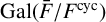 ${\mathrm {Gal}}(\bar {F}/F^{\mathrm {cyc}})$
is equal to one. From this starting point, our method proceeds via a purely cohomological approach. (Upon completing our work, the authors learned that Witte had proven a similar result on the
${\mathrm {Gal}}(\bar {F}/F^{\mathrm {cyc}})$
is equal to one. From this starting point, our method proceeds via a purely cohomological approach. (Upon completing our work, the authors learned that Witte had proven a similar result on the $\mathfrak {M}_H(G)$
-conjecture using entirely different methods (see [Reference Witte46]); we thank Jishnu Ray and Fabien Trihan for pointing this out.) While Witte’s result on the
$\mathfrak {M}_H(G)$
-conjecture using entirely different methods (see [Reference Witte46]); we thank Jishnu Ray and Fabien Trihan for pointing this out.) While Witte’s result on the $\mathfrak {M}_H(G)$
-conjecture may initially appear more general, as his approach involves the use of Selmer complexes, our result recovers his, given the well-documented relationship between Selmer groups and Selmer complexes (see [Reference Fukaya and Kato15, Propositions 4.2.35 and 4.3.13]; see also [Reference Lim25, Lemma 3.3.2]). Of course, this same relationship implies that our result follows from that of Witte. That said, we would like to elaborate on the motivation behind the alternative approach adopted in our paper. First of all, the focus of our work differs significantly from that of Witte’s. While Witte’s paper is centered on proving a main conjecture, our study is dedicated to investigating the precise structure of Selmer groups and the order of vanishing of their characteristic elements. More precisely, our direct approach proves that the global and local cohomology groups in the defining sequence of the Selmer group are cofinitely generated over
$\mathfrak {M}_H(G)$
-conjecture may initially appear more general, as his approach involves the use of Selmer complexes, our result recovers his, given the well-documented relationship between Selmer groups and Selmer complexes (see [Reference Fukaya and Kato15, Propositions 4.2.35 and 4.3.13]; see also [Reference Lim25, Lemma 3.3.2]). Of course, this same relationship implies that our result follows from that of Witte. That said, we would like to elaborate on the motivation behind the alternative approach adopted in our paper. First of all, the focus of our work differs significantly from that of Witte’s. While Witte’s paper is centered on proving a main conjecture, our study is dedicated to investigating the precise structure of Selmer groups and the order of vanishing of their characteristic elements. More precisely, our direct approach proves that the global and local cohomology groups in the defining sequence of the Selmer group are cofinitely generated over $\Lambda (H)$
(see Lemma 3.3 and the discussion preceding Lemma 5.3), a fact that does not appear to be explicitly established in Witte’s work. In contrast, within the number field context, these cohomology groups are not cofinitely generated over
$\Lambda (H)$
(see Lemma 3.3 and the discussion preceding Lemma 5.3), a fact that does not appear to be explicitly established in Witte’s work. In contrast, within the number field context, these cohomology groups are not cofinitely generated over $\Lambda (H)$
(see [Reference Ochi and Venjakob35, Theorems 3.2 and 4.1]), necessitating an argument that is based on the snake lemma in order to compute the Akashi series of a Selmer group (as in [Reference Coates, Schneider and Sujatha10, Reference Zerbes48, Reference Zerbes49]). In the function field context, our observation that these groups are
$\Lambda (H)$
(see [Reference Ochi and Venjakob35, Theorems 3.2 and 4.1]), necessitating an argument that is based on the snake lemma in order to compute the Akashi series of a Selmer group (as in [Reference Coates, Schneider and Sujatha10, Reference Zerbes48, Reference Zerbes49]). In the function field context, our observation that these groups are $\Lambda (H)$
-cofinitely generated allows for a more straightforward computation of the Akashi series of Selmer groups by directly computing the Akashi series of the global and local cohomology groups (see Section 5 for details). Additionally, we show that the generalized
$\Lambda (H)$
-cofinitely generated allows for a more straightforward computation of the Akashi series of Selmer groups by directly computing the Akashi series of the global and local cohomology groups (see Section 5 for details). Additionally, we show that the generalized $\mu $
-invariant of the dual Selmer group
$\mu $
-invariant of the dual Selmer group $X(A/F_\infty )$
, as well as the
$X(A/F_\infty )$
, as well as the $\mu $
-invariant of the dual Selmer group
$\mu $
-invariant of the dual Selmer group $X(A/F^{\mathrm {cyc}})$
, are both equal to zero (see Corollary 3.5). We note that the vanishing of the
$X(A/F^{\mathrm {cyc}})$
, are both equal to zero (see Corollary 3.5). We note that the vanishing of the $\mu $
-invariant is already implicit in [Reference Witte46, Corollary 4.21], where it is shown that the dual Selmer group lies in a certain category
$\mu $
-invariant is already implicit in [Reference Witte46, Corollary 4.21], where it is shown that the dual Selmer group lies in a certain category $\mathbf {N}_H$
, which essentially also implies that
$\mathbf {N}_H$
, which essentially also implies that $\mu =0$
. Finally, without relying on a noncommutative main conjecture, we present results related to the Birch–Swinnerton-Dyer conjecture, based on Tate’s fundamental work, under an assumption on the finiteness of the Tate–Shafarevich group (see Theorem 1.4 and the subsequent discussion).
$\mu =0$
. Finally, without relying on a noncommutative main conjecture, we present results related to the Birch–Swinnerton-Dyer conjecture, based on Tate’s fundamental work, under an assumption on the finiteness of the Tate–Shafarevich group (see Theorem 1.4 and the subsequent discussion).
In light of Theorem 1.3, we can now attach a characteristic element $\xi _A$
to
$\xi _A$
to $X(A/F_\infty )$
in the sense of Coates et al. This enables us to evaluate
$X(A/F_\infty )$
in the sense of Coates et al. This enables us to evaluate $\xi _A$
at a given Artin representation
$\xi _A$
at a given Artin representation $\rho : G\to {\mathrm {GL}}_n(\mathcal {O})$
, where
$\rho : G\to {\mathrm {GL}}_n(\mathcal {O})$
, where $\mathcal {O}$
is the ring of integers of a finite extension of
$\mathcal {O}$
is the ring of integers of a finite extension of ${\mathbb {Q}}_p$
in
${\mathbb {Q}}_p$
in $\overline {{\mathbb {Q}}}_p$
, via the homomorphism
$\overline {{\mathbb {Q}}}_p$
, via the homomorphism $\Phi _\rho $
(for details, see Section 7, particularly (7-2)). This yields an element in the field of fractions of the formal power series ring
$\Phi _\rho $
(for details, see Section 7, particularly (7-2)). This yields an element in the field of fractions of the formal power series ring $\mathcal {O}[[T]]$
in an indeterminate T with coefficients in
$\mathcal {O}[[T]]$
in an indeterminate T with coefficients in $\mathcal {O}$
. To facilitate explicit calculations in the discussion that follows, we introduce the following assumption:
$\mathcal {O}$
. To facilitate explicit calculations in the discussion that follows, we introduce the following assumption:
 $$ \begin{align*}\mathbf{(G)}: \quad H^i(G, A_{p^\infty}(F_\infty)) \text{ is finite for all } i \geq 1.\end{align*} $$
We are now in a position to state our next result, presented here in a slightly simplified form. For a more precise and general version, we refer readers to Theorem 7.7, Corollary 7.8, and Theorem 7.12.
Theorem 1.4. Let A be an abelian variety defined over a global function field F with $\mathrm {char}(F)\neq p$
and let
$\mathrm {char}(F)\neq p$
and let $F_\infty /F$
be an admissible p-adic Lie extension. Denote by
$F_\infty /F$
be an admissible p-adic Lie extension. Denote by $\xi _A$
the characteristic element of
$\xi _A$
the characteristic element of $X(A/F_\infty )$
and let
$X(A/F_\infty )$
and let $\mathrm {reg}_F$
denote the regular representation of F. Assuming
$\mathrm {reg}_F$
denote the regular representation of F. Assuming $(\mathbf {G})$
holds,
$(\mathbf {G})$
holds,
 $$ \begin{align*}{\mathrm{ord}}_{T=0}(\Phi_{\mathrm{reg}_F}(\xi_A))\geq {\mathrm{corank}}_{{\mathbb {Z}}_p}({\mathrm{Sel}}(A/F)).\end{align*} $$
Moreover, equality holds if Greenberg’s semi-simplicity conjecture (Conjecture 6.2) holds for $A/F$
. Additionally, if we assume the finiteness of
$A/F$
. Additionally, if we assume the finiteness of  , then
 $$ \begin{align*} {\mathrm{ord}}_{T=0}(\Phi_{\mathrm{reg}_F}(\xi_A))= {\mathrm{ord}}_{s=1}L(A/F,s). \end{align*} $$
In fact, by the deep theorem of Kato and Trihan [Reference Kato and Trihan22], the finiteness of the $\ell $
-primary part of the Tate–Shafarevich group
$\ell $
-primary part of the Tate–Shafarevich group  for a single prime number $\ell $
is sufficient to establish the final equality in the theorem.
$\ell $
is sufficient to establish the final equality in the theorem.
To state our final result, we first introduce the following stronger finiteness assumption. Recall that we write $H={\mathrm {Gal}}(F_\infty /F^{\mathrm {cyc}})$
.
$H={\mathrm {Gal}}(F_\infty /F^{\mathrm {cyc}})$
.
 $$ \begin{align*}\mathbf{(H)}: \quad H^i(H, A_{p^\infty}(F_\infty)) \text{ is finite for all } i \geq 0.\end{align*} $$
We provide a criterion for this condition to hold in Proposition 7.5 (see also [Reference Zerbes48, Section 5] and [Reference Lim25, Remark 6.6] for cases where Assumption ( $\mathbf {H}$
) is known to hold in the number field context). Let S be a nonempty finite set of primes of F containing all the primes where the abelian variety A has bad reduction, as well as all the primes of F that ramify in
$\mathbf {H}$
) is known to hold in the number field context). Let S be a nonempty finite set of primes of F containing all the primes where the abelian variety A has bad reduction, as well as all the primes of F that ramify in $F_\infty $
. Let
$F_\infty $
. Let $S'$
denote the subset of primes in S whose inertia group in G is infinite. We write
$S'$
denote the subset of primes in S whose inertia group in G is infinite. We write $A^*$
for the dual abelian variety. The following is our final main result.
$A^*$
for the dual abelian variety. The following is our final main result.
Theorem 1.5. Let A be an abelian variety defined over a global field F with $\mathrm {char} F\neq p$
and let
$\mathrm {char} F\neq p$
and let $F_\infty $
be an admissible p-adic Lie extension of F. Assume that Assumption
$F_\infty $
be an admissible p-adic Lie extension of F. Assume that Assumption $(\mathbf {H})$
holds. Then,
$(\mathbf {H})$
holds. Then, ${\mathrm {Sel}}(A/F_\infty )$
has a finite generalized G-Euler characteristic
${\mathrm {Sel}}(A/F_\infty )$
has a finite generalized G-Euler characteristic $\chi (G, {\mathrm {Sel}}(A/F_\infty ))$
if and only if
$\chi (G, {\mathrm {Sel}}(A/F_\infty ))$
if and only if ${\mathrm {Sel}}(A/F^{\mathrm {cyc}})$
has a finite generalized
${\mathrm {Sel}}(A/F^{\mathrm {cyc}})$
has a finite generalized $\Gamma $
-Euler characteristic
$\Gamma $
-Euler characteristic $\chi (\Gamma , {\mathrm {Sel}}(A/F^{\mathrm {cyc}}))$
. Moreover, if this is the case, then
$\chi (\Gamma , {\mathrm {Sel}}(A/F^{\mathrm {cyc}}))$
. Moreover, if this is the case, then
 $$ \begin{align*}\chi(G, {\mathrm{Sel}}(A/F_\infty)) = \chi(\Gamma, {\mathrm{Sel}}(A/F^{\mathrm{cyc}})) \prod_{v\in S'}\frac{\# A^*_{p^\infty}(F_v)}{\# H^1(\Gamma_w, A_{p^\infty}(F^{\mathrm{cyc}}_w))},\end{align*} $$
where, for each $v\in S'$
, w is a fixed prime of
$v\in S'$
, w is a fixed prime of $F^{\mathrm {cyc}}$
lying above v and
$F^{\mathrm {cyc}}$
lying above v and $\Gamma _w$
denotes the decomposition subgroup of
$\Gamma _w$
denotes the decomposition subgroup of $\Gamma $
at w.
$\Gamma $
at w.
This result is a natural analog of Zerbes [Reference Zerbes48], who proved a similar statement in the context of number fields. In the function field context, our theorem generalizes earlier computations by Sechi [Reference Sechi38] and Valentino [Reference Valentino43]. When A is an elliptic curve, our formula recovers Sechi’s result, in which Euler factors of the complex L-function appear on the right-hand side. For explicit examples, we refer the reader to [Reference Sechi38].
We conclude this introduction with an outline of the paper. Section 2 collects foundational material on Iwasawa algebras, which are used throughout the paper. The proof of Theorem 1.3 is given in Section 3. The key observation is that the Galois group ${\mathrm {Gal}}(F_S/F^{\mathrm {cyc}})$
, where
${\mathrm {Gal}}(F_S/F^{\mathrm {cyc}})$
, where $F_S$
is the maximal algebraic extension of F contained in
$F_S$
is the maximal algebraic extension of F contained in $\bar {F}$
, which is unramified outside S, has p-cohomological dimension one (see Lemma 3.2). In Section 4, we establish the surjectivity of the localization map defining the Selmer group
$\bar {F}$
, which is unramified outside S, has p-cohomological dimension one (see Lemma 3.2). In Section 4, we establish the surjectivity of the localization map defining the Selmer group ${\mathrm {Sel}}(A/F_\infty )$
, using Jannsen’s spectral sequence and Nekovář’s duality theorem. This is a key input in our computation of Akashi series in Section 5. In Section 6, we prove a control theorem, showing in particular that the restriction map
${\mathrm {Sel}}(A/F_\infty )$
, using Jannsen’s spectral sequence and Nekovář’s duality theorem. This is a key input in our computation of Akashi series in Section 5. In Section 6, we prove a control theorem, showing in particular that the restriction map ${\mathrm {Sel}}(A/F)\to {\mathrm {Sel}}(A/F^{\mathrm {cyc}})^{\Gamma }$
has a finite kernel and cokernel. This allows us to relate the order of vanishing at
${\mathrm {Sel}}(A/F)\to {\mathrm {Sel}}(A/F^{\mathrm {cyc}})^{\Gamma }$
has a finite kernel and cokernel. This allows us to relate the order of vanishing at $T=0$
of the characteristic power series of
$T=0$
of the characteristic power series of ${\mathrm {Sel}}(A/F^{\mathrm {cyc}})$
to the
${\mathrm {Sel}}(A/F^{\mathrm {cyc}})$
to the ${\mathbb {Z}}_p$
-corank of the Selmer group
${\mathbb {Z}}_p$
-corank of the Selmer group ${\mathrm {Sel}}(A/F)$
. Section 7 relates the order of vanishing of characteristic elements evaluated at Artin representations to Selmer coranks and their twists over intermediate subextensions of the p-adic Lie extension. This yields Theorem 1.4. In Section 8, we introduce the definition of the generalized Euler characteristic, following the framework of Zerbes [Reference Zerbes48]. Finally, in Section 9, we compute the generalized Euler characteristics under the assumption
${\mathrm {Sel}}(A/F)$
. Section 7 relates the order of vanishing of characteristic elements evaluated at Artin representations to Selmer coranks and their twists over intermediate subextensions of the p-adic Lie extension. This yields Theorem 1.4. In Section 8, we introduce the definition of the generalized Euler characteristic, following the framework of Zerbes [Reference Zerbes48]. Finally, in Section 9, we compute the generalized Euler characteristics under the assumption $(\mathbf {H})$
, thereby establishing Theorem 1.5.
$(\mathbf {H})$
, thereby establishing Theorem 1.5.
2 Prerequisites on Iwasawa algebras
Throughout, let p denote a fixed prime. Let G be a compact p-adic Lie group without p-torsion. The Iwasawa algebra of G over ${\mathbb {Z}}_p$
is defined by
${\mathbb {Z}}_p$
is defined by
 $$ \begin{align*} \Lambda(G)= \varprojlim {\mathbb {Z}}_p[G/U], \end{align*} $$
where U runs over the open normal subgroups of G and the inverse limit is taken with respect to the natural projection maps. Assume for now that G is a pro-p group. Then, the ring $\Lambda (G)$
admits a skew field of fractions
$\Lambda (G)$
admits a skew field of fractions $\mathcal {Q}(G)$
, which allows us to define the rank of a
$\mathcal {Q}(G)$
, which allows us to define the rank of a $\Lambda (G)$
-module M as follows:
$\Lambda (G)$
-module M as follows:
 $$ \begin{align*} {\mathrm{rank}}_{\Lambda(G)}(M) = \dim_{\mathcal{Q}(G)}\mathcal{Q}(G)\otimes_{\Lambda(G)}M. \end{align*} $$
The module M is said to be torsion if ${\mathrm {rank}}_{\Lambda (G)}(M)=0$
.
${\mathrm {rank}}_{\Lambda (G)}(M)=0$
.
Now, suppose that G is not necessarily pro-p. By Lazard’s theorem (see [Reference Dixon, du Sautoy, Mann and Segal13, Corollary 8.34]), one can always find an open subgroup $G'$
of G that is pro-p. In this case, a
$G'$
of G that is pro-p. In this case, a $\Lambda (G)$
-module M is said to be torsion over
$\Lambda (G)$
-module M is said to be torsion over $\Lambda (G)$
if it is torsion over
$\Lambda (G)$
if it is torsion over $\Lambda (G')$
in the sense defined above. We shall also make use of the following equivalent characterization of a torsion
$\Lambda (G')$
in the sense defined above. We shall also make use of the following equivalent characterization of a torsion $\Lambda (G)$
-module:
$\Lambda (G)$
-module: ${\mathrm {Hom}}_{\Lambda (G)}(M,\Lambda (G))=0$
(cf. [Reference Venjakob44, Remark 3.7]).
${\mathrm {Hom}}_{\Lambda (G)}(M,\Lambda (G))=0$
(cf. [Reference Venjakob44, Remark 3.7]).
3 Selmer groups and the
${\mathfrak {M}}_H(G)$
-conjecture

Let p be any prime number. Throughout, let F denote a global function field of characteristic coprime to p and write k for its constant field. Suppose that A is an abelian variety defined over F. Let $F_\infty $
be a p-adic Lie extension of F satisfying the following admissibility conditions:
$F_\infty $
be a p-adic Lie extension of F satisfying the following admissibility conditions:
-
(i)
$F_\infty $
contains the cyclotomic
${\mathbb {Z}}_p$
-extension
$F^{\mathrm {cyc}}$
of F; -
(ii)
$G = {\mathrm {Gal}}(F_\infty /F)$
is a compact p-adic group without p-torsion; -
(iii)
$F_\infty /F$
is unramified outside of a finite set of primes.


In particular, the extension $F^{\mathrm {cyc}}$
itself satisfies these conditions. Let S be a nonempty finite set of primes of F containing all primes where the abelian variety A has bad reduction, as well as all primes of F that ramify in
$F^{\mathrm {cyc}}$
itself satisfies these conditions. Let S be a nonempty finite set of primes of F containing all primes where the abelian variety A has bad reduction, as well as all primes of F that ramify in $F_\infty $
.
$F_\infty $
.
Let $\bar {F}$
denote a separable closure of F. For any extension
$\bar {F}$
denote a separable closure of F. For any extension ${\mathfrak {K}}$
inside
${\mathfrak {K}}$
inside $\bar {F}$
, we define the p-primary Selmer group
$\bar {F}$
, we define the p-primary Selmer group ${\mathrm {Sel}}(A/{\mathfrak {K}})$
using Galois cohomology as follows:
${\mathrm {Sel}}(A/{\mathfrak {K}})$
using Galois cohomology as follows:
 $$ \begin{align*} {\mathrm{Sel}}(A/{\mathfrak{K}})=\mathrm{ker}\bigg(H^1({\mathfrak{K}},A_{p^\infty})\rightarrow\prod_w H^1({\mathfrak{K}}_w,A)\bigg), \end{align*} $$
where $A_{p^\infty }$
denotes the group of all p-power division points in
$A_{p^\infty }$
denotes the group of all p-power division points in $A(\bar {F})$
. Note that when
$A(\bar {F})$
. Note that when ${\mathfrak {K}}$
is an infinite extension of F, each
${\mathfrak {K}}$
is an infinite extension of F, each ${\mathfrak {K}}_w$
is defined as the union of completions at w of all finite extensions of F contained in
${\mathfrak {K}}_w$
is defined as the union of completions at w of all finite extensions of F contained in ${\mathfrak {K}}$
. If
${\mathfrak {K}}$
. If ${\mathfrak {K}}$
is Galois over F, then the natural action of
${\mathfrak {K}}$
is Galois over F, then the natural action of ${\mathrm {Gal}}({\mathfrak {K}} /F)$
on
${\mathrm {Gal}}({\mathfrak {K}} /F)$
on $H^1({\mathfrak {K}},A_{p^\infty })$
endows
$H^1({\mathfrak {K}},A_{p^\infty })$
endows ${\mathrm {Sel}}(A/{\mathfrak {K}})$
with the structure of a
${\mathrm {Sel}}(A/{\mathfrak {K}})$
with the structure of a ${\mathrm {Gal}}({\mathfrak {K}}/F)$
-module.
${\mathrm {Gal}}({\mathfrak {K}}/F)$
-module.
Let $F_S$
denote the maximal extension of F inside
$F_S$
denote the maximal extension of F inside $\bar {F}$
that is unramified outside S. By the choice of S, we know
$\bar {F}$
that is unramified outside S. By the choice of S, we know $F_\infty $
is contained in
$F_\infty $
is contained in $F_S$
. For any extension K of F contained in
$F_S$
. For any extension K of F contained in $F_S$
, we write
$F_S$
, we write $G_S(K)={\mathrm {Gal}}(F_S/K)$
. Now, for a finite extension
$G_S(K)={\mathrm {Gal}}(F_S/K)$
. Now, for a finite extension $L/F$
and for each prime v of F, define
$L/F$
and for each prime v of F, define
 $$ \begin{align*}J_v(A/L)=\bigoplus_{w\mid v}H^1(L_w,A)(p),\end{align*} $$
where the direct sum is taken over all primes w of L lying above v. Since $L_w$
has characteristic different from p, Kummer theory gives the natural identification
$L_w$
has characteristic different from p, Kummer theory gives the natural identification $H^1(L_w,A)(p) \simeq H^1(L_w, A_{p^\infty })$
. We make use of this identification without any further comment.
$H^1(L_w,A)(p) \simeq H^1(L_w, A_{p^\infty })$
. We make use of this identification without any further comment.
Let $\bar {L}_w$
be a separable closure of
$\bar {L}_w$
be a separable closure of $L_w$
. By choosing an embedding
$L_w$
. By choosing an embedding $\bar {L}\subset \bar {L}_w$
, we may view
$\bar {L}\subset \bar {L}_w$
, we may view ${\mathrm {Gal}}(\bar {L}_w/L_w)$
as a subgroup of
${\mathrm {Gal}}(\bar {L}_w/L_w)$
as a subgroup of ${\mathrm {Gal}}(\bar {L}/L)$
. This gives rise to the following localization map:
${\mathrm {Gal}}(\bar {L}/L)$
. This gives rise to the following localization map:
 $$ \begin{align*} \lambda_S(A/L): H^1(G_S(L),A_{p^\infty}) \to \bigoplus_{v\in S}J_v(A/L), \end{align*} $$
which is induced by restriction.
For an infinite separable extension K of F contained in $F_S$
, we define
$F_S$
, we define
 $$ \begin{align*}J_v(A/K)=\lim_{\longrightarrow}J_v(A/L),\end{align*} $$
where the direct limit is taken over all finite extensions L of F contained in K, with respect to the natural restriction maps. Correspondingly, we define the localization map
 $$ \begin{align*}\lambda_S(A/K)=\lim_{\longrightarrow}\lambda_S(A/L).\end{align*} $$
We use the following result on Selmer groups, which can be proved in the same way as for elliptic curves over number fields (see [Reference Coates6, Lemma 2.3]).
Proposition 3.1. Let K be an extension of F contained in $F_S$
. Then,
$F_S$
. Then, ${\mathrm {Sel}}(A/K)$
fits into the exact sequence:
${\mathrm {Sel}}(A/K)$
fits into the exact sequence:
 $$ \begin{align*} 0 \longrightarrow \mathrm{Sel}(A/K) \longrightarrow H^1(G_S(K), A_{p^\infty}) \stackrel{\lambda_S(A/K)}{\longrightarrow} \bigoplus_{v \in S} J_v(A/K). \end{align*} $$
The remainder of this section is devoted to proving the $\mathfrak {M}_H(G)$
-conjecture for the Pontryagin dual
$\mathfrak {M}_H(G)$
-conjecture for the Pontryagin dual $X(A/F_\infty )$
of the p-primary Selmer group
$X(A/F_\infty )$
of the p-primary Selmer group ${\mathrm {Sel}}(A/F_\infty )$
. To this end, we begin with a crucial observation.
${\mathrm {Sel}}(A/F_\infty )$
. To this end, we begin with a crucial observation.
Lemma 3.2. We have
 $$ \begin{align*}\mathrm{cd}_p(G_S(F^{\mathrm{cyc}}))=1.\end{align*} $$
Proof. Since the set S is nonempty and $\mathrm {char}(F)\neq p$
, [Reference Neukirch, Schmidt and Wingberg34, Theorem 10.1.2 (i)(c)] implies that
$\mathrm {char}(F)\neq p$
, [Reference Neukirch, Schmidt and Wingberg34, Theorem 10.1.2 (i)(c)] implies that
 $$ \begin{align*}\mathrm{cd}_p(G_S(\bar{k}F))=1.\end{align*} $$
Note that $G_S(\bar {k}F)$
is a closed subgroup of
$G_S(\bar {k}F)$
is a closed subgroup of $G_S(F^{\mathrm {cyc}})$
and that its quotient
$G_S(F^{\mathrm {cyc}})$
and that its quotient ${\mathrm {Gal}}(\bar {k}F/F^{\mathrm {cyc}})$
is a profinite group in which every open subgroup has an index prime to p. Hence, by applying [Reference Neukirch, Schmidt and Wingberg34, Proposition 3.3.5(i)], we conclude that
${\mathrm {Gal}}(\bar {k}F/F^{\mathrm {cyc}})$
is a profinite group in which every open subgroup has an index prime to p. Hence, by applying [Reference Neukirch, Schmidt and Wingberg34, Proposition 3.3.5(i)], we conclude that $\mathrm {cd}_p(G_S(F^{\mathrm {cyc}}))=\mathrm {cd}_p(G_S(\bar {k}F))$
and the lemma follows.
$\mathrm {cd}_p(G_S(F^{\mathrm {cyc}}))=\mathrm {cd}_p(G_S(\bar {k}F))$
and the lemma follows.
Lemma 3.3. The cohomology group $H^1(G_S(F_\infty ), A_{p^\infty })$
is cofinitely generated over
$H^1(G_S(F_\infty ), A_{p^\infty })$
is cofinitely generated over $\Lambda (H)$
. In particular, the Pontryagin dual
$\Lambda (H)$
. In particular, the Pontryagin dual $H^1(G_S(F_\infty ), A_{p^\infty })^\vee $
is a torsion
$H^1(G_S(F_\infty ), A_{p^\infty })^\vee $
is a torsion $\Lambda (G)$
-module.
$\Lambda (G)$
-module.
Proof. Without loss of generality, we may assume that both G and consequently H are pro-p and have no p-torsion. By Nakayama’s lemma, it suffices to show that $H^1(G_S(F_\infty ), A_{p^\infty })^H$
is cofinitely generated over
$H^1(G_S(F_\infty ), A_{p^\infty })^H$
is cofinitely generated over ${\mathbb {Z}}_p$
.
${\mathbb {Z}}_p$
.
Since $H^2(G_S(F^{\mathrm {cyc}}),A_{p^\infty })=H^2(G_S(F_\infty ), A_{p^\infty })=0$
by Lemma 3.2, the Hochschild–Serre spectral sequence
$H^2(G_S(F^{\mathrm {cyc}}),A_{p^\infty })=H^2(G_S(F_\infty ), A_{p^\infty })=0$
by Lemma 3.2, the Hochschild–Serre spectral sequence
 $$ \begin{align*}H^i(H,H^j(G_S(F_\infty),A_{p^\infty}))\Rightarrow H^{i+j}(G_S(F^{\mathrm{cyc}}), A_{p^\infty})\end{align*} $$
degenerates to yield the following exact sequence:
 $$ \begin{align*}&0\to H^1(H,A_{p^\infty}(F_\infty))\to H^1(G_S(F^{\mathrm{cyc}}),A_{p^\infty})\\ &\quad\to H^1(G_S(F_\infty),A_{p^\infty})^H\to H^2(H,A_{p^\infty}(F_\infty)) \to 0. \end{align*} $$
Since both $H^1(H,A_{p^\infty }(F_\infty ))$
and
$H^1(H,A_{p^\infty }(F_\infty ))$
and $H^2(H,A_{p^\infty }(F_\infty ))$
are cofinitely generated over
$H^2(H,A_{p^\infty }(F_\infty ))$
are cofinitely generated over ${\mathbb {Z}}_p$
(see the proof of [Reference Howson18, Theorem 1.1]), it remains to show that
${\mathbb {Z}}_p$
(see the proof of [Reference Howson18, Theorem 1.1]), it remains to show that $H^1(G_S(F^{\mathrm {cyc}}),A_{p^\infty })$
is cofinitely generated over
$H^1(G_S(F^{\mathrm {cyc}}),A_{p^\infty })$
is cofinitely generated over ${\mathbb {Z}}_p$
. By Nakayama’s lemma, this is equivalent to showing that
${\mathbb {Z}}_p$
. By Nakayama’s lemma, this is equivalent to showing that $H^1(G_S(F^{\mathrm {cyc}}),A_{p^\infty })[p]$
is finite. From the long exact sequence of Galois cohomology associated with the short exact sequence
$H^1(G_S(F^{\mathrm {cyc}}),A_{p^\infty })[p]$
is finite. From the long exact sequence of Galois cohomology associated with the short exact sequence $0\to A_p\to A_{p^\infty }\xrightarrow {p} A_{p^\infty }\to 0$
, we obtain a surjection
$0\to A_p\to A_{p^\infty }\xrightarrow {p} A_{p^\infty }\to 0$
, we obtain a surjection
 $$ \begin{align*} H^1(G_S(F_{\mathrm{cyc}}), A_{p}) \twoheadrightarrow H^1(G_S(F_{\mathrm{cyc}}), A_{p^\infty})[p].\end{align*} $$
Hence, it suffices to show that $H^1(G_S(F_{\mathrm {cyc}}), A_{p})$
is finite. This is equivalent to proving that
$H^1(G_S(F_{\mathrm {cyc}}), A_{p})$
is finite. This is equivalent to proving that
 $$ \begin{align*}{\mathrm{corank}}_{{\mathbb {F}}_p[[\Gamma]]}(H^1(G_S(F_{\mathrm{cyc}}), A_{p}))=0.\end{align*} $$
Since ${\mathrm {corank}}_{{\mathbb {F}}_p[[\Gamma ]]}(H^0(G_S(F^{\mathrm {cyc}}),A_p))=0$
and
${\mathrm {corank}}_{{\mathbb {F}}_p[[\Gamma ]]}(H^0(G_S(F^{\mathrm {cyc}}),A_p))=0$
and $H^2(G_S(F^{{\mathrm {cyc}}}),A_p)=0$
,
$H^2(G_S(F^{{\mathrm {cyc}}}),A_p)=0$
,
 $$ \begin{align}{\mathrm{corank}}_{{\mathbb {F}}_p[[\Gamma]]}(H^1(G_S(F^{\mathrm{cyc}}),A_p)) =\sum_{i=0}^2(-1)^{i+1}{\mathrm{corank}}_{{\mathbb {F}}_p[[\Gamma]]}(H^i(G_S(F^{\mathrm{cyc}}),A_p)). \end{align} $$
Using the spectral sequence
 $$ \begin{align*} H^i(\Gamma, H^j(G_S(F^{\mathrm{cyc}}), A_{p})) \Rightarrow H^{i+j}(G_S(F),A_p), \end{align*} $$
we conclude that the right-hand side of (3-1) equals
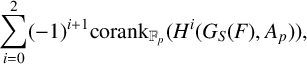 $$ \begin{align*}\sum_{i=0}^2(-1)^{i+1}{\mathrm{corank}}_{{\mathbb {F}}_p}(H^i(G_S(F), A_p)),\end{align*} $$
which vanishes by a global Euler–Poincaré characteristic calculation (see [Reference Neukirch, Schmidt and Wingberg34, (8.7.4)]). This concludes the proof of the lemma.
We can now prove the main result of this section.
Theorem 3.4. Let A be an abelian variety defined over a global function field F of characteristic prime to p. Let $F_\infty /F$
be an admissible p-adic Lie extension. Then, the Selmer group
$F_\infty /F$
be an admissible p-adic Lie extension. Then, the Selmer group ${\mathrm {Sel}}(A/F_\infty )$
is a cofinitely generated
${\mathrm {Sel}}(A/F_\infty )$
is a cofinitely generated $\Lambda (H)$
-module. In particular, the
$\Lambda (H)$
-module. In particular, the $\mathfrak {M}_H(G)$
-conjecture holds for
$\mathfrak {M}_H(G)$
-conjecture holds for $X(A/F_\infty )$
. Furthermore,
$X(A/F_\infty )$
. Furthermore, ${\mathrm {Sel}}(A/F^{\mathrm {cyc}})$
is a cofinitely generated
${\mathrm {Sel}}(A/F^{\mathrm {cyc}})$
is a cofinitely generated ${\mathbb {Z}}_p$
-module.
${\mathbb {Z}}_p$
-module.
Proof. Since ${\mathrm {Sel}}(A/F_\infty )$
is contained in
${\mathrm {Sel}}(A/F_\infty )$
is contained in $H^1(G_S(F_\infty ), A_{p^\infty })$
, the result follows immediately from Lemma 3.3.
$H^1(G_S(F_\infty ), A_{p^\infty })$
, the result follows immediately from Lemma 3.3.
We remark that the above theorem relies crucially on the assumption that $\mathrm {char}(F)\neq p$
; otherwise, the key ingredient—the global Euler–Poincaré characteristic—fails, due to the fact that
$\mathrm {char}(F)\neq p$
; otherwise, the key ingredient—the global Euler–Poincaré characteristic—fails, due to the fact that $p = 0$
in any ring of characteristic p. This also explains the
$p = 0$
in any ring of characteristic p. This also explains the $\mu = 0$
condition imposed in [Reference Ochiai and Trihan36]. We conclude with the following corollary concerning the generalized
$\mu = 0$
condition imposed in [Reference Ochiai and Trihan36]. We conclude with the following corollary concerning the generalized $\mu $
-invariant, as defined in [Reference Burns and Venjakob4, Reference Howson18, Reference Venjakob44] for finitely generated
$\mu $
-invariant, as defined in [Reference Burns and Venjakob4, Reference Howson18, Reference Venjakob44] for finitely generated $\Lambda (G)$
-modules.
$\Lambda (G)$
-modules.
Corollary 3.5. The generalized $\mu $
-invariant of
$\mu $
-invariant of $X(A/F_\infty )$
is zero.
$X(A/F_\infty )$
is zero.
Proof. We have shown that ${\mathrm {Sel}}(A/F_\infty )$
is a cofinitely generated
${\mathrm {Sel}}(A/F_\infty )$
is a cofinitely generated $\Lambda (H)$
-module. By [Reference Coates, Fukaya, Kato, Sujatha and Venjakob8, Proposition 2.3], this is equivalent to
$\Lambda (H)$
-module. By [Reference Coates, Fukaya, Kato, Sujatha and Venjakob8, Proposition 2.3], this is equivalent to $X(A/F_\infty )$
being
$X(A/F_\infty )$
being $\Sigma $
-torsion, where
$\Sigma $
-torsion, where $\Sigma $
is the Ore set introduced in Section 7. The result then follows from, for example, the proof of [Reference Burns and Venjakob4, Proposition 3.3(i)] (also see [Reference Howson18, Lemma 2.7]).
$\Sigma $
is the Ore set introduced in Section 7. The result then follows from, for example, the proof of [Reference Burns and Venjakob4, Proposition 3.3(i)] (also see [Reference Howson18, Lemma 2.7]).
4 Surjectivity of localization map
In this section, we establish the surjectivity of the localization map $\lambda _S(A/F_\infty )$
defining the Selmer group
$\lambda _S(A/F_\infty )$
defining the Selmer group ${\mathrm {Sel}}(A/F_\infty )$
. In particular, we deduce the surjectivity of the localization map
${\mathrm {Sel}}(A/F_\infty )$
. In particular, we deduce the surjectivity of the localization map $\lambda _S(A/F^{\mathrm {cyc}})$
. Before giving the proof, we introduce the compact Selmer group
$\lambda _S(A/F^{\mathrm {cyc}})$
. Before giving the proof, we introduce the compact Selmer group ${\mathfrak {S}}(A/F_\infty )$
. Let
${\mathfrak {S}}(A/F_\infty )$
. Let $T_pA=\varprojlim _n A_{p^n}$
denote the p-adic Tate module of A. For every finite extension L of F contained in
$T_pA=\varprojlim _n A_{p^n}$
denote the p-adic Tate module of A. For every finite extension L of F contained in $F_\infty $
, the compact Selmer group
$F_\infty $
, the compact Selmer group ${\mathfrak {S}}(A/L)$
is defined as
${\mathfrak {S}}(A/L)$
is defined as
 $$ \begin{align*} \mathrm{ker}\bigg( H^1(G_S(L), T_p A) \to \bigoplus_{w\in S} H^1(L_w, T_p A)\bigg),\end{align*} $$
where the sum runs over all primes w of L lying above the set S. We then define the compact Selmer group over $F_\infty $
as the inverse limit
$F_\infty $
as the inverse limit
 $$ \begin{align*}{\mathfrak{S}}(A/F_\infty)=\varprojlim_{L}{\mathfrak{S}}(A/L),\end{align*} $$
where the limit is taken over all finite extensions L of F contained in $F_\infty $
. We also define the continuous Iwasawa cohomology of
$F_\infty $
. We also define the continuous Iwasawa cohomology of $T_pA$
by
$T_pA$
by
 $$ \begin{align*}H^i_{\mathrm{Iw}}(F_\infty,T_pA)=\varprojlim_{L} H^{i}(G_S(L),T_p A),\end{align*} $$
where the limit is taken over all finite Galois extensions with transition maps given by the corestriction maps on cohomology. In particular, ${\mathfrak {S}}(A/F_\infty )$
is a submodule of
${\mathfrak {S}}(A/F_\infty )$
is a submodule of $H^1_{\mathrm {Iw}}(F_\infty ,T_pA)$
.
$H^1_{\mathrm {Iw}}(F_\infty ,T_pA)$
.
We now record the following result, which is a key ingredient in our eventual proof of surjectivity.
Lemma 4.1. The module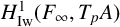 $H^1_{\mathrm {Iw}}(F_\infty , T_p A)$
is a torsion
$H^1_{\mathrm {Iw}}(F_\infty , T_p A)$
is a torsion $\Lambda (G)$
-module. Moreover, if
$\Lambda (G)$
-module. Moreover, if $\dim (G)\geq 2$
or if
$\dim (G)\geq 2$
or if $A_{p^\infty }(F_\infty )$
is finite, then
$A_{p^\infty }(F_\infty )$
is finite, then $H^1_{\mathrm {Iw}}(F_\infty , T_p A)=0$
.
$H^1_{\mathrm {Iw}}(F_\infty , T_p A)=0$
.
Proof. We consider the following spectral sequence of Jannsen (see [Reference Jannsen20, Theorems 1, 11]; see also [Reference Lim and Sharifi29, Theorem 4.5.1] and [Reference Nekovář33, Theorem 8.5.6]):
 $$ \begin{align*}E_2^{i,j}={\mathrm{Ext}}^i_{\Lambda(G)} ((H^j(G_S(F_\infty), A_{p^\infty}))^\vee, \Lambda(G)) \Rightarrow H^{i+j}_{\mathrm{Iw}}(F_\infty,T_p A).\end{align*} $$
The low-degree terms of this spectral sequence yield the following exact sequence:
 $$ \begin{align}&0\to {\mathrm{Ext}}^1_{\Lambda(G)} (A_{p^\infty}(F_\infty)^\vee, \Lambda(G))\to H^1_{\mathrm{Iw}}(F_\infty,T_p A)\nonumber\\ &\quad\to \mathrm{Hom}_{\Lambda(G)} ((H^1(G_S(F_\infty), A_{p^\infty}))^\vee, \Lambda(G)). \end{align} $$
By Lemma 3.3, we have ${\mathrm {rank}}_{\Lambda (G)}((H^1(G_S(F_\infty ), A_{p^\infty }))^\vee )=0$
, so the right-most term vanishes. Since
${\mathrm {rank}}_{\Lambda (G)}((H^1(G_S(F_\infty ), A_{p^\infty }))^\vee )=0$
, so the right-most term vanishes. Since $ {\mathrm {Ext}}^1_{\Lambda (G)} (A_{p^\infty }(F_\infty )^\vee , \Lambda (G))$
is a torsion
$ {\mathrm {Ext}}^1_{\Lambda (G)} (A_{p^\infty }(F_\infty )^\vee , \Lambda (G))$
is a torsion $\Lambda (G)$
-module (see [Reference Venjakob44, Proposition 3.5(iii)(a)]), it follows that
$\Lambda (G)$
-module (see [Reference Venjakob44, Proposition 3.5(iii)(a)]), it follows that $H^1_{\mathrm {Iw}}(F_\infty , T_p A)$
is a torsion
$H^1_{\mathrm {Iw}}(F_\infty , T_p A)$
is a torsion $\Lambda (G)$
-module. Now, by an observation of Jannsen (see [Reference Jannsen19, Corollary 2.6(b)(c)]), if
$\Lambda (G)$
-module. Now, by an observation of Jannsen (see [Reference Jannsen19, Corollary 2.6(b)(c)]), if $\dim (G)\geq 2$
or if
$\dim (G)\geq 2$
or if $A_{p^\infty }(F_\infty )$
is finite, then
$A_{p^\infty }(F_\infty )$
is finite, then ${\mathrm {Ext}}^1_{\Lambda (G)} (A_{p^\infty }(F_\infty )^\vee , \Lambda (G)) =0$
. Therefore, both the left-most and right-most terms in (4-1) vanish, and we conclude that
${\mathrm {Ext}}^1_{\Lambda (G)} (A_{p^\infty }(F_\infty )^\vee , \Lambda (G)) =0$
. Therefore, both the left-most and right-most terms in (4-1) vanish, and we conclude that $H^1_{\mathrm {Iw}}(F_\infty ,T_p A)=0$
, as required.
$H^1_{\mathrm {Iw}}(F_\infty ,T_p A)=0$
, as required.
Theorem 4.2. Let A be an abelian variety defined over a global function field F of characteristic prime to p and let $F_\infty /F$
be an admissible p-adic Lie extension. Then, the localization map
$F_\infty /F$
be an admissible p-adic Lie extension. Then, the localization map $\lambda _S(A/F_\infty )$
is surjective, yielding the following short exact sequence:
$\lambda _S(A/F_\infty )$
is surjective, yielding the following short exact sequence:
 $$ \begin{align} 0 \longrightarrow \operatorname{Sel}(A/F_\infty) \longrightarrow H^1(G_S(F_\infty), A_{p^\infty}) \overset{\lambda_S(A/F_\infty)}{\xrightarrow{\hspace{3cm}}} \bigoplus_{v \in S} J_v(A/F_\infty) \longrightarrow 0. \end{align} $$
Proof. Since the conclusion remains unchanged upon replacing the base field F by a larger field contained in $F_\infty $
, we may assume that G is pro-p. The Poitou–Tate sequence (see [Reference Neukirch, Schmidt and Wingberg34, Proof of Theorem 8.7.9]) gives the exact sequence
$F_\infty $
, we may assume that G is pro-p. The Poitou–Tate sequence (see [Reference Neukirch, Schmidt and Wingberg34, Proof of Theorem 8.7.9]) gives the exact sequence
 $$ \begin{align*}0\to {\mathrm{Sel}}(A/F_\infty)\to H^1(G_S(F_\infty),A_{p^\infty})\stackrel{\lambda_S(A/F_\infty)}{\longrightarrow}\bigoplus_{v\in S}J_v(A/F_\infty)\to{\mathfrak{S}}(A^*/F_\infty)^\vee \to 0, \end{align*} $$
where the final ‘ $0$
’ term follows from Lemma 3.2. Thus, it suffices to show that
$0$
’ term follows from Lemma 3.2. Thus, it suffices to show that ${\mathfrak {S}}(A^*/F_\infty )=0$
. By definition,
${\mathfrak {S}}(A^*/F_\infty )=0$
. By definition, ${\mathfrak {S}}(A^*/F_\infty )$
is contained in
${\mathfrak {S}}(A^*/F_\infty )$
is contained in $H^1_{\mathrm {Iw}}(F_\infty ,T_pA^*)$
. If
$H^1_{\mathrm {Iw}}(F_\infty ,T_pA^*)$
. If $\mathrm {dim}(G)\geq 2$
, then Lemma 4.1 implies that
$\mathrm {dim}(G)\geq 2$
, then Lemma 4.1 implies that $H^1_{\mathrm {Iw}}(F_\infty ,T_pA^*)=0$
and hence,
$H^1_{\mathrm {Iw}}(F_\infty ,T_pA^*)=0$
and hence, ${\mathfrak {S}}(A^*/F_\infty )=0$
.
${\mathfrak {S}}(A^*/F_\infty )=0$
.
It remains to consider the case $F_\infty =F^{\mathrm {cyc}}$
. This case is slightly more delicate, as we do not know a priori whether
$F_\infty =F^{\mathrm {cyc}}$
. This case is slightly more delicate, as we do not know a priori whether $A_{p^\infty }(F^{\mathrm {cyc}})$
is finite (see Remark 4.3 for the elliptic curve case). By replacing F with a finite extension if necessary, we may assume that every prime in S remains inert in
$A_{p^\infty }(F^{\mathrm {cyc}})$
is finite (see Remark 4.3 for the elliptic curve case). By replacing F with a finite extension if necessary, we may assume that every prime in S remains inert in $F^{\mathrm {cyc}}/F$
. For each
$F^{\mathrm {cyc}}/F$
. For each $v\in S$
, we denote by v also the unique prime of
$v\in S$
, we denote by v also the unique prime of $F^{\mathrm {cyc}}$
lying above v and identify the Galois group
$F^{\mathrm {cyc}}$
lying above v and identify the Galois group $\Gamma ={\mathrm {Gal}}(F^{\mathrm {cyc}}/F)$
with
$\Gamma ={\mathrm {Gal}}(F^{\mathrm {cyc}}/F)$
with ${\mathrm {Gal}}(F^{\mathrm {cyc}}_v/F_v)$
. On the global side, the Jannsen spectral sequence (see [Reference Jannsen20, Theorems 1, 11]; see also [Reference Lim and Sharifi29, Theorem 4.5.1] and [Reference Nekovář33, Theorem 8.5.6]) gives
${\mathrm {Gal}}(F^{\mathrm {cyc}}_v/F_v)$
. On the global side, the Jannsen spectral sequence (see [Reference Jannsen20, Theorems 1, 11]; see also [Reference Lim and Sharifi29, Theorem 4.5.1] and [Reference Nekovář33, Theorem 8.5.6]) gives
 $$ \begin{align*}{\mathrm{Ext}}^i_{\Lambda(\Gamma)} ((H^j(G_S(F^{\mathrm{cyc}}), A^*_{p^\infty}))^\vee, \Lambda(\Gamma)) \Rightarrow H^{i+j}_{\mathrm{Iw}}(F^{\mathrm{cyc}},T_p A^*).\end{align*} $$
The low-degree terms yield the following exact sequence:
 $$ \begin{align*} &0\to {\mathrm{Ext}}^1_{\Lambda(\Gamma)} (A^*_{p^\infty}(F^{\mathrm{cyc}})^\vee, \Lambda(G))\to H^1_{\mathrm{Iw}}(F_\infty,T_p A^*)\nonumber\\ &\quad\to {\mathrm{Ext}}^0_{\Lambda(\Gamma)} ((H^1(G_S(F^{\mathrm{cyc}}), A^*_{p^\infty}))^\vee, \Lambda(\Gamma)). \end{align*} $$
By Lemma 3.3, we have ${\mathrm {rank}}_{\Lambda (\Gamma )}((H^1(G_S(F_\infty ), A_{p^\infty }))^\vee )=0$
, so the right-most term vanishes.
${\mathrm {rank}}_{\Lambda (\Gamma )}((H^1(G_S(F_\infty ), A_{p^\infty }))^\vee )=0$
, so the right-most term vanishes.
For each $v\in S$
, there is also a local version of Jannsen’s spectral sequence (see [Reference Jannsen20, Theorem 11], [Reference Lim and Sharifi29, Theorem 4.2.2], or [Reference Nekovář33, Theorem 5.2.6]) for
$v\in S$
, there is also a local version of Jannsen’s spectral sequence (see [Reference Jannsen20, Theorem 11], [Reference Lim and Sharifi29, Theorem 4.2.2], or [Reference Nekovář33, Theorem 5.2.6]) for $A^*$
:
$A^*$
:
 $$ \begin{align*}{\mathrm{Ext}}^i_{\Lambda(\Gamma)} ((H^j(F^{\mathrm{cyc}}_v, A_{p^\infty}^*))^\vee, \Lambda(\Gamma)) \Rightarrow H^{i+j}_{\mathrm{Iw}}(F^{\mathrm{cyc}}_v,T_p A^*).\end{align*} $$
Let us simplify notation by writing $\mathrm {E}^i(-) = {\mathrm {Ext}}^i_{\Lambda (\Gamma )} (-, \Lambda (\Gamma ))$
. The low-degree terms give an exact sequence:
$\mathrm {E}^i(-) = {\mathrm {Ext}}^i_{\Lambda (\Gamma )} (-, \Lambda (\Gamma ))$
. The low-degree terms give an exact sequence:
 $$ \begin{align*}0\to \mathrm{E}^1(A^*_{p^\infty}(F^{\mathrm{cyc}}_v)^\vee)\to H^1_{\mathrm{Iw}}(F^{\mathrm{cyc}}_v,T_p A^*)\to \mathrm{E}^0 (H^1(F^{\mathrm{cyc}}_v, A^*_{p^\infty})^\vee).\end{align*} $$
The global and local spectral sequences are functorial [Reference Lim and Sharifi29, Theorem 4.5.1], which yields the following commutative diagram with exact rows:

where the vertical maps are induced by the natural localization maps. Note that $\ker g= {\mathfrak {S}}(A^*/F^{\mathrm {cyc}})$
. So it remains to show that f is injective. Since S is nonempty and
$\ker g= {\mathfrak {S}}(A^*/F^{\mathrm {cyc}})$
. So it remains to show that f is injective. Since S is nonempty and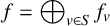 $f=\bigoplus _{v\in S} f_v$
, it suffices to show that each
$f=\bigoplus _{v\in S} f_v$
, it suffices to show that each
 $$ \begin{align*}f_v: \mathrm{E}^1 (A^*_{p^\infty}(F^{\mathrm{cyc}})^\vee) \to \mathrm{E}^1 (A^*_{p^\infty}(F^{\mathrm{cyc}}_v)^\vee) \end{align*} $$
is injective. However, since both $A^*_{p^\infty }(F^{\mathrm {cyc}})^\vee $
and
$A^*_{p^\infty }(F^{\mathrm {cyc}})^\vee $
and $A^*_{p^\infty }(F^{\mathrm {cyc}}_v)^\vee $
are finitely generated
$A^*_{p^\infty }(F^{\mathrm {cyc}}_v)^\vee $
are finitely generated ${\mathbb {Z}}_p$
-modules, [Reference Neukirch, Schmidt and Wingberg34, Corollary 5.5.7] implies that
${\mathbb {Z}}_p$
-modules, [Reference Neukirch, Schmidt and Wingberg34, Corollary 5.5.7] implies that $f_v$
is given by
$f_v$
is given by
 $$ \begin{align*}{\mathrm{Hom}}_{{\mathbb {Z}}_p}(A^*_{p^\infty}(F^{\mathrm{cyc}})^\vee, {\mathbb {Z}}_p)\to {\mathrm{Hom}}_{{\mathbb {Z}}_p}(A^*_{p^\infty}(F^{\mathrm{cyc}}_v)^\vee, {\mathbb {Z}}_p),\end{align*} $$
which is injective, as it is induced by the inclusion $A^*_{p^\infty }(F^{\mathrm {cyc}})\hookrightarrow A^*_{p^\infty }(F^{\mathrm {cyc}}_v)$
. This completes the proof.
$A^*_{p^\infty }(F^{\mathrm {cyc}})\hookrightarrow A^*_{p^\infty }(F^{\mathrm {cyc}}_v)$
. This completes the proof.
Remark 4.3. In the case where $A=E$
is an elliptic curve without complex multiplication, the proof of Theorem 4.2 can be simplified. By a theorem of Deuring, this is equivalent to the condition that E is not defined over a finite field; equivalently, E is nonisotrivial. In particular, we do not need to treat the case
$A=E$
is an elliptic curve without complex multiplication, the proof of Theorem 4.2 can be simplified. By a theorem of Deuring, this is equivalent to the condition that E is not defined over a finite field; equivalently, E is nonisotrivial. In particular, we do not need to treat the case $F_\infty =F^{\mathrm {cyc}}$
separately, since Lemma 4.1 holds without requiring the assumption
$F_\infty =F^{\mathrm {cyc}}$
separately, since Lemma 4.1 holds without requiring the assumption $\dim (G)\geq 2$
. One way to see this is via a result of Ulmer, which asserts that
$\dim (G)\geq 2$
. One way to see this is via a result of Ulmer, which asserts that $E(\bar {k}F)$
is a finitely generated abelian group (see [Reference Ulmer42, Section 6.3]). Since
$E(\bar {k}F)$
is a finitely generated abelian group (see [Reference Ulmer42, Section 6.3]). Since $F^{\mathrm {cyc}}$
is a subfield of
$F^{\mathrm {cyc}}$
is a subfield of $\bar {k}F$
, it follows that
$\bar {k}F$
, it follows that $E(F^{\mathrm {cyc}})$
is a finitely generated abelian group. Consequently,
$E(F^{\mathrm {cyc}})$
is a finitely generated abelian group. Consequently, $E_{p^\infty }(F^{\mathrm {cyc}})$
is finite. It implies that
$E_{p^\infty }(F^{\mathrm {cyc}})$
is finite. It implies that $E_{p^\infty }(F^{\mathrm {cyc}})$
is pseudo-null as a
$E_{p^\infty }(F^{\mathrm {cyc}})$
is pseudo-null as a $\Lambda (G)$
-module and therefore,
$\Lambda (G)$
-module and therefore,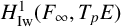 $H^1_{\mathrm {Iw}}(F_\infty , T_p E)$
injects into the
$H^1_{\mathrm {Iw}}(F_\infty , T_p E)$
injects into the ${\mathrm {Ext}}^0$
-term of the corresponding spectral sequence.
${\mathrm {Ext}}^0$
-term of the corresponding spectral sequence.
5 Akashi series
Let $\mathcal {Q}(\Gamma )$
denote the field of fractions of
$\mathcal {Q}(\Gamma )$
denote the field of fractions of $\Lambda (\Gamma )$
. To each
$\Lambda (\Gamma )$
. To each $M\in {\mathfrak {M}}_H(G)$
, we associate a nonzero element
$M\in {\mathfrak {M}}_H(G)$
, we associate a nonzero element $\mathrm {Ak}(M)\in \mathcal {Q}(\Gamma )$
, which is uniquely determined up to multiplication by a unit in
$\mathrm {Ak}(M)\in \mathcal {Q}(\Gamma )$
, which is uniquely determined up to multiplication by a unit in $\Lambda (\Gamma )$
. It can be shown (see [Reference Coates, Fukaya, Kato, Sujatha and Venjakob8, Lemma 3.1]) that the homology groups
$\Lambda (\Gamma )$
. It can be shown (see [Reference Coates, Fukaya, Kato, Sujatha and Venjakob8, Lemma 3.1]) that the homology groups
 $$ \begin{align*}H_i(H,M)\quad \text{for } i\geq0\end{align*} $$
are finitely generated torsion $\Lambda (\Gamma )$
-modules. We fix, from now on, a topological generator of
$\Lambda (\Gamma )$
-modules. We fix, from now on, a topological generator of $\Gamma $
and identify
$\Gamma $
and identify $\Lambda (\Gamma )$
with the formal power series ring
$\Lambda (\Gamma )$
with the formal power series ring ${\mathbb {Z}}_p[[T]]$
by mapping this topological generator to
${\mathbb {Z}}_p[[T]]$
by mapping this topological generator to $1 + T$
. Let
$1 + T$
. Let $f_{M,i}\in \Lambda (\Gamma )$
denote a characteristic power series of
$f_{M,i}\in \Lambda (\Gamma )$
denote a characteristic power series of $H_i(H,M)$
and define
$H_i(H,M)$
and define
 $$ \begin{align*} \mathrm{Ak}(M)=\prod_{i\geq0}f_{M,i}^{(-1)^i}. \end{align*} $$
This product is finite because $H_i(H,M)=0$
for
$H_i(H,M)=0$
for $i\geq \dim (H)$
and it is well defined up to multiplication by a unit in
$i\geq \dim (H)$
and it is well defined up to multiplication by a unit in $\Lambda (\Gamma )$
, since each
$\Lambda (\Gamma )$
, since each $f_{M,i}$
is. We call
$f_{M,i}$
is. We call $\mathrm {Ak}(M)$
the Akashi series of M. If Y is a discrete p-primary G-module such that
$\mathrm {Ak}(M)$
the Akashi series of M. If Y is a discrete p-primary G-module such that $M=Y^\vee \in {\mathfrak {M}}_H(G)$
, then we also refer to
$M=Y^\vee \in {\mathfrak {M}}_H(G)$
, then we also refer to $\mathrm {Ak}(M)$
as the Akashi series of Y and, by abuse of notation, write it as
$\mathrm {Ak}(M)$
as the Akashi series of Y and, by abuse of notation, write it as $\mathrm {Ak}(Y)$
. Via the duality
$\mathrm {Ak}(Y)$
. Via the duality
 $$ \begin{align*}H_i(H,M) = H^i(H,Y)^\vee,\end{align*} $$
we henceforth work with H-cohomology groups in computating the Akashi series, without further mention. This definition generalizes the notion of the characteristic power series. Specifically, if M is a finitely generated torsion $\Lambda (\Gamma )$
-module (that is, when
$\Lambda (\Gamma )$
-module (that is, when $H=\{1\}$
), then the Akashi series of M coincides with the
$H=\{1\}$
), then the Akashi series of M coincides with the $\Lambda (\Gamma )$
-characteristic power series of M and we denote
$\Lambda (\Gamma )$
-characteristic power series of M and we denote $\mathrm {Ak}(M)$
simply by
$\mathrm {Ak}(M)$
simply by $f_M$
, or
$f_M$
, or $f_Y$
.
$f_Y$
.
Lemma 5.1. Given a short exact sequence
 $$ \begin{align} 0\to M_1\to M_2 \to M_3\to 0 \end{align} $$
in the category ${\mathfrak {M}}_H(G)$
, the Akashi series satisfy
${\mathfrak {M}}_H(G)$
, the Akashi series satisfy $\mathrm {Ak}(M_2) = \mathrm {Ak}(M_1)\cdot \mathrm {Ak}(M_3)$
.
$\mathrm {Ak}(M_2) = \mathrm {Ak}(M_1)\cdot \mathrm {Ak}(M_3)$
.
Proof. This follows by considering the long exact sequence in H-homology derived from (5-1) and applying the multiplicativity of $\Lambda (\Gamma )$
-characteristic series in a short exact sequence.
$\Lambda (\Gamma )$
-characteristic series in a short exact sequence.
Remark 5.2. We note that the original definition of ${\mathfrak {M}}_H(G)$
in [Reference Coates, Schneider and Sujatha10] differs from that used in [Reference Coates, Fukaya, Kato, Sujatha and Venjakob8] and in this paper. One consequence of this discrepancy is that, in general,
${\mathfrak {M}}_H(G)$
in [Reference Coates, Schneider and Sujatha10] differs from that used in [Reference Coates, Fukaya, Kato, Sujatha and Venjakob8] and in this paper. One consequence of this discrepancy is that, in general, $\mathrm {Ak}(M) \neq \mathrm {Ak}(M/M(p))$
, as shown in [Reference Coates, Schneider and Sujatha10, Lemma 4.1]. This is because
$\mathrm {Ak}(M) \neq \mathrm {Ak}(M/M(p))$
, as shown in [Reference Coates, Schneider and Sujatha10, Lemma 4.1]. This is because $M(p)$
need not be finitely generated over
$M(p)$
need not be finitely generated over $\Lambda (H)$
and, hence, its homology group may not be finitely generated over
$\Lambda (H)$
and, hence, its homology group may not be finitely generated over ${\mathbb {Z}}_p$
. Therefore, even though its homology group is annihilated by some power of p, we cannot conclude that they are finite. In general,
${\mathbb {Z}}_p$
. Therefore, even though its homology group is annihilated by some power of p, we cannot conclude that they are finite. In general, $\mathrm {Ak}(M(p))$
may be nontrivial. In the case where G is a pro-p group without p-torsion, we have
$\mathrm {Ak}(M(p))$
may be nontrivial. In the case where G is a pro-p group without p-torsion, we have $\mathrm {Ak}(M(p))=p^{\mu (M)}$
(see [Reference Ardakov and Wadsley1, 1.6]), where
$\mathrm {Ak}(M(p))=p^{\mu (M)}$
(see [Reference Ardakov and Wadsley1, 1.6]), where $\mu (M)$
denotes the generalized
$\mu (M)$
denotes the generalized $\mu $
-invariant of M, as defined in [Reference Burns and Venjakob4, Reference Howson18, Reference Venjakob44].
$\mu $
-invariant of M, as defined in [Reference Burns and Venjakob4, Reference Howson18, Reference Venjakob44].
By virtue of Theorem 4.2, we have a short exact sequence
 $$ \begin{align*} 0\to {\mathrm{Sel}}(A/F_\infty)\to H^1(G_S(F_\infty),A_{p^\infty})\to \bigoplus_{v\in S} J_v(A/F_\infty)\to 0.\end{align*} $$
Since ${\mathrm {Sel}}(A/F_\infty )$
and
${\mathrm {Sel}}(A/F_\infty )$
and $H^1(G_S(F_\infty ),A_{p^\infty })$
are cofinitely generated
$H^1(G_S(F_\infty ),A_{p^\infty })$
are cofinitely generated $\Lambda (H)$
-modules by Lemma 3.3 and Theorem 3.4, so is
$\Lambda (H)$
-modules by Lemma 3.3 and Theorem 3.4, so is $\bigoplus _{v\in S} J_v(A/F_\infty )$
. Hence, we may apply Lemma 5.1 to deduce
$\bigoplus _{v\in S} J_v(A/F_\infty )$
. Hence, we may apply Lemma 5.1 to deduce
 $$ \begin{align} \mathrm{Ak}( H^1(G_S(F_\infty),A_{p^\infty})) = \mathrm{Ak}({\mathrm{Sel}}(A/F_\infty)) \mathrm{Ak}\bigg(\bigoplus_{v\in S} J_v(A/F_\infty)\bigg). \end{align} $$
Thus, determining $\mathrm {Ak}({\mathrm {Sel}}(A/F_\infty ))$
reduces to computing
$\mathrm {Ak}({\mathrm {Sel}}(A/F_\infty ))$
reduces to computing
 $$ \begin{align*}\mathrm{Ak}( H^1(G_S(F_\infty),A_{p^\infty}))\quad \text{and}\quad \mathrm{Ak}\bigg(\bigoplus_{v\in S} J_v(A/F_\infty)\bigg),\end{align*} $$
which are the subjects of the next two lemmas.
Lemma 5.3. $\mathrm {Ak}( H^1(G_S(F_\infty ),A_{p^\infty }))= f_{H^1(G_S(F^{\mathrm {cyc}}), A_{p^\infty })} \cdot \prod _{i\geq 1}(f_{H^i(H, A_{p^\infty }(F_\infty ))})^{(-1)^i}$
.
$\mathrm {Ak}( H^1(G_S(F_\infty ),A_{p^\infty }))= f_{H^1(G_S(F^{\mathrm {cyc}}), A_{p^\infty })} \cdot \prod _{i\geq 1}(f_{H^i(H, A_{p^\infty }(F_\infty ))})^{(-1)^i}$
.
Proof. Since $H^2(G_S(F^{\mathrm {cyc}}),A_{p^\infty })=H^2(G_S(F_\infty ), A_{p^\infty })=0$
by Lemma 3.2, the spectral sequence
$H^2(G_S(F^{\mathrm {cyc}}),A_{p^\infty })=H^2(G_S(F_\infty ), A_{p^\infty })=0$
by Lemma 3.2, the spectral sequence
 $$ \begin{align*}H^i(H,H^j(G_S(F_\infty),A_{p^\infty}))\Rightarrow H^{i+j}(G_S(F_\infty), A_{p^\infty})\end{align*} $$
degenerates and yields the following exact sequence:
 $$ \begin{align}&0\to H^1(H,A_{p^\infty}(F_\infty))\to H^1(G_S(F^{\mathrm{cyc}}),A_{p^\infty})\nonumber\\&\quad\to H^1(G_S(F_\infty),A_{p^\infty})^H\to H^2(H,A_{p^\infty}(F_\infty)) \to 0 \end{align} $$
together with isomorphisms
 $$ \begin{align}H^i(H,H^1(G_S(F_\infty),A_{p^\infty})) \simeq H^{i+2}(H,A_{p^\infty}(F_\infty)) \end{align} $$
for $i\geq 1$
. The lemma now follows from a direct calculation using (5-3) and (5-4).
$i\geq 1$
. The lemma now follows from a direct calculation using (5-3) and (5-4).
Since $\mathrm {char}(F_v)\neq p$
for each
$\mathrm {char}(F_v)\neq p$
for each $v\in S$
, it follows from a theorem of Iwasawa [Reference Neukirch, Schmidt and Wingberg34, Theorem 7.5.3] that the decomposition subgroup
$v\in S$
, it follows from a theorem of Iwasawa [Reference Neukirch, Schmidt and Wingberg34, Theorem 7.5.3] that the decomposition subgroup $G_w$
of any prime w of
$G_w$
of any prime w of $F_\infty $
lying above v has dimension at most
$F_\infty $
lying above v has dimension at most $2$
. Let
$2$
. Let $S'$
denote the subset of S consisting of primes whose inertia group in G is infinite. This is equivalent to requiring that the decomposition subgroup
$S'$
denote the subset of S consisting of primes whose inertia group in G is infinite. This is equivalent to requiring that the decomposition subgroup $G_w$
has dimension exactly
$G_w$
has dimension exactly $2$
. Indeed, since the residue characteristic is prime to p and G is a p-adic Lie group, the wild inertia subgroup is finite. Moreover, the maximal unramified p-extension of
$2$
. Indeed, since the residue characteristic is prime to p and G is a p-adic Lie group, the wild inertia subgroup is finite. Moreover, the maximal unramified p-extension of $F_v$
is
$F_v$
is $F_v^{\mathrm {cyc}}$
, and the maximal tamely ramified extension of
$F_v^{\mathrm {cyc}}$
, and the maximal tamely ramified extension of $F_v$
is a topologically cyclic extension over the maximal unramified extension.
$F_v$
is a topologically cyclic extension over the maximal unramified extension.
Lemma 5.4. $\mathrm {Ak}(\bigoplus _{v\in S} J_v(A/F_\infty )) = \prod _{v\in S\setminus S'} f_{J_v(A/F^{\mathrm {cyc}})}$
.
$\mathrm {Ak}(\bigoplus _{v\in S} J_v(A/F_\infty )) = \prod _{v\in S\setminus S'} f_{J_v(A/F^{\mathrm {cyc}})}$
.
Proof. For each $v\in S$
,
$v\in S$
,
 $$ \begin{align*}J_v(A/F_\infty)&=\bigoplus_{w\mid v}\mathrm{Ind}_{H_w}^H H^1(F_{\infty, w}, A_{p^\infty}), \end{align*} $$
where the sum is over primes w of $F^{\mathrm {cyc}}$
lying above v and we also write w for a fixed prime in
$F^{\mathrm {cyc}}$
lying above v and we also write w for a fixed prime in $F_\infty $
lying above w. We claim that
$F_\infty $
lying above w. We claim that $J_v(A/F_\infty )=0$
for
$J_v(A/F_\infty )=0$
for $v\in S'$
. Indeed, let w be a prime of
$v\in S'$
. Indeed, let w be a prime of $F_\infty $
above v, so that
$F_\infty $
above v, so that $\dim G_w= 2$
by assumption. Then, Iwasawa’s theorem [Reference Neukirch, Schmidt and Wingberg34, Theorem 7.5.3] implies that
$\dim G_w= 2$
by assumption. Then, Iwasawa’s theorem [Reference Neukirch, Schmidt and Wingberg34, Theorem 7.5.3] implies that $F_{\infty , w}$
has no nontrivial p-extensions. Hence,
$F_{\infty , w}$
has no nontrivial p-extensions. Hence, $ H^1(F_{\infty , w}, A_{p^\infty })=0$
and the claim follows.
$ H^1(F_{\infty , w}, A_{p^\infty })=0$
and the claim follows.
Now, consider $v\in S\setminus S'$
. To compute
$v\in S\setminus S'$
. To compute $\mathrm {Ak}(J_v(A/F_\infty ))$
, let w be a prime of
$\mathrm {Ak}(J_v(A/F_\infty ))$
, let w be a prime of $F^{\mathrm {cyc}}$
above v and fix a prime of
$F^{\mathrm {cyc}}$
above v and fix a prime of $F_\infty $
above w, which we again denote by w. Let
$F_\infty $
above w, which we again denote by w. Let $H_w$
denote the decomposition subgroup of H at w. By Shapiro’s lemma,
$H_w$
denote the decomposition subgroup of H at w. By Shapiro’s lemma,
 $$ \begin{align}H^i(H, J_v(A/F_\infty))\simeq \bigoplus_{w\mid v}H^i(H_w, H^1(F_{\infty, w},A_{p^\infty})). \end{align} $$
Since $v\nmid p$
, the inertia group at v is finite, so
$v\nmid p$
, the inertia group at v is finite, so $H_w$
is finite. As G has no p-torsion, the order of
$H_w$
is finite. As G has no p-torsion, the order of $H_w$
is prime to p and, thus,
$H_w$
is prime to p and, thus, $\mathrm {cd}_p(H_w)=0$
. Therefore, the right-hand side of (5-5) vanishes for all
$\mathrm {cd}_p(H_w)=0$
. Therefore, the right-hand side of (5-5) vanishes for all $i\geq 1$
, implying that
$i\geq 1$
, implying that
 $$ \begin{align*}H^i(H,J_v(A/F_\infty))=0\quad\text{for all } i\geq1.\end{align*} $$
For the term $J_v(A/F_\infty )^H$
, we observe that the restriction map
$J_v(A/F_\infty )^H$
, we observe that the restriction map
 $$ \begin{align*} J_v(A/F^{\mathrm{cyc}}) \rightarrow J_v(A/F_\infty)^H\end{align*} $$
is an isomorphism, due to the fact that $\mathrm {cd}_p(H_w)=0$
. In conclusion,
$\mathrm {cd}_p(H_w)=0$
. In conclusion,
 $$ \begin{align*} \mathrm{Ak}(J_v(A/F_\infty)) = \begin{cases} f_{J_v(A/F^{\mathrm{cyc}})} & \text{if } v\in S\setminus S', \\ 0 & \text{if } v\in S', \end{cases} \end{align*} $$
which implies the lemma.
Theorem 5.5. Let A be an abelian variety defined over a global function field F with $\mathrm {char}(F)\neq p$
and let
$\mathrm {char}(F)\neq p$
and let $F_\infty /F$
be an admissible p-adic Lie extension. Then,
$F_\infty /F$
be an admissible p-adic Lie extension. Then,
 $$ \begin{align*}\mathrm{Ak}({\mathrm{Sel}}(A/F_\infty))=f_{{\mathrm{Sel}}(A/F^{\mathrm{cyc}})}\prod_{i\geq 1}(f_{H^i(H, A_{p^\infty}(F_\infty))})^{(-1)^i}\prod_{v\in S'} f_{J_v(A/F^{\mathrm{cyc}})}.\end{align*} $$
Proof. Combining the computations from Lemmas 5.3 and 5.4 with (5-2),
 $$ \begin{align*}f_{H^1(G_S(F^{\mathrm{cyc}}), A_{p^\infty})} \prod_{i\geq 1}(f_{H^i(H, A_{p^\infty}(F_\infty))})^{(-1)^i} = \mathrm{Ak}({\mathrm{Sel}}(A/F_\infty))\prod_{v\in S\setminus S'} f_{J_v(A/F^{\mathrm{cyc}})}. \end{align*} $$
By Theorem 4.2, we have the short exact sequence
 $$ \begin{align*}0\to {\mathrm{Sel}}(A/F^{\mathrm{cyc}})\to H^1(G_S(F^{\mathrm{cyc}}),A_{p^\infty})\to \bigoplus_{v\in S} J_v(A/F^{\mathrm{cyc}})\to 0,\end{align*} $$
where all modules are cofinitely generated over ${\mathbb {Z}}_p$
, by Lemma 3.3 and Theorem 3.4. Therefore,
${\mathbb {Z}}_p$
, by Lemma 3.3 and Theorem 3.4. Therefore,
 $$ \begin{align*} f_{H^1(G_S(F^{\mathrm{cyc}}), A_{p^\infty})} = f_{{\mathrm{Sel}}(A/F^{\mathrm{cyc}})}\prod_{v\in S} f_{J_v(A/F^{\mathrm{cyc}})}.\end{align*} $$
Substituting this into the earlier expression, we obtain the required conclusion of the theorem.
We record an interesting corollary of our Theorem 5.5 that serves as an analog of a result of Howson [Reference Howson18] (also see [Reference Coates and Howson9]).
Corollary 5.6. Retain the assumptions of Theorem 5.5. Suppose further that G is pro-p with dimension at least $2$
. Then, the following formula holds:
$2$
. Then, the following formula holds:
 $$ \begin{align*} \mathrm{rank}_{\Lambda(H)} X(A/F_\infty) &= \mathrm{rank}_{{\mathbb {Z}}_p}X(A/F^{\mathrm{cyc}}) - \mathrm{rank}_{{\mathbb {Z}}_p}A_{p^\infty}(F^{\mathrm{cyc}})^\vee\\ &\quad+\sum_{w\in S'(F^{\mathrm{cyc}})} \mathrm{rank}_{{\mathbb {Z}}_p} A_{p^\infty}(F^{{\mathrm{cyc}}}_w)^\vee. \end{align*} $$
Proof. In the course of the proof, whenever N is a finitely generated torsion $\Lambda (\Gamma )$
-module with vanishing
$\Lambda (\Gamma )$
-module with vanishing $\mu $
-invariant, we represent the characteristic series
$\mu $
-invariant, we represent the characteristic series $f_N$
by a distinguished polynomial. In this context, it makes sense to speak of
$f_N$
by a distinguished polynomial. In this context, it makes sense to speak of $\deg f_N$
. In particular,
$\deg f_N$
. In particular, ${\mathrm {rank}}_{{\mathbb {Z}}_p}(N)=\deg f_N$
. Now, suppose M is a
${\mathrm {rank}}_{{\mathbb {Z}}_p}(N)=\deg f_N$
. Now, suppose M is a $\Lambda (G)$
-module that is finitely generated over
$\Lambda (G)$
-module that is finitely generated over $\Lambda (H)$
. Then,
$\Lambda (H)$
. Then, $H_i(H,M)$
is finitely generated over
$H_i(H,M)$
is finitely generated over ${\mathbb {Z}}_p$
for every i, and
${\mathbb {Z}}_p$
for every i, and
 $$ \begin{align} {\mathrm{rank}}_{\Lambda(H)}(M) = \sum_{i\geq 0}(-1)^i{\mathrm{rank}}_{{\mathbb {Z}}_p} H_i(H,M) \end{align} $$
(see [Reference Howson18, Theorem 1.1]). Combining this with the previous observation, we see that ${\mathrm {rank}}_{\Lambda (H)}(M)$
can be computed from its Akashi series
${\mathrm {rank}}_{\Lambda (H)}(M)$
can be computed from its Akashi series
 $$ \begin{align*} {\mathrm{rank}}_{\Lambda(H)}(M) = \sum_{i\geq 0}(-1)^i\deg f_{H_i(H,M)}. \end{align*} $$
Now, recall the conclusion of Theorem 5.5, which we rewrite as
 $$ \begin{align*}\mathrm{Ak}({\mathrm{Sel}}(A/F_\infty))=\mathrm{Ak}(A_{p^\infty}(F_\infty))f_{{\mathrm{Sel}}(A/F^{\mathrm{cyc}})}f_{A_{p^\infty}(F^{\mathrm{cyc}})}^{-1}\prod_{v\in S'} f_{J_v(A/F^{\mathrm{cyc}})}.\end{align*} $$
Since $\dim H\geq 1$
by assumption, we know that
$\dim H\geq 1$
by assumption, we know that ${\mathrm {rank}}_{\Lambda (H)}(A_{p^\infty }(F_\infty )^\vee )=0$
. It remains to verify the identity
${\mathrm {rank}}_{\Lambda (H)}(A_{p^\infty }(F_\infty )^\vee )=0$
. It remains to verify the identity
 $$ \begin{align*} \deg f_{J_v(A/F^{\mathrm{cyc}})} =\sum_{w|v}{\mathrm{rank}}_{{\mathbb {Z}}_p} A_{p^\infty}(F^{{\mathrm{cyc}}}_w)^\vee\end{align*} $$
for $v\in S'$
, where the sum runs over all primes w of
$v\in S'$
, where the sum runs over all primes w of $F^{\mathrm {cyc}}$
above v. To this end, note that
$F^{\mathrm {cyc}}$
above v. To this end, note that $J_v(A/F^{\mathrm {cyc}})= \oplus _{w|v}H^1(F^{\mathrm {cyc}}_w, A_{p^\infty })$
. For
$J_v(A/F^{\mathrm {cyc}})= \oplus _{w|v}H^1(F^{\mathrm {cyc}}_w, A_{p^\infty })$
. For $v\in S'$
, the proof of Lemma 5.4 shows that
$v\in S'$
, the proof of Lemma 5.4 shows that $H^1(F^{\mathrm {cyc}}_w, A_{p^\infty })\hspace{-1pt} =\hspace{-1pt} H^1(H_w, A_{p^\infty }(F_{\infty ,w}))$
. Since
$H^1(F^{\mathrm {cyc}}_w, A_{p^\infty })\hspace{-1pt} =\hspace{-1pt} H^1(H_w, A_{p^\infty }(F_{\infty ,w}))$
. Since $\dim H_w\hspace{-1pt}\geq\hspace{-1pt} 1$
and
$\dim H_w\hspace{-1pt}\geq\hspace{-1pt} 1$
and ${\mathrm {rank}}_{{\mathbb {Z}}_p[[H_w]]}(A_{p^\infty }(F_{\infty ,w})^\vee )\hspace{-1pt}=\hspace{-1pt}0$
, it follows from a similar formula to (5-6) and
${\mathrm {rank}}_{{\mathbb {Z}}_p[[H_w]]}(A_{p^\infty }(F_{\infty ,w})^\vee )\hspace{-1pt}=\hspace{-1pt}0$
, it follows from a similar formula to (5-6) and $\mathrm {cd}_p(H_w)=1$
that
$\mathrm {cd}_p(H_w)=1$
that
 $$ \begin{align*} {\mathrm{rank}}_{{\mathbb {Z}}_p}H^1(H_w, A_{p^\infty}(F_{\infty,w}))^\vee = {\mathrm{rank}}_{{\mathbb {Z}}_p}H^0(H_w, A_{p^\infty}(F_{\infty,w}))^\vee = {\mathrm{rank}}_{{\mathbb {Z}}_p} A_{p^\infty}(F^{{\mathrm{cyc}}}_w)^\vee.\end{align*} $$
This completes the proof of the corollary.
6 Control theorem
In this section, we prove the following control theorem, which enables us to relate the order of vanishing at $T=0$
of the characteristic power series of
$T=0$
of the characteristic power series of ${\mathrm {Sel}}(A/F^{\mathrm {cyc}})$
to the
${\mathrm {Sel}}(A/F^{\mathrm {cyc}})$
to the ${\mathbb {Z}}_p$
-corank of the Selmer group over
${\mathbb {Z}}_p$
-corank of the Selmer group over ${\mathrm {Sel}}(A/F)$
over the base field F.
${\mathrm {Sel}}(A/F)$
over the base field F.
Theorem 6.1. Let A be an abelian variety defined over a global function field F of characteristic different from p. Let $F^{\mathrm {cyc}}$
denote the cyclotomic
$F^{\mathrm {cyc}}$
denote the cyclotomic ${\mathbb {Z}}_p$
-extension of F. Write
${\mathbb {Z}}_p$
-extension of F. Write $\Gamma _n={\mathrm {Gal}}(F^{\mathrm {cyc}}/F_n)$
, where
$\Gamma _n={\mathrm {Gal}}(F^{\mathrm {cyc}}/F_n)$
, where $F_n$
is the n th layer of the extension
$F_n$
is the n th layer of the extension $F^{\mathrm {cyc}}/F$
such that
$F^{\mathrm {cyc}}/F$
such that $[F_n:F]=p^n$
. Then, the restriction map
$[F_n:F]=p^n$
. Then, the restriction map
 $$ \begin{align*}{\mathrm{Sel}}(A/F_n)\to {\mathrm{Sel}}(A/F^{\mathrm{cyc}})^{\Gamma_n}\end{align*} $$
has a finite kernel and cokernel, which are bounded independently of n.
Proof. We follow closely the method used in the proof of the control theorem for fine Selmer groups over number fields, as presented in [Reference Lim26]. Consider the following commutative diagram with exact rows:

Since $\Gamma _n$
has p-cohomological dimension
$\Gamma _n$
has p-cohomological dimension $1$
, the inflation-restriction sequence gives
$1$
, the inflation-restriction sequence gives
 $$ \begin{align*}\ker \beta_n=H^1(\Gamma_n, A_{p^\infty}(F^{\mathrm{cyc}}))\quad \text{and}\quad \mathrm{coker}~\! \beta_n=0.\end{align*} $$
Let $M=(A_{p^\infty }(F^{\mathrm {cyc}}))^\vee $
. Then, M is a finitely generated
$M=(A_{p^\infty }(F^{\mathrm {cyc}}))^\vee $
. Then, M is a finitely generated ${\mathbb {Z}}_p$
-module with a continuous
${\mathbb {Z}}_p$
-module with a continuous $\Gamma $
-action; hence, a finitely generated torsion
$\Gamma $
-action; hence, a finitely generated torsion $\Lambda (\Gamma _n)$
-module for every n. By [Reference Neukirch, Schmidt and Wingberg34, Proposition 5.3.20],
$\Lambda (\Gamma _n)$
-module for every n. By [Reference Neukirch, Schmidt and Wingberg34, Proposition 5.3.20],
 $$ \begin{align*}{\mathrm{rank}}_{{\mathbb {Z}}_p}M_{\Gamma_n}={\mathrm{rank}}_{{\mathbb {Z}}_p}M^{\Gamma_n}< \infty.\end{align*} $$
By the Mordell–Weil theorem, $M_{\Gamma _n}=(A_{p^\infty }(F_n))^\vee $
is finite, so
$M_{\Gamma _n}=(A_{p^\infty }(F_n))^\vee $
is finite, so ${\mathrm {rank}}_{{\mathbb {Z}}_p}M_{\Gamma _n}=0$
. It follows that
${\mathrm {rank}}_{{\mathbb {Z}}_p}M_{\Gamma _n}=0$
. It follows that $M^{\Gamma _n}$
is also finite. Note that
$M^{\Gamma _n}$
is also finite. Note that
 $$ \begin{align*}H^1(\Gamma_n,A_{p^\infty}(F^{\mathrm{cyc}}))=(A_{p^\infty}(F^{\mathrm{cyc}}))_{\Gamma_n},\end{align*} $$
which is the Pontryagin dual of $M^{\Gamma _n}$
. As M is a finitely generated
$M^{\Gamma _n}$
. As M is a finitely generated ${\mathbb {Z}}_p$
-module, the order of
${\mathbb {Z}}_p$
-module, the order of $M^{\Gamma _n}$
is bounded by the order of
$M^{\Gamma _n}$
is bounded by the order of $M(p)$
, which is independent of n. It remains to show that
$M(p)$
, which is independent of n. It remains to show that $\ker \gamma _n$
is finite and bounded independently of n. By the snake lemma, this implies the same uniform boundedness for
$\ker \gamma _n$
is finite and bounded independently of n. By the snake lemma, this implies the same uniform boundedness for $\ker \alpha _n$
and
$\ker \alpha _n$
and $\mathrm {coker}~\! \alpha _n$
. To analyze
$\mathrm {coker}~\! \alpha _n$
. To analyze $\gamma _n$
, observe that
$\gamma _n$
, observe that $v\in S$
does not divide p, so it suffices to show that for each prime w of
$v\in S$
does not divide p, so it suffices to show that for each prime w of $F^{\mathrm {cyc}}$
lying above
$F^{\mathrm {cyc}}$
lying above $v\in S$
, the group
$v\in S$
, the group $H^1(\Gamma _w, A_{p^\infty }(F^{\mathrm {cyc}}_w))$
is finite and bounded independently of n. This can be achieved by replacing
$H^1(\Gamma _w, A_{p^\infty }(F^{\mathrm {cyc}}_w))$
is finite and bounded independently of n. This can be achieved by replacing $\Gamma _n$
with
$\Gamma _n$
with $\Gamma _w$
and M with
$\Gamma _w$
and M with $(A_{p^\infty }(F^{\mathrm {cyc}}_w))^\vee $
, which remains a finitely generated
$(A_{p^\infty }(F^{\mathrm {cyc}}_w))^\vee $
, which remains a finitely generated ${\mathbb {Z}}_p$
-module, and then applying the same argument as above.
${\mathbb {Z}}_p$
-module, and then applying the same argument as above.
In Theorem 3.4, we showed that $X(A/F^{\mathrm {cyc}})$
is a finitely generated torsion
$X(A/F^{\mathrm {cyc}})$
is a finitely generated torsion $\Lambda (\Gamma )$
-module with
$\Lambda (\Gamma )$
-module with $\mu $
-invariant zero. Thus, the structure theorem for finitely generated
$\mu $
-invariant zero. Thus, the structure theorem for finitely generated $\Lambda (\Gamma )$
-modules implies that there exists a pseudo-isomorphism
$\Lambda (\Gamma )$
-modules implies that there exists a pseudo-isomorphism
 $$ \begin{align}X(A/F^{\mathrm{cyc}})\sim \bigoplus_{i=1}^k \Lambda(\Gamma)/(f_i^{a_i}), \end{align} $$
where we identify $\Lambda (\Gamma )\simeq {\mathbb {Z}}_p[[T]]$
using our fixed topological generator of
$\Lambda (\Gamma )\simeq {\mathbb {Z}}_p[[T]]$
using our fixed topological generator of $\Gamma $
, and each
$\Gamma $
, and each $f_i$
for
$f_i$
for $i=1,\ldots , k$
is a distinguished irreducible polynomial of degree
$i=1,\ldots , k$
is a distinguished irreducible polynomial of degree $\lambda _i$
. Consequently,
$\lambda _i$
. Consequently, $\Lambda (\Gamma )/(f_i^{a_i})$
is isomorphic to
$\Lambda (\Gamma )/(f_i^{a_i})$
is isomorphic to ${\mathbb {Z}}_p^{a_i \lambda _i }$
as an abelian group and
${\mathbb {Z}}_p^{a_i \lambda _i }$
as an abelian group and
 $$ \begin{align*}{\mathrm{rank}}_{{\mathbb {Z}}_p}(X(A/F^{\mathrm{cyc}}))=\lambda=\sum_{i=1}^k a_i \lambda_i.\end{align*} $$
Moreover, we have $\prod _{i=1}^k f_i ^{a_i}= f_{{\mathrm {Sel}}(A/F^{\mathrm {cyc}})}$
up to a unit in
$\prod _{i=1}^k f_i ^{a_i}= f_{{\mathrm {Sel}}(A/F^{\mathrm {cyc}})}$
up to a unit in $\Lambda (\Gamma )$
.
$\Lambda (\Gamma )$
.
We make use of the following analog of Greenberg’s semi-simplicity conjecture [Reference Greenberg17, Conjecture 1.12], originally posed for elliptic curves over number fields, but here considered for abelian varieties over global function fields.
Conjecture 6.2 (Greenberg’s semi-simplicity conjecture for
$A/F$
).

Let A be an abelian variety defined over a global function field F with $\mathrm {char}(F)\neq p$
. Then, the action of
$\mathrm {char}(F)\neq p$
. Then, the action of $\Gamma $
on
$\Gamma $
on $X(A/F^{\mathrm {cyc}})$
is completely reducible, that is, in the decomposition (6-1), we have
$X(A/F^{\mathrm {cyc}})$
is completely reducible, that is, in the decomposition (6-1), we have $a_i=1$
for all i.
$a_i=1$
for all i.
We then have the following result.
Proposition 6.3. Let A be an abelian variety defined over a global function field F. Then,
 $$ \begin{align*}{\mathrm{ord}}_{T=0}(f_{{\mathrm{Sel}}(A/F^{\mathrm{cyc}})})\geq {\mathrm{corank}}_{{\mathbb {Z}}_p}({\mathrm{Sel}}(A/F)).\end{align*} $$
Moreover, equality holds if Conjecture 6.2 is true.
Proof. By Theorem 6.1, the natural restriction map ${\mathrm {Sel}}(A/F)\to {\mathrm {Sel}}(A/F^{\mathrm {cyc}})^{\Gamma }$
has a finite kernel and cokernel, which by Pontryagin duality implies the same for the map
${\mathrm {Sel}}(A/F)\to {\mathrm {Sel}}(A/F^{\mathrm {cyc}})^{\Gamma }$
has a finite kernel and cokernel, which by Pontryagin duality implies the same for the map $X(A/F^{\mathrm {cyc}})_{\Gamma } \to X(A/F)$
. It follows that
$X(A/F^{\mathrm {cyc}})_{\Gamma } \to X(A/F)$
. It follows that
 $$ \begin{align*}{\mathrm{rank}}_{{\mathbb {Z}}_p}(X(A/F^{\mathrm{cyc}})_{\Gamma})={\mathrm{corank}}_{{\mathbb {Z}}_p}({\mathrm{Sel}}(A/F)).\end{align*} $$
Next, note that
 $$ \begin{align*}{\mathrm{rank}}_{{\mathbb {Z}}_p}(X(A/F^{\mathrm{cyc}})_{\Gamma})={\mathrm{rank}}_{{\mathbb {Z}}_p}(X(A/F^{\mathrm{cyc}})/T X(A/F^{\mathrm{cyc}})).\end{align*} $$
Since, for any distinguished polynomial $f(T)$
, we have
$f(T)$
, we have $\Lambda (\Gamma )/(f, T) \simeq {\mathbb {Z}}_p/ f(0) {\mathbb {Z}}_p,$
it follows that the
$\Lambda (\Gamma )/(f, T) \simeq {\mathbb {Z}}_p/ f(0) {\mathbb {Z}}_p,$
it follows that the ${\mathbb {Z}}_p$
-rank of
${\mathbb {Z}}_p$
-rank of $\Lambda (\Gamma )/(f, T)$
is
$\Lambda (\Gamma )/(f, T)$
is $1$
if and only if
$1$
if and only if $T\mid f$
. Therefore, from (6-1), the
$T\mid f$
. Therefore, from (6-1), the ${\mathbb {Z}}_p$
-rank of
${\mathbb {Z}}_p$
-rank of $X(A/F^{\mathrm {cyc}})/T X(A/F^{\mathrm {cyc}})$
is equal to the number of polynomials
$X(A/F^{\mathrm {cyc}})/T X(A/F^{\mathrm {cyc}})$
is equal to the number of polynomials $f_i$
that are equal to T. Assuming Conjecture 6.2, this is precisely the power of T dividing
$f_i$
that are equal to T. Assuming Conjecture 6.2, this is precisely the power of T dividing $f_{{\mathrm {Sel}}(A/F^{\mathrm {cyc}})}$
, and the result follows.
$f_{{\mathrm {Sel}}(A/F^{\mathrm {cyc}})}$
, and the result follows.
7 The order of vanishing of the characteristic element
In this section, we prove our main result concerning the order of vanishing of the characteristic element associated with the Selmer group over a p-adic Lie extension. We begin by recalling the definition of these characteristic elements.
As before, let G denote a compact p-adic Lie group without p-torsion and let H be a closed normal subgroup of G such that $\Gamma :=G/H\simeq {\mathbb {Z}}_p$
. First, we introduce the characteristic element
$\Gamma :=G/H\simeq {\mathbb {Z}}_p$
. First, we introduce the characteristic element $\xi _M$
attached to
$\xi _M$
attached to $M\in \mathfrak {M}_H(G)$
. To this end, we recall from [Reference Coates, Fukaya, Kato, Sujatha and Venjakob8] an equivalent definition of the category
$M\in \mathfrak {M}_H(G)$
. To this end, we recall from [Reference Coates, Fukaya, Kato, Sujatha and Venjakob8] an equivalent definition of the category $\mathfrak {M}_H(G)$
. A multiplicatively closed subset
$\mathfrak {M}_H(G)$
. A multiplicatively closed subset $\Sigma \subset \Lambda (G)$
is said to be a left and right Ore set if, for each
$\Sigma \subset \Lambda (G)$
is said to be a left and right Ore set if, for each $f\in \Sigma $
and
$f\in \Sigma $
and $x\in \Lambda (G)$
, there exist
$x\in \Lambda (G)$
, there exist $g_1, g_2\in \Sigma $
and
$g_1, g_2\in \Sigma $
and $y_1, y_2\in \Lambda (G)$
such that
$y_1, y_2\in \Lambda (G)$
such that
 $$ \begin{align*}f y_1=x g_1 \quad \text{and} \quad y_2 f=g_2 x.\end{align*} $$
We define
 $$ \begin{align*}\Sigma=\{f\in \Lambda(G): \Lambda(G)/\Lambda(G)f \text{ is a finitely generated } \Lambda(H)\text{-module}\}.\end{align*} $$
It is shown in [Reference Coates, Fukaya, Kato, Sujatha and Venjakob8, Theorem 2.4] that $\Sigma $
is a multiplicatively closed left and right Ore set in
$\Sigma $
is a multiplicatively closed left and right Ore set in $\Lambda (G)$
. Since
$\Lambda (G)$
. Since $p\notin \Sigma $
, we also consider the enlarged set
$p\notin \Sigma $
, we also consider the enlarged set
 $$ \begin{align*}\Sigma^*= \bigcup_{n\geq 0}p^n \Sigma,\end{align*} $$
which is again a multiplicatively closed left and right Ore set in $\Lambda (G)$
. We may therefore localize
$\Lambda (G)$
. We may therefore localize $\Lambda (G)$
at
$\Lambda (G)$
at $\Sigma $
and at
$\Sigma $
and at $\Sigma ^*$
to obtain
$\Sigma ^*$
to obtain $\Lambda (G)_\Sigma $
and
$\Lambda (G)_\Sigma $
and $\Lambda (G)_{\Sigma ^*}=\Lambda (G)_\Sigma [{1}/{p}]$
, respectively. It follows from [Reference Coates, Fukaya, Kato, Sujatha and Venjakob8, Proposition 2.3] that a finitely generated
$\Lambda (G)_{\Sigma ^*}=\Lambda (G)_\Sigma [{1}/{p}]$
, respectively. It follows from [Reference Coates, Fukaya, Kato, Sujatha and Venjakob8, Proposition 2.3] that a finitely generated $\Lambda (G)$
-module M lies in
$\Lambda (G)$
-module M lies in $ \mathfrak {M}_H(G)$
if and only if M is
$ \mathfrak {M}_H(G)$
if and only if M is $\Sigma ^*$
-torsion. Since the Iwasawa algebra
$\Sigma ^*$
-torsion. Since the Iwasawa algebra $\Lambda (G)$
is Noetherian and G has no element of order p, the global dimension of
$\Lambda (G)$
is Noetherian and G has no element of order p, the global dimension of $\Lambda (G)$
is finite. From [Reference Coates, Fukaya, Kato, Sujatha and Venjakob8],
$\Lambda (G)$
is finite. From [Reference Coates, Fukaya, Kato, Sujatha and Venjakob8], $K_0(\Lambda (G))$
can be identified with the Grothendieck group of the category of all finitely generated
$K_0(\Lambda (G))$
can be identified with the Grothendieck group of the category of all finitely generated $\Lambda (G)$
-modules. From the localization sequence in K-theory for the Ore set
$\Lambda (G)$
-modules. From the localization sequence in K-theory for the Ore set $\Sigma ^*$
, we obtain the following exact sequence:
$\Sigma ^*$
, we obtain the following exact sequence:
 $$ \begin{align*}\cdots \to K_1(\Lambda(G))\to K_1(\Lambda(G)_{\Sigma^*})\stackrel{\partial_G}{\longrightarrow}K_0(\mathfrak{M}_H(G))\to K_0(\Lambda(G))\to K_0(\Lambda(G)_{\Sigma^*})\to 0.\end{align*} $$
By [Reference Coates, Fukaya, Kato, Sujatha and Venjakob8, Proposition 3.4], the map $\partial _G$
is surjective. In light of this result, we can define a characteristic element for each
$\partial _G$
is surjective. In light of this result, we can define a characteristic element for each $M\in \mathfrak {M}_H(G)$
.
$M\in \mathfrak {M}_H(G)$
.
Definition 7.1. Given $M\in \mathfrak {M}_H(G)$
, a characteristic element for M is any element
$M\in \mathfrak {M}_H(G)$
, a characteristic element for M is any element $\xi _M\in K_1(\Lambda (G)_{\Sigma ^*})$
satisfying
$\xi _M\in K_1(\Lambda (G)_{\Sigma ^*})$
satisfying
 $$ \begin{align*}\partial_G(\xi_M)=[M],\end{align*} $$
where $[M]$
denotes the class of M in
$[M]$
denotes the class of M in $K_0(\Lambda (G))$
.
$K_0(\Lambda (G))$
.
We fix an algebraic closure $\overline {{\mathbb {Q}}}_p$
of
$\overline {{\mathbb {Q}}}_p$
of ${\mathbb {Q}}_p$
. Let
${\mathbb {Q}}_p$
. Let
 $$ \begin{align*}\rho: G\to {\mathrm{GL}}_n(\mathcal{O})\end{align*} $$
be an Artin representation, where $\mathcal {O}$
is the ring of integers of a finite extension of
$\mathcal {O}$
is the ring of integers of a finite extension of ${\mathbb {Q}}_p$
in
${\mathbb {Q}}_p$
in $\overline {{\mathbb {Q}}}_p$
. We write
$\overline {{\mathbb {Q}}}_p$
. We write $\Lambda _{\mathcal {O}}(\Gamma )$
for the Iwasawa algebra of
$\Lambda _{\mathcal {O}}(\Gamma )$
for the Iwasawa algebra of $\Gamma $
with coefficients in
$\Gamma $
with coefficients in $\mathcal {O}$
, which we identify with the formal power series ring
$\mathcal {O}$
, which we identify with the formal power series ring $\mathcal {O}[[T]]$
by sending a fixed topological generator of
$\mathcal {O}[[T]]$
by sending a fixed topological generator of $\Gamma $
to
$\Gamma $
to $1+T$
. Let
$1+T$
. Let $\mathcal {Q}_{\mathcal {O}}(\Gamma )$
denote the field of fractions of
$\mathcal {Q}_{\mathcal {O}}(\Gamma )$
denote the field of fractions of $\Lambda _{\mathcal {O}}(\Gamma )$
. If M is a finitely generated
$\Lambda _{\mathcal {O}}(\Gamma )$
. If M is a finitely generated $\Lambda (G)$
-module, we define
$\Lambda (G)$
-module, we define $M_{\mathcal {O}}=M\otimes _{{\mathbb {Z}}_p} \mathcal {O}$
and set
$M_{\mathcal {O}}=M\otimes _{{\mathbb {Z}}_p} \mathcal {O}$
and set
 $$ \begin{align}\mathrm{tw}_{\rho}(M)=M_{\mathcal{O}}\otimes_{\mathcal{O}} \mathcal{O}^n, \end{align} $$
where ${\mathcal {O}}^n$
is endowed with the action of G via
${\mathcal {O}}^n$
is endowed with the action of G via $\rho $
and G acts diagonally on the tensor product.
$\rho $
and G acts diagonally on the tensor product.
The representation $\rho $
defines a continuous group homomorphism,
$\rho $
defines a continuous group homomorphism,
 $$ \begin{align*}G\to (M_n(\mathcal{O})\otimes_{{\mathbb {Z}}_p}\Lambda(\Gamma))^\times,\end{align*} $$
which maps each g to $\rho (g)\otimes \bar {g}$
, where
$\rho (g)\otimes \bar {g}$
, where $\bar {g}$
denotes the image of g in
$\bar {g}$
denotes the image of g in $\Gamma $
. By [Reference Coates, Fukaya, Kato, Sujatha and Venjakob8, Lemma 3.3], this extends to a ring homomorphism
$\Gamma $
. By [Reference Coates, Fukaya, Kato, Sujatha and Venjakob8, Lemma 3.3], this extends to a ring homomorphism
 $$ \begin{align*}\Lambda(G)_{\Sigma^*}\to M_n(\mathcal{Q}_{\mathcal{O}}(\Gamma)).\end{align*} $$
By the functoriality of $K_1$
-groups, this in turn induces a group homomorphism,
$K_1$
-groups, this in turn induces a group homomorphism,
 $$ \begin{align*}K_1(\Lambda(G)_{\Sigma^*})\to K_1(M_n(\mathcal{Q}_{\mathcal{O}}(\Gamma))).\end{align*} $$
We define $\Phi _\rho $
to be the composite map
$\Phi _\rho $
to be the composite map
 $$ \begin{align}\Phi_\rho: K_1(\Lambda(G)_{\Sigma^*})\to K_1(M_n(\mathcal{Q}_{\mathcal{O}}(\Gamma))) \stackrel{\text{Morita}}{\simeq} K_1(\mathcal{Q}_{\mathcal{O}}(\Gamma))\simeq \mathcal{Q}_{\mathcal{O}}(\Gamma)^\times, \end{align} $$
where the first isomorphism is given by Morita’s equivalence. We also identify $\mathcal {Q}_{\mathcal {O}}(\Gamma )^\times $
with
$\mathcal {Q}_{\mathcal {O}}(\Gamma )^\times $
with $\mathcal {Q}_{\mathcal {O}}(T)^\times $
, where
$\mathcal {Q}_{\mathcal {O}}(T)^\times $
, where $\mathcal {Q}_{\mathcal {O}}(T)$
denotes the field of fractions of
$\mathcal {Q}_{\mathcal {O}}(T)$
denotes the field of fractions of $\mathcal {O}[[T]]$
.
$\mathcal {O}[[T]]$
.
Definition 7.2 (Burns [Reference Burns3]).
Let $\xi \in K_1(\Lambda (G)_{\Sigma ^*})$
and let
$\xi \in K_1(\Lambda (G)_{\Sigma ^*})$
and let $\rho $
be an Artin representation of G. Then, there exists an integer
$\rho $
be an Artin representation of G. Then, there exists an integer $r_\rho (\xi )$
and
$r_\rho (\xi )$
and $g(T)\in \mathcal {Q}_{\mathcal {O}}(T)^\times $
, with
$g(T)\in \mathcal {Q}_{\mathcal {O}}(T)^\times $
, with $g(0)\neq 0$
, such that
$g(0)\neq 0$
, such that
 $$ \begin{align*}\Phi_\rho(\xi)=T^{r_\rho(\xi)}g(T).\end{align*} $$
We call $r_\rho (\xi )$
the order of vanishing of
$r_\rho (\xi )$
the order of vanishing of $\xi $
at
$\xi $
at $\rho $
and denote it by
$\rho $
and denote it by ${\mathrm {ord}}_{T=0}(\Phi _{\rho }(\xi ))$
.
${\mathrm {ord}}_{T=0}(\Phi _{\rho }(\xi ))$
.
We now relate the evaluation of the characteristic element of a module $M\in \mathfrak {M}_H(G)$
at Artin representations of G to the Akashi series of the twists of M by such representations defined by (7-1).
$M\in \mathfrak {M}_H(G)$
at Artin representations of G to the Akashi series of the twists of M by such representations defined by (7-1).
Lemma 7.3. Let M be a module in the category $\mathfrak {M}_H(G)$
and let
$\mathfrak {M}_H(G)$
and let $\xi _M\in K_1(\Lambda (G)_{\Sigma ^*})$
denote its characteristic element. Then,
$\xi _M\in K_1(\Lambda (G)_{\Sigma ^*})$
denote its characteristic element. Then,
 $$ \begin{align*}\Phi_\rho(\xi_M)=\mathrm{Ak}(\mathrm{tw}_{\hat{\rho}}(M))\bmod \Lambda_{\mathcal{O}}(\Gamma)^\times,\end{align*} $$
where $\hat {\rho }$
denotes the contragradient representation of
$\hat {\rho }$
denotes the contragradient representation of $\rho $
, defined by
$\rho $
, defined by $\hat {\rho }(g)=\rho (g^{-1})^t$
for
$\hat {\rho }(g)=\rho (g^{-1})^t$
for $g\in G$
, where t denotes the transpose matrix.
$g\in G$
, where t denotes the transpose matrix.
Proof. By [Reference Coates, Fukaya, Kato, Sujatha and Venjakob8, Lemma 3.2], the twisted module $\mathrm {tw}_{\hat {\rho }}(M)$
also lies in the category
$\mathrm {tw}_{\hat {\rho }}(M)$
also lies in the category $\mathfrak {M}_H(G)$
. Hence, the Akashi series
$\mathfrak {M}_H(G)$
. Hence, the Akashi series $\mathrm {Ak}(\mathrm {tw}_{\hat {\rho }}(M))$
is well defined and the claimed equality follows from [Reference Coates, Fukaya, Kato, Sujatha and Venjakob8, (57)].
$\mathrm {Ak}(\mathrm {tw}_{\hat {\rho }}(M))$
is well defined and the claimed equality follows from [Reference Coates, Fukaya, Kato, Sujatha and Venjakob8, (57)].
Given an Artin representation $\rho : G\to GL_n(\mathcal {O})$
of G with coefficients in
$\rho : G\to GL_n(\mathcal {O})$
of G with coefficients in $\mathcal {O}$
, let
$\mathcal {O}$
, let $F_\rho $
be the Galois extension of F contained in
$F_\rho $
be the Galois extension of F contained in $F_\infty $
such that
$F_\infty $
such that ${\mathrm {Gal}}(F_\infty /F_\rho ) = \ker \rho $
. We then write
${\mathrm {Gal}}(F_\infty /F_\rho ) = \ker \rho $
. We then write $G_\rho = {\mathrm {Gal}}(F_\infty /F_\rho )$
. In the case where
$G_\rho = {\mathrm {Gal}}(F_\infty /F_\rho )$
. In the case where $\rho =\mathrm {reg}_L$
is the regular representation corresponding to a finite Galois extension L of F contained in
$\rho =\mathrm {reg}_L$
is the regular representation corresponding to a finite Galois extension L of F contained in $F_\infty $
, we simply write
$F_\infty $
, we simply write $G_L={\mathrm {Gal}}(F_\infty /L)$
for
$G_L={\mathrm {Gal}}(F_\infty /L)$
for $G_{\mathrm {reg}_L}$
. We now introduce two assumptions (
$G_{\mathrm {reg}_L}$
. We now introduce two assumptions ( $\mathbf {G}$
) and (
$\mathbf {G}$
) and ( $\mathbf {H}$
), which are useful for the computations in this section and in Section 9.
$\mathbf {H}$
), which are useful for the computations in this section and in Section 9.
 $$ \begin{align*} \mathbf{(G)}: \quad H^i(G, A_{p^\infty}(F_\infty)) \text{ is finite for all } i \geq 1. \end{align*} $$
 $$ \begin{align*} \mathbf{(H)}: \quad H^i(H, A_{p^\infty}(F_\infty)) \text{ is finite for all } i \geq 0. \end{align*} $$
Remark 7.4. Assumption $(\mathbf {G})$
is clearly satisfied if
$(\mathbf {G})$
is clearly satisfied if $A_{p^\infty }(F_\infty )$
is finite. It also holds in the case when
$A_{p^\infty }(F_\infty )$
is finite. It also holds in the case when $F_\infty =F(A_{p^\infty })$
(see [Reference Bandini and Valentino2, Section 3]). Note that
$F_\infty =F(A_{p^\infty })$
(see [Reference Bandini and Valentino2, Section 3]). Note that $(\mathbf {H})$
implies
$(\mathbf {H})$
implies $(\mathbf {G})$
.
$(\mathbf {G})$
.
Similarly, we write Condition ( ${\mathbf {G}}_{\boldsymbol {\rho }}$
) when replacing G with
${\mathbf {G}}_{\boldsymbol {\rho }}$
) when replacing G with $G_\rho $
, and
$G_\rho $
, and $Condition~(\mathbf {G_L})$
in the case where
$Condition~(\mathbf {G_L})$
in the case where $\rho =\mathrm {reg}_L$
for a finite Galois extension L of F contained in
$\rho =\mathrm {reg}_L$
for a finite Galois extension L of F contained in $F_\infty $
, with
$F_\infty $
, with $G_L={\mathrm {Gal}}(F_\infty /L)$
.
$G_L={\mathrm {Gal}}(F_\infty /L)$
.
The following proposition provides a criterion for verifying Assumption $(\mathbf {H})$
.
$(\mathbf {H})$
.
Proposition 7.5. Let A be an abelian variety defined over a global function field F with $\mathrm {char}(F)\neq p$
. Suppose that
$\mathrm {char}(F)\neq p$
. Suppose that $A_{p^\infty }(F^{\mathrm {cyc}})$
is finite and
$A_{p^\infty }(F^{\mathrm {cyc}})$
is finite and $H\simeq {\mathbb {Z}}_p^r$
. Then, Assumption
$H\simeq {\mathbb {Z}}_p^r$
. Then, Assumption $(\mathbf {H})$
holds, that is,
$(\mathbf {H})$
holds, that is, $H^i(H,A_{p^\infty }(F_\infty ))$
is finite for all
$H^i(H,A_{p^\infty }(F_\infty ))$
is finite for all $i\geq 0$
.
$i\geq 0$
.
Proof. The conclusion follows from the following algebraic observation: if $H\cong {\mathbb {Z}}_p^r$
, then for any
$H\cong {\mathbb {Z}}_p^r$
, then for any $\Lambda (H)$
-module M, the cohomology groups
$\Lambda (H)$
-module M, the cohomology groups $H_i(H,M)$
are finite for all
$H_i(H,M)$
are finite for all $i\geq 1$
, provided that
$i\geq 1$
, provided that $H_0(H,M)$
is finite. This result essentially follows from [Reference Serre39, pages 56–57], although the argument there is somewhat terse. For a detailed proof, we refer the reader to [Reference Lim28, Proof of Theorem 2.3].
$H_0(H,M)$
is finite. This result essentially follows from [Reference Serre39, pages 56–57], although the argument there is somewhat terse. For a detailed proof, we refer the reader to [Reference Lim28, Proof of Theorem 2.3].
We also recall, by Remark 4.3, that the finiteness condition on $A_{p^\infty }(F^{\mathrm {cyc}})$
automatically holds when A is an elliptic curve without complex multiplication.
$A_{p^\infty }(F^{\mathrm {cyc}})$
automatically holds when A is an elliptic curve without complex multiplication.
We now prove the following proposition, which highlights the significance of Assumption $(\mathbf {G})$
.
$(\mathbf {G})$
.
Proposition 7.6. Let A be an abelian variety defined over a global field of characteristic different from p. Suppose that Assumption $(\mathbf {G})$
holds. Then, for all
$(\mathbf {G})$
holds. Then, for all $i\geq 1$
, we have
$i\geq 1$
, we have ${\mathrm {ord}}_{T=0}(f_{H^{i}(H,A_{p^\infty }(F_\infty ))})=0$
.
${\mathrm {ord}}_{T=0}(f_{H^{i}(H,A_{p^\infty }(F_\infty ))})=0$
.
Proof. To show that the characteristic series of $H^{i}(H,A_{p^\infty }(F_\infty ))$
does not contribute a factor of T, it suffices to show that
$H^{i}(H,A_{p^\infty }(F_\infty ))$
does not contribute a factor of T, it suffices to show that $H^{i}(H,A_{p^\infty }(F_\infty ))^\Gamma $
is finite for all
$H^{i}(H,A_{p^\infty }(F_\infty ))^\Gamma $
is finite for all $i\geq 1$
. Since
$i\geq 1$
. Since $\mathrm {cd}_p\Gamma =1$
, the Hochschild–Serre spectral sequence
$\mathrm {cd}_p\Gamma =1$
, the Hochschild–Serre spectral sequence
 $$ \begin{align*}H^{r}(\Gamma, H^{s}(H, A_{p^\infty}(F_\infty)))\Rightarrow H^{r+s}(G,A_{p^\infty}(F_\infty))\end{align*} $$
degenerates to a short exact sequence
 $$ \begin{align*}0\to H^1(\Gamma, H^{i-1}(H,A_{p^\infty}(F_\infty)))\to H^i(G,A_{p^\infty}(F_\infty))\to H^i(H,A_{p^\infty}(F_\infty))^\Gamma\to 0\end{align*} $$
for every $i\geq 1$
. Since
$i\geq 1$
. Since $H^i(G,A_{p^\infty }(F_\infty ))$
is finite for every
$H^i(G,A_{p^\infty }(F_\infty ))$
is finite for every $i\geq 1$
by Assumption
$i\geq 1$
by Assumption $(\mathbf {G})$
, it follows that
$(\mathbf {G})$
, it follows that $H^i(H,A_{p^\infty }(F_\infty ))^\Gamma $
is also finite for every
$H^i(H,A_{p^\infty }(F_\infty ))^\Gamma $
is also finite for every $i\geq 1$
, as required.
$i\geq 1$
, as required.
Now, if L is a finite Galois extension of F contained in $F_\infty $
, we write
$F_\infty $
, we write $\mathrm {reg}_L$
for the regular representation of
$\mathrm {reg}_L$
for the regular representation of ${\mathrm {Gal}}(L/F)$
and let
${\mathrm {Gal}}(L/F)$
and let $G_L={\mathrm {Gal}}(F_\infty /L)$
.
$G_L={\mathrm {Gal}}(F_\infty /L)$
.
Theorem 7.7. Let A be an abelian variety defined over a global function field F with $\mathrm {char}(F)\neq p$
and let
$\mathrm {char}(F)\neq p$
and let $F_\infty /F$
be an admissible p-adic Lie extension. Denote by
$F_\infty /F$
be an admissible p-adic Lie extension. Denote by $\xi _A=\xi _{X(A/F_\infty )}$
the characteristic element of
$\xi _A=\xi _{X(A/F_\infty )}$
the characteristic element of $X(A/F_\infty )$
. Suppose that the condition
$X(A/F_\infty )$
. Suppose that the condition $(\mathbf {G_L})$
holds. Then,
$(\mathbf {G_L})$
holds. Then,
 $$ \begin{align*}{\mathrm{ord}}_{T=0}(\Phi_{\mathrm{reg}_L}(\xi_A))\geq {\mathrm{corank}}_{{\mathbb {Z}}_p}({\mathrm{Sel}}(A/L)).\end{align*} $$
Moreover, equality holds if Greenberg’s semi-simplicity Conjecture 6.2 is valid for $A/L$
.
$A/L$
.
Proof. Set $H_L=G_L\cap H$
and
$H_L=G_L\cap H$
and $\Gamma _L = {\mathrm {Gal}}(L^{\mathrm {cyc}}/L)$
. Fix a suitable power of the chosen topological generator of
$\Gamma _L = {\mathrm {Gal}}(L^{\mathrm {cyc}}/L)$
. Fix a suitable power of the chosen topological generator of $\Gamma $
so that it is a generator of
$\Gamma $
so that it is a generator of $\Gamma _L$
. With this choice, we have
$\Gamma _L$
. With this choice, we have
 $$ \begin{align*} {\mathbb {Z}}_p[[T_L]] \simeq \Lambda(\Gamma_L)\subseteq \Lambda(\Gamma) \simeq {\mathbb {Z}}_p[[T]].\end{align*} $$
As discussed in [Reference Lim27, Section 2.2 and Lemma 2.5], there exists a restriction map
 $$ \begin{align*} \mathrm{res}: K_1(\Lambda(G)_{\Sigma^*}) \longrightarrow K_1(\Lambda(G_L)_{\Sigma_{G_L}^*}) \end{align*} $$
such that $\mathrm {res}(\xi _A)$
is a characteristic element of
$\mathrm {res}(\xi _A)$
is a characteristic element of $X(A/F_\infty )$
viewed in
$X(A/F_\infty )$
viewed in $\mathfrak {M}_{H_L}(G_L)$
. Furthermore, [Reference Lim27, Proposition 2.10] gives the identity
$\mathfrak {M}_{H_L}(G_L)$
. Furthermore, [Reference Lim27, Proposition 2.10] gives the identity
 $$ \begin{align*}{\mathrm{ord}}_{T=0}(\Phi_{\mathrm{reg}_L}(\xi_A)) = {\mathrm{ord}}_{T_L=0}(\Phi_{\mathrm{reg}_L, G_L}(\xi_A)).\end{align*} $$
Thus, by the observations above, it suffices to treat the case $F=L$
. By Lemma 7.3, we have
$F=L$
. By Lemma 7.3, we have
 $$ \begin{align*}\Phi_{\mathrm{reg}_F}(\xi_A)=\mathrm{Ak}({\mathrm{Sel}}(A/F_\infty))u(T)\end{align*} $$
for some $u(T)\in \Lambda (T)^\times $
. Under the hypotheses of the theorem, we apply Proposition 7.6 to conclude that
$u(T)\in \Lambda (T)^\times $
. Under the hypotheses of the theorem, we apply Proposition 7.6 to conclude that ${\mathrm {ord}}_{T=0}(f_{H^{j}(H,A_{p^\infty }(F_\infty ))})=0$
for all
${\mathrm {ord}}_{T=0}(f_{H^{j}(H,A_{p^\infty }(F_\infty ))})=0$
for all $j\geq 1$
. Combining this with Theorem 5.5, we obtain
$j\geq 1$
. Combining this with Theorem 5.5, we obtain
 $$ \begin{align*}{\mathrm{ord}}_{T=0}(\mathrm{Ak}({\mathrm{Sel}}(A/F_\infty)))={\mathrm{ord}}_{T=0}\bigg(f_{{\mathrm{Sel}}(A/F^{\mathrm{cyc}})}\prod_{v\in S'} f_{J_v(A/F^{\mathrm{cyc}})}\bigg). \end{align*} $$
By Proposition 6.3, we know that the order of vanishing of $f_{{\mathrm {Sel}}(A/F^{\mathrm {cyc}})}$
at
$f_{{\mathrm {Sel}}(A/F^{\mathrm {cyc}})}$
at $T=0$
is at least
$T=0$
is at least ${\mathrm {corank}}_{{\mathbb {Z}}_p}({\mathrm {Sel}}(A/F))$
, where equality holds if Conjecture 6.2 is valid. It therefore remains to show that the terms
${\mathrm {corank}}_{{\mathbb {Z}}_p}({\mathrm {Sel}}(A/F))$
, where equality holds if Conjecture 6.2 is valid. It therefore remains to show that the terms $f_{J_v(A/F^{\mathrm {cyc}})}$
for
$f_{J_v(A/F^{\mathrm {cyc}})}$
for $v\in S'$
do not contribute to the order of vanishing. To see this, it suffices to show that
$v\in S'$
do not contribute to the order of vanishing. To see this, it suffices to show that $J_v(A/F^{\mathrm {cyc}})^{\Gamma }$
is finite. Indeed, since
$J_v(A/F^{\mathrm {cyc}})^{\Gamma }$
is finite. Indeed, since $\Gamma _w\simeq \Gamma \simeq {\mathbb {Z}}_p$
has p-cohomological dimension one, the inflation–restriction sequence yields a surjection
$\Gamma _w\simeq \Gamma \simeq {\mathbb {Z}}_p$
has p-cohomological dimension one, the inflation–restriction sequence yields a surjection
 $$ \begin{align*}H^1(F_v,A_{p^\infty}) \twoheadrightarrow J_v(A/F^{\mathrm{cyc}})^\Gamma.\end{align*} $$
By Tate local duality (cf. [Reference Milne32, Ch. I, Remark 3.6]), $H^1(F_v, A_{p^\infty })$
is dual to
$H^1(F_v, A_{p^\infty })$
is dual to $A^*_{p^\infty }(F_v)$
, which is finite by [Reference Clark and Xarles5, Proposition 3.2]. This completes the proof.
$A^*_{p^\infty }(F_v)$
, which is finite by [Reference Clark and Xarles5, Proposition 3.2]. This completes the proof.
We now present a corollary that relates the characteristic element to the L-function of A over the intermediate subfields of $F_\infty /F$
. For a finite extension L of F contained in
$F_\infty /F$
. For a finite extension L of F contained in $F_\infty $
, we write
$F_\infty $
, we write $L_S(A/L,s)$
for the L-function of A with Euler factors at the primes of L lying above S removed. The following is our corollary.
$L_S(A/L,s)$
for the L-function of A with Euler factors at the primes of L lying above S removed. The following is our corollary.
Corollary 7.8. Let A be an abelian variety defined over a global function field F with $\mathrm {char}(F)\neq p$
, and let
$\mathrm {char}(F)\neq p$
, and let $F_\infty /F$
be an admissible p-adic Lie extension. Suppose that for a finite Galois extension L of F contained in
$F_\infty /F$
be an admissible p-adic Lie extension. Suppose that for a finite Galois extension L of F contained in $F_\infty $
, the following conditions hold:
$F_\infty $
, the following conditions hold:
-
(1) the Tate–Shafarevich group
is finite; -
(2) Greenberg’s semi-simplicity Conjecture 6.2 holds for
$A/L$
; -
(3) Condition
$(\mathbf {G_L})$
holds.
 is finite;

Then,
 $$ \begin{align*} {\mathrm{ord}}_{T=0}(\Phi_{\mathrm{reg}_L}(\xi_A))= {\mathrm{ord}}_{s=1}L_S(A/L,s). \end{align*} $$
Proof. Under the finiteness of  ,
,
 $$ \begin{align*}{\mathrm{corank}}_{{\mathbb {Z}}_p}({\mathrm{Sel}}(A/L)) ={\mathrm{rank}}_{\mathbb{Z}}A(L).\end{align*} $$
Moreover, the deep results of Artin and Tate [Reference Tate40], Milne [Reference Milne31], and Kato and Trihan [Reference Kato and Trihan22] imply that
 $$ \begin{align*}{\mathrm{rank}}_{\mathbb{Z}}A(L) ={\mathrm{ord}}_{s=1}L_S(A/L,s),\end{align*} $$
provided that  is finite. The conclusion then follows from combining these equalities with Theorem 7.7.
It is now natural to ask whether similar results hold for nonregular Artin representations. To explore this, we introduce the following notation. Let $\rho : G\to GL_n(\mathcal {O})$
be an Artin representation of G with coefficients in
$\rho : G\to GL_n(\mathcal {O})$
be an Artin representation of G with coefficients in $\mathcal {O}$
. Let
$\mathcal {O}$
. Let $W_\rho $
be a free
$W_\rho $
be a free $\mathcal {O}$
-module of rank n realizing
$\mathcal {O}$
-module of rank n realizing $\rho $
. Denote by
$\rho $
. Denote by $F_\rho $
the Galois extension of F contained in
$F_\rho $
the Galois extension of F contained in $F_\infty $
such that
$F_\infty $
such that ${\mathrm {Gal}}(F_\infty /F_\rho ) = \ker \rho $
. We then write
${\mathrm {Gal}}(F_\infty /F_\rho ) = \ker \rho $
. We then write $G_\rho = {\mathrm {Gal}}(F_\infty /F_\rho )$
.
$G_\rho = {\mathrm {Gal}}(F_\infty /F_\rho )$
.
Proposition 7.9. Let A be an abelian variety defined over a global field of characteristic different from p. Suppose that Condition $(\mathbf {G}_{\boldsymbol {\rho }})$
holds. Then, for all
$(\mathbf {G}_{\boldsymbol {\rho }})$
holds. Then, for all $i\geq 1$
,
$i\geq 1$
,
 $$ \begin{align*}{\mathrm{ord}}_{T=0}(f_{H^{i}(H, \mathrm{tw}_\rho(A_{p^\infty})(F_\infty))})=0.\end{align*} $$
Proof. Let $H_\rho = G_\rho \cap H$
. Consider the spectral sequence
$H_\rho = G_\rho \cap H$
. Consider the spectral sequence
 $$ \begin{align*} H^r(H/H_\rho, H^s(H_\rho,\mathrm{tw}_\rho(A_{p^\infty})(F_\infty))) \Rightarrow H^{r+s}(H, \mathrm{tw}_\rho(A_{p^\infty})(F_\infty)). \end{align*} $$
Since $H/H_\rho $
is finite, it suffices to show that the characteristic series of
$H/H_\rho $
is finite, it suffices to show that the characteristic series of $H^i(H_\rho ,\mathrm {tw}_\rho (A_{p^\infty })(F_\infty ))$
does not contribute a factor of T. By the definition of
$H^i(H_\rho ,\mathrm {tw}_\rho (A_{p^\infty })(F_\infty ))$
does not contribute a factor of T. By the definition of $H_\rho $
, this group acts trivially on
$H_\rho $
, this group acts trivially on $W_\rho $
and so,
$W_\rho $
and so,
 $$ \begin{align} H^i(H_\rho,\mathrm{tw}_\rho(A_{p^\infty})(F_\infty)) = H^i(H_\rho, A_{p^\infty}(F_\infty))\otimes_{\mathcal{O}}W_\rho. \end{align} $$
Since Proposition 7.6 shows that the characteristic series of $H^i(H_\rho , A_{p^\infty }(F_\infty ))$
does not contribute a factor of T, it follows from (7-3) that the same holds for
$H^i(H_\rho , A_{p^\infty }(F_\infty ))$
does not contribute a factor of T, it follows from (7-3) that the same holds for $H^i(H_\rho ,\mathrm {tw}_\rho (A_{p^\infty })(F_\infty ))$
.
$H^i(H_\rho ,\mathrm {tw}_\rho (A_{p^\infty })(F_\infty ))$
.
Given any infinite separable extension K of F contained in $F_S$
, we define the twisted Selmer group
$F_S$
, we define the twisted Selmer group ${\mathrm {Sel}}(\mathrm {tw}_\rho (A)/K)$
by
${\mathrm {Sel}}(\mathrm {tw}_\rho (A)/K)$
by
 $$ \begin{align*} {\mathrm{Sel}}(\mathrm{tw}_{\rho}(A)/K)=\ker\bigg(H^1(G_S(K),\mathrm{tw}_\rho(A_{p^\infty}))\longrightarrow \bigoplus_{v\in S}J_v(\mathrm{tw}_\rho(A)/K)\bigg), \end{align*} $$
where for each $v\in S$
,
$v\in S$
,
 $$ \begin{align*}J_v(\mathrm{tw}_\rho(A)/K):=\varinjlim_{L}\bigoplus_{w\mid v}H^1(L_w,\mathrm{tw}_\rho(A_{p^\infty})).\end{align*} $$
Here, the direct limit is taken over all finite extensions L of F contained in K, and w runs over all primes of L lying above v. The transition maps in the limit are given by restriction. We denote by $X(\mathrm {tw}_\rho (A)/K)$
the Pontryagin dual of
$X(\mathrm {tw}_\rho (A)/K)$
the Pontryagin dual of ${\mathrm {Sel}}(\mathrm {tw}_\rho (A)/K)$
.
${\mathrm {Sel}}(\mathrm {tw}_\rho (A)/K)$
.
Lemma 7.10. We have the following short exact sequence of cofinitely generated $\Lambda _{\mathcal {O}}(H)$
-modules:
$\Lambda _{\mathcal {O}}(H)$
-modules:
 $$ \begin{align*}0 \longrightarrow {\mathrm{Sel}}(\mathrm{tw}_{\rho}(A)/F_\infty) \longrightarrow H^1(G_S(F_\infty),\mathrm{tw}_\rho(A_{p^\infty}))\longrightarrow \bigoplus_{v\in S}J_v(\mathrm{tw}_\rho(A)/F_\infty)\longrightarrow 0.\end{align*} $$
Proof. By the definition of $\rho $
, the group
$\rho $
, the group $G_S(F_\infty )$
acts trivially on
$G_S(F_\infty )$
acts trivially on $W_\rho $
. Hence, we have
$W_\rho $
. Hence, we have ${\mathrm {Sel}}(\mathrm {tw}_{\rho }(A)/F_\infty ) = {\mathrm {Sel}}(A/F_\infty )\otimes _{\mathcal {O}}W_\rho $
. Since
${\mathrm {Sel}}(\mathrm {tw}_{\rho }(A)/F_\infty ) = {\mathrm {Sel}}(A/F_\infty )\otimes _{\mathcal {O}}W_\rho $
. Since ${\mathrm {Sel}}(A/F_\infty )$
is cofinitely generated over
${\mathrm {Sel}}(A/F_\infty )$
is cofinitely generated over $\Lambda (H)$
by Lemma 3.3, it follows that
$\Lambda (H)$
by Lemma 3.3, it follows that ${\mathrm {Sel}}(\mathrm {tw}_{\rho }(A)/F_\infty )$
is cofinitely generated over
${\mathrm {Sel}}(\mathrm {tw}_{\rho }(A)/F_\infty )$
is cofinitely generated over $\Lambda _{\mathcal {O}}(H)$
. Similarly, we know that
$\Lambda _{\mathcal {O}}(H)$
. Similarly, we know that
 $$ \begin{align*}H^1(G_S(F_\infty),\mathrm{tw}_\rho(A_{p^\infty}))\quad \text{and}\quad \bigoplus_{v\in S}J_v(\mathrm{tw}_\rho(A)/F_\infty)\end{align*} $$
are cofinitely generated over $\Lambda _{\mathcal {O}}(H)$
. Since
$\Lambda _{\mathcal {O}}(H)$
. Since $W_\rho $
is a free
$W_\rho $
is a free $\mathcal {O}$
-module, the short exact sequence of the lemma then follows from Theorem 4.2 by tensoring the corresponding short exact sequence in that theorem with
$\mathcal {O}$
-module, the short exact sequence of the lemma then follows from Theorem 4.2 by tensoring the corresponding short exact sequence in that theorem with $W_\rho $
.
$W_\rho $
.
By an argument similar to that in [Reference Coates and Sujatha11, Proposition 2.5], the restriction map
 $$ \begin{align*} {\mathrm{Sel}}(\mathrm{tw}_{\rho}(A)/F^{\mathrm{cyc}}) \rightarrow {\mathrm{Sel}}(\mathrm{tw}_{\rho}(A)/F_\infty)^H \end{align*} $$
has a kernel that is cofinitely generated over $\mathcal {O}$
. It then follows from this fact and the preceding lemma that
$\mathcal {O}$
. It then follows from this fact and the preceding lemma that ${\mathrm {Sel}}(\mathrm {tw}_{\rho }(A)/F^{\mathrm {cyc}})$
is cofinitely generated over
${\mathrm {Sel}}(\mathrm {tw}_{\rho }(A)/F^{\mathrm {cyc}})$
is cofinitely generated over $\mathcal {O}$
. Therefore, we can apply the structure theory for
$\mathcal {O}$
. Therefore, we can apply the structure theory for $\Lambda _{\mathcal {O}}(\Gamma )$
-modules to obtain the following pseudo-isomorphism:
$\Lambda _{\mathcal {O}}(\Gamma )$
-modules to obtain the following pseudo-isomorphism:
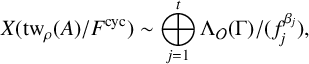 $$ \begin{align}X(\mathrm{tw}_\rho(A)/F^{\mathrm{cyc}})\sim \bigoplus_{j=1}^t \Lambda_{\mathcal{O}}(\Gamma)/(f_j^{\beta_j}), \end{align} $$
where each $f_j$
is an irreducible distinguished polynomial.
$f_j$
is an irreducible distinguished polynomial.
The following is Greenberg’s semi-simplicity conjecture for Artin twists over global function fields, which serves as the function field analog to the conjecture in [Reference Lim27, Conjecture 6.4].
Conjecture 7.11 (Greenberg’s semi-simplicity conjecture for
$\mathrm {tw}_\rho (A)/F$
).

Let A be an abelian variety defined over a global function field F with $\mathrm {char}(F)\neq p$
. Then, the action of
$\mathrm {char}(F)\neq p$
. Then, the action of $\Gamma $
on
$\Gamma $
on $X(\mathrm {tw}_\rho (A)/F^{\mathrm {cyc}})$
is completely reducible, that is,
$X(\mathrm {tw}_\rho (A)/F^{\mathrm {cyc}})$
is completely reducible, that is, $\beta _j=1$
for all j in (7-4).
$\beta _j=1$
for all j in (7-4).
We are now in a position to present the following result on the order of vanishing of characteristic elements evaluated at Artin representations.
Theorem 7.12. Let A be an abelian variety defined over a global function field F with $\mathrm {char}(F)\neq p$
and let
$\mathrm {char}(F)\neq p$
and let $F_\infty /F$
be an admissible p-adic Lie extension. Let
$F_\infty /F$
be an admissible p-adic Lie extension. Let $\rho $
be an irreducible Artin representation of
$\rho $
be an irreducible Artin representation of $G={\mathrm {Gal}}(F_\infty /F)$
and let
$G={\mathrm {Gal}}(F_\infty /F)$
and let $\xi _A$
denote a characteristic element of
$\xi _A$
denote a characteristic element of $X(A/F_\infty )$
. Suppose that Condition
$X(A/F_\infty )$
. Suppose that Condition $(\mathbf {G}_{\boldsymbol {\rho }})$
holds. Then,
$(\mathbf {G}_{\boldsymbol {\rho }})$
holds. Then,
 $$ \begin{align*}{\mathrm{ord}}_{T=0}(\Phi_{\rho}(\xi_A))\geq {\mathrm{corank}}_{\mathcal{O}}({\mathrm{Sel}}(\mathrm{tw}_\rho(A)/F)).\end{align*} $$
Moreover, equality holds if Greenberg’s semi-simplicity Conjecture 7.11 holds for $\mathrm {tw}_\rho (A)/F$
.
$\mathrm {tw}_\rho (A)/F$
.
Proof. The arguments used in the proof of Theorem 7.7 carry over to the setting of the Artin twists, using Proposition 7.9 and Lemma 7.10. In the proof, we also make use of the identity $X(\mathrm {tw}_\rho (A)/F_\infty ) = \mathrm {tw}_{\hat {\rho }}X(A/F_\infty )$
, as shown in [Reference Coates, Fukaya, Kato and Sujatha7, Lemma 3.4].
$X(\mathrm {tw}_\rho (A)/F_\infty ) = \mathrm {tw}_{\hat {\rho }}X(A/F_\infty )$
, as shown in [Reference Coates, Fukaya, Kato and Sujatha7, Lemma 3.4].
8 The generalized Euler characteristics
In this section, we introduce the definition of the generalized Euler characteristic. The idea of defining a finite Euler characteristic $\chi (G,Y)$
for a discrete p-primary G-module Y, even when the cohomology groups
$\chi (G,Y)$
for a discrete p-primary G-module Y, even when the cohomology groups $H^i(G,Y)$
are infinite, was first proposed by Coates, Schneider, and Sujatha in the form of the truncated Euler characteristic [Reference Coates, Schneider and Sujatha10]. Our presentation here follows that of Zerbes [Reference Zerbes48].
$H^i(G,Y)$
are infinite, was first proposed by Coates, Schneider, and Sujatha in the form of the truncated Euler characteristic [Reference Coates, Schneider and Sujatha10]. Our presentation here follows that of Zerbes [Reference Zerbes48].
Let W be a discrete p-primary $\Gamma $
-module. Then,
$\Gamma $
-module. Then,
 $$ \begin{align*}H^0(\Gamma,W)=W^\Gamma,\quad H^1(\Gamma,W)=W_\Gamma,\end{align*} $$
where $W_\Gamma $
is the maximal quotient of W on which
$W_\Gamma $
is the maximal quotient of W on which $\Gamma $
acts trivially. Hence, we have a map
$\Gamma $
acts trivially. Hence, we have a map
 $$ \begin{align*}\phi_W: H^0(\Gamma,W)\to H^1(\Gamma,W),\quad f\mapsto \text{ residue class of } f.\end{align*} $$
Now, let Y be a discrete p-primary G-module. We define
 $$ \begin{align*}d^0: H^0(G,Y)=H^0(\Gamma,Y^H)\longrightarrow H^1(\Gamma,Y^H)\hookrightarrow H^1(G,Y),\end{align*} $$
where the middle map is $\phi _{Y^H}$
and the last map is the inflation map. Similarly, for each
$\phi _{Y^H}$
and the last map is the inflation map. Similarly, for each $i\geq 1$
, define
$i\geq 1$
, define
 $$ \begin{align*}d^i: H^i(G,Y)\twoheadrightarrow H^0(\Gamma, H^i(H,Y))\longrightarrow H^1(\Gamma,H^i(H,Y))\hookrightarrow H^{i+1}(G,Y),\end{align*} $$
where the first map is the restriction map and the middle map is $\phi _{H^i(H,Y)}$
. Note that the restriction map is surjective since
$\phi _{H^i(H,Y)}$
. Note that the restriction map is surjective since $\mathrm {cd}_p(\Gamma )=1$
. We define
$\mathrm {cd}_p(\Gamma )=1$
. We define $d^{-1}$
to be the zero map.
$d^{-1}$
to be the zero map.
All the properties for the morphisms involved in the definition of the complex $(H^i(G,Y),d^i)$
become clear in the proof of the following proposition.
$(H^i(G,Y),d^i)$
become clear in the proof of the following proposition.
Proposition 8.1. The sequence $(H^\bullet (G,Y),d^\bullet )$
forms a cochain complex.
$(H^\bullet (G,Y),d^\bullet )$
forms a cochain complex.
Proof. We consider the Hochschild–Serre spectral sequence
 $$ \begin{align*}H^r(\Gamma,H^s(H,Y))\Rightarrow H^{r+s}(G,Y).\end{align*} $$
Since $\mathrm {cd}_p(\Gamma )=1$
, it follows that
$\mathrm {cd}_p(\Gamma )=1$
, it follows that $H^r(\Gamma ,H^s(H,Y))=0$
unless
$H^r(\Gamma ,H^s(H,Y))=0$
unless $r=0$
or
$r=0$
or $1$
. Thus, for all
$1$
. Thus, for all $s\geq 1$
, we obtain the short exact sequence
$s\geq 1$
, we obtain the short exact sequence
 $$ \begin{align} 0\to H^1(\Gamma,H^{s-1}(H,Y)) \to H^s(G,Y)\to H^0(\Gamma,H^s(H,Y)) \to 0. \end{align} $$
Now, observe that the differential $d^s: H^s(G,Y)\to H^{s+1}(G,Y)$
is given by the composition
$d^s: H^s(G,Y)\to H^{s+1}(G,Y)$
is given by the composition
 $$ \begin{align*}H^s(G,Y)\twoheadrightarrow H^0(\Gamma,H^s(H,Y)) \stackrel{\phi_{H^s(H,X)}}{\longrightarrow}H^1(\Gamma,H^{s}(H,Y))\hookrightarrow H^{s+1}(G,Y),\end{align*} $$
where the surjection and injection come directly from the short exact sequence (8-1). Therefore, $d^{s+1}\circ d^s$
factors through
$d^{s+1}\circ d^s$
factors through
 $$ \begin{align*}H^1(\Gamma,H^{s}(H,Y))\to H^{s+1}(G,Y) \to H^0(\Gamma,H^{s+1}(H,Y)),\end{align*} $$
which, by exactness of (8-1), is the zero map. Hence, we conclude that $d^{s+1}\circ d^s=0$
, as required.
$d^{s+1}\circ d^s=0$
, as required.
Definition 8.2. Let ${\mathfrak {H}}^\bullet $
denote the cohomology of the complex constructed in Proposition 8.1. If
${\mathfrak {H}}^\bullet $
denote the cohomology of the complex constructed in Proposition 8.1. If ${\mathfrak {H}}^i$
is finite for all
${\mathfrak {H}}^i$
is finite for all $i\geq 0$
, we say that the G-module Y has a finite generalized G-Euler characteristic
$i\geq 0$
, we say that the G-module Y has a finite generalized G-Euler characteristic $\chi (G,Y)$
, defined by
$\chi (G,Y)$
, defined by
 $$ \begin{align*}\chi(G,Y)=\prod_{i\geq0}\#({\mathfrak{H}}^i)^{(-1)^i}.\end{align*} $$
Lemma 8.3. The generalized G-Euler characteristic satisfies the following properties.
-
(1) If the groups
$H^i(G,Y)$
are finite for all i, then the generalized G-Euler characteristic of Y agrees with the usual G-Euler characteristic. -
(2) Suppose
$H^0(G,Y)$
and
$H^1(G,Y)$
are infinite, and
$H^i(G,Y)$
is finite for all
$i\geq 2$
. Then, Y has a finite generalized G-Euler characteristic if and only if the map
$d^0$
has a finite kernel and cokernel, in which case, (8-2)
$$ \begin{align} \chi(G,Y)=\frac{\#(\ker(d^0))}{\#(\mathrm{coker}~\!(d^0))}\times\prod_{i\geq2}\#(H^i(G,Y))^{(-1)^i}. \end{align} $$


Proof. This result is essentially contained in the work of Zerbes [Reference Zerbes48], though not explicitly stated in this form. For the reader’s convenience, we provide a full proof. For part (1), it suffices to show that for a cochain complex $({\mathfrak {X}}^\bullet ,\delta ^\bullet )$
with each
$({\mathfrak {X}}^\bullet ,\delta ^\bullet )$
with each ${\mathfrak {X}}^i$
finite for
${\mathfrak {X}}^i$
finite for $i\geq 0$
,
$i\geq 0$
,
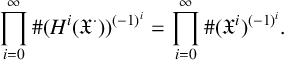 $$ \begin{align*}\prod^\infty_{i=0}\#(H^i({\mathfrak{X}}^\cdot))^{(-1)^i}=\prod^{\infty}_{i=0}\#({\mathfrak{X}}^i)^{(-1)^i}.\end{align*} $$
To verify this, consider the following two short exact sequences:
 $$ \begin{align*}0\to Z^i\to {\mathfrak{X}}^i \to B^{i+1}\to0,\end{align*} $$
 $$ \begin{align*}0\to B^i\to Z^i \to H^i({\mathfrak{X}}^\cdot)\to 0.\end{align*} $$
Since all modules involved are finite,
 $$ \begin{align*}\#({\mathfrak{X}}^i)=\#(Z^i)\cdot\#(B^{i+1}).\end{align*} $$
Because $\#(B^0)=1$
, it follows that
$\#(B^0)=1$
, it follows that
 $$ \begin{align*}\prod_{i\geq0}\#({\mathfrak{X}}^i)^{(-1)^i}=\prod_{i\geq0}(\#(Z^i) \cdot\#(B^{i+1}))^{(-1)^i}= \prod_{i\geq0}\#(H^i({\mathfrak{X}}^\cdot))^{(-1)^i}.\end{align*} $$
This proves part (1). For part (2), first note that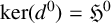 $\ker (d^0)={\mathfrak {H}}^0$
. Thus, if
$\ker (d^0)={\mathfrak {H}}^0$
. Thus, if $d^0$
has a finite kernel and cokernel, then
$d^0$
has a finite kernel and cokernel, then ${\mathfrak {H}}^0$
is finite. Consider the exact sequence
${\mathfrak {H}}^0$
is finite. Consider the exact sequence
 $$ \begin{align*}0\to {\mathfrak{H}}^1 \to \mathrm{coker}~\! d^0 \to H^2(G,Y), \end{align*} $$
where the third map is induced by $d^1$
. Since
$d^1$
. Since $\mathrm {coker}~\! d^0$
and
$\mathrm {coker}~\! d^0$
and $H^2(G,Y)$
are finite, it follows that
$H^2(G,Y)$
are finite, it follows that ${\mathfrak {H}}^1$
is also finite. Given that
${\mathfrak {H}}^1$
is also finite. Given that ${\mathfrak {H}}^i$
is finite for all
${\mathfrak {H}}^i$
is finite for all $i\geq 2$
by assumption, Y has a finite generalized G-Euler characteristic. Conversely, suppose that Y has a finite generalized G-Euler characteristic. Since
$i\geq 2$
by assumption, Y has a finite generalized G-Euler characteristic. Conversely, suppose that Y has a finite generalized G-Euler characteristic. Since $\ker (d^0)={\mathfrak {H}}^0$
and
$\ker (d^0)={\mathfrak {H}}^0$
and ${\mathfrak {H}}^0$
is finite,
${\mathfrak {H}}^0$
is finite, $d^0$
must have a finite kernel. Because
$d^0$
must have a finite kernel. Because $H^2(G,Y)$
is finite, so is
$H^2(G,Y)$
is finite, so is $\ker (d^2)$
. Now, consider the exact sequence
$\ker (d^2)$
. Now, consider the exact sequence
 $$ \begin{align*}0\to {\mathfrak{H}}^1 \to \mathrm{coker}~\! d^0 \to \ker d^2 \to {\mathfrak{H}}^2 \to 0.\end{align*} $$
It follows that $\mathrm {coker}~\! (d^0)$
is finite as well. To establish (8-2), note that the complex
$\mathrm {coker}~\! (d^0)$
is finite as well. To establish (8-2), note that the complex $(H^\bullet (G,Y),d^\bullet )$
induces the following cochain complex:
$(H^\bullet (G,Y),d^\bullet )$
induces the following cochain complex:
 $$ \begin{align*}0\to\mathrm{coker}~\!(d^0)\stackrel{\bar{d}^1}{\longrightarrow} H^2(G,Y)\stackrel{d^2}{\longrightarrow}\cdots.\end{align*} $$
All terms in this complex are finite and $\ker (\bar {d}^1)\simeq {\mathfrak {H}}_1$
. By part (1),
$\ker (\bar {d}^1)\simeq {\mathfrak {H}}_1$
. By part (1),
 $$ \begin{align} \prod^\infty_{i=1}\#({\mathfrak{H}}^i)^{(-1)^{i+1}}=\#(\mathrm{coker}~\! (d^0))\times \prod^\infty_{i=2}\#(H^i(G,Y))^{(-1)^{i+1}}. \end{align} $$
Since $\#({\mathfrak {H}}^0)=\#(\ker (d^0))$
, dividing both sides of (8-3) by
$\#({\mathfrak {H}}^0)=\#(\ker (d^0))$
, dividing both sides of (8-3) by $\#({\mathfrak {H}}^0)$
gives
$\#({\mathfrak {H}}^0)$
gives
 $$ \begin{align*}\chi(G,Y)=\frac{\#(\ker(d^0))}{\#(\mathrm{coker}~\!(d^0))}\times\prod_{i\geq2}\#(H^i(G,Y))^{(-1)^i},\end{align*} $$
which is exactly the expression in (8-2).
Let $| \cdot |_p$
denote the p-adic valuation of
$| \cdot |_p$
denote the p-adic valuation of $\overline {{\mathbb {Q}}}$
, normalized so that
$\overline {{\mathbb {Q}}}$
, normalized so that $|p|_p = p^{-1}$
. We now record the following important result, which relates the generalized Euler characteristic to the Akashi series.
$|p|_p = p^{-1}$
. We now record the following important result, which relates the generalized Euler characteristic to the Akashi series.
Proposition 8.4. Let Y be a discrete p-primary G-module such that $Y^\vee \in {\mathfrak {M}}_H(G)$
. If Y has a finite generalized G-Euler characteristic, then the leading term of its Akashi series
$Y^\vee \in {\mathfrak {M}}_H(G)$
. If Y has a finite generalized G-Euler characteristic, then the leading term of its Akashi series $\mathrm {Ak}(Y)$
is given by
$\mathrm {Ak}(Y)$
is given by $\alpha _Y T^k$
, where k is the alternating sum
$\alpha _Y T^k$
, where k is the alternating sum
 $$ \begin{align*}k=\sum_{i\geq0}(-1)^i \mathrm{corank}_{{\mathbb {Z}}_p}H^i(H,Y)^\Gamma\end{align*} $$
and
 $$ \begin{align*}\chi(G,Y)=|\alpha_Y|^{-1}_p.\end{align*} $$
Proof. See [Reference Zerbes48, Proposition 2.10].
We remark that, in general, the generalized G-Euler characteristic is not multiplicative in short exact sequences (see [Reference Zerbes48, the remark following Lemma 2.13]). However, the following lemma suffices for most of our purposes.
Lemma 8.5. Let
 $$ \begin{align*}0\to B_1 \to B_2 \to B_3 \to B_4 \to 0\end{align*} $$
be an exact sequence of discrete G-modules such that $B_1$
is finite and
$B_1$
is finite and $B_4$
has a finite G-Euler characteristic. Then,
$B_4$
has a finite G-Euler characteristic. Then, $B_2$
has a finite generalized G-Euler characteristic if and only if
$B_2$
has a finite generalized G-Euler characteristic if and only if $B_3$
does.
$B_3$
does.
Proof. Set $C=\ker (B_3\to B_4)$
. By analyzing the following two short exact sequences separately:
$C=\ker (B_3\to B_4)$
. By analyzing the following two short exact sequences separately:
 $$ \begin{align*}0\to B_1 \to B_2 \to C \to 0\end{align*} $$
and
 $$ \begin{align*}0\to C \to B_3 \to B_4\to 0,\end{align*} $$
we may reduce to the case where either $B_1=0$
or
$B_1=0$
or $B_4=0$
. We prove the lemma in the case
$B_4=0$
. We prove the lemma in the case $B_1=0$
; the case of
$B_1=0$
; the case of $B_4=0$
is analogous. Assume, therefore, that we have a short exact sequence of G-modules
$B_4=0$
is analogous. Assume, therefore, that we have a short exact sequence of G-modules
 $$ \begin{align*}0\to B_2\to B_3\to B_4\to 0,\end{align*} $$
with $B_4$
having finite G-Euler characteristics. In particular,
$B_4$
having finite G-Euler characteristics. In particular, $H^i(G,B_4)$
is finite for all
$H^i(G,B_4)$
is finite for all $i\geq 0$
. Consider the long exact sequence in G-cohomology arising from the short exact sequence above. It yields morphisms
$i\geq 0$
. Consider the long exact sequence in G-cohomology arising from the short exact sequence above. It yields morphisms
 $$ \begin{align*}\psi_i:H^i(G,B_2)\to H^i(G, B_3)\end{align*} $$
with finite kernel and cokernel for all $i\geq 0$
. By the naturality of the Hochschild–Serre spectral sequence and the definition of
$i\geq 0$
. By the naturality of the Hochschild–Serre spectral sequence and the definition of $d^i$
, the maps
$d^i$
, the maps $\psi _i$
are cochain maps between the complexes
$\psi _i$
are cochain maps between the complexes $(H^\bullet (G,B_2),d^\bullet _{B_2})$
and
$(H^\bullet (G,B_2),d^\bullet _{B_2})$
and $(H^\bullet (G,B_3),d^\bullet _{B_3})$
. Since the kernel and cokernel of these cochain maps are finite, the standard homological algebra argument implies that the induced maps on the cohomology of these complexes also have a finite kernel and cokernel. Therefore,
$(H^\bullet (G,B_3),d^\bullet _{B_3})$
. Since the kernel and cokernel of these cochain maps are finite, the standard homological algebra argument implies that the induced maps on the cohomology of these complexes also have a finite kernel and cokernel. Therefore, $B_2$
has a finite generalized Euler characteristic if and only if
$B_2$
has a finite generalized Euler characteristic if and only if $B_3$
does.
$B_3$
does.
Remark 8.6. One can even show that
 $$ \begin{align*}\chi(G,B_2)\chi(G, B_4)=\chi(G,B_1)\chi(G,B_3)\end{align*} $$
in the preceding lemma. As this latter calculation is not required for the paper, we do not provide a detailed proof, leaving it to the interested readers.
9 Computations of the generalized Euler characteristics
To compute the generalized Euler characteristics, we impose the following assumption $(\mathbf {H})$
on the abelian variety A defined over a function field F, which we now recall:
$(\mathbf {H})$
on the abelian variety A defined over a function field F, which we now recall:
 $$ \begin{align*} \mathbf{(H)}: \quad H^i(H, A_{p^\infty}(F_\infty)) \text{ is finite for all } i \geq 0. \end{align*} $$
Theorem 9.1. Let A be an abelian variety defined over a global field F with $\mathrm {char} F\neq p$
and let
$\mathrm {char} F\neq p$
and let $F_\infty $
be an admissible p-adic Lie extension of F. Suppose that Assumption
$F_\infty $
be an admissible p-adic Lie extension of F. Suppose that Assumption $(\mathbf {H})$
holds. Then,
$(\mathbf {H})$
holds. Then, ${\mathrm {Sel}}(A/F_\infty )$
has a finite generalized G-Euler characteristic if and only if
${\mathrm {Sel}}(A/F_\infty )$
has a finite generalized G-Euler characteristic if and only if ${\mathrm {Sel}}(A/F^{\mathrm {cyc}})$
has a finite generalized
${\mathrm {Sel}}(A/F^{\mathrm {cyc}})$
has a finite generalized $\Gamma $
-Euler characteristic. In that case, we have the following equality:
$\Gamma $
-Euler characteristic. In that case, we have the following equality:
 $$ \begin{align*}\chi(G, {\mathrm{Sel}}(A/F_\infty)) = \chi(\Gamma, {\mathrm{Sel}}(A/F^{\mathrm{cyc}})) \prod_{v\in S'}\frac{\# A^*_{p^\infty}(F_v)}{\# H^1(\Gamma_w, A_{p^\infty}(F^{\mathrm{cyc}}_w))},\end{align*} $$
where, for each $v\in S'$
, w is a fixed prime of
$v\in S'$
, w is a fixed prime of $F^{\mathrm {cyc}}$
lying above v and
$F^{\mathrm {cyc}}$
lying above v and $\Gamma _w$
denotes the decomposition subgroup of
$\Gamma _w$
denotes the decomposition subgroup of $\Gamma $
at w.
$\Gamma $
at w.
Proof. Consider the following fundamental commutative diagram:

The rows are exact. From the proof of Lemma 5.4, we know that the p-cohomological dimension of the decomposition group of H at every prime of $F_\infty $
is at most one. It follows that the map
$F_\infty $
is at most one. It follows that the map $\gamma $
is surjective. By applying the snake lemma, it follows that the map
$\gamma $
is surjective. By applying the snake lemma, it follows that the map $\phi $
is also surjective. Applying the snake lemma to the diagram (9-1), we obtain the following exact sequence:
$\phi $
is also surjective. Applying the snake lemma to the diagram (9-1), we obtain the following exact sequence:
 $$ \begin{align} 0\to \ker \alpha \to H^1(H,A_{p^\infty}(F_\infty)) \to \ker \gamma \to \mathrm{coker}~\! \alpha \to H^2(H,A_{p^\infty}(F_\infty)) \to 0. \end{align} $$
From Lemma 5.4, we have $H^i(H, J_v(A/F_\infty ))=0$
for every
$H^i(H, J_v(A/F_\infty ))=0$
for every $i\geq 1$
. Noting that
$i\geq 1$
. Noting that $\phi $
is surjective and using the long exact sequence in H-cohomology associated to the short exact sequence (4-2), we obtain an isomorphism
$\phi $
is surjective and using the long exact sequence in H-cohomology associated to the short exact sequence (4-2), we obtain an isomorphism
 $$ \begin{align*}H^i(H,{\mathrm{Sel}}(A/F_\infty))\simeq H^i(H,H^1(G_S(F_\infty),A_{p^\infty}))\quad \text{for all } i\geq1.\end{align*} $$
Consider the Hochschild–Serre spectral sequence
 $$ \begin{align*}H^p(H,H^q(G_S(F_\infty),A_{p^\infty}))\Rightarrow H^{p+q}(G_S(F^{\mathrm{cyc}}),A_{p^\infty}).\end{align*} $$
From Lemma 3.2, for every $i\geq 1$
,
$i\geq 1$
,
 $$ \begin{align*}H^i(H,H^1(G_S(F_\infty),A_{p^\infty}))\simeq H^{i+2}(H,A_{p^\infty}(F_\infty)).\end{align*} $$
Thus, for all $i\geq 1$
,
$i\geq 1$
,
 $$ \begin{align*}H^i(H,{\mathrm{Sel}}(A/F_\infty))\simeq H^{i+2}(H,A_{p^\infty}(F_\infty)).\end{align*} $$
By Assumption $(\mathbf {H})$
,
$(\mathbf {H})$
, $H^i(H,{\mathrm {Sel}}(A/F_\infty ))$
is finite for all
$H^i(H,{\mathrm {Sel}}(A/F_\infty ))$
is finite for all $i\geq 1$
. Consider now the following exact sequence:
$i\geq 1$
. Consider now the following exact sequence:
 $$ \begin{align*}&0\to H^1(\Gamma,H^i(H,{\mathrm{Sel}}(A/F_\infty)))\to H^{i+1}(G,{\mathrm{Sel}}(A/F_{\infty}))\\ &\quad\to H^0(\Gamma,H^{i+1}(H,{\mathrm{Sel}}(A/F_\infty)))\to 0.\end{align*} $$
From Lemma 8.3, ${\mathrm {Sel}}(A/F_\infty )$
has a finite generalized G-Euler characteristic if and only if the map
${\mathrm {Sel}}(A/F_\infty )$
has a finite generalized G-Euler characteristic if and only if the map
 $$ \begin{align*} &d^0 : H^0(G, {\mathrm{Sel}}(A/F_\infty))\\ &\quad= H^0(\Gamma, {\mathrm{Sel}}(A/F_\infty)^H) \stackrel{g}{\to} H^1(\Gamma, {\mathrm{Sel}}(A/F_\infty)^H) \stackrel{h}{\hookrightarrow} H^1(G, {\mathrm{Sel}}(A/F_\infty)) \end{align*} $$
has a finite kernel and cokernel. Since $\mathrm {coker}~h\hspace{-1pt} =\hspace{-1pt} H^1(H,{\mathrm {Sel}}(A/F_\infty ))^\Gamma\hspace{-1pt} \simeq\hspace{-1pt} H^{3}(H,A_{p^\infty }(F_\infty ))^\Gamma $
is also finite, it follows that
$\mathrm {coker}~h\hspace{-1pt} =\hspace{-1pt} H^1(H,{\mathrm {Sel}}(A/F_\infty ))^\Gamma\hspace{-1pt} \simeq\hspace{-1pt} H^{3}(H,A_{p^\infty }(F_\infty ))^\Gamma $
is also finite, it follows that $d^0$
has a finite kernel and cokernel if and only if g does. The latter is precisely equivalent to saying that
$d^0$
has a finite kernel and cokernel if and only if g does. The latter is precisely equivalent to saying that ${\mathrm {Sel}}(A/F_\infty )^H$
has a finite generalized
${\mathrm {Sel}}(A/F_\infty )^H$
has a finite generalized $\Gamma $
-Euler characteristic.
$\Gamma $
-Euler characteristic.
However, from Diagram (9-1), we have the following exact sequence:
 $$ \begin{align} 0\to \ker \alpha \to {\mathrm{Sel}}(A/F^{\mathrm{cyc}}) \to {\mathrm{Sel}}(A/F_\infty)^H \to \mathrm{coker}\ \alpha \to 0. \end{align} $$
Since $\ker \alpha \subseteq H^1(H,A_{p^\infty }(F_\infty ))$
, we know
$\ker \alpha \subseteq H^1(H,A_{p^\infty }(F_\infty ))$
, we know $\ker \alpha $
is finite. We claim that
$\ker \alpha $
is finite. We claim that $\mathrm {coker}~\! \alpha $
has a finite
$\mathrm {coker}~\! \alpha $
has a finite $\Gamma $
-Euler characteristic. Assuming the claim, it follows from Lemma 8.5 and (9-3) that
$\Gamma $
-Euler characteristic. Assuming the claim, it follows from Lemma 8.5 and (9-3) that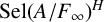 ${\mathrm {Sel}}(A/F_\infty )^H$
has a finite generalized
${\mathrm {Sel}}(A/F_\infty )^H$
has a finite generalized $\Gamma $
-Euler characteristic if and only if
$\Gamma $
-Euler characteristic if and only if ${\mathrm {Sel}}(A/F^{\mathrm {cyc}})$
does. This establishes the first assertion of the theorem. To prove the claim, note that by (9-2), it suffices to show that
${\mathrm {Sel}}(A/F^{\mathrm {cyc}})$
does. This establishes the first assertion of the theorem. To prove the claim, note that by (9-2), it suffices to show that $\ker \gamma $
has a finite
$\ker \gamma $
has a finite $\Gamma $
-Euler characteristic. As observed in the proof of Theorem 7.7, there is a surjection
$\Gamma $
-Euler characteristic. As observed in the proof of Theorem 7.7, there is a surjection
 $$ \begin{align*}H^1(F_v,A_{p^\infty}) \twoheadrightarrow J_v(A/F^{\mathrm{cyc}})^\Gamma,\end{align*} $$
and since $H^1(F_v, A_{p^\infty })$
is finite, so is
$H^1(F_v, A_{p^\infty })$
is finite, so is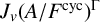 $J_v(A/F^{\mathrm {cyc}})^\Gamma $
. Thus, we see that
$J_v(A/F^{\mathrm {cyc}})^\Gamma $
. Thus, we see that $(\mathrm {ker}\gamma )^\Gamma $
is also finite. By [Reference Coates and Sujatha12, Proposition A.1.7], it follows that
$(\mathrm {ker}\gamma )^\Gamma $
is also finite. By [Reference Coates and Sujatha12, Proposition A.1.7], it follows that $\mathrm {ker}(\gamma )$
has a finite
$\mathrm {ker}(\gamma )$
has a finite $\Gamma $
-Euler characteristic.
$\Gamma $
-Euler characteristic.
Now, suppose that both generalized Euler characteristics in question are well defined. Then, by Theorem 5.5 and Proposition 8.4,
 $$ \begin{align*} \chi(G, {\mathrm{Sel}}(A/F_\infty)) = \chi(\Gamma, {\mathrm{Sel}}(A/F^{\mathrm{cyc}})) \prod_{v\in S'}\chi(\Gamma, J_v(A/F^{\mathrm{cyc}})). \end{align*} $$
Thus, the final assertion of the theorem follows once we show that
 $$ \begin{align} \chi(\Gamma, J_v(A/F^{\mathrm{cyc}})) = \frac{\# A^*_{p^\infty}(F_v)}{\# H^1(\Gamma_w, A_{p^\infty}(F^{{\mathrm{cyc}}}_w))} \end{align} $$
for each $v\in S'$
. The restriction map gives the following short exact sequence:
$v\in S'$
. The restriction map gives the following short exact sequence:
 $$ \begin{align*} 0 \to H^1(\Gamma_w, A_{p^\infty}(F^{{\mathrm{cyc}}}_w)) \to H^1(F_v, A_{p^\infty}) \to J_v(A/F^{\mathrm{cyc}})^\Gamma \to 0,\end{align*} $$
where, using Shapiro’s lemma, we identify
 $$ \begin{align*}J_v(A/F^{\mathrm{cyc}})^\Gamma\simeq H^0(\Gamma_w,H^1(F^{\mathrm{cyc}}_w,A_{p^\infty})).\end{align*} $$
By Tate local duality,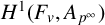 $H^1(F_v, A_{p^\infty })$
is dual to
$H^1(F_v, A_{p^\infty })$
is dual to $ A^*_{p^\infty }(F_v)$
. Therefore,
$ A^*_{p^\infty }(F_v)$
. Therefore,
 $$ \begin{align}\# J_v(A/F^{\mathrm{cyc}})^\Gamma = \frac{\# A^*_{p^\infty}(F_v)}{\# H^1(\Gamma_w, A_{p^\infty}(F^{{\mathrm{cyc}}}_w))}. \end{align} $$
However, by Shapiro’s lemma,
 $$ \begin{align} H^1(\Gamma, J_v(A/F^{\mathrm{cyc}})) \simeq H^1(\Gamma_w, H^1(F^{\mathrm{cyc}}_w, A_{p^\infty})). \end{align} $$
Now, consider the following spectral sequence:
 $$ \begin{align*}H^r(\Gamma_w, H^s(F^{\mathrm{cyc}}_w, A_{p^\infty}))\Rightarrow H^{r+s}(F_v, A_{p^\infty}).\end{align*} $$
Since $\mathrm {cd}_p ~\Gamma _w =1$
and
$\mathrm {cd}_p ~\Gamma _w =1$
and $H^2(F^{\mathrm {cyc}}_w, A_{p^\infty }) =0$
(see [Reference Neukirch, Schmidt and Wingberg34, Theorem 7.1.8(i)]), the spectral sequence degenerates, yielding an isomorphism
$H^2(F^{\mathrm {cyc}}_w, A_{p^\infty }) =0$
(see [Reference Neukirch, Schmidt and Wingberg34, Theorem 7.1.8(i)]), the spectral sequence degenerates, yielding an isomorphism
 $$ \begin{align} H^1(\Gamma_w, H^1(F^{\mathrm{cyc}}_w, A_{p^\infty})) \cong H^2(F_v, A_{p^\infty}). \end{align} $$
By Tate local duality, $H^2(F_v, A_{p^\infty })=0$
(see [Reference Coates and Sujatha12, Lemma 1.12]). Therefore, combining (9-5), (9-6), and (9-7), we obtain the identity (9-4), as required. This completes the proof of the theorem.
$H^2(F_v, A_{p^\infty })=0$
(see [Reference Coates and Sujatha12, Lemma 1.12]). Therefore, combining (9-5), (9-6), and (9-7), we obtain the identity (9-4), as required. This completes the proof of the theorem.
Remark 9.2. When $A=E$
is an elliptic curve, it follows from well-known properties of elliptic curves that
$A=E$
is an elliptic curve, it follows from well-known properties of elliptic curves that
 $$ \begin{align*}\chi(\Gamma,J_v(E/F^{\mathrm{cyc}}))=|L_v(E,1)|_p,\end{align*} $$
where $L_v(E,1)$
denotes the Euler factor at v of the complex L-function of E over F. This recovers a formula of Zerbes in the context of number fields, as well as a corresponding result by Sechi in the context of function fields, utilizing standard Euler characteristic calculations.
$L_v(E,1)$
denotes the Euler factor at v of the complex L-function of E over F. This recovers a formula of Zerbes in the context of number fields, as well as a corresponding result by Sechi in the context of function fields, utilizing standard Euler characteristic calculations.
In [Reference Lai, Longhi, Tan and Trihan24, Theorem 3.2.6], Lai, Longhi, Tan, and Trihan computed the generalized $\Gamma $
-Euler characteristic
$\Gamma $
-Euler characteristic
 $$ \begin{align*}\chi(\Gamma, {\mathrm{Sel}}(A/F^{\mathrm{cyc}}))\end{align*} $$
in terms of the quantities appearing in the Birch–Swinnerton-Dyer conjecture. Combining their result with ours, we deduce that the generalized G-Euler characteristic $\chi (G, {\mathrm {Sel}}(A/F_\infty ))$
can likewise be expressed in terms of invariants arising in the Birch–Swinnerton-Dyer conjecture. We conclude with the following corollary, which illustrates how the characteristic element fits into this framework.
$\chi (G, {\mathrm {Sel}}(A/F_\infty ))$
can likewise be expressed in terms of invariants arising in the Birch–Swinnerton-Dyer conjecture. We conclude with the following corollary, which illustrates how the characteristic element fits into this framework.
Corollary 9.3. Retain the setting of Theorem 9.1. Suppose further that Greenberg’s semi-simplicity Conjecture 6.2 holds for $A/F$
. Set
$A/F$
. Set $s_A=\mathrm {corank}_{{\mathbb {Z}}_p} {\mathrm {Sel}}(A/F)$
. Then,
$s_A=\mathrm {corank}_{{\mathbb {Z}}_p} {\mathrm {Sel}}(A/F)$
. Then,
 $$ \begin{align*} \frac{1}{T^{s_A}}\Phi_{\mathrm{reg}_F}(\xi_A) \bigg|_{T=0} = \chi(\Gamma, {\mathrm{Sel}}(A/F^{\mathrm{cyc}})) \prod_{v\in S'}\frac{\# A^*_{p^\infty}(F_v)}{\# H^1(\Gamma_w, A_{p^\infty}(F^{\mathrm{cyc}}_w))},\end{align*} $$
where, for each $v\in S'$
, w is a fixed prime of
$v\in S'$
, w is a fixed prime of $F^{\mathrm {cyc}}$
lying above v and
$F^{\mathrm {cyc}}$
lying above v and $\Gamma _w$
is the corresponding decomposition subgroup.
$\Gamma _w$
is the corresponding decomposition subgroup.
Acknowledgements
The authors thank Ashay Burungale, Pierre Colmez, Mahesh Kakde, Antonio Lei, Katharina Müller, Anwesh Ray, Jishnu Ray, Gianluigi Sechi, Ramdorai Sujatha, Fabien Trihan, Maria Valentino, and Sarah Zerbes for their interest and comments. They are very grateful to the anonymous referee for valuable suggestions. This paper arose from the conference ‘Special Values of L-functions’ held at Tsinghua Sanya International Mathematics Forum, and the authors thank Ashay Burungale, Emmanuel Lecouturier, and Xin Wan for organizing the conference that enabled the authors’ collaboration. Yukako Kezuka also thanks Gianluigi Sechi for sharing his PhD thesis, which inspired their collaboration.



