

Roman female workers have been described as silent participants in history, their voices unrecorded and their roles all but invisible.Footnote 1 Yet we have evidence for the consistent presence of a female manager at Roman rural villas, a phenomenon that deserves our attention.Footnote 2 The existence of the vilica can be traced across five centuries in the agronomists, poetry and drama, the jurists, and inscriptions.Footnote 3 Most of these texts contain little more than a brief mention of the term, and only one was written on the initiative of a vilica herself.Footnote 4 We do, however, have two clear accounts of her work: in the 2nd c. BCE, Cato lists her roles at the villa in one brief passage;Footnote 5 and the 1st-c. CE agronomist Columella gives a lengthy and detailed discussion of her duties that warrants more careful examination than it has received.Footnote 6 Close analysis of these accounts, presented here, calls into question the widely accepted scholarly view that the vilica’s responsibilities were confined to the domestic sphere.
Further, we can greatly expand our understanding of the roles of the vilica by reading the written sources in the light of archaeological investigations. Excavations give us insight into how work spaces and activities were organized at Roman villas, and thus the location, character, and scale of the duties that agronomists allocate to the vilica. Iconographic sources also enlarge our picture, since images, though scanty, show female figures working in ways that reflect both texts and archaeology. By reading these three forms of evidence in combination, we arrive at a new understanding of the Roman vilica’s work. The combined textual, archaeological, and iconographic record challenges the long-held picture of the vilica as a “housekeeper” and indicates that, in fact, she played key roles in Roman farming and the ritual practices seen as essential to its success.
Modern scholarship on the vilica
The existence of the vilica received scant attention until the late 20th c.Footnote 7 More recently, it has been established that vilica was the professional title for a female supervisor at a villa,Footnote 8 but her managerial roles have been envisaged as confined to the supervision of food for the household and domestic labor inside the house.Footnote 9
This prevailing view was established by Jasper Carlsen, who accorded the vilica her first detailed study, and summarized her roles thus:
The vilica … appears to have been essentially a housekeeper … responsible for the domestic work; she takes care of the buildings and their furniture, and supervises the work of the domestic slaves.Footnote 10
In her similarly pioneering work a decade later, Ulrike Roth also saw the vilica as “firmly separated” from “those activities associated with cultivation of the ground.”Footnote 11 This view has held sway for more than three decades, with scholars describing the vilica as responsible for domestic tasks “in the house,” particularly preparing and storing food for household consumption,Footnote 12 as recently encapsulated by Lena Lovén’s definition of her roles as encompassing “a variety of indoor responsibilities … with the over-arching control of the slaves working in the house and the kitchen, of food provisions, and the preparation of food.”Footnote 13
However, recent scholarship has demonstrated that Roman women were not segregated from public and business activities inside the house, and that women of diverse socio-economic backgrounds played prominent roles in local civic and commercial life.Footnote 14 Archaeological remains, business records, inscriptions, and images all show that women from a range of classes, including enslaved and freedwomen, handled financial transactions, worked in account-keeping, businesses, bars, inns, and retail, and sold wine, meat, perfume, metal goods, shoes, and cloth.Footnote 15 Women not only worked, but took on managerial roles. A female skeleton found at Villa B of Oplontis was probably that of a manager or businesswoman, judging from her bronze and silver jewelry and bag of more than 400 bronze, silver, and gold coins.Footnote 16 Tituli picti and stamps on amphorae and dolia for oil and wine, which were fundamental to agricultural production and profit, attest to women’s supervisory roles in the manufacture, use, and sale of these containers.Footnote 17 An inscription in Rome reveals the existence of a negotiatrix who imported Baetican olive oil and wine,Footnote 18 while the name of Umbricia Fortunata on fish sauce vessels from the Pompeian workshop of Umbricius Scaurus reveals her managerial involvement.Footnote 19 In Roman law, women could be appointed institutores, legally able to conduct a business and even shipping,Footnote 20 and the jurists comment that “women who have reached adult age are themselves handling their own business matters.”Footnote 21 Although urban epigraphic evidence suggests that many women worked indoors rather than in heavy outdoor labor such as building work, their tasks were not exclusively domestic but included occupations such as entertainment or retail.Footnote 22 Domestic labor such as house cleaning, cooking, washing dishes, and serving food was not particularly gendered or exclusively carried out by female servants in the Roman world. In fact, both texts and images indicate that it was often organized and carried out by males.Footnote 23 There is no reason, therefore, to assume that simply because of her gender the vilica was confined to the domestic sphere.
Ancient sources on the vilica
The 2nd-c. BCE agronomist Cato in his De agricultura briefly lists the vilica’s supervisory duties.Footnote 24 He mentions keeping the villa swept and in a clean state;Footnote 25 ensuring that food is supplied to the estate owner and household;Footnote 26 keeping chickens;Footnote 27 preserving fruits and nuts;Footnote 28 and knowing how to make flour.Footnote 29
Cato includes supervision of meals and cleaning among the vilica’s roles, but her responsibilities are not by any means exclusively domestic. They also include aspects of farming such as keeping poultry and the essential processing of seasonal farm products.Footnote 30 Keeping the villa in a clean state could also refer to work buildings, such as those for animals and wine/oil making, not merely the residence, as will be discussed below.Footnote 31 It is significant that Cato elsewhere includes the vilica in his list of “what is required to equip an olive grove/vineyard,”Footnote 32 alongside the vilicus, agricultural staff, and equipment, even though he does not list any domestic staff.
Attention should also be paid to one further task he assigns the vilica: to keep the “focus pure and swept around”Footnote 33 and to regularly offer garlands and supplicate the Lares for “the abundance” of the farm.Footnote 34 This sweeping is not mundane household cleaning but rather a ritual process.Footnote 35 The focus is the place where domestic cult offerings are burned,Footnote 36 as reinforced by the command that immediately follows to hang garlands and to supplicate there. The words pro copia associate the vilica with the output of the farm and abundant harvests. This accords with Tibullus’s description of farm workers supplicating the Lares for good harvests and fruitful vines.Footnote 37 It should be remembered that according to ancient viewpoints, such ritual acts were just as important to the success of farming as practical methods.Footnote 38 Although he warns that she must only do so by order of her master or mistress,Footnote 39 Cato nevertheless entrusts the vilica with this important role, as will be further discussed below.
In poetry of the early to mid-Imperial period, brief glimpses of the vilica also associate her with food,Footnote 40 but they are not descriptions of a cook preparing and delivering meals from the kitchen to the table. Rather, the vilica is described as responsible for sending fresh food from their country estates to the poets in Rome.Footnote 41 Thus we see the vilica in charge of the produce which leaves the estate, rather than simply organizing the farming household’s meals.
The 1st-c. BCE jurist Trebatius is quoted by his 3rd-c. CE counterpart Ulpian as saying that the vilica should be included in the instrumentum fundi – elsewhere defined as whatever is required for productive work, gathering and preserving produce of the estate.Footnote 42 In the list of staff included in the instrumentum fundi, her title is followed by the proviso “if in any way she assists with the responsibility of her husband.”Footnote 43 Her inclusion in the instrumentum fundi and association with a man’s officia imply that she was not segregated from male farm work but was seen as essential to aspects of production on the estate, a picture which is expanded by the agronomist Columella, as will be discussed below.
In these sources, the vilica appears to be an enslaved woman, but epigraphic and legal evidence indicates that she could also be freed. As has been argued for the vilicus, it is certainly possible that some vilicae may have been freed or free women.Footnote 44
Columella’s 12th book
Our most extensive evidence for the vilica’s work roles is that of the agronomist Columella, whose De re rustica was written in the 1st c. CE, more than 200 years after Cato’s De agricultura.Footnote 45 Columella’s work was intended as a manual for elite landowners on the profitable management of their villa estates and mostly consists of detailed discussion of farming practices.Footnote 46 He lists 50 Greek, Roman, and Carthaginian sources and frequently quotes the practical experience of his uncle Marcus, farming in his own home province of Hispania Baetica, although Columella himself lived and owned land in central Italy.
Columella devotes the whole of the 12th and final book of his De re rustica to describing the responsibilities (curae or officia) of the vilica. Footnote 47 While we cannot assume that the work of every vilica on an actual estate would have conformed to his instructions, they do tell us what roles this Roman landowner in the Imperial period thought it was likely and appropriate for her to fulfil. Contrary to assumptions made by modern scholars, in Columella’s account, the vilica’s responsibilities are not primarily domestic but are integral to the production and profit of the farm.
Columella begins Book 12 with an introductory section comprising the Preface and first three chapters. This mostly consists of quotes from Xenophon’s early 4th-c. BCE work Oeconomicus, set in the Athens of the late 5th c. BCE, more than 400 years earlier.Footnote 48 The agronomist then provides his own description of the roles of the vilica, without reference to Xenophon, in the bulk of Book 12, from chapters 4 to 59.
The modern view of the vilica and her limited, “domestic” role stems almost entirely from the introductory section of Columella’s Book 12. Scholars have invariably read this as evidence for the Roman vilica’s duties, even when Xenophon’s influence is recognized.Footnote 49 Milnor, for example, sees it as confirming the “domestic duties of the vilica,” arguing that Columella “follows Xenophon’s Oeconomicus in insisting” that women were suited to “‘housiness’ or domesticity.”Footnote 50
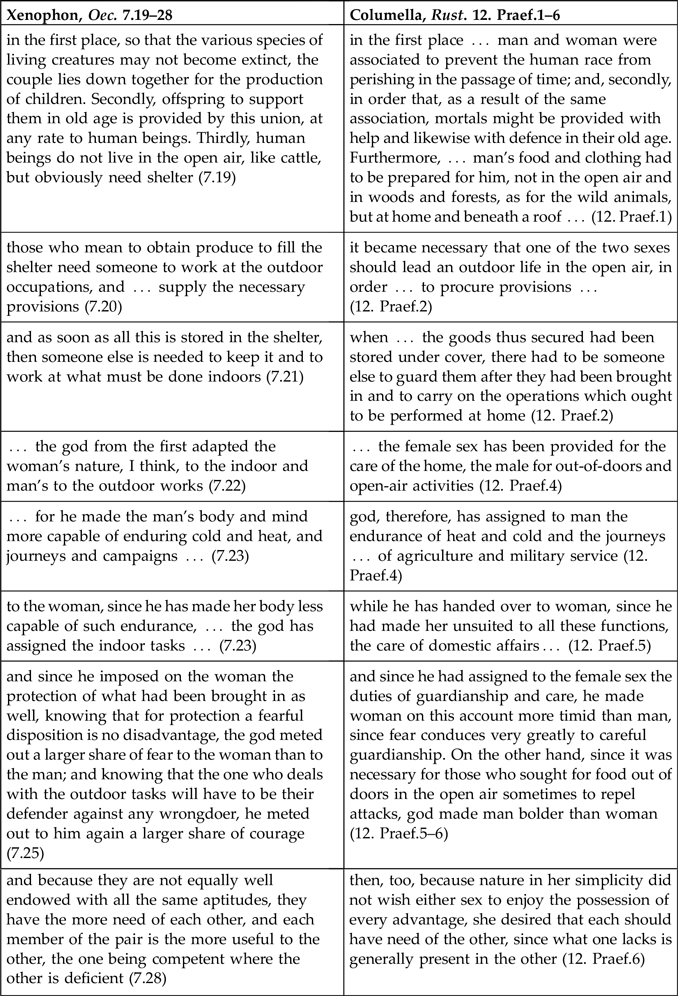
In accordance with the philosophical tradition of the dialogue, Xenophon presents his views in the form of an imaginary discussion between the philosopher Socrates and a possibly fictional Athenian landowner called Ischomachus.Footnote 51 In this dialogue, Ischomachus recounts to Socrates a conversation with his new 14-year-old wife about her proper role within their wealthy household in the city of Athens.Footnote 52 Columella begins his Preface to Book 12 by quoting, almost verbatim, Ischomachus’s opening explanation of the “natural” roles of men and women, according to which men work outdoors and women indoors (see Appendix 1).Footnote 53 Columella does not claim these ideas as his own, but says at the start and end of the section that they are put forward by “Xenophon of Athens, in that book… which is entitled Oeconomicus,” adding the caveat “not uselessly.”Footnote 54 The only other place in the De re rustica where Columella refers directly to Xenophon is with regard to the training of the vilicus, at which point Columella rejects his advice – also coming from the mouth of Ischomachus – on the grounds that “these things are very much too ancient and indeed are of his own era.”Footnote 55
The philosophical digression at the start of Book 12 is unique in Columella’s work. The only comparable part of the De re rustica is the account of the fabulosa tradita of the origins of bees, derived from the 4th-c. BCE Greek poet Euhemerus and the 2nd-c. BCE poet Nicander.Footnote 56 Although he repeats them at length, Columella dismisses these Greek traditions as unsuitable for farmers, whom “they do not help in any way – neither in their work nor in their household affairs.”Footnote 57 The rest of Columella’s detailed advice on beekeeping is completely unrelated and highly practical, which, as we will see, is also the case with his discussion of the vilica in Book 12, chapters 4 to 59. Columella’s philosophical and poetic digressions, like the presentation of his Book 10 in dactylic hexameter, seem intended to add a learned flourish to his work on farming in order to “win the appreciation of his educated audience.”Footnote 58
The start of Book 12 should not be read as a description of estate management, nor as a reflection of 1st-c. CE Roman views. It is an extended quote from a 4th-c. BCE Greek philosopher about the “natural” source of elite men’s and women’s ideal roles in marriage. Their incongruity in relation to a Roman vilica is highlighted by a subtle shift that Columella makes in his enumeration of activities requiring shelter. Xenophon lists care for infants, baking bread, and textile work – all tasks which would have concerned an upper-class Athenian wife in her urban home.Footnote 59 Columella, however, changes the list to one that is suitable for a farm: “crops and the other kinds of provisions from the earth required shelters, and the young of sheep and other livestock, as well as produce, had to be looked after in an enclosed place.”Footnote 60
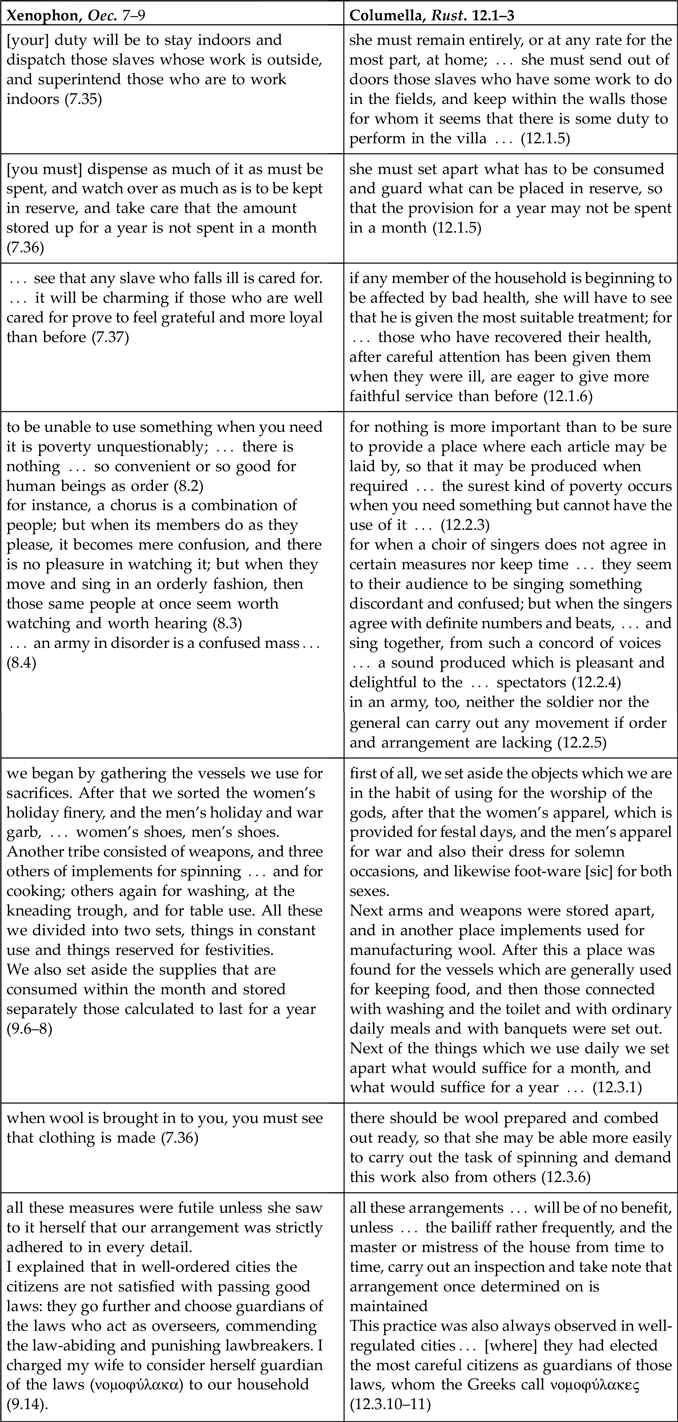
There follows an extended quotation of the list of roles in their Athenian town house that, in the course of their imaginary conversation, Ischomachus assigns to his bride (see Appendix 2).Footnote 61 These roles are:
-
• To stay indoors, at home
-
• To send slaves out of the house as their work requires
-
• To care for sick slaves and elicit their loyalty
-
• To dispense household supplies as they are needed
-
• To oversee the making of clothing
-
• To keep the household in order, like the polis
Even for 5th-c. BCE Athens, these instructions have the ring of a philosophical ideal rather than reality, and they have been described as “a medley of normative and idealistic thoughts on the Greek household.”Footnote 62 They would certainly not have applied to the realities of work for lower-class Athenian women, who must have left the house for many purposes such as fetching water or selling goods.Footnote 63
None of these roles coincides with Cato’s description of the work of the vilica, or with Columella’s own discussion which follows in Book 12, from chapter 4 onwards. Indeed, Columella twice more explicitly says that these are not his own instructions but rather precepts expressed by Xenophon.Footnote 64
In the final sections of chapter 3, while still quoting Ischomachus’s instructions as presented in Xenophon’s narrative, Columella departs from Xenophon in ways which again betray the gulf between the work of his enslaved Roman vilica and the fictional upper-class wife of his Greek source. While Ischomachus very briefly mentions “when wool is brought in to you, you must see that clothing is made for those who need it,” referring to the wool work conducted by Greek women in the town house,Footnote 65 Columella expands on this and gives it a rural context: “On wet days, or when due to frost or cold a woman cannot attend to farm work in the open air so that she is recalled to wool work, the wool should be prepared and combed, in order that she may more easily catch up with and complete her allocated wool making.”Footnote 66 Here, Columella reveals that the work of the vilica and other women will not always be indoors, but could be any sort of productive work in the open air (sub dio), as will be discussed below.Footnote 67
Columella quotes Ischomachus’s instructions to his wife to oversee the work at the looms,Footnote 68 but he replaces oversight of the hand-milling of grain and measuring out of provisions, kneading of dough, and folding of clothing and linens with the advice that the vilica
must be responsible for the kitchen and the ox-stalls, and no less the stables, that must be cleaned …. She must intervene when the stewards or the winery workers are weighing or measuring out anything and no less must be present when the shepherds are collecting the produce in the sheepfolds or putting the lambs or other young animals to suckle: indeed, she must certainly be there for the shearing and diligently take charge of the wool and count the fleeces in relation to the number of sheep. Then she must urge on the house slaves so that they air the furniture and the rubbed bronzes are polished and freed from rust, and all the things that want mending are handed over to artisans for repair.Footnote 69
Thus, Columella allocates to the vilica supervision not only of domestic staff (atriensii and promi),Footnote 70 but also of the cellarii, the workers in the cella vinaria and cella olearia – the wine and oil buildings of the farm – as will be discussed below.Footnote 71 Columella also sends his vilica out of the domestic zone as far as the sheepfolds, ox-stalls, and stables (stabuli, bubilia, and praesepia).Footnote 72 He gives the vilica outdoor duties directly related to farm production and profit, particularly animal husbandry: supervision of the care of the oxen needed for ploughing the grain fields; supervision of the products (milk and wool) derived from animal husbandry; and supervision of the suckling of young farm animals, which must be well managed in relation to the productive functions of milking and breeding.Footnote 73 The task of counting fleeces indicates that she is numerate, and probably literate.Footnote 74 This echoes the implication in Cato’s account that she can read or calculate the calendar in order to know the correct days to make offerings.Footnote 75
Columella’s extensive borrowing from Xenophon ends with chapter 3 and he effectively begins Book 12 again with the words: “We will now advise about other things, which were omitted in the preceding books since they were reserved for the duties of the vilica.”Footnote 76 His own much more substantial and realistic advice relating to a Roman farm follows, and in chapters 4 to 59, which have been all but ignored by modern historians, he outlines a very different set of responsibilities for the vilica:
-
• Preserving and drying fruit, vegetables, and herbs, and the processing of honey and beeswax in spring and summer (4–17)
-
• Preparations for the vintage in autumn, including carrying out correct rituals (18)
-
• Wine making (19–40)
-
• Making mulsum and fruit syrup (41–42)
-
• Preserving and drying cheese, fruit, vegetables, and herbs in autumn (43–48)
-
• Pickling olives in autumn (49–51)
-
• Oil making in winter (52–54)
-
• Killing and salting pigs (55)
-
• Preserving and drying fruit, vegetables, and herbs in winter (56–58)
-
• Preparing moretum and digestives (59)
These chapters all concern the essential processing of the products of the farm to make them long-lasting and profitable. In the absence of methods of effective sealing, freezing, or refrigeration, the fresh harvests of each season had to be protected from mold, decay, and insect infestation. Columella’s emphasis on the preservation of the farm products echoes Cato’s command that the vilica should preserve fruits and nuts. Processing was not only necessary for household food storage but would also be required if the products were to be transported for sale, as will be discussed below. For this reason, the jurists included preserving produce alongside producing it (while excluding grain to be consumed) in their definition of what was essential to the functioning of the fundus.Footnote 77 Columella mentions the preparation of meals and medicines only very briefly, in the final chapter.Footnote 78
Columella sets out the vilica’s responsibilities in order of the seasons, and with the transition to each new season he reminds the reader that those tasks he describes are overseen by the vilica. Footnote 79 This parallels Book 11, in which Columella gives a month-by-month description of the tasks overseen by the vilicus, intermittently reiterating that they are supervised by him.Footnote 80 Book 12 is thus clearly intended to enumerate the specific duties that Columella considers it ideal to allocate to the vilica.
The vilica and the archaeology of the villa
To fully understand the vilica’s sphere of work and Columella’s text, we must consider the economic and physical context for which Columella offers his advice: a wealthy rural villa in the western Mediterranean provinces during the Roman Imperial period. This was a complex of many buildings, oriented to surplus production for commercial sale and profit, sometimes on a large scale. The work of the vilica can be better understood by reading Columella’s instructions in the light of the archaeological remains of such 1st- to 2nd-c. CE villas.
Unlike Ischomachus’s 5th-c. BCE Athenian town house, in which wool work, hand-milling of grain, and storage took place,Footnote 81 at a Roman villa of the Imperial period, farm work and storage were separated from the domestic zones.Footnote 82 Columella himself describes how the villa was “divided” between the elite residence and the work buildings.Footnote 83 This distinction between residential and functional zones, usually termed the pars urbana and pars rustica, is clearly evident in villas across the western Mediterranean provinces, in spite of variations in layout, architectural style, and scale.Footnote 84
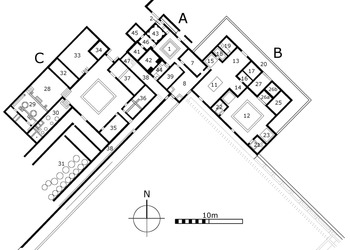
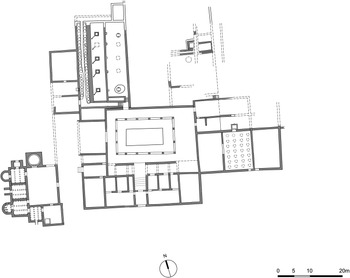
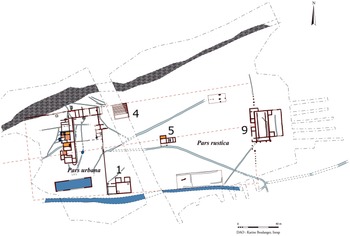
The distinction between residential and work spaces is already evident at the 1st-c. BCE villa of Varignano, Liguria (Fig. 1). The elite residence (B), with its decorative peristyle and mosaics and a portico overlooking the scenic bay, lay to the east of a huge central courtyard. The work zone (C), comprising oil and/or wine presses, additional work rooms, and a large storage hall with dolia (31), was arranged around a second and smaller yard to the west, accessed from the fields by a northern gate. Between this and the elite residence lay a smaller residential area (A) with opus signinum floors, which may have been for the farm managers – vilica and vilicus. This domestic quarter had an external entry, while also linking to both the pars urbana and work areas. A long corridor (38) separated the work zone from both residences.Footnote 85 The separation of work zones can similarly be seen at the villa of Milreu, built in the 1st c. CE not far from Columella’s home town of Gades in southern Hispania (Fig. 2). The villa consisted of three wings around a U-shaped courtyard: an elegant residence with peristyle and baths to the south; an oil-making wing with five presses and rooms for olive milling and oil storage to the west; and an eastern wing with buildings for wine making, including pressing and fermentation.Footnote 86 At the 1st- to 2nd-c. CE villa of Damblain (Gallia Lugdunensis) (Fig. 3), the pars urbana was even more emphatically separated from the work zones by a masonry wall stretching more than 80 m, the entry guarded by a small gatehouse.Footnote 87 Even when work areas at villas were located adjacent to the elite residence,Footnote 88 their agricultural rather than “domestic” functions were quite distinct. Recent space-syntax analysis of villas in Hispania has highlighted how functional areas were segregated from the residential zone by their different access points.Footnote 89 The differing spatial distributions of finds associated with a residence (mosaic tesserae, fine pottery) and those associated with storage and work (amphorae, millstones) have also been examined.Footnote 90
Plan of 1st-c. BCE villa of Varignano (Liguria), showing pars urbana to the east (B); oil and/or wine presses, work rooms, and storage dolia to the west (C); and smaller residential area, possibly for the farm managers (A). (© M. Feige, courtesy M. Feige.)

Fig. 1. Long description
The grand residence with courtyards and long portico faces east. To the west, multiple work buildings are arranged around a large central work yard. The farm managers’ residence lies in between, with several rooms around a small courtyard. It is separated from the work area by corridors but has access to both work and elite zone.
Plan of 1st- to 2nd-c. CE villa of Milreu (Hispania Lusitania), showing wine-making buildings with spaces for presses and cella vinaria to the east; oil-making building with five presses and cella olearia to the northwest; and pars urbana to the south. (© F. Teichner, courtesy F. Teichner.)
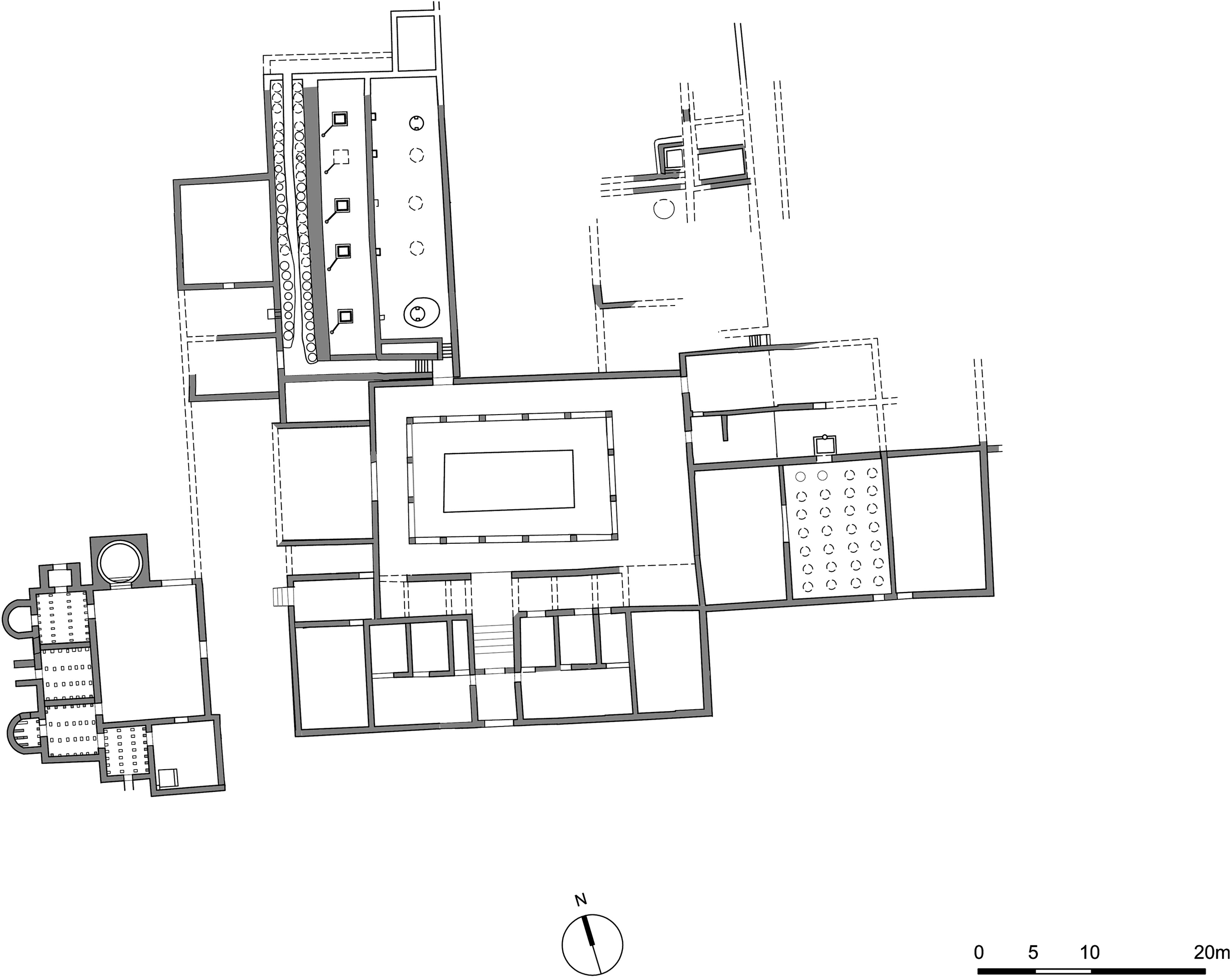
Fig. 2. Long description
The grand residence with peristyle courtyard faces south, with baths to the southwest. Large multi-room buildings for making oil and wine lie to the north and east, respectively.
Plan of 1st- to 2nd-c. CE villa of Damblain (Gallia Lugdunensis), showing pars urbana to the west, separated by a wall from the workers housing (1), granary (4), a cult building (5), and a large multifunctional work and storage building (9). (© K. Boulanger, courtesy K. Boulanger.)
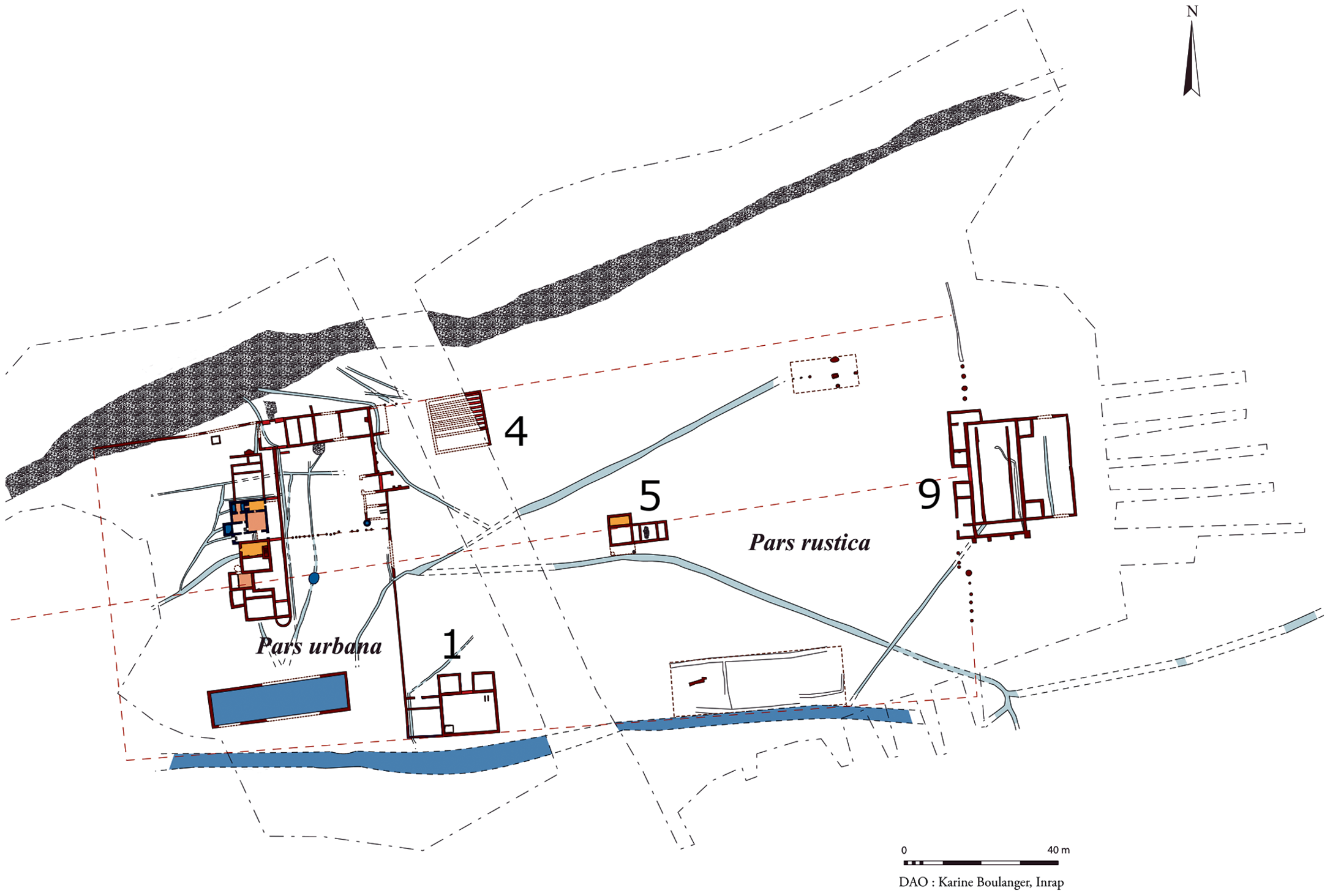
Fig. 3. Long description
The large multi-room elite residence with two wings lies to the west. To the east of a long diving wall are four buildings arranged within a large courtyard. The design and size of each building suggests its function for housing, storage of grain, cult practices, and agricultural work and storage.
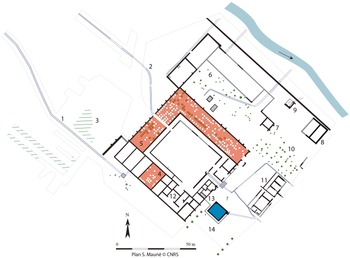
The pars urbana may in fact have been seldom used. Landowners spent most of the year in town, or even in another province altogether, and might visit their farms only rarely, as Columella himself admits.Footnote 91 The majority of the villa complex consisted of the different work sectors: wine- and oil-making and storage spaces, a large free-standing granary (horreum), a grain mill and threshing floor, animal barns and sheepfolds, workers’ housing, food-smoking facilities, zones for textile, craft and forging activities, and pottery or tile-making kilns.Footnote 92 The complexes were normally enclosed by a masonry boundary wall, as mentioned by Cato and Varro,Footnote 93 and as have been detected, for example, at the 1st-c. CE villas of Volusii Saturnini (Latium)Footnote 94 and Vareilles (Gallia Narbonensis)Footnote 95 (Fig. 4).
Plan of 1st-c. CE villa of Vareilles (Gallia Narbonensis), showing work zones with grain mill (9), granaries (7, 8), work buildings and stables (6), and orchard (10), enclosed by a long masonry wall to the north; wine-making building and cellae vinariae (4, 5) around a central courtyard; possible lodgings of vilica and vilicus (12); two-story pars urbana, garden and baths (13, 14); and workers’ housing (11). Traces of vineyards (3) and aqueducts (1, 2) have been identified to the west and northwest. (S. Mauné © CNRS, courtesy S. Mauné.)
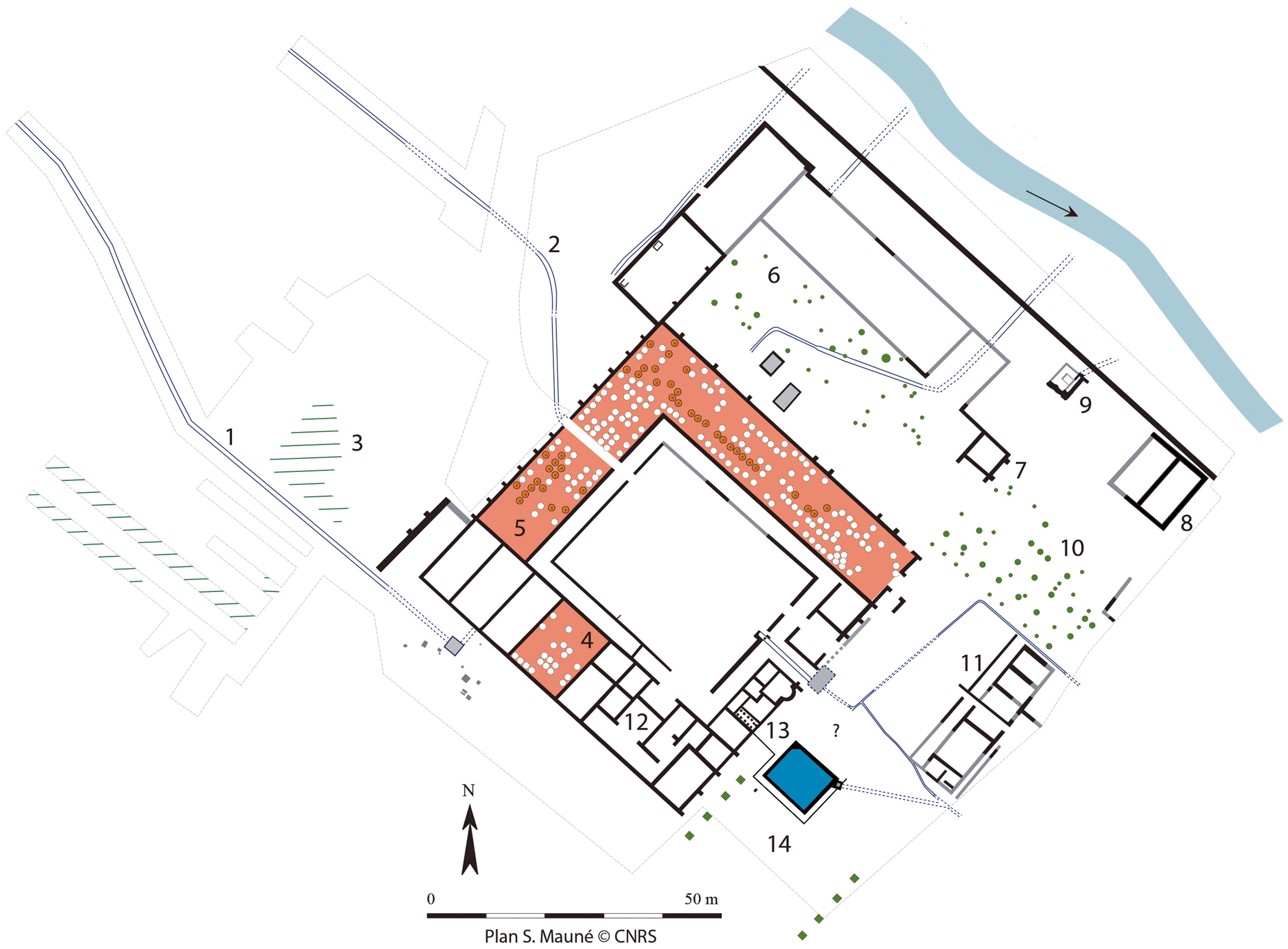
Fig. 4. Long description
The centre of the complex consists of three wings of wine-making buildings and a managers’ residence, around a courtyard. The elite residence and baths occupy the fourth side of the courtyard. Outside this central courtyard lie the workers’ housing to the southeast, and vineyards and aqueducts to the west and northwest. More work buildings and an orchard also lie outside the courtyard to the north, enclosed by a wall.
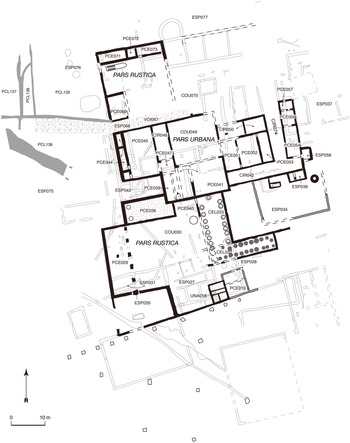
Columella’s description of the vilica’s duties reveals that her work must have been carried out in the work zones of the villa complex – not in the residential or “domestic” quarters. As noted above, her oversight of animal products and sheepfolds, stables, and ox-stallsFootnote 96 would have taken her some distance from the house. At the villa of Vareilles (Fig. 4) one or more of the three buildings (6) enclosed by the masonry wall to the north may have been animal barns.Footnote 97 The longest of these, measuring approximately 10 × 50 m, corresponds in size and proportions to the Roman sheepfolds in Crau, able to shelter several hundreds of sheep,Footnote 98 and to Columella’s recommendations for a long narrow sheepfold within a closed court with a high wall.Footnote 99 At late 1st-c. CE Damblain (Fig. 3), the large eastern building (9), the furthest from the residence and distanced from it by 180 m, probably served as an animal barn as well as housing multiple polyfunctional rooms, a forge, and probably upper-floor storage.Footnote 100
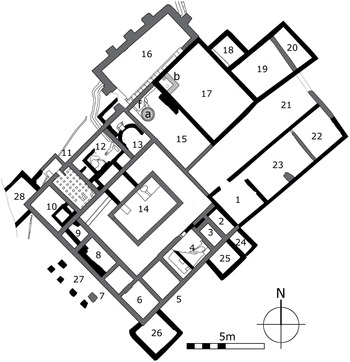
Many of the duties Columella allocates to the vilica must have been carried out in large multivalent farm buildings or work rooms of this kind. At Varignano (Liguria), six work rooms (32–37), ranging in size from 16 m2 to more than 100 m2, border all three sides of the work yard (Fig. 1).Footnote 101 At La Ramière (Gallia Narbonensis), a group of work buildings, some containing heating equipment and water basins, were arranged around a 570 m2 cobbled courtyard (COU 030) (Fig. 5). At the 2nd-c. phase of Villa F at Dragoncello (Latium) (Fig. 6), four irregularly shaped rooms (18–20, 22) surround an opus spicatum courtyard (21) next to the wine production unit (15, 17).Footnote 102 Spaces like these would have been required for processes supervised by the vilica, such as the preservation of fruit in vinegar, boiled-down grape juice, or honey,Footnote 103 and the preparation of storage vessels with heated pitch.Footnote 104 They could also have accommodated the pickling of olives,Footnote 105 which were left in baskets of salt for 30 days while the smelly and corrosive lees drained away, then sponged off in troughs and rolled in regularly drained jars for 40 days.Footnote 106
Plan of 1st-c. CE villa of La Ramière (Gallia Narbonensis), showing central pars urbana; northern work zone with tile kiln; and southern work zone with cella vinaria and other buildings around a courtyard (COU030). A hedge, wall and orchards have been identified south and southwest of the buildings. (© CNRS, courtesy H. Pomarèdes.)
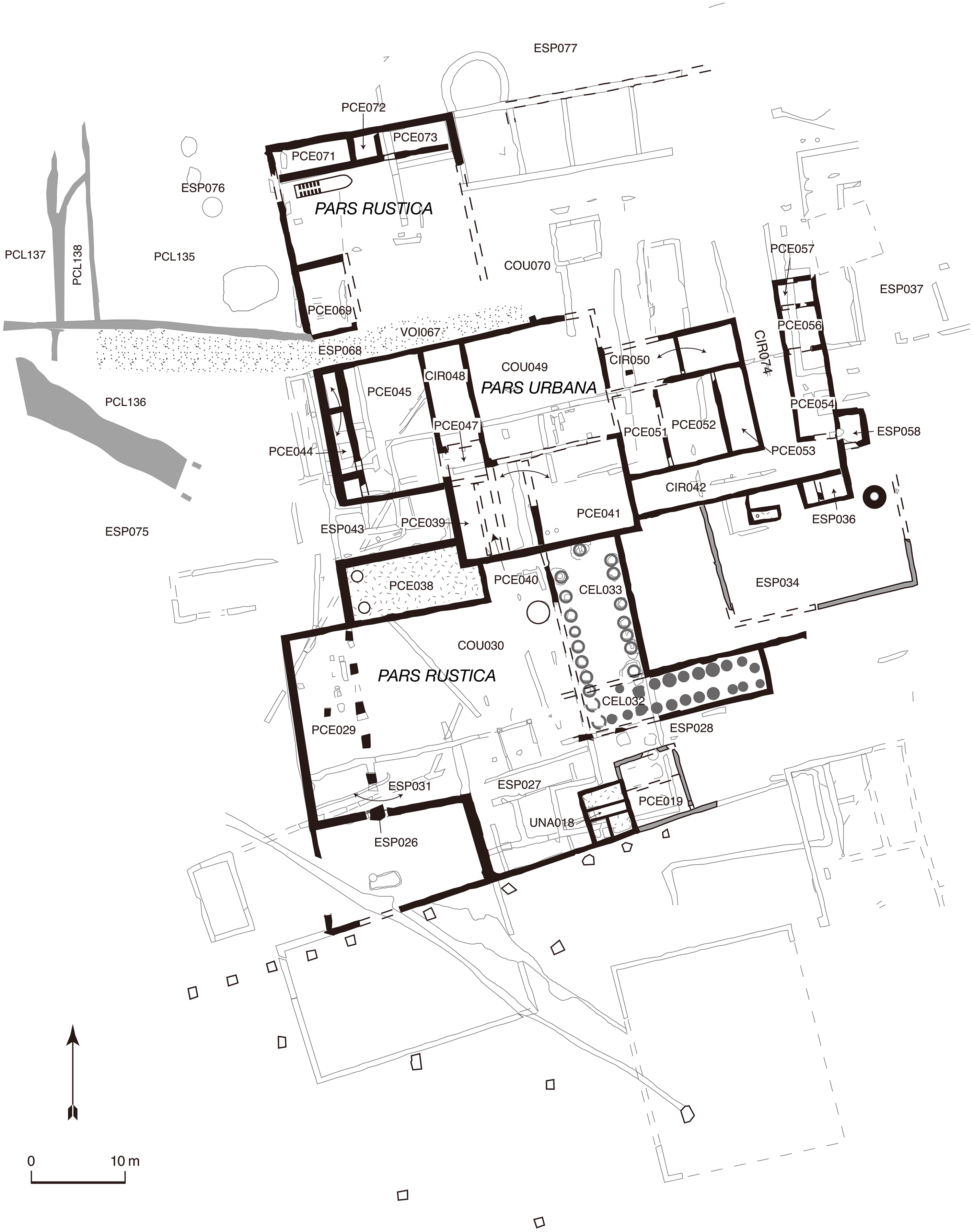
Fig. 5. Long description
The multi-room elite residence lies at the centre of the complex. There are work buildings arranged around yards to both the north and south of the residence.
Plan of 1st-c. CE Villa F at Dragoncello (Latium), showing pars urbana around a peristyle (14) to the southwest; and an opus spicatum courtyard (21) to northeast, surrounded by wine-making rooms (15, 17) and work rooms (18–20, 22). (© M. Feige, courtesy M. Feige.)
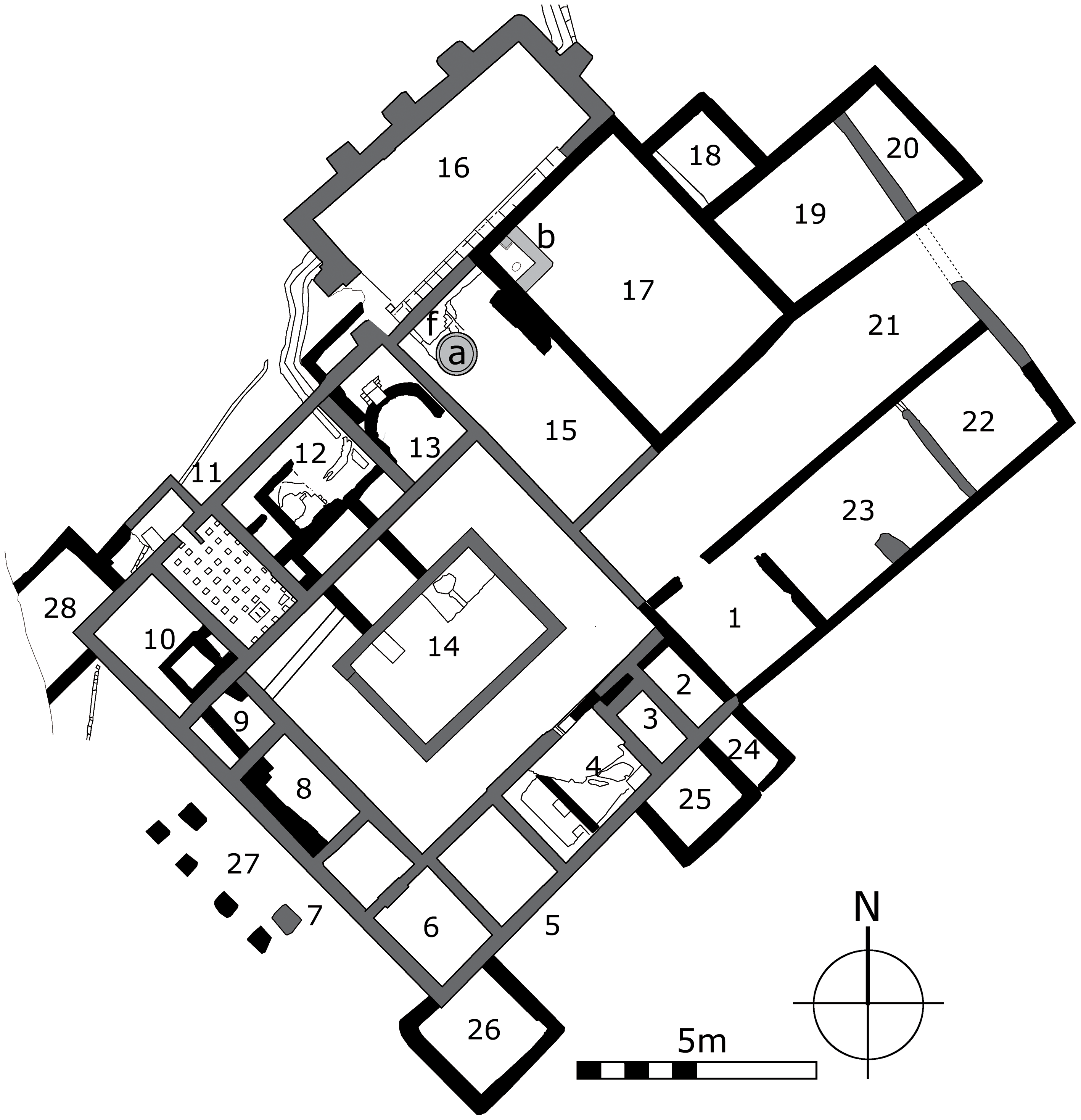
Fig. 6. Long description
The grand residence with peristyle courtyard and baths faces to the southwest. Adjacent to the peristyle to the northeast, buildings for making oil and wine are arranged around an irregularly shaped courtyard.
A significant proportion of the vilica’s work must in fact have been carried out in the open air. This would have included the slaughtering and butchering of pigs, and probably the salting of pork, since Columella adapts his instructions according to whether the weather is fine, cloudy, or rainy.Footnote 107 Butchery remains were found in the work yard of Damblain, and three cleavers were discovered in the agricultural building (9) on its eastern side (Fig. 3).Footnote 108 Columella also describes the drying of vegetables and fruit such as onions, apples, and figs, which were to be spread out in direct sunlight on special frames.Footnote 109 The outdoor nature of these tasks is reinforced by his statement, after the description of processing autumn fruits, that “all these things, as I have said, should be carried out on a fine day.”Footnote 110 All these kinds of work would probably have been conducted in the open yards characteristic of the functional areas of villas, likely near places where the produce was grown and buildings where it would be stored. Columella says the dried figs should be kept in a “very dry” storage building,Footnote 111 which could have been the same one used for grain, since remains of fruit as well as grains and pulses have been found in Roman granaries.Footnote 112 The work yard (6) at Vareilles (Fig. 4) is adjacent to a kitchen garden or orchard, in which such vegetables and fruit would have been produced (10), and also two horrea (7, 8) for storage. The work buildings and courtyard (COU 030) at La Ramière (Fig. 5) were situated immediately to the north of an orchard.Footnote 113 Although these villas adhered to different layouts, the practical demands of the chaîne opératoire that the vilica supervised remained the same.
While Columella does not say who carried out this work under the vilica’s supervision, it is possible that processing of fruits and vegetables through drying in the sun was part of the “farm work in the open air” that he says is performed by women, as discussed above.Footnote 114 Roman images also show female farm workers engaged in outdoor tasks relating to garden and orchard products: a number depict women making rose garlands, which may have been for sale for the festival of Rosalia.Footnote 115 In one mosaic, a woman carries a basket of harvested olives away from the olive grove, perhaps to be pickled as Columella describes.Footnote 116 While the extent to which such images are realistic may be debated,Footnote 117 it was clearly not incongruous to show females working in this way.Footnote 118
The vilica and wine and oil production
Perhaps the most important aspect of Columella’s account – which deserves our close attention – is that he gives the vilica responsibility for overseeing the two most important commercial production processes of the villa: the making of olive oil and the making of wine. Indeed, 26 of the 59 chapters of Book 12 concern these duties. Columella states quite clearly that these are part of the vilica’s responsibilities: “The olive harvest, like the vintage, demands the vilica’s management again.”Footnote 119
In Book 11, on the vilicus, Columella discusses all the tasks associated with growing and tending olive trees and vines, including planting, digging and trenching, staking and pruning, and harvesting the fruits.Footnote 120 Briefly noting the need to prepare the wine fermentation vessels and pressing machines before the grape harvest, he concludes his discussion of the vilicus’s duties during the vintage with the words, “However, this responsibility should not completely divert him from other cultivation of the land,”Footnote 121 going on to discuss soil preparation, sowing, and reaping of other crops. The rationale is made clear when he states that “because all these things must be carried out in the fields, he can delegate to the vilica responsibility for those things which must be done within the villa.”Footnote 122 His description of all the other responsibilities of the vintage is reserved for Book 12.
It is in his book on the vilica that Columella gives instructions for the whole process of wine making, from the necessary preparations before the harvest to the pressing of grapes; processing of the must (grape juice); addition of spices, herbs, and preservatives; and methods of treatment during the fermentation process and over the months until the following spring. He states that “whatever things are managed under cover with regard to the vintage should be her responsibilities,”Footnote 123 indicating that she is in charge of all stages in the vital process of turning harvested grapes into wine.
In distinguishing the wine-making work of the vilica from the work of the vilicus, Columella uses the phrases “within the villa”Footnote 124 and “under cover.”Footnote 125 This should not be understood as “in the house” or “à la maison,” as it has been translatedFootnote 126 and interpreted in secondary sources.Footnote 127 Nor does it mean that the vilica’s tasks are domestic. Columella uses the same term sub tecto for the covered pens used to shelter sick pigs and oxen.Footnote 128 This and intra villam refer to the roofed wine-making buildings and spaces of the villa, which lay at the heart of the complex and within the boundary wall, in contrast to the vineyards that were located outside the wall (Fig. 4, area 3).
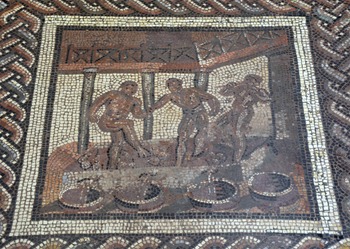
Recent archaeological studies have investigated in detail the characteristic spaces for wine making at wealthy villas in the western provinces,Footnote 129 and even traces of their vineyards.Footnote 130 The place for treading grapes was usually located either inside the buildings or under cover of a roof or awning, as shown in Roman images, since protection was needed both from rain and from the heat of the sun, which could cause premature fermentation (Fig. 7).Footnote 131 At the villa of Pisanella (Campania), for example, twin treading floors were located on either side of the pressing room (approximately 100 m2), which was entered from a courtyard. Large openings in the walls enabled the harvested grapes to be poured directly onto these floors.Footnote 132 The opus signinum treading floor at the 1st-c. CE villa of Valcuenda-Rus (Hispania Baetica) was similarly located next to the press room inside a building roofed with tiles, facing a work yard and close to the fermentation building.Footnote 133
Scene of grape treading inside a building with an upper gallery, 3rd-c. CE calendar mosaic of Saint-Romain-en-Gal, Musée d’Archéologie Nationale, Saint-Germain-en-Laye. (Photo Carole Raddato under a Creative Commons Attribution-NonCommercial-ShareAlike 2.0 [CC BY-NC-SA 2.0] license.)
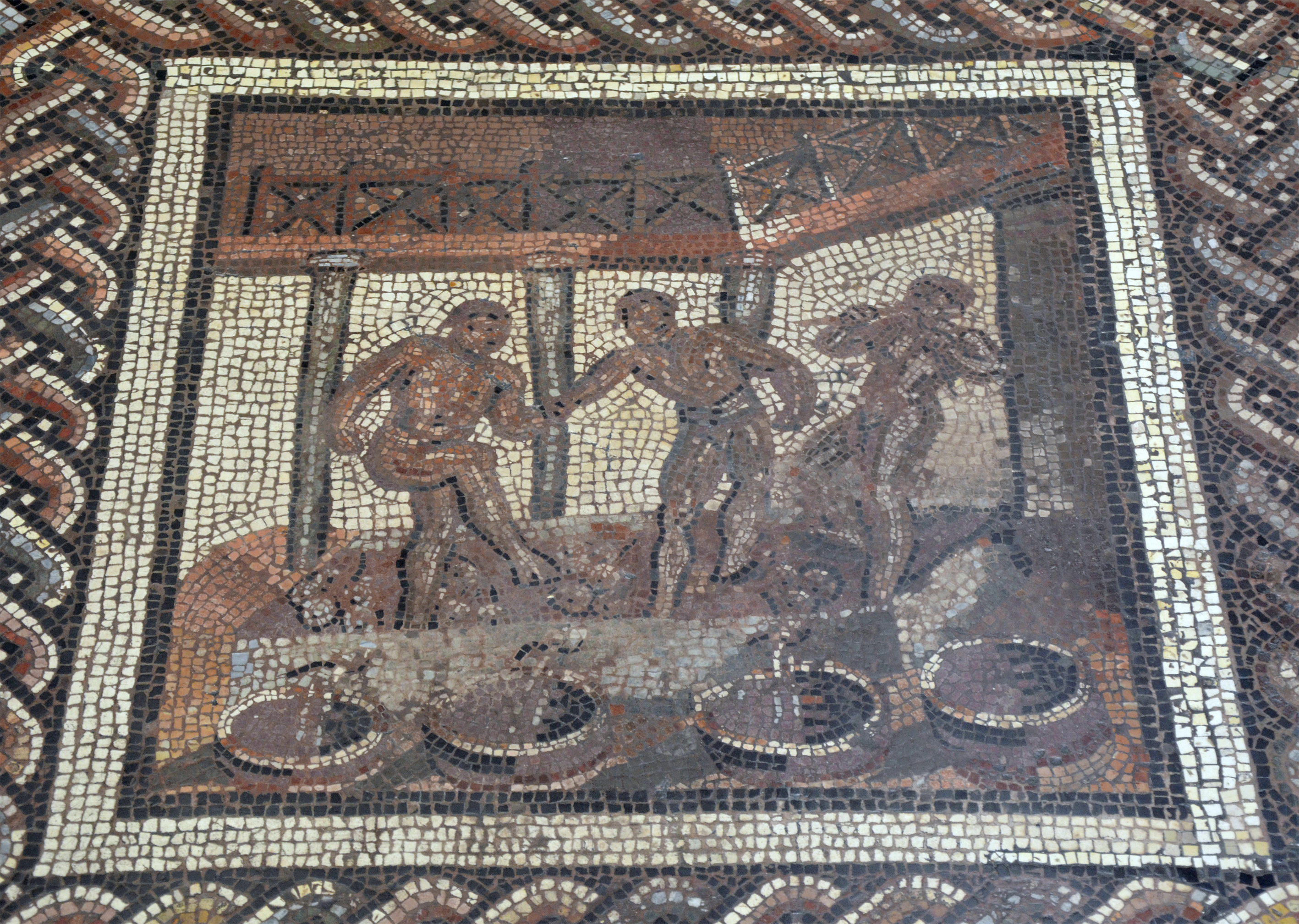
Fig. 7. Long description
The mosaic shows three men treading grapes in a large trough. Two hold hands to steady themselves, while the third plays music on a double flute. They are working within a building with an upper gallery supported by columns. The must is shown flowing into four barrels.
Columella says that the vilica must ensure that the torcularium and cella vinaria are kept clean and guarded throughout the vintage.Footnote 134 The torcularium was a large building or room that housed machines used to press grapes in order to extract the maximum quantity of juice for commercial-scale production. The spaces and stone parts for the machinery, described in detail by CatoFootnote 135 and briefly by Pliny,Footnote 136 are highly visible archaeologically. Most of these spaces range from 30 to 130 m2,Footnote 137 their size determined by the technology used, the length of the press levers, and the need to maneuver large and heavy press parts. Wine-press anchoring points could be built into walls and floors, which needed to be robust enough to withstand the considerable force of pressing. Raised or sunken areas and stairs, as at Varignano (Fig. 1), often facilitated operation of the machinery. Additional rooms could house heating structures for boiling and reducing grape juice, which was added to promote successful fermentation of the wine by boosting sugar content (and thus alcohol level),Footnote 138 as Columella describes at length in Book 12.Footnote 139 Such heating facilities have been identified at the villas of Canneto (Picenum),Footnote 140 Taradeau (Gallia Narbonensis),Footnote 141 and La Ramière (Gallia Narbonensis).Footnote 142 This substantial and important production zone was the vilica’s professional responsibility.
The cella vinaria was where the must (grape juice) was fermented and stored in specialized and valuable terracotta pots (dolia), which measured around 0.75–1.75 m in height and width and each held around 500–1,000 liters of wine.Footnote 143 Arranged in rows, they were often surrounded by earth to avoid rapid temperature changes or overheating of the fermenting must, against which Columella warns,Footnote 144 either buried or with the ground level raised to enclose them.Footnote 145 The cella vinaria was usually a large hall or building, or even several buildings (as at Vareilles), further sheltered from extremes of heat or cold by a tiled roof supported by wood or brick pillars.Footnote 146 The cella at Varignano has even yielded window glass.Footnote 147 In some regions, dolia could be placed in walled courtyards, but even at these sites the evidence of post-holes indicates that roofs of ephemeral material were provided, as would have been necessary for protection from hot sun.Footnote 148 Columella’s specification that the vilica is responsible for whatever needs to be managed with regard to the vintage “within the villa” and “under cover”Footnote 149 would apply to any of these arrangements.Footnote 150
As noted above, at the start of Book 12, Columella advises that the vilica must supervise the cellarii when they are “weighing or measuring out anything.”Footnote 151 These cellarii could be the workers in the cella vinaria, who performed an important task: about one month before the vintage, the dolia had to be sealed with pine pitch, which was melted and spread onto the inside surface with a broom. Columella says that each dolium required 25 pounds of pitch,Footnote 152 so hundreds or even thousands of pounds of pitch needed to be measured out to coat these huge vessels. Without this process, the whole wine harvest could be spoiled by excessive oxidation.Footnote 153 Organic residue analysis confirms the regular use of pitch (obtained from pine wood) on excavated dolia.Footnote 154 Columella briefly notes the necessity of this task in Book 11, but he places his detailed account within the responsibilities of the vilica in Book 12.Footnote 155
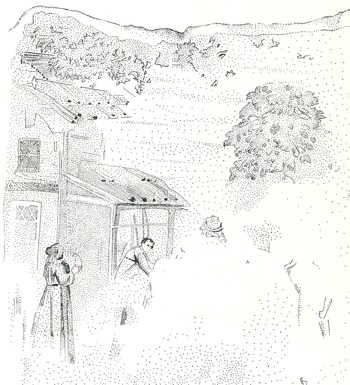
The importance of the pitching of the wine jars is reflected in its appearance from the 1st to the 3rd c. CE in menologia rustica (inscribed calendars listing agrarian tasks and festivals) and images of seasonal farm tasks.Footnote 156 In a late 2nd- or early 3rd-c. CE calendar painting from Rome,Footnote 157 a female in a long dress stands to one side of a September scene identified by the surviving letters of the phrase dolaia picantes (“pitching the jars”). A wine-press beam can be distinguished further to the right.Footnote 158 This wall painting shows exactly what Columella describes: a female figure overseeing the workers as they coat the wine dolia with pitch that would have been weighed out under her supervision, working “under cover” of a tiled roof which extends from a farm building (Fig. 8).Footnote 159 The figure is interpreted as a vilica by the excavator,Footnote 160 who compares her to female supervisors depicted on a mosaic from Zliten (Libya) in two scenes: of women hoeing and of the threshing of wheat.Footnote 161 Each of the three female figures gestures with her upraised right hand at the work, a gesture reminiscent of that used to express authority in Roman art.Footnote 162 It is possible that, just as farming texts invariably assumed the presence of a vilica, artistic images also represented this senior farm figure, whose presence was characteristic of estate life.
Scene of the pitching of wine dolia, with female figure (the vilica?), from a late 2nd- to early 3rd-c. CE calendar painting. Detail of drawing by F. Magi (By permission of the Pontifical Roman Academy of Archaeology.)
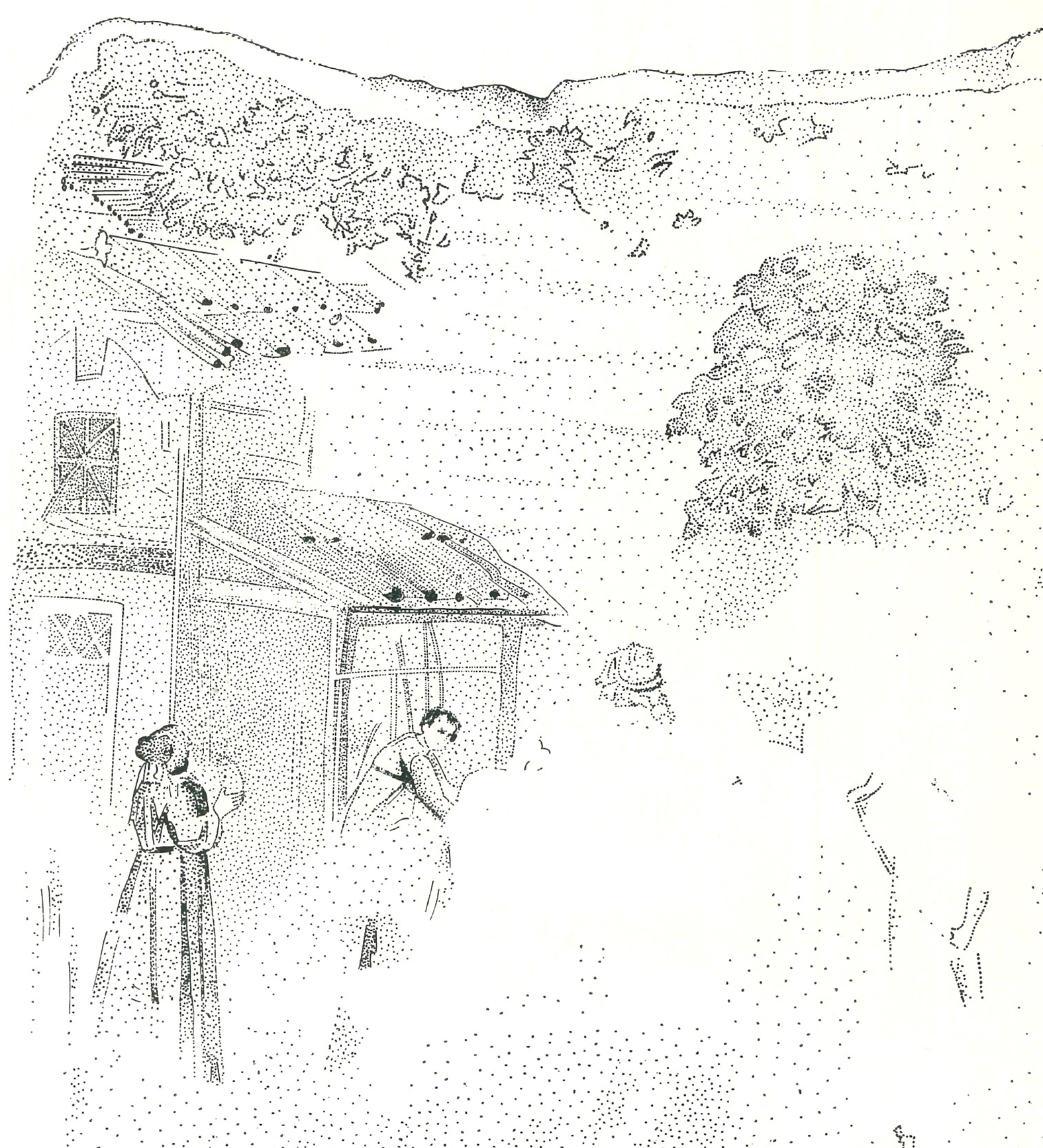
Fig. 8. Long description
The image depicts a female figure in a long tunic, standing in front of a farm building. Under a tiled roof which extends from the building, a man bends over his work. The lower part of the scene is no longer visible in the surviving section of the painting.
Columella also states that olive oil production is the vilica’s responsibility: “the cold of winter follows, during which the olive harvest, like the vintage, demands the vilica’s management again. And so first … we will advise about methods of pickling olives, and place immediately after an explanation of oil making.”Footnote 163 The agronomist goes on to detail the methods and machinery for milling the olives, the preparation of implements and oil vessels, the pressing of the olive oil, and the processing of different sorts of oils. Oil jars required careful cleaning and internal coating with a clay slip, wax, or gumFootnote 164 before use, and cleaning out after the oil was sold, since the sediment is strong smelling and corrosive. Columella emphasizes that this task should be supervised by the vilica: “when [the jars] have been emptied by the merchant, it must be the vilica’s responsibility to see that without delay any sediments or lees that have settled at the bottom of the vessels are immediately cleaned.”Footnote 165 Like wine making, oil production was conducted under cover, protected from cold and bad weather in large designated rooms or buildings, and with similarly substantial equipment, including large presses, stone mills for crushing the olives, and decantation facilities.Footnote 166 The arrangement can be clearly seen at Milreu, where huge oil-press rooms, spaces for dolia, and auxiliary rooms make up the northwestern wing of the villa (Fig. 2). Since olive harvesting takes place during “the cold of winter,”Footnote 167 Columella notes the risk of oil congealingFootnote 168 and warns that both the oil-press room and the cella olearia should face away from cold winds.Footnote 169 At some sites, archaeological investigations have uncovered hearths or hypocaust systems used to keep the oil building warm, and perhaps also for preparing hot water or salt for washing and oil extraction.Footnote 170
Wine and oil making were among the most important commercial activities of the kind of wealthy Roman villa that Columella describes, the backbone of land-based profits. Columella explicitly states that both the wine and the oil will be sold,Footnote 171 and as can be seen from the archaeological record, the oil- and/or wine-making capacities of such villas usually far exceeded the possible needs of their residents. Scales of production can be estimated by the capacities of production components such as presses, vats, and dolia (the number of which can often be deduced from their negative imprint, even if they are not found in situ). The 1st-c. BCE cella vinaria at the villa of Pisanella, in the wine-producing region of Campania, contained more than 80 dolia, equating to the production of around 80,000 liters of wine per year.Footnote 172 In Columella’s home province of Hispania, cellae at large 1st-c. CE villas are calculated to have contained 75 to 190 dolia.Footnote 173 The development of highly specialized and commercially oriented wine and oil production in southern Gaul from the 1st c. CE onwardsFootnote 174 can be seen in the exceptional number of dolia at sites such as Vareilles (Fig. 4), where hundreds, stored in multiple cellae vinariae, could hold a maximum capacity of around 650,000 liters in the mid-1st c. CE phase.Footnote 175 Investment in double or multiple presses and the spaces to house them also indicates large-scale production in a number of western provinces.Footnote 176 For example, at Milreu (Fig. 2), five oil presses were housed in rooms measuring more than 200 m2, and oil was stored in ca. 50 dolia.Footnote 177 The vilica thus had responsibility for overseeing large-scale productive work, which represented the fruits of considerable investments in land, buildings, machinery, equipment, and manpower, and was crucial to the profitability of the estate.
This contradicts assumptions that the vilica’s professional duties were located “away from those activities associated with cultivation of the ground,”Footnote 178 and that she was in charge only of the “Personals im Haus.”Footnote 179 In fact, Columella does not rigidly segregate the duties of the vilica from the work of the vilicus and male farm workers, but rather allocates to her activities directly arising from cultivation. The distinction Columella makes is not between agriculture and domestic work. The division of labor between vilicus and vilica is rather between work in the fields, orchards, and vineyards to produce the crops and tasks in and around the work buildings of the villa to process them and complete the productive chaîne opératoire. This accords with the vilica’s inclusion among the essential staff of a vineyard or olive grove by Cato, and as part of the instrumentum fundi by the jurists, and the reference in the latter to her assisting the vilicus in his duties, as discussed above.Footnote 180 The division of work is made quite clear in the passage from Columella’s Book 11, cited above, which allocates the September tasks of sowing/reaping crops in agris to the vilicus and the vintage work intra villam to the vilica.Footnote 181 Elsewhere in Book 11, the vilicus is assigned supervision in agro Footnote 182 of tasks such as trenching, digging, pruning, and grafting trees and vines;Footnote 183 feeding, treating, and branding cattle;Footnote 184 spreading manure;Footnote 185 sowing seed;Footnote 186 ploughing, cutting hay and fodder, and harvesting crops including grapes.Footnote 187
The vilica and cult practices
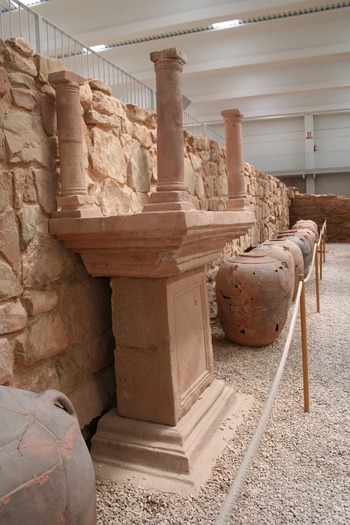
A striking element of Columella’s account of wine making is his inclusion in the book on the vilica of instructions for correct ritual procedures to be carried out before the grape harvest: “sacrifices must be made with the greatest piety and purity to Liber and Libera.”Footnote 188 The carrying out of rituals associated with Liber and wine making is attested in the archaeology of wine buildings and in epigraphy. Inscriptions accord Liber the epithet Torculensis (“of the wine-press”),Footnote 189 and 2nd-c. CE dedications to Liber and to Jupiter were inscribed on press weights at the villa of Trull dels Moros in Hispania.Footnote 190 Altars for offerings and cult paintings were placed in the wine-making buildings. These are best preserved in the villas of the Vesuvian region. At Villa Regina, an altar and herm of Bacchus, along with mural paintings of a sacred landscape, were placed in the portico of the cella vinaria. Altars and cult paintings of Bacchus-Liber were associated with press rooms at other Vesuvian villas, including Pisanella, the villa of N. Popidius Narcissus Maior, and Carmiano.Footnote 191 Outside Campania, at the early 2nd-c. CE imperial villa of Villa Magna, a square foundation at the corner of the wine treading floor has been interpreted as the base of an altar.Footnote 192 In Hispania, the bronze base of a cult statuette was recently discovered in the large 1st- to 3rd-c. CE cella vinaria at Vallmora, and a decorated stone altar was placed in the cella vinaria at the 1st- to 3rd-c. CE villa of Las Musas (Fig. 9).Footnote 193 In Roman understanding, such ritual practices were as vital to the success of wine making as the pitching of the jars.Footnote 194
Altar found in the cella vinaria at the 1st- to 3rd-c. CE villa of Las Musas (Hispania Tarraconensis) (© Y. Peña Cervantes, courtesy Y. Peña Cervantes.)
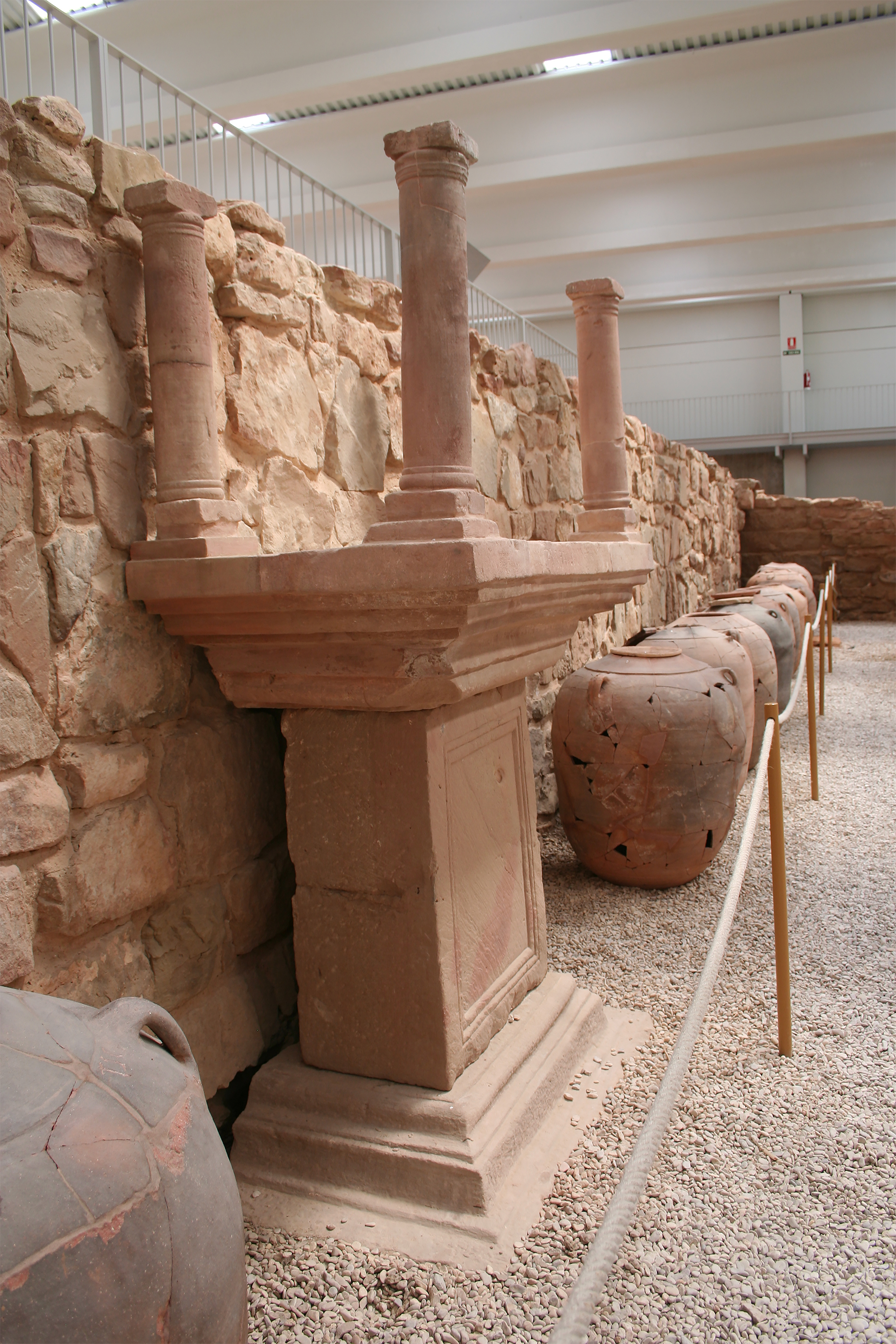
Fig. 9. Long description
The aedicula type altar has an elaborately carved base, and columns which once supported its roof. It stands against the interior stone wall of the cella vinaria at the villa of Las Musas.
Although Columella briefly refers to preparation of vessels for the grape harvest in Book 11, he does not mention these sacrifices or say that they should be made by the vilicus. Instead, he reserves those instructions for Book 12 on the vilica, thus indicating that this was part of her responsibilities. The places for sacrifices in the archaeological examples cited above are in the covered spaces for wine making and would therefore have fallen within the vilica’s sphere, since “whatever things are managed under cover with regard to the vintage should be her responsibilities.”Footnote 195
While Carla Rubiera Cancelas assumes that the vilica “no puede hacer oficio divino…. el poder que se deriva del control de la religión y que la potestas por definición es masculine,”Footnote 196 written and iconographic sources confirm that it was usual for Roman women – even of low rank – to make sacrifices, especially of bloodless offerings.Footnote 197 As noted above, Cato gave the vilica the task of offering garlands “for abundance” to the Lares. Footnote 198 Horace describes sacrifices to the Lares for good grape harvests as carried out by a lower-status female: “Country Phidyle, if you placate the lares with incense and fresh grain and a greedy sow, your fruitful vine will not feel the destructive African [sirocco].”Footnote 199 Varro specifies that during the festival of Liberalia, it is “old women” who act as the priestesses and make sacrifices of cakes to Liber at foculi throughout the town.Footnote 200 An inscription records an offering to “Great Liber Pater of the wine-press” by a woman named Veselia Felicetas, possibly a freedwoman acting as the vilica of the estate.Footnote 201 If the vilica was responsible for the processing and fermentation of the wine, it would make perfect sense for her to carry out the required sacrifices to Liber and Libera to ensure its success.
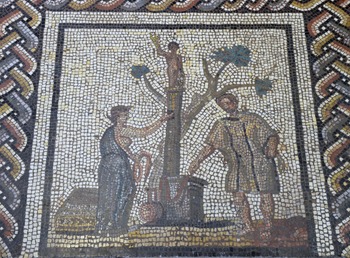
In the scene of sacrifice to Jupiter for abundant crops depicted in the calendar mosaic of Saint-Romain-en-Gal,Footnote 202 a woman holds the offering of garlands, closely echoing the passage from Cato (Fig. 10).Footnote 203 She raises her right hand in the same gesture as the female supervisors in the calendar painting from Rome and the mosaic from Zliten. Beside her is a jug for a wine libation and a male figure dressed in a tunic decorated with clavi, rather than a toga. Perhaps this scene can be interpreted as representing the vilica and vilicus, who are jointly responsible for the success of the harvests.
Scene of a female and a male figure offering garlands to Jupiter for success of the harvest, 3rd-c. CE calendar mosaic of Saint-Romain-en-Gal, Musée d’Archéologie Nationale, Saint-Germain-en-Laye. (Photo Carole Raddato under a Creative Commons Attribution-NonCommercial-ShareAlike 2.0 [CC BY-NC-SA 2.0] license.)
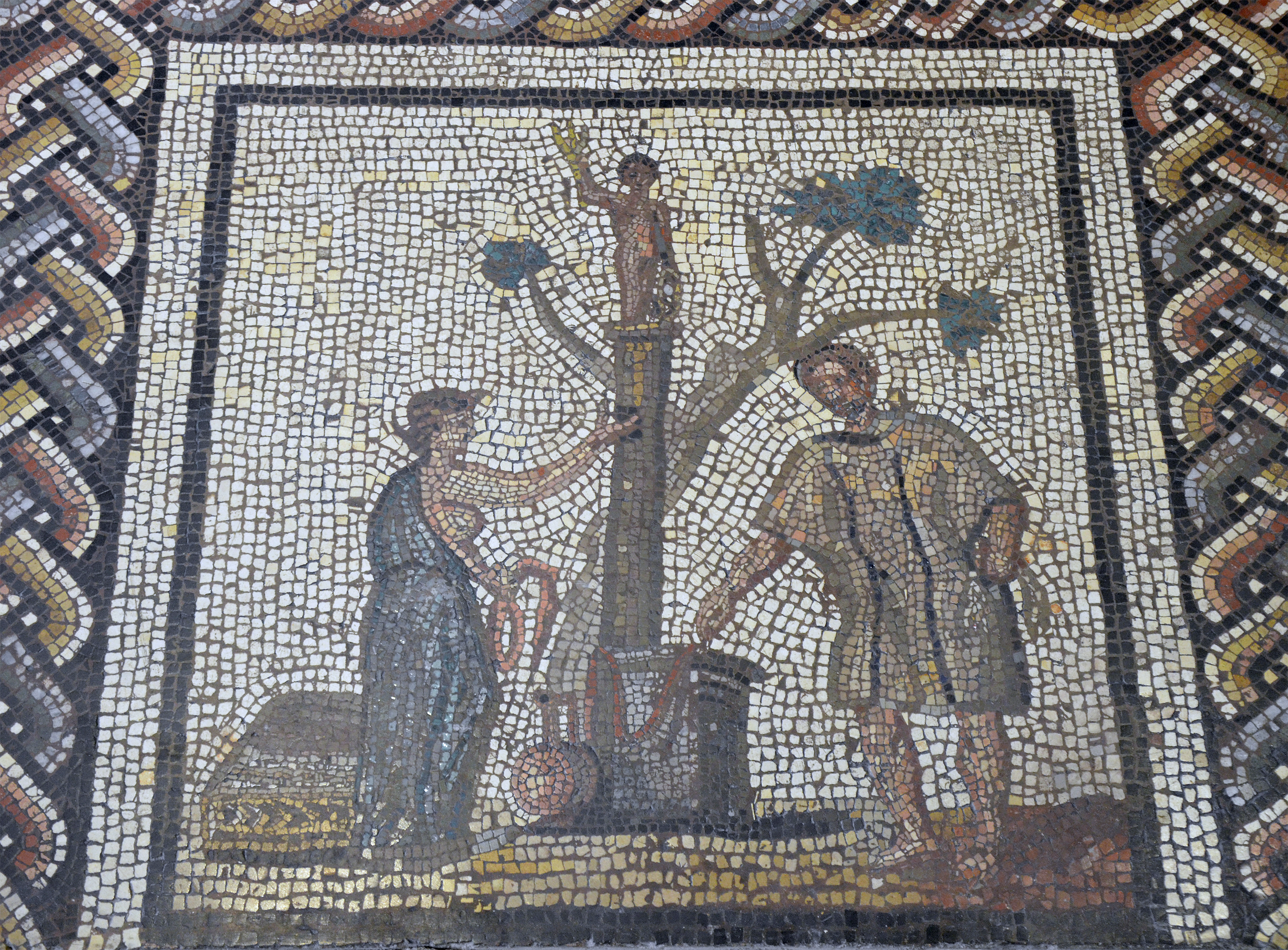
Fig. 10. Long description
The mosaic shows a female figure dressed in a long blue robe, with her right hand upraised, holding a pink rose garland. She stands in front of a large box and an offering jug, placed next to a square altar. On the other side of the mosaic stands a male figure, dressed in a full, loose tunic with two stripes. He gestures towards a second pink garland already laid on the altar. Behind them is a tall column on which stands a naked statue of Jupiter, holding a lightning bolt and wheel that are represented as gold by the use of yellow tesserae. A tree in the background indicates that the scene takes place outdoors.
Conclusions
Columella’s discussion has important implications for our understanding of the significant roles that Roman women played in rural production. While he does make distinctions between the domains of the female vilica and the male vilicus, they are not between outdoor productive work and domestic duties such as cooking and cleaning “in the house.” This can be seen from careful reading of his detailed discussions of the vilicus’s and vilica’s responsibilities, understood in relation to the archaeological remains of buildings and production processes at Roman villas. The sphere of the vilicus was farm work carried out in the open fields, vineyards, and orchards. The vilica was in charge of the essential processing of the produce, carried out in and around the work buildings, in zones segregated from the domestic spaces and built with specific architectural and spatial features to serve these functions.
Columella’s account shows that the vilica was responsible for important productive activities of the estate and for rituals that were believed to ensure their success, as can also be seen in Cato’s brief sketch of more than two centuries earlier. This picture also accords with Roman images showing women’s work activities and with other textual and epigraphic evidence for women’s economic and religious roles in Roman society. The vilica oversaw both female and male workers who performed large-scale processing tasks crucial to the profitability of the estate. In particular, she supervised two of the most important market-oriented activities of the villa, wine making and oil making. The scale and significance of this work is demonstrated by archaeological remains at many 1st- to 2nd-c. CE villas across the western Mediterranean provinces. The vilica thus played key roles within rural production, the dominant sector of the Roman economy. Although no vilica has left us an account of her work in her own words, by paying careful attention to all the evidence available to us, we can hear an echo of her voice.
Acknowledgments
I thank the editor and anonymous reviewers for their very helpful comments; Karine Boulanger, Michael Feige, Stéphane Mauné, Yolanda Peña Cervantes, Hervé Pomarèdes, and Felix Teichner for generously sharing their images; and Paul Burton, Alexandra Chavarría Arnau, Sarah Corrigan, Emlyn Dodd, Jana Kopáčková, Lucas Lewit-Mendes, Peter Mountford, Tim Parkin, Will Prinman, Ron Ridley, and Andrew Turner for their encouragement and invaluable assistance. Any errors are my own.
Appendices
(texts given in translations by E. C. Marchant, O. J. Todd, J. Henderson Reference Marchant and Todd2013 and E. S. Forster & E. H. Heffner 1955/Reference Forster and Heffner1968)
Appendix 1. Roles of men and women
Appendix 2. Household duties

 Open access



.jpg)