

Introduction
Au Québec, 15 municipalités sont dotées de comités exécutifs. Ces derniers sont prévus dans les chartes municipales, ainsi que dans la Loi sur les cités et villes, qui permet aux municipalités dont le conseil se compose minimalement de 12 personnes de se doter d’un tel comité, sans toutefois rendre cette disposition obligatoire. Les comités exécutifs sont généralement décrits comme l’équivalent d’un conseil des ministres (Bherer et Lemieux, Reference Bherer and Lemieux2002; Noël, Reference Noël1997), regroupant la garde rapprochée du maire ou de la mairesse et chargés de préparer ou de faire le suivi des décisions prises en conseil (art.70.8 de la Loi sur les cités et villes). Le comité exécutif assure la gestion administrative (projets de règlements) et financière (budget annuel) de la Ville, en conformité avec les décisions du conseil municipal. En outre, en dehors de ces délégations, le comité exécutif peut faire des propositions, qui devront cependant être approuvées par le conseil municipal. Dans la mesure où le comité exécutif rassemble un petit nombre de personnes et se tient souvent à huis clos, les discussions s’y déroulent à l’abri des regards, et sont de fait moins soumises aux effets de manches déployés lors des réunions publiques des conseils municipaux. Finalement, le comité exécutif se présente comme un rouage essentiel de l’organisation municipale dont le but est de faire avancer les projets et d’éviter toute paralysie de l’action municipale. Malgré cette place centrale dans le processus décisionnel, les comités exécutifs ont suscité peu d’analyses sur leurs rôles, leur évolution ou leurs effets sur la gouverne des villes québécoises contemporaines.
Plusieurs exemples récents tendent toutefois à montrer que le comité exécutif joue un rôle également politique dans la gouvernance municipale. Ainsi, en novembre 2023, la présidente du comité exécutif de la Ville de Montréal, mise en cause pour des faits intervenus dans un précédent mandat à l’Office de consultation publique, démissionne de son poste arguant que « la situation actuelle m’empêche de réaliser pleinement, et avec confiance, le mandat confié par [la mairesse] Valérie Plante » (Prévost, Reference Prévost2023). Quelques mois plus tard, en février 2024, la mairesse de la Ville de Sherbrooke annonçait qu’elle déléguait la présidence du comité exécutif de sa Ville à une conseillère municipale (Léonard, Reference Léonard2024) ; délégation qu’elle retirera quelques mois plus tard à la suite d’un désaccord (Radio-Canada, Reference Radio-Canada2024). Ainsi, à la lumière de ces deux exemples, le comité exécutif ne semble pas être seulement le lieu de la gestion administrative et financière. Il peut aussi être le lieu où se déroule le jeu politique.
Cette dimension politique du comité exécutif n’a pas fait, à notre connaissance, l’objet d’une analyse spécifique. Cette absence résulte tant de l’idée largement répandue que la scène municipale ne serait pas à proprement parler un espace politique, que de la méconnaissance plus générale du fonctionnement interne des municipalités. Les recherches contemporaines portent le plus souvent sur le volet législatif et concernent le politics, c’est-à-dire à la fois le moment électoral et les personnes candidates ou élues (voir entre autres quelques travaux récents, Breux, Couture et Koop, Reference Breux, Couture and Koop2019; Lucas et Armstrong, Reference Lucas and Armstrong2021; McGregor et al., Reference McGregor and Stephenson2024; Mévellec, Reference Mévellec2021), soit sur le volet policies, c’est-à-dire les décisions prises et les politiques adoptées ou mises en oeuvre (Caron de Montigny et Chiasson, 2022; Carpentier, Reference Carpentier2022; Fourot, Reference Fourot2021). Telle la boîte noire d’Easton, le parcours décisionnel et les rouages internes de la municipalité sont rarement mis en lumière (voir néanmoins Divay et al., Reference Divay, Caron and Divay2019). De même, les comités exécutifs sont numériquement peu nombreux au Québec, et rares dans les autres provinces canadiennes (Sancton, Reference Sancton2011).Footnote 1 Enfin, la figure mayorale est centrale dans le système politique municipal québécois. Forts de leur légitimité démocratique acquise par un scrutin « at large », les maires et les mairesses occupent le devant de cette scène, laissant souvent dans l’ombre les autres membres du conseil municipal. Pourtant, d’autres rôles, comme celui du comité exécutif, demandent à être mis en lumière pour mieux comprendre le fonctionnement politique des villes québécoises.
Cet article vise ainsi à lever le voile sur cette institution placée au coeur du processus décisionnel municipal, en répondant à la question suivante : en quoi les comités exécutifs participent-ils à la politisation des institutions municipales ? Le plus souvent discrets, ils existent à Montréal depuis les années 1920, avant d’avoir été diffusés dans d’autres villes à partir des années 1960. La trajectoire de cette institution, à la fois marquée par la longévité et la diffusion, se caractérise aussi par une série de modifications internes et d’appropriations variées. Le comité exécutif offre donc, pour les observateurs de la scène municipale, un indice révélateur des processus de politisation qui s’y déroulent.
Dans ce contexte, nous reviendrons dans un premier temps sur l’importance des institutions dans le fonctionnement du pouvoir municipal, et sur les dynamiques de changement organisationnel. Nous aborderons également la question de l’apolitisme municipal et des différentes perspectives que cette notion inclut, en mettant notamment de l’avant l’idée que l’apolitisme n’évacue pas la dimension politique des décisions prises par les municipalités. Cette première partie présentera également une définition opérationnelle de la notion de politisation inspirée des travaux de De Wilde (Reference De Wilde2011) et centrée sur deux principales dimensions : la présence des partis politiques et la prise en main du processus décisionnel par les élues et élus. Elle se terminera par des précisions méthodologiques sur cette recherche, qui demeure, d’abord et avant tout, exploratoire. Dans un deuxième temps, nous présenterons nos résultats. Ces derniers concernent d’abord le contexte montréalais et montrent les transformations incrémentales qui ont caractérisé le comité exécutif au cours du XXe siècle dans une logique de reprise en main par le pouvoir mayoral de cette institution. C’est ce modèle montréalais qui a été diffusé dans les autres villes de la province. Ceci nous amènera ensuite à identifier les logiques politiques actuelles qui guident la composition des comités exécutifs, ainsi que ses effets sur l’émergence d’un certain leadership politique à travers la professionnalisation de ses membres. En conclusion, nous montrerons que les comités exécutifs participent à la politisation des institutions municipales de trois façons interreliées. En lien avec les deux dimensions inspirées de De Wilde (Reference De Wilde2011), le comité s’impose comme un lieu clé du processus de décision politique. Il est aussi une instance où les dynamiques partisanes sont présentes et sont contrôlées par le maire ou la mairesse. Enfin, ces deux premiers éléments alimentent un processus de professionnalisation de ses membres, dont la présence nourrit à son tour la politisation des municipalités. Cette institution illustre également une certaine hétérogénéité dans le fonctionnement des municipalités québécoises, puisque sous couvert de la même dénomination, les pratiques et effets des comités exécutifs se révèlent variables selon les réalités politico-territoriales de chaque municipalité.
Revue des écrits et démarche méthodologique
Comprendre le rôle et l’éventuelle influence politique d’une institution comme le comité exécutif municipal appelle à revenir sur deux séries d’écrits. La première porte sur les logiques organisationnelles des institutions et leurs conséquences sur les dynamiques de pouvoir. La seconde s’attache à cerner la notion, polysémique, de politisation, et de son corollaire – notamment en contexte canadien – l’apolitisme. Le caractère méconnu de l’institution à l’étude invite également à développer un protocole d’enquête en trois temps.
Institutions et relations de pouvoir au sein des municipalités
Les institutions qui structurent les paliers de gouvernement (voir sur l’intercommunalité Pinson, Reference Pinson2019; sur les instances européennes Costa, Reference Costa and Dehousse2009; ou encore sur les instances internationales Nay et Petiteville, Reference Nay and Petiteville2011) sont autant de locus de pouvoir. Pour saisir les arrangements institutionnels municipaux, deux courants de littérature se sont développés.
Le premier, particulièrement présent aux États-Unis, s’est attardé à la description et l’analyse des effets de l’articulation politico-administrative (Carr et Karuppusamy, Reference Carr and Karuppusamy2008), c’est-à-dire des relations conseil-maire-direction générale sur leur performance fiscale (Coate et Knight, Reference Coate and Knight2009; Wei, Reference Wei2020), leur conflictualité interne (Svara, Reference Svara1999), ou encore sur leur capacité d’innovation (Nelson et Svara, Reference Nelson and Svara2012). Ce type de questionnement est toutefois peu importé au Canada, où le modèle maire-directeur général domine, à la suite de la tombée en désuétude des formules de type « board of Commissioners » ou « board of control » (Sancton, Reference Sancton2011; Tindal et al., Reference Tindal, Tindal, Stewart and Smith2017).
Le second courant regroupe une littérature plus abondante et internationale sur la manière dont les institutions politiques municipales sont organisées, amenant plusieurs auteurs à développer des typologies permettant de spécifier ces arrangements et le partage du pouvoir qu’ils impliquent (voir notamment Heinelt et al., Reference Heinelt, Magnier, Cabria and Reynaert2018; Mourtizen et Svara, Reference Mourtizen and Svara2002). Le plus souvent, le palier municipal s’insère dans des modèles nationaux, en reprenant à son compte des pratiques constitutionnelles et politiques des ordres de gouvernement supérieurs. En Europe, Wollman (Reference Wollman2008; Reference Wollman2012) identifie quant à lui deux principales tendances empruntées par les réformes municipales du début des années 2000 : la quasi-parlementarisation, lorsque les systèmes par comités (government by committee) font place à des formules axées sur un leader et son cabinet, et la quasi-présidentialisation plutôt liée à l’élection au suffrage universel direct d’un nombre croissant de maires et mairesses et favorisant une certaine personnalisation du pouvoir. Ces tendances reflètent elles-mêmes des façons distinctes de penser et d’exprimer la séparation des pouvoirs et surtout le leadership politique.
Les questions de la création et du changement dans les institutions, qu’elles soient municipales ou non, sont quant à elles largement dominées par les travaux néo-institutionnalistes. Selon Mahoney et Thelen (Reference Mahoney and Thelen2010), le développement institutionnel est généralement conçu comme résultant de chocs externes, donnant lieu de façon brutale à l’apparition de nouvelles institutions ou de changements radicaux de ces dernières. Toutefois, ils plaident également pour porter l’attention sur des changements beaucoup plus graduels, dont les effets cumulatifs réussissent parfois à reconfigurer l’institution (Thelen, Reference Thelen2003). Ce type d’approche néo-institutionnelle a bien montré les transformations discrètes du pouvoir au profit de la branche exécutive. Ainsi, la notion de « gouvernementalisation » (Nay, Reference Nay and Lagroye2003a : 86) évoque l’idée d’un processus de marginalisation des parlementaires dans le fonctionnement des institutions françaises, mais aussi britanniques ou allemandes. Le déplacement du pouvoir vers l’exécutif est aussi documenté dans les municipalités et intercommunalités françaises (Nay, Reference Nay2003b; Desage et Guéranger, Reference Desage and Guéranger2011), alors même que, comme le rappelle Pinson (Reference Pinson2009), le conseil municipal reste l’organe le plus visible pour les citoyens, ce qui n’est pas sans poser des enjeux de transparence et de surveillance (scrutiny) par le public.
Si le fonctionnement des institutions est arrimé à un ensemble de variables politiques, il est par ailleurs modulé par les acteurs politiques qui tendent parfois à « apolitiser les enjeux et les acteurs » (Aït-Aoudia, Bennani-Chraïbi et Contamin, Reference Aït-Aoudia, Bennani-Chraïbi and Contamin2010 : 216). L’histoire de la scène politique municipale au Canada en témoigne.
Apolitisme et politisation
La scène municipale canadienne a souvent été présentée comme apolitique, voire comme « purement administrative » (Plunkett, Reference Plunkett1955 : 30). Trois principaux éléments ont soutenu cette conception apolitique du municipal (Breux, Reference Breux, Breux and Mévellec2024).
Dans la foulée des idées réformistes du tournant du XXe siècle, la politique et son corollaire, le clientélisme, sont dénoncés. La lutte à la corruption rencontre un idéal bureaucratique et donne naissance à un mode de gestion de type corporatif : le politique est mis à distance, au profit d’un impératif de bonne gestion et d’efficacité managériale (Bherer et Quesnel, Reference Bherer and Quesnel2006). Les idées du management scientifique sont reprises par le mouvement réformiste, valorisant une gestion dite rationnelle et des techniques de la gestion privée, jugées plus aptes à assurer l’efficacité et l’efficience des services municipaux (Tindal et al., Reference Tindal, Tindal, Stewart and Smith2017 : 48). La figure du gestionnaire « en bon père de famille » résume cette conception des municipalités. Parallèlement, les municipalités sont vues comme responsables d’un nombre limité de compétences, traditionnellement liées à la propriété, et dont la dimension technique permettrait d’échapper à la nécessité de les associer à des choix de valeurs. Cet apolitisme valorisé dans le discours politique local (Divay, Reference Divay and Divay2019) n’est toutefois que de façade (Chiasson et Mévellec, Reference Chiasson and Mévellec2014; Lucas, Reference Lucas2024). Finalement, le municipal serait, grâce au principe de proximité, le lieu « naturel » de l’idéal communautaire (Bherer et Quesnel, Reference Bherer and Quesnel2006). Le consensus et l’absence de conflit sont érigés en mode de fonctionnement (Breux, Reference Breux, Breux and Mévellec2024).
Si ces éléments permettent d’expliquer l’apolitisme du municipal au Québec, ils sont aussi mis en question par plusieurs phénomènes : l’apparition et la diffusion des partis politiques municipaux (Breux et Mévellec, Reference Mévellec, Breux and Mévellec2024), ou encore l’élargissement des champs de compétences des municipalités – notamment reconnu par le statut de gouvernement de proximité accordé en 2017 par l’Assemblée nationale du Québec. Les villes, en particulier, offrent des services « à la personne » qui supposent des arbitrages de valeurs et sont donc explicitement de nature politique. Ces différents processus conduisent les villes à s’éloigner d’un gouvernement de consensus qui serait l’apanage de l’apolitisme. Les villes québécoises posent donc, à rebours d’une certaine littérature en science politique (Pinson, Reference Pinson2009; Desage et Guéranger, Reference Desage and Guéranger2011), la question de leur politisation, tant dans leur fonctionnement interne que par le type d’action publique qu’elles produisent.
Cette réalité invite à examiner de plus près la façon dont se concrétise cette politisation. La politisation est un concept dont la définition large fait consensus : il s’agit d’apporter dans la sphère du politique quelque chose considéré jusqu’à présent en dehors de celle-ci : « ‘Politicization’ in general terms means the demand for or the act of transporting an issue into the field of politics – making previously apolitical matters political » (De Wilde et Zürn, Reference De Wilde and Zürn2012 : 139). Néanmoins, l’opérationnalisation de la politisation apparait grandement divergente selon les disciplines, les contextes et les objets d’étude, si bien que la définition de la politisation apparait très souvent controversée (Hamidi, Reference Hamidi2023). Deux grandes catégories d’écrits se distinguent : ceux qui considèrent la politisation comme un phénomène discursif et ceux qui considèrent la politisation comme un phénomène plus large. En tant que phénomène discursif, la politisation nécessite des acteurs qui mettent de l’avant des enjeux et un public qui fait figure de caisse de résonance de ces enjeux. Si l’on considère la politisation comme un phénomène plus général, la parlementarisation vient s’ajouter à de tels éléments (Gheyle, Reference Gheyle2019), en portant le regard sur la formation de coalitions, les changements de vote sur des enjeux, les acteurs qui prennent les décisions, etc. Quelle que soit la définition retenue et même s’il existe plusieurs analyses de la politisation en politique comparée et en relations internationales (Zürn, Reference Zürn2019), les analyses focalisent généralement leur attention sur les institutions européennes, longtemps considérées comme technocratiques (Mair, Reference Mair2013; Robert, Reference Robert and Robert2021) et donc, en dehors de la sphère du politique.
Comme le résume De Wilde (Reference De Wilde2011), la politisation peut concerner trois principaux aspects du fonctionnement de l’Union européenne. Premièrement, la politisation des institutions résulte à la fois de l’affirmation du rôle des partis politiques sur la scène européenne et la politisation de la bureaucratie communautaire (au sens de Christensen et al., Reference Christensen, Kemmesen and Opstrup2014). Deuxièmement, le processus décisionnel est lui-même l’objet de luttes politiques, notamment partisanes, plus intenses et non confisquées par des professionnels ou experts. Finalement, la politisation passe également par celle des enjeux (au sens de Lagroye, Reference Lagroye2013) traités à l’échelon européen portés ou contestés par une diversité d’acteurs à l’intérieur comme à l’extérieur des institutions. Dans la perspective institutionnelle qui est la nôtre, on s’intéresse aux deux premiers phénomènes qui résonnent particulièrement bien avec la scène municipale québécoise. Le premier est la présence accrue des partis politiques municipaux dans les grandes villes du Québec, provoquant une certaine parlementarisation du fonctionnement de ces dernières, se manifestant potentiellement dans la composition des comités exécutifs. Le second est le processus décisionnel qui s’émancipe d’un fonctionnement technocratique pour faire plus de place à des élues et élus, eux-mêmes plus professionnalisés (Mévellec et Tremblay, Reference Mévellec and Tremblay2016). La question du travail discursif autour de certains dossiers (voir Breux et Couture, Reference Breux, Couture, McGregor and Stephenson2024; Chiasson, Gauthier et Andrew, Reference Chiasson, Gauthier and Andrew2014) dépasse l’ambition de cette recherche, qui se concentre sur le cadre institutionnel.
Démarche méthodologique
Pour saisir l’importance, le rôle et les effets des comités exécutifs, nous avons opéré en trois temps. Contrairement à Brorström (Reference Brorström2002), nous ne cherchons pas à démontrer la performance de l’institution municipale au fil de ses changements, mais plutôt à identifier les effets de la présence du comité exécutif sur la politisation municipale, et ce dans l’ensemble des villes québécoises où ils sont présents. Pour ce faire, il a fallu premièrement identifier les municipalités étant dotées de tels comités exécutifs. Une base de données a ainsi été créée à partir de l’interprétation de la Loi sur les cités et villes d’une part et des chartes des municipalités d’autre part. Nous avons donc été à la recherche des municipalités dont le conseil se composait minimalement de 12 personnes, ou qui sont encadrées par des chartes. Cela nous a permis de recenser l’existence de 15 comités exécutifs dans les villes de Montréal, Québec, Laval, Gatineau, Longueuil, Sherbrooke, Lévis, Saguenay, Trois-Rivières, Terrebonne, Saint-Jean-Sur-Richelieu, Repentigny, Saint-Jérôme, Drummondville et Shawinigan.
Nous avons ensuite privilégié une approche documentaire, mobilisant plusieurs sources, dont la collecte et l’analyse des chartes et règlements internes des municipalités, des pages Internet dédiées aux comités exécutifs, ainsi que des données électorales de chacune des 15 villes concernées. Nous avons également réalisé une revue de presse à l’échelle du Québec à partir de la base de données Eureka, sur l’ensemble des médias francophones de la province, comportant les termes « conseil municipal » et « comité exécutif » du 1er janvier 2000 au 28 juin 2024. Plus de 4 907 articles ont été recensés et il a rapidement été convenu de fonctionner différemment, car la très grande majorité de ces articles ne faisait que mentionner le comité exécutif sans nous donner d’informations supplémentaires. Une deuxième sélection a été opérée en cherchant « comité exécutif » et le nom des municipalités identifiées à la première étape, réduisant drastiquement le corpus à l’étude (30 articles conservés). Cela nous a permis de faire ressortir la présence de plusieurs enjeux autour de la présence des comités exécutifs, en lien avec leur composition et leur mode de fonctionnement. Il n’était donc pas question de procéder à une analyse textuelle ou systématique des articles : il s’agissait pour nous d’enrichir notre compréhension des pratiques.
Nous avons par la suite repris les dimensions proposées par De Wilde pour saisir la politisation des institutions européennes, dimensions que nous avons adaptées à la scène municipale québécoise (voir tableau 1). Selon De Wilde (Reference De Wilde2011), la première dimension est la place grandissante des partis politiques au sein des institutions, pouvant engendrer des conflits politiques. On s’est donc intéressé à la composition des comités exécutifs, afin d’identifier cette potentielle importance des partis au sein du comité exécutif. Nous avons documenté le profil des membres, ainsi que les argumentaires liés à leur sélection par les maires et mairesses. Ceci concerne les affiliations partisanes éventuelles, le genre, la représentation géographique, l’expérience individuelle, la présence de l’opposition et le taux de renouvellement des personnes qui siègent au comité exécutif. L’ensemble de ces données a été collecté en août 2024 et visait à brosser un portrait actuel de ces comités. C’est, à notre connaissance, la première fois qu’une telle démarche est entreprise sur les comités exécutifs au Québec.
Les dimensions de la politisation proposée par De Wilde (Reference De Wilde2011) et adaptées aux municipalités québécoises

La deuxième dimension retenue de la politisation concerne les règles et procédures entourant le fonctionnement du comité exécutif et la place des élues et des élus au sein de cette institution, au détriment des membres professionnels ou experts (De Wilde, Reference De Wilde2011). L’analyse documentaire nous a permis de saisir l’effectif de chaque comité exécutif, la personne qui le préside, la tenue des réunions à huis clos ou non, l’attribution ou non de dossiers spécifiques aux membres. Cette étape a mis en évidence le cas particulier de Montréal, qui fut la première à expérimenter le comité exécutif avant qu’il ne soit diffusé dans d’autres municipalités, mais également l’ensemble des changements organisationnels qu’a pu connaître cette institution.
Cette grille d’analyse permet d’avoir une conceptualisation relativement large et non exhaustive de la politisation, mais qui a l’avantage de poser les premières bases d’une réflexion sur les formes de la politisation de la scène municipale québécoise. Cette modeste exploration qualitative permet également de saisir, comme le souligne Gheyle (Reference Gheyle2019), des phénomènes qui sont susceptibles de passer largement inaperçus.
Les comités exécutifs dans les villes québécoises, d’hier à aujourd’hui ou le renforcement graduel du pouvoir mayoral
Afin de mieux comprendre les liens entre la présence des comités exécutifs et la politisation des municipalités québécoises, il importe dans un premier temps de revenir sur le cas spécifique de Montréal. Créé en 1921, ce dernier a été l’objet d’une série de réformes, qui lui ont peu à peu permis de s’imposer comme un lieu politique de premier plan. Utilisé comme modèle, son histoire nous amène ensuite à considérer sa diffusion à géométrie variable dans d’autres villes québécoises.
La lente politisation du comité exécutif de Montréal au fil des changements organisationnels
Montréal est la première Ville du Québec à s’être dotée d’un comité exécutif. Ce geste s’inscrit pleinement dans l’agenda des mouvements de la réforme urbaine qui cherchent à mettre à distance la gestion municipale de l’influence politique, en particulier mayorale :
les réformistes cherchent d’abord à obtenir la concentration des pouvoirs au sein d’un organisme exécutif composé d’un nombre restreint d’élus. Ils visent en somme à soustraire la gestion des affaires municipales aux échevins qui, prétendent-ils, profitent de leur position pour distribuer contrats et emplois aux amis et à la famille, afin de s’assurer une clientèle politique. (Dagenais, Reference Dagenais2006 : 79)
Cette volonté aboutira à la création d’un bureau des commissaires (dont les membres ne sont pas élus), ancêtre du comité exécutif, qui consacre une première séparation des pouvoirs législatif et exécutif.Footnote 2
En 1921 est créé le premier comité exécutif à Montréal. De nouveau, Dagenais souligne que
l’arrivée de cette nouvelle institution vise également à restreindre les attributions du maire et devient, en somme, de l’avis de plusieurs, le lieu véritable de l’exercice du pouvoir. C’est lui qui prépare le budget et qui, après l’avoir soumis pour approbation au Conseil municipal, gère les crédits alloués. À partir de 1922, il possède seul le pouvoir de nomination et de contrôle de l’ensemble des fonctionnaires, de même que des chefs de service, à l’exception du directeur des services. En outre, le Comité se voit attribuer l’entière initiative en matière législative et toute décision doit recevoir son aval. (Reference Dagenais2006 : 85)
En 1949, le maire sera finalement autorisé à siéger au comité exécutif (Dagenais, Reference Dagenais1992 : 34).
L’année 1960 marque une nouvelle étape, avec de nouveaux changements organisationnels internes, permettant au président d’acquérir
aux côtés du maire, le pouvoir politique qu’on lui connaît aujourd’hui. Les tandems Drapeau-Saulnier et Drapeau-Lamarre ont inauguré et symbolisé ce régime de pouvoir bicéphale, reconduit sous les administrations Doré-Fainstat et Doré-Cousineau. Ce mode de gestion (…) consacre la prééminence de l’exécutif au sein du pouvoir local. (Lustiger-Thaler, Reference Lustiger-Thaler2005 : 474)
Une autre réforme interne permet, à partir de 1962, au maire de proposer le nom des personnes qu’il souhaite voir siéger au comité exécutif (Dagenais, Reference Dagenais1992).
De façon plus large, cette période est celle de multiples transformations de la Ville de Montréal : « l’entrée des partis politiques à l’hôtel de ville en 1960 et l’avènement d’un régime inspiré du parlementarisme britannique et du système américain – le Comité exécutif faisant figure de cabinet présidentiel – furent au départ de la croissance et de l’expansion du gouvernement municipal à Montréal » (Lustiger-Thaler, Reference Lustiger-Thaler2005 : 474). À Montréal, de 1960 à 1990, la présidence du comité exécutif a pris une importance telle que l’on n’hésite pas, aussi bien dans la presse que dans les textes scientifiques, à considérer que l’exécutif est bicéphale. Toutefois, le comité exécutif sous Jean Drapeau n’a pas la même importance que celle qu’il aura sous Jean Doré.
En 1986, à son arrivée au pouvoir, le maire Doré, chef du Rassemblement des citoyens et citoyennes de Montréal (RCM), modifie l’organisation du comité exécutif et donne des fonctions précises à ses membres. Avant cela, les membres des comités exécutifs n’avaient pas officiellement de dossiers spécifiques entre les mains. Cette modification est présentée par le RCM comme la réalisation de deux objectifs, à savoir « démocratiser ce centre de décision et développer une collégialité dynamique entre le Comité exécutif et les élus; améliorer la productivité du Comité exécutif en responsabilisant directement les conseillers adjoints dans certains dossiers clefs » (Ville de Montréal, non-daté). Cette réforme interne va asseoir une première forme de hiérarchie et spécialisation des élues et élus municipaux. De 1986 à 1990, le comité exécutif reste sous le contrôle du RCM puisque les membres qui y siègent sont des fidèles du parti et de Jean Doré. Le comité exécutif est donc utilisé comme un lieu de partage du pouvoir exécutif, au sein d’une même couleur politique.
Avec l’arrivée de Pierre Bourque au pouvoir en 1994, l’effectif du comité exécutif augmente. Le nouveau maire souhaite alors assurer une représentation par « secteurs » ou « quartiers naturels ». Selon plusieurs sources journalistiques, il nomme également huit « conseillers associés » (Roy, Reference Roy1994) :
“Mme Eloyan va être responsable de l’administration, des dépenses de deux milliards de dollars, des relations patronale-syndicales. Le budget demeure dans ses mains en dernière instance et M. Sammy Forcillo, qui a la responsabilité des finances publiques et de la fiscalité municipale, va l’aider”, de dire M. Bourque. (Marsolais, Reference Marsolais1994)
La trajectoire de Montréal montre bien la succession de modifications du fonctionnement du comité exécutif, et qui permettent, par leur accumulation, au maire de conquérir une place centrale dans une organisation initialement pensée pour le mettre à distance. Cette place centrale se manifeste à travers les jeux et arbitrages politiques qui s’y déroulent : le maire a tendance à choisir des membres qui l’appuieront, tout en ayant un souci d’assurer une représentativité territoriale et parfois partisane. En cela, le comité exécutif montréalais dissipe l’illusion du consensus qui serait inhérent à une scène municipale apolitique, et en fait apparaître une certaine politisation.
La diffusion d’un modèle et ses appropriations variées
Si Montréal est le berceau des comités exécutifs, leur diffusion va avoir lieu à partir des années 1960. Le modèle est repris par le législateur qui l’insère dans la Loi sur les cités et villes afin d’en favoriser l’adoption ailleurs dans la province. Non obligatoire, cette diffusion reste toutefois initialement confinée à quatre villes. Baccigalupo synthétise, dans le tableau 2, les règles et pratiques associées aux comités exécutifs.
Il est clair que si le modèle initial est celui de Montréal, la formule qui se diffuse ne reprend pas à son compte la mise à distance du maire. Au contraire, Baccigalupo considère le comité exécutif comme l’antichambre du pouvoir : « L’existence d’un comité exécutif vient renforcer l’autorité du maire sur son conseil et réduire le caractère “démocratique” de la vie municipale » (Reference Baccigalupo1984a : 232). Le rôle mayoral au sein de cette instance est ainsi prépondérant. Dans la majorité des cas, il nomme et dirige les membres du comité, tel que le ferait à l’échelle provinciale une ou un premier ministre.
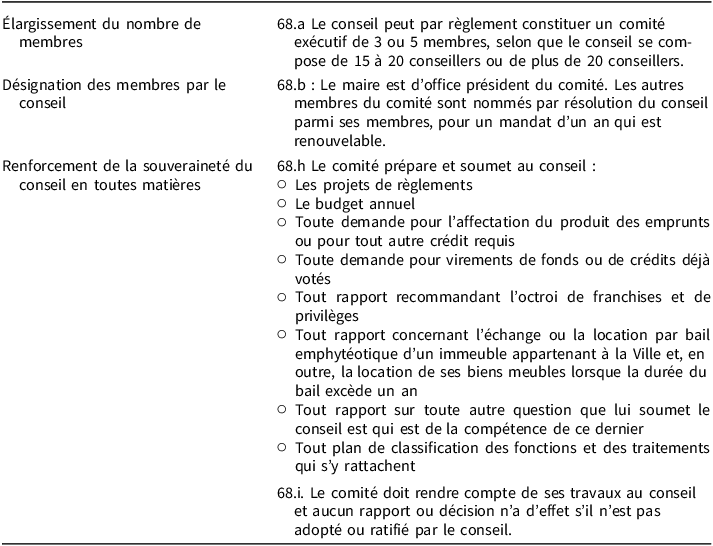
En 1978, la publication du rapport Tardif et l’adoption d’une série de lois viennent cependant modifier les rapports de pouvoir. En effet, face au constat de pratiques très centralisatrices, le projet de loi 44 – loi concernant les élections de 1978 dans certaines municipalités et modifiant la Loi sur les cités et villes – qui généralise la possibilité d’avoir un comité exécutif, le fait sous certaines conditions (Baccigalupo, Reference Baccigalupo1984b : 1057), dans l’idée de limiter cette concentration des pouvoirs. Les dispositions en matière de composition et de contrôle sont éclairantes à ce sujet, comme les résume le tableau 3.
Néanmoins, entre 1965 et 1982, seulement six municipalités se doteront de comités exécutifs, témoignant d’un engouement somme toute relatif pour le dispositif. Depuis 1978, certains faits sont cependant venus modifier les us et coutumes des comités exécutifs.
À la faveur des fusions municipales du tournant des années 2000, les nouvelles villes se dotent de nouvelles règles. Les comités exécutifs comportent plus de membres : Montréal (11), Québec (8), Longueuil (7). Les villes de Gatineau, Sherbrooke, Saguenay et Lévis adoptent cependant un nombre de membres semblables, soit quatre personnes (Collin, Léveillée et Savard, 2005 : 252–253). La Ville de Shawinigan obtient, dans son décret de création, la possibilité de se doter d’un comité exécutif de trois personnes. Le comité exécutif apparaît alors, au lendemain des fusions, comme une instance dédiée à l’efficacité de l’action politique, dont l’organisation s’adapte au contexte des nouvelles villes.
Au terme de ce tour d’horizon, la présence des comités exécutifs est marquée par une série de changements organisationnels qui reflètent tant l’évolution du système politique municipal que la façon dont le pouvoir et les dynamiques politiques s’expriment. Cette genèse montre également une relative diffusion géographique de cette institution, avec une certaine variation territoriale. Les règles qui régissent les comités exécutifs ne sont pas les seuls aspects qui indiquent le degré de politisation de cette institution. Il importe aussi de s’intéresser à celles et ceux qui siègent dans cette institution et aux effets d’un tel mandat.
Les comités exécutifs contemporains et leurs effets de sélection et professionnalisation politique
Comme on l’a évoqué, les chartes et la Loi sur les cités et villes fixent un certain nombre de balises quant à la composition des comités exécutifs. Toutefois, ces textes ne permettent pas de pleinement considérer la dimension politique de ces comités. La sélection des membres semble être guidée à la fois par des tendances communes et par des spécificités locales, en plus de refléter un certain degré de politisation, via la partisanisation. Le cas de la présidence est en cela révélateur. En outre, pour les conseillères et conseillers sélectionnés, la participation au comité peut constituer un accélérateur de professionnalisation politique.
Composer un comité exécutif, comme un conseil des ministres
Comme on l’a mentionné, les statuts formels des comités exécutifs prévoient généralement que le maire ou la mairesse est membre d’office et que les autres membres sont nommés par résolution du conseil (art. 70.2 et 70.3 de la Loi sur les cités et villes). Toutefois, il est clair que plusieurs considérations entrent en ligne de compte, dont le genre, l’équilibre territorial et surtout l’allégeance politique.
L’analyse de la composition des comités exécutifs montre qu’en moyenne ils sont entrés dans la zone paritaire à partir des élections de 2017. En 2021, la proportion était même de 54 %. Ce chiffre indique que la progression du nombre de femmes élues dans les villes, se traduit aussi par leur présence aux plus hautes fonctions, comme celles du comité exécutif. À Sherbrooke, le choix a même été de constituer un comité exécutif exclusivement féminin (Plante, Léonard et Brochu, Reference Plante, Léonard and Brochu2021).
La composition des comités exécutifs implique aussi parfois la recherche d’un certain équilibre territorial. Dans plusieurs villes (Lévis, Sherbrooke et Saguenay), la revue de presse a montré que cet objectif est explicite, sans qu’il soit toutefois prévu par les statuts et règlements. Ce souci territorial constitue un legs des fusions municipales : en assurant une représentation des anciennes composantes municipales, le comité exécutif doit aider à assurer une vision « grande ville » dans ce lieu décisionnel. À titre d’illustration, on peut évoquer ici le cas de Saguenay, où une controverse a eu lieu en 2022 au sujet de la surreprésentation de l’arrondissement de La Baie par rapport à la sous-représentation de celui de Chicoutimi. La mairesse a néanmoins pu aller de l’avant, puisque ce principe d’équilibre territorial n’est qu’une règle non écrite et non une condition légale dans la composition du comité exécutif (Boudreault-Gauthier, Reference Boudreault-Gauthier2023). Ce choix d’une représentation territoriale n’est toutefois pas systématique dans les 15 villes à l’étude.
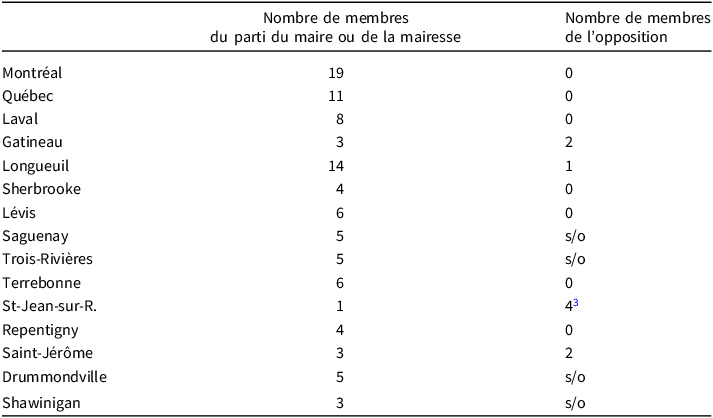
L’allégeance politique ou partisane, lorsqu’il y a présence de partis politiques municipaux, s’impose comme un troisième critère de sélection. Cette politisation du comité exécutif se traduit de deux façons. D’une part, il s’agit de comprendre quelle place est accordée à l’opposition dans le comité exécutif (voir tableau 4), et d’autre part comment constituer un tel comité quand le maire ou la mairesse n’a pas de majorité au conseil.
Les premiers comités exécutifs au Québec (1921–1976)
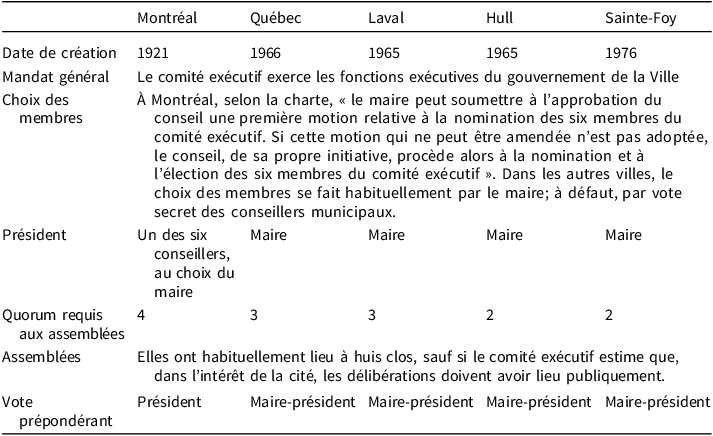
Source : Baccigalupo, Reference Baccigalupo1984a : 233. L’auteur précise que Charlesbourg se dotera d’un comité exécutif en 1977 et Longueuil en 1982.
Dispositions législatives concernant les comités exécutifs (1978)

Source : Baccigalupo, 1984b : 1057.
Composition des comités exécutifs selon l’affiliation partisane en août 2024

De façon évidente, les maires et mairesses qui ont une majorité au sein du conseil municipal choisissent de nommer un comité exécutif exclusivement composé des membres de leur parti, mimant ainsi le système parlementaire. Toutefois, la présence de l’opposition n’est pas impossible. Ce choix illustre la dimension éminemment politique de ces comités.
Dans la métropole, en 1997, des conseillers élus sous la bannière de Vision Montréal, ont démissionné de leur parti et constituent donc une opposition au sein du comité exécutif. Pierre Bourque a tenté de les évincer, sans succès (Levesque, Reference Levesque1997). Les membres du comité exécutif étaient alors élus pour quatre années et Pierre Bourque se battra pour limiter dans le temps les mandats selon cet article de presse : « Pierre Bourque revient à la charge et propose dans un projet de refonte de la charte de la Ville, que le maire de Montréal puisse « nommer, remplacer et destituer un membre du comité exécutif quand bon lui semble » (Gauthier, Reference Gauthier1997). Plusieurs années après, en 2014, Richard Bergeron, fondateur du parti Projet Montréal, acceptera l’invitation de Denis Coderre de siéger sur le comité exécutif :
Il participera dès mercredi au comité exécutif, où il agira à titre d’observateur, puisqu’il n’aura pas, dans un premier temps, le droit de vote, en vertu de la loi provinciale actuelle. La loi limite à 11 le nombre d’élus pouvant siéger au comité exécutif, et cette limite est déjà atteinte. Québec a cependant accepté d’amender la Charte de la Ville pour abolir cette règle. Il siégera en outre comme indépendant. (Radio-Canada, 2014)
À Québec, la stratégie du maire de Québec, en 2021, est sensiblement différente. Dans ses mots : « les conseillers municipaux d’opposition, qui veulent intégrer pleinement le comité exécutif de la Ville de Québec, devront d’abord quitter leur formation politique actuelle et siéger comme indépendants » (Moalla, Reference Moalla2021). Le comité devient alors un lieu d’intégration politique par « absorption ».
Dans le cas où les maires ou mairesses n’ont pas la majorité au conseil, la tendance est alors d’intégrer des membres indépendants ou de l’opposition au sein du comité exécutif afin d’assurer une certaine cohésion entre le conseil municipal et le comité exécutif. C’est le cas de Gatineau (sous les deux mandats minoritaires de Maxime Pedneaud-Jobin), de Lévis (en 2005 lorsque la mairesse Danielle Roy-Marinelli propose un siège au conseiller indépendant Jean-Claude Bouchard), ou encore de Montréal en 2009 (alors que le maire Gérald Tremblay invite Lyne Thériault du parti Vision Montréal à joindre le comité exécutif [Caron Reference Caron2009a]), et de Longueuil en 2017 (Gerbet, Reference Gerbet2017). Le comité devient alors un lieu de compromis politique.
Le bon fonctionnement du comité exécutif est fondé sur la capacité des membres à travailler de concert, entre eux, avec les autres membres du conseil municipal et avec l’administration. La démission est aussi possible. Le tableau présenté dans l’annexe 1 montre toutefois que c’est plutôt la stabilité qui caractérise les comités exécutifs. Les années électorales (2009; 2013; 2017; 2021), et donc potentiellement de renouvellement d’une partie du conseil municipal, sont celles où le mouvement est le plus important. En dehors de ces moments forts de la politique municipale, la revue de presse et l’analyse de notre base de données indiquent que la démission peut émaner de deux dynamiques différentes : la première est de nature individuelle et personnelle. À Drummondville, une membre du comité exécutif explique son départ en raison d’un climat de travail difficile : « Je travaille bien quand les débats sont constructifs, ouverts, que nous travaillons en équipe en bâtissant sur les réflexions et les opinions de tous pour arriver à trouver des idées et des projets meilleurs encore. […] Aussi, je ne ressens plus la confiance mutuelle et, pour moi, c’est un élément décisif » (Demers, Reference Demers2021). La seconde dynamique est plutôt d’ordre politique et correspond à des remaniements du comité exécutif par le maire ou la mairesse, comme dans le cas de Gatineau en février 2023 (Bélanger, Reference Bélanger2023). Cela n’est pas sans rappeler les stratégies de nomination oeuvrant dans les conseils des ministres, confirmant la politisation de cette instance municipale.
Le bon fonctionnement du comité exécutif peut aussi être lié au leadership qui s’y manifeste. Or, dans les chartes comme dans la loi, le rôle dévolu aux présidences des comités exécutifs n’est décrit que de façon succincte. Les éléments précisés ne concernent que les rôles liés à l’organisation des réunions du comité (par exemple dans les Chartes de Gatineau – art. 14 et de Longueuil – art. 26, le président convoque les séances, les préside et voit à leur bon déroulement, idem pour Sherbrooke – art. 22). Ces trois missions ne doivent pourtant pas cacher le travail nécessaire à la préparation de ces séances, qui comprend les rencontres préparatoires avec l’administration (avec la direction générale ou d’autres directions de service), ainsi que l’entretien de relations étroites avec les membres du conseil. En réalité, là où la présidence est exercée par une autre personne que le maire ou la mairesse, elle peut être considérée comme le numéro deux de la Ville, au sens où elle prend en charge la partie « exécutive » des responsabilités mayorales. Sa présence permet de décharger le maire ou la mairesse d’un ensemble de tâches liées à la gestion plus quotidienne. Le cas de Montréal illustre le plus systématiquement cette situation. Cette délégation de présidence est présente dans quatre villes (annexe 2). On peut donc s’interroger sur l’intérêt de confier la présidence à une autre personne.
La revue de presse et l’analyse du tableau (annexe 2) laissent poindre trois explications possibles : 1) Il est possible de penser que cela permet de distinguer la fonction politique de la fonction de gestion, chacune étant incarnée par une personne spécifique ; 2) cela permet au maire ou à la mairesse de se consacrer à la dimension politique pour laquelle il ou elle a été élu, c’est-à-dire développer une vision pour la ville, ce qui nécessite de se dégager de la gestion quotidienne. Confier la présidence à une personne autre que celle qui incarne la fonction mayorale peut faire office de pare-feu sur des sujets délicats. Cela évite de concentrer l’attention sur le maire ou la mairesse, et la présidence du comité exécutif peut défendre sur la place publique et/ou au conseil municipal certains enjeux. Sa présence permet aussi, sans doute, de faire émerger une autre voix : « C’est mieux de ne pas porter les deux chapeaux, car ça assure une plus grande impartialité et ça permet de mieux répartir la rémunération entre l’ensemble des élus » (Plante, Léonard et Brochu, Reference Plante, Léonard and Brochu2021 : 3). Par le passé certains maires et mairesses ont également mentionné confier la présidence à des personnes plus expérimentées qu’eux et elles – soulignant par ce fait même l’importance du rôle de la présidence du comité exécutif et des compétences attendues de celles et ceux qui occupent cette fonction. Cela semble effectivement être le cas si on regarde les vice-présidences, généralement confiées à des conseillers ou conseillères ayant au moins un mandat d’expérience (à l’exception de St-Jean sur Richelieu et à Terrebonne).
Dans les faits, les dynamiques politiques apparaissent semblables, que la présidence soit assurée par le maire ou la mairesse, ou par une autre personne. Dans les deux cas, l’enjeu est celui de la relation de confiance entre le maire ou la mairesse et la personne qui occupe la seconde place la plus importante, qu’elle soit présidente ou vice-présidente. Plus encore, la question de la loyauté est centrale dans le choix de l’individu à la présidence ou à la vice-présidence. Lorsque le lien de confiance n’est plus, cela conduit inévitablement à la révocation de la personne, comme on a pu le voir à Montréal en 2023.
L’examen des logiques qui guident la composition des comités exécutifs, à Montréal comme ailleurs, fait apparaître des pratiques guidées par le fonctionnement et le rôle politique de ces organisations.
Le comité exécutif comme accélérateur de professionnalisation politique
Comme pour les députés qui obtiennent un ministère, siéger au comité exécutif engendre ou accélère la professionnalisation de la carrière politique (Mévellec, Reference Mévellec, Breux and Mévellec2024). Cela se traduit par deux dynamiques. La première est liée, dans une logique weberienne de la professionnalisation politique, à la rémunération additionnelle qui accompagne ces fonctions. La seconde réfère à l’acquisition de savoirs et savoir-faire (Gaxie, Reference Gaxie2001).
Siéger au comité exécutif équivaut, de façon presque systématique, à bénéficier d’une rémunération additionnelle, y compris pour le maire ou la mairesse qui en prend en charge la présidence. Saint-Jean-sur-Richelieu et Longueuil font figure d’exception sur ce point. Dans tous les autres cas, les montants proposés reflètent le travail (incluant l’élaboration des règlements, la préparation du budget, la prise de décisions liées à la gestion quotidienne de la ville, la formulation de recommandations) et le temps de travail associés à ces responsabilités et se déclinent de façon décroissante selon le poste (présidence, vice-présidence, membre).Footnote 4 Si ces montants visent à reconnaître le travail et le temps nécessaires à l’exercice de ces responsabilités, ils participent aussi pleinement à deux processus. Le premier est la capacité des personnes élues à se consacrer à temps complet à leur mandat politique qui leur procure un revenu qu’elles peuvent juger satisfaisant. C’est particulièrement le cas pour celles qui occupent les fonctions de présidence ou de vice-présidence. Dans la Ville de Québec, les rémunérations se déclinent d’ailleurs explicitement selon que les responsabilités sont exercées à temps plein ou à temps partiel. Le deuxième processus est celui d’une hiérarchisation au sein-même des élues et des élus, doublement marquée par le type de responsabilité et les échelles de rémunération qui y sont associées. À notre connaissance, seule la Ville de Trois-Rivières, entre 2018 et 2022, a eu comme pratique d’éviter cette logique en abolissant les allocations additionnelles liées aux responsabilités additionnelles (telles que siéger au comité exécutif). Cette disposition a toutefois été revue en 2022.
Outre la dimension objective de la professionnalisation que représente le surplus de rémunération, la composition des comités exécutifs répond également à une recherche d’expertises ou de développement d’expertises sectorielles. Tout comme l’avait fait pour la première fois Jean Doré en 1986 à Montréal, les membres des comités exécutifs se voient attribués des dossiers spécifiques, suivant le modèle des ministres et de leurs portefeuilles. Cette spécialisation amène potentiellement l’acquisition d’une certaine compréhension et expertise dans ces dossiers, tant sur le fond des sujets que sur les procédures permettant de les traiter.
Pour la cohorte actuelle des membres des comités exécutifs, la diversité d’expertise est visible. Si quelques routiers de la politique municipale sont présents, de nombreuses personnes qui siègent aux comités exécutifs sont des entrantes en politique municipale. Sur 98 personnes actuellement en poste, 52 % en étaient à leur premier mandat, 22 % à leur deuxième, 17 % à leur troisième et 8 % détenaient quatre mandats ou plus. On peut postuler que ce caractère « novice » dans les fonctions électives est compensé par d’autres expériences et habilités accumulées dans les sphères professionnelles par exemple. Ce phénomène n’est pas nouveau : le maire Bourque a systématiquement choisi des néophytes en politique municipale à la présidence du comité exécutif; en 2009, le maire Labeaume voulait du « sang neuf pour amener de nouvelles idées à la table » (Caron, Reference Caron2009b). Néanmoins, la même année, le maire Bureau à Gatineau souhaitait « amener de l’expérience municipale au conseil » (Duquette Reference Duquette2009). Un phénomène semblable est visible à Trois-Rivières en 2021 où la vice-présidence du comité exécutif est choisie pour son expérience (Alarie, Reference Alarie2021). Les membres des comités exécutifs se spécialisent puisqu’ils peuvent développer une expérience de travail plus poussée à la fois avec la direction générale, ainsi qu’avec les directions des services impliqués dans leur « portefeuille ». Cette tendance semble vraie pour les membres réguliers et associés des comités exécutifs.
En procurant des conditions favorables à la professionnalisation politique, les comités exécutifs participent à faire advenir un champ politique municipal spécifique, régi par des règles formelles et informelles spécifiques.
Conclusion
Au moyen d’une approche par le changement institutionnel et la sociologie politique, nous avons pu examiner la genèse, l’évolution et un certain nombre d’effets de cette institution sur le fonctionnement de la démocratie municipale et sa politisation. Au terme de cette analyse exploratoire, en quoi les comités exécutifs participent-ils à la politisation des institutions municipales ? Notre analyse montre que les comités exécutifs participent à la politisation des institutions municipales de trois façons distinctes : le comité exécutif est tout d’abord le lieu de l’action municipale (policy), dans une logique managériale de recherche d’efficacité dans lequel les élus et élues occupent une place centrale. Le comité exécutif est également le lieu où s’expriment de manière claire les dynamiques politiques (politics) présentes au conseil municipal. En désignant les personnes qui y siègent, le maire ou la mairesse identifie ses proches et, dans certains cas, réussit à négocier le ralliement de l’opposition. Le comité exécutif est, de plus, un lieu de professionnalisation des élues et élus municipaux dont l’expérience s’inscrit plus explicitement dans le champ politique, distinct d’autres activités sociales. Leur présence atténue un mode de fonctionnement technocratique des municipalités. Ces trois éléments concourent à la politisation de la scène municipale, malgré l’étiquette apolitique qui lui est souvent attribuée.
Pensé à ses débuts, en 1921, comme un contrepoids à l’influence du maire de Montréal, le comité exécutif, sous l’influence du législateur (en 1949), et du maire Drapeau en 1960, va devenir rapidement le lieu de l’action municipale où les orientations politiques du conseil municipal sont traduites en décisions administratives, et où les arbitrages, en particulier budgétaires, sont préparés. La diffusion de ce modèle se fait à la fois grâce à l’action législative qui, en 1978, permet aux autres villes de se doter de comités exécutifs; puis, lors des fusions municipales qui donnent l’occasion de revoir les fonctionnements internes des nouvelles villes. Si l’exemple montréalais semble avoir fait école, la diffusion des comités exécutifs nous apparaît, dans une perspective néo-institutionnaliste, également portée par sa conformité avec le modèle parlementaire dominant. Tindal et ses collègues (2017) avaient déjà noté que les comités exécutifs des grandes villes du début du XXe siècle mimaient les pratiques parlementaires sans toutefois pouvoir compter sur la présence de partis politiques pour asseoir complètement ce modèle. La situation est différente aujourd’hui, alors que les partis politiques sont désormais présents dans de nombreuses villes québécoises et que l’exercice de la politique s’éloigne de plus en plus de façons de faire amateurs et indépendantes (Breux et Mévellec, Reference Mévellec, Breux and Mévellec2024). Si cette politisation n’est pas totale dans toutes les municipalités dotées d’un comité exécutif, elle donne toutefois des signes de vitalité dans plusieurs d’entre elles.
Le déplacement du pouvoir dans le comité exécutif s’accompagne de plusieurs stratégies de nomination cherchant à atteindre l’équilibre entre les genres, de parties du territoire, mais surtout à constituer un ensemble d’élues et d’élus loyaux envers le maire ou la mairesse. À Montréal, grâce à une série de modifications internes, le comité exécutif (et sa présidence) s’impose comme la garde rapprochée du maire ou de la mairesse, et se politise explicitement. Le fait que la présidence soit distincte de la fonction mayorale à Montréal n’empêche pas les villes où cette séparation n’est pas actée de faire du comité exécutif une instance éminemment politique : les conseillers et conseillères qui y siègent sont priés de mettre leur affiliation politique de côté et d’être indépendants, ou au contraire de l’afficher dans une solidarité de type ministérielle (Pelletier, Reference Pelletier, Taillon, Brouillet and Binette2016). Mais tout comme un conseil des ministres, sa composition reflète la majorité ou l’absence de majorité obtenue au conseil municipal, ainsi que le niveau de centralisation que le maire ou la mairesse souhaite imposer sur le fonctionnement de la Ville. La présidence du comité exécutif, fonction faiblement définie dans la loi, dépasse les simples activités de gestion de comité, puisqu’elle contrôle l’ordre du jour. Lorsque le maire ou la mairesse est en charge, il confirme la volonté d’imposer un exécutif monocéphale, ce qui doit alors interroger les rôles des autres membres ainsi que des liens avec la direction générale. Lorsque la présidence est confiée à un autre membre du conseil municipal, l’exécutif devient bicéphale – une configuration qui déroge plus fortement du modèle municipal traditionnel et interroge les rôles que chacun des acteurs doit s’approprier et les relations qui en découlent. Dans les deux cas, on peut constater un certain déplacement du locus du pouvoir depuis l’assemblée délibérante vers le comité exécutif, conduisant à penser les municipalités québécoises sur une trajectoire de quasi-parlementarisation telle que repérée ailleurs par Wollman (Reference Wollman2008).
Finalement, les comités exécutifs favorisent une certaine professionnalisation de la politique municipale. En offrant une rémunération additionnelle et en faisant du mandat municipal une fonction politique à temps plein, celles et ceux qui siègent au comité exécutif se rapprochent de la figure des professionnels de la politique. En outre, comme on l’a vu, l’apprentissage des rouages de la machine municipale, ou encore l’acquisition de connaissances spécifiques liées à certaines délégations sectorielles au sein du comité exécutif, procurent aux membres des savoirs et savoir-faire qui participent également de leur professionnalisation (Gaxie, Reference Gaxie2001; Mévellec, Reference Mévellec, Breux and Mévellec2024). De façon plus symbolique, les comités exécutifs sanctionnent une hiérarchisation interne au sein du conseil municipal, en créant une « classe d’élues et d’élus » associée à des éléments formels (réunions en huis clos, proximité avec l’administration, rémunérations distinctes) et informels (proximité avec le leadership politique, acquisition de savoirs et savoir-faire). Cette hiérarchisation des mandats municipaux et la professionnalisation qui l’accompagne témoignent du renforcement de la place des élues et élus face à la fonction publique municipale.
En bref, la présence des comités exécutifs à Montréal et dans les autres villes semble offrir un cadre institutionnel favorable aux processus de politisation de la politique municipale. Deux précautions doivent néanmoins être rappelées. Premièrement, la politisation ne se fait pas seulement dans les comités exécutifs, ces derniers n’en sont que des conditions favorables pour les raisons exposées ci-haut. La politisation est liée à d’autres mécanismes, dont certains se déroulent en partie hors des murs comme la politisation d’enjeux locaux. Les travaux sur l’Union européenne rappellent l’existence de plusieurs arènes de politisation (institutionnelles, intermédiaires et citoyennes) (Hurellman, Gora et Wagner, Reference Hurrelmann, Gora and Wagner2015). Notre enquête n’explore donc qu’une infime partie du phénomène. Deuxièmement, le portrait institutionnel et politique des villes brossé ici est marqué par l’hétérogénéité. Le monde municipal québécois est fortement dépendant des configurations politico-territoriales : la taille des municipalités mais surtout leurs trajectoires politiques les amènent à s’approprier de façons variables les outils mis à leur disposition par la loi (Divay et Caron, Reference Divay, Caron and Divay2019). En cela, le cas des comités exécutifs montre bien la plus-value de s’intéresser à Montréal et à d’autres villes pour comprendre plus finement les enjeux institutionnels et politiques qui se jouent au municipal, et souligner les effets d’expérimentation et d’adaptation à l’oeuvre. Ces deux précautions invitent à poursuivre l’analyse des comités exécutifs et des pratiques qu’ils impliquent, en mobilisant des approches monographiques permettant de mieux rendre compte de la complexité des dynamiques de politisation dans chaque configuration municipale.
Annexe 1
Tableau de la composition des comités exécutifs des 11 plus grandes villes du Québec de 2009 à 2024
Source : Données compilées et assemblées par Alyssa Vézina.

Annexe 2
Composition et présidence des comités exécutifs (août 2024)

Source : données compilées par les autrices.
Cette recherche a été financée par la Chaire de recherche du Canada sur les élections municipales (CRC-2022-00117)


 Open access

