




Introduction
Among terrestrial paleoenvironmental archives, loess-paleosol sequences (LPSs) preserve detailed records of Quaternary climate fluctuations. Paleosols were mainly formed into loess material under warmer and more humid climatic conditions during interglaciations, and loess generally accumulated under cold and dry conditions during glacial periods (Kukla, Reference Kukla1977; Pécsi, Reference Pécsi1990; Pye, Reference Pye1995; Bronger, Reference Bronger2003; Lowe and Walker, Reference Lowe and Walker2014; Li et al., Reference Li, Shi, Aydin, Beroya-Eitner and Gao2020).
From a paleopedological point of view, the northwestern Ukrainian loess region is of particular interest because of its transitional character between the central and eastern European subdomains in the northern European loess belt (Lehmkuhl et al., Reference Lehmkuhl, Nett, Pötter, Schulte, Sprafke, Jary and Antoine2021; Matoshko, Reference Matoshko2021). On the other hand, during the Pleistocene, northwestern Ukraine was located within an ecotone (forest/steppe), which determined the high sensitivity of the loess accumulation to global and regional paleoclimatic signals, resulting in a detailed stratigraphy of various LPSs and a high diversity of paleosol types. Moreover, the LPSs of this region are considered to be a valuable record of Pleistocene cryogenesis (Bogucki, Reference Bogucki and Makarenko1986; Jary, Reference Jary2009).
The Upper Pleistocene LPSs of the northern European loess belt have been comprehensively studied by many authors (Veklych, Reference Veklych1968, Reference Veklych1982; Kukla and Cílek, Reference Kukla and Cílek1996; Becze-Deàk et al., Reference Becze-Deàk, Langohr and Verrecchia1997; Rousseau et al., Reference Rousseau, Gerasimenko, Matviischina and Kukla2001; Haesaerts et al., Reference Haesaerts, Borziak, Chirica, Damblon, Koulakovska and Van Der Plicht2003, Reference Haesaerts, Damblon, Gerasimenko, Spagna and Pirson2016; Gerasimenko, Reference Gerasimenko2006; Antoine et al., Reference Antoine, Rousseau, Degeai, Moine, Lagroix, Kreutzer and Fuchs2013, Reference Antoine, Coutard, Guerin, Deschodt, Goval, Locht and Paris2016; Sprafke et al., Reference Sprafke, Terhorst, Peticzka and Thiel2013; Gocke et al., Reference Gocke, Hambach, Eckmeier, Schwark, Zöller, Fuchs, Löscher and Wiesenberg2014; Łanczont et al., Reference Łanczont, Madeyska, Sytnyk, Bogucki, Komar, Nawrocki, Hołub and Mroczek2015; Hošek et al., Reference Hošek, Hambach, Lisá, Grygar, Horáček, Meszner and Knésl2015, Reference Hošek, Lisá, Hambach, Petr, Vejrostová, Bajer, Grygar, Moska, Gottvald and Horsák2017; Matviishyna and Kushnir, Reference Matviishyna and Kushnir2021; Adameková et al., Reference Adameková, Lisá, Neruda, Petřík, Doláková, Novák and Volánek2021; Bradák et al., Reference Bradák, Csonka, Novothny, Szeberényi, Medveďová, Rostinsky and Fehér2021a; Bertran et al., Reference Bertran, Stadelmaier and Ludwig2022). Micromorphology has been applied as a particular tool for reconstructing the pedogenic processes, revealing the phases of pedogenesis and diagenetic soil transformation (Fedoroff and Goldberg, Reference Fedoroff and Goldberg1982; Matviishyna, 1982; Rose et al., Reference Rose, Lee, Kemp and Harding2000; Mroczek, Reference Mroczek2013; Solleiro-Rebolledo et al., Reference Solleiro-Rebolledo, Cabadas and Terhorst2013; Sprafke et al., Reference Sprafke, Thiel and Terhorst2014; Makeev et al., Reference Makeev, Rusakov, Kust, Lebedeva and Khokhlova2024). Despite the value of paleosol studies, insufficient attention has been paid to the evolution of pedogenic processes and the classification of paleosols, in particular in the LPSs of northwestern Ukraine. Therefore, some problems arise regarding the genetic interpretation of paleosols (Kemp, Reference Kemp2001), particularly the classification of paleosols, identification of primary and secondary soil characteristics, soil welding, secondary soil erosion, etc.
The synthesis of rock magnetic and pedogenic data in LPSs has yielded valuable paleoenvironmental interpretations (Tsatskin et al., Reference Tsatskin, Heller, Hailwood, Gendler, Hus, Montgomery, Sartori and Virina1998, Reference Tsatskin, Gendler, Heller, Kapur, Mermut and Stoops2008; Terhorst et al., Reference Terhorst, Appel and Werner2001; Maher et al., Reference Maher, Alekseev and Alekseeva2003; Marković et al., Reference Marković, Bokhorst, Vandenberghe, McCoy, Oches, Hambach and Gaudenyi2008, Reference Marković, Hambach, Stevens, Kukla, Heller, McCoy, Oches, Buggle and Zöller2011, Reference Marković, Sümegi, Stevens, Schaetzl, Obreht, Chu and Buggle2018; Maher, Reference Maher2016; Sümegi et al., Reference Sümegi, Gulyás, Molnár, Sümegi, Almond, Vandenberghe and Zhou2018; Wacha et al., Reference Wacha, Rolf, Hambach, Frechen, Galović and Duchoslav2018; Bradák et al., Reference Bradák, Seto and Nawrocki2019; Gerasimenko et al., Reference Gerasimenko, Hlavatskyi, Bakhmutov, Wimbledon, Poliachenko and Bonchkovskyi2022). Magnetic susceptibility (χ) and its frequency dependence (χfd%) are useful paleoenvironmental proxies (Heller et al., Reference Heller, Liu, Liu and Xu1991; Maher and Thompson, Reference Maher and Thompson1992; Forster et al., Reference Forster, Evans and Heller1994; Dearing et al., Reference Dearing, Dann, Hay, Lees, Loveland, Maher and O'Grady1996; Liu et al., Reference Liu, Hesse, Rolph and Begét1999; Evans and Heller, Reference Evans and Heller2001). The latter is a direct result of the soil-forming processes and the formation of magnetic minerals during pedogenesis (Maher, Reference Maher1998). Other rock magnetic parameters are widely used to identify the concentration, composition, and grain size of magnetic minerals, which are sensitive to environmental change (Evans and Heller, Reference Evans and Heller2003; Maxbauer et al., Reference Maxbauer, Feinberg and Fox2016). The application of these parameters in Eurasian loess studies has been extended in recent years (Dzierżek et al., Reference Dzierżek, Lindner and Nawrocki2020; Bradák et al., Reference Bradák, Seto, Stevens, Újvári, Fehér and Költringer2021b; Jordanova and Jordanova, Reference Jordanova and Jordanova2021; Költringer et al., Reference Költringer, Bradák, Stevens, Almqvist, Banak, Lindner, Kurbanov and Snowball2021a, Reference Költringer, Stevens, Bradák, Almqvist, Kurbanov, Snowball and Yarovaya2021b; Laag et al., Reference Laag, Hambach, Zeeden, Lagroix, Guyodo, Veres, Jovanović and Marković2021; Namier et al., Reference Namier, Gao, Hao, Marković, Fu, Song and Zhang2021; Wacha et al., Reference Wacha, Laag, Grizelj, Tsukamoto, Zeeden, Ivanišević, Rolf, Banak and Frechen2021; Zeeden and Hambach, Reference Zeeden and Hambach2021; Jordanova et al., Reference Jordanova, Laag, Jordanova, Lagroix, Georgieva, Ishlyamski and Guyodo2022; Ghafarpour et al., Reference Ghafarpour, Khormali, Tazikeh, Kehl, Rolf, Frechen and Zeeden2023; Guo et al., Reference Guo, Shi, Chen, Song, Dong and Wang2023; Aquino et al., Reference Aquino, Scardia, Prud'homme, Dave, Lezzerini, Johansson, Marquer, Safaraliev, Lauer and Fitzsimmons2024; Marković et al., Reference Marković, Hughes, Schaetzl, Gibbard, Hao, Radaković and Vandenberghe2024).
Only two loess-paleosol sections in northwestern Ukraine, Boyanychi and Korshiv, have been studied using techniques of rock magnetism (Nawrocki et al., Reference Nawrocki, Wøjcik and Bogucki1996; Bakhmutov et al., Reference Bakhmutov, Kazanskii, Matasova and Glavatskii2017) and paleomagnetism (Nawrocki et al., Reference Nawrocki, Bakhmutov, Bogucki and Dolecki1999; Hlavatskyi et al., Reference Hlavatskyi, Bakhmutov, Bogucki and Voloshyn2016; for a comprehensive overview, see Bakhmutov et al., Reference Bakhmutov, Hlavatskyi and Poliachenko2023). However, some important magnetic parameters (such as χfd%) from these studies are lacking, as well as a comparison of rock magnetic indices and paleopedological characteristics.
The loess sequence at the Smykiv, Novyi Tik, and Kolodezhi sites is a promising loess-paleosol sequence for paleopedological and magnetic studies since it is represented by well-developed paleosols. This paper aims to present a multiproxy study of the sequence and discuss its significance for understanding short-term changes in pedogenesis, sedimentation, and environmental impacts on the rock magnetic record in the Late Pleistocene. In particular, the changes in pedogenesis and their link to sedimentation, as well as the classification of paleosols using field observations, micromorphology, and grain-size analysis are distinguished. Since there are many paleocryogenic features, we shed new light on paleocryogenic events and the conditions under which cryogenic structures were formed. In addition, we apply different models of magnetic enhancement and dissolution in LPSs and propose a new transitional mechanism for the formation of magnetic properties in the studied region. Ultimately, the obtained paleopedological, paleocryological, and magnetic data should refine the scheme of paleoenvironmental changes during the Late Pleistocene in the transitional zone between central and eastern Europe, i.e., between areas with oceanic and continental climates.
Geologic background
The LPSs of northwestern Ukraine have been extensively studied since the 1960s (Bogucki et al., Reference Bogucki, Velichko and Nechaev1975, Reference Bogucki, Voloshyn and Tomeniuk2014; Morozova, Reference Morozova1981; Bogucki, Reference Bogucki and Makarenko1986; Nawrocki et al., Reference Nawrocki, Wøjcik and Bogucki1996, Reference Nawrocki, Polechońska, Boguckij and Łanczont2006, Reference Nawrocki, Bogucki, Łanczont, Werner, Standzikowski and Pańczyk2018; Bogucki and Voloshyn, Reference Bogucki and Voloshyn2008, Reference Bogucki and Voloshyn2014; Jary, Reference Jary2009; Bezusko et al., Reference Bezusko, Mosyakin and Bezusko2011; Kusiak et al., Reference Kusiak, Łanczont and Bogucki2012; Fedorowicz et al., Reference Fedorowicz, Łanczont, Bogucki, Kusiak, Mroczek, Adamiec, Bluszcz, Moska and Tracz2013; Jary and Ciszek, Reference Jary and Ciszek2013; Hlavatskyi et al., Reference Hlavatskyi, Bakhmutov, Bogucki and Voloshyn2016; Bonchkovskyi, Reference Bonchkovskyi2020a, Reference Bonchkovskyi2020b; Bonchkovskyi et al., Reference Bonchkovskyi, Hlavatskyi, Kuraieva, Kravchuk and Bonchkovskyi2023a, Reference Bonchkovskyi, Kuraeva and Bonchkovskyi2023b, and others). The LPSs of western Ukraine were examined using the local stratigraphic scheme of western Ukraine developed by A. Bogucki (Reference Bogucki and Makarenko1986) and subsequently modified by Łanczont and Boguckyj (Reference Łanczont and Bogutsky2007) and Bogucki et al. (Reference Bogucki, Voloshyn and Tomeniuk2014).
In this scheme, the Upper Pleistocene comprises a well-developed bipartite pedocomplex (Horokhiv unit, S1) overlain by a thick loess (L1) with three recognizable interstadial Gleysols (Krasyliv, Rivne, and Dubno units) associated with cryogenic levels (Bogucki, Reference Bogucki and Makarenko1986). The Horokhiv pedocomplex (S1) consists of a lower interglacial soil with a pronounced Bt horizon and an upper interstadial humified soil (Morozova, Reference Morozova1981; Bogucki, Reference Bogucki and Makarenko1986). In the most complete sections, the upper humified soil has been divided into three separate humified soils affected by solifluction and designated as the Kolodiiv soils (Łanczont and Boguckyj, Reference Łanczont and Bogutsky2007; Łanczont et al., Reference Łanczont, Madeyska, Sytnyk, Bogucki, Komar, Nawrocki, Hołub and Mroczek2015, Reference Łanczont, Madeyska, Mroczek, Komar, Hołub, Standzikowski and Fedorowicz2022). Based on numerous optically stimulated luminescence and thermoluminescence dates at Korshiv, Boyanychi, Pronyatyn, Yezupil, and other sites, the Horokhiv soil complex was correlated with the entire Marine Oxygen Isotope Stage (MIS) 5 (Łanczont et al., Reference Łanczont, Madeyska, Mroczek, Komar, Hołub, Standzikowski and Fedorowicz2023).
The Dubno unit (L1S1) in the LPSs of western Ukraine is predominantly represented by Gleysol (Morozova, Reference Morozova1981; Bogucki, Reference Bogucki and Makarenko1986; Łanczont and Boguckyj, Reference Łanczont and Bogutsky2007; Kusiak et al., Reference Kusiak, Łanczont and Bogucki2012; Fedorowicz et al., Reference Fedorowicz, Łanczont, Bogucki, Kusiak, Mroczek, Adamiec, Bluszcz, Moska and Tracz2013; Jary and Ciszek, Reference Jary and Ciszek2013; Bogucki et al., Reference Bogucki, Voloshyn and Tomeniuk2014; Łanczont and Madeyska, Reference Łanczont and Madeyska2015). Brown soils were described only in some sections in Poland (Jary and Ciszek, Reference Jary and Ciszek2013) and in Subcarpathia (Łącka et al., Reference Łącka, Łanczont, Madeyska and Bogutsky2007) where they are represented by a set of interstadial soils. In numerous studies, the Dubno unit has been correlated with MIS 3 (Łanczont and Boguckyj, Reference Łanczont and Bogutsky2007; Fedorowicz et al., Reference Fedorowicz, Łanczont, Bogucki, Kusiak, Mroczek, Adamiec, Bluszcz, Moska and Tracz2013, Reference Fedorowicz, Łanczont, Mroczek, Bogucki, Standzikowski, Moska, Kusiak and Bluszcz2018; Jary and Ciszek, Reference Jary and Ciszek2013).
The Rivne unit (L1-s2/l1) is a moderately developed Gleysol affected by solifluction and occasional ice-wedge pseudomorphs, whereas the Krasyliv unit (L1-s1/l1) is considered to be a buried active layer and is associated with the largest ice-wedge pseudomorphs (Bogucki et al., Reference Bogucki, Velichko and Nechaev1975; Nechaev, Reference Nechaev1983; Bogucki, Reference Bogucki and Makarenko1986; Fedorowicz et al., Reference Fedorowicz, Łanczont, Mroczek, Bogucki, Standzikowski, Moska, Kusiak and Bluszcz2018).
In this study, we use the Quaternary stratigraphic framework of Ukraine (Veklych, Reference Veklych1968; Reference Veklych1982; Veklych et al., Reference Veklych, Sirenko, Matviishyna, Gerasimenko, Perederiy and Turlo1993) and its modifications by Gerasimenko (Reference Gerasimenko2004), Gozhik et al. (Reference Gozhik, Shelkoplyas, Komar, Matviishyna and Peredereiy2000, Reference Gozhik, Komar, Łanczont, Fedorowicz, Bogucki, Mroczek, Prylypko and Kusiak2014), and Matviishyna et al. (Reference Matviishyna, Gerasimenko, Perederyi, Bragin, Ivchenko, Karmazinenko, Nagirnyi and Parkhomenko2010), which are widely applied to the LPSs in other regions of Ukraine. In this scheme, each chronostratigraphic unit was named after its stratotype locality, and its index consists of two letters (e.g., Pryluky, “pl”). Each pedocomplex may include soils of the initial (designated by index “a”), optimal (designated “b”), and final (designated “c”) phases of pedogenesis. Usually, two middle “b” soils (marked as “b1” and “b2”) are well defined and correspond to more pronounced climatic optima. Soils of the initial and final phases, “a” and “c,” show signs of development under cooler climates. Stages covering two to three climatic optima (usually, they correspond to interstadial or interglacial periods) are designated by odd numbers, e.g., Lower Pryluky, “pl1,” Upper Pryluky, “pl3.” Even numbers indicate cold stages (stadial and glacial periods), e.g., Middle Pryluky, “pl2.”
The correlation of the two stratigraphic frameworks has been the subject of debate in recent decades owing to different chronological interpretations of these schemes (Gerasimenko, Reference Gerasimenko2004; Lindner et al., Reference Lindner, Bogutsky, Gozhik, Marks, Łanczont and Wojtanowicz2006; Łanczont and Boguckyj, Reference Łanczont and Bogutsky2007; Bogucki et al., Reference Boguckyj, Łanczont, Łącka, Madeyska and Sytnyk2009, Reference Bogucki, Łanczont, Tomeniuk and Sytnyk2012; Matviishyna et al., Reference Matviishyna, Gerasimenko, Perederyi, Bragin, Ivchenko, Karmazinenko, Nagirnyi and Parkhomenko2010; Bonchkovskyi, Reference Bonchkovskyi2020a; Łanczont et al., Reference Łanczont, Komar, Madeyska, Mroczek, Standzikowski, Hołub and Fedorowicz2022); however, the names of the stratotypes and units remain constant. The correlation issues will be considered in the “Discussion” section.
Study area
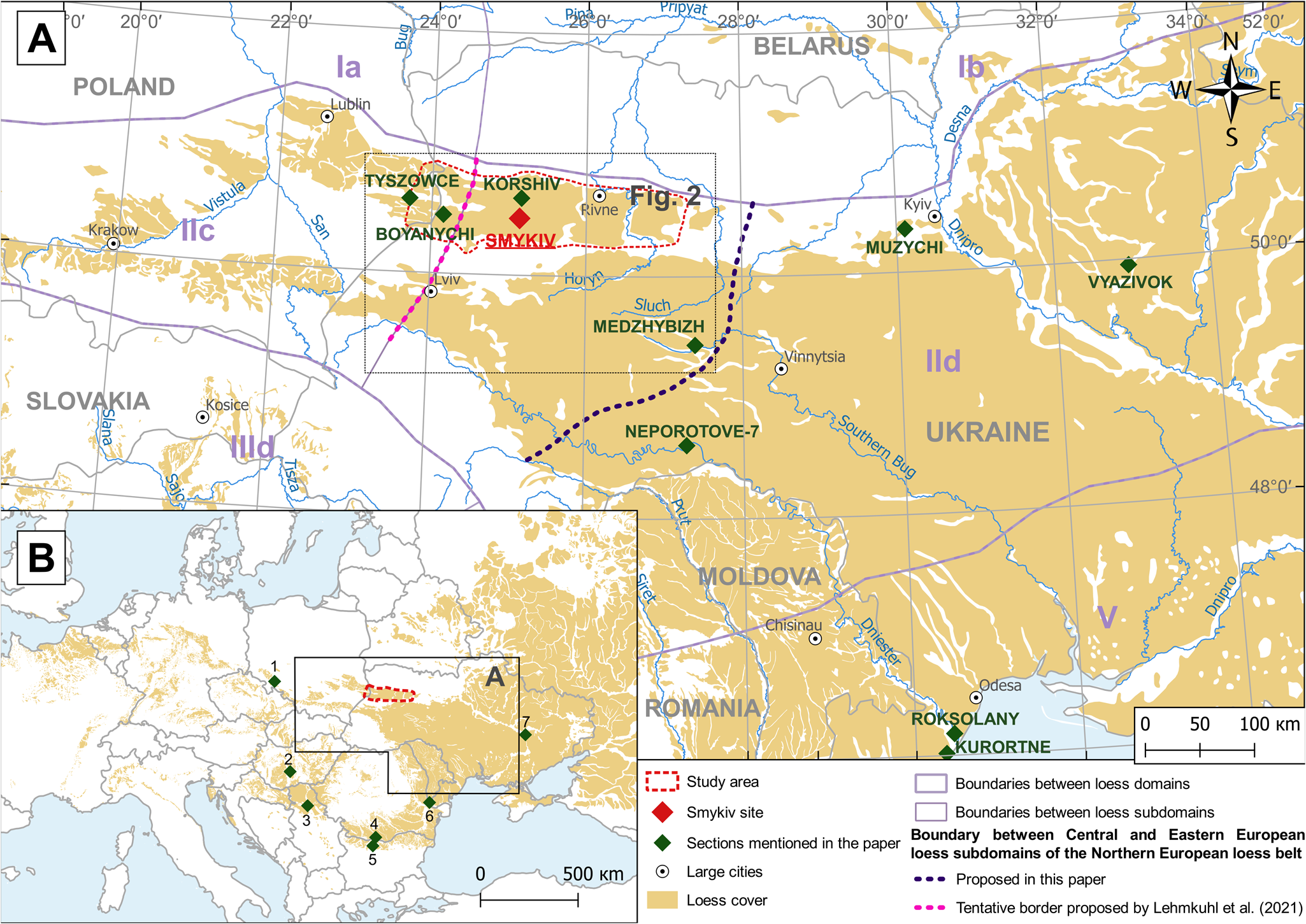
The study area is the Volyn Upland (Fig. 1), where three LPSs were investigated, namely: Smykiv, Novyi Tik, and Kolodezhi (Fig. 2). The Smykiv (50°28.18ʹN, 25°08.22ʹE) and Kolodezhi (50°29.49ʹN, 25°05.34ʹE) sites are located on the right-bank slope of the Dezha river (middle and upper stream, respectively), and the Novyi Tik section (50°29.50ʹN, 25°12.17ʹE) is situated on the left-bank slope of the Berestova river. The Dezha river valley consists of a 200–400 m wide floodplain and fragments of the Upper Pleistocene river terrace that appear towards its mouth (Fig. 2). The Berestova river valley is similar to the Dezha river valley in size and geologic context. The Volyn Upland is characterized by an undulating relief (200–250 m above sea level) significantly dissected by branched dry valleys and gullies up to 3–5 km long (Fig. 2A). The Styr river valley, the main river of the study area, includes three river terraces of the Upper and Middle Pleistocene (Fig. 2B).
(A) Location of the study area on the map of loess distribution at the regional and (B) European scale. Loess distribution is mapped as in Lehmkuhl et al. (Reference Lehmkuhl, Nett, Pötter, Schulte, Sprafke, Jary and Antoine2021). I. Weichselian marginal and protogenetic zone: Ia, western protogenetic subdomain; Ib, eastern protogenetic subdomain. II. Northern European loess belt: IIc, central European continental subdomain; IId, eastern European continental subdomain. III. Loess adjacent to central European and high-altitude mountain range: IIId, eastern margin of the European Alps and northern Carpathian Basin subdomain. V. Pontic East European domain. Loess-paleosol sequences: 1, Biały Kościół; 2, Paks; 3, Stari Slankamen; 4, Lunca; 5, Suhia Kladenetz; 6, Dolynske; 7, Stari Kaydaky.
(A) Relief of northwestern Ukraine; the map is created based on the Shuttle Radar Topography Mission Digital Elevation Model 1 Arc-Second (NASA Shuttle Radar Topography Mission (SRTM), 2013). (B) Geomorphological map of the central part of the Volyn Upland.

The regional loess-paleosol succession is underlain by Upper Cretaceous limestones, chalks, and marls with flint nodules. Beneath the Upper Cretaceous rocks, Devonian reddish sandstones and siltstones constitute a continuous formation (up to 2 km in thickness), overlying Silurian limestones, argillites, and siltstones (Gerenchuk, Reference Gerenchuk1976).
The present-day climate is continental moderate. At the meteorological station in Lutsk (40 km north of the Smykiv section), the average annual temperature is +7.7°C, in January −4.0°C, and in July +18.8°C, and precipitation is 560 mm (Osadchyi et al., Reference Osadchyi, Skrynyk, Palamarchuk, Skrynyk, Osypov, Oshurok and Sidenko2022). In the study area, the soil cover is varied, dominated by Haplic Luvisols, Luvic Phaeozems, Haplic Phaeozems, Luvic Chernozems, and Haplic Chernozems. Albic Luvisols, Calcic Chernozems, and Arenosols occupy isolated areas (Sharyfulina et al., Reference Sharyfulina, Behal, Olenchuk, Vysotska, Metel, Kaplan, Yeremeeva, Nahorna and Krupskyi1967). Vegetation is mainly represented by agrocoenoses and meadows on the site of agricultural land. Natural vegetation is represented by oak–hornbeam forests on plateaus and meadow-steppe on the steep slopes of dry valleys and gullies.
Materials and methods
The stratigraphy of the Smykiv sequence was studied in four excavations located on different landforms (lower and upper slopes of the Dezha river valley). In excavations #1 and #2, all stratigraphic units were exposed (Fig. 3), whereas in excavation #3 only the upper part of the section was studied. Excavation #4 was dug out on the lower slope of the Dezha river valley, which resulted in mixed and strongly disturbed sediments that hampered preservation of stratification.
(A) Stratigraphy of the Smykiv sequence. (B) Section #1 (year 2017). (C) Lower part of section #1 (year 2017). (D) Upper part of section #1 (year 2017). (E) Section #2 (year 2019). See Table 1 for definition of stratigraphic units.

All genetic horizons of the investigated paleosols were studied in accordance with the “Guidelines for Soil Descriptions” (FAO, 2006). Field interpretation of paleosols was performed according to IUSS Working Group WRB (2022). The soil color was determined according to the Munsell soil color chart (Munsell Color, 2009). Eighteen samples for micromorphological and grain-size analysis were taken in 2019 from each genetic horizon of the paleosols and from each bed of the non-soil deposits. Excavations #1 and #2 were subjected to sampling because of their completeness. Micromorphological features of paleosols were described according to the terminology of Stoops (Reference Stoops2003) and Stoops et al. (Reference Stoops, Marcelino and Mees2018).
Grain size was measured in the Laboratory of Landscape Ecology at the Taras Shevchenko National University of Kyiv according to the pipette method (Kachynskyi, Reference Kachynskyi1958), recording the following fractions: <1 μm (clay), 2–5 μm (very fine silt), 5–10 μm (fine silt), and 10–50 μm (coarse silt). The content of coarse fractions (50–250 μm, 250–500 μm, 500–1000 μm, and >1000 μm) was determined by sieving. Grain-size parameters such as median (Md) and average particle radius (Mz) were calculated as in Folk and Ward (Reference Folk and Ward1957) and presented in phi (φ). The sorting index was calculated according to Trask (Reference Trask1932). The loess (Kd) index (10–50 μm/<5 μm) is applied in this paper according to Jary (Reference Jary2007). To estimate the relationship between pedogenesis and sedimentation, the soil/sedimentation (SSI) index according to Bonchkovskyi et al. (Reference Bonchkovskyi, Kuraeva and Bonchkovskyi2023b) was applied.
Another collection of samples for magnetic measurements was taken at Smykiv in 2022. In total, 130 powder samples from the depth interval between 0.05 and 6.25 m (with a step of 5 cm) were extracted, including three additional samples from the largest ice-wedge pseudomorph (Fig. 3). Magnetic measurements were carried out in the laboratory of the Institute of Geophysics of the National Academy of Sciences of Ukraine (Demydiv).
To obtain a high-resolution magnetic susceptibility record, samples with a mass of about 10 g were prepared. Measurements of mass-specific susceptibility were carried out at the dual frequencies of 976 Hz (χlf; used as standard magnetic susceptibility quantity) and 15,616 Hz (χhf) using a MFK1-FB Kappabridge. The differences between the two susceptibilities provided the frequency-dependent magnetic susceptibility. The absolute (χfd) and its relative parameter (χfd%) were calculated as follows: χfd = χlf − χhf; χfd% = (χlf − χhf)/χlf × 100
Isothermal remanent magnetization (IRM) curves were obtained for 15 specimens from all stratigraphic units in magnetic fields from 0 to 1.0 T. The following magnetic parameters were measured for a pilot collection of 65 samples: (1) anhysteretic remanent magnetization (ARM) produced along one spatial axis and induced with a 50 μT static field and 50 mT alternating field using an AMU-1A anhysteretic magnetizer; (2) saturation isothermal remanent magnetization (IRM1T) acquired under a magnetic field of 1.0 T; and (3) IRM−0.3T acquired under the opposite magnetic field of −300 mT. The anhysteretic susceptibility (χARM) was calculated by dividing the ARM by the direct current magnetic field (~0.04 mT in Demydiv). Combinations of these parameters were used to calculate rock magnetic ratios: granulometric indices ARM/IRM1T, χARM/χlf, and IRM1T/χlf; indices of magnetic hardness S = IRM−0.3T/IRM1T and HIRM = (IRM1T + IRM−0.3T)/2 (Evans and Heller, Reference Evans and Heller2003; Maxbauer et al., Reference Maxbauer, Feinberg and Fox2016).
To complement regional paleoenvironmental reconstructions, new palynological data from the nearby Kolodezhi site were used, as well as paleopedological, palynological, and geochemistry records from previously studied Volyn Upland sequences, e.g., Novyi Tik (Bonchkovskyi, Reference Bonchkovskyi2020a; Bonchkovskyi et al., Reference Bonchkovskyi, Hlavatskyi, Kuraieva, Kravchuk and Bonchkovskyi2023a, Reference Bonchkovskyi, Kuraeva and Bonchkovskyi2023b). The paleoenvironmental reconstructions were enhanced by a comparison of our pollen data with formerly studied LPSs of western Ukraine and Poland. Pollen analysis of eight samples from the Kolodezhi section was prepared according to the following technique: boiling in a 10% HCl solution to remove carbonates; boiling in a Na4P2O7 solution to remove clay particles; boiling in HCl to remove secondary carbonates; boiling in a 10% KOH solution to remove organic matter; separation in a heavy liquid (CdI2 + KI) with the specific gravity 2.0–2.2; and, finally, treatment with a 40% HF solution to remove quartz grains.
Results
Stratigraphic subdivision
The loess-paleosol sequence at Smykiv comprises 13 stratigraphic units: six paleosols and seven non-soil beds (Fig. 3). A short description of the soils is given in Table 1. The correlation of units of the Quaternary stratigraphic framework of Ukraine, stratigraphic scheme of western Ukraine, and marine isotope stages is explained in the “Discussion” section.
Morphological description of the Smykiv stratigraphic units.
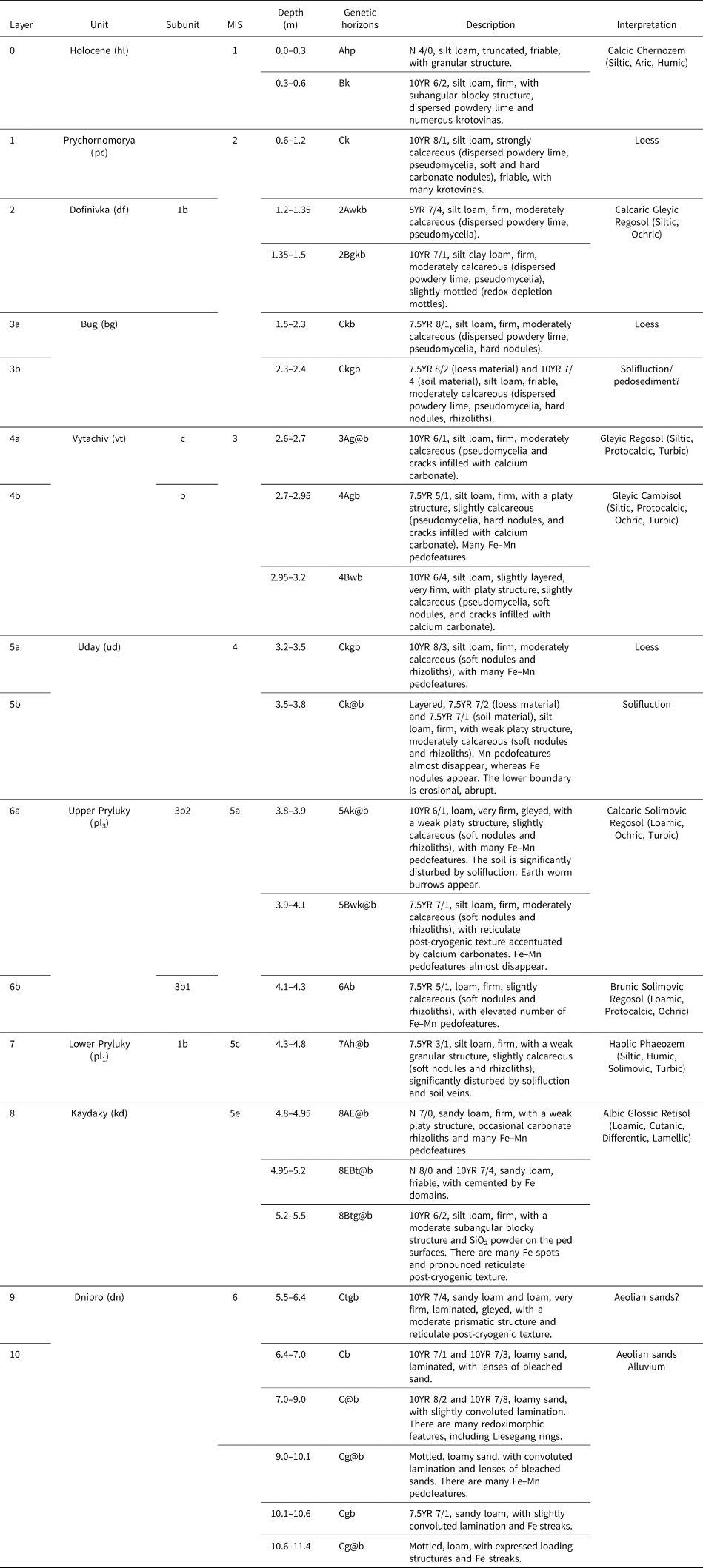
The lowermost unit in the Smykiv section, Dnipro (layers 9–10, MIS 6), is represented by thick (over 5 m) laminated loamy sands with several levels affected by cryoturbation that enabled an interpretation of these sediments as periglacial alluvium. The alluvium is overlain by humified sands with horizontal and wavy lamination, in which lenses with bleached coarse-grained sands are present. Reddish sands interbedded with grey gleyed loams lie above and underwent significant secondary pedogenesis influence, which led to their acquisition of prismatic structures and clay coatings on the ped surfaces.
The Kaydaky unit (layer 8, MIS 5e) is represented by a soil with distinct textural differences: the AE@b and EBt@b horizons are loamy sands, whereas the Btg@b horizon is a silt loam. Albeluvic glossae here penetrate the argic horizon, which, along with an abrupt textural difference, meet the criteria of a Retisol (IUSS Working Group WRB, 2022). The albic horizon is relatively thick (up to 0.4 m); however, in the upper part it is considerably humified; therefore, it is designated as the AE@b horizon, and in the lower part it alternates with reddish iron and clay-rich argic material; therefore, it is designated as the EBt@b horizon. In two upper horizons, a lenticular post-cryogenic texture occurs, accentuated by humified material. The argic horizon is characterized by clay coatings on the subangular blocky peds. Whitish silt cutans overlie the clay coatings. In the AE@b horizon, many small charcoal fragments and signs of mass-movement processes appear.
The Pryluky unit (layers 6 and 7, MIS 5a-c) directly overlies the Kaydaky unit. The Pryluky unit includes three relatively thin soils separated by cryogenic levels. The lower soil (layer 7, MIS 5c) is the darkest one in the section and is significantly deformed by soil veins and solifluction, which did not affect the overlying soil. Only secondary carbonates occur in the soil, including those that emphasize the reticulate post-cryogenic texture. Notably, krotovinas, abundant at this level in other sections (Bonchkovskyi, Reference Bonchkovskyi2020a), are rare here. Thus, the soil is classified as a Haplic Phaeozem. The middle soil (layer 6b, MIS 5a) is very thin (15–25 cm) but clearly visible in the section as a humified soil, not affected by solifluction (Fig. 3C). The soil consists only of the Ab horizon and can be attributed to a Brunic Solimovic Regosol. In this soil, several light-yellow mottles occur. The upper soil (layer 6a, MIS 5a) is a pedosediment in most of the sections, turning into moderately developed soil in section #1 (Fig. 3C), where it includes the Ak@b and Bwk@b horizons. The soil is disturbed by solifluction, soil veins, and a reticulate post-cryogenic texture. The latter resulted in a platy structure. Thus, the soil is classified as a Calcaric Solimovic Regosol.
The Uday unit (layer 5, MIS 4) comprises loess and solifluction beds, both calcareous and silty. Carbonates are both secondary and primary with an explicit predominance of calcified root cells and soft nodules. In the lower part of the unit, there are horizontal laminae and inclusions of humified soil material. In the upper part, the loess is weakly altered by subsequent pedogenesis.
The Vytachiv unit (layer 4, MIS 3) is represented by brown soil with two distinct horizons—Agb and Bwb—therefore, it was attributed to a Gleyic Cambisol. The soil is calcareous with a predominance of secondary carbonates, including hard nodules up to 4 cm in diameter. The Cambisol is overlain by thin tundra gley (layer 4a).
The Bug unit (layer 3, MIS 2), similarly to the Uday unit, consists of loess and solifluction beds. The solifluction bed is dominated by brown soil material. The loess material here forms only thin interbeds. Soft carbonate nodules and calcified root cells dominate the solifluction bed, whereas dispersed powdery lime and pseudomycelia dominate the loess bed. Fractures in the loess open at different levels.
The Dofinivka unit (layer 2, MIS 2) is represented by a weak calcareous soil with explicit signs of gleying in the lower part. Unlike other paleosols, the Dofinivka soil bears no signs of mass-movement processes. The soil is classified as a Calcaric Gleyic Regosol. In sections #1 and #2, the Dofinivka unit is overlain by a loess unit disturbed by Holocene krotovinas. However, in section #3, within the loess unit, a Gleysol (layer 1b) affected by cryoturbation and ice-wedge pseudomorphs is present.
The Holocene soil is truncated owing to prolonged ploughing and erosion along the slope. The chernic horizon is relatively shallow (0.3 m), and carbonates are found below a depth of 0.3–0.4 m, showing a Bk horizon. This enables an interpretation of the Holocene soil as a Calcic Chernozem.
Micromorphology
The micromorphology indicates the synsedimentary character of the MIS 5 soils, as evidenced by rounded and subrounded sand grains and their relative sorting. In the Ctgb horizon of the Kaydaky soil (layer 8, MIS 5e), sand grains are well rounded, attesting to the sedimentary provenance of the bed. Moreover, the micromorphology of the Kaydaky soil is typical for Retisols (Table 2). In the Btg@b horizon, the microstructure is angular blocky, and numerous clay coatings with humus impurities appear in the voids (Fig. 4L). Sand grains penetrate the micromass through microlayers enriched with clay coatings (Fig. 4K). These microlayers are well porous and vertically oriented, demonstrating sand penetration through glossae, a feature of Retisols. The EBt@b horizon is characterized by a platy microstructure and bleached micromass (Fig. 4J), with fragments of an argic horizon. In the AE@b horizon, the micromass is characterized by a pronounced microzonality, as evidenced by the alternation of domains enriched in Fe oxides and humus punctuations (Fig. 4I). Here, typic carbonate nodules appear for the first time.
Micromorphology of the Smykiv stratigraphic units.
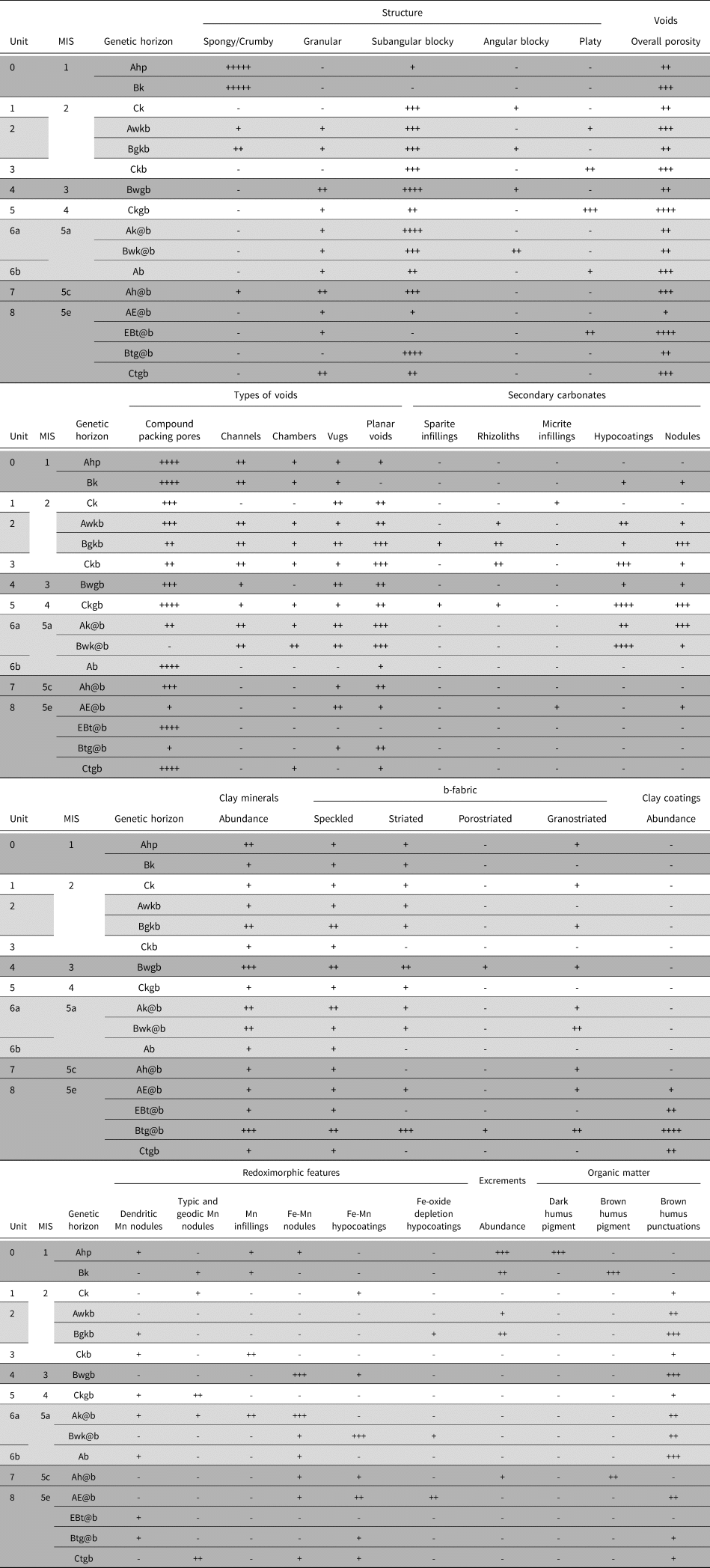
The classification corresponds to Stoops (Reference Stoops2003) and Stoops et al. (Reference Stoops, Marcelino and Mees2018). The semi-quantitative micromorphological analysis is as follows: - = none; + = few; ++ = common; +++ = frequent; ++++ = dominant. The developed paleosols are highlighted in grey; weak soils are highlighted in light-grey.
Micromorphology of the Kaydaky and Pryluky soil units (MIS 5). (A) intrusive manganese nodule in chamber, Ab@b horizon, layer 6a; (B) brown humus punctuations; note sand concentration around a granular aggregate, Ak@b horizon, layer 6a; (C) calcite hypocoating in channel, Ak@b horizon, layer 6a; (D) Fe–Mn hypocoating along a plane, Bwk@b horizon, layer 6a; (E) geodic micritic nodule, Bwk@b horizon, layer 6a; (F) dark brown humus punctuations and small Fe–Mn nodule between sand grains, Ab horizon, layer 6b; (G) crumby aggregates between sand grains, Ah@b horizon, layer 7; (H) circular pattern of sand grains, Ah@b horizon, layer 7; (I) microzonal groundmass: bleached domains alternate with ferruginous, AE@b horizon, layer 8; (J) bleached groundmass and platy aggregates, EBt@b horizon, layer 8; (K) silty primary groundmass (on the left) penetrated by sandy glossae with clay coatings (on the right), Btg@b horizon, layer 8; (L) fibrous clay coatings in the soil matrix, Btg@b horizon, layer 8. II, plane polarized light; X, cross polarized light.
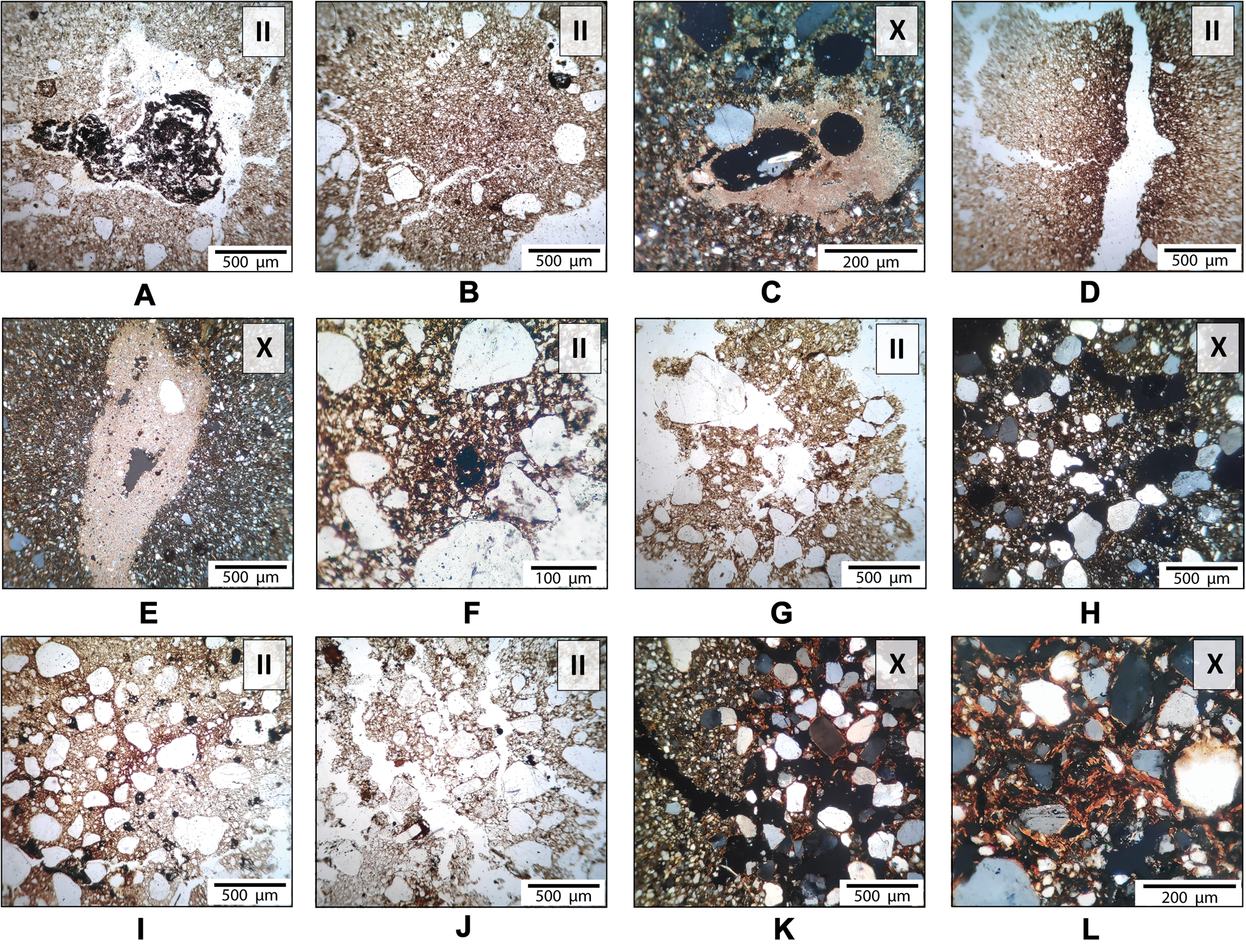
The lower Pryluky soil (layer 7, MIS 5c) is characterized by a weak granular microstructure (Fig. 4G). The micromass is enriched in brown humus and has no signs of a birefringence fabric. There are also thin Fe–Mn hypocoatings and Fe-oxide depletion hypocoatings. Sand grains are concentrated along the planes or form circular patterns (Fig. 4H). The Brunic Solimovic Regosol (layer 6b, MIS 5a) has a platy microstructure with pronounced brown humus punctuations (Fig. 4F). Here, the roundness of the sand grains increases, indicating intense sedimentation. The Calcaric Solimovic Regosol (layer 6a, MIS 5a) is characterized by an angular blocky microstructure in the Bwk@b horizon and a subangular blocky microstructure in the Ak@b horizon (Fig. 4B). Only secondary carbonates are found since they are associated with channels and chambers as developed calcite hypocoatings (Fig. 4C). Moreover, needle-fiber calcite also occurs in voids in the form of polycrystalline chains according to Verrecchia and Verrecchia (Reference Verrecchia and Verrecchia1994). Manganese infillings are frequent in the channels and chambers (Fig. 4A), whereas Fe–Mn hypocoatings are developed along the planes (Fig. 4D).
The Vytachiv soil (layer 4, MIS 3) has weakly separated angular blocky and granular aggregates with silt concentrations on the walls of granules. The latter is an indicator of soil redeposition (Kühn et al., Reference Kühn, Aguilar, Miedema, Bronnikova, Stoops, Marcelino and Mees2018). Thin carbonate hypocoatings, secondarily covered with Fe oxides, appear in several channels, whereas in the micromass, geodic, typic, and concentric Fe–Mn nodules (Fig. 5J), as well as typic carbonate nodules (Fig. 5I), occur. The latter bear signs of fracturing, probably due to their redeposition. The humus punctuations are well expressed.
Micromorphology of layers 1–5. (A) loess micromass, Ck horizon, layer 1; (B) crumby microstructure, Awkb horizon, layer 2; (C) weak platy microstructure, Awkb horizon, layer 2; (D) granular aggregates, Bgkb horizon, layer 2; (E) groundmass microzonality by Fe compounds, Bgkb horizon, layer 2; (F) empty channel and channel with calcite hypocoating, Ckb horizon, layer 3; (G) calcified root cells in the loess matrix, Ckb horizon, layer 3; (H) pronounced humus punctuations, Bwg horizon, layer 4; (I) typic carbonate nodule and rounded sand grain, Bwg horizon, layer 4; (J) concentric Fe–Mn nodule, Bwg horizon, layer 4; (K) developed carbonate hypocoating, Ckg@b horizon, layer 5; (L) micritic micromass and carbonate hypocoatings along planes, Ckg@ horizon, layer 5. II, plane polarized light; X, cross polarized light.

The Dofinivka soil (layer 2, MIS 2) is the least developed soil in terms of micromorphology. A weak platy (Fig. 5C), granular, and crumby (Fig. 5B) microstructure is characteristic of the Awkb horizon, whereas a better-developed granular and subangular blocky (with even single crumby aggregates) microstructure is present in the Bgkb horizon (Fig. 5D). The Bgkb horizon shows pronounced redoximorphic features, Fe-oxide depletion hypocoatings (Fig. 5E), and many carbonate rhizoliths. In the Awkb horizon, carbonates are represented by hypocoatings and small nodules.
The Uday (MIS 4) and Bug (MIS 2) loess units are characterized by many carbonate pedofeatures, including hypocoatings (Figs. 5F and K), rhizoliths (Fig. 5G), and typic nodules. The micromass is micritic and the microstructure is rather platy (Fig. 5L). Furthermore, granular aggregates appear in the Uday loess (MIS 4), and many channels occur in the Bug loess (MIS 2). In the Prychornomorya loess unit, carbonates are represented only by dispersed micrite (Fig. 5A).
Recent soil is characterized by dark brown humus and a spongy microstructure with soil fauna excrements. In the Ahp horizon, single silt-size crystals of secondary calcite occur, whereas in the Bk horizon, dispersed micrite and thin calcite hypocoatings appear.
Paleocryogenic features
At the Smykiv site, evidence of cryogenesis was found at different stratigraphic levels (Fig. 3). The Dnipro alluvium (layer 10, MIS 6) was affected by cryoturbation, loading structures with an amplitude of up to 0.5–0.6 m at the base of the section, as well as irregular waves and folds in the middle part of the alluvial unit. The latter is associated with irregular faults. From the top of layer 9, wedge-shaped soil veins open up to 1.0 m in depth.
The Kaydaky soil (MIS 5e) is disturbed by small wedge-shaped soil veins (up to 0.9 m in depth). The structures open from the top of the Btg@b horizon and are filled with material from there. Moreover, the Retisol is disturbed by reticulate post-cryogenic textures accentuated by iron oxides in the Btg@b horizon and lenticular post-cryogenic textures in the AE@b horizon. Layered post-cryogenic textures occur rarely.
The Pryluky soils (MIS 5a-c) are disturbed by two cryogenic levels. The lower level contains soil veins (up to 1.5 m in depth) filled with dark material of Phaeozem (layer 7) and bent by solifluction (up to 30–40°). Remarkably, only the lower (layer 7, MIS 5c) and upper (layer 6a, MIS 5a) Pryluky soils are deformed by solifluction, whereas the middle soil (layer 6b) remains undisturbed. This indicates the presence of two different solifluction layers, which is also confirmed by the existence of a network of narrow vertical soil veins (up to 0.9–1.1 m in depth) filled with brown material from unit 6a. Moreover, an ice-wedge pseudomorph penetrates the Pryluky soil that is 1.8 m in depth and 1.0 m in width at the mouth. The ice-wedge pseudomorph is filled with loose calcareous pale-yellow loess. The upper part of the structure is slightly bent by solifluction and overlain by a streak of redeposited humified material.
The upper solifluction bed is connected to the Bug unit (layer 3, MIS 2), showing plastic deformation of the soil material interbedded with the loess. From the loess, thin frost fissures (up to 0.8 m in depth) open. In section #3, the upper 1.5 m of an ice-wedge pseudomorph filled with Gleysol was exposed. Thin frost fissures (up to 1 m in depth) are found in the overlying loess.
Grain-size composition and carbonate content
The grain-size composition of the MIS 5 soils (layers 6–8) differs from the upper horizons in the increased sand content (up to 40–60%) and, respectively, low median particle diameter (3.2–5.3 phi) and average particle radius (4.3–5.2 phi) values (Fig. 6). In the upper Pryluky soil (layer 6a, MIS 5a), the sand content decreases significantly (5–40%), showing peaks in the solifluction horizons and in the Prychornomorya loess (up to 16–30%). In contrast, the upper part of the section (layers 1–5) is characterized by a high content of coarse silt (50–70%), including in the recent soil (57–59%). The clay content is the highest (25–34%) in the Dofinivka soil (layer 2).
Grain-size data from the Smykiv site (explanation in the text). Md, median particle radius; Kd, loess index; SSI, soil/sedimentation index. See Table 1 for definition of stratigraphic units.

The calcium carbonate content gradually decreases down the section, showing peaks beneath the recent soil (layer 1) and in the Bug (layer 3) and Uday (layer 5) loesses. In the middle Pryluky soil (layer 6b) carbonates are not found (due to leaching); however, field observations have shown that occasional secondary carbonates are encountered down to the Kaydaky soil (layer 8).
Magnetic susceptibility
Low-frequency mass-specific magnetic susceptibility (χlf) reveals weak magnetic enhancement in the loess, paleosol, and aeolian sand samples, ranging between 7 and 20 × 10−8 m3/kg, with a median of 11.5 × 10⁻⁸ m3/kg. This indicates a low total concentration of ferrimagnetic particles (Fig. 7). Only the Holocene soil reaches the maximum χlf values of up to 38 × 10−8 m3/kg in its uppermost layer. Relatively high χlf values are characteristic of the uppermost part of the uppermost MIS 2 (Prychornomorya, pc) loess (up to 20 × 10−8 m3/kg), interstadial soils of the MIS 2 (Dofinivka, df) unit (17 × 10−8 m3/kg), and the MIS 5c (lower Pryluky, pl1b) subunit (19 × 10−8 m3/kg). The alternation of other loesses, paleosols, and pedosediments is not expressed in the magnetic susceptibility record (Fig. 7).
Variations of selected rock magnetic parameters along lithologic column of the Smykiv section (explanation in the text). See Table 1 for definition of stratigraphic units.
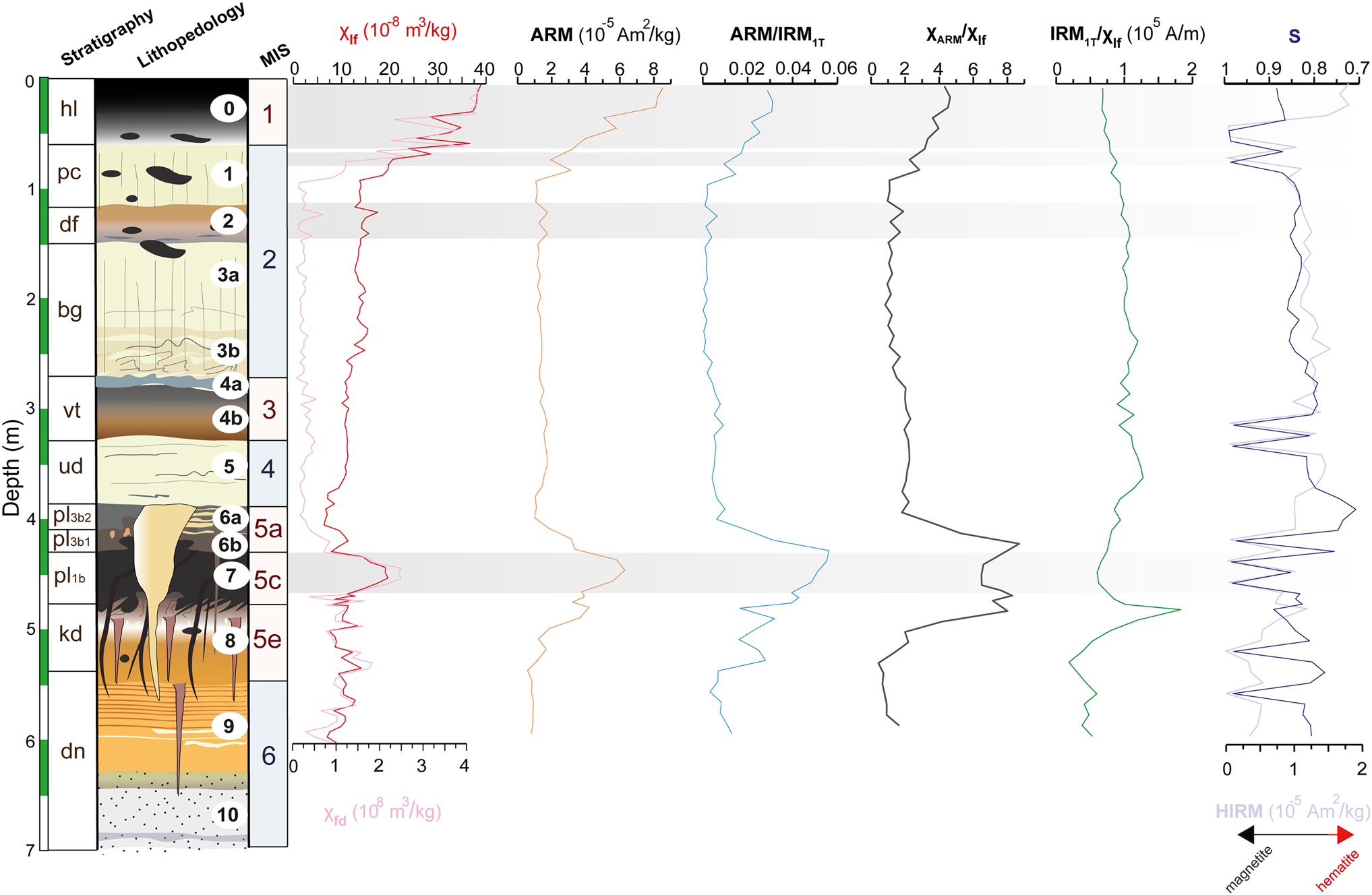
The variations of low-frequency (χlf) and frequency-dependent (χfd) susceptibilities show the same trend with depth, demonstrating significantly lower χfd values, with a median of 4.1 × 10⁻⁸ m3/kg in the Holocene soil and 0.5 × 10⁻⁸ m3/kg in the rest of the units (Fig. 7).
Percent frequency-dependent magnetic susceptibility (χfd%) is a direct measure of the contribution of superparamagnetic (SP) grains (Dearing et al., Reference Dearing, Dann, Hay, Lees, Loveland, Maher and O'Grady1996). In general, χfd% percentages greater than 6% indicate a considerable abundance of SP ferrimagnetic particles, while maximum observed values of ≥10–12% indicate that susceptibility is dominated by SP ferrimagnets, formed owing to pedogenic processes. Values of χfd% of <5% are typical for samples in which stable single-domain grains dominate the assemblage or where extremely fine grains (<0.005 μm) dominate the SP fraction.
The plot of χfd versus χlf (Fig. 8A) reveals four closely clustered groups of samples: (1) the Holocene soil with the highest χlf and χfd values in the section; (2) the uppermost part of the Prychornomorya loess with relatively high χlf but low χfd; (3) other loess samples with very low χlf and χfd patterns; and (4) paleosol and pedosediment samples with relatively low χlf values but higher χfd values than those observed in groups (2) and (3). The plot of χfd versus χfd% (Fig. 8B) indicates that most of the soil and pedosediment samples have χfd% percentages >10%, in which SP grains dominate the assemblage, and thus χfd% can be used quantitatively to estimate their total concentration (Fig. 8C).
(A) Frequency-dependent susceptibility (χfd) plotted against low-frequency susceptibility (χlf) and (B) percentage frequency-dependent factor (χlf%) plotted against frequency-dependent susceptibility of main lithologic groups of samples from the Smykiv section. (C) Mean χlf% values of each stratigraphic unit of the Smykiv section. (D) Examples of isothermal remanent magnetization acquisition curves of typical samples. Selected clusters of values (A) are shaded by different colors (see text for explanation). Note that χfd and χfd% both increase with enhanced pedogenesis. Abbreviations: hl, Holocene; pc, Prychornomorya; df, Dofinivka; bg, Bug; vt, Vytachiv; ud, Uday; pl3b1, Upper Pryluky; pl3b2, Lower Pryluky; kd, Kaydaky; dn, Dnipro.

At Smykiv, the MIS 5 (Pryluky–Kaydaky) paleosol series demonstrates a higher degree of pedogenesis (highest mean χfd% values in the section up to 12–13%) compared to that in the younger interstadial paleosol units (only 3–3.5%) (Fig. 8C). Relatively high χfd% values (6%) are also observed in the upper MIS 2 (Prychornomorya) loess and pseudomorphs (due to reworking by the recent soil).
Other magnetic parameters
IRM acquisition curves for typical samples are displayed in Figure 8D. The curves reach ~90% of the IRM1T when the applied field (H) is 300–350 mT for the majority of the paleosol and pedosediment samples, 400 mT for two loess samples, and 450 mT for one pedosediment sample from MIS 5a (upper Pryluky subunit, layer 6a). This behavior reveals the existence of “soft” magnetic minerals (magnetite and/or maghemite), especially in soils and pedosediments. However, the curves do not climb rapidly and the data indicate the presence of “hard” magnetic components (such as hematite), in particular, from loess and the youngest pedosediment layers. Nonetheless, a sample from the Holocene soil reaches 100% of the IRM in a field of 150 mT, which indicates the dominance of “soft” magnetic minerals (e.g., magnetite).
ARM (χARM) and the ratios ARM/IRM1T and χARM/χlf are indicators of stable single-domain (SSD) particles (Maher, Reference Maher1998; Evans and Heller, Reference Evans and Heller2003; Liu et al., Reference Liu, Roberts, Larrasoaña, Banerjee, Guyodo, Tauxe and Oldfield2012) due to the fact that multidomain (MD) grains generally have exceedingly low coercivities and are unable to retain any significant ARM. ARM, similarly to frequency-dependent susceptibility, is particularly high for magnetite grains close to the SP/viscous boundary (see Maher, Reference Maher1998). At Smykiv, values of ARM, ARM/IRM1T, and χARM/χlf increase in the entire MIS 5 pedocomplex (Fig. 7) and correlate with soil/loess boundaries more precisely than the magnetic susceptibility peaks (compare Fig. 7).
The IRM1T/χlf ratio (Fig. 7) is a grain-size proxy in dominantly magnetite-bearing sediments (Liu et al., Reference Liu, Roberts, Larrasoaña, Banerjee, Guyodo, Tauxe and Oldfield2012); however, the IRM1T/χlf seems distorted due to the significant contribution of hematite according to the IRM acquisition curves (Fig. 8A) and S and HIRM indices (Fig. 7). The S ratio is a common parameter that is used to quantify the proportion of “hard” and “soft” magnetic minerals (Evans and Heller, Reference Evans and Heller2003). The S ratio is expressed as the ratio of an IRM acquired at some non-saturating backfield (often −300 mT) measured after the acquisition of the saturation IRM (SIRM). Values close to unity indicate that the remanence is dominated by “soft” ferrimagnets. The remanence held by “hard” magnetic minerals within sediments is estimated by the “hard” IRM or HIRM. HIRM is typically defined as the difference between the SIRM and backfield IRM−300mT divided by 2.
The S ratio in the Smykiv section weakly depends on the lithology, but samples can be divided into two groups (Fig. 7). The S ratio of less than one-third of specimens (in particular, from the Pryluky soil) is close to 1, indicating a total dominance of magnetite, whereas the S ratio of more than two-thirds of samples (primarily, loess) fluctuates in the range between 0.8 and 0.9, suggesting a higher contribution of hematite. Since the HIRM increases with the increasing fraction of magnetically “hard” minerals, the S ratio is negatively correlated with the HIRM (Fig. 7).
Discussion
Chronostratigraphic attribution
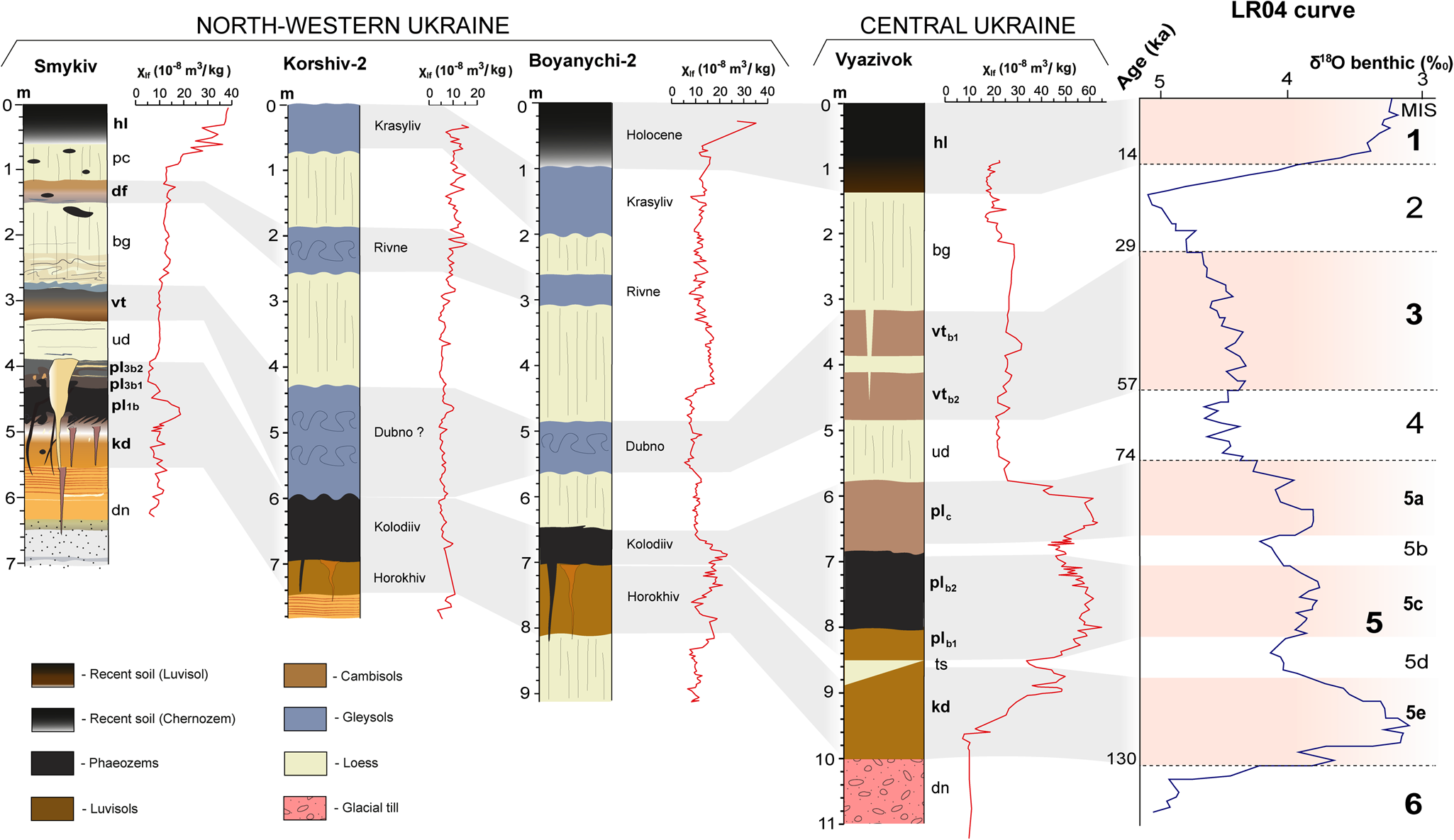
The Smykiv sequence correlates with the Upper Pleistocene Kolodezhi and Novyi Tik sections (Bonchkovskyi, Reference Bonchkovskyi2020a), Korshiv (Fedorowicz et al., Reference Fedorowicz, Łanczont, Bogucki, Kusiak, Mroczek, Adamiec, Bluszcz, Moska and Tracz2013) and Boyanychi (Kusiak et al., Reference Kusiak, Łanczont and Bogucki2012) sections in northwestern Ukraine, as well as with the Vyazivok sequence in central Ukraine (Veklych et al., Reference Veklych, Sirenko, Matviishyna, Melnychuk, Perederyi, Turlo and Vozgrin1984; Rousseau et al., Reference Rousseau, Gerasimenko, Matviischina and Kukla2001; Haesaerts et al., Reference Haesaerts, Damblon, Gerasimenko, Spagna and Pirson2016; Hlavatskyi and Bakhmutov, Reference Hlavatskyi and Bakhmutov2020) (Figs. 9 and 10, Table 3). The Smykiv site has not yet been dated, therefore the correlation is based on pedogenic, magnetic, and cryogenic features. In Figure 11, the Smykiv section is correlated with the local stratigraphic scheme of western Ukraine (Bogucki, Reference Bogucki and Makarenko1986; Bogucki et al., Reference Bogucki, Voloshyn and Tomeniuk2014) and the regional Quaternary stratigraphic framework by Veklych et al. (Reference Veklych, Sirenko, Matviishyna, Gerasimenko, Perederiy and Turlo1993) modified by Gerasimenko (Reference Gerasimenko2004), Gozhik et al. (Reference Gozhik, Shelkoplyas, Komar, Matviishyna and Peredereiy2000, Reference Gozhik, Komar, Łanczont, Fedorowicz, Bogucki, Mroczek, Prylypko and Kusiak2014), and Matviishyna et al. (Reference Matviishyna, Gerasimenko, Perederyi, Bragin, Ivchenko, Karmazinenko, Nagirnyi and Parkhomenko2010).
Correlation of the Smykiv section with key loess-paleosol sections of the Volyn Upland. Thermoluminescence (TL) dating results for the Korshiv section were obtained by Fedorowicz et al. (Reference Fedorowicz, Łanczont, Bogucki, Kusiak, Mroczek, Adamiec, Bluszcz, Moska and Tracz2013), and for the Boyanychi section by Kusiak et al. (Reference Kusiak, Łanczont and Bogucki2012); optically stimulated luminescence (OSL) dating results (45–63 μm) for the Tyszowce section were obtained by Moska et al. (Reference Moska, Adamiec, Jary and Bluszcz2017).

Correlation of the Smykiv section with the nearby Korshiv and Boyanychi loess sections in the Volyn Upland, Vyazivok section in the Dnipro Lowland (central Ukraine), and the stacked marine isotope LR04 curve (adapted from Lisiecki and Raymo, Reference Lisiecki and Raymo2005). Magnetic susceptibility data have been adapted for the Korshiv and Boyanychi sections from Hlavatskyi et al. (Reference Hlavatskyi, Bakhmutov, Bogucki and Voloshyn2016), and for the Vyazivok section from Hlavatskyi and Bakhmutov (Reference Hlavatskyi and Bakhmutov2020).
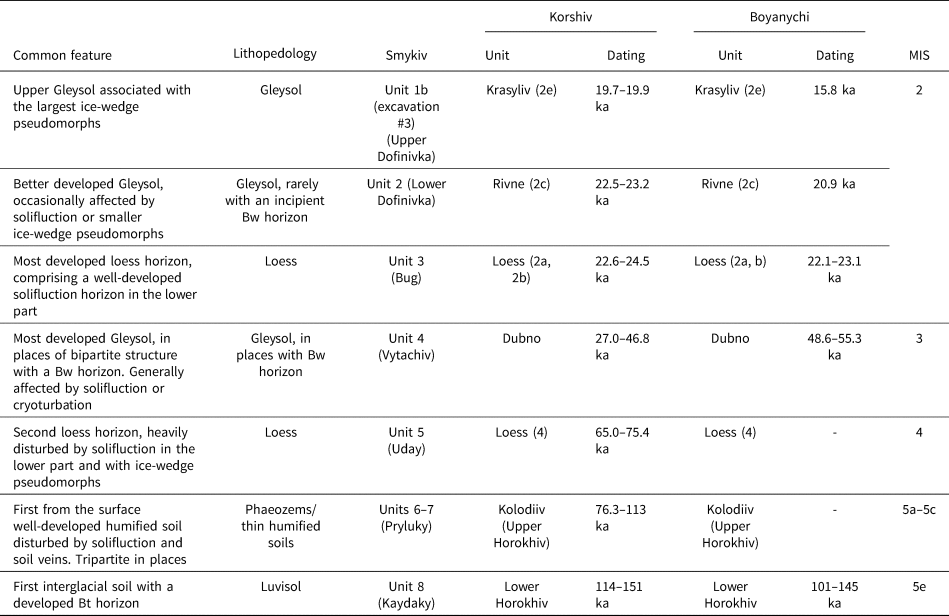
Common features of the marker stratigraphic units of the Smykiv sequence and dated sites at Korshiv (after Fedorowicz et al., Reference Fedorowicz, Łanczont, Bogucki, Kusiak, Mroczek, Adamiec, Bluszcz, Moska and Tracz2013) and Boyanychi (after Kusiak et al., Reference Kusiak, Łanczont and Bogucki2012).
Correlation of the Smykiv section with the stratigraphic schemes of western Europe (Frechen et al., Reference Frechen, Van Vliet-Lanoë and Van den Haute2001; Guiter et al., Reference Guiter, Andrieu-Ponel, de Beaulieu, Cheddadi, Calvez, Ponel, Reille, Keller and Goeury2003), western Ukraine (Bogucki, Reference Bogucki and Makarenko1986; Łanczont and Boguckyj, Reference Łanczont and Bogutsky2007), central Ukraine (Veklych et al., Reference Veklych, Sirenko, Matviishyna, Gerasimenko, Perederiy and Turlo1993 modified by Gerasimenko, Reference Gerasimenko2004; Matviishyna et al., Reference Matviishyna, Gerasimenko, Perederyi, Bragin, Ivchenko, Karmazinenko, Nagirnyi and Parkhomenko2010), and Chinese and Danubian stratigraphic models (Liu, Reference Liu1985; Kukla and An, Reference Kukla and An1989; Jordanova and Peterson, Reference Jordanova and Petersen1999; Marković et al., Reference Marković, Stevens, Kukla, Hambach, Fitzsimmons, Gibbard and Buggle2015) adapted by Łanczont et al. (Reference Łanczont, Komar, Madeyska, Mroczek, Standzikowski, Hołub and Fedorowicz2022) for western Ukraine and Poland. The correlation proposed by Łanczont and Boguckyj (Reference Łanczont and Bogutsky2007) is marked in red; the correlation proposed in this paper is marked in grey.

At the Smykiv site, layers 6–8 form a recognizable pedocomplex, which is the first pedocomplex from the surface in western Ukraine and is assigned to the Horokhiv soil unit in the local loess stratigraphic scheme (Bogucki, Reference Bogucki and Makarenko1986; Łanczont and Boguckyj, Reference Łanczont and Bogutsky2007; Fedorowicz et al., Reference Fedorowicz, Łanczont, Bogucki, Kusiak, Mroczek, Adamiec, Bluszcz, Moska and Tracz2013). In the most complete sections, the Horokhiv unit comprises a lower (Eemian) soil with a developed Bt horizon and up to three humified interstadial (MIS 5a and 5c) soils (Kolodiiv soils) (Łanczont et al., Reference Łanczont, Komar, Madeyska, Mroczek, Standzikowski, Hołub and Fedorowicz2022). A similar soil succession was recorded at the Smykiv site, where three humified soils are superimposed on a Retisol. In the nearby Novyi Tik sequence, these soils are separated by sand beds with cryogenic features (mostly solifluction and soil veins), indicating the stadial periods of MIS 5b and 5d (Bonchkovskyi, Reference Bonchkovskyi2020a). At the Novyi Tik site, the lower forest soil (Retisol and Luvisol) bears signs of an Eemian pollen succession, which proves the correlation of Pedocomplex I with MIS 5. At the Smykiv site, non-soil deposit beds between the soils of the first pedocomplex are absent; however, cryogenic features reliably indicate cold stages and pedogenesis interruption. At least two cryogenic levels can be distinguished that appear to correlate with MIS 5b and 5d.
In central Ukraine, the bipartite pedocomplex of MIS 5, consisting of lower forest and upper humified soils, is designated as the Kaydaky and Pryluky units, respectively (Rousseau et al., Reference Rousseau, Gerasimenko, Matviischina and Kukla2001; Vozgrin, Reference Vozgrin2001; Gerasimenko, Reference Gerasimenko2006, Reference Gerasimenko, Matviishyna, Gerasimenko, Perederyi, Bragin, Ivchenko, Karmazinenko, Nagirnyi and Parkhomenko2010a; Matviishyna et al., Reference Matviishyna, Gerasimenko, Perederyi, Bragin, Ivchenko, Karmazinenko, Nagirnyi and Parkhomenko2010; Haesaerts et al., Reference Haesaerts, Damblon, Gerasimenko, Spagna and Pirson2016; Hlavatskyi and Bakhmutov, Reference Hlavatskyi and Bakhmutov2020). The lower forest soil in the LPSs of the Kyiv loess region (Stari Bezradychi, Pyrogovo, and Muzychi sites) and the Dnipro Lowland (Vyazivok; Fig. 10) directly overlies the Dnipro till, which has previously been suggested to be of MIS 8 age (Veklych et al., Reference Veklych, Sirenko, Matviishyna, Gerasimenko, Perederiy and Turlo1993; Łanczont and Boguckyj, Reference Łanczont and Bogutsky2007; Gozhik et al., Reference Gozhik, Lindner and Marks2012, Reference Gozhik, Komar, Łanczont, Fedorowicz, Bogucki, Mroczek, Prylypko and Kusiak2014). It was widely accepted that the Dnipro (Dnieper) glaciation is the equivalent of the Odradian glaciation in Poland (Lindner et al., Reference Lindner, Bogutsky, Gozhik, Marks, Łanczont and Wojtanowicz2006). Recent studies demonstrate that the Odradian glaciation occurred during MIS 6 (Marks, Reference Marks2023), as was previously concluded for the Dnipro glaciation in Ukraine (Rousseau et al., Reference Rousseau, Gerasimenko, Matviischina and Kukla2001; Vozgrin, Reference Vozgrin2001; Gerasimenko, Reference Gerasimenko, Matviishyna, Gerasimenko, Perederyi, Bragin, Ivchenko, Karmazinenko, Nagirnyi and Parkhomenko2010b; Matoshko, Reference Matoshko, Ehlers, Gibbard and Hughes2011). Palynological studies have revealed the Eemian pollen succession in the soil directly overlying the Dnipro till, attributed to the Kaydaky soil unit (Gerasimenko, Reference Gerasimenko2006). Therefore, it was proposed to correlate the Kaydaky unit with MIS 5e and the Pryluky unit with MIS 5a–c (Gerasimenko, Reference Gerasimenko2006; Gerasimenko and Rousseau, Reference Gerasimenko and Rousseau2008). Nevertheless, other correlation schemes, in which the Dnipro unit corresponds to MIS 8 and the Kaydaky unit to MIS 7, are still being developed (Komar et al., Reference Komar, Łanczont, Fedorowicz, Gozhik, Mroczek and Bogucki2018; Łanczont et al., Reference Łanczont, Madeyska, Mroczek, Komar, Hołub, Standzikowski and Fedorowicz2023).
Taking into account that the Retisol (layer 8) in the Smykiv section is the first soil from the surface with a developed Bt horizon, it corresponds to the Kaydaky unit (MIS 5e). Consequently, the three humified soils (layers 6–7) correlate with the Pryluky unit (MIS 5a–5c) as they represent the first from the surface Chernozem-like soils. The two upper soils (layer 6) are designated as pl3b1 and pl3b2, whereas the Phaeozem (layer 7) is designated as pl1b.
The Gleyic Cambisol (layer 4) is designated as the Vytachiv unit, which is the equivalent of the Dubno unit in western Ukraine. The Calcaric Gleyic Regosol (layer 2) in the Smykiv section is attributed to the Dofinivka unit, whereas the underlying loess is attributed to the Bug unit and overlying loess to the Prychornomorya unit, all correlated with MIS 2. In the LPSs of western Ukraine and Poland, there are two Gleysols within the Upper Pleniglacial loesses (Bogucki, Reference Bogucki and Makarenko1986; Jary and Ciszek, Reference Jary and Ciszek2013; Fedorowicz et al., Reference Fedorowicz, Łanczont, Mroczek, Bogucki, Standzikowski, Moska, Kusiak and Bluszcz2018), which correspond to the Rivne and Krasyliv units, both associated with levels heavily affected by cryogenesis. Many authors have assumed that the Dofinivka unit correlates with the Rivne unit, and the Krasyliv unit with the intra-Prychornomorya subunit (Łanczont and Boguckyj, Reference Łanczont and Bogutsky2007; Matviishyna et al., Reference Matviishyna, Gerasimenko, Perederyi, Bragin, Ivchenko, Karmazinenko, Nagirnyi and Parkhomenko2010; Bogucki et al., Reference Bogucki, Łanczont, Tomeniuk and Sytnyk2012), since they are the two youngest soils in the Pleistocene. Given the numerous dates for the Rivne and Krasyliv units in western Ukraine and the Dofinivka unit in central Ukraine, the question of correlation of these stratigraphic units is quite problematic (Jary and Ciszek, Reference Jary and Ciszek2013; Dzierżek et al., Reference Dzierżek, Lindner, Chlebowski, Szymanek, Bogucki and Tomeniuk2022). Numerous dates for the Dofinivka unit in the LPSs of eastern and southern Ukraine range between 15 and 19 ka (Gerasimenko, Reference Gerasimenko1997, Reference Gerasimenko2004, Reference Gerasimenko, Buynevich, Yanko-Hombach, Gilbert and Martin2011), which correspond to the dates for the Krasyliv unit in western Ukraine (Kusiak et al., Reference Kusiak, Łanczont and Bogucki2012; Fedorowicz et al., Reference Fedorowicz, Łanczont, Bogucki, Kusiak, Mroczek, Adamiec, Bluszcz, Moska and Tracz2013, Reference Fedorowicz, Łanczont, Mroczek, Bogucki, Standzikowski, Moska, Kusiak and Bluszcz2018) but not the Rivne unit, which seems to be older and is dated mainly to 19–23 ka (Kusiak et al., Reference Kusiak, Łanczont and Bogucki2012; Fedorowicz et al., Reference Fedorowicz, Łanczont, Bogucki, Kusiak, Mroczek, Adamiec, Bluszcz, Moska and Tracz2013; Łanczont and Madeyska, Reference Łanczont and Madeyska2015). Furthermore, the Rivne soil unit is significantly better developed than the Krasyliv unit. The latter is often represented by gleyed loess beds. In western Europe, relatively developed soils in the upper part of the Weichselian loess are dated to 20–23 ka (Guiter et al., Reference Guiter, Andrieu-Ponel, de Beaulieu, Cheddadi, Calvez, Ponel, Reille, Keller and Goeury2003; Haesaerts et al., Reference Haesaerts, Borziak, Chirica, Damblon, Koulakovska and Van Der Plicht2003; Antoine et al., Reference Antoine, Coutard, Guerin, Deschodt, Goval, Locht and Paris2016), which corresponds to obtained ages for the Rivne unit. Taking into account the numerous dates from the LPSs of western Ukraine, provided by Kusiak et al. (Reference Kusiak, Łanczont and Bogucki2012), Fedorowicz et al. (Reference Fedorowicz, Łanczont, Bogucki, Kusiak, Mroczek, Adamiec, Bluszcz, Moska and Tracz2013, Reference Fedorowicz, Łanczont, Mroczek, Bogucki, Standzikowski, Moska, Kusiak and Bluszcz2018), and Łanczont and Madeyska (Reference Łanczont and Madeyska2015), it can be assumed that both the Rivne and Krasyliv units correspond to the Dofinivka unit in central Ukraine, and the status of the Dofinivka unit in the Quaternary stratigraphic framework of Ukraine should be reconsidered. It can be tentatively assumed that the Rivne unit corresponds to the Lower Dofinivka subunit (df1) and the Krasyliv unit to the Upper Dofinivka subunit (df3). Thus, layer 2 in the Smykiv section correlates with the Rivne unit, whereas layer 1b (Gleysol in excavation #3) is attributed to the Krasyliv unit.
In terms of stratigraphic nomenclature for the Chinese and Danubian loesses (Liu, Reference Liu1985; Kukla and An, Reference Kukla and An1989; Jordanova and Peterson, Reference Jordanova and Petersen1999; Marković et al., Reference Marković, Stevens, Kukla, Hambach, Fitzsimmons, Gibbard and Buggle2015), adapted by Łanczont et al. (Reference Łanczont, Komar, Madeyska, Mroczek, Standzikowski, Hołub and Fedorowicz2022) for western Ukraine and Poland, the Dnipro unit at Smykiv corresponds to the L2 unit, the Kaydaky–Pryluky pedocomplex to the S1 unit, and the Uday–Prychornomorya loess to the L1 unit (Fig. 11).
Pedogenesis and sedimentary environment
Compared to other LPSs in northwestern Ukraine, the Smykiv loess-paleosol sequence is characterized by thinner loess units and well-developed soils, namely a well-developed pedocomplex of MIS 5, moderately developed soil of MIS 3, and weakly developed soil of MIS 2. The MIS 5 soils bear signs of a synsedimentary origin, which is a characteristic of many LPSs in the southern and central parts of the Volyn Upland (Bonchkovskyi et al., Reference Bonchkovskyi, Kuraeva and Bonchkovskyi2023b). The coarse texture of MIS 5 soils can be explained by the contribution of aeolian sand to the pedogenesis, or the soils (especially those of MIS 5e) could inherit their texture from the parent material represented by aeolian sands. The pedogenesis was presumably interrupted by cold events as evidenced by cryogenic features, when erosion activated leading to soil truncation.
The Kaydaky soil (MIS 5e) meets the criteria of an Albic Glossic Retisol as evidenced by pronounced albeluvic glossae and abrupt textural differences. In the Btg@b horizon, there are many clay coatings with humus impurities. Sand intrusions into loamy material of an argic horizon at the microscale are another indicator of retic properties. Intrusions are enriched in clay coatings as a result of facilitated illuviation in coarse sediments. On the other hand, sand concentrations in inter-pedal voids are considered to be a result of repetitive freeze-thaw cycles in boreal soils (Van Vliet-Lanoё and Fox, Reference Van Vliet-Lanoë, Fox, Stoops, Marcelino and Mees2018). Seasonal freezing also led to a platy structure of the EBt@b horizon and was seen both at the macro- and microscale. Despite the contemporary spread of Retisols under boreal mixed forests, we consider that retic properties are manifested owing to coarse-grained parent material, as was reported at the Novyi Tik site, where Retisols were formed on sands and Luvisols were formed on loess (Bonchkovskyi, Reference Bonchkovskyi2020a).
Features of deep seasonal freezing in the Retisol seem to have occurred during the late phase of soil formation. Furthermore, wedge-shaped structures open from the top of the Btg@b horizon. These structures could have been formed under a cool climate, presumably during the Herning stade (MIS 5d). Given this, the soil continued to form during the Amersfoort interstade (MIS 5c). Many authors reported that soils with textural differences were not formed during interstadial periods (Łanczont and Boguckyj, Reference Łanczont and Bogutsky2007; Łanczont et al., Reference Łanczont, Madeyska, Sytnyk, Bogucki, Komar, Nawrocki, Hołub and Mroczek2015); however, there are studies corroborating Bt or Bth horizon formation in the first half of MIS 5c (Gerasimenko, Reference Gerasimenko2006; Antoine et al., Reference Antoine, Coutard, Guerin, Deschodt, Goval, Locht and Paris2016; Haesaerts et al., Reference Haesaerts, Damblon, Gerasimenko, Spagna and Pirson2016; Bonchkovskyi, Reference Bonchkovskyi2019, Reference Bonchkovskyi2020a). For instance, at the Novyi Tik site, the Podzol was formed on sands and the Luvisol was formed on loams (Bonchkovskyi et al., Reference Bonchkovskyi, Kuraeva and Bonchkovskyi2023b). Thus, it can be assumed that the Retisol at the Smykiv site continued to form during the Amersfoort interstade (MIS 5c), interrupted by a stage of climate deterioration during MIS 5d.
The MIS 5c soil (pl1b) is disturbed by solifluction and soil veins, associated with cryogenic events (MIS 5b) between phases of pedogenesis. Owing to a relatively well-developed A horizon and primarily carbonate leaching, the pl1b soil is classified as a Haplic Phaeozem. Domains with a crumby microstructure testify to significant biogenic activity. The soil has a synsedimentary origin as evidenced by a weak granular microstructure and elevated sand content. Furthermore, the soil underwent subsequent solifluction movement that probably led to the circular sand grain concentration pattern. However, it can also be caused by cryogenic sorting (Konishchev and Rogov, Reference Konishchev and Rogov1977), or solifluction and cryogenic sorting could manifest simultaneously (Van Vliet-Lanoё and Fox, Reference Van Vliet-Lanoë, Fox, Stoops, Marcelino and Mees2018).
The soils of MIS 5a (pl3) are less developed. The lower soil (pl3b1, layer 6b) is thin and therefore classified as a Brunic Solimovic Regosol. Rounded sand grains appear in the soil identifying high sedimentation rates, which should lead to fast soil accretion. The micromass and organic matter of this soil considerably differ from those of the Phaeozem, which does not indicate the development of this unit as a pedosediment of underlying soil. In return, a sharp upper boundary and abrupt decrease in sand content upwards confirm soil truncation. Presumably, the soil pl3b1 (layer 6b) was primarily formed as a Cambisol similar to that of soil pl3b1 in central Ukraine (Gerasimenko, Reference Gerasimenko2006; Haesaerts et al., Reference Haesaerts, Damblon, Gerasimenko, Spagna and Pirson2016).
The upper MIS 5a soil (pl3b2, layer 6a) is distinguished by a noticeable decrease in sand content and appearance of a blocky microstructure. The soil is weakly developed and turns into pedosediment downslope. The soil is the most calcareous among the MIS 5 soils, including needle-fiber calcite considered as secondary, formed owing to rapid evaporation of soil solutions saturated with calcite (Verrecchia and Verrecchia, Reference Verrecchia and Verrecchia1994). It appears to be that the calcic horizon (numerous rhizoliths and soft nodules), superimposed on the two lower Pryluky soils, is related to the upper Pryluky soil, indicating steppe pedogenesis. In contrast to older soils of MIS 5, these ones presumably are not synsedimentary, or sedimentary contribution was decreased. A decreasing sand sedimentation rate is a feature of the LPSs in the southern part of the Volyn Upland (Bonchkovskyi et al., Reference Bonchkovskyi, Kuraeva and Bonchkovskyi2023b), where sands were considered primarily to be aeolian and/or colluvial. The almost complete disappearance of sand and the high loess index (Kd) values in the Pleniglacial units, both in the loess and in the soil units, indicate that sedimentary conditions in this region changed dramatically at the beginning of MIS 4 and aeolian silt accumulation predominated until the Holocene.
The Vytachiv soil (MIS 3) incudes recognizable Agb and Bwb horizons intrinsic for Gleyic Cambisol. A calcic horizon (pronounced pseudomycelia and cracks infilled with carbonates), superimposed on the Vytachiv soil, is probably related to the tundra gley (layer 4a) or can be attributed to the overlying solifluction bed enriched in brown soil material, which can be another soil, subsequently entirely redeposited by solifluction.
At the nearby Kolodezhi and Kovban sites, where the Dubno unit (MIS 3) is represented by a set of three soils, only the lower soil is classified as Gleysol, whereas the two upper soils are classified as Cambisols or Regosols. The same pattern was identified for the Vytachiv unit in the Kyiv loess region (Gerasimenko and Rousseau, Reference Gerasimenko and Rousseau2008). Given the abrupt environmental changes in Europe during MIS 3 (Rasmussen et al., Reference Rasmussen, Bigler, Blockley, Blunier, Buchardt, Clausen and Cvijanovic2014), it can be assumed that Cambisols can represent particular interstadials in the study area, presumably the warmest ones.
The Dofinivka soil (MIS 2) is a weakly developed pale brown soil, which is tentatively classified as a Calcaric Gleyic Regosol. The soil cannot be classified as a Cambisol due to the absence of the Bw horizon. The soil was presumably formed in two phases. A better-developed microstructure and more-pronounced humus punctuations indicate more intense pedogenesis in the early phase. However, this occurred under seasonal waterlogging, which is marked by abundant redoximorphic features. In the second phase, the soil was formed in dry conditions, contributing to the secondary calcium accumulation and weathering processes. The Rivne (Lower Dofinivka) unit in the LPSs of western Ukraine is represented by a Gleysol (Bogucki, Reference Bogucki and Makarenko1986; Fedorowicz et al., Reference Fedorowicz, Łanczont, Mroczek, Bogucki, Standzikowski, Moska, Kusiak and Bluszcz2018). Cambic features appear at this level only in the Novyi Tik sequence (Bonchkovskyi, Reference Bonchkovskyi2020a), which, though, disappear in the paleodepression (Bonchkovskyi et al., Reference Bonchkovskyi, Hlavatskyi, Kuraieva, Kravchuk and Bonchkovskyi2023a). At the Smykiv site, the brown color of the soil reveals an incipient cambic horizon, which does not meet the criteria of Cambisols.
The Upper Dofinivka (Krasyliv) soil is associated with ice-wedge pseudomorphs and can be attributed to a Cryosol/Gleysol, which is typical for LPSs of western Ukraine (Bogucki, Reference Bogucki and Makarenko1986; Łanczont and Madeyska, Reference Łanczont and Madeyska2015).
At the Smykiv site, loess units are characterized by distinct redoximorphic features, which indicates that they were formed in relatively humid conditions or areas with generally poor drainage. Widespread solifluction and plastic deformation in the lower parts of the loess horizons demonstrate wet conditions, primarily in the first half of the stadial periods. These make the loess characteristics at the Smykiv site similar to those of the central European loess subdomain of the northern European loess belt defined by Lehmkuhl et al. (Reference Lehmkuhl, Nett, Pötter, Schulte, Sprafke, Jary and Antoine2021). The well-developed periglacial phenomena and magnetic susceptibility patterns (discussed below) enhance this assumption. Taking into account similar features of the LPSs in many sites of western Ukraine (Bogucki, Reference Bogucki and Makarenko1986; Bogutskiy et al., Reference Bogutskiy, Łanczont and Racinowski2000; Nawrocki et al., Reference Nawrocki, Polechońska, Boguckij and Łanczont2006, Reference Nawrocki, Bogutsky and Łanczont2007; Łanczont and Boguckyj, Reference Łanczont and Bogutsky2007; Jary, Reference Jary2009; Łanczont et al., Reference Łanczont, Fedorowicz, Kusiak, Boguckij and Sytnyk2009, Reference Łanczont, Madeyska, Sytnyk, Bogucki, Komar, Nawrocki, Hołub and Mroczek2015, Reference Łanczont and Madeyska2022, Reference Łanczont, Madeyska, Mroczek, Komar, Hołub, Standzikowski and Fedorowicz2023; Kusiak et al., Reference Kusiak, Łanczont and Bogucki2012; Fedorowicz et al., Reference Fedorowicz, Łanczont, Bogucki, Kusiak, Mroczek, Adamiec, Bluszcz, Moska and Tracz2013, Reference Fedorowicz, Łanczont, Mroczek, Bogucki, Standzikowski, Moska, Kusiak and Bluszcz2018; Jary and Ciszek, Reference Jary and Ciszek2013; Bonchkovskyi, Reference Bonchkovskyi2020a, Reference Bonchkovskyi2020b; Bonchkovskyi et al., Reference Bonchkovskyi, Hlavatskyi, Kuraieva, Kravchuk and Bonchkovskyi2023a, Reference Bonchkovskyi, Kuraeva and Bonchkovskyi2023b), we propose delineating the eastern boundary of the central European loess subdomain through the central part of the Podillia Upland (see Fig. 1).
Cryogenesis
At the Smykiv site, cryogenic features are revealed at different levels and are represented by the following forms: ice-wedge pseudomorphs, soil veins and frost fissures, solifluction, and cryoturbation. At the Smykiv site, ice-wedge pseudomorphs are associated with the Krasyliv (Upper Dofinivka) unit (second part of MIS 2) and the Uday loess (MIS 4). An older ice-wedge pseudomorph is filled with calcareous loess and is bent by solifluction. The topography of the Vytachiv soil (MIS 3) is not related to the ice-body degradation, which points to ice-wedge degradation prior to the MIS 3. The younger ice-wedge pseudomorph at the Smykiv site is associated with the Krasyliv (Upper Dofinivka) gley unit, formerly designated as a buried active layer (Bogucki, Reference Bogucki and Makarenko1986). Ice-wedge pseudomorphs of this level are the largest in LPSs of western Ukraine and Poland (Nechaev, Reference Nechaev1983; Bogucki, Reference Bogucki and Makarenko1986; Dolecki, Reference Dolecki2003; Fedorowicz et al., Reference Fedorowicz, Łanczont, Mroczek, Bogucki, Standzikowski, Moska, Kusiak and Bluszcz2018; Bonchkovskyi, Reference Bonchkovskyi2020a). Recently, the upper part of the infillings of the ice-wedge pseudomorph at the Volochysk site (Podillia Upland) has been dated to 13.9–16.1 ka and correlated with the Heinrich event H1 (Fedorowicz et al., Reference Fedorowicz, Łanczont, Mroczek, Bogucki, Standzikowski, Moska, Kusiak and Bluszcz2018). In Poland, multiple dates from ice-wedge pseudomorphs appear somewhat older: 20–29.5 ka (Zöller et al., Reference Zöller, Fischer, Jary, Antoine and Krawczyk2022).
At the Smykiv site, soil veins disturbed the Pryluky and Kaydaky soils and were presumably formed during MIS 5d, MIS 5b, and at the very beginning of MIS 4. The oldest soil veins are the smallest (<1 m); however, in other LPSs of western Ukraine they can reach up to 2 m in depth (Jary, Reference Jary2009). The lack of ice-wedge pseudomorphs of MIS 5d in western Ukraine testifies to deep seasonal freezing and not to permafrost. Soil veins of MIS 5b are the largest ones in the Smykiv section (up to 1.5 m) and are bent by solifluction. Cryogenic features at this level are rarely distinguished in the sections of western Ukraine, probably due to the truncation of the Upper Horokhiv soil and superimposition of MIS 4 cryogenesis on the older one. However, the presence of solifluction levels and soil veins inside MIS 5 has been proved recently in several LPSs of western Ukraine (Bogucki et al., Reference Bogucki, Łanczont, Tomeniuk and Sytnyk2012; Jary and Ciszek, Reference Jary and Ciszek2013; Łanczont et al., Reference Łanczont, Sytnyk, Bogucki, Madeyska, Krajcarz, Krajcarz, Koropeckyj, Żogała, Tomek and Kusiak2014; Bonchkovskyi, Reference Bonchkovskyi2020a). The cryogenesis during MIS 5b (as during MIS 5d) presumably took place under deep seasonal freezing since both solifluction (Matsuoka, Reference Matsuoka2001) and soil veins (Romanovskiy, Reference Romanovskiy1993) are not reliable indicators of permafrost. Soil veins of MIS 4 are very narrow and were formed prior to when ice-wedges grew and solifluction took place, as the solifluction horizon overlies them. The lower part of the loesses of MIS 4 (Uday unit) and MIS 2 (Bug unit) are disturbed by solifluction, identifying a more humid climate in the first half of these stadial periods.
Loading structures are observed in the alluvium of MIS 6, which is characteristic of the nearest LPSs, where various forms of periglacial phenomena occur. Occasional faults associated with cryoturbation were probably caused by local permafrost thaw (Van Vliet-Lanoё et al., Reference Van Vliet-Lanoë, Van Brulhet, Combes, Duvail, Ego, Baize and Cojan2017).
Models of magnetic enhancement and dissolution in LPSs
Magnetic susceptibility as an indicator of paleoclimate change was first used by Heller and Liu (Reference Heller and Liu1982, Reference Heller and Liu1984) during magnetic investigations of several loess profiles near Luochuan, China. Further, at numerous sequences located mostly within the Eurasian temperate belt, including Ukraine, it was proved that the variation of high and low values of magnetic susceptibility is closely correlated with paleosol/loess alternation and can be linked directly to the marine oxygen isotope record (Heller et al., Reference Heller, Liu, Liu and Xu1991; Maher and Thompson, Reference Maher and Thompson1992; Forster and Heller, Reference Forster and Heller1994; Maher, Reference Maher1998; Tsatskin et al., Reference Tsatskin, Heller, Hailwood, Gendler, Hus, Montgomery, Sartori and Virina1998; Jordanova and Petersen, Reference Jordanova and Petersen1999; Panaiotu et al., Reference Panaiotu, Panaiotu, Grama and Necula2001; Buggle et al., Reference Buggle, Hambach, Glaser, Gerasimenko, Marković, Glaser and Zöller2009; Marković et al., Reference Marković, Hambach, Stevens, Kukla, Heller, McCoy, Oches, Buggle and Zöller2011). Thus, the deposition of these sequences followed the so-called pedogenic (“Chinese”) magnetic enhancement model, namely the formation of pedogenic, single-domain, and SP magnetite (and maghemite) grains in paleosols (Hus and Han, Reference Hus and Han1992; Maher and Thompson Reference Maher and Thompson1992).
On the other hand, the magnetic measurements reported from loess sections in Alaska (Begét, Reference Begét1996; Liu et al., Reference Liu, Hesse, Rolph and Begét1999; Muhs et al., Reference Muhs, Ager, Bettis, McGeehin, Been, Begét, Pavich, Stafford and Stevens2003) revealed the opposite (“Alaskan” or reducing-pedogenic; Liu and Mao, Reference Liu and Mao2021) pattern: the magnetic susceptibility values are much lower in paleosol samples, and the loesses are characterized by very high values. This was explained by the influence of wind intensity in glacial periods, resulting in the enrichment of coarser grained magnetic minerals in the units of coarse-grained loess (Evans, Reference Evans2001), and by waterlogging of the soils during interglaciations (Begét et al., Reference Begét, Stone and Hawkins1990; Liu et al., Reference Liu, Hesse, Rolph and Begét1999). The gleying process in the redox weathering environment destroys the magnetite (Maher, Reference Maher1998; Nawrocki et al., Reference Nawrocki, Wøjcik and Bogucki1996; Grimley and Arruda, Reference Grimley and Arruda2007). This type of paleoclimate record also occurs in inland loesses of North America (Hayward and Lowell, Reference Hayward and Lowell1993) and some southern Siberian regions (Chlachula et al., Reference Chlachula, Evans and Rutter1998; Zhu et al., Reference Zhu, Matasova, Kazansky, Zykina and Sun2003).
Features of both magnetic enhancement models can be observed at some sites within classic “Chinese” and “Alaskan” model regions. For instance, in the Chinese Loess Plateau (Liu and Mao, Reference Liu and Mao2021), Dnipro Lowland in Ukraine (Hlavatskyi et al., Reference Hlavatskyi, Gerasimenko, Bakhmutov, Poliachenko and Cherkes2023), and Pannonian Plain in Hungary (Sartori et al., Reference Sartori, Heller, Forster, Borkovec, Hammann and Vincent1999; Sümegi et al., Reference Sümegi, Gulyás, Molnár, Sümegi, Almond, Vandenberghe and Zhou2018), magnetic susceptibility may decrease in paleosols due to gleying processes caused by local geomorphological conditions (location of these sequences in lowlands with a high ground water position). Magnetic susceptibility can also be affected by loess provenance (Grimley et al., Reference Grimley, Follmer and McKay1998). Paleosols of the Great Plains in the central United States have been shown to have either enhanced or reduced magnetic susceptibilities depending on paleodrainage conditions (Grimley et al., Reference Grimley, Follmer, Hughes and Solheid2003; Wang et al., Reference Wang, Lundstrom, Zhang, Grimley and Balsam2009). In many cases, the upper solum of paleosols has increased magnetic susceptibility values while the lower solum can have decreased magnetic susceptibility, compared with the parent loess. Observations of magnetic susceptibility in modern soils has helped to document dissolution processes as an important factor in poorly drained modern soils (de Jong et al., Reference de Jong, Pennock and Nestor2000; Hanesch and Scholger, Reference Hanesch and Scholger2005; Grimley and Arruda, Reference Grimley and Arruda2007; Blundell et al., Reference Blundell, Dearing, Boyle and Hannam2009) that could be applicable to paleosols. Thus, in addition to climatic conditions, the local and regional factors such as waterlogging, changes in parent material, and soil drainage significantly impact the soil magnetic susceptibility pattern.
Preliminary magnetic susceptibility studies of Polish and western Ukrainian loess sections revealed that their magnetic susceptibility variations are similar to those in the Alaskan sequences (Nawrocki, Reference Nawrocki1992; Nawrocki et al., Reference Nawrocki, Wøjcik and Bogucki1996, Reference Nawrocki, Bakhmutov, Bogucki and Dolecki1999). Hlavatskyi et al. (Reference Hlavatskyi, Bakhmutov, Bogucki and Voloshyn2016) noticed that the observed enviromagnetic patterns of the Boyanychi and Korshiv sections do not fit the Chinese or Alaskan types of formation of magnetic properties alone: both the loess and paleosol units have higher and lower susceptibility values. Following more comprehensive rock magnetic investigations, Bakhmutov et al. (Reference Bakhmutov, Kazanskii, Matasova and Glavatskii2017) established that the sections had the pedogenic (Chinese) type of formation of magnetic properties with an admixture of the Alaskan type. Analogous transitional patterns were also reported in the LPSs in Argentina (Bidegain et al., Reference Bidegain, Rico, Bartel, Chaparro and Jurado2009), Pakistan (Akram et al., Reference Akram, Yoshida and Ahmad1998), and Australia (Ma et al., Reference Ma, Liu, Hesse, Lü, Guo and Chen2013).
The loess-paleosol deposits at the Smykiv site are characterized by low magnetic susceptibility values (<20 × 10−8 m3/kg), similar to those at the nearby Korshiv and Boyanychi loess sections (<24 × 10−8 m3/kg). At the studied loess sequences in northwestern Ukraine, ratios of the magnetic susceptibility of paleosols (χlf soils) divided by that of loess samples (χlf loess) are in the range of 2−1 to 3, with a median of from 1.5−1 to 1. A few Upper Pleistocene sequences in central Europe, for instance, Biały Kościół in Poland (Moska et al., Reference Moska, Jary, Adamiec and Bluszcz2019), Paks in Hungary (Sartori et al., Reference Sartori, Heller, Forster, Borkovec, Hammann and Vincent1999), located to the west of the Volyn Upland, and the Medzhybizh section in the Podillia Upland (200 km SE from Smykiv; Bakhmutov et al., Reference Bakhmutov, Hlavatskyi, Stepanchuk and Poliachenko2018; Hlavatskyi et al., Reference Hlavatskyi, Stepanchuk, Kuzina, Poliachenko, Shpyra, Skarboviychuk, Yakukhno and Bakhmutov2021), show similar patterns (Fig. 12).
(A) Ratio of magnetic susceptibility in MIS 5 soils divided by that of MIS 2–4 loesses for selected Upper Pleistocene sequences in Eurasia and Alaska; circles = medians; whiskers = ranges of values; and (B) schematic range plots of absolute values of magnetic susceptibility in MIS 5 soil versus MIS 2–4 loess layers. The data were adapted from the following sources: Smykiv (this study), Korshiv and Boyanychi (Hlavatskyi et al., Reference Hlavatskyi, Bakhmutov, Bogucki and Voloshyn2016), Kurortne (Tecsa et al., Reference Tecsa, Gerasimenko, Veres, Hambach, Lehmkuhl, Schulte and Timar-Gabor2020), Vyazivok and Roksolany (Hlavatskyi and Bakhmutov, Reference Hlavatskyi and Bakhmutov2020), Stari Kaydaky, Ukraine (Buggle et al., Reference Buggle, Hambach, Glaser, Gerasimenko, Marković, Glaser and Zöller2009); Biały Kościół, Poland (Moska et al., Reference Moska, Jary, Adamiec and Bluszcz2019); Paks, Hungary (Sartori et al., Reference Sartori, Heller, Forster, Borkovec, Hammann and Vincent1999); Lunca, Romania (Constantin et al., Reference Constantin, Cameniţă, Panaiotu, Necula, Codrea and Timar-Gabor2015); Suhia Kladenetz, Bulgaria (Jordanova et al., Reference Jordanova, Laag, Jordanova, Lagroix, Georgieva, Ishlyamski and Guyodo2022); Stari Slankamen, Serbia (Marković et al., Reference Marković, Hambach, Stevens, Kukla, Heller, McCoy, Oches, Buggle and Zöller2011); Karamaidan, Tajikistan (Forster and Heller, Reference Forster and Heller1994); Luochuan, China (Heller et al., Reference Heller, Liu, Liu and Xu1991); Alaska (Liu et al., Reference Liu, Hesse, Rolph and Begét1999). See explanation in the text.

Moving towards the east and south across the Eurasian loess belt, magnetic susceptibility values increase in loesses, and much more in paleosols. The χlf values in paleosols are usually two to five times greater than those in loess layers at other sites in Ukraine, the Danube basin, Central Asia, and the Chinese Loess Plateau. In the westernmost part of Ukraine, the pedogenic (“Chinese”) model is observed first at the loess sections located within the Middle Dniester basin (Neporotove 7; Hlavatskyi et al., Reference Hlavatskyi, Gerasimenko, Bakhmutov and Poliachenko2022) and in the northernmost part of Ukraine within the Dnipro Upland (e.g., Muzychi; Vigilyanskaya, Reference Vigilyanskaya2002) (see Fig. 1). In contrast, the magnetic susceptibility values of Alaskan loesses are (on average) three to four times higher than those in paleosols (Liu et al., Reference Liu, Hesse, Rolph and Begét1999), and their absolute values are comparable to the highest ones in Eurasia (Fig. 12).
ARM, ARM/IRM1T, and χARM/χlf values are relatively higher in paleosol samples (Fig. 7), which contain a higher fraction of SSD particles (in contrast to the loesses). Furthermore, based on the magnetic susceptibility variation pattern, the Smykiv section cannot be classified as having the Chinese type of formation of magnetic properties in the sediments: in many paleosol units, very low magnetic susceptibility values are observed (Fig. 7), indicating the impact of the Alaskan magnetic enhancement model in the formation of the soils. Nevertheless, the loess units in all Ukrainian sections studied, according to magnetic characteristics, have a certain similarity. The mean values of magnetic susceptibility in the loess beds vary within a narrow range of 6 to 15 × 10–8 m3/kg (Rousseau et al., Reference Rousseau, Gerasimenko, Matviischina and Kukla2001, Reference Rousseau, Antoine, Gerasimenko, Sima, Fuchs, Hatté, Moine and Zoeller2011; Nawrocki et al., Reference Nawrocki, Bogucki, Łanczont and Nowaczyk2002; Bokhorst et al., Reference Bokhorst, Beets, Marković, Gerasimenko, Matviishina and Frechen2009; Buggle et al., Reference Buggle, Hambach, Glaser, Gerasimenko, Marković, Glaser and Zöller2009; Bakhmutov et al., Reference Bakhmutov, Kazanskii, Matasova and Glavatskii2017, Reference Bakhmutov, Hlavatskyi, Stepanchuk and Poliachenko2018; Hlavatskyi and Bakhmutov, Reference Hlavatskyi and Bakhmutov2020, Reference Hlavatskyi and Bakhmutov2021), with the exception of the Kurortne section on the Black Sea coast (30–50 × 10–8 m3/kg; Tecsa et al., Reference Tecsa, Gerasimenko, Veres, Hambach, Lehmkuhl, Schulte and Timar-Gabor2020). This supports the suggestion of a common distal source for the aeolian (loess) material supplied to the entire territory of Ukraine, including the Volyn Upland (Buggle et al., Reference Buggle, Glaser, Zöller, Hambach, Marković, Glaser and Gerasimenko2008; Bakhmutov et al., Reference Bakhmutov, Kazanskii, Matasova and Glavatskii2017).
In addition to contrasting magnetic susceptibility values in paleosol units between the northern and southern Ukrainian sections, differences are observed in magnetic hardness of the rock material. As an illustration, in the Roksolany and Dolynske sections in southern Ukraine, the hematite (and goethite) concentrations are very low, expressed by S values close to 1 (Bakhmutov et al., Reference Bakhmutov, Kazanskii, Matasova and Glavatskii2017; Hlavatskyi and Bakhmutov, Reference Hlavatskyi and Bakhmutov2021). The hematite (goethite) concentration in the Smykiv, Boyanychi, Korshiv, and partly Vyazivok sections is significantly higher (Bakhmutov et al., Reference Bakhmutov, Kazanskii, Matasova and Glavatskii2017; Hlavatskyi and Bakhmutov, Reference Hlavatskyi and Bakhmutov2020). This is indicated by the lower S values (in particular, in the solifluction horizons) and higher HIRM values, as compared to those at the Roksolany and Dolynske sections. The presence of hematite in the Boyanychi section was established by magnetic mineralogy methods (Nawrocki et al., Reference Nawrocki, Wøjcik and Bogucki1996). In sediments of the Smykiv, Boyanychi, and Korshiv sections, hematite could be formed through the surface oxidation of large magnetite grains.
Therefore, the Upper Pleistocene deposits in northwestern Ukraine were formed in different conditions than those in southern Ukraine. Bakhmutov et al. (Reference Bakhmutov, Kazanskii, Matasova and Glavatskii2017) suggested that periodic humidification in the territory of the Volyn Upland due to closeness to the ice sheet facilitated the oxidation of the ferrimagnetic grains and the formation of highly coercive minerals. Nevertheless, the majority of the paleosols at Smykiv are not gleyed, though they are sandy. In our view, the supply of hard magnetic material from the nearby alluvial layers is a probable contributory factor. The SP grains of magnetite and maghemite in paleosols could be destroyed by physical and chemical weathering, in particular, blowing winds and erosion which fashioned sedimentary soils, indicated by high χfd% percentages (in most cases) and secondary gleying, observed in a few soil horizons (Table 1) with lower χfd% values. This is well demonstrated by the difference between the IRM acquisition curves of the MIS 5e and Holocene soils: in the MIS 5e soil, oxidized magnetite resulted in the formation of hematite under weathering processes, whereas the classic pedogenic model of the formation of magnetite is observed only in the Holocene soil (Fig. 8D).
Based on the above estimations, we suggest that the Upper Pleistocene LPSs, in general, can be attributed to three types of paleoenvironments based on a few simple criteria presented in Table 4. The northwestern Ukrainian loess sections including the Smykiv section, in our interpretation, belong to the transitional model of the paleoclimate record.
The proposed criteria for dividing the Upper Pleistocene loess-paleosol sequences based on types of formation of magnetic properties.
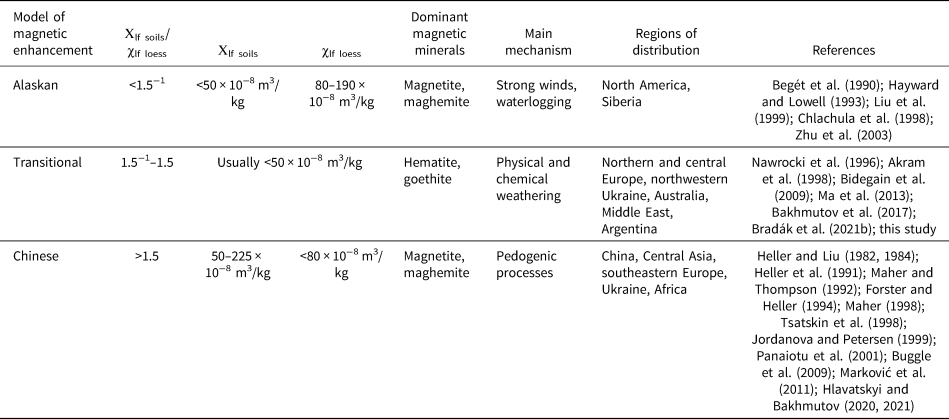
Paleoenvironmental reconstructions
In the loess-paleosol sequence of northwestern Ukraine, seven paleoenvironmental periods, covering the interval since MIS 6 to the final part of MIS 2, have been identified using lithologic, paleopedological, sedimentologic, palynological, and magnetic proxies. In this section, we discuss paleoenvironmental reconstructions for each period in view of the new results obtained from the Smykiv and nearby sites, studied by our team, versus previous data from the central Ukrainian and some European loess sequences. The chronology of the periods is presented for marine isotope stages as in Lisiecki and Raymo (Reference Lisiecki and Raymo2005) and Wolhfarth (Reference Wolhfarth2013).
MIS 6 (Dnipro period; 191–130 ka)
The Dnipro period is associated with the maximum ice-sheet advancement in central Ukraine (Veklych, Reference Veklych1968; Matoshko, Reference Matoshko, Ehlers, Gibbard and Hughes2011). In northwestern Ukraine, the Saalian (Dnieperian) ice sheet reached the northern margins of the Volyn Upland (Godzik et al., 2012) and, in southwestern Poland, the Carpathian foothills (Marks, Reference Marks2023). In the periglacial areas, high loess sedimentation rates occurred (Rousseau et al., Reference Rousseau, Antoine, Boers, Lagroix, Ghil, Lomax and Fuchs2020). In the LPSs of northwestern Ukraine, the corresponding loess unit L2 is predominantly 2–3 m thick (Bogucki, Reference Bogucki and Makarenko1986; Fedorowicz et al., Reference Fedorowicz, Łanczont, Bogucki, Kusiak, Mroczek, Adamiec, Bluszcz, Moska and Tracz2013; Bogucki and Voloshyn, Reference Bogucki and Voloshyn2014), reaching up to 5–7 m in some sections (Bogucki and Voloshyn, Reference Bogucki and Voloshyn2008). At the Novyi Tik site, the geochemistry of L2 differs from other loess units, particularly in its high values of trace elements such as Zr, Ga, Ce, Y and Yb, which are supposed to be the result of another source of aeolian dust at that time (Bonchkovskyi et al., Reference Bonchkovskyi, Kuraeva and Bonchkovskyi2023b). For instance, in central Ukraine, sorted fluvioglacial sands are considered to be the main source of dust contributed to the formation of L2 and therein Zr accumulation (Buggle et al., Reference Buggle, Glaser, Zöller, Hambach, Marković, Glaser and Gerasimenko2008).
At the Novyi Tik and Boremel-2 sites, the reddish laminated sands overlying L2 are considered to be aeolian and originated from the Styr river valley (Bonchkovskyi et al., Reference Bonchkovskyi, Kuraeva and Bonchkovskyi2023b). Similar aeolian sands have also been reported in the Korshiv section (Fedorowicz et al., Reference Fedorowicz, Łanczont, Bogucki, Kusiak, Mroczek, Adamiec, Bluszcz, Moska and Tracz2013), indicating dynamic aeolian processes at the end of MIS 6. The alternation of coarse-grained sand and silt in the Novyi Tik and Boremel-2 sections may indicate a seasonal variation in wind intensity as documented in the modern periglacial environment (Bateman, Reference Bateman and Shroder2013). The prevalence of tundra-steppe vegetation (Gerasimenko, Reference Gerasimenko2004) and the existence of permafrost (Dolecki, Reference Dolecki2003) presumably conditioned the high wind intensity. At the Smykiv site, the sands overlying the periglacial alluvium can be also defined as aeolian.
MIS 5e (Kaydaky period; 130–111 ka)
The humid and warm climate contributed to the spread of soils with a developed Bt horizon across almost the entire northern European loess belt (Morozova, Reference Morozova1981). The soils are predominantly classified as Luvisols, which are replaced by Retisols in the northern sites of the eastern European Plain (Sycheva et al., Reference Sycheva, Frechen, Terhorst, Sedov and Khokhlova2020; Makeev et al., Reference Makeev, Rusakov, Kust, Lebedeva and Khokhlova2024). In northwestern Ukraine, Retisols were formed on sands, whereas Luvisols were formed on loess.
The most complete LPSs show a similar pattern of soil evolution by the end of the last interglaciation, which in some publications is interpreted as a local phenomenon (Łanczont and Boguckyj, Reference Łanczont and Bogutsky2007). In the eastern LPSs of Ukraine, there is a cyclicity of pedogenic processes, manifested in two early phases of clay illuviation and two late phases of humus accumulation (Gerasimenko, Reference Gerasimenko2004, Reference Gerasimenko2006; Gerasimenko and Rousseau, Reference Gerasimenko and Rousseau2008). In northwestern and western Ukraine, the same pattern has not yet been traced. However, at the Novyi Tik site, the final phase of the last interglaciation is marked by a humified soil with a steppe palynological assemblage (Bonchkovskyi, Reference Bonchkovskyi2020a).
Our pollen studies of the Novyi Tik site are in line with previous investigations (Komar et al., Reference Komar, Łanczont and Madeyska2009, Reference Komar, Łanczont, Madeyska, Łanczont and Madeyska2015; Łanczont et al., Reference Łanczont, Komar, Madeyska, Mroczek, Standzikowski, Hołub and Fedorowicz2022), which reveal an Eemian pollen succession characteristic for central Europe (Mamakowa, Reference Mamakowa1989). In northwestern Ukraine, the following phases have been distinguished: (1) E1, birch forests; (2) E2, mixed forests; (3) E3, oak–elm–hornbeam forests; (4) E5, spruce–hornbeam forests; (5), mesophytic steppes with elm–birch woodland; (6) E7, pine forests.
MIS 5d (Tyasmyn period; 111–107 ka)
The deterioration of climatic conditions during MIS 5d led to increased erosion and the consequent truncation of the underlying soils, which has been described for the Herning stade in many parts of Europe (Antoine et al., Reference Antoine, Coutard, Guerin, Deschodt, Goval, Locht and Paris2016; Sycheva et al., Reference Sycheva, Frechen, Terhorst, Sedov and Khokhlova2020; Adameková et al., Reference Adameková, Lisá, Neruda, Petřík, Doláková, Novák and Volánek2021). At a higher topographical position, loess-like sandy loams were accumulated and subsequently reworked by pedogenesis or denudated.
As evidenced by cryogenic phenomena (involutions, soil veins, and post-cryogenic textures), cryogenesis presumably occurred under deep seasonal freezing conditions, enhanced by a moisture deficit. The latter is confirmed by the almost absence of solifluction and the appearance of involutions only in relief depressions. Moreover, cryogenesis contributed to the diagenesis of the Eemian soil, for instance in the acquisition of platy peds, cryogenic sorting, and frost heaving.
MIS 5c (Early Pryluky period; 107–88 ka)
The alternation of interstadial and stadial periods contributed to the formation of several soils in the MIS 5c substage. The soil succession is as follows (Bonchkovskyi, Reference Bonchkovskyi2019, Reference Bonchkovskyi2020a): forest soils (Podzols, Retisols, Luvisols) of the early optimum phase (pl1b1), strongly humified soil (Phaeozems) of the late optimum phase (pl1b2), and brown soils (Cambisols) or incipient soils (Regosols) of the late phase (pl1c). In places, the soils are separated by thin silt layers, similar to those defined as marker silts at the Dolní Věstonice site in central Europe (Kukla, Reference Kukla1977), which are considered to be the result of strong dust storms (Rousseau et al., Reference Rousseau, Ghil, Kukla, Sima, Antoine, Fuchs, Hatté, Lagroix, Debret and Moine2013).
Palynological data from the nearby Kolodezhi section (Fig. 13) enabled the reconstruction of birch–pine forests in the early optimum phase (pl1b1) and meadow-steppe vegetation in the late optimum phase (pl1b2). Similar data were obtained at the Novyi Tik site, where an admixture of broadleaved trees was registered in the early optimum phase (pl1b1) (Bonchkovskyi, Reference Bonchkovskyi2020a). In the late phase (pl1c), meadow steppes dominated with patches of pine and birch forests.
Pollen diagram for the Kolodezhi site (this study). AP, arboreal pollen; NAP, non-arboreal pollen.

The MIS 5c soils in the southern part of the Volyn Upland are characterized by increased sand content and low values of Ti/Zr, Ti/Nb, and Ce/Y ratios (Bonchkovskyi et al., Reference Bonchkovskyi, Kuraeva and Bonchkovskyi2023b), which may indicate that the soils could have inherited their texture from parent material (including of aeolian origin) or even that the aeolian sand contributed to pedogenesis. The source of the aeolian sands was presumably the alluvium of the Styr river.
MIS 5b (Middle Pryluky period; 88–85 ka)
The cooling of pl2 (MIS 5b) is marked by accelerated cryogenesis, probably under deep seasonal freezing. Widespread solifluction indicates a higher humidity compared to the Herning stade. The presence of bent soil veins presumably evidences cracking before solifluction occurs. The MIS 5b unit at the Novyi Tik and Boremel-2 sites is represented by thin loess beds overlain by aeolian sands, associated with soil and sand veins.
MIS 5a (Late Pryluky period; 85–71 ka)
The soils of MIS 5a are represented mainly by dark humified or brown forest soils; however, in the Smykiv section it includes two soils showing a trend towards aridification by the end of MIS 5. The palynological assemblage from the MIS 5a soil (Kolodezhi site) testifies to the spread of meadow-steppe vegetation with patches of lime and pine forests. Numerous krotovinas in the subsoil at the Novyi Tik site (Bonchkovskyi, Reference Bonchkovskyi2020a) also evidence steppe vegetation. The abrupt decrease in sand content in the uppermost MIS 5a soil testifies to the drastic change in sedimentary environment until the end of MIS 5.
MIS 4 (Uday period; 71–57 ka)
A predominantly thin loess with a higher proportion of clay was formed in the Uday period, probably as a result of the recycling of older clayey material (Van Loon, Reference Van Loon2006), and/or a more remote dust source (Pye, Reference Pye1995), and/or a decrease in aeolian silt accumulation (Gerasimenko, Reference Gerasimenko2006). A genuine loess was accumulated in the Styr river valley due to its proximity to the dust source—the river valley.
The cold and wet climate of the Uday period contributed to active cryogenesis and permafrost aggradation as evidenced by the ice-wedge pseudomorphs. Ice-wedge bodies presumably melted prior to the MIS 3 interstadial phases (Jary, Reference Jary2009). At the beginning of the Uday period, solifluction was widespread, contributing to the redeposition of the Pryluky soils.
Palynological data from the Novyi Tik site revealed typical tundra vegetation featuring dwarf birch (Betula sect. Nanae) and shrub alder (Alnus alnobetula subsp. fruticosa) (Bonchkovskyi, Reference Bonchkovskyi2020a). Bezusko et al. (Reference Bezusko, Mosyakin and Bezusko2011) suggested that open coniferous and birch forests could have existed in the river valleys.
MIS 3 (Vytachiv period; 57–27 ka)
The Vytachiv soil at the Smykiv site is a polygenetic Gleyic Cambisol formed rather under boreal vegetation. Thin overlying tundra gley indicates periglacial pedogenesis at the very end of MIS 3. At the Kolodezhi site (Fig. 13), three Vytachiv soils represent a typical soil succession described in central Ukraine (Gerasimenko, Reference Gerasimenko2006) and show at least three interstadial phases. In the second half of the first interstadial phase (vt1b1), Gleysols were formed in the boreal forest-steppe, where meadow steppes alternated with birch–pine forests. However, in the early phase, this soil was presumably formed under periglacial or subperiglacial vegetation (Gurtovaya, Reference Gurtovaya, Grichuk and Zaklinskaya1985). In the second interstadial phase (vt1b2), Cambisols were formed under boreal mixed forests dominated by birch and pine, with broadleaved trees (oak, hornbeam, hazel) as an admixture. In the youngest interstadial phase (vt3b), carbonate brown soils (Regosols) were formed under boreal open pine forests and meadow steppes with a slight admixture of xerophytes.
MIS 2 (Bug–Prychornomorya period; 27–10 ka)
In northwestern Ukraine, the thickest loess was formed during the Late Pleniglacial (MIS 2) (Bogucki, Reference Bogucki and Makarenko1986; Jary and Ciszek, Reference Jary and Ciszek2013) with two distinct tundra gleys designated as the Rivne and Krasyliv units (Bogucki, Reference Bogucki and Makarenko1986), representing short, relatively warm periods (Łanczont and Madeyska, Reference Łanczont and Madeyska2015). The micromorphology of the loess from the Smykiv site indicates relatively high biological activity during loess accumulation, which suggests the spread of relatively rich herbaceous vegetation at this time. According to palynological data, periglacial steppe and tundra-steppe with cryophytes and xerophytes occurred (Bezusko et al., Reference Bezusko, Mosyakin, Bezusko and Boguckyj2010).
Increased aridity towards the end of the Late Pleniglacial led to the disappearance of solifluction, which was widespread at the beginning of MIS 2. In return, the largest ice-wedge casts grew under continuous permafrost, presumably during the Heinrich event H1 (Fedorowicz et al., Reference Fedorowicz, Łanczont, Mroczek, Bogucki, Standzikowski, Moska, Kusiak and Bluszcz2018) or were associated with the Krasyliv period (Bogucki, Reference Bogucki and Makarenko1986).
Relatively warm phases (Rivne and Krasyliv periods) are represented by tundra gleys. On drained surfaces, the lower Dofinivka (Rivne) tundra gley turn into incipient brown soils as evidenced by the Regosol at the Smykiv site. At the nearby Kolodezhi site, a pollen assemblage from the Regosol enables the reconstruction of boreal meadow steppes (Fig. 13). Similar steppe vegetation with patches of open pine–birch forests with a slight admixture of lime was reconstructed at the Novyi Tik site (Bonchkovskyi, Reference Bonchkovskyi2020a). The Krasyliv tundra gley was presumably formed under subperiglacial or periglacial vegetation, indicating weak warming.
The general scheme of paleoenvironmental reconstruction is given in Figure 14. This displays considerable paleoenvironmental changes, demonstrating a general trend towards cooling and aridification from MIS 5 to MIS 2. The last interglacial (MIS 5e) was most similar to the modern one, but was characterized by higher humidity. The warmest interstadials of MIS 5 and MIS 3 were characterized by southern-boreal landscapes, whereas boreal landscapes occurred even during the interstadials of MIS 2 (Rivne).
Regional paleoenvironmental reconstructions for northwestern Ukraine based on the data from the Smykiv (this study), Novyi Tik (Bonchkovskyi, Reference Bonchkovskyi2020a), and Kolodezhi (this study) loess-paleosol sequences. Homo neanderthalensis and Mammuthus primigenius are given after Bonchkovskyi (Reference Bonchkovskyi2020a).

Conclusions
The loess-paleosol sequence of northwestern Ukraine shows developed interglacial and interstadial paleosols and relatively thin loess units. The loess units bear signs of redoximorphic features, solifluction, involution, and developed ice-wedge pseudomorphs, indicating the wet first and dry second half of the stadials. The pedocomplex of MIS 5 comprises four soils (from Retisol to Phaeozem and Calcaric Regosol), demonstrating a trend towards cooling and aridification. Owing to the erosional phases occurring in the stadial periods, the soils are partly truncated. The sandy texture of the MIS 5 soils indicates the contribution of aeolian sand sedimentation to pedogenesis and/or high rates of aeolian sand sedimentation during the cold periods of MIS 5. A shift in sedimentation can be traced in MIS 5a as a response to river valley reshaping. The MIS 3 soil is represented by Gleyic Cambisol, indicating the predominance of boreal landscapes during interstadial periods, whereas the main soil of MIS 2 is less developed (Calcaric Gleyic Regosol), formed under boreal landscapes during a short warm period at 21–23 ka.
Magnetic data from the Smykiv and nearby loess-paleosol sections support the hypothesis of the transitional model (containing aspects of both the “Chinese” and “Alaskan” models) of magnetic enhancement in northwestern Ukraine. However, the relative impacts of different mechanisms of physical and chemical weathering on the destruction of magnetite (and maghemite) grains in paleosols, as well as the origin of magnetic material in loess and pedosediments, has been reconsidered in terms of proximate sources of supply.
In comparison with other European LPSs, the Upper Pleistocene sequence in northwestern Ukraine is more similar to those of the central European loess subdomain (pronounced redoximorphic features in loess units, well-developed periglacial phenomena, and low magnetic susceptibility values in paleosols) rather than the eastern European loess subdomain. We conclude that the boundary between the two subdomains should be located 250 km further east than previously suggested (Lehmkuhl et al., Reference Lehmkuhl, Nett, Pötter, Schulte, Sprafke, Jary and Antoine2021). The high variability of coeval soils and changes in pedogenesis during the Late Pleistocene support that pedogenesis and paleolandscapes are more sensitive to climate change in transitional zones and ecotones. This record also suggests a dissolution mechanism for the transitional model of magnetic enhancement.
Additional studies, including radiocarbon and luminescence dating, as well as malacological and geochemical studies, are needed to obtain a robust chronostratigraphy of the studied sequence.
Acknowledgments
The study was partly supported by the National Research Foundation of Ukraine, grant number 2020.02/0406 (50%), Ministry of Education and Science of Ukraine, project No. 22BF050-01 (40%; O. Bonchkovskyi), and by a budget allocation from the National Academy of Sciences of Ukraine for research work 0124U000085 (10%; D. Hlavatskyi). The authors thank T. Skarboviychuk, L. Dyachuk, and S. Cherkes for their help with the rock magnetic measurements. We are thankful to Prof. S. Marković and two anonymous reviewers for their helpful and inspiring comments.


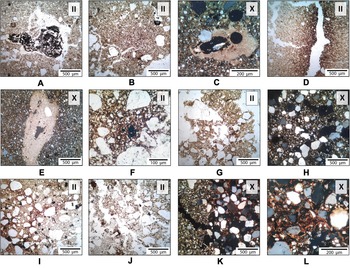
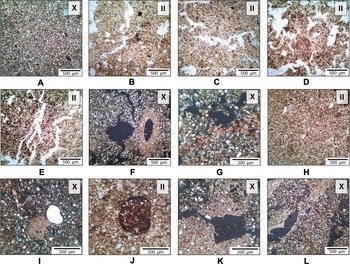
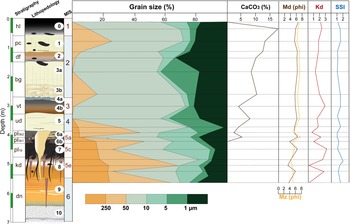
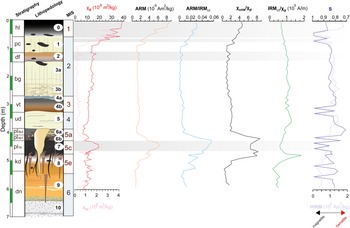


 Open access

