




In 1901, the Austrian agronomist Erich von Tschermak (1871–1962) produced a critical edition of Gregor Mendel's (1822–84) paper ‘Versuche über Pflanzenhybriden’, and in the same year the Cambridge biologist William Bateson (1861–1926) published an English translation entitled ‘Experiments in plant hybridization’ in the Journal of the Royal Horticultural Society.Footnote 1 Tschermak's edition appeared as Volume 121 of the series Ostwalds Klassiker der exakten Wissenschaften (Ostwald's Classic Texts in the Exact Sciences). Though indicative of its astonishing reception history, historians have rarely noted the paradox that lies in the fact that a journal article, which a few botanists had lifted from obscurity only a year earlier, was almost instantaneously proclaimed to belong to the canon of the ‘exact’ sciences, aptly inserted between Marcello Malpighi's seventeenth-century treatise on plant anatomy and an important contribution to higher arithmetic by Carl Friedrich Gauss.Footnote 2 The discipline that Mendel supposedly founded, namely genetics, did not yet exist in 1901, and his alleged ‘discovery’ of laws of inheritance would remain contested for at least another decade, including accusations that Mendel had manipulated his data to fit his expectations.Footnote 3
In trying to explain the rapid reception of Mendel's paper, historians usually focus on its theoretical content. According to this account, most influentially promoted by Garland E. Allen, Mendel's model of particulate inheritance spoke to a new generation of biologists who turned against the phylogenetic and morphological research traditions of the nineteenth century. They endorsed a reductionist view of life, and an understanding of science that placed experimental and quantitative over comparative and qualitative methods.Footnote 4 Consolidation of Mendelian genetics was accordingly brought about by paradigm articulation and strategies of theory adjustment to experimentally produced anomalies.Footnote 5 This interpretation is complemented by another tradition that proposes that Mendel's theory and method became popular due to their potential applications in agriculture and medicine, especially eugenics.Footnote 6 Despite their differences, both interpretations fundamentally agree that Mendel's paper was read for its theoretical and practical content, which was epitomized in what most early geneticists agreed to be Mendel's most fundamental theoretical discovery, namely the ‘purity of the gametes’, or that gametes of hybrids are not themselves hybrid but remain ‘pure’, and hence recombine in sexual reproduction without interacting with each other.Footnote 7
In this paper, we want to follow up a complementary interpretation that has occasionally been proposed, namely that Mendel's lasting legacy consisted in the creation of a particular experimental system that combined advanced breeding methods – in essence, pure breeding and artificial cross-fertilization – with a mathematical notation to record, analyse and visualize experimental results on paper.Footnote 8 This interpretation, to be sure, insists not on a dichotomy between experimental practice and theoretical understanding, but rather on a difference in scope. Instead of concentrating on paradigms, or sets of theoretical and methodological commitments delineating broad scientific programmes, it focuses on particular tools or methods that are flexibly employed in different research contexts. Such tools or methods often prove to be ‘remarkably tolerant and adaptable to theoretical change’, as Bill Wimsatt puts it in an article dealing with the history of the Punnett square, a diagram which was crucial to the early history of genetics, as we will show as well.Footnote 9 Examining such tools in detail can help to explain why Mendelism rapidly spread in the early twentieth century although biologists continued to disagree about the theoretical interpretation of empirical results gained from Mendelian experiments and about the extent to which these results could be generalized. This perspective also draws attention away from the acrimonious debates that accompanied the rise of Mendelism and brings into focus the many researchers and practitioners who were solely interested in learning how to carry out and analyse the results of Mendelian experiments. In other words, this perspective invites us to read Mendel's paper, as well as the many articles and books that adopted his reasoning, as texts ‘to learn by’, or as texts that were supposed to communicate specific know-how rather than wide-ranging theoretical or methodological principles.
Our aim in the following is to provide evidence for this understanding of the rise of Mendelism. In addition, we also want to suggest a fruitful method of investigating how twentieth-century readers used print publications to re-enact and rehearse experimental and mathematical methods. In order to understand how readers used texts, we simply suggest looking for readers’ annotations. For this article, we have checked early editions and translations of Mendel's paper, as well as some important early Mendelian textbooks such as Reginald C. Punnett's Mendelism or Wilhelm Johannsen's Elemente der exakten Erblichkeitslehre. The book copies we consulted are part of library and archival collections or available online through the Internet Archive and other online repositories such as the Biodiversity Heritage Library and the Digital Collections of the Wellcome Trust.Footnote 10 Many of these publications did actually turn out to be annotated, often by notable (and lesser-known) scientists of the time.
We are far from being able to present results from a systematic study of readers’ annotations in Mendelian publications. Our sample of sources is biased by our specific interest in annotated book copies and by the limited number of libraries and archives we could visit in person.Footnote 11 Yet we are convinced that our sources at least indicate that early Mendelian texts were often read as treatises in applied mathematics and experimental design, and that the rapid reception of Mendelism can therefore partly be explained as the spread of a computational and experimental protocol. In addition, we believe that our findings have some intrinsic interest for more general and systematic questions regarding how readers in the early twentieth century interacted with scientific texts in order to internalize and visualize experimental and computational procedures, and how such interactions in turn were suggestive of new diagrammatic representations.
It is tempting to compare our results with the body of scholarship on early modern reading and note-taking practices.Footnote 12 Yet Mendel's position in the history of the life sciences is too idiosyncratic to consider his readers as representative.Footnote 13 When we occasionally comment on how the practices we observed in our twentieth-century material differ from what we know about corresponding practices in the early modern period, one should also keep in mind that we know hardly anything yet about reading and note taking in twentieth-century science.Footnote 14 What follows is therefore a first exploration of potential themes that should invite further empirical research and analysis on twentieth-century annotation practices.
We will approach the material we collected in three steps. In the first section of this paper, we will focus on reading marks and annotations that refer to the discursive content of the texts we have investigated. These annotations indicate that many readers focused on ‘how-to’ aspects of Mendelian experimentation, and were less interested in theoretical conclusions. The second section then turns to a peculiar behaviour we detected among many of our readers, namely the urge to repeat calculations, as is particularly evident from readers detecting and correcting errors. We interpret this as resulting from the need to practise computing procedures in order to understand and master them. The final section turns to visual representations in early Mendelian texts, and argues that there is a link between the visual expedients early readers used – mainly lines drawn to connect different elements of the text – and later diagrammatic representations of the combinatorial logic of Mendelism. The conclusion will then argue that this combinatorial logic, which seems trivial from today's perspective, was counterintuitive back then and needed to be internalized through an active engagement with texts, tables and diagrams.
Agreeing and disagreeing
When Ostwald founded the Ostwalds Klassiker der exakten Wissenschaften series in 1889, it was mainly for educational purposes; his hope was that new generations of scientists could learn ‘what contributions to science, which have stood the test of time, look like and how they came about’.Footnote 15 Tschermak published a revised, second edition of Mendel's paper in 1909, and the volume would undergo four more print runs until 1940. The English translation of 1901 likewise went on being published, first as the second chapter of Bateson's Mendel's Principles of Heredity: A Defence (1902), then appended as ‘Part II’ to the third edition of the same book (1913). Bateson's translation was furthermore included as an appendix in William E. Castle's Genetics and Eugenics (1916). The publisher of this volume, Harvard University Press, decided to issue Mendel's paper separately in the form of an inconspicuous brochure, which also underwent several print runs. There was thus a constant demand for accessible editions and translations of Mendel's paper among students and researchers in the biological sciences. In addition, the period saw the production of many introductory texts on Mendelism, which in turn were often translated into several languages.Footnote 16
What is striking about the annotated copies of Mendel's paper that we inspected is that annotations are not uniformly distributed in the text. Especially the sections at the end of Mendel's paper, which proposed and discussed a theoretical explanation for the empirical results presented in the preceding sections, usually lack annotations.Footnote 17 Moreover, none of the copies we inspected showed signs of conceptual disagreement between Mendel and his readers. The most frequent annotations consist in marginal lines and underlinings that drew attention to parts of the text the reader deemed important. A typical example is provided by a copy of Tschermak's edition of Mendel's text, which is conserved in Berlin. In this book, a reader underlined a few words from the passage describing what is sometimes referred to as the ‘first law’ of Mendel, or the ‘law of uniformity’. Almost identical reading marks can be found in the same copy against Mendel's definition of recessive and dominant traits and his first statement of the 3:1 ratio according to which traits segregate.Footnote 18 We found similar reading marks against what are conventionally considered Mendel's most important contributions in a number of other editions.Footnote 19
The lack of exegetical or critical comments stands in striking contrast to what scholars have revealed about early modern reading practices. As Ann Blair has long argued, early modern readers of natural philosophy placed what they read within a web of existing knowledge through methods of marginal annotation and commonplacing.Footnote 20 More recently, Renée Raphael has shown that this also applies to works of the Scientific Revolution, such as Galileo Galilei's Discorsi, that are deemed to have radically dissociated themselves from the ‘bookish’ methods of traditional learning.Footnote 21 We did not find any evidence of this kind of topical engagement with Mendel's paper, nor did readers use his text to correct or complement existing knowledge, as eighteenth-century naturalists did in their quest to catalogue species.Footnote 22 Rather than working with texts from the inside out, connecting them with what was known about the world at large, readers of Mendel worked from the outside in, trying to pin down the essence of what Mendel had to say.
This focus of attention may seem to point to a partisan attitude. Yet a closer consideration of the passages that were emphasized through underlining and marginal reading marks points toward a different explanation. Most copies we inspected demonstrate readers’ attention to the first sections of the paper that explain the material used and its experimental arrangement, and then report the empirical findings in subsequent generations for mono-, di- and trihybrid crosses. The first two sections on ‘Selection of experimental plants’ and ‘Arrangement and order of the trials’ tended to be the most heavily annotated. For instance, a reader of an English translation of Mendel's paper printed in Bateson's Mendel's Principles of Heredity (1913, third edition) extensively underlined parts of Mendel's suggestions on how to avoid cross-fertilizations.Footnote 23 Mendel's statement that pure-bred plants possessing ‘constantly differing traits’ must be used for his hybridization experiments was almost universally highlighted.Footnote 24 Readers sometimes even put lines against apparently trifling, but practically significant, details, such as Mendel's warning that the green colouration of the albumen sometimes is faint, making the peas appear yellow. This is true, for example, for the copy of Tschermak's 1901 edition of Mendel's paper that was likely annotated by the Danish geneticist Wilhelm Johannsen (1857–1927) shortly after it had appeared.Footnote 25 Such annotations, in conjunction with the lack of engagement with the more theoretical sections of Mendel's paper, indicate that, for many readers, this paper was mainly an instruction on how to conduct Mendelian experiments.
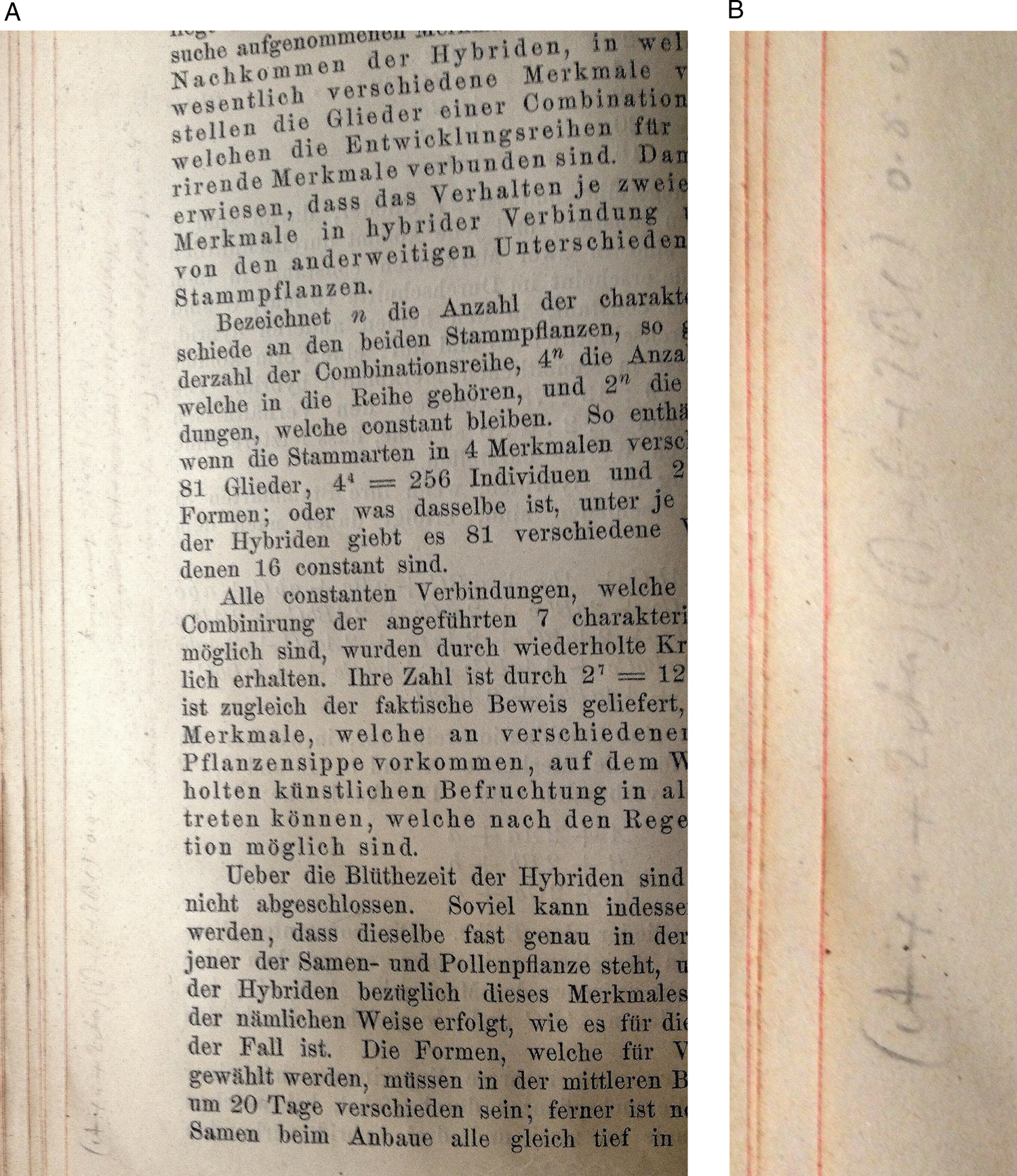
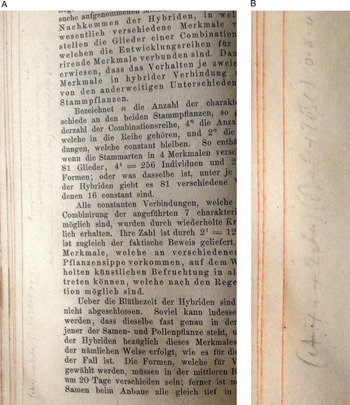
A final observation on the material we consulted lends additional support to this interpretation. As already mentioned, some readers dutifully noted the law of segregation and the law of independent assortment that look like Mendel's main contributions from today's perspective. These laws were formulated as empirical generalizations in the sections in which Mendel reported his findings from monohybrid and polyhybrid crosses. But even in this case, many readers exhibited more interest in the notation system and computational methods Mendel employed than in the actual empirical content of these generalizations. An excellent example is again provided by Johannsen, who would go on to become a central figure in classical genetics.Footnote 26 Johannsen added a long marginal note to the page on which Mendel formulated the following law (later called the law of independent assortment): ‘descendants of hybrids, in which several essentially different traits are united, represent the members of a combination series, in which the developmental series of two different traits respectively are conjoined’.Footnote 27 Mendel's formulation of the law was hardly transparent for readers who had yet to familiarize themselves with Mendelian combinatorics. In his marginal note, Johannsen therefore translated Mendel's verbal statement into mathematical form by multiplying the terms of two monohybrid series (Figure 1). Mendel did not explicitly explain that ‘conjoining developmental series’ was supposed to imply this arithmetic operation. Johannsen, as a reader, had to try this out in order to get a clearer understanding of what Mendel's ‘law valid for Pisum’ was supposed to mean and what its implications actually were.Footnote 28
(A) Annotation by Wilhelm Johannsen in Gregor Mendel's Versuche (1901), which an overly diligent librarian (we believe) tried to erase. The annotation begins with a multiplication of two monohybrid series ‘(A + a + 2Aa) (B + b + 2Bb) o.s.v.’ (the abbreviation ‘o.s.v.’ means ‘and so on’). (B) Detail. The rest of the annotation develops formulae that Mendel also discusses in the text. With kind permission of the Copenhagen University Library Frederiksberg, Call no. 80–33, p. 22.
Johannsen also furnishes us with one of the few examples in which a reader added critical comments to a Mendelian treatise. In 1905, he received a copy of Punnett's Mendelism (1905) ‘with the author's kind regards’, as noted on the flyleaf. Annotations by Johannsen in this copy are scarce, but he also received a copy of the third edition (1911) which he filled with corrections and critical remarks, for example by contradicting Punnett's presentation of inheritance of size in peas in terms of Bateson's presence–absence theory. Against Punnett's claim that ‘[a]ll peas are dwarf, but the tall is a dwarf plus a factor which turns it into tall’, Johannsen placed the dry (and, from the present point of view, correct) remark: ‘No, it is [the] phenotype [of a] pure tall’.Footnote 29
Disagreements about how to interpret phenomena correctly are therefore not completely absent from the material we have investigated, but they remain a minority among the annotations we found. Moreover, one should not forget that Punnett's Mendelism, just like Bateson's Mendel's Principles of Heredity, was published in the polemical context of the debate between biometricians and Mendelians.Footnote 30 In the majority of annotated books that we have looked at, readers exhibited an interest in the details of concrete experimental procedures and their successful implementation. To achieve this success, computational procedures and the potential for visual display of intricate relationships through ‘paperwork’ were key elements, which we are going to follow up in the next two sections.
Calculating and correcting
The art historian Martin Kemp has regarded Mendel's paper as a striking example of the paradoxical disappearance of ‘visual delights’ from natural history. As Kemp insists, Mendel must have possessed ‘[u]nrelenting visual and manual discipline’ to carry out his experiments with pea plants; and yet, he chose to present his results in the form of ‘rows of figures, with sets of paired characteristics designated by capital and lower-case letters’, thus demonstrating a pronounced lack of ‘illustrative interest.’ Kemp conjectured that ‘this shift away from the visual image’ was due to ‘a general sense that if natural history was to be regarded as a “hard” science, it needed to cast off its image as an attractive pursuit for amateurs and collectors of nature's wonders.’Footnote 31
In our interpretation of Mendel's paper as a treatise in experimental design and applied mathematics, Kemp's paradox ceases to exist. Algebraic notations, ratios, tables and diagrams did not supersede the lavish illustrations of plants and animals familiar from natural history. They were the new visualizations required by an investigation of the laws of heredity that relied on combinatorial analysis. In Mendel's paper, algebraic, combinatorial and statistical computations became the key tools for representing the outcomes of artificial crossings and formulating expectations. In addition to gaining an understanding of the choices Mendel had made in the design of his experiments, readers therefore also had to acquaint themselves with the new visual realm that this notation system created on paper.
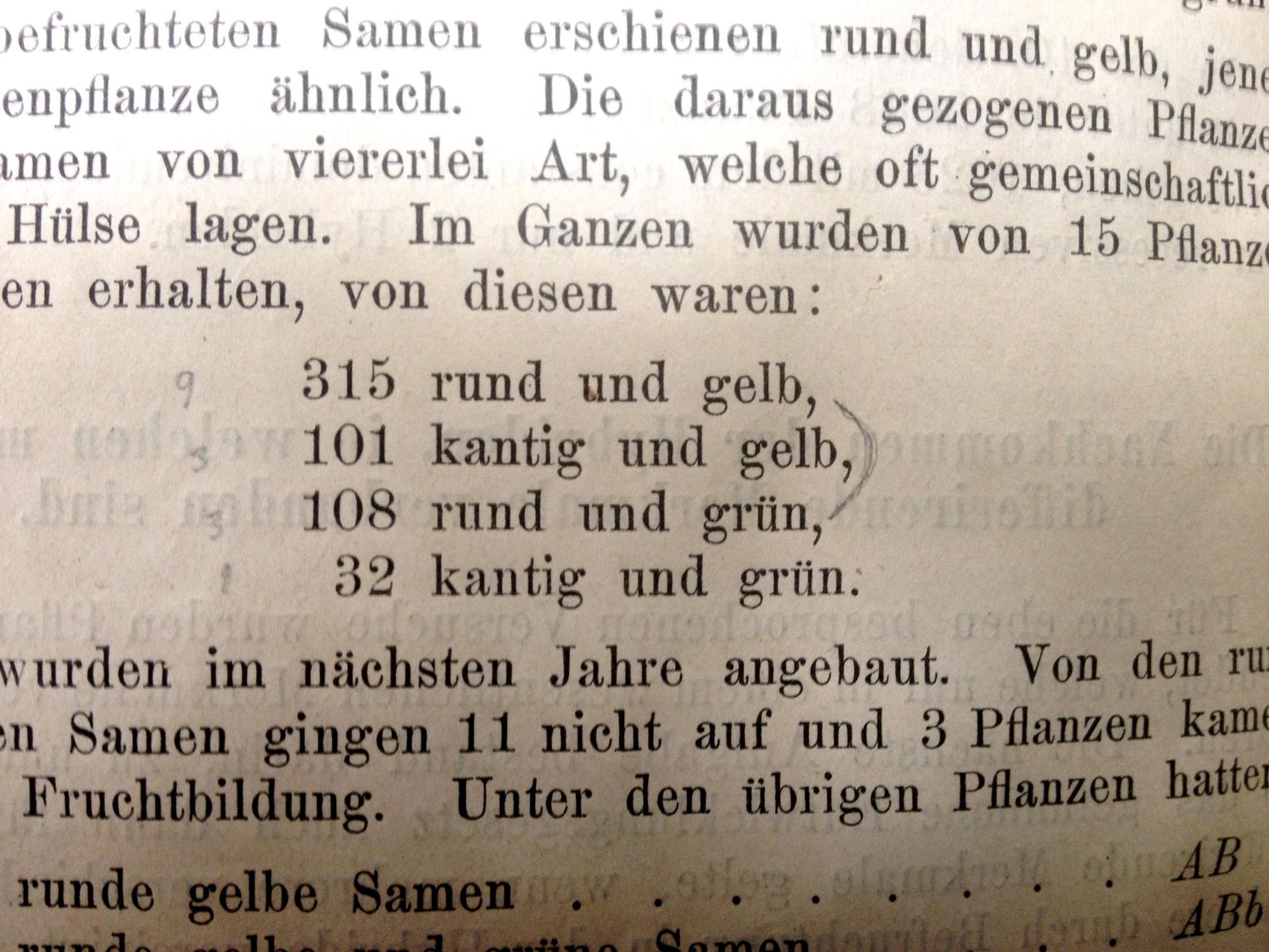
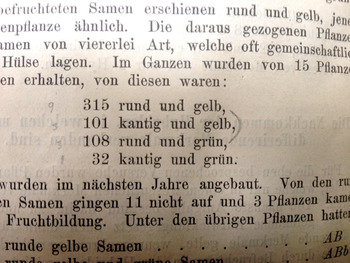
To acquire these skills, readers of Mendel's paper actively engaged with the text in two ways: by rehearsing calculations and by employing Mendel's notation system. Johannsen's copy of Tschermak's 1901 edition of Mendel's paper makes this engagement especially evident. Against a list of empirical results from a dihybrid cross in Mendel's paper, Johannsen placed the ratio 9:3:3:1 that was to be expected from the law of independent assortment and that fit well with Mendel's findings. In addition, however, he also noted the underlying 3:1 ratio of dominant to recessive traits for each of the individual character pairs (Figure 2). He did so in an intriguing way, namely by drawing a line to connect the first and third rows of the column, which contained results for round seeds (315 and 108), and in this way also letting the second and fourth row stand out, which contained the results for angular seeds (101 and 32). The ratios noted next to the empirical numbers respectively (9:3 and 3:1) immediately made it clear that seeds differing by seed colour only segregated in a 3:1 ratio. Johannsen's annotation reveals how the visual arrangement of numerical data in tables served as a template for readers to perform operations and calculations that enhanced their understanding of the underlying combinatorial logic. Mendel himself had already arranged the table in such a way that it paired results for plants differing by seed shape only, and Johannsen seems to have tested the assumption that a corresponding rearrangement with a view on plants differing by seed colour only would yield the same result.Footnote 32
This table in Mendel's paper presents numerical results from a dihybrid crossing of peas with green (grün) and yellow (gelb) seed colour and angular (kantig) and round (rund) seed shape. On the left, Johannsen noted down the ratios corresponding to the empirical results (9:3:3:1). In addition, he connected the two lines giving results for round seeds. With kind permission of the Copenhagen University Library Frederiksberg, Call no. 80–33, p. 18.
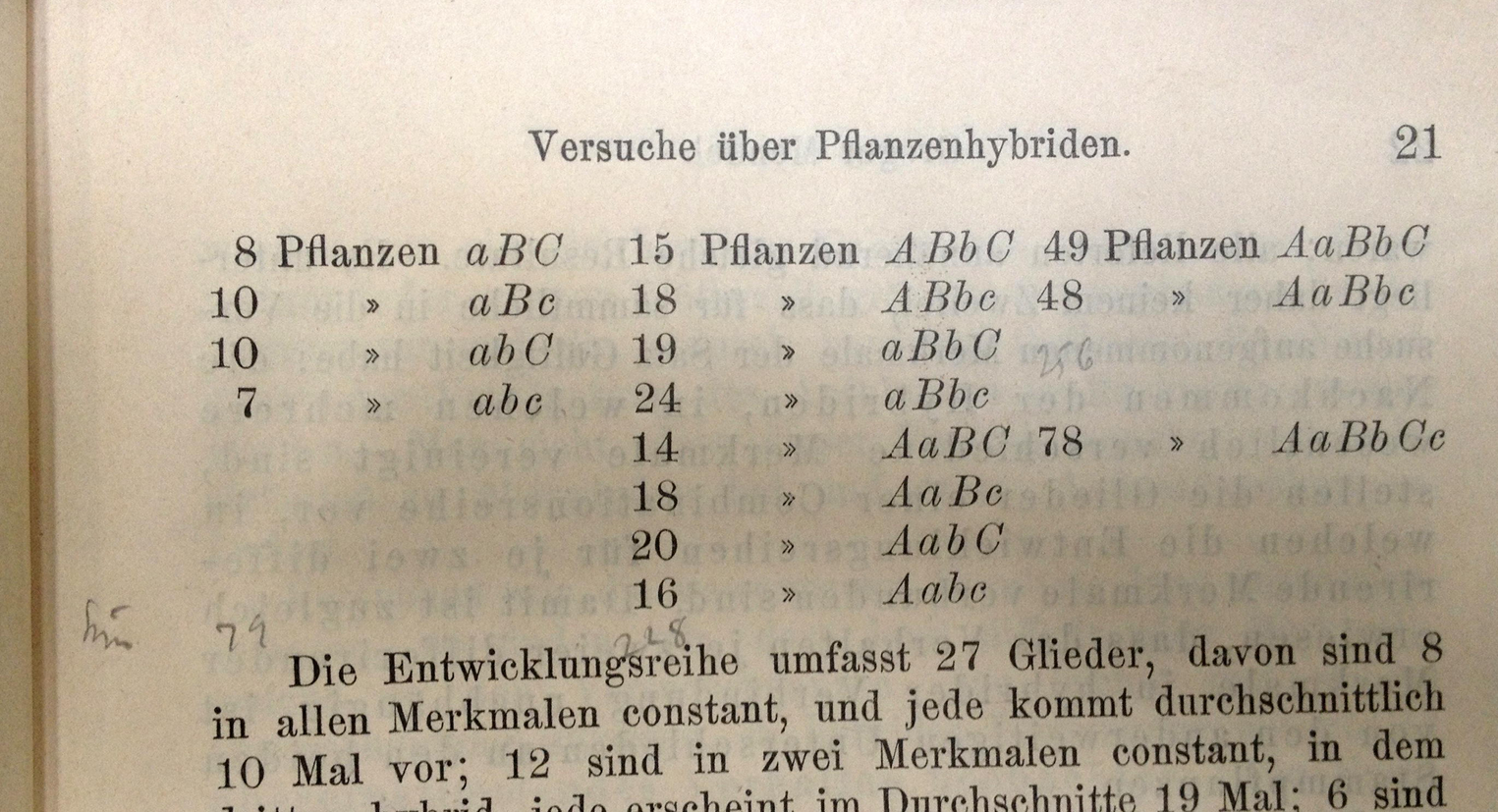
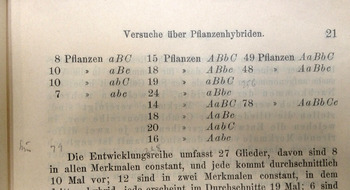
In the same copy, there is another interesting example of Johannsen's engagement with computations. He dutifully examined a data table related to a trihybrid cross by drawing the sum for each column (Figure 3). Repeating this computation was not really necessary to follow Mendel's argument, but evidently Johannsen wanted to get a better grasp of the unfamiliar procedure of data analysis and at the same time review the design of this trial that, in Mendel's own words, ‘asked for the most time and effort’. In addition, the sums represented the ratio between plants constant for all three characters, for two characters and for one character only. In the text of his paper, Mendel discussed this ratio in terms of averages calculated for each column, and it is possible that Johannsen also wanted to check these averages by drawing the sum for each column.Footnote 33
In this table included in Mendel's paper, Wilhelm Johannsen calculated the sums (noting ‘Sum’ in the margin) for the entries in each column (from left to right: 79, 228, 256; the first figure is wrong and should actually be 77). The table starts on the previous page, and only its lower half is shown in this reproduction. With kind permission of the Copenhagen University Library Frederiksberg, Call no. 80–33, p. 21.
Mendel's readers also familiarized themselves with the algebraic notation system Mendel used to represent his artificial crossings. Where Johannsen had annotated ratios, an anonymous reader of Mendel's original paper in the Brno Naturalists’ Associations’ journal placed combinations of upper-case and lower-case letters to represent the combinations of dominant and recessive characters according to Mendel's notation system. No real information is added to Mendel's text by this note, so it is plausible that the reader simply practised how to apply the notation system. Small inconsistencies indicate that he was still in the process of learning its use.Footnote 34
Attention to algebraic formalism can also be traced in the English translations of Mendel's paper. For instance, the translation printed in Bateson's first edition of Mendel's Principles of Heredity (1902) contained a typo in the table representing results from a trihybrid crossing that we discussed above. The typo was mentioned in the errata list at the beginning of the volume, and a copy from the private library of marine biologist Edwin Grant Conklin (1863–1952) has a correction of the misprint on the required page. Evidently, the mistake was amended because Mendel's formalism mattered to the reader of this early genetics textbook. The fact that the annotator did not realize at first that the erratum itself introduced another mistake suggests, on the other hand, that it took effort for readers to become familiar with Mendel's notation system.Footnote 35 A complicating factor is that Bateson's book inaugurated the transition from ‘Mendel's algebra’, which used single letters to represent homozygous trait combinations, to the standard algebra of classical genetics we are familiar with. The change is not just a matter of convention. Mendel's notation was developed without the concept of gene and allele, and Bateson was the first to point out the serious limitations of his formalism.Footnote 36
Shifting our attention to early introductions to genetics that built on Mendel's work, we came across many examples of readers’ engagement with computations. In his personal copy of the third edition of Punnett's Mendelism, for instance, which we already mentioned above for its polemical annotations, Johannsen computed the first six terms of the series 2n and 3n and wrote the results in the upper left-hand corner of the page. Johannsen was not repeating computations already made by Punnett. He was ‘testing figures’ for the number of possible forms arising when homozygous and heterozygous conditions are indistinguishable and distinguishable, as the arrangement of numbers suggests, probably to get an impression of how rapidly they were increasing with each added character pair.Footnote 37
Readers also had a very keen eye for detecting mistakes in the early genetics manuals that they studied. An anonymous reader of the second edition of Wilhelm Johannsen's textbook Elemente der exakten Erblichkeitslehre (1913) did not miss the wrong result of a multiplication. Johannsen's Elemente is renowned for introducing the words ‘gene’, ‘genotype’ and ‘phenotype’ to the biological lexicon, but the book was also an attempt to reconcile the mathematical achievements of the biometrical school with the latest findings of Mendelians.Footnote 38 The mistake must have been an oversight by the typesetter, because the final result of the summation that followed is correct, but the reader must have repeated the computation step by step in order to detect this mistake. Evidently, painstaking recalculation, even in cumbersome cases involving numerous steps, was an important reading practice by which mathematical procedures were internalized.Footnote 39
The readers of the early genetic textbooks we examined paid attention not only to arithmetic calculations, but also to the algebraic notation system that represented the crossings. One example is provided in a copy of an introductory textbook, Einführung in die experimentelle Vererbungslehre (Introduction to the Experimental Science of Heredity), that the leading German geneticist Erwin Baur (1875–1933) published in 1919. A reader amended a mistake in a tabular representation of results from a dihybrid crossing, where a dominant character had mistakenly been represented by a lower-case letter. This demonstrates once again that readers went to great lengths in double-checking, and hence internalizing, non-discursive, tabular, permutational or computational sections of the text.Footnote 40
The publication of R.A. Fisher's Statistical Methods for Research Workers in 1925 added a new set of tools to the computational baggage of genetics. Fisher was both a statistician and a geneticist, and his book, which was published in a series of biological monographs and manuals, had the ambition to explain the mathematical theory of statistical methods, ‘presenting them in the form of practical procedures appropriate to those types of data with which research workers are actually concerned’.Footnote 41 Statistical Methods for Research Workers was written for any experimental scientists who had to deal with statistical calculations, not just for geneticists. Yet, as one book reviewer remarked in the British Medical Journal (1926), due to the advanced statistical methods it presented, geneticists were singled out as a potentially more suitable audience.Footnote 42
Fisher gave geneticists new mathematical tools to facilitate the understanding of experimental design and related data analysis. In the analysis-of-variance method developed by Fisher, experimental results were displayed in a table, and subdivided by classes according to their cause of variation. This tabular arrangement made the structure of the experiment clearer and the arithmetic simpler.Footnote 43 In the preface to another textbook, The Design of Experiments, which was conceived as a practical guide to planning scientific experiments and analysing their results with suitable statistical methods, Fisher made it very clear that reading was not just an intellectual, but an eminently practical, exercise:
The reader is … advised that the detailed working of numerical examples is essential to a thorough grasp, not only of the technique, but of the principles by which an experimental procedure may be judged to be satisfactory and effective.Footnote 44
In Fisher's pairing of experimental design and computational analysis, and in his suggestion to the reader to recompute numerical examples to become familiar with them, we see not only a reflection of Fisher's own ideas, but also his belonging to a tradition that we trace back to Mendel's paper. In this tradition, texts were designed as instruments to convey precisely that ‘[u]nrelenting visual and manual discipline’ that, as Kemp rightly suspected, supports Mendelian experimentation. Or as Jeffrey Skopek has put it in his study of the use of historical cases in early genetics textbooks, ‘figures and tables that were presented as part of the Mendelian case [were] used to inculcate the geneticists’ way of seeing’.Footnote 45 In the following section, we want to turn to the new visual culture of genetics that was promoted in this way.
Drawing lines and diagrams
‘Visual thinking’ in mathematics and its epistemological value have a long and controversial history ranging from enthusiastic acceptance by Immanuel Kant to sheer disdain from Bertrand Russell.Footnote 46 Images and diagrams have been employed in the proof of mathematical theorems; their value as tools for thinking and teaching aids has long been debated in mathematical research and education.Footnote 47 Occasionally, in the past three decades, the role of diagrams has also moved centre stage in the history and philosophy of science, including calls to consider their role in the modern life sciences.Footnote 48
In our own research on the annotated copies of Mendel's paper and early genetics manuals, visualizations emerged as a key tool in conveying and learning about experimental practices of artificial crossings and related combinatorial operations. Mendel's original paper already contained a diagram that connected pollen and egg cells (symbolized by upper-case and lower-case letters) with arrows to illustrate the combinations that resulted from their random union. This diagram summarized Mendel's speculations about the mechanism that could explain segregation patterns. At the same time, it suggested a basic procedure by which readers could visualize the combinatorial logic underlying artificial cross-fertilizations and intuitively derive the segregation ratios simply by connecting two series of terms by lines.Footnote 49
In the previous section we already came across one example, in which a reader took up this suggestion (Figure 2), and we want to add another example from the same copy of Mendel's paper. Two pages before the diagram, where Mendel derived the possible combinations of factors resulting from dihybrid back-crossing experiments, Johannsen used lines to connect the letters that Mendel had used in order to represent different kinds of germ and pollen cells. The lines do not exhaust all possible connections, but identify some chief components of the resulting combination series.Footnote 50 While not a prominent feature, we encountered a few other instances in which readers visualized the mechanism that generated combinatorial series.Footnote 51 It should also be noted that Mendel arranged his ‘developmental series’ very consciously in a way that allowed readers to visually explore patterns and symmetries.Footnote 52
A particularly interesting case is presented in notes that the Swedish plant breeder Herman Nilsson-Ehle (1873–1949) entered on the back flyleaf of his personal copy of Tschermak's Mendel edition. He probably received the copy from Tschermak himself, who in 1901 visited the Plant Breeding Station in Svalöf (Sweden).Footnote 53 On the rear flyleaf of his copy, Nilsson-Ehle tried in vain to solve a problem that any student of genetics would consider trivial today.Footnote 54 The upper half of the page is taken up by three representations of monohybrid crosses, two of them back crosses (AA × Aa and aa × Aa), for which Nilsson-Ehle correctly derives the phenotypic segregation ratios by employing diagrams that structurally resemble the diagram in Mendel's paper. The lower half seems to be a failed attempt at doing the same for a dihybrid cross. In a first attempt at the problem, Nilsson-Ehle tried to find a solution by simply placing diagrams for back crosses (Aa × AA and Bb × BB) next to each other, but he erased this attempt. In what follows, he connected one bifactorial term (AB and ab respectively) through lines with a series of four other terms (AB, Ab, aB, ab). The erasures and repeated attempts are a clear sign of the difficulties he experienced in reproducing the terms of the series for a dihybrid cross.
Nilsson-Ehle was experimenting with a visual arrangement that would become very popular in Mendelian genetics. The lower half of his notes comes close to what is known as the ‘Punnett square’, in which the genetic constitutions for male and female gametes, designated by Mendelian letters, form a matrix of rows and columns that allows one to predict the genetic constitution of the zygotes formed by their union in fertilization, as well as the probability of their occurrence in a large population. In addition, the fields in a Punnett square could be shaded and coloured for the resulting phenotype, thus making expected segregation ratios immediately intuitive, due to their symmetry of distribution. Punnett introduced this square diagram to the literature in 1906 in a paper co-authored with Bateson and Edith R. Saunders, and included it in the second edition of his Mendelism. In the third edition (1911), he added a verbal description of how to construct the diagram, and the Punnett square became a standard feature of Mendelian literature. As a detailed reconstruction by A.W.F. Edwards has shown, the diagram first took shape in an exchange of letters between Bateson and Galton for the more complex case of a trihybrid cross, and may well have been inspired by the way in which Mendel presented a case of trifactorial inheritance of flower colour in beans.Footnote 55
Readers’ annotations suggest that Punnett squares were not immediately obvious representations, but continued to rely on the interplay between text and image. Wilhelm Johannsen provides an example of the effort it took to connect textual explanations of Mendelian inheritance with the related combinatorics. In the third edition of Mendelism, Punnett resorted to one of his squares to explain colour inheritance in poultry. To grasp Punnett's explanation, Johannsen again used lines joining symbolic representations of allelic combinations in the text with respective fields in the diagram. When reading this text, Johannsen was certainly not a beginner in the study of inheritance. The first edition of his Elemente (1909) was not a book which refrained from the use of mathematical formalism. Yet even Johannsen had to rely on visualizations to intuit the expected outcomes of complex crosses and to reach a critical awareness of the basis on which an author built his argument.Footnote 56
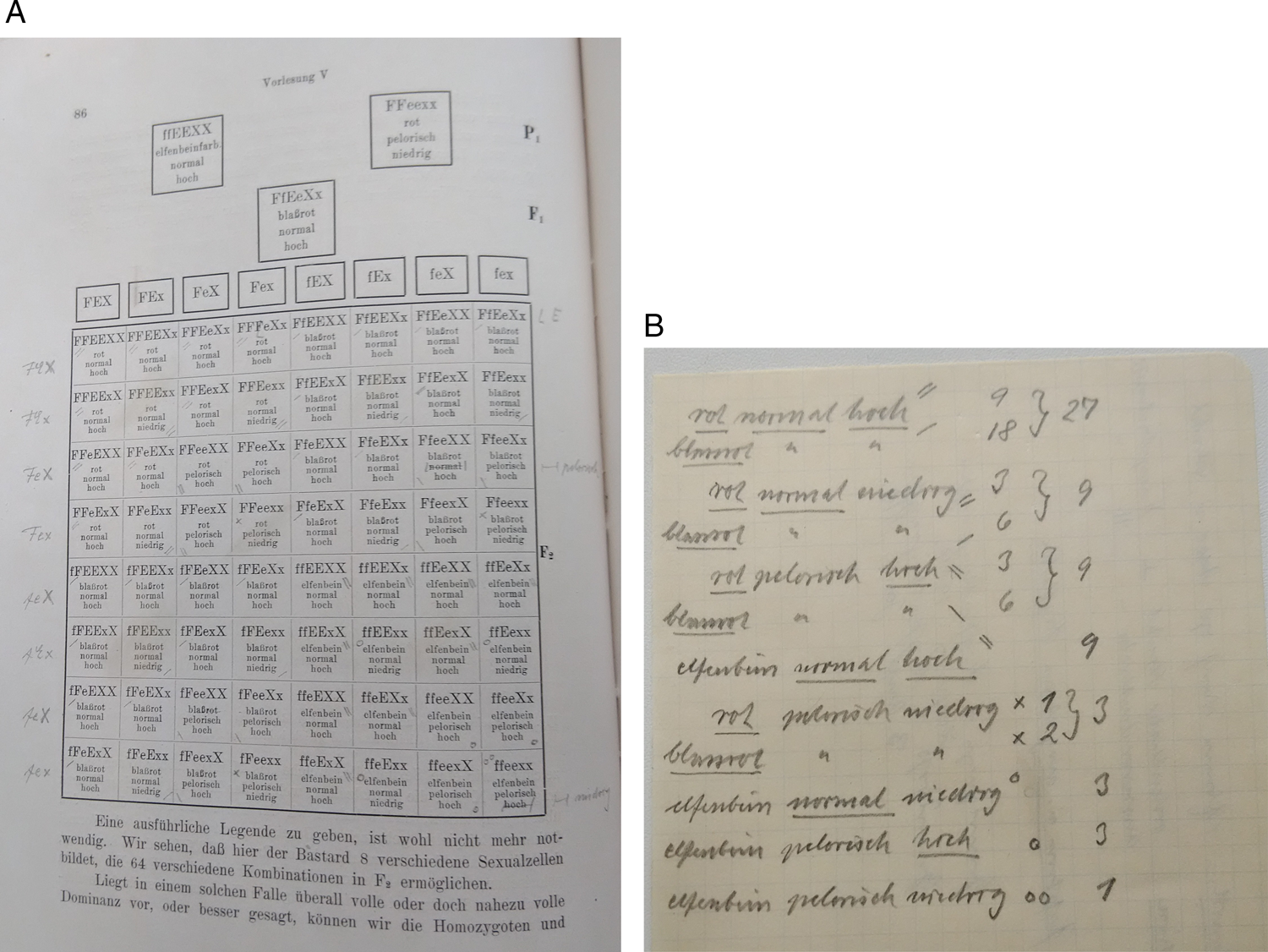
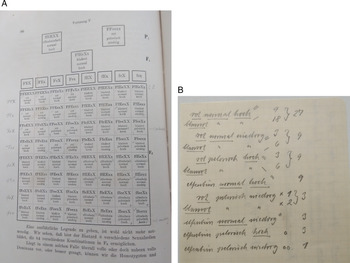
In another case, a copy of Baur's Einführung that we already mentioned in the previous section, the reader made sense of an eight-by-eight Punnett's square both by annotating the book page and by listing possible phenotypic outcomes on a separate sheet of paper, which was then left in the book. Even though the Punnett square gave a complete list of all the possible genotypes, the reader obviously felt the need to complement it in various ways. Thus he corrected the table for some obvious typos, added the gametic genotype for each row, and marked the fields with a symbol system for resulting phenotype. It is unlikely that this reader was engaged in precisely the same experiment that Baur described, but he reviewed it in excruciating detail to better understand its underlying visual logic (Figure 4).Footnote 57
(A) A Punnett square from Baur's Einführung (1919) and (B) an autograph sheet inserted in the book by a reader. While Punnett's square offers an efficient tool to present all possible combinations, the reader's list summarizes them in terms of their phenotypic outcome and groups them according to similarity. With kind permission of the Library of the Botanic Garden and Botanical Museum Berlin, Call no. 575 Bau <4>.
The Punnett square was not the only way to illustrate combinatorics in the early genetics manuals we examined. One of Mendel's rediscoverers, Carl Correns, preferred bifurcating diagrams.Footnote 58 In his second edition of Mendelism (1907), Punnett himself included a diagram – alongside his eponymous square – that illustrated the basic combinatorial events in gamete formation and fertilization in a form visually resembling a pedigree. These diagrams provided information on multiple generations and on the inheritance of genetic factors, and offered a summary of the crossing process at a glance. Their lines and arrows, circles and squares contributed to establish the visual language of the newly born genetics, alongside the tables, algebraic letters and ratios we have so far examined.Footnote 59
In addition, many of the early genetics manuals did not disdain colour plates in the tradition of natural-history publications. Beautiful colour plates and photographs are displayed in Bateson's, Baur's, Punnett's and Castle's textbooks. Through these plates, plants and animals (peas, primulas, snapdragons, maize, butterflies, fowls, mice, rabbits and more) and the laws that governed the inheritance of colour and other visible traits were revealed to the reader. This rich iconography was a helpful learning tool only for the engaged reader who went from text to image, from image to computation, and from computation back to text and image to fully understand the crossings described, as sometimes is evident from readers’ annotations on the plates.Footnote 60 Thus, with Kemp, one should not consider these illustrations as a mere survival from the natural-history tradition. While similar in their aesthetics, they were permeated by the very same combinatorial logic that the texts and diagrams in the books they illustrated tried to convey to their readers.
Conclusions
As mentioned in the introduction, the reception of Mendel's paper remains poorly understood. The mathematical knowledge required by the reader has been considered a potential stumbling block in its reception, because it was ‘forbidding to an audience interested in hybridization’.Footnote 61 Yet our findings point in the opposite direction. Tangible marks of active engagement – such as calculation of intermediate steps in long computations and correction of typos in numeric figures and algebraic letters – are abundant in the more mathematical sections of Mendel's paper and of genetics textbooks published in the early decades of the twentieth century. Mathematical knowledge was accessible even to the uninitiated by directly engaging with tabular arrangements and calculations in the text. The readers of Mendel's paper and Mendelian introductions to genetics did not skip these technical sections, but worked through them thoroughly. Even though biologists have often been portrayed as shy of mathematics, we gather from our sample of annotated copies that the students and researchers who read these texts accepted statistical methods and experimental design as part and parcel of their work, alongside the observations conducted at the lab bench and in the experimental garden. While it is true that the computing equipment in biological research was always limited in the early decades of the twentieth century – pen, paper, mathematical tables, slide rules and only occasionally a calculating machine – and while it is also true that biologists hardly considered their work ‘computational’ at this stage, genetics was beginning to acquire computational aspects back then.
According to philosopher Charles Saunders Peirce, ‘all deductive reasoning, even simple syllogism, involves … constructing an icon or diagram … experimenting upon this image in the imagination, and … observing the result so as to discover unnoticed and hidden relations among the parts’.Footnote 62 This also means that reasoning needs to be practised, even on basic levels that more than a century later seem utterly trivial. Our foray into readers’ annotations has revealed that both the authors of Mendelian texts and their readers were aware of this, and that these texts were designed and used in accordance with this design, to facilitate the profoundly visual and manual discipline needed to carry out genetic experiments. From our findings, it is evident that reading was not confined to the linear order of words in sentences, or of sentences in arguments. It also took note of the two-dimensional arrangement of words, numbers and symbols in series, tables and diagrams.
For the topic of this issue, ‘learning by the book’, there is a corollary from these findings. It may be futile to try to define the ‘manual’ or ‘handbook’ as a genre since whether a text is read to gain practical knowledge depends at least as much on how readers engage with it as it does on the motivations that guided its author(s) in writing it. Mendel's paper was meant to report empirical results from a series of experiments when it was originally published in 1866 and to suggest an explanation for these results, but it became a manual, or protocol, for conducting Mendelian experiments after its ‘rediscovery’ in 1900.
Acknowledgements
Staffan Müller-Wille would like to acknowledge support from the Swiss National Foundation Sinergia Grant CRSII5_183567, In the Shadow of the Tree: The Diagrammatics of Relatedness as Scientific, Scholarly, and Popular Practice. Giuditta Parolini is grateful to the German Research Foundation (DFG) for the funding received since 2017 (grant no. 321660352). Both authors would like to thank the issue editors and all the other participants in the workshops on Learning by the Book in Princeton and Berlin for asking challenging questions and forcing them to sharpen their focus.
Supplementary material
The supplementary material for this article can be found at https://doi.org/10.1017/bjt.2020.12


 Open access

