

Scholars of the Ontological Turn have focused on the ways in which the world is a product of relations between living things, objects, ideas, and all other categories of things that have force in the world. In archaeology, ontological pondering has focused in two areas: (1) the metaphysical importance and impact of relations to and between human and nonhuman things and (2) how non-Western perspectives lead to fundamentally different sets of relations and the production of alternative worlds (Alberti Reference Alberti2016). What has been less frequently grappled with in these conversations is the relations between the archaeologist as scholar and our investigation of the archaeological record. Yet, this kind of investigation is appropriate particularly given that the Ontological Turn was rooted in investigations of the scientific process (Latour and Woolgar Reference Latour and Woolgar1979). While a stated aim of the Ontological Turn in archaeology is to move beyond the epistemological to the study of reality (Lucas Reference Lucas2012:3), at the same time it forces us to reevaluate our epistemological tools in the context of these reframed goals. If the scholarship of the Ontological Turn has created the realization that there are multiple realities (Viveiros de Castro Reference Viveiros de Castro2003), one way those may manifest is in the ways in which archaeologists’ varied relations to data produce multiple possible pasts (Olivier Reference Olivier2011). Here, I present fragments of my epistemic approach to this problem in the context of the study of how the precolonial Maya of Actuncan, Belize lived among ruins of their deeper past.
Plaza A, Actuncan, ca. AD 810
After all these years, we have raised the World Tree again. The temple-mountain of our ancestors made whole.Footnote 1 We have labored for years, clearing the trees, stabilizing the stones that were there, cutting or scavenging limestone blocks, and building anew. For many katuns, perhaps baktuns, this place has grown wild. Our neighbors have claimed the legacy of this place, claimed our name, claimed our land. But these mountains hold our ancestors, not theirs. Now, our mountain with fresh stairs topped by a new vaulted building and roof comb rises in red-painted splendor again . . . from rubble to renewed. The final step has been raising the world tree on a bed of jute and chert eccentrics, representing the primordial sea and liminal earthly plane bracketed by four obsidian world bearers holding the corners of the world.
We are reshaping our world: reclaiming our sacred mountains and rejecting the claims of the lords of Tauutz Witz (toponyn for Xunantunich following Helmke Reference Helmke2019:39) to our past. These spaces are renewed, built on the old but created for the purposes of today. We do not forget the past: We live amongst its remains and shape them for today.
Inspired by the writings of David Freidel, Linda Schele, and others (Freidel et al. Reference Freidel, Schele and Parker1993; Robin Reference Robin2013; Schele and Freidel Reference Schele and Freidel1990), I began writing narrative vignettes (Fulton and Mixter Reference Mixter2022), like the one above, for their communicative potential but also as an epistemological experiment. Actuncan, Belize, where I research, was occupied for around 2,000 years as a village, from before 1000 BC until after AD 900. During that time, the material record indicates periods of prosperity, construction, and population growth. It also indicates periods of impoverishment and neglect of the physical infrastructure. Together with other regional evidence, these data point to a dynamic political context of shifting power centers, which impacted households in complex ways (Fulton and Mixter Reference Mixter2022; LeCount et al. Reference LeCount, Walker, Blitz and Nelson2019; Mixter Reference Mixter2020; Mixter et al. Reference Mixter, Jamison and LeCount2013, Reference Mixter, Fulton, Bussiere and LeCount2014). I wanted to better understand the Maya of Actuncan, Belize, as people living their daily lives who were impacted by the vagaries of Maya community, politics, and economy. How did they cope? How did that make them feel? The physical remains we encountered in the present provide inklings into the conditions people lived in in the past. However, reconstituting past lives in vibrant, relatable ways requires analogy, extrapolation, and imagination. Because we cannot know what people thought or felt, except when they tell us, this project requires the creation of multiple pasts that may have been real.
In this article, my primary aim is to propose the use of the tools of narrative and the modern experience of ruins as reflected in the ruination (e.g., Gordillo Reference Gordillo2014; Stoler Reference Stoler2008) and critical heritage studies literature (e.g., Smith Reference Smith2006) as lenses for understanding the impact of ruins in the context of past societies. This effort comes from my dissatisfaction with the existing tools for understanding the complex impact of ruins on past communities. Traditional epistemological tools are limited both by the incompleteness of archaeological data, the limits of traditional analogical approaches, and scholarly skepticism of interpretivist approaches to that past (Currie Reference Currie2018; Frieman Reference Frieman2024; Sørensen Reference Sørensen2017; Wylie Reference Wylie2002). To me, a core goal of archaeology is to bring historical depth to the past (e.g., Pauketat Reference Pauketat2001) in ways that provide heterodox insight into human ways of being (Graeber and Wengrow Reference Graeber and Wengrow2021) that are relevant to present and future social imaginaries (Borck Reference Borck2018), particularly in the context of a world in which the past has been constantly rewritten for political gain (Mixter and Henry Reference Mixter and Henry2017). Yet, to reach this goal, we must be able to create peopled pasts that are legible to both scholarly and nonacademic audiences today.
The Problem of Understanding Ruins
The physical remains of ancient Maya city centers are not subtle. Stone palaces and administrative buildings constructed on high platforms loom over broad plazas, while tall pyramids form highpoints in the forested horizon-line with occasional stone roof combs peeking from the forest canopy. Today, these buildings have fallen. Vaults and walls are partially collapsed, while steep platform edges are covered by tall trees and foliage. To the modern eye, Maya remains look like ruins as we have been conditioned to understand them through the Western cultural production of the last half millennium (Dillon Reference Dillon2005; Stewart Reference Stewart2020).
I first started studying the idea of ruins at Terminal Classic (AD 780–1000) Actuncan, Belize, where the Maya built a new broad, open civic center by stripping facing stones from the earlier buildings around them (Mixter Reference Mixter2016, Reference Mixter2017a, Reference Mixter2017b, Reference Mixter2020). The Maya of Actuncan were not just interacting with decaying buildings, they were creating a ruined landscape with their new community architecture nestled at its core. This set of actions rattles modern Western expectations in which new, nice things tend to replace or be built away from destroyed remains. Can we imagine why the Maya of Actuncan chose to build among a ruined landscape of their creation rather than build on fresh terrain or migrate like many of their contemporary neighbors? Can we imagine the impacts of these comingled past and present landscapes on daily life and concepts of community?
Joyce and Rosado-Ramirez critique the typical modern Western perspective that ruins are “damaged and disappearing vestiges of the built environment” (Reference Joyce and Rosado-Ramirez2025:3) notable for the absence of humans and their disconnection from the present. Instead, they call on us to consider the vibrancy of ruins in precolonial Mesoamerican communities. In the archaeology of the Maya, the significance of old buildings and places is attested to by evidence for reoccupation after periods of abandonment and from material remains deposited in built spaces after the end of their original period of use (Awe et al. Reference Awe, Helmke, Aimers, Ebert, Stemp and Hoggarth2020; Mixter Reference Mixter2022; Stanton and Magnoni Reference Stanton and Magnoni2008). Yet, there remains ambiguity as to what constitutes a ruin or whether “ruin” is even an appropriate framing of crumbling built environments in a Maya context in which buildings, both past and present, are often alive or inhabited by latent beings (Halperin Reference Halperin2014; Houston Reference Houston2014; Stuart Reference Stuart and Houston1998; Vapnarsky Reference Vapnarsky, Erikson and Vapnarsky2022). This ambiguity is more than an ontological mismatch between Western and Indigenous perspectives. The ambiguity of ruins similarly emerges in modern Western contexts when people’s lived reality collides with the Western categorical insistence of labeling a thing either ruin—dead, empty, crumbling—or not.
Despite the fact that an archaeologist of the Maya studies archetypical ruins, I didn’t understand the ambiguous status of ruins until I moved to the Triple Cities of Binghamton, Johnson City, and Endicott, New York, an unambiguously postindustrial place. In such places, the crumbling built environment fits a narrow, material conception of ruins but defies Western expectations of ruins as uninhabited places from past, lost times (Pancorbo and Martin Robles Reference Pancorbo, Robles, de Paredes, Carnicero and Salcedo-Fernandez2018; Smithson Reference Smithson1967). In places that may be seen as modern ruins, peoples’ stories and lived realities penetrate the ruined aesthetic (Ahmann Reference Ahmann2024; Bridgman and Packer Reference Bridgman and Myrna2024), complicating the ruin-or-not dynamic often imposed by external observers. Industrial ruins are not static but rather are lived in, used, repurposed, and remain key to the local sense of place. In both contexts, physical traces of the past “[exert] positive pressure on human practice and [are] constitutive of the spatiality of living places” (Gordillo Reference Gordillo2014:11). Our modern ruins, like Maya ruins, are alive through the stories they hold and their impact on the communities around them. Indeed, my neighbors object to the use of the term ruins to describe nearby postindustrial places because it places the setting of their daily lives in a static, past, decaying frame.
Unlike the people living near Binghamton, the Maya are not often afforded the right to resist having their past labeled a ruin. Can we instead abandon the static frame and find ways to bring the Maya past to life in a way that fills their ruins with people, stories, and meaning? The liveliness of past places to the Maya is evident of the centrality of precolonial places to Maya storytelling practices and understandings of the landscape from the Spanish colonial period (and presumably before) to today (Hamann Reference Hamann2002; Vapnarsky Reference Vapnarsky, Erikson and Vapnarsky2022; Worley Reference Worley2013). Oral storytelling traditions are used today by the Maya to establish a sense of place both by defining the generalized meanings of types of places and maintaining historical narratives about specific places (Huff Reference Huff2006; see also Montejo Reference Montejo, Watanabe and Fischer2004). Like Gordillo’s (Reference Gordillo2014) rubble in the Gran Chaco of Argentina, we should expect Maya ruins to be lived-in places with meanings that are nonuniform and particular to historical contingency. While the specific meanings differ, the ways in which ruins operate as critical social actors imbued with meaning through stories and materiality are not so different in the postindustrial present and in the Maya case. Can we look to our modern struggles with managing the past, struggles documented by the ruination and critical heritage literature, to inform richer narratives of how past people interacted with their pasts?
Epistemological Ponderings: Narrative and Historicized Approaches
The limitations of archaeological data make it difficult to bring to life the narratives of how the precolonial Maya interacted with their ruins. Maya ontological perspectives help but are not sufficient because in the interpretation of the precolonial past their use has been largely limited to the analogical application of belief systems to material remains and the hieroglyphically recorded voices of political elites. Here, I argue for leaning into the parallels between the experience with ruins in the present and past with the aim of producing richer possible narratives that enliven archaeological interpretation.
I draw inspiration from Catherine J. Frieman who argues from a feminist perspective that archaeologists should embrace the uncertainty in our data in a rejection of grand narratives: “Uncertainty of a past in ruins is a place of possibility that empowers us all to imagine and to work towards a better future” (Frieman Reference Frieman2024:1679). Embracing the “absent presences” (Lucas Reference Lucas2012:14–16) and attending to unproof (Frieman Reference Frieman2024:1684) provides interpretive spaces by extending the archaeological realm of study beyond evidentiary certainty (Black Trowel Collective et al. Reference Black Trowel Collective, Blackmore, Borck, Flexner, Frieman, Herrmann and Kiddey2024). This approach is key because it gives scholars space to question what we assume we know, to search for variety and texture in past lived experience, and to imagine alternate past worlds as a prefiguration for a better present or future (Frieman Reference Frieman2024:1685; after Borck Reference Borck2018).
Relatedly, Laurent Olivier’s (Reference Olivier2011) analysis of archaeology rejects the traditional view that archaeology is the science of the past. Rather, for him, archaeology is the process of bringing the fragments of the past into the present, a process that is necessarily caught up in the frames and references of the archaeologist-as-interpreter and the context of the contemporary moment. While physical vestiges may hold some internal material memory (Olsen Reference Olsen2010; Pétursdóttir and Olsen Reference Pétursdóttir and Olsen2014), it is their assembled relationships to people, the earth, other things, ideas, experiences, and meanings that frame their interpretation. These interpretations are slippery because things like ideas, experiences, and meanings exist in the minds of individuals and vary from person to person and time to time, leading to different or contradictory understandings. As a result, “Historians and archaeologists invent the objects they study as much as they discover them” (Olivier Reference Olivier2011:194).
Embracing the archaeologist’s ontological entanglements provides a path to creating richer narratives of the past that patches archaeological uncertainties. Philosopher of science Adrian Currie (Reference Currie2018:285–291) argues that historical scientists, including archaeologists, intuitively draw omnivorously on a wide array of sources, including the present, to patch interpretive holes. He calls this interpretive methodology “empirically grounded speculation” and argues that it leads to “richer, more robust—and often true—pictures of the past” (Currie Reference Currie2018:291). The narrative vignette at the beginning of this article is an example of empirically grounded speculation: I combine the archaeological data with my own reconstruction of events informed by documented understandings of Maya cosmology.
Using narrative as a mode of scholarly presentation is affectively powerful—it brings to life the dry dust of archaeological description, a form of enchantment (Perry Reference Perry2019) that stokes the archaeological imagination. It also allows us to write the past in a way that is full of detail and nuance, embracing a mode of presentation that brings past people alive and makes them real in a way that is not possible within the constraints of archaeological data. Further and most importantly, it allows us to imagine life in the past in a way that activates the full sensory and emotional compliment rather than reducing past people to the producers of materials remains (Agha Reference Agha2006; Praetzellis and Praetzellis Reference Praetzellis and Praetzellis1998).
However, this mode of writing is presumptuous: beyond the liberties taken filling in the gaps in the archaeological record, can the archaeologist and scholar truly know what past people did or thought? Certainly not. What is imagined surely does not match reality, even more so given the ontological gaps between modern (and, in this case, White Western settler) scholar and the past. Rather, it is a model of reality, which, as models do, uses partial information to draw a possible image of the past. For archaeologists, writing possible narrative pasts opens epistemological possibilities by permitting scholars to draw people in the past as fully formed living people, rather than partial beings framed by their relationships to the final resting place of their nonperishable belongings.
Possible Histories of Maya Ruins
By way of example, here I provide several historicized narratives of ruination and the creation of ruins from across the history of Actuncan, Belize. Located in the lower Mopan River valley near Belize’s modern border with Guatemala (Figure 1), Actuncan was a major Maya center occupied from before 1000 BC until after AD 900. Across this long history, Actuncan was part of a dynamic local landscape within a polity that was led by different sites and leaders at different moments in time (Table 1). Because of this dynamism, Actuncan suffered waves of ruination and reconstruction, which served as forms of inscribed or material memory constantly reinterpreted through the practice of daily life (Mixter Reference Mixter2017b).
Map showing the location of Actuncan in relation to nearby centers and rivers.

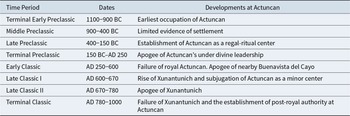
Summary of Actuncan’s Political Chronology.

To produce these narratives, I draw in part on my own frames of reference for understanding ruins and ruination to fill in the absences. I draw on modern sources that generally see the treatment of the past as a political project, which reflects shifting alignments of power and the deployment of humans’ universal attachment to their past as a tool of solidarity and hegemony. Each example draws from disparate sources in the ruination and critical heritage literature to exemplify how these can help patch over archaeological absence to create narrative possibilities. I do not aim to coherently define ruins or ruination in relation to the precolonial Maya. Rather, I draw disparately from sources with different operational definitions of ruins to work with sources that productively help narrativize my data. These are presented as possible histories constructed through empirically grounded speculation. While I anchor these to data and aim to be transparent with my interpretive tools, these pasts are narrativized beyond what may be confidently known.
Beginnings: Imperial Debris at Actuncan
Actuncan was first occupied prior to 1000 BC (Figure 2). At the time, we see the establishment of an early monumental E-Group (Simova Reference Simova2023, Reference Simova2025) around which sprung a small village. Our information about the following centuries is limited, but it seems the village remained small and may have even been abandoned for a time before it expanded modestly by 300 BC through the construction of a heterogenous collection of likely domestic structures.
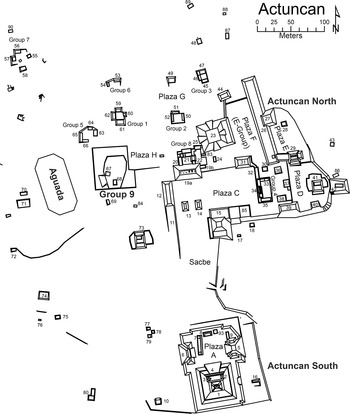
Map of Actuncan’s site core.

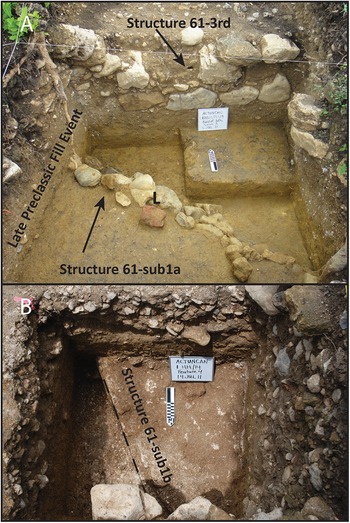
Around 300 BC, the entire early village, except the E-Group, was buried under a massive platform as part of a rapid urban planning event (Figure 3). A new urban center was constructed around unified planning principles and a new site orientation. This orientation defined a new processional causeway that connected the civic/administrative center of the site to the north to the massive 32 m tall triadic pyramid group known as Actuncan South to the south.
Photographs of buildings buried by the rapid burial of Actuncan’s Late Preclassic civic center: (A) Structure 61-sub1a was built of yellow clay with a river stone platform face; (B) Structure 61-sub1b was faced by cut limestone blocks and covered with a tamped sascab surface over a small river cobble fill. Evidence from associated ceramics indicates that both were built, used, and then buried under a thick layer of yellow clay fill during the Late Preclassic period. Both of these structures were found under Structure 61 with different orientations than the later site center. (Color online)

I often think about the people displaced by this transformation. While we can easily gloss this event as associated with the local adoption of sacred rulership, imagine being one of the site’s early residents, displaced from your home and forced to build a new household at the edges of the new civic center following the newly decreed orientation. Yes, the new civic center would have been shiny and new, representing that latest in Maya ritual trends. It would likely have been the new local capital. But I question: Whose life may have been placed in ruin?
Social psychiatrist Mindy Thompson Fullilove (Reference Fullilove2004) developed the concept of root shock to describe the negative psychological impact that results from displacement. Fullilove documents that displacement has long-term negative effects because the personal challenges of displacement, including finding new housing, are exaggerated by the loss of place-based community support networks and the disorientation of losing places that historically anchored individual and community roots. In other words, this kind of displacement disorients because it destroys the local forms of heritage that people rely on to define themselves.
Drawing on Ann Laura Stoler (Reference Stoler2008), I also wonder to what degree this ruination is part of an imperial process. Though the theory is not universally accepted, Freidel (Reference Freidel, Brown and Bey2018) has hypothesized that Late Preclassic El Mirador, Guatemala, was the capital of an expansionist imperial entity. Actuncan’s monumental center was built in a single planned event (though the exact time frame is difficult determine), has a Triadic Group, possibly a symbol of El Mirador’s imperial power, and looks fundamentally different from other regional centers at the time (Mixter et al. Reference Mixter, Ferrara and Jamison2023). Its rapid construction, the construction’s displacement of an earlier village, and the similarity of the new site plan to templates existing to Actuncan’s northwest suggest to me an imposition by an external political force.
Stoler (Reference Stoler2008:195) states, “Imperial projects are themselves processes of ongoing ruination, processes that ‘bring ruin upon,’ exerting material and social force in the present.” Actuncan’s new site core, which buried the earlier village, and the emblematic Triadic Group may be exactly this kind of imperial project. Its construction brought ruin on the earlier community. In what ways might the effects of this new construction reverberate in the social and economic fortunes of community members through time? This kind of active imperial debris poses important questions for us about the context in which Maya communities interacted with monumental architecture and processed its political implications in the context of their everyday lives.
Creating Debris: Ruination and the Uses of Heritage in Actuncan’s Classic Period
Following several hundred years of apparent political stability led by Actuncan, the Classic period was a politically dynamic time for this section of the Mopan River valley. Three different sites, Actuncan, Buenavista del Cayo, and Xunantunich, took turns as local capitals. This political dynamism may have been the product of attempts by larger rivals Caracol and Naranjo to control the Belize River trade routes and the Mopan River valley’s fertile agricultural land. Major construction on Actuncan’s monumental architecture ends in the third or fourth century. The shift in local leadership away from Actuncan is marked by a royal burial at nearby Buenavista del Cayo, which situates that site as the seat of a royal dynasty by AD 450 (Brown and Yaeger Reference Brown, Yaeger, Houk, Arroyo and Powis2020).
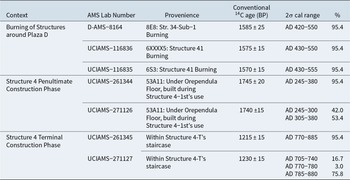
This political transition leads to active ruining at Actuncan. Actuncan’s elite houses were all abandoned and two of the three were covered with smashed Early Classic period ceramic vessels. Evidence also indicates that one of these houses and a buried structure across Plaza D were both burned and the house was partially demolished between AD 430 and 550,Footnote 2 likely during a single event (Table 2; Figure 4).
Probability curves for calibrated dates presented in the text.

Table of Dates from Actuncan Presented in the Text.

Note: All calibrated dates are presented as 2σ ranges calculated with Oxcal 4.4.4 (Bronk Ramsey Reference Bronk Ramsey2001, 2009) using IntCal 2020 (Reimer et al. Reference Reimer, Austin, Bard, Bayliss, Blackwell, Bronk Ramsey and Butzin2020).
There are hints that Buenavista del Cayo’s rise to power was violent. Fortifications were built across the north end of Actuncan blocking one of the easiest ingresses from the north, toward Buenavista del Cayo. In comparison to destroyed buildings, these fortifications created ruins in a different way. They awkwardly divided up the E-Group, limiting its capacity to be used as a gathering place, and broke up the solar alignment explicit in the design of E-Groups. Not only would the wall constantly remind the local community of the new risks brought by the Classic period power struggles, but it also ruined a part of the community’s ritual heart.
Before the displacement of Actuncan’s elites and the destruction of their residences, there are indications of Actuncan’s poverty. Most striking is a sudden lack of access to limestone, a critical construction material both as quarried blocks and the base for creating lime plaster. Limestone is abundant in the Mopan River valley but was not available directly around Actuncan, which was built on an alluvial terrace. This limitation is seen at Structure 41, where a lime plaster plaza floor wore away and was replaced by paving stones, which were subsequently buried under debris from the building’s burning and dismantlement. This replacement is also seen in commoner households. The residents of Group 1, the largest commoner household at the site, began to live on dirt patio surfaces instead of plaster sometime after the final expansion of the group’s patio in the fourth century AD. This dirt surface was used for at least 400 more years. While it is possible that these households chose to use dirt surfaces, this choice is muddy during the long wet season. Classic Maya households typically chose to live on plaster surfaces when possible, suggesting to me that economic limitations were the most likely reason for the use of dirt floors.
While the abandonment of ceremonial architecture, the construction of fortifications, and the destruction of elite residences speak to the drama of political transition and force of political action, the long-term impoverishment of residents speaks to the human ruining that impacted ordinary members of the Actuncan community. The site’s elites left, or perhaps were killed, but commoner residents continued to live for centuries in the remnants of their increasingly decaying center.
While these community members likely retained their own stories of Actuncan’s past—and their place in it—the site’s ruins also seem to have become an object of political value when Buenavista del Cayo’s dominance was contested by the rapid emergence of Xunantunich around AD 600 (LeCount et al. Reference LeCount, Yaeger, Leventhal and Ashmore2002). Actuncan was positioned directly between these two competing capitals, only 4 km from Buenavista and 2 km from Xunantunich. As such, it would have been contested terrain in the violent conflict that led to the fall of Buenavista’s kings (see also Kurnick Reference Kurnick2016; Luzmoor Reference Luzmoor2013). This transition in power created no relief for Actuncan’s residents. The conditions of impoverishment continued through the Late Classic period.
How did Actuncan’s increasingly ruinous landscape, created by a mix of time and events, impact those who lived there? Smith’s (Reference Smith2006) work on the nature of heritage is important because it encourages us to separate authorized discourses of heritage from the process by which heritage operates as a social force within communities. Evidence of the construction of a causeway connecting Xunantunich to Actuncan and the position of Actuncan to the north of Xunantunich in a direction associated with the ancestors suggests that the rulers of Xunantunich claimed Actuncan’s ruins as their ancestral place to legitimize their own authority (Ashmore Reference Ashmore, Ruiz, Marquínez, Campillo, de León, García-Gallo and Casto1998). Further, my colleagues and I have previously argued that Xunantunich placed a vassal caretaker in a palace at Actuncan to both claim its history and watch over its residents (Mixter et al. Reference Mixter, Jamison and LeCount2013). These acts can be read as an authorized heritage claim, which objectifies Actuncan’s ruins, produced through centuries of neglect of the site’s monumental architecture, and freezes the community’s past into a static form in service to the propogandist needs of the new authority in town.
Reclaiming Ruins
Local community members lived within Actuncan’s ruins, and their lives were negatively impacted by the foreign rulers who placed claims on Actuncan’s past. We have evidence that they resented this takeover. As Xunantunich declined in the Terminal Classic period (AD 780–900), and Actuncan became independent (Mixter Reference Mixter2020), the residents of Actuncan collapsed the roof of the client lord’s palace, buried capstones in its rooms, and filled the rooms with lime (Mixter et al. Reference Mixter, Jamison and LeCount2013). These actions were the work of the local community taking control of the process of ruination. The community decided to destroy the remains of a location of “difficult heritage,” to use Macdonald’s (Reference Macdonald2010) term, as a form of political action in reclaiming their community center. There is an irony in using a conspicuously wasteful amount of lime to ritually terminate this palace after all those years of limestone impoverishment.
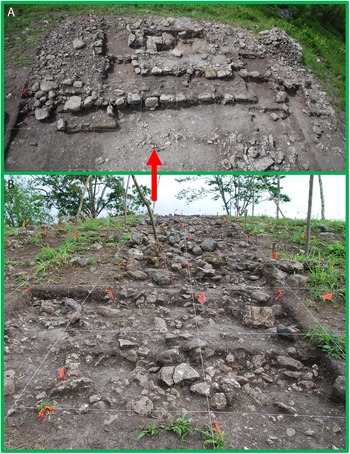
At the same time that they pulled down the palace roof, Actuncan’s residents built a new civic center in the Terminal Classic period (Mixter Reference Mixter2017a) by pillaging the existing monumental architecture in the north part of the site for block. This left the rubble core of those buildings exposed to the elements and the community’s daily gaze (Figure 5). The summit of some of these platforms are reused, defying Western expectations of acceptable places to live (Figure 6).
Photograph of Structure 12, illustrating the rubble fill spilling out of a platform that had its cut veneer stones removed. (Color online)

Photograph of Structure 41 illustrating new Terminal Classic architecture on the summit of a rubble-filled platform that has had its exterior veneer stones removed. (Color online)

The community also refurbished the site’s long abandoned Triadic Group. This space became the city’s ceremonial center once again, though with a set of modifications that transformed its original function for new needs. They built buildings in the group’s plaza to restrict its main entrance closing off the preexisting processional path, built a new performance platform in the plaza facing east, and performed repeated rituals that included substantial burning on the ruins of the group’s eastern pyramidal platform (Mixter Reference Mixter2022). These actions suggest that the practitioners had reinterpreted the space in the context of typical Classic period practice in which ancestor shrines were placed in the east. Perhaps this reflects an ontological shift from the time of the building’s Preclassic construction to its Terminal Classic reuse.
The Terminal Classic Actuncan Maya also reconstructed Structure 4, the Triadic Group’s largest southern pyramid (Mixter et al. Reference Mixter, Fulton, Angell, Mazza and Metz2025). Two radiocarbon dates from within the terminal staircase calibrate to between AD 770–885 and AD 705–880, respectively, at a 2σ range,Footnote 3 with probability distributions that strongly indicate a Terminal Classic period construction after AD 780 (Table 2; Figure 4). These data are bolstered by the recovery of a whole McRae Impressed type dish diagnostic to the Terminal Classic period under the terminal architecture of Structure 1, the pyramidal platform and vaulted building that sits on top of Structure 4 (Mixter et al. Reference Mixter, Fulton, Angell, Mazza and Metz2025:142). This indicates that the Terminal Classic Maya built a new building on the summit of Structure 4 at a time when most other monumental structures at the site had either fallen or were being taken apart.
Importantly, these new constructions were likely built on the naturally degraded and vegetation covered ruins of earlier versions of these buildings. Two radiocarbon samples indicate that Structure 4’s penultimate phase (known as Structure 4-1st) was in use at some point between AD 245 and 380 based on a 2σ calibrated range3 (Table 2; Figure 4). This places minimally 400 years between the penultimate and final construction phases, a period during which we have no evidence for the use of Actuncan’s public buildings.
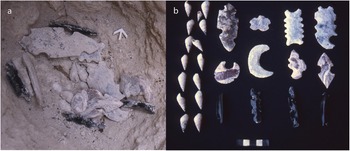
During the Terminal Classic period, Structure 4 was also reactivated as a ritual space and representation of the cosmos (Mixter et al. Reference Mixter, Fulton, Angell, Mazza and Metz2025). Just at the base of Structure 1 on top of Structure 4, excavations by McGovern (Reference McGovern, Leventhal and Ashmore1994) identified a large posthole approximately 30 cm across that would have supported a giant wooden post representing the Maya World Tree. Within this posthole, McGovern recovered three layers of cached objects (Figure 7). At the edges, he identified four eccentrically worked obsidian blades representing the four corners of the Maya world. Directly under the post were eight chert eccentrics representing the earthly plane. Beneath the lithics were 15 jute snail shells, representing the primordial sea. Stratigraphic analysis indicates that this posthole was dug into a late surface of Structure 4, contemporaneous with the Terminal Classic version of Structure 1.
(a) Photograph of a cache of lithic eccentrics and jute encountered in a large post hole in the surface of Structure 4. This cache was excavated by James O. McGovern in 1994 under the auspices of the Xunantunich Archaeological Project (XAP). The original context was XAP Operation 119 D/2-D1; (b) close-up of the contents of the cache. Photo credits: Xunantunich Archaeological Project, 1994. Used with permission of Richard M. Leventhal, XAP project director. (Color online)

It is the erection of this post in this place that I narrativize at the beginning of this article. This accounting is intended to emphasize the possible community sentiment and political ramifications of the Terminal Classic events identified archaeologically at Actuncan. The interpretations presented here and the narrative presented at the beginning of the article are not intended to reflect conclusive reading of these deposits but rather a possibility that embraces archaeological absence (Frieman Reference Frieman2024; Lucas Reference Lucas2012) to see the way a Maya community manipulated their heritage in a liberatory moment.
This reading, and other possible readings that embrace some degree of speculation, allow us to draw a world of possible pasts that gives humanity to peoples in the past and aims to break down alterity by recognizing possible common human traits that collapse past to present. In this instance, while the ancient Maya are ontologically different from us in many ways, I read them as concerned with the politics of everyday life and alert to the way materials of the past could be reconfigured as propogandist tools to legitimize regimes of power. This approach allows us to perceive everyday Maya as savvy participants in their political worlds rather than passive participants in a complex cosmological order. In other words, I see today’s complex processes of heritage where the past is processed both through official narratives and informally as the anchor of kitchen table communitas (Smith Reference Smith2006; Wertsch Reference Wertsch2002) as also at play in the past.
The evidence for Terminal Classic reuse of Actuncan’s Triadic Group differs from the reuse of other Triadic Groups during this time period, suggesting that ruins were understood in ways that reflected local historical contexts and local present day needs. For example, Cerro Mo’ at Tayasal (Halperin Reference Halperin2014) and Structure 4 at Cerro Maya (Walker Reference Walker1990) were not reutilized in substantial ways despite the reoccupation of those sites in the Terminal Classic period. Halperin’s (Reference Halperin2014) reading of Cerro Mo’ draws heavily on ethnographic evidence to build a Maya ontology of ruins. She suggests that Cerro Mo’ was left undisturbed as a wild and dangerous place of ancestors and supernaturals. In a completely different use, at El Mirador a Terminal Classic village was built on the collapsed debris of the Danta Triadic Group (Hansen et al. Reference Hansen, Howell, Guenter, Stanton and Magnoni2008). The active revival of Actuncan’s Triadic Group was anchored to the local continuity of occupation, which created a sense that these ruins belonged to the community (Mixter Reference Mixter2017b, Reference Mixter2020) rather than existing as alien precursors. In this context, local heritage management decisions reclaimed Actuncan’s Triadic Group as part of the new post-royal community.
Final Statements
What is the audience for archaeological stories? How does this inform the liberties we take? My argument in this article is that the creation of archaeological narratives has potential as an epistemological tool that enables us to fill in gaps so that we may imagine pasts drawn with more realistic human actors who act, think, and feel in accordance with their current needs and concerns. To thicken these narratives, I used theory about modern interactions with ruins and my personal understanding of human relationships to the past to build on traditional archaeological and analogical sources.
Reviewers for this article wondered about the assumptions made in the creation of these narratives. Does the use of paving stones and dirt floors actually speak to impoverishment? Was the burial of the early village a form of displacement, or does this perspective strip community members of their agency? Were external forces really the cause of many transformations we see at Actuncan? These emphasize the ways my perspectives have been inserted into these narratives: I tend to see the precolonial Maya as a class-based society in which everyone had some power in negotiating with leaders, but this agency was limited in the face of complex and often violent geopolitics of the Maya past. I see a realistic portrayal of the Maya past as combining these perspectives: I try to consider both what happened to Actuncan’s community members and consider how they may have processed those events.
Yet, alternative interpretations are possible. For example, the Late Preclassic community at Actuncan may well have voluntarily left their homes, and they likely participated in the construction of the new planned center. Additionally, the modern interpretive frameworks that I provide—heritage, root shock, Stoler’s take on ruination—may not be appropriate to the Maya past. The narratives are a version of a past we can never fully know. I think we should welcome these multiple possibilities.
One reviewer of this article wondered about the potential of these archaeological stories to increase the accessibility to archaeology for the public. While I don’t believe the words written here are engaging enough to break through to ordinary audiences, ultimately, public storytelling anchored to archaeological data elevates scholarship and has the potential to bring otherwise invisible pasts to public view. The project of public archaeological storytelling is about creating equity in how we present pasts. The richness of how we present past human lives should not be limited to the concreteness of the materials we find.
In this article, my primary aim was to argue for the use of the tools of narrative and critical heritage studies as lenses for understanding the impact of ruins in the context of past societies. Archaeology as a discipline is founded on the curiosity of humans about ruins. Ruins are part of what makes archaeology enchanting: they pull at human curiosity about the unknown and uncertain. Perhaps familiarized pasts can provide us with lessons for the future. Perhaps they will anchor claims to land, territory, or power for peoples or nations. Perhaps they can simply delight by helping us imagine living in possible pasts and by helping us to imagine possible futures.
Acknowledgments
Thanks to Robert Rosado-Ramirez and Arthur Joyce for the invitation to participate in the SAA session and in this special section in Latin American Antiquity. Thanks to BrieAnna Langlie and three anonymous reviewers whose feedback improved this manuscript. Thanks to the Belize Institute of Archaeology for permitting our work at Actuncan. Thanks to the staff of the Actuncan Archaeological Project, especially past project director Lisa LeCount and colleagues who led the excavations described here, including Scott Ferrara, BrieAnna Langlie, Gabrielle Mazza, and Allison Nick. Thanks to Richard Leventhal for permission to publish photographs taken at Actuncan under the auspices of the Xunantunich Archaeological Project. Most radiocarbon dates presented here were processed in collaboration with the Kennett labs at Pennsylvania State University and the University of California, Santa Barbara; thanks to Douglas Kennett, Richard George, and Brendan Culleton. Special thanks to Azucena Galvez, Ramon Galvez, Rudy Juan, Louis Juan, and the Manzanero family who provided us hospitality and access to their land. This research was aided by residents of Cayo district especially our project foremen Carlos Cocom, Cruz Puc, and Rene Uck.
Funding Statement
This work was funded by a Dissertation Fieldwork Grant from the Wenner-Gren Foundation, two grants from the Rust Family Foundation, and an AIA-NEH post-fieldwork grant. Thanks to Washington University in St. Louis and Binghamton University for additional funds and logistical support.
Data Availability Statement
Original Actuncan Archaeological Project data are held by the author and available in annual reports filed with the Belize Institute of Archaeology.
Competing Interests
The author declares none.




 Open access

