

Introduction
The 2025 Australian federal election had an extraordinary outcome. The Australian Labor Party (ALP), led by Prime Minister Anthony Albanese, was returned to office with an unprecedented majority in the Australian Parliament’s House of Representatives. This result defied all expectations and most of the polling (Mizen Reference Mizen2025). Only six months prior, the polls had predicted that this would be a one-term government (Roy Morgan 2024). The Liberal-National Coalition (LNP) (the Opposition) had overtaken the ALP in the polls in December 2024 and was 10 points ahead (LNP 55% and ALP 45%) in February 2025. Yet the election was a landslide victory for the ALP, with a two-party preferred vote of 55.2% – the best result for any government since 1975.
The LNP announced that if they won, they would introduce a policy mandating public servants return to the office (from here, referred to as their ‘working from home policy’). This policy proposal fundamentally misread the evolution of Australia’s social contract in the post-pandemic era, where large numbers of employees continued to work from home. Many commentators (Crabb Reference Crabb2025; Grattan Reference Grattan2025a) argued that the working from home policy was a major factor in the election outcome.Footnote 1 We use social contract theory to demonstrate that a significant contributor to the LNP’s election defeat was their working from home policy, which would, by implication, support private sector organisations to also implement such a policy. In this, they had failed to recognise that the Australian social contract is constantly evolving and has fundamentally shifted to include hybrid working as an expected condition of employment. Thus, we ask how the LNP’s working from home policy violated Australia’s evolving social contract, and what role did this violation play in the LNP’s 2025 electoral defeat?
First, we present a short overview on the social contract. Second, we present the case study: the Australian federal election and the LNP Opposition’s policy ‘backflip’ over their working from home policy. From this, we discuss evidence that the social contract has changed, which created part of the seismic shift in voter behaviour within six months. We conclude that hybrid working has become institutionalised as a part of Australia’s evolving social contract, with implications for future political discourse and employment relations policy.
Social contract
A social contract is the implied agreement between individuals and their government, which outlines the rights that individuals are entitled to and the obligations they owe to the state and to each other (Freeman Reference Freeman and Estlund2012). Critically, social contract theory argues that the legitimacy of a government is based on its ability to uphold the terms of the social contract; if the government fails to protect the rights of its citizens or maintain order, it may lose its legitimacy (Freeman Reference Freeman and Estlund2012). This concept of legitimacy through consent and reciprocity makes social contract theory particularly useful for understanding electoral behaviour – when governments or aspiring governments propose policies that violate what citizens perceive as their rights, they risk losing democratic legitimacy.
We use social contract theory as the analytical lens, as it provides a framework for understanding how collective expectations about rights and obligations become politically consequential. Unlike frameworks focused solely on policy preferences or economic interests, social contract theory helps explain why violations of evolving social norms can provoke a widespread electoral backlash. The theory captures how practices become expectations, expectations become norms, and norms become political imperatives that governments (political parties) violate at their peril.
The concept of the social contract has evolved significantly from its original 17th-century conception, which focused on political obligation and reciprocity (Paz-Fuchs Reference Paz-Fuchs2011; Williams Reference Williams2024). It has expanded to include social institutions and policies involved in the pursuit of social justice, used as a mechanism to establish and distribute rights and responsibilities (Paz-Fuchs Reference Paz-Fuchs2011). Further, the State is expected to use its power ‘to reflect society’s priorities and balance of powers’ (Paz-Fuchs Reference Paz-Fuchs2011, 6). As such, social contracts evolve in response to changing economic, social and technological conditions (Stiglitz and Rosengard Reference Stiglitz and Rosengard2015). This evolutionary quality makes social contract theory apt for analysing shifts in working arrangements following disruptions such as the COVID-19 pandemic.
For most of the 20th century, the Australian social contract around work was built on several key assumptions. Work meant full-time employment, typically in the post World War II era, from 9am to 5pm, Monday to Friday, conducted at the employer’s premises (Chung Reference Chung2023; Kochan Reference Kochan2016). This contract was based on gendered assumptions and was premised on ideal worker norms – the assumption that the ‘worker’ has no competing responsibilities and could dedicate themselves fully to workplace demands (Acker Reference Acker1990). The ideal worker was implicitly male, with a spouse managing domestic and caring responsibilities. This social contract began shifting with changing demographics and increased female labour market participation. The social contract evolved to encompass more progressive regulations and policies that increased gender equality, such as paid parental leave (Kochan Reference Kochan2016). However, these changes remained marginal to the core assumptions about work location and ideal worker presence.
How practices become rights: from empirical to normative
A crucial mechanism in social contract evolution is the transformation of practices into rights, which Paz-Fuchs (Reference Paz-Fuchs2011) describes as the movement from the empirical (what people actually do) to the normative (what they have a right to do and what the State should protect). This progression is evident in legislative changes in Australia. For example, the 2023 amendments to the Fair Work Act 2009 strengthened entitlements for eligible employees to request flexible working arrangements, which include changing the location of work (s 65 Fair Work Act 2009).
Further, one Australian State government has proposed legislating a right to hybrid working for at least two days a week, if an employee is able to work from home (Allan Reference Allan2025). This regulation forms part of an evolving social contract, with the government fulfilling its obligations to its citizens (Williams Reference Williams2024). However, conservative forces have failed to recognise the importance of these changes to the social contract, evidenced by challenges to increased work flexibility and working from home (see, for example, Hegerty Reference Hegerty2025). This was most notable during the 2025 Australian federal election, as we next discuss.
The Australian federal election and the opposition policy ‘backflip’
In recent history, employment relations have been influential in federal elections in Australia. In 2007, the LNP’s unpopular WorkChoices legislation, which reduced pay and employment conditions for many workers, resulted in an election loss for the LNP Government (Wilson and Spies-Butcher Reference Wilson and Spies-Butcher2011; Woodward Reference Woodward2010). While employment issues surfaced sometimes during subsequent elections, employment relations again played a decisive role in determining electoral outcomes in the 2025 election.
Australia has a three-year election cycle, so it was known that an election would be held in 2025. As a result, the two main parties, the ALP and the LNP, started to make potential election commitments from early 2025. In January, the LNP had a preferred vote of 52% and was seen to be gaining popularity fast. By February, they were predicted to gain 55% of the vote. However, the ALP won the election in May with a landslide victory. Post-election media analyses attribute the LNP loss partly to their working from home policy and subsequent backflip (Crabb Reference Crabb2025; Grattan Reference Grattan2025b). The following is an analysis of mainstream media political reporting in Australia on the working from home policy throughout March to May 2025, which shows the contribution of the policy announcement to the actual election result.
Early March 2025: The proposal to direct Australian Public Service (APS) employees to return to the office was first announced by the Shadow Minister for the Public Service, Senator Jane Hume, in early March 2025, prior to the election being called. She stated:
…it will be an expectation … that the APS will move towards returning to working five days a week from the office (Hume Reference Hume 2025a ).
In response to strong criticism of the policy proposal by the government and unions (see ACTU 2025), the then LNP leader, The Hon. Peter Dutton, MP, defended the policy, arguing that:
I am not going to tolerate a position where taxpayers are working harder than ever to pay their own bills and they’re seeing public servants in Canberra refusing to go to work (Dutton quoted in Evans Reference Evans 2025 ).
The framing of hybrid working as ‘refusing to go to work’ proved particularly damaging as it dismissed the legitimacy of home-based work arrangements that many Australians had adopted.
Senator Hume attempted to provide evidence for the policy’s necessity by citing an example of a public servant, ‘travelling around Australia in a caravan with their family’ while working (Hume Reference Hume2025b). Rather than convincing voters of widespread abuse, this anecdote backfired, appearing to trivialise genuine flexible working arrangements and suggesting the LNP was out of touch with how contemporary work was functioning.
The policy proposal was criticised as harmful to working women, as many women value working from home for caring reasons (see, for example, Wilson and Brooks Reference Wilson and Brooks2024). In response to this criticism, Dutton suggested that women seeking flexible work could use job-sharing arrangements (Crabb Reference Crabb2025). The suggestion that women should accept reduced hours and income rather than expect accommodation of their caring needs crystallised concerns that the LNP did not understand, or value, women’s economic participation. The assumption that working full-time hybridly could be replaced by part-time job-sharing was criticised in the media for being unrealistic, and for the potential to reduce women’s wages (Webber Reference Webber2025).
While the LNP’s proposal only related to federal public servants, the ALP Government was able to capitalise on fears that return to office mandates would spread to the private sector, as had been the case in the US following the President’s mandate requiring federal workers to return to the office (Ezell Reference Ezell2025). This is exemplified by a former LNP voter, who reportedly explained why she changed her vote to Labor:
The thing that got me really fired up was the work from home, and I know I’m not alone. If public sector workers in Canberra were forced to end working from home arrangements, that would be all the private sector would need to follow (quoted in YussufReference Yussuf2025).
The ALP strategically linked the working from home policy with cost-of-living concerns, Australia’s top electoral priority (Biddle Reference Biddle2025). The Prime Minister argued that returning fully to the office would cost Australians up to $5000 a year in transport and car parking (Mizen 2024). This reframing transformed an issue that may have seemed to affect only public servants into one with broad economic implications. Analysis of key urban seats found that most had high numbers of workers able to work from home, including outer suburban areas where long commutes were a major issue (Crowley Reference Crowley2025). The Prime Minister also suggested that the Opposition leader was out of touch with the needs of working families and the realities of the new workplace (Crowe Reference Crowe2025). The Public Service Minister, Senator Katy Gallagher, also criticised the Opposition and argued that flexible work arrangements had been ‘transformative for Australian families’, linking this to women’s increased workforce participation (Gallagher Reference Gallagher2025).
27 March 2025: Tapping into populist conservatism by proposing cuts to the public sector (Saulnier Reference Saulnier2017), the LNP also announced a policy to reduce the number of APS employees by 41,000 (Dutton Reference Dutton2025). This proposal was widely criticised by the ALP and other politicians residing in Canberra, Australia’s capital city, the location of the head offices of public sector agencies. Various politicians (from the ALP and an independent) argued that 41,000 public service positions could not be cut without negatively impacting front-line services (Gore and Burnside Reference Gore and Burnside2025).
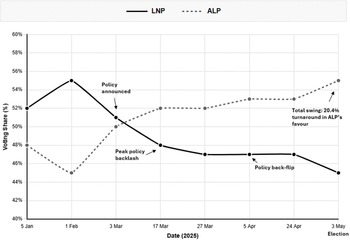
28 March 2025: Australian Prime Minister Anthony Albanese announced that the election would be held on 3 May. The LNP continued campaigning, with policy announcements coinciding with a notable shift in polling data. While the LNP had maintained a 55% preferred vote in February 2025, this declined to 51% by mid-March (see Figure 1), with the party falling behind Labor for the first time in months. A YouGov (polling company) director noted:
Dutton needed to win working-class votes in outer suburban Sydney and Melbourne but his Trump-style policies of ending work from home and cutting 40,000 public servants have seen his support dramatically impacted (quoted in Briggs Reference Briggs 2025 ).
2025 Australian federal election polling shift.
(Sources: Roy Morgan, 2 March, 16 March 2025; YouGov 7 March 2025).

The failed backflip
Recognising the electoral damage, the LNP began to soften its stance. Instead of demanding all public servants return to the office, the LNP suggested the working from home policy with mandatory office attendance would only apply to APS employees based in Canberra, and that they would allow some flexibility (Truu Reference Truu2025). This caused confusion, which was compounded as it was also unclear whether the 41,000 job cuts, from a total of 173,800 public servants (APSC 2024), would come from natural attrition or voluntary redundancy (Worthington Reference Worthington2025).
Early April 2025: With polling showing continued decline, the LNP withdrew the working from home policy and proposed public service job cuts. LNP leader Dutton admitted that ‘we made a mistake’ (Evans and Dalzell Reference Evans and Dalzell2025). The policy change was widely reported in the media as a ‘backflip’ that contributed to perceptions of a poorly managed campaign (Grattan Reference Grattan2025a; Worthington Reference Worthington2025). The reversal, however, came too late to undo the damage. The policy announcement had already revealed the LNP’s values and priorities in ways that contradicted voters’ expectations about the social contract. As political commentator Annabel Crabb noted:
Dutton’s language around the policy – equating working from home with “refusing to go to work” – conveyed a set of values that was clearly heard by Australian women (Crabb Reference Crabb 2025 ).
Women ‘hearing’ these values, and the associated working from home policy, reinforced perceptions that the LNP had a ‘woman problem’. This stemmed from the Liberal Party of Australia’s increasing neoliberalism in the 1990s, which supported traditional gender roles (Williams Reference Williams2025). These views persisted – and subsequently deepened – in the lead-up to the 2025 election (Williams Reference Williams2025). Post-election analysis revealed that former LNP voters cited the working from home policy as key in their vote switching (Yussuf Reference Yussuf2025). This pollster summed up his analysis:
Whether it was the work from home policy, whether it was the brand they’ve developed for themselves, women in their 30s and 40s just don’t view the Liberal Party as the political party that gets who they are and understands the pressures they’re experiencing (Samaras, quoted in Yussuf Reference Yussuf2025 ).
Similarly, in the aftermath of the election, one LNP senator acknowledged the party had such a problem and urged the party to ‘understand why women have turned away from our party’ (Yussuf Reference Yussuf2025). At the time of writing, the LNP was conducting a review of the 2025 election campaign, including demographic analysis, which will undoubtedly examine why women did not vote for the party (Liberal Party 2025).
Election Day, 3 May 2025: Despite the policy reversal, the damage proved irreversible. The ALP won the election with 55.2% of the vote, winning key urban seats identified as having many voters working from home, that were previously held by the LNP; this included the Opposition leader’s own seat (Crabb Reference Crabb2025) (echoing the 2007 election result, where the Prime Minister lost his seat, reportedly due to WorkChoices and other factors: Aljazeera 2007). In the post-election reshuffles, Senator Hume did not retain her Shadow portfolio in the new, slimmed-down Opposition front bench and was demoted to the backbench, a decision that commentators speculated was linked to her role in the policy (Maiden Reference Maiden2025).
It is evident that the working from home policy negatively impacted the LNP’s chance of winning government. We argue that one factor contributing to the LNP’s election defeat was the party’s failure to recognise that the social contract has evolved, with hybrid working now a core expectation of the workforce. It was not a privilege to be attacked but a right to be protected.
The new Australian social contract
Five years on from the start of the pandemic, levels of hybrid and remote working have stabilised in many countries, including in the UK (Chung and Yuan Reference Chung and Yuan2025) and the EU (Sostero et al Reference Sostero, Bisello and Fernandez Macias2024). Similarly, hybrid working has become institutionalised in Australia. In 2023, almost a third (32%) of employees worked from home for at least some of the time, with rates slightly higher amongst women than men (ABS 2024). This represents a significant increase from pre-pandemic levels, when fewer than 20% of workers had access to home-based work arrangements (ABS 2021). Working from home is common for white collar workers, with 46% of managers, 41.7% of professionals, and 36.3% of clerical workers working from home at least one day a week in 2023 (Laβ and Wooden Reference Laβ and Wooden2025). This figure is much higher for public/civil service workers. In 2024, over two-thirds (68%) of APS employees spent some work time away from the office (APSC 2025). Further, a recent survey of 974 Australian employers (public and private) found no increase in employers mandating a return to the office, with hybrid working patterns stabilising over the past two years (AHRI 2025).
Researchers have argued for a renewed social contract which incorporates flexible working to enable employees to balance work and caring responsibilities (Kochan Reference Kochan2016; Chung Reference Chung2023). While there are risks that women working from home could reinforce gender roles, a new social contract which incorporates gender equity and flexible working arrangements would also acknowledge and normalise the notion that employees have a life outside of work (Chung Reference Chung2023), and one which includes caring responsibilities throughout the life course (Hill and Baird Reference Hill, Baird, Baird, Hill and Colussi2024). The evidence suggests the social contract is evolving in Australia, evidenced by voter backlash to the working from home policy proposed by the LNP. This political party may not have realised the social contract is changing – and there are many other organisations which also appear to be unaware of this, as we next show.
Contested terrain: employer resistance and worker advocacy
Return to office mandates are ‘organisational directives for employees who have been working from home…to return to working in their employer’s premise’ (Williamson et al Reference Williamson, Taylor, Lundy and Jogulu2024, 2). The imposition – or proposed imposition – is a site of contested terrain in a post-pandemic environment. The emergence of an evolving social contract has created contested terrain between some employers (and their allies) seeking to reassert traditional work arrangements, calling for return to office mandates (Pepper and Wicks Reference Pepper and Wicks2024), and employees (supported by unions) defending and pursuing flexible working rights (Williamson et al Reference Williamson, Taylor, Lundy and Jogulu2024). Many organisations globally are committed to enforcing these mandates, despite research findings that such mandates foster resentment, lead to higher turnover (Chung and Yuan Reference Chung and Yuan2025; Ding et al Reference Ding, Zhao, Ma, Xing and Yang2024; Van Dijcke et al Reference Van Dijcke, Gunsilius and Wright2024), reduced job satisfaction and potential brain drain as talented employees migrate to more flexible competitors (Ding et al Reference Ding, Zhao, Ma, Xing and Yang2024). Return to office mandates have been specifically associated with higher quit rates amongst women internationally (Ding et al Reference Ding, Zhao, Ma, Xing and Yang2024), with women less likely to comply with mandates if applied (Chung and Yuan Reference Chung and Yuan2025).
Visibility of return to the office mandates grew when a senior Amazon executive in the US told staff that if they did not like the full return to office policy, they should quit (Bensinger Reference Bensinger2024). The mandates gained prominence, reinforced by the US President’s directive discontinuing remote work arrangements throughout federal government departments and agencies. In early 2025, all federal employees were required to return to the office full-time (Ezell Reference Ezell2025). This saw a broader return to the office trend, with many large US private companies, such as Google, Meta, and Microsoft, enforcing similar mandates (Williamson et al Reference Williamson, Taylor, Lundy and Jogulu2024).
Employers often cite productivity concerns (see, for example, Black and Durkin Reference Black and Durkin2024) as a reason for return to office mandates. Some organisations have mandated a full return to the office (for example, Dell, Goldman Sachs, JP Morgan, X, Amazon, Hubble 2025), and the New South Wales (NSW) public service in Australia (O’Neill Reference O’Neill2025). Such moves suggest that many employers are resisting the evolving social contract. In the NSW public service, unions have mounted a long-running case against a government-imposed mandate that employees return to the office (O’Neill Reference O’Neill2025). The main NSW public sector union has lodged a dispute with the NSW Industrial Relations Commission on several grounds. One of these is that employees who have dispensation to work from home, such as those with caring responsibilities or those with a disability, are being required to reapply to work from home. These employees have a right to do so and are not legally required to request to work flexibly. At the time of writing, the union was also arguing that the policy had changed from its original conception, which did not stipulate the number of days required to be in the office, to stating that employees had to attend the office for at least 50% of the time (Bajkowski Reference Bajkowski2025).
Similarly, at the time of writing, civil servants in the UK are engaged in industrial action protesting against return to office mandates (Taylor Reference Taylor2025). In Canada, the Public Sector Union pursued legal action to stop a return to office mandate for federal public service workers, increasing from two to three days per week (Thomas Reference Thomas2025). In Aotearoa New Zealand (NZ), the Public Sector Union has taken the NZ government to the employment tribunal, following unsuccessful mediation on public service work from home policies. This follows the NZ Government declaring in late 2024 that working from home was ‘not an entitlement’ (PSA 2025).
In contrast, unions support flexibility and stronger work from home rights (ACTU 2020), which have attendant implications for the social contract. The contested terrain between employers and unions is borne out by a current case in Australia’s main industrial relations tribunal, the Fair Work Commission (FWC). At the time of writing, the FWC is hearing submissions from employers and unions covered by the Clerks – Private Sector Award 2020 (FWC 2024) (an ‘award’ being one of the main instruments regulating employment for almost a quarter of Australian employees: DEWR 2025). The development of this clause is significant as it would have flow on effects, potentially impacting over half of all Australian workers (i.e. those covered by all collective industrial instruments, some 57.2% of the workforce: DEWR 2025). In a submission to the FWC review, a major employer association, the Australian Industry Group, proposed that the flexibility to work how and where employees wanted should be part of an annual salary that exempts employers from penalty and overtime rates (AIG 2025). The main union in the case opposed this position, stating that this position ‘was a “massive dummy spit”’ from big business after their anti-worker agenda was rejected at the last Federal election’ (ASU 2025).
Conclusions: the outcome of the election and the evolving social contract
We set out to unravel the impact of the LNP’s working from home policy on the 2025 election. We asked: how did the LNP’s working from home policy violate Australia’s evolving social contract and what role did this violation play in the LNP’s 2025 electoral defeat? We used social contract theory to answer this question. In the initial definition of the social contract, we explained that the legitimacy of a government is based on its ability to uphold the terms of the social contract. Tapping into stereotypes of public servants as lazy elites (Saulnier Reference Saulnier2017; Willems Reference Willems2020) who refuse to work in the office, or work as they travel the nation, the LNP had assumed that attacking public servants’ working rights would be popular (Clark Reference Clark2025). However, this proved not to be the case. Further, the working from home policy was not supported by women voters and reinforced the perception that the LNP was out of touch with women. The LNP demonstrated a lack of understanding of the evolving social contract. We contend that the Australian electorate judged that the LNP would not uphold what they now considered to be terms of the social contract. The LNP realised their error and wound back their plans (Butler Reference Butler2025), but it was too late. Reflecting global concerns that what had moved on since COVID-19 was under threat, the population convincingly voted to keep the new flexibility and hybrid working.
The case study presented here of the Australian federal election and backlash to a working from home policy, which would have mandated a return to the office for federal public servants, has implications for understanding political legitimacy in contemporary democracies. Social contract theory suggests that governments derive legitimacy from their ability to protect citizens’ rights and respond to their needs. The Australian electorate’s decisive rejection of return to office mandates and the LNP working from home policy indicates that hybrid working is now viewed as a legitimate right worthy of political protection. Further, the case study provides a salutary lesson not only for political parties, governments and public sectors, but also for employers who are considering violating the evolving social contract by enforcing return to office mandates.
Competing interests
The authors declare none.

 Open access

