

In authoritarian regimes and occupied countries, population control measures vastly inhibit the ease of operation for any terrorist, insurgent, or opposition group…. COVID essentially created that dynamic for entirely unique reasons.
Retired General Stanley A. McChrystal Former Commander of the United States Forces—AfghanistanFootnote 1The COVID-19 pandemic is on track to be the most deadly disease outbreak in recorded history. However, death tolls based solely on the number of persons killed through infection belies the potential deadliness of the pandemic. Disease outbreaks can result in deaths not only through infection (Yard et al. Reference Yard, Radhakrishnan, Ballesteros, Sheppard, Gates, Stein and Hartnett2021), but also through violence between and within states. Since the outset of the pandemic, governments, civil society organizations, and policy experts have warned that non-state actors, such as the Islamic State of Iraq and Syria (ISIS), Boko Haram, and al-Qaeda, are attempting to use the pandemic to discredit governments, rally supporters, and ultimately increase violence against states (United Nations Security Council Counter-Terrorism Committee Executive Directorate 2021).
Although non-state actors have threatened to take advantage of the pandemic to advance their goals, the lockdown measures that governments have adopted to stop the spread of disease among their populations, we argue, are likely to reduce violence by non-state actors subject to them. Specifically, we argue, government-imposed lockdown measures (i.e., curfews and travel bans) are likely to reduce attacks by non-state actors, especially in populated areas and areas outside actors’ base of operations, by depleting their resources, reducing the number of high-value targets available to them, and logistically making it more difficult to conduct attacks.
Most research on public health and non-state actor violence has focused on the effect of violence on public health outcomes (Ghobarah, Huth, and Russett Reference Ghobarah, Huth and Russett2003). In this study, we focus instead on the effect of public health crises and, their mitigation strategies in particular, on non-state actor violence. Lockdown measures have been used to manage other public health crises, including the Avian flu, Ebola, and Spanish flu. They are also widely used to combat insurgencies and manage crime, especially after natural disasters. Yet, despite their commonness, there is little academic research of their effect on non-state actor violence. Whereas public health research has focused exclusively on the health outcomes of these measures (Talic et al. Reference Talic, Shah, Wild, Gasevic, Maharaj, Ademi and Li2021), scholarly research on violence has focused on ordinary crime in states with strong rules of law (Nivette et al. Reference Nivette, Zahnow, Aguilar, Ahven, Amram, Ariel and Burbano2021).
To analyze the effect of lockdown measures on non-state actor violence, we take a multipronged approach. First, we examine statistically the effect of the pandemic, and curfews and travel bans in particular, on the number and location of ISIS attacks within ISIS’s strongholds in the Middle East and North Africa. Then, we visualize their impact on the location of violent events using geographic information system (GIS) mapping. Finally, to explore the plausibility of the mechanisms by which we argue that lockdowns affect non-state actor violence, and to identify which of them are most likely driving our statistical results, we conducted a qualitative analysis of the pandemic, drawing on semi-structured interviews with government officials, military leaders, policy experts, and locals.Footnote 2
We focus on a single non-state actor in our analysis to test our argument in a fine-grained way, taking into account knowledge of the actor and the context within which it operates. We chose ISIS because it explicitly pledged to capitalize on the pandemic to increase attacks, calling COVID-19 a “soldier of Allah,” and has provoked the most international concern for this reason.Footnote 3 COVID-19 is “a ticking time bomb” when it comes to ISIS, according to UN High Commissioner for Human Rights, Michelle Bachelet.Footnote 4 At the same time, ISIS, with its large financial reserves, minimal targeting of civilians, and rural base, is not especially vulnerable to the effects of lockdown measures. Therefore, a demonstrable effect of lockdowns on ISIS’s operations has important implications for non-state actors more broadly.
The results confirm our expectations that lockdown measures have an unintended beneficial effect reducing ISIS violence. Specifically, we find in our statistical analysis that curfews and internal travel bans are significantly associated with a reduction in the number of ISIS-initiated violent events, especially in high population areas in the case of the former, and areas outside ISIS’s base of operations in the case of the latter. Our qualitative analysis suggests that the effects of these measures are most likely due to short-term changes in ISIS’s targets and logistics rather than its resources. These results not only help us understand the effectiveness of population control measures for combating insurgencies, but also extend our knowledge of the far-reaching implications of policy responses to public health crises on society.
Existing Research on Lockdown Measures and Violence
Lockdown measures, we define, as any course of action that restricts the movement of the population. They include curfews, limiting the hours of the day in which people may be outside their homes, and travel bans, restricting where people can move when outside their homes. Population control measures, like these, are used not only to contain disease during public health crises, but are also a standard tactic for combating non-state actor violence found in counterinsurgency manuals and controlling crime in states more generally. Yet, there is little research on the mechanisms by which these measures affect non-state actor violence, the conditions under which they have the greatest impact, and evidence of their effects more broadly.
Counterinsurgency manuals are concise, and while they identify population control measures as a key tool for combating violence (NATO 2011; U.S. Department of Defense 2016), their purpose is different than academic research. As a result, the manuals do not expound on the logic of how these measures alter non-state actor violence or offer evidence of their effect. Academic research on counterinsurgency strategies has offered little analysis into these issues as well. Most research on lockdown strategies as counterinsurgency tools focuses on the legality and morality of these policies (Brass Reference Brass2006; Criddle and Fox-Decent Reference Criddle and Fox-Decent2012) rather than their effectiveness.
The few studies of their effectiveness are qualitative analyses of specific insurgencies (Duffy Reference Duffy2009; Oxford Analytica 2021). Only one study, to the best of our knowledge, analyzes these measures’ effectiveness statistically. As part of a study on housing demolitions, this study finds that curfews increase suicide attacks in Israel (Benmelech, Berrebi, and Klor Reference Benmelech, Berrebi and Klor2015). However, curfews are endogenous to suicide attacks in this analysis. That is, they were probably imposed where the likelihood of violence was greatest, making it impossible to identify their effects.
The COVID-19 pandemic presents a unique opportunity to isolate the effects of lockdowns because in the countries we analyzed, the lockdowns were imposed in every locale, without regard to the presence of insurgent violence, and were not enforced in ways that would explain the location patterns we hypothesize and, ultimately, observe in our data.Footnote 5 They were also not accompanied by other measures, such as housing demolitions or military raids, as lockdowns imposed as counterinsurgency tools often are, making it difficult to isolate their effects. Even though the pandemic-related measures were imposed for different reasons, they restricted population movements the same way as those imposed to fight insurgencies and, therefore, should have similar effects. While the lockdowns imposed as part of the COVID-19 pandemic were extensive and long-lasting, public health and counterinsurgency lockdowns can be limited and short-lived or extensive and long-lasting.
Academic research on counterinsurgency strategies has analyzed a range of other population-centric measures for combating violence (Kilcullen Reference Kilcullen2006). These include resettlement programs (Azam and Hoeffler Reference Azam and Hoeffler2002; Lichtenheld Reference Lichtenheld2020; Zhukov Reference Zhukov2015); information campaigns and intelligence-gathering technologies (Cohen Reference Cohen2015; Lyall and Isaiah Wilson Reference Lyall and Wilson2009); material incentives to build popular support (Beath, Christia, and Enikolopov Reference Beath, Christia and Enikolopov2012; Berman, Shapiro, and Felter Reference Berman, Shapiro and Felter2011); and military tactics and technologies for avoiding high civilian casualties (Johnston Reference Johnston2012; Lyall, Blair, and Imai Reference Lyall, Blair and Imai2013). Resettlement programs share the most in common with lockdowns since they isolate non-state actors from local populations. But, research on them focuses on the motivation for resettlement programs, not their effects.
Recent research in criminology analyzes how curfews imposed as part of the COVID-19 pandemic have affected crime by altering mobility patterns. Most of this research, thus far, finds that pandemic-related curfews have increased crime inside the home (Boman and Gallupe Reference Boman and Gallupe2020) and online (Lallie et al. Reference Lallie, Shepherd, Nurse, Erola, Epiphaniou, Maple and Bellekens2021), while decreasing it outside the home, except for deadly crimes (i.e., homicide)—arguably the crime most akin to non-state actor violence (Ashby Reference Ashby2020; Boman and Gallupe Reference Boman and Gallupe2020; Nivette et al. Reference Nivette, Zahnow, Aguilar, Ahven, Amram, Ariel and Burbano2021). To explain why lockdowns have not reduced homicides, researchers have conjectured that murderers do not respect law enforcement and simply do not comply with lockdown measures (Abrams Reference Abrams2021; Ashby Reference Ashby2020).
These findings on homicide suggest that lockdowns should not reduce violence by non-state actors either because, even though it occurs in the public domain, non-state actors are also opposed to the legal authority of governments and not likely to respect lockdowns either. We expect lockdowns, though, to reduce the opportunity for non-state actors to commit violence in ways they might not for ordinary criminals. Even if non-state actors do not respect government-imposed lockdown measures, these measures alter the behavior of the local population and can leave non-state actors short of funds, bereft of targets, and exposed to detection as a result.
How Lockdowns Reduce Non-State Actor Violence
Government-imposed lockdown measures, we argue, can affect the ability of non-actors to engage in violence in a number of ways. By non-state actor, we mean a “non-sovereign entity that…employs violence in pursuit of its objective”(U.S. Code §6402). Our argument only applies to non-state actors that do not control their own territory and, therefore, are subject to government-imposed lockdown restrictions. Sixty percent of non-state actors active between 1946 and 2010 did not control territory (Cunningham, Gleditsch, and Salehyan Reference Cunningham, Gleditsch and Salehyan2009). Today, this includes some of the most deadly groups, including ISIS, Boko Haram, and al-Shabaab, among others. Our argument is also limited to violent acts conducted by non-state actors.Footnote 6 While government-imposed lockdown measures are likely to affect the violence committed by all non-state actors subject to them, certain aspects of lockdowns are likely to affect some groups more than others.
First, government-imposed lockdown measures can deprive non-state actors subject to them of the resources needed to conduct attacks. Non-state actors generate income from a range of activities (e.g., extortion, trafficking, smuggling, and legal commercial activities) that lockdowns can affect (Kenner Reference Kenner2019). Lockdowns can limit the hours of operation for their businesses; reduce demands for their goods and services; restrict exchanges through which money, goods, and persons are smuggled; and deplete the incomes of locals from whom money is extorted and donations are received.Footnote 7 Governments can also be financially strained by lockdowns, but, unlike non-state actors, governments can make exemptions, tailor restrictions, or lift restrictions entirely to prevent their own fighting capacity from being undermined.
The effect of lockdowns via this mechanism should not be immediate, but can cast a long shadow depending on how extensive and long-lived the lockdowns are, with longer and more extensive lockdowns having a greater impact. The effect should not be immediate because most groups are apt to have at least some resources in reserve. The more resources groups have in reserve, the less immediate will be this impact of lockdown measures. The resource effects of lockdowns are also likely to be exponential. Since most groups can count on at least some reserves in the short term, lockdowns should have a larger impact on violence via this mechanism the longer they are in place. Long-lived and extensive lockdowns are also likely to limit the ability of non-actors to conduct attacks via this mechanism after they have been lifted. For groups already very weak, these effects can be catastrophic.
Second, lockdown measures can decrease non-state actor violence by reducing the number of high-value civilian targets available to actors. High-value civilian targets are places where large numbers of people gather (e.g., markets, religious events, public rallies, schools, and camps for internally displaced persons). Attacks on these places can result in high casualties, yielding maximum terror. Lockdowns reduce the number of high-value civilian targets by limiting large gatherings of people. They do not typically affect the availability of high-value non-civilian targets, such as government security forces and infrastructure (e.g., prisons and military bases), because they do not generally apply to them. The effect of lockdown measures on violence via changes in the population of targets should be immediate, but short-lived. Once the measures are lifted, and people return to the streets, the number of attacks should resume at the same rate or higher.
This aspect of lockdown measures should reduce violence the most among non-state actors that intentionally target civilian populations. Non-state actors target civilians for different reasons: to discourage civilians from or punish them for supporting opposition forces; to weaken their resolve to fight; and to compel them to pressure governments to acquiesce, among other reasons (Stanton Reference Stanton2016). Non-state actors that rely on locals for financial support are believed to be less likely to attack civilian populations. These are often actors that lack access to natural resources and foreign state sponsors (Fortna, Lotito, and Rubin Reference Fortna, Lotito and Rubin2018; Salehyan, Siroky, and Wood Reference Salehyan, Siroky and Wood2014).
Third, lockdowns can make it logistically more difficult for non-state actors to conduct attacks. Curfews can decrease violence by emptying streets of people and making it more challenging for fighters to hide their movements. Curfews, according to General McChrystal, make it “harder for non-state actors to ‘hide activities in plain sight’ as most insurgent groups try to do. With less going on, it’s harder to operate.”Footnote 8 The loss of cover can deter non-state actors from attempting to conduct attacks and enable government forces to foil attacks before they occur. The effect of curfews via this channel should also be immediate and short-lived, lasting only as long as curfews are in place. They should also be greatest in urban areas where crowds offer fighters the most cover in the first place.
Internal travel restrictions, meanwhile, can deter non-state actors from launching attacks outside their base of operations by making it more difficult for them to move around within countries. This will lead to a relatively greater concentration of attacks within a group’s base of operations. It can also reduce total attacks if non-state actors do not ratchet up attacks within their base of operations to compensate for the loss of targets outside them, or are frequently caught trying to evade these restrictions. Travel restrictions will most significantly impact groups that have incentives to launch attacks throughout countries. These include groups that oppose national governments and possess national objectives, such as overthrowing national governments, as opposed to regional or local ones. Travel bans, like curfews, do not make it logistically more difficult for government forces to operate since they are not subject to these measures themselves.
For all non-state actors, both curfews and travel restrictions will have a greater impact on violence when there is high compliance with them. Compliance depends to a large extent on the degree to which governments enforce the restrictions. The greater the level of enforcement, the greater the reduction in population movements. Enforcement, in turn, depends on the resources of governments and, specifically, on the number of military and police forces governments have to uphold the restrictions without diverting forces from counterinsurgent activities. However, even when enforcement is imperfect, a large segment of the population may still comply with the measures for other reasons, including a general respect for the rule of law or desire to physically protect themselves from infection.
In sum, lockdown measures, we argue, are likely to reduce non-state actor violence through their effects on actors’ resources, targets, and logistics. Lockdowns are likely to have the longest lasting, but least immediate, impact on violence via actors’ resources. Meanwhile, they should have the most immediate and shortest-lived impact via changes in actors’ targets and logistics. Non-state actors with small coffers should be the most vulnerable to the resource-strain of lockdowns, whereas non-state actors that attack civilians and operate throughout countries, especially in urban areas, should be the most vulnerable to the target and logistical impacts of lockdowns.
Case Selection
ISIS is a valuable case with which to analyze the effect of lockdowns. ISIS is a non-state actor that does not control its own territory and presents a persistent and pervasive threat to global security. It is also a hard test of our argument because it is not especially vulnerable to the effects of lockdowns. (Brancati Reference Brancati2018; Eckstein Reference Eckstein, Greenstein and Polsby1975; Gerring Reference Gerring2007). ISIS has large financial reserves (OIA 2016). It targets civilians but government security forces and other non-state actors are its primary targets today. ISIS also operates largely in sparsely populated desert areas and utilizes an extensive tunnel system to move around and provide cover for its operations. ISIS’s rural strategy is derived at least in part from Maoist principles of warfare (Hassan Reference Hassan2018). Most non-state actors, meanwhile, have much less funding than ISIS (Bauer and Levitt Reference Bauer and Levitt2020; Zehorai Reference Zehorai2018). ISIS is among the top five richest non-state actors today, along with Hezbollah, Taliban, Hamas, and al-Qaeda (USDOT 2022). ISIS also targets civilians less heavily than most non-state actors today given its reliance on civilians for material support (Bauer and Levitt Reference Bauer and Levitt2020; Fortna, Lotito, and Rubin Reference Fortna, Lotito and Rubin2018).Footnote 9 Moreover, most insurgencies are urban-based (Kilcullen Reference Kilcullen2006). Therefore, if lockdown measures reduce ISIS violence, we can expect them to have as great, if not a greater effect, on most non-state actors active today.
We focus our analysis of ISIS on its presence in Iraq, Syria, and Egypt.Footnote 10 ISIS conducts most of its attacks today in these three states. These states are vulnerable to ISIS because they are weak states and/or adjoin weak states in the case of Egypt. Although we expect lockdown measures to reduce violence in all three states, we also anticipate that there may be differences in the extent to which the pandemic, and the lockdown measures in particular, reduce violence in each of them. ISIS was best positioned to take advantage of the pandemic in Iraq, as experts feared, and least well positioned in Egypt.
Prior to the pandemic in 2019, ISIS committed the greatest number of attacks on average in Iraq (11.8 events/week), followed by Syria (7.8 events/week) and Egypt (3.5 events/week). U.S. and Iraqi security forces temporarily reduced their activities at the outset of the pandemic to stop the spread of disease among their troops. The Iraqi government subdivided its military units into small cell-like groups and halved its on-duty personnel (Hodge Reference Hodge2020). U.S. forces stopped accompanying Iraqi units and expedited its plans to shut military bases (Watson Reference Watson2020). U.S. forces also stopped accompanying Syrian Democratic Forces on raids, but their initial footprint in Syria was much smaller. The Syrian government temporarily stopped conscripting reserves to prevent COVID-19 from spreading among its troops, but it is not known to have changed its tactics otherwise. The lockdowns may also have been less well enforced in Iraq and Syria as a result. In Egypt, where the military was much stronger at the outset, no similar measures were reportedly undertaken.
Our analysis of ISIS in these three states covers a 78-week period between December 31, 2018 and June 28, 2020. The data are such that for every week in 2020 observed under COVID-19, the same week in 2019 is observed not under COVID-19. Given the time period that we analyze, and ISIS’s significant financial reserves, any effect observed in our statistical analysis of lockdowns is most likely due to the logistical challenges of executing attacks and changes in civilian targets, rather than longer-term strains in ISIS’s resources. We further explore the potential reasons for the effects observed in the statistical analysis in the subsequent qualitative analysis.
Data and Measures
To examine these relationships statistically, we constructed the following measures, which are evaluated at either the state or governorate level.
ISIS Violence
ISIS Violent Events is the number of violent events reported to have been, or likely to have been, initiated by ISIS, each week (either in a state or governorate) based on the Armed Conflict Location and Event Data Project (Raleigh et al. Reference Raleigh, Linke, Hegre and Karlsen2010).Footnote 11 ACLED provides daily counts of violent events based on a range of local, regional, and national sources (e.g., government and military agencies, international organizations, research consultancy groups, local civilians, and news media).Footnote 12, Footnote 13 ACLED does not identify the initiator of the violence, so we identified it, using independent coders, based on notes in ACLED describing the violent events.Footnote 14 There are 1,512 violent events initiated by ISIS; 198 events likely initiated by ISIS; and 187 events for which it was unclear whether ISIS was the initiator or not. We analyzed events in which the initiator’s identity was unclear or unknown in Tables A7 and A8 in the Supplementary Material.Footnote 15
ISIS Deadly Events is the number of violent events reported to have been, or likely to have been, initiated by ISIS per week (either at the state or governorate level) involving at least one fatality. This measure allows us to gauge the severity of attacks, which may prove less deadly since curfews limit large groups gathering, and is less likely to suffer from underreporting bias (Cubukcu and Forst Reference Cubukcu and Forst2018).
COVID-19 Measures
COVID-19 Pandemic (1-week lag) is a dichotomous measure, coded 1 for the pandemic if there is a new reported death from COVID-19 in a state in a week, and 0 otherwise. The pandemic did not end for any state in the analysis period.Footnote 16 We use this measure to evaluate the overall effect of the pandemic, which policy makers and experts feared would increase violence, and ensure that any effect observed for lockdown measures is not due to other aspects of the pandemic.
COVID-19 Deaths (1-week lag) is the cumulative number of reported deaths from COVID-19 in a state per week. The figures are based on the World Health Organization’s (WHO) Coronavirus Disease (COVID-19) Situation Reports. We use this measure to gauge the severity of the pandemic.Footnote 17 We explore alternative pandemic measures (e.g., number of weeks since the first COVID-19 death) in Table A4 in the Supplementary Material.
Lockdown Measures
Curfews (1-week lag) is a dichotomous measure of any official government-imposed restrictions limiting the movements of persons within a state. It is coded 1 if an official curfew is imposed in a governorate in a given week, and 0 otherwise. This measure, like the one for travel bans, is not limited to those imposed as a result of COVID-19 to maximize variation in their presence within and across countries over time.Footnote 18 Since some curfews prior to COVID-19 were imposed due to ISIS (non-exogenous), we created separate dichotomous indicators for ISIS- and non-ISIS-related curfews. To code these measures, we used local newspaper reports, as well as the UN’s COVID-19 Situation Reports for Iraq and the COVID-19 Updates for Syria.
Since we expect curfews to have a greater effect in high-population areas, we also measure the population of each governorate (Brinkhoff Reference Brinkhoff2021). For the GIS analysis, we code areas within governorates by population (e.g., capital, urban areas, and rural areas). We follow local administrative laws in defining rural areas as those having less than 10,000 inhabitants, and non-capital urban areas as those exceeding 10,000 people.
Internal Travel Bans (1-week lag) is a dichotomous measure of government-imposed restrictions on travel among governorates. It is coded 1 if there is an official ban on land and/or air travel for people and/or cargo/goods for a governorate in a given week, and 0 otherwise. In practice, all bans excluded cargo. Since some bans prior to COVID-19 were imposed due to ISIS (non-exogenous), we created separate dichotomous measures for ISIS- and non-ISIS-related bans, and base our analysis on them. We collected these data using local newspaper reports and the UN’s COVID-19 Situation Reports for Iraq. To determine if these bans not only reduce the number of attacks, but also cause them to be more concentrated, we created an indicator for base, which is coded 1 if a governorate had the highest average number of ISIS attacks in a country in the pre-pandemic analysis period, and 0 otherwise. The bases are Northern Sinai (Egypt), Diyala (Iraq), and Deir ez-Zor (Syria). These governorates are also where supply facilities are organized and ISIS’s leadership is reportedly located in each state.
Control Variables
Anti-ISIS Violent Events (1-week lag) is the number of violent events per week (in a state or governorate) perpetrated against ISIS according to ACLED. We consider any act, regardless of the identity of the actor, perpetrated against ISIS as an anti-ISIS violent event. There are 905 anti-ISIS violent events in the analysis.Footnote 19 We expect attacks on ISIS to diminish the group’s capabilities and reduce attacks by it in the long run. In the short run, they may be associated with a higher number of ISIS attacks if anti-ISIS forces step up their weekly activities in response to ISIS attacks.
Ramadan is a measure denoting Ramadan in a state, coded 1 if any part of a week falls within the month of Ramadan for any Islamic community, and 0 otherwise. ISIS leaders consider Ramadan a “month of victories” and have previously called upon its soldiers to “make it, with God’s permission, a month of pain for infidels everywhere” (Hubbard Reference Hubbard2016). If ISIS’s pledge is not mere rhetoric, and if anti-ISIS forces do not successfully pre-empt a Ramadan surge, Ramadan should be associated with a higher number of ISIS attacks.
Oil Price (1-week lag) is the price of oil (dollars per barrel) in a given week in a state (Cushing, OK WTI Spot Price FOB, U.S. Energy and Information Administration). Oil prices may have reduced the Iraqi government’s spending on fighting ISIS since it is dependent on oil for 90% of its revenue, as well as the amount of money ISIS could extort from the distribution of oil. Oil prices dropped substantially around the start of the pandemic for reasons independent of the pandemic, but subsequently recovered. The government’s oil revenue also declined due to a pandemic-related decline in oil demand. We do not include other economic measures to gauge fighting capacity (e.g., GDP per capita, GDP growth, or military spending) because they are measured on a yearly basis, and are not available or reliable in the case of Syria.
The Results
We analyze the data statistically using negative binomial count models with random effects. We use negative binomial models because the sample mean and variance are not equal and random effects because we expect the dispersion to vary in our models across units for unidentified reasons. We include indicators for states, given variation in the strength of ISIS across states, and we include interactions between the state indicators and certain variables to identify potential variation in the latter across countries. We provide Wald Tests in the tables to assess the significance of the interaction effects (i.e., whether we can reject the null hypothesis that the coefficients for the main effects and interaction terms are simultaneously equal to zero) (Ramanathan Reference Ramanathan2002, 156). Rejecting the null indicates that there is a statistically significant interaction effect. We also use Wald tests to test the joint significance of dummy variables. Additional models and tests mentioned in the text are available in the Supplementary Material.
State-Level Regression Results
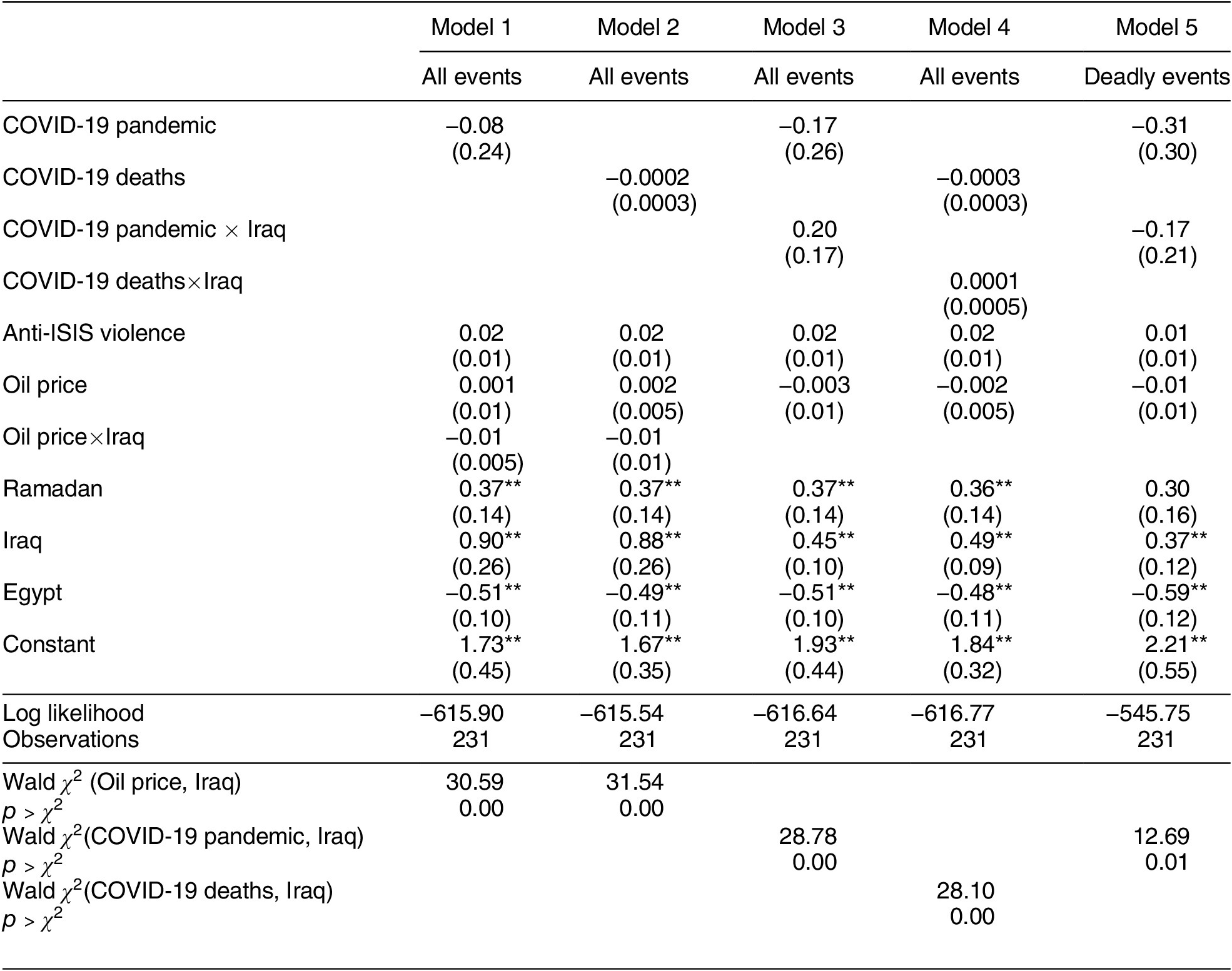
We begin by analyzing the overall effect of the pandemic in order to determine if ISIS violent events increased as a result of the pandemic as many policy-makers and experts feared, and to distinguish the effect of the lockdown measures from other potential effects of the pandemic. The unit of analysis is the state-week since all of the measures in this analysis vary at the state level. Table 1 depicts the results of this analysis.
Relationship of COVID-19 Pandemic to ISIS Violent Events (All, Deadly)
Note: Standard errors in parentheses. * $ p\le 0.05 $
, **
$ p\le 0.05 $
, ** $ p\le 0.01 $
.
$ p\le 0.01 $
.
According to Models 1 and 2, neither the variable for the COVID-19 pandemic, nor the cumulative number of deaths associated with it, is significantly related to the number of ISIS violent events. According to these models and all subsequent ones, the predicted number of violent events is higher in Iraq than Syria, and lower in Egypt than Syria. The number of fatal attacks follows the same pattern.
To explore variation in the pandemic’s effects across countries, we interact our pandemic measures with our state indicators. We show the results for Iraq in Models 3–5 since the number of ISIS attacks is greatest in Iraq. The interaction effects in Models 3–5 are significant at conventional levels according to Wald tests, but lead to different conclusions about the overall effect of the pandemic in Iraq.
Model 3 indicates that in Iraq, the pandemic is associated with a slightly higher number of violent events than the non-pandemic period (e.g., the average number of violent events predicted from the model for Iraq is 2.9% [0.31 events] higher for the pandemic than for the non-pandemic period, assuming that the random effect is zero and all other variables are held at their means). Models testing the interaction effects for Egypt and Syria indicate that the pandemic is associated with a lower number of violent events in Egypt and Syria. (See Table A3 in the Supplementary Material.) Wald tests for these interactions are also significant at conventional levels.
In Model 4, we replace our dichotomous measure of the pandemic with our measure of the cumulative number of deaths due to the COVID-19 pandemic and interact it with Iraq. According to it, the cumulative number of deaths from the pandemic is associated with a lower number of violent events, although the resultant decrease is less in Iraq than elsewhere. The effects for Iraq are modest but noteworthy (e.g., the average number of violent events predicted from the model for Iraq is 16% [1.8 events] lower for the maximum [1,103] than for the minimum [0] number of reported deaths in the analysis period, assuming that the random effect is zero and all other variables are held at their means). The models testing the interaction effects for Egypt and Syria indicate that the cumulative number of deaths due to COVID-19 is associated with a lower number of violent events in Egypt and Syria. Wald tests for these interactions are also significant at conventional levels.
In Model 5, we use deadly ISIS events as our outcome variable instead of all violent events. In this model, we interact our dichotomous measure of the pandemic and Iraq. The difference in the predicted number of violent events for the pandemic and non-pandemic period in this model is noteworthy (e.g., the average number of deadly violent events predicted from the model for Iraq is 38% [2.8 events] lower for the pandemic than for the non-pandemic period, assuming that the random effect is zero and all other variables are held at their means).
We conjecture that the increase in non-deadly attacks that we observed in Model 3 may be due to the temporary reduction in activities by Iraqi and U.S. forces at the outset of the pandemic (March and April 2020). Model 5 would not pick this effect up because we analyze deadly attacks only (rather than all attacks) in it. Total attacks might have increased in Iraq, whereas deadly attacks did not because the increased attacks were against non-civilians and attacks against non-civilians were slightly less deadly than those against civilians, according to the data. Model 4 would not pick this effect up either because we measure the pandemic in it in terms of cumulative deaths. This measure distinguishes earlier weeks in the analysis period from later ones, when Iraqi forces resumed their activities. Consistent with this hypothesis, we find that if we measure the pandemic in terms of the number of weeks that have passed since the first death from COVID-19 in a country, the pandemic is significantly associated with a modestly lower number of violent events in Iraq, as well as Egypt and Syria. (See Table A4 in the Supplementary Material.)
The other variables that are significant in the models in Table 1 are Ramadan and the interaction effect for oil and Iraq. Ramadan is associated with a higher number of ISIS violent events, but not with deadly events (e.g., the predicted number of violent events from Model 1 is 45% [3.13 events] higher for Ramadan than for the period outside it, assuming that the random effect is zero and all other variables in the model are held at their means). The interaction effects for oil and Iraq in Models 1 and 2 are also significant at conventional levels according to Wald tests, with higher oil prices modestly reducing the number of ISIS attacks in Iraq. Anti-ISIS violent events are not significant across models.Footnote 20
Governorate-Level Regression Results
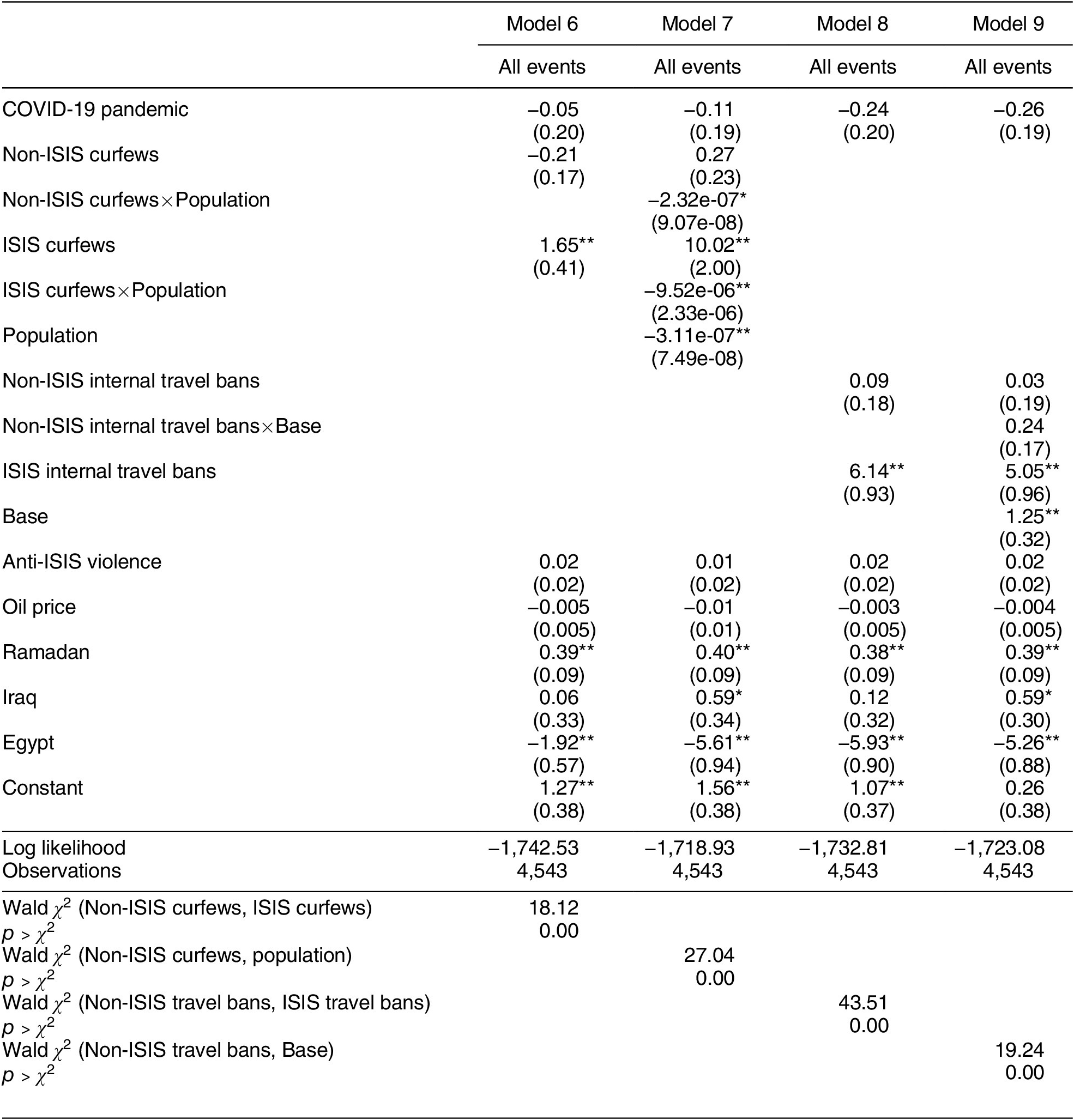
In order to examine the effects of curfews and travel bans on non-state actor violence, and how their effects vary across highly populated and base areas, we conduct a separate analysis of the number of ISIS violent events that occur at the governorate level. Both curfews and travel bans vary across governorates over time although during the pandemic, they were in place in all governorates of Egypt, Iraq, and Syria for 3–4 months. They were lifted prior to the end of the analysis period in Syria, but not in Egypt or Iraq.Footnote 21 In these models, we include the COVID-19 pandemic variable to control for any other factors related to the pandemic that might affect ISIS attacks. The COVID-19 pandemic variable is insignificant across models. If we exclude it, due to collinearity with the lockdown measures, we find that, with the exception noted below, the results for the lockdown measures are statistically and substantively the same.
Table 2 depicts the results of this analysis.Footnote 22 The size of the effects in terms of number of events (but not in terms of percentage change) is smaller for the governorate-level analysis than the national-level analysis because the number of violent events per week per governorate is much smaller than the number of violent events per week per state. The average number of events per week per governorate is 1.05 events (Iraq), 0.75 events (Syria), and 0.24 events (Egypt).
Relationship of Curfews and Travel Bans to ISIS Violent Events (All)
Note: Standard errors in parentheses. The interaction term for ISIS travel bans and base is dropped from Model 9. * $ p\le 0.05 $
, **
$ p\le 0.05 $
, ** $ p\le 0.01 $
.
$ p\le 0.01 $
.
Model 6 indicates that curfews imposed for reasons unrelated to ISIS reduce the number of ISIS violent events in the analysis period relative to no curfews. Those imposed due to ISIS are associated with a significantly higher number of attacks relative to no curfews (e.g., the predicted number of violent events is 19% [0.06 events] lower for non-ISIS curfews than no curfews, assuming that the random effect is zero and all other variables are held at their means). A Wald test indicates that the variables for non-ISIS and ISIS curfews are jointly significant at conventional levels. If we interact the indicators for Iraq and Syria in Model 6 individually with curfews or travel bans, the interaction effects are not significant according to Wald tests, indicating that there is not a significant difference in the impact of these measures on ISIS violent events across countries. We do not conduct separate analyses of the lockdown measures in Egypt due to insufficient variation in violent events across governorates.Footnote 23
Model 7 examines the interaction between curfews and the population of the governorates. According to this model, as expected, the greater the population of the governorate, the more curfews reduce the number of ISIS violent events.Footnote 24 A Wald test indicates that the interaction effect is significant at conventional levels. In Figure 1, we present the number of violent events predicted from Model 7 for Iraq (assuming random effects are zero and all other variables are held at their means) for non-ISIS curfews and no curfews across the full range of governorate populations.
Lockdown Interaction with Population on ISIS Violent Events

As is evident from the figure, the predicted number of violent events declines for both no curfews and non-ISIS curfews as the population of the governorate increases, but the decrease is greater for non-ISIS curfews. For example, the predicted number of violent events is 80% (0.16 events) lower for a governorate the size of Baghdad (8.1 million) when non-ISIS curfews are in place than when no curfews are in place (assuming that the random effect is zero and all other variables are held at their means). For a governorate the size of Najaf (1.5 million), it is 8% (0.12 events) lower when non-ISIS curfews are in place then when no curfews are in place. If we conduct separate analyses for Iraq and Syria, we find the same statistically significant interaction effects for population and curfews in each country. (See Table A18 in the Supplementary Material.)
Model 8 suggests that travel bans imposed for reasons unrelated to ISIS are associated with a higher number of ISIS violent events relative to no travel bans. However, if we drop the pandemic variable from the model, non-ISIS travel bans are associated with a lower number of violent events, as expected. (See Table A13 in the Supplementary Material.) A Wald test indicates that the measures for non-ISIS and ISIS travel bans for this supplementary model are jointly significant at conventional levels. The results are also consistent with our argument regarding base and non-base areas, which is tested in Model 9.
In Model 9, we interact the effect of travel bans with ISIS’s base of operations. According to Model 9, the number of attacks in ISIS’s base area of operations is significantly higher when non-ISIS travel bans are in place than when they are not, as expected. Wald tests indicate that the interaction effect is significant at conventional levels.Footnote 25 If we conduct separate analyses for Iraq and Syria, we find the same statistically significant interaction effects for travel bans and ISIS’s base of operations in each country. (See Table A18 in the Supplementary Material.)
In Figure 2, we depict the predicted number of violent events from Model 9 for base and non-base areas for non-ISIS travel bans and no travel bans. As is evident from the graph, the predicted number of violent events that occur in the group’s base of operations is higher when non-ISIS travel bans are in place than when no travel bans are in place (e.g., in base areas, the predicted number of violent events is 24% [0.33 events] higher for non-ISIS travel bans than no travel bans, assuming that the random effect is zero and all other variables are held at their means). The predicted number of violent events in non-base areas is practically the same for non-ISIS travel bans and no travel bans.
Lockdown Interactions with Base on ISIS Violent Events

GIS Mapping
To further explore quantitatively the nature of the effects of curfews and travel bans during the pandemic, we track the number and location of ISIS attacks within and across governorates of Iraq using GIS.Footnote 26 Since space does not allow an analysis of all three countries, we focus on Iraq—where ISIS was most active pre-pandemic. Similar analyses (e.g., chi-square tests) available in Figures A2 and A3 in the Supplementary Material for Egypt and Syria yield consistent results. The GIS analysis compares the location of ISIS violent events in Iraq when lockdown measures (i.e., curfews and travel bans) were in place during the pandemic in all governorates in 2020 (March 9 to June 28) with a comparable period when lockdown measures were not in place in any governorate in 2019 (March 11 to June 30).
In the pandemic period chosen for this analysis, our two types of lockdown measures (i.e., curfews and travel bans) coincided temporally. In the spatial analysis, therefore, we cannot distinguish empirically the effects of travel bans from those of curfews. However, theoretically, we expect travel bans and curfews to have spatially distinct effects that we can distinguish visually. That is, we expect travel bans to affect mobility between governorates, whereas we expect curfews to affect violence within governorates based on their population density. To examine these distinct effects, we construct two different sets of maps. The first shows changes in the number and location of events across governorates, which we expect to be affected by travel bans. The second hones in on differences within governorates in the number of events in urban versus rural areas, which we expect to be affected by curfews.
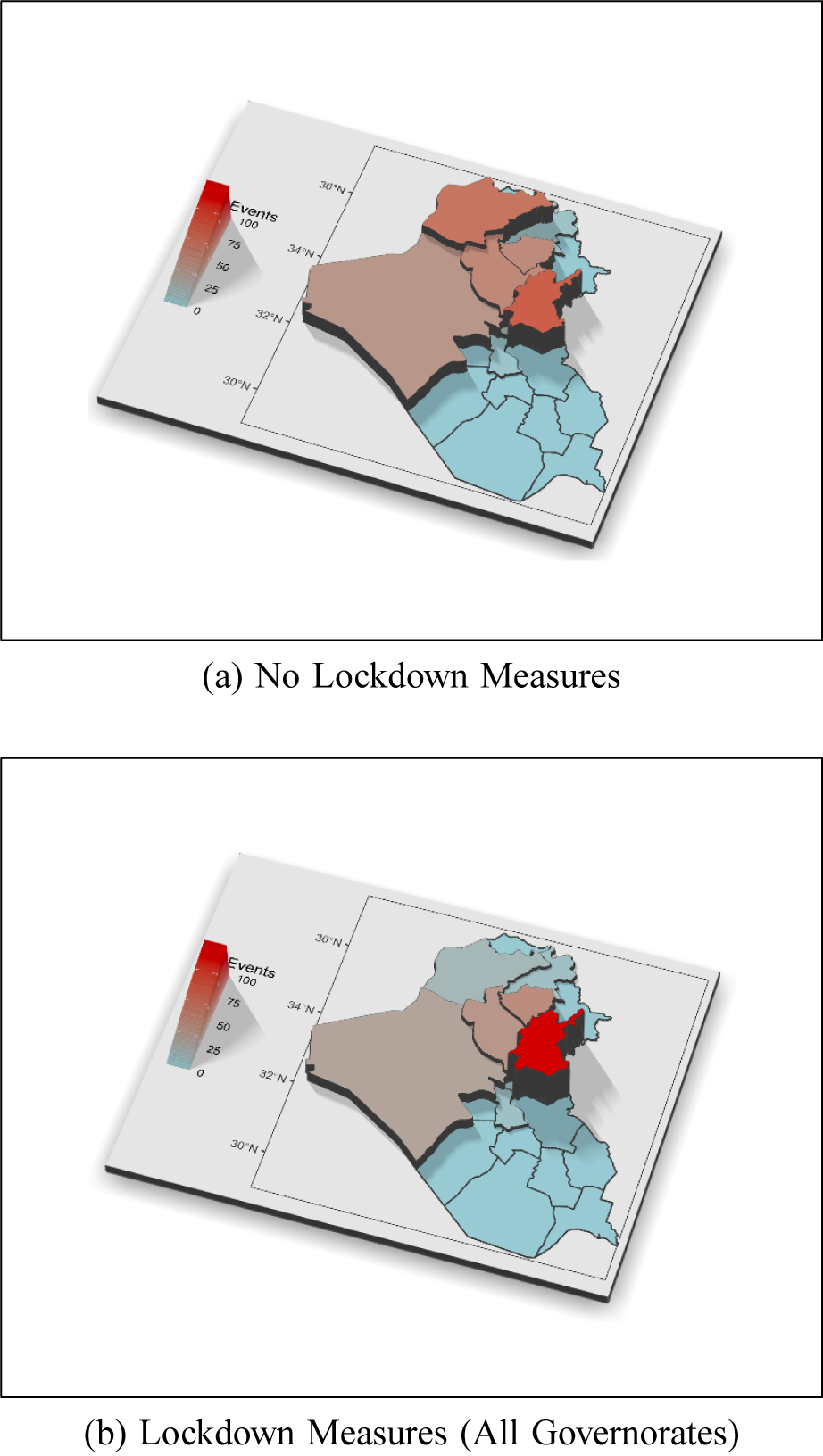
The heatmaps in Figure 3 illustrate the difference across governorates in the location of events when no lockdowns were in place in any governorate compared to the location of events when lockdowns were in place during the pandemic in all governorates.Footnote 27 The darker (and redder) the color and the higher the governorate, the greater the number of events in the governorate. As the figure shows, in 2019, when lockdown measures were not in place in any governorate, there were more ISIS violent events over a larger area of Iraq, especially in al-Anbar in the East and in Salah al-Din in the North, as expected, than in the same period in 2020 when lockdown measures were in place in all governorates. In 2020, the number of events was more concentrated in the eastern governorate of Diyala, with the number of violent events in the West and North lower. Diyala is the base of ISIS’s operations in Iraq.Footnote 28
Lockdown Measures and ISIS Violent Events: Base versus Non-Base Areas
A join-count analysis (di Salvatore and Ruggeri Reference di Salvatore and Ruggeri2021), testing the non-randomness of individual event locations, verifies the impression of the spatial concentration of events suggested by the maps. The spatial clustering of violent events is highly statistically significant ( $ p<0.001 $
), both before and after lockdown measures were instituted. Furthermore, and also as expected, the join count reveals that the variance of event distributions is greater before lockdown measures were instituted than during them.Footnote 29
$ p<0.001 $
), both before and after lockdown measures were instituted. Furthermore, and also as expected, the join count reveals that the variance of event distributions is greater before lockdown measures were instituted than during them.Footnote 29
Figure 4 depicts the same event information presented in the heatmaps in a bar plot. It also shows the results of a chi-square test of the difference in the distribution of violent events across governorates when lockdowns were in place during the pandemic in all governorates (“lockdowns” bar) and the comparison period the year prior to the pandemic when no lockdowns were in place in any governorate (“no lockdowns” bar). The left scale is a raw count of the number of events. As expected, the chi-square confirms what the tests of spatial autocorrelation suggested, that the location of events perpetrated in each governorate in the two periods examined is highly significantly different ( $ p\le 0.001 $
).Footnote 30
$ p\le 0.001 $
).Footnote 30
Testing Lockdowns Relationship to Changes in ISIS Violent Events Location across Governorates: Base versus Non-Base Areas

Using the same data, but visualizing the theorized effects of curfews within governorates, the density map contours in Figure 5 illustrate the difference in the location of events in urban versus rural areas when no lockdowns were in place in any governorate in 2019 and when lockdowns were in place in all governorates in 2020 during the pandemic. The density curves suggest that when lockdowns were in place, the number of attacks in large population centers including Baghdad—the most populous governorate and capital of Iraq, and in Mosul the second largest city in Iraq and the capital of the governorate of Nineveh—was substantially lower than when no lockdowns were in place, as expected. In contrast, the number of events declined less or even increased in rural areas, especially in some of the more sparsely populated governorates, such as Diyala and Salah al-Din.
Lockdown Measures and ISIS Violent Events within Governorates: Urban versus Rural Areas
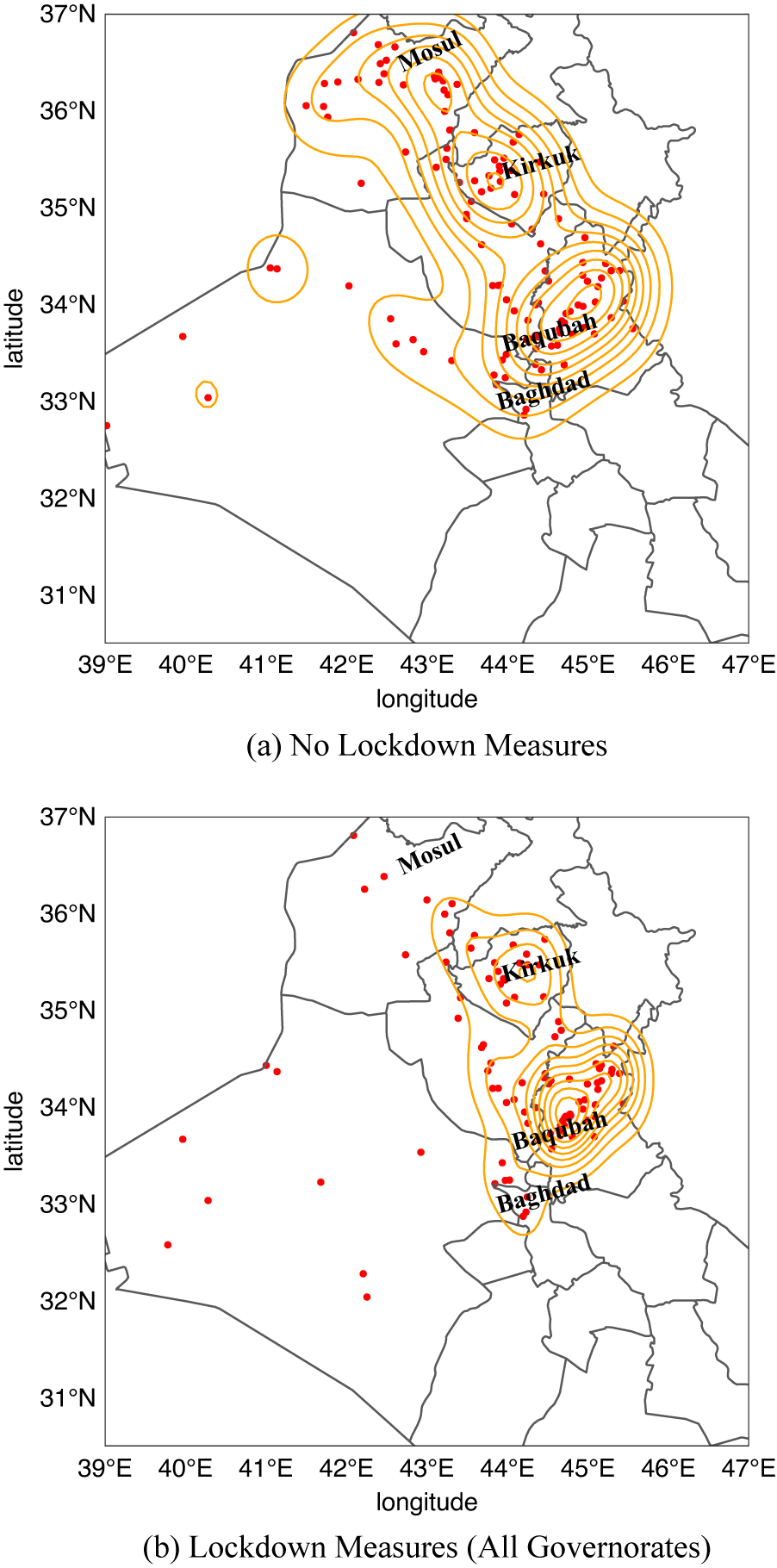
Figure 6 tests the impression given in the density maps that the lockdown measures reduced the number of attacks in urban areas, but not in rural areas of Iraq. The figure shows the number of events by three types of location: governorate capital, other urban centers, and rural areas, when lockdown measures were instituted in all governorates in 2020 (“lockdowns” bar) and in the comparison period in 2019 when no lockdown measures were in place in any governorate (“no lockdowns” bar). As is apparent from Figure 6, the difference in the number of events perpetrated in these three types of areas in these two time periods, according to the reported chi-square test, is statistically significant ( $ p\le 0.0125 $
) and as expected, with the number of incidents being lower in urban but not in rural locations during lockdowns.
$ p\le 0.0125 $
) and as expected, with the number of incidents being lower in urban but not in rural locations during lockdowns.
Testing Lockdowns Relationship to Changes in ISIS Violent Events Location within Governorates: Urban versus Rural Areas

A Closer Look at the Mechanisms
In order to evaluate the extent to which each of the mechanisms (e.g., resources, targets, and logistics) by which we theorize lockdowns reduce non-state actor violence can explain the relationships that we observed in our quantitative analysis, we look qualitatively at the effects of the lockdown restrictions imposed due to the COVID-19 pandemic on ISIS in Egypt, Iraq, and Syria. We find evidence that the lockdowns inhibited the ability of ISIS to operate through all three pathways. The immediate decline in violence that we identified in our statistical analysis, though, is most likely due to the effect of these measures on ISIS’s targets and ease of operation, rather than its resources, given the group’s substantial reserves.
To establish a foundation for this analysis, we first describe the lockdown restrictions implemented in each state. (See Table A1 in the Supplementary Material for complete list.) In March 2020, the Egyptian, Iraqi, and Syrian governments imposed extensive and protracted lockdown restrictions (both travel bans and curfews) on their populations to contain the COVID-19 virus. At the time, Egypt already had both curfews and travel bans in place in the Northern Sinai to combat ISIS fighters there. These measures prohibited most travel into the Northern Sinai and restricted residents’ movements within different locales of the governorate. The measures were imposed as part of a state of emergency established in Egypt after the 2013 coup d’état, and were accompanied by other counterinsurgency measures, including media and communication blackouts, evictions, and building demolitions.
Neither Iraq nor Syria had any lockdown measures in place at the time they imposed restrictions to contain COVID-19. In the year prior to the pandemic, though, local governments in both states imposed lockdowns for different reasons. In Iraq, several local governments, including Baghdad, established curfews to control anti-government protests demanding improvements in government services, corruption, employment, and so forth. These restrictions were well enforced but in effect only at night, and for no more than a few weeks. In Syria, local governments imposed lockdowns to maintain security after ISIS and other insurgents carried out attacks. These restrictions were not as well enforced as those in Iraq, and in place for no more than a week, but they closed some public institutions, whereas the Iraqi measures did not, and were in effect day and night.
In contrast, the lockdown measures adopted due to the pandemic were imposed in all governorates and localities in all three countries without regard to the pre-existing level of violence in them. They were also extensive and long-lived (i.e., 3–4 months).Footnote 31 Lockdowns in place in the Northern Sinai in Egypt prior to the pandemic continued after this period. In Egypt and Syria, all nonessential private and public institutions were completely closed. In Iraq, all nonessential private institutions were closed and the hours of operation of all public institutions were halved. Essential institutions included police, hospitals, and other medical establishments, as well as state institutions involved in relief efforts. Schools and religious institutions were considered nonessential. All outdoor activities were banned. All nonessential travel between governorates was also banned in all three states. Cargo and security forces were considered essential. Lacking control of any territory of its own, ISIS was subject to these restrictions and did not impose restrictions, or undertake any pandemic-related community outreach of its own (e.g., provision of medical supplies or food relief).
Although the lockdowns were extensive and long-lived in all three states, they were not perfectly enforced in any of them. Military and police forces were used in all three states to enforce the lockdowns, and to provide other pandemic-relief efforts (e.g., distributing medical supplies, sanitizing public areas, establishing field hospitals, and managing burials). In Iraq and Syria, due to staffing shortages, security forces used to combat ISIS were redirected to enforce the lockdowns. Even in Iraq, though, where the initial threat from ISIS was greatest, this did not seem to create more security vulnerabilities. In fact, while under lockdown, Iraqi forces plugged vulnerabilities along its border with Syria, adding barbed wires and cameras over more than half of the border. In Egypt, there were no known shortages in or substantial redeployment of forces to enforce the lockdowns.
Even though the pandemic-related lockdowns were not strictly enforced in these states, they substantially changed the movements of the population. Modest improvements in air quality (Hashim et al. Reference Hashim, Al-Naseri, Al-Maliki and Al-Ansarib2021) and significant declines in economic growth in all three states (World Bank 2020) attest to this fact. Although there was likely variation in the enforcement of the lockdowns across locales, there is no evidence that the lockdowns were enforced in a way that would explain the patterns we observed in our quantitative analysis. That is, there is no evidence that the measures were enforced more strongly in the areas where the decline in violence was greatest (i.e., highly populated governorates and non-base areas).Footnote 32
However, there is substantial evidence that the lockdowns affected ISIS in the three ways that we hypothesized. The lockdown measures strained ISIS’s resources in a number of ways. They reduced the funds that ISIS was able to generate from allied businesses that were closed down by the restrictions. These businesses range from currency exchanges and car dealerships to pharmacies and fish farms (Kenner Reference Kenner2019). They also decreased the money ISIS was able to collect from locals. With locals strapped economically, ISIS reduced the taxes it charged local traders and businesses, according to Omar Abu Laila of Deir Ezzor 24, a Syrian development organization.Footnote 33 ISIS relies substantially today on local extortion, especially on oil supply lines, for funds since it no longer controls any oil fields of its own (Kenner Reference Kenner2019).
The lockdown measures also disrupted ISIS’s ability to transfer funds among cells within and across countries because they shut down the financial institutions on which these transactions depend (e.g., hawalas, couriers, and financial facilitation networks). Syrian cells are especially likely to have been affected since they depend on transfers from wealthier Iraqi cells.Footnote 34 The lockdowns may also have disrupted ISIS’s smuggling networks, which operate through bribes of corrupt local security officials. According to General Waleed al-Rawi, former Chief of Staff for the Iraqi Minister of Defense, by reducing population movements, the lockdowns left corrupt officials more exposed to detection and less likely to collaborate with ISIS.Footnote 35
Whatever resource strain ISIS experienced as a result of the lockdowns, this strain is unlikely, though, to account for the reduction in violence that we observed in the quantitative analysis. The decline in violence that we observed was immediate. Yet, ISIS had substantial financial reserves at the time, estimated to have been in the hundreds of millions, which it could rely on in the short term to fund its activities (Kenner Reference Kenner2019). The lockdown measures were also only in place for a few months—too short for ISIS to have been severely harmed financially given its large reserves. Once the lockdowns were lifted, ISIS reportedly resumed its normal economic activities.
ISIS was not advantaged by a similar decline in government resources as a result of the pandemic. In Iraq, the government’s ability to fight ISIS at the outset of the pandemic may well have been hampered by the reduction in the activities of U.S. and Iraq forces, as previously described, but these changes were not a result of the financial strain of the lockdowns. Moreover, although the Iraqi, Syrian, and Egyptian governments were adversely affected financially by the lockdowns, none of them are known to have reduced their spending on combating ISIS as a result. Not only did the Egyptian government not cut military spending, but it also reportedly distributed a disproportionate amount of COVID-19 relief aid to military-owned businesses (Whitehouse Reference Whitehouse2020).
The decline in violence that we observed in the statistical analysis is more likely due to the reduction in the number of high-value civilian targets for ISIS, as well as the lockdowns making it logistically more difficult for ISIS to conduct attacks. ISIS fighters target civilians for a number of reasons. They attack civilians in retribution for their supporting government security forces. They kidnap civilians for ransom and attack Christian and Shiite Muslims seen as heretics. ISIS also unintentionally kills civilians through indiscriminate violence, such as roadside bombs. Thus, a decline in the number of civilians in public would invariably reduce the number of potential civilian targets for and incidental victims of ISIS. Indeed, the number of attacks against civilians as a percentage of total attacks declined under lockdown restrictions in the data.
Civilians, though, are not ISIS’s primary targets today. Only about a quarter of ISIS’s attacks in 2019 involved civilians, according to ACLED. ISIS’s primary targets today are government security (e.g., military and police) forces. The lockdowns did not apply to them and, therefore, would not have changed the number of government targets available to ISIS. Thus, the reduction in the number of high-value civilian targets for ISIS as a result of the pandemic is unlikely to account for the entire decrease in violence that we observed in the statistical analysis. The impact of the lockdowns on ISIS’s ease of operation was likely also important.
The lockdowns made it more difficult for ISIS to operate logistically by impeding its communications, reducing its physical cover, and increasing checks on its movements. The curfews obstructed communications because ISIS relies heavily on in-person communications to transfer orders and directions to local members in order to avoid detection. With fewer people on the streets, ISIS was not able to rely on in-person communications to conduct operations without exposing its members to a greater risk of detection.Footnote 36
The curfews also left ISIS fighters more exposed to detection by reducing its physical cover. ISIS fighters move around largely in miles-long tunnels and hide in caves located in sparsely populated dessert areas. To launch attacks, fighters need to leave their hideouts. It is at this point that the lack of people on the streets due to curfews left fighters more exposed to detection, according to Lieutenant General Pat White, the former commander of Inherent Resolve.Footnote 37 The effect would have been less apparent in rural areas where there were fewer people serving as cover for ISIS in the first place.
The travel bans also left ISIS fighters more exposed by placing additional checks on their movements. To enforce the travel bans, governments established additional check points on roads and other points of entry. At these points of entry, security forces verified identification cards and permitted only those allowed to travel between governorates (e.g., cargo trucks, government security forces, and medical services) to proceed. ISIS’s tunnels did not allow its fighters to completely avoid these checkpoints because the tunnels were limited to specific areas within countries.
These logistical challenges could have reduced violence in one of two ways: they could have deterred ISIS from launching attacks or resulted in a greater number of attacks being foiled before they occurred. Since there were no reports of substantially more arrests of ISIS members during the lockdowns, the effect was likely deterrent in nature and, thus, limited to the time the lockdown measures were in place. Intelligence gathering on which the fight against ISIS, including the air campaign, depends was indirectly affected by the lockdowns because it relies on locals for information regarding the location of fighters. With fewer persons in the streets, there were fewer opportunities for intelligence gathering.
In sum, our qualitative analysis indicates that all three of the mechanisms that we identified are plausible ways that lockdowns can reduce non-state actor violence. The analysis also suggests that the effects we observed in our statistical analysis are likely due to the reduction in high-value civilian targets for ISIS and the logistical challenges that lockdowns posed. These effects were short-lived, generally lasting only as long as they were in place. Within six months, the average number of ISIS-initiated violent events returned to pre-lockdown levels in all three states (Raleigh et al. Reference Raleigh, Linke, Hegre and Karlsen2010). Furthermore, by the following year, ISIS had launched its deadliest attacks since losing control over its territory, storming a prison in Syria and army barracks in Iraq.
Conclusion
In contrast to widespread concerns that the pandemic would increase violence by non-state actors, such as ISIS, our analysis finds that lockdown measures used to control the pandemic curtailed ISIS attacks in the period analyzed, especially in more populated areas and areas outside ISIS’s base of operations. These results add to the fast-growing body of research about the effects of the pandemic, and public health crises more generally, on society. Academic research has looked at the effects of lockdown restrictions on a multitude of factors besides disease transmission. These include crime (Nivette et al. Reference Nivette, Zahnow, Aguilar, Ahven, Amram, Ariel and Burbano2021), economic growth (Fernandes Reference Fernandes2020), education (Dorn et al. Reference Dorn, Hancock, Sarakatsannis and Viruleg2020), and the environment (Le Quéré et al. Reference Le Quéré, Jackson, Jones, Smith, Abernethy, Andrew and De-Gol2020), among others. With this project, we extend our understanding of these measures’ wide-sweeping effects to non-state actor violence.
The analysis contributes to our understanding of the effects of lockdowns on non-state actor violence in a number of ways. We identify multiple mechanisms (i.e., resources, targets, and logistics) by which lockdown measures can affect the intensity and location of non-state actor violence and distinguish among them in terms of the immediacy and longevity of their effects. We also characterize the contexts in which different mechanisms are likely to have a greater effect than others, and test our hypotheses both quantitatively and qualitatively. This contextualization allows us to speak to the likely effects of these measures on non-state actors more broadly.
We expect lockdowns to have similar effects on violence in other contexts since lockdowns, whether imposed after a natural disaster or in a situation of political instability, alter population movements. We also expect them to have a greater effect on most non-state actors that do not control their own territory today. Most non-state actors have much less funding than ISIS, target civilians more heavily than ISIS, and operate today in urban areas, and, therefore, are more vulnerable to the effects of lockdown measures than ISIS. Still, we must be mindful not to construe lockdown measures as a magic bullet against insurgencies since lockdowns can have other negative side effects on society (e.g., education, mental health, and poverty), especially in developing countries where non-state actors tend to operate.
SUPPLEMENTARY MATERIAL
To view supplementary material for this article, please visit https://doi.org/10.1017/S0003055422001423.
DATA AVAILABILITY STATEMENT
Research documentation and data that support the findings of this study are openly available in the APSR Dataverse at https://doi.org/10.7910/DVN/JPHHJV.
ACKNOWLEDGMENTS
The authors would like to thank General Stanley McChrystal; Brett McGurk, former U.S. Special Presidential Envoy for the Global Coalition to Counter ISIS and Ambassador Anne Patterson for conversations about the project; Jim Gimpel and Adrian Baddeley for helpful exchanges about spatial data; Ekaterina Vanurina for research assistance; Dolores Ciccone for editorial assistance; Barbara Esty and Kenya Flash at Yale University and Judith S. Markowitz at the University of Maryland for data librarian assistance; and our colleagues at the Interdisciplinary Lab for Computational Social Science (https://ilcss.umd.edu) for support of the project. J.B. would like to thank the Snider Center at the University of Maryland for summer support.
CONFLICT OF INTEREST
The authors declare no ethical issues or conflicts of interest in this research.
ETHICAL STANDARDS
The authors declare that the human subjects research in this article was reviewed and approved by the Internal Review Board at the University of Maryland, College Park (1616403-2) and certificate numbers are provided in the Supplementary Material. The authors affirm that this article adheres to the APSA’s Principles and Guidance on Human Subject Research.


 Open access


Comments
No Comments have been published for this article.