

In his book, The Story of the Blues, Paul Oliver gives Frankie “Half Pint” Jaxon a strange introduction: Jaxon “was something of an anomaly.”Footnote 1 To be specific, he did not sound like the other Kansas City male singers Oliver compares him to. Or more to the point, he did not sound like a man. As Oliver puts it: Jaxon’s “feminine, shrill voice had none of the Kansas City vocal quality.” It was not just the voice. Oliver also mentions that Jaxon “made a hit as a female impersonator.” The one paragraph on Jaxon is pretty much all Oliver has to say about queer blues musicians.Footnote 2 Nothing can be read about Bessie Smith and Ma Rainey, the Empress and Mother of the Blues, respectively, having romantic relationships with women and casting queer characters like “sissies” in their songs.
Queer musicians and characters apparently do not fit into the story of the blues—or rather, in some stories of the blues. The lives and songs of queer artists like Jaxon, Smith, and Rainey would get their own story, but only after other ones had been told many times, so often that they became, as Oliver’s title says, the story of the blues. As cultural historian Marybeth Hamilton has shown, established strands of blues history avoided the profusely erotic moments, queer or straight, in the genre.Footnote 3 The early twentieth-century White folklorists who collected blues and other Black songs in the South, for example, referred to such sexually charged moments as “pornography” and “rotten with filth.”Footnote 4 In the decades after World War II, “blues commentators” idealized country blues artists like Robert Johnson, whose music captured the writers’ conception of the “authentic contours” of the genre: “rural, male, non-commercial, and permeated by sorrow.”Footnote 5 They dismissed the sassy songs about sex performed by Smith and Rainey as commercial fare created for urban, thrill-seeking audiences. Oliver singled out Smith’s “Empty Bed Blues” (1928), which piles one sexual metaphor on top of another. The song, according to him, “was clearly directed at a market seeking a vicarious satisfaction from pornographic records.”Footnote 6 The “unsubtle imagery,” he added, “does not result from a fundamentally innocent expression of libidinous instincts as may be noticed in many folk blues.”Footnote 7
The story of the queer blues would emerge, and not surprisingly, in scholarly and musical sources far removed from the above histories. The scholarly chronicle of the queer blues began to unfold with biographies of Smith and Rainey from the 1970s and 1980s.Footnote 8 They discussed the singers’ sexuality and the ways their songs embraced queer topics. The next chapter in that history includes feminist studies that covered female blues singers of the 1920s and 1930s as a group.Footnote 9 Approached as such, their recordings, as described by Angela Davis, “divulge unacknowledged traditions of feminist consciousness in working-class black communities.”Footnote 10 She reveals the intersectionality of their songs achieved through “aesthetic representations of the politics of gender and sexuality” being “informed by and interwoven with their representations of race and class.”Footnote 11
Queer desire is a prominent thread running through these feminist studies, but it is one of many threads. Queerness eventually became a topic in itself. The 1977 album AC-DC Blues compiled songs by queer musicians from the 1920s to the 1930s.Footnote 12 Nearly fifty years later, it was followed by the first book on such musicians, Darryl W. Bullock’s Queer Blues: The Hidden History of Early Blues Music.Footnote 13 Another development in the story of the queer blues has been the focus on gender-nonconforming artists, particularly Gladys Bentley, who wore a suit and top hat and married a White woman. Bentley appears in Saidiya Hartman’s study of young Black women in the early twentieth century. Those women were “radical thinkers who tirelessly imagined other ways to live and never failed to consider how the world might be otherwise.”Footnote 14 In a phrase that serves as a historical throughline in the queer blues, Bentley declared “queer and outlaw passions.”Footnote 15
This study of Jaxon draws upon the work that has shaped the story of the queer blues. It also turns a new page in that story by being the first study devoted to a male musician. Much of the work in the queer blues history of the 1920s and 1930s has been on female artists, which is understandable given that they were both celebrated musicians and, as revealed by feminist scholars, incisive social critics. Black queer male musicians were obviously involved in the blues and popular music of the time. They include, besides Jaxon, Billy Banks (aka Billy Rose), Jimmie Daniels, George Hannah, Dick Barrow (aka Sepia Mae West), Walter Winston (aka Sepia Gloria Swanson), Porter Grainger, and Guildford Payne. A lack of press coverage and recordings has kept most of them in obscurity. Not so with Jaxon. His busy career as a singer, composer, dancer, producer, and bandleader was well covered. He also released a large number of recordings, which reveal the queer aspects of his work. In some songs, he plays the part of a man; in others, he takes on the role of a woman. Some of these characters—both male and female—revel in the pleasures of sex with men. Jaxon appeared in drag during shows, but there are no known sources describing how he incorporated it into his performances, nor are there extant images of him in drag.
To explore Jaxon’s queer blues, this study will focus on three topics: transformation, voice, and desire. The three form a circuit in which creative and erotic energies flow between them. A transformation to a more feminine-sounding voice, for example, can release the erotic pleasures of a sissy, which can then lead to further changes in the melody and lyrics of a song, alterations that may inspire new vocal and erotic moments.
Transformation is central to Jaxon’s music and, as we will see, his career too. The scope of his transformations raises several questions. First, what is transformed? The changes begin with songs. Jaxon’s recordings reveal songs being reimagined, both pre-existing ones by other musicians and his own songs, as heard in his four versions of his hit “Fan It.” Jaxon not only changes the melodies, lyrics, and styles of songs but also his voice by taking on different colors and personas. As the voice changes, so does Jaxon, particularly in terms of perceived gender. Many different Jaxons emerge in the recordings, from a man boasting about the sexual charms of his girlfriend in “She Can Love So Good” (1930) to a woman finding a cure of ecstasy with her doctor in “Operation Blues” (1929).Footnote 16
As to how to understand these extensive transformations, this study approaches them from two perspectives. When it comes to the music and topics of songs, Jaxon can be heard practicing the Black tradition of signifyin’, in which an individual flaunts their creativity by showing how they can turn out familiar sayings, songs, or other strands of culture in intriguing ways.Footnote 17 So masterful is Jaxon at signifyin’ that he gives songs whole new lives and meanings, as can be heard with “My Daddy Rocks Me” (1929). The transformations can also be considered from a queer theory perspective. José Esteban Muñoz’s concept of disidentification describes how queer people of color transform dominant narratives and ideologies by working both within and against them.Footnote 18 These alterations create a space for them to speak of their own experiences. Such is the case with the sissy, a figure mentioned but never heard from directly in the blues, that is, until Jaxon’s transformations gave him moments to sing about the sissy’s desires.
Signifyin’ and queer theory make for an unusual pairing in that they have apparently not come together before in the literature, at least not in music studies. Far from being odd fellows, the two extend each other’s critical range. Queer theory, for example, can reveal how the wit and metamorphoses of signifyin’ can support the resistance and refuge offered by disidentification. Muñoz highlights the transformations practiced by queer artists of color in individual works, but he does not address larger practices of transformation, like signifyin’, and how they have been used by those artists to challenge dominant ideologies.
Finally, what do Jaxon’s transformations tell us about the story of the queer blues, including the social role of the blues, queer desire, and queerness itself in early twentieth-century Black culture? Angela Davis, to recall, described how the intersectionality created by female blues singers’ representations of race, gender, sexuality, and class gave them a space in which to express an emergent “feminist consciousness.”Footnote 19 The queer blues of male musicians configured those four areas in different ways, but the music still produced an opening to shape new conceptions of queerness and desire. Desire was such a strong force in Jaxon’s music that he asked questions about it, particularly “what does it do to us?” and “what should we do with it?” The answers offered by his songs added to emerging ideas of queer desire and queerness. Jaxon’s music reveals a queerness that is dynamic and multifaceted, a world in which sounds, voices, and personas continually change, creating new possibilities.
Jaxon: Life, Career, and Queer Biography
As important a figure as Jaxon may be in the queer blues, he still requires an introduction.Footnote 20 True to his esthetics of transformation, the following biographical portrait concentrates on changes in his career and repertoire over the course of the roughly thirty years he spent on stage. Frank Devera Jackson was born in 1897 in Alabama.Footnote 21 He later respelled his last name, and the nickname “Half Pint” came from fellow soldiers in WWI who teased him about his height (5′2′′). By around the age of ten, he was already performing and joined a traveling company led by Henry McDaniel, the father of Oscar winner Hattie McDaniel. It is not clear what type of music he was performing at this time. At some point, Jaxon became involved in the company created by Bert Williams and George Walker, which significantly shaped Black music and dance in the early twentieth century.Footnote 22 It put Black artists before large audiences in elaborate productions built around dramatic themes. Jaxon’s role in the company is unclear. The press called him both an “understudy” and “protégé” of Walker.Footnote 23 The elder performer, however, passed away in 1911, which leaves questions about when Jaxon would have joined the company and how long he had to work with Walker. However long it was, Jaxon got to know Walker’s performances well, so well that he brought Walker’s mother to tears by imitating his signature moves in a benefit concert for her.Footnote 24
During the 1910s and 1920s, Jaxon’s career stretched across venues, roles, and genres. He became active in Black vaudeville, which could showcase his diverse talents as a singer, dancer, and producer. Jaxon refers explicitly to vaudeville at the end of “Saturday Night Scrontch” (1929) by shouting “Look out, T.O.B.A!”—that is, the Theatre Owners Booking Association, the organization that contracted Black entertainers.Footnote 25 What did the organization have to look out for? Jaxon may be referring to the sexual skit preceding the warning. In it, he, typical of his performance of other songs, plays both male and female roles.Footnote 26 The woman begs “Scrontch me, Daddy” and says that her “hard man” feels like the “Rock of Gibraltar.”Footnote 27 “Scrontch” was slang for dance, but with Jaxon’s tone and delivery, it also comes across as something sexual. Perhaps the skit was too risqué for some T.O.B.A venues. While Jaxon recorded such songs, it is not clear where, or even if, he performed them in clubs, but the fact that he recorded so many suggests that they were part of his act.
As Jaxon recalled in a 1940s interview, he did some cross-dressing for shows. When he was around sixteen, he dressed as a woman in skits with vaudeville comedian Gallie de Gaston.Footnote 28 About later performances with Helen Lee, he recalled: “Sometimes she would impersonate me in the type of clothes that I wore, and I would do the opposite with her in a finale, dressed as she would as a female.”Footnote 29 Cross-dressing was not uncommon in Black vaudeville, which featured female impersonators (as they were known at the time).Footnote 30 While cross-dressing never became Jaxon’s primary act, as was the case with those entertainers, it remained part of his repertoire. Just how big a part is not known.
Jaxon initially won attention as a dancer, receiving praise for his “inimitable” “dance ideas.”Footnote 31 His performances had him moving back and forth between Black clubs in Atlantic City and Chicago. Drawing upon his experience with the Williams and Walker company, he directed evening-length entertainments such as The Streets of Cairo, an “Orientalist review” in which Jaxon played the part of Lovin’ Sam, the Sheik from Alabara.Footnote 32 His work as a director and producer extended to shows with Bessie Smith and Ethel Waters. By the end of the 1920s, Jaxon had primarily become a solo singer. His repertoire included different stripes of blues and blues-based songs featuring jazz rhythmic currents. He found his way into the recording studio, securing contracts with the Brunswick and Gennett labels.
The 1930s brought on another metamorphosis: Jaxon became a bandleader. He had two ensembles, the Hot Shots and Pints of Joy. His shift to conducting was part of a larger development in the music world. During the 1920s, Black ensembles led by celebrated directors like Duke Ellington and Fletcher Henderson became more popular and influential, which contributed to the emergence of the big bands of the Swing period. Although Jaxon’s ensembles of five to eight players were not as large as the most famous bands, the emphasis, as with those bands, was on a well-known director and his ensemble. Like many swing bands, his groups had regular radio gigs, including a spot on WJJD in Chicago.Footnote 33 Jaxon’s dynamic sound, which caught the attention of White musicians and listeners, created opportunities for him to cross the color line. Band leader Guy Lombardo exclaimed, “That band has something.”Footnote 34 Jaxon appeared with White ensembles (Mae Dix’s Chicago Harmonaders) and played at White clubs, like the White Horse tavern in Kansas City. Success brought him back to the recording studio and a three-year contract with Decca (1937–40). By 1941, Jaxon had retired. He held a government job in Washington, D.C., before moving to Los Angeles, where he passed away in 1953.
It is hard to think of another musician who made it from the Williams and Walker productions of the 1900s and 1910s through the blues rage of the 1920s and then on to the swing boom of the 1930s. That Jaxon stayed afloat in those changing stylistic currents was because of his ability to transform. Performers often struggle to move from the style in which they strike success to the next big style. Blues royalty Bessie Smith and Ma Rainey, for example, could not establish themselves in the jazz and swing idioms of the 1930s.
Jaxon not only thrived in the stylistic flux of the time, but his act also suited the changes occurring in queer performance spaces. During the 1920s and 1930s, those spaces in Northern cities broadened beyond the clandestine saloons and other spots claimed earlier in the century.Footnote 35 With what has been called the pansy craze, White female impersonators like Jean Malin and Karyl Norman stepped into revues, theatrical shows, and even films. Black queer musicians may not have attracted as bright a spotlight, but they still drew attention and performed in more public venues. The Black press, for example, covered performances by Sepia Gloria Swanson, and Gladys Bentley intrigued White and Black audiences at the Ubangi Club in Harlem.
Black queer musicians performed in clubs that were part of the growing queer spaces created by the arrival of LGBT Black people in Northern cities during the Great Migration. As historian Chad Heap has noted, these performance spaces were not as clearly divided along hetero and homosexual lines as White queer performance settings were. According to Heap: “Race complicated the process of sexual identification and categorization in this period, with black nightspots providing even more room for experimentation than white venues did… black leisure spaces remained arenas in which sexual identities were less fixed and sexual encounters less regulated.”Footnote 36 In his study of 1930s Chicago, Roderick A. Ferguson describes how “black neighborhoods became the signs of moral instability and alternative gender and sexual formations.” “Vice districts” emerged where “blacks and whites, as well as heterosexuals and homosexuals could congregate.”Footnote 37 Although we cannot connect Jaxon to known queer performance venues, his changes of voice, gender, and sexual pleasure suited the “intermediary space” for gender and sexuality that was formed in Black queer spaces of the time.Footnote 38
The identification of Jaxon as queer in this article rests on the songs that he recorded, which abound with queer moments. As discussed below, Jaxon indulges in a sexual encounter with a male lover in “My Daddy Rocks Me.” He followed the song with two other recordings in which “Daddy” “rocks” and “swings” him: “Take It Easy” (1929) and “Take It Easy Greasy” (1936). His rendition of “Willie the Weeper” (1927) mentions a man dancing in his “BVDs” and “biscuits” that are “eighteen inches long.”Footnote 39 As with his work on stage, Jaxon took on different gender identities in his songs. Of the around eighty recordings that he made, sixteen feature him playing the roles of both female and male characters.Footnote 40 “Operation Blues” is the only recording in which he performs exclusively as a woman. In that song and seven others in which Jaxon presents female and male characters, the women—that is, Jaxon—enjoy sexual moments with the male characters.Footnote 41 The woman in “I Wonder Where My Easy Rider’s Gone” (1929) recalls “joyridin’” with her unfaithful lover while she eagerly waits for him to get home for more joy. Home also offers sexual rewards in “Can’t You Wait Till You Get Home?” (1927). The woman tells her man to hold off until they are back at their place, where he “gets it once, sometimes twice.” In the songs that do not feature sexual scenarios, the female characters usually make sassy responses to men.
Outside of the recording studio, Jaxon never publicly said anything about being queer. His friends, fellow musicians, or possible lovers were also silent about his sexuality. He did, though, boast about being robustly straight in an interview done in the 1940s during his retirement: “I’ve been married, including common law, a good number of times. Never had to pay for licenses—all were paid by the females. I have been accused of being the father of 7 or 10 boys in all—no girls—by all say about 36 or 60 women or girls.”Footnote 42
That remark, coupled with the songs about sex with men, highlights the challenges of queer biography. Biographies assemble the surviving pieces of a life; however, with queer biographies, many of those pieces are surrounded by silence, ambiguity, and evasion owing to the social oppression that queer individuals have confronted. This is especially the case with lives from earlier periods, including Jaxon’s in the early twentieth century. The additional layers of oppression faced by Black and other racialized individuals compounded the silences and denials in queer lives.
Silences are tricky when it comes to Jaxon. He did not leave behind a personal record of being queer, but very few people at that time did. Jaxon, though, left behind song recordings that say a lot about being queer. It is unlikely that a straight man would sing such songs, let alone so many of them. As discussed below with recordings of “Sissy Man Blues,” some did, but in those songs, the sissy man was presented as a sexual possibility during dry spells. Jaxon not only sang such songs, but he also played the part of the sissy man. Rather than being a mere possibility, the sissy man became a loud and rapturous reality. The number of recordings, along with the frank joy in the sexual escapades that they depict, strongly suggest that Jaxon was queer. As for the interview remark, it smacks of overcompensation—so many women and children, and those children, as proof of his virility, are all boys.
The interview calls to mind other queer Black performers who hid, denied, or even renounced their sexuality. One such performer was Gladys Bentley, Jaxon’s fellow queer artist in the 1920s and 1930s. In a 1952 article for Ebony magazine, she discussed her marriage to a man and medical procedures done so that she could be “a woman again.”Footnote 43 As for Jaxon, his death certificate indicates that he was married to a woman named Sirnader Jackson.Footnote 44 Given how little we know about Jaxon offstage, it is difficult to ascertain how that marriage fit into his personal life. His relationship with Sirnader may have meant much to him during his final years.
We, though, have the songs, which can be considered queer all on their own. They are important Black queer texts of the 1920s and 1930s. With that in mind, this study will turn to the songs, looking at how one in particular, “My Daddy Rocks Me,” and others reveal the multifaceted queer world that Jaxon created.
“My Daddy Rocks Me”
Jaxon came late to “My Daddy Rocks Me.” Many musicians had recorded the song by the time he did in 1929. Black composer James Bernie Barbour wrote “My Man Rocks Me (With One Steady Roll),” and Trixie Smith scored a hit with the initial recording of the song in 1922.Footnote 45 Her recording and her version, that is. The song became a palimpsest, as Smith, Jaxon, and other musicians changed the lyrics, particularly those dealing with the titular “rock” and “roll.” Jaxon did change the title to “Daddy,” but that name is one of three choices—“Daddy,” “Man,” and “Gal”—for the singer’s lover in the lyrics of the original sheet music. Barbour, for his part, winked at the sexual meaning of the title words. He describes a man and a woman “spooning” underneath a blanket while sitting on a rocking chair. The rocking supposedly comes from the chair, but musicians and listeners thought otherwise.
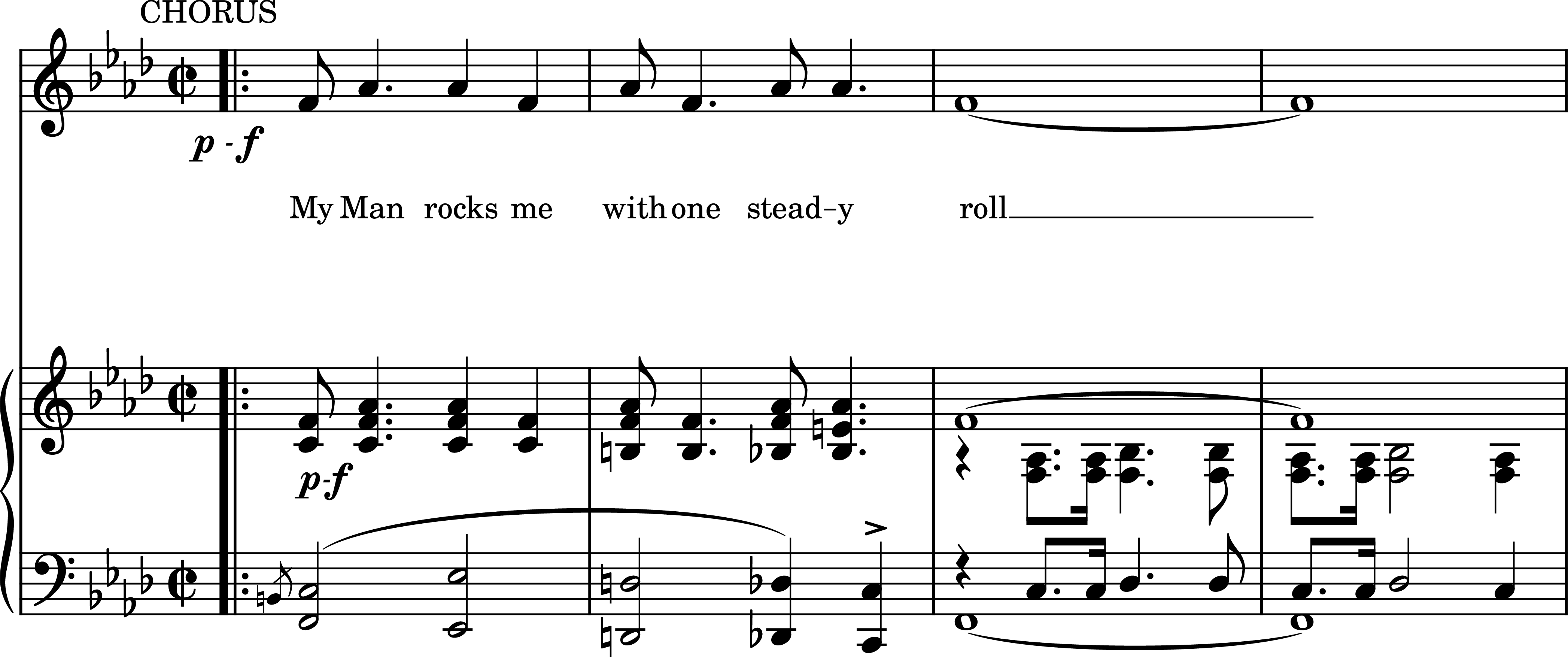
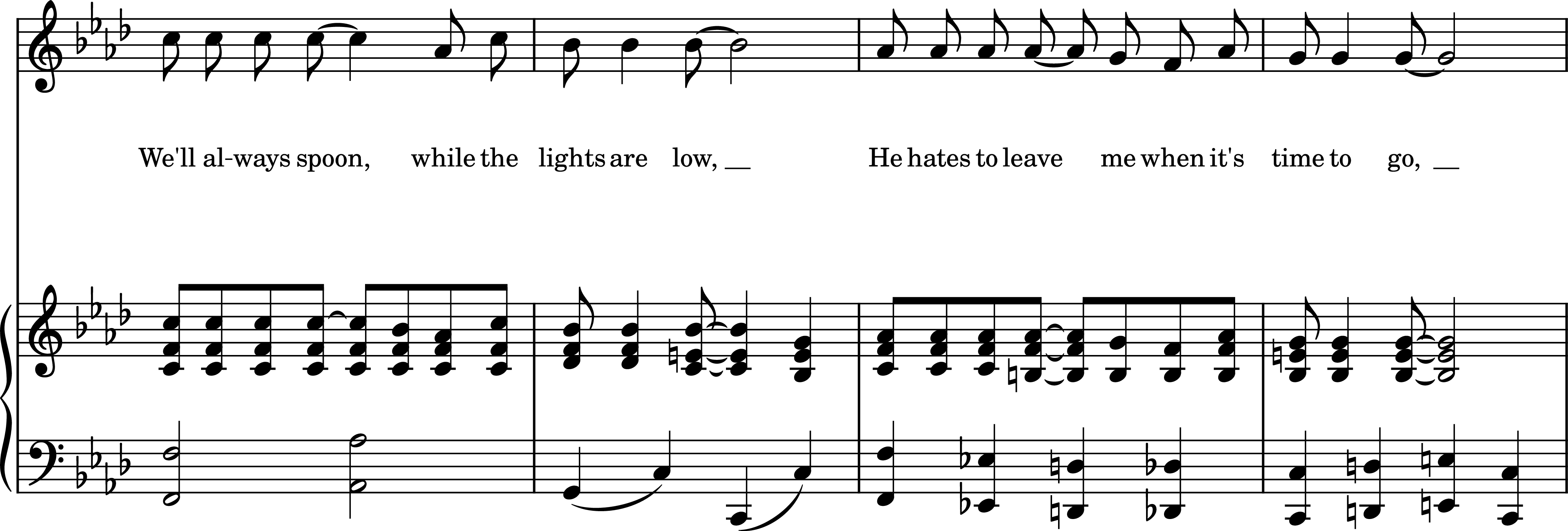
Barbour’s setting of the title line gave them plenty to think about. The song consists of four four-measure phrases set in an A A’ B A form for the 16-bar chorus sections.Footnote 46 The A-section melody conveys slow, steady rocking—that of the chair or lovemaking—by alternating between two notes, f and a♭ (see Example 1). The minor third and F Minor tonality give the canoodling a bluesy and dark setting. Syncopations on the minor third add a rhythmic kick to that “steady” “rock” and “roll.” In the B section, Barbour sets a cozy scene with a “blanket of love and charms.” Smith discards the comfy lyrics and describes how long her man has kept her enthralled by referring to the passing of time on a clock, nine hours over the course of three statements of the chorus. She saw the potential for languorous time keeping in Barbour’s melody, which starts on c, the highest note in the song, and slowly moves down largely by step, while working in the f-a♭ minor third from the opening section (see Example 2).
James Bernie Barbour, “My Man Rocks Me (With One Steady Roll),” A Section.

James Bernie Barbour, “My Man Rocks Me (With One Steady Roll),” B Section.

Musicians, both Black and White, interpreted the song in different ways. Some felt that the title alone did the trick and turned the song into an instrumental jazz piece.Footnote 47 Most musicians, though, savored the lyrics. Although Smith made the song famous, the vocal versions preceding Jaxon’s recording were all done by male singers.Footnote 48 They change the gender of the titular character, referring to “baby” and “she.”Footnote 49 The male singer in the 1925 recording by Harold Ortli and His Ohio State Collegians, a White band, puts “Daddy” in the title role. Perhaps the band was oblivious to the meaning of the lyrics, which is hard to imagine, or shy about the euphemisms, as the musicians put in only one vocal chorus and instead treated the song as an energetic dance number.
Jaxon was neither oblivious nor shy about the song’s meaning. On the contrary, he elaborated upon it, flamboyantly so. He stuck to “Daddy” and did not change a pronoun. Whereas some band’s versions move between vocal and instrumental choruses, Jaxon alternates between two different types of vocal choruses, which unfold over seven choruses. Most of the choruses (nos. 2, 3, 5, and 7) present Barbour’s melody and Jaxon’s lyrics, which build upon Smith’s idea of clock watching. In Jaxon’s version, the lovemaking stretches out over three hours compared to nine in Smith’s performance, but the encounter comes across as more salacious, with lines about how Daddy is “killin” him. Jaxon sings the song in his own voice, which is a high voice. He does not adopt the affected high voice used to play the parts of women in other songs, a choice that suggests that it is Jaxon who is enjoying his time with Daddy.
The other type of vocal section (choruses 1, 4, and 6) involves no lyrics, but rather Jaxon’s moans and groans, which are sung on top of instrumental soloists in the band playing the melody. The song opens with those moans, which Jaxon sings on the minor third in the A section of Barbour’s song, now stated on D4-F4-D4 in D Minor, the key in which Smith recorded the song. With Barbour, the pitches convey Daddy’s “rock” and “roll.” Jaxon’s moans tell us about the pleasures of that “steady roll” before we even hear those words. He creates an erotic prelude that does not appear in earlier or later versions. The moaning could have ended there, but it returns midway through the song. In an astute touch, Jaxon’s second moaning section (chorus 4) corresponds to the B section of Barbour’s melody. In the original version, the melody moves down from the fifth scale degree (now A4 in D minor) over the range of a fifth (to D4). Jaxon, on the other hand, begins on A4 and works around that pitch but then reverses the melodic course in the original by making two quick and ecstatic leaps from A4 to D5. This passage obviously conveys the melodic and sexual climax of the moaning section. The third chorus of the section (number 6) suggests relaxation afterwards as Jaxon returns to the opening D4, to which he adds speech and a small leap up to the A4 heard in the fourth chorus. It is not the only sexual climax in the song. The seventh and final chorus closes with quick, impassioned cries before the concluding “steady roll.” For Jaxon, the playful hints at sex in the lyrics were not enough. He interspersed a vocal section throughout the song that sounded out those hints, and he also gave the song not one but two sexual climaxes.
Signifyin’, Hokum, and the Sissy
Jaxon’s extravagant rendition of “My Daddy Rocks Me” can be heard as signifyin’ on Barbour’s song and Smith’s rendition in particular. He practices the repetition and revision at the heart of signifyin’.Footnote 50 The performance of the song serves as repetition. As for revision, the same question looms over Jaxon as it does any jazz musician interpreting a well-known, pre-existing song.Footnote 51 What are they going to do with it? In particular, how will they make it their own as expected of both jazz and signifyin’? The question is enticing for a master of transformation like Jaxon. He takes up a specific approach of signifyin’. His version extends key aspects of “My Daddy Rocks Me,” drawing them out and transforming them to create new dimensions in and around the song.Footnote 52 Jaxon adds the moans, which bring new vocal sounds to the song. The moans create a new formal section in “My Daddy Rocks Me,” one not dependent on words. The new section, in turn, introduces a new structure to the song, the three-part design of the moaning choruses. “My Daddy Rocks Me” now has two interrelated formal designs, both of which lead to sexual climax, erotic and structural highpoints only hinted at in Barbour’s song and Smith’s performance.
Jaxon’s signifiyin’ extends to how “My Daddy Rocks Me” was understood. His revisions turn the song into a series of orgasmic tremors. At the same time, he refers to two ways that “My Daddy Rocks Me” and other erotic songs in Black music of the time were understood. One way is stated on the record itself: hokum. The disc label lists the musicians as Tampa Red’s Hokum Jug Band with a “vocal chorus” by Jaxon. Tampa Red was an influential blues guitarist who recorded several songs with Jaxon. Besides Tampa Red’s band, there were The Hokum Boys and, not to be outdone, The Famous Hokum Boys. With these and other musicians, hokum became a captivating style and mood. The style combined elements of Northern urban music and Southern downhome styles. From New York and Chicago, it took up-tempo jazz rhythms, the small ensembles used in jazz songs, and the bluesy, colorful timbres produced by instruments in those ensembles. To them were added instruments heard in Southern small towns, particularly the jug and washboard. Living up to the name Hokum Jug Band, “My Daddy Rocks Me” blends bluesy instrumental lines with bloated puffs in a jug, a humorous foil to Jaxon’s moans.
Hokum created a mood of bawdiness by mixing the sexually suggestive and comic. Jaxon’s moans are sensual, but they are indulged to the point that they create both pleasure and chuckles. While Jaxon enjoys his time with Daddy, the pursuit of pleasure in hokum songs can sometimes go awry. A man in The Hokum Boys’ “Hokum Blues” (1929), for example, no sooner found “a new way of loving” than he “lost [his] stroke” and ended up without his “gal” and going “broke.”
The musical amalgams at the heart of hokum were part of the larger cultural melding underway in the Great Migration. Northern urban Blacks may have left the South, but they did not leave behind the culture that they loved. Musical styles, jokes, stories, and other cultural forms of the traditional South were refashioned and folded into the new idioms emerging in Northern cities. With those combinations, migrants produced lively ties between the world that they had left and the new one greeting them. As music historian Roberta Freund Schwartz has observed, the experiences of migration “created a continuous dialogue between the past and present, northern and southern, and rural and urban.”Footnote 53
Beyond a general role in the cultural hybridity of the Great Migration, hokum expanded the space for queer eroticism and play in Black music during the 1920s and 1930s. Queer musicians took advantage of the emergence of a new style to create opportunities for exploring queer themes. In their hands, hokum could be, as historian Karen Sotiropoulos puts it, a “weapon.” She discusses early twentieth-century New York theater, but her observations extend to the jazz and blues-based music discussed here. In particular, hokum was “a technique nurtured by the modern era’s heightened focus on self-presentation and a necessary survival strategy for black Americans negotiating Jim Crow.”Footnote 54
As Jaxon’s recordings show, the jokes and exaggerations of hokum offered a way of introducing queer identities and desires in humorous, unthreatening ways. Even musicians who were apparently not queer found in hokum a space to deal with queer themes. The Hokum Boys, for example, welcomed queer characters into their version of “Somebody’s Been Using That Thing” (1930).Footnote 55 It presents a gallery of people who have been “using that thing” or giving in to desires, including those for sex, alcohol, and gambling. The Hokum Boys add to them a man who lives in “the funniest place” and “puts paint and powder on his face.” The next verse goes down to the levee where there are “a lot of women who walked and talked like men.” Some characters fare better than others in wrestling with desire. The gambler wins big, while a man trying to make it with a “high-stepping” dancer ends up injured. The verses for the queer man and woman are the only ones that do not point to any kind of outcome, good or bad. A speaker does respond to the lines about the man with a mocking effeminate voice, but everyone in the song is a setup for a laugh. The queer characters are just who they are, part of daily life: the guy you might see in a “house on the corner” or the woman you could run into at the docks.
“My Daddy Rocks Me” and other Jaxon recordings traded in the laughs prized by hokum. Although we may hear the groans rather than the laughs in the recordings, Jaxon’s ever-abundant font of moans most likely inspired chuckles in the studio and with listeners at home. Jaxon was upfront about mixing humor and sensuality in his recordings. His rendition of “How Long, How Long Blues” (1928) combines the two in what is one of Jaxon’s most extensive transformations. Written and recorded by Leroy Carr, the song captures a man asking how long his lover will be away and how long he will have to endure his sorrow.Footnote 56 Jaxon’s version only uses the first two words of the title, around which he creates other meanings through his reworking of Carr’s tearful soliloquy. The title question now deals with, as in “My Daddy Rocks Me,” the length of lovemaking and, in this song, that of the lover’s penis. The latter serves as the punchline to a skit in which Jaxon plays both the male and female roles in a couple. The woman tells her lover that she may be reading the Ladies Home Journal, but that she would prefer The Saturday Evening Post, with an emphasis on the last word and its second meaning of a rigid column. The skit interrupts Jaxon’s moaning, now presented more in his female voice, although the gender lines do get blurry. The moaning sensually and comically conveys the urgency in the questions posed about length.
Jaxon signified on another way of hearing “My Daddy Rocks Me”: the double entendre. For him, two ways of hearing the song were not enough. He found another one. Two, though, were enough for White folklorist Guy B. Johnson. In his 1927 article “Double Meaning in the Popular Negro Blues,” he cites “My Daddy Rocks Me,” although he never gives the title of the song nor does he mention either Barbour or Trixie Smith.Footnote 57 All he has to do is give the opening line of the chorus about the “steady roll.” As he tells the presumably White readers of the Journal of Abnormal and Social Psychology, that and other lines are proof that “double meanings in the blues are of a sexual nature.”Footnote 58 His research took him to live performances as he also gives lines from “numerous vulgar versions” of the song that “have been in vogue in the Negro underworld for several years.”Footnote 59 While the lyrics of those versions do have a “kinship with the phonographic version,” by which he probably means Smith’s recording, some of them do not appear in hers or other recordings, which shows how labile the song was.Footnote 60
Johnson stopped at the “vulgarity” teeming in words like “rock” and “roll.” Not Jaxon. Why would he? The “sexual nature” of the lyrics was obvious, very much so. And not just those of Barbour’s song. A critic for the Black newspaper the New York Age put it well in a review of a show by Gladys Bentley: she “delivers a couple of those songs that have come to be identified with her, dual meaning lyrics that really have only one.”Footnote 61 Jaxon would offer more than one meaning and more than one way of hearing “My Daddy Rocks Me.” With him, it is not so much what we hear as who we hear. That was a figure who Johnson got nowhere near in his article: the sissy man.
If Johnson was interested in that figure, he could have found queer male characters in blues lyrics or queer performers on stage. Jaxon, after all, was performing when he wrote the article. The title of Kokomo Arnold’s “Sissy Man Blues” (1935) gave the character top billing, although he appears in only one chorus. Weary of masturbation, Arnold pleads: “Lord, if you can’t send me no woman, please send me some sissy man.” That three singers recorded the song after Arnold suggests that the sissy man had a place in Black song, and, presumably, Black life.Footnote 62 The one line that the character receives presents him as a sexual substitute and an acceptable one, for even God could deliver him. In The Hokum Boys’ “Somebody’s Been Using That Thing,” the man wearing women’s makeup is a person you could meet in the neighborhood. In these songs, the sissy man has no agency. He is someone who is acknowledged as either a sexual possibility or a passing figure. With her “Sissy Blues” (1926), Ma Rainey gave him a role and even a name. She accepts, albeit begrudgingly, that her man has been seeing Miss Kate, who “shakes that thing like jelly on a plate.” Miss Kate shakes it so well that Rainey’s man has left her “all alone.”
In Jaxon’s version of “My Daddy Rocks Me,” we do not hear about the sissy man; rather, we hear the sissy man. We hear him moan in pleasure, beg Daddy to “take it easy,” and thrill at the moment of climax. While delighting in the musical and queer imagination in Jaxon’s recording, we should not overlook the fact that the sound of a queer Black man enjoying sexual pleasure is a transgressive sound, so much so that it would seemingly not appear on a record in the 1920s. Jaxon, though, etched that sound into a record so that it could be heard by anyone, anywhere, and at any time, from the 1920s to today.
Sissy sounds would again find their way onto a record in the 1950s with Little Richard’s “Tutti Frutti.” In the original version of the song that he had performed at clubs, squeals punctuated lines about anal sex. When the song was recorded for commercial release, the squeals remained, but they were strangers in the new, foreign erotic world created by the rewriting of the lyrics, a world where Little Richard had his “gals” Sue and Daisy. As bastardized as “Tutti Frutti” became, queer resonances still emerge, especially when we hear it with Jaxon’s moans in our ears. The two recordings bring out a historical lineage of Black queer male singers, with Jaxon serving as an important predecessor to Little Richard. And the line continues. It would be interesting to know what Jaxon and Little Richard would have made of Lil Nas X. He may not moan and squeal as much as they did, but his songs and videos are alive in queer erotic play, such as Lil Nas X giving Satan a lap dance in the video for “Montero (Call Me by Your Name)” (2021). It concludes with Lil Nas X indulging in some low-voice sensual ooh’s, which serve as the accompaniment for a different kind of climax, him breaking Satan’s neck.
Disidentification: Queer Resistance and Refuge
The sissy squeals in the recordings of these three artists emerge from what queer theorist José Esteban Muñoz calls disidentification. His concept provides a way of hearing transformations, like the sissy’s cries, in the larger cultural sphere. Muñoz describes how queer artists of color transform the “energies” and “patterns” of the dominant White culture.Footnote 63 Through those transformations, they do not simply stand apart in opposition to that culture, but rather they mount a more complex and involved critique, one in which the “disidentificatory subject” “tactically and simultaneously works on, with, and against a cultural form.”Footnote 64
Jaxon’s version of “My Daddy Rocks Me” stages such a critique. It fits what Muñoz calls “comedic disidentification,” which “accomplishes important cultural critique while at the same time providing cover from, and enabling the avoidance itself of, scenarios of direct confrontation with phobic and reactionary ideologies.”Footnote 65 Hokum, as mentioned earlier, uses laughter to similar ends, but Muñoz presents disidentification as a larger queer strategy. Jaxon’s rendition, in line with Muñoz’s concept, works with a song that already challenged White heterosexual mores by raising the idea of sexual pleasure, particularly among Black individuals. As the recordings by White musicians and Johnson’s article suggest, that challenge had been enjoyed and absorbed by Whites. Jaxon, though, works against that acceptance through his queer sonic pleasure dome. While inviting laughs, the moans in that space can be heard as critiquing the silencing and stereotyped depictions of Black sexuality, particularly queer sexuality, in the dominant White culture. The sounds of Black queer love are made to be heard and enjoyed.
Disidentification, according to Muñoz, remaps the social spheres of the dominant White culture in ways that create alternatives and refuges for people of color. The intersectionality of race, gender, sexuality, and class created through songs by female blues singers and Jaxon “unsettled” the “strictures of class, race, and gender” prescribed by that culture.Footnote 66 Disidentification also provides a refuge from those strictures, what Muñoz calls “counterpublics,” spaces that are separate from and challenge the public sphere controlled by dominant ideologies.Footnote 67 In particular, Jaxon’s songs offer listeners an alternative space in which to experience their eroticism. The idea of the alternative space created by Jaxon’s songs can be understood in various ways. Unfortunately, there is no historical record of the physical spaces, such as clubs or parties, in which Jaxon may have performed “My Daddy Rocks Me” and other sensual songs. The recordings, though, open up an interior space for listeners, a refuge where they can partake in Jaxon’s erotic reveries free of social condemnation. The recording of “My Daddy Rocks Me” may be only a little over three minutes long, but, like Jaxon and Daddy counting the hours of lovemaking, the listener can extend the experience of hearing two Black men make love.
Cultural theorist C. Riley Snorton gets at a similar idea in their discussion of sissy blues, particularly Kokomo Arnold’s “Sissy Man Blues.” The song created a “triangulation of space” involving “the familiar South, the public city of the North,” and what they call the “familiar unknown.”Footnote 68 The last space could refer to the actual locations that individuals found to “have a truly fulfilling erotic life” beyond the restrictions of race, labor, and economic blight of the Great Depression.Footnote 69 It could also cover the interior space described above, which too could be fulfilling for listeners.
The work of University of Chicago sociology student Earl W. Bruce revealed that White listeners found their way into the space created by queer blues. For his Master’s thesis, Bruce explored gay subcultures in 1930s Chicago. His research led him to a party enlivened by “pornographic recordings sung by some Negro entertainers” that featured “homosexual themes.”Footnote 70 Five White men listened and danced to the recordings, claiming in them a place as liberating as the one in which the party was being held.
Desire, Transformation, and Queerness
“My Daddy Rocks Me” builds upon two recurring aspects of Jaxon’s work as a queer artist: desire and transformation. This study concludes by examining how the two play out in other songs and how they shape a larger queerness in Jaxon’s music. In “My Daddy Rocks Me,” desire emerges as a force that grows more passionate and voluminous as it is being fulfilled. Jaxon had other ways of understanding desire. Indeed, he asked questions about it, particularly what to do with it and what it does to us. His inquiry builds upon the word “it” in all of its ambiguity. As Johnson mentioned in his study of double entendres, the word appears throughout the blues. He singles out one meaning: “the sex act.”Footnote 71 Jaxon gives the word more meanings than that. He wrote two songs devoted to “it,” so much so that the word makes the titles: “Fan It” (1928) and “You Got to Wet It” (1929).Footnote 72 “Fan It” was Jaxon’s biggest success.Footnote 73 He recorded four different versions of it, and the song had a long life crossing genres and decades in country (Bob Wills and His Texas Playboys, 1936) and big band (Woody Herman, 1946) versions. “You Got to Wet It” was, in some ways, a new version of “Fan It.” Hoping to cash in on the success of “Fan It,” Jaxon wrote a similar song, not just with the title roles of “it” but also with the repeated descending minor-third melodic figure used for the grabber lines “fan it” and “wet it.”
As for the question of what to do with desire, the titles of the two songs offer an answer. Or do they? The verbs—appropriate for the blues—have two meanings, opposing ones in this case. “Fan” conveys either cooling something down or intensifying it, like fanning a fire or a revolution. With “wet,” there are two different things that can be done with water: dampen something or provide it with sustenance so that it can grow. The songs go both directions with the verbs. “Fan It” opens by boasting how “hot” the song is and teasing listeners to “cool it if [they] can.”Footnote 74 “You Got to Wet It,” on the other hand, starts with Farmer Jones standing in a dry field and realizing that he is going to have to water his crops.
Beyond these initial lines, the songs move past tunes and plants to people. What do they do to desire—do they fan or wet it—and what does it do to them? In “You Got to Wet It,” a man cannot keep up with his girlfriend at a dance because her moves are “so slim.” She tells him to “wet it,” or recharge, so that they can “rock” on the floor. The exuberant solo trumpet line answering the woman’s call to “wet it” suggests that her advice did the trick. For some, though, the command is to cool things down. Jaxon tells an unidentified person that if their “good man” stays out “all night long,” then the man should “fan it” until he “sings his song,” which could mean him saying that he is sorry or maybe turning his sexual attention to his partner. Desire can also lead people astray, some to ruin. In “Fan It,” fanning desire has brought one man to prison, and poor Uncle Ned “has been fanning it since the age of six” and now is in an “awful fix.”
The stories in “Fan It” and “You Got to Wet It” lead to a final question: what to make of desire? The latter provides an answer in the closing line of the chorus: “Let the good work go on.” The line has a Biblical ring to it. “Good work” calls to mind the “good word,” but the ring gets more specific than that. Jaxon’s line evokes a particular verse, Philippians 1:6: “being confident in this very thing, that He who has begun a good work in you will complete it until the day of Jesus Christ.”Footnote 75 Jaxon most likely did not have that verse in mind, yet the parallel brings out the religious tone of his line. The subjects of the two, though, could not be more different. With Jaxon, the good work can be heard as referring to sexual desire, the force depicted in “You Got to Wet It.” Jaxon also throws out the line in two versions of “Fan It.”Footnote 76 Both songs preach to listeners that sexual desire is “good” and that they should embrace it and bring it—hopefully—to a satisfying fulfillment. Coming from a queer Black man, that sermon is just as transgressive as the sounds of the sissy man in “My Daddy Rocks Me” and other songs.
“My Daddy Rocks Me,” “Fan It,” and “You Got to Wet It” reveal how important transformation is to Jaxon’s work and his expression of queer desire. Indeed, transformation is a spark for him. His recordings of pre-existing songs and versions of his own songs convey how Jaxon relished opportunities to reimagine the music and lyrics of songs, to make them his own. In those new versions, he also transformed himself, creating many different Jaxons. Voice, genre, persona, and gender constantly changed in recordings and on stage over the course of his career. There is the fleet dancer, the saucy drag artist, the teasing blues singer, and the dynamic swing band conductor.
Transformations also occur across and within recordings of particular songs. What better way to explore his talents at transformation than by remaking the same song several times? Jaxon did that with the four versions of “Fan It” as well as three recordings of the song “Corrine”: “Corrine” (1927), “Corrine Blues” (1929), and “Callin’ Corrine” (1939).Footnote 77 Each one is cast in a different musical style, and the form and lyrics are reworked too. Jaxon plays both the titular character and the devoted man she cheats on. It is obvious which character won his attention. Corrine’s part grows over the course of the recordings, with Jaxon working in more spots for Corrine’s feminine voice and, in the last version, the sounds of her sexual pleasure.
Through transformations, queerness in Jaxon’s work emerges as a space of multiplicity, fluidity, and ambiguity. There are many Jaxons who are always changing and difficult to pin down, which may have served him in being guarded about his sexuality, as he seems to have been at times. Beyond such protection, this multidimensional conception of queerness had tremendous artistic potential. It not only emerged from transformation but also encouraged it. Changes in vocal delivery and style could inspire other changes in a song or lead Jaxon to new songs and the changes that could be made to those songs. The currents of change could also lead to bold statements about queer pleasure. Jaxon’s sensual moans arose from the desire to transform songs so that he could explore desire itself, like the “good work” that it can do. Once in a song, the moans change, growing in intensity and range. Those changes recreate songs, like the new formal design and erotic peaks in the recording of “My Daddy Rocks Me.”
Transformation continued beyond songs. With his moans, Jaxon reshaped the dimensions of the recorded voice. If he did not introduce the sissy-man voice to the recorded sound world, his recordings established a place for it, one where a whole new voice and vein of erotic pleasure could be heard. Listeners could play that voice over and over again and respond to its sensuality and constant changes. The voice could change them too, unveiling sexual worlds that remained hidden or elusive. With Jaxon, queerness offered a stream of possibilities for how to perform songs and self in new ways.
David Metzer is Professor in the School of Music at the University of British Columbia. He is the author of Quotation and Cultural Meaning in Twentieth-Century Music (Cambridge University Press, 2003), Musical Modernism at the Turn of the Twenty-First Century (Cambridge University Press, 2009), The Ballad in American Popular Music: From Elvis to Beyoncé (Cambridge University Press, 2017), and Prison Song: Music and Incarceration in the United States (University of Michigan Press, 2026).

 Open access

