





1. Introduction
The heat flux conveyed to the divertor target due to edge-localised modes (ELMs) (Wagner et al. Reference Wagner1982) constitutes one of the most consequential challenges for component integrity and plasma operation in future fusion power plants (FPPs). Extrapolation of ELM energy fluence based on a multi-machine analysis (Eich et al. Reference Eich2017) shows that unmitigated type-I ELMs would be intolerable for divertor target integrity in ITER (Pitts et al. Reference Pitts2019) and, likely, in any other next-generation device. This brings the necessity of an integrated solution where small/mitigated ELMs are achieved while good plasma performance is sustained. A plasma regime that is currently being considered for future operations involves high edge-density scenarios with ELMs that, compared with the large and more ubiquitous type-I ELMs, feature (i) higher frequency, (ii) smaller amplitude and (iii) lower plasma energy losses (Viezzer et al. Reference Viezzer2023). This small-ELM regime is characterised by high density in the scrape-off layer (SOL) and separatrix, and is consistent with the requirement of a power exhaust solution with a partially detached divertor and increased reliance on neutral hydrogenic radiation for dissipation. Pioneering experimental studies on these high-collisionality small-ELM scenarios, originally referred to as type-II ELMs, have been carried out in ASDEX Upgrade (Stober et al. Reference Stober2001), DIII-D (Leonard et al. Reference Leonard2001), JET (Saibene et al. Reference Saibene2005) and JT-60U (Kamada et al. Reference Kamada2000), where access requirements, plasma performance and global ELM parameters were identified. This regime, which is also referred to as the quasi-continuous-exhaust regime (Faitsch et al. Reference Faitsch2021), has been more recently subject of further dedicated studies in various machines (Labit et al. Reference Labit2019), where it was found to be connected with an increased time-averaged heat flux decay length (λq ) in the SOL (Perillo et al. Reference Perillo2024) (Chen et al. Reference Chen2025) (Stagni et al. Reference Stagni2024), which is beneficial for divertor target integrity, and with enhanced upstream filamentary activity, results in the presence of a density shoulder (Stagni et al. Reference Stagni2022; Redl et al. Reference Redl2024; Perillo et al. Reference Perillo2025). Recent modelling works (Harrer et al. Reference Harrer2022; Radanovic et al. Reference Radovanovic2022) suggest that small ELMs originate in a region close to the pedestal foot due to unstable ballooning modes triggered in the vicinity of the separatrix. Similarly, simulations with the code JOREK (Cathey et al. Reference Cathey2022) have shown that, when the separatrix density is above a certain threshold, large type-I ELMs disappear and are replaced by small ballooning modes.
This high-density regime has the potential to constitute a promising future plasma scenario; however, the extrapolation of the small-ELM peak energy loads to the walls in FPPs is still uncertain due to (i) lack of direct experimental inference of the small-ELM pedestal origin and (ii) fast-enough measurements capable of decoupling the inter-ELM from the intra-ELM divertor peak heat flux from current machines.
In this work, intra-ELM characteristics and the pedestal dynamics due to high-density small ELMs are reported and contextualised with type-I ELM cases. The pedestal origin of ELM filaments is explored via local measurements in the DIII-D plasma boundary and dedicated simulations with the BOUT++ code (Dudson et al. Reference Dudson2009). Informed by those results, an ad hoc modification of the peak ELM energy fluence model (Eich et al. Reference Eich2017) is carried out and tested against an experimental data set of small ELMs at DIII-D and ASDEX Upgrade, for the first time. Extrapolations of peak parallel energy fluences to representative scenarios for SPARC and ITER are reported, and the results are discussed.
2. Methods
2.1. Discharge characteristics and diagnostics
The main plasma characteristics for the shots examined are reported in table 1. The input power Neutral Beam Injection for the used discharges ranges between 5 and 9.5 MW (2nd column in table 1) for small ELMs, while it is 2.8 MW for the type-I ELM ones. The small-ELM scenarios examined in this work are characterised by higher separatrix density (n
e, separatrix
in figure 1(a)) and line-averaged density (3rd column in table 1 and <ne
> in figure 1(b)) compared with the type-I ELM cases. External seeding was done with D
2 seeding only. The plasma scenarios of this work are characterised by a plasma current I
p between 0.9 and 1.1 MA (6th column in table 1), and both elongation and triangularity (4th and 5th columns in table 1) are similar throughout the shots for both ELM regimes. All discharges are well-defined lower single null, with a dRsep (the distance between the primary and secondary separatrix at the outer midplane) of −4 cm, and the toroidal magnetic field (B
t
, 7th column in table 1) is between −1.95 and −2.15 T, in the favourable B × ∇B direction, where $B$
is the grad-
$B$
is the grad- $B$
drift. The ELM frequency is between ∼ 250 and ∼ 400 Hz for the small ELMs, while it is ∼ 20 Hz for the type-I cases. The main focus on this study is on small ELMs, but type-I ELMs are also included for completeness and to provide well-documented reference cases.
$B$
drift. The ELM frequency is between ∼ 250 and ∼ 400 Hz for the small ELMs, while it is ∼ 20 Hz for the type-I cases. The main focus on this study is on small ELMs, but type-I ELMs are also included for completeness and to provide well-documented reference cases.
Main discharge characteristics for the scenarios examined in this study.

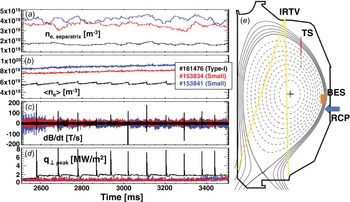
Time traces for type-I (black) and small (red and blue) ELM scenarios of (a) electron density at the separatrix, (b) line-averaged density, (c) fast magnetic coil (OMP) signal, (d) Infrared thermography (IRTV) peak heat flux at the outer divertor target, (e) two-dimensional magnetic reconstruction for a representative case (no. 153841). The IRTV view to the lower outer target is indicated in yellow, the TS chord location is red, the BES view in orange and reciprocating probe (RCP) position near the OMP in blue.

Time traces of magnetic fluctuations measured with a Mirnov probe in the outer midplane region for three representative cases are reported in figure 1(c), where clear significant differences can be observed. During small ELMs the magnetic fluctuations are approximately 10 times smaller than those during type-I ELMs. This can be interpreted as the increased mode number of the small ELM, compared with a type-I ELM, leading to a faster radial attenuation of the instability (Kamada et al. Reference Kamada2000). The inter-ELM magnetic fluctuation level for the small-ELM regimes is approximately three times larger than that of the type-I ELM scenarios, consistent with enhanced filamentary activity and fluctuation levels at the plasma edge.
The peak heat flux at the outer divertor target (near the outer strike point, OSP) is shown in figure 1(d), for the same representative cases i.e. two small ELMs and one type-I ELM. During the small ELMs, the peak heat flux is a factor 2 larger than that during inter-ELM. During the type-I ELMs, however, that increases by a factor ∼ 5.
When the large ELMs occur, spikes appear in the peak heat flux (figure 1 d) and fast magnetic (figure 1 c) signals, and the line-averaged density drops (figure 1 b). During the small ELMs, however, no notable changes are present in any signal except from the peak heat flux.
The turbulence control parameter (Eich et al. Reference Eich2020) at the separatrix (αt ) is a dimensionless parameter that describes the relative importance of the resistive ballooning instability over the drift-wave transport. For the discharges used in this study αt is between ∼ 0.45 and ∼ 1.1 for the small-ELM database, while it is around 0.2 for the type-I scenarios. In the framework of αt as a parameter to characterise small-ELM scenarios, it is worth reporting that ASDEX Upgrade (Redl et al. Reference Redl2024) and TCV (Stagni et al. Reference Stagni2022) reported values of αt consistently above 0.5.
An infrared imaging diagnostic at DIII-D IRTV with a spatial resolution of 1.9 mm pixel−1 and an acquisition rate of 16 kHz (integration time of 62 μs, in line-scan mode) i.e. fast enough to resolve intra-ELM divertor heat flux evolution (Perillo et al. Reference Perillo2022), has been used to evaluate perpendicular heat flux to the outer divertor; the camera view is shown in figure 1 e (in yellow). Further details on the IRTV system at DIII-D can be found in Lasnier et al. (Reference Lasnier1998). The ASDEX Upgrade IR camera (Sieglin et al. Reference Sieglin2017) was focused on the outer target, with an acquisition rate of 2 kHz, and with camera settings optimised for high-density plasmas. Both the DIII-D and ASDEX Upgrade IR systems use the code THEODOR (Herrmann et al. Reference Herrmann1995) to convert tile surface temperatures to heat flux.
A Thomson scattering (TS) system (Glass et al. Reference Glass2016) (red in figure 1(e)) has been used to measure plasma electron density n e and temperature T e . While a single TS measurement is nearly instantaneous (10 ns laser pulse time), successive TS measurements are taken every 2–10 ms i.e. not fast enough to resolve consecutive ELM events. To obtain inter-ELM and intra-ELM pedestal profiles, a conditional average technique (Leonard et al. Reference Leonard2002) is applied to available TS data within temporal bounds selected using the OSP peak heat flux as reference signal for the ELM phase at the time of the TS laser firing.
A fast RCP diagnostic (Boedo & Rudakov Reference Boedo and Rudakov2017), located in the vicinity of the outer midplane (in blue in figure 1(e)), has been adopted to carry out SOL measurements of ELM electron temperature (T e ) and electron density (n e ), from which the electron pressure (p e ) is extracted. The value of T e is calculated with the probe via the harmonic technique and digitised at 400 kHz (Boedo & Rudakov Reference Boedo and Rudakov2017) i.e. fast enough to resolve intra-ELM time windows. The electron density is calculated by combining ion saturation current I sat and T e measurements via the relation n e = 2I sat/Ae[m i /2k b T e ]1/2 (Molesworth et al. Reference Molesworth2024), where m i is the ion mass and A the projected area of the probe tip (∼4 mm2).
A wide-field beam emission spectroscopy (BES) system (in orange in figure 1(e)), with an $8 \times 8$
grid of discrete channels looking at the outboard midplane has been used to produce time-averaged radial profile of normalised density fluctuation levels. Details on the diagnostic can be found in McKee et al. (Reference McKee2010).
$8 \times 8$
grid of discrete channels looking at the outboard midplane has been used to produce time-averaged radial profile of normalised density fluctuation levels. Details on the diagnostic can be found in McKee et al. (Reference McKee2010).
2.2. Model and experimental measurements of the peak ELM energy fluence
A heuristic model (Eich et al. Reference Eich2017) was validated against type-I ELM measurements from JET, ASDEX Upgrade and MAST, and later DIII-D (Knolker et al. Reference Knolker2018), HL-2A (Gao et al. Reference Gao2021) and COMPASS (Adamek et al. Reference Adamek2023), and then adopted to predict the peak ELM parallel energy fluence $\varepsilon _{\parallel }$
for ITER due to type-I ELMs. The model assumes a toroidally uniform plasma volume in the pedestal region that is connected along magnetic field lines to the divertor target. The power in this given volume is then conducted to the target at the floor via parallel transport. The model can be written as
$\varepsilon _{\parallel }$
for ITER due to type-I ELMs. The model assumes a toroidally uniform plasma volume in the pedestal region that is connected along magnetic field lines to the divertor target. The power in this given volume is then conducted to the target at the floor via parallel transport. The model can be written as
 \begin{equation} \varepsilon _{\parallel , \textit{model}}= 6\pi p_{e}a_{\textit{minor}}\frac{B_{tor,omp}}{B_{pol,omp}}\sqrt{\frac{1+\kappa ^{2}}{2}} ,\end{equation}
where $p_{e}$
is the pedestal electron pressure from which the ELM originates,
$p_{e}$
is the pedestal electron pressure from which the ELM originates, $a$
is the minor radius,
$a$
is the minor radius, $B_{tor,omp}$
and
$B_{tor,omp}$
and $B_{pol,omp}$
are the toroidal and poloidal magnetic fields at the outer midplane and
$B_{pol,omp}$
are the toroidal and poloidal magnetic fields at the outer midplane and $\kappa$
is the plasma elongation. The model can be re-written in a more compact form as
$\kappa$
is the plasma elongation. The model can be re-written in a more compact form as $\varepsilon _{||}=6\pi p_{e}R_{\textit{major}}q_{edge}$
, where
$\varepsilon _{||}=6\pi p_{e}R_{\textit{major}}q_{edge}$
, where $q_{edge}$
is an edge safety factor in the cylindrical approximation (Eich et al. Reference Eich2017), calculated as
$q_{edge}$
is an edge safety factor in the cylindrical approximation (Eich et al. Reference Eich2017), calculated as $q_{edge}=\sqrt{{1+\kappa ^{2}}/{2}}({a_{\textit{minor}}}/{R_{\textit{major}}})({B_{tor, omp}}/{B_{pol, omp}})$
. It should be noted that
$q_{edge}=\sqrt{{1+\kappa ^{2}}/{2}}({a_{\textit{minor}}}/{R_{\textit{major}}})({B_{tor, omp}}/{B_{pol, omp}})$
. It should be noted that $p_{e}$
is the only free parameter that has no geometric dependence and, therefore, knowing the pedestal origin of the filaments is essential to apply the model to any experimental scenario. In this work, the choice of pedestal origin to model the divertor peak energy fluence due to small ELMs will be guided by experimental results and simulations with the code BOUT++, as will be discussed later. The model assumes the divertor being in attached conditions; therefore, the time windows for the discharges from which the ELM database is compiled are such that divertor detachment is avoided.
$p_{e}$
is the only free parameter that has no geometric dependence and, therefore, knowing the pedestal origin of the filaments is essential to apply the model to any experimental scenario. In this work, the choice of pedestal origin to model the divertor peak energy fluence due to small ELMs will be guided by experimental results and simulations with the code BOUT++, as will be discussed later. The model assumes the divertor being in attached conditions; therefore, the time windows for the discharges from which the ELM database is compiled are such that divertor detachment is avoided.
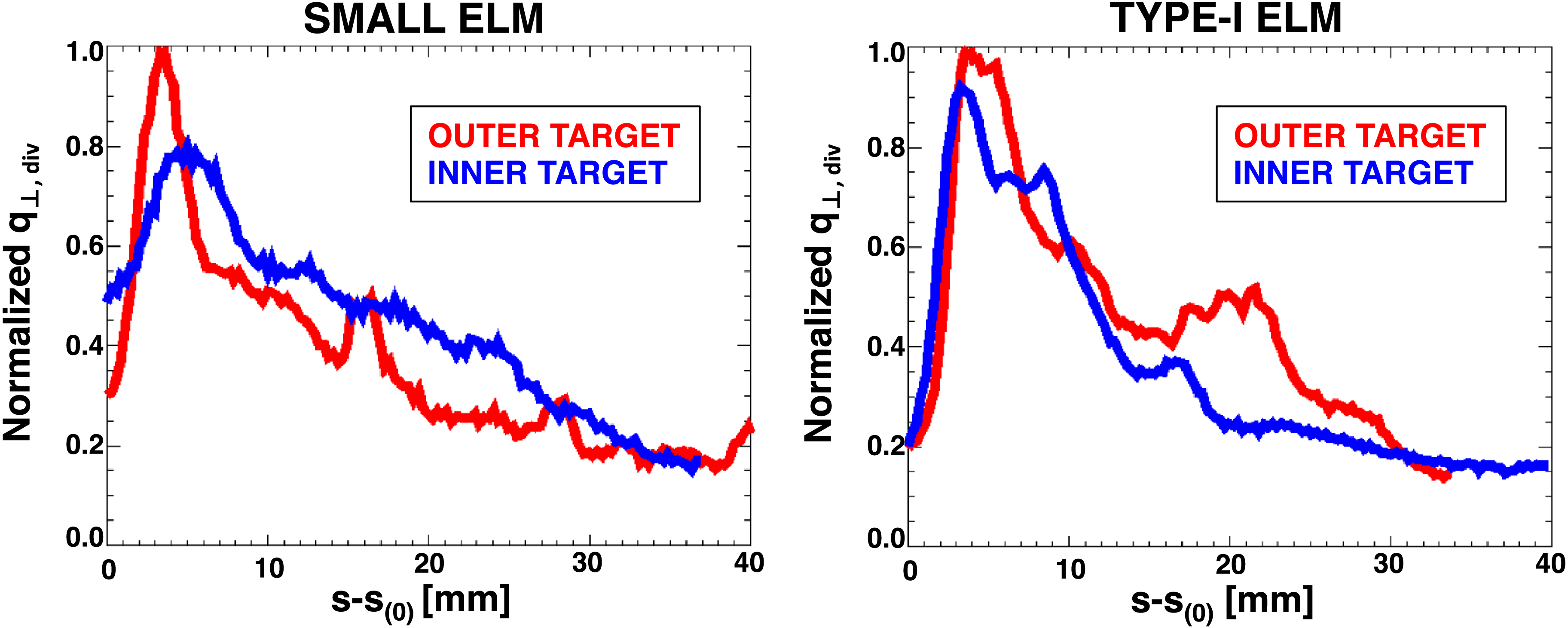
An important assumption of the model is that the power carried by the ELM is evenly distributed between the inner and outer targets. To address whether that is applicable to experimental measurements adopted in this work, the in/out power distribution has been evaluated as the ratio of the radially integrated time-averaged IRTV divertor heat flux among the outer target and inner target profiles, and calculated as $Q_{\textit{ratio}}=({\int\!\lt q_{\bot , \textit{outer}\left(s\right)\gt \,\text{d}s}}/{\int\!\lt q_{\bot , \textit{inner}\left(s\right)\gt\,\text{d}s}})$
. The in/out time-averaged ELM heat flux profiles, normalised by the maximum, are reported in figure 2 for two representative cases i.e. a small ELM and a type-I ELM, with
$Q_{\textit{ratio}}=({\int\!\lt q_{\bot , \textit{outer}\left(s\right)\gt \,\text{d}s}}/{\int\!\lt q_{\bot , \textit{inner}\left(s\right)\gt\,\text{d}s}})$
. The in/out time-averaged ELM heat flux profiles, normalised by the maximum, are reported in figure 2 for two representative cases i.e. a small ELM and a type-I ELM, with $Q_{\textit{ratio}}$
=0.93 and
$Q_{\textit{ratio}}$
=0.93 and $Q_{\textit{ratio}}$
=1.08, respectively. Among the experimental database upon which the model has been applied,
$Q_{\textit{ratio}}$
=1.08, respectively. Among the experimental database upon which the model has been applied, $Q_{\textit{ratio}}$
values between in/out targets are within +/− 20 %.
$Q_{\textit{ratio}}$
values between in/out targets are within +/− 20 %.
Time-averaged heat flux profile at the outer target (red) and inner target (blue), normalised by the maximum, as a function of normalised space (mm) for a small ELM (left) and type-I ELM (right).
Experimentally, $\varepsilon _{\parallel }$
is calculated by aid of IRTV measurements at the outer divertor target as
$\varepsilon _{\parallel }$
is calculated by aid of IRTV measurements at the outer divertor target as
 \begin{equation} \varepsilon _{\parallel , \textit{experimental}}=\frac{1}{\sin \left(\alpha _{\textit{osp}}\right)}\int _{t=t_{0}}^{t=t_{ELM}}\left[q_{\bot , osp}\left(t\right)-q_{\bot \textit{inter}-ELM, osp}\right]\,\text{d}t ,\end{equation}
where $q_{\bot , osp }$
is the total (inter- and intra-ELM) peak heat flux (MW m−2),
$q_{\bot , osp }$
is the total (inter- and intra-ELM) peak heat flux (MW m−2), $q_{\bot , \textit{inter}-ELM,osp}$
is the peak heat flux between the ELMs (which is considered constant) and
$q_{\bot , \textit{inter}-ELM,osp}$
is the peak heat flux between the ELMs (which is considered constant) and $\alpha _{\textit{osp}}$
is the incident angle in the toroidal direction of the OSP magnetic field line, obtained with Equilibrium Fitting reconstructions (Lao et al. Reference Lao1985), and is around 2.3° for the scenarios examined in this study. The IRTV divertor heat flux is integrated between t
0
(obtained as the last data point before the peak heat flux increases above 10 % of the inter-ELM one) and t
ELM, which is the time when the peak heat flux decreases by 1 e-folding length. Figure 3 shows the IRTV peak heat flux at the outer divertor versus time for four representative small ELMs, in red, and type-I ELMs, in black. The 1/e points in the temporal profiles are indicated in blue diamonds and orange triangles, respectively.
$\alpha _{\textit{osp}}$
is the incident angle in the toroidal direction of the OSP magnetic field line, obtained with Equilibrium Fitting reconstructions (Lao et al. Reference Lao1985), and is around 2.3° for the scenarios examined in this study. The IRTV divertor heat flux is integrated between t
0
(obtained as the last data point before the peak heat flux increases above 10 % of the inter-ELM one) and t
ELM, which is the time when the peak heat flux decreases by 1 e-folding length. Figure 3 shows the IRTV peak heat flux at the outer divertor versus time for four representative small ELMs, in red, and type-I ELMs, in black. The 1/e points in the temporal profiles are indicated in blue diamonds and orange triangles, respectively.
Intra-ELM IRTV peak heat flux at the outer divertor for four representative type-I (black) and small (red) ELMs. The one e-folding decay from the maximum is indicated with orange triangles for type-I and blue diamonds for small ELMs.
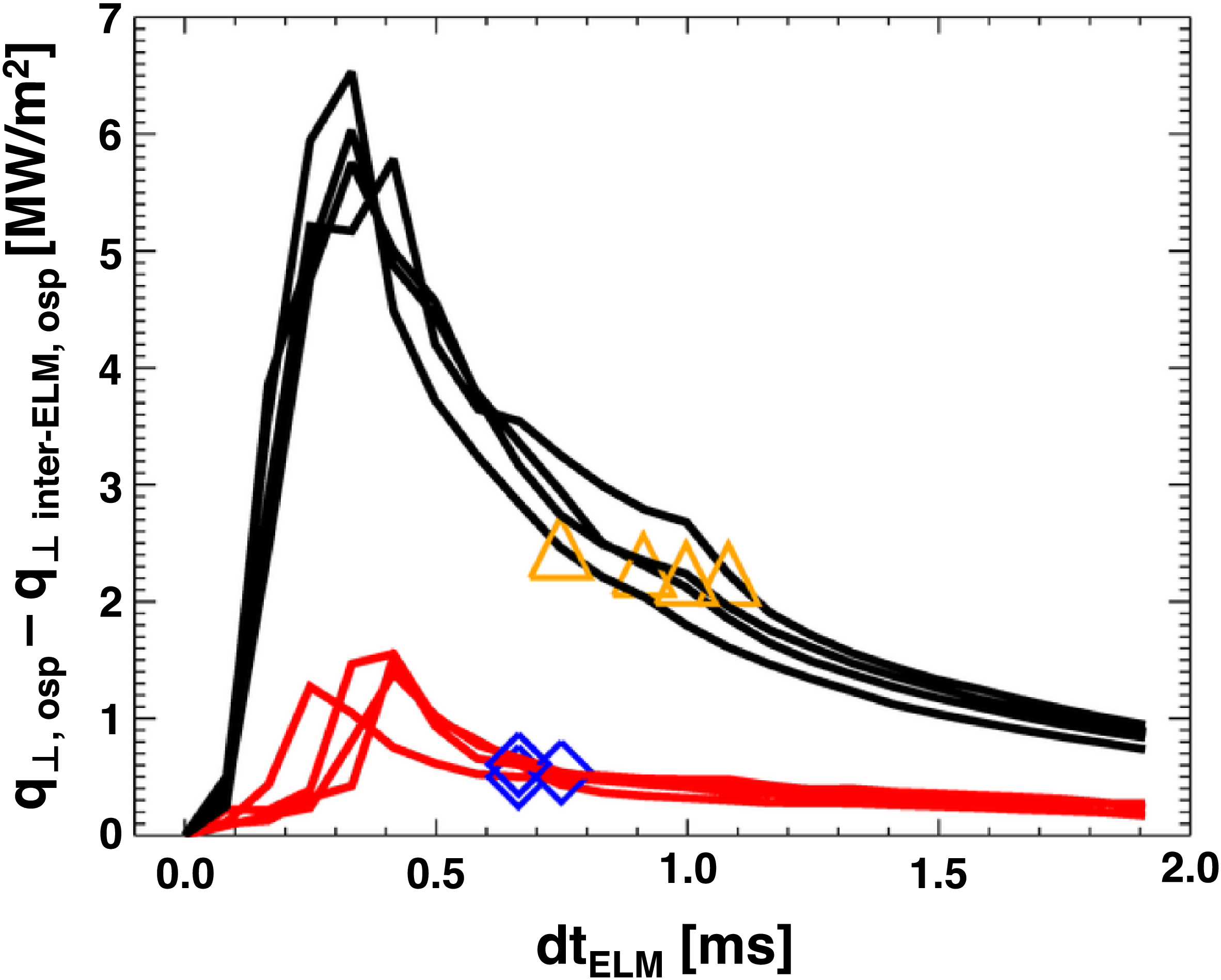
It is of interest to note that the IRTV ELM rise time (τIR, ELM ) for the small-ELM cases is, on average, longer than that for type-I ELMs. This is consistent with the correlation between the duration of the divertor ELM heat flux pulse and the ion transit time from the pedestal to the divertor target, as τfront = 2πRq 95/c s (Loarte et al. Reference Loarte2003), where c s is the sound speed. Simulations with the parallel-loss model have also shown a strong reduction of the parallel heat conductivity in a high-collisionality SOL with cold ELM filaments (Fundamenski et al. Reference Fundamenski and Pitts2006).
2.3. Identification of the outer-midplane separatrix location
The pedestal profiles of T
e
and n
e
are obtained by fitting a modified hyperbolic tangent to the TS data in the plasma-edge region. The separatrix location is adjusted by applying a radial shift to the kinetically corrected Spitzer (Stangeby et al. Reference Stangeby2015) parallel heat flux density at the outer midplane ( $q_{||e}^{kcSp}$
in (6) of Stangeby et al. Reference Stangeby2015) so that it matches the value obtained via the power-into-SOL method (P
SOL), i.e.
$q_{||e}^{kcSp}$
in (6) of Stangeby et al. Reference Stangeby2015) so that it matches the value obtained via the power-into-SOL method (P
SOL), i.e.
 \begin{equation}q_{\|,sep, omp}=0.5\frac{P_{\textit{SOL}}}{4\pi R_{omp}\lambda _{q}\left({B_{\vartheta }}/{B_{\phi }}\right)_{omp}},\end{equation}
where Psol
(or Ptot
− Prad, core
) is the power entering the SOL, Romp
is the outer-midplane (OMP) radius, ${B_{\vartheta }}/{B_{\phi }}$
is the ratio between the poloidal and toroidal magnetic fields at the OMP and λ
q
is the SOL heat flux width. For the DIII-D cases examined here,
${B_{\vartheta }}/{B_{\phi }}$
is the ratio between the poloidal and toroidal magnetic fields at the OMP and λ
q
is the SOL heat flux width. For the DIII-D cases examined here, $\lambda _{q}$
is evaluated by fitting an exponential decay function to the IRTV-measured outer divertor heat flux profile, mapped at the OMP (Perillo et al. Reference Perillo2024) i.e. 5.8 mm on average. On the other hand, for the ASDEX Upgrade cases examined and reported in § 3.5,
$\lambda _{q}$
is evaluated by fitting an exponential decay function to the IRTV-measured outer divertor heat flux profile, mapped at the OMP (Perillo et al. Reference Perillo2024) i.e. 5.8 mm on average. On the other hand, for the ASDEX Upgrade cases examined and reported in § 3.5, $\lambda _{q}$
is extracted from TS data in the SOL via the relation (Faitsch et al. Reference Faitsch2021)
$\lambda _{q}$
is extracted from TS data in the SOL via the relation (Faitsch et al. Reference Faitsch2021) $\lambda _{q}={2}/{7}\lambda _{{T_{e}}}$
. The resulting shift in Ψ
n
is within +/− 0.005 for the scenarios examined, which is significantly lower than the normalised pedestal width
$\lambda _{q}={2}/{7}\lambda _{{T_{e}}}$
. The resulting shift in Ψ
n
is within +/− 0.005 for the scenarios examined, which is significantly lower than the normalised pedestal width $\Delta$
Ψ
n,
ped
∼ 0.05, hence allowing us to clearly distinguish between the pedestal foot (Ψ
n
∼ 0.995) and pedestal top (Ψ
n
∼ 0.95) regions.
$\Delta$
Ψ
n,
ped
∼ 0.05, hence allowing us to clearly distinguish between the pedestal foot (Ψ
n
∼ 0.995) and pedestal top (Ψ
n
∼ 0.95) regions.
3. Results
3.1. Small-ELM energy content and power balance
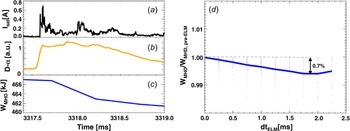
The ion saturation current (Isat ), measured with the midplane RCB at ∼3.5 cm from the separatrix, is shown in figure 4(a) for an intra-ELM time window during a small-ELM event. By inspecting figure 4(a) it can be seen that, after the initial spike, distinct filamentary structures that last between 50 and 200 μs are observed for approximately 1 ms, consistent with high upstream filamentary activity. The Deuterium-alpha (D-α) signal, measured with a filterscope viewing at the lower-outer divertor, is reported in figure 4(b), for reference. In figure 4(c) we show the plasma stored-energy signal (W MHD), where a clear drop can be observed despite the small size of the instability. By quantifying this ELM-induced decrease in W MHD, the ELM energy content can be extracted. Conditional average of the drop in the normalised stored energy i.e. WMHD /WMHD, pre-ELM has been carried out over the small ELMs examined, as shown in figure 4(d). The result indicates that, on average, the small ELMs carry 0.7 % of the plasma stored energy, which is well below any previously reported type-I ELMs, and comparable to small ELMs in the high-collisionality regime from various machines (Maingi et al. Reference Maingi2011; Leonard Reference Leonard2014).
(a–c) Intra-ELM evolution of ion saturation current measured with RCP in the SOL, D-a signal and plasma stored energy and (d) conditional average of the stored-energy drop induced by small ELMs.

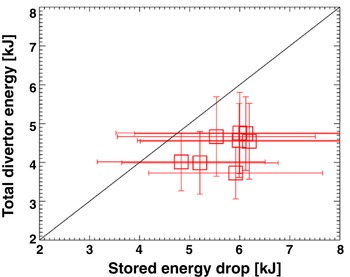
To quantify the small-ELM energy content for the scenario examined, a simple power accounting exercise has been carried out, where the energy carried by the ELM (evaluated via the stored-energy drop) is compared with the energy deposited at the divertor. The latter can be calculated by using IRTV heat flux profiles as $W_{\!\textit{IRTV}}=2\pi R_{0}\mathrm{d}t_{elm}\int\!\lt q_{\bot , \textit{intra}\_ ELM}(r)\gt \mathrm{d}r$
, where
$W_{\!\textit{IRTV}}=2\pi R_{0}\mathrm{d}t_{elm}\int\!\lt q_{\bot , \textit{intra}\_ ELM}(r)\gt \mathrm{d}r$
, where $R_{0}$
is the major radius, dt
elm is the ELM duration evaluated as described in § 2.2 and
$R_{0}$
is the major radius, dt
elm is the ELM duration evaluated as described in § 2.2 and $\lt q_{\bot , \textit{intra}\_ ELM}\gt$
is the time-averaged intra-ELM heat flux radial profile obtained as
$\lt q_{\bot , \textit{intra}\_ ELM}\gt$
is the time-averaged intra-ELM heat flux radial profile obtained as $q_{\bot , intr{a_{ELM}}}(r)=q_{\bot , OSP}(r) -q_{\bot , inte{r_{ELM{,_{\textit{osp}}}}}}(r)$
. The results are presented in figure 5. The energy delivered to the divertor is found to be less than the stored-energy drop, among all cases. Possible explanations may be related to (i) energy dissipation mechanisms along the path from the low-field side to the divertor targets and/or (ii) the far-SOL energy deposition that is not captured by the IRTV view. Despite this discrepancy, the power accounted for in the divertor is within 23 % the one extracted from the stored-energy drop, which is within the estimated uncertainty of the IRTV measurement (Lasnier et al. Reference Lasnier1998).
$q_{\bot , intr{a_{ELM}}}(r)=q_{\bot , OSP}(r) -q_{\bot , inte{r_{ELM{,_{\textit{osp}}}}}}(r)$
. The results are presented in figure 5. The energy delivered to the divertor is found to be less than the stored-energy drop, among all cases. Possible explanations may be related to (i) energy dissipation mechanisms along the path from the low-field side to the divertor targets and/or (ii) the far-SOL energy deposition that is not captured by the IRTV view. Despite this discrepancy, the power accounted for in the divertor is within 23 % the one extracted from the stored-energy drop, which is within the estimated uncertainty of the IRTV measurement (Lasnier et al. Reference Lasnier1998).
Total divertor energy, calculated from IRTV measurements at the divertors vs small-ELM plasma stored-energy drop.

3.2. Pedestal structure dynamics due to small ELMs
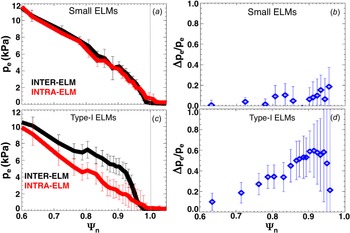
To experimentally characterise the pedestal dynamics induced by small-ELM instabilities, conditional averaging of TS data has been carried out using the IRTV OSP peak heat flux signal as temporal reference within the ELM cycle. This exercise, which has also been carried out for type-I ELMs for reference, allows for the evaluation of the global effect on the pedestal structure due the ELM pulse. Results are reported in figures 6(a) and 6(c), where the intra-ELM and inter-ELM time windows are indicated in red and black, respectively. For the small-ELM scenario (figure 6 a), ELMs only marginally destabilise the pedestal, while for the type-I ELM case (figure 6 c), a significant collapse in the pedestal structure is observed. The latter is in line with previous results (Leonard Reference Leonard2014). The type-I ELM-driven pressure loss extends deep into the core to Ψ n ∼ 0.6, and is accompanied by a large stored-energy drop of ΔWELM /WMHD = 15 %. In the small-ELM case, however, the scenario is different i.e. the inter-ELM and intra-ELM profiles almost superimpose, within error bars, along the whole profile, except that a clear peak in the intra-ELM profile is present near and across the separatrix, suggesting that the instability is localised mostly in a region in the vicinity of the pedestal foot.
Conditional average of TS measurements of pedestal electron pressure, pe , and relative change of pe for small-ELM (a, b) and type-I ELM (c, d) scenarios. The small ELMs show little effect on the pedestal structure, while type-I ELMs lead to a collapse of the profile.

Information on the effect of the ELM on the pedestal structure can also be inferred by inspecting the relative change of the electron pressure (Δp e /p e ) inside the separatrix, as reported in figures 6(b) and 6(d), where it can be seen that Δp e /p e for the small ELMs is between ∼ 3 times and 10 times smaller if compared with that for the type-I ELMs. It is of interest to note that, in the type-I ELM case, the relative change increases monotonically from Ψ n ∼ 0.6 and peaks at Ψ n ∼ 0.91, before going toward negative values. For the small-ELM scenario, however, Δp e /p e oscillates around 0 between Ψ n ∼ 0.6 and Ψ n ∼ 0.9, and the peak occurs much closer to the separatrix.
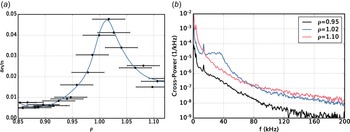
The BES analysis can inform us regarding the pedestal dynamics in high-collisionality small-ELM scenarios. In figure 7(a) we show the time-averaged (over 700 ms) normalised density fluctuation dn/n for a representative small-ELM discharge at DIII-D (no. 174165), similar to the ones adopted to compile the database used in this work with the exception that Ne was externally seeded. A clear peak in the density fluctuation level is found to be localised in the vicinity (or right across) the separatrix. Figure 7(b) reports the power spectra measured at different radii i.e. pedestal top, near the separatrix and the SOL, where we see a broadband turbulent feature between ∼ 20 and 40 kHz in the near-separatrix region (indicated in blue). Consistently higher power levels are found near the separatrix and at the SOL, compared with that at the pedestal top (indicated in black). These results, together with the conditional average analysis on TS pedestal profiles, are consistent with significant edge turbulence levels and increased near-separatrix activity in this plasma regime.
The BES results of (a) time-averaged normalised density fluctuations in the vicinity of the OMP for no. 174165 (time window goes from t = 2800 to t = 3500 ms) and (b) cross-power spectra at different radii for the same discharge.

3.3. BOUT++ simulations of pedestal stability during small ELMs
To investigate the origin and associated pedestal perturbation of small ELMs, simulations are performed using the reduced six-field fluid model implemented in the BOUT++ framework (Xia & Xu Reference Xia and Xu2015; Li et al. Reference Li2024). This model evolves the perturbed ion density $\tilde{n}_{i}$
, electron and ion temperatures
$\tilde{n}_{i}$
, electron and ion temperatures $\tilde{T}_{e}$
and
$\tilde{T}_{e}$
and $\tilde{T}_{i}$
, ion parallel velocity
$\tilde{T}_{i}$
, ion parallel velocity $\tilde{V}_{i,\parallel }$
, magnetic vector potential
$\tilde{V}_{i,\parallel }$
, magnetic vector potential $\tilde{A}_{\parallel }$
and vorticity
$\tilde{A}_{\parallel }$
and vorticity $\tilde{\varpi }$
. It captures the essential peeling–ballooning physics, acoustic and drift-Alfvén waves, and includes key non-ideal effects such as ion diamagnetic drift, E × B drift and resistivity. The simulations are carried out for DIII-D discharge no. 153841 in a domain spanning normalised poloidal flux
$\tilde{\varpi }$
. It captures the essential peeling–ballooning physics, acoustic and drift-Alfvén waves, and includes key non-ideal effects such as ion diamagnetic drift, E × B drift and resistivity. The simulations are carried out for DIII-D discharge no. 153841 in a domain spanning normalised poloidal flux $0.90 \lt $
Ψ
n
$0.90 \lt $
Ψ
n $\lt 1.05 $
, with grid resolutions of
$\lt 1.05 $
, with grid resolutions of $n_{\psi }=516, n_{y}=64$
,
$n_{\psi }=516, n_{y}=64$
, $n_{z}=64$
in the radial, field-aligned and binormal directions, respectively. Toroidal mode numbers n = 5, 10, 15, …, 80 are included for the nonlinear runs. Experimental equilibrium profiles of
$n_{z}=64$
in the radial, field-aligned and binormal directions, respectively. Toroidal mode numbers n = 5, 10, 15, …, 80 are included for the nonlinear runs. Experimental equilibrium profiles of $n_{i}$
,
$n_{i}$
, $T_{i}$
and
$T_{i}$
and $T_{e}$
are used from the pedestal through the SOL, while the equilibrium component of the radial electric field E
r
is taken from charge-exchange recombination measurements (Chrystal et al. Reference Chrystal2016).
$T_{e}$
are used from the pedestal through the SOL, while the equilibrium component of the radial electric field E
r
is taken from charge-exchange recombination measurements (Chrystal et al. Reference Chrystal2016).
The simulated small-ELM mode is found to originate at the pedestal foot, in the vicinity of the separatrix. The stability analysis indicates that the lower pedestal region is unstable to the resistive ballooning mode. In figure 8 we show the linear mode structure for the n = 60 toroidal mode number, where it can be seen that the normalised pressure perturbation extends from Ψ n ∼ 0.98 to slightly into the SOL at Ψ n ∼ 1.01.
Linear mode n = 60 structure of the normalised pressure perturbation obtained from the BOUT++ linear simulation.

BOUT++ simulation results of electron pressure profiles normalised to the pedestal-top value at Ψ n = 0.95. The black curve indicates the inter-ELM profile, while the red curve shows the averaged saturated intra-ELM pressure profile.

Nonlinear simulations are also carried out using the BOUT++ six-field model. The initial condition employs the experimentally measured pedestal profiles corresponding to the inter-ELM phase. Small ELM-like activity during the ELM crash phase is observed in the BOUT++ nonlinear simulation, and figure 9 compares the initial pre-crash normalised electron pressure profile (black) with the nonlinearly relaxed profile obtained from the simulation (red). The mode develops and saturates during the simulated ELM crash window near the pedestal foot, flattening the pressure gradient in the pedestal region, and does not penetrate beyond the pedestal top. This finding is consistent with the experimental results on the pedestal electron pressure evolution during the small ELMs, reported in § 3.2 and figure 6(a). This behaviour suggests that, although the instability originates near the pedestal bottom and separatrix, its weak amplitude limits the ELM size and prevents a large-scale ELM collapse.
It is worth reporting that the simulated peak parallel heat flux gives a value of ∼22 MW m−2, which is in reasonable agreement with the IRTV measured one of ∼30 MW m−2.
3.4. Inferring small-ELM pedestal origin via local measurements in the SOL
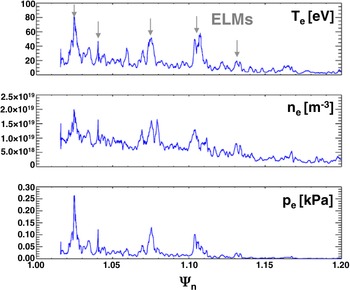
The SOL profiles of electron temperature and density, from which the electron pressure can be extracted, have been measured with the RCP near the OMP. Such measurements scan a region between the far SOL at Ψ n ∼ 1.2 to the near separatrix at Ψ n ∼ 1.015. The inter- and intra-small-ELM time windows can be well distinguished, as shown in figure 10, where T e , n e and p e measured during the inward part of a RCP reciprocation are reported for a small-ELM scenario (no. 153837). During the small ELMs, on average, the electron temperature increases by a factor 4 compared with the inter-ELM. However, the intra-ELM increase in density is much lower i.e. within a factor two. The high-density background inter-ELM is expected for the ELM plasma scenario examined, as parallel losses are slowed down and perpendicular transport is increased.
The RCP-measured plasma parameters of T e , n e and p e vs Ψ n during a small-ELM discharge. The ELMs are indicated with grey arrows.

The fast RCP data used in this work allow de-coupling of the inter- from the intra-small-ELM evolution of plasma parameters in the SOL. As ELM plasma density and temperature (and pressure) decay exponentially outside the separatrix (Boedo et al. Reference Boedo2005; Fundamenski & Pitts Reference Fundamenski and Pitts2006; Pitts et al. Reference Pitts2007), information on the ELM filaments’ origin at the pedestal can be inferred. This can be done by fitting the intra-ELM peak values in the SOL with a simple exponential decay function of the form $p_{e}=p_{e, \textit{separatrix}}e^{(-{\psi _{n}}/{\lambda _{{p_{e}}}})}$
, which allows us to project pe
to the separatrix and, subsequently, compare such value with the inter-ELM electron pressure pedestal profile.
$p_{e}=p_{e, \textit{separatrix}}e^{(-{\psi _{n}}/{\lambda _{{p_{e}}}})}$
, which allows us to project pe
to the separatrix and, subsequently, compare such value with the inter-ELM electron pressure pedestal profile.
Results are reported in figure 11 for three available cases, in different colours, together with the inter-ELM TS p e profile in the region between Ψ n = 0.95 and Ψ n = 1.08 (in black).
Inter-ELM pedestal TS profiles (in black) of electron pressure, p e , for three small-ELM cases. Intra-ELM measurements of p e in the SOL with the RCP are indicated by coloured diamonds, and the exponential fit to the data is shown with a solid line. The coloured vertical areas highlight the pedestal zone from which the projected values to the separatrix correspond.

By comparing the projected values at the separatrix with the pedestal profile, it is inferred that the ELMs’ p e origin is located in the region between Ψ n ∼ 0.99 and Ψ n ∼ 1, as indicated by coloured vertical areas in figure 11. By using the same method, type-I ELM plasma parameters in the SOL were found to be consistent with mid/top pedestal values inboard of the separatrix (Boedo et al. Reference Boedo2005).
The findings presented in this section are consistent with the picture of small ELMs being constituted primarily of a turbulent state near the OMP separatrix, as shown by BOUT++ simulations and experimental analysis on the pedestal pressure dynamics and edge-density fluctuations.
3.5. Benchmarking the modified ELM energy fluence model with experiments
The peak parallel ELM energy fluence model (Eich et al. Reference Eich2017) has been so far tested against ELM measurements from various machines only for type-I ELMs. In those analyses, $p_{e}$
was taken from the pedestal top. In the current work, we first tested the model against DIII-D experimental values, calculated as in § 2.2, from 105 individual ELMs with the same assumption of pe
from the pedestal top (Ψ
n
= 0.95). On average, the experimental peak ELM energy fluence (
$p_{e}$
was taken from the pedestal top. In the current work, we first tested the model against DIII-D experimental values, calculated as in § 2.2, from 105 individual ELMs with the same assumption of pe
from the pedestal top (Ψ
n
= 0.95). On average, the experimental peak ELM energy fluence ( $\varepsilon$
∥, peak, experimental
) for type-I ELMs is 0.29 MJ m−2, while the modelled one (
$\varepsilon$
∥, peak, experimental
) for type-I ELMs is 0.29 MJ m−2, while the modelled one ( $\varepsilon$
∥, peak, model
) is 0.22 MJ m−2 i.e. within ∼25 % (not shown) and in good agreement with the existing literature. However, if the same assumption of pedestal origin is applied for the small-ELM cases,
$\varepsilon$
∥, peak, model
) is 0.22 MJ m−2 i.e. within ∼25 % (not shown) and in good agreement with the existing literature. However, if the same assumption of pedestal origin is applied for the small-ELM cases, $\varepsilon$
∥, peak, model
overestimates
$\varepsilon$
∥, peak, model
overestimates $\varepsilon$
∥, peak, experimental
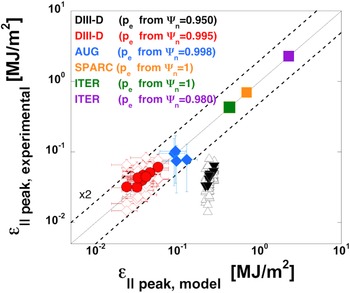
by a factor 8 or more, as shown in black in figure 12, where empty triangles are single ELMs, while filled black triangles are averaged over the same discharge. This discrepancy is in qualitative agreement with recent results at DIII-D (Traverso et al. Reference Traverso2024).
$\varepsilon$
∥, peak, experimental
by a factor 8 or more, as shown in black in figure 12, where empty triangles are single ELMs, while filled black triangles are averaged over the same discharge. This discrepancy is in qualitative agreement with recent results at DIII-D (Traverso et al. Reference Traverso2024).
Comparison between experimental parallel peak ELM energy fluence, ${\varepsilon }_{\|\textrm{peak}, {experimental}}$
, and the predicted values from the ELM energy fluence model,
${\varepsilon }_{\|\textrm{peak}, {experimental}}$
, and the predicted values from the ELM energy fluence model, ${\varepsilon }_{\|\textrm{peak} , {model}}$
. For DIII-D cases, the pedestal origins of the ELMs examined are the pedestal top (in black) and pedestal foot (in red). For ASDEX Upgrade data, reported in blue, only pedestal foot values are used. Projected values to ITER are indicated in green and purple, respectively, for the pedestal origin varying from the separatrix to Ψ
n
= 0.98. The projected value for SPARC, with p
e
from the separatrix, is indicated in orange.
${\varepsilon }_{\|\textrm{peak} , {model}}$
. For DIII-D cases, the pedestal origins of the ELMs examined are the pedestal top (in black) and pedestal foot (in red). For ASDEX Upgrade data, reported in blue, only pedestal foot values are used. Projected values to ITER are indicated in green and purple, respectively, for the pedestal origin varying from the separatrix to Ψ
n
= 0.98. The projected value for SPARC, with p
e
from the separatrix, is indicated in orange.

Informed by the experimental results and BOUT++ simulations presented before in this study, the energy fluence model has been modified by using p
e
from the pedestal foot, at $\Psi$
n
= 0.995. The results for the DIII-D small-ELM scenarios are shown in red in figure 12, where the filled circles are the averaged values per each discharge, and the empty diamonds are each individual ELMs. The error bar in the
$\Psi$
n
= 0.995. The results for the DIII-D small-ELM scenarios are shown in red in figure 12, where the filled circles are the averaged values per each discharge, and the empty diamonds are each individual ELMs. The error bar in the $\varepsilon$
∥, peak, model
is obtained by applying a pedestal profile shift to the location of pe
ranging between
$\varepsilon$
∥, peak, model
is obtained by applying a pedestal profile shift to the location of pe
ranging between $\Psi$
n
= 0.99 and
$\Psi$
n
= 0.99 and $\Psi$
n
= 1.0, to account for uncertainties on magnetic reconstructions (§ 2.3) and the exact birth region of the filaments. For these scenarios, good agreement between the model and the experimental data is obtained, where virtually all experimental data points are within a factor-two deviation from the predicted values, and the averaged values agree within 40 %.
$\Psi$
n
= 1.0, to account for uncertainties on magnetic reconstructions (§ 2.3) and the exact birth region of the filaments. For these scenarios, good agreement between the model and the experimental data is obtained, where virtually all experimental data points are within a factor-two deviation from the predicted values, and the averaged values agree within 40 %.
ASDEX Upgrade IRTV measurements (Redl et al. Reference Redl2024) of divertor peak heat flux in the high-density regime from four different shots (nos. 39231, 39232, 39234 and 39237) have also been compared with the modified ELM energy fluence model. For those cases, the peak heat flux used to calculate the energy fluence are taken from heat flux profiles averaged over ∼5 ms, which corresponds to 10 time steps. To obtain the pressure profiles, ‘integrated data analysis’ (IDA) (Fischer et al. Reference Fischer2017) using a Bayesian probabilistic approach is used to determine the profile based on a convolution of core and edge diagnostics. The IDA profiles are then mapped on kinetic-constrained magnetic coordinates.
ASDEX Upgrade results are reported in figure 12, in blue, where it can be seen that the model reproduces all experimental data to within 50 %. The large error bars in the experimental data are due to fluctuating values of the peak heat flux, as high-frequency ELMs could not be de-coupled from the inter-ELM time windows. For this reason also, the background is not subtracted and the peak of the time-averaged heat flux profile at the outer divertor is used. In these cases, p e from the pedestal foot at Ψ n = 0.998 is used and the integration time, dtELM, is assumed to be 1 +/− 0.3 ms, consistent with DIII-D small ELMs. An expanded and detailed work on high-density small-ELM duration in ASDEX Upgrade, although desirable, is beyond the scope of this study.
The small-ELM peak heat flux is typically deposited within the first 2–3 mm from the OMP separatrix (Perillo et al. Reference Perillo2024; Chen et al. Reference Chen2025). Accordingly, the results reported here are expected to hold in quasi-double-null configurations, provided the distance between the primary and secondary separatrix at the OMP (dRsep) is ${\gt}|3|\; \text{mm}$
. In an ideal Double-Null configuration (dRsep = 0), the inner targets would become isolated from the low-field side, and the ELM energy is therefore expected to split between primary-outer and secondary-outer divertor targets. Under this condition, the 1:1 target power sharing distribution accounted for by a factor 2 in the ELM energy fluence model remains valid.
${\gt}|3|\; \text{mm}$
. In an ideal Double-Null configuration (dRsep = 0), the inner targets would become isolated from the low-field side, and the ELM energy is therefore expected to split between primary-outer and secondary-outer divertor targets. Under this condition, the 1:1 target power sharing distribution accounted for by a factor 2 in the ELM energy fluence model remains valid.
The consistent reproducibility of the small-ELM measurements reported here, from both DIII-D and ASDEX Upgrade, provides further support to the concept of filaments originating in a narrow region in the vicinity of the separatrix. Further experimental data from other machines would be needed to test the modified model over more cases.
3.6. Extrapolating the peak ELM energy fluence to SPARC and ITER
In this section, we provide a first-order estimate of the peak parallel energy fluence produced by high-density small ELMs in SPARC and ITER. To the best of our knowledge, no previous study has reported such a projection in this regime. This extrapolation is enabled by the good agreement between the measured small-ELM values and the modified model results in § 3.5, as supported by both experiments and BOUT++ simulations.
For the SPARC case (Creely et al. Reference Creely2023), with $q_{edge}$
= 1.96,
$q_{edge}$
= 1.96, $R_{\textit{major}}$
= 1.85 m and electron temperature and density from the separatrix (reported in table 2) i.e. with p
e
= 9.984 kPa, the projected peak parallel ELM energy fluence is 0.7 MJ m−2, and is visually indicated by an orange square in figure 12.
$R_{\textit{major}}$
= 1.85 m and electron temperature and density from the separatrix (reported in table 2) i.e. with p
e
= 9.984 kPa, the projected peak parallel ELM energy fluence is 0.7 MJ m−2, and is visually indicated by an orange square in figure 12.
Values of n e and T e used to compute the peak ELM energy fluence due to small ELMs in SPARC and ITER.

In the ITER D-T 15 MA scenario (Garzotti et al. Reference Garzotti2019) (run ID: 135011-7), with $q_{edge}= 1.68$
,
$q_{edge}= 1.68$
, $R_{\textit{major}}$
= 6.2 m and electron temperature and density from the separatrix (table 2), p
e
= 2.180 kPa, the projected
$R_{\textit{major}}$
= 6.2 m and electron temperature and density from the separatrix (table 2), p
e
= 2.180 kPa, the projected $\varepsilon$
∥, peak
is 0.43 MJ m−2 (in green in figure 12). Assuming a low-collisionality plasma edge with T
i
/T
e
= 2, that would become 0.86 MJ m−2. For the same ITER scenario, if p
e is taken from Ψ
n
= 0.98 and T
i
/T
e
= 1 (values of ne
and T
e
are reported in table 2), the resulting
$\varepsilon$
∥, peak
is 0.43 MJ m−2 (in green in figure 12). Assuming a low-collisionality plasma edge with T
i
/T
e
= 2, that would become 0.86 MJ m−2. For the same ITER scenario, if p
e is taken from Ψ
n
= 0.98 and T
i
/T
e
= 1 (values of ne
and T
e
are reported in table 2), the resulting $\varepsilon$
∥, peak increases to ∼2.3 MJ m−2. The same exercise of shifting pe
to Ψ
n
= 0.98 could not be carried out for the SPARC case due to data unavailability.
$\varepsilon$
∥, peak increases to ∼2.3 MJ m−2. The same exercise of shifting pe
to Ψ
n
= 0.98 could not be carried out for the SPARC case due to data unavailability.
The cylindrical edge safety-factor-like term (qedge ) used for the extrapolations are derived from the nominal q95 values of 3.5 (SPARC) and 3 (ITER), via the relation qedge = q95/1.78, where the factor 1.78 (i.e. 16/9) accounts for two geometric corrections: the larger effective major radius (Rmajor + a minor, Ψn = 95)/R and the increase in the midplane poloidal field compared with the poloidally averaged one i.e. Bp,OMP /<B p >. The product of these two corrections (4/3 * 4/3 = 16/9) gives the factor 1.78, which is valid in machines with aspect ratio R/a of approximately 3.
Recent thermal analysis of the ITER divertor vertical targets (Gunn et al. Reference Gunn2017) indicates that the tungsten (W) monoblock surface melting threshold due to ELMs in the D–T 15 MA phase at ITER is $\varepsilon_{\bot,{peak}}= 0.57$
MJ m−2. Assuming an incident angle of 2.7°, this corresponds to a parallel energy density of
$\varepsilon_{\bot,{peak}}= 0.57$
MJ m−2. Assuming an incident angle of 2.7°, this corresponds to a parallel energy density of $\varepsilon$
∥,peak
= 12 MJ m−2, which is in line with type-I energy fluence projections in SPARC (Kuang et al. Reference Kuang2020). This value exceeds the small-ELM projections for both machines reported in this study, suggesting that the regime might be tolerable for W divertor targets integrity. The conclusion remains valid even when assuming a factor two uncertainty in the projected ITER value at Ψ = 0.98 (table 2), i.e. 2.3 × 2 = 4.6 MJ m−2.
$\varepsilon$
∥,peak
= 12 MJ m−2, which is in line with type-I energy fluence projections in SPARC (Kuang et al. Reference Kuang2020). This value exceeds the small-ELM projections for both machines reported in this study, suggesting that the regime might be tolerable for W divertor targets integrity. The conclusion remains valid even when assuming a factor two uncertainty in the projected ITER value at Ψ = 0.98 (table 2), i.e. 2.3 × 2 = 4.6 MJ m−2.
In carrying out those extrapolations, however, the following caveats should be taken into account:
-
(i) The nominal value of 12 MJ m−2 strongly depends on the angle of the magnetic field line incident to the material surface. For instance, with an incident angle ranging between 0.5° and 3°, the corresponding tolerable $\varepsilon$
∥, peak decreases from 65 to 10.9 MJ m−2.
$\varepsilon$
∥, peak decreases from 65 to 10.9 MJ m−2. -
(ii) W leading edges will have a significantly lower melting threshold. For example, the upper leading edge of the W monoblock of the vertical target of the outer divertor in ITER is reported to have a factor ∼ 3 lower heat flux tolerance than the bulk surface (Gunn et al. Reference Gunn2017).
-
(iii) When assessing material tolerances, the small intra-ELM peak energy fluence should be added to the inter-ELM one, since divertor survival in reactor-relevant scenarios is governed by the total incident energy fluence. However, in high-density divertor-detached conditions, the inter-ELM heat flux is expected to be minimal, while ELMs are likely to induce transient re-attachment. As a result, the intra-ELM heat flux becomes key to determining material integrity, given that a divertor solution that fully buffers ELMs has not yet been demonstrated.

The extrapolations presented in this section should be regarded as first-order estimates, serving as an initial step toward evaluating high edge-collisionality small-ELM scenarios as a potential solution for the power exhaust challenge in future machines. Assessing the implications of the projected values for material limits and structural integrity under plasma exposure will require dedicated plasma–material interaction (PMI) experiments and modelling (Cappelli et al. Reference Chen2025). The present study is intended to provide the first quantitative projections that can support subsequent PMI-focused analyses.
4. Summary and conclusions
The main findings reported in this study can be summarised as follows:
-
(i) Small ELMs in high edge-collisionality plasmas at DIII-D are found to carry, on average, 0.7 % of the plasma stored energy. Of that, approximately 80 % is accounted for to be deposited to the divertor targets.
-
(ii) The pedestal structure is only marginally destabilised by the small ELMs, with a relative change during the instability (Δp e /p e ) having a maximum, localised at the pedestal foot, of ∼ 0.2. For type-I ELMs, a strong collapse of the pedestal is observed and Δp e /p e increases monotonically throughout the whole profile up to 0.6.
-
(iii) The inter-ELM and intra-ELM pedestal profiles in small-ELM scenarios, if compared, do not show significant difference except in a region at the pedestal foot and across the separatrix, consistent with enhanced edge turbulence levels, and confirmed by edge measurements of the density fluctuation.
-
(iv) Simulations with the BOUT++ code of a small-ELM case at DIII-D revealed that the pedestal foot region is unstable to a high-n resistive ballooning mode. The instability-induced pressure perturbation is found to extend from Ψ n ∼ 0.98 to slightly into the SOL at Ψ n ∼ 1.01, consistent with experimental measurements.
-
(v) Intra-ELM-resolved measurements of electron pressure in the SOL suggest that the small ELMs originate in the pedestal foot region, between Ψ n = 0.99 and Ψ n = 1.0.
-
(vi) By carrying out an ad hoc modification of the peak ELM energy fluence model, guided by experimental results and simulations showing p e coming from the pedestal foot, measurements of small-ELM energy fluence in DIII-D and ASDEX Upgrade divertor can be reproduced, within ∼ 40 % on average.
-
(vii) First-order projections of small-ELM peak parallel energy fluence to ITER and SPARC result in values that are below the nominal threshold of W monoblock surface melting.
Further dedicated experiments employing diagnostics with sufficient temporal resolution to resolve the intra-ELM dynamics, both in the pedestal (e.g. reflectometry, fast TS) and divertor (IRTV, fast probes), would be valuable for expanding the small-ELM database across different devices, regimes and magnetic configurations.
Assessing whether ELM plasma buffering effects (Komm et al. Reference Komm2023) and good confinement occur simultaneously when operating with this type of small ELM and a detached divertor should be a focus of future studies to further address the viability of this regime as a power exhaust solution for future machines.
Acknowledgements
This material is based upon work supported by the U.S. Department of Energy, Office of Science, Office of Fusion Energy Sciences, using the DIII-D National Fusion Facility, a DOE Office of Science user facility, under Award(s) DE-FC02-04ER54698, DE-FG02-07ER54917, DE-FG02-08ER54999 and DE-AC52-07NA27344. The Authors are thankful for fruitful discussions with Dr M. Faitsch and Dr M. Shafer.
Editor Eleonora Viezzer thanks the referees for their advice in evaluating this article.
Disclaimer
This report was prepared as an account of work sponsored by an agency of the United States Government. Neither the United States Government nor any agency thereof, nor any of their employees, makes any warranty, express or implied, or assumes any legal liability or responsibility for the accuracy, completeness or usefulness of any information, apparatus, product or process disclosed, or represents that its use would not infringe privately owned rights. Reference herein to any specific commercial product, process or service by trade name, trademark, manufacturer or otherwise does not necessarily constitute or imply its endorsement, recommendation or favouring by the United States Government or any agency thereof. The views and opinions of authors expressed herein do not necessarily state or reflect those of the United States Government or any agency thereof. The views and opinions expressed herein do not necessarily reflect those of the ITER Organization.
Data availability statement
The data that support the findings of this study are available from the corresponding author upon reasonable request.
Declaration of interests
The authors report no conflicts of interest.







 Open access

