





Highlights
-
• Typically developing (TD) children outperformed autistic children in comprehension
-
• Passive voice comprehension improved with age for autistic and TD children
-
• Working memory predicted better comprehension in autistic but not in TD children
-
• Bilingualism had no negative effect on comprehension in autistic and TD children.
1. Introduction
According to current estimates, more than half of the world’s population is bilingual, which can be defined as ‘the use of two or more languages (or dialects) in everyday life’ (Grosjean et al., Reference Grosjean, Li and Bialystok2013, p. 5). However, the level of language proficiency, the age of acquisition of the different languages and the rates at which speakers use these languages can vary substantially. The current study focuses on bilingual children exposed, at home or school, to their societal language, German or French, as well as to other languages, and explores how this influences the acquisition of complex syntax.
As bilingualism is a widespread phenomenon, many children, both with typical and atypical development, are growing up bilingual. Autism spectrum disorder (ASD), which affects more than 1% of the worldwide population, typically impacts social communication, potentially yielding delays and differences in language development compared to typically developing (TD) children (Montgomery et al., Reference Montgomery, Chondrogianni, Fletcher-Watson, Rabagliati, Sorace and Davis2021). Parents of autistic children are often advised against raising their children in a bilingual context due to fears of potentially exacerbating these effects (Drysdale et al., Reference Drysdale, Van Der Meer and Kagohara2015).
Recent studies on ASD suggest that bilingual autistic children do not experience increased language delay (Drysdale et al., Reference Drysdale, Van Der Meer and Kagohara2015). Although cognitive benefits have often been reported for TD children, some studies show null results (see Gunnerud et al., Reference Gunnerud, Ten Braak, Reikerås, Donolato and Melby-Lervåg2020, for discussion). Similarly, bilingualism has been found to yield positive effects for autistic children on working memory (WM) and inhibition (Baldimtsi et al., Reference Baldimtsi, Peristeri, Tsimpli and Durrleman2020; Montgomery et al., Reference Montgomery, Chondrogianni, Fletcher-Watson, Rabagliati, Sorace and Davis2021) or to have no effect on WM, response inhibition or attentional interference control (Gonzalez-Barrero & Nadig, Reference Gonzalez-Barrero and Nadig2019; Montgomery et al., Reference Montgomery, Chondrogianni, Fletcher-Watson, Rabagliati, Sorace and Davis2021).
Independently of these effects, avoiding bilingualism can negatively impact family well-being and bonding, which would be avoided if bilingualism were maintained. Thus, developing the empirical coverage of bilingualism effects in this population would allow the autism community to make evidence-based decisions regarding multilingualism (Drysdale et al., Reference Drysdale, Van Der Meer and Kagohara2015). Studies on the comprehension of complex syntactic constructions by monolingual autistic individuals have yielded conflicting results, suggesting potential difficulties for subsets of autistic children across various languages, in particular for non-canonical structures such as passives (Costa & Lobo, Reference Costa and Lobo2020; Durrleman et al., Reference Durrleman, Delage, Prévost and Tuller2017).
Studies investigating the effect of bilingualism on complex syntax in autistic children are still scarce, but tend to show that bilingualism does not exacerbate performance (Gilhuber et al., Reference Gilhuber, Raulston and Galley2023). No study to date has focused on the effects of bilingualism on the comprehension of passives by autistic children, which is the aim of the current study. We focus on autistic and TD children who show various degrees of bilingual experience and for whom French and German are the societal languages.
Passive voice is acquired later than active voice in German and French. TD German-speaking children begin acquiring passive constructions around age three, achieving robust comprehension by five or six (Armon-Lotem et al., Reference Armon-Lotem, Haman, Jensen De López, Smoczynska, Yatsushiro, Szczerbinski, Van Hout, Dabašinskienė, Gavarró, Hobbs, Kamandulytė-Merfeldienė, Katsos, Kunnari, Nitsiou, Sundahl Olsen, Parramon, Sauerland, Torn-Leesik and Van Der Lely2016), while French-speaking TD children start around age four, reaching robust comprehension by eight (Durrleman et al., Reference Durrleman, Delage, Prévost and Tuller2017). These languages offer valuable insight due to their structural differences: German uses case-marking and SOV (Subject-Object-Verb) word order with verb-final subordinate clauses, whereas French has SVO (Subject-Verb-Object) order with less morphological marking. Comparing them helps reveal whether difficulties in passive comprehension arise from universal syntactic properties or language-specific features.
The study also explores potential links between the comprehension of passive voice and verbal WM, since the latter has been argued to influence its acquisition (Marinis & Saddy, Reference Marinis and Saddy2013) and to potentially be impacted by bilingualism.
1.1. Adopting a positive approach to bilingualism
Bilingual speakers are frequently compared to monolingual speakers regarding their linguistic performance. However, current research warns against such strict binary comparisons (Rothman et al., Reference Rothman, Bayram, DeLuca, Di Pisa, Duñabeitia, Gharibi, Hao, Kolb, Kubota, Kupisch, Laméris, Luque, Van Osch, Pereira Soares, Prystauka, Tat, Tomić, Voits and Wulff2023). A continuous description of bilingualism better captures the heterogeneity of participants’ knowledge, exposure to and use of different languages, as well as shifts in language dominance. In addition, grouping heterogeneous speakers as strictly monolingual or bilingual may hide the cognitive effects of bilingualism and prevent adequate monitoring of multilingual children’s abilities.
This study thus adopts a continuous approach to bilingualism, in line with the recent more nuanced views (Gullifer & Titone, Reference Gullifer and Titone2020; Rothman et al., Reference Rothman, Bayram, DeLuca, Di Pisa, Duñabeitia, Gharibi, Hao, Kolb, Kubota, Kupisch, Laméris, Luque, Van Osch, Pereira Soares, Prystauka, Tat, Tomić, Voits and Wulff2023) and defines bilingual experience as a balance of cumulative exposure, measured through an entropy score (see more details in Section 2.1).
1.2. Passive voice in German and French
Sentences in the active voice have a direct relationship between grammatical (i.e., syntactic) and thematic (i.e., semantic) roles, with the subject being the agent who performs the action described by the verb and the object being the patient or the theme as in (1). In sentences in the passive voice, this relationship is reversed: the agent is mapped to the noun phrase (NP) in the by-phrase and the patient is mapped to the structural subject as in (2) (Jovanovic, Reference Jovanovic2020):

Passive voice has been argued to require more processing resources than active voice, in both TD children and those with language delays. This may be due to a general bias of the parser to assign the role of agent to the first encountered NP. In example (2), the parser first assigns the role of agent to Paul, up to the moment that it hears the verb kissed. This should trigger a reanalysis, leading to Paul being assigned the role of patient and the by-phrase being interpreted as the agent (Marinis & Saddy, Reference Marinis and Saddy2013, for English).Footnote 1
TD children understand active sentences at around 18 months, whereas passive constructions are usually understood quite late, between five and seven years of age (Durrleman et al., Reference Durrleman, Delage, Prévost and Tuller2017; Jovanovic, Reference Jovanovic2020).Footnote 2 Later acquisition of passive voice compared to the active voice has been associated with syntactic maturation (Borer & Wexler, Reference Borer, Wexler, Roeper and Williams1987), low frequency of passives in children’s input or misinterpretation of the by-phrase (see Jovanovic, Reference Jovanovic2020, for an overview of the studies). Furthermore, passives without the prepositional by-phrase, referred to as short passives, are reported to emerge earlier in children’s linguistic repertoire compared to so-called long passives with the by-phrase (Armon-Lotem et al., Reference Armon-Lotem, Haman, Jensen De López, Smoczynska, Yatsushiro, Szczerbinski, Van Hout, Dabašinskienė, Gavarró, Hobbs, Kamandulytė-Merfeldienė, Katsos, Kunnari, Nitsiou, Sundahl Olsen, Parramon, Sauerland, Torn-Leesik and Van Der Lely2016; Durrleman et al., Reference Durrleman, Delage, Prévost and Tuller2017). Finally, (short) passives with actional verbs (those that involve a target state and allow a resultative reading) are reported to be mastered earlier than those with psychological verbs (i.e., involving a target state) (Borer & Wexler, Reference Borer, Wexler, Roeper and Williams1987).
Monolingual speakers of German reportedly interpret passives accurately at around five or six years of age (Armon-Lotem et al., Reference Armon-Lotem, Haman, Jensen De López, Smoczynska, Yatsushiro, Szczerbinski, Van Hout, Dabašinskienė, Gavarró, Hobbs, Kamandulytė-Merfeldienė, Katsos, Kunnari, Nitsiou, Sundahl Olsen, Parramon, Sauerland, Torn-Leesik and Van Der Lely2016). German is a SOV language with V2 (Verb second) in main clauses and reordering options for non-verbal constituents. In embedded clauses, the finite verb typically occupies the clause-final position (Armon-Lotem et al., Reference Armon-Lotem, Haman, Jensen De López, Smoczynska, Yatsushiro, Szczerbinski, Van Hout, Dabašinskienė, Gavarró, Hobbs, Kamandulytė-Merfeldienė, Katsos, Kunnari, Nitsiou, Sundahl Olsen, Parramon, Sauerland, Torn-Leesik and Van Der Lely2016). Sentences with verbs in simple tenses show an SVO order. German passives require movement of the NP in the structural object position to the subject position, an auxiliary (sein ‘to be’ or werden ‘to get’) in the V2 position and the past participle verb-finally. If the agent is present, it appears as a PP (prepositional phrase) between the auxiliary and the main verb. Passive voice is frequently formed with the auxiliary werden and expresses a dynamic event in which the subject undergoes an action brought about by another entity (Jovanovic, Reference Jovanovic2020).Footnote 3

French has a basic SVO order, and full passives in French are formed in a similar way to English, that is, using the auxiliary verb être (‘to be’) and a past participle. The agent is usually introduced by the preposition par (Nicoladis & Sajeev, Reference Nicoladis and Sajeev2020):

German and French offer a valuable comparison for passive voice acquisition: both use auxiliaries and past participles but differ structurally, that is, German is a case-marking SOV language with verb-final subordinate clauses, while French is SVO with less overt morphology. Comparing performance on passives helps determine if difficulties stem from language-specific factors or are broader, which is crucial for understanding autism-related challenges, since it remains unclear whether their syntactic challenges reflect sensitivity to language-specific features or more general processing limitations (see Section 1.3). Including children with varying bilingual experience also allows exploration of how bilingualism and WM interact with passive syntax.
1.3. Comprehension of passive voice by monolingual autistic children
Studies on the comprehension of passives by monolingually raised TD children and autistic children yield conflicting results. On the one hand, some studies report that autistic children comprehend passive voice less accurately than TD children (Costa & Lobo, Reference Costa and Lobo2020; Durrleman et al., Reference Durrleman, Delage, Prévost and Tuller2017). Durrleman et al. (Reference Durrleman, Delage, Prévost and Tuller2017) revealed that French-speaking autistic children performed significantly less accurately on actional and psychological passives compared to age-matched TD children, possibly due to difficulties with semantic interpretation. In addition, the study showed that the comprehension of different types of passives increases with age for TD children (age range 4–9), but not for autistic children (age range 8–11). Besides, the study did not find an effect of non-verbal abilities on the comprehension of passive voice, that is, the subgroup of autistic children within normal IQ range also performed worse on the comprehension of passive voice compared to TD children. Further, Costa and Lobo (Reference Costa and Lobo2020) also reported less accurate comprehension of passive voice by autistic Portuguese-speaking children (7–13 years, low to high non-verbal IQ values) compared to TD peers.
On the other hand, some studies have shown that TD children and autistic children converge on their comprehension of passive constructions (e.g., Jensen de López et al., Reference Jensen de López, Schroeder and Gavarró2018; Terzi et al., Reference Terzi, Marinis, Kotsopoulou and Francis2014). Terzi et al. (Reference Terzi, Marinis, Kotsopoulou and Francis2014) examined the interpretation of various syntactic constructions by 20 TD and 20 autistic Greek-speaking children (5–8 years, matched for non-verbal IQ in the medium range). Regarding the comprehension of passive voice, autistic children did not differ from TD children. The absence of the differences between TD and autistic children is explained by referring to the values of non-verbal IQ of the latter that were in the average range.
Another study by Jensen de López et al. (Reference Jensen de López, Schroeder and Gavarró2018) examined the comprehension of passive voice by adolescent speakers of Danish (15 TD, 13–17 years; 15 autistic individuals, 13–18 years). The study revealed that autistic adolescents performed similarly to TD peers. Additionally, age was not associated with passive comprehension in any of the investigated groups. The absence of differences between the two groups was explained by referring to the older age of the participants as well as the high IQ scores of autistic children.
Finally, some research has shown that the comprehension of passive voice by autistic children is affected by the difficulty of the experimental task. For instance, Andreou et al. (Reference Andreou, Antoniou and Peristeri2025) investigated the comprehension of different syntactic structures by 29 autistic Greek-speaking children (aged 7;1–12;6) using two sentence–picture matching tasks (i.e., the Syntactic Proficiency Test and the Diagnostic Verbal Intelligence Quotient, DVIQ). Autistic children had difficulties with comprehension of passives in the more visually complex DVIQ test but not in the Syntactic Proficiency Test; there was no effect of age on children’s accuracy scores.
1.4. Comprehension of passive voice by bilingual children
Non-canonical word order structures, including passive voice, are more challenging for monolingual children than canonical ones (Jovanovic, Reference Jovanovic2020). In language contact, these structures may be even harder for bilingual children due to reduced input. Passive voice requires not only syntactic and semantic knowledge (word order, theta role mapping) but also discourse skills (identifying information structure). As an external interface phenomenon (syntax–semantics–discourse), passive voice is predicted to show greater variability already in bilingual TD children, reflecting increased processing demands (Interface Hypothesis, Sorace, Reference Sorace2011). Such challenging structures for bilingual TD children may also be vulnerable in bilingual autistic children.
Research on the comprehension of passives in the societal language of TD bilingual children is quite scarce. In general, several studies report a convergence between monolingual and bilingual children in their comprehension of passive constructions, but not across all tested conditions and age groups. Nicoladis and Sajeev (Reference Nicoladis and Sajeev2020) found that while younger French–English bilingual children (3–4 years old) performed less accurately than English monolingual peers, older bilingual and monolingual children performed in a similar way to monolingual peers (5–6 years old). Further, Cristante (Reference Cristante2016) did not find the difference in passive voice comprehension between Turkish–German bilinguals and German monolinguals in Germany aged 7 years and 10 years.
A recent study by Boila (Reference Boila2024) investigated 34 German monolingual and 38 German-Italian simultaneous bilingual children (4–6 years) residing in Germany. Bilingual children did not differ from monolingual children in their comprehension accuracy of German passive voice sentences in which the subject was located in the preverbal position. However, when the subject appeared after the auxiliary verb, bilingual children performed significantly less accurately than monolingual children.
Unlike many previous studies, Boila (Reference Boila2024) additionally quantified bilingualism as a continuous variable calculating the cumulative language input and output. This variable did not predict the comprehension of passive voice. According to Boila (Reference Boila2024), the absence of a bilingualism effect presumably reflects the full acquisition of passives by bilingual children.
Finally, there is also evidence of differences in passive voice comprehension in bilingual and monolingual children, for example, for Turkish–English bilinguals compared to English monolinguals between 7 and 9 years of age (Marinis, Reference Marinis2007) as well as for Spanish–English bilinguals compared to English monolinguals between 9 and 14 years of age (Orellana, Reference Orellana2020).
Currently, there are no studies exploring the comprehension of passive constructions by autistic bilingual children. However, there is some work on the comprehension of passives comparing bilingual and monolingual children with developmental language disorder (DLD). In the absence of studies on bilingual autistic children’s comprehension of passives, findings from bilingual children with DLD can provide a useful point of comparison for addressing the question of whether bilingualism impacts the comprehension of passive voice. Indeed, autistic individuals form a heterogeneous group in terms of their communication and language skills (Schaeffer et al., Reference Schaeffer, Abd El-Raziq, Castroviejo, Durrleman, Ferré, Grama, Hendriks, Kissine, Manenti, Marinis, Meir, Novogrodsky, Perovic, Panzeri, Silleresi, Sukenik, Vicente, Zebib, Prévost and Tuller2023) with studies suggesting that subgroups of autistic children show similar linguistic profiles to children with DLD (previously referred to as specific language impairment, SLI) (Durrleman et al., Reference Durrleman, Delage, Prévost and Tuller2017). Like children with ASD, many individuals with DLD show difficulties with the comprehension of passives (for Mandarin: Durrleman et al., Reference Durrleman, Chen and He2024; for English: Marinis & Saddy, Reference Marinis and Saddy2013).
Talli and Stavrakaki (Reference Talli and Stavrakaki2020) investigated monolingual Greek children (mean age 8;11) and Russian–Greek and Albanian–Greek bilingual children (mean age 8;4) with DLD. The study found that monolingual children with DLD performed more accurately than their bilingual peers on passives, contrary to TD monolingual children who were less accurate than their TD bilingual peers. These results are explained with reference to the low frequency of passive voice in Greek and to a less frequent exposure of bilingual children to this structure compared to their monolingual peers. Contrary to Talli and Stavrakaki (Reference Talli and Stavrakaki2020), Marini et al. (Reference Marini, Andreetta, Mita, Piccolo, Berginc and Ozbič2025) found that bilingual Italian–Slovenian speaking children with DLD performed better than their monolingual Italian peers on the comprehension of syntactically complex sentences such as negative sentences (including sentences in the passive voice) and relative clauses due to the link between their enhanced WM skills and grammatical comprehension.
To summarize, some research on the comprehension of passives found no differences between bilingual and monolingual TD children (Cristante, Reference Cristante2016), or differences limited to younger children (Nicoladis & Sajeev, Reference Nicoladis and Sajeev2020) or complex structures (Boila, Reference Boila2024). In contrast, other studies found that bilingual children performed less accurately than their monolingual peers (Marinis, Reference Marinis2007; Orellana, Reference Orellana2020). Finally, two studies on the comprehension of syntactically complex structures by children with DLD reported conflicting results (Marini et al., Reference Marini, Andreetta, Mita, Piccolo, Berginc and Ozbič2025; Talli & Stavrakaki, Reference Talli and Stavrakaki2020).
1.5. Working memory and syntax in autistic and TD monolingual populations
A recent body of work links grammatical acquisition with WM (Delage & Frauenfelder, Reference Delage and Frauenfelder2019; Talli & Stavrakaki, Reference Talli and Stavrakaki2020). Mastering complex grammatical structures requires the ability to store and manipulate sequences of verbal information. WM serves exactly this function by temporarily holding and processing information through its components: the phonological loop, the central executive and the episodic buffer (Baddeley, Reference Baddeley2007). The phonological loop maintains incoming phonological information for a brief period and rehearses it to refresh memory traces. The central executive governs and regulates the information managed by the phonological loop. Meanwhile, the episodic buffer integrates and stores cohesive chunks of information drawn from various memory subsystems.
Verbal WM is vital for holding linguistic elements, integrating them and resolving dependencies, especially when agent and patient roles are reversed. Further, verbal WM has been found to be a key factor in sentence-level comprehension research, accounting for the increased comprehension difficulty of non-canonical sentences compared to canonical ones (Caplan & Waters, Reference Caplan and Waters1999). Therefore, WM is important for mastering passive voice since its successful comprehension involves non-canonical word order and requires memorizing, maintaining and manipulating syntactic and semantic information across longer spans (Durrleman et al., Reference Durrleman, Delage, Prévost and Tuller2017).
It has been reported that autistic individuals often experience difficulties with executive functions (EFs), including WM (Townes et al., Reference Townes, Liu, Panesar, Devoe, Lee, Taylor, Arnold, Crosbie and Schachar2023). Further, a number of studies postulated a link between WM and complex syntactic structures, in that autistic individuals experiencing difficulties with linguistic tasks also have difficulties with WM (Durrleman & Delage, Reference Durrleman and Delage2016; Riches et al., Reference Riches, Loucas, Baird, Charman and Simonoff2010). While WM was found to be associated with the comprehension of passive voice in monolingual children with DLD (Marinis & Saddy, Reference Marinis and Saddy2013), monolingual autistic children did not show an association between the comprehension of passive voice and forward digit span or backward digit span (Durrleman et al., Reference Durrleman, Delage, Prévost and Tuller2017).
For the comprehension of passive voice in monolingual TD children, some studies report an association with WM (Paolazzi et al., Reference Paolazzi, Grillo, Alexiadou and Santi2019), while others report no influence of WM (Boyle et al., Reference Boyle, Lindell and Kidd2013; Marinis & Saddy, Reference Marinis and Saddy2013).
1.6. Working memory and syntax in autistic and TD bilingual populations
In the preceding subsection, we outlined the potential relevance of WM abilities for the comprehension of passives in monolinguals. Interestingly, bilingual individuals are reported to exhibit advantages in EF abilities compared to monolingually raised individuals, possibly due to the constant management of two linguistic systems, which strengthens their cognitive control (Gunnerud et al., Reference Gunnerud, Ten Braak, Reikerås, Donolato and Melby-Lervåg2020). Research regarding the links between bilingualism, WM and the comprehension of complex syntactic constructions is limited, and the role of potential WM advantages in the comprehension of complex linguistic structures is still unclear.
Some studies report that TD bilingual children outperform monolinguals regarding the comprehension of complex syntactic constructions due to their advanced WM skills (Solaimani et al., Reference Solaimani, Wolfer, Baumeister, Chondrogianni, Bentea and Durrleman2025). More specifically, WM has been found to correlate with the comprehension of passive voice in bilingual, but not monolingual, TD children (Marinis & Saddy, Reference Marinis and Saddy2013). However, not all studies support better WM performance in bilingual populations (Orellana, Reference Orellana2020).
It remains largely unclear how bilingualism influences WM of autistic individuals, and the results of the few existing studies are mixed. While some research found a clear positive effect of bilingualism on WM (Baldimtsi et al., Reference Baldimtsi, Peristeri, Tsimpli and Durrleman2020), some other work did not find such a clear positive effect of bilingualism on WM in autistic children compared to their monolingual peers (Gonzalez-Barrero & Nadig, Reference Gonzalez-Barrero and Nadig2019).
Work on the potential links between WM and the production/comprehension of complex syntactic constructions in autistic bilinguals is very limited. There is evidence that although bilingualism does not impede language performance of autistic children, it also does not have a clear positive effect on their linguistic performance, with no association between the WM, bilingualism and the comprehension of complex syntactic structures. For instance, Meir and Novogrodsky (Reference Meir and Novogrodsky2020) investigated the association between syntactic abilities and verbal memory among monolingual Hebrew-speaking and bilingual Hebrew–Russian-speaking autistic children (age range: 4;6–9;2). Children’s syntactic abilities were tested through a sentence repetition task targeting various syntactic constructions. The study showed no bilingual advantage in autistic children regarding sentence repetition scores and memory scores in their societal language Hebrew, and no correlation of age and syntactic abilities in autistic children.
To date, there are no studies exploring the potential links between the comprehension of passive voice and WM in autistic bilingual children. However, there is some research on individuals with DLD that provides rather mixed findings. Talli and Stavrakaki (Reference Talli and Stavrakaki2020; see also Section 1.4) found that while verbal short-term memory (STM) predicted syntactic comprehension abilities of monolingual children (both TD and children with DLD), it was not a predictor of syntactic comprehension for bilingual children. Contrary to Talli and Stavrakaki (Reference Talli and Stavrakaki2020), Marini et al. (Reference Marini, Andreetta, Mita, Piccolo, Berginc and Ozbič2025) showed that grammatical comprehension correlated with phonological STM in bilingual Italian–Slovenian children with DLD. However, similar to Talli and Stavrakaki (Reference Talli and Stavrakaki2020), monolingual Italian-speaking children with DLD also showed a correlation between phonological STM and grammatical comprehension.
Taken together, some literature suggests that children’s comprehension of passive voice depends not only on linguistic complexity, but also on developmental factors (age) and cognitive resources (particularly verbal WM), which may further be influenced by bilingual experience. Passive sentences are harder than actives because they reverse the usual ‘who did what’ order and require listeners to hold constituents in mind until the by-phrase reveals the agent. With age, children become better at using these cues and handling the extra memory load, reflecting developmental trajectories in both syntactic competence and memory capacity (Durrleman et al., Reference Durrleman, Delage, Prévost and Tuller2017; Solaimani et al., Reference Solaimani, Wolfer, Baumeister, Chondrogianni, Bentea and Durrleman2025).
Verbal WM has been argued to underpin the maintenance and integration of sentence parts and thus to support the acquisition of complex syntax in both TD children (Delage & Frauenfelder, Reference Delage and Frauenfelder2019) and those with autism (Delage et al., Reference Delage, Eigsti, Stanford and Durrleman2022). Autistic monolingual children were often shown to have difficulties with EFs (Townes et al., Reference Townes, Liu, Panesar, Devoe, Lee, Taylor, Arnold, Crosbie and Schachar2023). Studies on bilingual TD and autistic children provided mixed results. While some studies have suggested that bilingual experience may relate to stronger WM (TD: Morales et al., Reference Morales, Calvo and Bialystok2013; ASD: Peristeri et al., Reference Peristeri, Vogelzang and Tsimpli2021), some other studies did not detect such boosts (ASD: Gonzalez-Barrero & Nadig, Reference Gonzalez-Barrero and Nadig2019; TD: Shokrkon & Nicoladis, Reference Shokrkon and Nicoladis2021). Therefore, more work is needed to elucidate how bilingualism interacts with verbal WM in shaping comprehension of complex syntax, namely passive voice, which is known to be susceptible to the impact of autism. Moreover, parents often worry that bilingualism may be detrimental for the development of their autistic children (Drysdale et al., Reference Drysdale, Van Der Meer and Kagohara2015). In this context, this work contributes evidence-based guidance on linguistic and cognitive development in bilingual contexts, addressing these parental concerns.
1.7. Research questions and hypotheses
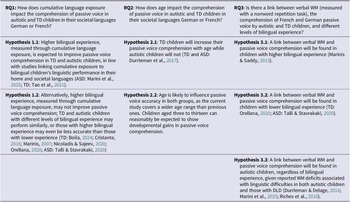
The current study is the first to explore the comprehension of passive constructions alongside WM, in TD and autistic children with varying bilingual experience and of a large developmental age range. It is aimed at answering the following research questions (RQs, see Table 1).
Research questions and hypotheses

2. Methodology
2.1. Participants
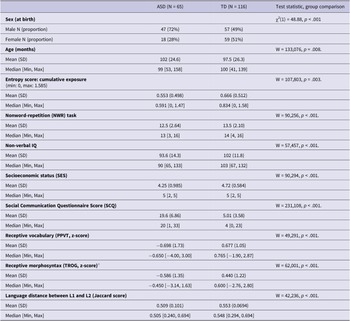
The sample for the current study consists of 181 children: 116 TD children and 65 autistic children (mean age = 8;3, range: 3;5–13;2). An overview of participants’ characteristics is given in Table 2. The data were collected in Switzerland, France and Germany. Children were diagnosed with ASD by a psychiatrist or psychotherapist, supported by either the Autism Diagnostic Observation Schedule - 2nd Edition (ADOS-2; Lord et al., Reference Lord, Rutter, DiLavore, Risi, Gotham and Bishop2012) or another standardized ASD diagnosis tool. Although every parent confirmed that their child had an official diagnosis, not every parent provided an official document due to some privacy issues. Further, we report the data on the socioeconomic status (SES) of parents, social communication score (SCQ) of children as well as the results of the common tests targeting their receptive grammar (TROG), vocabulary (PPVT) and non-verbal IQ (see Table 2 and Supplementary Appendix 1 for details).
Background of the participants: Linguistic, demographic and cognitive variables

a TROG 2 scores are reported as z scores rather than raw values because participants spanned a wide age range and the raw score schemes differed across languages – German scoring counted blocks passed, whereas French scoring counted errors. At each age, ‘reference’ children have scores between −1 and 1. Scores below −1 are below average while scores above 1 are above average.
To quantify bilingual experience of participants, their parents filled out the Quantifying Bilingualism Experience (Q-BEx) questionnaire (De Cat et al., Reference De Cat, Gusnanto, Kašćelan, Prévost, Serratrice, Tuller and Unsworth2025). In this study, we concentrate on the data from background information, language exposure and use, and proficiency modules. Parents indicated children’s proficiency in different languages, which was taken as an indicator of language dominance. Apart from the dominant language, many participants were exposed to one or two additional languages. Children were tested in their dominant language, which was either French or German; this was also their societal language. Some children were exposed to one or two languages at home or in school (i.e., French and other home or school language(s) or German and other home or school language(s)). The variety of their home and further languages was diverse with 22 different home or further languages and 16 L3 languages that belong to different families (e.g., Romance, Germanic, Slavic, Semitic, Finno-Ugric, etc.).
Since we adopt a continuous approach to bilingualism, participants are not grouped into monolinguals and bilinguals. Instead, bilingual experience was operationalized through the relative cumulative language exposure, indicated by the Q-BEx, and indexed through the language entropy score (Gullifer & Titone, Reference Gullifer and Titone2020). Relative cumulative language exposure is the overall proportion of hearing a language throughout life (the number of languages varied from one to three) (De Cat et al., Reference De Cat, Gusnanto, Kašćelan, Prévost, Serratrice, Tuller and Unsworth2025). Cumulative exposure has been found to be predictive of the linguistic skills of bilingual children in both their home and societal language (Tao et al., Reference Tao, Cai and Gollan2021).
Crucially, however, cumulative exposure does not capture how languages are distributed across contexts or the degree of language co-activation in daily life; language entropy provides a complementary measure by indexing the diversity and unpredictability of language use, which has been argued to place differential demands on executive and WM resources. Based on these relative scores, the language entropy score was calculated using the following equation $ H=-{\sum \limits}_{i=1}^n{p}_i\bullet {\mathit{\log}}_2\left({p}_i\right) $
. Language entropy captures the uncertainty of using a given language in a given moment and ranges from 0 to log n, with n being the number of languages. If a person uses two languages, the maximum entropy score is 1; if the number of languages is three, the maximum entropy score is around 1.585. The entropy score of 0 means no language diversity and a high predictability of a language while high entropy scores are linked to higher language diversity and, consequently, very low predictability of a language in a given moment (Gullifer & Titone, Reference Gullifer and Titone2020). For instance, if a participant reported having a relative cumulative exposure to German of 53% of the time and to English 47% of the time, the language entropy score was calculated as follows: (0.53*log2(0.53) + 0.47*log2(0.47))*−1 = 0.997.
$ H=-{\sum \limits}_{i=1}^n{p}_i\bullet {\mathit{\log}}_2\left({p}_i\right) $
. Language entropy captures the uncertainty of using a given language in a given moment and ranges from 0 to log n, with n being the number of languages. If a person uses two languages, the maximum entropy score is 1; if the number of languages is three, the maximum entropy score is around 1.585. The entropy score of 0 means no language diversity and a high predictability of a language while high entropy scores are linked to higher language diversity and, consequently, very low predictability of a language in a given moment (Gullifer & Titone, Reference Gullifer and Titone2020). For instance, if a participant reported having a relative cumulative exposure to German of 53% of the time and to English 47% of the time, the language entropy score was calculated as follows: (0.53*log2(0.53) + 0.47*log2(0.47))*−1 = 0.997.
Further, we assessed verbal WM of participants using a nonword-repetition (NWR) task from the LITMUS test battery (Chiat, Reference Chiat, Armon-Lotem, de Jong and Meir2015), whose aim is to evaluate children’s phonological memory regardless of their language background and experience. Children were asked to repeat 16 nonwords that do not exist in any language but contain language-specific properties (e.g., stress placement). The length of words varied from two to five syllables. Verbal WM score was computed as the overall number of correctly repeated nonwords (max: 16). NWR scores of TD children were significantly higher than those of autistic children (p < .001).
The linguistic and demographic information and the NWR scores are shown in Table 2.
2.2. Materials and procedure
The study elicited comprehension data of children who were tested in two separate sessions on different days. Children were tested in their dominant language (German or French); they were accompanied by a trained assistant who spoke their dominant language and helped them to navigate through the tasks.
We used a Gamified Syntactic Comprehension Task designed for young children and children with linguistic and cognitive impairments, avoiding unnecessary visual and verbal details. The task was performed via a gamified app on a tablet (iPad). The comprehension of passive voice was assessed on six items, all of which included long passives; critical items were interspersed with 54 fillers with other syntactic structures, including sentences in active voice (N = 6). Each participant was presented with all the items in a randomized order (i.e., target items in passive voice and all other filler items). The children were presented with three pictures that depicted some characters, and the task was to select one picture that corresponded to the test item that had been aurally presented to the participants (see Figures 1 and 2 in Supplementary Appendix 2). First, the participants got familiarized with the main characters of the picture (e.g., Here is a dog and a mouse or here is an elephant and a tiger). Then they heard a test item in active or passive voice (e.g., The mouse is being washed by the dog or the tiger is pushing the elephant) and saw three pictures on the screen. The picture on the right showed the target sentence in passive voice, the picture on the top showed the sentence with reversed theta roles (called ‘Reversed’) while the picture on the left was not connected with the test item (called ‘Oddball’). After the response had been given, participants saw a motivating sign (e.g., a star) and heard a motivating phrase (e.g., nice job!) (see examples 1–4 used to elicit the comprehension of passive and active voice in Supplementary Appendix 2).
The primary goal of the study is to examine the comprehension of sentences in passive voice in autistic and TD children with varying degrees of bilingual experience. Active voice sentences serve for balancing, but also as a baseline to the passive sentences in the following analyses: first, comprehension accuracy scores for active voice will allow us to exclude children who perform at chance level in the least challenging condition. Second, for the remaining children, we expect performance accuracy to be higher for active than for passive voice (Armon-Lotem et al., Reference Armon-Lotem, Haman, Jensen De López, Smoczynska, Yatsushiro, Szczerbinski, Van Hout, Dabašinskienė, Gavarró, Hobbs, Kamandulytė-Merfeldienė, Katsos, Kunnari, Nitsiou, Sundahl Olsen, Parramon, Sauerland, Torn-Leesik and Van Der Lely2016; Marinis & Saddy, Reference Marinis and Saddy2013); this provides an important control of our experimental setup. Third, to answer our research questions, comprehension accuracies for passive voice will be linked to children’s measures of bilingual experience and WM abilities.
3. Results
For statistical analysis, three separate binomial generalized linear mixed-effects models were created in RStudio (R Core Team, 2020). Each model included random intercepts for participants and items. The models were fully specified. For models with interactions, the binary fixed effects were contrast-coded using sum contrast coding (either −0.5 or 0.5). For post hoc tests of interactions, pairwise Tukey test was applied. The R script and the .xlsx data file are available on the OSF page.Footnote 4
3.1. Comprehension of active versus passive voice
To identify participants who performed at the chance level, first we modelled the response accuracy (correct = 1, incorrect = 0) as a dependent variable, with the random effects of participant and item in Model 1. The 95% confidence interval around the average of their model predictions was calculated. Participants whose confidence intervals included the chance level 33% were performing at chance. This chance level was set considering that each participant could choose from three pictures. Two participants were identified and were subsequently excluded from further analysis (for detailed calculations, see the R script available on the OSF page).
Figure 1 shows the mean comprehension accuracy for active and passive sentences by TD children and autistic children. The descriptive overview shows that TD children perform well with active and passive voice, while autistic children perform less accurately with passive sentences than with active sentences.
Mean accuracies across participants by structure (active or passive voice) and group (TD children or autistic children).

Further, we modelled the response accuracy on active versus passive sentences as a function of group (TD/ASD) and condition (Active/Passive; Model 2). We also included an interaction of group and condition. Since the goal of this model was to make sure that the experiment was credible, other fixed effects such as bilingual experience or verbal WM were not included. The model revealed two main effects and one interaction: first, there was a main effect of the group, that is, TD children were in general more accurate in the comprehension of active and passive sentences compared to autistic peers (estimate = −1.2, SE = 0.28, z = −4.22, p < .001). Second, there was a main effect of condition, that is, the comprehension of sentences in active voice was more accurate than those in passive voice by TD children and autistic children (estimate = 1.6, SE = 0.39, z = 4.1, p < .001; see Supplementary Appendix 3 for the detailed description of the results).
Additionally, there was a significant two-way interaction between group and condition. Tukey’s adjustment revealed the following results: first, TD children and autistic children performed significantly better on the comprehension of the sentences in active voice compared to those in passive voice (TD children: estimate = 1.18, SE = 0.41, z = 2.86, p = .03; autistic children: estimate = 2.02, SE = 0.43, z = 4.74, p < .001). Second, TD children performed significantly more accurately on the comprehension of passive voice than autistic children (estimate = −1.62, SE = 0.29, z = −5.43, p < .001). Finally, TD children and autistic children did not differ significantly from each other regarding their comprehension of sentences in active voice (estimate = −0.78, SE = 0.35, z = −2.26, n.s.; see Supplementary Appendix 4 for more details).
3.2. Factors influencing comprehension of passive voice
Here, we provide the results for the main research questions 1, 2 and 3, focusing on the comprehension of passive voice by French- and German-speaking TD children and autistic children, and possible effects of bilingual experience, chronological age and verbal WM.
The response accuracy on passive sentences (either correct, 1, or incorrect, 0) was modelled as a function of group (TD/ASD), bilingual experience (entropy score 0–1.585), chronological age (3;5–13;2) and verbal WM (1–16) (Model 3). The model included two-way interactions of group with every other fixed effect, that is, group and bilingual experience, group and chronological age, and group and verbal WMFootnote 5. Additionally, the model included a three-way interaction of group, verbal WM and bilingual experience. The linear fixed effects were centred and scaled by the R scale command. This is practical for the computation of interactions and to be able to compare estimates on a similar scale. Furthermore, the model was checked for issues related to multicollinearity by inspecting the variance inflation factor (VIF) associated with each term (VIFs for all terms are in the range 1.09–1.28).
Results showed that bilingual experience was not a significant predictor of children’s comprehension of passive voice, that is, higher balance of cumulative exposure did not lead to better comprehension of passive voice within every group.
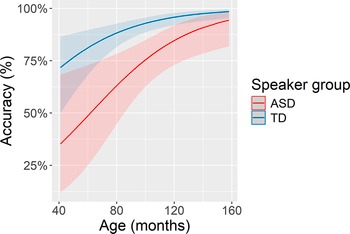
The model revealed three main effects and one interaction. First, there was a main effect of group, that is, TD children performed significantly more accurately regarding the comprehension of passive voice compared to autistic children (estimate = −1.45, SE = 0.35, z = −4.14, p < .001). Second, there was a main effect of age, showing that the comprehension of passive voice significantly improved with age for both groups (estimate = 0.73, SE = 0.18, z = 4.16, p < .001; see Figure 2 and Supplementary Appendix 5).
Effect of age on the comprehension accuracy of passive voice by typically developing (TD) children and autistic children.

Third, there was a main effect of verbal WM, that is, participants with higher verbal WM scores showed more accurate comprehension of passive voice than those with lower verbal WM scores (estimate = 0.60, SE = 0.17, z = 3.62, p < .001).
Additionally, there was a significant two-way interaction between group and verbal WM (estimate = 0.74, SE = 0.32, z = 2.27, p = .03). Post-hoc analyses revealed that higher WM scores predicted better comprehension of passive voice in autistic children but not in TD children (see Figure 3).Footnote 6
Effect of verbal working memory on the comprehension accuracy of passive voice by typically developing (TD) children and autistic children.

To sum up, TD children outperformed autistic children on their comprehension of passive voice, and the comprehension of this syntactic structure improved with age for both groups. Further, verbal WM was found to predict the comprehension of passive voice in autistic children but not in TD children. Finally, bilingual experience did not emerge as a significant predictor of the comprehension of passive voice; that is, there was no evidence that balance of exposure had an effect on passive voice comprehension in both TD and autistic children.
4. Discussion
This study investigated how autistic and TD children aged 3 to 13 comprehend passives in French or German, and how age, bilingual experience and verbal WM contribute to this comprehension. To our knowledge, this is the first study to examine passive voice comprehension in autistic children with varying bilingual experience and across a large developmental span.
The first research question focused on whether bilingual experience, operationalized as a balance of cumulative exposure and measured through an entropy score, impacted the comprehension of passive voice in TD children and autistic children. Our results refute Hypothesis 1.1 (Table 1), which predicted that TD children and autistic children with higher bilingual experience would perform better than those with lower bilingual experience. The results of the study showed that bilingual experience did not have an effect on the comprehension of passive voice in both TD and autistic children. Specifically, TD and autistic children with different levels of bilingual experience behaved alike, confirming Hypothesis 1.2.
Our study found that autistic children performed generally less accurately on the comprehension of passive voice than their TD peers, independently of their bilingual experience, echoing studies on the comprehension of passives by monolingual autistic children in Portuguese (Costa & Lobo, Reference Costa and Lobo2020) and French (Durrleman et al., Reference Durrleman, Delage, Prévost and Tuller2017). Moreover, we performed an exploratory analysis investigating whether autism severity reflected by the SCQ scores explained children’s comprehension of passives and found that lower comprehension was associated with higher SCQ scores, in line with work reporting an association between autism traits and complex syntax (Durrleman & Delage, Reference Durrleman and Delage2016; Meir & Novogrodsky, Reference Meir and Novogrodsky2020).
We also ran an exploratory analysis examining whether morphosyntactic skills contributed to the accuracy differences between TD and autistic children. We found that although autistic children scored lower than TD children on the TROG test, their receptive morphosyntactic skills were not found to explain their comprehension of passive voice, in line with the work reporting that global morphosyntactic abilities do not fully explain difficulties with specific complex syntactic structures in autistic populations (Meir & Novogrodsky, Reference Meir and Novogrodsky2020). To sum up, less accurate comprehension of passive voice by autistic children compared to their TD peers can be explained by the syntactic complexity of passive voice, as well as various degrees of autism severity.
Our results differ from studies that found no group differences (Andreou et al., Reference Andreou, Antoniou and Peristeri2025; Jensen de López et al., Reference Jensen de López, Schroeder and Gavarró2018; Terzi et al., Reference Terzi, Marinis, Kotsopoulou and Francis2014). The discrepancies may relate to participant characteristics: some studies included only higher-IQ (Terzi et al., Reference Terzi, Marinis, Kotsopoulou and Francis2014) or older autistic children who may have already mastered passive constructions (Andreou et al., Reference Andreou, Antoniou and Peristeri2025; Jensen de López et al., Reference Jensen de López, Schroeder and Gavarró2018). Further, the discrepancy between the results of this study and the aforementioned studies may lie in the differences regarding study design. For instance, contrary to this study, which provided three response options, Jensen de López et al. (Reference Jensen de López, Schroeder and Gavarró2018) included four such options and Andreou et al. (Reference Andreou, Antoniou and Peristeri2025) had two different conditions, one of which was more visually complex (i.e., four black-and-white options) than the other (i.e., three colourful options).
Importantly, we found no negative effect of bilingualism on passive voice comprehension in either TD or autistic children, in line with Cristante (Reference Cristante2016) and Meir and Novogrodsky (Reference Meir and Novogrodsky2020). This contrasts with studies reporting disadvantages for bilingual TD children (Marinis, Reference Marinis2007; Orellana, Reference Orellana2020). The discrepancy may stem from lower dominant-language proficiency in Marinis’ sample, where bilinguals scored far below norms in grammar and vocabulary, resembling DLD profiles, but unlike our participants, who showed age-appropriate proficiency in French and German. Similarly, Orellana’s findings may reflect limited exposure to passives, whereas children in our study likely had sufficient input, consistent with Boila (Reference Boila2024), who also found no effect of cumulative exposure. Our results also diverge from Tao et al. (Reference Tao, Cai and Gollan2021), who linked cumulative exposure to performance, perhaps because they measured exposure differently (self-designed questionnaire) and used a picture-naming task rather than passive comprehension. Nor did we replicate findings from children with DLD: Marini et al. (Reference Marini, Andreetta, Mita, Piccolo, Berginc and Ozbič2025) reported a bilingual advantage linked to enhanced WM, while Talli and Stavrakaki (Reference Talli and Stavrakaki2020) observed disadvantages under low passive input. In contrast, our bilingual participants did not show WM-related benefits, and German/French exposure may have provided more frequent access to passives than Greek.
The absence of a bilingualism effect cannot be explained by cross-linguistic similarity, in contrast to the view that cross-linguistic influence tends to be stronger when the languages involved are typologically similar or more structurally alike compared to cases involving more distant language pairs (Odlin, Reference Odlin1989). Given the possibility that autistic children may have been exposed to distantly related language pairs and therefore were not able to engage a similar structure from another language that would help them comprehend passive voice better, we additionally computed an individual Jaccard language similarity score between children’s L1 and L2 (i.e., the higher the score, the more distant language pair) (Skirgård et al., Reference Skirgård, Haynie, Blasi, Hammarström, Collins, Latarche, Lesage, Weber, Witzlack-Makarevich, Passmore, Chira, Maurits, Dinnage, Dunn, Reesink, Singer, Bowern, Epps, Hill and Gray2023). Jaccard similarity scores between L1 and L2 (0.240–0.694) did not predict performance on passive voice (see the model in the R script). Instead, the lack of effect may rather reflect the inherent demands of passives, which tax WM, non-canonical word order integration and pragmatics (Delage et al., Reference Delage, Eigsti, Stanford and Durrleman2022). According to the Interface Hypothesis (Sorace, Reference Sorace2011), such structures are vulnerable even in TD bilinguals; in autism, the processing load may outweigh any potential bilingual advantage.
The absence of a bilingualism effect in the current study may have several alternative explanations. First, bilingual experience is shaped not only by the total amount of exposure but also by contextual factors such as the linguistic demands of home, school and community environments, which were not fully captured by the cumulative exposure measure. Second, discrepancies between the present findings and previous work may reflect differences between autistic children and those with DLD. Children with DLD typically show primary difficulties in structural language (e.g., grammar, morphology, vocabulary learning), whereas autistic children often present with broader social-communication difficulties and more heterogeneous language profiles (Schaeffer et al., Reference Schaeffer, Abd El-Raziq, Castroviejo, Durrleman, Ferré, Grama, Hendriks, Kissine, Manenti, Marinis, Meir, Novogrodsky, Perovic, Panzeri, Silleresi, Sukenik, Vicente, Zebib, Prévost and Tuller2023). It is possible that bilingualism interacts differently with structural language weaknesses than with social-communication challenges. Thus, findings from DLD samples may not generalize directly to our autistic sample (Andreou et al., Reference Andreou, Antoniou and Peristeri2025).
The second research question focused on the possible impact of age on the comprehension of passive voice in German and French across TD and autistic children. Our results refute Hypothesis 2.1, according to which only TD but not autistic children were expected to perform more accurately on the comprehension of passive voice with age. Our results confirm Hypothesis 2.2 (Table 1), which predicted an effect of age on the comprehension of passive voice in both TD and autistic children.
We found that the comprehension of passive voice increases with age for TD and autistic children. This result is important, since it does not match some earlier studies finding no association between age and syntactic abilities in autistic children (Andreou et al., Reference Andreou, Antoniou and Peristeri2025; Durrleman et al., Reference Durrleman, Delage, Prévost and Tuller2017; Jensen de López et al., Reference Jensen de López, Schroeder and Gavarró2018; Meir & Novogrodsky, Reference Meir and Novogrodsky2020). One of the explanations of such differences is the exact ages and age ranges investigated by different studies. Generally, the above-mentioned studies examined the comprehension of passive voice by children who were older than those investigated in our study. Specifically, Durrleman et al. (Reference Durrleman, Delage, Prévost and Tuller2017) looked at autistic children from 8–11 years, Andreou et al. (Reference Andreou, Antoniou and Peristeri2025) investigated autistic children between 7;1 and 12;6 years of age while Jensen de López et al. (Reference Jensen de López, Schroeder and Gavarró2018) examined adolescent speakers between 13 and 17 years of age. The results of our study show that the comprehension of passive voice drastically improves at around 8 or 10 years of age for both TD and autistic children (the accuracy is above 75%), and thus, it is possible that the above-described studies did not see an effect of age, because starting from an older age the comprehension of passive voice was already close to ceiling and did not improve significantly anymore. Also, Durrleman et al. (Reference Durrleman, Delage, Prévost and Tuller2017) found that the age of TD children correlated with their comprehension of actional passive voice all the way from ages 4 to 9; specifically, 4- to 5-year-olds performed significantly worse than 6- to 7-year-olds, who, in turn, performed significantly worse than 8- to 9-year-olds. The results of the current study show that not only TD children, but also autistic children improve their comprehension of passive voice with age. Thus, to see the effect of age, it is important to test younger autistic children as well as older ones.
Finally, Meir and Novogrodsky (Reference Meir and Novogrodsky2020) examined monolingual and bilingual autistic children of a greater age range between 4;6–9;2 years of age, which is more similar to the age range of the children tested in the current study (i.e., 3–13). Contrary to the results of our study, Meir and Novogrodsky (Reference Meir and Novogrodsky2020) did not find an association between age and syntactic abilities of autistic children. Different outcomes in both studies are most probably due to differences in the investigated phenomena and methods. While the current study exclusively focused on passive voice and its comprehension, Meir and Novogrodsky (Reference Meir and Novogrodsky2020) did not target passive voice, but examined other complex syntactic constructions (e.g., object wh-questions, oblique wh-questions, object relatives) through a sentence repetition task.
The third research question focused on the possible association between verbal WM and the comprehension of French and German passive voice in autistic and TD children with different bilingual experiences. Our results refute Hypothesis 3.1 (Table 1), according to which an association between verbal WM and the comprehension of passive voice was expected for children with higher bilingual experience than those with low bilingual experience. The results of the study also refute Hypothesis 3.2 (Table 1), which predicted an association between verbal WM and the comprehension of passive voice in children with lower bilingual experience than those with higher bilingual experience. The association between verbal WM and the comprehension of passive voice emerged independently of the level of bilingual experience and only for autistic and not TD children, confirming Hypothesis 3.3 (Table 1).
Specifically, autistic children with higher WM scores performed better on the comprehension of passive voice while in TD children WM scores were not associated with passive voice comprehension, in contrast to some previous work on the association of passive voice and WM in TD children (Marinis & Saddy, Reference Marinis and Saddy2013; Orellana, Reference Orellana2020; Paolazzi et al., Reference Paolazzi, Grillo, Alexiadou and Santi2019). The discrepancy between these previous studies and the current study might stem from differences in the tasks that were used to measure WM as well as in the type of WM measured. For instance, Paolazzi et al. (Reference Paolazzi, Grillo, Alexiadou and Santi2019) and Marinis and Saddy (Reference Marinis and Saddy2013) found an association between comprehension of passive voice and WM that was measured via a combination of verbal and non-verbal tasks (i.e., non-verbal sentence judgment task and verbal letter recall task). Further, Orellana (Reference Orellana2020) found a strong effect of the visual WM on passive voice comprehension in monolingual TD children and a weak effect in bilingual children. Finally, and importantly, Boyle et al. (Reference Boyle, Lindell and Kidd2013), who used the same method as reported in this study to measure verbal WM (i.e., NWR task), did not find an effect on the comprehension of passive voice in monolingual TD children.
The current study showed that TD children had significantly higher verbal WM than autistic children, confirming previous research (Townes et al., Reference Townes, Liu, Panesar, Devoe, Lee, Taylor, Arnold, Crosbie and Schachar2023). Furthermore, deficits in WM have been suggested to relate to linguistic difficulties in monolingual autistic children as well as in monolingual and bilingual children with DLD (Durrleman & Delage, Reference Durrleman and Delage2016; Marini et al., Reference Marini, Andreetta, Mita, Piccolo, Berginc and Ozbič2025; Riches et al., Reference Riches, Loucas, Baird, Charman and Simonoff2010; Talli & Stavrakaki, Reference Talli and Stavrakaki2020). Therefore, the link between lower performance on syntactic comprehension and lower verbal WM among autistic children, found in this study, is not surprising. It is worth noticing that our results mirror those by Durrleman and Delage (Reference Durrleman and Delage2016) and Riches et al. (Reference Riches, Loucas, Baird, Charman and Simonoff2010), who found that the production of complex syntactic constructions by autistic children was linked to nonword repetition, possibly pointing towards large heterogeneity in WM scores in this population and challenges in verbal WM observed in simpler tasks.
5. Limitations and further directions
One limitation of our study is that TD and autistic children are not perfectly matched for IQ scores. The current study included children with a wide IQ range, from far below average to far above average, which was similar for TD and autistic children. This limitation is a compromise we had to accept in order to pursue our primary research question on the role of bilingual experience in language comprehension; recruiting the necessary number of children to match autistic and TD children on age, continuous multilingualism factors like language entropy, and additionally IQ scores would take an unrealistic amount of time. This may explain differences from some previous studies such as those by Terzi et al. (Reference Terzi, Marinis, Kotsopoulou and Francis2014) and Andreou et al. (Reference Andreou, Antoniou and Peristeri2025), which only included children with medium IQ values. Future research should try to match autistic and TD children on their non-verbal IQ to control for its influence on linguistic performance.
Another limitation of this study is the small number of passive items and the exclusive focus on long passives. This focus was a principled choice, as long passives were hypothesized to be the most likely to be influenced by bilingualism, given that they place higher computational demands (Borer & Wexler, Reference Borer, Wexler, Roeper and Williams1987), while bilingualism has been argued to enhance EFs (Gunnerud et al., Reference Gunnerud, Ten Braak, Reikerås, Donolato and Melby-Lervåg2020). Nevertheless, future research should broaden the design to include a larger number of items as well as both short and long passives to provide a more comprehensive picture.
6. Conclusion
The current study found that TD children outperformed autistic children on their comprehension of passive voice, but the comprehension of this syntactic structure improved with age for both groups. Further, verbal WM predicted the comprehension of passive voice in autistic children, but not in TD children. Finally, bilingual experience did not seem to impact our findings in any significant way. Therefore, we conclude that although bilingual experience did not contribute to the boost in verbal WM and the comprehension of passive voice, more importantly, it did not have a negative effect on the linguistic performance of autistic children. Our findings are relevant in light of the fact that bilingual children may experience discrimination from paediatricians, speech therapists or (pre)school teachers who often evaluate such children based on the monolingual norm and make decisions about future trajectories of the children (Rothman et al., Reference Rothman, Bayram, DeLuca, Di Pisa, Duñabeitia, Gharibi, Hao, Kolb, Kubota, Kupisch, Laméris, Luque, Van Osch, Pereira Soares, Prystauka, Tat, Tomić, Voits and Wulff2023). The current study adds another point in favour of not artificially restricting the linguistic input of autistic and TD children. Specifically, the current results should inform educational or clinical practices by highlighting that bilingualism is not an aggravating factor for autistic children in the comprehension of complex syntactic constructions.
Supplementary material
The supplementary material for this article can be found at http://doi.org/10.1017/S1366728926101242.
Data availability statement
The data that support the findings of this study are openly available at: https://osf.io/de3fp
Acknowledgements
We are grateful to Anna Czypionka for her constructive feedback.
Funding statement
This study was supported by the Swiss National Science Foundation (SNSF) awarded to Stephanie Durrleman (grant PR00P1_193104/1).
Competing interests
The authors declare none.
Ethical standard
The authors assert that all procedures contributing to this work comply with the ethical standards of the relevant national and institutional committees on human experimentation and with the Helsinki Declaration of 1975, as revised in 2008.



 Open access

