





An emerging body of empirical research documents the developmental antecedents and consequences of personality disorders (De Fruyt & De Clercq, Reference De Fruyt and De Clercq2014; De Fruyt, De Clercq, De Caluwé, & Verbeke, Reference De Fruyt, De Clercq, De Caluwé and Verbeke2017). Conceptualizations of personality pathology have shifted over the past decade, and so have the terms used to describe the personality and psychopathology constructs considered in the present paper (see Table 1). More recently, the field has shifted to conceptualizing personality disorders dimensionally (Krueger & Hobbs, Reference Krueger and Hobbs2020). Dimensional models of personality disorders come from investigations of the structure of personality and psychopathology and a lack of empirical evidence supporting categorical models of personality disorder variation. In addition, the National Institute of Mental Health (NIMH) has launched the Research Domain Criteria (RDoC) initiative, with the goal of linking brain circuits to specific behaviors by investigating multiple levels of analysis (i.e., genes, molecules, cells, circuits, physiology, behavior, and self-reports) (Cuthbert & Insel, Reference Cuthbert and Insel2013; Insel et al., Reference Insel, Cuthbert, Garvey, Heinssen, Pine, Quinn and Wang2010). In the RDoC approach, these levels are applied to dimensional constructs hypothesized to comprise underlying processes that may be relevant to psychopathology. However, we argue that the field must look beyond the connection between RDoC and outcomes, as has traditionally been done when trying to link RDoC to psychopathology (Koudys, Traynor, Rodrigo, Carcone, & Ruocco, Reference Koudys, Traynor, Rodrigo, Carcone and Ruocco2019), and the connection between RDoC and development, as has more recently been done in attempts to integrate a developmental psychopathology perspective with the RDoC initiative (Mittal & Wakschlag, Reference Mittal and Wakschlag2017). Instead, we propose an integrative account that will elucidate the development of the relevant mechanisms underlying the structure of personality pathology.
Terminology used for describing personality pathology
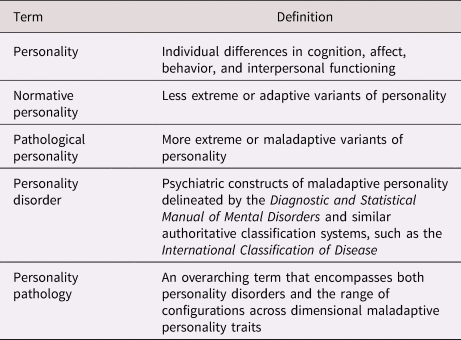
In the present paper, we first provide an overview of personality disorder classification, highlighting the shift from categorical to dimensional approaches to classifying personality disorders. We review empirical evidence for dimensional classification systems and structural models of personality pathology. We provide an overview of developmental theories of pathological personality. We then review the RDoC approach and the extent to which it incorporates developmental principles. We conclude by proposing an integrative developmental model for personality pathology that integrates dimensional personality disorder classification (Krueger & Hobbs, Reference Krueger and Hobbs2020), RDoC-informed science on underlying mechanisms (Clark, Cuthbert, Lewis-Fernández, Narrow, & Reed, Reference Clark, Cuthbert, Lewis-Fernández, Narrow and Reed2017), and developmental psychopathology theory (Cicchetti, Reference Cicchetti1984; Cicchetti & Crick, Reference Cicchetti and Crick2009) as crucial to providing a comprehensive account of the development and mechanisms underlying personality pathology. We believe our integrative account of personality pathology development will provide a testable model to elucidate the underlying mechanisms of personality pathology development across the life span.
Classification of Personality Disorders
Personality disorders are a significant public health concern, given associations with morbidity, premature mortality, and numerous personal and social costs (Winsper et al., Reference Winsper, Bilgin, Thompson, Marwaha, Chanen, Singh and Furtado2020). The classification of personality disorders has historically been contentious, limiting our ability to effectively identify and treat individuals with personality pathology (Krueger & Markon, Reference Krueger and Markon2014; Tyrer, Mulder, Kim, & Crawford, Reference Tyrer, Mulder, Kim and Crawford2019; Zachar, Krueger, & Kendler, Reference Zachar, Krueger and Kendler2016). Classical dichotomous categories of personality disorders, based on clinical descriptions rooted in the diagnostic nosology of earlier Diagnostic and Statistical Manuals of Mental Disorders (DSMs), include specific diagnostic criteria (Krueger & Hobbs, Reference Krueger and Hobbs2020). Yet, there are numerous problems with the categorical approach to personality disorder diagnosis, including the use of arbitrary boundaries to distinguish between normality and abnormality, comorbidity, heterogeneity, low diagnostic stability, and limited treatment utility (Clark, Reference Clark2007; Krueger & DeYoung, Reference Krueger and DeYoung2020; Latzman & Kumari, Reference Latzman and Kumari2020; Tyrer et al., Reference Tyrer, Mulder, Kim and Crawford2019; van Dijk, Krueger, & Laceulle, Reference van Dijk, Krueger and Laceulle2020). Particularly notable is that traditional categories of personality disorders used historically in research and clinical practice are inconsistent with a substantial empirical literature on the structure of psychopathology (Krueger, Reference Krueger2016; Krueger & Hobbs, Reference Krueger and Hobbs2020; Krueger & Markon, Reference Krueger and Markon2014; Tyrer et al., Reference Tyrer, Mulder, Kim and Crawford2019). Maladaptive personality traits exist on continua with normative personality traits, supporting the notion that personality disorders and personality pathology are better captured dimensionally than categorically (Krueger & Markon, Reference Krueger and Markon2014; van Dijk et al., Reference van Dijk, Krueger and Laceulle2020).
In recognition of the problems with the traditional categorical approach to personality disorder diagnosis, the field has begun to move towards dimensional classification models of personality pathology with the addition of the alternative model of personality disorder (AMPD) in Section III of the DSM-5 (American Psychiatric Association, 2013) and with the International Classification of Disease (ICD-11) personality disorder model (Krueger & Hobbs, Reference Krueger and Hobbs2020; Krueger & Markon, Reference Krueger and Markon2014; Tyrer et al., Reference Tyrer, Mulder, Kim and Crawford2019). The AMPD conceptualizes personality pathology in terms of both overall dysfunction and specific maladaptive trait specifiers. It includes Criterion A, which refers to personality functioning, defined as impairments in self and interpersonal functioning, and Criterion B, which refers to maladaptive personality traits that delineate the five broad domains of negative affectivity (vs. emotional stability), detachment (vs. extraversion), antagonism (vs. agreeableness), disinhibition (vs. conscientiousness), and psychoticism (vs. lucidity). Similar to the AMPD, the ICD-11 personality disorder model considers dysfunction, parallel to Criterion A in the AMPD, and specific variants, parallel to Criterion B in the AMPD, which includes maladaptive personality traits of negative affectivity, detachment, dissociality, disinhibition, and anankastia; these map directly onto cognate AMPD personality traits (Krueger & Hobbs, Reference Krueger and Hobbs2020; Zimmermann, Kerber, Rek, Hopwood, & Krueger, Reference Zimmermann, Kerber, Rek, Hopwood and Krueger2019). AMPD and ICD-11 personality traits are thought to capture the full spectrum of maladaptive personality characteristics (Krueger & Hobbs, Reference Krueger and Hobbs2020). Of note and in a significant departure from traditional categorical approaches to diagnosis, the ICD-11 personality disorder model also requires clinicians to rate the degree of personality pathology on a dimensional indicator (Krueger & Hobbs, Reference Krueger and Hobbs2020; Tyrer et al., Reference Tyrer, Mulder, Kim and Crawford2019).
This shift towards a dimensional approach to understanding and diagnosing personality disorders and personality pathology comes in the context of such shifts for psychopathology more broadly. The hierarchical structure of psychopathology suggests the field should utilize an empirically based approach to delineate the observed structure of psychopathology and therefore inform an empirically based nosology used in research and clinical practice (Conway et al., Reference Conway, Forbes, Forbush, Fried, Hallquist, Kotov and South2019; Kotov, Krueger, & Watson, Reference Kotov, Krueger and Watson2018). This hierarchical structure of psychopathology focuses on continuously distributed traits, theorized to form the scaffolding for psychopathology based on formal quantitative models (Krueger et al., Reference Krueger, Kotov, Watson, Forbes, Eaton, Ruggero and Bach2018). Taken together, the paradigm shift to conceptualizing personality pathology as dimensional ushers in an era of both challenges and opportunities for the field to elucidate the development of personality pathology across the life span.
Traditional Developmental Accounts of Personality
Given the shift to conceptualizing personality disorders dimensionally, pressing questions remain: How does dimensional personality pathology develop, and what are the underlying systems relevant to its development? How do individuals arrive at different personality pathology profiles across these dimensional traits? What are the processes involved in the association between normative personality and pathological personality? There are compelling reasons to incorporate principles of developmental psychopathology in order to accurately conceptualize personality pathology causes and consequences across the life span and begin to answer these questions (Cicchetti & Crick, Reference Cicchetti and Crick2009). The ways in which developmental psychopathology has begun to be incorporated in the field's thinking about personality pathology have been described in detail elsewhere (Cicchetti & Crick, Reference Cicchetti and Crick2009; De Clercq, Reference De Clercq2018; Tackett, Balsis, Oltmanns, & Krueger, Reference Tackett, Balsis, Oltmanns and Krueger2009). Here, we focus on describing the existing theoretical models of personality pathology that were hypothesized based on the tenets of developmental psychopathology theory.
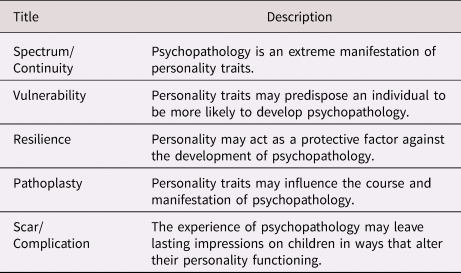
Traditional developmental accounts of personality pathology (see Table 2) posit distinguishable yet potentially complementary models for understanding its development: spectrum/continuity, vulnerability, resilience, pathoplasty, and scar/complication models (Brandes, Reardon, & Tackett, Reference Brandes, Reardon, Tackett, Hupp and Jewell2019; Shiner & Caspi, Reference Shiner and Caspi2003). First, the spectrum/continuity model states that personality pathology is an extreme manifestation of personality traits, with traits and disorders/syndromes existing on a continuum ranging from normal personality traits to psychopathology. Second, the vulnerability model states that personality traits may predispose an individual to be more likely to develop specific forms of psychopathology over time. Third, the resilience model states that personality may have the opposite influence, thereby acting as a protective factor against the development of psychopathology in the context of life stressors. Fourth, the pathoplasty model states that personality traits may influence the course and manifestation of psychopathology. Finally, the scar/complication model states that the experience of psychopathology may leave lasting impressions on people in ways that alter their personality functioning. Taken together, these explanations for personality and psychopathology implied by traditional models suggest the association between personality and psychopathology is likely complex and bidirectional across time (Brandes et al., Reference Brandes, Reardon, Tackett, Hupp and Jewell2019). These traditional models are likely complementary and may be differentially relevant in understanding different forms of psychopathology, different developmental stages, or different people. In order to understand individual variation in personality and psychopathology, the structure, stability, and change of traits must be conceptualized from a developmentally informed lens (Brandes et al., Reference Brandes, Reardon, Tackett, Hupp and Jewell2019).
Traditional developmental accounts of personality disorders
A Developmental Framework for Personality Pathology
At the same time that the field has shifted towards dimensional classification, there has been increasing recognition of the importance of considering individual differences in normative personality and personality pathology in the context of developmental processes and environmental factors. In recognition that existing theories may be complementary in explaining the complex trait–disorder relations in personality pathology, and that these relations may differ across development, a “work in progress” integrative developmental framework for personality pathology has been proposed (De Fruyt et al., Reference De Fruyt, De Clercq, De Caluwé and Verbeke2017; De Fruyt & De Clercq, Reference De Fruyt and De Clercq2014). Based on the trait-based interactional framework used by industrial and organizational psychologists to explain work performance (Tett & Burnett, Reference Tett and Burnett2003), De Fruyt and De Clercq (Reference De Fruyt and De Clercq2014) proposed an integrative framework to describe trait–pathology relationships across the life span, which was subsequently updated by De Fruyt et al. (Reference De Fruyt, De Clercq, De Caluwé and Verbeke2017).
The Situation×Trait interaction model by De Fruyt et al. (Reference De Fruyt, De Clercq, De Caluwé and Verbeke2017) is built around three pillars (see Figure 1). First, latent personality traits (arrow 1) and environmental factors (arrow 2) may have independent direct effects on behaviors, feelings, and cognitions (characteristic manifestations). Second, these characteristic manifestations may be appraised as either adaptive or dysfunctional, based on developmental stage, relationship functioning, and work functioning. Evaluation of whether these characteristic manifestations are adaptive/functional (dotted line I) or dysfunctional symptoms of a pathological disorder warranting diagnostic evaluation (dotted line II) considers both developmental stage and societal norms, thus resulting in characteristic manifestations that may be interpreted as symptoms or signals of specific disorders (arrow 3). Third, formal/physical environmental factors (i.e., work, social, and family), as well as appraisals of environmental attributes, may trigger or activate latent personality tendencies expressed in characteristic manifestations, therefore acting as moderators of the trait–characteristic manifestations relation (arrows 4a).
Trait-based framework of personality pathology from De Fruyt et al. (Reference De Fruyt, De Clercq, De Caluwé and Verbeke2017).

In addition to three main pillars described above, the Situation×Trait interaction model contains three component blocks that attempt to recognize the complexity of personality pathology: biology, environment, and reward structure. First, biology is integrated into the model, with the influence of biology on characteristic manifestations (arrows 5 and 7). Traits partially mediate an individual's genetic/biological set up and characteristic manifestations. Moreover, reciprocal effects are shown (arrow 6) to demonstrate how enduring changes in characteristic manifestations result from scar effects. In addition, a direct path from biology to characteristic manifestations is shown (arrow 7), implying no full mediation of biological influences on characteristic manifestations by traits. The reciprocal relation between biology and the environment is shown as well (arrow not numbered).
Second, in the environment block of the Situation×Trait interaction model, work, social, and family environments are specified, as well as environmental attributes based on the DIAMONDS taxonomy model (Rauthmann et al., Reference Rauthmann, Gallardo-Pujol, Guillaume, Todd, Nave, Sherman and Funder2014; Rauthmann, Sherman, Nave, & Funder, Reference Rauthmann, Sherman, Nave and Funder2015), suggesting that daily human situations can be described by eight psychologically meaningful dimensions (i.e., Duty, Intellect, Adversity, Mating, pOsitivity, Negativity, Deception, and Sociality). The situational eight DIAMONDS model was proposed to provide a comprehensive and systematic account and description of environments based on extensive empirical work examining taxonomies of situations, including the psychologically relevant characteristics of situations that are tied to situation cues, goal affordances, and behavior. The DIAMONDS taxonomy was derived from factor analyses of people's reports on their perceptions of the kinds of situations they encounter: Duty (Does work need to be done?), Intellect (Is deep cognitive processing relevant?), Adversity (Are there overt threats from external forces?), Mating (Is there potential to attract or court sexual/romantic mates?), pOsitivity (Are there positive aspects to the situation?), Negativity (Could the situation entail negative feelings?), Deception (Is dishonesty or mistrust an issue?), and Sociality (Is meaningful social interaction possible?). The DIAMONDS model is particularly well suited for integration in a developmental model of personality because it considers empirical work disentangling how broad personality traits shape the psychological characteristics of situations individuals encounter and perceive. The Situation×Trait interaction model incorporates the DIAMONDS taxonomy model (Rauthmann et al., Reference Rauthmann, Sherman, Nave and Funder2015), with the environments and their attributes both influencing (arrow 2) and being influenced by (arrow 8) an individual's characteristic manifestations. The environmental features may additionally serve as triggers, moderating the latent trait–characteristic manifestation connection (arrows 4a) and biology–characteristic manifestation paths (arrows 4b).
Third, the Situation×Trait interaction model shows the role of reward structures in order to connect this model with existing learning theories. Core elements of the model (i.e., latent traits expressed in a set of characteristic manifestations that are eventually moderated by the environment) form an intrinsic reward structure (arrow 9). The proposed intrinsic reward structure assumes that when people can express their traits, this manifestation is experienced as intrinsically rewarding; in contrast, when people do not express their traits, they become dissatisfied. Rewards accumulate into the characteristic manifestations that comprise an individual's identity. The identity formation process is thought to be susceptible to environmental influences and continue across development. In addition to the intrinsic reward structure, the model includes an extrinsic reward structure. The evaluation of characteristic manifestations as adaptive or dysfunctional also results in extrinsic rewards (arrow 10), which may further impact the intrinsic rewards (arrow 11). Finally, the set of both intrinsic and extrinsic rewards may affect change and continuity of characteristic manifestations (arrow 12), thereby forming a feedback loop.
Overall, traditional developmental accounts of personality pathology, particularly the more recent integrative Situation×Trait interaction model proposed by De Fruyt et al. (Reference De Fruyt, De Clercq, De Caluwé and Verbeke2017), provide a useful starting framework for considering the multiple factors contributing to personality pathology development. The Situation×Trait interaction model aims to incorporate previous models of personality pathology, including the vulnerability and spectrum/continuity models (arrow 1), the scar/complication model (via the reciprocal path arrow 6), and the pathoplasty model (arrows 13a and 13b: traits moderating, respectively, arrows 7 and 2). However, we will argue in the following sections that a more comprehensive model of personality pathology development can be enhanced by being more explicit about the latest theories and approaches for understanding mechanisms of why and how personality pathology develops over time – a crucial frontier in the field that we will address below. Next, we will provide a summary of the most prominent approach to understanding mechanisms of psychopathology – the RDoC initiative – and argue that RDoC can be usefully integrated with developmental approaches to personality pathology in order to inform an integrative model of personality pathology development.
Research Domain Criteria (RDoC) Initiative
A limitation of both traditional developmental theories and structural accounts of personality pathology is that they are more descriptive than mechanistic. Questions remain: What are the underlying mechanisms of the development of personality pathology across the life span? What explains individual differences in the etiology, course, and overall development of personality pathology? In contrast to the descriptive accounts of personality pathology described in the previous sections, a prominent approach to understanding mechanisms of psychopathology is the NIMH RDoC project.
Increased understanding of underlying mechanisms – the primary goal of the RDoC initiative – is crucial for elucidating the etiology and pathophysiology of psychopathology, but these mechanisms must be linked back to a model that describes and classifies the manifest behavioral signs and symptoms for which patients seek clinical care in order to have utility (Krueger & DeYoung, Reference Krueger and DeYoung2020). Below, we argue that the field can benefit from linking RDoC-informed approaches to elucidating the mechanisms of psychopathology with developmental and structural models of the development of psychopathology signs and symptoms in order to provide a comprehensive, clinically relevant and developmentally informed model of personality pathology development. Here, we present an overview of the RDoC initiative and recent efforts that have been made to integrate developmental psychopathology with RDoC.
Overview of RDoC
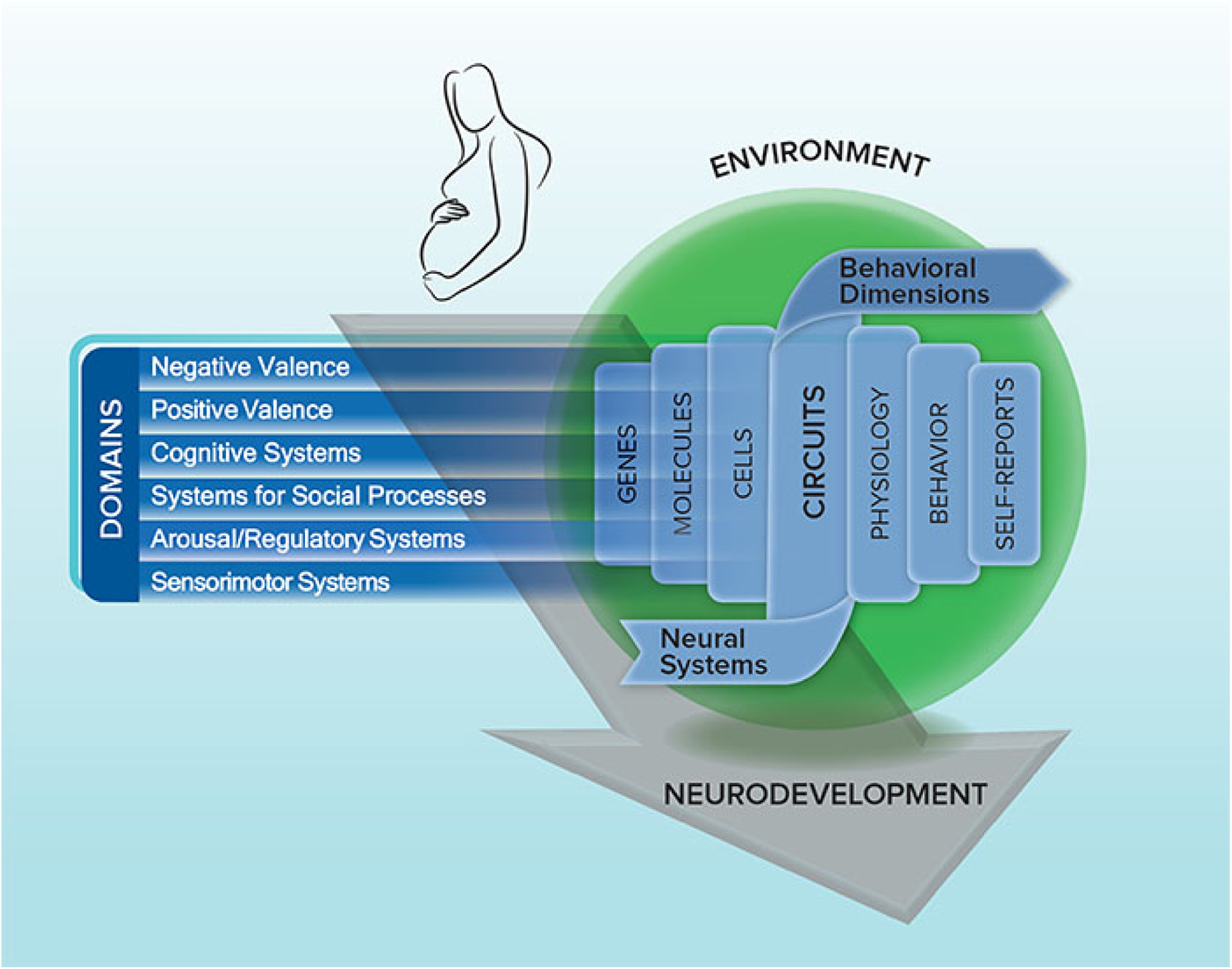
RDoC was launched in 2010 with the intention of shifting research on psychopathology towards an understanding of mechanisms (Cuthbert & Insel, Reference Cuthbert and Insel2013; Insel et al., Reference Insel, Cuthbert, Garvey, Heinssen, Pine, Quinn and Wang2010). Motivated by the field's desire to propose an alternative solution to overcome the shortcomings of categorical approaches in the DSM, the RDoC project was launched with the goal of encouraging research on mechanisms likely relevant to manifest psychopathology, incorporating genetics, imaging, and cognitive science (Insel et al., Reference Insel, Cuthbert, Garvey, Heinssen, Pine, Quinn and Wang2010; Pickersgill, Reference Pickersgill2019). RDoC claims to be transdiagnostic (seeking markers of dysfunctional psychobiological circuitry that transcend multiple traditional disorder categories), translational (encouraging researchers to apply the basic science of brain systems and behavior to an understanding of mental disorders), and dimensional (focusing on how the activity of brain circuits is continuously distributed with no boundaries demarcating normality and abnormality) (Lilienfeld & Treadway, Reference Lilienfeld and Treadway2016). The main premise of RDoC is the argument that the field should move away from focusing on symptomatology and, instead, move towards focusing on underlying mechanisms. RDoC proponents believe that to understand the complexity of psychopathology, the field needs a framework that studies all causal factors together, visualized through the RDoC matrix (Clark et al., Reference Clark, Cuthbert, Lewis-Fernández, Narrow and Reed2017).
The RDoC research framework (see Figure 2), has four main components: the first two are the neurodevelopmental and environmental factors that present the broad context for the framework, and the second two are the functional domains and their units of analysis that comprise the RDoC matrix (Clark et al., Reference Clark, Cuthbert, Lewis-Fernández, Narrow and Reed2017). Within the neurodevelopmental and environmental context, RDoC entails studying psychopathology with respect to basic functional dimensions that form six major domains: negative valence, positive valence, cognitive systems, social processes, arousal and modulatory systems, and sensorimotor systems. Each of these domains consists of three to six specific constructs, intended to capture the functional elements of behavior and cognition. The units of analysis denoted by the seven columns of the RDoC matrix signify measures of genes, molecules, cells, neural-circuit activity, physiology, behavior, and self-reports. RDoC encourages researchers to utilize several of these columns in research studies to elucidate the constructs under investigation in a more comprehensive manner. Overall, RDoC aims to focus on the elements of the matrix and free researchers from the need to use categorical diagnoses, thereby emphasizing a mechanistic understanding of psychopathology from a dimensional perspective.
The Research Domain Criteria (RDoC) framework showing the RDoC matrix and its environmental and neurodevelopmental contexts from nimh.nih.gov.
Developmental perspective on RDoC
Although neurodevelopment is included as an environmental context that should be considered in RDoC investigations, the RDoC initiative has nonetheless historically been criticized for not paying enough attention to development. More recently, however, there has been growing traction in the field to integrate a developmental perspective on the RDoC framework (Casey, Oliveri, & Insel, Reference Casey, Oliveri and Insel2014; Franklin, Jamieson, Glenn, & Nock, Reference Franklin, Jamieson, Glenn and Nock2015; Garvey, Avenevoli, & Anderson, Reference Garvey, Avenevoli and Anderson2016; Mittal & Wakschlag, Reference Mittal and Wakschlag2017). RDoC can be integrated with developmental psychopathology by utilizing developmentally informed research designs that enable conceptualization of RDoC constructs as developmental mechanisms (i.e., the underlying constructs that lead to developmental change). The developmental context is important for examining neural mechanisms underlying behavior because these brain–behavior relations shift as a result of normative and pathological development (Wakschlag et al., Reference Wakschlag, Perlman, Blair, Leibenluft, Briggs-Gowan and Pine2018).
RDoC will benefit from more explicit integration of transactional developmental processes into its framework, as well as consideration of a broader perspective on development rather than focusing solely on neurodevelopment (Franklin et al., Reference Franklin, Jamieson, Glenn and Nock2015). It is critical to understand how RDoC constructs interact as they mature and differentiate, since some capabilities do not develop in a linear manner (Garvey et al., Reference Garvey, Avenevoli and Anderson2016). For example, cognitive constructs typically change in a linear fashion, whereas social and emotional constructs change in a nonlinear fashion. In addition, it is important to examine the continuities and discontinuities that exist across development (Garvey et al., Reference Garvey, Avenevoli and Anderson2016). RDoC constructs may be expressed differently at different ages and developmental level. For example, separation anxiety is considered normal early in development but is a sign of mental illness later in development. By facilitating the integration of critical developmental processes, developmental psychopathology has the potential to inform RDoC's goal of understanding the neurodevelopmental origins of psychopathology.
Taken together, there has been immense progress in the field with advancing our understanding of the structure of psychopathology, the underlying mechanisms of psychopathology, and the developmental antecedents and consequences of psychopathology. However, a significant gap in the field is that there lacks integration across the personality structure, RDoC, and developmental literatures. In the final section, we will present our proposed theoretical model that integrates developmental psychopathology, the structure of personality, and RDoC approaches to elucidate the nature of dimensional personality pathology development across the life span.
Integrative Developmental Model of Personality Pathology
From the above literature review, it is clear that the latest evidence on personality pathology structure, developmental models of personality pathology, and RDoC offer new challenges and opportunities for providing a more comprehensive model of personality pathology development. Here, we try to tackle the issue of understanding how and why personality pathology develops by integrating these literatures. We contend such an approach must consider structural models of personality pathology, RDoC's focus on neurobiological systems that are relevant to psychopathology, and traditional developmental science models of personality pathology changes over time.
Although there have been recent efforts to integrate across multiple levels of analysis to inform mechanistic accounts of dimensional personality pathology (Allen, Schreiber, Hall, & Hallquist, Reference Allen, Schreiber, Hall and Hallquist2020) and posit theories for the development of personality pathology states and traits (De Fruyt et al., Reference De Fruyt, De Clercq, De Caluwé and Verbeke2017), there has not yet been a model proposed to integrate these approaches. Simply discussing associations between brain and behavior does not adequately capture a mechanistic account of personality pathology; in order to elucidate mechanistic explanations of personality pathology, descriptive precision is needed (Allen et al., Reference Allen, Schreiber, Hall and Hallquist2020). Here, we propose a model that integrates these recent advances in the literature on dimensional personality pathology, personality pathology development, and RDoC. In doing so, we offer an integrative account of the development of personality pathology and its underlying mechanisms.
Overview of core aspects of our model
Figure 3 shows a graphic depiction of our integrative developmental model for personality pathology. A key extension of the De Fruyt model in our integrative model for personality pathology is integration of an RDoC-informed mechanistic approach. We see integrating RDoC as crucial both for conceptualizing personality pathology as dimensional traits (orange) and for specifying the biological underpinnings (green) of their underlying behavioral, cognitive, and affective mechanisms hypothesized to be the functional domains of RDoC (blue). Bidirectional arrows are used throughout to demonstrate the developmental psychopathology principles of equifinality and multifinality (i.e., it is possible that any given arrow may be in one direction for certain individuals in certain situations whereas in both directions for other individuals in other situations). The thick red bidirectional arrows indicate that the extent of severity and thus (mal)adaptation of corresponding elements on either or both sides of the arrows influence the direction and strength of the association between the elements. Moreover, it is important to note that the extent to which personality traits (orange) and functional domains (blue) are considered severe/maladaptive is based on developmental stage, internal identity (i.e., sense of self and interpersonal relatedness), and the external environment (i.e., school, work, family, and social components as well as appraisals of environmental attributes). The diamonds (environment and identity) and their corresponding bidirectional arrows indicate that these elements of the model are influencing and being influenced by the other components in a reciprocal fashion. The identity diamond, comprising both Criterion A (sense of self and interpersonal relatedness) and the intrinsic/extrinsic identity reward structure, is in blue to indicate that one's identity is intimately tied to the functional domains of RDoC. The environment diamond, comprising the formal/physical environmental factors (i.e., school, work, social, and family) and appraisals of environmental attributes (i.e., DIAMONDS) is in purple to indicate that the associations among the internal characteristics of other aspects of the model (blue, orange, and green) influence and are influenced by external environmental characteristics.
Our integrative developmental model for personality pathology is depicted with bidirectional arrows throughout to demonstrate the developmental psychopathology principles of equifinality and multifinality (i.e., it is possible that any given arrow may be in one direction for certain individuals in certain situations whereas in both directions for other individuals in other situations). The thick red bidirectional arrows indicate that the extent of severity and thus (mal)adaptation of corresponding elements on either or both sides of the arrows influence the direction and strength of the association between the elements. A lack of a direct connection between biological units of analysis (green) and personality traits (orange) indicates the Research Domain Criteria (RDoC) functional domains are thought to be underlying mechanisms that explain brain-behavior associations between biological units of analysis (green) and pathological personality traits (orange). The diamonds (environment and identity) and their corresponding bidirectional arrows indicate that these elements of the model are influencing and being influenced by all aspects of the model in a reciprocal fashion. The identity diamond, comprising both Criterion A and the intrinsic/extrinsic identity reward structure, is in blue to indicate that one's identity is intimately tied to the functional domains of RDoC. The environment diamond, comprising the formal/physical environmental factors and appraisals of environmental attributes that form the environmental context, is in purple to indicate that the associations among the internal characteristics of other aspects of the model (blue, orange, and green) influence and are influenced by external environmental characteristics.

Integration of normative/pathological personality spectrum
By including the normative/pathological personality spectrum as a core component, our model for personality pathology integrates structural accounts of dimensional personality pathology included in the AMPD. Rather than focusing on DSM-5 categorical diagnoses, our model includes maladaptive personality traits (negative affectivity, detachment, psychoticism, antagonism, and disinhibition) as the personality pathology outcomes of interest. Although the predictive associations between specific maladaptive personality traits and functional domains are not yet consistently documented in the literature, the most consistent findings thus far utilizing domains of the hierarchical structure of psychopathology (Michelini, Palumbo, DeYoung, Latzman, & Kotov, Reference Michelini, Palumbo, DeYoung, Latzman and Kotov2021), which are conceptually similar to the AMPD domains, are depicted in the figure with dashed grey arrows.
Integration of RDoC functional domains
Based on the recent literature on the structure of personality pathology, a key aspect of the De Fruyt model that warrants updating is the link between traits, characteristic manifestations (behaviors, feelings, and cognitions), and symptoms as part of an integrative dimensional model of personality pathology. In their model, these components are seemingly separate. However, based on structural evidence examining the dimensional components of personality pathology, we believe this model warrants updating to reflect how these components are overlapping aspects of personality pathology. Specifically, the RDoC functional domains provide a framework for conceptualizing the behaviors, feelings, and cognitions that are thought to underlie maladaptive personality traits. We incorporate RDoC's functional domains as an additional component, with the basic functional dimensions forming six major domains (negative valence, positive valence, cognitive systems, social processes, arousal and modulatory systems, and sensorimotor systems) as potential mechanisms influencing and being influenced by the traits that comprise personality pathology.
Integration of biological units of analysis
First, we incorporate RDoC's focus on units of analysis. In our model, we expand the biology section to include the biological units of analysis from RDoC (genes, molecules, cells, neural-circuit activity, physiology). The self-reports and behavior units of analysis are inherently integrated in the other elements of our model. Including this box (green) in our model is consistent with the RDoC initiative and developmental psychopathology framework perspective about the importance of integrating multiple levels of analysis in order to understand psychopathology. By specifying the ways in which biological underpinnings (green) of the functional domains (blue) underlie personality pathology (orange), the field can advance a more in-depth understanding of the personality dimensions and their underlying mechanisms of interest.
Severity/adaptation as moderators
The extent to which functional domains (blue) are maladaptive (i.e., more severe) will influence the extent to which personality traits (orange) are pathological as well as the extent to which biological characteristics (green) are pathological. Similarly, the extent to which personality traits (orange) are maladaptive will influence the extent to which the functional domains of RDoC (blue) are pathological. Furthermore, the extent to which biological characteristics (green) are maladaptive will influence the extent to which functional domains of RDoC (blue) are pathological. For example, individuals with worse social cognitive ability to reason about the mental states of others also demonstrate more maladaptive personality traits such as negative affectivity and show impaired physiology associated with their maladaptive forms of social cognition and personality. These associations in this example are bidirectional, such that individuals with impairments in these domains develop further impairment over time. It is also noteworthy that the lack of a direct connection between biological units of analysis (green) and personality traits (orange) indicates the RDoC functional domains are thought to be underlying mechanisms that explain brain–behavioral associations between biological units of analysis (green) and pathological personality traits (orange) rather than there being a direct association between biology and personality traits.
Identity
In our model, the identity component encompasses both Criterion A of AMPD (sense of self and interpersonal relatedness) and the reinforcing intrinsic/extrinsic reward structure involved in identity development from De Fruyt's model. In the AMPD, a personality disorder must have clinically significant problems with sense of self and interpersonal relatedness (purple) as well as one or more pathological personality trait (orange). In De Fruyt's model, the manifestation of latent personality traits forms a reward structure and comprises an individual's identity, with the set of intrinsic and extrinsic rewards affecting change and continuity of feelings, behaviors, and cognitions that affect personality traits, thereby forming a feedback loop. In our model, we propose that identity broadly defined – encompassing one's sense of self and interpersonal relatedness, as well as intrinsic/extrinsic reward structures, operate at all levels of the model. Specifically, these internal components influence and are influenced by biological factors, functional domains, and personality traits; in addition, they moderate the association between different aspects of the model by directly influencing the severity/adaptation arrows. Specifically, identity components influence the strength and direction of the association between biological factors and underlying functional domains, as well as the strength and direction of the association between underlying functional domains and personality traits. However, the fact that the arrow is bidirectional from severity/adaptation to identity indicates that the relation is reciprocal; the extent to which components of the model are considered to be more severe/maladaptive influences an individual's sense of self, interpersonal relatedness, and intrinsic/extrinsic reward structure that reinforces stable patterns of feelings, behaviors, and cognition, thereby forming a feedback loop.
Environment
In our model, the aforementioned elements that comprise dimensional personality pathology are bidirectionally related to environmental components. The environmental context of our model includes the school, work, social, and family contexts as well as the environmental attributes based on the DIAMONDS taxonomy model utilized by De Fruyt. The school, work, social, and family contexts are considered the relatively fixed aspects of the environment, and the DIAMONDS dimensions of human situations are considered the more rapidly changing ways in which individuals characterize their daily environmental situations as they change depending on context. Both the stable and changing aspects of the environment form the external environmental contexts (purple diamond), which influence and are influenced by biological factors, functional domains, and personality traits; in addition, they moderate the association between different aspects of the model by directly influencing the severity/adaptation arrows. Moreover, as with the identity diamond described above, the fact that the arrow is bidirectional from severity/adaptation to identity indicates that the relation is reciprocal; the extent to which components of the model are considered to be more severe/maladaptive influences an individual's school, work, social, and family environments, as well as environmental attributes, thereby forming another feedback loop in our model.
Integration of developmental theories
A core component of our model that permeates through all the different elements is that it considers the principles of developmental psychopathology and integrates existing theories on the development of personality pathology. Bidirectional associations are hypothesized to demonstrate the developmental psychopathology principles of equifinality and multifinality (i.e., it is possible that any given arrow may be in one direction for certain individuals in certain situations whereas in both directions for other individuals in other situations). Moreover, the bidirectional arrows represent developmental time; the direction of these developmental pathways (i.e., whether a given domain is a precursor or consequence in development) is an empirical question that the next frontier of developmental psychopathology research must address. Of note, although bidirectional associations are likely in many circumstances, the possibility of direct effects for certain associations in the model is an open line of empirical inquiry. Regarding existing theories of personality pathology development, our integrative model encompasses the variety of possible models for developmental causes and consequences of personality pathology. First, the spectrum/continuity model is indicated in our model with the normative/pathological personality spectrum box (orange) connected to the severity/adaptation arrow in relation to functional domains, as it demonstrates that personality traits exist on a continuum from normal personality traits to pathological personality traits depending on the level of severity and (mal)adaptation. Second, the vulnerability, resilience, and pathoplasty models are in indicated in our box of the normative/pathological personality spectrum (orange) and its connection to the bidirectional arrow of severity/adaptation, its connection to the environment diamond, and its connection to the identity diamond. Third, the scar/complication models are indicated in the feedback loops generated by how the environment diamond and identity diamond each are bidirectionally associated with biological factors, functional domains, and personality traits as the extent to which these components are considered severe/maladaptive. Finally, De Fruyt's developmental model is incorporated throughout our model with elements including intrinsic/extrinsic identity structure, DIAMONDS, and bidirectional associations between the elements, as our model is an extension of theirs. As mentioned above, another key developmental component of our model is the extent to which personality traits (orange) and functional domains (blue) are considered severe/maladaptive is based on developmental stage, demonstrating another key principle of developmental psychopathology.
Conclusion
Incorporating RDoC into an integrative account of personality pathology development is useful because it adds a level of biological and mechanistic specificity. RDoC provides biological targets (i.e., genes, molecules, cells, neural-circuit activity, and physiology), as well as functional elements of the RDoC matrix that should be studied to elucidate the potential underlying mechanisms of personality pathology development. We propose a comprehensive account of personality pathology development that includes the functional domains involved in the associations between neural systems and enduring patterns of personality pathology. In addition, we specify the role of severity and maladaptation in determining the extent to which personality traits become pathological on the spectrum from normality to abnormality. By integrating these complementary lines of inquiry, the field will advance an understanding of the causes and consequences of dimensional personality pathology. While integrative, our theoretical model is largely intended to guide future empirical work that will further elaborate on our model. Future research should further specify how personality traits (orange), functional domains (blue), and biology (green) interact at specific developmental timepoints, even as early as early childhood, to influence the development of personality pathology. Moreover, it is crucial to test whether certain functional domains are more strongly associated with certain traits of pathological personality and/or biological units of analysis. Furthermore, it is important to test whether some of the bidirectional relations specified in our model (e.g., environment associated with pathological personality, functional domains, and biological units of analysis) are causal, unidirectional relations across developmental time. Specifying the links between components of personality pathology (i.e., maladaptive traits) and functional domains (i.e., RDoC domains) across development is a critical empirical challenge that the field must address. In doing so, the field will be able to adopt our model for clinical use in the future.
Acknowledgments
None.
Funding Statement
This material is based upon work supported by the National Science Foundation Graduate Research Fellowship Program to M. Altschuler (NSF-GRF 00074041). Any opinions, findings, and conclusions or recommendations expressed in this material are those of the author(s) and do not necessarily reflect the views of the National Science Foundation. Robert Krueger was partly supported by NIH awards R01AG053217 and U19AG051426. The content is solely the responsibility of the authors and does not necessarily represent the official views of the National Institutes of Health.
Conflicts of Interest
None.


 Open access

