




Introduction
From the fifteenth century onwards, European expansion ensured that an unprecedented number of materials, things, objects, and commodities were catapulted into motion, crossing new, vast distances, and finding their way into previously unknown constellations and combinations.
European missionaries also brought Christian relics everywhere they went. Nearly all ships that left Europe in the fifteenth and sixteenth centuries had such relics on board. Every newly built and consecrated church in Africa, Asia, and the Americas had to be outfitted with relics. Moreover, saints’ relics were useful to have on long ocean voyages: numerous reports exist stating that they guided sailors through dangerous storms and saved ship and crew from an otherwise certain death.Footnote 1
When, for Portugal, it became clear that they would need a lot of relics to supply the many churches in the overseas territories, they turned to one place where many particularly suitable relics could be found: Cologne, the harbour city located strategically on the river Rhine at the intersection of major trade routes.Footnote 2 Here were kept the alleged relics of Saint Ursula and her 11,000 virgin companions, the best-known and largest saints’ collective during the Middle Ages and early modernity.Footnote 3 As the Roman catacombs were only discovered in 1578 and with them the possibility of sending a large number of saints’ relics out into the world,Footnote 4 the Cologne convolute provided the only opportunity to stock up on relics on a grand scale until the last quarter of the sixteenth century.
Ursula was reportedly the daughter of a third-century Christian British king. She decided to postpone her wedding to a pagan prince by several years to give her groom time to convert to Christianity while she herself would make a pilgrimage to Rome. Due to a misreading, legend has it that 11,000 virgins accompanied her.Footnote 5 Rarely has such a mistake been so important for history: for later, only this sudden increase in the number of holy virgins from eleven to 11,000 enabled the Iberian monarchies to furnish the many churches and monasteries on other continents with relics. In comparison, the Theban legion, which was a Roman legion from Egypt, whose members were believed to have died for their Christian faith in the third century, consisted of only “six thousand six hundred and sixty-six men.”Footnote 6 What is important, of course, is that the translation error in the case of the venerated virgins was followed by the discovery in 1106 of a huge burial ground near Cologne, which was immediately believed to be the site of the martyrdom of those same 11,000 virgins. This mass grave in Cologne became the never-dwindling source for relics taken everywhere during the period of Iberian expansion.
The hagiographic profile of this transregional group of martyrs met the Portuguese requirements of the fifteenth and sixteenth centuries perfectly. Ursula’s escort included virgins as well as male members of the clerical elite from virtually everywhere in the known world (Britain, Italy, Bohemia, Istanbul, Jerusalem, …), and this international composition “conferred it a universal character that matched the composition of the contemporary Catholic missions.”Footnote 7 The saints had, during their lifetime, according to legend, travelled long distances by ship and Ursula had acted as a missionary converting her companions – and her bridegroom – to the Christian faith. Ursula and her companions had allegedly died their martyr’s death at the hands of the pagan Huns. But later, after their death, the army of 11,000 virgins are said to have miraculously delivered the city of Cologne from the Huns. All these were aspects, then, that mirrored the actions of early modern actors who also travelled long distances by ship to proselytise and fight against the pagans in distant lands, several of whom were also martyred. Renato Cymbalista writes that another reason why the Ursula virgins were a good fit for Brazil was that not only were there enough of them to fulfil the needs of this immense country but, since they had all (but one, namely Cordula) suffered martyrdom on the same day (21 October), the holy virgins could be celebrated on the same feast day in different and disparate churches, which led to a homogenisation of the festive calendar in those vast regions.Footnote 8 In this article, I would like to add another, hitherto undescribed, advantage in the overseas use of the relics of this specific virginal collective: Ursula’s companions were all somehow related to each other by blood, and because this favoured the idea of a noble kinship network of saints being laid over the newly conquered territories, it could generate a sense of connectedness, no matter how far apart people lived in the Portuguese-dominated world. Thus the global spreading of this saints’ collective might have been an attempt to maintain dynastic unity and political harmony. Indeed, both the Spanish and the Portuguese brought relics of the Ursula virgins first into their heartland and from there to their overseas territories.Footnote 9 As a consequence, Ursula and her female and male companions, nobles of early Christianity, connected the empires of the early modern period: competing monarchies created, willingly or unwillingly, a levelling network, formed by a transregional collective of saints. The Iberian monarchies had agreed on a marriage policy to strengthen dynastic ties.Footnote 10 And their intermarriages formed a network very similar to that of Saint Ursula’s consorts, as we shall see.
This article traces the spread of the cult of Saint Ursula and the 11,000 virgins from Cologne to Portugal and into the Portuguese-dominated overseas territories in the first half of the sixteenth century. After describing the nature and role of the sacred network that was established through the distribution of these relics in the overseas regions, the article will bring together the scarce visual evidence of this cult from ‘Estado da India,’ which is the name of the ‘imperial edifice’ set up by the Portuguese since 1530 in disparate regions between the Cape of Good Hope and Japan.Footnote 11 As we lack research on potentially existing examples of images and objects associated with the cult of Ursula and her companions from Africa and the Americas, only the few artefacts that have survived from the Estado da India are assembled here. This is an especially valuable endeavour, as those scholars who have previously studied the Portuguese transcontinental distribution of Ursula relics have not looked at the visual and material culture that accompanied and facilitated this distribution. It would be welcome if more artworks from all parts of the Portuguese empire could be added to this corpus in the future.
Linking Early Christian and Early Modern Kinship Networks
In Portugal, Saint Ursula and her companions became the objects of a long history of veneration. Two of the main episodes of the ‘Reconquest’ – the (Christian) conquest of Almoravid Lisbon in 1147 and the conquest of Alcácer do Sal in 1217 – had allegedly taken place on Ursula’s feast day, 21 October, and these military successes were thus attributed to the intercession of her and her companions.Footnote 12 But only around 1500, and thus under the reign of King Manuel I (r. 1495-1521), did what Maria Cristina Osswald called “the explosion of this rather bizarre medieval devotion in the Portuguese territories overseas” take place.Footnote 13 The Portuguese Crown’s interest in this cult increased at exactly the peak of Portugal’s overseas expansion. In 1517, three of the 11,000 virgins, taken from the treasury in Cologne, entered Lisbon.
Lisbon workshop, Arrival of the Relics of Saint Auta at Madre de Deus Monastery, ca. 1522, oil on oak, 69 × 74.5 cm, Museu Nacional de Arte Antiga, Lisbon, accession no. 1462 Pint.

Figure 1 Long description
A scene depicting a religious procession in front of an ornate building. A crowned figure in a red robe holds a book in the foreground. Several clergy members, dressed in white and carrying a large cross, lead the procession. A group of people follows, some holding a canopy. The building features intricate architectural details, including a statue in a niche and decorative carvings. The setting suggests a ceremonial or religious event.
The five panels belonging to the Saint Auta Altar, now preserved in the Museu Nacional de Arte Antiga, bear witness to this (fig. 1).Footnote 14 This involved the entire body of Saint Auta, the daughter of the king and queen of Sicily (Quincian and Geracina) and the heads of two other, nameless virgins. The translation was carried out at the demand of Emperor Maximilian who offered the relics to his cousin Queen Leonor (1458–1525), sister of Manuel I and widow of King John II (r. 1482-1495). The relics were carried in procession through the streets of Lisbon to the newly founded Convent of Madre de Deus.Footnote 15 Queen Leonor had founded this convent in 1509 and had turned to her cousin the emperor to send her some relics of the 11,000 virgins for its consecration ceremony. This case shows very well how important kinship relations were within the dynasties of Europe to get the relics of the virgins moving across borders. Early modern courtly culture was characterised in a special way by complex kinship relationships. The ruling elite in its interconnectedness strikingly mirrors the collective of Ursula’s 11,000 companions. The authoritative passage from the legend of Saint Ursula as rendered by Jacobus de Voragine in his thirteenth-century Legenda Aurea makes it very clear that the protagonist of this story is, apart from Ursula, the Early Christian closely interwoven family network of nobility:
From all sides, then, the virgins flocked together, and men, too, hurried to see this great spectacle. Many bishops also came to be with the virgins and to travel with them. […] Saint Geracina, queen of Sicily, also came. She had married a very cruel man, a veritable wolf, whom she transformed into a lamb. She was the sister of bishop Macirisus, and Daria, Saint Ursula’s mother. Ursula’s father wrote her a letter in which he gave her an idea of Ursula’s secret purpose, and Geracina, inspired by God, immediately put the affairs of the kingdom in the hands of one of her sons, and took ship and sailed to Britain, having with her her four daughters, Babilla, Juliana, Victoria, and Aurea and her little son Adrian, who for love of his sisters attached himself to the pilgrimage. At her invitation, virgins gathered from various countries, and Geracina, continuing as their leader, eventually suffered martyrdom with them. (In Rome) Pope Cyriacus rejoiced at their coming. He himself was from Britain and had many blood relations among the virgins, so he and the entire clergy of Rome welcomed them with high honor. […] Maurisius, bishop of the city of Levicana, who was the uncle of Babilla and Juliana […] also joined the aforesaid virgins. […] Ethereus, who was pledged to be the blessed Ursula’s husband […] received the Lord’s order to urge his mother to become a Christian. […] He had his mother baptized, and then, with his mother and his little sister Florentina and Bishop Clement as well, went out to meet the virgins […]. Marculus, the bishop of Greece, and his niece Constantia were now directed […] to go to Rome. Constantia had been betrothed to the son of a king, but he had died before the wedding.Footnote 16
The function underlying this passage is obviously to connect all the virgins and their male companions by meticulously naming their kinship relations: husband or betrothed, sister, mother, father, son, daughter, uncle, and niece: all these degrees of relationship are called up. It was obviously very important in this legend to show that all the persons belonging to this saints’ collective were somehow related by blood or marriage. This circumstance fully corresponds to the composition of the royal and clerical elite who, over a thousand years later, circulated the virgins’ relics among themselves. Astonishingly, this central aspect within these saints’ legend has escaped those researchers who have dealt with the hagiographic profile of the virgins, the role of their relics, and their visualisations. Even Scott B. Montgomery, who explicitly focuses on the “group sanctity” and “group cohesion” of this collective, seems to ignore the fact that they were all related to each other.Footnote 17 I would like to stress here that Saint Ursula and her companions were not only a large collective consisting of randomly assembled saints who were friends and acquaintances but that they were a transregional collective that, even when their relics were spread across the globe, could never become disparate, because they were all related to each other. At the places where their relics were brought, ‘satellite courts’ were thus created, which also characterised European court culture at the time. Jonathan Spangler writes, referring to European monarchies of the time, of the “luxury of spreading out their multiple family members as representatives of the dynasty across their domains.”Footnote 18 The transregional network of related saints might have been perceived similarly when it was laid across the Portuguese world of the sixteenth and seventeenth centuries through the initiatives of those in power.Footnote 19
In order to gain a better understanding of this aspect, it is helpful to take a look at the distribution of relics as it was practised before this period. Indeed, in the fifteenth century, it was still explicitly saints who were associated with the Portuguese Avis dynasty who were to be harnessed for the expansion efforts. They were appropriated as “patron saints of the kingdom” for the conquest of North Africa. Maria de Lurdes Rosa calls them “the saints of Dom Manuel,” referring to Queen Dona Isabel, Don Afonso Henriques, Dom Fernando, and the “principe perfeito” João II.Footnote 20 John III, Manuel’s son and successor, reduced the Portuguese presence in Africa, and this was also accompanied by a reduced commitment to the canonisation of one saint favoured by his father, namely the Morisco saint Gonçalo Vaz. At the same time, interest in the relics of the 11,000 virgins increased, presumably because it had long since become clear that limiting oneself to saints who were in some way directly connected to the Avis dynasty was not feasible given the country’s gigantic expansionist ambitions. Therefore, relations with the collective of the 11,000 virgins were established.
In 1517, as we have seen, three of the virgins’ relics were translated from Cologne to Lisbon. Damião de Góis reports the arrival of Auta’s relics in Lisbon. Read closely, the short twenty-sixth chapter of the fourth part of his Crónica do Serenissimo Senhor Rei Dom Emanuel not only tells us about Queen Leonor’s devotion to the cult of the 11,000 virgins, but reveals her aim to link her and her husband to Ursula and her companions by emulating them. Leonor is described as a saintly figure: deeply religious and charitable. We learn that she supported monasteries and religious orders and took care of the health of the poor population. She founded the Santa Casa de Miseriordia de Lisboa as well as the Madre de Deus convent and determined that she should be buried there, not royally, but in a simple tomb set into the floor. This is made explicit to illustrate her humilitas. Moreover, this hagiographic description of the queen’s life and pious work is followed by a reference to her intense devotion to Ursula. The passage is then followed rather abruptly by an account of King Manuel’s plans during this time to withdraw from the world. At the exact time when the relics of Saint Auta came to Lisbon, King Manuel, we learn, had embraced the idea of turning his back on the world and serving God. However, marriage politics got in the way, resulting in his third marriage after being widowed twice. This time he married Eleanor of Castile, thirty years his junior, instead of what was initially planned for her, namely marriage to Manuel’s son John. In 1519 Manuel and Eleanor of Castile wedded and the king’s plan to go into spiritual seclusion failed. The link between the legend of Ursula and the tricky marriage politics of the Manueline period is evident. After all, Ursula had only gathered her companions around her and embarked on her long journey, which ended in martyrdom, because she wanted to avoid marrying a (pagan) king’s son.
When we read the Early Christian interrelated group of saints as a model or mirror of the dynastic kinship links of the time, the translatio of 1517 was the moment in which networks were linked across time and spaces. The Early Christian Sicilian queen’s daughter Saint Auta, after having resided for centuries in Cologne, would live in Lisbon, in the convent founded by Queen Leonor of Portugal. Jacobus de Voragine, in his Legenda Aurea, elaborates on the dating of the virgins’ martyrdom: The year 238, according to him, cannot be correct since a kingdom of Sicily did not exist at that time. But when Auta’s relics came to Lisbon, a kingdom of Sicily had been in existence for some time. And since 1516 it had been ruled directly by Spain. So, in 1517, Lisbon received the sacred remains of an Early Christian princess, whose parents had allegedly ruled over Sicily, which was now ruled by Spain – by Leonor’s brother Charles V, to be precise, whose paternal grandmother was Mary of Burgundy and whom dynastic unions had made ruler of the Aragonese kingdoms of Naples, Sicily, and Sardegna. Charles V’s grandfather was Maximilian – the one who had arranged for the translation of the relics from Cologne to Lisbon, on demand of his niece, Leonor of Portugal. After Maximilian’s death in 1519, Charles V inherited Austria. He was betrothed for a short period to Mary, the daughter of King Henry VII of England and younger sister to the future King Henry VIII. But the engagement was called off and Mary was instead married to King Louis XII of France in 1514. Charles’s sister Eleanor married the widowed father of Charles’s first cousin Isabella of Portugal, the daughter of King Manuel I of Portugal and Charles’s aunt Maria of Aragon. As in the Legenda Aurea, we could continue endlessly to weave the huge web of family relationships here.
During the sixteenth and seventeenth centuries, at least twenty-five virgin heads arrived in Portugal, twelve of which were kept in the Jesuit church of São Roque in Lisbon. The Convent of Santo António dos Xabreganos, near Alcácer do Sal, kept the head of Santa Responsa, San Francisco de Santarém housed Saint Aurea’s head, and the Cistercian convent of Odivelas was said to be in the possession of Saint Ursula’s relics, and so on.
The long-term success of the Ursuline virgins in the Portuguese world was made possible by the collaboration between the Jesuits and the Portuguese monarchs.Footnote 21 Pierre Favre, co-founder of the Society of Jesus, had a strong devotion for Saint Ursula and her companions and during his stay in Cologne in 1544 he used to pray in Saint Ursula’s c. Since he also had papal permission to remove bodily relics from the Cologne stock, he took with him seven of the eleven thousand virgins’ heads when he left. In December of that same year, 1544, he offered two of these heads as well as four large bones to the now ruling John III and his wife Catherine of Austria. Favre handed them over the moment he told the Portuguese king that he had to depart for Castile for the good of the Society of Jesus. We learn from the sources that the king and queen asked Favre to deposit, with his own hands, the heads in precious reliquaries in the Queen’s Oratory.Footnote 22 Favre himself writes in his Memorias espirituales: “On the day of the apostle Matthias, I offered to the king and queen of Portugal two of the relics deriving from the eleven thousand virgins to the king (I offered) what they gave me in the Carthusian convent in Cologne, to the queen what the nuns of the convent of Maximino had given to me.”Footnote 23 On the same occasion, the prince was offered a bone of one of the virgin martyrs, and Favre gave another two of the heads to the Jesuit College of Coimbra, founded in 1542. After this, the college was commonly known as the College of the Eleven Thousand Virgins. Favre was the great distributor to Portugal of relics of the eleven thousand virgins, his transfers enabling them to be redistributed to overseas territories.
A Head Start in Goa
In 1548, thirty-one years after the relics of Saint Auta had been brought from Cologne to Lisbon, the chief relic of Auta’s mother, Saint Geracina, was shipped to Goa. This was the first of the virgins’ heads to go overseas. But it was not until 1575 that the first two virgin skulls reached Brazil – Salvador de Bahia to be precise.Footnote 24 The capital of the Estado da India was, thus, already in possession of a virgin head a good quarter of a century before one arrived in Brazil. This can be explained by the fact that Brazil did not have the same importance as Goa at that time. In 1560, heads and bones of other Ursula virgins were brought to Mozambique and in 1567 to Malacca.Footnote 25 By 1578, two more virgin heads were being kept in Goa.Footnote 26 The Estado da India had quite an edge in terms of the distribution of the relics of this collective of saints. The very first head to go straight to the capital Goa, in 1548, was one of the heads that Pierre Favre had given the royal Portuguese couple in 1544. And it was said to be the head of the Sicilian queen Geracina.Footnote 27 By this relic translation, the two capitals, Lisbon and Goa, became related ‘by blood’ through the presence of mother and daughter in the two cities respectively. This fits in very well with the Portuguese idea to turn Goa into a second Lisbon.Footnote 28 While the queen of Sicily now resided in Goa, her daughter, the princess, continued to work her miracles in Lisbon. It would be interesting to know whether hierarchy played a role in the minds of contemporaries, as the hierarchically superior saint did not reside in Lisbon but in Goa. Geracina was indeed, hagiographically speaking, very prominent, as she is one of the few virgins mentioned by name in the Legenda Aurea, where she is even called the ‘leader’ of the large group of virgins who joined Ursula.
Geracina’s relic travelled with the Belgian Jesuit Gaspar Barzeus and António Gomes, who was the designated director of Goa’s Jesuit college. From witness reports we learn that the ship that carried the relic was caught in a violent storm, ran ashore off the coast of Mozambique and was badly damaged, so that the passengers were doomed to die. However, after Geracina was asked to intervene, the ship was set back on its journey.Footnote 29
After its arrival in Goa, on 14 October 1548, the relic was received with a solemn procession, led by the governor, the bishop, and the whole nobility, through the streets from the Sé Cathedral in Old Goa to the Jesuit College of São Paulo. António Gomes gave a rousing homily and a week later, on 21 October, the feast day of the eleven thousand virgins was solemnly celebrated. People came from near and far to see the skull and donate to it.Footnote 30 In March 1549, and thus five months after Geracina’s head’s arrival in Goa, Provincial Gaspar Barzeus ordered the institution of a confraternity in honour of the eleven thousand virgins at the College of S. Paulo Velho in Goa to promote miracles as well as conversions associated with Geracina’s head. On this occasion, one of the existing side altars was re-consecrated to this cult, and the painting of a rich oil retable for the same altar was commissioned.
Saint Geracina’s Reliquary
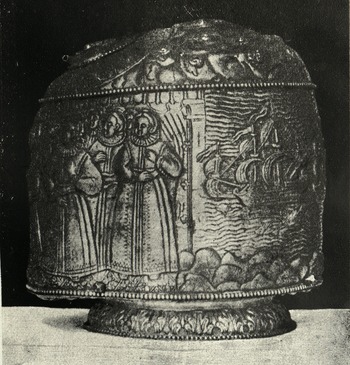
The arrival of Saint Geracina’s head in Goa thus spawned the founding of the Jesuit confraternity centred on Ursula and her virgins. Viceroy Afonso de Noronha was the first member of the brotherhood, and in 1552, he commissioned a silver receptacle for the holy skull “to store it in an appropriate manner and to differentiate it from other relics” (“mandou lavrar a charola, ou custodia de prata em que hoje se guarda a veneravel cabeça”).Footnote 31 In the sources, this container is simply called ‘custodia.’ The object, unfortunately, is no longer extant. It seems to have disappeared in the early 1940s. Fortunately, however, we still have one photograph (fig. 2).
Anonym. (silversmith), Reliquary containing the skull of Saint Geracina, 1552, silver, dimensions and current whereabouts unknown, kept at the Sé Cathedral of Old Goa until at least 1942. Image: A.B. Bragança Pereira, “Historia religiosa de Goa (1542–1557),” Oriente Português 10 (1934–1935), 501.

Figure 2 Long description
The silver reliquary features intricate engravings, including two figures dressed in detailed attire standing on the left side. To the right, a ship is depicted sailing on water, surrounded by waves. The reliquary is adorned with decorative elements along the top and bottom edges, showcasing craftsmanship from 1552. The base is rounded, supporting the main body of the reliquary.
It shows a silver reliquary that at first glance resembles a traditional head reliquary, although it is immediately apparent that this object has strongly idiosyncratic features. It was made by local Goan goldsmiths, and I would argue that it has been adapted to its specific local context. Its form is cylindrical, with a half-sphere on top of a narrower base. Although the upper part of the object elicits associations with the form of a skull, the reliquary interestingly does not present the viewer with a face. Instead, the custodia is enveloped with images depicting scenes from the legend of the eleven thousand virgins. These scenes wrap around its exterior. On the right of the object, we can see a sailing ship with several flagged masts and sails billowing in the wind. The ocean behind it is indicated by wavy lines, and the coast is marked by round rocks at the bottom. On the left-hand side of the object, only half of which is shown in the photograph, several women are recognisable; we can count about six. They are all wearing the same long dresses and millstone collars. It seems as if they are standing under an arch or in front of a curtain. The women are gesticulating; it could be that Ursula or Geracina is standing in the centre. The surrounding band with the narrative scenes is bordered at top and bottom with a belt of silver pearls. At the top, the reliquary is closed with a dome or hemisphere. Small angels can be seen here between clouds. We can also see a flap that could be opened to allow a view of the relic inside. Even if the photograph only presents one side of the object, the entire reliquary seems to have been enveloped with narrative depictions. The reliquary stands on a flat, round base decorated with acanthus leaves.
Where in head or bust reliquaries made for European churches, we are used to finding a face, here we find whole figures of a group of women. And, as we learn from the sources in Brazil, a head of one of the virgins was kept in a silver bust reliquary there.Footnote 32 But in Goa, the face was replaced by a group of figures and a narrative.
In Goa, the handling of human remains, especially a skull, is to be seen against the background of the cremation ritual common in Hindu religious practices.Footnote 33 Concealing the skull in the reliquary was of course also common in Europe, but the anthropomorphic design of the reliquaries made in Europe indicates that they (might) contain a human skull or part of one. It is also worth considering that the power of the gaze is one of the central elements of Hindu images and beliefs. Darshan, the exchange of glances with the deity, was and is practised in Hindu temples. The all-seeing Hindu gods, as Diana Eck writes in her book on Darshan, never close their eyes because the state of the world depends upon their attentive gaze. The opening of the eyes was, in Hindu artistic practice, the last step in completing an image. Furthermore, the idiosyncrasy of the Goan reliquary might be explained by the hypothesis that the Christian commissioners of the object wanted to play it safe and convert Hindu believers without recourse to pictorial strategies that were also important in traditional Hindu belief practices, namely, a representation of the divinity with open eyes. The beholder of this object must relinquish the desire to exchange glances with it, while at the same time, the object conceals the bones that may have had a disturbing effect on Hindu – or formerly Hindu – viewers. If the reliquary of Saint Geracina has no face, making it impossible for the faithful to exchange glances with the represented saint, then it differs not only from Christian reliquaries, but also from Hindu objects. It occupies, thus, the much-vaunted third space envisioned by Homi Bhabha.Footnote 34
Other Images of Saint Ursula and the Eleven Thousand Virgins in the Estado da India
Other images made in Goa or its surroundings can be related to the cult of Saint Ursula and her eleven thousand companions. One silver statue has even been named a representation of Saint Geracina (fig. 3).Footnote 35
Anonym. (silversmith), silver statuette, late 16th/early 17th century, silver, H: 45 cm, São Roque Antiguidades e Galeria de Arte, B246.

Figure 3 Long description
A silver statuette depicting a standing figure adorned in intricately detailed attire. The figure is holding a draped cloth in one hand, with elaborate patterns on the garment. The overall design showcases fine craftsmanship typical of late 16th to early 17th century artistry.
Hugo Miguel Crespo dates it to the sixteenth century and writes that this figure “undoubtedly was holding in her left hand her identifying attribute, the cast and chased palm of martyrdom, now unfortunately lost.” Crespo has captured the materiality and technique of this object with great expertise but is somewhat quick to name Geracina as the represented saint.Footnote 36 The (missing) palm tree is, of course, an attribute given to all martyrs. This figure might have held even an arrow once, which would have made her a St. Ursula, but, unfortunately, we can only guess here and will most likely never find out which attribute she once held.
We are on safer ground regarding the identification of the protagonist within the painting of Saint Ursula that is kept in the Museum of Christian Art in Goa (fig. 4).Footnote 37
Anonym., Saint Ursula, 16th century, oil on wood, polychrome and gilt frame, 97.5 × 53 cm, Museum of Christian Art, Goa, inv. no. 01.1.3.

Figure 4 Long description
A painting depicting Saint Ursula, adorned with a crown and halo, wearing a richly detailed robe. She holds a palm branch in her left hand. The frame is ornate with intricate designs. The name 'S. URSULA' is inscribed at the bottom.
Her name is inscribed at the bottom, and to avoid any confusion, she is also holding the arrow that killed her. Ursula is depicted in half-length and half-profile turned to the right against a grey background. Her gaze extends beyond the picture, past the viewer, not meeting his or her eye. She is wearing a voluminous red cloak or cape, from whose neckline her left hand peeks out and presents the arrow, the rest of the arm concealed under the capacious fabric. The sleeves and chest of her dress are visible; the saint wears a robe made from a weave-patterned black and silver fabric that is trimmed with lace along the sleeves and neckline. Her sumptuous dress and the radiant red drapery trimmed with a gold, patterned border, the shimmer of which is indicated by white streaks of light, reveal the saint’s noble status. The golden flowers on the collar could be a necklace, the star on the neck a brooch. She wears pearl earrings and a black decorative bow in her loose gold-blonde hair. The golden crown on her head, which identifies her as a royal daughter, is surrounded by a narrow halo hoop. Ursula places her right hand on the palm of the martyr, which lies on a gold-ornamented table. It is not entirely clear what the golden stripe running diagonally from the saint’s shoulder to the top right-hand corner of the picture, in the same direction as the arrow, represents. Overpainting seems to have occurred here in the past, especially as the background that this stripe separates off to the left appears interspersed with green or blue paint. It is probably datable to the seventeenth century. The gilded red frame is original and deserves mention. The vertical-format image of the saint is flanked by two fluted columns standing on bases formed by stylised acanthus leaves.
This artwork derives from the Sé Cathedral in Old Goa where it once formed part of a decorated chest in the sacristy. Ursula is portrayed here detached from the legendary narrative and her companions. Group sanctity, which is, according to Scott Montgomery, always in the foreground in European depictions, was not significant enough to visualise here. It was more important to represent a royal woman. The fact that the crown appears again at the top of the frame underlines the significance of this insignia. While, as a royal figure, the respective viceroy of the Estado da India was present and could, at times, also be seen by his subjects, very few women – and no women of noble or royal blood – migrated from Portugal to the Estado da India. While that may be accurate, Charles R. Boxer may well be exaggerating in his claim that “no wife of a Portuguese viceroy or governor-general of India accompanied her husband to Goa between 1549 and 1750.”Footnote 38 Barring a few potential exceptions that cannot be grasped from the records, we can proceed from the assumption of a widespread absence of European female figures of authority and royal blood. We know that the so-called ‘Orphans of the King’ reached the Estado da India: orphaned girls of marriageable age, “who were sent out in annual batches from orphanages at Lisbon and Oporto […] at the expense of the Crown. They were usually provided with dowries in the form of minor government posts, or with small grants of land, for the men who might marry them after their arrival at Goa.”Footnote 39 Interestingly, this practice of sending orphan girls began in 1545, three years before the first of the eleven thousand virgins arrived in Goa. But, as Boxer points out, there were always very few female orphans, and in some years no women made the journey to the Estado da India at all. The highest recorded number of arriving ‘Orphans of the King’ was apparently fifty-four in 1560. Francisco Rodrigues da Silveira, who served in India between 1585 and 1598, even said that “It shows in truth great negligence on our part that we send every year to India four or five great ships laden with men, but carrying no women whatever.”Footnote 40 Therefore, if missionaries and Portuguese office holders wanted to showcase female identifiers of noble blood, then the eleven thousand virgins were good role models. Many ivory figures of the Virgin Mary – all crowned – also flooded the territory with crowned female figures,Footnote 41 and it is perhaps also worth mentioning that Saint Catherine of Alexandria, also the daughter of a king and always depicted with a crown, was the patron saint of Goa, as the city was conquered on her feast day. The See Cathedral (Sé Catedral de Santa Catarina) was dedicated to her. As the absence of Christian women from Europe was a fact,Footnote 42 the visualisation of white European female saints may have been intended to “remedy” or counteract this in the visual culture of Christianity in the Estado da India. While all the Portuguese viceroys and governors were immortalised in a portrait gallery in the Vice Regal palace in Goa (an initiative which dates to 1547, the year before the relics of Saint Geracina arrived in Goa),Footnote 43 the female counterbalance to this male-centred visual culture was provided by the crowned Madonnas, Catherines, and Ursulas and her companions. All of these events date back to the 1540s, because at that time policies were being consolidated for a presence in Asia, which were also closely linked to the affirmation of Catholicism. The arrival of Bishop Juan de Albuquerque at the end of 1538 and the construction of the first Catholic diocese in Asia is another fundamental part of this process.Footnote 44 Everything was part of the idea of Goa as another Lisbon, and the head of one of the 11,000 virgins was also part of this policy.
In another surviving visual testimony to her cult in the Estado da India, Ursula appears not alone, but together with her crowd of of virgins (fig. 5).Footnote 45
Anonym., Saint Ursula and Some of Her Eleven Thousand Companions, mid-17th century, polychrome wooden bas-relief carving, 180 × 110 × 6 cm, Museum of Christian Art, Goa. inv. no. 02.1.10.

Figure 5 Long description
A polychrome wooden bas-relief carving depicting Saint Ursula, identifiable by her crown and staff, standing at the center. She is surrounded by a group of companions, all wearing similar long robes. The figures are enclosed within an arched frame with intricate patterns along the border. The carving is detailed, showcasing the expressions and attire of each figure, emphasizing the collective presence of the group.
The bas-relief altarpiece, which once belonged to the Jesuit seminary in Rachol (founded in 1606), dates probably from the early seventeenth century. The polychromy was certainly more vivid in the past. Mighty, tall, and upright, Ursula stands in full figure in the centre of the picture and her sweeping skirt in particular takes up most of the lower part of the picture. She is wearing a long, pleated, and belted dress with frilled sleeves and a ruff above the neckline. In one hand she holds an arrow, in the other a cross-staff with a fluttering pennant. Behind her we see to each side four virgins peering out at the beholder. They are depicted much smaller than their leader, which emphasises their lesser importance and their collective character. Nevertheless, they are dressed exactly like Ursula, except that their heads are uncrowned. The two virgins in front are holding palm branches. The frame imitates a round arch, and its floral bas-relief is gilded. The whole artwork is slightly larger than life, so that the faithful viewers in front of it, in this case the Jesuits and their students in Rachol, had an imposing visual counterpart in Saint Ursula. It is not surprising that the relief comes from the Jesuit seminary in Rachol. As Osswald writes, “by the middle of the seventeenth century all Jesuit churches in the Portuguese missionary territories had at least one altar dedicated to the Eleven Thousand Virgins”.Footnote 46
Summary
What the Portuguese (like the Spanish at the same time) accomplished in the decades after 1500 was an enormous geographical expansion of their sphere of influence and dominion to three other continents. The large-scale conquest of new territory went hand in hand with the transplantation of their Christian history into the new regions. The relics of the saints were material witnesses to this history, and the bodily remains of Ursula and her virgin companions materialised the many sacrifices it took to establish Christianity in Europe: eleven thousand newly baptised Christians had allegedly been killed by the unbelieving Huns because they would not renounce their Christian faith. In a stark reversal of the situation in the sixteenth century, thousands of people fell victim to the Christian expansion movements in Africa, the Americas, and Asia. Nevertheless, to make them new Christians, the local people were confronted with the mass deaths of Christians from the early days of Christianity in Europe. This is not the place to examine this chiasm in depth psychologically. Let us conclude that the moment these relics were brought from Europe to Asia, the millennia-long history of Christianity was installed at the site of the new missionary efforts. The opening up of the region was accompanied by the import of the European-Christian past. The networks of living Christians in the Portuguese-dominated areas were interwoven with those of the Early Christian saints, and in the case of Saint Ursula and her companions, networks of nobles were linked together across time.
In both Brazil and the Estado da India, it was important to connect the individual nodes in the network of Portuguese-dominated places. This was primarily accomplished through administrative measures. But in the minds of the people, according to the thesis put forward in this text, this connectedness was made imaginable by knowing that not only were many of these places connected through political communication, through trade, or through the information channels of the political and clerical representatives, but that they were also permanently woven together by the distributed presence of the saints’ relics. The fact that Europeans were highly expansive in the sixteenth century and violently forced their way into existing political and cultural contexts on other continents cannot be glossed over. However, the abstract concept of ‘Iberian expansion’ might be better grasped by looking at the phenomenon of distributed presence outlined in this article. The moment we abandon the expansionist macrocosm in favor of a focus on concrete case studies and microcosms, other concepts come into view that are better suited to understanding the finer mechanisms of exchanges transgressing cultural, linguistic and material boundaries. In the case of the circulation of Christian relics across the vast geographical construct of the Estado da India outlined here, it is evident that the cohesive power of circulated and disseminated relics was used to counter dispersive tendencies. The community of saints naturally consisted of all the saints, and the heterogeneous saints from different centuries and contexts probably always created among the faithful something like a feeling of being connected. However, this feeling must have been reinforced by the fact that Saint Ursula’s companions, who were related by consanguineal or affinal kinship, now formed individual ‘courts’ at the places where their relics were kept and maintained family contacts with each other, as was known from the aristocratic ruling Iberian elite at the time. This new, cohesive force was made particularly palpable by the fact that the feast of Saint Ursula and her companions on 21 October was now celebrated simultaneously in places scattered around the globe. People strove for connectedness in both the secular and the spiritual spheres, as they knew that personal networks were indispensable for the success of the expansion endeavour. “The projection of elites across this global empire explains why, in part, imperial spaces across four continents very quickly became traversed by informal relationships that would prove decisive for their history.”Footnote 47
As far as the images are concerned, Scott B. Montgomery’s thesis on the centrality of group sanctity in the visual culture of Saint Ursula and her companions can be carefully applied to the situation in the Estado da India. Among the few surviving examples, we find both an individual depiction of Saint Ursula (Fig. 4) and examples that invoke the collective of virgins behind her (Fig. 5). Geracina’s reliquary stands for a specific virgin, but at the same time refers to the collective through the figures depicted on the object’s surface. This example shows very well that the other virgins were always mentally included when even only one was encountered. Moreover, the pictorial evidence therefore supports the theory that when relics of the virgins were brought to different locations, this led to the idea of solidarity with and interdependency on one another. This fact also speaks against the identification of the silver statuette (Fig. 3) with Saint Geracina. To visualise a member of the band of companions around Saint Ursula without any reference to the collective to which she belonged would be unique in global terms, so to speak. Nor is the individual depiction of Ursula uncommon in Europe. In this respect, the panel that was once kept in the Cathedral can also be interpreted as being in line with the European iconographic tradition. Mention should, however, be made of the special garment worn by this Saint Ursula, which can surely only be explained by local female dress customs. Here, as in the reliquary, transcultural negotiation processes can be assumed that took place when the cult of the eleven thousand virgins was introduced in Goa. The material and visual culture of the cult in the Estado da India, rare as it is, can tell us a lot about the moment when new kinship relationships were entered into, more than even the written sources can reveal.
Acknowledgements
I would like to thank Andrew Sears, Carla Alferes Pinto, Corinne Mühlemann, José Pedro Paiva, and Alberto Saviello for their feedback and important advice. I am also grateful for the pleasant working atmosphere given to me by the Jesuit Library in Zurich.
Urte Krass holds the Chair of Early Modern Art History at the University of Bern. She received her doctorate from the University of Hamburg. She worked at the Kunsthistorisches Institut in Florenz – Max-Planck-Institute, and at the Ludwig-Maximilians-University Munich, where she also habilitated. Her research focuses on political iconography, the material culture of Christian sainthood, as well as on early modern transcultural negotiation processes via artifacts and images. Krass is the author of “Nah zum Leichnam. Bilder neuer Heiliger im Quattrocento” (Berlin/Munich 2012) and of “The Portuguese Restoration of 1640 and Its Global Imagery. Political Iconography and Transcultural Negotiation” (AUP 2023). She is the Principal Investigator of the SNSF Consolidator project “Global Bones: Entanglements, Transfers, and Translations in the Early Modern Era”.



 Open access

