





Introduction
The emotional climate in the family plays a crucial role in adolescents’ functioning and their emotional development. Difficulties regulating positive and negative affect are at the core of maternal psychopathological symptoms, which are among the most salient predictors of adolescent psychopathological symptoms (McLaughlin et al., Reference McLaughlin, Gadermann, Hwang, Sampson, Al-Hamzawi, Andrade, Angermeyer, Benjet, Bromet, Bruffaerts, Caldas-de-Almeida, de Girolamo, de Graaf, Florescu, Gureje, Haro, Hinkov, Horiguchi, Hu and Kessler2012; Weissman et al., Reference Weissman, Wickramaratne, Gameroff, Warner, Pilowsky, Kohad, Verdeli, Skipper and Talati2016). To thoroughly understand how maternal affect constitutes adolescent psychopathological risk, we need to consider not only mean levels of affect (i.e., affect intensity), but also temporal changes in affect (i.e., affect dynamics). In everyday life, these affect patterns are best captured on a momentary or daily level. However, adolescents may also vary in their susceptibility to maternal affect, as not all adolescents are equally sensitive to their environment (Belsky, Reference Belsky1997; Pluess, Reference Pluess2015). The congruency of adolescents’ affect with their mothers’ affect, that is, the association of adolescent and mother affect across days, might function as a susceptibility factor, exacerbating or attenuating the effects of maternal affect on adolescent psychopathological symptoms. Using five years of measurement bursts of maternal and adolescent affect in a 14-year longitudinal study, we examined (1) how intensity, inertia, and variability of maternal daily positive and negative affect contribute to offspring psychopathological symptoms across adolescence and in young adulthood, and (2) whether mother–adolescent affect congruency moderates these associations.
Maternal affect and youth psychopathology
Emotion socialization theories (Dunsmore & Halberstadt, Reference Dunsmore, Halberstadt and Barrett1997; Eisenberg et al., Reference Eisenberg, Cumberland and Spinrad1998; Morris et al., Reference Morris, Silk, Steinberg, Myers and Robinson2007; Thompson & Meyer, Reference Thompson, Meyer and Gross2007) concur that emotional development occurs largely in the context of the family. How parents express, react to, and communicate about emotions constitutes an emotional climate in which children learn how to understand, express, and regulate emotions. Children who are repeatedly exposed to dysregulated parental affect or a disturbed emotional climate can develop maladaptive affect schemas, mimic dysfunctional affective patterns observed from their parents, or feel emotionally insecure, which may contribute to psychopathological problems directly or indirectly through emotion regulation difficulties (Goodman & Gotlib, Reference Goodman and Gotlib1999; Halberstadt et al., Reference Halberstadt, Crisp and Eaton1999; Stocker et al., Reference Stocker, Richmond, Rhoades and Kiang2007).
Parental affect is influential in adolescence, as adolescents are confronted with new challenges, experience more extreme and fluctuating emotions than in childhood (Arnett, Reference Arnett1999; Larson et al., Reference Larson, Moneta, Richards and Wilson2002; Reitsema et al., Reference Reitsema, Jeronimus, Dijk and Jonge2022), and become more susceptible to changes in their social environment (e.g., Dahl et al., Reference Dahl, Allen, Wilbrecht and Suleiman2018). As mothers spend a considerable amount of time with their children (e.g., Pleck, Reference Pleck and Lamb1997) and are strongly involved in managing and supporting adolescents’ emotions (Stocker et al., Reference Stocker, Richmond, Rhoades and Kiang2007), their affect greatly contributes to the emotional climate in the family and thus to adolescents’ adjustment. Dysregulated maternal affect can be reflected in levels and patterns of affect. It is therefore relevant to examine the intensity, fluctuations, and duration of maternal affective experiences as they unfold in everyday life. Day-to-day patterns of maternal affect are particularly interesting to examine, as they can reflect fluctuations in affect in response to changing environments in an ecologically valid context, beyond the lab setting (Smyth et al., Reference Smyth, Neubauer, Russell, Price and Walle2018).
Maternal affect intensity
Experiencing high levels of negative affect from mothers can overwhelm adolescents’ capacities for managing their affect (Thompson & Meyer, Reference Thompson, Meyer and Gross2007) and make them feel helpless (Creasey et al., Reference Creasey, Ottlinger, Devico, Murray, Harvey and Hesson-McInnis1997), thereby contributing to adolescent internalizing and externalizing symptoms. Some studies indeed found that mothers’ daily negative affect was related to concurrent and future child disruptive behaviors (Elgar et al., Reference Elgar, Waschbusch, McGrath, Stewart and Curtis2004) as well as concurrent adolescent depressive symptoms (Leung et al., Reference Leung, Stewart, Wong, Ho, Fong and Lam2009). Similarly, adolescent-reported maternal negative affect was related to concurrent adolescent internalizing and externalizing symptoms (Stocker et al., Reference Stocker, Richmond, Rhoades and Kiang2007) and to changes in adolescent negative emotionality and internalizing (but not externalizing) symptoms two years later, above and beyond mothers’ affective disorder (Haller & Chassin, Reference Haller and Chassin2011). High levels of maternal positive affect, on the other hand, are associated with positive functioning (Eisenberg et al., Reference Eisenberg, Gershoff, Fabes, Shepard, Cumberland, Losoya, Guthrie and Murphy2001; Michalik et al., Reference Michalik, Eisenberg, Spinrad, Ladd, Thompson and Valiente2007) and fewer problem behaviors in childhood (Cumberland-Li et al., Reference Cumberland-Li, Eisenberg, Champion, Gershoff and Fabes2003; McCoy & Raver, Reference McCoy and Raver2011) and adolescence (Milan & Carlone, Reference Milan and Carlone2018). However, previous evidence was typically based on one-time assessments, which provide only limited conclusions about how maternal daily affect levels across time and contexts contribute to both concurrent and later adolescent psychopathological symptoms.
Maternal affect dynamics
Besides affect intensity, the patterns in which affective experiences change or persist across time – characterized as ‘affect dynamics’ (Koval et al., Reference Koval, Pe, Meers and Kuppens2013) – play an important role in psychological adjustment. While some affect fluctuation is normative and adaptive, as it allows individuals to flexibly respond to environmental demands (e.g., Carver, Reference Carver2015; Frijda & Mesquita, Reference Frijda, Mesquita, Kitayama and Markus1994), regulatory processes are needed to ensure that affective responses remain within certain boundaries. Disruptions in these regulatory processes might result in emotions that change very rapidly or not at all, which has been related to psychopathological problems in adults and adolescents (Houben et al., Reference Houben, Van Den Noortgate and Kuppens2015; Scott et al., Reference Scott, Victor, Kaufman, Beeney, Byrd, Vine, Pilkonis and Stepp2020; Zhu et al., Reference Zhu, Plamondon, Goldstein, Snorrason, Katz and Björgvinsson2022).
Fluctuating maternal affect, or affect variability, may be of specific interest for adolescents’ emotional adjustment, as these patterns provide cues for the predictability of their environment. Predictable patterns are crucial sources of information that children use to understand and adapt to their environment, as well as to regulate and develop adequate biobehavioral responses (Ugarte & Hastings, Reference Ugarte and Hastings2024). Mothers who frequently shift between extreme levels of affect have difficulties maintaining stable emotional states (Gruber et al., Reference Gruber, Kogan, Quoidbach and Mauss2013). This can create an unpredictable emotional environment that increases children’s emotional insecurity and limits their opportunities to learn how to flexibly adapt to different contextual demands and with that, to develop a broad range of coping skills (Granic & Patterson, Reference Granic and Patterson2006). High levels of maternal affect variability were indeed associated with poorer neurological, cognitive, and emotional development in children, and predicted increased risk for internalizing and externalizing symptoms (Davis et al., Reference Davis, Stout, Molet, Vegetabile, Glynn, Sandman, Heins, Stern and Baram2017; Glynn et al., Reference Glynn, Howland, Sandman, Davis, Phelan, Baram and Stern2018; Howland et al., Reference Howland, Sandman, Davis, Stern, Phelan, Baram and Glynn2021).
Prolonged durations of affective states, such as affect inertia, on the other hand, may reflect difficulties to recover from affective experiences. A rigid emotional climate may reflect inflexibility or insensitivity to environmental demands and an increased preoccupation of mothers with themselves (Rottenberg et al., Reference Rottenberg, Gross and Gotlib2005), thereby impacting adolescents’ emotional adjustment. While much remains unknown about the impact of maternal affect inertia on children’s adjustment, rigidity in parent–child interactions in a lab setting was found to be associated with children’s psychopathology (Hollenstein et al., Reference Hollenstein, Granic, Stoolmiller and Snyder2004).
Studies to date mostly focused on the role of negative affect in psychopathological symptoms or on maternal mood more generally. However, negative and positive affect can have distinct, but not necessarily opposite effects on functioning (e.g., Baumeister et al., Reference Baumeister, Bratslavsky, Finkenauer and Vohs2001; Carl et al., Reference Carl, Soskin, Kerns and Barlow2013). Positive and negative affect can be linked to different biological processes and functions (Alexander et al., Reference Alexander, Aragón, Bookwala, Cherbuin, Gatt, Kahrilas, Kästner, Lawrence, Lowe, Morrison, Mueller, Nusslock, Papadelis, Polnaszek, Helene Richter, Silton and Styliadis2021), with dysregulated negative affect signaling difficulties managing threat and dysregulated positive affect signaling difficulties managing reward experiences and building resources (Fredrickson, Reference Fredrickson1998, Reference Fredrickson, Fox, Lapate, Shackman and Davidson2018). As such, they may generate different pathways to psychopathology (Bos et al., Reference Bos, de Jonge and Cox2019). Findings from a recent study that jointly examined positive and negative affect intensity, inertia, and variability in both internalizing and externalizing disorders, for example, suggest that negative affect dynamics are particularly indicative of internalizing symptoms, while positive affect dynamics are more indicative of externalizing symptoms (Scott et al., Reference Scott, Victor, Kaufman, Beeney, Byrd, Vine, Pilkonis and Stepp2020). As difficulties in maternal regulation of positive versus negative affect may pose a unique, potentially different risk for adolescents’ psychopathological symptoms, we examined the associations of maternal affect intensity and dynamics with adolescent psychopathological symptoms separately for positive and negative affect.
The moderating role of mother–adolescent congruency
Although maternal affect can signal risk for adolescent psychopathological symptoms, not all children exposed to a negative affective environment ultimately develop psychopathological problems (Kemp et al., Reference Kemp, Bernier, Lebel and Kopala-Sibley2022). Individual differences in environmental sensitivity (e.g., Belsky, Reference Belsky1997; Ellis et al., Reference Ellis, Boyce, Belsky, Bakermans-Kranenburg and Van Ijzendoorn2011; Pluess, Reference Pluess2015) suggest that children are generally more or less sensitive to maternal influences and that highly sensitive children are more strongly affected by both adverse and beneficial experiences. While differential sensitivity theories mainly consider individual characteristics as susceptibility markers, the dyadic context may be important as well, as reciprocal co-regulation processes can shape children’s physiological functioning (e.g., Calkins et al., Reference Calkins, Propper and Mills-Koonce2013; Davis et al., Reference Davis, Stout, Molet, Vegetabile, Glynn, Sandman, Heins, Stern and Baram2017; Morris et al., Reference Morris, Silk, Steinberg, Myers and Robinson2007). Applied to the emotional family climate, sensitivity to maternal affect may be reflected in the congruency of adolescents’ affect with maternal affect, with higher mother–adolescent affect congruency indicating higher sensitivity (Oshri et al., Reference Oshri, Liu, Suveg, Caughy and Goodgame Huffman2023). The idea that environmental susceptibility could be due to dyadic characteristics rather than individual characteristics has been previously proposed in the context of affect susceptibility among couples (Randall & Schoebi, Reference Randall and Schoebi2015) and physiological synchrony among mother–child dyads (Oshri et al., Reference Oshri, Liu, Suveg, Caughy and Goodgame Huffman2023). Behavioral and physiological synchrony between parents and children can predict both positive and negative outcomes (see Birk et al., Reference Birk, Stewart and Olino2022 for a review), and as such mother–child synchrony has been considered a susceptibility marker that may explain individual variability in how parental factors predict children’s psychopathological adjustment. High dyadic physiological synchrony exacerbated the associations between parenting and adolescent adjustment for better and for worse, in that positive and negative parenting were related to decreased and increased levels of behavioral problems, respectively (Oshri et al., Reference Oshri, Liu, Suveg, Caughy and Goodgame Huffman2023).
Whether such differential effects translate to day-to-day mother–adolescent affect congruency (i.e., the extent to which mothers’ and adolescents’ fluctuations in daily affect are associated concurrently over time) remains unclear. As mother–adolescent neural synchrony has been found to be strongly associated with their self-reported day-to-day affect congruency (Lee et al., Reference Lee, Miernicki and Telzer2017), it may be possible that biological and observed levels of congruency reflect similar underlying processes. Daily reciprocity of negative affect among parent–adolescent dyads has been associated with higher levels of internalizing symptoms (Mercado et al., Reference Mercado, Kim, Gonzales and Fuligni2019) and reciprocity of positive affect has been associated with lower empathic concern among couples (Sels et al., Reference Sels, Ceulemans, Bulteel and Kuppens2016). In addition, higher congruency with mothers’ daily mood predicted higher emotional competence (Lee et al., Reference Lee, Miernicki and Telzer2017), and higher susceptibility to partner’s positive affect predicted decreased levels of distress and life satisfaction (Randall & Schoebi, Reference Randall and Schoebi2015; Sels et al., Reference Sels, Ceulemans, Bulteel and Kuppens2016). Preliminary evidence for the moderating role of day-to-day emotional congruency was found among couples, in that that high congruency was beneficial for women’s adjustment in the context of an emotionally highly reactive partner, but adverse when the partner was lowly reactive (Lopata et al., Reference Lopata, Randall and Bar-Kalifa2021).
The present study
The present study aimed to investigate how maternal daily positive and negative affect levels (i.e., affect intensity) and affect dynamics (i.e., affect inertia and variability) contribute to adolescent internalizing and externalizing symptoms, and whether mother–adolescent affect congruency moderates these associations. Based on life-span developmental and dynamics systems theories (Granic, Reference Granic2005; Nesselroade & Molenaar, Reference Nesselroade, Molenaar, Lerner, Lamb and Freund2010), long-term developmental processes are shaped by short-term dynamics that may accumulate to predict future psychopathological symptoms. Examining associations with maternal affect and mother–adolescent congruency on a day-to-day level repeatedly across adolescence allowed for a better understanding of how intrapersonal and interpersonal affect processes in everyday life drive long-term risk for psychopathology. By examining affect intensity, inertia, and variability jointly, we provided insights into the unique contributions of different aspects of maternal affect, which have been mostly studied in isolation.
Based on theoretical and empirical findings from emotion socialization research, we expected that lower maternal daily positive affect intensity and higher maternal daily negative affect intensity would be associated with more adolescent and young adult internalizing and externalizing symptoms. Based on the role of emotional inflexibility and insensitivity for children’s development, we further expected that higher positive and negative affect inertia would be associated with more adolescent and young adult internalizing and externalizing symptoms. Additionally, based on the role of emotional unpredictability, we expected that higher positive and negative affect variability would be associated with more internalizing and externalizing symptoms in youth.
Moreover, there might be differences in how maternal daily affect patterns predict adolescent symptoms in the short-term and in the long-term. Theories on transient effects (Fraley & Roisman, Reference Fraley and Roisman2015; Rutter, Reference Rutter1996; Schulenberg et al., Reference Schulenberg, Sameroff and Cicchetti2004) propose that early experiences provide a foundation for later experiences, which shape adjustment more directly and strongly. Over time, the associations between early experiences and youth adjustment diminish to approach zero. The enduring effects model (Fraley & Roisman, Reference Fraley and Roisman2015; Sroufe et al., Reference Sroufe, Egeland and Kreutzer1990) proposes that previous experiences not only generate, but also scaffold current experiences and shape adjustment. As such, they provide long-lasting working models that continue to influence development across life stages. In this model, the associations between early experiences and youth adjustment remain stable, or at least above zero, over time. Furthermore, it has been suggested that parental influence develops over time and that adolescents start to resemble their parents more closely as they get older (Halberstadt & Eaton, Reference Halberstadt and Eaton2002). To examine whether maternal affect has transient or enduring effects on offspring functioning, we investigated psychopathological outcomes during adolescence, during a transitional period between late adolescence and young adulthood, and during young adulthood. Based on inconsistent previous findings, it is possible that the associations between maternal daily affect and adolescent psychopathological symptoms either diminish from adolescence to young adulthood (consistent with the transient effects model), or that they persist, albeit small, across the three time points (consistent with the enduring effects model).
Finally, based on individual differences in environmental sensitivity, we expected that mother–adolescent affect congruency would moderate the associations between maternal affect and adolescent internalizing and externalizing symptoms. We considered day-to-day dyadic congruency as susceptibility factor to mothers’ affect, in that higher mother–adolescent affect congruency combined with maternal affect patterns that represent emotional dysregulation may increase adolescents’ psychopathological symptoms. Compared to adolescents with low congruency scores, adolescents who were strongly congruent with their mothers’ daily affect were expected to report more internalizing and externalizing symptoms in the context of an adverse emotional climate (i.e., low positive and high negative affect intensity as well as high positive and negative inertia and variability), but fewer symptoms in the context of a more beneficial daily emotional climate. Adolescents who were less congruent with their mothers’ affect were expected to remain at the same risk for psychopathology, irrespective of maternal affect. As psychopathological symptoms differ for females and males (Kessler et al., Reference Kessler, Avenevoli, Costello, Georgiades, Green, Gruber, He, Koretz, McLaughlin, Petukhova, Sampson, Zaslavsky and Merikangas2012), we used adolescent gender as covariate in all analyses. The hypotheses, study design, and analyses of this study were preregistered on OSF (https://osf.io/y9s76). All supplemental materials and syntax files are available at https://osf.io/d2jna.
Methods
Participants
The sample consisted of 488 adolescents (43.2% adolescent girls, M age T1 = 13.04, SD age = 0.46) and their mothers (M age T1 = 44.40, SD age = 4.41) who participated in the Research on Adolescent Development And Relationships Young (RADAR-Y) study that followed adolescents from age 13 onwards. Participants were annually assessed from age 13 to 18 and biennially assessed from age 20 to age 27. The present study used annual data from age 13 to 18 as well as data from age 20 and age 27. All adolescents and most of their mothers (92.8%) were of Dutch origin, identified as racial–ethnic majority (98.8%), and lived in mainly intact two-parent families (85.9%) with medium to high socioeconomic status (88.3%), based on parents’ occupation level.
Sample attrition was 3.0 – 11.5% across all waves, with 339 adolescents remaining in the study at age 27. Participants who remained in the study at age 27 were significantly younger at the first measurement occasion, F(486) = 14.33, p < .001, and had significantly older mothers, F(486) = 5.59, p = .018, than adolescents who dropped out of the study. They were also more likely to be girls, χ2(1) = 8.19, p = .004, and to be from medium to high socioeconomic status families, χ2(1) = 8.65, p = .003, but did not differ from adolescents who dropped out on their baseline psychopathological symptoms.
Procedure
The present study used daily diary data from age 13 to 17 and self-report data from age 14 to 27. Adolescents attended the 1st grade of secondary school at the onset of the study and were recruited through 230 randomly selected elementary schools in the central and western regions of the Netherlands. Of all selected participants (N = 1,544), families were excluded if they did not fulfill the full family requirements (n = 364), could not be contacted or withdrew their participation (n = 569), or failed to provide written consent of all family members (n = 114). Out of 497 families who participated at the first measurement occasion, n = 6 mother–adolescent dyads were excluded from the analyses because their data was missing for all waves and n = 3 mother–adolescent dyads were excluded due to non-valid data at any assessment of daily affect. This resulted in a final sample size of n = 488. Adolescents and mothers provided active written informed consent at all waves. They each received 20€ per wave and 10€ per online assessment week as compensation for their participation. They completed daily assessments online and annual assessments at their homes (age 14 – 18) or online (age 20 and 27). Daily and home assessments were spaced approximately three months apart each year: the daily assessments took place in June, September, and December; the home visits mostly around February and March. To complete the daily assessments, participants were prompted via email at 5:30 p.m. for 5 consecutive weekdays (Monday to Friday). If they had not completed their diary yet, they received reminder emails 1.5 hr after the initial prompt and text messages and phone calls after an additional 1.5 hr. Participants who missed an assessment were invited to participate in a substitute day (the following Monday) or week (the following week). This resulted in 75 assessments per participant across 5 years. The study procedure was approved by the Medical Research Ethics Committee of the University Medical Center Utrecht (RADAR: Research on Adolescent Development and Relationships, 05/159-K).
Measures
Adolescent internalizing symptoms
At age 14, 15, 16, 17, 18, 20, and 27, self-reported internalizing symptoms were assessed as a combined score of adolescent anxiety symptoms, using the 38-item Screen for Child Anxiety Related Emotional Disorders (SCARED; Birmaher et al., Reference Birmaher, Khetarpal, Brent, Cully, Balach, Kaufman and Neer1997), and depression symptoms, using the 23-item 2nd edition of the Reynolds Adolescent Depression Scale (RADS-2; Reynolds, Reference Reynolds2000). At age 27, the adult version of the SCARED (i.e., SCARED-A; van Steensel & Bögels, Reference van Steensel and Bögels2014), which consists of 71 items, was used to replace the adolescent version. To keep the adolescent and adult versions consistent, we excluded the school phobia scale from the SCARED and the obsessive–compulsive disorder (9 items), post-traumatic stress disorder (4 items), animal phobia (3 items), blood-injection-injury phobia (7 items), and situational-environmental phobia (5 items) scales from the SCARED-A. Adolescents rated how anxious they felt on a 3-point scale (1 = almost never, 3 = often) and how depressed they felt on a 4-point scale (1 = almost never, 4 = often). All scales showed high internal consistencies across time points (α= .92 – .95). Items for the SCARED and the RADS-2 were averaged, respectively, to create one depression and one anxiety score per participant per wave. The total anxiety and depression scores were then standardized and averaged to create an internalizing symptom score per participant per wave (correlations ranged from r = .70 to r = .78). Scores were averaged only when both anxiety and depression scores were non-missing to ensure that the internalizing construct was comparable across participants. To reflect adolescent internalizing symptoms in one total score across adolescence, the scores from age 14 to age 18 were averaged.
Adolescent externalizing symptoms
At age 14, 15, 16, 17, 18, and 20, self-reported externalizing symptoms were assessed using the 11-item delinquent and the 19-item aggressive behavior scales of the Youth Self Report (YSR; Achenbach, Reference Achenbach1991). At age 27, the 14-item rule-breaking behavior and the 15-item aggressive behavior subscales of the Adult Self Report were used (Achenbach & Rescorla, Reference Achenbach and Rescorla2003). Adolescents rated their externalizing behaviors on a 3-point scale (0 = never, 2 = often). The scales showed high internal consistencies across time points (α= .88 – .91). If data were available for ≥ 90% of all items, items were averaged to create one externalizing score per participant per wave. To reflect adolescent externalizing symptoms in one total score across adolescence, the scores from age 14 to age 18 were averaged.
Daily positive and negative affect
At adolescent age 13, 14, 15, 16, and 17, maternal and adolescent daily positive and negative affect were assessed using the Daily Mood Device, an adapted internet version of the Electronic Mood Device (DMD; Hoeksma et al., Reference Hoeksma, Sep, Vester, Groot, Sijmons and De Vries2000). Participants rated their primary emotions (happy, angry, anxious, sad) on a 9-point scale on five consecutive days at three time points per year. Each emotion was measured with three items (e.g., ‘glad’ to measure happiness, ‘cross’ to measure anger, ‘afraid’ to measure anxiety, and ‘down’ to measure sadness during that particular day). The items on the happy scale were averaged to form a total score of positive affect intensity per day. The items on the angry, afraid, and sad scales were averaged, respectively, and the mean scores from each scale were averaged to form a total score of negative affect intensity per day. Positive affect scores were formed if participants reported on at least one item of the happy scale per day; negative affect scores were formed if participants reported on at least one item of the angry, anxious, and sad scales, respectively. The multilevel confirmatory factor structure and longitudinal measurement invariance for the positive and negative affect scales were established for both mothers and adolescents and can be found in the supplemental material (see Table S1-S3). The scales were reliable at the within (.89 – .95) and between-person level (.96 – .99). Positive and negative affect scores were then used to calculate maternal affect inertia and variability with Dynamic Structural Equation Modeling (DSEM) techniques discussed in the following section.
Data analysis
Missing data ranged from 1.0 – 30.7% across all outcome variables and from 20.5 – 23.9% across maternal and adolescent positive and negative affect (average days with missing data per participant ranged from 14.8 – 17.2 days). Little’s missing completely at random (MCAR) test detected no systematic patterns of missingness, normed χ2/df = 1.28 across study variables for the positive affect model and normed χ2/df = 1.52 for the negative affect model (Bollen, Reference Bollen1989). The results of the Augmented Dickey-Fuller stationarity test on panel data (Dickey & Fuller, Reference Dickey and Fuller1979; Dishop & DeShon, Reference Dishop and DeShon2022) further indicated no evidence for time trends in the data.
Main analyses using DSEM
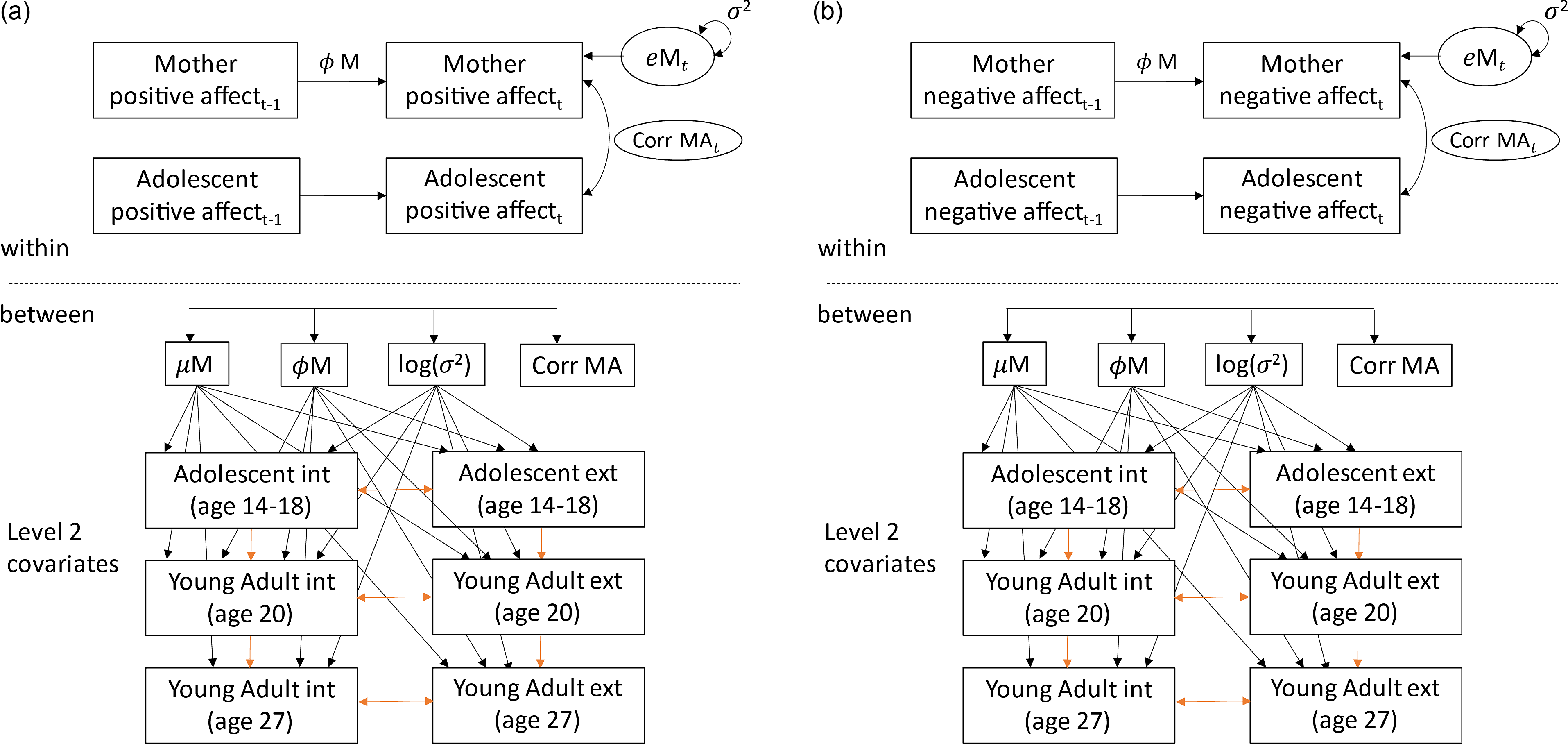
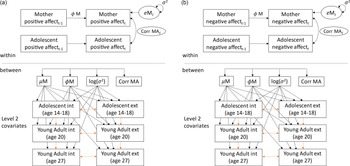
All analyses were conducted using Mplus version 8.11 (Muthén & Muthén, Reference Muthén and Muthén1998–Reference Muthén and Muthén2017). To extract measures of maternal affect intensity, inertia, and variability for positive and negative affect, respectively, we constructed two bivariate multilevel path models using Dynamic Structural Equation Modelling (DSEM; see Figure 1). In DSEM, all intensive affect measures were split into a within-person and a between-person component using latent mean centering. The between-person component reflects an individuals’ trait affect scores, while the within-person component reflects temporal deviations from that individual’s means, characterized as affective states (Hamaker et al., Reference Hamaker, Asparouhov, Brose, Schmiedek and Muthén2018). These models were used to obtain individual scores for maternal positive affect intensity, inertia, variability, and mother–adolescent positive affect congruency (Figure 1(a)) and individual scores for maternal negative affect intensity, inertia, variability, and mother–adolescent negative affect congruency (Figure 1(b)) that were used in the moderation analyses.
Visual representation of conceptual DSEM models for positive (a) and negative affect (b); μ = individual mean (intensity level), φ = autoregressive paths (inertia), log(σ2) = individual differences in innovation variance (variability), Corr MA = covariance between mother affect and adolescent affect at the same time point (mother–adolescent affect congruency). In addition to maternal affect indicators, all adolescent affect indicators (mean, autoregressive path, innovation variance) were estimated. To maintain a clear visual depiction and the focus on the main hypotheses, the estimated indicators for adolescent affect are not presented in the figure (see Figure S1 in the supplemental material for the full model).
We followed the general approach suggested by Hamaker and colleagues (2018): We modeled two first-order autoregressive VAR(1) models using Bayesian Markov chain Monte Carlo (MCMC) estimation (two chains, 50,000 iterations) with default priors. PSR values for each parameter were very close to 1 (≤ 1.015 for positive affect and ≤ 1.019 for negative affect) and trace plots were dense, which indicates model convergence. Covariance coverage was ≥ .154 for both models. Missing data were handled using MCMC sampling. Due to nonequidistant measurements (i.e., no assessments on the weekend and during the remaining weeks of the year) and missing data (e.g., participants who failed to complete all daily assessments of the week), not all intervals between measurements were equal. As the effect sizes of the lagged associations depend on the time interval (see Gollob & Reichardt, Reference Gollob and Reichardt1987; Hamaker et al., Reference Hamaker, Asparouhov, Brose, Schmiedek and Muthén2018), it is important to account for its unequal structure. To best reflect our day-to-day dynamics of interest and the structure of our data, in which most assessments were obtained with an interval of one day, we specified the time interval of interest to a value of 1 (unit of days). For the days that were not consecutive but included longer time intervals between measurements, we inserted missing values (10 days) to set the autocorrelation close to zero.
Maternal positive and negative affect levels at Day t were constructed as outcome variables that were regressed on maternal positive and negative affect levels at the previous Day t-1, respectively. Autoregressive effects, innovation variances, means, and covariances for both maternal and adolescent affect were randomly estimated at the within-person level, indicating that the scores of mothers and adolescents within one family were fixed across time but varied across families. Each model included seven random effects, respectively: two means for maternal and adolescent affect, two autoregressive paths for maternal and adolescent affect from t-1 to t, two innovation variances for maternal and adolescent affect, and the covariance between maternal and adolescent affect at t. The random mean μ for maternal positive or negative affect constitutes positive or negative affect intensity, or average affect levels across days. The autoregression path Φ between maternal positive or negative affect at t-1 and maternal positive or negative affect at t constitutes maternal positive or negative affect inertia, or the tendency for an emotion to carry over from one day to the next. The random residual variance log(π) of maternal positive or negative affect (i.e., innovation variance) constitutes maternal positive or negative affect variability, or the range of daily fluctuations, irrespective of temporal order. This measure describes the novel aspects of positive or negative affect on a specific day that cannot be explained by the autoregressive effect, such as individual differences in sensitivity to other factors that influence an individual’s daily affect (Jongerling et al., Reference Jongerling, Laurenceau and Hamaker2015) and the perception of affect (Simons et al., Reference Simons, Simons, Grimm, Keith and Stoltenberg2021). This alternative measure of affect variability differs conceptually from often used measures, which statistically overlap with affect inertia to some extent, such as mean squared successive differences (MSSD) or intraindividual standard deviations (ISD) or variance (Koslowski & Holtmann, Reference Koslowski and Holtmann2025), and has recently been used more frequently as a measure of variability (e.g., Scott et al., Reference Scott, Victor, Kaufman, Beeney, Byrd, Vine, Pilkonis and Stepp2020; Tammilehto et al., Reference Tammilehto, Kaurin, Bosmans, Kuppens, Flykt, Vänskä, Peltonen and Lindblom2025). The standardized random covariance between maternal positive or negative affect at Day t and adolescent positive or negative affect at Day t constitutes mother–adolescent positive and negative affect congruency, respectivelyFootnote 1 . All random effects were allowed to covary with each other at the between-person level. Results of the DSEM models and correlations between all random effects can be found in Table S4 in the Supplemental Material.
To test our first research question regarding the associations of maternal affect intensity, inertia, and variability with adolescent and young adult internalizing and externalizing symptoms, we deviated from our preregistration. While we originally proposed to use separate path models with extracted factor scores from DSEM, we followed the suggestion of a reviewer to model our predictive outcomes at all time points directly in DSEM. This approach provides the most reliable, robust results and allowed us to test our hypotheses on transient versus enduring effects more directly. Specifically, we constructed two DSEM models, one for positive affect and one for negative affect. At the within-person level, we specified all random effects. At the between-person level, we specified the regression paths from maternal affect intensity (i.e., mean), inertia (i.e., autoregression), and variability (i.e., innovation variance) to adolescent internalizing symptoms as well as externalizing symptoms at age 14 – 18, age 20, and age 27. We included autoregressive paths between subsequent time points (e.g., age 14 – 18 to age 20) for internalizing and externalizing symptoms, respectively, as well as covariances between all random effects and between internalizing and externalizing symptoms at each time point (see Figure 1; Figure S1).
Moderation analyses using path models
After obtaining the predictor scores from DSEM, we added mother–adolescent positive and negative affect congruency as direct effects and moderators to each respective model. We evaluated three interaction effects for positive and negative affect, respectively, per time point: Mother–adolescent affect congruency*maternal affect intensity, mother–adolescent affect congruency*maternal affect inertia, and mother–adolescent affect congruency*maternal affect variability. Hence, each model included 18 interaction effects. To further examine significant interactions, we estimated the association between maternal affect and adolescent psychopathological symptoms at ± 1 SD from the mean of mother–adolescent affect congruency (Cohen et al., Reference Cohen, Cohen, West and Aiken2003). As recommended practice for differential susceptibility (Preacher et al., Reference Preacher, Curran and Bauer2006; Roisman et al., Reference Roisman, Newman, Fraley, Haltigan, Groh and Haydon2012), we calculated the region of significance (1) with respect to the moderator to examine the range of values of mother–adolescent affect congruency for which maternal affect and adolescent symptoms were significantly associated, and (2) with respect to the predictor to examine the range of values of maternal affect for which mother–adolescent affect congruency and adolescent symptoms were significantly associated. To determine differential susceptibility, the regression lines for high and low mother–adolescent affect congruency should differ significantly in the context of a beneficial (i.e., low negative or high positive affect, low positive or negative affect inertia, low positive or negative affect variability) and adverse emotional climate (i.e., high negative or low positive affect, high positive or negative affect inertia, high positive or negative affect variability), as indicated by ± 2 SD boundaries from the mean. Regions of significance were calculated and illustrated using a web-based program (Roisman et al., Reference Roisman, Newman, Fraley, Haltigan, Groh and Haydon2012).
Sensitivity analyses
Multivariate outlier analyses using Mahalanobis Distance identified 8 outliers for the positive affect model and 11 outliers for the negative affect model. We therefore conducted all models without their respective outliers as sensitivity analyses. To avoid discussing potential artifacts, we only interpreted results that were consistent across analyses with and without outliers.
Additionally, adolescents’ own affect undoubtedly plays an important role in directly shaping youth adjustment. In our DSEM models, we estimated and thus controlled for adolescent affect indicators to some extent, when estimating maternal affect indicators and their associations with youth internalizing and externalizing symptoms. To further examine whether the effects of maternal affect indicators and mother–adolescent affect congruency hold above and beyond the direct effects of adolescents’ own mean affect levels and dynamics, we conducted sensitivity analyses including adolescent affect indicators as unique predictors of their internalizing and externalizing symptoms.
Finally, we deviated from our preregistered analyses by conducting all main analyses directly in DSEM and by estimating the associations with internalizing and externalizing symptoms at all time points simultaneously. To ensure that the high model complexity did not affect our general results, we conducted sensitivity analyses using our preregistered approach that included extracting all affect indicators from the DSEM models and conducting path models separately per time point.
Results
Daily maternal affect predicting youth psychopathological symptoms
Correlations between all variables in the positive affect models (A) and negative affect models (B) are presented in Table S5 in the Supplemental Material.
Maternal positive affect
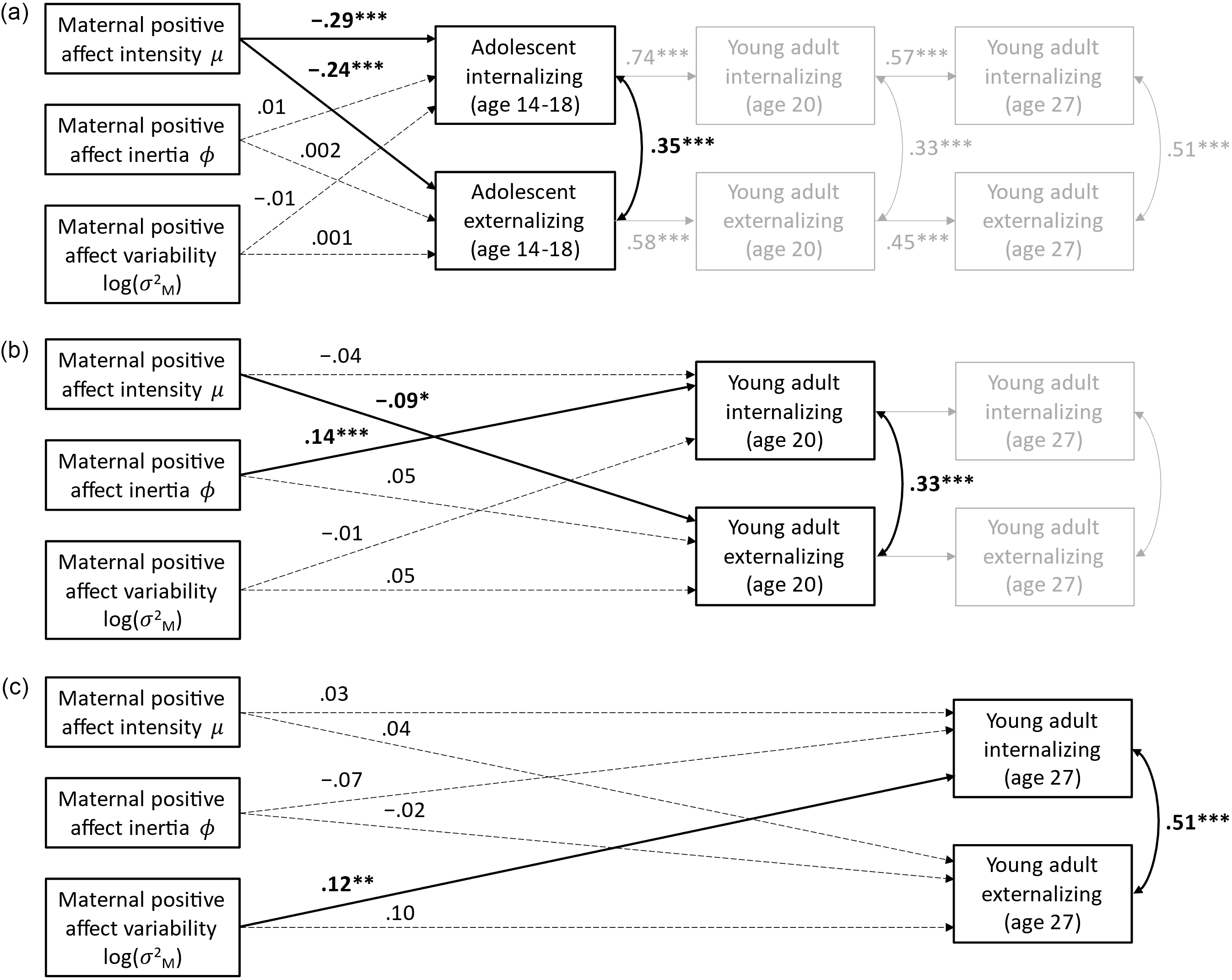
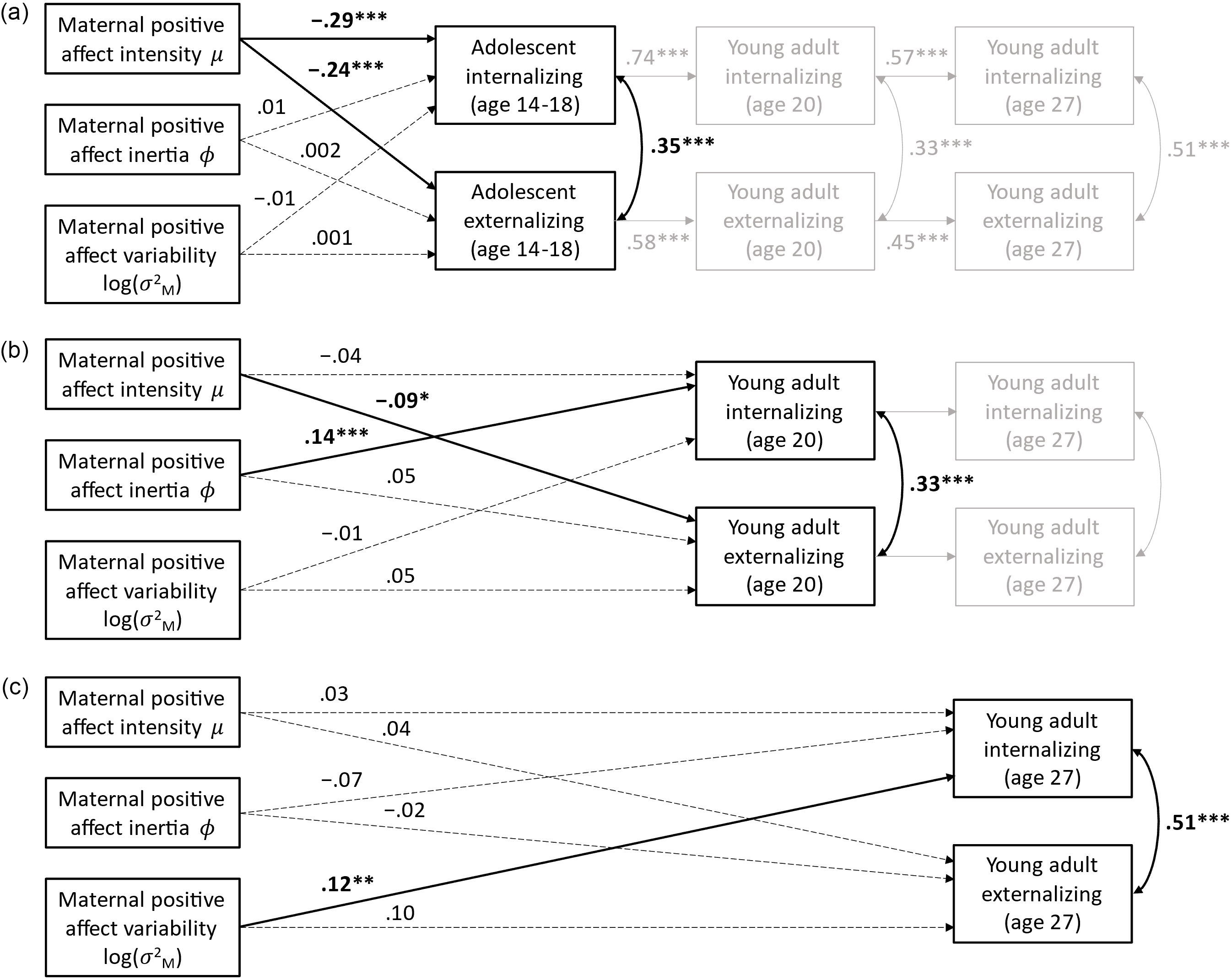
The full results for all main analyses can be found in Table S6 in the Supplemental Material. All associations in the model are controlled for psychopathological symptoms (i.e., stability paths) at all time points. Consistent with our hypotheses, higher maternal positive affect intensity during adolescence was significantly associated with fewer adolescent internalizing and externalizing symptoms concurrently at age 14 – 18 (see Figure 2(a)), as well as fewer externalizing symptoms at age 20 controlling for symptoms at age 14 – 18. No other significant associations were found between maternal positive affect intensity and psychopathological symptoms at age 20 (see Figure 2(b)) or age 27 (see Figure 2(c)). Higher maternal positive affect inertia during adolescence was associated with higher internalizing symptoms at age 20, but not with symptoms at any other time point. Higher maternal positive affect variability during adolescence was associated with higher internalizing symptoms at age 27, but not with symptoms at any other time point.
Graphical representation of the results from the main DSEM model at the between-person level, predicting internalizing and externalizing symptoms from maternal daily positive affect at age 14 – 18 (a), age 20 (b), and age 27 (c). Maternal affect indicators were measured on five consecutive days for three non-successive weeks per year from adolescent age 14 – 18. All effects were estimated in the same model, but are presented separately for age 14 – 18, 20 and 27 for visual reasons. *** p < .001 ** p < .01 * p < .05.
Sensitivity analyses without outliers generally resulted in similar conclusions (see Table S7), except that maternal positive affect variability also significantly predicted higher externalizing symptoms at age 20 and at age 27, and that the associations of maternal positive affect intensity with externalizing symptoms at age 20 did not reach significance. In addition, including adolescent positive affect indicators as predictors for youth internalizing and externalizing symptoms resulted in overall similar effect sizes for associations between maternal positive affect indicators and youth internalizing and externalizing symptoms (see Table S8). As expected, adolescent affect indicators significantly predicted youth internalizing and externalizing symptoms, particularly at age 14 – 18 and age 27. Maternal affect indicators still uniquely predicted youth symptoms above and beyond adolescents’ own affect, although the effect sizes became somewhat smaller. However, contrary to the main analyses, maternal positive affect intensity significantly predicted higher externalizing symptoms at age 27, and did not predict lower externalizing symptoms at age 20. Finally, examining all time points separately as preregistered yielded overall similar conclusions as well (see Table S9). However, these analyses resulted in significant associations not only of maternal affect intensity with adolescent internalizing and externalizing symptoms at age 14 – 18, but also with internalizing symptoms at age 20 and age 27. The associations of maternal affect variability with young adult internalizing symptoms at age 27 did not reach significance.
Maternal negative affect
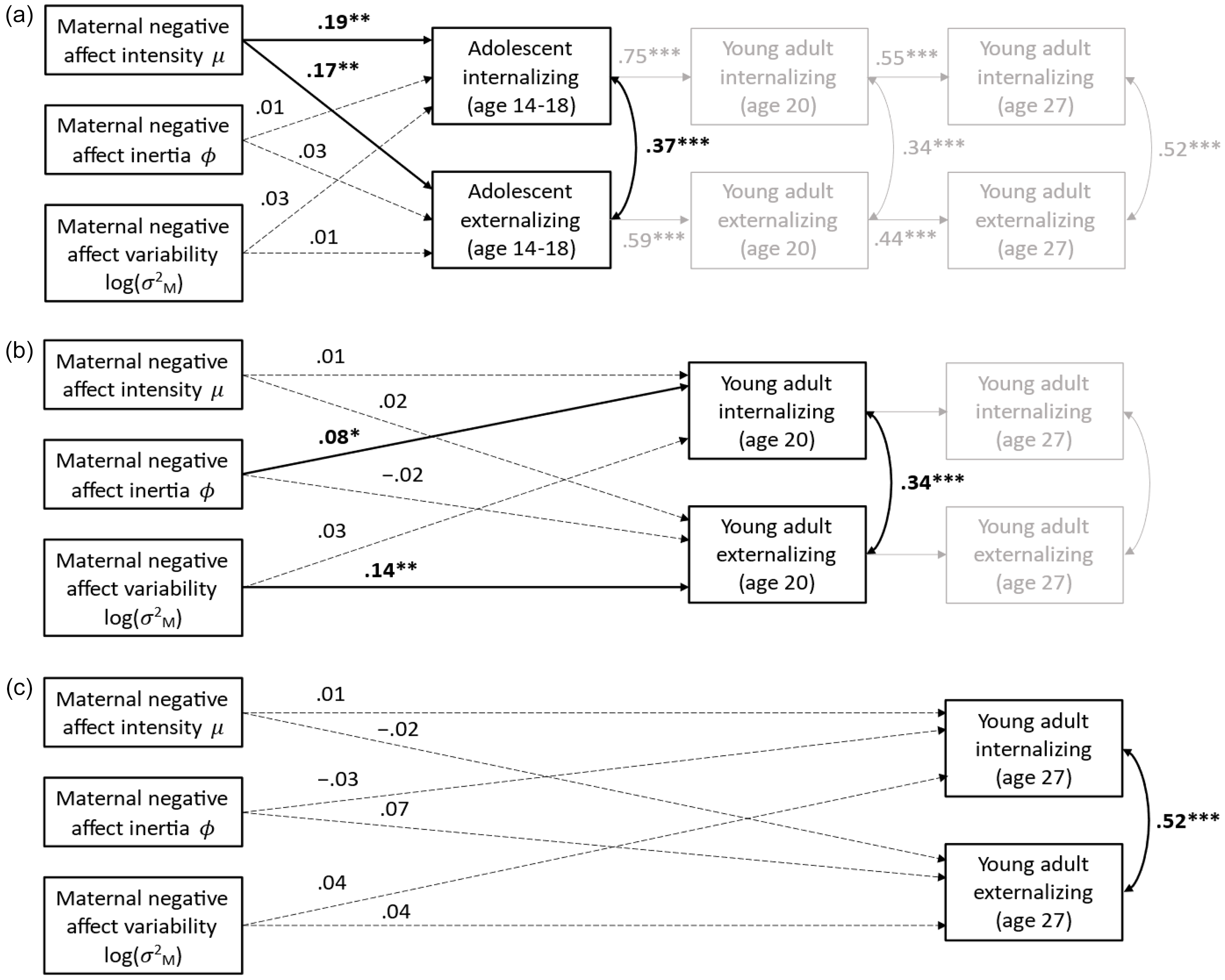
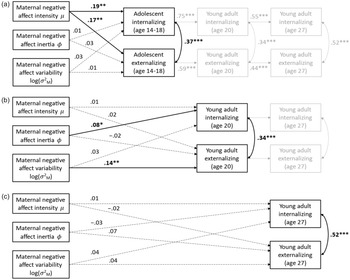
All associations in the model are controlled for psychopathological symptoms (i.e., stability paths) at all time points. Consistent with our hypotheses, higher maternal negative affect intensity during adolescence was associated with higher adolescent internalizing and externalizing symptoms concurrently at age 14 – 18 (see Figure 3(a); see Table S6). No other significant associations were found between maternal negative affect intensity and psychopathological symptoms at age 20 (see Figure 3(b)) or at age 27 (see Figure 3(c)) controlling for symptoms at age 14 – 18. Higher maternal negative affect inertia during adolescence was associated with higher internalizing symptoms at age 20, while higher maternal negative affect variability was associated with higher externalizing symptoms at age 20. No other significant associations were found between maternal negative affect indicators and youth psychopathological symptoms.
Graphical representation of the results from the main DSEM model at the between-person level, predicting internalizing and externalizing symptoms from maternal daily negative affect at age 14 – 18 (a), age 20 (b), and age 27 (c). Maternal affect indicators were measured on five consecutive days for three non-successive weeks per year from adolescent age 14 – 18. All effects were estimated in the same model, but are presented separately for age 14 – 18, 20 and 27 for visual reasons. *** p < .001 ** p < .01 * p < .05.
Sensitivity analyses without outliers resulted in the same conclusions, with the exception that maternal negative affect intensity was no longer significantly associated with adolescent externalizing symptoms at age 14 – 18 (see Table S7). Including adolescent negative affect indicators as predictors for youth internalizing and externalizing symptoms resulted in the same conclusions for maternal affect dynamics, but the associations between maternal negative affect intensity and adolescent internalizing symptoms at age 14 – 18 did not hold above and beyond the effects of adolescent affect (see Table S8). Notably, adolescent affect intensity and variability, but not inertia, contributed to youth psychopathological symptoms. Using the preregistered approach yielded similar conclusions as the main model regarding the effects of maternal negative affect intensity (see Table S9). For maternal affect dynamics, the associations with internalizing and externalizing symptoms at age 20 remained comparable in size, but were no longer significant.
Moderation by mother–adolescent daily affect congruency
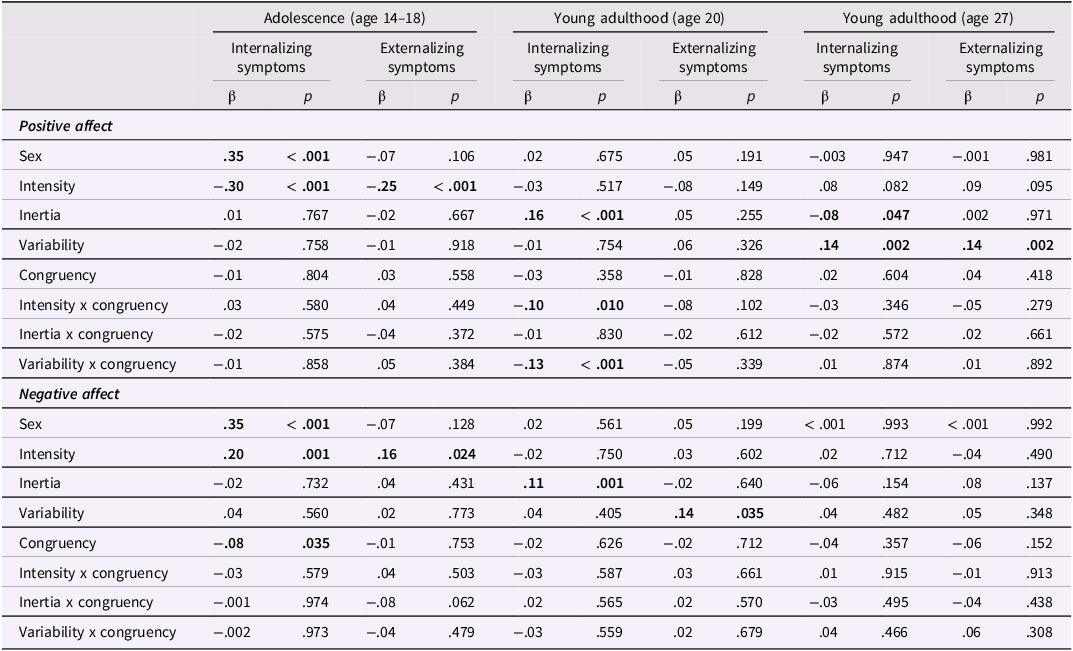
The two path models including direct effects and all interaction effects per maternal affect indicator and time point did not indicate acceptable fit for positive affect (RMSEA = .120, CFI = .950, SRMR = .053) or negative affect (RMSEA = .110, CFI = .956, SRMR = .048). Evaluating the modification indices revealed large regression coefficients between adolescent symptoms at age 14-18 and young adult symptoms at age 27. We therefore added these two-year stability paths, which substantially improved the fit of the models and resulted in good model fit for both positive affect (RMSEA = .082, CFI = .983, SRMR = .040) and negative affect (RMSEA = .073, CFI = .985, SRMR = .035). The results of all moderation analyses are depicted in Table 1.
Results of the moderation analyses
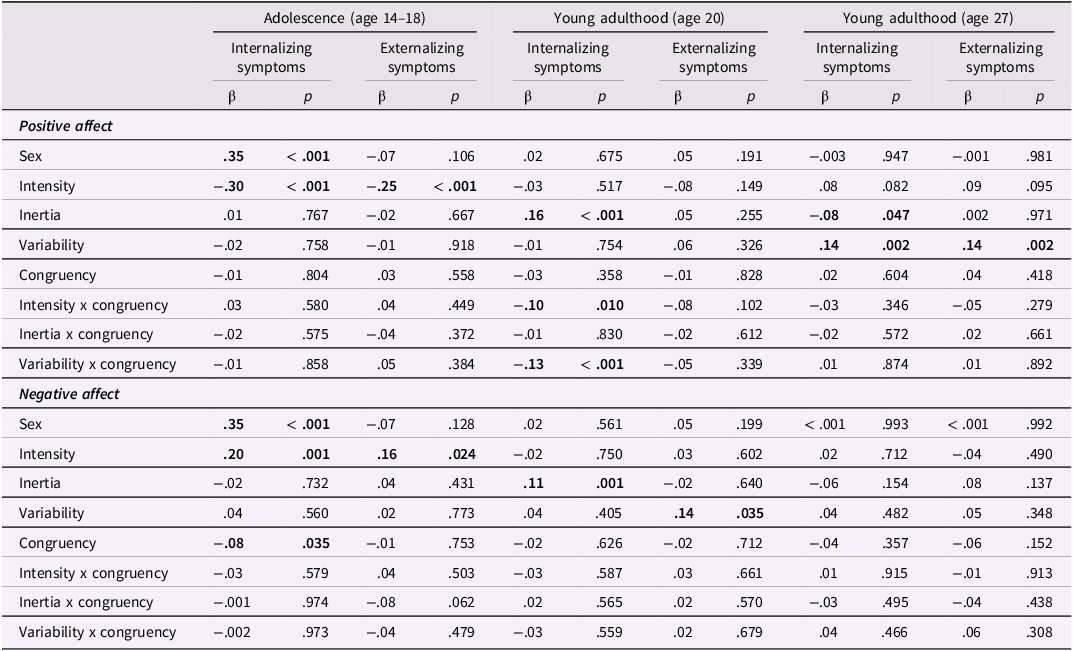
Note. Each model included autoregressive paths between time points (βs = .27 – .75, ps < .001) and correlations between internalizing and externalizing symptoms (βs = .33 – .52, ps < .001).
Maternal positive affect
Out of 18 potential interaction effects for maternal positive affect, we only detected two significant interactions: Mother–adolescent affect congruency moderated the associations of maternal positive affect intensity as well as maternal positive affect variability with youth internalizing symptoms at age 20 (controlling for psychopathological symptoms at all time points).
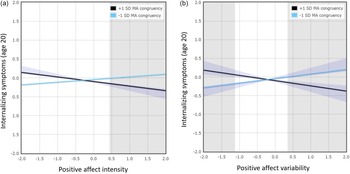
The regions of significance for mother–adolescent affect congruency revealed that the association of maternal affect intensity with internalizing symptoms at age 20 was only significant for high-congruent, and not for low-congruent adolescents (see Table S10). The regions of significance for maternal positive affect intensity revealed that youth who were highly congruent with their mothers’ affect reported lower internalizing symptoms at age 20 than low-congruent youth, when maternal positive affect was high (see Figure 4(a)). The extreme lower bound significance values for maternal positive affect intensity scores further indicated that mother–adolescent affect congruency and adolescent symptoms are unlikely to be significantly associated at low levels of maternal positive affect intensity.
Significant interactions of positive affect intensity (a) and positive affect variability (b) with mother–adolescent (MA) affect congruency predicting internalizing and externalizing symptoms in in young adulthood at age 20; shaded areas depict regions of significance.
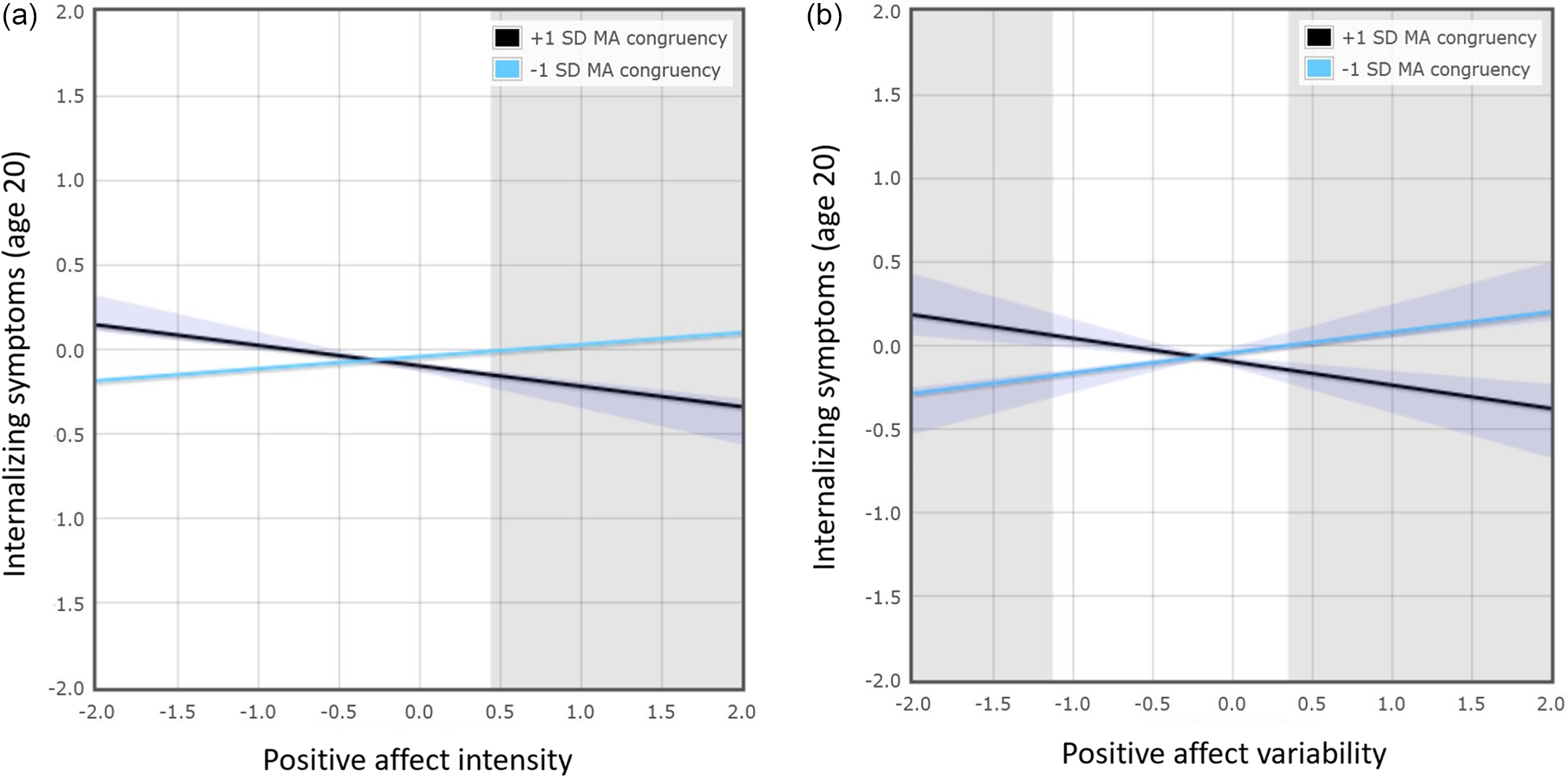
With regards to the interaction effect involving maternal positive affect variability, the regions of significance for mother–adolescent affect congruency revealed that the association of maternal affect variability with young adult internalizing symptoms at age 20 was significant for both high-congruent and low-congruent adolescents (see Table S10). The regions of significance for maternal positive affect variability revealed that youth who were highly congruent with their mothers’ affect reported lower internalizing symptoms at age 20 than low-congruent youth when maternal affect variability was high, but more internalizing symptoms when maternal affect variability was low (see Figure 4(b)).
All sensitivity analyses without outliers, including adolescent affect indicators, and using the preregistered approach resulted in similar effect sizes and conclusions (see Table S7, S11, and S12).
Maternal negative affect
For maternal negative affect, no significant interactions were detected (see Table 1). This indicates that mother–adolescent affect congruency did not moderate any of the associations between maternal negative affect indicators and youth internalizing or externalizing symptoms. The results remained the same across all sensitivity analyses (see Table S7, S11, and S12).
Discussion
This study examined the role of maternal affect intensity, inertia, and variability during adolescence in adolescent and young adult internalizing and externalizing symptoms and how mother–adolescent affect congruency may moderate these associations. As partially expected, lower maternal positive affect intensity and higher maternal negative affect intensity were associated with more internalizing and externalizing symptoms in, but generally not beyond, adolescence. In contrast, maternal positive and negative affect dynamics only contributed to psychopathological symptoms in young adulthood, but associations were not consistent. Although we detected little evidence for interaction effects, mother–adolescent affect congruency moderated the effects of maternal positive, but not negative, affect intensity and variability, in that adolescents who were more congruent with their mother’s positive affect were at lower risk for internalizing symptoms at age 20 than adolescents who were less congruent with their mother’s affect.
The role of maternal affect in youth psychopathology
Controlling for affect dynamics and adolescent gender, maternal affect intensity most consistently predicted offspring internalizing and externalizing symptoms in adolescence, but generally not in young adulthood. This predominant role of affect intensity held even controlling for adolescent affect indicators and is in line with studies indicating associations of maternal positive and negative affect with child psychopathological symptoms (Elgar et al., Reference Elgar, Waschbusch, McGrath, Stewart and Curtis2004; Leung et al., Reference Leung, Stewart, Wong, Ho, Fong and Lam2009) and studies highlighting the dominant role of mean-level intensity over affect dynamics in predicting internalizing symptoms (e.g., Dejonckheere et al., Reference Dejonckheere, Mestdagh, Houben, Rutten, Sels, Kuppens and Tuerlinckx2019). Mothers’ higher levels of negative affect and lower levels of positive affect can undermine their ability to be responsive and attentive or to use effective problem-solving strategies in interactions with their children (e.g., Dix, Reference Dix1991), thereby increasing their children’s risk for psychopathological symptoms in their development towards adulthood. Although we found some indication that associations with externalizing symptoms persisted into young adulthood, the effects of maternal affect intensity generally seemed to be transient, as they were most profound in adolescence and did not uniquely predict young adult symptoms above and beyond significant associations during adolescence. This suggests that mothers’ affect levels play an important role in children’s functioning, particularly during adolescence.
Albeit less consistently, maternal affect dynamics contributed to young adult, but not adolescent, psychopathological symptoms above and beyond maternal affect intensity and adolescent affect dynamics. This is in line with previous studies that found associations of affect inertia and variability with lower psychological adjustment, controlling for affect levels (Koval et al., Reference Koval, Sütterlin and Kuppens2016; Scott et al., Reference Scott, Victor, Kaufman, Beeney, Byrd, Vine, Pilkonis and Stepp2020). High positive or negative affect inertia might decrease mothers’ abilities to flexibly respond to immediate environmental demands and to engage with their children (e.g., Rottenberg et al., Reference Rottenberg, Gross and Gotlib2005). These mothers hence may have difficulties to meet their children’s social and emotional needs, which increases adolescents’ risk for psychopathological problems (Goodman et al., Reference Goodman, Simon, Shamblaw and Kim2020; Goodman & Gotlib, Reference Goodman and Gotlib1999). High positive and negative affect variability, on the other hand, may create an unpredictable environment that puts adolescents at risk for developing psychopathological symptoms. Interestingly, maternal affect dynamics only contributed to later, particularly internalizing, symptoms in young adulthood, suggesting potential sleeper effects. In the context of the substantial associations between maternal affect intensity and adolescent psychopathological symptoms, it is possible that the impact of maternal affect dynamics above and beyond affect levels in adolescence is small. This would be in line with recent meta-analytical evidence that affect dynamics have little predictive value above and beyond affect levels (see Dejonckheere et al., Reference Dejonckheere, Mestdagh, Houben, Rutten, Sels, Kuppens and Tuerlinckx2019, but see also Lapate & Heller, Reference Lapate and Heller2020 for a critical discussion). However, studies reviewed in this meta-analysis mainly included adult samples that usually do not take developmental change into account (McKone & Silk, Reference McKone and Silk2022). Moreover, our measure of affect variability differs conceptually from the measures used in reviewed studies and may exhibit less statistical overlap with affect inertia (Jongerling et al., Reference Jongerling, Laurenceau and Hamaker2015; Koslowski & Holtmann, Reference Koslowski and Holtmann2023). Future studies are needed to further address, and replicate, the potential role of maternal affect dynamics in predicting youth psychopathological symptoms in and beyond adolescence.
The effects of maternal affective experiences remained generally comparable when controlling for adolescent affect dynamics in the model, even though the effects of maternal affect intensity, but not maternal affect dynamics, decreased in effect size. As expected based on the prominent role of one’s own affect in the development of psychopathology (e.g., Joiner & Lonigan, Reference Joiner and Lonigan2000; Kotov et al., Reference Kotov, Krueger, Watson, Achenbach, Althoff, Bagby, Brown, Carpenter, Caspi, Clark, Eaton, Forbes, Forbush, Goldberg, Hasin, Hyman, Ivanova, Lynam, Markon and Zimmerman2017), adolescent affect intensity was found to be substantially associated with internalizing and, to a lesser extent, externalizing symptoms in adolescence. Adolescent affect variability, but not inertia, also played a role in adolescent symptoms, most notably in adolescent externalizing symptoms. There was some evidence that these associations persisted over time and continued to uniquely predict externalizing symptoms in young adulthood at age 27. These results contribute to the growing evidence that momentary and daily affect as well as affect dynamics are important in understanding psychopathological problems and their development (e.g., Houben et al., Reference Houben, Van Den Noortgate and Kuppens2015; Koval et al., Reference Koval, Sütterlin and Kuppens2016; Reitsema et al., Reference Reitsema, Jeronimus, Dijk and Jonge2022; Scott et al., Reference Scott, Victor, Kaufman, Beeney, Byrd, Vine, Pilkonis and Stepp2020).
Our findings provided most support for transient effects, suggesting that the affective maternal environment uniquely, but not necessarily enduringly, predicts adolescent and young adult symptoms at specific moments, controlling for other time points. For maternal affect dynamics, these associations partly deviate from the revisionist model, which suggests that they would be stronger in adolescence and diminish by young adulthood (Fraley et al., Reference Fraley, Roisman and Haltigan2013), but they are transient in that they are only occurring at specific time points. Furthermore, stability of youth symptoms between time points was high, which suggests that an earlier maternal affective environment may still indirectly contribute to later psychopathological symptoms through its effect on earlier psychopathological symptoms. This notion further becomes evident in the sensitivity analyses conducted separately per time point, in which maternal positive, but not negative, affect intensity was also significantly associated with psychopathological symptoms in young adulthood. While we generally found associations for both maternal positive and negative affect with adolescent psychopathological symptoms, the effects of maternal positive affect seemed to be somewhat stronger for most associations. This is contrary to what we would expect given that negative experiences and emotions are often more influential and stronger than positive ones (Baumeister et al., Reference Baumeister, Bratslavsky, Finkenauer and Vohs2001). One potential explanation may be that there was more variability in positive than negative affect in our sample. As mothers generally reported only low levels of negative affect, the effects for maternal negative affect may have been less pronounced or underestimated compared to a sample of mothers who experience more negative affect on a daily basis.
The moderating role of mother–adolescent affect congruency
Contrary to our hypotheses, we found limited evidence for the moderating role of mother–adolescent positive and negative affect congruency. High-congruent and low-congruent adolescents only consistently differed on their psychopathological symptoms at age 20 in the context of high maternal affect intensity and variability. Adolescents whose daily affect was more congruent with their mother’s daily positive affect fared better at age 20 than low-congruent adolescents when their mothers showed higher levels of positive affect and positive affect variability. This moderating effect was still evident controlling for adolescent affect indicators in the model. In the context of a highly beneficial emotional environment, such as high levels of maternal positive affect, being congruent with their mothers’ affect seems to benefit youth mental health a few years later. This finding is in line with vantage sensitivity (Pluess & Belsky, Reference Pluess and Belsky2013), which suggests that adolescents respond differentially in the context of positive environments.
That high mother–adolescent affect congruency protected young adults against the effects of high maternal positive affect variability but rendered them more vulnerable to low maternal affect variability was in the unexpected direction. Although this finding is contrary to previous findings on mother–child physiological synchrony (e.g., Oshri et al., Reference Oshri, Liu, Suveg, Caughy and Goodgame Huffman2023), it is in line with the protective effect of emotional congruency found among women whose partners were more emotionally reactive (Lopata et al., Reference Lopata, Randall and Bar-Kalifa2021). Being familiar with maternal affect patterns might help adolescents to predict these patterns, adapt to them, and feel emotionally secure (Eisenberg et al., Reference Eisenberg, Cumberland and Spinrad1998; Ugarte & Hastings, Reference Ugarte and Hastings2024). Being connected and congruent with their mothers may then help adolescents to better apprehend their mothers’ fluctuating affect, and thus be less affected by them.
No other moderation effects were found. It is possible that mothers’ positive and negative affect poses a particularly salient risk for youth psychopathology that affects adolescents irrespective of whether they display similar affect as their mothers. Although previous research found that physiological and affective parent–child synchrony was associated with youth psychopathological symptoms in the context of maternal depression and parenting (Kudinova et al., Reference Kudinova, Woody, James, Burkhouse, Feurer, Foster and Gibb2019; Oshri et al., Reference Oshri, Liu, Suveg, Caughy and Goodgame Huffman2023), these studies examined synchrony during momentary interactions. Rather than the extent to which mothers and adolescents experience similar affect in a day, it may be more relevant how congruent they are during shared moments or in their reactions to similar environmental stressors.
Limitations and future directions
This is the first study to examine how maternal day-to-day affect dynamics and their interactions with adolescent affect across time contribute to internalizing and externalizing symptoms in adolescence and young adulthood. Our unique design predicting outcomes on the macro-level from daily affect on the micro-level provided valuable insights into the daily processes that shape adolescent adjustment and explain differences in intraindividual trajectories to psychopathological symptoms. Despite these strengths, this study is not without limitations. First, as we focused on day-to-day affect associations, we could not investigate context-dependent maternal affect in different situations. Therefore, it is not clear whether highly rigid, or highly variable patterns of maternal affect indeed reflect difficulties to flexibly respond to environmental demands or whether mothers just did not encounter situations that would elicit different emotions. Future studies might record several affect assessments throughout the day in relation to the specific situations in which they occur to identify adaptive or maladaptive responses and their effects on adolescent adjustment. Furthermore, it is possible that interactions between different aspects of affect drive individual risk trajectories in adolescent adjustment. For example, one study found that for individuals with high negative affect intensity, high levels of variability seem to be adaptive (Jenkins et al., Reference Jenkins, Hunter, Richardson, Conner and Pressman2019). Future studies should further investigate which maternal affect profiles best contribute to positive youth outcomes. That includes examining nonlinear associations, which can provide important insights into the extent to and levels at which maternal affect reflects a positive or negative context for children’s emotional development.
Second, mothers and adolescents are likely to influence and coregulate each other’s emotions (e.g., Saxbe & Repetti, Reference Saxbe and Repetti2010). While mothers have been found to coregulate adolescents’ negative affect towards positivity (e.g., Van Bommel et al., Reference Van Bommel, Van der Giessen, Van der Graaff, Meeus and Branje2019), reinforcing each other’s negative mood could accumulate negativity and ultimately psychopathological symptoms in these families. The effects of such coregulation of mothers’ and adolescents’ affect may depend on the context in which they occur. The current study mainly focused on associations between mothers’ and adolescents’ general affect levels throughout the day, which can reflect both shared affect (e.g., mother–adolescent interactions or responses to the same event) and non-shared affect across different positive or negative situations. Our measure of general mother–adolescent congruency may therefore be less context-specific. Future studies should investigate how parents and children coregulate each other’s affective behaviors across time and contexts and how this drives the development and course of adolescent psychopathological symptoms.
Finally, our sample included mainly well-functioning mothers who reported relatively high levels of positive affect and low levels of negative affect across days. High negative affect inertia does therefore not necessarily indicate prolonged negative emotions, but could also indicate a prolonged absence of negative emotions. Although low negative affect inertia could be maladaptive, particularly in situations that warrant negative emotions, high negative affect is expected to have the most adverse effects on maternal interaction behaviors. Affect patterns involving high negative emotions may thus be most strongly associated with adolescent adjustment. Future research is necessary to investigate whether our conclusions generalize to populations who exhibit more daily negative affect, such as mothers (and adolescents) with clinically relevant levels of psychopathology or who experience multiple stressors in daily life. Relatedly, this study included mother–adolescent dyads only, due to the prominent role of maternal influence in adolescent development. The emotional climate of the family, however, also includes other nuclear family members such as additional caregivers or siblings. As paternal behaviors can moderate the effects of maternal psychopathology and behaviors on child functioning (e.g., McKee et al., Reference McKee, Roland, Coffelt, Olson, Forehand, Massari, Jones, Gaffney and Zens2007; Vakrat et al., Reference Vakrat, Apter-Levy and Feldman2018), it is possible that different family members’ affect exacerbate or counter the effects of maternal affect on adolescent adjustment.
Conclusion
The results of this study provide novel insights into the affective processes that contribute to adolescent adjustment. How maternal affect unfolds at a daily level plays a role in adolescent, and to some extent young adult adjustment, highlighting the importance of short-term processes in shaping long-term development. Particularly maternal positive and negative affect intensity appeared to play a salient role in adolescent internalizing and externalizing symptoms, even though they did not uniquely predict symptoms into young adulthood above and beyond these associations in adolescence. While a recent study found that affect dynamics contribute little to the prediction of psychopathological symptoms above and beyond mean levels of positive and negative affect (Dejonckherre et al., Reference Dejonckheere, Mestdagh, Houben, Rutten, Sels, Kuppens and Tuerlinckx2019), our results suggest that maternal affect dynamics might to some extent predict future psychopathological symptoms in young adulthood. Mother–adolescent affect congruency, in contrast, generally did not moderate these associations, but there was some limited evidence that being congruent with mothers’ positive affect could reflect differential susceptibility in the context of maternal positive affect indicators. However, the findings on the potential role of mother–adolescent affect congruency should be treated with caution and need to be replicated.
Supplementary material
The supplementary material for this article can be found at https://doi.org/10.1017/S0954579425100953.
Data availability
The data used in this study can be requested and accessed via https://doi.org/10.17026/dans-zrb-v5wp. All supplemental materials and syntax files are available at https://osf.io/d2jna.
Acknowledgments
We thank Ellen Hamaker for her expert advice on the DSEM analyses and Sascha B. Duken for his input and feedback at earlier stages of this study. Finally, we are grateful to all families who participated in the RADAR study.
Funding statement
Data of the RADAR (Research on Adolescent Development And Relationships) study were used (https://doi.org/10.17026/dans-zrb-v5wp). RADAR was founded by W. Meeus and has been financially supported by main grants from the Netherlands Organisation for Scientific Research (GB-MAGW 480-03-005, GB-MAGW 480-08-006), Stichting Achmea Slachtoffer en Samenleving (SASS), the Netherlands Organisation for Scientific Research to the Consortium Individual Development (CID; 024.001.003), a grant of the European Research Council (ERC-2017-CoG -773023 INTRANSITION), and various other grants from the Netherlands Organisation for Scientific Research, VU University Amsterdam, and Utrecht University. The funders had no role in the study design, data collection and analysis, decision to publish, or preparation of the manuscript.
Competing interests
The author(s) declare none.
AI statement
The authors declare that no AI was used in the creation of this manuscript.
Pre-registration statement
The hypotheses, study design, and analyses of this study were pre-registered on the Open Science Framework (https://osf.io/y9s76; date: Jan 19, 2021, 8:54 PM).
The following deviations were made: First, to test our first research question regarding the associations of maternal affect intensity, inertia, and variability with adolescent and young adult internalizing and externalizing symptoms, we deviated from our preregistration. While we originally proposed to use separate path models with extracted factor scores from DSEM, we followed the suggestion of a reviewer to model our predictive outcomes at all time points directly in DSEM. This approach provides the most reliable, robust results and allowed us to test our hypotheses on transient versus enduring effects more directly. Second, in constructing mother–adolescent affect congruency scores, we also deviated slightly from our preregistration. At the time of preregistering our study and analyses, it was not yet possible to extract a covariance between maternal and adolescent affect in DSEM. We are thankful to the anonymous reviewer who pointed out to us that this option became available by the time this manuscript underwent the peer review process. Extracting the random covariance from DSEM directly rather than from a separate multilevel model best aligned with our study’s design and was therefore chosen as preferred method.
Prior versions
A preprint of the submitted manuscript has been uploaded to PsyArXiv (https://psyarxiv.com/q4h37).


 Open access

