


The outbreak of the Second Sino-Japanese War in July 1937 precipitated a breakneck mobilization of Korea's resources—military, industrial, and sylvan. Confronted with a newfound demand for war material, the Government-General of Korea (Chōsen Sōtokufu, hereafter GGK) ramped up the production of timber, charcoal, and a host of chemical components. To facilitate this push, the Major Industries Control Law was extended from the metropole to Korea, thereby tightening the colonial state's grip on key war industries. A slate of laws thereafter restructured Korea's heavy industrial base so as to meet the requirements of its so-called “national defense economy.” The colonial state likewise intensified its ideological efforts to enlist Korean subjects into service of the war effort. By 1938, a full-fledged National Spiritual Mobilization Movement was underway, as the colonial state dialed up its rhetoric of imperialization (J. kōminka; K. hwangminhwa) and “Japan and Korea as one body” (J. naisen ittai; K. naesŏn ilche).Footnote 1
If these transformations marked the advent of Korea's wartime system, they also heralded the beginning of what many Korean scholars have come to call the colonial state's wartime “forest plunder” (K. sallim sut'al). Debates regarding the scope and legacies of wartime deforestation notwithstanding, few scholars dispute that the Asia-Pacific War, like the Sino- and Russo-Japanese Wars before it, exacted a tremendous toll on Korea's woodlands.Footnote 2 As kaleidoscopic repositories of fuel, lumber, rail ties, chemicals, and other raw materials—what were increasingly gathered under the label “national defense resources” (kokubō shigen)—Korea's forests were targeted for industrial-scale utilization as never before.
Streamlining the GGK's control over forest resources were edicts such as the 1937 Temporary Regulations for Imports and Exports, which bolstered the state's ability to track the flow of forest resources and allocate them at its discretion. In August 1938, a price ceiling was also established in Korea's four principal timber markets, thereby lowering the cost of key forest commodities. But perhaps the date that most precisely marks the inauguration of wartime forestry in Korea was September 1, 1937—the day the Korean Forestry Development Company (Chōsen Ringyō Kaihatsu Kabushiki Gaisha, hereafter KFDC) was chartered. Envisioned as a quasi-official agent of the colonial state, the KFDC consolidated the resources of Korea's seven largest forestry corporations (including the Oriental Development Company and the Ōji Paper Company) into a central apparatus of wartime forest management (Chōsen Sōtokufu Reference Sōtokufu1937).
Taking the emergence of the command economy of forest resources as its focus, this article examines two principal facets of wartime forestry in colonial Korea. First, I broadly survey the mechanisms through which the colonial state requisitioned forest resources between 1937 and 1945. In particular, I examine what many forestry bureaucrats deemed the three pillars of wartime forestry policy: enhanced yields, rationalized consumption, and fuel substitution through village-level charcoal production. Considered together, these initiatives offer insight into not only the ecological impact of colonial rule in Korea, but also what Micah Muscolino (Reference Muscolino2015, 4–5) calls “the energetics of militarized landscapes”: that is, how the exigencies of war reconfigure the energy flows that sustain both military operations and civilian life. In the case of colonial Korea, such an analysis requires that we look beyond the peninsula itself. Korea's forest resources, after all, flowed in large volumes into Manchuria and northern China, where they were laid as railway sleepers, assembled as buildings, processed as chemicals, or burned as fuel. Informed by Daqing Yang's (Reference Yang2011, 5) important observation that “the material means of either building Japan's empire or holding it together are largely taken for granted rather than being thoroughly investigated,” I here track the wartime exploitation, circulation, and utilization of Korea's forests as they were transfigured into the objects, materials, and commodities that vitalized Japan's empire at war.
Second, through an analysis of Japanese efforts to regulate everyday fuel consumption patterns, I offer a thumbnail sketch of the lived experience of wartime forestry reforms.Footnote 3 I devote particular attention to the ideological campaign enjoining Korean subjects to channel their “imperial spirits” to endure a “low temperature lifestyle” (J. teion seikatsu; K. chŏon saenghwal): what was essentially a set of austerity measures and sumptuary codes that cloaked fuel conservation in the mantle of imperial sacrifice.Footnote 4 Although scholars have long attended to the bio-politics of the colonial state in Korea, seldom have they considered the relationship between state power, bio-power, and the energy sources that powered the routines and rhythms of everyday life: from cooking to bathing, transportation to recreation.Footnote 5 Especially overlooked is the question of how wartime reforms to Korea's energy portfolio shaped the circulation of heat into the Korean home and its heating devices—quotidian consumption patterns that were both mediated through different sectors of colonial society and intimately connected to daily life.Footnote 6
Examining the politics of domestic fuel consumption in late colonial Korea offers insight into more than the market dynamics and material requirements of industrial warfare; it also enables us to broaden conceptualizations of colonial and wartime violence. In contrast to the more spectacular displays of oppression that figure so prominently in nationalist histories, wartime thermal regulations point towards the operation in colonial Korea of something akin to what Rob Nixon (Reference Nixon2013, 2) has called “slow violence”: “incremental and accretive” forms of suffering that occur largely out of sight and over prolonged temporal frames, whose “attritional lethality” injures both people and their surrounding ecosystems. While the case of colonial Korea does not map neatly onto Nixon's examinations of more contemporary environmental crises (such as industrial pollution or climate change), it nonetheless reminds us of the corporeal consequences of colonial subjectivity and the material deprivations that often defined everyday existence under colonial rule.
Of particular salience to this article is Nixon's notion of “displacement without moving”: how state-imposed landscapes can prompt the “loss of land and the resources beneath,” leaving “communities stranded in a place stripped of the very characteristics that made it inhabitable” (19). That colonialism and war prompted the physical displacement of Koreans—to factories in the north, to frontiers in Manchuria, to coal mines in Japan—is a well-established arena of historical inquiry.Footnote 7 But the onset of the war and the subsequent tightening of resource rationing gave rise to a different form of displacement. As the conflict progressed, communities were increasingly cleaved from surrounding woodlands, families were deprived of fuel, and farmers were left with difficult daily choices about how to access the materials essential to their livelihood. To understand daily life within the landscapes of Korea's own “dark valley,” then, we must not only chart the growth of a command economy for forest products, but also consider the bodily and sensory implications of caloric control.
Mobilizing the Woodlands
Exploitation was not always the watchword of the forestry project in colonial Korea. To the contrary, from the outset of colonial rule the forestry enterprise was as concerned with the seed as it was with the saw: it placed afforestation and conservation at the heart of its efforts to reclaim a peninsula often described by commentators—Japanese, Korean, or otherwise—as a “land of bald mountains and red earth.”Footnote 8 Hyperbolic though it often was, language of this sort was not unfounded. For while large tracts of old-growth forests could be found in remote stretches of the Yalu and Tumen river basins of the north, much of Korea's woodlands—which comprise roughly 72 percent of the peninsula's landmass—were denuded. Space does not here permit a full accounting of the dynamics of Korea's late Chosŏn deforestation, but suffice it to say that a convergence in the nineteenth century of a population boom, institutional erosion, elite expropriation, and rural strife did much to degrade the peninsula's forests, especially those in the densely populated south.Footnote 9
Forest regeneration thus early commanded the attention of foresters who, driven by fears of cascading environmental degradation, moved to regenerate forest stocks through a wide range of so-called “greenification activities” (ryokka undō): erosion control projects, ceremonial plantings, seed disbursal programs, and so forth. At the foundation of this policy framework lay the Forest Ordinance (Shinrin rei) of 1911, a sweeping set of legal reforms that, most notably, established a forestland-lease system through which the state outsourced the work of afforestation to corporations and capitalists. Using a legal architecture not unlike that established for forestry works in Hokkaido, these land lease provisions entitled lessees to ownership of the land and its resources once the progress of afforestation met state-established standards. As one might expect, Japanese entrepreneurs were at a decided advantage in taking on these capital-intensive projects, although the state did make a concerted effort to recognize Korean claims to seized woodlands through a complex and protracted arbitration process.Footnote 10
Whatever the inequities of this system, many regions in the peninsula saw considerable accumulation in forest stock. Perhaps the American journalist Arthur Bullard best captured the initial progress of this campaign—and the way in which it was carefully showcased to foreign observers—when he wrote for readers of Harper's Weekly upon his visit to Korea in 1919 that “One thing, which all tourists notice is the elaborate program of reforestation. The barren and denuded hills of Korea are growing up to a new wealth for the profit of future generations” (Bullard Reference Bullard1919, 859). Such commentary echoed widely, and was routinely held up by Japanese officials as evidence of the progress of its civilizing mission in Korea. In this way, forest conservation was used to signal Japan's place among the “first-rank” nations, whose scientific forestry practices were cast as metrics of civilization and enlightenment.Footnote 11 Never mind that (as John Lee has shown in this forum) Koreans had their own rich traditions of silviculture, that many of these saplings did not survive, or that the rates of timber felling continued to outstrip afforestation in some parts of Korea. These nascent second-growth stands provided just the sort of optics desired by colonial boosters to draw attention to the material impact of their reform agenda on the Korean landscape.
The outbreak of war with China in 1937, however, marked the beginning of the end of the colonial state's ambitious, contentious, and largely forgotten reforestation project. Thereafter, many of the forest stands that had been scientifically reared, carefully guarded, and heralded as “the lifeline of empire” were unceremoniously cut down. The rhetoric of forest conservation as a key to ensuring the nation's future in a hundred years’ time yielded to calls for sacrifice to preserve the empire now (Uemura Reference Kakisaburō1938, 9).
Provisioning the wartime state with timber, charcoal, pulp, and other wood products was a tall order, however. With battlefronts expanding in China just as the industrial applications of wood fibers were broadening, demand for Korean forest resources rose rapidly. Forestry bureaucrats in Korea accordingly took measures to control prices, commandeer transport routes, and, where possible, expand productive capacities.Footnote 12 They did so in part by authorizing in 1939 new felling operations within Korea's extensive network of Forest Management Stations: processing facilities concentrated in and around the resource-rich National Forestlands of the Yalu and Tumen river basins that had since the 1920s formed the engine of Korea's timber industry. Simultaneously, the GGK underwrote a breakneck expansion of the network of logging roads and timber railways so as to streamline the processing and distribution of remote forest stocks. In 1939, no less than 100 kilometers of additional track was laid, bringing the total web-work of logging transport routes to 518 kilometers comprised of sixty-three lines (Doi Ringaku Shinkōkai Reference Shinkōkai1974, 148). One need only inspect statistics on aggregate timber production to gain a sense of the expanding scope of felling operations. Whereas in 1931 approximately 3,500,000 shakujime (or 42,000,000 cubic feet) of timber was harvested from National Forestlands, this figure had by 1938 increased twofold to 7,780,000 shakujime (93,360,000 cubic feet; Hagino Reference Toshio1965, 141).
Early into the war effort, forestry officials remained steadfast in their commitment to reforestation. Invoking the lessons of World War I—a conflict that threw into sharp relief the causes and consequences of national timber famine—foresters called for robust regeneration efforts alongside increased production drives (Chōsen Sanrinkai Reference Sanrinkai1941). They did so in concert with agricultural experts, who had long underscored the importance of healthy forests as a foundation for irrigation works, “climatic harmony,” and erosion control—environmental issues inextricably linked to rice production. If Korea was to form a rice basket for the empire through the war, many reasoned, then the state should be careful not to overharvest its forests (Sawada Reference Toshinobu1938).
Forest regeneration, in fact, was the very raison d’être of the KFDC, which was initially tasked with overseeing afforestation works in National Forestlands. To that end, the GGK leased the KFDC 220,000 chōbu (roughly 218,174 hectares) of woodlands concentrated in North Kyŏngsang and Kangwŏn provinces, and subsidized the cost of afforestation by as much as one-third. But some shareholders and employees had other plans in mind. Just two years into its operations, the company began to harvest timber and process charcoal from the very woodlands it was supposed to stock and protect, reaping in 1940 a net profit of 155,000 yen (Ch'oe Pyŏng-t'aek Reference Pyŏng-T'aek2008, 280). In this way, the KFDC became yet another vehicle through which the pretext of afforestation was used to siphon forestland and resources into the hands of Japanese corporate entities—what scholars have called the “greenification framework” (ryokkashugi) of colonial rule (Matsumoto Reference Takenori and Takako2011; Miyata and Yi Reference Setsuko and U-Yŏn2009).
But it was not just National Forestlands that saw intensified exploitation; locally owned and operated woodlands—those belonging to counties (myŏn), temples, cooperatives, or individuals—were also targeted for extraction. New market regulations were propped up as old-growth stands were cut down. A major shift in the timber commodity marketplace came in 1940 when the GGK issued an ordinance that henceforth required all woodcutters, merchants, brokers, and millers involved in the timber trade to gain permission from the state to expand their operations or sell, lease, and dispose of any forest resources. Additional regulations took place at the provincial level, where forestry officials rolled out a series of selective cutting guidelines and tax obligations that sought to control the flow of forest goods and stimulate the reclamation of neglected woodlands. In effect, however, these directives saddled merchants, brokers, and farmers with additional operating costs, leaving many with little choice but to sell off their timber to state entities at cut-rate prices or to dispose of their land altogether.
Nor did these market interventions always go as planned. As Ch'oe Pyŏng-t'aek (Reference Pyŏng-t'aek2004) has shown with the colonial capital, for instance, price controls set shortly after the outbreak of war in 1937 in order to stabilize supplies of charcoal had the unintended consequence of flooding the market with cheap firewood at the very moment that colonial officials were urging Koreans to use alternative fuel sources. Initially, as a result, the GGK actually induced exactly the opposite market adjustment officials had desired: supplies of charcoal diminished as Koreans bought up and burned cheap firewood, thereby undercutting afforestation efforts and fuel replacement drives. In response, the GGK placed strict limitations on woodcutting and fuelwood distribution—stiff measures that, while effective in driving up the production of charcoal, aroused the protests of merchants and consumers alike.Footnote 13
Despite such complications, the state proceeded to ever more tightly control the allocation of key forestry products. As one might expect for a peninsula routinely described as an “advance military supply base” (zenshin heitan kichi) for the war in China, no small measure of the timber resources processed in Korea were channeled directly into military operations. A majority of these resources took the form of traditional products such as rail ties, construction materials, and mine timbers that were vital to the maintenance and expansion of military supply lines.Footnote 14 But as the conflict wore on, Korea's forest resources were also poured into the production of more specialized products. Airplane frames, shipbuilding materials, cellophane, plastics, and other chemical byproducts were all manufactured using Korean forest materials to sustain military and defense operations. Of increasing utility and strategic importance was the production of rayon and other synthetic fibers: wood pulp derivatives in high demand as replacement for fabrics and tire cord. Demand for pulp-based products was met in part by scaling up the operations of the Ōji Paper–backed Korea Paper and Chemical Manufacture Company, which from its flagship factory in Kilju churned out impressive volumes of chemical components (Ōji Seishi Kabushiki Gaisha Reference Kabushiki Gaisha1976, 408–20).
Working through supply chains that had grown in tandem with the making of the Korea-Manchuria economic bloc, war planners channeled these and other products principally into northern China. Whereas in 1933 just under five million yen's worth of lumber and board sheets were shipped across the Yalu River into Manchuria, in 1939 this figure had swelled to over nine million yen (Hagino Reference Toshio1965, 143). At the same time, however, Korean corporations engaged in manufacturing were also becoming heavily dependent on timber and charcoal imports from the Japanese archipelago to offset shortfalls in domestic supply. Between 1937 and 1942, average timber imports from Japan amounted to approximately thirty-two million yen per year, while average annual exports from Korea to Japan in that same period were only around two million yen (Pae Reference Chae-su1997, 264).
These wartime trade currents suggest a far more complex portrait of wartime forest exploitation than is often noted. Insofar as the GGK scaled up the processing of Korean timber to support the war effort in northern China, we can say that the state stripped Korea of much of its forest stock, particularly that in the north of the peninsula. But only small volumes of Korea's forest resources were actually exported for consumption back in Japan, despite the growing scarcity in fuel and timber back in the archipelago. Far more impressive were the volumes of timber shipped from Japan to Korea. In this sense, the peninsula and its factories formed something of a timber sink for the empire. While Korea's northerly national forests supplied raw materials for industrialization at home and battlefronts abroad, the rising demand of private enterprise was met only by importing significant quantities of sylvan resources from the archipelago.Footnote 15
The escalation in hostilities that came with Japan's entry into the Second World War in 1941 only compounded the strain placed on Korea's woodlands. The condition of Korea's forests thereafter began to decline precipitously as the colonial state moved to meet the exigencies of total war. With gasoline earmarked for military use, most vehicles were crudely jury-rigged with inefficient wood-burning engines. In the meantime, many Korean companies and communities turned to the production of pine resin, root tar, and turpentine—“arboreal alchemy” that bespeaks the desperate need, felt across the empire, to sap the forests of any sustenance they could offer (Tsutsui Reference Tsutsui2003, 300). As in mainland Japan, these efforts were often driven by hunger. One 1942 report from Hamhŭng, for example, relayed the extensive destruction of local pine forests due to the last-ditch efforts of malnourished farmers to strip their bark for food. “A considerable number of village people,” the author noted, “have swollen bodies since they feed only on wild roots and tree-bark.” Another researcher discovered forty-three different types of roots and bark consumed by farmers around the Taegu area (quoted in Park Kyoung-hee 2013, 53, 202).
Perhaps the best indication of the shift to what might be called “total war forestry” was the fact that beginning in 1942 afforestation activities were severely curtailed. With supplies of seeds, saplings, and labor dwindling, colonial officials had little recourse but to resort to natural regenerative approaches and call upon Korean landowners to plant trees of their own volition. Although the spotty nature of data collection makes it difficult to assess deforestation after 1942, it is reasonable to conclude that forest stocks continued to diminish as the war intensified, forcing many Koreans into a day-to-day struggle to meet their fuel needs.
Caloric Control
If increasing production quotas were the primary concern of forestry bureaucrats in Seoul and Tokyo, controlling consumption was the wartime mandate of local and provincial officials. Such efforts were hardly new. Rather, they had for decades lain at the heart of the colonial state's push to ameliorate Korea's so-called “fuel problem” (J. nenryō mondai; K. yŏllyo munje): supply shortages in firewood and charcoal that drove many (primarily rural) households to burn forest biomass—including grass, thatch, pine needles, and nutrient-rich detritus—for fuel. Since the 1920s, the GGK had invested heavily in research into the promotion and production of alternative fuel sources, especially culm, rice husks, and coal briquettes. Agro-forestry experts and architects, meanwhile, embarked on a decades-long crusade to improve the Korean ondol: the cooking stove cum radiant heated floor system widely considered ground zero of deforestation (Fedman Reference Fedman2018). A catalyzing jolt to both initiatives came in 1932 with the inauguration of the Rural Revitalization Campaign (J. Nōson Shinkō Undō; K. Nongch'on Chinhŭng Undong). As part of its overarching goal of enabling material “self-sufficiency” in farm life, the campaign underwrote the creation of village-level institutions to oversee forest protection, spearhead ondol improvement, and stimulate on-site charcoal production.
With the outbreak of war, however, came a much more stringent regulatory regime. In the most basic sense, the wartime fuel conservation campaign proceeded on two fronts: one about encouragement, the other restraint. Regarding the latter, provincial authorities tightened controls on the collection of fuel by increasing forest ranger patrols; fortifying the forest penal codes; and monitoring local burning practices, especially in areas known as strongholds of slash-and-burn agriculture. Fuel conservation practices that were once merely suggested in forestry guidelines were codified into sumptuary legal ordinances that targeted individual and household fuel consumption patterns. In August 1940, for instance, the GGK promulgated a set of Charcoal Distribution Regulations, prompting the formation of Charcoal Distribution Associations across the peninsula. This was followed in 1942 by the passage of the Korean Timber Control Ordinance (Chōsen Mokuzai Tōsei Rei), which further empowered village-level institutions and their leadership structures to oversee fuel rationing (Ch'oe Pyŏng-t'aek Reference Pyŏng-t'aek2004).
But for wartime conservation to be truly effective, many reasoned, it was also incumbent upon technocrats, settlers, and civic leaders to double down on their promotion of “enlightened” conservationist ethics and sustainable forestry practices (Chōsen Sanrinkai Reference Sanrinkai1939, 54). Such practices, it was thought, would not only assuage scarcity, but also inculcate Korean subjects with civic-mindedness, frugality, and a heightened environmental consciousness—values that had long been cast in the colonial context as hallmarks of the Japanese people. The economization of fuel practices, in this sense, formed to some a vehicle for the assimilation of the Korean people.
At the heart of this effort was a multifaceted public relations campaign. Using a variety of platforms (including radio, pamphlets, and billboards) and a host of forestry spectacles (such as ceremonial plantings and public exhibitions), forestry officials and their civic partners in the Korean Forestry Association (Chōsen Sanrinkai) preached the gospel of fuel economy. Central to their rhetoric was the notion of airin shisō—“forest love thought”—a well-worn slogan of forest conservation. Mixing universalizing rhetoric about national resource conservation with essentializing notions of Japan's timeless forest culture, forest love thought was a catch-all term for the modern ecological sensibilities championed by foresters: the rational utilization of the forest's bounty, an appreciation of the subliminal power of forest scenery, and the active enjoyment of nature through hiking and mountaineering. It yoked the actions and decisions of each individual not simply to the environment, but also to the fate of the village, nation, and empire.Footnote 16
If forest love thought was the lofty ideal, village-level sufficiency in fuel consumption was the practical objective of wartime forestry. As officials would time and again proclaim, a sustainable supply of forest resources started in one's hamlet, home, and hearth. To be a true steward of the land and a virtuous subject of the empire was to meticulously maintain a local parcel of woodlands—often called an “agricultural use forest” (nōyōrin)—that would furnish the fuel, fertilizer, and fodder required by each agricultural community. It was also to enthusiastically embrace the production and combustion of alternative fuel sources. And while the GGK promoted a variety of substitute fuels, village-level processing of charcoal was at the forefront of their agenda. Looking to jumpstart production, provincial governments began to organize and underwrite the creation of Charcoal Production Associations (Seitan Kumiai), what were often offshoots of agricultural cooperatives. As a result of these and other efforts, the production of charcoal rose sharply from about 38,240,000 in 1940 to 76,135,000 in 1944. Conversely, the processing of firewood dropped from around 1,500,000 kan in 1936 to 1,000,000 kan in 1942 (Kang Reference Yŏng-sim1998, 284).Footnote 17
Whatever the achievements of fuel substitution efforts, the prolonged success of wartime conservation measures rested in large part on the thermal efficiency of the stoves and homes in which fuels were burned. Recognizing this, forestry officials doubled down on their efforts to implement practical improvements to the ondol stove. In urban Korea, officials and businessmen enthusiastically promoted the installation of “rehabilitated ondol” (kōseishiki ondoru) models in the homes of those with the wherewithal to implement improvements or build new structures. A growing number of kitchens also saw the installation of “forest love cook stoves”: a kitchen appliance invented by Kim Pang-hun expressly for the purpose of economizing the fuel requirements of food preparation (Tonga Ilbo 1935). In rural Korea, focus narrowed after 1937 on the overly wide mouth (agungi) of the ondol—a design flaw that many saw as easily rectified by retrofitting covers. To that end, provincial governments began to issue subsidies for the installation of tin-plated or cement mouth covers and dispensed funding for the training of homebuilders in inexpensive thermal construction techniques (Takaichi Reference Keifuku1939). Some rural communities went so far as to deputize local ondol inspectors to ensure that ondol lids remained in place and to thwart illegal fuel collection (Chōsen Sanrinkai 1934). Given that a majority of the roughly 33,000 forest code infractions prosecuted by the state in 1938 “arose from” the ondol, these inspectors clearly had their work cut out for them (Maeil Sinbo 1938).
If such efforts to shape fuel consumption patterns speak to the growing reach of the wartime state into the domestic sphere, they also hint at how natural resource conservation was freighted with new meaning against the backdrop of imperial indoctrination. Indeed, much in the way that officials came to view the Korean home as a space for the Shintoization of the Korean spirit, as Todd Henry (Reference Henry2014) has shown, they marked domestic heating practices and fuel conservation efforts as expressions of imperial fealty. More and more, household rates of caloric consumption were viewed as barometers of spiritual assimilation. Heeding dietary directives, limiting electricity consumption, economizing firewood: these and other daily behaviors were targeted by officials as they called upon subjects to go about their everyday lives in service of the wartime state. Cloaked in the rhetoric of individual as well as communal sacrifice, forestry bureaucrats called upon Koreans to exercise restraint wherever possible.
By 1940, colonial officials had launched a full-fledged campaign calling upon Koreans to practice “a low temperature lifestyle” during winter months, when the Siberian “knife winds” could push temperatures well below zero. The low temperature lifestyle began in the fall, when schools and various civic groups organized preparation drives to stockpile approved fuel sources, insulate buildings, and ready winter garments. Although the low temperature lifestyle was predicated on the willful participation of all residents of Korea, the real agents of this campaign were women, who were expected to take the lead in practicing and promoting wartime home economics (Maeil Sinbo 1941a). As one editorial in the women's magazine Yŏsŏng put it, just as there was to be a new order of geopolitics in the Asia-Pacific, so was there to be “a new order in the kitchen” (puŏk ŭi sinch'eje; Kim Reference Hong-jin1940, 34).
The low temperature lifestyle entailed a different diet for humans and animals, both. Apart from hearty soups, hot foods were to be limited (to the degree that nutrient intake guidelines would allow), while the practice of feeding livestock hot slop was to be avoided altogether. It urged Koreans to sleep with more bedding; wear warmer, more practical garments; and, if possible, consolidate the ondol to a single room in the home to be used only as needed. It implored Koreans to creatively recycle heat sources, burn appropriately dried-out fuels, and remain cognizant at all times of potential sources of waste (Pak Reference Tong-jin1943). Austerity was imperative. Indulgences such as a warm bath were only permitted insofar as they maintained hygiene; travel by bus or car was to be limited only to essential business. Above all else, Koreans were entreated to muster the resolve to endure the discomfort that accompanied fuel shortages (Maeil Sinbo 1941b, 1941c, 1941d, 1941e).
The benefits of heeding these directives, officials maintained, were manifold. Not only did this lifestyle conserve precious fuel sources, but it also promoted a safer, more salubrious home. By sealing the ondol mouth and more carefully monitoring combustion, homeowners would diminish the risk of home fires, the incidence of which was of major concern in densely inhabited metropolitan areas. Should households maintain appropriate temperatures, some argued, Korean bodies would also be spared the health problems (such as headaches) and lethargic habits (such as pipe-smoking) that had for decades been highlighted as pernicious byproducts of Koreans’ so-called “ondol lifestyle” (Kwŏn 2010). Furthermore, inasmuch as these efforts would reduce the time spent by women and children foraging for fuel, they would also enhance agricultural productivity and stimulate by-employments. After 1942, fuel conservation was deemed vital not only to agrarian life and national defense, but also to the making of a “Greater East Asia Co-Prosperity Sphere,” an abstract notion of pan-Asianism and economic autarky that buttressed Japan's expansionist rhetoric (Maeil Sinbo 1943).
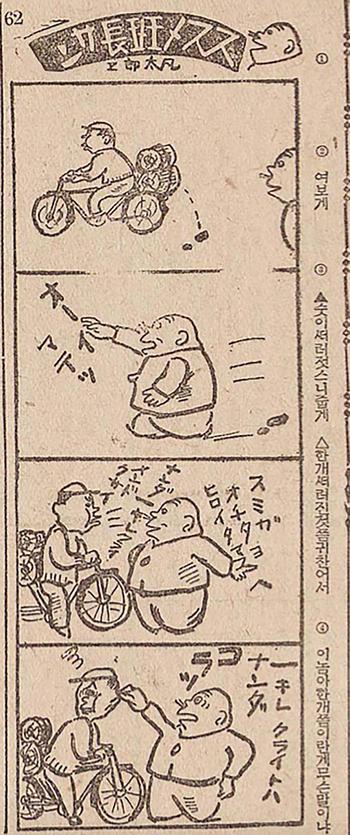
If the low temperature lifestyle was realized through individual actions and decisions, it also called upon Koreans to collectively tighten the social fabric of local society. As officials routinely noted, proactive communal vigilance was of the utmost importance. In many cases, efforts to guard against waste were organized institutionally, as in the Charcoal Production and Distribution Associations. Important, too, were “neighborhood patriotic units” (K. aegukpan)—the peninsular counterpart to Japan's own neighborhood associations (J. tonarigumi)—that mobilized units of ten to twenty households to carry out government directives, especially those related to rationing. Few sources capture the spirit of communal conservation better than figure 1, a cartoon strip from a November 1942 edition of the Maeil Sinbo, the only Korean-language newspaper in circulation in the closing years of the war. The sixty-second installment of the Susume Hanchō-san series, a comic meant to convey ideals of virtue and propriety to young readers, the strip depicts a confrontation between the elder Korean role model and a young (presumably) Korean cyclist over the latter's willingness to part ways with a fallen piece of charcoal. It underscores the obligation not only to appreciate every single joule of potential energy, but also for neighbors to speak up when confronted with profligacy. That the cartoon was published in Japanese (with Korean glosses) also offers a reminder that wartime assimilationist efforts targeted language reform as much as environmental ethics.
A Susume Hanchō-san comic depicting a confrontation over wasted charcoal (Maeil Sinbo 1942, 4).
Conspicuously absent in most wartime commentary on the low temperature lifestyle were Japanese settlers. Despite the fact that the population of Japanese settlers and soldiers in Korea had by the 1940s swelled to over 900,000, placing a major strain on already scant natural resources, Korea's fuel problem was cast as a definitively Korean problem. If anything, the task before the Japanese settler community was to lead the charge in the diffusion of modern heating practices and the tenets of forest love thought. Endowed with a hardy Yamato spirit and infused with modern ideas of hygiene, industry, and thrift, Japanese settlers, it was argued, were to occupy the front lines of fuel conservation.
And yet, the words and deeds of Japanese settlers did not always square. According to Kageyama Nobukage, a longtime forestry bureaucrat, Japanese settlers were sometimes less than paragons of efficiency. Even though Japanese would install ondol in their homes, field stations, and official residences, he remembered, they “would light it separately for each meal and light it again for their bath water.” Such behavior, he conceded, was “a terribly wasteful thing” (Miyata and Yi Reference Setsuko and U-Yŏn2009, 433). Although anecdotal, his testimony offers a reminder that those with the means and connections were sometimes able to operate outside the colonial state's conservationist agenda.
Korean reactions to the low temperature lifestyle and fuel conservation campaigns were mixed. Many worked closely with the state to police the woodlands, boost charcoal production, and promote thermally efficient living conditions. But other communities resisted. For a good number of the 3,000 or so retailers, brokers, and vendors dealing in timber and firewood, the state's fuel rationalization measures presented a multitude of commercial obstacles. Official proclamations calling upon merchants to embrace a new “business ethic” and “economic morality” that placed imperial service before personal profit often rang hollow, prompting some to protest official policy or to skirt regulation by turning to black markets (Eguchi Reference Miyokichi1940).
But the brunt of these draconian regulatory measures was borne by Korean rural households. If, as Chŏn U-yŏn (Reference U-yŏn and Sang-Yun2004, 137) has written, some Korean farming communities had long been familiar with the expression “to starve to death or to freeze to death, both are death all the same,” this notion surely found new salience in the wartime period as Koreans, cut off from forest resources, struggled to meet their basic material needs. Although the circumstances are far from clear in many cases, fatal instances of hypothermia are well documented, especially among the elderly in rural areas (Maeil Sinbo 1940, 1941f). Considerable evidence also suggests that many Koreans, especially swidden agriculturalists (hwajŏnmin), remained beyond the reach of the colonial state and its foresters. In spite of efforts dating back to the early 1920s to sedentarize these itinerant farming households—and prevent their fires from growing into great conflagrations—the practice persisted in remote regions of Korea until the collapse of Japan's empire, and indeed well into the post-liberation period.Footnote 18
Conclusion
Despite the multidimensional nature of the wartime forestry project described above, a single question about Japanese forestry in colonial Korea has monopolized scholarly attention: to what extent can we describe the colonial period as a “plundering” of Korea's natural resources? While scholars have arrived at different conclusions regarding the so-called “forest plunder thesis,” most agree that the forestry enterprise in colonial Korea unfolded in three distinct phases. Following an initial period of policy consolidation, a decade of more or less sustainable forestry that began in the mid-1920s ultimately gave way after 1937 to the wartime command economy of forestry products, which depressed reforestation initiatives and accelerated cutting operations. Geographically, the resulting wartime intensification of timber extraction unfolded unevenly across the peninsula, with the lion's share of timber harvested from the old-growth conifer forests of the northern provinces.
Such a focus on the question of exploitation, however, has obscured other important features of wartime forestry in colonial Korea. The politics surrounding the domestication of heat is one such lacuna. Although scholars have done much to elucidate the effects of rural unrest, war, and economic centralization on food security and caloric intake in colonial Korea, they have largely taken for granted the very materials that enabled bellies to fill and bodies to warm: household fuels.Footnote 19 To wartime forestry officials, however, domestic fuel consumption was of paramount concern; the path to a sustainable fuel supply, and with it military victory, led through the woods and directly to the ondol stove. For all their concern with military supply chains, production quotas, and market controls, in other words, forestry experts never lost sight of the importance of the domestic sphere to their work in Korea. The protraction and escalation of hostilities prompted forestry officials and their local partners to probe ever more deeply into the materiality and rhythms of the household as they worked to address the scarcity that only deepened under total war conditions. What ultimately emerged from their efforts was a far-reaching reconfiguration of energy distribution systems that, over the course of the long winter season, held profound physiological implications for bodies across the peninsula.
In his important work on the corporeal toll exacted by Japan's tenacious pursuit of industrial modernity, Brett Walker (Reference Walker2010, 177) has suggested that “ecological food chains and food webs are essentially about the transference of energy; and in some respects the politics of nations are, too.” As this short article has shown, these energy politics extended into the forests, homes, stoves, and furnaces of colonial Korea and beyond. Resourcing the empire at war, in other words, was not only a matter of fueling industry or supporting the military through the sequestration and redistribution of natural resources; it was also about regulating the heat consumption patterns that defined so many aspects of everyday life.
Buried beneath the wartime rhetoric on imperial service and the reams of statistics produced by the colonial state on forest resource allocations lay the human desire to stay comfortably warm in an often bitterly cold place. Although fuel conservation was couched in terms of fuel economization, industrial demand, and national security, we should also remember that the politics of heat domestication shaped colonial Korea's most intimate interactions and social spaces: the drawing of a bath, the preparation of meals, and social life in the home. Rarely do these quotidian experiences figure into studies of the colonial state. But they figure prominently in the memories, perceptions, and sentiments of Japanese and Korean residents of the peninsula. If, as one forestry expert put it, “for life in Korea and the lifestyle of the Korean people fuel, that is, the ondol, is essential,” then it should also be the subject of careful historical inquiry (Takahashi Reference Kishichirō1922, 91).
Paying heed to the politics of fuel conservation enables us in turn to engage, with Rob Nixon (Reference Nixon2013, 2), “a different kind of violence, a violence that is nether spectacular nor instantaneous, but rather incremental and accretive, its calamitous repercussions playing out across a range of temporal scales.” What Nixon's notion of slow violence offers to the context of colonial Korea is, above all else, a greater sensitivity to the slow-moving temporal dispersion of the structural and environmental consequences of state-led efforts to shape landscapes and control physical bodies. Although these forces are scarcely suggested in the colonial archive or the ecological legacies of colonialism still etched into the Korean landscape, they nonetheless formed a defining feature of life and survival under total war.
Acknowledgments
This essay has benefited from input and insights from many parties. In particular, I would like to thank Jun Uchida, Kären Wigen, Yumi Moon, Richard White, Ian J. Miller, John S. Lee, Micah Muscolino, Lisa Brady, Albert Park, and two anonymous JAS reviewers. Financial support for this research was provided by a summer stipend from the National Endowment for the Humanities (FT-254269-17) and the Core University Program for Korean Studies through the Ministry of Education of the Republic of Korea and Korean Studies Promotion Service of the Academy of Korean Studies (AKS-2016-OLU-2250005).



