


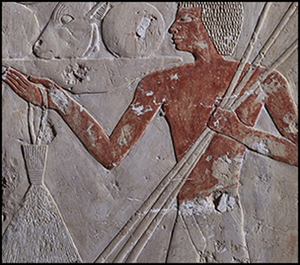


Introduction
Despite the widely recognised monumentality and durability of ancient Egyptian sculpture, carved reliefs, and paintings—often termed ‘art’ in the Western worldview—the creators of these works remain largely obscure. This is partly due to the specific societal context of ancient Egypt, where, in contrast to ancient Greece for example, artists were not revered. Thus, claims of authorship in ancient Egypt are practically non-existent. Furthermore, ancient Egyptian artistic production is characterised by the prevailing role of workshops, which prevented individual styles from developing (for an overview, see Oppenheim Reference Oppenheim, Bárta, Coppens and Krejči2006: 216–19; Laboury Reference Laboury and Kóthay2012: 199–200). So if the ancient Egyptian artist as a person is indeed ‘the great unknown of Egyptology’ (Laboury Reference Laboury and Andreu-Lanoë2013), the role of apprentices is even more elusive.
The process of identifying ancient Egyptian artists through the investigation of the material dimensions of their work was developed in reference to studies of painted Theban tombs of the New Kingdom (sixteenth to eleventh century BC) (e.g. Bryan Reference Bryan and Davies2001; Keller Reference Keller and Davies2001; Tavier Reference Tavier and Kóthay2012; Hartwig & Leterme Reference Hartwig, Leterme and Hartwig2013; Laboury & Tavier Reference Laboury, Tavier, Angenot and Tiradritti2016). Laboury (Reference Laboury and Kóthay2012: 203–206) has proposed to term this approach ‘an archaeology of art’ as, in his view, “like in a stratigraphy, there are, stored in [the] material medium, many marks that can be used to investigate and restore the genesis of the object and the circumstances of its creation” (Laboury Reference Laboury and Kóthay2012: 203). This approach complements the (art)historical analysis of ancient Egyptian monuments and objects (for an overview of the latter, see Hartwig Reference Hartwig, Verbovsek, Backes and Jones2011; Müller Reference Müller2013), in that it plays down their aesthetic and semantic dimensions and focuses instead on the process of production, rather than the outcome.
The study of ancient Egyptian carved reliefs (Woods Reference Woods and Hartwig2015) has focused primarily on unfinished monuments that allow the investigation of their creation from the perspective of the work process and its organisation (e.g. Teichmann Reference Teichmann and Hornung1971; Baines Reference Baines1989). In recent years, however, the number of studies of finished reliefs addressing the same issues has grown (Freed Reference Freed, Bárta and Krejčí2000; Silverman Reference Silverman, Bárta and Krejčí2000; Oppenheim Reference Oppenheim, Bárta, Coppens and Krejči2006; Pieke Reference Pieke, Strudwick and Strudwick2011; Davies Reference Davies and Gillen2017). These latter studies form a reference point for the present article.
In archaeology, the study of the techniques used and the sequencing of the actions required to produce an artefact is known as the chaîne opératoire (operational sequence). Derived from anthropological discourse (Gosselain Reference Gosselain1992; Lemonnier Reference Lemonnier1992), the term has been applied predominantly to lithic industries (e.g. Sellet Reference Sellet1993; Bar-Yosef & Van Peer Reference Bar-Yosef and Van Peer2009; Soressi & Geneste Reference Soressi, Geneste and Tostevin2011; Delage Reference Delage2017). Although the production of artworks has long been viewed in a similar way, the specific potential of the chaîne opératoire approach for the study of art lies in a better understanding not only of the final product, but also of the technological and socio-cultural environment in which it was created, illuminating, for example, the question of apprenticeship (Gosselain Reference Gosselain1992: 563–64, 572 & 582). While the concept may be applied for the investigation of any type of artefact, it is particularly useful for the study of relief work, since—like a lithic tool—it is a product of a process of reduction.
Here, the chaîne opératoire approach is applied to the wall reliefs in the Chapel of Hatshepsut, the largest room in the temple built for the eponymous female pharaoh (1473–1458 BC). The temple is located at Deir el-Bahari in Thebes, on the west bank of the Nile (Figure 1). The room, intended for Hatshepsut's mortuary cult, was built of limestone blocks and decorated in raised relief. Its lateral (north and south) walls, measuring approximately 13.26m in length and 3.78m in height, depict the so-called offering scenes that are standard for this type of cult space, but which in all earlier examples survive only in a fragmentary state (Stupko-Lubczynska Reference Stupko-Lubczynska2016). As is usual with such scenes, approximately two-thirds of each wall is occupied by a procession of offering-bearers—male figures carrying various objects towards the deceased, who is depicted seated at the western end of the wall, furthest from the entrance (Figure 2). In the Chapel of Hatshepsut, the offering procession is arranged in three registers, comprising 200 figures in total, 100 on each lateral wall (although their number is unequal in each row, with 32, 32 and 36 figures from top to bottom on the south wall, and 32, 30 and 38 figures on the north wall). The numerous figures displaying repetition of certain features, along with their exceptional state of preservation, create a unique opportunity to study the technological dimensions of a finished relief. The aim here is not only to understand the technological processes by which the reliefs of the Chapel of Hatshepsut were made, but also to elucidate workshop organisation and to identify the work of individuals and the relationships between master and apprentice, in an holistic approach that might prove useful for the study of similarly decorated monuments in other parts of the world.
The Temple of Hatshepsut at Deir el-Bahari (photograph by M. Jawornicki; plan by T. Dziedzic).
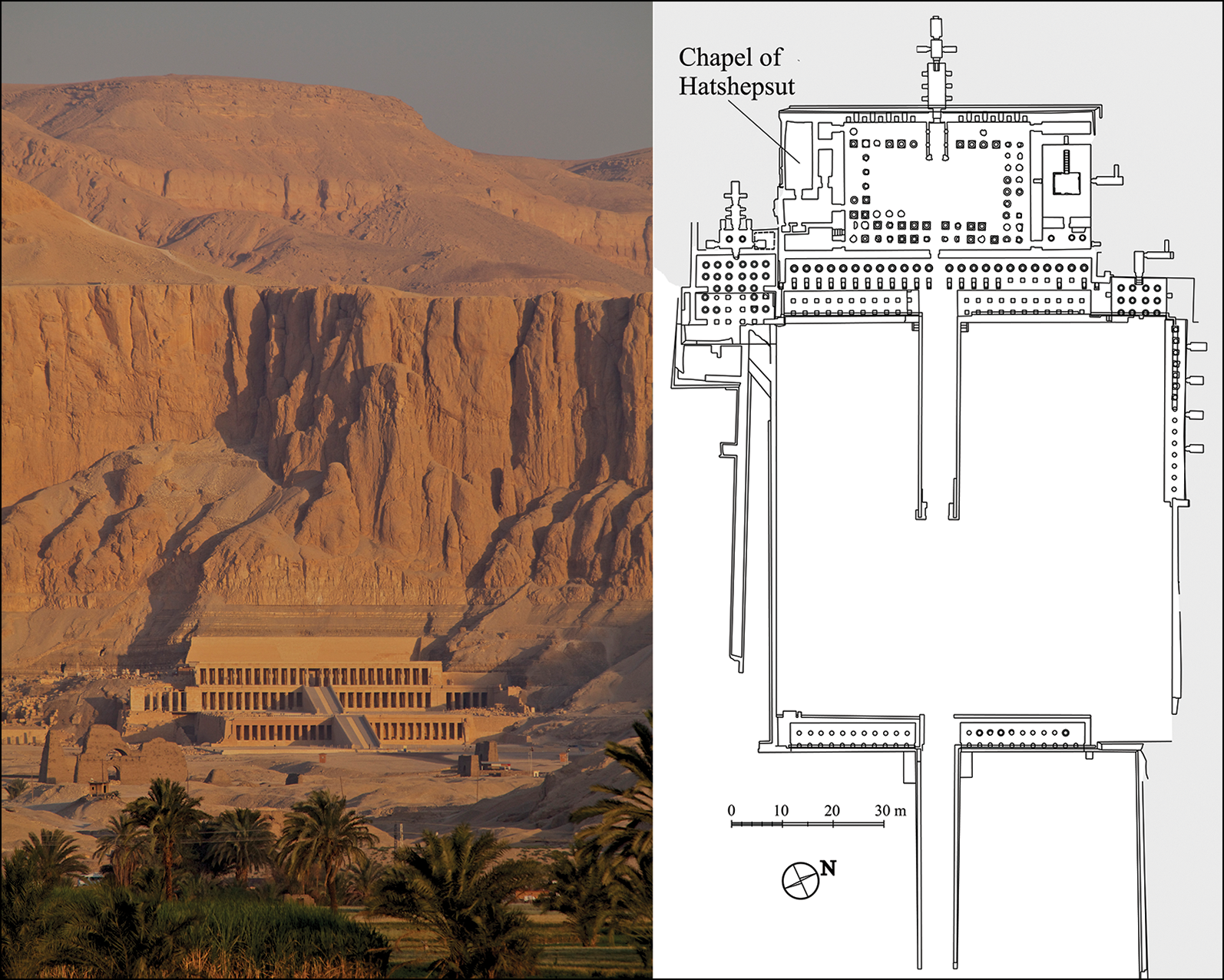
The Chapel of Hatshepsut, with offering scenes on the south and north walls (photographs by J. Kościuk and M. Jawornicki; plan by T. Dziedzic).

Our research also applies an experimental—or, more precisely, an experiential—approach. In the Chapel of Hatshepsut, this was realised over the course of a long-term project to document the reliefs, undertaken between 2006 and 2013 by a team of draughtspersons supervised by the present author. The project was organised by the Mission of the Polish Centre of Mediterranean Archaeology, University of Warsaw. The method adopted by the mission was to draw the wall surfaces at 1:1 scale on plastic film sheets attached directly to the walls; these were subsequently scanned and processed as vector graphics. Although unintended at that stage, the drawing documentation process has allowed a subsequent evaluation of the ergonomic dimensions of the process of carving the reliefs, as the work of the mission's team replicated certain actions of the ancient artists.
The chaîne opératoire of Egyptian reliefs
The process of creating ancient Egyptian reliefs is well understood (Teichmann Reference Teichmann and Hornung1971; Aldred Reference Aldred, Helck and Otto1975: 801–804; Bogoslovsky Reference Bogoslovsky1980: 92–93; Laboury Reference Laboury, Davies and Laboury2020: 91), proceeding through the following steps:
1. Smoothing the wall surface, accompanied by minor work, such as the plastering of defects in the stone and joints between blocks.
2. Division of the wall surface into sections and application of a square grid (Figure 3a)—both using red paint—presumably by a draughtsperson's assistants (Robins Reference Robins1994: 23–30 & 87–118).
3. Preliminary sketch drawn in red paint, executed by the transfer of the pre-planned composition from a portable medium (e.g. papyrus or wooden board; cf. Iversen Reference Iversen1960; Galán Reference Galán2007) onto the wall, by draughtspersons.
4. Correction of the sketch by a lead draughtsperson. At this stage, details were added in black paint and any errors in proportions corrected, the entire composition achieving its final, although still two-dimensional, form (Figure 3b).
5. Texts to accompany the images were inscribed as a separate operation, executed after the figural composition had been laid out. This task may have been accomplished by a scribe or a draughtsperson in the same two-stage manner, using red and black paint.
6. With all the outlines completed, the sculptors started their work, following the black lines. The execution of raised reliefs comprised several phases, such as chiselling out and smoothing the background (two tasks not necessarily undertaken by the same person), after which a more experienced sculptor may have begun carving the protruding silhouettes to achieve their three-dimensional appearance.
7. The finished relief surface was whitewashed and coloured.
a) Remains of a square grid in the Chapel of Hatshepsut and its reconstruction for the entire figure of an offering-bearer (photographs by J. Kościuk and M. Jawornicki; grid reconstruction by the author); b) limestone flake, with preparatory drawing on a grid—presumably a portrait of Senenmut, overseer of construction at Hatshepsut's Temple at Deir el-Bahari. The sketch gives a sense of the completion of stages two to four in the Chapel of Hatshepsut (courtesy of The Metropolitan Museum of Art, New York, Rogers Fund, 1936, acc. no. 36.3.252).

As the initial stage of the chaîne opératoire relates to the procurement of the raw materials and the final stage is the disuse or discard of the object (Sellet Reference Sellet1993: 106), the sequence outlined above forms only one part of a considerably longer sequence that began with the extraction of stone blocks from a quarry and the dressing and setting of the blocks in a wall. After the stages described above, further steps included the intentional erasure of some parts of the finished relief, their subsequent repair and final abandonment or destruction (for the chaîne opératoire approach in ancient Egyptian masonry, see Wieczorek Reference Wieczorek2018: 143).
As work progressed, the evidence for each earlier stage in the sequence was obliterated by the stage that followed. Recognition of this sequence in ancient Egyptian artwork comes from the examination of monuments left in various stages of completion, complemented by the rich textual material pertaining to works in progress. Such information was gained from previous excavations at Deir el-Medina, a village once inhabited by a community of stonecutters, scribes, outline draughtspersons and relief sculptors, who were engaged in the preparation of royal tombs in the Valley of the Kings (Černy Reference Černy1973; Valbelle Reference Valbelle1985; Demarée et al. Reference Demarée, Haring, Hovesreydt and Zonhoven2018: A & N). Further evidence from Deir el-Medina comprises figured ostraca (in their Egyptological definition), that is, sketches of varying degrees of complexity and artistic quality drawn on limestone flakes and attributed to both senior artists and apprentices; some of these ostraca feature trial reliefs (Demarée et al. Reference Demarée, Haring, Hovesreydt and Zonhoven2018: X). Most of the Deir el-Medina material dates to the Nineteenth and Twentieth Dynasties (c. 1295–1069 BC), thus post-dating Hatshepsut. A number of textual and figured ostraca, however, are known from this pharaoh's reign and are linked to works at Deir el-Bahari and its surroundings (Hayes Reference Hayes1942, Reference Hayes1960; Eyre Reference Eyre and Powell1987: 184–85) (see Figure 3b).
The working environment in the Chapel of Hatshepsut
Scaffolding
The lowermost register of the chapel's decoration is easily accessible for a person standing at floor level and could therefore be set out and carved without difficulty. Work on the two higher registers, however, required scaffolding (cf. Arnold Reference Arnold1991: 231–33). One scene from a Theban tomb of a royal workplace (Figure 4a) shows that scaffolding may have been erected to facilitate simultaneous access to the entire work area, rather than one level at a time, with platforms placed at the equivalent of half a person's height apart. While drawing and painting are relatively ‘clean’ tasks, debris produced by stone carving must have affected the spacing of the workforce, precluding one person working directly below another (Oppenheim Reference Oppenheim, Bárta, Coppens and Krejči2006: 119–20). Analysis of reliefs in the Old Kingdom mastaba of Mereruka (Pieke Reference Pieke, Strudwick and Strudwick2011: 220) suggests that the sculptors first cut the wall's lower register before continuing to the upper areas.
a) Work on light-pole scaffolding, as depicted in Theban tomb 100, immediately following Hatshepsut's reign (after Davies Reference Davies1943: pl. 60); b) scaffolding erected during documentation in the Chapel of Hatshepsut (photograph by A. Hallmann).

As our own team of draughtspersons observed over the course of our recording the Chapel of Hatshepsut, placing the scaffolding's platform in the middle of the lower register facilitated work in the upper register while standing, and in the middle register while sitting (Figure 4b). If this arrangement applied in ancient times, it would have allowed several sculptors to work side by side, alternating their positions (sitting or standing) to minimise fatigue, and swapping places, if needed, in accordance to their skills and the complexity of the details to be carved. Such spatial organisation would have enabled an apprentice to be taught by a master, as discussed below.
Workshop organisation
The number of relief sculptors who worked simultaneously in the Chapel of Hatshepsut is a matter of speculation. The group, however, can be divided into the more experienced individuals (artists A: the master sculptors) and those with less experience (artists B). This organisation has been observed among the unfinished reliefs in the temple of Sety I at Abydos, which post-dates Hatshepsut. Here, the most important and complex features, such as the king's face, were left for the principal sculptor, who, in this case, never arrived to complete his work (Baines Reference Baines1989: 26–27). In the case of the Chapel of Hatshepsut, it can be presumed that all the relatively large and plain surfaces with limited detail were executed by artists B, while more intricate areas were completed by artists A. As in a Renaissance-era workshop (Bambach Reference Bambach1999: 1–2; Wallace Reference Wallace1999; Rinaldi Reference Rinaldi, Marani and Fiorio2015: 441–43), legs, arms and torsos would have been executed by artists B. Such a reconstruction is supported by the numerous corrections observed in these ‘non-complex’ areas (Figure 5) (for similar observations regarding an Old Kingdom relief, see Pieke Reference Pieke, Strudwick and Strudwick2011: 222–23).
Examples of work by less experienced sculptors (corrections indicated with arrows) (photographs by M. Jawornicki; arrows by the author).

Unsurprisingly, the faces exhibit the most expertly carved details in the Chapel of Hatshepsut and thus can be securely ascribed to artists A. Each face differs slightly, potentially reflecting the presence of more than one master sculptor. Faces may provide an excellent opportunity to use the Morellian method (named after the art historian Giovanni Morelli, who advanced a means of diagnosing distinctive details to track a specific artist's ‘hand’, which is broadly applied in the analysis of Western European art) (Fernie Reference Fernie and Fernie1995). This method has occasionally been employed to study ancient art (for an overview, see Gunn & Lowish Reference Gunn and Lowish2017: 196–201) and applied by several Egyptologists (e.g. Kozloff Reference Kozloff and Reineke1979; Hartwig & Leterme Reference Hartwig, Leterme and Hartwig2013: 144–47; Hartwig Reference Hartwig and Hartwig2015: 41–42). In the present case, it has involved the careful analysis of certain characteristic details, including the presence or absence of the eyelid, eye-lining and the philtrum extending from the nasal septum. The result, however, has proved negative. As highlighted by Laboury (Reference Laboury and Kóthay2012: 203), the application of the Morellian method to ancient Egyptian art is problematic due to the “neutralization of the personal style of the artist”, referred to above. In relief work, this concealment of the artist's identity is even more pronounced than in painting, where some features betray the ‘hands’ at work (e.g. the individuality of the brushstrokes) (Laboury Reference Laboury and Kóthay2012: 204, pl. 44.2). Along with an overall striving for homogeneity, certain other factors could be relevant in our case:
(1) Material obstacles: the same sculptor could have rendered repetitive details with some variation. This could occur, for example, when the sculptor was near the block's edge, where carving had to be sparsely executed so that the soft limestone would not chip away.
(2) Experiment: a scenario in which an experienced sculptor, spending many hours exclusively or predominantly carving faces, decided to explore the use of alternative techniques—a phenomenon observed elsewhere (Silverman Reference Silverman, Bárta and Krejčí2000: 263; Pieke Reference Pieke, Strudwick and Strudwick2011: 217; Davies Reference Davies and Gillen2017: 206–208).
(3) Multiple stages: carving was carried out over preliminary drawings, which themselves may have contained differences. Questions of how accurately (or even mechanically) a drawing was followed by a sculptor, or about the precision of the initial drawing, cannot be answered when studying a finished relief. The fact that these two stages were interlinked should nonetheless be taken into account (for a further critique of the Morellian method, see Davies Reference Davies and Gillen2017: 217–19).
The reliefs in the Chapel of Hatshepsut are relatively homogeneous in their execution. There are some minor variations in the quality of the work, however, where one would expect it to be of a higher level. The south wall provides a good example: the carving of nestlings being carried in a case by an offering-bearer seems to have been executed by an apprentice (Figure 6a). This is particularly remarkable, given that a master sculptor appears to have been working close by, as suggested by an exquisitely carved vessel with a lid in the shape of a recumbent calf (Figure 6b). In the case of the nestlings, it may be that this was the work of less experienced artists involved in complex areas of carving; such workmanship may have been present elsewhere, but has been obliterated by the following step—the final touch of the senior sculptor.
Two levels of relief carving: a) artist B; b) artist A (photographs by J. Kościuk and M. Jawornicki; illustration by the author).

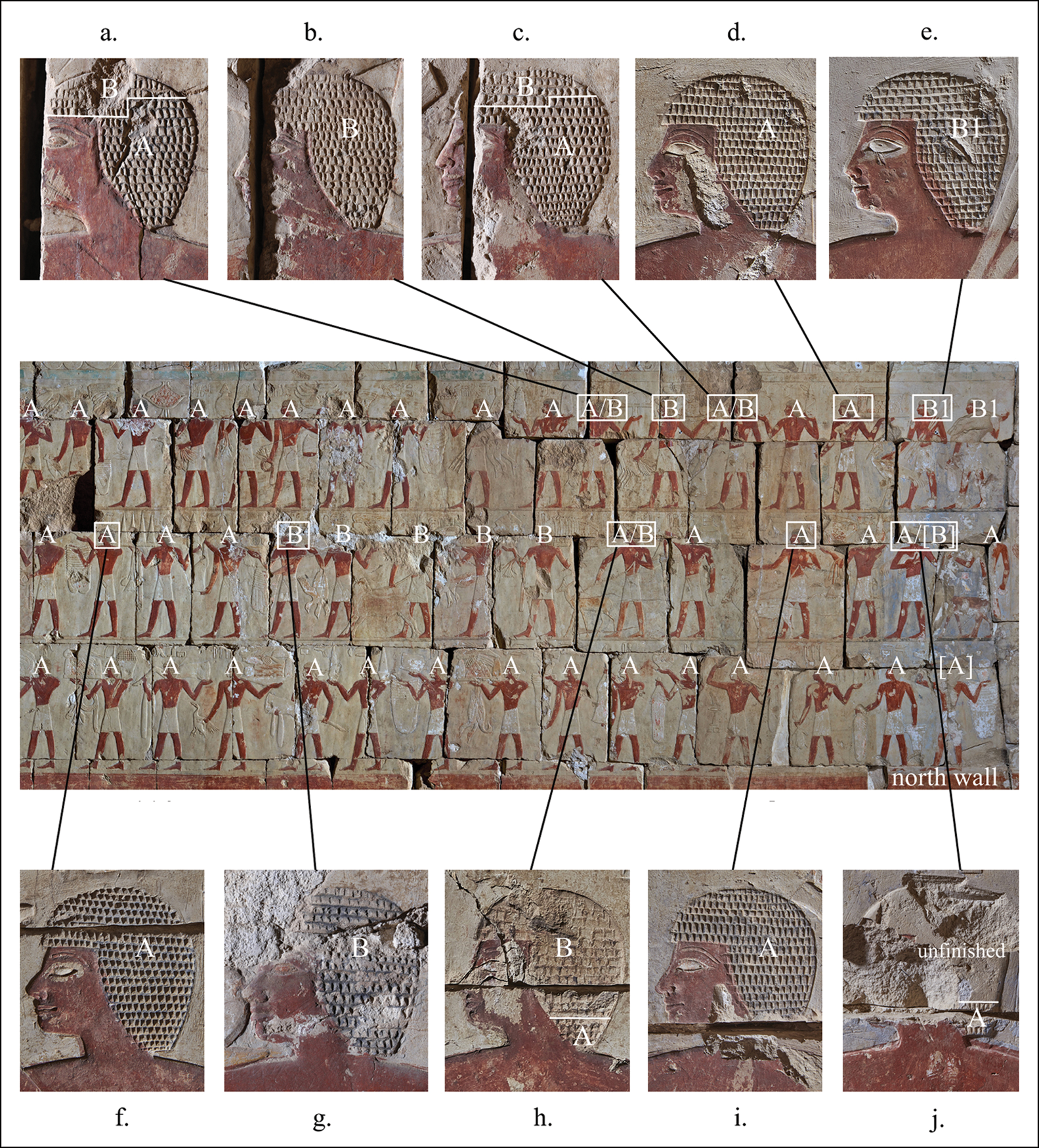
The best example of the interrelation between the master sculptor and his assistant(s) is visible in the offering-bearers’ wigs, which were carved by both artists A and B. These intricate and time-consuming elements, depicting rows of curls, were carved as horizontal lines with either numerous triangular negatives (by artist A) or with vertical strokes (by artist B) (Figure 7). Wigs featuring on the eastern part of the north wall reveal the teaching process (Figure 8). Here, in the middle and upper registers, between the work zones of artists A and B, wigs were initiated by the master and finished by a trainee (Figure 8a, c & h). In one case, the master has executed his part, but the remainder was not completed by the assistant (Figure 8j). Among the wigs showing work split between two artists, Figure 8c illustrates the master's virtuosity applied, we believe, for an apprentice's benefit (virtually no other wigs entirely completed by the master received such detailed treatment). Furthermore, some wigs in this area are of ‘mid-level’ workmanship (Figure 8e), perhaps executed by a more advanced student (B1), or by the apprentice at the end of his training.
Wigs of adjacent offering-bearers sculpted by artists B (left) and A (right) (photograph by M. Jawornicki).

Work zones of artists A, B, and B1 sculpting offering-bearers’ wigs (photographs by M. Jawornicki; figure by the author).
The room's size required a division of tasks typical of large-scale projects employing a workforce of differing capabilities. Artistic education, acquired through imitation and practice, is evidenced predominantly in portable sources (tracing boards and figured ostraca; Bogoslovsky Reference Bogoslovsky1980: 107; Keller Reference Keller, Bleiberg and Freed1991: 51; Galán Reference Galán2007: 103–104; Cooney Reference Cooney and Wendrich2012: 162–66), that is, aside from any given monument. The material in the Chapel of Hatshepsut, however, strongly suggests that training also took place during the creation of the final relief. Indeed, this phenomenon seems to be illustrated by the symmetrical compositions on the door jambs and lintels, noted elsewhere, where one half of each was carved by a more assured hand (see Davies Reference Davies and Gillen2017: 214–17; Laboury Reference Laboury, Davies and Laboury2020: 88 & 93).
Two crews?
Textual sources from Deir el-Bahari and Deir el-Medina indicate that a monument under construction was divided into symmetrical halves worked by ‘left’ and ‘right’ crews, each with their own supervisor (Hayes Reference Hayes1960: 39–41[doc. no. 13]; Černy Reference Černy1973: 101–109; Megally Reference Megally, Gaál and Kákosy1974; Eyre Reference Eyre and Powell1987: 173 & 185–86). In a letter from the mid-Twentieth Dynasty (c. 1120 BC), a certain Hormin—a draughtsman from Deir el-Medina—asks for an assistant, “so that he will help me in the drawing. I am alone for my brother is ill. Those of the right side have carved a chamber more than the left” (Eyre Reference Eyre1984; Wente & Meltzer Reference Wente and Meltzer1990: 134). Apparently, Hormin and his team in the left-side crew were rushing to lay out the planned decoration ahead of the sculptors.
In the Chapel of Hatshepsut, some details indicate that two groups of artists may have been working independently on the two lateral walls. Such a separation is suggested by differences (either in workmanship or iconography) in the same type of object carried by an offering-bearer; for example, on the south wall, only the outline of the corn sheaves is carved (Figure 9a), whereas on the north wall all the details are executed in relief (Figure 9b). Another motif is a milk or water jug, which on the south wall is shown as a clay container hanging on a rope (Figure 9c), while on the north wall it is depicted as a metal container (Figure 9d–e) (Stupko-Lubczynska Reference Stupko-Lubczynska2016: 158–59). Given the sequential nature of minor steps within the decoration process, these dissimilarities may have occurred when the relief was carved (stage six outlined above), during the preliminary drawing (stage three) or its correction (stage four), or even earlier, in the design process, if the master drawing was sufficiently detailed.
Motifs treated differently on two walls: sheaves of corn on (a) the south wall and (b) the north wall; water/milk jugs on (c) the south wall and (d–e) the north wall (photographs by M. Jawornicki).

Ergonomic problems?
The workmanship of the titles that accompany each offering-bearer (Stupko-Lubczynska Reference Stupko-Lubczynska2016: 260–74) is another feature differentiating the chapel's two lateral walls. On the south wall, all such titles are carved in the same technique as the rest of the scene, while on the north wall, many are rendered as incisions in the smoothed background, which suggests that at the stage of preliminary drawing, the surface intended for them was left empty and the titles were added later, for example, after the work was ‘received’ (a step known from textual sources, denoting, most probably, inspection and approval; Eyre Reference Eyre and Powell1987: 176 & 184).
This ‘secondary’ carving of inscriptions is concentrated in the eastern part of the north wall, in the middle and upper registers (Figure 10), roughly overlapping with the area where artist A was teaching artist(s) B (see Figure 8). Supposing that—ahead of the carving phase—inscriptions were added as a separate step (stage five), after the completion of figural drawing, and considering that subsequent phases probably followed in quick succession (as described in Hormin's letter), it can be assumed that this area was temporarily inaccessible to the person writing the inscriptions, being occupied, before all texts had been completed in paint, by those learning to carve wigs.
Distribution of offering-bearers’ titles and accompanying inscriptions, executed on a smoothed background (encircled) on the north wall (photographs by M. Jawornicki; figure by the author).

Conclusions
This study has sought to shed light on the craftspeople who created the raised carved reliefs in the Chapel of Hatshepsut at Deir el-Bahari. Our close examination of two mirrored scenes decorating the chapel's lateral walls has reconstructed the sequence of actions (chaîne opératoire) required to create the relief decoration. In doing so, we believe we have achieved a better understanding of the conditions under which the ancient artists worked.
The latter aspect was illuminated through the process of our own recording of the reliefs, which replicated, in some respects, the environment in which the relief was produced. The insights obtained were then contextualised with the evidence from other Egyptian sites and with textual and iconographic sources pertaining to construction and decoration work in progress.
Large-scale ancient Egyptian projects, including the Chapel of Hatshepsut, were undertaken in workshop settings. Reliefs were created in stages following initial drawings prepared with the aid of proportion grids, and realised by a range of specialists with differing levels of skills, who were entrusted with tasks accordingly. In the chapel, numerous corrections in areas of minor complexity suggest the involvement of less experienced sculptors. Additionally, one area on the chapel's north wall has been recognised as a location where student(s) were taught to carve more elaborate details. This indicates that training took place directly on site, with close master-apprentice interaction, including the correcting of mistakes and the demonstrating of techniques to be emulated. The results of those training exercises form part of the completed work.
Minor differences in work organisation observed via the chapel's iconography and relief technique point to a division of labour between two crews (as attested in some Egyptian texts). Further assessment of the nature of the workforce has proved impossible, as stylistic analysis using the Morellian method was found to be unhelpful here. Given that drawing preceded relief execution, the stylistic deviations in carving cannot necessarily be ascribed to individual sculptors; they may, for example, result from an earlier (drawing) stage.
Overall, some of the observations made in the Chapel of Hatshepsut are evident in other Egyptian monuments (and beyond, in basic principles of workshop organisation). Others seem exceptional, demonstrating that labour practices remained dynamic, adapting to varying environmental conditions. Here, the chaîne opératoire approach can be helpful. Awareness of the work stages in our case proved especially useful for understanding the ‘secondary’ carving—the incisions made in the finished background—of texts accompanying images, as identified in the area where training was conducted. This could be explained if the operational sequence was not necessarily linear but had overlapping steps, which caused ergonomic conflicts and resulted in deviations from the original project. When the relief on the chapel's north wall was finished, about one third of the figures lacked their inscriptions; the subsequent correction of this omission suggests an inspection of completed work—a step known from texts, but otherwise imperceptible in the archaeological record. The evidence from the Chapel of Hatshepsut seems to suggest that during this inspection not only was, for example, the workmanship of the final product checked, but also so was its compliance with the pre-planned composition.
The study of ancient Egyptian (and more broadly ancient Near Eastern) art is relatively privileged due to richness of written and pictorial sources. Nonetheless, even in these regions, we must not lose sight of the material evidence provided by artefacts and monuments (Nicholson Reference Nicholson, Shaw and Bloxam2020). The present study has demonstrated the potential of taking a holistic view of a well-known structure and its decoration, offering insights into the techniques of production and the organisation of work, through the use of an experiential approach contextualised with texts, iconography and analogical sources. When applied to workshop products, such as the reliefs of the Chapel of Hatshepsut, this approach can be used to reconstruct the ergonomics of the site, distinguish the work of individual persons, and even illuminate such intangible phenomena as the relationship between master and apprentice.
Acknowledgements
The study of the reliefs in the Chapel of Hatshepsut was conducted within the Polish-Egyptian Archaeological and Conservation Mission in the Temple of Hatshepsut at Deir el-Bahari, directed by Zbigniew E. Szafrański (since 2020 by Patryk Chudzik). The work was carried out on behalf of the Polish Centre of Mediterranean Archaeology, University of Warsaw, in cooperation with the authorities of the Egyptian Ministry of Antiquities in Cairo and in Luxor (project lead: Mirosław Barwik; drawing documentation team: Paul Barford, Mariusz Caban, Maria Mathia, Marek Puszkarski, Grażyna Zborowska and the author).
Funding statement
From 2012 to 2017, the author's research was financed by the National Science Centre, Poland (agreement no. 2012/05/D/HS3/03680).


 Open access

