


In the late 1990s, Kenya, Tanzania, and Uganda renewed their efforts toward regional integration, which culminated in the creation of the East African Community (EAC) in 2000. The East African Court of Justice was established as the EAC’s core judicial organ and was tasked with interpreting and applying the founding treaty and ensuring compliance with Community law. Since the EACJ issued its first decision in 2006, the Court has delivered important decisions on a range of issues, including domestic governance, human rights, and the rule of law as well as key aspects of regional integration. By studying the EACJ’s decision-making, this chapter examines the theoretical argument in the case of an international court with narrow strategic space. Specifically, the EACJ faces pervasive political constraints due to low formal independence, as shown in the Chapter 3, and a lack of political fragmentation. Additionally, the EACJ has experienced political resistance by states. According to the theoretical framework presented in Chapter 2, the EACJ should demonstrate a substantial degree of deference.
This chapter assesses the extent to which the EACJ defers to states and whether its deference is best explained by the nature of Court’s structural political constraints and adaptive practices, or alternatively its support networks. The analysis reveals that the EACJ’s deference is substantial, meaning that the Court is highly prone to accept, either through abstaining or through not validating, the states’ exercise of authority. This is observed through the rates at which case outcomes are decided in favor of states and how the Court relies on restrictive interpretations and minimal scrutiny in its legal reasoning. However, the EACJ has shown less deference in its remedies when it finds a violation. The analysis further illustrates how these patterns of deference are associated with the Court’s political vulnerability due to its weaker safeguards to independence and the lack of fragmentation among the EAC’s member states. Past resistance has also played a role in confining the Court. On the other hand, to the extent that the Court does not defer, it has been bolstered by increasing political fragmentation among member states and by the Court’s own agency. In particular, the Court adapts to its political environment by practicing persuasive argumentation and public legitimation that facilitates less deference. Last, the patterns of deference are loosely associated with the Court’s support network.
The chapter begins by describing the process leading to the creation of the EAC to place the EACJ within its historic and ideational context. It then describes the Court’s workload before examining the extent to which and how the Court defers. Next, the chapter shows how the Court’s support network is stronger than its deference would imply. This is followed by an analysis of how the Court’s deference corresponds with its pervasive political constraints and adaptive practices. The chapter concludes with a review of the core findings.
The EACJ’s Ideational Setting: Colonial Legacies, Political Norms, and Legal Culture
The EACJ has been affected by its ideational context. For this reason, I set the stage for the analysis by briefly describing this context. Notably, this discussion reveals that the political norms behind regionalism and the legal culture in East Africa are tied to the region’s colonial experience. The legacies of colonialism include political tensions between integration and independence, and legal pluralism. In addition to legal pluralism, legal culture is defined by a prominence of “judicial insecurity” and limited societal confidence in the state legal order.
Regionalism in East Africa has a long history and integration occurred in three iterations prior to the formation of the current EAC. The first iteration was an effort to generate economies of scales by the British Empire. During the nineteenth century, Kenya, Zanzibar (now part of Tanzania), and Uganda were British protectorates or colonies, while Tanganyika (the present-day mainland Tanzania), Burundi, and Rwanda were controlled by Germany.Footnote 1 British interests propelled cooperation between Kenya and Uganda. For example, colonial rulers constructed a Kenya-Uganda Railway in the final years of the nineteenth century, established a single currency in 1905, a postal union in 1911, and a customs union in 1917.Footnote 2 Following the end of World War I and the creation of the League of Nations, Burundi and Rwanda were transferred to Belgian control, and Tanganyika became a mandated territory under British control.Footnote 3 With the transfer of Tanganyika to British rule, it was integrated into the prior cooperation between the territories of Uganda and Kenya. Tanganyika, for instance, joined the common currency in 1921, the customs union in 1923, and the postal union in 1933.Footnote 4 Keen on further integration, the territorial governors began holding conferences (which included Kenya, Tanganyika, Uganda, Zanzibar, and present-day Malawi and Zambia) that led to deeper and wider cooperation.Footnote 5 In 1940, the Conference of Governors established a secretariat,Footnote 6 and later transformed the Conference into the East African High Commission in 1948, which included cooperation on administration, finance, post and communications, railways and harbors, civil aviation, social services, research and scientific services, economic services, and defense.Footnote 7
An important feature of the colonial attempts to integrate East Africa was a certain degree of legal integration. As with other regions under British imperial rule, the East African territories shared a regional court of appeal, called the East African Court of Appeal (EACA).Footnote 8 Established in 1902, this court was part of the British imperial legal order, and it was the penultimate court of appeal for citizens of the British colonies and protectorates in East Africa. Its decisions were binding, but litigants could seek an appeal to the Judicial Committee of the Privy Council in London.Footnote 9 It addressed both criminal and civil matters, and it was staffed by British judges.Footnote 10 Even though it considered local customary law and often was called upon to remedy conflicts between colonial statutes and treaties, the common law and customary law, it was nonetheless an imperial court.Footnote 11 The EACA’s administration was transferred to the East African High Commission in 1948.
This remained the situation until the dawn of independence in the early 1960s. At that time, and marking the second iteration of integration, British and East African leaders transformed the East African High Commission into the East African Common Service Organization (EACSO).Footnote 12 Tanganyika became independent in 1961, Uganda in 1962 and Kenya in 1963. Zanzibar and Tanganyika united to form the United Republic of Tanzania in 1964. The newly independent states recognized the EACA as their court of last resort according to the EACSO agreements and state constitutions.Footnote 13 While the EACSO persisted, nationalist sentiments and discontent with the unequal distribution of common resources created disruptions, leading to the abandonment of the single currency in 1965.Footnote 14 Efforts to redress some of the discontent led to the Kampala Agreement in 1965, which aimed to address trade imbalances.Footnote 15
In a third iteration, the Treaty for East African Cooperation was adopted in 1967 and the now former East African Community was created to help sustain a common market.Footnote 16 This cooperation continued the status of the EACA as the court of last resort for the member states.Footnote 17 The former East African Community survived for ten years, but collapsed after states were unable to agree on a budget in 1977.Footnote 18 This also marked the end of the EACA. A combination of unrealistic expectations, clashing political ideologies, the rise of Ugandan dictator Idi Amin, economic hardships from the 1970s oil crisis, and severe draught contributed to the collapse and pressures to disintegrate.Footnote 19 Tensions between the states were high, and the situation deteriorated when Uganda invaded Tanzania in 1978, and an eight-month-long war broke out. It took nine years and interventions by the World Bank and the UN for Kenya, Tanzania, and Uganda to agree on a distribution of common assets from their former cooperation.Footnote 20
As this account suggests, regional integration can be traced back to the initiatives of colonial oppressors. In the postcolonial era, political elites recognized the value of regional integration, yet some opposing pressures encouraged disintegration. Revival of integration began when government leaders met in 1991 and later created a Permanent Tripartite Commission for East African Cooperation in 1993.Footnote 21 Eventually, the new and current EAC was created in 2000 by the Treaty Establishing the East African Community (EAC Treaty).Footnote 22 The founding members are Kenya, Tanzania, and Uganda. Rwanda and Burundi joined in 2007, South Sudan in 2016, and the Democratic Republic of the Congo (DRC) in April 2022. The EAC’s primary objective is a customs union, a common market, a monetary union, and, ultimately, a political federation.
The establishment of the new EAC was likely the product of several factors. The idea of integration had never been fully outrooted. Even the 1984 mediation agreement on the distribution of former community assets left open the possibility for future cooperation.Footnote 23 Shared resources, such as Lake Victoria, and intraregional trade provided additional motivations.Footnote 24 The conflicting economic and political ideologies which drove states apart were somewhat alleviated by the 1990s. For example, the World Bank and IMF structural adjustment programs in the 1980s meant that Kenya, Tanzania, and Uganda had compatible economic policies by the 1990s.Footnote 25 External economic and political factors also put pressure on leaders to recommit to regional integration. For example, globalization generally incentivized regionalism,Footnote 26 and interorganizational learning and emulation, as well as some active influence of actors like the EU, also contributed to the development of the new EAC.Footnote 27
Political norms supportive of regional unity and cooperation ultimately contributed to the creation of the EAC, but they also coexisted with norms supportive of national sovereignty and disunity. This duality can be seen in aspects of the EAC’s decisions. For example, when designing the EACJ some actors, mostly from civil society, called for the Court to have jurisdiction over human rights. States resoundingly rejected these proposals in favor of a regional court that better preserved sovereignty.Footnote 28 We can also see these tensions in the EAC’s relatively high delegation (whereby a third party is granted authority by the states, such as the EACJ), alongside lower levels of pooling (or the transfer of authority from individual member states to a collective IO member state body).Footnote 29
Beyond political norms, colonialism left its mark on legal culture across the region. Importantly, colonialism significantly contributed to legal pluralism within East Africa, which is an important aspect of the legal identity and culture across East Africa. Pluralism is reflected in the mix of state legal orders across and within EAC’s member states. The EAC’s founding members (Kenya, Uganda, Tanzania) have common law systems, reflecting their former status as British colonies. South Sudan also uses common law. Burundi and Rwanda are civil law states, indicating their former colonial ties. Moreover, Islamic law operates – albeit to varying extents – in Kenya,Footnote 30 Tanzania, and South Sudan. In addition to state and religious law, customary law is an integral part of the legal order in all member states.Footnote 31
Aside from plurality of legal orders governing a society, legal culture is also constituted by beliefs and attitudes about the law and courts.Footnote 32 In East Africa, and elsewhere in Africa, state courts are not the sole mode of dispute settlement pursued by local and regional actors. Customary modes of dispute settlement are frequently utilized.Footnote 33 Their judiciaries and state legal order face many challenges. For instance, judges can face retaliation for their decision.Footnote 34 Access to justice is often illusive. The United Nations Development Programme (UNDP) finds significant gaps in the rule of law and access to justice in several of the EAC’s member states; the reality “is that of unfairly enforced laws that are not accessible to all, weak institutions unable to increase access to justice, or citizens who are not empowered to make effective use of the law.”Footnote 35 Moreover, constitutionalism has a history of lacking empirical legitimacy.Footnote 36 For instance, trust in courts is often low according to Afrobarometer surveys.Footnote 37 Overall, we might describe this as a culture of judicial insecurity and fragile trust.
To summarize, the EACJ’s ideational environment is significantly shaped by the colonial history of its member states. Colonial legacies, alongside a range of other political and economic factors, have simultaneously promoted political norms that are supportive of integration and regional cooperation alongside competing values like independence and sovereignty. Additionally, the EACJ’s ideational context includes legal cultures defined by pluralism, judicial insecurity, and fragile faith in the state legal order.
The East African Court at Work
Against this backdrop, the EACJ was established by chapter 8 of the EAC Treaty, which entered into force in 2000. The Court resides in Arusha, Tanzania, at the EAC’s headquarters. The EACJ is responsible for “ensur[ing] the adherence to law in the interpretation and application of and compliance with [the EAC] Treaty.”Footnote 38 Since 2007, it has had a First Instance and Appellate Division.Footnote 39 Member states may refer to the EACJ another member or Community “organ”Footnote 40 or “institution”Footnote 41 for an infringement or failure to fulfill Treaty obligations.Footnote 42 Upon the direction of the Council of the EAC, the Secretary General can also refer a member state to the EACJ for an infringement or failure to fulfill its Treaty obligations.Footnote 43 Private actors (i.e., legal and natural persons) can refer any Act, regulation, directive, decisions, or action of a member state or an EAC institution to the EACJ for a determination of its lawfulness according to the Treaty.Footnote 44 Member states’ domestic courts can refer questions on the interpretation or application of the Treaty to the EACJ for a preliminary ruling.Footnote 45 Also, the Summit of Heads of State (herein the Summit), the Council, or member states may request advisory opinions from the Court.Footnote 46 Decisions of the Court are binding on member states, subject to appeal to the Appellate Division, and jurisdiction is compulsory with membership in the EAC.
The EACJ became operational in 2001, received its first “reference” (i.e., application) in 2005, and delivered its first judgment in 2006. Since then, the Court’s caseload has grown, despite some lulls. The proceeding analysis is based on original data of all EACJ’s finalized cases from 2006 until the end of 2020. This data includes a total of ninety-four cases, of which seventy-one were delivered by the First Instance Division and twenty-three by the Appellate Division.Footnote 47 Figure 4.1 shows how many cases the EACJ finalized each year. In 2020, it issued fourteen judgments, the highest number in any year up to 2020. It averaged 6.3 final judgments per year. While the EACJ’s caseload is smaller than, for example, the ECJ in its first fifteen to twenty years (see Figure A4.1 in Appendix), these figures are on par with other international courts, such as the ACtHPR (see Chapter 6).
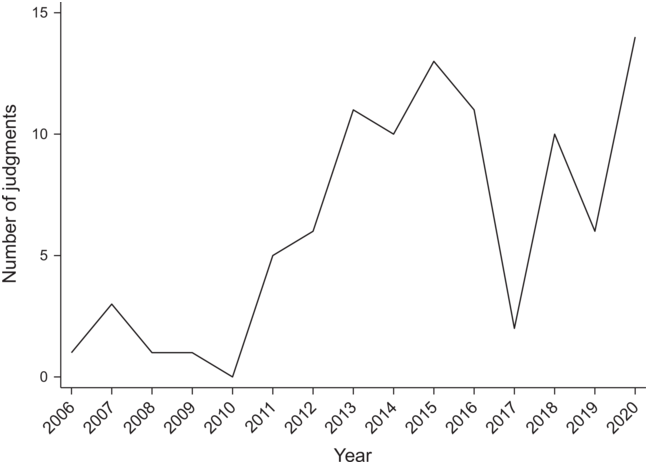
Figure 4.1 Long description
A line graph with the vertical axis labeled number of judgments ranging from 0 to 15 in increments of 5. The horizontal axis spans from 2006 to 2020. The trend starts at 1 in 2006, rises to 3 in 2007, dips to 1 by 2009, then briefly reaches 0 in 2010. From 2011, it rose steadily, peaking at 13 in 2015. It drops sharply to 2 in 2017, climbs to 10 in 2018, drops to 6 in 2019, and ends at 15 in 2020.
Nearly all references to the EACJ (excluding appeals) have been initiated by private actors, except for one filed by a member state against an EAC institutionFootnote 48 and one reference for a preliminary ruling.Footnote 49 The respondents to references are not evenly distributed. Table 4.1 shows the number of references by each respondent, bearing in mind that references can have more than one respondent. The EAC was a respondent in twenty-nine instances. Among member states, Uganda was the respondent in the most disputes, or twenty-four in total. Burundi has also been a respondent in a comparatively large number of disputes.Footnote 50 South Sudan was a respondent in only one finalized dispute, but it had only been a member for four years within the timeframe under analysis.
| Respondent | Total | Decided on merits | No treaty violation | Treaty violation |
|---|---|---|---|---|
| East African Community | 29 | 25 | 17 | 8 |
| Burundi | 19 | 13 | 8 | 5 |
| Kenya | 12 | 9 | 5 | 4 |
| Rwanda | 8 | 8 | 6 | 2 |
| South Sudan | 1 | 1 | 0 | 1 |
| Tanzania | 12 | 9 | 4 | 5 |
| Uganda | 24 | 19 | 13 | 6 |
Note: These figures do not include references where a respondent is struck off for being wrongly enjoined in the dispute. Preliminary references and appeals are also excluded.
The EACJ has addressed a variety of issues. Two-thirds of claims concerned the EAC’s fundamental and operational principles – espoused in Article 6(d)Footnote 51 and 7(2)Footnote 52 of the EAC Treaty – and relate to democracy, human rights, and the rule of law. Article 6(d) or Article 7(2) violations were each alleged in forty-one of the EACJ first instance cases, while both were cited in thirty-eight cases. Matters relating to the East African Legislative Assembly (EALA), such as the election of EALA members or the election of the Speaker, were brought to the Court in nine first instance cases.Footnote 53 Eight first instance cases concerned the common market or customs union, and the powers and responsibilities of the EAC Secretariat (EAC Treaty Articles 66–73) were raised in nine first instance cases.Footnote 54
Judicial Deference by the East African Court of Justice
This section examines the EACJ’s decisions to determine the extent to which it accepts the states’ and EAC’s exercise of authority. It illustrates that the Court defers to a substantial degree, as seen in the tendency of case outcomes to be favorable to states and the EAC as well as the Court’s reliance on restrictive interpretation. However, the Court is less likely to defer when it comes to remedies.
Case Outcomes
Case outcomes, or the rates at which states or the EAC win a case, provide information on the extent to which the EACJ defers, or accepts the state’s or EAC’s exercise of authority. Table 4.2 provides descriptive statistics on the EACJ’s case outcomes and its deference rates. I examine case outcomes and deference rates by type of respondents (states, EAC, or both) and types of decisions (decided on the merits or all decisions). The merits deference rate is calculated as the number of judgments in which the EACJ found the respondent(s) had not violated the law divided by the total number of merits judgments – this gives an indication of how often the EACJ validates the respondent’s exercise of authority. The total deference rate equals the number of decisions in which the Court found no violation (validation), the case was inadmissible (abstention), or it did not have jurisdiction (abstention) divided by the total number of all case outcomes.
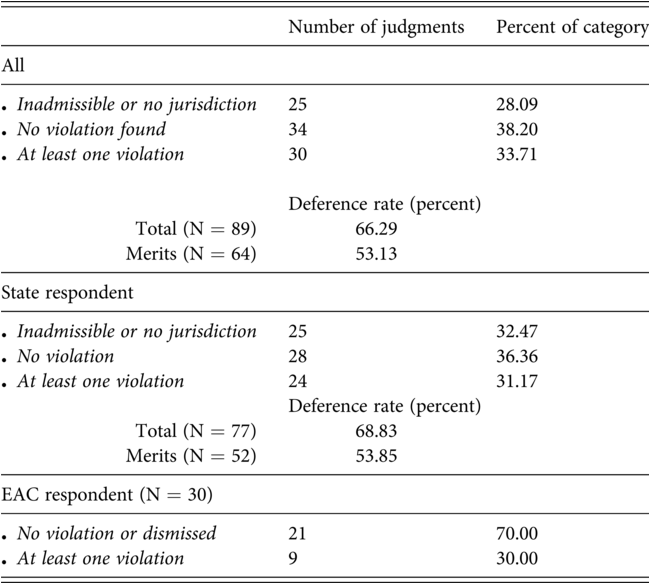
Table 4.2 Long description
The table summarizes the East African Court of Justice’s case outcomes from 2006 to 2020, showing the number of judgments and percentage within each category, along with deference rates for total and merits categories. The data is presented separately for all cases, state respondents, and E A C respondents.
1. All cases
There were 25 cases classified as inadmissible or with no jurisdiction, representing 28.09% of all cases.
There were 34 cases where no violation was found, representing 38.20%.
There were 30 cases where at least one violation was found, representing 33.71%.
The overall deference rate was 66.29% for all cases, which is out of a total of 89 cases, and 53.13% for merits cases, which is out of a total of 64 cases.
2. State respondent cases
There were 25 cases classified as inadmissible or no jurisdiction, representing 32.47% of state respondent cases.
There were 28 cases where no violation was found, representing 36.36%.
There were 24 cases where at least one violation was found, representing 31.17%.
The deference rate was 68.83% for all state respondent cases, which is out of a total of 77 cases, and 53.85% for merits cases, which is out of a total of 52 cases.
3. E A C respondent cases, totalling 30 cases
There were 21 cases where no violation was found or the case was dismissed, representing 70% of E A C respondent cases.
There were 9 cases where at least one violation was found, representing 30%.
Note: These data exclude the one preliminary ruling and four instances where the Court affirmed its jurisdiction and remanded the reference back to the First Instance Division. Total deference rate = (no violation + inadmissible or no jurisdiction) ÷ Total N. Merits deference rate = no violation ÷ Merits N.
A few observations can be made from Table 4.2. First, the EACJ rules in favor of states and the EAC more than it does applicants, so it has a general propensity to accept the respondents’ exercise of authority either through abstention or validation. When states are respondents, the EACJ has deferred in approximately 69 percent of all cases. The rate of deference in cases against states is lower if the dispute gets past the hurdles of jurisdiction and admissibility and is considered on the merits. In these instances, the EACJ ruled in favor of states in slightly more than half of its decisions. The Court defers more to EAC organs than it does to individual states. Overall, applicants typically do not get favorable outcomes when they bring complaints to the EACJ.
Has the Court’s deference changed over time? Figure 4.2 speaks to this question, depicting temporal patterns in case outcomes. This figure should be interpreted with caution because year-on-year changes can be large as the number of judgments in any given year is relatively small. This is especially the case in the first five years. For example, the deference rate was zero in 2008 and 100 percent in 2009, but this apparent surge in deference occurred because there was only one judgment in each of these years. There is also a gap in the figure because there were no final judgments in 2010.
EACJ’s deference rate by year (2006–2020).
Note: This figure does not include preliminary references or Appellate decisions that remand a case back to the First Instance Division.
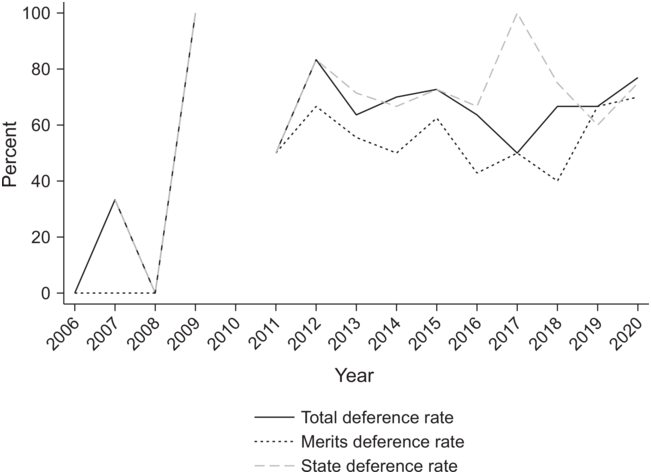
Figure 4.2 Long description
A line graph with the vertical axis labeled percent, ranging from 0 to 100 in increments of 20. The horizontal axis spans from 2006 to 2020. Three lines represent total deference rate (solid), merits deference rate (dotted), and state deference rate (dashed). From 2006 to 2009, the merit deference rate remained near zero, then rose sharply to 100 in 2009. It started again in 2011 and fluctuated between 40 and 60 till 2020. Between 2012 and 2020, the state deference rate fluctuated, peaking at 100 in 2017. The total deference rate varies between 50 and 75. The merits deference rate remains lower and more variable, reaching lows near 40 and highs around 70. All three lines trend upward at the end.
Changes in deference, nonetheless, are easier to discern from 2011 onward. Three main observations can be made. First, the EACJ’s tendency to defer to states is relatively consistent over time. This is depicted in Figure 4.2, which shows deference to states is equal to or higher than the total deference rate in most years since 2011 and does not drop below 50 percent. In fact, the average yearly state deference rate (including cases against states only) for the 2010s is 72 percent, suggesting that states receive a favorable outcome in close to three out of every four judgments. Second, applicants fare slightly better, and states less so, if the Court considers the merits of a case. Figure 4.2 shows that the merits deference rate is lower than total deference in all years. On average, the yearly merits deference rate is 55 percent and does not surpass 70 percent from 2010 onward, although it never drops below 40 percent. Last, we can see a slight downward trend in deference from 2012 to 2018.
While the EACJ defers more than it does not, it does not overtly succumb to political pressures or blindly rule in favor of states: The Court has refused to abstain in numerous instances, and it has declined to validate a state’s or the EAC’s exercise of authority at times. As the section “Legal Interpretation and Deferential Reasoning” shows, the Court’s legal interpretations and reasoning is sometimes nondeferential.
Legal Interpretations and Deferential Reasoning
The EACJ has adopted nondeferential interpretations in some notable instances. For example, the Court has twice declined to validate the Treaty amendments adopted by the EAC Summit in 2006, in one case for a failure to conduct a public consultation prior to adoptionFootnote 55 and the other because the amendments undermine the supremacy of the EACJ.Footnote 56 In the first of these cases, the Court addressed the question of whether Article 30 of the Amended EAC Treaty permitted private litigants to refer cases against Community organs to the EACJ. Article 30(1) does not expressly include EAC “organs” among the entities against which private litigants can allege infringement. The respondents to the case urged the Court:
to interpret the provisions of Article 30 of the Treaty strictly, and not to construe them as impugned on the sovereignty of the Partner States; emphasizing that under that article, only an Act, regulation, directive, decision or action of a single Partner State or an institution of the Community may be challenged; but not that of an organ of the Community. He argued that to the extent that in this reference the applicants challenge the legality of the decision of the Summit to amend the Treaty, the reference does not fall within the ambit of Article 30 and is therefore not properly before this Court.Footnote 57
States made clear to the Court in their arguments that anything other than a narrow interpretation of Article 30 would impose on their sovereignty. The Court nonetheless rejected the respondents’ preferred interpretation. It stated: “we are not persuaded by the respondents’ urging that we give to Article 30, a narrow interpretation that excludes from the application of the Article, infringement of the Treaty by an organ of the Community. With due respect to learned counsel, it seems to us that such a restrictive interpretation is not based on a sound ground.”Footnote 58 In this instance, the Court eschewed restrictive interpretation and instead embraced a purposive interpretation that permits private litigants to sue Community organs.
Previous scholarship identifies other notable instances where the Court adopted nondeferential interpretations of its jurisdiction.Footnote 59 For example, Gathii calls the Court’s judgment in Katabazi “mission creep” because it declared it indirectly had jurisdiction over human rights, the rule of law, and good governance.Footnote 60 Katabazi concerned fourteen Ugandans who were granted bail by the High Court of Uganda and then promptly rearrested by security personnel in defiance of the High Court.Footnote 61 The arrestees were then taken before a military court martial, charged with possession of firearms and terrorism. The Ugandan Constitutional Court declared their detention unconstitutional and ordered their release. After the Government failed to comply, the applicants filed a complaint with the EACJ, claiming that the re-arrests, charges, and detention violated Articles 6 and 7 of the EAC Treaty, which commit member states to objectives and principles of human rights and the rule of law.Footnote 62 The EACJ ruled that it had jurisdiction to hear the case, even though the Treaty did not expressly grant it human rights jurisdiction and reserved the authority to expand the jurisdiction of the Court, including for human rights issues, to states.Footnote 63 The Court found the case nevertheless concerned the interpretation of the EAC Treaty because the Community and states committed to objectives and principles of human rights and the rule of law according to Article 6(d) and 7(2). For this reason, the EACJ would not “abdicate from exercising its jurisdiction of interpretation [of the Treaty] … merely because the reference includes allegation of human rights violation.”Footnote 64 By rejecting a restrictive interpretation of its jurisdiction, the Court refused to abstain from reviewing how states exercise their authority relating to human rights. This essentially rebuffed states’ earlier decision to exclude human rights from the EACJ’s jurisdiction.Footnote 65
While Katabazi and a few other judgments are exemplars of nondeferential interpretation and reasoning, they are exceptional. In fact, the EACJ employed restrictive interpretation in the aftermath of Katabazi to mitigate its impact, notably in the Independent Medical Legal Unit case.Footnote 66 In this case, the complainant alleged that Kenya and the EAC failed to prevent, investigate, and punish the execution, torture, cruelty, and inhuman and degrading treatment of over 3,000 residents in the Mount Elgon region between 2006 and 2008. The Kenyan government challenged the EACJ’s jurisdiction to hear the case, among other things, based on the time limitation imposed by Article 30(2) of the Amended EAC Treaty. This provision asserts that individual complaints “shall be instituted within two months” of the alleged violation.Footnote 67 The EACJ’s First Instance Division on July 29, 2011, ruled against Kenya, reasoning that “the matters complained of are failures in a whole continuous chain of events from when the alleged violations started until the Claimant decided that the Republic of Kenya had failed to provide any remedy for the alleged violations.”Footnote 68 This decision drew on the concept of a “continuous violation” which is a widely recognized principle in international human rights law.
Kenya appealed this ruling, and the Appellate Division reversed the First Instance Division’s decision, dismissing the complaint as time-barred according to Article 30(2). The Appellate Division argued:
In our view, there is no enabling provision in the Treaty to disregard the time limit set by Article 30(2). Moreover, that Article does not recognize any continuing breach or violation of the Treaty outside the two months after a relevant action comes to the knowledge of the Claimant; nor is there any power to extend that time limit … Again, no such intention can be ascertained from the ordinary and plain meaning of the said Article or any other provision of the Treaty.Footnote 69
The Appellate Division deferred to states; it relied on restrictive interpretation to abstain as much as possible from imposing on states’ sovereignty. The EACJ’s interpretation, in essence, accepted the states’ decision to limit the Court jurisdiction – as reflected in Article 30(2) – when they amended the Treaty in 2006.
The restrictive interpretation of Article 30(2) has been significant. While the Katabazi case potentially “opened the flood gates” and extended the authority of the EACJ, the outcome of the Independent Medical Legal Unit case minimized the effects of Katabazi. Since then, the Court has consistently applied the same narrow interpretation of the two-month time limit, making successful application to the EACJ exceedingly difficult.Footnote 70 This was especially the case in the years immediately following the Appellate Division’s judgment. My data reveal that twelve applications have been time-barred from review by the Court. In several other instances, the Court found that some, but not all, of an applicant’s claims were time-barred.Footnote 71
Other important decisions of the Court reflect deference through interpretation. For instance, the Appellate Division relied on restrictive interpretation to determine the EACJ’s ratione personae jurisdiction, or rules on standing, for a nonresident citizen.Footnote 72 The Appellate Division interpreted Article 30(1) of the EAC Treaty, which provides that “any person who is resident in a Partner State may refer for determination by the Court” a complaint of an alleged Treaty violation by a state or EAC institution. The Court determined that this provision guarantees jurisdiction of the Court only if the complainant resides in a member state, and therefore excludes from the jurisdiction of the Court any reference from nonresident citizens.Footnote 73 Based on the ordinary meaning, the Court concluded that “the word ‘resident’ as used in Art. 30(1) cannot be construed to mean that it was intended by the drafters of the Treaty to engraft ‘non-resident citizens’ of EAC Partner States as part of the phrase ‘… any person who is resident in a Partner State’.”Footnote 74 The Court further argued that this interpretation would not be absurd or unreasonable results or effects that are counter to the object and purpose of the Treaty. The exclusion of nonresident citizens from the right to petition the EACJ is significant, as the Court has been increasingly used by opposition politicians or regime opponents to seek redress,Footnote 75 and it is not uncommon for members of the opposition to be in exile.Footnote 76
Some members of the Court, in fact, called this interpretation restrictive, when they issued the first dissenting opinion the EACJ had ever seen (two of five judges dissented). The dissenting judges contended that the majority’s interpretation was “narrow and restrictive … and amounts to a retrogressive and backward move in Treaty interpretation for this Court.”Footnote 77 They argued that Treaty was created to benefit the East African people and therefore empowered them to challenge infringements before the Court. As such, “it could not have been the intention of the framers of the Treaty that access to justice under the Treaty would be unequal or disproportionate.”Footnote 78 A good faith interpretation would require the Court to consider the object and purpose of the Treaty. As the dissent argues, “it follows therefore that a Good Faith interpretation does not import a simple literal interpretation of words and terms as would be had from a dictionary, but rather a consideration of those terms and words in light of the object and purpose of the Treaty.”Footnote 79 Ultimately, the Court’s interpretation restricted access to the EACJ, requiring the Court to abstain from exercising its authority more often than it would have otherwise.
A closer look at legal reasoning reveals EACJ’s scrutiny is usually light, as the Court often concludes the EAC Treaty reserves discretion for states or complainants have not met evidentiary standards. I identify sixteen instances of deference arising from an interpretation that the EAC Treaty reserves discretion for states, typically because the Treaty is silent on the matter. The Court also applies high evidentiary standards, which Shirlow argues “can be used to restrict the circumstances in which an international court or tribunal will review domestic acts, thereby expanding the decision-making autonomy of particular domestic actors.”Footnote 80 Thus, the EACJ’s high evidentiary standards can be viewed as a mode of deference; I find fifteen cases where deference arose from high standards of evidence. In one of these cases, the Court was asked to determine whether Uganda’s repression of the peaceful “walk to work” protests in 2011 violated the state’s obligation to respect human rights. The Court’s approach to the issue was to address the evidence. Even though the brutality of the protests were noted by both local and international media, and shamed by organizations such as Human Rights Watch, the Court concluded newspaper cuttings were not properly tended as evidence, that the Court could not rely on the notoriety of events as evidence, and the Court rejected video evidence because its authenticity was not proven by the applicants. Witness testimony was also insufficient as no evidence was provided to confirm the veracity of their testimonies. For example, the applicants did not provide medical records documenting personal injuries.Footnote 81
While deference is often based on reasons of state discretion or inadequate evidence, I find several cases where the Court decided state action was reasonable or that the Court has limits to its power based on a “work-to-rule” or restrictive interpretation. The Court rarely applies intense scrutiny based on practices of, for instance, balancing, proportionality assessments, or a margin of appreciation. All in all, the evidence suggests that the Court’s methods of interpretation and reasoning are more deferential than not, irrespective of case outcome.
Remedies
The EACJ rules in favor of states in most judgments and tends to rely on restrictive or “work-to-rule” interpretations or relaxed scrutiny. Do the Court’s remedies similarly reflect deference? The EAC Treaty and the EACJ Rules of Procedure permit a wide range of remedies and do not explicitly limit the Court’s remedial powers. An analysis of the remedial orders reveals that the EACJ has used the full range of its powers, and it frequently shows nondeference to states through its remedies for successful litigants.
Table 4.3 summarizes the remedial orders delivered by the EACJ. As shown, the most common remedy is declaratory orders, which the Court delivered in all thirty cases where it found a violation (as we would expect). In sixteen of these, or 53 percent, the Court issued one additional remedy. In two cases, representing 7 percent of instances where a breach was declared, the Court ordered two additional remedies. The additional remedies included reparations, like compensation or restitution, which the EACJ ordered in seven cases. They also included consequential orders, which is the type of remedy that intrudes most on state sovereignty. Consequential orders are the EACJ’s second most common remedy, after declaratory judgments. The EACJ has given consequential orders in thirteen instances, or 43 percent of cases where a violation is found. It has also issued a consequential order in one case where it did not declare a violation.Footnote 82 Also noteworthy, the EACJ issued consequential orders against the EAC and states at similar rates. Among the cases in which the EAC was found to have failed in its obligation, the EACJ delivered a consequential order in 44 percent. Similarly, the Court delivered a consequential order in 46 percent of cases where a state was found to be in violation. Additionally, the Appellate Division gave remedies in the form of remanding references to the First Instance Division in three cases. There were also three cases in which the EACJ granted interim orders (temporary injunction),Footnote 83 although applicants requested them in twelve other cases included in the data (not shown in Table 4.3).
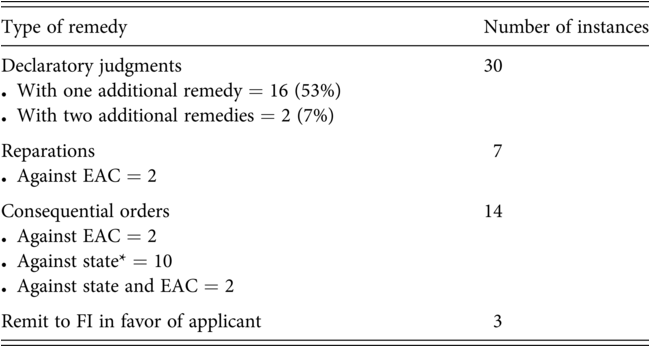
Table 4.3 Long description
The table summarizes the remedies awarded by the East African Court of Justice from 2006 to 2020, showing the types of remedies and the number of instances for each.
1. Declaratory judgments
There were 30 declaratory judgments in total.
Among these, 18 cases included one additional remedy, representing 60%.
Two cases included two additional remedies, representing 7%.
2. Reparations
There were 7 instances of reparations awarded.
Two of these were against the East African community.
3. Consequential orders
There were 14 consequential orders in total.
Two were against the East African community.
Ten were against the states.
Two were against both states and the East African community.
4. Remit to the first instance in favour of the applicant
There were 3 instances where the case was remitted to the first instance in favour of the applicant.
* In one instance, a consequential order was delivered without a declaratory judgment.
Note: Judgments can have more than one remedy type. The coding included up to four per case. This does not include cost awards. Some declaratory judgments are against both the state respondent(s) and the EAC.
Table 4.4 describes the Court’s consequential orders. It shows that most of the EACJ’s consequential orders against states mandate changes to domestic law or policy, while two of the four orders against the EAC require the Secretary General to investigate or carry out fact-finding inquiries related to alleged failures of states. Table 4.4 also shows that the EACJ tempers the intrusiveness of its remedies at times, as seen by its use of prospective annulment. These consequential orders apply prospectively only. In other words, these orders signal some deference because they do not reverse or invalidate past decisions, but rather set expectations for future action. For instance, in East African Law Society & Others v Kenya & Others,Footnote 84 the Court declared that the states had not followed correct procedures when amending the EAC Treaty by failing to hold public consultations. The Court nonetheless did not void the relevant amendments. Rather, it said that public consultations were necessary for any future amendments. The SerengetiFootnote 85 case is another instance where an order had only prospective application. In this case, the EACJ issued a permanent injunction against Tanzania, preventing the state from constructing a paved road through the Serengeti National Park. Ostensibly, this order significantly intruded on Tanzania’s sovereignty; however, the Tanzanian government had already abandoned its plan to pave a road when the injunction was issued.Footnote 86 While the Court did limit action going forward, it was also cautious to recognize that the state could pursue future initiatives, so long as there was no negative environmental impact. Put differently, it left some discretion to the government. In the appeal that followed, the Appellate Division upheld the permanent injunction (the data counts this as another consequential order).Footnote 87
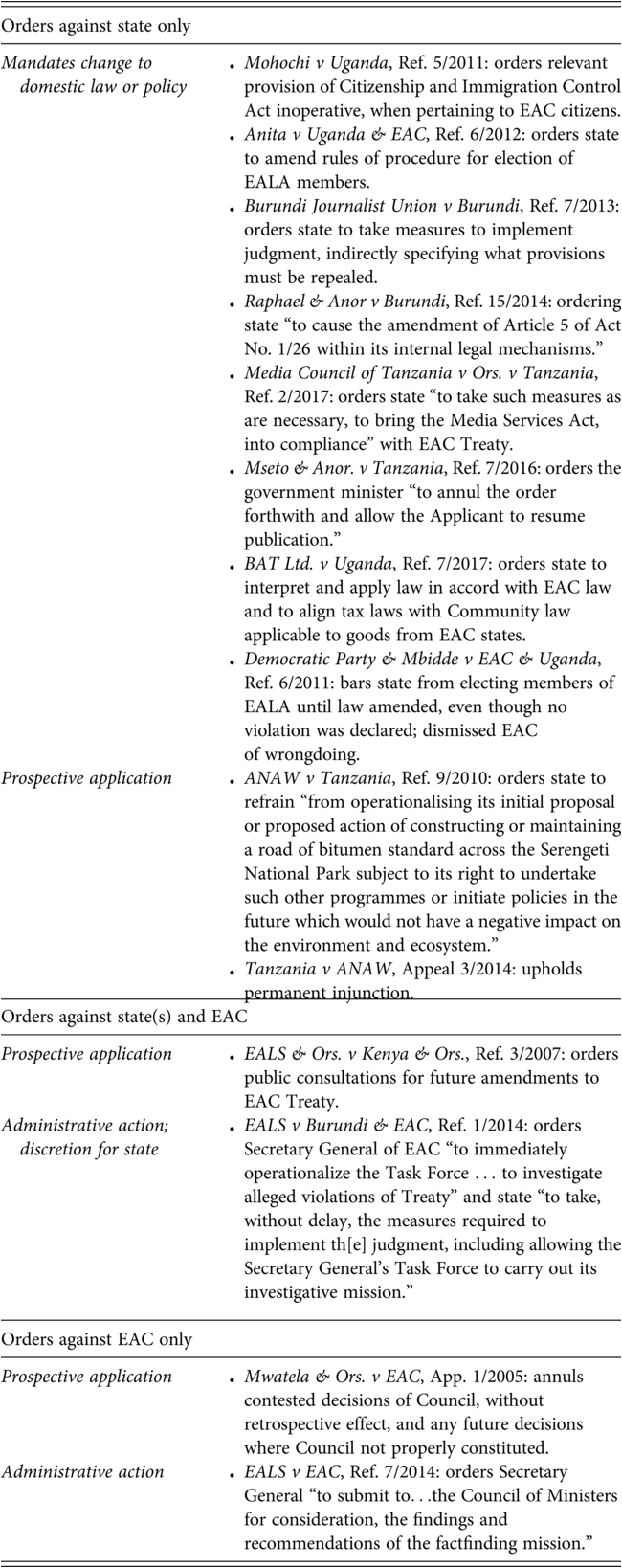
Table 4.4 Long description
The table features a summary of the East African Court of Justice’s resulting orders. The table is structured by the category of orders directed at a state. For Each order category, a bullet point offers specific case examples alongside the mandated actions.
1. Orders against the state exclusively
Mandates adjustment to internal statutes or regulations:
In the case of Mohachi versus Uganda, Reference number 5 of the year 2011, the court directed that a relevant section of the citizenship and immigration control act be rendered inoperative, specifically when it concerns citizens of the East African Community.
2. Orders against the state exclusively
Mandates adjustment to internal statutes or regulations:
In the matter of Mohachi versus Uganda, reference number 5 of the year 2011, the court directed that a relevant section of the citizenship and immigration control act be rendered inoperative, specifically when it concerns citizens of the East African Community.
In the matter of Anita versus Uganda and E A C, reference number 6 of the year 2012, the court directed the state to amend its rules of procedure for the election of EALA members.
Concerning Burundi Journalist Union versus Burundi, reference number 7 of the year 2013, the court instructed the state to undertake measures to implement a judgment, indirectly specifying that certain provisions must be repealed.
Regarding Raphael and Another versus Burundi, reference number 15 of the year 2014, the court issued a ruling stating to cause the amendment of Article 5 of Act Number 1 slash 26 within its internal legal mechanisms.
In the case of Media Council of Tanzania and Others versus Tanzania, reference number 2 of the year 2017, the court ordered the state to take such measures as are necessary to bring the Media Services Act into compliance with E A C stipulations.
Concerning Mseto and Another versus Tanzania, reference number 7 of the year 2016, the court directed the government minister to annul the order forthwith and allow the applicant to resume publication.
Regarding B A T Limited versus Uganda and E A C, reference number 7 of the year 2017, the court ordered the state to interpret and apply law by E A C law and to align tax laws with community law applicable to goods from E A C states.
In the matter of democratic party and others versus E A C and Uganda, reference number 6 of the year 2011, the court barred the state from electing members of E A L A until the law was amended, even though no violation was declared in the dismissal of E A C’s wrongdoing.
Concerning A N A W versus Tanzania, reference number 9 of the year 2010, the court ordered the state to refrain from operationalising its initial proposal or proposed action of constructing or maintaining a road of bitumen standard across the Serengeti National Park subject to its right to undertake such other programmes or initiate policies in the future which would not have a negative impact on the environment and ecosystem.
Regarding Tanzania versus ANAW, appeal number 3 of the year 2014, the court upheld a permanent injunction.
3. Orders against the state and E A C
Prospective application
In the case of E A L S and others versus Kenya and others, reference number 3 of the year 2007, the court ordered public consultations for future amendments to the E A C Treaty.
Administrative action discretion for the state
Concerning E A L S versus Burundi and E A C, reference number 1 of the year 2014, the court ordered the Secretary General of E A C to immediately operationalize the task force to investigate alleged violations of treaty and stated to take, without delay, the measures required to implement the judgment, including allowing the Secretary General’s task force to carry out its investigative mission.
4. Orders against E A C exclusively
Prospective application
Regarding Mwatela and others versus E A C, Application number 1 of the year 2005, the court annulled contested decisions of the Council, without retrospective effect, and any future decisions where the Council was not properly constituted.
Administrative action
In the matter of E A L S versus E A C, reference number 7 of the year 2014, the court ordered the Secretary General to submit to the Council of Ministers for consideration, the findings and recommendations of the factfinding mission.
Note: Case names are listed in short form. See Appendix for full citation.
The Court has occasionally left some degree of discretion to states on how to remedy a wrong. Most notably, in East Africa Law Society v Attorney General of Burundi,Footnote 88 the Court responded to allegations that Burundi had violated rule of law principles by disbarring without due process an attorney who had criticized the government. The Court ruled in favor of the applicant and ordered the government to take measures to implement the judgment. The Court, however, did not specify what these measures should be, and importantly did not say the government must reinstate the lawyer to the bar. In other instances, when the Court mandated changes to domestic law or policy, it has done so with varying degrees of intervention.
To summarize, the EACJ’s remedial orders paint a somewhat different picture about deference. On remedies, the EACJ is less acceptant of the state or EAC’s exercise of authority. Nonetheless, there is a perception that its remedies are limited and that the Court exercises restraint in orders.Footnote 89 This perception may reflect how the consequential orders give some discretion to states.
Explaining the East African Court’s Substantial Deference
Despite notable instances of nondeference, the EACJ’s decisions show substantial levels of deference in terms of case outcomes and legal interpretation, and to a lesser degree remedies. How can we explain the Court’s tendency to defer?
The Role of Support Networks
Previous scholarship suggests that support networks play a key role in determining whether ICs defer to states or not. An account based on the logic of support networks expects higher degrees of deference, such as that shown by the EACJ, when a court provides insufficient opportunities for supporters to access the Court, it fails to adequately mobilize supporters or if its support network is weak or inactive. The following section assesses this logic by looking at the channels of access for supporters, the Court’s efforts to mobilize potential supporters, and the strength and activity of its support network. It considers three types of supporters: private actors (e.g., nongovernmental actors, civil society, for-profit actors), substate actors (e.g., national courts), and supranational actors. It shows that the EACJ’s support network is better situated than its deference would suggest based on the logic of support networks. Moreover, the greatest source of support for the EACJ comes from private actors, not substate or supranational actors.
The Court features several channels of access for its would-be supporters to utilize. First, private actors have direct access to petition the Court. The EAC Treaty entitles individuals or other private actors (NGOs, businesses, etc.) to directly petition the Court for determination of the legality of a state or EAC act or action.Footnote 90 The Court also has provisions for third-party access. Specifically, private actors can act as either amicus curiae or interveners before the EACJ,Footnote 91 although the Court must first grant them leave to intervene or submit an amicus curiae brief.Footnote 92 Last, private actors can indirectly access the Court through referrals for preliminary rulings from national courts. When questions of Community law arise in the context of domestic litigation, national courts are entitled to refer these issues for a preliminary ruling to the EACJ.Footnote 93
Moreover, the Court has sought to mobilize its supporters and encourage their use of these channels of access. Important aspects of the Court’s jurisprudence are pro-litigant and expand opportunities for private actors to access the Court. The EACJ has asserted its willingness to review complaints that involve alleged violations of the principles of good governance, rule of law, and human rights.Footnote 94 It has also determined that it can review environmental disputes.Footnote 95 The Court’s awards on costs (i.e., recoverable expenses of litigation, such as lawyers’ fees and payments to expert witnesses) have also been pro-litigant at times. For instance, the Court has adopted the practice of not awarding costs in public interest litigation. It has also determined that it will consider an applicant’s hardship, such of loss of employment, when deciding whether to award costs to litigants.Footnote 96
The EACJ has also made structural reforms, with the support of member states, to facilitate access and cultivate its support network. In 2013, the EACJ’s rules were amended to remove filing fees.Footnote 97 Sub-registries were also created in 2010, at the request of the EACJ.Footnote 98 The first sub-registry opened in 2012, and currently there is a sub-registry in the capital of five partner states. (There is not yet one in South Sudan or the DRC.) Prior to having the sub-registries, the only way to file a complaint was to travel to the EACJ registry in Arusha and file there. For most private actors, namely, individuals, this was prohibitive to filing a complaint. The sub-registries thus are important contact points for stakeholders, which enhance the accessibility and visibility of the Court.Footnote 99
The EACJ has worked to mobilize actors through its outreach, or “off-the-bench,” activities. For example, it has hosted numerous workshops with lawyers, national judges, and civil society organizations.Footnote 100 Likewise, these organizations invite representatives of the Court to participate in their activities.Footnote 101 The Court also produces material to improve information about how to access and use the Court. For instance, it has published a user guide and manual.Footnote 102
Not only does the EACJ feature access opportunities and work to mobilize its support network, but its network is relatively active. In fact, the EACJ’s support network has been responsible for a large portion of the cases brought to the Court, and in particular the Pan African Lawyers Union (PALU) and the EALS “have been very active in bringing cases … and they have actually kept [the Court] very busy.”Footnote 103 Additionally, political elites, especially members of the political opposition within the member states, have also been active in utilizing the Court.Footnote 104 My data record the legal counsel in each case, when stated in the judgment. The data reveal that a significant portion of cases were litigated by a repeat lawyer, or a lawyer who served as counsel in at least one prior case before the EACJ. Table 4.5 illustrates what portion of cases are represented by a repeat lawyer at the First Instance Division. It excludes appeals because counsel does not typically change as cases progress to the appellate stage. Preliminary references are also excluded because private actors behind the domestic dispute do not have representation before the EACJ in these types of cases. As Table 4.5 shows, approximately 54 percent of cases were litigated by a repeat lawyer. In fact, eight lawyers alone acted as legal counsel across thirty-three disputes. Repeat lawyers thus are critical to litigation before the EACJ. NGOs have been applicants in nine cases excluding appeals and preliminary references. Also, a third party has been granted leave as either an amicus or an intervener in fourteen cases (15 percent of cases).Footnote 105 All in all, a support network is at the core of much of the Court’s workload.
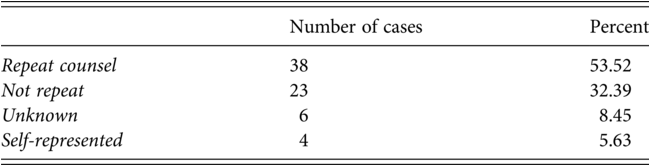
Table 4.5 Long description
The table features the information regarding the legal counsel representing applicants at the East African Court of Justice, E A C J. The table displays the count of cases and the corresponding percentage for different categories of representation.
For repeat counsel, there were 38 cases, which represent 53.52% of the total.
In the category of not repeated, there were 23 cases, accounting for 32.39%.
The number of cases with unknown representation was 6, equivalent to 8.45%.
Finally, there were 4 cases where applicants were self-represented, making up 5.63%.
Note: N = 71. Appeals and preliminary references are excluded.
Can this support network account for the EACJ’s deference? I test whether applicants win more often when cases involve a repeat lawyer or an NGO, as would be expected if a support network were a strong explanatory determinant of nondeference (see Table 4.6). The results are mixed. On the one hand, when cases are represented by repeat lawyers or NGOs participate (either as an applicant or a third party), the applicants are less successful than if no repeat lawyer or NGO participates. This finding runs counter to the expectations of a support network. On the other hand, the overall pattern on remedial orders lends evidence to the role of a judicial support network. Consequential orders were delivered in 58 percent of instances when a repeat lawyer was involved in contrast to 38 percent when there was no repeat lawyer. Similarly, when NGOs participate, 88 percent of decisions included a consequential order whereas only 27 percent of cases without NGO participation conclude with a consequential order. The same pattern is present when comparing the involvement of judicial supporters with whether the Court orders any remedy in addition to a declaratory judgment.
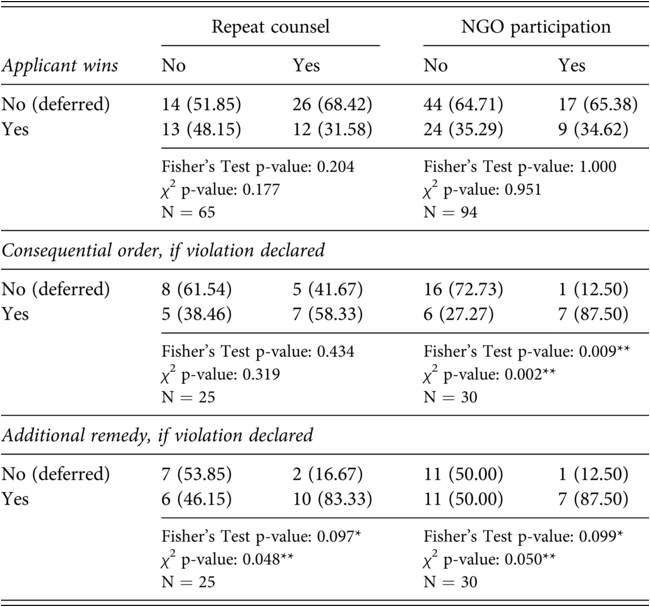
Table 4.6 Long description
The table presents cross-tabulations of the East African Court of Justice’s deference by support network. It examines the relationship between applicant win outcomes, categorized as no, meaning the court, deferred or yes, and the support network variables of repeat counsel, with options of no or yes, and N G O participation, also with options of no or yes. The table further presents data on consequential orders and additional remedies when a violation is declared, segmented by these support network variables and applicant win status. Within each cell, the count of cases and the row percentage are detailed. Statistical test results, specifically Fisher’s Test p-value, Chi-squared p-value, and the total number of cases, denoted as N, are reported below each cross-tabulation.
1. Applicants win or loss
Applicant loss, reflecting deference deferred
There are 14 cases, in which the applicant lost and did not have repeat counsel, constituting 51.85%.
There are 26 cases, in which the applicant lost and did have repeat counsel constituting 68.42% of all cases with repeat counsel.
Based on whether there is N G O participation
There are 44 cases in which the applicant loses and there was no NGO participation, amounting to 64.71% of all cases without NGO participation.
There are 17 cases in which the applicant loses and there was NGO participation, amounting to 65.38% of all cases with NGO participation.
Statistical test results for repeat counsel reveal that Fisher’s Test p-value registers at 0.204, Chi-squared p-value at 0.177, with a total of 65 cases. For N G O participation, Fisher’s Test p-value registers at 1.000, Chi-squared p-value at 0.951, with 94 cases in total.
Applicant wins reflecting nondeference
Based on whether there is repeat counsel
In the context of no repeat counsel, there are 13 cases in which the applicant won, representing 48.15% of all cases without repeat counsel.
In the context of yes repeat counsel, there are 12 cases, in which the applicant won, representing 31.58% of all cases with repeat counsel.
Based on whether there is N G O participation
In the situation of no N G O participation, there are 24 cases where the applicant won, representing 35.29% of all cases without NGO participation.
In the situation of yes N G O participation, there are 9 cases in which the applicant won, representing 34.62% of all cases with NGO participation.
2. Consequential order, if a violation is declared
No Consequential order, if a violation is declared.
Based on whether there is repeat counsel
When repeat counsel is absent, there are 8 cases, in which no consequential order is delivered accounting for 61.54% of all cases with no repeat counsel.
When repeat counsel is present, there are 5 cases in which no consequential order is delivered, accounting for 41.67% of all cases with repeat counsel.
Based on whether there is N G O participation
When N G O participation is absent, there are 16 cases in which no consequential order is delivered, accounting for 72.73% of all cases without NGO participation .
When N G O participation is present, there is 1 case in which no consequential order is delivered, accounting for 12.50% of all cases with NGO participation.
Statistical test results for repeat counsel indicate that Fisher’s Test p-value stands at 0.434, Chi-squared p-value at 0.319, with a total of 25 cases. For N G O participation, Fisher’s Test p-value registers at 0.009, Chi-squared p-value at 0.002, involving 30 cases.
Consequential order is delivered, if a violation is declared.
Based on whether there is repeat counsel
In the absence of repeat counsel, there are 5 cases in which a consequential order is declared, making up 38.46% of cases involving no repeat counsel.
With repeat counsel, there are 7 cases with a consequential order, making up 58.33% of cases involving repeat counsel.
Based on whether there is N G O participation
Without N G O participation, there are 6 cases with a consequential order, comprising 27.27% of all cases without NGO participation.
With N G O participation, there are 7 cases with a consequential order, comprising 87.50% of cases with NGO participation.
3. Additional remedy, if a violation is declared
Additional remedy not delivered, when a violation is declared, reflecting deference.
Based on whether there is repeat counsel
In the case of no repeat counsel, there are 7 instances with no additional remedy, representing 53.85% of all cases without repeat counsel.
In the case of yes repeat counsel, there are 2 instances with no additional remedy, representing 16.67% of all cases with repeat counsel.
Based on whether it is N G O participation
In the absence of N G O participation, there are 11 instances with no additional remedy, representing 50.00% of all cases without NGO representation.
With N G O participation, there is 1 instance with no additional remedy, representing 12.50% of all cases with NGO participation.
Statistical test results for the repeat counsel demonstrate that Fisher’s Test p-value is 0.097, Chi-squared p-value is 0.048, with a case count of 25. For N G O participation, Fisher’s Test p-value measures 0.099, Chi-squared p-value measures 0.050, involving 30 cases.
Additional remedy is delivered, if a violation is declared, reflecting nondeference
Based on whether there is repeat counsel
Without repeat counsel, there are 6 cases with an additional remedy, accounting for 46.15% of cases without repeat counsel.
With repeat counsel, there are 10 cases with an additional remedy, accounting for 83.33% of all cases with repeat counsel.
Based on whether there is N G O participation
In the absence of N G O involvement, there are 11 cases in which an additional remedy was ordered, accounting for 50.00% of cases without NGO involvement.
With N G O involvement, there are 7 cases in which an additional remedy was ordered, accounting for 87.50% of cases with NGO involvement.
Note: *p < 0.10, **p < 0.05, ***p < 0.001. These data exclude cases in which the legal counsel is unknown and appeals judgments. In each cross-tabulation, the first number is the frequency and the second number (in parentheses) is the column percentage.
While it is quite telling that the EACJ is less deferential in terms of its remedial orders depending on the participation of its judicial support network, it is difficult to understand how the Court’s decisions on outcomes and interpretation, which are more deferential, were driven by the role of support networks. Many of the case outcomes are the result of deferential standards of review. For instance, the Court has interpreted the law in ways that undermine access for would-be supporters. As described earlier, the restrictive interpretation of the two-month time limit for filing a case has led to several complaints being dismissed by the Court. Moreover, the decision in which this restrictive interpretation was adopted was a reference filed by an NGO and another NGO acted as an amicus.Footnote 106 As one interviewee expressed, “You can’t take a case there anymore,” suggesting how limiting the two-month rule is and how would-be supporters see opportunities with the Court.Footnote 107 A more recent decision relied on restrictive interpretation to exclude nonresident citizens from direct access to the Court; the applicant in this case was represented by a repeat lawyer.Footnote 108 The EACJ also penalizes unsuccessful applicants by rewarding legal costs to successful state respondents or the EAC if the case does not reflect a public interest in the eyes of the Court. I have recorded fourteen instances where the EACJ awarded costs to a state or the EAC at the expense of the private actor. Ultimately, the EACJ applies more deference in cases prior to arriving at the question of possible remedies, despite the participation of an active support network. If and when the Court does, however, conclude that it cannot defer to states on jurisdiction or the merits of the case, the support network provides some cover for its more intrusive remedies.
Finally, it is worth noting that the Court appears to have minimal support from substate actors, such as national judiciaries, and supranational actors. Domestic courts are disinclined to refer cases to the EACJ. By the end of 2020, there had only been one preliminary reference. While the reasons why domestic courts have not made more referrals are beyond the scope of this analysis, insufficient knowledge of the preliminary referral or the relevant EAC law by lower court judges or concurrent appointments may offer partial explanations.Footnote 109 Additionally, national court judges may believe that the EACJ poses a threat to themselves, or the courts they preside over. For instance, a referral may be viewed as ceding their otherwise limited power to a supranational court, or judges may fear political retribution from their executives for making a referral. Domestic courts within the EAC are often politically constrained by the executives,Footnote 110 and a referral would limit their ability to make regime friendly judgments when the political stakes are high. These explanations are speculative. Yet, it remains clear that domestic courts have so far been unable or unwilling to provide the EACJ with substate partnerships like that which have been documented for other international courts, such as the CJEU. Support from supranational actors, namely, the EAC Secretary General, is also unlikely. While the Secretary General can initiate proceedings if it finds a state has infringed its duties, it cannot refer the case to the Court on its own discretion but needs the support of the EAC Council (an intergovernmental organ). Thus, the EACJ is unlikely to find a supranational actor among its advocates. This is a marked difference to the CJEU.
In sum, to the extent that the Court demonstrates a willingness to not defer to states in terms of its remedies, the EACJ’s support network, especially from private actors, may embolden it. However, other aspects of the EACJ’s decision-making do not align with the expectation of a support network. In particular, the generally high levels of activity of the private actor contingent of a support network are not congruent with the EACJ’s substantial deference on outcomes and legal interpretation. More aligned with the high levels of deference are, however, the inactivity or weakness of the EACJ’s substate and supranational actors.
The Structural Determinants of the East African Court’s Strategic Space
The previous discussion alluded to explanatory gaps that arise from the logic of support networks. Does the Court’s strategic space fill these gaps? In what follows, I consider the structural determinants of the Court’s strategic space and their role in shaping the EACJ’s substantial deference. I begin by examining the EACJ’s formal independence.
Formal Independence
The comparative mapping of ICs’ formal independence in Chapter 3 revealed that the EACJ is among the ICs with lowest levels of formal independence. Table 4.7 summarizes the rules that constitute the formal independence of the EACJ and whether they enhance or hamper independence. First among the rules that limit the Court’s independence are those governing the selection of judges and their tenure. The Court can have a maximum of fifteen judges (ten for the First Instance Division and five for the Appellate Division),Footnote 111 who are selected by consensus of the Summit.Footnote 112 Selection by consensus allows any state to veto potential appointees. States also have the capacity to remove judges from office for misconduct, an inability to perform the duties of office, or criminal behavior. Removal can occur through two means: (1) the Summit can remove a judge upon the recommendation of an ad hoc tribunal appointed by the Summit for the purposes of adjudging fitness; or (2) the Summit can remove a judge if they have been removed from office domestically or resigns from office domestically following allegations of misconduct.Footnote 113 The provision about the removal of EACJ judges differs from other ICs, which tend to have the sitting judges of the court decide on the merits of a fellow judge’s removal.
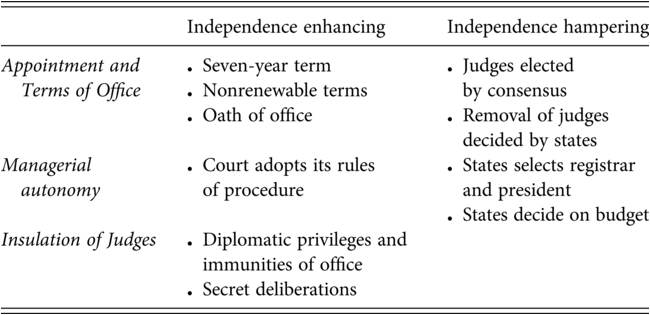
Table 4.7 Long description
The table outlines the rules constituting the formal independence of the East African Court of Justice E A C J. The table is divided into two main categories: factors enhancing independence and factors hampering independence, further broken down by specific aspects of judicial operation.
1. Appointment and Terms of Office
For Independence enhancing,
Seven-year term for judges.
Non-renewable terms for judges.
Requirement of an oath of office for judges.
For Independence hampering,
Judges are elected by consensus among the states.
Removal of judges is decided by the member states.
2. Managerial autonomy
For Independence enhancing,
The court has the authority to adopt its own rules of procedure.
For Independence hampering,
Member states select the registrar and the president of the court.
Member states decide on the court’s budget.
3. Insulation of Judges
For Independence enhancing,
Judges are granted diplomatic privileges and immunities of office.
Deliberations of the court are kept secret.
Second, rules pertaining to the Court’s managerial autonomy weaken formal independence. The EACJ does not have formal input over the selection of its registrar, president (for Appellate Division) and principal judge (for the First Instance Division), or its budget. States through the Council of Ministers appoint the registrar,Footnote 114 and the Summit selects the president of the Court and the principal judge.Footnote 115 The Court’s budget is proposed by the Secretariat of the EAC, which is then considered by the Council of Ministers and approved by the EALA.Footnote 116 There is no formal requirement that the Court be consulted on its budget.
In contrast to the rules that hamper independence, some governing rules enhance the EACJ’s formal independence. Importantly, judges are elected to a seven-year (or until the age of seventy, whichever comes first), nonrenewable term.Footnote 117 Also, a degree of managerial autonomy is provided by the Court’s ability to determine its own rules of procedure.Footnote 118 Last, the EACJ’s independence is enhanced by rules that help to insulate judges from political pressure, namely, judges enjoy diplomatic privilegesFootnote 119 and are “immune from legal action for any act or omission committed in the discharge of their judicial functions,”Footnote 120 and the Court’s decisions are “reached in private.”Footnote 121
While distinct from independence, I also mention two rules that relate to impartiality. First, judges must recuse themselves from hearing cases in which they were previously involved or in which they have a conflict of interest.Footnote 122 Second, the Summit on the recommendation of the Council determines the salary and conditions of service for EACJ judges, which are otherwise not mentioned in the Treaty.Footnote 123
On the whole, key elements of the EACJ’s safeguards to independence are weak, making the Court potentially vulnerable to political pressure from states. The formal rules provide states with an arsenal of formal mechanisms, both ex ante and ex post, to employ against the Court if they wished to do so. Moreover, these rules have a bearing on how the Court is perceived. Two rules in particular have been the subject of controversy and criticism. First, politicians, the media, regional lawyers, and even the Court itself have criticized the rules governing the removal of EACJ judges. The EAC Treaty was amended in 2006, in an episode of “backlash” against the Court. Among the rules modified were those related to the removal of judges. Article 26 of the original EAC Treaty from 1999, provided:
(1) The President of the Court or other Judge shall not be removed from office except by the Summit for misconduct or for inability to perform the functions of his or her office due to infirmity of mind or body.
(2) Notwithstanding the provisions of paragraph 1 of this Article, a Judge of the Court shall only be removed from office if the question of his or her removal from office has been referred to an ad hoc independent tribunal appointed for this purpose by the Summit and the tribunal has recommended that the Judge be removed from office for misconduct or inability to perform the functions of his or her office.
(3) The tribunal appointed under paragraph 2 of this Article shall consist of three eminent Judges drawn from within the Commonwealth of Nations.
According to the original Treaty, states controlled the removal of judges, upon the recommendation of a tribunal for misconduct or infirmity. In 2006, the Treaty was amended to increase states’ control over the removal of judges. The revisions were widely seen as a maneuver by Kenya to punish the Court, and two of its appointees, for the EACJ’s decision in the Anyang Nyong’o case,Footnote 124 which halted Kenya’s selection of members for the EALA. Article 26 of the Revised Treaty states that:
1. A Judge shall not be removed from office except by the Summit –
(a) for misconduct or for inability to perform the functions of his or her office due to infirmity of mind or body;
Provided that a Judge shall only be removed from office under this subparagraph if the question of his or her removal from office has been referred to an ad hoc independent tribunal appointed for this purpose by the Summit and the tribunal has recommended that the Judge be removed from office for misconduct or inability to perform the functions of his or her office; or
(b) in the case of a Judge who also holds judicial office or other public office in a Partner State–
(i) is removed from that office for misconduct or due to inability to perform the functions of the office for any reason; or
(ii) resigns from that office following allegation of misconduct or of inability to perform the functions of the office for any reason;
(c) if the Judge is adjudged bankrupt under any law in force in a Partner State; or
(d) if the Judge is convicted of an offence involving dishonesty or fraud or moral turpitude under any law in force in a Partner State.
The most notable part of the revised provision is paragraph (b) to (d), which allows any state to remove a judge from office by using domestic channels. Local elites openly criticized the amended article, viewing it as a way for states to unilaterally remove judges simply by indicting a sitting judge within their national jurisdiction. For instance, the President of the EALS, Tom Ojienda, said, “‘the amendments, among other things, provide that EACJ judges automatically surrender their positions upon being indicted in their countries’… He added the reforms pursued by Kenya ‘constituted a travesty of judicial independence and a threat to regional integration within the EAC’.”Footnote 125 Similarly, the then Deputy Secretary General of the EALS, Otiende Amollo, told the media that the changes were “unwarranted and could lead to emasculation of the Judiciary by the Executive.”Footnote 126 In an opinion piece, one regional lawyer claimed, “The decision means that the judges will be in office only at the mercy of their respective presidents, which will amount to absence of security of tenure. Once this is done, the EACJ will have graduated into a toothless watchdog, incapable of deciding against their governments.”Footnote 127 A Kenyan opposition politician at the time, Joseph Kamotho, wrote in an opinion piece in a local newspaper that “From the look of things, there is an attempt to subjugate the jurisdiction of the court to that of member states. That could prove problematic in the long run.”Footnote 128
The Court itself has criticized the new provisions on the removal of judges. When the EACJ was presented with a case contesting the validity of the Treaty amendments, it argued, “The introduction of automatic removal and suspension on grounds raised or established in the home State, and applicable to only those in judicial or public office, makes possibilities of applying un-uniform standards to judges of the same court endanger the integrity of the Court as a regional court.”Footnote 129 The EACJ’s strategic plan identified some of the rules related to formal independence as source of its weakness. In particular, the 2010–15 strategic plan listed the “lack of security of tenure of judges” as a weakness.Footnote 130 To my knowledge, there has been one incident where a judge has been removed from the Court. Justice Moijo ole Keiwua from Kenya was suspended from the EACJ in 2007 following his removal from the bench in Kenya after facing allegations of corruption, which was enabled by the amendments to the Treaty.Footnote 131 All in all, the rules on the removal of judges have undermined the Court’s safeguards from political interference, which tarnishes societal perceptions about the Court.
Another important aspect of the Court’s formal independence that has had a notable impact on how the Court is viewed are the rules related to its managerial autonomy. Political elites have expressed dissatisfaction with the current rules and advocated for greater financial and administrative autonomy for the Court. For instance, the EAC Development Strategy for 2006–10 called for financial autonomy for the EACJ.Footnote 132 Similarly, the EALA recommended the EAC Summit pass the “Administration of the EACJ Bill of 2016,”Footnote 133 which aimed to strengthen the independence of the EACJ by, among other things, giving the Court greater say in the allocation of its financial resources. The Court also identified its lack of managerial autonomy as problematic for its independence and performance, and it has lobbied states to increase the EACJ’s managerial autonomy. For example, its Strategic Plan of 2018–23 recognized that its capacity was limited by not having financial or administrative autonomy.Footnote 134 In 2021, the President of the Court, Justice Nestor Kayobera, told the media that “financial autonomy would also boost the independence of the Court.”Footnote 135 The previous President of the Court, Emmanuel Ugirashebuja, similarly went to the press in 2020, arguing that financial autonomy would “give the Court financial muscle to carry its activities independently.”Footnote 136
The situation remains unchanged into 2024, and the current President of the Court continues to press for increased financial and administrative autonomy. President Kayobera, when speaking at an event in Kampala, said: “The other arms of the EAC have independence. We need the EACJ to have financial and administrative autonomy to discharge our mandate properly.”Footnote 137 While these pleas have been ongoing, the Court’s limited budget and need to go to states to ask for budgetary autonomy have an impact on how the Court is perceived by its stakeholders. As one interviewee explained, sometimes the Court has to go begging the heads of state, and “that ruins the credibility of the Court.”Footnote 138
The EACJ’s rules related to managerial autonomy and the selection and removal of judges curtail its independence. While these rules negatively affect the perceived legitimacy of the Court, they are unlikely to chill judicial decision-making on their own. Rather, the coupling of these rules with a politically aligned, or unfragmented, membership gives the Court greater reason to anticipate and view coordinated state resistance as credible.
Political Fragmentation
I have shown that the EACJ delivers judgments under constraints imposed by its formal rules. These rules both provide channels for political interference and weaken the Court’s legitimacy in the eyes of its stakeholders. While the formal rules constrain the Court, my core argument also expects political fragmentation to affect decision-making. Specifically, I have posited that deference and fragmentation have a negative relationship (H2). Fragmentation, understood as heterogeneous preferences among member states, reduces the feasibility and credibility of collective state resistance. This begs the question: Do we observe a negative relationship between deference and fragmentation in the case of the EACJ?
To address this question, I identify three issues that have been repeatedly addressed by the EACJ. The issues are: (1) press freedom, (2) freedom of association, and (3) due process guarantees. I select these issues because the Court has addressed them in more than one of its merits decisions and corresponding data are available for measuring fragmentation. The issues that meet these criteria are limited. Table 4.8 catalogs the EACJ’s decisions on these issues. It shows that the EACJ did not defer on issues of press freedom (2015–19), but that it did on the freedom of association (2018–19). On due process, the Court did not defer between 2012 and mid-2018, but thereafter it began to defer. The table also specifies the theoretically expected level of fragmentation, based on H2, in each case: Where deference is absent, we expect to observe high fragmentation, and when the Court deferred, fragmentation should be low. The final column shows the actual degree of fragmentation.
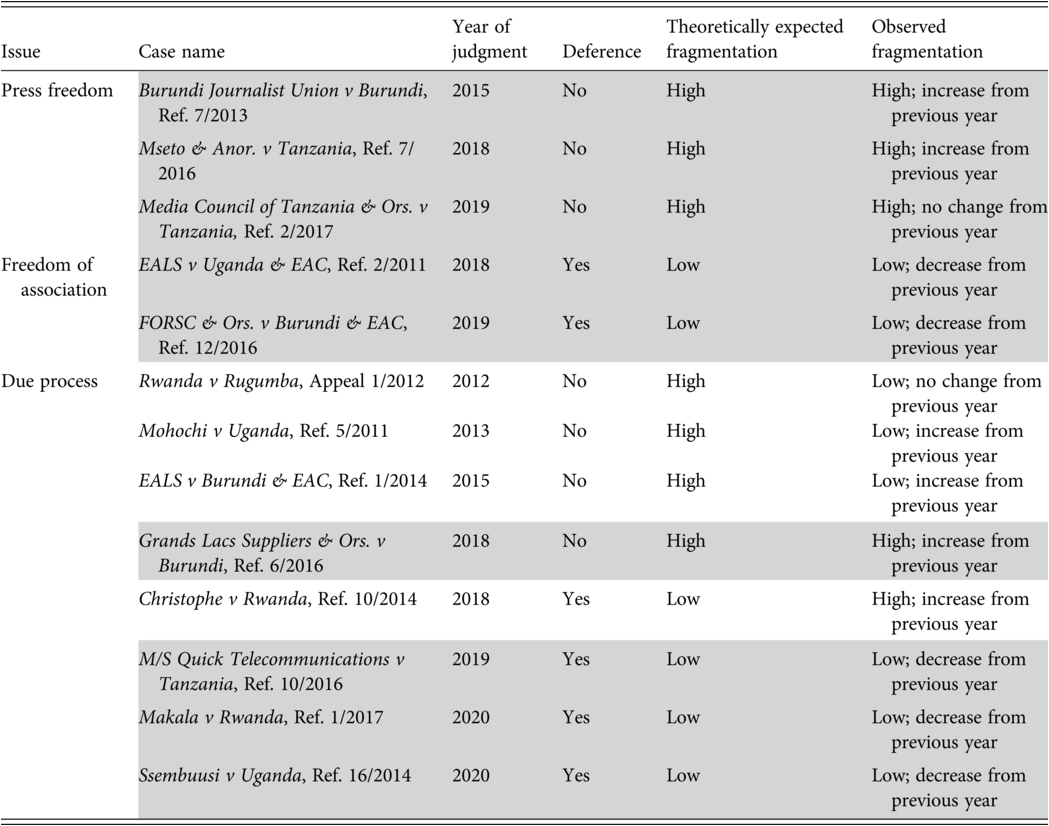
Table 4.8 Long description
The table presents information on the East African Court of Justice deference and East African Community fragmentation across selected issues.
1. Press freedom
In the case of Burundi Journalist Union versus Burundi, reference 7 of 2013, the year of judgment was 2015, the deference was no, the theoretically expected fragmentation was high, and the observed fragmentation was high, with an increase from the previous year.
In the case of Mseto and Another versus Tanzania, reference 7 of 2016, the year of judgment was 2018, the deference was no, the theoretically expected fragmentation was high, and the Observed fragmentation was high, with an increase from the previous year.
In the case of Media Council of Tanzania and others versus Tanzania, reference 2 of 2017, the year of judgment was 2019, the deference was no, the theoretically expected fragmentation was high, and the Observed fragmentation was high, with no change from the previous year.
2. Freedom of association
In the case of East African Law Society versus Uganda and East African Community, reference 2 of 2011, the year of judgment was 2018, the deference was yes, the theoretically expected fragmentation was low, and the observed fragmentation was low, with a decrease from the previous year.
In the case of Foundation for Human Rights Initiative of Social Change and others versus Burundi and East African Community, reference 12 of 2016, the year of judgment was 2019, the deference was yes, the theoretically expected fragmentation was low, and the observed fragmentation was low, with a decrease from the previous year.
In the case of Rwanda versus Rugumba, Appeal 1 of 2012, the year of judgment was 2012, the deference was no, the theoretically expected fragmentation was high, and the observed fragmentation was low, with no change from the previous year.
In the case of Mohachi versus Uganda, reference 5 of 2011, the year of judgment was 2013, the deference was no, the theoretically expected fragmentation was high, and the Observed fragmentation was low, with an increase from the previous year.
In the case of East African Law Society versus Burundi and East African Community, reference 1 of 2014, the year of judgment was 2015, the deference was no, the theoretically expected fragmentation was high, and the Observed fragmentation was low, with an increase from the previous year.
3. Due process
In the case of Grands Lacs Suppliers and others versus Burundi, reference 6 of 2016, the year of judgment was 2018, the deference was no, the theoretically expected fragmentation was high, and the Observed fragmentation was high, with an increase from the previous year.
In the case of Christophe versus Rwanda, reference 10 of 2014, the year of judgment was 2018, the deference was yes, the theoretically expected fragmentation was low, and the observed fragmentation was high, with an increase from the previous year.
In the case of M Slash quick telecommunications versus Tanzania, reference 10 of 2016, the year of judgment was 2019, the deference was yes, the theoretically expected fragmentation was low, and the observed fragmentation was low, with a decrease from the previous year.
In the case of Makala versus Rwanda, reference 1 of 2017, the year of judgment was 2020, the deference was yes, the theoretically expected fragmentation was low, and the observed fragmentation was low, with a decrease from the previous year.
In the case of Ssembuusi versus Uganda, reference 16 2014, the year of judgment was 2020, the deference was yes, the theoretically expected fragmentation was low, and the observed fragmentation was low, with a decrease from the previous year.
Note: Low is defined as a COV of 50 percent or below, and high is defined as above 50 percent. Cells are shaded in gray when the observed fragmentation is congruent with the expected fragmentation. Case names are listed in short form; see Appendix for full citation.
To measure fragmentation, or preference heterogeneity, I use V-Dem data, inferring preferences from state practice.Footnote 139 I rely on three V-Dem indicators to capture preferences on each of the selected issues: government censorship effort as an indicator of state preferences on press freedom, civil society repression for freedom of association, and transparent laws with predictable enforcement for due process guarantees.Footnote 140 For each of the indicators, I calculate the yearly coefficient of variation (COV) for all EAC member states, adjusted for changes in the EAC membership. The COV is a statistical measure of variability, which indicates the size of a sample’s standard deviation in relation to its mean. It is useful because it is a standardized measure of variability, allowing for comparison across indicators.Footnote 141 Higher values indicate greater variability in the data, or, in other words, more heterogeneous preferences. Figure 4.3 illustrates the preference heterogeneity of EAC members from 2005 to 2020 on each of the three indicators.
EAC political fragmentation on select issues.
Note: Calculations and illustration by author.
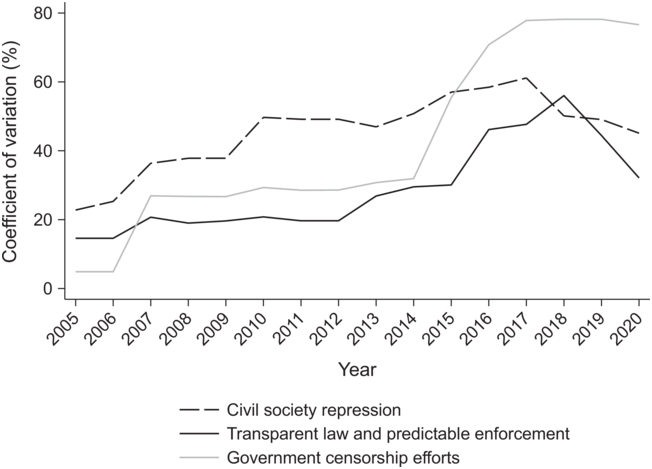
Figure 4.3 Long description
A line graph with the vertical axis labeled coefficient of variation in percent, ranging from 0 to 80 in increments of 20. The horizontal axis spans from 2005 to 2020. Three lines represent civil society repression (dashed), transparent law and predictable enforcement (solid), and government censorship efforts (light solid). Civil society repression rises steadily from 2005, peaking around 60 in 2017 before declining. Transparent law increases gradually with a sharp rise in 2016 to 45, peaking at 60 in 2018, then falling. Government censorship rises steeply from 2014, peaks at 80 in 2017, and remains high through 2020.
Table 4.8 compares the observed heterogeneity, based on the data shown in Figure 4.3, with the theoretically expected level of heterogeneity. All instances where the observed and expected heterogeneity are congruent are shaded in gray. As Table 4.8 shows, the EACJ delivered three merits judgments related to press freedom between 2015 and 2019. All three of these judgments represent nondeference, as the Court declared that the respondent state violated its treaty obligations through its treatment of the media. We therefore expect to observe high fragmentation on government censorship between 2015 and 2019. Figure 4.3 shows that the COV for government censorship grew steeply in 2014 and remained high in the following years, as expected according to H2. There is also a negative relationship between fragmentation and deference on the issue of freedom of association. Between 2018 and 2019, the Court ruled twice in favor of states on the freedom of association, reflecting deference. Using data on the repression of civil society, Figure 4.3 shows that preference heterogeneity peaked in 2017 and then declined, suggesting growing alignment between states in 2017. While preferences heterogeneity in 2018 was higher than in the EAC’s first five years, the years these judgments came out were marked by a declining fragmentation on civil society repression.
The Court has addressed due process rights in several cases. The circumstances in each case differ. Some relate to criminal detention and trials, others to civil matters. At their core, however, they concern whether applicants were treated fairly during domestic judicial processes and according to established rules and principles. Deference on due process claims has changed over time, along with fragmentation. The EACJ was nondeferential between 2012 and June 2018. Since that time, the Court deferred to states in all related cases. According to data on transparent law and predictable enforcement (Figure 4.3), there was a steep increase in the heterogeneity of states’ preferences from 2012 to 2018. This roughly corresponds with expectations, as deference was low during a period of rising fragmentation, even if heterogeneity was relatively low. In 2019 and 2020, the EACJ was more deferential, which coincides with low and declining heterogeneity. If we were to include how fragmentation shifts from year to year (as opposed to the absolute level in any given year) for all three issues, the evidence is even stronger. In that case, all but one row would be shaded.
Overall, the evidence largely aligns with the theoretical expectation that deference and fragmentation have a negative relationship (H2). While these data cover only roughly a quarter of all merits judgments against states and a subset of issues, another observation speaks to the patterns in deference overall. Figure 4.3 suggests that political fragmentation increased from approximately 2012 to 2017, but then began to decline. This roughly corresponds with temporal changes in deferral rates. As seen in Figure 4.2, both total and merit deferral rates decreased between 2012 and 2017, before there was an uptick around 2018 and 2019. Broadly speaking, there is strong evidence to suggest that the EACJ has been more deferential at times and on issues where states’ preferences are homogeneous. Conversely, as states’ preferences diverge, the Court is less inclined to defer. This suggests that political fragmentation alleviates some of the political constraints faced by the Court. Finally, examining fragmentation in this way sheds light on what explains both temporal patterns in deference and cross-sectoral ones.
Past Resistance
The EACJ experienced coordinated state resistance early in its operations. This important episode of resistance has been documented by other scholars,Footnote 142 but I briefly recount the main contours of the story here before discussing its impact on the EACJ.
Shortly after the Court began operating, opposition politicians from Kenya sought the EACJ’s intervention over Kenya’s selection of members to the EALA.Footnote 143 The EAC Treaty requires the national assemblies of each member state to “elect, not from among its members, nine members of the Assembly, who shall represent as much as it is feasible, the various political parties represented in the National Assembly, shades of opinion, gender and other special interests groups in that Partner state.”Footnote 144 Kenya’s National Assembly conducted an “election” of its EALA members in October 2006. For this “election,” the major political parties – the Kenya African National Union, the Forum for the Restoration of Democracy-People, and the National Rainbow Coalition (NARC) – put forward a list of nominees to the EALA. However, a schism within the NARC, which was a coalition party that came to power in 2002, led it to have two lists: one proposed by the Government from among politicians loyal to President Kibaki and another proposed by a new opposition group but former coalition partner (the Liberal Democratic Party). It was the Government’s list for NARC nominees that was presented to the National Assembly for approval. Those nominees listed by Liberal Democratic Party, including Professor Peter Anyang’ Nyong’o, filed a reference with the EACJ contesting Kenya’s selection of members. Anyang’ Nyong’o and others also sought an interim injunction that would prevent the selected members from taking office until the Court had decided the reference. The EACJ granted this temporary order on November 27, 2006. Immediately after this order was handed down, Kenya took steps to punish the EACJ for what it viewed as interference in domestic political affairs. For instance, Kenya tried to have the Court disbanded and intimidated the Kenyan judges in hopes they would recuse themselves from the case.Footnote 145 Kenya collaborated with the other member states to curb the EACJ. This began on November 30, when the EAC Summit condemned the decision of the Court.Footnote 146 In December 2006, the Summit amended the EAC Treaty to restrain the Court, which came into force in March 2007.
The amendments restructured the Court into the First Instance and Appellate Division and added provisions aiming to restrict the jurisdiction of the Court. In addition, the amendments revised the provisions related to the removal of judges, which are described in detail above. Changes to the rules governing the removal of judges were seen as Kenya’s strategy to intimidate and remove its judges from the Court. The member states also added paragraph 2 to Article 30, barring references from private actors that are filed more than two months following an alleged violation.
This entire episode had implications for how the Court was viewed. The Summit’s condemnation of the Court in its Communique of November 30, 2006, damaged the legitimacy of the Court, as did some media coverage which claimed the Court’s order had “thrown [the EALA] into disarray”Footnote 147 and that by not hearing from all parties, namely, the nominees who were prevented from taking office, the Court “violated the rule of natural justice,” caused them “irreparable damage,” and “paralysed the regional assembly.”Footnote 148 Proponents of the Court also suggested the episode was damaging to the Court. For instance, Donald Deya, chief of the EALS, wrote in an opinion piece that states were “denigrating the Court” as well as the Treaty and that the EALS “condemns any attacks on the independence and integrity of the EACJ.”Footnote 149 In a press interview, the EALS called out states for their “disparaging and ridiculing tone” of the Court, which amounted to “contempt of court.”Footnote 150 Thus, the states’ collective resistance affected perceptions of the Court.
This experience also provided important information to judges sitting on the Court: States are capable of curtailing and undermining the Court if it steps too much out of line. For instance, when the Court was asked to interpret the amendment that imposed a two-month time limit on references, the Appellate Division narrowly interpreted this time limit.Footnote 151 In fact, one interviewee suggested that the Court’s fear of another “backlash” led it to be “very narrow and restrictive in the interpretation” of the two-month rule.Footnote 152 The Court’s restrictive interpretation of this provision should be read in light of the fact that the provision resulted from an episode of collective state resistance.
Also telling is how the Court has tended to respond to requests for interim orders. Applicants have requested interim orders on fourteen occasions in the aftermath of Anyang’ Nyong’o.Footnote 153 Orders were granted in only two of these instances. For stakeholders, the EACJ’s rulings on interim orders have been “very hesitant,” and even though there is sympathy for the Court, it “has refrained on some occasions to exercise its mandates when they are highly needed and they abscond from their duty … because people, they expect them to do more than what they are doing.”Footnote 154 Another interviewee speculated that the EACJ’s decision to deny interim orders in relation to President Nkurunziza of Burundi’s bid to run for a third presidential term was due to the “potential for another backlash.”Footnote 155 The reluctance to grant interim orders occurs in the background of prior resistance that arose from the Court’s delivery of interim orders.
The temporal patterns in deference resonate with interviewees’ impressions that past resistance has affected the Court’s decision-making. The Court’s deferral rate increased in the aftermath of Anyang’ Nyong’o (see Figure 4.2). Thus, the evidence suggests that the Court’s experience with state resistance narrowed its strategic space, leading the Court to prefer deference in order to avoid similar episodes, as expected by H5.
The EACJ’s Adaptive Practices
The formal independence and political fragmentation, along with past resistance, have structured the EACJ’s strategic space in important ways. They combine to shape the credibility and feasibility of resistance as well as how the Court is perceived by its stakeholders, setting the conditions for the EACJ’s substantial deference. As I have shown, however, the EACJ sometimes decides not to defer. The nature of fragmentation in any given dispute, as well as the participation of a support network, shed light on the nondeference by the EACJ. I have posited that the Court might also adapt to its political constraints by developing practices that help to restore or broaden its strategic space, thus enabling the Court to not defer when in accord with underlying legal constraints. The following discussion explores the EACJ’s practices of persuasive argumentation and public legitimation to discern their significance.
Persuasive Argumentation
The EACJ relies on two forms of persuasive argumentation – unanimous decisions and citation of national jurisprudence – to buttress nondeference. First, the EACJ relies on unanimous judgments. Speaking with one voice, according to my argument, enables some protection for judges but also helps to boost the persuasiveness of the Court’s judgments. One member of the Court explained that judges have informally agreed to issue unanimous decisions for the purpose of speaking with one voice and to improve the independence of the judges and prevent political retribution.Footnote 156 Protecting the individual judges from political retaliation is a salient concern for the judges. Several of the judges come from countries where judicial interference is relatively commonplace. For example, scholars have described Kenya, Burundi, and Uganda as states where judicial interference occurs.Footnote 157 Additionally, the experience of the EACJ has been that individual judges can indeed become targets of states, as was the case following the interim order in Anyang’ Nyong’o, which led one Kenyan judge to be removed from office.
The Court has issued unanimous decisions in all but two judgments. In the first instance, the Appellate Division ruled in favor of the respondent state, which had argued that the Court was not entitled to hear applications from nonresident citizens.Footnote 158 Two judges dissented, neither of whom were nationals of the respondent state.Footnote 159 In the second instance, the Court was responding to a claim raised by Burundi contesting the process leading to the election of the Speaker of the EALA. The Court dismissed Burundi’s claim, but one judge dissented in support of Burundi.Footnote 160 The dissenting judge in this instance was the appointee from Burundi.Footnote 161 It is only in this latter instance where an act of nondeference resulted in a dissenting opinion, yet only by the national judge who would most likely benefit politically from the dissent. Otherwise, unanimous judgments provide means by which the Court prevents its strategic space from narrowing when it decides not to defer.
The second practice of persuasive argumentation that the EACJ has developed relates to how it cites jurisprudence. Table 4.9 summarizes the descriptive statistics of the EACJ’s citation practices. It shows that the average EACJ judgment cites 4.71 of its own judgments. On the other hand, the average number of citations to external jurisprudence is 3.84. Among external jurisprudence, the average EACJ judgment cites international courts less than domestic courts, and the maximum number of citations to domestic jurisprudence is more than twice that of international citations.Footnote 162
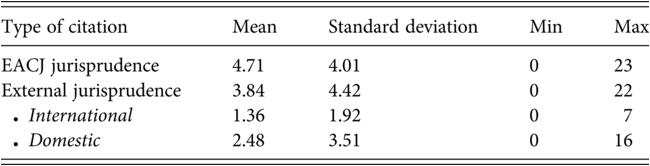
Table 4.9 Long description
The table presents descriptive statistics on the East African Court of Justice’s E A C J citation practices. The table shows the mean, standard deviation, minimum value, and maximum value for different types of citations.
1. For E A C J jurisprudence, the mean number of citations is 4.71, with a standard deviation of 4.01. The minimum number of citations is 0, and the maximum is 23.
2. For external jurisprudence, the mean number of citations is 3.84, with a standard deviation of 4.42. The minimum number of citations is 0, and the maximum is 22.
3. For International citations, the mean number of citations is 1.36, with a standard deviation of 1.92. The minimum number of citations is 0, and the maximum is 7.
4. For domestic citations, the mean number of citations is 2.48, with a standard deviation of 3.51. The minimum number of citations is 0, and the maximum is 16.
Note: All ninety-four cases are included. The coding records citations made by the Court in the reasoned part of its rulings or judgments. It does not include references that are cited in the summary of parties’ arguments or the discussion of case facts. Citations raised by parties in their arguments which are later referenced by the Court in its own reasoning are included in the citation counts. Citations are only counted once, even when the Court cites them more than once in a single decision. Interim rulings are included in coding of case, if applicable and available. Final judgments at the First Instance Division and Appellate Division are coded separately.
The Court cites a range of authorities. Domestic jurisdictions that are cited include those of the member states as well as the former EACA and other common law jurisdictions including British, Canadian, Indian, and American courts. As for international jurisprudence, the Court cites several international courts and tribunals, but often the ICJ and the CJEU.
The EACJ’s citation practices systematically vary by whether it defers or not. Table 4.10 analyzes the relationship between deference and citation practices. This table compares references to both domestic and international jurisdictions against deference in merits decisions based on: (1) case outcomes and (2) remedies. It shows that nondeference – whether measured by a declared violation, consequential order, or any remedy in addition to a declaratory judgment – is reasoned with reference(s) to domestic jurisprudence more often than deference is. For instance, roughly 77 percent of decisions in which violations are declared cite domestic case law, but domestic jurisprudence is cited in only 53 percent of decisions where no violation is found. The contrast is even greater when looking at consequential orders: 86 percent of judgments with consequential orders cite domestic courts, while 58 percent without a consequential order cite domestic jurisprudence. The differences in domestic citations based on deference are statistically significant. That said, the Court does also refer to domestic case law when it defers. References to international jurisprudence are also more typical when there is nondeference than not, even though this difference is not always statistically significant or as large. These patterns hold when looking at all judgments, in contrast to merits-only judgments (see Table A4.1).
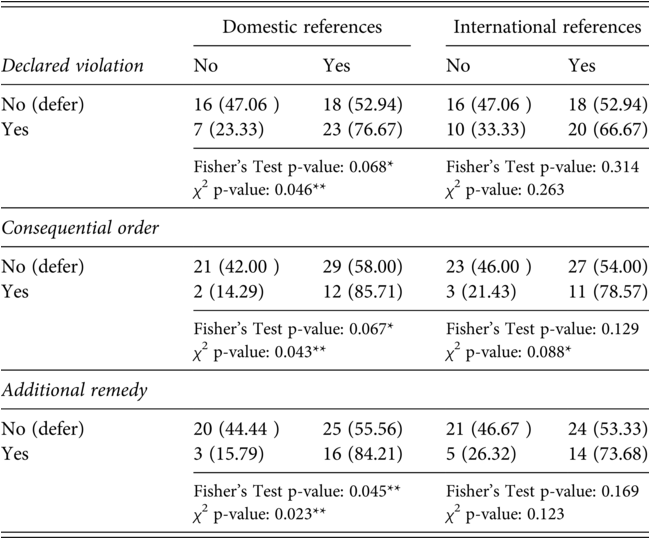
Table 4.10 Long description
The table presents a cross-tabulation of the East African Court of Justice’s E A C J citation practices by deference, considering merits only. It examines the relationship between whether a violation was declared, categorized as no, which reflects deference, defer or yes, and the citation of domestic and international references, categorized as no or yes. The table also includes data on consequential orders and additional remedies based on whether a violation was declared and the citation of these reference types. Within each cell, the number of cases and the row percentage are provided. Below each cross-tabulation, Fisher’s exact test p-value and Chi-squared p-value are reported.
1. Declared violation
Domestic references
In the category of no declared violation, reflecting deference, there are 16 cases where the citation of domestic references is no, representing 47.06%, and 18 cases where the citation of domestic references is yes, representing 52.94%.
In the yes category of a declared violation, there are 7 cases where the citation of domestic references is no, representing 23.33%, and 23 cases where the citation of domestic references is yes, representing 76.67%.
Statistical test results show that Fisher’s Test p-value is 0.068, and the Chi-squared p-value is 0.046.
International references
In the category of no declared violation, reflecting deference, there are 16 cases where the citation of international references is no, representing 47.06%, and 18 cases where the citation of international references is yes, representing 52.94%.
In the yes category of a declared violation, reflecting nondeference, there are 10 cases where the citation of international references is no, representing 33.33%, and 20 cases where the citation of international references is yes, representing 66.67%.
Statistical test results show that Fisher’s Test p-value is 0.314, and the Chi-squared p-value is 0.263.
2. Consequential order
Domestic references
In the category of no consequential order, reflecting deference, there are 21 cases where the citation of domestic references is no, representing 42.00%, and 29 cases where the citation of domestic references is yes, representing 58.00%.
In the yes category of a consequential order, there are 2 cases where the citation of domestic references is no, representing 14.29%, and 12 cases where the citation of domestic references is yes, representing 85.71%.
Statistical test results show that Fisher’s Test p-value is 0.067, and the Chi-squared p-value is 0.043.
International references
In the category of no consequential order, reflecting deference, there are 23 cases where the citation of international references is no, representing 46.00%, and 27 cases where the citation of international references is yes, representing 54.00%.
In the yes category of consequential order, reflecting nondeference, there are 3 cases where the citation of international references is no, representing 21.43%, and 11 cases where the citation of international references is yes, representing 78.57%.
Statistical test results show that Fisher’s Test p-value is 0.129, and the Chi-squared p-value is 0.088.
3. Additional remedy
Domestic references
In the category of no additional remedy, reflecting deference, there are 20 cases where the citation of domestic references is no, representing 44.44%, and 25 cases where the citation of domestic references is yes, representing 55.56%.
In the yes category of an additional remedy, reflecting nondeference, there are 3 cases where the citation of domestic references is no, representing 15.79%, and 16 cases where the citation of domestic references is yes, representing 84.21%.
Statistical test results show that Fisher’s Test p-value is 0.045, and the Chi-squared p-value is 0.023.
International references
In the category, there are 21 cases where the citation of international references is no, representing 46.67%, and 24 cases where the citation of international references is yes, representing 53.33%.
In the yes category of additional remedy, reflecting nondeference, there are 5 cases where the citation of international references is no, representing 26.32%, and 14 cases where the citation of international references is yes, representing 73.68%.
Statistical test results show that Fisher’s Test p-value is 0.169, and the Chi-squared p-value is 0.123.
Note: N = 64. *p<0.10, ** p<0.05, *** p<0.001. This excludes cases where the merits are not considered, or the case is remanded to the FI. In each cross-tabulation, the first number is the frequency and the second number (in parentheses) is the row percentage.
The data support H3 and suggest that external citations (especially from domestic jurisprudence) are integral to how it manages its political constraints and nondeference. To maintain a positive relationship with states, especially when dealing with an issue for the first time, the Court aims to have “a deeply reasoned judgment. Sometimes we even go further and cite the case law of other international tribunals, especially the ECJ. You will also find that given the fact obviously the founding members of [the EAC] have the common law system, we even go further to cite some national cases so that people can start relating to what is happening, especially in member states. Because if we say that even in your own country there’s a ruling that supports what we talk about,” the Court can begin to receive support from states.Footnote 163 For instance, the Court drew upon domestic and international jurisprudence in the SerengetiFootnote 164 and Anyang’ Nyong’oFootnote 165 cases, and both are among the judgments with the highest number of references to both international and domestic cases. Both decisions cite judgments from courts within the member states, other common law jurisdictions, and the former East African Court of Appeal.Footnote 166 At the same time, they reflect instances of nondeference. The Serengeti decision reflects nondeference in terms of outcomes, legal interpretation, and remedies. Other instances where domestic references are high are cases where interim orders are requested and/or other interim applications are ruled on by the Court. For example, in Zziwa v EACFootnote 167 the First Instance Division found that there had been a violation of the EAC Treaty behind the ousting of the Speaker of the EALA, Margaret Zziwa.
The EACJ’s strategic space is constrained by lower safeguards to independence and political fragmentation. To cope with these constraints, the Court relies on persuasive arguments to bolster its judgments, especially when it does not defer. Unanimous judgments and references to domestic jurisprudence are key to understanding deference by the EACJ. However, the Court also relies on nonjudicial practices to shape its strategic space. I turn to this next and consider how the EACJ employs public legitimation.
Public Legitimation
The EACJ has also developed practices of public legitimation to expand its strategic space. The Court uses a range of activities that targets public audiences while portraying the Court’s commitment to its political purpose and stakeholders.
In its first several years of operations, the Court gave little attention to how it was viewed by its stakeholders.Footnote 168 However, by 2010 the Court recognized that policymakers and stakeholders did not “consciously or unconsciously, appreciate its role,” which could risk “marginalizing the status of the Court” and “denying East African citizens the right to access the services of an effective regional court.”Footnote 169 The Court also acknowledged that it was “not visible enough” as “the users and other stakeholders still do not know sufficiently this regional mechanism of dispute resolution.”Footnote 170 In recognition of these issues, the Court set related objectives: “to proactively influence a positive shift in mindset of EAC Policy Organs and other Stakeholders concerning the role and place of the Court” and “to make the Court visible and indispensable in matters related to the discharge of its mandate.”Footnote 171 More concretely, the EACJ aimed to raise the profile of the Court by organizing seminars, meetings, and “sensitization workshops” with stakeholders and holding sessions in the member states.Footnote 172
The EACJ’s public image remained a key concern when the Court formulated its second strategic plan in 2018. Specifically, the EACJ identified the appreciation and visibility of the Court as two of its six main strategic issues.Footnote 173 The plan stressed the need to engage stakeholders through seminars, workshops, and other outreach activities. It also envisioned plans to disseminate promotional material and revamp the EACJ’s webpage and social media presence.Footnote 174
In line with these plans, the Court carries out outreach activities. The Court occasionally holds sessions and meetings in member states.Footnote 175 It also hosts and participates in workshops with lawyers, national judges, and civil society organizations.Footnote 176 The judges and Registrar speak at external events, typically by invitation, such as delivering a public lecture at universities.Footnote 177 While the main objective of these activities is to raise “awareness of this Court to the citizens of the East African Community,”Footnote 178 they typically target civil society organizations, like NGOs, the private sector, academic institutions, and bar associations, as opposed to the broader public.Footnote 179 The ability to reach a broad audience through its outreach activities has also been hindered by a lack of available funding,Footnote 180 which has been remarked upon in the EAC Annual Reports.Footnote 181
The Court targets a wider audience through public communication, namely, press releases, its webpage, and social media. An evaluation of this public communication reveals whether it aims to legitimize the Court in the eyes of the public. For this purpose, I extracted all press releases from the EACJ’s website up through the year 2020. Beginning with the earliest available press release in 2010, a total of 191 press releases were manually coded for their content. The vast majority (79 percent) of the press releases discuss case proceedings and outcomes. The remaining 21 percent discuss the Court’s ceremonial events or “off-the-bench” activities, hosted by the Court or attended by judges or the Registrar.
The Court utilizes press releases to convey messages to the public about the Court. The coding reveals that 15 percent of the press releases feature portrayals of the Court’s political purpose or its people-centeredness. The press releases convey the Court as an essential instrument for justice and integration. For example, when describing the workshop leading to the first strategic plan in 2010, a press release stated the judges and staff “will work towards the transformation of the EACJ into a well-designed tool of justice to address the legal challenges emanating from the wider and deeper integration of the Community.”Footnote 182 Similar messaging can be identified at later dates. For instance, a 2018 press release described a sensitization workshop. It reported that Justice Ugirashebuja, the President of the EACJ at the time, stressed that
“regional integration requires good cooperation between all the partners in the rule of law chain: judges, lawyers, civil servants, academics, businesses and individuals. ‘We all must contribute to make the EAC a living legal reality.’ His Lordship emphasized on the role of the court, which is crucial in resolving disputes which would otherwise threaten the survival of a Community… Justice Ugirashebuja further added that without an effective dispute resolution mechanism, the survival of the Community is at stake and that without its case law, and many principles that the Court has developed and will continue to develop, the Community will certainly not be where it is today and will not arrive at where it aims to be.”Footnote 183
The political purpose of the EACJ is also conveyed through narratives about the value of law, courts, and judiciaries, in general, rather than the Court per se. These narratives signal the EACJ’s commitment to principles of the rule of law and its other core purposes. One press release, for instance, reported that Justice Dr. Emmanuel Ugirashebuja “advised the judiciary of any Country in today’s World is a critical part of its economic and social infrastructure and therefore, that the judiciary is a vital factor in the rule of law and more broadly in economic development.”Footnote 184
Press releases also at times convey the Court’s attention to its stakeholders, with references to East Africans, the Community or region and its citizens. For instance, the press release describing a 2014 Workshop for the Judges of National Courts and Civil Society Organizations cited Justice Ugirashebuja as saying: “Together we can give hope to all those who clamor for resurgent East Africa and a region of greater equality, peace and harmonious development.”Footnote 185 Several press releases praise the Court for “bringing justice closer to East Africans.”
Nearly all of the narratives about the Court’s political purpose or people-centeredness arise when the EACJ communicates information about its off-the-bench activities. Such messages are rarely found in the press releases about cases proceedings, which instead relate details about cases before the Court, including the factual background of the reference, the parties’ arguments, and the invoked Treaty provisions. While the released details about cases can include mentions of democracy, rule of law, good governance, or human rights, the press releases make clear that such values are claimed by the parties to a dispute or are expressed in law. Thus, they do not convey these values as attributes of the Court.
The narratives of the EACJ’s political purpose and people-centeredness are also expressed on the Court’s website. The homepage presents the Court’s visions to be “A world-class Court dispensing quality justice for a prosperous Community” and its mission “To contribute to regional Integration by ensuring adherence to justice, rule of law and fundamental rights and freedoms through the interpretation and application of and compliance with the East African Community Law.” Together, the press releases and webpage illustrate that the Court uses legitimation narratives of political purposes and people-centeredness. The press releases especially show that these narratives have been present across time, as I find at least one press release in every year (except 2020, when the Court’s ceremonial and outreach activities were significantly affected by the COVID-19 pandemic). Even though we can observe legitimation narratives, they are missing from a large share of the EACJ’s public communication as seen through its press releases.
In addition to press releases and its webpage, the Court uses social media – including Facebook, Twitter, and YouTube – as part of its public communication strategy.Footnote 186 I further assess the Court’s legitimation narratives by examining its Facebook posts.Footnote 187 Using a web-scraping tool, I extracted all of the EACJ’s Facebook posts from June 2013 until the end of 2020.Footnote 188 In total there were 528 posts extracted. I analyzed the posts for words or phrases that reflect the Court’s political purpose and people-centeredness.Footnote 189 Table 4.11 displays the prominence of the EACJ’s legitimation narratives as revealed by the Facebook posts. Like the Court’s press releases, Table 4.11 shows that a relatively small portion (13 percent) of the EACJ’s Facebook posts feature an element of public legitimation. It also shows that of the two types of narratives, the EACJ places greater emphasis on its political purpose rather than on its people-centeredness. The Court might stress its political purpose to signal to states that it respects its purpose.
| Legitimation words and phrases | Number of posts | Percent of total | |
|---|---|---|---|
| People-centeredness | 25 | 4.73 | |
| community | 9 | 1.7 | |
| East Africans | 4 | 0.76 | |
| East African citizens | 0 | 0 | |
| East African people | 1 | 0.19 | |
| citizens | 8 | 1.52 | |
| people | 7 | 1.33 | |
| Political purpose | 65 | 12.31 | |
| integration | 12 | 2.27 | |
| justice | 26 | 4.92 | |
| rule of law | 13 | 2.46 | |
| democracy | 7 | 1.33 | |
| good governance | 12 | 2.27 | |
| human rights | 8 | 1.52 | |
| development | 9 | 1.70 | |
| community | 9 | 1.7 | |
| People-centeredness or political purpose | 68 | 12.88 | |
Note: All terms and phrases are case sensitive.
A year-by-year examination reveals an upward trend in the use of terms reflecting people-centeredness or commitment to political purpose (see Table A4.2). From 2013 to 2017, each year featured less than ten percent of posts with public legitimation terms, while more than fifteen percent did so in each of the following years. While the temporal data are limited, there appears to be a positive relationship between public legitimation and nondeference in accord with H4. Notably, merit deference was at its lowest in 2018 (see Figure 4.2), while public legitimation was at its highest.
Conclusion
This chapter has examined the decision-making of the East African Court of Justice, and its principal findings are best summarized as four main points. First, the ideational setting of the EACJ, much like the other courts studied in this book, reveals legacies of the colonial past for the region. These legacies are most profoundly seen in often opposing political norms; regionalism and integration have been valued and embraced from the colonial era up to today but have also run up against strong commitments to national sovereignty at times. Additionally, legal pluralism and judicial insecurity also shape prominent beliefs in the state legal order.
Second, as will be shown in the following chapters, the EACJ stands out for its high degree of deference. Its case outcomes typically show acceptance of the exercise of authority by the EAC or its member states. Legal interpretations on key questions have followed a work-to-rule approach, and the Court’s reasoning prioritizes state discretion and uses high evidentiary standards. The EACJ, however, abstains less in its remedial orders and has been willing to issue intrusive consequential orders. On the whole, the EACJ can be described as exercising substantial deference.
Third, the pattern of deference demonstrated by the Court is puzzling based on the extensiveness of its support network. While the support network still has significant room for strengthening, the Court has benefited from an active private contingent of its support network. Most cases are supported by a repeat lawyer or involve the participation of an NGO. Their involvement in litigation before the EACJ, however, does not systematically determine the outcome of cases or legal interpretation. The Court’s high deference, nonetheless, aligns with a lack of support from subnational or supranational actors. All things considered, the patterns in deference are difficult to reconcile based on the Court’s support network and suggest there are other aspects of its political environment that matter.
Fourth, to explain the EACJ’s deference we need to consider the pervasive constraints faced by the Court. More than the other ICs examined in this book, the EACJ has low formal independence. This constrains the Court in important ways, by affecting the credibility of state resistance and the Court’s legitimacy. Past resistance further solidifies a sense that resistance is feasible and harms how stakeholders view the Court. Political fragmentation, or the lack of it, therefore also adds to the Court’s constraints. As I have shown, the temporal and cross-sectoral variation in deference closely follows patterns in political fragmentation. The variation in deference is also linked to the Court’s practices of persuasive argumentation and public legitimation. Generally speaking, the EACJ’s deference and constraints align with the expectations outlined in Chapter 2. As an IC with low formal independence and moderate levels of political fragmentation, the EACJ shows a tendency to defer to states. Chapter 5 examines the Caribbean Court of Justice and demonstrates how an IC with high formal independence, in contrast to the EACJ, tends to not defer.
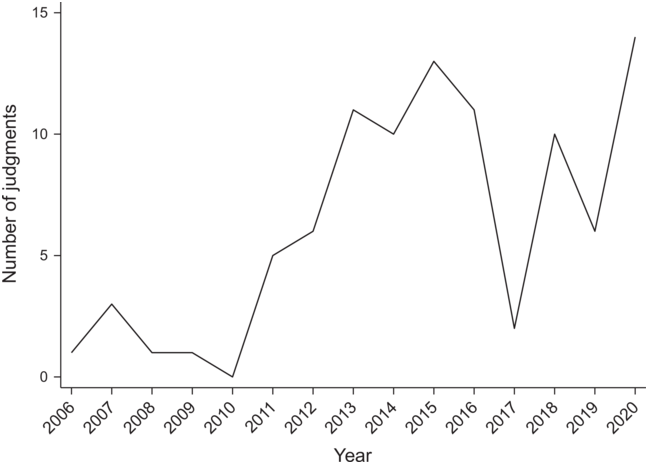
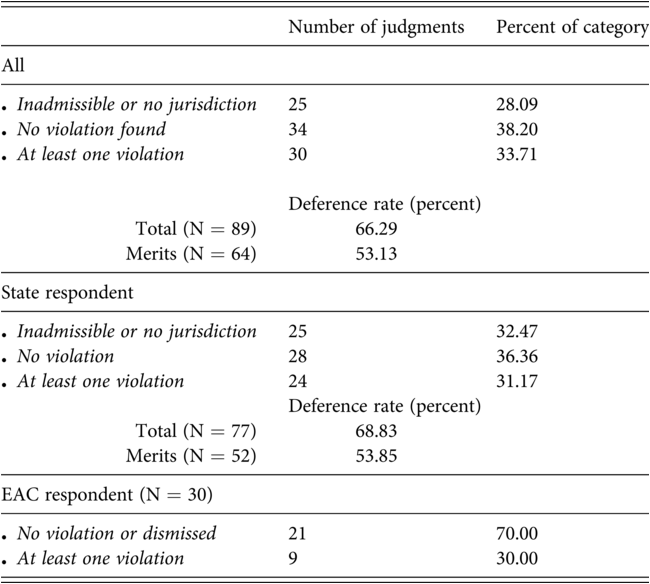
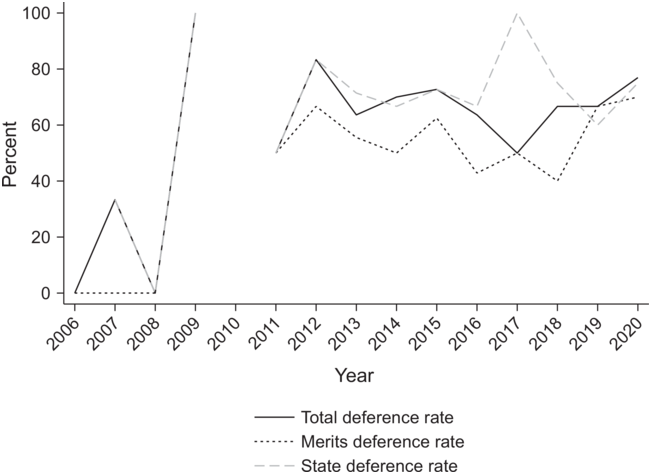
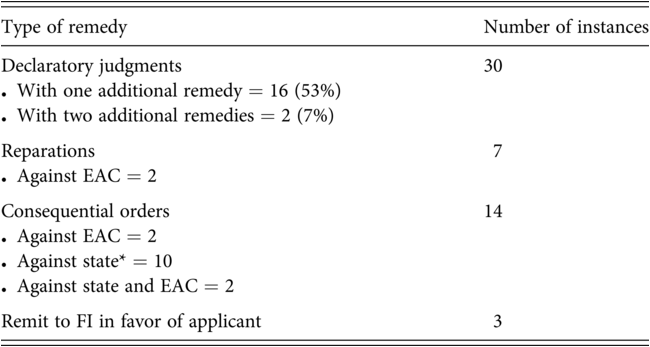
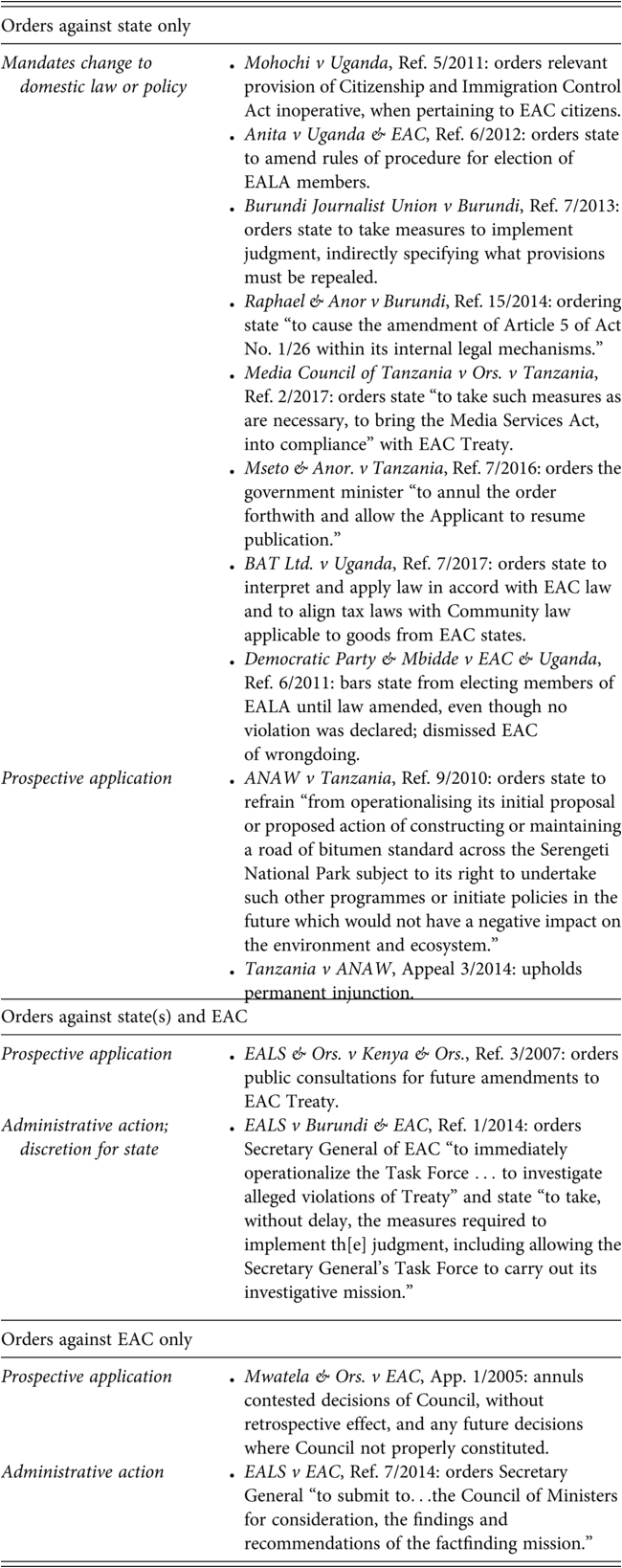
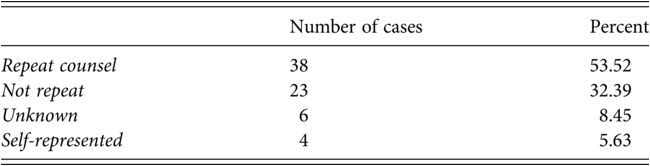
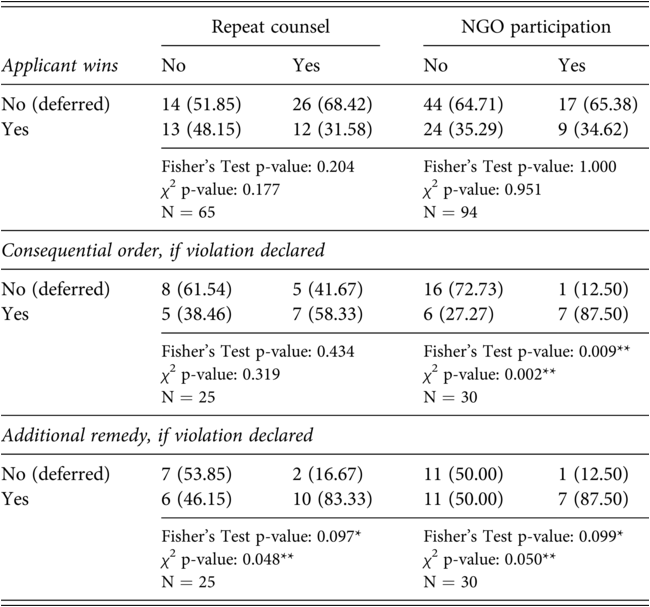
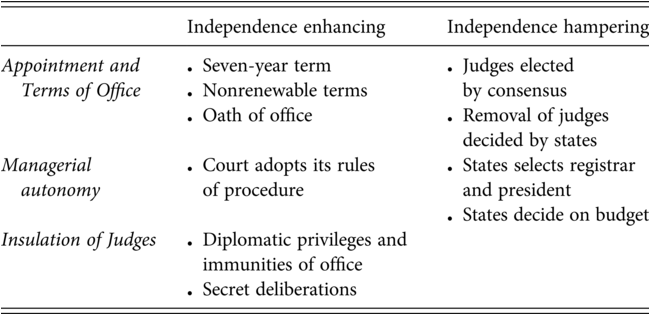
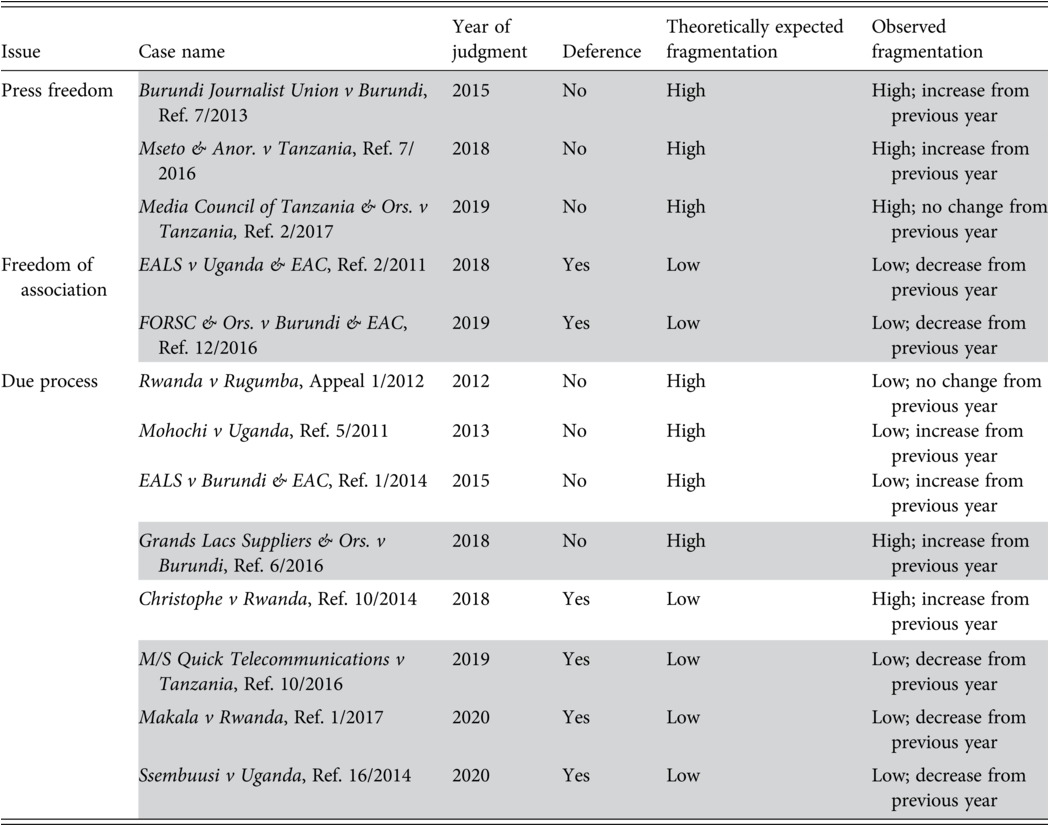
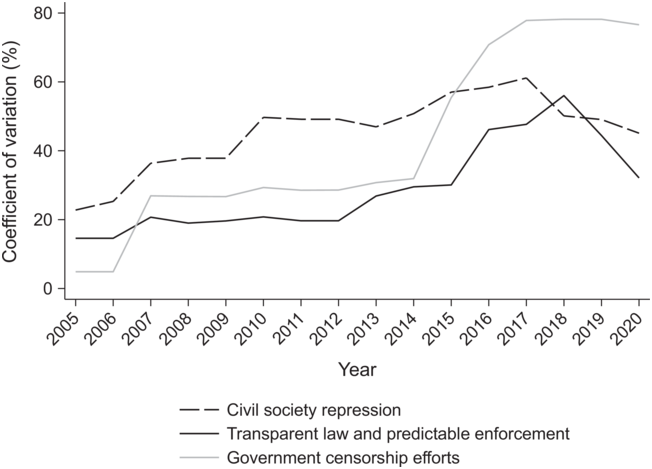
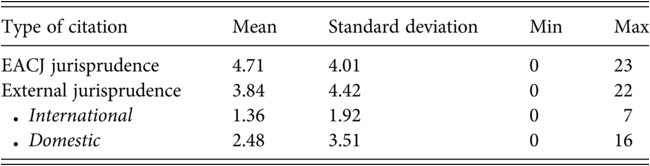
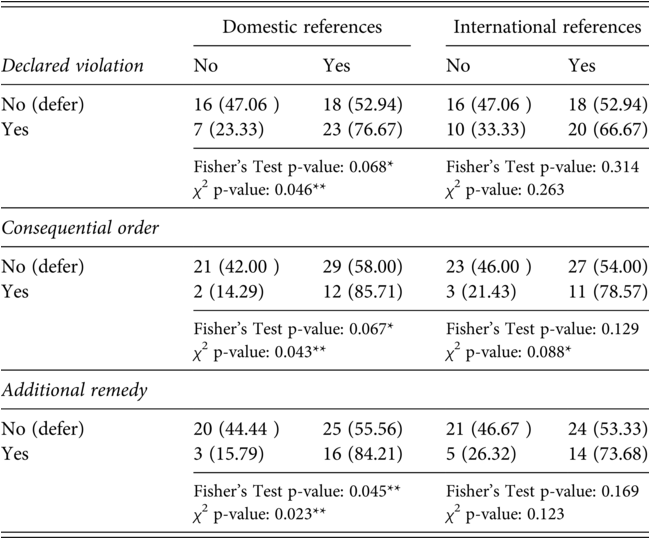

 Open access