

Introduction
The paper provides illustrations of, and posits explanations for, the detrimental treatment of women by the apprenticeship system in Australia. The fact that apprenticeship systems were created for men is an international phenomenon (e.g. Gessler Reference Gessler, McGrath, Mulder, Papier and Suart2019); as McMahon (Reference McMahon, Smith, Zhao and Frost-Camilleri2025) puts it, vocational education and training (VET) systems are written for ‘reference man’.Footnote 1 There are two main strands to the problem in Australia. One is women’s low levels of participation in ‘traditional’ apprenticeships – craft and manufacturing, except for the occupation of hairdressing. The other is the under-representation of feminised occupations in the apprenticeship system in Australia and, therefore, the reduced opportunities for women to access training-based employment, compared to men.
Much attention has been paid to the low participation of women in traditional trade apprenticeships. There are real barriers and problems for women who choose to undertake ‘masculinised’ apprenticeships in traditional trades (Bridges et al Reference Bridges, Wulff, Bamberry, Krivokapic-Skoko and Jenkins2020), which rightly need to be addressed. But while this paper discusses that issue, it focuses to a greater extent on the less-frequently discussed matter, the unfavourable treatment of other occupations by the apprenticeship system. The problem has, in fact, been recognised in policy documents in Australia for many decades, for example, in Kirby (Reference Kirby1985), the government report which prompted a major expansion of the apprenticeship system. Yet still in Australia, women who choose to work in feminised occupations find that apprenticeships, if they exist, often have the lesser title ‘traineeships’ and receive appreciably less attention and benefits. While this has been a long-term problem, the paper will show how developments in the 2020s, such as labour shortages and the move to ‘clean energy’, have served – in fact, have been harnessed – to further disadvantage women, making the problem more urgent.
The paper is written as an analysis of policy developments and manifestations, and sets out to contest the dominant school of thought about women’s engagement with apprenticeships, i.e. that the problem is that too few women enter apprenticeships in masculinised occupations. Synthesising and extending earlier work by the author, it does not report on a research project, but does use data to illustrate arguments. The questions which the paper seeks to answer are:
-
1. What do apprenticeship data show about differences in participation and in funding rates by gender?
-
2. What new imperatives in the apprenticeship domain have taken place in the 2020s? How do these imperatives affect women?
-
3. To what extent do existing theories explain what has happened, and what is happening, to women in the Australian apprenticeship system?
The paper analyses three types of Australian evidence: key policy documents produced by, or commissioned by, the Australian Government; statistics on the occupational distribution of gender over time across Australian apprenticeships and traineeships; and the relative rates of government funding provided for apprenticeships for occupations in masculinised and feminised industries.Footnote 2 The final source of evidence is the specific apprenticeship policy responses to the 2020s developments described above.
The paper begins by explaining apprenticeships as understood internationally and some details about the Australian system, before discussing relevant literature relevant to gender and apprenticeship. It then presents the three different sources of evidence to illustrate the problems in Australia. Except where either traditional apprenticeships or traineeships are being specifically discussed, or where a distinction is important to make a point, the generic term ‘apprenticeships’ is used in the paper, as it is (generally) in government policy documents. It is well recognised, however, that the word ‘apprenticeship’ is generally interpreted as relating only to masculinised occupations, i.e. those covered by the commonly-used term ‘tradies’, which is in itself a manifestation of the problem.
Apprenticeships and the Australian apprenticeship system
The nature of apprenticeships
Internationally, apprenticeships involve learning about, and how to perform, an occupation, usually within a specified type of employment contract. They sit at the intersection of work and training, generally including learning on and off the job, usually with the involvement of an external training provider. While apprenticeships exist in many countries, international comparisons are notoriously difficult (Markowitsch and Wittig 2020, Valiente et al Reference Valiente, Maitra, Gonon and Pilz2025), with several comparative projects showing wide differences (e.g. Smith and Brennan Kemmis Reference Smith and Brennan Kemmis2013; Fazio et al Reference Fazio, Fernández-Coto and Ripani2016). For example, in Australia, apprenticeships are usually undertaken post-school rather than by senior secondary students as in many European countries; again, unlike many countries, they are available to people of any age. The international comparison undertaken by Smith and Brennan Kemmis (Reference Smith and Brennan Kemmis2013) for the International Labour Organization (ILO) tabulates many such variables, including the availability of apprenticeship in various occupational areas, across 11 countries. In 2017, further work was undertaken by the ILO, surveying each of the tripartite partners in the 20 large economies of the G20, with the analysis carried out by Smith et al (Reference Smith, Tuck and Chatani2018). The survey was based on the ten Actions for Quality apprenticeships agreed by the G20 at a meeting of the G20 Labour and Employment Ministers and subsequently endorsed at the 2016 Hangzhou G20 Summit (Smith et al Reference Smith, Tuck and Chatani2018, xi) and provides further points of comparison.
Apprenticeship systems often display skewed gender participation; Australia resembles other countries where systems have historically been confined to relatively small numbers of occupations primarily undertaken by men (e.g. Smith and Brennan Kemmis Reference Smith and Brennan Kemmis2013), except for hairdressing, where females predominate. Some countries, such as the US and Canada, are still overwhelmingly male-dominated. In countries where apprenticeship is normally part of senior secondary schooling, the genders are more balanced. There are international agreements on education and work which should guide national policies on apprenticeships. The G20’s agreed Actions, referred to earlier, included Action 3 ‘promoting apprenticeship programmes in a broad range of occupations and sectors’ and Action 7 ‘Improving access to quality apprenticeship for disadvantaged groups’. Interestingly, women were not specifically mentioned in the Actions, but governments reported initiatives for women as part of their Action 7 responses on ‘disadvantaged groups’ (Smith et al Reference Smith, Tuck and Chatani2018, xii-xiii). Two of the United Nations’ 17 Sustainable Development Goals (SDGs) are also relevant: SDG 4: ‘Ensure inclusive and equitable quality education and promote lifelong learning opportunities for all’ and SDG 5: Achieve gender equality and empower all women and girls.Footnote 3
Apprenticeship systems usually display high-level participation by governments, trade employers, and trade unions (Bridgford Reference Bridgford2017) in the tripartite formulation of apprenticeship policy (International Labour Organization (ILO) 2017). In Australia, the trade unions, and particularly those in the male-dominated areas, have been particularly influential in VET policy since the 1940s (Gospel Reference Gospel1994). Apprenticeship systems are essentially conservative – i.e. slow and/or reluctant to change – (Smith Reference Smith2019a) or, put more bluntly, ‘ossified’ (PhillipsKPA 2018, 22). It is difficult to reach agreement among the stakeholders for change, as interests may vary so much and can be deeply entrenched. As Smith (Reference Smith2019a) points out, apprenticeships’ conservative nature partly rests in their embeddedness into a wide range of economic and social structures. This is a strength and an indicator of resilience on the one hand, and prevents undesirable ‘hi-jacking’, but on the other hand, can be problematic where apprenticeships need to evolve quickly to meet changes in economy and society, as Smith (Reference Smith2019a) points out.
The Australian apprenticeships system
The Australian system includes ‘traditional trade’ apprenticeships and newer traineeships, which are described further below. Australian apprentices and trainees achieve formal qualifications from the vocational education and training (VET) system, normally from a competency-based Training Package. Training Packages are based around industry and/or occupational areas, and are developed by government-funded skills councils (Smith Reference Smith, Tierney, Rizvi, Ercikan and Smith2023). Most apprenticeship qualifications are at Certificate III level on the Australian Qualifications Framework (AQF), with a small number at higher qualification levels, including a few at degree level (AQF level 7). Higher or degree apprenticeships are more common in many other countries (Smith et al Reference Smith, Tuck and Chatani2018) but are still in their infancy in Australia. Traditional trade apprenticeships generally last for three or four years, and traineeships for one to two years, more often one year.
Australian apprentices and trainees are always formally employed, usually but not always full-time, and receive wages, unlike in some other countries where apprentices receive only stipends (Smith and Brennan Kemmis Reference Smith and Brennan Kemmis2013). Most who complete their term continue in employment with the same employer, but completion rates are quite low, consistently a little over 50% (e.g. National Centre for Vocational Education Research [NCVER] 2024); this is often seen as a policy problem. State and Territory governments fund, or to be more exact, ‘subsidise’,Footnote 4 the formal training component of apprenticeships, and are also responsible for ‘declaring’ occupations as apprenticeships; some occupations are ‘declared’ only in some States. The Commonwealth government provides some financial incentives for employers and apprentices, generally minor; a $1500 AUD employer incentive was a standard rate for many years. Rates have varied over time (Ross and Paul Reference Ross and Paul2024). There is particular funding to encourage participation by equity groups.
In the mid-1980s, shorter ‘traineeships’ were introduced in a wide range of industry areas previously without apprenticeships (Smith Reference Smith2021). They are typically one to two years in duration compared with the three or four years for traditional ‘trade’ apprenticeships. At around that time, government funding for apprenticeship and traineeship training was made available to private training providers as well as Technical and Further Education (TAFE), the public provider. This initiative was known initially as ‘user choice’ (Smith and Keating Reference Smith and Keating2003) since companies could now choose where to send their apprentices or trainees, rather than being obliged to use the nearest public training provider. Evident abuse by some training providers and apprentice contracting agencies also became apparent. These early abuses unfortunately tainted the concept of traineeships in Australia, providing an easy target for commentators who wished to confine apprenticeships to trade occupations (e.g. Schofield Reference Schofield1999, as discussed by Smith Reference Smith2008a and Reference Smith2022). Subsequent research, however, has showed many instances of good traineeship practice (e.g. Smith et al Reference Smith, Comyn, Brennan Kemmis and Smith2009; Smith Reference Smith2015a; the satisfaction rates of trainees with their training both on-the-job (88.6%) and off-the job (86.4%) were high (NCVER 2024); those in traineeships were slightly more satisfied with their on-the-job training than trade apprentices, and slightly less satisfied with the off-the-job training. Smith et al (Reference Smith, Callan, Robinson, Smith and Snell2024) found, in the retail and hospitality industries, that traineeships were often a route into well-paid management jobs at young ages.
The Australian apprenticeships system expanded, steadily and later rapidly, as a result of the introduction of traineeships. In the early 21st century, there were two spikes, in the early 2000s and the early 2010s, for particular reasons. Apprentice participation at its peak reached just over 4% of the employed population in 2011, with over 400,000 people in training, but fell rapidly after that due to funding cuts (Smith Reference Smith2021, 350), which is discussed later in this paper.
Government data, collected by the National Centre for Vocational Education Research, do not differentiate between apprenticeships and traineeships, instead using the proxy ‘trade and ‘non-trade’. Analysis of figures presented by Smith (Reference Smith2021, 351) shows that the proportion in ‘non-trade’ apprenticeships (i.e. traineeships) increased from zero in 1985 – as might be expected since that was the year of the Kirby report (Kirby Reference Kirby1985), which recommended traineeships’ institution, to 10.8% in 1993, and more rapidly after that, so that ‘non-trade’ numbers actually exceeded ‘trade’ numbers from the years 2002 until 2011. By 2019, non-trade apprenticeships (i.e. traineeships), mainly, but not only, in feminised or non-gender-weighted occupations, constituted only 34.9% of total apprenticeships (Smith Reference Smith2021).
Apprenticeship systems often incorporate intermediary bodies to facilitate and expand the operation of apprenticeship systems (Smith Reference Smith2019b). Australia has two types. Group Training Organisations (GTOs), in place since the 1980s, act as an apprentice’s formal employer, placing the apprentice with a host employer (Smith Reference Smith2019b). They currently employ 6.6 % of apprentices, with higher proportions in traditional trades, for example, 12.0 % of electrical apprentices (Ross and Paul Reference Ross and Paul2024, 111, 296). Apprentice Connect Providers manage apprentices’ contracting arrangements and government reporting; these bodies have had different names over the decades. GTOs are generally non-profit, but the apprentice contracting system is privatised; a small number of major companies hold national contracts (Smith Reference Smith2019b) and are paid per sign-up.
Relevant themes from the literature on gender in work, and specifically in apprenticeships
The gendered nature of occupations is universally acknowledged, with a ‘complex mixture of individual choice, social orientations and institutional arrangements reinforcing the differential status of men and women in work.’ (Niemeyer and Colley Reference Niemeyer and Colley2015). Feminised occupations tend to exhibit lower pay rates and worse working conditions (Pocock Reference Pocock2016), and women may be deliberately excluded from masculinised occupations (Goldin Reference Goldin2014) to protect occupational prestige. Occupations may be less respected after women enter them, or women may enter them because they have become less respected (Thompson Reference Thompson1989). Pan (Reference Pan2015) refers to ‘tipping points’ where occupations may suddenly lose their gendered nature after a large influx of entrants from the other gender. Some occupations have characteristics that deter women from entry, such as physically demanding or dirty work, or male networking, which excludes women (Giazitzoglu 2024); workers display ‘hegemonic masculinity’ (L. Smith Reference Smith2013, 863). It has been argued that women simply have differential preferences and traits, but differentiation between active choice and the experience of barriers is difficult (Olivetti et al Reference Olivetti, Pan and Petrongolo2024).
Beliefs about skill affect occupational prestige and, therefore, the extent to which men may wish to exclude women. The social construction of skill is operationalised through industrial relations arrangements, and proxy measures such as wage rates or length of training (Spenner Reference Spenner1990), all relevant to apprenticeship arrangements. The bulk of traineeships are in service industries, where skills are undervalued and undocumented (Hampson and Junor Reference Hampson and Junor2015), and are dismissed by some writers (e.g. Payne Reference Payne2009). In social construction theory, the presence of women in an occupation provides in itself a perception of a low-skilled job (Healy et al Reference Healy, Hansen and Ledwith2006). Indeed, Warhurst et al (Reference Warhurst, Tilly, Gatta, Warhurst, Mayhew, Finegold and Buchanan2017) argue that gender, race, and class are now the main determinants of perceived skill in work. Beliefs about skill are highly entrenched, and as Acker (Reference Acker and Wallace1989, 78) points out, paradigm shifts are difficult to operationalise within ‘social structures dominated by men’; inevitably, resistance from those with labour market power will occur. Social construction of skill is powerful and internalised; Duemmler and Caprani (Reference Duemmler and Caprani2017), for example, in Switzerland, describe how retail apprentices are driven to develop strategies to valorise their apprenticed occupation.
The concept of the labour aristocracy – a privileged layer of workers who have, over time, colluded with capitalist leaders, appropriated the ‘fruits of empire’, and enjoyed superior conditions of work and earnings (Hobsbawm Reference Hobsbawm1968) – is highly relevant to apprenticeships. Gray describes a ‘distinct upper stratum of the working class’. He describes trades such as engineering and building, just as in Australia today, ‘characterised by an apprenticeship system and a sharp distinction between members and non-members of ‘the trade’’ (Gray Reference Gray1981, 64). He references Engels who ‘emphasises ‘the labour of grown-up men’ and ‘the great Trades Unions.’Footnote 5 In the 19th century in the UK, the labour aristocrats were skilled in controlling changes in workplaces, and their power was linked to craft training systems (Gray Reference Gray1981, 24). Gray states that confusion was caused by the arrival of newer industries without formal systems of apprenticeships. While gender is not always a component of the theory, Gray (Reference Gray1981, 26) argues otherwise, describing the exclusion of women from the labour aristocracy as a means of ‘policing the frontiers of craft skill’, since women’s work was regarded as unskilled. Moreover, women could be paid less as they were not the breadwinners in a family (Gray 198, 1, 29), which in turn led to a subordinate role for women and shaped occupational hierarchies.
The reserve army of labour may be seen as another pillar of the occupational hierarchy. The reserve army is seen in Marxist terms as the mass of unemployed people who could be called upon or discarded as the economy dictated (Thompson Reference Thompson1989, xv). Gray (Reference Gray1981) maintains that women in the home or performing outworking at home were also a reserve army of labour. However, this notion has been contested (Thompson Reference Thompson1989, 193). Further, Bruegel (Reference Bruegel1979) argued that, in the light of changes in industrial structures, the rise in importance of service work in the economy meant that women could not so easily be ‘disposed of’ in times of economic crisis.
Gender in VET and apprenticeships
VET has always been male-focused; Choy and Edwards-Groves (Reference Choy and Edwards-Groves2024) recount Australian VET’s original focus on male work, with women being confined to ‘domestic science’ and secretarial schools. More recently, gender discussions of women in VET have tended to focus on the lack of penetration by women of male areas (Phan Reference Phan2001; Butler and Ferrier Reference Butler and Ferrier2006). Women in Australian VET (which includes institutional-based VET as well as apprenticeships) are currently concentrated in health care, community services, and early childhood occupations, all growing sectors. They form almost half (46.6%) of VET students and have higher completion rates in VET than men, as a government report (DEWR 2023) states. This seemingly positive result is depicted, however, as problematic (DEWR 2023, 10) because of the occupational areas in which women study, with the report expressing a preference to move women into trades. Niemeyer and Colley (Reference Niemeyer and Colley2015) view such strategies to encourage women to enter male-dominated areas of VET may be construed as blaming women for their occupational choices.
It is thus not surprising that apprenticeships in feminised industries have lower status than those in masculinised industries, precisely because the apprenticeship system grew around the dominance of men. A dominant strand of literature buttresses the relative positions of men’s and women’s work in the apprenticeship system. Fortwengel et al (Reference Fortwengel, Gospel and Toner2019, 21), for example, refer dismissively to traineeships in the service industry as ‘lesser skilled’, while Buchanan (Reference Buchanan2015) claims that traineeships are ‘characterised’ by a lack of off-the-job training. Some writers on the UK system, such as Keep and James (2010), mount similar arguments. Their arguments often attack employers, as does Cully (Reference Cully2008), for example, in asserting that employers’ use of traineeships was an attempt to ‘capture economic rents’ through the (modest) employer incentives and through the ability to pay lower wages while training. He does not apply this criticism to employers of apprentices in masculinised occupations. Cully (Reference Cully2008: 272) also claims that because trainee wages do not rise appreciably on completion, unlike trade apprentices’ wage rise on completion, ‘by inference’ there is no rise in productivity. The phrase ‘by inference’ ignores the historical reasons why jobs generally undertaken by men are paid more than those generally undertaken by women. And so, undertaking a traineeship in a female-dominated occupation is to invite disparagement, although there is no reference to gender, only to occupations, in critiques.
A more overt theme in the apprenticeship literature, as noted earlier, is the problem of low participation of women in male-dominated trades. Kirby (Reference Kirby1985) mentions a figure of around 10%, and this figure persists to the current day, as will be shown later. While this imbalance may be attributed to gender stereotyping and lack of enlightened career guidance, women are also deterred by fears of harassment or intimidation during training or work (Struthers and Strachan Reference Struthers and Strachan2019), and apprenticeship structures do not provide support to women to address these matters (McMahon Reference McMahon, Smith, Zhao and Frost-Camilleri2025). The construction industry in Australia is especially prone to problems during apprenticeships, with a culture among workers of risk-taking and disregard for safety (Loosemore and Malouf Reference Loosemore and Malouf2019), and complicated further by the preponderance of sub-contracting (Pook Reference Pook2024) and an adversarial industrial relations culture (Arnold and Kelly Reference Arnold and Kelly2024). Moreover, as McMahon (2015, 91) points out, since it is overwhelmingly males in male-dominated organisations who recruit new apprentices in trade occupations, ‘historical patterns of exclusion’ persist.
In Australia, females have lower completion rates than males in Australia in male-dominated apprenticeships (Ross and Paul Reference Ross and Paul2024, 212). A large-scale US study found the same (Srikanth et al Reference Srikanth, Baker, Meischke, Seixas and Zuidema2024); and in Germany, Beckmann (Reference Beckmann2023) found, more generally, that ‘gender-atypical’ apprentices (i.e. males in ‘female’ jobs and females in ‘male’ jobs) were more likely to withdraw. Apprentice intermediary organisations may assist; Ross and Paul (Reference Ross and Paul2024, 212) state, using government data, that being employed by a GTO, while having a positive effect on completion rates for both genders, has a greater effect for females than males in trade apprenticeships.
Key evidence of the disadvantaging of women in the apprenticeship system
Four major sources of evidence were used for analysis:
-
1. Seven major Australian Government reports (1954 to 2024) on apprenticeships were analysed for their gender content, providing a snapshot of policy changes and stakeholder concerns over time.
-
2. Overall statistics on participation by gender in the apprenticeship system were extracted for the periods 1995–2019 and 2020–24; analysis by occupational area for occupations with more than 2000 commencements for the year 2023–2024 was used to show patterns of gender dominance.
-
3. Funding: A comparison of funding (‘subsidy’) rates for off-the-job training for one typical occupation in each of the occupational areas, using rates for the year 2024. The State of Victoria was selected for the analysis, since Victoria, currently with around 20% of commencing apprentices, was the site of earlier research on apprentice funding rates, and has often led funding trends.
-
4. Apprenticeship-related policy reactions to recent economic changes – post-COVID labour shortages, ‘clean energy’ and ‘green skills’ – were analysed for their gender implications. The focus was on the make-up of the Apprenticeships Priority List and the financial incentives for apprentices and employers. A linked development was the ‘hi-jacking’ of a government programme on women’s careers.
1: Analysis of gender in major Australian apprenticeship reports issued by the federal government
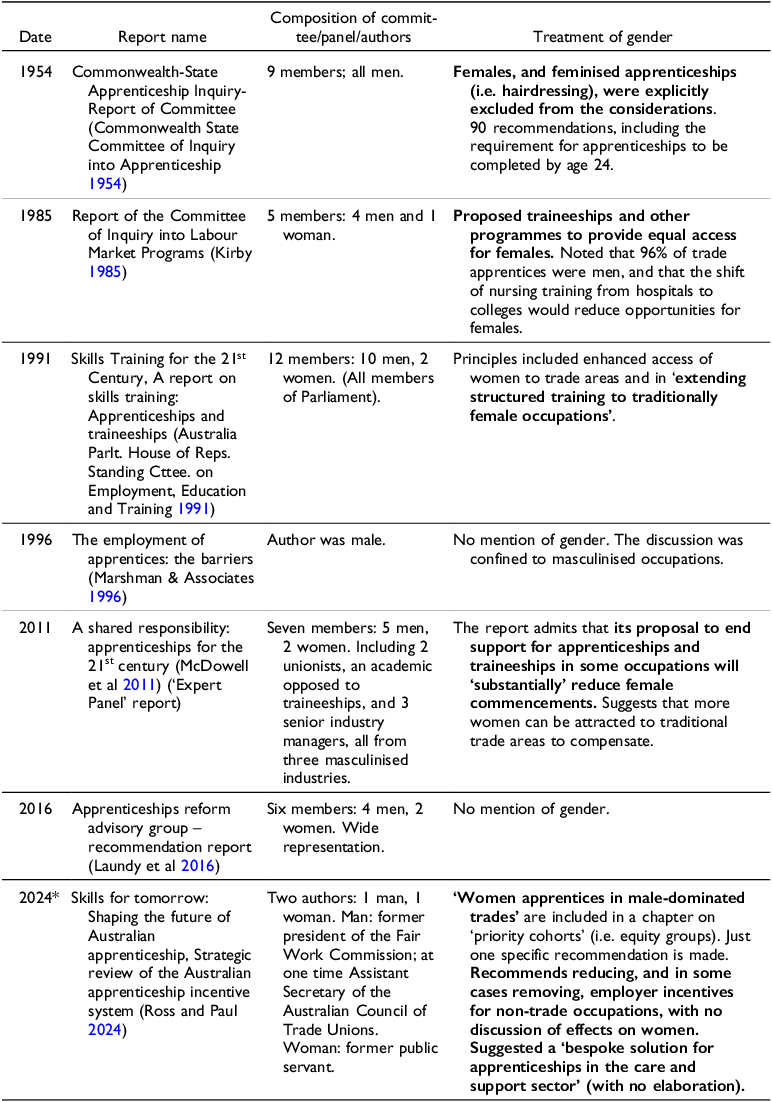
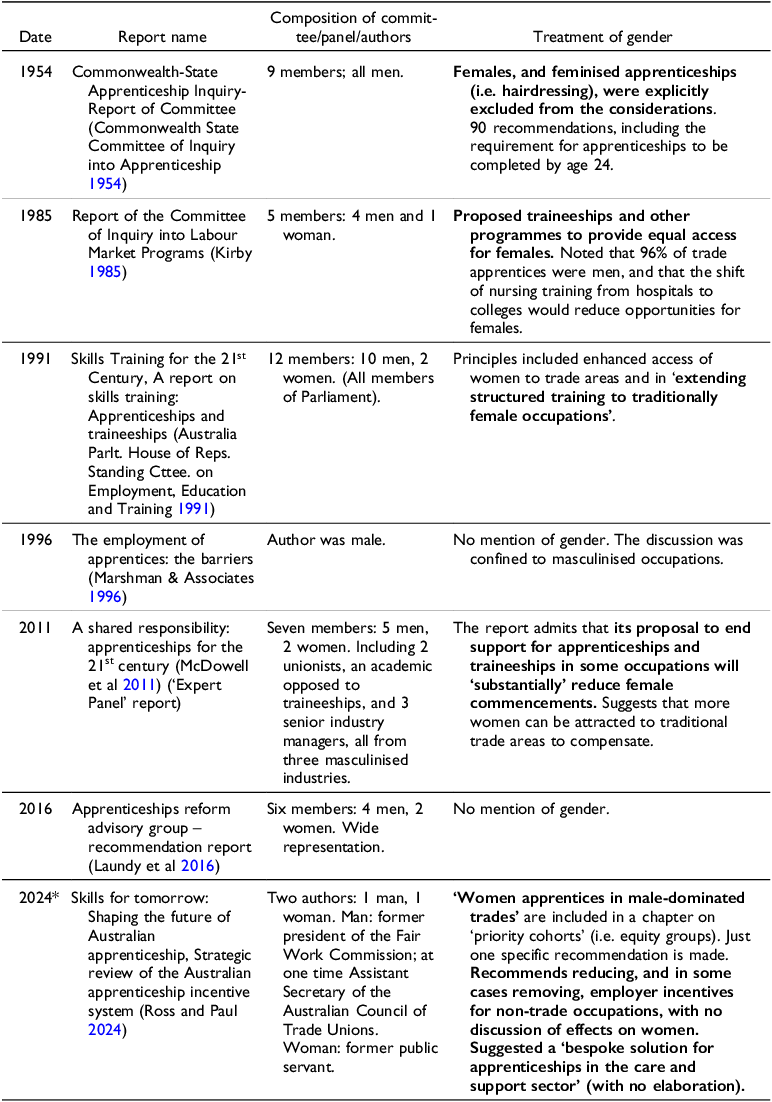
Seven major national apprenticeship reports, four listed by the National Centre for Vocational Education Research (NCVER) in its ‘landmark documents’ section,Footnote 6 which covers reports to 2010, with the addition of three later reports, were analysed for the gender composition of the committees’ panels, or the individuals who authored the reports, and the way in which gender issues were addressed (Table 1). Key gender propositions of the reports are bolded in the Table.
Gender analysis of government apprenticeship reports
* Released 2025.
Source: Author.
In the discussion, it should be borne in mind that government documents may or may not be viewed favourably by governments or translated directly into policy. But even if they are not, they provide useful insights into the views held by dominant stakeholders and/or officials at the time. Moreover, they remain on the public record and could be utilised in the future.
The 1954 report (Commonwealth-State Committee of Inquiry into Apprenticeship 1954), as might be expected from its date, excluded women completely. The Kirby report (Reference Kirby1985), in contrast, addressed the issue of women’s marginalisation as a priority, stating that ‘the trades and the apprenticeship system have been, and still are, a male domain’ (125). It noted that at that time, 33% of male school leavers but only 4% of female school leavers were apprentices. As the author put it, ‘Young women are disadvantaged by the male stereotyped nature of trade training and the types of occupations it serves’ (Kirby Reference Kirby1985, 124). To address this imbalance, it therefore proposed the system of traineeships, initially aimed at school-leavers, and in industries where apprenticeships did not exist. They were required to have a minimum length of one year, to include off-the-job training, and to have ‘equal access to males and females’ (Kirby Reference Kirby1985, 120). These traineeships were subsequently introduced. The 1991 report also explicitly encouraged expansion of contracted training into feminised occupations, as well as encouraging women into masculinised occupations. Since then, for over two decades, reports have either ignored gender issues (see e.g. Bob Marshman and Associates 1996; Laundy et al Reference Laundy, Lindgren, McDougall, Diamond, Lambert, Luciani and De Souza2016) or have proposed reduced funding for feminised occupations (McDowell et al Reference McDowell, Oliver, Persson, Fairbrother, Wetzlar, Buchanan and Shipstone2011, Ross and Paul Reference Ross and Paul2024). The latter two reports are discussed below and also in more detail later in the paper, as they are central to the paper’s argument about women’s disadvantage in the apprenticeship system.
The 2011 Expert Panel report ‘Apprenticeships for the 21st Century’ (McDowell et al Reference McDowell, Oliver, Persson, Fairbrother, Wetzlar, Buchanan and Shipstone2011) became notorious for advocating the removal of financial support for traineeships. Smith (Reference Smith2015b) has explained how that earlier report was not only enacted in relation to Commonwealth government support but was also referenced by some jurisdictions in order to justify cuts to training subsidies. At one stage, the funding for training for some feminised occupations in the State of Victoria was set at $1.50 per hour per trainee compared with over $10.00 for masculinised occupations (Smith Reference Smith2015b). This meant that some public and private training providers permanently ceased provision of training for those areas (Guthrie et al Reference Guthrie, Smith, Burt and Every2014). The 2024 report (Ross and Paul Reference Ross and Paul2024) contains a similar proposal to defund most traineeships, while remaining equivocal on child care and aged care workers.
Both of these reports were partly authored by people from masculinised trade union backgrounds, with the 2024 (Ross and Paul Reference Ross and Paul2024) lead author also having chaired the Fair Work Commission, the national employment relations tribunal, for ten years. The industry representatives on the ‘Expert Panel’ report (McDowell et al Reference McDowell, Oliver, Persson, Fairbrother, Wetzlar, Buchanan and Shipstone2011), including one of the two women on the panel, were all from masculinised industries such as construction, aerospace, and mining. As will be discussed further, the Ross and Paul (Reference Ross and Paul2024) report relied heavily on anti-traineeship literature, such as a report by Cully (Reference Cully2008) produced for the Fair Work Commission.
2. Statistics on participation by gender
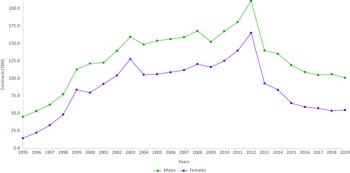
Figure 1 presents commencement data for the years 1995–2019; the dates were selected to show developments over the quarter of a century prior to the disruption of the apprenticeship system by the COVID pandemic.
Apprentice/trainee contracts commencements 1995–2019 (to 30 June annually) by gender.
Source: Derived from NCVER’s National Centre for Vocational Education Research) ‘Apprentices and Trainees’ data collection.
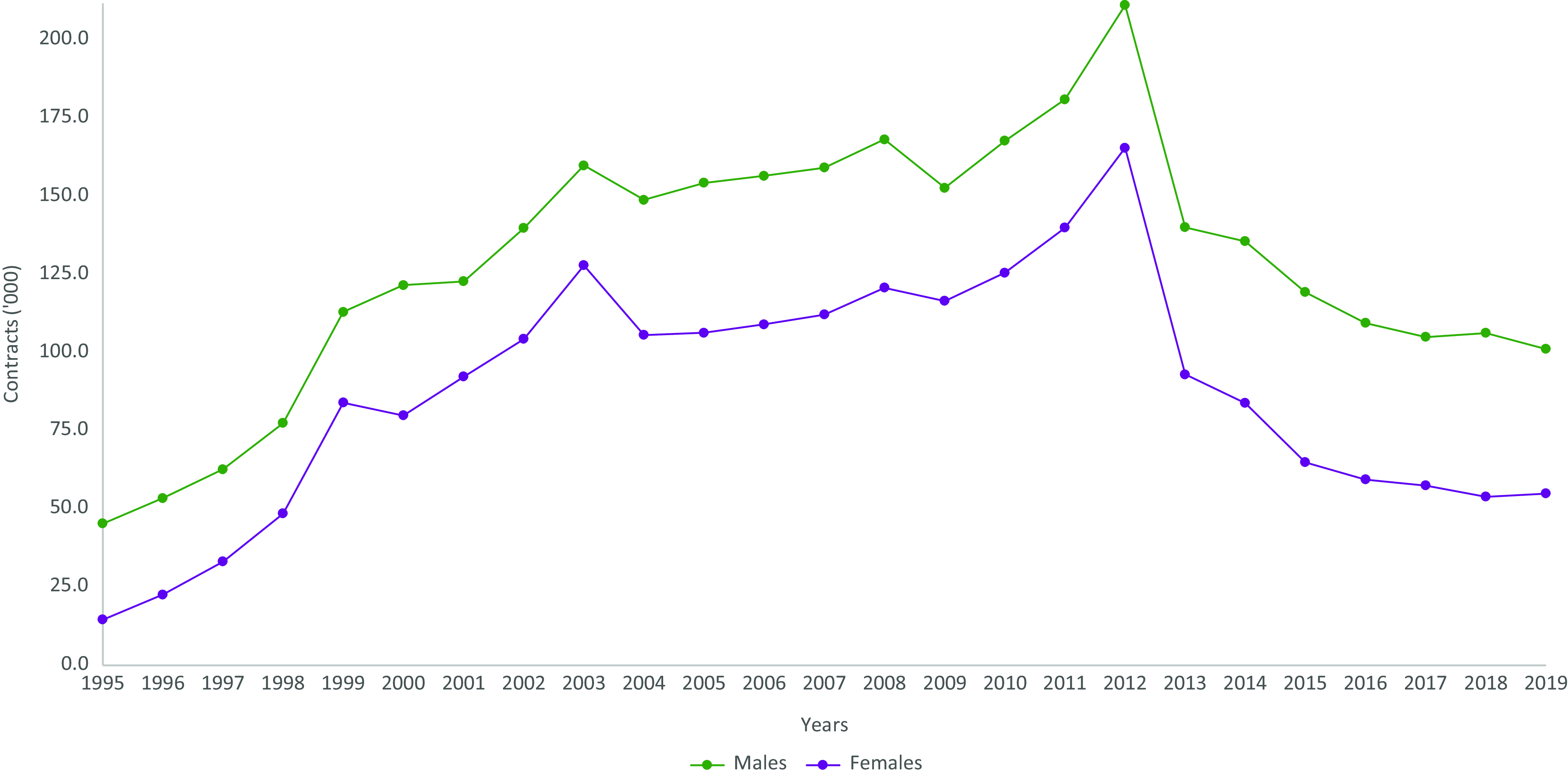
Figure 1 shows that male commencements in the apprenticeship system exceeded female commencements for the whole 25-year period, with a low female base of 24.5% (14,700 out of 60,000) in 1995. Figure 1 shows the gap narrowing at times when total apprentice numbers were higher, with women forming 43.9% (165,600 out of 376,900) of commencements in 2012, for example, and even higher in 2009 when there was an anomalous sharp fall in male commencements, perhaps due to the Global Financial Crisis. The gender gap widened again, with a rapid fall after 2012, and female commencement settled to around 35% of commencements by the end of the decade. The rapid fall in the mid-2010s can be attributed to the events set in chain by the 2011 McDowell et al ‘Expert Panel’ report, discussed in the previous section.
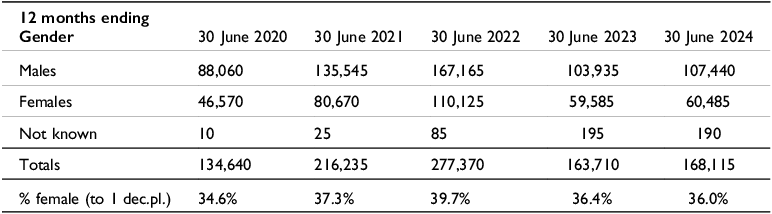
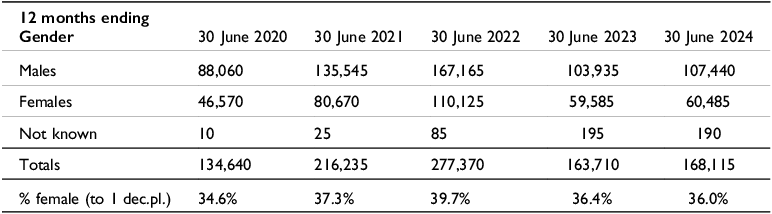
Table 2 below brings the ‘commencing’ data shown in Figure 1 to the current day.
Commencing apprentices and trainees in Australia by gender 2020–2024
Source: NCVER 2024, Apprentices and trainees 2024 – June quarter Data Builder, Contract status, Gender by 12-month series. Percentages added by author.
Table 2 shows a COVID-related drop in total commencements from 156,200 in the year 2018-2019 to 134,640 in 2019–2020. This would be expected, since recruitment effectively stopped in March 2020. However, the numbers recovered due to generous wage subsidies for apprenticeships, which are discussed in detail later in the paper. These COVID subsidies (see Smith Reference Smith2024) affected total numbers over this period, accounting for the peak in total commencement in 2021 and 2022. In line with other peaks discussed above, women’s relative participation increased during the peak COVID subsidy years. However, the percentage changes were only minor compared with earlier peaks, perhaps because masculinised trade commencements peaked in 2022,Footnote 7 due to a heavy investment in infrastructure projects during the COVID period (Smith Reference Smith2024). Women reached 39.7% of commencements in 2022, not far from the 2012 peak of 43.9%, but the figures dropped after that. In effect, Table 2 shows the continuation of the late 2010s trend of women forming about a third of total enrolment.
As well as the commencement numbers shown in Figure 1 and Table 2, ‘In-training’ numbers are also collected. The gender gap is higher for these, as trade apprenticeships last for three or four years, meaning that men generally remain in the system for much longer than women and are counted each year they are enrolled. Ross and Paul (Reference Ross and Paul2024, 31) state that, for December 2023, only 28.0% of apprentices in training were women. In contrast, women constitute 47.9% of all employed people (2022 figures) (Workplace Gender Equality Agency 2022).
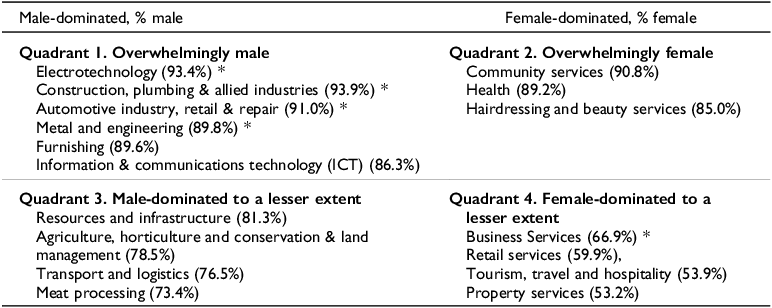
Further analysis was carried out by occupational area, using designated apprenticeship ‘occupational area’ groupings. The year 2023–2024 was selected for the analysis, as by this time, apprenticeship numbers had reverted to a pre-COVID norm. The numbers by gender in the top 17 occupational apprentice areas by number of commencements were allocated to four categories: those overwhelmingly male or female dominated (85% plus), and those gender segregated to a lesser extent (Table 3). These 17 occupational areas each had 2,000 or more apprentice/trainee commencements; (Information & communications technology was added, with 1,945). In Table 3, the five largest occupational areas – those with over 10,000+ commencements – are indicated by *. ‘Metal and engineering’, with 9,735 commencements, is also starred, because its total was so close to 10,000, with a natural break in the data below that.
Occupational analysis of commencements by gender, Australia, 2023–2024 year (occupations with over 2000 commencements)
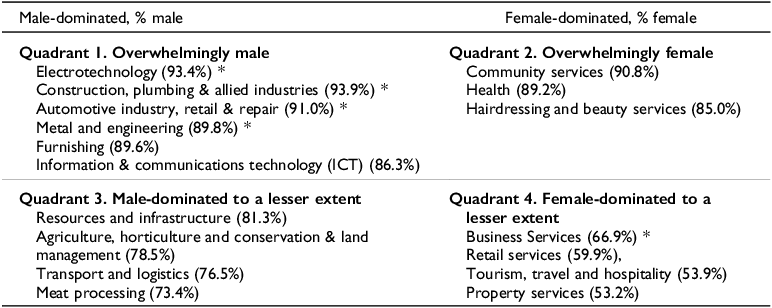
* refers to 10,000 or near commencements
Source: Author, using https://www.ncver.edu.au/research-and-statistics/data/databuilder#
All but one of the heavily apprenticed occupations (10,000+ commencements) were found to be in Quadrant 1 – ‘overwhelmingly male’. The three ‘overwhelmingly female’ apprentice areas had lower numbers. The only female-dominated area with 10,000 commencements (Business studies, Quadrant 4) was only two-thirds female. Only two of the 17 most-apprenticed occupational areas (Tourism, travel, and hospitality and property services) had more or less equal gender splits, both in Quadrant 4. Notably, the occupational areas with more men were more gender-segregated than those with more women.
3. Comparison of funding by occupational area
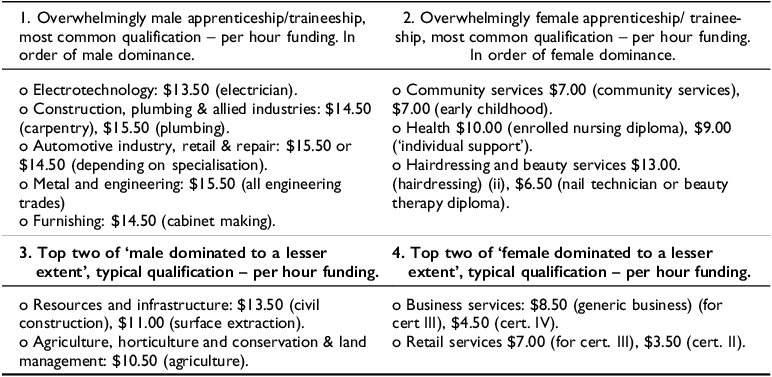
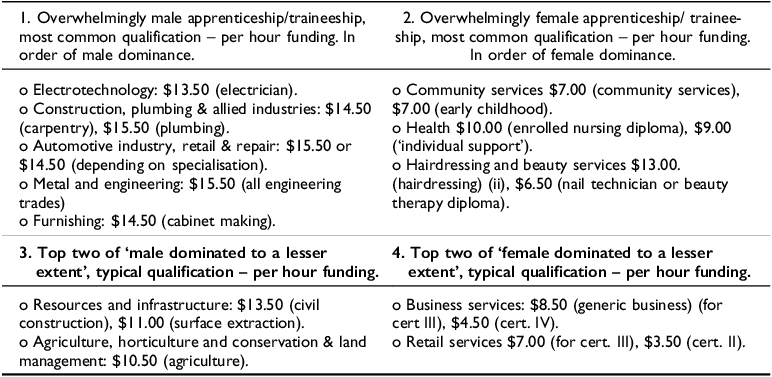
Funding: Table 4 compares the funding (‘subsidy’) allocated for training of apprenticesFootnote 8 , by the State of Victoria, to typical occupations in 12 of these occupational areas. State government funding lists are provided by qualification, rather than by ‘occupational area’; therefore, a ‘typical’ and heavily used qualification had to be selected for each area, which was done by inspection of the relevant Training Package’s qualifications list. Certificate III level qualifications were selected in most cases, because a Certificate III is regarded as a full occupational qualification compared with lower levelsFootnote 9 ; it is the standard for masculinised trade apprenticeships. Qualification regimes in some other occupations meant that qualifications at other levels needed to be used, for example, at Diploma level in beauty therapy.
Funding rates per hour in AUD for apprentice/trainee programmes, Victoria, 2024, most common apprenticeship/traineeship qualification in each occupational area
Source: Data from Victorian government’s 2024 Funded Program List.
Notes: (i) This list, which in prior years was formerly publicly available, is now only available to those who can log into the ‘Skills Victoria Training System, see https://www.vic.gov.au/access-skills-victoria-training-system. A copy was provided by a TAFE Institute for use in this paper. (ii) Hairdressing was the only apprenticeship area in the ‘overwhelmingly female’ category. All others were deemed traineeships.
Five of the 17 occupational areas included in Table 3 contained such diverse qualifications that it was impossible to select a ‘typical’ qualification for occupational area. The five omitted from Table 4 were the ICT category from Table 3’s Quadrant 1, and the two lowest-enrolment occupational areas from each of Quadrants 3 and 4.
Table 4 shows clearly that male-dominated occupations received much higher rates of funding than female-dominated occupations. Even within male-dominated occupations, funding was generally, but not always, higher the more the occupation was dominated by males. The differences cannot be fully accounted for by cost of delivery. Moreover, apprenticeships are funded for longer periods of time – normally three times that for traineeships – so that the differences between the total funding provided by the State for masculinised and feminised occupations are therefore much higher than the Table implies.
4. Apprenticeship-related policy reactions to economic change in the 2020s
In the past five years, three significant changes have affected the economy and the demand for labour in masculinised industries: post-COVID labour shortages, sustainability, and ‘green skills’.
The COVID pandemic years of 2020 and 2021 severely affected all industries worldwide. Fears of mass youth unemployment led, in many countries, to mass subsidies for apprenticeship, as described earlier, among other job generation and retention strategies. However, workforce shortages in many industries began worldwide as economies recovered quickly from the initial COVID shocks (Birch and Preston Reference Birch and Preston2022). Thus, by December 2024, the Australian unemployment rate was only 4%Footnote 10 compared with 6% ten years earlier. The Occupational Shortage List (replacing a previous Skills Priority List) prepared by Jobs and Skills Australia (JSA), a government agency, found that 33% of occupations were in shortage in 2024. Of these, the highest grouping was ‘technicians and trades workers’. Six of the top twenty occupations in shortage are serviced only, or primarily, by apprenticeships, and four may be, but need not be, apprenticeships/traineeships. Fourteen of the top 20 labour shortage occupations were reported to be highly gender-skewed (i.e. 80.0% plus male or female), leading JSA to conclude that gender-skewed workforces ‘may inadvertently constrain the labour supply’ (JSA 2024b,16)
Sustainability is now vital in skill development systems (e.g. Pavlova Reference Pavlova2019), with a specific focus on ameliorating climate change via ‘clean energy’. Much like Industry 4.0 jobs (Gessler Reference Gessler2024), ‘green skills’ can be divided into those creating the architecture (for example, wind farm technicians) and those utilising new systems. Warhurst et al (Reference Warhurst, Harris, Cardenas Rubio and Anderson2025) identified three categories of ‘green’ jobs: ‘pure green’ jobs; those which are ‘greening’ – i.e. requiring new skills and knowledge; and existing jobs that are more in demand due to the imperative of net zero initiatives. The authors found that, in Scotland, women were under-represented in green jobs, except for the second category (Warhurst et al Reference Warhurst, Harris, Cardenas Rubio and Anderson2025). In Germany, Aichinger et al (Reference Aichinger, Wehden, Ludwig and Creutzig2025) have found that young women find what the authors call ‘climate crafts’ unattractive.
The apprenticeship system’s responses
Response to COVID: As explained earlier, employers had previously received minor financial incentives to employ apprentices, but wage subsidies had never been available in Australia as a mainstream incentive. COVID had an immediate and major impact on support for industry to retain and recruit apprentices, as in many other countries. During the COVID pandemic, there was a sudden move to generous (50%) wage subsidies for employers (Smith Reference Smith2024), firstly to retain apprentices, under the Supporting Apprentices and Trainees initiative, then the Boosting Apprenticeship Commencements (BAC) initiative for employers of new or recommencing apprentices and trainees. A later scheme provided a 10% wage subsidy to retain the BAC apprentices and trainees, and was available until June 2025 (Smith Reference Smith2024).
Response to labour shortages: The COVID measures were clearly oriented to job retention and job creation, but had the function of providing a precedent for more generous support for employers in the future. Thus, in July 2022, when the COVID measures (apart from CAC) ceased, occupations on what was known as the ‘Apprenticeships Priority List’Footnote 11 became eligible for wage subsidies to the employer, albeit at a lower rate. The subsidies were 10% of apprentices’ wages for the first two years, and 5% for the third year of employment, with maximum caps set. The occupations on the list in 2022 comprised only those under the umbrellas of ‘Technicians and trade workers’ and ‘Community and Personal Services’ workers. In 2024, the wage subsidy was removed and changed to a hiring incentive only, albeit much larger than ever before ($5000 AUD in two instalments). The priority list was expanded in January 2025. Individual apprentices on the priority list can now also receive a ‘support payment’ of up to $5000 AUD, spread over the first two years. They can also access an Apprenticeship Support Loan, similar to a Higher Education loan.
Importantly, during the period that the post-COVID wage subsidy had been in train (2022–2024), employers of apprentices whose occupations were not on the priority list had still been able to claim a hiring incentive. However, this provision was removed in 2024, and the apprentices receive no support either. These defunded occupations are nearly all traineeships.
Response to ‘clean energy’: Apprentices in the so-called ‘new energy’ occupations receive an additional $10,000 over an apprenticeship term. These occupations are specially flagged on the ‘Priority List’ and are all male-dominated. Initially, the occupations were tightly defined, but from June 2024, they were widened to occupations which might have ‘exposure’ to clean energy, as averred by the employer; the apprentice is required to select clean energy electives in his or her training plan. Eligibility for this and other apprentice payments is interpreted to apprentices by their provider from the privatised ‘Apprentice Connect’ network. There are no additional employer incentives for this group of occupations, but three Apprentice Connect providers and one private training provider receive additional funding as ‘New Energy Apprenticeship Mentoring Providers’.Footnote 12
Building Women’s Careers: The metamorphosis of a government initiative on women in VET
In 2023, a government initiative ‘Supporting women to achieve VET-based careers’ was launched to ‘address systemic barriers for women in VET’Footnote 13 (DEWR 2023, 5). At first, the initiative focused on ‘economic equality’ for women and achieving ‘higher-paying careers’. Questions for public feedback primarily focused on how to achieve more inclusive workplace and VET environments. Gender differences in VET choices were noted. Despite a characterisation of feminised occupations as inferior, the paper did focus on what could be done to improve women’s participation in VET and in workplaces. However, by October 2024, there was a sudden and unacknowledged change in the focus of the initiative. It became the ‘Building Women’s Careers program’.Footnote 14 The new title was presumably intended to reference the construction industry, the imagery on the documentation changed from occupationally neutral to images of women undertaking masculinised trade occupations, and the programme information linked it to a government industry initiative ‘Future Made in Australia’. No actions were proposed beyond funding four-year projects to improve women’s participation in work and training in four industry areas only: construction, advanced manufacturing, clean energy, and ‘digital and technology’ – four of the top five male-dominated areas in Table 3 above. Proposals were invited from groupings of organisations and needed to be aimed at ‘structural and cultural change in women’s participation in VET and the workplace’, with 20 projects announced in March 2025. While these initiatives are undoubtedly welcome, they address only the problem of women’s access to male-dominated apprenticeships, while the original concept paper had a much broader scope.
Discussion
This section draws together the arguments in the paper to answer the three questions posed at the beginning of the paper:
-
1. What do apprenticeship data show about differences in participation and in funding rates by gender?
-
2. What new imperatives in the apprenticeship domain have taken place in the 2020s? How do these imperatives affect women?
-
3. To what extent do existing theories explain what has happened and what is happening to women in the Australian apprenticeship system?
What do apprenticeship data show about differences in participation and in funding rates by gender?
The data have shown that the growth of traineeships in the 1990s and 2010s favoured feminised occupations – or at least brought the numbers of trainees in those occupations, along with total numbers of women in the system, to near parity with male-dominated occupations. In contrast, since then, women’s participation has fallen back to around one-third of commencements, i.e. half that of men. Since women are mainly in shorter traineeships, the number of apprentices/trainees actually being trained at any one time is even more male-weighted. The extent of male domination in trade apprenticeships is very high: 90% or over in the major trade areas, with hairdressing the only exception at 85% female.
The decline of traineeship numbers has been enacted by removal of government incentives for traineeships, but much more importantly, by State governments’ removal or reduction of funding for training for those occupations (Guthrie et al Reference Guthrie, Smith, Burt and Every2014). The withdrawal of funding and consequent withdrawal by training providers has, at least in the State of Victoria, adversely affected post-school options in rural and regional areas for girls as compared to boys (Smith and Foley Reference Smith and Foley2019).
This paper has shown that male-dominated occupations receive a far higher rate of funding for off-the-job apprentice training than female-dominated occupations. Furthermore, the longer training period for male-dominated apprenticeships means that individual male apprentices attract far more government funding than female. In short, the history of apprenticeships in the last 40 years shows a deliberate opening of the system to women via the expansion of apprenticeable occupations, followed by a deliberate closing of the system. These changes mirror, or are mirrored by, the provisions of government reports on apprenticeships (see Table 1), with the 1980s and early 1900s reports supporting expansion, but the 2011 and 2024 reports exhibiting clear attacks on feminised occupations.
What new imperatives in the apprenticeship domain have taken place in the 2020s so far? How do these imperatives affect women?
The introduction of COVID wage subsidies briefly increased the proportion of women in apprenticeships, as has previously happened with growth in total numbers, but the effect soon faded. Labour shortages have increased pressures to attract women to trade apprenticeships, but the purpose of these efforts has shifted from gender equality to filling labour force gaps.
While there are no longer any wage subsidies, employer incentives for some occupations remain higher than at any time except during COVID, prompted by labour shortages in many industries. This shift has been exacerbated by ‘new energy’ funding, where substantial payments to apprentices in male-dominated occupations are made, with the ‘new energy’ proof threshold low. Most of the new energy jobs are those in the third, non-core, category proposed by Warhurst et al (Reference Warhurst, Harris, Cardenas Rubio and Anderson2025) – i.e. those that are more in demand in an economy with a net-zero aim. This could be seen as a form of ‘greenwashing’, sometimes used to make unattractive jobs seem more attractive (Gonon 2022), and in this instance, is being used to advantage apprentices by making jobs seem greener than they are.
Thus, apprenticeship incentives have moved into a higher gear for male-dominated industries. But under the most recent ‘Priority List’ changes to apprenticeships, for the first time in decades, some feminised occupations such as those in retail and business now attract no support for employers at all (nor for apprentices). Even the female-dominated occupations which are on the priority list do not attract direct payments to apprentices, although the employers still receive incentives.
These most recent changes appear to have been working in tandem with the production of the 2024 ‘Skills for Tomorrow’ report (Ross and Paul Reference Ross and Paul2024), with some funding announcements, including the removal of employer incentives for certain occupations, made before the release of the report.
To what extent do existing theories explain what is happening to women in the Australian apprenticeship system?
The Australian apprenticeship system and the changes that have taken place in the last fourteen years serve almost as textbook illustrations of the gender theories of work, social construction theory, and most specifically the labour aristocracy theory. Women entered the apprenticeship sphere on a large scale from the late 1980s, accessing, for the first time, contracted training associated with employment, in the industries and occupations in which they predominated. The apprenticeship system, as operationalised post-World War II in Australia, had served the interests of the ‘skilled’ workers, their ‘capitalist allies’ and specifically of men, and so the entry of feminised occupations to the apprenticeship system proved a threat to the male labour aristocracy, to which the 2011 ‘Apprenticeships for the 21st Century’ government report (McDowell et al Reference McDowell, Oliver, Persson, Fairbrother, Wetzlar, Buchanan and Shipstone2011) appears to have been a (belated) response (Smith Reference Smith2013).
Recent economic developments have provided an excuse once more to reward groups of people, primarily men, entering designated masculinised jobs and their employers. Technical skills are valorised, and many masculinised occupations have been re-classified as ‘clean energy’ jobs to accrue extra privileges – the modern day equivalents of the ‘fruits of empire’(Hobsbawm Reference Hobsbawm1968). It is surprising, yet not surprising when a gender theory lens is applied, that the 2024 ‘Skills for tomorrow’ report found mentioned that women had higher completion rates than men in non-trade occupations, yet recommended removing employer incentives for such occupations, except, perhaps (it remains unclear), in the care and support industries.
The 2024 ‘Skills for tomorrow’ report has moved back towards re-establishing a labour aristocracy that colludes with capital in certain industries. It is significant that employers of trainees are depicted in the report (Ross and Paul Reference Ross and Paul2024: 65, 79, using arguments from Cully [Reference Cully2008]) as profiting from the (modest) subsidies available to them and from the potentially lower wages required. Yet employer subsidies for masculinised industries are not questioned in the Ross and Paul report, nor the lower wages payable to trade apprentices, perhaps because they are viewed as legitimate for boys being turned into men (Gray Reference Gray1981). The report also discusses at some length (Ross & Paul, 77-78) the ‘sharp practice’ of employers exploiting the ‘BAC’ COVID incentives, which occurred for a short time due to a design flaw that was quickly rectified, claiming that this sharp practice was confined to non-trade occupations.Footnote 15 While this short-lived ‘rort’ clearly indicates the need for better policy development, it is difficult to understand its legitimate inclusion in the report, and so, it can only be viewed as an opportunity for an additional attack upon non-trade occupations.
While lip service is paid (e.g. JSA 2004b) to labour shortages in feminised industries, no concrete actions at all are proposed. The Ross and Paul (Reference Ross and Paul2024) report proposes, but provides no details of, a ‘bespoke solution’ for the care and support sectors of the economy. Leaving aside the fact that it is odd to describe a major part of the economy – 15.6% of workers, according to JSA (2024a), compared with, for example, 9.2% in construction – as ‘bespoke’, the wording could be interpreted as a way of distancing these occupations from ‘traineeships’. Thus, an acceptable form of support for some feminised industries could be created, potentially dividing female workers and female-dominated industries among themselves. It could even be argued that creating a special provision for workers in care and support apprenticeships encourages them to continue their traditional role in the home, albeit being paid.
The encouragement of women into masculinised occupations via the 2024 Building Women’s Careers programme seems at face value to be at odds with traditional labour aristocracy theories, which emphasise the protection of occupational privilege (Hobsbawm Reference Hobsbawm1968). As noted earlier, protective mechanisms included the exclusion of women (Goldin Reference Goldin2014) and the policing of the ‘frontiers of craft skill’ (Gray Reference Gray1981). However, one could argue that, safe in the knowledge that most women do not prefer these occupations, there is little danger of the ‘tipping point’ being reached (Pan Reference Pan2015) or of masculinised culture (Giazitzoglu 2024) being diluted. The initiative could be viewed as a purely instrumental and temporary way of alleviating labour shortages, to be abandoned as soon as possible. A further interpretation is that women in masculine workplaces might reduce the ‘hegemonic masculinity’ (L. Smith Reference Smith2013), leading to risky behaviours (Loosemore and Malouf Reference Loosemore and Malouf2019), thus working as ‘change agents’ on behalf of a mainly masculine workforce.
The Building Women’s Careers programme, and its earlier manifestation ‘Supporting women to achieve VET-based careers, are classic illustrations of the theory of social construction of skill (Healy et al Reference Healy, Hansen and Ledwith2006; Warhurst et al Reference Warhurst, Tilly, Gatta, Warhurst, Mayhew, Finegold and Buchanan2017), in that only certain, male-dominated occupations are depicted in government literature as having ‘careers’. Yet, as Smith et al (Reference Smith, Callan, Robinson, Smith and Snell2024) and others have shown, that there are excellent career paths in feminised industries. But these industries are not included in the program. Neither is there a comparable exercise to encourage men into feminised occupations that are in shortage.
Thus, the current encouragement of women into masculinised trades finds explanations in the literature cited earlier in the paper. But it also echoes another episode in Australian labour history – the mobilisation of women to the workforce in wartime. In the Second World War, in Australia as in other countries (e.g. Summerfield Reference Summerfield1977, writing about Britain), women were called upon to enter the workforce and/or to work in previously male-dominated industries. Reekie (Reference Reekie1985) describes the Australian Government’s mobilisation campaign of women to take up work in ‘essential’ industries such as munitions, manufacturing, clothing and food processing, and in the Australian Women’s Land Army,Footnote 16 firstly by encouragement and, by late 1942, by ‘direction’. In both factory work and land army work, however, women were paid considerably less than men, so that, perhaps not surprisingly, women became politically active in their workplaces when they noticed that the trade unions favoured male workers (Harris and Sendziuk Reference Harris and Sendziuk2018).
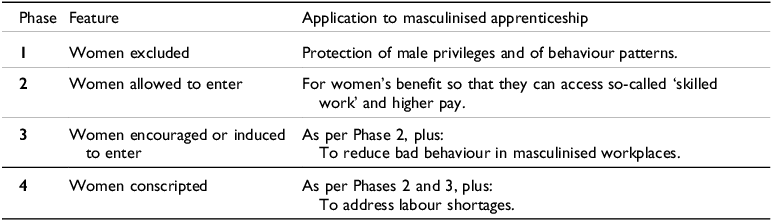
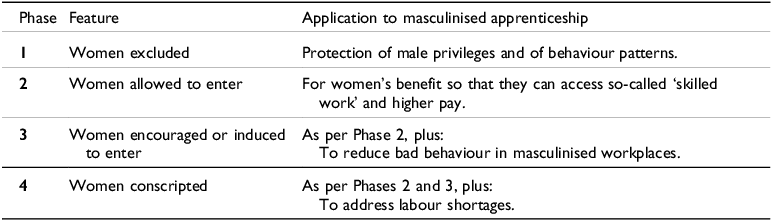
The ‘national interest’ argument for women to move into masculinised occupations is therefore not new. The imperative basically depends on the concept of women representing a reserve army of labour (Thompson Reference Thompson1989). The progression is depicted in Table 5, in an initial categorisation which could be further developed through subsequent research.
Evolution of women’s inclusion in masculinised work
Source: Author.
The direction of change over time is from Phase 1 to 4, although there could be a leap to Phase 4 at any time, as there was in the Second World War. While women are not currently being actively forced into masculinised occupations, strong pressure is building through the ‘national interest’ argument. It could conceivably be argued, also, that women could be forced by personal circumstances to take up a ‘clean energy’ apprenticeship because of the personal and employer benefits which are not present in feminised occupations. One overlooked issue is that the potential effects of men’s rights movements in recent years, exacerbated by online communities (Rafail and Freitas Reference Rafail and Freitas2019), may increase the ‘hegemonic masculinity’ of those workplaces, creating new risks for women.
It is interesting to speculate what might happen should changes in the economy create a surplus of labour in the masculinised occupations; in other words, what a Phase 5 might look like. Towards the end of the Second World War in Australia, factories stopped recruiting women, but the return of women to feminised occupations or the home was an expectation rather than a requirement (Harris and Sendziuk Reference Harris and Sendziuk2018). The active recruitment of women into masculinised apprenticeships could well cease.
Conclusion
Australia is unusual in the world (Smith et al Reference Smith, Tuck and Chatani2018) in knowingly reducing the size of its apprenticeship system in recent years (Smith Reference Smith2021). This has adversely affected women, but not men. Historically, it is interesting to speculate about why government policy has moved from favouring the expansion of apprenticeships into feminised occupations in the 1980s and early 1990s towards downgrading, and removing benefits from, apprenticeships/traineeships in those occupations.
It is also of interest to speculate why the expansion was ‘allowed’ to occur in the 1980s and 1990s, given the strength of opposing interests, described by Kirby (Reference Kirby1985, 124) as ‘polarised’? Perhaps opposition to the inclusion of women’s occupations into the system was delayed by a similar ‘confusion’ to that reported by Gray (Reference Gray1981) as being experienced by the labour aristocracy following the advent of new occupations in the 19th century. Once realised, however, the opposition of the labour aristocracy, with its allies in industry and politics, was effectively deployed. This opposition was actioned through the major reports of 2011 and 2024, as well as by funding policies enacted during or soon after the production of those reports. One also has to admire the skill with which a ‘national interest’ argument for clean energy has been marshalled to create added benefits for certain male-dominated industries and, specifically, for their apprentices. As Acker (Reference Acker and Wallace1989) states, ‘powerful groups write the rules’.
While the 2011 government report (McDowell et al Reference McDowell, Oliver, Persson, Fairbrother, Wetzlar, Buchanan and Shipstone2011) advocating removal of support for feminised occupations attracted attention and public discussion, the 2024 report (Ross and Paul Reference Ross and Paul2024) has not. This could be because the new report discusses, at length, the barriers faced both at work and in training by women in masculinised occupations, and provides case studies of successful female apprentices. The attention paid to these matters (albeit limited in space – 17 pages in a report of 366 pages) could be seen as ‘femwashing’ (Hainneville et al Reference Hainneville, Guevremont and Robinot2023), and has perhaps distracted attention both from the proposal to defund training in feminised industries, and from the fact that there is actually only one concrete recommendation for women in masculinised industries, a pilot programme in small and medium enterprises (Ross and Paul Reference Ross and Paul2024, 225). There is, of course, the separate ‘Building Women’s Careers’ programme but that is not specifically for apprenticeships. The McDowell et al report (Reference McDowell, Oliver, Persson, Fairbrother, Wetzlar, Buchanan and Shipstone2011, 211-12) mentions that women are concentrated in non-trade apprenticeships, and that women have better completion rates than men in those occupations; and also briefly mentions lower pay rates in feminised industries (p. 213), but does not take any of those issues further.
In January 2025, Australia’s Prime Minister, in announcing the release of the ‘Skills for Tomorrow’ report (see Table 1), chose to focus on one piece of content: ‘Many apprentices have said they could earn more stacking shelves at the supermarket’.Footnote 17 He was referring to several statements by apprentices, which were incorrect but reproduced in the report without comment (e.g. Ross and Paul Reference Ross and Paul2024, 64), about how much more they could earn in retail jobs. This prime ministerial intervention, validating male apprentices by denigrating work in a feminised industry, echoes a 2008 statement by a previous Labor Prime Minister, Julia Gillard, then the Deputy Prime Minister. She had criticised the previous government for funding traineeships for nail technicians: ‘You might not have been able to have been able to get a house built, but you could always go down the beauty parlour and make yourself feel better about it. That was their contribution to training in this nation’. (see Smith Reference Smith2008b).
These statements by two of Australia’s Prime Ministers show that the labour aristocracy has clearly succeeded in capturing government as well as the other parts of the tripartite system (ILO 2017) to create an entrenched patriarchal structure (Acker Reference Acker and Wallace1989), to the extent that casual disrespect for women and their workplaces from the country’s leaders is considered acceptable. It appears to be difficult for governments – including these Labor governments – to recognise self-interest from the labour aristocrats and their employers. Rather, they reward it. It could be argued that the ‘rent-seeking’ and appropriation of the modern-day equivalent of the ‘fruits of empire’ has taken place for many decades in traditional trades, while any benefits accruing to feminised industries have been criticised enthusiastically by writers such as Cully (Reference Cully2008) and Buchanan (Reference Buchanan2015), and, sadly, taken up by governments.
It is true that traineeships in feminised industries sometimes suffer from less-well-developed curriculum and less experienced employers than traditional trade apprenticeships. This is due to a combination of factors, including the later establishment of training pathways, the fact that training was developed in the less-than-satisfactory competency-based training era (Smith and Keating Reference Smith and Keating2003, 131–140), an unreliable history of funding, and lack of public regard for the occupations. But rather than rectifying the situation, the Australian VET system seems to be choosing a destructive rather than constructive approach. This is at odds with agreed international goals on apprenticeship, as manifested in the agreed G20 actions on apprenticeships and as implied by the Sustainable Development Goals. Apprenticeships in some feminised occupations now receive no incentives, and unviable training rates, and women’s participation in the system has fallen. In effect, there has been a return to the early 1980s situation, which the Kirby report (Reference Kirby1985) set out to reform.
There is a dearth of research in Australia on apprenticeships and traineeships, especially compared with other countries, meaning that the complexity and subtlety of the issues raised in this paper are not rehearsed publicly. There is a clear need for up-to-date empirical research specifically on traineeships (i.e. non-trade apprenticeships). The division of the system into the two types is messy and inconsistently referred to (as noted by Stanwick et al Reference Stanwick, Ackehurst and Frazer2021), but the lack of differentiation in public statements basically means that traineeships get lost from public view. Therefore, women, who ‘hold up half the sky’ (Pocock Reference Pocock2016), are overlooked. All debates revolve around trade apprenticeships, which are dominated by men, and improvements in traineeships, predominantly feminised, are not considered.
Niemeyer and Colley (Reference Niemeyer and Colley2015, 1) state, in their introduction to a special edition of the Journal of Vocational Education and Training on gender and VET, that ‘from an historical perspective, there is a stunning persistence of gender inequalities in the field of VET in general, both in the vertical and the horizontal dimensions’. In the field of apprenticeships, at least in Australia, women’s disadvantage has not only persisted but has worsened in the last ten years. The authors also state, ‘it is inevitable that gender inequalities are produced and reproduced in new and different ways’ (Niemeyer and Colley Reference Niemeyer and Colley2015, 1). It would be fair to say that few people in 2015 could have anticipated the ‘new and different’ developments of the past five years that have been discussed above, but perhaps many could have predicted that men would have taken advantage of them in the field of apprenticeships.
With firm evidence, it would not be impossible to address these difficulties; but as Kirby (Reference Kirby1985) noted, and as PhillipsKPA (2018, 23) point out very clearly, in a report on a wide government-commissioned national consultation, ‘stakeholders hold stridently divergent views, often protecting what might be described as an entrenched stakeholder interest.’ PhillipsKPA (2018, 25) state that ‘this task (modernising the apprenticeship system) will require the various social partners to engage in good faith to resolve the issues emerging in the apprenticeships system’. This ‘good faith’ engagement would be facilitated by the development of a strong research base in traineeships, to ensure that discussions are evidence-based.
Erica Smith is an Emeritus Professor of Vocational Education and Training (VET) at Federation University Australia. She has managed many research projects funded by the Australian Research Council, international organisations, and industry bodies. She is co-chair of INAP, the international network of apprenticeship researchers and has served on several government committees. Erica has prior experience as a human resource manager in the retail and community services industries; and has held several positions in the VET sector.

 Open access

