


The cost of food is an important determinant of dietary behaviour. When consumers make food choices based on cost alone, food choices tend to be more energy dense and nutrient poor(Reference Andrieu, Darmon and Drewnowski1). Poor diet quality can contribute to an increased rate of overweight and obesity(2). According to Australian Consumer Price Index data, in 2011, Australian food costs increased by an average of 4·2 %(3). One of the most significant increases during this time was a 16 % increase in the price of vegetables(3). The affordability of healthy foods has the potential to impact on food security, the ability of families to obtain nutritious food on a regular and reliable basis, particularly for people with low incomes(Reference Drewnowski and Darmon4, Reference Lennernas, Fjellstrom and Becker5).
There is some evidence that healthier food substitutions are more expensive than their regular counterparts(Reference Lee, Ralston and Truby6). In a study conducted in New Zealand supermarkets, lower-fat alternatives were 44 %, 27 % and 19 % more expensive for margarine, meat/poultry and cheese, respectively(Reference Ni Mhurchu and Ogra7). In a US study, baked chips, lean meat and wholegrain pasta were 20–60 % more costly than the corresponding regular products (fried chips, regular-fat meat and white pasta), while wholegrain breads and rice were 10–30 % more expensive than the regular lower-fibre varieties(Reference Andreyeva, Blumenthal and Schwartz8).
Generic food brands are those that are specific to a particular supermarket chain. Generic brands have been in Australian supermarkets since the 1960s with an emphasis on lower prices and historically may have been lower-quality products(9). Recently the two major Australian supermarket chains, who together have about 70 % of the retail food market, have offered generic products across a greater number of categories and at different quality and pricing levels(9).
Previous studies measuring the cost of food in Australia have generally focused on food cost, availability and quality for branded food products, and have not specifically examined these factors in relation to generic food brands(Reference Burns and Friel10–Reference Cancer Council19). However, one Australian study has shown that substituting generic brands for market brands reduced weekly food costs by about 13 %(Reference Kettings, Sinclair and Voevodin20). Two European studies reported that generic food product lines represent excellent value for money and were not nutritionally inferior to the equivalent branded products(Reference Cooper and Nelson21, Reference Darmon, Caillavet and Joly22). These European findings, however, cannot be generalised to the retail context more broadly, such as in Australia.
An Australian study that looked at over 3000 products found that food products manufactured on behalf of supermarket retailers and sold as generic private label products were not consistently nutritionally different from branded products, although there was some variability in the nutritional characteristics for some food categories(Reference Cleanthous, Mackintosh and Anderson23). That study also found that serving sizes varied between generic and branded food products for some food categories including pizza, canned legumes, ready meals, and savoury and sweet biscuits(Reference Cleanthous, Mackintosh and Anderson23).
Australian reports have found that more than 80 % of consumers buy generic food products, despite a persistent perception that generic products are inferior to branded products(9). The purpose of the present study was to compare the cost of popular branded food items with that of their generic equivalents to determine if the purchase of generic food products would lead to considerable cost savings for consumers.
Methods
Survey tool
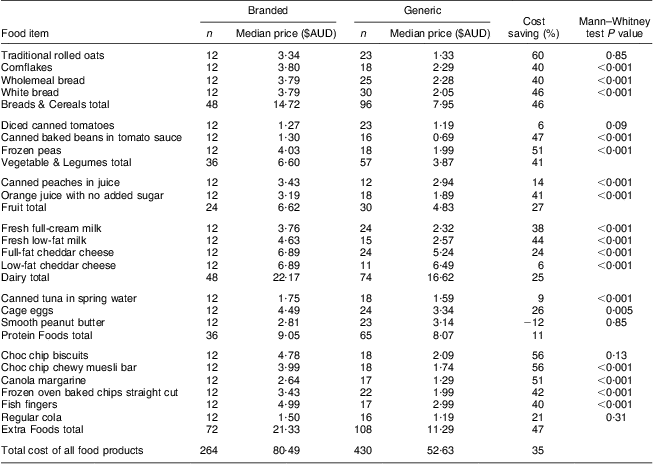
Food items included in the study included ‘core’ foods (n 16) as outlined in the Australian Guide for Healthy Eating (Table 1)(24). Core food items were further classified into sub-categories according to food groups comprising breads and cereals, vegetables, fruit, dairy foods and protein-rich foods. In addition, a sub-category of popular ‘extra’ foods (n 6) that are also in the Consumer Price Index basket of foods was included to reflect the eating habits of the general population.
Cost comparison between the cheapest generic products and cheapest branded products by supermarket; survey conducted in two major supermarket chains across six locations in Sydney, Australia (n 12), March 2009

Food items were selected based on popularity as evidenced by their inclusion in the representative sample of foods used by the Australian Bureau of Statistics in determining the Consumer Price Index for Australia (L Taylor, personal communication, 2010). The products included in the Consumer Price Index pricing samples are selected carefully to represent the range of types and varieties of goods bought by the Consumer Price Index population group(25). Selection is made after obtaining detailed information about the buying habits of the population group, such as which varieties and brands of products are the largest selling types or which packaging sizes are most commonly purchased(25). This process involves extensive consultations with retailers and manufacturers. The reference population for the Australian Consumer Price Index is private households in the eight capital cities and represents about two-thirds of Australian private households(25).
Procedure
The survey was conducted in six suburban locations across the Sydney metropolitan area with differing levels of socio-economic disadvantage, defined by the Australian Bureau of Statistics’ Index of Relative Socio-economic Advantage and Disadvantage and classified into tertiles (most disadvantaged, moderately disadvantaged and least disadvantaged)(26). The six locations included two suburbs from each socio-economic tertile.
Given the dominance of two major food retailers (referred to as Supermarket A and Supermarket B) in the Australian retail food sector(9), inclusion in the present study required that each suburb location contained both of the major supermarket chains. Locations were also required to be accessible by public transport. Both Supermarket A and Supermarket B have multiple ‘tiers’ of generic lines available for a range of products.
Data were collected by two student dietitians over a 3 d consecutive period in March 2009 on weekdays. The survey was initially piloted in two stores (not included in the final survey sample) to test the clarity of the instructions and reliability of the coding instrument. The survey tool was subsequently refined to improve its layout.
Surveyors recorded the standard shelf prices (not sale prices) for the specified pack size for the cheapest branded product and its generic equivalents in each supermarket. Prices for all available tiers of generic label ranges were recorded (e.g. savings and premium generic product lines).
Inter-coder reliability
Both coders independently surveyed four supermarkets and cross-checked their recorded prices. There was 90 % agreement between the coders, and discrepancies were discussed with the lead author to improve consistency. The remaining eight supermarkets were visited and surveyed individually by one of these two student dietitians.
Data analysis
Data were analysed using the SPSS for Windows statistical software package version 15·0 (SPSS Inc., Chicago, IL, USA). For a small number of items where the specified size was not available (due to the supermarket not having stock available for a particular product), the next nearest size was recorded and the price was adjusted to represent a standard unit price for between-product price comparisons. Percentage cost saving was calculated based on the difference in price between the cheapest branded item and the generic item, given as a proportion of the cheapest branded item.
Descriptive statistics were obtained for the cost of generic and branded food products for each selected food item. Differences in the cost of individual food items and the median cost of goods within a sub-category were analysed statistically using the Mann–Whitney test for non-parametric data.
Results
Cost comparison between generic and branded food products
The cheapest generic products were found to be lower in price than the cheapest branded products for all items and in both supermarkets, except for low-fat cheddar cheese in Supermarket B (Table 1).
Purchasing generic equivalents rather than branded items was found to provide a mean cost saving of 44 % across all food categories. Greatest cost savings were found in the bread and cereals sub-category, where savings of 60 % or more were found for rolled oats (60 %) and white bread (71 %). The smallest cost saving was reported in the fruit sub-category (27 %).
The mean percentage cost saving was calculated across all food groups by socio-economic status tertile, by using the cheapest available product from both generic and branded categories. There was little variation in cost savings across the socio-economic tertiles, ranging from 42 % in the least disadvantaged areas to 43 % in the most disadvantaged areas.
The mean saving obtained from purchasing the cheapest generic products over branded products was 46 % at Supermarket A and 41 % at Supermarket B (Table 1). The cost saving between generic and branded items was the same (27 % mean cost saving) at both supermarket chains for the fruit category, whereas for all other food categories there were different levels of cost savings between the two supermarket chains (Fig. 1). The greatest difference in the mean cost saving between Supermarket A and B was reported for the dairy product category where a 13 % difference in cost was found.
Mean percentage cost saving between cheapest generic and cheapest branded product for Supermarket A ( $$$$
) and Supermarket B (
$$$$
) and Supermarket B ( $$$$
) by food category; survey conducted in two major supermarket chains across six locations in Sydney, Australia (n 12), March 2009
$$$$
) by food category; survey conducted in two major supermarket chains across six locations in Sydney, Australia (n 12), March 2009

The median cost of all tiers of generic items was significantly lower than the branded equivalent (Fig. 2). This was true for all items except for rolled oats, canned tomatoes, peanut butter, choc chip biscuits and regular cola (Table 2). Comparing only the cheapest available tier of generic products, the median cost was significantly lower than the branded equivalent for all items (P = 0·001 for regular cola, all others P < 0·001; data not shown).
Percentage cost saving on median price between generic products and branded products by food category; survey conducted in two major supermarket chains across six locations in Sydney, Australia (n 12), March 2009

Difference in median of cost of branded and generic food items; survey conducted in two major supermarket chains across six locations in Sydney, Australia (n 12), March 2009
Note: the Mann–Whitney test ranked multiple tiers of generic items in the analysis, leading to a bi-modal distribution of generic prices.
Discussion
The present study highlighted that significant cost savings can be made by purchasing generic food products, particularly for core foods such as bread and cereals, where savings were as high as 53 % for wholemeal bread and 46 % overall for the breads and cereals sub-category. Given that the Australian Guide to Healthy Eating recommends up to 12 servings of bread and cereals daily for an adult person(24), this has the potential to save costs in the food budget for both families and individuals. The only previous Australian study to examine substitution of generic brands for branded products showed a 13 % reduction in weekly food costs, based on dietary modelling of a 7 d meal plan for two typical welfare-dependent Australian families(Reference Kettings, Sinclair and Voevodin20).
Previous studies have found that low-income groups are least likely to purchase foods that are consistent with dietary guidelines(Reference Turrell, Hewitt and Patterson17, Reference Giskes, Turrell and Patterson27, Reference Turrell28). In particular, those in low socio-economic groups are less likely to purchase foods that are high in fibre and low in fat, sugar and salt, and the consumption of fruit and vegetables in this group is likely to be lower(Reference Turrell, Hewitt and Patterson17, Reference Giskes, Turrell and Patterson27, Reference Yeh, Ickes and Lowenstein29). Consumers with lower household incomes also have a higher tendency to purchase generic products(Reference Prendergast and Marr30), making the nutritional adequacy of these products an issue of public health interest.
In a report on the competitiveness of retail prices of grocery items, the Australian statutory agency responsible for fair trade and competition, the Australian Competition and Consumer Commission (ACCC), concluded that pricing strategies adopted by the major supermarket chains for their premium generic label products result in those generic products generally having lower shelf prices than branded products of comparable quality(9). According to the ACCC's consumer survey, although most consumers buy some generic products, there is a persistent perception that generic equivalents are of inferior quality to branded products(9). However, the ACCC found that if consumers considered a generic product to be a close substitute for the targeted branded product, they were more likely to switch to that generic brand in response to its lower price(9). In a blinded study comparing the taste of generic and branded food items by the Australian consumer group CHOICE, consumers rated ‘premium’ (i.e. top tier) generic foods as equivalent to or better than the leading brands for taste(31).
Consumer purchases are not, however, solely driven by price or nutrition(Reference Shepherd and Raats32). Country of origin is an emerging issue for some consumers who are concerned about ‘food miles’ and the carbon emissions associated with food distribution from ‘paddock to plate’(33). In 2006, CHOICE reported that fewer generic products are Australian made and owned(31). The present study found that Australian products were available in generic lines for most food categories in the survey (data not shown). Further work on the role of generic foods should include providing consumers with information on cost-competitive, nutritious and environmentally sustainable food.
There has been criticism of the large supermarket chains for introducing greater numbers of generic products as this has the potential to limit consumer choices and negatively impact on smaller suppliers, primary producers and farmers(34). Some commentators believe less choice may mean less innovation and fewer new products introduced into the market, and although there may be short-term price cuts, it may result in higher costs in the longer term. However, a recent Australian Senate inquiry about the impacts on the dairy industry of supermarket price cutting on milk found that milk price discounting is likely to be pro-competitive and of benefit to consumers; although the report did note that there were some instances whereby the risk of any retail price movements or other shocks that affect the sales of branded products were in large part being passed immediately onto the dairy farmers(35).
Supermarket chains argue that cost savings on generic lines are primarily achieved by reducing marketing costs and by controlling the production networks, not by using low-grade ingredients(9). Leading brands often attribute their product's expense to the use of highest-quality ingredients. However for processed food products, standardisation of ingredients and control of processing are likely to be high, resulting in less difference nutritionally between products of the same food item(Reference Cooper and Nelson21). An Australian study has confirmed that generally generic food products were nutritionally similar to branded products(Reference Cleanthous, Mackintosh and Anderson23), which is a positive finding for consumers, especially those on low incomes.
The current study has some limitations. First, a limited number of food products (n 22) were surveyed from the two major supermarket chains. However, the foods selected in the sample are included among the popular foods analysed for the Australian Consumer Price Index and were a more expansive range of foods than those analysed in previous studies of generic food prices(Reference Cooper and Nelson21, Reference Darmon, Caillavet and Joly22). Second, while the two supermarket chains surveyed account for 70 % of packaged grocery sales(9), consumers also purchase foods at other retail outlets. Third, the study looked only at the regular price of products, rather than the sale price. The purchase of items on special offer may result in further cost savings. The study compared the generic items with the cheapest branded products available at the time of survey. Even greater price differences would have been found in comparison with more expensive branded products. Finally, a further limitation of the study was that price information was collected for specified pack sizes, and this may not reflect the cost savings experienced by those consumers who buy larger bulk-sized products or the differences in those who rely on smaller convenience-sized products.
Financial constraints are potentially the largest contributor to food insecurity faced by low-income families(Reference Turrell28). Low-income groups have been shown to be least likely to purchase foods that are consistent with the recommendations in dietary guidelines(Reference Turrell, Hewitt and Patterson17, Reference Giskes, Turrell and Patterson27, Reference Turrell28). The significant price differential between branded items and their generic equivalents implies that consumers, particularly those on lower incomes, could benefit financially from purchasing generic lines without compromising the quality of their diets. Further research on the nutritional quality of generic food products and how they compare with branded products would be valuable given the cost benefits of selecting generic products. In addition, research on the purchasing patterns of low-income consumers would be beneficial to determine whether those who purchase generic products do so across a range of food product types or a more narrow range of food product types.
The promotion of generic lines, particularly for core foods such as breads and cereals, dairy foods, protein foods, and canned and frozen fruits and vegetables, may be an effective strategy to assist people on lower incomes to meet dietary guidelines, which are protective against chronic disease. This strategy may have greatest impact when incorporated into healthy food budgeting programmes targeting people at socio-economic disadvantage.
Acknowledgements
This work was supported by Cancer Council NSW. The authors declare no conflicts of interest. The authors’ contributions were as follows: K.C., study design, supervision of data collection, interpretation of results, drafting of paper; C.I.-H., data analysis, initial drafting of paper; D.G., data analysis and statistical advice, contribution to paper; B.K., input into study design and implementation, contribution to paper; A.B., interpretation of results, reviewing of paper; M.A.-F., interpretation of results, reviewing of paper. The authors wish to thank Laura Owens and Joyi Shi, Master of Nutrition and Dietetics students from the University of Sydney, for their contribution to the survey and data analysis.



