


















1 Introduction
Our goal is to resolve a conjecture posed in [Reference Bergelson, Moreira and Richter1, Remark 1.12] by showing that multiple ergodic averages of the form

converge to a positive limit as
$N\to \infty $
 whenever f is a tempered function; that is, if there exists
$\ell \in \mathbb {N}$
whenever f is a tempered function; that is, if there exists
$\ell \in \mathbb {N}$
 such that
$f^{(\ell )}$
such that
$f^{(\ell )}$
 decreases to
$0$
decreases to
$0$
 and
$\lim _{x\to \infty }xf^{(\ell )}(x)=\infty $
and
$\lim _{x\to \infty }xf^{(\ell )}(x)=\infty $
 . We will prove this by developing some new tools regarding weighted averages and applying a theorem from [Reference Bergelson, Moreira and Richter1].
In order to discuss this in more detail, we first require some definitions. Let
$\Delta $
 denote the discrete derivative, which acts on a function f defined on
$\mathbb {N}=\{1,2,\ldots \}$
denote the discrete derivative, which acts on a function f defined on
$\mathbb {N}=\{1,2,\ldots \}$
 by
$\Delta f(n)= f(n)-f(n-1)$
by
$\Delta f(n)= f(n)-f(n-1)$
 for
$n\geqslant 2$
for
$n\geqslant 2$
 and
$\Delta f(1) = f(1)$
and
$\Delta f(1) = f(1)$
 . For
$\ell \geqslant 1$
. For
$\ell \geqslant 1$
 , we define
$\Delta ^{\ell }f(n) = \Delta (\Delta ^{\ell -1}f(n))$
, we define
$\Delta ^{\ell }f(n) = \Delta (\Delta ^{\ell -1}f(n))$
 , where
$\Delta ^0f(n) = f(n)$
, where
$\Delta ^0f(n) = f(n)$
 . For
$p(x) = a_mx^m+\cdots +a_1x+a_0\in \mathbb {Z}[x]$
. For
$p(x) = a_mx^m+\cdots +a_1x+a_0\in \mathbb {Z}[x]$
 , we put

Definition 1.1. Let
$\mathscr {F}_1$
 be the collection of functions defined by

Having defined
$\mathscr {F}_{\ell }$
 for some
$\ell \in \mathbb {N}$
for some
$\ell \in \mathbb {N}$
 , let
$\mathscr {F}_{\ell +1} = \{f:\mathbb {N}\rightarrow \mathbb {R}:\Delta f \in \mathscr {F}_{\ell }\}$
, let
$\mathscr {F}_{\ell +1} = \{f:\mathbb {N}\rightarrow \mathbb {R}:\Delta f \in \mathscr {F}_{\ell }\}$
 . Finally, let
$\mathscr {F} =~\bigcup _{\ell =1}^{\infty }\mathscr {F}_{\ell }$
. Finally, let
$\mathscr {F} =~\bigcup _{\ell =1}^{\infty }\mathscr {F}_{\ell }$
 . We may note that
$\mathscr {F}$
. We may note that
$\mathscr {F}$
 contains all tempered functions.
Remark 1.1. A function
$f:\mathbb {N}\rightarrow \mathbb {R}$
 is contained in
$\mathscr {F}$
is contained in
$\mathscr {F}$
 if and only if there is an
$\ell \in \mathbb {N}$
if and only if there is an
$\ell \in \mathbb {N}$
 such that
$\Delta ^{\ell } f$
such that
$\Delta ^{\ell } f$
 is eventually decreasing to
$0$
is eventually decreasing to
$0$
 but
$\Delta ^{\ell -1}f$
but
$\Delta ^{\ell -1}f$
 tends to
$\infty $
tends to
$\infty $
 . So any function of the form
$f(n) = n^c$
. So any function of the form
$f(n) = n^c$
 for
$c\in (0,\infty )\backslash \mathbb {Z}$
for
$c\in (0,\infty )\backslash \mathbb {Z}$
 is contained in
$\mathscr {F}$
is contained in
$\mathscr {F}$
 , but no polynomial is contained in
$\mathscr {F}$
, but no polynomial is contained in
$\mathscr {F}$
 .
.
The following is Theorem D in [Reference Bergelson, Moreira and Richter1].
Theorem 1.2. [Reference Bergelson, Moreira and Richter1, Theorem D]
Let
$k \in \mathbb {N}, \ell \in \mathbb {N}$
 ,
$f \in \mathscr {F}_{\ell }$
,
$f \in \mathscr {F}_{\ell }$
 . Let
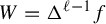
$W= \Delta ^{\ell -1}f$
. Let
$W= \Delta ^{\ell -1}f$
 so that
$\lim _{n\to \infty }W(n)=\infty $
so that
$\lim _{n\to \infty }W(n)=\infty $
 and
$\lim _{n\to \infty }\Delta W(n)=0$
and
$\lim _{n\to \infty }\Delta W(n)=0$
 . Let
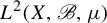
$(X,\mathscr {B},\mu ,T)$
. Let
$(X,\mathscr {B},\mu ,T)$
 be an invertible probability-measure-preserving system and let
$p_1,\ldots ,p_k \in \mathbb {Z}[x]$
be an invertible probability-measure-preserving system and let
$p_1,\ldots ,p_k \in \mathbb {Z}[x]$
 .
.
-
(a) For any $h_1,\ldots ,h_k \in L^{\infty }(X,\mathscr {B},\mu )$
 , the limit $$ \begin{align*} \lim_{W(N)-W(M)\to\infty}\frac{1}{W(N)-W(M)}\sum_{n=M}^N\Delta W(n) T^{\lfloor p_1(\Delta)f(n) \rfloor}h_1\cdots T^{\lfloor p_k(\Delta)f(n) \rfloor}h_k \end{align*} $$exists in $L^2(X,\mathscr {B},\mu )$
.
, the limit $$ \begin{align*} \lim_{W(N)-W(M)\to\infty}\frac{1}{W(N)-W(M)}\sum_{n=M}^N\Delta W(n) T^{\lfloor p_1(\Delta)f(n) \rfloor}h_1\cdots T^{\lfloor p_k(\Delta)f(n) \rfloor}h_k \end{align*} $$exists in $L^2(X,\mathscr {B},\mu )$
.
-
(b) For any $A \in \mathscr {B}$
with
$\mu (A)> 0$
, the limit $$ \begin{align*} \lim_{W(N)-W(M)\to\infty}\frac{1}{W(N)-W(M)}\sum_{n=M}^N\Delta W(n)\mu\bigg(A\cap\bigg(\bigcap_{i=1}^{k}T^{-\lfloor p_i(\Delta)f(n) \rfloor}A\bigg)\bigg) \end{align*} $$exists and is positive.




In [Reference Bergelson, Moreira and Richter1, Remark 1.12], it is conjectured that each limit of weighted averages appearing in Theorem 1.2 can be replaced with the corresponding limit of Cesàro averages whenever f is a tempered function. Theorem 1.2 applies when f is any element of
$\mathscr {F}$
 , not just when f is a tempered function. However, when f is not tempered the weighted averages in Theorem 1.2 cannot be replaced by Cesàro averages (cf. Example 5.2 where
$f(n)=\log (n)$
, not just when f is a tempered function. However, when f is not tempered the weighted averages in Theorem 1.2 cannot be replaced by Cesàro averages (cf. Example 5.2 where
$f(n)=\log (n)$
 is not tempered).
The following theorem is a corollary of our main result and it gives an affirmative answer to the conjecture in [Reference Bergelson, Moreira and Richter1].
Theorem A. Let
$f\in \mathscr {F}_{\ell }$
 be a tempered function. Let
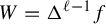
$W=\Delta ^{\ell -1}f$
be a tempered function. Let
$W=\Delta ^{\ell -1}f$
 so that W increases to
$\infty $
so that W increases to
$\infty $
 ,
$\Delta W$
,
$\Delta W$
 decreases to
$0$
decreases to
$0$
 , and
$\lim _{N\to \infty }N\cdot \Delta W(N) = \infty $
, and
$\lim _{N\to \infty }N\cdot \Delta W(N) = \infty $
 . Suppose that
$(x_n)_{n\in \mathbb {N}}$
. Suppose that
$(x_n)_{n\in \mathbb {N}}$
 is a bounded sequence in a Banach space Y and let
$L\in Y$
is a bounded sequence in a Banach space Y and let
$L\in Y$
 . If
. If

then

Thus, in light of Theorem A, the following theorem follows immediately from Theorem 1.2.
Theorem 1.3. Let
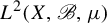
$(X,\mathscr {B},\mu ,T)$
 be an invertible probability-measure-preserving system. Let
$f\in \mathscr {F}$
be an invertible probability-measure-preserving system. Let
$f\in \mathscr {F}$
 be a tempered function, let
$k\in \mathbb {N}$
be a tempered function, let
$k\in \mathbb {N}$
 , and let
$p_1,\ldots ,p_k \in \mathbb {Z}[x]$
, and let
$p_1,\ldots ,p_k \in \mathbb {Z}[x]$
 .
.
-
(a) For any $h_1,\ldots ,h_k \in L^{\infty }(X,\mathscr {B},\mu )$
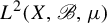
, the limit (1.2) $$ \begin{align} \lim_{N\to\infty}\frac{1}{N}\sum_{n=1}^NT^{\lfloor p_1(\Delta)f(n) \rfloor}h_1\cdots T^{\lfloor p_k(\Delta)f(n) \rfloor}h_k \end{align} $$exists in $L^2(X,\mathscr {B},\mu )$
.
-
(b) For any $A \in \mathscr {B}$
with
$\mu (A)> 0$
, the limit (1.3) $$ \begin{align} \lim_{N\to\infty}\frac{1}{N}\sum_{n=1}^N\mu(A\cap T^{-\lfloor p_1(\Delta)f(n) \rfloor}A\cap\cdots \cap T^{-\lfloor p_k(\Delta)f(n) \rfloor}A) \end{align} $$exists and is positive.




Using the identity
$f(n-k) = (1-\Delta )^kf(n)$
 , we obtain a special case of Theorem 1.3, which not only extends Theorem 1.2 but also is an extension of [Reference Frantzikinakis5, Theorem 5.6].
Corollary 1.4. Let
$(X,\mathscr {B},\mu ,T)$
 be an invertible probability-measure-preserving system. Let
$f\in \mathscr {F}$
be an invertible probability-measure-preserving system. Let
$f\in \mathscr {F}$
 be a tempered function and let
$k\in \mathbb {N}$
be a tempered function and let
$k\in \mathbb {N}$
 .
.
-
(a) For any $h_1,\ldots ,h_k \in L^{\infty }(X,\mathscr {B},\mu )$
, the limit (1.4) $$ \begin{align} \lim_{N\to\infty}\frac{1}{N}\sum_{n=1}^NT^{\lfloor f(n) \rfloor}h_1\cdots T^{\lfloor f(n+k) \rfloor}h_k \end{align} $$exists in $L^2(X,\mathscr {B},\mu )$
.
-
(b) For any $A \in \mathscr {B}$
with
$\mu (A)> 0$
, the limit (1.5) $$ \begin{align} \lim_{N\to\infty}\frac{1}{N}\sum_{n=1}^N\mu(A\cap T^{-\lfloor f(n) \rfloor}A\cap\cdots\cap T^{-\lfloor f(n+k) \rfloor}A) \end{align} $$exists and is positive.




We will now introduce some notation in order to formulate our main theorem.
Definition 1.2. Let
$W:\mathbb {N}\rightarrow \mathbb {R}$
 be a function which increases to
$\infty $
be a function which increases to
$\infty $
 and let
$(x_n)_{n\in \mathbb {N}}$
and let
$(x_n)_{n\in \mathbb {N}}$
 be a bounded sequence in a Banach space Y.
-
• For $N\in \mathbb {N}$
, define the Nth W-weighted average of
$(x_n)_{n\in \mathbb {N}}$
by (1.6) $$ \begin{align} {\mathbb{E}}_{n\leqslant N}^Wx_n= \frac{1}{W(N)}\sum_{n=1}^N\Delta W(n) x_n. \end{align} $$
-
• More generally, we define the W-weighted average of $(x_n)_{n\in \mathbb {N}}$
over the interval
$[M,N]$
to be (1.7) $$ \begin{align} {\mathbb{E}}_{n\in [M,N]}^Wx_n = \frac{1}{W(N)-W(M)}\sum_{n=M}^N\Delta W(n) x_n. \end{align} $$
-
• Define the uniform W-weighted average of $(x_n)_{n\in \mathbb {N}}$
as (1.8) $$ \begin{align} {\mathbb{E}}_{\mathrm{unif}}^W(x_n) =\lim_{W(N)-W(M)\to \infty}{\mathbb{E}}_{n\in [M,N] }^W(x_n) \end{align} $$when the limit exists. The limit $\lim _{W(N)-W(M)\to \infty }$
is taken over all sequences of intervals
$[M_j,N_j]$
for
$j\in \mathbb {N}$
, with
$W(N_j)-W(M_j)\to \infty $
as
$j\to \infty $
.
-
• Define the iterated W-weighted averages of $(x_n)_{n\in \mathbb {N}}$
by
$ {\mathbb {E}}(1)_{n\leqslant N}^Wx_n = {\mathbb {E}}_{n\leqslant N}^Wx_n$
and (1.9) $$ \begin{align} {\mathbb{E}}(k+1)_{n\leqslant N}^Wx_n = {\mathbb{E}}_{n\leqslant N}^W({\mathbb{E}}(k)_{m\leqslant n}^Wx_m) = \frac{1}{W(N)}\sum_{n=1}^N\Delta W(n) \cdot{\mathbb{E}}(k)_{m\leqslant n}^Wx_m \end{align} $$for $k\in \mathbb {N}$
.
-
• For $L\in Y$
, we say that
$ {\mathbb {E}}(\infty )^Wx_n = L$
if (1.10) $$ \begin{align} \lim_{k\to\infty}\limsup_{N\to\infty}|{\mathbb{E}}(k)_{n\leqslant N}^W(x_n -L)|=0. \end{align} $$













Example 1.5. When
$W(N) = N$
 ,
$ {\mathbb {E}}_{n\leqslant N}^Wx_n$
,
$ {\mathbb {E}}_{n\leqslant N}^Wx_n$
 denotes the usual Cesàro averages and we will write
$ {\mathbb {E}}_{n\in [M,N]}x_n$
denotes the usual Cesàro averages and we will write
$ {\mathbb {E}}_{n\in [M,N]}x_n$
 instead of
$ {\mathbb {E}}^W_{n\in [M,N]}x_n$
instead of
$ {\mathbb {E}}^W_{n\in [M,N]}x_n$
 so that we have
$ {\mathbb {E}}_{n\in [M,N]}x_n = {\mathbb {E}}_{n\in [M,N]}^Wx_n = ({1}/({N-M}))\sum _{n=M}^{N}x_n$
so that we have
$ {\mathbb {E}}_{n\in [M,N]}x_n = {\mathbb {E}}_{n\in [M,N]}^Wx_n = ({1}/({N-M}))\sum _{n=M}^{N}x_n$
 . When
$U(N) = \log (N)$
. When
$U(N) = \log (N)$
 ,
$ {\mathbb {E}}_{n\leqslant N}^Ux_n$
,
$ {\mathbb {E}}_{n\leqslant N}^Ux_n$
 is the logarithmic average

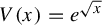
It will be useful to consider weighted averages with respect to functions which grow faster than any polynomial. For example, let
$V(x) = e^{\sqrt {x}}$
 . Then

Example 1.6. When
$W(N) = N$
 , the uniform W-weighted average of
$(x_n)_{n\in \mathbb {N}}$
, the uniform W-weighted average of
$(x_n)_{n\in \mathbb {N}}$
 is the usual notion of the uniform Cesàro limit

and
$ {\mathbb {E}}_{ \mathrm{unif}}x_n = L$
 is equivalent to the statement that
$\lim _{N\to \infty }({1}/{N})\sum _{n=k}^{N+k}x_n$
is equivalent to the statement that
$\lim _{N\to \infty }({1}/{N})\sum _{n=k}^{N+k}x_n$
 converges to L uniformly in k.
When
$U(N) = \log (N)$
 , the uniform U-weighted average of
$(x_n)_{n\in \mathbb {N}}$
, the uniform U-weighted average of
$(x_n)_{n\in \mathbb {N}}$
 is
is

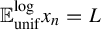
and
$ {\mathbb {E}}_{ \mathrm{unif}}^{\log }x_n =L$
 is equivalent to the statement that
$\lim _{a\to \infty }({1}/{\log a}) \sum _{n=k}^{ak}({x_n}/{n})$
is equivalent to the statement that
$\lim _{a\to \infty }({1}/{\log a}) \sum _{n=k}^{ak}({x_n}/{n})$
 converges to L uniformly in k.
We now show that Theorem A follows from our main result, Theorem B.
Theorem B. Let
$V:\mathbb {N}\rightarrow (0,\infty )$
 be a function which increases to
$\infty $
be a function which increases to
$\infty $
 with
$\Delta {\log} (V(N))$
with
$\Delta {\log} (V(N))$
 eventually decreasing to
$0$
eventually decreasing to
$0$
 such that
$\lim _{N\to \infty }({\Delta {\log} (V(N)})/{\Delta {\log} (N)})=\infty $
such that
$\lim _{N\to \infty }({\Delta {\log} (V(N)})/{\Delta {\log} (N)})=\infty $
 . Let Y be a Banach space, let
$(x_n)_{n\in \mathbb {N}}\subseteq Y$
. Let Y be a Banach space, let
$(x_n)_{n\in \mathbb {N}}\subseteq Y$
 be a bounded sequence, and let
$L\in Y$
be a bounded sequence, and let
$L\in Y$
 . Consider the following statements:
-
(1) $\lim _{N\to \infty } {\mathbb {E}}_{n\leqslant N}^Vx_n =L$
; -
(2) $ {\mathbb {E}}(\infty )^Vx_n = L$
; -
(3) $\lim _{N\to \infty } {\mathbb {E}}_{n\leqslant N}^Ux_n = L$
for each function
$U:\mathbb {N}\rightarrow (0,\infty )$
which increases to
$\infty $
and satisfies (1.15) $$ \begin{align} \lim_{N\to\infty}\frac{V(N-1)}{\Delta U(N)}\bigg(\frac{\Delta U(N)}{\Delta V(N)}-\frac{\Delta U(N-1)}{\Delta V(N-1)}\bigg)=-1; \end{align} $$
-
(4) $\lim _{N\to \infty } {\mathbb {E}}_{n\in [N-s(N),N]}x_n = L$
for each non-decreasing function
$s:\mathbb {N}\rightarrow \mathbb {N}$
satisfying (1.16) $$ \begin{align} \lim_{N\to\infty}s(N) \cdot \Delta{\log}(V(N))=\infty \end{align} $$and $s(N)\leqslant N-1$
for all
$N\in \mathbb {N}$
;
-
(5) $ {\mathbb {E}}_{\mathrm {unif}}^{\log V}x_n = L$
.











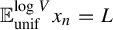
We have that

Proof of Theorem A.
Let
$V(N) = e^{W(N)}$
 and suppose that

that is,
$ {\mathbb {E}}_{ \mathrm{unif}}^Wx_n = L$
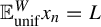 and so condition (5) of Theorem B holds. We have that
$\Delta{\log} (V(N))$
and so condition (5) of Theorem B holds. We have that
$\Delta{\log} (V(N))$
 is decreasing to
$0$
is decreasing to
$0$
 and that

because of our assumptions on W. Thus we can apply Theorem B to deduce that condition (4) holds.
Let
$s(N) = N-1$
 so that
$ {\mathbb {E}}_{n\in [N-s(N),N]}x_n = {\mathbb {E}}_{n\in [1,N]}x_n = {\mathbb {E}}_{n\leqslant N}x_n$
so that
$ {\mathbb {E}}_{n\in [N-s(N),N]}x_n = {\mathbb {E}}_{n\in [1,N]}x_n = {\mathbb {E}}_{n\leqslant N}x_n$
 for all
$N\in \mathbb {N}$
for all
$N\in \mathbb {N}$
 and
$\lim _{N\to \infty }s(N)\cdot \Delta{\log}(V(N)) = \lim _{N\to \infty }N\cdot \Delta W(N)=\infty $
and
$\lim _{N\to \infty }s(N)\cdot \Delta{\log}(V(N)) = \lim _{N\to \infty }N\cdot \Delta W(N)=\infty $
 . By Theorem B, we have that
$ {\mathbb {E}}_{n\in [N-s(N),N]}x_n=L$
. By Theorem B, we have that
$ {\mathbb {E}}_{n\in [N-s(N),N]}x_n=L$
 . This completes the proof.
Remark 1.7. The limit in equation (1.15) initially appears unwieldy and impractical. However, let us assume that the limit in equation (1.15) exists. Then we can perform some algebraic manipulations and apply the Stolz–Cesàro theorem [Reference Pólya and Szegő7, Problem 70] to see that

So the limit in equation (1.15) is equal to
$-1$
 if and only if
$\lim _{N\to \infty }(({V(N)\cdot \Delta U(N)})/ ({U(N)\cdot \Delta V(N)}))=0$
if and only if
$\lim _{N\to \infty }(({V(N)\cdot \Delta U(N)})/ ({U(N)\cdot \Delta V(N)}))=0$
 . We can obtain a clearer criterion when we use our assumption that
$\lim _{N\to \infty }\Delta{\log}(V(N))=0$
. We can obtain a clearer criterion when we use our assumption that
$\lim _{N\to \infty }\Delta{\log}(V(N))=0$
 , since we have

and so
$\lim _{N\to \infty }\Delta{\log}\ V(N) = 0$
 if and only if
$\lim _{N\to \infty }({\Delta V(N)}/{V(N)})=0$
if and only if
$\lim _{N\to \infty }({\Delta V(N)}/{V(N)})=0$
 . It follows that

One more application of the Stolz–Cesàro theorem shows that if
$\lim _{N\to \infty }({\Delta{\log}(U(N))}/ {\Delta{\log}(V(N))})=0$
 then
$\lim _{N\to \infty }({ \log (U(N))}/{ \log (V(N))})=0$
then
$\lim _{N\to \infty }({ \log (U(N))}/{ \log (V(N))})=0$
 . In particular, when the limit in equation (1.15) is known to exist, the assumption that equation (1.15) holds can be replaced with the assumption that
$\lim _{N\to \infty }({\log (U(N))}/{\log (V(N))})=0$
. In particular, when the limit in equation (1.15) is known to exist, the assumption that equation (1.15) holds can be replaced with the assumption that
$\lim _{N\to \infty }({\log (U(N))}/{\log (V(N))})=0$
 . For one important example of this, recall that a Hardy field is a field of real-valued functions which is closed under derivation, with the equivalence relation that two functions are equal if they are equal outside of a compact set. What is important for our purposes is any function contained in a Hardy field is eventually monotone and so any limit involving functions contained in the same Hardy field will exist in
$\mathbb {R}\cup \{-\infty ,+\infty \}$
. For one important example of this, recall that a Hardy field is a field of real-valued functions which is closed under derivation, with the equivalence relation that two functions are equal if they are equal outside of a compact set. What is important for our purposes is any function contained in a Hardy field is eventually monotone and so any limit involving functions contained in the same Hardy field will exist in
$\mathbb {R}\cup \{-\infty ,+\infty \}$
 (for more details, see [Reference Boshernitzan3]). When U and V are contained in the same Hardy field, the limit in (1.15) must exist.
Remark 1.7 gives a special case of Theorem B.
Theorem C. Let V be a function which is contained in a Hardy field and tends to
$\infty $
 . Suppose that
$\lim _{N\to \infty }({ \log (V(N))}/{ \log (N)})=\infty $
. Suppose that
$\lim _{N\to \infty }({ \log (V(N))}/{ \log (N)})=\infty $
 and
$\lim _{N\to \infty }({\log (V(N))}/{ N})=0$
and
$\lim _{N\to \infty }({\log (V(N))}/{ N})=0$
 . Let Y be a Banach space, let
$(x_n)_{n\in \mathbb {N}}\subseteq Y$
. Let Y be a Banach space, let
$(x_n)_{n\in \mathbb {N}}\subseteq Y$
 be a bounded sequence, and let
$L\in Y$
be a bounded sequence, and let
$L\in Y$
 . Consider the following statements:
-
(1) $\lim _{N\to \infty } {\mathbb {E}}_{n\leqslant N}^Vx_n =L$
; -
(2) $ {\mathbb {E}}(\infty )^Vx_n = L$
; -
(3) $\lim _{N\to \infty } {\mathbb {E}}_{n\leqslant N}^Ux_n = L$
for each function U which tends to
$\infty $
, satisfies
$\lim _{N\to \infty }(\log (U(N))/{\log (V(N))})=0 $
, and is contained in the same Hardy field as V; -
(4) $\lim _{N\to \infty } {\mathbb {E}}_{n\in [N-s(N),N]}x_n = L$
for each non-decreasing function
$s:\mathbb {N}\rightarrow \mathbb {N}$
satisfying
$ \lim _{N\to \infty }s(N) \cdot \Delta{\log}(V(N))=\infty $
and
$s(N)\leqslant N-1$
for all
$N\in \mathbb {N}$
; -
(5) $ {\mathbb {E}}_{\mathrm {unif}}^{\log V}x_n = L$
.










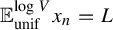
We have that

Of special interest in Theorem B is condition (4), since this allows us to relate weighted averages to Cesàro averages along a sequence of intervals.
Example 1.8. Let
$E\subseteq \mathbb {N}$
 be a set with

Let
$f\in \mathscr {F}_{\ell }$
 and let
$k\in \mathbb {N}$
and let
$k\in \mathbb {N}$
 . Let
$W= \Delta ^{\ell -1}f$
. Let
$W= \Delta ^{\ell -1}f$
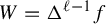 . For each
$n\in \mathbb {N}$
. For each
$n\in \mathbb {N}$
 , let
$A(n)$
, let
$A(n)$
 be the set of
$a\in \mathbb {N}$
be the set of
$a\in \mathbb {N}$
 such that

From [Reference Bergelson, Moreira and Richter1, Corollary F] we know that the set

is W-syndetic, meaning that

Using Theorem B, we may rephrase this W-syndetic condition as saying that

for any non-decreasing function
$s\colon \mathbb {N}\rightarrow \mathbb {N}$
 with
$\lim _{N\to \infty }s(N)\cdot \Delta W(N)=\infty $
with
$\lim _{N\to \infty }s(N)\cdot \Delta W(N)=\infty $
 and
$s(N)\leqslant N-1$
and
$s(N)\leqslant N-1$
 for all
$N\in \mathbb {N}$
for all
$N\in \mathbb {N}$
 . More concretely, for the sake of example we can take
$f(n) = n^{3/2}$
. More concretely, for the sake of example we can take
$f(n) = n^{3/2}$
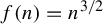 . Fix
$k\in \mathbb {N}$
. Fix
$k\in \mathbb {N}$
 and let
$\varepsilon>0$
and let
$\varepsilon>0$
 . We can take
$s(N) = N^{1/2+\varepsilon }$
. We can take
$s(N) = N^{1/2+\varepsilon }$
 in equation (1.19) to see that for all large enough N, there is an
$n\in [N-N^{1/2+\varepsilon },N]$
in equation (1.19) to see that for all large enough N, there is an
$n\in [N-N^{1/2+\varepsilon },N]$
 such that E contains a configuration of the form

and, moreover, these configurations are abundant in the sense of equation (1.18).
1.1 Structure of the paper
The remainder of the paper consists of a proof of Theorem B. It is clear that
$(1)\implies (2)$
 by definition. We will prove the rest of the implications one by one. In §2 we prove
$(2)\implies (3)$
by definition. We will prove the rest of the implications one by one. In §2 we prove
$(2)\implies (3)$
 , in §3 we prove
$(3)\implies (4)$
, in §3 we prove
$(3)\implies (4)$
 , and in §4 we prove
$(4)\implies (5)$
, and in §4 we prove
$(4)\implies (5)$
 . Finally, in §5 we prove that
$(5)\implies (2)$
. Finally, in §5 we prove that
$(5)\implies (2)$
 .
.
2
$(2)\implies (3)$

In this section we prove the implication
$(2)\implies (3)$
 in Theorem B. This implication will follow readily from the following lemma, whose proof appears in an unpublished manuscript authored by Michael Boshernitzan [Reference Boshernitzan4].
Lemma 2.1. Let
$V,U:\mathbb {N}\rightarrow (0,\infty )$
 increase to
$\infty $
increase to
$\infty $
 and suppose that

Let Y be a Banach space and let
$(x_n)_{n\in \mathbb {N}}\subseteq Y$
 be a bounded sequence. Then

where the
$o_{N\to \infty }(1)$
 term depends only on
$U,V$
term depends only on
$U,V$
 and
$\sup _{n\in \mathbb {N}}\|x_n\|$
and
$\sup _{n\in \mathbb {N}}\|x_n\|$
 .
.
Proof. Recall that the summation by parts formula says that

for functions
$f,g$
 on
$\mathbb {N}$
on
$\mathbb {N}$
 . By the hypothesis of the lemma, we may apply the results of Remark 1.7 to obtain
$\lim _{N\to \infty }(({V(N)\cdot \Delta U(N)})/({U(N)\cdot \Delta V(N)}))=0$
. By the hypothesis of the lemma, we may apply the results of Remark 1.7 to obtain
$\lim _{N\to \infty }(({V(N)\cdot \Delta U(N)})/({U(N)\cdot \Delta V(N)}))=0$
 and hence
$\lim _{N\to \infty }({\Delta U(N)}/{U(N)})=0$
and hence
$\lim _{N\to \infty }({\Delta U(N)}/{U(N)})=0$
 .
.
We will take the right-hand side of equation (2.1) and rewrite it in the form of the left-hand side. Put
$F(n) = \sum _{k=1}^n\Delta V(k)\cdot x_k$
 so that
$\Delta F(n) = \Delta V(n)\cdot x_n$
so that
$\Delta F(n) = \Delta V(n)\cdot x_n$
 and
${F(N)}/{V(N)}= {\mathbb {E}}_{n\leqslant N}^Vx_n$
and
${F(N)}/{V(N)}= {\mathbb {E}}_{n\leqslant N}^Vx_n$
 .
.
Apply summation by parts to obtain


The first term in (2.5) is equal to
$(({V(N)\hspace{-1pt}\cdot\hspace{-1pt} \Delta U(N)})/({U(N)\hspace{-1pt}\cdot\hspace{-1pt} \Delta V(N)}))\hspace{-1pt}\cdot\hspace{-1pt} ({F(N)}/{V(N)})$
 , which tends to
$0$
, which tends to
$0$
 as
$N\to \infty $
as
$N\to \infty $
 since
${F(N)}/{V(N)} = {\mathbb {E}}_{n\leqslant N}^Vx_n$
since
${F(N)}/{V(N)} = {\mathbb {E}}_{n\leqslant N}^Vx_n$
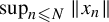
 is bounded in norm by
$\sup _{n\leqslant N}\|x_n\|$
is bounded in norm by
$\sup _{n\leqslant N}\|x_n\|$
 . The second term in (2.5) is

By assumption, we have
$({V(n-1)}/{\Delta U(n)})({\Delta U(n)}/{\Delta V(n)}-{\Delta U(n-1)}/{\Delta V(n-1)}) = -1+o_{N\to \infty }(1)$
 .
.
Note that
${F(n-1)}/{V(n-1)} = {\mathbb {E}}_{k\leqslant n-1}^Vx_k$
 is bounded in norm by
$\sup _{n\in \mathbb {N}}\|x_n\|$
is bounded in norm by
$\sup _{n\in \mathbb {N}}\|x_n\|$
 . So (2.5) is

and the
$o_{N\to \infty }(1)$
 term will depend only on
$U,V$
term will depend only on
$U,V$
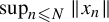
 , and
$\sup _{n\leqslant N}\|x_n\|$
, and
$\sup _{n\leqslant N}\|x_n\|$
 , and in particular not on
$(x_n)_{n\in \mathbb {N}}$
, and in particular not on
$(x_n)_{n\in \mathbb {N}}$
 . Finally, recalling that
$\lim _{N\to \infty }({\Delta U(N)}/{U(N)})=0$
. Finally, recalling that
$\lim _{N\to \infty }({\Delta U(N)}/{U(N)})=0$
 , we have

Corollary 2.2. Let Y be a Banach space, let
$(x_n)_{n\in \mathbb {N}}\subseteq Y$
 be a bounded sequence, and let
$L\in Y$
be a bounded sequence, and let
$L\in Y$
 . Suppose that
$V:\mathbb {N}\rightarrow (0,\infty )$
. Suppose that
$V:\mathbb {N}\rightarrow (0,\infty )$
 is a function which increases to
$\infty $
is a function which increases to
$\infty $
 with
$\limsup _{N\to \infty }({\Delta V(N)}/{V(N)})<1$
with
$\limsup _{N\to \infty }({\Delta V(N)}/{V(N)})<1$
 . Let
$U:\mathbb {N}\rightarrow (0,\infty )$
. Let
$U:\mathbb {N}\rightarrow (0,\infty )$
 be a function which increases to
$\infty $
be a function which increases to
$\infty $
 and satisfies

If
$ {\mathbb {E}}(\infty )^Vx_n = L$
 then
$\lim _{N\to \infty } {\mathbb {E}}_{n\leqslant N}^Ux_n = L$
then
$\lim _{N\to \infty } {\mathbb {E}}_{n\leqslant N}^Ux_n = L$
 .
.
Proof. Suppose that
$ {\mathbb {E}}(\infty )^Vx_n = L$
 . Let
$\varepsilon>0$
. Let
$\varepsilon>0$
 . We can pick
$K\in \mathbb {N}$
. We can pick
$K\in \mathbb {N}$
 such that
$| {\mathbb {E}}_{n\leqslant N}^V(k)(x_n)-L|<\varepsilon $
such that
$| {\mathbb {E}}_{n\leqslant N}^V(k)(x_n)-L|<\varepsilon $
 for all large enough N. Now consider
$ {\mathbb {E}}_{n\leqslant N}^U( {\mathbb {E}}_{k\leqslant n}^V(K)x_k)$
for all large enough N. Now consider
$ {\mathbb {E}}_{n\leqslant N}^U( {\mathbb {E}}_{k\leqslant n}^V(K)x_k)$
 . From equation (2.1),

Using linearity, we have

But we can bound
$| {\mathbb {E}}_{n\leqslant N}^U( {\mathbb {E}}_{k\leqslant n}^V(K)x_k-L)|$
 using the triangle inequality,

Taking
$\limsup _{N\to \infty }$
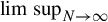 of equation (2.6), we find that

This holds for each
$\varepsilon>0$
 , so we conclude that
$\lim _{N\to \infty } {\mathbb {E}}_{n\leqslant N}^Ux_n=L$
, so we conclude that
$\lim _{N\to \infty } {\mathbb {E}}_{n\leqslant N}^Ux_n=L$
 .
.
3
$(3)\implies (4)$

In this section we prove the implication
$(3)\implies (4)$
 in Theorem B. We begin by recalling the Silverman–Toeplitz theorem [Reference Boos and Cass2, Theorem 2.3.7].
Theorem 3.1. (Silverman–Toeplitz)
Let
$(c_{N,n})_{N,n\in \mathbb {N}}$
 be a doubly indexed sequence of complex numbers and let Y be a Banach space. The following assertions are equivalent:
-
(A) $\lim _{N\to \infty }\sum _{n\in \mathbb {N}}c_{N,n}y_n = \lim _{n\to \infty }y_n$
for each convergent sequence
$(y_n)_{n\in \mathbb {N}}\subseteq Y$
; -
(B) $(c_{N,n})_{N,n\in \mathbb {N}}$
satisfies each of the following:-
• for each $n\in \mathbb {N}$
,
$\lim _{N\to \infty }c_{N,n}=0$
, -
• $\lim _{N\to \infty }\sum _{n\in \mathbb {N}}c_{N,n}=1$
, -
• $\limsup _{N\to \infty }\sum _{n\in \mathbb {N}}|c_{N,n}|<\infty $
.
-







The Silverman–Toeplitz theorem will allow us to deduce the desired implication once we show that there is a sequence
$(c_{N,n})_{N,n\in \mathbb {N}}$
 relating the averages of the form
$ {\mathbb {E}}_{n\in [N-s(N),N]}$
relating the averages of the form
$ {\mathbb {E}}_{n\in [N-s(N),N]}$
 and the averages of the form
$ {\mathbb {E}}_{n\leqslant N}^U$
and the averages of the form
$ {\mathbb {E}}_{n\leqslant N}^U$
 .
.
Lemma 3.2. Let Y be a Banach space, let
$U:\mathbb {N}\rightarrow (0,\infty )$
 be an increasing function which satisfies
$\limsup _{N\to \infty }({\Delta{\log}(U(N))}/{\Delta{\log}(N)})=\infty $
be an increasing function which satisfies
$\limsup _{N\to \infty }({\Delta{\log}(U(N))}/{\Delta{\log}(N)})=\infty $
 and
$\limsup _{N\to \infty } (\Delta U(N)/{U(N)})=0$
and
$\limsup _{N\to \infty } (\Delta U(N)/{U(N)})=0$
 . Additionally, assume that
$\Delta U$
. Additionally, assume that
$\Delta U$
 is non-decreasing. Let
$s:\mathbb {N}\rightarrow \mathbb {N}$
is non-decreasing. Let
$s:\mathbb {N}\rightarrow \mathbb {N}$
 be a non-decreasing function with
$s(N)\leqslant N-1$
be a non-decreasing function with
$s(N)\leqslant N-1$
 for all
$N\in \mathbb {N}$
for all
$N\in \mathbb {N}$
 and
and

Then there exists a doubly indexed non-negative sequence
$(c_{N,n})_{N,n\in \mathbb {N}}$
 which satisfies each of the conditions in item (B) of Theorem 3.1 such that for any bounded sequence
$(x_n)_{n\in \mathbb {N}}\subseteq Y$
which satisfies each of the conditions in item (B) of Theorem 3.1 such that for any bounded sequence
$(x_n)_{n\in \mathbb {N}}\subseteq Y$
 ,
,

Proof. Define
$(c_{N,n})_{N,n\in \mathbb {N}}$
 by
by

and note that each
$c_{N,n}$
 is non-negative since
$\Delta U$
is non-negative since
$\Delta U$
 is non-decreasing. Additionally, it is clear that
$\lim _{N\to \infty }c_{N,n}=0$
is non-decreasing. Additionally, it is clear that
$\lim _{N\to \infty }c_{N,n}=0$
 for each fixed n since
$s(N)\to \infty $
for each fixed n since
$s(N)\to \infty $
 as
$N\to \infty $
as
$N\to \infty $
 . Next we will show that equation (3.1) holds. Switching the order of summation, we have

We will show the following two equations, from which equation (3.1) follows:

and

For (3.2), if
$k=N$
 we have

and if
$N-s(N)\leqslant k<N$
 then
then

Turning our attention to (3.3), we can observe that
$c_{N,k} = 0$
 for
$k<N-s(N)$
for
$k<N-s(N)$
 and so as above we have

Then


Recall that
$ {\mathbb {E}}_{n\leqslant N-s(N)-1}^Ux_n$
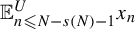 is bounded and that
${U(N-s(N)-1)}/{U(N)}\leqslant 1$
is bounded and that
${U(N-s(N)-1)}/{U(N)}\leqslant 1$
 since U is increasing. Additionally, from equation (1.17),
$ \lim _{N\to \infty }({\Delta{\log} U(N)}/({\Delta U(N)}/ {U(N)})) =1$
since U is increasing. Additionally, from equation (1.17),
$ \lim _{N\to \infty }({\Delta{\log} U(N)}/({\Delta U(N)}/ {U(N)})) =1$
 . By assumption, we have
$\lim _{N\to \infty }s(N)\cdot \Delta{\log}\ U(N)=\infty $
. By assumption, we have
$\lim _{N\to \infty }s(N)\cdot \Delta{\log}\ U(N)=\infty $
 and so taking the limit of equation (3.5) shows that equation (3.3) holds. Lastly, we have
$\lim _{N\to \infty }\sum _{n\in \mathbb {N}}c_{N,n} = 1$
and so taking the limit of equation (3.5) shows that equation (3.3) holds. Lastly, we have
$\lim _{N\to \infty }\sum _{n\in \mathbb {N}}c_{N,n} = 1$
 by taking
$x_n = 1$
by taking
$x_n = 1$
 for all
$n\in \mathbb {N}$
for all
$n\in \mathbb {N}$
 in equation (3.1). This concludes the proof.
Corollary 3.3. Let Y be a Banach space, let
$(x_n)_{n\in \mathbb {N}}\subseteq Y$
 be a bounded sequence, and let
$L\in Y$
be a bounded sequence, and let
$L\in Y$
 . Let
$V:\mathbb {N}\rightarrow (0,\infty )$
. Let
$V:\mathbb {N}\rightarrow (0,\infty )$
 be an increasing function such that
$\Delta{\log}(V(N))$
be an increasing function such that
$\Delta{\log}(V(N))$
 decreases to
$0$
decreases to
$0$
 with
$\lim _{N\to \infty }({\Delta{\log}\ V(N)}/{\Delta{\log}(N)})=\infty $
with
$\lim _{N\to \infty }({\Delta{\log}\ V(N)}/{\Delta{\log}(N)})=\infty $
 . Suppose that
$\lim _{N\to \infty } {\mathbb {E}}_{n\leqslant N}^Ux_n = L$
. Suppose that
$\lim _{N\to \infty } {\mathbb {E}}_{n\leqslant N}^Ux_n = L$
 for each function
$U:\mathbb {N}\rightarrow (0,\infty )$
for each function
$U:\mathbb {N}\rightarrow (0,\infty )$
 which increases to
$\infty $
which increases to
$\infty $
 and satisfies

Let
$s:\mathbb {N}\rightarrow \mathbb {N}$
 be a non-decreasing function satisfying
$\lim _{N\to \infty }s(N) \cdot \Delta{\log}(V(N))=~\infty $
be a non-decreasing function satisfying
$\lim _{N\to \infty }s(N) \cdot \Delta{\log}(V(N))=~\infty $
 and
$s(N)\leqslant N-1$
and
$s(N)\leqslant N-1$
 for all
$N\in \mathbb {N}$
for all
$N\in \mathbb {N}$
 . Then
$ {\mathbb {E}}_{n\in [N-s(N),N]}x_n = L$
. Then
$ {\mathbb {E}}_{n\in [N-s(N),N]}x_n = L$
 .
.
Proof. Our strategy is to find functions U and
$\tilde {U}$
 where U satisfies (1.15),
$\tilde {U}$
where U satisfies (1.15),
$\tilde {U}$
 satisfies the assumptions of Theorem 3.2, and

Then by taking limits of equation (3.1) and invoking the Silverman–Toeplitz theorem it will follow that
$\lim _{N\to \infty } {\mathbb {E}}_{n\in [N-s(N),N]}x_n = L$
 . We begin by picking a function
$r:\mathbb {N}\rightarrow (0,\infty )$
. We begin by picking a function
$r:\mathbb {N}\rightarrow (0,\infty )$
 which decreases to
$0$
which decreases to
$0$
 slowly enough such that:
-
(i) $\lim _{N\to \infty }r(N)\cdot \log (V(N))=\infty $
; -
(ii) $\lim _{N\to \infty }r(N)\cdot s(N)\cdot \Delta{\log}\ V(N) =\infty $
; -
(iii) $\lim _{N\to \infty }({\Delta{\log}(r(N))}/{\Delta{\log}\log (V(N))}){\kern-1pt}={\kern-1pt}\lim _{N\to \infty }(({\log (V(N)){\kern-1pt}\cdot{\kern-1pt} \Delta r(N)})/(r(N){\kern-1pt}\cdot \Delta{\log} (V(N))))=0$
, from which it follows that
$\lim _{N\to \infty }({\Delta{\log}(r(N))}/ \Delta{\log}(V(N)^{r(N)}))=0$
and
$\lim _{N\to \infty }({\log (V(N))\cdot \Delta r(N)}/{\Delta{\log}(V(N))})= \lim _{N\to \infty } ({\Delta{\log}(V(N)^{r(N)})}/{\Delta{\log}(V(N))})=0$
.





For example, we can take

Let
$U(N) = \sum _{n\leqslant N}(({\Delta V(n)}/{V(n)})V(n)^{r(n)})$
 , so that
$\Delta U(N) = ({\Delta V(N)}/$
, so that
$\Delta U(N) = ({\Delta V(N)}/$ ${V(N)})V (N)^{r(N)}>0$
 .
.
We can verify that equation (1.15) holds. Indeed,

Additionally, it follows from Remark 1.7 that
$\lim _{N\to \infty }({\Delta U(N)}/{U(N)})=0$
 . To check that
$U(N)$
. To check that
$U(N)$
 tends to
$\infty $
tends to
$\infty $
 as
$N\to \infty $
as
$N\to \infty $
 , note that

and so
$\Delta U(N) = V(N)^{r(N)} ({\Delta V(N)}/{V(N)}) = ({\Delta (V(N)^{r(N)})}/{r(N)})\cdot (1+o_{N\to \infty }(1))$
 . Similarly,

by our assumptions on r. Let
$T(N) = {V(N)^{r(N)}}/{r(N)}$
 , which increases to
$\infty $
, which increases to
$\infty $
 . We have shown that
$\lim _{N\to \infty }({\Delta T(N)}/{\Delta U(N)})=1$
. We have shown that
$\lim _{N\to \infty }({\Delta T(N)}/{\Delta U(N)})=1$
 and hence
$\lim _{N\to \infty }({T(N)}/ {U(N)}) =1$
and hence
$\lim _{N\to \infty }({T(N)}/ {U(N)}) =1$
 . It follows that
$U(N)$
. It follows that
$U(N)$
 tends to
$\infty $
tends to
$\infty $
 as
$N\to \infty $
as
$N\to \infty $
 . Since U increases to
$\infty $
. Since U increases to
$\infty $
 and satisfies (1.15), we have by hypothesis that
$\lim _{N\to \infty } {\mathbb {E}}_{n\leqslant N}^Ux_n =L$
and satisfies (1.15), we have by hypothesis that
$\lim _{N\to \infty } {\mathbb {E}}_{n\leqslant N}^Ux_n =L$
 . Since
$\lim _{N\to \infty }({T(N)}/{U(N)})=1$
. Since
$\lim _{N\to \infty }({T(N)}/{U(N)})=1$
 and
$\lim _{n\to \infty }({\Delta T(n)}/{\Delta U(n)})=1$
and
$\lim _{n\to \infty }({\Delta T(n)}/{\Delta U(n)})=1$
 , we also have that
$\lim _{N\to \infty } {\mathbb {E}}_{n\leqslant N}^{T}x_n =L$
, we also have that
$\lim _{N\to \infty } {\mathbb {E}}_{n\leqslant N}^{T}x_n =L$
 .
.
We now define a function
$\tilde {U}$
 which satisfies the conditions of Lemma 3.2. Let
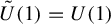
$\tilde {U}(1) = U(1)$
which satisfies the conditions of Lemma 3.2. Let
$\tilde {U}(1) = U(1)$
 and
$\tilde {U}(N+1) = \alpha _N \tilde {U}(N)$
and
$\tilde {U}(N+1) = \alpha _N \tilde {U}(N)$
 , where

and Z is a function which decreases to
$0$
 sufficiently slowly. Then

It follows that

We now check that
$\Delta \tilde {U}$
 is non-decreasing:

This is non-negative so long as
$\alpha _{N}\geqslant {\Delta \tilde {U}(N)}/{\tilde {U}(N)}+\alpha _{N-1}{\tilde {U}(N-1)}/{\tilde {U}(N)}$
 . Using the fact that
${\tilde {U}(N-1)}/{\tilde {U}(N)} = {1}/{\alpha _{N-1}}$
. Using the fact that
${\tilde {U}(N-1)}/{\tilde {U}(N)} = {1}/{\alpha _{N-1}}$
 and
${\Delta \tilde {U}(N)}/{\tilde {U}(N)}=1-({1}/{\alpha _{N-1}})$
and
${\Delta \tilde {U}(N)}/{\tilde {U}(N)}=1-({1}/{\alpha _{N-1}})$
 , this inequality becomes

We can note that

and so it suffices to show that
$({\Delta T(N+1)}/{T(N+1)})(1+Z(N))\geqslant ({\Delta T(N)}/ {T(N)})(1+Z(N-1))$
 . However, after rearranging, this is

Since
$\Delta{\log}(V(N))$
 is decreasing, this inequality is satisfied so long as Z decreases to
$0$
is decreasing, this inequality is satisfied so long as Z decreases to
$0$
 slowly enough. Thus,
$\Delta \tilde {U}$
slowly enough. Thus,
$\Delta \tilde {U}$
 is non-decreasing.
Lastly, to show that
$\lim _{N\to \infty } {\mathbb {E}}_{n\leqslant N}^{\tilde {U}}x_n = L$
 consider [Reference Kuipers and Niederreiter6, Lemma 7.1], which says that if
$\lim _{N\to \infty } {\mathbb {E}}_{n\leqslant N}^{{T}}x_n {\kern-1pt}={\kern-1pt} L$
consider [Reference Kuipers and Niederreiter6, Lemma 7.1], which says that if
$\lim _{N\to \infty } {\mathbb {E}}_{n\leqslant N}^{{T}}x_n {\kern-1pt}={\kern-1pt} L$
 ,
${\Delta \tilde {U}(N{\kern-1.5pt}+{\kern-1.5pt}1)}/{\Delta \tilde {U}(N)}{\kern-1.5pt}\geqslant{\kern-1.5pt} {\Delta T(N{\kern-1.5pt}+{\kern-1.5pt}1)}/{\Delta T(N)}$
,
${\Delta \tilde {U}(N{\kern-1.5pt}+{\kern-1.5pt}1)}/{\Delta \tilde {U}(N)}{\kern-1.5pt}\geqslant{\kern-1.5pt} {\Delta T(N{\kern-1.5pt}+{\kern-1.5pt}1)}/{\Delta T(N)}$
 , and there is an
${H{\kern-1.5pt}>{\kern-1.5pt}0}$
, and there is an
${H{\kern-1.5pt}>{\kern-1.5pt}0}$
 such that
${\Delta \tilde {U}(N)}/{\tilde {U}(N)}\leqslant H\cdot ({\Delta T(N)}/{T(N)})$
such that
${\Delta \tilde {U}(N)}/{\tilde {U}(N)}\leqslant H\cdot ({\Delta T(N)}/{T(N)})$
 for all N, then
$\lim _{N\to \infty } {\mathbb {E}}_{n\leqslant N}^{\tilde {U}}x_n = L$
for all N, then
$\lim _{N\to \infty } {\mathbb {E}}_{n\leqslant N}^{\tilde {U}}x_n = L$
 . Using (3.7), we can find an
$H>0$
. Using (3.7), we can find an
$H>0$
 such that
${\Delta \tilde {U}(N)}/{\tilde {U}(N)}\leqslant H\cdot ({\Delta T(N)}/{T(N)})$
such that
${\Delta \tilde {U}(N)}/{\tilde {U}(N)}\leqslant H\cdot ({\Delta T(N)}/{T(N)})$
 for all N. Also, the inequality
${\Delta \tilde {U}(N+1)}/{\Delta \tilde {U}(N)}\geqslant {\Delta T(N+1)}/{\Delta T(N)}$
for all N. Also, the inequality
${\Delta \tilde {U}(N+1)}/{\Delta \tilde {U}(N)}\geqslant {\Delta T(N+1)}/{\Delta T(N)}$
 holds since

and

So it suffices to show that
$({\alpha _N-1})/({\alpha _{N-1}-1})\geqslant 1+o_{N\to \infty }(1)$
 , but we can rearrange (3.8) to see that
$({\alpha _N-1})/({\alpha _{N-1}-1})\geqslant {1}/{\alpha _{N-1}}=1+o_{N\to \infty }(1)$
, but we can rearrange (3.8) to see that
$({\alpha _N-1})/({\alpha _{N-1}-1})\geqslant {1}/{\alpha _{N-1}}=1+o_{N\to \infty }(1)$
 . This completes the proof.
4
$(4)\implies (5)$

In this section we prove the implication
$(4)\implies (5)$
 in Theorem B. As in the previous section, the proof of this implication relies heavily on the Silverman–Toeplitz theorem.
Theorem 4.1. Let Y be a Banach space, let
$(x_n)_{n\in \mathbb {N}}\subseteq Y$
 be a bounded sequence, and let
$L\in Y$
be a bounded sequence, and let
$L\in Y$
 . Let
$V:\mathbb {N}\rightarrow (0,\infty )$
. Let
$V:\mathbb {N}\rightarrow (0,\infty )$
 be a function which increases to
$\infty $
be a function which increases to
$\infty $
 with
$\Delta{\log}(V(N))$
with
$\Delta{\log}(V(N))$
 decreasing to
$0$
decreasing to
$0$
 such that
$\lim _{N\to \infty }({\Delta{\log}(V(N))}/{\Delta{\log}(N)})=\infty $
such that
$\lim _{N\to \infty }({\Delta{\log}(V(N))}/{\Delta{\log}(N)})=\infty $
 . Suppose that
$\lim _{N\to \infty } {\mathbb {E}}_{n\in [N-s(N),N]}x_n = L$
. Suppose that
$\lim _{N\to \infty } {\mathbb {E}}_{n\in [N-s(N),N]}x_n = L$
 for each non-decreasing function
$s:\mathbb {N}\rightarrow \mathbb {N}$
for each non-decreasing function
$s:\mathbb {N}\rightarrow \mathbb {N}$
 satisfying

and
$s(N)\leqslant N-1$
 for all
$N\in \mathbb {N}$
for all
$N\in \mathbb {N}$
 . Then
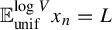
$ {\mathbb {E}}_{\mathrm {unif}}^{\log V}x_n = L$
. Then
$ {\mathbb {E}}_{\mathrm {unif}}^{\log V}x_n = L$
 .
.
Proof. Let
$W(N) = \log (V(N))$
 for
$N\in \mathbb {N}$
for
$N\in \mathbb {N}$
 . Let
$A = A(N)$
. Let
$A = A(N)$
 and
$B = B(N)$
and
$B = B(N)$
 be arbitrary integer-valued functions with
$W(B)-W(A)\to \infty $
be arbitrary integer-valued functions with
$W(B)-W(A)\to \infty $
 as
$N\to \infty $
as
$N\to \infty $
 . We will show that
$\lim _{N\to \infty } {\mathbb {E}}_{n\in [A,B]}^Wx_n = L$
. We will show that
$\lim _{N\to \infty } {\mathbb {E}}_{n\in [A,B]}^Wx_n = L$
 . Since A and B are arbitrary, this is sufficient to show that
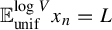
$ {\mathbb {E}}_{\mathrm {unif}}^{\log V}x_n =L$
. Since A and B are arbitrary, this is sufficient to show that
$ {\mathbb {E}}_{\mathrm {unif}}^{\log V}x_n =L$
 .
.
Pick a non-decreasing function
$s\colon \mathbb {N}\rightarrow \mathbb {N}$
 satisfying
$\lim _{N\to \infty }s(N)\cdot \Delta W(N) = \infty $
satisfying
$\lim _{N\to \infty }s(N)\cdot \Delta W(N) = \infty $
 , but which is slow enough such that
$s(N)\leqslant N-1$
, but which is slow enough such that
$s(N)\leqslant N-1$
 for all
$N\in \mathbb {N}$
for all
$N\in \mathbb {N}$
 and
$\lim _{N\to \infty } (({s(B)\cdot \Delta W(B)})/ ({W(B)-W(A)})) = 0$
and
$\lim _{N\to \infty } (({s(B)\cdot \Delta W(B)})/ ({W(B)-W(A)})) = 0$
 . Further, we can assume that
$\Delta s(N)\in \{0,1\}$
. Further, we can assume that
$\Delta s(N)\in \{0,1\}$
 for all
$N\in \mathbb {N}$
for all
$N\in \mathbb {N}$
 , since the condition
$\lim _{N\to \infty }({\Delta{\log}(V(N))}/{\Delta{\log}(N)})=\lim _{N\to \infty }N\cdot \Delta{\log}(V(N))=\infty $
, since the condition
$\lim _{N\to \infty }({\Delta{\log}(V(N))}/{\Delta{\log}(N)})=\lim _{N\to \infty }N\cdot \Delta{\log}(V(N))=\infty $
 implies that we can take
$s(N)$
implies that we can take
$s(N)$
 to be asymptotically slower than N. By assumption, we have that
$\lim _{N\to \infty } {\mathbb {E}}_{n\in [N-s(N),N]}x_n=L$
to be asymptotically slower than N. By assumption, we have that
$\lim _{N\to \infty } {\mathbb {E}}_{n\in [N-s(N),N]}x_n=L$
 .
.
We will show that there exists a doubly indexed sequence of non-negative constants
$(c_{N,n})_{N,n\in \mathbb {N}}$
 such that
$\lim _{N\to \infty }\sum _{n\in \mathbb {N}}c_{N,n}=1$
such that
$\lim _{N\to \infty }\sum _{n\in \mathbb {N}}c_{N,n}=1$
 ,
$\lim _{N\to \infty }c_{N,n_0}=0$
,
$\lim _{N\to \infty }c_{N,n_0}=0$
 for each fixed
$n_0\in \mathbb {N}$
for each fixed
$n_0\in \mathbb {N}$
 , and
, and

Once we have shown these properties, we can conclude that
$\lim _{N\to \infty } {\mathbb {E}}_{n\in [A,B]}^Wx_n = L$
 by the Silverman–Toeplitz theorem and our assumption that
$\lim _{k\to \infty } {\mathbb {E}}_{n\in [k-s(k),k]}x_n=L$
by the Silverman–Toeplitz theorem and our assumption that
$\lim _{k\to \infty } {\mathbb {E}}_{n\in [k-s(k),k]}x_n=L$
 .
.
We will define
$(c_{N,n})$
 inductively. For
$N\in \mathbb {N}$
inductively. For
$N\in \mathbb {N}$
 , define
$c_{N,n} = 0$
, define
$c_{N,n} = 0$
 if
$n>B$
if
$n>B$
 or
$n<A$
or
$n<A$
 . Then put
$c_{N,B} = ({s(B)\Delta W(B)}/({W(B)-W(A)}))$
. Then put
$c_{N,B} = ({s(B)\Delta W(B)}/({W(B)-W(A)}))$
 . For
$n\in [A,B]$
. For
$n\in [A,B]$
 , having already defined
$c_{N,n+1},\ldots , c_{N,B}$
, having already defined
$c_{N,n+1},\ldots , c_{N,B}$
 , let
, let

With this definition, it is clear that for each
$N\in \mathbb {N}$
 we have

Note that
$\lim _{N\to \infty }c_{N,n_0}=0$
 for each fixed
$n_0\in \mathbb {N}$
for each fixed
$n_0\in \mathbb {N}$
 , since
$\lim _{N\to \infty }A = \infty $
, since
$\lim _{N\to \infty }A = \infty $
 and
$c_{N,n_0}=0$
and
$c_{N,n_0}=0$
 for
$n_0<A$
for
$n_0<A$
 . Next, we will show that
$c_{N,n}\geqslant 0$
. Next, we will show that
$c_{N,n}\geqslant 0$
 for all n. We proceed with an inductive argument. First note that
$c_{N,B} = ({s(B)\cdot \Delta W(B)})/({W(B)-W(A)})\geqslant 0$
for all n. We proceed with an inductive argument. First note that
$c_{N,B} = ({s(B)\cdot \Delta W(B)})/({W(B)-W(A)})\geqslant 0$
 and that
$c_{N,n}=~0$
and that
$c_{N,n}=~0$
 for
$n>B$
for
$n>B$
 or
$n<A$
or
$n<A$
 . Now suppose that
$A\leqslant k<B$
. Now suppose that
$A\leqslant k<B$
 and
$c_{N,k+1},\ldots , c_{N,B}\geqslant ~0$
and
$c_{N,k+1},\ldots , c_{N,B}\geqslant ~0$
 . We know that
$\Delta W(k)\geqslant \Delta W(k+1)$
. We know that
$\Delta W(k)\geqslant \Delta W(k+1)$
 by our assumption that
$\Delta{\log}(V(N))$
by our assumption that
$\Delta{\log}(V(N))$
 is decreasing and so

Let
$z\leqslant B$
 be the largest integer such that
$k\geqslant z-s(z)$
be the largest integer such that
$k\geqslant z-s(z)$
 , so that

is equal to either
${c_{N,k}}/{s(k)}-{c_{N,z+1}}/{s(z+1)}$
 or
${c_{N,k}}/{s(k)}-{c_{N,z+1}}/{s(z+1)}-{c_{N,z+2}}/ {s(z+2)}$
or
${c_{N,k}}/{s(k)}-{c_{N,z+1}}/{s(z+1)}-{c_{N,z+2}}/ {s(z+2)}$
 . In either case, we have that

By assumption,
$c_{N,z+1}\geqslant 0$
 and so
$c_{N,k}\geqslant 0$
and so
$c_{N,k}\geqslant 0$
 , which completes the induction.
To prove that equation (4.2) holds, observe that

Switching the order of summation, we have

Now we can split the outer sum into two sums in order to apply equation (4.4):

Next, we will show that
$\sum _{n=A-s(A)}^{A-1}x_n\sum _{k= n}^B({c_{N,k}}/{s(k)})\cdot 1_{\{n\geqslant k-s(k)\}}=o_{N\to \infty }(1)$
 , which will prove equation (4.2). First, we will use the triangle inequality,

Recall that
$c_{N,k}=0$
 for
$k<A$
for
$k<A$
 and so for
$n<A$
and so for
$n<A$
 we have

Then

By (4.4),

So altogether, we have shown that

Finally, taking
$x_n = 1$
 in equation (4.2) shows that
$\sum _{n\in \mathbb {N}}c_{N,n}= 1+o_{N\to \infty }(1)$
in equation (4.2) shows that
$\sum _{n\in \mathbb {N}}c_{N,n}= 1+o_{N\to \infty }(1)$
 , which concludes the proof.
5
$(5)\implies (2)$

In this section we prove the implication
$(5)\implies (2)$
 in Theorem B. Our strategy is to emulate the proof of a classical theorem of Schatte.
Theorem 5.1. [Reference Schatte9, Theorem B]
Let
$(x_n)_{n\in \mathbb {N}}$
 be a bounded sequence of complex numbers and let
$L\in \mathbb {C}$
be a bounded sequence of complex numbers and let
$L\in \mathbb {C}$
 . Then
$ {\mathbb {E}}(\infty )(x_n) = L$
. Then
$ {\mathbb {E}}(\infty )(x_n) = L$
 if and only if
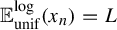
$ {\mathbb {E}}_{ \mathrm{unif}}^{\log }(x_n) = L$
if and only if
$ {\mathbb {E}}_{ \mathrm{unif}}^{\log }(x_n) = L$
 .
.
Example 5.2. It is known that
$\lim _{N\to \infty } {\mathbb {E}}_{n\leqslant N}e^{2\pi i \log (n)}=({1}/{N})\sum _{n=1}^Ne^{2\pi i \log (n)}$
 does not tend toward
$0$
does not tend toward
$0$
 as
$N\to \infty $
as
$N\to \infty $
 . Indeed,

The sum
$({1}/{N})\sum _{n=1}^Ne^{2\pi i \log (n/N)}$
 is a Riemann sum for the integral
$\int _0^1e^{2\pi i \log (x)}dx$
is a Riemann sum for the integral
$\int _0^1e^{2\pi i \log (x)}dx$
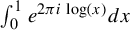 and so
$({1}/{N})\sum _{n=1}^Ne^{2\pi i \log (n/N)} = \int _0^1e^{2\pi i \log (x)}dx + o_{N\to \infty }(1)$
and so
$({1}/{N})\sum _{n=1}^Ne^{2\pi i \log (n/N)} = \int _0^1e^{2\pi i \log (x)}dx + o_{N\to \infty }(1)$
 .
.
Let
$x_n = e^{2\pi i \log (n)}$
 and let
$C = \int _0^1e^{2\pi i \log (x)}dx = {1}/({1+2\pi i })$
and let
$C = \int _0^1e^{2\pi i \log (x)}dx = {1}/({1+2\pi i })$
 . Note that
$\|x_n\| = 1$
. Note that
$\|x_n\| = 1$
 for all
$n\in \mathbb {N}$
for all
$n\in \mathbb {N}$
 and
$|C|<1$
and
$|C|<1$
 . Then

In general,
$ {\mathbb {E}}_{n\leqslant N}(k)x_n = C^k\cdot x_N+o_{N\to \infty }(1)$
 . From this we can see that as
$k\to \infty $
. From this we can see that as
$k\to \infty $
 ,
$ {\mathbb {E}}_{n\leqslant N}(k)x_n\to 0$
,
$ {\mathbb {E}}_{n\leqslant N}(k)x_n\to 0$
 . So
$ {\mathbb {E}}(\infty )x_n = 0$
. So
$ {\mathbb {E}}(\infty )x_n = 0$
 . According to Theorem 5.1, this implies that

For our purposes, we need to begin with the following theorem, which is a straightforward extension of [Reference Schatte8, Satz 1].
Theorem 5.3. Let Y be a Banach space, let
$(x_n)_{n\in \mathbb {N}}\subseteq Y$
 be a bounded sequence. Let
$V:\mathbb {N}\rightarrow (0,\infty )$
be a bounded sequence. Let
$V:\mathbb {N}\rightarrow (0,\infty )$
 be a function which increases to
$\infty $
be a function which increases to
$\infty $
 and satisfies
$\lim _{N\to \infty }({\Delta V(N)}/ {V(N)}) =0$
and satisfies
$\lim _{N\to \infty }({\Delta V(N)}/ {V(N)}) =0$
 . Then for each
$k\in \mathbb {N}$
. Then for each
$k\in \mathbb {N}$
 ,
,

Proof. We proceed by induction on k. There is nothing to prove when
$k=0$
 , so suppose that equation (5.1) holds and we will show that

Then

We will show that
from which equation (5.2) follows. Recall from Remark 1.7 that
${\Delta V(N)}/{V(N)} = \Delta{\log}(V(N))\cdot (1+o_{N\to \infty }(1))$
 . Then

Let
$\ell _n = \log ({V(N)}/{V(n)})$
 and
$G_n = \sum _{i=m}^n\Delta{\log}(V(i))$
and
$G_n = \sum _{i=m}^n\Delta{\log}(V(i))$
 , so that
$\Delta G_n = \Delta {\log} (V(n)) = -\Delta \ell _n$
, so that
$\Delta G_n = \Delta {\log} (V(n)) = -\Delta \ell _n$
 . Then using summation by parts, we have

The first two terms are equal to
$0$
 since
$\ell _N = 0$
since
$\ell _N = 0$
 and
$G_{m-1}=0$
and
$G_{m-1}=0$
 . Next, noting that
$\lim _{n\to \infty }({\ell _{n}}/{\ell _{n+1}}) = 1$
. Next, noting that
$\lim _{n\to \infty }({\ell _{n}}/{\ell _{n+1}}) = 1$
 , we have

Additionally, we can write

So,

Comparing with (5.3), we have

so

as desired.
Lemma 5.4. Let Y be a Banach space and let
$(x_n)_{n\in \mathbb {N}}\subseteq Y$
 be a bounded sequence. Let
$V:\mathbb {N}\rightarrow (0,\infty )$
be a bounded sequence. Let
$V:\mathbb {N}\rightarrow (0,\infty )$
 be a function which increases to
$\infty $
be a function which increases to
$\infty $
 and satisfies
$\lim _{N\to \infty }({\Delta V(N)}/ {V(N)}) =0$
and satisfies
$\lim _{N\to \infty }({\Delta V(N)}/ {V(N)}) =0$
 . Suppose that

Then
$ {\mathbb {E}}(\infty )^Vx_n = 0$
 .
.
Proof. Pick
$k\in \mathbb {N}$
 arbitrarily large and define
$F(x) = ({x}/{k!})\log ({1}/{x})^k$
arbitrarily large and define
$F(x) = ({x}/{k!})\log ({1}/{x})^k$
 , with
$F(0)=0$
, with
$F(0)=0$
 . Note that F is continuous and F is increasing on the interval
$(0,e^{-k})$
. Note that F is continuous and F is increasing on the interval
$(0,e^{-k})$
 and decreasing on the interval
$(e^{-k},1)$
and decreasing on the interval
$(e^{-k},1)$
 . From Theorem 5.3, we have that

Summation by parts gives us that

Pick
$C>0$
 such that
$\limsup _{N\to \infty }|\!\sum _{n=1}^N({\Delta V(n)}/{V(n)})x_n|\leqslant C$
such that
$\limsup _{N\to \infty }|\!\sum _{n=1}^N({\Delta V(n)}/{V(n)})x_n|\leqslant C$
 . Then

The result follows from the fact that
$\lim _{k\to \infty }F(e^{-k})=0$
 .
.
Theorem 5.5. Let Y be a Banach space and let
$(x_n)_{n\in \mathbb {N}}\subseteq Y$
 be a bounded sequence. Let
$V:\mathbb {N}\rightarrow (0,\infty )$
be a bounded sequence. Let
$V:\mathbb {N}\rightarrow (0,\infty )$
 be a function which increases to
$\infty $
be a function which increases to
$\infty $
 and satisfies
$\lim _{N\to \infty }({\Delta V(N)}/{V(N)})=0$
and satisfies
$\lim _{N\to \infty }({\Delta V(N)}/{V(N)})=0$
 . Suppose that
$ {\mathbb {E}}_{\mathrm {unif}}^{\log V}(x_n) = L$
. Suppose that
$ {\mathbb {E}}_{\mathrm {unif}}^{\log V}(x_n) = L$
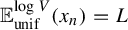 . Then
$ {\mathbb {E}}(\infty )^Vx_n = L$
. Then
$ {\mathbb {E}}(\infty )^Vx_n = L$
 .
.
Proof. Without loss of generality, assume
$L=0$
 . Pick any
$\varepsilon>0$
. Pick any
$\varepsilon>0$
 . We will find bounded sequences
$(y_n)_{n\in \mathbb {N}}, (z_n)_{n\in \mathbb {N}}$
. We will find bounded sequences
$(y_n)_{n\in \mathbb {N}}, (z_n)_{n\in \mathbb {N}}$
 with
$x_n=y_n+z_n$
with
$x_n=y_n+z_n$
 for each
$n\in \mathbb {N}$
for each
$n\in \mathbb {N}$
 , such that
$\sup _{N\in \mathbb {N}}|y_N|<\varepsilon $
, such that
$\sup _{N\in \mathbb {N}}|y_N|<\varepsilon $
 and
$\limsup _{N\to \infty }|\!\sum _{n=1}^N({\Delta V(n)}/{V(n)})z_n|<\infty $
and
$\limsup _{N\to \infty }|\!\sum _{n=1}^N({\Delta V(n)}/{V(n)})z_n|<\infty $
 . From Lemma 5.4 it will follow that

which will conclude the proof.
Recall from Remark 1.7 that
${\Delta V(n)}/{V(n)} = \Delta{\log}(V(n))\cdot (1+o_{n\to \infty }(1))$
 . We know that

tends to
$0$
 whenever
$\log (V(B))-\log (V(A))$
whenever
$\log (V(B))-\log (V(A))$
 tends to
$\infty $
tends to
$\infty $
 , and so it follows that we also have that

tends to L whenever
$\log (V(B))-\log (V(A))$
 tends to
$\infty $
tends to
$\infty $
 .
.
We can find a
$K_0>0$
 such that for any
$M,N$
such that for any
$M,N$
 with
$W(N)-W(M)>K_0$
with
$W(N)-W(M)>K_0$
 ,
,

Define a sequence
$(N_i)$
 as follows. Let
$N_1=1$
as follows. Let
$N_1=1$
 and, having picked
$N_i$
and, having picked
$N_i$
 for
$i\in \mathbb {N}$
for
$i\in \mathbb {N}$
 , pick the smallest
$N_{i+1}>N_i$
, pick the smallest
$N_{i+1}>N_i$
 such that
$\log (V(N_{i+1}-1))-\log (V(N_i))>K_0$
such that
$\log (V(N_{i+1}-1))-\log (V(N_i))>K_0$
 . For each
$i\in \mathbb {N}$
. For each
$i\in \mathbb {N}$
 , define

so that the sequence
$(y_k)_{k\in \mathbb {N}}$
 is constant on each interval
$[N_i,N_{i+1}-1]$
is constant on each interval
$[N_i,N_{i+1}-1]$
 and
$|y_n|<\varepsilon $
and
$|y_n|<\varepsilon $
 for all
$n\in \mathbb {N}$
for all
$n\in \mathbb {N}$
 . Put
$z_n = x_n-y_n$
. Put
$z_n = x_n-y_n$
 for all
$n\in \mathbb {N}$
for all
$n\in \mathbb {N}$
 , and note that
$(z_n)$
, and note that
$(z_n)$
 is bounded since
$(x_n)_{n\in \mathbb {N}}$
is bounded since
$(x_n)_{n\in \mathbb {N}}$
 and
$(y_n)_{n\in \mathbb {N}}$
and
$(y_n)_{n\in \mathbb {N}}$
 are bounded. All that is left is to show that
$\limsup _{N\to \infty }|\!\sum _{n=1}^N({\Delta V(n)}/{V(n)})z_n|<\infty $
are bounded. All that is left is to show that
$\limsup _{N\to \infty }|\!\sum _{n=1}^N({\Delta V(n)}/{V(n)})z_n|<\infty $
 .
.
Pick
$N\in \mathbb {N}$
 and pick i such that
$N_{i-1}<N\leqslant N_{i}$
and pick i such that
$N_{i-1}<N\leqslant N_{i}$
 . Then

We have that
$z_k = x_k-y_k$
 , and
$y_k$
, and
$y_k$
 is constant for
$k\in [N_{m-1},N_m-1]$
is constant for
$k\in [N_{m-1},N_m-1]$
 , so
, so

Then

We have that
$\sum _{k=N+1}^{N_i}({\Delta V(k)}/{V(k)})\leqslant \sum _{k=N_{i-1}}^{N_i}({\Delta V(k)}/{V(k)})$
 which is close to
$\log (V(N_{i}))-\log (V(N_{i-1}+1))$
which is close to
$\log (V(N_{i}))-\log (V(N_{i-1}+1))$
 . By definition of
$(N_i)_{i\in \mathbb {N}}$
. By definition of
$(N_i)_{i\in \mathbb {N}}$
 , we have that
$\log (V(N_{i}))-\log (V(N_{i-1}+1))\leqslant K_0+1$
, we have that
$\log (V(N_{i}))-\log (V(N_{i-1}+1))\leqslant K_0+1$
 for all large enough i. So we have
$\limsup _{N\to \infty } |\!\sum _{n=1}^N({\Delta V(n)}/{V(n)})z_n|<\infty $
for all large enough i. So we have
$\limsup _{N\to \infty } |\!\sum _{n=1}^N({\Delta V(n)}/{V(n)})z_n|<\infty $
 as desired.
Acknowledgements
The creation of this paper would not have been possible without the generous advice and direction from the author’s advisor, Vitaly Bergelson. We would also like to thank Nikos Frantzikinakis for helpful conversation, Saúl Rodríguez Martín for the inspiration of Example 5.2 and for finding mistakes in an earlier version of this paper, and an anonymous referee for helpful comments.


 Open access

