





Policy Significance Statement
Our study of India’s lower courts demonstrates that court administration practices are one of the key factors in the performance of district courts. Focus on improving case management, effective case categorization, and streamlined administrative processes, rather than an increase in the number of judges, can have a more substantial impact on court performance. Data management and data-driven decision-making have been recognized as important pillars of the judicial reform effort; however, much needs to be improved, especially at the level of the district courts, in improving data quality and accuracy.
1. Introduction
Since the early 20th century, efforts have been made to address the issues of pendency and delays that have plagued Indian courts. A core pillar of access to justice is the equal accessibility of judicial systems, in order to deliver individually and socially just results. Currently, huge backlogs and pendency continue to deter litigants from approaching law courts, militating against equitable access and eroding public trust in courts. This also has serious economic consequences (Marciano et al., Reference Marciano, Melcarne and Ramello2019).
Much of the literature on the functioning of the judiciary and caseload management focuses on the appellate courts of India, the Supreme Court and state High Courts (Dhavan, Reference Dhavan1978, Reference Dhavan1986; Chemin, Reference Chemin2007; Balakrishnan, Reference Balakrishnan2008; Robinson, Reference Robinson2013; Chandra et al., Reference Chandra, Hubbard and Kalantry2017), leaving out the lower judiciary, the very first point of institutional contact with the judiciary for a majority of Indians, which “provide the most thorough measure of litigation activity.”Footnote 1
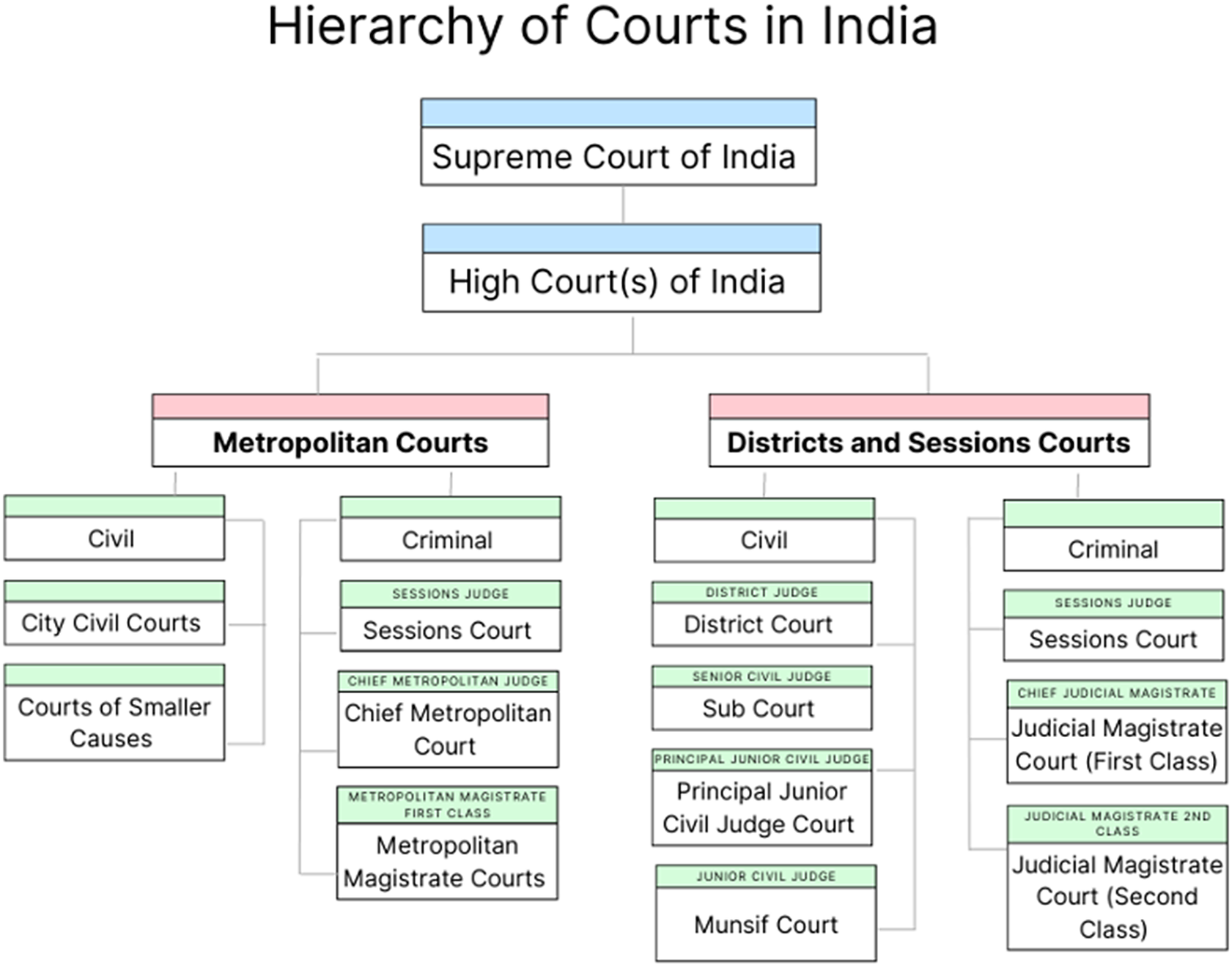
According to the Supreme Court’s “National Policy and Action Plan for Implementation of Information and Communication Technology in the Indian Judiciary” (2005), India has around 2066 courts that make up the lower judiciary, spanning 746 districts. The lower judiciary encompasses a wide variety of courts (see Figure 1), and this structure varies from one state to another. As of March 2024, a total of 44,084,192 cases are pending in these courts of which 10,890,880 are civil cases and 33,193,312 are criminal cases; and 11,977,866 cases remain pending for over 3 years (National Judicial Data Grid, 2023).
Hierarchy of courts in India.
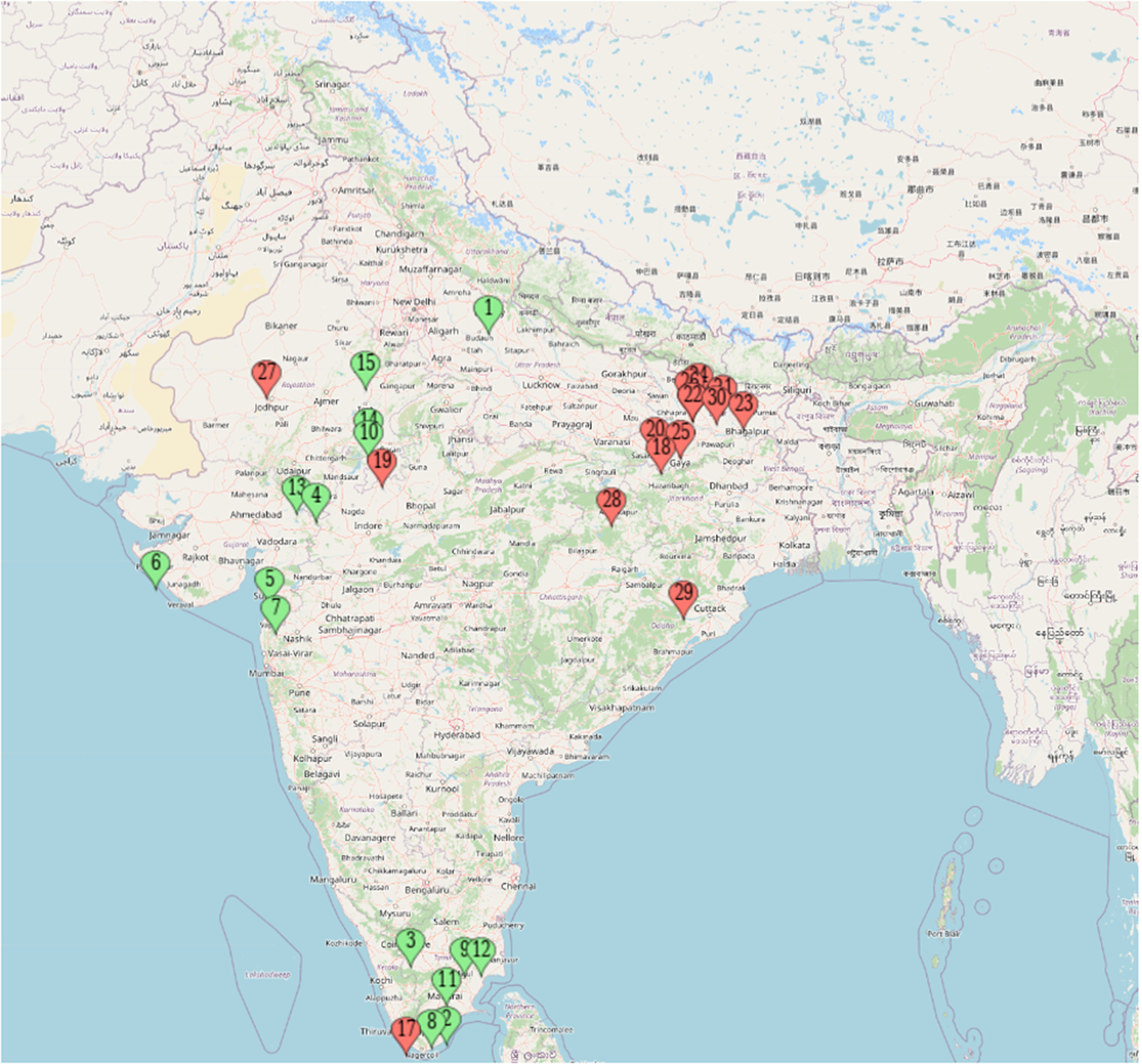
Location of 30 district courts selected for analysis. Source: District Court Performance Dataset (DCPD), 2023.
In recent times, much emphasis has been given to the digitization of management and monitoring of cases at every individual court (Supreme Court of India, N.C.M.S, 2015). This led to the setting up of the National Judicial Data Grid (“NJDG”) through the joint efforts of the Supreme Court’s e-Committee, the Department of Justice, and the National Informatics Centre. The NJDG provides access to judicial proceedings and decisions by collating publicly available open-content information from the courts (National Judicial Data Grid, 2023). It contains a nuanced analysis of the pending cases and the different stages at which they are listed in courts. This repository of case information serves as a platform to analyze predictors that could determine the fate of a case, and therefore extends transparency by making this data available to litigants, policymakers, and researchers alike.
Such resources collating real-time information on orders, judgments, and case details from courts as part of the e-Courts Project are a welcome step. However, so far, there have been limited nation-wide, empirically driven studies of India’s lower judiciary (Aithala et al., Reference Aithala, Sudheer and Sengupta2021). Where district courts formed the subject of studies, they tended to focus on specific court complexes or regions (Jha, Reference Jha2012; Krishnan et al., Reference Krishnan, Kavadi, Girach, Khupkar, Kokal, Mazumdar, Nupur, Sen, Sodhi and Shukla2014; Mahadik, Reference Mahadik2018).Footnote 2 A chief reason for this gap was the significant challenges faced by researchers in accessing error-free data on the functioning of the lower courts and the absence of comprehensive analysis and rationale on factors contributing to delay in case resolution. Without such strong data, it became challenging to develop a tailored judicial policy framework for India that focused attention on factors such as the lower courts’ location, scope and jurisdiction, allocation of resources, and related factors.
Now, using publicly available case-related data extracted by the Development Data Lab (“DDL”) from district courts’ digital data platform, our study makes a concerted effort to understand the performance of lower courts in India and the challenges they face in decision-making. Such analysis is an important aspect of court management and system planning (Engel and Weinshall, Reference Engel and Weinshall2020).
Court performance is a complex concept with several meanings depending on the context and jurisdiction. In this article, we use a specific quantitative measure of performance determined using the median number of days it takes a district court in India to decide cases. Several approaches have been tested in the past. Dakolias (Reference Dakolias1999), in an international comparative study, has used variables such as yearly filed cases, disposed cases, pending cases, clearance rate, congestion rate, the average duration of each case, and the number of judges per one lakh (0.1 million) inhabitants. Schauffler (Reference Schauffler2007) identified 10 indicators for court performance, including access and fairness, clearance rates, time to disposition, age of active, pending caseload, trial data certainty, reliability and integrity of case files, collection of monetary penalties, effective use of jurors, employee satisfaction, and cost per case. Other studies have selected several combinations of these factors to conduct a similar examination (Schneider, Reference Schneider2005; Rosales-Lo ́Pez, Reference Rosales-Lo ́Pez2008; de Castro, Reference de Castro2009; Demirovic et al., Reference Demirovic, Jasarevic and Berg2016; Beldowski et al., Reference Beldowski, Dabros and Wojciechowski2020).
So far, except for a few studies in Brazil, this topic has been discussed mainly in a European (Dakolias, Reference Dakolias1999; Demirovic et al., Reference Demirovic, Jasarevic and Berg2016; Agrell et al., Reference Agrell, Mattsson and Månsson2020; Beldowski et al., Reference Beldowski, Dabros and Wojciechowski2020; Spaić and Dordević, Reference Spaić and Dordević2022) or US context (Christensen and Szmer, Reference Christensen and Szmer2012). We study court performance in a populous, middle-income country setting with particular attention to the district judiciary, which forms the first formal source of adjudication of people’s rights.
We examine court performance measured in median days to decision (MDD), through independent variables relating to: court administration—in terms of case categorization, age of case and case management and judges—through their working strength, term, and workload, which are further elaborated in the section “Methodology”.
Our approach consists of the following. First, we devise a single measure for court performance to test it against quantitative factors that have an effect on case disposal rates. These factors help in going beyond a sole measure, that is, the number of judges present in a court, to ascertain the performance of a given court. Second, we focus on courts of comparable jurisdiction, with similar powers and functions, using large-scale, longer time series data. Accordingly, we create a dataset consisting of all Courts of the Chief Metropolitan Magistrate (CMM), the Chief Judicial Magistrate (CJM), and the District and Sessions Courts in India. To best assess the impact of the factors identified in our research questions on the performance of these courts, we then take the top and bottom ~1% percentile of district courts in terms of their days to decision. Third, having identified both the courts and the factors affecting performance, we perform several tests in an attempt to understand how these factors affect court performance.
2. Understanding court performance
Access to justice has long been understood as the most basic human right of a modern, egalitarian legal system that purports to guarantee the legal rights of all. In their seminal work, Garth and Cappelletti (Reference Garth and Cappelletti1978) describe how delay in justice delivery means inaccessible justice, which has a “devastating effect,” particularly on the economically weak, forcing them to abandon their claims or settle for much less than their entitlement.
In India, several attempts have been made to determine factors for heavy caseloads and slower case disposals in courts (Chemin, Reference Chemin2012; Amirapu, Reference Amirapu2021; Mishra, Reference Mishra2023). Delays in decision-making in district courts have been attributed to the uneven workload of the judiciary, the uneven demand and supply side of the litigation process, vacancies, and inadequate case management systems (Supreme Court of India, N. C. M. S, 2015). Much of the Indian State’s response to addressing questions of efficiency of judicial systems has been directed at increasing the number of judges and improving the judicial infrastructure (Rankin, Reference Rankin1925; McCree, Reference McCree1981; Gabrys, Reference Gabrys1998; Supreme Court of India, N. C. M. S, 2015), thereby, concentrating on the supply side of the issue, critiquing that bench strength has not been commensurate with the number of cases to be dealt with. From as early as 1925, in the Report of the Civil Justice Committee (Rankin Committee), up to the implementation of the National Court Management System’s unit system-based model backed by the Supreme Court, all official reports emphasize on improving or gauging the required judge strength to improve court performance.
While constant deliberations and attempted reforms have led to an increase in the number of judges, the problems of pendency and congested courts remain. As an illustration, between January 2008 and January 2024, the total number of judges at the country’s highest court, the Supreme Court, increased from 25 to 34 (full sanctioned bench strength) and at the regional appellate courts, the High Courts, increased from 594 to 783 (at 70% sanctioned strength). During the same period, case pendency on the other hand increased exponentially from around 37,89, 986 cases in 2008 (46,926 in Supreme Court and in 37,43,060 high courts) to 62,91,692 cases by January 2024 (80,221 in the Supreme Court and 62,11,471 in high courts) (Supreme Court of India, 2008; Press Information Bureau, 2024). Institutionalized remedies of increasing the judge strength therefore appear to do little, if anything, in increasing the performance of courts in terms of disposing cases (Beenstock and Haitovsky, Reference Beenstock and Haitovsky2004). In fact, conversely, increasing the number of judges in a court may lead to reduction in backlog of cases (Rabiyath and Rupakula, Reference Rabiyath, Rupakula, Babu, Thomas, Raja, Hans-Bernd and Somashekar2010) which might give rise to the incentives to the litigating parties, causing congestion in courts (Beenstock, Reference Beenstock2001; Rosales-Lo ́Pez, Reference Rosales-Lo ́Pez2008).
In parallel, much work has been done to understand the development and growth of society through the efficiency of judicial institutions (Kumar and Singh, Reference Kumar and Singh2022; Gupta and Bolia, Reference Gupta and Bolia2024). Our paper is strongly influenced by the methodological literature assessing case dispositions. To this end, Ahsan (Reference Ahsan2013) and Amirapu (Reference Amirapu2021) use the fraction of district and session court cases resolved within 1 year, and Chemin (Reference Chemin2012) and Boehm and Oberfield (Reference Boehm and Oberfield2020) use congestion as a marker for efficiency of the court and assess it against the pending cases in the High Courts. This article is therefore informed by the importance of studying the “pendency problem” which has strong implications on the judicial performance of India’s district courts.
Historically, it is believed that court performance can be managed by increasing the number of judges, consequently increasing case disposal rates (Law Commission of India, 1987a, 1987b, 2014). In our study, we interrogate this assumption, and look at other less-studied factors relating to court administration and the composition of cases in a court (Manivannan et al., Reference Manivannan, Thomas and Zaveri-Shah2023), which cannot be studied using purely qualitative methods. Drawing from Micevska and Hazra’s (Reference Micevska and Hazra2004) measures for determining court congestion, we design our own measures to understand the systemic factors or constraints that affect the time taken to dispose of a case in a district court in India. More recently, Niti Aayog, the Indian government’s policy think tank, suggested the introduction of a “judicial performance index” to help state High Courts as well as chief justices of High Courts track the performance of district courts and suggesting process improvements for reducing delay in subordinate courts (NITI Aayog, 2017). In our study, we choose district courts because of their unique position in the judicial hierarchy, and as they hear most cases by number and volume (Dhavan, Reference Dhavan1977; Sathe, Reference Sathe2002).
Our measures include administrative indicators such as the time taken between hearings and factors related to the type of case being heard. An effective way of examining this is through a detailed empirical analysis of case-related time series data of district courts, as we have done. While previous studies have mentioned court performance as a concept in conjunction with others like pendency and delay (Law Commission of India, 2014; Kumar and Singh, Reference Kumar and Singh2022), no study so far has focused on a systematic, data-driven understanding of the interactions between these factors determining the performance of the lower judiciary across the country. Thus, the Indian legal system’s challenges remain unresolved.
Our main hypothesis is that while the policy narrative in India focuses significantly on addressing delays by adding more judges (Law Commission of India, 2014; Ministry of Law and Justice, Government of India, 2022 Footnote 3), this measure does not explain the variation in performance of the courts in terms of time to decision, that is, comparable courts with more judges or with higher judge days, do not decide cases faster. While Europe-based studies like those conducted by Ippoliti and Tria (Reference Ippoliti and Tria2020) collate, from earlier research, several input and output methods to measure the efficiency of the judiciary such as the time needed to settle a case, the number of cases completed by a court, technical efficiency scores, and clearance rates, these measures are not sufficient to understand the complicated concept of court performance in a vastly diverse, rapidly growing country like India, and a data driven approach is more suited. The uniqueness of our paper is therefore its focus on using data to highlight other significant factors that could explain variation in court performance in India, such as judge term and working strength, the administrative categorization of the court, case management practices, and the types of cases filed before district courts.
3. Methodology
To better address the gaps in understanding court performance identified in the section “Understanding court performance,” we propose a single measure for performance and test probable factors that affect case pendency against this measure. The aim of this study is to explore the main factors that impact court performance and reveal underlying causes for delays that are not addressed through current policy prescriptions. In this article, our focus is on court performance determined by the time taken by a district court to decide a case. We rely on historical data to make this determination and use MDD of all cases available in the judicial dataset that we created for this purpose. MDD is the time taken to arrive at a decision for 50% of these cases. We do not use the arithmetic mean number of days to decide a case, as it is heavily affected by outliers. The MDD is a reliable measure of court performance as we have considered both demand (filing) and supply (judge strength, caseload, court administration) factors of case pendency in its design (Micevska and Hazra, Reference Micevska and Hazra2004; Voigt, Reference Voigt2016; Ippoliti and Tria, Reference Ippoliti and Tria2020; Gupta and Bolia, Reference Gupta and Bolia2024). Scholars have also pointed to the advantage of using decision time as an easily measurable value of court performance (Yeung et al., Reference Yeung, Ovádek and Lampach2022).
3.1. Determining court performance
Studies around the world have identified qualitative (Beenstock and Haitovsky, Reference Beenstock and Haitovsky2004; Staats et al., Reference Staats, Bowler and Hiskey2005) and quantitative (Dakolias, Reference Dakolias1999; Espinosa et al., Reference Espinosa, Desrieux and Wan2017; Marciano et al., Reference Marciano, Melcarne and Ramello2019) factors that could, in various combinations, impact court performance. Our aim is to quantitatively understand the main challenges to court performance by studying the following factors in relation to the MDD of cases across district courts in India.
These research questions have been crafted by interrogating the underlying assumption that augmenting the number of judges in a courtroom will potentially have an elevating effect on case disposal rates. However, since this measure does not explain the variability in days to decision in comparable courts, we supplement MDD with factors that could explain such a variation in case disposal rates (Micevska and Hazra, Reference Micevska and Hazra2004; Manivannan et al., Reference Manivannan, Thomas and Zaveri-Shah2023; Gupta and Bolia, Reference Gupta and Bolia2024). These factors were formulated and selected for our assessment as they contribute to the duration of case disposal beyond the addition of judges in a court.
-
1. Does performance depend upon the administrative categories of courts of first instance?
Is there a difference in performance between district courts with different administrative jurisdictions?
-
2. Does court performance depend on judges’ strength, tenure, and workload?
A common policy prescription to address judicial delay has been to increase the number of judges (Rankin, Reference Rankin1925; McCree, Reference McCree1981; Gabrys, Reference Gabrys1998; Spaić and Dordević, Reference Spaić and Dordević2022) or have concentrated attention on calculating required judge strength (Gopal, 2016).Footnote 4 This question looks at the relationship between the working strength of judges in a court, their tenure, the workload per judge, and court performance.
-
3. Is district court performance affected by case management practices?
Using the measure of “days from case filing to first hearing” as a proxy for case management, we study how this impacts court performance. Case filing is considered more appropriate as the constraints that a court experiences during filing are more significant to the subsequent judicial process than the date of decision (Yeung et al., Reference Yeung, Ovádek and Lampach2022).
-
4. How does the distribution of age of cases impact court performance?
We look at disposed cases and calculate the number of days between their filing and disposal. This aims to understand how new and delayed cases may be dealt with differently in courts with high MDD and courts with low MDD.
-
5. Does courts’ performance vary depending on the type of case filed?
Do the type and the number of cases filed in a court have an impact on the outcome delivered by the court?
3.2. Data source
To understand the various factors related to court performance that we analyze in this article, we required a data repository containing large-scale, longer time series data on all district courts in the country. We began with the judicial data repository created by the DDL, which is India’s largest open judicial data repository available under an open data license. The DDL judicial data repository houses case data scraped from the government’s e-courts platform, the “NJDG,” with case log entries from the lower courts. This includes the dates of case registration, filings, and hearings. It also contains details of the litigating parties, case disposition, and final decision. Apart from this, DDL also has data on the judges deciding these cases such as their official designation and tenure, as available on the e-courts platform (Development Data Lab, 2021).
3.2.1. District court performance dataset
The DDL repository contains data from 7253 unique courts that represent the totality of the lower judiciary in India. To study court performance, we focussed on courts of comparable jurisdiction, with similar powers and functions. Using the DDL repository, we created the “District Court Performance Dataset” (“DCPD”) consisting of all Courts of the CMM, the CJM, and the District and Sessions Courts in India (refer Figure 1), 1,775 courts, and the cases filed in these courts for the period 2010–2018.
We then calculated “MDD” for each of these 1775 courts as a preliminary indicator of their performance. MDD is defined as:
 $$ MDD= Median\left(\left[ Date\ of\ decision\ for\ case- Date\ of\ filing\ for\ case\right]\right) $$
The DCPD comprises all categories of cases adjudicated in that district, whether civil or criminal. For each district court, we considered only decided cases with valid filing and decision dates and cases where the decision date was on or after the filing date. We then statistically derived our identified factors for the caseload and judgeship of these courts to study the impact of these factors on court performance, as set out in Table 1.
Factors of court performance
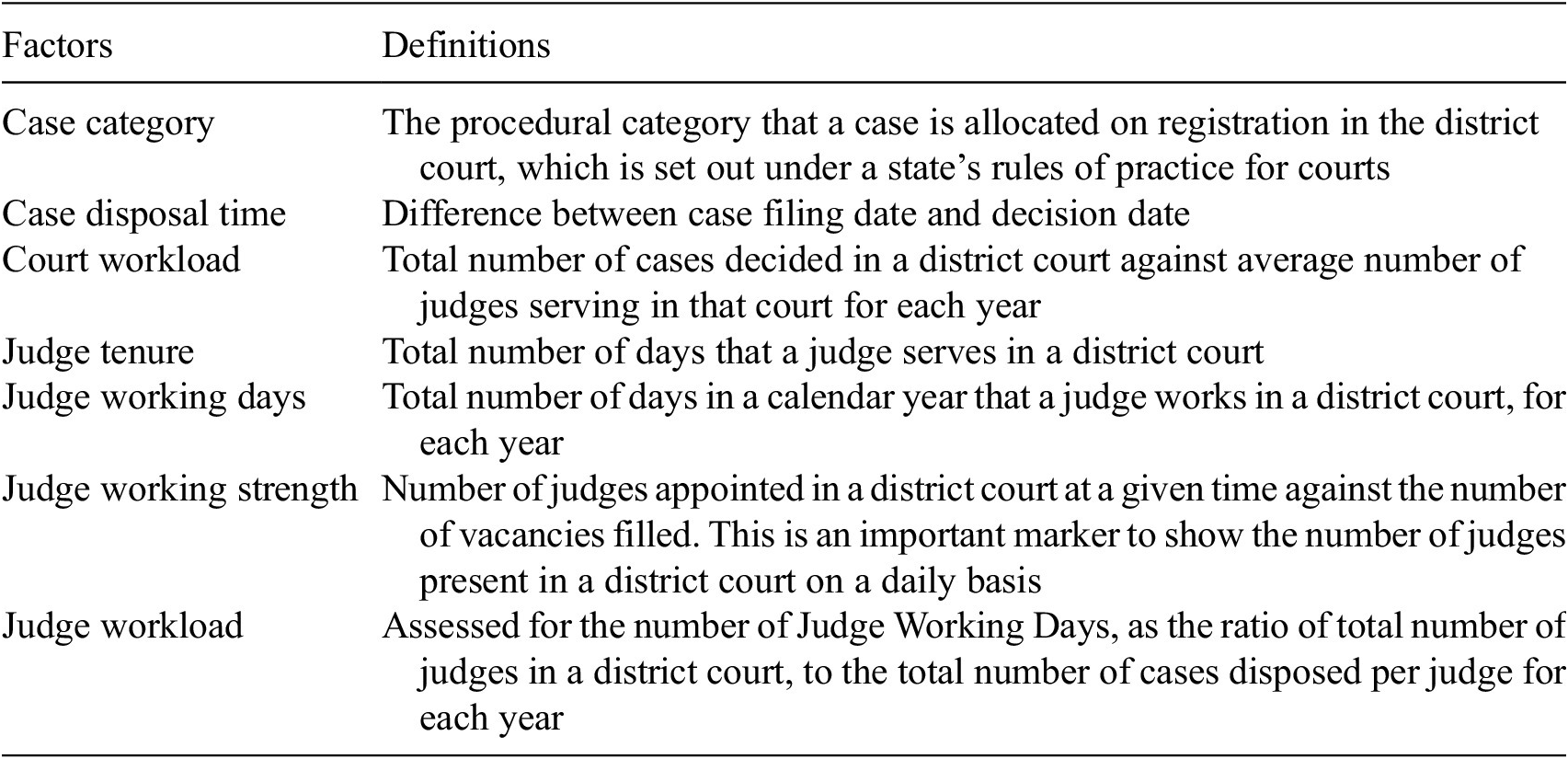
The table’s components and factors are derived from established practices and data sources within the judicial system,Footnote 5 ensuring reliability and relevance for the assessment conducted in our paper and are pertinent to assessing the time taken to decide a case within a district court setting.
To explain these factors, we need to understand the following related concepts:
-
• Caseload is the total number of cases a judge in a district court adjudicates on, on a daily basis. This further aids in the calculation of congestion and case clearance rates.
-
• Congestion rate is calculated as the ratio of cases older than a year to cases disposed. Standard indicators being caseload per capita and caseload per judge.
To best assess the impact of the factors identified in our research questions on the performance of these courts, we then took the top and bottom ~1% percentile of district courts in terms of their MDD, and labeled them as “High Median Days” courts (“HMD courts”) and “Low Median Days” courts (“LMD courts”). A total of 15 HMD courts and 15 LMD courts were thus identified.
3.3. Limitations
As we explain earlier, we borrow from Micevska and Hazra’s (Reference Micevska and Hazra2004) study on court congestion in India, and design our own method to explain the constraints to case disposal that district courts in India face. We recognize that such an approach at generalization is quite reductionist and may serve a limited role in understanding complex cultural legal problems (Peter De Souza, Reference Peter De Souza2022). We acknowledge that quantifying court performance and applying judicial indices must be done in a more pluralist manner, grounded in the local cultural context.
Our study makes certain basic assumptions. First, we assume that each district court judge covered in our sample is working at the same level of efficiency as the others. We also limit our analysis of court performance to the working of judges and the processing of cases. However, in practice, other aspects such as court staff, infrastructure, and budgets are equally important to consider.
Second, to paint a holistic picture of how courts perform in India, it is important to consider judges’ work not in silos but through factors that affect the filing and disposal of the cases overall. In this article, we do not seek to divide judges’ workload by case type or the number of cases assigned to them in a day. Instead, we consider the daily working strength of judges present in district courts for our analysis. The workload of a judge is defined as the overall time taken to dispose of a case—this has been done because we do not have the data to gauge the amount of time a judge takes to prepare a case outside of court, or the amount of time it takes for the registration and preparation of cases before they are heard. As such, an important caveat in our study is that we do not draw conclusions about the quality of judicial decision-making.
Finally, as we explain in the section “Data source,” the study is entirely based on the data scraped by the DDL from the Indian e-courts platform. As earlier Indian studies have pointed out, in the absence of a “coherent centralized approach to judicial data collection and dissemination” in the country, there is “widespread variation in the quality and quantity of accessible court data across the different states in India, especially at the district level” and “…basic measures of court performance and of the state of litigation, such as institution rates, disposal rates, and pendency rates, are not easily available for several districts in India” (Krishnaswamy et al., Reference Krishnaswamy, K. Sivakumar and Bail2018). In spite of these shortcomings, the e-courts platform remains the primary and official source of information for the justice delivery system in India. We have taken several steps to address incomplete or inconsistent entries in the DCPD. To address erroneous data entries, we have eliminated entries with missing date values, invalid filing and decision dates, and with discernible errors such as where the decision date was on or after the filing date. Spelling and capitalization inconsistencies in text-based metadata entries were also standardized across the DCPD dataset.
4. Empirical analysis
This section looks at each of the factors identified in the research questions, and assesses its impact on court performance, by studying the operation of each factor on HMD and LMD courts.
4.1. Administrative categories of courts and impact on court performance
Articles 233–237 of the Constitution of India lay down the provisions for the setting up of the subordinate judiciary in India. These courts form a part of India’s lower level of judiciary, which ascends to the High Courts and the Supreme Court, administratively laying out the levels of powers that the judiciary exercises.
In this article, we analyze the main factors impacting performance of India’s district courts. For this, we built the DCPD from 1775 courts considering the courts of the District and Sessions judges (“DJ”), additional district courts, courts of “CJM” and additional CJMs, courts of the “CMM” and additional chief metropolitan judge as functionally equivalent.
The highest court in every district is the District and Sessions courts—“district” court for civil cases, acting as the “sessions” court for its criminal jurisdiction. At this level, there may be one or more courts of additional district and session’s judge with the same judicial power as that of the DJ. Under the civil jurisdiction, the civil courts take on cases divided into three jurisdictions, namely, pecuniary, territorial, and subject matter jurisdiction. This has been discussed under section 15-20 of the Code of Civil Procedure (“CPC”). Class action suits, injunctions, recovery suits, cases related to family, property and likes are heard by the civil courts. Similarly, sections 177-188 of the Criminal Procedure Code (“CrPC”) lays down the jurisdictions exercised by the criminal courts. Bailable and non-bailable offences such as public nuisance and terrorism, respectively; and cognizable and non-cognizable offences are heard by the criminal courts.
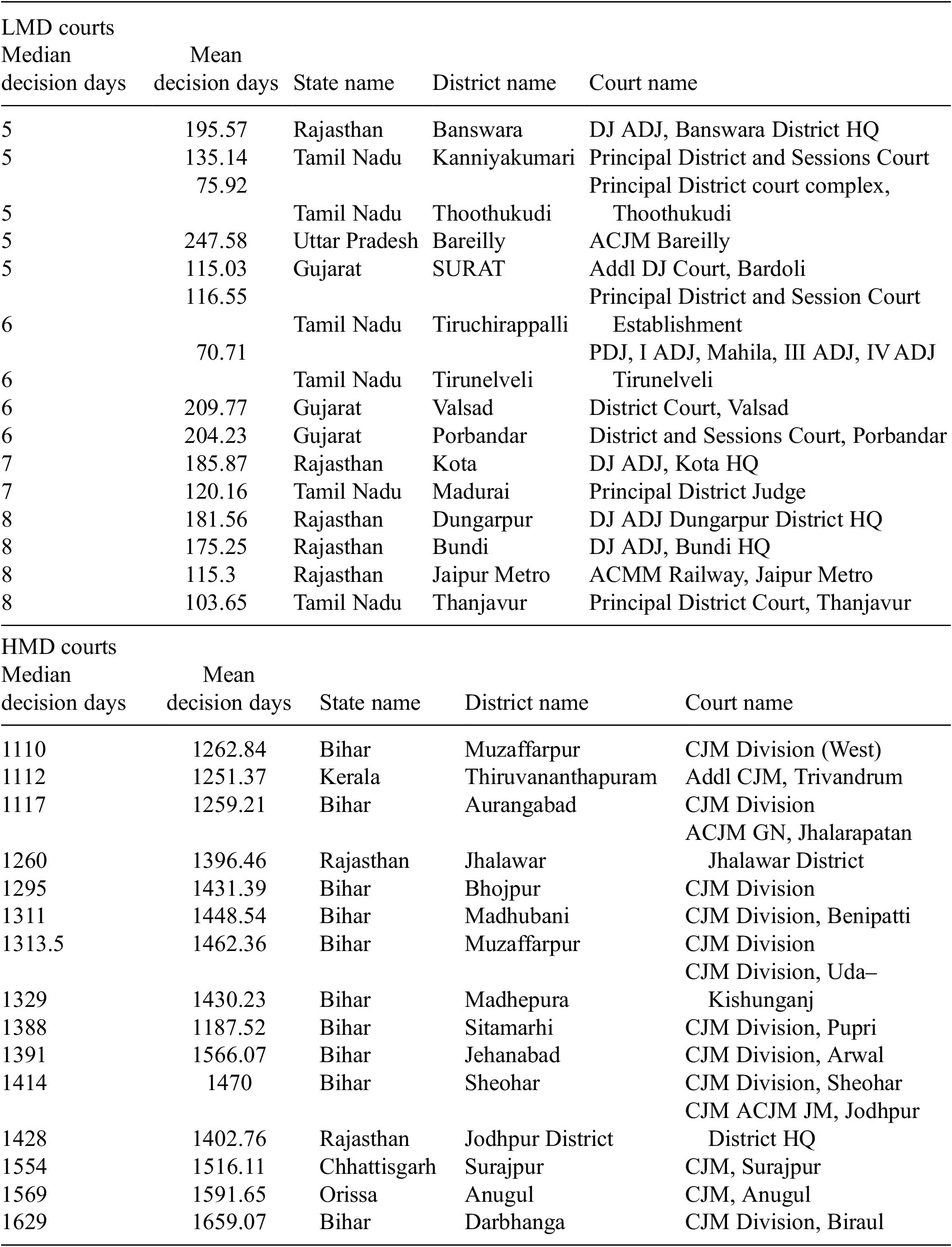
In our analysis, as we have considered district courts and additional district courts as equivalent, the DCPD includes CJMs and Additional CJMs as well as the Principal DJ and Additional DJs. Court performance is determined as the number of days that a district court takes to decide a case. To arrive at our performance measure, we first calculated the total number of days between the date of filing and the decision date (ignoring pending cases or those with invalid dates—for instance, where the year does not begin with “20XX” and or incomplete entries). We then determined the time taken to dispose off 50% of the cases being considered and termed this as “median decision days” in column 1 at Table 2. The “mean decision days” refers to the sum of decision days for each year in each of the 30 selected courts, divided by the total number of years under review, that is, 2010–2018. The MDD for the entire set of courts in the DCPD was determined to be 190 days. We then identified the top and bottom 1% percentile of these 1775 courts in terms of their MDD (Table 2). The 15 courts comprising the top ~1 percentile, with the lowest MDD, are termed “LMD courts”, and correspondingly, the 15 courts comprising the lowest percentile with highest MDD are termed the “HMD courts.” From Table 2, it is clear that the MDD is much lower than the mean decision days. The MDD is thus a more reliable indicator of district court performance than mean decision days.
All-India list of HMD and LMD courts
4.1.1. Observations
Table 2 lists out the 15 LMD and 15 HMD courts we have selected from the DCPD, their geographic location and their MDD and mean decision days. We note that there is a huge difference in performance between the district courts considered, taking anywhere between 5 and ~1600 days to decide 50% or more of their cases (Figure 2). Overall, the LMD courts show a low 5–8 MDD, with a majority of these courts located in the states of Tamil Nadu or Rajasthan.
In contrast, the courts performing low on our performance measure show a high MDD ranging from 1110 to 1600 days. The district courts in the state of Bihar, which has one of the lowest per capita incomes in the country, show highest MDD to arrive at decisions of cases. Three of the high MDD courts (Sitamarhi, Muzaffarpur, and Aurangabad), are located in some of India’s most underdeveloped districts, which are termed “aspirational districts” by the Indian government (NITI Ayog, 2023).
An interesting observation from Table 2 read with Supplementary material (annexed) is that the LMD courts with fewer days to decision actually face a higher caseload, ranging from 674 to 71,000 cases, while the HMD courts caseload is lower, from 81 to 3400 cases.
Second, we note that only one of the LMD courts is a CJM’s court, with the others mostly being District and Sessions Courts. In contrast, all the HMD courts are CJM or ACJM courts. The differences could perhaps be accounted for owing to the nature and administrative complexity of cases filed before the two kinds of courts, as well as the significant differences in procedures for administrative handling of cases at different court complexes.
From this description, it becomes clear that the administrative categorization of a court—as a district or sessions court, or a magistrate’s or sessions’ court, seems to have greater impact on that court’s performance rather than the number of cases adjudicated before that court. This has clear and important policy lessons for resourcing and budgeting of district courts in India.
In the next section of this article, we look at whether the allocation of judges and their term can explain the differences in performance observed in the identified district courts.
4.2. Court performance and judge strength, tenure, and workload
4.2.1. Judge working strength
Both policy measures and scholarly work have emphasized the importance of judges’ working strength, given its importance in the planning of resources required for any judiciary (Beenstock and Haitovsky, Reference Beenstock and Haitovsky2004; Spaić and Dordević, Reference Spaić and Dordević2022), as well as its impact on access to justice, since it can “capture the extent to which disputes can be resolved at a relatively low cost, without dysfunctional delays and discrimination” (Deseau et al., Reference Deseau, Levai and Schmiegelow2019). For our analysis, judge working strength indicates the number of judges in a court in a given year, assumed to be working at optimum performance.
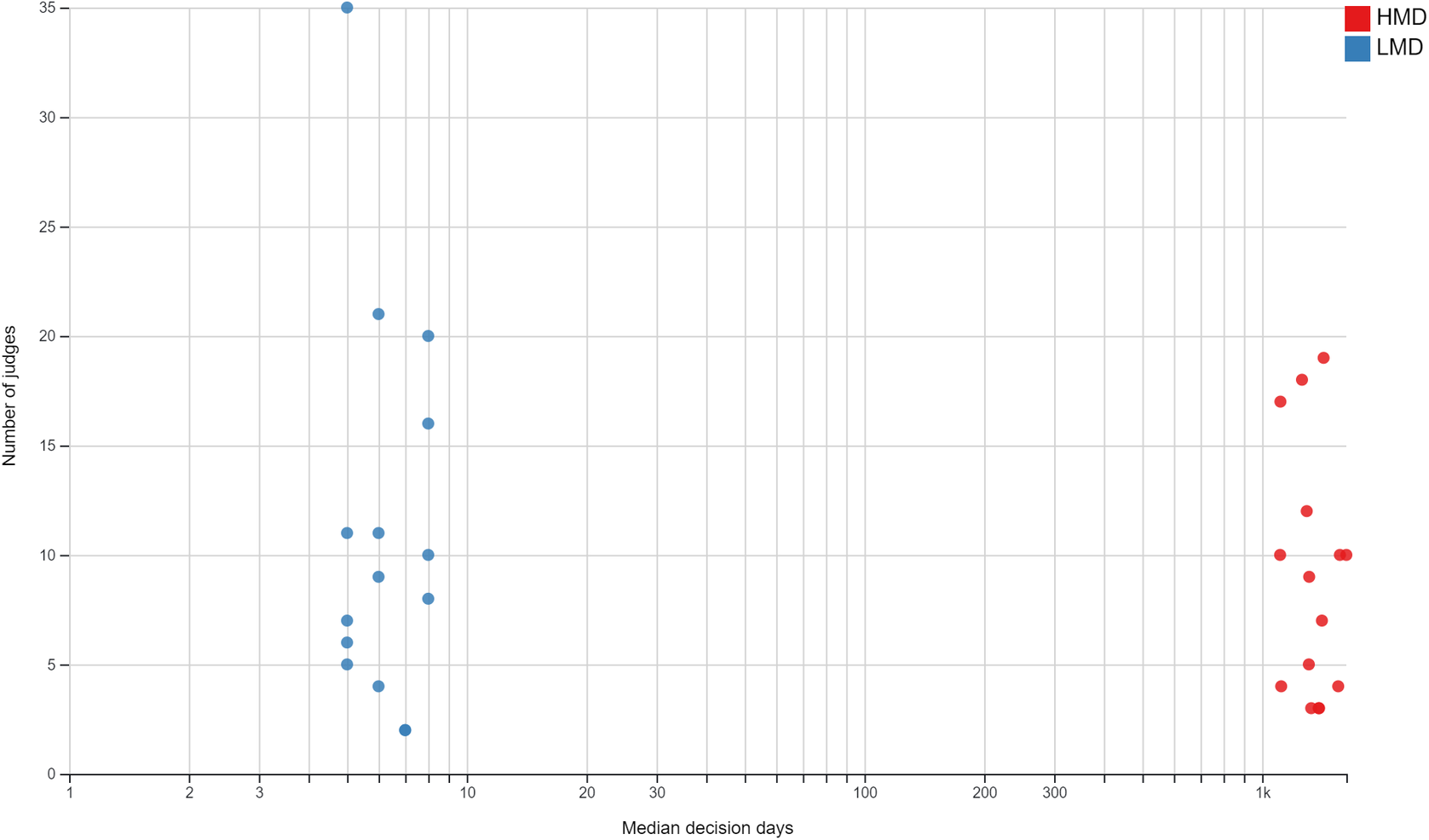
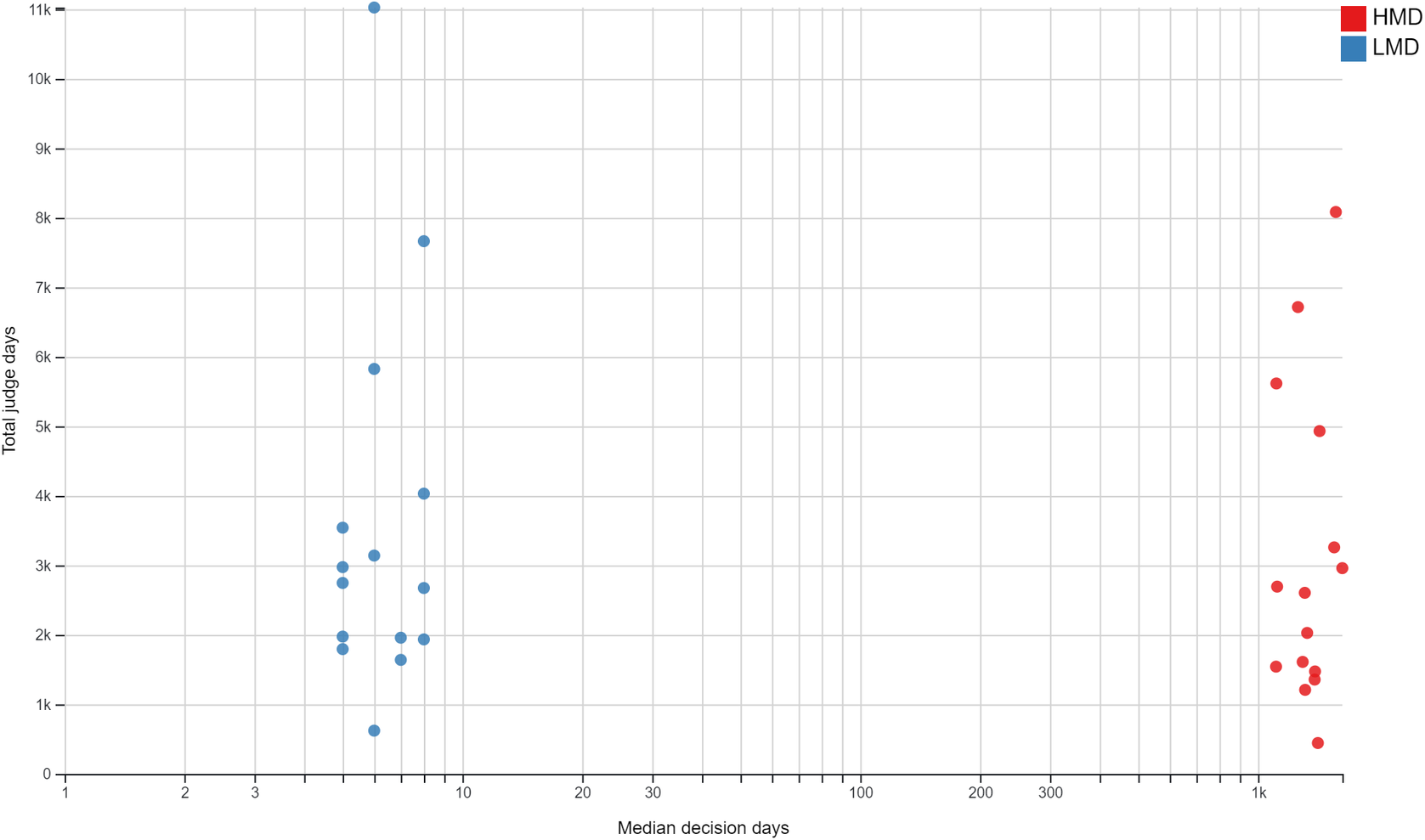
Figure 3, which describes the total number of judges in a district court over a year and its performance, finds that the LMD courts with between 2 and 21 judges, have decided cases much faster than HMD courts with a similar range of judge strength have been of a similar range, between 3 and 19. HMD courts have taken more than 1000 MDD to decide their cases with this bench strength. This is confirmed in Figure 4, which compares total judge days and MDD. It appears that the LMD courts have mostly observed a higher number of total judge days, with a concentration seen around the 1600–4000 range. HMD courts show a scattered distribution of total judge days, which is slightly lower than the LMD courts, clustering in the 1200–3200 range.
Judge working strength in HMD and LMD courts. Both HMD and LMD courts show a similar range of judge strength.
Total judge working days in HMD and LMD courts.
4.2.2. Judge tenure
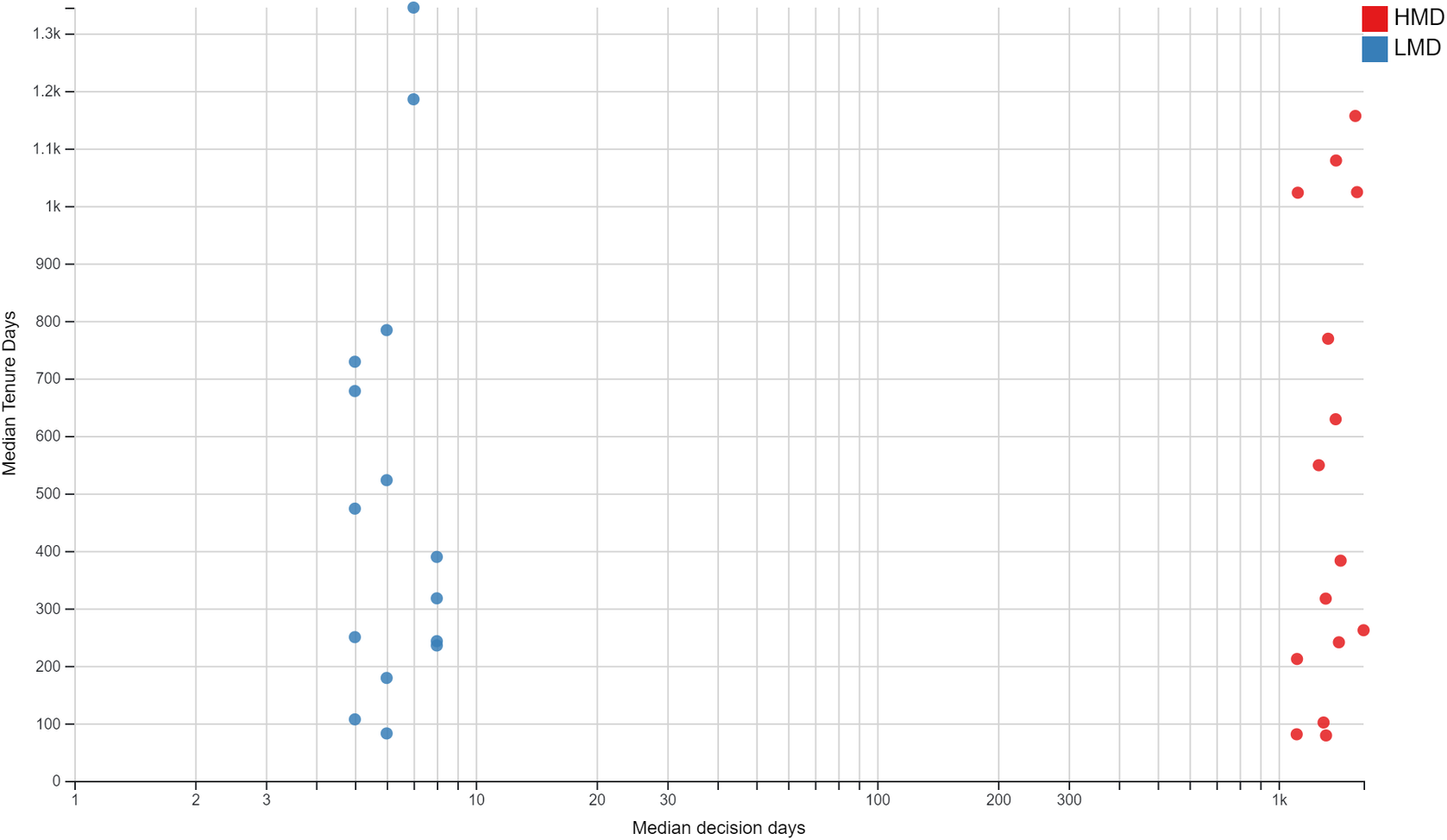
In addition to the commonly studied measures on number of judges and caseload (de Castro, Reference de Castro2009; Lienhard and Kettiger, Reference Lienhard and Kettiger2011), we also looked at the term of a judge in a particular court to see if it has an impact on performance—whether courts with judges remaining in the same court for a longer term perform better (Figure 5) (Teitelbaum, Reference Teitelbaum2006). These measures have not received sufficient focus in earlier Indian studies, which have instead examined specific questions like the mandatory retirement age for judges of the Indian Supreme Court (Kalantry, Reference Kalantry2022) or aspects like average hearing time per case by dividing the number of cases in a day with the working hours of courts or the time taken by courts for different categories of hearings (Mandyam et al., Reference Mandyam, Narasappa, Tirumalai, Murthy, Narasappa and Vidyasagar2016). These have not been helpful because a focus on working hours of a court is prone to errors in calculations—courts often reduce or extend their working hours depending on their caseload, and a case may be adjourned without substantial hearing and no detailed explanation, reducing the total number of cases heard per working day.
Median Judge Term versus Median Days to Decision for selected district courts, with similar judge tenures for HMD and LMD courts. Index: Blue Dots represent LMD courts, red dots represent HMD courts. Refer to Supplementary material for a detailed table.
4.2.3. Judge workload
A substantial body of research has also examined the relationship between judge workload and court performance. Some scholars have argued for the “endogenous productivity hypothesis”—that higher number of files on the court docket improves the efficiency of the judges in resolving cases (Beenstock and Haitovsky, Reference Beenstock and Haitovsky2004; Dimitrova-Grajzl et al., Reference Dimitrova-Grajzl, Grajzl, Sustersic and Zajc2012). However, this has been criticized as it ignores the substantial judicial and institutional constraints that judges face such as their administrative burdens, support from staff, and use of information technology (Johnsen, Reference Johnsen2012; Jonski and Mankowski, Reference Jonski and Mankowski2014; Gomes et al., Reference Gomes, Guimaraes and Akutsu2016).
Figure 6 compares HMD and LMD courts’ workload with its performance expressed as MDD, and shows some interesting results. The formula we use for arriving at judge’ annual workload is Workload = Total Cases/Average Judge Count. The median workload for courts in the complete DCPD is 4270 cases per judge.
Judge workload in HMD and LMD Courts. LMD courts have larger dockets but decided cases faster.
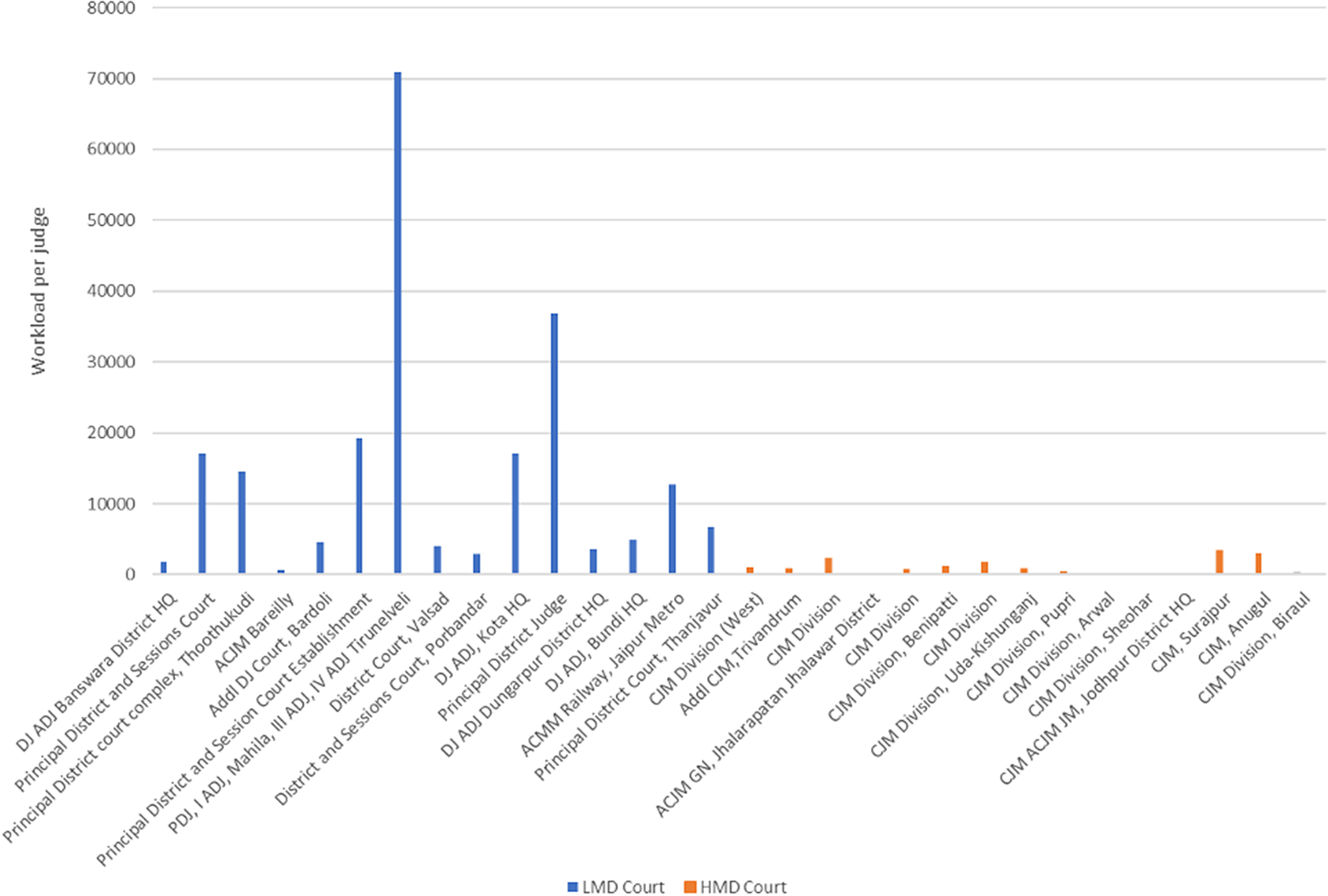
There is a striking contrast between the workload of the 15 selected high-performing district courts—the LMD courts and the low-performing HMD courts, that runs counter to expectations. HMD courts have lower workloads per judge than LMD courts, or in other words, courts where each judge has a heavy docket, seem to decide cases faster. Furthermore, from Supplementary material, we note that the average workload of the high-performing LMD court is more than 200 times that of the low-performing HMD court.
Finally, we conducted a two-sided randomization permutation test for HMD and LMD courts on these four measures, namely the judge working strength, total judge working days, judge tenure, and judge workload. The null hypothesis was that the LMD and HMD measures are from the same distribution. With a significance level of alpha = 0.01, the corresponding null hypothesis cannot be rejected for judge working strength, working days, or tenure.
However, the measure of judge workload gives us different results. With a p-value of 3.10E-06, the null hypothesis can be rejected for judge workload, that is, workload for LMD courts is significantly different from that for HMD courts (see Supplementary material for details).
4.2.4. Observations
From the figures above, we see that neither the total number of judges, nor judge working days in each court accounts for the large difference in performance observed in HMD and LMD courts.
The Indian Supreme Court observed in Malik Mazhar Sultan and Anr v. U.P. Public Service Commission (2006), that “…non-filling of vacancies for a long time, deprives the people of the services of the Judicial Officers. This is one of the reasons for the huge pendency of cases in the courts. It is absolutely necessary to evolve a mechanism to speedily determine and fill vacancies of Judges at all levels.” This reflects a common policy assumption that by appointing more judges to a court, the demand for judicial services is matched with its supply, since this means that more cases are decided and pendency is reduced.Footnote 6 However, we observe different results. The total number of judge days and average number of judges are not good indicators of whether a court will demonstrate “high” or “low” MDD in terms of decisions. This is also supported by the results of the two-sided randomization permutation test. The number of judges actually posted to the court, as well as the active number of days the judge heard cases in the period of our interest, are similar across the HMD and LMD courts. This ties in with the observations of other Indian scholars that “there is no evidence that previous increases in judicial strength by themselves have indeed reduced backlog” (Krishnaswamy et al., Reference Krishnaswamy, K. Sivakumar and Bail2018).
Similarly, there seems to be no correlation between the length of a judge’s term in a particular court and the performance of that court. A simple explanation for this result could be, as the Supreme Court of India, N. C. M. S (2015) report observes, in the long term, the total number of “judicial hours” required for disposing a court’s caseload is an important measure to target for case pendency management. We extend this observation to suggest that the quality of judicial time spent is critical, and not the total number of days that a judge spends at a court to ensure that the backlog of cases is cleared and that the backlog is not continuously extended.
A counterintuitive result from our study is also that the workload per judge is actually lower in HMD courts, supported by the different distributions of the workload measure in HMD and LMD courts in the randomization permutation test. This is counter to the common understanding that district courts are slow due to overburdened judges, which understanding is also historical—in the 1980s, McCree (Reference McCree1981), Posner (Reference Posner1985), and Gabrys (Reference Gabrys1998) assumed that the number of judges determine a court’s output, and so, it was argued that to solve the caseload problem in US courts, the judiciary should be expanded. In fact, as mentioned earlier, Beenstock and Haitovsky (Reference Beenstock and Haitovsky2004) note that only adding more judges will make existing judges adapt their behavior and reduce their case disposal numbers. They therefore conclude that the case backlog does not depend on the working strength of the court (p. 366).
One explanation for the result of our analysis could be owing to the use of a fixed “input–output” method, as practiced in India, as well as in American and English courts. Usually, this occurs where the size of a court bench is decided on the basis of the amount of “judge time” required for a specific category of case, and so, a set number of judges (input) is fixed, based on the number of cases disposed (output). Following the approach suggested by Cooter (Reference Cooter1983) and Posner (Reference Posner1993), Beenstock and Haitovsky (Reference Beenstock and Haitovsky2004) find that this may not be appropriate as these “input” and “output” coefficients of bench strength are not fixed but vary based on the caseload. This suggests that judges value leisure and dislike effort in judging. The trade-off between deciding more cases (and so, exerting more effort) or underperformance, as measured by case backlog, results in optimizing behavior by judges. Similar to other service providers, where the caseload of a court is high, judges dispose of more cases when under pressure, and so the overall performance of their court increases (p. 352).
Of these four measures, workload is the only one that takes the number of cases filed into account, and is the only one that demonstrates significant difference between HMD and LMD courts, with workload per judge being lower in low-performing courts. This seems to indicate that the nature of cases filed has an important effect on court performance, a measure that we analyze in the section “Court Performance and the Significance of Type of Cases.”
4.3. Case management practices and court performance
From an analysis of judges of the district courts, we turn to query available data on the administrative side of these courts. Caseload management is an essential part of court functioning. An efficient management of cases guarantees adjudication and speedy disposal of cases, and therefore aiding in prevention of delays and pendency of cases (Amirapu, Reference Amirapu2021). It may also help in the allocation of judicial resources and judges to specific courts or cases. The objective of a well-functioning caseload management system is essentially to put the court’s cognitive ability to best use by reducing the time it takes for the preparation of cases (Gupta and Bolia, Reference Gupta and Bolia2024) (“homework”) before it is heard by the judges.
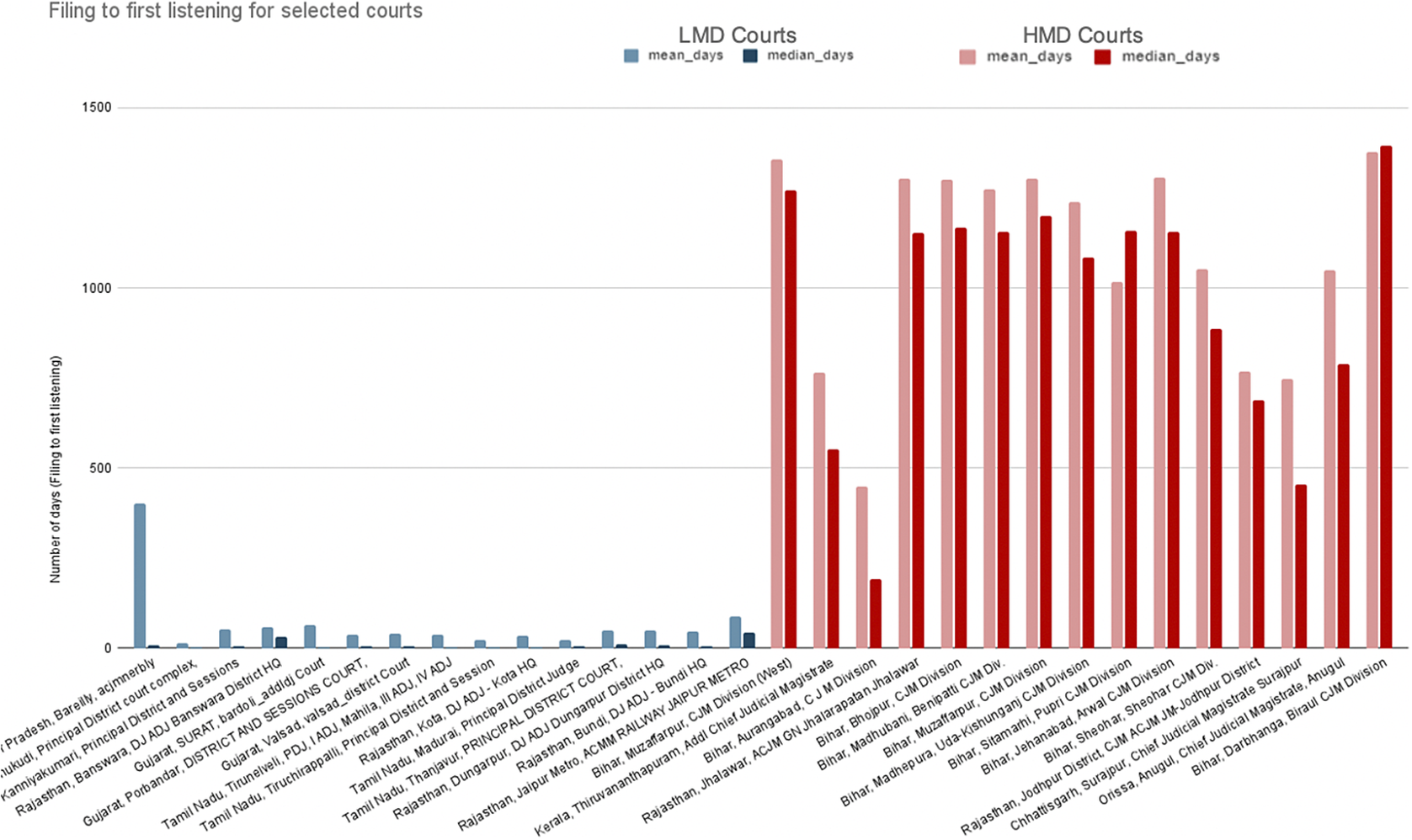
In the DCPD, we calculate the mean and median days between the date a case is first filed and the date of its first hearing, as an indication of the administrative efficiency of district courts (Figure 7).
Mean and median days between case filing date and first hearing date. HMD courts take much longer for the first hearing after a case is instituted.
4.3.1. Observations
High-performing courts show better administrative efficiency in case management. On average, these courts take less than 100 days from filing, for listing a matter for the first hearing. Contrary to these findings, low-performing district courts take more than 800 (median) days to list matters for the first hearing. This indicates that administrative processes and structures play a key role in court performance. Moreover, a majority of cases heard by both HMD and LMD courts are criminal cases, and this result goes against official strictures regularly issued by the Supreme Court to subordinate courts to ensure that criminal trials do not prolong unreasonably, and in no case, more than 6 months, to maintain “people’s faith in the rule of law and efficacy of the legal system” (Choudhary, Reference Choudhary2018). The Civil Rules of Practice issued by various state High Courts also mandate that the disposal of criminal matters should be preferred among those cases ready for hearing.Footnote 7
4.4. Court performance and distribution of age of cases
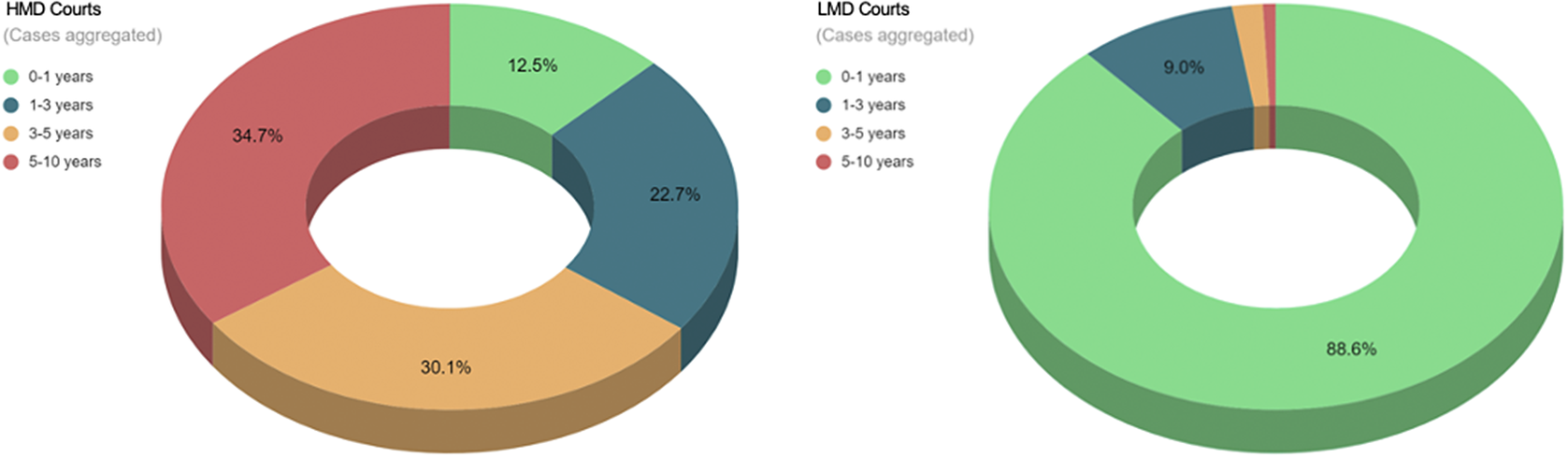
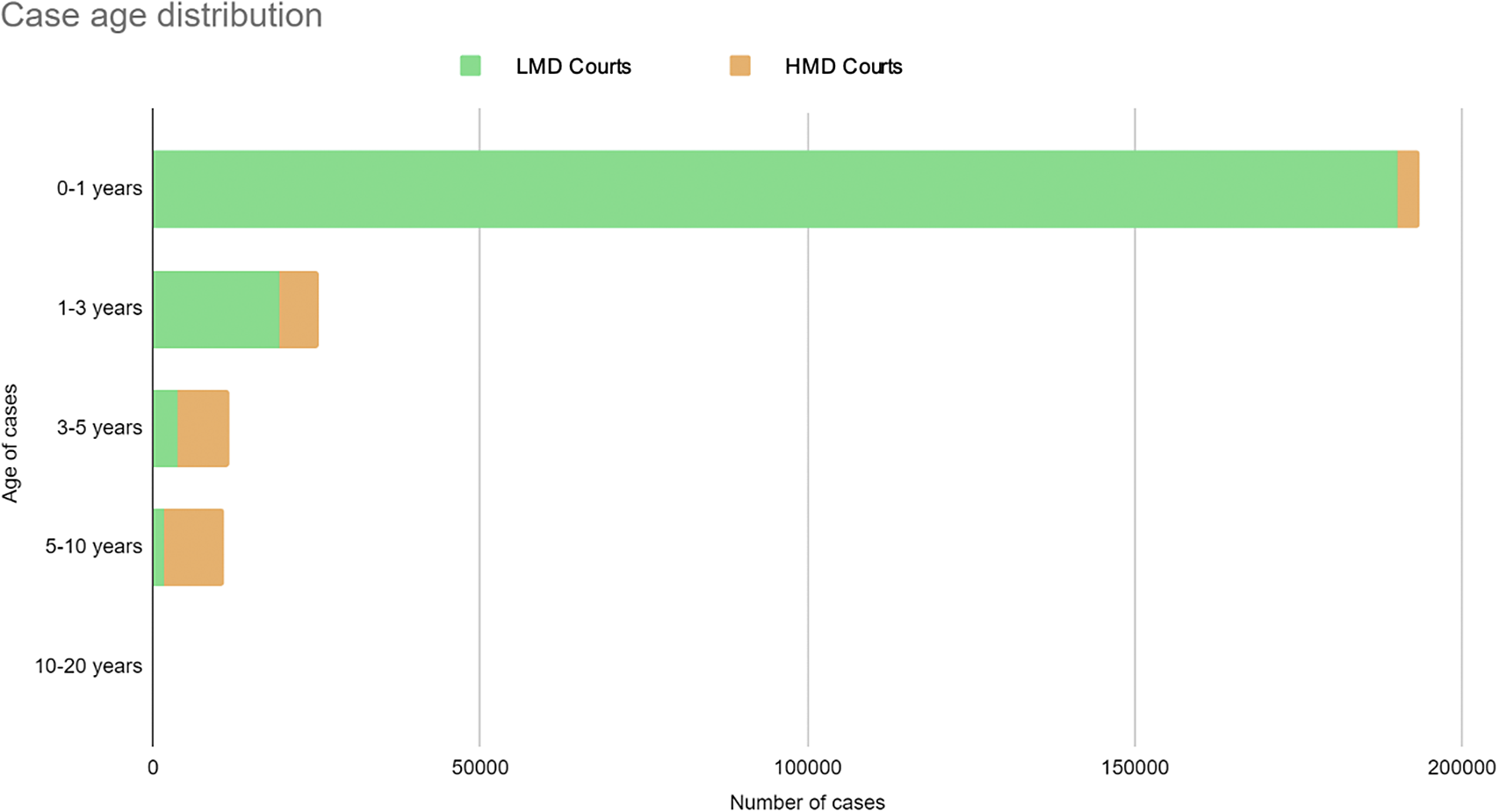
Earlier studies have focused on variables affecting judge time such as the total number of judgments and time needed to make those judgments (Yeung et al., Reference Yeung, Ovádek and Lampach2022). These ignore important factors that affect the judge’s ability to decide, such as the time taken between the filing until first hearing and the distribution of the age of cases. We verify these factors in LMD courts and HMD courts by following the categorization adopted by the NJDG (Figures 8 and 9).
Distribution of age of cases for HMD and LMD courts. Cases taking more than 5 years to decide constitute over 30% of HMD court cases.
Number of cases in HMD and LMD courts based on years taken to decide.
4.4.1. Observations
In our selected courts, LMD courts decided a majority of cases within the first year from filing date. In HMD courts, a substantial proportion of cases (nearly 65%) have taken between 3 years and 10 years for disposal.
There could be various explanations to this result. HMD courts may mainly be deciding “hard” cases, which engage with difficult questions of law substantively, and require high investment of time and resources of the court in decision-making. The nature of a case is determined by its subject matter, and by whether judges classify that as a “hard” or an “easy” case. These terms are not defined and could have different meanings among courts. Caseload pressure on judges ensures that judges manage court time efficiently by applying case management techniques (Rao, Reference Rao2022). Judges put in effort by being better prepared for cases or, most likely, use what Beenstock and Haitovsky (Reference Beenstock and Haitovsky2004) refer to as “homework” cases, “that do not strictly require court-time” (p. 354).
4.5. Court performance and the significance of type of cases
Beenstock (Reference Beenstock2001), in his analysis of Israeli magistrate courts and district courts, observed that certain categories of cases—“case types”—required little or less courtroom time, and thus the case completion time varied by types of courts (here, criminal v/s civil courts). In his study on the state courts of the first degree in Brazil, de Castro (Reference de Castro2009) considered cross-court differences in the types of cases handled to explain the variation in productivity. It was observed that case proceedings and processes were largely dependent on the composition of the court docket in terms of the nature of the cases (p. 37). To determine the significance of the type of case to court performance in our dataset, we took all cases instituted in 2017 in our compiled list of 30 courts and classified the cases filed under them into the following categories: Civil, Criminal, Commercial, Property, and Motor Vehicles Act. A total of 104,602 cases were filed in the concerned 30 courts over a period of 1 year, which we categorized into these 5 major classifications. We then queried whether there is a difference in the type of cases instituted in HMD and LMD courts that may have an impact on their performance.
4.5.1. Case types and their meaning
-
(i) Civil cases: A civil case is instituted under the CPC, 1908 when there has been a conflict between institutions or people, generally of a monetary nature. A person makes their grievances known to the court by filing a “complaint” of being harmed by the actions of a natural or legal person. For the purposes of this classification, “Family” cases, dealing with issues of divorce, child custody, maintenance, and the like have been included in the civil case categorization.
-
(ii) Criminal cases: The CrPC, 1973 establishes the process for submitting a report or complaint, the ensuing trial, and other elements of criminal law related to an investigation, bail, and so forth. A criminal case originates when a person is convicted of committing an offence under the Indian Penal Code.
-
(iii) Commercial cases: Any case involving matters of commercial significance is categorized as “commercial.” We have identified Trademark applications, Trust Original Petitions, Company Miscellaneous Applications, and other financial suits under this broad category.
-
(iv) Property cases: There are roughly 18 statutes that concern themselves with property matters in India. They range from those relating to registration, transfer and sale of property, to limitation, succession, and partition matters. The bulk of cases in the DCPD fall under the Transfer of Property Act, 1882, the Rent Control Act, 1948, and the Registration Act, 1908.
-
(v) Motor vehicle cases: The Motor Vehicles Act, 1988 provides for legislative provisions dealing with the licensing, registration, offences, penalties, and so forth related to motor vehicles. Most cases under the DCPD relate to accident claims in the form of revision petitions or execution thereof.
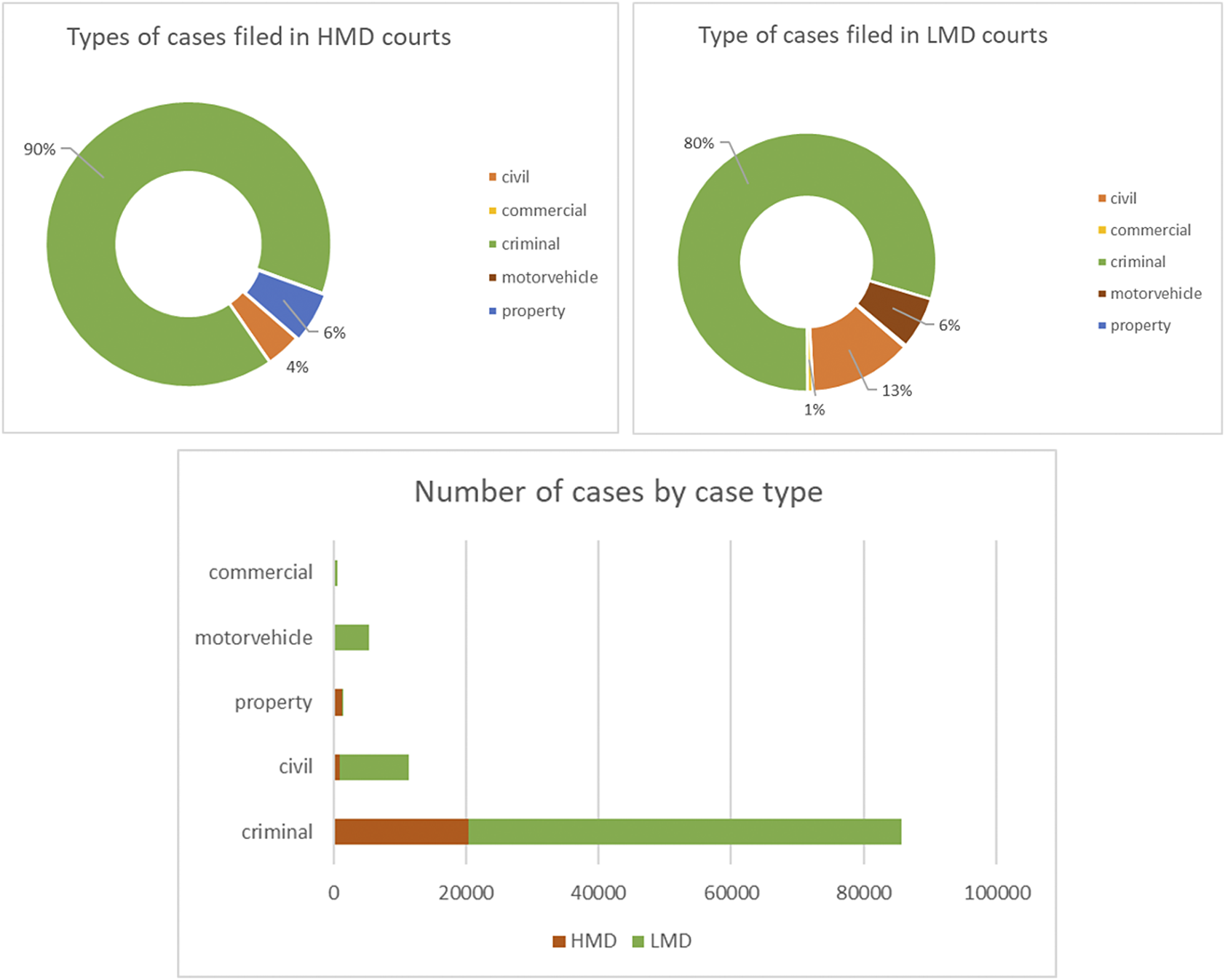
Types of cases filed in HMD Courts and LMD Courts. Criminal matters constitute the bulk of cases in both kinds of courts.
4.5.2. Observations
In keeping with the observations under Section 4.1.1, we observe that LMD courts hear a much larger number of cases overall than HMD courts, counter to the expectation that slower courts would be the ones overburdened by a high number of cases. In 2017, HMD courts heard a total of 22,690 cases, while LMD courts heard 81,912 cases. Of these, the majority of cases in both kinds of courts were criminal cases, comprising 80% of LMD and 90% of HMD court caseloads. There are some other differences in the case mix, with “property” cases, commonly believed to take longer to decide, being a more significant presence in HMD courts (6%) in contrast with LMD courts (0.2%) (Figure 10). However, with the overall numbers of property cases being low (1% of the total set), we do not believe that case type analysis is sufficient to account for the differences in performance observed in LMD courts and HMD courts.
Of course, while this set of cases is labeled overall as “criminal,” “civil,” and so forth, there are clear differences in the way they move through the LMD courts and HMD courts—the MDD of criminal cases in LMD courts was only 2 days in 2018, while the same measure stands at 541 days in the HMD courts. So, “criminal” or “civil” cases encompass a wide range of asks from these district courts.
4.5.3. Procedural stages of a case
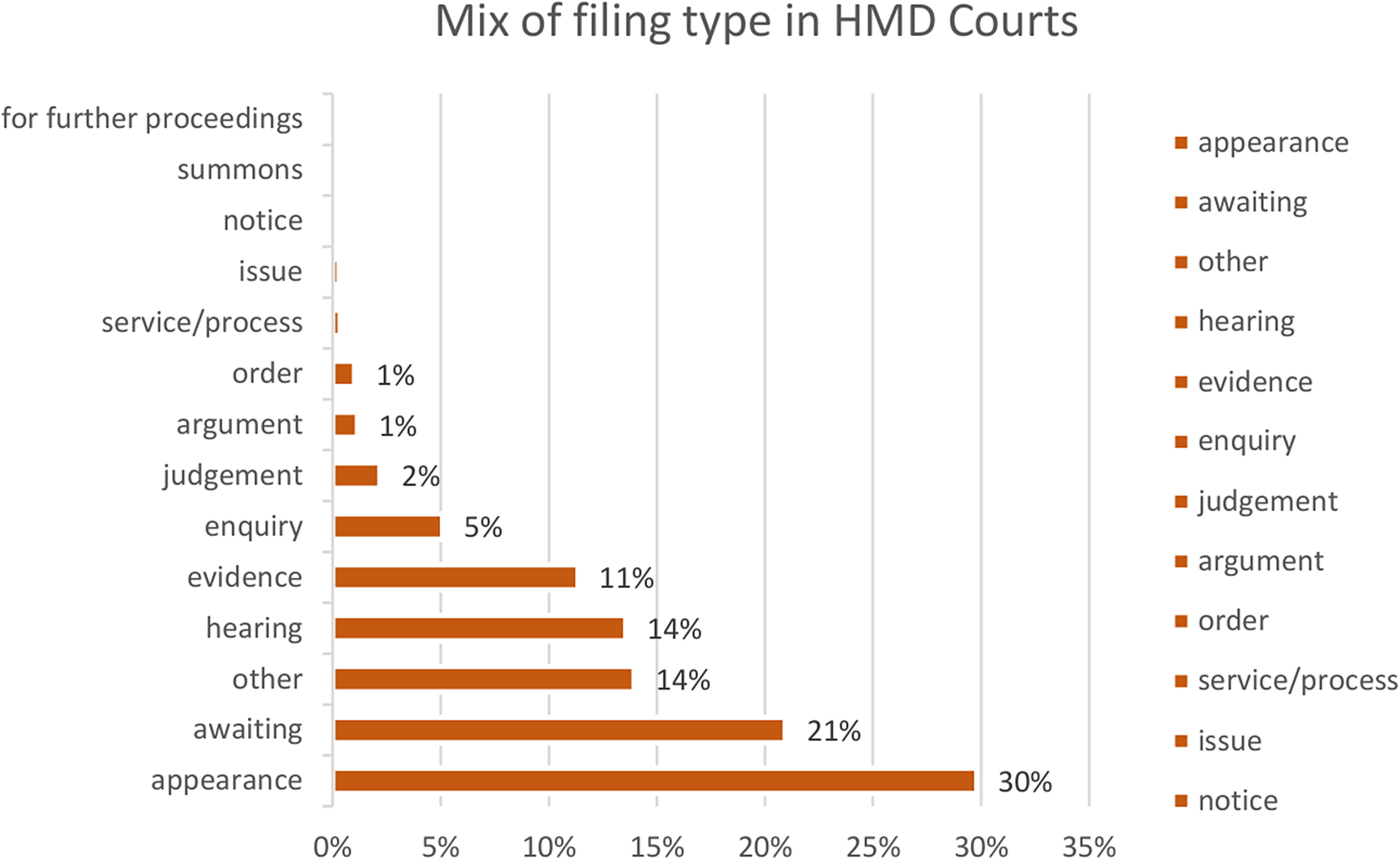
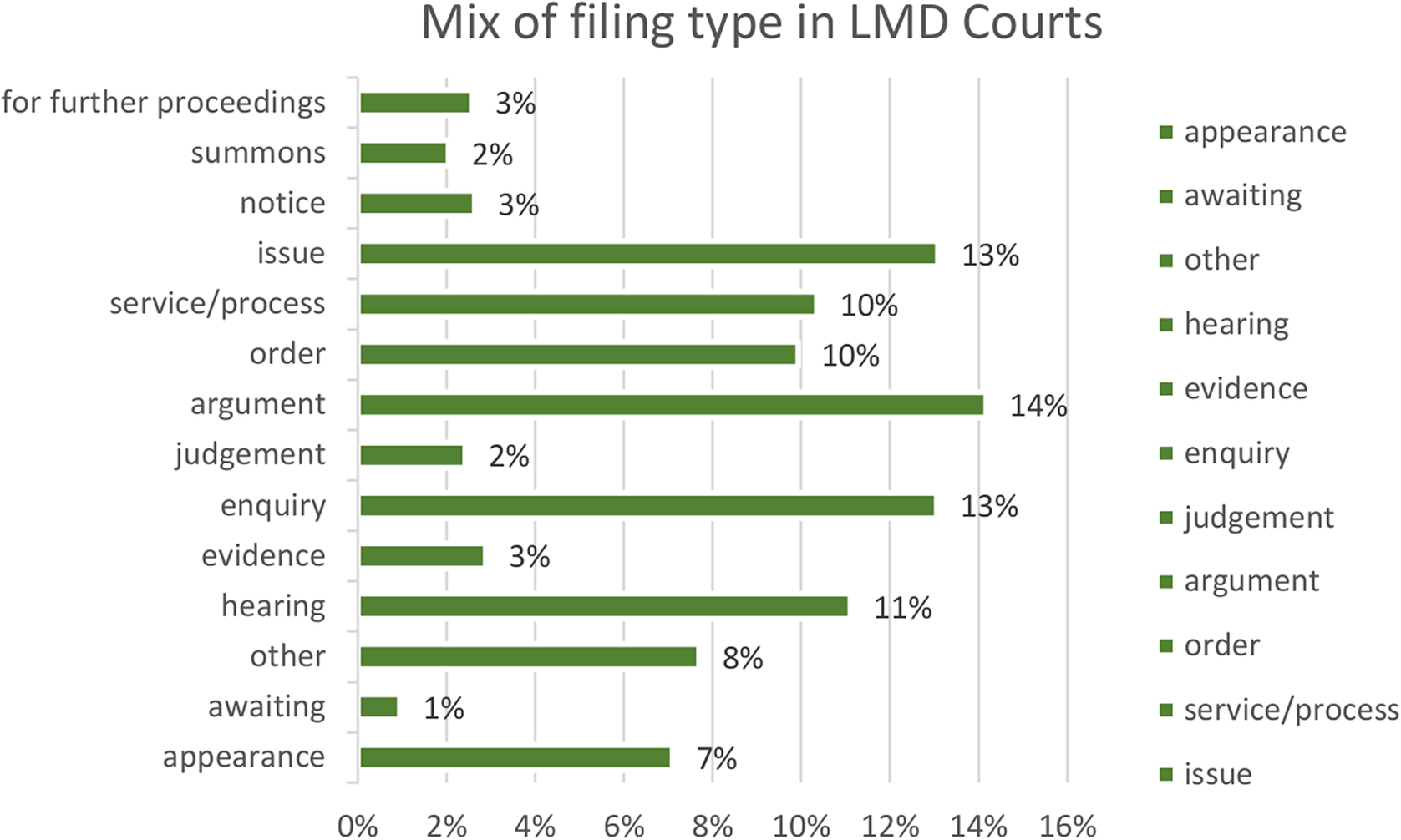
Another indication of the difference in types of cases in the DCPD is in the procedural category that each entry is allocated. Both civil and criminal matters are characterized by several procedural stages involving back-and-forth movement of cases between different stages, and can result in matters getting stalled at each stage of the trial. In addition to the subject matter, case entries also have a procedural designation based on the stage of proceedings, such as an “appearance” case or a “hearing” case. For the purposes of this article, we study this procedural designation as the “type of filing” in LMD and HMD courts, and find notable differences in the composition of the two (Figures 11 and 12).
Mix of filing type in HMD courts. Cases classified at the earlier stages of proceedings are a significantly higher percentage of cases in HMD courts.
Mix of filing type in LMD courts. Cases classified at the earlier stages of proceedings are a significantly lower percentage of cases in LMD courts.
4.5.4. Observations
“Appearance” and “awaiting” cases, that do not necessarily move a case forward (Daksh, 2020), make up over 50% of the cases in HMD courts, while they constitute only 8% of cases in LMD courts. LMD courts, by contrast, hear cases with procedural designations across the lifecycle of a trial, including more cases labeled “argument” (14% in LMD vs. 1% in HMD courts) and “order” (10% in LMD vs. 1% in HMD courts). “Awaiting” cases across both types of courts take longer to decide (161 median days) than “argument” (3 median days) or “order” (4 median days) cases. Interestingly, “appearance” cases seem to behave very differently in the two kinds of courts, with appearance cases in HMD courts taking 394 median days to decide, while they take only 3 days to decide in LMD courts.
Two important factors impacting performance emerge from this analysis. First is the nature of the cases that the HMD and LMD courts hear, not just in their subject matter but in the nature of the dispute itself, and of the litigants and lawyers appearing before these courts, consistent with Galanter’s classic “party capability” theory (Galanter, Reference Galanter, Kennedy and Fisher1975).Footnote 8 Second, this analysis indicates that the administrative wherewithal of the court, that is, its ability to ensure parties appear and move forward through the stages of trial has a significant impact on its performance.
It should be noted that while procedural labels, in keeping with the Civil and CrPCs, usually indicate different stages of a single case, each new procedural stage of a case may form a separate entry on the e-courts platform, from which the DCPD is constructed. This may introduce variability in how the overall caseload in district courts is counted. In addition, earlier reports have noted that the stages of proceedings have been described too broadly, written in free text or with several typographical errors, making it difficult to interpret and analyze (Mandyam et al., Reference Mandyam, Narasappa, Tirumalai, Murthy, Narasappa and Vidyasagar2016; Daksh, 2020).
5. Summary findings
Our study departs from the general understanding by showing that in a district court in India, the total number of days when a judge is involved in adjudicating cases and the number of judges in that court do not impact the performance of that court in terms of time taken by the court to decide cases, without regard to the nature of cases adjudicated by that court. In fact, the number of judges in a court at a given day as well as the number of days that each judge of a district court actively hears cases remain similar across LMD and HMD courts. Furthermore, despite a much lower than average caseload per judge, several district courts remain low performing. This indicates that the nature of cases filed before a district court has a stronger impact on that court’s performance rather than the number of cases adjudicated before that court. In fact, our results can support a conclusion that caseload pressure improves performance, and merely increasing the number of judges may be self-defeating since it could lead to the existing judges reducing their work, by putting in less effort at case disposals. Administratively, the courts of the principal DJ perform better than the CJM and CMM courts. Our findings on the importance of administrative factors are confirmed when we find that the procedural stage of a case in the life cycle of decision-making has a higher impact on the days to decision than the subject matter of the case.
We observe that there is no difference between the performance of the courts with high and low judge strength. The term of a judge does not appear to impact the court’s performance as we measure it. So, courts where judges remain in office in the same court for a longer term do not necessarily perform better than those where judges’ term is less than 1 year (in some cases, between 3 and 4 months). The average term of a district court judge is 1.4 years. Lower court judges do not enjoy security of term. There is a wide variation in the median term of a district court judge, ranging from 79 days to 1345 days.
Between 2010 and 2018, across all categories of cases, there is a steady increase in the total number of cases decided within the first year from filing. Against this, the number of cases that have taken between 5 and 10 years for final judgment have also increased. Judges seem to take a clearly different approach deciding cases that are “easy” where justice seems to be delivered quickly, and perceived as “hard cases” which suffer inordinate delays in decision-making. LMD courts have better managed case listing practices and take around 3 months to list matters for the first hearing.
6. Conclusion
District courts are the first point of institutional contact for the public with the judiciary. Their performance therefore assumes high importance in the overall health of the judiciary. As Krishnan et al. (Reference Krishnan, Kavadi, Girach, Khupkar, Kokal, Mazumdar, Nupur, Sen, Sodhi and Shukla2014) poignantly observe, the lower tier of the Indian judiciary, just as the upper judiciary, adjudicates on important issues of socioeconomic relevance. Therefore, it becomes the primary protector of rights and an important starting point for enabling access to justice.
As we explain above, historically, several measures to evaluate court performance have been developed and used internationally. Our choice of using the number of median days for a court working at optimal capacity to decide a case is common practice across courts at the European UnionFootnote 9 (European Commission for the Efficiency of Justice, n.d.) and the United States, which measure has been independently verified in earlier studies and accepted as a valid measure of performance across these jurisdictions. This has an important, positive economic impact (OECD, 2018).
Our detailed statistical analysis of publicly available case-related data from district courts across the country between 2010 and 2018 reveals several surprising, and even counterintuitive findings. To explain the reasons for this will require a deeper analysis of the systemic and cultural factors affecting judicial decision-making at India’s lower courts, which we do not attempt here. Our analysis is also impacted by the quality of data on the lower judiciary available in the public domain. Despite several authors pointing to the importance of well-functioning courts for economic development (Djankov et al., Reference Djankov, Glaeser, Porta, Lopez-De-Silanes and Shleifer2003; Chemin, Reference Chemin2009; Visaria, Reference Visaria2009; Chemin, Reference Chemin2012; Ponticelli and Alencar, Reference Ponticelli and Alencar2016; Kondylis and Stein, Reference Kondylis and Stein2018; Boehm and Oberfield, Reference Boehm and Oberfield2020; Amirapu, Reference Amirapu2021; Rao, Reference Rao2022), much remains to be done to improve the overall quality of data that is available for research to inform better policymaking on court performance in the country. This study therefore focuses on highlighting the key findings as revealed by the datasets, which can serve as useful pointers for future research on the topic and can provide important empirical evidence to assist policymakers in strengthening the case for urgent reform in this area.
In understanding the factors which determine the courts’ performance, our findings paint an overall modest picture of India’s district courts which is similar to lower courts in other countries—of high case backlog and increasing pressure on judges for matter disposals. We suggest that the dominant policy narrative where the focus remains concentrated on supply side solutions to reduce pendency and delays does not improve how the system actually functions.
We find that the nature of cases filed before a district court is an important determinant of court performance, not so much its workload. Our findings that the number of judges or judge days remain similar across the HMD and LMD district courts runs counter to the dominant/official narrative that India’s lower courts are unable to perform effectively and that they take an inordinate amount of time to decide cases due to overburdened judges.Footnote 10 However, we should be cautious. Our findings cannot be interpreted to mean that the number of judges per court should be further reduced, or that the caseload per judge should be increased, further exhausting district judges, as there may be “some unobserved trade-off between quantity and quality” of cases disposed of. Our results seem to be consistent with recent acknowledgments by judges themselves that merely appointing more judges to a district court is not the only solution to reduce court backlog (Tripathi, Reference Tripathi2022). Our analysis clearly shows that policymaking for lower courts should keep in mind the contextual setting of the court, including geographic location, administrative nature of the cases they handle as well as caseload distribution. These should inform resource allocations for the district judiciary.
The project faces familiar challenges of lack of standardization, large data gaps and incorrect classification associated with using case-related public datasets as is without modifications. However, to enable robustness of our analysis, we have undertaken substantial data verification checks and filtered the datasets to ensure that inaccuracies and incompleteness in the datasets is eliminated. The study’s findings are therefore validated on this basis. We caution that measures to improve court performance cannot work in isolation. These need to be supported by a major revamp of the provision of free legal aid programs to reach the maximum number of people.
Supplementary material
The supplementary material for this article can be found at http://doi.org/10.1017/dap.2024.24.
Data availability statement
Data necessary to replicate the results of this article are available here: https://www.kaggle.com/datasets/himanshupayal/e-courts-judicial-data.
Acknowledgments
The authors thank the administration at the National Law School of India University and the Indian Institute of Science for supporting the collaborative project. The authors would also like to thank the colleagues at both these institutions as well subject experts. The authors would also like to thank xKDR and Daksh for their valuable contributions to the paper. Their insightful interventions helped us structure the paper better. Finally, the authors extend their appreciation to Justice Srikrishna for his very relevant and insightful questions, which played a pivotal role in giving direction to the paper. The authors are grateful to the editorial team of this journal and the anonymous reviewers for their helpful comments. A preprint version of this article has been published on SSRN.
Author contribution
Varsha Aithala, Anushka Sachan, and Srijoni Sen were involved in conceptualization, writing, formal analysis, and editing, with Varsha Aithala and Anushka also contributing to resources. Furthermore, Srijoni Sen contributed to methodology, supervision, and project administration. Himanshu Payal focused on data curation and validation, methodology, software, and visualization. Chiranjib Bhattacharya contributed to conceptualization, methodology, validation, software, and visualization. He also worked on supervision and project administration.
Funding statement
This work received no specific grant from any funding agency, commercial, or not-for-profit sectors.
Competing interest
The authors declare none.


 Open access


Comments
No Comments have been published for this article.