


Introduction
Do non-native, late bilinguals make use of morphological and morphosyntactic information during online word recognition in the same way as native speakers? Although this question has received a lot of attention in recent experimental research, the matter is still controversial. Some researchers have claimed that native (L1) and non-native (L2) speakers apply the same mechanisms for processing morphologically complex words, but that L2 processing may be negatively affected by difficulties with lexical access or retrieval, working memory limitations, and/or slower processing speed (e.g., Cunnings, Reference Cunnings2017; Hopp, Reference Hopp2016; McDonald, Reference McDonald2006). Alternatively, more substantial L1/L2 differences have been posited by the Shallow-Structure Hypothesis (SSH), originally for sentence processing (Clahsen & Felser, Reference Clahsen and Felser2006a, Reference Clahsen and Felser2006b) and later extended to morphological processing (e.g., Clahsen, Felser, Neubauer, Sato & Silva, Reference Clahsen, Felser, Neubauer, Sato and Silva2010; Clahsen, Balkhair, Schutter & Cunnings, Reference Clahsen, Balkhair, Schutter and Cunnings2013; Clahsen, Gerth, Heyer & Schott, Reference Clahsen, Gerth, Heyer and Schott2015). The SSH holds that even proficient L2 speakers tend to have problems building or manipulating abstract grammatical representations in real time, and that relative to native speakers, L2 processing of morphologically complex words relies more heavily on storage of complex forms and less on morphological structure and computation. In experimental research, priming experiments (specifically, masked priming) have been widely used as a technique to provide insight into the kinds of cues the word recognition system relies on during morphological processing (see Marslen-Wilson, Reference Marslen-Wilson2007, for a review). Previous L2 priming studies, however, have produced mixed results. For inflection, for example, some studies reported L1-like morphological priming effects for English past-tense forms and for French -er verbs in groups of late bilinguals, even under masked-priming conditions (e.g., Coughlin & Tremblay, Reference Coughlin and Tremblay2015; Feldman, Kostić, Basnight-Brown, Đurđević & Pastizzo, Reference Feldman, Kostić, Basnight-Brown, Đurđević and Pastizzo2010; Voga, Anastassiadis-Symeonidis & Giraudo, Reference Voga, Anastassiadis-Symeonidis and Giraudo2014), whereas other studies found morphological facilitation effects for inflectional phenomena in English, German, and Turkish for their L1 control groups, but not for groups of (highly proficient) late bilinguals (e.g., Jacob, Heyer & Veríssimo, Reference Jacob, Heyer and Veríssimo2017; Kirkici & Clahsen, Reference Kirkici and Clahsen2013; Neubauer & Clahsen, Reference Neubauer and Clahsen2009; Silva & Clahsen, Reference Silva and Clahsen2008). The question of whether an inflected word's morphological structure and its morphosyntactic features (e.g., finiteness features) are underused in L2 processing or whether the L2 system employs these information sources in the same way as the L1 system remains to be answered.
Against this background, this study reports the results from a masked-priming experiment on late bilinguals’ processing of Hebrew inflectional morphology, the first L2 study of its kind on a previously unconsidered language type (Semitic). Due to its non-concatenative properties, the Semitic lexical processor has been claimed to be primarily driven by morphology, designed to extract a complex word's abstract structure (root and word pattern), irrespective of meaning or surface form (Boudelaa & Marslen-Wilson, Reference Boudelaa and Marslen-Wilson2015; Frost, Forster & Deutsch, Reference Frost, Forster and Deutsch1997). With those properties, Hebrew morphology should be an ideal test case to test the role of morphology during L2 word recognition.
Background: Hebrew morphology
There is an extensive linguistic and psycholinguistic literature on this topic (see, e.g., Arad, Reference Arad2005; Aronoff, Reference Aronoff1994; Frost et al., Reference Frost, Forster and Deutsch1997; Plaut & Gonnermann, Reference Plaut and Gonnerman2000), which will not be discussed here. Rather, the following remarks are meant as background information for those unfamiliar with Hebrew morphology and the corresponding experimental research.
Hebrew composes most words non-concatenatively, by a non-linear combination of a consonantal root and a vowel pattern, which together constitutes stems to which inflectional affixes may be added. The consonantal root typically contains three consonants and carries the core meaning of the word. The same root is commonly assigned to more than one pattern. For verbs there are seven distinct vowel patterns called binyanim, which provide designated positions for inserting a root's consonants. For example, the verb katav ‘(he) wrote’ consists of the root K-T-V and the binyan Paal, which is expressed by the vowel pattern CaCaC (with ‘C’ representing the root consonants). While two binyanim (Pual and Hufal) are fully predictable in their morphosyntactic function (encoding passive voice), the other five classes show only general semantic and syntactic tendencies (for review, see Arad, Reference Arad2005). In fact, for many Hebrew verbs, it is generally difficult or impossible to compute their meaning compositionally on the basis of roots and patterns. Furthermore, binyanim assignment is obligatory, with every verb having to be assigned to a binyan before it can be inflected. Aronoff (Reference Aronoff1994, chapter 5) points out that with these properties the Hebrew binyanim may be conceived as a system of inflectional classes, akin to the conjugational classes in the Romance languages. As such, the binyanim are not morphemic – in the sense of reliably encoding particular syntactic or semantic properties – but instead serve as an abstract morphological mark of a given verb's inflectional class, which dictates the phonological shape of its different forms (Aronoff, Reference Aronoff1994, p. 127).
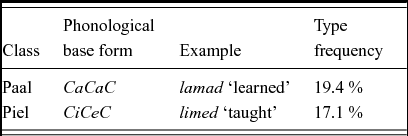
For the present study, we examined the two most common binyanim, Paal and Piel. While both classes have relatively high type frequencies (calculated as percentages of verbs of each class in a corpus containing 4,131 verbs; Itai & Wintner, Reference Itai and Wintner2008), they differ in their productivity (see Table 1). New verbs are typically assigned to Piel, whereas Paal forms represent a restricted class of lexical items in Modern Hebrew (see Bolozky, Reference Bolozky1999).
Properties of the Paal and Piel classes
Hebrew (and Arabic) morphology has been subject to a large number of experimental studies, albeit almost exclusively with native speakers (Boudelaa & Marslen-Wilson, Reference Boudelaa and Marslen-Wilson2005; Deutsch, Frost & Forster, Reference Deutsch, Frost and Forster1998; Frost et al., Reference Frost, Forster and Deutsch1997; Frost, Kugler, Deutsch & Forster, Reference Frost, Kugler, Deutsch and Forster2005). One familiar finding from this research is a root-priming effect, that is, faster lexical decision times for a target word (e.g., mixtav ‘a letter’) when the prime shares the same consonantal root, relative to an unrelated control prime (e.g., hixtiv ‘(he) dictated’ → mixtav vs. hirgish ‘(he) felt’ → mixtav). Interestingly, a root-priming effect was obtained even when prime and target were not transparently related in meaning (e.g., rasham ‘(he) registered’ → hirshim ‘(he) impressed’). How to interpret root-priming effects is controversial. Root priming may signal full morphological decomposition of every complex Hebrew or Arabic word form into root and pattern (e.g., Boudelaa & Marslen-Wilson, Reference Boudelaa and Marslen-Wilson2011, Reference Boudelaa and Marslen-Wilson2015). Alternatively, root-priming effects have been interpreted in terms of additive or interactive effects of prime-target overlap in form and meaning, even under masked-priming conditions (e.g., Plaut & Gonnerman, Reference Plaut and Gonnerman2000; see also Gonnerman, Seidenberg & Andersen, Reference Gonnerman, Seidenberg and Andersen2007).
Further insight into the nature of morphological priming in Hebrew comes from a recent masked-priming study that showed reliable root-priming effects from Piel primes, but not from Paal primes, with a group of L1 Hebrew speakers (Farhy, Veríssimo & Clahsen, Reference Farhy, Veríssimo and Clahsen2017). The authors attributed this contrast to distinct morpho-lexical representations for the two binyanim, structured fully decomposable stems for productive classes (like Piel) versus unstructured stems that are stored as wholes for unproductive classes (like Paal).
Little is known about late bilinguals’ processing of Semitic morphology. Two recent studies provide insight into how L2 speakers handle its non-concatenative morphology. Norman, Degani and Peleg (Reference Norman, Degani and Peleg2016) found that in L1 and L2 Hebrew speakers (the latter with either Arabic or English as L1), pseudowords composed from existing roots and vowel patterns yielded longer lexical-decision times than pseudowords composed from non-existing roots or vowel patterns. The authors interpreted this finding as signalling native-like decomposition of Hebrew words into roots and patterns in L2 Hebrew. Alternatively, however, it is possible that pseudowords with existing roots and vowel patterns take longer to reject (relative to pseudowords constructed from non-existing component parts), because they are phonologically more similar to real words. In addition, in a cross-modal study (Freynik, Gor & O'Rourke, Reference Freynik, Gor and O'Rourke2017), root-priming effects of similar magnitudes were obtained in both L2 and L1 speakers of Arabic, which the authors interpret as signalling the use of native-like morphological decomposition into roots and patterns in L2 Arabic speakers. Alternatively, however, one may conceive of this finding as the result of the combined effects of overlap of form and meaning, given that cross-modal priming may be particularly sensitive to semantic effects (e.g., Gonnerman et al., Reference Gonnerman, Seidenberg and Andersen2007; Marslen-Wilson, Tyler, Waksler & Older, Reference Marslen-Wilson, Tyler, Waksler and Older1994).
In the present study, we examine whether late bilinguals access pure morphology during word recognition in the same way as native speakers, by testing late bilinguals’ sensitivity to the Hebrew binyanim – a case of pure morphology that is less directly derivable from form-meaning associations than the commonly studied grammatical morphemes. Specifically, we tested whether non-native speakers showed root priming from verbs belonging to the productive Piel class and from the unproductive Paal class, presented in two different verbal forms (1sg Past and Infinitive). In addition, we directly compared our results to a group of native speakers who underwent the same experiment (Farhy et al., Reference Farhy, Veríssimo and Clahsen2017) and showed robust priming from Piel, but not from Paal forms. If non-native speakers are sensitive to the distinction between verbal classes, they should show the same priming pattern as the L1 control group. However, if L2 speakers underuse morphological information, they should show similar effects following Paal and Piel primes.
Method
Participants
Fifty-eight non-native Hebrew speakers (35 males, 7 left-handed, mean age: 28.69, SD: 4.46) participated in the experiment. They all lived in Israel and had emigrated from South America, with Spanish (n = 55) or Portuguese (n = 3) as their native language. All participants were late learners of Hebrew (mean age of onset: 14.0 years, SD: 4.61) and achieved a mean score of 96% (SD = 0.08) in one section of the YAEL proficiency test for university candidates (including sentence completion, sentence rephrasing, and reading comprehension), with every participant achieving a 70% score or higher. Participants also estimated (in percentages) their relative use of Hebrew, both overall, and in four specific domains (speaking, hearing, writing, and reading). Hebrew had a mean overall usage of 60.96% (SD = 18.94). Similar usage ratings were reported for the four specific domains (speaking: 61.56%; hearing: 61.84%; writing: 67.39%; reading: 63.18%). Participants used their native languages (Spanish or Portuguese) less often, with a mean overall usage of 28.95% (SD: 16.73). All participants had normal or corrected-to-normal vision and none had been diagnosed with any language disorders.
Materials
Table 2 displays the experimental design, including an example stimulus set. Experimental targets consisted of 42 Hitpael verbs, presented in the 3sg past tense, a form constituted by a root together with the Hitpael verbal pattern, with no inflectional suffixes. There were two sets of 21 targets, one for each of two Form Type conditions, 1sg Past and Infinitive; as described below, Form Type refers to the particular form in which prime words were presented. Note that the experimental targets were always presented in their 3sg past-tense form. Each target word was paired with three types of primes: (a) one prime belonging to the Paal class, based on the same verbal root as the target, (b) one prime belonging to the Piel class, also based on the same root, and (c) one unrelated prime, which had no orthographic, phonological, or semantic overlap with its corresponding target form. The materials were the same as in Farhy et al. (Reference Farhy, Veríssimo and Clahsen2017).
Experimental conditions, with an example stimulus set
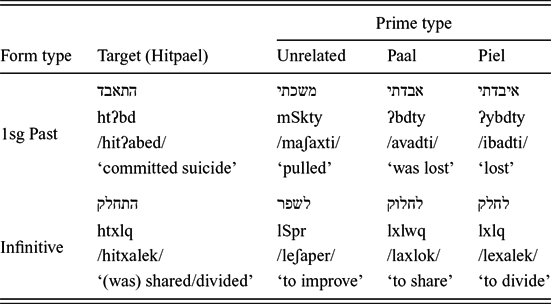
Note: Examples are shown in Hebrew orthography together with transliteration to Latin letters, phonological form, and English translation.
Each target was preceded by Paal, Piel, and Unrelated primes presented either in a finite form, the 1sg past tense (21 targets), or in the infinitive form (21 targets)Footnote 1. Conditions were matched for length, semantic relatedness, and lemma frequency (Itai & Wintner, Reference Itai and Wintner2008). We also included 294 filler prime–target pairs, 126 word–word pairs and 168 word–nonword pairs, yielding a total of 336 targets, half of them words and half pseudowords (for additional descriptions, see Farhy et al., Reference Farhy, Veríssimo and Clahsen2017).
Procedure
Participants were asked to perform a lexical decision task on visual targets, as quickly and accurately as possible. Every trial consisted of a fixation cross (500ms), a blank screen (500ms), a row of hash marks (500ms), a prime word (50ms), and the target (presented until a response was made, up to a timeout of 2000ms). After a further 500ms, the next trial started. Response times (RTs) were measured from the onset of target presentation.
Data analysis
Two items with extremely low accuracy (below 50%) were removed (hidama ‘was similar’ and hishtamer ‘was preserved’, both from the 1sg Past condition), in addition to incorrect responses and timeouts (i.e., when no response was made during the 2000ms window). In addition, trials with extremely slow RTs (longer than 1,500ms) were removed (6.84%). In order to compare the current priming effects to an L1 group, Farhy et al.’s (Reference Farhy, Veríssimo and Clahsen2017) data from 30 native Hebrew speakers (who underwent the same task and procedure) were added to the present dataset.
The RT data were analysed with generalised linear mixed-effects regression, with crossed random effects for participants and items (Baayen, Davidson & Bates, Reference Baayen, Davidson and Bates2008). RTs were analysed without any transformation, but with the assumption that the data follows an inverse Gaussian distribution (with an identity link function), as recommended by Lo and Andrews (Reference Lo and Andrews2015). A detailed description of this kind of regression model is provided in Appendix S1 (Supplementary material), together with an assessment of the models’ random structure. The following factorial predictors were included: (a) Prime Type (Paal, Piel, Unrelated), (b) Form Type (1sg Past, Infinitive), and (c) Group (L1, L2). In the presence of interactions, treatment contrasts were used and the statistical comparisons of interest were obtained by relevelling factors and refitting the model. In the cases where ‘main effects’ are reported, these were obtained by converting factors to numeric variables and centering them (e.g., Fraundorf & Jaeger, Reference Fraundorf and Jaeger2016). Accuracy data were also analysed with generalised mixed-effects regression (binomial family, logit link function; Jaeger, Reference Jaeger2008).
Results
Table 3 displays mean RTs, standard errors (SEs), and accuracy rates in all conditions, for the L2 speaker group in the present study, as well as for the L1 control group.
Mean RTs and SEs (in parenthesis) and accuracy rates
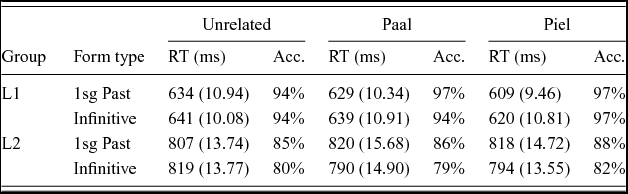
Note: The L1 data are from Farhy et al. (Reference Farhy, Veríssimo and Clahsen2017). Displayed means and SEs are back-transformed from a reciprocal transformation (-1000/RT), as this was the transformation used in the analysis of the L1 group reported in Farhy et al.
In the accuracy data, a main effect of Group was obtained (b = 1.24, z = 3.88, p<.001), indicating higher accuracy rates for the L1 group, across conditions, and an effect of Prime Type, indicating higher accuracy rates in the Piel prime condition, across groups (Unrelated vs. Piel: b = 0.45, z = 2.74, p = .006; Paal vs. Piel: b = 0.34, z = 2.00, p = .045). Significant interactions between the predictors were not found (all |z|s<1.13, all ps>.262).
With regard to the RTs, the analysis yielded significant three-way interactions between Prime Type, Form Type and Group, both for Paal priming (b = −36.3, t = −2.47, p = .013) and Piel priming (b = −34.7, t = −2.38, p = .017). These analyses were followed by separate within-group analyses. For the L2 group, interactions between Prime Type and Form Type were significant, for both Paal priming (b = −35.4, t = −2.34, p = .019) and Piel priming (b = −37.1, t = −2.24, p = .025), but not for the comparison between Paal and Piel (b = 1.7, t = 0.11, p = .913), indicating that the two binyanim show similar effects across the two forms. Further analyses revealed different priming patterns in the Infinitive and the 1sg Past conditions. In the Infinitive condition, Piel and Paal primes yielded significantly shorter RTs than Unrelated primes (Unrelated vs. Piel: b = 26.3, t = 2.15, p = .032; Unrelated vs. Paal: b = 22.0, t = 2.01, p = .045). By contrast, primes presented in the 1sg Past condition did not produce any facilitation, neither for Piel (b = −10.78, t = −0.93, p = .350), nor for Paal primes (b = −13.40, t = –1.09, p = .275)Footnote 2.
In the L1 group, similar priming effects were obtained in the Infinitive and the 1sg Past conditions, with no interactions between Prime Type and Form Type, neither for Paal (b = 2.1, t = 0.13, p = .895), nor for Piel priming (b = −2.5, t = −0.15, p = .880). Across both Form Type conditions, Piel primes yielded significantly shorter RTs than Unrelated primes (b = 23.9, t = 2.93, p = .003), whereas Paal primes did not produce any reliable facilitation (b = 2.07, t = 0.25, p = .805), with a significant difference between RTs following Paal and Piel primes (b = −21.8, t = −2.68, p = .007). In addition, an examination of each Form Type condition (despite the absence of interactions) showed significant priming from Piel in both the Infinitive and 1sg Past (both ps<.049), but no priming effects from Paal in neither of the two Form Types (both ps>.786).
Discussion
In the current masked-priming study, late L2 learners of Hebrew showed similar morphological root-priming effects for infinitive forms, regardless of whether verbs belonged to the productive verbal class Piel or to the unproductive class Paal. However, when verbs were presented in a finite form (1sg past tense), no priming effects were obtained, neither for Paal nor for Piel verbs. Both of these findings stand in sharp contrast with the results obtained with the L1 group, for which root-priming effects were elicited by Piel verbs only, both when they were presented as infinitives and as finite forms. In other words, whereas for native speakers priming effects were modulated by binyan but not by finiteness, L2 speakers showed the opposite pattern, with morphological priming being crucially dependent on finiteness but not on binyan membership.
The Hebrew binyanim have been argued to constitute a system of ‘pure morphology’, because they determine the phonological shape of verbal stems and are essentially arbitrary with regards to the syntactic or semantic properties that they express (Aronoff, Reference Aronoff1994). The fact that L1 root-priming effects are modulated by binyan indicates that native speakers distinguish between these abstract morphological categories and use this information during visual word recognition, specifically, by decomposing stems of Piel verbs down to the level of the root or accessing whole stems in the case of the unproductive class Paal (see Farhy et al., Reference Farhy, Veríssimo and Clahsen2017, for discussion). However, this account cannot be extended to the L2 data. The equivalent L2 effects for Paal and Piel – priming for infinitives, and no priming for finite forms – suggests instead that late-learners of Hebrew represent verbs from productive and unproductive classes in a similar way and, at least under masked-priming conditions, do not show sensitivity to purely morphological cues like binyan membership during the recognition of complex forms.
How can the L2 root-priming effects for infinitives be explained? One possibility is that L2 speakers of Hebrew recognise and extract root constituents from non-finite forms (Freynik et al., Reference Freynik, Gor and O'Rourke2017), for example, due to the root's salient role in Hebrew as a structural unit (Frost et al., Reference Frost, Forster and Deutsch1997). Alternatively, the source of these facilitation effects may be that L2 speakers learn form-to-meaning lexical regularities, such as the co-occurrence of roots with certain semantic features (Plaut & Gonnerman, Reference Plaut and Gonnerman2000). Crucially, however, the process by which roots are pre-activated in L2 masked-priming is (a) equally applicable to verbs from all binyanim and (b) can be ‘blocked’ or made more difficult in the case of forms that contain a tense and agreement morpheme, as revealed by the lack of root priming from forms presented in the 1sg past tense. Although not initially hypothesized, the contrast between facilitated decomposition of infinitives, but lack of priming from forms with finite morphemes, is reminiscent of production studies in which late learners show considerable difficulties with the overt expression of morphosyntactic features, instead producing infinitives and unmarked forms (e.g., Blom, Polišenská & Weerman, Reference Blom, Polišenská and Weerman2006; White, Reference White2003). Prévost and White (Reference Prévost and White2000), for example, suggested that (in production) access to finite forms is sometimes blocked, resulting in underspecified non-finite forms ‘winning’ the competition for lexical insertion, especially under pressure. Furthermore, the lack of priming from 1sg past-tense forms in our study is broadly consistent with a number of previous priming studies, in which late bilinguals show reduced facilitation from inflected forms and marked stems (e.g., Jacob et al., Reference Jacob, Heyer and Veríssimo2017; Veríssimo, Heyer, Jacob & Clahsen, Reference Veríssimo, Heyer, Jacob and Clahsen2017; Krause, Bosch & Clahsen, Reference Krause, Bosch and Clahsen2015; Silva & Clahsen, Reference Silva and Clahsen2008). The present findings therefore suggest that word recognition in advanced L2 learners is less sensitive to both morphological (binyan membership) and morphosyntactic cues (finiteness) than in native speakers.
Other proposed sources of L1 versus L2 contrasts, such as limited exposure and proficiency or native-language influence cannot easily account for our results. Firstly, our L2 participants were all highly proficient and fully immersed speakers, who used Hebrew on a daily basis. Secondly, they were native speakers of Spanish or Portuguese, languages that also display verbal conjugation classes. Moreover, there is evidence that L1 speakers of Romance languages employ this purely morphological information during word recognition (Say & Clahsen, Reference Say, Clahsen, Nooteboom, Weerman and Wijnen2002; Veríssimo & Clahsen, Reference Veríssimo and Clahsen2009).
We conclude that even advanced late-learners are likely to show processing differences relative to L1 speakers, specifically in the domains of pure morphology and morphosyntax. More generally, our results are consistent with the Shallow-Structure Hypothesis (Clahsen & Felser, Reference Clahsen and Felser2006a, Reference Clahsen and Felser2006b; Clahsen et al., Reference Clahsen, Felser, Neubauer, Sato and Silva2010), according to which late bilinguals underuse grammatical information and analysis in the course of linguistic processing.
Supplementary material
To view supplementary material for this article, please visit https://doi.org/10.1017/S1366728918000032



