

Introduction: An Overview
From 1912 to 1949, the Republic of China (ROC) underwent a profound period of transformation and revitalization. Following the collapse of the Qing Dynasty in 1912, the ROC era was characterized by significant social changes, including the emergence of new social classes, the expansion of modern education, and widespread political mobilization (Fairbank and Goldman Reference Fairbank and Goldman2006). Among these changes, the status of Chinese women saw remarkable progress. Because Chinese women were no longer confined to being merely the product and property of their families (Fairbank and Goldman Reference Fairbank and Goldman2006), they began to experience newfound freedoms. This included greater participation in the workforce, increased access to education, and enhanced autonomy in choosing their life partners. As traditional norms were challenged and new opportunities for social and economic participation emerged, these shifts marked a pivotal moment in the modernization of Chinese society. As Diana Lary highlights, this era represented a crucial shift towards gender equality and the broader renaissance of China within its society (Lary Reference Lary2007). A key moment in this transformation was the May Fourth Movement of 1919, which called for the rejection of traditional Confucian values in favor of modernization, alongside political, social, and cultural reforms, including the advancement of women’s rights. A prominent platform for these ideals was New Youth (新青年), a journal founded by Chen Duxiu and Li Dazhao, which championed Marxism, science, democracy, and women’s emancipation. Influential female political figures, such as Soong Ching-ling, the wife of Sun Yat-sen, utilized their power to advocate for gender equality and women’s education. These cultural and political shifts gave rise to the figure of the “New Woman” (新女性), symbolizing empowerment, independence, and modernity.
While many scholars in both the US and mainland China have explored Chinese dancing bodies in various contexts and celebrated prominent dance artists and institutions, little attention has been given to the group of young Chinese women dancers (16–25 years old) in girls’ schools in the Republic Era, an aspect I aim to address. This paper adopts a thematic structure to analyze female bodies moving from 1926 to 1934, focusing on three interconnected dimensions: From Legacy to Agency: Female Bodies and New Beginnings; Performing Collectivity: New Women Dancing on the Sports Field of Republic China; and Negotiating Modernity: Female Bodies and Bodily Identity in the Mid-1930s. By broadening the scope of existing research, this paper aims to re-stage Chinese female bodies away from a solely revolutionary lens; Excepting to re-read history through an embodied epistemology rooted in my lived experience as a Chinese woman and dance practitioner-scholar, but to reinterpret their role not only in the performance space, but also in the arenas of gender, society, education, and politics, among other things. This paper argues that dance empowered young Chinese women to challenge traditional gender norms and engage with the forces of modernity during this time. These ordinary female dancing bodies were not merely reflections of social and political change but were active agents in shaping it. Through dance movements, they negotiated shifting cultural and political landscapes, using dance to explore new notions of freedom, identity, and womanhood. Their performances, therefore, became a crucial means of understanding the way China and Chinese people participated in the broader project of national transformation in the Republic of China.
Why the Republic of China (ROC)?
The early twentieth century in China was a period of profound political and cultural upheaval marked by an unprecedented influx of foreign goods, ideas, and practices. Among these shifts, the introduction of Western dance forms such as modern dance and ballet, opened new avenues for artistic experimentation and individual expression.
Before the twentieth century, Chinese dance had been predominantly ceremonial or embedded in theatrical traditions like court performances, opera, and folk rituals. Court dance, with its dignified elegance, symmetrical formations, and meticulously codified choreography, served as a vehicle for imperial authority and Confucian ideals such as propriety (li 禮) and benevolence (ren 仁). Its stylized gestures and opulent costumes embodied the principle of harmony between heaven and humanity (tian-ren heyi 天人合一), reinforcing both cosmic order and dynastic legitimacy through performative ritual.
A pivotal shift began during the mid-Qing dynasty, when Western missionaries introduced female physical education to China. This initiative laid the groundwork for systemic educational reforms, particularly between 1922 and 1928, as China transitioned from Japanese-inspired pedagogical models to American-influenced systems (Yu Reference Yu2025). As historian E-tu Zen Sun notes, the 1920s marked a dynamic era of collaboration between China and the US, particularly in the fields of science and higher education (Sun Reference Sun, Fairbank and Feuerwerker1986). The establishment of women’s physical education schools coincided with the rise of feminist activism in the 1920s and 1930s, a movement that advocated for expanded access to women’s education and bodily autonomy. Dance was a mandatory course in these progressive curricula. For instance, at Jinling College, upper-level students participated in weekly physical education sessions featuring activities ranging from ball games and archery to dance and Chinese boxing (Figure 5). This period also saw the profound influence of American educational models on China’s physical education reforms. By 1921, graduation performances at Women’s Sports Normal Schools prominently featured Western dances (Figures 6 and 7), signaling a transnational exchange of ideas (Yu Reference Yu2025). Also, the dance textbook was described as 新颖 (innovation) in Women’s Physical Education School in women’s studies scholar Yu Chien-ming’s book, which positioned dance as a discipline that transcended physical training to embody modernity and self-expression. This pedagogical evolution underscored the broader cultural negotiation between Chinese tradition and global modernity; Fairbank and Goldman state that Modernity arrived as a layered amalgamation of influences from multiple nations, driving rapid and all-encompassing transformation (Fairbank and Goldman Reference Fairbank and Goldman2006).
This reconfiguration of women’s education and physical culture intersected dynamically with broader feminist movements, creating a symbiotic relationship between bodily liberation and intellectual emancipation. The evolving discourse on gender catalyzed significant advancements in women’s education, marriage rights, and public visibility transformations, which were vividly reflected in both artistic production and sociopolitical activism. Female writers such as Huang Luyin, Feng Yuanjun, and Ding Ling, all active during Republican China (1912–1949), reconceptualized love as a form of intellectual transcendence, using literature to critique patriarchal structures and interrogate the tension between individual autonomy and societal expectations (Lee Reference Lee and Fairbank1983). Their work built upon the radical legacy of Qiu Jin, the revolutionary feminist and poet who fused advocacy for women’s liberation with Han Chinese nationalism, and established a blueprint for later activists.
The famous Chinese painter and sculptor Pan Yuliang, who rose to prominence in Republican China (1912–1949), defied conventions by adopting Western techniques to depict the female nude, challenging Confucian modesty norms while asserting women’s agency. Similarly, poet Xu Zihua scrutinized gender inequities and social injustices in works like the Tingzhu Lou Poetry Collection (聽竹樓詩稿), contributing to a growing literary canon centered on female subjectivity (Lee Reference Lee and Fairbank1983). On the Peking opera stage, female performers ascended to prominence after 1911, subverting traditional gender roles through their artistic dominance. As theater scholar Joshua Goldstein observes, actresses “almost overnight, were coming to dominate the drama world” (Goldstein Reference Goldstein2004).
These cultural shifts were amplified by proliferating media platforms dedicated to feminist thought. Journals such as Funü Zazhi (The Ladies’ Journal, 1915–1931), Funü Shibao (The Women’s Eastern Times, 1911–1917), Nüzi Yuekan (The Women’s Monthly, 1933–1937) and Nü Sheng (Woman’s Voice, 1932–1935) provided vital forums for debating women’s rights, education, and social reform, fostering a collective consciousness among urban educated women. The rise of newspapers, periodicals, intellectual societies, and political parties created novel avenues for public engagement. Historian Charlotte Furth notes that these institutions enabled “novel modes of communication and association” and facilitated the dissemination of new ideas and the formation of new communities (Furth Reference Furth and Fairbank1983, 322) that empowered women to claim visibility in spheres previously dominated by men.
Dance, too, became a site of this modernization project. Events branded as wudaohui (舞蹈會, dance parties), wudaodahui (舞蹈大會, dance festivals) or youyihui (遊藝會, entertainment gatherings) attracted public attention. Dance institutionalization further cemented its role in redefining the female image. Organizations like the China Youth Dance Association (中國青年舞蹈協會), the China Youth Theatre and Dance Association (中國青年演劇舞蹈協會), Zhonghua Dance Art Organization (中華舞俑藝術社), the Rong Jin Youth Organization (蓉巾青年會), and the Qingmuguan Dance Lecture Course (靑木關舞蹈講習班) functioned as laboratories for modernity, dismantling women’s social isolation and reimagining gendered bodily practices. During this time, pioneering dancers such as Chen Cuiying (陳脆英), Liang Lingqiu (梁淩秋), Lin Wen (林文), Wu Xiaobo (吳小波), Li Ounahua (李歐娜華), Zheng Mengxia (鄭孟霞), Ling Peifen (淩佩芬), Hu Rongrong (胡蓉蓉), Wang Yuan (王淵), and Zhao Xingyuan (趙涬元) became cultural icons, their careers chronicled in magazines as exemplars of both psychological resilience and creative individuality. Though this paper does not delve into individual biographies, the prominence of these dancers and institutions underscores their symbolic power; they embodied the era’s dual preoccupation with bodily discipline and emancipatory expression, reflecting how female dancers became a microcosm of Republican China’s struggle to reconcile tradition with modernity.
To interrogate these intersections of bodily practice and societal transformation, this paper employs an interdisciplinary methodology that treats photographs, kinetic archives, and mobilized documents as critical sites for analyzing women’s dance and dancing bodies’ ephemerality and their embeddedness in Republican China’s cultural, social, and political struggles. Through close readings of choreography, lyrics, plot structures, and newspaper critiques, the paper reconstructs kinetic narratives that transcend geographic and cultural boundaries, revealing how dance mediated competing visions of gender, modernity, and nationhood. By analyzing spatial relationships, bodily movements, and transboundary gestures within photographic and textual archives, the study foregrounds dance as both a physical language and a choreopolitical act, one that negotiates the tensions between tradition and rupture in a rapidly changing society.
Photographs, as frozen moments of becoming, document more than static postures or costumes; they index the political and cultural mobility of women who wielded dance as a tool to claim agency within constrained spaces. Each image functions as a visual palimpsest, revealing how dance became a medium for socio-cultural translation, a corporeal lexicon through which women navigated and contested their evolving roles.
From Legacy to Agency: Female Bodies and New Beginnings
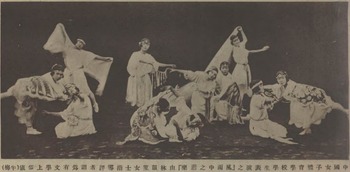
In 1926, a dance performance titled Sorrow and Joy Amidst Wind and Rain (風雨中之悲樂), directed by female choreographer Lin Yunsheng (林韵笙), was staged at the China Women’s Physical Education School (Ban Reference Ban1926). Performed by eleven female students, the work captured public attention through its visual symbolism and feminine themes. A 1926 photograph from The Eastern Times Photo Supplement (圖畫時報), China’s first pictorial newspaper, captures a group of Chinese women in a performance space. Through their choreography, female bodies become sites of resistance, strength, and self-expression, reflecting the shifting dynamics of gender and power in early Republican China (Figure 1).
Female students from the China Women’s Physical Education Academy (中國女子體育學校) performing the dance work “Sorrow and Joy via the Wind and Rain” Photo by Ban Mei (半梅), Reference Ban1926.Published in The Eastern Times Photo Supplement (圖畫時報), issue no. 315, p. 2.

Figure 1. Long description
In the foreground, three dancers are positioned low to the ground, two reclining with extended arms and one kneeling, all facing slightly left. Behind them, five dancers stand or kneel in staggered heights, each with one or both arms raised, creating diagonal lines. Their costumes feature long, draped sleeves and sashes, with some holding fabric aloft. At the rear, two dancers stand at the far left and right, each with one arm extended upward and the other outward, anchoring the composition. The group forms a wide arc, with bodies angled toward the center, suggesting coordinated movement. The stage is dark, and the lighting highlights the contours of the dancers’ garments and gestures. Chinese text is printed along the bottom edge.
This 1926 dance drew inspiration from a theatrical narrative interwoven with natural motifs: flowers, butterflies, rain, wind, lotus blossoms, willow trees, and the mythical Butterfly Fairy. While the plot appears simple on the surface, its allegorical depth elevates it into a poignant commentary on both the fragility and the tenacity of women’s real life in early twentieth-century China.
In the following section, I present a translated synopsis of the original storyline, reconstructed and translated into English from fragmented accounts in 1926 Chinese newspapers.
The Rain Sister has departed, but Wind Auntie, using her last bit of strength, slowly begins to blow in. One of the butterfly sisters, her wings injured, can no longer flutter gracefully like a swallow in flight. Despite the fierce wind and rain, the vibrant flower spirits remain, their slender, radiant colors still captivating, enveloping the butterfly sisters in the entire garden. “Why not seize this moment to dance?” they seem to say. Such a scene of “wind and rain in summer” is rare indeed. The four butterflies, lying motionless on the ground, have pale faces and cannot move, continuously singing, “I cannot leave here.” Just then, the Butterfly Fairy passes by and hears the cries of her kindred spirits. She follows the sound and learns that the four fragile butterflies are in need of help. Spreading her wings, she declares, “Sisters, this is the consequence of your greed. But I will protect your delicate bodies. Rise and dance once more. Be free again, my dears!” The lotus flower smiles weakly, while the willow tree expresses its gratitude to the Butterfly Fairy for her love, urging everyone to quickly awaken and avoid further suffering from the storm.
The dance begins with four dancers portraying flowers, positioned in distinct poses on stage: one reclining, one standing, one prone, and one leaning. Their silk costumes, short in length, are complemented by colorful ribbons tied around their waists, which flow gracefully during the performance. The dancers are adorned with flower crowns and small green lights, moving in synchrony with the music. Their movements are elegant, conveying a sense of lightness and tranquility. Subsequently, another four dancers transform into butterflies and move to the center of the stage. The butterfly dancers and the flower dancers perform in a duet, exhibiting a perfect collaboration, with each group clearly embodying the identity and characteristics of their roles. The butterfly dancers shape their arms like wings, performing delicate and graceful movements.
Two dancers portraying the Wind Aunties carry three-meter-long silk fabrics, using them to create an improvised dance around the flowers and butterflies, symbolizing the power of the wind. In this scene, the flower and butterfly dancers move in harmony with the wind dancers. As the music intensifies, the choreography becomes more dynamic, drawing the audience deeper into the performance.
The dancer representing the rain then enters, dressed in pale green and adorned with copper bells that ring with each of her turns. This element adds a unique auditory aspect to the performance. At this point, the flower dancers continue their movements alongside the wind and rain, while the butterflies, now symbolizing the storm’s effect, remain still, unable to move. As the rain ceases and the wind subsides, the flower dancers become more precise and livelier in their movements.
The injured butterflies are heard singing the English song, “I Cannot Leave Here.” At this moment, the Butterfly Fairy appears, holding two large brown feather fans, representing both her wings and ethereal nature. The injured butterflies sing a plaintive song as they dance, their voices filled with sorrow. The Butterfly Fairy uses her wings to lift the butterfly sisters, restoring their freedom. They express their gratitude to the Butterfly Fairy through diverse butterfly-themed movements, continuing to dance and sing in unison.
Through the portrayal of nonhuman elements such as flowers, butterflies, wind, rain, and the Butterfly Fairy, as a female choreographer, Lin Yunsheng utilized these nonhuman characters to reflect female prototypes in real social contexts, also demonstrate the complexity and diversity of the female social body during this period. For example, Lin artistically used rain and wind to symbolize the social chaos and uncertainties of the era, while the butterflies and flowers embodied the core of femininity, with their delicate yet resilient forms. Through these choreographic metaphors, Lin not only highlighted the struggles of Chinese women but also underscored their capacity to resist, adapt, and ultimately transcend the challenges imposed by a rapidly transforming society. These nonhuman characters, particularly the butterflies and flowers, were not merely passive representations but active symbols of the resilience, power, and stability that countered the turbulence of both the natural world and the sociopolitical landscape of early Republican China. By embodying these roles, the women dancers reclaimed their bodies as sites of strength and autonomy, reinforcing their ability to navigate an environment marked by instability and upheaval. Lin’s choreography can be seen as a deliberate act of national and gendered transformation. It provided a platform for Chinese women to practice their agency, not only as dancers but as individuals capable of physical and vocal expression within the context of societal turmoil. In doing so, Lin’s work engaged with the broader project of modernization, calling for the redefinition of both gender roles and national identity in a moment of historical flux.
To realize her choreographic vision, Lin Yunsheng shifted Chinese women away from entrenched societal norms and expectations, creating space for them to voice their autonomy and agency. By bridging the divide between human bodies and natural elements, Lin’s choreography offered an immersive platform for these women to transcend the limits of their assigned roles, allowing them to embody and blend biological differences within the context of these “rebirthing” performances. For instance, the butterfly dancers moved beyond the confines of social roles where women were often reduced to sexualized objects (Ho Chen 1907, as cited in Furth Reference Furth, Fairbank and Feuerwerker1986, 350), property (Fairbank and Goldman Reference Fairbank and Goldman2006), and isolated figures (Chih Ta 1907, as cited in Furth Reference Furth, Fairbank and Feuerwerker1986), within everyday life. In the performance, they transferred into liminal spaces, borrowing the form of butterflies to symbolize female beauty and freedom. These movements directly challenged the societal norms that restricted the female body, transforming it into a vehicle of agency and self-expression.
Through this transformation, the women dancers momentarily reclaimed autonomy in the performance space and asserted control over their bodies in society. Their embodied performances created an idealized vision of the butterfly as the future of the Chinese woman. This conceptualization allowed both the dancers and the audiences to temporarily escape the harsh realities of their socio-political environment, offering a form of collective respite from the bitterness, tension, and uncertainty that characterized this tumultuous period in Chinese history (Lary Reference Lary2010).
However, when the butterflies are injured by the storm and heavy winds, it reminds us that the complexity of their living experiences and the ongoing social struggle might not be easily overcome. Rather than only living in these situations, the dance performance once again allowed Chinese females to re-choreograph the narratives of the realities, showing their collective strength, solidarity, and wisdom on the public stage. The character of the Butterfly Fairy takes on a significant role as Her(oes) demonstrates empathy in saving her fellow butterflies, which behavior stands in contrast to families and neighborhoods that are deeply scarred by doubt and betrayal (Lary Reference Lary2010). The wind and rain performers shifted their habitual body movements in the performance, boldly taking the new social image and their “first-time” bodies, which are akin to the bold young women exercising their autonomy in selecting their own husbands at the beginning of the 1930s (Lary Reference Lary2010).
Clearly, Lin’s choreography granted Chinese female bodies a newfound level of expression and artistic innovation. The on-stage dance performance staged in 1926 China served as a cultural prism, reflecting shifting perceptions of Chinese women’s roles, the nation’s path toward modernization, and the transformative power of dance. Long after the performance ended, it lingered in the public consciousness as a prophetic choreography, where the female dancing body became both a symbol of change and a driving force behind China’s pursuit of modernity.
In the politically fragmented landscape of 1920s China, which was a period often likened to an interregnum between dynastic collapse and modernist consolidation, female bodies served as living vessels of cultural continuity. Their Manchu hairstyle evoked the imperial order, and their unbound feet reminded China’s modernity project. In this way, Chinese females embodied dual roles: preservers of a waning cultural memory and performers of embryonic modernity, mediating between eroding traditions and an uncertain future through the very language of their bodies.
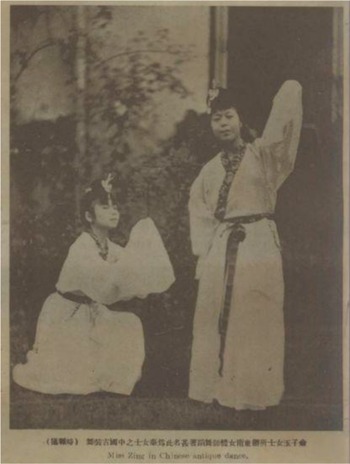
On April 24, 1927, the Eastern Times Photo Supplement featured two female students from the Southeast Girls’ School of Sports. The girls were students of Yu Ziyu (餘子玉), the woman who founded the school’s dance department and later became the dean of the school. In this dance photograph, the two female students are wearing the Manchu female hairstyle qitou zuozi (旗頭座子) and Han dynasty clothes called Hanfu (漢服) (see Figure 2). The qitou zuozi refers to a traditional hairstyle worn by adult Manchu women of the Qing Dynasty; this is the hairstyle Empress Wanrong wore at her wedding to Puyi in 1922 after the Qing Dynasty had nominally ceased to exist in 1912.
Two students from the Southeast Girls’ School performing in Yu Ziyu’s (餘子玉) dance program, wearing the Manchu qitou zuozi hairstyle and Han-style clothing. Published in The Eastern Times Photo Supplement (圖畫時報), issue no. 353, 1927.
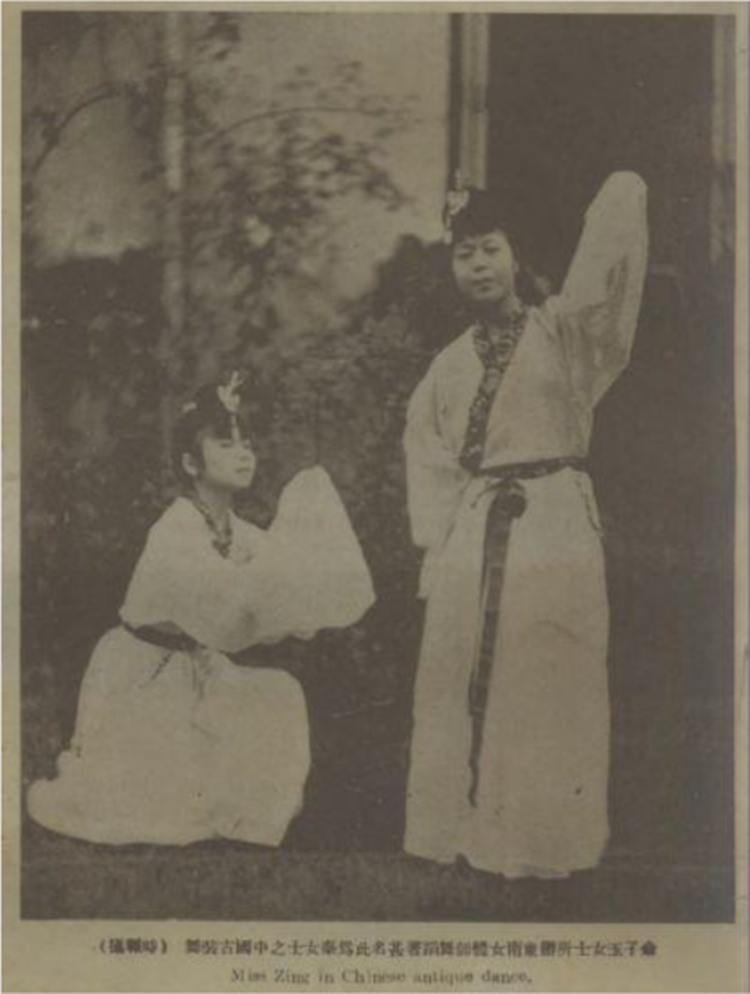
In contrast to Chinese women who adopted bobbed or permed hairstyles in 1920s China, the process of making the qitou zuozi took on a ritualistic significance. The process of braiding, pinning, and ornamentation became an act of collective mourning, mourning the loss of vanishing traditions while simultaneously invoking a nostalgic connection to China’s imperial past. The qitou zuozi, worn by women in the Qing dynasty, symbolized a historical era that had now passed, here, the qitou zuozi was more than a hairstyle it carried with it a deep sense of continuity and preservation. These stylistic choices as bodily testimony and nationalist statement provided Chinese with the opportunity to rehearse cultural identity and national spirit in the performance world. In this act of dressing, women dancers reclaimed their identity but also as national testimony in 1920s Shanghai, where the foreign population had risen to 23,307 (Bergère Reference Bergère, Fairbank and Feuerwerker1983). Through the dressing performance, the women embodied the tension between preserving the past and adapting to a rapidly changing present; in so doing, their attire and movements carried a powerful message beyond the dance performance per se.
A close reading of the photograph provides insight into the cultural, political, and gendered dynamics of the time. While the costumes are indeed significant, they also offer crucial clues about the movement and meaning embedded in their performances. For example, the photograph freezes the dancers in symmetry poses. The woman on the left appears to be in a crouching position, her hands gently clasped in front of her. Her gaze is directed toward the hand of her partner, whose arm is extended forward, indicating a clear connection and mutual engagement in the performance. Even though they are posed in a traditional Chinese dance movement, the loose clothing and flowing design symbolized the new freedoms and possibilities for Chinese women that emerged during the early Republican Era. Their body movements slightly changed due to the fabric texture and weight of their costumes. The loose, flowing material produces a deeper meaning of how female dancers adapted their habitual movements. It suggests that, while stepping into new freedoms, they still had to navigate the complexities of tradition and modernity. Each movement became a negotiation between old societal expectations and new forms of self-expression. The grace and control needed to manage the flowing fabric also represent the women’s ability to assert their agency and adapt to the changing cultural and political landscape. Their bodies, influenced by these social changes, are not only costumes but carry a symbolic message of transformation, empowerment, and the trend of a redefined role for Chinese women in a rapidly modernizing society.
The photograph is more than a visual record, it captures a moment of embodied transformation, where the female body reflects both tradition and China’s evolving cultural landscape in the early twentieth century. Through dance, these images reveal how women transcended boundaries, expressing femininity, identity, and modernization in their body movements. They serve as both a reflection of and a response to the societal changes of early Republican China.
Performing Collectivity: New Women Dancing on the Sports Field of Republic China
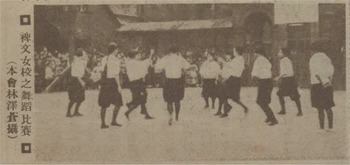
On July 26, 1928, Bridgman Memorial School for Girls (裨文女中) organized a Sports Day on the school’s playground. The female students, dressed in knee-length black pants, long socks, and short-sleeved white button-down shirts, performed a group dance in front of the entire school (Figure 3). The dance competition took place in a large, open space, with students and teachers sitting side by side, creating a natural stage with the surrounding buildings as the backdrop. From a dance perspective, this photograph captures a moment of collective expression and coordination, where the dancers are moving in unison. Their bodies suggest both energy and discipline, embodying the values of teamwork and physicality that were promoted in the early Republican Era as part of the modernization of women’s roles in society. Apart from the dance and group gymnastic performances, female students also participated in various sports activities and achieved significant success in both the long jump and high jump competitions.
Students of the Bridgman Memorial School for Girls performing in a Sports Day dance competition (裨文女校之舞蹈比賽). Photograph by Lin Zecang (林澤蒼). Published in Pictorial Weekly (中國攝影學會畫報) 3, issue no.137 (1928): 2.
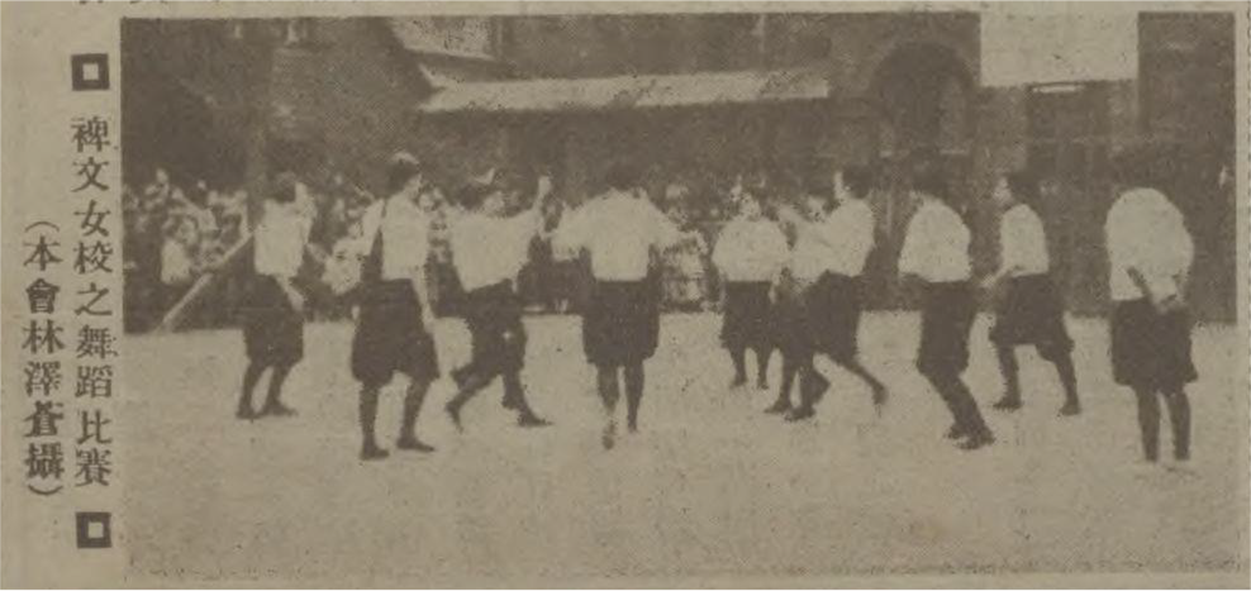
The uniforms, bobbed hair and contemporary footwork add vibrant layers to this black-and-white photo from 1928, in which the female dancers’ embodiment of modernity is clearly visible. Through their dance, these women dancers are not only performing but also embodying the social and cultural changes happening around them. The modernity of their movements contrasts with the ancient dance performances that were mentioned earlier (Figures 1 and 2), dance, in this context, an interlayer space between tradition and innovation, a tool for question and reflection, as these dancers take to the stage to represent a new vision of femininity, one that is active, visible, and assertive. In this photo, the female body is not simply an object of the gaze but a site of agency, capable of shaping and participating in the ongoing historical narrative of the time. Their body movements speak to a collective transformation, both personal and societal, as they navigate the shifting landscapes of gender, culture, and modernity in early twentieth-century China.
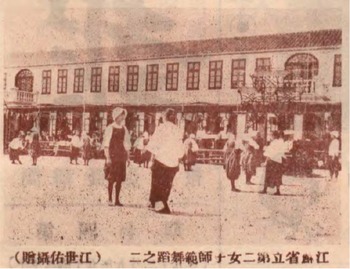
In 1926, a comparable scene unfolded at Jiangsu Second Girls’ Normal School, located near Shanghai (Figure 4). Here, female students dressed in school uniforms performed a duet-style dance in the school’s outdoor space. The choreography, marked by paired costumes and synchronized movements, underscored the unity and collaborative nature of the performance. In the duet, one female dancer wore a white hat and black dress, while her partner donned a white T-shirt and long black skirt, visually reinforcing the concept of partnership and balance through the symmetry of their attire.
Female students dancing on Sports Day at the Jiangsu Second Girls’ Normal School. Photograph by Jiang Shiyou (江世佑). Published in Pictorial Weekly (中國攝影學會畫報), issue no. 40 (1926): 1.
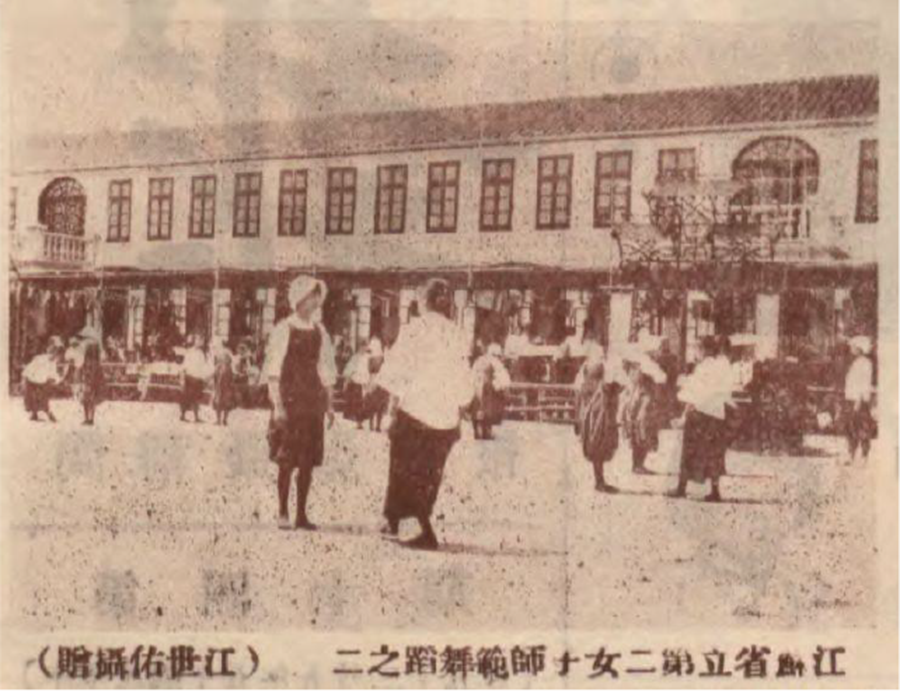
This scene, like the one in 1928 (Figure 3), is emblematic of the cultural and social shifts of the early Republican Era. The female bodies in motion, within the backdrop of the outdoor school space, capture a moment of transition in Chinese society, one in which Chinese girls were being educated and prepared for roles that would go beyond the domestic sphere. Dance, in this context, becomes a medium through which young women were both expressing and internalizing the values of modernity, partnership, and mutual cooperation.
These dance scenes captured in photographs from Chinese girls’ schools in 1926 and 1928 reveal critical insights into the sociocultural redefinition of women’s roles during a transformative period in modern China. These images illuminate how young Chinese women actively negotiated their place within a rapidly changing society, employing dance not merely as a performative act but as a dynamic medium of bodily agency. Far from being passive subjects of historical shifts, they utilized movement to embody and experiment with emerging identities: rehearsing modernity, challenging traditional gender norms, and reimagining their social and political visibility through choreographed expression. In doing so, dance became both a metaphor and a mechanism for their participation in the broader project of national and cultural reinvention. While embracing new influences, the disciplined and precise movements evident in the choreography, reflect a strong grounding in academic principles, influenced by newly imported Western pedagogies, and educational system and curriculum settings from Japan, the United States and European countries (Sun Reference Sun, Fairbank and Feuerwerker1986). The dancers’ unified outfits and synchronized movements further underscore a sense of individualism, suggesting that these performances were not simply about collective expression but also about embodying a shared vision of a modernizing China. From a choreographic perspective, the individual body becomes a microcosm of this larger transformation, demonstrating through carefully orchestrated actions, mannerisms, and expressions a conscious embrace of new citizen images within the structured environment of educational institutions. It is possible to imagine how Chinese females exercised these new ideologies, reforms, and social changes in this uncertain historical time and situation. Here, dance recreated the time and space in which Chinese females were able to search for and rebuild their nationality, sense of belonging, and spirituality by receiving shared experiences from one another. By moving together as a social group, Chinese females’ agency and public visibility were increased in choreographed dances, and, in so doing, they forged bonds of solidarity, gender support, and a sense of unity amidst societal change. Their moving bodies, as unique social phenomena, participated in the shifting social norms and traditions of 1920s China and actively contributed to the New China transformation project.
Echoing historians Wilbur and Sun’s words, a sense of optimism and hope pervaded late 1928 China; the new leadership inspired confidence that China was entering a brighter era. This newfound hope provided a space for the emergence of female dancing bodies in various Chinese schools: For example, in 1929, the students at both the Tianjin Nankai Middle School (Wang Reference Wang1929), and the Shanghai Qingxin Girls’ Middle School (Lin Reference Lin1929), and in 1931, the students at the Fujian Provincial School (Zheng Reference Zheng1931) wore white tops and black skirts on the school’s Sports Day. Although the combination of white and black in their costumes blurred the distinctiveness of female attire, it effectively challenged traditional gender binaries by creating neutral or ambiguous representations. This attire transcended the rigid male-female categorizations that had defined old Chinese society. The ambiguity within the costumes granted Chinese female bodies the autonomy to move forward, embracing new opportunities for education and personal freedom within the evolving urban landscape of New China. In their collective movements, these female dancers not only embodied the spirit of transformation but also contributed to the creation of new urban phenomena at the intersection of gender equality, empowerment, and societal change. Their bodies in motion served as powerful symbols of the shifting roles of women during this transformative period, where education and the pursuit of freedom were increasingly within their reach. It is important to note that many rural and non-coastal regions still adhered to the traditional education system, lacking the resources and opportunities for such dance performances. However, the female dancers in their school uniforms, moving with purpose in these major urban centers, demonstrated a new vision of Chinese womanhood that was adaptable, emancipated, and in the process of transformation. Their presence and performance offered a compelling example of the evolving role of women in China’s modernization, signaling the debut of a reimagined female identity in China’s urban landscapes.
Negotiating Modernity: Female Bodies and Bodily Identity in the Mid-1930s
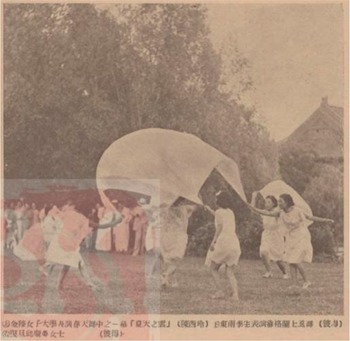
The 1934 dance party at Jinling College, an institution founded by five major American Christian missionary societies, serves as a compelling example of the transnational transfer of cultural and educational practices. In the piece titled “Summer Cloud” (夏天之雲), seven female students dressed in white dresses and shoes danced on the grass, manipulating an oversized piece of white silk as a parachute, their hands holding the edges. As they tossed the silk into the air, it formed a dynamic, mushroom-like shape, with one student dancing beneath it while the others moved around the outside (Figure 5). This image captured in a photograph, bears a striking resemblance to photographs of Isadora Duncan and her dancers performing with large silks, suggesting that Duncan’s aesthetic influence extended beyond her specific choreography and into the broader visual language of dance being adopted in China. The billowing parachute, like Duncan’s light silks, likely served to liberate the dancers’ bodies, creating a natural interplay between the bodies and the fabric, a visualization of the connection between motion and movement, as Ann Daly states in her book Done into Dance: Isadora Duncan in America, Duncan reimagined dance not merely as entertainment but as a vehicle for social betterment, drawing from traditions such as physical culture and social dance, which treated bodily movement as a moral and expressive force capable of transforming both the self and society.
Students performing “Summer Cloud” (夏天之雲) at Jinling College, Nanjing, 1934. Photograph by Chen Xiling (陳西玲). Published in The Eastern Times Photo Supplement (圖畫時報), issue no. 1006.
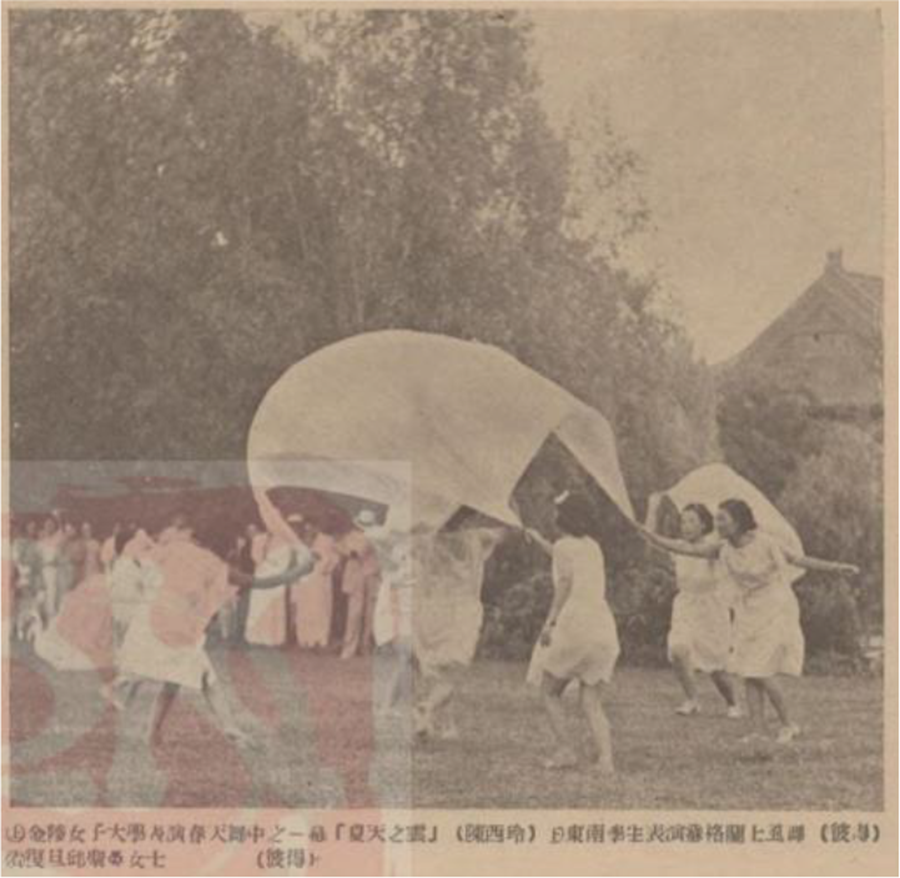
Figure 5. Long description
In the foreground, seven students in light-colored dresses hold and wave large, translucent fabric pieces, creating the effect of billowing clouds. Their arms are extended upward and outward, and their bodies are positioned in a dynamic, circular arrangement, suggesting synchronized movement. Behind them, a group of spectators stands in a loose line, observing the performance. The audience is partially obscured by the performers and fabric. The background is densely filled with tall trees, and in the upper right corner, a gabled roof of a traditional building is visible, anchoring the scene in an outdoor campus setting. The overall composition emphasizes the interaction between the performers, the props, and the natural environment.
The 1934 dance event at Jinling College, though framed within American cultural pedagogy, can be reinterpreted as a radical dress rehearsal for revolution, a precursor to the physical and ideological resistance Chinese women would wage during the Second Sino-Japanese War (1937–1945). Through performances like the “Summer Cloud” Dance, women dancers transformed the dance space into a battleground of agency, rehearsing the courage and solidarity, and striving to resist the invaders, protect the dignity, and ensure the safety of their families. Female bodies, serving as distinctive social phenomena, played a significant role in shaping the Chinese landscape during that period. These women dancers did not just perform, but prophesied. In their movements, we see the embryonic defiance that would explode into full-throated resistance during the war. By asserting their bodies as sites of strength, discipline, and collective power, these women proved that resistance was not confined to the battlefield; it could be woven into the very fabric of daily life. Their dance was a declaration: Chinese women would not merely endure history, they would choreograph it.
In addition to Summer Cloud, the dance program also listed six dance genres that reflected distinct facets of American dance pedagogy and cultural sensibilities. These included a Polish Dance, a Peter Pan Story Dance, a Water Wave Dance, a Spring Dance, a Children’s Dance, and a Clog Dance (Xinmin bao 新民報, Reference Xinmin1934). The inclusion at Jinling College of genres like the Polish Dance and Clog Dance, both popular forms in American dance education at the time, signals a direct replication of US curricular content.
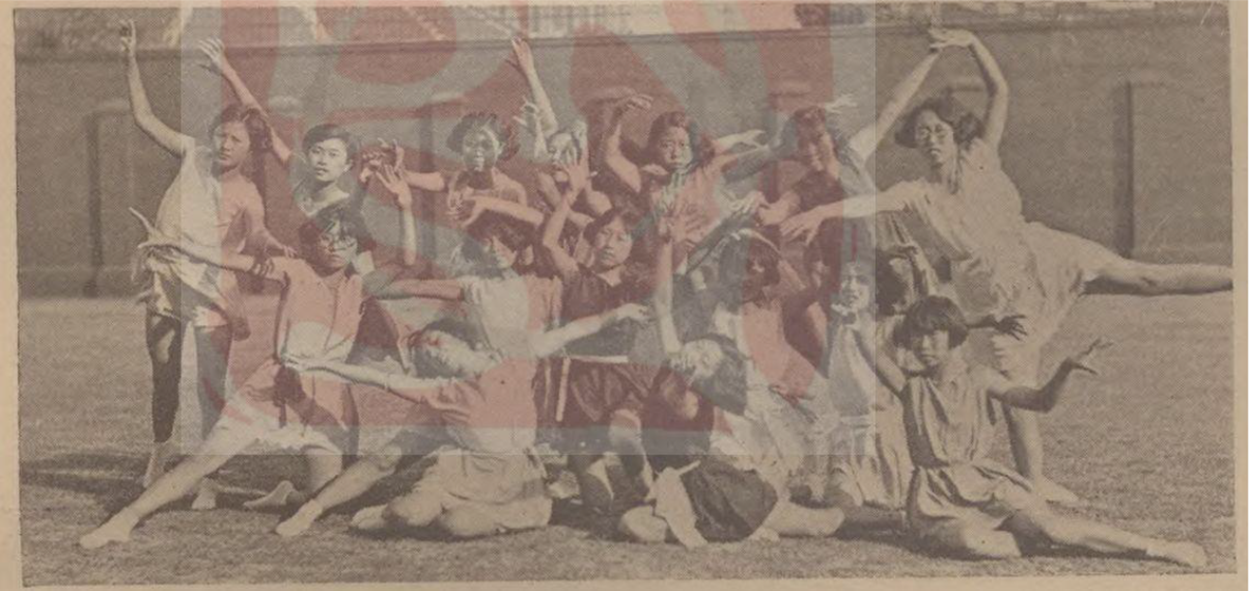
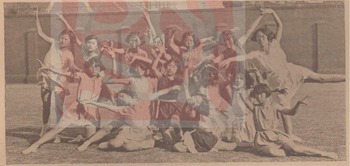
In the same year of 1934, another striking example of American-influenced bodily expression emerged when fifteen female students at China Women’s Sports Normal School gathered on the grass and replicated the liberated movement style of modern dance pioneer Isadora Duncan (Figure 6). Female students with open upper bodies and arms extended outward seemed to embed themselves in the sunshine and green space. While the movements seen in the photograph appear somewhat messy, the Grecian-inspired tunics worn by the students are reminiscent of the costumes designed by another influential figure, Margaret H’Doubler, considered a “founder of American college dance.” As Janice Ross explains in Moving Lessons, H’Doubler, like Duncan, advocated for a “natural” approach to movement and emphasized the importance of kinesthetic awareness and creativity in dance education (Ross Reference Ross2000). It is possible that these Chinese students were exposed to both Duncan’s and H’Doubler’s ideas, either directly or indirectly, as H’Doubler’s work, influenced by the “Wisconsin Idea” of university service to the state, helped to establish dance as a legitimate subject within higher education, a pedagogical shift paralleling John Dewey’s progressive educational reforms in China (Keenan Reference Keenan1977). Dewey’s emphasis on experiential learning and fostering individual growth, creativity, and independent thinking, as outlined in the book The Dewey Experiment in China (Keenan Reference Keenan1977), resonated with Chinese educators seeking to modernize curricula and integrate physical education, potentially creating fertile ground for H’Doubler’s dance-as-education philosophy.
Dance performance at the China Women’s Sports Normal School (中國女體師) in 1934. Published in The Eastern Times Photo Supplement (圖畫時報), issue no. 1005, p. 1.
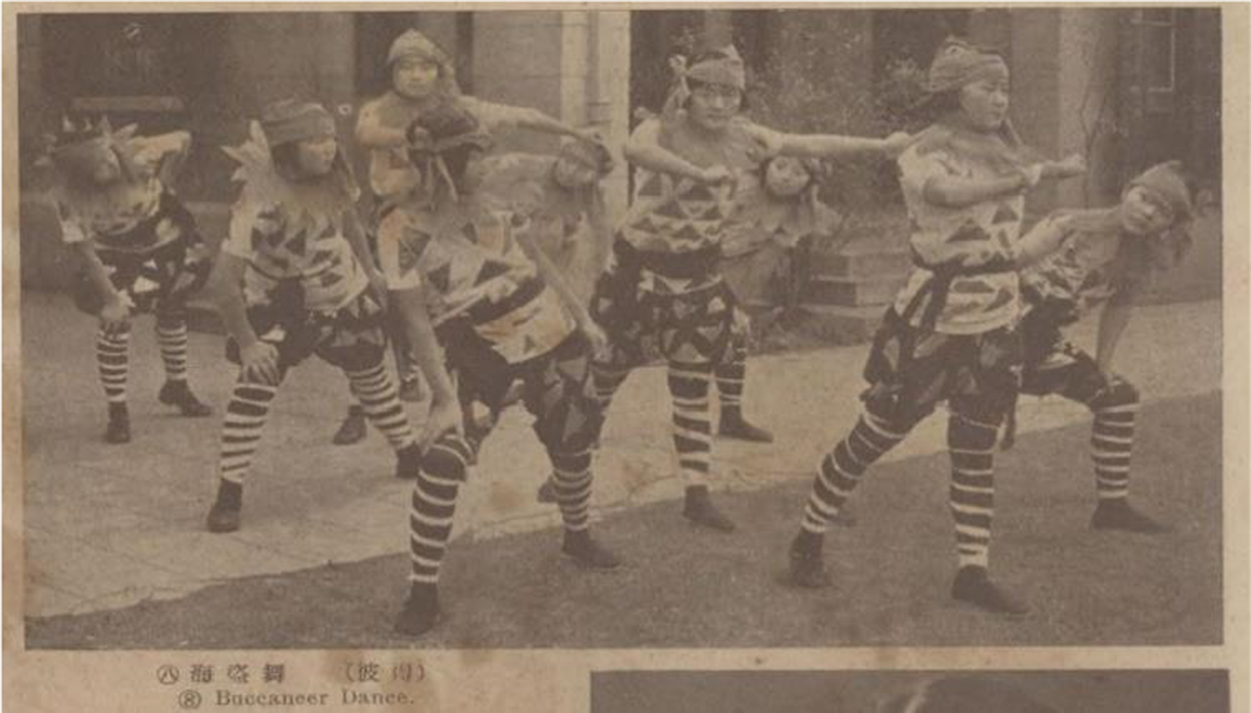
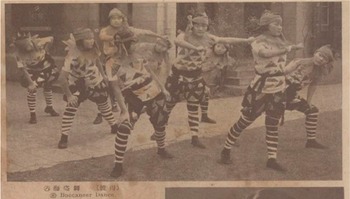
Students performing the “Pirate Dance” at the China Women’s Sports Normal School. Photograph by Peter (彼得). Published in The Eastern Times Photo Supplement (圖畫時報), issue no. 883 (1932): 1.
Although this kind of fusion in 1930s China is not impossible to see, what is at stake here is the women dancers’ performances in these dances were not merely about movement, it embodied a modernization in thought, allowing them to rethink and practice New Woman roles in a modern society. In this case, female dancers embodied the very process of China’s modernization, from costumes to movements, from individual to group, these women did not merely perform modernity, they enacted it physically, their bodies becoming living texts upon which the tensions of a transforming nation were negotiated. By moving in context-specific dance forms, they translated imported American ideals into collective expressions of Chinese identity, their dances mirrored China’s broader struggle to balance Western-inspired progress with cultural sovereignty. The Grecian-inspired tunics they wore, though inspired by Duncan’s neoclassical idealism, became symbols of a localized modernity, a visual fusion of foreign aesthetics and Chinese aspirations. Here, their bodies were not just as daughters or wives but as artists, citizens, and humans.
However, the impact of Isadora Duncan’s work on Chinese dancers in the 1930s, while significant, must be examined through a critical lens that acknowledges the racialized undertones of her aesthetic. While Duncan’s emphasis on natural movement and female empowerment resonated with many Chinese intellectuals and reformers, her concept of “natural” was, as Ann Daly argues, often implicitly linked to a Eurocentric ideal of beauty, drawing heavily on imagery from ancient Greece and performed primarily by white dancers (Daly Reference Daly2002). This “presumption of naturalness,” to borrow dance historian Gay Morris’s term (Morris Reference Morris2006), raises questions about the racial dynamics at play when Duncan’s style was embraced outside the Western context. Duncan’s influence was notably amplified by the 1926 tour of China by students from her Moscow school, led by Irma Duncan. Extensively covered in the Chinese media and discussed by prominent figures such as dramatist Tian Han (田漢), novelist Yu Dafu (郁達夫), and the Prussian philosopher Alfred Westharp (Ma Reference Ma2023), the tour undoubtedly exposed Chinese audiences to Duncan’s philosophy. It is plausible, given this prominent exposure, that Duncan’s work, with its emphasis on natural movement and female empowerment, significantly impacted Chinese elite and intellectual circles.
This influence likely encouraged Chinese women to “practice” these dance movements, potentially blurring the lines between performance and lived experience. However, the adoption of Duncan’s “natural” movement by Chinese dancers presents a complex case study in cross-cultural exchange, demanding that we consider how these dancers navigated the racialized connotations embedded within Duncan’s aesthetic. While they may have embraced the liberating potential of her style, they were also engaging with a form of movement developed within a specific Western context and often performed by white bodies. The extent of their awareness or concern regarding these racial undertones remains open to interpretation. Yet, their adaptations of Duncan’s movements, such as the incorporation of the traditional Chinese dance vocabulary or a shift in emphasis from individual expression to collective harmony in performances like “Summer Cloud”(Figure 5), suggest a conscious or unconscious negotiation with the inherent biases of the imported style. The Chinese dancers, through their embodied practice, were subtly reinterpreting “natural” movement, potentially challenging its Eurocentric underpinnings while simultaneously creating a new, China-inspired form of dance. These performances, therefore, become crucial sites for understanding the complex intersection of race, gender, and cultural identity in the transnational flow of dance, prompting us to question the extent to which Duncan’s “New Woman” movements choreographed Chinese mobility in the spaces of private bodies and sensations. How did Chinese bodies interpret and mobilize Duncan’s non-verbal movements in 1930s China? What constituted “Chineseness” as performed through these hybrid dance movements, a fusion of Western influences and Chinese sensibilities? These questions highlight the complex interplay between cross-cultural exchange, bodily practice, and the evolving performance of identity in early twentieth-century China.
Isadora Duncan’s influence on Chinese dance in the 1930s was significant but was mediated through cultural negotiation. Her emphasis on “natural” movement and female empowerment resonated with Chinese reformers advocating for women’s liberation during the May Fourth and New Culture Movements. However, Duncan’s Eurocentric ideals of beauty and individualism rooted in ancient Greek aesthetics were reinterpreted to align with China’s collectivist ethos and nationalist imperatives. This dialectical process underscores what historians John K. Fairbank and Merle Goldman describe as China’s “selective adaptation” of foreign ideas, a practice rooted in reconciling imported frameworks with indigenous socio-political priorities (Fairbank and Goldman Reference Fairbank and Goldman2006). For example, performances like Summer Cloud (1934) at Jinling College reframed Duncan’s individualistic improvisation into synchronized group choreography. This shift from solo to collective expression transformed her philosophy into a vehicle for communal harmony, a distinctly Chinese reinterpretation that prioritized social cohesion over Western-style individualism.
As Fairbank and Goldman point out, Chinese intellectuals, when confronted with Western liberalism, did not simply imitate or reject it. Instead, they selectively adapted these ideas, attempting to reconcile them with China’s unique history of authoritarian collectivism and its own distinct social and political context. This process underscored the enduring tension between adopting foreign models and forging a uniquely Chinese path to modernization. (Fairbank and Goldman Reference Fairbank and Goldman2006).
This syncretism mirrored broader debates over China’s modernization trajectory. At the 1933 National Games in Nanjing, Nationalist official Chen Guofu argued that Western sports, though symbolically modern, required adaptation to suit China’s “national conditions” (guoqing 國情) (You Reference Yu2025). Similarly, Duncan’s dance forms were not merely imitated but hybridized, becoming tool for Chinese women to claim agency in public spaces while navigating the tension between Western modernity and Chinese tradition, illustrating Charlotte Furth’s and John K. Fairbank’s ideas that foreign borrowings (wai外) had to align with domestic cultural logic (nei内) to be legible within China’s sociopolitical landscape (Furth Reference Furth and Fairbank1983; Fairbank Reference Fairbank and Fairbank1983).
Duncan’s dance, stripped of its Eurocentric individualism, became a medium through which Chinese women could embody modernity without fully surrendering to Western cultural hegemony. The synchronized precision of group choreography, where Chinese dancers filtered Duncan’s movements through their own cultural lenses, embodied experiences, and the socio-political exigencies of the time. The potential incorporation of Confucian values of collective discipline and specific lower body movements or patterns further suggests a conscious “Sinicization” of Duncan’s aesthetic.
In conclusion, Duncan’s influence in 1930s China exemplifies the complex interplay between global cultural flows and local reinterpretation. Women dancers did not merely replicate her aesthetic; they instrumentalized it to forge a hybrid modernity that balanced feminist liberation with nationalist cohesion. As with Chen Guofu’s critique of Western sports, the adaptation of Duncan’s dance philosophy underscores a broader historical pattern, namely, embracing global modernity while asserting cultural distinctiveness. Women dancers’ performances were not merely artistic experiments; they embodied China’s struggle to navigate its place in a rapidly globalizing world. By blending Isadora Duncan’s Western ideals of bodily freedom with Chinese traditions of collective discipline, the dancers mirrored the nation’s broader ambition to selectively engage with modernization trends. Their dance movements became a metaphor for China’s paradoxical modernization and captured the essence of Republican China’s fraught yet determined path toward self-reinvention.
Another striking illustration of foreign dance practiced on female bodies in 1932 is captured in the photo of a China Women’s Sports Normal School festival, where students performed a “Pirate Dance” in an outdoor space (中國女體師舞蹈大會紀, 1932). Clad in red pirate-style headbands and dynamic costumes (Figure 7), the women dancers embody a striking visual and physical challenge to traditional gender norms. Their adoption of masculine coded movements such as strong and expansive gestures,powerful strides, and assertive stances, signals more than a mere stylistic choice; it represents a deliberate act of bodily reclamation and resistance. At a time when women’s roles were in flux, these dancers used their body-minds as a site of transformation, blending masculine aesthetics with feminine agency to challenge the gendered boundaries that had long constrained women’s movement.
In addition to the nine female dancers, a foreign male photographer, Peter (last name omitted), participated in this photography session as both male audience and unseen dancer, subtly shaping the visual choreography through his compositional choices. His Western perspective and male gaze did not simply document the dancers but actively intervened in the construction of their bodily narratives. His use of angles, focus, and framing silently rechoreographed the dancers’ presence, positioning them within a mediated vision that both reinforced and complicated their agency. As Chinese women moved dynamically in front of the camera’s lens, their physical expressions simultaneously resisted and engaged with this external perspective, negotiating between self-representation and the imposed visual grammar of a foreign observer. In doing so, their performances became layered enactments of bodily autonomy, shifting between their own choreographic intent and the silent, unseen influence of the photographer’s editorial choices. This interplay between female movement and male mediation underscores the complex tensions of representation, modernity, and gender in early twentieth-century China.
The inclusion of foreign photographers’ work and non-Chinese names in The Eastern Times Photo Supplement (圖畫時報) during China’s Republican era (1912–1949) was not merely a stylistic choice but a strategic visual rhetoric embedded in the nation’s modernization project. By publishing the dance photography credited to foreign photographers like “Peter” (彼得), the newspaper enacted a dual narrative: It signaled China’s cosmopolitan openness to global influences while simultaneously staging female bodies as the framework that enabled Chinese audiences to become familiar with this new project.
The photograph captures more than a mere performance; it serves as a historical document that reflects the way Chinese women dancers navigated the shifting ideological and social terrain of early twentieth-century China. Through their costuming, movement, and engagement with the camera, the Chinese women dancers in this photograph illustrate a complex negotiation of identity. At the same time, the presence of the foreign male photographer introduces another layer of complexity. In this way, the photograph becomes an embodiment of women’s mobility, not just in dance, but in society at large. Their engagement with dance, an art form that requires public visibility, physical expression, and often cross-cultural exchange, placed them at the forefront of debates about women’s autonomy, nationalism, and modernity. Ultimately, the image captures a fleeting yet profound moment in which Chinese women dancers navigated the challenges of their time through movement. They blurred the boundaries between masculine and feminine, between tradition and revolution, and between being looked at and looking back, thereby turning the act of performance into an assertion of selfhood, agency, and modern identity.
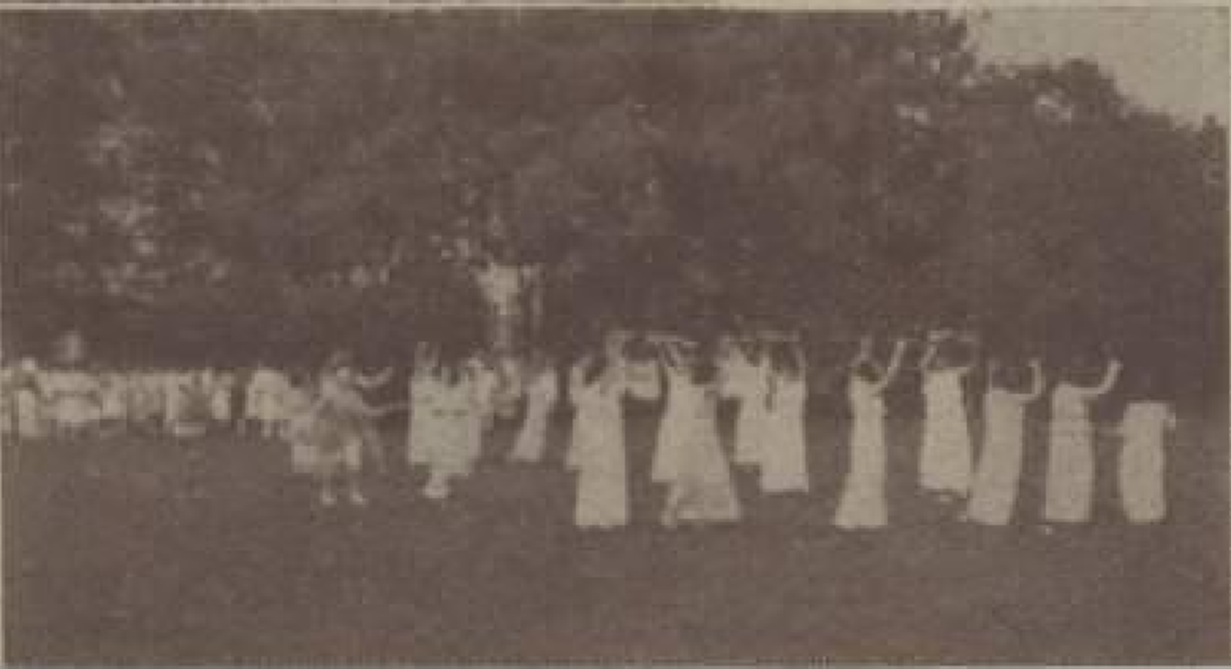
Shanghai, a city that became an even more internationalized avant-garde in the late 1920s and early 1930s, as historian scholar Meng Yue states, after 1927, “seemed to have naturally carried on the unruly pursuits for the new and the innovative” (Meng Reference Meng2006, 228). In this cosmopolitan city, there was a prestigious school, The McTyeire School for Girls (中西女中), established in 1892 by American Methodist missionary Andrew Young John William Allen (林樂知), which played a key role in shaping the “New Woman” in early twentieth-century China (Figure 8).
Dance performance at The McTyeire School for Girls (中西女塾) in 1930. Photograph by Juan (娟). Published in Pictorial Weekly (中國攝影學會畫報) 5, issue no.243:1.
First, the Gothic Revival architecture of the McTyeire School for Girls functioned as a spatial manifesto; each structure was an active agent layering modernity into female bodies and blending Western forms with localized symbolism to create a hybrid modernity that students could inhabit, perform, and internalize. The style’s verticality, ornate hybridity, and dramatic performativity transformed physical structures into ideological scaffolds that were not passive scenery but rather a pedagogy of the body. In other words, its verticality trained bodies to aspire, its hybrid ornamentation rooted progress in cultural continuity, and its dramatic spaces staged modernity as a performative act. Chinese women did not merely learn about modernity, they inhabited it, their movements and voices sculpted by arches, courtyards, and vaults. As Meng Yue argues, Shanghai’s “unruly pursuit of the new” materialized here, on a campus where Gothic spires and Chinese landscape conspired to mold female bodies that would move away from the old tradition and rechoreograph China’s future. Overall, in 1930s Shanghai, the McTyeire School’s campus became a mobile site where concrete architecture and intangible female bodies catalyzed a dramatic performance, rendering modernity not an abstract ideal but rather a visceral, daily practice. Each building, including the Faculty House (North), the Browning Hall Science Building (Northeast), St. Mary’s Chapel (East), the Music Hall (Southeast), and the China Building (Alumnae Gymnasium) (South), acted as a distinct reagent in this alchemy, shaping how women students inhabited, negotiated, and ultimately redefined what it meant to be a “New Woman” in China.
Second, the McTyeire School’s anthem encapsulated its mission to mold young Chinese women as architects of China’s modernization, blending nationalist fervor, Enlightenment ideals, and a gendered vision of progress. The lyrics functioned as both a pedagogical manifesto and a cultural artifact, reflecting Chinese women’s role in shaping a hybrid modernity during the turbulent 1930s.
Lyrics like “bringing truth and freedom high” reflect Western Enlightenment ideals (“truth,” “freedom”) in China’s modernization, framing education as liberation and an educated woman as a catalyst for societal change; “Scatter knowledge far and near. Till all China learns the lessons” positions female students as agents of national salvation, tasked with disseminating modern (Western-inspired) education to revive China, a radical departure from Confucian gender roles. The song crystallizes the tensions of 1930s China: a yearning for Western-style progress coupled with a desire to retain cultural identity. By casting female students as vessels of this duality, educated in “truth” yet rooted in the “heart of old Shanghai”, McTyeire’s anthem captures the era’s hopeful yet fraught negotiation with modernity. It is not merely a school song but a sonic monument to the “New Woman,” whose body and mind were battlegrounds for China’s future.
The ideals embedded in McTyeire’s architecture and anthem came to life through the female students’ embodied experiences. Nowhere is this more vividly captured than in a 1930 photograph of the girls in motion, where modern womanhood was not only taught, but danced into being.
Back to the 1930 photograph of McTyeire’s female students in sleeveless white dresses, arms uplifted to the wind, moving freely as a group on the grass space. It embodies Isadora Duncan’s “natural movement” philosophy, rejecting rigid femininity for organic liberation. The women dancers’ flowing gestures, pure dresses, and peaceful choreography contrast with the outside society and even their daily life routine. Here, dance became a time when Chinese women fully took the initiative to create a utopia and universal freedom, reframing their bodies as agents of harmony and autonomy in 1930s China. The dance was also both a sanctuary and a provocation, proving that even in chaos, women could carve out spaces where freedom was not just imagined but embodied. Like McTyeire’s students and all the girls’ school students discussed in this paper, Chinese females, through their “natural movement,” prefigured the roles they would later assume as political leaders (宋慶齡 Soong Ching-ling and 宋美齡 Soong Mei-ling) and writers (張愛玲 Zhang Ailing), women who didn’t just survive China’s storms but danced and navigated through them, scripting a future where utopia was not a fantasy but an embodied practice.
In the turbulent folds of history, Chinese women’s bodies have never ceased to speak. Especially when social upheaval tears apart old orders, women’s bodies often become the first battlegrounds, their social roles as women, students, and citizens become performative in the process of “becoming.” For these Chinese women, dance, as a complex narrative of resilience, modernity, and transformation, blurs the social and gender lines, allowing women to reclaim discursive power and reshape their subjectivity. In the dance space, female bodies gained public recognition and frequently report under systemic patriarchy, where women’s performances and contributions were neither marginalized nor erased. This legacy is embodied by pioneer dancers like Chen Cuiying (陳脆英), Liang Lingqiu (梁淩秋), Lin Wen (林文), Wu Xiaobo (吳小波), Li Ounahua (李歐娜華), Zheng Mengxia (鄭孟霞), Ling Peifen (淩佩芬), Hu Rongrong (胡蓉蓉), Wang Yuan (王淵), and Zhao Xingyuan (趙涬元), as discussed earlier in this paper. Even though most of the dancing bodies discussed in this paper are unnamed, their anonymity itself speaks volumes. Through the depiction of their movement, each photograph finds its own meaning and identity in the history and history of civilization.
Through this lens, I challenge static, revolutionary nationalism and Western-centric frameworks of dance scholarship by demonstrating how Chinese women moved the shifting cultural and political landscape to create new forms of corporeal expression that both redefined and reactivated themselves. In so doing, this article juxtaposes dance and Chinese women as a dynamic force that navigates between temporality, space, and identity, offering a model for understanding how they engage with global discourses of modernity, nationalism, and feminism. How Chinese women dancers mobilized gender norms through dance education, positioning their embodied practice as an active force within the broader socio-historical transformations of Republican China.
By placing these historical figures within the broader framework of dancing bodies, this research reinterprets the concept of “Chineseness” not as a fixed, monolithic entity, but as a living, becoming, and producing, adaptable form in constant dialogue with historical change and global influence. The female dancing bodies discussed in this article enrich the current scholarship by offering a localized perspective that critiques the oversimplified reliance on the Cold War-Era ideological lenses found in Western scholarship on Chinese dance. In doing so, it shifts the focus from an external, often Orientalist gaze to an internal, genderly grounded understanding of how Chinese women dancers themselves have negotiated and redefined their social and political identities through “performance” later, played a significant role in Chinese-based scholarship in shaping a global conversation on Chinese dance studies and more.
Funding
This article was supported by the Teaching Reform Research Project (grant number J24A06).


 Open access

