
In 1961, President John F. Kennedy committed the United States to “landing a man on the moon and returning him safely to the earth.”Footnote 1 Fulfilling that pledge, the Apollo project landed six manned spacecraft on the lunar surface between 1969 and 1972. Yet in 1972 President Richard Nixon terminated the program, scaled back the National Aeronautics and Space Administration's (NASA) budget, and limited US manned space ambitions to near-Earth operations, where they have remained. Several centuries earlier, another powerful government's project of costly expeditions played out similarly. In 1405, the Yongle emperor of China's Ming Dynasty authorized several massive naval expeditions to the Indian Ocean. After a final voyage under the Xuande emperor in 1433, the expeditions ended forever.
For space-exploration advocates, China's decline after the Ming treasure fleets demonstrate what happens to great powers when they stop exploring.Footnote 2 For anti-isolationists in China and elsewhere, the end of the expeditions serves as a marker for the Ming Dynasty's inward turn, supposedly causing China's eventual “century of humiliation” at the hands of more adventuresome Western powers.Footnote 3 Critics contend that the real lesson of the Apollo and treasure-fleet voyages was that they were pointless: “The Chinese ceased voyaging to the coast of Africa for the same reason the United States stopped sending men to the moon—there was nothing there to justify the costs of such voyages.”Footnote 4 Yet this more sophisticated argument raises an even larger puzzle: why did either power “go there” in the first place?
In both cases, we argue, leaders embarked on costly endeavors to legitimate their claims to leadership—emperorship or American hegemony. We find little indication that the Ming expected the treasure fleets to yield military or economic awards. Similarly, Kennedy and his advisers saw the Apollo project as a colossal waste of resources if measured in direct economic or military terms. Yet evidence suggests that both leaders made this choice to secure dominance in arenas that they viewed as symbolically critical to leadership and security. For the Yongle emperor—a usurper in an insecure dynasty—that meant demonstrating that other rulers in the “known world” acknowledged their status as his tributaries. For Kennedy, this meant securing a successful “first” in the science-and-technology field to eclipse the Soviet “firsts” like Sputnik and Gagarin's orbit. Kennedy believed continuing failure in this arena threatened American hegemonic leadership. In both cases, when the apparent crises passed—in part because the projects achieved their goals—the projects ended.
We locate this argument within a broader social-constructionist understanding of hierarchy and hegemony. We cash out the wager that world politics is a sphere of complex social stratificationFootnote 5 by viewing constituent hierarchies in terms of social fields. The possession of field-relevant capital positions actors in various relations of super- and subordination within fields.Footnote 6 According to hegemonic-order theorists, military and economic capital plays a major role in establishing overall position in political systems—in part because of their greater fungibility, as possessing capital in those fields can also help actors secure privileged positions in other fields. Within that general framework, specific fields may—for socially and historically contingent reasons—not only emerge but also take on “outsized” significance in relations of political dominance. Relevant resources—tangible goods, tokens, or even performances—become, in Bourdieu's term, symbolic capital.Footnote 7 The Ming court and the Kennedy administration spent significant economic resources on, respectively, the treasure fleets and the Apollo program precisely to acquire what they saw as symbolic capital critical for maintaining political dominance.
This framework integrates relevant theoretical perspectives and strands of research. Hegemonic-order theories posit that dominant actors craft political order and, in doing so, allocate status and prestige.Footnote 8 These theories imply that dominant actors will seek to legitimate their position, but they face trouble in accounting for, first, when they make exceptionally costly investments in acquiring symbolic capital and, second, the particular kinds of goods and performances that dominant actors pursue.Footnote 9 The cases here—in which dominant actors saw economically and militarily unproductive investments as appropriate responses to critical security threats—prove particularly challenging.
Theories of status competition and conspicuous consumption do expect actors to demonstrate social dominance by purchasing prestige goods or engaging in expensive performances. Still, they often struggle to explain variation—not only among the choice of prestige goods and performances, but also in terms of the relative value of those goods and performances with respect to other forms of capital. Social-constructionist approaches, which stress historically and socially contingent dynamics, help explain this variation.Footnote 10 Turning to field theory synthesizes these insights—and integrates them into more general accounts of hierarchy in world politics. In particular, a focus on social fields provides a way of theorizing how processes of social construction create strategic contexts through which actors pursue power politics.
Hegemony, Hierarchy, and Social Fields
Recent years have seen the rise—or, more accurately, the reinvigoration—of hierarchy-centric scholarship. As Bially Mattern and Zarakol argue, participants hold that “hierarchies are ubiquitous features” of international relations that “generate social, moral, and behavioral dynamics that are different than those created by other arrangements.”Footnote 11 A focus on hierarchy, they claim, resolves enduring puzzles or overturns existing conventional wisdom. Many attempt to rope together a range of older work and situate it in conversation with emerging research.Footnote 12 For example, Lake suggests that aspects of American foreign relations become less puzzling when viewed as taking place within a zone of interstate hierarchy.Footnote 13 McDonald argues that the democratic peace is as an artifact of a great-power hierarchy that simultaneously reduces military conflict and produces similar regime types.Footnote 14
What is hierarchy? Social and political systems are hierarchical to the extent that they are stratified along a series of asymmetric rankings or positions. That is, hierarchy refers to any pattern of super- and subordination. Status hierarchies are stratified by rankings of honor and prestige, class hierarchies by economic roles, and so forth. These stratifications matter to the extent that they translate into relations and practices of social dominance. Much of international-relations scholarship—from work on global governance to theories of great-power politics—examines the causes and consequences of various forms of super- and subordination.
Major research agendas—including hegemonic-stability and power-transition theory, world systems theory, dependency theory, and the study of empires—take some kind of international hierarchy as a basic fact of world politics. But, by the 1990s, the focus of theoretical debates in the field generally shifted to the nature and consequences of international anarchy.Footnote 15 This change owed much to the emergence of structural realism as a focal point for theoretical debates. For structural realists, anarchy represents not only the central fact of world politics but also justifies the study of international relations as a distinctive area of inquiry. In Waltz's formulation, “parts of domestic political systems stand in relations of super- and subordination. Some are entitled to command; others are required to obey. Domestic systems are centralized and hierarchic.” In contrast, “the parts of international-political systems stand in relations of coordination. Formally, each is the equal of all the others. None is entitled to command; none is required to obey. International relations are decentralized and anarchic.”Footnote 16
Much hierarchy-centric scholarship makes a critical point: once we shift from assuming anarchy to focusing on patterns of super- and subordination, we need to attenuate—if not abandon—the assumption that relations among states are fundamentally distinctive from relations within them. For example, the absence of a clean distinction between “international anarchy” and “domestic hierarchy” undermines warrants for dismissing the importance of legitimacy and authority in international politics. Theories developed to handle relations among actors in other contexts can be applied to international settings.Footnote 17 Mechanisms and processes that hold within polities may also operate among and across them.Footnote 18 We compare the Apollo program—where interstate concerns involving hegemonic influence and a revisionist power played a key role—to the Ming treasure fleets—where concern involving legitimacy within imperial structures predominated—in part to highlight this implication of hierarchy-centric theory.
Hegemony and Hierarchy
Focusing on the hierarchical dimensions of world politics generates its own problems. As Donnelly argues, “hierarchy provides almost as poor an account of the structure of international (and national) systems as anarchy. It simply states that the pattern of stratification is not flat.” We need an approach that tells us “how a system is stratified—or anything else about the (many and varied) ways in which international systems are structured.”Footnote 19
Hegemonic-order theories offer one solution. They also illustrate the varied character of hierarchy in world politics. Hegemonic-order theory describes a broad class of international hierarchies: those involving a pre-eminent power that manages the relations of subordinate actors. For power-transition theorists, “relations within … [the] power hierarchy are not anarchical despite the absence of formal rules and enforced international law.” Footnote 20 Gilpin maintains that world politics are anarchical and hence distinctive from domestic systems, but that “it is possible to identify similarities in the control mechanisms of domestic systems and international systems.”Footnote 21
Hegemony describes “the mobilization of leadership” to order relations among other actors.Footnote 22 Such understandings of hegemonyFootnote 23 involve a polity using its superior economic and military capabilities—its position atop interstate hierarchies in these domains—to create an international order “manifest in the settled rules and arrangements between states that define and guide their interactions.”Footnote 24 These can involve rules and norms of conduct, the topography of formal international institutions, the (related) allocation of status and prestige, and even who “counts” as an international actor.Footnote 25
These elements of international order highlight additional patterns of hierarchy, such as those created when actors vary in their compliance with norms of conduct,Footnote 26 garner differential status through the extent that they demonstrate their military prowess,Footnote 27 or enjoy positions of super- and subordination in international forums.Footnote 28As we noted, any form of differentiation—from national performance on educational standards to the possession of culturally significant landmarks—can become, or contribute to, politically relevant hierarchies. Hegemonic ordering operates, in no small measure, by influencing both how much these forms of differentiation matter and by shaping the distribution of relevant assets, relations, and practices.
Hegemons are not necessary for international order. International order can be created and upheld by great-power cartels or generalized consent among states—or as emergent properties of the interaction of polities.Footnote 29 Even in hegemonic systems, international order enjoys relative autonomy from the leading power. Thus, hegemony describes a specific form of leadership—one that rests on occupying a position of some combination of military and economic superiority—that helps generate, interacts with, and shapes other patterns of hierarchy.
Social Fields, Capital, and Hierarchy
Establishing the relationship between hegemony and hierarchy clarifies, without resolving, Donnelly's concern about mapping hierarchies. How to proceed? Some deploy network-analytic measures to tease out variation in prestige hierarchies or forms of political domination.Footnote 30 We adopt another alternative: treating world politics as composed of a variety of social fields.Footnote 31 Patterns of super- and subordination within these fields reflect the possession of field-relevant capital—that is, resources and performances that confer status and commensurate power within a particular social context.Footnote 32 Those with more field-relevant capital occupy a higher position than those with less. Various forms of capital serve as both the objective and currency of power—in Berling's terms, capital is “the most important criteria for defining an agent's position in the hierarchy in a field.”Footnote 33
Bourdieu defines capital as “accumulated labor (in its materialized form or its ‘incorporated’ embodied form which, when appropriated on a private, i.e., exclusive, basis by agents or groups of agents, enables them to appropriate social energy in the form of reified or living labor.”Footnote 34 The best known typology of capital involves Bourdieu's broad tripartite distinction between economic capital, social capital, and cultural capital,Footnote 35 although he also added new kinds as fitted his empirical concerns, such as “academic capital.” Broader forms of capital have subtypes, or subspecies—such as derivatives, stocks, and cash for economic capital—whose value varies in time and space. Although we can understand the relationships produced by fields and the allocation of capital in general terms, the social fields that define any particular kind of capital are historically and socially contingent: we can only know them through empirical study.
Field-theoretic approaches fit well with social-constructivist and related sensibilities.Footnote 36 In English School terms, much of world politics takes place within international hierarchical “societies” that locate actors in positions of super- and subordination.Footnote 37 These locations are not driven solely by military and economic capabilities, but also by the possession of other socially valued assets, such as cultural capital, social capital in the form of relationships with other actors, and the ability to engage in related performances. As Adler-Nissen argues, “a field is a historically derived system of shared meanings, which define agency and make action intelligible and the agents in a field develop a sense of the social game. The stratification of a field is based on different forms of capital … and the efficacy of the capital depends on the contexts where it is used.”Footnote 38
Field theory treats agents as behaving strategically with respect to the socially constituted field in which they operate. Fields each have “their own ‘stakes’ around which contestants struggle and jostle for position … agents are conditioned in their strategic behavior by their location in the competitive, game-playing character of the field.” They “compete, collude, negotiate, and contest for position.”Footnote 39 Thus, “field is an inclusive concept orienting analysts to both objective positions and cultural meaning, to both objective positions and cultural stances.”Footnote 40 For example, in modern academic life publications, citations, the ranking of home institutions, and other familiar factors constitute subspecies of academic capital.
With respect to world politics, international-relations scholars generally assume, reasonably, that, in an overarching field of interstate relations (the “international system”), military and economic resources serve as critical field-relevant capital. But those are not the only possible metrics. Towns shows that actors can also differentiate themselves through “standards of civilization” marked by, for instance, the socio-political position of women.Footnote 41 Similarly, racial hierarchies in world politics reflect the construction of membership in different “racial groups” as field-relevant capital for states and other actors.Footnote 42 The possession of colonies—and the performance of imperial management—became important capital in the field of great-power competition during the nineteenth century.Footnote 43
Particular capital endowments often become important to position in particular fields via their investment with specific symbolic importance. According to Zhang, “objective capital can be expressed and represented through symbolic capital, as it will always have a symbolic form.” But “symbolic capital can exist independently of objective capital: for instance, the word ‘progress’ may carry symbolic capital, but by itself it has no form of objective capital.” When “the symbolic capital contained in the term ‘progress’ is married to something objective, such as tools (a form of economic capital), social networks (social capital), or specific building styles (cultural capital), this infusion of symbolic capital will change their nature and increase their capital.”Footnote 44 The constitution of particular weapons-systems—say, nuclear weapons—as “prestige goods” involves the translation of particular subspecies of military capital into symbolic capital representing great-power status and attendant technological prowess.Footnote 45
Field-theoretic approaches regard world politics as composed of multiple forms of stratification. There are as many potential hierarchies as there are social fields; the same actors may occupy different positions in different social fields. Actors may try to create fields—or subfields—in which they enjoy advantages in field-relevant capital. For example, some states punch above their economic and military weight in international sporting fields, while others underperform in various diplomatic fields.Footnote 46 The logic of “status compensation” strategies entails wagering that states may deal with status immobility in some fields by seeking a superordinate position in others.Footnote 47
Some fields prove enduring, others ephemeral. Capital that once enjoyed great symbolic importance for competition among great powers and great-power aspirants—diplomatic priority at the papacy, the possession of colonies—loses its significance as the terms of field-relevant capital shifts. The relationship between fields also varies over time. In Bourdieusian terms, the “rate of exchange” between different forms of capital is not only mutable, but also shapes and reflects the hierarchy of fields. The resulting hierarchy—how fields relate to one another—constitutes an important dimension of international order.
This creates analytic difficulties. How do we identify a field? How do we map its boundaries? There “are often several fields that intersect or relate, but they are [still] relatively distinct.”Footnote 48 Capital in one field—say, science and technology—can become important in another field because of its fungibility, or it can emerge as symbolic capital relevant to that other field. For Bourdieu, “the limit of a field is the point where the effects of its actors and institutions cannot be found,” which places a high burden on careful empirical analysis.Footnote 49 This is harder to operationalize in studies of world politics than in well-bounded social spaces, such as community theater troupes or video-gaming guilds.
Such challenges are most pressing for attempts to catalog or schematize the universe of fields in world politics. This is not our aim here. We take up the more limited task of identifying the existence of relevant fields, the nature of field-relevant capital, and why they mattered to the maintenance of legitimate leadership. Thus, in the Apollo case, we provide evidence that, first, American decision makers perceived a distinctive field of science-and-technology competition; second, space constituted a critical subfield of that competition; and third, that important audiences and rivals agreed with those assessments.Footnote 50 In the Ming case, we provide circumstantial evidence consistent with these claims and inconsistent with other plausible arguments. But there we have the advantage of being able to point to long-standing understandings of field-relevant capital for establishing the legitimacy of individual and dynastic rule.
Hegemony and Social Fields
Hegemonic-order theory's central propositions translate into field-theoretic terms.Footnote 51 The tenets of hegemonic-order theory presuppose at least one international field—akin to what Go calls a “global field”Footnote 52—constituted by the distribution of economic and military capital.Footnote 53 These forms of capital are sufficiently fungible that they allow for the “purchase”—or accumulation—of other assets, such as diplomatic, social, and cultural capital. Hence, when a single actor garners a large-enough quantity of (some combination of) military and economic capital, it can then use that superordinate position to reshape fields.
A dominant actor may do so deliberately—for instance, by rewarding greater conformance with liberal democratic governance norms and thus transform markers of liberal democracy into symbolic capital. Or it may structure international organizations so that holding certain positions—such as a seat on the United Nations Security Council—becomes a form of diplomatic capital that states ultimately struggle over. Or it may do so inadvertently. For example, a leading actor may create such a close association between possessing aircraft carriers and great-power status that some states decide to pursue them for reasons beyond military efficacy.Footnote 54
Such dynamics can manifest in terms of specific performances. Consider Lake's understanding of “symbolic obeisance” as “costly acts that do not involve direct compliance with commands but are nonetheless public, often collective displays of submission that acknowledge and affirm the authority of the ruler.”Footnote 55 For Lake, such acts provide evidence of international hierarchy. Thus, when small states committed to provide military resources to the International Security Assistance Force (ISAF) in Afghanistan, they signaled to the US that they accepted its superordinate position. In practice, as field theory would expect, such behaviors also followed an instrumental and strategic logic. For weaker states, they provided a way to seek higher status in the eyes of Washington, which might later lead to economic, military, or diplomatic support.Footnote 56 Or consider the politics of legitimacy in early modern Korea and its connection to Chinese suzerainty, and the use of “ritualized” unequal interaction to sustain that relationship.Footnote 57
Conceptualizing world politics as an arena of social fields does not exhaust all aspects of political order—international or otherwise—but it does provide important analytical leverage. Order finds reflection in the nature of fields, the relationship among them, the terms of exchange of field-relevant capital and, importantly, the complex hierarchies they generate. Actors compete, collude, and jostle within those fields, attempt to change their terms and relationship, or even create new ones.
Dominant Actors and the Pursuit of Symbolic Assets
Taken together, the discussion implies that actors who sit atop social hierarchies can remain bound by those hierarchies.Footnote 58 Thus, we propose that:
Proposition 1
Superordinate actors will invest in acquiring field-relevant capital connected to political dominance. During periods of acute status uncertainty or ambiguity, Footnote 59 they may even divert significant military or economic capital to accrue economically and militarily unproductive, but symbolically valuable, assets.
This proposition parallels Barnhart's discussion of European powers’ acquisition of African colonies in the late nineteenth century. She argues that “many important, seemingly puzzling instances of international behavior are best understood largely as assertions of status, often at the cost of immediate strategic or material interests”Footnote 60 and that “states are likely to engage in status competition if their status has been called into question by an instance of disrespect or by a humiliating event … to signal that they possess characteristics and capabilities that distinguish them from lesser powers” and to demonstrate that they can “exercise the prerogatives associated with their desired status.”Footnote 61
We propose a more general account. The underlying dynamics may spring from humiliation or an affront, but more calculating, strategic agendas may predominate. As Go argues, “as powerful states seek symbolic capital to win ‘trust,’ they do so through … ‘strategic’ and ‘pragmatic’ legitimacy, aiming for symbolic capital as a strategy of power amidst their struggle in the field.”Footnote 62
We further argue that:
Proposition 2
The nature of the capital that actors pursue depends on the interrelationship of social fields. That is, attempts to legitimate dominance normally involve the acquisition of field-relevant capital, which is itself often historically and socially contingent.
Many scholars argue that actors will engage in policies—and costly ones—designed to secure or enhance their standing and hence their claim to legitimate dominance over other actors.Footnote 63 Others argue that states divert resources into highly visible goods as a form of “conspicuous consumption.”Footnote 64 Pu and Schweller note that “some projects” including “space programs” are “intended as costly signals of great-power status, for they require enormous capabilities and resources that most states do not possess.”Footnote 65 Early argues that “space capabilities” serve “as important symbols of national pride and indicators of status to other countries in the world.”Footnote 66 Gilady argues that the “high cost of ‘Big Science’ turns it into a credible test of status by imposing considerable intrinsic restrictions that work as effective gatekeepers.”Footnote 67
Existing approaches sometimes struggle with variation in the relative importance of different assets—capital—for social dominance and hierarchy. Thus, they often point to invariant reasons that a form of capital matters, or invoke the characteristics and assets of leading powers.Footnote 68 But these invariant reasons explain why states expend resources on some enormously expensive projects but not others. Classifying such expenditures as simple waste or extravagance also undersells the motivations at work if such projects provide not simply markers of status but also strategies of addressing perceived existential threats.
Field-theoretic approaches, however, expect that particular projects acquire such importance only to the degree that they become “infused” with symbolic significance—and that depends on dynamics within and across fields.Footnote 69 This can result from long-standing and deeply institutionalized forces—or reflect more contingent and short-lived perceptions of dominant actors. The “largely arbitrary reasons why some yardsticks gain political prominence … stems from contingent politics and practices.”Footnote 70 These conditions may be difficult to specify ex ante, but they are not random: they emerge from the content of fields and the conduct of actors who inhabit them. Thus, we can expect to see similar effects with respect to deeply sedimented and more ephemeral fields and field-relevant capital.
Finally, we address a tendency to focus on revisionist challengers or second-tier states. Such work implicitly assumes that hegemons and other superordinate actors are “field makers” rather than “field takers.” But although leaders—such as militarily and economic dominant actors—exercise some ability to shape other fields, that ability remains limited. They find it comparatively less expensive to “purchase” assets that fit within existing fields than to use, say, economic and military capital to rewrite those fields. Moreover, dominant actors face significant risk if they attempt to do so. They owe their position of social dominance to having accrued significant capital under the existing rules of the game. Changing the basic terms of social priority—turning revisionist against their own order—is an extremely risky move. Holding that leaders can rewrite the rules of the game at will assumes that dominant actors can somehow stand outside their social habits, practices, and dispositions. In some cases, trying to overhaul the rules of the game will even seem simply implausible.
This suggests that:
Proposition 3
Superordinate actors—whether hegemons, empires, or their leaders—will find themselves limited with respect to how they maintain and pursue social dominance through the acquisition of field-relevant capital in general, and symbolic capital in particular.
Rulers cannot usually simply abandon long-standing criteria of legitimacy without risking political instability or even overthrow. Leaders of hegemonic states often face similar constraints with respect to their position in fields of great-power competition.
Case Justification
We first surmised a link between our cases because of their frequent connection in popular and even scholarly contexts. However, our justification for studying them derives from specific methodological and theoretical considerations. We pursue an “uncommon foundations” strategy of “identifying causal mechanisms in widely different cases.”Footnote 71 Our cases involve enormous differences. Even ignoring cultural, technological, institutional, regime, military, economic, and social differences, the United States of the 1950s and 1960s was a sovereign state facing a significant international competitor across multiple international fields. The Yongle emperor's greatest challenges emerged from perceptions within the empire that his rule was illegitimate. If similar analytics and causal mechanisms provide explanatory leverage despite these differences, then the uncommon characteristics of the case give us greater analytic confidence.Footnote 72
Despite such surface differences, both involve political hierarchies with transnational dimensions. The Yongle emperor and President Kennedy contended with both “domestic” and “international” audiences. Ming rule simultaneously encompassed both a state-like core but also a broader network of tributary states and peripheral areas. Treating even Ming “domestic” politics as akin the domestic politics of a sovereign-territorial state is a category error: neither Ming authority in particular, nor imperial strategies of rule in general, reflect a clean division between “international” and “domestic” politics.Footnote 73 The hierarchical nature of the Western order circa 1961 meant that President Kennedy, like other postwar American presidents, played a similar dual role as both the chief executive of the US government and the titular “leader of the Free World” sitting atop a globe-spanning network of alliances and partnerships.Footnote 74 Some even compare the two systems.Footnote 75
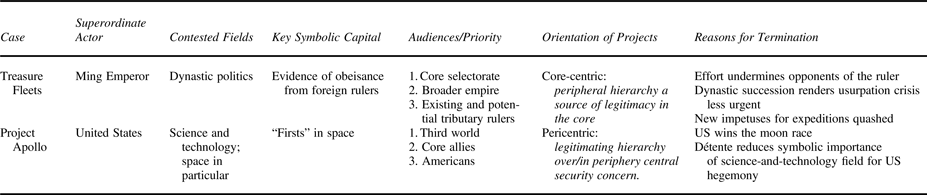
However one comes down on the specifics, the cases help vet a key wager of hierarchy-centric scholarship: that we should be able to find similar dynamics across “domestic” and “international” hierarchies. Table 1 summarizes the key conceptual and theoretical elements of the cases.
Case summaries
Main Alternative Explanations
The most plausible rival theories for why states invest massive amounts of resources into given performances derive from military security or economic incentives. The Ming treasure fleets’ close relationship to the imperial military and the presumed dual-use nature of much space exploration technology in the US case might supply military justifications for such expenditures. Commerical and economic incentives might have mattered, such as Chinese merchants’ interests in expanding trade routes or technological spinoffs from lunar exploration. In either case, symbolic correlates would provide, at best, secondary explanations. Other alternatives include arguments from national identity, rent-seeking, and idiographic factors. We consider these in the appendix, where we also provide additional evidence for our explanation and the rival ones we discuss.
Case Methodology
We deploy process-tracing methodology.Footnote 76 In its Bayesian reformulation, process tracing focuses on evaluating the likelihood that given evidence would be observed if one theoretical explanation were true compared to others.Footnote 77 This allows us to better adjudicate competing claims than other case-study techniques, especially in light of our uncommon foundations approach. Focusing on the probative value of evidence also allows us to dismiss some alternative explanations more quickly than others: “being equally tough on alternative explanations does not require going into equal depth … on every one of them.”Footnote 78 For more details, especially concerning data sources, see our online appendix.
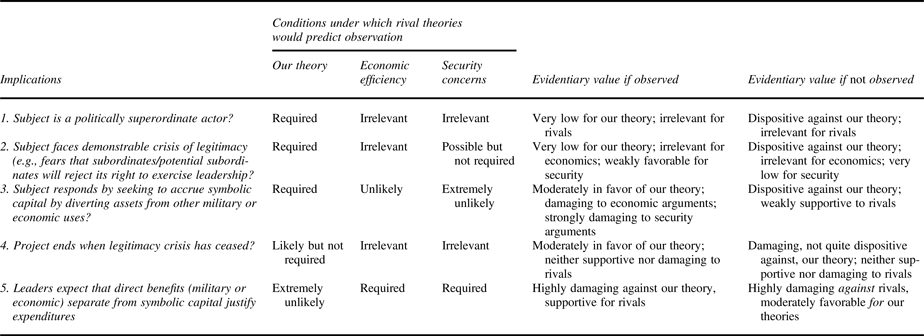
Table 2 lays out the observable implications of our argument and how evidence should adjust our confidence in our theory when compared to the two rival accounts we evaluate here. In accord with process-tracing methodology, we lay out what we should most likely observe—or not—if our proposed mechanism is operational (but not rivals’) or if rivals’ mechanisms are operational (but not ours). Different potential observations—or lack of observations—should adjust our relative confidence in our theory relative to its rivals. Different observations—or lack of observations—can have different effects on our judgment about rival theories. Specifying levels of confidence facilitates transparency and also provides a marker about how observations (for instance, if Ming court records are ever rediscovered) would affect our judgment.
Observable implications and evidentiary significance
Voyages of the Ming Treasure Fleets
In 1405 CE, Zhu Di, the Yongle emperor of China's Ming dynasty, authorized the first of seven massive naval expeditions from China to the Indian Ocean in 1405.Footnote 79 Other voyages took place in 1407–9, 1409–11, 1413–15, 1417–19, 1421–22, and 1431–33. They covered an increasing distance: the first expedition visited Southeast Asia, Indochina, and modern-day Kolkata and Sri Lanka; the sixth—the last under the Yongle emperor—visited as far as Aden and the East African coast.Footnote 80 Most were commanded by the eunuch admiral Zheng He.
The Yongle emperor died in 1424. On the advice of scholar-elite officials, his son and successor Zhu Gaochi, the Hongxi emperor, canceled further voyages. The Hongxi emperor unexpectedly died in 1425 after less than a year on the throne. His son and successor, Zhu Zhanji—the Xuande emperor—commissioned a seventh expedition that sailed in 1433 and may have intended only to repatriate foreign ambassadors and personnel. But the Xuande emperor died in 1435, at roughly the same time as Zheng He. The new emperor, Zhu Qizhen (known both as the Zhengtong emperor, 1435–1449, and as the Tianshun emperor, 1457–1464), discontinued the voyages. Sources concur that no serious attempts to revive the treasure fleets followed the Zhengtong emperor's reign.
Theoretical Applicability
We expect that otherwise superordinate actors will divert substantial resources to maintain their position in a field where their dominance is challenged. The Yongle emperor faced such a crisis because he had succeeded to the throne illegitimately: following a massive civil war from 1399 to 1402, he usurped the throne from his nephew, whom he (almost certainly) killed—“one of the most extraordinary cases of usurpation in the late imperial period.”Footnote 81 He immediately confronted massive challenges. To quell external threats—especially from northern nomadsFootnote 82—he employed a combination of diplomacy and warfare; to ward off an internal military challenge, he created a new military “nobility” loyal to him; to purge former regime loyalists, he executed hundreds of officials and “tens of thousands of innocent people”; and to further both policies, he removed the capital from Nanjing to the former Mongol capital, a northern city he renamed Beijing.Footnote 83
His chief “national security” task, however, was legitimizing his rule.Footnote 84 After mass executions failed to settle the issue,Footnote 85 he turned to an alternative strategy. Ming dynastic governance required the emperor to abide by an extensive, demanding set of norms drawn from tradition and invented by elites.Footnote 86 Such norms were overseen by Confucian scholar-officials who staffed the bureaucracy. Western scholars later labeled one important set of practices the “tributary system”: a set of rituals through which external rulers acknowledged the Chinese emperor as their superior in an explicitly hierarchical system of international relations. The Ming court conducted relations with many powerful actors outside its direct ambit—including the polities whose successors would later become known as Korea and Japan—through such practices.Footnote 87 The Hongwu emperor, the dynastic founder, placed special emphasis on the system.Footnote 88 Demonstrations that the emperor commanded respect as the ruler from beyond the borders of the Chinese amounted to symbolic capital in the Ming political field.
The Yongle emperor expanded these practices to an unprecedented degree. The treasure fleets amounted to a bricolage of customs through which the Yongle emperor employed the resources of the imperial treasury to “prove” his legitimacy by seeking the validation of external “subjects.” Crucially, these expeditions were not voyages of discovery. Chinese merchants and others described the Arab world and Eastern Africa as early as 860 CE, and Ming-era traders already enjoyed extensive commercial contacts with many of the ports that the fleets visited.Footnote 89 The treasure-fleet expeditions “were essentially an urbane but systematic tour of inspection of the known world.”Footnote 90 Their mission was to convince local potentates to enroll in the tributary system. In most instances, the fleets’ trade goods proved sufficient to buy such loyalty. If not, “the Treasure-ships were intended not only to dazzle foreign peoples with their wealth and majesty but to overawe potential opposition with their might and firepower.”Footnote 91 The fleet sometimes employed more coercive means. On each of the early voyages, the fleet—and its troops—suppressed pirates and other outlaws. It also deployed force against local governments who attacked the fleet.Footnote 92
The fleets succeeded at expanding the emperor-centric world order, enrolling as many as forty-eight states in the system (many for the first time).Footnote 93 When the expeditions returned to the Ming court, they brought back not only valuable goods and ambassadors but even foreign rulers—visible tokens of the extension of Ming prestige throughout the known world.Footnote 94 They also carried exotic treasures like giraffes from Africa—which the court proclaimed to be qilin, mythological beings said to appear during the rule of an illustrious ruler.Footnote 95
The observations thus fit the pattern we would expect given our predictions in Table 2. The case meets the criteria required in implications 1, 2, and 3. Similarly, there seems to be strong evidence that implication 4, about the termination of the voyage, also fits the pattern we predict. In particular, the fact that the voyages largely stopped with the demise of the Yongle emperor suggests that the legitimacy crisis was tied to his reign (as one would expect given his usurper status—his successors came to the throne legitimately).
Alternative Explanations
Economic Efficiency
If economic arguments based on trade explained the voyages, then (as implication 5 in Table 2 summarizes) the scale of the outlay needed for the vessels would have required expectations of a commensurate return on investment. The scale of the fleets undermines this explanation. The 1405 voyage alone included seven ambassadors, ten deputy ambassadors, a few dozen supervisors, 800 sailors, and 26,000 soldiers and their officers.Footnote 96
A fleet constructed for economic returns should have minimized costs; one constructed for symbolic purposes would have overinvested in displays of status. Consider the mammoth investments involved: from felling entire forests to employing “hundreds of households of carpenters, smiths, sailmakers, ropemakers, caulkers, carters and haulers, even timekeepers.”Footnote 97 Such investments would be hard to justify even for luxury goods. It remains unclear if the goods acquired on the voyage even reached Chinese marketplaces or if they remained in the court.Footnote 98
A secondary clue comes from the emphasis on political relationships as a goal of the fleets; economic motives cannot explain why the voyages so closely tracked the tributary system. Moreover, it strains credibility that the voyages would have become (or have been seen to become) uneconomical just as the Yongle emperor died (implication 4). We find economic explanations unsatisfactory; the most valuable “good” purchased by the fleets was symbolic obeisance (as consonant with implication 3) and that the fact pattern predicted does not fit an economic explanation.
Military Security
The Ming faced or initiated security challenges in Vietnam and in Mongolia, both near their core areas. The vast sums the court directed toward the expeditions had no bearing on these military campaigns, nor were they directed against an “over-the-horizon” threat. They also didn't yield alliances of much tangible benefit. Given the expenditures necessary to sustain these expeditions, the treasure fleets entailed significant opportunity costs for Ming military security. As Hoffman asks, “why pour money into the fleets when the real danger came from nomads instead?”Footnote 99 Consequently, we find that this explanation would contradict the observed fact pattern, and, according to implication 5, we argue for summarily dismissing the security explanation.
Project Apollo
At the dawn of the Cold War, Washington and its allies recognized the existence of a US-led order comprising (at least) the advanced industrialized democracies, most of Latin America, and much of noncommunist Asia.Footnote 100 This fits with implication 1: the United States (and its president) were politically superordinate actors. As implication 2 requires, the Cold War created an ongoing possibility of demonstrable crises of legitimacy. US and other Western leaders saw the Soviet Union as both a material challenger and an ideological rival with the capability to attract the political support of both the “new nations” (as the then-current phrase described the decolonizing world) and, potentially, their own citizens and states.Footnote 101 It may seem fantastic today, more than twenty-five years after the collapse of the USSR, but Soviet communism once appeared not only as a viable alternative to liberal capitalism but also potentially a superior one. Consequently, from the 1950s onward, Washington and Moscow competed to retain existing allies and attract new ones in Latin America and decolonizing regions of Africa and Asia. There was significant uncertainty about which side the “third world” would join.Footnote 102 Many leaders—and ordinary people across the globe—believed the United States could lose the Cold War by failing to concretely and continuously make good on the promise of its ideological wagers.Footnote 103
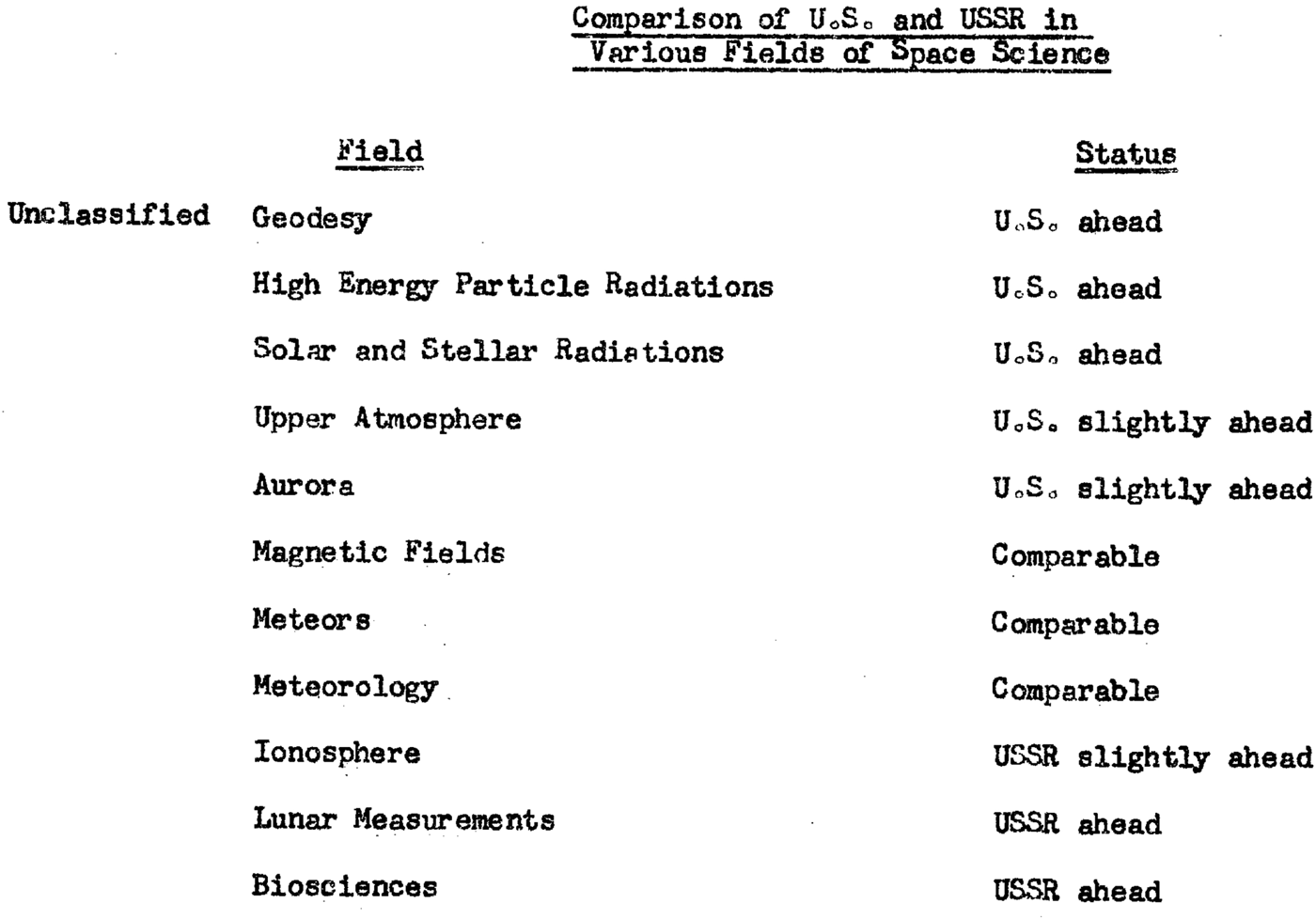
Science and technology has long roots as a field of competition, but it emerged as a critical field—and specifically in terms of space—almost literally overnight.Footnote 104 On 4 October 1957, the Soviet Union launched Sputnik, the first artificial satellite. The scale of Western and nonaligned shock at Sputnik surprised the Soviet leadership. The Kremlin quickly moved to capitalize on its success. Success in space became constructed as a contest over whether Soviet communism or democratic capitalism was superior for humankind.Footnote 105 Moscow disregarded the Soviet space establishment's scientific priorities to better promote satellites, and later human space missions, as advertisements for Communism.Footnote 106 American officials viewed the challenge as a test of national competence and prestige.Footnote 107 In keeping with the construction of the field of competition, accounting for progress in the space race quickly became routinized. A January 1960 CIA assessment, for instance, included a table comparing US and USSR accomplishments in fields as specific as “Ionosphere” and “Geodesy” (Figure 1)—a formal statement setting out how scientific capital was exchanged into prestige.Footnote 108
Table reproduced from CIA report assessing US and USSR accomplishments in space, 1 January 1960
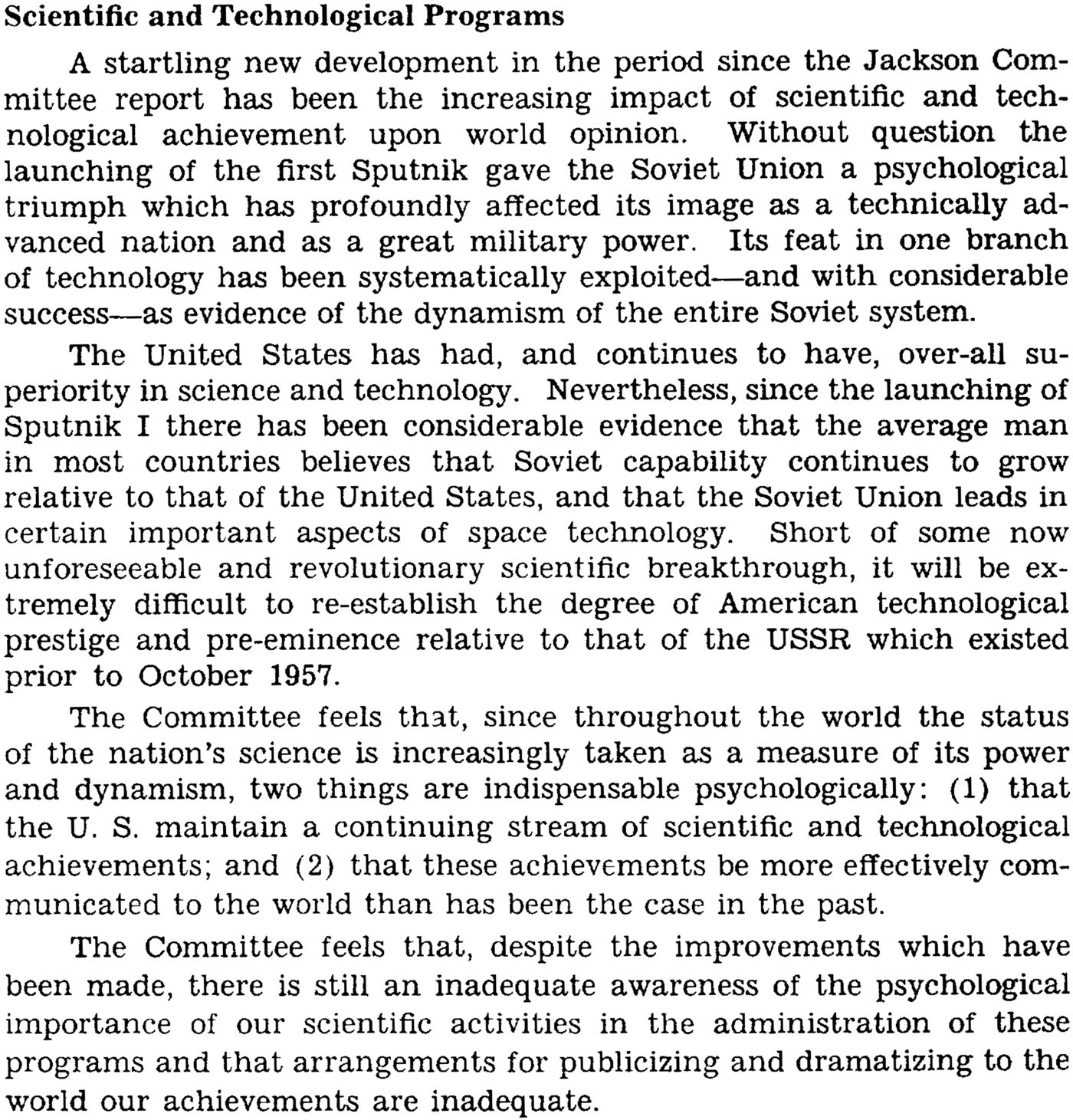
The most important impact of this field of rivalry in space was on the competition for the hearts and minds of the nonaligned world. “The flight of Sputnik … impressed many ordinary Latin Americans; some recalled it as the first time they ever heard of the Soviet Union.”Footnote 109 A July 1959 United States Information Agency (USIA) assessment of the “Impact of US and Soviet Space Programs on World Opinions” found particular shifts about popular views toward the US-Soviet balance in Latin America, where it estimated that “the two nations are about equal;” in Africa, where both sides were also regarded as equal but where that “assessment … represent[ed] a very significant revision of views concerning the nature of Soviet society;” and in India, where “Soviet dramatic successes appear to have decisively implanted the opinion that the Soviet Union is now the world scientific leader.”Footnote 110 The December 1960s “Sprague Committee” report on reorganizing US efforts to disseminate information internationally took for granted that science and technology—especially space—would prove to be an enduring part of this Cold War competition for global influence (Figure 2), remarking that “throughout the world the status of the nation's science is increasingly taken as a measure of its power and dynamism.”Footnote 111
Selection from the Sprague Committee Report (p. 36 of original).
Gagarin's Orbit and Kennedy's Crisis of Legitimacy
By Kennedy's inauguration, leaders, elite, and mass audiences around the globe—in the Soviet Union and the United States, their allies, and the nonaligned world—viewed space activities as competitive, meaningful, and linked to assessments of not only each camp's military abilities but also the attractiveness of their systems. The furor over Sputnik had largely subsided when Kennedy succeeded Eisenhower in January 1961. Kennedy's generally bellicose inaugural address even singled out space and science as an area of potential East-West cooperation.Footnote 112 Yet space reemerged as a competitive arena on 12 April 1961, when Soviet cosmonaut Yuri Gagarin completed an Earth orbit on Vostok I to become the first human in space.Footnote 113 This Soviet triumph was “a worse blow to US prestige than the Sputnik launch … since by 1961 the American people and US allies abroad were aware that the US had been engaged in a competition to launch an astronaut before the Soviet Union.”Footnote 114
On 21 April (two days after the withdrawal of CIA-backed guerrilla forces from Cuba's Bay of Pigs), a USIA assessment of Gagarin's orbit on global media opinion concluded that “the Soviet feat is generally held to have increased and consolidated the Soviet lead in space, and to increase Soviet military, political, and propaganda leverage.”Footnote 115 Survey evidence later confirmed qualitative claims. In October 1961, USIA reported on polls of Western European public confidence in the United States. The document was sent only to the White House and two other agencies “because of the obvious political combustibility of the survey.”Footnote 116 It found Europeans rated the Soviets as besting the Americans’ “lead in space developments as follows: Britain 78% [Soviet lead] to 7% [American lead]; France 80% to 2%; Italy 62% to 11%; and West Germany 67% to 12%.”
The Kennedy administration believed that the United States, as “leader of the Free World,” needed to constantly demonstrate its attractiveness and fitness to the nonaligned countries and its allies. Such thinking fit with a December 1960 CIA National Intelligence estimate that argued that Soviet leaders regarded the fact that “a Communist rocket which first ventured into space symbolizes for them that they are marching in the vanguard of history.”Footnote 117 Consequently, as Westad writes, “for Kennedy and his advisers, the key to what America could do to help avoid breakdown in the Third World was held by its technological success.”Footnote 118 Nor were such concerns limited to the Third World. That USIA paid such careful attention to public opinion polling on space is consistent with the Kennedy administration's worries that even countries such as West Germany and Italy might become neutral as a result of declining confidence in the West spurring votes for left-wing parties.Footnote 119
We therefore conclude that policymakers understood Gagarin's flight as sparking a crisis on the terms of American legitimacy—evidence consistent with implication 2. The question facing the White House in late April and early May 1961 was thus how to respond. Both Kennedy and his vice president, Lyndon Johnson, had been starkly critical of Eisenhower's seemingly blasé response to Sputnik and believed that his reluctance to take a stronger line had cost him at home and abroad.Footnote 120 Thus, as in implication 3, Kennedy and his administration chose to accrue symbolic capital by investing massively in a display of competence. Setting the goal of a lunar landing stemmed not from some supposed romantic yearning for a final frontier, but rather a calculated search for a benchmark where US disadvantages vis-à-vis the Soviet Union—notably, its lack of a reliable heavy-lifting rocket—would be counterbalanced by its superior industrial and organizational potential.Footnote 121 But Kennedy also wanted to pursue the minimum goal that would convincingly demonstrate US superiority. He pushed his advisers to investigate alternative national goals—putting a laboratory in space, a manned circumnavigation of the moon, landing a robotic probe on the lunar surface, or (his last choice) “a rocket to go to the moon and back with a man.”Footnote 122 NASA advised that the most ambitious option, a manned lunar mission, provided the only sure chance of beating the Soviets.Footnote 123
Kennedy's decision to proceed with Apollo to demonstrate that US capabilities matched US pretensions in global hierarchies provides important evidence consistent with implications 3 and 5. The scale of Project Apollo's drain on US resources may seem surprising. Apollo ranks with the most expensive public works and defense projects carried out by the US government. The World War II-era Manhattan Project, which developed the first atomic weapons, cost approximately $22 billion in 2008 dollars; by contrast, Apollo cost $98 billion.Footnote 124 At its peak, the Manhattan Project claimed 1 percent of annual federal spending; Apollo peaked at 2.2 percent of the federal budget.Footnote 125 It was unusual for the fiscally restrained Kennedy to endorse such a costly plan, but he never hid the scale of the commitment: a budget official later recounted that “there was never a major decision like this made with the same degree of eyes-open, knowing-what-you're-getting-in-for” character.Footnote 126 In his 25 May 1961 speech, he told Congress that “No single space project in this period will be more impressive to mankind or more important for the long-range exploration of space, and none will be so difficult or expensive to accomplish.”Footnote 127
What was Kennedy paying for? Symbolic capital—defined as demonstrating that the United States, despite its poor showing in the space-race spectacles, was, in fact, dominant in science and technology. Internal Kennedy administration budget memoranda grouped NASA budgets with military and diplomatic expenditures, not with civilian agencies. In December 1961, Kennedy's budget bureau projected that by 1963 NASA would incur obligations of $3.78 billion, compared to foreign economic aid ($3.19 billion), foreign military aid ($1.5 billion), and the entire State Department ($0.35 billion). NASA was thus the largest line item in this category except for the military functions of the Department of Defense.Footnote 128 Such evidence reaffirms our interpretation that policymakers envisioned Apollo's international implications as warranting a nearly wartime mobilization of resources; NASA's classification among other military and diplomatic line items reaffirms the power-political nature of Apollo.
Overwhelming evidence corroborates our interpretation.Footnote 129 For instance, in a joint memorandum two weeks before Kennedy's public announcement of Apollo, NASA administrator James Webb and Defense Secretary Robert McNamara argued for increased spending on manned space exploration despite its lack of military payoff: “major successes, such as orbiting a man as the Soviets have just done, lend national prestige even though the scientific, commercial or military value of the undertaking may by ordinary standards be marginal or economically unjustified.”Footnote 130 The Webb-McNamara memorandum—crafted to support and elaborate a decision to respond that had already been made—assessed that “projects in space may be undertaken for any one of four principal reasons … gaining scientific knowledge … commercial or chiefly civilian value … potential military value … [or] for reasons of national prestige. The US is not behind in the first three categories … The Soviets lead in space spectaculars which bestow great prestige.”Footnote 131 Webb and McNamara concluded:
This nation needs to make a positive decision to pursue space projects aimed at enhancing national prestige. Our attainments are a major element in the international competition between the Soviet system and our own. The non-military, non-commercial, non-scientific but “civilian” projects such as lunar and planetary exploration are, in this sense, part of the battle along the fluid front of the cold war … It is vital to establish specific missions aimed mainly at national prestige.
Despite the romantic language of his public speeches about space, in private Kennedy continually reinforced the message that considerations of international prestige, not the intrinsic value of space exploration or space science, justified Apollo's expense. Kennedy put this forcefully in a tape-recorded November 1962 meeting with NASA Administrator James Webb and other officials.Footnote 132
KENNEDY: Everything we do ought really to be tied to getting on the Moon ahead of the Russians.
WEBB: Why can't it be tied to pre-eminence in space, which are your own …
KENNEDY: Because, by God, we keep—we've been telling everybody we're pre-eminent in space for five years and nobody believes it because they have the booster and the satellite. We know all about the number of satellites we put up, two or three times the number of the Soviet Union … we're ahead scientifically. It's like that instrument you got up at Stanford which is costing us a hundred and twenty-five million dollars and everybody tells me we're the number one in the world. And what is it? I can't think what it is.
MULTIPLE SOURCES: The linear accelerator.
KENNEDY: I'm sorry, that's wonderful, but nobody knows anything about it! … The policy ought to be that this is the top-priority program of the Agency, and one of the two things, except for defense, the top priority of the United States government. I think that that is the position we ought to take. Now, this may not change anything about that schedule, but at least we ought to be clear, otherwise we shouldn't be spending this kind of money because I'm not that interested in space. I think it's good; I think we ought to know about it; we're ready to spend reasonable amounts of money. But we're talking about these fantastic expenditures which wreck our budget and all these other domestic programs and the only justification for it, in my opinion, to do it in this time or fashion, is because we hope to beat them and demonstrate that starting behind, as we did by a couple years, by God, we passed them.Footnote 133
Perhaps the best evidence of Kennedy's motivations comes from an earlier chastising of Webb's enthusiasm for the moon shot as a scientific endeavor: “But this is important for political reasons, international political reasons. This is, whether we like it or not, in a sense a race.” Such remarks both demonstrate evidence consistent with implications 1, 2, and 3, and inconsistent with other explanations’ predictions about what we should observe.
Further evidence for our interpretation comes from how Apollo ended. The original purpose of the Apollo project fit uneasily into changing relations between the United States and the USSR by the end of the decade. True, the US government showed off the lunar landings. President Richard Nixon greeted the Apollo 11 astronauts on board the USS Hornet after their splashdown in the Pacific Ocean, the centerpiece of his tour of US allies;Footnote 134 the Apollo 11 astronauts toured twenty-four countries on the GIANTSTEP–Apollo 11 Presidential Goodwill Tour;Footnote 135 and the Nixon administration sent lunar samples to 135 countries as tokens of US friendship.Footnote 136 As many as 41 million people attended USIA-organized expositions of moon rocks around the world.Footnote 137 The diplomatic uses of the Apollo missions even extended to include only two Communist leaders’ voices on a disc left on the moon's surface: the American-friendly Yugoslavia's Marshal Tito and Romania's Nicolae Ceausescu.Footnote 138
These were not quite the victory laps that one might have expected given the competitive atmosphere in which the Apollo project had begun. By the end of the 1960s, “public diplomats’ approach to space programming had shifted notably. Instead, the emphasis of programming portrayed space exploration as a global accomplishment.”Footnote 139 It is not accidental that Neil Armstrong's words upon setting foot on the lunar surface were to stress that this was not an American accomplishment but a giant leap “for mankind.”
Apollo's success, then, was ironic: even though the project met its goal, the world had changed around it, making that triumph worth much less than its authors had intended.Footnote 140 Neither military-security nor economic analyses explain this decision to stop; it only makes sense in the context of a race that had been won—and which had, by the time the Americans won it, already lost its luster. As implication 7 suggests, this timing is more consonant with our preferred explanation than with rivals'.
Assessing Competing Explanations
How do rival explanations track with observed evidence? They do not perform well.
Military Security
There is some supportive evidence for the hypothesis that military concerns triggered spending on Apollo. For instance, the April 1961 USIA survey of world public opinion after Gagarin's orbit found that there was a “strong feeling that the Soviet feat has military implications and in some way enlarges Soviet military capabilities.” Yet this evidence pales before other data suggesting that considerations of “military implications”—beyond audience perceptions of a link between space prowess and military capabilities—do not appear to have weighed on senior policymakers or President Kennedy.
Kennedy's advisers consistently argued that the moon project was separate from security needs. The Webb–McNamara memorandum of May 1961 echoed Wiesner's January 1961 transition memorandum on this point: although “it is generally assumed by the American citizen that our vast expenditures of money and technical talent are primarily designed to meet the overriding needs of our military security,” missiles were “slowly being delegated to the category of routine management.” Wiesner (and, later, Webb and McNamara) argued the most important factor in the national space effort was “the factor of national prestige … During the next few years, the prestige of the United States will in part be determined by the leadership we demonstrate in space activities.”Footnote 141
Nor was there the promise of substantial spillovers from moon-shot technology. The 1950s space race involved dual-use technologies, such as developing “missiles able to deliver nuclear weapons and satellites capable of securely performing reconnaissance missions.”Footnote 142 But US policymakers realized early that Apollo required boosters far more powerful than needed for any plausible military purpose.Footnote 143 Even Soviet leader Nikita Khrushchev understood in 1962 that “space rockets require more powerful engines, since by this [sic] means they carry greater payloads and attain a higher altitude, while military rockets in general do not require such powerful engines—engines already in existence can carry warheads of great destructive force and assure their arrival at any point on the globe.”Footnote 144
In the early 1960s, US intercontinental ballistic missiles (ICBMs) switched to solid propellants, while NASA used liquid propellants, a distinction that limited civilian-military technology transfer.Footnote 145 Given this evidence, there is little reason to think that a drive for military superiority, per se, played a role in the Apollo project, nor that direct military interests drove the project (see implications 3 and 5).
Economics
Although NASA press officers valiantly tried to justify Apollo as producing large spillover effects, specific claims about its economic benefits tend to conflate the lunar program with other uses of space, such as earth observation and telecommunications. Otherwise, they rest on nebulous claims of long-term benefits.Footnote 146 Such arguments also tend to ignore or downplay the opportunity cost of human space exploration compared to alternative modes of exploration. Although the first manned circumlunar voyage occurred in 1968, robotic missions to the Moon proved feasible as early as the Soviet Luna missions in 1959. Unmanned science could have produced many, if not all, of the same technological spillovers claimed for manned missions. Van Dyke writes that “if there were no reasons for the lunar program other than the prospect that it would produce economic … benefits, it is safe to say that very few would consider it justifiable.”Footnote 147 Little evidence supports the contention that economic motives took priority.
Both of these functionalist explanations would be hard-pressed to explain why the moon missions stopped when they did, except through some process of learning that the security or economic returns were lower than expected; we have encountered no such evidence of dashed expectations.
Conclusion
Today, Project Apollo and the treasure fleets conjure images of national greatness squandered by subsequent generations of lesser, narrow-minded politicians. Unsurprisingly, American presidents seeking to discover a legacy have recurrently toyed with the idea of sending astronauts to the moon or even to Mars. Despite the seemingly large rewards of doing so, no such project has come to fruition. The putative grandeur of Apollo and the Ming fleets sits uneasily with the fact that they were, in military and economic terms, massive wastes of resources that diverted labor and treasure into, in those terms, unproductive ventures. Despite their current rhetorical status, it was not a desire for altruistic “greatness” but a need for self-interested symbolic domination that justified such extravagances. In the absence of such a challenge, the game is not worth the candle.
We wager that understanding the processes that could transform legitimacy crises into such performances can, in turn, illuminate other recurrent patterns in world politics. Despite their significant differences—their uncommon foundations—the cases display similar mechanisms and processes associated with the politics of hierarchy and maintaining political dominance, whether in terms of dynastic politics or science-and-technology competition. In finding common mechanisms and processes across the layered hierarchies at stake in Ming China (core, empire, and tributary system) and Cold War America (core, asymmetric alliances, and zones of competition for clients and allies), we show the payoffs to a key wager of hierarchy-centric scholarship: that international relations and domestic politics blur together when it comes to the leverage provided by explanatory theory.
This juxtaposition also allows us to engage with Acharya's important call for a “global” approach to the study of international politics by comparing the kinds of systems that long constituted international-relations scholars’ bread and butter, like the Cold War, and non-Western systems that have received less attention, like Ming China. This comparison is particularly salient given widespread interest in interrogating early modern Chinese international relations, including attempts to compare it to postwar American hegemony.Footnote 148
We also seek to advance more pluralist ways of studying power politics. Scholars should combine sensibilities from social-constructionist and strategic approaches to understand power politics. Such dynamics extend beyond straightforward economic and military competition; they may employ instruments outside the typical repertoire.Footnote 149 Both cases provide examples of high-stakes power politics. But the immediate objects—the capital—at stake took the form of tokens and performances of, on the one hand, obeisance from distant rulers and, on the other, science-and-technical prowess in space. The Yongle's and the Kennedy courts’ policy choices involved incontestably strategic and instrumental dimensions, yet played out in socially constructed fields that cannot be explained in purely “objective” terms.
Finally, the field-theoretic approach we offer provides a means of cutting into the dynamics of hegemony at the level of individual diplomats, in institutional sites, and between states. While we focused on the last, fields specific to micro-level settings coexist with more macro-level ones, and they should influence one another.Footnote 150 This is the direction that advocates of hierarchy-centric scholarship point to: seeing world politics as composed of complex patterns of super- and subordination that incentivize “compliant and resistant behavior,” generate “positional and role-based behaviors,” and “produce distinctive political spaces.”Footnote 151 A hierarchy-centered account of world politics will also have to offer accounts of what kinds of competition will be generated under hierarchy, how contests for domination and acceptance of subordination will proceed, and why the forms of such hierarchies will change over time. By illuminating how legitimacy challenges can produce state actions that mobilize resources on a wartime scale, we seek to show that the stakes of these debates matter for more than abstract concerns: they describe processes at the core of political life.
Supplementary Material
Supplementary Material for this article is available at <https://doi.org/10.1017/S0020818318000139>.



