




Introduction
Wetlands are among the most important ecosystems on Earth. During the Carboniferous period, wetlands produced and preserved vast amounts of organic matter, forming fossil fuels such as peat, coal, oil and gas, whose extraction and use is now driving anthropogenic climate change. Today, wetlands cover 5–8 per cent of the Earth's land surface, but account for 20–30 per cent of global carbon pool stored in its soils (Nahlik & Fennessy Reference Nahlik and Fennessy2016). Exploitation of fossil wetlands is driving climate change but the protection of present day wetlands is vital to combating it.
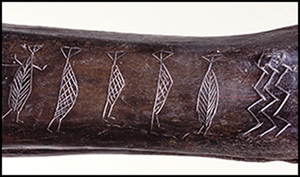
For millennia, people around the world have sought out wetlands and their surroundings as places to live, as a means of communication, and for activities as varied as fishing, hunting and ritual (Menotti & O'Sullivan Reference Menotti and O'Sullivan2013). Wetland archaeological sites are often particularly informative, due to the excellent preservation environments for organic materials resulting from high water content, which functions as a barrier to atmospheric oxygen that would otherwise accelerate their degradation (Matthiesen et al. Reference Matthiesen, Eriksen, Hollesen and Collins2015). This preservation potential can permit a more complete picture of past human activities in comparison to dry-land archaeological evidence (Coles Reference Coles and Purdy1988). Figure 1 shows a range of organic finds that illustrate the preservation potential and carbon storage capability of wetland sites.
Examples of archaeological finds from wetlands: a) a carved wooden scabbard, c. 1600 BP (Nydam, Denmark); b) a Neolithic trackway, c. 5800 BP (Somerset, England); c) human figures carved on an aurochs bone, c. 10 000 BP (Ryemarksgård, Denmark); and d) human remains, c. 2400 BP (Tollund, Denmark) (photographs courtesy of the National Museum of Denmark (J. Lee and R. Fortuna) and the Somerset Levels Project).

Wetlands have been destroyed at alarming rates. It is estimated that more than half of the world's wetlands have been lost, mainly during the twentieth century (Mitsch & Gosselink Reference Mitsch and Gosselink2015: 45). This loss is accompanied by damage and destruction of the archaeological record. In England, for example, it has been estimated that almost 80 per cent of the country's wetland monuments were damaged or destroyed between 1950 and 2000, mainly as a result of peat cutting and peat wastage, drainage works, water extraction and the conversion of wetlands into arable land or for development (Van de Noort et al. Reference Van de Noort2002). Climate change represents an additional component in this complex interplay of variables and trends affecting wetlands. Increasing temperatures and changing precipitation patterns lead to a growing demand for water and greater risks of floods and droughts, all of which influence wetland ecosystems and the archaeological remains they preserve (Chapman Reference Chapman2002; Desta et al. Reference Desta, Lemma and Fetene2012; Junk et al. Reference Junk2013; Van de Noort Reference van de Noort, Menotti and O'Sullivan2013b).
Although wetland destruction is still ongoing in many parts of the world (Davidson et al. Reference Davidson, Fluet-Chouinard and Finlayson2018), wetlands are increasingly being acknowledged for the ‘ecosystem services’ they supply, including food and clean water, biodiversity, flood mitigation, coastal protection and, most recently, their ability to sequester and store carbon (Lal Reference Lal2008; Mitsch et al. Reference Mitsch2013; Mitsch & Gosselink Reference Mitsch and Gosselink2015). Several countries have adopted a policy of ‘no-net-loss’, where any destruction of a wetland must be compensated by the restoration or creation of another wetland nearby. A no-net-loss policy and the creation of new wetlands, however, may obscure the substantial loss of natural wetlands, as described by Xu and colleagues (2019) for China. In relation to archaeological wetland sites, the creation of new wetlands is of little benefit and the focus of efforts should therefore be on the preservation and protection of existing wetlands. Hence, the effects of climate change and of climate change policy on wetland archaeology are vital but understudied. The purpose of this article is to:
a) present examples of some of the threats to archaeological wetland sites that may be enhanced, or diminished, by climate change;
b) to discuss methods for predicting and quantifying the impact of climate change; and
c) to discuss what archaeologists and cultural heritage managers can do to mitigate the negative, and to reinforce the positive, effects of climate change.
We acknowledge that the term ‘wetland archaeology’ is a broad category that includes many different types of sites and landscapes, of which we can only discuss some illustrative case studies here. What all these examples share, however, is the decisive role played by water in the preservation of their archaeological materials. More broadly, this contribution forms part of a series of articles on the effects of climate change on archaeological sites in different environments, including the Arctic (Hollesen et al. Reference Hollesen2018) and marine and coastal environments (Gregory et al. Reference Gregory2022). Notably, while climate change in these other environments has predominantly negative effects on archaeological preservation, with limited options for mitigation, the effects of climate change on wetland archaeology are more variable and, in some cases, may even directly or indirectly benefit preservation. Here, therefore, we seek to explore this complexity and, more broadly, to understand the threat of climate change as only one of several threats to wetland archaeology.
Threats to archaeological sites in wetlands that may be influenced by climate change
Climate change is expected to affect both temperature and precipitation patterns across the world, along with a wide range of derived effects (Intergovernmental Panel on Climate Change 2021). Figure 2 shows the predicted changes in precipitation, evapotranspiration, runoff and soil moisture content across the world, using an intermediate carbon emission scenario (SSP2-4.5) where the carbon-dioxide emissions start falling c. 2050. In this scenario, global temperature is expected to increase by approximately 2.1–3.5°C by the end of this century. The expected effects on precipitation are not uniform, including areas that will receive less (brown colours) and those that will receive more (green/blue colours) (Figure 2a). Large parts of the world are hatched, indicating areas where it is still uncertain whether there will be more, less or unchanged precipitation. The timing and annual distribution of precipitation may also change, with longer dry spells and more intense rainfall episodes (Intergovernmental Panel on Climate Change 2021). Both the evapotranspiration (Figure 2b) and the runoff (Figure 2c) maps show similar variations across the world. The near-surface soil moisture (Figure 2d) is the net result of a suite of complex processes (e.g. precipitation evapotranspiration, drainage, overland flow and infiltration) and heterogeneous and difficult-to-characterise above- and below-ground system properties (e.g. slope and soil texture). These predictions are still highly uncertain and increases and decreases in soil moisture content are expected in different parts of the world (Figure 2d).
Projected water cycle changes. Long-term (2081–2100) projected annual mean changes (%) relative to present-day (1995–2014) in the SSP2-4.5 emissions scenario for: (a) precipitation; (b) surface evapotranspiration; (c) total runoff; and (d) surface soil moisture. Numbers in the top right of each panel indicate the number of Coupled Model Intercomparison Project Phase 6 (CMIP6) models used for estimating the ensemble mean. For other scenarios, please refer to relevant figures in Intergovernmental Panel on Climate Change (2021). Uncertainty is represented using the simple approach: no overlay indicates regions with high model agreement, where ≥80% of models agree on sign of change; diagonal lines indicate regions with low model agreement, where <80% of models agree on sign of change (figure taken with permission from Intergovernmental Panel on Climate Change (2021: technical summary, box TS.6)).

Extensive geographical variability in the types and locations of wetlands (Figure 3), coupled with the distribution of archaeological sites and the predicted impacts of climate change (Figure 2), makes it difficult to generalise about how wetlands and their archaeology will be affected. Nonetheless, as wetlands are sensitive to changes in hydrological balance, it is important to understand how the most important precipitation- and temperature-related processes may affect preservation conditions.
Regional distribution (percentage) of wetland area based on a total global wetland area of 12.1 million km2 (numbers taken from Davidson et al. Reference Davidson, Fluet-Chouinard and Finlayson2018) (figure by J. Hollesen).

Drought and flooding
Alongside artificial drainage, increased evaporation, together with more frequent and longer heatwaves, may lead to drought and lowered water tables. As the diffusion constant for oxygen in air is 10 000 times higher than in water, the effects of reduced levels of water on archaeological deposits can be dramatic (Matthiesen et al. Reference Matthiesen2015), as the greater availability of oxygen increases microbial degradation of buried organic remains. Furthermore, if not kept permanently wet, waterlogged materials, such as archaeological wood, may experience substantial shrinkage and lose their scientific value (Gregory & Jensen Reference Gregory and Jensen2006). The effects of drainage and water extraction on archaeological sites in wetlands are documented in a long series of articles (e.g. French & Taylor Reference French and Taylor1985; Van de Noort et al. Reference Van de Noort2002; Matthiesen & Jensen Reference Matthiesen, Jensen, Fischer and Pedersen2005; Gearey et al. Reference Gearey2010; Milner et al. Reference Milner2011; Brunning Reference Brunning2012). Recent examples include Lake Sibaya in South Africa, where drought, water extraction and tree plantations have caused the water level to drop by up to 17m, exposing several Early Iron Age sites (Whitelaw & van Rensburg Reference Whitelaw and van Rensburg2020). Elsewhere, Boethius and colleagues (Reference Boethius, Kjällquist, Magnell and Apel2020) describe how drainage and climate change over the past 70 years have led to a decrease in the state of preservation of the Mesolithic wetland site of Ageröd in Sweden. In many cases, drainage has led to a rapid degradation of archaeological remains and the peat or sediments in which they are incorporated, thus simultaneously degrading the palaeoecological record (Davies et al. Reference Davies, Fyfe and Charman2015). Some of the derived effects of drainage and water loss include the settling of soil surfaces (Wösten et al. Reference Wösten, Ismail and van Wijk1997; Matthiesen & Jensen Reference Matthiesen, Jensen, Fischer and Pedersen2005), the acidification of peat in pyrite-rich wetlands (Boreham et al. Reference Boreham2011; Milner et al. Reference Milner2011), and changes in vegetation (Brunning Reference Brunning2013b) that may further affect archaeological remains. While most of the peat in undisturbed peatlands is sufficiently moist to be protected from fire and smouldering, the lowering of the water table by drainage or climate change can increase the frequency and extent of peat fires (Turetsky et al. Reference Turetsky2015), which may expose and damage archaeological remains (Gearey et al. Reference Gearey2010). The detrimental effects of fire and heat on cultural resources and archaeology are described in detail in Ryan et al. (Reference Ryan, Trinkle, Cassandra and Lee2012).
Increasingly frequent extreme precipitation events may cause severe flooding, but their impact on wetland archaeological sites is largely unknown. Lillie and colleagues (Reference Lillie, Soler and Smith2012), for example, have demonstrated how extreme flooding affects the composition and activity of the wetland microbial community, but it is unclear how, in turn, this influences the preservation of archaeological material. Flooding could potentially help to protect wetland sites, especially those that have already been drained, where floodwater may re-saturate the peat and temporarily reduce the availability of oxygen, thereby slowing organic decomposition. Conversely, increased flood risk may also lead to the implementation of enhanced flood protection measures, which may damage wetland sites and encourage further detrimental changes in land use (Kincey et al. Reference Kincey, Challis and Howard2008).
Increased temperature
When temperature increases, the rate of chemical and biological reactions also increases, at least to a certain limit. This is also the case for the degradation of organic material. The Q10 temperature coefficient describes the relative increase in chemical and/or biological reaction rates for each 10°C rise in temperature; the Q10 values for the oxidation of peat, wood and bone from archaeological sites are typically 2–4 (Matthiesen Reference Matthiesen2014; Matthiesen et al. Reference Matthiesen, Eriksen, Hollesen and Collins2021; Hollesen & Matthiesen Reference Hollesen and Matthiesen2015). If temperatures increase by 2–3°C, as expected by the end of the twenty-first century, this will correspond to a direct increase in reaction rates of 15–50 per cent. Nonetheless, the indirect effects of temperature increases are probably even more important. For instance, higher temperatures will increase evaporation rates, which may lead to the drying of wetlands, as outlined above. Increasing temperatures, in combination with higher carbon dioxide concentrations and changing water levels, may also lead to significant shifts in vegetation and the introduction of new species (Short et al. Reference Short2016). Depending on the type of vegetation, these changes may either help protect or damage archaeological deposits (Tjelldén et al. Reference Tjelldén, Kristiansen, Matthiesen and Pedersen2015; Krause-Jensen et al. Reference Krause-Jensen2019), and the overall effects may therefore be negative at some sites and positive at others. Likewise, changes to fauna may lead to the proliferation or disappearance of species that damage wetland sites, such as an increase in the number of water buffalo in Australian mangroves (Saintilan et al. Reference Saintilan2019). Increased temperatures may also lead to more water abstraction from wetlands for crop irrigation, thereby exacerbating desiccation.
Sea-level rise
Relative to 1986–2005, by 2100, global sea level is expected to rise between 0.29–0.59m (RCP2.6) and 0.61–1.10m (RCP8.5), depending on carbon emissions (Intergovernmental Panel on Climate Change 2019). This rise will affect intertidal and coastal wetlands, which will either shift inland (if possible) or become ‘squeezed’ between the sea and inland infrastructure (Van de Noort Reference Van de Noort2013a). This may cause erosion, redeposition and salinisation, which may induce changes in vegetation and biogeochemical processes within wetland deposits (Henman & Poulter Reference Henman and Poulter2008; Herbert et al. Reference Herbert2015). The effects from sea-level rise on intertidal and coastal archaeological sites are discussed in a range of articles (e.g. Carmichael et al. Reference Carmichael2018; Elliott & Williams Reference Elliott and Williams2019; Gregory et al. Reference Gregory2022), but few of these focus specifically on wetland archaeology. Where wetland sites are exposed in the inter-tidal zone (e.g. Bell et al. Reference Bell, Caseldine and Neumann2000), higher sea levels and more frequent storms may accelerate their ongoing destruction. Coastal erosion in one place, however, will typically lead to increased sediment deposition in another and, for coastal wetland sites, both exposure and concealment should be taken into consideration (Chapman Reference Chapman2002; Elliott & Williams Reference Elliott and Williams2019). The effects of salinisation caused by the ingress of seawater on archaeological wetland sites have been described by Macphail and colleagues (Reference Macphail2010), and the preservation of iron artefacts and organic materials, for example, could be affected by the high content of chloride and sulphate in seawater. At the same time, the existence of well-preserved, submerged Stone Age settlements in the marine environment (Fischer & Pedersen Reference Fischer and Pedersen2018) demonstrates that inundation by the sea can also benefit preservation, once sites are covered by sediment.
Discussion
Wetland archaeological sites around the world have suffered greatly during the past 100 years as a result of drainage, exploitation and development. Climate change is compounding the threat to the preservation of remaining wetlands with an additional layer of pressure and uncertainty. The exact effects are difficult to predict, let alone to quantify, but it is still necessary to make predictions in order to identify which wetland environments and archaeological sites and materials are most at risk. The results must inform national strategies for the protection of sites thought to be under increased risk, with mitigation strategies in the form of enhanced management or rescue excavation (Brunning Reference Brunning, Menotti and O'Sullivan2013a). As the excavation of waterlogged sites is expensive and funding is limited, hard decisions will inevitably have to be made about how many, and how completely, threatened sites can be excavated. Enhanced management may be a more realistic option, and we suggest that more focus should be given to the possible synergy between climate change mitigation and wetland heritage protection.
Predicting impacts from climate change
Predicting and monitoring the impact of climate change on archaeological sites and materials in wetlands is extremely complex. Several levels of understanding are required to predict the consequences, as it is necessary to understand local climate change, how this affects the local soil environment within the wetland, and how this, in turn, affects archaeological materials within the soil (Figure 4). For each of these levels, an awareness of the range of uncertainties and possible local variations and their interactions is necessary.
Predicting the impact of climate change on wetland archaeology is complex and requires an understanding of processes both above and below ground (figure by H. Matthiesen).

The large variations and high uncertainty in the prediction of future precipitation and soil moisture changes (described above; Figure 2) make it difficult to generalise about the fate of wetlands at a global level (Junk et al. Reference Junk2013). Thus, based on our current state of knowledge, the impacts of climate change on wetland archaeology can only be addressed using detailed local/regional climate predictions. Although this is a major limitation, many of the processes and factors that influence the preservation of archaeological materials and artefacts are, in fact, global. By studying how soil environments and buried archaeological materials respond to wetter or drier conditions, we can obtain the information required to develop strategies for best practice on how to deal with different situations in the various types of wetlands found around the world.
First, it is important to understand what predicted local climate changes mean for the subsurface environment in any given wetland, for example, in terms of water level or soil moisture content, oxygen levels, temperature, pH and root penetration (Desta et al. Reference Desta, Lemma and Fetene2012; Singh et al. Reference Singh, Cowie and Yin Chan2020). In wetlands, the subsurface environment is characterised by strong vertical variation, with fundamental differences above versus below the water level, and changes in both environments must be evaluated. The effects of climate change may vary substantially between different types of wetlands: for instance, it is necessary to know whether wetlands are fed by precipitation, groundwater or rivers (Acreman et al. Reference Acreman2011a), and current and future land use and hydrological management must be taken into account, as these may have a greater impact than the effects of climate change (Gardner et al. Reference Gardner, Burningham and Thompson2019).
Second, it is necessary to understand the significance of predicted changes in the subsurface environment(s) for archaeological materials. This requires knowledge of the exact depth of the archaeological deposits, the type and vulnerability of the materials present and the effects of the soil environment on the degradation of these different materials. Some effects are well documented in the conservation literature, for example, the effects of dewatering waterlogged wood or of acidification on bone and antler (Huisman Reference Huisman2009)—but these have seldom been assessed on a quantitative scale. One approach to obtaining more quantitative data is the use of decay experiments on archaeological materials or deposits under controlled laboratory conditions (Hollesen & Matthiesen Reference Hollesen and Matthiesen2015), which are then subsequently confirmed through field observations (Matthiesen Reference Matthiesen, Eriksen, Hollesen and Collins2015).
As stated above, it is too early to generalise about the global effects of climate change on wetland archaeology: we simply do not know how many sites are threatened, how many are unaffected and how many may benefit from such changes. Recent studies, however, demonstrate that it is possible to evaluate the impacts locally for a given archaeological site and regionally for a group of similar sites, taking into consideration local climate changes, the types and uses of the wetland(s), the types of archaeological remains present and the relevant threats. Examples of such regional models include Elliott & Williams (Reference Elliott and Williams2019); Howard and colleagues (Reference Howard2008); Kincey and colleagues (Reference Kincey, Challis and Howard2008); and Fenger-Nielsen and colleagues (Reference Fenger-Nielsen2020). Even if these contributions do not focus on wetlands, their methods and approaches provide inspiration.
Monitoring and the importance of hard evidence
Even if local or regional predictive models of the effects of climate change are made, it is important to ground truth and continuously improve them. Some impacts are still largely theoretical and have not yet been documented in situ at archaeological sites. As natural systems can behave differently, unexpectedly or even counterintuitively, it is important to increase the monitoring of archaeological sites around the world to collect hard evidence of the effects of climate change. As an example, between 2016 and 2019, the authors have been involved in environmental monitoring at two wetland sites in England: the Sweet Track and Glastonbury Lake Village. These sites are situated in the same valley, less than 10km apart. The summer of 2018 was extremely warm and dry, with only 60 per cent of the normal precipitation for the region, and this was seen as an example of what may increasingly be expected in the future as a consequence of climate change. Intuitively, we expected to find extremely low water levels throughout the environment during that summer; however, measurements demonstrated that, while the summer ground water level at Glastonbury was approximately 0.3m lower than normal (Brunning Reference Brunning2020), the water level at the Sweet Track was exactly the same in 2018 as in the previous and following summers (Matthiesen Reference Matthiesen2020). Obviously, two examples do not reflect the situation in all wetlands, but they illustrate how hydrology can be complex, and emphasise the necessity of taking actual measurements rather than relying on the assumption that an extremely dry summer will result in low water levels across the board. Several approaches, including repeated site visits and/or continuous monitoring, can and should be used to identify long-term trends, as well as occasional extreme weather events, at archaeological sites (Matthiesen Reference Matthiesen, Eriksen, Hollesen and Collins2015; Boethius et al. Reference Boethius, Kjällquist, Magnell and Apel2020). This type of hard evidence is not only necessary to document and raise awareness of preservation problems, but also crucial for deciding on possible mitigation strategies and for documenting their effects.
Like climate change, wetland archaeology is a global phenomenon (Menotti & O'Sullivan Reference Menotti and O'Sullivan2013). When it comes to peer-reviewed research focusing on the monitoring of wetland archaeological remains, however, there is still a geographical bias towards studies focused on Europe and the USA, as reflected in the bibliography of the present article. This may change with the initiation of more local and regional studies of preservation conditions in wetlands across the world and the publication of the results in international journals. This will allow for a more realistic and globally balanced view of the effects of climate change on wetland archaeology and provide a starting platform for the discussion of global solutions.
Climate change mitigation: new roles for wetland archaeology?
The ecosystem services provided by wetlands are increasingly acknowledged by politicians and planners for their role in mitigating the effects of climate change, including limiting the impact of floods, offering coastal protection and, not least, the sequestering and storage of carbon (Gearey et al. Reference Gearey, Fletcher and Fyfe2014; Mitsch & Gosselink Reference Mitsch and Gosselink2015; Villa & Bernal Reference Villa and Bernal2017). Of all the organic carbon sequestered in the Earth's soils, at least 20–30 per cent is stored in wetlands (Mitsch & Gosselink Reference Mitsch and Gosselink2015). Healthy wetlands offer a net uptake of carbon dioxide but, if drained, can emit several tonnes per hectare each year (Mitsch et al. Reference Mitsch2013).
The sequestration of carbon in wetlands can now be included in National Greenhouse Gas Inventories (Intergovernmental Panel on Climate Change 2014), providing a cost-efficient way for countries to manage carbon emissions. Several countries have already identified peatlands as integral to their plans for the reduction of greenhouse gas emissions (Crooks et al. Reference Crooks2018; Moomaw et al. Reference Moomaw2018), leading to increased political emphasis on curtailing peat cutting, drainage and farming on organic-rich lowland soils.
A decade ago, Durham and colleagues (Reference Durham, Van de Noort, Martens and Vorenhout2012) suggested that rewetting drained farmland could become economically viable, as the value of carbon dioxide storage and sequestration grows relative to the return on crops. A decade later, developments in terms of political decision making and economic tools indicate that the authors were correct in their prediction. Obviously, archaeological sites are only a very small consideration in global carbon budgets, but their preservation can go hand-in-hand with the more general protection of global wetlands. Gearey and colleagues (Reference Gearey, Fletcher and Fyfe2014) have suggested that the archaeological community should play a more active role both in defining ecosystem services generally and in the practical restoration of peatland to avoid unintended impacts on archaeological resources. The need for and potential of a more proactive role was also emphasised at the COP26 UN climate change conference in Glasgow, which included a session on peatlands and archaeology (Global Peatlands Pavilion 2021).
Wetland archaeology can play a role in providing illustrative examples of the long-term storage of organic material—certainly images such as those in Figure 1 are more concrete and informative to show the general public the preservation and carbon storage potential of wetlands than are abstract numbers of tonnes of carbon per hectare per year. Furthermore, archaeological materials provide essential data for monitoring the sequestration of carbon over prolonged periods, which may help to refine current models of carbon storage (Pollard Reference Pollard2012). The balance between the protection and destruction of wetlands is often decided by the wider economy and by political considerations (Moomaw et al. Reference Moomaw2018); archaeology may help push the balance towards protection by demonstrating the value of archaeological wetland sites and through the visualisation of the otherwise abstract phenomenon of carbon storage.
Conclusions
The consequences of climate change on archaeological sites and landscapes can be severe, and it can seem prohibitively difficult to mitigate the effects or to conduct rescue excavations. Wetland excavations are expensive, and it is unrealistic to raise funding to fully investigate all threatened sites, especially as there is no developer to help cover the costs. Mitigation, on the other hand, may be more realistic in some cases, both from practical and economic viewpoints. The hydrology of wetlands is highly influenced by local conditions and actions, and at many sites hydrological management is likely to have a larger impact on site preservation than climate change (Gardner et al. Reference Gardner, Burningham and Thompson2019). Importantly, this means that it may be possible to mitigate some of the negative effects of climate change through careful management of sites. Economic considerations often decide the fate of wetlands, but their value is constantly growing due to their importance for wildlife, biodiversity, flood defence, coastal protection, archaeology and carbon storage (Acreman et al. Reference Acreman2011b). The latter, in particular, means that the protection of wetlands may move up the political agenda, potentially to the benefit of wetland archaeology. In order to maximise this benefit, it is necessary to identify which sites are the most threatened and to prioritise mitigation work on them. Cultural heritage is an important asset in relation to climate change (Van de Noort Reference Van de Noort2013a) and this is especially true for wetland sites: not only are they important archives that document previous climate variations and allow us to comprehend how flora, fauna and humans have previously reacted to climate change (Van de Noort Reference Van de Noort2013a; Greiser & Joosten Reference Greiser and Joosten2018), but they are also illustrative of the long-term storage of organic material that can be used to understand what happens to sequestered carbon over deep time.
Acknowledgements
The authors would like to acknowledge the comments received from three anonymous reviewers, as well as those from Barbara Purdy and Robert Knight (Florida), Gavin Whitelaw (regarding South Africa) and Dilys Johns (New Zealand). This article represents the view of the authors alone, and all errors and shortcomings are their responsibility.
Funding statement
The Danish Cultural Ministry (FPK 2020-0003) is thanked for financial support.


 Open access

