

Introduction
Alliances are strategic relationships through which organizations share resources, exchange knowledge, and coordinate actions to achieve mutual objectives (He et al., Reference He, Meadows, Angwin, Gomes and Child2020). Beyond isolated partnerships, firms are embedded in alliance networks – interconnected relationships that shape access to capabilities, information, and legitimacy (Bae and Gargiulo, Reference Bae and Gargiulo2004). Because these networks vary across industries in structure, governance, and strategic role (Rosenkopf and Schilling, Reference Rosenkopf and Schilling2007; Wassmer, Reference Wassmer2010), understanding them requires sector-specific analysis. This study focuses on alliance networks in banking, conceptualizing banks as central actors within dense, multi-layered webs of cooperation.
Banking is a sector where alliances are particularly consequential. Banks operate under stringent regulations, shared standards, and oversight, creating persistent interdependencies (Steinbacher and Jagri, Reference Steinbacher and Jagri2018). Rapid digital transformation – driven by artificial intelligence, blockchain, cloud computing, and application programming interfaces – has increased reliance on collaborations with fintechs, technology providers, and non-bank actors (Maier, Reference Maier2016). As financial services depend more on shared infrastructures and data exchange, alliance networks are central to innovation, regulation, and competitiveness.
These networks also have systemic implications. Interbank ties span lending, payment systems, clearing, shared infrastructures, and joint ventures, creating pathways for value and risk propagation across the financial system. The 2007–2008 crisis demonstrated how interconnected banks can amplify contagion and systemic risk (Silva et al., Reference Silva, da Silva and Tabak2017). Therefore, understanding alliance networks is vital for firm strategy, financial stability, and regulation. They help manage uncertainties but can also increase systemic vulnerability (Chung et al., Reference Chung, Singh and Lee2000).
Despite their importance, research remains fragmented. A dominant focus is on bilateral, dyadic analysis – examining transaction costs and contractual choices – often neglecting the broader network context (He et al., Reference He, Meadows, Angwin, Gomes and Child2020; Parmigiani and Rivera-Santos, Reference Parmigiani and Rivera-Santos2011). Another approach studies network structures but underplays institutional pressures and relational qualities shaping alliances. Consequently, existing research offers limited insights into how banks manage multiple relationships under shared regulatory and institutional conditions.
This paper addresses this gap by adopting a network-level perspective integrating neo-institutional and tie strength theories. Neo-institutional theory emphasizes how organizations in a common field converge through coercive, normative, and mimetic pressures (DiMaggio and Powell, Reference Dimaggio and Powell1983). In banking, such pressures are especially salient due to regulation and uncertainty. Tie strength theory complements this by differentiating between strong and weak ties, which support stability, trust, and information exchange (Granovetter, Reference Granovetter1973). Together, these perspectives analyse banking alliances as interdependent relationships within an institutionalized network.
We argue that banks respond differently to various uncertainties. Under systemic or regulatory challenges, they rely on strong, embedded ties for stability and legitimacy. Under technological or competitive pressures, weaker ties provide flexibility and access to innovation. These choices are shaped by institutional isomorphism: similar regulatory environments lead banks to adopt comparable strategies, while relational trust influences partner selection within the network.
Methodologically, we synthesize empirical evidence through an integrative literature review (Torraco, Reference Torraco2005). By analysing prior studies across alliance types and actors, we develop a conceptual model capturing recurring network patterns that are hard to observe in individual studies (Phelps and Paris, Reference Phelps and Paris2010).
This research contributes in three ways: first, shifting analysis from dyads to alliance networks; second, combining institutional isomorphism and tie strength to explain variation in alliance types; and third, providing insights into financial stability and systemic resilience by showing how network strategies both mitigate uncertainty and create systemic interdependence.
Theoretical background
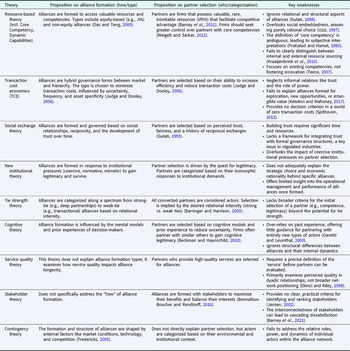
Alliance networks are multi-actor systems in which organizations maintain multiple, simultaneous relationships that interact with one another. Unlike isolated alliances, networks exhibit interdependence, indirect effects, and emergent properties that cannot be understood by examining single ties in isolation (Gulati, Reference Gulati1998; Phelps and Paris, Reference Phelps and Paris2010). A theoretical foundation must therefore explain not only why alliances form but also how portfolios of relationships are structured, how partner choices are shaped by broader environments, and how coordination occurs across interconnected ties. As summarized in Table 1, existing theories address some of these issues but remain limited when applied to network-level phenomena.
Comparison of theories to explain value network component

Table 1. Long description
A table comparing theories to explain value network components. The table has 9 rows and 4 columns. The columns are Theory, Proposition on alliance formation, Proposition on partner selection, and Key weaknesses. The rows are Resource-based theory, Transaction cost economics, Social exchange theory, New institutional theory, Tie strength theory, Cognitive theory, Service quality theory, Stakeholder theory, and Contingency theory. Each row lists the theory, its proposition on alliance formation, its proposition on partner selection, and its key weaknesses.
Much of the alliance literature has been shaped by the Resource-Based View (RBV) and Transaction Cost Economics (TCE). RBV explains alliances as mechanisms for accessing complementary resources and capabilities (Barney et al., Reference Barney, Ketchen and Wright2011), while TCE focuses on aligning governance structures with transaction characteristics such as uncertainty and asset specificity (Williamson, Reference Williamson1985). Although these perspectives explain why alliances arise and how individual relationships are governed, their limitations become apparent in network contexts. Both approaches are fundamentally dyadic, treating alliances as discrete decisions and largely overlooking interdependence among multiple ties. Consequently, they provide limited explanations for alliance portfolios, network positioning, or the diffusion of similar alliance forms across organizations operating in the same field (Parmigiani and Rivera-Santos, Reference Parmigiani and Rivera-Santos2011).
Moreover, RBV and TCE emphasize efficiency-oriented motivations and struggle to explain network phenomena driven by legitimacy, conformity, or symbolic alignment. Organizations may adopt similar partnership structures not because they maximize efficiency but because they are perceived as appropriate or credible within a shared environment. These dynamics point to the need for perspectives that account for field-level pressures and collective patterns of behaviour.
Neo-institutional theory addresses these concerns by shifting the level of analysis from individual transactions to organizational fields. It explains convergence in organizational practices through coercive, normative, and mimetic pressures (DiMaggio and Powell, Reference Dimaggio and Powell1983). From a network perspective, institutional theory clarifies why alliance forms diffuse across organizations, why certain partners become widely accepted, and why organizations exposed to similar environments often develop structurally similar alliance networks (Gulati and Higgins, Reference Gulati and Higgins2003).
However, neo-institutional theory also has limitations for network analysis. While it explains convergence at the field level, it offers limited insight into relational differentiation within networks. Organizations subject to similar pressures often maintain different partners, governance intensities, and network positions. Institutional theory therefore under-specifies how alliances are enacted through concrete relationships and how organizations interpret and respond to institutional demands.
Tie strength theory provides a relational lens that complements this institutional perspective. Building on Granovetter’s (Reference Granovetter1973) distinction between strong and weak ties, it explains how different relationships support different forms of coordination, information exchange, and learning. Strong ties facilitate trust-based coordination and the transfer of complex knowledge, whereas weak ties provide access to diverse information and novel opportunities (Uzzi, Reference Uzzi1997). In alliance networks, tie strength captures variation in relational intensity across a firm’s portfolio of partnerships.
Yet tie strength theory also has limitations. As summarized in Table 1, it offers limited explanation for why certain ties emerge or why particular relational patterns become prevalent across organizations. Without considering broader institutional environments, it risks treating network structures as outcomes of interaction without explaining their external drivers.
Taken together, no single theory adequately explains alliance networks as holistic systems. RBV and TCE clarify why alliances exist but overlook network interdependence; neo-institutional theory explains convergence but underplays relational mechanisms; and tie strength theory explains relational functioning but lacks contextual grounding. Addressing alliance networks therefore requires an integrated approach.
This study combines neo-institutional theory and tie strength theory to capture both the external pressures shaping alliance networks and the relational mechanisms through which these pressures are enacted. Institutional theory explains why organizations face incentives to align their alliance strategies, while tie strength theory clarifies how they differentiate relationships within the network. Trust emerges at the intersection of these perspectives, reflecting both shared institutional expectations and repeated interaction. The resulting framework, illustrated in Figure 1, provides a foundation for analysing how alliance networks form, evolve, and generate both coordination and vulnerability.
Initial conceptual model of the alliance network.

Research methodology
This study develops a conceptual model of alliance networks by integrating neo-institutional isomorphism and tie strength theory. Alliance networks are shaped by institutional pressures and relational mechanisms, requiring a synthesis of diverse theories anchored in cumulative empirical evidence. We used an integrative literature review with a structured deductive–inductive content analysis to advance theory in a complex domain (Torraco, Reference Torraco2005).
An integrative literature review enables reinterpreting and recombining existing knowledge to generate new conceptual insights, linking network-level theory with recurring empirical patterns in alliance research. Guided by a programmatic theory approach (Aguinis and Cronin, Reference Aguinis and Cronin2022), we assessed dominant alliance theories for network-level explanatory power, identifying gaps that neo-institutional theory and tie strength theory help address.
The literature search was conducted in Scopus using combinations of terms related to ‘alliance’, ‘network’, and ‘bank’, drawing on established reviews (Barringer and Harrison, Reference Barringer and Harrison2000; Gulati and Higgins, Reference Gulati and Higgins2003; He et al., Reference He, Meadows, Angwin, Gomes and Child2020; Parmigiani and Rivera-Santos, Reference Parmigiani and Rivera-Santos2011). We restricted the sample to English-language, peer-reviewed journals in business and management, ensuring academic rigour between 1986 and 2025 (please see Online Appendix 1). The initial yield was 3,482 publications.
To ensure quality and relevance, we implemented a two-stage screening process. First, we limited the sample to A and A* journals (ABDC classification lists), reducing the pool to 423 studies. Second, we conducted conceptual screening to retain articles addressing (i) studies not focused on financial institutions, (ii) use of alliance or network terminology in a metaphorical or non-substantive sense, (iii) studies examining only intra-organizational collaborations, and (iv) empirically void conceptual or commentary pieces. The second step yielded a final dataset of 98 empirical articles used for content analysis.
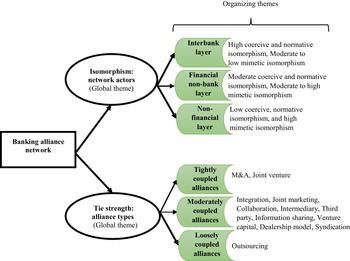
Drawing on the theoretical frameworks, we developed an analytical scheme positioning alliance forms along a continuum from tightly to loosely coupled arrangements (Barringer and Harrison, Reference Barringer and Harrison2000) and classifying network actors into three layers – interbank actors, non-bank financial institutions, and non-financial institutions – drawing on multi-layer network literature (Amici et al., Reference Amici, Fiordelisi, Masala, Ricci and Sist2013). This framework guided the coding strategy (Figure 2).
Network of themes.

Figure 2. Long description
A diagram of the network of themes. The diagram is divided into two main sections: Isomorphism: network actors and Tie strength: alliance types. The Isomorphism section includes three layers: Interbank layer, Financial non-bank layer, and Non-financial layer. Each layer is associated with different levels of coercive, normative, and mimetic isomorphism. The Tie strength section categorizes alliances into Tightly coupled alliances, Moderately coupled alliances, and Loosely coupled alliances, each with specific types of alliances listed. Arrows indicate the flow from the Banking alliance network to the respective themes and layers, showing the relationships and categorizations within the network.
The core method combined deductive coding with inductive refinement. Deductively, articles were coded for alliance type, tie strength, institutional pressures, and actor category using predefined theoretical constructs. Inductively, themes and patterns emerged from the data, capturing how alliances were described and evaluated across studies. This mixed approach ensured theory-driven categorization while remaining sensitive to empirical variation (Boyatzis, Reference Boyatzis1998; Braun and Clarke, Reference Braun and Clarke2006).
Results were synthesized into a thematic network (Figure 2) and a co-occurrence matrix (Table 2), illustrating concept clusters and the frequency of alliance types by actor category. These outputs underpin the refinement of the conceptual framework and the articulation of propositions. Finally, the model was compared with alternative theories and applied research in the alliance and financial services literatures to assess internal coherence and practical relevance, without overstating generalizability beyond the reviewed studies.
Code co-occurrence matrix of convergence of alliance types-network actors

+++ High emphasis; ++ Medium emphasis; + Low emphasis.
Developing the preliminary conceptual model
Figure 1 presents the preliminary conceptual model, which conceptualizes alliance networks as outcomes of interactions between institutional isomorphic pressures and relational tie strength. Rather than viewing alliances as isolated dyads, the framework emphasizes how organizations position themselves within interdependent networks shaped by external institutional forces and internal relational dynamics.
The model is structured as a two-dimensional matrix. The vertical axis captures the three forms of institutional isomorphism – coercive, normative, and mimetic (DiMaggio and Powell, Reference Dimaggio and Powell1983) – while the horizontal axis represents variation in tie strength, ranging from weak to strong ties (Granovetter, Reference Granovetter1973; Uzzi, Reference Uzzi1997). Together, these dimensions generate a typology of alliance profiles that reflects coordination under different combinations of institutional guidance and relational embeddedness. The model is not deterministic; it highlights contingent patterns rather than fixed outcomes. In the reviewed empirical literature, variation in tie strength is most often expressed through alliance governance forms – such as mergers and acquisitions, joint ventures, equity participation, integration, outsourcing, and information sharing – rather than standardized relational metrics (e.g., interaction frequency).
At a general level, limited institutional guidance combined with weak ties leads organizations to rely more on imitation under uncertainty. By contrast, strong institutional pressures coupled with dense ties are associated with higher coordination, stability, and mutual commitment. These outcomes arise from the interaction of institutional and relational mechanisms rather than from either dimension alone.
Two contextual conditions shape these interactions. First, institutional environments vary in how coercive and normative pressures are designed and enforced, influencing the degree of required coordination. Second, technological change introduces uncertainty and new coordination demands that reshape both institutional expectations and relational structures (Nambisan et al., Reference Nambisan2017). These contexts condition how organizations respond to isomorphic pressures within alliance networks.
Coercive isomorphism: A contingent driver of tie strength
Coercive isomorphism arises from formal regulations, legal mandates, and authoritative pressures that define acceptable organizational practices (DiMaggio and Powell, Reference Dimaggio and Powell1983). From a network perspective, coercive pressures influence tie strength when they require coordination, interoperability, or shared compliance mechanisms among organizations. In such cases, repeated interaction and mutual adjustment encourage stronger, more embedded ties (Gulati and Singh, Reference Gulati and Singh1998).
However, coercive pressures do not uniformly strengthen alliances. Regulations designed to preserve competition or limit coordination may constrain tie intensity by design. Recent technological developments, including standardized digital infrastructures and automated compliance systems, can further shape how coercive pressures affect coordination by increasing predictability while reducing discretion.
S1. Coercive isomorphism is associated with stronger alliance ties when regulatory or authoritative pressures require coordination or shared compliance. When coercive pressures emphasize separation or competition, this association weakens.
Normative isomorphism: The foundational role of shared standards
Normative isomorphism stems from shared professional norms, values, and standards that guide organizational behaviour (Scott, Reference Scott2014). Within alliance networks, normative alignment reduces interpretive ambiguity and supports coordination by establishing common expectations. Shared professional practices and technological standards facilitate collaboration by increasing reliability and mutual understanding among partners (Gulati, Reference Gulati1998). Normative pressures vary across contexts and over time, and their influence depends on the degree to which shared standards are institutionalized. Consequently, normative isomorphism strengthens alliance ties only when common norms are widely recognized and adopted.
S2. Normative isomorphism facilitates stronger alliance ties by aligning expectations and routines among organizations, particularly where shared professional or technological standards are well established.
Mimetic isomorphism: The response to uncertainty
Mimetic isomorphism occurs when organizations imitate the practices of others perceived as successful or legitimate under conditions of uncertainty (DiMaggio and Powell, Reference Dimaggio and Powell1983). In alliance networks, imitation serves as a provisional coordination mechanism when formal rules or shared norms provide limited guidance. Such behaviour is often associated with weaker ties that allow learning and experimentation without deep relational commitment (Granovetter, Reference Granovetter1973). As coercive or normative structures become more established, reliance on imitation typically declines, as organizations gain clearer guidance regarding acceptable practices. Technological change frequently amplifies uncertainty, thereby increasing opportunities for mimetic behaviour (Haunschild and Miner, Reference Haunschild and Miner1997).
S3. Mimetic isomorphism is more prevalent when coercive and normative pressures are weak and alliance ties are loosely embedded, functioning as a substitute coordination mechanism under uncertainty.
Content analysis results
This section reports the results of the deductive–inductive content analysis conducted on the final sample of 98 empirical studies. The purpose of the analysis is not hypothesis testing, but the identification of recurring patterns in how alliance networks are conceptualized and described across the literature, and how these patterns align with the theoretical framework developed in the previous sections. Following established qualitative analysis procedures, the coding process generated global themes, organizing themes, and basic codes that capture key elements of alliance networks (Boyatzis, Reference Boyatzis1998; Braun and Clarke, Reference Braun and Clarke2006).
The deductive component of the analysis was guided by the two core dimensions of the framework presented in Figure 1. Consistent with prior research on alliance networks, these dimensions are network actors and alliance types (Mason et al., Reference Mason, Lalwani and Boughton2007). They served as global themes corresponding to the vertical and horizontal axes of the framework. Inductively, patterns within these dimensions were identified across the empirical literature. To visualize the relationships among concepts and themes, a thematic network was constructed and is presented in Figure 2.
Network actors
Organizations form alliances with a variety of partners that occupy different institutional positions relative to the focal organization and the broader industry (Napier et al., Reference Napier, Mathiassen and Robey2011). Following Amici et al. (Reference Amici, Fiordelisi, Masala, Ricci and Sist2013) and the logic of institutional isomorphism, network actors were categorized into three layers based on their institutional proximity and functional similarity: the interbank layer, the non-bank financial institutions layer, and the non-financial institutions layer.
The interbank layer includes actors operating within the core banking field, such as commercial banks, payment and settlement systems, and central banking institutions. These actors typically share regulatory frameworks, professional norms, and standardized practices. The non-bank financial institutions layer comprises organizations adjacent to banking, including insurance companies, investment firms, fintechs, and credit institutions. The non-financial institutions layer includes actors outside the financial sector, such as information and communication technology firms, high-technology companies, startups, and entrepreneurial ventures.
Of the 98 reviewed articles, 90 examined alliances involving actors from a single layer, while 8 studies addressed relationships spanning two or more layers (see Online Appendix 2). Because some studies examined multiple actor categories, the total number of coded actor instances across layers was 110. Of these, 30 instances were associated with the interbank layer, 33 with the non-bank financial institutions layer, and 47 with the non-financial institutions layer. These frequencies indicate the relative emphasis of existing empirical research rather than the actual prevalence of alliances in practice.
Alliance types
Alliance types were categorized using tie strength theory, which conceptualizes interorganizational relationships along a continuum from strong to weak ties (Granovetter, Reference Granovetter1973; Uzzi, Reference Uzzi1997). Drawing on Barringer and Harrison (Reference Barringer and Harrison2000), alliances were classified from tightly coupled arrangements (e.g., mergers and acquisitions, joint venture), through moderately coupled forms (e.g., information sharing, venture capital), to loosely coupled arrangements (e.g., outsourcing).
Across the dataset, 12 distinct alliance types were identified and coded. At least one alliance type was coded in each article, and multiple types were coded when studies examined more than one form of collaboration. This approach captures variation in relational intensity while acknowledging that alliance forms often exist along a continuum rather than as discrete categories.
The global and organizing themes were specified deductively beforehand, so coder agreement was required only for assigning codes and linking them to these themes. Coding and attribution were conducted in iterative, consensus‑based discussions among the authors rather than via independent parallel coding. As a result, conventional inter‑coder reliability measures (e.g., Cohen’s kappa, percentage agreement) are not applicable and were not computed (Lombard et al., Reference Lombard, Snyder Duch and Bracken2002; Krippendorff, Reference Krippendorff2018).
Developing code co-occurrence matrix
To examine associations between alliance types (tie strength) and network actors (isomorphism) in the empirical literature, a code co-occurrence matrix was developed (Table 2). The matrix captures how specific alliance types are emphasized in relation to particular actor categories based on their joint occurrence in the reviewed studies.
Each cell reports the relative frequency with which an alliance type co-occurs with a given actor layer. To enable comparison across actor categories, frequencies were normalized by dividing each cell’s count by the cumulative frequency of its column. Emphasis levels were then expressed symbolically rather than through raw counts.
Percentages above 75% are classified as high (+++), between 50% and 75% as moderate (++), and between 25% and 50% as low (+); values below 25% indicate no meaningful emphasis. These quartile-based thresholds are commonly used in content analysis (Krippendorff, Reference Krippendorff2004; Neuendorf, Reference Neuendorf2002). In our data, most alliances show low co-occurrence values, while only a few reach high levels. However, these high-value alliances recur frequently and represent the most stable relationships in the institutional environment.
As shown in Table 2 and consistent with the thematic network in Figure 2, alliance types are grouped along the horizontal axis into loosely, moderately, and tightly coupled forms. Three patterns emerge. First, tightly coupled alliances show high emphasis (+++) with interbank actors, indicating convergence around deep coordination among institutionally proximate organizations. Second, among non-bank financial institutions, no alliance type reaches high emphasis; instead, moderately coupled arrangements such as information sharing and intermediary alliances display medium emphasis (++), suggesting strategic diversity. Third, among non-financial institutions, moderately and loosely coupled alliances – such as joint marketing collaborations, venture capital partnerships, and outsourcing – are most frequently emphasized, typically at medium (++) or low (+) levels.
Overall, the co-occurrence analysis synthesizes how prior studies emphasize particular combinations of actor categories and alliance forms. These patterns provide empirical grounding for the conceptual framework and inform refinement of the subsequent propositions.
Developing the banking alliance network model
Building on the theoretical framework developed in the Content analysis results section and the empirical patterns synthesized in the Developing the banking alliance network model section, this study develops a banking alliance network model that explains how alliance types align with different categories of network actors under varying institutional conditions. The model, presented in Figure 3, integrates neo-institutional theory and tie strength theory to capture how coercive, normative, and mimetic isomorphism interact with relational intensity across the alliance network.
Banking alliance network model.

In Figure 3, the vertical axis represents the relative intensity of institutional isomorphism, while the horizontal axis captures variation in tie strength. The model does not assume fixed or optimal alliance choices; rather, it reflects recurring configurations emphasized in the empirical literature, as indicated by high (+++) and moderate (++) convergence levels in Table 2. These configurations represent network-level tendencies under specific institutional conditions, not prescriptive rules.
The model developed in this study and its propositions derived apply to organizational settings characterized by institutional formalization and regulatory oversight, such as banking systems in developed economies. In these contexts, organizational legitimacy is shaped by mature governance frameworks, standardized compliance mechanisms, and relatively transparent market structures. The theoretical relationships proposed here are therefore most relevant where institutional rules are explicitly codified and actively enforced. While the general logic may extend to other institutional environments, variations in regulatory capacity, market informality, or enforcement strength may substantially alter how these mechanisms operate.
Isomorphism across network layers
Actors positioned within the interbank layer are subject to more intense coercive and normative pressures than actors in adjacent layers due to shared regulatory frameworks, legal mandates, and professional standards (DiMaggio and Powell, Reference Dimaggio and Powell1983; García-Casarejos et al., Reference García-Casarejos, Alcalde-Fradejas and Espitia-Escuer2009; Gulati and Higgins, Reference Gulati and Higgins2003). Compliance with banking regulation and supervisory requirements is central to legitimacy in this layer, reinforcing convergence in organizational structures and practices (Ross, Reference Ross2022). As a result, coercive and normative isomorphism are more pronounced among interbank actors than among non-bank financial institutions or non-financial institutions.
Normative isomorphism further reinforces this convergence through shared professional certifications, industry standards, and international best practices that diffuse across the core banking field (Novindra Idroes et al., Reference Novindra Idroes, Tisnawati Sule, Rufaidah and Sari2017). In contrast, actors located in non-bank financial and non-financial layers face weaker or more heterogeneous institutional pressures, resulting in lower overall levels of coercive and normative alignment with the banking field.
P1. Coercive and normative isomorphism are more prevalent among interbank actors than among actors in the non-bank financial institutions and non-financial institutions layers.
Mimetic isomorphism operates differently across network layers. While imitation is common among industry peers, its influence on alliance decisions is reduced where coercive and normative guidance is strong, as such guidance lowers uncertainty and clarifies acceptable practices (Jepsona et al., Reference Jepsona, Kirytopoulosb and Chileshe2020). Where coercive and normative pressures weaken – particularly in alliances involving non-bank financial or non-financial actors – uncertainty increases, and imitation becomes a more salient coordination mechanism (Martínez-Ferrero and García-Sá, Reference Martínez-Ferrero and García-Sá2017).
P2. Mimetic isomorphism is less influential than coercive and normative isomorphism within the interbank layer but becomes more influential in alliances involving non-bank financial and non-financial institutions due to higher uncertainty.
Alignment of alliance types and network actors
Statements S1–S3 developed in the Content analysis results section explain how different forms of isomorphism shape tie strength. Institutional pressures shape the coordination challenges that banks face when forming and managing alliances. Coercive, normative, and mimetic pressures increase the need to demonstrate conformity with accepted practices, gather information about legitimate alliance partners, and align alliance structures with institutional expectations. These requirements raise search, negotiation, and coordination costs in inter-bank relationships (Gulati and Singh, Reference Gulati and Singh1998). However, the extent to which institutional pressures translate into higher transaction costs depends on relational embeddedness. Strong ties reduce information asymmetries, facilitate trust-based exchanges, and lower the need for detailed monitoring and contractual safeguards. Thus, strong ties moderate the cost-raising effects of institutional pressures, whereas weak ties amplify them. This mechanism clarifies how institutional forces and tie strength jointly shape alliance configurations in the banking network model. The empirical synthesis in Table 2 shows that alliance types with high (+++) or moderate (++) convergence are systematically associated with specific network layers. These patterns provide the basis for the alliance profiles depicted in Figure 3.
For interbank alliances, the primary objective is stability and risk reduction, particularly under systemic stress (Anderson et al., Reference Anderson, Calomiris, Jaremski and Richardson2018). Achieving these objectives requires coordination, shared infrastructures, and frequent interaction (Holthausen and Rochet, Reference Holthausen and Rochet2006). Accordingly, alliance forms with strong tie intensity, such as mergers and acquisitions, joint ventures, and deep integration, exhibit high or moderate convergence (+++/++) in the interbank layer. Where coercive or normative alignment is weaker, moderately coupled arrangements such as integration or structured information sharing provide coordination without full organizational coupling (Bermpei et al., Reference Bermpei, Kalyvas, Neri and Russo2018; Gartenberg and Pierce, Reference Gartenberg and Pierce2017).
P3. For alliances with interbank actors, strong-tie arrangements (e.g., mergers and acquisitions, joint ventures) are associated with high coercive and normative isomorphism, while moderately coupled alliances (e.g., integration, information sharing) are more prevalent where institutional alignment is weaker.
In alliances with non-bank financial institutions, coercive and normative pressures are more moderate, reflecting regulatory diversity and functional heterogeneity. Empirical studies emphasize moderately coupled alliances – particularly information-sharing arrangements – with medium convergence (++), enabling coordination around data, standards, and complementary resources without deep structural integration (Jagtiani and Lemieux, Reference Jagtiani and Lemieux2019; Velu, Reference Velu2016).
P4. For alliances with non-bank financial institutions, where coercive and normative isomorphism are moderate, alliances with moderate tie intensity (e.g., information sharing) are more prevalent.
Alliances with non-financial institutions are characterized by greater institutional distance and higher uncertainty. Empirical convergence in this layer centres on moderately and loosely coupled arrangements, including venture capital partnerships, joint marketing collaborations, dealership models, intermediary platforms, syndication networks, and outsourcing (Fock et al., Reference Fock, Woo and Hui2005; Gewald and Dibbern, Reference Gewald and Dibbern2009; Houston et al., Reference Houston, Lee and Suntheim2018; Wonglimpiyarat, Reference Wonglimpiyarat2007). These alliance forms allow flexibility, experimentation, and access to complementary capabilities while limiting coordination and control costs (Weigelt and Sarkar, Reference Weigelt and Sarkar2012).
P5. For alliances with non-financial institutions, moderately coupled alliances (e.g., venture capital, joint marketing collaboration, intermediary and syndication networks) are associated with moderate isomorphism, while loosely coupled alliances (e.g., outsourcing) are more prevalent where institutional alignment is low.
Together, these propositions constitute a network-level model that explains how institutional pressures and relational mechanisms jointly shape alliance portfolios across different layers of the banking ecosystem.
Discussion
Theoretical implications
This study advances understanding of alliance networks by developing a network-level model that integrates neo-institutional isomorphism and tie strength theory. Unlike prior work centred on dyadic alliances or single theoretical lenses, the model shows how institutional pressures and relational mechanisms jointly shape alliance portfolios across interconnected actors. By treating alliances as embedded within networks rather than isolated governance choices, the study responds to calls for more systemic and institutionally grounded explanations of interorganizational cooperation.
A key theoretical contribution is clarifying how different forms of isomorphism operate unevenly across network layers and interact with tie strength. Whereas much of the alliance literature abstracts from institutional context, the model shows that coercive and normative isomorphism are more salient among institutionally proximate actors, while mimetic isomorphism plays a stronger role under uncertainty and institutional distance. This configurational logic helps explain why similar organizations converge on comparable alliance strategies, while heterogeneous actors rely on more flexible, exploratory relationships.
The model also complements transaction cost economics rather than contradicting it. Transaction cost theory explains alliance governance as a response to uncertainty, asset specificity, and opportunism (North, Reference North1992; Williamson, Reference Williamson1985), and higher uncertainty typically increases coordination and monitoring costs, leading organizations to favour less rigid governance (Sent and Kroese, Reference Sent and Kroese2022). The present model extends this logic by showing how institutional alignment and relational embeddedness reduce uncertainty and foster trust, thereby shaping governance choices at the network level rather than solely within dyads. In this sense, isomorphism and tie strength operate as mechanisms through which transaction costs are managed in institutionalized environments (McMackin et al., Reference McMackin, Chiles and Lam2022).
The model is further aligned with institutional perspectives on trust and reciprocity. As North (Reference North1992, Reference North and Shorrocks2005) argues, repeated interaction and shared norms reduce the need for formal contracting over time. Consistent with this view, the findings suggest that institutional alignment facilitates stronger ties by stabilizing expectations and reducing ambiguity, without implying that strong ties are inevitable or universally optimal. This distinction is especially relevant in digitally mediated economies, where traditional transaction costs decline while new forms of uncertainty and trust requirements emerge (Bentkowska, Reference Bentkowska2021; Greif, Reference Greif2000).
The theoretical scope of the model is, however, bounded. By emphasizing legitimacy and institutional alignment, the framework foregrounds convergence and coordination mechanisms rather than strategic agency or power asymmetries. This positioning reflects the study’s focus on explaining network-level regularities in alliance formation rather than firm-specific optimization or value appropriation strategies.
Practical implications
The proposed model offers important implications for managerial decision-making and policy analysis. For bank managers, it provides a framework for aligning alliance strategies with institutional conditions and partner characteristics. Regulatory requirements such as Basel III capital standards and anti-money laundering rules create coercive pressures that encourage coordination through shared infrastructures and standardized practices (Nguyen et al., Reference Nguyen, Le and Freeman2006; Shabir et al., Reference Shabir, Jiang, Bakhsh and Zhao2021). Strategic alliances – including participation in industry-wide networks (e.g., SWIFT) and collaboration with fintech firms – can thus be understood as mechanisms for reducing uncertainty through institutional conformity and relational design.
Beyond firm-level strategy, the model sheds light on structural dynamics in banking. Market concentration may reflect not only economies of scale or regulatory burdens but also network strategies. Strong, trust-based alliances enhance resilience during stress, yet they can reinforce advantages for central actors and marginalize peripheral ones (Allen and Babus, 2009; Uzzi, Reference Uzzi1997). Over time, reliance on strong ties among dominant institutions may contribute to consolidation even without formal mergers.
These insights carry implications for regulatory and competition policy. Traditional antitrust approaches emphasize market share and ownership structures, but network positioning and relational embeddedness may also constitute relational market power. Banks embedded at the centre of dense alliance networks can exert influence not captured by conventional concentration metrics.
As illustrated in Figure 4, alliances evolve through a reinforcing cycle: isomorphic pressures shape initial cooperation, tie strength develops through repeated interaction, and successful collaborations become institutionalized. Strong ties may generate norms that diffuse across the field (normative isomorphism), are imitated by others (mimetic isomorphism), and eventually formalized into regulation (coercive isomorphism). Alliance networks are therefore not only shaped by institutions but also contribute to institutional evolution.
Evolution of alliances over time.

Digital transformation intensifies these dynamics. Technologies such as blockchain introduce ‘algorithmic trust’ through smart contracts and automated enforcement, reshaping relationships between trust, control, and governance (Catalini and Gans, Reference Catalini and Gans2020; Davidson et al., Reference Davidson, Primavera and Potts2018). Algorithmic mechanisms can substitute for strong relational ties in standardized transactions or complement them in complex innovation contexts by reducing coordination costs (Lumineau et al., Reference Lumineau, Wang and Schilke2021). These developments reinforce the relevance of the model for alliance formation in digitally mediated and highly regulated environments.
Industry guidance further corroborates the model. Gartner’s typology (service provider, business partner, trusted ally, and outsider) is grounded in trust and control (Panetta, Reference Panetta2019); the proposed framework operationalizes these dimensions through tie strength constructs and extends them by incorporating interbank, non-bank financial, and non-financial actor layers specific to banking. Accenture’s emphasis on partner selection and alliance diversity (Gera et al., Reference Gera, Secchi, Gagliardi and Svahn2019) aligns with the model’s spectrum of tie intensity but is expanded through attention to actor diversity and adaptability. McKinsey’s focus on resource-sharing mechanisms (Sengupta et al., Reference Sengupta, HV, Chung, Ji, Ng, Xiao, Koh and Chen2019) is broadened by positioning resource dependency as a driver of isomorphism that shapes interbank relationships.
Conclusions
This study develops a network-level framework for understanding banking alliances by integrating neo-institutional isomorphism and tie strength theory. Drawing on a synthesis of 98 empirical studies, it shifts the analytical focus from isolated dyads to patterned configurations within alliance networks embedded in shared institutional environments. The analysis identifies systematic variation across network layers: strong and moderately strong ties prevail among interbank actors facing intense coercive and normative pressures; moderately coupled arrangements dominate alliances with non-bank financial institutions; and moderately or loosely coupled forms are most common in collaborations with non-financial actors. These patterns suggest that alliance design reflects institutional proximity, legitimacy requirements, and uncertainty alongside efficiency considerations.
The study contributes to institutional economics by clarifying how institutional pressures and relational mechanisms jointly shape alliance portfolios. Coercive and normative isomorphism stabilize coordination where institutional guidance is strong, whereas mimetic processes become more salient under uncertainty, complementing transaction cost explanations without assuming uniform strategic motivations.
Several limitations remain. The framework derives from a literature-based synthesis and reflects patterns emphasized across studies rather than direct observations of alliance behaviour, limiting causal inference. Future research could empirically test these relationships across regulatory regimes, examine temporal dynamics in alliance networks, and assess how technological change reshapes institutional and relational alignment over time.
Supplementary material
The online Appendices as the supplementary material for this article can be found at https://doi.org/10.1017/S1744137426100617.
Declaration of use of AI in the writing process
The authors declare that generative AI tools were used exclusively to support language editing and readability. All content was reviewed and edited by the authors, who take full responsibility for the final version of the article.



 Open access

