

The heroine of a short story published in 1834 reclines by an open window one evening and hears a distant guitar, as if ‘to complete the romance of the scene’.Footnote 1 Short stories written during the 1830s for magazines of fashion and chit-chat like La Belle Assemblée, where this one appeared, contain many such nocturnal episodes involving a guitar. The player, generally a man (the sense of a serenade is rarely far away) and an accomplished amateur, plays soft and beguiling sounds in the open air. He is usually heard before he is seen, adding to the sense of romance and mystery as the music travels on the warm evening zephyrs of some southern clime. Although the stories that enfold these episodes are easy to dismiss as literary works of minimal pretensions, they are nonetheless revealing: they show that the idea of a guitar could create expectations that the experience of actually hearing one played indoors, in a professional and concert context, would be liable to confound.Footnote 2 A guitar of the 1830s was indeed softly voiced, but those who heard one in a large London hall, for example, might be inclined to dismiss it for being not worth carrying to a concert-room. According to one particularly severe critic in 1836, a guitar was ‘just calculated for the space of a sentry box or the back room of a shopkeeper in the Burlington Arcade’.Footnote 3 Only the most gifted soloists, whose talent won them an ephemeral fame, could aspire to a concert career in the sense of occasional public performance in such venues.Footnote 4 Some composer-players of distinction did emerge, notably Fernando Sor (1778–1839) and Trinidad Huerta (1800–74), both of whom were heard by London audiences;Footnote 5 yet neither those musicians nor any others with serious compositional ambitions for the guitar succeeded in composing works held in enduring esteem by the general musical public, as opposed to the instrument’s aficionados. As a result, modern historians of nineteenth-century music have generally overlooked the guitar, bypassing the many traces it has left in newspapers, publishers’ catalogues, and contemporary portraiture that reveal its powerful appeal to the domestic amateur.
Today, it seems an inducement rather than a deterrent that the guitar craze of 1800 to 1840 was a predominantly amateur affair. A view of nineteenth-century musical history that now encompasses urban soundscapes, for example, has a place for an instrument used by street singers who, if they were not amateurs in any familiar sense, were not professionals either, since they had no formal training, no contract of hire, and no guarantee of payment.Footnote 6 Equally auspicious is the recent interest in cheap prints or ‘songsters’ where amateur guitar players, perhaps otherwise working by ear, may often have found the words of the songs they wished to accompany.Footnote 7 The attention given to musical practices that used some alternative to staff notation should encourage a closer look at the way guitar players with ‘a good ear, and ordinary aptitude’ could store their repertoire of accompanied songs.Footnote 8 As a result of these and other developments, the history of the guitar in Britain has become a field of study as fertile as those currently being cultivated in other parts of Western Europe, amid a general resurgence of interest in historic guitars and period performance upon them.Footnote 9
Yet although the contexts for guitar research are now much more encouraging than they were as little as a generation ago, we should not minimize the limitations of the instrument or mistake the prospect it offered to the beginner. With its persistently romantic associations, its inchoate traditions of pedagogy, and its readiness to accommodate those of modest talent or ambition, the guitar was often taken up with an enthusiasm that could prove evanescent; in 1808 a London resident discovered ‘a tolerable Spanish Guittar’ that had already been consigned to the lumber room barely a decade into the British advance of interest in the instrument.Footnote 10 A broader picture of that development has to be assembled from advertisements, anecdotes, and reviews in newspapers or periodicals, from sheet music, letters, portraits of players, method books, auction lists and inventories of property, and extant instruments. A graph of the guitar’s fortunes compiled from such varied sources is unlikely to produce a smooth or decisive curve and may be expected to have lacunae. Moreover, the chart may also show an abrupt dip or rise from time to time, perhaps caused by a single data point.Footnote 11
One kind of source, however, has generally been overlooked, namely manuscripts of guitar-accompanied song compiled by amateurs for their own use. Despite the focused contribution such sources can make to the social and musical history of the guitar, especially if they are dated and associated with specific persons, there is currently no available survey of them.Footnote 12 To be sure, it is possible that such manuscripts were not made as often as we might suppose. To judge by the way many guitarists play today, their nineteenth-century forebears may often have devised accompaniments by ear alone. Ciebra’s Hand-Book for the Guitar, a shilling tutor published in London around 1860, revealingly aspires to form players that can ‘execute an impromptu Accompaniment to almost any melody’.Footnote 13 The musically literate could adapt the pianoforte parts they encountered in print or manuscript.Footnote 14 For the purposes of notating more considered and stabilized accompaniments, moreover, some nineteenth-century guitarists used homemade systems denoting chords with letters, fretboard diagrams (‘chord boxes’), or other devices noted on ephemeral sheets or even scraps of paper. There is an example of such a fragment in the archive of the late-Victorian guitariste Mina Norton, probably prepared for a member of her guitar and mandolin band.Footnote 15 There were nonetheless various ways in which players could be drawn to compile a private manuscript of their repertoire for the guitar in a more orthodox manner. They might relish the now-vanished art of meticulous and exacting penmanship for its own sake, perhaps using paper from a stationer’s fancy range and employing their most ornate handwriting, striving for music symbols with the neatness and regularity of engraving. The result, once completed, might be a travelling companion, the memento of a particular time in the compiler’s life, or a piece of domestic handicraft for parlour display, like an album of drawings or a picture made of cut paper.Footnote 16
This article is devoted to three manuscript guitar books which show traces of all these motives for making a collection of guitar-accompanied song. Discovered serendipitously in bookshops or auction catalogues, none has ever figured in an institutional collection or bibliographical record hitherto.Footnote 17 Of particular interest is the range of places where these manuscripts were copied or used, for they include Trincomalee in Ceylon (now Sri Lanka) and Jabalpur in the Indian state of Madhya Pradesh, as well as Kempsey in Worcestershire and Dover in Kent. Because they are associated with particular names and specified dates, they do as much to construct the social context by which they are understood as they receive from what is already known or assumed.
It will be convenient to refer to them as Simmonds, Snowden, and Temple, after the individuals who signed and dated them:
Simmonds:
GB-Cssc Add. MS 122.
Signed and dated May 26th 1837 at ‘Trincomalie’ (now commonly spelled Trincomalee) in Ceylon (now Sri Lanka) by Mary E. Simmonds, who was possibly the principal copyist.
Snowden:
GB-Cssc Add. MS 123.
Signed and dated March 1838, probably at Dover, by Eleanor Snowden, later Darby.
Numerous hands, including Snowden’s own.
Temple:
GB-Cssc Add. MS 124.
Copied with entries dated from 1868 to 1901 in Cheltenham, Kempsey, London, Margate, Southsea, and various places in India, principally by John Alexander Temple.
Simmonds and Snowden gather repertoire from the peak years of the guitar fashion in Britain, approximately 1825 to 1835. The chronological gap between those two manuscripts and Temple, which takes up the story again in the late 1860s, corresponds to a mid-century dip in the guitar’s fortunes when the professional virtuosi of the peak years either passed into relative obscurity, like Leonard Schulz, or sought other forms of livelihood. Johann Abraham Nüske, for example, became a bookseller, while Ferdinand Pelzer increasingly concentrated upon his work as a singing-class teacher in the 1840s.Footnote 18 Temple, however, shows a player taking an interest in the guitar, principally considered as a means to accompany the voice, at a time of renewed interest in the instrument.
Simmonds
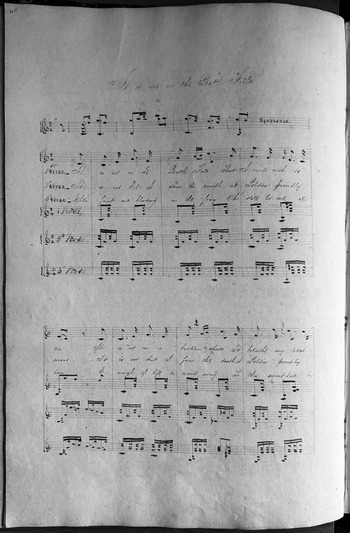
Mary E. Simmonds, of whom nothing else is known, signed and dated this book (Figure 1) on 26 May 1837 at Trincomalee in Ceylon, a colony of the British Empire that profited from the trade in cinnamon and coffee. Trincomalee offered a large harbour for merchant vessels and for a fleet kept in place to contain French ambitions in the Indian Ocean.Footnote 19 (Some of the blank pages in the manuscript carry a child’s crude and sometimes unfinished drawings of sailing ships.) Although neat and elegant, with highly accomplished calligraphy for song titles and text underlay, the general presentation possesses a somewhat homemade appearance (Figure 2). The minuscule notational symbols are sometimes mistakenly placed on extremely fine (and now often faded) staves barely four millimetres deep in total, compounding difficulties created by what is sometimes a faulty musical text.Footnote 20
The front cover of Simmonds (GB-Cssc Add. MS 122) after conservation by the Cambridge Colleges’ Conservation Consortium. Photo by permission of the Master and Fellows of Sidney Sussex College, Cambridge.

The first page of ‘It Is Not on the Battle Field That I Would Wish to Die’, by Thomas Haynes Bayly, as arranged for voice and single guitar in Simmonds (GB-Cssc Add. MS 122), p. 40. Photo by permission of the Master and Fellows of Sidney Sussex College, Cambridge.

To keep abreast of fashionable musical developments in London, in song as in much else, British expatriates in Ceylon relied upon the maritime commerce that moved regularly between London and imperial possessions in the Indian Ocean. If Simmonds was compiled as well as signed in Ceylon, this was the commerce which allowed the compiler(s) to assemble a repertoire evoking the London theatres, where audiences gathered for musical dramas like The Brigand. The printed arrangements drawn upon for the book include Charles Sola’s version of ‘Meet Me by Moonlight Alone’, published in London by Latour in 1827–28, and a copy of John Barnett’s hugely popular ballad ‘The Light Guitar’, originally a serenade sung by Madame Vestris in the comic drama The Epaulette, premiered in 1825. The manuscript also contains five arrangements attributed to an unknown G. M. H., whose attempts to write short instrumental introductions are as homemade as the layout of the pages on which they appear. Simmonds also includes a rarity, however, which shows how enterprising players might become when venturing arrangements for their own use. ‘It Is Not on the Battle Field That I Would Wish to Die’, by Thomas Haynes Bayly, was published for voice and pianoforte by Goulding & D’Almaine in 1828, with a different accompaniment for each of the three verses but following essentially the same harmonic scheme each time.Footnote 21 The version for voice and guitar in Simmonds follows this relatively unusual procedure (see Figure 2).Footnote 22
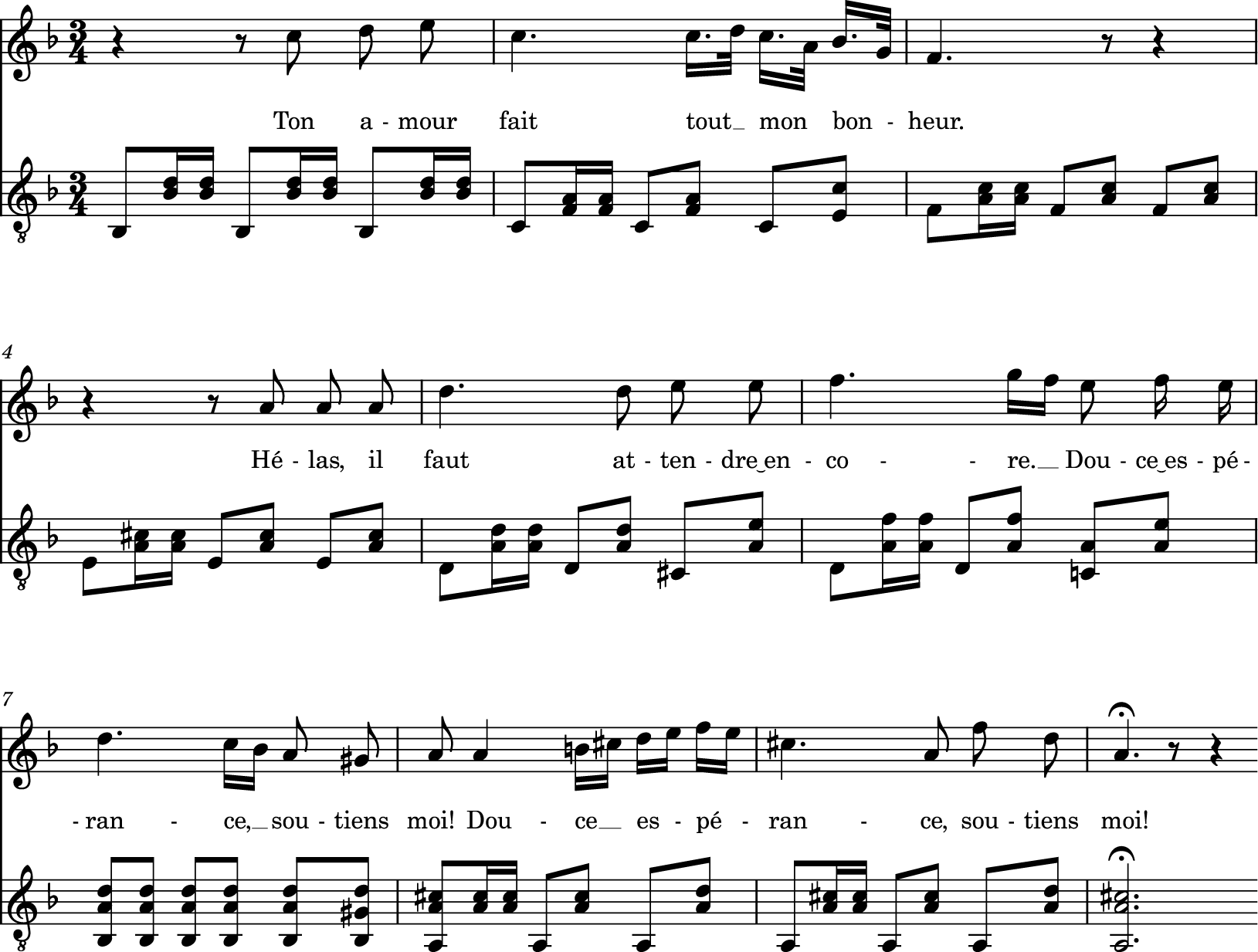
The suggestion of domestic elegance and civility that Simmonds conveys, with its calligraphic flourishes and general air of preciosity, does not efface the memory of the Napoleonic tumult barely a generation before and perpetuated into the 1830s by the South American wars of independence. ‘To Break Oppression’s Chains’ is a version of a Spanish patriotic song, ‘Vivir en cadenas’, composed during the war of 1807–14 when Spanish, Portuguese, and British forces succeeded in driving Napoleon’s soldiers out of Iberia.Footnote 23 Although composed by the guitar virtuoso Fernando Sor (whose political affiliations during the Peninsular War were unstable), the song has the simplicity of line, harmony, and sentiment required of an emotive work designed to be learned and taken up by many (Example 1).Footnote 24 In Simmonds the song appears as an arrangement for voice and guitar, perhaps homemade, in the key of G major, underlaid with a verse paraphrase of the Spanish text in English, but with the Spanish original, immaculately calligraphed by a different hand, placed after the score.
The beginning of ‘To break oppression’s chains’ (‘Vivir en cadenas’), arranged for voice and single guitar in Simmonds (GB-Cssc Add. MS 122), pp. 36–37.

Despite the care with which the Spanish text of ‘Vivir en cadenas’ is copied (but not underlaid), the repertoire of Simmonds is not particularly cosmopolitan, for fourteen of the seventeen songs are in English. The remaining three are in French.
Snowden
Snowden shows how far some amateur players were prepared to go in their search for repertoire that cast an aura of foreign-language lessons and trips to distant capitals around the singer, even if he or she (usually she) had no experience of either. Such material allowed amateur singers, often accompanying themselves, to participate in the vocal art of their high-born counterparts, here caught in a shaft of light cast by a private letter of 1827:
Since I wrote last the guitar is come and she [Lady Frances] sings to us every evening, the prettiest collection of things, Italian, German, Spanish, light and grave, and the voice is so sweet and so flexible, and the words so clear and the face so smiling, and the figure so binding, and the whole thing so perfectly lovely that in short there is no going to bed.Footnote 25
Snowden shows how such a country-house scene might be imitated in an urban villa. Eleanor Snowden was the daughter of a solicitor in the village of Charlton, on the main north road out of Dover, and was a much-published poet by the time she put her name to this manuscript collection of songs in French, Italian, Spanish, and Swiss German (see Figure 3).Footnote 26 (There are only two in English, and music was never added for one of them.) Miss Snowden was raised in a musical household, for her book also contains a little music for three other instruments of the drawing-room amateur, namely the harp and pianoforte (for women) and the flute (for men). Snowden signed the manuscript perhaps only days before she married Thomas Elde Darby on 8 April 1838, as if saying farewell to her maiden name, her single life, and the musical repertoire she particularly associated with it. The sense of a volume crossing the boundaries between personal memento, music book, and pastime handicraft is strong in this dainty and prettified album,Footnote 27 even though there may be the work of seven different hands in the book in addition to Snowden’s own.Footnote 28 The leaves measure only 184 mm x 137 mm, and the paper is decidedly decorative, with margins on all four sides and blind stamped on the recto with images of ancient musical instruments, among other motifs (Figure 4).
The front cover of Snowden (GB-Cssc Add. MS 123) after conservation by the Cambridge Colleges’ Conservation Consortium. Photo by permission of the Master and Fellows of Sidney Sussex College, Cambridge.

The first page of Bolero de la Cachucha (‘Al Amor lo comparo’) for voice and guitar as it appears in the guitar book of Eleanor Snowden (GB-Cssc Add. MS 123), p. 45. The page measures 184 mm x 137 mm. Copied, with great care, from Don Francisco V. de Molina’s guitar method The Spanish Lyre (London, the author, 1825), pp. 9–10. Photo by permission of the Master and Fellows of Sidney Sussex College, Cambridge.

Snowden reveals the interest excited by the various ‘Tyrolean’ bands that became fashionable in 1827 with the vocal concerts, including yodelling effects, of the Swiss Rainer family at a time when Alpine tourism had scarcely begun.Footnote 29 The members of the ensemble performed in ‘national’ costume and toured widely. Snowden has ‘Tyrolean’ airs with texts in French (‘Celui qui sut toucher mon cœur’) and English (‘The Swiss Boy’), both of which show the short-range repetition of motifs associated with such melodies, a prime source of the folkloric character that contemporaries discerned in them. There are also examples of Tyrolean material here with texts in Swiss German, suggesting an unusual depth of interest in such songs and a diligent search for authentic examples. Two are taken from Les Délices de la Suisse, ou choix de Ranz des Vaches, published in Basel by Ernest Knop around 1835; another comes from a London print (The Emmethaler Shepherd of 1830), while yet another is the final section of ‘Gruss an die Schweiz’ by Carl Blum, composed for the singer Anna Milder (later Milder-Hauptmann), who performed it throughout Europe and Russia.Footnote 30
In her own work as a poet, however, Eleanor Snowden was more inspired by the medieval and Moorish-Christian past of Spain than the landscapes of the Tyrol. This was an interest nurtured in the reading public during the Peninsular War by poets such as Felicia Hemans (England and Spain, 1808), Sir Walter Scott (The Vision of Don Roderick, 1811), and Walter Savage Landor (Count Julian, 1812). One of Snowden’s own narrative poems, The Moorish Queen of 1831, distils the mystique of medieval Iberia in a scene of guitar-accompanied singing at a Spanish royal court:
[The troubadour] bent, obedient to the Queen’s behest
And o’er his shoulder negligently slung
The Amorist’s guitar; then touch’d the strings
Clear as the silver sound of gushing springs
And a wild air in tuneful accents sung. [p. 15]
Materials to recreate this scene in the imagination of player and listener alike abound in Snowden, which opens with ‘L’Espagnole impatiente’, a song to gratify a taste for Spanish seguidillas boleras. With its exuberant melody prone to spring in just after the second main beat of the bar, its emphatically motivic accompaniment, its modulation, and its repeated accented dissonances, ‘L’Espagnole impatiente’ is considerably more flamboyant than anything usually attempted in polite guitar accompaniments for drawing-room ballads of the day with English words (Example 2).
Excerpt from ‘L’Espagnole impatiente’, from the guitar book of Eleanor Snowden (GB-Cssc Add. MSS 123), p. 1.

During the Peninsular War the guitar, long associated by British writers with what they believed to be Spanish indolence, became an emblem of a spirited activism: their struggle against the French invader.Footnote 31 The national instrument was conscripted into the service of the nation.Footnote 32 In 1810 the Manchester Mercury reported that a Spanish guerilla leader had challenged the French troops by brandishing his guitar as if it were a banner, while the first canto of Byron’s Childe Harold (1812) shows the legendary Maid of Saragossa hanging her guitar on a willow, like an Israelite of Psalm 137, before going forwards to fight.Footnote 33 Such romantic and martial associations rapidly gave the guitar a significant place in the commercialized pleasure culture of war, with its ‘interweaving of fashion, sociability and militarism’, that developed on the home front in Britain during the Peninsular conflict.Footnote 34 One of its principal musical monuments of the 1820s is a bilingual tutor for the guitar in Spanish and English entitled The Spanish Lyre (1825);Footnote 35 this is the source of five song arrangements in Snowden. The author, Don Francisco V. de Molina, is described on the title page as an ‘Officer in the Spanish Army’ and is very likely to be the Captain Molina who served under Sir William Carroll in the Peninsular War. He was one of the ‘hundreds of other brave Spaniards now in London’ mentioned in a newspaper report of 1825 and was evidently a musician, since the Morning Post praises him for giving ‘the highest gratification to the lovers of harmony’.Footnote 36 Three of the five songs Snowden takes from The Spanish Lyre, with scrupulous care, are underlaid with both English and Spanish texts in the original, but it is revealing that she copies only the Spanish (Figure 4).
The demand for such material declined once the ‘Great Vogue’ for the guitar wound down. In 1856, the Dorset newspaper that had once reported the sale by a London merchant of more than three thousand guitars in six months noted that the guitar ‘has fallen into general disfavor’ in recent years.Footnote 37 The guitar never sank below the horizon, however, for there were always some ready to grant the worth of its cardinal virtues: portability and a capacity for full harmony. These qualities commended it to touring entertainers like Sophia and Annie Brown, Emma Stanley, and Frederick Augustus Beverley, forgotten performers who included guitar-accompanied songs (and in some cases a solo) in their act.Footnote 38 Given that these entertainers toured widely, some of them into the 1860s, and were seen by many thousands of spectators, their contribution to the continuing (if quiet) life of the guitar in mid-nineteenth-century England was probably well in excess of those professional music masters in a position to add guitar lessons to their menu of services.
Temple
During the second half of the century there was a gradual recovery of interest in the guitar among British amateurs. To refer to this development as a ‘revival’ of guitar-playing may seem bold, but it is to venture no further than some contemporary observers were prepared to go. In 1886, when the compilation of Temple was well under way, readers of a local paper in Cheltenham learned that they could expect ‘a revived demand for guitars and guitar music’ in their spa town.Footnote 39 The following year a London correspondent reported that a ‘revival’ of the guitar was taking place to the point where it threatened to drive the banjo out of the drawing room.Footnote 40 By the end of the century, even the authors of romantic novels had noticed this development. J. H. Riddell’s Fair Abbotsmead, serialized in 1899, tells of a concert that was planned to include ‘Cockles and Mussels’ sung to a guitar; when it becomes clear that the lady who offered to do so cannot be present on the night after all, a volunteer offers to sing it instead, presumably to a pianoforte. One of the concert organizers immediately asks: ‘[What] about the guitar? That was one of the attractions.’ The volunteer, a late example of a guitar revivalist, gamely replies: ‘In the days of my faraway youth […] I knew something of the guitar, and […] have been trying to revive my knowledge, so I think everything may come off fairly well.’ There follows a vivid account of ‘Cockles and Mussels’ in performance as she sits down quietly, ‘as if alone in her own drawing room’, and sings with such good effect that her performance is greeted with a ‘stamping of feet and wild enthusiasm’.Footnote 41
To judge by more than a thousand references to amateur guitar-playing in the newspaper record of 1840 to 1900, especially in the south and the Midlands, this gradual resurgence of interest was principally manifest among singers wishing to accompany themselves.Footnote 42 The record is particularly abundant for the southern counties of Essex, Norfolk, Suffolk, Sussex, Hampshire, Somerset, and Dorset; it also reaches into the Midlands and northern centres such as Birmingham, Derby, Leeds, Liverpool, Manchester, Newcastle, and Sheffield.
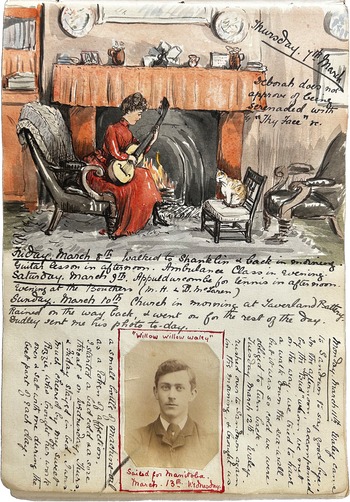
Temple is a monument to this British renewal of interest in guitar-accompanied song after the mid-century. The book also offers a timely reminder that the revival was not an exclusively female affair in the way that some sources, such as the remarkable illustrated diary of Maud Berkeley née Tomlinson (Figure 6), suggest.Footnote 43 John Alexander Temple, or JAT as he signed himself and as he will be called from now on, compiled much of his book in India, where he was both a military and a civil officer of the British imperial administration (Figure 7). More was added in England at The Nash, the Temple family’s spacious country house at Kempsey in Worcestershire (long since sold). JAT’s handsome and meticulously copied scores reflect the talents of his family, for like his father, Richard Temple, he was a gifted painter who had grown up among musicians.Footnote 44 His youngest sister, Augusta Anna, sang ‘prettily both to the piano and guitar’,Footnote 45 while another, Henriette Penelope, is presumably the HPT whose hand appears in the book.
The front cover of Temple (GB-Cssc Add. MS 124) before conservation by the Cambridge Colleges’ Conservation Consortium. Photo by permission of the Master and Fellows of Sidney Sussex College, Cambridge.

Maud Berkeley née Tomlinson (1859–1949) singing ‘Thy Face [Is Ever Near]’, in the sitting room of the Tomlinson family home at 7 Station Road, Sandown, on the Isle of Wight, as depicted in her illustrated diary (Sketch Book 1b, covering 1 January–17 August 1889). The scene is dated Thursday 7 March 1889. Private collection. Copyright Lorraine Wood.

John Alexander Temple (1842–1928). By permission of Charles Temple-Richards.

Temple was compiled by a player with close connections to a professional guitarist of real note in England during the second half of the nineteenth century, namely Catharina (‘Madame’) Pratten (1824–95). Brought to Britain by her father, Ferdinand Pelzer, around 1829, she was soon performing as a child prodigy and all her long life was a tireless champion of the guitar, considered as a genteel instrument for the drawing room, as in the days of Lady Frances (see above).Footnote 46 JAT and his sister Henriette were probably Madame Pratten’s pupils, for they apparently had access to material from her desk in both print and manuscript form. Henriette copied ‘Phoebe Dearest Tell Oh! Tell Me’ ‘from Mme P’s printed [copy]’ and Polish March from an ‘original MS written out by Mme P’. JAT copied ‘Night Love Is Creeping’ ‘from Mme. P’s copy’ and ‘Orynthia, My Beloved’ ‘from Mme. Ps Ms’. It is possible that ‘Mme P’ is Madame Pratten’s sister Giulia Pelzer (1838–1938), also a noted teacher, but Giulia makes no certain appearance in the book until 1898, when she is called ‘Mme Pelzer’ (she supplied John with some music by Giulio Regondi). JAT’s connections with Giulia may only have begun soon after Madame Pratten’s death in 1895. Moreover, a case could be made that some annotations in Temple, mostly in pencil but some in her usual blue crayon, are in Madame Pratten’s hand (see Figure 8).
A: The annotation ‘crisp’ in a page of music manuscript in Madame Pratten’s hand, reproduced in Frank M. Harrison, Reminiscences of Madame Sidney Pratten (Barnes and Mullins, 1899), between pp. 48 and 49. B: The pencil annotation ‘crisp’ in Temple, p. 46. C: The annotation ‘dolce’ in a page of music manuscript in Madame Pratten’s hand, reproduced in Harrison, Reminiscences of Madame Sidney Pratten, after p. 88. D: The annotation ‘dolce’ in Temple, p. 82.

There are seventy-one songs and nineteen solo pieces in Temple, including a ‘Divertimiento’ [sic] by Madame Pratten for a guitar tuned in E major, copied with JAT’s characteristic care and exactitude (Figure 9). There is also the ‘Thema’ from Giulio Regondi’s 2me Air varié, op. 22 (which JAT received from Giulia Pelzer in February 1898) and six relatively straightforward — but potentially flamboyant — works by Leonard Schulz, using the standard tuning. Five of the instrumental pieces (a set of Palermo quadrilles) were copied by an unidentified CHS, however, rather than by JAT; seven more were added to the book from 1898 onwards and therefore late in its history as a growing anthology. That was a time when JAT’s interest in solo music was broadening, under the influence of Giulia Pelzer. Since only two of the instrumental items in Temple are listed in the handwritten index (one of them a set of preludes, the other Le Chasseur by Leonard Schulz), it seems that this manuscript was also conceived as a song book, like Simmonds and Snowden, until the last years in which additions were being made to its final pages.
The first page of XVth Divertimiento for a guitar tuned in E major, by Madame Pratten, from the guitar book of John Alexander Temple (GB-Cssc Add. MS 124), pp. 143–45. Copied on 13 April 1875 by JAT at the family’s mansion of The Nash at Kempsey, Worcestershire. Photo by permission of the Master and Fellows of Sidney Sussex College.

A substantial number of the accompaniments in the book use a guitar tuned in E major, a device which Madame Pratten considered a good preparation for studying ‘the ordinary key [i.e. the standard tuning] in comparative ease’.Footnote 47 This is curious, for it is not obviously a wise procedure to teach the guitar with a tuning that produces the common chordal vocabulary of the instrument with left-hand configurations different from those required by the standard arrangement. There is nonetheless some substance in Madame Pratten’s observation that easy airs can be produced with the E-major tuning after a relatively modest number of lessons. The novice has a resonant tonic harmony available on open strings; moreover, chord spellings that are difficult or impossible to achieve with the standard tuning not only become feasible with such an accord but may also be particularly sonorous, since they often involve open strings. Melodic work can also be carried well up the fingerboard while supported by the tonic harmony at a significantly lower tessitura.
The chronological range of the vocal material in Temple is remarkably wide, reaching from favourite ballads of the late-Georgian period, such as ‘Teach Me to Forget’ of 1829 (as Figure 10 shows, JAT notes the date), ‘Kathleen Mavourneen’, and ‘Oft in the Stilly Night’, to later imports from America, including ‘The Sun Shines Bright in the Old Kentucky Home’ and ‘Swanee River’. Such materials had considerably broadened the late-Victorian repertoire of the guitar beyond anything that might be considered aristocratisant or socially exclusive in the late-Georgian manner, though Madame Pratten, who continued to embody that polite tradition, is well represented. Between May 1869 and August 1871, however, while in India, JAT embarked on a campaign of making his own arrangements. He produced his first attempt while still at the family home in Worcester (a setting of Thomas Moore’s ‘Romaika’, ‘arranged by JAT’) and another while on board the passenger ship SS Delhi that carried him back to his post (‘Truth in Absence’, ‘set from Captn Barnes printed copy’). His notes after each piece refer several times to borrowed prints that were presumably voice and pianoforte versions, since he set the material for guitar himself. Thus ‘Troika/The Russian Drivers [sic] Song’ is ‘for Guitar by J.A.T. Set from Mr. Pemberton’s printed copy’. The quantity of JAT’s creative work in Temple is impossible to assess with any accuracy; there may be well over a dozen examples, including those on which he simply notes where in India the piece was ‘set’. There are appreciably more, however, if some of the seventeen songs which lack the initial guitar introduction but have four blank staves ready to receive it are also the work of this most meticulous and careful amateur.
The first page of ‘Teach Me to Forget’ (‘Friends depart and memory takes them’) by Sir Edmund Bishop, arranged for voice and guitar by Madame Pratten, as it appears in the guitar book of JAT, Temple (GB-Cssc Add. MS 124), p. 85. Copied by JAT on 2 July 1869 at the family’s mansion of The Nash at Kempsey, Worcestershire. Photo by permission of the Master and Fellows of Sidney Sussex College, Cambridge.

*
These three manuscripts suggest that the guitar’s place in British musical life during the nineteenth century was principally secured by its usefulness to the amateur who wished to accompany songs. Many such players would have agreed with the Lancaster journalist of 1818 who maintained that ‘there is no accompaniment […] at all equal to the Spanish Guitar’ for any singer with a ‘tolerable voice’.Footnote 48 The same writer celebrates the guitar for being ‘portable […] easily acquired, easily retained, and easily supplied in case of accidents’. Pride of place in that list goes to the guitar’s portability, perhaps the most frequently cited of its virtues but one that gains an added significance in the imperial and indeed global context suggested by two of the manuscripts discussed here.Footnote 49 A guitar was certainly part of John Alexander Temple’s luggage on at least one occasion, for his manuscript includes an arrangement that he compiled while on board ship, returning to India. There must have been several guitars taken to Ceylon on the verge of Victoria’s reign if Simmonds was compiled as well as signed and dated there. The guitar’s associations with Spain, particularly notable in Simmonds and Snowden, made it ‘as rapturous and romantic as the most resolute enthusiast in sensibility and serenading can desire’, in the opinion of the same Lancaster journalist. Despite the slightly facetious tone of that commendation, the writer is not discussing a musical interest for the mere dilettante. The prospect which the guitar offered the player did not closely resemble that of any ‘standard’ instrument. On one hand, its repertoire was relatively simple, considered in musical terms, and impossible for many to take seriously. On the other hand, the guitar had pervasive associations with the Mediterranean lands from Cadiz across to Venice, and also with the Middle Ages (note the reference to a troubadour in Eleanor Snowden’s poem quoted above). These themes connected the guitar directly with some of the principal stimuli that stirred the imaginations and creative powers of poets, painters, and dramatists in Britain up to the middle of the nineteenth century and beyond. That is one of the reasons why a commentator of 1827 assigned the guitar a social eminence comparable to that of the pianoforte, for ‘no drawing-room or boudoir is considered furnished without a guitar lying on the sofa or fauteuil’.Footnote 50 Only the previous year, however, another journalist had apparently seen so few sofas adorned with guitars that he wondered why the instrument ‘is not in more general use amongst amateurs’.Footnote 51 The discrepancy between the two reports underlines the importance of manuscript sources like those discussed above to a balanced assessment of the guitar’s fortunes in a country that no longer looks like das Land ohne Gitarren.
Inventories
In the following inventories, all text in italics within an entry is present in the manuscripts; the only exceptions are the printed sources that the compilers certainly or probably used, found in the indented paragraphs. Each entry gives a) the title assigned to the song, if there is one, b) the first line of the text, in single quotation marks.
Simmonds
Paper, 123 mm x 170 mm. i + 158 (modern pencil foliation) + i. Watermark: ‘Smith and Co. 1827’. Bound by McKinnell and McKie, 94 High Street, Dumfries. On p. 3 ‘Mary E. Simmonds/Trincomalie/May 26th 1837’. At least three different hands. Two arrangements, separately dated, were made in the early 1830s, namely ‘Teach Me to Forget’ on 28 October 1831 and ‘Kathleen O’Moore’ on 16 March 1832. Staves ruled in brown ink, perhaps originally black. The section with guitar-accompanied songs comprises thirty-five leaves (pp. 1–69); after two leaves cut away to leave only stubs, the remainder are mostly blank but contain a few musical scribbles and a child’s drawings of sailing ships, including a paddle steamer.
No tears or stains, though both the paper (which has become coarse and slightly brittle) and ink were not of the first quality and have aged conspicuously. Few marks of use, including on p. 43 a pencilled fingering and another at the start of the next bar seemingly deleted. On pp. 64–65 two manicules have been added to show the structure of the song.
All guitar accompaniments in this manuscript use standard tuning.
1
An engraving of a woman playing a mandolin, cut from a magazine and pasted in.
2
blank
3
Mary E. Simmonds/Trincomalie/May 26th 1837
4–5
Marie Paroles de Mr. Planard. Musique de F. Herold
‘Je pars demain; il faut quitter Marie’
Voice and guitar
Romance from Act I Scene 7 of Marie: Opéra-comique en trois actes, paroles de M. E. de Planard Musique de M. Hérold (J. Woddon, 1827).
6–7
blank
8–9
I’ll sing to my Guitar
‘Yes I will rove with thee my Love’
Voice and guitar
I’ll sing to my guitar: the favorite melody, sung with great applause by Miss E. Romer, at the Theatre Royal Drury Lane written by Richard Ryan Esqr. The music arranged and partly composed by J. T. Craven. Advertised in Weekly Times, 29 June 1828.
10–11
blank
12–13
Chanson dans l’Opera comique de la /Florella /Paroles de Mr. Scribe Musique de D. F. E. Auber
‘Après la richesse joyeux Pelerin’
Voice and guitar
Fiorella. Opéra Comique en trois Actes, Paroles de Mr. Scribe Musique de D. F. E. Auber. Ronde chantée par Mr. Valère … Accompagnement de Guitare par Defrance, Après la richesse, joyeux Pélerin… (Pleyel et fils, 1827).
14–15
blank
16–17
Meet me by Moonlight J. A. Wade
‘Meet me by moonlight alone’
Voice and guitar
Adapted from the print of 1826–27 used for the edition in English Romantic Songs and Ballads of the Early Nineteenth Century, ed. by B. Jeffery (Tecla Editions, 1983 and 2004), pp. 6–8.
18–19
blank
20–21
The Light Guitar
‘Oh leave the gay and festive scene’
Voice and guitar
This ballad by John Barnett reflects the romanticized medieval ethos that the guitar had acquired by the 1820s (the second verse begins ‘I’ll tell thee how the maiden wept/When her true knight was slain’). Originally a serenade sung by Madame Vestris in the comic drama The Epaulette, it was published for parlour use in an arrangement for voice and pianoforte, running through several editions. Settings for voice and guitar, like this one, are surprisingly rare, given the cue in the title.
22–23
blank
24–25
March to the Battle Field
‘March to the Battle Field the Foe is now before us’
Voice and guitar
In a version with the line ‘The woes and pains of slavery’s chains’ (as in G. W. Clark, The Liberty Minstrel (Leavitt & Alden, 1845), p. 115), the song became associated with the abolitionist movement, but the line is different in Simmonds (‘The woes, the pains, the galling chains’), and the song appears rather to urge a patriotic defence against a tyrannical invader.
26–27
blank
28–29
Rise gentle Moon. Barnett
‘Day has gone down on the Baltic’s broad billow’
Voice and guitar
Rise gentle moon: sung by Miss Love, in the historical drama Charles the Twelfth or The Siege of Stralsund. Performed at the Theatre Royal, Drury Lane. Written by J. R. Planché Esqr. Composed by John Barnett (Mayhew, 1829).
30–31
blank
32–33
Le Troubadour
‘Brulant d’amour et partant pour la guerre’
Voice and guitar
There are numerous arrangements of this air, including Brûlant d’amour et Partant, pour la guerre! Romance favorite, musique de Sauvan, variée pour harpe du piano à 4 mains avec accompagnement de flûte ad libitum par M. Ch. Bochsa fils (Dufaut et Dubois, n.d.).
34–35
blank
36–37
Spanish Patriotic Song/Translated by Major Morris
‘To break oppression’s chains’
Voice and guitar
An adaptation of Fernando Sor’s ‘Vivir en cadenas’, here underlaid with an English verse paraphrase of the first verse and with two verses of the original Spanish text copied, after the music, by another hand. Nothing further is known of the translator, Major Morris, save that his translation is not unique to this manuscript since it was used during a lecture to a Mechanics’ Institute in 1837 (Leicestershire Mercury, 7 January 1837). For other versions for voice(s) and guitar, see B. Jeffery, España de la Guerra: The Spanish Political and Military Songs of the War in Spain 1818–1814 (Tecla Editions, 2017), pp. 385–89.
38–39
blank
40–41
It is not on the Battle Field
‘It is not on the “Battle Field” that I would wish to die’
Voice and guitar
This setting is highly unusual for the way each verse has a separately written-out accompaniment, following the score for voice and pianoforte. It is not on the battle field: ballad, sung by Mr. Sapio, Mr. Braham, & Mr. Millar, at the concerts, festivals &c. The poetry by Thomas H. Bayly Esq., the symphonies and accompaniments by T. A. Rawlings (Goulding and D’Almaine, 1828).
42–43
blank
44–45
Teach me to Forget/Arranged for the Guitar/by /G.M.H./Oct. 28th 1831
‘Friends depart, and memory takes them’
Voice and guitar
Text (by Thomas Haynes Bayly) copied in a different hand to underlay. Music by Henry Bishop. Numerous published editions for voice and pianoforte.
46–47
blank
48–49
Green Hills of Tyrol/Music by Rossini./Arranged by G.M.H.
‘Green hills of Tyrol again I see’
Voice and guitar
50–51
blank
52–53
I’m thine, I’m thine/From the Opera of Fra Diavolo/Music by A[u]ber./Arranged by G. M. H.
‘I’m thine, I’m thine, she oft would say’
Voice and guitar
54–55
blank
56–57
Do You ever think of me Love /Music by Sporle Words by Jefferys
‘Do you ever think of me Love’
Voice and guitar
58–59
blank
60–61
Love’s Ritornella/From the Opera of the Brigand/Arranged by G. M. H.
‘Gentle Zitella, whither away?’
Voice and guitar
Composed for The Brigand by T. Cooke with words by J. R. Planche, this air was well known to guitar players during much of the nineteenth century. There is an arrangement by C. M. Sola (Cooke’s favorite air Love’s ritornella […] arranged for the guitar and dedicated to Mrs Shelton (Chappell, 1830)) and a simple arrangement in Ciebra’s Hand-Book for the Guitar (Charles Sheard, c. 1860), p. 23. An item in the Yorkshire Post of 7 September 1867 imagines how a daughter might vex her father by repeatedly singing ‘Gentle Zitella, whither away?’ to guitar accompaniment. An arrangement by Madame Pratten, for voice and guitar tuned in E major, was entered into Temple (see below) on 24 September 1868. References to guitar-accompanied performances of this song by amateurs at concerts are scattered through the newspaper record (for example London Evening Standard, 4 February 1867; Sussex Agricultural Express, 7 November 1890; South Bucks Standard, 24 November 1893).
62–63
blank
64–66
We Met Arranged by G. M. H
‘We met, ‘twas in a crowd’
Voice and guitar
Words and music by Thomas Haynes Bayly.
67
blank
68–69
Kathleen O’Moore/arranged by… 16 March 1832
‘My love, still I think that I see her’
Voice and guitar
70–71
blank
72–159
A brief fragment of a pianoforte score (‘Three Little Kittens’); p. 74, a fragment on two staves, both with treble clef; p. 78, a fragment of a pianoforte score; pp. 94–95, a child’s pencil drawings of ships; p. 110, a child’s drawing of the paddle steamer ‘Himalaya’; pp. 111–13, unfinished drawings, probably of ships; p. 115, a child’s sketch of a three-masted sailing ship; pp. 156–58, ‘The False One’, full text of a poem by Thomas Haynes Bayly.
Snowden
Paper, 184 mm x 137 mm. i + 93 (original ink pagination) + iii. The leaves are blind embossed on all four edges of the recto throughout the book save the flyleaves. On front flyleaf ‘Guitar Songs / Eleanor Snowden/ March. 1838’
| 1–28 | Hand I. A distinct booklet on six-stave paper. |
| 29–36 | Hand II on nine-stave paper (from here to end), less accomplished and struggling somewhat with the cramped conditions. |
| 37–38 | Hand III, neat and using nine-stave paper. |
| 39 | Hand IV, a crude music hand, possibly Snowden’s since the title of this fragment of music for pianoforte (A Solidão) is in her hand. |
| 41–46 | Hand II returns; songs copied from de Molina, The Spanish Lyre. |
| 47–48 | Hand V, crude and using blue ink for underlay. |
| 49–57 | Hand III returns. |
| 58–77 | Hand VI? Songs in Swiss German. |
| 78–93 | Hand VII? |
No tears or stains. Marks of use include fol. 25 Legérement written above a section of the guitar.
All the guitar accompaniments and solos in this manuscript use standard tuning.
1–4
L’Espagnole Impatiente/Seguidilla
‘Viens mon ami pour ta presence’
Voice and guitar
L’espagnole impatiente […] seguidilla mise en musique par Pacini; accompagnement de guitare par Meissonnier J[eune]. From Troubadour ambulant, journal de guitare (chez Pacini, c. 1815), p. 41.
5–8
Si tu voulais/Bolero
‘Si tu voulais sensible à ma priere’
Voice and guitar
9–11
Le Pêcheur/Romance
‘Sous l’orme au dèclin d’un beau jour’
Voice and guitar
Le pecheur: romance (‘Sous l’orme au declin’) musique de Charles Lis avec accompagnement de guitare par Meissonnier j[eu]ne (Ph. Petit, 1820).
12
blank
13–15
Tyrolienne/Made.lle Gail
‘Celui qui sut toucher mon coeur’
Voice and guitar
Tyrolienne (‘Celui qui sut toucher’) musique de Sophie Gail, paroles de Dubois; accompagnement de lyre ou guitare par Meissonnier jeune (Meissonnier, c. 1820).
16–19
Le Troubadour du Tage/Romance à deux voix/Musique et Accompt de Guitare par Pollet/Paroles de M. Demeure
‘Fleuve du Tage, je fuis tes bords heureux’
Two equal voices and guitar
Le troubadour du Tage/Romance/musique et accomp.t de lyre ou guitare par B. Pollet (Frère fils, c. 1818)
20–22
The Swiss Boy a Ballad
‘Come arouse thee, arouse thee’
Voice and guitar
Numerous versions and arrangements, including The Swiss boy a ballad: No. 1 of the Tyrolese melodies sung by Mrs. Waylett / the words by William Ball; the music arranged by I. Moscheles (I. Willis, ?1830).
23–28
Rondo/della Capricciosa Pentita Fioravanti
‘Chi d’amor squarciò la benda’
Voice and guitar
From Valentino Fioravanti’s two-act melodrama La Capricciosa Pentita. For voice and pianoforte in Chi d’amor squarcio la benda, He who tears the bonds of love: a favorite air, composed by Fioravanti (Chappell,?1815).
29
Gallopade
Solo for guitar
Waltz
Solo for guitar
30–32
Waltz/played by the Band of the 16th Lancers
Solo for pianoforte, but music never entered
33–35
Ce que je désire
‘Ce que je désire et que j’aime’
Voice and pianoforte
Various editions, including Ce que je désire, romance, musique et accompagnement de piano forte par Boildieu (G. Shade,?1815).
37–38
Los Cariñitos de Amor
‘Por Dios, te pido hermanito’
Voice and guitar
From Don Francisco V. de Molina’s guitar method The Spanish Lyre, p. 8.
39
Modinha/A Solidão /A Lira Portugueza
Solo for pianoforte, incomplete
A Lira Portugueza: Collecçáo de Modinhas novas com acompanhamento de pianoforte (Lisbon, 1817).
40
blank
41–42
Cancion del Lelillo
‘Ay Maria si fueres al rio’
Two voices (on one stave) and guitar
From Don Francisco V. de Molina’s guitar method The Spanish Lyre, pp. 18–19.
43–44
Bolero del suspiro
‘En tus hermosos ojos’
Voice and guitar
From Don Francisco V. de Molina’s guitar method The Spanish Lyre, pp. 20–21.
45–46
Bolero de la Cachucha
‘Al Amor lo comparo’
Voice and guitar
From Don Francisco V. de Molina’s guitar method The Spanish Lyre, pp. 9–10.
47–48
I veri Canti. La Letaiola /A. Giamboni
‘Benedetto chi ti fè’. An extra verse written on a slip of paper tipped in.
Voice, harp, or pianoforte
A. Giamboni, I veri Canti popolari Toscani (Florence, n.d.).
49–50
A los ojos de Filis
‘A tus hermosos ojos’
Voice and guitar
From Don Francisco V. de Molina’s guitar method The Spanish Lyre, pp. 16–17.
51
Entre los lugares
‘Entre los lugares, jovenes Españoles’
Laid out for voice and guitar but blank, save for text
52
Cancion del Exilio
‘Entre todos los bellos’
Laid out for voice and guitar but blank, save for incipit ‘Entre todos los bellos’
53–57
Par M. Moral Tirana Arrangée par Paz
‘Iba un triste calesero’
Voice and guitar with pianoforte or harp
Narcisse Paz, Collection des Meilleurs Airs Nationaux Espagnols […] avec Accompagnement de Guitarre et de Piano ou Harpe (Benoist, n.d.), pp. 7–9.
58
Danse favorite Suisse/Pour deux Voix, Flute et Piano
‘La la la’
Two voices, flute, and pianoforte
59–60
Des Kühers Freuden
‘Morge früeh, eh’ d’Sunne lacht’
Voice, guitar, and pianoforte
Les Délices de la Suisse, ou choix de Ranz des Vaches (Ernest Knop,?1835), pp. 5–6.
61–64
Des Schweizer’s [sic] Glück/Volkslied
‘Bei uns auf den Alpen da wohnen’
Voice, guitar, pianoforte, or harp
Text in Schweizerischer Liederkranz (Glarus, 1840), p. 7.
65–66
Schweizer Volkslied Abschied vom Liebschen
‘Du must mer’s jo nit übel uf nehma’
Voice, guitar, pianoforte, or harp
Les Délices de la Suisse, ou choix de Ranz des Vaches (Ernest Knop,?1835), pp. 19–20.
67–73
Grûss [sic] an die Schweiz/Alpenlied
‘Uf’m Bergli bi i gsäße’
Voice, guitar, and pianoforte
Gruss an die Schweiz Alpenlied mit Begleitung des Piano forte oder der Guitarre von Carl Blum (A. Wanaz, c. 1825). This work, which Blum called ‘A Concert-Scene’, was one of his most popular pieces. There are three arrangements with guitar, which are most probably not by Blum. The version in Snowden follows the Swiss edition in having only the final section.Footnote 52
74–77
Was kann schöner seyn? Swiss Air/Arranged by F. Stockhausen
Voice, harp, or pianoforte
An inset slip of paper has an English singing translation of the first stanza written in the hand of Eleanor Snowden. The Emmethaler shepherd, Was kan schöner seyn? a favorite Swiss air, written by J. Augustine Wade, & arranged with an accompaniment for the Pf. or harp, by F. Stockhausen. No. 6 (Chappell, c. 1830).
78–80
Las Caprichosas
‘Un Muchacho me ama’
Voice and guitar
Three Spanish boleras with Accompaniment for the Piano Forte or Spanish Guitar Composed and Respectfully Dedicated to the Lady Kennedy by Francisco Gomez, Set 1 (London, printed and sold by the author, 1823).
80–81
Una vez que te lo dije
Voice and guitar, but guitar part never added
82–83
Cancionilla
‘Antes que llegue mi bien a amar’
Voice and guitar
Text printed as first part of a ‘Minue afandangado’ in Juan Antonio de Zamacola, Coleccion de las mejores coplas de seguidillas, tiranas y polos que se han compuesto para cantar ál a Guitarra (D. Preciso, 1816), ii, p. 259.
83–85
Las Bayladoras
‘Es como el humo Nina tu pensamiento’
Voice and guitar
Three Spanish boleras with Accompaniment for the Piano Forte or Spanish Guitar Composed and Respectfully Dedicated to the Lady Kennedy by Francisco Gomez, Set 1 (London, printed and sold by the author, 1823).
85–86
Hymno de Riego/Spanish National Air
‘Serenos alegros, valientes y osados, Cantemos, soldados’
Voice and guitar
Six bars on p. 85, then p. 86 has only melody and underlay.
87–90
Una paloma/Sola
‘Una paloma blanca como la nieve’
Two voices and guitar
Una paloma, a favorite Spanish air, for one or two voices arranged with an accompaniment for the piano forte or guitar, and dedicated to Miss Eliza Sotheby, by C. M. Sola (publisher unknown; entered at Stationers’ Hall on 12 October 1826).
91–93
Cancion. Compuesto por/Mme de Laborde Bussoni. Las palabras/por D. Mateo Seoane
‘En vano mi alma resuelta intenta de amor’
Voice and pianoforte
Continued, imperfect, on a leaf with crude, hand-drawn staves and without blind-stamped decoration.
Voice, guitar, and pianoforte. Cancion/Con Acompañamiento de Piano y de Guitarra./Compuesta y Dedicada a/Miss Laura Jannette Swanston/Por Madame de Laborde Bussoni./Las palabras por D. Mateo Seoane (London, c. 1835).
Unnumbered leaves (blind-stamped paper returns)
‘Dove siete, rapiti momenti’
Voice and pianoforte
‘Under the Feathery Cork Tree’
Voice and guitar, but guitar part never added
Temple
Paper, 295 mm x 220 mm. i (with contemporary index on the recto) + 230 + xii. Original ink pagination. Bound in leather over thin boards stamped with the initials of John Alexander Temple in gilt, on the front board, GUITAR/MSS. SONGS AND MUSIC/J.A.T. On the inside of that same board is the bookplate of his nephew, Harald Markham Temple, together with the Temple arms, suggesting that the book may be one of the various family papers, engravings, and manuscripts that Harald Markham Temple bought when heavy taxation, high rates, and a diminished income forced the Temples to sell their two estates in 1921 and 1922. He died intestate in 1958; thereafter, the whereabouts of his uncle’s manuscript is unknown until sometime in the 1960s, when it was found in a second-hand bookshop in the UK (no further details are known). The principal hand in the book is that of JAT himself, but the hand of his sister Henriette appears twice, once explicitly indicated (pp. 45–46) and once deduced from the script (pp. 79–80). The Palermo quadrilles, for guitar and flute, were copied and signed by an unknown CHS.
Signs of use include light grime on the bottom right of many pages, presumably from being frequently turned. Other signs include: p. 10, pencilled fingerings; p. 34, pencilled indication of position; and p. 87, two chord boxes to clarify left-hand fingering. There are numerous notes in pencil, some in the hand of Madame Pratten, others, which may also be hers, in the blue crayon she often employed.
Index
1–2
Juanita
‘Soft o’er the fountain’
Original in F Major Arranged for the Guitar by/Madame R. Sidney Pratten
Words and Music by the Honble Mrs Norton
Sept 24th 1868
Voice and guitar tuned in E major
Marked ‘Allegretto’ in pencil, possibly in the hand of Madame Pratten.
3–4
[Gentle Zitella]
‘Gentle Zitella whither away’
Arranged for the Guitar by/Madame R. Sidney Pratten
Sepr 24th 1868
Voice and guitar tuned in E major
5–6
The bailiff’s daughter of Islington/Old Ballad Arranged for the Guitar by/Madame R. S. Pratten
‘There was a youth, and a well-beloved youth’
Voice and guitar tuned in E major
7–8
Bygone Hours
‘Tis sad ‘tis sad to think upon the joyous days’
Words by the Hon. Mrs Norton
Music by Mrs Price Blackwood
Arranged for the Guitar by/Madame R. Sidney Pratten
Voice and guitar tuned in E major
9–13
Thou art so near and yet so far
‘I know an eye so softly bright’
Composed by/Alexander Reichardt
Arranged for the Guitar by/Madame R. S. Pratten
Voice and guitar tuned in E Major
14–20
Kathleen Mavourneen
‘Kathleen Mavourneen the grey dawn is breaking’
Composed by F. Nicholls Crouch
Guitar tuned in E major Arranged for the Guitar/by Madame R. S. Pratten
Voice and guitar tuned in E Major
Lacking introductory symphony on four blank staves.
21–23
Als ich an einem somertag/Old German song
‘Als ich an einem somertag/As idly on the summer’s day’
Guitar tuned in E major Arranged by/Madame R. S. Pratten
Voice and guitar tuned in E major
24–27
A! che la morte/(from Il Trovatore)
‘A! che la morte’
Arranged for the Guitar by/Madame R. S. Pratten
Guitar tuned in E major
October 24th 1868. JAT
Voice and guitar tuned in E Major
28
blank
29–30
I cannot sing the old songs
‘I cannot sing the old songs’
Words and Music by /Claribel. Arranged by/Madame R. Sidney Pratten
Voice and guitar tuned in E Major
31–32
Phillis, dear Phillis/Serenade
‘Phillis dear Phillis I’m waiting for thee’
Composed by/H. S. Thompson
Arranged by/Madame R. Sidney Pratten
Voice and guitar in standard tuning
33–34
Maraquita/A Portugese [sic] love song
‘Wherefore dearest my suit denying’
‘a bad setting/see page 185’ [in pencil]
Words and Music by/the Hon: Mrs Norton
Arranged by/Madame R. Sidney Pratten
October 2nd 1868
Voice and guitar in standard tuning
35
Roland the brave/A Legend
‘The brave Roland! The brave Roland!’
Composed by/Mrs. Robert Arkwright
Arranged by/Madame R. Sidney Pratten
Voice and guitar in standard tuning
37–39
Ruth
‘Entreat me not to leave thee’
Composed by/Miss Davies
Arranged by/Madame R. Sidney Pratten
Septr. 30th 1868
Voice and guitar in standard tuning
40–44
Oft in the Stilly Night/Scotch Air
‘Oft in the stilly night’
The words by/Thomas Moore Esq.,
Arranged by/Madame R. Sidney Pratten
Voice and guitar in standard tuning
On p. 41, 3 bars of alternative guitar accompaniment.
45–46
Phoebe dearest tell oh! tell me
‘Phoebe dearest tell oh! tell me’
By J. L. Hatton. Arranged for the Guitar by/Madame R. Sidney Pratten
H[enrietta] P[enelope] T[emple] Septr 1868/Copied from Mme P’s printed [copy]
Voice and guitar in standard tuning
On p. 46, the pencil annotation ‘crisp’ in the hand of Madame Pratten.
47–49
The Lily of St. Goar
‘By the ever flowing river’
Southsea. Novr 30th 1868
Voice and guitar in standard tuning
50–51
Under the willow she’s sleeping
‘Under the willow she’s laid with care’
Composed by C. Foster
Southsea. Decr 2nd 1868. /JAT
Voice and guitar tuned in E major
52–54
Shells of Ocean
‘One summer eve with pensive thought’
Music by J. Cherry [in pencil]
Guitar tuned in E Major
Copied JAT Feb.ry 3rd 1869./London
Voice and guitar tuned in E major
55–59
Maud/A Serenade
‘Come into the Garden Maud’
Music by Miss M. Lindsay
Words from “Maud” by/Alfred Tennyson D. C. L.
Arranged for the Guitar/by Mme. R. Sidney Pratten
Guitar tuned in E major
Copied JAT March 20th 1869. /The Nash
Voice and guitar tuned in E major
Begins with a softly pencilled draft of an opening accompaniment not then used.
60
Preludes
3 preludes
Solo for guitar in standard tuning
61–62
blank
63–64
Ye banks and braes
Guitar tuned in E major
Solo for guitar in standard tuning
65
Exercise in harmonics
For guitar tuned in E major
65–66
There’s nae luck about the house
Solo for guitar tuned in E major
67–68
The Agnes Polka
Arranged by Leonard Schulz
Solo for guitar in standard tuning
69–70
Polish March
Guitar tuned in E major
Original MS written out by Mme P. Sept.r 2nd 1868
Solo for guitar tuned in E major
71–72
[Preludes and exercises for guitar in standard tuning]
On p. 72 the pencil annotation ‘E tuned down to D’ in the hand of Madame Pratten.
73–74
Drink to me only with thine eyes
‘Drink to me only with thine eyes’
Words by Ben Jonson
Guitar tuned in E major
Arranged for the Guitar by/Mme R. Sidney Pratten
Copied JAT 23 Bloomsbury S. London/ March 27th 1869
Voice and guitar tuned in E major
75–76
Begone! dull care
‘Begone! dull care, I prithee be gone’
Arranged by Mme R. Sidney Pratten
Copied J.A.T. The Nash 16th April 1869
Voice and guitar in standard tuning
77–78
Lore Ley
‘Ich weis nicht, was soll es bedeuten’
Words by Heine
Arranged by J.A.T.
Copied JAT The Nash 27th May 1869/Recd from L.G.H. Febry 1869.
Voice and guitar in standard tuning
The identity of LGH is unknown.
79–80
The Romaika
‘When the Balaika is heard o’er the sea’
Words from “Evenings in Greece” No. 1/by Thomas Moore Esq.r
Arranged by JAT
Guitar tuned in E/Major
Copied JAT The Nash/29th May 1869
Voice and guitar tuned in E major
On p. 80 are lengthy extracts from ‘Douglas on the Modern Greeks’ about the Romaika dance, i.e. F. S. N. Douglas, An Essay on Certain Points of Resemblance between the Ancient and Modern Greeks (London, 1813), pp. 120–21.
81–82
You and I
‘We sat by the river, you and I’
Words and Music by/Claribel
Arranged by/Mme R. S. Pratten
J.A.T. The Nash 3rd June 1869
Voice and guitar in standard tuning
Various pencil annotations in the hand of Madame Pratten, including ‘crisp’, ‘ritard’ (twice), and ‘dolce’.
83–84
Take back the heart
‘Take back the heart that thou gavest’
Words by Hon.ble Mrs G. R. Gifford [in pencil, very faint]
Music by Claribel [in pencil, very faint]
Copied JAT The Nash/ [date lost when guillotined for binding; only []th 186[9] remains]
Voice and guitar tuned in E Major
85–86
Teach me to forget
‘Friends depart and memory takes them’
Music by Sir H. R. Bishop/1829
Arranged by Mme R. S. Pratten
Copied JAT The Nash July 2nd/1869
Voice and guitar in standard tuning
87–88
Night love is creeping/In the Opera of/Love’s Triumph
‘Night love is creeping/O’er moor and main’
Composed by W. Vincent Wallace
Arranged by Mme R. S. Pratten
Copied J.A.T. The Nash/August 1869. /From Mme. P’s copy 13 Chilworth Street/June 27th 1869.
Voice and guitar tuned in E Major
89–92
Orynthia, my beloved/Recit: & Romance
‘Orynthia, my beloved, I call in vain’
Sir H. R. Bishop
Arranged by Mme R. S. Pratten
Copied from Mme. Ps Ms./The Nash. Augst 31st 1869
Voice and guitar in standard tuning
93–94
Kitty Tyrrell
‘You’re looking as fresh as the morn, darling’
Words by Chas: Jeffereys. Music by Chas: W. Glover
Copied from Mme. P’s Setting/The Nash A[ug]?31st [date damaged when guillotined for binding] 1869.
Voice and guitar in standard tuning
95–96
Truth in absence
‘I think of thee at morn my love’
By Edmond Harper Arranged for Guitar by J.A.T.
Set from Captn Barnes printed copy/J.A.T. S.S. “Delhi”. 16th Septr. 1869
Voice and guitar in standard tuning
97–98
Troika/The Russian drivers [sic] Song
Words and Music arranged by H. Sutherland Edwards
For Guitar by JAT.
Set from Mr. Pemberton’s printed copy/Nagpoor Decr 5th 1869 J.A.T.
Voice and guitar tuned in E Major
99–100
Katey’s letter
‘Och! Girls dear, did you ever hear’
Words and Music by Lady Dufferin. Arranged by J.A.T.
Set from Mrs. Pemberton’s printed copy. / J.A.T. Nagpoor Decr 13th 1869
Voice and guitar in standard tuning
101–02
What will you do? Love
‘What will you do love when I am going’
Written and composed by Samuel Lover
Voice and guitar in standard tuning
Lacking introductory symphony on four blank staves.
103–04
Ruby
‘I opened the leaves of a book last night’
By J. J. Lonsdale. Music by Virginia Gabriel
Set at Nagpoor June 1869. Copied Raipoor Dec. 28th 1870
Voice and guitar in standard tuning
105–06
Floating away
‘Bear upon thy breast, oh river!’
By J.E. Carpenter. Music by John Blockley
Set at Nagpoor 1870. Copied Raipoor Dec. 29th 1870
Voice and guitar in standard tuning
107–08
[I strive to forget thee]
‘[I] strive to forget thee, I seek to be free’
Raipoor Decr. 31st 1870 JAT.
Voice and guitar in standard tuning
Lacking introductory symphony on four blank staves.
109–10
Who can tell
‘What may tomorrow be?’
Words by E. Ransford. By G. B. Allen
Set in Feb.ry 1870 — copied Raipoor/Jan.ry 28th 1871 JAT
Voice and guitar tuned in E Major
111–12
[Old Kentucky Home]
‘The sun shines bright in the old Kentucky home’
S. C. Foster
From printed Piano Copy./Raipoor January 15th 1871. JAT
Voice and guitar in standard tuning
Lacking introductory symphony on four blank staves.
113–17
[Danube River]
‘Do you recall that night in June’
Raipoor Jan.ry 27th–1871./ JAT
2 voices, flute, and guitar in standard tuning
Arranged for voice, flute, and guitar, with pencilled doubling of the melody, mostly in thirds and sixths, to create a vocal duet. On p. 116, instructions for tempo and expression.
Lacking introductory symphony on four blank staves.
118–21
Le Chasseur
Leonard Schulz
Copied Raipoor 2nd March/1871. JAT
Solo for guitar in standard tuning
From the series Select Compositions and Arrangements for the Guitar by Leonard Schulz (Chappell, 1844).
122
blank
123–24
[Lord Ullin’s Daughter]
‘A chieftain to the Highlands bound’
Set at Raipoor — Feb.ry 25th — 1871. JAT
Voice and guitar tuned in E Major
125
[Stars of the summer night]
‘Stars of the summer night, far in yon azure deeps’
Jubbulpore. July 29th 1871. JAT
Voice and guitar in standard tuning
Words by Shelley, as acknowledged in the Index.
Key signature of B major, but a bizarre and seemingly experimental accompaniment with a drone more or less throughout.
126–28
Fisherman answer me
‘Fisherman answer me why so lonely’
Words by author of “Queen Isabel” Music by Oliver Cramer
Set from Mr. Bradshaws printed copy/Jubbulpore July 14th 1871. JAT
Voice and guitar in standard tuning
Lacking introductory symphony on four blank staves.
129–30
Only a lock of hair
‘Only a spark from love’s dear shrine’
Words by Hon. Mrs Gifford. Music by Claribel
Set at Khundwa July 9th 1871.
Copied at Jubbulpoor. Aug.st 5th 1871. /JAT
Voice and guitar in standard tuning
131–35
Palermo Quadrilles
Il Marito … Luisella … Il primo amore … La Cosetora … La Marinarella
Copied by C.H.S./Jubbulpoor. April 30th 1873
Guitar in standard tuning and flute
Arranged from the original versions for pianoforte by Charles d’Albert, Palermo quadrilles (various editions, from approximately 1854).
136
Theme in G. Beethoven
The Nash. April — 1875. JAT
Solo for guitar in standard tuning
VI Variations très faciles pour le Forte-Piano (Johann Traeg, 1800), p. 2, Thema Andante quasi Allegretto.
137–38
[There’s a bower of roses]
‘There’s a bower of roses by Bendemeer’s stream’
The Nash Oct. 4th 1873
Voice and guitar in standard tuning
Lacking introductory symphony on four blank staves.
Words from the oriental verse romance of Lalla Rookh (1817) by Thomas Moore.
139–40
[Where and how shall I earliest meet her]
‘Where and how shall I earliest meet her’
The Nash. Oct. 1873
Voice and guitar in standard tuning
Lacking introductory symphony on four blank staves.
141–42
[Ten thousand miles away]
‘Twas a dismal day in the London docks’
Set The Nash 9th Oct. 1873/Copied Jubbalpor 29th March 1874/JAT
Voice and guitar in standard tuning
143–45
XVth Divertimiento. By Mme Pratten.
Guitar tuned in E.
Copied. 13th April 1875. /JAT. The Nash
Solo for guitar tuned in E major
On p. 144, the pencil annotations ‘Cres’ and ‘fiercely’ in Madame Pratten’s hand.
146–48
Allegro/tempo di Tarantella. Leonard Schulz
Solo for guitar in standard tuning
Journal des Guitaristes: a collection of the most admired national, operatic and melodies arranged for the guitar by Leonard Schulz (Jullien, n.d.).
Annotations in pencil and markings in blue crayon throughout, probably in the hand of Madame Pratten.
149–50
The last appeal (Ask me no more)
‘Ask me no more: the moon may draw the sea’
Written by A. Tennyson
Composed by John Blockley
JAT. Margate — July 1st/1875.
Voice and guitar in standard tuning
151–52
[Annie Lisle]
‘Down where the waving willows’
Set Feb.ry 1871 at Raipoor./Copied at Bron liost 23rd Sept 1875
Voice and guitar in standard tuning
153–54
Once I loved a maiden fair [Old English]
‘Once I loved a maiden fair’
JAT. The Nash./26th Octr.1875
Voice and guitar in standard tuning
Lacking introductory symphony on four blank staves.
155–56
Serenade from Don Giovanni/Mozart
‘Deh vieni alla finestra’
London/ 22nd June 1875
Voice and guitar in standard tuning
157–58
[Barbara Allen]
‘In Scarlet Town where I was born’
Guitar tuned in E Major
Guitar tuned in E major
Lacking introductory symphony on four blank staves.
159–60
Serenade from Don Giovanni Mozart
‘Deh vieni alla fenestra’
JAT/Margate 2nd July/1875
Voice and guitar in standard tuning
A more florid arrangement than pp. 155–56.
161–62
[The Röda Sarafan]
‘Kjare moder sy ei paa’
Voice and guitar in standard tuning
Described in the index as Russian, but text appears to be a corrupt amalgam of Norwegian and Swedish.
163–64
Long time ago
‘Near the lake where drooped the willow’
Composed by C. Horn
The Nash/Oct.r 11th 1875
Voice and guitar in standard tuning
165–66
Shall I wasting in despair
‘Shall I wasting in despair’
Composed by George Barker
JAT. The Nash/Nov. 4th 1875
Voice and guitar in standard tuning
167–68
The song of Fionnuala
‘Silent, oh Moyle! be the roar of thy water’
By T. Moore
JAT The Nash Nov. 6th /1875
Voice and guitar in standard tuning
169–70
Sleeping, I dreamed love
‘Sleeping, I dreamed love’
Set at Jaballpoor 14th Octr. 1871. /Copied The Nash 8th Nov 1875
Voice and guitar in standard tuning
Lacking introductory symphony on four blank staves.
171–72
The Lark
‘The lark now leaves his wat’ry nest’
J.L. Hatton
Cheltenham May 1876
Voice and guitar in standard tuning
Phrase markings in blue crayon, possibly by Madame Pratten.
173–74
Remember or forget H. Aïdé
‘I sat beside the streamlet’
May 6th 1876/ JAT.
Voice and guitar in standard tuning
175–76
[In the gloaming]
‘In the gloaming oh! my darling’
Seonee. July 5th 1882. JAT
Voice and guitar in standard tuning
177–78
O, ma maîtresse
‘O, ma maîtresse, ô mes amours’
Felicien David
Lalla Rookh [i.e. from David’s opera of that name]
From Col: Thomson’s/copy. Seonee Oct./ 1883.
Voice and guitar in standard tuning
Accompaniment incomplete; one bar and a fragment of another in pencil, simply as note heads.
179–80
[Dermot Astore]
‘Oh Dermot Astore’
From Dr. Gaffneys copy/Seonee. 1884.
Voice and guitar in standard tuning
181–82
blank
183–84
[To the forest]
‘When the balmy breath of Spring’
JAT/Shundara/14th March/1886
Voice and guitar in standard tuning
Lacking introductory symphony on two blank staves.
185–86
[Maraquita]
‘Wherefore dearest, my suit denying’
Voice and guitar in standard tuning
An arrangement designed to replace the ‘bad setting’ at pp. 33–34.
Lacking introductory symphony on three blank staves and a portion of a fourth.
187–88
No Sir! Spanish ballad
‘Tell me one thing, tell me truly’
A. M. Wakefield
JAT. Acton 1886
Voice and guitar in standard tuning
189–90
blank
191–92
[Tall stalwart lancer]
‘A tall stalwart Lancer lay dying’
R. H. Davies
JAT. Jubbulpor / Jan: 1894
Voice and guitar in standard tuning
Introductory symphony on two staves incomplete.
193–94
[Swanee River]
‘Way down upon de Swanee ribber’
From Mrs. Fagans book./Jubbulpore. 23rd. Dec. 1894.
Voice and guitar in standard tuning
Lacking introductory symphony on four blank staves.
195–96
[Oh honey]
‘Oh, honey, my honey’
Voice and guitar in standard tuning
From the burlesque opera Little Christopher Columbus.
Some of the melody, which is incomplete, is written in pencil; the accompaniment, incomplete, is in pencil throughout and is presumably a work in progress of JAT.
Lacking introductory symphony on four blank staves.
197–98
blank
199–200
[Sunshine above]
‘Sunshine above and sunshine in my heart’
Voice and guitar in standard tuning
From the musical comedy The Gaiety Girl.
Incomplete. Accompaniment drafted in pencil on p. 199 only.
201–02
blank
203–04
Tema
Giulio Regondi/Op.22
From Mme Pelzer. 3rd. Feb. 1898
Solo for guitar in standard tuning
205–06
Andantino/F. Pelzer
Harrow/Feb 9th/1898
Solo for guitar in standard tuning
207
Berceuse– Violin and Guitar Hutton
Harrow/March 16 1898
Violin and Guitar, but only the guitar part copied
Guitar in standard tuning
208
Johann Strauss’s waltz
Beginning of the melody line of an unidentified waltz, melody only, in a childish (and probably a child’s) hand.
209–10
blank
211–12
Come with thy lute to the fountain
‘Come, with thy lute, to the fountain’
J. P. Hullah
Harrow/2nd April/1898
Two voices and guitar in standard tuning
213
Untitled
From Mr. Barker/March 14th 1900
Solo (?) for guitar in standard tuning. A setting of the hymn tune ‘Cloisters’ by Joseph Barnby, associated with various hymn texts, e.g. ‘Lord of our life, and God of our Salvation’.
214
Le Militaire/Fantasia
Leonard Schulz
For solo guitar, but blank
Select Compositions and Arrangements for the Guitar by Leonard Schulz (Chappell, 1844).
215–17
blank
218–21
Le Marin or Sailors Hornpipe
Leonard Schulz
Copied at/British Museum/27.1.00
Solo for guitar in standard tuning
Select Compositions and Arrangements for the Guitar by Leonard Schulz (Chappell, 1844).
223–24
blank
225–29
Le Postillon
Leonard Schulz
Copied at British/Museum/3rd Feb 1901
Solo for guitar in standard tuning
Select Compositions and Arrangements for the Guitar by Leonard Schulz (Chappell, 1844).
[231]
Oh tis nothing but a shower
‘Oh tis nothing but a shower’
Voice and guitar tuned in E major
Lacking introductory symphony on four blank staves and incomplete.
12 blank leaves
A loose inserted leaf in a different hand contains ‘Durham Cathedral Chants’, i.e. psalm tones.






 Open access

