

INTRODUCTION
The football match was advertised by something more like a policy document than a flyer. “Sino-Russian affection is deep” (ZhongE qing shen) it proclaimed as it circulated on social media platform Wechat, before explaining the aims of the contest. Held in the China-Russia border town of Hunchun between one team of Russian students and another of local Chinese government workers, the game would, we learned, “deepen Sino-Russian Friendship” and “promote government-organized communication between peoples” (cujin zhengfu zuzhi minjian jiaoliu). Under date, time, and location information appeared names of the organizing parties, among them Hunchun Municipal Communist Party Committee External Propaganda Center and the local government bureau for dealing with foreigners in Hunchun. A list of rules told us good behavior was expected of spectators and players: “This is a civilized match with scientific refereeing,” it asserted. “Friendship comes first, the result comes second.”
While speaking of the importance of “friendly” atmospherics to relations between China, Russia and other (post)socialist places, this presentation of a local sports match—one of many contests, song and dance shows, symposia, and artistic festivals held regularly in Hunchun under an aegis of official Sino-Russian Friendship—also made claims which seemed discordant, both to some players and to an observing researcher. On the day of the game, I asked my friend Alesha, who was on the Russian team, whether he thought it would achieve its goals. “This isn't friendship,” he grimaced. “Look at all this ceremonial nonsense going on.” He gestured at a bilingual pitch-side red banner that repeated the Friendship slogans from Wechat in large yellow characters. Since day-to-day Sino-Russian relationships are negotiated in Hunchun in an atmosphere of official cross-border friendship, such comments are common. Russian objections to staged Chinese-backed events as notional settings for cultivating “deep” ties are only one index of wider divergences between each side's approaches to forging interpersonal friendships.
The other, related, point of discord emerged when contemplating the event in the context of international relationships at large. The ability of state authorities anywhere to foster friendly organic bonds between populations often appears limited, and certainly more so than the inverse. Whipping up nationalistic antipathy of one people against another is a more usual way of buttressing a political agenda, and nationalism today a more revealing lens than internationalism for understanding relationships between governments, their citizens, and those of other countries. From the USSR and Yugoslavia to Scotland, Catalonia, and Brexit Britain, evidence of ordinary people rejecting friendships celebrated between their polities abound in both the Cold War era's former “camps.”
Yet in places like China and Russia—countries bound by an official Friendship Treaty, no less—explicit invocation of friendship among people as part of positive relations among states remains a cornerstone of foreign engagements. For China, the extent of this is truly global: two 2013 speeches at which President Xi Jinping launched the PRC's flagship Belt and Road Initiative in Kazakhstan and Indonesia were respectively entitled “Promote People-to-People Friendship and Create a Better Future”Footnote 1 and occurred alongside an exhibition of Sino-Indonesian Friendship.Footnote 2 As the football match showed, however, such “big-F” Friendship projects pose particular questions in situations where, in addition to the official tie, significant numbers of citizens encounter and possibly befriend counterparts from a friendly state. To what extent is an interstate Friendship compatible with ordinary people's likely divergent understandings of the relationship in daily life? How do relationships unfolding among states influence those among people, and vice-versa? Northeastern Chinese border towns like Hunchun, where Russians are a constant presence, offer a chance to address such questions.
This article takes the Sino-Russian case as a starting point to interrogate the dual scales of interpersonal and interstate friendship, and the differing cultural conceptions of friendship, which emerge as initiatives like “government-organized communication between peoples” are negotiated on the ground. Investigating this demands an ethnographic focus on cross-border relations in Hunchun, and a historical one on the official Sino-Russian/Soviet tie. Scholars seeking to reconcile interstate and interpersonal relationships from various perspectives, whether looking for the everyday in the international or the international in the everyday, have not thus far adequately accommodated both in the same frame, as I will show. Yet well beyond the Sino-Russian case, seeing how these relationships intersect is vital in an indeterminate age “after the post-Cold War” (Dai Reference Dai and Rofel2018), amid the relational friction (Tsing Reference Tsing2005) of myriad anthropogenic crises. This study of Friendship, just one of several anthropomorphizing euphemisms which clothe interstate ties—from partners to rivals, adversaries, enemies, and allies—argues that we see dynamics among persons and states in terms of overlaid “scales” rather than discrete “levels” of relationship.
As I elaborate below, a scalar approach reveals that bonds among states and among people from those states are simultaneous, mutually entangled, and operate around the same contours, rather than existing separately and independent of one another as the idea of “levels” suggests. Partly a product of academic disciplinary boundaries, and partly of global power divisions, positing separate “levels” of relationship implies that states are not run by people who are people in the same way as “we” are people, and thus that they must be understood differently. But border locales such as Hunchun show how state-state dynamics and everyday lives operate together. Consequently, neither should be taken as an a priori analytical frame for the other. This multiscalar study is also multi-perspectival, taking both Russian and Chinese relationship-making into account and revealing the asymmetries produced by their encounters. In an era when citizens and states alike must negotiate relations with people from other places, and as geopolitics and globalization reshape understandings of friendship itself, the anthropology of international relations and the politics of cross-cultural ones have both practical and analytical importance.
* * * * *
The football match concluded in a 4-1 drubbing for the Russians. It was observed by separate groups of supporters who, reflecting a wider lack of organic amity between Russian and Chinese residents of Hunchun, did not mix with one another, and the whistle blew for full time well before 90 minutes had elapsed. “Scientific refereeing” had been jettisoned to save face for the losing side. Afterward the two teams gathered for a photo with the Friendship banner, shook hands perfunctorily, and went their separate ways.
Conducting fieldwork in Hunchun over recent years, including a long stint from 2014–2015 and several visits since, I have attended many official Friendship events, from concerts to symposia, have read dozens of Chinese and Russian media reports of the new heights reached by official Sino-Russian Friendship,Footnote 3 and yet I have also encountered a wider field of everyday frustrated friendlessness in the town itself (and a few successes). Helping to organize local cultural events, working as a translator, assisting in shops, and studying at a nearby university, with friendship as both subject of enquiry and research method, I have also felt caught in the midst of troublesome ties among Russian and Chinese interlocutors with divergent perspectives on relationships. As elaborated below, people of each group often voice disagreement over classic anthropological concerns such as the balance of formal/spontaneous and instrumental/affective elements of relationships. These may appear distinct from anything that would matter among states, but they ultimately coalesce into wider senses of Otherness which, in turn, allow us to reframe interpersonal and interstate relationships together.
Hunchun makes for a compelling site to demonstrate this and is in fact a friendly node for more than just the vast Chinese and Russian worlds. The town lies on the North Korean border too, and today's diverse municipal population of around 226,000 is 52 percent Han Chinese, 38 percent Korean Chinese (ethnically Korean PRC citizens known in Korean as Chosŏnjok) and 10 percent Manchu,Footnote 4 with several hundred Russians present at any given time. This is thus a convergence of multiple populations whose relations have been officially “friendly,” under socialist and postsocialist projects both within and among the PRC, Russia/the USSR, and North Korea.
The most totalizing of these projects, as keenly felt in its 1960s–1980s demise as in its 1950s heyday, was the official Friendship between China and the Soviet Union. The force of this relationship, its modified reemergence in a post-Soviet Sino-Russian form, and the unfeasibility of accounting for all possible ties in such a diverse location as Hunchun, account for my focus here on China/Russia relations. I will also concentrate primarily on Han Chinese and ethnically Russian citizens of each country.
The atmospherics of (post)socialist state projects are only one reason why friendship is important here, for the relationship also has a vernacular local salience. Borderland or migratory settings such as Hunchun form a kind of “frontier” social ecology (Hruschka Reference Hruschka2010) where, as Igacio Martínez (Reference Martínez2014: 321) notes, cross-cultural and multiethnic friendships may emerge to mediate hardships or get things done. Scholars working on China have observed that frontier population movements like those which Hunchun has witnessed for much of its historyFootnote 5 see family and lineage-based ties attenuate, making non-kin relations emerge to the fore (Stafford Reference Stafford and Carsten2000; Pasternak Reference Pasternak1969). While lineage has different valences among Russians or Koreans, similar effects of detachment from pre-existing communities are a feature of most migrant biographies. All of this makes friendship a possible and indeed desirable relationship for local people beyond the pageantry official Sino-Russian Friendship, as I will now show.
THE SEARCH FOR FRIENDSHIP
Deeper frontier and statist histories will be important to my arguments, particularly as I compare socialist and postsocialist friendships, but contemporary Hunchun presents both an official Friendship and a cross-cultural contact scenario which are of relatively recent vintage. Today's Sino-Russian Treaty of Good-Neighborliness, Friendship and Cooperation was signed in 2001 by Presidents Vladimir Putin and Jiang Zemin just as Russians were starting to come to Hunchun. Deng Xiaoping's “opening up” of China and post-Soviet loosening of border controls had permitted movement in both directions since the 1990s, and Hunchun joined earlier starters such as the towns of Suifenhe and Heihe as a popular cross-border destination around 2000. The thousands of Russian Far Easterners who now arrive annually comprise both longer-term settlers and people spending just a few days or weeks. Long-termers holding individual visas include pensioners, students (like the football players), teachers, and nightclub performers, while those on shorter visits come on group tour visas as shoppers (for household goods, clothes, toys, and auto parts, among other things), traders, leisure tourists, or medical patients (private Russian-oriented hospitals are numerous). However, even short-termers make repeat visits and roam Hunchun freely, their “tours” being largely nominal, and so regardless of length of stay extensive local familiarity and reiterative Sino-Russian relationships are common. Fieldwork put me into extensive contact with Russian and Chinese men and women of various backgrounds and durations of stay, and it is on their collective experiences that I draw.Footnote 6
Visually, Hunchun bears many trophies of a rapid departure from carefully curated, socialist internationalism (when little cross-border contact occurred) to a new neoliberal internationalization. The town's appearance and demographics have been transformed by income from a post-1990s remittance economy driven by Chosŏnjok sojourning in South Korea and PRC government investment aiming to make this an infrastructural “hub for Northeast Asia” (as ubiquitous publicity posters declare). The local streetscape forms a dizzying patchwork of architectural and linguistic cyphers, from a mock-tsarist Post Office to traditional Chinese gardens, South Korean-style numbered apartment buildings, and shopfronts displaying a jumble of Chinese characters, Russian Cyrillic, Korean hangeul and, sometimes, Latin script English signs (×image 1). Trade and tourism, both domestic and cross-border, are among the primary local industries today, while the sclerotic remnants of older coal mining and forestry concerns rust on the margins. The Chosŏnjok outflux to Korea has been matched by Han in-migration from northern China. Contact here is thus facilitated by an interstate Friendship with socialist antecedents, but also unfolds in vernacular settings similar to many others globally over recent decades of post-Cold War mobility. These, in turn, lead to plentiful reflections from each side on the possibility for making friends in Hunchun.
Multilingual Hunchun shopfronts. The shop is called “Friends.” Author's photo.

Liuba, a retiree whose biography resembled those of many older Russians in Hunchun, offered a common perspective on the potential for cross-cultural friendship. Having worked as a civil servant in her nearby hometown of Slavianka, she had arrived six years previously and bought an apartment with her husband. An active organizer of Friendship events, she noted during our conversations that life this side of the border had many benefits, from safety and affordability to a bustling and neat atmosphere quite different from dilapidated eastern Russia. But when speaking of relationships, Liuba was less positive. Despite the length of her residency and her involvement in cross-cultural affairs, she had few if any Chinese friends. “The issue is,” she told me one summer day as we sat in a lakeside park, “that Chinese people want to be friends with you in exchange for something [za chto-to]. So, if someone is befriending you, it's clear they have something in mind. Maybe it's not necessarily monetary investment, but anyway it won't just be a straightforward relationship.”
From the opposite point of view, Xiaoling, a twenty-nine-year-old Han Chinese vendor from a Hunchun business family who had arrived from Qiqihar in neighboring Heilongjiang province several years before, voiced an equally common perspective. She ran a shop in the compound surrounding Hunchun's China-Russia border crossing and this job, together with a father who imported Russian seafood and a sister who guided tours to Vladivostok, gave her many opportunities to meet Russians. But her failure to cement relationships had left her frustrated: “Why is it so hard to make a Russian friend [Eluosi pengyou]?” she lamented over coffee. “I've been trying for years. Even studying Russian at a training center didn't help.” Xiaoling was motivated in part by the excitement of cross-cultural communication (jiaoliu) for its own sake, and this had sparked our friendship since she initially assumed I was Russian.
Significantly, she also shared her hope that friendship might facilitate starting a cross-border trading business. “But Russians seem so cold when I suggest this,” she concluded. Xiaoling's day job in the border compound embodied the coterminous limits of her amical and commercial ties. Her shop sold “Russian goods” (Ehuo) to Chinese tourists, but in a common quirk of such emporia, all her Ehuo—matreshka dolls, vodka, chocolate, pleather wallets—were faux-Russian goods made in Heilongjiang. Despite being on the border and trading in the frisson of international connection, this was a node of exclusively Chinese flows.
Liuba and Xiaoling's experiences speak of how encounters often unfold in this setting doubly primed—by the frontier social ecology and constant invocation of Sino-Russian Friendship—for cross-cultural ties. Theirs and others’ explicit, if fruitless, search for friends and friendship (pengyou/youyi in Chinese, drug/druzhba in Russian) sets places like Hunchun apart from settings where scholars have at times found the relationship as analytically slippery as these interlocutors found it practically elusive (Beer Reference Beer1998). Indeed, early functionalist anthropological studies (Fortes Reference Fortes1953; Wolf Reference Wolf and Banton1966), and some sociologists (Pahl Reference Pahl2000), dismiss friendship's existence beyond societies (usually Euro-American ones) where the absence of lineage obligations frees an individual to pursue volitional, affective non-kin relationships. More recent work in anthropology (Desai and Killick Reference Desai and Killick2013; Bell and Coleman Reference Bell and Coleman1999; Descharmes et al. Reference Descharmes, Heuser, Kruger and Loy2011) and elsewhere (Berenskoetter Reference Berenskoetter2007) has applied “friendship” as a flexible heuristic to interrogate various relationships not necessarily labeled “friendship,” complementing capacious reappraisals of kinship (Carsten Reference Carsten2000). But in Hunchun today friendship's overt existence demands an approach which differs from both of these precursors. Active searches for youyi and druzhba here require both that we take it seriously in an at-most-only-partially “European” setting and that we see it as more than an externally applied heuristic. We need to account for how explicitly named friendships are understood and operate rather than fitting diverse relations into a “friendship” rubric.
By returning of friendship qua friendship into the analytical fold I do not intend to posit youyi and druzhba as analytically the same—indeed, this is part of my point. In their own practical and linguistic settings each sits within distinct, if overlapping semantic fields, with dictionary definitions suggesting youyi's association with more generically “friendly” interaction and druzhba's with greater levels of intimacy. Yet crucially, as well as being constantly discussed in daily life in Hunchun the two are a long-equated translational pair, occupying cognate spaces in Russian and Chinese social science, literature, and politics, of which treaty titles are only one expression. Much of this formal equivalence-drawing, I suggest, is itself a product of the long history of socialist internationalism and transference. I thus proceed here from the fact that the two are simultaneously anchored as equivalents within notionally reciprocal and equal (post)socialist state relations, and yet also operate differently in everyday life. Liuba, Xiaoling, and Alesha's frustrations all invite us to consider why everyday Sino-Russian encounters in Hunchun, despite in principle offering chances for a vernacular “translingual” (Liu Reference Liu1995) rapprochement between youyi and druzhba, only rarely produce this. My proposal for how to make sense of this is a scalar one.
SCALES: JUST A DIFFERENCE
Drawn from the Hunchun ethnographic setting itself, a scalar approach allows us analytically to accommodate interpersonal and interstate relations together in a new way. Closer examination of everyday interactions here shows that Russian and Chinese counterparts diverge most in their readiness to make friends with someone seen as Other, and it is these differential approaches to difference—differences over difference—which indicate that interstate Friendship is a “scaled-up” version of the vernacular bond rather than an independently operating level of relationship. Among exclusively Chinese or Russian friends, practices of youyi and druzhba may involve varied approaches to difference of various kinds, but here in Hunchun the most pivotal contours of difference perceived by both sides lie categorically between Chinese and Russian counterparts. These generalized senses of Otherness which determine whether or not relationships work out are constructed in various ways discussed below. But their wider importance is already evident in Liuba and Xiaoling's own interactions. As Liuba reflected further on her encounters with apparently instrumental Chinese people: “Well, at the beginning it bothers you, but then later you realize that's just how it is here, it's just a difference [prosto raznitsa takaia].” “The Chinese,” she continued, “have a different mentality [chuzhoi mentalitet]” around relationships. Her familiarity with this had seen her move from initial frustration, through understanding Chinese relationship practices as an immutable cultural difference, and finally to accepting this difference, notwithstanding its implications for her social life: no Chinese friends. Difference thus posed a potential barrier to relating.
Xiaoling's reference to prospective “Russian friends” was equally revealing. More coded than Liuba's outright invocation of fundamental Otherness, this nevertheless gestured at how difference is less of an impediment to Chinese friend-making: “Russian” may be not simply a modifier for “friend,” but a characteristic of a kind of person whose Otherness is enfolded within feelings of friendship. But Russians on the receiving end of efforts to make them “Russian friends” have less tolerance for the idea that friendship be qualified in this categorical way.
As I demonstrate below, this shows that, notwithstanding extensive intercommunity familiarity in this frontier space, each side largely interacts with the other as Chinese or Russian people first and foremost. This makes the dynamics of everyday relations concurrently active on the state scale since differences running parallel to the Sino-Russian border have simultaneous vernacular and official significance.
The idea that interpersonal and interstate thus represent scales of the same kind of relationship builds on Biao Xiang's (Reference Xiang2013) theorization of “multiscalar” ethnographic practice, and allows us to address blind spots within two existing strands of research into these relations. On one hand, International Relations scholarship has of late made room for growing interest in several “reflectivist” turns (Wehrer Reference Wehrer2019), encompassing everyday International Relations, micropolitical, cultural (Callahan Reference Callahan2001), relational, feminist, non-state, environmental, and social constructivist (Theys Reference Theys, McGlinchey, Walters and Scheinpflug2017) approaches, including in East Asia (Nordin and Smith Reference Nordin and Smith2018; Koschut and Oelsner Reference Koschut and Oelsner2014) and the former-USSR (Bukh Reference Bukh2020; Hopf Reference Hopf2002). Yet as noted by the editors of a recent special issue, there is little consensus on how to theorize “the everyday” within inter-polity relations, and state affairs remain a priority (Björkdahl, Hall, and Svensson Reference Björkdahl, Hall and Svensson2019: 124).
From the opposite point of departure, state-focused anthropology has less difficulty conceiving of the everyday, how the “social life of the state” permeates intimate lived experience (Ssorin-Chaikov Reference Ssorin-Chaikov2003; Humphrey Reference Humphrey2004), or how the state itself operates socially (Scott Reference Scott1998). But these studies rarely discuss everyday experiences of ties among states, even when interstate relations feature obliquely in work on borders (Reeves Reference Reeves2014; Simpson Reference Simpson2014), or in multi-sited (Marcus Reference Marcus1995) or “bifocal” (Inda and Rosaldo Reference Inda and Rosaldo2008) migration studies. Similarly eliding state-state concerns per se, research into intercultural friendships has generally been conducted within single settler-colonial settings (Reina Reference Reina1959; Gudykunst Reference Gudykunst1985; Brandt Reference Brandt2013), or in cosmopolitan cities (Vincent, Neal, and Iqbal Reference Vincent, Neal and Iqbal2018).
Together, whether privileging the interstate and marginalizing the interpersonal or focusing on state effects without scrutinizing actually existing interstate relations, these approaches implicitly separate the two into disconnected levels (Wehrer Reference Wehrer2019). Xiang's scalar paradigm allows us to bridge the gap. Based on research with a Beijing-based migrant community from China's Zhejiang province, Xiang primarily aims to offer an alternative to “multi-sited” approaches which would see Zhejiang hometowns/Beijing as different “sites,” instead arguing that these must be understood as overlaid “emergent” and “taxonomical” scales of action and analysis. This approach shows how actions and events on the more hierarchical and bounded taxonomical scale, exemplified by state regulations to which Zhejiang migrants are subject in Beijing, also have a valence on the emergent scale as they play out in the migrants’ hometown communities. Conversely, developments on the fuzzier, “actor-centric and activity-specific” emergent scale have taxonomical consequences as, for example, individual migrant business dealings carry simultaneous significance across the wider province and country.
Correspondingly in today's Hunchun, while on one hand state-scale postsocialist Friendship activates the downscale possibility for emergent friendships, those vernacular everyday relationships also have analytical value on the state scale. This is because of the importance of Sino-Russian difference to them. Xiang's disruption of the fixity of sites, and his argument that all events, actors, and interactions are “simultaneously located at a particular taxonomical scale and an emergent one” (Reference Xiang2013: 285) is thus equally useful in dismantling the rigid “level”-based approach to interstate and interpersonal relationships. As interstate and interpersonal bonds interpenetrate one another, holding taxonomical and emergent in mind together reveals both the “institutional significance of … daily life” (ibid.: 288) and its inverse. I now return to day-to-day friendship practices in Hunchun to show what they reveal about relations among states. Toward the end of the article, I then turn to reciprocal consideration of how interstate relations have simultaneous significance in everyday interactions.
MUTUAL ETHNOGRAPHIES
While Chinese and Russian interlocutors each see the other as Other, the possibility of befriending someone different is viewed asymmetrically. However, merely observing this is insufficient: as existing studies have shown, difference may be both an impediment to relating (Balibar Reference Balibar2005) and inherent to certain forms of sociality (Stasch Reference Stasch2009), and so there is a need to understand ethnographically how it is constructed in specific settings. With Hunchun exemplifying a little-considered scenario wherein people with different perspectives on difference interact, I will now show how senses of generalized difference emerge on each side.
Depending on the context of an encounter, Hunchun interlocutors discern difference in a variety of ways. While Liuba and Xiaoling diverged over instrumental versus affective concerns, the football match exposed issues around formality and spontaneity. I will treat these in turn, examining more closely Chinese and Russian counterparts’ ethnographies of one another, before showing how specific relationship-making patterns are enfolded within wider “cultural” differences perceived by each side. Russian perceptions of excessive Chinese formality around friendship, or Chinese complaints of unpredictable Russian spontaneity, ultimately reflect only individual strands within wider bundles of perceived Otherness which may or may not be accommodated within friendships. Emergent relations are thus negotiated around taxonomical-scale difference between cultures (Russian kul'tura, Chinese wenhua), mentalities (mentalitet, sixiang), and customs (obychai, xisu).
The dissectional approach taken to show this may appear a somewhat bloodless denial of the processual elements of everyday relationship-making. However, this again is justified by the ethnographic setting which demonstrates precisely that each side interacts with the other through reified notions of culture rather than, for example, as fellow frontierspeople. In general, this allows little opportunity for more durative, processual patterns of relating to get off the ground, something immediately apparent in the field of instrument and affect.
Instrument/Affect
In a commerce-driven town like Hunchun it is unsurprising that transactional concerns and their balance with affective components of possible friendships are important. Like other frontier settings, this bustling postsocialist entrepôt sees a notable proportion of Sino-Russian contact unfold in vending or trade contexts. Yet, since this occurs as part of a wider field of reiterative interaction, relational dynamics go beyond the “business friendships” that have attracted scholarly attention amid growing Chinese involvement in international economies (Kriz and Keating Reference Kriz and Keating2010). They also unfold in a complex environment where Russians coming from a less economically buoyant location nevertheless do so as consumers, something whose implications I examine below when considering how taxonomical state-scale affairs manifest in everyday relations.
Many Russians echo Liuba's views that transactionalism has no place in friendship. Sergei, a forty-five-year-old cross-border trader had spent a decade in Hunchun undertaking various local business ventures, including export-import arrangements of the kind Xiaoling sought. “But I don't want to mix business and friendship,” he said, “because then if the business deteriorates your friendship is also spoilt.” Friendship was non-instrumental, Sergei explained, and he had often felt uncomfortable with how Chinese people seemed to take their relationship only so far before seeking to extract material benefit.
Many Chinese interlocutors were reciprocally sensitive to the effects of this Russian desire to separate affective friendship from instrumentality, including the owners of local shops where I spent time observing interactions between Chinese owners and Russian customers. Discussing these exchanges in his electronics store, Jiaxiang was one of many who hoped that his repeat interactions with clients would allow him to make “Russian friends.” But mostly he was left bemoaning their mercenary shopping practices.
“Russians are obsessed with haggling [kanjia],” he said. “It's lihai,” he added, using a term meaning “sharp”/“formidable”; e'ren—“extortionate”—is another common epithet. “They'll come into the shop without saying hello, go for the lowest price and just leave if unsatisfied.” Even long-term customers, I heard, with whom a relationship seems well-established, may simply disappear forever if something seems too expensive. Arguing mercilessly about price is seen by Russians as a legitimate pursuit in a transactional sphere ill-suited to friend-making (Stern Reference Stern2015). But such sentiment-free practices are jarring to Chinese counterparts who contrast them with ideal-type exchanges involving polite inspection of items and gentler bargaining to cultivate affective bonds. Unlike for Russians, business need not exclude friendship, and indeed is better with it.
That both sides thus complain of the other's utilitarianism but in different contexts—Russians when looking for purely affective ties, Chinese people when seeking a mix—accords with how each group's relational practices have been seen in social scientific literature. As Oleg Kharkhordin and Anna Kovaleva (Reference Kharkhordin, Kovaleva and Kharkhordin2009: 58–59) note, Russian men and women of various ages are given to see real friendship as an arena of pure feeling, one in which raw, spontaneous affect is generated through free emotional communication (obshchenie) (also Shlapentokh Reference Shlapentokh1984: 215). Such intersubjective communion is, these sociologists conclude, polluted by instrumental concerns. Conversely, anthropological work on Chinese friendships has noted that “unquestionably deeply affective” ties may also “have decidedly instrumental features” (Strickland Reference Strickland2010: 103; also Huang Reference Huang2008: 7), something Xiaoling and Jiaxiang were open to. In examining Chinese relationships based simultaneously on “mutual interest and benefit” and the cultivation of “feelings” (ganqing), studies by Mayfair Yang (Reference Yang1994: 1) and others (Kipnis Reference Kipnis1997; Ledeneva Reference Ledeneva2008) have critically enriched anthropological understandings of global friendships, gifting, and economic morality. Such insights are also of further relevance here, for it is within the wider sphere of ritualistic yet affective interactions—which, as Yang notes, includes banqueting and other ceremonial occasions—that another bone of Sino-Russian contention arises.
Formality/Spontaneity
Alesha, a thirty-one-year-old student from Kraskino (Hunchun's nearest Russian neighbor), had voiced skepticism at the football match about making friends in choreographed settings, and would often reflect on his wider relational struggles. Making Chinese acquaintances (znakomye) was easy, he said, but finding real friends was almost impossible since Chinese people merely “used” their “Russian friends,” parading them in front of their compatriots at tedious dinners or performances to “show off.” This complaint combined Russian objections to perceived transactionalism and to the environments in which friendship might emerge. Official Friendship events themselves brought these into particular focus, as even when finding them enjoyable on some level, Russians set little store by formal meals, concerts, or sports matches as fora for friendship.
Conversely, Chinese attendees valued these occasions as chances to cultivate affective bonds and mix with and befriend Russians in a convivial atmosphere. On the sidelines of one variety show, a businessman in his forties named Zhihao captured this with the following ditty about Hunchun:
-
It's a small town, not big, 小城不大
-
The scenery is like a painting, 风景如画
-
The population is not large, 人口不多
-
Everyone is good at drinking. 都挺能喝.
Zhihao's association of Hunchun's pleasant atmosphere with its Friendship festivities attested to a wider sense that these were chances for developing inclusively intimate relationships befitting this “small town.” Yet he had also observed a certain Russian reluctance to reciprocate, and when I probed him admitted to not having actually made many friends in such contexts. Pondering why this was, he reflected that differential approaches to (in)formality were indeed a complicating factor. “They're so open and love chatting and dancing,” Zhihao said, “these habits … it's hard to get used to the cultural divide [wenhua chayi].” A kind of openness (kaifang) and rebellious attitude towards formality, he felt, left him feeling ill-matched to such displays of boldness and made it difficult to discern how interested Russians, whom he saw and spoke to most days, were in friendship.
Broader anthropological work in quite different settings shows how formality and spontaneity may each frame different kinds of tie. Harry Walker (Reference Walker2013) examines dichotomies between the joyful “play” of traditional sociality and the more rule- and role-based orderly association of soccer matches for the Urarina in Peru, and argues that soccer matches see Urarina adopt several newly ascribed categories of relationship associated with statehood and individual citizenship. At formal events in Hunchun, Russians are invited to enter a comparable sphere of categorical relating by inhabiting the role of “Russian friends,” but most are reluctant to do so. Unlike the Urarina, who see a certain accommodation of new “modern,” taxonomical relations as desirable, Russians are immediately braced against such classificatory formality since it is incompatible with the friendship they are being invited into. We will see that Walker's arguments may further help us assess whether everyday Chinese and Russian friend-making patterns align with wider state projects.
Ideals and Practice
Daily interactions in Hunchun thus see Russians advocating friendship based on spontaneity and affect, and Chinese residents more open to combining instrument, formality, and feeling. As an outsider to both social worlds, I did recognize each side's broad diagnoses of their troubles during my own interactions, both here and extending back to years living in China and Russia. Conversations with local Chinese interlocutors, from shopkeepers to my host family, would cover all manner of topics from global affairs to marital troubles and health. But with striking regularity, discussion would turn to how our friendship would be a good basis for selling something in the Western world I was seen to embody. Conversely, Russian friendships entailed high expectations of affective commitment and I found, for example, that any flaky last-minute change of plan from me would generate a larger cloud of sarcasm about being a “great friend” than I was used to in the UK. My own friend-making thus sometimes seemed to hover in the in-between, since I felt too circumspect about diving into quixotic marketing schemes to blend in with Chinese friends, and too flighty and insincere to live up to Russian demands.
Such broad divergences, as already suggested, resemble the ideal-types documented in more culturalist analyses, yet even as my own experiences suggested that neither side's day-to-day relationships—either within or between groups—hove uniformly to the above-mentioned patterns, I found they were constantly invoked as people reflected on their social lives in Hunchun. Mutual ethnographies saw Russians echoing early functionalist privileging of sentimentality and choice in friendship, while Chinese perspectives more closely resembled recent anthropological openness to formality and instrumentality in the tie. Russian idealizations were no more idealizing than Chinese ones, but as different lines separating friendship from other things were drawn, the fact that Russian views matched those of early anthropologists may be unsurprising if we consider their common broadly “European” outlook, one incidentally also shared by Soviet propagandists during the Cold War (image 2).
“American-Style Friendship,” Veniamin Markovich Briskin, Moscow 1954. The (probably antisemitic) portrayal of the American “friend” shows him buying “national independence” (the words on the letter). The transactionalism and unfreedom of capitalist relationships is thus contrasted with notionally purer, bounded, Soviet socialist bonds. From the Sergo Grigorian Collection, with permission.

While it is beyond my scope here to discuss, for example, “polluted” Russian friendships that do involve business or Chinese ones that deliberately exclude it, important questions remain about why the idealizations documented here play such a prominent role in Hunchun. In cross-cultural interactions, what might normally appear to be culturalist analytical views of friendship float to the surface as intimate, personal concerns: in anthropological terms, it is as though the “etic” interpretive framework of an outsider seeps into each side's internal, “emic” social practice. This means that rather than translingual rapprochement between youyi and druzhba occurring on the frontier, differences between idealized visions of each relationship continue to play a determinant role. The idealization thus becomes the process.
To understand this better, I suggest, we may examine the wider bundles of perceived static cultural difference in which relational elements such as instrument/affect and formality/spontaneity are seen to be embedded. Grasping how each side is in fact negotiating relationships around perceptions of more generalized Otherness will allow us then to recontextualize interstate Friendship.
THE EXOTIC OTHER
The conceptions of difference around which everyday friend-making pivots amount to often-racializing Orientalist and Occidentalist visions of static Otherness, whose exoticism is striking given constant mutual contact. This tendency likely owes something to an inheritance, on both sides, of “vernacular” (post)socialist social science (Kruglova Reference Kruglova2017), which determines that every “people” possesses a particular mentality and customs. Thus, identification of one's counterpart and their behavior as “Russian” or “Chinese” over-determines encounters that might otherwise be more heterodox. As in Mei Zhan's ethnography of Shanghai international students studying traditional Chinese medicine, each side is attuned to the generalized differences that distinguish their encounters with the “other world”: while Zhan's interlocutors are skeptical of things which seem insufficiently “Chinese” to be Chinese medicine (even if they are) (Reference Zhan2009: 130), Chinese and Russian counterparts, despite interacting in countless day-to-day settings, channel their relationships through categorical frameworks of difference that they then match up with idealizations of friendship. This gives Sino-Russian friendship patterns their multiscalar utility, for like the everyday business dealings of Biao Xiang's interlocutors unfolding in intimate hometown settings, the dynamics of these relations are simultaneously “national in scope,” with resonances on the taxonomical state scale (Xiang Reference Xiang2013: 288).
Russian evaluations of generalized Chinese difference are sometimes guardedly positive in tone, since China is seen as a stimulating and alluring destination. The small Russian tour firms, which have just two or three staff and bring shorter-term visitors across the border, attest to this, boasting names that depict the modest distances they cover between decidedly provincial locations as leaps between worlds: “World of Travels” (Mir Puteshchestvii) or “Roads of the World” (Dorogi Mira) (×image 3). Racializing, negative attitudes are also present, and aside from condemnations of “cunning” Chinese instrumentalism, Russians who own apartments say they never lease one to Chinese tenants because “you'll never get it clean again.” But with or without value judgements, attributions of Otherness to “the Chinese” or generic “Asians” are accompanied by statements invoking “just a difference,” “alien mentality,” or that “that's the culture.”
Poster for Roads of the World tour company featuring exotic pagoda. Retrieved from dorogi-mira.ru.

Reciprocal Chinese views of the neighboring maozi (“hairies,” an unflattering northeastern term for Russians) or zhandou minzu (“combative people,” an irony-tinged label invoking purported Russian pugilism and stubbornness) similarly frame direct neighbors as distant and exotic. If the Chinese are “Asian” to Russians, then Russia's essentialization as “Europe” is most evident in Hunchun's main nighttime entertainment spot, “Europe-style Street” (Oushi jie). Built in the mid-2000s, the street forms a confounding parade of lurid Disneyesque buildings with turrets and cornicing, plaster models of Brussels landmark Mannekin Pis atop Corinthian columns, and bars named “Beerlin” (sic) and “Petersburg.” Mirroring Russian tour company names, advertisements for Chinese tours to Russia blur generic views of “European” buildings (image 4). Chinese discussions of how many Russians live in Hunchun invert the numerical inflation of racializing “yellow peril” discourses (Larin Reference Larin, Kotkin and Wolff1995), evoking masses of inscrutable Others. The two hundred some Russians in Hunchun form a small if visible proportion of the population, but Chinese talk of thousands of Russian residents with dozens of children in local schools is ubiquitous. (I was able to discover five children, at most.)
Poster for Vladivostok tour displaying the Moscow History Museum, 4,000 miles away. Flyer handed out on streets of Hunchun.

Yet differences over these symmetrically projected visions of difference are key to friendships. Tellingly, even Russians who, unlike Liuba, see themselves as having successfully befriended Chinese people nevertheless share her perception of immovable Chinese Otherness. Vova, the football team captain and a long-term Hunchun-resident in his thirties, considered himself a master of friend-making and would regale me with evidence of his “cultural” adaptations: “The Chinese never change, so you have to do what they do,” he said, illustrating his point with a story about meeting a local official. “The man was sitting at his desk and I handed him some sweets. Then I saw in the cabinet behind him he already had the same sweets! But he still thanked me and ate mine.” This, Vova observed, showed the importance of ceremony in Chinese friendship. “But,” he added, “although lots of Russians know you should do this and develop ‘feelings’ [he used the Chinese word ganqing], few bother.”
Other Russians with Chinese friends similarly described the need for cultural metamorphosis or smekalka, a uniquely Russian flexibility in challenging situations. I frequently heard the proverbial equivalent to “when in Rome…,” namely “do not enter another's monastery with your own charter.” Although Liuba, Vova and others described opposite outcomes, they shared a view of Otherness as a potential obstacle to friendship which, whether it can be overcome or not, must always be reckoned with. Rather than creating new, hybrid spaces between druzhba and youyi, Russians uphold boundaries, but may at times vault them into a distinct Chinese cultural realm.
Chinese transformation in the opposite direction was not unheard of, and some I met had indeed developed a taste for the spontaneous Russian “singing and dancing” referenced by Zhihao. But more often Chinese friendships in Hunchun showed that difference need not be such a barrier and indeed—as with “Russian friends”—it may be an intrinsic component of affective friendships. Ascription of the label “Russian” reflects a maintenance of explicit status positions in Chinese relationships of a kind noted by numerous scholars. Notwithstanding the recently documented “individualization” in PRC society (Yan Reference Yan2009), relationship-making has been shown to involve reproduction of categorical ties such as “classmate,” “colleague,” or “fellow villager” rather than of a unitary subject (Smart Reference Smart, Bell and Coleman1999; Kipnis Reference Kipnis1997: 36–37). As Xiaowei Zang notes in a comparison of Han Chinese and Hui Muslim friendships, the former often make friends around “status blocks or cultural boundaries” while still valuing individual choice (Reference Zang2003: 65). Even relational dyads which, like Chinese/Russian, imply status differentiation still encode a balance of reciprocal ganqing. Degrees of familiarity or expected commitment of course differ between peers (e.g., classmate/classmate) and non-peers (guest/host), but in Hunchun it is evident that, as between guest and host, from a Chinese perspective friendship with a foreigner whose foreignness is integral to the friendship need not be a qualitatively different, affect-free tie.
Russians, though, have seen minimizing difference, such as that represented by formal or transactional tendencies, as key for druzhba (Kharkhordin and Kovaleva Reference Kharkhordin, Kovaleva and Kharkhordin2009: 74–75), achieved through abovementioned obshchenie, which overcomes boundaries of difference as “everyone's personhood [is] dialogized to produce a common intersubjective sociality” (Yurchak Reference Yurchak2006: 148).Footnote 7 Russians therefore balk at being a “Russian friend” precisely because the term encodes a category distinction incompatible with intersubjective communion. Thus even as, or rather partly because, Chinese intentions to make friends are translated into Russian at formal Friendship events, little vernacular mediation with youyi occurs and processual approaches are thwarted in their infancy.
Although I wish to avoid origin-seeking or determinism, these patterns might be seen as explicable given wider traits of the two “worlds” (per Mei Zhan or the bus companies) that converge in Hunchun. For one thing, Chinese and Russian societies are institutionalized to differing extents, and so Russian friendship based on deep trust and dissolved difference may befit an environment rich in cultures of informality (Ledeneva Reference Ledeneva2006) and lacking more reliable Chinese-style relationship-anchoring mechanisms, from government to lineages. Mutual contact may also help us understand China and Russia's places within anthropological debates over reciprocity, economic morality, conditionality of relationships, and the place of the sacred. Encounters here appear to bring one group who put work into separating “pure” gifts from commodities (Gregory Reference Gregory1982; Laidlaw Reference Laidlaw2000), and correspondingly sacred unconditional relationships from transactional economic ones, together with a second group whose reciprocity is rooted in an elaborate, if no less sacred, register of entangled gift-based and emotional exchange (Yang Reference Yang1994). As Yunxiang Yan has noted, even in postsocialist northeast China, where “Confucian” and kin-based sociality patterns have diminished amid recent political and social upheaval, even relatively informal postsocialist relationship-making—for example seeking “back doors” into new social networks—still involves a blend of ethical and instrumental concerns (Reference Yan2003: 39–40).
Yet even if Hunchun offers each side ample chances to observe the other's relative interest in material exchange, formality, emotional expression, and spontaneous openness, actually making other-worldly friendships and thus shifting the parameters of the sacred within youyi and druzhba proves difficult. Having accounted for this, we are now equipped with an analytical frame to reappraise Friendship among states. State-scale youyi and druzhba are, as noted, anchored as translationally equivalent. Yet everyday Sino-Russian interactions, whether at Friendship events, in shops, or elsewhere, continue to stumble over several overlaid contours of differentiation—among trade partners, notional hosts/guests, or cultural Others—all broadly coextensive with the interstate border. Emergent relational dynamics thus activate contours of difference which apply at the taxonomical scale, and knowing what these are we can now scale up our analysis to study state relations anthropologically. Categorical difference, it turns out, is of pivotal practical and analytical importance here too.
(POST)SOCIALIST STATE FRIENDSHIP
To see how the dynamics of interpersonal relationships operate among states, it is first useful to explore further how postsocialist friendship compares to that under high socialism. This is a complex picture involving both divergences and important continuities.
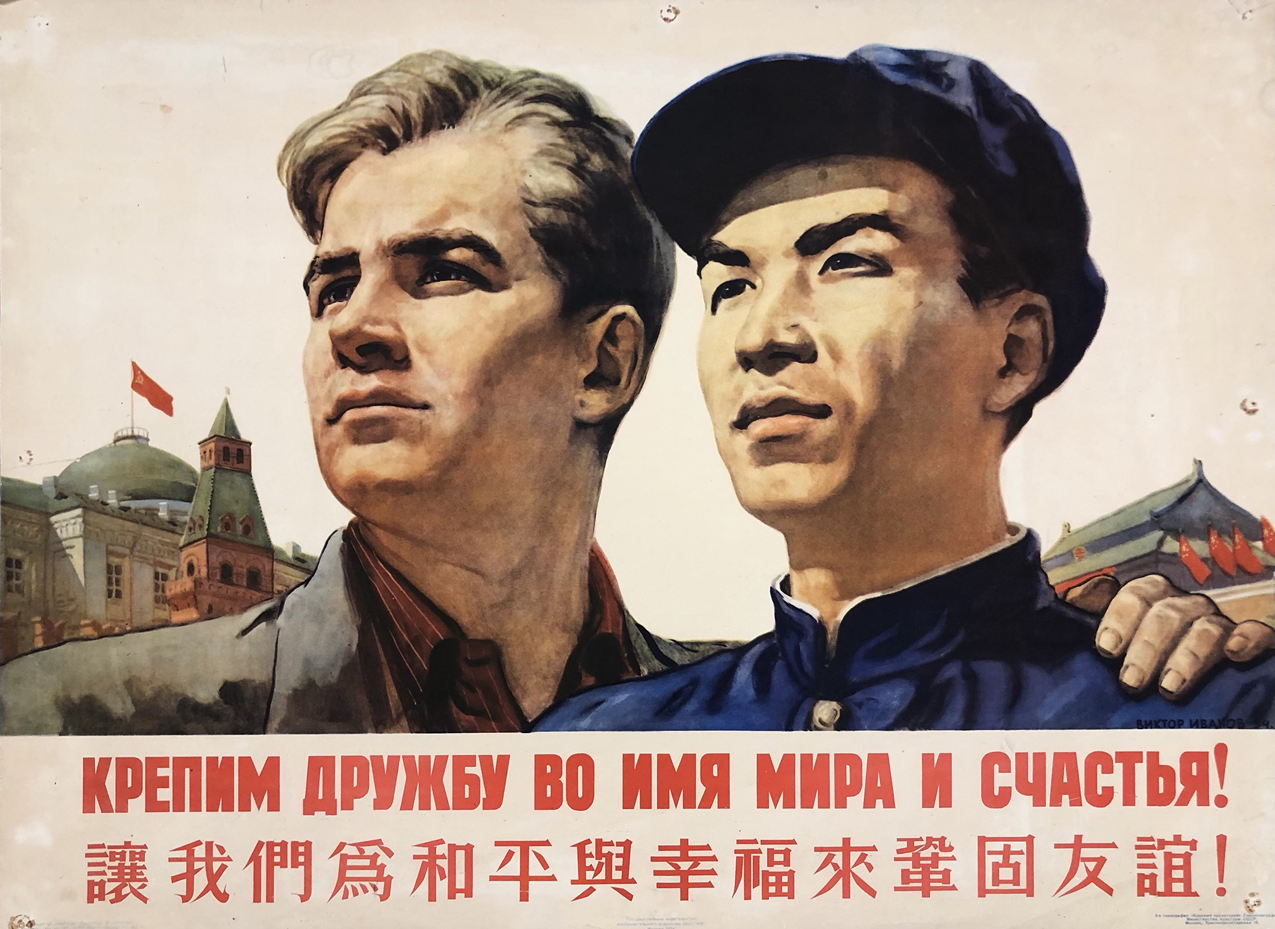
As already noted, conception of the Sino-Russian relationship as a Friendship owes much to its forceful promotion as the official bond both between China and the USSR, and among multiethnic populations within PRC and Soviet borders. Application of friendship in socialist international relations grew out of 1930s use of “Friendship of Peoples” (Druzhba narodov) to describe ties between the USSR's many ethnic groups (Martin Reference Martin2001: 270). Following the October 1949 establishment of the PRC, and after several decades of more-than-friendly engagement with Soviet socialism among Chinese revolutionaries (McGuire Reference McGuire2017), a Sino-Soviet Treaty of Friendship, Alliance and Mutual Assistance was signed during a 1949–50 visit to Moscow by Mao Zedong. Five years later, the alliance between the USSR and the seven European Warsaw Pact states was instantiated by a Friendship treaty whose Russian title differed by only one word from its East Asian antecedent. These Friendships were animated by cultural events, joint building projects (Friendship Bridges link China to Russia and other postsocialist neighbors including North Korea and Vietnam), and a massive transference of Soviet industrial, military, and political technologies to China during the 1950s (Kaple Reference Kaple1994) (image 5), when the Sino-Soviet Friendship Association also became the largest single mass organization in the PRC (Li Reference Li2018: 36).
“We strengthen our friendship in the name of peace and happiness,” in Russian and Chinese. From the Sergo Grigorian Collection, with permission.
However, even during this crimson Sino-Soviet efflorescence—when both also sealed Friendship ties with North Korea—Hunchun remained, as it had been since its 1714 foundation as a Manchu-Qing garrison, a relative backwater. Whatever the formal unity and cross-border “euphoria” (Bulag Reference Bulag2003: 757) of PRC-USSR-DPRK Friendship, this quiet, mostly Korean county town saw at-most-modest and strictly regulated contact across the borders on its outskirts. Minimal movement between Hunchun and neighboring Russian Primorskii region made Sino-Soviet Friendship something borderlanders generally read about in newspapers or celebrated with compatriots. Local Chosŏnjok with kin across the sluggish River Tumen in Korea were more habitual border-crossers, but even this dwindled as competing Kim and Mao cults strained PRC-DPRK relations from the 1960s. Occasional dance troupe or delegation visits were the sole, often literally choreographed expression of frontier amity with which a select few Hunchun attendees engaged.
Increasing fortification all along the 7,600 kilometer Sino-Soviet border during the 1950s (Urbansky Reference Urbansky2012) made Sino-Soviet Friendship resemble cognate projects elsewhere. Similar controls on vernacular interaction existed among most Friendly states, leading scholars of socialist internationalism to question the very idea of Friendship: Soviet Friendship of Peoples (Hirsch Reference Hirsch2005), Eastern European alliances (Applebaum Reference Applebaum2019), Vietnamese (Bayly Reference Bayly2007) and North Korean (Young Reference Young2019) Friendships have all been seen as at best empty rhetoric and at worst cynical mobilization of fictive human warmth for imperialist purposes. Even when modest contact among citizens did occur, socialist governments are widely understood to have disliked their populations actually mixing with “foreigners” (Applebaum Reference Applebaum2019; McGuire Reference McGuire2017: 287).
Understandably therefore, Yan Li argues that Sino-Soviet amity “had nothing at all to do with promoting personal relationships between the two peoples” (Reference Li2018: 28), an argument which seems all the more credible given how quickly Friendship turned to enmity. The 1960s–1980s Sino-Soviet split was, as older Hunchun interlocutors on both sides attest, a period of near-total isolation from what was going on just over the Sino-Russian border ridge. Around a 1969 border conflict over Zhenbao/Damanskii Island, 500 kilometers to the north, the town was suffused with hostile propaganda declaiming the USSR's purported “revisionism” and “socialist imperialism”—suspicions of which, as Austin Jersild (Reference Jersild2014) notes, had been present even under high Friendship. While views on the ground of course varied, the transition to enmity may have been smoother for populations who—not really knowing one another—were more easily convinced that the nearby Other was now a foe.
For ordinary people in postsocialist Hunchun, therefore, continuities between Sino-Soviet Friendship and today's intercultural contact are confined largely to the realm of myth. Personal recollections of past cross-border dynamics as often feature the recriminations of the more recent split as they do wistful references to China's “Soviet older brother” (Sulian lao dage). Yet, importantly for our broader understanding of official Friendship, while the tie may have evaporated in the specifically 1960s Sino-Soviet case, neither side abandoned it as a mode of interstate relating. At local and national levels, Chinese and Soviet celebrations of Friendships with, for example, the Global South, endured beyond the split in ways still evident today. As in many spheres, China's post-Mao shift to a more marketized economy has not been accompanied by equivalent changes in the symbolism and institutions of state, and so almost all Beijing's significant international relationships remain suffused in Friendship, from African nations such as Tanzania and Angola to Pakistan, Europe, and Central Asia. In June 2018, Putin was awarded The Order of Friendship, the PRC's highest international honor, at a ceremony in which Xi described him as his “best and most intimate friend” (see image 6).Footnote 8 Today's Russian Federation has more formal discontinuities with the USSR than the PRC does with its earlier selves, but, as in many other parts of the (post)socialist world, elements of the friendship-diplomatic complex remain intact here too. Russia, Kazakhstan, Uzbekistan, Cuba, and North Korea all have Friendship Associations to manage external relations and confer their own Friendship Medals on foreign dignitaries: like youyi and druzhba, dostyq, dustlik, amistad, and chinsŏn thus remain one another's formal Kazakh, Uzbek, Spanish, and Korean translations.
Xi Jinping and Vladimir Putin adorn a wall during a Day of Friendship to mark the opening of a new martial arts club in Hunchun, 2015. Author's photo.

Yet if this explains why socialist-style atmospherics clothe renewed post-Soviet Sino-Russian relations, the fact that postsocialist Friendship now allows for everyday engagements among citizens in Hunchun is not wholly ignored in official messaging. Marking a post-split thaw in relations which began in the late 1980s, the 2001 Jiang-Putin Friendship Treaty includes an element absent in its Mao-Stalin predecessor, namely “good neighborliness” (Chinese mulin, Russian dobrososedstvo). The high formalism of earlier treaties cast states as disembodied entities floating in space, unencumbered by the physicality of frontier relations. But good neighborliness—also featuring in a China-Southeast Asia treaty mooted by Xi in 2013—reflects a new era of acknowledged contact and human mobility. Everyday interaction is indeed a core feature of twenty-first-century international Friendships as Chinese workers, technicians, and others ride Belt and Road vectors outward, and foreign students, traders, and migrants come to China and interact far from established networks. Having already discussed how such transnational interactions unfold in the Sino-Russian case, and the pivotal importance of difference to these, I will now reappraise the official tie in light of everyday friendship and show why the two may be out of step. The socialist-era ignoring of Sino-Russian neighboring is an entry-point here, for it reflects the importance of bounded categorical difference among discrete states as a tenet of interstate Friendship well before high socialism.
BORDERS OF DIFFERENCE
Everyday friendships in Hunchun see each side approach difference asymmetrically, but interstate Friendship, by virtue of its embeddedness in a hegemonic international political system, has a kind of forced symmetry. This is because states must, to use a geometrical metaphor, tessellate as spatially and administratively commensurate units. Categorical differences parallel to those that are pivotal in Hunchun must therefore notionally carry the same weight in, for example, Moscow and Beijing's approaches to druzhba and youyi. Considering interstate Friendship's deeper history sheds further light on this.
As political scientist Evgeny Roshchin (Reference Roshchin2009a: 126–32) shows, Russia's first eighteenth-century encounters with diplomatic Friendship came as growing interactions with European states saw Muscovite Tsars move from issuing “charters” (gramoty) unilaterally declaring “love” for recipient powers to reciprocal exchanges of treaties expressing druzhba. This was coterminous with a process whereby states themselves were being understood as bounded, post-Westphalian sovereign entities. Unlike love among fuzzy polities with blurred boundaries, such as old Muscovy, Friendship described relations between geographically discrete and qualitatively commensurate units, serving as “a defined guarantee for … control over a unified territory, the defense of borders, and a guarantee of order” (Roshchin Reference Roshchin2009b: 410). Friendship, statehood, and exclusive sovereignty thus became mutually constitutive since identifying another state as a friend entailed common submission to a legible regime of linear borders (see also Derrida Reference Derrida2005).
Shifting understandings of everyday relationships underlay this novel application of “friendship.” European conceptions of what friendship is as a personal relationship have long changed in line with sociopolitical transformations (Grayling Reference Grayling2013), and the post-Enlightenment era of burgeoning Westphalian statehood was a time when, at least in intellectual circles, it was seen as a bond among bounded, self-possessing individuals (Kon Reference Kon1987: 9). These ideas, I suggest, were thus reflexively mapped onto states at a time when new political entities and new types of statehood were being born from revolutions on both sides of the Atlantic. Indeed, the architects of the era's political transformations and the promoters of rugged personal amity were often the same (invariably) men. In Russia, intellectual architects of Peter the Great's reforms developed the idea of the agentive “self” (samost’) (Kalugin Reference Kalugin2009: 188, 280–81), while robust American republican individualist Ralph Waldo Emerson saw interpersonal friendship as “an alliance of two large, formidable natures” (Reference Emerson1993: 47–48).
Interstate Friendship thus had the culturally specific Euro-American idea of categorial differentiation among bounded entities at its core from the outset. Given their common conceptual inheritance, Westphalian polities and sentimental individual persons were framed as cognate bodies making sovereign decisions to engage in the bond. This, then, was the idealized vision which proliferated from the USSR, a Russian-inflected apotheosis of many of post-Enlightenment modernity's most categorical ideals and formal taxonomies. Twentieth-century socialist internationalism, with its repudiation of colonial border-transgression, ensured that the idea of friendship among agentive entities separated by linear contours of difference was inherited by the PRC, the DPRK, and other states which traced tangled threads of heredity back to European revolutionary republicanism (Skocpol Reference Skocpol1979).
In this context, interstate Friendship's power may indeed have lain in its ability to overstep linear boundaries and forge a kind of pooled political subjectivity cognate with that which Russians seek in Hunchun today: the promise of socialist “internationalism” itself arguably rested on the idea that discrete actors had separately chosen to pursue a common cause. In practice, of course, a tongue-in-cheek reading of the Soviet government's willingness to intervene in the domestic affairs of its Eastern European Friends, and the fact that from Afghanistan to Angola it was only through extensive “help” that Moscow-friendly governments were installed over the twentieth century, might suggest more-than-expected compatibility with a Russian-derived openness to overstepping boundaries of difference. Yet categorical differences among “independent” states (per the Soviet poster in image 2) remained a vital conceptual totem.
Returning to consideration of China, the idea that socialist Friendship entailed the maintenance of formal difference notwithstanding indivisible unity raises curious questions. As a socialist state whose 1949 Communist revolution had come about only partially thanks to Soviet assistance, the PRC rested on cultural underpinnings in which friendship and relationality were understood very differently compared to in Europe or the Soviet Union (Yang Reference Yang1993). Yet Sino-Soviet Friendship, like other bonds among revolutionary socialist states celebrating powerful separateness but also shared political objectives, may in fact have appeared more compatible with vernacular difference-retaining Chinese friendships theorized here. I return to the implications of this.
A scalar approach to the interface between interpersonal and interstate friendships thus shows how Hunchun's emergent ethnographic context helps us reappraise taxonomical ties among (post)socialist states. On both scales, I have shown, parallel contours of difference are pivotal, but while these are approached asymmetrically in everyday relationships, among states they must ideally be seen symmetrically. I now reverse the direction of analysis to show how the actual, and rather less ideal, operation of interstate dynamics has downscale consequences for everyday friendships too. Thus far I have dealt with idealization on both scales, but moving deeper into the practical realm reveals the messy ways in which multiscalar Sino-Russian friendships unfold in Hunchun today. This may offer both an explanation for why everyday friendship is not blossoming here and grounds for reappraising interstate and interpersonal more broadly.
FRONTIER ANTAGONISTS
Interstate dynamics have meaning at an everyday scale as rigid taxonomical affairs play out in Hunchun's looser emergent “frontier” context. Chinese and Russian people here resemble many frontierspeople across time in being both economically and administratively precarious and, to a significant extent, mutually reliant. Most Russians, including long-term residents, speak of feeling like priezzhie—“entrants” or “outsiders.” Even those who own apartments or have regular employment in schools, trade companies, travel agencies, or nightclubs face bureaucratic vulnerabilities. Since PRC migration policies favor white-collar foreign “talents” (Bork-Hüffer and Yuan-Ihle Reference Bork-Hüffer and Yuan-Ihle2014), entities employing Russians cannot sponsor long-term work or residency permits. Not for want of trying, therefore, most retain only “tourist” legal status. Life may be materially more comfortable here, and jobs, however contingent, are easier to find than amid the post-Soviet decay of small-town eastern Russia. But the sense of being priezzhie remains, alongside an implicit contrast to Chinese “locals.”
Yet the Chinese people with whom most Russians interact are usually no more settled. Indeed, Hunchun's vendors or service workers are mostly wailairen—the precise outsider/entrant equivalent of Russian priezzhie—and comprise a shifting cohort of migrants from northeastern industrial towns which, like Xiaoling's home Qiqihar, have struggled economically in the post-Mao market era. Most thus come from further afield than Slavianka or Kraskino, and their mobility is as much a postsocialist phenomenon as Russian border-crossing is. Domestic migrants may encounter fewer bureaucratic hurdles, but differential urban/rural household registrations mean villagers moving to Hunchun (formally a “city”) still face administrative complications. Seeking more comfortable lives just as their Russian counterparts do, these hard-pressed arrivals open shops like those I spent time in, or seek cross-border trade opportunities to zhengqian, an expression for “earning money” which implies saving up day-by-day. Russian custom and cooperation are vital to this, and so if these ventures fail people must try their luck elsewhere. The ever-changing patchwork of shops on Hunchun's streets are testament to wailairen precarity.
Yet parallel precarities and mutual exposure do not beget much relational reconciliation, even as they produce reciprocal familiarity like that also seen in African and Chinese domestic migrant encounters in Guangzhou (Lan Reference Lan2019). One reason for this, I suggest, is to be found in the downscale effects of interstate Friendship dynamics. Even where one might assume unmediated and flexible “frontier” relations could develop, shifts at the state scale carry an everyday valence that may hinder emergent relationships.
Evidence of this emerged during 2014–2015, when a remarkable uptick in celebrations of official Sino-Russian Friendship was accompanied by a significant diminution of friendships on the ground. Warming of the interstate bond came as Russia's 2014 Crimean annexation and war in Ukraine coalesced with strained PRC-West relations, encouraging Moscow and Beijing to redouble affirmations of their Friendship. Presidents Putin and Xi met several times in 2014 and 2015, and, with Western leaders absent, each was a VIP guest at the other's World War II seventieth anniversary parade. Putin's 2018 award of China's Friendship Medal continued this trend. But beyond shifting Eurasian geopolitics, friendly Russian overtures to China also stemmed from insecurity caused by falling global oil prices, which had caused a drastic drop in the value of the ruble. Consequently, the same dynamics underlying deeper interstate Friendship meant that prices in Hunchun suddenly doubled for Russians, making life much less friendly.
Both blossoming interstate bonds and the currency shift played out across the contours of difference already discussed: mushrooming formal Friendship events left Russians more nonplussed than ever, while higher prices increased their resolve to get a bargain and sharpened suspicions of being ripped off by (apparently disingenuously) “friendly” Chinese vendors. Conversely, Chinese shopkeepers now confronted customers more insensitively averse to cultivating feelings in their dealings than ever.
These developments revealed the antagonisms of symmetrically dependent everyday relationships that were also exposed to distant and ungovernable state-scale shifts. Even in normal times, dynamics in Hunchun and other transnational trade hubs exhibit intensified traits of what Clifford Geertz called the “bazaar economy,” in which vendors and clients are “at once coupled and opposed,” mutually reliant but at odds in their goals (buying cheap/selling dear) (Reference Geertz1978: 30–32). Like the “familiar” or even “intimate antagonists” of Geertz's Moroccan souq, parties to transactions in Hunchun are familiar partners in symmetrical demographic positions. But as shifting taxonomical dynamics change the terms of emergent interactions, degrees of both dependency and antagonism can be exacerbated to an unmanageable degree.
Biao Xiang shows how state interventions in the lives of Zhejiang migrants have simultaneous effects on provincial, county, and interpersonal scales. Similarly, the very state border which is constitutive of the whole idea of Sino-Russian Friendship in Hunchun also plays a pivotal role as a divider of economic spheres, and as a widener of differences between friendship practices. As well as intensifying already-problematic divergences over haggling, the currency crash reduced the number of Russians in town. Straining friendships in two countervailing but equally disruptive directions, therefore, this both forced Russia-reliant Chinese businesspeople to shut up shop and move on and yoked those who remained still closer into non-collaborative, mutually antagonistic relationships: fewer and more abrasive encounters further exposed each side's varying tolerance for the other's divergent cultural approaches to affect and exchange.
This twinning of blossoming official Friendship and its deteriorating interpersonal counterpart thus shows how actions across the same contours of difference at different scales may pull in opposing directions. This deduction leads me to conclude with a comparative appraisal of how we might see multiscalar friendships on a broader canvas, including in contrasting socialist and postsocialist cases. Offering Russian- and Chinese-linked examples to illustrate this, I also suggest how interstate and interpersonal bonds might be approached in future research.
COMPARISONS: FRIENDSHIP WITH OR AGAINST THE STATE
Soviet Friendship against the State
As the precursor to later internationalist Friendships, Soviet Friendship of Peoples and interpersonal relationships under its aegis offer a productive contrast with today's postsocialist cross-border bonds. On one hand, Druzhba narodov shared some features of today's Sino-Russian dynamic, at once categorically separating mutually familiar populations via an elaborate system which ascribed “nationalities” with various reified differences (Hirsch Reference Hirsch2005), and vaunting friendship between them. Indeed, the “Russian” football team in Hunchun included several representatives of the former-USSR's multiethnic population: five Russians, three Koreans, two Kazakhs, and one Ukrainian. However, unlike in Hunchun, there was often significant resonance between official and everyday friendships in Soviet contexts. Why this was can be reappraised here.
Russians and non-Russians alike found that official Friendship acquired everyday affective significance, notwithstanding the formality of festivals, concerts, contests, and exhibitions, which seemed to require that “all … nationalities be deeply moved by the art of other Soviet nationalities” (Slezkine Reference Slezkine1994: 447). In one Saint Petersburg-based study, culturologist Svetlana Lourié (Reference Lourié [Lur'e]2011: 145) observed that her multi-ethnic interlocutors identified a “common language, an understanding of the other” and “human warmth” in shared Friendship events. As Caroline Humphrey (Reference Humphrey2004: 146) notes, “real warmth flourished” precisely when, “After the parades, people partied all night, usually in a totally multi-ethnic ambiance. Audiences enjoyed the cultural achievements of other nationalities.”
To deduce what set Soviet citizens apart from today's Sino-Russian case, I suggest that, unlike for Hunchun's oppositionally “yoked” counterparts, the contours of difference distinguishing Soviet citizens at the state scale did not line up so neatly with potentially friendship-inhibiting differences in the everyday. For one thing, before the explosion of informality that has distinguished post-Soviet Russian experiences in most areas of society and politics (Ledeneva Reference Ledeneva2006), some Russians may have seen state-linked Friendship events as a firmer guarantor for some form of durable relationship. But more important, I think, is that the daily activities in which members of the USSR's multiethnic population were involved, while certainly not free from antagonism, did not so consistently pitch groups against one another, and encouraged certain forms of collaboration. Tellingly, this often ran directly contrary to state-scale activities, for it was as people waged struggles imposed by the socialist shortage economy that personal friendships arose. As Humphrey continues, “In everyday life, a great deal of comradeship also rested on a sense of shared hardship, common fears, and on the grey sameness of material life.” Friendships offered access to scarce goods (Abrahams Reference Abrahams, Bell and Coleman1999) or a “refuge” from the unfriendly public domain (Shlapentokh Reference Shlapentokh1984) where the “seller's market” meant “the seller [was] unfriendly and impolite with the buyer, while the buyer trie[d] to flatter the seller” (Kornai Reference Kornai1992: 248).
Interpersonal bonds based in part on conspiring to navigate bureaucratic tedium and material monotony thus had instrumental features that Russians in Hunchun today might shun. But with boundaries of difference inscribed in formal or transactional situations not being so consistently parallel with, for example, status differences between Russians and Kazakhs, people's vernacular ties were less neatly separated into realms of distinct friendship practice than Sino-Russian druzhba and youyi are today.
There was a rich irony in the fact that both Friendship and Cooperation—totems of Soviet state messaging equally ubiquitous in today's PRC—flourished in vernacular form against the state. They were, in Alexei Yurchak's encapsulation, “very real humane values … that the realities of socialism afforded—often in spite of the state's proclaimed goals” (Reference Yurchak2006: 8). This was underscored by the minimal official attention paid to interpersonal friendship, for while Friendship of Peoples appeared everywhere from street and university names to the Soviet national anthem, the only everyday bond that was really celebrated was Karl Marx and Friedrich Engels’. And even if paeans to this Great and Touching Friendship—in the words of one serially reissued book (Sukhotin and Vidgop Reference Sukhotin and Vidgop1958) translated into Chinese in 1983 (Weitegepu and Suhuojing Reference Hongdun1983)—alluded to its deep affect, its strength was shown to lie in the men's characters as powerful independent minds united yet discrete, precisely the kind of intellectual tie on which the idea of interstate Friendship was based in the first place. For all its “touching” qualities, therefore, and while Engels’ regular bailouts of Marx were eschewed,Footnote 9 this was a metonym for taxonomical Friendship of Peoples and the USSR's Friendships with other socialist states.
Thus, while Soviet citizens belonged to discretely categorized peoples with culturally varied ideas about relationships, unlike today's Hunchun counterparts they faced similar state-imposed frontier struggles and forged intersubjective friendships across contours of difference in both formality and instrumentality suffused settings. Differential approaches to emergent relationships were less liable to be exacerbated by coalescence with structurally antagonistic taxonomical opposition and some translation between friendship practices became more viable.
Chinese Friendship with the State
Within China, too, a multiethnic population, differentiated under a classificatory system partly borrowed from the USSR during the 1950s, has been exhorted to forge mutual friendships while enduring common struggles and political excesses. But the analysis presented here also has implications for pragmatic questions around Chinese friendships beyond PRC borders over time.
While friendship and Chinese politics have long had an uneasy coexistence given the former's seditious egalitarianism against traditional preference for hierarchy (Kutcher Reference Kutcher2000: 1616), Soviet-style mobilization of Friendship with the outside world began early in the PRC era. In the revolutionary 1940s, Han Communist cadres sought ritual friendships with neighboring Mongols (Bulag Reference Bulag2010: 115–17), while Chinese proletarians were exhorted to develop “class ganqing” with foreign counterparts (Kipnis Reference Kipnis1997: 161–62). For a new state managing relationships in a potentially hostile world, friendship became a way of “treating outsiders differently” (Brady Reference Brady2003): both whole countries and individual foreigners were classed as inimical or friendly to the CCP government, and until the 1980s foreigners invited to visit Beijing were lodged in the Friendship Hotel.
While the Sino-Russian case suggests that treating outsiders differently is incompatible with more boundary-dissolving visions of friendship, it may be that this kind of choreographed official youyi can be more easily reconciled with everyday relationships in a Chinese context. While Walker's Urarina interlocutors embarked on an unfamiliar trajectory toward taxonomical Peruvian citizenship by playing rule-based football, Chinese people's pre-existing comfort with relating across difference may entail a greater readiness to befriend Russians as Russians than vice versa. To reiterate, this is not to ignore a wide range of Chinese relationships across a spectrum of difference and encoding differential balances of affect and other concerns. But at least in a cross-border situation where youyi and druzhba are being explicitly negotiated the former has more scope for accommodating difference like that which separates states.
Beyond the present case, moreover, we may benefit from seeing emergent friendships between Chinese and non-Chinese counterparts elsewhere in terms of overlaid personal- and state-scale contours of difference. The same post-Cold War mobility underlying Hunchun's Sino-Russian contact has seen PRC citizens move throughout the world, and since work on the resulting day-to-day relationships generally sidelines state-related concerns, the present study offers a new paradigm. Intercultural communication scholar Yijia Huang (Reference Huang2008: 12–13) notes that differential accommodation of “culture” poses problems in potential friendships between U.S.-based Chinese students and their American counterparts, while reciprocal American objections to being “foreign friends” have been documented in China itself (Liu and Dervin Reference Liu and Dervin2020). Such work would benefit from consideration of the role that the Sino-U.S. relationship plays in delineating how notions of “culture” are constructed on each side, all the more so at this time of growing trans-Pacific tension. In a different context, while activity at the state scale implicitly undergirds many relationships among Chinese and local co-workers in Zambia (Chang Reference Chang2013), and generalized Sino-African interactions in Guangzhou (Lan Reference Lan2019), work on these situations has not yet explored the bidirectional relationship between everyday ties and shifting official Sino-African Friendships. Janny Chang's (Reference Chang2013: 38) insights into how Chinese and Zambian colleagues forge relationships that appear to blend each side's approach to instrument and affect would be enriched further through a focus on how difference itself is managed, not least since these interactions occur at a PRC state-owned enterprise. With Sino-African relationships coming into focus recently amid racializing incidents during the COVID-19 pandemic, applying a scalar approach would shed new light on what happens when Chinese friendships with the state break down, as they once did during the Sino-Soviet split.
CONCLUSION
As cross-cultural relationships continue to multiply, the fact that Chinese “foreign” friends remain valid kinds of friend at different scales may pose provocative questions regarding global engagements involving the PRC, which still operates on a political system mostly inherited from a Friendly USSR. Could Soviet-style state socialism, with its relational classifications, interstate Friendship framework, and Xi Jinping's “people-to-people friendship” add up to a project better suited to a Chinese cultural backdrop—and to a new multipolar, bloc-based global order—than to the Russian and binary Cold War one from which it emerged? Whether or not people can forge foreign friendships compatible with state-scale arrangements depends, I suggest, on how they and their counterparts approach the contours of difference that separate them.
On a broader canvas, the present study presents questions for comparison with other global contexts. Beyond simply showing how international relationships play a part in people's lives, or how vernacular understandings of a given relationship influence its meaning among states, this study has privileged neither and thus reached a more balanced understanding of both. By discerning ethnographically the multi-scalar importance of senses of difference, and tracing the continuities and divergences between socialist and postsocialist friendships, I offer a general framework for examining how interpersonal and interstate relationships are entwined. Key questions to interrogate when applying this framework elsewhere include what role difference plays in each side's approach to a potential relationship, and to what extent the dynamics of the given state-state relationship exacerbates or minimizes senses of difference for each side. Addressing these may explain imbalances in one side's apparent feelings of friendship when compared to the other. As I have shown, these are important issues since even when people from different places “should” for sociological or political reasons be friends, today's world offers all-too-many instances in which they are not.


 Open access

