



Acute kidney injury (AKI) affects approximately 10–15 % of patients admitted to the hospital(Reference Ronco, Bellomo and Kellum1). AKI confers a significant increase in risks for both short- and long-term mortality and morbidity(Reference Kaddourah, Basu and Bagshaw2–Reference Wald, Quinn and Luo4). Therefore, it is of great importance to reveal more modifiable factors for the primary prevention of AKI.
AKI is characterised by an abrupt increment of serum creatinine or a rapid decline in urine output(5). The pathophysiology of AKI is complex and often involves a critical disparity between the supply of oxygen and nutrients to the nephron and the increased metabolic demands of the kidney(Reference Tögel and Westenfelder6,Reference Sharfuddin and Molitoris7) . Inflammation and oxidative stress are pivotal in the progression of AKI(Reference Christ, Lauterbach and Latz8). Given the association between diet and immune function, it has been hypothesised that dietary interventions, particularly those rich in antioxidants, may influence AKI risk(Reference Jeon, Lee and Yang9). Coffee, one of the most widely consumed beverages globally, has attracted significant attention for its potential health benefits(Reference Liu, Zhang and Ye10,Reference Voskoboinik, Koh and Kistler11) . Caffeine, coffee’s primary active ingredient, possesses antioxidant and anti-inflammatory properties that may mitigate oxidative stress, as evidenced by in vitro and clinical research(Reference Kalthoff, Landerer and Reich12,Reference Metro, Cernaro and Santoro13) . Additionally, other coffee constituents, such as chlorogenic acid, niacin and quinides, have also demonstrated strong antioxidant capabilities and the potential to reduce the inflammatory response(Reference Kalthoff, Ehmer and Freiberg14,Reference Butt and Sultan15) . A previous study of 14 207 USA adults reported a reversed J-shaped association between coffee intake and the risk of AKI(Reference Tommerdahl, Hu and Selvin16). However, due to a lack of information, this study was unable to assess whether the common coffee additives, such as milk and sweetener, could affect the association between coffee intake and the risk of AKI. In fact, previous studies(Reference Gan, Ye and Zhang17–Reference Xiang, Liu and Zhou20) have found that increased sweetener (including sugar and artificial sweetener) consumption was associated with higher risks of type 2 diabetes mellitus, CVD and all-cause mortality. In addition, few studies have examined the association of different coffee types (including instant, ground and decaffeinated coffee) with the risk of AKI and investigated the modifying effect of between-person variation in caffeine metabolism on the relationship between coffee consumption and new-onset AKI.
To address the above knowledge gaps, we aimed to evaluate the dose–response association of consumption of coffee with different additives, including milk and sweetener (sugar and/or artificial sweetener), and consumption of different types of coffee, including instant, ground and decaffeinated coffee, with new-onset AKI in the UK Biobank, a prospective cohort. Furthermore, we explored the potential modifying effect of genetic variation in caffeine metabolism on the association. The current study may have important implications for public health and dietary guidelines, particularly concerning the consumption of coffee and its potential protective effects against AKI.
Methods
Study design and participants
The UK Biobank, a large prospective cohort study, recruited over 500 000 participants aged 37–73 years from twenty-two study centres across the UK (England, Wales and Scotland) between 2006 and 2010(Reference Collins21–Reference Zhou, He and Ye24). Briefly, all participants completed a touch-screen questionnaire, received a series of physical measurements and provided biological samples. More details of the UK Biobank protocol have been described previously(Reference He, Zhou and Ye25–Reference Ye, Zhang and Zhang28). This study was conducted according to the guidelines laid down in the Declaration of Helsinki, and all procedures involving human subjects/patients were approved by the North West Research Ethics Committee (06/MRE08/65). Written informed consent was obtained from all subjects.
For this study, our analyses were restricted to participants who had completed at least one online 24-h dietary recall questionnaire (n 210 954). We further excluded participants with implausible total energy intake (male with < 800 kcal/d or > 4200 kcal/d or female with < 600 kcal/d or > 3500 kcal/d)(Reference Seidelmann, Claggett and Cheng29–Reference Liu, Gan and He31), those with prior AKI and coffee consumers without habitual additives. Therefore, a total of 194 324 participants were included in the final analysis (online Supplementary Fig. S1).
Dietary assessments
Dietary information was collected using the Oxford WebQ, a web-based 24-h dietary recall questionnaire, to assess the type and amount of food consumed, including beverages and daily nutrient intake during the previous 24 h. The Oxford WebQ has been validated in previous studies(Reference Liu, Young and Crowe32). Participants were invited to complete the questionnaires on five occasions from April 2009 to June 2012 to account for seasonal variations in dietary intake.
During each 24-h dietary recall, participants were asked if they had consumed coffee in the previous 24 h. Coffee consumers reported amounts of different types of coffee, including instant coffee, ground coffee (such as filter coffee or cappuccino) and decaffeinated coffee (any type). To reduce the confusion about size, the online dietary questionnaire provided specifications for some regular drinks (e.g. mugs or cups). The average number of drinks across multiple dietary recalls was calculated to represent the habitual intake. Coffee consumers were asked whether they added milk or sweetener (including sugar and artificial sweetener) to coffee. Participants who added the same additive (no additive, milk, sweetener (sugar and artificial sweetener) and milk and sweetener (sugar and artificial sweetener)) to their coffee in different dietary recalls were classified as habitual additive consumers, while others were classified as non-habitual additive consumers, who drank coffee with various additives in different dietary recalls. The categories of coffee additives were shown in online Supplementary Table S1. To control for confounding, our analysis was limited to habitual additive consumers.
A healthy diet score was derived from ten food items based on a recent dietary recommendation for cardiovascular health. If participants achieved one of the ten dietary goals, they will get one point with a maximal point of 10(Reference Liu, He and Ye33).
Genetic scores of caffeine metabolism
Using four common single-nucleotide polymorphisms that are associated with blood caffeine metabolite levels and located in or near genes involved in caffeine metabolism (rs2472297, rs56113850, rs6968554 and rs17685), the weighted genetic caffeine metabolism score was calculated by summing the number of alleles multiplied by their β-coefficients(Reference Inoue-Choi, Ramirez and Cornelis34). A higher score indicated a faster caffeine metabolism. Detailed information about genotyping and quality control in the UK Biobank study has been reported previously(Reference Bycroft, Freeman and Petkova35).
Covariates measurements
Detailed information on covariates was available through baseline questionnaires, including age, sex, ethnicity, education levels, Townsend deprivation index, smoking status, alcohol drinking, physical activity and diets. Area-based socioeconomic status was derived from the postal code of residence by using the Townsend deprivation index. BMI was computed as weight divided by height squared. Participants were categorised into two groups based on their answers to employment status: employed (including those in paid employment or self-employed, retired, doing unpaid or voluntary work or being full or part-time students) and unemployed(Reference Zhang, Chen and Pan36). Prevalent diabetes was identified through multiple procedures considering types of diabetes and sources of the diagnosis(Reference Eastwood, Mathur and Atkinson37). Prevalent hypertension was defined as a systolic blood pressure of 140 mmHg or higher, a diastolic blood pressure of 90 mmHg or higher, self-reported hypertension or the use of antihypertensive drugs. Prevalent CVD was defined as self-reported atrial fibrillation, stroke, coronary heart disease and heart failure.
Biochemical measurements were conducted at a specialised central laboratory. The estimated glomerular filtration rate was calculated based on serum creatinine using the Chronic Kidney Disease Epidemiology Collaboration Equation. The urinary albumin to creatinine ratio (mg/g) was calculated as urinary albumin (mg/l) to urinary creatinine (g/l) ratio. Prevalent chronic kidney disease (CKD) was defined as estimated glomerular filtration rate < 60 ml/min/1·73 m2 or urinary albumin to creatinine ratio ≥ 30 mg/g or self-reported CKD. Optimal physical activity was defined as more than 4 d of vigorous/moderate physical activity in a typical week(Reference Zhang, Zhang and Ye38). More information regarding these covariates can be found in the UK Biobank online protocol (www.ukbiobank.ac.uk).
Assessment of study outcomes
New-onset AKI was defined according to the International Classification of Diseases edition 10 code N17, ascertained by primary care data, hospital inpatient data, death register records or self-reported medical conditions at follow-up visits, all of which were mapped to three-character International Classification of Diseases edition 10. More details about the ascertainment of the outcome can be found online (https://biobank.ndph.ox.ac.uk/showcase/label.cgi?id=1712).
Statistical analysis
Baseline characteristics are presented according to whether coffee was consumed and whether milk and/or sweeteners were added to coffee (no coffee consumption, no additives, only milk, only sweeteners and both milk and sweeteners were added) as mean (s d) for continuous variables and number (percentage) for categorical variables. Differences across categories were compared using one-way analysis of variance for continuous variables and χ 2 tests for categorical variables, accordingly.
Restricted cubic spline Cox regressions were used to explore the shape of the relationships of coffee consumption with new-onset AKI in participants adding different additives (no additives, only milk, only sweeteners and both milk and sweeteners) to coffee and participants drinking different types of coffee (including instant, ground and decaffeinated coffee). The Cox proportional hazards models (hazard ratio (HR) and 95 % CI) with no coffee consumption as the reference group were used to estimate the relationship of drinking coffee with different additives (no additives, only milk, only sweeteners and both milk and sweeteners were added) with new-onset AKI. The coffee consumption was then categorised into the following six groups: coffee non-consumers, > 0 to 1·5 drinks/d, > 1·5 to 2·5 drinks/d, > 2·5 to 3·5 drinks/d, > 3·5 to 4·5 drinks/d, which is equivalent to an average of 1, 2, 3, 4 and 5 or more drinks/d, respectively. The association between coffee consumption categories (six groups) with new-onset AKI was further examined in participants adding different additives (no additives, only milk, only sweeteners and both milk and sweeteners) and participants drinking different types of coffee. The regression models were adjusted for age, sex, ethnicity, BMI, healthy diet scores, income, employment, education levels, Townsend deprivation index, smoking status, alcohol drinking, optimal physical activity, hypertension, diabetes mellitus, high cholesterol, CKD and CVD. The percentage of missing values for each covariate was < 1 %, except for physical activity (3·9 %) and income (10·3 %), and CKD (8·0 %), which were encoded as a missing indicator category for categorical variables.
As additional exploratory analyses, possible modifications to the relationship and coffee consumption with new-onset AKI in unsweetened coffee consumers were assessed for variables including age (< 60 or ≥ 60 years), sex (male or female), BMI (< 30 or ≥ 30 kg/m2), smoking status (current, previous or never), alcohol drinking (< 1 or ≥ 1 time/week), optimal physical activity (no or yes), diabetes (no or yes), hypertension (no or yes), high cholesterol (no or yes), CKD (no or yes), CVD (no or yes) and weighted genetic caffeine metabolism score (tertiles). Potential modifying effects were assessed by likelihood ratio tests.
A two-tailed P < 0·05 was considered to be statistically significant in all analyses. Analyses were performed using R software (version 4.1.1, http://www.R-project.org/).
Results
Study participants and baseline characteristics
Of the 194 324 participants included in the current study (online Supplementary Fig. S1), the average age (sd) was 56·1 (7·9) years, and 86 577 (44·5 %) of the participants were male. About 75·1 % of the participants reported drinking coffee, 10·8 %, 43·1 %, 2·5 % and 18·6 % of the participants reported drinking coffee adding neither milk nor sugar, only milk, only sweetener (sugar and/or artificial sweetener) and both milk and sweetener, respectively.
Compared with coffee consumers, non-coffee consumers tended to be younger, were less likely to be male and white, smoked and consumed alcohol less frequently and had lower levels of education and income (Table 1). Among coffee consumers, those who preferred their coffee black (without any additives) usually had higher incomes, a higher level of education and a lower occurrence of CKD. People who added milk to their coffee were typically less likely to be male or current smokers and had a reduced rate of diabetes, while also consuming more dairy products overall. Conversely, coffee drinkers who favored sweeteners were predominantly male and had a greater incidence of hypertension, diabetes, high cholesterol and CVD. Lastly, those who added both milk and sweeteners to their coffee often had less healthy diets and tended to consume higher amounts of sugar (Table 1).
Baseline characteristics of study participants according to coffee consumption categories* (Numbers and percentages; mean values and standard deviations)

* Values are presented as means (sd) or proportions.
Relationship of coffee consumption with different additives (milk and/or sweetener) (v. No coffee consumption) with new-onset acute kidney injury
During a median of 11·6 years of follow-up, a total of 5864 (3·0 %) participants were documented as developing AKI.
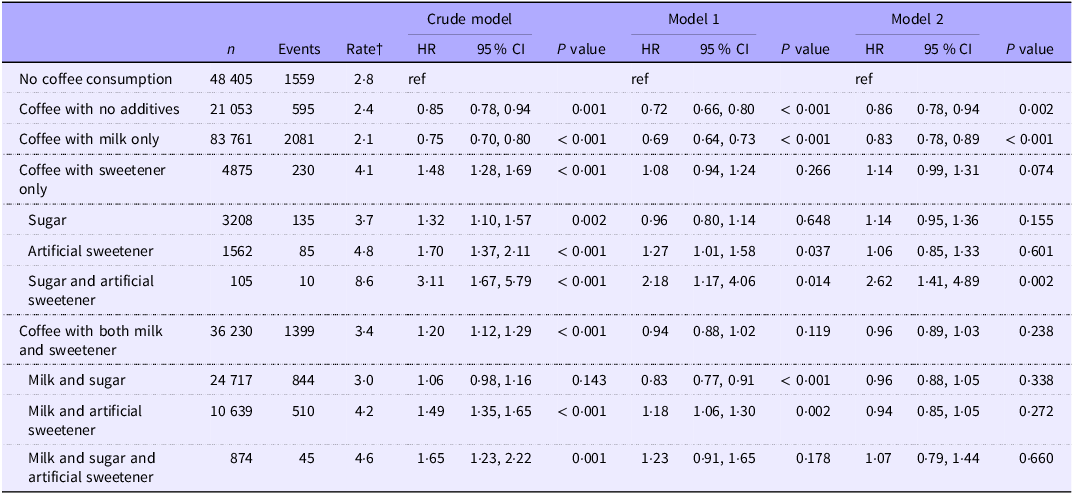
Compared with coffee non-consumers, a significantly lower risk of new-onset AKI was found in coffee consumers adding neither milk nor sugar to coffee (HR, 0·86; 95 % CI, 0·78, 0·94) and adding only milk to coffee (HR, 0·83; 95 % CI, 0·78, 0·89), but not in coffee consumers adding only sweetener (sugar and/or artificial sweetener) to coffee (HR, 1·14; 95 % CI, 0·99, 1·31) and adding both milk and sweetener to coffee (HR, 0·96; 95 % CI, 0·89, 1·03) (Table 2). Similar associations were observed in different subgroups (online Supplementary Table S2 and S3).
Relationship of coffee consumption with different additives (milk and/or sweetener) (v. no coffee consumption) with risk of new-onset acute kidney injury* (Hazard ratios and 95 % confidence intervals)
HR, hazard ratio.
Model 1: adjusted for age, sex and ethnicity.
Model 2: adjusted for variables in model 1 plus BMI, healthy diet score, income, employment, education level, Townsend deprivation index, smoking status, alcohol drinking, optimal physical activity, hypertension, diabetes mellitus, high cholesterol, chronic kidney disease and CVD.
* The associations in Table 2 were derived from two Cox models. The first Cox model included a variable indicting four levels of coffee drinking with no coffee consumption as reference, while the second Cox model included a variable indicting nine levels of coffee drinking with no coffee consumption as reference.
† Incidence rates per 1000-person years.
Relationship of coffee consumption with new-onset acute kidney injury in coffee consumers with different additives (milk and/or sweetener)
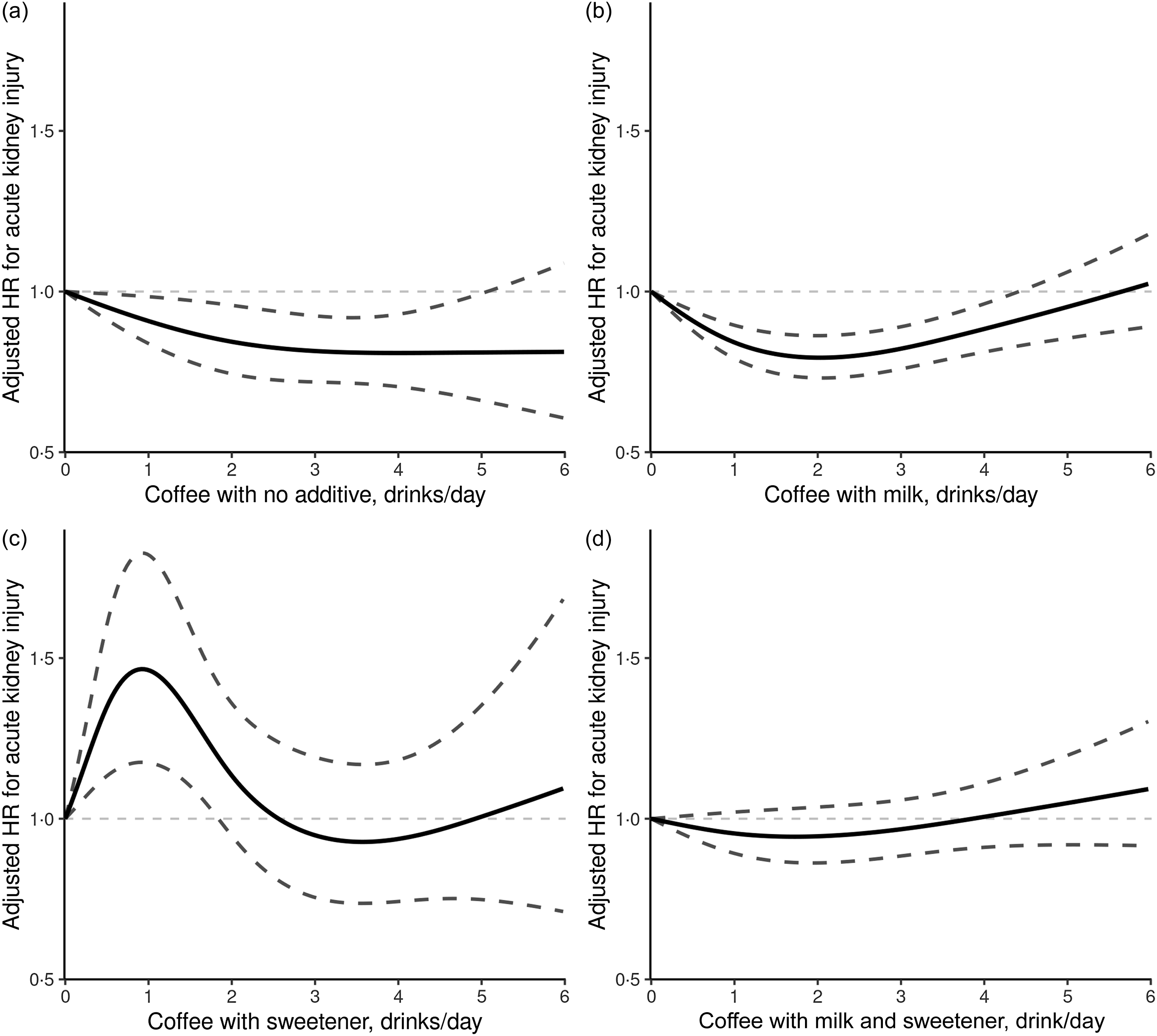
There was a U-shaped association of coffee consumption with the risk of new-onset AKI, with the lowest risk at 2–3 drinks/d, in coffee consumers with no additives (Fig. 1(a)) and with addition of milk only (Fig. 1(b)), but not in coffee consumers with addition of sweetener only (Fig. 1(c)) and with addition of both milk and sweetener (Fig. 1(d)) (Table 3).
Relationship of coffee consumption with new-onset AKI in coffee consumers with different additives*. * Adjusted for age, sex and ethnicity, BMI, healthy diet score, income, employment, education level, Townsend deprivation index, smoking status, alcohol drinking, optimal physical activity, hypertension, diabetes mellitus, high cholesterol, chronic kidney disease and CVD. AKI, acute kidney injury.
Relationship of coffee consumption with new-onset acute kidney injury in coffee consumers with different additives (milk and/or sweetener) (Hazard ratios and 95 % confidence intervals)

HR, hazard ratio.
Adjusted for age, sex, ethnicity, BMI, healthy diet score, income, employment, education level, Townsend deprivation index, smoking status, alcohol drinking, optimal physical activity, hypertension, diabetes mellitus, high cholesterol, chronic kidney disease and CVD.
Since the similar results for coffee consumers with no additives and with addition of milk only, we combined the two groups as an unsweetened coffee consumption group. Accordingly, there was a U-shaped association of coffee consumption with the risk of new-onset AKI, with the lowest risk at 2–3 drinks/d, in unsweetened coffee consumers (online Supplementary Fig. S2A and Table 3). Compared with the coffee non-consumers, the adjusted HR (95 % CIs) of new-onset AKI for participants who drank unsweetened coffee > 0 to 1·5, > 1·5 to 2·5, > 2·5 to 3·5, > 3·5 to 4·5, > 4·5 drinks/d were 0·84 (0·77, 0·92), 0·78 (0·71, 0·86), 0·81 (0·72, 0·90), 0·86 (0·76, 0·98) and 0·99 (0·86, 1·14), respectively. However, there was a null association of coffee consumption with the risk of new-onset AKI in sweetened coffee consumers (online Supplementary Fig. S2B and Table 3).
Relationship of different types of coffee consumption with new-onset acute kidney injury in unsweetened and sweetened coffee consumers
There was a U-shaped association of instant (Fig. 2(a)), ground (Fig. 2(b)) and decaffeinated (Fig. 2(c)) coffee consumption with the risk of new-onset AKI in unsweetened coffee consumers (Table 4). However, there was a null association of different types of coffee consumption with the risk of new-onset AKI in sweetened coffee consumers (Table 4). Similar results were observed after excluding those developing AKI within 2 years (online Supplementary Table S4) or further adjustment for intake of dairy products and total sugar (online Supplementary Table S5). Besides further adjustment for usage of diuretics and nonsteroidal anti-inflammatory drugs, history of hospital admission for major surgery and baseline estimated glomerular filtration rate levels did not substantially change our findings (online Supplementary Table S6).
Association of coffee types with the risk of new-onset acute kidney injury among unsweetened coffee drinkers*. * Adjusted for age, sex and ethnicity, BMI, healthy diet score, income, employment, education level, Townsend deprivation index, smoking status, alcohol drinking, optimal physical activity, hypertension, diabetes mellitus, high cholesterol, chronic kidney disease and CVD.

Association of coffee types with the risk of new-onset acute kidney injury* (Hazard ratios and 95 % confidence intervals)

HR, hazard ratio.
* Adjusted for age, sex, ethnicity, BMI, healthy diet score, income, employment, education level, Townsend deprivation index, smoking status, alcohol drinking, optimal physical activity, hypertension, diabetes mellitus, high cholesterol, chronic kidney disease and CVD.
Stratified analyses of the relationship of coffee consumption with new-onset acute kidney injury in unsweetened coffee consumers
None of the following variables, including age, sex, BMI, smoking status, alcohol drinking, physical activity, diabetes mellitus, hypertension, high cholesterol, CKD, CVD and weighted genetic caffeine metabolism score, significantly modify the relationship of coffee consumption with new-onset AKI in unsweetened coffee consumers (all P for interaction > 0·05; online Supplementary Table S7 and S8).
Discussion
In this large-scale, population-based prospective cohort of 194 324 participants without prior AKI, we found that compared with coffee non-consumers, a significantly lower risk of new-onset AKI was found in unsweetened coffee consumers, but not in sweetened coffee consumers, irrespective of the addition of milk. Moreover, there was a U-shaped association between unsweetened coffee consumption and the risk of new-onset AKI, with the lowest risk at 2–3 cups/d, irrespective of the addition of milk and the coffee types.
Prior to our current study, Tommerdahl et al(Reference Tommerdahl, Hu and Selvin16) found a reversed J-shaped association of coffee consumption with the risk of new-onset AKI, using data from the Atherosclerosis Risk in Communities study. However, evidence concerning the relationship of consumption of coffee with different additives, including milk and/or sweetener (sugar and/or artificial sweetener), and consumption of different types of coffee, including instant, ground and decaffeinated coffee, with new-onset AKI remained scarce. Our present study, with a prospective design, a large sample size, a comprehensive adjustment for a series of confounders and the inclusion of middle-aged adults with a wider range of coffee consumption, addressed the above knowledge gaps timely by considering coffee types, coffee common additives and genetic variation in caffeine metabolism simultaneously.
Our study provides some new insights into this field. First, compared with non-coffee consumers, participants who drank coffee with milk or coffee without any additives, not those who drank coffee with sugar (with or without milk), had a significantly lower risk of new-onset AKI. Intakes of sugar and artificial sweeteners could increase the levels of uric acid, electrolytes, complete blood count, C-reactive protein, serum albumin, serum glucose and blood lipids(Reference Wołyniec, Szwarc and Kasprowicz39), all of which were associated with an increased risk of AKI, and thus reducing the protective effect of moderate coffee consumption on new-onset AKI.
Second, there was a U-shaped association between unsweetened coffee consumption and the risk of new-onset AKI, with the lowest AKI risk at 2–3 drinks/d. Coffee is a complex chemical mixture containing hundreds of physiologically active substances. On the one hand, coffee contains a variety of compounds, including caffeine, chlorogenic acid, niacin and quinides, which are strong antioxidants and may reduce inflammatory response, the important mechanisms of AKI(Reference Kalthoff, Landerer and Reich12–Reference Butt and Sultan15). As such, this may partly explain the lower risk of AKI associated with moderate coffee consumption. On the other hand, heavy coffee consumption was associated with a higher risk of hypertension(Reference Zhang, Hu and Caballero40) and higher plasma homocysteine(Reference Olthof, Hollman and Zock41,Reference Verhoef, Pasman and Van Vliet42) , both of which were important risk factors for new-onset AKI(Reference Hsu, Ordoñez and Chertow43,Reference Long, Zhen and Zhu44) , and therefore may counteract the beneficial effects of moderate coffee, resulting in a null association between heavy coffee consumption and the risk of AKI.
Third, there was a U-shaped association of instant, ground and decaffeinated coffee consumption with the risk of new-onset AKI in unsweetened coffee consumers. However, there was a null association of different types of coffee consumption with the risk of new-onset AKI in sweetened coffee consumers, suggesting that coffee types were not the main factor affecting the relationship of coffee consumption and new-onset AKI. Fourthly, genetic variation in caffeine metabolism did not significantly modify the association between coffee consumption and new-onset AKI. Moreover, moderate unsweetened decaffeinated coffee consumption was associated with a lower risk of new-onset AKI. These results suggested that caffeine may not be the primary coffee component that plays a role in reducing the risk of AKI. Overall, more studies are needed to further confirm our findings and elucidate the underlying mechanisms.
This study has several limitations. First, the possibility of residual confounding due to unmeasured or unknown factors may have occurred because of the observational nature of this study. Second, although the mean of several surveys was used in this study to reduce measurement errors, misclassifications of coffee intake were still possible. Third, the current study used ICD codes as the main source to identify study outcomes, leading to the omission of those with mild AKI that did not require hospitalisation. However, false negatives would be expected to underestimate the true association. In addition, the severity of AKI was positively correlated with the subsequent adverse outcomes, suggesting that severe AKI is clinically more important(Reference Chertow, Burdick and Honour45,Reference Coca, Singanamala and Parikh46) . Fourth, since this study consisted of predominantly white participants, it should be cautious to generalise the results to other races or populations.
Conclusions
In conclusion, moderate consumption (2–3 drinks/d) of unsweetened coffee with or without milk was associated with a lower risk of new-onset AKI, irrespective of coffee type and genetic variation in caffeine metabolism. If further confirmed, our results suggest that moderate consumption of unsweetened coffee, irrespective of the addition of milk and the coffee types, could be part of a healthy dietary strategy for the primary prevention of AKI.
Supplementary material
For supplementary material/s referred to in this article, please visit https://doi.org/10.1017/S0007114524002873.
Acknowledgements
We especially thank all the participants of the UK Biobank and all the people involved in building the UK Biobank study. This research has been conducted using the UK Biobank Resource under Application Number 73201.
The study was supported by National Key Research and Development Program (2022YFC2009600 and 2022YFC2009605 to XHQ), National Natural Science Foundation of China (81973133 to XHQ 82030022 and 82330020 to FFH), Key Technologies R&D Program of Guangdong Province (2023B1111030004 to FFH), Guangdong Provincial Clinical Research Center for Kidney Disease (2020B1111170013 to FFH) and the Program of Introducing Talents of Discipline to Universities, 111 Plan (D18005 to FFH).
Z. Y., F. F. H. and X. Q. designed and conducted the research; Z. Y. and M. L. performed the data management and statistical analyses; Z. Y. and X. Q. wrote the manuscript. All authors reviewed/edited the manuscript for important intellectual content. All authors read and approved the final manuscript.
The authors have nothing to disclose.
The data underlying this article are available in UK Biobank at https://www.ukbiobank.ac.uk/ and can be accessed with reasonable request.



