

Introduction
In recent years, the number of people aged over 60 has significantly increased across sub-Saharan Africa (SSA), rising from 30 million in 2000 (4.7% of the total population) to 52 million (4.8%) in 2020, and it is projected to reach 158 million (7.4%) by mid-century (United Nations, 2019). With that growth, concerns are being raised over the need to better develop social security, pension and public health systems to provide universal coverage essential for wellbeing in old age (National Research Council, Reference Cohen, Menken and Committee on Population2006; World Health Organization, 2015; Aboderin, Reference Aboderin2017). Many older adults experience diverse problems with age that can require physical, social, economic and health assistance (Bongaarts and Zimmer, Reference Bongaarts and Zimmer2002; National Research Council, Reference Cohen, Menken and Committee on Population2006). The absence of broad-based formal health insurance and social protection systems in many SSA countries means that older adults in worsening health tend to be highly dependent on members of their households, families and communities for support. It is particularly the case in Senegal, where most of the older people do not have social protection or health insurance (Kâ et al., Reference Kâ, Faye, Mbaye, Tall, Gaye, Sow and Ba2016, Reference Ka, Seck, Coumé, Thiongane, Mbaye and Dia2018; Niyonsaba, Reference Niyonsaba2018). Despite the ratification of several international treaties aiming to support older people, social policies towards them are severely underfunded and limited to a pension system that affects only a minority (23% according to the International Labor Office, 2017). Although there is a consensus that families act as the main provider of support for older people in SSA, relatively little is known about the strategies used by both older adults and their families to ensure old-age support.
Several studies have examined this issue from the perspective of living arrangements in which co-residence with an adult child is presumed to be the primary source of familial support to older people (Apt, Reference Apt2001; Bongaarts and Zimmer, Reference Bongaarts and Zimmer2002; Kimuna, Reference Kimuna2005; Zimmer and Dayton, Reference Zimmer and Dayton2005; Ruggles and Heggeness, Reference Ruggles and Heggeness2008; Molmy et al., Reference Molmy, Sajoux, Nowik, Molmy, Sajoux and Nowik2011; Antoine and Gning, Reference Antoine, Gning, Inis Ndiaye and Ba2014; Bainame et al., Reference Bainame, Burnette and Shaibu2015; Golaz et al., Reference Golaz, Rutaremwa, Wandera, Nowik and Lecestre Rollier2015; Nowik et al., Reference Nowik, Lecestre-Rollier, Loriaux, Golaz, Ojiambo, Rutaremwa, Andrianantoandro, Baroin, Gning and Hane2015; Indongo and Sakaria, Reference Indongo and Sakaria2016; Kendall and Anglewicz, Reference Kendall and Anglewicz2018; United Nations, 2017). Support from a co-resident adult child is often termed intra-household support and is thought to be the main traditional support mechanism. Familial support can also come from kin living outside the household through remittances and transfers of monetary or in-kind resources to older people; this should be most important when intra-household support is absent or insufficient. It is likely that this kind of support, termed inter-household support to older adults, will become more common in future years, as the living arrangements of older people evolve due to increased rural–urban outmigration of younger generations from the countryside, constrained housing in cities and as the structure of African households becomes more nuclear (Apt, Reference Apt2001; Bongaarts and Zimmer, Reference Bongaarts and Zimmer2002; Ruggles and Heggeness, Reference Ruggles and Heggeness2008).
Although there is economic literature on remittances, little is known about how the living arrangements of older people may affect the private transfers they receive from family members residing outside their household in SSA. This study investigates how the living arrangements of older adults, including the presence of a spouse and of younger adults (e.g. adult children), are associated with receiving transfers from non-coresident kin in Senegal. It also aims to examine how this association differs by gender. This paper is structured as follows. The next section presents the background literature on the living arrangements of older adults and family transfers in developing countries. The subsequent sections describe the data and methods, and the empirical results. The paper ends with a reflection on the implications of these findings.
Background
Changing living arrangements of older adults in SSA
In most of SSA, residing with family members is an essential survival strategy for older people who are unable to take care of themselves. Living arrangements are generally seen as a good proxy for intra-household support (United Nations, 2005). Indeed, the household is often the nexus for the informal redistribution of material, financial and human resources to provide support for vulnerable family members (Bongaarts and Zimmer, Reference Bongaarts and Zimmer2002; Kimuna, Reference Kimuna2005; Zimmer and Dayton, Reference Zimmer and Dayton2005; Kendall and Anglewicz, Reference Kendall and Anglewicz2018; Kim et al., Reference Kim, Link and Waite2016). Although co-habitation can benefit both younger and older generations, with older parents frequently helping with child care and other housework, living with adult children in many societies in SSA has long been ‘a fundamental means of ensuring that the day-to-day needs of the older population would be met’ (United Nations, 2005: 75). It allows older adults to obtain financial, material and psychological support, particularly when they have insufficient resources, and to benefit from instrumental support in terms of household tasks, such as cooking, shopping and laundry.
In recent decades, many SSA countries have experienced demographic and socio-economic changes that have been affecting household structures and family organisation, with important consequences for the older population (Bongaarts and Zimmer, Reference Bongaarts and Zimmer2002; Kimuna, Reference Kimuna2005; Zimmer and Dayton, Reference Zimmer and Dayton2005; Ruggles and Heggeness, Reference Ruggles and Heggeness2008; Antoine and Gning, Reference Antoine, Gning, Inis Ndiaye and Ba2014; Indongo and Sakaria, Reference Indongo and Sakaria2016; Kendall and Anglewicz, Reference Kendall and Anglewicz2018; United Nations, 2017). Studies have revealed an increased proportion of older adults living alone or only with their spouse present (Bongaarts and Zimmer, Reference Bongaarts and Zimmer2002; United Nations, 2005; Zimmer and Dayton, Reference Zimmer and Dayton2005; Zimmer and Das, Reference Zimmer and Das2014). Some researchers have argued that the modernisation process and economic development involves a weakening of social ties, giving rise to a nuclearisation of families, along with a reduction of intergenerational co-habitation and intra-household support (Goode, Reference Goode1963; Bongaarts and Zimmer, Reference Bongaarts and Zimmer2002; Aboderin, Reference Aboderin2004). These transformations in co-habitation patterns represent a great challenge to maintaining intra-household solidarity that is essential for the wellbeing of older adults (Goode, Reference Goode1963; Becker, Reference Becker1974; McDonald, Reference McDonald, Berquó and Xenos1992; Apt, Reference Apt2001; Aboderin, Reference Aboderin2004, Reference Aboderin2017). The erosion of traditional patterns of living arrangements in SSA could lead to a ‘crisis’ in support for older people that may require policy measures and interventions to address (Aboderin, Reference Aboderin2004). It may also encourage the development of new strategies of familial support for older people in ‘less-favourable’ living arrangements, such as those living alone or only with young children or other older adults. In this respect, the external kin network can play an important role through inter-household transfers to provide assistance to older people.
Theoretical approaches on family support to older people
In most developing countries where social security systems remain weak, older parents typically rely on support from family members, either through living arrangements such as residing with a younger adult child, or through external transfers. It is plausible that older people, their spouses, children and other relatives develop strategies to cope with the growing vulnerabilities related to age so as to ensure necessary support. The main source of support for older people usually is their own children, although the extended family may also contribute. Aboderin (Reference Aboderin2017) asserts that the responsibility to care for older people is deeply enshrined in the norms and values of African societies through traditional, moral or religious obligations. Economists have described this behaviour as an ‘implicit contract’ between parents and children (Becker, Reference Becker1974; Ben-Porath, Reference Ben-Porath1980; Laitner, Reference Laitner, Rosenzweig and Stark1997). Parents are responsible for the care of their young children and for investing in their education, health and wellbeing. In later years, when children reach adulthood and their parents are ageing and in need of support, children have a strong social obligation to provide for them (Bengtson and Roberts, Reference Bengtson and Roberts1991; Kim et al., Reference Kim, Link and Waite2016; Aboderin, Reference Aboderin2017). It is also possible that adult children provide care for their parents either for altruistic reasons (especially between different generations of the same family) or for opportunistic reasons such as the hope of receiving a better inheritance (Laferrère and Wolff, Reference Laferrère, Wolff, Kolm and Ythier2006). Similarly, those providing support to an older person outside their own household may, in return, expect to receive support from other family members when in need. In such a situation, inter-household transfers to the older adult can be viewed as a kind of subscription to a family insurance policy (Becker, Reference Becker1974; Kuhn and Stillman, Reference Kuhn and Stillman2004).
The analysis of family transfers to older people is of interest for scientific and policy reasons, especially in the context of developing countries. To a certain extent, family transfers can perform a similar role to that of public transfers in more developed countries, by acting as social security for households with older people, especially those in less-favourable living arrangements (Becker, Reference Becker1974; Maitra, Reference Maitra1999; Cox, Reference Cox, Glewwe, Agrawal and Dollar2004). External transfers also allow younger workers who have moved out of their family homes to continue to provide for their parents' health-care needs and wellbeing, without necessarily sharing the same household. In terms of long-term care, Murphy et al. (Reference Murphy, Kowal, Albertini, Rechel, Chatterji and Hanson2018) argued that understanding patterns of family transfers in developing countries may provide insights into the extent to which family support is perceived as a burden. There is a pressing need for research to better understand the mechanisms through which households and families ensure essential support for older people in the SSA context, given the overall weakness of public social support systems and the likely long-term trend of declining intra-household support.
Living arrangements and family transfers to older people
Empirical studies investigating the correlation between living arrangements and family transfers to older people are rare and those that exist have contradictory findings. The literature presented here is mainly drawn from research conducted in other developing countries, mainly in Asia. Some studies report that living alone is associated with a decreased likelihood of receiving family support. Khan (Reference Khan2014), in particular, examined the most important determinants of financial transfers among individuals aged between 40 and 79 years living across 21 countries and territories in five major regions of the world: North America, Europe, Latin America, Asia and Middle East/Africa. He found that older individuals who live as a couple or with other family members are 1.8 times more likely to receive financial support and 2.0 times more likely to receive non-financial support such as help or care, compared with those who live alone. For East Africa, the corresponding chances of receiving financial and non-financial (help or care) support are increased by 2.8 and 2.7 times, respectively, compared to those living alone. Khan (Reference Khan2014) explained these results by the fact that poverty is still a cause for real concern in old age. Other studies have conversely reported that living alone is significantly associated with a greater probability of older people receiving financial or in-kind transfers. Using the National Transfer Account approach on data from Taiwan, Tung and Lai (Reference Tung, Lai, Lee and Mason2011) showed that net inter-household transfers are negligible for older people living with adult children, and positive when they live alone or in skipped-generation households. Similarly, Chen et al. (Reference Chen, Leeson, Han and You2017a) reports that older adults in China who do not live with an adult child are more likely to receive intergenerational cash transfers than those living with their children. According to them, this is generally described as an act of respect, spiritual devotion, affection, responsibility and repayment of what has been done for them, as recommended by the Confucian ideals of filial piety (Sung, Reference Sung1998; Silverstein et al., Reference Silverstein, Cong and Li2006). Thus, in some aspects at least, the situation in Asian countries appears similar to that in much of SSA.
Gender and growing disability risks linked to age also appear to be important factors affecting family transfers to older adults in SSA (Bongaarts and Zimmer, Reference Bongaarts and Zimmer2002; Oppong, Reference Oppong2006; Kendall and Anglewicz, Reference Kendall and Anglewicz2018). Older men and women often find themselves to be in very different economic and social situations. Older women typically have less access to personal financial and material resources, and lower earnings. This ‘feminisation of the economic vulnerability’ at old age has been observed in Uganda, Senegal and Cameroon (Golaz and Antoine, Reference Golaz, Antoine, Molmy, Sajoux and Nowik2011; Golaz and Rutaremwa, Reference Golaz and Rutaremwa2011; Yakam et al., Reference Yakam, Carrière, LeGrand, Bergouignan, Sanderson and Oris2020). Older women also tend to have closer relations with their children – this is especially the case in polygamous unions – and are usually responsible for taking care of the household (e.g. cooking, cleaning, washing, farming), compared to men. As a result, women's needs for support in old age and their ability to solicit assistance from their kin may differ greatly from those of men. In contrast, older men are less likely to be widowers and not uncommonly have younger wives who provide in-home care for them. Given these gender differences, the presence of the spouse in the same household can have quite different implications for older men and women. In addition, for both men and women, it seems likely that the probability of living with others is much higher for older disabled people who are in great need of on-site care, possibly leading to a lower likelihood of receiving inter-household transfers, as their needs are already being taken care of. Thus, gender, age and disability status are key variables to take into consideration when studying strategies used by both older adults and their families to ensure old-age support in SSA.
In sum, the scientific literature is consistent with the view that older individuals and couples, their children and, to a lesser degree, other relatives develop strategies to ensure support for vulnerabilities related to ageing and to attain other goals. With age, different frailties and needs arise; some may call for only modest financial or material support, while others require more-intensive assistance with their daily life (bathing, cooking, etc.). Inter-household transfers and co-resident support are alternative ways to provide support, but they are not perfect substitutes, as financial transfers alone cannot replace physical assistance or affective support. It is also important to recognise the simultaneity of decisions among different members of the family with regard to the levels and types of support, meaning that living arrangements and transfers are, to some extent, endogenous.
Research hypotheses
This study investigates how the living arrangements of older adults, measured by the presence of younger adults (e.g. their adult children) and/or a spouse, may be associated with receiving transfers from non-coresident kin. The literature presented above leads to the following hypotheses. First, we expect that older people living with a spouse and younger adult child will be less likely to receive transfers from family members residing outside the household compared to others (Hypothesis 1). Older adults who live alone, only with young children or other older adults might be less likely to have sufficient care and financial/material assistance provided inside their household, increasing their need for support from outside the household compared to those living with a spouse and younger adult child. Second, we hypothesise older women will be more likely than men to receive inter-household transfers, after controlling for their living arrangements (Hypothesis 2). We presume that families support older women more than older men because they are often more vulnerable, whatever their living arrangements, and may entertain closer affective relations with their children. Third, we make a distinction between adult children and other adults who are not related to older people by blood ties. Due to the strength of the kinship, we expect that co-residence with an adult who is not his or her child will increase the probability of receiving transfers compared to those living with an adult own child (Hypothesis 3). To our knowledge, this hypothesis has never been tested in the literature. Presumably, the older adult who lives with his or her own adult son or daughter will already have considerable support and therefore will be less in need of external support. However, if that older adult is living with someone else, it seems less clear that he or she will benefit from adequate intra-household support.
Data and variables
Data
This study is a cross-sectional analysis based on the second round of the Poverty and Family Structure Survey (PFSS2). The survey was conducted by the National Agency for Statistics and Demography in 2010–2011, with the aim of collecting data for the analysis of determinants of family structures and their consequences for households' and individuals' wellbeing. The key innovations of the PFSS2 data collection for this research are the sets of questions on the family and on transfers. PFSS2 data were collected on the survival and resident status of parents and all individuals residing in the household, transfers received/sent by each member of the household, and the socio-demographic characteristics of the recipient/sender. As such, these data allow for the study of the complexity of the family structures and relations in Senegal relevant to old-age support, as Demographic and Health Surveys and census data do not contain similar information. More details on the Poverty and Family Structure Survey in Senegal can be found in De Vreyer et al. (Reference De Vreyer, Lambert, Safir and Sylla2008).
The PFSS2 covers a sample of 2,953 households spread over 150 clusters, drawn randomly from census districts across Senegal to ensure national representativeness (De Vreyer et al., Reference De Vreyer, Lambert, Safir and Sylla2008; Lambert et al., Reference Lambert, Ravallion and van de Walle2014). The sample of older adults includes individuals aged 50 years and above from the sampled households. Previous research identified age 50 as an appropriate cut-off point for examining ageing in SSA (Ssengonzi, Reference Ssengonzi2009; Schatz et al., Reference Schatz, Madhavan, Collinson, Gómez-Olivé and Ralston2015, Reference Schatz, Ralston, Madhavan, Collinson and Gómez-Olivé2018; Wilunda et al., Reference Wilunda, Ng and Stewart Williams2015; Niamba et al., Reference Niamba, Gagnon, Adjiwanou and Legrand2019), and specifically in Senegal (Macia et al., Reference Macia, Duboz, Montepare and Gueye2012, Reference Macia, Ka and Duboz2019). This age cut-off point also seems reasonable considering the biological, functional and socio-cultural dimensions associated with the health and social status of older people in the SSA context. Of the 3,269 individuals aged 50 and above listed in the household rosters and identified as eligible respondents for this analysis, 35 were visitors in households at the time of the survey and were excluded from the analysis. Also excluded were 120 older adults who completed the survey but had missing values for at least one of the variables used in this analysis. After these exclusions, the study is based on 3,114 people aged 50 and above.
Dependent variable
The dependent variable is dichotomous and indicates whether an older adult received a net positive transfer (received a larger value of transfer than the older adult had send out) from family living outside the household during the 12 months preceding the interview. Only transfers from a person who is related to the older adult is considered as a family transfer. Transfers from non-related persons, professional activity, or other institutions such as the government, religious association or non-governmental organisations are not included in this measure. To calculate the net positive transfers, the total amount of self-reported transfers (including both money and monetised in-kind transfers) received by an older adult was subtracted from the amount that he or she provided to other family members. If this difference is strictly positive, then the older person received more than he or she gave and the dependent variable is coded as 1, else it is coded 0. Previous research suggests that it is preferable to consider net positive transfers instead of simply the fact that a transfer was received, to account for the sometimes large in and out flows between older adults to their adult children (Lee et al., Reference Lee, Mason and Cotlear2010; Chen et al., Reference Chen, Leeson, Han and You2017a, Reference Chen, Leeson and Liu2017b; Murphy et al., Reference Murphy, Kowal, Albertini, Rechel, Chatterji and Hanson2018). Of the 1,444 seniors who reported receiving a transfer, only 163 (11.3%) did not receive a positive net transfer. In any case, the results of this analysis remain largely unchanged when transfers from older persons are not taken into account in the construction of the dependent variable. This is also true when we used the amount of the net positive transfer estimated by a Tobit model, instead of a dummy variable.Footnote 1
Main independent variables
Living arrangements are operationalised by considering both the presence of a spouse and of another adult in the household. It is specified by four categories: (a) ‘living with no spouse and no younger adult’ (including living alone and only with young children or other older adults); (b) ‘living with no spouse, but with younger adult’; (c) ‘living with spouse, but no younger adult’; and (d) ‘living with spouse and younger adult’. Younger adults are defined as people aged between 18 (the age of civil majority in Senegal) and 49 years old. Due to the importance of the filial/blood relationship for older people's wellbeing, it is important to distinguish other adults in the household who are the children of the older person and those who are not. Other younger adults are often members of the extended family (siblings, nephews/nieces, stepsons/stepdaughters, etc.). As co-resident adult children are likely to provide more assistance, we hypothesise that living with an adult who is not one's own child implies less intra-household support and results in an increase in the probability of receiving a family transfer from outside the household. To test this issue, the category (b) ‘living with no spouse, but with younger adult’ is subdivided into (b1) ‘living with no spouse, but with other younger adults’ and (b2) ‘living with no spouse, but with younger adult child’. Similarly, category (d) ‘living with spouse and younger adult’ is divided into (d1) ‘living with spouse and other younger adults’ and (d2) ‘living with spouse and younger adult child’. If, in the same household, we have an older adult living with at least one adult child and also with other adults, priority is given to the presence of the adult child and living arrangements are classified b2 or d2.
Control variables
Control variables include socio-demographic and economic variables at the individual level (age group, gender, education, presence of a chronic illness or disability, own earnings, public assistance and other non-familial transfers received), household level (proportion of the household members currently working) and contextual level (area of residence). Age is captured by three age groups: 50–59, 60–69, and 70 and above. As schooling levels are low for older people in Senegal, education is defined as a dichotomous variable: no formal education versus some education. Given that the data do not contain information on whether older people need to receive assistance from the family or not, we use health and economic variables as proxies for need. Suffering from a chronic illness or disability is dichotomous ‘yes’ or ‘no’. The own earnings from work over the last 12 months includes salaries as well as profits from farming or own-account businesses, and is categorised by four groups: none, low, medium and high.Footnote 2 Public support is a dichotomous variable, distinguishing older adults who benefited from a pension, health insurance and other assistance from the government. Other non-familial transfers received by the older adult is also a dummy variable and indicates whether they received transfers from non-relatives from outside the household such as friends, colleagues, associations, etc. At the household level, the proportion of the household members currently engaged in an economic activity is used as a proxy for the economic capacity of the household.Footnote 3 At the contextual level, the area of residence distinguishes Dakar (the capital of Senegal), other towns and rural areas.
Descriptive statistics of the sample
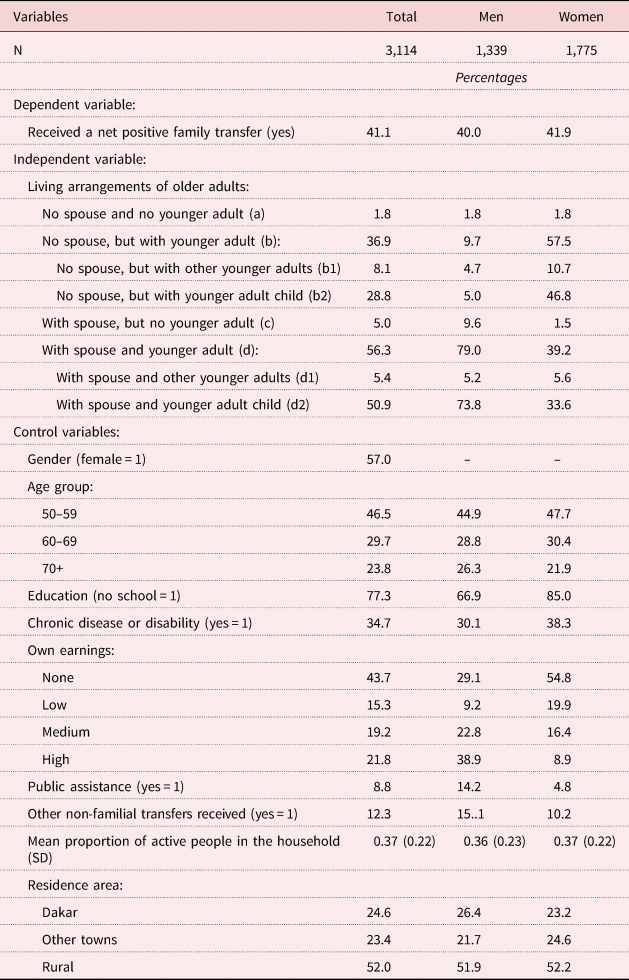
Table 1 shows the descriptive statistics for the background characteristics of 3,114 older adults aged 50 and above, by gender. Respondents are on average 62.3 years old, and more than half (57%) are women. Slightly more than half (52%) live in a rural area, with the rest split evenly between Dakar and other urban areas. In terms of educational attainment, a large majority (77.3%) had no education, as formal schooling was reserved for a small minority of the population in the past, when older people in the survey were school-aged. This was especially the case for older women who were considerably less likely to have gone to school. About a third of the sample reported being affected by a chronic disease or disability. The proportion of older adults without own earnings is higher among older women than older men, confirming the relative financial dependence of women. More than a third of residents in households with older people report being economically active. Only 8.8 per cent of respondents received public assistance such as pensions, health assurance and other assistance from the government – 14.2 per cent for older men and 4.8 per cent for older women. Finally, 12.3 per cent of respondents reported receiving transfers from non-relatives living outside the household.
Characteristics of the analytical sample by gender
Note: SD: standard deviation.
Source: Second round of the Poverty and Family Structure Survey in Senegal, 2010–2011.
Results
This section first describes the living arrangements of older adults in Senegal, focusing on differences between men and women, which have consistently been found to be important elsewhere in Africa (Golaz and Antoine, Reference Golaz, Antoine, Molmy, Sajoux and Nowik2011; Golaz and Rutaremwa, Reference Golaz and Rutaremwa2011; Yakam et al., Reference Yakam, Carrière, LeGrand, Bergouignan, Sanderson and Oris2020). Gender differences in the percentage of older adults receiving a net positive family transfer from outside the household in different living arrangements are then presented and assessed. Finally, a probit regression for receiving a net positive transfer on living arrangements is estimated for the entire sample of older people and separately for men and women.
What do the living arrangements of older adults in Senegal look like?
Figure 1 presents the living arrangements of older adults in Senegal by gender and age. This figure distinguishes between living with one's adult child and living with other adults to highlight the strength of parent–child ties in the co-habitation strategies of seniors and their families. In total, only 1.8 per cent of older respondents live with no younger adult and no spouse; half of them live alone and half live with young children or other older adults (aged 50 and over; result not shown). We find the same result among men and women and the similar proportions for each age group. About 5 per cent of older adults live with a spouse but without a younger adult; this proportion is significantly higher among older men than older women and decreases significantly with age.
Living arrangements of older adults in Senegal by gender and age group.
Notes: Women significantly different from men at p < 0.01 in all cases except those marked #. Older adults aged 50–59 significantly different from those aged 60–69 and 70+ at p < 0.01 in all cases except those marked #.
Source: Second round of the Poverty and Family Structure Survey in Senegal, 2010–2011.

Living with an adult child is clearly the most common living arrangement of older people in Senegal (79.7%). According to Bongaarts and Zimmer (Reference Bongaarts and Zimmer2002), this is because the prevalence of parent–child co-residence is inversely related to socio-economic development. While older women are much more likely to live with at least one adult child and without a spouse (46.8% for women and 5% for men), older men are more likely to live with their spouse and their adult children (73.8% for men and 33.6% for women). Another 13.5 per cent of older adults live with other younger adults and without their own adult children present. When the older adults do not co-reside with their own adult child, they usually live with other younger adults who are members of the extended family (siblings, nephews/nieces, stepsons/stepdaughters, etc.).Footnote 4 These people, like adult children, can also be an important source of support for the older people in the household. With respect to age groups, even if living with a younger adult child and spouse remains the most common living arrangement of older people in Senegal regardless of age, we find that the proportion of older adults living with their adult children but without a spouse and those living with other adults but without a spouse increases with age. Thus, despite recent demographic and socio-economic changes noted by several studies that may affect household structure in SSA, living with an adult child remains the most common living arrangement for older people (Bongaarts and Zimmer, Reference Bongaarts and Zimmer2002; Zimmer and Dayton, Reference Zimmer and Dayton2005; Ruggles and Heggeness, Reference Ruggles and Heggeness2008; Zimmer, Reference Zimmer2009; Bainame et al., Reference Bainame, Burnette and Shaibu2015; Kendall and Anglewicz, Reference Kendall and Anglewicz2018; United Nations, 2017).
Gender differences of family transfers to older adults by living arrangements
Table 2 presents the percentage of older adults who received a net positive family transfer by living arrangements and gender. In all, two out of five older adults received a positive net transfer from at least one member of the family residing outside the household. Most of these transfers come from non-coresident children (13.8%), parents or parents-in-law (9.8%), and siblings (7.7%) (results not shown). By performing a two-sample test of proportions by gender, we show that the percentage of older people receiving a net positive transfer differs significantly between men and women according to their living arrangements. Indeed, older women living with neither a spouse nor any younger adult are significantly much more likely to receive a net positive transfer than older men (62.5% versus 29.2%). Gender differences are also apparent when looking at those living with a spouse with no younger adult present, with an advantage for older women to receive such transfers (p = 0.090). Similarly, receiving a net positive transfer is more common among older women living with a younger adult but no spouse, compared to older men in the same situation (45.6% versus 26.2%). This difference is even larger when the co-resident younger adult is not their own child. In contrast, the percentage of males living both with spouse and a younger adult (whether his own child or not) who received a net positive transfer from family outside the household is significantly higher than their female counterparts in the same living arrangement (41.8% versus 35.0%). This difference is significant when the co-resident adult is the child of the older person and non-significant when the younger adult is not their child.Footnote 5
Percentage of older adults who received a net positive transfer from family outside the household by their living arrangements and their gender
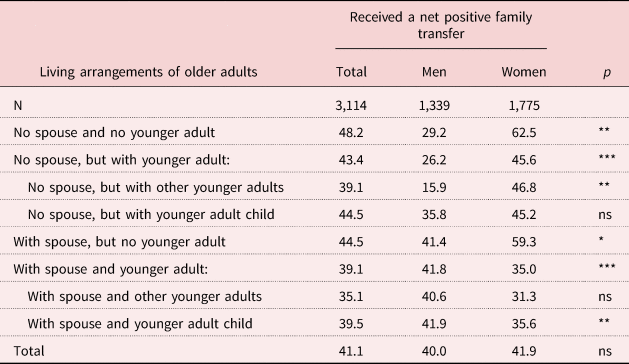
Significance levels: p-Values concern differences between men and women: * p < 0.1, ** p < 0.05, *** p < 0.01, ns: non-significant.
Source: Second round of the Poverty and Family Structure Survey in Senegal, 2010–2011.
Multivariate findings
Three probit regression models are used to study the association between living arrangements of older adults and the probability for an older adult in Senegal to receive a net positive transfer from family members living outside the household: one model estimated for the full sample, and the others for women and men separately.Footnote 6 All models are adjusted by the same covariates (except for gender in Models 2 and 3). The regression results, in the form of marginal effects, are presented in Table 3. To facilitate the interpretation of the results and to assess differences on the absolute probability scale, we present average marginal effects calculated from the probit coefficients. A positive marginal effect indicates that older adults in the category of interest are more likely to receive a net positive transfer from family members outside the household compared to those in the reference category, averaged over the values of other covariates in the model. The contrasts of predicted probabilities between men and women are also presented in Table 3. A positive value means that women have an advantage compared to men. The reference category for living arrangements ‘living with spouse and younger adult child’ is compared to the other groups, as this is the most common situation for older people in Senegal.
Marginal effects from probit regression examining the receipt of a net positive family transfer
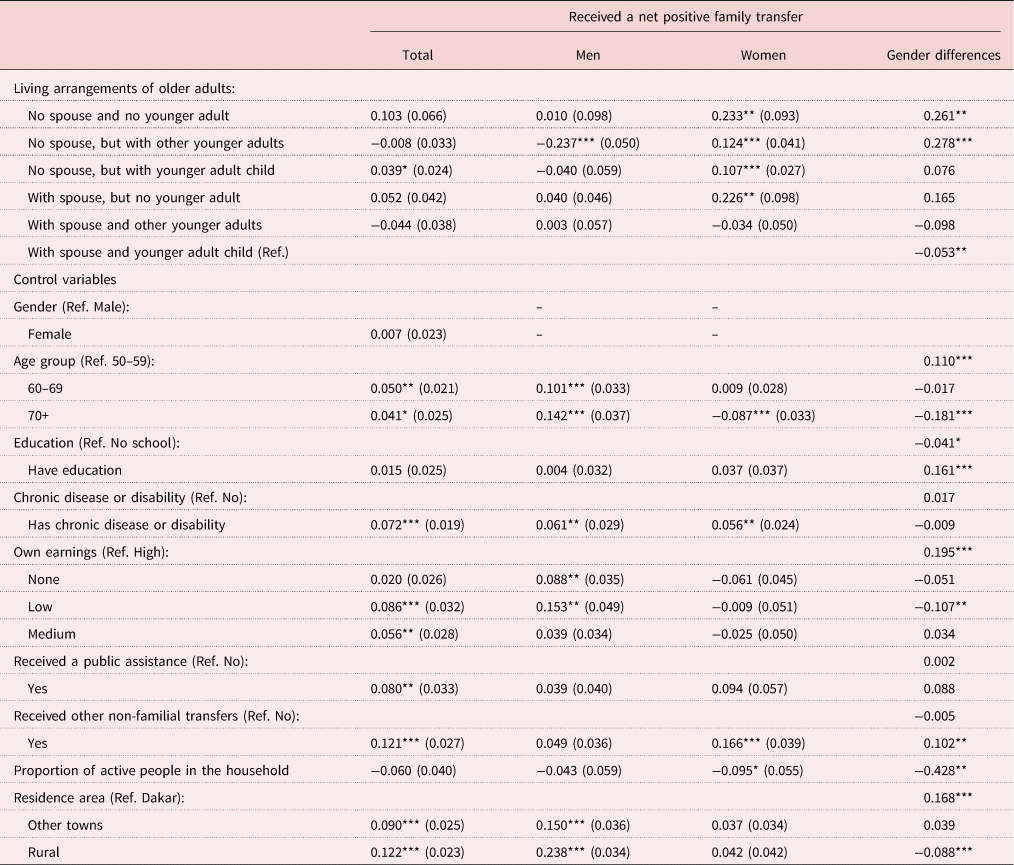
Notes: The ‘Gender differences’ column represents the contrasts of predicted probabilities between men and women. A positive sign means that women have an advantage compared to men. Standard errors are in parentheses. Ref: omitted reference categories.
Source: Second round of the Poverty and Family Structure Survey in Senegal, 2010–2011.
Significance levels: * p < 0.1, ** p < 0.05, *** p < 0.01.
Likelihood ratio tests show that living arrangements are significantly associated with family transfers from members outside the household.Footnote 7 However, the results for the full sample do not show a significant difference in the probability of receiving a net positive family transfer when comparing older adults ‘living with spouse and younger adult child’ individually with each of the other groups of living arrangement of the older adults, except those ‘living with no spouse, but with younger adult child’. These non-significant results may be due to small sample sizes, especially for older adults who live without adult children and spouse (N = 56).
Gender-based analyses considering covariates highlight the differences between men and women. For older men, the difference between the estimated likelihood of receiving a transfer for older men living with a spouse and younger adult child and those in any other living arrangements is not statistically significant, except for those who live without a spouse, but with other younger adults: they have a lower probability of receiving such a transfer. Conversely, for older women, living with a spouse and younger adult significantly decreases the probability of receiving a net positive family transfer from family outside the household compared to those living in any other living arrangements, except for those living with a spouse and any other adults. The probability of receiving a transfer for older women living neither with a spouse nor younger adults is greater than that for older women in the reference category by 23.3 percentage points. The change in probability of receiving such a transfer also increases by 22.6 percentage points when the living arrangement of the older women goes from ‘living with spouse and younger adult child’ to ‘living with spouse, but no younger adult’. In addition, the absence of the husband increases the likelihood of older women receiving support from non-resident family members as does the absence of an adult child. For the same living arrangement pattern, we also found that the probability of receiving a net positive transfer from non-coresident kin is significantly higher among older women than among older men, especially in the following living arrangements: ‘no spouse and no younger adult’ and ‘no spouse, but with other younger adults’. In contrast, older men who live ‘with spouse and younger adult child’ are more likely than older women in the same living arrangement to receive such transfers. This result suggests that depending on the gender of the older adults, some living arrangements are less favourable than others for receiving support from family outside the household. Furthermore, there is no significant advantage to receiving a net positive transfer for older women co-habiting with their husband or not, when living with their own adult child rather than with another adult. However, older men with no spouse present are advantaged in terms of receiving such a transfer but only when they live with their own adult child versus living with other adults (results not shown).
The results of the full sample model reveal often large associations between the probability of receiving a net positive transfer from family members outside the household and the socio-demographic and economic covariates. Remember that our dependent variable does not measure the magnitude of the transfer but only whether the older adults received a larger value of transfer from family living outside the household than they had sent. Except for gender, education and the proportion of active people in the household, estimated coefficients are also statistically significant. People aged 60–69 and over 70 are more likely to receive a net positive transfer from family outside the household than those aged 50–59. Moreover, the probability of receiving such transfers increases with age among older men while between older women those aged over 70 are significantly less likely to receive such transfers. Older people who live in rural and other towns tend to be more inclined to receive net positive transfers than their counterparts in Dakar. In urban areas (Dakar and other towns), older women have a higher probability of receiving a positive net transfer than older men, in rural areas the reverse is observed. Older adults suffering from a disability or chronic disease have a higher likelihood of receiving a net positive transfer from family outside the household. Surprisingly, the older adults who are already receiving some public assistance such as pensions, health insurance and other assistance from the government, as well as other non-familial transfers from non-relatives, are more likely to receive a net positive support from the family network. The greater the own earnings of older adults, the lower the probability of receiving a net positive transfer, but this finding is not statistically significant among older women.
Discussion
In the absence of well-functioning broad-based formal health insurance and social protection systems in many SSA countries, the family acts as the key provider of support to older people (Payne et al., Reference Payne, Pesando and Kohler2017). Given the ongoing socio-economic and demographic changes that may reshape household structures and affect the living arrangements of older adults, several authors have expressed concern over the essential support for older people within the framework of co-habitation. However, some studies have been cautiously optimistic, suggesting that old-age support will be maintained through new forms of assistance including inter-household support from relatives living outside the household through transfers of cash and in-kind resources (Apt, Reference Apt2001, Reference Apt2002; Aboderin and Hoffman, Reference Aboderin and Hoffman2015). This study aims to better understand this kind of support by examining the extent to which transfers from family outside the household to older adults occur and how they are conditioned by living arrangements.
The descriptive analysis shows that co-residence with spouse and younger adult child remains the most common living arrangement of older people in Senegal, although there are differences between men and women. While older men were more likely than older women to live both with their spouse and their adult children, older women were relatively much more likely to live with their adult child but without their spouse. This difference may be due to wives living longer and often being considerably younger than their husbands. When her husband dies, the wife tends to move into the extended family with their children (Zimmer and Dayton, Reference Zimmer and Dayton2005). As other researchers have pointed out, when older parents become frail and are unable to take care of themselves, they often move into their adult children's households to seek assistance or their adult children move or remain in the parent's household, again to offer assistance (Chen et al., Reference Chen, Leeson and Liu2017b). Our study also found that the proportion of older people living alone or only with their spouse in Senegal remains very small. This result shows the small impact to date of socio-economic and demographic changes on the structure of older persons' households, contrary to what is commonly suggested in the literature on other SSA countries (Bongaarts and Zimmer, Reference Bongaarts and Zimmer2002; National Research Council, Reference Cohen, Menken and Committee on Population2006; Ruggles and Heggeness, Reference Ruggles and Heggeness2008; Bainame et al., Reference Bainame, Burnette and Shaibu2015; Kendall and Anglewicz, Reference Kendall and Anglewicz2018). The Senegalese old-age context, characterised by polygamy and large families, could be one of the explanations for the status quo observed regarding the propensity to live alone in old age. However, it is quite possible to witness an increase in this type of household in the future.
Of much importance in this study are the differences observed when performing the analysis on the sub-samples of older men and older women separately. Our first hypothesis that older people living with a spouse and younger adult child are less likely to receive transfers from family members residing outside the household compared to others was supported for women and not for men. Considering analysis of the men's sub-sample, we found that there is no significant difference between older men living with a spouse and younger adult child and any other type of living arrangement, except for those living with other younger adults but no spouse who have the lowest probability of receiving a net positive transfer from non-coresident family networks. This result shows that family support from outside the household to older men does not necessarily depend on their living arrangement. This may be explained by the place of men in African societies, where they are often considered more as providers of help than receivers, whatever their living situations. Indeed, a man who lives alone or with others (spouse or adult child) is supposed to be able to take care of himself and, at the same time, to support the others. In that sense, there is no reason for the family to support an older man who lives without a spouse nor adult children versus living with both, because families expect the man to assume the role of household head and provide support for the family, rather than the other way around. Conversely to older men, for older women, we found a significant difference between those living with a spouse and younger adult child and any other types of living arrangement, except for those living with other adults and spouse. Especially, the results showed that among all the categories of older women's living arrangements, those living with no adult and no spouse (including those living alone, only with young children or with other older adults) have a greater probability of receiving a net positive transfer from family outside the household. This suggests that support from the family outside the older person's household occurs mainly when they are not likely to receive day-to-day assistance within the household. The absence of the spouse and the adult child in the household is generally seen as a good proxy for a lack of intra-household support, especially when we controlled with health and the economic needs of the older person. The result implies that the family outside the household assumes responsibility for supporting the older women when they are not co-habiting with their spouse or an adult person in the same household. Even though many adult children have left their parents' homes, family continue to provide remote support by sending them financial or in-kind transfers. Another result showed that living with an adult child but without a spouse substantially increases the likelihood of older women receiving a net positive family transfer when compared to those living with a spouse and an adult child. The absence of the husband appears to be a key element of inter-household transfers to older women in Senegal as does the absence of an adult child. One can assume that the presence of the husband reduces the likelihood of needing support from family members outside the household because he is involved in providing for the day-to-day needs of the older wife, especially financial. This finding also suggests that the presence of the husband might be seen as protective or as having a security effect by other family members, which certainly reduces their involvement in the care of older people who are still in a relationship. Thus, it suggests that the absence of the spouse in the household may be an indicator of vulnerability of the older women even when co-habiting with their adult children.
In addition, the results suggest that older women are more likely than older men to receive net positive family transfers in the following living arrangements: ‘no spouse and no younger adult’ and ‘no spouse, but with other younger adults’. This finding partially confirms our second hypothesis and shows that support of the family outside the household for older people depends not only on their living arrangements as confirmed by Hypothesis 1, but also on their gender. If older men have a lower probability of receiving positive net transfers from other family members, it may be because they receive all the necessary support within the household and do not need as many transfers from outside the household. Older women, especially those living in separate residences from their husbands, on the other hand, have to rely more on their families outside the household (Gning and Antoine, Reference Gning and Antoine2015). As some authors have also suggested, the presence of a spouse is more of a benefit for older men than older women (Golaz and Antoine, Reference Golaz, Antoine, Molmy, Sajoux and Nowik2011; Golaz and Rutaremwa, Reference Golaz and Rutaremwa2011; Niamba et al., Reference Niamba, Gagnon, Adjiwanou and Legrand2019; Yakam et al., Reference Yakam, Carrière, LeGrand, Bergouignan, Sanderson and Oris2020). However, we identified some specific vulnerable groups according to their weight in the older people population who are least likely to receive net positive family transfer: this includes older men who live with other younger adults but without their spouse and older women living with their spouse and younger adults, whether it is their sons or not (results not shown). Another result invalidated our second hypothesis by showing that older men living ‘with spouse and younger adult child’ are more likely than older women in the same living arrangement to receive transfers. This may be explained by the fact that men are generally responsible for the care of their spouse and other household members while women are cared for by their spouse or other adults in the household when co-habiting with them.
Testing Hypothesis 3, which expected a different impact on the probability of receiving net positive transfer among older adults living with an adult who is not his or her child compared to those with an adult who is his or her child, we did not find significant evidence for older women whether they live with their husband, whereas it exists for older men, especially those living with no spouse. This result means that, in the context of Senegal, younger adults who are not related to older people by blood ties (usually siblings, nephews/nieces, stepsons/stepdaughters or other relatives) have the same responsibility for taking care of older women as their own adult children. Caring for older women is not only a responsibility of children but also of other members of the family and the community which live with them (National Research Council, Reference Cohen, Menken and Committee on Population2006; Aboderin and Hoffman, Reference Aboderin and Hoffman2015; Aboderin, Reference Aboderin2017). That was not the case for older men where in the absence of the spouse, families are less likely to support those who live with other adults without their own younger adult child present. Although Hypothesis 3 is confirmed for the latter, the direction of the relationship is not what was expected. Contrary to what was assumed, older men living with other younger adults and no spouse would receive less outside help, either because they already have adequate support within the household or because outside support is lacking.
This paper aims to contribute to the empirical knowledge of family support to older adults in SSA and to improve knowledge about strategies used by both older adults and their families to support older people. Based on these findings, family support towards older people, especially women, is not only structured around co-habitation, but also extra-residential solidarity (Kuépié, Reference Kuépié2012; Gning, Reference Gning, Nowik and Lecestre-Rollier2015). Previous research has shown that family solidarity tends to crumble with changes in household structure and residential arrangements (Goode, Reference Goode1963; Aboderin, Reference Aboderin2004, Reference Aboderin2017). The present research shows that family transfers to the older adults can complement traditional support strategies. Older adults, especially women, who live alone, without a spouse, without an adult or just with young children, can count on the support of the family outside the household. These results are consistent with the findings of Kuépié (Reference Kuépié2012), which indicates that family transfers and living arrangements are substitutable, one occurring to enforce the other. Even though older adults' needs for assistance are not well captured in this study, it provides a nuance to the widespread findings that suggest that changes in the structure of African households does lead to a weakening of extended kin solidarity and a reduction in family support (Bongaarts and Zimmer, Reference Bongaarts and Zimmer2002). These conclusions are essentially based on the implicit confusion that is often made between living arrangements and private support for older people (Aboderin, Reference Aboderin2017). Even if family structures mutate, family support may take a new form. This paper helps to initiate the debate on the subject by focusing on support from outside the household, which has been less studied so far.
There are some limitations to this study. First, support provided to the older adult by the family outside the household focused specifically on financial or in-kind transfers. Exchanges of services, particularly sociability and support networks, are difficult to quantify and remain poorly known, or even ignored, compared to monetary and financial exchanges which have long been the subject of economic science. Of course, support to older persons can also be emotional, psychological and even physical by performing household tasks, such as cooking, shopping, laundry, etc. Given the Senegalese context, older women may be more in need of assistance in housework than financial assistance. Second, older adults' need for assistance is not measured, neither is the financial capacity of the non-coresident family member to provide it. To address this limit, health and economic variables were used as a proxy for the need for assistance since the data do not allow one to know whether the older adult is experiencing need for receiving a transfer from the family. Although we also included the proportion of the household members currently in activity to control for the likely needs of older adults' co-residents, the data used here did not allow us to consider the financial capacity of the non-coresident family member. Third, living arrangement decisions of older adults can be the result of frequently receiving family transfers from outside the household, which generate a potential reversed causality by endogeneity. Indeed, older adults receiving more financial and material transfers can be more likely to live alone as higher wealth reduces vulnerabilities and constraints. So, there is a complex simultaneity problem inherent in this issue, which is not addressed in this paper due to the fact that cross-sectional data were used. Addressing these limitations could contribute to a better understanding of why family transfers to older adults occur, and how it would be conditioned by their living arrangements. It provides a tentative explanation, which it would be desirable to validate in further research.
To sum up, the paper contributes to the emerging literature on private support in old age by highlighting both living arrangements of older people and family support, and the link between the two. Family transfers from outside the household might be an important way to provide support to older people, especially for women who live with no adult and no spouse (including living alone and only with young children or other older adults). However, by providing financial and other kinds of assistance to older family members, families may also put themselves in need. Therefore, the Government of Senegal, as well as those of other SSA countries cannot let households and individuals be the sole provider of social security for older people. Even though decision-makers should place more attention on potential external family support when designing policies to support older people in constrained settings, they should do more to accelerate the implementation of public policies in their favour.
Supplementary material
The supplementary material for this article can be found at https://doi.org/10.1017/S0144686X22001039.
Acknowledgements
We are grateful to the National Agency for Statistics and Demography for giving us data to carry out this research. An early version of this work was presented at the 8th African Population Conference in Entebbe, Uganda, in October 2019. We thank all the participants of this conference and the anonymous reviewers for helpful comments and suggestions. All errors are ours.
Author contributions
WAY designed and carried out the study, performed statistical analyses, interpreted the results and wrote the manuscript. YC and TL commented on the manuscript and reviewed critically the final version for intellectual content and quality.
Financial support
This work was supported by the Centre for Research and Expertise in Social Gerontology.
Conflict of interest
The authors declare no potential conflicts of interest with respect to the research, authorship and/or publication of this article.
Ethical standards
Ethical approval was not required.


 Open access

