





1 Introduction
The heavy reliance on assessments in critical social decision-making, such as college admission, personnel selection and placement, and resource allocation, highlights the need for a thorough evaluation of assessment fairness, particularly in light of ongoing concerns about equity. For decades, assessment fairness has been a central focus in psychometrics. American Educational Research Association et al. (2014) further emphasizes the importance of ensuring assessment fairness throughout the test development process, including the standard practice of screening for differential item functioning (DIF).
DIF refers to the phenomenon in which people from different subgroups, usually defined by demographic variables, such as gender, race, or ethnicity, differ in the probability of correctly answering an item after controlling for their ability. Although DIF does not necessarily indicate measurement bias, DIF detection is a critical first step for further investigation. Two types of DIF are often discussed in the literature: uniform DIF (UDIF) and non-uniform DIF (NUDIF). Specifically, UDIF assumes a consistent difference in item responses between groups across ability levels, whereas NUDIF allows this difference to vary across ability levels. Various DIF detection methods have been developed, including Lord’s chi-square test, logistic regression, and regularized DIF (Lord, Reference Lord1980; Swaminathan & Rogers, Reference Swaminathan and Rogers1990; Tutz & Schauberger, Reference Tutz and Schauberger2015; Wang et al., Reference Wang, Zhu and Xu2023). While these methods differ in many ways, they typically treat DIF as the main effect of each demographic variable.
Recently, two criticisms have emerged concerning the quantitative methodologies used in inequality studies, including those employed in DIF analysis. First, existing methods often overlook intersectionality. In reality, people’s multiple identities do not function in isolation but are interlinked to collectively shape the privilege and discrimination. Intersectionality, a theoretical framework rooted in feminist scholarship, highlights this complexity and is increasingly used in fields, such as health, psychology, and education studies (Cole, Reference Cole2009; Núñez, Reference Núñez2014). In the context of DIF, this framework gives rise to the concept of intersectional DIF, which refers to the DIF that results from the interaction effect of multiple demographic variables. Unlike traditional DIF, which only considers the main effect of demographic variables separately, intersectional DIF captures the potential bias that arises at the intersection of multiple identities. For example, individuals belonging to multiple marginalized groups may experience DIF effects that are not simply the sum of the effect of each grouping variable, but amplified or diminished due to their intersecting social positions. Empirical results from a recent intersectional DIF study suggest that traditional DIF methods that ignore intersectionality may lead to substantial bias (Albano et al., Reference Albano, French and Vo2024). Second, existing studies often require the specification of a reference group. DIF is usually detected by comparing each focal group to the reference group, while comparisons among focal groups themselves are rarely made. Although mathematically any group can be designated as the reference with no difference, the routine choice of the privileged group may unintentionally reinforce the notion that privileged groups represent the norm, positioning all other groups as deviations (Johfre & Freese, Reference Johfre and Freese2021).
In response to these concerns, recent studies have begun to address intersectional DIF (Albano et al., Reference Albano, French and Vo2024; Belzak, Reference Belzak2023; Muthén & Asparouhov, Reference Muthén and Asparouhov2018; Russell & Kaplan, Reference Russell and Kaplan2021; Russell et al., Reference Russell, Szendey and Kaplan2021, Reference Russell, Szendey and Li2022). These methods typically model intersectional DIF by either incorporating both demographic variables and their interactions (i.e., product terms) into the measurement model, or by defining a single synthetic categorical variable that encodes all combinations of demographic characteristics. The synthetic group method is mathematically equivalent to modeling all-way interactions. However, both methods treat intersectional DIF as fixed effects, which limits scalability. As more demographic variables are included, the number of intersectional groups and corresponding parameters increases geometrically, while the sample size per group decreases. This leads to challenges for model estimation. For example, the combination of gender (e.g., male, female, and non-binary) and race (e.g., White, Black, or African American, American Indian or Alaska Native, Asian, and Native Hawaiian or Other Pacific Islander) results in 15 intersectional groups, and this number expands rapidly as additional variables are considered.
In contrast to traditional fixed-effect methods for DIF detection, intersectionality can be modeled as random effects within the multilevel modeling framework. This approach is inspired by multilevel analysis of individual heterogeneity and discriminatory accuracy (MAIHDA), an emerging quantitative approach developed in health inequality. MAIHDA treats individuals (level 1) as nested within intersectional strata (level 2), where each stratum represents a unique combination of social identities, that is, a specific level of the synthetic intersectional group variable. MAIHDA models incorporate the main effect for each demographic variable and a stratum-level random effect. Rather than modeling all-way interaction terms explicitly through fixed effects, the random effect captures the total between-strata variance that is not explained by the additive main effects. Compared to traditional fixed-effect methods, this multilevel framework promotes model parsimony and scalability in the presence of many demographic variables and enables the decomposition of covariate effects into additive and interactive components (Evans et al., Reference Evans, Borrell, Bell, Holman, Subramanian and Leckie2024; Evans et al., Reference Evans, Williams, Onnela and Subramanian2018; Merlo, Reference Merlo2018). It is worth noting that, in MAIHDA, the same demographic variables that characterize individuals at level 1 also define the level 2 strata. While this seems to introduce collinearity, there is a conceptual distinction. As clarified in the MAIHDA literature, unlike in conventional multilevel models where demographic variables are treated as individual-level covariates, these variables are conceptualized as properties of the strata at level 2. This framing is fundamental to the MAIHDA framework and is discussed in detail by Evans et al. (Reference Evans, Borrell, Bell, Holman, Subramanian and Leckie2024).
Similar to the MAIHDA framework, we propose applying random effects to item parameters for detecting intersectional DIF. In this approach, the main effects of demographic variables on item parameters are explicitly modeled to account for traditional DIF, while random effects are introduced to capture additional variations across intersectional groups without requiring the explicit specification of interaction terms. A random item effect with nonzero variance, after controlling for main effects, is interpreted as evidence of intersectional DIF. Using random effects, the proposed model inherits the advantages of MAIHDA, including interpretability, scalability, and parsimony.
Although this multilevel approach is new to DIF detection, it builds on the well-known random item effect framework in psychometrics. Specifically, random-item item response theory (IRT) models allow item parameters to vary across groups following specific distributions. These models have been applied in various measurement invariance contexts, such as longitudinal designs with randomly drawn item samples, international large-scale assessments, and automatic item generation (AIG) or item cloning (De Boeck, Reference De Boeck2008; Jong et al., Reference Jong, Steenkamp and Fox2007; Lathrop & Cheng, Reference Lathrop and Cheng2017; Muthén & Asparouhov, Reference Muthén and Asparouhov2018; Rijmen & Jeon, Reference Rijmen and Jeon2013). However, existing random item effect models cannot be used directly for intersectional DIF detection. First, most existing models define groups using a single demographic variable (e.g., country) and do not involve the decomposition of main and interaction effects. When extended to intersectional groups formed by multiple identities, using only random effects confounds interactions with main effects. In other words, without explicitly modeling main effects, the random effect cannot be directly interpreted as intersectional DIF (Jong et al., Reference Jong, Steenkamp and Fox2007; Muthén & Asparouhov, Reference Muthén and Asparouhov2018; Rijmen & Jeon, Reference Rijmen and Jeon2013). Second, existing models typically assume random effects on all items, requiring post hoc tests to identify DIF items. Third, model estimation is computationally intensive. Although Rijmen & Jeon (Reference Rijmen and Jeon2013) employ variational inference to reduce computational efforts, their algorithm still lacks closed-form solutions and remains computationally demanding.
Our proposed methods address these limitations through three innovations. First, as mentioned above, the proposed models incorporate both main effects of demographic variables and random effects, enabling separation between traditional and intersectional DIF. Second, we impose a log penalty on the random item effects, effectively shrinking the variance to zero for items free from intersectional DIF. Notably, due to this regularization, our methods do not require anchors for random effects. However, anchor items are still needed for main effects, as we assume that both traditional and intersectional DIF can appear on the same item. Since the primary focus of this study is on intersectional DIF, the anchor requirement applies only to main effects and thus plays a limited role. Third, for efficient model estimation, we develop a Gaussian variational expectation–maximization (GVEM) algorithm. Originally introduced to psychometrics for multidimensional IRT (MIRT) estimation, GVEM circumvents the high-dimensional integral in model estimation, achieves a closed-form solution within the EM algorithm, and significantly reduces computational complexity (Cho et al., Reference Cho, Wang, Zhang and Xu2021).
Our methods accommodate both intersectional UDIF and NUDIF detection by applying a unified modeling strategy to different item parameters (i.e., difficulty and discrimination). In addition, we extend the model to capture intersectional impact. Impact refers to differences in the group-level mean abilities. Traditionally, impact is limited to the main effects of demographic variables on group-level ability means. However, as emphasized by intersectionality, interactions among multiple identities could also influence group-level abilities. We define intersectional impact as different group-level mean abilities arising from these interactions. Similar to intersectional DIF, we use random effects on group-level mean abilities (i.e., multilevel latent trait) to capture intersectional impact. Beyond studying intersectionality, our proposed approach is also well suited for nested structures, such as students within different countries, especially in large-scale assessments (Pastor, Reference Pastor2003; Sulis & Toland, Reference Sulis and Toland2017).
In summary, the major contributions of this article are fourfold: (1) quantifying the intersectional DIF as random item effects, (2) introducing the concept of intersectional impact, (3) applying a log penalty to detect nonzero item-level variation reflective of intersectional DIF, and (4) applying efficient variational methods for model estimation. The rest of the article is organized as follows. We first introduce the four random item IRT models proposed in this study, followed by the regularized GVEM algorithm. Then, we present four simulation studies and an empirical study to evaluate the performance of the proposed intersectional DIF detection methods. Finally, we conclude with a discussion of limitations and future directions.
2 Methods
This study aims to detect intersectional DIF, defined as interactions among demographic variables on item parameters. We also consider scenarios both with and without intersectional impact, defined as interactions among demographic variables that affect group-level mean abilities. The two-parameter logistic (2PL) IRT model is used as the foundational model, upon which four extended models are developed. These models incorporate random item intercepts for intersectional UDIF, random item slopes for intersectional NUDIF, and a multilevel ability structure for intersectional impact. Specifically, the four proposed models are 2PL with random item intercept (2PL-Ri), 2PL with random item intercept and with multilevel latent trait (2PL-RiM), 2PL with random item intercept and slope (2PL-Ris), and 2PL with random item intercept and slope and with multilevel latent trait (2PL-RisM). The structure and applicability of these models are summarized in Table 1.
Proposed IRT models in this study

Note: DIF and impact refer to intersectional DIF and intersectional impact, respectively.
Let $y_{ijs}$
denote the binary response of person i (
$y_{ijs}$
denote the binary response of person i ( $i = 1,2,\dots ,N_s$
) in group s (
$i = 1,2,\dots ,N_s$
) in group s ( $s = 1,2,\dots ,S$
) on item j (
$s = 1,2,\dots ,S$
) on item j ( $j = 1,2,\dots ,J$
). For 2PL-RisM, the most flexible model in this study, the item response function of
$j = 1,2,\dots ,J$
). For 2PL-RisM, the most flexible model in this study, the item response function of $y_{ijs}$
is
$y_{ijs}$
is
 $$ \begin{align} \begin{aligned} \mathbb{P}(y_{ijs} = 1\mid \theta_{is},a_{js}, b_{js}) &= \frac{1}{1+\exp[-(a_{js}\theta_{is} + b_{js})]}, \end{aligned} \end{align} $$
where the random effects are
 $$ \begin{align} \begin{aligned} \theta_{is}\mid\alpha_{0s} &\sim\mathcal{N}(\alpha_{0s}+\boldsymbol{\alpha}_1^{\textsf{T}}\boldsymbol{X}_s,\sigma_{\theta}^2),\\ \alpha_{0s}&\sim\mathcal{N}(0,\sigma_{\alpha_0}^2),\\ b_{js}&\sim\mathcal{N}(\boldsymbol{\beta}_j^{\textsf{T}}\tilde{\boldsymbol{X}}_s,\sigma_{b_j}^2),\\ a_{js}&\sim\mathcal{N}_{+}(\bar{\boldsymbol{\gamma}}_j^{\textsf{T}}\tilde{\boldsymbol{X}}_s,\bar \sigma_{a_j}^2). \end{aligned} \end{align} $$
Before interpreting the model, it is necessary to clarify several notations. Let D denote the number of demographic variables of interest. An intersectional group is defined as a unique combination of levels across these D variables. Let S be the total number of such intersectional groups, equal to the product of the number of levels across all variables. That is, $S = \prod _{d=1}^DK_d$
, where
$S = \prod _{d=1}^DK_d$
, where $K_d$
is the number of levels for the d-th variable. For each group
$K_d$
is the number of levels for the d-th variable. For each group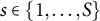 $s \in \{1,\dots ,S\}$
, let
$s \in \{1,\dots ,S\}$
, let $\boldsymbol {X}_s$
be a P-dimensional dummy coded vector. The total number of dummy variables is
$\boldsymbol {X}_s$
be a P-dimensional dummy coded vector. The total number of dummy variables is $P = \sum _{d=1}^D (K_d -1)$
. For example, if there are
$P = \sum _{d=1}^D (K_d -1)$
. For example, if there are $D = 2$
variables, race and gender, where race has
$D = 2$
variables, race and gender, where race has $K=5$
categories and gender has
$K=5$
categories and gender has $K=3$
categories, then
$K=3$
categories, then $S = 5 \times 3 = 15$
, and
$S = 5 \times 3 = 15$
, and $P = (5-1) + (3-1) = 6$
. To accommodate the intercept, let
$P = (5-1) + (3-1) = 6$
. To accommodate the intercept, let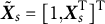 $\tilde {\boldsymbol {X}}_s = [1, \boldsymbol {X}_s^{\textsf {T}}]^{\textsf {T}}$
be a
$\tilde {\boldsymbol {X}}_s = [1, \boldsymbol {X}_s^{\textsf {T}}]^{\textsf {T}}$
be a $(P+1)$
-dimensional vector. Correspondingly,
$(P+1)$
-dimensional vector. Correspondingly, $\boldsymbol {\beta }_j^{\textsf {T}} = [b_j, \dot {\boldsymbol {\beta }}_j^{\textsf {T}}]$
, where
$\boldsymbol {\beta }_j^{\textsf {T}} = [b_j, \dot {\boldsymbol {\beta }}_j^{\textsf {T}}]$
, where $b_j$
denotes the intercept parameter for item j in the reference group, and
$b_j$
denotes the intercept parameter for item j in the reference group, and $\dot {\boldsymbol {\beta }}_j^{\textsf {T}}$
is the vector of coefficients representing the main effects of demographic variables on the intercept. Note that in the current model, one intersectional group serves as the reference group because demographic variables are dummy coded to capture main effects. However, by using effect coding instead, no single intersectional group is treated as the reference; rather, effects are interpreted relative to the overall mean across all groups. Similarly,
$\dot {\boldsymbol {\beta }}_j^{\textsf {T}}$
is the vector of coefficients representing the main effects of demographic variables on the intercept. Note that in the current model, one intersectional group serves as the reference group because demographic variables are dummy coded to capture main effects. However, by using effect coding instead, no single intersectional group is treated as the reference; rather, effects are interpreted relative to the overall mean across all groups. Similarly, $\bar {\boldsymbol {\gamma }}_j ^{\textsf {T}} = [a_j, \dot {\bar {\boldsymbol {\gamma }}}_j^{\textsf {T}}]$
, where
$\bar {\boldsymbol {\gamma }}_j ^{\textsf {T}} = [a_j, \dot {\bar {\boldsymbol {\gamma }}}_j^{\textsf {T}}]$
, where $a_j$
denotes the slope parameter for item j in the reference group, and
$a_j$
denotes the slope parameter for item j in the reference group, and $\dot {\bar {\boldsymbol {\gamma }}}_j^{\textsf {T}}$
represents the main effects on the slope. Finally,
$\dot {\bar {\boldsymbol {\gamma }}}_j^{\textsf {T}}$
represents the main effects on the slope. Finally, $\mathcal {N}$
and
$\mathcal {N}$
and $\mathcal {N}_+$
denote the normal distribution and the truncated normal distribution (left-truncated at zero), respectively. We place bars over parameters associated with
$\mathcal {N}_+$
denote the normal distribution and the truncated normal distribution (left-truncated at zero), respectively. We place bars over parameters associated with $a_{js}$
to indicate that
$a_{js}$
to indicate that $\bar {\boldsymbol {\gamma }}_j^{\textsf {T}}\tilde {\boldsymbol {X}}_s$
and
$\bar {\boldsymbol {\gamma }}_j^{\textsf {T}}\tilde {\boldsymbol {X}}_s$
and $\bar {\sigma }_{a_j}^2$
represent the mean and variance of the untruncated latent variable underlying
$\bar {\sigma }_{a_j}^2$
represent the mean and variance of the untruncated latent variable underlying $a_{js}$
, rather than those of
$a_{js}$
, rather than those of $a_{js}$
itself.
$a_{js}$
itself.
In Equation (1), $\theta _{is}$
is the ability of person i in subgroup s, where abilities within each subgroup follow a normal distribution with mean
$\theta _{is}$
is the ability of person i in subgroup s, where abilities within each subgroup follow a normal distribution with mean $\alpha _{0s}+\boldsymbol {\alpha }_1^{\textsf {T}}\boldsymbol {X}_s$
. Recall that
$\alpha _{0s}+\boldsymbol {\alpha }_1^{\textsf {T}}\boldsymbol {X}_s$
. Recall that $\boldsymbol {X}_s$
is the dummy coding vector that corresponds to group s.
$\boldsymbol {X}_s$
is the dummy coding vector that corresponds to group s. $\boldsymbol {\alpha }_1^{\textsf {T}}\boldsymbol {X}_s$
represents the main effect of demographics on the group-level mean ability, that is, the traditional impact in DIF literature. In addition, we introduce the random intercept
$\boldsymbol {\alpha }_1^{\textsf {T}}\boldsymbol {X}_s$
represents the main effect of demographics on the group-level mean ability, that is, the traditional impact in DIF literature. In addition, we introduce the random intercept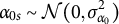 $\alpha _{0s} \sim \mathcal {N}(0, \sigma _{\alpha _0}^2)$
. As in the MAIHDA literature, we do not explicitly model any high-order interactions among the demographic variables. Instead, the random effect
$\alpha _{0s} \sim \mathcal {N}(0, \sigma _{\alpha _0}^2)$
. As in the MAIHDA literature, we do not explicitly model any high-order interactions among the demographic variables. Instead, the random effect $\alpha _{0s}$
is used to capture these additional deviations, that is, the intersectional impact. Moreover,
$\alpha _{0s}$
is used to capture these additional deviations, that is, the intersectional impact. Moreover, $b_{js}$
represents the group-specific intercept parameter for item j in subgroup s, following a normal distribution with mean
$b_{js}$
represents the group-specific intercept parameter for item j in subgroup s, following a normal distribution with mean $\boldsymbol {\beta }_j^{\textsf {T}}\tilde {\boldsymbol {X}}_s$
and variance
$\boldsymbol {\beta }_j^{\textsf {T}}\tilde {\boldsymbol {X}}_s$
and variance $\sigma _{b_j}^2$
. The term
$\sigma _{b_j}^2$
. The term $\boldsymbol {\beta }_j^{\textsf {T}}\tilde {\boldsymbol {X}}_s$
represents the group-specific intercept due to the main effects of demographic variables, corresponding to the traditional UDIF. The variance of the random intercept
$\boldsymbol {\beta }_j^{\textsf {T}}\tilde {\boldsymbol {X}}_s$
represents the group-specific intercept due to the main effects of demographic variables, corresponding to the traditional UDIF. The variance of the random intercept $\sigma _{b_j}^2$
captures deviations from the main effect across intersectional groups and is intended to reflect intersectional DIF on the intercept. Similarly, the group-specific slope parameter
$\sigma _{b_j}^2$
captures deviations from the main effect across intersectional groups and is intended to reflect intersectional DIF on the intercept. Similarly, the group-specific slope parameter $a_{js}$
follows a truncated normal distribution. Its pre-truncation mean,
$a_{js}$
follows a truncated normal distribution. Its pre-truncation mean, $\bar {\boldsymbol {\gamma }}_j^{\textsf {T}}\tilde {\boldsymbol {X}}_s$
, captures the main effects of demographics on the slope (i.e., traditional NUDIF), while the variance
$\bar {\boldsymbol {\gamma }}_j^{\textsf {T}}\tilde {\boldsymbol {X}}_s$
, captures the main effects of demographics on the slope (i.e., traditional NUDIF), while the variance $\bar \sigma _{a_j}^2$
is specifically introduced to capture intersectional DIF on the slope. Accordingly, the model is parameterized so that item j is free of intersectional NUDIF when
$\bar \sigma _{a_j}^2$
is specifically introduced to capture intersectional DIF on the slope. Accordingly, the model is parameterized so that item j is free of intersectional NUDIF when $\bar \sigma _{a_j}^2 = 0$
, and further free of intersectional UDIF when
$\bar \sigma _{a_j}^2 = 0$
, and further free of intersectional UDIF when $\sigma _{b_j}^2 = 0$
as well.
$\sigma _{b_j}^2 = 0$
as well.
Please note that the 2PL-RisM model shown above combines features of the random item effect model and multilevel IRT model. It treats item parameters similarly to a linear logistic test model with error (LLTM with error), but instead of using a property matrix to explain the difficulty (De Boeck, Reference De Boeck2008; Kim & Wilson, Reference Kim and Wilson2020), the mean of each item’s difficulties is determined by the main effects of demographics to capture traditional DIF, while the variance accounts for additional variations (i.e., intersectional DIF). In addition, the other three models in Table 1 are simplified version of the 2PL-RisM model: the 2PL-Ris model sets $\alpha _{0s} = 0$
, the 2PL-RiM model sets
$\alpha _{0s} = 0$
, the 2PL-RiM model sets $a_{js} = a_j$
, and the 2PL-Ri model sets both
$a_{js} = a_j$
, and the 2PL-Ri model sets both $\alpha _{0s} = 0$
and
$\alpha _{0s} = 0$
and $a_{js} = a_j$
.
$a_{js} = a_j$
.
2.1 Model estimation
In this section, we introduce a novel algorithm for model estimation based on variational inference. The key idea of variational approximation is to approximate the intractable marginal likelihood with a computationally feasible lower bound. The lower bound derived in this article follows the local variational methods by Bishop (Reference Bishop2006) and Cho et al. (Reference Cho, Wang, Zhang and Xu2021). Compared to the variational methods by Rijmen & Jeon (Reference Rijmen and Jeon2013), the GVEM method in this article results in closed-form solutions for most parameters. To ensure clarity, we begin with the simplest model in this study, 2PL-Ri. The item response function of $y_{ijs}$
can still be written as in Equation (1), with random effects
$y_{ijs}$
can still be written as in Equation (1), with random effects
 $$ \begin{align} \begin{aligned} \theta_{is}&\sim\mathcal{N}(\boldsymbol{\alpha}_1^{\textsf{T}}\boldsymbol{X}_s,\sigma_{\theta}^2),\\ b_{js}&\sim\mathcal{N}(\boldsymbol{\beta}_j^{\textsf{T}}\tilde{\boldsymbol{X}}_s,\sigma_{b_j}^2). \end{aligned} \end{align} $$
Let $\boldsymbol {Z}=\bigcup _{s=1}^S\bigcup _{i=1}^{N_s}\bigcup _{j=1}^J\{\theta _{is},b_{js}\}$
be the set of all latent variables, including both latent traits and random item effects, in the 2PL-Ri model. The joint likelihood of responses
$\boldsymbol {Z}=\bigcup _{s=1}^S\bigcup _{i=1}^{N_s}\bigcup _{j=1}^J\{\theta _{is},b_{js}\}$
be the set of all latent variables, including both latent traits and random item effects, in the 2PL-Ri model. The joint likelihood of responses $\boldsymbol {Y}=\bigcup _{s=1}^S\bigcup _{i=1}^{N_s}\bigcup _{j=1}^J\{y_{ijs}\}$
and latent variables
$\boldsymbol {Y}=\bigcup _{s=1}^S\bigcup _{i=1}^{N_s}\bigcup _{j=1}^J\{y_{ijs}\}$
and latent variables $\boldsymbol {Z}$
is
$\boldsymbol {Z}$
is
 $$ \begin{align} \begin{aligned} p(\boldsymbol{Y},\boldsymbol{Z}) &= \mathbb{P}(\boldsymbol{Y}\mid \boldsymbol{Z})p(\boldsymbol{Z}) \\ &= \prod_{s=1}^S\left\{\left[\prod_{i=1}^{N_s}\prod_{j=1}^J \mathbb{P}(Y_{ijs} =y_{ijs}\mid\theta_{is},b_{js})\right]\left[\prod_{j=1}^J p_{b_j}(b_{js})\right]\left[\prod_{i=1}^{N_s} p_{\theta_{is}}(\theta_{is})\right] \right\},\end{aligned} \end{align} $$
where $\mathbb {P}(Y_{ijs} =y_{ijs}\mid \theta _{is},b_{js}) = \mathbb {P}(Y_{ijs} =1\mid \theta _{is},b_{js})^{y_{ijs}} \mathbb {P}(Y_{ijs} =0\mid \theta _{is},b_{js})^{1-y_{ijs}}$
. With any probability density function
$\mathbb {P}(Y_{ijs} =y_{ijs}\mid \theta _{is},b_{js}) = \mathbb {P}(Y_{ijs} =1\mid \theta _{is},b_{js})^{y_{ijs}} \mathbb {P}(Y_{ijs} =0\mid \theta _{is},b_{js})^{1-y_{ijs}}$
. With any probability density function $q(\boldsymbol {Z})$
for
$q(\boldsymbol {Z})$
for $\boldsymbol {Z}$
, the log marginal likelihood of
$\boldsymbol {Z}$
, the log marginal likelihood of $\boldsymbol {Y}$
can be written as
$\boldsymbol {Y}$
can be written as
 $$ \begin{align} \begin{aligned} \ell(\boldsymbol{Y}) &= \log\mathbb{P}(\boldsymbol{Y})\\ &=\int\left[\log\mathbb{P}(\boldsymbol{Y})\right] q(\boldsymbol{Z})\text{d}\boldsymbol{Z}\\ &= \int \left[\log \frac{p(\boldsymbol{Y},\boldsymbol{Z})}{p(\boldsymbol{Z}\mid \boldsymbol{Y})} \right] q(\boldsymbol{Z})\text{d}\boldsymbol{Z}\\ &= \int \left[\log \frac{p(\boldsymbol{Y},\boldsymbol{Z})}{q(\boldsymbol{Z})} \right] q(\boldsymbol{Z})\text{d}\boldsymbol{Z} + \int \left[\log \frac{q(\boldsymbol{Z})}{p(\boldsymbol{Z} \mid \boldsymbol{Y})}\right] q(\boldsymbol{Z})\text{d}\boldsymbol{Z}\\ &\geq \int \left[\log \frac{p(\boldsymbol{Y},\boldsymbol{Z})}{q(\boldsymbol{Z})} \right]q(\boldsymbol{Z})\text{d}\boldsymbol{Z} \\ &\equiv \text{ELBO}\\ &= \int \left[\log p(\boldsymbol{Y},\boldsymbol{Z})\right] q(\boldsymbol{Z})\text{d}\boldsymbol{Z}-\text{constant},\\ \end{aligned} \end{align} $$
where ELBO refers to the evidence lower bound, and the difference $\ell (\boldsymbol {Y})-\text {ELBO}$
corresponds to the Kullback–Leibler (KL) divergence (Kullback & Leibler, Reference Kullback and Leibler1951) from
$\ell (\boldsymbol {Y})-\text {ELBO}$
corresponds to the Kullback–Leibler (KL) divergence (Kullback & Leibler, Reference Kullback and Leibler1951) from $q(\boldsymbol {Z})$
to
$q(\boldsymbol {Z})$
to $p(\boldsymbol {Z}\mid \boldsymbol {Y})$
, given by
$p(\boldsymbol {Z}\mid \boldsymbol {Y})$
, given by
 $$\begin{align*}\text{KL}[q(\boldsymbol{Z})\mathrel{\|}p(\boldsymbol{Z}\mid\boldsymbol{Y})]=\int \left[\log\frac{q(\boldsymbol{Z})}{p(\boldsymbol{Z} \mid \boldsymbol{Y})}\right]q(\boldsymbol{Z})\text{d}\boldsymbol{Z}\geq 0.\end{align*}$$
Note that the constant in Equation (5), $\int \left [\log q(\boldsymbol {Z})\right ] q(\boldsymbol {Z})\text {d}\boldsymbol {Z}$
, depends only on q and can therefore be omitted from the optimization. Optimizing
$\int \left [\log q(\boldsymbol {Z})\right ] q(\boldsymbol {Z})\text {d}\boldsymbol {Z}$
, depends only on q and can therefore be omitted from the optimization. Optimizing $\ell (\boldsymbol {Y})$
is thus reduced to maximizing
$\ell (\boldsymbol {Y})$
is thus reduced to maximizing $\int \left [\log p(\boldsymbol {Y},\boldsymbol {Z})\right ] q(\boldsymbol {Z})\text {d}\boldsymbol {Z}$
. The EM algorithm achieves this by setting
$\int \left [\log p(\boldsymbol {Y},\boldsymbol {Z})\right ] q(\boldsymbol {Z})\text {d}\boldsymbol {Z}$
. The EM algorithm achieves this by setting $q(\boldsymbol {Z})$
such that
$q(\boldsymbol {Z})$
such that $\text {KL}[q(\boldsymbol {Z})\mathrel {\|}p(\boldsymbol {Z}\mid \boldsymbol {Y})]=0$
. In the E-step, it computes the expectation of the log-likelihood (i.e.,
$\text {KL}[q(\boldsymbol {Z})\mathrel {\|}p(\boldsymbol {Z}\mid \boldsymbol {Y})]=0$
. In the E-step, it computes the expectation of the log-likelihood (i.e., $\int \left [\log p(\boldsymbol {Y},\boldsymbol {Z})\right ]q(\boldsymbol {Z})\text {d}\boldsymbol {Z}$
). In the M-step, this expectation is maximized with respect to model parameters. However, the regular EM algorithm requires that the expectation is computationally feasible, which hardly holds in the random item effect models. In the 2PL-Ri model, for example, the expectation in Equation (5) involves a high-dimensional integral with respect to
$\int \left [\log p(\boldsymbol {Y},\boldsymbol {Z})\right ]q(\boldsymbol {Z})\text {d}\boldsymbol {Z}$
). In the M-step, this expectation is maximized with respect to model parameters. However, the regular EM algorithm requires that the expectation is computationally feasible, which hardly holds in the random item effect models. In the 2PL-Ri model, for example, the expectation in Equation (5) involves a high-dimensional integral with respect to $\boldsymbol {Z}$
, a latent variable of dimension
$\boldsymbol {Z}$
, a latent variable of dimension $SJ+N$
, where
$SJ+N$
, where $N=\sum _{s=1}^SN_s$
is the total sample size. We address this challenge by applying variational inference for estimation.
$N=\sum _{s=1}^SN_s$
is the total sample size. We address this challenge by applying variational inference for estimation.
In the context of 2PL-Ri, given Equations (1) and (3)–(4), we have
 $$ \begin{align} &\int \left[\log p(\boldsymbol{Y},\boldsymbol{Z})\right] q(\boldsymbol{Z})\text{d}\boldsymbol{Z}\nonumber\\= &\int \left[\log \mathbb{P}(\boldsymbol{Y}\mid \boldsymbol{Z}) + \log p(\boldsymbol{Z})\right] q(\boldsymbol{Z})\text{d}\boldsymbol{Z}\nonumber\\= &\int \bigg[ \sum_{s=1}^S\sum_{i=1}^{N_s}\sum_{j=1}^J\bigg\{y_{ijs}\log\frac{1}{1+\exp[-(a_j\theta_{is} + b_{js})]} + (1-y_{ijs}) \log \frac{1}{1+\exp(a_j\theta_{is} + b_{js})}\bigg\} \nonumber\\& \qquad +\sum_{s=1}^S\bigg\{\sum_{i=1}^{N_s} \log p_{\theta_{is}}(\theta_{is}) +\sum_{j=1}^J \log p_{b_{js}}(b_{js})\bigg\} \bigg] q(\boldsymbol{Z})\text{d}\boldsymbol{Z}\nonumber\\= &\int \bigg[ \sum_{s=1}^S\sum_{i=1}^{N_s}\sum_{j=1}^J\bigg\{y_{ijs}\log\frac{1}{1+\exp[-(a_j\theta_{is} + b_{js})]} + (1-y_{ijs}) \log \frac{1}{1+\exp(a_j\theta_{is} + b_{js})}\bigg\} \nonumber\\& \qquad -\frac{1}{2}\sum_{s=1}^S\bigg\{(N_s+J)\log2\pi+\sum_{i=1}^{N_s}\left[\log\sigma_{\theta}^2+\frac{(\theta_{is}-\boldsymbol{\alpha}_1^{\textsf{T}}\boldsymbol{X}_s)^2}{\sigma_{\theta}^2}\right]\nonumber\\&\qquad \qquad \qquad+ \sum_{j=1}^J\left[\log\sigma_{b_j}^2+\frac{(b_{js}-\boldsymbol{\beta}_j^{\textsf{T}}\tilde{\boldsymbol{X}}_s)^2}{\sigma_{b_j}^2}\right]\bigg\} \bigg] q(\boldsymbol{Z})\text{d}\boldsymbol{Z}.\nonumber \end{align} $$
The difficulty in computing the marginal log-likelihood in Equation (6) primarily arises from the sigmoid function, which prevents closed-form integration. We adopted a local variational method (Bishop, Reference Bishop2006) to approximate the sigmoid function with a computationally feasible lower bound. As demonstrated in Cho et al. (Reference Cho, Wang, Zhang and Xu2021), a sigmoid function can be expressed as
 $$ \begin{align} \begin{aligned} f(x) = \frac{\exp(x)}{1+\exp(x)} &= \max_{\xi} \frac{\exp(\xi)}{1+\exp(\xi)} \exp{\left[\frac{(x-\xi)}{2}-\eta(\xi) (x^2-\xi^2)\right]}\\ & \geq \frac{\exp(\xi)}{1+\exp(\xi)} \exp{\left[\frac{(x-\xi)}{2}-\eta(\xi) (x^2-\xi^2)\right]}, \end{aligned} \end{align} $$
where $\eta (\xi ) = (2\xi )^{-1}\{1/[1+\exp {(-\xi )}]-1/2\}$
, and
$\eta (\xi ) = (2\xi )^{-1}\{1/[1+\exp {(-\xi )}]-1/2\}$
, and $\xi $
is the variational parameter used to approximate the sigmoid function, which is updated iteratively in the EM algorithm. Applying Equation (7) to Equation (6), we obtain
$\xi $
is the variational parameter used to approximate the sigmoid function, which is updated iteratively in the EM algorithm. Applying Equation (7) to Equation (6), we obtain
 $$ \begin{align} \begin{aligned} &\int \left[\log p(\boldsymbol{Y},\boldsymbol{Z})\right]q(\boldsymbol{Z})\text{d}\boldsymbol{Z}\\ \geq\:& \int \bigg[ \sum_{s=1}^S\sum_{i=1}^{N_s}\sum_{j=1}^J\bigg\{\log\frac{1}{1+\text{e}^{-\xi_{ijs}}}+\left(y_{ijs}-\frac{1}{2}\right)(a_j\theta_{is}-b_{js})-\frac{1}{2}\xi_{ijs}-\eta(\xi_{ijs})\left[(a_j\theta_{is}-b_{js})^2-\xi_{ijs}^2\right]\bigg\} \\ &\qquad \quad -\frac{1}{2}\sum_{s=1}^S\bigg\{(N_s+J)\log2\pi+\sum_{i=1}^{N_s}\left[\log\sigma_{\theta}^2+\frac{(\theta_{is}-\boldsymbol{\alpha}_1^{\textsf{T}}\boldsymbol{X}_s)^2}{\sigma_{\theta}^2}\right] \\ &\qquad \qquad \qquad \quad + \sum_{j=1}^J\left[\log\sigma_{b_j}^2+\frac{(b_{js}-\boldsymbol{\beta}_j^{\textsf{T}}\tilde{\boldsymbol{X}}_s)^2}{\sigma_{b_j}^2}\right]\bigg\} \bigg] q(\boldsymbol{Z})\text{d}\boldsymbol{Z} \\ \equiv\:& \int \mathcal{B}(\boldsymbol{Y}, \boldsymbol{Z}) q(\boldsymbol{Z})\text{d}\boldsymbol{Z}\\ \equiv\:& Q(\boldsymbol{Y}), \end{aligned} \end{align} $$
where $\mathcal {B}(\boldsymbol {Y}, \boldsymbol {Z})$
denotes a lower bound of
$\mathcal {B}(\boldsymbol {Y}, \boldsymbol {Z})$
denotes a lower bound of $\log p(\boldsymbol {Y},\boldsymbol {Z})$
under the local variational approximation.
$\log p(\boldsymbol {Y},\boldsymbol {Z})$
under the local variational approximation.
Next, we need to determine a variational density $q(\boldsymbol {Z})$
that closely approximates the true posterior
$q(\boldsymbol {Z})$
that closely approximates the true posterior $p(\boldsymbol {Z}\mid \boldsymbol {Y})$
, such that
$p(\boldsymbol {Z}\mid \boldsymbol {Y})$
, such that $\text {KL}[q(\boldsymbol {Z})\mathrel {\|}p(\boldsymbol {Z} \mid \boldsymbol {Y})]$
is minimized. This ensures that the ELBO provides a tight approximation to the marginal log-likelihood
$\text {KL}[q(\boldsymbol {Z})\mathrel {\|}p(\boldsymbol {Z} \mid \boldsymbol {Y})]$
is minimized. This ensures that the ELBO provides a tight approximation to the marginal log-likelihood $\ell (\boldsymbol {Y})$
, as shown in Equation (5). Under the mean-field variational assumption (Bishop, Reference Bishop2006), we approximate the posterior distribution of the latent variables using a product of independent factors, each corresponding to a separate latent variable, i.e.,
$\ell (\boldsymbol {Y})$
, as shown in Equation (5). Under the mean-field variational assumption (Bishop, Reference Bishop2006), we approximate the posterior distribution of the latent variables using a product of independent factors, each corresponding to a separate latent variable, i.e.,
 $$\begin{align*}q(\boldsymbol{Z}) =\prod_{s=1}^S\left[\prod_{i=1}^{N_s}q_{\theta_{is}}(\theta_{is})\prod_{j=1}^Jq_{b_{js}}(b_{js})\right].\end{align*}$$
Note that the latent variables in $\boldsymbol {Z}$
need not be truly independent, as the goal is to approximate its true posterior distribution while simplifying the computation. Then, for any latent variable
$\boldsymbol {Z}$
need not be truly independent, as the goal is to approximate its true posterior distribution while simplifying the computation. Then, for any latent variable $z_\ell \in \boldsymbol {Z}$
, its optimal variational distribution
$z_\ell \in \boldsymbol {Z}$
, its optimal variational distribution $q_{z_\ell }$
takes the form
$q_{z_\ell }$
takes the form
 $$\begin{align*}q_{z_\ell}(z_\ell) \propto \exp{\mathbb{E}_{\boldsymbol{Z}\setminus \{z_\ell\}} [\log p(\boldsymbol{Y},\boldsymbol{Z})]},\end{align*}$$
where $\mathbb {E}_{\boldsymbol {Z}\setminus \{z_\ell \}}$
refers to the expectation over all latent variables in
$\mathbb {E}_{\boldsymbol {Z}\setminus \{z_\ell \}}$
refers to the expectation over all latent variables in $\boldsymbol {Z}$
other than
$\boldsymbol {Z}$
other than $z_\ell $
(Bishop, Reference Bishop2006; Blei et al., Reference Blei, Kucukelbir and McAuliffe2017). With the lower bound
$z_\ell $
(Bishop, Reference Bishop2006; Blei et al., Reference Blei, Kucukelbir and McAuliffe2017). With the lower bound $\mathcal {B}(\boldsymbol {Y}, \boldsymbol {Z})$
, we update the variational distribution as
$\mathcal {B}(\boldsymbol {Y}, \boldsymbol {Z})$
, we update the variational distribution as
 $$\begin{align*}q_{z_\ell}(z_\ell) \propto \exp{\mathbb{E}_{\boldsymbol{Z}\setminus \{z_\ell\}} [\mathcal{B}(\boldsymbol{Y}, \boldsymbol{Z})]}.\end{align*}$$
Thus, the optimal $q_{\theta _{is}}(\theta _{is})$
and
$q_{\theta _{is}}(\theta _{is})$
and $q_{b_{js}}(b_{js})$
that maximize the ELBO (i.e., minimize the KL divergence) are given by
$q_{b_{js}}(b_{js})$
that maximize the ELBO (i.e., minimize the KL divergence) are given by
 $$ \begin{align} \begin{aligned} q_{\theta_{is}}(\theta_{is})&\propto\exp\mathbb{E}_{\boldsymbol{Z}\setminus\{\theta_{is}\}}\left[\mathcal{B}(\boldsymbol{Y}, \boldsymbol{Z})\right]\\ &\propto\exp\mathbb{E}_{\boldsymbol{Z}\setminus\{\theta_{is}\}}\left\{\sum_{j=1}^J\left[\left(y_{ijs}-\frac{1}{2}\right)a_{j}\theta_{is}-\eta(\xi_{ijs})(a_{j}\theta_{is}-b_{js})^2\right]-\frac{(\theta_{is}-\boldsymbol{\alpha}_1^{\textsf{T}}\boldsymbol{X}_s)^2}{2\sigma_{\theta}^2}\right\}\\ &\propto\exp\left\{\sum_{j=1}^J\left[\left(y_{ijs}-\frac{1}{2}\right)a_{j}\theta_{is}-\eta(\xi_{ijs})(a_{j}^2\theta_{is}^2-2a_j\theta_{is}\mu_{b_{js}}+\mu_{b_{js}}^2+\sigma_{b_{js}}^2)\right]-\frac{(\theta_{is}-\boldsymbol{\alpha}_1^{\textsf{T}}\boldsymbol{X}_s)^2}{2\sigma_{\theta}^2}\right\}\\ &\propto\exp\left\{\sum_{j=1}^J a_j\left[\left(y_{ijs}-\frac{1}{2}\right) + 2\eta(\xi_{ijs})\mu_{b_{js}}\right]\theta_{is} -\sum_{j=1}^J\left[\eta(\xi_{ijs})a_{j}^2\right]\theta_{is}^2 -\frac{\theta_{is}^2-2\boldsymbol{\alpha}_1^{\textsf{T}}\boldsymbol{X}_s\theta_{is}}{2\sigma_{\theta}^2}\right\}\\ &\propto\exp\left\{\left[\sum_{j=1}^J a_j\left\{\left(y_{ijs}-\frac{1}{2}\right) + 2\eta(\xi_{ijs})\mu_{b_{js}}\right\} + \frac{\boldsymbol{\alpha}_1^{\textsf{T}}\boldsymbol{X}_s}{\sigma_{\theta}^2}\right]\theta_{is} - \left[\sum_{j=1}^J\eta(\xi_{ijs})a_{j}^2 +\frac{1}{2\sigma_{\theta}^2}\right] \theta_{is}^2\right\} \end{aligned} \end{align} $$
and
 $$ \begin{align} \begin{aligned} q_{b_{js}}(b_{js})&\propto\exp\mathbb{E}_{\boldsymbol{Z}\setminus\{b_{js}\}}\left[\mathcal{B}(\boldsymbol{Y}, \boldsymbol{Z})\right]\\ &\propto\exp\mathbb{E}_{\boldsymbol{Z}\setminus\{b_{js}\}}\left\{-\sum_{i=1}^{N_s}\left[\left(y_{ijs}-\frac{1}{2}\right)b_{js}+\eta(\xi_{ijs})(b_{js}-a_{j}\theta_{is})^2\right]-\frac{(b_{js}-\boldsymbol{\beta}_j^{\textsf{T}}\tilde{\boldsymbol{X}}_s)^2}{2\sigma_{b_j}^2}\right\}\\ &\propto\exp\left\{-\sum_{i=1}^{N_s}\left[\left(y_{ijs}-\frac{1}{2}\right)b_{js}+\eta(\xi_{ijs})\left\{b_{js}^2-2b_{js}a_j\mu_{\theta_{is}}+a_{j}^2(\mu_{\theta_{is}}^2+\sigma_{\theta_{is}}^2)\right\}\right]-\frac{(b_{js}-\boldsymbol{\beta}_j^{\textsf{T}}\tilde{\boldsymbol{X}}_s)^2}{2\sigma_{b_j}^2}\right\}\\ &\propto\exp\left\{\sum_{i=1}^{N_s}\left[ 2\eta(\xi_{ijs})a_j\mu_{\theta_{is}} - \left(y_{ijs}-\frac{1}{2}\right) \right]b_{js} -\sum_{i=1}^{N_s}\eta(\xi_{ijs})b_{js}^2-\frac{b_{js}^2-2\boldsymbol{\beta}_j^{\textsf{T}}\tilde{\boldsymbol{X}}_s b_{js}}{2\sigma_{b_j}^2}\right\}\\ &\propto\exp\left\{\left[\sum_{i=1}^{N_s}\left\{ 2\eta(\xi_{ijs})a_j\mu_{\theta_{is}} - \left(y_{ijs}-\frac{1}{2}\right) \right\} + \frac{\boldsymbol{\beta}_j^{\textsf{T}}\tilde{\boldsymbol{X}}_s}{\sigma_{b_j}^2}\right]b_{js} -\left[\sum_{i=1}^{N_s}\eta(\xi_{ijs})+\frac{1}{2\sigma_{b_j}^2}\right] b_{js}^2\right\}, \end{aligned} \end{align} $$
respectively. As shown in Equation (9), the variational density of $\theta _{is}$
is an exponential family with sufficient statistics
$\theta _{is}$
is an exponential family with sufficient statistics $\theta _{is}$
and
$\theta _{is}$
and $\theta _{is}^2$
, and thus
$\theta _{is}^2$
, and thus $q_{\theta _{is}}(\theta _{is})= \mathcal {N}(\mu _{\theta _{is}},\sigma _{\theta _{is}}^2)$
, where
$q_{\theta _{is}}(\theta _{is})= \mathcal {N}(\mu _{\theta _{is}},\sigma _{\theta _{is}}^2)$
, where
 $$ \begin{align} \begin{aligned} \sigma^2_{\theta_{is}}&=\frac{\sigma_{\theta}^2}{1+2\sigma_{\theta}^2\sum_{j=1}^J\eta(\xi_{ijs})a_j^2}\\ \mu_{\theta_{is}}&=\frac{\boldsymbol{\alpha}_1^{\textsf{T}}\boldsymbol{X}_s+\sigma_{\theta}^2\sum_{j=1}^Ja_{j}\left[y_{ijs}-\frac{1}{2}+2\eta(\xi_{ijs})\mu_{b_{js}}\right]}{1+2\sigma_{\theta}^2\sum_{j=1}^J\eta(\xi_{ijs})a_{j}^2}.\\ \end{aligned} \end{align} $$
Similarly, the variational density of $b_{is}$
shown in Equation (10) also follows a normal distribution, that is,
$b_{is}$
shown in Equation (10) also follows a normal distribution, that is, $q_{b_{is}}(b_{is})=\mathcal {N}(\mu _{b_{js}},\sigma _{b_{js}}^2)$
, where
$q_{b_{is}}(b_{is})=\mathcal {N}(\mu _{b_{js}},\sigma _{b_{js}}^2)$
, where
 $$ \begin{align} \begin{aligned} \sigma_{b_{js}}^2&=\frac{\sigma_{b_j}^2}{1+2\sigma_{b_j}^2\sum_{i=1}^{N_s}\eta(\xi_{ijs})}\\ \mu_{b_{js}}&=\frac{\boldsymbol{\beta}_j^{\textsf{T}}\tilde{\boldsymbol{X}}_s-\sigma_{b_j}^2\sum_{i=1}^{N_s}\left[y_{ijs}-\frac{1}{2}-2\eta(\xi_{ijs})a_{j}\mu_{\theta_{is}}\right]}{1+2\sigma_{b_j}^2\sum_{i=1}^{N_s}\eta(\xi_{ijs})}. \end{aligned} \end{align} $$
Given the optimal variational distributions derived above and the mean-field variational assumption, we compute the expectation over all latent variables with respect to the variational distribution $q(\boldsymbol {Z})$
in Equation (8), yielding
$q(\boldsymbol {Z})$
in Equation (8), yielding
 $$ \begin{align} \begin{aligned} Q(\boldsymbol{Y}) &=\sum_{s=1}^S\sum_{i=1}^{N_s}\sum_{j=1}^J\bigg\{\log\frac{1}{1+\text{e}^{-\xi_{ijs}}}+\left(y_{ijs}-\frac{1}{2}\right)(a_{j}\mu_{\theta_{is}}-\mu_{b_{js}})-\frac{1}{2}\xi_{ijs}\\ &\qquad\qquad\qquad\quad-\eta(\xi_{ijs})\left[a_{j}^2(\mu_{\theta_{is}}^2+\sigma_{\theta_{is}}^2)-2a_{j}\mu_{\theta_{is}}\mu_{b_{js}}+\mu_{b_{js}}^2+\sigma_{b_{js}}^2-\xi_{ijs}^2\right]\bigg\}\\ &\quad-\frac{1}{2}\sum_{s=1}^S\bigg\{(N_s+J)\log2\pi+\sum_{i=1}^{N_s}\left[\log\sigma_{\theta}^2+\frac{\sigma_{\theta_{is}}^2+(\mu_{\theta_{is}}-\boldsymbol{\alpha}_1^{\textsf{T}}\boldsymbol{X}_s)^2}{\sigma_{\theta}^2}\right]\\ &\qquad\qquad\quad +\sum_{j=1}^J\left[\log\sigma_{b_j}^2+\frac{\sigma_{b_{js}}^2+(\mu_{b_{js}}-\boldsymbol{\beta}_j^{\textsf{T}}\tilde{\boldsymbol{X}}_s)^2}{\sigma_{b_j}^2}\right]\bigg\}. \end{aligned} \end{align} $$
In addition, a log penalty is imposed on $\sigma _{b_j}^2$
in Equation (13) to encourage sparsity in item random effects for intersectional DIF detection. The log penalty has been employed for identifying permissible attribute patterns in cognitive diagnostic models (Gu & Xu, Reference Gu and Xu2019; Ma et al., Reference Ma, Ouyang and Xu2023; Wang, Reference Wang2024). Note that
$\sigma _{b_j}^2$
in Equation (13) to encourage sparsity in item random effects for intersectional DIF detection. The log penalty has been employed for identifying permissible attribute patterns in cognitive diagnostic models (Gu & Xu, Reference Gu and Xu2019; Ma et al., Reference Ma, Ouyang and Xu2023; Wang, Reference Wang2024). Note that $\log \sigma _{b_j}^2$
is already included in
$\log \sigma _{b_j}^2$
is already included in $Q(\boldsymbol {Y})$
. On the one hand, incorporating the log penalty preserves closed-form solutions in the M-step, thereby ensuring computational efficiency. On the other hand, as shown by Ma et al. (Reference Ma, Ouyang and Xu2023), the log penalty has a Bayesian interpretation: it corresponds to placing a Dirichlet prior with parameter
$Q(\boldsymbol {Y})$
. On the one hand, incorporating the log penalty preserves closed-form solutions in the M-step, thereby ensuring computational efficiency. On the other hand, as shown by Ma et al. (Reference Ma, Ouyang and Xu2023), the log penalty has a Bayesian interpretation: it corresponds to placing a Dirichlet prior with parameter $1-\lambda $
on the variances. When
$1-\lambda $
on the variances. When $1-\lambda <0$
, the prior becomes an improper Dirichlet distribution, which promotes the selection of significant variances more aggressively than traditional proper Dirichlet priors. Overall, a regularized GVEM algorithm is proposed, where the objective function to be maximized is given by
$1-\lambda <0$
, the prior becomes an improper Dirichlet distribution, which promotes the selection of significant variances more aggressively than traditional proper Dirichlet priors. Overall, a regularized GVEM algorithm is proposed, where the objective function to be maximized is given by
 $$ \begin{align*} Q'(\boldsymbol{Y}) = Q(\boldsymbol{Y}) - \lambda\sum_{j=1}^J\log \sigma_{b_j}^2, \end{align*} $$
where $\lambda>0$
is a tuning parameter and larger values of
$\lambda>0$
is a tuning parameter and larger values of $\lambda $
result in greater sparsity in
$\lambda $
result in greater sparsity in $\sigma _{b_j}^2$
.
$\sigma _{b_j}^2$
.
In each EM iteration, variational densities in Equations (11) and (12) are updated in the E-step. In the M-step, $Q'(\boldsymbol {Y})$
is maximized to update all model parameters. This is achieved by setting the derivative of the objective function with respect to each model parameter to be zero. We will show that all parameters of the 2PL-Ri model can be updated with closed-form solutions, leading to a computationally efficient algorithm. We fix
$Q'(\boldsymbol {Y})$
is maximized to update all model parameters. This is achieved by setting the derivative of the objective function with respect to each model parameter to be zero. We will show that all parameters of the 2PL-Ri model can be updated with closed-form solutions, leading to a computationally efficient algorithm. We fix $\sigma _\theta $
to 1 for model identification, and the update rules for all other model parameters are presented below:
$\sigma _\theta $
to 1 for model identification, and the update rules for all other model parameters are presented below:
 $$ \begin{align} \begin{aligned} \xi_{ijs}^2&=\mu_{b_{js}}^2+\sigma_{b_{js}}^2-2a_j\mu_{\theta_{is}}\mu_{b_{js}}+a_j^2(\mu_{\theta_{is}}^2+\sigma_{\theta_{is}}^2),\\ a_j&=\frac{\sum_{s=1}^S\sum_{i=1}^{N_s}\left[(y_{ijs}-\frac{1}{2})\mu_{\theta_{is}}+2\eta(\xi_{ijs})\mu_{\theta_{is}}\mu_{b_{js}}\right]}{2\sum_{s=1}^S\sum_{i=1}^{N_s}\eta(\xi_{ijs})(\mu_{\theta_{is}}^2+\sigma_{\theta_{is}}^2)},\\ \boldsymbol{\alpha}_1&=\left(\sum_{s=1}^S\sum_{i=1}^{N_s}\boldsymbol{X}_s\boldsymbol{X}_s^{\textsf{T}}\right)^{-1}\left(\sum_{s=1}^S\sum_{i=1}^{N_s}\mu_{\theta_{is}}\boldsymbol{X}_s\right),\\ \boldsymbol{\beta}_j&=\left(\sum_{s=1}^S\tilde{\boldsymbol{X}}_s\tilde{\boldsymbol{X}}_s^{\textsf{T}}\right)^{-1}\left(\sum_{s=1}^S\mu_{b_{js}}\tilde{\boldsymbol{X}}_s\right),\\ \sigma_{b_j}^2&=\frac{1}{S+2\lambda}\sum_{s=1}^S\left[\sigma_{b_{js}}^2+(\boldsymbol{\beta}_j^{\textsf{T}}\tilde{\boldsymbol{X}}_s-\mu_{b_{js}})^2\right]. \end{aligned} \end{align} $$
Following the derivation shown above, similar variational lower bounds can be derived for the other three proposed models. The detailed derivation for the most complex model in this study, 2PL-RisM, is provided in the Appendix.
Lastly, we employ the generalized information criterion (GIC) to select an appropriate value of $\lambda $
, as it has been shown to have desirable theoretical properties (Cho et al., Reference Cho, Xiao, Wang and Xu2024; Fan & Tang, Reference Fan and Tang2013). Specifically, GIC takes the form of
$\lambda $
, as it has been shown to have desirable theoretical properties (Cho et al., Reference Cho, Xiao, Wang and Xu2024; Fan & Tang, Reference Fan and Tang2013). Specifically, GIC takes the form of
 $$ \begin{align} \text{GIC}=-2\ell(\boldsymbol{Y})+k\times c_N, \end{align} $$
where k is the number of DIF parameters and $c_N = c\log N\log \log N$
, with c being a constant that controls the degree of model sparsity. When
$c_N = c\log N\log \log N$
, with c being a constant that controls the degree of model sparsity. When $c_N = \log N$
, GIC reduces to the Bayesian information criterion (BIC). Since
$c_N = \log N$
, GIC reduces to the Bayesian information criterion (BIC). Since $\ell (\boldsymbol {Y})$
is computationally intractable due to high-dimensional integration, we instead use
$\ell (\boldsymbol {Y})$
is computationally intractable due to high-dimensional integration, we instead use $Q(\boldsymbol {Y})$
as a surrogate in Equation (15) to compute the GIC.
$Q(\boldsymbol {Y})$
as a surrogate in Equation (15) to compute the GIC.
The regularized GVEM algorithm for DIF detection in the 2PL-Ri model is summarized in Algorithm 1. Two remarks are worth noting.
Remark 1. The log penalty term $\log x$
might lead to numerical instability when x approaches zero. Although
$\log x$
might lead to numerical instability when x approaches zero. Although $\log x$
does not appear in the iterations of the GVEM algorithm as shown in Equations (11), (12), and (14), it is required for computing the GIC. Therefore, we replace
$\log x$
does not appear in the iterations of the GVEM algorithm as shown in Equations (11), (12), and (14), it is required for computing the GIC. Therefore, we replace $\sigma _{b_j}^2$
with
$\sigma _{b_j}^2$
with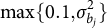 $\max \{0.1, \sigma _{b_j}^2\}$
in the GIC calculation whenever
$\max \{0.1, \sigma _{b_j}^2\}$
in the GIC calculation whenever $\sigma _{b_j}\neq 0$
.
$\sigma _{b_j}\neq 0$
.
Remark 2. We do not penalize main DIF effects (i.e., $\dot {\boldsymbol {\beta }}_j$
and/or
$\dot {\boldsymbol {\beta }}_j$
and/or ${\dot {\bar {\boldsymbol {\gamma }}}}_j$
) because the primary goal of this study is to detect intersectional DIF, which is defined through nonzero variance terms. As a result, anchor items must be prespecified, in contrast to approaches in the literature that penalize main effects directly (see, e.g., Wang et al., Reference Wang, Zhu and Xu2023). If an additional penalty term, such as the lasso, were imposed on these main effects, anchor items would no longer be required. In this study, we use four anchor items, corresponding to 20% of the total test length.
${\dot {\bar {\boldsymbol {\gamma }}}}_j$
) because the primary goal of this study is to detect intersectional DIF, which is defined through nonzero variance terms. As a result, anchor items must be prespecified, in contrast to approaches in the literature that penalize main effects directly (see, e.g., Wang et al., Reference Wang, Zhu and Xu2023). If an additional penalty term, such as the lasso, were imposed on these main effects, anchor items would no longer be required. In this study, we use four anchor items, corresponding to 20% of the total test length.

3 Simulation studies
Four simulation studies are conducted to evaluate the performance of the proposed regularized GVEM algorithm in detecting intersectional DIF. Studies I–IV corresponded to the four models, 2PL-Ri, 2PL-RiM, 2PL-Ris, and 2PL-RisM, respectively, each targeting at a different DIF scenario, as detailed in the Methods section. In all studies, the number of items is fixed to $J=20$
. Following Huang et al. (Reference Huang, Bolt and Lyu2024), the slope parameters
$J=20$
. Following Huang et al. (Reference Huang, Bolt and Lyu2024), the slope parameters $a_j$
(
$a_j$
( $j = 1,2,\dots ,J$
) are drawn from
$j = 1,2,\dots ,J$
) are drawn from $\text {Lognormal}(0,0.25^2)$
, and intercept
$\text {Lognormal}(0,0.25^2)$
, and intercept $b_j$
(
$b_j$
( $j = 1,2,\dots ,J$
) are drawn from
$j = 1,2,\dots ,J$
) are drawn from $\text {Uniform}[-2,2]$
. The true item parameters are given in Table 2.
$\text {Uniform}[-2,2]$
. The true item parameters are given in Table 2.
True fixed item parameters for the simulation studies

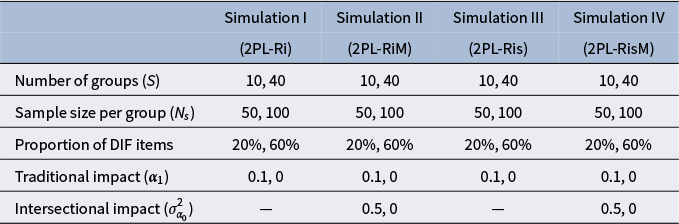
Each simulation study systematically manipulates four common factors. First, the number of intersectional groups is set to either 10 or 40. For the 10-group conditions (i.e., $S=10$
), groups are defined by two demographic variables, one binary (e.g., sex) and one five-category variable (e.g., occupational status), resulting in
$S=10$
), groups are defined by two demographic variables, one binary (e.g., sex) and one five-category variable (e.g., occupational status), resulting in $P=5$
for the dummy-coded variables. For the 40-group conditions, groups are defined by four demographic variables, three binary (e.g., sex, immigrant background, and dichotomous education level) and one five-category variable (e.g., occupational status), resulting in
$P=5$
for the dummy-coded variables. For the 40-group conditions, groups are defined by four demographic variables, three binary (e.g., sex, immigrant background, and dichotomous education level) and one five-category variable (e.g., occupational status), resulting in $P=7$
for the dummy-coded variables. This setup aligns with an empirical study on intersectionality (Keller et al., Reference Keller, Lüdtke, Preckel and Brunner2023). Second, the sample size per group is set to either 50 or 100. Third, the proportion of items with intersectional DIF is set at 20% (Items 1–4) or 60% (Items 1–12). Intersectional DIF is introduced by nonzero random item effects. For items with intersectional UDIF, half are assigned
$P=7$
for the dummy-coded variables. This setup aligns with an empirical study on intersectionality (Keller et al., Reference Keller, Lüdtke, Preckel and Brunner2023). Second, the sample size per group is set to either 50 or 100. Third, the proportion of items with intersectional DIF is set at 20% (Items 1–4) or 60% (Items 1–12). Intersectional DIF is introduced by nonzero random item effects. For items with intersectional UDIF, half are assigned $\sigma _{b_j}^2=0.54$
and the other half
$\sigma _{b_j}^2=0.54$
and the other half $\sigma _{b_j}^2=1$
. For items with intersectional NUDIF, half are assigned
$\sigma _{b_j}^2=1$
. For items with intersectional NUDIF, half are assigned $\bar \sigma _{a_j}^2=0.33$
and the other half
$\bar \sigma _{a_j}^2=0.33$
and the other half $\bar \sigma _{a_j}^2=1$
. These magnitudes are derived from a pilot study using PISA data, where the variances for intersectional DIF ranged from 0.31 to 0.98 for intercepts (centered at 0.54) and from 0.22 to 0.46 for slopes (centered at 0.33). All items with intersectional NUDIF include both random intercept and random slope, reflecting real-world scenarios where NUDIF often coexists with UDIF (Wang et al., Reference Wang, Zhu and Xu2023). Fourth, traditional impact, defined as mean ability differences due to the main effects by demographic variables, is either absent or present. When present, the traditional impact is set at
$\bar \sigma _{a_j}^2=1$
. These magnitudes are derived from a pilot study using PISA data, where the variances for intersectional DIF ranged from 0.31 to 0.98 for intercepts (centered at 0.54) and from 0.22 to 0.46 for slopes (centered at 0.33). All items with intersectional NUDIF include both random intercept and random slope, reflecting real-world scenarios where NUDIF often coexists with UDIF (Wang et al., Reference Wang, Zhu and Xu2023). Fourth, traditional impact, defined as mean ability differences due to the main effects by demographic variables, is either absent or present. When present, the traditional impact is set at $\boldsymbol {\alpha }_1 = 0.1$
, yielding ability mean differences ranging from 0.1 to 0.2 for the 10-group conditions and up to 0.4 for the 40-group conditions.
$\boldsymbol {\alpha }_1 = 0.1$
, yielding ability mean differences ranging from 0.1 to 0.2 for the 10-group conditions and up to 0.4 for the 40-group conditions.
Beyond the four common factors, Studies II and IV also consider intersectional impact. This is introduced by the variance of the group-level random intercept on ability ( $\sigma _{\alpha _0}^2$
), set to either 0 (absence) or 0.5 (presence). These values correspond to intra-class correlation (ICC) values of approximately 0 and 0.1, aligning with the ICC in empirical intersectional educational assessment literature (Keller et al., Reference Keller, Lüdtke, Preckel and Brunner2023). Overall, Studies I and III included 16 experimental conditions each, while Studies II and IV included 32 conditions each. A summary of all manipulated factors is provided in Table 3.
$\sigma _{\alpha _0}^2$
), set to either 0 (absence) or 0.5 (presence). These values correspond to intra-class correlation (ICC) values of approximately 0 and 0.1, aligning with the ICC in empirical intersectional educational assessment literature (Keller et al., Reference Keller, Lüdtke, Preckel and Brunner2023). Overall, Studies I and III included 16 experimental conditions each, while Studies II and IV included 32 conditions each. A summary of all manipulated factors is provided in Table 3.
Illustration of simulation designs
We note again that this study focuses on detecting intersectional DIF, rather than traditional DIF. To avoid confounding due to traditional DIF and to demonstrate the models’ ability to disentangle traditional and intersectional DIF, all items are designed to exhibit traditional DIF, which is introduced through fixed main effects of demographic variables. More specifically, we set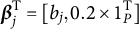 $\boldsymbol {\beta }_j^{\textsf {T}} = [b_{j},0.2\times \boldsymbol {1}_P^{\textsf {T}}]$
and
$\boldsymbol {\beta }_j^{\textsf {T}} = [b_{j},0.2\times \boldsymbol {1}_P^{\textsf {T}}]$
and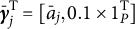 $\bar {\boldsymbol {\gamma }}_j^{\textsf {T}} = [\bar a_{j},0.1\times \boldsymbol {1}_P^{\textsf {T}}]$
in Equation (2). Under the 10-group conditions, this setup results in traditional DIF magnitudes ranging from 0.2 to 0.4 for intercepts and 0.1 to 0.2 for slopes across groups. For the 40-group conditions, these ranges increase to 0.2 to 0.8 for intercepts and 0.1 to 0.4 for slopes, following the design by Belzak & Bauer (Reference Belzak and Bauer2020). To ensure model identification in the presence of traditional DIF across all items, 20% of items (Items 17–20) are designated as anchors with main effects fixed at zero (i.e.,
$\bar {\boldsymbol {\gamma }}_j^{\textsf {T}} = [\bar a_{j},0.1\times \boldsymbol {1}_P^{\textsf {T}}]$
in Equation (2). Under the 10-group conditions, this setup results in traditional DIF magnitudes ranging from 0.2 to 0.4 for intercepts and 0.1 to 0.2 for slopes across groups. For the 40-group conditions, these ranges increase to 0.2 to 0.8 for intercepts and 0.1 to 0.4 for slopes, following the design by Belzak & Bauer (Reference Belzak and Bauer2020). To ensure model identification in the presence of traditional DIF across all items, 20% of items (Items 17–20) are designated as anchors with main effects fixed at zero (i.e., $\dot {\boldsymbol {\beta }}_j=\boldsymbol {0}$
and
$\dot {\boldsymbol {\beta }}_j=\boldsymbol {0}$
and ${\dot {\bar {\boldsymbol {\gamma }}}}=\boldsymbol {0}$
). However, their random effects are still freely estimated, meaning that they are not anchored with respect to intersectional DIF.
${\dot {\bar {\boldsymbol {\gamma }}}}=\boldsymbol {0}$
). However, their random effects are still freely estimated, meaning that they are not anchored with respect to intersectional DIF.
The flagging procedure for intersectional DIF has been shown in Algorithm 1. Each condition is replicated 50 times, and the performance is measured by false positive (FP) and true positive (TP) rates. Specifically, the FP rate refers to the proportion of items free from intersectional DIF mistakenly flagged as DIF items, while the TP rate refers to the proportion of items with intersectional DIF that are correctly detected. We consider 50 replications sufficient since the TP and FP rates are averaged across all the DIF-free and DIF-related item parameters, rather than being evaluated for a single parameter in each replication.
3.1 Simulation I: UDIF detection
We evaluate 2PL-Ri in this simulation, where slope parameters are fixed across groups. Figure 1 shows the TP and FP rates of Simulation I across 50 replications. Under most conditions, except when $S=10$
and
$S=10$
and $N_s=50$
, the new method performs well. Overall, the 2PL-Ri model performs better with more groups and larger sample sizes per group. As intersectional DIF is modeled by random effects, such results are not surprising but consistent with the findings from the multilevel modeling literature (Adam et al., Reference Adam, Twabi and Manda2021; Maas & Hox, Reference Maas and Hox2005; Moineddin et al., Reference Moineddin, Matheson and Glazier2007). In addition, the proportion of DIF items and the presence or absence of intersectional impact have minimal influence on the results.
$N_s=50$
, the new method performs well. Overall, the 2PL-Ri model performs better with more groups and larger sample sizes per group. As intersectional DIF is modeled by random effects, such results are not surprising but consistent with the findings from the multilevel modeling literature (Adam et al., Reference Adam, Twabi and Manda2021; Maas & Hox, Reference Maas and Hox2005; Moineddin et al., Reference Moineddin, Matheson and Glazier2007). In addition, the proportion of DIF items and the presence or absence of intersectional impact have minimal influence on the results.
Simulation I results.

3.2 Simulation II: UDIF detection with intersectional impact
We study 2PL-RiM in Simulation II, where intersectional impact is considered. As shown in Figure 2, the new method follows a pattern similar to Simulation I. That is, the proposed method performs well under most conditions except when $S=10$
and
$S=10$
and $N_s=50$
, and unsurprisingly, it performs better with more groups and larger sample sizes per group. In addition, the proportion of DIF items has a small effect on performance, with a lower proportion yielding slightly better results. Similarly, the presence or absence of traditional and intersectional impact has minimal influence on the results.
$N_s=50$
, and unsurprisingly, it performs better with more groups and larger sample sizes per group. In addition, the proportion of DIF items has a small effect on performance, with a lower proportion yielding slightly better results. Similarly, the presence or absence of traditional and intersectional impact has minimal influence on the results.
Simulation II results.

3.3 Simulation III: UDIF and NUDIF detection
2PL-Ris is evaluated with both UDIF and NUDIF incorporated. Figure 3a and 3b summarizes the DIF detection results on intercept and slope parameters, respectively. With intersectional NUDIF, the proposed method maintains desirable performance on intercepts with $S=40$
while resulting in worse performance with the smaller group number
$S=40$
while resulting in worse performance with the smaller group number $S=10$
. The DIF detection results for slope parameters are generally unsatisfactory. Relatively better performance was observed under conditions involving a large number of groups and either the absence of traditional impact or the combination of the presence of traditional impact and a low proportion of DIF items. In general, this is consistent with prior studies, which found that it is more challenging to identify DIF effects on slope parameters than on intercepts (Bauer et al., Reference Bauer, Belzak and Cole2020; Wang et al., Reference Wang, Zhu and Xu2023). Regarding the manipulated factors, while the number of groups and the sample size per group have consistent effects across Simulations I–III, the influence of DIF proportion and traditional impact becomes more pronounced in this study. Lastly, compared to Simulation I, DIF detection results for the intercept exhibit lower TP rates when
$S=10$
. The DIF detection results for slope parameters are generally unsatisfactory. Relatively better performance was observed under conditions involving a large number of groups and either the absence of traditional impact or the combination of the presence of traditional impact and a low proportion of DIF items. In general, this is consistent with prior studies, which found that it is more challenging to identify DIF effects on slope parameters than on intercepts (Bauer et al., Reference Bauer, Belzak and Cole2020; Wang et al., Reference Wang, Zhu and Xu2023). Regarding the manipulated factors, while the number of groups and the sample size per group have consistent effects across Simulations I–III, the influence of DIF proportion and traditional impact becomes more pronounced in this study. Lastly, compared to Simulation I, DIF detection results for the intercept exhibit lower TP rates when $S=10$
. Additional guidance on the use of this method is provided in the Discussion section.
$S=10$
. Additional guidance on the use of this method is provided in the Discussion section.
Simulation III results.

3.4 Simulation IV: UDIF and NUDIF detection with intersectional impact
The final simulation study evaluates the 2PL-RisM model, with the TP and FP rates summarized in Figure 4. In general, the method results in desirable TP and FP rates for detecting intersectional UDIF, but performs poorly in detecting intersectional NUDIF. In fact, the NUDIF detection results are generally unacceptable across nearly all conditions.
Simulation IV results.

4 Empirical study
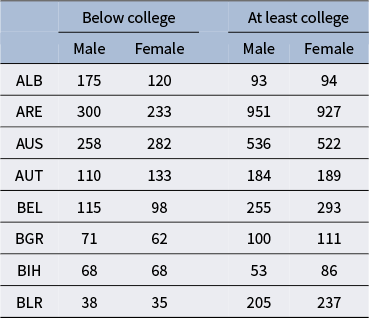
A real data set from the Programme for International Student Assessment (PISA) is used to demonstrate the performance of the four methods in this article. PISA is a well-known international large-scale assessment that tests the skills and knowledge of 15-year-old students in mathematics, reading, and science (OECD, 2019). In this study, we use a subset of the PISA 2018 science assessment, including dichotomous responses of 7,002 students on 19 items. Three demographic variables are considered: (1) country (eight countries in the subset), (2) sex (male or female), and (3) highest parental education (below or at least college level). These variables are chosen due to their frequent consideration in studies on educational equity. The full combination of these variables results in 32 intersectional groups, with their corresponding sample sizes summarized in Table 4.
Sample size for each group in the empirical study
Before discussing our empirical findings, we introduce a feasible way to tune the hyperparameter c in GIC (Lyu et al., Reference Lyu, Wang and Xu2025). Figure 5 illustrates the procedure, where c is plotted against $J_{\text {DIF}}$
, the number of items exhibiting intersectional DIF. Similar to the scree plots in factor analysis, Figure 5 suggests that the models chosen by GIC with
$J_{\text {DIF}}$
, the number of items exhibiting intersectional DIF. Similar to the scree plots in factor analysis, Figure 5 suggests that the models chosen by GIC with $c = 1.05$
, which corresponds to the “elbow” of the plot. In practice, the choice of c can also depend on research goals. In certain high-stakes testing contexts, a higher FP rate may be acceptable in order to achieve a high TP rate, as undetected DIF can lead to serious fairness concerns.
$c = 1.05$
, which corresponds to the “elbow” of the plot. In practice, the choice of c can also depend on research goals. In certain high-stakes testing contexts, a higher FP rate may be acceptable in order to achieve a high TP rate, as undetected DIF can lead to serious fairness concerns.
Relationship between the number of items exhibiting intersectional DIF and c.

The empirical data set is analyzed using each of the four models, and the results are summarized in Table 5, where a and b refer to (intersectional) NUDIF and UDIF, respectively. Items 7, 17, 18, and 19 are flagged as UDIF items by most models, and no item is flagged as NUDIF.
DIF detection results of the empirical study

Note: b indicates UDIF, and NUDIF is not detected.
Given the simulation results indicating unsatisfactory performance in detecting NUDIF, we focus our empirical analysis on the results from the 2PL-Ri and 2PL-RiM models. To validate the empirical results, we estimate the RiM and Ri model using Markov chain Monte Carlo (MCMC) via the rstan package (Stan Development Team, 2024), allowing random item effects only for the consistently flagged items (i.e., items 7, 17, 18, and 19). For comparison, we also fit a constrained version of the model without random item effects. Model comparison based on the leave-one-out information criterion (LOOIC) reveals that the model with random item effects provides a significantly better fit, with a LOOIC difference of $107$
and a standard error of
$107$
and a standard error of $21.8$
. Furthermore, for comparison, a total score-based method is also employed to examine intersectional DIF (Belzak, Reference Belzak2023). Specifically, Belzak’s method (Reference Belzak2023) uses regularized logistic regression, with total score as the matching criterion and intersectionality modeled through interactions among demographic variables. This method is chosen due to its similarity to our proposed methods, as it accounts for both main and intersectional DIF effects with a primary focus on UDIF. However, this method has two limitations: (1) it does not automatically account for impact, since the total score is not directly regressed on demographic variables and (2) it may struggle with a large number of demographic variables, given that interactions are modeled using fixed effects. Despite these limitations, the method identifies UDIF in items 2, 5, 7, 14, 18, and 19, which largely aligns with the findings from our proposed methods.
$21.8$
. Furthermore, for comparison, a total score-based method is also employed to examine intersectional DIF (Belzak, Reference Belzak2023). Specifically, Belzak’s method (Reference Belzak2023) uses regularized logistic regression, with total score as the matching criterion and intersectionality modeled through interactions among demographic variables. This method is chosen due to its similarity to our proposed methods, as it accounts for both main and intersectional DIF effects with a primary focus on UDIF. However, this method has two limitations: (1) it does not automatically account for impact, since the total score is not directly regressed on demographic variables and (2) it may struggle with a large number of demographic variables, given that interactions are modeled using fixed effects. Despite these limitations, the method identifies UDIF in items 2, 5, 7, 14, 18, and 19, which largely aligns with the findings from our proposed methods.
5 Discussion
This study proposes a novel random effects IRT approach for detecting intersectional DIF and demonstrates the feasibility of applying a regularized GVEM algorithm in this context. By including both item-level and person-level random effects, the model accounts for intersectional DIF and impact effects arising from multiple demographic variables. Through the GVEM framework, all model parameters can be updated by closed-form solutions when detecting UDIF, resulting in a computationally efficient model estimation procedure. Simulation results show that the proposed methods can effectively detect UDIF. We have further extended the method to detect intersectional NUDIF, which is known to be more challenging. In this setting, all model parameters except the main and random effects on item discrimination (i.e., $\boldsymbol {\gamma }_j$
and
$\boldsymbol {\gamma }_j$
and $\bar {\sigma }^2_{a_j}$
) have closed-form solutions (see the Appendix for details). The simulation results reveal that the number of groups has the most substantial impact on performance, followed by the sample size per group, the proportion of DIF items, and the presence or absence of impact. In terms of computational efficiency, the method performs well on standard hardware. On a laptop with an Intel i7-12700H CPU, the runtimes for a typical setting (i.e., 20 items, 20% DIF items, 40 groups, and 100 people per group) with a single regularization parameter range from 7.23 to 12.41 seconds, depending on the model used. These results underscore the scalability of the proposed approach for large-scale assessments.
$\bar {\sigma }^2_{a_j}$
) have closed-form solutions (see the Appendix for details). The simulation results reveal that the number of groups has the most substantial impact on performance, followed by the sample size per group, the proportion of DIF items, and the presence or absence of impact. In terms of computational efficiency, the method performs well on standard hardware. On a laptop with an Intel i7-12700H CPU, the runtimes for a typical setting (i.e., 20 items, 20% DIF items, 40 groups, and 100 people per group) with a single regularization parameter range from 7.23 to 12.41 seconds, depending on the model used. These results underscore the scalability of the proposed approach for large-scale assessments.
In this study, intersectional DIF is modeled using random effects, and variation in group sizes may influence the methods’ performance. Literature on multilevel modeling has shown that unequal cluster sizes can reduce both the power to detect true effects and the efficiency of estimating fixed and random components (Candel & Breukelen, Reference Candel and Breukelen2009; Kush et al., Reference Kush, Konold and Bradshaw2022; Manatunga et al., Reference Manatunga, Hudgens and Chen2001). Specifically, Candel & Breukelen (Reference Candel and Breukelen2009) found that the relative efficiency (RE) of the random intercept variance estimator can drop to between 84% and 95%, depending on the distribution and range of the cluster sizes. They also found that the loss in RE can be recovered by increasing the number of clusters, where the compensatory adjustment is given by $1/RE-1$
. For example, if the RE is
$1/RE-1$
. For example, if the RE is $84\%$
, then
$84\%$
, then $1/0.84-1 \approx 0.19$
, suggesting that an increase of
$1/0.84-1 \approx 0.19$
, suggesting that an increase of $19\%$
more clusters is needed to restore the original efficiency.
$19\%$
more clusters is needed to restore the original efficiency.
While we explore intersectional NUDIF detection alongside UDIF, the results for intersectional NUDIF detection are unsatisfactory, particularly when the model simultaneously accounts for intersectional impact. A supplementary simulation study demonstrates that even when response data are generated from the 2PL-Ris model, which includes intersectional NUDIF, the 2PL-Ri model still effectively identified items exhibiting intersectional UDIF. This suggests that, in practice, researchers should mainly rely on the detection results for intersectional UDIF when using the proposed methods. The results for intersectional NUDIF should be interpreted with caution and be used primarily in cases where intersectional impact is not included and when both the sample size and the number of groups are sufficiently large. Despite these challenges, our framework provides a foundation for future advances in intersectional NUDIF detection. In a pilot study where only random effects, but not main effects, were considered, the methods demonstrate better results for NUDIF detection, suggesting potential for improvement. Future studies could explore the incorporation of regularization in both random effects and main effects to overcome estimation challenges. In addition, modeling slope parameters with lognormal distributions instead of truncated normal distributions may offer further improvement.
Another limitation of the simulation studies is that how demographic variables affect the variance of ability is not considered. Specifically, while mean latent traits are allowed to vary across groups, the within-group variance is assumed to be constant. Although this assumption aligns with most DIF research, several educational studies, such as Baye & Monseur (Reference Baye and Monseur2016) and Gray et al. (Reference Gray, Lyth, McKenna, Stothard, Tymms and Copping2019), have discovered differences in latent trait variances among demographic groups. Future research may explore how demographic variables influence the variance of latent traits.
This study employs a variational approach to approximate the log marginal likelihood. Although parameter estimation may be biased due to the use of a mean-field Gaussian distribution family to approximate the posterior distribution of the latent variables, the approximation becomes increasingly accurate with larger sample sizes. Nevertheless, the estimation of latent variables, including group-specific item parameters with random effects and person abilities, may not be sufficiently accurate. To address this issue, we propose applying the standard MCMC procedure for their estimation, as described in the empirical study. Alternatively, future research could consider using best linear unbiased prediction (BLUP) as a complementary or alternative approach to MCMC.
Lastly, it is important to recognize that DIF arises within a complex social context. Each individual carries a unique set of experiences that shape their learning and life trajectories. However, when patterns of advantage or disadvantage emerge at the group level, they serve as a reminder that systemic discrimination continues to persist. Thus, while detecting DIF is a crucial first step in examining issues of fairness, it must be followed by deeper investigations into the underlying causes of structural inequality.
Data availability statement
The code that supports the findings of this study will be available on the project webpage (https://sites.uw.edu/pmetrics/projects/) shortly as we are still working on creating user-friendly R package and Shiny App. The real data was downloaded directly from the PISA website.
Author contributions
H.R. performed the formal analysis and initial draft writing; W.L. contributed to the derivation of the algorithms, C.W. contributed the original idea, method development, partial writing, reviewing and editing, and obtaining funding; G.X. contributed the original idea, method development, partial writing, reviewing and editing, and obtaining funding.
Funding statement
The research reported here was supported by the Institute of Education Sciences, U.S. Department of Education, through Grant R305D200015 and R305D240021 to University of Washington, National Science foundation, through grant EDU-CORE #2300382 to University of Washington, through grant SES-1846747, and SES-2150601 to University of Michigan, the research grant from Duolingo English Test, and the University of Washington BIRCH Center M-PARC Award. The opinions expressed are those of the authors and do not represent views of the Institute of Education Sciences or the U.S. Department of Education or National Science Foundation or Duolingo, Inc.
Competing interests
The authors declare no competing interests.
A Appendix
The derivation of the 2PL-RisM model estimation procedure is shown below. The model is presented in Equations (1) and (2). Applying the local variational method in Equation (7), we obtain

Then, the corresponding optimal variational distributions for the latent variables are
 $$ \begin{align*} \begin{aligned} q_{\alpha_{0s}}(\alpha_{0s})&\propto\exp\mathbb{E}_{\boldsymbol{Z}\setminus\{\alpha_{0s}\}}\left[\mathcal{B}(\boldsymbol{Y}, \boldsymbol{Z})\right]\\ &\propto\exp\mathbb{E}_{\boldsymbol{Z}\setminus\{\alpha_{0s}\}}\left[-\frac{\alpha_{0s}^2}{2\sigma_{\alpha_0}^2}-\sum_{i=1}^{N_s}\frac{(\alpha_{0s}+\boldsymbol{\alpha}_1^{\textsf{T}}\boldsymbol{X}_s-\theta_{is})^2}{2\sigma_{\theta}^2}\right]\\ &\sim\mathcal{N}(\mu_{\alpha_{0s}},\sigma_{\alpha_{0s}}^2),\end{aligned} \end{align*} $$
where
 $$ \begin{align*} \begin{aligned} \sigma^2_{\alpha_{0s}}&=\frac{\sigma_{\alpha_0}^2\sigma_{\theta}^2}{N_s\sigma_{\alpha_0}^2+\sigma_{\theta}^2},\\ \mu_{\alpha_{0s}}&=\frac{\sigma_{\alpha_0}^2}{N_s\sigma_{\alpha_0}^2+\sigma_{\theta}^2}\left(\sum_{i=1}^{N_s}\mu_{\theta_{is}}-N_s\boldsymbol{\alpha}_1^{\textsf{T}}\boldsymbol{X}_s\right); \end{aligned} \end{align*} $$
 $$ \begin{align*} \begin{aligned} q_{\theta_{is}}(\theta_{is})&\propto\exp\mathbb{E}_{\boldsymbol{Z}\setminus\{\theta_{is}\}}\left[\mathcal{B}(\boldsymbol{Y},\boldsymbol{Z})\right]\\ &\propto\exp\mathbb{E}_{\boldsymbol{Z}\setminus\{\theta_{is}\}}\bigg\{\sum_{j=1}^J\left[\left(y_{ijs}-\frac{1}{2}\right)a_{js}\theta_{is}-\eta(\xi_{ijs})(a_{js}\theta_{is}-b_{js})^2\right]\\ &\qquad \qquad \qquad \quad -\frac{(\theta_{is}-\alpha_{0s}-\boldsymbol{\alpha}_1^{\textsf{T}}\boldsymbol{X}_s)^2}{2\sigma_{\theta}^2}\bigg\}\\ &\sim\mathcal{N}(\mu_{\theta_{is}},\sigma_{\theta_{is}}^2), \end{aligned} \end{align*} $$
where

where
 $$ \begin{align*}\begin{aligned} \bar\sigma_{a_{js}}^2&=\frac{\bar\sigma_{a_j}^2}{1+2\bar\sigma_{a_j}^2\sum_{i=1}^{N_s}\eta(\xi_{ijs})(\mu_{\theta_{is}}^2+\sigma_{\theta_{is}}^2)},\\ \bar\mu_{a_{js}}&=\frac{\bar{\boldsymbol{\gamma}}_j^{\textsf{T}}\tilde{\boldsymbol{X}}_s+\bar\sigma_{a_j}^2\sum_{i=1}^{N_s}\left[y_{ijs}-\frac{1}{2}+2\eta(\xi_{ijs})\mu_{b_{js}}\right]\mu_{\theta_{is}}}{1+2\bar\sigma_{a_j}^2\sum_{i=1}^{N_s}\eta(\xi_{ijs})(\mu_{\theta_{is}}^2+\sigma_{\theta_{is}}^2)},\\ \sigma_{a_{js}}^2&=\bar\sigma_{a_{js}}^2\left\{1-\frac{\bar\mu_{a_{js}}}{\sqrt{2\pi}\bar\sigma_{a_{js}}\Phi\left(\frac{\bar\mu_{a_{js}}}{\bar\sigma_{a_{js}}}\right)}\exp\left(-\frac{\bar\mu_{a_{js}}^2}{2\bar\sigma_{a_{js}}^2}\right)-\frac{1}{2\pi\left[\Phi\left(\frac{\bar\mu_{a_{js}}}{\bar\sigma_{a_{js}}}\right)\right]^2}\exp\left(-\frac{\bar\mu_{a_{js}}^2}{\bar\sigma_{a_{js}}^2}\right)\right\},\\ \mu_{a_{js}}&=\bar\mu_{a_{js}}+\frac{\bar\sigma_{a_{js}}}{\sqrt{2\pi}\Phi\left(\frac{\bar\mu_{a_{js}}}{\bar\sigma_{a_{js}}}\right)}\exp\left(-\frac{\bar\mu_{a_{js}}^2}{2\bar\sigma_{a_{js}}^2}\right);\end{aligned} \end{align*} $$
 $$ \begin{align*} \begin{aligned} q_{b_{js}}(b_{js})&\propto\exp\mathbb{E}_{\boldsymbol{Z}\setminus\{b_{js}\}}\left[\mathcal{B}(\boldsymbol{Y},\boldsymbol{Z})\right]\\ &\propto\exp\mathbb{E}_{\boldsymbol{Z}\setminus\{b_{js}\}}\left\{-\sum_{i=1}^{N_s}\left[\left(y_{ijs}-\frac{1}{2}\right)b_{js}+\eta(\xi_{ijs})(b_{js}-a_{js}\theta_{is})^2\right]-\frac{(b_{js}-\boldsymbol{\beta}_j^{\textsf{T}}\tilde{\boldsymbol{X}}_s)^2}{2\sigma_{b_j}^2}\right\}\\ &\sim\mathcal{N}(\mu_{b_{js}},\sigma_{b_{js}}^2), \end{aligned} \end{align*} $$
where
 $$ \begin{align*}\begin{aligned} \sigma_{b_{js}}^2&=\frac{\sigma_{b_j}^2}{1+2\sigma_{b_j}^2\sum_{i=1}^{N_s}\eta(\xi_{ijs})},\\ \mu_{b_{js}}&=\frac{\boldsymbol{\beta}_j^{\textsf{T}}\tilde{\boldsymbol{X}}_s-\sigma_{b_j}^2\sum_{i=1}^{N_s}\left[y_{ijs}-\frac{1}{2}-2\eta(\xi_{ijs})\mu_{a_{js}}\mu_{\theta_{is}}\right]}{1+2\sigma_{b_j}^2\sum_{i=1}^{N_s}\eta(\xi_{ijs})}. \end{aligned}\end{align*} $$
Given the optimal variational distributions derived above and the mean-field variational assumption, the expectation (i.e., the integral) in Equation (A1) can be computed as
 $$ \begin{align*} \begin{aligned} Q(\boldsymbol{Y})&=\sum_{s=1}^S\sum_{i=1}^{N_s}\sum_{j=1}^J\bigg\{\log\frac{1}{1+\text{e}^{-\xi_{ijs}}}+\left(y_{ijs}-\frac{1}{2}\right)(\mu_{a_{js}}\mu_{\theta_{is}}-\mu_{b_{js}})-\frac{1}{2}\xi_{ijs}\\ &\qquad\qquad\qquad\ -\eta(\xi_{ijs})\left[(\mu_{a_{js}}^2+\sigma_{a_{js}}^2)(\mu_{\theta_{is}}^2+\sigma_{\theta_{is}}^2)-2\mu_{a_{js}}\mu_{\theta_{is}}\mu_{b_{js}}+\mu_{b_{js}}^2+\sigma_{b_{js}}^2-\xi_{ijs}^2\right]\bigg\}\\ &\quad-\frac{1}{2}\sum_{s=1}^S\bigg\{(N_s+2J+1)\log2\pi+\left[\log\sigma_{\alpha_0}^2+\frac{\mu_{\alpha_{0s}}^2+\sigma_{\alpha_{0s}}^2}{\sigma_{\alpha_0}^2}\right]\\ &\qquad\qquad\quad\ +\sum_{i=1}^{N_s}\left[\log\sigma_{\theta}^2+\frac{\sigma_{\theta_{is}}^2+\sigma_{\alpha_{0s}}^2+(\mu_{\theta_{is}}-\mu_{\alpha_{0s}}-\boldsymbol{\alpha}_1^{\textsf{T}}\boldsymbol{X}_s)^2}{\sigma_{\theta}^2}\right]\\ &\qquad\qquad\quad\ +\sum_{j=1}^J\left[\log\bar\sigma_{a_j}^2+\frac{\sigma_{a_{js}}^2+(\mu_{a_{js}}-\bar{\boldsymbol{\gamma}}_j^{\textsf{T}}\tilde{\boldsymbol{X}}_s)^2}{\bar\sigma_{a_j}^2}+2\log\Phi\left(\frac{\bar{\boldsymbol{\gamma}}_j^{\textsf{T}}\tilde{\boldsymbol{X}}_s}{\bar\sigma_{a_j}}\right)\right]\\ &\qquad\qquad\quad\ +\sum_{j=1}^J\left[\log\sigma_{b_j}^2+\frac{\sigma_{b_{js}}^2+(\mu_{b_{js}}-\boldsymbol{\beta}_j^{\textsf{T}}\tilde{\boldsymbol{X}}_s)^2}{\sigma_{b_j}^2}\right]\bigg\}. \end{aligned}\end{align*} $$
The objective function with log penalty is
 $$ \begin{align*}\begin{aligned}Q'(\boldsymbol{Y}) = Q(\boldsymbol{Y})-\lambda\sum_{j=1}^J(\log\bar\sigma_{a_j}^2+\log\sigma_{b_j}^2).\end{aligned}\end{align*} $$
By setting the derivative of the objective function with respect to each model parameter to be zero, we get the following parameters update rules:
 $$ \begin{align*} \begin{aligned} \xi_{ijs}^2&=(\mu_{a_{js}}^2+\sigma_{a_{js}}^2)(\mu_{\theta_{is}}^2+\sigma_{\theta_{is}}^2)-2\mu_{a_{js}}\mu_{\theta_{is}}\mu_{b_{js}}+\mu_{b_{js}}^2+\sigma_{b_{js}}^2,\\ \sigma_{\alpha_0}^2&=\frac{1}{S}\sum_{s=1}^S(\sigma_{\alpha_{0s}}^2+\mu_{\alpha_{0s}}^2),\\ \sigma_{\theta}^2&=\frac{1}{\sum_{s=1}^SN_s}\sum_{s=1}^{S}\left\{N_s\left[\sigma_{\alpha_{0s}}^2+(\mu_{\alpha_{0s}}+\boldsymbol{\alpha}_1^{\textsf{T}}\boldsymbol{X}_s)^2\right]+\sum_{i=1}^{N_s}\left[\sigma_{\theta_{is}}^2+\mu_{\theta_{is}}^2-2\mu_{\theta_{is}}(\mu_{\alpha_{0s}}+\boldsymbol{\alpha}_1^{\textsf{T}}\boldsymbol{X}_s)\right]\right\},\\ \boldsymbol{\alpha}_1&=\left(\sum_{s=1}^S\frac{N_s}{\sigma_{\theta}^2}\boldsymbol{X}_s\boldsymbol{X}_s^{\textsf{T}}\right)^{-1}\left(\sum_{s=1}^S\frac{\sum_{i=1}^{N_s}\mu_{\theta_{is}}-N_s\mu_{\alpha_{0s}}}{\sigma_{\theta}^2}\boldsymbol{X}_s\right),\\ (\bar{\boldsymbol{\gamma}}_j, \bar\sigma_{a_j}^2)&=\mathop{\text{argmin}}_{(\bar{\boldsymbol{\gamma}}_j, \bar\sigma_{a_j}^2)} \sum_{s=1}^S \left\{\log\bar\sigma_{a_j}^2+\frac{\sigma_{a_{js}}^2+(\mu_{a_{js}}-\bar{\boldsymbol{\gamma}}_j^{\textsf{T}}\tilde{\boldsymbol{X}}_s)^2}{\bar\sigma_{a_j}^2}+2\log\Phi\left(\frac{\bar{\boldsymbol{\gamma}}_j^{\textsf{T}}\tilde{\boldsymbol{X}}_s}{\bar\sigma_{a_j}}\right)\right\}+2\lambda \log\bar\sigma_{a_j}^2,\\ \boldsymbol{\beta}_j&=\left(\sum_{s=1}^S\tilde{\boldsymbol{X}}_s\tilde{\boldsymbol{X}}_s^{\textsf{T}}\right)^{-1}\left(\sum_{s=1}^S\mu_{b_{js}}\tilde{\boldsymbol{X}}_s\right),\\ \sigma_{b_j}^2&=\frac{1}{S+2\lambda}\sum_{s=1}^S\left[\sigma_{b_{js}}^2+(\mu_{b_{js}}-\boldsymbol{\beta}_j^{\textsf{T}}\tilde{\boldsymbol{X}}_s)^2\right]. \end{aligned} \end{align*} $$
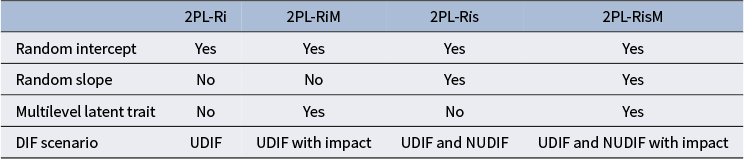
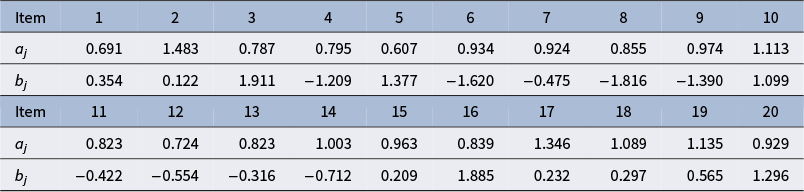
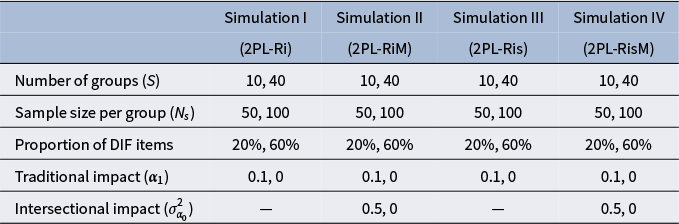
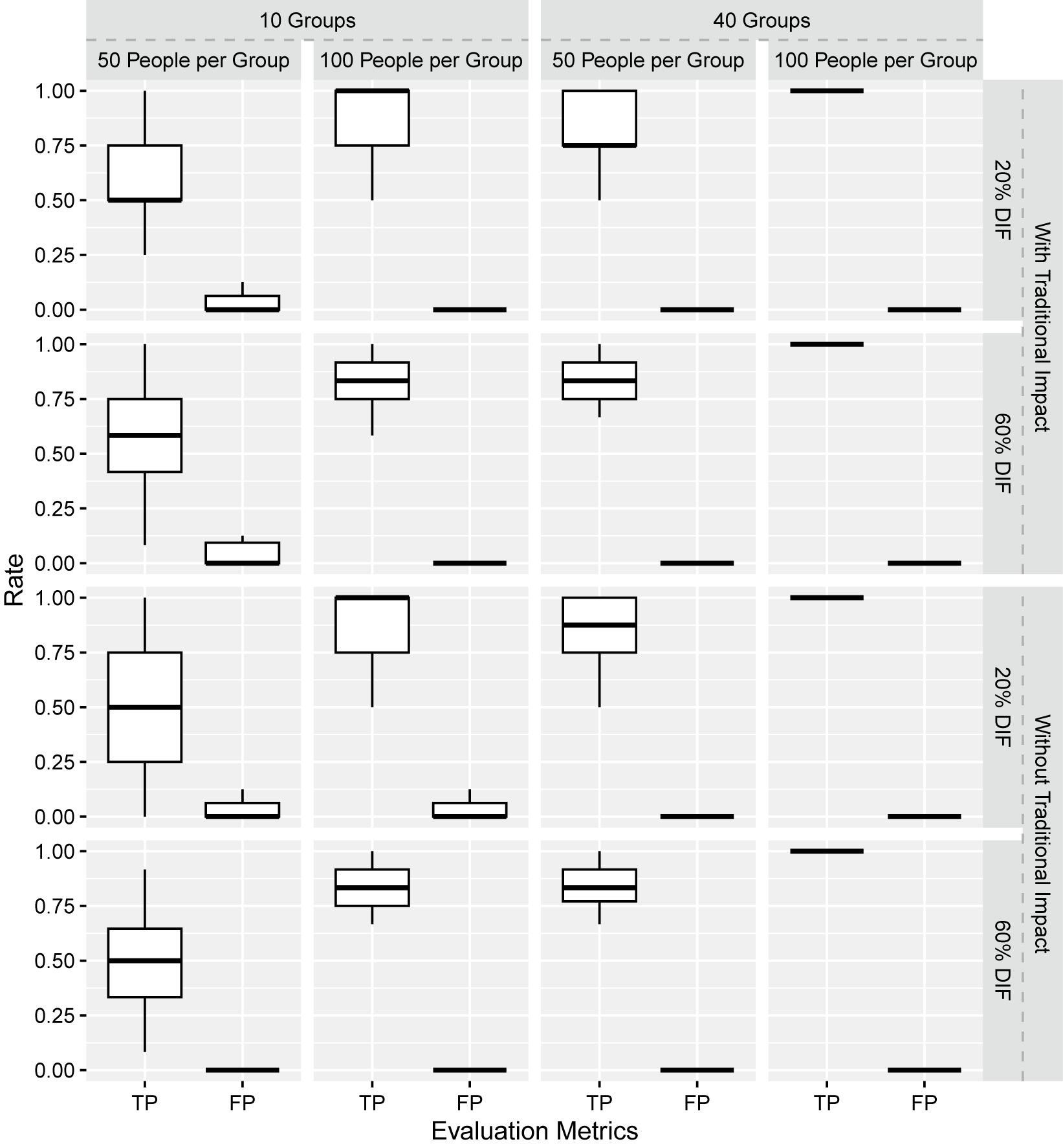
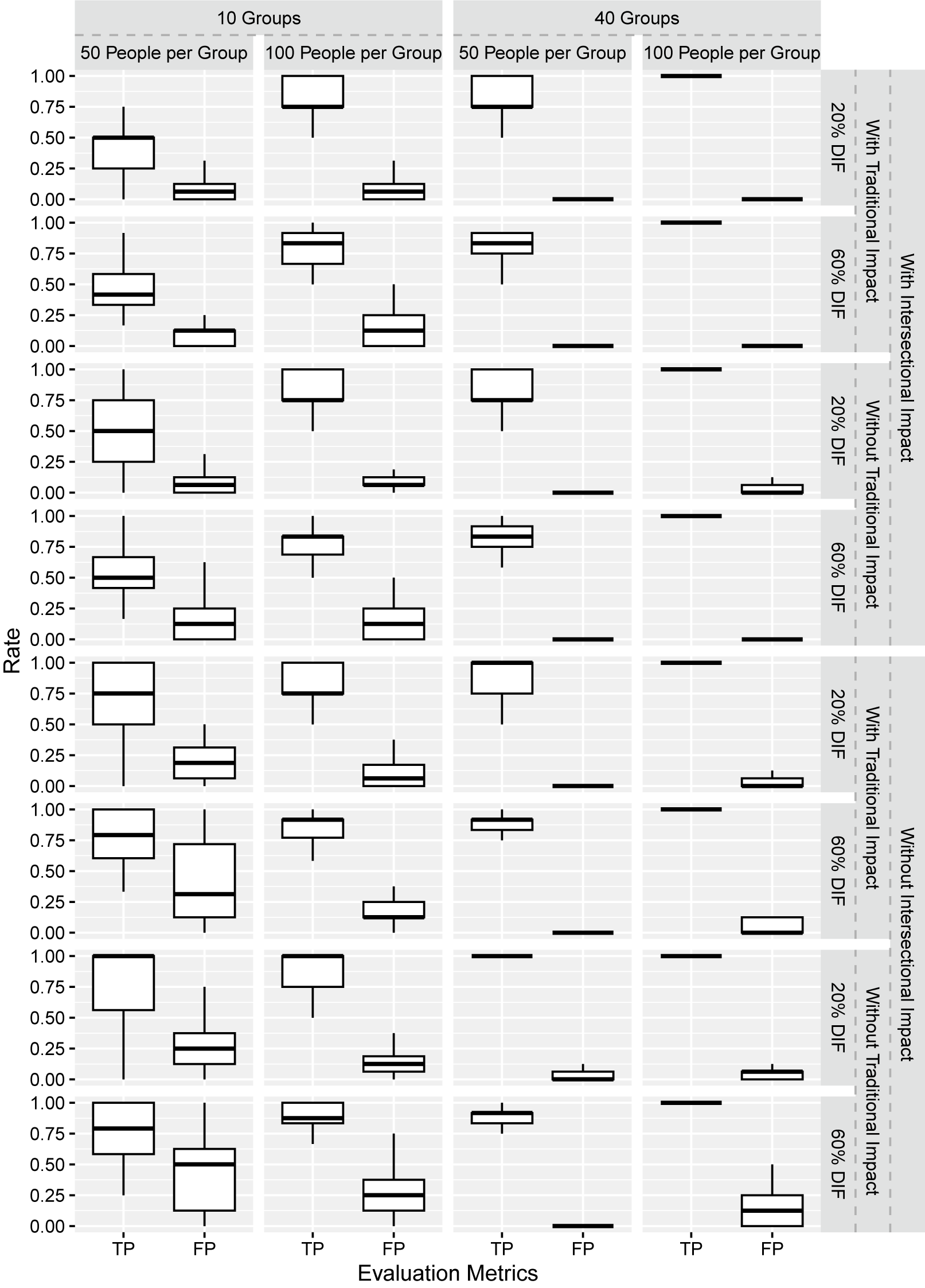
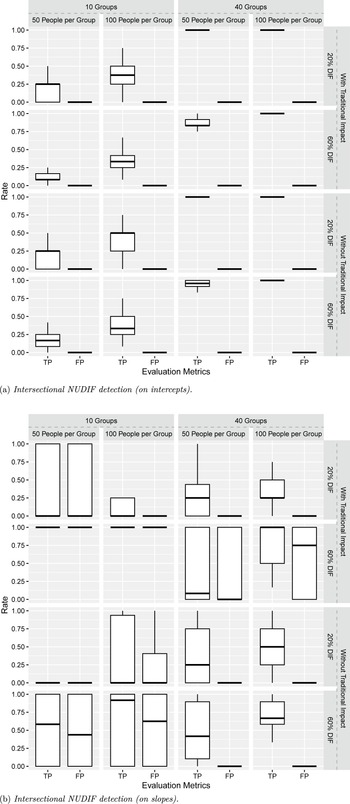
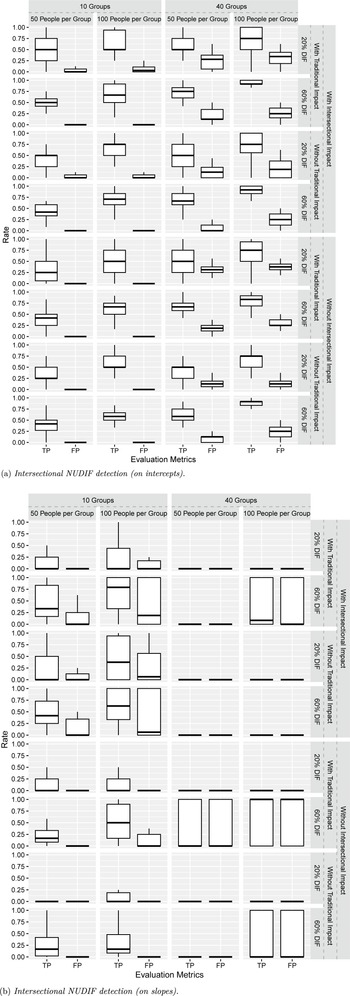
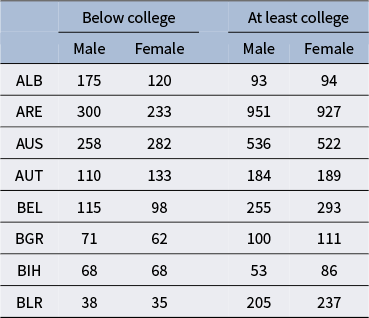
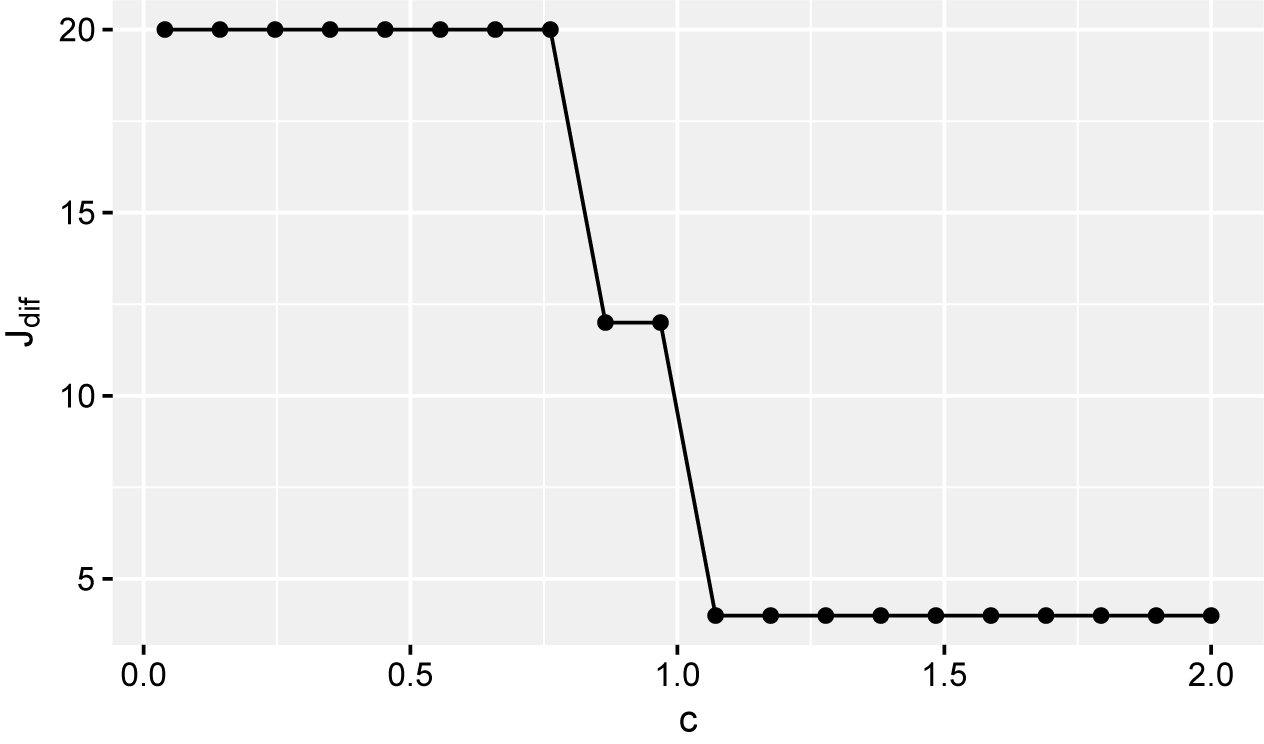


 Open access

