




Introduction
Asset-based welfare has emerged as a complementary welfare strategy in many developed countries. This approach encourages individuals to accumulate assets that appreciate over time instead of relying on public income transfers (Doling and Ronald Reference Doling and Ronald2010). Early examples are found in Australia, Canada, and the US (Castles Reference Castles1998). Australia, in particular, shows how low housing costs associated with high homeownership rates can compensate for a limited public-pension system (Bradbury Reference Bradbury, Gornick and Jäntti2013; Stebbing and Spies-Butcher Reference Stebbing and Spies-Butcher2016). Homeownership in the UK is also an important determinant of financial security in later life (Toussaint and Elsinga Reference Toussaint and Elsinga2009). Rising homeownership rates and the residualization of social rental housing in other European countries further indicate a shift toward asset-based welfare (Groves et al. Reference Groves, Murie and Watson2007).
Similarly, in East Asian welfare states, minimalist welfare arrangements have been promoted by historically high homeownership rates since the industrial period (Groves et al. Reference Groves, Murie and Watson2007). In this context, homeownership functions as more of a central policy instrument for mitigating market risks than in many Western welfare states (Conley and Gifford Reference Conley and Gifford2006). Increases in housing equity, driven by rising property values, have therefore been interpreted as substitutes for comprehensive old-age pension systems (Doling and Ronald Reference Doling and Ronald2010). However, the limited attention paid to housing in relation to welfare-state systems limits our understanding of the distinctive institutional configurations of East Asian welfare regimes (Groves et al. Reference Groves, Murie and Watson2007).
This study examines homeownership and its relationship with public-pension system development in Japan, South Korea (hereafter, Korea), and Taiwan. While recent discussions of asset-based welfare emphasize homeownership’s complementary role in securing old-age income, historical experience in East Asia suggests a different housing–welfare-state dynamic. The governments of Japan, Korea, and Taiwan have promoted homeowner societies since the early industrialization period (Doling Reference Doling, Agus, Doling and Lee2002). Homeownership may therefore help explain the limited development of public-pension systems in East Asia. High demand for housing assets, supported by state policies, may have discouraged the expansion of welfare states in general and public-pension systems in particular. Studies suggest that housing can have a trade-off relationship with welfare-state programs (Kemeny Reference Kemeny1980, Reference Kemeny2005). We examine whether this hypothesis accounts for the housing–pension relationship in the three aforementioned Asian societies. Although Groves et al. (Reference Groves, Murie and Watson2007) and Ronald and Doling (Reference Ronald and Doling2010, Reference Ronald and Doling2012) identified this feature of asset-based welfare in East Asia, they focused on housing systems, paying less attention to welfare-state programs. This gap is significant, given the expansion of public welfare programs across East Asia in recent decades.
Next, we outline the conceptual foundations of the relationship between homeownership and public-pension systems. The subsequent sections present the results of our empirical analysis. Using statistical data, we trace the macro-level co-development of homeownership and public pensions. A comparative historical approach is adopted to analyze the housing–pension nexus in the three societies of Japan, Korea, and Taiwan. Historical documents, secondary data sources, and official archives are used to examine their institutional development. Lastly, we discuss how contemporary forms of asset-based welfare shape citizens’ economic well-being.
Conceptual background
Growing attention to asset-based welfare reflects recent structural transformations in capitalist economies. Since the 1980s, neoliberalism, particularly financial market deregulation, has accelerated the expansion of bank lending and investment in financial assets and real estate. Individuals are increasingly encouraged to assume debt to purchase housing and sustain consumption. As a result, advanced economies have shifted toward “privatized Keynesianism,” in which extended mortgages and household debt—rather than wage growth, welfare states, or public-demand management—underpin mass consumption (Crouch Reference Crouch2008).
Adkins et al. (Reference Adkins, Cooper and Konings2021) demonstrate that financial deregulation, consumer credit liberalization, and mortgage securitization have intensified housing-market expansion in Australia since the 1980s. Highlighting house-price inflation, they show how rising asset values replaced labor income as an alternative welfare source. They further argue that homeownership and property-based capital gains have reconfigured class relations. Similarly, Aalbers (Reference Aalbers2008) contends that mortgage market financialization expands credit access, intensifies competition for housing, and contributes to rapid house-price inflation in advanced economies.
In contrast to Western countries, asset-based welfare in East Asia is linked to developmentalism. Often described as developmental or productivist (Holliday Reference Holliday2000; Lee and Ku Reference Lee and Ku2007), East Asian welfare regimes are shaped by late industrialization (Gough Reference Gough, Gough and Wood2004; Rudra Reference Rudra2008). Economic catch-up is a primary policy objective of late-developing states. Governments therefore prioritize capital accumulation and direct financial resources toward economic development while limiting the fiscal burden of welfare provision. As a result, social policy remains subordinate to economic development strategies (Holliday Reference Holliday2000). Within this framework, asset-based welfare encourages individuals to accumulate assets to meet welfare needs. Singapore’s Central Provident Fund exemplifies this by channeling household savings into public housing provision, thereby reducing reliance on social policy interventions (Lee 2014).
However, neoliberalism shaped East Asian economies as well. Under growing pressure to liberalize trade and finance in the 1980s and 1990s, these societies adopted neoliberal practices at different rates and intensities. While some argue that post-developmental East Asian states have converged with Western neoliberal models, others emphasize the persistence of developmentalist institutions. A broad consensus holds that East Asian neoliberalism remains distinct, retaining key institutional legacies of developmentalism (Park and Saito Reference Park, Saito, Park, Hill and Saito2012).
Neoliberal housing policy reforms are also evident across East Asia. While Singapore’s government remained a monopoly housing provider, Hong Kong began selling public rental housing and promoting homeownership in the late 1980s. In Japan, Korea, and Taiwan, commercial banks and other financial institutions were deregulated in the 1990s, soon becoming key actors in the mortgage and housing lease markets (Chen and Li Reference Chen, Li, Park, Hill and Saito2012). Elements of housing-market financialization, including mortgage securitization and financialized private landlordism, appeared in the 2000s, though to a lesser extent than in the West. Nonetheless, loose monetary policies expanded mortgage homeownership and contributed to house-price inflation, reflecting trends observed in the West (Forrest and Hirayama Reference Forrest and Hirayama2015; Kim Reference Kim2020; Kim Reference Kim2022).
The asset-based welfare approach is embedded in East Asia’s socioeconomic structure (Doling and Ronald Reference Doling and Ronald2008, Reference Doling and Ronald2010). Whereas many industrialized Western countries treat housing as a social good with collective value, East Asian governments regard housing as a private good for which individuals are responsible. After World War II, Western governments addressed housing shortages through social rental housing for low-income groups and tenure-neutral subsidies for broader populations (Whitehead Reference Whitehead, Forrest and Routledge2003). East Asian governments, by contrast, intervened in housing provision to varying degrees but largely relied on market mechanisms for housing distribution and consumption. State-led “build-for-sale” strategies encouraged widespread homeownership, distinguishing East Asian housing policy from Anglo-Saxon approaches that relied on market mechanisms and the privatization of public housing, as in the UK and Australia (Lee et al. Reference Lee, Forrest, Tam, Forrest and Lee2003).
Early homeownership expansion has implications for welfare-state development. Studies identify a trade-off between homeownership and public welfare. First, housing assets, regarded as functionally equivalent to social transfers, support consumption and satisfy needs during income shocks without reliance on public income support (Estévez-Abe Reference Estévez-Abe2008). Owner-occupied housing reduces housing costs in later life, and housing equity can be mobilized through residential mobility or mortgage equity release to maintain consumption (Toussaint and Elsinga Reference Toussaint and Elsinga2009). Homeownership may also enable households to benefit from long-term housing-asset appreciation (Malpass Reference Malpass2008).
Second, Kemeny (Reference Kemeny1980, Reference Kemeny2005) argues that a strong policy emphasis on homeownership generates resistance to public spending and taxation. Homeownership may reduce support for tax-financed welfare programs, especially when it expands prior to welfare-state development, which can shape long-term social policy trajectories. Kemeny (Reference Kemeny2005) highlights the privatizing effects of homeownership and its association with inequality and exclusion, offering a framework for understanding the underdevelopment of public welfare systems in East Asia.
Third, Castles (Reference Castles1998) conversely argues that levels of welfare provision shape housing tenure choices. In this view, weak welfare states incentivize homeownership, whereas more generous welfare states crowd out opportunities for private savings for homeownership through higher taxation (Castles Reference Castles1998). Minimal public welfare provision may therefore facilitate homeownership.Footnote 1 This logic suggests that widespread homeownership could enhance individuals’ well-being by reducing reliance on public-pension benefits, consistent with Estévez-Abe’s (Reference Estévez-Abe2008) discussion of functional equivalents.
The trade-off between homeownership and welfare provision is often empirically assessed using total social expenditure as a percentage of GDP to measure public welfare (Castles Reference Castles1998). Conceptual debates, meanwhile, focus on retirement income programs (Kemeny Reference Kemeny2005). This reflects the assumption that wealth accumulated during working age, particularly housing wealth, is a resource for consumption in later life and may substitute for public-pension benefits. Accordingly, analyses of the relationship between homeownership and welfare-state development may be more appropriately centered on public-pension systems.
A growing body of research examines this relationship. While earlier studies found empirical support for the trade-off (Stamsø Reference Stamsø2010), recent work points to a nuanced or even complementary relationship (Ansell Reference Ansell2014; Delfani et al. Reference Delfani, De Deken and Caroline2014; Van Gunten and Kohl Reference Van Gunten and Kohl2020). Ansell (Reference Ansell2014) finds that homeowners become less supportive of social insurance policies during periods of house-price appreciation. By contrast, Delfani et al. (Reference Delfani, De Deken and Caroline2014) show that the trade-off disappears when institutional differences in housing and pension systems are considered. Van Gunten and Kohl (Reference Van Gunten and Kohl2020) further argue that the trade-off became inverted over time, existing prior to the 1990s but disappearing or becoming positive thereafter, partly due to credit market expansion since the 1980s. Stephens (Reference Stephens2020) further critiques Kemeny’s housing regime theory for its limited capacity to account for the diversity of institutional change across different national contexts.
Drawing on existing research, we expect homeownership to be negatively associated with public-pension system development. Delfani et al. (Reference Delfani, De Deken and Caroline2014) note that housing tenure systems may shape the institutional form of pension systems, and vice versa. In East Asia, distinct pension arrangements may therefore reflect historical homeownership development. It also remains unclear whether Van Gunten and Kohl’s (Reference Van Gunten and Kohl2020) findings are applicable to East Asia. Unlike in Western countries, limited alternatives such as social rental housing mean that individuals continue to face housing deficits and may resist reallocating resources toward expanded public-pension provision. Accordingly, following Kemeny (Reference Kemeny1980, Reference Kemeny2005), we hypothesize that the advancement of homeowner societies prior to welfare-state development shaped subsequent policy trajectories, contributing to underdeveloped public-pension systems in Japan, Korea, and Taiwan. For empirical investigation, we examine historical development from the 1950s to the early 2020s. We discuss housing and pension policies within broader institutional and political contexts by dividing development into two subperiods: developmental and post-developmental.
Basic statistics for homeownership and public pensions in East Asia
Homeownership in East Asia
East Asian societies achieved high homeownership rates during the industrialization period (Doling Reference Doling1999, Reference Doling, Agus, Doling and Lee2002; Lee et al. Reference Lee, Forrest, Tam, Forrest and Lee2003). Indeed, by the early 1990s, homeownership rates in some East Asian countries exceeded those in Western societies (Doling Reference Doling, Agus, Doling and Lee2002). As discussed earlier, the productivist logic of East Asian states promoted homeownership through public intervention in housing markets (Lee et al. Reference Lee, Forrest, Tam, Forrest and Lee2003). Nevertheless, substantial variation exists in homeownership rates across East Asian societies.
In Singapore and Hong Kong, direct state provision has been central to housing policy, reflecting the constraints of densely populated city-states. Housing policy has served broader goals of social integration and political control. Castells et al. (Reference Castells, Goh and Kwok1990) link large-scale public housing intervention to episodes of social unrest, including riots and interethnic conflicts. Since 1964, Singapore has pursued state-assisted homeownership as part of a nation-building strategy aimed at fostering social cohesion. The government played an extensive role in housing production and supported mortgage payments through a mandatory savings program, resulting in near-universal homeownership. By contrast, Hong Kong’s housing system reflects its colonial legacy with a substantial public rental sector. Although homeownership rates have increased since the late 1970s, about half the population continues to rent (Lee et al. Reference Lee, Forrest, Tam, Forrest and Lee2003).
Japan, Korea, and Taiwan also promoted homeowner societies but relied on more selective interventions and subsidies (Lee et al. Reference Lee, Forrest, Tam, Forrest and Lee2003). In Japan, rapid postwar increases in land and housing prices encouraged households to pursue homeownership as a means of asset accumulation (Hirayama and Hayakawa Reference Hirayama, Hayakawa, Forrest and Murie1995). Conservative governments viewed property ownership as a strategy for social stability, while housing construction functioned as a driver of economic growth (Hirayama Reference Hirayama, Forrest and Routledge2003). The state assumed primary responsibility for providing low-interest homeownership loans to middle-class households and repeatedly raised loan limits in response to rising prices. Homeownership rates reached about 60 percent by the late 1960s but hardly changed afterward. They continued to stagnate following the collapse of the asset bubble in the early 1990s (Hirayama Reference Hirayama, Forrest and Routledge2003).
In Korea and Taiwan, housing provision received low priority as governments focused on investment in manufacturing. With limited public involvement, housing was considered an individual responsibility, and the public housing sector remained small. Despite severe housing shortages, Korea showed little interest in expanding housing supply during industrialization. Following democratization in the late 1980s, the state belatedly pursued large-scale housing construction but did not introduce mortgage financing for low-income homebuyers until the late 1990s, thus maintaining relatively low homeownership rates. By contrast, owner-occupied dwellings account for a large share of Taiwan’s housing stock. Large-scale state intervention in the mid-1970s aimed to mitigate political instability associated with diplomatic setbacks. After democratization, the government expanded low-interest mortgage programs to promote homeownership (Chen and Li Reference Chen, Li, Park, Hill and Saito2012).
Singapore and Taiwan have high homeownership rates, ranging from 80 to 90 percent, whereas other East Asian societies record rates closer to 50–60 percent (Table 1). Excluding Hong Kong, with its distinctive social rental sector, Japan and Korea do not exhibit high homeownership rates among advanced East Asian societies. Japan’s stagnant rate, at around 60 percent, is commonly attributed to the housing-bubble collapse of the 1990s. Nonetheless, in 2018, homeownership among older people was high at 80.8 percent. Meanwhile, Korea’s rate, which is below 60 percent, reflects limited state involvement in housing provision and mortgage financing during industrialization. Data from the Luxembourg Income Study (LIS) show that the rate among the elderly remained at 72.8 percent. Taiwan, however, has a high rate of 89.2 percent, and LIS data show an even higher rate of 93.4 percent for Taiwanese older adults. These patterns suggest that claims of uniformly high homeownership across East Asia are overstated, particularly given rising homeownership in Western countries. Most industrialized Western societies reported rates exceeding 60 percent by the late 2010s (OECD 2022a).Footnote 2
Composition of housing tenure status in selected East Asian societies
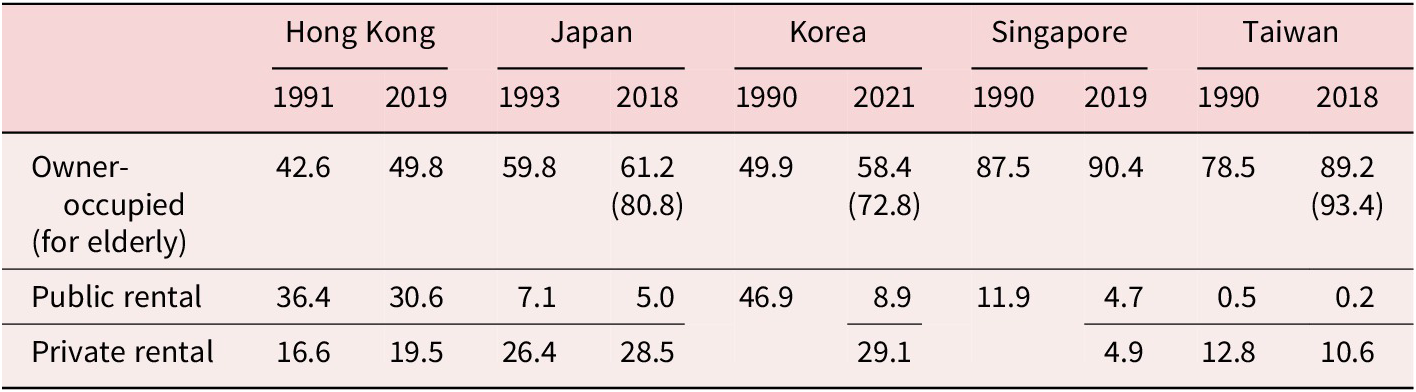
Table 1. Long description
Starting from the left, the table lists five countries: Hong Kong, Japan, Korea, Singapore, and Taiwan. Each country has two columns for two years: Hong Kong 1991 and 2019, Japan 1993 and 2018, Korea 1990 and 2021, Singapore 1990 and 2019, Taiwan 1990 and 2018. The first row is owner-occupied (for elderly): Hong Kong 42.6 and 49.8, Japan 59.8 and 61.2 (80.8 for elderly), Korea 49.9 and 58.4 (72.8 for elderly), Singapore 87.5 and 90.4, Taiwan 78.5 and 89.2 (93.4 for elderly). The second row is public rental: Hong Kong 36.4 and 30.6, Japan 7.1 and 5.0, Korea 46.9 and 8.9, Singapore 11.9 and 4.7, Taiwan 0.5 and 0.2. The third row is private rental: Hong Kong 16.6 and 19.5, Japan 26.4 and 28.5, Korea 29.1 and 4.9, Singapore 12.8 and 10.6. Notable trends include a general increase in owner-occupation rates over time, especially in Singapore and Taiwan, and a decrease in public rental shares, particularly in Korea. Some cells include values in parentheses indicating elderly-specific rates, which are higher than the general population in Japan, Korea, and Taiwan.
Note: Kim and Jin (Reference Kim and Jin2021) for Hong Kong, Singapore, and Taiwan, 2018–2019. Other figures for Hong Kong come from Census and Statistics Department (1993); those for Singapore come from Department of Statistics Singapore (n.d.). For Japan: Statistics Bureau of Japan, Ministry of Internal Affairs and Communications. (1994, 2019). Figures for Korea come from the Statistics Korea (1992), Ministry of Land, Infrastructure and Transport (2022), and LIS. For Taiwan: Directorate-General of Budget, Accounting and Statistics. 1992. and LIS.
Nonetheless, prior studies correctly suggest that East Asian housing policy trajectories diverged from those in Western countries. Strong homeownership aspirations emerged in part from limited alternatives, such as public rental housing (see Table 1). The share of public rental housing remained small (except for Hong Kong), although that for Korea reached the OECD average in recent years. The extent to which these aspirations were realized varied across societies, shaped by differences in state intervention and housing-market conditions.
Public-pension systems in East Asia
Studies attribute the underdevelopment of East Asia’s public-pension systems (Choi Reference Choi2008; Yeh et al. Reference Yeh, Cheng and Shih-Jiunn2020), with its limited coverage and modest benefits, to late industrialization and developmentalism, which prioritized economic catch-up over social policy expansion (Gough Reference Gough, Gough and Wood2004; Holliday Reference Holliday2000; Lee and Ku Reference Lee and Ku2007). East Asian states channeled fiscal resources toward economic development while constraining social spending (Gough Reference Gough, Gough and Wood2004; Rudra Reference Rudra2008).
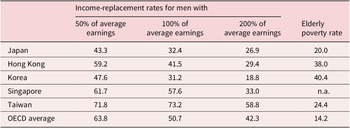
As shown in Table 2, East Asian public-pension systems exhibited low income-replacement rates and high levels of old-age poverty. Following the OECD’s method, gross pension-replacement rates were simulated for individual men with 200 percent, 100 percent, and 50 percent of average earnings who enter the labor market at age 22 in 2022 and work until the normal pension age (OECD 2024). These estimates capture benefit generosity for new entrants in public-pension systems. In most East Asian societies, replacement rates fall below the OECD average. Strikingly, old-age poverty rates in the early 2020s remain considerably high, indicating weak pension performance. Among the five societies considered, Japan records the lowest rate at 20.0 percent, while Korea has the highest at 40.4 percent.
Comparison of pension-replacement rates by earnings and elderly poverty rates
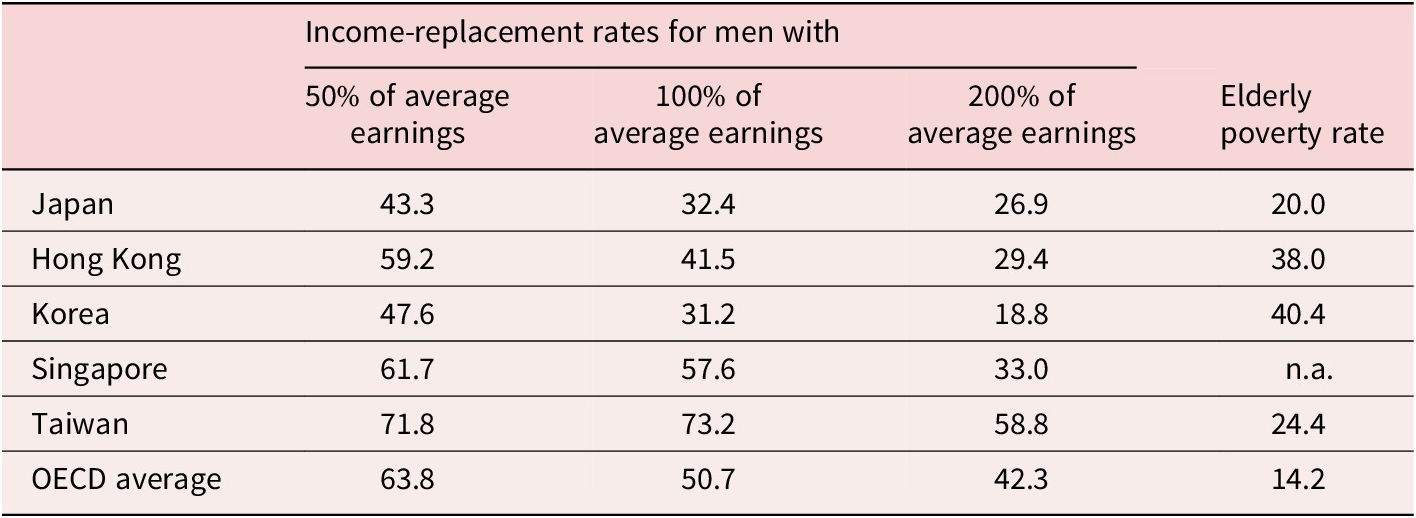
Table 2. Long description
From top to bottom, the table lists Japan, Hong Kong, Korea, Singapore, Taiwan, and O E C D average. For each, four columns are presented left to right. The first three columns show income-replacement rates for men with 50 percent, 100 percent, and 200 percent of average earnings. The fourth column shows the elderly poverty rate. Data values are as follows. Japan: 43.3, 32.4, 26.9, 20.0. Hong Kong: 59.2, 41.5, 29.4, 38.0. Korea: 47.6, 31.2, 18.8, 40.4. Singapore: 61.7, 57.6, 33.0, n.a. Taiwan: 71.8, 73.2, 58.8, 24.4. O E C D average: 63.8, 50.7, 42.3, 14.2. The poverty rate is based on 50 percent of the national median disposable income in 2020 or the latest year. Sources are O E C D for Japan, Korea, and O E C D average, O E C D 2024 for Hong Kong, Singapore, and Taiwan, Luxembourg Income Study for Taiwan’s poverty rate, and Oxfam for Hong Kong’s poverty rate.
Note: Poverty rate based on 50 percent of the national median disposable income in 2020 or the latest year. Sources: OECD (2023) for Japan, Korea, and OECD average. OECD (2024) for pension-replacement rates for Hong Kong, Singapore, and Taiwan. Taiwan’s poverty rate: Luxembourg Income Study. Hong Kong’s poverty rate, www.oxfam.org.hk/tc/f/news_and_publication/115439/POVERTy%20Rerport%202024_Eng.pdf.
Taiwan is a distinctive case, with a high income-replacement rate of 73.2 percent for individual men with average earnings. However, this applies primarily to privileged workers covered by Labor Insurance. Moreover, the shift from lump-sum payments to annuities in 2008 limited benefit realization for many individuals. Those with unstable employment are covered by the National Pension (NP), also introduced in 2008. Consequently, Taiwan continues to experience substantial old-age poverty. The poverty rate of 24.4 percent indicates that many older people derive limited protection from the public-pension system.
Homeownership and public-pension systems in East Asia
Tables 1 and 2 indicate that the relationship between homeownership and public pensions does not follow a simple trade-off pattern (e.g., high homeownership paired with low pension generosity). Instead, Japan, Korea, and Taiwan show distinct configurations. Japan combines moderate homeownership among older people with mature public-pension programs that provide relatively low benefits. Korea exhibits low homeownership alongside an immature public-pension system characterized by low replacement rates and limited coverage. Less than two-thirds of working-age adults aged 18–59 currently contribute to Korea’s public-pension system. Taiwan presents yet another pattern, with high homeownership and an immature pension system that nonetheless offers a high replacement rate. Explaining these divergent outcomes requires a comparative historical analysis that accounts for broader socioeconomic and institutional trajectories within each society.
Homeownership and public-pension development in Japan, Korea, and Taiwan
Comparative historical analysis
We use a comparative historical approach to analyze the relationship between homeownership and public-pension development in Japan, Korea, and Taiwan. This approach prioritizes identifying causal mechanisms rather than variable-based associations, as typically emphasized in quantitative research (Amenta Reference Amenta, Mahoney and Rueschemeyer2003; Mahoney and Rueschemeyer Reference Mahoney, Rueschemeyer, Mahoney and Rueschemeyer2003; Thelen and Mahoney Reference Thelen, Mahoney, Mahoney and Thelen2015). This approach also emphasizes institutional continuity, highlighting how social policy evolves over time. Process tracing is therefore employed to identify institutional development patterns and explicate the mechanisms underlying policy changes (Beach and Pedersen Reference Beach and Pedersen2013; Hall Reference Hall2008).
Our case selection is based on the “most different systems design” approach (Przeworski and Teune Reference Przeworski and Teune1970). Although Japan, Korea, and Taiwan are commonly categorized as developmental welfare states, they differ across multiple dimensions, including population size, economic scale, and timing of industrialization. Japan modernized considerably earlier than Korea and Taiwan, with Japan and Korea dominated by large conglomerates and Taiwan characterized by small and medium-sized enterprises (SMEs) (Abrahamson Reference Abrahamson2017; Fields Reference Fields, Walter and Zhang2012; Walter and Zhang Reference Walter, Zhang, Walter and Zhang2012; Yang Reference Yang2017). These contrasts help control for divergent national characteristics, thereby sharpening the analytical focus on how developmentalism and economic liberalization shape the relationship between homeownership and public-pension development across these societies.
Our comparative historical analysis distinguishes two phases. The first corresponds to the developmentalist era, spanning the postwar period to approximately 1990. During this period, developmentalism was the dominant framework shaping social policy as governments pursued economic catch-up with the West. The second phase began in the 1990s and is characterized by shifts toward economic and political liberalization. This periodization highlights gradual changes in policy priorities and facilitates analysis of how and why each society reoriented its policy emphasis over time.
Japan
Postwar era of the developmentalist state
Japan became industrialized earlier than its East Asian neighbors and pioneered a developmental state model characterized by close coordination between bureaucratic and business elites (Johnson Reference Johnson1982). It prioritized economic growth and subordinated social policy to developmental objectives. Housing policy reflected this orientation. Housing construction was treated as a driver of industrial expansion, while expanded housing provision improved material living standards and generated political support among middle-class households.
The government extensively intervened in housing markets. Severe housing shortages persisted from the end of World War II into the high-growth period, driven by population growth and urban migration. Expanding housing construction, therefore, became a central policy concern. Japan’s postwar housing system was institutionalized through three major legislative acts: the Government Housing Loan Corporation Act (1950), Public Housing Act (1951), and Japan Housing Corporation Act (1955). The Government Housing Loan Corporation provided long-term, low-interest loans to middle-class households. Local governments constructed low-rent public housing for low-income households, while the Japan Housing Corporation developed collective housing projects for middle-class residents in major urban areas.
Homeownership expanded rapidly from the 1950s through the 1960s, reaching 71 percent in 1958. Although it declined to 60 percent by 1968, this shift reflected the growth of rental housing in urban areas as a response to large-scale rural-to-urban migration (Hirayama Reference Hirayama2014a). From the late 1960s onward, homeownership stabilized at about 60 percent and became the dominant tenure form. Beginning in the 1970s, among the three major housing policy instruments, only housing loan provision through the Government Housing Loan Corporation continued to expand. The ratio of individual housing loans to GDP rose to 10 percent in the 1970s, exceeded 20 percent in the 1980s, and reached approximately 30 percent by the mid-1990s (Hirayama Reference Hirayama2014a).
Government support for expanding homeownership during the early postwar decades reflected economic and political considerations. First, Liberal Democratic Party (LDP) administrations linked housing construction to economic development. Even during the 1973 oil crisis, housing loan provision through the Housing Finance Corporation was treated as a central policy tool, with home construction promoted during economic downturns (Hirayama Reference Hirayama2014a). Second, homeownership was politically important. During the 1960s, left-leaning local governments aligned with the Japan Socialist Party and Japan Communist Party sought to expand public housing. Public rental housing supply increased during this period, peaking in the early 1970s. In response, the LDP curtailed public rental housing expansion to limit support for left-wing parties and sought to stabilize conservative politics by increasing the number of homeowners (Hirayama Reference Hirayama2020a). Homeownership accounted for about 60 percent of housing units from the late 1960s onward, whereas public and public corporation rental housing declined from 7.6 percent of housing stock in 1983 to 5.0 percent in 2018 (Hirayama Reference Hirayama2020a).
Developmentalist Japan was less active in expanding public-pension provision. In 1944, it introduced the Employees’ Pension (EP), an employee-based public pension scheme providing earnings-related annuities. During the 1950s, contribution rates did not increase, and benefit levels stayed low. In response, several occupational groups established separate public-pension schemes, citing dissatisfaction with EP benefits. NP was introduced in 1961 to cover self-employed people, partially consolidating Japan’s occupationally fragmented pension system.
In the early 1960s, the Ministry of Welfare sought to expand public-pension benefits. Pension bureaucrats feared that, without earnings-related benefits, EP would lose relevance as private corporate pension schemes expanded. Employers, however, favored private corporate benefits over public-pension benefits. From the 1950s, some firms introduced retirement allowances as rewards for long-term employment. The Ministry of Finance consolidated these arrangements in the early 1960s by providing tax incentives through the Qualified Retirement Pension System for small firms and the Employee Pension Fund System for large firms (Estévez-Abe Reference Estévez-Abe2008; Nishinarita 2009). As a result, corporate retirement benefits expanded rapidly, while public-pension generosity did not significantly improve.
Labor unions also helped expand corporate retirement allowances. As the labor movement grew in the postwar period, trade unions organized nationwide campaigns demanding retirement benefits. These allowances expanded rapidly during periods of economic growth. Given the limited development of EP, workers relied heavily on employers for income security in later life (Hamaguchi Reference Hamaguchi2020). Retirement allowances were paid as lump sums and were frequently used to finance home purchases (Fukami Reference Fukami, Takagi, Fukami and Kimoto1980). Company-level housing benefits further reflected strong homeownership aspirations among workers. In the early postwar period, when few households could independently assemble housing loan deposits, firms provided deposit assistance, helping employees access government housing loans. During the 1970s and 1980s, housing benefits became a major component of corporate welfare provision (Hirayama Reference Hirayama, Doling and Ronald2014b).
By contrast, Japan’s fragmented public-pension system became increasingly vulnerable as population aging accelerated. Growing concerns emerged over disparities in benefit levels and financial sustainability across occupationally separated public-pension schemes. The 1985 pension reform addressed these issues by restructuring the system into a common first tier, the Basic Pension, and occupationally differentiated second-tier programs, including EP and the Mutual Aid Pensions. This reform also introduced limits on benefit growth to contain future public-pension expenditures (Ministry of Health, Labor and Welfare 2022).
Neoliberal reforms
As neoliberalism became the dominant policy paradigm, Japan moved toward deregulation and privatization from the 1990s onward. Housing markets were central to these reforms. Housing prices more than doubled between 1982 and 1989 during the asset bubble before its collapse, with urban property values falling by up to 40 percent. The Asian financial crisis compounded this prolonged downturn. As corporations reduced recruitment and withdrew company-based benefits, the government facilitated labor market deregulation after 1999, followed by broader liberal reforms in the 2000s (Ronald and Kyung Reference Ronald and Kyung2013).
Housing policy was the primary target of deregulation. Japan’s developmentalist housing framework was progressively dismantled from the 1990s, as postwar policy pillars were abolished or restructured to advance neoliberal practices. Subsidies for housing construction were curtailed, and public housing provision was downsized, declining to about 20 percent of its historical peak. Instead, the state promoted market-based housing finance. Although mortgage funding by the Government Housing Loan Corporation expanded throughout the 1980s and 1990s, the Koizumi administration accelerated deregulation and marketization, ultimately withdrawing public funding from the primary mortgage market (Ronald and Kyung Reference Ronald and Kyung2013).
Despite the bubble’s collapse, the government continued to promote homeownership into the 2000s (Hirayama Reference Hirayama2020b). Policies included maintaining mortgage tax deductions, expanding securitization programs, and introducing savings schemes. However, economic stagnation, labor market insecurity, declining fertility, and rising single-person households reduced homeownership’s viability (Hirayama Reference Hirayama2014a). Liberalization increased mortgage burdens and widened inequality, destabilizing Japan’s homeownership model. While the Basic Act on Housing and Living (2006) defined housing as the “foundation of life,” housing policy increasingly emphasized individual responsibility and market reliance, reinforcing the privatization of housing security (Hirayama Reference Hirayama2020b).
In the neoliberal era, public-pension systems, weakly embedded in Japanese society, experienced further retrenchment. Japan became the world’s first super-aged society in 2006, when the share of the population aged 65 and over exceeded 20 percent, having risen from 12.1 percent in 1990; by 2024 the share was 29.3 percent (Aspalter and Liu Reference Aspalter, Liu and Aspalter2024; Statistics Bureau of Japan 2024). This rapid demographic shift compounded fiscal pressures on the public-pension system. Growing concerns emerged that younger cohorts viewed rising contribution burdens with anxiety and doubted the long-term sustainability of public pensions. The 2004 reform introduced an upper limit on future contribution rates and a financial stabilization mechanism designed to ensure the fiscal viability of EP within this cap. As a result, Japan’s public-pension system no longer guarantees adequate income in later life. The Democratic Party and labor unions opposed benefit reductions, but under the stable governing coalition of the LDP and Komeito, these objections had limited political impact (Shizume Reference Shizume2021). Pension benefit levels were reduced through reforms in 2004 and 2016. As many perceived pensions alone as insufficient for livelihood, public attention shifted from defined benefit (DB) public-pension schemes like EP toward individual investment vehicles, including individual-type defined contribution (DC) pension plans. While the overall pension system may ensure substantial benefits for employees of large enterprises, it will leave the remainder of the population financially vulnerable during their retirement.
Strong homeownership aspirations may have encouraged continued reliance on lump-sum retirement payments, reinforcing limited public-pension generosity. However, corporate retirement allowance systems also weakened after the asset bubble collapse. For SMEs, rising costs made these schemes difficult to sustain, while economic downturns undermined their financial stability (Nishinarita 2009). To replace retirement allowances, private DC and DB pension schemes were introduced in the early 2000s. While DB schemes offered annuitized benefits comparable to EP, DC schemes shifted investment risk to individual participants, further weakening the collective provision of old-age security. Notably, trade unions sought to preserve lump-sum retirement payments until the final stages of this transition.
In recent decades, homeownership has not expanded in Japan. Among younger cohorts, the rate has declined markedly, while it has continued to rise among older adults. Worsening economic conditions are a key factor in declining youth homeownership. Although housing and land prices fell after the 1990s bubble collapse, declining real incomes increased the mortgage debt burden, making homeownership less attainable. Labor market deregulation expanded precarious employment, increasing the number of younger individuals with stagnant or declining earnings. Delayed and declining marriages further contributed to lower homeownership rates. Meanwhile, homeownership remained high among the elderly at approximately 80 percent (Hirayama Reference Hirayama2021). Once mortgage loans are fully repaid, owner-occupied housing is expected to provide old-age security, similar to pensions. With anticipated pension retrenchment, homeownership aspiration remains strong despite prolonged economic stagnation in Japan (Hirayama Reference Hirayama2010).
South Korea
The developmentalist era
During industrialization, Korea prioritized economic growth as a national survival strategy. This developmental approach involved limited public welfare commitments and constrained social citizenship. In particular, the government avoided active involvement in public income transfers as well as housing welfare.
In the postwar period, Korea faced persistent urban housing shortages due to civil war, rapid industrialization, and accelerated urbanization. Public housing institutions were established in the 1960s to address these shortages. For example, the Korean National Housing Corporation was created to construct public housing, although most units were built for sale and remained inaccessible to low-income households. Overall, state intervention had limited impact. Public investment in housing was insufficient to meet rising demand, and the housing supply ratio—the number of dwellings relative to households—declined continuously between 1960 and 1990 (Ronald and Jin Reference Ronald and Jin2010).
Meanwhile, homeownership aspiration intensified among most households. Promoting owner-occupied housing had been a policy goal since the 1970s, but large-scale government intervention materialized only in the late 1980s, in response to an escalating housing crisis. Following democratization, the new administration launched the Two Million Housing Units Construction Plan 1988–1992 and exceeded its target. Nearly 190,000 public rental units were also constructed under the program. State support for housing provision was increasingly framed as a strategy to stimulate the construction sector and employment growth (Ronald and Jin Reference Ronald and Jin2010).
Despite the rapid expansion of the housing stock, owner-occupation rates did not rise accordingly. Limited homeownership growth is largely attributable to the government’s supply-oriented approach, which was not accompanied by the development of housing finance or mortgage markets (Ronald and Jin Reference Ronald and Jin2010). Until the late 1990s, the primary mortgage market was dominated by public institutions. The National Housing Fund provided subsidized loans to low-income households, while the Korea Housing Bank served middle-income households. Commercial banks were largely excluded from mortgage lending until the late 1990s, and loan-to-value ratios remained low, typically between 20 percent and 30 percent (Ronald and Kyung Reference Ronald and Kyung2013; Yoon et al. Reference Yoon, Sohn, Kim and Chun1998).
The widespread use of Korea’s distinctive rental system, jeonse , reflects the absence of a developed mortgage market. Under jeonse , renters provide a lump-sum deposit, typically 30–70 percent of a dwelling’s purchase value, in lieu of monthly rent, with the full amount returned at lease termination. Established during industrialization, this system increased liquidity for landlords while allowing tenants to reduce housing costs and accumulate savings (Park Reference Park2000). However, owing to limited formal housing financing, many moderate-income households relied on informal borrowing to finance deposits (Heo Reference Heo2012). Over time, many jeonse renters failed to accumulate sufficient capital for home purchases, while landlords leveraged deposits to acquire additional properties (Lee et al. Reference Lee, Forrest, Tam, Forrest and Lee2003). In the absence of long-term mortgage programs for low-income households, jeonse did not expand homeownership, but contributed to concentrated multiproperty ownership among wealthy households.
The developmentalist state was also reluctant to introduce public transfer programs. Korea’s first public-pension scheme was established in 1960 for government employees, followed by separate schemes for military personnel and teachers in 1963 and 1975, respectively. During the industrialization period, however, most civilians lacked access to public-pension benefits. Although the government enacted the National Pension Act in 1973, partly to mobilize large-scale funds for industrial investment, implementation was postponed owing to the recession following the first oil shock. A public pension for civilian workers, the NP, was ultimately introduced for the employees of large firms in 1988 after democratization.
Instead of expanding public pensions, the government relied on a corporate welfare strategy to secure worker cooperation. In 1961, revisions to the Labor Standards Act transformed retirement allowances from a voluntary practice into a mandatory company welfare program. Firms with more than 30 employees were required to provide lump-sum retirement allowances equivalent to an average monthly wage for each year of service, with some firms applying progressive rates based on seniority. Corporate retirement allowances became the most significant form of welfare provision during industrialization. Coverage expanded gradually to workplaces with at least five employees in 1989 and to firms with at least one employee by 2010 (OECD 2022b). To reinforce long-term employment relationships, firms also provided additional welfare benefits beyond retirement allowances. These benefits expanded markedly after democratization in the late 1980s. Company-based unions successfully pressed for enhanced retirement allowances and supplementary benefits, including housing support (Kim Reference Kim2018).
In contrast to widespread support for retirement allowances, workers showed limited support for public pensions. Labor unions were largely passive in the introduction and development of the NP, showing a stronger attachment to retirement allowances. In the early phase of the NP, policymakers proposed converting part of the reserve money for retirement allowances into NP contributions. Specifically, a contribution equivalent to 3 percent of wages was to be financed through a partial conversion of reserve money. This was strongly opposed by workers, who were unwilling to reduce lump-sum retirement payments. Lump-sum payments were often spent on discretionary uses, particularly home purchases.Footnote 3 The 1999 pension reform further demonstrated labor unions’ preference for preserving retirement allowances, even at the cost of reduced public-pension benefits. Labor unions accepted cuts to pension benefit levels but successfully opposed the government’s proposal to convert reserve money into pension contributions (National Pension History Compilation Committee 2015).
Widespread homeownership aspiration in Korea has posed a barrier to the development of modernized retirement income systems. Retirement allowances, frequently used as seed capital for housing purchases, became deeply institutionalized among workers and generated resistance to pension development. Since the 1990s, labor unions have also increasingly demanded financial assistance for home purchases through collective bargaining, revealing the centrality of housing assets in retirement security strategies (Kim Reference Kim2020).
Postindustrialization period
In contrast to Japan’s turn toward housing deregulation and privatization under neoliberalism, Korea responded to neoliberal pressures by easing financial regulation while simultaneously expanding state intervention in housing markets. During the 1990s, financial regulations were relaxed and the Korea Housing Bank was privatized, enabling commercial banks to enter mortgage markets. The primary mortgage market was liberalized, expanding in scale and diversifying lending products (Kim Reference Kim2007). In the 2000s, initiatives such as the establishment of the state-owned Korea Housing Finance Corporation aimed to improve borrowing conditions for working households (Ronald and Kyung Reference Ronald and Kyung2013).
Following the Asian economic crisis, housing policy was characterized by a hybrid strategy combining market liberalization with welfare expansion, which required continued state involvement (Ronald and Kyung Reference Ronald and Kyung2013). While governments sought to broaden market-based housing finance, they also imposed strict controls on real-estate transactions when volatility threatened social objectives. Meanwhile, the share of jeonse arrangements fell from 28.2 percent in 2000 to 15.5 percent in 2020, largely driven by lowered interest rates from commercial banks (Statistics Korea 2000–2020). This shift has underscored the growing importance of housing markets and publicly supported rental housing. Progressive administrations elected in 1998 and 2003 advanced plans to build one million new public rental units by 2012, expanding the sector to 9.8 percent of total housing by 2008. Subsequent governments continued to promote large-scale housing construction, and a housing allowance program was introduced and expanded. In this context, neoliberalization in Korea represented a qualitative reconfiguration of state regulation rather than a simple retreat.
As housing supply increased, homeownership rebounded to 54.2 percent in 2000, and Korea reached a housing supply ratio of 100 percent in 2002. By 2005, homeownership rose further to 55.6 percent. However, housing prices became increasingly volatile and grew faster than household incomes. Demand was driven primarily by affluent investors, intensifying affordability constraints for younger households. In 2005, approximately 8 percent of households owned multiple properties, accounting for 38 percent of total housing ownership (Ronald and Jin Reference Ronald and Jin2010).
Korean neoliberal deregulation was accompanied by reforms of public welfare policies. Although NP was extended to universal coverage by 1999, it failed to attract strong support from workers. Despite repeated reforms that substantially reduced benefits, pension retrenchment generated little resistance. Rapid population aging intensified fiscal concerns over the NP’s long-term sustainability. The share of the population aged 65 and over rose from 7.2 percent in 2000 to 20.3 percent by 2025, making Korea a super-aged society in one of the fastest demographic transitions globally (Statistics Korea 2000–2025). These demographic pressures provided additional justification for successive benefit reductions. The replacement rate declined from 70 percent to 60 percent in the 1999 pension reform and further reduced to 50 percent in 2008, with a scheduled gradual decline to 40 percent by 2028 following the 2007 reform. Although the noncontributory Basic Pension was introduced in 2008 as a complementary measure and has since been expanded, many pensioners are still expected to face inadequate benefit levels (Kim and Nahm Reference Kim, Nahm and Aspalter2024).
Labor’s strong attachment to retirement allowances was further evident in the slow transition to an occupational pension system. In 2005, the government introduced a modern occupational pension framework to replace corporate retirement allowances with DB or DC plans and to encourage annuitization. However, reflecting workers’ preferences, employers were permitted to retain retirement allowance schemes with employee consent. Although coverage was expanded in 2010 to firms with at least one employee, adoption remained limited. By 2019, only 27.5 percent of workplaces had occupational pension plans, covering 51 percent of eligible workers. The slow transition reflected reluctance on the part of both labor and capital. A key factor was interim settlement, which allowed employees to receive advance payments of retirement allowances for immediate use, including housing expenses and medical costs. Workers favored retirement allowances because lump-sum and advance payments could be used flexibly, particularly for housing rentals and purchases, indicating a prioritization of asset accumulation over pension participation. Employers were also hesitant to adopt occupational pensions, as interim settlements reduced the financial burden of retirement allowance schemes (Ju and Jung Reference Ju and Jung2010).
As a result, neither of the two modernized retirement income systems—NP and occupational pensions—functioned effectively, contributing to high old-age poverty in Korea. Retirement allowances remained deeply institutionalized among workers and employers, undermining support for public and occupational pensions. Public resistance to increasing pension contribution rates intensified amid growing concerns over NP’s financial sustainability.
Taiwan
The era of developmentalism
Taiwan is often cited as a paradigm of the East Asian productivist or developmental welfare regime, yet its public-pension system has relatively early origins. In the postwar period, the policy priority was economic catch-up with Western countries, pursued largely at the expense of decommodified pension provision. Public-pension schemes were established in the 1950s, including Labor Insurance (LI) for private-sector workers and separate schemes for civil servants and military personnel. Coverage remained limited, however, primarily encompassing the employees of large enterprises, such as party-affiliated or state-owned firms, while most workers were excluded (Yeh et al. Reference Yeh, Cheng and Shih-Jiunn2020). Initially, LI was outsourced to the private Taiwan Life Insurance Company, and benefits were provided as lump-sum payments, resembling private life insurance rather than a conventional pension scheme (Bureau of Labor Insurance 2010). This design indicates that LI functioned primarily as a compulsory savings mechanism. The authoritarian Kuomintang government gradually expanded LI coverage to SME employees from the 1960s onward, but progress was slow. As a result, old-age economic security remained a persistent policy concern in Taiwan through the 1980s and 1990s.
Second-tier occupational pensions were also weakly developed relative to Japan and Korea. Prior to the 1980s, private-sector employees had virtually no secure corporate pension arrangements aside from patronage-based schemes for military personnel and civil servants (Yeh et al. Reference Yeh, Cheng and Shih-Jiunn2020). Although these occupational pensions were structured as DB plans, eligible individuals could choose between monthly annuities and lump-sum payments. Overall, during this period, Taiwan’s pension system remained underdeveloped, with protection confined to a narrow segment of core workers.
By contrast, housing policy during this period was treated as an integral component of the broader economic development strategy, despite the absence of a large-scale public housing sector. Poor living conditions and rapid rural-to-urban migration in the 1950s produced a strong public demand for more state involvement in housing provision. In this context, the Confucian notion that “having land means having wealth” shaped homeownership aspiration. In response, the government adopted the “Housing for All” policy in the 1960s, which combined affordable public housing construction with preferential home purchase loans offered at below-market interest rates (Chang and Hsieh Reference Chang, Hsieh, Rebecca and Ha2018; Chen and Bih Reference Chen, Bih, Doling and Ronald2014). Initially incorporated into the Social Welfare Fund plan, these programs sought to improve housing accessibility while reducing the cost of homeownership.
Following the oil crisis of the 1970s, Taiwan launched the Ten Major Construction Projects and adopted expansionary fiscal policies to counter economic downturn. Housing policy was further mobilized through the Six-Year National Housing Construction Plan (1976–1981) and subsequent housing initiatives aimed at stimulating growth. From 1979, housing programs were incorporated into the Twelve Major Construction Projects and later expanded into the Ten-Year National Housing Plan (1980–1989), which targeted the construction of 600,000 units. These initiatives illustrate how housing and infrastructure development functioned as countercyclical tools in Taiwan’s developmental state. Prior to the 1980s, housing policy was thus firmly embedded in strategies of national modernization and industrial expansion.
Overall, during Taiwan’s developmentalist period, pension policy was deliberately constrained, while housing policy was integrated into economic development objectives. This configuration suggests that the state implicitly relied on homeownership expansion to offset limited public-pension provision, exemplifying the logic of the developmental welfare state.
The turn to liberalization: Post-1990
Taiwan has undergone substantial liberalization since the late 1980s, profoundly reshaping the development of its welfare state (Lee and Ku Reference Lee, Ku and Aspalter2024). Taiwan entered the category of an aging society in 1993, when the share of the population aged 65 and over reached 7 percent; it became an aged society in 2018 as the proportion exceeded 14 percent, and officially crossed the 20 percent threshold to become a super-aged society at the end of 2025, with 20.06 percent of the population aged 65 and over (NDC 2024). This rapid demographic transition, accomplished in just 32 years from aging to super-aged society, added urgency to pension reform. Following democratization, intensified party competition led to expanded public-pension provision during the 1990s and 2000s, including the introduction of contributory National Pension Insurance (NPI) and noncontributory pension schemes (Shi Reference Shi, Mok and Ku2010). NPI implementation in 2008 marked a critical step toward universal pension coverage. At the same time, the conversion of LI benefits from lump-sum payments into annuities strengthened its role in income maintenance. However, this reform weakened LI’s earlier function as a compulsory asset-accumulation vehicle that had enabled workers to channel benefits into housing purchases.
Meanwhile, the Labor Standards Act mandated employers to provide retirement allowances as part of an industrial upgrading strategy that incentivized long-term employment, requiring at least 25 years of tenure to qualify (Yeh Reference Yeh2014). Given Taiwan’s SME-dominated industrial structure, most private-sector employees remained ineligible. A substantial expansion of corporate pension coverage occurred only after 2005, when DB retirement allowances were converted into individual DC accounts. A second-tier individual account scheme for farmers was introduced in 2022, and in 2023, the occupational pension scheme for civil servants and public teachers transitioned from a DB to a DC plan.
In summary, Taiwan’s pension system has undergone substantial transformation over the past few decades. The first-tier public-pension system primarily emphasizes income maintenance, while second-tier occupational pension schemes facilitate individual asset accumulation. Historical reliance on lump-sum benefits established a strong institutional linkage between pension outcomes and homeownership. Lump-sum payments were long promoted across both public and occupational pension arrangements. LI was initially designed as a compulsory savings mechanism and, until recently, provided benefits as lump-sum payments. These benefits gave retirees sizable financial resources for flexible postretirement use, including mortgage repayment or housing purchases, thereby serving as a substitute for monthly pensions (Bureau of Labor Insurance 2010). In 2008, LI was converted into an annuity-based system to address growing concerns over old-age income security.
For military personnel and civil servants, Taiwan historically encouraged lump-sum benefit selection through a preferential savings rate of 18 percent. This arrangement enabled retirees to transform lump-sum payments into stable income streams or invest in housing assets. Although the preferential rate has been phased out through recent reforms, its legacy has reinforced enduring cultural and economic preferences for asset-based security over reliance on state-provided annuities.
Under economic liberalization, Taiwan’s housing policy moved toward deepening privatization and commodification (Tsai Reference Tsai2001; Liao Reference Liao2022). As concerns over excess savings intensified, real-estate finance emerged as a mechanism for absorbing over-accumulated capital (Liao Reference Liao2022). A shift occurred in 1986 with the introduction of the Real Estate Management Company system, which mediated relations among developers, homebuyers, and financial institutions while reducing public housing output. This marked a transformation of housing policy, with the state shifting from being a direct provider to playing a regulatory role (Liao Reference Liao2022). From the 1990s onward, housing prices continued to rise, as national housing policy increasingly targeted housing as a commodity. Once sold, state-provided housing units became private assets, contributing to price escalation and declining affordability for low- and middle-income households. These dynamics fueled the “Snails without Shells” movement in the 1990s, yet the government offered few effective policy responses during this period (Chang and Hsieh Reference Chang, Hsieh, Rebecca and Ha2018). After the 1990s, the Democratic Progressive Party, despite its opposition to the Kuomintang’s authoritarian legacy, promoted privatization policies (Tsai Reference Tsai2001). Privatization extended beyond state- and party-owned enterprises and reshaped housing policy orientation. This market-oriented shift coincided with the state-led expansion of social welfare in areas such as healthcare and pensions. The divergence suggests an implicit strategy in which formal social protection was expanded while housing provision was largely left to market mechanisms, based on the assumption that high homeownership levels inherited from the developmental period would buffer social risks during the transition.
In summary, early housing policy in Taiwan primarily aimed to promote home purchases through household savings while lowering homeownership costs (Chen and Bih Reference Chen, Bih, Doling and Ronald2014). As a result, Taiwan’s homeownership rate reached 92.3 percent in 2020, while the excess savings rate remained high, at about 14.7 percent in 2022. This high homeownership level functioned as a buffer, partially compensating for historically limited public-pension provision. Since the 1990s, broader privatization trends have further pushed housing policy toward marketization. However, this shift has driven housing price inflation and intensified intergenerational inequality. Older individuals have largely benefited from asset appreciation and housing-based security, whereas younger people face a “double jeopardy”: entry into an increasingly unaffordable housing market alongside a maturing pension system that has yet to provide sufficient replacement rates to offset the absence of housing assets (Chang and Hsieh Reference Chang, Hsieh, Rebecca and Ha2018).
Homeownership and public-pension development in Japan, Korea, and Taiwan
Developmentalism shaped distinctive housing policy trajectories in Japan, Korea, and Taiwan. Rapid industrialization and urbanization relied heavily on state intervention in housing markets. Governments positioned housing policy as a part of their economic growth strategies, although housing played a less central role in Korea’s industrial development agenda. All three governments promoted homeownership while remaining reluctant to expand public rental housing. However, state intervention diverged markedly in mortgage financing. Japan and Taiwan combined housing construction with home purchase loan provision, whereas Korea focused predominantly on housing supply while neglecting mortgage financing. This divergence largely explains the variation in homeownership levels across the three societies during the industrialization period (Ronald and Kyung Reference Ronald and Kyung2013).
Japan, Korea, and Taiwan also shared a tendency to avoid active involvement in public-pension system development. Reliance on housing-based asset accumulation reduced state incentives to build comprehensive public-pension schemes. Instead, lump-sum retirement payments were emphasized, either at the company level in Japan and Korea or through public programs in Taiwan. These lump-sum benefits functioned as compulsory savings mechanisms for housing purchases. Workers’ strong attachment to lump-sum payments subsequently discouraged the development of modernized pension arrangements, including earnings-related public pensions and corporate pension plans. As a result, housing-centered asset-building strategies constrained the expansion of comprehensive public-pension systems.
During the period of liberalization, democratization increased pressures on East Asian welfare states to respond to social demands, while economic liberalization steered policy toward privatization. However, institutional housing and welfare structures established during the industrialization period constrained policy responses to neoliberal influences after the 1990s in all three societies.
In Japan, welfare institutions were relatively mature, and the housing market was already well developed. Marketization and deregulation were therefore viewed as a natural response to perceived inefficiencies in state intervention, contributing to a stronger neoliberalization trajectory. Although pension retrenchment in Japan mirrored trends in many Western countries, it produced severe consequences in the form of high elderly poverty. By contrast, in Korea and Taiwan, democratization intensified political contestation and generated a stronger demand for state intervention to address social risks. In Taiwan, where high homeownership levels were already achieved in the early 1980s, pension expansion emerged as a central policy priority, despite the political dilemmas inherent in social policy transformation in newly industrialized welfare states (Yeh and Lue Reference Yeh and Lue2024), while housing policy became increasingly market oriented. In Korea, underdeveloped welfare institutions and persistent housing problems heightened pressures for expanded state involvement, particularly given the immaturity of housing and mortgage markets prior to the late 1990s.
Retirement income system reforms were shaped by factors beyond neoliberal influences. Democratization contributed to the expansion of public pensions in Korea and Taiwan, while population aging and associated fiscal pressures constrained pension development in Japan, Korea, and Taiwan. This constrained development of public pensions mirrored a trend toward pension retrenchment across many Western countries, where much attention was paid to the privatization of contributory pensions to avoid potential future fiscal costs arising from population aging. In the East Asian context, however, we should emphasize that reliance on corporate retirement allowances left a legacy of weakly embedded public-pension systems. Pension benefit retrenchment occurred with little resistance from workers or the public in Japan and Korea, partly because economic developmentalism continued to shape public attitudes toward welfare provision (Yeh and Ku Reference Yeh and Ku2021). In Taiwan, continued reliance on lump-sum payments similarly weakened public pensions’ capacity to provide adequate old-age income, contributing to persistent elderly poverty. Although Taiwan successfully transformed public pensions from lump-sum payments to annuitized benefits and extended legal coverage to the entire population in the twenty-first century, it remains uncertain whether Taiwan’s achievement of both high homeownership and improved pension provision can be sustained under ongoing neoliberal and sociodemographic pressures.
Conclusion
The study finds that although all three governments of Japan, Korea, and Taiwan pursued homeowner-oriented societies, the timing and intensity of state intervention in housing provision and distribution varied substantially, producing divergent homeownership levels. In Japan, the state played a central role in housing provision and mortgage lending for middle-class households in the early postwar period, resulting in high homeownership by the 1960s. In Taiwan, the government intervened in housing construction and mortgage provision during the 1960s and 1970s, and homeownership reached high levels by the 1980s. By contrast, Korea’s government remained largely disengaged from housing provision until democratization in the late 1980s. Although large-scale housing construction followed, limited mortgage financing until the late 1990s contributed to comparatively low homeownership rates.
Despite these differences, middle-class households in all three societies historically prioritized asset accumulation through homeownership over public-pension expansion. A key mechanism was the early introduction of mandatory savings in the form of lump-sum retirement payments. Combined with strong homeownership aspiration, these arrangements reinforced reliance on private housing assets for old-age security and constrained subsequent pension development. In Japan and Korea, labor unions favored corporate lump-sum retirement allowances over public or occupational pensions with annuitized benefits. Workers relied on lump-sum payments to finance housing purchases and resisted reallocating resources toward higher pension contributions. In Taiwan, early public-pension schemes also provided lump-sum benefits, operating primarily as compulsory savings programs that participants used for asset accumulation and housing purchases. Although the transition to annuitized pension benefits and the expansion of coverage in the 2000s represented significant progress, these reforms occurred too late to prevent high levels of old-age poverty.
In summary, this study provides empirical support for Kemeny’s (Reference Kemeny1980, Reference Kemeny2005) proposition that emphasis on housing asset investment constrains the development of public welfare. The advancement of homeownership societies by developmental states prior to public-pension expansion appears to have shaped subsequent policy trajectories. While heavy reliance on private homeownership contributed to the emergence of limited public-pension systems, our comparative case analyses indicate a more nuanced relationship between homeownership and pensions than Kemeny’s thesis alone suggests. During the developmentalist era, limited welfare provision incentivized homeownership in all three societies, broadly consistent with Castles’s (Reference Castles1998) proposition. In the post-developmental period, the legacy of housing-centered asset accumulation continued to constrain pension development in varying ways, partially aligning with Kemeny’s (Reference Kemeny1980, Reference Kemeny2005) thesis. However, the relationship appears to vary with developmental stages and policy environments. In Japan, the trade-off between homeownership and public pensions established during industrialization has persisted into the neoliberal era, during which privatization and deregulation proceeded with little resistance. In Korea and Taiwan, by contrast, political contestation following democratization in the post-developmental period created opportunities to weaken this inverse relationship. Korea nonetheless remains distinctive, as relatively modest homeownership has coexisted with persistently weak public-pension provision. Taiwan, meanwhile, illustrates the possibility that public pensions can expand alongside high levels of homeownership.
An important question, however, remains: Can homeownership function as a mechanism for securing old-age consumption comparable to public income transfers (Fahey et al. Reference Fahey, Nolan and Maître2004; Dewilde and Raeymaeckers Reference Dewilde and Raeymaeckers2008)? Recently, housing equity-release mechanisms have enabled households to convert housing wealth into income while remaining in their homes (Malpass Reference Malpass2008; Toussaint and Elsinga Reference Toussaint and Elsinga2009). Reverse mortgage programs have become particularly salient because they align with the logic of asset-based welfare—framing housing as an asset that can be transformed into a sustainable income stream for older people. However, housing assets based on owner occupation have proven difficult to liquidate to meet consumption needs or finance welfare services in the three societies. Despite government interest since the mid-1990s, reverse mortgages have not been widely used in Japan, largely because secondhand housing holds limited value outside major urban areas. Korea introduced a government-guaranteed reverse mortgage program in 2007 for older homeowners, yet uptake has remained minimal, with only about 1 percent of eligible homeowners participating by 2021. Taiwan introduced a reverse mortgage program in 2015, but its use has been constrained by enduring cultural norms. A strong emphasis on intergenerational wealth transfer, particularly the belief in preserving land for future generations, discourages older individuals from using housing as collateral.
Homeownership thus represents a double-edged sword. While it retains potential as a source of income in later life—especially in Western contexts where asset-based welfare complements well-established public pensions—it also risks exacerbating inequality and weakening social solidarity. Asset-based welfare produces a structural divide between homeowners and renters, leaving many older individuals exposed to poverty (Elsinga and Hoekstra Reference Elsinga and Hoekstra2015; Izuhara Reference Izuhara2016). Younger cohorts increasingly face limited access to homeownership, contributing to delayed family formation, lower fertility, and heightened intergenerational conflicts over housing policy (Benites-Gambirazio and Bonneval Reference Benites-Gambirazio and Bonneval2024). Moreover, housing-market volatility highlights the inherent instability of property-based welfare arrangements (Doling and Ronald Reference Doling and Ronald2010; Izuhara Reference Izuhara2016; Bryant et al. Reference Bryant, Spies-Butcher and Adam2024).
Although these outcomes are often interpreted as the consequences of housing financialization in Western countries, similar dynamics are evident in East Asia. Following the deregulation of private financial institutions after the 1990s, mortgage market financialization expanded access to credit in Japan, Korea, and Taiwan, while also intensifying housing price volatility (Chen and Li Reference Chen, Li, Park, Hill and Saito2012). These risks may be more acute in East Asia, where asset-based welfare has tended to substitute collective pension provision and emphasize individual responsibility over social rights. As a result, the distributional conflicts and insecurities associated with asset-based welfare are likely to operate with limited institutional constraint. Under these conditions, promoting homeownership is unlikely to constitute a “potential cornerstone of the new welfare state” (Groves et al. Reference Groves, Murie and Watson2007).
Data availability statement
No new data were created or analyzed for this study.

 Open access

