


Introduction
The association between old age and fear of crime has been widely discussed since the ascent of victimisation surveys in the 1960s and 1970s. Early studies (e.g. Goldsmith and Tomas, Reference Goldsmith and Tomas1974) suggested that older people are troubled by heightened levels of fear of crime out of proportion with factual victimisation risks, as epitomised in the Time magazine headline ‘The elderly: prisoners of fear’ (Time, 1976). Subsequent research has partly rebutted this crude notion, added important nuances, and identified psychological and social mechanisms by which old age may stimulate fear of crime (Clemente and Kleiman, Reference Clemente and Kleiman1977; Greve, Reference Greve1998). A robust finding of extant research is that older people are not generally more worried about victimisation risks but that many feel unsafe walking outdoors/in their residential areas. Consequently, they tend to adapt their daily routines to increasing feelings of unsafety, e.g. by avoiding certain places or being out during dark hours, or by restricting social interaction with neighbours (Greve et al., Reference Greve, Leipold and Kappes2017). Fear of crime is a strongly localised social cognition, and hence the ecological dimension, i.e. urban environments, merits special attention in research on fear of crime of older adults.
Crime and safety-related perceptions and behaviours in urban contexts are relevant topics for several research fields in the social sciences. In criminology and urban sociology, fear of crime is viewed as a part of social processes which may weaken the social fabric of neighbourhoods (Taylor, Reference Taylor1995; Markowitz et al., Reference Markowitz, Bellair, Liska and Liu2001; Skogan, Reference Skogan2015). In quality-of-life and health research, fear of crime is seen as an impediment to wellbeing and mental health (Lindström et al., Reference Lindström, Lindström, Moghadassi and Merlo2006; Jackson and Stafford, Reference Jackson and Stafford2009); and in gerontology and ageing studies, fear of crime is regarded as detrimental to place attachment which is seen as a crucial resource in older age when physical competences and activity spaces become increasingly restricted (De Donder et al., Reference De Donder, De Witte, Buffel, Dury and Verté2012; Wahl et al., Reference Wahl, Iwarsson and Oswald2012). These different research foci notwithstanding, all approaches share a basic feature: neighbourhood-related perceptions and behaviours are fundamentally about person–environment interactions (P × E), because the same individual will perceive and react to different urban contexts differently, and different individuals will perceive and react to the same urban context differently (Wikström, Reference Wikström and McCord2004; Magnusson and Stattin, Reference Magnusson, Stattin, Damon and Lerner2006). Scholars have investigated at great length both the characteristics of urban neighbourhoods which evoke fear of crime, as well as the individual characteristics of people who report fear of crime, yet the interaction between the individual and the environmental predictors of fear has generally not received the same level of attention. With its predominant focus on the macro-level social processes in communities, criminology and urban sociology have mostly been interested in why residents in some neighbourhoods are on average more fearful than others, and how these neighbourhood-level differences in fear affect the collective social organisation of communities (Robinson et al., Reference Robinson, Lawton, Taylor and Perkins2003; Wyant, Reference Wyant2008; Hinkle, Reference Hinkle2013; Barton et al., Reference Barton, Weil, Jackson and Hickey2017; Sargeant et al., Reference Sargeant, Liu, John, Hong, Huu, Chen and Mazerolle2017). Individual differences in these neighbourhood-focused perceptions, including feelings of unsafety, have largely been ignored (with some exceptions) and are only slowly being included in recent studies.
In contrast, reflecting their cardinal interest in individual wellbeing, gerontology and ageing studies have paid more attention to person-level characteristics that influence safety perceptions as well as the person-level consequences of living in problematic urban environments. Noise, sub-standard housing, concentrated poverty, violence and incivilities are among the environmental factors which may deplete the wellbeing and health of older residents (Annear et al., Reference Annear, Keeling, Wilkinson, Cushman, Gidlow and Hopkins2014; Cagney and Cornwell, Reference Cagney, Cornwell, Hayward and Majmundar2018). As recent examples, Cagney and Cornwell (Reference Cagney, Cornwell, Hayward and Majmundar2018) found effects of neighbourhood social capital on older residents’ wellbeing, Wilson-Genderson and Pruchno (Reference Wilson-Genderson and Pruchno2013) found effects of neighbourhood violent crime on depressive symptoms of older residents and Mendes de Leon et al. (Reference Mendes de Leon, Cagney, Bienias, Barnes, Skarupski, Scherr and Evans2009) reported a reduced frequency of walking in neighbourhoods with high levels of disorder.
Of course, older adults are not the only demographic group to suffer from low-quality or unsafe urban environments, as an extensive research literature on neighbourhood effects on children and adolescents testifies (Sharkey and Faber, Reference Sharkey and Faber2014; Chang et al., Reference Chang, Wang and Tsai2016). However, lifecourse trajectories in older age are typically characterised by reduced social roles and material wealth, decreasing physical strength and increasing health impairments which all may contribute to an increasing vulnerability towards external threats. It was this notion of vulnerability which has led gerontologists to assume that older adults are more susceptible to environmental influences than younger adults. The ‘environmental docility hypothesis’ (Lawton and Simon, Reference Lawton and Simon1968; Lawton, Reference Lawton1990; cf. Schieman, Reference Schieman2009; Wahl and Gerstorf, Reference Wahl and Gerstorf2018) can be seen as one of the very few explicit P × E theories of individual wellbeing in ecological contexts. Yet, given the influence of the ‘environmental docility hypothesis’, surprisingly little empirical evidence has been accumulated to support the notion that older adults are more susceptible to environmental threats than younger age groups (Yen et al., Reference Yen, Michael and Perdue2009; Wahl et al., Reference Wahl, Iwarsson and Oswald2012). One major reason for this dearth is that research undertaken by gerontologists and ageing scholars in most cases have used specialised samples of restricted age ranges, with the consequence that comparisons of effect sizes across different age groups are rendered impossible. Also, many specialised surveys often do not offer sufficient variability on the ecological level of urban neighbourhoods to ensure enough statistical power for investigating the respondents’ reactions to different environmental conditions. As a consequence, a key assumption of the ‘environmental docility theory’ has remained largely untested: Are older adults more susceptible to adverse environmental conditions than younger age groups?
We use two independent surveys from Germany and Australia comprising 12,620 respondents aged 25–90 years and residing in 435 urban neighbourhoods in four cities to investigate age-specific differences in fear of crime as a reaction to environmental threats, focusing on neighbourhood social disadvantage measured by unemployment rates as a key indicator of problematic urban environments. Using multi-level modelling and cross-level interactions between individual age and neighbourhood disadvantage, we show that older people are in fact less responsive to environmental threats than younger adults, and provide some evidence that this is partly due to the stronger community attachment of older adults.
Literature review
Fear of crime and age
Fear of crime is best understood as a multi-faceted construct comprising cognitive, affective and behavioural dimensions (Hale, Reference Hale1996; Gabriel and Greve, Reference Gabriel and Greve2003; Collins, Reference Collins2016). Studies heeding this complexity and employing multiple survey instruments have shown that higher fear levels in older age are limited to only some dimensions and appear less paradoxical than early research had suggested. Older adults are not generally more afraid of crime and do not perceive higher victimisation risks than younger people, but they tend to feel less safe walking in their residential areas and show more precautionary behaviour, i.e. by avoiding certain places or walking outdoors during dark hours (LaGrange and Ferraro, Reference LaGrange and Ferraro1989; Greve, Reference Greve1998; Kappes et al., Reference Kappes, Greve and Hellmers2013). Physical frailty is often assumed to be a major underlying process (see below). Concerning this localised perception of unsafety, many studies have found a U-shaped age–fear association, with the youngest as well as the oldest age groups, and particularly young women, being more fearful than middle-aged people (Reuband, Reference Reuband1989; Cobbina et al., Reference Cobbina, Miller and Brunson2008; Hummelsheim et al., Reference Hummelsheim, Hirtenlehner, Jackson and Oberwittler2011; Köber and Oberwittler, Reference Köber and Oberwittler2019). However, in contrast to older adults, adolescents and young adults actually face the highest risks of violent victimisation which makes their fear of crime appear less paradoxical.
What had initially been coined the ‘victimisation–fear paradox’ regarding the mismatch in older age groups between much lower victimisation risks but higher levels of fear is often explained using the concept of vulnerability (Greve, Reference Greve1998; Jackson, Reference Jackson2009; Easton, Reference Easton2013). According to Skogan and Maxfield (Reference Skogan and Maxfield1981: 69; similarly Killias, Reference Killias1990), physical vulnerability is the ‘openness to attack, powerlessness to resist attack, and exposure to traumatic physical (and probably emotional) consequence if attacked’. People who feel more vulnerable due to physical frailty, psychological traits or scarce socio-economic resources may anticipate more severe consequences if victimised, and hence may have good reason to be more worried about crime. Most research agrees that older people are or perceive themselves as more vulnerable because of their vanishing physical strength (Fattah and Sacco, Reference Fattah and Sacco1989: 212–226; Hale, Reference Hale1996: 100–103). The gerontological literature suggests that physical decline starts at later mid-life and continues with a constant or possibly increasing speed (Baltes and Smith, Reference Baltes and Smith2003; Frederiksen et al., Reference Frederiksen, Hjelmborg, Mortensen, Mcgue, Vaupel and Christensen2006; Hank et al., Reference Hank, Jürges, Schupp and Wagner2009a, Reference Hank, Jürges, Wagner, Schupp, Börsch-Supan, Hank, Jürges and Schröder2009b). In support of the vulnerability approach, an analysis of the 2004 Health and Retirement Study showed that self-rated health completely mediated the effect of perceived unsafety on leisure-time physical activity (Tucker-Seeley et al., Reference Tucker-Seeley, Subramanian, Li and Sorensen2009).
An additional yet mostly overlooked issue is the possibility that age effects on fear of crime may conceal cohort effects (Ferraro and LaGrange, Reference Ferraro and LaGrange1992; Gray et al., Reference Gray, Grasso, Farrall, Jennings and Hay2018; Köber and Oberwittler, Reference Köber and Oberwittler2019). Cohort effects are enduring influences received during the formative period of the lifecourse, typically during childhood and adolescence, on a collective group of people born in a defined historical timespan. As longitudinal or repeated cross-sectional data over a considerable time period are needed to disentangle cohort from age effects, knowledge about these complex temporal dimensions is still sparse. However, it seems useful to keep in mind that cross-sectional age effects reflect not only chronological age but also the societal circumstances when people were born and raised.
Fear of crime and neighbourhood conditions
The neighbourhood context is a crucial layer of analysis in fear of crime research. One widely used survey standard item of fear of crime asks respondents about their feelings of safety in their residential areas which we call ‘localised fear’ in this article. The limitations of this question, specifically that is does not explicitly refer to crime as the object of fear, are noted in the literature (Ferraro and LaGrange, Reference Ferraro and LaGrange1987), yet scholars do agree that this question broadly captures residents’ shared perceptions of neighbourhood problems and dangers. Empirically, this interpretation is supported by the substantial shares of neighbourhood-level variance (usually expressed in the intraclass correlation coefficient (ICC)) in studies using spatially clustered samples and applying multi-level analysis (Oberwittler, Reference Oberwittler, Groenemeyer and Wieseler2008; Wyant, Reference Wyant2008; Brunton-Smith and Sturgis, Reference Brunton-Smith and Sturgis2011). In the long tradition of communities and crime studies, fear of crime has played a pivotal role as a social reaction to disorder and crime undermining trust and social cohesion and potentially fuelling downwards spirals of neighbourhood decline (Taylor, Reference Taylor2001; Robinson et al., Reference Robinson, Lawton, Taylor and Perkins2003; Brunton-Smith and Jackson, Reference Brunton-Smith, Jackson and Ceccato2012; Drakulich, Reference Drakulich2013, Reference Drakulich2015; Häfele, Reference Häfele2013; Brunton-Smith et al., Reference Brunton-Smith, Jackson and Sutherland2014; Skogan, Reference Skogan2015; Janssen et al., Reference Janssen, Oberwittler and Gerstner2019). However, while evidence on the effects of crime and disorder on localised fear have been mixed, partly for intricate methodological reasons (Skogan, Reference Skogan2015), many studies have found robust associations with neighbourhood social disadvantage, typically measured by census-based poverty and ethnic minority indicators. For example, in their seminal analysis of the British Crime Survey, Brunton-Smith and Sturgis (Reference Brunton-Smith and Sturgis2011) found that socio-demographic variables including poverty, urbanisation and ethnic heterogeneity explained 30 per cent of the neighbourhood variance in worries about crime, whereas the inclusion of recorded crime rates and systematic observation of disorder added only 4 per cent to the explained variance. Stronger associations of localised fear with neighbourhood social disadvantage relative to crime and disorder have also been found in several studies in the United States of America (Scarborough et al., Reference Scarborough, Like-Haislip, Novak, Lucas and Alarid2010; Drakulich, Reference Drakulich2013; Cossman et al., Reference Cossman, Porter and Rader2016), Sweden (Mellgren, Reference Mellgren2011) and Germany (Lüdemann, Reference Lüdemann2006; Oberwittler, Reference Oberwittler, Groenemeyer and Wieseler2008; Häfele, Reference Häfele2013; Janssen et al., Reference Janssen, Oberwittler and Gerstner2019). In previous analyses of the two surveys used in this paper, police-recorded neighbourhood crime rates had no effect on fear of crime after controlling for social disadvantage and other socio-demographic variables (Oberwittler et al., Reference Oberwittler, Janssen and Gerstner2017; Sargeant et al., Reference Sargeant, Liu, John, Hong, Huu, Chen and Mazerolle2017). These findings have shifted away the attention from crime as the main cause of fear, lending support to an interpretation which stresses the broader, expressive meanings of fear of crime. In this view, crime serves as a ‘metaphor for social problems in the local community and to wider society’ (Jackson, Reference Jackson2004: 961), extending far beyond perceived victimisation risks. Residents in areas of concentrated disadvantage have more reason to express anxieties about social and economic threats, as high levels of unemployment and poverty signal a marginalised position in the social structure and exacerbate the already-reduced sense of personal control among lower-class individuals (Ross et al., Reference Ross, Mirowsky and Pribesh2001; Kraus et al., Reference Kraus, Piff, Mendoza-Denton, Rheinschmidt and Keltner2012). Sampson (Reference Sampson2009) argued that social conditions and ‘ultimately inequality’ shape people's perceptions of neighbourhood reputation. Many studies have shown that feelings of unsafety in disadvantaged neighbourhoods are very closely linked to low levels of collective trust and social cohesion among residents. Both are connected aspects of the social fabric of neighbourhoods that are strongly associated with structural disadvantage (Garcia et al., Reference Garcia, Taylor and Lawton2007; Tolsma et al., Reference Tolsma, Meer and Gesthuizen2009; Hinkle, Reference Hinkle2013; Brunton-Smith et al., Reference Brunton-Smith, Jackson and Sutherland2014; Sargeant et al., Reference Sargeant, Liu, John, Hong, Huu, Chen and Mazerolle2017; Wickes, Reference Wickes, Teasdale and Bradley2017; Collins and Guidry, Reference Collins and Guidry2018; Laméris et al., Reference Laméris, Hipp and Tolsma2018). The same is true for neighbourhood attachment and satisfaction which is also dented in disadvantaged areas, and particularly among residents who feel more unsafe in their local areas (Kullberg et al., Reference Kullberg, Timpka, Svensson, Karlsson and Lindqvist2010; Permentier et al., Reference Permentier, Bolt and Ham2011; Hipp, Reference Hipp2013; Boschman, Reference Boschman2018; Sharp, Reference Sharp2018). Taken together, research has produced robust evidence that feelings of safety in congruence with broader perceptions of neighbourhood social cohesion are constrained in urban areas suffering from structural disadvantage more than from high crime loads.
Person–environment interactions in fear of crime
Much less effort has been devoted to the question of how and why individual residents react differently to problematic environmental influences. Traditionally, fear of crime research has either focused on individual or on collective, neighbourhood-level characteristics, but the interplay between individual and neighbourhood factors has only slowly received attention. As examples of recent research, Brunton-Smith and Sturgis (Reference Brunton-Smith and Sturgis2011) found that gender, ethnicity and personal victimisation moderate the effects of neighbourhood-level characteristics on fear of crime; Snedker (Reference Snedker2015) looked at gender differences in neighbourhood effects on fear; and Oberwittler et al. (Reference Oberwittler, Janssen and Gerstner2017) found that xenophobic attitudes moderate the effect of neighbourhood ethnic diversity on fear.
More to the focal issue of this paper, few studies have systematically investigated differential neighbourhood effects on safety perceptions – or wellbeing more generally – by age or by physical or mental vulnerabilities which may increase with age. The influential ‘environmental docility hypothesis’ developed very early by Lawton and Simon (Reference Lawton and Simon1968; cf. Lawton, Reference Lawton1990) proposed that older adults’ wellbeing is more susceptible to environmental influences than that of younger adults. Their key assumption was that ‘the more competent the organism – in terms of health, intelligence, ego strength, social role performance, or cultural evolution – the less will be the proportion of variance in behaviour attributable to physical objects or conditions around him’ and, reversely, a ‘reduction in competence, or “deprived status”, heightens his behavioural dependence on external conditions’ (Lawton and Simon, Reference Lawton and Simon1968: 108). Considering secular changes in the ageing process in developed societies, Wahl and Gerstorf (Reference Wahl and Gerstorf2018; Gerstorf et al., Reference Gerstorf, Hülür, Drewelies, Eibich, Duezel, Demuth, Ghisletta, Steinhagen-Thiessen, Wagner and Lindenberger2015) have recently maintained that the increased susceptibility to contextual influences may be restricted to the Fourth Age when physical and cognitive decline starts more forcefully. The decline of competences is supposed to render older people more exposed and vulnerable to the adversities associated with disadvantaged neighbourhoods.
The current literature testifies to the continuing weight of the environmental docility hypothesis in gerontological research on wellbeing (Schieman, Reference Schieman2009; Cramm et al., Reference Cramm, Dijk and Nieboer2013; Michael and Yen, Reference Michael and Yen2014; Cagney and Cornwell, Reference Cagney, Cornwell, Hayward and Majmundar2018), yet there still is a dearth of studies actually testing the hypothesis that older adults are more susceptible to environmental adversities than younger age groups. In a study of women of all ages, neighbourhood social capital had the strongest impact on self-rated health for women between 60 and 84 years (Eriksson and Ng, Reference Eriksson, Ng, Nyqvist and Forsman2015) and similarly, Robert and Li (Reference Robert and Li2001) found the age group 60–69 years to be most affected by neighbourhood disadvantage. However, most studies in ageing research are exclusively based on specialised samples of older adults. In a systematic review on health effects of neighbourhood environments on older people, Yen et al. (Reference Yen, Michael and Perdue2009) found only one study covering the complete adult lifespan, and a systematic review by Annear et al. (Reference Annear, Keeling, Wilkinson, Cushman, Gidlow and Hopkins2014) a priori restricted the search process to studies of older adults starting at 50 years. While it is logical that gerontological research focuses on older people, the unavoidable consequence of an exclusive focus is that comparisons across different age groups are rendered impossible.
The opposing viewpoint that older people may be less susceptible to environmental conditions has received much less support, although it can be traced back to the early years of research on fear of crime. Maxfield (Reference Maxfield1984: 246) found that older residents were not more fearful than younger residents in more problematic neighbourhoods: ‘When crime is a particular feature of the neighbourhood environment, the high fear levels of older residents are shared by their more youthful neighbors. In such neighborhoods everyone is more afraid.’ The same result was reported by McGarrell et al. (Reference McGarrell, Giacomazzi and Thurman1997) with respect to the impact of neighbourhood disorder on fear of crime: only in the neighbourhoods with low disorder did fear significantly increase with age. Both studies were restricted to a handful of neighbourhoods which severely limits the generalisability of results, and no consistent P × E hypothesis emerged from them.
In ageing research, Wahl and colleagues (Oswald et al., Reference Oswald, Wahl, Naumann, Mollenkopf, Hieber, Wahl, Brenner H, Mollenkopf, Rothenbacher and Rott2006; Wahl et al., Reference Wahl, Mollenkopf, Oswald, Claus, Mollenkopf and Walker2007, 2012) provided a possible explanation why older adults may be less affected by adverse neighbourhood conditions: older residents often live in the same neighbourhood for decades and may develop a very strong place attachment or ‘sense of place identity’ (Wahl and Gerstorf, Reference Wahl and Gerstorf2018: 163). Social interactions with neighbours, daily routines and autobiographical memories accumulate over many years to build strong familiarities and emotional bonds to the place of residence (Wahl et al., Reference Wahl, Mollenkopf, Oswald, Claus, Mollenkopf and Walker2007: 105). Consequently, older people may ‘value their familiar home and neighbourhood environment, even if they present inherent risks’ (Wahl et al., Reference Wahl, Iwarsson and Oswald2012: 309). According to this perspective, place attachment furnishes older residents to endure or ignore problematic neighbourhood conditions, thus making them more resilient.
Some studies have confirmed the fear-reducing effect of place attachment. De Donder et al. (Reference De Donder, De Witte, Buffel, Dury and Verté2012), in a large survey of older adults in Belgium, found that unsafety perceptions were lower for respondents with higher place attachment and civic engagement, and a study of older adults in Florida found that neighbourhood dissatisfaction was the strongest predictor of fear of crime (McCoy et al., Reference McCoy, Wooldredge, Cullen, Dubeck and Browning1996). Concerning a related aspect of place attachment, McNeeley and Stutzenberger (Reference McNeeley and Stutzenberger2013; cf. Hipp, Reference Hipp2011) reported that the inclination to move to a different neighbourhood was decreasing with age, controlling for risk perception and actual victimisation experiences.
As stated above, very few studies have explicitly tested hypotheses based on P × E theories of age and fear of crime. As a precondition, an appropriate study design must include both a respondent sample across the complete adult lifespan as well as a sufficient number and diversity of neighbourhood contexts. Due to the dearth of such studies, the question of whether older adults are more, less or equally vulnerable to adverse neighbourhood conditions than younger age groups with regard to fear of crime has remained largely unanswered. We contribute to closing this research gap by investigating cross-level interactions between age and neighbourhood social disadvantage on localised fear of crime in two large-scale community studies from Australia and Germany.
Current study
Hypotheses and study context
The central research question of this article is whether the impact of neighbourhood social disadvantage on localised fear of crime is stronger, weaker or the same for older adults compared to younger age groups. Figure 1 graphically illustrates these three hypothetical outcomes of this cross-level interaction between individual age and neighbourhood conditions. Hypothesis 1a (H1a) follows the ‘environmental docility hypothesis’ (Lawton and Simon, Reference Lawton and Simon1968) and assumes that the effect of neighbourhood disadvantage on fear of crime is stronger in higher age, while Hypothesis 1b (H1b) takes the opposite stance that the effect of neighbourhood disadvantage on fear of crime is weaker in higher age, in line with Maxfield (Reference Maxfield1984) and McGarrell et al. (Reference McGarrell, Giacomazzi and Thurman1997). If H1a and H1b were not accepted, H0 – the effects of neighbourhood disadvantage on localised fear are not dependent on age – would be maintained. Given the sparse and inconclusive research on this issue, we do not take sides for either alternative hypothesis.
Interactions between individual vulnerability and neighbourhood disadvantage.

The additional Hypothesis H2 (H2) builds on H1b and posits that in case older adults are in fact less vulnerable to adverse neighbourhood conditions than younger ages, this can be explained by a stronger place attachment of older people which works as a psychological buffer against environmental adversities, following the reasoning of Wahl and colleagues (Oswald et al., Reference Oswald, Wahl, Naumann, Mollenkopf, Hieber, Wahl, Brenner H, Mollenkopf, Rothenbacher and Rott2006; Wahl and Gerstorf, Reference Wahl and Gerstorf2018). Thus, H2 assumes that neighbourhood attachment acts as a mediator of the P × E effect of age and neighbourhood disadvantage.
We investigate these research questions using two community surveys from Germany and Australia and employing multi-level analysis. The two surveys used a set of near-identical items designed to advance the knowledge about the conditions and consequences of neighbourhood social processes including safety perceptions in large cities, alongside questions on the socio-demographic background. Both surveys had a very similar design, based on probability samples of the adult population in large samples of urban neighbourhoods located in two cities in Australia (Melbourne and Brisbane) and two cities in Germany (Cologne and Essen).
By comparing Australian and German cities, we aim to enhance the cross-national generalisability of findings. If the comparison of two independent studies from different countries yields the same results, this would render the conclusions more robust. Both countries belong to the group of highly developed nations. Australia ranked second and Germany sixth in the 2014 Human Development Index (United Nations Development Programme, 2015). Germany's per capita Gross Domestic Product (GDP) was US $47,200, Australia's per capita GDP was US $47,600 in 2014 (Organisation for Economic Co-operation and Development (OECD), 2019). The unemployment rate was 5.0 per cent in Germany and 6.1 per cent in Australia. There are also some structural differences between the two countries: Australia is more urbanised, with 70.1 per cent of the population residing in urban regions compared to 57.1 per cent in Germany. In contrast to Australia, the regional distribution of urban wealth was more unequal in Germany, with some large cities scoring considerably below the national average in mean household income (OECD, 2018: 103), and with signs of larger social segregation within cities. Both German cities had unemployment rates above the national average (9.6% in Cologne, 12.4% in Essen), whereas the Australian cities roughly matched the national average (5.9% in Melbourne, 5.5% in Brisbane).
Due to a very low fertility rate, Germany has a rapidly ageing population, and the share of the population aged 65 years and over was considerably higher in Germany (21.5%) than in Australia (14.7%). As a rough indicator of serious crime, both countries had very low homicide rates of around one per 100,000 inhabitants.
Data
Sample characteristics
To investigate Australian neighbourhoods, we used data from the Australian Community Capacity Study which was conducted in 2010 as a computer-assisted telephone interview survey in 295 neighbourhoods in Brisbane (Wave 3) and Melbourne (Wave 1), with an overall response rate of 32.6 per cent. For Germany, we used the first wave of the SENSIKO study conducted in 2014, a postal survey with a response rate of 41 per cent in 140 neighbourhoods in Cologne and Essen (Table 1). Both surveys used sampling frames of the general adult population residing in private dwellings – from age 18 in Australia and 25–90 years in Germany – without special regard to possible age-related physical or cognitive impairments. Residents in care homes, and hence a section of the particularly impaired older population, were excluded from both surveys. Older adults are generally known as an easier-to-reach demographic group in surveys (Mulry, Reference Mulry, Tourangeau, Edwards, Johnson, Wolter and Bates2014). Physical impairments – except grave hearing impairments in telephone surveys and visual impairments in mail surveys – do not necessarily hamper survey participation. Age-specific response rates in the German survey were in fact highest for the age bracket 70–79 years, and still higher for the age bracket 80–89 compared to all age groups under 50 years.Footnote 1 Participation in both surveys was dependent on sufficient cognitive capabilities. Systematic information on cognitive impairments in the target population was unavailable. However, approximately 8 per cent of the non-response among the age group 70 years and older in the German sample could be attributed to dementia and frailty based on information given by other household members (Gerstner and Oberwittler, Reference Gerstner and Oberwittler2016). Restricting the samples to the age range 25–90 years – the predefined sampling frame in Germany – the sample sizes were 3,910 respondents in Germany and 8,710 respondents in Australia. Reflecting a near-identical sampling design aimed at roughly even numbers of respondents in all neighbourhoods, the mean numbers of respondents per neighbourhood were similar in Australia (21.4) and Germany (28.0). No weights were applied because all relevant characteristics were included in the models.
Descriptive statistics of countries and cities

Australian neighbourhoods in this study were based on suburbs within broader statistical local areas; German neighbourhoods were based on smaller administrative units. The Australian neighbourhoods were considerably larger both in terms of population (mean = 6,645) and area size (mean = 14.6 square kilometres (km2)) than the German neighbourhoods (population mean = 2,880; area size mean = 0.56 km2). These differences in part reflect different geographic layouts of urban areas in the two countries, with larger geographic pattern and much lower population densities in Australia compared to Germany. The impact of varying spatial definitions on results is a recurring topic in geographic research. While smaller spatial units are generally believed to yield stronger effects due to higher homogeneity, effects often have been found to be robust on different scales (Oberwittler and Wikström, Reference Oberwittler, Wikström, Weisburd, Bernasco and Bruinsma2009; Hipp, Reference Hipp2010; Lawton, Reference Lawton, Bruinsma and Johnson2018).
Dependent variable
Our dependent variable is a version of the standard item of fear of crime which measures feelings of unsafety in the respondents’ residential neighbourhoods. The question in Australia was worded: ‘I feel safe walking down the street after dark’, using five answer categories from ‘strongly agree’ to ‘strongly disagree’; and in Germany: ‘How safe do you feel – or would you feel – walking alone after dark in your area of residence?’, using only four answer categories from ‘very safe’ to ‘very unsafe’. ‘Area of residence’ was defined in the German questionnaire as the area around one's home accessible within ten minutes’ walking.
The issue of even or uneven numbers of answer categories is a long-standing theme in survey research (Sturgis et al., Reference Sturgis, Roberts and Smith2014). Based on other analyses of the same datasets, we assume only small effects of the diverging number of answer categories (cf. Gerstner et al., Reference Gerstner, Wickes and Oberwittler2019). For the comparative analyses, the item was standardised to a minimum value of 0 and a maximum of 1 in each country – similar to a percentage of maximum possible score (e.g. Cohen et al., Reference Cohen, Cohen, Aiken and West1999). Table 2 shows the distribution of the dependent variable in both countries. To rule out a potential bias, we ran alternative models using a random allocation of the middle category to either safe or unsafe in the Australian sample, and the results were nearly identical to those reported below and are available on request.
Descriptive statistics of fear of crime
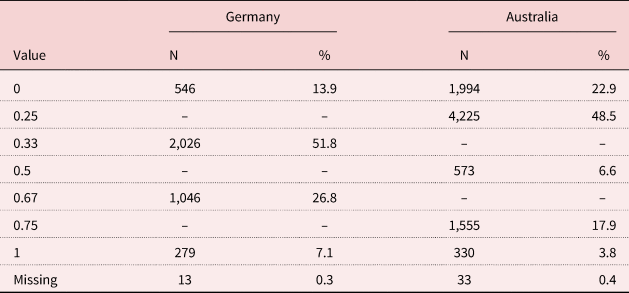
With its explicit reference to the respondents’ neighbourhoods, this question is well-suited and has often been employed to measure localised fear of crime (Greve, Reference Greve1998; Gibson et al., Reference Gibson, Zhao, Lovrich and Gaffney2002; Oberwittler, Reference Oberwittler, Groenemeyer and Wieseler2008; Alper and Chappell, Reference Alper and Chappell2012; Häfele, Reference Häfele2013; Sargeant et al., Reference Sargeant, Liu, John, Hong, Huu, Chen and Mazerolle2017). However, the standard item has also been subjected to criticism. Concerns have centred on the absence of an explicit reference to crime and the implicit focus on violent street crime. Further, while the affective dimension clearly prevails, it may be assumed that the question evokes all three dimensions of fear of crime (affective, cognitive and behavioural) to varying degrees (Ferraro and LaGrange, Reference Ferraro and LaGrange1987; Farrall et al., Reference Farrall, Bannister, Ditton and Gilchrist1997; Kreuter, Reference Kreuter2002; Häfele, Reference Häfele2013). Many scholars favour an interpretation of the standard item which stresses the broader and expressive meanings of fear of crime (see the section ‘Fear of crime and neighbourhood conditions’ above). Lastly, its lack of specificity may invite different cognitive associations from different demographic groups: women may associate the question with the threat of a sexual assault while older people may fear accidents (e.g. stumbling or falling) more than criminal assaults. While such criticism is not unfounded, studies have demonstrated that a clear majority of people connect this question with crime (Reuband, Reference Reuband2000), also indicated by strong correlations with other measures of fear of crime. In the German sample, the standard item of localised fear correlated strongly with avoidance behaviour (Spearman's rank correlation coefficient ρ = 0.62) and crime-specific affective fear (ρ = 0.46), and moderately with cognitive fear of crime (ρ = 0.32). Supportive of this interpretation, an in-depth analysis of the German sample using crime-specific affective fear as an alternative outcome found very similar results to those reported by Köber (Reference Köber2018).
Independent variables
Age was restricted to 25–90 years, the predefined age range of the German survey sample. The mean age was 52.9 with a standard deviation (SD) of 14.2 and seven missing values in the Australian sample, and a mean of 53.0 (SD = 14.2, 104 missing values) in the German sample. In the regression models, we used orthogonal polynomials of age to circumvent multicollinearity between the linear and quadratic age variables which also eases the interpretation of the interaction terms of age with gender and neighbourhood disadvantage (Narula, Reference Narula1979).
Education was measured using the International Standard Classification of Education (UNESCO Institute for Statistics, 2006) recoded to five categories (Table 3). The economic status was assessed differently in both surveys. The Australian survey asked respondents for the approximate annual household income. The high number of missing values in Australia was included as a residual indicator category. In the German survey, three questions addressed subjective income and wealth, resulting in considerably fewer missing values. Respondents were asked whether they received social benefits during the last 12 months; second, whether they were capable of paying a large bill; and third, whether their household income was sufficient to make ends meet. A factor analysis based on polychoric correlations suggested an acceptable fit for a one-dimensional solution. We grouped the resulting variables in both countries to quartiles of an ordinal measurement of the economic status, with higher values representing more affluence. Education correlated more strongly with economic status in Germany than in Australia (ρ = 0.29 versus ρ = 0.12).
Descriptive statistics of independent and control variables

Note: ISCED: International Standard Classification of Education.
Migration status distinguished respondents who were born in Australia from Germany from those born abroad. We asked respondents about the length of residence, using categories from up to one year to more than 20 years. We recoded this variable to up to two years, 2–20 years, and more than 20 years based on group and effect size considerations. Neighbourhood attachment was based on single survey questions: ‘Do you feel truly “at home” in your neighbourhood?’ (with four answering categories: ‘truly at home’ to ‘not at home at all’) in the German sample and ‘I feel that I belong to this local community’ (with five answering categories: ‘strongly agree’ to ‘strongly disagree’) in the Australian sample.
We used the unemployment rate as a proxy for neighbourhood social disadvantage because it was available in both countries and based on a common definition. In the absence of direct measurements of income or poverty in Germany, the unemployment rate is a strong indicator for neighbourhood deprivation. The unemployment rate was significantly higher in German (mean = 10.4, SD = 5.9) than in Australian neighbourhoods (mean = 3.4, SD = 1.2), reflecting considerably higher levels of unemployment in the German cities. Whereas unemployment rates in Australian neighbourhoods varied between a minimum of zero and a maximum of 6 per cent (in Melbourne) and 8 per cent (in Brisbane), the range of values was much larger in Germany, with the lowest values around 2 per cent and the highest values around 26–28 per cent in Cologne and Essen. These cross-national differences in neighbourhood unemployment rates indicate not only higher levels of social disadvantage in German compared to Australian cities but also higher levels of social segregation, with urban areas of concentrated disadvantage in which sizeable shares of residents are affected by poverty (Mustered et al., Reference Mustered, Murie and Kestellot2006; Kronauer and Siebel, Reference Kronauer and Siebel2013). Violent crime rates were constructed as the number of police-recorded violent offences against the person (homicide, assault, robbery) divided by 100,000 resident population and were log-transformed to normalise their highly skewed distribution. The violent crime rates on the log scale were slightly higher in Germany (mean = 6.9, SD = 0.9) than in Australia (mean = 6.2, SD = 1.4). We standardised both neighbourhood variables within countries to make the regression coefficients more comparable but left the unemployment rate untransformed in Figures 2 and 3 to provide a more natural interpretation of the graphs. As we are not interested in explaining level differences in fear between the two countries, within-country standardisation is suitable for the cross-national analysis of the effect sizes (slopes) of this predictor and how they vary by age, but would not be suitable for investigating level differences in fear of crime between the two countries (which we do not intend in this paper).
Predicted effect of neighbourhood social disadvantage on fear of crime depending on age (by country).

Predicted effect of age on fear of crime depending on neighbourhood social disadvantage (by country).
Notes: AUS: Australia. GER: Germany.

Analytic strategy
Considering the hierarchical structure of our survey data with respondents nested in neighbourhoods, we ran multi-level regression models to analyse individual- and neighbourhood-level predictors of fear of crime simultaneously, as well as cross-level interactions between age and neighbourhood disadvantage. After null and conditional models for assessing the ICC of fear of crime by age groups, we fitted three equivalent linear multi-level regression models by country to test our two main hypotheses. We preferred linear over ordered logistic modelling because of the well-known difficulties of model comparisons (Mood, Reference Mood2010) and interaction effects due to the non-linear relationship between logits and probabilities (Ai and Norton, Reference Ai and Norton2003; Greene, Reference Greene2010).
The first baseline model (Model 1) was a random intercept model with all individual-level predictors (except neighbourhood attachment) and neighbourhood disadvantage, Model 2 tested the cross-level interaction between age and neighbourhood disadvantage controlling for violent crime rates and Model 3 added neighbourhood attachment as a mediating predictor.
In modelling the cross-level interaction between age and neighbourhood disadvantage, we followed Snijders and Bosker's (Reference Snijders and Bosker2012: 82, 105) advice to include the multiplicative term on theoretical grounds, irrespective of the existence of a random slope for age.Footnote 2 The importance of the cross-level interaction was assessed in two ways: first, the significance of the interaction terms was tested based on Satterthwaite's approximation of degrees of freedom; second, an improvement of the global fit was assessed with the Akaike information criterion (AIC) which penalises additional coefficients less strongly than the equationally similar Bayesian information criterion. For both, smaller values indicate a better overall quality of the model.
As interaction effects are notoriously difficult to interpret from regression coefficients, we reported marginal means and showed marginal effects plots to gain insights into their substantive meaning (Brambor et al., Reference Brambor, Clark and Golder2006). It is important to consider that interaction effects are symmetric and operate ‘both ways’: the effects of both interaction variables depend on the respective other (Berry et al., Reference Berry, Golder and Milton2012). Therefore, both the variable effect of neighbourhood disadvantage depending on age as well as the variable effect of age depending on neighbourhood disadvantage should be considered to gain a full picture of the mutual dependency. Due to the quadratic relationship between age and fear, the marginal effect of age (which is the derivative of the regression equation to age) is depending on neighbourhood disadvantage and age. In other words, the effect of age is constant neither across the range of age nor neighbourhood disadvantage (Aiken et al., Reference Aiken, West and Reno1991: chap. 5). Therefore, we plotted the marginal age effects depending on neighbourhood disadvantage at four age points (25, 45, 65 and 85 years).
Computationally, we used R (R Core Team, 2016) and the packages lme4 for the regression analysis (Bates et al., Reference Bates, Mächler, Bolker and Walker2015), effects (Fox, Reference Fox2003) for the prediction, mgcv (Wood, Reference Wood2017) for the generalised additive models and ggplot2 (Wickham, Reference Wickham2016) as well as lattice (Sarkar, Reference Sarkar2008) for visualisations.
Results
As an exploratory step of analysis, we first look at the ICCs of localised fear of crime in different age groups controlling for individual socio-demographic composition. This ICC measures the share of between-neighbourhood variance which signifies the potential influence of any neighbourhood conditions on localised fear. Table 4 shows that the overall ICC was roughly of the same size in Germany and Australia: in the overall sample, 13.6 per cent of the variance in Germany and 12.1 per cent in Australia was between the neighbourhoods, indicating potentially large influences of neighbourhood characteristics on localised fear of crime. Differentiated by age groups, both countries showed a tendency of decreasing ICCs by age groups, yet this tendency was stronger in Australia. Here, the ICC for older respondents (60 years and older) was only half of that for respondents under 40 years; in Germany, the difference was 3.1 percentage points. Smaller ICCs indicate a decreased potential impact of neighbourhood conditions on safety perceptions.
Conditional intraclass correlation coefficients (ICCs) of localised fear of crime by age groups

Note: Conditional ICCs controlling for education, economic status, migration, length of residence and gender.
Turning to the multi-level regression models (Table 5), Model 1 shows the results for the baseline random incept model without the P × E interaction effect. Most of the individual-level effects of socio-demographic variables were very similar in both countries and in line with previous research. Female respondents reported more fear than male respondents, and age was curvilinearly related to fear: with higher age, respondents became increasingly more fearful. Only in Australia was the curvilinear age effect on fear stronger for women, indicated by a significant interaction between gender and age squared.
Linear multi-level regression models of fear of crime

Notes: 1. Orthogonal polynomials. 2. Standardised by two standard deviations to allow comparisons to categorical variables (Gelman, Reference Gelman2007). 3. Neighbourhood variable. 4. ‘Do you feel truly “at home” in your neighbourhood?’ (with four answering categories: ‘truly at home’ to ‘not at home at all’) in Germany and ‘I feel that I belong to this local community’ (with five answering categories: ‘strongly agree’ to ‘strongly disagree’) in Australia. Ref. Rather at home (Germany); Agree (Australia).
Abbreviations: Ref., reference category; SD, standard deviation.
Significance levels: * p < 0.05, ** p < 0.01, *** p < 0.001.
Social status variables impacted fear in very similar ways in Germany and Australia: lower-educated and poorer people were more fearful compared to higher-educated and more affluent people, again in line with previous research. The effect of education, and in particular of high educational degrees, was stronger in Germany than in Australia. The positive effect of the residual ‘missing’ category of economic status in Australia suggests that many of the 24 per cent of respondents who did not want to report their income may belong to lower-income groups. Migration background did not affect fear of crime in either country. Length of residence had, if at all, a rather small influence on fear in Germany. In Australia, both people who moved into a neighbourhood recently and who lived there for more than 20 years reported slightly less fear. Together, all individual-level socio-demographic variables explained just under 10 per cent of the respondent-level variance in both countries.
In the neighbourhood part of the multi-level model (Model 1), social disadvantage as measured by the standardised unemployment rate increased localised fear in both countries. The coefficients of 0.12 in both countries indicate the increase of fear on a scale between 0 and 1 for two standard deviations increase in neighbourhood disadvantage. This scaling of continuous variables makes the size of the coefficient also comparable to all categorical predictors (Gelman, Reference Gelman2007). Violent crime rates, too, increased fear of crime in both countries, yet the coefficient of 0.05 represents a weaker effect compared to social disadvantage, supporting previous research. Social disadvantage not only was of greater importance for the variation in local insecurities between neighbourhoods but was also stronger than most individual effects and as strong as gender which has shown very strong and robust associations with fear of crime in most studies. The pivotal relevance of neighbourhood disadvantage for localised fear is underlined by the fact that as a single predictor, it explained 69 per cent of the between-neighbourhood variance in Germany and 58 per cent of the between-neighbourhood variance in Australia, after controlling for the individual socio-demographic composition of respondents but not controlling for violent crime rates (not shown, available on request). Violent crime rates added only little (4.5% in Germany, 5.2% in Australia) to the explanation of local variations in insecurities. These results once again proved the strong position of social disadvantage in accounting for neighbourhood differences in residents’ perceptions of safety and related social processes (Ham et al., Reference Ham, Manley, Bailey, Simpson and Maclennan2012; Sampson, Reference Sampson2018). We included dummy variables to control for city-level differences in fear; the coefficients show that people in Essen and Melbourne were more fearful compared to people in Cologne and Brisbane, respectively.
Model 2 focused on the central research question of this paper about the nature of the P × E interaction. A significant negative coefficient for the multiplicative term between linear age and neighbourhood disadvantage suggests that this P × E interaction indeed exists and has the same direction in both countries. This conclusion is supported by an increased model fit, both in terms of a slight increase in individual-level explained variance and a slight decrease in AIC, and despite the absence of a significant random slope of age. The negative coefficient indicates that a higher value on one variable decreases the effect of the other variable. Thus, the results support hypothesis H1b that the effect of neighbourhood disadvantage on fear of crime is weaker in higher age.
As interaction effects are notoriously difficult to understand, we visualised the predicted effects on localised fear in three graphs. Figure 2 illustrates the varying effects of neighbourhood disadvantage on fear at different ages of respondents, and, as interactions are symmetrical and can be viewed from both angles, Figure 3 illustrates the varying effects of age on fear at different levels of neighbourhood disadvantage. Technically, both figures are graphical representations of the marginal means of the outcome variable at defined values of the two predictors involved in the interaction, controlling for all other effects in the model.
Figure 2 shows for both countries that localised fear increased with social disadvantage at all ages, and that older people, and in particular the very old, reported more fear than younger people in most kinds of neighbourhoods. Looking at younger ages (25 years up to 45 years) in Australia, fear increased from a low of just under 0.25 (on a scale between 0 and 1) in the least disadvantaged neighbourhoods to a high of just under 0.50 in the most disadvantaged neighbourhoods. Likewise, for younger people in Germany, fear increased from a low of around 0.25 in the least disadvantaged neighbourhoods to a high of around 0.60 in the most disadvantaged neighbourhoods. Note that in both countries, fear on average roughly doubled comparing the extreme poles of neighbourhood social conditions, irrespectively of the large difference in the range of unemployment rates in Australia (approximately 0–8%) and Germany (approximately 2–28%).
The P × E interaction is expressed in Figure 2 in the decreasing steepness of the slope of neighbourhood disadvantage at age 65 and in particular 85 years. Thus, older people's fear was less strongly associated with neighbourhood disadvantage. At the same time, older people were considerably more fearful than younger ages in better-off neighbourhoods and, reversely, younger ages were as fearful (almost in Australia, actually in Germany) as older people in the most disadvantaged neighbourhoods.
Figure 3 illustrates the same P × E interaction from a reversed angle. As the x-axis now represents age, one can clearly see the curvilinear increase of localised fear with age. In the least disadvantaged neighbourhoods, fear started at a low level at young age and increased considerably with age, and more forcefully in older age. In other words, younger people were considerably less fearful in better-off neighbourhoods than their old-age neighbours. In contrast, residents in the most disadvantaged neighbourhoods were all very fearful, no matter their age. One can infer from this that younger people react more forcefully to neighbourhood social conditions in expressing fear, whereas old people show high levels of fear irrespectively of neighbourhood contexts. Neighbourhood social conditions matter more for younger than for older people's localised fear. Especially the very high fear levels of old residents in better-off neighbourhoods suggest that their safety perceptions are out of proportion with real neighbourhood conditions, and hence must be influenced by other factors peculiar to their age group.
Figure 4 takes yet another angle on the P × E interaction. This graph plots the marginal effects of neighbourhood disadvantage on localised fear by age. The marginal effects represent the coefficient at specific values of the other variable involved in the interaction. The reduction with age of the effect of neighbourhood disadvantage is very similar in both countries: at age 25, the effect is around 0.15 and decreases in a curvilinear fashion to less than 0.07 at age 90. As the histograms in Figure 4 indicate, we have sufficient data to compute reliably the marginal effects of unemployment rates along the age spectrum.
Marginal effects of neighbourhood social disadvantage depending on age.
Notes: Model 3 (M3) adds neighbourhood attachment to Model 2 (M2). The interaction is visibly decreased, particularly in the German sample.

The contour plots (Figure 5) offer a more nuanced perspective on the P × E interactions and serve as an additional check of the robustness of our findings in Model 2 (Hainmueller et al., Reference Hainmueller, Mummolo and Xu2019).Footnote 3 They should be interpreted like topographic maps with age and neighbourhood disadvantage on the axes. Higher (brighter) areas indicate more fear. Faster colour changes imply steeper gradients. We interpret these results as follows: first, holding neighbourhood disadvantage or age constant, i.e. looking strictly vertically (the increase of fear with age holding neighbourhood disadvantage constant) or horizontally (the increase of fear with neighbourhood disadvantage holding age constant), localised fear of crime increased with age and, more strongly, with neighbourhood disadvantage; second, the slope of neighbourhood disadvantage on fear was greater for younger than for older people in Germany (see the contour lines). In Australia, however, older people reacted more strongly to changes in social disadvantage at the beginning of the scale (roughly from 0 to 2% of neighbourhood unemployment), while the increase of fear with social disadvantage was stronger for younger people between 3 and 5 per cent of neighbourhood unemployment. After that, the steeper slope for younger people is reduced again. Third, the interaction surface was fairly smooth, without drastic humps, wrinkles or holes. This supports our modelling approach of non-linear but monotonically decreasing neighbourhood effects depending on age (and, due to the symmetry of interaction effects, also vice vers). The small deviations from these changing effects (discussed as “second” in this paragraph) do not impair our primary finding of a noticeable P × E interaction in both countries.
Interaction surface of age and neighbourhood social disadvantage predicting fear.

As a final analytical step, we test hypothesis H2 that the reduced impact of neighbourhood disadvantage on localised fear of older residents is, among other things, due to their higher level of neighbourhood attachment which may act as a buffer to adverse environmental influences. As outlined above, the potential underlying mechanism assumes that older people feel more attached to their neighbourhood and, therefore, consciously or unconsciously ignore fear-provoking neighbourhood characteristics. While neighbourhood attachment did significantly increase with age in both countries, the bivariate correlation was rather weak ρ = 0.09 in Germany, ρ = 0.08 in Australia with signs of curvilinearity), limiting the potential scope of mediation effects.
Model 3 shows, first of all, that neighbourhood attachment, in fact, had a very strong association with fear. Very low attachment (compared to a middle category) was associated with an increase of localised fear by 0.24 scale points in Germany and 0.20 in Australia, and very high attachment (again, compared to a middle category) decreased fear by 0.08 scale points in Germany and 0.19 scale points in Australia. Thus, neighbourhood attachment was by far the strongest predictor of localised fear. The strong impact was also reflected by an increase of explained individual-level variance from approximately 10 to 15.7 per cent in Germany and from approximately 9 to 17.3 per cent in Australia. It is important to regard this association between neighbourhood safety perceptions and attachment as bi-directional: residents who are strongly attached to their neighbourhood feel safer, and at the same time residents who feel very unsafe in their neighbourhood surely are less attached to it.
The mediation hypothesis that neighbourhood attachment accounts for the interaction between age and neighbourhood disadvantage received modest support. The multiplicative interaction term (age × neighbourhood disadvantage) decreased by around a fifth in both countries between Models 2 and 3, but the resulting differences of coefficients did not reach significance. Thus, neighbourhood attachment can explain some part but not the bulk of this P × E interaction.
In additional models, we alternatively tested for the interaction between violent crime rates and age (not shown in Table 5, results available on request). There was no interaction effect in Germany and only a marginally significant positive interaction with the quadratic age term (p < 0.05) in Australia, indicating a small curvilinear interaction; younger as well as older respondents showed slightly stronger effects with regard to violent crime rates than middle-aged respondents. This finding, albeit not as robust as our main finding, merits further analysis.
Summary and discussion
It is a widely shared assumption in ageing research that ‘where people live … makes a difference’ (Gerstorf et al., Reference Gerstorf, Ram, Goebel, Schupp, Lindenberger and Wagner2010) and, in particular, that older people's wellbeing becomes more susceptible to environmental adversities because physical and mental vulnerabilities increase with age (Annear et al., Reference Annear, Keeling, Wilkinson, Cushman, Gidlow and Hopkins2014; Cagney and Cornwell, Reference Cagney, Cornwell, Hayward and Majmundar2018; Wahl and Gerstorf, Reference Wahl and Gerstorf2018). Crime and perceptions of insecurity are one facet of local environments which may cause stress and negatively impact the wellbeing of older residents. Research has for decades discussed the heightened susceptibility of older people to fear of crime against the backdrop of age-related vulnerabilities (Greve et al., Reference Greve, Leipold and Kappes2017). The ‘environmental docility hypothesis’ proposed by Lawton and Simon (Reference Lawton and Simon1968) has been very influential in promoting the view more generally that age-related reductions in individual competencies increase the significance of external conditions for wellbeing.
However, the empirical evidence substantiating this hypothesis is not conclusive as few studies have investigated the impact of environmental conditions on wellbeing differentiated by age groups, instead largely focusing on age-restricted samples (Yen et al., Reference Yen, Michael and Perdue2009; De Donder et al., Reference De Donder, Buffel, Dury, De Witte and Verté2013; Annear et al., Reference Annear, Keeling, Wilkinson, Cushman, Gidlow and Hopkins2014).
This paper contributes to filling this gap by analysing the age-specific association of fear of crime and adverse neighbourhood conditions in two separate community surveys of the general adult population in 435 neighbourhoods in two German and two Australian cities. Using the unemployment rate as a lead indicator of problematic neighbourhood conditions and employing multi-level modelling, we showed that older adults are, in fact, not more, but less susceptible to neighbourhood conditions with regard to fear of crime, quite contrary to the prevailing view.
Overall, neighbourhood disadvantage accounted for around two-thirds of the between-neighbourhood variance in feelings of insecurity in both countries, despite considerable differences in the local concentrations of social disadvantage in German and Australian cities. Compared to individual-level socio-demographic variables except gender, neighbourhood disadvantage was the strongest predictor of fear of crime in both countries, and considerably stronger than violent crime rate which was only weakly associated with fear. But the cross-level interaction between individual age and neighbourhood disadvantage revealed that the size of this effect dropped by around half from the youngest (25 years) to the oldest age (90 years) in both samples (see Figure 4). Thus, older people's fear was considerably less strongly associated with neighbourhood disadvantage. Consequently, younger people were almost as fearful as older people in the most disadvantaged neighbourhoods (see Figure 2). Our findings parallel those of a very early study by Maxfield (Reference Maxfield1984; 246; McGarrell et al., Reference McGarrell, Giacomazzi and Thurman1997) who concluded that ‘everyone is more afraid’ in the most problematic neighbourhoods. On the flipside, we found older people to be considerably more fearful than younger ages in better-off neighbourhoods.
Taken together, these findings suggest that older people's safety perceptions tend to be less connected with objective neighbourhood conditions in comparison to younger ages, and hence must be influenced by other factors peculiar to their age group. We tested and found limited evidence for a mediating effect of neighbourhood attachment on the relation between neighbourhood disadvantage and fear of crime, in line with the notion of Wahl and Gerstorf (Reference Wahl and Gerstorf2018: 163) that a strong ‘sense of place identity’ protects older residents against external adversities. However, while place attachment may explain the mitigated association between older age and fear in the most disadvantaged neighbourhoods, it cannot account for the higher levels of fear of older people (relative to younger ages) in middle-class neighbourhoods.
Our findings may have important implications for prevention. Programmes for improving the subjective security of older people primarily geared at disadvantaged neighbourhoods may miss a relevant target group: older people in middle-class neighbourhoods.
Data limitations prevent us from elaborating our analysis further. The cross-national comparative design restricts the catalogue of available variables both on the individual and on the neighbourhood level. Doubts about the ambiguous meanings of the single item measuring localised fear calls for more fine-grained analyses of the cognitive, affective and behavioural dimensions of fear of crime. Unfortunately, these variables were available only in the German study where analogue analyses support the findings above (Köber, Reference Köber2018: chap. 5.7). To measure neighbourhood conditions, we relied on the unemployment rate as a single indicator of social disadvantage, thus missing other potential environmental influences. Nevertheless, it accounts for 69 and 58 per cent of the neighbourhood-level variation of fear of crime in Germany and Australia, respectively, once more underlining the pivotal role of social inequality in shaping collective urban perceptions (Sampson, Reference Sampson2009). In contrast, crime rates showed relatively weak effects on local insecurities, in line with many previous studies (Oberwittler, Reference Oberwittler, Groenemeyer and Wieseler2008; Drakulich, Reference Drakulich2013, Reference Drakulich2015).
The interplay of fear of crime, physical health and activity patterns, and neighbourhood conditions is a worthwhile direction for future research. Limited data availability prevented us from digging deeper by including direct measurements of physical or mental vulnerabilities which are seen as major proximal influences on wellbeing in older age (Schilling et al., Reference Schilling, Deeg and Huisman2018; Wahl and Gerstorf, Reference Wahl and Gerstorf2018). The association of physical health and fear of crime is well-documented in the literature (Greve, Reference Greve1998; Cossman and Rader, Reference Cossman and Rader2011; Köber, Reference Köber2018). Also, and closely related to health, we lack information on the activity patterns and outdoor routines of respondents which may hold a clue to our findings. Mobility and outdoor activities become more constricted with age-related reductions in physical health (Mendes de Leon et al., Reference Mendes de Leon, Cagney, Bienias, Barnes, Skarupski, Scherr and Evans2009; Tucker-Seeley et al., Reference Tucker-Seeley, Subramanian, Li and Sorensen2009; Annear et al., Reference Annear, Keeling, Wilkinson, Cushman, Gidlow and Hopkins2014). Especially in very old age and in cases of serious and chronic health impairments, people spend most of their daytime at home, which increasingly replaces the outside world as a salient environment (Oswald et al., Reference Oswald, Hieber, Wahl and Mollenkopf2005; Schilling et al., Reference Schilling, Deeg and Huisman2018). This ‘insideness’ may shield older people with reduced mobility from exposure to outside neighbourhood conditions, and their physical impairments may account for increased levels of perceived insecurity irrespective of neighbourhood contexts. Physical health and, in particular, activity and mobility patterns should be considered in future studies of neighbourhood influences on wellbeing and security perceptions across adult lifestages.


 Open access

