





1. Introduction
People can make slightly different decisions depending on the language of thought (Keysar et al., Reference Keysar, Hayakawa and An2012). Known as the Foreign Language Effect (FLE), it posits that a foreign language creates more psychological distance than a native language, leading to more deliberative than automatic responses (Costa et al., Reference Costa, Foucart, Arnon, Aparici and Apesteguia2014). This can be either beneficial or disadvantageous for decision-making (McFarlane et al., Reference McFarlane, Cipolletti Perez and Weissglass2020; Pavlenko, Reference Pavlenko2017). The cognitive enhancement hypothesis assumes that some cognitive biases are reduced in a foreign language as stimuli are elaborated more analytically, e.g., causality bias (Díaz-Lago & Matute, Reference Díaz-Lago and Matute2019). However, the cognitive demands of a foreign language may also drain brain resources for other cognitive processes (Volk et al., Reference Volk, Köhler and Pudelko2014). Building on this second interpretation, the cognitive overload hypothesis assumes that people are worse in cognitive reflection in a foreign language, e.g., in detecting fake news (Muda et al., Reference Muda, Pennycook, Hamerski and Białek2023). Additionally, several studies have reported null-FLE on the outcome bias and representativeness heuristic (Vives et al., Reference Vives, Aparici and Costa2018). These mixed findings of the FLE on cognitive biases warrant further research to understand the impact of a foreign language on decision-making using different tasks. In this paper, we investigate whether a foreign language can induce a specific response bias: acquiescence.
Acquiescence refers to the act of passively accepting something, often without resistance (Paulhus, Reference Paulhus1991). It has been studied as a form of response bias as the tendency to agree with questions or to go along with the status quo (Ray, Reference Ray1983). Acquiescence in dichotomous accept-reject type of decisions is linked to increased cognitive load of the task (Knowles & Condon, Reference Knowles and Condon1999; Knowles & Nathan, Reference Knowles and Nathan1997). For instance, Knowles and Condon (Reference Knowles and Condon1999) manipulated cognitive load during a dichotomous decision task, in which participants decided whether 50 pairs of opposite personality traits describe themselves or not. Ideally, if they choose “It's me” for 50 personality traits, then they would rationally choose “It's not me” for the other 50 traits, e.g., you would not choose “It's me” for both extroverted and introverted. These authors discovered that people exhibited more acquiescence – that is, they chose more “It's me” than “It's not me” – under higher cognitive load. Furthermore, these authors showed that people chose “It's not me” much more slowly than “It's me”. They explained these results under Gilbert's (Reference Gilbert1991) Spinozan account of belief: comprehending an accept-reject type of question mandates automatic initial acceptance, such that the decision is essentially made between certifying the acceptance or rejecting it; since rejecting requires more cognitive resources than certifying (Gilbert et al., Reference Gilbert, Krull and Malone1990), increased cognitive load would increase the difficulty in rejecting, leading to more acquiescence.
We therefore adopt the paradigm of Knowles and Condon (Reference Knowles and Condon1999) to investigate the effect of foreign language on acquiescence. Due to the fact that processing a foreign language is less automatic (Abutalebi, Reference Abutalebi2008), under the cognitive overload hypothesis, we expected participants to exhibit more acquiescence for accept-reject dichotomous decisions in a foreign (vs. native) language. As reaction time is a sensitive measure to extraneous processing cost (DeLeeuw & Mayer, Reference DeLeeuw and Mayer2008), we also expected people to be generally slower in a foreign language, and more critically, much slower in rejecting a personality trait than certifying the acceptance of it. Conversely, if the cognitive enhancement hypothesis holds, we would expect participants to exhibit less acquiescence in a foreign language and no interference of it on rejection.
2. Method
Three experiments were conducted to test these hypotheses. Experiment 1 was conducted online, Experiments 2 and 3 were conducted in presence, and Experiment 3 was pre-registered (https://aspredicted.org/23fu7.pdf) to replicate and extend the findings of Experiment 2. The experiments were implemented on Labvanced (https://www.labvanced.com). The study was approved by the Research Ethics Committees of the University of Padua (Protocol number: 5084) and was conducted in accordance with the Helsinki Declaration of 1975, as revised in 2008.
2.1. Participants
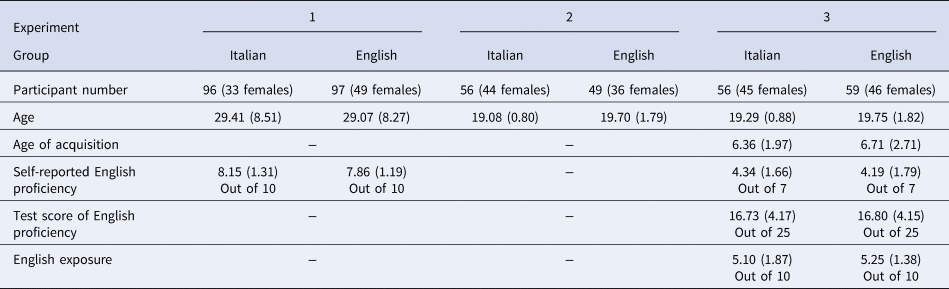
A priori power analysis using G*Power (Faul et al., Reference Faul, Erdfelder, Lang and Buchner2007) suggested a sample size of 108 (α = .05, 1 − β = .95, and f = .25) for a repeated measures between factor ANOVA design. In Experiment 1, we tested 193 native Italian-speakers via Prolific (https://www.prolific.co); in Experiment 2, we tested 105 native Italian-speakers (university students); and in Experiment 3, we tested 115 native Italian-speakers (university students). See Table 1 for details of the participant pool.
Descriptive statistics of participants in Experiments 1, 2, and 3, with mean values and standard deviation in brackets.
2.1. Materials
We utilized a validated 5-factor scale in Italian containing 100 personality traits (Di Blas & Forzi, Reference Di Blas and Forzi1999, Table 2). Within each factor, half the traits had positive loadings and the other half had negative loadings, e.g., extroverted and introverted (see Supplementary materials). There is no difference in letter count, t(191.84) = 0, 95% CI [−0.71,0.71], p = 1.00, between the Italian version (M = 8.74, SD = 2.31) and the English version (M = 8.74, SD = 2.78) of the stimuli.
2.2. Procedure
After consent, participants were randomly assigned to complete the experiment in either Italian (native language) or English (foreign language). They first read the instructions and completed two practice trials. In Experiment 1, all trials began with a 500 ms fixation cross, followed by a small black square at the center of the computer screen. Participants moved the mouse inside the square to start the critical frame, where they saw a personality trait (Lato bold font, size 26) and were asked to decide whether it described themselves or not. Participants clicked on the “It's me” or the “It's not me” button for a certifying or rejecting decision, respectively. Immediately afterwards in the English version, participants indicated whether they knew the presented personality trait or not. Afterwards, participants reported their English proficiency on a 10-point Likert scale. In Experiments 2 and 3, participants completed the experiment on smartphones individually in a dimly-lit and sound-proof auditorium. All trials began with a 500 ms fixation cross, followed by a personality trait at the screen center and a question below. They used their dominant finger to touch the “It's me” or the “It's not me” button to decide whether it described themselves or not. Immediately afterwards in the English version, participants indicated whether they knew the presented personality trait or not. In Experiment 2, participants did not report their English proficiency, whereas in Experiment 3 they reported their English proficiency on a 7-point Likert scale and completed a 25-item English test at the end (www.cambridgeenglish.org).
2.3. Analyses
Analyses were performed in R (R Core Team, 2022) with the lme4 package (Bates et al., Reference Bates, Mächler, Bolker and Walker2015). We first excluded participants that were not native Italian-speakers and those with incomplete data. Then we excluded trials with reaction times (RTs) falling outside the 2.5 standard deviation from the mean. This resulted in 0.94%, 2.29%, and 2.39% of data loss in Experiments 1, 2, and 3, respectively. The English Proficiency score was aggregated from listening, speaking, reading, and writing ratings in Experiment 1, and the correct answer count of the English test in Experiment 3. Due to a programming error, participants’ comprehension of each personality trait in English was not recorded in Experiment 1, the main analyses were therefore performed on all personality traits between English and Italian. Whereas in Experiments 2 and 3, the main analyses were performed between English and Italian excluding the traits participants did not know in EnglishFootnote 1. For decisions, we fitted a mixed-effects linear model with Language as a fixed factor and Participant as a random factor. For RTs, we fitted a mixed-effects linear model with Language and Decision as fixed factors, Participant as a random factor. Word frequency of the personality traits and participant’ English proficiency were added as covariates in the models as a methodological safeguard, ensuring that any observed effects of Language on Decision and RT are not driven by these potentially influential factors.
Results. Experiment 1
Decisions
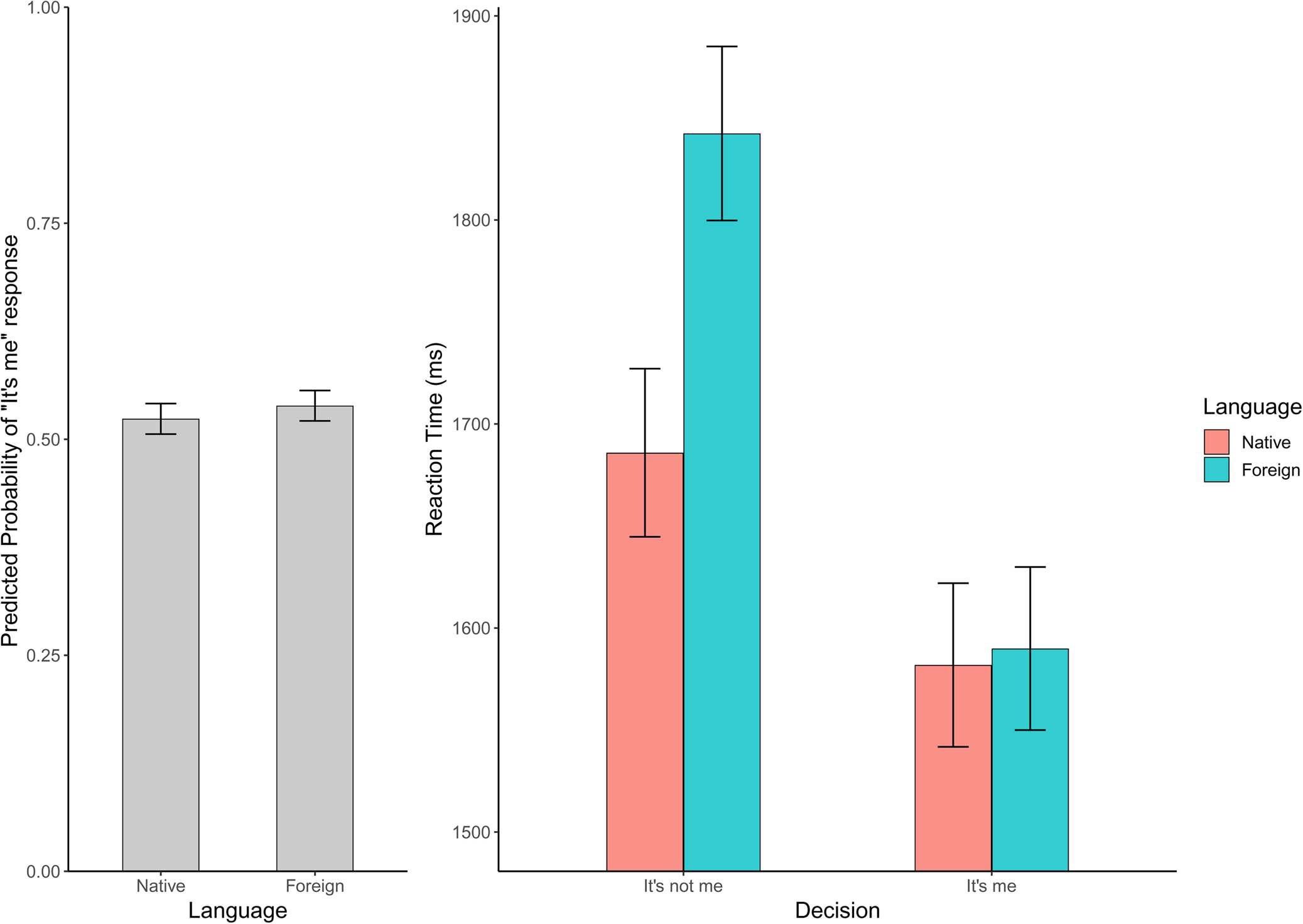
The effect of Language was not significant (OR = 0.94, 95% CI [0.85, 1.04], p = .234), nor was the effect of English_proficiency (OR = 1.01, 95% CI [0.97, 1.05], p = .503). The effect of Frequency was significant (OR = 1.35, 95% CI [1.32, 1.39], p < .001), indicating the more frequent the trait word is the more likely participants chose “It's me”.
RTs
The effect of Language on RTs was significant (Estimate = −156.49, 95% CI [−215.94, −97.03], p < .001), participants responded more slowly in English. Decision was significant (Estimate = −252.45, 95% CI [−279.91, −224.99], p < .001), participants selected “It's not me” more slowly than “It's me”. The interaction of Language and Decision was significant (Estimate = 148.44, 95% CI [111.61, 185.27], p < .001), participants selected “It's not me” much more slowly in English than Italian (see Figure 1). English_proficiency effect was significant (Estimate = -38.78, 95% CI [−6.54, −17.02], p < .001), suggesting faster responses with higher English proficiency. Frequency was significant (Estimate = −39.86, 95% CI [-47.06, −32.65], p < .001), with more frequent trait words eliciting quicker responses.
Decisions and Reaction Times in Experiment 1. The left panel presents the predicted probability of “It's me” responses by Language; the right panel presents reaction times (in milliseconds) by Language and Decision. Error bars represent 95% confidence intervals.
Results. Experiment 2
Decisions
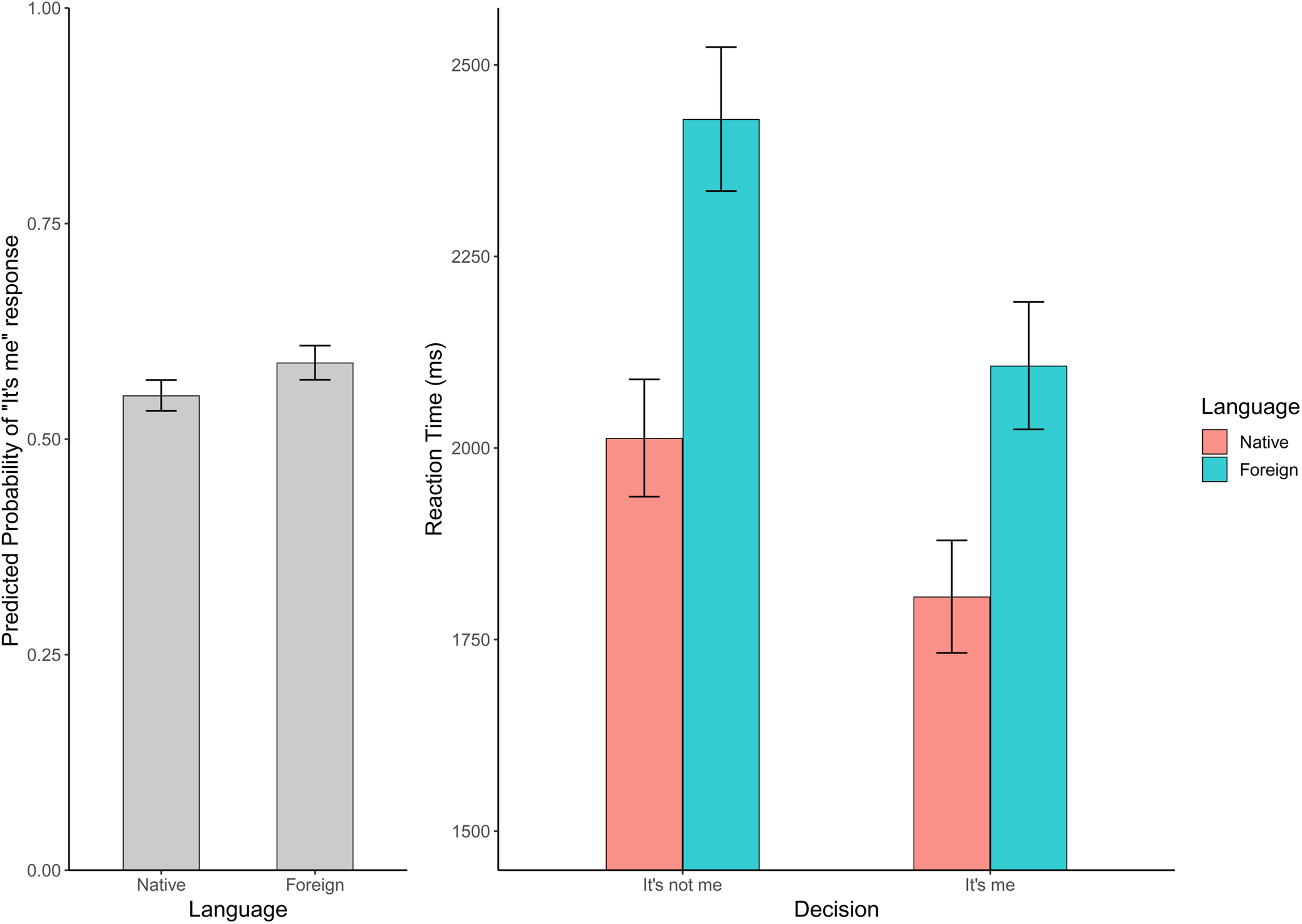
For known words, the effect of Language was significant (OR = 0.86, 95% CI [0.77, 0.95], p = .005), participants were more likely to choose “It's me” in English than Italian. The effect of Frequency was also significant (OR = 1.17, 95% CI [1.13, 1.21], p < .001), suggesting the more frequent the trait word is the more likely participants chose “It's me”.
RTs
The effect of Language was significant (Estimate = −416.31, 95% CI [−537.49, −295.14], p < .001), participants responded more slowly in English. Decision was also significant (Estimate = −321.85, 95% CI [−392.59, −251.10], p < .001), participants selected “It's not me” more slowly than “It's me”. The interaction between Language and Decision was significant (Estimate = 114.93, 95% CI [32.55, 197.30], p = .006), participants selected “It's not me” much more slowly than “It's me” in English than Italian (see Figure 2). Additionally, the effect of Frequency was significant (Estimate = -39.33, 95% CI [−53.39, −25.27], p < .001), the more frequent the trait words, the more quickly the responses.
Decisions and Reaction Times in Experiment 2 (excluding unknown personality traits in the foreign language). The left panel presents the predicted probability of “It's me” responses by Language; the right panel presents reaction times (in milliseconds) by Language and Decision. Error bars represent 95% confidence intervals.
Results. Experiment 3
Decisions
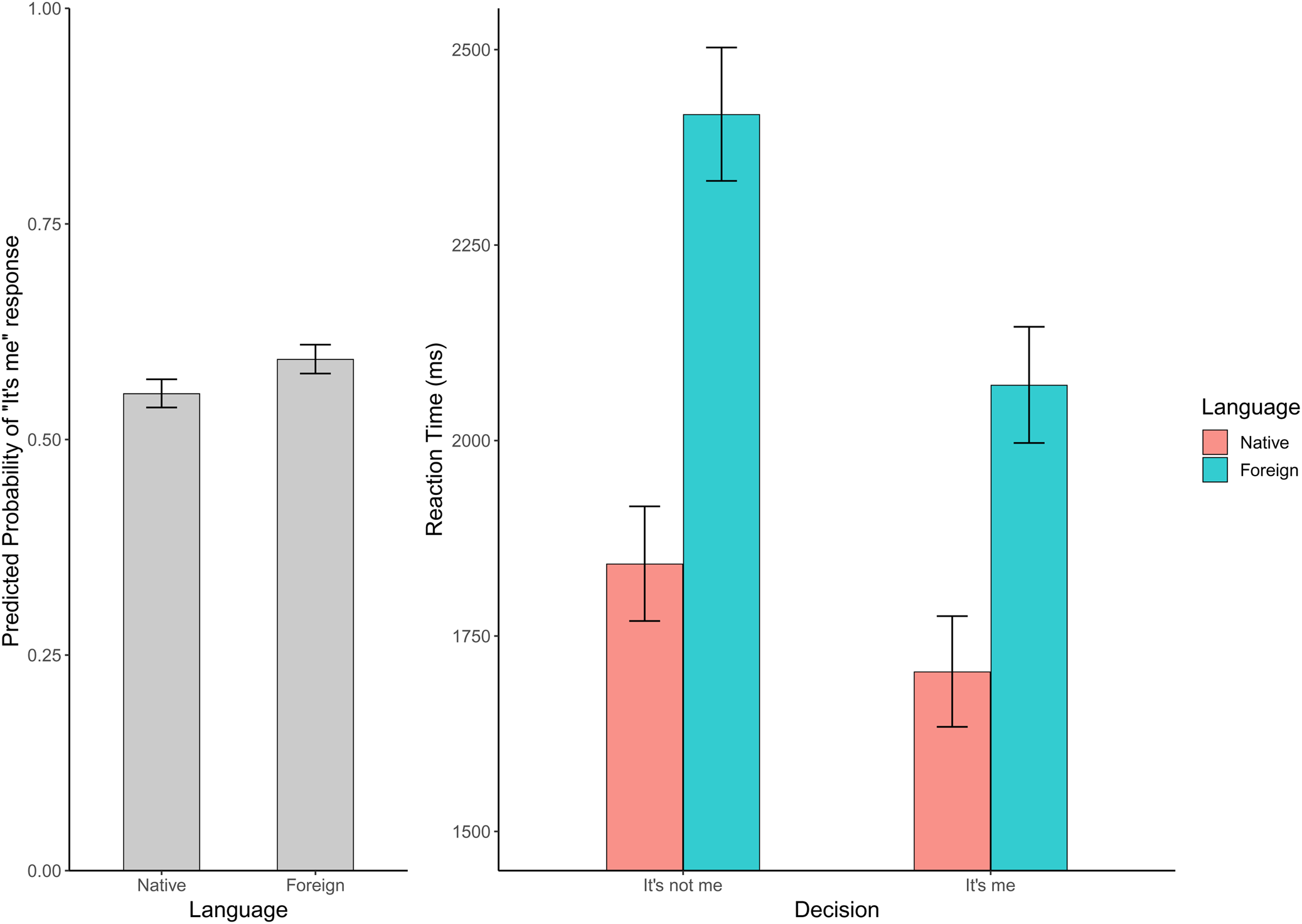
The effect of Language was significant (OR = 0.85, 95% CI [0.77, 0.94], p = .001), participants were more likely to choose “It's me” in English than Italian. English_proficiency was significant (OR = 0.99, 95% CI [0.97, 1.00], p = .017), the lower the English_proficiency the higher the likelihood of choosing “It's me”. Frequency was also significant (OR = 1.21, 95% CI [1.17, 1.25], p < .001), the higher the frequency the higher the likelihood of “It's me” decision.
RTs
The effect of Language was significant (Estimate = −574.88, 95% CI [−687.32, −462.44], p < .001), participants responded more quickly in Italian than English. The effect of Decision was significant (Estimate = −346.20, 95% CI [−411.48, −280.92], p < .001), participants selected “It's me” faster than “It's not me”. The interaction between Language and Decision was significant (Estimate = 208.29, 95% CI [132.10, 284.47], p < .001), participants selected “It's not me” much more slowly than “It's me” in English than Italian. Moreover, English_proficiency was significant (Estimate = −18.70, 95% CI [−30.69, −6.71], p = .002), suggesting faster responses with higher English proficiency. Frequency was significant (Estimate = −62.21, 95% CI [−75.05, −49.36], p < .001), with more frequent trait words eliciting quicker responses.
Decisions and Reaction Times in Experiment 3 (excluding unknown personality traits in the foreign language). The left panel presents the predicted probability of “It's me” responses by Language; the right panel presents reaction times (in milliseconds) by Language and Decision. Error bars represent 95% confidence intervals.
3. Discussion
Our research comprised three experimental studies that aimed at elucidating the influence of thinking in a foreign language on the level of acquiescence. Cumulatively, the findings from these experiments indicate a propensity for increased acquiescence when respondents completed the task in a foreign language. In Experiment 1, a marginal increase was observed in participants’ propensity to choose certifying “It's me” responses in a foreign language as compared to their native language. However, this difference failed to reach statistical significance, seeming to imply that thinking in a foreign language might not escalate acquiescence. This preliminary conclusion, though, warrants cautious interpretation, as it may be confounded by unaccounted variables, particularly pertaining to participants’ comprehension of the personality traits in the foreign language. For instance, people have the tendency to resist novel or unfamiliar concepts (Townsend, Reference Townsend and Townsend2017), it is therefore plausible that participants demonstrated an inclination to choose “It's not me” responses for personality traits they found incomprehensible in the foreign language. It is worth noting that this result is nevertheless of theoretical relevance in bilingual research, as previous assumptions of acquiescence stem from research in the native language, in which comprehension is not an issue (Gilbert, Reference Gilbert1991; Knowles & Condon, Reference Knowles and Condon1999). Is it still the case in a foreign language when we often encounter incomprehensible words?
In Experiment 2, we addressed the comprehension issue of personality traits in a foreign language, asking participants to indicate explicitly whether they knew the trait or not. The analysis, consequently, focused on comparing responses to known traits in English with those in Italian, therefore eliminating the confounding effect of lexical comprehension. The results aligned with our initial hypothesis, revealing a statistically significant greater likelihood of participants choosing “It's me” in English than in Italian. Further bolstering this finding, Experiment 3, a pre-registered study, successfully replicated these results, lending additional credence to the hypothesis that thinking in a foreign language may indeed elevate acquiescence, above and beyond the issue of comprehension.
To account for the underlying mechanism for this phenomenon in relation to cognitive load, we incorporated reaction time measurements for each response in our experiments. Consistent with our predictions, participants across all experiments demonstrated prolonged decision-making times when responding in the foreign language as opposed to their native language. This aligns with existing literature – notably, Abutalebi (Reference Abutalebi2008) – which posits that processing in a foreign language lacks the fluency and automaticity of one's native tongue. More critically for our aim, participants consistently took more time to select “It's not me” compared to “It's me”. This finding corroborates Gilbert's two-stage theory of belief (Gilbert, Reference Gilbert1991), positing that rejecting or unaccepting a previously comprehended concept (i.e., choosing “It's not me” for a personality trait) is cognitively more taxing than certifying their comprehension and accepting it (i.e., choosing “It's me”). This pattern implies that the heightened cognitive demands of thinking in a foreign language not only slow down the overall decision-making process but also disproportionately amplify the challenge in rejecting previously processed information. The robustness of this interaction in Experiment 1 was further validated in Experiments 2 and 3, even after the exclusion of personality traits that were incomprehensible to participants in English. This reinforces the notion that increased cognitive load, such as that experienced while thinking in a foreign language, can significantly influence the reconsideration phase in dichotomous accept-reject type of decision-making processes.
It is important to note that other factors can also contribute to acquiescence, such as the individual's personality type (Davis et al., Reference Davis, Lee, Johnson, Conrad, Resnicow, Thrasher, Mesa and Peterson2020), cultural background (Baron-Epel et al., Reference Baron-Epel, Kaplan, Weinstein and Green2010), and political orientations (Javeline, Reference Javeline1999). In this study, we only included linguistic variables such as the frequency of the personality trait words and the individual foreign language proficiency. The results suggest there is a positive relationship between word frequency and the tendency to choose “It's me”, but the relationship between English proficiency and such tendency is not so clear. Whereas, the self-reported English proficiency did not have an effect on acquiescence in Experiment 1, the objective evaluation of English proficiency in Experiment 3 revealed a negative relationship. Future research could compare subjective and objective measures of language proficiency to further explore this factor.
An alternative explanation for this phenomenon also merits consideration. Namely, the increased propensity to choose “It's me” in a foreign language, particularly for recognized personality traits, may be attributed to confirmation bias (Nickerson, Reference Nickerson1998). This bias suggests that prior familiarity with a term could inadvertently steer individuals towards affirming its applicability to themselves. However, it is important to note that our current dataset does not offer empirical support for this specific hypothesis. While this alternative explanation highlights the complexity as to why people show more acquiescence in a foreign language, it does not contradict the observed trend of this phenomenon. Future studies may address the role of familiarity, such as in a task involving learning novel words. In sum, we advocate for further research to address these complexities in understanding acquiescence, particularly in the interplay between language and cognition in decision-making processes. Such explorations are crucial for a more nuanced understanding of how language influences cognitive and response biases.
4. Conclusion
This study investigated whether a foreign language contributes to more acquiescence by testing two alternative hypotheses. According to the cognitive overload hypothesis people should show more acquiescence in a foreign (vs. native) language; according to the cognitive enhancement hypothesis, the more deliberative thinking style prompted by a foreign language should result in less acquiescence. Our results lend support to the cognitive overload hypothesis. We demonstrate that people show a higher tendency to choose cognitively easier “It's me” than cognitively harder “It's not me” responses in a foreign language as compared to their native language, given that they comprehended the task items.
On a theoretical level, our study represents a pioneering effort in the investigation of foreign language induced response biases. Although we focused on the foreign language effect in acquiescence, it is worth pointing out that there are also other types of response biases such as socially desirable responding, extreme responding, and midpoint responding (Garland, Reference Garland1991; Paulhus, Reference Paulhus1991). This research paves the way for future investigations exploring these response biases in the different languages of sequential bilinguals. On a practical level, understanding that thinking in a foreign language interferes with the cognitive resources allocated for evaluative reconsideration can enhance our awareness of its consequences in the decision-making process, especially in an increasingly multilingual world.
In conclusion, this original study provides evidence that people can be subjective to more acquiescence when making decisions in a foreign language. The findings of this study highlight the influence of language context on the cognitive processes that underlie decision making, suggesting that increased cognitive effort to process a foreign language can impact decisional outcomes leading to certain biases.
Data availability
The data and materials for all experiments are available at an OSF repository (https://osf.io/yvcq8/?view_only=3d6088df8c504262b42643aeb9d044e4).
Acknowledgements
ZH is supported by a PhD grant from the Fondazione Cassa di Risparmio di Padova e Rovigo.
Competing interest
The authors declare none.


 Open access

