

I. INTRODUCTION
This article deals with the experiences, careers, and accomplishments of the group of African Americans who gained PhDs in economics between 1921 and 1943, roughly the first generation of African Americans to do so. This cohort faced a large amount of discrimination, both in their efforts to obtain their advanced degrees and in their efforts to obtain suitable employment afterwards. Until after World War II, predominantly white universities did not hire Black people into regular faculty positions.Footnote 1 From the 1940s on they might be hired occasionally as short-term adjuncts or as short-term lecturers or visitors. Continuing college teaching jobs for African Americans were limited to segregated Black colleges. Moreover, the major journals in economics published almost nothing on issues relating to Black people. It was only in 1943–44 that major economics journals published a few articles on workplace discrimination and wartime efforts to overcome it (Rutherford Reference Rutherford2024). Outside of the academic world, Black organizations such as the National Urban League and the NAACP (National Association for the Advancement of Colored People) employed Black staff. Modest numbers of African Americans were employed in New Deal programs as advisors on minority affairs, and many more in later wartime agencies. Private white companies tended to place Black employees in the least desirable occupations and not in management positions. There was a developing Black professional class consisting of doctors, dentists, lawyers, and college professors but, as of 1920, no economists.Footnote 2
Despite these difficulties, a number of this group did manage to create significant careers and make important contributions to economics, to economic policy, and to the cause of civil rights. In terms of the economics profession’s inclusion of Black people, it was this group who began to push the door open. Many of the benefits of their actions accrued to later generations, but they deserve the credit. By the mid-1950s a new African American with a PhD in economics stood at least some small chance of being hired into a regular faculty position at a predominantly white university.
II. DEFINITIONS AND DATES
Before I proceed, it is necessary to define exactly who should be included in the category of African Americans with PhDs in economics, and to explain the time frame used. On the first issue, the easy cases are those who were American-born and of African descent, and who obtained PhDs from programs clearly designated as economics programs. Issues arise, however, with individuals whose PhD degrees are ambiguously listed as “Economics and Sociology,” “Social Economics,” or “Social Science.” This was not uncommon at the time, as not all universities had separated their economics and sociology departments, and some included political science or “government” as well. In these cases, further research was done to determine if the degree program taken was predominantly economics, and if the individual pursued a career that indicated a continued engagement with economics.
A further problem concerns individuals of African descent not born in the US who then came to the US either to complete a PhD in economics or who were already so qualified. For non-US-born individuals, the determining factor applied here was whether they completed their PhD and came to the US prior to the end of the time frame considered and then continued to work in the US rather than return to their home country.
As for the dates chosen, the start date of 1921 is chosen as the date the first African American was awarded a PhD in economics. Sadie Mossell Alexander’s Reference Mossell1921 PhD in economics from the University of Pennsylvania is now recognized as the first PhD from what was clearly an economics program. As I have argued elsewhere, there were a number of black historians and sociologists, from William E. B. Du Bois onward, who contributed to the early development of Black labor studies (Rutherford Reference Rutherford2024). My reason for excluding them here is that it is the history of African American economists and the economics profession that I wish to focus on in this paper.
The end date was not so much chosen as dictated by the available data. In 1946 Harry W. Greene published his Holders of Doctorates Among American Negroes (Greene Reference Greene1946), a major resource for the study of early African American scholars in all disciplines from 1876 to 1943. Greene’s work lists both those with doctoral degrees from purely economics departments and those with degrees from joint departments. It would have been better if the end date could have been pushed to the end of World War II, but attempting to develop a complete listing for African American PhDs in economics for the years from 1943 to 1945 would have been a task beyond the available resources.Footnote 3
Greene’s book is not taken as infallible, as it certainly contains errors, but these errors appear to be matters of over-inclusion rather than under-inclusion. As will be seen in the next section, I have eliminated a number of those listed by Greene on the basis of the above criteria. However, the research for this paper did not reveal any names not included in Greene.
III. PEOPLE
The existing literature on African American contributions to economics is limited. There have been some publications dealing with the careers and contributions of a small number of pioneering African American economists: Sadie Mossell Alexander, Abram Harris, and Robert Weaver are perhaps the best known of these early Black economists, and each have at least some secondary literature concerning them (Malveaux Reference Malveaux and Boston1997a; Banks Reference Banks2008; Alexander and Banks Reference Alexander and Banks2021; Darity Reference Darity1987; Darity and Ellison Reference Darity and Ellison1990; Conrad and Sherer Reference Conrad, Sherer and Boston1997). In addition, Samuel Myers (Reference Myers2017) has discussed the first six Black economists to graduate with PhDs from Harvard, including, within my time frame, Robert Weaver, William Dean, and Booker Tanner McGraw.
There are, of course, others.
In terms of economics, Greene lists sixteen individuals with PhDs in economics as a single subject in his main text and one more in the appendix. This list does have some flaws, notably by including individuals who were not Black, or who were not American or working in America at the relevant time, or whose degrees were not in economics. Waights Gibbs Henry is listed as obtaining an economics PhD in 1918, but he turns out to have been white.Footnote 4 Two others are listed as obtaining degrees from the University of London, but neither was American or working in the US at the relevant time. One is W. Arthur Lewis,Footnote 5 who was born in the West Indies and whose career was in the UK and West Indies until 1963 when he joined Princeton. The other, A. T. Peters, is a bit of a mystery. An A. T. Peters did complete a PhD in theology at about the right time, but no one by that name in economics.Footnote 6 That gives an adjusted figure of fourteen African American holders of PhDs in economics from the first in 1921 until 1943.
Greene does list another eight individuals with PhDs degrees stated as being in “Social Economy,” “Economics and Sociology,” “Economics and History,” “Economics, Government, and Sociology,” or “Social Science,” ranging in time from 1912 to 1940. In four cases further research made it clear that the PhDs concerned were clearly not in economics. In another case the individual concerned was from India and, although a person of color, not African American. The three other individuals obtained degrees that have been described as PhDs in economics in the secondary literature but have ambiguous cases. I eventually decided to eliminate all of these individuals. The first, George Haynes (PhD Columbia 1912), I eliminated because his degree and primary attachments were in sociology and social work and not in economics;Footnote 7 the second, Henderson Donald (PhD Yale 1926 in Economics, Government and Sociology), because after obtaining his degree he almost immediately switched his career from economics to sociology.Footnote 8 The third, Milton S. J. Wright (PhD Heidelberg 1932 in Social Science), was the hardest to decide. His thesis, in the German Historical tradition, combined economic history, sociology, and political science. On his return to the US he became head of the Department of Economics and Political Science at Wilberforce, but most of his publications were editorials in The Sphinx dealing with general educational issues concerning Black students.Footnote 9 I eventually decided against.
IV. PATHS TO THE PHD
Given the economic and social position of most African Americans at this time, it is not surprising to learn that those who decided to pursue graduate degrees in economics to the PhD level tended to come from middle-class or even prominent Black families, several with parents or other relatives possessing college or university degrees themselves, or with family contacts in the academic world. Even so, the paths taken were not always very direct, being complicated by potentially weaker high school preparation, racist admission policies, and financial constraints. Southern universities did not accept Black students. Segregated Black colleges (historically Black colleges and universities, or HBCUs) were the only alternative in the South, but they were not limited to the South.Footnote 10 These colleges did not offer graduate degrees, but progress to PhD-granting institutions often passed through one or more of these colleges.
Among those where there is relevant information available, there are two individuals who benefited from attending the Black M Street High School, later Dunbar High School, in Washington, DC. This school followed a classical curriculum and had an extremely strong reputation for academic excellence (Myers Reference Myers2017). Both Sadie MossellFootnote 11 and Robert Weaver attended this school. Their performance and the school’s reputation were such that they were able to gain entrance directly into the University of Pennsylvania and Harvard University, respectively. They also both had relevant family connections. Mossell’s father was the first Black person to graduate from the University of Pennsylvania Law School, and she had an uncle (Lewis Moore) who was the first African American to earn a PhD from the University of Pennsylvania and who taught classics at Howard, and another uncle (Nathan Mossell) who was the first Black person to graduate from the University of Pennsylvania medical school. Despite this background, Mossell’s transition to university was not easy. She was the only Black student in her classes, and her fellow white students refused to talk to her throughout her undergraduate program. This isolation and discrimination would not have been uncommon experiences for Black students at predominantly white institutions. Her graduate education was aided by university fellowships and her award of the highly competitive Francis Sargeant Pepper Fellowship (Alexander and Banks Reference Alexander and Banks2021, pp. xiii–xiv).
Weaver’s family were middle class, his father being a postal worker and his mother a schoolteacher. His maternal grandfather was the first African American to graduate from Harvard in dentistry. Weaver recalled his parents as struggling financially but with the clear ambition to send their children to “New England Schools,” which they succeeded in doing (Armstrong and Pendergast Reference Armstrong and Pendergast2018). Weaver obtained his BA from Harvard College in 1929 and his MA in economics from Harvard in 1931. He then taught for a year at North Carolina Agricultural and Technical College in Greensboro, before going on to his PhD.
Others who attended leading high schools for African Americans include William Dean, who attended the Frederick Douglas High School in Baltimore, a school that also followed a classical curriculum; and Mabel MurphyFootnote 12 and T. B. McGraw, who attended the Atlanta University Laboratory School, a school that was very much oriented towards college preparation. Dean’s father was a prominent clergyman and civic leader. William Dean’s school performance was impressive enough for the principal of Douglas to help him obtain the financing to go to prestigious Bowdoin College, from where he received his BA summa cum laude in 1930. From there he went to Harvard for his MA (1932). During his time at Harvard he was a university scholar (1930–31), Henry Lee Memorial fellow (1931–32), and Edward Austin fellow (1932–33). After his MA he joined the faculty at Atlanta University and remained on the faculty there while completing his PhD at Harvard and finishing as the top-rated student in economics in 1938 (Myers Reference Myers2017, pp. 172, 175).
Mabel Murphy’s parents were both college-educated: her father had completed an undergraduate degree at Wisconsin and then taught at Langston and Alabama State, and her mother had completed teacher training at Atlanta University. Mabel Murphy went first to Spelman College, then to Mount Holyoke for her undergraduate degree. She then taught at the high-school level at Fort Valley Normal and Industrial Institute for two years before going to Northwestern for an MA in economics, which she obtained in 1940. While there, she married Hugh Smythe, an anthropologist.Footnote 13 She then went to Wisconsin for her PhD in economics with a minor specialization in law, completed in 1942 (Morin Reference Morin1986). B. T. McGraw took a longer route. He did a BA at Atlanta (1923) and then an MA (1923) and MBA (1924) at the University of Michigan. He was appointed as head of the economics department at Lincoln (MO), where he taught from 1924 until 1942. During that time he gained entry to Harvard for his PhD, graduating in 1939 (Myers Reference Myers2017). In terms of financing their PhDs, Dean, McGraw, and Smythe were all beneficiaries of Rosenwald FundFootnote 14 scholarships.
Many of the others also had to work for periods between and during degree work. Abram Harris graduated from Armstrong High School in Richmond, Virginia, before going to Virginia Union University for his BS. He worked for the National Urban League and taught for a year at West Virginia State. He obtained an MA from the University of Pittsburgh in 1924. After that he became the director of the Minneapolis Urban League, completing a study on race relations in Minneapolis in 1926. A year later he obtained an appointment as assistant professor in the economics department at Howard, and became the head of the department in 1928. He accomplished his doctoral studies at Columbia by commuting between Washington, DC, and New York. At Columbia he studied both labor issues and the history of economics, especially Karl Marx and Thorstein Veblen.Footnote 15 He was awarded Social Science Research Council grants and Rosenwald Fund scholarships, and obtained his PhD in 1930 (Darity Reference Darity1987).
Brailsford Brazeal came from a small Georgia town, Dublin, where his father was a preacher. His family encouraged him to move away for more opportunity, and he attended the Morehouse Academy High School that later became part of the Atlanta University Laboratory School. He went on to complete a BA at Morehouse and an MA at Columbia before returning to Morehouse to teach in 1928. He became head of the Department of Economics and dean of men at Morehouse before obtaining Rosenwald funding to go back to Columbia for his PhD, completed in 1942 (Collier Reference Collier2020b).
The McLaurin family were a prominent Black family in Oklahoma, active in civil rights. Dunbar McLaurin’s mother, Peninah, was the first Black person to apply to the University of Oklahoma in 1921. She was rejected. His father, George, attempted to enroll in the University of Oklahoma in 1948 but was also turned down. He successfully sued to first gain admission to the University of Oklahoma, and then, in 1950, to prevent his segregation within the university (Levy Reference Levy2020).Footnote 16 The latter suit became a Supreme Court case, McLaurin v Oklahoma State Regents, and an important step on the way to overturning Plessy v Ferguson (Brophy Reference Brophy2009). Dunbar McLaurin was something of a prodigy, graduating high school at twelve. He obtained a BA from Southwestern College, a Methodist college in Kansas, and an MA from the University of KansasFootnote 17 before moving to the University of Illinois for his doctoral program. He was only twenty-one when he completed his PhD.
Lloyd Bailer’s father was a physician and his mother a schoolteacher before her marriage. The family were mixed race, white, native American, and Black, and light-complexioned. They could often pass as white. As a child Lloyd Bailer had both white and Black friends and was “ten or eleven years old” before he “realized the phenomenon of race discrimination existed” (Bailer Reference Bailer1940).Footnote 18 His high school was predominantly white. After high school he attended Wayne State University in Detroit. Bailer moved to identify fully as Black after completing his BA in education (1934) and obtaining a job teaching at a Black school. He then completed an MA at Wayne State University in 1936 and attended a summer session at Columbia in 1937, while continuing to teach school, before moving to the University of Michigan for his PhD (Bailer Reference Bailer1940). He was employed in the economics department at Howard as an instructor, with Abram Harris as a colleague, before finishing his degree in 1943. His PhD research was financed as part of the Carnegie/Myrdal project.
The others I have much less information on. Warren Banner obtained employment with the National Urban League (NUL) after obtaining his AB and MA from Pennsylvania State. The Urban League gave him fellowships to pursue further graduate work at Pittsburgh and Columbia. In 1937 the NUL appointed him director of their Department of Research, before he completed his PhD in 1939 (Banner Reference Banner1940). Robert Francis’s father edited a newspaper aimed at Black people, and his mother keenly encouraged further education (Fleming and Millard Reference Fleming and Millard2017, pp. 203–205). It has been claimed that Francis was possibly the first Black person with a PhD from Berkeley as a whole and not just in economics (Fleming and Millard Reference Fleming and Millard2017, p. 203), but correspondence with archivists at Berkeley has not provided confirmation of this claim. Frederic A. Jackson earned an MBA from New York University in 1930 before later going on to his PhD (1942).Footnote 19 Samuel Warren obtained a BA from Allegheny College in Pennsylvania in 1925 and an MA from Wisconsin in 1929, with a considerable gap until his PhD in 1942. I have little information on Frank G. Davis except that he was a student of Abram Harris’s at Howard where he obtained his BA, and then went on to Ohio State for his MA and the University of Illinois for his PhD.
A number of points can be taken from this: clearly important were the role of a family with a strong orientation toward college education, the quality of high school preparation, and the financing that was available, from the Rosenwald Fund in particular.Footnote 20 The role of HBCUs in bridging the gaps between high schools and PhD institutions is also very evident. It is apparent that continuing teaching or research jobs could be obtained at Black colleges or Black organizations such as the NUL if a person had an MA degree. These employment opportunities were vital to the progression of aspiring doctoral students, as very long gaps between degrees were not unusual, but they also highlight financial constraints that necessitated them, and the dedication and effort involved in holding regular teaching or research jobs while also completing PhD degrees.
This pattern, however, raises the question of the motivation to go on to try to obtain a doctoral degree with limited additional employment opportunities. Black scholars with PhDs in economics were not hired into predominantly white institutions (PWIs) in this period, and it was only with the New Deal and World War II that government began to offer opportunities. Sadie Alexander interviewed with the NUL after completing her MA but “made the difficult decision” to continue on to a doctorate (Alexander and Banks Reference Alexander and Banks2021, p. xiv). Many would have faced the same difficult choice. On the other hand, PhD degrees were becoming significantly more common within the faculty at leading HBCUs such as Howard. Indeed, Howard had a remarkable thirty-six people with PhDs on faculty in 1931–32 (Howard Annual Catalogue 1931–32) and forty-one with PhDs on faculty as of 1934–35 (Greene Reference Greene1937, p. 35), indicating a considerable amount of academic ambition, despite low pay. It also indicates the considerable Black intellectual community that grew up around Howard and in the DC area. Gaining a doctorate was a visible demonstration that African Americans could achieve academic excellence. As will be seen from what follows, a further motivation was to gain the knowledge, position, and status that could be used to advance the cause of African American civil rights.
V. PHD DISSERTATIONS
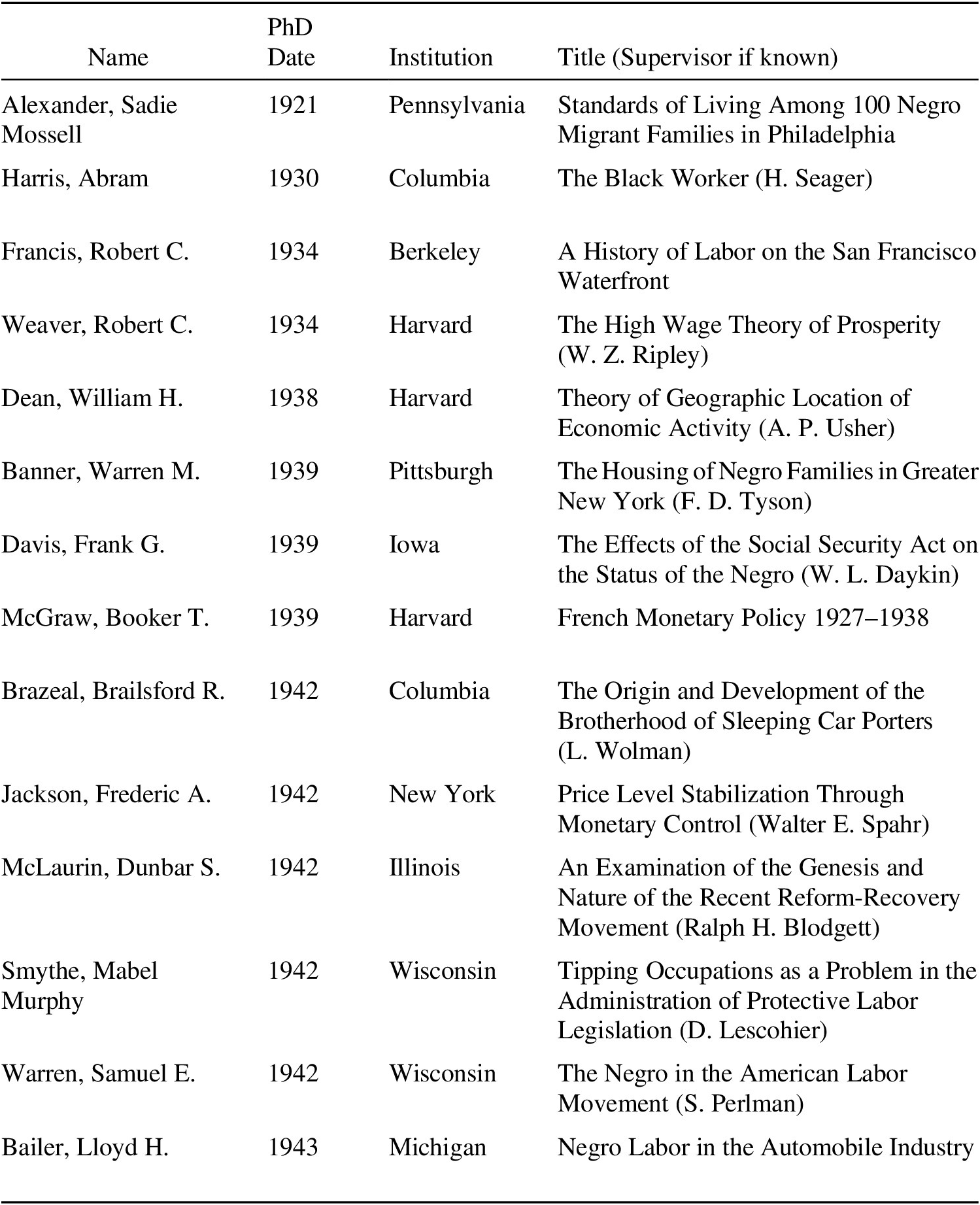
In reviewing the PhD dates and dissertation titles listed in Table 1, a number of general observations stand out. The first is the very slow pace of the production of African American PhDs in economics prior to the late 1930s and 1940s. Sadie Alexander’s was first in 1921 and then it is nine years until the next, Abram Harris in 1930. This compares unfavorably with the record in history and sociology where African American PhDs were being produced earlier and with somewhat more regularity (Rutherford Reference Rutherford2024). Moreover, in the economics case only three universities produced more than one PhD—Harvard with three (1934, 1938, 1939), Columbia with two (1931, 1942), and Wisconsin with two (both in 1942)—so most of these students would have been entirely isolated within their programs. By way of contrast, over the period covered by Greene, Harvard produced seven African American PhDs in history, and Chicago produced six in sociology. Given the high level of interest of African American students in labor economics, the fact that Columbia and Wisconsin produced only two students each is noticeable. It is also surprising that the University of Chicago, which was such a center for the training of Black sociologists and for race relations research in general (Stanfield Reference Stanfield2011, pp. 143–161), should have produced no Black PhDs in economics at all.Footnote 21 This perhaps speaks to the relative lack of interest in recruiting or attracting Black graduate students among economics departments that I have discussed elsewhere (Rutherford Reference Rutherford2024).
African American PhDs in Economics 1921–1943

Table 1. Long description
The table contains four columns: Name, P h D Date, Institution, and Title (Supervisor if known).
* Alexander, Sadie Mossell: 1921, Pennsylvania, Standards of Living Among 100 Negro Migrant Families in Philadelphia.
* Harris, Abram: 1930, Columbia, The Black Worker (H. Seager).
* Francis, Robert C.: 1934, Berkeley, A History of Labor on the San Francisco Waterfront.
* Weaver, Robert C.: 1934, Harvard, The High Wage Theory of Prosperity (W. Z. Ripley).
* Dean, William H.: 1938, Harvard, Theory of Geographic Location of Economic Activity (A. P. Usher).
* Banner, Warren M.: 1939, Pittsburgh, The Housing of Negro Families in Greater New York (F. D. Tyson).
* Davis, Frank G.: 1939, Iowa, The Effects of the Social Security Act on the Status of the Negro (W. L. Daykin).
* McGraw, Booker T.: 1939, Harvard, French Monetary Policy 1927–1938.
* Brazeal, Brailsford R.: 1942, Columbia, The Origin and Development of the Brotherhood of Sleeping Car Porters (L. Wolman).
* Jackson, Frederic A.: 1942, New York, Price Level Stabilization Through Monetary Control (Walter E. Spahr).
* McLaurin, Dunbar S.: 1942, Illinois, An Examination of the Genesis and Nature of the Recent Reform-Recovery Movement (Ralph H. Blodgett).
* Smythe, Mabel Murphy: 1942, Wisconsin, Tipping Occupations as a Problem in the Administration of Protective Labor Legislation (D. Lescohier).
* Warren, Samuel E.: 1942, Wisconsin, The Negro in the American Labor Movement (S. Perlman).
* Bailer, Lloyd H.: 1943, Michigan, Negro Labor in the Automobile Industry.
Source: From Greene (Reference Greene1946). Modified by the omission of W. G. Henry, W. Arthur Lewis, and A. T. Peters. See Greene (Reference Greene1946, pp. 50–77). Greene does not provide a date for Jackson’s PhD. It was 1942. Warren’s dissertation manuscript is dated 1941, but both Greene and Lampman (Reference Lampman1993, p. 311) list his degree as awarded in 1942.
In terms of dissertation topics, nine of the dissertations were directed towards issues in labor, housing, household economics, or economic policy, with very specific African American concerns relating to discrimination and unequal treatment. In contrast, the dissertations from Harvard were not oriented towards specifically Black issues and were also noticeably more theoretical than the others.Footnote 22 Other than labor market issues, the only topic dealt with by more than one dissertation was that of monetary and stabilization policy (Weaver, McGraw, McLaurin, and Jackson), a topic clearly related to the Great Depression. While the Depression had particularly severe consequences for Black workers, none of these dissertations focus specifically on African American employment issues.
Among the dissertations dealing broadly with Black issues, several resulted in significant publications. Sadie Alexander’s survey of the standard of living among migrant families in Philadelphia was published in a shorter version in the Annals of the American Academy of Political and Social Science (Mossell Reference Mossell1921). Her work included detailed surveys and interviews with Black households with a view to determining how well migrant families had adapted to urban life as measured by the standard of living they had attained. Abram Harris’s “The Black Worker” was one of the first works to deal extensively with union discrimination against Black workers. Harris’s thesis chapters were incorporated into his book with Stirling Spero, The Black Worker: The Negro and the Labor Movement (Spero and Harris Reference Spero and Harris1931), a major contribution to Black labor studies. Brailsford Brazeal’s thesis dealt with the long struggle involved in the formation of the Brotherhood of Sleeping Car Porters, the first labor organization led by African Americans to receive a charter from the American Federation of Labor. As part of his research, he worked as an assistant cook on the line that went south from New York. Black sleeping car workers had been heavily discriminated against by the Pullman Company, and the formation of the union was a triumph for union leader A. Philip Randolph. The published version of Brazeal’s thesis (Brazeal Reference Brazeal1946) became a widely reviewed and cited book. Lloyd Bailer’s thesis research was done as a part of the Carnegie/Myrdal project, and dealt with the racial situation in the automobile industry. Bailer’s contribution, “The Negro Automobile Worker,” was written in 1940 and included in the unpublished “Negro Labor and Its Problems” edited by Paul Norgren, and summarized in appendix 6 of American Dilemma (Myrdal Reference Myrdal1944, pp. 1119–1122). Bailer’s work was “based on independent statistical information he assembled, as well as extensive interviews with auto industry officials and both white and black auto workers” (Foote et al. Reference Foote, Whatley and Wright2003, p. 496). He detailed the discrimination that concentrated Black workers in the least desirable and least skilled jobs. This research was the basis of his later articles in the Journal of Political Economy (Bailer Reference Bailer1943) and Political Science Quarterly (Bailer Reference Bailer1944).
Also significant, although unpublished, were Warren Banner’s thesis that provided the first detailed examination of the poor housing conditions faced by African Americans in all five of the boroughs of New York (Banner Reference Banner1940); Robert Francis’s dissertation, “A History of Labor on the San Francisco Waterfront,” which detailed the background to the major, and violent, 1942 strike of longshoremen in San Francisco, a strike that resulted in the formation of the International Longshoremen’s Association and the opening of the San Francisco waterfront to Black workers; and Frank Davis’s study of social security, notable for its argument that the program had failed to improve the economic status of Black workers, because they continued to have low wages and intermittent employment, and that simply including domestic and agricultural employments, as most critics recommended, would not solve the problem (Davis Reference Davis1939).
Mabel Smythe’s interesting dissertation took on the issue of tipping, which particularly affected Black occupations. She argued that tipping tended to depress paid wage levels and increase the economic insecurity faced by employees. Tipping also created problems in the design and application of minimum wage laws and the calculation of unemployment and social security benefits (M. Smythe Reference Smythe1942). Smythe opposed tipping and wished to see it replaced by a minimum wage system paying a living wage. Samuel Warren’s very lengthy thesis covered the history of Black labor from slavery and plantation labor to urbanization and industrial work, with a particular emphasis on the history of Black labor and trade unionism (Warren Reference Warren1941). Perhaps the most significant thing about Warren’s dissertation is that Wisconsin labor economists such as John Commons and Selig Perlman had paid almost no attention to Black workers, and Commons had decidedly racist views concerning Black people. As pointed out by Sidney Peck (Reference Peck1966, p. 61): “in their four-volume work on the history of American labor, John R. Commons and associates made less than fifteen minor references to Negro workmen,” while Perlman “scarcely referred to the Negro laboring class” at all. Commons retired from Wisconsin in 1933. Don Lescohier did not share Commons’s views, but the case with Perlman is less clear. Warren’s comprehensive dissertation, therefore, served as an important corrective to the major omission of Black labor history from Wisconsin’s economics.
Of the four dissertations dealing with macro issues, Weaver’s “The High Wage Theory of Prosperity” presents a theoretical analysis of consumption and saving over the business cycle, claiming that depression is a problem of oversaving and underconsumption. His argument was that higher wages could boost consumption and create greater economic stability (Myers Reference Myers2017). Booker McGraw’s thesis analyzing French monetary policy stresses the limitations of pure monetary theory in achieving economic stability and the importance of basic institutional instruments and arrangements, providing lessons for American policy (Myers Reference Myers2017). Jackson’s thesis argues strongly against New Deal monetary policy and claims that a monetary policy aimed primarily at price stabilization will not be able to achieve economic stability on its own. What he recommends is a return to gold and “a coordination of monetary and other non-monetary forces which influence business” (Jackson Reference Jackson1942, pp. i–iii). Dunbar McLaurin’s dissertation critically discusses the many and various proposals for economic planning that emerged in the late 1930s, including those suggested by Lewis Lorwin, George Soule, Stuart Chase, Gerard Swope, and others (McLaurin Reference McLauren1942). William Dean’s thesis is something of an outlier, dealing with location theory and making fundamental theoretical contributions that were utilized by Walter Isard and others in the further development of location theory. Dean’s thesis, The Theory of Geographical Location of Economic Activity, was published (Dean Reference Dean1938) and used as a text at both Harvard and Northwestern (Myers Reference Myers2017).
All of these dissertations represent strong pieces of work, and the quality of the dissertations serves to emphasize the high level of ability among these students. Given the challenges they faced to complete their degrees, that they were excellent to exceptional students should be no surprise.
VI. POST-PHD CAREERS
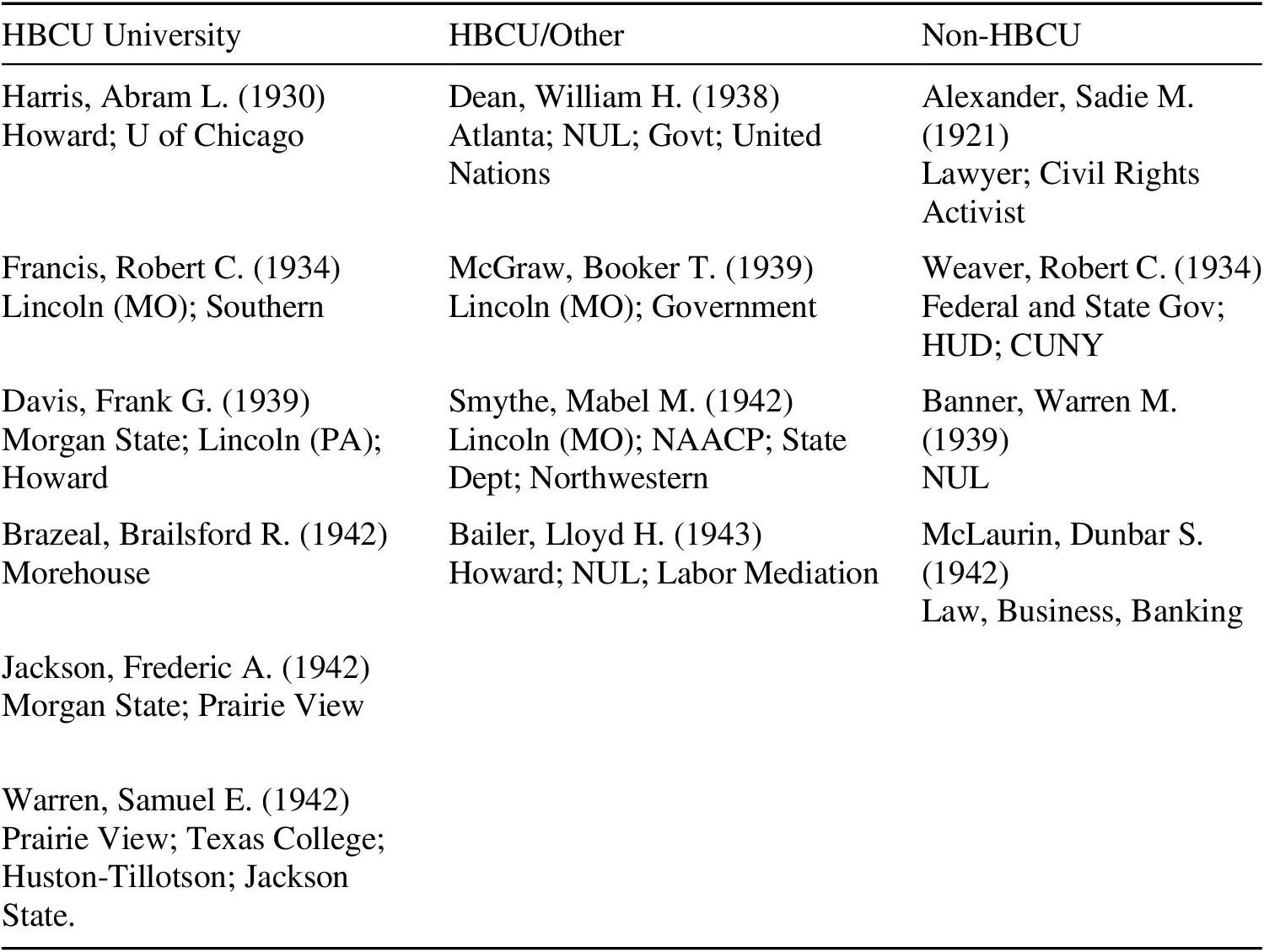
Of our fourteen African American PhDs, six pursued teaching/academic careers, spent almost entirely within the system of HBCUs, although Abram Harris did obtain employment in the undergraduate college at the University of Chicago in 1946. Four others began with significant stints teaching at a HBCU before moving in other directions, while four had careers entirely outside of the HBCUs (Table 2). This, of course, is a reflection of the unwillingness of predominantly white colleges and universities to hire African Americans, leaving the HBCUs as the only choice for those seeking teaching or academic careers. The main alternatives to teaching in an HBCU appear to have been working for a Black organization such as the National Urban League, or a position in government or in an independent business or professional capacity. This narrow range of opportunities and the lack of any employment in predominantly white non-governmental organizations or businesses are noticeable.
Careers of African American Economists (PhDs 1921–1943)
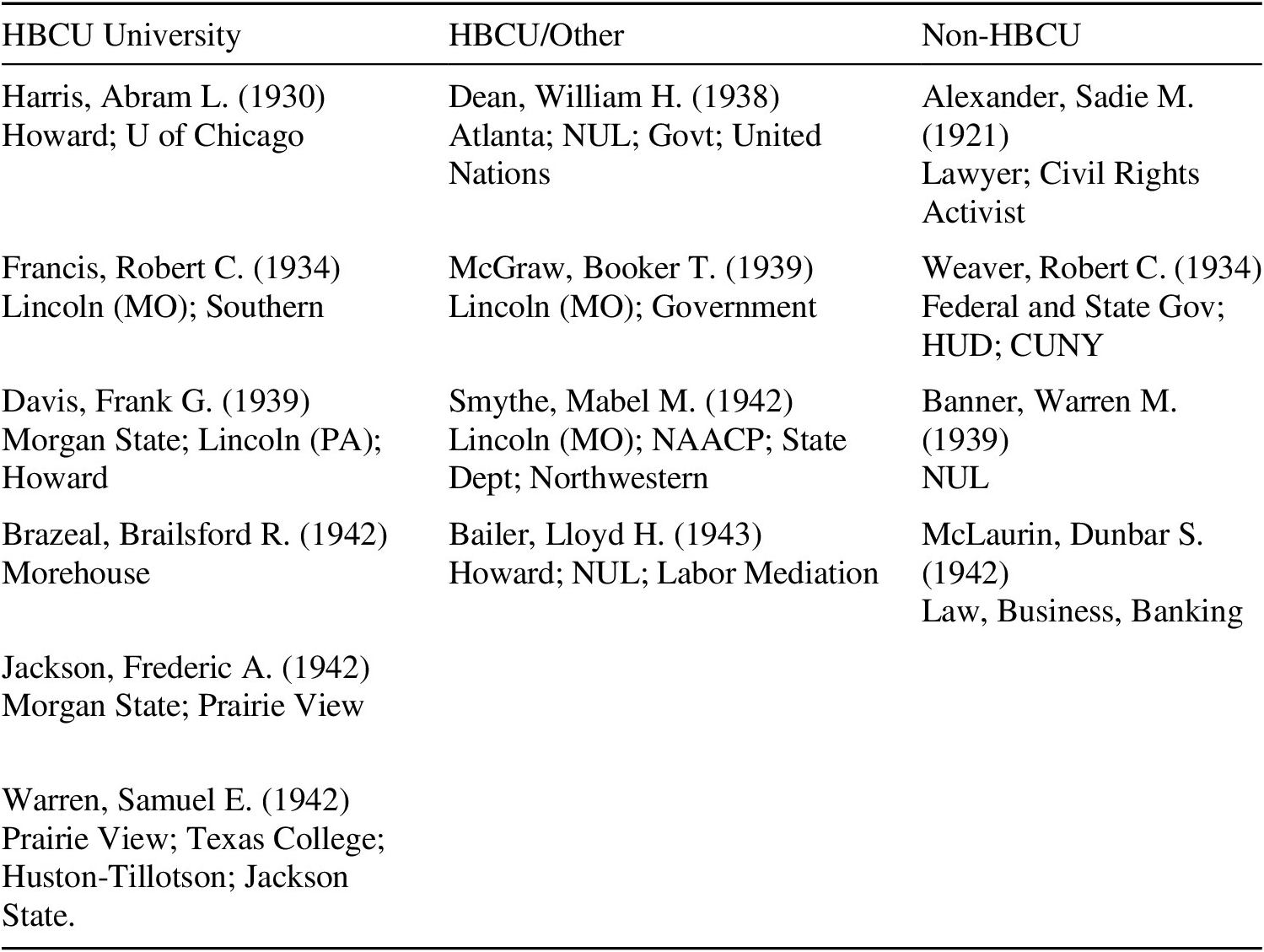
Table 2. Long description
The table is organized into three columns: H B C U University, H B C U / Other, and Non-H B C U.
Column 1: H B C U University
- Abram L. Harris (1930): Howard; U of Chicago.
- Robert C. Francis (1934): Lincoln (M O); Southern.
- Frank G. Davis (1939): Morgan State; Lincoln (P A); Howard.
- Brailsford R. Brazeal (1942): Morehouse.
- Frederic A. Jackson (1942): Morgan State; Prairie View.
- Samuel E. Warren (1942): Prairie View; Texas College; Huston-Tillotson; Jackson State.
Column 2: H B C U / Other
- William H. Dean (1938): Atlanta; N U L; Govt; United Nations.
- Booker T. McGraw (1939): Lincoln (M O); Government.
- Mabel M. Smythe (1942): Lincoln (M O); N A A C P; State Dept; Northwestern.
- Lloyd H. Bailer (1943): Howard; N U L; Labor Mediation.
Column 3: Non-H B C U
- Sadie M. Alexander (1921): Lawyer; Civil Rights Activist.
- Robert C. Weaver (1934): Federal and State Gov; H U D; C U N Y.
- Warren M. Banner (1939): N U L.
- Dunbar S. McLaurin (1942): Law, Business, Banking.
Of the six who chose college teaching careers, there are three about whom I could find only limited information. Robert Francis, Frederic Jackson, and Samuel Warren spent their careers teaching at HBCUs, a high proportion of which were in the South. Opportunities for research were likely limited and their jobs would have been heavy on teaching, student mentoring, and administration.
After completing his thesis, Francis taught at Lincoln (MO), overlapping with B. T. McGraw, and then at Southern, publishing a short article in Social Forces arguing that from the point of view of the Black worker, industrial unionism and the Committee for Industrial Organization (CIO) should be strongly supported rather than attempting to “force a begrudged recognition from a debilitated aristocracy of labor” (Francis Reference Francis1936, p. 273). According to Thomas Fleming and Max Millard (2017, p. 204), Francis returned to San Francisco after six years but had become severely alcoholic.
Frederic Jackson taught at Morgan State and Prairie View. Following on from his thesis on monetary policy, he became a member of the Economists’ National Committee on Monetary Policy, which advocated for a return to the gold standard and against what they saw as inflationary monetary policy.
Warren taught at a long list of colleges: Prairie View, Texas College, Huston-Tillotson, and Jackson College, becoming head of his department at all but the first and head of the social science division at the last. He gave occasional papers at the annual meetings of the Association for the Study of Negro Life and History, one in 1939 on “The Historical Development of Negro Labor” and one in 1957 on “The Negro Worker in Texas Since 1860.” The 1939 paper was published in the Journal of Negro History (Warren Reference Warren1940) and consists of an elaborate outline for a course on the history of Black labor. Warren refers occasionally to his unpublished manuscript “The Negro in Industry,” which most likely developed into his doctoral dissertation. His thesis strongly supported Black trade unionism. He also published some minor pieces on educational issues.Footnote 23
Abram Harris managed to become “the first black American economist to attain academic prominence in the United States” (Darity Reference Darity and Boston1997, p. 230). This, after being ejected from the Willard Hotel in Washington, DC, sometime in the late 1920s when he was attempting, as a member, to attend the annual American Economic Association (AEA) conference (Darity Reference Darity, Harris and Darity1989, p. 29n21). While at Howard, Harris accumulated an impressive publication record along two main lines. The first, following on from his thesis and book with Spero, took a radical view of race issues based on his reading of Marx. This resulted in work that approached Black/white issues from the point of view of class, not race. Harris argued for multiracial working-class solidarity and sought to initiate a multiracial labor party. He also sharply criticized Black capitalists, particularly Black owners of financial institutions, for their exploitation of the Black population at large, as well as those who saw Black business development as the way forward for Black people (Harris 1936; Darity Reference Darity and Boston1997). In the light of the Great Depression, Harris joined with his Howard colleagues, E. Franklin Frazier and Ralph Bunche, to attack the established policies of Black organizations, such as the NAACP and NUL, that focused on civil rights, to promote a more fundamental shift to a social democracy based on a multiracial labor movement.
Harris also pursued his interest in Veblen and Marx in more purely scholarly directions, resulting in two papers in the Journal of Political Economy (JPE) dealing with “types of institutionalism” including discussions of Veblen and Marx (Harris Reference Harris1932, 1934). Harris was the first Black economist to publish in the JPE. As noted above, these papers attracted the attention of Frank Knight, ultimately resulting in Harris’s gaining a position in the undergraduate college at Chicago in 1946. Although this was not a position with full faculty status, he was the first Black economist to be given such a position at a major white university,Footnote 24 something that created quite a stir and brought him to the attention of the broader profession (Darity Reference Darity and Boston1997). Once at Chicago, Harris focused on his history of thought interests, dealing with Veblen’s view of capitalism, Marx’s social philosophy, and, increasingly, the liberalism of John S. Mill, and ceased working on explicitly Black issues until the 1960s (Darity Reference Darity1987, Reference Darity and Boston1997). A good number of these papers were also published in the JPE (Harris Reference Greene and Darity1989). Darity has discussed the likely racial element in the denial of a position in the economics department, the limited interactions he had with the graduate faculty other than Knight, and his ultimate regret at leaving his colleagues at Howard. In his eulogy for Harris, Frank Knight strongly criticized American racism and expressed anger at the discrimination that had hindered Harris’s career (Levy and Peart Reference Levy and Peart2025).
After completing his doctorate, Frank Davis taught at Morgan State and Lincoln (PA) before moving to Howard, where he became chair of the Department of Economics. As a relatively new PhD scholar, Davis attended and provided information concerning the meeting of the First Phylon Institute in 1941 (Davis Reference Davis1941). This meeting involved an address by Du Bois and contributions from Robert Weaver and William Dean, with many others such as B. T. McGraw and Brailsford Brazeal present. Just after he moved to Howard, Davis published his book The Economics of Black Community Development (Davis Reference Davis1972). Davis argues that the conventional analysis focusing on the ghetto labor market and the role of discrimination on both the demand and supply sides is insufficient. Instead, he presents a two-sector model in which the “Black ghetto” is a labor-intensive sub-economy surrounded by a capital-intensive and oligopolistic “general economy.” With technological change in the general economy displacing unskilled labor, the ghetto economy becomes a “labor intensive one-sector export economy with nothing to sell to the rest of the economy but low-priced unskilled labor” (Davis Reference Davis1971, p. 102). The solution runs in terms of providing capital and raising productivity in the ghetto economy, and Davis suggests the establishment of a National Ghetto Development Corporation for this purpose (Davis Reference Davis1972).Footnote 25 Davis here is contradicting the views of his former teacher Abram Harris.
Davis continued to elaborate this model, bringing in more detail on the consumption and savings of Black households and referring back to his PhD thesis on social security (Davis Reference Davis1982). In addition, Davis became a member of the Caucus of Black Economists of the AEA, signing the 1970 “Statement of Concern” to the association, highlighting racial and professional bias and lack of social responsibility in the profession. Davis also became a member of the AEA Committee on the Education and Training of Minority Group Economists. Despite these achievements and his publishing career stretching into the 1980s, Davis remained at Howard.
Brailsford R. Brazeal’s whole career was at Morehouse, with which he associated closely. By 1934 he was head of the Department of Economics and Business Administration and dean of men. He would become dean of academics at Morehouse and did much to enhance the standing and academic reputation of the college, writing on issues such as curriculum and counseling services (Brazeal Reference Brazeal1934, Reference Brazeal1947). He opened his house to students, among them Martin Luther King Jr. and Maynard Jackson, who became the first Black mayor of Atlanta. His home was placed on the National Register of Historic Places in 2005 (Cyriaque Reference Cyriaque2006; Collier Reference Collier2020b).
Brazeal’s major work was his book The Brotherhood of Sleeping Car Porters (1946), developed from his thesis. He also wrote a biography of the brotherhood’s leader, A. Philip Randolph, which remained unpublished. Brazeal continued to follow Randolph’s career, contributing papers on the formation and functioning of the Fair Employment Practices Committee (FEPC) set up by President Roosevelt in 1941 to ban “discriminatory employment practices by Federal agencies and all unions and companies engaged in war-related work” (Brazeal Reference Brazeal1951, Reference Brazeal1954a; Collins Reference Collins2001).Footnote 26 Roosevelt’s actions were pushed along by Randolph’s advocacy and threats to organize mass marches on Washington, something that had the support of both the brotherhood and the NAACP. Brazeal himself emphasized the radical nature of these tactics: “this pressure technique represented a distinct departure from the conventional protest methods which the Negro had used,” but this method succeeded in enlarging the “movement for economic equality which is a basic ingredient of democracy” (Brazeal Reference Brazeal1954a, p. 146). Brazeal outlined the heavy political opposition to the attempts to establish a permanent FEPC, including opposition from businesses and unions with discriminatory practices and real estate companies concerned to maintain segregation in housing, but pointed to the progress against discrimination being made at the state and municipal levels in numerous places (Brazeal Reference Brazeal1951).
Brazeal was also highly active in the promotion of voting rights, working on voter registration and writing about discrimination against Black voters. He conducted a series of studies of African American voting in counties in Georgia and South Carolina (Brazeal Reference Brazeal1960), and also engaged in many other civil rights issues. He forcefully opposed the forces of reaction that he saw endangering civil rights in the McCarthy period, forces that “propel America toward the strangulating tentacles of dictatorship” (Brazeal Reference Brazeal1954b. p. 442).
Of the four who began with appointments at HBCUs but then moved on, the case of William Dean is the hardest to read about. Despite finishing as the top student in his final year at Harvard, and with extremely enthusiastic reports concerning his exceptional abilities, he was not offered the tutorial post normally given to the top student, due to his race: what his supervisor Abbott P. Usher nicely called “the special circumstances that make it impossible for us to use Dr. Dean here at Harvard” (Logan Reference Logan, William, Logan and Winston1982, p. 165). Dean’s reaction was one of both bitterness and despair. He wrote:
Really, Harvard disgusts me more and more. I have been strongly advised here to go into government service. An institution which will have nothing of me expects me to get a better break from whites elsewhere. Frankly, I don’t see what keeps a colored man’s courage up. I feel more beat and licked every day. I don’t seem to be able to muster up the fortitude to go ahead with the work already well under way. (Logan Reference Logan, William, Logan and Winston1982, p. 165)
Not only this, but applications he made to City College and Queens College of the City University of New York were unsuccessful despite his teaching at City College in the summer of 1939 and being strongly supported by letters from Frank Taussig, Walter White (secretary of the NAACP), and Mayor Fiorello LaGuardia. Dean taught at Atlanta University from 1933 to 1942, introducing a course on labor economics and attempting to improve conditions for Black workers in local factories. In the last two of these years, he also worked as a consultant for the National Resources Planning Board and, then, from 1942 to 1944, for the wartime Office of Price Administration. The latter position took him on technical missions to Haiti and the Virgin Islands, where he contracted a severe illness. On recovering somewhat, he took on the job of director of Community Relations for the National Urban League, surveying thirteen communities with the goal of improving race relations, but then moved on to take up missions for the United Nations in Haiti, Libya, and Somalia, achieving the status of Africa Unit Chief in 1949. He returned from the Somalia mission exhausted and despondent, feeling that the mission’s attempt to place Somalia on the road to economic development had failed (Logan Reference Logan, William, Logan and Winston1982; Brewer Reference Brewer1953). Shortly after he returned to the US he committed suicide on January 8, 1952.
After finishing his doctorate, B. T. McGraw continued to teach at Lincoln (MO) until 1942, at which point he moved into government service as a minority consultant on housing, mainly relating to wartime issues of housing Black workers. He also worked for a number of other wartime agencies. Issues concerning housing and racial discrimination became his specialty. By 1954 he was deputy assistant to the administrator in the Housing and Home Finance Agency. McGraw published on the effect of anti-discrimination court rulings, the 1954 Housing Act, residential restrictions by race, promotion of equal opportunity in housing, and urban renewal (McGraw and Nesbitt Reference McGraw and Nesbitt1953; McGraw Reference McGraw1955, Reference McGraw1958, Reference McGraw1964). Between 1961 and 1963 Robert Weaver was head of the Housing Agency, a position that McGraw had a role in helping him achieve (Myers Reference Myers2017).
After completing her PhD, Mabel M. Smythe taught at Lincoln (OH) (from 1942 to 1944), just failing to overlap with McGraw; Tennessee State College (1945); and, as an adjunct, at Brooklyn College (1946–47). Footnote 27 Her experience at Tennessee led her and her husband to decide to never again teach in the South, due to the attitudes of white politicians toward Black colleges. While at Lincoln, she and her husband wrote an article examining the state of economics and business education in Black colleges. They argued that most colleges were too small in terms of both student numbers and faculty to be able to “educate for economic leadership,” and needed to consolidate (M. Smythe and H. Smythe Reference Smythe and Smythe1944). They also wrote on the effects of the war on Black colleges and the needs of the veteran (H. Smythe and M. Smythe Reference Smythe and Smythe1944; M. Smythe and H. Smythe Reference Smythe and Smythe1945).
From 1951 to 1953 she and her husband were in Japan as part of a program to help improve Japanese higher education after the war. Mabel Smythe taught English and economics at Shiga University. Their view of university training in Japan was that it was “shackled,” particularly by the hierarchical and formal nature of faculty interactions, the lack of cooperative scholarship, the clique controlling entry to the leading schools, and the adherence to traditional teaching methods (H. Smythe and M. Smythe Reference Smythe1952).
They also warned of the difficulties in US-Japanese relations caused by Japanese views of American racism: “The United States is scrupulous in her diplomatic behavior—she goes abroad in a gown of purest white: but the soiled petticoat of domestic prejudice is too long to be hidden, even if she could succeed in keeping it from touching the nonwhite allies beyond her borders” (M. Smythe and H. Smythe Reference Smythe1952, p. 198). To combat the sometimes startlingly false views of the position of African Americans held by people in Japan and elsewhere in Asia, and to broaden the educational experience of African American students, Mabel Smythe proposed that students from Asia be encouraged to attend HBCUs on a visiting basis (M. Smythe Reference Smythe1952). Her interest in student exchanges led to her close involvement with James H. Robinson in the founding of Operation Crossroads, and with the African Scholarship Program for Nigerian students to attend American universities.Footnote 28
Back in New York, in 1953 she was appointed as deputy director of the NAACP Legal Defence and Education Fund, where she was an important part of the team preparing the material for Thurgood Marshall in the Brown v Board of Education case. She felt she was taking part in history, realizing the huge impact the case could have. A description of her immense contribution to the historical research involved in the case can be found in Alfred Perkins (Reference Perkins2003).
Between 1954 and 1969 she taught at the New Lincoln School, the last ten years as principal. During the 1960s she was also appointed to numerous governmental advisory positions relating to her educational and foreign experiences,Footnote 29 and taught as an adjunct professor at the Baruch School, Queens College, and at the City University of New York. From 1970 to 1977 she was director of research and then vice-president for the Phelps-Stokes Fund, editing the Black American Reference Book (1976). As if that were not enough, she served as scholar in residence at the US Commission on Civil Rights in 1973 and 1974.
In 1977 President Carter appointed her as US ambassador to Cameroon and subsequently also to Equatorial Guinea.Footnote 30 She traveled with American representatives to several other African countries, and on her return to the US in 1980, she was appointed deputy assistant secretary for African Affairs. She was a part of the US delegation participating in the International Conference for Assistance to Refugees in Africa, an experience that gave rise to her article on the pressing need to improve the aid to African refugees (M. Smythe Reference Smythe1982). In 1981 she was appointed as Melville J. Herskovits Professor of African Studies at Northwestern University, becoming the associate director of the African Studies Program in 1983. She retired in 1985, but that did not stop her continuing her engagement with African affairs, both economic and political, for several more years.
Between 1941 and 1946 Lloyd Bailer was a member of the Department of Economics at Howard, with Abram Harris as a colleague. Wartime also involved him with the War Production Board and the National War Labor Board. As noted above, he produced major articles in the Journal of Political Economy (Bailer Reference Bailer1943) and the Political Science Quarterly (Bailer Reference Bailer1944), combining his dissertation research with concerns relating to the conversion of auto plants to wartime production. The first paper detailed the racial frictions, strikes, and other conflicts that the wartime upgrading of Black labor had occasioned in the auto industry. These racial frictions caused riots in Detroit and put wartime production in danger. Bailer examined the extent of racial tension in various different plants and under what circumstances it was greater or lesser. He pointed to the example of specific policies in one plant that had worked to reduce tensions. The second paper dealt more specifically with automobile union policies and attitudes toward Black labor. While union leadership was committed to equality, its ability to bring about change was limited by the “the tremendous expansion in membership which has brought into the union large numbers of workers bitterly opposed to equality between Negroes and whites on the job or in the union” (Bailer Reference Bailer1944, p. 576). In terms of bringing about greater equality in those plants that had traditionally excluded Black workers, Bailer was not optimistic.
After leaving Howard, Bailer developed his own labor mediation practice based in New York. He also worked as director of Industrial Relations for the Urban League of New York, as a field examiner for the National Labor Relations Board. He was appointed to the New York State Board of Higher Education and taught at various times as a lecturer at Rutgers, Brooklyn College, and Columbia University. He continued to write on organized labor, racial minorities, and “The Negro in the Labor Force” (Bailer Reference Bailer1951, Reference Bailer1953), and also continued to serve on a variety of federal advisory boards but increasingly devoted his time to labor arbitration. He moved to Los Angeles in 1967, where he became the first chairman of the Los Angeles County Employee Relations Committee.
There are only four people who did not have a significant part of their career at a Black college: Sadie Mossell Alexander, Robert Weaver, Warren Banner, and Dunbar McLaurin. After graduating, Sadie Mossell Alexander could not find employment in the Philadelphia area. Even Black colleges were not interested. They did hire women but, at that time, generally only in home economics, education, nursing, or fine arts (primarily music) departments, indicating the same pattern of discrimination against women as found in white institutions. She had a minor speciality in insurance and did find a job as an assistant actuary with the largest Black insurance company in the US, located in Durham (NC). Two years later she returned to Philadelphia and married Raymond Alexander, who had just graduated from Harvard Law School (Alexander and Banks Reference Alexander and Banks2021, pp. xvii–xviii). Again, she could not find a job and after a year decided to enroll in the Law School at the University of Pennsylvania, but this did not spare her from further discrimination. The dean excluded her from study groups with white students, and attempted (unsuccessfully) to prevent her election to the Law Review Board.
After graduating as the first Black woman from the law school, and passing the bar, she joined the law firm her husband had started. No other law firm would hire her. As outlined by Nina Banks, the firm pursued an aggressive campaign for civil rights, becoming “the leading civil rights law firm in Philadelphia” (Alexander and Banks Reference Alexander and Banks2021, p. xix). In addition, she gave many speeches on a vast range of civil rights issues, became involved with the NUL, the American Civil Liberties Union, and numerous other organizations, and in 1946 was appointed by President Truman to the President’s Committee on Civil Rights. The committee’s report, To Secure These Rights (1947), included recommendations to establish a permanent civil rights commission, a civil rights division within the Department of Justice, and many other civil rights protections. A year later Truman desegregated the civil service and armed forces.
After completing his PhD, Robert Weaver was recommended for a job with the Federal Reserve but was turned down due to his race (Armstrong and Pendergast Reference Armstrong and Pendergast2018). Presumably following the same advice given to William Dean, he then moved into government service in the New Deal, becoming an advisor on Negro Affairs under Harold Ickes in the Department of the Interior, and a consultant on housing issues in the Public Works Administration. He became a leading member of Roosevelt’s “Black Cabinet” that worked to increase the participation of Black groups in New Deal programs.Footnote 31 He opposed the racial “dual wage” system of the National Recovery Administration. He drafted the 1937 US Housing Program for the Roosevelt administration, while also feeling it was inadequate and that it should have gone further. At the same time, he was publishing in the house journals of the NUL and NAACP on issues involving the training and employment of Black workers and housing. Later, he moved to wartime administration and was chief of the Negro Employment and Training Branch of the War Production Board. Weaver published a large amount on labor union issues and issues relating to the inclusion of Black workers in wartime industries such as aircraft (1942, 1944a, 1944b, 1945), as well as on housing issues such as restrictive covenants (Weaver Reference Weaver1944c). Two of his papers on wartime labor issues were published in the Journal of Political Economy and the Quarterly Journal of Economics.
After the war he left the federal government, feeling that the anti-discrimination programs he was involved with were moving too slowly. He taught and wrote mainly on urban housing issues (1944c, 1948), but his teaching appointments at Columbia, Northwestern, New York University, and the New School were all short-term summer or visiting positions.Footnote 32 He then worked for the State of New York on housing, and in the 1960s was appointed by the Kennedy and Johnson administrations, continuing to work on Black housing issues as head of the Housing and Home Finance Agency (Weaver Reference Weaver1964, Reference Weaver1965). Kennedy’s initial effort to have Weaver’s agency raised to Cabinet level was blocked due to Weaver’s being Black, but a few years later Johnson succeeded. Weaver was appointed the head of Housing and Urban Development (HUD) in 1966, the first African American to be appointed to a Cabinet position (Conrad and Sherer Reference Conrad, Sherer and Boston1997). Throughout his career Weaver fought discrimination, and his race relations activism was “an innovation for government” (Armstrong and Pendergast Reference Armstrong and Pendergast2018).
Even before completing his PhD, Warren Banner was appointed as director of the Department of Research of the National Urban League, a position he continued to hold for many years (Banner Reference Banner1940).Footnote 33 The NUL’s mandate was to improve the economic and social conditions of minority groups and to combat discrimination, particularly in employment and housing. Under Banner’s direction his department conducted a vast number of surveys concerning the conditions facing minority communities all over the country. Local groups facing some issue in employment, housing, or racial tension could request the Urban League to conduct a survey to pinpoint the issues and suggest community solutions. These surveys included information on income, employment, labor relations, housing, health, education, crime, race relations, and more.
A brief version of Banner’s survey of New York was published in the Journal of Educational Sociology (Banner Reference Banner1944a). Another report that attracted broader attention was the 1944 report on Hartford, Connecticut, which focused on employment and housing issues during the war (Banner Reference Banner1944b). The wartime employment of Black workers in industries where they had not been employed previously created serious racial backlash, including violent riots from white workers, in numerous cites. The NUL and Banner’s department made particular efforts to help provide for “war industry cities faced with racial problems” (Granger Reference Granger1943). After the war Banner and his department dealt with the issues created by highway construction, urban renewal, and public housing projects such as those in Miami (Banner Reference Banner1953).Footnote 34 Initial reports were often followed by later surveys to measure progress made. Seattle, for example, was the subject of surveys conducted eleven years apart in 1943 and 1954.Footnote 35
Dunbar McLaurin served in the Philippines during World War II, afterwards setting up the McLaurin Far East Trade Association and making a great deal of money refurbishing and selling army surplus vehicles and equipment. On his return to the US, he obtained a law degree and became a well-known figure in the Black business community of New York. In 1964 he founded, along with Jackie Robinson, the Freedom National Bank, the first Black bank in Harlem. He became a consultant to the Human Resources Administration in New York and suggested that the City devote up to 10% of its purchases to businesses in Black and other minority communities, and later drafted what he called the “Ghetto Economic and Industrialization Plan,” which asked for the establishment of development corporations to funnel Small Business Administration funds into ghetto areas. He set up Ghettonomics, a consulting firm, to promote these ideas, and became an adjunct professor of business at Columbia University. He also consulted on business projects in Nigeria and helped African students to come to the US to study.
In 1973, due to business and legal difficulties in the midst of his efforts to establish a second Black bank, the Universal National Bank, Dunbar McLaurin died by suicide. The Sphinx (Alpha Phi Alpha Fraternity Reference Fraternity1973) published an unusual ten-page tribute to his work for Black people and Black communities around the world.
VII. CONCLUSION
Of these fourteen economics scholars with PhDs, some, not surprisingly, had more prominent careers than others, but achieving a PhD under the circumstances of the time, full of discriminations and microaggressions, must itself be seen as a very major accomplishment. The relatively narrow choice of career paths, particularly initially, is plain to see, as is the complete lack of white employers outside of government.
Ten of our fourteen individuals began by being employed teaching at an HBCU,Footnote 36 and some then spent their entire careers teaching at HBCUs. These institutions played a vital role in upgrading the education and life chances of subsequent generations of Black students. Many of our fourteen individuals made their way to their PhD institutions via previous degrees earned at HBCUs. The key role of these institutions in providing opportunities for African Americans both as students and as academics is obvious but at the same time hard to exaggerate. Even in 1990 Mabel Smythe-Haith was to say the following about the importance of their role:
Black colleges fulfill a need that white colleges fail to provide for black students. The black colleges receive the black students wholeheartedly and work with them until they reach acceptable levels. Today the black college continues to believe in the black student, for they know that students will succeed if motivated. Again, they provide black role models when blacks were seldom acknowledged in the public media. Then and now, black colleges provide an artistic and cultural life in the black community. At such colleges, students do not face prejudice against their blackness and their cultural background. (Elliott Reference Elliott and Smith1992, p. 1054)
Of course, as the Smythes had previously argued, HBCUs had their limitations, such as small student bodies, small faculties, heavy teaching and administrative loads, and lack of resources to support research. When one looks at HBCU catalogs from the 1930s and 1940s, it is not uncommon to find a faculty of two people teaching virtually all the economics and business courses on offer. For most of the late 1930s and 1940s, Abram Harris and Edward LewisFootnote 37 were the only regular economics faculty at Howard, although supplemented by Lloyd Bailer as an instructor in the early 1940s. Similarly, in the mid-1930s the economics teaching at Lincoln was done almost entirely by Robert Francis and B. T. McGraw.
The limitations of the HBUCs at the time undoubtedly had an adverse effect of the level of research output produced. In terms of the research activity at HBCUs, Howard appears to have been the most successful, with Harris, Davis, and Bailer all publishing significant work while there. Harris produced not only major works on Black labor and trade unions, as well as on many other issues relating to Black workers, but a number of papers on history of economics issues in the JPE, which eventually got him to Chicago. Bailer contributed significantly to Gunner Myrdal’s American Dilemma (Myrdal Reference Myrdal1944), and published related papers in the JPE and Political Science Quarterly, while Davis published extensively on issues of ghetto development. Outside of Howard, Brazeal published his book on the Brotherhood of Sleeping Car Porters (1946), and many other pieces on civil rights issues.
Some government positions also a provided a reasonably supportive research environment, with Weaver combining his government career with a highly successful publication record on Black employment and housing issues, and B. T. McGraw publishing much more while he was in government, again largely on housing discrimination, than he did while at Lincoln. In terms of publications by Black authors in leading economics journals dealing with discrimination against Black labor, Weaver and Bailer led the way in successfully publishing in the JPE and the Quarterly Journal of Economics in the early 1940s.Footnote 38
It is also noticeable that regardless of the topic of their PhDs, almost all of the people discussed here spent their careers in work designed to improve the economic condition of Black people and communities, either through teaching or other activities or both. This combination of scholarship and civil rights activism has been noted before (Stewart Reference Stewart2015; Banks Reference Banks2022). The three individuals with Harvard PhDs are a good example. As noted above, none of their PhDs dealt with specifically Black issues. Nevertheless, Weaver and McGraw moved to work on employment and housing issues relating to Black communities, including discrimination in housing and the problem of ghettos. Weaver drafted the 1937 Housing Act, and Dean worked in projects in Haiti and the West Indies during the war and then as a director in the United Nations Department of Economic Affairs involved in missions in Libya and Somaliland. William M. Brewer (Reference Brewer1953, p. 136) speaks of Dean’s ambition “to bring relief to the disadvantaged and exploited in Africa.” Among the others, Sadie Alexander was heavily involved in civil rights advocacy throughout her career; in the pre-Chicago part of his career, Harris was a major voice in the criticism of union discrimination against Black workers prevalent in the American Federation of Labor and very active in the attempt to shift NUL and NAACP policies; Bailer, Francis, and Warren were all supportive of the Congress of Industrial Organizations unions efforts to increase Black membership; Davis and McLaurin and Weaver worked on the issue of ghetto development; Dean and Banner worked with the NUL to mitigate racial tensions in cities all over the country; Alexander was also closely involved with the efforts of the NUL to maintain Black employment levels after the war; Brazeal advocated for voting rights and supported the efforts to establish a permanent FEPC; Mabel Smythe worked with the NAACP on Brown v Board of Education, among many other contributions to civil rights; Alexander was appointed by President Truman to the President’s Committee on Civil Rights, and the committee’s report included a vast range of civil rights protections; Bailer worked to improve the position of the Black worker; McLaurin and Smythe, as well as Dean, worked in Africa and sought to improve economic conditions there.
The personal histories outlined above clearly indicate the importance of the New Deal and World War II, both as a source of employment opportunities for Black economists, and as events that in a variety of ways helped to break down discrimination against Black people in employment. The combination of the needs of the New Deal, and even more so the war, multiplied the impact of those working for civil rights by many times. Government employment of Black social scientists in various advisory positions began with the New Deal, but the war expanded those opportunities. The New Deal did not place anti-discrimination initiatives as a high priority, bur those involved in Roosevelt’s “Black Cabinet,” such as Weaver, certainly took the opportunity to improve what they could in terms of wages, employment, and housing for Black people. The war led to more opportunities due to the pressing need to increase wartime production and to overcome racial problems in workplaces and housing. Weaver, Dean, McGraw, and Bailer all served on numerous wartime agencies and boards. This increase in the hiring of Black people extended well beyond those directly considered here, and included a general upgrading in the job status of Black employees of the federal government (Roberts Reference Roberts1943). Moreover, the war’s demand for labor, the rise of industrial unionism, and governmental efforts such as the FEPC brought about real changes to the economic position of Black workers more generally. The NUL was also heavily involved in this effort as well through people such as Dean and Banner.
William Collins has argued that “although labor economists have devoted considerable attention to black economic progress in the post-1964 period, it is surprising that the 1940s, and the wartime experience in particular have been neglected” (Collins Reference Collins2001, p. 272). Neglected by white economists perhaps, but certainly not by Black economists. Weaver, Banner, Alexander, Brazeal, and Bailer were all acutely aware of the significance of the wartime efforts to increase the participation of Black workers in wartime industries and the efforts made by both Black organizations such as the NAACP and the NUL and the federal government (on the basis of the FEPC). According to Collins, the FEPC, even without direct recourse to penalties, “was surprisingly effective in its efforts to promote Roosevelt’s anti-discrimination policy outside of the South” and to have “accelerated the pace of black economic advancement” by “opening doors for black workers in industries, occupations, and firms that had previously excluded them” (Collins Reference Collins2001, pp. 284–285). The culmination of these efforts can be seen in the report of the President’s Committee on Civil Rights, To Secure These Rights (1947), which, as noted above, included Sadie Alexander on the committee. Also relevant in this history was the work of the NAACP, including that of Mabel Smythe, in helping to put together the case for Brown vs Board of Education. These reports and court victories led directly to the 1964 Civil Rights Act. Two years later Weaver was the first African American to be appointed as a federal government Cabinet secretary. In 1980 Mabel Smythe was appointed deputy assistant secretary for African Affairs.
None of the individuals considered here obtained a regular entry-level position at a predominantly white university, but despite this discrimination they had an impact. Harris’s appointment at Chicago was less than it might have been but still attracted wide attention. Most of the teaching appointments given to people such as Weaver, Smythe, McLaurin, and Bailer at PWIs were short-term visiting or adjunct positions, but they still introduced Black teachers to numerous white universities. Weaver and Smythe obtained their professorships only in 1970 and 1981, respectively, but the appointments did recognize their career achievements. Progress was not fast. New African American PhDs began to be hired by PWIs in the 1940s, but this was “usually only one per institution and often as adjunct faculty” (Elfman Reference Elfman2020). For example, Phyllis Wallace (PhD Economics Yale 1948) obtained an appointment at NYU but it was not tenure track: she was a part-time lecturer in economics and statistics (Malveaux Reference Malveaux and Boston1997b). It was another ten years before even small numbers of Black academics began to be hired into regular positions at PWIs. It is notable that none of the six Harvard individuals with PhDs examined by Myers (the last awarded their PhD in 1951) obtained an entry level position in a PWI, but by the mid- to late 1950s this was beginning to change. Emmett J. Rice (PhD Berkeley 1954) was awarded a Fulbright scholarship in India and then obtained an assistant professor position at Cornell in 1954, and Andrew Brimmer (PhD Harvard 1955) was first employed by the Federal Reserve for three years (something not offered to Weaver) and then obtained an assistant professor position at Michigan State in 1958, before moving to Wharton and then into government and ultimately to a position on the Federal Reserve Board of Governors as the first Black board member. After World War II and with the GI bill of 1944, Black Americans from humbler backgrounds could achieve academic success. A particular case in point in economics again was Andrew Brimmer, whose parents were sharecroppers.Footnote 39 This is the collective legacy of the first generation of African American PhDs in economics.
COMPETING INTERESTS
The author declares no competing interests exist.

 Open access


