




1. Introduction
This article analyses the credit networks forming around two intermediaries in the city of Vercelli during the fourteenth century: the baker Enrico da Greggio and the priest Salerno Ferraroto. The two were enmeshed in a bustling network of credit relations both as creditors and as borrowers. Their involvement in lending and borrowing operations shows that members of society who were not part of the wealthy classes also acted as important elements in the credit system of their city and its surrounding territory. Indeed, prior to the establishment of government credit and major banking institutions, a complex web of economic relations within the urban fabric was generated, regulated and maintained by relatively small-scale social actors operating across different spheres: farming and crafts, commerce, religion, welfare and finance. These networks were able to interconnect individuals and institutions via flexible, accessible, juridically valid instruments that made it possible to redistribute resources, manage debt and activate systems of economic support in contexts often lacking any formal guarantees.
Historians have highlighted with increasing depth and precision the central role of credit in late-medieval urban economies, mainly through the study of notarial practices and mercantile networks.Footnote 1 They have established that for most people in the pre-industrial age, credit was accessed via a plurality of informal mechanisms that relied mostly on trust and social relations. While recent research has established the existence of relatively impersonal lending mechanisms (at least in the early modern period), personal ties were in fact the prevalent lubricant for the wheels of the economy.Footnote 2
According to these studies, prospective creditors hedged their risk not by looking for specific guarantees in the form of collateral but by carefully considering the personal character and reputation of the borrower. In other words, reliance was placed not so much on a rational assessment of the solvency of the potential debtor as on his or her good name, an attribute that was evaluated principally within a context of religious values and sociocultural mores.Footnote 3 Numerous contributions have analysed the dynamics of creditworthiness and mutual trust, with a focus on actors within the social elite, major bankers and credit professionals.Footnote 4 Other studies have investigated methods of recording transactions, forms of collateral/surety and the role of notaries in certifying and formalizing exchanges between major economic actors.Footnote 5
However, these studies have all tended to focus on forms of credit practised by bankers, professional moneylenders or members of a social elite, neglecting the significant and active participation of less prominent members of society. These ‘minor’ players, engaged in productive or religious pursuits, maintained credit relations with a variety of individuals or institutions, including hospitals, monasteries and confraternities. We believe that insufficient attention has been dedicated to the operations of the associated small-scale lending networks, where access to liquidity depended not on possessing a large amount of capital but instead on social and institutional relations of trust and proximity.Footnote 6 Our study seeks to fill this gap, highlighting the central role of these overlooked players by examining the documentation generated by their activities. We argue that the fourteenth-century urban microcredit networks were by no means marginal or residual (relics of an earlier era); rather, they represented a widespread, adaptable and socially significant economic infrastructure. Our article demonstrates the existence of extensive, widespread and multiform lending and borrowing practices outside of the more prominent and typically considered mercantile contexts and adds to the corpus of recent studies on ‘grassroots’ forms of credit in the Middle Ages. Fourteenth-century Vercelli provides an apt context for exploring how microcredit functioned at different levels of the social fabric. By means of cross-referenced analysis of notarial sources produced in this city, we show that these forms of credit, often involving small sums, were sustained by logics of reciprocity, proximity and continuity, and closely integrated into the customary activities of monasteries and hospitals.
Our focus on actors generally relegated to the background by historians – private individuals of relatively modest means, small-scale economic operators, minor clergy and local non-mercantile institutions – represents an original contribution to the literature. Overall, we seek to demonstrate that the economic ties between individuals (such as our baker and our priest) and local institutions (in this case monasteries, hospitals and parishes) contributed to the continuing existence of a local, proximal credit economy based on trust, continuity and shared risk management/exposure in the early fourteenth century.
We describe the dynamics of this system as revealed in notarial documents, which provide a detailed record of small-scale circulation of capital through a continuous and highly ramified network where credit was an everyday practice grounded in personal bonds, accounting habits and inter-institutional relations. Not only were notaries vehicles for legal formalization of inter-party relations but the records they produced constitute an invaluable source of information on economic networks based on trust, reciprocity and social cooperation.Footnote 7 The assembled documentation, systematically culled from thousands of records, was examined using a prosopographic and reticular methodology, seeking to identify stable interrelations among a varied array of social actors (laypersons, clergy, small-scale economic operators) and reconstruct the continuity of relations of trust over time. The implemented approach combines qualitative analysis instruments with quantitative elements (value of loans, frequency of transactions, existence of collateral), to highlight both the substance of circulating credit and its social relevance. Particular attention has been dedicated to the modes of formalization of credit.
We make a further important contribution to the literature by recognizing medieval documents as artefacts: a material product reflecting different choices of formalization, linguistics and purposes. The study of the different types of document relating to various forms of credit – deposits, loans, pawn loans, agistments, sales, leases, rent payments – allows us to highlight a plurality of economic practices that responded to concrete needs in the everyday exercise of microcredit and reciprocity.
We show how such practices are neither residual nor marginal but of central importance in understanding the economy of trust and risk in a mid-sized city such as Vercelli in the fourteenth century. We interpret microcredit networks as social and economic apparatuses that allowed ostensibly non-privileged individuals to act strategically, negotiate their own credit relations and establish enduring economic arrangements with charitable and religious institutions. This approach makes it possible to reconsider the very concept of credit in the Middle Ages, expanding the spectrum of actors and logics that informed it.
Our article is organized as follows. After this introduction providing the background and outlining our objectives and methods, Section 2 presents the actors, both individual and institutional, in the microcredit system of fourteenth-century Vercelli. In Section 3 we describe our sources and methodology, while Section 4 focuses on our two main protagonists and the credit networks surrounding them. Section 5 provides a detailed examination of specific credit practices and the various instruments involved, and Section 6 presents our conclusions and implications for further study.
2. A baker and a priest in fourteenth-century Vercelli
This article revolves around the activities of a baker and a priest in mid-fourteenth-century Vercelli, a medium-sized city with strong municipal traditions on the River Sesia in the Po Valley. At the time it was in the western part of the principality of Milan, under the Visconti; it is now in eastern Piedmont. While Italy was characterized in the late Middle Ages by a polycentric urban fabric, its economy was primarily agricultural, with a high percentage of the population living in rural areas. The Po Valley, despite epidemics, wars and famines, was one of the most densely populated areas in Europe at the time, thus the study of the microcredit systems operating there provides a wealth of knowledge regarding social and economic relations on the continent.Footnote 8
The well-documented cases of Enrico da Greggio and Salerno Ferraroto and their social and economic networks aptly illustrate certain characteristics and dynamics of the microcredit system in Vercelli. As will become evident through our analysis of historical literature, this sort of system permeated much of central and northern Italy at the time. Of particular relevance in the cases at hand are a Victorine monastery dedicated to Sant’Andrea with its church and annexed hospital. The baker and the priest, both involved in the above microcredit system, were closely engaged with the Sant’Andrea monastery and hospital. What is essential in this article is the fact that both – but especially the hospital – were significant players in the local credit market that underpinned the economy of the city and of the surrounding rural area, but in different ways in each of these contexts: mainly land grants, work services and grain loans in the countryside and house and shop rents and monetary loans in the city.
Our knowledge of the priest Salerno Ferraroto derives essentially from his testament, which illustrates many details of his credit activities, but we have few biographical details. The sources are somewhat more eloquent about the life of our baker, Enrico da Greggio. We know that he hailed from a small village on the River Sesia north of Vercelli and later moved to the city, initially taking up residence in the Sant’Andrea area, where he is recorded in 1316 in a deed for a pawn loan he issued to a notary.Footnote 9 The last record we have of him dates to 1358, so he must have been quite young in 1316 but already endowed with the attributes that would characterize him for more than 40 years: his profession as a baker (fornarius), his relationship with the Sant’Andrea monastery and hospital, and his credit activities.
He lived initially in the Sant’Andrea district (Henricus de Gregio fornarius, qui stat ad Sanctum Andream). In 1317, he is recorded as living outside of the area with his wife, Fiorina, the widow of another baker who was the father of her child. The document attesting to this new situation also records Enrico’s credit activities, which would continue in various ways up to 1344 and beyond.Footnote 10 In that year, the baker and his wife undertook the solemn rite of conversion to lay brother and sister, donning the garb of fratres and sorores of the Sant’Andrea hospital.Footnote 11
Enrico continued his credit activities in his new role as member and official representative of the hospital, to which he was bound by 30 years of loyalty and devotion. His role in the credit network was not the result of fortuitous or chance circumstances; rather, it was owing to his entrepreneurial character and his inclusion in a system of relations that allowed him – by mobilizing his own personal earnings and in all probability also the liquidity of others – to establish himself as a small-scale but respected businessman in an enduring relationship with a prestigious charitable organization.
Enrico was certainly not alone in the local credit network. It included other small businessmen, such as the well-documented Vercelli dairyman (formaglarius) and innkeeper (tabernarius) Iacobo Barberio da Masino, and priests, such as Salerno Ferraroto (our second case study) and Rolando da Camino (who was also a notary). Both of the latter were at some point parish priests of the church and parish of San Luca. As documented in their wills, all these persons were engaged in the lending of money and provisions within a well-established and deeply interconnected network.
Founded in the early thirteenth century by the renowned cardinal Guala Bicchieri, the Victorine monastery and hospital of Sant’Andrea were closely linked: the monastery (or clergy house) was responsible for much of the hospital management (hospitals at this time were charitable institutions accommodating the sick, the poor, other needy persons and pilgrims). The abbot of the basilica of Sant’Andrea appointed the minister of the hospital and supervised the selection of the lay brothers and sisters, sitting on the hospital’s board of governors.Footnote 12 The clergy house oversaw the administration of the hospital via a system of regular accounting reports (stipulated in the by-laws but little documented). While closely linked, the clergy house and the hospital were distinct in both their institutional profile and their assets and finances.
The clergy and its various ecclesiastical bodies engaged widely in moneylending at interest, notwithstanding the harsh prohibition of interest-bearing loans established by canon law.Footnote 13 Individual cathedral canons and members of the secular clergy took an active part in the local credit market. Our examination of the case of the priest Ferraroto provides further evidence of this well-known fact. Among many other examples of clergymen active in the local credit market at that time is the above-mentioned priest Rolando da Camino. Not long after his death, his brother and heir, Iacobo, settled Rolando’s outstanding debts and testamentary bequests by transferring third-party credits owed to Rolando worth a total of 190 Pavese lire to the Sant’Andrea hospital.Footnote 14 In all probability, this was only a part of the priest’s uncollected credits.
3. Documentary practices and microcredit
Our research has been based essentially on two types of sources: registers of rents paid to the hospital by concessionaires of Sant’Andrea hospital lands on a semi-annual basis (rent books) and notarial deeds making up the bulk of the medieval section of the archive of the Sant’Andrea hospital of Vercelli.Footnote 15 The latter have been a principal source in researching this article. They consist of unbound parchments that the successive hospital administrations have carefully collected over the centuries, including not only documents attesting to the direct engagement of the hospital in legally binding agreements but also document groups that the hospital collected together with the various assets added to its portfolio: acquisitions, inheritances, or liquid and immoveable assets bequeathed to the hospital by lay brothers or sisters. These documents shed light not only on the institutional and organizational make-up of the hospital but also on the part of the urban and rural world with which it entertained relations, the activities and engagements that animated this portion of the society and a number of outstanding members of this community. We will briefly examine a number of recent studies on credit and its growth and functions in late-medieval Italy, seeking an approximate assessment of the intensity of exchange on what may be defined as the credit market ante litteram.
Our knowledge of the spread and characteristics of microcredit in late-medieval Italy is largely based on notarial sources. In truth, given the outward impetus of the Italian notarial sphere, particularly touching on southern France and the Iberian Peninsula, notarial instruments are a source of primary importance in the history of credit in all of south-western Europe. This was noted by Monique Zerner in her brief but dense introduction to a book published in 2004 titled Notaires et crédit dans l’Occident Méditerranéen médiéval, in which she argues that it is possible to move towards an understanding of credit in late-medieval European societies, ‘for countries having a public notary system’, only by means of a systematic analysis of credit deeds and comparisons among different regions. She adds that, if notarial registers are available, it may be possible to contemplate quantitative studies, although those who have undertaken such an arduous enterprise – with thousands of credit deeds among the surviving registers of the notaries of Arles and significant variations in the percentage of such deeds among total deeds therein registered (27 per cent, 42 per cent, 56 per cent, 11 per cent) – place little confidence in the results.Footnote 16 Similar studies addressing northern Italy have produced analogous outcomes. Indeed, a quantitative history based on notarial sources can hardly produce reliable results. That notwithstanding, research into this type of documentation tends to be, if not quantitative, at least of broad scale.
Studies of specific urban contexts give a clear sense of the development, starting in the second half of the twelfth century and in parallel with the rise of urban elites, of a new phase of interest-rate loans.Footnote 17 These loans represented a novelty and, as an aspect of general growth in trade, they tended to intensify. This is clearly evidenced in direct documentation from notarial sources. One example is the case of Bergamo and Treviso, where, as in much of communal Italy, these sources were exclusively unbound papers held in ecclesiastical archives up to approximately the mid-thirteenth century.Footnote 18 An immediate effect of this was the establishment and consolidation of communal offices having the primary task of appraising and selling the possessions of insolvent debtors. In Treviso, the office of the municipal venditores et extimatores, operating since the 1180s, was soon regulated by well-defined statutory norms attesting to the existence, since the 1210s, of a magistrate in charge of pledges (massarius pignorum). Precise limits were also set on interest rates that could be charged for loans.Footnote 19
Around the mid-thirteenth century, in the above two cities as well as others, such as Pavia, the panorama of credit sources changed radically with the advent of the first notarial registers.Footnote 20 The high number of deeds in these registers (hundreds in each) not only allows us to determine the ratio of loan contracts to other types of deed (which, as we said earlier, is only loosely indicative) but also offers relatively complete and diversified documentation of credit relations that is less subject to targeted selection processes. Documentation on unbound parchments (charters), which were nearly the only documentary sources available to historians for the period prior to the emergence of registers, tended to favour the preservation of records of loans against land or, in any case, loans that had led over time to the acquisition by the creditor of real estate formerly belonging to the debtor. This is significant for a number of reasons. On the one hand, a change in the types of availabe records offers new opportunities which were broadly exploited in studies conducted in the twentieth century. On the other, the emergence and consolidation of these hitherto non-existent documentary sources (one example being the family books studied by Armando Sapori in several of the essays cited earlier as well as in many others) are the natural outcome of a completely reworked system of social and economic relations and of a new culture that employed written deeds for previously unimagined purposes. Indeed, this is quite evident, one example being a recent study on the role and assets of women, consisting of dowries received from their families and wealth received through their husbands, in small and medium-sized financial transactions in the latter half of the thirteenth century in Pavia.Footnote 21 Another example is studies of the complex role and solid establishment of outside lenders, Tuscan in particular, on the Venetian mainland, in the Patriarchate of Aquileia and in Trentino in the same period. Yet another source, contemporary and coterminous with the above, regards the more circumscribed function – limited to consumption lending – of the Jewish banks, which gained stature with the support of public authorities, perhaps replacing Tuscan moneylenders, who abandoned the credit business in favour of trade and financial investments.Footnote 22
These are only some of the many innovative studies that could be cited. One of their salient characteristics is the choice to offer broad perspectives on credit in certain parts of Italy in the late Middle Ages, while also concentrating on specific themes and individual creditors. In this article we narrow the focus to two individual fourteenth-century case studies in Vercelli, the baker Enrico da Greggio and the priest Salerno Ferraroto, drawing information from the vast collection of notarial deeds in the archive of the city’s main hospital, Sant’Andrea. As pointed out already, as regards sources of credit, the collection of parchments held by religious bodies predominantly regard those that had as an outcome the transfer of ownership of real estate. While this is generally true, we must consider the fact that the value of the archival series of unbound parchments held by religious bodies, and in particular medium and large Italian hospitals (e.g., the Santa Maria della Scala hospital in Siena),Footnote 23 lies partially in the ability of these organizations to draw in ample portions of document collections of benefactors and lay brothers/sisters, producing an archival configuration similar to a system of large and small planets orbiting a central star.
Our study explores nodes within a dense credit network in a city characterized by the expansion of craft and commercial activities, and by its strong connection with the surrounding rural areas. The documents consulted for the section dedicated to the baker Enrico da Greggio are mainly loans or deposit contracts, but there are also agistments, credit transfers, among others. They include small pieces of parchment – for the benefit of those who are interested in the material nature of the sources – where Enrico usually appears in the role of the one extending credit. However, he is also documented in the opposite role of debtor, as we shall see. For the sake of clarity, we provide an example of the most common documentary type: in October 1316, Uberto de Cumis, a notary in Vercelli well represented in the sources, stated that he had received from Enrico, ‘who resides’, he notes, ‘in Sant’Andrea of Vercelli’, the sum of 3 lire and 12 soldi in Pavese coinage to be repaid by the subsequent calends of March. The creditor declares that he holds as collateral from the borrower a down mattress or pillow (culcitra) and a blanket lined with blue and red silk (cupeltorium unum setatum de blaveto et de vermeglo).Footnote 24 This gives an idea of the many items that may be written into these small contracts, which will come into clearer focus when we examine the wealth of papers regarding Enrico preserved in the archives.
Another notarial source that is rich in information on the credit networks (i.e., the social networks for which credit constitutes a connective tissue of maximum importance) is testaments. The last will and testament of the priest Salerno Ferraroto, parish priest of the church of San Luca of Vercelli, was drawn up at the end of August 1342: its many interesting bequests provide a perfect – but hardly the only – example of the issues examined herein.Footnote 25 We could write an entire generous chapter about the testaments in the archives of the Sant’Andrea hospital. Furthermore, by cross-referencing the data, Salerno’s testament allows connections to be made to the rent books. However, an in-depth exploration of these connections and the related documentary sources is beyond the scope of the part of this article dedicated to Salerno. Suffice it to observe that an agricultural accounting book produced by the Sant’Andrea hospital in the same period as Salerno’s testament offers many routes of investigation into agricultural credit and the instruments that allowed a continual renewal of credit relationships.
The efficiency of the local microcredit system centring on Vercelli in the fourteenth century is thus illustrated through the accounts of the individuals we examine and via the direct action of the Sant’Andrea hospital of Vercelli, which proved to be an important actor in the credit system in both the urban and the rural contexts, employing different instruments in each – cash loans in the former and a mixture of land-use contracts and loans (cash, seed, implements) in the latter – and thus a major source of social support in both realms. Thanks to the competency developed in credit and accounting processes, the administrators and agents of the hospital were players in a virtuous system that supported different categories of the population. In general, however, the role of hospitals in the credit system in the Middle Ages has already been underscored, as demonstrated by the studies of the hospital of Santa Maria della Scala in Siena by Gabriella Piccinni.Footnote 26 And we note that also in recent times, forms of rural microcredit in developing countries have proven to be effective means for helping communities secure food supplies for the entire year.
4. The networks of Enrico da Greggio and Salerno Ferraroto
A great deal of documentation on the baker Enrico da Greggio has been preserved in the archive of the Sant’Andrea hospital. The trade and economic activity that would characterize him for much of his life – certainly at least up to his conversion as lay brother in 1344 and appointment to the board of governors of the hospital – are amply recorded: baker and moneylender, solidly integrated into the local social and economic context. He was not unique; small businesspeople who complemented their normal products or services with occasional loans of money or provisions were not rare. We have already mentioned the well-documented case of the Vercelli dairyman and innkeeper Iacobo Barberio da Masino, but many others are documented in the copious archives of the Sant’Andrea hospital.
In the fourteenth century, hundreds of commercial products from the port of Genoa and transalpine markets circulated in Vercelli: glassware, mirrors, precious metals, fabrics, fine leathers and other products. This century also witnessed an increase in facilities designated for commercial activities and the storage of cereals, other foodstuffs and also manufactured goods.Footnote 27 The city thus included among its population a good number of interregional traders, as well as artisans and local merchants. All of these occupations were integrated into chains of credit that ensured the regular conduct of the related activities.
A number of these activities required a significant number of workers, especially the textile industry, which employed various specializations: shearers, weavers, linen specialists, wool specialists, cotton specialists, clothiers. This complexity was then reflected in financial management, including recourse to various forms of credit.Footnote 28 People in certain professions, whom we might consider elite artisans (e.g., leatherworkers, gilt workers, butchers, tailors, weapons manufacturers, carpenters), earnt a good income. This did not necessarily insulate them from financial difficulties, but it did often put them in a position to extend credit to other artisans or merchants.Footnote 29 In certain cases, they lent money in a process formalized by notarial deeds; in others, the credit might take the form of sales with deferred payment or third-party rental payments. These mechanisms were favoured in Vercelli partially by the presence of institutions such as the Sant’Andrea hospital.
This prestigious institution represented one of the most important nodes in the credit network used by the small-scale businesspeople of Vercelli, who were consistently late in their rent payments to the hospital, often compensating the shortfall with the provision of goods or services. They also turned to the hospital to obtain small loans. The credit network also supported the hospital: in times of low liquidity, it leveraged its significant real property holdings to provide compensation for services and products by renting out houses, workshops and plots of land.Footnote 30 The hospital was thus a large receiver of various types of service in return for discounts on rent, replacing the money and goods owed with services of a different type or perhaps goods: cloth, rope, bricks, roof tiles, oil, salted meat and so on.Footnote 31
Enrico da Greggio was both a maker and a vendor of bread. He was, as we have said, a baker: he procured flour and fuel to heat the oven and produced and sold bread. He belonged to a category of very important entrepreneurs: as a bread baker he produced a vital staple at the time (indeed, the use of ovens was strictly regulated); and he was involved in the processing and sale of other foodstuffs (in one isolated source he is referred to as a tavern keeper).Footnote 32 The large amount of existing documentation on Enrico makes it possible to explore in detail certain aspects of his activity, especially those involving credit. The surviving documents are notarial deeds, thus marked by a high degree of formality and certifying various types of operation (deposits, loans, pawn loans, agistments, sales, leases, payments of rents) which acquire particular significance when put into context: a system strongly permeated by credit relations.
As mentioned earlier, we have relatively little information on the life of the priest Ferraroto. We know that he was the priest of the parish of San Luca for some period and his testament testifies to his activity as a lender. As stated already, the Sant’Andrea monastery and hospital were located in the parish of San Luca. The parish church had been built between 1232 and 1235 by behest of the Victorine canons to replace an older church. Its construction had the authorization and consent of the archpriest of the cathedral of Sant’Eusebio and the bishop of Vercelli.Footnote 33 The appointment of the parish priest of San Luca was the responsibility of the monastery of Sant’Andrea. Furthermore, this priest was incardinated in the association of urban parish priests, the societas capellanorum Vercellensium, who were solidly connected to the two Vercelli matrice churches of Sant’Eusebio and Santa Maria by virtue of the dual-cathedral system typical of certain northern Italian cities that was also implemented in Vercelli.Footnote 34 Hospital documents allow us to determine the names of the ministers of the parish of San Luca for the entire first half of the fourteenth century, the period of interest here. This would be of little importance generally, but in this case sources show that some of these ministers are of prime relevance to our topic of study.
We must now briefly consider a well-known characteristic of societies in the late Middle Ages and the early modern period. In the area of fourteenth-century Vercelli, where the Victorine canon house and its hospital were located, – and also well beyond the boundaries of the parish of San Luca – everyone knew everyone else; the lives of all were inextricably intertwined in a complex web of family relations, friendships, dependencies, pride-based rivalries, and legitimate and somewhat less legitimate relationships up and down the social ladder. It was a system of interrelations where the rigidity of hierarchies gave form to side-by-side, face-to-face coexistence of people from all social strata.
In certain cases, the available documentation gives us a glimpse of this weave of relations. Taking as an example the parish priest of San Luca, we will discuss the rental of a house in the parish by the canons regular of Sant’Andrea to Enrico da Greggio, their creditor: the rental contract is dated May 1332.Footnote 35 Several months later, the full chapter of the canons, with the abbot presiding, approved the granting of the lease. The witnesses were a notary from Vercelli, Simone de Arro, and the parish priest of San Luca, Rolando. At the beginning of 1332, Rolando had also been witness to the contract whereby the Sant’Andrea hospital rented to Enrico a strip of land adjacent to the latter’s house in San Luca.Footnote 36 It is the first record of Rolando as minister of the church of San Luca: ‘presbiter Rollandus de Senzano minister ecclesie Sancti Luche Vercellensis’. Rolando was both priest and notary, something not at all unusual in thirteenth- and fourteenth-century Vercelli and generally in central and northern Italy in that period. The oldest known document attributable to him dates to 1324, when Rolando (‘Rollandus de Senzano de Camino notarius’) drafted the deed of appointment of a legal procurator for the Sant’Andrea hospital; one of the witnesses was Salerno Ferraroto, son of the late dominus Benedetto.Footnote 37 Rolando worked as a notary until shortly before his death in May 1341. In 1337, he had ceased being the parish priest of San Luca, then documented as chaplain of the altar of San Nicolò in the urban church of Santa Maria, partner cathedral with Sant’Eusebio.Footnote 38 He was replaced as parish priest by the newly appointed Salerno Ferraroto according to Ferraroto’s testament, dictated at the end of August 1342.Footnote 39 This document, along with other documents associated with the subsequent affairs of Rolando that are not explicitly referenced herein, is of great interest to the topic of microcredit in fourteenth-century Vercelli.
5. Credit practices
Let us now consider the credit practices that emerge from the documents relating to the two case studies. The documentation regarding Enrico da Greggio covers a chronological arc of 30 years, from 1316 to 1346, concluding just before the years of the Black Death, which devastated the economy and demography of much of Europe. In general, in addition to his work as a baker, Enrico and his wife were engaged in multiple activities that allowed them to make investments and extend credit, even in small sums. Their activities were constantly associated with the monastery and especially with the hospital of Sant’Andrea and its administrators, whose trust they enjoyed and for whom they also did business, to the point where it would not be far from the truth to say that Enrico was the hospital’s front man.
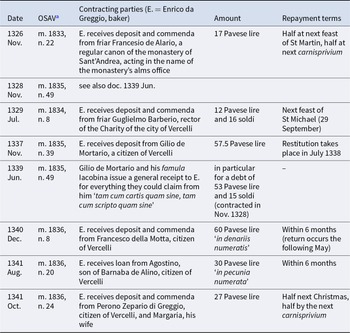
We have already mentioned the 1316 document recording a small loan from Enrico to a notary. At that time Enrico lived in or near the Sant’Andrea Hospital. He is documented the following year married to Fiorina, widow of another baker, and living in the urban parish of San Donato. In the early 1330s, he and his wife moved to the parish of San Luca, where the Sant’Andrea monastery and hospital were located. The couple loaned 23 Pavese lire in a commenda deposit arrangement to a certain Giovanni de Albertolio for a number of months. It was a sum of money that belonged to both husband and wife, as well as to Giovannino, Fiorina’s son by her previous marriage.Footnote 40 The family thus had significant sums of money, which they sought to invest with interest in the short term. We note that the composite definition of the transaction (deposit and commenda) does not correspond to a specific credit relationship that can necessarily be distinguished from a common loan.Footnote 41 Probably, the choice of the deposit and commenda form depended on the presence of a clause that placed all the potential risks that could compromise the success of the business on the party receiving the capital.Footnote 42 We are unable to determine the overall profile of the relation between the lender and Giovanni de Albertolio; all that is known is that the borrower promised to return the invested sum within three months, by the feast of Saint Bartholomew. Some three years later, two inhabitants of a village near Vercelli declared that they had received from Enrico ‘because of a loan’ the sum of 6 Pavese lire, promising to repay it within four months in an equivalent quantity of rye, calculated based on the market price (‘pro precio quod vendetur in foro’).Footnote 43 There is no difference between one transactional act and the other in the structure of the relationship. While in this first example it is Enrico who entrusts his financial resources into the hands of another person who wishes to conduct business, later others would entrust theirs to him, and over the years he evidently boosted his reputation and financial means and thus his ability to engage in business dealings. He was thus a borrower in 1326 and again in 1337, 1340 and 1341. On 3 November 1326 he received 17 Pavese lire from Francesio de Alario, canon of Sant’Andrea, acting on behalf of the monastery’s Elemosina [alms] division, which was dedicated to charity and well identified in the sources. Enrico pledged to repay half of the deposit on the occasion of the upcoming Feast of St Martin (11 November) and the other half on the following carnisprivium (quinquagesima, the last Sunday before Lent).Footnote 44 In this case we also have evidence of Enrico’s ability to meet deadlines because on 17 November 1326 (two days after the Feast of St Martin), friar Francesio de Alario stated that he had received from the baker half of the amount he had deposited – 8 Pavese lire and 10 soldi – as the first instalment in repaying the debt.Footnote 45 This is an apt example of characteristics that emerge very clearly from an analysis of available documentation on Enrico: he was a reliable business partner who possessed vital ‘reputation capital’, a fundamental quality for those operating in late-medieval local credit networks (see Table 1).
Deposits and loans received by Enrico da Greggio
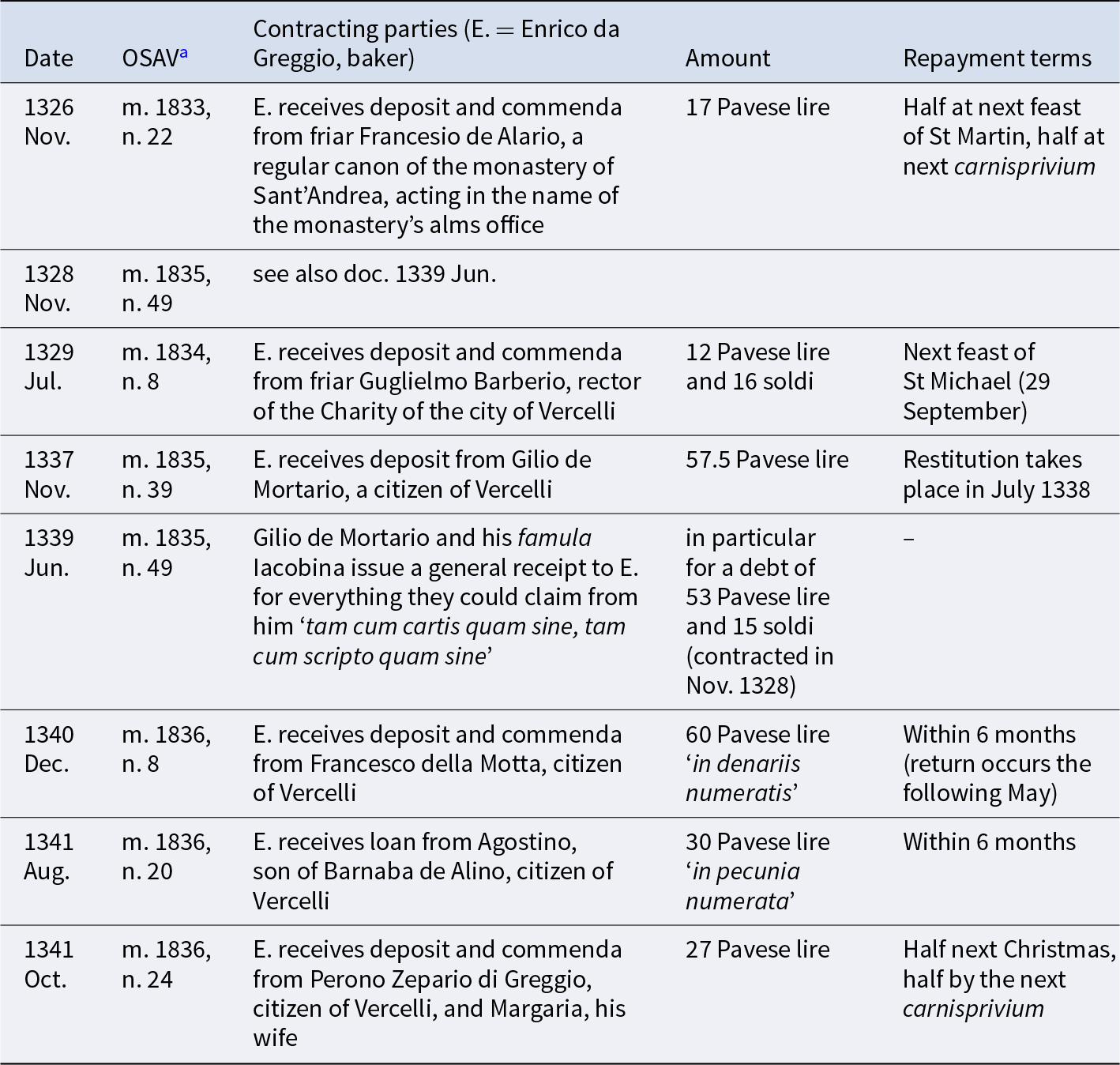
a The acronym OSAV stands for Archivio di Stato di Vercelli, Ospedale di Sant’Andrea di Vercelli.
In July 1338, Gilio de Mortario, a member of a long-standing Vercelli family, stated that he had received from Enrico da Greggio full payment of a debt of 57½ Pavese lire in the form of a deposit, stipulated with notarial deed in November of the previous year.Footnote 46 In 1339, Gilio again – this time acting together with his servant Giacomina – stated that he had received full satisfaction for all debts from Enrico, both those documented in notarial deeds and debts contracted without the services of a notary (‘tam cum cartis quam sine, tam cum scripto quam sine’), and in particular for a debt of 53 Pavese lire and 15 soldi contracted more than ten years earlier by notarial contract.Footnote 47 This particular contract has not survived. In any case, relations between Gilio and Enrico were apparently strong and enduring. We also know that Gilio was an agent of the minister of the Santa Brigida hospital, Guglielmo, a member of the powerful aristocratic Avogadro of Valdengo family, on whose behalf he acted habitually.Footnote 48 Enrico rented a plot of land near Vercelli from the hospital on which he grew mixed crops. In 1337 he paid three years of rent and a portion of tithe to Gilio, who was acting as procurator for Guglielmo.Footnote 49
In 1340, the dominus Francesco della Motta of Vercelli loaned Enrico 60 Pavese lire in cash (in denariis numeratis) with the assurance that he would be paid back within six months.Footnote 50 The following year, Perono Zepario da Greggio and his wife Margaria entrusted 27 Pavese lire to him on deposit, with the agreement that Enrico would return half the sum by Christmas and the other half subsequently.Footnote 51 In these cases, payment according to the terms in the notarial deed is attested by the cancellation cuts in the parchments.
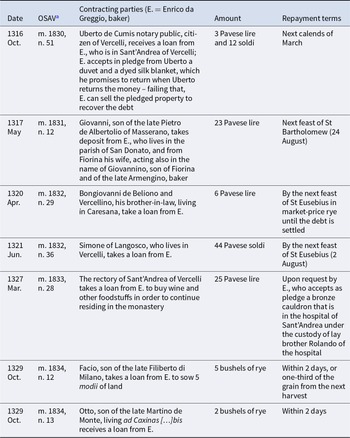
Loans are another type of credit operation in which Enrico is recorded as being active in the Vercelli network. Here Enrico almost always played the role of lender and only occasionally the borrower. A fundamental aspect here is that these were loans not only of money but also of other goods, such as seed. This is a characteristic feature of late medieval and early modern societies (consider the large number of grain loans in the rural credit markets and the spread of grain banks [monti frumentari] in the early modern period).Footnote 52 Another significant aspect is that while it is money that may be loaned, repayment may be in grain. On 24 April 1320, Bongiovanni de Beliono and his brother-in-law Vercellino, both living in Caresana, received a loan of 6 Pavese lire from Enrico da Greggio in return for a promise to deliver as much rye to the latter’s home as would be necessary to repay the debt by the following Feast of Saint Eusebius of Vercelli, celebrated on 2 August.Footnote 53 On 8 June 1321, Simone di Langosco, a resident of Vercelli, received a loan of 44 Pavese soldi from Enrico with the promise to repay the debt the same year by the feast of the same saint.Footnote 54
On 26 March 1327, the chapter of the monastery of Sant’Andrea di Vercelli requested a loan of 25 Pavese lire from Enrico. This appears to have been an unusual circumstance for an entity with a solid financial footing. Indeed, in the notarial deed, the chapter stated that at that time the monastery did not have stores of wine or other foods and was unable to procure them without resorting to a cash loan. They had appealed to a number of different persons to obtain it, but only Enrico had been willing to grant it. The clergymen promised to repay Enrico on demand, pledging as collateral a bronze cauldron (calderia de bronzio) kept by lay brother Rolando at the Sant’Andrea hospital.Footnote 55
Enrico continued his small- and medium-sized credit activity in the following years (see Table 2 for the years 1316–1329): in 1329 he lent two Vercelli bushels (staia) of rye to Otto de Monte, who promised to repay the debt within the improbable term of two days.Footnote 56 Another deed registered that year by a notary regarded a certain Facio da Milano, who declared he had received five Vercelli bushels of rye from Enrico to be used for the planting of five moggiate of land, promising to settle the debt within eight days or to give a third of the grain produced by that land at the following harvest (the latter being the actual repayment agreement).Footnote 57 Just over ten years later, in 1341, it was Enrico who received a loan, stating that he had received 30 Pavese lire from Agostino de Alino, citizen of Vercelli, with the promise to repay the sum within six months.Footnote 58 The cancellation cuts on the parchment deed testify to the regular settlement of the credit agreement.
Deposits and loans arranged by Enrico da Greggio
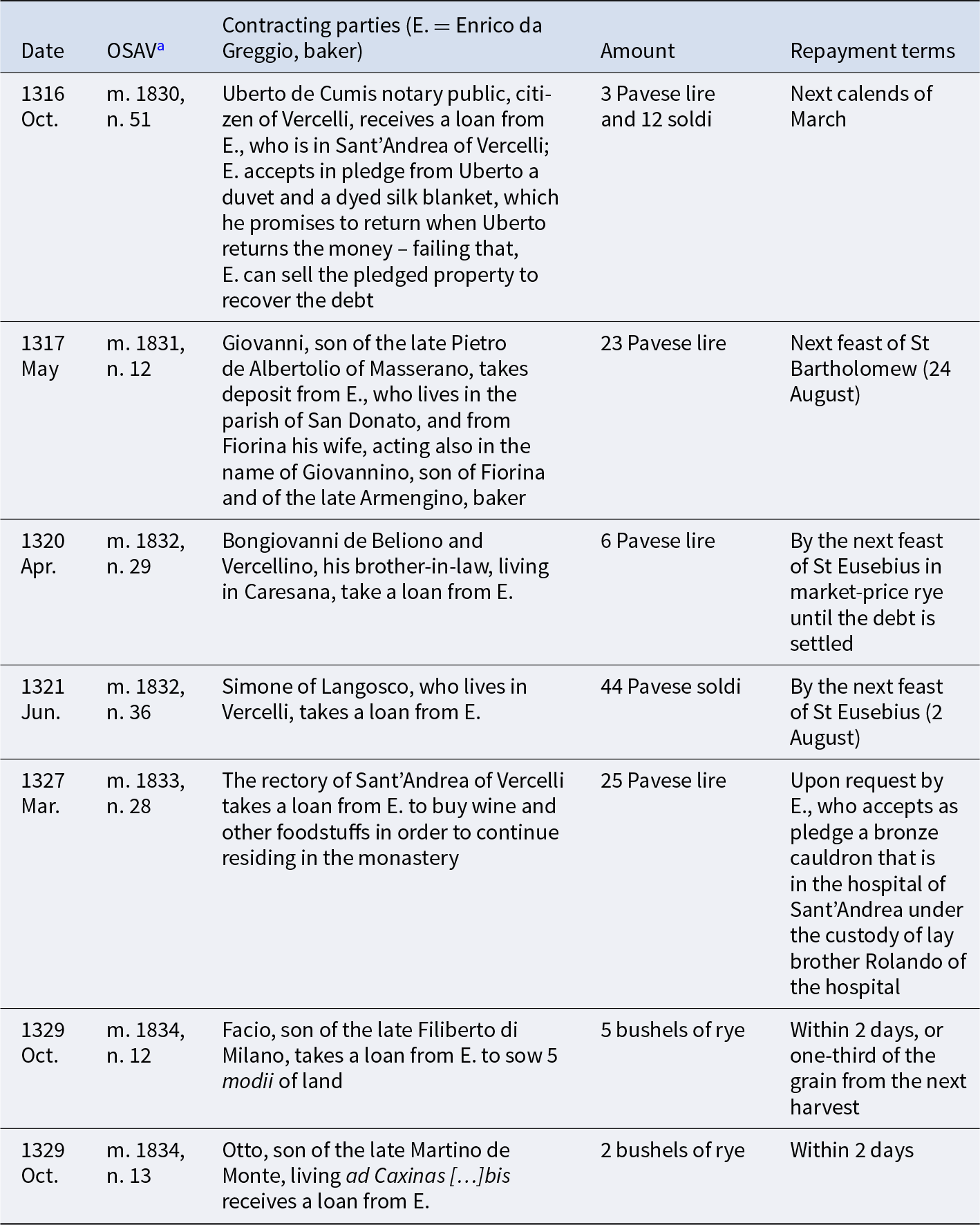
a The acronym OSAV stands for Archivio di Stato di Vercelli, Ospedale di Sant’Andrea di Vercelli.
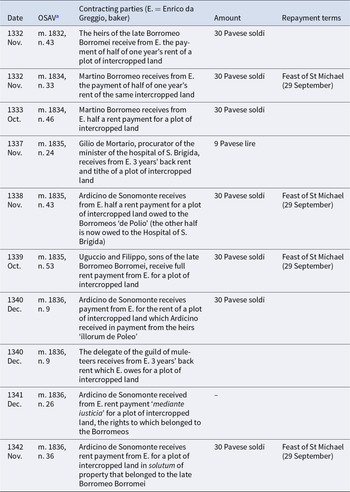
Another type of document that provides insight into credit relations is payment receipts issued to the borrower by the creditor after the debt is settled, also in this case certified by notarial deed. Such deeds reveal additional credit-related activities by Enrico. There are both receipts for deposits and receipts for rents. We have already mentioned the former and shall now discuss the latter (see Table 3). Two receipts in the year 1332 evidence the payment of rent of 3 lire, which Enrico owed to members of the Borromeo family for a piantato, that is, an intercropped plot of land (most commonly grape vines supported by trees) in Cantarana, near Vercelli,Footnote 59 where Enrico also had other landed interests.Footnote 60 Receipts for such payments and another rental of an adjacent piece of land exist for the following years but at irregular intervals, given the incompleteness of preserved documents: one exists for the year 1333, another for 1338 and a third for 1339.Footnote 61 For reasons that are not entirely clear, although they almost certainly have to do with judicial reassignment of credit, in 1338 and subsequent years (1340–1342), Enrico’s rental payments to the Borromeo family were intercepted by a member of the Sonomonte family of Vercelli.Footnote 62 Enrico rented other piantati in Cantarana, as we learn from other payment receipts: in 1337 he paid three years of rent and tithe in arrears to the Santa Brigida hospital, amounting to a total of 9 lire;Footnote 63 in 1340 he again paid three years of back rent to the Vercelli corporation of muleteers.Footnote 64
Rents for landed property paid by Enrico da Greggio
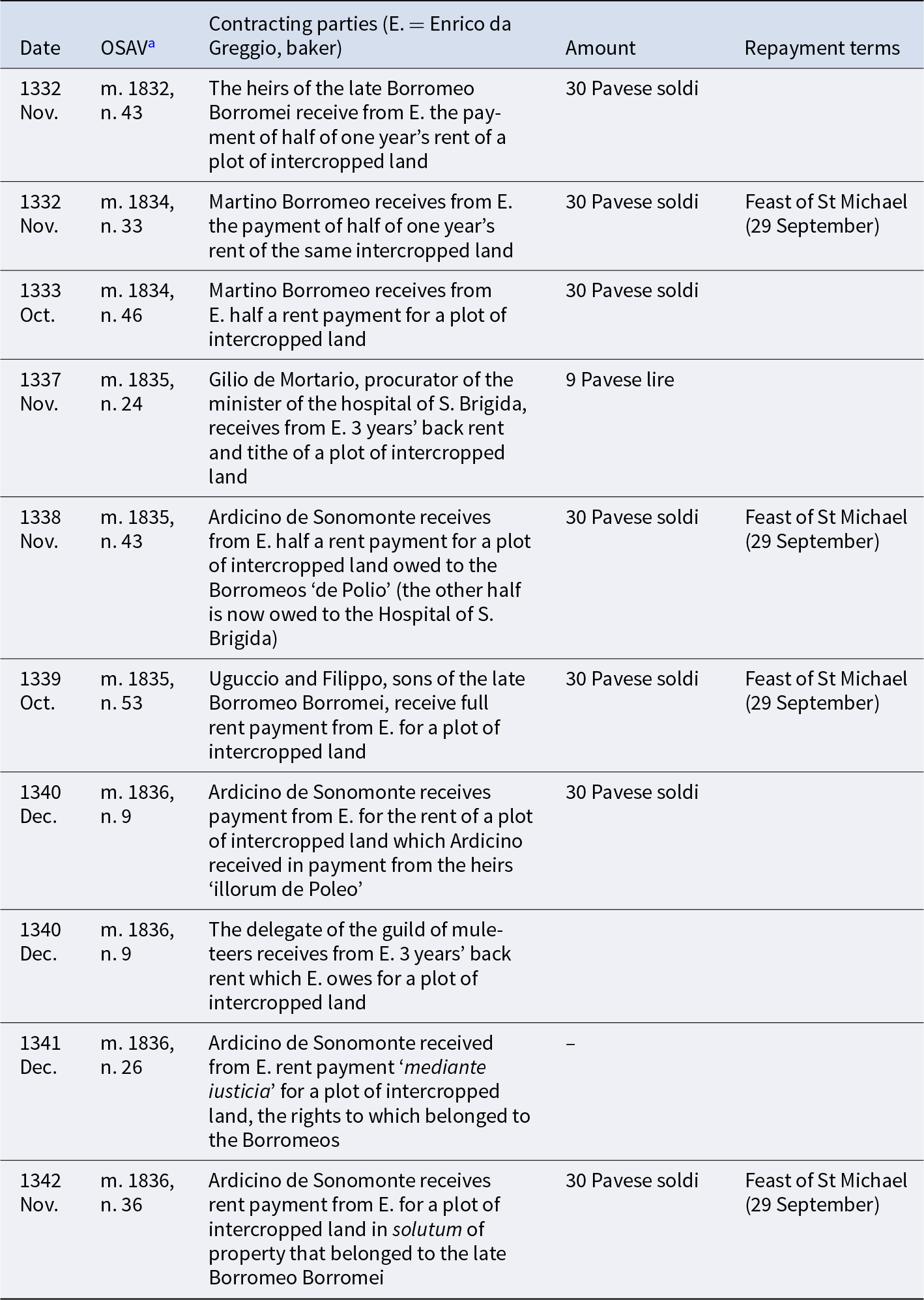
a The acronym OSAV stands for Archivio di Stato di Vercelli, Ospedale di Sant’Andrea di Vercelli.
We could deepen our examination of the rents for agricultural land or homes in the city paid or received by Enrico. However, it will be sufficient to note that in the specific cases illustrated by the surviving documents regarding Enrico, the possession of or access to a rented property occurred through the resolution of a dispute deriving from a crisis in credit relations: we have seen this in the case of Ardicino Sonomonte, who had obtained the right to receive rent from Enrico for a property located in Cantarana, thanks to a judicial sentence (‘mediante iusticia in pagamentum’).Footnote 65 Another example ocurred in December 1329 when the consuls of Vercelli had assigned to Enrico a house in rua Taramascha in the Vercelli neighbourhood of San Donato that had belonged to a Perrino de Rodulfo. The tenant, Antonio de Lombarda, was informed by a municipal judge that his landlord was now Enrico. As a consequence, by means of a notarial deed summarizing the entire situation and making explicit reference to the documents upon which it was based, Antonio promised to pay Enrico annual rent of 40 Pavese soldi.Footnote 66
In general, the baker Enrico was involved in an intensive series of dealings that involved the use of money and various forms of credit securities in a period when credit relations extended across all of society, down to the lowest social strata. He was in constant contact with persons and organizations that granted or requested loans (as Enrico himself did), including the institution that was an indispensable element in guaranteeing compliance with credit obligations: the municipal court of Vercelli.
As mentioned earlier, Enrico da Greggio and his wife Fiorina’s bond with the Sant’Andrea monastery and hospital continued for decades. Since 1318 he is documented as lessee for 11 Pavese lire a year of a house with oven located in the parish of San Donato owned by the hospital.Footnote 67 Two years earlier, before he had married Fiorina, he was living in the Sant’Andrea neighbourhood, probably in the hospital, when he granted a small pawn loan to a notary of Vercelli.Footnote 68 As well as can be gathered from the sparse sources, the hospital apparently had a room set aside in which to keep pledged property, as we will discuss later. Here we must ask whether Enrico conducted his affairs in his own name or on behalf of the hospital. The notaries were very careful to avoid any mention in that regard. In any case, Enrico had a strong bond with the hospital and it appears that he acted, albeit not always, in its name. This bond was not formalized in any written contract, or at least not before Enrico and Fiorina, now in their later years, became a lay brother and sister of the hospital. In August 1344, after 27 years of married life, the couple were elected lay brother and sister in a solemn dedication ceremony.Footnote 69 These laypersons associated with the religious body had been growing in importance in European societies since the twelfth century, but the religious and civil authorities struggled to find a precise legal definition for them. Enrico, who was an active and successful businessman and a steadfast contributor to the municipal coffers, must have been a particularly difficult case. Just over a year after the dedication ceremony, the municipality of Vercelli lodged a complaint against now friar Enrico da Greggio, asking him to pay the city taxes as he had done prior to his conversion. The court of justice of the podesta of Vercelli, after requesting a consilium sapientis, decreed that Enrico should be removed from the tax rolls and exempted from his tax obligations from the day of his dedication onwards.Footnote 70
As we mentioned earlier, the hospital probably functioned as a sort of pawn bank. While no direct documentation of this is known to exist, certain documents do make oblique reference to this function. We shall examine one when discussing the last will and testament of the priest Salerno, which mentions a solarium at the hospital serving as a storeroom. Another will be addressed immediately.
Returning to our discussion of Enrico, the baker’s case carries a number of implications: on the one hand, we find him engaged in a small construction project on a house with a courtyard – it is not known whether he had whole or partial ownership – in the Vercelli parish of San Luca, the same neighbourhood where the monastery and hospital of Sant’Andrea were located; on the other, he conducted his regular activity as lender, but this time, as mentioned already, to the monastery, which had a supervisory function with respect to the hospital, even though the latter enjoyed complete autonomy in administrative and economic affairs.Footnote 71 The baker’s affairs expanded and his financial roots were consolidated in the part of the city where he lived. Enrico had had a new house with an attic built across the courtyard from his old house. He had then had a wall erected to separate this courtyard from land associated with a neighbouring house belonging to the Sant’Andrea monastery.Footnote 72 He asked the canons to pay for half of the cost of building the wall. They refused, demanding instead that the wall be demolished. The two parties eventually came to an agreement: the canons would pay nothing and would have the option, if they so chose, to modify the wall, which stood half on their land and half on Enrico’s. On the same day that this agreement was signed, Enrico and the canons made another agreement on what appeared to be a wholly unrelated question, but may be supposed to be associated with the issue of the wall in some way.Footnote 73 The canons had run out of wine, oil and other foodstuffs that were absolutely necessary for life in the monastery and the fulfilment of their religious functions. They thus needed to borrow money in order to acquire these supplies. The sum amounted to 25 Pavese lire; they could find no one willing to lend them this sum except Enrico, who gave them a cash loan. The canons promised to repay Enrico when and where he should request it (‘quandocumque et quocienscumque voluerit’), pledging as collateral, according to customary praxis in such loan contracts, all assets of the clergy house and also, as a special pledge, a bronze cauldron located in the Sant’Andrea hospital in the custody of friar Rolando, a lay brother who managed the cellars (not to be confused with the above-mentioned priest Rolando).Footnote 74
While the essentials and nature of the financial and dependency relations between the hospital and Enrico are obscure, at least prior to the induction of the baker and his wife as lay brother and lay sister, it is clear that the bond must have been strong and frequently expressed. The hospital provided help to Enrico in his plans to consolidate his assets in the parish of San Luca, renting to him a piece of land (‘sedimen unum seu senterium’, probably a narrow strip) adjacent to his house in that parish some years after the affair of the wall and the loan of the 25 lire.Footnote 75 This consolidation continued a few months later, again as an outcome of said loan to the clergy house, which had not repaid the sum and was thereby obliged to rent to Enrico a house it owned on the public road and adjacent to Enrico’s house, that is, adjacent, we may assume, to the residential complex that Enrico had established in San Luca. The contract was to remain in force for nine years and the rent was set at 4 Pavese lire per year. However, after the nine years had passed, if Enrico had not been repaid the sum of 25 lire he had loaned to the canons in 1327, the rental would continue at the same yearly rate until complete settlement of the debt.Footnote 76 In truth, the question of the 25 lire loan immediately had other implications, which the lease laid out in clear terms: it called for annulment of the previous leases for the same house stipulated with Enrico for an annual rent of 3 lire, for annulment of the payment receipts for said rent and finally for annulment of certain agreements whereby Enrico could use the house without paying any rent at all. These are all recorded in notarial deeds bearing the same date as the agreement about the wall and the granting of the loan of 25 lire: 26 March 1327. These having been annulled and the new lease drawn up, the debt of 25 lire remained outstanding (‘dicto debito et instrumento dicti debiti librarum vigintiquinque Papiensium remanente firmo et in suo robore’). The credit relations with the monastery were therefore highly remunerative for Enrico: in addition to the pledge of the bronze cauldron, he had obtained, upon delivering the cash loan, the rental of a house for 3 lire and fake receipts attesting to payment of the same, because the parties had agreed that Enrico could use the house free of charge while still having the right to claim the credit of 25 lire. The rental of the house was in fact gratuitous and was therefore a form of interest.Footnote 77
Let us now turn to the will of the priest Salerno. It offers a useful overview of the relations between the priest and the hospital – not only his relations with the institution itself but also his personal and affective bonds with persons, to whom he gave small sums. The latter include members of the board of governors of the charitable entity – such as the lay brother Giovanni da San Germano – as well as the workers who provided the daily hospital services (servants, cooks) and persons who resided – for reasons not known to us – at the hospital. We must immediately emphasize, and this is a point of particular relevance, that in these latter cases, as in other bequests of money or goods listed in the testament, the bequests consisted not of hard cash or cereals but of credits, that is, as we read in the testament, of sums of money belonging to the category of ‘debts and instruments and financial obligations and names of debtors and amounts of money’ (‘debita et instrumenta et iura ac nomina debitorum et quantitates peccunie’).
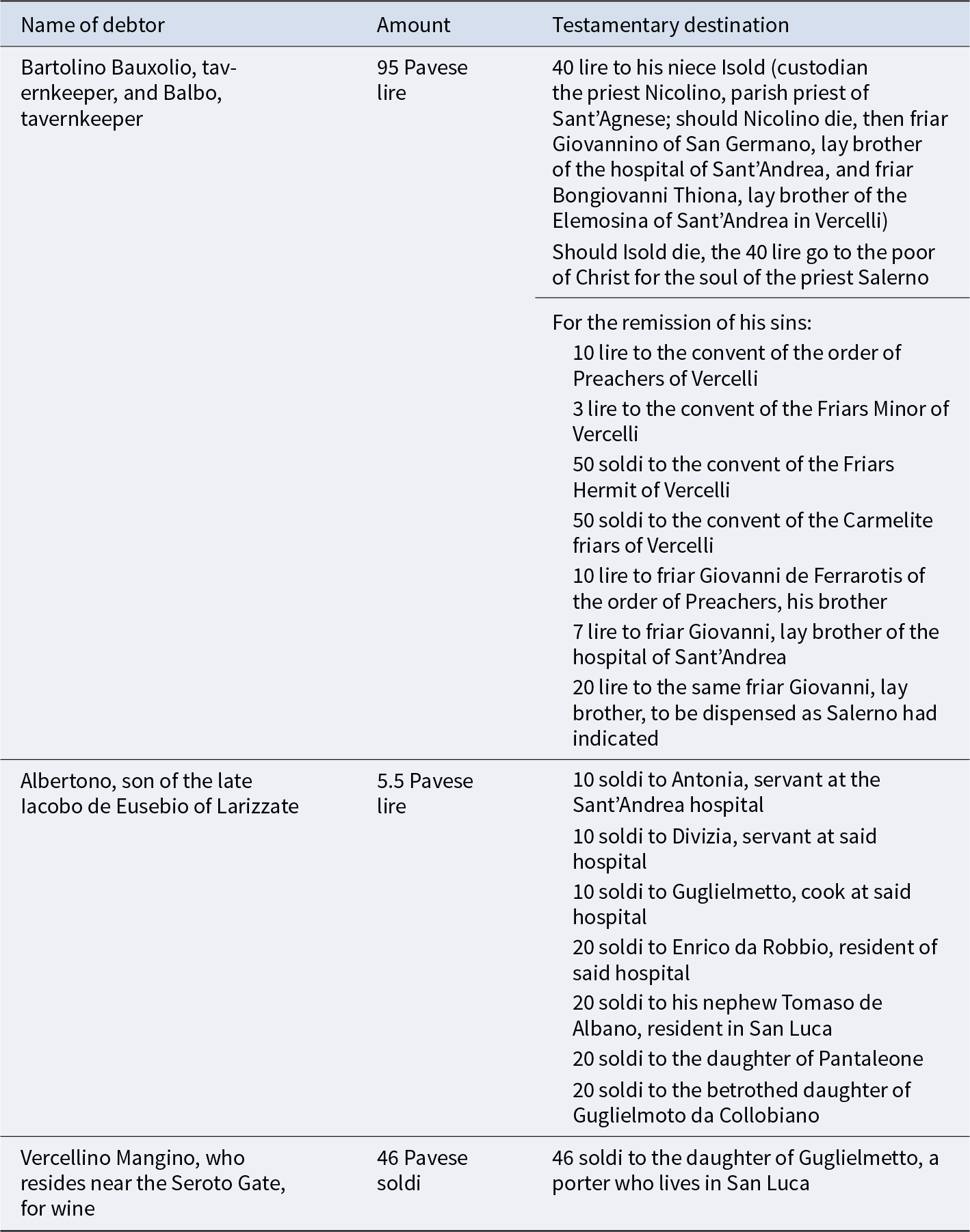
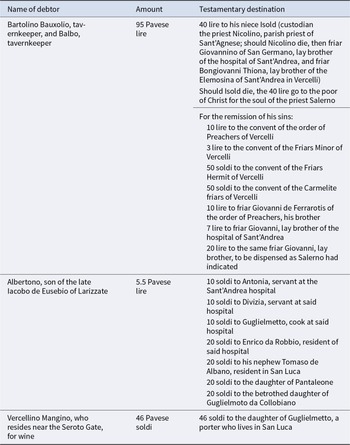
By their very nature, more than shedding light on the principal hereditament (about which they generally say little), testaments provide information on the assets bequeathed and financial interests left unresolved by the testator at the time of death.Footnote 78 In this specific case, the testament provides a window onto Salerno’s many religious, affective and credit relations in the last years of his life. A characteristic that is certainly not unique to Salerno is that his last wishes are crafted in such a way that every credit (whether in money, grain or legumes) corresponds to a specific bequest (see Table 4).
Residual credits and their charitable destination from the will of the priest Salerno (25 August 1342)
Source: OSAV, m. 1836, n. 31.
The testament records Salerno’s real estate. By agency of the notary who recorded his last will and testament, the priest disposes of his land and buildings in a few short sentences, naming two of his brothers (the third was a Dominican friar) heirs to ‘all his paternal and maternal properties’.Footnote 79 The document also lists his financial assets, which are represented not as cash or precious objects but as credits: ‘[the testator] states, furthermore, that he holds legal claim to the quantities of things and money listed herein’.Footnote 80 The list that follows contains the names of individuals who owed money to Salerno for loans (in certain cases loans of wine) formalized with or without notarial deed (cum carta or sine carta, respectively) or for deposits, although only in one case. The total amount owed, including all loans and the deposit, was just under 240 Pavese lire and 6 gold florins. There is also a short list of credits in grains and legumes, owed in particular by the Sant’Andrea monastery and by the hospital, which held the foodstuffs owed to Salerno in its solaria. Apart from the objects, clothing, agricultural implements and a few other items also listed in the testament, Salerno assigned the credits to the many legatees he named, taking care to associate the sums owed by a given debtor with precise lists of bequests. The execution of these testamentary instructions was entrusted to a friend, he too the priest in charge of a parish in the city, to a lay brother of the hospital to which Salerno was particularly attached and to a lay brother in the Elemosina division of the monastery of Sant’Andrea. We provide one small example: regarding a credit of 5½ Pavese lire owed by a man, probably a farmer, who lived in a village near Vercelli, Salerno appointed as legatees two servants and a cook at the hospital, a man who lived at the hospital, a nephew and the daughters of two acquaintances, bequeathing one half lira each to the first three and one lira each to the others.
The testament is full of interesting information, in particular regarding the intricate network of financial, affective, religious and ecclesiastical relations it illustrates. This network was sustained and invigorated during his lifetime and continued to have effect after his death in the circulation of small and medium sums of money and goods (including clothing, objects, furniture, work implements, etc.), credits that took the form not of coins or grains but of promises to provide, with no deadline ever being set, some quantity of one or the other.
6. Conclusions
The economic circulatory systems of late-medieval societies were characterized not only by flows of money but, even more, by flows of credit, mainly taking form in an extensive and articulate system of microcredit. This system envisaged the repayment of a cash loan not only with other cash but also with agricultural products, other sorts of goods, days of work or specific services. The values of a heterogeneous set of fungible credit and debit items – money, goods, services – were broadly understood and quantified among the community, lubricating the day-to-day functions of the economy and society.Footnote 81
While it is true that in the final centuries of the Middle Ages, in an increasing trend from the eleventh century on, societies were characterized by much more intensive monetary flows than in previous centuries, we must keep well in mind that sources prevalently document those flows as commitments on the part of a highly varied range of entities to pay a sum of money in the future.Footnote 82 We might suggest research into relations between payments in cash, payments in goods or work and promises to pay in different contexts and periods. But it is important to recognize that the development of the monetary economy prevalently took form in the spread and penetration of credit mechanisms across all social strata.
In its multiple forms and connections, credit flows through all of society. Although historiographers mainly ascribe it to the early modern period and explore it within that context, the final centuries of the Middle Ages were already characterized by the ubiquity of credit. Credit was relevant not only to religious institutions, nobles, landowners, wealthy merchants and successful artisans but also to those in other social categories. The sources we have examined here bring to light a plethora of otherwise relatively inconspicuous people (servants, cooks, young single women, porters, agents of charitable organizations, clerics, friars and so on) who were well integrated into the credit network. The same network also linked, at nodes not far removed from those already mentioned, religious and charitable bodies, members of the local aristocracy, notaries and merchants. Well endowed with lands and engaged in brisk business dealings, the latter resorted to credit because they suffered what we might call a chronic lack of liquidity, limiting their access to markets on a day-to-day basis.
Available documentation indicates, rather clearly in the case of the credit relations between the baker Enrico da Greggio and the Victorine clergy house and hospital of Sant’Andrea, that there is always more to the story. It is very difficult to get a complete picture of credit relationships from notarial sources alone. A given transaction was documented in a system of mutually independent documents that were kept together in the notary’s register and in the archives of the counterparties. However, the notarial registers, in the case we have studied, have not survived. By their differing natures, the notarial deeds on loose parchments (extracts from the register) regard different time frames, different periods of relevance: those that document significant and enduring interests are kept, while those on which periodic payments (receipts) or accessory agreements are written have generally been lost.
We have outlined in the article part of a complex web of economic and social relations that were widespread in Vercelli and the surrounding area during the fourteenth century. There were numerous types of credit relation in effect in this context, with the credit itself taking various forms. Our painstaking documentary analysis opens a circumscribed but significant window onto this world, placing special emphasis on microcredit operations. In the small but bustling economy of the parishes of San Donato and San Luca in the northern part of the city of Vercelli, we find a wealth of documents regarding formerly obscure baker Enrico da Greggio, who gained some prominence through his credit activity. This transition was supported by the Sant’Andrea hospital, with which Enrico maintained steady but not institutionally formalized relations. This was true at least until he and his wife Fiorina were invested with semi-religious status in 1344, becoming part of the small group of lay brothers and sisters who administrated, under the control of the minister, much of the activity at the charitable institution.
Similarly, in the will of the priest Salerno, parish priest of the church of San Luca (the Sant’Andrea monastery and hospital were located in the parish of San Luca), as in other wills of that period, we read of a complex web of relationships of affection and devotion interlaced with credit relations. Every debt that the priest left uncollected at the time of his death is transformed into a bequest, with no specification of termination conditions.
The in-depth analysis we propose of records relating to particular case studies could be a useful addition to the study of the spread of credit relations in the late Middle Ages. Recent studies are predominantly based on notarial deeds, unified by the agency of the single notary who has compiled a unique register. In the documentary dossiers we have analysed here, the unifying principle is identified instead with a single economic actor engaged in credit relationships who may use the services of a plurality of notaries, as circumstances dictated, while accumulating his own archive. The preservation of such archives (nearly 60 documents in the case of Enrico da Greggio) depends on their incorporation into the archives of a larger charitable organization, under whose wing Enrico, Salerno and numerous others before and after them built their entire careers as creditors. Such sources, relating to the credit activity of an individual, shed significant light on legal and economic aspects that are pertinent to research into medieval credit relations. At the same time, they illuminate the social aspects of credit relations (at their differing levels of intensity and scale), showing that the relations informing these networks were the vital humour, the lifeblood, of the social body in late medieval and early modern Europe. They enabled the continuation and transformation of bonds within families and between neighbours, friends and partners. The types of source we have cited here open new avenues of investigation into historiographic issues that will continue to be relevant in the future.
Supplementary material
The supplementary material for this article can be found at https://doi.org/10.1017/S0268416025100830.


 Open access

