





Highlights
-
• Daily interactional contexts shape bilinguals’ cognitive strategies.
-
• Heritage speakers demonstrate dynamic bilingual language control.
-
• Proactive control enhances English naming but may hinder Spanish naming.
-
• Language dominance modulates cognitive control during language switching.
-
• Heritage bilinguals’ switching frequency predicts naming accuracy differences.
1. Introduction
Bilingualism provides an opportunity to examine the complex relationship between language and cognition because the requirement to regulate the use of two languages across different communicative contexts places distinct cognitive demands on speakers (e.g., Green & Abutalebi, Reference Green and Abutalebi2013). Bilinguals vary in the opportunities to find themselves in contexts that strictly use one language only, both languages interchangeably, or a mix of both. Research on the effects of the linguistic context has shown that cognitive control mechanisms are selectively engaged during language processing in response to the demands of the environment (e.g., Beatty-Martínez et al., Reference Beatty-Martínez, Navarro-Torres and Dussias2020a; Zhang et al., Reference Zhang, Diaz, Guo and Kroll2021). As Green and Abutalebi (Reference Green and Abutalebi2013) suggested, there is adaptive control of the bilingual’s two languages that reflects these environmental demands. Notably, the modulation of language processing in response to contextual demands is observed over and above levels of acquired proficiency, suggesting that a key issue is to identify how language processes are impacted by the unique requirements in a given environment.
The starting point for the present study is the observation that linguistic environments are not only determined by geography but also by the variation and complexity of the bilingual experience. Here, we examine the interactional contexts of heritage speakers of Spanish and English and ask how language experience and cognitive resources affect their ability to speak words in each language. Heritage bilinguals embody the outcome of a situation of language contact that is prevalent in the U.S. (and in many other parts of the world), between a minority (home) language and a dominant societal language (e.g., Miglio & Gries, Reference Miglio and Gries2015; Montrul, Reference Montrul2016; Montrul & Polinsky, Reference Montrul and Polinsky2021). Heritage speakers of Spanish in Southern California are bilinguals who acquire Spanish as their native or first language (L1) in the home, before entering a school context where they become increasingly exposed to English, a second language (L2) which typically becomes the dominant language in many domains of their lives. The interactional contexts of heritage speakers allow both languages to be used to varying degrees, but the patterns of language use differ from bilinguals who have been studied previously. Heritage speakers may alternate between using their home and societal languages both separately and interchangeably within the course of a day, as they may be immersed in either or both the L1 and the L2 at any given moment. Consider these illustrative bilingual phenotypes among heritage speakers:
-
(1) Potential scenarios of heritage bilingual profiles:
-
(a) Julian is a college student who lives at home with his family in a predominantly Spanish-speaking community. He primarily speaks Spanish with his family members and neighbors. When he is at school, he only uses English when speaking with other students and professors.
-
(b) Jimena is the youngest of her siblings, with whom she communicates mostly in English. She understands Spanish whenever her parents speak it to her, but only uses it to communicate with her grandparents who live with her. At school, she has many bilingual friends who speak Spanish in front of her and sometimes to her, but she only responds to them in English.
-
(c) Daniela was born in San Diego, California. At the age of 10, she and her family moved to a border town in Mexico. She never stopped attending school in the US, and she commutes every day across the border for school and other activities. She speaks both English and Spanish fluently and uses them interchangeably depending on the situation.
-
Language switching is central to the habitual patterns of language use in heritage speakers and modulates the relationship between linguistic abilities and the cognitive control mechanisms involved in language regulation. Differences related to how and when heritage speakers switch between their two languages are of interest not only for characterizing heritage experience but also for understanding the ways that cognitive mechanisms are engaged during spoken production. Bilinguals appear to seamlessly codeswitch in natural speech in a seamless manner. Research on codeswitching (CS) has demonstrated that, unlike the processing costs typically observed in laboratory-based language-switching experiments, such costs are not evident in naturalistic CS as it occurs in real-world contexts (Adamou & Shen, Reference Adamou and Shen2019; Yacovone et al., Reference Yacovone, Moya and Snedeker2021). Nonetheless, evidence from lab studies show that experience with switching across different contexts can lead to distinct patterns of cognitive performance (Han et al., Reference Han, Li and Filippi2022; Jevtović et al., Reference Jevtović, Duñabeitia and De Bruin2020), particularly when switching between the dominant and non-dominant languages (Meuter & Allport, Reference Meuter and Allport1999). In the present study, we implemented a language-switching paradigm at the lexical level to examine switching in heritage speakers. Given previous findings on the costs associated with CS, we investigate whether this experience for heritage speakers in real life may reflect on their performance in language switching in the laboratory.
Past research on language switching suggests that the direction of the language switch matters. Difficulty speaking the more dominant language (L1) after speaking the less dominant language (L2) has been replicated in previous studies (e.g., Casado et al., Reference Casado, Szewczyk, Wolna and Wodniecka2022; Costa & Santesteban, Reference Costa and Santesteban2004; Kleinman & Gollan, Reference Kleinman and Gollan2018) and is typically accepted as a key signature of bilingual language control in that it reveals a downregulation of the more dominant language, which enables the less dominant language to be spoken. It has also been shown to be greater when there is greater asymmetry between the two languages in studies that observed a reversed language dominance effect (e.g., Van Assche et al., Reference Van Assche, Duyck and Gollan2013; Verhoef et al., Reference Verhoef, Roelofs and Chwilla2009) in performance on mixed-language blocks (e.g., Christoffels et al., Reference Christoffels, Firk and Schiller2007; Declerck et al., Reference Declerck, Kleinman and Gollan2020) and single language block designs (e.g., Branzi et al., Reference Branzi, Martin, Abutalebi and Costa2014; Misra et al., Reference Misra, Guo, Bobb and Kroll2012; see details on the blocked language order effect in Declerck et al., Reference Declerck, Kleinman and Gollan2020) at both the trial- and block-level or both. Order effects in a single-language block design may be a more ecologically valid approach to studying language switching in heritage bilinguals, particularly if the aim is to capture linguistic and cognitive behavior of these speakers in situations where they may be required to switch from their L1 to their L2 and in the opposite direction.
Prior to describing the details of the experiment, we consider what is known about the role of cognitive control in bilingualism. We then discuss the notion of interactional contexts that shape the way languages are used by bilinguals both cognitively and linguistically. Finally, we provide a summary of previous studies that investigate language switching and cognitive control, before considering the role of this ability in our targeted group of Spanish-English heritage bilinguals.
2. Background
To understand the bilingual experiences of heritage speakers, we need to first acknowledge a common feature across all bilinguals: that they are mental jugglers of two language systems which remain activated in parallel even when only one is being used (e.g., Kroll et al., Reference Kroll, Dussias, Bogulski, Kroff and Ross2012). By attending to external cues in the environment, bilinguals draw on cognitive resources to monitor and overcome interference from their non-target language to ensure the selection of the appropriate language (Kroll et al., Reference Kroll, Bobb and Hoshino2014; Meuter & Allport, Reference Meuter and Allport1999). The constant exercise of resolving cross-language interference occurs at all levels of language processing (Prior et al., Reference Prior, Degani, Awawdy, Yassin and Korem2017). Presumably, bilingual individuals like Julian, Jimena and Daniela from the potential scenarios in (1) are required to continually regulate the two languages to adapt to contexts where they must remain in a single language, switch from one language to another, or mix languages through CS (Gosselin & Sabourin, Reference Gosselin and Sabourin2023; Green & Abutalebi, Reference Green and Abutalebi2013).
3. Interactional contexts in the bilingual experience
The notion of interactional context was introduced within the framework of the Adaptive Control Hypothesis (ACH, Green & Abutalebi, Reference Green and Abutalebi2013), which posits that environmental contexts (e.g., like those described in the potential scenarios above) impose distinct demands on cognitive processes that modulate language abilities. The ACH identifies three types of interactional contexts in which bilinguals communicate: single-language contexts in which bilinguals only use one of their languages at a time (low competition between both languages); dual-language contexts in which bilinguals could use either of their languages at any given moment (greater demands on cognitive control to regulate competition between the languages); and dense-code switching contexts where bilinguals can freely use both languages (relatively low competition). It is the case that most bilingual communication is not limited to any single context, but actually shifts across contexts, thereby recruiting a different mix of cognitive mechanisms to ensure selection of the appropriate language(s).
Evidence for the role of interactional contexts comes from a set of studies that exploited the unique demands associated with language and cultural expectations across different geographical locations. Beatty-Martínez et al. (Reference Beatty-Martínez, Navarro-Torres and Dussias2020a) examined three groups of highly proficient Spanish-English bilinguals living in locations which differed in the expectations to keep the two languages separate or to use them interchangeably. One group lived in Granada, Spain, where Spanish and English are used separately. Another lived in San Juan, Puerto Rico, where the languages are used almost interchangeably. The third group was immersed in Pennsylvania in a context where English is the dominant language, and few others speak Spanish. The approach was to use two lexical production tasks and a non-linguistic measure of cognitive control to ask whether patterns of language production would differentially reflect the engagement of cognitive control as a function of environmental demands.
To assess cognitive control, Beatty-Martínez et al. (Reference Beatty-Martínez, Navarro-Torres and Dussias2020a) administered the AX-continuous performance task (AX-CPT), which measures two key mechanisms of cognitive control (see Braver et al., Reference Braver, Paxton, Locke and Barch2009): proactive and reactive control. Proactive control involves the preparation and planning in anticipation of potential interference, allowing individuals to maintain goal-relevant information for more efficient management of cognitive demands in situations of potential interference. A bilingual may engage proactive control when preparing for language use in a context that they are familiar with and can accurately anticipate the target language (and suppress the non-target language in advance). Reactive control is a late-correction strategy that is engaged in response to interference from an event after it has occurred. Contrary to the anticipatory strategy employed in proactive control, reactive control allows the individual to detect and resolve conflict. A bilingual person may engage in reactive control when unexpectedly met with the requirement to switch out of the target language of a particular context (e.g., they bump into a speaker of the other language) and adapt to the new linguistic demand within that context. In observing differences in the recruitment of these two cognitive control strategies, Beatty-Martínez et al. (Reference Beatty-Martínez, Navarro-Torres and Dussias2020a) reported distinct patterns in picture-naming performance for Spanish-English bilinguals in three different interactional contexts, who might otherwise have been aggregated as a single group of proficient bilinguals.
In considering the association between the AX-CPT and picture naming performance, no reliable patterns were reported for the bilinguals in Puerto Rico (i.e., integrated context), where both languages could be used cooperatively. The bilinguals in Granada, Spain (i.e., separate context), where the two languages were used separately, showed a pattern of reactive cognitive control that predicted their naming performance. Experience with language use in a separate context potentially led these bilinguals to employ greater reliance on reactive control processes (as indexed by lower AY error rates), which were associated with higher picture naming accuracy in both the L1 and the L2. The most dramatic differences were observed for the bilinguals immersed in their L2 English in Pennsylvania (i.e., varied context). For those in this context, the data revealed a positive association between AY error rates (indicative of a greater tendency to rely on context processing) and Spanish naming performance (i.e., higher accuracy and faster reaction times). Namely, these bilinguals appeared to draw on proactive control to enable maintenance of the L1 Spanish. The interpretation was that in an environment that is functionally hostile to the L1, with few opportunities to speak Spanish, these bilinguals must actively monitor the environment and allocate cognitive resources proactively to enable production in Spanish. The point for the present paper is that variation in language use creates different opportunities for bilingual speakers, and those opportunities are hypothesized to shape the ways that cognitive resources are engaged during language processing.
Findings on interactional contexts suggest that they shape how bilinguals engage cognitive resources and adapt to the linguistic demands of their environment when using their two languages. However, interactional contexts may not only arise as a function of geography and its associated environmental demands. Given previous findings, one may expect to observe distinct cognitive patterns among heritage speakers, even those living in the same geographical location. The present study investigates how heritage speakers potentially differ from bilinguals who have been studied in the past. Heritage speakers often use language in a complex interactional context that may change frequently within a given day. As illustrated in the illustrative scenarios above, a heritage speaker may find themselves communicating in a single-language environment one moment and then in a dense codeswitching environment the next, as a function of the dynamic interactional context that they are immersed in. Although there can be variation among heritage speakers as a group, the experience of navigating multiple interactional contexts may produce unique patterns even within a group of heritage bilinguals living in the same geographical location.
Previous studies have identified a range of factors to characterize the different types of language experiences of bilinguals (de Bruin, Reference de Bruin2019; Luk & Bialystok, Reference Luk and Bialystok2013; Pereira Soares et al., Reference Pereira Soares, Prystauka, DeLuca and Rothman2022). These factors vary at the individual level (e.g., language proficiency, fluctuating dominance, patterns of language use, etc.) and can be influenced by the demands of the communicative context (e.g., frequency and motives for language switching, appropriateness of CS). To better understand the relationship between language and cognition, it is important to first identify those aspects of heritage experience (i.e., habitual patterns of language use and environmental demands) that may affect how cognitive resources are engaged to enable speech in both languages. The social ecologies of the contexts that bilinguals navigate in their daily lives (namely, those that are within and outside of their communities) are complex and variable, but they reveal how linguistic and cognitive systems converge through bilingual language control (Beatty-Martínez & Titone, Reference Beatty-Martínez and Titone2021). A more detailed characterization of the heritage speaker experience is necessary to understand how cognitive control is engaged to enable these speakers to switch between their heritage and societal languages on a daily basis.
4. Language switching and cognitive control
The ability to switch between languages, a fundamental skill for all bilinguals, draws on cognitive resources. But what cognitive mechanisms allow bilinguals to switch between languages in a seemingly effortless manner (e.g., Jevtović et al., Reference Jevtović, Duñabeitia and De Bruin2020; van Hell & Witteman, Reference van Hell and Witteman2009)? In the example above, what potentially enables Daniela from scenario (1c) to switch languages when commuting every day across the border? In experimental psychology, language switching has been studied through laboratory paradigms which typically employ cues to elicit language switches (e.g., Blanco-Elorrieta & Pylkkänen, Reference Blanco-Elorrieta and Pylkkänen2017), but ultimately tap into elements of language switching that occur in actual bilingual speech.
In codeswitched speech, a natural switch between languages can occur for a number of reasons. For example, speakers may switch depending on the topic of conversation; they may switch from their less proficient language into their more dominant one and sometimes switch unintentionally (Rodriguez-Fornells et al., Reference Rodriguez-Fornells, Krämer, Lorenzo-Seva, Festman and Münte2012). A classification of language switches has the potential to reveal interindividual differences in cognitive control and the process of planning and producing speech prior to a switch. Bilinguals regulate both languages during language switching in a way that is representative of how they use their languages in their day-to-day lives. Remember scenario (1a): the regulatory mechanisms that enable a switch for Julian may look different than those for Daniela. Critically, measuring speakers’ production during language switching can reveal adaptive aspects in the language system that result from the extent to which switching is integrated into their everyday life experiences (i.e., their habits of language use).
Language switching paradigms have been used to investigate the consequences of language switching for cognitive control during spoken production. Zhang et al. (Reference Zhang, Kang, Wu, Ma and Guo2015) examined the effect of short-term training in language switching. For one hour a day over 10 days, participants in China completed a picture-naming task cueing them to name the images in Mandarin or English. Participants completed the AX-CPT in the sessions preceding and following completion of the training to observe the training’s effect on their cognitive control style (proactive versus reactive control). The findings revealed an increase in the behavioral shift index (BSI), a measure of an individual’s control style, suggesting a higher preference for proactive control at the post-test session and only for those who completed the language switching training. Greater reliance on proactive control (i.e., goal maintenance in anticipation of the target) may reflect a general enhancement of cognitive control ability, motivated by how participants monitored and maintained attention to cues in the language switching training task.
Zhang et al. (Reference Zhang, Diaz, Guo and Kroll2021) then addressed the same question with a similar group of Mandarin-English bilinguals but now immersed in an L2 English-dominant context. Bilinguals immersed in this context revealed more enhanced proactive control than those immersed in Mandarin even prior to training. This suggested that L2-immersed bilinguals faced a greater need to inhibit their L1 because so few people in the environment spoke Mandarin. In effect, the environment itself imposed the training that produced increased proactive control and enhanced inhibition of the L1 in language switching for the L2-immersed group, suggesting a coupling between language regulation and proactive control. Heritage speakers have been described as bilinguals immersed in an L2 environment, a characterization that can be misleading as the linguistic experiences of these speakers differ from those of international students, late bilinguals who have maintained dominance in L1 as the first acquired language. Most heritage speakers become dominant speakers of their second learned language. In the next section, we take a closer look at the group of interest in our study.
5. Heritage speakers of Spanish in Southern California
Valdés (Reference Valdés2000) defines heritage speakers in the U.S. context as “individuals raised in homes where a language other than English is spoken and who are to some degree bilingual in English and the heritage language” (p. 375). When we consider the trajectory of language development, as they grow older, heritage speakers are first exposed to the societal language primarily through socialization in the school environment. As individuals gain exposure to the societal language, it is not uncommon for them to undergo a shift in language dominance (i.e., greater proficiency and overall dominance in the societal language) vis-à-vis the heritage language (Oppenheim et al., Reference Oppenheim, Griffin, Peña and Bedore2020). As a natural consequence of their language experience, heritage speakers vary in their command of the heritage language (e.g., Aalberse et al., Reference Aalberse, Backus and Muysken2019; Montrul, Reference Montrul2016). Factors that influence proficiency and knowledge of the heritage language can include the quantity and quality of linguistic input the speaker receives, the opportunities they have for using the language, literacy development and individual differences (e.g., Aalberse et al., Reference Aalberse, Backus and Muysken2019; Gollan et al., Reference Gollan, Starr and Ferreira2015; Torres et al., Reference Torres, Estremera and Mohamed2019; see also Daskalaki et al., Reference Daskalaki, Blom, Chondrogianni and Paradis2020 for research on child heritage speakers). Heritage speakers’ proficiency also varies across language skills (i.e., listening, speaking, reading and writing).
As illustrated in (1), heritage speakers vary in how they use their two languages on a daily basis across multiple interactional contexts. This variation influences their competence in each language, fluctuating throughout their lifetime, particularly as a function of adapting to the linguistic demands of their communicative contexts (e.g., Oppenheim et al., Reference Oppenheim, Griffin, Peña and Bedore2020; Peña et al., Reference Peña, Bedore, Torres and Francis2021). The linguistic experiences of heritage speakers make up a large percentage of the Latino community in Southern California (McGhee, Reference McGhee2023) and may further inform the current understanding of the relationship between language, cognition and context more concretely and in ways that have not been considered before in studies with other groups of bilinguals.
Heritage speakers live in an environment that potentially discourages the use of their native (home) language. The motivation to maintain the home language may require cognitive resources to be exploited differently compared to other bilinguals immersed in an L2 context. When considering additional features that are unique to this bilingual group, such as language dominance and habitual CS experience, we would expect to see differences in the cognitive resources that are recruited and in the degree to which switch costs are imposed in spoken production.
6. The present study
The present study aims to identify the cognitive control mechanisms that underlie the varied linguistic behavior of heritage speakers to observe how language regulation and cognitive control adapt to the language context. This study asks two general questions: (1) Do heritage bilinguals recruit a more proactive or reactive control strategy during language regulation and production in each language? and (2) What individual- and context-level factors of the heritage bilingual experience modulate this relationship? We consider lexical production in relation to cognitive performance, the role of language dominance, and features of self-reported language switching.
A set of linguistic and cognitive measures similar to those used by Beatty-Martínez et al. (Reference Beatty-Martínez, Navarro-Torres, Dussias, Bajo, Guzzardo Tamargo and Kroll2020b) was used in the present study. Information on participants’ language history was collected through a set of questionnaires to identify how Spanish and English are used across contexts and in speakers’ daily lives. Two linguistic measures that potentially reflect different ways a bilingual manages lexical access were employed. The first was a picture-naming task, which requires the lexical activation of a specific target name in the target language. Past studies have observed bilingual performance on this task to reflect the engagement of regulatory strategies to overcome cross-language interference (Beatty-Martínez et al., Reference Beatty-Martínez, Navarro-Torres, Dussias, Bajo, Guzzardo Tamargo and Kroll2020b; Misra et al., Reference Misra, Guo, Bobb and Kroll2012). A semantic verbal fluency task was also included to assess lexical retrieval abilities. This task has been shown to capture cross-language activation in bilinguals (Beatty-Martínez et al., Reference Beatty-Martínez, Navarro-Torres, Dussias, Bajo, Guzzardo Tamargo and Kroll2020b; see Linck et al., Reference Linck, Kroll and Sunderman2009 for tasks sensitive to language immersion effects) and requires participants to generate words by relying contextually on their semantic network. The AX-CPT task (Braver et al., Reference Braver, Paxton, Locke and Barch2009) was administered as a cognitive measure, focusing on error rates and reaction times for the AY condition to assess participants’ reliance on proactive versus reactive control. Participant reliance on contextual information could impair their performance on AY trials, potentially creating an expectancy for a “yes” response following A-cues, hence leading to increased error rates and slower RTs for these trial types when proactive control is engaged (Beatty-Martínez et al., Reference Beatty-Martínez, Navarro-Torres, Dussias, Bajo, Guzzardo Tamargo and Kroll2020b).
Given heritage speakers’ lifelong experience with language switching, individuals with more language switching experience (e.g., habitual codeswitchers) may incur a lower cost in producing speech in both languages. For heritage speakers who have shifted in their language dominance, their L2 (i.e., English) functions more like the L1 (i.e., more native-like), making them more similar to the international students from Zhang et al. (Reference Zhang, Diaz, Guo and Kroll2021), who exhibited a temporary shift in dominance due to immersion. While the observed effect in Zhang et al. resulted from a temporary environmental training, it may be similar to a heritage speaker’s more stable, developmental shift resulting from their real-world experience of being immersed (over a longer period of time). If the dominance shifts are comparable, we would expect heritage speakers to exhibit patterns of proactive control (replicating the findings in Zhang et al.) to anticipate language switches and support language production.
However, the real-world experiences of heritage speakers introduce unique demands. Unlike the bilinguals in Zhang et al., heritage speakers navigate contexts of high variability where the L1, Spanish, is typically very much present. Maintaining the L1 in an unsupported L2-dominant environment may require reliance on reactive control and greater attention to cues that enable them to modulate language control (see the findings for bilinguals from Granada, Spain; Beatty-Martínez et al., Reference Beatty-Martínez, Navarro-Torres, Dussias, Bajo, Guzzardo Tamargo and Kroll2020b). These distinctions suggest that the degree to which heritage bilinguals engage proactive or reactive control strategies will be modulated by features of their bilingual experience, such as the general frequency and tendency to switch languages. The behavioral and cognitive manifestations of lab-induced versus developmental shifts in dominance may reveal aspects of a deeper organization of language processes.
7. Hypotheses
To investigate how heritage speakers’ dynamic interactional context modulates language production and cognitive control, we consider the following:
7.1. How do heritage bilinguals recruit strategies of cognitive control to regulate and produce words in each language?
Heritage bilinguals are immersed in an L2-English environment where opportunities to speak their L1-Spanish are common and accessible. Therefore, we expect them to have more experience switching from their L1 to their L2 than in the opposite direction. We predict that L1-L2 switching frequency will mediate the cost when participants are asked to switch between their languages, and that this cost will also be mediated by the engagement of proactive control.
7.2. Is there a relationship between performance on a picture-naming task and cognitive control modulated by bilingual experience?
To determine how language production is influenced by heritage language experience, we identify potential factors at the individual and context levels. At the individual level, we predict that language dominance will play an important modulating role in determining how cognitive resources are recruited. Due to a shift in language dominance, English-dominant participants are expected to show a higher level of proactive control since the societal language matches the language in which they are most dominant. However, recruitment of reactive control for English-dominant speakers may also be involved, particularly in the activation of Spanish, as speakers must be prepared for potential language switches into their less-dominant home language. Related to this, the context-level differences may manifest in the requirement to switch from the non-dominant to the dominant language or in the opposite direction. Due to the social ecology of their interactional contexts, we expect to see more efficient regulation during switches that occur from the dominant (English) to the non-dominant (Spanish) direction, which would reflect the direction of a language switch with which these speakers have the most experience (fewer opportunities to speak their heritage language in a society where English is the dominant language).
8. Method
The authors assert that all procedures contributing to this work comply with the ethical standards of the relevant national and institutional committees on human experimentation and with the Helsinki Declaration of 1975, as revised in 2008.
8.1. Participants
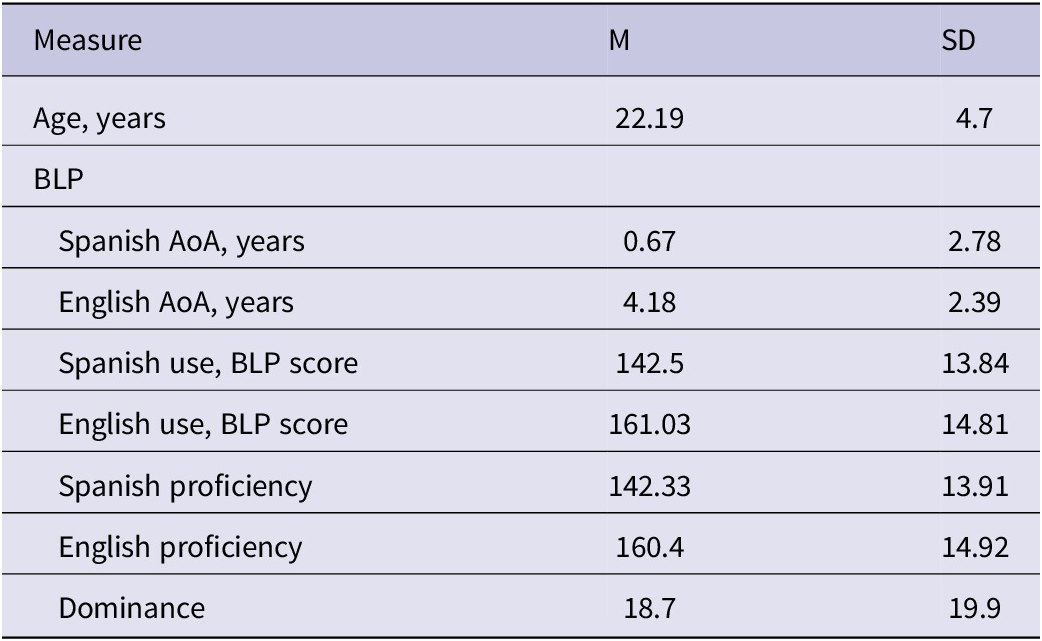
Heritage speakers of Spanish, bilingual in Spanish and English, participated in this study (N = 60, 52 females).Footnote 1 Participants were compensated for their participation. Bilinguals were recruited at the University of California, Irvine, and nearby community colleges. Participant demographic information is summarized in Table 1 below.
Self-reported participant characteristics

Note. Age of acquisition (AoA). Language use scores were computed by adding participant self-ratings for Spanish and English use and multiplying by a weight of 1.09. Dominance scores range from −218 (Spanish-dominant) to +218 (English-dominant), scores near 0 indicate balanced bilingualism.
9. Materials and tasks
9.1. Semantic verbal fluency task
A semantic verbal fluency task was used to measure language proficiency in each language. Each language block (Spanish and English) included five categories sampled from: kitchen utensils, furniture, clothes, colors, body parts, vegetables, professions, musical instruments, family members and animals. Categories were counterbalanced across languages. Participants had 30 seconds to name as many items as possible after a tone. Responses in the incorrect language, proper nouns, or repeated variations (e.g., “dark blue” and “light blue”) were coded as incorrect. The total number of correct responses per language was analyzed.
9.1.1. Picture-naming task
Adapted from Beatty-Martínez et al. (Reference Beatty-Martínez, Navarro-Torres, Dussias, Bajo, Guzzardo Tamargo and Kroll2020b), this task included 132 black and white line-drawn images: 64 named in English and 64 in Spanish. Participants were instructed to name each picture as quickly and accurately as possible in the appropriate language. Responses involving hesitations, multiple answers, or inaccuracies were coded as incorrect. Dialectal variations (e.g., “coche” or “carro” for “car”) were accepted. Reaction times for correct responses were analyzed, with exclusions for times below 300 ms or above 3000 ms and those that were 2.5 standard deviations above/below the mean RT of each participant (15% of trials).
AX-CPT. The AX-version of the Continuous Performance Task (Ophir et al., 2009) was used to measure preference for proactive or reactive strategies of cognitive control. Participants responded to 5-letter sequences in the following order: cue (A or B), three distractor letters, and a probe (X or Y). Participants were instructed to press the right key (M) for the first four letters. If the first letter (cue) was an “A” and the last letter (probe) was an “X,” participants were instructed to press the left key (Z). For any other cue-probe combinations, they were to continue pressing the right key (M). AX trials appeared 70% of the time, and AY, BX, and BY trials appeared 10% each. Error rates and reaction times were recorded for all experimental trials. Reaction times lower than 100 ms or beyond 2.5 SDs from the mean were excluded. The BSI (Braver et al., Reference Braver, Paxton, Locke and Barch2009) was calculated as (AY – BX)/(AY + BX) for correct responses, with a positive BSI indicating proactive control (greater interference in AY trials) and a negative BSI indicating reactive control (greater interference in BX trials). Performance on AY trials was also analyzed. High error rates for this trial suggest failure to appropriately inhibit prepotent responses and slower RTs potentially reflect greater reliance on contextual information and engagement of proactive control (Beatty-Martínez et al., Reference Beatty-Martínez, Navarro-Torres, Dussias, Bajo, Guzzardo Tamargo and Kroll2020b).
9.2. Questionnaires
The Bilingual Language Profile (Birdsong et al., Reference Birdsong, Gertken and Amengual2012) assessed language history, use, proficiency and attitudes, computing a continuous dominance index from −218 (Spanish dominance) to +218 (English dominance). Participants also completed the Bilingual Switching Questionnaire (BSQ; Rodriguez-Fornells, Reference Rodriguez-Fornells, Krämer, Lorenzo-Seva, Festman and Münte2012) to assess language switching frequency across five scales rated on a five-point scale: L1-switch (tendency to switch into the L1), L2-switch (tendency to switch into the L2), contextual switch (CS; any switches triggered by contextual factors such as a particular situation or environment), unintended switches (US; characterized by a lack of awareness), and an overall switch score (OS; raw addition of participant scores from previous four scales). The descriptive statistics for each of the scales L1S, L2S, CS, US and OS are reported in Supplementary Table A1 (Appendix).
10. Procedure
The study was conducted online using the Gorilla (www.gorilla.sc) experimental platform. Participants were invited to a virtual lab via Zoom. The experimenter introduced the study and remained in the Zoom meeting until the study was completed. Participants completed the verbal fluency and picture-naming tasks, followed by the AX-CPT and questionnaires. Some participants (n = 31) started with the picture-naming task in Spanish, while others (n = 29) started in English. The session lasted 1.5 to 2 hours, including a 10-min break in between the language production tasks and the AX-CPT (see the procedure represented in Supplementary Figure A1 in the Appendix).
11. Analysis
Two participants with accuracy lower than 60% for Spanish trials were excluded from the analysis (N = 58). All analyses were conducted in the R programming environment (version 4.4.1) using generalized mixed-effects models through the lme4 package (Bates et al., Reference Bates, Mächler, Bolker and Walker2015). The analysis was conducted in two parts to predict picture-naming accuracy and reaction times using a simple model that included the main predictors as fixed effects: order of presentation (Spanish-first = −0.5, English-first = 0.5), language (Spanish = −0.5, English = 0.5), AY error ratesFootnote 2, and all possible interactions between these. Continuous variables were centered and standardized. Initially, we fit random effects to include a random slope of AY errors in the random intercept of Participant and a random slope of Language in the random intercept of Target for both models. During the model fitting process, an issue arose with the convergence of the random effects structure that led to the decision to remove the random slope of AY in the random intercept of Participant and the random slope of Language in the random intercept of Target for both modelsFootnote 3. The following models were used to predict accuracy and reaction times, respectively:
 $$ \begin{array}{l} glmer\left( Accuracy\sim Order\times Language\times AY\; Errors\right.\\ {}\left.+\left(1| Participant\right)+\left(1| Item\right)\right).\end{array} $$
 $$ lmer\left( Reaction\ Times\sim Order\times Language\times AY\; Errors+\left(1| Participant\right)+\left(1| Item\right)\right). $$
In a secondary analysis, the potential influence of language dominance (Dominance) and frequency of L2-switches (L2S; frequency of switches from the L1 to the L2 from the BSQ)Footnote 4 were included alongside the primary fixed effects of interest. These were included to examine whether individual differences in language dominance and CS experience could account for variability in our predicted outcome measures. We ensured that there was low multicollinearity among the predictors by computing variance inflation factor (VIF) values (see Supplementary Table A2 in the Appendix). The following models, including the additional fixed effects, were used to predict accuracy and reaction times, respectively:
 $$ glmer(Accuracy\sim Order\times Language\times AY\;Errors+Dominance $$
 $$ + BSQ+\left(1| Participant\right)+\left(1| Item\right)\Big) $$
 $$ lmer(Reaction\ Times\sim Order\times Language\times AY\;Errors+Dominance $$
 $$ + BSQ+\left(1| Participant\right)+\left(1| Item\right)\Big) $$
12. Results
The simple models, which included only the primary predictors, and the more complex models with the added fixed effects (Dominance and BSQ) were compared using the likelihood ratio test. There was a significant improvement in model fit (χ2(2) = 6.40, p = .041) when comparing the two models that predicted Accuracy. This suggests that including the additional variables (in the complex model) provides a better explanation of the variance in Accuracy, supporting the inclusion of these as fixed effects in this analysis. When comparing the two models predicting Reaction Times, there was a trend toward improvement in model fit (χ2(2) = 5.37, p = .068), although it did not reach statistical significance (p > .05). A slight decrease in Akaike information criterion (AIC) and Bayesian information criterion (BIC) values suggests that including the additional variables (in the complex model) contributed to a better explanation of the variance in Reaction Times. We report the simple models and their output in the Appendix (see Supplementary Tables A3 and A4 for the model predicting Accuracy and the Reaction Time model, respectively).
Descriptive statistics of picture-naming performance demonstrated that on average participants named pictures in English more accurately and with faster reaction times, compared to Spanish. Performance on this language production measure is summarized in Table 2 below.
Descriptives of language production measures: picture-naming

Note. Mean and standard deviations for language production measures by each task and divided by order of presentation.
12.1. Picture-naming accuracy
In the primary analysis, we examined the effects of order of presentation, language, and AY error rates (and the interactions between these) on picture-naming accuracy using the following model:
 $$ glmer\Big( Accuracy\sim Order\times Language\times AY\; Errors+ Dominance $$
 $$ + BSQ+\left(1| Participant\right)+\left(1| Item\right)\Big) $$
Given the significant improvement in model fit (χ2(2) = 6.40, p = .041) that was observed with the inclusion of L2S (L2-switch factor from the BSQ) and Dominance in the complex model, we elaborate on the significant effects that resulted from that model (see Table 3 below) on the basis that it suggests additional explanatory power for accuracy outcomes compared to the simple model.
Estimated coefficients from the (complex) mixed-effects logistic regression model on picture naming accuracy

Note. Model formula: glmer(Accuracy ~ Order × Language × AY Errors + L2S_BSQ + Dominance + (1 |Participant) + (1|Item)). Confidence intervals (CI). Language Dominance based on BLP responses. Intercept is scaled accuracy for picture naming. Bolded p-values are statistically significant from zero.
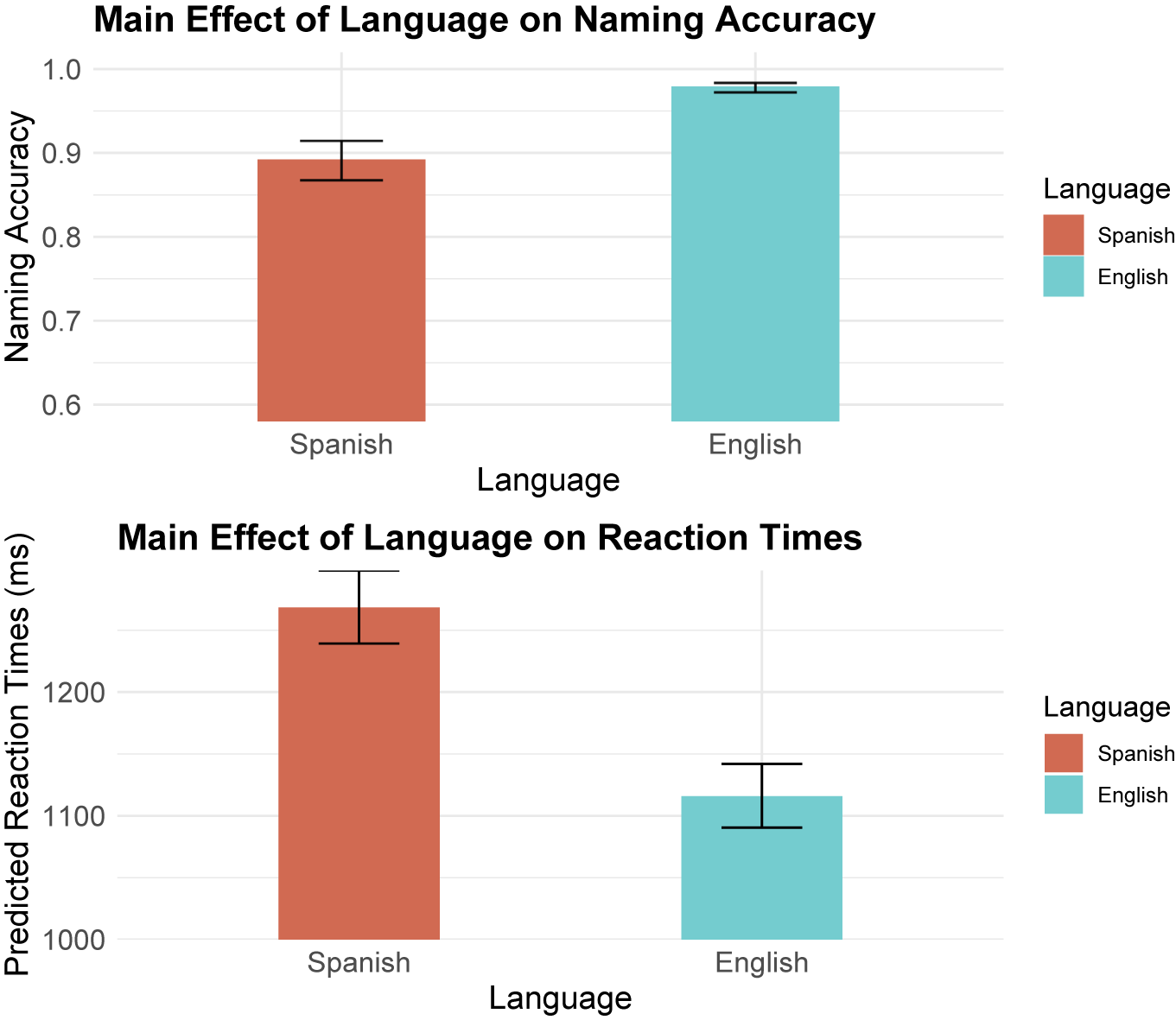
Fixed effects results indicated a significant main effect of language on naming accuracy (𝛽 = 1.67, SE = 0.34, z = 4.96, p < .001), suggesting that naming accuracy in English was significantly higher than in Spanish, holding other variables constant.
Main effect of language on naming accuracy (𝛽 = 1.67, SE = 0.34, z = 4.96, p < .001) and reaction times (𝛽 = −0.06, SE = 0.01, t = −4.89, p < .001).

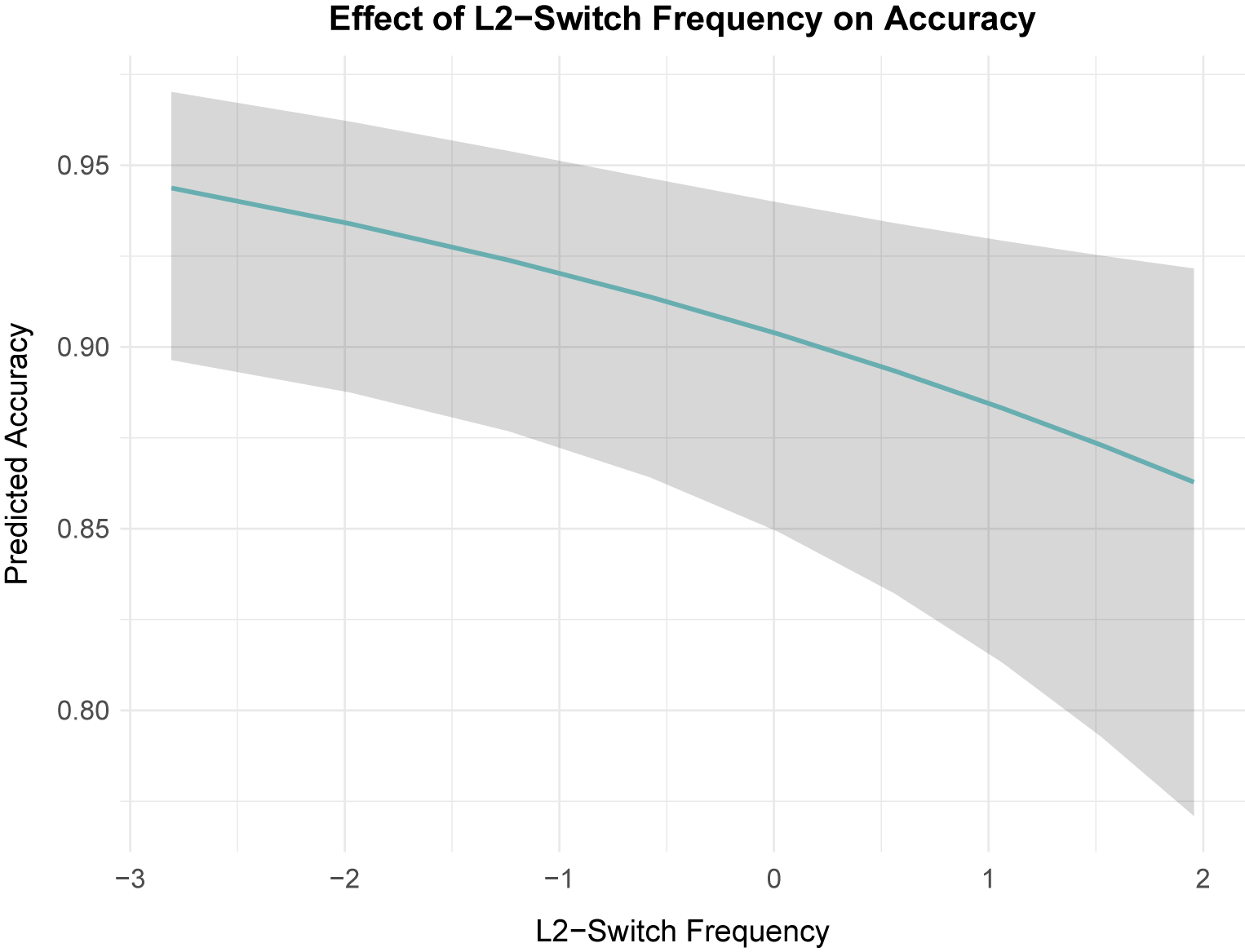
The frequency of L2 switches (Figure 2) also significantly impacted accuracy, where a higher frequency of switches from the L1 (Spanish) to the L2 (English) was associated with lower accuracy (𝛽 = −0.21, SE = 0.08, z = −2.44, p < .05).
Main effect of self-reported frequency of L1-L2 switches (BSQ) on naming accuracy (p < .05) averaged across both languages. Higher frequency of L2 switches is associated with a decrease in naming accuracy.

Other effects were not statistically significant, such as the influence of the order of presentation on accuracy (𝛽 = −0.13, SE = 0.17, z = −0.74, p = .46), nor the effect of AY error rates (𝛽 = −0.12, SE = 0.09, z = −1.37, p = .17). However, there was a trend towards significance for the interaction between language and AY error rates (𝛽 = 0.17, SE = 0.09, z = 1.95, p = .05), indicating that the effect of AY errors may differ significantly between languages.
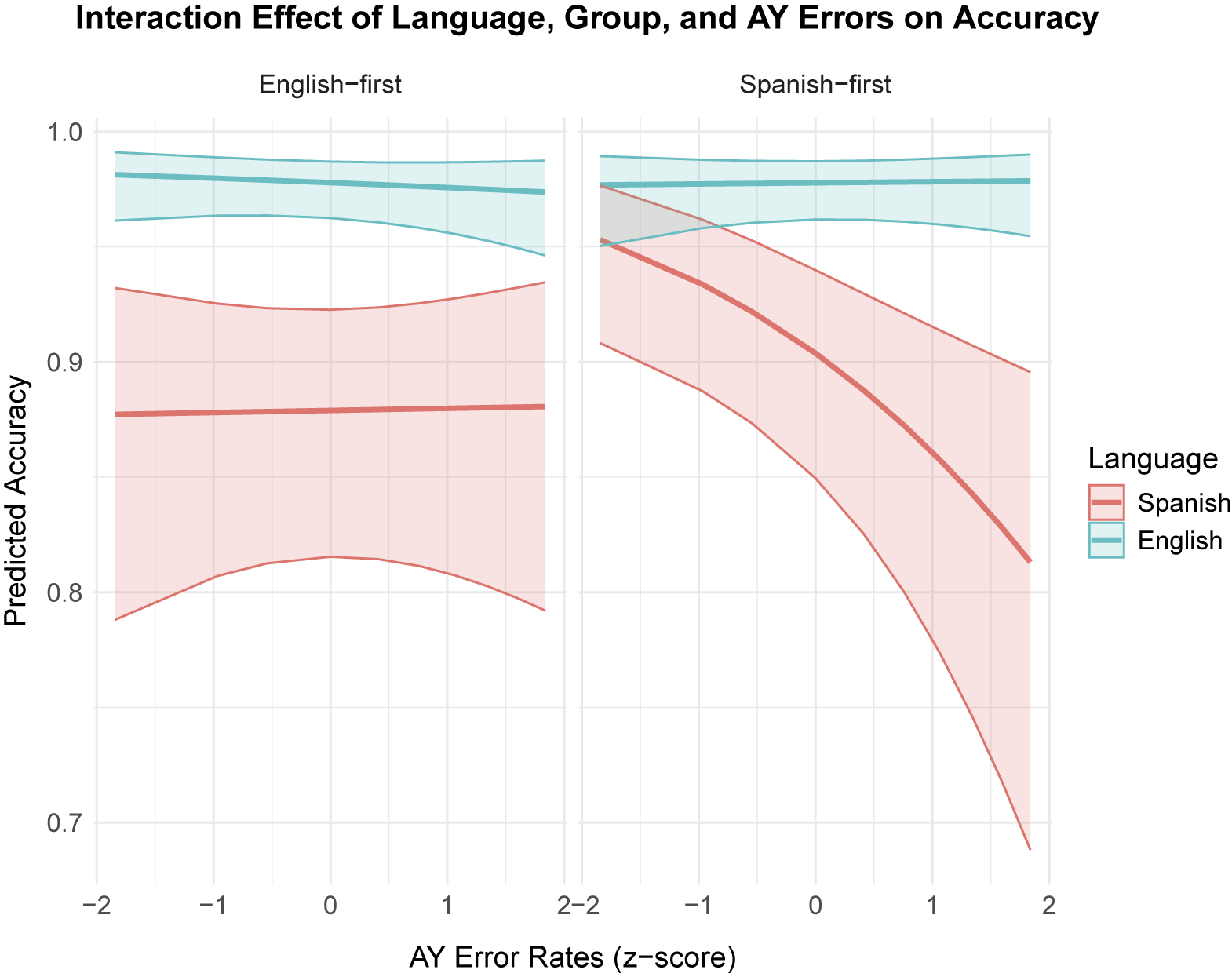
Finally, a statistically significant three-way interaction was observed between order, language, and AY error rates (𝛽 = −0.54, SE = 0.17, z = −3.13, p < .01). This suggests that the relationship between AY error rates and naming accuracy was modulated by both the language of the trial and the order of presentation (whether participants started the tasks in Spanish or English, see Figure 3 below).
Plot of Language by AY Errors interaction effect on accuracy for English-first and Spanish-first conditions. Higher AY error rates suggest greater reliance on proactive control (lower = reliance on reactive control).

Based on previous findings, we hypothesized that the order of naming would reflect differences in the degree to which the two languages were regulated. The results revealed that as the rate of AY errors increases (suggesting engagement of proactive control), the likelihood of successful naming decreased more significantly for participants in the Spanish-first condition than for those in the English-first condition, particularly for Spanish naming accuracy.
12.2. Picture-naming reaction times
In the primary analysis, we examined the effects of order of presentation, language and AY error rates (and the interactions between these) on picture-naming reaction times using the following model:
 $$ lmer\left( Reaction\ Times\sim Order\times Language\times AY\; Errors+ Dominance+ BSQ+\left(1| Participant\right)+\left(1| Item\right)\right). $$
The model revealed several significant effects in predicting Reaction Times (see Table 4 below).
Estimated coefficients from the (complex) linear mixed-effects model on picture naming reaction times

Note. Model formula: lmer(Reaction Times ~ Order × Language × AY RTs + Dominance + BSQ + (1|Participant) + (1|Item)). Confidence intervals (CI). Language Dominance based on BLP responses. Intercept is the log reaction time for picture naming. Bolded p-values are statistically significant from zero.
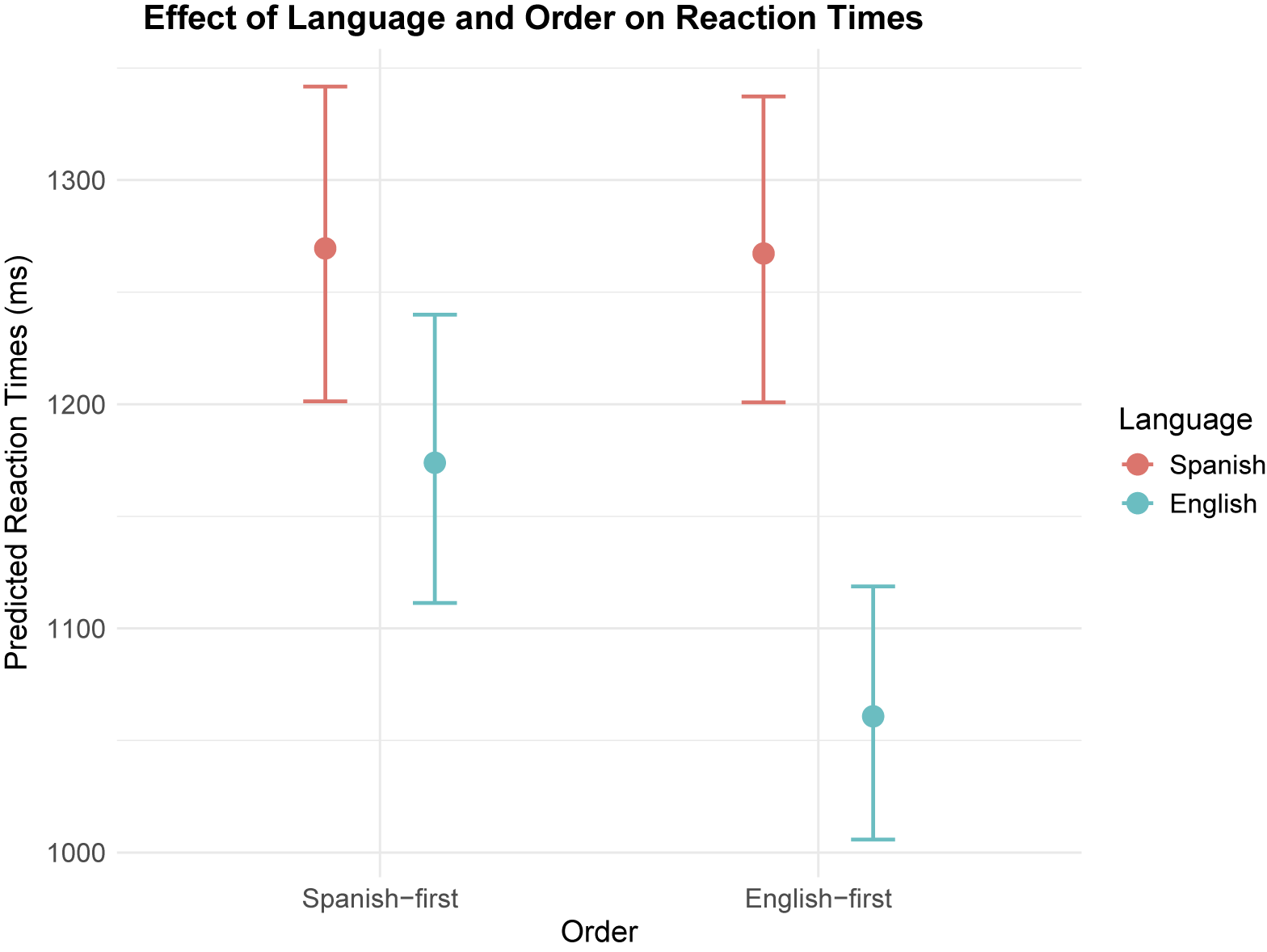
Fixed effects results indicated a significant main effect of language on reaction times (𝛽 = −0.06, SE = 0.01, t = −4.89, p < .001), suggesting that RTs in English were significantly faster than those in Spanish (see Figure 1 above). The effect of language dominance was also significant (𝛽 = 0.01, SE = 0.01, t = 2.27, p < .05), suggesting that participants with higher English dominance showed slower reaction times overall. Both the effects of order of presentation (𝛽 = −0.02, SE = 0.01, t = −1.75, p = .09) and L2-switching frequency (𝛽 = 0.01, SE = 0.01, t = 1.81, p = .08) were merely approaching significance.
As for the interaction terms that were tested in this model, the interaction between order of presentation and language was highly significant (𝛽 = −0.04, SE = 0.01, t = −6.97, p < .001), indicating that whether participants started the task in Spanish or English negatively modulated reaction times (Figure 4).
Interaction between language (Spanish versus English) and the order of presentation (Spanish-first versus English-first) on predicted reaction times (in milliseconds). Error bars indicate 95% confidence intervals.

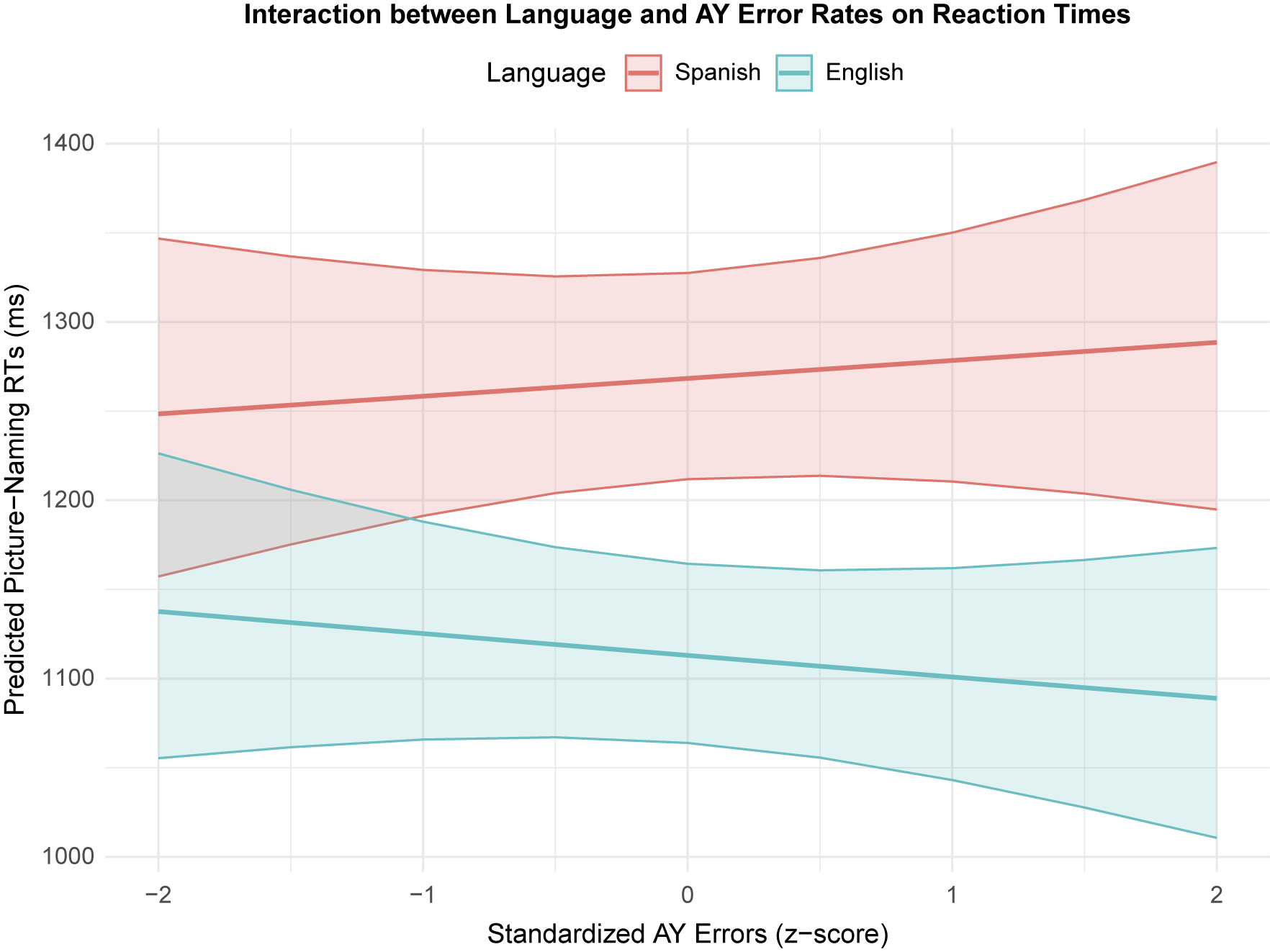
The interaction between language and AY errors was also highly significant (𝛽 = −0.01, SE = 0.003, t = −2.7, p < .01), indicating a negative association between AY errors and picture-naming RTs by language (Figure 5). Other interactions, including the combined effect of the three-way interaction on picture-naming reaction times, were not significant.
Interaction effect between language and standardized AY errors on picture-naming RTs. AY error scores above 0 are indicative of engagement of proactive control.

Next, we report the results from participant performance on additional tasks that, while not the primary focus of the study, contribute to a more comprehensive understanding of our research questions.
How is language production influenced by heritage language experience?
The distribution of dominance scores from the BLP suggests a wide range of dominance profiles ranging from −41.78 (Spanish dominance) to 56.85 (English dominance) and a prominent skew toward English dominance (M = 18.7, SD = 19.9). A plot with the distribution of raw dominance scores can be found in Supplementary Figure A1 in the Appendix. Here, we report the effect of AY errors (Beatty-Martínez et al., Reference Beatty-Martínez, Navarro-Torres and Dussias2020a; Luque & Morgan-Short, Reference Luque and Morgan-Short2021; Morales et al., Reference Morales, Gómez-Ariza and Bajo2013). Some studies have used the BSI (e.g., Zhang et al., Reference Zhang, Diaz, Guo and Kroll2021), which is an aggregate measure of proactive control. For the most part, these results align: BSI scores show that on average, participants had a higher preference for proactive control (Supplementary Figure A2).Footnote 5
Post-hoc analysis of verbal fluency demonstrated that, on average, participants produced more items in English than in Spanish in the verbal fluency task, t(59) = 2.90, p < .01, with a mean difference of 5.12 items (95% CI [1.57, 8.66]). Overall, for this language production measure, heritage speakers were generally dominant and more proficient in English compared to Spanish (see Supplementary Table A5 in the Appendix). To account for the influence that may have resulted from the order of presentation, we ran two linear models to predict verbal fluency scores in each language with order of presentation as a predictor. No significant effects were found for predicting English verbal fluency (Supplementary Table A6) or Spanish verbal fluency (Supplementary Table A7), suggesting that the order of presentation did not significantly influence verbal fluency outcomes in this sample. The absence of such effects could be attributed to differences in participant characteristics or the specific semantic categories that were employed (see Luo et al., Reference Luo, Luk and Bialystok2010 for differences in performance on phonemic (or letter) fluency versus semantic (or category) fluency).
13. Discussion
The present study extends a previously reported relationship between spoken language production, bilingual language experience, and cognitive control to a population of heritage language bilinguals. We report data on heritage speaker performance on spoken word production in English and Spanish that suggests that for heritage bilinguals, there may be a more complex pattern of cognitive control associated with each language than observed in previous studies. Heritage speakers who relied on proactive control strategies produced lower accuracy and slower RTs in Spanish but higher accuracy and faster RTs in English. Secondary analyses revealed that this effect varied as a function of the order in which participants switched languages. Potentially, for participants in the Spanish-first condition, when they engaged proactive control, which typically aids their performance in English, they may have allocated greater cognitive effort to inhibit their dominant language and activate their non-dominant language first. The consequences of this included lower accuracy rates and slower reaction times for speakers who were generally highly proficient (though not dominant) in Spanish, when they started the task in this language.
It appears that there is evidence for a differential effect of cognitive control strategies on production in each language that is modulated by the order of presentation. By engaging proactive control, a more pronounced decrease in Spanish accuracy is observed for individuals in the Spanish-first condition. However, when they were required to switch from their more dominant language (i.e., English) to Spanish, there appeared to be no major impact on accuracy based on the participant’s cognitive control profile. In this respect, the heritage bilinguals from our sample performed similarly to those in the varied context reported in Beatty-Martínez et al. (Reference Beatty-Martínez, Navarro-Torres and Dussias2020a). Namely, both the heritage bilinguals in the Spanish-first condition in the present study and those in the varied context in the Beatty-Martínez et al. study relied on proactive control to maintain their L1 Spanish, suggesting that they allocate cognitive resources proactively to enable speech planning in Spanish in an environment that typically requires them to use English. However, it is interesting to note that a different pattern was observed for the heritage speakers in the English-first condition.
Why does the order in which naming was performed matter? Past research suggests that speaking the more dominant language after speaking the less dominant language is likely to reveal a downregulation of the more dominant language, presumably that enables the less dominant language to be spoken. This spillover effect from the language that is functionally the L2, or less dominant language, to the L1, vis-à-vis the more dominant language, has been replicated in previous studies (e.g., Casado et al., Reference Casado, Szewczyk, Wolna and Wodniecka2022; Misra et al., Reference Misra, Guo, Bobb and Kroll2012; Van Assche et al., Reference Van Assche, Duyck and Gollan2013) and taken to reflect the dynamics of how both languages are regulated to enable fluent production when one is more dominant than the other. Misra et al. (Reference Misra, Guo, Bobb and Kroll2012) demonstrated that this down-regulation persists even after switching back to the more dominant language in the final block, suggesting that a global inhibitory effect can influence subsequent language use. The data suggest that while not statistically significant, the order of language blocks may have slowed naming latencies in English (the dominant language) more when it followed Spanish (the less dominant language). Further data is needed to confirm this potential order effect which is critical for heritage speakers, who may experience this effect to a greater extent given the frequency with which they navigate between their two languages.
Less is known about how the frequency of language switching, which is potentially high for heritage bilinguals, affects the recovery from these regulatory consequences and how, over an extended time, there might be changes in the way that cognitive resources are recruited to maintain proficiency. It is possible that heritage speakers, by virtue of their frequent switching, adapt differently to the sustained inhibitory effects on the dominant language, leading to variability in how they recruit cognitive control strategies. These findings suggest that heritage speakers, in contrast to late bilinguals (e.g., Bice & Kroll, Reference Bice and Kroll2015; Linck et al., Reference Linck, Kroll and Sunderman2009), who potentially acquire their L2 in a structured and separate setting as adults with established strong proficiency in their L1, may encounter more opportunities requiring them to switch languages. These differences in language experience and usage mean that heritage speakers face the unique challenge of maintaining their dominant L2 and also their L1, with more opportunities to switch on a daily basis, potentially resulting in greater variation for these speakers in how they recruit cognitive control strategies to regulate each of their languages.
13.1. Dynamic language control and linguistic adaptation
The findings suggest that proactive control is the preferred strategy for heritage speakers, although its relationship to language production is potentially more dynamic than had previously been suggested. We hypothesized that the social ecology of the linguistic behavior of heritage speakers is highly variable, with more frequent changes in their interactional context compared to those of other bilinguals. Within the course of a day, heritage speakers use their languages in contexts where they may encounter completely different environmental demands, to which they must adapt, to remain in a single language, use both languages through language mixing (i.e., CS), or switch between both languages based on the speaker, the topic of conversation, or other situational factors.
The patterns observed in the present study for heritage speakers converge with those reported for bilingual speakers from the varied context in Beatty-Martínez et al.’s (Reference Beatty-Martínez, Navarro-Torres, Dussias, Bajo, Guzzardo Tamargo and Kroll2020b) study, bilinguals from Hispanic countries who resided in Pennsylvania, U.S. at the time of the study. They report a positive association between AY error rates and Spanish accuracy, which may be attributed to a strategic resolution of conflict interference to sustain lexical access to Spanish in an environment that predominantly requires English. The finding observed in the present study is also supported by Zhang et al. (Reference Zhang, Kang, Wu, Ma and Guo2015); Zhang et al., Reference Zhang, Diaz, Guo and Kroll2021) which reported a shift towards proactive control in late L2 bilinguals who underwent extensive language switching training. Furthermore, the convergence between these findings can further illuminate the significance of a shift in language dominance that is seen in heritage bilinguals. It may be the case that the lifelong experience of being immersed in the societal language, as is the case for heritage speakers, shares similarities in the adaptive engagement of cognitive resources that late L2 speakers, such as those from Zhang et al. (Reference Zhang, Diaz, Guo and Kroll2021), experienced during their immersion in an L2-dominant context. A shift in language dominance is the extended real-life version of this short-term immersive experience. A necessary next step is to characterize the habitual language patterns of heritage bilinguals and the diversity of their interactional contexts to identify better measures of bilingual language experience for these speakers.
13.2. Dynamic interactional context and heritage bilingual experience
Individual differences in the specific ways that heritage speakers use their two languages may also play a role in how adaptive responses are driven by interactional costs. In line with Green and Abutalebi (Reference Green and Abutalebi2013), heritage bilinguals encounter all three interactional contexts proposed in the ACH (e.g., single language, dual language and dense code-switching) at different points within their day. The question remains: how can we observe the adaptive response in heritage bilinguals as they navigate such a dynamic and complex interactional context? Adaptive control processes occur as a response to interactional costs, when speakers suppress interference from the dominant language in a single-language context (e.g., when an English-dominant heritage speaker is in their home environment speaking Spanish with their parents or grandparents). In a dual language context, the interactional cost that is incurred by the speaker may be related to their ability sustain attention to the language that is being used in a particular situation and to cues to switch languages (e.g., a heritage speaker is dining at a Mexican restaurant and speaking to a friend in English but switches to Spanish to address the waiter). Finally, in the dense code-switching context, the interaction cost that drives an adaptive response may be related to a speaker’s ability to codeswitch with other members of the speech community (e.g., a heritage speaker learning that it is socially appropriate to codeswitch in a given context and progressively engaging in this form of speech with others). In theory, we would expect to see overlap in the adaptive responses of bilinguals who navigate similar interactional contexts, even if to different extents. To date, previous findings confirm the presence of an adaptive response, where the effect of limiting competition from the nontarget language leads to decreased speed of response in the target language (e.g., Zhang et al., Reference Zhang, Kang, Wu, Ma and Guo2015).
In this initial study, we have demonstrated that heritage bilingual experience is related to language production and cognitive control. However, further research is necessary to understand which processes of executive control are involved in aspects of bilingual experience, such as language switching. For instance, the data from the present study suggest that there may be a relation between heritage speakers’ perceptions of L1-L2 switching during actual CS in natural contexts and their performance on the lexical-level language switching task. Although inadvertent CS may reflect mechanisms that differ from cued language switching, investigating the relationship between these factors may tell us whether language switching can be used as a proxy for switching more generally. If the frequency of language switches in the L1-L2 direction are related to monitoring abilities, then considering this variable could reveal interindividual differences in the interplay between cognitive control and linguistic functions. A measure of individual differences in language switching that more adequately considers the frequency of language switches in either direction in ways is essential to help us identify the role of language switching as a skill for speakers who have adapted to communicating in contexts that demand more automatic and regular switching and how these types of switches recruit cognitive resources differentially.
Future areas for exploration are in the detection of cues that signal language selection and their association with specific language contexts. For heritage speakers in Southern California, attention to cues is imperative due to the high degree of linguistic diversity in this context. The possibility for either Spanish or English to be used at any given moment is high and speakers must learn to identify and attend to cues that inform them of an upcoming switch. In another study, Zhang et al. (Reference Zhang, Morris, Cheng and Yap2013) reported a series of studies that reveal the effect of cultural priming on linguistic performance. They showed that incongruent cues can lead highly proficient Mandarin-English bilingual speakers to produce disfluencies in speech. The authors showed how the underlying controlled/automatic mechanisms that perceive and assimilate to cultural cues in the environment are adaptive in nature. Although their study focused on bilingual speakers situated in contexts where their languages are learned and primarily used in a separate manner, it would be interesting to consider the extent to which cultural cues can prime heritage speakers who potentially possess a more integrated use of their two languages. This could potentially reveal differences in the ways heritage speakers process cultural cues. Measures such as language entropy (Gullifer & Titone, Reference Gullifer and Titone2020) which provide a quantifiable measure of (multi)language usage across communicative contexts could better support investigations into the distinctive cues that could, for example, prime a heritage speaker to speak Spanish at a university or academic setting versus when entering a local grocery store in their neighborhood.
14. Conclusion
To identify how heritage bilinguals recruit cognitive control to regulate their two languages, a deeper characterization of the linguistic and interactional contexts that heritage speakers navigate is necessary. In this initial study, we have described heritage speakers as a unique group of bilinguals whose linguistic experiences within a variable interactional context may contribute to the field’s understanding of the relationship between language and cognition. Critically, this study serves as an opportunity to understand how heritage bilinguals navigate a dynamic interactional context and adapt to the demands it imposes on their linguistic and cognitive abilities. These findings potentially establish a baseline for future studies examining language switching in the presence of distinct cues for heritage speakers who live on both sides of the US-Mexico border. By asking these questions, we learn more about the experience of heritage bilinguals and also demonstrate how that experience provides a powerful tool for investigating the relations between language and cognition more generally.
Supplementary material
The supplementary material for this article can be found at http://doi.org/10.1017/S1366728925000203.
Data availability statement
The data reported for this study are available from the corresponding author upon request.
Acknowledgements
The research reported in this paper is based upon work supported by a National Science Foundation Graduate Research Fellowship, DGE-1839285, to JHS. We extend our gratitude to all participants and the undergraduate research assistants who helped with data collection at UC Irvine. This work was supported in part by the Howard Schneiderman Interdisciplinary T32 Training Program in Learning and Memory (Grant Number T32 MH119049-06), which provided funding during the preparation of this manuscript. The content is solely the responsibility of the author(s) and does not necessarily represent the official views of NIH.
Competing interest
The authors declare none.





 Open access

