




Introduction
Archaeological methods and perspectives can be applied to the material traces of human behaviour from all periods, including the present. Although such traces vary widely in form (flint vs plastic, for example), context (from deeply stratified deposits to surface remains and from terrestrial to marine environments), and date (from early prehistory to the contemporary world), the same questions often apply. What is it? Why is it here? What behaviours does it represent? What processes (cultural and natural) have affected it since its deposition (after Schiffer Reference Schiffer1976)? More recently, archaeologists have started to ask how this newfound knowledge shapes the way we think about the contemporary world and about the future (e.g. Harrison et al. Reference Harrison2020).
The ages of prehistoric archaeology are named after the materials that characterise them: stone, bronze and iron. For the recent or contemporary past, which we define here as the period of living memory (after Harrison & Schofield Reference Harrison and Schofield2010; but see also Harrison (Reference Harrison2011), who advocates an ‘archaeology in and of the present’), the descriptor ‘Plastic Age’ has been suggested by archaeologists and others (e.g. Thompson et al. Reference Thompson, Swan, Moore and Vom Saal2009; Pétursdóttir Reference Pétursdóttir2017) due to the prevalence and resilience of plastic. In terms of prevalence, Geyer et al. (Reference Geyer, Jambeck and Law2017) estimated that as of 2017, 8300 million metric tons of virgin plastics have been produced since its invention in 1907. Overall—and accepting regional variations—only nine per cent of this plastic has been recycled or re-used, resulting in billions of metric tons lost to the environment (as “matter out of place”, after Douglas (Reference Douglas2002 [1966]: 44)). Most of this discard has reached the marine environment either via rivers and their catchments, or by direct deposition (Geyer et al. Reference Geyer, Jambeck and Law2017; Parker Reference Parker2018). This ‘matter out of place’ creates a significant environmental problem, not least given plastic's resilience. Although the processes by which plastic breaks down into microplastics are broadly understood, the true extent of its longevity is unknown.
Research is ongoing across a range of disciplines to document, understand and mitigate the problem of marine pollution, for which there is no straightforward solution. From the present authors’ viewpoints of archaeology, marine biology, and politics and policy, we suggest that the material focus of archaeology offers a unique perspective on marine pollution that can help mitigate this problem, highlight the impact of behavioural change and thus effectively slow the leakage of plastic into the environment. Our suggestion builds on another recent archaeological intervention in Galápagos (Schofield et al. Reference Schofield, Wyles, Doherty, Donnelly, Jones and Porter2020). By working with local communities in the World-Heritage-listed archipelago, a collection of objects retrieved from local beaches was used to construct object biographies, a process that demonstrated to project participants how human behaviours are invariably the cause of the pollution, and how easily those behaviours can be changed. As part of related work, street surveys in the form of surface collection were combined with qualitative surveys amongst local community groups to demonstrate the relationship between perception and behaviours with regard to a specific and consistently problematic waste item in Galápagos, as elsewhere: the disposable plastic bag (Schofield et al. in press).
This article employs a comparable archaeological perspective to explore the specific material culture of COVID-19 (or ‘COVID waste’, after Kassam Reference Kassam2020), focusing on personal protective equipment (PPE) (and specifically single-use, plastic masks and gloves)—the most prevalent and visual examples of this waste—emphasising to archaeologists how this perspective can helpfully inform policy. In short, from across our respective positions in the arts and humanities, sciences and social sciences, we present the view that archaeology provides a unique foundation for shaping environmental policy in a COVID-19 (and post-COVID-19) world. We present this argument specifically to archaeologists, to encourage a greater recognition of the ways in which the discipline can be actively future- and policy-oriented.
Finally, by way of introduction, we should position ourselves relative to COVID-19 and COVID waste. From our locations in the UK, Belgium (but resident at time of writing in Mexico) and Australia, we are directly familiar with the situation in these four countries and in the additional places that we have worked (including Galápagos), but only indirectly with the situation elsewhere. Thus, we acknowledge likely differences in the circulation of plastic waste from the Global North to South. We also acknowledge the influence on COVID waste of factors including access to healthcare, the lack of access to disposable PPE and the politicisation of, and lack of instruction in, mask-wearing. Although not the focus of this article, archaeology would also seem well placed to address these and other societal differences.
Contemporary archaeology
Contemporary archaeology is typically defined as an archaeology in and of the present, a fluid moment in which archaeologists both encounter the world and have the opportunity to question it through material remains (Harrison & Schofield Reference Harrison and Schofield2010; Harrison Reference Harrison2011), to render the supposedly familiar unfamiliar (Graves-Brown Reference Graves-Brown2000: 1). In questioning the world, contemporary archaeology often adopts an activist approach, as was the case with Rathje and Murphy's (Reference Rathje and Murphy1992) study of garbology, and with more recent approaches to the archaeology of social justice (e.g. Kiddey Reference Kiddey2017). Contemporary archaeology is therefore different to conventional archaeological practice, as it focuses on a past that exists within living memory and that we continue to shape through our everyday practices. In contemporary archaeology, material culture exists on the surface, literally and conceptually (Harrison Reference Harrison2011; although it should be noted how plastic is also increasingly present within sedimentary deposits (e.g. Zalasiewicz et al. Reference Zalasiewicz2016; Mytum & Meek Reference Mytum and Meek2021).
It is from this present- and future-oriented position, while incorporating the perspectives of marine biology, policy and politics, that we focus our investigation on single-use, plastic PPE. This is a category of contemporary material culture that has rapidly come to characterise the COVID-19 pandemic, becoming a common sight in our neighbourhoods and increasingly also in remote places, including beaches and the marine environment. We thus pose the question: what can archaeology contribute to this particular and very contemporary aspect of environmental pollution? We begin with the problem itself, before suggesting an archaeological approach and, finally, assessing its policy implications.
COVID pollution
In the context of post-humanism (e.g. Sterling Reference Sterling2020), ‘naturecultures’ (e.g. Bartolini Reference Bartolini and Harrison2020) and future-oriented perspectives (e.g. Harrison et al. Reference Harrison2020), archaeology and the environment are inevitably and unavoidably entwined. Just as for earlier periods of archaeological enquiry—and thoughts turn, in particular, to the European Mesolithic—understanding material culture requires knowledge of the environment in which it occurs and vice versa. Humans have long been an integral part of the ecosystem, and our actions inevitably have consequences. As the volume of COVID-related items increases in the environment, so does the risk of animals interacting with them (e.g. Kassam Reference Kassam2020; Strokes Reference Strokes2020), the film-like, plasticised objects being of attractive shapes, textures, colours and consistency to a wide range of animals (e.g. Acampora et al. Reference Acampora, Schuyler, Townsend and Hardesty2014; Schuyler et al. Reference Schuyler, Wilcox, Townsend, Hardesty and Marshall2014; Priyank & Dey Reference Priyanka and Dey2018). From domestic animals within the developing world to wild marine species, all have been heavily affected by discarded plastic waste (Vegter et al. Reference Vegter2014; Priyank & Dey Reference Priyanka and Dey2018). Ingestion of these products can result in multiple health problems, including gut impaction or perforation, dietary dilution and exposure to toxic pollutants, all of which can lead to death (Vegter et al. Reference Vegter2014; Verma et al. Reference Verma, Vinoda, Papireddy and Gowda2016).
A further direct risk is the virus ‘jumping’ across species; indeed, this was how COVID-19 originally infected humans. Multiple examples show that dolphins and other marine mammals can be infected by coronaviruses, and that they can cause mortality (e.g. Woo et al. Reference Woo, Lau, Lam, Tsang, Hui, Fan, Martelli and Yuen2013; Nabi & Khan Reference Nabi and Khan2020). Furthermore, Prata et al. (Reference Prata, Silva, Walker, Duarte and Rocha-Santos2020) demonstrate that the virus can survive for up to three days on both plastic and non-plastic reusable bags (Williams et al. Reference Williams, Gerba, Maxwell and Sinclair2011; Barbosa et al. Reference Barbosa, Albano, Silva and Teixera2019). Indeed, a recent study shows that SARS-CoV-2 (the strain of coronavirus that causes COVID-19) survives on plastic with even more stability than on copper or cardboard (van Doremalen et al. Reference van Doremalen2020). Putting this in context, there are currently more than 914 marine species known to have been either entangled in and/or have ingested marine debris (Kuhn & van Franeker Reference Kuhn and van Franeker2020). Most of these species will also be susceptible to discarded COVID-related waste, as discussed below.
Despite clear environmental benefits of human quarantine and isolation, such as decreasing air and noise pollution (the so-called ‘Anthropause’; e.g. Searle et al. Reference Searle, Turnbull and Lorimer2021), a significant and less welcome side-effect of prioritising health during the COVID-19 pandemic has been an increase in plastic consumption and, more vitally, plastic pollution. Ignoring the use of PPE in hospitals, which we presume is predominantly, if not always, disposed of responsibly, this pollution largely comprises the public use of PPE, primarily in the form of single-use facemasks and gloves.
With COVID-19 the related plastic is both omnipresent and highly resilient, and its impacts both diverse and significant. Single-use facemasks, for example, are made of polypropylene, which has a very low degradation rate (Liço et al. Reference Liço, Boci, Vito and Marku2014). Starting around March 2020 in the UK, Australia and Europe, facemasks quickly became both the symbol of coronavirus and a highly coveted commodity (Subramanian Reference Subramanian2020), due, in part, to their scientifically evidenced efficacy in curbing the spread of infection (e.g. Liang et al. Reference Liang, Gao, Cheng, Zhou, Uy, Heiner and Sun2020; Zhang et al. Reference Zhang, Li, Zhang, Wang and Molina2020). At the time of writing, over 50 nations have imposed mandatory regulations for the use of facemasks in public, including, but not limited to, Venezuela, Czechia, Germany and Spain. In an example of policy informing material culture, Lebanon, Qatar and Morocco have imposed fines on anyone found not to be wearing a mask (Silva et al. Reference Silva, Prata, Walker, Campos, Duarte, Soares, Barceló and Rocha-Santos2020).
In the UK alone, 748 million items of PPE, amounting to 14 million items a day, were delivered to hospitals in the two or so months from 25 February 2020, comprising 360 million gloves, 158 million masks, 135 million aprons and one million gowns (Department of Health and Social Care 2020). Given the numbers now in use, facemasks have rapidly and unsurprisingly become a very obvious and visible addition to contemporary waste. To place this observation in a wider context, at the pandemic's original centre of Wuhan, China, clinical waste reached 200 tons in a single day (Saadat et al. Reference Saadat, Rawtani and Hussain2020), while in Quito, Ecuador, daily waste during the pandemic increased by 40 per cent, corresponding to an increase of 600 tons (Novillo & Lescano Reference Novillo and Lescano2020). Although these COVID-specific, single-use plastic items are a vital part of the response to COVID-19, these particular categories of material culture are also creating significant environmental problems that will long outlast the immediate health concerns of the virus. They are also now part of the archaeological record, representing a resilient account of a global pandemic and the world's response to it.
Within the context of this COVID-specific, single-use plastic and its impacts, our argument centres on the view that an archaeological perspective is uniquely placed to inform a policy-informed approach. It can
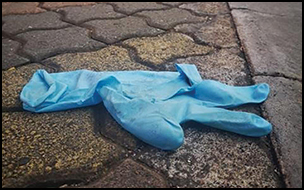
1) highlight the problem of waste by foregrounding ubiquitous items of plastic waste that have become symbolic of the pandemic (primarily masks and gloves) and that have entered the archaeological record (see Figure 1);
2) provide a longer-term perspective on this particular response to a pandemic, and changing attitudes to the use of single-use plastics over time;
3) contribute to much-needed solutions through archaeology's focus on the prevalence and resilience of material culture.
The sections that follow present an example of how this can be achieved.
Discarded gloves in Galápagos (above) and discarded facemasks in Brussels (below) (photographs by J.P. Muñoz Pérez & S. Praet).

An archaeological approach to pandemics
Archaeology has previously proved helpful in studying pandemics (after Antoine Reference Antoine2008; see also Roberts et al. Reference Roberts, Wrobel and Westaway2020). Examples include zooarchaeology to identify disease hosts (e.g. McCormick Reference McCormick2003); archaeobotany, palaeoecology and geoarchaeology to reconstruct climatic conditions and their influence on pandemics (e.g. Riddell et al. Reference Riddell, Erlendsson, Eddudóttir, Gísladóttir and Kristjánsdóttir2018); urban archaeology to understand how urban space and architecture shape the transmission of disease (Chouin Reference Chouin2018: 10); material culture and mortuary archaeology to provide a chronology of the victims, their status and burial practices (e.g. Bianucci & Kacki Reference Bianucci, Kacki, Harbeck, von Heyking and Schwarzberg2012); and, finally, bioarchaeology and palaeopathology to understand the physical effects of the disease, including the use of aDNA, stable isotope and proteomic analyses (e.g. Gallagher & Dueppen Reference Gallagher and Dueppen2018; Keller et al. Reference Keller2019).
In terms of the current COVID-19 pandemic, Forster et al. (Reference Forster, Forster, Renfrew and Forster2020) have employed a method previously developed for studying prehistoric populations to demonstrate—albeit not without contention—how phylogenetic networks could successfully help to trace undocumented COVID-19 infection sources. Moreover, a social media initiative (through Twitter: @Viral_Archive) has involved archaeologists curating a visual archive of the pandemic (see also Perry & Band Reference Perry and Band2020; https://en.unesco.org/covid19).
Our approach, however, is different, as it is less concerned with the archaeological evidence for pandemics in the past (or even the present), and more about what an archaeological lens adds to our understanding of the current and ongoing pandemic and its longer-term implications. Crucially, the approach shows how this perspective might help to inform policy relating to the pandemic's impacts, on, for example, wildlife, aesthetics and tourism. Having already discussed the material culture of COVID-19 (what we refer to as COVID waste), we can now also ask: what might the related archaeological data look like?
A brief archaeological case study
With the COVID-19 pandemic, lives around the globe have become more digital than ever before. One side effect of this is that social networks have become an increasingly important source of information for social sciences (building on, for example, Lewis et al. Reference Lewis, Gonzalez and Kaufman2012). Archaeology, by contrast, has tended to view social media as a tool for diffusion (e.g. Zuanni Reference Zuanni2017), rather than as a data source. We argue that by drawing data from social media sources, we can begin to use them as an archaeological resource.
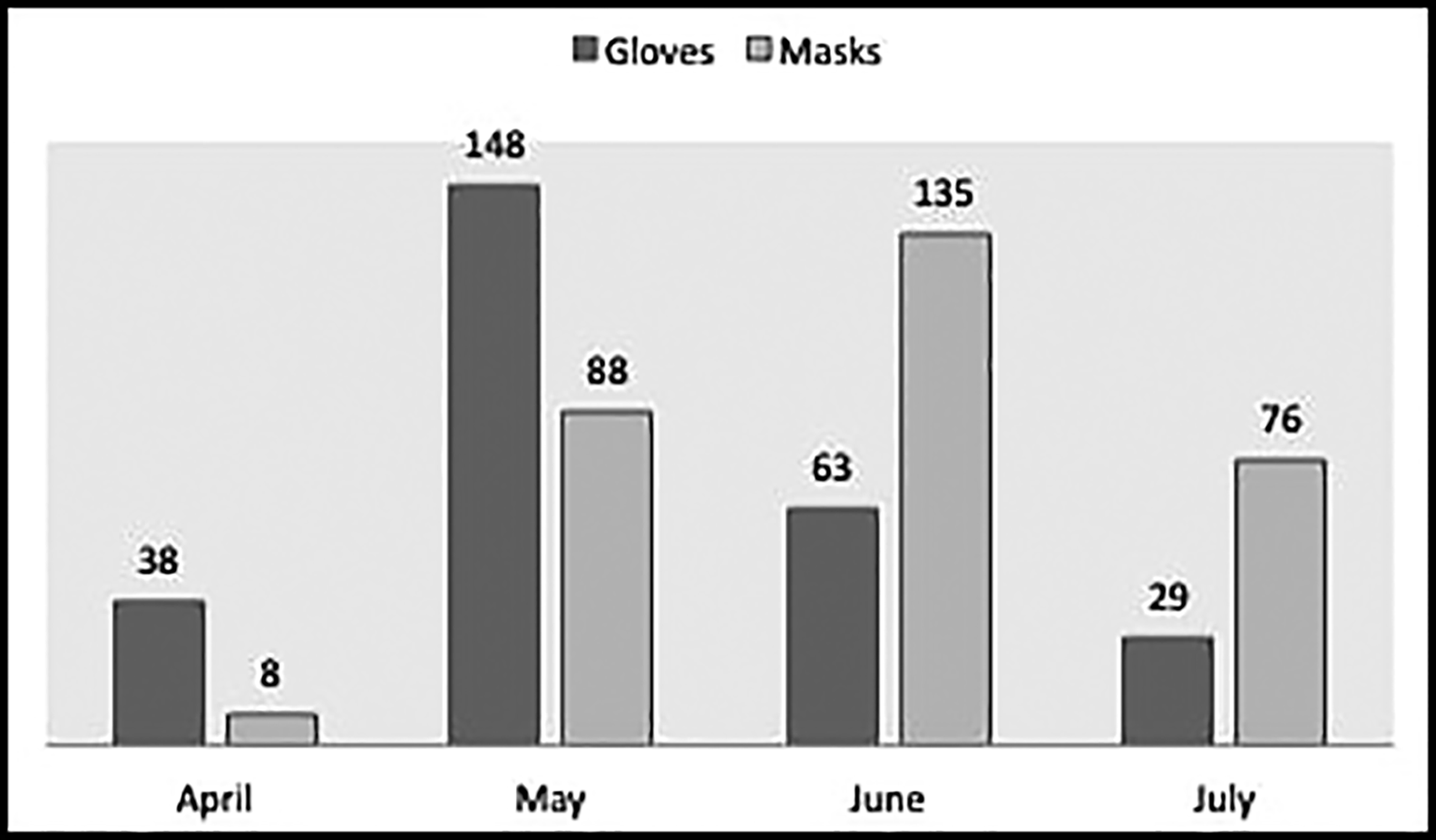
Since 23 March 2020, when, in the UK, the British Prime Minister addressed the nation and introduced the first tranche of lockdown restrictions, there has been a trend in evidencing COVID waste through social media. On Instagram, for example, around ten hashtags and at least eight accounts gathered COVID waste pictures in the USA, the UK and France, with the glovedropnyc account uploading 1476 pictures of discarded gloves in New York. Meanwhile, #theglovechallenge initiative by the environmental organisation Clean This Beach Up has gathered evidence of 17 467 single-use gloves (M.J. Algarra, pers. comm.) posted across Facebook, Twitter and Instagram. Even though COVID pollution exists on a global scale, the Clean This Beach Up campaign highlighted the extent of COVID waste reported on social media in the USA, with 35 per cent of the testimonies coming from New York and 21 per cent from Miami and Broward County in Florida. Algarra (pers. comm.) also registered a peak in testimonies between 27 April and 10 May 2020, with 200–250 pictures of gloves posted daily during this period. After the second week of May 2020, evidence of gloves started to decrease, whereas the number of masks appeared to grow. This trend is confirmed by Janis Jones (pers. comm.), who recorded 307 masks and 278 gloves in San Diego during her daily walks from April to July 2020 (Figure 2). An increase in discarded masks recorded by Jones in June probably relates to the World Health Organization's decision on 5 June to recommend the general public use of facemasks.
Numbers of masks and gloves identified by Janis Jones (pers. comm.) from 14 April to 16 July 2020 on daily walks in San Diego, USA.
Although only indicative, these data demonstrate how social media can provide an in-depth perspective on, and direct testimonies of, material culture. Our impression is that waste ‘consciousness’ on social media seems greater in English-speaking countries, arguably reflecting local differences of culture, geography (e.g. more urban testimonies) and privileges during this pandemic, all factors that affect the digital archaeological record. In contrast, one of the present authors recorded no discarded PPE items on the street while living through the pandemic in Huajuapán de León, Mexico, where most people wear reusable cloth face coverings. This is probably due to the cost of single-use masks alongside a preference for decorated facemasks. Social media initiatives can also provide interpretative context, for example, highlighting a need for waste disposal education and strong notions around the disposability of ‘cheap’ plastics, alongside other social and cultural factors.
Policy-making through contemporary archaeology
In this final section, we outline how archaeological data such as those outlined above can help to inform policy relating to plastic pollution. Scientific research on plastic pollution in Galápagos, along with community action and assistance from non-governmental organisations, for example, have influenced the islands’ Governing Council to change its plastic pollution policies. This includes the implementation of a waste-management programme that has the highest recycling rate in Ecuador, and a provincial ordinance regulating single-use plastics (e.g. Zambrano-Monserrate & Ruano Reference Zambrano-Monserrate and Ruano2020). A similar approach has also been undertaken with great success in Australia (Donnelly et al. Reference Donnelly, Munoz-Perez, Jones and Townsend2020).
While these are two examples of good practice, in reality, plastic pollution policies across jurisdictions are fragmented, ad hoc and inconsistent, and despite there being more regulatory measures in place than ever before, plastic pollution—and, notably, marine pollution—continues to increase (Dauvergne Reference Dauvergne2018). Global, international organisations and nation states have varied their approaches by implementing strict regulations, soft-law voluntary approaches or a mixture of both. Some policies directly address plastic use through bans and incentives (such as container deposit schemes), or indirectly through broader waste-management schemes or circular economy approaches. Prior to the COVID-19 pandemic, over 127 countries had made great progress in enacting laws and policies to reduce single-use plastic products and materials, and in targeting production levels (Silva et al. Reference Silva, Prata, Walker, Campos, Duarte, Soares, Barceló and Rocha-Santos2020). Kenyan law, for example, includes fines for offenders of up to US$38 000 (United Nations Environment Programme 2018), while Plastic Waste Directives and Strategies by the EU will ban ten types of single-use plastic product by 2021 (European Commission 2018).
Regulations, however, can be overturned when a ‘window of opportunity’ presents itself through a crisis (Kingdon Reference Kingdon1995), such as COVID-19. Companies including Starbucks and McDonalds, for example, have banned reusable cups ‘for consumer safety’. At an institutional level, bans on plastic bags have been temporarily lifted and policy implementation postponed in several states in the USA on advice from the Plastics Industry Association (Shen Reference Shen2020; Silva et al. Reference Silva, Prata, Walker, Campos, Duarte, Soares, Barceló and Rocha-Santos2020), while in the UK, plastic bags often remain available free of charge (McVeigh Reference McVeigh2020). From a psychological perspective, Musa et al. (Reference Musa, Hayes, Bradley, Clayson and Gillibrand2013) previously found that users preferred plastic bags, persuaded that their use would avoid cross contamination. Furthermore, laws banning the use of plastic straws, cotton buds and stirrers were delayed by six months (Perkins Reference Perkins2020). This shift in policy was also driven by the pandemic-related drop in oil prices that made new plastic cheaper to buy than recycled (Denne Reference Denne2020). In the USA, where many of these plastic bans were controversial, the COVID-19 crisis has legitimised their reversal, and decision-makers have attracted support from the groups who opposed the original policies. New policies regarding the mandatory use of facemasks in public spaces have been implemented in over 50 countries. This, along with an increase in the use of cleaning products, protective films on objects used to protect workers and other related medical items, has led to an overload of plastic waste with which disposal facilities have struggled to cope (Prata et al. Reference Prata, Silva, Walker, Duarte and Rocha-Santos2020; Silva et al. Reference Silva, Prata, Walker, Campos, Duarte, Soares, Barceló and Rocha-Santos2020). Policies that have been used during the pandemic have focused predominantly on mandatory actions, bans, taxation and fines, and result in immediate changes to human behaviour. They are not always regarded as effective solutions, however, and do little to “motivate wider sustainable views and behaviours” (Jia et al. Reference Jia, Evans and van der Linden2019).
The complexity and the widespread nature of plastic pollution, especially during the COVID-19 pandemic, makes it difficult for policy-makers to identify the most effective approaches while balancing political pressures from industry, communities and civil society groups. Future policies must move beyond bans, fines or forcing people to behave in a certain way. Encouraging the use of reusable PPE through incentives, for example, could easily reduce the number of facemasks in the environment (Figures 3–4). Future policies must also encourage governments, industry and communities to work together towards positive behavioural solutions (Vince & Hardesty Reference Vince and Hardesty2018; Jia et al. Reference Jia, Evans and van der Linden2019). As the case study above demonstrates, social media can be a powerful tool, as it has been shown to influence the political agenda (Barbera et al. Reference Barberá, Casas, Nagler, Egan, Bonneau, Jost and Tucker2019).
The necropsy of a green sea turtle recovered from the Queensland coast, Australia, conducted by Caitlin Smith and Kathy Townsend, revealed an assemblage of ‘matter out of place’ (after Douglas (Reference Douglas2002 [1966: 44]) in the turtle's stomach contents (photograph by Kathy Townsend).

Among the artefacts found within the green sea turtle were the remains of a disposable facemask (photograph by Kathy Townsend).

The pollution created by the COVID-19 pandemic presents a crisis that would benefit from what public policy scholars call ‘crisis thinking’, where the aim is to define the social conditions that enable crises to be identified and for suitable action to be taken (see Carayannopoulos & McConnell Reference Carayannopoulos and McConnell2018). This too needs to be taken into account in driving policy change. It is perhaps in this context that an archaeological perspective built around both the prevalence (being widespread) and the resilience (being long-lasting, and creating an archaeological record) of this material culture can be most persuasive in shaping new policies and helping to prepare for, and navigate pathways through, future (e.g. environmental) crises. From this perspective alone, archaeologists need to be more involved in the public debate on plastic pollution in order to inform policy decisions further. The first step is for archaeologists to increase their collaboration with policy specialists, government decision-makers (working with government agencies directly) and industry.
Conclusion
We contend, from a diversity of perspectives on environmental pollution, that through an understanding of the socio-cultural life of objects, contemporary archaeology offers a unique window on environmental pollution, including that being caused by COVID waste. Archaeology lends itself to documenting COVID waste, but also to informing the policies that provide solutions capable of mitigating its longer-term impact. It can contribute to ‘crisis thinking’ and holistic approaches to developing future policies in pandemic responses that will need to be considered by governments.
To conclude, while outlining an approach to the archaeology of COVID waste and describing how such an archaeological perspective can inform environmental policy, this article also speaks to the wider issues exposed by the pandemic, demonstrating one of the ways that archaeology remains relevant and useful in shaping sustainable futures.
Acknowledgements
We are indebted to two anonymous reviewers whose insightful comments have enabled us to strengthen our argument and to give the article a clearer purpose. We thank Janis Jones and María José Algarra for sharing their data, which enabled the archaeological case study.
Funding statement
This research received no specific grant from any funding agency or from commercial or not-for-profit sectors. Estelle Praet thanks the Fonds de la Recherche Scientifique—FNRS and the White Rose College of Arts and Humanities for funding her PhD on Galápagos Marine Plastics.


 Open access

