





Annually, child maltreatment affects over one in seven children in the United States (Centers for Disease Control and Prevention, 2022), posing a significant threat to children’s psychosocial outcomes (Chang et al., Reference Chang, Meier, Maguire-Jack, Davis-Kean and Mitchell2024; Strathern et al., Reference Strathearn, Giannotti, Mills, Kisely, Najman and Abajobir2020). Although child maltreatment has significant universal consequences (Vachon et al., Reference Vachon, Krueger, Rogosch and Cicchetti2015), research suggests that its specific outcomes and mechanisms of influence are more closely associated with the frequency, severity, or combination of maltreatment types experienced (Lau et al., Reference Lau, Leeb, English, Graham, Briggs, Brody and Marshall2005; Yoon, Reference Yoon2017). For instance, Lau and colleagues (Reference Lau, Leeb, English, Graham, Briggs, Brody and Marshall2005) demonstrated that the co-occurrence of multiple types of maltreatment was more strongly related to child trauma symptoms, behavior problems, and diminished adaptive functioning compared to the severity or individual type of maltreatment alone. Unfortunately, research indicates that the majority of maltreated children experience polyvictimization (e.g., 73%; Cicchetti & Rogosch, Reference Cicchetti and Rogosch1997), meaning they are exposed to more than one form of maltreatment.
Consequently, researchers have increasingly been concerned with identifying the various combinations of maltreatment to which children are exposed and how these combinations may differentially impact child development outcomes (e.g., Lawrence et al., Reference Lawrence, Hunt, Mathews, Haslam, Malacova, Dunne, Erskine, Higgins, Finkelhor, Pacella, Meinck, Thomas and Scott2023). For example, Bijlsma et al. (Reference Bijlsma, Assink, Overbeek, van Geffen and van der Put2023) reported that children experiencing polyvictimization demonstrated higher levels of behavioral adjustment problems than those exposed to only one type of maltreatment. An important limitation of many extant polyvictimization-based studies, however, is that they often overlook heterogeneity among polyvictimized children. Research indicates that some children experience clusters of maltreatment subtypes, including co-occurring physical and emotional abuse, whereas others may primarily experience different types of neglect (Matsumoto et al., Reference Matsumoto, Piersiak, Letterie and Humphreys2023). To better understand the developmental risks faced by polyvictims, researchers have increasingly adopted data-driven, person-centered analytic approaches (e.g., Witt et al., Reference Witt, Münzer, Ganser, Fegert, Goldbeck and Plener2016). These models support the identification of unique subgroups of maltreatment within populations at elevated risk for multiple forms of maltreatment, such as children with prior child welfare involvement (Armour et al., Reference Armour, Elklit and Christoffersen2014; Warmingham et al., Reference Warmingham, Handley, Rogosch, Manly and Cicchetti2019; Ziobrowski et al., Reference Ziobrowski, Buka, Austin, Sullivan, Horton, Simone and Field2020).
Modeling transitions in exposure to child maltreatment across development
A consistent finding in the current literature is that individuals who experience multiple types of maltreatment often exhibit some of the poorest developmental outcomes, including greater health-risk behaviors, increased psychopathology, and reduced quality of life (Lawrence et al., Reference Lawrence, Hunt, Mathews, Haslam, Malacova, Dunne, Erskine, Higgins, Finkelhor, Pacella, Meinck, Thomas and Scott2023; Witt et al., Reference Witt, Münzer, Ganser, Fegert, Goldbeck and Plener2016). These findings underscore the importance of understanding how multiple maltreatment subtypes co-occur in early childhood and the potential implications of these patterns of exposure for subsequent adjustment outcomes. Indeed, it seems important to clarify whether polyvictimized children are exposed to multiple forms of maltreatment simultaneously or whether these exposures unfold dynamically across different developmental periods.
Given these important concerns, researchers have applied person-centered models to examine developmentally sensitive changes in child maltreatment exposure. This work has identified partially distinct patterns of exposure to varying maltreatment subtypes across developmental periods, including preschool, early childhood, and later childhood (e.g., Villodas et al., Reference Villodas, Litrownik, Thompson, Roesch, English, Dubowitz, Kotch and Runyan2012). To better understand how these patterns change over time, Prindle et al. (Reference Prindle, Foust and Putnam-Hornstein2022) used latent transition analysis to examine shifts in maltreatment reports across three developmental periods, namely, birth to age four, ages 5 to 12, and ages 13 to 17. They identified six maltreatment classes (i.e., neglect, emotional neglect, sexual abuse, physical abuse, emotional abuse, polyvictimization, and no maltreatment), wherein children in the polyvictimization class showed relatively stable risk of exposure over time, while children in all other classes were more likely to transition to no maltreatment exposure in subsequent periods (Prindle et al., Reference Prindle, Foust and Putnam-Hornstein2022). In contrast, another recent study applying latent transition analysis to examine maltreatment patterns between fourth and eighth grade found that polyvictimization declined across this period, while psychological maltreatment and low maltreatment classes became more prevalent (Feng et al., Reference Feng, Hwa, Shen, Hsieh, Wei and Huang2023). Together, these findings illustrate the dynamic nature of maltreatment exposure but also highlight the challenge of interpreting longitudinal trajectories of multiple types of maltreatment across broad developmental spans.
Though these studies provide important insights into continuity and change in exposure to child maltreatment over time, several limitations highlight the need for alternative person-centered approaches. For example, the latent transition analyses conducted by Feng et al. (Reference Feng, Hwa, Shen, Hsieh, Wei and Huang2023) and Prindle et al. (Reference Prindle, Foust and Putnam-Hornstein2022) effectively capture transitions between distinct maltreatment classes across broad developmental periods (e.g., early and middle childhood vs. adolescence). While useful for describing patterns of stability and change in maltreatment classes present across timepoints, latent transition analysis does not directly model heterogeneity in longitudinal trajectories, as it focuses on transitions between time-specific latent statuses rather than identifying various groups of individuals who follow similar patterns of change across waves. This limitation is important to note as it suggests latent transition approaches may not fully capture heterogeneity in how polyvictimization unfolds over time.
Trajectories of child maltreatment and child psychological adjustment problems
To address these gaps and limitations, repeated-measures latent class analysis (RMLCA) provides a complementary, trajectory-based approach. RMLCA identifies unique longitudinal patterns of maltreatment exposure informed by repeated measures of the same indicators across multiple timepoints, allowing researchers to capture greater variability in trajectories of maltreatment over time. For example, one study by Cho and colleagues (Reference Cho, Miu and Lee2024) leveraged RMLCA and identified four distinct maltreatment trajectories between birth and age 17. Their trajectories included individuals primarily exposed to early-life neglect, polyvictimization in preschool, increasing neglect with sexual abuse in middle childhood, and polyvictimization in middle childhood. Although the study was conducted with a relatively small sample and found no associations between maltreatment trajectories and juvenile justice outcomes, it demonstrates the value of RMLCA in capturing the type, timing, and chronicity of maltreatment exposure; factors that are difficult to disentangle using traditional analytic approaches.
Building on this work, it is critical to examine maltreatment trajectories as they emerge in early development to better inform prevention efforts, including strategies to prevent maltreatment onset and reduce the persistence of chronic exposure. Early childhood is an especially salient period for investigation, as maltreatment prevalence peaks by age five (U.S. Department of Health and Human Services, 2025). Identifying distinct trajectories of maltreatment exposure during this period may provide important insight into how different patterns of maltreatment contribute to subsequent psychological adjustment, including internalizing and externalizing problems. To our knowledge, no study to date has systematically investigated how early childhood maltreatment trajectories relate to later child psychological adjustment outcomes, highlighting a critical gap in the literature.
Purpose of the present study
Thus, the current study had two specific objectives: (1) Identify trajectories of maltreatment exposures across early childhood among children with early child welfare involvement; and (2) Examine whether a child’s membership within a specific maltreatment trajectory is associated with later psychological adjustment outcomes, namely, internalizing and externalizing symptoms.
Methods
Participants
The present study utilized data from three waves of the second National Survey of Child and Adolescent Well-Being (NSCAW II; Dowd et al., Reference Dowd, Dolan, Smith, Day, Keeney, Wheeless and Biemer2013). NSCAW II is a longitudinal study of families in the United States subject to child welfare investigation for suspected maltreatment. The baseline wave of NSCAW II began in 2008 and concluded in 2009, consisting of 5,872 children investigated for maltreatment. The second wave was conducted between 2009 and 2011, approximately 18 months following the completion of the baseline investigation. The third wave was conducted between 2011 and 2012, approximately 36 months following the completion of the baseline investigation. Institutional Review Board approval for this study was obtained through the first author’s institution. Consistent with the aim of examining early childhood exposure to maltreatment, the analytic sample was limited to caregivers of children aged 36 months or younger at wave one of NSCAW II (N = 2,579). We further restricted the sample to caregivers who were identified as the same responding caregiver across waves one, two, and three. We prioritized a single, consistent source of reporting to facilitate clearer identification of latent trajectories, as differences across reporters may introduce additional variability that may reflect reporter-specific biases rather than underlying maltreatment patterns. Finally, 55 cases with complete missing data on all indicators of child maltreatment were excluded, yielding a final analytic sample of 1,059 caregivers.
Measures
Maltreatment indicators
Child maltreatment was measured using six indicator variables, with repeated assessments across waves. Indicator variables corresponded to six subtypes of child maltreatment, including emotional abuse (e.g., calling children lazy or dumb), moderate physical abuse (also referred to as corporal punishment; e.g., spanking with an open hand), severe physical abuse (e.g., physical assault involving hitting with a fist or kicking), neglect (e.g., inadequate supervision when adult care was needed), sexual abuse (e.g., coerced sexual contact), and domestic violence exposure (e.g., partner slamming the respondent against the wall). This operationalization of child maltreatment subtypes is consistent with the subscales of the Parent–Child Conflict Tactics Scale (CTS-PC; Straus et al., Reference Straus, Hamby, Finkelhor, Moore and Runyan1998), which distinguishes child maltreatment severity only for physical assault items, and does not differentiate between emotional and physical neglect. In addition, consistent with the Reduced Conflict Tactics Scale 2 (CTS2; Straus, Reference Straus, Straus and Gelles1990), domestic violence exposure was distinguished from child emotional abuse. The subscales asked caregivers to report the frequency of each behavior in the past 12 months using an 8-point Likert scale, ranging from (0) never or not in the past 12 months to (25) more than 20 times. Differences in the number of physical abuse items for children under age two precluded comparable frequency scores across age groups. Thus, responses were dichotomized to indicate whether the child had experienced any exposure to each maltreatment subtype during the past 12 months. This coding procedure was repeated across each wave.
Psychological adjustment outcomes
Child psychological adjustment outcomes were measured by internalizing (35 items; e.g., “Sulks [pouts a lot]”) and externalizing symptoms (24 items; e.g., “Is defiant”), assessed at wave three. Subscales from the Child Behavior Checklist (CBCL; Achenbach & Rescorla, Reference Achenbach and Rescorla2001) for children who were between 1.5 and 5 years old asked caregivers to report the frequency of each symptom in the past 12 months using a 3-point Likert scale, ranging from (0) not true to (2) very true or often true. Responses were summed for each CBCL subscale, with higher scores on each subscale indicating greater internalizing and externalizing symptoms, respectively. Cronbach’s alpha values for the internalizing and externalizing symptoms subscales were acceptable (α = 0.996 and 0.993, respectively).
Sociodemographic predictors
Sociodemographic variables assessed at baseline were examined as predictors of child maltreatment trajectories. These variables included child age (in months) and assigned sex, as well as caregiver age (in years) and assigned sex. Caregiver race/ethnicity was categorized as Black, White, Hispanic, or other race/ethnicity. Caregiver education level was categorized as less than a high school degree, a high school degree or equivalent, or more than a high school degree. Marital status was measured dichotomously, indicating the current marital status of the caregiver. Caregiver responsibility for multiple children was measured dichotomously, distinguishing between caring for (0) one child or (1) two or more children. Poverty status was assessed dichotomously to reflect whether household income fell at or above the federal poverty level, based on the 2009 guidelines (Dowd et al., Reference Dowd, Dolan, Smith, Day, Keeney, Wheeless and Biemer2013).
Analytic approach
This study employed RMLCA to examine developmental trajectories of exposure to child maltreatment and their associated psychological adjustment outcomes, namely, internalizing and externalizing symptoms. Unlike variable-centered approaches, RMLCA is a person-centered analytic method that extends latent class analysis longitudinally, capturing nonparametric changes over time and allowing for the identification of maltreatment trajectories that are not necessarily continuous or linear (Killian et al., Reference Killian, Cimino, Weller and Hyun Seo2019; Wright & Hallquist, Reference Wright and Hallquist2014). After data preprocessing in Stata v17.0, Mplus v8.9 was used to conduct RMLCA.
First, to identify children’s maltreatment trajectories, RMLCA was conducted using maximum likelihood estimation with robust standard errors (Vermunt & Magidson, Reference Vermunt and Magidson2004; Yuan & Bentler, Reference Yuan and Bentler2000). Missing data are handled in Mplus through Full Information Maximum Likelihood (FIML), which utilizes all available data to estimate model parameters. RMLCA models were fitted iteratively with the number of classes increasing from two to six classes to determine the optimal class solution. Model selection relied on multiple fit indices, including the Akaike Information Criterion (AIC; Akaike, Reference Akaike1987), Bayesian Information Criterion (BIC; Schwarz, Reference Schwarz1978), and adjusted BIC (aBIC; Sclove, Reference Sclove1987). Lower AIC, BIC, and aBIC values are indicative of improved model fit. Additionally, the Lo–Mendell–Rubin adjusted likelihood ratio test (aLRT) and the Vuong–Lo–Mendell–Rubin likelihood ratio test (VLMR-LRT) were used to evaluate whether a k-class solution fit the data significantly better than the k – 1 solution (Collins & Lanza, Reference Collins and Lanza2010; Lo et al., Reference Lo, Mendell and Rubin2001). Class separation was assessed using entropy, wherein values closer to one signify clearer separation and distinction among classes.
Second, Asparouhov and Muthén’s (Reference Asparouhov and Muthén2013) three-step procedure was used to examine sociodemographic predictors of maltreatment trajectory membership. Under this approach, individuals are assigned to the class with the highest posterior membership probability, and multinomial logistic regression is utilized to test the relationship between sociodemographic variables and class membership.
Third, the Bolck–Croon–Hagenaars (BCH) method (Bolck et al., Reference Bolck, Croon and Hagenaars2004) was utilized to estimate the relationship between maltreatment trajectories and children’s psychological adjustment. Again, individuals are assigned to the class with the highest posterior membership probability, and mean scores for externalizing and internalizing symptoms are computed. Omnibus tests and pairwise comparisons were conducted to evaluate differences in externalizing and internalizing symptoms across the identified maltreatment trajectories.
Results
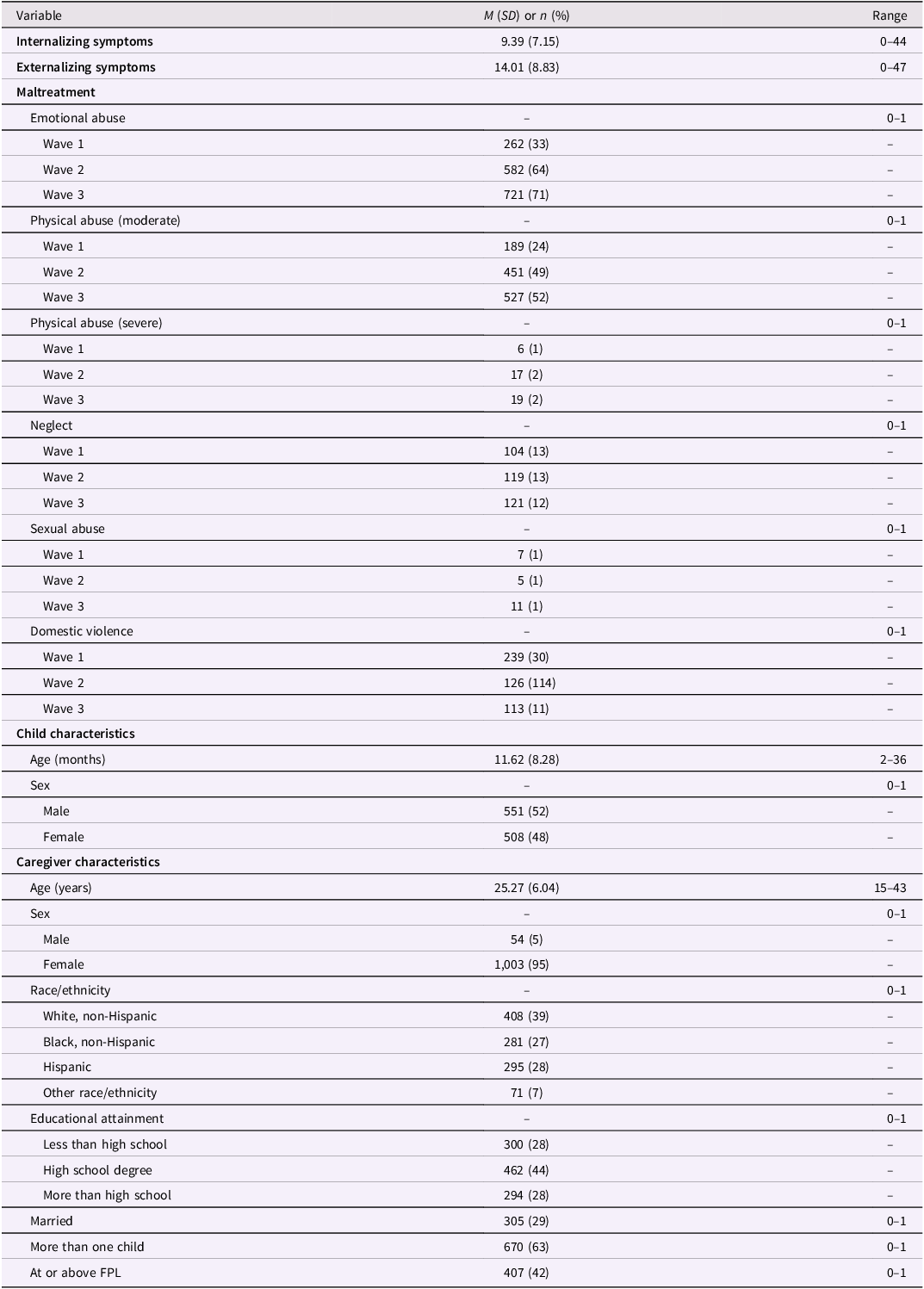
Study descriptives are presented in Table 1. At baseline, children had a mean age of 11.62 months (SD = 8.28), with a nearly equal composition of males (52%) and females (48%). The majority of children’s caregivers were female (95%) and biological parents (81%), with the remaining 19% being other biological relatives. Most caregivers identified as White (39%), followed by Hispanic (28%), and Black (27%). Regarding education, 44% of caregivers had attained a high school degree or equivalent. The majority of caregivers were unmarried (71%) and had a mean age of 25.27 years (SD = 6.04) at baseline. Pairwise correlations between focal variables are presented in Supplemental Table 1.
Descriptive statistics of study variables
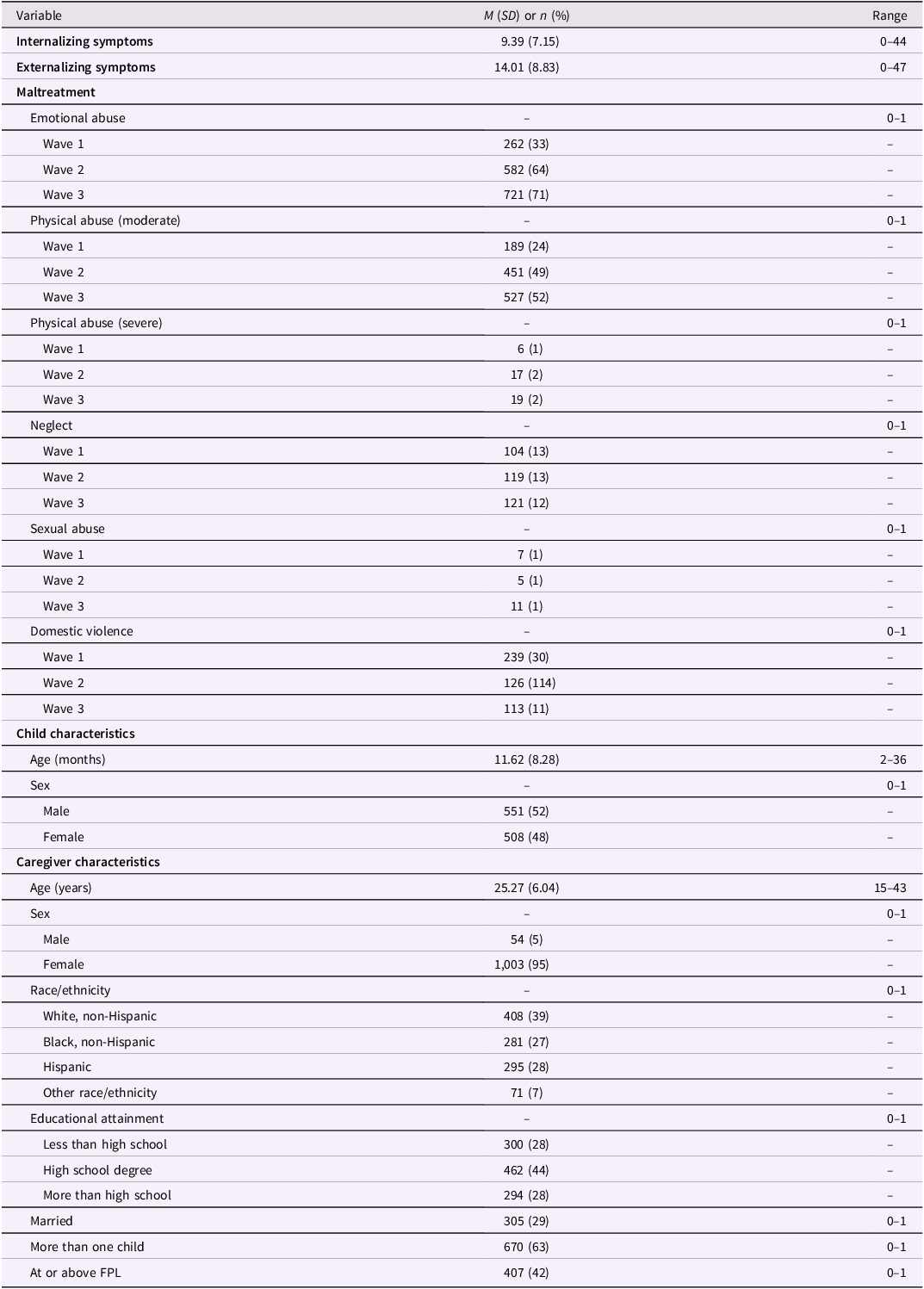
Note. N = 1,059. FPL = 100% Federal Poverty Line.
Identification of latent classes
As presented in Table 2, models with two to six classes were evaluated using multiple fit indices. The four-class solution was identified as the optimal model, supported primarily by BIC, aBIC, and likelihood ratio tests. Both BIC and aBIC values decreased with the addition of sequential classes until the five-class solution, at which point the values increased, indicating reduced fit for models with five or more classes. Log-likelihood and AIC values continued to decline through the six-class solution. Among models with four or more classes, the four-class solution exhibited the highest entropy, suggesting the greatest class separation. The aLRT and VLMR-LRT were significant only for the two- and four-class solutions, demonstrating that the three-class solution had poorer fit than the two-class model, and the five-class solution had poorer fit than the four-class model. Considering fit indices, interpretability, and parsimony, the four-class solution was selected as the final model.
Fit indices of identified latent child maltreatment trajectories

Note. N = 1,059. Bold values represent best-fitting value. AIC = Akaike Information Criterion; BIC = Bayesian Information Criterion; aBIC = adjusted Bayesian Information Criterion; aLRT = Lo–Mendell–Rubin adjusted Likelihood Ratio Test p-values; VLMR-LRT = Vuong–Lo–Mendell–Rubin Likelihood Ratio Test p-values.
Interpretation of the latent class solution
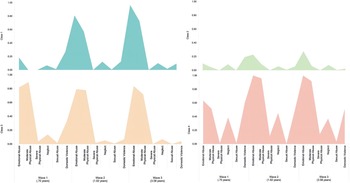
Figure 1 displays the class membership proportions and item response probabilities for the selected four-class solution, while sociodemographic predictors of maltreatment trajectory membership are shown in Supplemental Table 2. The “Stable Low Multi-Type” class contained 34% of the sample and was marked by consistently low probabilities of endorsing any form of maltreatment across all time points. Three alternative developmental patterns of maltreatment emerged in addition to the “Stable Low Multi-Type” class: “Increasing Emotional–Physical,” “Stable High Emotional–Physical,” and “Stable High Multi-Type.”
Item response probabilities and overall class prevalence for the repeated-measures latent class solution.
Note. Age ranges across waves were overlapping; median ages were 0.75, 1.92, and 3.58 years, at waves 1, 2, and 3, respectively. Class 1 = “Increasing Emotional–Physical” (37%); Class 2 = “Stable Low Multi-Type” (34%); Class 3 = “Stable High Emotional–Physical” (17%); Class 4 = “Stable High Multi-Type” (12%).
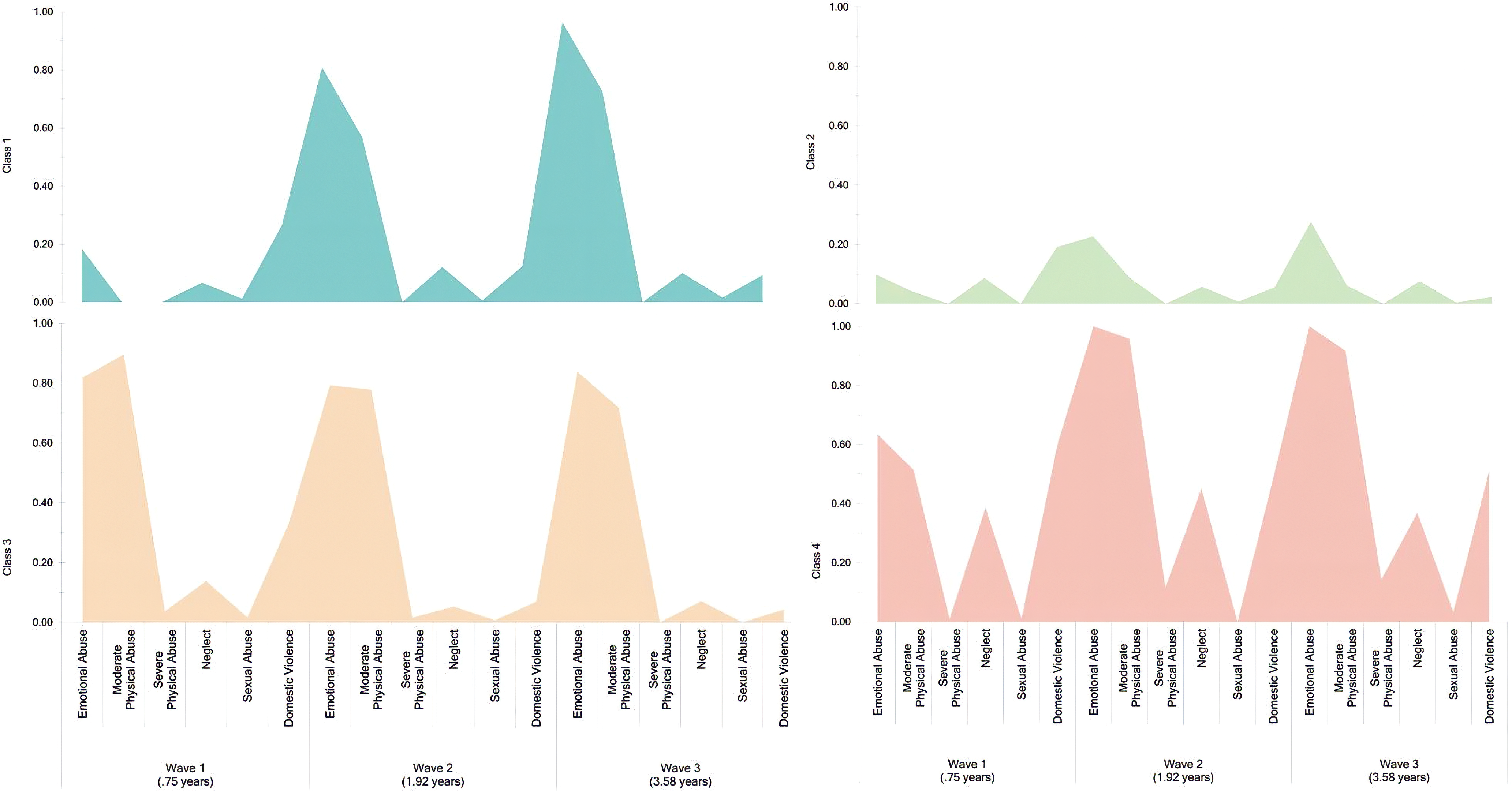
Figure 1. Long description
The image contains four line graphs, each representing different classes of child maltreatment over three waves. The x-axis for all graphs represents different types of abuse and neglect, including emotional abuse, moderate physical abuse, severe physical abuse, sexual abuse, neglect, and domestic violence. The y-axis represents the probability of each class occurring. The waves are labeled as Wave 1 (0.75 years), Wave 2 (1.92 years), and Wave 3 (3.58 years). Panel A: Class 1 shows increasing emotional-physical abuse with peaks at Wave 2 and Wave 3. Panel B: Class 2 shows stable low multi-type abuse with minor fluctuations across all waves. Panel C: Class 3 shows stable high emotional-physical abuse with consistent high probabilities across all waves. Panel D: Class 4 shows stable high multi-type abuse with high probabilities across all waves, particularly peaking at Wave 2 and Wave 3.
Accounting for 37% of the sample, the “Increasing Emotional–Physical” class exhibited initially low probabilities of endorsing any maltreatment (ranging from 0.00–0.27). However, by wave two, members of this class showed a notable increase in maltreatment, reporting moderate to high probabilities of emotional abuse and moderate physical abuse (ranging from 0.57 to 0.81). This upward trend persisted into wave three, with high probabilities of emotional abuse and moderate physical abuse (ranging from 0.73 to 0.96). The other maltreatment types showed no appreciable increase over the study period.
The “Stable High Emotional–Physical” class accounted for 17% of the sample. This “Stable High Emotional–Physical” class exhibited stable and high probabilities of endorsing emotional abuse and moderate physical abuse (ranging from 0.72 to 0.90) across all time points. Members of this class reported low levels of endorsement of severe physical abuse (ranging from 0.00 to 0.04), neglect (ranging from 0.05 to 0.14), sexual abuse (ranging from 0.00 to 0.02), and domestic violence (ranging from 0.04 to 0.33) across all time points.
The smallest class, labeled “Stable High Multi-Type,” accounted for 12% of the sample. This “Stable High Multi-Type” class exhibited moderate probabilities of emotional abuse and moderate physical abuse at wave one (ranging from 0.51 to 0.63), which increased to sustained high probabilities in subsequent waves (ranging from 0.92 to 1.0). This class also exhibited the highest likelihood, relative to other classes, of severe physical abuse (maximum of 0.14), neglect (maximum of 0.45), sexual abuse (maximum of 0.03), and exposure to domestic violence (maximum of 0.60). In general, probabilities for all forms of maltreatment for this class persisted over time.
Comparisons of psychological adjustment across maltreatment profiles
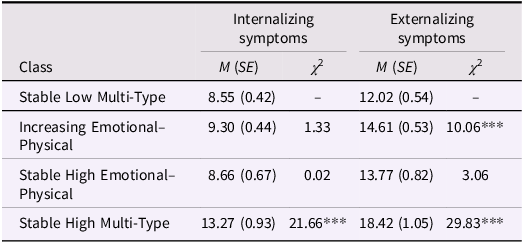
Class membership was significantly associated with subsequent internalizing and externalizing symptoms (see Table 3). Differences between classes in children’s internalizing symptoms were significant (χ 2[3] = 21.89, p < .001). Results of pairwise comparisons demonstrated that the “Stable High Multi-Type” class (M = 13.27, SE = 0.93, p < .001) displayed more internalizing symptoms than the “Stable Low Multi-Type” class (M = 8.55, SE = 0.42). There were also significant differences between the “Stable High Multi-Type” class and the “Stable High Emotional–Physical” (p < .001) and “Increasing Emotional–Physical” (p < .001) classes, indicating that children in the “Stable High Multi-Type” class scored higher on internalizing symptoms.
Internalizing and externalizing symptoms as a distal outcome of class membership
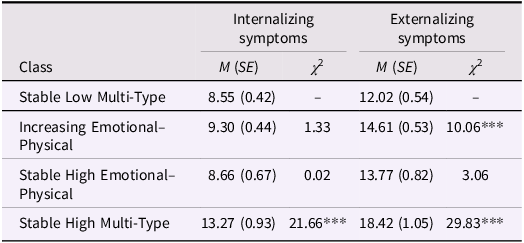
Note. Reference class is the “Stable Low Multi-Type” class.
*** p < .001.
With respect to children’s externalizing symptoms, significant class differences emerged (χ 2[3] = 33.04, p < .001). Pairwise comparisons revealed that the “Stable High Multi-Type” class (M = 18.42, SE = 1.05, p < .001) and the “Increasing Emotional–Physical” class (M = 14.61, SE = 0.53, p < .01) scored higher on externalizing symptoms than the “Stable Low Multi-Type” class (M = 12.02, SE = .54). While not statistically significant, the “Stable High Emotional–Physical” class (M = 13.77, SE = 0.82, p < .10) scored marginally higher on externalizing symptoms than the “Stable Low Multi-Type” class. There were also significant differences between the “Stable High Multi-Type” class and the “Stable High Emotional–Physical” (p < .01) and “Increasing Emotional–Physical” (p < .01) classes, indicating that children in the “Stable High Multi-Type” class scored higher on externalizing symptoms.
Discussion
Child maltreatment represents a complex public health concern, yet relatively little research has examined how maltreatment exposure changes over time as children develop, or how these trajectories influence risk for later psychological adjustment problems. The current study sought to address this gap by advancing knowledge of the developmental dynamics and consequences of early maltreatment among children with prior child welfare involvement through identifying distinct trajectories of maltreatment exposure in early childhood.
Changes in risk for child maltreatment across early childhood
Overall, our findings comport well with prior research suggesting that exposure to child maltreatment is often stable but can also shift and evolve over time (Yoon et al., Reference Yoon, Calabrese, Yang, Logan, Maguire-Jack, Min, Slesnick, Browning and Hamby2024). Notably, even within the relatively brief 36-month period examined in this study, we identified a subgroup of children who showed marked increases in maltreatment exposure over time. These results highlight the importance of assessing maltreatment longitudinally to better understand how patterns of stability and change in maltreatment exposure may influence children’s adjustment outcomes.
First, we identified a trajectory of children who exhibited consistently low probabilities of maltreatment exposure across all types. This maltreatment trajectory served as an important reference group for comparison purposes. However, it is important to note that the “Stable Low Multi-Type” class may not necessarily reflect an absence of maltreatment exposure. Because maltreatment data were derived from caregiver self-reports, it is possible that caregivers underreported instances of maltreatment due to concerns about potential repercussions, particularly in this sample of children with prior child welfare involvement. For example, caregivers may have minimized their responses out of fear that disclosing maltreatment could negatively influence their case outcomes (e.g., Fong, Reference Fong2019).
Second, we identified a trajectory of children who experienced polyvictimization that remained relatively stable across early childhood. This pattern is consistent with prior person-centered studies suggesting that polyvictimized children tend to remain at elevated risk for maltreatment over time (e.g., Prindle et al., Reference Prindle, Foust and Putnam-Hornstein2022). Children in this “Stable High Multi-Type” maltreatment trajectory exhibited higher levels of both externalizing and internalizing symptoms than those in the “Stable Low Multi-Type” maltreatment trajectory, as well as compared to other trajectories with maltreatment exposure. This finding is perhaps unsurprising, as more chronic and pervasive forms of victimization are often associated with greater disruptions in psychological functioning. Notably, this group also exhibited the highest relative exposure to less frequently reported forms of maltreatment in this sample, including domestic violence, sexual abuse, neglect, and severe physical abuse. Consistent with previous work, our results reinforce that polyvictimization, particularly when it is stable across time, represents a robust risk factor for psychopathology (e.g., Bijlsma et al., Reference Bijlsma, Assink, Overbeek, van Geffen and van der Put2023; Lawrence et al., Reference Lawrence, Hunt, Mathews, Haslam, Malacova, Dunne, Erskine, Higgins, Finkelhor, Pacella, Meinck, Thomas and Scott2023).
Third, we identified two trajectories characterized by significant clustering of emotional abuse and moderate physical abuse. This pattern aligns with theoretical frameworks suggesting that maltreatment exposures may reflect distinct dimensions of adversity, such as threat-related experiences (McLaughlin et al., Reference McLaughlin, Sheridan and Lambert2014). Indeed, recent meta-analyses indicate that emotional and physical abuse frequently co-occur and represent one of the most common threat-based typologies of maltreatment (e.g., Matsumoto et al., Reference Matsumoto, Piersiak, Letterie and Humphreys2023). Interestingly, however, in contrast to dimensional models of adversity (Miller et al., Reference Miller, Sheridan, Hanson, McLaughlin, Bates, Lansford, Pettit and Dodge2018), our findings did not show that children exposed to these threat-related forms of maltreatment were at significantly greater risk for internalizing symptoms. It is plausible that, given our sample of children with prior child welfare involvement, even those with minimal maltreatment exposure may have exhibited elevated internalizing symptoms due to cumulative stress and prior trauma (e.g., Rayburn et al., Reference Rayburn, McWey and Cui2016). However, it may also be the case that maltreatment exposure shapes broader regulatory difficulties in early childhood that are not yet distinctly captured by internalizing and externalizing domains. For instance, internalizing symptoms (e.g., anxiety, depression, withdrawal) are often less observable and harder to detect during early childhood due to their subtle nature and limited verbal skills in young children. Further, internalizing and externalizing symptoms in early childhood show greater co-occurrence and a less clearly differentiated presentation in caregivers’ reports (Arslan et al., Reference Arslan, Lucassen, Van Lier, De Haan and Prinzie2021; Shi et al., Reference Shi, Ettekal, Deutz and Woltering2020), highlighting the need for further examination of how these patterns differentiate across later developmental periods.
Fourth, relatedly, we found that children in the “Increasing Emotional–Physical” maltreatment trajectory were not at higher risk for internalizing problems but did exhibit significantly greater externalizing problems than children with minimal maltreatment exposure. This finding is only partially consistent with prior research demonstrating distinct relationships between emotional and physical abuse with children’s psychosocial adjustment. Specifically, whereas physical abuse is commonly associated with externalizing behaviors and emotional abuse with both externalizing and internalizing difficulties (Yoon et al., Reference Yoon, Yoon, Pei and Ploss2021), escalating exposure to these forms of maltreatment may compromise children’s developing regulatory capacities, thereby increasing the likelihood of behavioral dysregulation, as observed in our study. In addition, this finding extends existing literature by highlighting the potential importance of change in maltreatment exposure, rather than static levels, in shaping psychological adjustment. Interestingly, children who experienced increases in emotional and physical abuse were more likely to display externalizing problems, whereas those with stable, high exposure to physical and emotional abuse were not at significantly elevated risk. One possible explanation is that sustained exposure to adversity may afford children opportunities to cultivate adaptive coping strategies over time, whereas more variable or escalating exposure to maltreatment may compromise children’s capacity to respond effectively to emerging or worsening stressors. Future research should further investigate how changes in maltreatment exposure over longer developmental periods interact with children’s coping and regulatory capacities to influence psychosocial outcomes.
Taken together, the present findings highlight the importance of examining dynamic trajectories of child maltreatment over time to better understand and address threats to children’s psychological adjustment. While trajectories characterized by early escalation followed by sustained multi-type maltreatment were linked to elevated adjustment problems, stable, domain-specific abuse did not confer the same risk. Additionally, intensifying exposures to domain-specific abuse over time were linked to increased externalizing problems, suggesting that fluctuations in maltreatment severity and type over time may be particularly detrimental, and that initial levels of maltreatment should not be assumed to predict future exposures, even over relatively short developmental periods. These results underscore the need for early identification and targeted intervention strategies that consider not only the presence of maltreatment but also its trajectory, timing, and combination, as dynamic patterns of abuse may differentially shape children’s developmental outcomes.
Implications for practice and research
The observed relationships between maltreatment trajectories and children’s externalizing and internalizing symptoms have important implications for practice. Distinct patterns of maltreatment exposure were linked to differentiated psychological adjustment, suggesting that maltreatment trajectory membership can serve as a meaningful indicator of the type and intensity of support a child may require. For instance, children exposed to sustained and intensifying polyvictimization (i.e., “Stable High Multi-Type”) exhibited significantly elevated externalizing and internalizing symptoms relative to children in other trajectories. The early intensification and enduring high-risk exposure to maltreatment in this group indicate a need for sustained, coordinated interventions that address emotional distress and behavioral dysregulation while simultaneously targeting family-level factors that contribute to compounding risk.
These findings underscore the importance of assessment strategies that jointly consider maltreatment patterns and children’s psychological and behavioral functioning over time. Because maltreatment trajectories can change over relatively short developmental periods and are differentially associated with externalizing and internalizing symptoms, single timepoint assessments are inadequate for identifying children’s risk for psychological maladjustment. Repeated, integrated assessments that capture shifts in maltreatment exposure alongside emerging psychological and behavioral difficulties may provide a more accurate representation of children’s evolving needs, thereby improving the timeliness and precision of intervention planning and evaluation. Conceptualizing maltreatment as a dynamic process and psychological adjustment as a developmentally unfolding response allows researchers and practitioners to design more tailored, adaptive interventions that respond to children’s and caregivers’ ongoing needs. Relatedly, baseline information on caregivers’ receipt of mental and behavioral health services was limited by a substantial proportion of missing data, which reduced the analytic sample available for this variable and limited statistical power to detect associations with maltreatment trajectories. Future research is needed to more thoroughly examine how early caregiver engagement in clinical interventions may influence long-term maltreatment risk among children with child welfare system involvement.
Limitations
As with all studies, this study is not without limitations. First, key study variables, including child maltreatment and child psychological adjustment, were assessed using caregiver self-reports. Self-reported data are susceptible to biases such as social desirability bias and mono-method bias. As such, findings should be interpreted with caution, as associations may partially reflect systematic bias in which caregivers who endorsed maltreatment also perceived greater child behavior problems, or alternatively, where caregiver distress or guilt may have influenced both maltreatment and child symptom ratings. Additionally, maltreatment behaviors captured by the CTS-PC may include those that do not independently result in child protective services (CPS) contact; however, evidence suggests convergence between CTS-PC scores and CPS involvement in samples with prior child welfare contact, particularly when such contact is not concealed (Bennett et al., Reference Bennett, Sullivan and Lewis2006). Caregiver reports may also capture meaningful variation in harmful parenting behaviors not reflected in official maltreatment records that explain unique variance in child adjustment outcomes (Sierau et al., Reference Sierau, Brand, Manly, Schlesier-Michel, Klein, Andreas, Garzón, Keil, Binser, von Klitzing and White2017). Nonetheless, future research would benefit from incorporating multiple informants (e.g., teachers, caseworkers) and diverse data sources (e.g., administrative records, observational measures) to strengthen the validity of these constructs. Second, our analytic sample was limited to children with the same responding caregiver across waves, which may underrepresent children experiencing caregiver transitions or out-of-home placements, including those with more severe behavioral and emotional difficulties. In addition, although we identified a class of children with consistently low reports of maltreatment, all families in the current study had prior contact with CPS. As such, the absence of a non-CPS-involved comparison group limits interpretation to relative differences among higher-risk profiles rather than differences relative to children without CPS involvement. Third, we did not examine sex differences in maltreatment trajectories, as it was beyond the scope of the current study. Given prior research documenting sex differences in maltreatment experiences (e.g., Chung & Chen, Reference Chung and Chen2020), future work should explore whether developmental patterns and consequences of maltreatment differ by sex. Fourth, although we used longitudinal data to examine maltreatment trajectories over time, we are unable to draw causal inferences about the association between maltreatment experiences and children’s psychological adjustment, as some constructs were measured concurrently at wave three.
Concluding thoughts
In this longitudinal study, we identified four distinct trajectories of maltreatment exposure during early childhood that varied in type, co-occurrence, severity, stability, and timing. These trajectories were differentially related to children’s externalizing and internalizing symptoms, with higher exposure to multiple forms of maltreatment predicting the poorest outcomes. Collectively, these findings point to the need for ongoing, comprehensive assessment of maltreatment exposure and underscore the importance of early, targeted interventions to support the psychological and behavioral well-being of young children involved with the U.S. child welfare system.
Supplementary material
The supplementary material for this article can be found at https://doi.org/10.1017/S0954579426101667.
Data availability statement
The authors do not own the study data and do not have permission to share it. The underlying code is not publicly available due to proprietary limitations, but all analytical steps are documented in the Methods. Materials cannot be shared due to ownership and confidentiality restrictions, but procedural details are provided to allow replication.
Acknowledgments
The data used in this publication, the National Survey of Child and Adolescent Well-Being, were obtained from the National Data Archive on Child Abuse and Neglect and have been used in accordance with its Terms of Use Agreement license. The Administration on Children, Youth and Families, the Children’s Bureau, the original dataset collection personnel or funding source, NDACAN, Duke University, Cornell University, and their agents or employees bear no responsibility for the analyses or interpretations presented here.
Funding statement
The authors received no external funding.
Competing interests
The authors declare no competing interests. No generative AI tools were used in the production, analysis, or interpretation of this work
Pre-registration statement
The study was not pre-registered because it is an exploratory, data-driven analysis.



 Open access

