



The two concepts of food security and sustainability share several attributes. They are broad and complex notions used by various scientific disciplines and lay groups such as non-governmental organizations and governments, which often coin their own definitions. They have been designed to frame and constitute common objectives for the international community and, as such, they have been developed by international negotiations, although in different arenas. Over time there have been increasing formal attempts to link the two concepts perhaps dating from the Nobel Prize speech of Borlaug in 1970( Reference Borlaug 1 ), even though the technical language was different, and in particular as a consequence of the UN Rio+20 conference in 2012 towards the preparation of Sustainable Development Goals. The concept of food security has evolved over recent decades and has been gradually enlarged. Initially it focused mainly on availability of food and on food production( 2 ); then it was expanded to include explicitly the accessibility to food (physical, economic and socio-cultural), its utilization( 3 ) and lastly to encompass the stability of these dimensions( 4 ). Sustainability has been introduced in the international discussions through the notion of sustainable development, defined as ‘development that meets the needs of the present without compromising the ability of future generations to meet their own needs’( 5 ). The popularization of the term dates to the Brundtland Commission report Our Common Future ( 6 ), but the concepts are arguably much older, e.g. F.H. King’s book from 1911( Reference King 7 ) entitled Farmers of Forty Centuries or Permanent Agriculture in China, Korea and Japan and Schumacher’s discussion of ‘economics of permanence’( Reference Schumacher 8 ). Sustainability thus includes a time dimension which determines how to consider trade-offs between social and economic v. environmental issues, which can here be understood also as incorporating a long-term social and economic dimension. It should be noted here that many experts on sustainability dispute the conventional definition of economic ‘growth’, but this debate is beyond the scope of the present paper. The key point is that renewable resources, if consumed now at a rate faster than they can be regenerated, will no longer be available for future generations.
During this same time period the notion of sustainability was increasingly applied formally by international organizations to food security( Reference Dally, Dasgupta and Bolin 9 – Reference Richardson 12 ). It is not clear why there was such a time lag in this recognition since commentators such as Paul Ehrlich, Lester Brown and concerned scientists had been warning of these issues for far longer( Reference Butler 13 , 14 ).
The purpose of the present paper is to align these ideas by incorporating sustainability as a new long-term time dimension within the definition and repositioning of food security (and vice versa). We discuss the conceptual and operational benefits of such integration. It should be noted at the outset that the literature on the topics of food security and sustainability is far too large for a systematic review. Instead, we have chosen to adopt a quasi-historical approach following major food meetings and reports in roughly chronological order to show how their two relevant literatures have increasingly interacted, and we suggest that they should be combined under one conceptual framework. The paper comments on the integration, links and gaps between food security and sustainability.
The evolution of the concept and definitions of food security
The concept of food security originated some 45 years ago, at a time of global food crises. Initially it focused on ensuring food supply with regard to availability and the global and local price stability of basic foods. This was the outcome of the extreme instability of agricultural commodity prices in the early 1970s, following the turbulence in the currency and energy markets, as well as a number of other unfavourable circumstances. The emphasis on supply-side issues reflected the changing organization of the global food economy considered responsible for these crises. The occurrence of famine, hunger and food crises required a new definition of food security which recognized the critical needs and behaviour of potentially vulnerable and affected people( Reference Clay 15 , Reference Shaw 16 ). The international community met at the World Food Conference of 1974 and defined food security as ‘[the] availability at all times of adequate world food supplies of basic foodstuffs to sustain a steady expansion of food consumption and to offset fluctuations in production and prices’( 2 ). Although this definition does not explicitly mention utilization or stability, it is probably implicit in the wording ‘at all times’. The definition stresses reasonably the need for more production since macronutrient hunger in 1970 was thought to affect 25 % of the global population (and more recent FAO revisions imply that up to 30 % was then hungry).
A better understanding of past famine situations then led to a shift in emphasis from the supply/availability side to a wider approach encompassing demand as well. Influential arguments put forward by Sen( Reference Sen 17 ) pointed to what he called a lack of entitlements to food, or effective demand (i.e. demand that can be fulfilled by money or another means), more than the unavailability of food itself, as the starting point for acute famine episodes. A deeper understanding of the functioning of agricultural markets under stress conditions, and how at-risk populations found themselves unable to access food, led to the expansion of the FAO definition of food security to include securing access by vulnerable people to available supplies. Sen emphasized the concept of entitlements of individuals and households to acquire food to avoid food insecurity and as a target for combating hunger. Such a balance between the demand and supply side of the food security equation led to a revised definition of ‘ensuring that all people at all times have both physical and economic access to the basic food that they need’( 18 ).
The next development came in 1986 when the World Bank published its seminal report Poverty and Hunger ( 19 ). This introduced a time scale for food security by distinguishing between chronic food insecurity, associated with problems of poverty, and acute, transient food insecurity, caused by natural or man-made disasters. These concerns were reflected in an extension of food security to include: ‘access of all people at all times to enough food for an active, healthy life’.
In 1994 the UN Development Programme’s Human Development Report considered the requirements for human security. Seven main threats were identified, which are listed here by us from the micro to the macro levels: food, health, personal, economic, community, political and environmental security( 20 ). About this time the issue of human rights entered discussions concerning food security within the larger framework of social security( Reference Drèze and Sen 21 ).
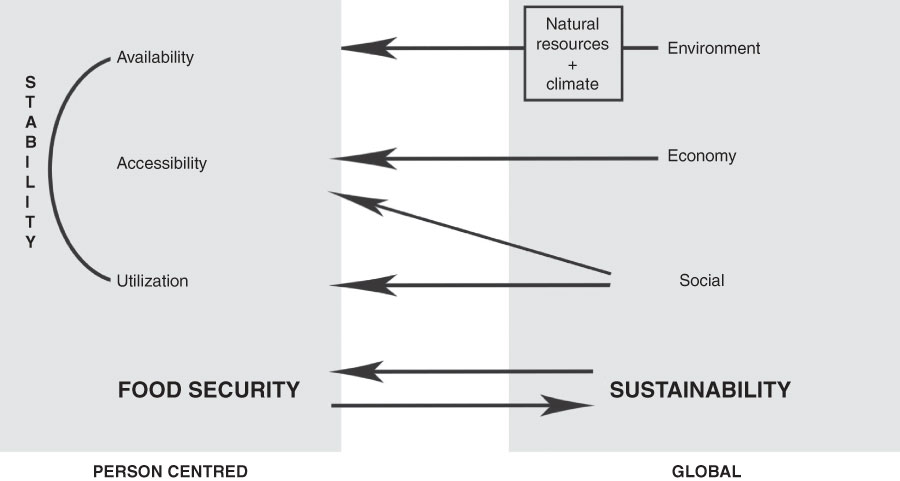
Food security is a problem from the individual to the global level: it is an individual issue; yet policies deal with it mostly at the national level, and its measurement is (at best) at the household level, to accommodate food preferences (see Fig. 1). Food security is a multidimensional and multifaceted operational construct which by 1993 had evolved over 200 definitions( Reference Smith, Ponting and Maxwell 22 ). This situation was clearly ‘unsustainable’ and reflected the fact that studies on food security were often very context specific, depending on which of the many technical perspectives and policy issues were under discussion( Reference Maxwell and Smith 23 ). In an attempt to bring more coherence to such complexity, a redefinition of food security was conducted through international consultations in preparation for the World Food Summit held in 1996( Reference Clay 15 , Reference Shaw 16 ). Food security, at the individual, household, national, regional and global levels, is achieved ‘when all people, at all times, have physical and economic access to sufficient, safe and nutritious food that meets their dietary needs and food preferences for an active and healthy life’( 3 ).
The interrelationships between food security and sustainability
FAO began reporting on and monitoring food insecurity virtually since its creation. Much work was undertaken between the 1950s and the 1970s to assess the resources of populations in different countries with respect to adequate dietary energy levels. The organization advanced and implemented measures for assessing energy deprivation at a country level. A more systematic and consistent framework was promoted after the 1996 World Food Summit, when the organization was assigned by its members the task of monitoring progress towards the target set of reducing by half the number of undernourished persons in developing countries by year 2015. In the mid-1990s, as the term ‘food security’ evolved, the terms ‘nutrition security’ and ‘food and nutrition security’ also emerged in order to combine all these elements( 24 ). Since the late 1990s, this monitoring process has been communicated through an FAO annual flagship report, The State of Food Insecurity in the World, first issued in 1998. Nutrition per se now began to achieve recognition, independently of dietary energy or lack of protein, with better acknowledgement of both macro- and micronutrient requirements( 25 ). The definition of food security was refined further in The State of Food Insecurity in the World 2001: ‘Food security [is] a situation that exists when all people, at all times, have physical, social and economic access to sufficient, safe and nutritious food that meets their dietary needs and food preferences for an active and healthy life’( 25 ). With regard to the social emphasis, it was recognized that addressing poverty is necessary but not alone sufficient to achieve this goal( 26 ).
Importantly, the broadening and deepening of the notion of food security has led to a considerable expansion in the range of issues that are now understood as potentially linked to it. Shaw( Reference Shaw 16 ) represents food security as three concentric circles, the outer one encompassing such issues as globalization, sustainable development and human rights. Since its reform in 2009, the Committee on World Food Security (CFS) has discussed the influence on food security of many diverse topics such as: price volatility, land tenure, international investments in agriculture, climate change, social protection, biofuels, investments in smallholder agriculture, and food losses and waste. These subjects have been considered in the context of sustainable food systems and sustainable fisheries and aquaculture, informed by reports from its High Level Panel of Experts on Food Security and Nutrition (HLPE). Many of these points were already highlighted in 1999 by Alexandratos( Reference Alexandratos 27 ) and Cassman( Reference Cassman 28 ). The CFS is due to discuss water and food security in 2015. Consideration of these multiple issues brings the scope of food security closer to sustainability, in terms of range and time perspectives. Furthermore, by adopting a forward-looking view, as attested by the very mandate of the HLPE( 29 ), food security gets closer to the time dimension of the sustainability concept. Finally, the reports requested from the HLPE by CFS for 2014 and 2015 show a progressive incorporation of sustainability as an integral component of food security and nutrition. As noted above, this integration has been both long overdue and a long time in development.
Current understanding of food security: from pillars to pathways – a timely development
By 2009 the term ‘food security and nutrition’ had become the standard for the CFS documentation and one of the corporate strategic objectives of the FAO. The last revision to the definition of food security came at the 2009 World Summit on Food Security which, within the Five Rome Principles for Sustainable Global Food Security, added a fourth dimension: that of stability as the short-term time indicator of the ability of food systems to withstand shocks, whether natural or man-made( 4 ). This new fourth dimension introduced the concept of constancy in food security. The Summit also used for the first time the phrase ‘four pillars of food security’( 4 ). However, the visualization of pillars gives a rather misleading representation of the concept since the four dimensions are surely interrelated and interdependent, rather than static and separate. Pillars give no illustration of the linkage between the dimensions of food security. Another reason to avoid the visualization of food security as being dependent on four ‘pillars’ is the weighting problem( Reference Decancq and Lugo 30 , Reference Dobbie and Daila 31 ). By this is meant that not all the elements of food security are of equal importance as implied by the pillar analogy. Their weightings are context and country specific. In attempting to define indicators for the measurement of food security different countries have different degrees of challenges along their food security pathway, so that it may not be appropriate to give each dimension an equal weighting of 25 %. For example, in many developing countries accessibility depends on the transport infrastructure which may be limiting for food security. In Tanzania 75 % of the population are farmers and 90 % of rural roads are unpaved( Reference Bansal 32 ). Such considerations will affect the measurement of food security by any index.
Instead of pillars, a better analogy would be one of a path as used by The State of Food Insecurity in the World 2013 ( 33 ) to show the links from food production (availability) to household (accessibility) to individual (utilization). Accessibility relates to physical (transport, infrastructure) and economic means (food purchasing power). It also involves socio-cultural access and preferences( Reference Timmer 34 ) and its health effects( Reference Marmot, Allen and Bell 35 ) and, with them, the importance of social protection( 36 ). Stability thus emphasized the importance of bringing a time dimension, albeit short term, to food security. The food security path may also be considered circular as there is a feedback loop from utilization to availability since human capital depends on optimal nutritional state for the workforce in agriculture and in all sectors of production.
Introducing sustainability as part of food security
Sustainability has a historical development somewhat similar to that of food security. From the original accepted use of ‘sustainable development’, it follows that sustainability is the assessment of the robustness of a system over time (‘without compromising the ability of future generations to meet their own needs’( 37 )). Food security, as it is conventionally understood, is a person-focused concern, whereas environmental and ecological sustainability factors operate both locally and also at supra national/regional/global levels. Much ink has been spilled over a consensus definition of ‘sustainability’ and space does not permit more discussion here. Suffice the definition in Wikipedia that, ‘in more general terms, sustainability is the endurance of systems and processes. The organizing principle for sustainability is sustainable development, which includes the four interconnected domains: ecology, economics, politics and culture’( 38 ).
Over the past years there has been increasing agreement that sustainability is very relevant to food security (as referenced elsewhere( Reference Lang and Barling 39 , Reference Garnett, Appleby and Balmford 40 )), but its position in the food security framework has yet to be formulated. It could be incorporated in the dimensions of availability, for the long-term sustainability of food production( Reference Smith and Gregory 41 ), and access, for the long-term sustainability of consumption. Some might hold that sustainability represents the extension of the time frame of stability, or even a more relevant substitute for stability. For others, sustainability should be considered as a separate fifth dimension of food security( Reference Lang and Barling 39 , 42 , Reference Hanson 43 ) to represent and monitor the capacity to ensure, for the long term, all of the dimensions of food security. The implications of including sustainability as a fifth dimension of food security are to consolidate a more holistic operational framework at each level – regional, national, household and individual. It also brings together, in a comprehensive manner, other important notions such as: sustainable agriculture( 44 ), sustainable economy, sustainable food production( Reference Smith and Gregory 41 ) and sustainable diets( Reference Burlingame and Dernini 45 ).
Sustainability can be considered a precondition for long-term food security. The environment, and especially climate and the obtainability of natural resources, are a precondition for the availability of food as well as the preservation of biodiversity( Reference Sperling and McGuire 46 ). Economic and social sustainability are necessary for the accessibility of all to food. Social sustainability is also a determinant for the utilization of food. Together, the three dimensions of sustainability – social and economic and environmental – also ensure the stability of the systems on which depends the constancy of the other dimensions of food security. On the other hand, the relationships are reciprocal as food security is considered increasingly as a condition for sustainability. This is shown in Fig. 1.
However, all viewpoints concur that sustainability implies the long-term (generation) time dimension, which was explicitly incorporated, already in 2009, in the Five Rome Principles for Sustainable Global Food Security( 4 ), particularly Principle 3.2. This stated: ‘[To] strive for a comprehensive twin-track approach to food security that consists of: 1) direct action to immediately tackle hunger for the most vulnerable and 2) medium and long-term sustainable agricultural, food security, nutrition and rural development programmes to eliminate the root causes of hunger and poverty, including through the progressive realization of the right to adequate food’. However, even this synthesis is not new. In 1998, in a policy forum on global food supply, it was noted that ‘humanity’s success in feeding itself should be judged by i) the proportion of people whose access to basic nutritional requirements is secure, and ii) the extent to which global food production is sustainable’( Reference Dally, Dasgupta and Bolin 9 ). Such a linkage between food security and sustainability has also been discussed by other authors in the intervening years( Reference Pinstrup-Andersen and Herforth 11 , Reference Richardson 12 ).
During the preparations for Rio+20 the international community identified two main objectives: (i) to integrate better the dimensions of sustainable development; and (ii) to make it more concrete and operational. FAO, the Rome-based agencies, as well as numerous governments and stakeholders emphasized the importance of food security and nutrition as an integral part of sustainable development. In other words, it is both forward looking and human-being focused. The documents prepared by FAO( 47 ) analysed the various ways by which food security and nutrition, in its four dimensions, interacts with sustainability in its three dimensions. For instance, sustainability in the use and management of natural resources is a condition for food security, now and for the future. Economic development and social development are keys to the eradication of poverty, malnutrition and hunger. But hunger and malnutrition are also a long-term burden on societies, impeding economic and social development as well as sustainable management of resources. This approach is well-reflected in the outcome document of the Rio+20 Conference, which reaffirmed ‘commitment to enhancing food security and access to adequate, safe and nutritious food for present and future generations’ and recognized ‘the need to maintain natural ecological processes that support food production systems’( 48 ). Concerns have also been raised about the non-living environmental components (other than climate), such as phosphate and affordable energy( Reference Butler 49 ), and these remain to be addressed adequately. Food security and nutrition for present and future generations is thus both an integral part and a goal of sustainable development.
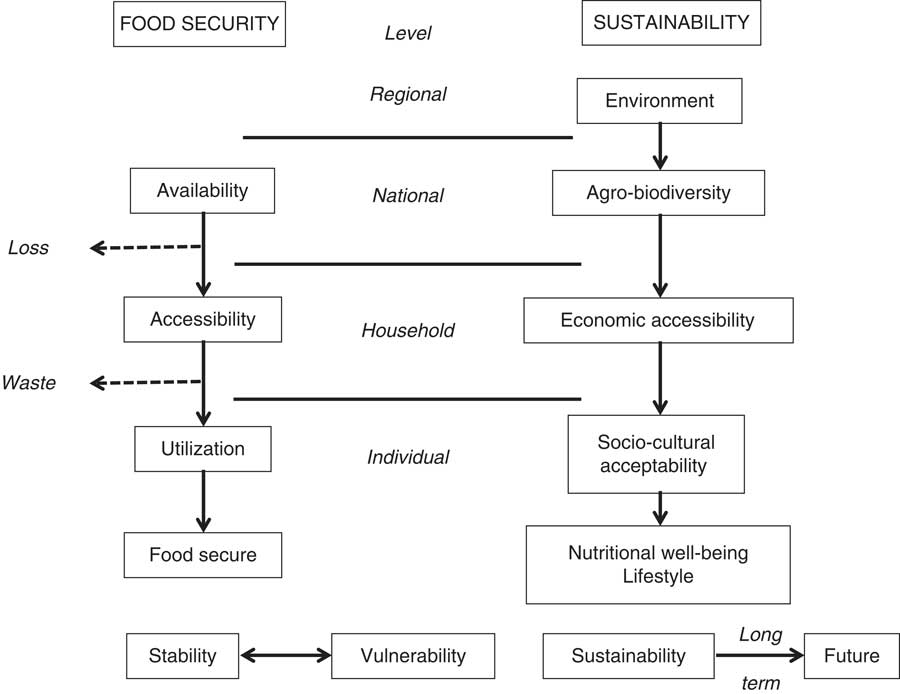
Sustainability is a general (gestalt) concept applicable across the whole of food security representing much more than the sum of its relevance to each individual dimension. However, in the final analysis, the inclusion of sustainability recognizes that continued healthy well-being through the lifespan( Reference Berry and DeGeest 50 ) and further generations is the goal of sustainable food security. These points are illustrated in Fig. 2. The left side shows the path of food from production to consumption (minus food losses and waste( Reference Parfitt, Barthel and Macnaughton 51 )) to food security and the right that of sustainability. The existence of food security in a nation necessitates that all four dimensions are present. The four dimensions are interrelated and interdependent such that food insecurity may occur when there is a disruption at any level along the pathway from availability to utilization and in consideration of stability. However, the real challenge and irony of these considerations is that the population groups that are most vulnerable to food insecurity are the ones about which there is the least information. Marginalized populations such as immigrants, inhabitants of city slums, refugees, the homeless, the mentally ill, the elderly, prisoners, displaced persons, the unemployed and more, hardly ever appear in food surveys since they are poorly accessible and the most difficult to monitor and help( Reference Marmot, Allen and Bell 35 ).
The time dimension to food security: short-term stability (left side); long-term sustainability (right side)
There is potential tension between environmental sustainability and the other dimensions of food security. Food availability is not yet monitored globally for environmental impacts, in particular the balance between animal and vegetable food sources. Food stability and sustainability share an element of time, but stability over time is not necessarily compatible with sustainability, for example when higher agricultural chemical inputs are required to keep production constant. Food security policies in the absence of sustainability measures and indicators will surely contribute to food increased insecurity in future years.
Indicators for food security and sustainability
The major challenge of this exercise in epistemology and taxonomy in positioning ‘sustainability’ vis-à-vis food security is to identify urgently convenient indicators for these concepts and data sources that could support their calculation. Indicators need to be widely accepted as correct and reasonably objective and to be homogeneous across time and space. Suitable indicators for global food security must be reliable, repeatable and available for the majority of countries of the world. There is, however, no accepted agreement as to what are the optimal ones for food security( Reference Richardson 12 , Reference Runge and Gonzalez-Valero 52 – Reference Pangaribowo, Gerber and Torero 56 ).
The measurement of food security in the years after which FAO was founded – post World War II – was mostly on energy deprivation and protein deficiency. The organization provided the first comprehensive international data framework in the 1950s and 1960s. The methodology for measuring energy deficiencies – or chronic undernourishment – in a population with a parametric approach was first proposed by Sukhatme( Reference Sukhatme 57 ) (see also Naiken( Reference Naiken 58 ) for a historical review). Despite the many limitations and wide critiques( Reference Svedberg 59 , 60 ), global assessment of food security has continued to be based on modifications of this approach. The 1996 World Food Summit assigned FAO the responsibility for monitoring progress towards the objective of the Plan of Action – reducing by half the number of estimated undernourished people by year 2015. This was based on the prevalence of undernourishment; that is, on the FAO parametric indicator of energy deprivation proposed originally by Sukhatme. In the early 2000s, the Millennium Development Goal process adopted the same indicator, among others, to measure progress towards Goal 1 – reducing by half the proportion (but not necessarily the number…) of undernourished persons in the population. As concluded also by the International Scientific Symposium on Measuring Food and Nutrition Security, held in January 2012 at FAO, given the existing data, the prevalence of undernourishment remains one of the few indicators available with wide coverage and comparability across time and space. At the same time it is widely recognized that as a standalone indicator, prevalence of undernourishment is not able to capture the complexity of all the dimensions of food security and that a more comprehensive approach to the measurement is required. In recent years, FAO, the International Fund for Agricultural Development and the World Food Programme( 26 , 33 ) have proposed a suite of food security indicators, in which each food security dimension is described by a number of indicators. Efforts are also underway to summarize these indicators into aggregated indices.
Many other indices are available and the topic has recently been summarized by other researchers( Reference Pangaribowo, Gerber and Torero 56 ), criticized( Reference Coates 61 ) and queried( Reference Jones, Ngure and Pelto 62 ). Of all the different measures of food security, the FAO suite is the only one to include stability in the index. Table 1 (left side) summarizes indicators selected by FAO( 33 ) as best representing the dimensions of food security at present. These were chosen from numerous different indicators on the basis of their relevance, availability and frequency of measurement. A tool has recently been developed to measure both the sustainability and health issues of different specific food (dietary) patterns( Reference van Dooren, Marinussen and Blonk 63 ).
A compilation of indicators from the FAO, together with those incorporating sustainability as the long-term time dimension to the domains of food security using the example of sustainable diets
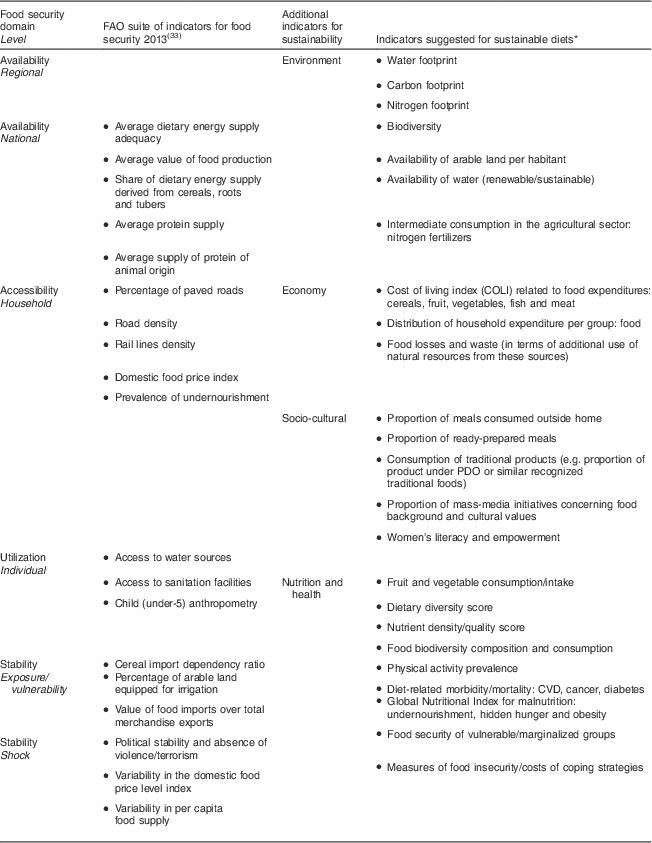
PDO, Protected Designation of Origin.
* After FAO/Centre International de Hautes Etudes Agronomiques Méditerranéennes (2012)( 84 ) and with additions.
The same problems occur with the measurement of sustainability, where some seventy indicators have been listed under twelve headings( Reference Singh, Murty and Gupta 64 ). Universal indicators for sustainability have yet to be established; they need to be widely accepted as correct and reasonably objective. Ideally there must also be reliable, periodically collected and reported data that can support their use for a wide range of countries( 65 , 66 ). One way of considering these points is to tackle a specific example within the context of food security and sustainable food systems, such as sustainable diets. Table 1 (right side) is an attempt to list possible indicators to include environmental considerations, data for which have to be obtained from the relevant international agencies. Such a set of indicators for sustainable diets would be pertinent also for the integration of food consumption as part of a broader set of indicators for sustainability itself.
Another possibility could be to complement the indicators for food security with some indicators of sustainability to cover all its dimensions. Given the importance of poverty as a driver of food insecurity, the social dimension is generally well accounted for in food security indicators. In fact, indicators of food security could be considered as very good indicators for the social dimension of sustainability. The addition of some indicators for the environmental dimension could well complete a food security set of indicators, especially if they focus on availability of, and accessibility to, natural resources. Examples are, for instance, availability of potentially arable land per habitant and availability of water, which would help integrate better the conditions necessary for long-term food security.
Attempts to include sustainability within the framework of food security and vice versa should be considered as work in evolution. The next stages will be: (i) to consult different stakeholder groups, including civil society, concerning the appropriateness of the indicators; and (ii) to determine differential weightings in an attempt to build a composite index by which to compare (say) sustainable diets across regions of the world. The Mediterranean area would be a good region to study as it comprises countries from very different socio-economic and development backgrounds. Two related indices for sustainable food security may be considered. One might be a general, worldwide index with fixed weightings for comparing countries and for allocating resources and aid. The second could have variable weightings depending on the needs and challenges in the different domains of food security according to developmental regions of the world. Such a twofold country distribution classification has been employed for malnutrition in the Global Nutritional Index( Reference Rosenbloom, Kaluski and Berry 67 ). Another simpler way would be to assess each indicator separately in order to identify critical points and priority areas for improvement.
Sustainable diets
Sustainable diets, with all their different elements, fit logically into this new general framework, along with other sustainability elements in the food system( Reference Esnouf, Russel and Bricas 68 , Reference Tilman and Clark 69 ). While the topic is of increasing interest and complexity, the following is a brief discussion which, however, cannot be comprehensive. Together with sustainable food systems, sustainable diets help articulate in a more concrete and operational way food security and sustainability. They highlight long-term health and protection of the environment. As defined in 2010, ‘sustainable diets are those diets with low environmental impacts which contribute to food and nutrition security and to healthy life for present and future generations. Sustainable diets are protective and respectful of biodiversity and ecosystems, culturally acceptable, accessible, economically fair and affordable; nutritionally adequate, safe and healthy; while optimizing natural and human resources’( Reference Burlingame and Dernini 45 ). As such, this definition recognizes the role of nutrition for a healthy life, now and in the future, emphasizing a time dimension in the understanding of food security. It also underlines the role of sustainable consumption as a driver of sustainable production. This relationship was at the basis of sustainable consumption and production, as described in Agenda 21 adopted in Rio and finally operationalized in the 10-year framework of programmes on this topic( 48 ).
The Mediterranean diet has been regarded as a model system on which to develop and validate methods and indicators for sustainable diets( Reference Burlingame and Dernini 70 , Reference Dernini, Meybeck and Burlingame 71 ). Such diets, which are ecosystem specific, are but one practical way of applying sustainability to food security and nutrition( Reference van Dooren, Marinussen and Blonk 63 ). Rather, in this synthesis, sustainability becomes the long-term component of all the levels and dimensions of food security, the well-established and accepted determinant of a nation’s health and well-being.
Synthesis and challenges
How can changes in food consumption patterns towards sustainable diets – i.e. food eaten by an individual or household – affect positive sustainability outcomes such as conservation of biodiversity, reduced climate change and other environmental impacts, improved economic and social benefits, and improved health and nutrition?( Reference Reddy, Lang and Dibb 72 ). This question stresses the new challenge of how to increase the awareness and education of the public, the food industry, producers and policy makers concerning the reciprocal relationship between sustainable diets and food security( Reference Lang and Barling 39 , Reference Clonan and Holdsworth 73 , 74 ). The increasing awareness of the importance of sustainability necessitates its incorporation into nutrition in a practical and measurable manner.
The current baseline for long-term preparation requires consistent efforts in this direction. FAO projections to 2050 indicate that a likely scenario, based on past trends and probable developments, may imply considerable further intensification of production per unit of land in the coming decades( Reference Bruinsma 75 ). This is considered to be the consequence of the increasing global demand for food and the associated changes in diet patterns that follow from the expected developments in income and population. It should be emphasized that while this is a likely scenario, it is not necessarily a desirable one: more intensification may likely cause increased pressure on land, water and genetic resources, which may only be eased by a modification in global demand. However, the effects of climate change on these predictions could be considerable( Reference Klein 76 , Reference Malina, McCarthy and Wall 77 ). Warnings have also been discussed carefully by Butler( Reference Butler 13 ) in particular reference to the Asia-Pacific region (but also applicable to other regions) as part of the long-standing debate between Malthusians (himself and others( Reference Wahlqvist, McKay and Chang 78 )) and optimists, such as Dyson( Reference Dyson 79 ). In a companion paper Butler( Reference Butler 49 ) identified five interrelated challenges to future food security as: (i) climate change; (ii) water scarcity; (iii) tropospheric ozone pollution; (iv) impending scarcity of phosphorus and conventional oil; and (v) the possible interaction between future population displacement, conflict and poor governance. His conclusions were that ‘a sustainable improvement in food security requires a radical transformation in society’s approach to the environment, population growth, agricultural research and the distribution of rights, opportunities and entitlements.’
Food security, nutrition and sustainability are increasingly discussed in the same context( Reference Lang 80 ). Sustainability should be regarded as an integral part of food security planning, monitoring and evaluation in determining the long-term viability of food system chains( Reference Searchinger, Hanson and Ranganathan 81 ). It also involves the active collaboration of farmers to use eco-friendly practices( Reference Barthel, Crumley and Svedin 82 ). But this is everyone’s challenge; a recent publication listed over eighty organizations and programmes involved with nutrition security issues, and there are more( 83 ). Getting the concept of sustainability on the political agenda is a challenge since its benefits are long-term and of little immediate electoral advantage. It also needs to be made more concrete and person-centred to be more acceptable and understandable. The integration of food security as an explicit part of the sustainability agenda would go a long way towards such a goal. The task ahead is to build food security on sustainability and vice versa ( Reference Tilman and Clark 69 ). The final common pathway of all these efforts is towards sustainable food security and nutrition. Not all food-secure diets are sustainable, but all sustainable diets are food-secure.
Acknowledgements
Financial support : This research received no specific grant from any funding agency in the public, commercial or not-for-profit sectors. Conflict of interest: None. The views stated in this paper are those of the authors and do not necessarily reflect those of FAO. Authorship: The ideas expressed in this paper summarize many discussions held between E.M.B. and the co-authors. E.M.B. made the initial drafts of the article and then each author revised, contributed to and approved the final version. Ethics of human subject participation: Ethical approval was not required.



