


Introduction
The birth weight of babies in India is relatively low compared with European(Reference Arora and Tamber Aeri1). Unlike developed countries,(2) there are no specific guidelines for gestational weight gain (GWG) in India,(Reference Arora and Tamber Aeri1) but it is estimated that weight gain during pregnancy is on average 7 kg(Reference Coffey3) and the average birth weight of rural babies is 2⋅6 kg(Reference Metgud, Naik and Mallapur4). The proportion of people living in rural India in 2020 was 68 % as compared with people in rural areas having a lower standard of living than those who are in urban (not slum) areas. Rates of migration from rural to urban areas occur in relation to work, marriage, business and education and are increasing (https://censusindia.gov.in/) alongside the nutrition transition with changes in diet, physical activity and socio-economic status(Reference Popkin5). The city of Pune in Maharashtra, India is undergoing high population growth in large part due to migration from rural areas(Reference Krishnamurthy, Mishra and Desouza6). In 2016, the national prevalence of low birth weight (<2⋅5 kg) was 16⋅4 %, with less low birth weight in urban areas at 15⋅7 % compared with rural at 16⋅7 %(Reference Khan, Mozumdar and Kaur7). One fifth of global births each year are in India. In an extensive literature search, we could find no publications that investigated, in India or other developing countries, maternal body composition and water changes in pregnancy.
Maternal size, weight gain in pregnancy, fetal gender and gestational age are known determinants of birth weight(Reference Khan, Mozumdar and Kaur7,Reference Mahumud, Sultana and Sarker8) . It is not clear which component of maternal weight or weight gained during pregnancy influences fetal size at birth or if this is different by the area of residence. It is challenging to measure changes in body composition during pregnancy as the maternal and fetal depots cannot easily be differentiated(Reference Widen and Gallagher9) and the relative contributions to body mass that include amniotic fluid, uterine muscle, breast size and increase of extracellular fluids with gestation. The basic assumptions about the constancy of hydration of the fat-free mass in the two-component model are not valid in pregnancy(Reference Most, Marlatt and Altazan10). A measure of fat-free mass by, for example, dual-energy x-ray absorptiometry (aside from the safety issue in pregnancy) would, therefore, not provide an accurate estimate of total body water (TBW). Hence, the measurement of TBW, usually the largest component of maternal weight, by the deuterated water (D2O) dilution method provides, at the time of measurement, an accurate measure of maternal total body water,(Reference Heymsfield, Ebbeling and Zheng11) and the proportion of body water that makes up total maternal weight can be derived.
Total body water, when measured by deuterium dilution, has been reported to increase by 5–8 kg during gestation, while total mass of the pregnant mother can increase between 12 and 16 kg(Reference Widen and Gallagher9,Reference Lederman, Paxton and Heymsfield12) . These values of water and weight change are derived from urban women living in developed countries with pre-pregnancy weights more than 60 kg.
We hypothesised that an increase in maternal body water measured by deuterium dilution would be positively associated with an increase in birth weight, but that the increases in body mass would differ according to the rural or urban environment. A secondary aim was to examine the utility of bioimpedance spectroscopy (BIS) to determine TBW at 17 and 34 weeks of gestation and the changes over this period.
Methods
Women with normal pregnancies registered at the rural primary health care centre at Vadu near Pune and at the antenatal clinic of King Edward Memorial Hospital (KEMH), Pune, Maharashtra, India were invited to participate in this cohort study. Inclusion criteria included normal singleton pregnancies booked before 16 weeks of gestation and consent to follow the study protocol entailing three visits during pregnancy: 17, 26 and 34 weeks of gestation are clinically relevant for the detection of anomalies, gestational diabetes mellitus and pre-eclampsia, respectively. Women were excluded if there was a congenital anomaly in the foetus or if there was a high risk of elective delivery. The study protocol was approved by the ethics committee of the KEMH Research Centre, Pune and by the local community leaders in the three study areas. Each subject signed informed consent.
Pregnant mothers had measurements of anthropometry and BIS at 17, 26 and 34 weeks of gestation at the Diabetes Research Centre, KEMH, Pune. Gestation was determined from the first day of the last menstrual period and modified if dating sonography varied beyond 2 weeks.
Anthropometry
Trained observers performed all measurements. Maternal height was measured to the nearest 0⋅1 cm using a wall-fixed stadiometer (CMS Instruments, London, UK) and the body weight was recorded to the nearest 0⋅05 kg using a portable digital scale (Conveigh, Electronic Inst. Pvt. Ltd, Mumbai, India). After birth baby and mother measurements were completed mostly within 24 h and always within 72 h. Birth weight was measured to the nearest 1 g using a digital scale (Ishida, ATCO Pvt. Ltd, Mumbai, India), and after trimming of the umbilical cord and membranes, placental weight was recorded to the nearest 1 g with a digital scale (Ishida, ATCO Pvt. Ltd, Mumbai, India). Crown-heel length was measured to the nearest 0⋅1 cm using a portable Pedobaby Babymeter (ETS J.M.B., Brussels, Belgium).
After at least 5 min rest in the supine position, blood pressure was measured on the right arm using a digital monitor (Model UA 767PC, A&D Instruments Ltd, Abingdon, UK). Two readings were recorded and the second reading was used for analysis.
Total body water by bioimpedance spectroscopy
Supine, hand to foot bioimpedance measurements were recorded in the morning after the bladder had been emptied, after fasting overnight and after resting 5 min in a supine position using a MultiScan 5000 device (Bodystat Ltd, Isle of Man, UK). TBW-BIS was estimated from measurements taken over 5–1000 kHz using a tetrapolar electrode arrangement and the manufacturer's Cole-Cole model-fitting software.
Total body water by deuterium dilution
Total body water was measured by D2O(13) at 17 and 34 weeks of gestation. Participants reported in the evening before the study and at 20.00 h received a standard dinner and then rested for 5 h. About 01.00 h, participants provided a basal urine sample. They then drank 75 mg/kg body weight of deuterated water (Europa Scientific, Crewe, UK) from a sterile plastic container with the aid of a straw. The dose was weighed to three decimal places on an Afcoset (FX-400) electronic balance (Mumbai, India). This was followed by 3 g/kg body weight of plain water using the same straw and the container to ensure that the complete dose was ingested. Urine samples were collected at the fifth and sixth hours after drinking the deuterated water. Body weight measured after the last urine sample was used for all calculations.
Urine samples were frozen (at −70°C) until transportation to St John's Hospital, Bangalore, India for further analysis. Deuterium enrichment was analysed by zinc reduction followed by dual-inlet mass spectroscopy (Europa Scientific, Crewe, UK)(Reference Prentice14). Each sample was analysed in duplicate, and the mean value was used for calculation. Repeated analysis for natural background samples gave a coefficient of variation (CV, delta v. Standard Mean Ocean Water, SMOW) equal to 0⋅02 %. With high enrichment samples using IAEA standard no. 302 (enrichment equal to 500 v. SMOW), CV was equal to 0⋅22 %. The sample dose of deuterated water was also analysed to ascertain its enrichment and included in the calculation of the deuterium dilution space. It is agreed that deuterium over estimates total body water by 4 % related to the exchange of hydrogen with other molecules,(Reference Racette, Schoeller and Luke15) so the space was divided by 1⋅04 to derive total body water.
Based on the study by Butte that showed that in sixty-three women living in the United States, birth weight was correlated positively with gestational gain in TBW measured by deuterium dilution (r 0⋅37, P = 0⋅006), we calculated that forty-nine women were required from both the rural and urban environment to achieve an α value of 0⋅05 and power of 80 %.
Statistical analysis
Descriptive data are reported as mean and standard deviation or numbers and percentages as appropriate. Differences between rural and urban maternal characteristics were examined by Student's t test.
Separately by the location, univariate and stepwise multiple linear regression analyses were used to study the relationships between birth and placental weights and maternal characteristics including parity, gestation at birth, maternal weights at 17, 26 and 34 weeks and post-delivery, and at 17 and 34 weeks of water weight, dry mass, ratio of water to weight as a percentage, and water and dry mass increase over this time. For the stepwise approach, a significance level of 0⋅25 was set as the criterion for entry of a predictor into the model and a level of 0⋅05 for a predictor to stay in the model. The determination of two predictors of birth weight by multiple regression to find a medium effect size (f 2) of 0⋅15 and achieve a statistical power (1–β) of 0⋅90 and an α value of 0⋅05 required a total sample size of 88 (G*power Version 3.1.9.6, Kiel University, Germany). Pearson correlations, paired t-tests and Bland and Altman plots(Reference Bland and Altman16) were used to compare the two methodologies for TBW determination. Statistical analyses were performed using Statistical Package for Social Sciences (SPSS) for Windows (version 25.0, IBM Corp.).
Results
Of the 127 women who consented to consume total body water measured by the deuterium dilution technique (TBW-D2O) at 17 weeks, 109 were also measured at 34 weeks and ninety-nine of those had the weight of their child (fifty-one male and forty-eight female) at birth recorded. The weight of the placenta was measured for eighty-three of these women. Maternal weight at 17 weeks was not different when 127, 109 or 99 women were compared, overall or by location. Thirteen rural women and fifteen urban did not complete the measurements.
Almost half, 51 (52 %) lived in the rural area and 48 (48 %) in the urban area; 67 women (68 %) were nulliparous, twenty-eight had one and four had two previous pregnancies. Birth occurred at 39⋅3 ± 1⋅3 weeks of gestation. Overall, women were 154⋅8 ± 5⋅3 cm tall and, at 17 weeks, weighed 48⋅0 ± 6⋅9 kg (Table 1), with the mean BMI value of 20⋅2 ± 2⋅8 kg/m2. Women were educated for a median of 11 years and were of middle-class socio-economic status; the average standard of living index (SLI)(17) was 37 ± 8, with a range of 13–61. The Indian government classifies an SLI of 0–14 as low, 15–24 as medium and 25–67 as high. Rural women were 3 years younger, weighed 5 kg less, gained 1⋅6 kg less weight between 17 and 34 weeks and had lighter placentas than urban but blood pressure, and the mean birth weight was not different between rural and urban (Table 1). The incidence of low birth weight (LBW <2⋅5 kg) in the rural environment was 21⋅6 % (11/51 births) and in the urban environment 10⋅4 % (5/48 births P for difference = 0⋅132). Crown-heel length measurements at birth were only available for forty-eight rural and forty-two urban births. Rural babies (47⋅8 ± 1⋅8 cm) compared with urban (49⋅2 ± 1⋅6 cm) were 1⋅3 cm shorter (P < 0⋅001).
Characteristics of mothers at 17, 26 and 34 weeks and infant and placental birth weight overall and by the geographic location

BIS, bioimpedance spectroscopy; BP, blood pressure; D2O, deuterated water; TBW, total body water.
At 17 and 34 weeks, rural women had a higher proportion of water to total weight implying lower fatness. The ratio of the mass of water gained to total mass gained between 17 and 34 weeks was not different by the location (Table 1). Systolic and diastolic blood pressures did not change from 17 to 34 weeks. Placental weight was associated with birth weight in both rural (r 0⋅438, P = 0⋅003) and urban women (r 0⋅624, P < 0⋅001).
On multivariate analysis, the birth weight of babies of both rural and urban women was positively and independently associated with parity and gestation at birth (Tables 2 and 3). For rural women, a unit increase in parity was associated with a 238 g increase in birth weight and a week of gestation 70 g higher birth weight. These respective increases in birth weight for urban women were 113 and 235 g. Only for rural women was an increase in dry mass independently associated with a higher birth weight. Also, only for rural women, univariate analysis showed that a decrease in percentage body water as a percentage of body weight from 17 to 34 weeks was associated with a higher birth weight. This implies proportionally more body fat gain – as fat is a component of dry mass which is associated with a higher birth weight.
Associations between characteristics of fifty-one rural mothers during pregnancy and birth weight (g) by univariate and multiple regression analyses
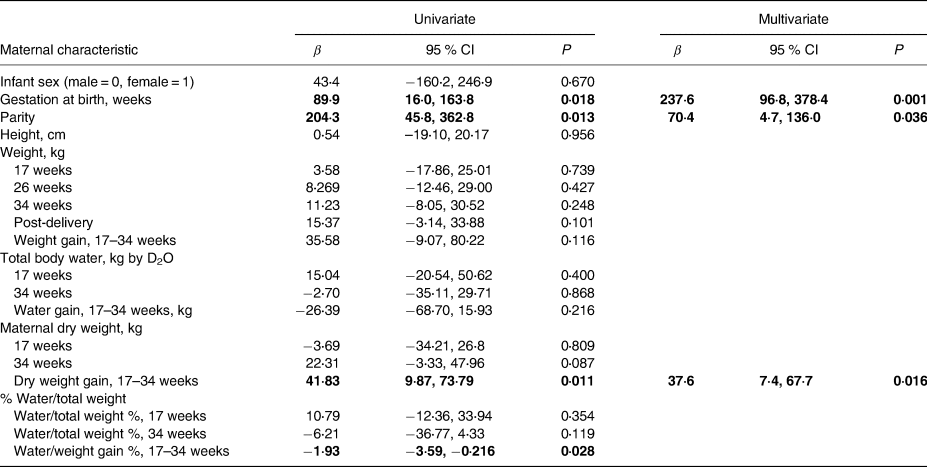
Bold text indicates statistical significance with a P value <0·05.
Associations between characteristics of forty-eight urban mothers during pregnancy and birth weight (g) by univariate and multiple regression analyses

Bold text indicates statistical significance with a P value <0·05.
The only statistically significant determinant of placental weight was the number of weeks of gestation at birth for rural (β 20⋅0; 95 % CI 3⋅1, 36⋅8; P = 0⋅021), but not for urban, women.
The correlations between BIS and D2O estimates of TBW were 0⋅849 (P < 0⋅001) at 17 weeks and 0⋅790 (P < 0⋅001) at 34 weeks. However, we found that on average BIS underestimated the D2O measured water space (Fig. 1) and the underestimation increased with the size of that compartment at both weeks 17 (r 0⋅475, P < 0⋅001, Fig. 1(a)) and 34 (r 0⋅452, P < 0⋅001 Fig. 1(b)). For the changes in TBW between 17 and 34 weeks, the correlation between these two methods of estimation was 0⋅281 (P = 0⋅005). The Bland and Altman plot (Fig. 1(c)) indicated an average underestimation of the change measured by BIS compared to D2O but with some overestimation at lower levels of change and, predominantly, underestimation at higher levels of change (r 0⋅604, P < 0⋅001).
Comparison at 17 (a) and 34 weeks (b) of pregnancy of the difference between total body water (TBW) as estimated by deuterium dioxide dilution (TBW D2O) and TBW as assessed by whole-body bioimpedance spectroscopy (TBW-BIS) with the mean of the two methods. In (c), the differences between the TBW changes over these two time points as assessed by the two methods are compared against the mean difference. Solid horizontal lines indicate the means of the differences and dashed lines the limits of agreement (mean difference ± 2 sd).

Discussion
This investigation of maternal total body water at 17 and 34 weeks found that only for rural women but not for urban, a relative increase in dry mass or a decrease in percentage body water between 17 and 34 weeks was associated with a higher birth weight. This implies proportionally more body fat gain, a component of dry mass, was associated with a higher birth weight. Since 17–34 weeks encompass trimester 2 and 6 weeks of trimester 3, we cannot compare the present results directly to studies that measured body composition within a trimester. Other researchers(Reference Widen, Factor-Litvak and Gallagher18) have found that a higher rate of GWG in trimester 2 was associated with higher birth weight and higher GWG in both trimester 2 and 3 with larger gains in maternal fat mass measured by underwater weighing.
The women in our study would not be considered underweight, although compared to European and Asian Indian women in developed countries, e.g. New Zealand(Reference Rush, Freitas and Plank19), total body mass was low and the height was short. The utility of BMI cutpoints is recognised as different for Asian populations compared to European,(20) but there are no specific BMI cutpoints for pregnant Asian women.
In comparison with the Institute of Medicine (IOM) guidelines for GWG for women with a BMI of 20 kg/m2, 11⋅5–16 kg is recommended,(2) but the mean weight gain in the present study of 6⋅7 kg was considerably less, albeit that the gain for our women was between weeks 17 and 34. A further 6 weeks of pregnancy could result in a further 3 kg of body weight. In addition, mean birth weight was 2⋅8 kg, which is not considered low by the IOM, but is less than the 3⋅4 kg reported by Butte et al. (Reference Butte, Ellis and Wong21) for a water gain of 7⋅1 kg.
The rate of recommended weight gain/week in the second and third trimester is ~0⋅4 kg/week,(2) which adds to an expected 0⋅5–2 kg gain in the first trimester. Weight gain over the 17 weeks from 17 to 34 weeks was, on average, 0⋅4 kg/week, which is within the IOM guideline.
Lederman et al. studied TBW in 200 women in New York (weight at week 14, 65 kg) in early and late pregnancy and reported that, at term, maternal TBW, not fat, was significantly associated with infant birth weight(Reference Lederman, Paxton and Heymsfield22). For each 1 litre increase in body water at week 37, birth weight was increased by 35 g. In Chile, Mardones-Santander et al. measured TBW by D2O in 224 pregnant women at term and found that fat-free mass was the most important maternal body component associated with birth weight(Reference Mardones-Santander, Salazar and Rosso23). One kg of additional fat-free mass was associated with 20 g of extra birth weight and 1 kg of additional fat mass with 18 g; a 1 week increase in gestational age at delivery was associated with 79 g of extra birth weight. However, the estimate of fat-free mass at term assumed a hydration of 75 % as modelled by van Raaij et al. (Reference van Raaij, Peek and Vermaat-Miedema24). Butte et al. assessed body composition, including TBW by deuterium dilution, using the four-compartment model in sixty-three women of low, normal and high BMI, from before pregnancy, at 9, 22 and 36 weeks of pregnancy and 2, 6 and 27 weeks of postpartum(Reference Butte, Ellis and Wong21). Women with higher BMI gained more weight and fat mass in pregnancy, but all had similar gains in TBW, protein and fat-free mass. Birth weight of offspring was significantly correlated with maternal pre-pregnancy weight, pre-pregnancy fat mass and gain in maternal weight, TBW and fat-free mass, but not with gain in fat mass(Reference Butte, Ellis and Wong21). This is in agreement with our findings that water and dry mass gained by urban and rural women were not statistically different, but weight gain was higher for urban, suggesting that more fat mass was gained by urban women. Possible explanations include the level of physical activity and dietary patterns as the rural women were most often engaged in agriculture.
In agreement with BIS results at 32 weeks of gestation reported by Lof and Forsum(Reference Lof and Forsum25), where tracer dilution was also used as a reference TBW measure, we report that in pregnancy at 17 and 34 weeks, BIS underestimated total body water. The mean difference in both studies was 3⋅8 kg, and the extent of underestimation increased with weeks of gestation. Both studies used Cole model-fitting and Hanai mixture theory to estimate TBW by BIS. A number of factors may contribute to the TBW underestimation by BIS. During pregnancy, a substantial fraction of the increased TBW will be sequestered in the trunk, which contributes very little to the measured resistance of the whole body that is predominantly from the legs and arms with their much smaller cross-sectional areas. The increased underestimation observed from 17 to 34 weeks is supported by this explanation. Secondly, the shape factor used in the BIS formulae, based on the lengths and circumferences of the limbs and the trunk, will be altered during pregnancy(Reference Jaffrin and Morel26). Thirdly, the resistivity coefficients adopted by the manufacturer's software may not apply in pregnancy, given that electrolyte concentrations change during pregnancy. We observed significant linear relationships between the average TBW estimates from dilution and BIS and the differences between the two techniques which were not seen in the Lof and Forsum study(Reference Lof and Forsum25). Refinements to the BIS model for application in late pregnancy may improve accuracy and precision and permit the appropriate evaluation of the utility of TBW estimates by this approach in individual women.
This study was limited by its relatively small sample size but strengthened by the sampling of women living in both rural and urban areas, the comprehensive and diligent longitudinal measurements and the validity of measurements of body water by D2O. This investigation adds to a paucity of literature concerning body composition and GWG of Indian women and highlights differences in body composition during pregnancy related to rural and urban environments and possible impacts of the nutrition transition on body composition in pregnancy and fetal growth.
Acknowledgments
The authors are grateful to the pregnant women and their children for taking part in this study and also thank Dr KJ Coyaji, Director KEM Hospital, Pune, for providing research facilities. The authors are indebted to Dr Suhas Otiv, Dr SS Naik, Ms Pallavi Hardikar, Mrs Neelam Memane, Dr Niranjan Joshi, Dr Aparna Joshi, Mrs PC Yajnik, Mr Charudatta Joglekar, Mr TM Deokar, Mr SD Chougule, Mr AB Gaikwad and the drivers for their invaluable contributions to the study.
C. S. Y. designed research; H. L., A. G. and D. S. B. conducted research; E. C. R. and L. D. P. analysed data; and E. C. R., L. D. P. and C. S. Y. wrote the paper. C. S. Y. had primary responsibility for final content. All authors read and approved the final manuscript.
This study was funded as part of a cooperative research programme by the International Atomic Energy Agency (IAEA).
The contents of this article are solely the responsibility of the authors.
None declared.


 Open access

