





Introduction
Sleep problems in adolescents have increasingly garnered attention due to their prevalence and adverse effects on health. Adolescent sleep issues typically manifest as irregular sleep timing, delayed sleep phase, and reduced sleep duration, driven by physiological, behavioral, and social transitions (Crowley et al., Reference Crowley, Wolfson, Tarokh and Carskadon2018; Hoyt et al., Reference Hoyt, Maslowsky, Olson, Harvey, Deardorff and Ozer2018). Accumulating evidence highlights sleep disturbances—including short nocturnal sleep, insomnia, snoring, and daytime sleepiness—as salient risk factors for adolescent mental health (Isaiah et al., Reference Isaiah, Ernst, Cloak, Clark and Chang2021; Ng et al., Reference Ng, Wu, Lam, Lam, Nip, Ng, Leung and Leung2020; Roberts et al., Reference Roberts, Roberts and Chen2002; Tamura et al., Reference Tamura, Komada, Inoue and Tanaka2022). The World Health Organization (WHO, 2021) has identified adolescent sleep disturbances alongside internalizing and externalizing symptoms as critical mental health priorities. Given the developmental changes characterizing early adolescence, this period presents a crucial window to explore the complex interplay between sleep issues and psychological symptoms.
Adolescence marks a vulnerable stage for mental health (Silva et al., Reference Silva, Silva, Ronca, Gonçalves, Dutra and Carvalho2020). Most mental health disorders diagnosed in adults emerge during adolescence. Adolescent-onset mental health problems have been associated with a range of negative long-term consequences (Kessler et al., Reference Kessler, Amminger, Aguilar-Gaxiola, Alonso, Lee and Üstün2007). Internalizing symptoms, such as anxiety and depression, are inwardly directed emotional difficulties, whereas externalizing symptoms are outwardly expressed behaviors, including irritability and aggression (Willner et al., Reference Willner, Gatzke-Kopp and Bray2016). These psychopathologies often emerge or significantly escalate during adolescence, with prevalence estimates of internalizing and externalizing disorders ranging from approximately 19 to 31% among adolescents globally, with notably high rates reported among Chinese youth (Cui et al., Reference Cui, Li, Leckman, Guo, Ke, Liu, Zheng and Li2021; Pinquart, Reference Pinquart2021; Twenge et al., Reference Twenge, Cooper, Joiner, Duffy and Binau2019). Adolescents experiencing these symptoms face heightened risks for serious consequences, including suicidal behavior (Hartley et al., Reference Hartley, Pettit and Castellanos2018), adult criminality (Leschied et al., Reference Leschied, Chiodo, Nowicki and Rodger2008), and impaired academic performance (Okano et al., Reference Okano, Jeon, Crandall, Powell and Riley2020). Thus, clarifying the etiological mechanisms and reciprocal interactions between sleep disturbances and adolescent mental health is critical for identifying effective intervention strategies and reducing these adverse outcomes.
While previous studies have consistently linked sleep problems to both internalizing symptoms (Mulraney et al., Reference Mulraney, Giallo, Lycett, Mensah and Sciberras2016; Pasch et al., Reference Pasch, Latimer, Cance, Moe and Lytle2012; Quach et al., Reference Quach, Nguyen, Williams and Sciberras2017) and externalizing symptoms (Pieters et al., Reference Pieters, Burk, Van der Vorst, Dahl, Wiers and Engels2015; Van Veen et al., Reference Van Veen, Lancel, Beijer, Remmelzwaal and Rutters2021), less is known about the longitudinal interplay between these constructs at the symptom level. For example, short sleep duration, insomnia symptoms, and irregular sleep patterns have been associated with more depressive and anxiety symptoms, as well as externalizing behaviors such as aggression and rule-breaking (Lunsford-Avery et al., Reference Lunsford-Avery, Wang, Kollins, Chung, Keller and Engelhard2022; Owens et al., Reference Owens, Wang, Lewin, Skora and Baylor2017). However, these studies typically rely on aggregate-level analyses or latent-variable models (Williamson et al., Reference Williamson, Zendarski, Lange, Quach, Molloy, Clifford and Mulraney2021; Yue et al., Reference Yue, Cui, Liu, Jia and Liu2022), limiting the ability to capture nuanced symptom-level dynamics. Consequently, the specific pathways through which sleep problems influence, or are influenced by, individual psychological symptoms over time remain poorly understood. Given adolescence’s sensitivity for establishing enduring sleep patterns and psychological vulnerabilities, investigating the temporal and reciprocal nature of these relationships is of vital importance. In this study, we applied a novel cross-lagged panel network methodology to investigate longitudinal associations between sleep problems, internalizing symptoms, and externalizing symptoms, aiming to identify key symptoms that may serve as early intervention targets.
Theoretical considerations
Several theoretical models propose relations between sleep problems and adolescent psychopathology. According to the Cognitive Model of Insomnia (Lundh & Broman, Reference Lundh and Broman2000), sleep problems are the result of an interaction between sleep-interpreting processes and sleep-interfering processes. On the one hand, individuals’ personal standards, attitudes, beliefs, and fears influence how they interpret sleep fluctuations, sleep difficulties, and daytime consequences of poor sleep (sleep-interpreting processes). Conversely, in the sleep-interfering processes, cognitive or emotional arousal stemming from traumatic or stressful events, anxiety, and emotional distress directly disrupts sleep (Lundh & Broman, Reference Lundh and Broman2000). Through these interactive processes, internalizing and externalizing symptoms can precede and predict sleep difficulties. While this model has been validated primarily in adult populations, emerging research suggests that cognitive-emotional mechanisms also contribute to adolescent sleep disturbances (Lovato et al., Reference Lovato, Short, Micic, Hiller and Gradisar2017). The Developmental Cascade Model (Masten & Cicchetti, Reference Masten and Cicchetti2010) emphasizes how difficulties in one domain may spill over into other domains over time through recursive processes. According to this model, difficulties in one domain (e.g., sleep disturbance) may initiate a cascade that contributes to the emergence or worsening of other problems (e.g., internalizing, and externalizing symptoms), which in turn perpetuate further sleep disturbance (Moilanen et al., Reference Moilanen, Shaw and Maxwell2010). Supporting this model, a longitudinal study documented a reciprocal cascade between sleep and emotional problems: disturbed sleep contributed to the persistence of depressive symptoms from childhood through early adolescence, which in turn, predicted ongoing sleep disturbances (Marino et al., Reference Marino, Andrade, Montplaisir, Petit, Touchette, Paradis, Côté, Tremblay, Szatmari and Boivin2022). Collectively, these models provide a theoretical foundation for understanding the dynamic, reciprocal interactions between sleep disturbances and psychological symptoms, highlighting the need to clarify the directionality and specificity of these relationships.
Developmental association among sleep problems, internalizing symptoms, and externalizing symptoms
Adolescence is marked by dynamic developmental changes that heighten vulnerability to both sleep disturbances and psychological symptoms (Lunsford-Avery et al., Reference Lunsford-Avery, Wang, Kollins, Chung, Keller and Engelhard2022). In recent years, sleep-related issues among adolescents have gained attention globally, including in China. The Ministry of Education of the People’s Republic of China issued a national guideline recommending that adolescents obtain at least eight hours of sleep each nightFootnote 1 . However, national data indicate that the average sleep duration is 7.48 hours for junior high school students and only 6.5 hours for senior high school students (Li et al., Reference Li, Tao, Gao, Wen, Dong, Song, Zou and Ma2020). A recent meta-analysis further estimates that sleep deprivation affects up to 80% of junior high students and 84% of senior high school students in China (Li et al., Reference Li, Wang, Zhang, Wang and Yang2022). The high and rising prevalence of sleep problems among Chinese adolescents is particularly concerning given their strong ties to physical and mental health.
Extensive evidence has demonstrated that adolescent sleep problems are linked to impairments of psychosocial functioning in children and adolescents. For example, sleep problems are associated with later internalizing and externalizing problems (e.g., Lunsford-Avery et al., Reference Lunsford-Avery, Wang, Kollins, Chung, Keller and Engelhard2022; Gregory & O’connor, Reference Gregory and O’connor2002; Gregory et al., Reference Gregory, Rijsdijk, Lau, Dahl and Eley2009; Owens et al., Reference Owens, Wang, Lewin, Skora and Baylor2017; Wang et al., Reference Wang, Guo, Du, Li, Wu, Guo and Lu2022). There is also evidence that psychopathological symptoms, such as depressed mood, can precede sleep-related issues, including insufficient nighttime sleep, insomnia symptoms, snoring, and excessive daytime sleepiness (e.g., Hayley et al., Reference Hayley, Skogen, Sivertsen, Wold, Berk, Pasco and Øverland2015; Lovato et al., Reference Lovato, Short, Micic, Hiller and Gradisar2017; Marino et al., Reference Marino, Andrade, Montplaisir, Petit, Touchette, Paradis, Côté, Tremblay, Szatmari and Boivin2022). However, existing studies on the relations between sleep problems and internalizing and externalizing problems often rely on aggregate measures, such as composite scores or summed scales, and latent variables derived from statistical modeling (Williamson et al., Reference Williamson, Zendarski, Lange, Quach, Molloy, Clifford and Mulraney2021; Yue et al., Reference Yue, Cui, Liu, Jia and Liu2022). These approaches are limited because they may obscure the nuanced, symptom-level interactions critical for understanding how specific types of sleep problems (e.g., difficulties falling asleep, arousal disorder) influence—or are influenced by—individual internalizing (e.g., anxiety, somatic complaints) and externalizing (e.g., delinquent behavior, aggression) symptoms over time.
Additionally, symptoms of internalizing and externalizing disorders frequently co-occur and predict one another across adolescence (Kessler et al., Reference Kessler, Avenevoli, McLaughlin, Green, Lakoma, Petukhova, Pine, Sampson, Zaslavsky and Merikangas2012), suggesting complex temporal dynamics. Research shows that externalizing behaviors (e.g., aggression, delinquency) often precede internalizing symptoms (e.g., anxiety, depression) by triggering adverse social reactions such as rejection, isolation, and academic difficulties (Weeks et al., Reference Weeks, Ploubidis, Cairney, Wild, Naicker and Colman2016). However, research has seldom tested these associations longitudinally at the symptom-specific level, particularly in relation to sleep disturbances.
Given adolescence’s critical role in establishing enduring psychological patterns, clarifying symptom-level associations among sleep, internalizing symptoms, and externalizing symptoms over time is essential. Adolescents’ mental health symptoms are often intertwined and highly comorbid, predicting each other longitudinally (Kessler et al., Reference Kessler, Avenevoli, McLaughlin, Green, Lakoma, Petukhova, Pine, Sampson, Zaslavsky and Merikangas2012). Thus, it is crucial to employ methodologies capable of modeling these dynamic, reciprocal relationships at the symptom level to advance our understanding of how specific symptoms evolve and influence one another throughout adolescence.
A network approach
Given the high comorbidity and interdependence among symptoms of mental disorders, the traditional latent-variable approach has increasingly been supplemented by network-based methods (Borsboom & Cramer, Reference Borsboom and Cramer2013). The network theory of psychopathology conceptualizes mental disorders as emergent phenomena arising from the direct interactions among individual symptoms, rather than as manifestations of underlying latent constructs (Borsboom, Reference Borsboom2017). In this framework, symptoms are represented as nodes, and their statistical or causal associations as edges, forming a complex system that reflects the dynamic interactions within psychopathology (Epskamp et al., Reference Epskamp, Borsboom and Fried2018). Centrality indices, such as expected influence (EI), help identify symptoms that are most connected within the network, thereby highlighting potential intervention targets (Robinaugh et al., Reference Robinaugh, Millner and McNally2016).
In recent years, network analysis has gained increasing traction, not only within psychopathology (Guo et al., Reference Guo, Cui, Qiu, Bu, Yang, Li and Zhu2024; Marian et al., Reference Marian, Costantini, Macsinga and Sava2023) but also in personality psychology (Taylor et al., Reference Taylor, Fong and Asmundson2021; Vanzhula et al., Reference Vanzhula, Kinkel-Ram and Levinson2021). This analytic approach combines intuitive visualization with rigorous statistical inference, enabling researchers to explore the structure and interrelationships within psychological systems. Visualization captures the architecture of symptom relationships, while statistical methods such as centrality measures, bridge centrality, and community detection provide insight into how individual symptoms influence one another and interconnect across symptom domains (Briganti et al., Reference Briganti, Kempenaers, Braun, Fried and Linkowski2018; Costantini et al., Reference Costantini, Epskamp, Borsboom, Perugini, Mõttus, Waldorp and Cramer2015; Jones et al., Reference Jones, Ma and McNally2021).
However, a notable limitation of most network studies to date is their reliance on cross-sectional data. While such data are valuable for identifying associations among symptoms, they fail to capture the temporal or causal dynamics of symptom interactions over time (Williamson et al., Reference Williamson, Zendarski, Lange, Quach, Molloy, Clifford and Mulraney2021). To address this gap, the cross-lagged panel network (CLPN) model has emerged as a powerful extension that integrates longitudinal modeling into network analysis (Wysocki et al., Reference Wysocki, van Bork, Cramer and Rhemtulla2022). CLPN combines the strengths of network theory with the temporal precision of cross-lagged panel models (CLPM), allowing for the modeling of both autoregressive (within-node) and cross-lagged (between-node) effects across time.
Whereas traditional CLPM assumes that variables operate independently and examines directional associations in a pairwise fashion, CLPN models psychological constructs as interdependent components within a dynamic, evolving system. By using directed edges within a temporal network structure, CLPN provides a more comprehensive view of how symptoms influence one another over time. This framework not only identifies the most central symptoms but also distinguishes those that primarily drive the network (high out-EI centrality) from those that are more reactive (high in-EI centrality) (Cervin et al., Reference Cervin, Miguel, Güler, Ferrão, Erdoğdu, Lazaro, Gökçe, Geller, Yulaf, Başgül, Özcan, Karabekiroğlu, Fontenelle, Yazgan, Storch, Leckman, do Rosário and Mataix-Cols2022; McNally, Reference McNally2016).
Importantly, the CLPN approach offers a system-level perspective that captures feedback loops and cascading effects—phenomena that are particularly relevant in the development and persistence of mental disorders such as depression, anxiety, and behavioral problems (Chavez-Baldini et al., Reference Chavez-Baldini, Verweij, de Beurs, Bockting, Lok, Sutterland, van Rooijen, van Wingen, Denys, Vulink and Nieman2022; Funkhouser et al., Reference Funkhouser, Chacko, Correa, Kaiser and Shankman2021). By identifying high bridge centrality nodes, which link symptom clusters across multiple domains, CLPN further highlights potential targets for transdiagnostic interventions that address interconnected symptom groups across different disorders (Guo et al., Reference Guo, Cui, Qiu, Bu, Yang, Li and Zhu2024).
In sum, CLPN provides a theoretically robust and empirically grounded framework for understanding the evolving dynamics of psychopathology at the symptom level. Its integration of temporal directionality, network topology, and clinical relevance positions it as an ideal approach for identifying causal pathways and intervention points within complex psychological systems. By offering both a more granular and system-wide view of symptom interactions, CLPN enhances our ability to target interventions at the most influential and interconnected symptoms in psychopathological networks (Elliott et al., Reference Elliott, Jones and Schmidt2020; Wysocki et al., Reference Wysocki, van Bork, Cramer and Rhemtulla2022).
Use of the network approach to understanding sleep problems and internalizing and externalizing symptoms
While the network approach has gained prominence for mapping the symptom-level structure of adolescent psychopathology (Epskamp & Fried, Reference Epskamp and Fried2018; Fried, Reference Fried2015; Fried & Cramer, Reference Fried and Cramer2017), most existing network studies primarily focus on emotional and behavioral domains separately, and few studies have explicitly investigated symptom-level relationships involving sleep disturbances alongside internalizing and externalizing symptoms. One study examined the network structure of internalizing and externalizing psychopathology composed of eight DSM-IV disorders from middle school through adolescence, finding that generalized anxiety disorder and oppositional defiant disorder were the most central disorders within their respective networks (McElroy et al., Reference McElroy, Shevlin, Murphy and McBride2018). In another study, Boschloo et al. (Reference Boschloo, Schoevers, van Borkulo, Borsboom and Oldehinkel2016) examined the network structure of 95 emotional and behavioral symptoms from five domains (i.e., internalizing, externalizing, attention, thought problems, and social problems) in a large sample of pre-adolescents (M age = 11.1 years; N = 2,175). They found that emotional and behavioral symptoms tend to cluster within, rather than across, broader diagnostic domains, though notable symptom pairs did bridge internalizing and externalizing domains, underscoring the interconnectedness of these dimensions. Of note, these studies did not examine symptom associations over time, and thus it remains unclear which symptoms serve as bridges between the internalizing and externalizing domains across different stages of adolescence.
To the best of our knowledge, network analysis methods have rarely been used to examine the network structure of the relationships between sleep problems and internalizing and externalizing symptoms. A network analysis study found that poor sleep quality is associated with disinhibited behavior (i.e., rule breaking, aggressive behavior, and inattention) (Kelmanson, Reference Kelmanson2023). In another network analysis study, sleep disturbance did not have a direct link to depression symptoms, but rather was indirectly associated with them through worry (Boschloo et al., Reference Boschloo, Schoevers, van Borkulo, Borsboom and Oldehinkel2016). A recent network analysis study revealed that generalized anxiety disorder symptoms are most central nodes within largely similar symptom network structures among children and adolescents aged 7.5–14 years (McElroy et al., Reference McElroy, Shevlin, Murphy and McBride2018). In a network of internalizing, externalizing, and attention symptoms and prosocial behaviors, inattention emerged as the most central symptom (Rouquette et al., Reference Rouquette, Pingault, Fried, Orri, Falissard, Kossakowski, Vitaro, Tremblay, Cote and Borsboom2018). These studies highlight the importance of including symptoms from diverse domains of psychopathology in symptom network models to gain a clearer understanding of the unique and potentially causal relationships between symptoms. However, existing studies relied largely on cross-sectional, undirected networks, limiting their ability to determine temporal directionality or causal pathways.
Moreover, prior research on symptom networks has predominantly been limited to childhood and early adulthood samples, leaving the critical early adolescent period (ages 11–15) comparatively understudied. Consequently, there is limited knowledge about how sleep disturbances and specific internalizing and externalizing symptoms predict each other across time. Our study addresses these gaps by utilizing longitudinal cross-lagged panel network analysis to examine symptom-level temporal relationships between sleep disturbances and internalizing and externalizing problems across early adolescence. Our study is the first to examine temporal associations across a six-month-long time interval between every two adjacent time point in early adolescence (ages 11–15).
The current study
The present study aims to examine the longitudinal relationships among sleep problems, internalizing symptoms, and externalizing symptoms in early adolescence (ages 11–15) by using cross-lagged panel network (CLPN) modeling. The data for this study were drawn from a larger longitudinal project on adolescent development conducted in urban regions of Northwest China (see Liu et al., Reference Liu, Zhang, Wu, Yang and Liang2021). The current study addresses a distinct research question using a novel analytic framework and focuses on symptom-level associations that have not been previously examined.
Specifically, we applied CLPN to explore reciprocal associations at the symptom level across multiple time points, identifying directional relationships among individual sleep disturbances and internalizing and externalizing symptoms. We recognize that the representation of these domains with differing numbers of nodes—sleep (6), internalizing (3), and externalizing (2)—may raise concerns about potential imbalance. However, it is important to note that the selection of nodes was purposefully designed to capture the complexity and multidimensionality of each domain, rather than to represent them in equal measure. The CLPN method, which accounts for both autoregressive and cross-lagged effects, is particularly suited for modeling the interdependencies between symptoms over time, allowing us to explore how symptoms from different domains influence each other while avoiding oversimplification.
Additionally, we calculated symptom centrality indices (i.e., out-degree and in-degree centrality) to determine which symptoms prospectively predicted or were predicted by other symptoms, thus clarifying potential intervention targets. Given the exploratory nature of this novel research approach and the paucity of prior evidence examining longitudinal symptom-level associations, we anticipated that symptoms would form distinct yet interconnected clusters corresponding to sleep problems, internalizing problems, and externalizing problems, with specific sleep problems potentially bridging or interacting with these clusters.
Methods
Participants and procedures
Participants included 1,303 early adolescents initially recruited in the fall semester of the first year of middle school (7th grade) from 29 classes across four middle schools in urban regions of Northwest China. Data were collected across four waves (T1, T2, T3, and T4), spaced at approximately 6-month intervals from the first semester of 7th grade to the second semester of 8th grade. However, 22 students did not complete the entire assessment. The primary reasons for attrition included illness, participation in other school-related activities (e.g., remediation), and students transferring to different schools. The current analysis included participants who had completed at least two waves of survey (n = 1281; 636 females, mean age at baseline = 12.73 years, SD = 0.68), regardless of whether these timepoints were adjacent (e.g., participants completing T1, and T3 were retained). The average attrition rate over the entire study was 9.84% (T2: 9.83%, T3: 9.92%, T4: 9.87%). Little’s test for missing completely at random (MCAR) was performed across all four timepoints simultaneously and results indicated that the missing data were randomly distributed (χ2 = 241.03, df = 255, p = 0.542). After applying the inclusion criteria, remaining missing values were handled via listwise deletion prior to conducting the cross-lagged panel network analyses. All missing data handling procedures were completed manually before implementing the CLPN analyses using the glmnet library, which requires complete data. The analysis code is available at https://osf.io/3e2ds/overview?view_only=6309a53bebbe4d598ce78b65bfb875e5.
Participating classes were randomly selected, and the questionnaires were completed in pencil-and-paper format under the supervision of the researchers. All four participating schools followed a similar daily schedule, with classes typically beginning between 7:30 and 8:00 AM. There was no notable variation in school start times across schools or classrooms. The research was approved by the relevant Research Ethics Committee, local bureau of education, and principals of the participating schools. Written informed consent was obtained by participating adolescents and classroom teachers.
Measures
Sleep problems
Adolescents reported their perceived sleep problems by reporting to a 26-item Adolescent Sleep Disturbance Questionnaire (ASDQ; Zhang et al., Reference Zhang, Xu, Zhao, Chen, Ye, Shen, Wu, Zhang, Shen and Li2018), a self-administered questionnaire. Adolescents were asked to indicate on a 5-point Likert scale ranging from 0 (never) to 4 (always) how often they had carried out or experienced certain forms of sleep-related problems in the previous six months (total score ranging from 0 to 104). Prior studies have indicated that the ASDQ demonstrates acceptable psychometric properties in assessing sleep problems among Chinese adolescents (Cronbach’s alpha = 0.71 for the total scale; 0.61–0.73 for subscales; test–retest intraclass correlation ICCs = 0.85 for total scale; 0.64–0.82 for subscales (Yang, Reference Yang2016; Zhang et al., Reference Zhang, Xu, Zhao, Chen, Ye, Shen, Wu, Zhang, Shen and Li2018). The ASDQ comprises six symptom-based domains: five items assessing difficulties falling asleep, seven assessing difficulties maintaining asleep, five assessing difficulties reinitiating asleep, three assessing morning awakening disorders, three assessing sleep breathing disorders, and three assessing arousal disorders. Internal reliability was acceptable for the full scale (T1–T4, Cronbach’s alpha = 0.82–0.89) and subscales (alpha = 0.68–0.76, 0.69–0.79, 0.77–0.85, 0.73-0.80, 0.74–0.83, 0.73–0.88 respectively for the six subscales across T1∼T4). To be used as indicators of sleep problems in cross-lagged panel network (CLPN) analyses, separate means for difficulties falling asleep, difficulties maintaining asleep, difficulties reinitiating asleep, morning awakening disorders, sleep breathing disorders and arousal disorders were calculated. In line with the network modeling framework, which does not assume latent constructs but instead examine direct associations among observed variables, we treated each subscale as an independent observed variable (node). This allowed us to examine their unique temporal dynamics and interactions with internalizing and externalizing symptoms. To further evaluate the measurement structure of the ASDQ, confirmatory factor analysis was conducted at each wave. The six-factor measurement models fit the data well at each wave (T1: χ2 /df = 9.05, CFI = 0.95, TLI = 0.91, RMSEA = 0.07, SRMR = 0.03; T2: χ2 /df = 3.53, CFI = 0.99, TLI = 0.98, RMSEA = 0.04, SRMR = 0.02; T3: χ2 /df = 5.42, CFI = 0.98, TLI = 0.97, RMSEA = 0.06, SRMR = 0.02; T4: χ2 /df = 7.84, CFI = 0.97, TLI = 0.95, RMSEA = 0.07, SRMR = 0.03).
Internalizing and externalizing symptoms
The Chinese version of Youth Self-Report (YSR) of Child Behavior Checklist was used to assess adolescents’ internalizing and externalizing symptoms in the preceding 6 months on a 3-point scale ranging from 0 (not true) to 2 (very true or often true). The YSR scale consists of 65 items. Internalizing symptoms are evaluated using 32 items, with total scores ranging from 0 to 64, spanning three distinct dimensions: withdrawal behavior (9 items), somatic symptoms (9 items), and anxious/depressed moods (14 items). Externalizing symptoms are evaluated using 33 items, with total scores ranging from 0 to 66, spanning two dimensions: delinquent behavior (13 items) and aggressive behavior (20 items). For the purpose of the study, subscale scores of internalizing and externalizing symptoms were used, with higher scores indicating a greater level of problems. The YSR has demonstrated adequate psychometric properties in Chinese youths (Liu et al., Reference Liu, Guo, Liu, Wang, Hu, Tang, Chai, Zhao, Yang and Sun1997). The Cronbach’s alphas were 0.90–0.92 and 0.91–0.93 for internalizing symptoms and externalizing symptoms among the current sample from T1 to T4, respectively.
Statistical analysis
The statistical software R (Version 4.3.2) was used to conduct the main statistical analyses, including centrality analysis, stability tests, and CLPN model estimation. Descriptive statistical analyses were performed using the SPSS Version 25.0. To manage the missing values, the Full Information Maximum Likelihood (FIML) approach was implemented (Lee & Shi, Reference Lee and Shi2021).
Network estimation and visualization
We estimated three separate CLPN models (T1→T2 Network, T2→T3 Network and T3→T4 Network) to model longitudinal relationships between sleep problems, internalizing, and externalizing symptoms over approximately 6-month intervals. Each CLPN model was generated by estimating both the autoregressive (i.e., the influence of a variable on itself at the next measurement after controlling for covariates) and cross-lagged (i.e., the influence of one variable on another variable at the next measurement after controlling for covariates) coefficients across time through a series of regularized regression models (Wysocki et al., Reference Wysocki, van Bork, Cramer and Rhemtulla2022). To account for individual differences, sex and age were included as control covariates in all longitudinal network analyses. Sex was controlled to adjust for potential gender-related differences, whereas age was included to capture developmental progression effects. This parsimonious control strategy is consistent with prior longitudinal network studies (e.g., Chavez-Baldini et al., Reference Chavez-Baldini, Verweij, de Beurs, Bockting, Lok, Sutterland, van Rooijen, van Wingen, Denys, Vulink and Nieman2022; Funkhouser et al., Reference Funkhouser, Chacko, Correa, Kaiser and Shankman2021; Qu et al., Reference Qu, Liu, Jia, Zhang, Chen, Zhang, Feng and Chen2024; Xie et al., Reference Xie, Huang, Liu and Xu2023), which emphasize balancing model complexity and interpretability by including only essential time-invariant covariates.
To enhance interpretability and create a relatively sparse network, the standard lasso (Least Absolute Shrinkage and Selection Operator) method was applied to the estimated regression coefficients, shrinking nonsignificant paths toward zero. Lasso regularization is essential for controlling network sparsity and reducing spurious edges—weak or incidental associations that can distort the network structure—particularly in panel data settings (Costantini et al., Reference Costantini, Epskamp, Borsboom, Perugini, Mõttus, Waldorp and Cramer2015). To ensure that the model estimates were reliable, we standardized the variables prior to the regularized estimation procedure, following the default procedure in the glmnet package. Standardizing the variables ensures that they are on the same scale, which allows the lasso procedure to treat them equally when applying shrinkage, ensuring accurate and consistent estimation of the network structure. We selected the optimal penalty parameter (λ) using 10-fold cross-validation, choosing the value that minimized the mean cross-validated error to balance model fit and complexity. Although Graphical Lasso (gLASSO) is commonly used for penalized estimation in Gaussian graphical models, we opted for the standard lasso method implemented via the glmnet package in R, which is more appropriate for network estimation through penalized regression without penalizing the off-diagonal elements of the precision matrix.
In these networks, nodes represent individual symptoms or symptom clusters, and edges represent directional relationships. Edge colors indicated directionality (blue: positive relationships; red: negative relationships), with edge thickness and saturation reflecting the strength of the associations. The glmnet package (Friedman et al., Reference Friedman, Hastie and Tibshirani2008) in R was used to estimate CLPN regression, and the qgraph package (Epskamp et al., Reference Epskamp, Cramer, Waldorp, Schmittmann and Borsboom2012) was used to generate network plots.
Network stability and centrality
The stability of the CLPN models was examined using bootstrap approaches with bootnet package Version 1.4.3 in R (Epskamp et al., Reference Epskamp, Borsboom and Fried2018). The accuracy of edge weights and node centrality were tested with two bootstrapping procedures. The accuracy of edge weights was estimated by drawing nonparametric bootstrapped confidence intervals with 1,000 iterations. Wider intervals indicated lower stability of edge weight estimates. Correlation stability (CS) coefficients reflects the maximum proportion of cases that can be excluded while retaining a correlation of at least 0.7 with the original centrality estimates. According to Epskamp et al. (Reference Epskamp, Borsboom and Fried2018), a CS coefficient should not be lower than 0.25 to allow meaningful interpretation, while a value of 0.5 or higher indicates strong and reliable stability. In our constructed CLPN models, the obtained CS values (ranging from 0.28 to 0.60) all exceeded the minimum acceptable threshold, indicating good network stability that is sufficient to support the robustness and reliability of the centrality results.
Centrality measures were computed to aid interpretation of CLPN models through qgraph package Version 1.6.5 in R (Epskamp et al., Reference Epskamp, Cramer, Waldorp, Schmittmann and Borsboom2012). Expected influence (EI), defined as the sum of values of the edges connected to each node (Robinaugh et al., Reference Robinaugh, Millner and McNally2016), was used in this study to indicate centrality. To account for the longitudinal and directed nature of the CLPN, we calculated the cross-lagged in-EI (i.e., the sum of the values of incoming edges connected to a node), and out-EI (i.e., the sum of the values of outgoing edges linked with one node). Additionally, we sought to identify bridge nodes that connect between sleep problems and the two constructs of internalizing and externalizing symptoms by computing bridge EI (i.e., the sum of the values of a node’s edges connecting with the nodes from other communities).
Network comparison
To evaluate the consistency and developmental changes of symptom interactions across time, network comparisons were conducted between successive time points (T1→T2, T2→T3, and T3→T4). These comparisons allowed us to assess how the network structure evolves over time and to examine the stability of the relationships between variables. We used three key criteria to evaluate these changes. First, we examined the correlations of corresponding edge weights in adjacent networks to assess the stability of symptom relationships. Higher correlations between corresponding edge weights suggest that the relationships are stable across time, while lower correlations indicate that the relationships between symptoms have changed. Second, we assessed the proportion of replicated edges across time points. A high proportion of replicated edges indicated longitudinal stability in the network, while a low proportion suggests that new or altered relationships are emerging, reflecting developmental changes in the symptom interactions. Third, we evaluated the correlations of centrality indices (expected influence values) for each node. Expected influence (EI) quantifies the relative importance of symptoms based on in-coming and out-going edges. If the centrality rankings of symptoms remained similar across time, this would suggest stability, while significant changes in centrality would indicate that certain symptoms become more or less central as the network develops.
To provide a more flexible and data-driven analysis, we did not constrain the cross-lagged paths to remain constant across time, allowing the relationships between variables to evolve and vary at each time point. By comparing the three distinct CLPNs (T1→T2, T2→T3, T3→T4), we were able to investigate how the strength and direction of the cross-lagged effects might change over time. This approach not only captures dynamic interactions between symptoms but also allows us to assess whether the relationships evolve or remain stable, without making restrictive assumptions about their constancy. By utilizing these criteria, we were able to explore whether the network structure was stable across time or whether changes occurred in the symptom interactions, providing insights into the developmental trajectory of the network.
Results
Descriptive statistics
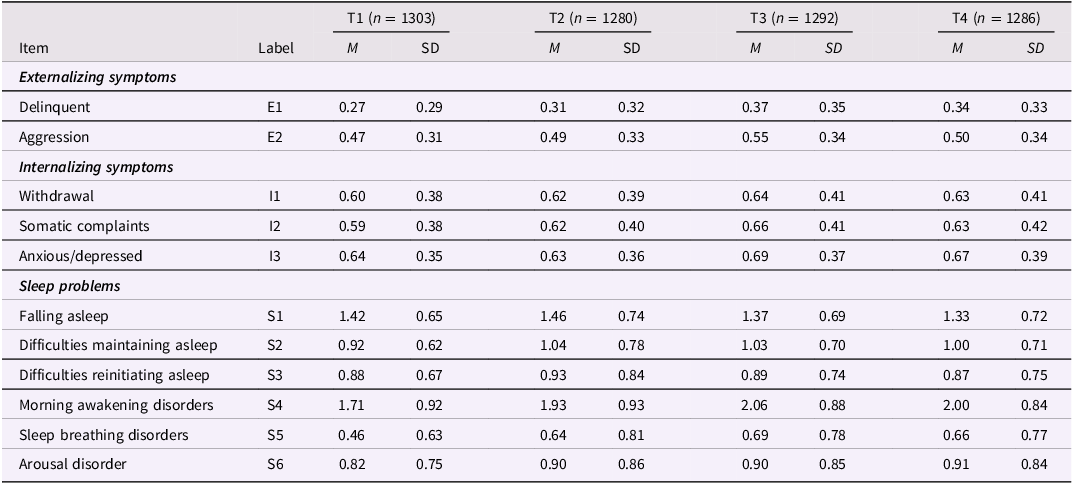
Table 1 provides item details, node labels, means, and standard deviations for all study variables across the four assessment waves. Correlation analyses indicated significant positive correlations among all variables (all ps < .01, see Supplemental Tables S1-S4).
Network nodes of sleep problems and internalizing and externalizing symptoms
Network stability and accuracy
The stability and accuracy of the CLPN models (T1→T2, T2→T3, T3→T4) were evaluated through bootstrapping procedures (see Supplementary Figures S1–S6). The 95% bootstrap confidence intervals (CIs) for edge weights were generally small to moderate, indicating acceptable accuracy and stability of network estimates (Figure S1). Correlation stability coefficients for in-expected influence (CS = 0.60, 0.36, 0.44), out-expected influence (CS = 0.44, 0.28, 0.44), and bridge expected influence (CS = 0.36, 0.28, 0.44) across T1→T2, T2→T3, and T3→T4 networks, respectively, also demonstrated acceptable stability (Figure S2). The T1→T2 network was much denser compared to both T2→T3 and T3→T4 network. Among all possible 121 edges, the percentage of nonzero edges is 82.6% for T1→T2 network, 55.4% for T2→T3 network and 61.2% for T3→T4 network (see Supplemental Tables S5–S7). Detailed edge weight and centrality difference tests are available in Figures S3–S6.
Cross-lagged panel network models
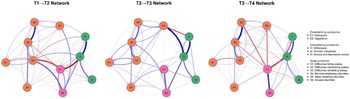
Figure 1 illustrates the cross-lagged panel network (CLPN) from T1 to T4, displaying the directed relationships between nodes after controlling for the T1 covariates. Specifically, the covariates measured at T1 are included to account for their potential influence on the relationships observed at subsequent time points (T2, T3, T4). By controlling for these baseline covariates, the model assesses the change in the parameter estimates at each time point, isolating the unique relationships between variables from the baseline effects. This approach ensures that the observed associations at later time points reflect developmental changes in the network, rather than being confounded by T1 covariates. Edge weights are presented in Tables S5-S7. Because the plotting algorithm determines path thickness relative to the strongest path, autoregressive edges (M = 0.29 for T1→T2 network, M = 0.25 for T2→T3 network, M = 0.26 for T3→T4 network) were excluded from Figure 2 to make the cross-lagged edges more visually interpretable but are presented in Supplementary Figure S7.
The cross-lagged panel networks for T1→T2 (left), T2→T3 (middle) and T3→T4 (right). Arrows represent unique longitudinal relationships. Blue edges indicate positive relationships, and red edges indicate negative relationships. Thicker edges represent stronger relations. Autoregressive edges were estimated but not shown in the plot for simplicity.
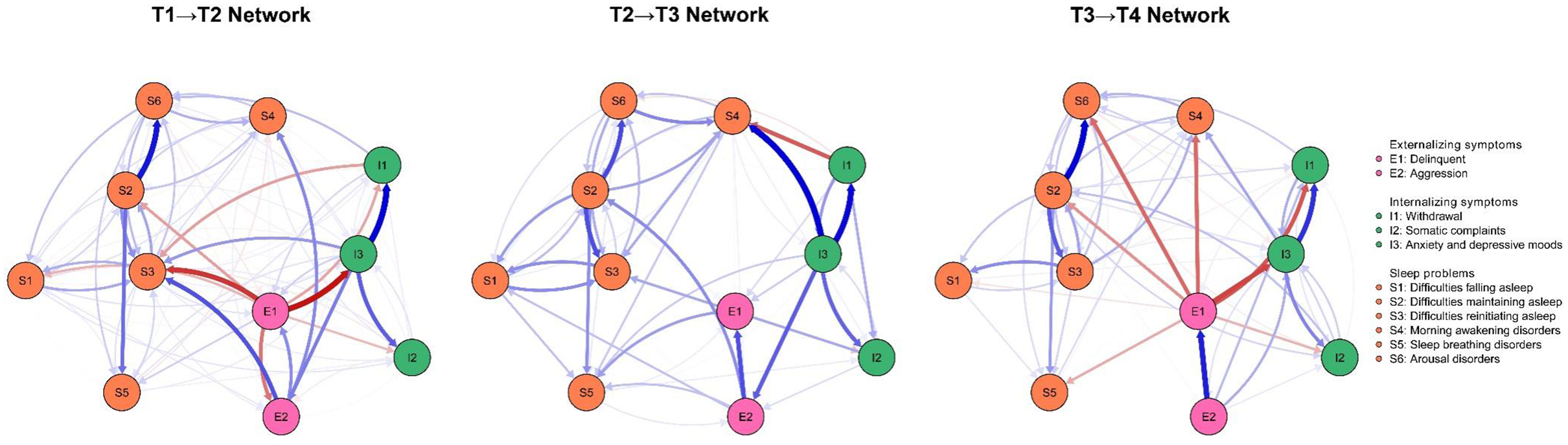
Regarding within-domain relationships, the strongest consistent edge within externalizing domain was aggression (E2) positively predicting delinquent behavior (E1) (edge weights: 0.12, 0.13, and 0.20 for T1→T2, T2→T3, and T3→T4, respectively). Within internalizing symptoms, the strongest consistent edges were anxious/depressed symptoms (I3) positively predicting withdrawal symptoms (I1; edge weights: 0.25, 0.18, 0.19) and somatic complaints (I2; edge weights: 0.17, 0.12, 0.11). Within sleep problems, strongest edges consistently included difficulty maintaining sleep (S2) predicting difficulty reinitiating sleep (S3; edge weights: 0.11, 0.13, 0.15) and arousal disorders (S6; edge weights: 0.23, 0.14, 0.23).
In terms of bridging edges between sleep problems and internalizing/externalizing symptoms, notable temporal changes occurred. For the T1→T2 network, the strongest edges included aggression (E2) positively predicting difficulty reinitiating sleep (S3; edge weight = 0.18), anxious/depressed symptoms (I3) positively predicting aggression (E2; edge weight = 0.13), and delinquent behavior (E1) negatively predicting difficulty reinitiating sleep (S3; edge weight = –0.21). In the T2→T3 network, significant bridging edges involved anxious/depressed (I3) positively predicting early awakening (S4; edge weight = 0.20) and aggression (E2; edge weight = 0.12), and aggression (E2) positively predicting difficulties maintaining sleep (S2; edge weight = 0.08). In the T3→T4 network, the strongest bridging edges were delinquent behavior (E1) negatively predicting anxious/depressed (I3; edge weight = –0.17), withdrawal (I1; edge weight = –0.17), arousal disorders (S6; edge weight = –0.16), and early awakening (S4; edge weight = –0.14).
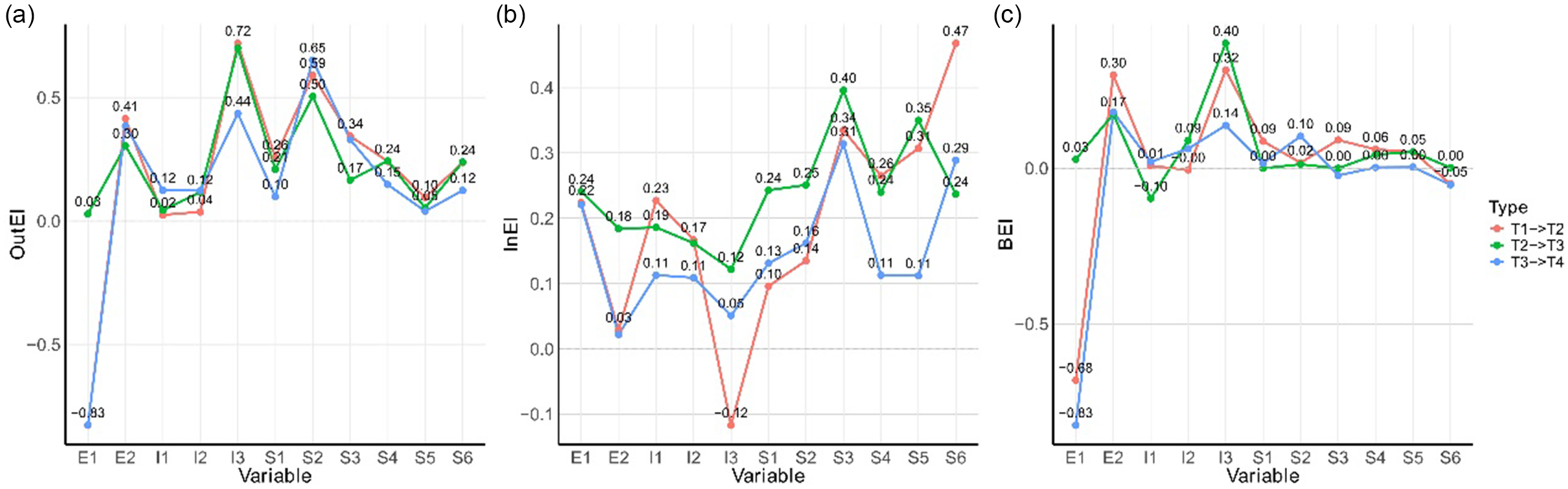
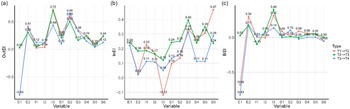
Figure 2 illustrates the centrality indices of symptoms across the three cross-lagged panel networks (T1→T2, T2→T3, T3→T4). Panel A presents out-expected influence (out-EI), highlighting symptoms’ predictive impact on subsequent symptoms; notably, delinquent behavior (E1), anxiety/depressive moods (I3), and difficulty maintaining sleep (S2) consistently demonstrated the strongest predictive influence. Panel B displays in-expected influence (in-EI), reflecting susceptibility to influence by prior symptoms; here, difficulties reinitiating sleep (S3), withdrawal (I1), and delinquent behavior (E1) showed consistently high vulnerability across networks. Panel C shows bridge expected influence (bridge-EI), identifying symptoms crucial in linking sleep problems with internalizing and externalizing symptom domains. Delinquent behavior (E1), anxiety/depressive moods (I3), and aggression (E2) emerged as the strongest bridging symptoms, suggesting their critical role in symptom co-occurrence and progression over time. Across the three networks, centrality estimates for most symptoms remained relatively stable, although delinquent behavior (E1) exhibited noticeable variability, particularly in out-EI and bridge-EI measures.
Network comparisons (T1→T2, T2→T3 and T3→T4 networks)
To assess whether symptom-level associations changed across later stages of adolescence, network comparisons were conducted between the T1→T2 and T2→T3 networks, and subsequently between the T2→T3 and T3→T4 networks. The similarity coefficient of edge weights between the T1→T2 and T2→T3 networks (excluding autoregressive paths) was moderate (r = 0.52). Forty-four cross-lagged edges replicated consistently, representing 52.4% of the T1→T2 edges and 80.0% of the T2→T3 edges. Three edges (withdrawal → arousal, arousal → withdrawal, somatic → aggression) changed signs between these two networks. Out-expected influence (out-EI) centrality indices showed significant stability (r = 0.91), suggesting consistent patterns of symptom influence across these intervals. However, correlations for in-EI (r = 0.55) and bridge-EI (r = 0.28) were not significant, suggesting variability in symptom influence patterns. Rank-order stability for out-EI was moderate (45.5% consistency across nodes), while stability was lower for bridge-EI (27.3%) and lowest for in-EI (18.2%).
The similarity coefficient of edge weights between T2→T3 and T3→T4 networks was moderate (r = 0.61). Thirty-six cross-lagged edges replicated across both intervals, representing 65.5% of T2→T3 and 58.1% of T3→T4 edges. Notably, five of these edges reversed direction across intervals. Centrality analyses indicated significant stability only for out-EI (r = 0.73), but correlations for in-EI (r = 0.43) and bridge-EI (r = 0.49) were not statistically significant, highlighting continued variability in symptom interactions. Only one node (delinquent behavior, E1; 9.1%) consistently retained its out-EI rank, and one node (difficulty reinitiating sleep, S3; 9.1%) retained its bridge-EI rank. No node maintained consistent in-EI rankings, indicating dynamic symptom interplay and shifting centrality roles in the later waves. Difficulty reinitiating sleep (S3) consistently appeared influential in bridging relationships between sleep problems and internalizing/externalizing symptoms during these later intervals.
Discussion
The present study examined the longitudinal network associations between sleep problems and internalizing and externalizing symptoms in early adolescents, utilizing a novel cross-lagged panel network analysis. To our knowledge, this is the first study to apply this symptom-level network approach to elucidate temporal relationships across these three domains. Grounded in the network theory of psychopathology (Borsboom, Reference Borsboom2017), this study extends previous aggregate-level or cross-sectional analyses by highlighting the unique, dynamic pathways connecting individual symptoms over time.
The primary aim of the current study was to analyze the intricate, dynamic associations among sleep problems and both internalizing and externalizing symptoms by three cross-lagged panel networks (T1→T2, T2→T3, T3→T4). A primary finding was that anxiety and depressive moods (I3) emerged as a highly central symptom, consistently exhibiting strong out-expected influence, meaning it prospectively predicted multiple internalizing symptoms (withdrawal and somatic complaints) as well as symptoms across other domains, including aggression and sleep problems (difficulty reinitiating sleep). These results align with prior longitudinal studies showing that depressed mood predicts future sleep difficulties (Hayley et al., Reference Hayley, Skogen, Sivertsen, Wold, Berk, Pasco and Øverland2015; Lovato et al., Reference Lovato, Short, Micic, Hiller and Gradisar2017; Marino et al., Reference Marino, Andrade, Montplaisir, Petit, Touchette, Paradis, Côté, Tremblay, Szatmari and Boivin2022). However, our findings contrast with studies suggesting that sleep problems predict later depressive symptoms, but not vice versa (Gregory & O’Connor, Reference Gregory and O’connor2002; Gregory et al., Reference Gregory, Rijsdijk, Lau, Dahl and Eley2009; Wang et al., Reference Wang, Guo, Du, Li, Wu, Guo and Lu2022). Our results highlight the role of anxiety and depressed mood in predicting downstream sleep and behavioral problems, offering symptom-level insights that complement traditional models. As described in the Cognitive Model of Insomnia (Lundh & Broman, Reference Lundh and Broman2000), cognitive–behavioral processes—such as worry and rumination—central to anxiety and depression can disrupt sleep. Indeed, rumination as a core symptom of depression has been shown to characterize comorbid depression/anxiety (Nolen-Hoeksema, Reference Nolen-Hoeksema2000) and explain the link between depressed mood and impaired sleep (Li et al., Reference Li, Corkish, Richardson, Christensen and Werner-Seidler2024). Our results are also consistent with a recent CLPN analysis that revealed depressed mood as an important precursor to other internalizing and externalizing symptoms (Funkhouser et al., Reference Funkhouser, Chacko, Correa, Kaiser and Shankman2021).
Compared with the changes from Time 2 to Time 3 and from Time 3 to Time 4, during the change from Time 1 to Time 2, anxiety and depression continued to predict higher levels of withdrawal behavior, and somatic complaints. Notably, the importance of anxiety and depression as bridge symptoms diminished over time, suggesting their influence may be most pronounced at the earlier stages of adolescence. The variation in sparsity between the networks could reflect developmental changes and may be indicative of time-specific dynamics in the relationship between adolescent sleep problems and internalizing/externalizing symptoms. The developmental trajectories of these symptoms are likely influenced by a variety of factors, such as environmental influences, biological maturation, and social contexts, which may vary across time points. Our results underscore anxious and depressed mood as early, central symptoms within the broader psychopathology network. These symptoms, if intervened in early adolescence, may help prevent the cascade of related difficulties across internalizing, externalizing, and sleep domains (Funkhouser et al., Reference Funkhouser, Chacko, Correa, Kaiser and Shankman2021).
Delinquent behavior (E1) was identified as another key symptom with high centrality and strong bridging effects, significantly linking externalizing symptoms with sleep disturbances and internalizing problems. Interestingly, delinquent behavior showed mixed associations: positively predicting some symptoms (e.g., anxiety and depressive moods) while negatively predicting sleep disturbances such as difficulty reinitiating sleep (S3). The positive predictive association is consistent with prior research showing that externalizing behaviors are associated with increased risk for later depression (Weeks et al., Reference Weeks, Ploubidis, Cairney, Wild, Naicker and Colman2016), and adds to the body of literature showing that symptoms of internalizing and externalizing disorders frequently co-occur and predict one another across adolescence (Kessler et al., Reference Kessler, Avenevoli, McLaughlin, Green, Lakoma, Petukhova, Pine, Sampson, Zaslavsky and Merikangas2012; Meuret et al., Reference Meuret, Tunnell and Roque2020). This negative predictive association was somewhat unexpected and might reflect nuanced developmental dynamics. For instance, delinquent behaviors, often related to sensation-seeking, may temporarily suppress certain sleep difficulties, potentially due to reduced nighttime worries or anxieties (Dodd & Lester, Reference Dodd and Lester2021; Kuin et al., Reference Kuin, Masthoff, Kramer and Scherder2015). Nonetheless, further research is needed to explore these counterintuitive effects, especially considering that exploratory network analyses can sometimes yield novel but ambiguous relationships (Bringmann et al., Reference Bringmann, Albers, Bockting, Borsboom, Ceulemans, Cramer, Epskamp, Eronen, Hamaker, Kuppens, Lutz, McNally, Molenaar, Tio, Voelkle and Wichers2022).
Within sleep problems, difficulty maintaining sleep (S2) showed robust predictive influence on other sleep disturbances such as arousal disorders (S6) and difficulty reinitiating sleep (S3). This suggests that difficulties in maintaining sleep may be a critical initial sleep issue, triggering subsequent sleep-related disturbances. These findings are consistent with prior studies emphasizing the cascading nature of sleep disturbances in adolescence (Owens et al., Reference Owens, Wang, Lewin, Skora and Baylor2017). Given their predictive position, interventions that specifically target sleep maintenance may offer benefits for improving overall sleep quality and have downstream benefits for mental health.
This study employs a cutting-edge modeling technique, specifically CLPN modeling, to analyze autoregressive and cross-lagged effects. The utilization of longitudinal data allowed for the estimation of a directed network and facilitated the identification of temporal effects among symptoms. Many existing psychopathology network analyses have concentrated on cross-sectional data (e.g., Black et al., Reference Black, Panayiotou and Humphrey2022; Van der Hallen et al., Reference Van der Hallen, Jongerling and Godor2020; Guloksuz et al., Reference Guloksuz, Pries and Van Os2017). This study recommends that greater attention be devoted to longitudinal network modeling. In contrast to previous cross-sectional symptom network analyses, this approach enables a clearer identification of potential causal pathways and a distinction between the roles of symptoms as predictors and those as predicted variables. Given this distinction, the CLPN model does not lend itself directly to the bootstrapped difference tests typically used in cross-sectional comparisons. The CLPN approach provides unique insights into the dynamic and time-specific nature of symptom interactions. The alternative bootstrapping procedures could be considered in future studies to enhance the robustness of cross-lagged network comparisons. In addition, the CLPN model, like the CLPM, does not explicitly differentiate between within-person and between-person variance. While this modeling choice allows for the estimation of dynamic network structures over time, it does not provide a clear separation of the individual-level (within-person) variability from group-level (between-person) effects. As a result, interpretations of the effects can sometimes be ambiguous, especially when individual differences or group factors are potentially influencing the results. Future research can explore models that more effectively distinguish between individual differences in symptoms levels capitalizing on network analysis methodology.
Several limitations should be acknowledged. First, since all measurements were based solely on adolescents’ responses to questionnaires, this can increase the risk of common method variance (Richardson et al., Reference Richardson, Simmering and Sturman2009). Moreover, internalizing symptoms can worsen reported sleep issues. Studies show that depressed youth report more sleep problems than their non-depressed peers, even when objective measures do not support this difference (Bertocci et al., Reference Bertocci, Dahl, Williamson, Iosif, Birmaher, Axelson and Ryan2005). While the findings generally aligned with expectations, and previous studies have validated the use of child-reported data for those aged 7 and older (Riley et al., Reference Riley, Forrest, Rebok, Starfield, Green, Robertson and Friello2004), future research would benefit from incorporating various types of measurements from multiple sources, including reports from parents and teachers. Second, anxiety and depressed moods were combined into a single syndrome score in the YSR and modeled as one node, which limits our ability to distinguish between the two constructs. The observed centrality of this node may reflect a general internalizing factor and obscure distinct symptom pathways. Future research should use more granular measures that assess anxiety and depression separately to better capture their unique etiologies, developmental trajectories, and roles within the symptom network. Third, the chosen six-month intervals between measurements may not capture the optimal temporal dynamics among symptoms. The appropriate time-lag to detect meaningful temporal relations between adolescent symptoms remains uncertain, and shorter or longer intervals could yield different findings (Gollob & Reichardt, Reference Gollob and Reichardt1987). Parameter estimates can vary as a function of the time interval between measurements, and differences in time lag may explain why some of the results from the present study differed from those of previous intensive longitudinal network analyses. Future research should test multiple measurement intervals to clarify optimal intervals for capturing these symptom dynamics. In addition, although this study was not designed to specifically investigate the impact of the COVID-19 pandemic, it is important to acknowledge that data collection occurred during a time when adolescents may have experienced pandemic-related disruptions to daily life, including school closures, reduced social interaction, and altered sleep routines. As such, some of the observed symptom dynamics may partially reflect responses to pandemic-related stressors. Finally, a related limitation is that the study used brief measures, which likely explains the relatively low internal consistency in the Adolescence Sleep Disturbance Questionnaire (ASDQ). Although the measures used in this study were effective as a broad screener for a school-based sample, future research would benefit from using more specific and psychometrically validated instruments to assess distinct dimensions of sleep problems in adolescents.
Conclusion
In summary, this study provides novel insights into the longitudinal interplay between sleep problems and internalizing/externalizing symptoms at the symptom level during early adolescence. Using a cross-lagged network approach, anxiety/depressive moods, delinquent behavior, and difficulties maintaining sleep emerged as key nodes influencing subsequent symptomatology. These findings underscore critical potential targets for early clinical interventions. Addressing these central symptoms may effectively disrupt symptom progression and reduce adolescent psychopathology burden, highlighting opportunities for targeted prevention and treatment during this critical developmental window.
Supplementary material
The supplementary material for this article can be found at https://doi.org/10.1017/S0954579425100965.
Data availability statement
The datasets analyzed in the current study are not publicly available but are available from the corresponding author on reasonable request.
Acknowledgements
We are grateful to the participants of this study for their participation.
Authorship contributions
Xiaoting Liu: Writing – review & editing, Supervision, Resources, Methodology, Funding acquisition, Data curation, Conceptualization. Chao Ma: Writing – original draft, Visualization, Methodology, Formal analysis, Data curation. Li Niu: Writing – original draft, Visualization, Methodology, Conceptualization. Jing Lin: Writing – original draft, Project administration, Methodology, Investigation, Data curation, Conceptualization.
All authors have agreed to the final submitted version.
Funding statement
This research was supported by grants from the Humanities and Social Sciences Youth Foundation, Ministry of Education of the People’s Republic of China (No. 24XJC190005), the National Natural Science Foundation of China (32300888), and Funds for Soft Science Special Project of Gansu Basic Research Plan (No.25JRZA059).
Competing interests
The authors declare no conflict of interest.
Ethical standards
The present study was approved by the School of Psychology Research Ethics Committee, Northwest Normal University (Approval No. HR 2018-10-002). All procedures performed in this study involving human participants were in accordance with the ethical standards of the institutional and/or national research committee.
Informed consent statement
Informed consent was obtained from all individual participants included in the study.
Pre-registration statement
The analyses reported in this manuscript were not preregistered.


 Open access

