


Introduction
Nearly one million individuals die by suicide each year, underscoring its significance as a major global public health concern [1]. For every completed suicide, there are an estimated 10–40 suicide attempts, reflecting the broader scope of suicidal behavior and its impact [Reference Stenbacka and Jokinen2]. Suicide affects individuals across the entire lifespan and, in 2019, was the fourth leading cause of death among individuals aged 15–29 years worldwide [Reference Hempstead and Phillips3]. It occurs across all geographic regions and cultural contexts [Reference Fountoulakis, Gonda, Dome, Theodorakis and Rihmer4, Reference Fountoulakis, Kawohl, Theodorakis, Kerkhof, Navickas and Höschl5]. While the association between suicide and psychiatric disorders – particularly major depressive disorder and alcohol use disorder – is well documented in high-income countries, a considerable proportion of suicides occur impulsively during acute crises. These crises often involve an impaired capacity to cope with stressors such as financial hardship, relationship dissolution, chronic physical illness, or humanitarian emergencies [Reference Comtois, Russo, Roy-Byrne and Ries6–Reference Oquendo, Bongiovi-Garcia, Galfalvy, Goldberg, Grunebaum and Burke11]. Suicide attempts are commonly classified by method into violent and nonviolent categories. Notably, attempts involving violent methods are robust predictors of future completed suicide and increased risk of premature mortality [Reference Hirot, Ali, Azouvi, Balogh, Lemarchand and Petat12].
Previous research has demonstrated that both high suicidal intent and the use of violent methods in suicide attempts are associated with a significantly increased risk of subsequent suicide, in contrast to attempts involving lower intent or nonviolent methods [Reference Stenbacka and Jokinen2, Reference Niméus, én and Träskman-Bendz13–Reference Stefansson, Nordström and Jokinen15]. Individuals who attempt suicide using violent means often differ from nonviolent attempters in several key respects and may exhibit more similarities with individuals who have died by suicide [Reference Giner, Jaussent, Olié, Béziat, Guillaume and Baca-Garcia16]. Although neurobiological and neuropsychological distinctions between violent and nonviolent attempters have been identified [Reference Stenbacka and Jokinen2], there remains a notable gap in the literature concerning the specific risk factors influencing the choice of violent suicide attempt methods. Understanding the risk factors associated with particular methods of suicide attempts or completed suicide is critical for effective prevention and for improving suicide risk assessment in clinical practice [Reference Runeson, Tidemalm, Dahlin, Lichtenstein and Långström14]. In the present study, we investigated individual suicide attempt methods – both violent and nonviolent – alongside demographic variables and clinical diagnoses. The primary objective was to analyze risk factors and explore underlying motives associated with violent and nonviolent suicide attempts, while identifying key differences between these groups. A further aim was to examine the relationship between the method of suicide attempt and the risk of future completed suicide.
The primary research questions guiding this study were as follows:
-
1. What specific factors predict the use of violent versus nonviolent methods in suicide attempts?
-
2. What are the principal differences between individuals who employ violent methods and those who utilize nonviolent methods in their suicide attempts?
Materials and methods
Definitions
Violent suicide is most commonly classified based on the method employed. A widely used framework is Asberg’s criteria [Reference Asberg, Traskman and Thoren17], cited in numerous studies [Reference Giner, Jaussent, Olié, Béziat, Guillaume and Baca-Garcia16, Reference Penas-Lledo, Guillaume, Delgado, Naranjo, Jaussent and Courtet18], which categorize methods such as hanging, firearm use, jumping from heights, deep self-inflicted cuts, intentional car crashes, self-immolation, gas poisoning, drowning, electrocution, and jumping in front of a train as violent. In contrast, overdoses involving drugs or other substances are typically considered nonviolent suicide attempts. Alternative definitions exist in the literature: for example, Stenbacka and Jokinen [Reference Stenbacka and Jokinen2] define violent suicide as encompassing all methods except poisoning, while Dumais et al. [Reference Dumais, Lesage, Lalovic, Seguin, Tousignant and Chawky19] consider all methods violent except for drowning, gas poisoning, and substance overdose.
Despite its clinical significance, few studies have explored the demographic characteristics associated specifically with violent suicide. However, it is well established that men are more likely than women to use violent methods, both in suicide attempts and completed suicides. A large-scale European study across four countries investigated these gender-specific differences in depth, revealing that suicidal acts were three to four times more lethal in men. Not only did men more frequently select high-lethality methods, but the lethality of identical methods was also higher among men [Reference Mergl, Koburger, Heinrichs, Szekely, Toth and Coyne20]. Additionally, transitioning from a nonviolent suicide attempt to death by a violent method was significantly more prevalent in men than in women [Reference Bradvik21].
Given the considerable heterogeneity within the population of individuals who attempt or die by suicide, researchers have increasingly sought to identify distinct subgroups using key variables. Prominent dichotomies in contemporary suicide research include violent versus nonviolent attempters, high- versus low-lethality methods, impulsive versus non-impulsive behavior, and low versus high suicidal intent. These distinctions have been operationalized using various psychometric instruments, such as the Beck Suicide Intent Scale [Reference Ludwig and Dwivedi22]. In the present study, we examine and compare both the violent and nonviolent subgroups to identify distinguishing characteristics and risk factors.
Study design and setting
Source of data
This cross-sectional retrospective study was conducted at two major medical centers in Budapest, Hungary: the Emergency Department, Psychiatric Ward, and Clinical Toxicology Unit of Péterfy Sándor Hospital, and the Dr. Manninger Jenő National Trauma Center, a Level III trauma facility. Data were extracted from the electronic health records of these institutions, covering the period from January 1, 2016, to December 31, 2021. Péterfy Sándor Hospital and Outpatient Clinic is one of the largest healthcare providers in Budapest. Its Emergency Department and Clinical Toxicology Unit serve as the primary treatment centers for cases of self-poisoning originating in Budapest and Pest County, providing care to a population exceeding three million [Reference Szilágyi, Bálint, Hajduska-Dér and Bérdi23]. In contrast, the Dr. Manninger Jenő Trauma Center provides trauma care to a more limited geographic area within Budapest and Pest County. As such, data from this center should be interpreted as indicative of broader trends rather than as fully representative of the population. The sample, therefore, offers insight into patterns of suicidal behavior but does not allow for comprehensive generalization. Notably, a separate study reported an increase in both violent suicide attempts and completed suicides during the COVID-19 pandemic [Reference Szeifert, Szilágyi, Sebők and Bérdi24]; however, the present article does not address the specific impact of the pandemic on these trends.
This cross-sectional retrospective study included two distinct subpopulations based on the method of suicide attempt: violent and nonviolent. The nonviolent sample was drawn from a comprehensive research project involving paper-and-pencil questionnaires. Inclusion criteria were adults aged 18–65 years who were admitted to the Psychiatric and Clinical Toxicology Units of Péterfy Sándor Hospital, Budapest. Individuals classified as parasuicide attempters – those engaging in deliberate self-harming behavior without clear suicidal intent – were excluded, as were patients diagnosed with neurocognitive or psychotic disorders.
Psychiatric diagnoses, suicide risk assessments, and evaluations of underlying motives were conducted using the Structured Clinical Interview for DSM-IV [Reference First, Spitzer, Gibbon and Williams25], administered by trained psychiatrists and clinical psychologists. Diagnostic conclusions were further supported using classifications from the International Classification of Diseases, 10th Revision [26]. All diagnoses were made at the time of admission to the psychiatric ward or emergency services.
The violent suicide attempt sample comprised patients of all ages who were consecutively admitted for medical treatment at the Dr. Manninger Jenő National Trauma Center, Budapest, between January 1, 2016, and December 31, 2021. The initial dataset included 228 cases. After restricting the age range to 18–65 years and excluding records with incomplete psychiatric data or unknown place of residence, the final violent sample consisted of 153 individuals.
The nonviolent sample ultimately included 145 participants, each with complete data on psychiatric diagnoses, substance use disorders, age, gender, and residence.
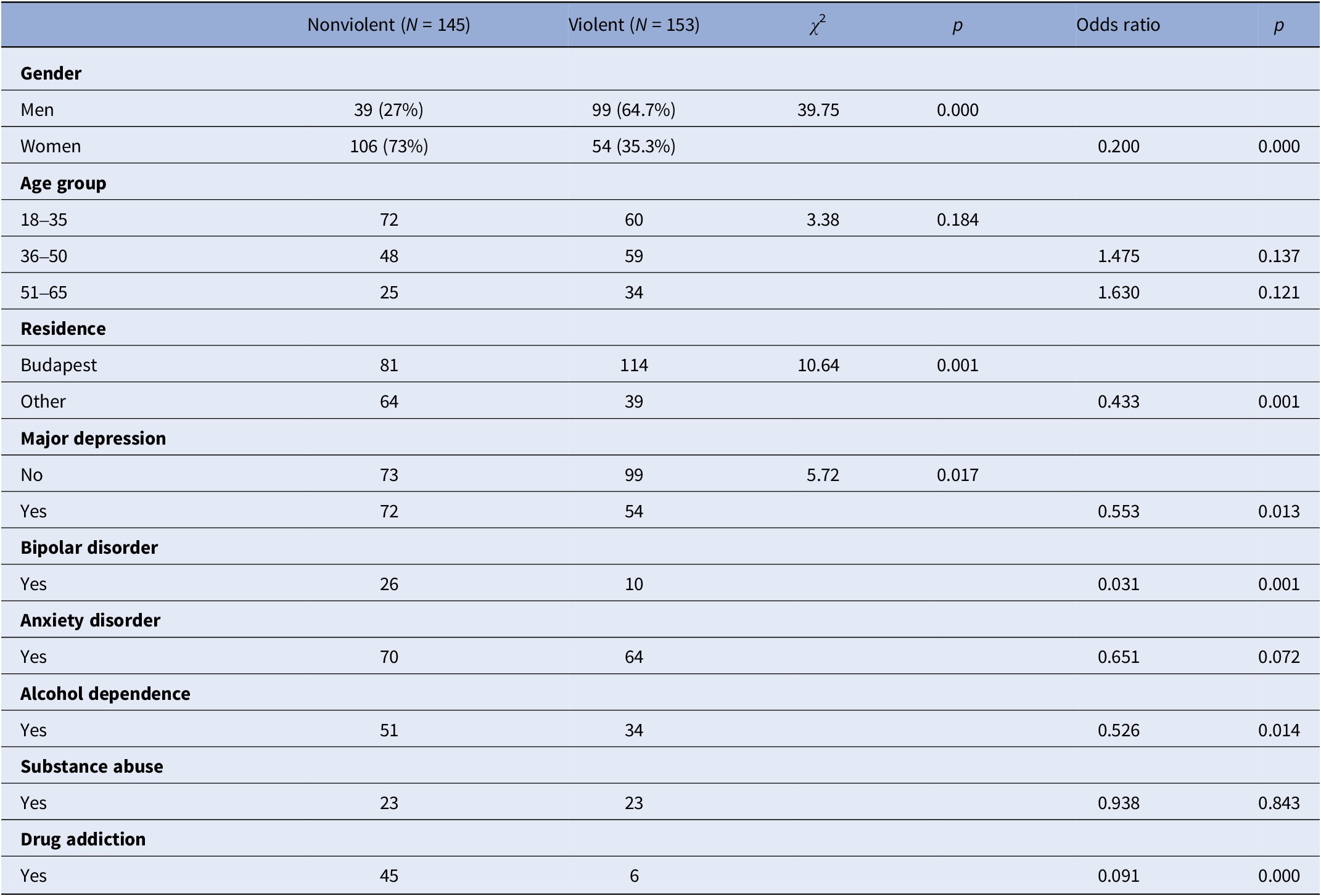
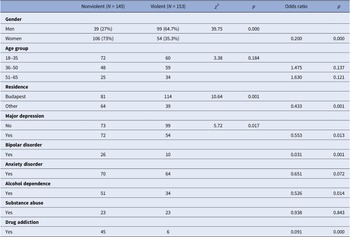
Data for both groups were extracted from hospital electronic medical records and included demographic characteristics (age, gender, residence), psychiatric and/or medical treatment status at admission, and detailed information regarding the circumstances and methods of the suicide attempt. Descriptive statistics for both groups are summarized in Table 1.
Variables associated with violent and nonviolent behavior/attempts
Ethics
The study received ethical approval from the institutional review boards of both participating institutions: the Institutional Review Board of Péterfy Sándor Hospital and Outpatient Clinic (Approval No. 25/2016) and the Institutional Review Board of the Dr. Manninger Jenő National Trauma Center (Approval No. 19/2021). The authors confirm that all procedures performed in this study involving human participants were conducted in accordance with the ethical standards of the institutional and national research committees and adhered to the principles outlined in the Declaration of Helsinki (1975), as revised in 2013.
Statistic
Chi-square tests and logistic regression analyses were employed to examine the factors associated with violent versus nonviolent suicide attempts. In the logistic regression model, the dependent variable was binary, with a value of 0 representing nonviolent attempts and 1 representing violent attempts. Results were interpreted using odds ratios (ORs), which indicate how a one-unit change in a given predictor variable affects the odds of a violent suicide attempt relative to a reference category. An OR greater than 1 suggests an increased likelihood of a violent method, whereas an OR less than 1 indicates a decreased likelihood.
Both univariate and multivariate logistic regression models were conducted. The univariate models assessed the independent effect of each variable on the likelihood of a violent attempt, while the multivariate model evaluated the combined influence of all variables when included simultaneously. This dual approach allowed for the identification of both individual and interactional contributions to the risk of violent suicidal behavior.
The results of the chi-square tests and the odds ratios derived from the logistic regression models are presented in Table 1. While the chi-square test identifies statistically significant associations between categorical variables, the odds ratio offers additional insight by quantifying the magnitude of these associations, thus providing a measure of effect size.
Results
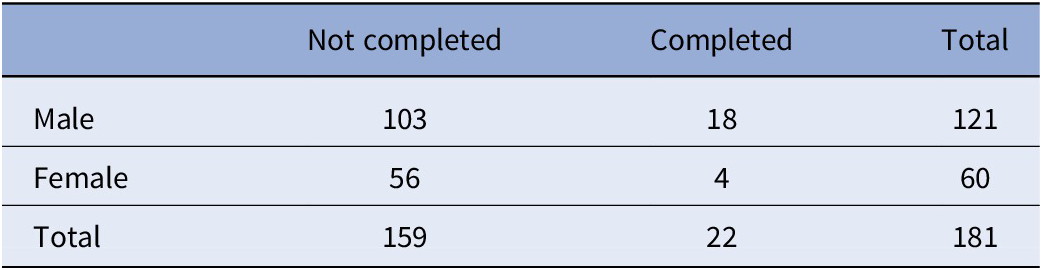
A total of 298 inpatients who had attempted suicide were included in the study, comprising 46.1% males and 53.9% females. Of these, 22 individuals (12.1%) – all of whom employed violent methods – died during hospitalization due to severe medical complications (Table 2). Among the various methods, autostrangulation appeared to be the most lethal. In terms of age distribution, the highest proportion of violent attempters fell within the economically active age group (18–55 years), whereas among female nonviolent attempters, the majority were aged between 18 and 35 years.
The number of completed suicides by gender among violent attempters
The most frequently reported motives for violent suicide attempts, in descending order of prevalence, were marital conflict (32.4%), divorce, separation, or relationship break-up (30.2%), severe or chronic somatic illness (12%), financial crisis (11.5%), the loss of a close relative (6.4%), sudden job loss or unemployment (5.1%), and other life events (33.4%). These motives predominantly represent acute external stressors. It is well established that individuals with major psychiatric disorders exhibit heightened sensitivity to such stressors, reflecting increased vulnerability to suicidal behavior in the context of adverse life events.
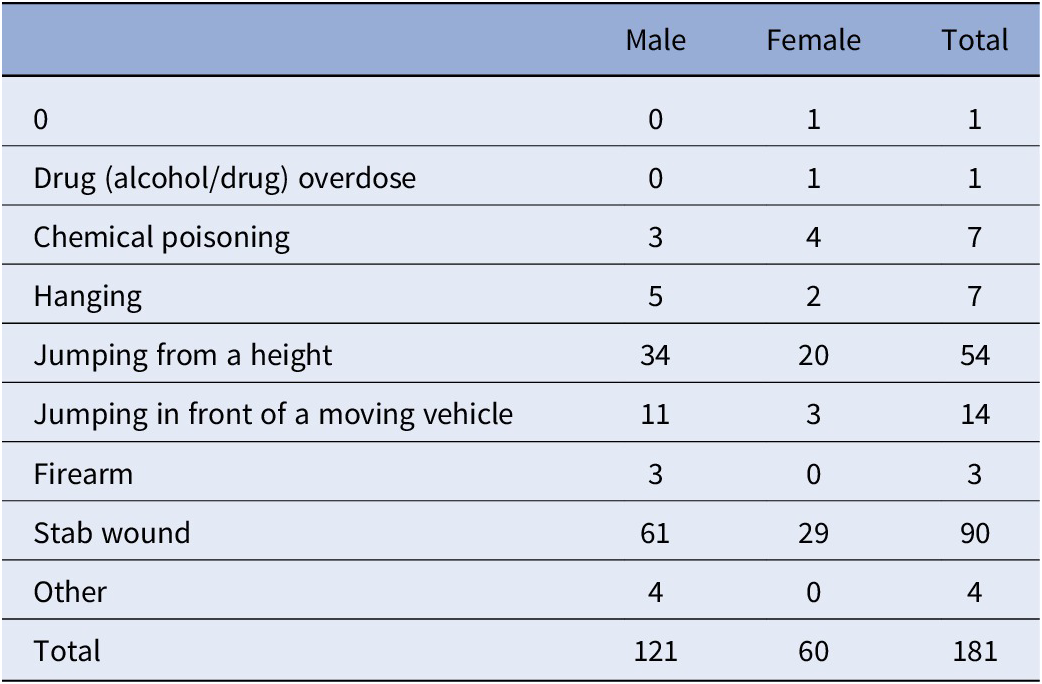
The most common violent methods used were stabbing (90 cases; 49.7%), jumping from a height (54 cases; 29.8%), jumping in front of a train (14 cases; 7.7%), autostrangulation (7 cases; 3.8%), and firearm use (3 cases; 1.6%) (Table 3). Eighteen male participants had a documented history of previous violent suicide attempts, one of whom died during current treatment due to the severity of their somatic condition. Among female participants, 56 had previously engaged in violent suicide attempts; four of these individuals died during the course of hospitalization. In some cases, data were incomplete due to the patient being unconscious at the time of admission or a lack of collateral information.
Methods of violent suicide attempts at admission
The most frequently observed psychiatric diagnoses were major depressive disorder (42.2%), bipolar disorder in depressive or mixed episodes (12%), and anxiety disorders (44.9%). Additionally, comorbid substance use was prevalent: 28.5% of the sample had alcohol dependence, 15.4% had a substance use disorder, and 17.1% reported drug addiction, primarily involving benzodiazepines.
As anticipated, female participants were significantly less likely to engage in violent suicide attempts compared to their male counterparts. An odds ratio (OR) of 0.20 indicates that the likelihood of employing a violent method is 80% lower among women than among men. Additionally, individuals residing in rural areas were found to be 60% less likely to use violent methods compared to those living in the capital city, suggesting a geographical disparity in the method of suicide attempts. Although the propensity to use violent methods appeared to increase with age, this association did not reach statistical significance.
With respect to psychiatric diagnoses, the presence of major depressive disorder was associated with a reduced likelihood of violent behavior, as indicated by an OR of 0.553. This suggests that individuals diagnosed with depression are less inclined to employ violent means. A particularly strong association was observed for bipolar disorder in its depressive or mixed episodes, with an OR of 0.031, indicating a substantially lower probability of violent behavior among this subgroup. The p-value for this association (p = 0.001) was statistically significant, further reinforcing the link between bipolar disorder and a preference for nonviolent methods.
In contrast, no statistically significant association was found between anxiety disorders and the likelihood of violent versus nonviolent behavior. Therefore, it cannot be concluded that anxiety disorders significantly influence the method selection in suicide attempts.
With regard to substance use disorders, alcohol dependence was associated with a reduced likelihood of violent suicide attempts. An odds ratio (OR) of 0.526 suggests that individuals with alcohol dependence were 47.4% less likely to engage in violent behavior compared to those without alcohol dependence, when sociodemographic variables and psychiatric comorbidities were not accounted for. Similarly, the association between drug addiction and violent behavior was markedly inverse; an OR of 0.091 indicates that individuals with drug addiction were 91% less likely to employ violent methods compared to nonaddicted individuals. However, it is important to note that substance use disorders, considered broadly, did not exhibit a statistically significant effect on the likelihood of violent suicide attempts.
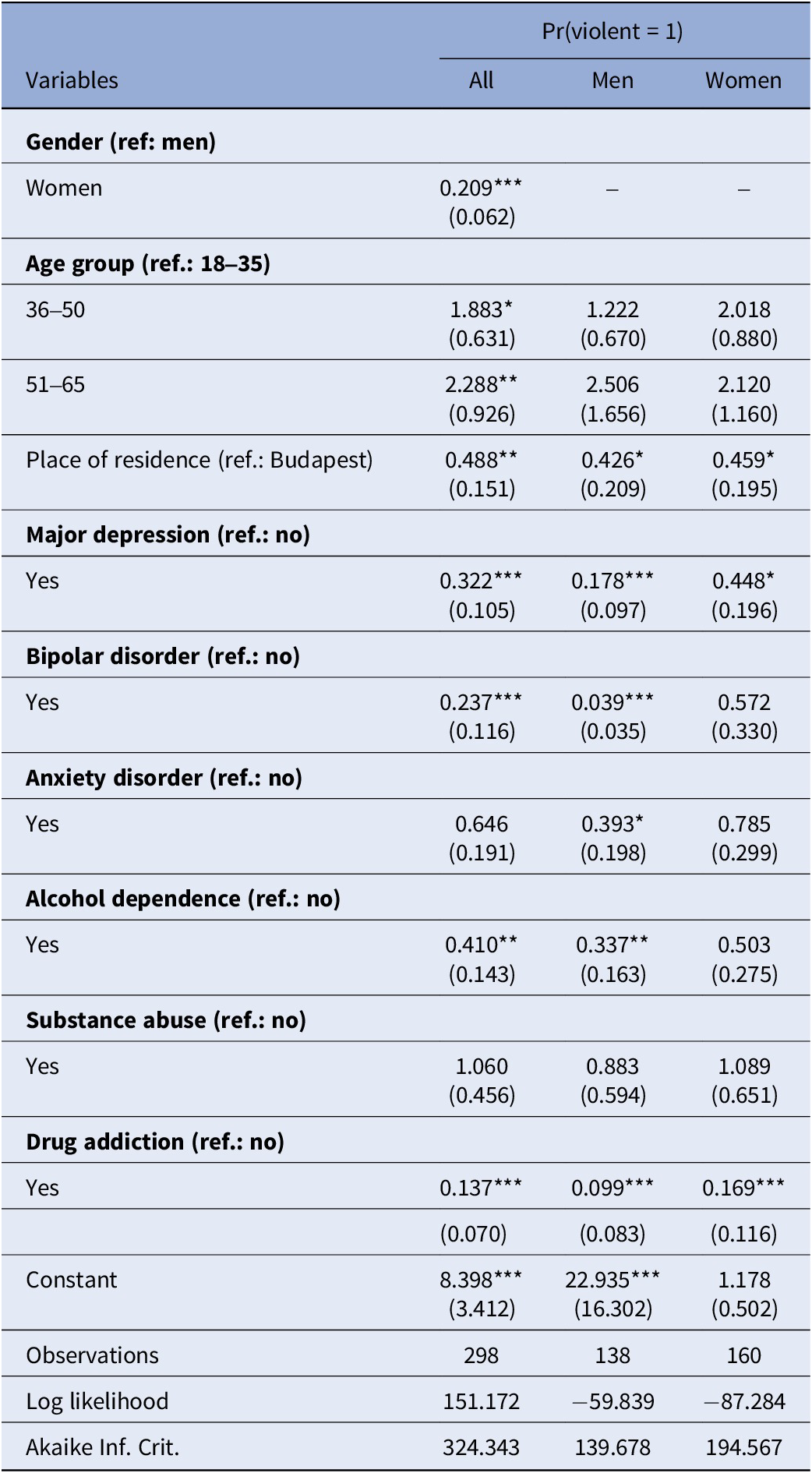
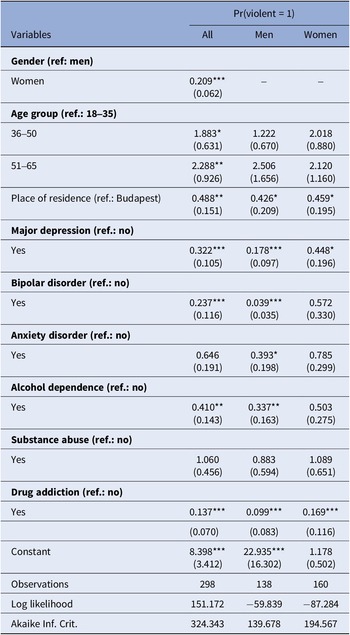
Multivariable logistic regression analysis for the full sample (Table 4) revealed several significant predictors of violent versus nonviolent suicide attempts. Female participants were substantially less likely to engage in violent behavior compared to males (OR = 0.209), and this effect remained consistent even after adjusting for other variables, indicating a robust gender-based difference. Age was also a significant factor: individuals aged 36–50 years and 51–65 years demonstrated an increased likelihood of employing violent methods, with odds ratios of 1.883 and 2.288, respectively, suggesting that older age groups are at heightened risk for violent suicide attempts.
Results of the logistic regressions
*p < 0.1; **p < 0.05; ***p < 0.01.
Several psychiatric and substance use disorders were inversely associated with violent behavior. Major depressive disorder (OR = 0.322) and bipolar disorder (OR = 0.237) were both significantly linked to a decreased probability of violent method selection. Similarly, alcohol dependence (OR = 0.337) and drug addiction (OR = 0.099) were also associated with substantially lower odds of engaging in violent suicidal behavior. These findings suggest that certain psychiatric diagnoses and substance use disorders may influence not only the risk of suicide attempts but also the method by which they are carried out.
Higher levels of psychiatric comorbidity were more frequently observed among individuals who attempted suicide using nonviolent methods. Specifically, the presence of three or more comorbid conditions was recorded in 26.8% of the nonviolent group, compared to only 3.3% among those who used violent methods. In contrast, the absence of comorbidity (i.e., zero comorbid diagnoses) was significantly more common in the violent group (34.6%) than in the nonviolent group (9.7%). In both subgroups, the most prevalent pattern was the presence of a single comorbid condition.
A chi-square test revealed a statistically significant association between the degree of psychiatric comorbidity and the method of suicide attempt (χ 2 = 50.19; df = 5; p < 0.001), indicating a substantial difference in comorbidity distribution between individuals who engaged in violent versus nonviolent behaviors.
Gender-specific logistic regression models further clarified these associations. Among male participants, all diagnostic variables – except for drug dependence – were significant predictors of the method of suicide attempt. For example, the presence of major depressive disorder was associated with a markedly reduced likelihood of violent behavior (OR = 0.178), as was bipolar disorder in depressive episodes (OR = 0.039), highlighting the protective effect of certain psychiatric conditions against the use of violent methods in male suicide attempters.
Among female participants, only major depressive disorder (OR = 0.448) and drug addiction (OR = 0.572) were significantly associated with a reduced likelihood of engaging in violent suicide attempts compared to nonviolent ones. No other variables demonstrated statistically significant effects within this subgroup.
Limitations
Owing to the retrospective design of the study, the analysis was based on variables derived from data available in the hospitals’ electronic medical record systems. Key variables relevant to the study objectives – such as patient age, gender, and method of suicide attempt – were consistently documented and therefore included in the analysis. Although additional variables pertinent to suicidal behavior, such as educational attainment and marital status, were identified as potentially relevant, they were excluded from both the analysis and the sample description due to incomplete data coverage across the full cohort. The absence of these data can largely be attributed to patients’ critical somatic conditions at admission, impaired cognitive status, or lack of collateral history. In some cases, data were unavailable due to the patient’s death from severe medical complications prior to the collection of additional background information.
Conclusions
Despite increasing attention to the classification of suicidal behavior, limited research has focused specifically on the demographic characteristics associated with violent suicide attempts. It is well established that men are more likely than women to employ violent methods in both suicide attempts and completed suicide [Reference Ludwig and Dwivedi22], a pattern confirmed in our findings. In our sample, a greater proportion of men engaged in violent suicide attempts and died by suicide compared to women.
Approximately 90% of individuals who attempt or die by suicide suffer from a current major psychiatric disorder [Reference Mann, Michel and Auerbach27]. However, psychiatric diagnosis alone does not fully account for the likelihood of violent suicide. Our results indicate that age and geographic location are also key contributors; violent suicide attempts were more prevalent among older men residing in the capital. These findings raise important questions about the potential influence of sociodemographic variables and personality traits – such as impulsivity, aggression, low levels of personality integration, and a history of violence – which may interact with psychiatric conditions to elevate the risk of violent suicide.
While existing literature often highlights a neurobiological approach – particularly the role of the serotonin system in the suicide–violence relationship [Reference Alvarez, Cremniter, Gluck, Quintin, Leboyer and Berlin28] – risk factors in violent and nonviolent subpopulations are frequently found to be indistinct [Reference Rihmer, Fekete, Gonda, Füredi and Németh29]. Importantly, characteristics like impulsivity and social disadvantage are relatively common in the general population and typically become clinically significant as suicide risk factors only when co-occurring with a major psychiatric disorder. Adverse life events alone are rarely sufficient to precipitate suicidal behavior without an underlying psychiatric condition. As such, conceptualizing suicide risk within a hierarchical framework is essential, placing major psychiatric disorders – particularly untreated depression – at the highest level of clinical importance [Reference Rihmer30]. For example, untreated major depressive disorder increases suicide risk by approximately 20- to 30-fold, whereas male gender increases risk by a factor of two. Bipolar disorder and substance use disorders similarly elevate risk. Importantly, while male gender is a significant demographic factor, it is not a pathological condition; its risk-enhancing effect emerges primarily in the context of additional adverse or clinical factors [Reference Rihmer, Kantor, Rihmer and Seregi9, Reference Rihmer30].
Furthermore, it is crucial to consider the broader social and temporal context of suicidal behavior. Most of our data were collected during the COVID-19 pandemic, a period marked by multiple, overlapping psychosocial stressors. Acute stressors such as severe viral infection, severe illness, job loss, the death of a loved one, social isolation, and existential uncertainty may have played an amplified role in suicidal behavior during this time [Reference Szeifert, Szilágyi, Sebők and Bérdi24]. National data confirm that suicide rates increased in Hungary during the pandemic years, with a marked rise in violent suicides among men [Reference Osváth, Bálint, Németh, Kapitány, Rihmer and Döme31–33].
In our sample, the clearest predictors of violent suicide attempts were male gender, older age, and urban residence. These findings emphasize the need for targeted suicide prevention strategies that account for gender-specific vulnerabilities. Encouraging men – particularly those in midlife or experiencing a crisis – to seek help without stigma is vital. Men may be disproportionately affected by financial instability, identity loss, and hormonal changes during midlife, all of which may compound the risk. Prevention efforts should prioritize means restriction, enhance access to mental health care, and promote social support systems, particularly in urban environments.
It is essential to emphasize that psychosocial and sociodemographic factors, while relevant, do not rival the predictive power of psychiatric disorders in suicide risk. These domains function on different levels: psychiatric pathology – particularly when untreated – represents a sustained and clinically actionable risk, whereas sociodemographic factors typically exert influence in interaction with clinical vulnerability.
In conclusion, although risk factors for violent and nonviolent suicide attempts are broadly similar, minor differences do exist. However, from a clinical perspective, these differences are relatively negligible. Indeed, individuals who initially engage in nonviolent suicide attempts may later switch to violent methods, reinforcing the need for early intervention regardless of initial method. Our findings underscore the critical role of accessible mental health services and professional support during acute life crises, particularly during periods of widespread social disruption. Further research is warranted to explore the interaction between personality traits, neurobiology, and sociodemographic factors in the context of violent suicidal behavior, which remains an under-investigated but clinically important domain.
Data availability statement
Data available upon reasonable request.
Financial support
No funding was received.
Competing interests
The authors declare none.



 Open access


Comments
No Comments have been published for this article.