


Introduction
Parkinson’s disease (PD) is described as a degenerative condition of the basal ganglia accompanied by dopamine deficiency in the striatal complex. Reference Graybiel1 Whilst this subcortical network is perhaps the primary anatomical substrate for impaired motor control in PD patients, many of the non-motor symptoms of PD, including (but not limited to) apathy, hallucinosis, impulse control, cognitive impairment, anosmia, and sleep disorders, are more likely to be a manifestation of cortical disease, Reference Christopher, Koshimori, Lang, Criaud and Strafella2 associated with degeneration of non-dopaminergic forebrain neurons as disease progresses. Reference Bonnet, Loria, Saint-Hilaire, Lhermitte and Agid3,Reference Bonnet4 Brain imaging, including positron emission tomography (PET), magnetic resonance imaging (MRI), and functional MRI, has identified regions of abnormal cortical function Reference Hu, Taylor-Robinson and Chaudhuri5,Reference Sabatini, Boulanouar and Fabre6 and significant changes in cortical thickness and cortico-cortical connectivity Reference Shah, Lenka and Saini7,Reference Yau, Zeighami and Baker8 in patients with PD. There is also some evidence that there may be defective central sensory processing in this patient group, leading to sensory-motor decoupling. Reference Hwang, Agada, Grill, Kiemel and Jeka9
There are limited means to evaluate the functional integrity of human cerebral cortex. Transcranial magnetic stimulation (TMS) is a non-invasive tool for evaluating cortical function, particularly with regard to motor control. The motor-evoked potential (MEP) is the EMG response generated by magnetic stimulation over the contralateral motor cortex and can be modified by sensory stimulation delivered prior to the magnetic stimulus. Short-latency afferent inhibition (SAI) is a well-known inhibitory paired-pulse paradigm, where median nerve stimulation precedes (∼20 ms) the TMS pulse. Reference Sailer, Molnar, Paradiso, Gunraj, Lang and Chen10 This paradigm has been used previously to assess the integrity of sensory-motor coupling in human participants. Reference Rizzo, Arico and Liotta11 Pharmacological studies have suggested that SAI is mediated by muscarinic and GABAergic receptors. Reference Di Lazzaro, Oliviero and Profice12,Reference Di Lazzaro, Pilato, Dileone, Tonali and Ziemann13 Studies in patients with Alzheimer’s disease (AD) Reference Nardone, Bergmann and Kronbichler14 and PD dementia Reference Celebi, Temuçin, Elibol and Saka15 have shown reduced SAI consistent with cholinergic/GABAergic neuronal loss. However, whilst some studies have shown normal SAI in PD patients without dementia Reference Celebi, Temuçin, Elibol and Saka15 others have reported reduced SAI in PD patients only in their ON phase. Reference Sailer, Molnar, Paradiso, Gunraj, Lang and Chen10 Moreover, a linear correlation between gait speed in PD patients and SAI has also been reported, Reference Rochester, Yarnall and Baker16 suggesting that SAI might show a gradual decline with the advancement of disease in PD.
In the present cross-sectional study, we assessed SAI in PD patients stratified in early to advanced stages of disease and explored the clinical correlation of this neurophysiological index in our sample.
Methods
The study was conducted at a movement disorders laboratory in Eastern India with ethical approval from the Institutional Ethics Committee. All participants provided informed consent. Patients with tremor dominant (TD), postural instability/gait difficulty (PIGD), or intermediate phenotypes Reference Stebbins, Goetz, Burn, Jankovic, Khoo and Tilley17 were recruited, and the stage of disease was assessed using the modified Hoehn and Yahr (H&Y) scale. Patients with H&Y stage ≥4 were excluded from the study. Motor and cognitive function were assessed using the Movement Disorder Society-sponsored revision of the Unified Parkinson’s Disease Rating Scale (MDS-UPDRS part III) and Montreal Cognitive Assessment (MoCA), respectively. Gait parameters were measured using an electronic walkway with embedded pressure sensors (GAITRite, USA). The medical history was documented. This included a medication history and documentation of the time at which the last dose of L-dopa was taken. None of the patients demonstrated prominent motor fluctuation, and thus, we considered time since last L-dopa dose in our subgroup analysis. All patients were right-handed. The laterality of disease was surmised from the asymmetry index of the UPDRS score.
SAI was tested whilst patients were sitting comfortably in a chair with arm rests. Adhesive EMG electrodes (H59P; Kendall) were placed over the muscle belly of the first dorsal interosseous (FDI) muscle and metacarpophalangeal joint of the right index finger. The ground electrode was placed on the same hand over the dorsal surface of the wrist joint. EMG signals were recorded through a custom-built isolated EMG amplifier (gain ×1000, bandpass 30 Hz − 2 kHz). Amplified EMG signals and event markers were digitised via a power1401 interface (Cambridge Electronic Design, Cambridge, UK) at a sampling frequency of 5000 Hz and saved to desktop for offline analysis, through custom analysis scripts written in MATLAB (MathWorks, USA).
The median nerve was stimulated by two adhesive surface electrodes placed over the volar aspect of the wrist joint using a constant current stimulator (DS7A; Digitimer). The anode was placed proximal to the skin fold separating the forearm and wrist, and the cathode was placed parallel to it 2–3 cm proximal to the anode. The sensory threshold was identified for every individual by gradually increasing the current (0.6–11 mA; 0.2ms pulse width). For SAI experiments, we stimulated the median nerve at three times sensory threshold.
A figure of eight coil (model D702, Magstim Ltd, Whitland, UK) and magnetic stimulator (Magstim 2002 stimulator, Magstim Ltd, Whitland, UK) were used to stimulate the left motor cortex. The coil was positioned with the handle pointing posterior and lateral at 45° to the sagittal plane resulting in the flow of current in the coil from the posterior to anterior direction. Patients were requested to remain relaxed throughout the TMS study but maintain their hand in the same posture. The TMS coil was moved over the head to locate the optimal location for MEPs from the FDI muscles. The Resting Motor Threshold (RMT) was determined as the minimum intensity required to evoke > 50 μV peak-to-peak responses in relaxed FDI muscle in at least five out of 10 trials. Test/control MEPs were elicited at 120% RMT during SAI experiments.
SAI was tested at five different conditioning intervals (TMS was preceded by median nerve stimulation at intervals of 18, 19, 20, 21 and 22 ms). Each condition was tested ten times (10 × 5 = 50), and unconditioned TMS was also delivered ten times (n = 60). Combinations of stimuli were randomised and precisely timed through a script written in Spike2 software (Cambridge Electronic Design).
The average percentage inhibition of MEPs in all five conditions relative to the average unconditioned MEP was computed using a MATLAB (Mathwork, USA) script, and the value at the interstimulus interval with maximal inhibition was used for inter-group comparisons. Normality of data was tested using the Shapiro–Wilk test. One-way ANOVA with post hoc Tukey’s test was applied to test the difference between three groups (e.g., % SAI between three H&Y stages), and unpaired t-tests were used to compare % SAI between two subgroups. The post hoc categories created for subgroup analysis were the following: patients with or without anticholinergic medications; with or without benzodiazepines; laterality of disease; and patients receiving levodopa dose within or beyond 2 hours. Four patients did not report the last levodopa intake time. One patient did not show any laterality of disease. The subgroups were generated by direct interview and review of past medical records. Spearman’s rank correlation coefficient was used to find associations between gait speed and cognitive domains. A p value < 0.05 was considered as the threshold for rejecting the null hypothesis. Predictive statistics were not attempted because of the small sample sizes. The SPSS v20 (IBM, USA) statistical software package was used for statistical analysis.
Results
A total of 22 patients (13 males) with PD, diagnosed by a movement disorders neurologist in accordance with the Movement Disorders Society Parkinson’s Disease Criteria, with a mean age of 61 (±10.4) years, were enrolled in the study. Mean disease duration was 72 (±50.3) months, with a mean age of onset of disease of 55 (±13) years. The mean H&Y and UPDRS-III scores were 1.9 (±0.68) and 28.6 (±12.9), respectively; the mean MoCA score was 20.7 (±6.3). Thirteen patients (59%) had a PIGD phenotype, seven (32%) had a TD phenotype, and two (9%) were of an intermediate phenotype.
Figure 1A and 1B depict two representative average MEP waveforms from an early (H&Y stage 1) and an advanced (H&Y stage 3) patient, respectively; typical inhibition was demonstrated at all interstimulus intervals (ISIs) in the early case, whereas in the patient with more advanced disease inhibition was lost at all ISIs. Group data summarised in Figure 1 C showed a gradual decline in SAI (values closer to 100%, indicating no inhibition) with the increasing advancement of disease. Whilst the overall MoCA score did not show a linear correlation with percentage inhibition, two cognitive domains (orientation and visuospatial executive function) demonstrated an inverse correlation with SAI (Figure 1D and 1E). We did not observe a correlation between SAI and score of MDS-UPDRS part III (p = 0.29).
Correlation of short-latency afferent inhibition (SAI) with stage of Parkinson’s disease and cognitive function. (A) Average test (grey) and conditioned (black) motor-evoked potential (MEP) from a representative patient with PD at modified H&Y (modified Hoehn and Yahr) stage 1 (early stage) showing the expected reduction in MEP amplitude when conditioned with median nerve stimulation. (B) Average test (grey) and conditioned (black) MEP from a representative patient at H&Y stage 3 (advanced stage) showing no change in MEP amplitude when conditioned with median nerve stimulation. ISI= Interstimulus interval. (C) Gradual mean reduction in percentage inhibition of test MEP with advancement in the disease stage (One-way ANOVA with post hoc Tukey’s test). (D) A significant negative correlation between SAI and the orientation cognitive domain (Spearman’s rank correlation). (E) A significant negative correlation between SAI and visuospatial executive function (Spearman’s rank correlation). P < 0.05 was considered the threshold to reject the null hypothesis. N = sample size.

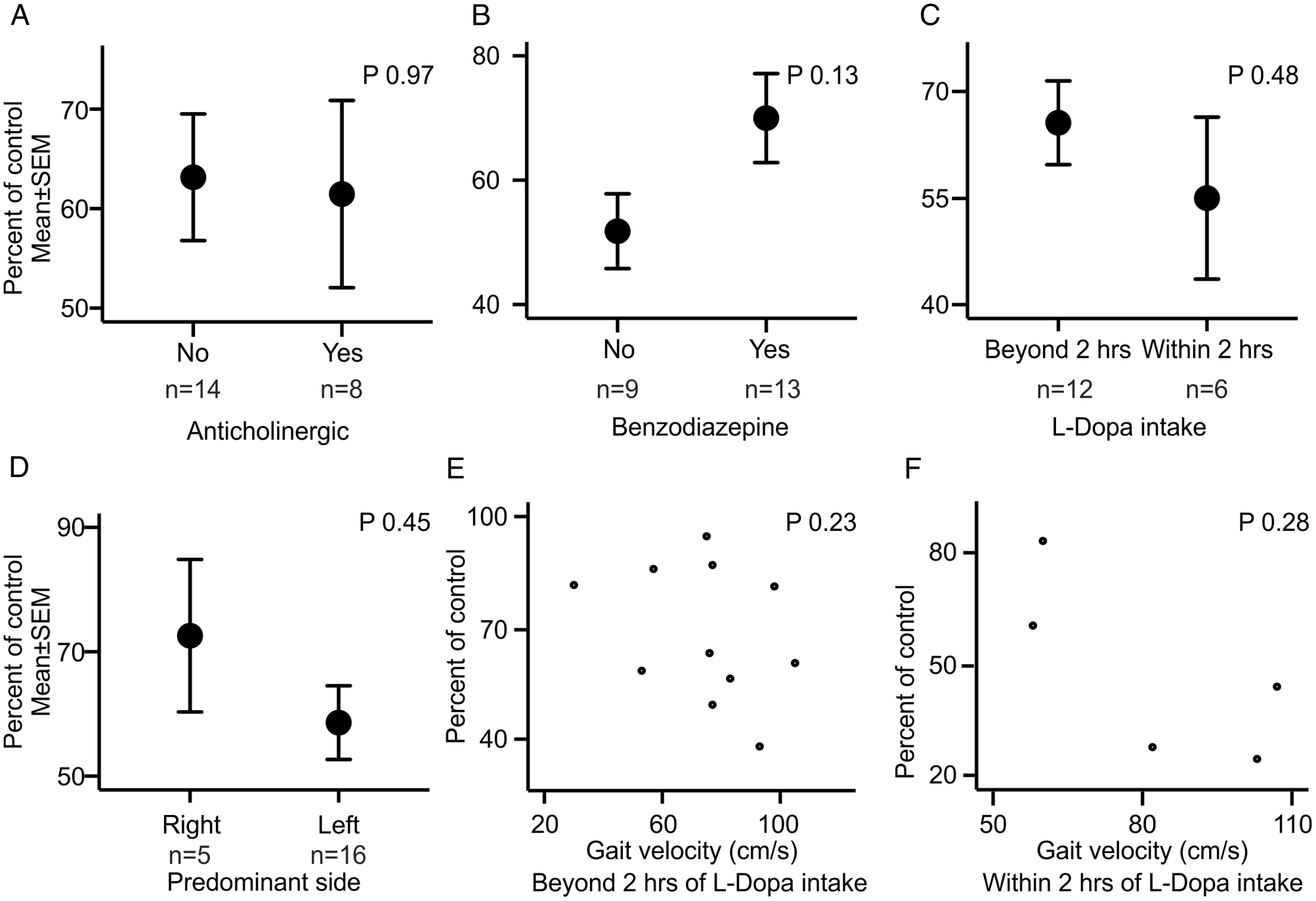
We performed a subgroup analysis to understand between-group differences in patients taking psychoactive drugs, which have previously been reported to affect SAI. Surprisingly, medication, including centrally acting anticholinergic agents, had no significant effect on SAI (Figure 2A and 2B). The levodopa equivalent daily dose (LEDD) did not show any significant correlation with SAI (p = 0.08). Whilst there was a visible separation between users and non-users of benzodiazepine at therapeutic doses, this did not reach statistical significance. There was no significant difference in SAI between patients who were tested within 2 hours of taking L-dopa compared to those who took L-dopa more than two hours prior to testing (Figure 2C). SAI between more and less affected sides was comparable (Figure 2D). Unexpectedly, we did not find any significant correlation between gait speed and SAI in subgroups separately (Figure 2E, 2F). Drawing conclusion from five patients on correlation between gait speed and SAI is likely to be inappropriate. Hence, we tested correlation between gait speed and SAI in all 22 patients, but it still did not reach the level of significance (p = 0.08). Finally, we did not observe any difference in resting motor threshold (RMT) between different stages of PD or cognitive scores.
Psychoactive medications and clinical factors showing no effect on short-latency afferent inhibition (SAI) in Parkinson’s patients. (A) Comparing SAI between groups of patients with and without centrally acting anticholinergic drugs at therapeutic doses failed to show any difference. (B) Comparing SAI between groups of patients with and without oral benzodiazepine drugs at therapeutic doses failed to show any difference. (C) Comparing SAI between groups of patients administered L-dopa within or more than 2 hours before the test failed to show any effect of the timing of L-dopa administration on SAI. (D) Comparing SAI elicited from intrinsic muscles of the right hand, between patients with left or right predominant PD failed to show any difference (A–D: Unpaired t-test). (E, F) Scatter plots of SAI and gait speed among patients who consumed L-dopa more than 2 hours before testing and within 2 hours of testing respectively showed no significant correlation (Spearman’s rank correlation). P < 0.05 was considered the threshold to reject the null hypothesis. N = sample size.
Discussion
In this study, we observed a decrease in cortical sensory-motor coupling in PD patients with disease progression, evaluated by testing SAI in this patient group. Additionally, we found that the visuospatial executive function and orientation domains of cognition demonstrated a negative correlation with SAI. SAI has been frequently used as a surrogate estimate of cortical cholinergic tone. Whilst the non-specific muscarinic receptor antagonist scopolamine has been reported to reduce SAI Reference Di Lazzaro, Oliviero and Profice12 and GABAA receptor agonists have been shown to increase SAI, Reference Di Lazzaro, Pilato, Dileone, Tonali and Ziemann13,Reference Turco, El-Sayes, Savoie, Fassett, Locke and Nelson18 the wider pharmacology of SAI is not well-documented. If we accept that the reduction in SAI we have observed is through cholinergic denervation; then, the current study reinforces a hypothesis of an “acetylcholine-deprived brain” in patients with advanced PD.
Studies investigating SAI in PD have produced conflicting results. Reference Bologna, Paparella, Fasano, Hallett and Berardelli19 For example, Sailer et al. (2003) reported that SAI was reduced on the more affected side in PD patients on medication but remained normal in PD patients off dopaminergic medications, Reference Sailer, Molnar, Paradiso, Gunraj, Lang and Chen10 whereas Di Lazzaro et al. (2004) reported a selective increase in SAI on the more affected side in hemiparkinsonian patients. Reference Di Lazzaro, Oliviero and Pilato20 Guerra et al. reported that SAI was comparable between patients and healthy subjects and that dopaminergic therapy did not modify the amplitude of MEPs evoked during the SAI protocol. Reference Guerra, Colella and Giangrosso21
SAI was significantly reduced in mild PD patients with visual hallucination (VH) compared to those without VH and controls. Reference Manganelli, Vitale and Santangelo22 Rochester et al. (2012) observed significant associations between SAI and age, gait speed, postural instability, and attention in a relatively large sample of PD patients, with gait speed remaining an independent predictor of reduced SAI on regression analysis. Reference Rochester, Yarnall and Baker16 A study focussed on cognitive attributes of neurodegeneration found that SAI was significantly reduced in AD but not in PD patients without dementia compared to controls. However, SAI was significantly reduced in PD patients with dementia (PDD), and there was a strong correlation between SAI and Mini-Mental State Examination (MMSE) score. Reference Celebi, Temuçin, Elibol and Saka15 Another group of investigators found that SAI was significantly reduced in patients with mild PD and REM sleep behavioural disorder (RBD) compared to PD patients without RBD and controls. Reference Nardone, Bergmann and Brigo23 SAI values correlated positively with neuropsychological tests measuring episodic verbal memory, executive functions, visuo-constructional, and visuo-perceptual abilities. No significant differences were observed in SAI between PD patients with Freezing of Gait (FOG), PD patients without FOG, and healthy controls. Reference Picillo, Dubbioso and Iodice24 PD patients with dysphagia showed significantly reduced SAI compared to those without dysphagia. Reference Lee, Koo, Song, Jo, Lee and Jang25 However, in the same study, SAI was not significantly correlated with disease duration, modified H&Y stage, or UPDRS-III score. In broad agreement with Rochester et al., a more recent study reported significant reductions in SAI in patients with mild to moderate PD compared to older adults with a history of two or more falls, with mean SAI correlating with changes in gait speed under a dual-task condition. Reference Pelosin, Ogliastro and Lagravinese26
SAI, and its correlation with clinical parameters, is thus quite variable across studies. These inconsistencies may be explained by factors including small study sample size, stage of PD, different phenotypes of PD, method of analysis, and the presence of cognitive impairment.
Our observations that a reduction in SAI is correlated with the stage of disease and negatively correlated with two specific cognitive domains (orientation and visuospatial executive function) are consistent with dysfunction in cholinergic neuronal networks. Cholinergic neurons are concentrated in a number of nuclei including, but not limited to, the basal forebrain complex, the pedunculopontine nucleus (PPN), the laterodorsal tegmental nucleus (LDTN), and the medial habenula. Cholinergic interneurons are also found in the striatum, nucleus accumbens, and the neocortex. A recent review by Pasquini et al (2021) has detailed the evidence from various modalities (MRI, PET, Electroencephalogram/EEG, TMS) for cholinergic pathology in PD Reference Pasquini, Brooks and Pavese27 and has speculated that, because cholinergic dysfunction is not a universal finding in PD, it may represent a phenotypic variant of PD. Although Braak’s original ascending model postulates simultaneous involvement of dopaminergic and cholinergic neurons, there is limited clinical evidence for this. Moreover, whilst animal studies have shown a link between dysfunction of cholinergic striatal interneurons and the severity of motor symptoms such as tremor and levodopa-induced dyskinesia, these preclinical observations have not translated into the clinic.
Studies in Alzheimer’s disease (AD), where cholinergic pathology is well recognised, have also identified impairment in SAI correlated with UPDRS-3 score (R = 0.731, p = 0.016) and Aβ42 levels (R = –0.652, p < 0.05), suggesting a direct relationship between motor impairment and amyloidopathy. Reference Schirinzi, Di Lorenzo and Sancesario28 Similar findings have also been reported by Bologna et al. in patients with AD Reference Bologna, Guerra and Colella29 ; AD-mediated cholinergic degeneration may also therefore account for motor impairment in this condition. Some of our “null findings” are also somewhat surprising and require confirmation (Figure 2). For example, we observed a lack of correlation between SAI abnormalities and motor functions as assessed by the MDS-UPDRS. This is potentially explained by the increased weighting assigned to features of tremor (four tremor-specific sections), which, unlike bradykinesia (one bradykinesia-specific section) or gait disturbance (two specific sections), might not be a direct reflection of cholinergic deprivation. Similarly, we failed to observe differences in SAI between those treated with centrally acting anticholinergic medications or benzodiazepines at therapeutic doses, compared to those who were not. We also failed to find any difference in SAI between patients with left/right predominant disease or any effect of the timing of L-dopa relative to testing, or a significant correlation between gait speed and SAI. These “null findings” could all be attributed to a limited sample size. Moreover, as discussed above, there are persisting uncertainties regarding the pharmacology of SAI in healthy controls, and thus, our observations regarding the effects of medication should not be entirely dismissed.
In conclusion, the current study provides evidence of a gradual decline in sensory-motor integration in PD patients with advancing stage of disease. Moreover, our observations regarding SAI and visuospatial/orientation domains of cognition are compatible with previously published literature.
Conflict of Interest
The authors have no conflicts of interest to disclose.
Author Contribution
SC, US, SR: Study concept and design, acquisition of data, analysis and interpretation, first draft of the manuscript, critical revision of the manuscript for important intellectual content.
YK, SB: Data analysis and interpretation, critical revision of the manuscript for important intellectual content.
MRB, SNB: Study concept and design, analysis and interpretation, critical revision of the manuscript for important intellectual content.
HK: Study concept and design, critical revision of the manuscript for important intellectual content, study supervision.



