




1. Introduction
The exports of goods intensive in natural resources have played a highly important role in the economic history of Latin America. During the first globalisation, many of the region's economies followed an export-led development model (Bulmer-Thomas, Reference Bulmer-Thomas1994; Bértola and Ocampo, Reference Bértola and Ocampo2012; Martín-Retortillo et al., Reference Martín-Retortillo, Pinilla, Velazco, Willebald, Pinilla and Willebald2018). A main example is Argentina, where the export growth between 1875 and 1929 was only exceeded by that of Canada and Japan among economies that represent more than 1 per cent of global trade (Federico and Tena-Junguito, Reference Federico and Tena-Junguito2019; Pinilla and Rayes, Reference Pinilla and Rayes2019). Overall, the participation of the region in the international trade of primary products, including agri-food products, was highly relevant during this period (Pinilla and Aparicio, Reference Pinilla and Aparicio2015).
However, during the period when the import-substitution industrialisation (ISI) development policy was implemented, Latin American countries lost a significant part of their relative weight of global exports of agricultural and food products, as their growth rate was small compared to that of the rest of the world (Serrano and Pinilla, Reference Serrano and Pinilla2016). Despite the profound structural change observed in the most important economies of the region, the growth in manufacturing exports was relatively lower than that of other newly industrialised countries, such as those in East Asia (Gereffi and Wyman, Reference Gereffi and Wyman1990).
The serious problems inherent to the import-substitution model in the 1980s, the so-called lost decade, favoured a shift towards increased openness to the global market. The most indebted countries adopted a package of economic reforms, known as the Washington Consensus, in exchange for financing or the renegotiation of their debt. Of particular importance were the adjustment policies, structural reforms, redefinition of the role of the state and the implementation of free market policies. As a result, both the economy as a whole and agriculture in particular underwent changes in their productive structure, competitiveness, productivity, and profitability (Martín-Retortillo et al., Reference Martín-Retortillo, Pinilla, Velazco and Willebald2019). In the case of agriculture, resources were allocated to sectors that were competitive in international markets. Thus, agricultural exports grew quickly notably expanding Latin American agri-food exports from the mid-1990s onward (Serrano and Pinilla, Reference Serrano and Pinilla2014a). The strong growth of primary products exports in recent decades has led to an interesting debate on the re-primarisation of the Latin American economies (Arteaga et al., Reference Arteaga, Cardozo and Diniz2020; Román and Willebald, Reference Román and Willebald2021; Bértola and Ocampo, Reference Bértola and Ocampo2022). The importance of this process has attracted the attention of major international organisations (Chaherli and Nash, Reference Chaherli and Nash2013; OCDE/CEPAL/CAF, 2015; Giordano, Reference Giordano2019; FAO, 2020).
The literature focuses mainly on two themes: the role of China in the export growth of Latin American countries (Rosales and Kuwayama, Reference Rosales and Kuwayama2007; Jenkins, Reference Jenkins2011; Bolinaga and Slipak, Reference Bolinaga and Slipak2015; Perrotti, Reference Perrotti2015; Santana, Reference Santana2018; Aviles and Wong, Reference Aviles and Wong2019) and the consequences of re-primarisation for the economic development of the region (Teubal and Palmisano, Reference Teubal and Palmisano2015; Orozco, Reference Orozco2016; Bértola and Ocampo, Reference Bértola and Ocampo2022). However, there are very few studies that provide a comprehensive and quantitative analysis of the factors behind the significant export growth.
Within this framework, the objective of this article is to analyse the growth process of agri-food product exports in Latin America and its determinants between 1994 and 2019. To achieve this objective, we estimate several gravity models using the exports of 231 agri-food products from 19 Latin American countries to 186 destinations during the period 1994–2019. We have selected this time period to include the effects of the implementation of the Washington Consensus policies mentioned before (Dijkstra, Reference Dijkstra2000; Escaith and Paunovic, Reference Escaith and Paunovic2004; Lora, Reference Lora2012).
We believe that this study offers a twofold contribution. On one hand, this is the first comprehensive analysis on the recent evolution of Latin America's agri-food exports over an extended period, encompassing the shift in development model and the emergence of Asian economies in the global market. By analysing the export growth by origin, destination and product category and studying the behaviour of export prices, we broaden the knowledge on this export growth.
Secondly, to the best of our knowledge, this study is the first to examine the agri-food exports of Latin America between 1994 and 2019, disaggregating them by product group. While Ayuda et al. (Reference Ayuda, Belloc and Pinilla2022) and Balogh and Aguiar (Reference Balogh and Aguiar2022) also use gravity models to analyse the agri-food exports for the same years, they do not develop such a comprehensive analysis of the agri-food exports of Latin American economies and they do not take into account that the determinants of the agri-food exports may be different depending on the type of products considered.
Our results indicate that the rapid growth of agri-food exports was largely driven by the expansion in external demand and the proliferation of regional trade agreements, particularly NAFTA, CACM, ALADI, MERCOSUR, APEC and TPP. Moreover, our analysis by type of product shows that the effects are different depending on the type of product considered.
The paper is structured as follows. In section 2 we analyse the evolution of trade in Latin America, particularly focusing on the agri-food export boom during the period 1994–2019. Section 3 describes the empirical model and the variables and data used. In section 4, we present and interpret the results of the econometric analysis. In the final section, we reevaluate the recent agri-food export experiences of Latin American countries from a historical perspective, focusing particularly on comparing this recent period with previous ones.
2. The boom in agri-food exports from Latin America, 1994–2019
2.1. Export growth
During the first globalisation, from the mid-nineteenth century to 1929, the economy of the vast majority of Latin American countries was based on export-led development models driven by the exports of primary products. Agricultural and food products played a prominent role, comprising a considerable percentage of their exports and a significant share of global exports. However, the impact of this export-led growth model varied significantly among countries, influenced by the growth of their exports and by what Díaz Alejandro (Reference Díaz Alejandro and Thorp1988) defined as the commodity lottery—namely, the strength of their backward, forward, and final demand linkages with the rest of the economy (Bulmer-Thomas, Reference Bulmer-Thomas1994; Aparicio et al., Reference Aparicio, González-Esteban, Pinilla, Serrano, Pinilla and Willebald2018).
The effects of the so-called First Export Era on Latin America's economic growth have been the subject of one of the liveliest debates in the economic history of the region (Kuntz-Ficker, Reference Kuntz-Ficker2017a). Contrary to the very pessimistic view that prevailed until recently, a much more positive view on export-led development models has arisen (Kuntz-Ficker, Reference Kuntz-Ficker2017b).
Before the First World War, Argentina and Uruguay exhibited the most robust economic growth. In instances where the export-led model failed to generate rapid GDP growth, particularly in much of Latin America, scholars have identified several key issues. These include insufficiently dynamic expansion of exports, export concentration in a limited number of products and countries, leading to vulnerability to price fluctuations and boom-and-bust cycles. Moreover, the productivity of the non-export sectors remained largely unaffected by these export activities (Aparicio et al., Reference Aparicio, González-Esteban, Pinilla, Serrano, Pinilla and Willebald2018; Martín-Retortillo et al., Reference Martín-Retortillo, Pinilla, Velazco, Willebald, Pinilla and Willebald2018).
The turbulence of the inter-war period resulted in significant pessimism regarding the viability of the export-led development model. Challenges encountered by agricultural exporters in their traditional markets, instability and declines in terms of trade, and a persistent downward trend from the 1930s onward prompted scrutiny of the export-oriented growth model centred on primary products (Cárdenas et al., Reference Cárdenas, Ocampo, Thorp, Cárdenas, Ocampo and Thorp2000, pp. 13–14; Paiva Abreu, Reference Paiva Abreu, Bulmer-Thomas, Coatsworth and Cortés-Conde2006, p. 121). The theoretical shift advanced by the structuralism led by Raul Prebisch was embodied in the inward-looking development strategy proposed by the ECLAC. This strategy, ISI, was followed by the most important economies of the region.
The ISI model resulted in rapid economic growth and significant structural change from the beginning of the 1950s. However, due to the delayed impact of the crisis of the 1970s in the region, economic growth stagnated partially causing the lost decade. As we have explained, the adoption of the policies embedded in the Washington Consensus, included market liberalisation and the implementation of structural reforms based on increased external openness in order to exploit the comparative advantages and increase exports (Bértola and Ocampo, Reference Bértola and Ocampo2012). This new strategy involved mobilising resources in competitive export sectors, including agriculture. This, in turn, implied the liberalisation of agricultural trade, the promotion of more profitable non-traditional agricultural exports, internal deregulation and the improvement of rural non-farm activities as an additional source of income for small farmers (Conroy et al., Reference Conroy, Murray and Rosset1996; Birdsall et al., Reference Birdsall, de la Torre and Menezes2008; Martín-Retortillo et al., Reference Martín-Retortillo, Pinilla, Velazco and Willebald2019).
Moreover, since the early 1990s, governments sought to expand trade through the signing of regional trade agreements. These agreements have been a cornerstone of the region's internal economic integration and its openness to trade with global markets.
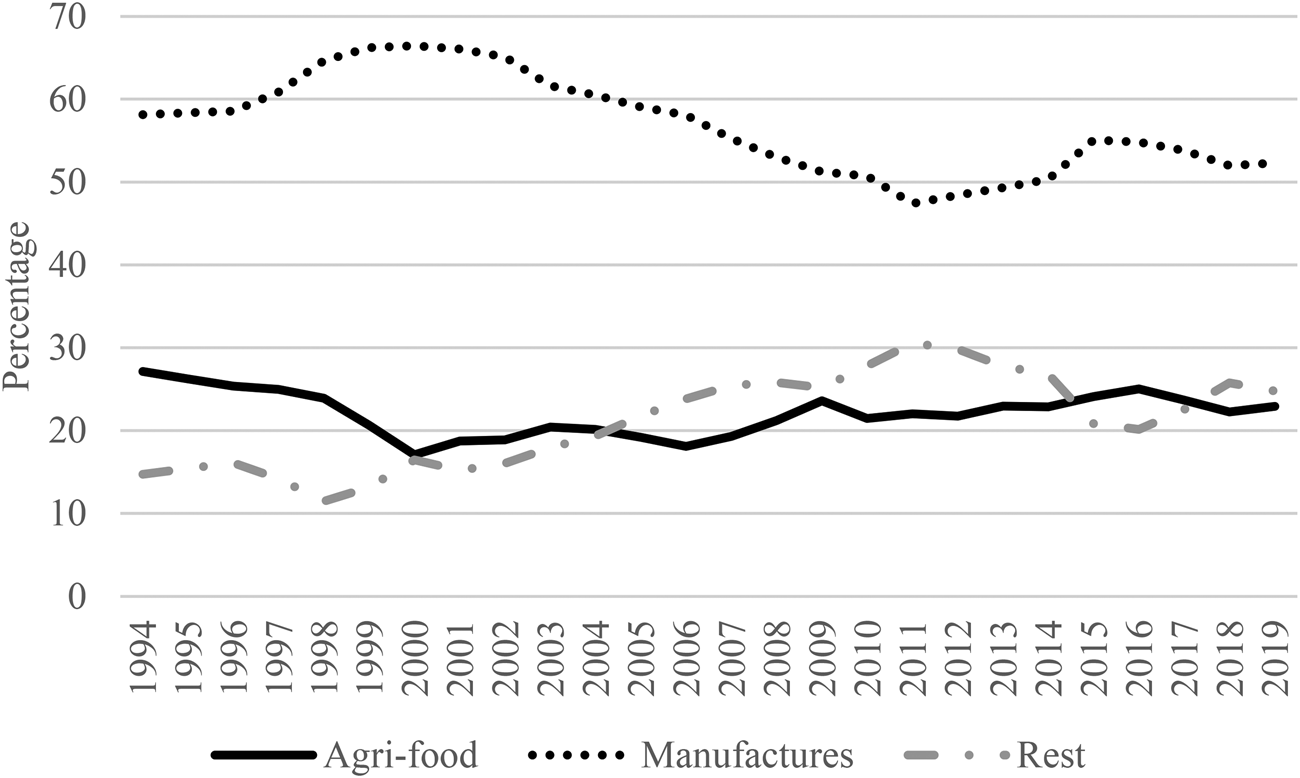
In the 1990s, these policies supported the expansion of exports, particularly in manufactured goods, which accounted for two-thirds of the total exports at the outset of the twenty-first century (see Figure 1 and Figure A1 in the Supplementary Material). While exports of manufactured goods have continued to grow robustly in the twenty-first century, albeit with a temporary slowdown during the 2008 crisis, exports of primary products have shown even faster growth. Specifically, exports of agri-food products, minerals, and energy products have all seen significant growth. The accelerated growth of the exports primary products resulted in a significant increase in their share of the region's total exports. Scholars have noted that this rapid export expansion was fueled by robust demand from Asia and the commodities “supercycle” until 2014 (Bértola and Ocampo, Reference Bértola and Ocampo2022). This phenomenon could be viewed in the context of a variant of Dutch disease.
Evolution of Latin American exports by product groups (in percentage).
Source: Own elaboration based on UN COMTRADE (2021).

The growing weight that products intensive in natural resources such as minerals, energy or agri-food products have had in Latin American exports is commonly referred to as re-primarisation. Adding the exports of primary products and natural resource-based manufactures for all the countries in the region but Mexico, they increased from 68.9 per cent of exports in 1999–2001 to 79.1 per cent in 2019–2021 (CEPAL, 2023).
Re-primarisation resulted in a relative stagnation of structural change and an increase in the relative importance of these sectors, although this varied by country. A broad theoretical and historical literature has discussed the potential issues associated with excessive reliance on natural resource-intensive activities. Scholars have highlighted concerns that such activities may lead to a less diversified division of labor that hinders the incorporation of knowledge and complicates sustainable economic growth strategies.
Moreover, activities focused on the primary sector do no result in productive spillovers because they are typically not a source of innovation. Scholars have also identified other problems, such as de-industrialisation during periods of resource price booms, significant volatility in commodity prices, engagement of producers in unregulated rent-seeking activities, and the concentration of economic and political power among elites (Willebald et al., Reference Willebald, Badia-Miró, Pinilla, Badia-Miró, Pinilla and Willebald2015).
Agri-food products have played an important role in this re-primarisation process. From the 1950s, growth in Latin American agri-food exports was weak compared to that of the world as a whole. Thus, the share of Latin American exports in the global trade of agricultural and food products decreased from 16.5 per cent in 1962 to 11.7 per cent in 1992. This reduction is explained by export substitution policies, specialisation in basic products with a low-income elasticity, protectionist policies adopted by developed countries and the relative failure of the region's integration processes (Anderson and Valdés, Reference Anderson and Valdés2008; Serrano and Pinilla, Reference Serrano and Pinilla2016). The open growth model adopted in the early 1990s, along with a shift towards export diversification and increased global demand, significantly boosted exports, thereby reversing the previous decreasing trend (Serrano and Pinilla, Reference Serrano and Pinilla2014a).
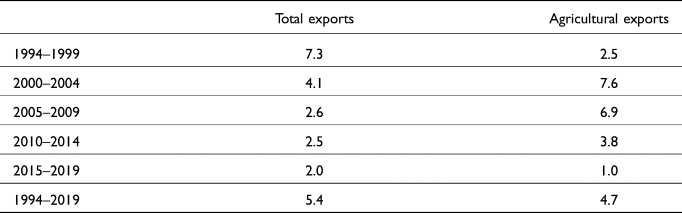
Undoubtedly, it was from the beginning of the twenty-first century that the growth in agri-food exports significantly outpaced that of total exports, which, as noted, also experienced substantial growth (Table 1).
Accumulative annual average growth rates of Latin American exports, 1994–2019 (constant 2015 US dollars)

Source: Own elaboration based on UN COMTRADE (2021).
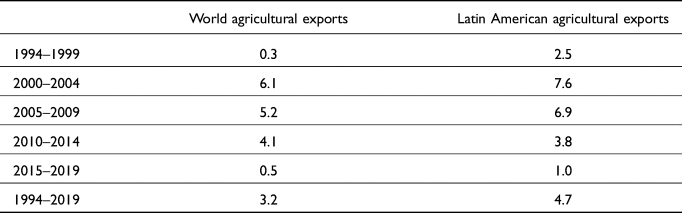
A direct consequence of the dynamism in the region's agri-food exports is their increasing global significance, driven by their rapid growth (Table 2).
Growth rates of world and Latin American agri-food exports, 1994–2019 (%)

Source: Own elaboration based on UN COMTRADE (2021).
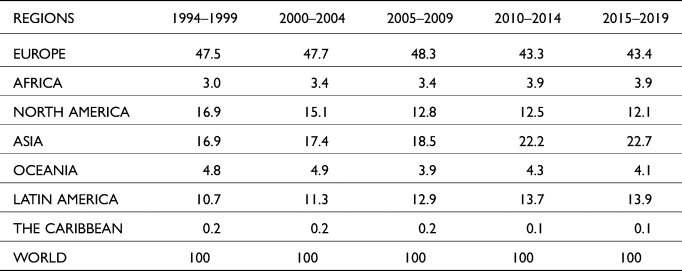
As we can observe in Table 3 and Table A1 in the Supplementary Material, the greater dynamism of Latin American exports is reflected in their increased participation in world agricultural exports from 10.7 per cent in 1994–1999 to almost 14 per cent in 2015–2019. Therefore, since the mid-1990s, Latin America has increased its share in the international markets for agricultural and food products, becoming an increasingly significant player (see Table 3 and Figure A2 in the Supplementary Material).
World exports of agri-food products, 1994–2019 (percentages over millions of 2015 US dollars)

Source: Own elaboration based on UN COMTRADE (2021).
Thus, the region remains heavily reliant on the exports of agricultural commodities and on the fluctuations in commodity prices. As it is well-known, the export boom took place in the context of an improvement in the terms of trade—a supercycle of commodity prices—between 2002 and 2012 in several of the main products exported by the region, mainly due to the economic growth of China.
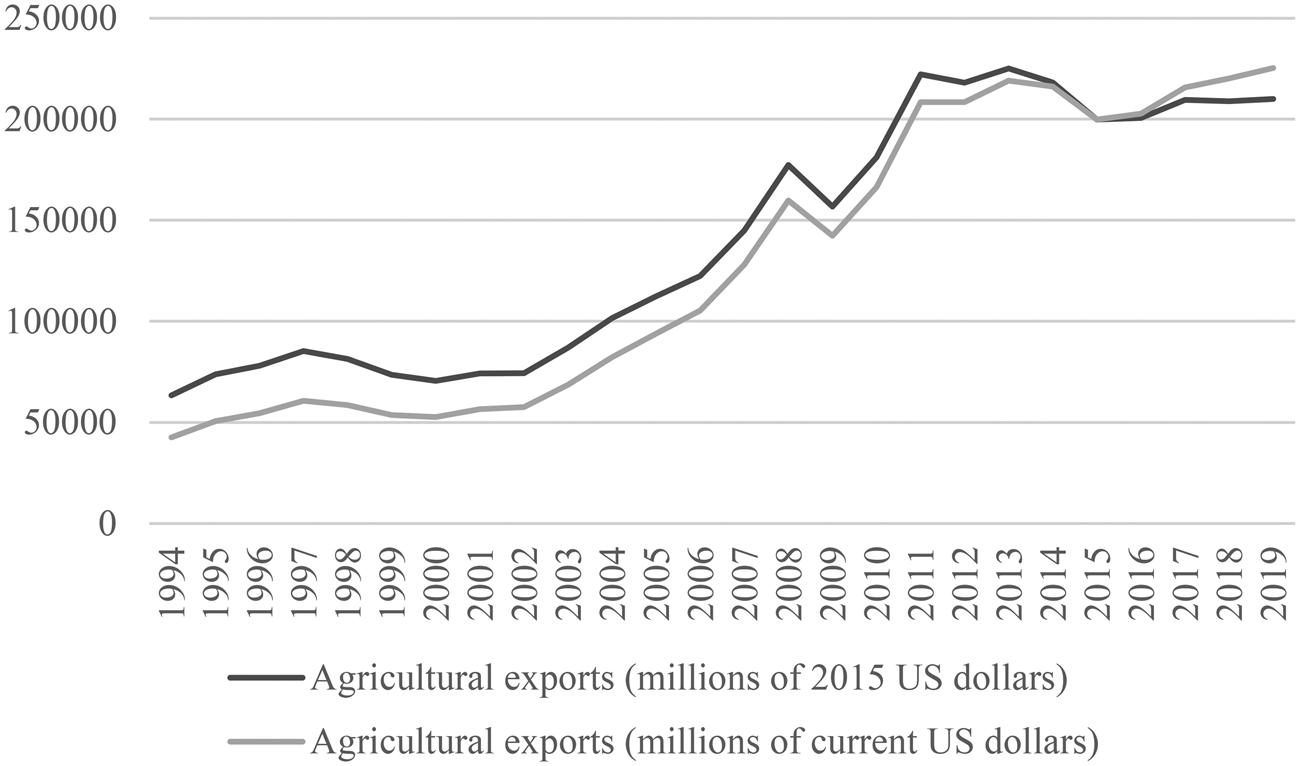
Overall, the developing world has been the driving force behind this new export dynamism, while developed countries have seen a decline in their share, contrary to the situation in the second half of the twentieth century. This shift can be attributed to the increase in South–South trade, particularly due to the rising Asian demand for agri-food products, as well as to some degree of trade liberalisation and reduced agricultural support in wealthy countries (Serrano and Pinilla, Reference Serrano and Pinilla2014a). In the case of Latin America agri-food exports grew at an average annual rate of 4.7 per cent in real terms between 1994 and 2019, more than tripling over this period. Despite fluctuations, this growth peaked in 2013 (Figure 2).
Evolution of Latin American agricultural exports.
Source: Own elaboration based on UN COMTRADE (2021).

Figure 2 illustrates that the export boom began at the start of the twenty-first century. By applying the innovational outlier (IO) structural break test (Perron and Vogelsang, Reference Perron and Vogelsang1992; Clemente et al., Reference Clemente, Montañés and Reyes1998), we can identify a structural break in 2001, marking the onset of the agricultural export boom (Figure A3 in the Supplementary Material).
2.2. Exports' origins and destinations
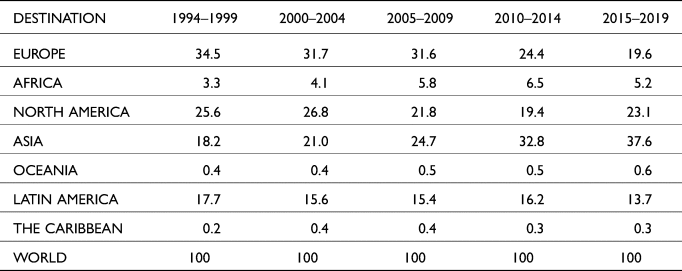
Examining the destination of these rapidly expanding exports, we observe substantial growth across all of them (Table 4 and Table A2 in the Supplementary Material). However, there have been significant changes in their relative shares. The most notable change has been the decline in the importance of exports to Europe and the increasing relevance of those sent to Asia. From 2010 onward, Asia, particularly due to the role of China, became the primary trading partner for Latin America in agri-food products.
Destination of the agri-food exports of Latin America (percentages of exports in millions of 2015 US dollars)

Source: Authors' compilation based on the UN COMTRADE (2021).
This region doubled its share of exports of these products from 16.9 per cent in 1994 to 39.7 per cent in 2019. China replaced the position that Japan had held in the previous decades, maintaining, and deepening the importance of Asia in the region (Bernal-Meza, Reference Bernal-Meza2016). In 2019, China emerged as the second-largest destination for Latin American agri-food exports, holding an 18.17 per cent share, following the United States with a 23.03 per cent share. The growth in Asian destinations was offset with the fall in the share of Europe and North America. During the period 1994–1999, Europe was Latin America's main trading partner and, together with North America, represented 60 per cent of the exports of agri-food products. Currently, the importance of these destinations has decreased to 42 per cent (Table 4).
Furthermore, the rise of Asia as the principal trading partner was accelerated by the global economic crisis of 2008. Prior to the crisis, during the early years of the twenty-first century, China's increasing integration into the global market was pivotal, significantly influencing the boom in international prices of primary products. Latin America, endowed with abundant natural resources, has thus emerged as a key supplier of primary products to China, reinforcing its historical role as an exporter of these products.
The share of intra-regional trade in Latin America, while growing in absolute values—from 10.4 billion 2015 US dollars in 1994 to 27.7 in 2019 (see Table A2 in the Supplementary Material)—has slightly decreased in relative terms, particularly due to the lower economic growth of the region in recent years (CEPAL, 2019). Latin American intraregional trade is low compared to the intraregional agri-food trade of other continents such as Europe and Asia (Pinilla and Serrano, Reference Pinilla, Serrano and Patel2009; Olmos, Reference Olmos2017). The relatively lower trade is partially explained by the relatively lower scope of integration in the region (Bértola and Ocampo, Reference Bértola and Ocampo2022).
The Herfindahl–Hirschman Index (HHI) of Latin American agri-food exports for the period studied reveals that they were not highly concentrated in terms of the country of destination (see Table A3 in the Supplementary Material). From 2010 to 2014, the HHI shows a decreasing trend. However, the last five years show an increase in the index primarily driven by China's growing importance and the diminishing relative significance of Europe.
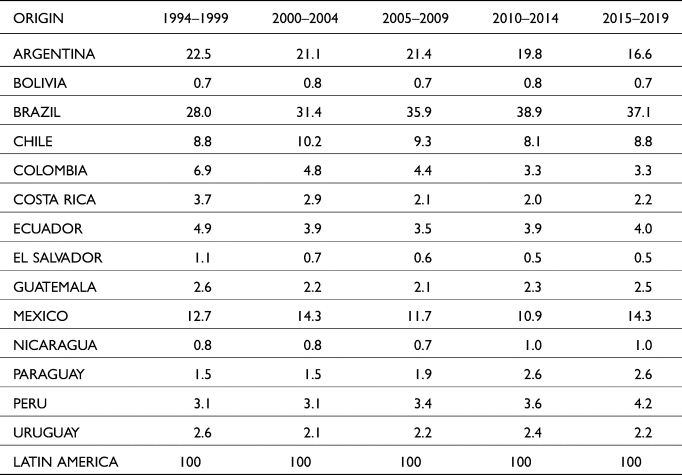
The analysis of exports by origin reveals that just three countries, Brazil, Argentina and Mexico, represented more than 62 per cent of exports throughout the entire period (Table 5 and Table A4 in the Supplementary Material). These three countries are followed by Chile, Peru, Ecuador and Colombia as the main exporters. Currently, Brazil is the country which has most increased its share, representing more than a third of the total. This is not surprising if we take into account that it is also the country with the highest growth in agricultural production since 1950 (Martín-Retortillo et al., Reference Martín-Retortillo, Pinilla, Velazco and Willebald2019). Except for Colombia, Costa Rica and El Salvador, all the countries at least doubled value of their exports in real terms during the period and, with the exception of Colombia, exports grew at an average annual rate of 2 per cent or more. Brazil, Guatemala, Mexico, Nicaragua, Paraguay and Peru reached an average annual rate of over 5 per cent.
Geographical distribution of the agri-food exports of Latin America (percentages of exports in millions of 2015 US dollars)

Source: Own elaboration based on UN COMTRADE (2021).
When dividing the countries into two groups—one comprising large countries (Argentina, Brazil and Mexico) and the other consisting of the remaining countries—we observe an average annual growth rate of 5.1 per cent for the three large countries, compared to 4.0 per cent for the rest of the countries.
The HHI used to measure geographical concentration among exporting countries, shows a consistently high concentration of the origin of exports, primarily driven by the roles played by Brazil and Mexico as exporters of agri-food products (see Table A3 in the Supplementary Material). The data reveal that export concentration was moderate during 1994–1999 but has since increased.
2.3. Composition of exports by product
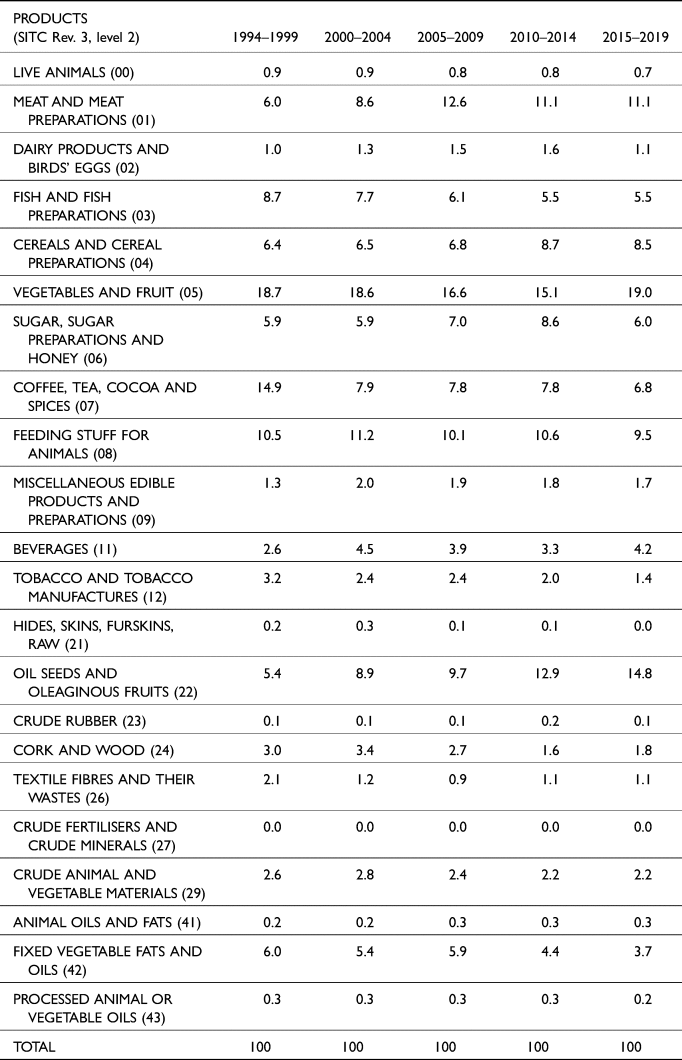
The changes in the origins and destinations of imports have had an effect on the composition of exports by product. This has changed considerably over the last few decades. Certain products have increased significantly, particularly oil seeds and meat, while the share of others, such as tobacco, fish, coffee, cocoa, tea and spices has fallen.
The principal agricultural products exported from the region in 2015–2019 were soybeans, oil flat cakes and corn (Table 6 and Table A5 in the Supplementary Material). Also relevant were the exports of other products, such as fruit (particularly bananas, pineapple and avocado), frozen beef, green coffee (unroasted or before being processed) and poultry.
Breakdown by product of the Latin American agri-food exports (percentages of exports in millions of 2015 US dollars)

Source: Own elaboration based on UN COMTRADE (2021).
Over the last 20 years, Brazil, Argentina, Paraguay, Uruguay and Bolivia have become the main global suppliers of soy and oil seeds (Klein and Vidal Luna, Reference Klein and Vidal Luna2021). While the United States dominated production until the twenty-first century, South American producers, and particularly Brazil, have replaced the United States as the leading exporter. The significant transformation of soy production took place with the introduction of genetically modified seeds resistant to glyphosate, which played a crucial role in soy production across the region. Additionally, there has been a notable surge in meat exports, mostly from Brazil, Mexico, Uruguay, and Argentina. Brazil, in particular, has emerged as the world's top chicken exporter and holds a leading position in the global beef market (Klein and Vidal Luna, Reference Klein and Vidal Luna2022). Brazil's growing competitive advantage in extensive cattle production, coupled with rising per capita incomes that have shifted consumer diets towards increased animal protein consumption, globalisation trends and the policies implemented to stimulate production have all contributed to the country's growing share of global meat exports.
One of the main drivers of agricultural growth in the past two decades has been technological advancements, particularly the widespread adoption of technologies like direct sowing and transgenic seeds. These innovations have significantly increased productivity in cereal and oilseed production (Klein and Vidal Luna, Reference Klein and Vidal Luna2022). Overall, Latin American agriculture experienced rapid productivity growth from the early 1990s, surpassing the rates of previous decades. Several factors contributed to this growth, including increased land-use intensity in the Southern Cone, new production methods such as soybean consortiums (“sowing pools”), expansion of feedlots, and improvements in storage, agro-industrial processing, preservation, transport and communication systems. There was also intensive growth in agricultural inputs such as self-propelled machinery, chemicals, and hybrid seed varieties. These advancements represent significant progress in agricultural modernisation (Kay, Reference Kay1994; Martín-Retortillo et al., Reference Martín-Retortillo, Pinilla, Velazco and Willebald2019, Reference Martín-Retortillo, Pinilla, Velazco and Willebald2022). The declining importance of products like coffee and cocoa is due to the rapid increase in production and export shares by Asian countries—Vietnam, India, China and Laos—and African countries—Tanzania, Ivory Coast, Ghana and Nigeria. However, Brazil remains the leading producer and exporter of coffee, and Costa Rica, Colombia, Ecuador, Guatemala and Peru are also significant exporters of coffee and cocoa (CEPAL et al., 2015; OECD-FAO, 2019).
According to CEPAL et al. (2017), global exports of avocados grew at an average annual rate of 15 per cent over the past decade. Since 2016, avocados have become the second most imported fruit from Latin America and the Caribbean, following bananas. The avocado's popularity and high nutritional value have contributed to this rapid market growth. In terms of cereals, Argentina and Brazil are the largest producers in the area and have become major exporters of corn (Klein and Vidal Luna, Reference Klein and Vidal Luna2022).
Although there was a boom in agri-food exports, initially there was a diversification in these products in the region. Ultimately, the degree of concentration has ended up being slightly higher than that observed in the mid-1990s (Table A3 in the Supplementary Material).
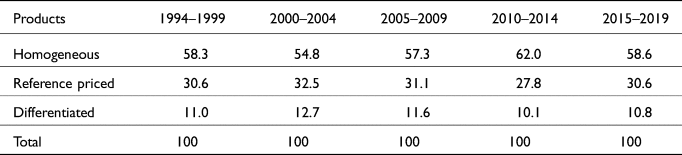
Following Rauch's conservative product classification system (Rauch, Reference Rauch1999),Footnote 1 we have classified the products into three groups: (1) homogeneous products; (2) reference-priced products; and (3) differentiated products. Homogeneous products are sold in organised markets at easily affordable prices, requiring little information for exchange. Reference-priced products are not sold in organised markets but have widely known prices. Differentiated products have unique attributes or brands, making them hard to standardise and are usually bought from specific suppliers.
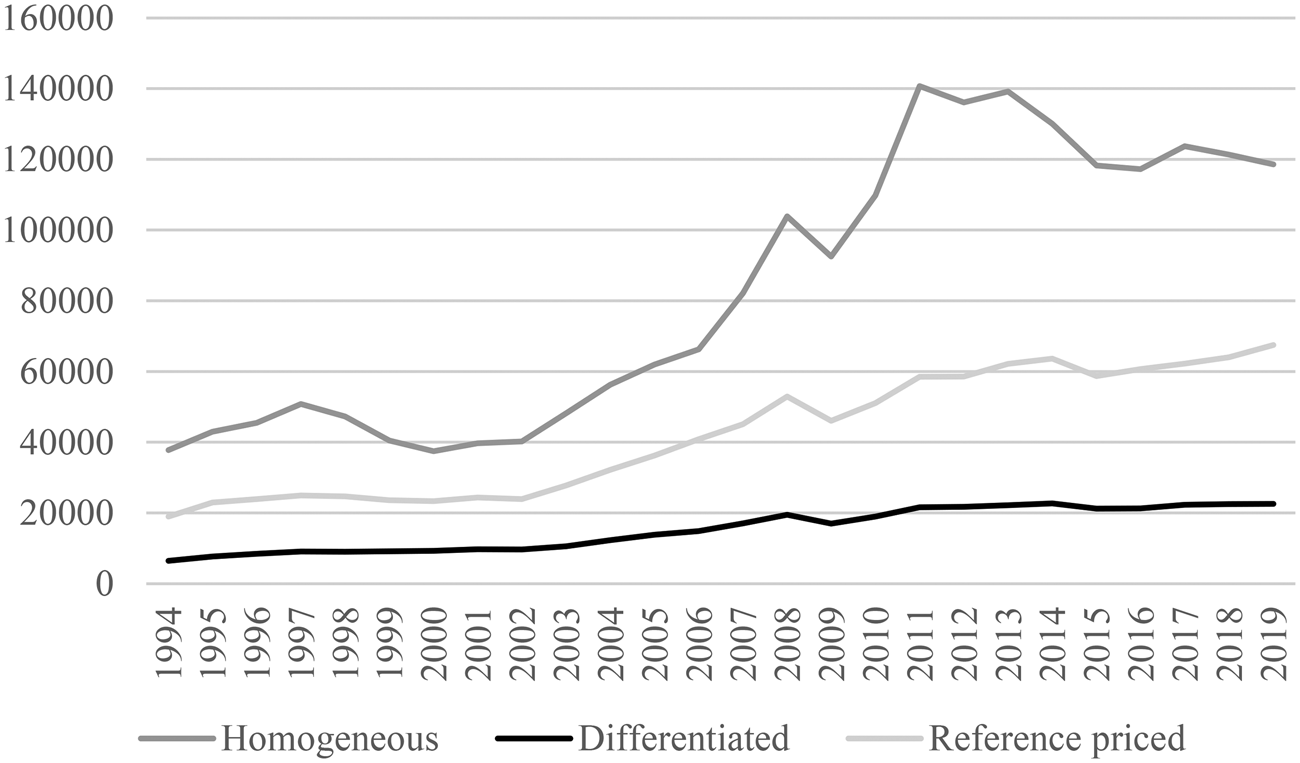
As illustrated in Figure 3, sales of the three product groups increased significantly between 1994 and 2019. A long-term perspective, disregarding short-term fluctuations, reveals that the second and third groups experienced a slightly higher average annual growth rate (4.9 per cent and 5 per cent, respectively) compared to homogeneous products (4.5 per cent). However, as shown in Table 7 and Figure 3, the share of each product group remained relatively stable during this period of growth in agricultural exports (Tables A5, A6 in the Supplementary Material).
Breakdown of agri-food exports of Latin America, Rauch's classification (percentage of exports over millions of 2015 US dollars).
Source: Own elaboration based on UN COMTRADE (2021).

Composition of agri-food products exported by Latin America, Rauch's classification (percentage of exports over millions of 2015 US dollars)

Source: Own elaboration based on UN COMTRADE (2021).
2.4. Behaviour of agri-food prices
The strong expansion of agri-food exports was driven by a significant rise in prices (Ocampo, Reference Ocampo2017). To analyse price behaviour, we have created a price index using the export unit values of 212 agri-food products, calculated with value and volume data from UN COMTRADE (2021) and using with 2015 as the base year. To construct the overall index, we weighted the individual indices according to their share in Latin American agri-food trade from 2004 to 2006.
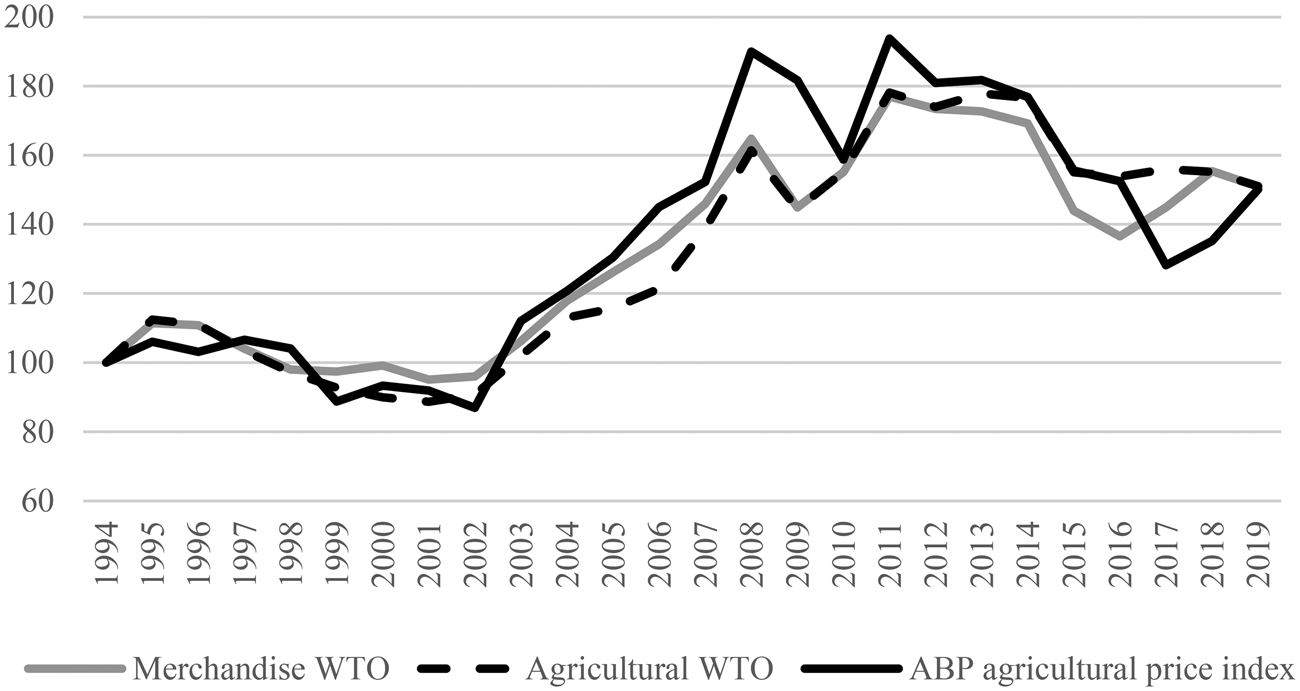
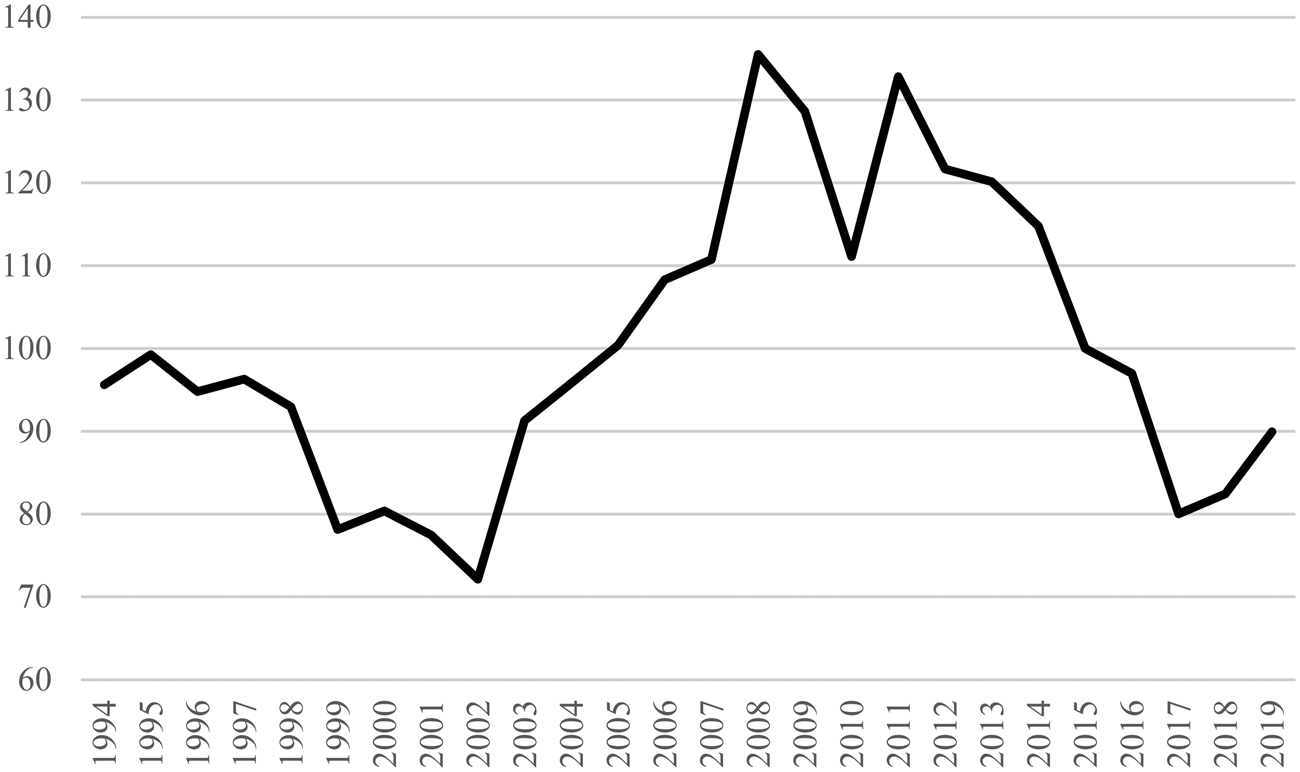
The prices or unit values of Latin American agri-food exports grew at an average annual rate of 1.57 per cent between 1994 and 2019. This rate is nearly identical to the price growth of total international trade in goods and global agricultural trade (Figure 4).
Price indices of agri-food exports (Latin America and world) and total trade (base year 1994).
Source: ABP (Authors' elaboration based on UN COMTRADE, 2021); Merchandise WTO and Agricultural WTO (https://data.wto.org).

Adjusting for inflation we see that the real prices of Latin American agri-food exports initially declined sharply. However, between 2002 and 2012, they experienced significant growth, which encouraged increased production and export. In the final years of the period, real prices declined sharply once again (Figure 5).
Evolution of Latin American agri-food exports in real prices (base year 2015).
Source: Own elaboration based on UN COMTRADE (2021). GDP deflator extracted from the World Development Indicators database.

All product groups experienced price increases. Initially, differentiated and reference-priced products saw the largest increases. By the end of the super-cycle, however, all groups had experienced similar growth. The subsequent fall impacted homogeneous products the most (Figure A4 in the Supplementary Material).
2.5. The increasing relevance of regional trade agreements
As we have explained, another crucial factor behind the “re-primarisation” and export growth is the proliferation of trade agreements. Since 1990, regional trade agreements (RTAs) signed by Latin American countries have formed the basis of their international economic integration strategies. The 1980s debt crisis shifted attention towards international trade to generate the foreign currency needed to pay off massive debts. This made the region's economic situation heavily reliant on export capacity (Bulmer-Thomas, Reference Bulmer-Thomas1994; French-Davis et al., Reference Ffrench-Davis, Múñoz, Palma and Bethell1997).
Within this context, many countries of the region adopted pro-market economic reforms, promoting free trade to build a strong export sector and supporting economic growth considered openness to international markets as the only way to eliminate inefficient companies. However, as noted by Rodríguez and Rodrik (Reference Rodríguez and Rodrik1999) and Taylor (Reference Taylor and Banuri1991), free trade alone is insufficient for economic growth. It must be accompanied by the export of high-value-added products and active policies that enable structural change.
However, in Latin America there has been a tendency to focus on static comparative advantages. After the failure in 1999 of the third ministerial conference of the World Trade Organisation (WTO) and the stagnation of the Doha Round multilateral negotiations, the Latin American countries used the RTAs as the main tool for economic integration and as the optimum way to increase export growth. Moreover, by limiting the number of members and focusing on their specific interests, it was easier to reach agreements. The proliferation of RTAs has led authors, such as Bhagwatti et al. (Reference Bhagwatti, Panagariya and Krishna1999), to refer to the “infatuation” with these agreements.
The second wave of RTAs has left behind the old-fashion Latin American protectionism and has enabled a more open regionalism to be adopted. Consistent with the liberalising trend, almost all the Latin American countries became members of the GATT, and later of the WTO, complying with all the obligations. However, the more profound opening has taken place under the network of preferential trade agreements.
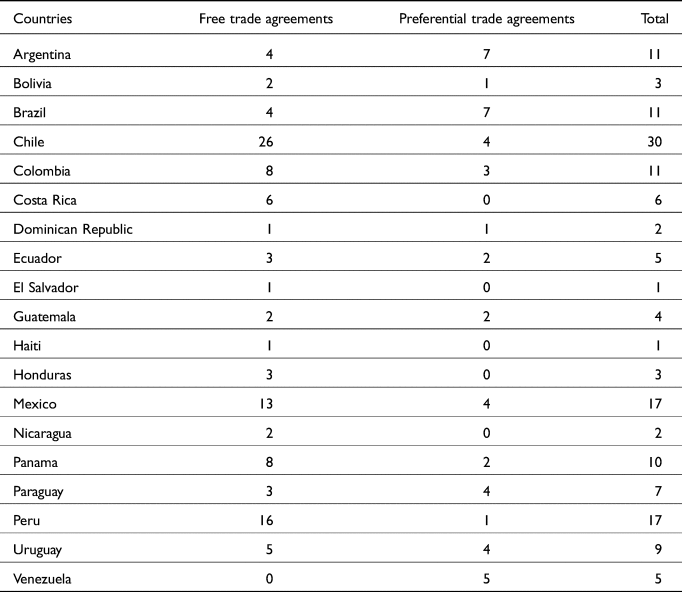
Since the creation of the WTO, the number of RTAs has increased from almost 50 to the 360 currently in force.Footnote 2 Although regional agreements predominate, the new agreements incorporate an increasing number of developed and developing countries of different geographical regions (Behar and Cirera-i-Crivillé, Reference Behar and Cirera-i-Crivillé2013). As a result, intra-regionalism is now becoming “trans-continentalism” (Tussie, Reference Tussie2011), making it difficult to draw lines around trading blocks. Limits are “fuzzy” (Baldwin, Reference Baldwin2006) and are constantly being re-shaped. Thus, a kind of “spaghetti bowl” has arisen in the region due to the intersection of a multitude of trade agreements and the diversity of regulations and institutional arrangements. According to the Foreign Trade Information System of the Organization of American States (OAS),Footnote 3 in Latin America there are 85 free trade agreements, 4 customs unions, 2 framework agreements and 25 preferential trade agreements in force (Table 8).
Trade agreements signed by Latin American countries

Source: Foreign Trade Information System, Organization of American States (OAS) in November 2022.
Since the early 1990s, and more intensely in recent years, Latin American and Caribbean countries have engaged in bi-regional trade negotiations. Led by Chile, Mexico and Peru, these countries have secured agreements with other Latin American and Caribbean countries, the United States, the European Union and with several Asian countries. This trend reflects a strategic emphasis on free trade agreements with the North and large Asian economies, driven by the large market of these economies, low expectations for multilateral negotiations post-Uruguay Round (1994), and the perceived poor performance of sub-regional agreements (Valdés and Foster, Reference Valdés and Foster2006). Many of these agreements go beyond the lowering of tariffs and address other trading issues, including some referring to agriculture trade, such as sanitary and phytosanitary measures (Chaherli and Nash, Reference Chaherli and Nash2013).
However, the results obtained by Latin American countries are somewhat disappointing, even more so if we compare them with other developing regions, such as south-east Asia. Dingemans and Ross (Reference Dingemans and Ross2012) concluded that the impact of RTAs in Latin America has not been fully satisfactory in terms of the diversification of exports, the productive structure of the export sector and the expansion to new markets. Despite this, a significant portion of Latin American trade has been conducted through RTAs.
3. Empirical model and data
The goal of this section is to explain the empirical model and the data we have used to analyse the determinants of the evolution of agri-food exports of Latin America for the period 1994–2019.
We have used gravity models to explain the annual bilateral export flows from 19 Latin America countries to all countries worldwide, focusing exclusively on available data.Footnote 4 The data are organised according to the Standard International Trade Classification (SITC) Revision 3 at the four-digit level. The estimates of the trade flows are aggregated according to the exporter, importer, type of trade flow and year.Footnote 5
We first estimate the gravity equation for the total agri-food exports. Secondly, we group the agri-food exports according to the aforementioned Rauch's classification (homogeneous products, reference priced products and differentiated products).Footnote 6 This classification enables us to take into account differences arising from trade according to the type of product, such as communication and information costs. The estimation by product groups also enables us to assess whether there are any significant differences in the exports' determinants.
The theoretical foundation of gravity models rests on the analogy to Newtonian physics, positing that bilateral trade flows are directly proportional to a country's market size, often proxied by its GDP, and inversely proportional to the geographical distance between trading partners, a common measure of international transport costs.
Given the problems associated with the log-linear specification of the simple gravity model, primarily stemming from the exclusion of zero trading flows and relevant variables, the augmented gravity model is specified to explain agri-food exports from a Latin America country i to any other country j used in this study is as follows:
 $$ \eqalignt{& X_{ij, t} \cr & \! \! \! \! = \exp \left[{\matrix{ {\alpha + \beta_1\ln ( {Y_{i, t}} ) + \beta_2\ln ( {Y_{\,j, t}} ) + \beta_3\ln ( {{\rm Dis}{\rm t}_{ij}} ) + \beta_4\ln ( {{\rm Excvo}{\rm l}_{ij, t}} ) + \beta_5\ln ( {{\rm AbsGDPpcDif}{\rm f}_{ij, t}} ) } \cr { + \beta_6{\rm ComLan}{\rm g}_{ij} + \beta_7{\rm RT}{\rm A}_{ij, t} + \beta_8{\rm WT}{\rm O}_{ij, t} + \theta_i + {\rm \Omega }_j + \mu_t} \cr } } \right] \cr & \qquad \qquad \qquad \qquad \qquad \qquad \qquad \qquad \qquad\qquad + \varepsilon _{ij, t}$$
Although equation [1] represents our principal specification, we also estimate a series of alternative regressions.
We denote “i” as the Latin American exporting country (i = 1, 2, …19), “j” as the importing country (j = 1, 2, …186) and “t” (t = 1994, …, 2019) as the time period analysed. Furthermore, ln denotes the natural logarithm of the variables. The dependent variable is represented by X ij,t, which is the agri-food exports of country i to country j in year t in 2019 US dollars, taken from UN-COMTRADE (2021). Y i,t and Y j,t measure the real GDP, in 2019 US dollars, of the exporting country and the importing country, respectively. They indicate the size of the markets and capture the effect of potential production of the exporter i (country of origin) and the purchasing capacity of the importer j (country of destination), respectively (Jacobo, Reference Jacobo2005) (Centre d’Études Prospectives et d'Informations Internationales (CEPII) and World Development Indicators (WDI) database). The relationship between exports and GDP is expected to be positive, as a country with a higher market size will have a greater supply capacity if it is an exporter and a higher demand potential if it is an importer.
Given that the GDP of the exporting country is a highly imperfect measure of its capacity to supply agri-food products, we replace this variable in the model with the gross agricultural production, GAP i,t (sourced from the Food and Agriculture Organization Statistics (FAOSTAT) database). In so doing, we adapt the gravity equation to the specific case of agri-food trade and measure the effect on exports of the changes in potential agricultural production. As in the case of GDP, the expected sign of this coefficient is also positive.
Dist ij is the geographical distance in kilometres between the capitals of the countries of origin and destination (CEPII database). Geographical distance is used as an estimate of trade costs; a longer distance is expected to have a negative effect on exports. In addition to distance and in order to take into account other frictions and obstacles to trade, we also consider a series of variables. Following Cho et al. (Reference Cho, Sheldon and Mccorriston2002) and Rose (Reference Rose2000), we include the volatility of the bilateral exchange rate.
Excvol ij,t is an indicator of the volatility of the bilateral nominal exchange rate (between i and j) in year t, measured as the standard deviation of the first difference in the annual natural logarithm of the bilateral nominal exchange rate for each pair of countries, in the 10 years preceding t, drawing the exchange rate data from the World Bank. We include this variable to examine the impact of exchange rate uncertainty on trade flows. We expect a coefficient with a negative sign, showing an inverse relationship between exchange rate instability and trade flows.
AbsGDPpcDiff ij,t measures the effect of the relative factor endowments between country i and j. Specifically, this variable refers to the absolute difference between the GDP per capita of the exporting and importing countries (expressed in 2019 US dollars and collected from CEPII database). A coefficient with a positive sign indicates that the trade of agri-food products from Latin America can be explained by the Heckscher–Ohlin trade theory; if differences in factor endowments of the two countries increase, the trade between them will also increase. On the other hand, if the estimated coefficient is negative and statistically significant, it supports the Linder hypothesis (Reference Linder1961); countries with similar per capita incomes have similar preferences and tastes, and, therefore, should trade more with one another. As a result, the inclusion of this variable enables us to test both hypotheses through the sign shown by the coefficient $\widehat{{\beta _5}}$ . ComLang ij is a dummy variable that takes the value of 1 if the two countries share the same official language (CEPII database) and seeks to capture historical factors, common backgrounds or culture. In this sense, the coefficient is expected to have a positive sign.
In the institutional context, similar to many studies, we have included dummy variables to analyse the impact of regional liberalisation resulting in the proliferation of regional trade agreements (RTA ij,t) on the one hand, and the effects of the multilateral liberalisation processes (WTO ij,t) on the other (both collected from the CEPII database). In the case of RTAs, a positive sign is expected whenever the effect of the trade creation between the members is greater than the trade diversion towards the rest of the world. Following Rose (Reference Rose2004), we have included several dummy variables to explore the effects of belonging to free trade associations and to capture the effects of Latin American integration.Footnote 7 This enables us to examine and differentiate the effects of participating in free trade agreements in the Latin American economies analysed based on the year of adhesion to the Central American Common Market (CACMij,t), the Andean Community Agreement (CANij,t), the Southern Cone Common Market (MERCOSURij,t), the North American Free-Trade Agreement (NAFTAij,t), the Group of three (G-3ij,t), the Asia-Pacific Economic Cooperation (APECij,t), the Latin American Integration Association (ALADIij,t), the Pacific Alliance (APij,t), the Trans-Pacific Strategic Economic Partnership Agreement (P4ij,t) and the Trans-Pacific Partnership Agreement (TPPij,t). A significant positive value for each variable would indicate that membership in the corresponding agreement promoted trade, while a negative value would suggest a negative impact on exports. The coefficients of these variables are expected to be positive, mostly because these agreements are expected to have positively influenced the agri-food trade.
Finally, following the influential work of Anderson and van Wincoop (Reference Anderson and Van Wincoop2003), the equation includes multilateral trade resistance terms (MTRs), using fixed effects of the exporting country (θ i), importing country (Ω j), and year (μ t). Thus, we avoid biased estimates of the parameters of the model, due to the omission of variables that contemplate unobservable characteristics of both exporting and importing countries, as well as the time period, which may affect trade and are not accounted for by the remaining variables. The error term ($\varepsilon _{ij, t}$ ) captures all the variables that influence trade and are not explicitly specified.
The theoretical framework for the gravity equation provides a method to verify the home market effect (Feenstra et al., Reference Feenstra, Markusen and Rose1998, Reference Feenstra, Markusen and Rose2001). According to these authors, in the case of differentiated products and in the presence of increasing returns to scale, exports are more sensitive to changes in the market size of the exporting country than that of the importing country. This is called the home market effect. On the contrary, trade of homogeneous goods is more sensitive to the market size of the importing country and displays a reverse home market effect.
The entire set of agri-food exports data spans from 1994 to 2019, with 19 Latin America countries considered as exporters and 186 countries as potential trading partners (including the rest of Latin America). Although the Latin American agricultural products were exported to more countries during this period, this study focuses on a sample of 186 importing countries due to the availability of data. Therefore, there are 91,884 potential trade observations (19 exporters * 186 importers * 26 years). As there are many missing observations for some of the regressors for certain countries and/or years, the sample size used is smaller. Even so, the representativeness of our sample is very high and accounts for up to 95.36 per cent of total agri-food exports (95.32 per cent for the homogeneous products, 96.19 per cent for the differentiated products and 95.12 per cent for the referenced-priced products). The principal statistics of the variables used in the gravity equation are shown in Table A7 in the Supplementary Material.
The gravity equations have been estimated using the Poisson pseudo-maximum likelihood (PPML) equation proposed by Silva and Tenreyro (Reference Silva and Tenreyro2006). We have clustered the standard errors at the country-pair level. Although ongoing debate persists in the literature regarding the choice of estimator with the best properties for the gravity equation, there is a growing consensus that this method is generally considered the most suitable (Kareem and Kareem, Reference Kareem and Kareem2014; Piermartini and Yotov, Reference Piermartini and Yotov2016; Ayuda et al., Reference Ayuda, Belloc and Pinilla2022).
The PPML estimator allows us to take into account the presence of zero trade values in the dependent variable, as it specifies the dependent variable in levels and estimates the gravity equation in its multiplicative form. In this respect, this non-linear estimation method overcomes the “zero problem” faced by the linear methods and provides a natural way to deal with zero trade flows. Moreover, the Poisson estimator is consistent and unbiased in the presence of heteroscedasticity, a highly frequent problem in trade models due to the non-homogeneous behaviour of countries with respect to their trade intensity.
4. Results
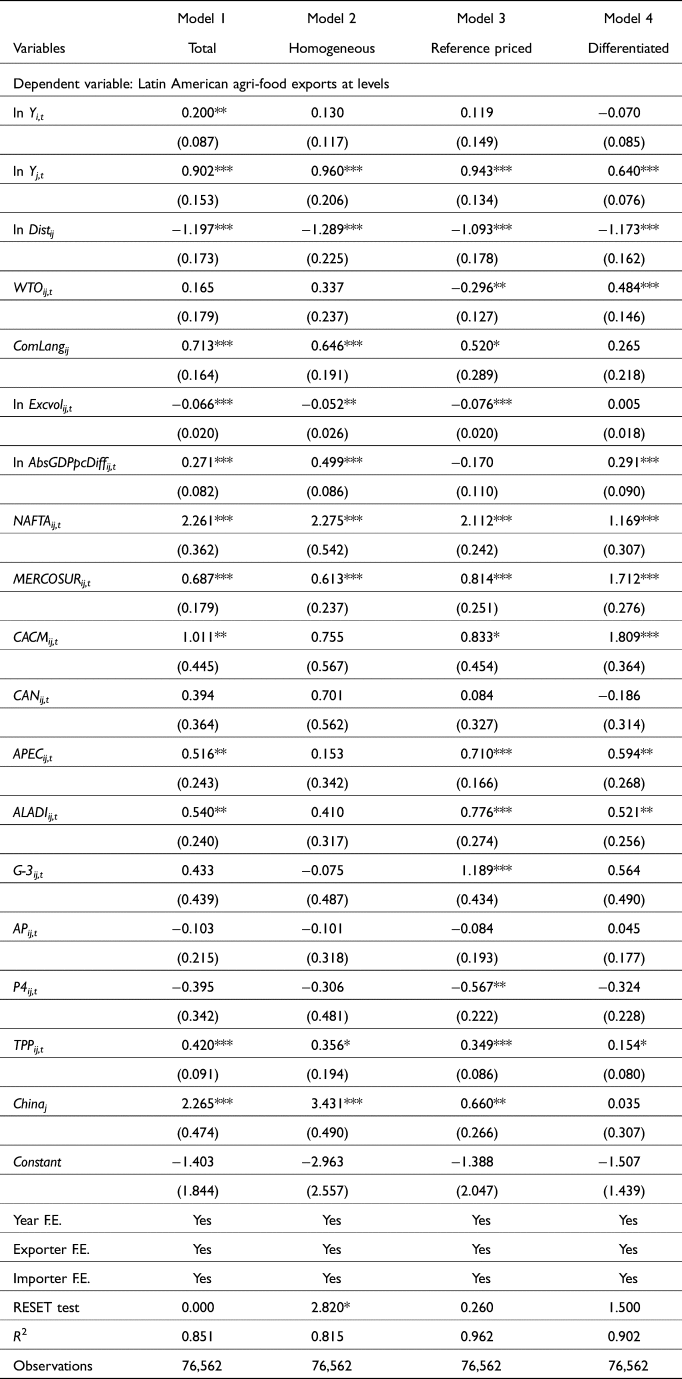
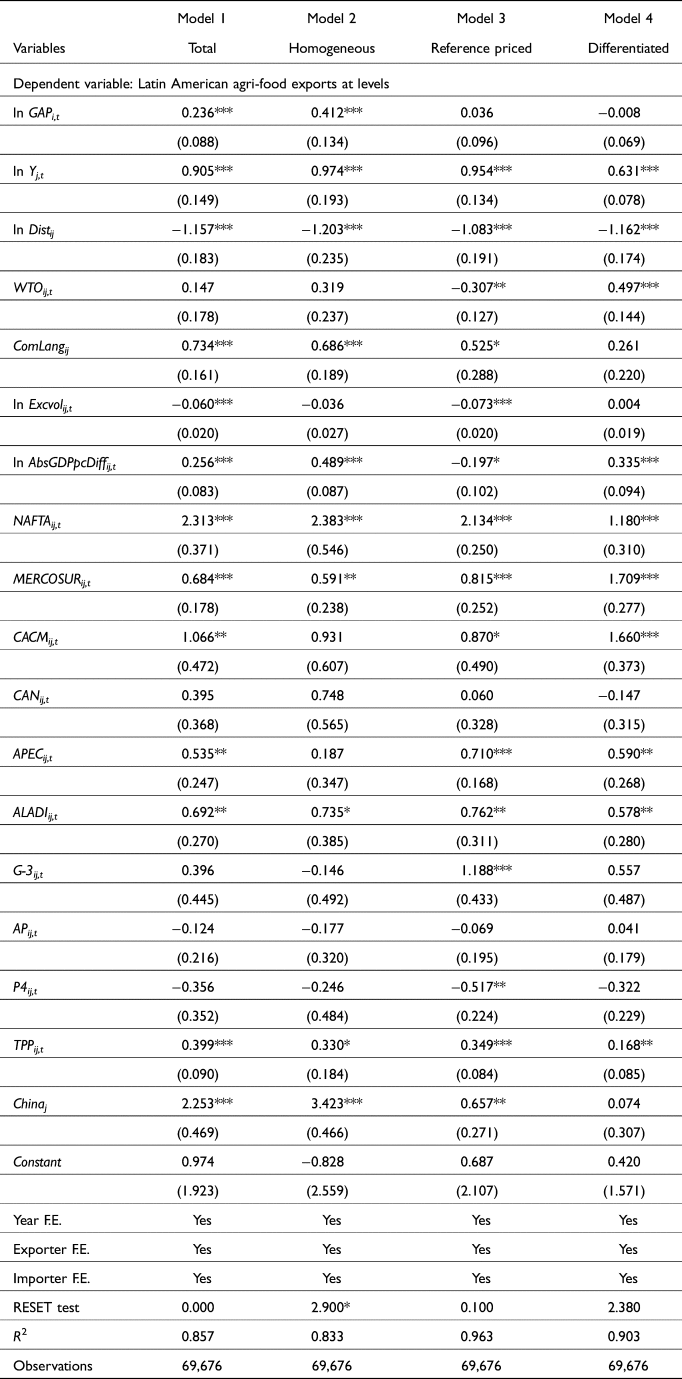
Tables 9 and 10 present the gravity models estimated for agri-food exports.Footnote 8 The two tables differ in that in Table 9 we use the GDP of the exporting country while in Table 10 we use gross agricultural production as a proxy for the supply capacity of Latin American countries. In the lower part of the tables the Ramsey (Reference Ramsey1969) RESET test statistic is shown. This statistic tests the null hypothesis of correct model specification. Based on the results, we can sustain that the null hypothesis of correct specification cannot be rejected for any of the models at the 5 per cent level of significance.
Results of the estimated gravity models

Notes: Poisson pseudo-maximum likelihood (PPML) estimations. Exporter–importer clustered robust standard errors in parentheses. ***, ** and * indicate that coefficients are significant at 1%, 5% and 10% levels, respectively. All variables are in logarithms, except dummy variables and agri-food exports.
Results of the gravity models estimated

Notes: Poisson pseudo-maximum likelihood (PPML) estimations. Exporter–importer clustered robust standard errors in parentheses. ***, ** and * indicate that coefficients are significant at the 1%, 5% and 10% levels, respectively. All variables are in logarithms, except dummy variables and agri-food exports.
Although the dependent variable is expressed in levels, the estimates of the coefficients of the continuous variables—all of them expressed in logarithmic terms—are interpreted as elasticities, whereas the coefficients of the dummy variables are interpreted as semi-elasticities.
Overall, most of the coefficients have the expected sign and are statistically significant. These estimates show that agri-export growth in the Latin American region was mainly driven by the increase in demand, measured through the GDP of the importing country, which has a statistically significant positive relationship with agricultural exports. It is particularly the exports of homogeneous and reference-priced products that were most driven by the growth in demand. In this respect, the differentiated products accounted for a low share in exports to China (around 2.0–5.3 per cent during the period analysed), whereas Chinese demand has concentrated in homogeneous products (around 59.6–87.23 per cent of the total agri-food exports to China).
Supply, measured both through GDP (Table 9) and through the agricultural production of the exporting country (Table 10), had a positive effect for all the products together. Furthermore, the agricultural production of the exporting country had a positive effect for the homogeneous products, whereas the coefficient of the GDP is not significant, reinforcing the use of agricultural production as a proxy for supply. Nevertheless, both GDP and agricultural production had no effects on the other two product groups. Because these are mainly processed products, this result is not surprising, as both the GDP and agricultural production would not be adequately measuring the expansion of supply.
In any event, in all types of products and for the total, the coefficient estimated for the elasticity of GDP and for the agricultural production of the exporting country is lower than that corresponding to the elasticity of GDP of the importing country, which leads us to conclude that the decisive factor in this agri-export boom was demand and that there was a reverse home market effect (Feenstra et al., Reference Feenstra, Markusen and Rose2001). This raises many doubts about the degree of real differentiation of the products included in the differentiated group. To be sure, while these products are included in this group in the Rauch classification, they do not provide the expected result; the existence of a home market effect, as shown by other studies on global agri-food trade (Serrano and Pinilla, Reference Serrano and Pinilla2014b).
As expected, distance negatively affects the agri-food exports of all types of products, although its impact was slightly greater in homogeneous products, for which the transport cost represents a higher percentage of the final price.Footnote 9
Having a common culture shows a statistically significant positive relationship in the overall model and that of homogeneous products. This result contradicts previous studies, such as Rauch (Reference Rauch1999), who found that for homogeneous goods, information barriers were less relevant since these products are traded in organised markets. In contrast, differentiated products particularly benefited from cultural links, such as a shared language, because their complexity requires a higher level of communication for their exchange.
The coefficient estimated for the volatility of the exchange rate (Excvol) shows a statistically significant negative sign. This means that a lower exchange rate volatility stimulated the exchange of these products, particularly in the homogeneous and reference-priced products. However, as also found by Cho et al. (Reference Cho, Sheldon and Mccorriston2002), its relative importance is low.
The absolute difference in per capita income AbsGDPpcDiff shows statistically significant positive coefficients in total exports and homogeneous and differentiated products. This suggests that their exchange aligns better with the Heckscher–Ohlin model, which posits that countries with different factor endowments trade more intensively.
Finally, the RTA variable has a statistically significant positive effect on agricultural exports (Tables A9a and A9b in the Supplementary Material). Specifically, regional trade agreements have led to an increase in agricultural trade ranging from 68.9 per cent (homogeneous products) to 107.3 per cent (total agricultural products) between member countries, compared to those not part of such agreements. RTAs have encouraged the increase in exports in the region due to the reduction in tariffs and the elimination of sanitary, phytosanitary and technical barriers. Their effect has been particularly relevant in reference-priced products. In contrast, integration into the WTO only resulted in trade creation effects in the differentiated products, whereas the estimates suggest a negative relationship with the trade of reference- priced products. Therefore, trade liberalisation following the Uruguay Round (1986–1994) boosted the exports of at least some products, particularly those with a certain level of industrial processing.
The estimates of the models presented in Tables 9 and 10 underscore the importance of separately estimating the coefficients for different regional trade agreements. This discourages the use of a single dummy variable to estimate their overall impact. We can observe that they not all have a statistically significant impact on the agri-food trade of the region. In this respect, we argue that NAFTA, CACM, MERCOSUR, ALADI, APEC and TPP have had a statistically significant effect, unlike other agreements such as CAN, G-3, AP and P4. Furthermore, their impact has been different depending on the type of product.
If we consider the impact of trade agreements involving only one Latin American country, such as NAFTA with Mexico and P4 with Chile, we observe that NAFTA has significantly stimulated exports of homogeneous and reference-priced products to its northern neighbours. In contrast, P4 has decreased trade in reference-priced products by approximately −40.37.
The most significant agreements among Latin American countries, such as MERCOSUR or CACM, have played a crucial role in boosting the trade of differentiated products, whereas ALADI and G-3 have promoted trade in reference-priced products. Comparing agreements involving the same Latin American countries, MERCOSUR has had a greater impact than ALADI in Argentina–Brazil–Paraguay–Uruguay–Venezuela, except for homogeneous products. In Venezuela–Colombia and Colombia–Mexico, ALADI has had a greater effect than G-3 across most products, except for reference-priced products. Finally, in Ecuador–Peru and Chile–Mexico–Peru, ALADI has shown a greater impact across all products.
As noted in section 3, in all gravity models we include importer dummy variables to control for multilateral resistance terms, along with exporter and year dummy variables. Given China's significant role in our analysis of the agri-food exporting boom, we also present the estimates of the constant associated with this country's fixed effect. The estimates underscore China's importance in this agri-food exporting surge, as they are positive and statistically significant for both total exports and homogeneous and reference-priced exports. Moreover, the estimates indicate that the “China effect” has been particularly pronounced in homogeneous products.
All in all, our gravity estimates suggest that the main determinants behind the agri-food exporting boom experienced during 1994–2019 are external demand and the relative success of the economic integration. This claim is valid for both total exports and commodity groups. Nevertheless, we also find some commodity-specific determinants that do not apply universally total agri-food exports. For example, agricultural production positively impacts only the exports of homogeneous products, while exchange rate volatility reduces trade in both homogeneous and reference-priced products. Among regional trade agreements, NAFTA, CACM, ALADI and MERCOSUR stand out as the most influential, each with specific effects on different commodities. NAFTA primarily promotes exports of homogeneous and reference-priced products, ALADI favours reference-priced exports, and both CACM and MERCOSUR boost exports of differentiated products. The WTO also encourages exports of differentiated products but reduces trade in reference-priced products during the analysed period. Importantly, imports from China have been predominantly concentrated in homogeneous goods.
5. Conclusions: a reassessment of the export boom from a historical perspective
The objective of this study was to explain the principal changes in Latin America's agri-food trade since the mid-1990s, against the backdrop of structural reforms aimed at overcoming the macroeconomic challenges of the “lost decade” of the 1980s. These reforms marked a departure from previous decades characterised by inward-looking development and policies that penalised the region's traditional exports of agricultural and food products.
During the period analysed, Latin America's agri-food exports grew at a faster pace than those of most world regions, akin to the Belle Époque period between 1870 and 1914.
However, the export era of recent decades differs significantly from the period between 1870 and the troubled inter-war years. A key distinction lies in the type of trade prevalent in each period: inter-industry trade during the first wave of globalisation vs. intra-industry trade in the current era. It is crucial to note that while natural resource-intensive products have been vital in recent export booms, manufactured goods are even more significant, contrasting with the earlier era. This phenomenon could be seen as a re-primarisation, considering that many Latin American countries had already achieved substantial industrialisation in the latter half of the twentieth century.
A crucial factor in the significant increase in Latin America's exports has been the growing importance of the Asian continent as a destination for the region's agri-food exports, driven particularly by China's rising demand. China has become Latin America's second-largest trading partner, only behind the United States. Historically, it can be observed that the most dynamic countries in each period have tended to promote the region's exports: Great Britain during the first wave of globalisation, the United States throughout much of the twentieth century, and China since the early twenty-first century.
The primary exporting countries of agri-food products in Latin America are Brazil, Argentina and Mexico, with Brazil notably increasing its share the most. A significant historical shift lies in Brazil's leadership in this regard. While Argentina and Uruguay primarily led the export expansion of certain tropical products like coffee during the first wave of globalisation, Brazil has emerged as the predominant leader in recent years. Brazil experienced the highest growth in agricultural production and productivity in Latin America during the latter half of the twentieth century, which has been pivotal in establishing its leadership in exporting agri-food products (Mueller and Mueller, Reference Mueller, Mueller, Pinilla and Willebald2018; Klein and Vidal Luna, Reference Klein and Vidal Luna2019; Martín-Retortillo et al., Reference Martín-Retortillo, Pinilla, Velazco and Willebald2019, Reference Martín-Retortillo, Pinilla, Velazco and Willebald2022).
The principal agri-food products exported in recent years include fruits and vegetables, particularly bananas, avocados and pineapples, as well as oil seeds, oleaginous fruits and meat (poultry and pork). Among these, exports of meat and oil seeds have shown the most significant growth during the period studied. Conversely, coffee, tea and cocoa have experienced the greatest decline in market share, largely due to competition from Asian and African countries.
While the shift towards non-traditional agri-food exports over the last three decades has been crucial for regional dynamism, there remains a notable continuity in Latin America's export profile that tempers optimism. The region continues to heavily concentrate on commodities and unprocessed products, unlike the trend in European countries, for example. This concentration limits the ability to foster linkages with other sectors, which are essential for promoting structural diversification and economic growth.
The greater increase in exports coincided with an increase in real prices of agri-food exports from Latin America. This is not surprising. The most dynamic cycles of expansion in the region's agri-food exports have been linked to improvements in its terms of trade, as was the case during the first wave of globalisation. Similarly, periods of low growth in agri-food exports, such as the inter-war period or much of the second half of the twentieth century, coincided with sharp deteriorations in their terms of trade (Ocampo and Parra-Lancourt, Reference Ocampo and Parra-Lancourt2010; Serrano and Pinilla, Reference Serrano and Pinilla2011a).
Export growth is also positively related to the growing relevance of regional trade agreements. Here we observe a clear departure from the post-Second World War period. The sluggish growth of Latin America's agri-food exports after 1950 is widely attributed to the region's unsuccessful regional integration efforts, unlike Europe's experience. The rapid expansion of intra-European agri-food trade cannot be fully understood without considering the speed and depth of its internal market integration, which removed many existing barriers (Serrano and Pinilla, Reference Serrano and Pinilla2011b). In contrast, while structuralists advocated regional integration as a necessary complement to inward-looking development policies, the achievements were modest (Bulmer-Thomas, Reference Bulmer-Thomas1994). However, since the early 1990s, significant strides have been made, such as the establishment of MERCOSUR and NAFTA, which were pivotal in facilitating export expansion.
To identify the primary determinants of re-primarisation, we have estimated various augmented gravity models for different groups of agri-food products based on their degree of differentiation, following Rauch's classification. The estimates from these gravity models confirm the significance of demand and market growth in driving exports across the three product categories examined, with a pronounced impact on homogeneous products, which are particularly favoured by Chinese demand. Across all product types, we observe evidence of a reverse home market effect, where the elasticity of the importing country's GDP surpasses that of the exporting country or gross agricultural production. These findings demonstrate clear continuity with patterns observed in the latter half of the twentieth century, where demand growth similarly played a central role in driving export growth.
Also notable is the intraregional effort undertaken during the twenty-first century through the signing of regional trade agreements, which have formed the foundation of Latin America's international economic integration strategies. This shift followed a period of scepticism regarding the benefits of free trade in previous decades, during which the region pursued ISI policies that particularly harmed its agro-exporting sector. The limited success of these Regional Trade Agreements (RTAs), both within the region and with other countries, underscores their importance in fostering agri-food trade growth in previous decades.
However, this article demonstrates that RTAs have uneven effects across different product types, particularly benefiting reference-priced products. By individually incorporating these RTAs into our models, we have observed their distinct effects on total agricultural exports and specific product groups. For instance, NAFTA significantly boosted Mexican agri-food exports, especially in homogeneous products, consistent with prior studies like Ayuda et al. (Reference Ayuda, Belloc and Pinilla2022) and in contrast with unexpected results from Balogh and Aguiar (Reference Balogh and Aguiar2022). MERCOSUR and CACM have also significantly boosted trade in differentiated products, while G-3 and ALADI have been instrumental for reference-priced products. These agreements have played pivotal roles in promoting agri-food trade within Latin America.
Furthermore, using gravity models to analyse exports, we find that WTO's multilateral market liberalisation has primarily stimulated trade in differentiated products, benefiting from tariff reductions under its multilateral agreements, while it has restrained trade in reference-priced products. Thus, a key finding of this study is the differential impact of determinants on exports of various agricultural product types.
Several lines of research emerge from this work. Firstly, despite the potential significance of prices in the re-primarisation phenomenon, the gravity equations have only addressed them through fixed effects. However, this approach does not enable us to pinpoint the specific effects of terms of trade on the exchange of agricultural and food products in Latin America. We propose this as a future line of research.
It is also crucial to broaden the research to examine the social implications of the export boom. This includes investigating whether large firms or small farmers have been the primary beneficiaries of export growth, and assessing its impact on poverty and rural inequality. Additionally, exploring the environmental impacts of this recent export surge in the region is a promising extension of this study, given the various ways in which international trade and trade policies can adversely affect the environment, particularly in developing countries.
Lastly, an analysis of trade margins, both intensive and extensive, would help decompose this export growth and determine which margin contributes most to the increase in agri-food exports from Latin America. To our knowledge, this issue has not yet been thoroughly explored. Effective policies would likely show a significant role for the extensive margin.
We believe this paper introduces novel elements that could inform one of the major economic debates in Latin America in the coming years: the impacts of re-primarisation on economic development. Lessons learned from the export-led development model during the Belle Époque should guide this debate. The twenty-first century shares important parallels with the first wave of globalisation, though changes in the international context and Latin American economies are also noteworthy.
Supplementary material
The supplementary material for this article can be found at https://doi.org/10.1017/S021261092400020X.
Acknowledgements
We thank the editors and the anonymous referees for their valuable comments and suggestions. The corresponding author expresses his gratitude for the financial support received from the Collaboration Grant in University Departments of the Spanish Ministry of Education and Vocational Training. This study has received financial support from the Ministry of Science and Innovation of Spain (projects PGC2018-095529-B-I00 and PID2019-106822RB-I00) and from the Department of Science, Innovation and Universities of the Government of Aragon (Consolidated Groups S40_20R and S55_20R). The authors wish to thank participants at the VII Latin American Economic History Conference (Lima, 2022) and at the “Política y Economía en la Historia de la Política Comercial” seminar (Zaragoza, 2022), for their comments on an earlier version of this paper. The usual disclaimer applies.


 Open access

