




1. Introduction
We work over the field of complex numbers $\mathbb C$
.
$\mathbb C$
.
The goal of this paper is to prove the existence of the minimal model program (MMP) for log canonical (lc) algebraically integrable foliations on varieties with mild singularities. One of our main theorems is the following.
Theorem 1.1. Let X be a smooth projective variety and $\mathcal{F}$
an algebraically integrable foliation with at worst lc singularities on X. Then we may run a
$\mathcal{F}$
an algebraically integrable foliation with at worst lc singularities on X. Then we may run a $K_{\mathcal{F}}$
-MMP.
$K_{\mathcal{F}}$
-MMP.
1.1 History on MMP for foliations
The MMP for foliations has been studied extensively in the past several years not only due to its importance on the characterization of the ambient variety and its tangent bundle, but also due to its close connection with the major conjectures of the classical MMP. For example, foliations play a crucial role in the proof of several key cases of the abundance conjecture for threefolds (cf. [Reference MiyaokaMiy87]).
To prove the existence of the MMP, we need at least three ingredients: the cone theorem, the contraction theorem, and the existence of flips. We can only run MMP when all of them are known. For foliations in low dimensions, these three ingredients have been established for surfaces [Reference McQuillanMcQ08, Reference BrunellaBru15] and threefolds [Reference Cascini and SpicerCS20, Reference SpicerSpi20, Reference Cascini and SpicerCS21, Reference Spicer and SvaldiSS22]. Although it is difficult to achieve any of these results in dimension $\geq 4$
, there are some developments on the MMP for foliations induced by dominant rational maps recently, i.e. algebraically integrable foliations. For example, for algebraically integrable foliations, [Reference Ambro, Cascini, Shokurov and SpicerACSS21] proved the cone theorem in full generality, and [Reference Chen, Han, Liu and XieCHLX23] proved the contraction theorem and the existence of flips when the foliations have at worst
$\geq 4$
, there are some developments on the MMP for foliations induced by dominant rational maps recently, i.e. algebraically integrable foliations. For example, for algebraically integrable foliations, [Reference Ambro, Cascini, Shokurov and SpicerACSS21] proved the cone theorem in full generality, and [Reference Chen, Han, Liu and XieCHLX23] proved the contraction theorem and the existence of flips when the foliations have at worst $\mathbb{Q}$
-factorial foliated divisorial log terminal (dlt) singularities. These two results together imply the existence of the MMP for algebraically integrable foliations with at worst
$\mathbb{Q}$
-factorial foliated divisorial log terminal (dlt) singularities. These two results together imply the existence of the MMP for algebraically integrable foliations with at worst $\mathbb{Q}$
-factorial foliated dlt singularities.
$\mathbb{Q}$
-factorial foliated dlt singularities.
1.2 MMP for lc foliations on Kawamata log terminal varieties
It is known that we can run MMP for algebraically integrable foliations with at worst $\mathbb{Q}$
-factorial foliated dlt singularities. The
$\mathbb{Q}$
-factorial foliated dlt singularities. The $\mathbb{Q}$
-factorial foliated dlt singularities are usually considered as a foliated version of
$\mathbb{Q}$
-factorial foliated dlt singularities are usually considered as a foliated version of $\mathbb{Q}$
-factorial dlt singularities for usual pairs [Reference Cascini and SpicerCS21, Reference Chen, Han, Liu and XieCHLX23], and foliated log smooth singularities are always
$\mathbb{Q}$
-factorial dlt singularities for usual pairs [Reference Cascini and SpicerCS21, Reference Chen, Han, Liu and XieCHLX23], and foliated log smooth singularities are always $\mathbb{Q}$
-factorial foliated dlt.
$\mathbb{Q}$
-factorial foliated dlt.
However, Cascini and Spicer [Reference Cascini and SpicerCS25a] pointed out that it is necessary to consider the MMP for foliations with singularities which are worse than $\mathbb{Q}$
-factorial foliated dlt. One major motivation is that Fano foliations (i.e. foliations with ample anti-canonical divisor
$\mathbb{Q}$
-factorial foliated dlt. One major motivation is that Fano foliations (i.e. foliations with ample anti-canonical divisor $-K_{\mathcal{F}}$
) are never foliated dlt (cf. [Reference Araujo and DruelAD13, Theorem 5.1]), and they form an important topic in the theory of foliations. This makes [Reference Chen, Han, Liu and XieCHLX23] not applicable to Fano foliations.
$-K_{\mathcal{F}}$
) are never foliated dlt (cf. [Reference Araujo and DruelAD13, Theorem 5.1]), and they form an important topic in the theory of foliations. This makes [Reference Chen, Han, Liu and XieCHLX23] not applicable to Fano foliations.
To resolve this issue, we should consider the MMP for algebraically integrable foliations with at worst lc singularities on Kawamata log terminal (klt) varieties, which is natural and necessary. In this paper, we prove the existence of the MMP under this setting.
Theorem 1.2 Let $(X,\mathcal{F},B)/U$
be an lc algebraically integrable foliated triple such that
$(X,\mathcal{F},B)/U$
be an lc algebraically integrable foliated triple such that $(X,\Delta)$
is klt for some
$(X,\Delta)$
is klt for some $B\geq\Delta\geq 0$
. Let R be a
$B\geq\Delta\geq 0$
. Let R be a $(K_{\mathcal{F}}+B)$
-negative extremal ray
$(K_{\mathcal{F}}+B)$
-negative extremal ray $/U$
. Then:
$/U$
. Then:
-
(1) (contraction theorem) there exists a contraction $/U$
$\operatorname{cont}_R: X\rightarrow T$
of R;
$/U$
$\operatorname{cont}_R: X\rightarrow T$
of R; -
(2) (existence of flips) if
$\operatorname{cont}_R$
is a flipping contraction, then the flip
$/U$
$X^+\rightarrow T$
associated to R exists.




Theorem 1.2 is known by [Reference Cascini and SpicerCS25a, Theorem 3.2] under the following additional assumptions:
-
– the termination of
$\mathbb{Q}$
-factorial klt flips in dimension
$r=\operatorname{rank}\mathcal{F}$
; -
–
$B=\Delta$
with rational coefficients; -
– X is projective, and
$\mathbb{Q}$
-factorial for statement (2).


Theorem 1.2 implies that we can run MMP for algebraically integrable foliations with at worst lc singularities on klt varieties. In fact, under the assumptions of Theorem 1.2, we can show that $(X,\Delta)$
remains klt after each step of the MMP. Therefore, with the help of the (relative) cone theorem [Reference Ambro, Cascini, Shokurov and SpicerACSS21, Reference Chen, Han, Liu and XieCHLX23], we prove the following result on the existence of MMP.
$(X,\Delta)$
remains klt after each step of the MMP. Therefore, with the help of the (relative) cone theorem [Reference Ambro, Cascini, Shokurov and SpicerACSS21, Reference Chen, Han, Liu and XieCHLX23], we prove the following result on the existence of MMP.
Theorem 1.3 (Existence of MMP). Let $(X,\mathcal{F},B)/U$
be an lc algebraically integrable foliated triple such that
$(X,\mathcal{F},B)/U$
be an lc algebraically integrable foliated triple such that $(X,\Delta)$
is klt for some
$(X,\Delta)$
is klt for some $B\geq\Delta\geq 0$
. Then we may run a
$B\geq\Delta\geq 0$
. Then we may run a $(K_{\mathcal{F}}+B)$
-MMP
$(K_{\mathcal{F}}+B)$
-MMP $/U$
. Moreover, for any birational map
$/U$
. Moreover, for any birational map $\phi: X\dashrightarrow X^+$
that is a sequence of steps of a
$\phi: X\dashrightarrow X^+$
that is a sequence of steps of a $(K_{\mathcal{F}}+B)$
-MMP
$(K_{\mathcal{F}}+B)$
-MMP $/U$
,
$/U$
, $(X^+,\Delta^+:=\phi_*\Delta)$
is klt.
$(X^+,\Delta^+:=\phi_*\Delta)$
is klt.
We remark that when X is $\mathbb{Q}$
-factorial, which is the most natural setting when we run MMP, the condition that
$\mathbb{Q}$
-factorial, which is the most natural setting when we run MMP, the condition that $(X,\Delta)$
is klt for some
$(X,\Delta)$
is klt for some $B\geq\Delta\geq 0$
is equivalent to the condition that X is klt. In particular, Theorem 1.1 is a direct consequence of Theorems 1.2 and 1.3.
$B\geq\Delta\geq 0$
is equivalent to the condition that X is klt. In particular, Theorem 1.1 is a direct consequence of Theorems 1.2 and 1.3.
We also remark that Theorem 1.3 is known when $(X,\mathcal{F},B)/U$
is
$(X,\mathcal{F},B)/U$
is $\mathbb{Q}$
-factorial foliated dlt by [Reference Chen, Han, Liu and XieCHLX23, Theorem 2.1.1]. Although [Reference Chen, Han, Liu and XieCHLX23, Theorem 2.1.1] does not require X to be klt, X is automatically klt by [Reference Chen, Han, Liu and XieCHLX23, Theorem 2.1.9]. Therefore, [Reference Chen, Han, Liu and XieCHLX23, Theorem 2.1.1] can be viewed as a special case of Theorem 1.3.
$\mathbb{Q}$
-factorial foliated dlt by [Reference Chen, Han, Liu and XieCHLX23, Theorem 2.1.1]. Although [Reference Chen, Han, Liu and XieCHLX23, Theorem 2.1.1] does not require X to be klt, X is automatically klt by [Reference Chen, Han, Liu and XieCHLX23, Theorem 2.1.9]. Therefore, [Reference Chen, Han, Liu and XieCHLX23, Theorem 2.1.1] can be viewed as a special case of Theorem 1.3.
1.3 Base-point-freeness theorem, good minimal models, and Mori fiber spaces
After the establishment of the cone theorem, the contraction theorem, and the existence of flips, our next goal is to show the existence of good minimal models or Mori fiber spaces. First, we prove the existence of Mori fiber spaces for lc algebraically integrable foliations on klt varieties.
Theorem 1.4
(Existence of Mori fiber spaces). Let $(X,\mathcal{F},B)/U$
be an lc algebraically integrable foliated triple such that
$(X,\mathcal{F},B)/U$
be an lc algebraically integrable foliated triple such that $(X,\Delta)$
is klt for some
$(X,\Delta)$
is klt for some $B\geq\Delta\geq 0$
. Assume that
$B\geq\Delta\geq 0$
. Assume that $K_{\mathcal{F}}+B$
is not pseudo-effective
$K_{\mathcal{F}}+B$
is not pseudo-effective $/U$
.
$/U$
.
Then we may run a $(K_{\mathcal{F}}+B)$
-MMP
$(K_{\mathcal{F}}+B)$
-MMP $/U$
with scaling of an ample
$/U$
with scaling of an ample $/U$
$/U$ $\mathbb{R}$
-divisor and any such MMP terminates with a Mori fiber space of
$\mathbb{R}$
-divisor and any such MMP terminates with a Mori fiber space of $(X,\mathcal{F},B)/U$
.
$(X,\mathcal{F},B)/U$
.
Next, we deal with the existence of good minimal models. Unfortunately, since we do not know the existence of minimal models for smooth projective varieties in dimension $\geq 5$
, we cannot prove the existence of minimal models for lc algebraically integrable foliations on klt varieties unconditionally. Nevertheless, we can prove the existence of good minimal models when the boundary divisor contains an ample
$\geq 5$
, we cannot prove the existence of minimal models for lc algebraically integrable foliations on klt varieties unconditionally. Nevertheless, we can prove the existence of good minimal models when the boundary divisor contains an ample $\mathbb{R}$
-divisor, or when the numerical dimension is 0.
$\mathbb{R}$
-divisor, or when the numerical dimension is 0.
Theorem 1.5
(Existence of good minimal models with polarizations). Let $(X,\mathcal{F},B)/U$
be an lc algebraically integrable foliated triple such that
$(X,\mathcal{F},B)/U$
be an lc algebraically integrable foliated triple such that $(X,\Delta)$
is klt for some
$(X,\Delta)$
is klt for some $B\geq\Delta\geq 0$
. Let A be an ample
$B\geq\Delta\geq 0$
. Let A be an ample $/U$
$/U$ $\mathbb{R}$
-divisor on X such that
$\mathbb{R}$
-divisor on X such that $K_{\mathcal{F}}+B+A$
is pseudo-effective
$K_{\mathcal{F}}+B+A$
is pseudo-effective $/U$
. Then:
$/U$
. Then:
-
(1) we may run a
$(K_{\mathcal{F}}+B+A)$
-MMP
$/U$
with scaling of an ample
$/U$
$\mathbb{R}$
-divisor and any such MMP terminates with a minimal model of
$(X,\mathcal{F},B+A)/U$
; -
(2) the minimal model in statement (1) is a good minimal model.




We remark that similar statements for threefold foliations in [Reference Cascini and SpicerCS20, Reference Cascini and SpicerCS21, Reference Spicer and SvaldiSS22] usually require that $(X,\mathcal{F},B+A)$
is lc as Bertini-type theorems generally fail. In comparison, we do not need
$(X,\mathcal{F},B+A)$
is lc as Bertini-type theorems generally fail. In comparison, we do not need $(X,\mathcal{F},B+A)$
to be lc in Theorem 1.5.
$(X,\mathcal{F},B+A)$
to be lc in Theorem 1.5.
An interesting fact is that we use Theorem 1.5(1) to prove the following base-point-freeness theorem, which in return gives us Theorem 1.5(2).
Theorem 1.6
(Base-point-freeness theorem). Let $(X,\mathcal{F},B)/U$
be an lc algebraically integrable foliated triple such that
$(X,\mathcal{F},B)/U$
be an lc algebraically integrable foliated triple such that $(X,\Delta)$
is klt for some
$(X,\Delta)$
is klt for some $B\geq\Delta\geq 0$
. Let A be an ample
$B\geq\Delta\geq 0$
. Let A be an ample $/U$
$/U$ $\mathbb{R}$
-divisor on X such that
$\mathbb{R}$
-divisor on X such that $K_{\mathcal{F}}+B+A$
is nef
$K_{\mathcal{F}}+B+A$
is nef $/U$
. Then:
$/U$
. Then:
-
(1)
$K_{\mathcal{F}}+B+A$
is semi-ample
$/U$
; -
(2) if
$K_{\mathcal{F}}+B+A$
is Cartier, then
$\mathcal{O}_X(n(K_{\mathcal{F}}+B+A))$
is globally generated
$/U$
for any integer
$n\gg 0$
.





In particular, Theorem 1.6 solves [Reference Cascini and SpicerCS25a, Conjecture 4.1] which further assumes that $B=\Delta$
and
$B=\Delta$
and $(X,\mathcal{F},B)$
is foliated dlt. We remark that [Reference Chen, Han, Liu and XieCHLX23, Theorem A] proved [Reference Cascini and SpicerCS25a, Conjecture 4.1] when
$(X,\mathcal{F},B)$
is foliated dlt. We remark that [Reference Chen, Han, Liu and XieCHLX23, Theorem A] proved [Reference Cascini and SpicerCS25a, Conjecture 4.1] when $(X,\mathcal{F},B)$
is
$(X,\mathcal{F},B)$
is $\mathbb{Q}$
-factorial foliated dlt but the non-
$\mathbb{Q}$
-factorial foliated dlt but the non- $\mathbb{Q}$
-factorial case is much more difficult to prove.
$\mathbb{Q}$
-factorial case is much more difficult to prove.
An immediate consequence of Theorems 1.5 and 1.6 is the finite generation of the lc ring for lc polarized algebraically integrable foliations on klt varieties.
Theorem 1.7
(Finite generation of the lc rings with polarizations). Let $(X,\mathcal{F},B)/U$
be an lc algebraically integrable foliated triple such that
$(X,\mathcal{F},B)/U$
be an lc algebraically integrable foliated triple such that $(X,\Delta)$
is klt for some
$(X,\Delta)$
is klt for some $B\geq\Delta\geq 0$
. Let A be an ample
$B\geq\Delta\geq 0$
. Let A be an ample $/U$
$/U$ $\mathbb{R}$
-divisor on X such that
$\mathbb{R}$
-divisor on X such that $B+A$
is a
$B+A$
is a $\mathbb{Q}$
-divisor. Then the lc ring
$\mathbb{Q}$
-divisor. Then the lc ring
 $$R(X,K_{\mathcal{F}}+B+A):=\bigoplus_{m=0}^{+\infty}\pi_*\mathcal{O}_X(\lfloor m(K_{\mathcal{F}}+B+A)\rfloor)$$
is a finitely generated $\mathcal{O}_U$
-algebra.
$\mathcal{O}_U$
-algebra.
Another case when we have the existence of good minimal models is when X is projective and the numerical dimension of the foliated triple is 0.
Theorem 1.8 Let $(X,\mathcal{F},B)$
be a projective lc algebraically integrable foliated triple such that
$(X,\mathcal{F},B)$
be a projective lc algebraically integrable foliated triple such that $(X,\Delta)$
is klt for some
$(X,\Delta)$
is klt for some $B\geq\Delta\geq 0$
. Assume that
$B\geq\Delta\geq 0$
. Assume that $\kappa_{\sigma}(K_{\mathcal{F}}+B)=0$
.
$\kappa_{\sigma}(K_{\mathcal{F}}+B)=0$
.
Then we may run a $(K_{\mathcal{F}}+B)$
-MMP with scaling of an ample
$(K_{\mathcal{F}}+B)$
-MMP with scaling of an ample $\mathbb{R}$
-divisor and any such MMP terminates with a minimal model
$\mathbb{R}$
-divisor and any such MMP terminates with a minimal model $(X_{\rm min},\mathcal{F}_{\rm min},B_{\rm min})$
of
$(X_{\rm min},\mathcal{F}_{\rm min},B_{\rm min})$
of $(X,\mathcal{F},B)$
such that
$(X,\mathcal{F},B)$
such that $K_{\mathcal{F}_{\rm min}}+B_{\rm min}\sim_{\mathbb R}0$
.
$K_{\mathcal{F}_{\rm min}}+B_{\rm min}\sim_{\mathbb R}0$
.
1.4 Fano foliations and Mori dream spaces
As a consequence of Theorems 1.4 and 1.5, we show that we can run MMP for any $\mathbb{R}$
-Cartier
$\mathbb{R}$
-Cartier $\mathbb{R}$
-divisor on any klt projective variety with an lc algebraically integrable Fano foliation structure, and any such MMP terminates with either a good minimal model or a Mori fiber space. It implies that the ambient variety of an lc algebraically integrable Fano foliation is a Mori dream space if the ambient variety is
$\mathbb{R}$
-divisor on any klt projective variety with an lc algebraically integrable Fano foliation structure, and any such MMP terminates with either a good minimal model or a Mori fiber space. It implies that the ambient variety of an lc algebraically integrable Fano foliation is a Mori dream space if the ambient variety is $\mathbb{Q}$
-factorial klt.
$\mathbb{Q}$
-factorial klt.
Theorem 1.9. Let $\mathcal{F}$
be an lc algebraically integrable Fano foliation on a klt projective variety X. Let D be an
$\mathcal{F}$
be an lc algebraically integrable Fano foliation on a klt projective variety X. Let D be an $\mathbb{R}$
-Cartier
$\mathbb{R}$
-Cartier $\mathbb{R}$
-divisor on X. Then:
$\mathbb{R}$
-divisor on X. Then:
-
(1) we may run a D-MMP which terminates with either a good minimal model of D or a Mori fiber space of D;
-
(2) X is a Mori dream space if it is
$\mathbb{Q}$
-factorial.

In particular, D is semi-ample if it is nef, and the section ring R(X,D) is a finitely generated $\mathbb{C}$
-algebra if D is a
$\mathbb{C}$
-algebra if D is a $\mathbb{Q}$
-divisor.
$\mathbb{Q}$
-divisor.
Theorem 1.9 also holds in the relative setting and for the foliated Fano-type case. We refer the reader to Theorem A.11 for the most general version of Theorem 1.9.
1.5 Minimal models in the sense of Birkar and Shokurov
We have studied the MMP for lc algebraically integrable foliations on klt varieties in details in Theorems 1.2, 1.3, 1.4 and 1.5. However, it is also interesting and important to consider the MMP for lc algebraically integrable foliations when ambient varieties are not necessarily klt. They appear in birational geometry naturally. For example, for a locally stable family $f: X\rightarrow Z$
, the foliation induced by f is lc, but X may not be klt or even lc (the singularities of X can actually be very bad). Recently, MMP for locally stable families has been established in [Reference Meng and ZhuangMZ23] when they study the wall crossing for moduli of stable pairs.
$f: X\rightarrow Z$
, the foliation induced by f is lc, but X may not be klt or even lc (the singularities of X can actually be very bad). Recently, MMP for locally stable families has been established in [Reference Meng and ZhuangMZ23] when they study the wall crossing for moduli of stable pairs.
Unfortunately, we are unable to prove the contraction theorem or the existence of flips without any assumption on the ambient variety. Therefore, it can be difficult to talk about minimal models or Mori fiber spaces in this setting. One way to resolve this issue is to study minimal models or Mori fiber spaces in the sense of Birkar and Shokurov, i.e. minimal models or Mori fiber spaces which allow extraction of lc places (cf. [Reference ShokurovSho96, Reference BirkarBir12]). We refer the readers to Definition 4.3 for details.
In this paper, we prove the following two results. First, an lc foliated triple polarized by an ample divisor always has a minimal model or a Mori fiber space in the sense of Birkar and Shokurov.
Theorem 1.10. Let $(X,\mathcal{F},B)/U$
be an lc algebraically integrable foliated triple and
$(X,\mathcal{F},B)/U$
be an lc algebraically integrable foliated triple and $A\geq 0$
an ample
$A\geq 0$
an ample $/U$
$/U$ $\mathbb{R}$
-divisor on X. Then
$\mathbb{R}$
-divisor on X. Then $(X,\mathcal{F},B+A)/U$
has either a minimal model or a Mori fiber space in the sense of Birkar and Shokurov.
$(X,\mathcal{F},B+A)/U$
has either a minimal model or a Mori fiber space in the sense of Birkar and Shokurov.
Second, when the ambient variety is klt, we show that the existence of a minimal model or a Mori fiber space in the sense of Birkar and Shokurov is equivalent to the termination of MMP with scaling of ample divisors. While the latter obviously implies the former, to prove the reverse is highly non-trivial, even for usual pairs (cf. [Reference BirkarBir12, Theorem 1.9(3)]).
Theorem 1.11. Let $(X,\mathcal{F},B)/U$
be an lc algebraically integrable foliated triple. Assume that
$(X,\mathcal{F},B)/U$
be an lc algebraically integrable foliated triple. Assume that $(X,\mathcal{F},B)/U$
has a minimal model or a Mori fiber space in the sense of Birkar and Shokurov, and X is potentially klt. Let A be an ample
$(X,\mathcal{F},B)/U$
has a minimal model or a Mori fiber space in the sense of Birkar and Shokurov, and X is potentially klt. Let A be an ample $/U$
$/U$ $\mathbb{R}$
-divisor on X. Then:
$\mathbb{R}$
-divisor on X. Then:
-
(1) any
$(K_{\mathcal{F}}+B)$
-MMP
$/U$
with scaling of A terminates provided that the
$(K_{\mathcal{F}}+B)$
-MMP
$/U$
with scaling of A exists; -
(2) if there exists a klt pair
$(X,\Delta)$
such that
$B\geq\Delta\geq 0$
, then
$(X,\mathcal{F},B)/U$
has a minimal model or a Mori fiber space.


1.6 A Shokurov-type polytope
Finally, as an important ingredient in the proof of our main theorems, we prove the existence of a Shokurov-type polytope (cf. [Reference Birkar, Cascini, Hacon and McKernanBCHM10, Corollary 1.1.5]) for algebraically integrable foliations.
Theorem 1.12. Let $(X,\mathcal{F},B:=\sum_{i=1}^mv^0_iB_i)/Z$
be an lc algebraically integrable foliated triple such that
$(X,\mathcal{F},B:=\sum_{i=1}^mv^0_iB_i)/Z$
be an lc algebraically integrable foliated triple such that $K_{\mathcal{F}}+B$
is nef
$K_{\mathcal{F}}+B$
is nef $/Z$
. Let
$/Z$
. Let $\boldsymbol{v}_0:=(v^0_1,\dots,v^0_m)$
. Then there exists an open subset U of the rational envelope of
$\boldsymbol{v}_0:=(v^0_1,\dots,v^0_m)$
. Then there exists an open subset U of the rational envelope of $\boldsymbol{v}_0$
in
$\boldsymbol{v}_0$
in $\mathbb R^m$
such that
$\mathbb R^m$
such that $(X,\mathcal{F},\sum_{i=1}^mv_iB_i)$
is lc and
$(X,\mathcal{F},\sum_{i=1}^mv_iB_i)$
is lc and $K_{\mathcal{F}}+\sum_{i=1}^mv_iB_i$
is nef
$K_{\mathcal{F}}+\sum_{i=1}^mv_iB_i$
is nef $/Z$
for any
$/Z$
for any $(v_1,\dots,v_m)\in U$
.
$(v_1,\dots,v_m)\in U$
.
1.7 Generalized foliated quadruples
Generalized foliated quadruples play an important role in the proofs of the main theorems in many recent works (cf. [Reference Liu, Luo and MengLLM23, Reference Liu, Meng and XieLMX24, Reference Chen, Han, Liu and XieCHLX23]). In this paper, generalized foliated quadruples are also crucially used due to the failure of Bertini-type theorems for foliations. The generalized foliated quadruple version of all our main theorems holds, although some of them require the nef part of the generalized foliated quadruple to be a nef $\mathbb{Q}$
-Cartier combination (NQC). We refer the reader to Appendix A for details.
$\mathbb{Q}$
-Cartier combination (NQC). We refer the reader to Appendix A for details.
For the convenience of the reader, we avoid using generalized foliated quadruples in the statements and proofs of most of our results. We only essentially use this structure in Theorem 7.2 and its proof, and make remarks on why we need this structure in footnotes therein.
1.8 Main difficulties in the proof of the main theorems
Roughly speaking, [Reference Chen, Han, Liu and XieCHLX23, Theorem A] established the MMP for algebraically integrable foliations that are $\mathbb{Q}$
-factorial foliated dlt (which implies that the ambient variety is klt). However,
$\mathbb{Q}$
-factorial foliated dlt (which implies that the ambient variety is klt). However, $\mathbb{Q}$
-factorial foliated dlt singularities might be too good to hope for in practice. Actually, [Reference Chen, Han, Liu and XieCHLX23] showed that (as conjectured in [Reference Ambro, Cascini, Shokurov and SpicerACSS21]) such a foliation is induced by an equidimensional morphism
$\mathbb{Q}$
-factorial foliated dlt singularities might be too good to hope for in practice. Actually, [Reference Chen, Han, Liu and XieCHLX23] showed that (as conjectured in [Reference Ambro, Cascini, Shokurov and SpicerACSS21]) such a foliation is induced by an equidimensional morphism $f\colon X\to Z$
(not just a rational map). Moreover, (even though highly non-trivial) there exists an lc pair (X,G) such that
$f\colon X\to Z$
(not just a rational map). Moreover, (even though highly non-trivial) there exists an lc pair (X,G) such that $K_\mathcal{F}\sim_{f} K_X+G$
. Thanks to the cone theorem, the global
$K_\mathcal{F}\sim_{f} K_X+G$
. Thanks to the cone theorem, the global $K_\mathcal{F}$
-MMP turns out to be over Z, hence is equivalent to a
$K_\mathcal{F}$
-MMP turns out to be over Z, hence is equivalent to a $(K_X+G)$
-MMP
$(K_X+G)$
-MMP $/Z$
whose theory is well-established. Thus the authors of [Reference Chen, Han, Liu and XieCHLX23] were able to deduce many corresponding results.
$/Z$
whose theory is well-established. Thus the authors of [Reference Chen, Han, Liu and XieCHLX23] were able to deduce many corresponding results.
In general, things become much more complicated if the foliation is only induced by a rational map, in which case we do not have an associated auxiliary pair to work with. One natural idea is to consider the ‘dlt’ modification (whose existence is proved in [Reference Ambro, Cascini, Shokurov and SpicerACSS21, Reference Chen, Han, Liu and XieCHLX23]) $g:X'\to X$
such that
$g:X'\to X$
such that $g^{-1}\mathcal{F}$
is induced by a fibration
$g^{-1}\mathcal{F}$
is induced by a fibration $f':X'\to Z'$
with some desired properties. As we have explained, it is very promising that corresponding MMP on X’ can be run. The key point is how to descend them back to X. This process is subtle because the modification g is not easy to control. For example, if we want to show the semi-ampleness of
$f':X'\to Z'$
with some desired properties. As we have explained, it is very promising that corresponding MMP on X’ can be run. The key point is how to descend them back to X. This process is subtle because the modification g is not easy to control. For example, if we want to show the semi-ampleness of $K_\mathcal{F}+A$
with ample A, the ampleness of A will not be preserved under the modification since perturbation is not allowed due to the failure of Bertini-type theorems. The best we could hope for is that the pullback of A under g stays ample on the leaves of
$K_\mathcal{F}+A$
with ample A, the ampleness of A will not be preserved under the modification since perturbation is not allowed due to the failure of Bertini-type theorems. The best we could hope for is that the pullback of A under g stays ample on the leaves of $g^{-1}\mathcal{F}$
which are exactly (the reduction of) the fibers of
$g^{-1}\mathcal{F}$
which are exactly (the reduction of) the fibers of $f':X'\to Z'$
. In this case, the restrictions of g on the leaves are finite morphisms, but to descend semi-ampleness under finite morphisms is quite subtle when the schemes (leaves of
$f':X'\to Z'$
. In this case, the restrictions of g on the leaves are finite morphisms, but to descend semi-ampleness under finite morphisms is quite subtle when the schemes (leaves of $g^{-1}\mathcal{F}$
and
$g^{-1}\mathcal{F}$
and $\mathcal{F}$
) are not normal (actually the properties of our leaves are even worse). Instead, it turns out that we need to apply deep and complicated MMP techniques (on X’) to prove the desired semi-ampleness results (e.g. base-point-free theorem) on X.
$\mathcal{F}$
) are not normal (actually the properties of our leaves are even worse). Instead, it turns out that we need to apply deep and complicated MMP techniques (on X’) to prove the desired semi-ampleness results (e.g. base-point-free theorem) on X.
It is also important to notice that Fano foliations are never foliated dlt, and do not even satisfy Property $(*)$
. Actually if
$(*)$
. Actually if $(X,\mathcal{F},B)$
is a projective lc foliated triple such that
$(X,\mathcal{F},B)$
is a projective lc foliated triple such that $-(K_{\mathcal{F}}+B)$
is ample, then
$-(K_{\mathcal{F}}+B)$
is ample, then $\mathcal{F}$
is not induced by a contraction (cf. [Reference Araujo and DruelAD13, Theorem 5.1]). Moreover, many Fano foliations are lc, and a lot of work contributed to the classification of lc Fano foliations on smooth projective varieties (cf. [Reference Araujo and DruelAD13, Reference Araujo, Druel, Cascini, McKernan and PereiraAD16]). Therefore, it is natural to consider the MMP for lc algebraically integrable Fano foliations on smooth projective varieties (e.g. Theorem 1.9).
$\mathcal{F}$
is not induced by a contraction (cf. [Reference Araujo and DruelAD13, Theorem 5.1]). Moreover, many Fano foliations are lc, and a lot of work contributed to the classification of lc Fano foliations on smooth projective varieties (cf. [Reference Araujo and DruelAD13, Reference Araujo, Druel, Cascini, McKernan and PereiraAD16]). Therefore, it is natural to consider the MMP for lc algebraically integrable Fano foliations on smooth projective varieties (e.g. Theorem 1.9).
1.9 Idea of the proof
The key idea of the proof is the following observation. Given two contractions $h: X'\rightarrow X$
and
$h: X'\rightarrow X$
and $f: X'\rightarrow Z$
between normal quasi-projective varieties, there exists a unique normal quasi-projective variety
$f: X'\rightarrow Z$
between normal quasi-projective varieties, there exists a unique normal quasi-projective variety $\bar X$
satisfying the following:
$\bar X$
satisfying the following:
-
(1) h and f factor through
$\bar X$
; -
(2)
$\bar X$
is ‘minimal’ among all varieties satisfying statement (1); In other words, if there exists a variety X” such that h and f factor through X”, then the induced contractions
$X''\rightarrow X$
and
$X''\rightarrow Z$
factor through
$\bar X$
.


We call $\bar X$
the core model of (h,f). It is natural and not difficult to observe the existence of such a
$\bar X$
the core model of (h,f). It is natural and not difficult to observe the existence of such a $\bar X$
. For example, given two contractions
$\bar X$
. For example, given two contractions $X\rightarrow Z_0$
and
$X\rightarrow Z_0$
and $Z\rightarrow Z_0$
, then the normalization of the main component of
$Z\rightarrow Z_0$
, then the normalization of the main component of $X\times_{Z_0}Z$
,
$X\times_{Z_0}Z$
, $\bar X$
, is automatically the core model of
$\bar X$
, is automatically the core model of $(\bar X\rightarrow X,\bar X\rightarrow Z)$
. In many scenarios,
$(\bar X\rightarrow X,\bar X\rightarrow Z)$
. In many scenarios, $\bar X\rightarrow Z$
is viewed as a ‘base change’ of
$\bar X\rightarrow Z$
is viewed as a ‘base change’ of $X\rightarrow Z_0$
. For general contractions h and f, the core model of (h,f) can be viewed as an analogue of such a base change but without a base.
$X\rightarrow Z_0$
. For general contractions h and f, the core model of (h,f) can be viewed as an analogue of such a base change but without a base.
Pairs of contractions $h: X'\rightarrow X$
and
$h: X'\rightarrow X$
and $f: X'\rightarrow Z$
are very common in the study of algebraically integrable foliations. Given an algebraically integrable foliation
$f: X'\rightarrow Z$
are very common in the study of algebraically integrable foliations. Given an algebraically integrable foliation $\mathcal{F}$
on X, there are many cases when h is a
$\mathcal{F}$
on X, there are many cases when h is a $\mathbb{Q}$
-factorial Ambro–Cascini–Shokurov–Spicer (ACSS) modification of
$\mathbb{Q}$
-factorial Ambro–Cascini–Shokurov–Spicer (ACSS) modification of $\mathcal{F}$
(or a
$\mathcal{F}$
(or a $(*)$
-modification of
$(*)$
-modification of $\mathcal{F}$
) and f is a contraction which induces
$\mathcal{F}$
) and f is a contraction which induces $\mathcal{F}':=h^{-1}\mathcal{F}$
. It is usually easier to study
$\mathcal{F}':=h^{-1}\mathcal{F}$
. It is usually easier to study $\mathcal{F}'$
due to its connection with an lc pair structure
$\mathcal{F}'$
due to its connection with an lc pair structure $(X',B'+G)$
(cf. [Reference Ambro, Cascini, Shokurov and SpicerACSS21, Proposition 3.6]). We will use
$(X',B'+G)$
(cf. [Reference Ambro, Cascini, Shokurov and SpicerACSS21, Proposition 3.6]). We will use $\mathcal{F}'$
to study
$\mathcal{F}'$
to study $\mathcal{F}$
.
$\mathcal{F}$
.
The problem is that, when we study the MMP for $\mathcal{F}$
(e.g. contraction theorem and existence of flips), we usually need to consider
$\mathcal{F}$
(e.g. contraction theorem and existence of flips), we usually need to consider $\mathcal{F}$
together with a polarization by an ample divisor A on X. However,
$\mathcal{F}$
together with a polarization by an ample divisor A on X. However, $A':=h^*A$
is only big and nef and not ample. Moreover,
$A':=h^*A$
is only big and nef and not ample. Moreover, $(X',B'+G+A')$
is only an lc pair polarized by a big and nef divisor, and we do not know the existence of good minimal models for such pairs yet. It causes troubles for us to use the MMP for
$(X',B'+G+A')$
is only an lc pair polarized by a big and nef divisor, and we do not know the existence of good minimal models for such pairs yet. It causes troubles for us to use the MMP for $(X',B'+G+A')$
to study the MMP for
$(X',B'+G+A')$
to study the MMP for $K_{\mathcal{F}}+A$
.
$K_{\mathcal{F}}+A$
.
Nevertheless, by using the core models we have introduced, we can resolve this problem. Let $\bar X$
be the core model of (h,f) with
$\bar X$
be the core model of (h,f) with $\bar h: \bar X\rightarrow X$
,
$\bar h: \bar X\rightarrow X$
, $\bar f: \bar X\rightarrow Z$
, and
$\bar f: \bar X\rightarrow Z$
, and $g: X'\rightarrow\bar X$
. Then:
$g: X'\rightarrow\bar X$
. Then:
-
– although
$\bar A:=\bar h^*A$
is no longer ample, it is ample
$/Z$
; -
– let
$\bar B:=g_*B'$
and
$\bar G:=g_*G$
; since g is a contraction over Z,
$(\bar X,\bar B+\bar G)$
is crepant to
$(X',B'+G)$
by the negativity lemma and thus it is lc.


In particular, $\bar X$
not only has an lc pair structure associated to the foliation
$\bar X$
not only has an lc pair structure associated to the foliation $\bar{\mathcal{F}}:=\bar{h}^{-1}\mathcal{F}$
(while X does not necessarily have this structure) but also preserves some information of X via the divisor
$\bar{\mathcal{F}}:=\bar{h}^{-1}\mathcal{F}$
(while X does not necessarily have this structure) but also preserves some information of X via the divisor $\bar A$
, at least over Z. The core model
$\bar A$
, at least over Z. The core model $\bar X$
, instead of X’, seems to be a more natural object for us to study due to its uniqueness with respect to the base. Moreover, it preserves more core information of X comparing with an arbitrary model X’. This is why we call it as a ‘core model’. This is also inspired by [Reference Meng and ZhuangMZ23, Proof of Theorem 1.5]. We study the basic properties of core models and its relationship with foliations in § 3.
$\bar X$
, instead of X’, seems to be a more natural object for us to study due to its uniqueness with respect to the base. Moreover, it preserves more core information of X comparing with an arbitrary model X’. This is why we call it as a ‘core model’. This is also inspired by [Reference Meng and ZhuangMZ23, Proof of Theorem 1.5]. We study the basic properties of core models and its relationship with foliations in § 3.
In our case, the MMP $/Z$
for
$/Z$
for $(\bar X,\bar B+\bar G+\bar A)$
with scaling of ample divisors behaves nicely. Moreover, by our construction,
$(\bar X,\bar B+\bar G+\bar A)$
with scaling of ample divisors behaves nicely. Moreover, by our construction, $(\bar X,\bar B+\bar G)$
has a close connection with the induced foliation
$(\bar X,\bar B+\bar G)$
has a close connection with the induced foliation $\bar{\mathcal{F}}$
on
$\bar{\mathcal{F}}$
on $\bar X$
, and we can show that the MMP
$\bar X$
, and we can show that the MMP $/Z$
for
$/Z$
for $K_{\bar{\mathcal{F}}}+\bar B+\bar A$
with scaling of ample divisors behaves nicely. By the cone theorem for algebraically integrable foliations [Reference Ambro, Cascini, Shokurov and SpicerACSS21, Theorem 3.9], any
$K_{\bar{\mathcal{F}}}+\bar B+\bar A$
with scaling of ample divisors behaves nicely. By the cone theorem for algebraically integrable foliations [Reference Ambro, Cascini, Shokurov and SpicerACSS21, Theorem 3.9], any $(K_{\bar{\mathcal{F}}}+\bar B+\bar A)$
-MMP is a
$(K_{\bar{\mathcal{F}}}+\bar B+\bar A)$
-MMP is a $(K_{\bar{\mathcal{F}}}+\bar B+\bar A)$
-MMP
$(K_{\bar{\mathcal{F}}}+\bar B+\bar A)$
-MMP $/Z$
. Thus, any
$/Z$
. Thus, any $(K_{\bar{\mathcal{F}}}+\bar B+\bar A)$
-MMP with scaling of ample divisors behaves nicely. Then we can use this fact to study the MMP for
$(K_{\bar{\mathcal{F}}}+\bar B+\bar A)$
-MMP with scaling of ample divisors behaves nicely. Then we can use this fact to study the MMP for $K_{\mathcal{F}}+A$
with scaling of ample divisors, and hence for
$K_{\mathcal{F}}+A$
with scaling of ample divisors, and hence for $K_{\mathcal{F}}$
by adopting the some ideas from [Reference Cascini and SpicerCS25a, Reference Chen, Han, Liu and XieCHLX23].
$K_{\mathcal{F}}$
by adopting the some ideas from [Reference Cascini and SpicerCS25a, Reference Chen, Han, Liu and XieCHLX23].
More precisely, the key idea of [Reference Cascini and SpicerCS25a, Proof of Theorem 3.2] is as follows.
-
– We take a
$(*)$
-modelFootnote
1
of
$(X,\mathcal{F},B)$
which satisfies good properties. Achieving this requires us to run the ‘first MMP’ for a foliated log smooth model. -
– We run the ‘second MMP’ which contracts the strict transforms of the
$(K_{\mathcal{F}}+B)$
-negative extremal rays. Termination of flips is needed here. -
– We run the ‘third MMP’ which contracts the strict transform of the exceptional divisor of the
$(*)$
-modification. Termination of flips is again needed here.


We follow the same idea to prove Theorems 1.2 and 1.3, but many arguments are different. We do not need to run the ‘first MMP’ and we shall directly use our core model $\bar X$
. We use properties of the core model
$\bar X$
. We use properties of the core model $\bar X$
to show that the ‘second MMP’ could terminate. Finally, we can use the termination of MMP with scaling for klt generalized pairs of log general type to get the termination of the ‘third MMP’.
$\bar X$
to show that the ‘second MMP’ could terminate. Finally, we can use the termination of MMP with scaling for klt generalized pairs of log general type to get the termination of the ‘third MMP’.
There are several additional things to remark for our proof of Theorems 1.2 and 1.3.
-
(1) We need the MMP for generalized foliated quadruples because Bertini-type theorems generally fail for algebraically integrable foliations. We need the concept of generalized foliated quadruples to consider MMP with scaling of ample divisors in more details. We need results on the MMP for generalized foliated quadruples in [Reference Chen, Han, Liu and XieCHLX23].
-
(2) When the boundary B has irrational coefficients, we need to establish the existence of a Shokurov-type polytope (Theorem 1.12) for algebraically integrable foliations in order to show that the ‘third MMP’ terminates. This is done in § 6. Moreover, if we consider the contraction theorem and the existence of flips for (non-NQC) generalized foliated quadruples instead of foliated triples, the Shokurov-type polytope does not exist. We need to resolve this issue by introducing and studying a special class of nef
$\mathbb{R}$
-divisors, namely ‘
$\epsilon$
-nef
$\mathbb{R}$
-divisors’. See Appendix B for details. -
(3) When X is not
$\mathbb{Q}$
-factorial, it can be tricky to run MMP on
$\bar X$
since
$\bar X$
may not be
$\mathbb{Q}$
-factorial either. In this case, we need to prove some results on the MMP on X’. Nevertheless, we can still use
$\bar X$
as an auxiliary variety to help us establish the MMP on X’, hence the ‘second MMP’ on X’. See § 5 for details. In addition, when X is not
$\mathbb{Q}$
-factorial, the arguments in [Reference Cascini and SpicerCS25a] no longer work for the existence of flips, and we need an alternative argument. Our choice is to consider the ample model of a special
$\mathbb{R}$
-divisor over the base of the contraction. In this case, some basic properties on different types of models of foliations need to be proved. See § 4 for details.


Finally, we say a few more words about the proof of other main theorems. First, by using core models, we establish an MMP on $\bar X$
with scaling of the pullback of an ample divisor on X in § 5, and show that such a MMP terminates in some cases (Theorem 5.6). Theorem 1.10 follows from the establishment of such a MMP. Theorem 1.8 follows from the establishment of such a MMP, the fact that movable divisors with zero numerical Iitaka dimension are numerically trivial, and the abundance for numerically trivial algebraically integrable foliations.
$\bar X$
with scaling of the pullback of an ample divisor on X in § 5, and show that such a MMP terminates in some cases (Theorem 5.6). Theorem 1.10 follows from the establishment of such a MMP. Theorem 1.8 follows from the establishment of such a MMP, the fact that movable divisors with zero numerical Iitaka dimension are numerically trivial, and the abundance for numerically trivial algebraically integrable foliations.
To prove Theorems 1.4 and 1.5, we need to lift MMP to $\mathbb{Q}$
-factorial ACSS models. Cascini and Spicer [Reference Cascini and SpicerCS25a, Remark 3.3] briefly mentioned such lifting for flips. We discuss the lifting of the MMP in more detail in § 8, which allows divisorial contractions and non-
$\mathbb{Q}$
-factorial ACSS models. Cascini and Spicer [Reference Cascini and SpicerCS25a, Remark 3.3] briefly mentioned such lifting for flips. We discuss the lifting of the MMP in more detail in § 8, which allows divisorial contractions and non- $\mathbb{Q}$
-factorial MMP to be lifted. More importantly, we show that MMP with scaling can also be lifted. This, together with the results in § 5, implies Theorems 1.4 and 1.5. Theorem 1.9 is a direct consequence of Theorems 1.4 and 1.5, since any D-MMP is a
$\mathbb{Q}$
-factorial MMP to be lifted. More importantly, we show that MMP with scaling can also be lifted. This, together with the results in § 5, implies Theorems 1.4 and 1.5. Theorem 1.9 is a direct consequence of Theorems 1.4 and 1.5, since any D-MMP is a $(K_{\mathcal{F}}+(-K_{\mathcal{F}}+\epsilon D))$
-MMP for some
$(K_{\mathcal{F}}+(-K_{\mathcal{F}}+\epsilon D))$
-MMP for some $0\lt \epsilon\ll 1$
such that
$0\lt \epsilon\ll 1$
such that $-K_{\mathcal{F}}+\epsilon D$
is ample. We remark that we need generalized foliated quadruples again to prove these theorems due to the failure of Bertini-type theorems.
$-K_{\mathcal{F}}+\epsilon D$
is ample. We remark that we need generalized foliated quadruples again to prove these theorems due to the failure of Bertini-type theorems.
Finally, to prove Theorem 1.11, we need to show that the existence of minimal models in the sense of Birkar and Shokurov for $(X,\mathcal{F},B)$
is equivalent to the existence of minimal models of a pair
$(X,\mathcal{F},B)$
is equivalent to the existence of minimal models of a pair $(X',B'+G)$
which is related to
$(X',B'+G)$
which is related to $(X,\mathcal{F},B)$
. Therefore, we can use the known results on the existence of minimal models for
$(X,\mathcal{F},B)$
. Therefore, we can use the known results on the existence of minimal models for $(X',B'+G)$
to deduce Theorem 1.11. Such a relationship is automatic when we have an equidimensional Property
$(X',B'+G)$
to deduce Theorem 1.11. Such a relationship is automatic when we have an equidimensional Property $(*)$
structure, but it is more complicated when
$(*)$
structure, but it is more complicated when $(X,\mathcal{F},B)$
does not satisfy Property
$(X,\mathcal{F},B)$
does not satisfy Property $(*)$
. The task is done in § 4. A key observation is to reinterpret an MMP
$(*)$
. The task is done in § 4. A key observation is to reinterpret an MMP $/U$
which is also an MMP
$/U$
which is also an MMP $/Z$
as an MMP
$/Z$
as an MMP $/Z_U$
, where
$/Z_U$
, where $Z_U$
is the core model of
$Z_U$
is the core model of $(X\rightarrow U, X\rightarrow Z)$
. The use of the auxiliary variety
$(X\rightarrow U, X\rightarrow Z)$
. The use of the auxiliary variety $Z_U$
will greatly help us transform the
$Z_U$
will greatly help us transform the $(K_{\mathcal{F}}+B)$
-MMP into the
$(K_{\mathcal{F}}+B)$
-MMP into the $(K_{X'}+B'+G)$
-MMP and lead to the proof of Theorem 1.11.
$(K_{X'}+B'+G)$
-MMP and lead to the proof of Theorem 1.11.
1.10 Sketch of the paper
In § 2 we recall some preliminary results on algebraically integrable foliations and results in [Reference Chen, Han, Liu and XieCHLX23]. In § 3 we introduce the concept of core models and study its basic properties. In § 4 we study different types of models for algebraically integrable foliations. In § 5 we use the concept of core models to study the MMP for $\mathbb{Q}$
-factorial ACSS foliated triples polarized by the pullback of an ample divisor and prove Theorem 1.10. In § 6 we construct a Shokurov-type polytope for algebraically integrable foliations and prove Theorem 1.12. In § 7 we prove Theorems 1.2 and 1.3. In § 8 we study the lifting of the MMP for algebraically integrable foliations to
$\mathbb{Q}$
-factorial ACSS foliated triples polarized by the pullback of an ample divisor and prove Theorem 1.10. In § 6 we construct a Shokurov-type polytope for algebraically integrable foliations and prove Theorem 1.12. In § 7 we prove Theorems 1.2 and 1.3. In § 8 we study the lifting of the MMP for algebraically integrable foliations to $\mathbb{Q}$
-factorial ACSS models. In § 9 we prove the rest of our main theorems for foliated triples. In § 10 we propose and discuss some remaining open problems on the MMP for algebraically integrable foliations and prove some results that might be useful for future applications. Finally, Appendices A and B focus on generalized foliated quadruple. In Appendix A, we state and prove the generalized foliated quadruple version of our main theorems. In Appendix B, we introduce the concept of
$\mathbb{Q}$
-factorial ACSS models. In § 9 we prove the rest of our main theorems for foliated triples. In § 10 we propose and discuss some remaining open problems on the MMP for algebraically integrable foliations and prove some results that might be useful for future applications. Finally, Appendices A and B focus on generalized foliated quadruple. In Appendix A, we state and prove the generalized foliated quadruple version of our main theorems. In Appendix B, we introduce the concept of $\epsilon$
-nefness, which is a replacement of the Shokurov-type polytope for generalized foliated quadruples.
$\epsilon$
-nefness, which is a replacement of the Shokurov-type polytope for generalized foliated quadruples.
2. Preliminaries
We will adopt the standard notation and definitions on MMP in [Reference Kollár and MoriKM98, Reference Birkar, Cascini, Hacon and McKernanBCHM10] and use them freely. For foliations and foliated triples, we adopt the notation and definitions from [Reference Chen, Han, Liu and XieCHLX23] which generally align with [Reference Cascini and SpicerCS20, Reference Ambro, Cascini, Shokurov and SpicerACSS21, Reference Cascini and SpicerCS21] with possible minor differences.
2.1 Special notation
Definition 2.1. A contraction is a projective morphism between varieties such that $f_*\mathcal{O}_X=\mathcal{O}_Y$
.
$f_*\mathcal{O}_X=\mathcal{O}_Y$
.
Notation
2.2. Let $f: X\dashrightarrow X'$
be a birational map between normal varieties. We denote by
$f: X\dashrightarrow X'$
be a birational map between normal varieties. We denote by $\operatorname{Exc}(f)$
the reduced divisor supported on the codimension one part of the exceptional locus of f.
$\operatorname{Exc}(f)$
the reduced divisor supported on the codimension one part of the exceptional locus of f.
Notation
2.3. Let X be a normal variety and D,D’ two $\mathbb{R}$
-divisors on X. We define
$\mathbb{R}$
-divisors on X. We define $D\wedge D':=\sum_P\min\{\operatorname{mult}_PD,\operatorname{mult}_PD'\}P$
where the sum runs through all the prime divisors P on X. We denote by
$D\wedge D':=\sum_P\min\{\operatorname{mult}_PD,\operatorname{mult}_PD'\}P$
where the sum runs through all the prime divisors P on X. We denote by $\operatorname{Supp} D$
the reduced divisor supported on D.
$\operatorname{Supp} D$
the reduced divisor supported on D.
Definition 2.4. Let m be a positive integer and $\boldsymbol{v}\in\mathbb R^m$
. The rational envelope of
$\boldsymbol{v}\in\mathbb R^m$
. The rational envelope of $\boldsymbol{v}$
is the minimal rational affine subspace of
$\boldsymbol{v}$
is the minimal rational affine subspace of $\mathbb R^m$
which contains
$\mathbb R^m$
which contains $\boldsymbol{v}$
. For example, if
$\boldsymbol{v}$
. For example, if $m=2$
and
$m=2$
and $\boldsymbol{v}=({\sqrt{2}}/{2},1-({\sqrt{2}}/{2}))$
, then the rational envelope of
$\boldsymbol{v}=({\sqrt{2}}/{2},1-({\sqrt{2}}/{2}))$
, then the rational envelope of $\boldsymbol{v}$
is
$\boldsymbol{v}$
is $(x_1+x_2=1)\subset\mathbb R^2_{x_1x_2}$
.
$(x_1+x_2=1)\subset\mathbb R^2_{x_1x_2}$
.
Notation
2.5. A general choice of a real number a is a choice of a real number such that $a\not\in\mathbb Q(\Gamma_0)$
for a finite set
$a\not\in\mathbb Q(\Gamma_0)$
for a finite set $\Gamma_0\subset\mathbb R$
. Here
$\Gamma_0\subset\mathbb R$
. Here $\mathbb Q(\Gamma_0)$
is the field extension of
$\mathbb Q(\Gamma_0)$
is the field extension of $\mathbb Q$
by elements in
$\mathbb Q$
by elements in $\Gamma_0$
. We also say that a is general in
$\Gamma_0$
. We also say that a is general in $\mathbb R/\mathbb Q$
.
$\mathbb R/\mathbb Q$
.
2.2 Foliations
Definition 2.6 (Foliations, cf. [Reference Ambro, Cascini, Shokurov and SpicerACSS21, Reference Cascini and SpicerCS21]). Let X be a normal variety. A foliation on X is a coherent sheaf $\mathcal{F}\subset T_X$
such that:
$\mathcal{F}\subset T_X$
such that:
-
(1)
$\mathcal{F}$
is saturated in
$T_X$
, i.e.
$T_X/\mathcal{F}$
is torsion free; and -
(2)
$\mathcal{F}$
is closed under the Lie bracket.


The rank of the foliation $\mathcal{F}$
is the rank of
$\mathcal{F}$
is the rank of $\mathcal{F}$
as a sheaf and is denoted by
$\mathcal{F}$
as a sheaf and is denoted by $\operatorname{rank}\mathcal{F}$
. The co-rank of
$\operatorname{rank}\mathcal{F}$
. The co-rank of $\mathcal{F}$
is
$\mathcal{F}$
is $\dim X-\operatorname{rank}\mathcal{F}$
. The canonical divisor of
$\dim X-\operatorname{rank}\mathcal{F}$
. The canonical divisor of $\mathcal{F}$
is a divisor
$\mathcal{F}$
is a divisor $K_\mathcal{F}$
such that
$K_\mathcal{F}$
such that $\mathcal{O}_X(-K_{\mathcal{F}})\cong\mathrm{det}(\mathcal{F})$
. If
$\mathcal{O}_X(-K_{\mathcal{F}})\cong\mathrm{det}(\mathcal{F})$
. If $\mathcal{F}=0$
, then we say that
$\mathcal{F}=0$
, then we say that $\mathcal{F}$
is a foliation by points.
$\mathcal{F}$
is a foliation by points.
Given any dominant map $h: Y\dashrightarrow X$
, we denote by
$h: Y\dashrightarrow X$
, we denote by $h^{-1}\mathcal{F}$
the pullback of
$h^{-1}\mathcal{F}$
the pullback of $\mathcal{F}$
on Y as constructed in [Reference DruelDru21, 3.2] and say that
$\mathcal{F}$
on Y as constructed in [Reference DruelDru21, 3.2] and say that $h^{-1}\mathcal{F}$
is induced by
$h^{-1}\mathcal{F}$
is induced by $\mathcal{F}$
. Given any birational map
$\mathcal{F}$
. Given any birational map $g: X\dashrightarrow X'$
, we denote by
$g: X\dashrightarrow X'$
, we denote by $g_*\mathcal{F}:=(g^{-1})^{-1}\mathcal{F}$
the pushforward of
$g_*\mathcal{F}:=(g^{-1})^{-1}\mathcal{F}$
the pushforward of $\mathcal{F}$
on X’ and also say that
$\mathcal{F}$
on X’ and also say that $g_*\mathcal{F}$
is induced by
$g_*\mathcal{F}$
is induced by $\mathcal{F}$
. We say that
$\mathcal{F}$
. We say that $\mathcal{F}$
is an algebraically integrable foliation if there exists a dominant map
$\mathcal{F}$
is an algebraically integrable foliation if there exists a dominant map $f: X\dashrightarrow Z$
such that
$f: X\dashrightarrow Z$
such that $\mathcal{F}=f^{-1}\mathcal{F}_Z$
, where
$\mathcal{F}=f^{-1}\mathcal{F}_Z$
, where $\mathcal{F}_Z$
is the foliation by points on Z, and we say that
$\mathcal{F}_Z$
is the foliation by points on Z, and we say that $\mathcal{F}$
is induced by f.
$\mathcal{F}$
is induced by f.
A subvariety $S\subset X$
is called
$S\subset X$
is called $\mathcal{F}$
-invariant if for any open subset
$\mathcal{F}$
-invariant if for any open subset $U\subset X$
and any section
$U\subset X$
and any section $\partial\in H^0(U,\mathcal{F})$
, we have
$\partial\in H^0(U,\mathcal{F})$
, we have $\partial(\mathcal{I}_{S\cap U})\subset \mathcal{I}_{S\cap U}$
, where
$\partial(\mathcal{I}_{S\cap U})\subset \mathcal{I}_{S\cap U}$
, where $\mathcal{I}_{S\cap U}$
is the ideal sheaf of
$\mathcal{I}_{S\cap U}$
is the ideal sheaf of $S\cap U$
. For any prime divisor P on X, we denote
$S\cap U$
. For any prime divisor P on X, we denote $\epsilon_{\mathcal{F}}(P):=1$
if P is not
$\epsilon_{\mathcal{F}}(P):=1$
if P is not $\mathcal{F}$
-invariant and
$\mathcal{F}$
-invariant and $\epsilon_{\mathcal{F}}(P):=0$
if P is
$\epsilon_{\mathcal{F}}(P):=0$
if P is $\mathcal{F}$
-invariant. For any prime divisor E over X, we define
$\mathcal{F}$
-invariant. For any prime divisor E over X, we define $\epsilon_{\mathcal{F}}(E):=\epsilon_{\mathcal{F}_Y}(E)$
where
$\epsilon_{\mathcal{F}}(E):=\epsilon_{\mathcal{F}_Y}(E)$
where $h: Y\dashrightarrow X$
is a birational map such that E is on Y and
$h: Y\dashrightarrow X$
is a birational map such that E is on Y and $\mathcal{F}_Y:=h^{-1}\mathcal{F}$
. For any
$\mathcal{F}_Y:=h^{-1}\mathcal{F}$
. For any $\mathbb{R}$
-divisor D on X, we denote by
$\mathbb{R}$
-divisor D on X, we denote by $D^{\mathcal{F}-\mathrm{ninv}}$
the reduced divisor supported on the union of non-
$D^{\mathcal{F}-\mathrm{ninv}}$
the reduced divisor supported on the union of non- $\mathcal{F}$
-invariant components of D.
$\mathcal{F}$
-invariant components of D.
Definition 2.7 (Tangent, cf. [Reference Ambro, Cascini, Shokurov and SpicerACSS21, § 3.4]). Let X be a normal variety, $\mathcal{F}$
a foliation on X, and
$\mathcal{F}$
a foliation on X, and $V\subset X$
a subvariety. Suppose that
$V\subset X$
a subvariety. Suppose that $\mathcal{F}$
is a foliation induced by a dominant rational map
$\mathcal{F}$
is a foliation induced by a dominant rational map $X\dashrightarrow Z$
. We say that V is tangent to
$X\dashrightarrow Z$
. We say that V is tangent to $\mathcal{F}$
if there exists a birational morphism
$\mathcal{F}$
if there exists a birational morphism $\mu: X'\rightarrow X$
, an equidimensional contraction
$\mu: X'\rightarrow X$
, an equidimensional contraction $f': X'\rightarrow Z$
, and a subvariety
$f': X'\rightarrow Z$
, and a subvariety $V'\subset X'$
, such that:
$V'\subset X'$
, such that:
-
(1)
$\mu^{-1}\mathcal{F}$
is induced by f’; and -
(2) V’ is contained in a fiber of f’ and
$\mu(V')=V$
.


Definition 2.8 (Foliated triples). A foliated triple $(X,\mathcal{F},B)/U$
consists of a normal quasi-projective variety X, a foliation
$(X,\mathcal{F},B)/U$
consists of a normal quasi-projective variety X, a foliation $\mathcal{F}$
on X, an
$\mathcal{F}$
on X, an $\mathbb{R}$
-divisor
$\mathbb{R}$
-divisor $B\geq 0$
on X, and a projective morphism
$B\geq 0$
on X, and a projective morphism $X\rightarrow U$
, such that
$X\rightarrow U$
, such that $K_{\mathcal{F}}+B$
is
$K_{\mathcal{F}}+B$
is $\mathbb R$
-Cartier.
$\mathbb R$
-Cartier.
If $\mathcal{F}=T_X$
, then we may drop
$\mathcal{F}=T_X$
, then we may drop $\mathcal{F}$
and say that
$\mathcal{F}$
and say that $(X,B)/U$
is a pair. If U is not important, then we may drop U. If
$(X,B)/U$
is a pair. If U is not important, then we may drop U. If $\mathcal{F}$
is algebraically integrable, then we say that
$\mathcal{F}$
is algebraically integrable, then we say that $(X,\mathcal{F},B)$
is algebraically integrable. If X is
$(X,\mathcal{F},B)$
is algebraically integrable. If X is $\mathbb{Q}$
-factorial, then we say that
$\mathbb{Q}$
-factorial, then we say that $(X,\mathcal{F},B)$
is
$(X,\mathcal{F},B)$
is $\mathbb{Q}$
-factorial. If we allow B to have negative coefficients, then we shall add the prefix ‘sub-’. If B is a
$\mathbb{Q}$
-factorial. If we allow B to have negative coefficients, then we shall add the prefix ‘sub-’. If B is a $\mathbb{Q}$
-divisor then we may add the prefix ‘
$\mathbb{Q}$
-divisor then we may add the prefix ‘ $\mathbb Q$
-’.
$\mathbb Q$
-’.
Definition 2.9 (Singularities). Let $(X,\mathcal{F},B)$
be a foliated triple. For any prime divisor E over X, let
$(X,\mathcal{F},B)$
be a foliated triple. For any prime divisor E over X, let $f: Y\rightarrow X$
be a birational morphism such that E is on Y, and suppose that
$f: Y\rightarrow X$
be a birational morphism such that E is on Y, and suppose that
 $$K_{\mathcal{F}_Y}+B_Y:=f^*(K_\mathcal{F}+B),$$
where $\mathcal{F}_Y:=f^{-1}\mathcal{F}$
. We define
$\mathcal{F}_Y:=f^{-1}\mathcal{F}$
. We define $a(E,\mathcal{F},B):=-\operatorname{mult}_EB_Y$
to be the discrepancy of E with respect to
$a(E,\mathcal{F},B):=-\operatorname{mult}_EB_Y$
to be the discrepancy of E with respect to $(X,\mathcal{F},B)$
. If
$(X,\mathcal{F},B)$
. If $\mathcal{F}=T_X$
, then we define
$\mathcal{F}=T_X$
, then we define $a(E,X,B):=a(E,\mathcal{F},B)$
which is the usual discrepancy for pairs.
$a(E,X,B):=a(E,\mathcal{F},B)$
which is the usual discrepancy for pairs.
We say that $(X,\mathcal{F},B)$
is lc (respectively, klt) if
$(X,\mathcal{F},B)$
is lc (respectively, klt) if $a(E,\mathcal{F},B)\geq -1$
(respectively,
$a(E,\mathcal{F},B)\geq -1$
(respectively, $\gt -1$
) for any prime divisor E over X. For foliated sub-triples, we define singularities in the same way and we shall add the prefix ‘sub-’ for the descriptions of singularities.
$\gt -1$
) for any prime divisor E over X. For foliated sub-triples, we define singularities in the same way and we shall add the prefix ‘sub-’ for the descriptions of singularities.
An lc place of $(X,\mathcal{F},B)$
is a prime divisor E over X such that
$(X,\mathcal{F},B)$
is a prime divisor E over X such that $a(E,\mathcal{F},B)=-\epsilon_{\mathcal{F}}(E)$
. An lc center of
$a(E,\mathcal{F},B)=-\epsilon_{\mathcal{F}}(E)$
. An lc center of $(X,\mathcal{F},B)$
is the center of an lc place of
$(X,\mathcal{F},B)$
is the center of an lc place of $(X,\mathcal{F},B)$
on X.
$(X,\mathcal{F},B)$
on X.
We remark that our definition of lc and klt singularities has some differences compared with the classical definition [Reference McQuillanMcQ08, Reference Cascini and SpicerCS20, Reference Ambro, Cascini, Shokurov and SpicerACSS21, Reference Cascini and SpicerCS21, Reference Chen, Han, Liu and XieCHLX23], where the $-1$
in the inequality is replaced with
$-1$
in the inequality is replaced with $-\epsilon_{\mathcal{F}}(E)$
. The next lemma shows that the two definitions on lc coincide so we are free to use results on ‘lc foliations’ in literature. Moreover, there are good reasons why we refine the definition of klt singularities. We refer the readers to Remark 10.1 for details.
$-\epsilon_{\mathcal{F}}(E)$
. The next lemma shows that the two definitions on lc coincide so we are free to use results on ‘lc foliations’ in literature. Moreover, there are good reasons why we refine the definition of klt singularities. We refer the readers to Remark 10.1 for details.
Lemma 2.10. Let $(X,\mathcal{F},B)$
be a foliated sub-triple. The following two conditions are equivalent:
$(X,\mathcal{F},B)$
be a foliated sub-triple. The following two conditions are equivalent:
-
(1)
$(X,\mathcal{F},B)$
is sub-lc; -
(2)
$a(E,\mathcal{F},B)\geq -\epsilon_{\mathcal{F}}(E)$
for any prime divisor E over X.


Proof. It is clear that condition (2) implies condition (1) so we only need to show that condition (1) implies condition (2). Suppose the lemma does not hold. Then there exists a prime divisor E over X such that E is $\mathcal{F}$
-invariant and
$\mathcal{F}$
-invariant and $a(E,\mathcal{F},B)<0$
. Possibly replacing X by a high model, we may assume that E is on X and X is smooth. Thus, E is a component of B and
$a(E,\mathcal{F},B)<0$
. Possibly replacing X by a high model, we may assume that E is on X and X is smooth. Thus, E is a component of B and $\operatorname{mult}_EB \gt 0$
. This contradicts [Reference Cascini and SpicerCS21, Remark 2.3].
$\operatorname{mult}_EB \gt 0$
. This contradicts [Reference Cascini and SpicerCS21, Remark 2.3].
Definition 2.11 (Potentially klt). Let X be a normal quasi-projective variety. We say that X is potentially klt if $(X,\Delta)$
is klt for some
$(X,\Delta)$
is klt for some $\mathbb{R}$
-divisor
$\mathbb{R}$
-divisor $\Delta\geq 0$
.
$\Delta\geq 0$
.
Lemma 2.12. Let $(X,B)/U$
be an lc pair such that X is potentially klt and A an ample
$(X,B)/U$
be an lc pair such that X is potentially klt and A an ample $/U$
$/U$ $\mathbb{R}$
-divisor. Then there exists a klt pair
$\mathbb{R}$
-divisor. Then there exists a klt pair $(X,\Delta)$
such that
$(X,\Delta)$
such that $\Delta\sim_{\mathbb R,U}B+A$
.
$\Delta\sim_{\mathbb R,U}B+A$
.
Proof. There exist a klt pair $(X,\Delta_0)$
and a real number
$(X,\Delta_0)$
and a real number $\epsilon\gt 0$
sufficiently small such that
$\epsilon\gt 0$
sufficiently small such that $H_0:=A+\epsilon(B-\Delta_0)$
is ample
$H_0:=A+\epsilon(B-\Delta_0)$
is ample $/U$
. Let H be a general member in
$/U$
. Let H be a general member in $|H_0|_{\mathbb R/U}$
. Then
$|H_0|_{\mathbb R/U}$
. Then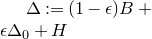 $\Delta:=(1-\epsilon)B+\epsilon\Delta_0+H$
satisfies our requirements.
$\Delta:=(1-\epsilon)B+\epsilon\Delta_0+H$
satisfies our requirements.
2.3 Special algebraically integrable foliations
Definition 2.13 (Foliated log resolutions). We refer the readers to [Reference Chen, Han, Liu and XieCHLX23, Definition 6.2.1] or [Reference Ambro, Cascini, Shokurov and SpicerACSS21, 3.2] for the definition of being foliated log smooth.
Let X be a normal quasi-projective variety, B an $\mathbb{R}$
-divisor on X, and
$\mathbb{R}$
-divisor on X, and $\mathcal{F}$
an algebraically integrable foliation on X. A foliated log resolution of
$\mathcal{F}$
an algebraically integrable foliation on X. A foliated log resolution of $(X,\mathcal{F},B)$
is a birational morphism
$(X,\mathcal{F},B)$
is a birational morphism $h: X'\rightarrow X$
such that
$h: X'\rightarrow X$
such that
 $$(X',\mathcal{F}':=h^{-1}\mathcal{F},B':=h^{-1}_*B+\operatorname{Exc}(h))$$
is foliated log smooth. The existence of foliated log resolutions for any such $(X,\mathcal{F},B)$
is guaranteed by [Reference Chen, Han, Liu and XieCHLX23, Lemma 6.2.4].
$(X,\mathcal{F},B)$
is guaranteed by [Reference Chen, Han, Liu and XieCHLX23, Lemma 6.2.4].
Definition 2.14 (Property $(*)$
foliations, [Reference Ambro, Cascini, Shokurov and SpicerACSS21, Definition 3.8] and [Reference Chen, Han, Liu and XieCHLX23, Definition 7.2.2]). Let
$(*)$
foliations, [Reference Ambro, Cascini, Shokurov and SpicerACSS21, Definition 3.8] and [Reference Chen, Han, Liu and XieCHLX23, Definition 7.2.2]). Let $(X,\mathcal{F},B)$
be a foliated triple. Let
$(X,\mathcal{F},B)$
be a foliated triple. Let $G\geq 0$
be a reduced divisor on X and
$G\geq 0$
be a reduced divisor on X and $f: X\rightarrow Z$
a contraction. We say that
$f: X\rightarrow Z$
a contraction. We say that $(X,\mathcal{F},B;G)/Z$
satisfies Property
$(X,\mathcal{F},B;G)/Z$
satisfies Property $(*)$
if the following conditions hold:
$(*)$
if the following conditions hold:
-
(1)
$\mathcal{F}$
is induced by f and G is an
$\mathcal{F}$
-invariant divisor; -
(2) f(G) is of pure codimension 1, (Z,f(G)) is log smooth, and
$G=f^{-1}(f(G))$
; -
(3) for any closed point
$z\in Z$
and any reduced divisor
$\Sigma\ge f(G)$
on Z such that
$(Z,\Sigma)$
is log smooth near z,
$(X,B+G+f^*(\Sigma-f(G)))$
is lc over a neighborhood of z.


We say that f, Z, and G are associated with $(X,\mathcal{F},B)$
.
$(X,\mathcal{F},B)$
.
Proposition 2.15 (Cf. [Reference Ambro, Cascini, Shokurov and SpicerACSS21, Proposition 3.6] and [Reference Chen, Han, Liu and XieCHLX23, Proposition 7.3.6]). Let $(X,\mathcal{F},B)$
be a foliated triple. Let
$(X,\mathcal{F},B)$
be a foliated triple. Let $G\geq 0$
be a reduced divisor on X and
$G\geq 0$
be a reduced divisor on X and $f: X\rightarrow Z$
an equidimensional contraction, such that
$f: X\rightarrow Z$
an equidimensional contraction, such that $(X,\mathcal{F},B;G)/Z$
satisfies Property
$(X,\mathcal{F},B;G)/Z$
satisfies Property $(*)$
and B is horizontal
$(*)$
and B is horizontal $/Z$
. Then
$/Z$
. Then
 $$K_{\mathcal{F}}+B\sim_{Z}K_X+B+G.$$
Definition 2.16. Let $f: X\rightarrow Z$
be a projective morphism between normal quasi-projective varieties and
$f: X\rightarrow Z$
be a projective morphism between normal quasi-projective varieties and $G\geq 0$
an
$G\geq 0$
an $\mathbb{R}$
-divisor on X. We say that G is super
$\mathbb{R}$
-divisor on X. We say that G is super $/Z$
if there exist ample Cartier divisors
$/Z$
if there exist ample Cartier divisors $H_1,\dots,H_{m}$
on Z such that
$H_1,\dots,H_{m}$
on Z such that $G\geq\sum_{i=1}^{m}f^*H_i$
, where
$G\geq\sum_{i=1}^{m}f^*H_i$
, where $m:=2\dim X+1$
.
$m:=2\dim X+1$
.
Definition 2.17 (ACSS, cf. [Reference Chen, Han, Liu and XieCHLX23, Definitions 5.4.2, 7.2.2, 7.2.3]). Let $(X,\mathcal{F},B)$
be an lc foliated triple,
$(X,\mathcal{F},B)$
be an lc foliated triple, $G\geq 0$
a reduced divisor on X, and
$G\geq 0$
a reduced divisor on X, and $f: X\rightarrow Z$
a contraction. We say that
$f: X\rightarrow Z$
a contraction. We say that $(X,\mathcal{F},B;G)/Z$
is ACSS if the following conditions hold.
$(X,\mathcal{F},B;G)/Z$
is ACSS if the following conditions hold.
-
(1) We have that
$(X,\mathcal{F},B;G)/Z$
satisfies Property
$(*)$
. -
(2) We have that f is equidimensional.
-
(3) there exists an
$\mathbb{R}$
-Cartier
$\mathbb{R}$
-divisor
$D\geq 0$
on X, such that
$\operatorname{Supp}\{B\}\subset\operatorname{Supp} D$
, and for any reduced divisor
$\Sigma\geq f(G)$
such that
$(Z,\Sigma)$
is log smooth, is quotient divisorial log terminal (qdlt) (cf. [Reference de Fernex, Kollár and XudFKX17, Definition 35]).
$$(X,B+D+G+f^*(\Sigma-f(G)))$$
-
(4) For any lc center of
$(X,\mathcal{F},B)$
with generic point
$\eta$
, over a neighborhood of
$\eta$
:-
(a)
$\eta$
is the generic point of an lc center of
$(X,\mathcal{F},\lfloor B\rfloor)$
; and -
(b)
$f: (X,B+G)\rightarrow (Z,f(G))$
is a toroidal morphism.
-



If $(X,\mathcal{F},B;G)/Z$
is ACSS and G is super
$(X,\mathcal{F},B;G)/Z$
is ACSS and G is super $/Z$
, then we say that
$/Z$
, then we say that $(X,\mathcal{F},B;G)/Z$
is super ACSS. If
$(X,\mathcal{F},B;G)/Z$
is super ACSS. If $(X,\mathcal{F},B;G)/Z$
is (super) ACSS, then we say that
$(X,\mathcal{F},B;G)/Z$
is (super) ACSS, then we say that $(X,\mathcal{F},B)/Z$
and
$(X,\mathcal{F},B)/Z$
and $(X,\mathcal{F},B)$
are (super) ACSS.
$(X,\mathcal{F},B)$
are (super) ACSS.
2.4 Birational maps in MMP
Definition 2.18. Let $X\rightarrow U$
be a projective morphism from a normal quasi-projective variety to a variety. Let D be an
$X\rightarrow U$
be a projective morphism from a normal quasi-projective variety to a variety. Let D be an $\mathbb{R}$
-Cartier
$\mathbb{R}$
-Cartier $\mathbb{R}$
-divisor on X and
$\mathbb{R}$
-divisor on X and $\phi: X\dashrightarrow X'$
a birational map
$\phi: X\dashrightarrow X'$
a birational map $/U$
. Then we say that X’ is a birational model of X. We say that
$/U$
. Then we say that X’ is a birational model of X. We say that $\phi$
is D-non-positive (respectively, D-negative, D-trivial, D-non-negative, D-positive) if the following conditions hold:
$\phi$
is D-non-positive (respectively, D-negative, D-trivial, D-non-negative, D-positive) if the following conditions hold:
-
(1)
$\phi$
does not extract any divisor; -
(2)
$D':=\phi_*D$
is
$\mathbb{R}$
-Cartier; -
(3) there exists a resolution of indeterminacy
$p: W\rightarrow X$
and
$q: W\rightarrow X'$
, such that where
$$ p^*D=q^*D'+F, $$
$F\geq 0$
(respectively,
$F\geq 0$
and
$\operatorname{Supp} p_*F=\operatorname{Exc}(\phi)$
,
$F=0$
,
$0\geq F$
,
$0\geq F$
and
$\operatorname{Supp} p_*F=\operatorname{Exc}(\phi)$
).






Definition 2.19. Let $X\rightarrow U$
be a projective morphism from a normal quasi-projective variety to a variety. Let D be an
$X\rightarrow U$
be a projective morphism from a normal quasi-projective variety to a variety. Let D be an $\mathbb{R}$
-Cartier
$\mathbb{R}$
-Cartier $\mathbb{R}$
-divisor on X and
$\mathbb{R}$
-divisor on X and $f: X\rightarrow Z$
a contraction
$f: X\rightarrow Z$
a contraction $/U$
. We say that f is a D-Mori fiber space
$/U$
. We say that f is a D-Mori fiber space $/U$
if f is a contraction of a D-negative extremal ray
$/U$
if f is a contraction of a D-negative extremal ray $/U$
and
$/U$
and $\dim X\gt \dim Z$
. If
$\dim X\gt \dim Z$
. If $f: X\rightarrow Z$
is a D-Mori fiber space
$f: X\rightarrow Z$
is a D-Mori fiber space $/U$
for some
$/U$
for some $\mathbb{R}$
-Cartier
$\mathbb{R}$
-Cartier $\mathbb{R}$
-divisor D, then we say that
$\mathbb{R}$
-divisor D, then we say that $f: X\rightarrow Z$
is a Mori fiber space
$f: X\rightarrow Z$
is a Mori fiber space $/U$
. If f is obviously a contraction
$/U$
. If f is obviously a contraction $/U$
or the ‘
$/U$
or the ‘ $/U$
’ property is not important, then we may drop the ‘
$/U$
’ property is not important, then we may drop the ‘ $/U$
’ in the definitions.
$/U$
’ in the definitions.
Definition 2.20. Let $X\rightarrow U$
be a projective morphism from a normal quasi-projective variety to a variety. Let D be an
$X\rightarrow U$
be a projective morphism from a normal quasi-projective variety to a variety. Let D be an $\mathbb{R}$
-Cartier
$\mathbb{R}$
-Cartier $\mathbb{R}$
-divisor on X,
$\mathbb{R}$
-divisor on X, $\phi: X\dashrightarrow X'$
a D-negative map
$\phi: X\dashrightarrow X'$
a D-negative map $/U$
and
$/U$
and $D':=\phi_*D$
.
$D':=\phi_*D$
.
-
(1) We say that X’ is a minimal model
$/U$
of D if D’ is nef
$/U$
. -
(2) We say that X’ is a good minimal model
$/U$
of D if D’ is semi-ample
$/U$
. -
(3) A contraction
$/U$
$f: X'\rightarrow Z$
is called a Mori fiber space
$/U$
of D if f is a D’-Mori fiber space
$/U$
.


Lemma 2.21. Let $X\rightarrow U$
be a projective morphism from a normal quasi-projective variety to a variety and F an extremal face in
$X\rightarrow U$
be a projective morphism from a normal quasi-projective variety to a variety and F an extremal face in $\overline{NE}(X/U)$
. Let
$\overline{NE}(X/U)$
. Let $H_1,H_2$
be two supporting functions
$H_1,H_2$
be two supporting functions $/U$
of F and
$/U$
of F and $\phi: X\dashrightarrow X'$
an
$\phi: X\dashrightarrow X'$
an $H_1$
-trivial birational map
$H_1$
-trivial birational map $/U$
. Then
$/U$
. Then $\phi$
is
$\phi$
is $H_2$
-trivial.
$H_2$
-trivial.
Proof. Let $p: W\rightarrow X$
and
$p: W\rightarrow X$
and $q: W\rightarrow X'$
be a resolution of indeterminacy. Then there exists a unique extremal face
$q: W\rightarrow X'$
be a resolution of indeterminacy. Then there exists a unique extremal face $F_W$
of
$F_W$
of $\overline{NE}(W/U)$
such that
$\overline{NE}(W/U)$
such that $p_*F_W=F$
,
$p_*F_W=F$
, $\overline{NE}(W/X)\subset F_W$
, and
$\overline{NE}(W/X)\subset F_W$
, and $p^*H_1,p^*H_2$
are both supporting functions of
$p^*H_1,p^*H_2$
are both supporting functions of $F_W$
.
$F_W$
.
Since $\phi$
is
$\phi$
is $H_1$
-trivial, q is
$H_1$
-trivial, q is $p^*H_1$
-trivial. Therefore, q only contracts
$p^*H_1$
-trivial. Therefore, q only contracts $p^*H_1$
-trivial extremal rays in
$p^*H_1$
-trivial extremal rays in $\overline{NE}(W/U)$
, so q only contracts
$\overline{NE}(W/U)$
, so q only contracts $p^*H_2$
-trivial extremal rays in
$p^*H_2$
-trivial extremal rays in $\overline{NE}(W/U)$
. Thus, q is
$\overline{NE}(W/U)$
. Thus, q is $p^*H_2$
-trivial, so
$p^*H_2$
-trivial, so $\phi$
is
$\phi$
is $H_2$
-trivial.
$H_2$
-trivial.
Lemma 2.22. Let $X\rightarrow U$
be a projective morphism from a normal quasi-projective variety to a variety. Let A,B be two
$X\rightarrow U$
be a projective morphism from a normal quasi-projective variety to a variety. Let A,B be two $\mathbb{R}$
-divisors on X and let t be a real number such that t is general in
$\mathbb{R}$
-divisors on X and let t be a real number such that t is general in $\mathbb R/\mathbb Q$
and
$\mathbb R/\mathbb Q$
and $A+tB$
is
$A+tB$
is $\mathbb{R}$
-Cartier. Then A,B are
$\mathbb{R}$
-Cartier. Then A,B are $\mathbb{R}$
-Cartier, and any
$\mathbb{R}$
-Cartier, and any $(A+tB)$
-trivial map
$(A+tB)$
-trivial map $\phi: X\dashrightarrow X'$
is A-trivial and B-trivial.
$\phi: X\dashrightarrow X'$
is A-trivial and B-trivial.
Proof. Let A’ and B’ be the images of A,B on X’, respectively. Then $A'+tB'$
is
$A'+tB'$
is $\mathbb{R}$
-Cartier. By [Reference Han, Liu and ShokurovHLS24, Lemma 5.3], A,B,A’,B’ are
$\mathbb{R}$
-Cartier. By [Reference Han, Liu and ShokurovHLS24, Lemma 5.3], A,B,A’,B’ are $\mathbb{R}$
-Cartier. Let
$\mathbb{R}$
-Cartier. Let $p: W\rightarrow X$
and
$p: W\rightarrow X$
and $q: W\rightarrow X'$
be a resolution of indeterminacy, then
$q: W\rightarrow X'$
be a resolution of indeterminacy, then
 $$p^*A+tp^*B=p^*(A+tB)=q^*(A'+tB')=q^*A'+tq^*B'.$$
By [Reference Han, Liu and ShokurovHLS24, Lemma 5.3], $p^*A=q^*A'$
and
$p^*A=q^*A'$
and $p^*B=q^*B'$
. The lemma follows.
$p^*B=q^*B'$
. The lemma follows.
2.5 Relative Nakayama–Zariski decompositions
Definition 2.23. Let $\pi: X\rightarrow U$
be a projective morphism from a normal variety to a variety, D a pseudo-effective
$\pi: X\rightarrow U$
be a projective morphism from a normal variety to a variety, D a pseudo-effective $/U$
$/U$ $\mathbb{R}$
-Cartier
$\mathbb{R}$
-Cartier $\mathbb{R}$
-divisor on X, and P a prime divisor on X. We define
$\mathbb{R}$
-divisor on X, and P a prime divisor on X. We define $\sigma_{P}(X/U,D)$
as in [Reference Liu and XieLX25, Definition 3.1] by considering
$\sigma_{P}(X/U,D)$
as in [Reference Liu and XieLX25, Definition 3.1] by considering $\sigma_{P}(X/U,D)$
as a number in
$\sigma_{P}(X/U,D)$
as a number in $[0,+\infty)\cup\{+\infty\}$
. We define
$[0,+\infty)\cup\{+\infty\}$
. We define $N_{\sigma}(X/U,D)=\sum_Q\sigma_Q(X/U,D)Q$
where the sum runs through all prime divisors on X and consider it as a formal sum of divisors with coefficients in
$N_{\sigma}(X/U,D)=\sum_Q\sigma_Q(X/U,D)Q$
where the sum runs through all prime divisors on X and consider it as a formal sum of divisors with coefficients in $[0,+\infty)\cup\{+\infty\}$
.
$[0,+\infty)\cup\{+\infty\}$
.
Lemma 2.24 [Reference Liu and XieLX25, Lemmas 3.4(2)(3) and 3.7(4)]. Let $\pi: X\rightarrow U$
be a projective morphism from a normal variety to a variety and D a pseudo-effective
$\pi: X\rightarrow U$
be a projective morphism from a normal variety to a variety and D a pseudo-effective $/U$
$/U$ $\mathbb{R}$
-Cartier
$\mathbb{R}$
-Cartier $\mathbb{R}$
-divisor on X. Let
$\mathbb{R}$
-divisor on X. Let $f: Y\rightarrow X$
be a projective birational morphism. Then we have the following.
$f: Y\rightarrow X$
be a projective birational morphism. Then we have the following.
-
(1) For any exceptional
$/X$
$\mathbb{R}$
-Cartier
$\mathbb{R}$
-divisor
$E\ge0$
and any prime divisor P on Y, we have
$$ \sigma_P(Y/U,f^*D+E)=\sigma_P(Y/U,f^*D)+\operatorname{mult}_PE. $$
-
(2) For any exceptional
$/X$
$\mathbb{R}$
-Cartier
$\mathbb{R}$
-divisor
$E\ge0$
on Y, we have
$$N_{\sigma}(X/U,D)=f_*N_{\sigma}(Y/U,f^*D+E).$$
-
(3) The set
$\operatorname{Supp} N_{\sigma}(X/U,D)$
coincides with the divisorial part of
${\textbf{B}}_-(X/U,D)$
.




Lemma 2.25. Let $X\rightarrow U$
be a projective morphism from a normal variety to a variety and
$X\rightarrow U$
be a projective morphism from a normal variety to a variety and $\phi: X\dashrightarrow X'$
a birational map
$\phi: X\dashrightarrow X'$
a birational map $/U$
. Let D be an
$/U$
. Let D be an $\mathbb{R}$
-Cartier
$\mathbb{R}$
-Cartier $\mathbb{R}$
-divisor on X such that
$\mathbb{R}$
-divisor on X such that $\phi$
is D-negative and
$\phi$
is D-negative and $D':=\phi_*D$
. Then we have the following.
$D':=\phi_*D$
. Then we have the following.
-
(1) The divisors contracted by
$\phi$
are contained in
$\operatorname{Supp} N_{\sigma}(X/U,D)$
. -
(2) If D’ is movable
$/U$
, then
$\operatorname{Supp} N_{\sigma}(X/U,D)$
is the set of all
$\phi$
-exceptional divisors.





Proof. Let $p: W\rightarrow X$
and
$p: W\rightarrow X$
and $q: W\rightarrow X'$
be a resolution of indeterminacy. Then
$q: W\rightarrow X'$
be a resolution of indeterminacy. Then
 $$p^*D=q^*D'+E$$
for some $E\geq 0$
that is exceptional
$E\geq 0$
that is exceptional $/X'$
and
$/X'$
and $\operatorname{Supp} E$
contains the strict transforms of all
$\operatorname{Supp} E$
contains the strict transforms of all $\phi$
-exceptional divisors on W. By Lemma 2.24(1),
$\phi$
-exceptional divisors on W. By Lemma 2.24(1),
 $$\operatorname{Supp} E\subset\operatorname{Supp} N_\sigma(W/U,q^*D'+E)=\operatorname{Supp} N_\sigma(W/U,p^*D),$$
By Lemma 2.24(2), $\operatorname{Supp} p_*E\subset\operatorname{Supp} N_\sigma(X/U,D)$
. Therefore, any
$\operatorname{Supp} p_*E\subset\operatorname{Supp} N_\sigma(X/U,D)$
. Therefore, any $\phi$
-exceptional divisor is contained in
$\phi$
-exceptional divisor is contained in $\operatorname{Supp} N_\sigma(X/U,D)$
.
$\operatorname{Supp} N_\sigma(X/U,D)$
.
If D’ is movable $/U$
, then by Lemma 2.24(2),
$/U$
, then by Lemma 2.24(2), $q_*N_\sigma(W/U,q^*D'+E)=0$
. Thus,
$q_*N_\sigma(W/U,q^*D'+E)=0$
. Thus,
 $$\operatorname{Supp} N_\sigma(W/U,q^*D'+E)$$
is q-exceptional. By Lemma 2.24(2) again, we have $\operatorname{Supp} N_\sigma(X/U,D)=\operatorname{Supp} p_*N_\sigma(W/U, q^*D'+E)$
, whose components are all
$\operatorname{Supp} N_\sigma(X/U,D)=\operatorname{Supp} p_*N_\sigma(W/U, q^*D'+E)$
, whose components are all $\phi$
-exceptional. Condition (2) follows from condition (1).
$\phi$
-exceptional. Condition (2) follows from condition (1).
2.6 Generalized pairs and generalized foliated quadruples
Remark 2.26. Generalized pairs [Reference Birkar and ZhangBZ16, Definition 1.4] and generalized foliated quadruples (see [Reference Liu, Luo and MengLLM23, Definition 1.2] and [Reference Chen, Han, Liu and XieCHLX23, Definition 3.4.3]) will be inevitably used in this paper. They are crucial for our proofs since Bertini-type theorems fail for foliations (cf. [Reference Das, Liu and MascharakDLM23, Example 3.4]). We need this notion to discuss the structures induced by MMP in a more accurate manner.
For $\boldsymbol{b}$
-divisors and generalized pairs, we follow the notation and definitions in [Reference Birkar and ZhangBZ16, Reference Hacon and LiuHL23]. For generalized foliated quadruples, we shall follow [Reference Chen, Han, Liu and XieCHLX23].
$\boldsymbol{b}$
-divisors and generalized pairs, we follow the notation and definitions in [Reference Birkar and ZhangBZ16, Reference Hacon and LiuHL23]. For generalized foliated quadruples, we shall follow [Reference Chen, Han, Liu and XieCHLX23].
Generalized pairs and generalized foliated quadruples are very technical concepts. To make the statements in this paper more concise, for most results whose proofs for generalized foliated quadruples are similar to the proofs for foliated triples, we only prove the foliated triple version and do not prove the generalized foliated quadruple version. We state the corresponding generalized foliated quadruple version in Appendix A. We freely use results from [Reference Chen, Han, Liu and XieCHLX23] on generalized foliated quadruples.
We need some results on NQC $\mathbb{R}$
-divisors which are related to generalized pairs and generalized foliated quadruples.
$\mathbb{R}$
-divisors which are related to generalized pairs and generalized foliated quadruples.
Definition 2.27 (NQC). Let $X\rightarrow U$
be a projective morphism from a normal quasi-projective variety to a variety. Let D be a nef
$X\rightarrow U$
be a projective morphism from a normal quasi-projective variety to a variety. Let D be a nef $\mathbb{R}$
-Cartier
$\mathbb{R}$
-Cartier $\mathbb{R}$
-divisor on X and
$\mathbb{R}$
-divisor on X and ${\textbf{M}}$
a nef
${\textbf{M}}$
a nef $\boldsymbol{b}$
-divisor on X.
$\boldsymbol{b}$
-divisor on X.
We say that D is NQC $/U$
if
$/U$
if $D=\sum d_iD_i$
, where each
$D=\sum d_iD_i$
, where each $d_i\geq 0$
and each
$d_i\geq 0$
and each $D_i$
is a nef
$D_i$
is a nef $/U$
Cartier divisor. We say that
$/U$
Cartier divisor. We say that ${\textbf{M}}$
is NQC
${\textbf{M}}$
is NQC $/U$
if
$/U$
if ${\textbf{M}}=\sum \mu_i{\textbf{M}}_i$
, where each
${\textbf{M}}=\sum \mu_i{\textbf{M}}_i$
, where each $\mu_i\geq 0$
and each
$\mu_i\geq 0$
and each ${\textbf{M}}_i$
is a nef
${\textbf{M}}_i$
is a nef $/U$
Cartier
$/U$
Cartier $\boldsymbol{b}$
-divisor.
$\boldsymbol{b}$
-divisor.
Lemma 2.28 (Cf. [Reference Birkar and ZhangBZ16, Lemma 4.4(3)]). Let $(X,B)/U$
be a
$(X,B)/U$
be a $\mathbb{Q}$
-factorial lc pair and L an NQC
$\mathbb{Q}$
-factorial lc pair and L an NQC $/U$
$/U$ $\mathbb{R}$
-divisor on X. Assume that X is klt. Then there exists a positive real number
$\mathbb{R}$
-divisor on X. Assume that X is klt. Then there exists a positive real number $l_0$
such that any sequence of steps of a
$l_0$
such that any sequence of steps of a $(K_X+B+lL)$
-MMP
$(K_X+B+lL)$
-MMP $/U$
is L-trivial for any
$/U$
is L-trivial for any $l\gt l_0$
.
$l\gt l_0$
.
Lemma 2.29. Let $(X,\mathcal{F},B)/U$
be an lc algebraically integrable foliated triple and D a nef
$(X,\mathcal{F},B)/U$
be an lc algebraically integrable foliated triple and D a nef $/U$
$/U$ $\mathbb{R}$
-divisor on X such that
$\mathbb{R}$
-divisor on X such that $D-(K_{\mathcal{F}}+B)$
is ample
$D-(K_{\mathcal{F}}+B)$
is ample $/U$
. Then D is NQC
$/U$
. Then D is NQC $/U$
.
$/U$
.
Proof. We write $D=\sum_{i=1}^cr_iD_i$
, where
$D=\sum_{i=1}^cr_iD_i$
, where $r_1,\dots,r_c$
are linearly independent over
$r_1,\dots,r_c$
are linearly independent over $\mathbb Q$
and each
$\mathbb Q$
and each $D_i$
is a Cartier divisor. Let
$D_i$
is a Cartier divisor. Let $\boldsymbol{r}=(r_1,\dots,r_c)$
. We define
$\boldsymbol{r}=(r_1,\dots,r_c)$
. We define $D(\boldsymbol{v}):=\sum_{i=1}^cv_iD_i$
for any
$D(\boldsymbol{v}):=\sum_{i=1}^cv_iD_i$
for any $\boldsymbol{v}=(v_1,\dots,v_c)\in\mathbb R^c$
. By [Reference Han, Liu and ShokurovHLS24, Lemma 5.3],
$\boldsymbol{v}=(v_1,\dots,v_c)\in\mathbb R^c$
. By [Reference Han, Liu and ShokurovHLS24, Lemma 5.3], $D(\boldsymbol{v})$
is
$D(\boldsymbol{v})$
is $\mathbb{R}$
-Cartier for any
$\mathbb{R}$
-Cartier for any $\boldsymbol{v}\in\mathbb R^c$
.
$\boldsymbol{v}\in\mathbb R^c$
.
Let $L:=D-(K_\mathcal{F}+B)$
. Since ample
$L:=D-(K_\mathcal{F}+B)$
. Since ample $/U$
is an open condition, there exists an open set
$/U$
is an open condition, there exists an open set $V\ni\boldsymbol{r}$
in
$V\ni\boldsymbol{r}$
in $\mathbb R^c$
, such that
$\mathbb R^c$
, such that $\frac{1}{2}L+D(\boldsymbol{v})-D$
is ample
$\frac{1}{2}L+D(\boldsymbol{v})-D$
is ample $/U$
for any
$/U$
for any $\boldsymbol{v}\in V$
.
$\boldsymbol{v}\in V$
.
By [Reference Chen, Han, Liu and XieCHLX23, Theorem 2.3.1], there exist finitely many $\big(K_{\mathcal{F}}+B+\frac{1}{2}L\big)$
-negative extremal rays
$\big(K_{\mathcal{F}}+B+\frac{1}{2}L\big)$
-negative extremal rays $/U$
$/U$ $R_1,\dots,R_l$
, and
$R_1,\dots,R_l$
, and $R_j=\mathbb R_+[C_j]$
for some curve
$R_j=\mathbb R_+[C_j]$
for some curve $C_j$
. Since D is nef,
$C_j$
. Since D is nef, $D\cdot C_j\geq 0$
for each j. Thus, possibly shrinking V, we may assume that for any
$D\cdot C_j\geq 0$
for each j. Thus, possibly shrinking V, we may assume that for any $\boldsymbol{v}\in V$
, we have that
$\boldsymbol{v}\in V$
, we have that $D(\boldsymbol{v})\cdot C_j\gt 0$
for any j such that
$D(\boldsymbol{v})\cdot C_j\gt 0$
for any j such that $D\cdot C_j\gt 0$
. Since
$D\cdot C_j\gt 0$
. Since $r_1,\dots,r_c$
are linearly independent over
$r_1,\dots,r_c$
are linearly independent over $\mathbb Q$
, for any j such that
$\mathbb Q$
, for any j such that $D\cdot C_j=0$
, we have
$D\cdot C_j=0$
, we have $D(\boldsymbol{v})\cdot C_j=0$
for any
$D(\boldsymbol{v})\cdot C_j=0$
for any $\boldsymbol{v}\in\mathbb R^c$
. Therefore,
$\boldsymbol{v}\in\mathbb R^c$
. Therefore, $D(\boldsymbol{v})\cdot C_j\geq 0$
for any j and any
$D(\boldsymbol{v})\cdot C_j\geq 0$
for any j and any $\boldsymbol{v}\in V$
.
$\boldsymbol{v}\in V$
.
By the cone theorem [Reference Chen, Han, Liu and XieCHLX23, Theorem 2.3.1], for any curve C on X, we may write $[C]=\eta+\sum_{i=1}^l a_i[C_i]$
where
$[C]=\eta+\sum_{i=1}^l a_i[C_i]$
where $a_1,\dots,a_l\geq 0$
and
$a_1,\dots,a_l\geq 0$
and $\eta\in\overline{NE}(X/U)_{K_{\mathcal{F}}+B+\frac{1}{2}L\geq 0}$
. For any
$\eta\in\overline{NE}(X/U)_{K_{\mathcal{F}}+B+\frac{1}{2}L\geq 0}$
. For any $\boldsymbol{v}\in V$
, since
$\boldsymbol{v}\in V$
, since
 $$D(\boldsymbol{v})\cdot \eta=\big(K_\mathcal{F}+B+\tfrac{1}{2}L\big)\cdot\eta+\big(\tfrac{1}{2}L+D(\boldsymbol{v})-D\big)\cdot \eta\geq 0,$$ $D(\boldsymbol{v})\cdot C\geq 0$
. Therefore,
$D(\boldsymbol{v})\cdot C\geq 0$
. Therefore, $D(\boldsymbol{v})$
is nef
$D(\boldsymbol{v})$
is nef $/U$
for any
$/U$
for any $\boldsymbol{v}\in V$
. We let
$\boldsymbol{v}\in V$
. We let $\boldsymbol{v}_1,\dots,\boldsymbol{v}_{c+1}\in V\cap\mathbb Q^c$
be rational points such that
$\boldsymbol{v}_1,\dots,\boldsymbol{v}_{c+1}\in V\cap\mathbb Q^c$
be rational points such that $\boldsymbol{r}$
is in the interior of the convex hull of
$\boldsymbol{r}$
is in the interior of the convex hull of $\boldsymbol{v}_1,\dots,\boldsymbol{v}_{c+1}$
. Then there exist positive real numbers
$\boldsymbol{v}_1,\dots,\boldsymbol{v}_{c+1}$
. Then there exist positive real numbers $a_1,\dots,a_{c+1}$
such that
$a_1,\dots,a_{c+1}$
such that $\sum_{i=1}^{c+1}a_i=1$
and
$\sum_{i=1}^{c+1}a_i=1$
and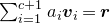 $\sum_{i=1}^{c+1}a_i\boldsymbol{v}_i=\boldsymbol{r}$
. Since
$\sum_{i=1}^{c+1}a_i\boldsymbol{v}_i=\boldsymbol{r}$
. Since $D(\boldsymbol{v}_i)$
is a nef
$D(\boldsymbol{v}_i)$
is a nef $/U$
$/U$ $\mathbb{Q}$
-divisor for each i and
$\mathbb{Q}$
-divisor for each i and $D=\sum_{i=1}^{c+1}a_iD(\boldsymbol{v}_i)$
, D is NQC
$D=\sum_{i=1}^{c+1}a_iD(\boldsymbol{v}_i)$
, D is NQC $/U$
.
$/U$
.
Lemma 2.30. Let $(X,\mathcal{F},B)/U$
be an lc algebraically integrable foliated triple and D an
$(X,\mathcal{F},B)/U$
be an lc algebraically integrable foliated triple and D an $\mathbb{R}$
-divisor on X such that
$\mathbb{R}$
-divisor on X such that $K_{\mathcal{F}}+B+D$
is NQC
$K_{\mathcal{F}}+B+D$
is NQC $/U$
. Then there exists
$/U$
. Then there exists $\delta_0\in (0,1)$
such that for any
$\delta_0\in (0,1)$
such that for any $\delta\in (0,\delta_0)$
, any
$\delta\in (0,\delta_0)$
, any $(K_{\mathcal{F}}+B+(1-\delta)D)$
-non-positive extremal ray
$(K_{\mathcal{F}}+B+(1-\delta)D)$
-non-positive extremal ray $/U$
is
$/U$
is $(K_{\mathcal{F}}+B+D)$
-trivial.
$(K_{\mathcal{F}}+B+D)$
-trivial.
Proof. Let $\pi: X\rightarrow U$
be the induced morphism. Since
$\pi: X\rightarrow U$
be the induced morphism. Since $K_{\mathcal{F}}+B+D$
is NQC
$K_{\mathcal{F}}+B+D$
is NQC $/U$
, there exists a positive real number
$/U$
, there exists a positive real number $\epsilon$
such that
$\epsilon$
such that $(K_{\mathcal{F}}+B+D)\cdot C\geq\epsilon$
for any curve C such that
$(K_{\mathcal{F}}+B+D)\cdot C\geq\epsilon$
for any curve C such that $\pi(C)=\{pt\}$
and
$\pi(C)=\{pt\}$
and $(K_{\mathcal{F}}+B+D)\cdot C\gt 0$
.
$(K_{\mathcal{F}}+B+D)\cdot C\gt 0$
.
Let $d:=\dim X$
. We show that
$d:=\dim X$
. We show that $\delta_0:={\epsilon}/({2d+\epsilon})$
satisfies our requirements. Let R be a
$\delta_0:={\epsilon}/({2d+\epsilon})$
satisfies our requirements. Let R be a $(K_{\mathcal{F}}+B+(1-\delta)D)$
-non-positive extremal ray
$(K_{\mathcal{F}}+B+(1-\delta)D)$
-non-positive extremal ray $/U$
. If R is not
$/U$
. If R is not $(K_{\mathcal{F}}+B+D)$
-trivial, then R is
$(K_{\mathcal{F}}+B+D)$
-trivial, then R is $(K_{\mathcal{F}}+B+D)$
-positive, hence
$(K_{\mathcal{F}}+B+D)$
-positive, hence $(K_{\mathcal{F}}+B)$
-negative. By the length of extremal rays [Reference Chen, Han, Liu and XieCHLX23, Theorem 2.3.1], R is spanned by a curve C such that
$(K_{\mathcal{F}}+B)$
-negative. By the length of extremal rays [Reference Chen, Han, Liu and XieCHLX23, Theorem 2.3.1], R is spanned by a curve C such that $\pi(C)=\{pt\}$
and
$\pi(C)=\{pt\}$
and $0\lt -(K_{\mathcal{F}}+B)\cdot C\leq 2d$
. Thus, for any
$0\lt -(K_{\mathcal{F}}+B)\cdot C\leq 2d$
. Thus, for any $\delta\in (0,\delta_0)$
,
$\delta\in (0,\delta_0)$
,
 \begin{align*} 0&\ge(K_{\mathcal{F}}+B+(1-\delta)D)\cdot C=(1-\delta)(K_{\mathcal{F}}+B+D)\cdot C+\delta(K_{\mathcal{F}}+B)\cdot C\\ &\geq (1-\delta)\epsilon-2d\delta \gt \epsilon-(2d+\epsilon)\delta_0=0,\end{align*}
which is not possible.
3. Core models
The goal of this section is to introduce two new types of birational models for algebraically integrable foliations, namely core models and simple models. We shall also recall the definition of ACSS models defined in [Reference Chen, Han, Liu and XieCHLX23, Reference Das, Liu and MascharakDLM23].
Roughly speaking, simple models are birational models of algebraically integrable foliations that are weaker than $(*)$
-models but still have potentially lc pair structures, while core models are unique simple models which satisfy certain universal property. The use of core models is crucial for the proof of our main theorems.
$(*)$
-models but still have potentially lc pair structures, while core models are unique simple models which satisfy certain universal property. The use of core models is crucial for the proof of our main theorems.
3.1 Core models for two contractions
Definition-Lemma 3.1. Let X’,X,Z be normal quasi-projective varieties and $h: X'\rightarrow X$
,
$h: X'\rightarrow X$
, $f: X'\rightarrow Z$
contractions. Then there exists a unique normal quasi-projective variety
$f: X'\rightarrow Z$
contractions. Then there exists a unique normal quasi-projective variety $\bar X$
up to isomorphisms with two contractions
$\bar X$
up to isomorphisms with two contractions $\bar h: \bar X\rightarrow X$
and
$\bar h: \bar X\rightarrow X$
and $\bar f: \bar X\rightarrow Z$
satisfying the following.
$\bar f: \bar X\rightarrow Z$
satisfying the following.
-
(1) For any ample
$\mathbb{R}$
-divisor A on X,
$\bar h^*A$
is ample
$/Z$
. -
(2) There exists a contraction
$g: X'\rightarrow \bar X$
such that
$\bar h\circ g=h$
and
$\bar f\circ g=f$
.


The variety $\bar X$
is called the core model of (h,f) associated with
$\bar X$
is called the core model of (h,f) associated with $(\bar h,\bar f)$
.
$(\bar h,\bar f)$
.
Moreover, for any dominant map $\phi: X'\dashrightarrow X''$
such that K(X”) is algebraically closed in K(X’) (e.g.
$\phi: X'\dashrightarrow X''$
such that K(X”) is algebraically closed in K(X’) (e.g. $\phi$
is a birational map or a contraction), and any contractions
$\phi$
is a birational map or a contraction), and any contractions $h'': X''\rightarrow X$
and
$h'': X''\rightarrow X$
and $f'': X''\rightarrow Z$
such that
$f'': X''\rightarrow Z$
such that $h''\circ\phi=h$
and
$h''\circ\phi=h$
and $f''\circ\phi=f$
,
$f''\circ\phi=f$
, $\bar X$
is the core model of (h”,f”) associated with
$\bar X$
is the core model of (h”,f”) associated with $(\bar h,\bar f)$
.
$(\bar h,\bar f)$
.
Proof. Step 1. In this step we construct $\bar h,\bar f, g$
which satisfy condition (2) such that condition (1) holds for a fixed ample
$\bar h,\bar f, g$
which satisfy condition (2) such that condition (1) holds for a fixed ample $\mathbb{R}$
-divisor A, and
$\mathbb{R}$
-divisor A, and $\bar X$
is unique. Let A be a fixed ample
$\bar X$
is unique. Let A be a fixed ample $\mathbb{R}$
-divisor on X. Then
$\mathbb{R}$
-divisor on X. Then $h^*A$
is semi-ample, hence semi-ample
$h^*A$
is semi-ample, hence semi-ample $/Z$
. Let
$/Z$
. Let $g: X'\rightarrow\bar X$
be the ample model
$g: X'\rightarrow\bar X$
be the ample model $/Z$
of
$/Z$
of $h^*A$
. Then there exists an induced contraction
$h^*A$
. Then there exists an induced contraction $\bar f: \bar X\rightarrow Z$
. Since the ample model of
$\bar f: \bar X\rightarrow Z$
. Since the ample model of $h^*A$
is
$h^*A$
is $h: X'\rightarrow X$
, we have an induced contraction
$h: X'\rightarrow X$
, we have an induced contraction $\bar h: \bar X\rightarrow X$
. We denote it by
$\bar h: \bar X\rightarrow X$
. We denote it by $\bar h$
. By the uniqueness of ample models,
$\bar h$
. By the uniqueness of ample models, $\bar X$
is unique.
$\bar X$
is unique.
Step 2. In this step we show that condition (1) holds for any ample $\mathbb{R}$
-divisor. Suppose that there exists an ample
$\mathbb{R}$
-divisor. Suppose that there exists an ample $\mathbb{R}$
-divisor H on X such that
$\mathbb{R}$
-divisor H on X such that $\bar h^*H$
is not ample
$\bar h^*H$
is not ample $/Z$
. Then by applying Step 1 to
$/Z$
. Then by applying Step 1 to $H,\bar h,\bar f$
, there exist contractions
$H,\bar h,\bar f$
, there exist contractions $g': \bar X\rightarrow\bar X'$
,
$g': \bar X\rightarrow\bar X'$
, $\bar h': \bar X'\rightarrow X$
, and
$\bar h': \bar X'\rightarrow X$
, and $\bar f': \bar X'\rightarrow Z$
such that
$\bar f': \bar X'\rightarrow Z$
such that $\bar h'^*H$
is ample
$\bar h'^*H$
is ample $/Z$
. Since
$/Z$
. Since $\bar h^*H$
is not ample
$\bar h^*H$
is not ample $/Z$
, g’ is not an isomorphism. Since g’ is a contraction
$/Z$
, g’ is not an isomorphism. Since g’ is a contraction $/Z$
and
$/Z$
and $\bar h^*A=g'^*\bar h'^*A$
is ample
$\bar h^*A=g'^*\bar h'^*A$
is ample $/Z$
, g’ is finite and, thus, an isomorphism, which is a contradiction.
$/Z$
, g’ is finite and, thus, an isomorphism, which is a contradiction.
Step 3. In this step we prove the moreover part. There exist a birational morphism $p: W\rightarrow X'$
from a normal quasi-projective variety W and a projective surjective morphism
$p: W\rightarrow X'$
from a normal quasi-projective variety W and a projective surjective morphism $q: W\rightarrow X''$
such that
$q: W\rightarrow X''$
such that $q=\phi\circ p$
. Since K(X”) is algebraically closed in K(X’), q is a contraction. Let
$q=\phi\circ p$
. Since K(X”) is algebraically closed in K(X’), q is a contraction. Let $\bar X''$
be the core model of (h”,f”) associated with
$\bar X''$
be the core model of (h”,f”) associated with $(\bar h'',\bar f'')$
and
$(\bar h'',\bar f'')$
and $g'': X''\rightarrow\bar X''$
the induced contraction. Since both
$g'': X''\rightarrow\bar X''$
the induced contraction. Since both $g\circ p$
and
$g\circ p$
and $g''\circ q$
are ample models
$g''\circ q$
are ample models $/Z$
of
$/Z$
of $(h\circ p)^*A=(h''\circ q)^*A$
, the ample model
$(h\circ p)^*A=(h''\circ q)^*A$
, the ample model $/Z$
of
$/Z$
of $h^*A$
is isomorphic to the ample model
$h^*A$
is isomorphic to the ample model $/Z$
of
$/Z$
of $h''^*A$
. Thus,
$h''^*A$
. Thus, $\bar X$
is the core model of (h”,f”) associated with
$\bar X$
is the core model of (h”,f”) associated with $(\bar h,\bar f)$
.
$(\bar h,\bar f)$
.
3.2 Core models for algebraically integrable foliations
Definition 3.2 (Simple modifications). Let $(X,\mathcal{F},B)$
and
$(X,\mathcal{F},B)$
and $(X',\mathcal{F}',B')$
be two algebraically integrable foliated triples and
$(X',\mathcal{F}',B')$
be two algebraically integrable foliated triples and $h: X'\rightarrow X$
a birational morphism. Let
$h: X'\rightarrow X$
a birational morphism. Let $f: X'\rightarrow Z$
be a contraction and G a reduced divisor on X’. We say that
$f: X'\rightarrow Z$
be a contraction and G a reduced divisor on X’. We say that $h: (X',\mathcal{F}',B';G)/Z\rightarrow (X,\mathcal{F},B)$
is a simple modification if the following conditions hold:
$h: (X',\mathcal{F}',B';G)/Z\rightarrow (X,\mathcal{F},B)$
is a simple modification if the following conditions hold:
-
(1)
$\mathcal{F}':=h^{-1}\mathcal{F}$
and
$B':=h^{-1}_*(B^{\mathcal{F}-\mathrm{ninv}}\wedge\operatorname{Supp} B)+\operatorname{Exc}(h)^{\mathcal{F}'-\mathrm{ninv}}$
; -
(2)
$(X',\mathcal{F}',B')$
is lc; -
(3)
$a(E,\mathcal{F},B)\leq-\epsilon_{\mathcal{F}}(E)$
for any h-exceptional prime divisor E; -
(4)
$K_{\mathcal{F}'}+B'\sim_ZK_{X'}+B'+G$
; -
(5)
$(X',\mathcal{F}',B';G)/Z$
satisfies Property
$(*)$
.







We say that $h: (X',\mathcal{F}',B',G)/Z\rightarrow (X,\mathcal{F},B)$
is an ACSS modification if it is a simple modification and
$h: (X',\mathcal{F}',B',G)/Z\rightarrow (X,\mathcal{F},B)$
is an ACSS modification if it is a simple modification and $(X',\mathcal{F}',B';G)/Z$
is ACSS.
$(X',\mathcal{F}',B';G)/Z$
is ACSS.
We say that $h: (X',\mathcal{F}',B',G)/Z\rightarrow (X,\mathcal{F},B)$
is a core modification if it is a simple modification and
$h: (X',\mathcal{F}',B',G)/Z\rightarrow (X,\mathcal{F},B)$
is a core modification if it is a simple modification and $h^*A$
is ample
$h^*A$
is ample $/Z$
for any ample
$/Z$
for any ample $\mathbb{R}$
-divisor A on X.
$\mathbb{R}$
-divisor A on X.
If $h: (X',\mathcal{F}',B',G)/Z\rightarrow (X,\mathcal{F},B)$
is a simple (respectively, ACSS, core) modification, then we also say that h is a simple (respectively, ACSS, core) modification of
$h: (X',\mathcal{F}',B',G)/Z\rightarrow (X,\mathcal{F},B)$
is a simple (respectively, ACSS, core) modification, then we also say that h is a simple (respectively, ACSS, core) modification of $(X,\mathcal{F},B)$
.
$(X,\mathcal{F},B)$
.
Definition 3.3 (Core models and ACSS models). Let $(X,\mathcal{F},B)$
be an algebraically integrable foliated triple and
$(X,\mathcal{F},B)$
be an algebraically integrable foliated triple and $h: (X',\mathcal{F}',B',G)/Z\rightarrow (X,\mathcal{F},B)$
a simple (respectively, ACSS, core) modification.
$h: (X',\mathcal{F}',B',G)/Z\rightarrow (X,\mathcal{F},B)$
a simple (respectively, ACSS, core) modification.
We say that $(X',\mathcal{F}',B';G)/Z$
,
$(X',\mathcal{F}',B';G)/Z$
, $(X',\mathcal{F}',B')/Z$
, and
$(X',\mathcal{F}',B')/Z$
, and $(X',\mathcal{F}',B')$
are simple (respectively, ACSS, core) models of
$(X',\mathcal{F}',B')$
are simple (respectively, ACSS, core) models of $(X,\mathcal{F},B)$
. Moreover, we say that h is:
$(X,\mathcal{F},B)$
. Moreover, we say that h is:
-
(1)
$\mathbb{Q}$
-factorial if X’ is
$\mathbb{Q}$
-factorial; -
(2) strict if the
$\mathcal{F}$
-invariant part of
$\operatorname{Supp}\operatorname{Exc}(h)$
is contained in
$\operatorname{Supp} G$
; -
(3) super if G is super
$/Z$
.


We frequently use the following result on the existence of ACSS models.
Theorem 3.4 ([Reference Chen, Han, Liu and XieCHLX23, Theorem 2.5.1] and [Reference Ambro, Cascini, Shokurov and SpicerACSS21, Theorem 3.10]). Let $(X,\mathcal{F},B)$
be an lc algebraically integrable foliated triple. Then
$(X,\mathcal{F},B)$
be an lc algebraically integrable foliated triple. Then $(X,\mathcal{F},B)$
has an ACSS model
$(X,\mathcal{F},B)$
has an ACSS model $h: (X',\mathcal{F}',B';G)/Z\rightarrow (X,\mathcal{F},B)$
that is
$h: (X',\mathcal{F}',B';G)/Z\rightarrow (X,\mathcal{F},B)$
that is $\mathbb{Q}$
-factorial, strict and super.
$\mathbb{Q}$
-factorial, strict and super.
Lemma 3.5. Let $(X,\mathcal{F},B)$
be an lc algebraically integrable foliated triple and let
$(X,\mathcal{F},B)$
be an lc algebraically integrable foliated triple and let $h: (X',\mathcal{F}',B';G)/Z\rightarrow (X,\mathcal{F},B)$
be a simple model. Let
$h: (X',\mathcal{F}',B';G)/Z\rightarrow (X,\mathcal{F},B)$
be a simple model. Let $f: X'\rightarrow Z$
be the associated contraction and let
$f: X'\rightarrow Z$
be the associated contraction and let $\bar X$
be the core model of (h,f) associated with
$\bar X$
be the core model of (h,f) associated with $(\bar h,\bar f)$
. Let
$(\bar h,\bar f)$
. Let $g: X'\rightarrow\bar X$
be the induced birational morphism,
$g: X'\rightarrow\bar X$
be the induced birational morphism, $\bar{\mathcal{F}}:=g_*\mathcal{F}',\bar B:=g_*B'$
, and
$\bar{\mathcal{F}}:=g_*\mathcal{F}',\bar B:=g_*B'$
, and $\bar G:=g_*G$
.
$\bar G:=g_*G$
.
Assume that f is equidimensional. Then:
-
(1)
$K_{\mathcal{F}'}+B'=g^*(K_{\bar{\mathcal{F}}}+\bar B)$
; -
(2)
$K_{X'}+B'+G=g^*(K_{\bar X}+\bar B+\bar G)$
; -
(3)
$\bar h: (\bar X,\bar{\mathcal{F}},\bar B;\bar G)/Z\rightarrow (X,\mathcal{F},B)$
is a core model; -
(4) if
$h: (X',\mathcal{F}',B';G)/Z\rightarrow (X,\mathcal{F},B)$
is strict (respectively, super), then
$\bar h: (\bar X,\bar{\mathcal{F}},\bar B;\bar G)/ Z\rightarrow (X,\mathcal{F},B)$
is strict (respectively, super).




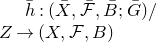
Proof.
-
(1) Let
$K_{\bar{\mathcal{F}}}+\bar B':=\bar h^*(K_{\mathcal{F}}+B).$
Then Therefore,
$$K_{\bar{\mathcal{F}}}+\bar B=g_*(K_{\mathcal{F}'}+B')=g_*h^*(K_{\mathcal{F}}+B)=g_*g^*(K_{\bar{\mathcal{F}}}+\bar B')=K_{\bar{\mathcal{F}}}+\bar B'.$$
$\bar B'=\bar B$
, so
$K_{\mathcal{F}'}+B'=g^*(K_{\bar{\mathcal{F}}}+\bar B)$
.
-
(2) By Proposition 2.15, we have
Since g is a birational morphism
$$K_{X'}+B'+G\sim_ZK_{\mathcal{F}'}+B'=g^*(K_{\bar{\mathcal{F}}}+\bar B)\sim_{\mathbb R,\bar X}0.$$
$/Z$
, Then we have
$$K_{X'}+B'+G\sim_{\mathbb R,\bar X}0.$$
$$K_{X'}+B'+G=g^*g_*(K_{X'}+B'+G)=g^*(K_{\bar X}+\bar B+\bar G).$$
-
(3) Since
$\bar X$
is the core model of (h,f), we only need to show that
$\bar h: (\bar X,\bar{\mathcal{F}},\bar B;\bar G)/Z\rightarrow (X,\mathcal{F},B)$
is a simple model by checking each condition of Definition 3.2.







Definition 3.2(1): By our construction, $\bar{\mathcal{F}}=\bar h^{-1}\mathcal{F}$
and
$\bar{\mathcal{F}}=\bar h^{-1}\mathcal{F}$
and $\bar B=\bar h^{-1}_*B+\operatorname{Exc}(\bar h)^{\bar{\mathcal{F}}-\mathrm{ninv}}$
.
$\bar B=\bar h^{-1}_*B+\operatorname{Exc}(\bar h)^{\bar{\mathcal{F}}-\mathrm{ninv}}$
.
Definition 3.2(2): By condition (1), $K_{\bar{\mathcal{F}}}+\bar B=\bar h^*(K_{\mathcal{F}}+B)$
. Since
$K_{\bar{\mathcal{F}}}+\bar B=\bar h^*(K_{\mathcal{F}}+B)$
. Since $(X,\mathcal{F},B)$
is lc,
$(X,\mathcal{F},B)$
is lc, $(\bar X,\bar{\mathcal{F}},\bar B)$
is lc.
$(\bar X,\bar{\mathcal{F}},\bar B)$
is lc.
Definition 3.2(3): Since any $\bar h$
-exceptional divisor is also h-exceptional, it follows from our construction.
$\bar h$
-exceptional divisor is also h-exceptional, it follows from our construction.
Definition 3.2(4): Thus follows from condition (1) and (2).
Definition 3.2(5): We only need to check Definition 2.14 for $(\bar X,\bar{\mathcal{F}},\bar B,\bar G)/Z$
. Definition 2.14(1): Since
$(\bar X,\bar{\mathcal{F}},\bar B,\bar G)/Z$
. Definition 2.14(1): Since $\mathcal{F}'$
is induced by f,
$\mathcal{F}'$
is induced by f, $\bar{\mathcal{F}}$
is induced by
$\bar{\mathcal{F}}$
is induced by $\bar f$
. Since G is
$\bar f$
. Since G is $\mathcal{F}'$
-invariant,
$\mathcal{F}'$
-invariant, $\bar G$
is
$\bar G$
is $\bar{\mathcal{F}}$
-invariant. Definition 2.14(2):
$\bar{\mathcal{F}}$
-invariant. Definition 2.14(2): $(Z,f(G)=\bar f(\bar G))$
is log smooth by assumption. Since
$(Z,f(G)=\bar f(\bar G))$
is log smooth by assumption. Since $G=f^{-1}(f(G))$
,
$G=f^{-1}(f(G))$
, $\bar G=\bar f^{-1}(\bar f(G))$
. Definition 2.14(3): For any closed point
$\bar G=\bar f^{-1}(\bar f(G))$
. Definition 2.14(3): For any closed point $z\in Z$
and any reduced divisor
$z\in Z$
and any reduced divisor $\Sigma\geq\bar f(\bar G)$
on Z such that
$\Sigma\geq\bar f(\bar G)$
on Z such that $(Z,\Sigma)$
is log smooth near z,
$(Z,\Sigma)$
is log smooth near z, $(X',B'+f^*(\Sigma-\bar f(\bar G)))$
is lc over a neighborhood of z. By condition (2),
$(X',B'+f^*(\Sigma-\bar f(\bar G)))$
is lc over a neighborhood of z. By condition (2),
 $$K_{X'}+B'+f^*(\Sigma-f(G))=g^*(K_{\bar X}+\bar B+\bar f^*(\Sigma-\bar f(\bar G))),$$
so $(\bar X,\bar B+\bar f^*(\Sigma-\bar f(\bar G)))$
is lc over a neighborhood of z.
$(\bar X,\bar B+\bar f^*(\Sigma-\bar f(\bar G)))$
is lc over a neighborhood of z.
-
(4) Thus follows from the definitions of being strict or super.
Y, yes; N, not necessarily true; $\bullet$
, holds when X’ is
$\bullet$
, holds when X’ is $\mathbb{Q}$
-factorial.
$\mathbb{Q}$
-factorial.
Lemma 3.6. Let $(X,\mathcal{F},B)$
be an lc algebraically integrable foliated triple and let
$(X,\mathcal{F},B)$
be an lc algebraically integrable foliated triple and let $h: (X',\mathcal{F}',B';G)/Z\rightarrow (X,\mathcal{F},B)$
be a strict simple model. If X is potentially klt, then X’ is potentially klt.
$h: (X',\mathcal{F}',B';G)/Z\rightarrow (X,\mathcal{F},B)$
be a strict simple model. If X is potentially klt, then X’ is potentially klt.
Proof. Let $(X,\Delta)$
be a klt pair and let
$(X,\Delta)$
be a klt pair and let $K_{X'}+\tilde\Delta':=h^*(K_X+\Delta)$
. Then
$K_{X'}+\tilde\Delta':=h^*(K_X+\Delta)$
. Then $(X',\tilde\Delta')$
is sub-klt. Since
$(X',\tilde\Delta')$
is sub-klt. Since $(X',B'+G)$
is lc,
$(X',B'+G)$
is lc, $(X',\delta\tilde\Delta'+(1-\delta)(B'+G))$
is sub-klt for any
$(X',\delta\tilde\Delta'+(1-\delta)(B'+G))$
is sub-klt for any $\delta\in (0,1)$
. Since G contains all h-exceptional prime divisors that are
$\delta\in (0,1)$
. Since G contains all h-exceptional prime divisors that are $\mathcal{F}'$
-invariant, and since
$\mathcal{F}'$
-invariant, and since $\operatorname{Supp} B'$
contains all h-exceptional prime divisors that are not
$\operatorname{Supp} B'$
contains all h-exceptional prime divisors that are not $\mathcal{F}'$
-invariant, we have
$\mathcal{F}'$
-invariant, we have $\delta\tilde\Delta'+(1-\delta)(B'+G)\geq 0$
for any
$\delta\tilde\Delta'+(1-\delta)(B'+G)\geq 0$
for any $0\lt \delta\ll 1$
. Therefore,
$0\lt \delta\ll 1$
. Therefore, $(X',\delta\tilde\Delta'+(1-\delta)(B'+G))$
is klt for any
$(X',\delta\tilde\Delta'+(1-\delta)(B'+G))$
is klt for any $0\lt \delta\ll 1$
. In particular, X’ is potentially klt.
$0\lt \delta\ll 1$
. In particular, X’ is potentially klt.
Remark 3.7. ‘ $(*)$
-models’ are defined in [Reference Ambro, Cascini, Shokurov and SpicerACSS21, Reference Cascini and SpicerCS25a] and ‘great ACSS models’ are defined in [Reference Chen, Han, Liu and XieCHLX23]. We do not need these models in this paper. Nevertheless, we provide the readers with a description of the properties of different types of models in Table 1. Note that ‘
$(*)$
-models’ are defined in [Reference Ambro, Cascini, Shokurov and SpicerACSS21, Reference Cascini and SpicerCS25a] and ‘great ACSS models’ are defined in [Reference Chen, Han, Liu and XieCHLX23]. We do not need these models in this paper. Nevertheless, we provide the readers with a description of the properties of different types of models in Table 1. Note that ‘ $(*)$
-models’ are defined differently in [Reference Ambro, Cascini, Shokurov and SpicerACSS21] and [Reference Cascini and SpicerCS25a].
$(*)$
-models’ are defined differently in [Reference Ambro, Cascini, Shokurov and SpicerACSS21] and [Reference Cascini and SpicerCS25a].
Different types of simple models.

Table 1: Long description
The table compares different types of simple models across six properties: Q-factorial, Strict, Super, X' to Z equidim, (X', B' + G), and X'. It consists of six rows and six columns. The rows are labeled as Simple models, Core models, (*)-models [ACSS21], ACSS models, (*)-models [CS25a], and Great ACSS models. The columns are labeled with the properties mentioned. Each cell contains values indicating the presence or absence of specific properties, such as N for no, Y for yes, and various abbreviations like lc, klt, and qdlt. Notable trends include the Great ACSS models having the most properties marked as present, while Simple and Core models have fewer properties marked.
4. Models for foliations
The goal of this section is to introduce and study the basic behaviors of different types of models for foliated triples: weak lc models, minimal models, good minimal models, etc. We will also introduce minimal models in the sense of Birkar and Shokurov and log minimal models for foliations. Results in this section are similar to results in [Reference BirkarBir12, 2] and [Reference Hacon and LiuHL23, 3] with some differences as we need to take invariant lc centers into consideration.
4.1 Definitions of minimal models and Mori fiber spaces
Remark 4.1. In the classical definition of models, ‘log minimal model’, ‘good minimal model’, or ‘log terminal model’ (cf. [Reference Birkar, Cascini, Hacon and McKernanBCHM10, Reference BirkarBir12]) usually requires that the model is $\mathbb{Q}$
-factorial dlt. This is because the initial structure on which we start running the MMP is usually
$\mathbb{Q}$
-factorial dlt. This is because the initial structure on which we start running the MMP is usually $\mathbb{Q}$
-factorial dlt. For foliations this is replaced by the condition ‘
$\mathbb{Q}$
-factorial dlt. For foliations this is replaced by the condition ‘ $\mathbb{Q}$
-factorial ACSS’ [Reference Chen, Han, Liu and XieCHLX23]. However, since the singularities we are going to come up with in this paper is usually worse than
$\mathbb{Q}$
-factorial ACSS’ [Reference Chen, Han, Liu and XieCHLX23]. However, since the singularities we are going to come up with in this paper is usually worse than $\mathbb{Q}$
-factorial ACSS, we have to change these definitions a little bit in order to deal with worse singularities. On the other hand, we still want to consider models of the objects we study that have nice singularities after possibly extracting some lc places. Considering all these issues, we will slightly change the notations in previous literature and define different models in the following way.
$\mathbb{Q}$
-factorial ACSS, we have to change these definitions a little bit in order to deal with worse singularities. On the other hand, we still want to consider models of the objects we study that have nice singularities after possibly extracting some lc places. Considering all these issues, we will slightly change the notations in previous literature and define different models in the following way.
-
– For models requiring good singularities (e.g.
$\mathbb{Q}$
-factorial ACSS), we always keep the word ‘log’. We always allow extraction of lc centers when considering these models. -
– For models without these strict singularity conditions (e.g. only requiring lc), we shall not use the word ‘log’. Moreover, if we allow extraction of lc centers, then we shall add the prefix ‘bs-’ or write ‘in the sense of Birkar and Shokurov’.

Definition 4.2 (Log birational model). Let $(X,\mathcal{F},B)/U$
be a foliated triple,
$(X,\mathcal{F},B)/U$
be a foliated triple, $\phi: X\dashrightarrow X'$
a birational map over U,
$\phi: X\dashrightarrow X'$
a birational map over U, $E:=\operatorname{Exc}(\phi^{-1})$
the reduced
$E:=\operatorname{Exc}(\phi^{-1})$
the reduced $\phi^{-1}$
-exceptional divisor, and
$\phi^{-1}$
-exceptional divisor, and $\mathcal{F}':=\phi_*\mathcal{F}$
. Assume that
$\mathcal{F}':=\phi_*\mathcal{F}$
. Assume that $a(D,\mathcal{F},B)\leq-\epsilon_{\mathcal{F}}(D)$
for any component D of E. We let
$a(D,\mathcal{F},B)\leq-\epsilon_{\mathcal{F}}(D)$
for any component D of E. We let
 $$B':=\phi_*B+\sum_D(-a(D,\mathcal{F},B))E$$
and say that $(X',\mathcal{F}',B')/U$
is a log birational model of
$(X',\mathcal{F}',B')/U$
is a log birational model of $(X,\mathcal{F},B)/U$
, where the sum runs through all components of E.
$(X,\mathcal{F},B)/U$
, where the sum runs through all components of E.
Definition 4.3 (Minimal models). Let $(X,\mathcal{F},B)/U$
be a foliated triple and
$(X,\mathcal{F},B)/U$
be a foliated triple and $(X',\mathcal{F}',B')/U$
a log birational model of
$(X',\mathcal{F}',B')/U$
a log birational model of $(X,\mathcal{F},B)/U$
such that
$(X,\mathcal{F},B)/U$
such that $K_{\mathcal{F}'}+B'$
is nef
$K_{\mathcal{F}'}+B'$
is nef $/U$
.
$/U$
.
-
(1) We say that
$(X',\mathcal{F}',B')/U$
is a bs-weak lc model or weak lc model in the sense of Birkar and Shokurov of
$(X,\mathcal{F},B)/U$
, if for any prime divisor D on X which is exceptional over X’,
$$a(D,\mathcal{F},B)\leq a(D,\mathcal{F}',B').$$
-
(2) We say that
$(X',\mathcal{F}',B')/U$
is a bs-minimal model or minimal model in the sense of Birkar and Shokurov of
$(X,\mathcal{F},B)/U$
, if for any prime divisor D on X which is exceptional over X’,
$$a(D,\mathcal{F},B)<a(D,\mathcal{F}',B').$$
-
(3) We say that
$(X',\mathcal{F}',B')/U$
is a bs-semi-ample model or semi-ample model in the sense of Birkar and Shokurov of
$(X,\mathcal{F},B)/U$
if it is a bs-weak lc model of
$(X,\mathcal{F},B)/U$
and
$K_{\mathcal{F}'}+B'$
is semi-ample
$/U$
. -
(4) We say that
$(X',\mathcal{F}',B')/U$
is a bs-good minimal model or good minimal model in the sense of Birkar and Shokurov of
$(X,\mathcal{F},B)/U$
if it is a bs-minimal model of
$(X,\mathcal{F},B)/U$
and
$K_{\mathcal{F}'}+B'$
is semi-ample
$/U$
.





If, in addition, the induced birational map $X\dashrightarrow X'$
does not extract any divisor, then we say remove the initial ‘bs-’ or the phrase ‘in the sense of Birkar and Shokurov’ in the previous definitions.
$X\dashrightarrow X'$
does not extract any divisor, then we say remove the initial ‘bs-’ or the phrase ‘in the sense of Birkar and Shokurov’ in the previous definitions.
-
(5) We say that
$(X',\mathcal{F}',B')/U$
is a log minimal model of
$(X,\mathcal{F},B)/U$
if it is a bs-minimal model of
$(X,\mathcal{F},B)$
and
$(X',\mathcal{F}',B')$
is
$\mathbb{Q}$
-factorial ACSS. -
(6) We say that
$(X',\mathcal{F}',B')/U$
is a good log minimal model of
$(X,\mathcal{F},B)/U$
if it is a log minimal model of
$(X,\mathcal{F},B)$
and
$K_{\mathcal{F}'}+B'$
is semi-ample
$/U$
.






We remark that, similar to [Reference Chen, Han, Liu and XieCHLX23], the definition of ‘log minimal model’ in our paper does not coincide with the classical definition with $\mathcal{F}=T_X$
as
$\mathcal{F}=T_X$
as $\mathbb{Q}$
-factorial ACSS is equivalent to
$\mathbb{Q}$
-factorial ACSS is equivalent to $\mathbb{Q}$
-factorial qdlt instead of
$\mathbb{Q}$
-factorial qdlt instead of $\mathbb{Q}$
-factorial dlt when
$\mathbb{Q}$
-factorial dlt when $\mathcal{F}=T_X$
.
$\mathcal{F}=T_X$
.
Definition 4.4 (Mori fiber space). Let $(X,\mathcal{F},B)/U$
be a foliated triple and let
$(X,\mathcal{F},B)/U$
be a foliated triple and let $(X',\mathcal{F}',B')/U$
be a log birational model of
$(X',\mathcal{F}',B')/U$
be a log birational model of $(X,\mathcal{F},B)/U$
. Let
$(X,\mathcal{F},B)/U$
. Let $f: X'\rightarrow Z$
be a
$f: X'\rightarrow Z$
be a $(K_{\mathcal{F}'}+B')$
-Mori fiber space
$(K_{\mathcal{F}'}+B')$
-Mori fiber space $/U$
.
$/U$
.
-
(1) We say that
$(X',\mathcal{F}',B')\rightarrow Z$
is a bs-Mori fiber space, or a Mori fiber space in the sense of Birkar and Shokurov of
$(X,\mathcal{F},B)/U$
, if for any prime divisor D on X which is exceptional over X’,
$$a(D,\mathcal{F},B)<a(D,\mathcal{F}',B').$$
-
(2) We say that
$(X',\mathcal{F}',B')\rightarrow Z$
is a Mori fiber space of
$(X,\mathcal{F},B)/U$
if
$(X',\mathcal{F}',B')\rightarrow Z$
is a bs-Mori fiber space of
$(X,\mathcal{F},B)/U$
and the induced birational map
$X\dashrightarrow X'$
does not extract any divisor. -
(3) We say that
$(X',\mathcal{F}',B')\rightarrow Z$
is a log Mori fiber space of
$(X,\mathcal{F},B)/U$
if it is a bs-Mori fiber space of
$(X,\mathcal{F},B)/U$
and
$(X',\mathcal{F}',B')$
is
$\mathbb{Q}$
-factorial ACSS.





Remark 4.5. The condition ‘ $\mathbb{Q}$
-factorial ACSS’ is a condition only for algebraically integrable foliations. Therefore, ‘log minimal model’, ‘good log minimal model’, and ‘log Mori fiber space’ are only well-defined for algebraically integrable foliations. However, Definition 4.3(1)–(4) and Definitions 4.4(1)–(2) are well-defined for arbitrary foliations. Therefore, many results in this section also hold for arbitrary foliations.
$\mathbb{Q}$
-factorial ACSS’ is a condition only for algebraically integrable foliations. Therefore, ‘log minimal model’, ‘good log minimal model’, and ‘log Mori fiber space’ are only well-defined for algebraically integrable foliations. However, Definition 4.3(1)–(4) and Definitions 4.4(1)–(2) are well-defined for arbitrary foliations. Therefore, many results in this section also hold for arbitrary foliations.
We also remark that we do not have any requirement on the singularities of $(X,\mathcal{F},B)$
and
$(X,\mathcal{F},B)$
and $(X',\mathcal{F}',B')$
in Definition 4.3(1)–(4) and Definitions 4.4(1)–(2). This is because in many cases, we want to consider a generalized foliated quadruple polarized by an ample divisor A. Due to the failure of Bertini-type theorems for foliations, usually the only thing we can do is to consider a generalized foliated quadruple structure
$(X',\mathcal{F}',B')$
in Definition 4.3(1)–(4) and Definitions 4.4(1)–(2). This is because in many cases, we want to consider a generalized foliated quadruple polarized by an ample divisor A. Due to the failure of Bertini-type theorems for foliations, usually the only thing we can do is to consider a generalized foliated quadruple structure $(X,\mathcal{F},B,\bar A)$
, i.e. we let A be the nef part. However, this is inconvenient when the foliation is associated with some other pair structure, as many theorems on pairs consider structures of the form
$(X,\mathcal{F},B,\bar A)$
, i.e. we let A be the nef part. However, this is inconvenient when the foliation is associated with some other pair structure, as many theorems on pairs consider structures of the form $(X,B+A)$
instead. Therefore, if we do not have any singularity restrictions on the models, then using
$(X,B+A)$
instead. Therefore, if we do not have any singularity restrictions on the models, then using $(X,\mathcal{F},B+A)$
will bring us more flexibility when applying results of usual pairs.
$(X,\mathcal{F},B+A)$
will bring us more flexibility when applying results of usual pairs.
4.2 Basic properties of models
In this subsection we prove several basics properties on models of foliated triples. We remark that results in this section works for any foliated triples without any requirement on algebraic integrability nor singularities, so we expect results in this subsection to be useful for further applications, particularly to non-algebraically integrable foliations.
Lemma 4.6 (Cf. [Reference BirkarBir12, Remark 2.6] and [Reference Hacon and LiuHL23, Lemma 3.4]). Let $(X,\mathcal{F},B)/U$
be a foliated triple and let
$(X,\mathcal{F},B)/U$
be a foliated triple and let $(X',\mathcal{F}',B')/U$
a bs-weak lc model of
$(X',\mathcal{F}',B')/U$
a bs-weak lc model of $(X,\mathcal{F},B)/U$
associated with the birational map
$(X,\mathcal{F},B)/U$
associated with the birational map $\phi: X\dashrightarrow X'$
. Let
$\phi: X\dashrightarrow X'$
. Let $p: W\rightarrow X$
and
$p: W\rightarrow X$
and $q: W\rightarrow X'$
be birational morphisms such that
$q: W\rightarrow X'$
be birational morphisms such that $q=\phi\circ p$
. Assume that
$q=\phi\circ p$
. Assume that
 $$p^*(K_\mathcal{F}+B)=q^*(K_{\mathcal{F}'}+B')+E,$$
then $E\geq 0$
and is exceptional
$E\geq 0$
and is exceptional $/X'$
.
$/X'$
.
Proof. For any prime divisor D that is an irreducible component of E,
 $$\operatorname{mult}_DE=a(D,\mathcal{F}',B')-a(D,\mathcal{F},B).$$
Therefore, if D is not exceptional $/X$
, then:
$/X$
, then:
-
– if D is not exceptional
$/X'$
, then
$\operatorname{mult}_DE=0$
by Definition 4.2; -
– if D is exceptional
$/X'$
, then
$\operatorname{mult}_DE\geq 0$
by Definition 4.3(1).


Therefore, $p_*E\geq 0$
. Since
$p_*E\geq 0$
. Since $K_{\mathcal{F}'}+B'$
is nef
$K_{\mathcal{F}'}+B'$
is nef $/U$
,
$/U$
, $q^*(K_{\mathcal{F}'}+B')$
is nef
$q^*(K_{\mathcal{F}'}+B')$
is nef $/X$
, hence E is anti-nef
$/X$
, hence E is anti-nef $/X$
. By the negativity lemma,
$/X$
. By the negativity lemma, $E\geq 0$
.
$E\geq 0$
.
If E is not exceptional $/X'$
, then there exists a component D of E that is not exceptional
$/X'$
, then there exists a component D of E that is not exceptional $/X'$
. If D is not exceptional
$/X'$
. If D is not exceptional $/X$
, then
$/X$
, then $\operatorname{mult}_DE=0$
by Definition 4.2, a contradiction. Thus, D is exceptional over X. In particular,
$\operatorname{mult}_DE=0$
by Definition 4.2, a contradiction. Thus, D is exceptional over X. In particular, $\phi$
extracts D. Since
$\phi$
extracts D. Since $(X',\mathcal{F}',B')/U$
is a log birational model of
$(X',\mathcal{F}',B')/U$
is a log birational model of $(X,\mathcal{F},B)$
,
$(X,\mathcal{F},B)$
,
 $$a(D,\mathcal{F}',B')=a(D,\mathcal{F},B),$$
which implies that $\operatorname{mult}_DE=0$
, a contradiction.
$\operatorname{mult}_DE=0$
, a contradiction.
Lemma 4.7 (Cf. [Reference BirkarBir12, Remark 2.7] and [Reference Hacon and LiuHL23, Lemma 3.5]). Let $(X,\mathcal{F},B)/U$
be a foliated triple. Let
$(X,\mathcal{F},B)/U$
be a foliated triple. Let $(X_1,\mathcal{F}_1,B_1)/U$
and
$(X_1,\mathcal{F}_1,B_1)/U$
and $(X_2,\mathcal{F}_2,B_2)/U$
be two bs-weak lc models of
$(X_2,\mathcal{F}_2,B_2)/U$
be two bs-weak lc models of $(X,\mathcal{F},B)/U$
with induced birational maps
$(X,\mathcal{F},B)/U$
with induced birational maps $\phi: X_1\dashrightarrow X_2$
. Let
$\phi: X_1\dashrightarrow X_2$
. Let $h_1: W\rightarrow X_1$
and
$h_1: W\rightarrow X_1$
and $h_2: W\rightarrow X_2$
be two birational morphisms such that
$h_2: W\rightarrow X_2$
be two birational morphisms such that $\phi\circ h_1=h_2$
. Then:
$\phi\circ h_1=h_2$
. Then:
-
(1)
$h_1^*(K_{\mathcal{F}_1}+B_1)=h_2^*(K_{\mathcal{F}_2}+B_2);$
-
(2) if
$K_{\mathcal{F}_2}+B_2$
is semi-ample
$/U$
, then
$K_{\mathcal{F}_1}+B_1$
is semi-ample
$/U$
; -
(3) if
$K_{\mathcal{F}_2}+B_2$
is ample
$/U$
, then
$\phi$
is a morphism.



Proof. Let $\phi_1: X\dashrightarrow X_1$
and
$\phi_1: X\dashrightarrow X_1$
and $\phi_2: X\dashrightarrow X_2$
be the induced birational maps. Possibly replacing W with a higher model, we may assume that the induced birational map
$\phi_2: X\dashrightarrow X_2$
be the induced birational maps. Possibly replacing W with a higher model, we may assume that the induced birational map $h: W\rightarrow X$
is a morphism. Let
$h: W\rightarrow X$
is a morphism. Let
 $$E_i:=h^*(K_X+B)-h_i^*(K_{X_i}+B_i)$$
for $i\in\{1,2\}$
. By Lemma 4.6,
$i\in\{1,2\}$
. By Lemma 4.6, $E_i\geq 0$
and is exceptional over
$E_i\geq 0$
and is exceptional over $X_i$
for
$X_i$
for $i\in\{1,2\}$
. Thus,
$i\in\{1,2\}$
. Thus, $h_{1,*}(E_2-E_1)\geq 0$
and
$h_{1,*}(E_2-E_1)\geq 0$
and $E_1-E_2$
is nef
$E_1-E_2$
is nef $/X_1$
, and
$/X_1$
, and $h_{2,*}(E_1-E_2)\geq 0$
and
$h_{2,*}(E_1-E_2)\geq 0$
and $E_2-E_1$
is nef
$E_2-E_1$
is nef $/X_2$
. By the negativity lemma,
$/X_2$
. By the negativity lemma, $E_2-E_1\geq 0$
and
$E_2-E_1\geq 0$
and $E_1-E_2\geq 0$
. Thus,
$E_1-E_2\geq 0$
. Thus, $E_1=E_2$
, which implies condition (1). Condition (2) immediately follows from condition (1). By condition (1), if
$E_1=E_2$
, which implies condition (1). Condition (2) immediately follows from condition (1). By condition (1), if $K_{\mathcal{F}_2}+B_2$
is ample
$K_{\mathcal{F}_2}+B_2$
is ample $/U$
, then
$/U$
, then $h_2: W\rightarrow X_2$
is the ample model
$h_2: W\rightarrow X_2$
is the ample model $/U$
of
$/U$
of $h^*(K_{\mathcal{F}_1}+B_1)$
, hence
$h^*(K_{\mathcal{F}_1}+B_1)$
, hence $\phi$
is the ample model
$\phi$
is the ample model $/U$
of
$/U$
of $K_{\mathcal{F}_1}+B_1$
. Since
$K_{\mathcal{F}_1}+B_1$
. Since $K_{\mathcal{F}_1}+B_1$
is semi-ample
$K_{\mathcal{F}_1}+B_1$
is semi-ample $/U$
,
$/U$
, $\phi$
is a morphism. This implies condition (3).
$\phi$
is a morphism. This implies condition (3).
Lemma 4.8. Let r be a positive real number. Let $(X,\mathcal{F}_1,B_1)/U$
and
$(X,\mathcal{F}_1,B_1)/U$
and $(X,\mathcal{F}_2,B_2)/U$
be two foliated triples such that
$(X,\mathcal{F}_2,B_2)/U$
be two foliated triples such that
 $$K_{\mathcal{F}_2}+B_2\equiv_U r(K_{\mathcal{F}_1}+B_1).$$
Let $(X',\mathcal{F}'_1,B_1')/U$
be a weak lc model (respectively, minimal model) of
$(X',\mathcal{F}'_1,B_1')/U$
be a weak lc model (respectively, minimal model) of $(X,\mathcal{F}_1,B_1)/U$
with induced birational map
$(X,\mathcal{F}_1,B_1)/U$
with induced birational map $\phi: X\dashrightarrow X'$
. Let
$\phi: X\dashrightarrow X'$
. Let $\mathcal{F}_2':=\phi_*\mathcal{F}$
and
$\mathcal{F}_2':=\phi_*\mathcal{F}$
and $B_2':=\phi_*B_2$
. Then
$B_2':=\phi_*B_2$
. Then $(X',\mathcal{F}_2',B_2')/U$
is a weak lc model (respectively, minimal model) of
$(X',\mathcal{F}_2',B_2')/U$
is a weak lc model (respectively, minimal model) of $(X,\mathcal{F}_2,B_2)/U$
.
$(X,\mathcal{F}_2,B_2)/U$
.
If $(X',\mathcal{F}'_1,B_1')/U$
is a semi-ample model (respectively, good minimal model) of
$(X',\mathcal{F}'_1,B_1')/U$
is a semi-ample model (respectively, good minimal model) of $(X,\mathcal{F}_1,B_1)/U$
and
$(X,\mathcal{F}_1,B_1)/U$
and
 $$K_{\mathcal{F}_2}+B_2\sim_{\mathbb R,U} r(K_{\mathcal{F}_1}+B_1),$$ $(X',\mathcal{F}'_2,B_2')/U$
is a semi-ample model (respectively, good minimal model) of
$(X',\mathcal{F}'_2,B_2')/U$
is a semi-ample model (respectively, good minimal model) of $(X,\mathcal{F}_2,B_2)/U$
.
$(X,\mathcal{F}_2,B_2)/U$
.
Proof. Let $p: W\rightarrow X$
and
$p: W\rightarrow X$
and $q: W\rightarrow X'$
be a resolution of indeterminacy. By Lemma 4.6,
$q: W\rightarrow X'$
be a resolution of indeterminacy. By Lemma 4.6,
 $$p^*(K_{\mathcal{F}_1}+B_1)=q^*(K_{\mathcal{F}_1'}+B_1')+E$$
for some $\mathbb{R}$
-divisor
$\mathbb{R}$
-divisor $E\geq 0$
that is exceptional
$E\geq 0$
that is exceptional $/X'$
. Then
$/X'$
. Then
 $$p^*(K_{\mathcal{F}_2}+B_2)\equiv_U rq^*(K_{\mathcal{F}_1'}+B_1')+rE,$$
so
 $$K_{\mathcal{F}_2'}+B_2'=q_*p^*(K_{\mathcal{F}_1}+B_1)\equiv q_*(rq^*(K_{\mathcal{F}_1'}+B_1')+rE)=r(K_{\mathcal{F}_1'}+B_1')$$
is nef $/U$
. Moreover, if
$/U$
. Moreover, if $K_{\mathcal{F}_1'}+B_1'$
is semi-ample
$K_{\mathcal{F}_1'}+B_1'$
is semi-ample $/U$
and
$/U$
and $K_{\mathcal{F}_2}+B_2\sim_{\mathbb R,U} r(K_{\mathcal{F}_1}+B_1)$
, then
$K_{\mathcal{F}_2}+B_2\sim_{\mathbb R,U} r(K_{\mathcal{F}_1}+B_1)$
, then
 $$K_{\mathcal{F}_2'}+B_2'\sim_{\mathbb R,U}r(K_{\mathcal{F}_1'}+B_1')$$
is semi-ample $/U$
.
$/U$
.
We have
 $$p^*(K_{\mathcal{F}_2}+B_2)\equiv_U q^*(K_{\mathcal{F}_2'}+B_2')+rE.$$
Therefore, for any prime divisor D on X which is exceptional over X’,
 $$a(D,\mathcal{F}_2',B_2')-a(D,\mathcal{F}_2,B_2)=-\operatorname{mult}_Dp_*(rE)=r(a(D,\mathcal{F}_1',B_1')-a(D,\mathcal{F}_1,B_1)).$$
Therefore, $a(D,\mathcal{F}_2,B_2)\leq\text{(respectively, }<\text{) }a(D,\mathcal{F}_2',B_2')$
if and only if
$a(D,\mathcal{F}_2,B_2)\leq\text{(respectively, }<\text{) }a(D,\mathcal{F}_2',B_2')$
if and only if $a(D,\mathcal{F}_1,B_1)\leq\text{(respectively, }<\text{) }a(D,\mathcal{F}_1',B_1')$
. The lemma follows immediately from the definitions.
$a(D,\mathcal{F}_1,B_1)\leq\text{(respectively, }<\text{) }a(D,\mathcal{F}_1',B_1')$
. The lemma follows immediately from the definitions.
4.3 Models under foliated log resolutions
From now on, we focus on different models of foliations that are algebraically integrable and lc. We first study the relationship between different types of models and foliated log resolutions. Of course, we expect results in this section to hold in greater generalities provided that there is a proper definition of ‘foliated log resolution’ for non-algebraically integrable foliations.
We first recall the following result.
Theorem 4.9
[Reference Chen, Han, Liu and XieCHLX23, Theorem 9.4.1]. Let $(X,\mathcal{F},B)/U$
be a
$(X,\mathcal{F},B)/U$
be a $\mathbb{Q}$
-factorial ACSS algebraically integrable foliated triple such that
$\mathbb{Q}$
-factorial ACSS algebraically integrable foliated triple such that $K_{\mathcal{F}}+B\sim_{\mathbb R,U}E\geq 0$
and E is very exceptional
$K_{\mathcal{F}}+B\sim_{\mathbb R,U}E\geq 0$
and E is very exceptional $/U$
. Then we may run a
$/U$
. Then we may run a $(K_{\mathcal{F}}+B)$
-MMP
$(K_{\mathcal{F}}+B)$
-MMP $/U$
with scaling of an ample
$/U$
with scaling of an ample $/U$
$/U$ $\mathbb{R}$
-divisor A and any such MMP terminates with a good log minimal model
$\mathbb{R}$
-divisor A and any such MMP terminates with a good log minimal model $(X',\mathcal{F}',B')/U$
such that
$(X',\mathcal{F}',B')/U$
such that $K_{\mathcal{F}'}+B'\sim_{\mathbb R,U}0$
.
$K_{\mathcal{F}'}+B'\sim_{\mathbb R,U}0$
.
See [Reference BirkarBir12, Definition 3.1] for the definition of very exceptional divisors. In particular, exceptional divisors coincide with very exceptional divisors in the context of birational morphisms.
Definition 4.10
(Foliated log smooth model) Let $(X,\mathcal{F},B)$
be an lc algebraically integrable foliated triple and
$(X,\mathcal{F},B)$
be an lc algebraically integrable foliated triple and $h: X'\rightarrow X$
a foliated log resolution of
$h: X'\rightarrow X$
a foliated log resolution of $(X,\mathcal{F},B)$
(cf. Definition 2.13). Let
$(X,\mathcal{F},B)$
(cf. Definition 2.13). Let $\mathcal{F}':=h^{-1}\mathcal{F}$
, and let
$\mathcal{F}':=h^{-1}\mathcal{F}$
, and let $B'\geq 0$
and
$B'\geq 0$
and $E\geq 0$
be two
$E\geq 0$
be two $\mathbb{R}$
-divisors on X’ satisfying the following:
$\mathbb{R}$
-divisors on X’ satisfying the following:
-
(1)
$K_{\mathcal{F}'}+B'=h^*(K_\mathcal{F}+B)+E$
; -
(2)
$(X',\mathcal{F}',B')$
is foliated log smooth and lc; -
(3) E is h-exceptional;
-
(4) for any h-exceptional prime divisor D such that
D is a component of E.
$$a(D,X,B)\gt-\epsilon_{\mathcal{F}}(D),$$


We say that $(X',\mathcal{F}',B')$
is a foliated log smooth model of
$(X',\mathcal{F}',B')$
is a foliated log smooth model of $(X,\mathcal{F},B)$
.
$(X,\mathcal{F},B)$
.
Lemma 4.11. Let $(X,\mathcal{F},B)/U$
be an lc algebraically integrable foliated triple. Let
$(X,\mathcal{F},B)/U$
be an lc algebraically integrable foliated triple. Let $(W,\mathcal{F}_W,B_W)$
be a foliated log smooth model of
$(W,\mathcal{F}_W,B_W)$
be a foliated log smooth model of $(X,\mathcal{F},B)$
.
$(X,\mathcal{F},B)$
.
Then any bs-weak lc model (respectively, bs-minimal model, bs-semi-ample model, bs-good minimal model, log minimal model, good log minimal model) of $(W,\mathcal{F}_W,B_W)/U$
is a bs-weak lc model (respectively, bs-minimal model, bs-semi-ample model, bs-good minimal model, log minimal model, good log minimal model) of
$(W,\mathcal{F}_W,B_W)/U$
is a bs-weak lc model (respectively, bs-minimal model, bs-semi-ample model, bs-good minimal model, log minimal model, good log minimal model) of $(X,\mathcal{F},B)/U$
.
$(X,\mathcal{F},B)/U$
.
Proof. We let $h: W\rightarrow X$
be the induced birational morphism. We may write
$h: W\rightarrow X$
be the induced birational morphism. We may write
 $$K_{\mathcal{F}_W}+B_W=h^*(K_{\mathcal{F}}+B)+E$$
for some $E\geq 0$
that is h-exceptional, and
$E\geq 0$
that is h-exceptional, and $D\subset\operatorname{Supp} E$
for any h-exceptional prime divisor D such that
$D\subset\operatorname{Supp} E$
for any h-exceptional prime divisor D such that $a(D,X,B)\gt-\epsilon_{\mathcal{F}}(E)$
.
$a(D,X,B)\gt-\epsilon_{\mathcal{F}}(E)$
.
Claim 4.12. Let $(X',\mathcal{F}',B')/U$
be a bs-weak lc model of
$(X',\mathcal{F}',B')/U$
be a bs-weak lc model of $(W,\mathcal{F}_W,B_W)/U$
. Then
$(W,\mathcal{F}_W,B_W)/U$
. Then
 $$a(D,\mathcal{F},B)\leq a(D,\mathcal{F}',B')$$
for any prime divisor D over X.
Proof. Let $\phi_W: W\dashrightarrow X'$
be the induced birational map, and let
$\phi_W: W\dashrightarrow X'$
be the induced birational map, and let $p: V\rightarrow W$
and
$p: V\rightarrow W$
and $q: V\rightarrow X'$
be a common resolution such that
$q: V\rightarrow X'$
be a common resolution such that $q=\phi_W\circ p$
. By Lemma 4.6,
$q=\phi_W\circ p$
. By Lemma 4.6,
 $$p^*(K_{\mathcal{F}_W}+B_W)=q^*(K_{\mathcal{F}'}+B')+F$$
for some $F\geq 0$
that is exceptional over X’. Then we have
$F\geq 0$
that is exceptional over X’. Then we have
 $$p^*h^*(K_{\mathcal{F}}+B)=q^*(K_{\mathcal{F}'}+B')+F-p^*E,$$
so
 $$p^*E-F\sim_{\mathbb{R},X}q^*(K_{\mathcal{F}'}+B')$$
is nef $/X$
. Since
$/X$
. Since $h_*p_*(F-p^*E)=h_*p_*F\geq 0$
, by the negativity lemma,
$h_*p_*(F-p^*E)=h_*p_*F\geq 0$
, by the negativity lemma, $F\geq p^*E$
. Thus,
$F\geq p^*E$
. Thus, $a(D,\mathcal{F},B)\leq a(D,\mathcal{F}',B')$
for any prime divisor D over X.
$a(D,\mathcal{F},B)\leq a(D,\mathcal{F}',B')$
for any prime divisor D over X.
Proof of Lemma 4.11 continued. First we prove the bs-weak lc model case. Let $(X',\mathcal{F}',B')/U$
be a bs-weak lc model of
$(X',\mathcal{F}',B')/U$
be a bs-weak lc model of $(W,\mathcal{F}_W,B_W)/U$
with induced birational map
$(W,\mathcal{F}_W,B_W)/U$
with induced birational map $\phi_W: W\dashrightarrow X'$
. By Claim 4.12, we only need to show that
$\phi_W: W\dashrightarrow X'$
. By Claim 4.12, we only need to show that $(X',\mathcal{F}',B')/U$
is a log birational model of
$(X',\mathcal{F}',B')/U$
is a log birational model of $(X,\mathcal{F},B)/U$
.
$(X,\mathcal{F},B)/U$
.
Let $\phi: X\dashrightarrow X'$
be the induced morphism and
$\phi: X\dashrightarrow X'$
be the induced morphism and
 $$\tilde B':=\phi_*B+\operatorname{Exc}(\phi^{-1})^{\mathcal{F}'-\mathrm{ninv}},$$
then we only need to show that $B'=\tilde B'$
. Since
$B'=\tilde B'$
. Since $(X',\mathcal{F}',B')/U$
is a bs-weak lc model of
$(X',\mathcal{F}',B')/U$
is a bs-weak lc model of $(W,\mathcal{F}_W,B_W)/U$
, we have
$(W,\mathcal{F}_W,B_W)/U$
, we have
 $$B'=(\phi_W)_*B_W+\operatorname{Exc}(\phi_W^{-1})^{\mathcal{F}'-\mathrm{ninv}}.$$
Let D be a prime divisor on X’. There are three cases.
Case 1. The divisor D is not exceptional over X. In this case,
 $$-\operatorname{mult}_D\tilde B'=a(D,\mathcal{F}',\tilde B')=a(D,\mathcal{F},B)=a(D,\mathcal{F}_W,B_W)=a(D,\mathcal{F}',B')=-\operatorname{mult}_DB',$$
so $\operatorname{mult}_DB'=\operatorname{mult}_D\tilde B'$
.
$\operatorname{mult}_DB'=\operatorname{mult}_D\tilde B'$
.
Case 2. The divisor D is exceptional over W. In this case, D is a component of $\operatorname{Exc}(\phi_W^{-1})$
and a component of
$\operatorname{Exc}(\phi_W^{-1})$
and a component of $\operatorname{Exc}(\phi^{-1})$
, hence
$\operatorname{Exc}(\phi^{-1})$
, hence
 $$\operatorname{mult}_DB'=\epsilon_{\mathcal{F}}(D)=\operatorname{mult}_DB''.$$
Case 3. The divisor D is exceptional over X but not exceptional over W. In this case,
 $$-\operatorname{mult}_DB'=a(D,\mathcal{F}',B')=a(D,\mathcal{F}_W,B_W).$$
Since $E\geq 0$
,
$E\geq 0$
, $a(D,\mathcal{F}_W,B_W)\leq a(D,\mathcal{F},B).$
By Claim 4.12,
$a(D,\mathcal{F}_W,B_W)\leq a(D,\mathcal{F},B).$
By Claim 4.12, $a(D,\mathcal{F},B)\leq a(D,\mathcal{F}',B').$
Thus,
$a(D,\mathcal{F},B)\leq a(D,\mathcal{F}',B').$
Thus,
 $$-\operatorname{mult}_DB'=a(D,\mathcal{F},B)=a(D,\mathcal{F}',B')=a(D,\mathcal{F}_W,B_W).$$
By Definition 4.10(4), $a(D,\mathcal{F},B)=-\epsilon_{\mathcal{F}}(D),$
which implies that
$a(D,\mathcal{F},B)=-\epsilon_{\mathcal{F}}(D),$
which implies that
 $$\operatorname{mult}_DB'=\epsilon_{\mathcal{F}}(D)=\operatorname{mult}_D\operatorname{Exc}(\phi^{-1})^{\mathcal{F}'-\mathrm{ninv}}=\operatorname{mult}_D\tilde B'.$$
Thus, $B'=\tilde B'$
, so
$B'=\tilde B'$
, so $(X',\mathcal{F}',B')/U$
is a log birational model of
$(X',\mathcal{F}',B')/U$
is a log birational model of $(X,\mathcal{F},B)/U$
, and we are done for the bs-weak lc model case.
$(X,\mathcal{F},B)/U$
, and we are done for the bs-weak lc model case.
Next we prove the bs-minimal model case. Suppose that $(X',\mathcal{F}',B')/U$
be a bs-minimal model of
$(X',\mathcal{F}',B')/U$
be a bs-minimal model of $(W,\mathcal{F}_W,B_W)/U$
. For any prime divisor D on X which is exceptional over X’,
$(W,\mathcal{F}_W,B_W)/U$
. For any prime divisor D on X which is exceptional over X’, $h^{-1}_*D$
is a prime divisor on W which is exceptional over X’. Thus,
$h^{-1}_*D$
is a prime divisor on W which is exceptional over X’. Thus,
 $$a(D,\mathcal{F},B)=a(D,\mathcal{F}_W,B_W)<a(D,\mathcal{F}',B').$$
The bs-minimal model case immediately follows from the bs-weak lc model case.
The bs-semi-ample model, bs-good minimal model, log minimal model, and good log minimal model cases follow immediately from the bs-weak lc model and the bs-minimal model cases.
4.4 Models under pullbacks
Lemma 4.13. Let $(X,\mathcal{F},B)/U$
be an lc algebraically integrable foliated triple and
$(X,\mathcal{F},B)/U$
be an lc algebraically integrable foliated triple and $(X',\mathcal{F}',B')/U$
a bs-weak lc model of
$(X',\mathcal{F}',B')/U$
a bs-weak lc model of $(X,\mathcal{F},B)/U$
. Let
$(X,\mathcal{F},B)/U$
. Let $(W,\mathcal{F}_W,B_W)$
be a foliated log smooth model of
$(W,\mathcal{F}_W,B_W)$
be a foliated log smooth model of $(X,\mathcal{F},B)$
such that the induced birational map
$(X,\mathcal{F},B)$
such that the induced birational map $\phi_W: W\dashrightarrow X'$
is a morphism.
$\phi_W: W\dashrightarrow X'$
is a morphism.
Then we may run a $(K_{\mathcal{F}_W}+B_W)$
-MMP
$(K_{\mathcal{F}_W}+B_W)$
-MMP $/X'$
with scaling of an ample
$/X'$
with scaling of an ample $/X'$
$/X'$ $\mathbb{R}$
-divisor which terminates with a good minimal model
$\mathbb{R}$
-divisor which terminates with a good minimal model $(Y,\mathcal{F}_Y,B_Y)/X'$
of
$(Y,\mathcal{F}_Y,B_Y)/X'$
of $(W,\mathcal{F}_W,B_W)/X'$
such that
$(W,\mathcal{F}_W,B_W)/X'$
such that
 $$K_{\mathcal{F}_Y}+B_Y=q^*(K_{\mathcal{F}'}+B'),$$
where $q: Y\rightarrow X'$
is the induced morphism. In particular,
$q: Y\rightarrow X'$
is the induced morphism. In particular, $(Y,\mathcal{F}_Y,B_Y)/U$
is a log minimal model of
$(Y,\mathcal{F}_Y,B_Y)/U$
is a log minimal model of $(W,\mathcal{F}_W,B_W)/U$
.
$(W,\mathcal{F}_W,B_W)/U$
.
Proof. Let $h: W\rightarrow X$
be the induced birational morphism. We have
$h: W\rightarrow X$
be the induced birational morphism. We have
 $$K_{\mathcal{F}_W}+B_W=h^*(K_\mathcal{F}+B)+E$$
for some $E\geq 0$
that is exceptional
$E\geq 0$
that is exceptional $/X$
. By Lemma 4.6, we have
$/X$
. By Lemma 4.6, we have
 $$h^*(K_{\mathcal{F}}+B)=\phi_W^*(K_{\mathcal{F}'}+B')+F,$$
where $F\geq 0$
is exceptional
$F\geq 0$
is exceptional $/X'$
. Thus,
$/X'$
. Thus,
 $$K_{\mathcal{F}_W}+B_W\sim_{\mathbb R,X'}F+E.$$
Claim 4.14. We claim that E is exceptional $/X'$
.
$/X'$
.
Proof. Let D be a component of E. By Definition 4.10(4), $a(D,\mathcal{F},B)\gt -\epsilon_{\mathcal{F}}(E)$
and D is exceptional
$a(D,\mathcal{F},B)\gt -\epsilon_{\mathcal{F}}(E)$
and D is exceptional $/X$
.
$/X$
.
Assume that D is not exceptional over X’. Since $(X',\mathcal{F}',B')/U$
is a log birational model of
$(X',\mathcal{F}',B')/U$
is a log birational model of $(X,\mathcal{F},B)/U$
and
$(X,\mathcal{F},B)/U$
and $(X,\mathcal{F},B)$
is lc,
$(X,\mathcal{F},B)$
is lc, $a(D,\mathcal{F}',B')=-\epsilon_{\mathcal{F}}(E)$
. Since
$a(D,\mathcal{F}',B')=-\epsilon_{\mathcal{F}}(E)$
. Since $F\geq 0$
,
$F\geq 0$
, $a(D,\mathcal{F},B)\leq a(D,\mathcal{F}',B')$
. Thus,
$a(D,\mathcal{F},B)\leq a(D,\mathcal{F}',B')$
. Thus, $a(D,\mathcal{F},B)=-\epsilon_{\mathcal{F}}(E)$
, hence D is not a component of E, a contradiction.
$a(D,\mathcal{F},B)=-\epsilon_{\mathcal{F}}(E)$
, hence D is not a component of E, a contradiction.
Proof of Lemma 4.13 continued. By Claim 4.14, $F+E$
is exceptional over X’. By Theorem 4.9, we may run a
$F+E$
is exceptional over X’. By Theorem 4.9, we may run a $(K_{\mathcal{F}_W}+B_W)$
-MMP
$(K_{\mathcal{F}_W}+B_W)$
-MMP $/X'$
with scaling of an ample
$/X'$
with scaling of an ample $/X'$
divisor, which terminates with a good minimal model
$/X'$
divisor, which terminates with a good minimal model $(Y,\mathcal{F}_Y,B_Y)/X'$
of
$(Y,\mathcal{F}_Y,B_Y)/X'$
of $(W,\mathcal{F}_W,B_W)/X'$
such that
$(W,\mathcal{F}_W,B_W)/X'$
such that $K_{\mathcal{F}_Y}+B_Y\sim_{\mathbb{R},X'}0$
. In particular,
$K_{\mathcal{F}_Y}+B_Y\sim_{\mathbb{R},X'}0$
. In particular, $(Y,\mathcal{F}_Y,B_Y)$
is
$(Y,\mathcal{F}_Y,B_Y)$
is $\mathbb{Q}$
-factorial ACSS, and
$\mathbb{Q}$
-factorial ACSS, and $a(D,\mathcal{F}_W,B_W)<a(D,\mathcal{F}_Y,B_Y)$
for any prime divisor D on W that is exceptional
$a(D,\mathcal{F}_W,B_W)<a(D,\mathcal{F}_Y,B_Y)$
for any prime divisor D on W that is exceptional $/Y$
. By the negativity lemma,
$/Y$
. By the negativity lemma,
 $$K_{\mathcal{F}_Y}+B_Y=q^*(K_{\mathcal{F}'}+B').$$
The lemma follows.
Lemma 4.15. Let $(X,\mathcal{F},B)/U$
be an lc algebraically integrable foliated triple. If
$(X,\mathcal{F},B)/U$
be an lc algebraically integrable foliated triple. If $(X,\mathcal{F},B)/U$
has a bs-weak lc model (respectively, bs-semi-ample model), then
$(X,\mathcal{F},B)/U$
has a bs-weak lc model (respectively, bs-semi-ample model), then $(X,\mathcal{F},B)/U$
has a log minimal model (respectively, good log minimal model).
$(X,\mathcal{F},B)/U$
has a log minimal model (respectively, good log minimal model).
Proof. By Lemma 4.7 we only need to prove the bs-weak lc model case. The lemma follows immediately from Lemmas 4.11 and 4.13.
Lemma 4.16 Let $(X,\mathcal{F},B)/U$
and
$(X,\mathcal{F},B)/U$
and $(Y,\mathcal{F}_Y,B_Y)/U$
be two lc algebraically integrable foliated triples, and let
$(Y,\mathcal{F}_Y,B_Y)/U$
be two lc algebraically integrable foliated triples, and let $f: Y\rightarrow X$
be a birational morphism such that
$f: Y\rightarrow X$
be a birational morphism such that
 $$K_{\mathcal{F}_Y}+B_Y=f^*(K_\mathcal{F}+B)+E$$
for some $E\geq 0$
that is exceptional
$E\geq 0$
that is exceptional $/X$
and
$/X$
and $f_*\mathcal{F}_Y=\mathcal{F}$
. Then we have the following.
$f_*\mathcal{F}_Y=\mathcal{F}$
. Then we have the following.
-
(1) Any bs-weak lc model of
$(X,\mathcal{F},B)/U$
is a bs-weak lc model of
$(Y,\mathcal{F}_Y,B_Y)/U$
. -
(2) If
$(X,\mathcal{F},B)/U$
has a bs-weak lc model (respectively, bs-semi-ample model), then
$(Y,\mathcal{F}_Y,B_Y)/U$
has a log minimal model (respectively, good log minimal model).


Proof. (1) Let $(X',\mathcal{F}',B')/U$
be a bs-weak lc model of
$(X',\mathcal{F}',B')/U$
be a bs-weak lc model of $(X,\mathcal{F},B)/U$
,
$(X,\mathcal{F},B)/U$
, $\phi: X\dashrightarrow X'$
the induced birational map, and
$\phi: X\dashrightarrow X'$
the induced birational map, and $\phi_Y:=\phi\circ f$
. Let
$\phi_Y:=\phi\circ f$
. Let $p: W\rightarrow Y$
and
$p: W\rightarrow Y$
and $q: W\rightarrow X'$
be a resolution of indeterminacy, and let
$q: W\rightarrow X'$
be a resolution of indeterminacy, and let $h:=f\circ p$
. By Lemma 4.6,
$h:=f\circ p$
. By Lemma 4.6,
 $$h^*(K_\mathcal{F}+B)=q^*(K_{\mathcal{F}'}+B')+F$$
for some $F\geq 0$
that is exceptional over X’. Thus,
$F\geq 0$
that is exceptional over X’. Thus,
 $$p^*(K_{\mathcal{F}_Y}+B_Y)=q^*(K_{\mathcal{F}'}+B')+p^*E+F.$$
Thus, $a(D,\mathcal{F}_Y,B_Y)\leq a(D,\mathcal{F}',B')$
for any prime divisor D over X’. In particular, if
$a(D,\mathcal{F}_Y,B_Y)\leq a(D,\mathcal{F}',B')$
for any prime divisor D over X’. In particular, if $a(D,\mathcal{F}',B')=-\epsilon_{\mathcal{F}}(D)$
, then
$a(D,\mathcal{F}',B')=-\epsilon_{\mathcal{F}}(D)$
, then $a(D,\mathcal{F}_Y,B_Y)=-\epsilon_{\mathcal{F}}(D)$
.
$a(D,\mathcal{F}_Y,B_Y)=-\epsilon_{\mathcal{F}}(D)$
.
Since $(X',\mathcal{F}',B')/U$
is a log birational model of
$(X',\mathcal{F}',B')/U$
is a log birational model of $(X,\mathcal{F},B)/U$
and
$(X,\mathcal{F},B)/U$
and $(X,\mathcal{F},B)$
is lc,
$(X,\mathcal{F},B)$
is lc,
 $$B'=\phi_*B+\operatorname{Exc}(\phi^{-1})^{\mathcal{F}'-\mathrm{ninv}}.$$
Let
 $$\tilde B':=(\phi_Y)_*B_Y+\operatorname{Exc}(\phi_Y^{-1})^{\mathcal{F}'-\mathrm{ninv}}.$$
For any prime divisor D on X’, there are two cases:
Case 1. The divisor D is not exceptional over X. In this case,
 $$\operatorname{mult}_DB'=a(D,\mathcal{F}',B')=a(D,\mathcal{F},B)=a(D,\mathcal{F}_Y,B_Y)=a(D,\mathcal{F}',\tilde B')=-\operatorname{mult}_D\tilde B',$$
so $\operatorname{mult}_DB'=\operatorname{mult}_D\tilde B'$
.
$\operatorname{mult}_DB'=\operatorname{mult}_D\tilde B'$
.
Case 2. The divisor D is exceptional over X. In this case,
 $$a(D,\mathcal{F}',B')=-\operatorname{mult}_DB'=-\epsilon_{\mathcal{F}}(D).$$
Since $a(D,\mathcal{F}_Y,B_Y)\leq a(D,\mathcal{F}',B')$
and
$a(D,\mathcal{F}_Y,B_Y)\leq a(D,\mathcal{F}',B')$
and $(Y,\mathcal{F}_Y,B_Y)$
is lc,
$(Y,\mathcal{F}_Y,B_Y)$
is lc, $a(D,\mathcal{F}_Y,B_Y)=-\epsilon_{\mathcal{F}}(D)$
. Therefore, if D is not exceptional over Y, then
$a(D,\mathcal{F}_Y,B_Y)=-\epsilon_{\mathcal{F}}(D)$
. Therefore, if D is not exceptional over Y, then
 $$\operatorname{mult}_D\tilde B'=\operatorname{mult}_DB_Y=-a(D,\mathcal{F}_Y,B_Y)=\epsilon_{\mathcal{F}}(D)=\operatorname{mult}_DB',$$
and if D is exceptional over Y, then
 $$\operatorname{mult}_D\tilde B'=\operatorname{mult}_D\operatorname{Exc}(\phi_Y^{-1})^{\mathcal{F}'-\mathrm{ninv}}=\epsilon_{\mathcal{F}}(D)=\operatorname{mult}_DB'.$$
Thus, $B'=B''$
, hence
$B'=B''$
, hence $(X',\mathcal{F}',B')/U$
is a log birational model of
$(X',\mathcal{F}',B')/U$
is a log birational model of $(Y,\mathcal{F}_Y,B_Y)/U$
. Since
$(Y,\mathcal{F}_Y,B_Y)/U$
. Since $K_{\mathcal{F}'}+B'$
is nef
$K_{\mathcal{F}'}+B'$
is nef $/U$
, and
$/U$
, and $a(D,\mathcal{F}_Y,B_Y)\leq a(D,\mathcal{F}',B')$
for any prime divisor D over X’,
$a(D,\mathcal{F}_Y,B_Y)\leq a(D,\mathcal{F}',B')$
for any prime divisor D over X’, $(X',\mathcal{F}',B')/U$
is a bs-weak lc model of
$(X',\mathcal{F}',B')/U$
is a bs-weak lc model of $(Y,\mathcal{F}_Y,B_Y)/U$
, and we get condition (1).
$(Y,\mathcal{F}_Y,B_Y)/U$
, and we get condition (1).
Condition (2) follows from condition (1) and Lemmas 4.15 and 4.7.
4.5 Minimal models and core models
In this subsection, we shall use core models to study how the (bs-)minimal models of $(X,\mathcal{F},B)/U$
are associated with the (bs-)minimal models of
$(X,\mathcal{F},B)/U$
are associated with the (bs-)minimal models of $(X,B+G)/U$
when
$(X,B+G)/U$
when $(X,\mathcal{F},B;G)$
satisfies Property
$(X,\mathcal{F},B;G)$
satisfies Property $(*)$
. First we recall the following results in [Reference Chen, Han, Liu and XieCHLX23] and [Reference Hashizume and HuHH20].
$(*)$
. First we recall the following results in [Reference Chen, Han, Liu and XieCHLX23] and [Reference Hashizume and HuHH20].
Lemma 4.17
(Cf. [Reference Chen, Han, Liu and XieCHLX23, Lemma 9.2.1]). Let $(X,\mathcal{F},B)/U$
be an lc algebraically integrable foliated triple, G a reduced divisor on X, and
$(X,\mathcal{F},B)/U$
be an lc algebraically integrable foliated triple, G a reduced divisor on X, and $f: X\rightarrow Z$
a contraction, such that
$f: X\rightarrow Z$
a contraction, such that $(X,\mathcal{F},B;G)/Z$
satisfies Property
$(X,\mathcal{F},B;G)/Z$
satisfies Property $(*)$
and
$(*)$
and $K_{\mathcal{F}}+B\sim_{\mathbb R,U}K_X+B+G$
. Assume that G is super
$K_{\mathcal{F}}+B\sim_{\mathbb R,U}K_X+B+G$
. Assume that G is super $/Z$
. Let
$/Z$
. Let $D\geq 0$
be an
$D\geq 0$
be an $\mathbb{R}$
-divisor on X such that
$\mathbb{R}$
-divisor on X such that $K_{\mathcal{F}}+B+D$
is nef
$K_{\mathcal{F}}+B+D$
is nef $/U$
.
$/U$
.
Then any sequence of steps of a $(K_{\mathcal{F}}+B)$
-MMP
$(K_{\mathcal{F}}+B)$
-MMP $/U$
(with scaling of D) is a sequence of steps of a
$/U$
(with scaling of D) is a sequence of steps of a $(K_{X}+B+G)$
-MMP
$(K_{X}+B+G)$
-MMP $/U$
(with scaling of D), and any sequence of steps of a
$/U$
(with scaling of D), and any sequence of steps of a $(K_{X}+B+G)$
-MMP
$(K_{X}+B+G)$
-MMP $/U$
(with scaling of D) is a sequence of steps of a
$/U$
(with scaling of D) is a sequence of steps of a $(K_{\mathcal{F}}+B)$
-MMP
$(K_{\mathcal{F}}+B)$
-MMP $/U$
(with scaling of D). Moreover, any sequence of steps of a
$/U$
(with scaling of D). Moreover, any sequence of steps of a $(K_{\mathcal{F}}+B)$
-MMP
$(K_{\mathcal{F}}+B)$
-MMP $/U$
or a
$/U$
or a $(K_{X}+B+G)$
-MMP
$(K_{X}+B+G)$
-MMP $/U$
is a sequence of steps of an MMP
$/U$
is a sequence of steps of an MMP $/Z$
.
$/Z$
.
Theorem 4.18
[Reference Hashizume and HuHH20, Theorem 1.7]. Let $(X,B)/U$
be an lc pair and A an ample
$(X,B)/U$
be an lc pair and A an ample $/U$
$/U$ $\mathbb{R}$
-divisor on X such that
$\mathbb{R}$
-divisor on X such that $(X,B+A)$
is lc and
$(X,B+A)$
is lc and $K_X+B+A$
is nef
$K_X+B+A$
is nef $/U$
. Assume that
$/U$
. Assume that $(X,B)/U$
has a
$(X,B)/U$
has a $\mathbb{Q}$
-factorial bs-minimal model or
$\mathbb{Q}$
-factorial bs-minimal model or $K_X+B$
is not pseudo-effective
$K_X+B$
is not pseudo-effective $/U$
. Then there exists a sequence of
$/U$
. Then there exists a sequence of $(K_X+B)$
-MMP
$(K_X+B)$
-MMP $/U$
with scaling of A which terminates with either a minimal model or a Mori fiber space of
$/U$
with scaling of A which terminates with either a minimal model or a Mori fiber space of $(X,B)/U$
.
$(X,B)/U$
.
In Lemma 4.17, and many results in [Reference Chen, Han, Liu and XieCHLX23], we come up with ‘MMP $/U$
is always an MMP
$/U$
is always an MMP $/Z$
’. If we use the language of core models, then it is essentially saying that ‘MMP
$/Z$
’. If we use the language of core models, then it is essentially saying that ‘MMP $/U$
is always an MMP
$/U$
is always an MMP $/Z_U$
’, where
$/Z_U$
’, where $Z_U$
is the core model of
$Z_U$
is the core model of $(X\rightarrow U,X\rightarrow Z)$
. We have the following lemmas on showing this fact.
$(X\rightarrow U,X\rightarrow Z)$
. We have the following lemmas on showing this fact.
Lemma 4.19. Let $(X,\mathcal{F},B)/U$
be an lc algebraically integrable foliated triple. Assume that the associated morphism
$(X,\mathcal{F},B)/U$
be an lc algebraically integrable foliated triple. Assume that the associated morphism $\pi: X\rightarrow U$
is a contraction, and assume that
$\pi: X\rightarrow U$
is a contraction, and assume that $\mathcal{F}$
is induced by a contraction
$\mathcal{F}$
is induced by a contraction $f: X\rightarrow Z$
. Let
$f: X\rightarrow Z$
. Let $Z_U$
be the core model of
$Z_U$
be the core model of $(\pi,f)$
. Then:
$(\pi,f)$
. Then:
-
(1) any sequence of steps of a
$(K_{\mathcal{F}}+B)$
-MMP
$/U$
is a step of a
$(K_{\mathcal{F}}+B)$
-MMP
$/Z_U$
; -
(2) if
$(X,\mathcal{F},B)$
is
$\mathbb{Q}$
-factorial ACSS and
$K_{\mathcal{F}}+B$
is nef
$/U$
, then
$K_{\mathcal{F}}+B$
is nef
$/Z_U$
; -
(3)
$(X,\mathcal{F},B)/U$
has a bs-weak lc model if and only if
$(X,\mathcal{F},B)/Z_U$
has a bs-weak lc model.


Proof.
-
(1) By the universal property of the core model (Definition-Lemma 3.1), we only need to show that any contraction of a
$(K_{\mathcal{F}}+B)$
-negative extremal ray
$/U$
is a contraction
$/Z$
. This follows from the (relative) cone theorem of algebraically integrable foliations (see [Reference Ambro, Cascini, Shokurov and SpicerACSS21, Theorem 3.9] and [Reference Chen, Han, Liu and XieCHLX23, Theorem 2.3.1]). -
(2) If
$K_{\mathcal{F}}+B$
is not nef
$/U$
, then there exists a
$(K_{\mathcal{F}}+B)$
-negative extremal ray
$/U$
R. By the (relative) cone theorem of algebraically integrable foliations (see [Reference Ambro, Cascini, Shokurov and SpicerACSS21, Theorem 3.9] and [Reference Chen, Han, Liu and XieCHLX23, Theorem 2.3.1]), R is a
$(K_{\mathcal{F}}+B)$
-negative extremal ray
$/Z$
. Since
$(X,\mathcal{F},B)$
is a
$\mathbb{Q}$
-factorial ACSS, there exists a contraction
$\operatorname{cont}_R$
of R. By Definition-Lemma 3.1,
$\operatorname{cont}_R$
is a contraction
$/Z_U$
, which is not possible as
$K_{\mathcal{F}}+B$
is nef
$/Z_U$
. Therefore,
$K_{\mathcal{F}}+B$
is nef
$/U$
. -
(3) First we suppose that
$(X,\mathcal{F},B)/U$
has a bs-weak lc model
$(X',\mathcal{F}',B')/U$
. Let
$(W,\mathcal{F}_W,B_W)$
be a foliated log smooth model of
$(X,\mathcal{F},B)/U$
such that the induced map
$W\dashrightarrow X'$
is a morphism. By Lemma 4.13, we may run a
$(K_{\mathcal{F}_W}+B_W)$
-MMP
$/X'$
which terminates with a log minimal model
$(Y,\mathcal{F}_Y,B_Y)/X'$
such that
$(Y,\mathcal{F}_Y,B_Y)/U$
is a log minimal model of
$(W,\mathcal{F}_W,B_W)/U$
. By condition (1), the induced birational map
$Y\dashrightarrow Z_U$
is a morphism, so
$(Y,\mathcal{F}_Y,B_Y)/Z_U$
is a log minimal model of
$(W,\mathcal{F}_W,B_W)/Z_U$
. By Lemma 4.11,
$(Y,\mathcal{F}_Y,B_Y)/Z_U$
is a log minimal model of
$(X,\mathcal{F},B)/Z_U$
. This proves the only if part.





Next we prove the if part. Assume that $(X,\mathcal{F},B)/Z_U$
has a bs-weak lc model
$(X,\mathcal{F},B)/Z_U$
has a bs-weak lc model $(X',\mathcal{F}',B')/Z_U$
. By Lemma 4.15, we may assume that
$(X',\mathcal{F}',B')/Z_U$
. By Lemma 4.15, we may assume that $(X',\mathcal{F}',B')/Z_U$
is a log minimal model of
$(X',\mathcal{F}',B')/Z_U$
is a log minimal model of $(X,\mathcal{F},B)/Z_U$
. By Definition-Lemma 3.1,
$(X,\mathcal{F},B)/Z_U$
. By Definition-Lemma 3.1, $Z_U$
is the core model of
$Z_U$
is the core model of $(X'\rightarrow U,X'\rightarrow Z)$
. By condition (2),
$(X'\rightarrow U,X'\rightarrow Z)$
. By condition (2), $K_{\mathcal{F}'}+B'$
is nef
$K_{\mathcal{F}'}+B'$
is nef $/U$
, so
$/U$
, so $(X',\mathcal{F}',B')/U$
is a bs-weak lc model of
$(X',\mathcal{F}',B')/U$
is a bs-weak lc model of $(X,\mathcal{F},B)/U$
. This proves the if part.
$(X,\mathcal{F},B)/U$
. This proves the if part.
Lemma 4.20 Let $(X,B)/U$
be a pair associated with contraction
$(X,B)/U$
be a pair associated with contraction $\pi: X\rightarrow U$
. Let
$\pi: X\rightarrow U$
. Let $f: X\rightarrow Z$
be a contraction such that B is super
$f: X\rightarrow Z$
be a contraction such that B is super $/Z$
. Let
$/Z$
. Let $Z_U$
be the core model of
$Z_U$
be the core model of $(\pi,f)$
. Then:
$(\pi,f)$
. Then:
-
(1) if
$K_X+B$
is nef
$/Z_U$
then
$K_X+B$
is nef
$/U$
; -
(2) any sequence of steps of a
$(K_X+B)$
-MMP
$/U$
is a sequence of steps of a
$(K_X+B)$
-MMP
$/Z_U$
; -
(3)
$(X,B)/U$
has a minimal model if and only if
$(X,B)/Z_U$
has a minimal model.


Proof. Let $d:=\dim X$
.
$d:=\dim X$
.
-
(1) Let R be a
$(K_X+B)$
-negative extremal ray
$/U$
. Then R which is spanned by a rational curve C such that
$0\lt -(K_{X}+B)\cdot C\leq 2d$
. We may assume that C is of minimal degree among all rational curves which span R, i.e. for any rational curve C’ such that
$[C']=R$
,
$-(K_X+B)\cdot C'\geq -(K_X+B)\cdot C$
. -
Since B is super
$/Z$
,
$B=\sum_{i=1}^{2d+1}f^*H_i+B_0$
where
$H_i$
are ample Cartier divisors on Z and
$B_0\geq 0$
. If f(C) is not a point, then which contradicts the cone theorem. Therefore, f(C) is a point. The contraction of C exists by the usual cone theorem, and it is a contraction
$$(K_X+B_0)\cdot C=(K_X+B)\cdot C-\sum_{i=1}^{2d+1}(f^*H_i\cdot C)<-2d,$$
$/Z$
and a contraction
$/U$
. By the universal property of the core models, the contraction of C is a contraction
$/Z_U$
.
-
Therefore, any contraction of a
$(K_X+B)$
-negative extremal ray
$/U$
is a contraction
$/Z_U$
, so any step of a
$(K_X+B)$
-MMP
$/U$
$(X,B)\dashrightarrow (Y,B_Y)$
is an MMP
$/Z_U$
. Since B is super
$/Z$
,
$B_Y$
is super
$/Z$
. By Definition-Lemma 3.1,
$Z_U$
is the core model of
$(Y\rightarrow U,Y\rightarrow Z)$
. We may replace (X,B) with
$(Y,B_Y)$
and continue this process. -
(2) Suppose that
$(X',B')/Z_U$
is a minimal model of
$(X',B')/U$
. Since the induced birational map
$X\dashrightarrow X'$
does not extract any divisor and is over Z, B’ is super
$/Z$
. If
$K_{X'}+B'$
is not nef
$/U$
, then there exists a step of a
$(K_{X'}+B')$
-MMP
$/U$
. This step cannot be over
$Z_U$
since
$K_{X'}+B'$
is nef
$/Z_U$
. This contradicts condition (1), so
$(X',B')/U$
is a minimal model of
$(X,B)/U$
. -
Suppose that
$(X,B)/U$
has a minimal model. By Lemma 4.15,
$(X,B)/U$
has a log minimal model. By Theorem 4.18, we may run a
$(K_X+B)$
-MMP
$/U$
with scaling of an ample divisor which terminates with a minimal model
$(X',B')/U$
of
$(X,B)/U$
. By condition (1) the induced map
$X'\dashrightarrow Z_U$
is a contraction. Therefore,
$(X',B')/Z_U$
is a minimal model of
$(X,B)/U$
.


The following proposition is crucial for us to prove Theorem 1.11.
Proposition 4.21 Let $(X,\mathcal{F},B)/U$
be an lc algebraically integrable foliated triple. Assume that
$(X,\mathcal{F},B)/U$
be an lc algebraically integrable foliated triple. Assume that $(X,\mathcal{F},B)/U$
has a bs-weak lc model. Then there exists an ACSS modification
$(X,\mathcal{F},B)/U$
has a bs-weak lc model. Then there exists an ACSS modification $h: (X',\mathcal{F}',B';G)/Z\rightarrow (X,\mathcal{F},B)$
that is
$h: (X',\mathcal{F}',B';G)/Z\rightarrow (X,\mathcal{F},B)$
that is $\mathbb{Q}$
-factorial, strict, and super, and
$\mathbb{Q}$
-factorial, strict, and super, and $(X',B'+G)/U$
has a log minimal model.
$(X',B'+G)/U$
has a log minimal model.
Proof. Let $(Y,\mathcal{F}_Y,B_Y)/U$
be a bs-weak lc model of
$(Y,\mathcal{F}_Y,B_Y)/U$
be a bs-weak lc model of $(X,\mathcal{F},B)/U$
. Let
$(X,\mathcal{F},B)/U$
. Let $g: W\rightarrow X$
be a foliated log resolution of
$g: W\rightarrow X$
be a foliated log resolution of $(X,\mathcal{F},B)$
associated with the equidimensional contraction
$(X,\mathcal{F},B)$
associated with the equidimensional contraction $f_W: W\rightarrow Z$
, such that the induced birational map
$f_W: W\rightarrow Z$
, such that the induced birational map $W\dashrightarrow Y$
is a morphism,
$W\dashrightarrow Y$
is a morphism, $\mathcal{F}_W:=g^{-1}\mathcal{F}$
is induced by
$\mathcal{F}_W:=g^{-1}\mathcal{F}$
is induced by $f_W$
, and
$f_W$
, and $B_W:=g^{-1}_*B+\operatorname{Exc}(g)^{\mathcal{F}_W-\mathrm{ninv}}$
. Then there exists a reduced divisor
$B_W:=g^{-1}_*B+\operatorname{Exc}(g)^{\mathcal{F}_W-\mathrm{ninv}}$
. Then there exists a reduced divisor $G_W\geq 0$
on W such that
$G_W\geq 0$
on W such that $G_W$
is super
$G_W$
is super $/Z$
,
$/Z$
, $\operatorname{Exc}(g)\subset\operatorname{Supp} G_W$
, and
$\operatorname{Exc}(g)\subset\operatorname{Supp} G_W$
, and $(W,\mathcal{F}_W,B_W;G_W)/Z$
is ACSS. Moreover,
$(W,\mathcal{F}_W,B_W;G_W)/Z$
is ACSS. Moreover, $(W,\mathcal{F}_W,B_W)$
is foliated log smooth.
$(W,\mathcal{F}_W,B_W)$
is foliated log smooth.
Let $\pi: X\rightarrow U$
be the associated morphism and
$\pi: X\rightarrow U$
be the associated morphism and $X\rightarrow U'\rightarrow U$
be the Stein factorization of
$X\rightarrow U'\rightarrow U$
be the Stein factorization of $\pi$
. Possibly replacing U with U’, we may assume that
$\pi$
. Possibly replacing U with U’, we may assume that $\pi$
is a contraction. Let
$\pi$
is a contraction. Let $Z_U$
be the core model of
$Z_U$
be the core model of $(\pi\circ g,f_W)$
. By Lemma 4.13, we may run a
$(\pi\circ g,f_W)$
. By Lemma 4.13, we may run a $(K_{\mathcal{F}_W}+B_W)$
-MMP
$(K_{\mathcal{F}_W}+B_W)$
-MMP $/U$
which terminates with a log minimal model
$/U$
which terminates with a log minimal model $(X'',\mathcal{F}'',B'')/U$
of
$(X'',\mathcal{F}'',B'')/U$
of $(W,\mathcal{F}_W,B_W)/U$
. By Lemma 4.19, this MMP is a
$(W,\mathcal{F}_W,B_W)/U$
. By Lemma 4.19, this MMP is a $(K_{\mathcal{F}_W}+B_W)$
-MMP
$(K_{\mathcal{F}_W}+B_W)$
-MMP $/Z_U$
, so
$/Z_U$
, so $(X'',\mathcal{F}'',B'')/Z_U$
is a log minimal model of
$(X'',\mathcal{F}'',B'')/Z_U$
is a log minimal model of $(W,\mathcal{F}_W,B_W)/Z_U$
. By Lemma 4.17,
$(W,\mathcal{F}_W,B_W)/Z_U$
. By Lemma 4.17, $K_{\mathcal{F}_W}+B_W\sim_{\mathbb R,Z}K_W+B_W+G_W$
, so by Lemma 4.8,
$K_{\mathcal{F}_W}+B_W\sim_{\mathbb R,Z}K_W+B_W+G_W$
, so by Lemma 4.8, $(X'',B''+G'')/Z_U$
is a minimal model of
$(X'',B''+G'')/Z_U$
is a minimal model of $(W,B_W+G_W)/Z_U$
, where G” is the image of
$(W,B_W+G_W)/Z_U$
, where G” is the image of $G_W$
on X”. By Lemma 4.20,
$G_W$
on X”. By Lemma 4.20, $(W,B_W+G_W)/U$
has a minimal model.
$(W,B_W+G_W)/U$
has a minimal model.
By Theorem 4.9, we may run a $(K_{\mathcal{F}_W}+B_W)$
-MMP
$(K_{\mathcal{F}_W}+B_W)$
-MMP $/X$
with scaling of an ample
$/X$
with scaling of an ample $/X$
divisor which terminates with a log minimal model
$/X$
divisor which terminates with a log minimal model $(X',\mathcal{F}',B')/X$
such that
$(X',\mathcal{F}',B')/X$
such that $K_{\mathcal{F}'}+B'\sim_{\mathbb R,X}0$
. Let
$K_{\mathcal{F}'}+B'\sim_{\mathbb R,X}0$
. Let $\phi: W\dashrightarrow X'$
be the induced birational map and
$\phi: W\dashrightarrow X'$
be the induced birational map and $h: X'\rightarrow X$
the induced birational morphism, and let
$h: X'\rightarrow X$
the induced birational morphism, and let $G:=\phi_*G_W$
. By our construction,
$G:=\phi_*G_W$
. By our construction, $h: (X',\mathcal{F}',B';G)/Z\rightarrow (X,\mathcal{F},B)$
is an ACSS modification that is
$h: (X',\mathcal{F}',B';G)/Z\rightarrow (X,\mathcal{F},B)$
is an ACSS modification that is $\mathbb{Q}$
-factorial, strict, and super. By Lemma 4.17,
$\mathbb{Q}$
-factorial, strict, and super. By Lemma 4.17, $\phi$
is also a
$\phi$
is also a $(K_X+B+G)$
-MMP
$(K_X+B+G)$
-MMP $/X$
.
$/X$
.
Let $p: V\rightarrow W$
and
$p: V\rightarrow W$
and $q: V\rightarrow X$
be a resolution of indeterminacy such that p is a log resolution of
$q: V\rightarrow X$
be a resolution of indeterminacy such that p is a log resolution of $(W,B_W+G_W)$
and q is a log resolution of
$(W,B_W+G_W)$
and q is a log resolution of $(X',B'+G)$
. Let
$(X',B'+G)$
. Let $\Delta_V:=p^{-1}_*(B_W+G_W)+\operatorname{Exc}(p)$
. Then
$\Delta_V:=p^{-1}_*(B_W+G_W)+\operatorname{Exc}(p)$
. Then $(V,\Delta_V)$
is a (foliated) log smooth model of
$(V,\Delta_V)$
is a (foliated) log smooth model of $(W,B_W+G_W)$
and
$(W,B_W+G_W)$
and $(X',B'+G)$
. By Lemma 4.16,
$(X',B'+G)$
. By Lemma 4.16, $(V,\Delta_V)/U$
has a bs-weak lc model. By Lemma 4.11,
$(V,\Delta_V)/U$
has a bs-weak lc model. By Lemma 4.11, $(X',B+G)/U$
has a bs-weak lc model. By Lemma 4.15,
$(X',B+G)/U$
has a bs-weak lc model. By Lemma 4.15, $(X',B+G)/U$
has a log minimal model.
$(X',B+G)/U$
has a log minimal model.
5. Existence of polarized log minimal models
The goal of this section is to prove Theorem 5.6, which essentially implies Theorem 1.10 and is crucial for the proofs of Theorems 1.2 and 1.3. We first recall the following results on the MMP for usual pairs.
Lemma 5.1 (Cf. [Lemma 2.20]Reference Tsakanikas and XieTX24) Let $(X,B+A)/U$
be an lc pair such that (X,B) is lc and
$(X,B+A)/U$
be an lc pair such that (X,B) is lc and $K_X+B+A$
is nef
$K_X+B+A$
is nef $/U$
. Then there exists a positive real number
$/U$
. Then there exists a positive real number $\epsilon\in (0,1)$
such that any
$\epsilon\in (0,1)$
such that any $(K_X+B+(1-\epsilon)A)$
-MMP
$(K_X+B+(1-\epsilon)A)$
-MMP $/U$
is
$/U$
is $(K_X+B+A)$
-trivial for any
$(K_X+B+A)$
-trivial for any $\epsilon\in (0,\epsilon_0)$
.
$\epsilon\in (0,\epsilon_0)$
.
Theorem 5.2 Let $(X,B)/U$
be an lc pair and
$(X,B)/U$
be an lc pair and $H\geq 0$
an
$H\geq 0$
an $\mathbb{R}$
-divisor on X such that
$\mathbb{R}$
-divisor on X such that $K_X+B+H$
is nef
$K_X+B+H$
is nef $/U$
and
$/U$
and $(X,B+H)$
is lc. Assume that there exists an infinite sequence of
$(X,B+H)$
is lc. Assume that there exists an infinite sequence of $(K_X+B)$
-MMP
$(K_X+B)$
-MMP $/U$
with scaling of H with scaling numbers
$/U$
with scaling of H with scaling numbers $\lambda_i$
such that
$\lambda_i$
such that $\lim_{i\rightarrow+\infty}\lambda_i=\lambda$
and
$\lim_{i\rightarrow+\infty}\lambda_i=\lambda$
and $\lambda\not=\lambda_i$
for any i. Then
$\lambda\not=\lambda_i$
for any i. Then $(X,B+\lambda H)/U$
does not have a bs-minimal model.
$(X,B+\lambda H)/U$
does not have a bs-minimal model.
Proof. By [Reference BirkarBir12, Theorem 1.9(3)], $(X,B+\lambda H)/U$
does not have a bs-minimal model that is
$(X,B+\lambda H)/U$
does not have a bs-minimal model that is $\mathbb{Q}$
-factorial dlt. By [Reference BirkarBir12, Corollary 3.7],
$\mathbb{Q}$
-factorial dlt. By [Reference BirkarBir12, Corollary 3.7], $(X,B+\lambda H)/U$
does not have a bs-minimal model.
$(X,B+\lambda H)/U$
does not have a bs-minimal model.
Theorem 5.3
([Corollary 1.4.2]Reference Birkar, Cascini, Hacon and McKernanBCHM10) Let $(X,B)/U$
be a
$(X,B)/U$
be a $\mathbb{Q}$
-factorial pair and
$\mathbb{Q}$
-factorial pair and $A\geq 0$
an
$A\geq 0$
an $\mathbb{R}$
-divisor on X such that B is big
$\mathbb{R}$
-divisor on X such that B is big $/U$
,
$/U$
, $(X,B+A)$
is klt, and
$(X,B+A)$
is klt, and $K_X+B+A$
is nef
$K_X+B+A$
is nef $/U$
. Then any
$/U$
. Then any $(K_X+B)$
-MMP
$(K_X+B)$
-MMP $/U$
with scaling of A terminates with either a minimal model or a Mori fiber space of
$/U$
with scaling of A terminates with either a minimal model or a Mori fiber space of $(X,B)/U$
.
$(X,B)/U$
.
Lemma 5.4 Let $(X,B)/U$
be an lc pair. Let
$(X,B)/U$
be an lc pair. Let $H\geq 0$
be an
$H\geq 0$
be an $\mathbb{R}$
-divisor on X such that
$\mathbb{R}$
-divisor on X such that $(X,B+H)$
is lc and
$(X,B+H)$
is lc and $K_X+B+H$
is nef
$K_X+B+H$
is nef $/U$
. Assume that for any
$/U$
. Assume that for any $\mu\in [0,1]$
,
$\mu\in [0,1]$
,
-
– either
$(X,B+\mu H)/U$
has a log minimal model, or -
–
$K_X+B+\mu H$
is not pseudo-effective
$/U$
.


Then there exists a $(K_X+B)$
-MMP
$(K_X+B)$
-MMP $/U$
with scaling of H which terminates after finitely many steps.
$/U$
with scaling of H which terminates after finitely many steps.
Proof. Denote by this MMP
 $$(X_1,B_1):=(X,B)\dashrightarrow (X_2,B_2)\dashrightarrow\dots\dashrightarrow (X_i,B_i)\dashrightarrow\cdots.$$
Let $H_i$
be the image of H on
$H_i$
be the image of H on $X_i$
for each i, and let
$X_i$
for each i, and let
 $$\lambda_i:=\inf\{t\mid t\geq 0, K_{X_i}+B_i+tH_i\text{ is nef/}U\}$$
be the i-th scaling number of this MMP for each i.
If $\lambda_1=0$
then there is nothing left to prove. So we may assume that
$\lambda_1=0$
then there is nothing left to prove. So we may assume that $\lambda_1\gt 0$
. By Lemma 5.1, we may pick
$\lambda_1\gt 0$
. By Lemma 5.1, we may pick $\lambda_1'\in (0,\lambda_1)$
such that any sequence of a
$\lambda_1'\in (0,\lambda_1)$
such that any sequence of a $(K_X+B+\lambda_1'H)$
-MMP
$(K_X+B+\lambda_1'H)$
-MMP $/U$
is
$/U$
is $(K_X+B+\lambda_1H)$
-trivial.
$(K_X+B+\lambda_1H)$
-trivial.
By Theorem 4.18, we may run a $(K_X+B+\lambda_1'H)$
-MMP
$(K_X+B+\lambda_1'H)$
-MMP $/U$
with scaling of a general ample
$/U$
with scaling of a general ample $/U$
divisor A which terminates. We let
$/U$
divisor A which terminates. We let
 $$(X_1,B_1):=(X,B)\dashrightarrow (X_2,B_2)\dashrightarrow\dots\dashrightarrow (X_{k_1},B_{k_1})$$
be this sequence of the MMP $/U$
. Then this sequence consists of finitely many steps of a
$/U$
. Then this sequence consists of finitely many steps of a $(K_X+B)$
-MMP
$(K_X+B)$
-MMP $/U$
with scaling of H, with scaling numbers
$/U$
with scaling of H, with scaling numbers $\lambda_1=\lambda_2=\dots=\lambda_{k_1-1}$
. If
$\lambda_1=\lambda_2=\dots=\lambda_{k_1-1}$
. If $K_X+B+\lambda_1'H$
is not pseudo-effective
$K_X+B+\lambda_1'H$
is not pseudo-effective $/U$
, then we have already achieved a
$/U$
, then we have already achieved a $(K_{X_{k_1}}+B_{k_1})$
-Mori fiber space
$(K_{X_{k_1}}+B_{k_1})$
-Mori fiber space $/U$
and we are done. Otherwise,
$/U$
and we are done. Otherwise,
 $$K_{X_{k_1}}+B_{k_1}+\lambda'_1H_{k_1}$$
is nef $/U$
, so we have
$/U$
, so we have $\lambda_{k_1}\leq\lambda_1'<\lambda_1$
.
$\lambda_{k_1}\leq\lambda_1'<\lambda_1$
.
We may replace $(X,B)/U$
with
$(X,B)/U$
with $(X_{k_1},B_{k_1})/U$
and continue this process. If this MMP does not terminate, then we may let
$(X_{k_1},B_{k_1})/U$
and continue this process. If this MMP does not terminate, then we may let $\lambda:=\lim_{i\rightarrow+\infty}\lambda_i$
. Then
$\lambda:=\lim_{i\rightarrow+\infty}\lambda_i$
. Then $\lambda\not=\lambda_i$
for any i, and
$\lambda\not=\lambda_i$
for any i, and $K_{X_i}+B_i+\lambda_iH_i$
is nef
$K_{X_i}+B_i+\lambda_iH_i$
is nef $/U$
. Thus,
$/U$
. Thus, $K_X+B+\lambda H$
is pseudo-effective
$K_X+B+\lambda H$
is pseudo-effective $/U$
. By Theorem 5.2,
$/U$
. By Theorem 5.2, $(X,B+\lambda H)$
does not have a log minimal model, which contradicts our assumption. Therefore, this MMP terminates and we are done.
$(X,B+\lambda H)$
does not have a log minimal model, which contradicts our assumption. Therefore, this MMP terminates and we are done.
Theorem 5.5 [Reference Hashizume and HuHH20, Theorem 1.5]. Let $(X,B)/U$
be an lc pair and A an ample
$(X,B)/U$
be an lc pair and A an ample $/U$
$/U$ $\mathbb{R}$
-divisor on X such that
$\mathbb{R}$
-divisor on X such that $(X,B+A)$
is lc. Then
$(X,B+A)$
is lc. Then $(X,B+A)/U$
has a bs-good minimal model or a bs-Mori fiber space.
$(X,B+A)/U$
has a bs-good minimal model or a bs-Mori fiber space.
Combining the above theorem with [Reference Hashizume and HuHH20, Theorem 1.7], we can conclude that the existence of a bs-good minimal model or a bs-Mori fiber space is equivalent to the existence of a good minimal model or a Mori fiber space in the setting of the above theorem.
The following theorem is crucial for the proof of our main theorems.
Theorem 5.6. Let $(X,\mathcal{F},B)/U$
be an lc algebraically integrable foliated triple and let A,H be two ample
$(X,\mathcal{F},B)/U$
be an lc algebraically integrable foliated triple and let A,H be two ample $/U$
$/U$ $\mathbb{R}$
-divisors on X. Let
$\mathbb{R}$
-divisors on X. Let $h: (X',\mathcal{F}',B';G)/Z\rightarrow (X,\mathcal{F},B)$
be a simple model of
$h: (X',\mathcal{F}',B';G)/Z\rightarrow (X,\mathcal{F},B)$
be a simple model of $(X,\mathcal{F},B)$
that is strict and super,
$(X,\mathcal{F},B)$
that is strict and super, $H':=h^*H$
, and
$H':=h^*H$
, and $A':=h^*A$
. Then:
$A':=h^*A$
. Then:
-
(1) we may run a
$(K_{\mathcal{F}'}+B'+H')$
-MMP
$/U$
with scaling of A’, which terminates with either a minimal model or a Mori fiber space of
$(X',\mathcal{F}',B'+H')/U$
; -
(2) if X is potentially klt, any
$(K_{\mathcal{F}'}+B'+H')$
-MMP
$/U$
with scaling of A’ terminates with either a minimal model or a Mori fiber space of
$(X',\mathcal{F}',B'+H')/U$
.



Proof. Possibly replacing A with a multiple, we may assume that $K_{\mathcal{F}}+B+H+A$
is nef
$K_{\mathcal{F}}+B+H+A$
is nef $/U$
. Let
$/U$
. Let $\pi: X\rightarrow U$
be the induced projective morphism and let
$\pi: X\rightarrow U$
be the induced projective morphism and let $H_U$
be a sufficiently ample
$H_U$
be a sufficiently ample $\mathbb{R}$
-divisor on U. Possibly replacing A with
$\mathbb{R}$
-divisor on U. Possibly replacing A with $A+\pi^*H_U$
and H with
$A+\pi^*H_U$
and H with $H+\pi^*H_U$
, we may assume that A and H are ample. Possibly replacing A and H, we may assume that A,H are general in
$H+\pi^*H_U$
, we may assume that A and H are ample. Possibly replacing A and H, we may assume that A,H are general in $|A|_{\mathbb R}$
and
$|A|_{\mathbb R}$
and $|H|_{\mathbb R}$
, respectively. In particular,
$|H|_{\mathbb R}$
, respectively. In particular, $(X',B'+H'+G)$
is lc.
$(X',B'+H'+G)$
is lc.
Since G is super $/Z$
and
$/Z$
and $(X',\mathcal{F}',B')/U$
is lc, by Lemma 4.17, any
$(X',\mathcal{F}',B')/U$
is lc, by Lemma 4.17, any $(K_{\mathcal{F}'}+B'+H')$
-MMP
$(K_{\mathcal{F}'}+B'+H')$
-MMP $/U$
with scaling of A’ is a
$/U$
with scaling of A’ is a $(K_{X'}+B'+H'+G)$
-MMP
$(K_{X'}+B'+H'+G)$
-MMP $/U$
with scaling of A’ and is an MMP
$/U$
with scaling of A’ and is an MMP $/Z$
. Then
$/Z$
. Then $K_{\mathcal{F}'}+B'+H'+A'$
and
$K_{\mathcal{F}'}+B'+H'+A'$
and $K_{X'}+B'+H'+A'+G$
are nef
$K_{X'}+B'+H'+A'+G$
are nef $/U$
. Let
$/U$
. Let $d:=\dim X$
.
$d:=\dim X$
.
Let $\bar X$
be the core model of (h,f) associated with
$\bar X$
be the core model of (h,f) associated with $(\bar h,\bar f)$
. Let
$(\bar h,\bar f)$
. Let $g: X'\rightarrow \bar X$
be the induced birational morphism. By Lemma 3.5(4), there exists a core model
$g: X'\rightarrow \bar X$
be the induced birational morphism. By Lemma 3.5(4), there exists a core model $\bar h: (\bar X,\bar{\mathcal{F}},\bar B;\bar G)/Z\rightarrow (X,\mathcal{F},B)$
that is strict and super. Let
$\bar h: (\bar X,\bar{\mathcal{F}},\bar B;\bar G)/Z\rightarrow (X,\mathcal{F},B)$
that is strict and super. Let $\bar H:=\bar h^*H$
and
$\bar H:=\bar h^*H$
and $\bar A:=\bar h^*A$
. By the definition of core models,
$\bar A:=\bar h^*A$
. By the definition of core models, $\bar H$
and
$\bar H$
and $\bar A$
are ample
$\bar A$
are ample $/Z$
. Since
$/Z$
. Since $\bar G$
is super
$\bar G$
is super $/Z$
,
$/Z$
,
 $$\bar G\geq\sum_{i=1}^{2\dim X+1}\bar f^*H_i,$$
where $H_i$
are ample Cartier divisors on Z. Then there exists
$H_i$
are ample Cartier divisors on Z. Then there exists $0\lt \epsilon\ll 1$
such that
$0\lt \epsilon\ll 1$
such that $\epsilon \bar H+\frac{1}{2}\bar f^*H_1$
is ample. Let
$\epsilon \bar H+\frac{1}{2}\bar f^*H_1$
is ample. Let $\bar L$
be a general element in
$\bar L$
be a general element in
 $$\big|\epsilon\bar H+\tfrac{1}{2}\bar f^*H_1\big|_{\mathbb R},$$ $\widehat H:=(1-\epsilon)\bar H$
, and
$\widehat H:=(1-\epsilon)\bar H$
, and $\widehat G:=\bar G-\frac{1}{2}\bar f^*H_1$
. Then
$\widehat G:=\bar G-\frac{1}{2}\bar f^*H_1$
. Then
 $$K_{\bar X}+\bar B+\widehat H+\widehat G+\bar L\sim_{\mathbb R}K_{\bar X}+\bar B+\bar H+\bar G$$
and $(\bar X,\bar B+\widehat H+\widehat G+\bar L)$
is lc.
$(\bar X,\bar B+\widehat H+\widehat G+\bar L)$
is lc.
Step 1. First we prove the theorem when X is potentially klt. By Lemma 3.6, $\bar X$
is potentially klt. Since
$\bar X$
is potentially klt. Since $\bar L$
is ample, by Lemma 2.12, there exists a klt pair
$\bar L$
is ample, by Lemma 2.12, there exists a klt pair $(\bar X,\bar\Delta)$
such that
$(\bar X,\bar\Delta)$
such that
 $$0\leq\bar\Delta\sim_{\mathbb R,U}\bar B+\widehat H+\widehat G+\tfrac{1}{2}\bar L.$$
Let $K_{X'}+\tilde\Delta':=g^*(K_{\bar X}+\bar\Delta)$
. Then
$K_{X'}+\tilde\Delta':=g^*(K_{\bar X}+\bar\Delta)$
. Then $(X',\tilde\Delta')$
is sub-klt. Let
$(X',\tilde\Delta')$
is sub-klt. Let $0\lt \delta\ll 1$
be a real number. Since
$0\lt \delta\ll 1$
be a real number. Since $\operatorname{Supp} (G+B')$
contains all g-exceptional prime divisors and
$\operatorname{Supp} (G+B')$
contains all g-exceptional prime divisors and $(X',B'+H'+G)$
is lc,
$(X',B'+H'+G)$
is lc,
 $$(X',\widehat\Delta':=\delta\tilde\Delta'+(1-\delta)(B'+H'+G))$$
is klt. Since $g^*\bar L$
is big and nef, there exist ample
$g^*\bar L$
is big and nef, there exist ample $\mathbb{R}$
-divisors
$\mathbb{R}$
-divisors $L_n$
and
$L_n$
and $\mathbb{R}$
-divisors
$\mathbb{R}$
-divisors $E\geq 0$
, such that
$E\geq 0$
, such that
 $$\frac{\delta}{2}g^*\bar L\sim_{\mathbb R}L_n+\frac{1}{n}E$$
for any positive integer n. Then for any $n\gg 0$
,
$n\gg 0$
, $(X',\widehat\Delta'+({1}/{n})E)$
is klt. Since
$(X',\widehat\Delta'+({1}/{n})E)$
is klt. Since $L_n$
is ample
$L_n$
is ample $/U$
, there exists a klt pair
$/U$
, there exists a klt pair $(X',\Delta')$
such that
$(X',\Delta')$
such that
 $$0\leq\Delta'\sim_{\mathbb R,U}\widehat\Delta'+L_n+\frac{1}{n}E$$
for some $n\gg 0$
. By our construction and Lemma 3.5(2),
$n\gg 0$
. By our construction and Lemma 3.5(2),
 $$\Delta'\sim_{\mathbb R,U}B'+H'+G.$$
Now any $(K_{\mathcal{F}'}+B'+H')$
-MMP
$(K_{\mathcal{F}'}+B'+H')$
-MMP $/U$
with scaling of A’ is a
$/U$
with scaling of A’ is a $(K_{X'}+B'+H'+G)$
-MMP
$(K_{X'}+B'+H'+G)$
-MMP $/U$
with scaling of A’, hence a
$/U$
with scaling of A’, hence a $(K_{X'}+\Delta')$
-MMP
$(K_{X'}+\Delta')$
-MMP $/U$
with scaling of A’. By Theorem 5.3, any such MMP terminates.
$/U$
with scaling of A’. By Theorem 5.3, any such MMP terminates.
Step 2. Now we prove the general case. For any real number $\mu\in [0,1]$
such that
$\mu\in [0,1]$
such that
 $$K_{X'}+B'+H'+G+\mu A'$$
is pseudo-effective $/U$
, by Lemma 3.5(2),
$/U$
, by Lemma 3.5(2),
 $$K_{\bar X}+\bar B+\bar H+\bar G+\mu\bar A$$
is pseudo-effective $/U$
. Therefore,
$/U$
. Therefore,
 $$K_{\bar X}+\bar B+\widehat H+\widehat G+(\bar L+\mu\bar A)$$
is pseudo-effective $/U$
. Since
$/U$
. Since $\bar L$
is ample and
$\bar L$
is ample and $\bar A$
is big and nef
$\bar A$
is big and nef $/U$
,
$/U$
, $\bar L+\mu\bar A$
is ample
$\bar L+\mu\bar A$
is ample $/U$
. Since
$/U$
. Since $H,A,\bar L$
are general,
$H,A,\bar L$
are general,
 $$(\bar X,\bar B+\widehat H+\widehat G+(\bar L+\mu\bar A))/U$$
is lc. By Theorem 5.5 and the remark thereafter,
 $$(\bar X,\bar B+\widehat H+\widehat G+(\bar L+\mu\bar A))/U$$
has a good minimal model.
Denote by f the contraction $X'\rightarrow Z$
. Since
$X'\rightarrow Z$
. Since
 $$K_{X'}+B'+(1-\epsilon)H'+G-\tfrac{1}{2}f^*H_1+g^*(\bar L+\mu\bar A)=g^*(K_{\bar X}+\bar B+\widehat H+\widehat G+(\bar L+\mu\bar A)),$$
 $$\big(X',B'+(1-\epsilon)H'+G-\tfrac{1}{2}f^*H_1+g^*(\bar L+\mu\bar A)\big)/U$$
has a good log minimal model. By Theorem 4.18,
 $$\big(X',B'+(1-\epsilon)H'+G-\tfrac{1}{2}f^*H_1+g^*(\bar L+\mu\bar A)\big)/U$$
has a minimal model. Since
 $$B'+(1-\epsilon)H'+G-\tfrac{1}{2}f^*H_1+g^*(\bar L+\mu\bar A)\sim_{\mathbb R}B'+H'+G+\mu A',$$
by Lemma 4.8, $(X',B'+H'+G+\mu A')/U$
has a good minimal model. By Lemma 4.15,
$(X',B'+H'+G+\mu A')/U$
has a good minimal model. By Lemma 4.15, $(X',B'+H'+G+\mu A')/U$
has a log minimal model.
$(X',B'+H'+G+\mu A')/U$
has a log minimal model.
By Lemma 5.4, there exists a $(K_{X'}+B'+H'+G)$
-MMP
$(K_{X'}+B'+H'+G)$
-MMP $/U$
with scaling of A’ which terminates. By Lemma 4.17, this MMP
$/U$
with scaling of A’ which terminates. By Lemma 4.17, this MMP $/U$
is also a
$/U$
is also a $(K_{\mathcal{F}'}+B'+H')$
-MMP
$(K_{\mathcal{F}'}+B'+H')$
-MMP $/U$
with scaling of A’. The theorem follows.
$/U$
with scaling of A’. The theorem follows.
6. A Shokurov-type polytope
The goal of this section is to prove Theorem 1.12.
Proof of Theorem 1.12. Let $B(\boldsymbol{v}):=\sum_{i=1}^m v_iB_i$
for any
$B(\boldsymbol{v}):=\sum_{i=1}^m v_iB_i$
for any $\boldsymbol{v}:=(v_1,\dots,v_m)\in\mathbb R^m$
. By [Reference Das, Liu and MascharakDLM23, Theorem 1.5], there exists an open subset
$\boldsymbol{v}:=(v_1,\dots,v_m)\in\mathbb R^m$
. By [Reference Das, Liu and MascharakDLM23, Theorem 1.5], there exists an open subset $U_1\ni\boldsymbol{v}_0$
in the rational polytope of
$U_1\ni\boldsymbol{v}_0$
in the rational polytope of $\boldsymbol{v}_0$
, such that for any
$\boldsymbol{v}_0$
, such that for any $\boldsymbol{v}\in U_1$
,
$\boldsymbol{v}\in U_1$
, $(X,\mathcal{F},B(\boldsymbol{v}))$
is lc. We let
$(X,\mathcal{F},B(\boldsymbol{v}))$
is lc. We let $c:=\dim U_1$
and let
$c:=\dim U_1$
and let $\boldsymbol{v}_1,\dots,\boldsymbol{v}_{c+1}$
be vectors in
$\boldsymbol{v}_1,\dots,\boldsymbol{v}_{c+1}$
be vectors in $U_1\cap\mathbb Q^m$
such that
$U_1\cap\mathbb Q^m$
such that $\boldsymbol{v}_0$
is contained in the convex hull
$\boldsymbol{v}_0$
is contained in the convex hull $U_2$
spanned by
$U_2$
spanned by $\boldsymbol{v}_1,\dots,\boldsymbol{v}_{c+1}$
. Then there exist positive real numbers
$\boldsymbol{v}_1,\dots,\boldsymbol{v}_{c+1}$
. Then there exist positive real numbers $a_1,\dots,a_{c+1}$
such that
$a_1,\dots,a_{c+1}$
such that $\sum_{i=1}^{c+1}a_i\boldsymbol{v}_i=\boldsymbol{v}_0$
and
$\sum_{i=1}^{c+1}a_i\boldsymbol{v}_i=\boldsymbol{v}_0$
and $\sum_{i=1}^{c+1}a_i=1$
. We let I be a positive integer such that
$\sum_{i=1}^{c+1}a_i=1$
. We let I be a positive integer such that $I(K_{\mathcal{F}}+B(\boldsymbol{v}_i))$
is Cartier for each i. Let
$I(K_{\mathcal{F}}+B(\boldsymbol{v}_i))$
is Cartier for each i. Let $d:=\dim X$
and
$d:=\dim X$
and $a_0:=\min_{1\leq i\leq c+1}\{a_i\}$
.
$a_0:=\min_{1\leq i\leq c+1}\{a_i\}$
.
Consider the set
 $$\Gamma:=\bigg\{\sum a_i\gamma_i\mid\gamma_i\in [-2dI,+\infty)\cap\mathbb Z\bigg\}\cap (0,+\infty).$$
We have $\gamma_0:=\inf\{\gamma\in\Gamma\}\gt 0$
. We let U be the interior of the set
$\gamma_0:=\inf\{\gamma\in\Gamma\}\gt 0$
. We let U be the interior of the set
 $$\bigg\{\frac{1}{2d+\gamma_0}(2d\boldsymbol{r}+\gamma_0\boldsymbol{v})\;\bigg| \;\boldsymbol{v}\in U_2\bigg\}.$$
We show that U satisfies our requirement. By our construction, $(X,\mathcal{F},B(\boldsymbol{v}))$
is lc for any
$(X,\mathcal{F},B(\boldsymbol{v}))$
is lc for any $\boldsymbol{v}\in U$
so we only need to show that
$\boldsymbol{v}\in U$
so we only need to show that $K_{\mathcal{F}}+\sum_{i=1}^mv_iB_i$
is nef
$K_{\mathcal{F}}+\sum_{i=1}^mv_iB_i$
is nef $/Z$
for any
$/Z$
for any $\boldsymbol{v}=(v_1,\dots,v_m)\in U$
. We let R be an extremal ray in
$\boldsymbol{v}=(v_1,\dots,v_m)\in U$
. We let R be an extremal ray in $\overline{NE}(X/U)$
. There are three cases.
$\overline{NE}(X/U)$
. There are three cases.
Case 1: $(K_{\mathcal{F}}+B)\cdot R=0$
. In this case,
$(K_{\mathcal{F}}+B)\cdot R=0$
. In this case, $(K_{\mathcal{F}}+yB(\boldsymbol{v}))\cdot R=0$
for any
$(K_{\mathcal{F}}+yB(\boldsymbol{v}))\cdot R=0$
for any $\boldsymbol{v}\in U_1$
, so
$\boldsymbol{v}\in U_1$
, so $(K_{\mathcal{F}}+B(\boldsymbol{v}))\cdot R=0$
for any
$(K_{\mathcal{F}}+B(\boldsymbol{v}))\cdot R=0$
for any $\boldsymbol{v}\in U$
.
$\boldsymbol{v}\in U$
.
Case 2: $(K_{\mathcal{F}}+B(\boldsymbol{v}_i))\cdot R\geq 0$
for any i. In this case,
$(K_{\mathcal{F}}+B(\boldsymbol{v}_i))\cdot R\geq 0$
for any i. In this case, $(K_{\mathcal{F}}+B(\boldsymbol{v}))\cdot R\geq 0$
for any
$(K_{\mathcal{F}}+B(\boldsymbol{v}))\cdot R\geq 0$
for any $\boldsymbol{v}\in U_1$
, so
$\boldsymbol{v}\in U_1$
, so $(K_{\mathcal{F}}+B(\boldsymbol{v}))\cdot R\geq 0$
for any
$(K_{\mathcal{F}}+B(\boldsymbol{v}))\cdot R\geq 0$
for any $\boldsymbol{v}\in U$
.
$\boldsymbol{v}\in U$
.
Case 3: $(K_{\mathcal{F}}+B)\cdot R\gt 0$
and
$(K_{\mathcal{F}}+B)\cdot R\gt 0$
and $(K_{\mathcal{F}}+B(\boldsymbol{v}_j))\cdot R<0$
for some j. In this case, by the relative cone theorem for algebraically integrable foliations (cf. [Reference Chen, Han, Liu and XieCHLX23, Theorem 2.2.1] and [Reference Ambro, Cascini, Shokurov and SpicerACSS21, Theorem 3.9]), R is spanned by a curve C such that
$(K_{\mathcal{F}}+B(\boldsymbol{v}_j))\cdot R<0$
for some j. In this case, by the relative cone theorem for algebraically integrable foliations (cf. [Reference Chen, Han, Liu and XieCHLX23, Theorem 2.2.1] and [Reference Ambro, Cascini, Shokurov and SpicerACSS21, Theorem 3.9]), R is spanned by a curve C such that $(K_{\mathcal{F}}+B(\boldsymbol{v}_i)\cdot C\geq -2d$
for any i. Thus,
$(K_{\mathcal{F}}+B(\boldsymbol{v}_i)\cdot C\geq -2d$
for any i. Thus,
 $$I(K_{\mathcal{F}}+B(\boldsymbol{v}_i))\cdot C\in [-2dI,+\infty)\cap\mathbb Z,$$
so
 $$I(K_{\mathcal{F}}+B(\boldsymbol{v}))\cdot C\in\Gamma_0.$$
Then for any $\boldsymbol{v}\in U$
, there exists
$\boldsymbol{v}\in U$
, there exists $\boldsymbol{v}'\in U_2$
such that
$\boldsymbol{v}'\in U_2$
such that $(2d+\gamma_0)\boldsymbol{v}=2d\boldsymbol{r}+\gamma_0\boldsymbol{v}'$
. We have
$(2d+\gamma_0)\boldsymbol{v}=2d\boldsymbol{r}+\gamma_0\boldsymbol{v}'$
. We have
 \begin{align*} I(K_{\mathcal{F}}+B(\boldsymbol{v}))\cdot C&=\frac{\gamma_0}{2d+\gamma_0}I(K_{\mathcal{F}}+B(\boldsymbol{v}'))\cdot C+\frac{2d}{2d+\gamma_0}I(K_{\mathcal{F}}+B(\boldsymbol{r}))\cdot C\\ &\geq \frac{\gamma_0}{2d+\gamma_0}\cdot (-2d)+\frac{\gamma_0}{2d+\gamma_0}\cdot\gamma_0=0, \end{align*}
so $I(K_{\mathcal{F}}+B(\boldsymbol{v}))\cdot R\geq 0$
. The theorem follows.
$I(K_{\mathcal{F}}+B(\boldsymbol{v}))\cdot R\geq 0$
. The theorem follows.
7. Proof of the contraction theorem and the existence of flips
We first prove the contraction theorem when the supporting function is not big, and then prove the contraction and the existence of flips when the supporting function is big.
Proposition 7.1 Let $(X,\mathcal{F},B)/U$
be an lc algebraically integrable foliated triple such that
$(X,\mathcal{F},B)/U$
be an lc algebraically integrable foliated triple such that $(X,\Delta)$
is lc for some
$(X,\Delta)$
is lc for some $B\geq\Delta\geq 0$
. Let R be a
$B\geq\Delta\geq 0$
. Let R be a $(K_{\mathcal{F}}+B)$
-negative extremal ray
$(K_{\mathcal{F}}+B)$
-negative extremal ray $/U$
and
$/U$
and $H_R$
a supporting function
$H_R$
a supporting function $/U$
of R. Suppose that
$/U$
of R. Suppose that $H_R$
is not big
$H_R$
is not big $/U$
. Then R is also a
$/U$
. Then R is also a $(K_X+\Delta)$
-negative extremal ray
$(K_X+\Delta)$
-negative extremal ray $/U$
. In particular, there exists a contraction
$/U$
. In particular, there exists a contraction $\operatorname{cont}_R$
of R.
$\operatorname{cont}_R$
of R.
Proof. By [Reference Chen, Han, Liu and XieCHLX23, Theroem 2.2.1, Lemma 8.4.1], we may assume that
 $$H_R=K_{\mathcal{F}}+B+A$$
for some ample $/U$
$/U$ $\mathbb{R}$
-Cartier
$\mathbb{R}$
-Cartier $\mathbb{R}$
-divisor A on X. Let
$\mathbb{R}$
-divisor A on X. Let $\pi: X\rightarrow U$
be the induced projective morphism and
$\pi: X\rightarrow U$
be the induced projective morphism and $X\rightarrow U'\rightarrow U$
the Stein factorization of
$X\rightarrow U'\rightarrow U$
the Stein factorization of $\pi$
. Possibly replacing U with U’, we may assume that
$\pi$
. Possibly replacing U with U’, we may assume that $\pi$
is a contraction.
$\pi$
is a contraction.
Let F be a general fiber of $\pi$
. Then
$\pi$
. Then $H_F:=H_R|_F$
is nef but not big. Let
$H_F:=H_R|_F$
is nef but not big. Let $q:=\dim F$
and
$q:=\dim F$
and $A_F:=A|_F$
, then there exists an integer
$A_F:=A|_F$
, then there exists an integer $0\leq k\leq q-1$
such that
$0\leq k\leq q-1$
such that
 $$H_F^k\cdot A_F^{q-k}\gt H_F^{k+1}\cdot A_F^{q-k-1}=0.$$
Let $D_i:=H_R$
for any
$D_i:=H_R$
for any $1\leq i\leq k+1$
, and let
$1\leq i\leq k+1$
, and let $D_i:=A$
for any
$D_i:=A$
for any $k+2\leq i\leq q$
. Then
$k+2\leq i\leq q$
. Then
 $$(D_1|_F)\cdot (D_2|_F)\cdots\dots\cdot (D_q|_F)=H_F^{k+1}\cdot A_F^{q-k-1}=0$$
and
 $$-(K_{\mathcal{F}}+B)|_F\cdot (D_2|_F)\cdots\dots\cdot (D_q|_F)=(A_F-H_F)\cdot H_F^{k}\cdot A_F^{q-k-1}=H_F^{k}\cdot A_F^{q-k}\gt 0.$$
Let $M:=H_R+A=K_{\mathcal{F}}+B+2A$
. Then M’ is nef
$M:=H_R+A=K_{\mathcal{F}}+B+2A$
. Then M’ is nef $/U$
. By [Reference Chen, Han, Liu and XieCHLX23, Theorem 8.1.1], for any general closed point
$/U$
. By [Reference Chen, Han, Liu and XieCHLX23, Theorem 8.1.1], for any general closed point $x\in X$
, there exists a rational curve
$x\in X$
, there exists a rational curve $C_x$
such that
$C_x$
such that $x\in C_x$
,
$x\in C_x$
, $\pi(C_x)$
is a closed point,
$\pi(C_x)$
is a closed point, $C_x$
is tangent to
$C_x$
is tangent to $\mathcal{F}$
, and
$\mathcal{F}$
, and
 $$0=D_1\cdot C_x=H_R\cdot C_x.$$
In particular, $C_x$
spans R.
$C_x$
spans R.
By Theorem 3.4, there exists an ACSS modification $h: (X',\mathcal{F}',B';G)/Z\rightarrow (X,\mathcal{F},B)$
that is
$h: (X',\mathcal{F}',B';G)/Z\rightarrow (X,\mathcal{F},B)$
that is $\mathbb{Q}$
-factorial and strict. Then G contains any h-exceptional
$\mathbb{Q}$
-factorial and strict. Then G contains any h-exceptional $\mathcal{F}'$
-invariant prime divisor, and
$\mathcal{F}'$
-invariant prime divisor, and $\operatorname{Supp} B'$
contains any h-exceptional non-
$\operatorname{Supp} B'$
contains any h-exceptional non- $\mathcal{F}'$
-invariant prime divisor. In particular, Let
$\mathcal{F}'$
-invariant prime divisor. In particular, Let $\Delta':=h^{-1}_*\Delta$
. Since
$\Delta':=h^{-1}_*\Delta$
. Since $(X,\Delta)$
is lc, we may write
$(X,\Delta)$
is lc, we may write
 $$K_{X'}+\Delta'+E_+=h^*(K_X+\Delta)+E_-,$$
where $E_+,E_-\geq 0$
are exceptional
$E_+,E_-\geq 0$
are exceptional $/X$
, and
$/X$
, and $E_+\wedge E_-=0$
. Then
$E_+\wedge E_-=0$
. Then
 $$B'+G\geq \Delta'+E_++\operatorname{Supp} E_-\geq \Delta'+E_+-E_-.$$
Let x be a general closed point in X and let $C_x'$
be the strict transform of
$C_x'$
be the strict transform of $C_x$
on X’. Let
$C_x$
on X’. Let $A':=h^*A$
. Since x is a general closed point in X and
$A':=h^*A$
. Since x is a general closed point in X and $C_x$
is tangent to
$C_x$
is tangent to $\mathcal{F}$
,
$\mathcal{F}$
, $C_x'$
is tangent to
$C_x'$
is tangent to $\mathcal{F}'$
. By Proposition 2.15,
$\mathcal{F}'$
. By Proposition 2.15,
 \begin{align*}0&=H_R\cdot C_x=h^*H_R\cdot C_x'=(K_{\mathcal{F}'}+B'+A')\cdot C_x'=(K_{X'}+B'+A'+G')\cdot C_x'\\&\geq (K_{X'}+\Delta'+E_+-E_-+A')\cdot C_x'=h^*(K_X+\Delta+A)\cdot C_x'\\&=(K_X+\Delta+A)\cdot C_x\gt (K_X+\Delta)\cdot C_x.\end{align*}
Therefore, R is a $(K_X+\Delta)$
-negative extremal ray. The existence of
$(K_X+\Delta)$
-negative extremal ray. The existence of $\operatorname{cont}_R$
follows from the usual contraction theorem for lc pairs.
$\operatorname{cont}_R$
follows from the usual contraction theorem for lc pairs.
Finally, we prove the contraction theorem and the existence of flips when the supporting function is big. We remark that generalized foliated quadruples will inevitably be used in the proof of the following theorem. For the convenience of the reader that is not familiar with generalized pairs and/or generalized foliated quadruple, in the following proof, we include footnotes whenever when we have to use generalized foliated quadruples and explain the reasons. We also suggest the readers to consider ${\textbf{M}}={\textbf{N}}=\boldsymbol{0}$
throughout the proof.
${\textbf{M}}={\textbf{N}}=\boldsymbol{0}$
throughout the proof.
To prove this theorem, we need to use the concept of generalized foliated quadruples. Nevertheless, we can stick to ‘NQC generalized foliated quadruples’ as the non-NQC case is harder to prove.
Theorem 7.2. Let $(X,\mathcal{F},B,{\textbf{M}})/U$
be an lc algebraically integrable generalized foliated quadruple such that
$(X,\mathcal{F},B,{\textbf{M}})/U$
be an lc algebraically integrable generalized foliated quadruple such that $(X,\Delta,{\textbf{N}})/U$
is klt, where
$(X,\Delta,{\textbf{N}})/U$
is klt, where $B\geq\Delta\geq 0$
and
$B\geq\Delta\geq 0$
and ${\textbf{M}}-{\textbf{N}}$
is nef
${\textbf{M}}-{\textbf{N}}$
is nef $/U$
. Let R be a
$/U$
. Let R be a $(K_{\mathcal{F}}+B+{\textbf{M}}_X)$
-negative extremal ray
$(K_{\mathcal{F}}+B+{\textbf{M}}_X)$
-negative extremal ray $/U$
and A an ample
$/U$
and A an ample $/U$
$/U$ $\mathbb{R}$
-divisor on X, such that
$\mathbb{R}$
-divisor on X, such that $H_R:=K_\mathcal{F}+B+{\textbf{M}}_X+A$
is a supporting function
$H_R:=K_\mathcal{F}+B+{\textbf{M}}_X+A$
is a supporting function $/U$
of R and is big
$/U$
of R and is big $/U$
. Then we have the following.
$/U$
. Then we have the following.
-
(1) (Contraction theorem)
$H_R$
is semi-ample
$/U$
. In particular,
$H_R$
defines a contraction
$\operatorname{cont}_R: X\rightarrow T$
. Moreover:-
(a) if
$H_R$
is Cartier, then for any integer
$m\gg 0$
,
$\mathcal{O}_X(mH_R)$
is globally generated over U; -
(b) for any line bundle L on X such that
$L\cdot R=0$
,
$L\cong\operatorname{cont}_R^*L_T$
for some line bundle
$L_T$
on T.
-
-
(2) (Existence of flips) The ample model
$/T$
$X^+$
of
$K_{\mathcal{F}}+B+{\textbf{M}}_X$
exists. Moreover:-
(a)
$(X^+,\phi_*\Delta,{\textbf{N}})$
is klt, where
$\phi: X\dashrightarrow X^+$
is the induced birational map; -
(b) if
$\operatorname{cont}_R$
is a small contraction, then the induced morphism
$X^+\rightarrow T$
is a
$(K_{\mathcal{F}}+B+{\textbf{M}}_X)$
-flip
$/U$
; -
(c) if X is
$\mathbb{Q}$
-factorial, then-
(i)
$X^+$
is
$\mathbb{Q}$
-factorial, -
(ii) if
$\operatorname{cont}_R$
is a divisorial contraction, then
$T=X^+$
and
$\rho(X)=\rho(T)+1$
, and -
(iii) if
$\operatorname{cont}_R$
is a small contraction, then
$\rho(X)=\rho(X^+)$
.
-
-


Proof. Step 1. We reduce to the case when $(K_X+\Delta+{\textbf{N}}_X)\cdot R\gt 0$
.
$(K_X+\Delta+{\textbf{N}}_X)\cdot R\gt 0$
.
Let $\epsilon\in (0,1)$
be a real number such that
$\epsilon\in (0,1)$
be a real number such that $(K_X+\Delta+{\textbf{N}}_X+\epsilon A)\cdot R\not=0$
. By Lemma 2.12, possibly replacing
$(K_X+\Delta+{\textbf{N}}_X+\epsilon A)\cdot R\not=0$
. By Lemma 2.12, possibly replacing ${\textbf{M}}$
with
${\textbf{M}}$
with ${\textbf{M}}+\epsilon\bar A$
,
${\textbf{M}}+\epsilon\bar A$
, ${\textbf{N}}$
with
${\textbf{N}}$
with ${\textbf{N}}+\epsilon\bar A$
,Footnote
2
and A with
${\textbf{N}}+\epsilon\bar A$
,Footnote
2
and A with $(1-\epsilon)A$
, we may assume that
$(1-\epsilon)A$
, we may assume that $(K_X+\Delta+{\textbf{N}}_X)\cdot R\not=0$
, and there exists a klt pair
$(K_X+\Delta+{\textbf{N}}_X)\cdot R\not=0$
, and there exists a klt pair $(X,\tilde\Delta)$
such that
$(X,\tilde\Delta)$
such that
 $$0\leq\tilde\Delta\sim_{\mathbb R,U}\Delta+{\textbf{N}}_X+A.$$
If $(K_X+\Delta+{\textbf{N}}_X+A)\cdot R<0$
, then
$(K_X+\Delta+{\textbf{N}}_X+A)\cdot R<0$
, then $(K_X+\tilde\Delta)\cdot R<0$
, and the theorem follows from the contraction theorem and the existence of flips for klt pairs. Thus we may assume that
$(K_X+\tilde\Delta)\cdot R<0$
, and the theorem follows from the contraction theorem and the existence of flips for klt pairs. Thus we may assume that $(K_X+\Delta+{\textbf{N}}_X)\cdot R\gt 0$
.
$(K_X+\Delta+{\textbf{N}}_X)\cdot R\gt 0$
.
Step 2. In this step we construct an ACSS model $(X',\mathcal{F}',B',{\textbf{M}})$
of
$(X',\mathcal{F}',B',{\textbf{M}})$
of $(X,\mathcal{F},B,{\textbf{M}})$
and run a sequence of steps of MMP
$(X,\mathcal{F},B,{\textbf{M}})$
and run a sequence of steps of MMP $\phi': X'\dashrightarrow X_n$
for this ACSS model to achieve a model
$\phi': X'\dashrightarrow X_n$
for this ACSS model to achieve a model $(X_n,\mathcal{F}_n,B_n,{\textbf{M}})$
.
$(X_n,\mathcal{F}_n,B_n,{\textbf{M}})$
.
By Theorem 3.4 (actually, we need its generalized pair version [Reference Chen, Han, Liu and XieCHLX23, Theorem 2.5.1]), there exists an ACSS model $h: (X',\mathcal{F}',B',{\textbf{M}};G)\rightarrow (X,\mathcal{F},B)$
that is
$h: (X',\mathcal{F}',B',{\textbf{M}};G)\rightarrow (X,\mathcal{F},B)$
that is $\mathbb{Q}$
-factorial, strict, and super. Then
$\mathbb{Q}$
-factorial, strict, and super. Then $(X',B'+G,{\textbf{M}})$
is
$(X',B'+G,{\textbf{M}})$
is $\mathbb{Q}$
-factorial qdlt (cf. Remark A.2(4)). Therefore,
$\mathbb{Q}$
-factorial qdlt (cf. Remark A.2(4)). Therefore, $(X',B'+G,{\textbf{N}})$
is qdlt and X’ is klt. Let
$(X',B'+G,{\textbf{N}})$
is qdlt and X’ is klt. Let
 $$K_{X'}+h^{-1}_*\Delta+{\textbf{N}}_{X'}+E_1:=h^*(K_X+\Delta+{\textbf{N}}_X)+E_2$$
for some $E_1\geq 0, E_2\geq 0$
such that
$E_1\geq 0, E_2\geq 0$
such that $E_1\wedge E_2=0$
. Since
$E_1\wedge E_2=0$
. Since $(X,\Delta,{\textbf{N}})$
is klt, there exists a positive real number t such that all coefficients of
$(X,\Delta,{\textbf{N}})$
is klt, there exists a positive real number t such that all coefficients of
 $$\Delta':=h^{-1}_*\Delta+E_1+t\operatorname{Exc}(h)$$
are strictly less than 1. Since $B'+G\geq\operatorname{Exc}(h)$
and
$B'+G\geq\operatorname{Exc}(h)$
and $h_*(B'+G)\geq B\geq\Delta$
,
$h_*(B'+G)\geq B\geq\Delta$
,
 $$B'+G\geq h^{-1}_*\Delta+\operatorname{Exc}(h)\geq\Delta'.$$
Thus, $(X',\Delta',{\textbf{N}})$
is qdlt. Since
$(X',\Delta',{\textbf{N}})$
is qdlt. Since $\lfloor\Delta'\rfloor=0$
,
$\lfloor\Delta'\rfloor=0$
, $(X',\Delta',{\textbf{N}})$
is klt.
$(X',\Delta',{\textbf{N}})$
is klt.
Let $A':=h^*A$
and
$A':=h^*A$
and $H_R':=h^*H_R=K_{\mathcal{F}'}+B'+{\textbf{M}}_{X'}+A'$
. By the generalized pair version of Theorem 5.6(2),Footnote
3
we may run a
$H_R':=h^*H_R=K_{\mathcal{F}'}+B'+{\textbf{M}}_{X'}+A'$
. By the generalized pair version of Theorem 5.6(2),Footnote
3
we may run a $(K_{\mathcal{F}'}+B'+{\textbf{M}}_{X'}+\frac{1}{2}A')$
-MMP
$(K_{\mathcal{F}'}+B'+{\textbf{M}}_{X'}+\frac{1}{2}A')$
-MMP $/U$
with scaling of
$/U$
with scaling of $\frac{1}{2}A'$
which terminates. This MMP is also a sequence of steps of a
$\frac{1}{2}A'$
which terminates. This MMP is also a sequence of steps of a $(K_{\mathcal{F}'}+B'+{\textbf{M}}_{X'})$
-MMP
$(K_{\mathcal{F}'}+B'+{\textbf{M}}_{X'})$
-MMP $/U$
with scaling of A’. We let
$/U$
with scaling of A’. We let
 $$(X_0,\mathcal{F}_0,B_0,{\textbf{M}}):=(X',\mathcal{F}',B',{\textbf{M}})\dashrightarrow (X_1,\mathcal{F}_1,B_1,{\textbf{M}})\dashrightarrow\dots\dashrightarrow (X_n,\mathcal{F}_n,B_n,{\textbf{M}})\dashrightarrow\dots$$
be this MMP, let $A_i,H_i$
be the images of
$A_i,H_i$
be the images of $A',H_R'$
on
$A',H_R'$
on $X_i$
for each i, and let
$X_i$
for each i, and let
 $$\lambda_i:=\inf\{t\geq 0\mid K_{\mathcal{F}_i}+B_i+{\textbf{M}}_{X_i}+\lambda_iA_i'\text{ is nef}/U\}$$
be the scaling numbers. Let n be the smallest index such that $\lambda_i<1$
. Then the induced birational map
$\lambda_i<1$
. Then the induced birational map $\phi': X'\dashrightarrow X_n$
is a sequence of steps of a
$\phi': X'\dashrightarrow X_n$
is a sequence of steps of a $(K_{\mathcal{F}'}+B'+{\textbf{M}}_{X'}+\lambda_n A')$
-MMP
$(K_{\mathcal{F}'}+B'+{\textbf{M}}_{X'}+\lambda_n A')$
-MMP $/U$
and is
$/U$
and is $(K_{\mathcal{F}'}+B'+{\textbf{M}}_{X'}+A')$
-trivial for each step.
$(K_{\mathcal{F}'}+B'+{\textbf{M}}_{X'}+A')$
-trivial for each step.
Let $\Delta_n,G_n$
be the images of
$\Delta_n,G_n$
be the images of $\Delta',G$
on
$\Delta',G$
on $X_n$
, respectively. By the generalized pair version of Lemma 4.17,Footnote
4
$X_n$
, respectively. By the generalized pair version of Lemma 4.17,Footnote
4 $\phi'$
is a sequence of steps of a
$\phi'$
is a sequence of steps of a $(K_{X'}+B'+G+{\textbf{M}}_{X'})$
-MMP
$(K_{X'}+B'+G+{\textbf{M}}_{X'})$
-MMP $/U$
,
$/U$
, $(X_n,B_n+G_n,{\textbf{M}})$
is
$(X_n,B_n+G_n,{\textbf{M}})$
is $\mathbb{Q}$
-factorial qdlt. Since
$\mathbb{Q}$
-factorial qdlt. Since $B'+G\geq\Delta'$
,
$B'+G\geq\Delta'$
, $B_n+G_n\geq\Delta_n$
. Since
$B_n+G_n\geq\Delta_n$
. Since ${\textbf{M}}-{\textbf{N}}$
is nef
${\textbf{M}}-{\textbf{N}}$
is nef $/U$
,
$/U$
, $(X_n,\Delta_n,{\textbf{N}})$
is
$(X_n,\Delta_n,{\textbf{N}})$
is $\mathbb{Q}$
-factorial qdlt. Since
$\mathbb{Q}$
-factorial qdlt. Since $\lfloor\Delta_n\rfloor=0$
,
$\lfloor\Delta_n\rfloor=0$
, $(X_n,\Delta_n,{\textbf{N}})$
is klt.
$(X_n,\Delta_n,{\textbf{N}})$
is klt.
Step 3. In this step we construct an MMP $\varphi: X_n\dashrightarrow \hat X$
.
$\varphi: X_n\dashrightarrow \hat X$
.
Claim 7.3. There exists a positive real number $\delta_0\in (0,\frac{1}{2})$
and a function
$\delta_0\in (0,\frac{1}{2})$
and a function $\mu: (0,\delta_0)\rightarrow (0,+\infty)$
, such that for any
$\mu: (0,\delta_0)\rightarrow (0,+\infty)$
, such that for any $\delta\in (0,\delta_0)$
that is general in
$\delta\in (0,\delta_0)$
that is general in $\mathbb R/\mathbb Q$
and any
$\mathbb R/\mathbb Q$
and any $l\gt \mu(\delta)$
, any sequence of steps of a
$l\gt \mu(\delta)$
, any sequence of steps of a
 $$((K_{X_n}+\Delta_n+{\textbf{N}}_{X_n})+l(K_{\mathcal{F}_n}+B_n+{\textbf{M}}_{X_n}+(1-\delta)A_n))\text{-MMP}/U$$
is $(K_{\mathcal{F}_n}+B_n+{\textbf{M}}_{X_n}+(1-\delta)A_n)$
-trivial,
$(K_{\mathcal{F}_n}+B_n+{\textbf{M}}_{X_n}+(1-\delta)A_n)$
-trivial, $(K_{\mathcal{F}_n}+B_n+{\textbf{M}}_{X_n}+A_n)$
-trivial, and
$(K_{\mathcal{F}_n}+B_n+{\textbf{M}}_{X_n}+A_n)$
-trivial, and $A_n$
-trivial.
$A_n$
-trivial.
Proof. By Lemma 2.22, we only need to show that the MMP is $(K_{\mathcal{F}_n}+B_n+{\textbf{M}}_{X_n}+(1-\delta)A_n)$
-trivial. When
$(K_{\mathcal{F}_n}+B_n+{\textbf{M}}_{X_n}+(1-\delta)A_n)$
-trivial. When ${\textbf{M}},{\textbf{N}}$
are NQC
${\textbf{M}},{\textbf{N}}$
are NQC $/U$
, by the generalized pair version of Theorem 1.12
Footnote
5
,
$/U$
, by the generalized pair version of Theorem 1.12
Footnote
5
, $K_{\mathcal{F}_n}+B_n+{\textbf{M}}_{X_n}+(1-\delta)A_n$
is NQC
$K_{\mathcal{F}_n}+B_n+{\textbf{M}}_{X_n}+(1-\delta)A_n$
is NQC $/U$
for any
$/U$
for any $\delta\in (0,1-\lambda_n)$
, and the claim follows from [Reference Birkar and ZhangBZ16, Lemma 4.4(3)].Footnote
6
$\delta\in (0,1-\lambda_n)$
, and the claim follows from [Reference Birkar and ZhangBZ16, Lemma 4.4(3)].Footnote
6
When ${\textbf{M}}$
and
${\textbf{M}}$
and ${\textbf{N}}$
are not necessarily NQC
${\textbf{N}}$
are not necessarily NQC $/U$
, the proof is more complicated and the claim follows from Proposition B.9. We remark that Proposition B.9 shows that we do not need
$/U$
, the proof is more complicated and the claim follows from Proposition B.9. We remark that Proposition B.9 shows that we do not need $\delta$
to be general in
$\delta$
to be general in $\mathbb R/\mathbb Q$
but we do not need this fact.
$\mathbb R/\mathbb Q$
but we do not need this fact.
Proof of Theorem 7.2 continued. By the generalized pair version of Lemma 2.29,Footnote
7 $K_{\mathcal{F}}+B+{\textbf{M}}_X+A$
is NQC
$K_{\mathcal{F}}+B+{\textbf{M}}_X+A$
is NQC $/U$
. By the generalized pair version of Lemma 2.30,Footnote
8
there exists a real number
$/U$
. By the generalized pair version of Lemma 2.30,Footnote
8
there exists a real number $\delta_1\in (0,\delta_0)$
satisfying the following:
$\delta_1\in (0,\delta_0)$
satisfying the following:
-
–
$\delta_1$
is general in
$\mathbb R/\mathbb Q$
; -
–
$\delta_1<1-\lambda_n$
; -
–
$K_{\mathcal{F}}+B+{\textbf{M}}_X+(1-\delta_1)A$
is big
$/U$
; -
–
$\textbf{B}_-(H_R-2\delta_1 A/U)=\textbf{B}_+(H_R/U)$
; -
– R is an
$(H_R-2\delta_1 A)$
-negative extremal ray
$/U$
, and is the only
$(H_R-2\delta_1 A)$
-non-positive extremal ray
$/U$
.


Since $\delta_1\lt 1-\lambda_n$
,
$\delta_1\lt 1-\lambda_n$
, $\phi'$
is a sequence of steps of a
$\phi'$
is a sequence of steps of a $(K_{\mathcal{F}'}+B'+{\textbf{M}}_{X'}+(1-\delta_1)A')$
-MMP
$(K_{\mathcal{F}'}+B'+{\textbf{M}}_{X'}+(1-\delta_1)A')$
-MMP $/U$
. Thus, there exists a positive real number
$/U$
. Thus, there exists a positive real number $l_1\gt \mu(\delta_1)$
satisfying the following:
$l_1\gt \mu(\delta_1)$
satisfying the following:
-
–
$\delta_1 A+({1}/{l_1})(K_X+\Delta+{\textbf{N}}_X)$
and
$\delta_1 A-({1}/{l_1})(K_X+\Delta+{\textbf{N}}_X)$
are ample
$/U$
; -
–
$\phi'$
is a sequence of steps of a hence a sequence of steps of a
$$\bigg((K_{\mathcal{F}'}+B'+{\textbf{M}}_{X'}+(1-\delta_1)A')+\frac{1}{l_1}(K_{X'}+\Delta'+{\textbf{N}}_{X'})\bigg)\text{-MMP}/U,$$
$$((K_{X'}+\Delta'+{\textbf{N}}_{X'})+l_1(K_{\mathcal{F}'}+B'+{\textbf{M}}_{X'}+(1-\delta_1)A'))\text{-MMP}/U;$$
-
–
$l_1$
is general in
$\mathbb R/\mathbb Q$
.


Let
 $${\textbf{P}}:=\overline{K_{\mathcal{F}_n}+B_n+{\textbf{M}}_{X_n}+(1-\delta_1)A_n}=\overline{H_n-\delta_1A_n}.$$
Since $(X_n,\Delta_n,{\textbf{N}})$
is klt,
$(X_n,\Delta_n,{\textbf{N}})$
is klt, $(X_n,\Delta_n,{\textbf{N}}+l_1{\textbf{P}})$
is klt. By our choice of
$(X_n,\Delta_n,{\textbf{N}}+l_1{\textbf{P}})$
is klt. By our choice of $\delta_1$
and l,
$\delta_1$
and l,
 $$K_{X_n}+\Delta_n+{\textbf{N}}_{X_n}+l_1{\textbf{P}}_{X_n}$$
is big. By [Reference Birkar and ZhangBZ16, Lemma 4.4(2)], we may run a
 $$(K_{X_n}+\Delta_n+{\textbf{N}}_{X_n}+l_1{\textbf{P}}_{X_n})\text{-MMP}/U$$
with scaling of an ample $/U$
$/U$ $\mathbb{R}$
-divisor which terminates with a good minimal model
$\mathbb{R}$
-divisor which terminates with a good minimal model
 $$(\widehat X,\widehat\Delta,{\textbf{N}}+l_1{\textbf{P}})/U$$
of $(X_n,\Delta_n,{\textbf{N}}+l_1{\textbf{P}})/U$
, and
$(X_n,\Delta_n,{\textbf{N}}+l_1{\textbf{P}})/U$
, and $(\widehat X,\widehat\Delta,{\textbf{N}}+l_1{\textbf{P}})$
is klt.Footnote
9
We let
$(\widehat X,\widehat\Delta,{\textbf{N}}+l_1{\textbf{P}})$
is klt.Footnote
9
We let $\varphi: X_n\dashrightarrow\widehat X$
be the induced birational map. By our construction,
$\varphi: X_n\dashrightarrow\widehat X$
be the induced birational map. By our construction, $\varphi$
is
$\varphi$
is ${\textbf{P}}_{X_n}$
-trivial.
${\textbf{P}}_{X_n}$
-trivial.
Step 4. In this step we show that the induced birational map $X\dashrightarrow\widehat X$
does not extract any divisor and is
$X\dashrightarrow\widehat X$
does not extract any divisor and is $H_R$
-trivial.
$H_R$
-trivial.
Let $\psi:=X'\dashrightarrow\widehat X$
and
$\psi:=X'\dashrightarrow\widehat X$
and $\alpha: X\dashrightarrow\widehat X$
be the induced birational maps. By our construction,
$\alpha: X\dashrightarrow\widehat X$
be the induced birational maps. By our construction, $\psi$
is a sequence of steps of a
$\psi$
is a sequence of steps of a
 $$((K_{X'}+\Delta'+{\textbf{N}}_{X'}+l_1(K_{\mathcal{F}'}+B'+{\textbf{M}}_{X'}+(1-\delta_1)A'))\text{-MMP}/U.$$
Let
 $$N:=N_{\sigma}(X'/U,K_{X'}+\Delta'+{\textbf{N}}_{X'}+l_1(H_R'-\delta_1 A')).$$
Since
 $$K_{X'}+\Delta'+{\textbf{N}}_{X'}+l_1(H_R'-\delta_1 A')=h^*(l_1(H_R-\delta_1 A)+(K_X+\Delta+{\textbf{N}}_X))+(E_2+t\operatorname{Exc}(h)),$$
By Lemma 2.24(1), $\operatorname{Exc}(h)\subset\operatorname{Supp} N$
. By Lemma 2.24(2) and (3),
$\operatorname{Exc}(h)\subset\operatorname{Supp} N$
. By Lemma 2.24(2) and (3),
 \begin{align*} \operatorname{Supp} f_*N&=\operatorname{Supp} N_{\sigma}(X/U,l_1(H_R-\delta_1 A)+(K_X+\Delta+{\textbf{N}}_X))\\ &={\textbf{B}}_-(X/U,l_1(H_R-\delta_1 A)+(K_X+\Delta+{\textbf{N}}_X)).\end{align*}
Since $l_1\delta A-(K_X+\Delta+{\textbf{N}}_X)$
and
$l_1\delta A-(K_X+\Delta+{\textbf{N}}_X)$
and $l_1\delta_1 A+(K_X+\Delta+{\textbf{N}}_X)$
are ample
$l_1\delta_1 A+(K_X+\Delta+{\textbf{N}}_X)$
are ample $/U$
,
$/U$
,
 \begin{align*} &{\textbf{B}}_-(X/U,l_1(H_R-\delta A)+(K_X+\Delta+{\textbf{N}}_X))\\ &\quad= {\textbf{B}}_-(X/U,l_1H_R-(l_1\delta_1 A-(K_X+\Delta+{\textbf{N}}_X)))\\ &\quad \subset{\textbf{B}}_+(X/U,H_R),\end{align*}
and
 \begin{align*} &{\textbf{B}}_-(X/U,l_1(H_R-\delta A)+(K_X+\Delta+{\textbf{N}}_X))\\ &\quad ={\textbf{B}}_-(X/U,l_1(H_R-2\delta_1A)+(l_1\delta_1 A+(K_X+\Delta+{\textbf{N}}_X)))\\ &\quad\supset{\textbf{B}}_-(X/U,H_R-2\delta_1A)={\textbf{B}}_+(X/U,H_R).\end{align*}
Therefore, $\operatorname{Supp} f_*N={\textbf{B}}_+(X/U,H_R)$
, so
$\operatorname{Supp} f_*N={\textbf{B}}_+(X/U,H_R)$
, so
 $$\operatorname{Supp} N=\operatorname{Exc}(h)\cup h^{-1}_*\operatorname{Supp}{\textbf{B}}_+(X/U,H_R).$$
By Lemma 2.25, $\operatorname{Exc}(\psi)=\operatorname{Supp} N$
. In particular, the induced birational map
$\operatorname{Exc}(\psi)=\operatorname{Supp} N$
. In particular, the induced birational map $\alpha: X\dashrightarrow \widehat X$
does not extract any divisor. Since
$\alpha: X\dashrightarrow \widehat X$
does not extract any divisor. Since $\psi$
and h are
$\psi$
and h are $H_R'$
-trivial,
$H_R'$
-trivial, $\alpha$
is
$\alpha$
is $H_R$
-trivial.
$H_R$
-trivial.
Step 5. In this step we construct the contraction $\operatorname{cont}_R: X\rightarrow T$
and prove condition (1).
$\operatorname{cont}_R: X\rightarrow T$
and prove condition (1).
Recall that by Step 1, we have $(K_X+\Delta+{\textbf{N}}_X)\cdot R\gt 0$
. Thus there exists a positive real number c such that
$(K_X+\Delta+{\textbf{N}}_X)\cdot R\gt 0$
. Thus there exists a positive real number c such that
 $$cA\cdot R=(K_X+\Delta+{\textbf{N}}_X)\cdot R.$$
Let
 $$L_R:=l_1H_R-(K_X+\Delta+{\textbf{N}}_X)+cA.$$
Then $L_R\cdot R=0$
. Since
$L_R\cdot R=0$
. Since
 $$L_R=l_1(H_R-\delta_1A)+l_1\bigg(\delta_1A-\frac{1}{l_1}(K_X+\Delta+{\textbf{N}}_X)\bigg)+cA,$$
R is the only $(H_R-\delta_1A)$
-negative extremal ray
$(H_R-\delta_1A)$
-negative extremal ray $/U$
, and
$/U$
, and $\delta_1A+({1}/{l_1})(K_X+\Delta+{\textbf{N}}_X)$
and A are ample
$\delta_1A+({1}/{l_1})(K_X+\Delta+{\textbf{N}}_X)$
and A are ample $/U$
, we have that
$/U$
, we have that $L_R$
is a supporting function
$L_R$
is a supporting function $/U$
of R. By Lemma 2.21,
$/U$
of R. By Lemma 2.21, $\alpha$
is
$\alpha$
is $L_R$
-trivial.
$L_R$
-trivial.
Let $\widehat A, \widehat H_R$
, and
$\widehat A, \widehat H_R$
, and $\widehat L_R$
be the images of
$\widehat L_R$
be the images of $A, H_R$
and
$A, H_R$
and $L_R$
on
$L_R$
on $\widehat X$
respectively. Then
$\widehat X$
respectively. Then $\widehat L_R$
is big and nef, and
$\widehat L_R$
is big and nef, and
 $$\bigg(l_1+\frac{c}{\delta_1}\bigg)\widehat H_R=(K_{\widehat X}+\widehat\Delta+{\textbf{N}}_{\widehat X})+\widehat L_R+\frac{c}{\delta_1}(\widehat H_R-\delta_1\widehat A)=(K_{\widehat X}+\widehat\Delta+{\textbf{N}}_{\widehat X})+\widehat L_R+\frac{c}{\delta_1}{\textbf{P}}_{\widehat X}.$$
Since ${\textbf{P}}$
descends to
${\textbf{P}}$
descends to $X_n$
,
$X_n$
, ${\textbf{P}}_{X_n}$
is nef. Since
${\textbf{P}}_{X_n}$
is nef. Since $\varphi$
is
$\varphi$
is ${\textbf{P}}_{X_n}$
-trivial,
${\textbf{P}}_{X_n}$
-trivial, ${\textbf{P}}_{\widehat X}$
is nef. Since
${\textbf{P}}_{\widehat X}$
is nef. Since $(\widehat X,\widehat\Delta,{\textbf{N}}+l_1{\textbf{P}})$
is klt,
$(\widehat X,\widehat\Delta,{\textbf{N}}+l_1{\textbf{P}})$
is klt, $(\widehat X,\widehat\Delta,{\textbf{N}})$
is klt. Since
$(\widehat X,\widehat\Delta,{\textbf{N}})$
is klt. Since $L_R$
is big
$L_R$
is big $/U$
and nef
$/U$
and nef $/U$
and
$/U$
and $\alpha$
is
$\alpha$
is $L_R$
-trivial,
$L_R$
-trivial, $\widehat L_R$
is big
$\widehat L_R$
is big $/U$
and nef
$/U$
and nef $/U$
. Thus,
$/U$
. Thus, $\widehat L_R+({c}/{\delta_1}){\textbf{P}}_{\widehat X}$
is big
$\widehat L_R+({c}/{\delta_1}){\textbf{P}}_{\widehat X}$
is big $/U$
and nef
$/U$
and nef $/U$
. By the base-point-freeness theorem,Footnote
10
$/U$
. By the base-point-freeness theorem,Footnote
10 $\widehat H_R$
is semi-ample
$\widehat H_R$
is semi-ample $/U$
, and
$/U$
, and $\mathcal{O}_{\widehat X}(mH_R)$
is globally generated
$\mathcal{O}_{\widehat X}(mH_R)$
is globally generated $/U$
if
$/U$
if $\widehat H_R$
is Cartier. We let
$\widehat H_R$
is Cartier. We let $\operatorname{cont}_R: X\rightarrow T$
and
$\operatorname{cont}_R: X\rightarrow T$
and $\widehat{\operatorname{cont}_R}: \widehat X\rightarrow T$
be the contractions
$\widehat{\operatorname{cont}_R}: \widehat X\rightarrow T$
be the contractions $/U$
induced by
$/U$
induced by $H_R$
and
$H_R$
and $\widehat H_R$
respectively.
$\widehat H_R$
respectively.
If $H_R$
is Cartier, then
$H_R$
is Cartier, then $H_R'$
is Cartier. Since
$H_R'$
is Cartier. Since $\phi'$
is a sequence of steps of an MMP of a
$\phi'$
is a sequence of steps of an MMP of a $\mathbb{Q}$
-factorial ACSS generalized foliated quadruples and
$\mathbb{Q}$
-factorial ACSS generalized foliated quadruples and $\varphi$
is a sequence of steps of an MMP of a klt pair,
$\varphi$
is a sequence of steps of an MMP of a klt pair, $\widehat H_R$
is Cartier. Therefore,
$\widehat H_R$
is Cartier. Therefore, $\mathcal{O}_{\widehat X}(m\widehat H_R)$
is globally generated
$\mathcal{O}_{\widehat X}(m\widehat H_R)$
is globally generated $/U$
for any integer
$/U$
for any integer $m\gg 0$
. Since
$m\gg 0$
. Since $mH_R=\operatorname{cont}_R^*(\widehat{\operatorname{cont}_R})_*(m\widehat H_R)$
,
$mH_R=\operatorname{cont}_R^*(\widehat{\operatorname{cont}_R})_*(m\widehat H_R)$
, $\mathcal{O}_{X}(mH_R)$
is globally generated
$\mathcal{O}_{X}(mH_R)$
is globally generated $/U$
for any integer
$/U$
for any integer $m\gg 0$
. This implies condition (1)(a).
$m\gg 0$
. This implies condition (1)(a).
We prove condition (1)(b). Since $L-(K_{\mathcal{F}}+B+{\textbf{M}}_X)$
is ample
$L-(K_{\mathcal{F}}+B+{\textbf{M}}_X)$
is ample $/T$
, by condition (1)(a),
$/T$
, by condition (1)(a), $\mathcal{O}_X(mL)$
is globally generated
$\mathcal{O}_X(mL)$
is globally generated $/T$
for any
$/T$
for any $m\gg 0$
. Thus,
$m\gg 0$
. Thus, $mL\cong\operatorname{cont}_R^*L_{T,m}$
and
$mL\cong\operatorname{cont}_R^*L_{T,m}$
and $(m+1)L\cong\operatorname{cont}_R^*L_{T,m+1}$
for line bundles
$(m+1)L\cong\operatorname{cont}_R^*L_{T,m+1}$
for line bundles $L_{T,m}$
and
$L_{T,m}$
and $L_{T,m+1}$
for any
$L_{T,m+1}$
for any $m\gg 0$
. We may let
$m\gg 0$
. We may let $L_T:=L_{T,m+1}-L_{T,m}$
.
$L_T:=L_{T,m+1}-L_{T,m}$
.
Step 6. We prove condition (2) and conclude the proof of the theorem.
Since $K_{\widehat X}+\widehat\Delta+{\textbf{N}}_{\widehat X}+l_1{\textbf{P}}_{\widehat X}$
is semi-ample
$K_{\widehat X}+\widehat\Delta+{\textbf{N}}_{\widehat X}+l_1{\textbf{P}}_{\widehat X}$
is semi-ample $/U$
, it is semi-ample
$/U$
, it is semi-ample $/T$
. Let
$/T$
. Let $\beta: \widehat X\rightarrow X^+$
be the ample model
$\beta: \widehat X\rightarrow X^+$
be the ample model $/T$
of
$/T$
of $K_{\widehat X}+\widehat\Delta+{\textbf{N}}_{\widehat X}+l_1{\textbf{P}}_{\widehat X}$
. Since
$K_{\widehat X}+\widehat\Delta+{\textbf{N}}_{\widehat X}+l_1{\textbf{P}}_{\widehat X}$
. Since $\widehat X$
is a minimal model of
$\widehat X$
is a minimal model of
 $$K_{X'}+\Delta'+{\textbf{N}}_{X'}+l_1(H_R'-\delta_1A'),$$ $X^+$
is the ample model
$X^+$
is the ample model $/T$
of
$/T$
of
 $$K_{X'}+\Delta'+{\textbf{N}}_{X'}+l_1(H_R'-\delta_1A'),$$
so the induced birational map $X^+$
is the ample model
$X^+$
is the ample model $/T$
of
$/T$
of
 $$(K_X+\Delta+{\textbf{N}}_X)+l_1(H_R-\delta_1A).$$
Since R is the only $((K_X+\Delta+{\textbf{N}}_X)+l_1(H_R-\delta_1A))$
-negative extremal ray
$((K_X+\Delta+{\textbf{N}}_X)+l_1(H_R-\delta_1A))$
-negative extremal ray $/U$
,
$/U$
, $X^+$
is also the ample model
$X^+$
is also the ample model $/T$
of
$/T$
of $K_{\mathcal{F}}+B+{\textbf{M}}_X$
.
$K_{\mathcal{F}}+B+{\textbf{M}}_X$
.
Since $\beta$
is
$\beta$
is $(K_{\widehat X}+\widehat\Delta+{\textbf{N}}_{\widehat X}+l_1{\textbf{P}}_{\widehat X})$
-trivial and
$(K_{\widehat X}+\widehat\Delta+{\textbf{N}}_{\widehat X}+l_1{\textbf{P}}_{\widehat X})$
-trivial and $l_1$
is general in
$l_1$
is general in $\mathbb R/\mathbb Q$
, by Lemma 2.22,
$\mathbb R/\mathbb Q$
, by Lemma 2.22, $\beta$
is
$\beta$
is $(K_{\widehat X}+\widehat\Delta+{\textbf{N}}_{\widehat X})$
-trivial. Since
$(K_{\widehat X}+\widehat\Delta+{\textbf{N}}_{\widehat X})$
-trivial. Since $(\bar X,\bar\Delta,{\textbf{N}})$
is klt,
$(\bar X,\bar\Delta,{\textbf{N}})$
is klt, $(X^+,\Delta^+,{\textbf{N}})$
is klt, where
$(X^+,\Delta^+,{\textbf{N}})$
is klt, where $\Delta^+$
is the image of
$\Delta^+$
is the image of $\widehat\Delta$
on
$\widehat\Delta$
on $X^+$
. This implies condition (2)(a) and condition (2)(b) follows from the definition of a flip.
$X^+$
. This implies condition (2)(a) and condition (2)(b) follows from the definition of a flip.
The proof of condition (2)(c) for the divisorial contraction case is similar to the proof of [Reference Kollár and MoriKM98, Corollary 3.17], and the proof of condition (2)(c) for the flipping contraction case is similar to [Reference Hacon and LiuHL23, Theorem 6.1, Step 3]. We omit these proofs.
8. Lifting of the MMP
We emphasize that the following lemma is not a direct consequence of the cone theorem in [Reference Ambro, Cascini, Shokurov and SpicerACSS21], since $A_n$
may not be ample
$A_n$
may not be ample $/U$
and Bertini-type theorems fail for foliations.
$/U$
and Bertini-type theorems fail for foliations.
Lemma 8.1. Let $(X,\mathcal{F},B)/U$
be an lc algebraically integrable foliated triple and A an ample
$(X,\mathcal{F},B)/U$
be an lc algebraically integrable foliated triple and A an ample $/U$
$/U$ $\mathbb{R}$
-divisor on X. Let
$\mathbb{R}$
-divisor on X. Let $\mathcal{P}:$
 $$(X_0,\mathcal{F}_0,B_0):=(X,\mathcal{F},B)\dashrightarrow (X_1,\mathcal{F}_1,B_1)\dashrightarrow\dots\dashrightarrow (X_n,\mathcal{F}_n,B_n)$$
be a sequence of steps of a $(K_{\mathcal{F}}+B)$
-MMP
$(K_{\mathcal{F}}+B)$
-MMP $/U$
with scaling of A and let
$/U$
with scaling of A and let $A_i$
be the image of A on
$A_i$
be the image of A on $X_i$
for each i. Let
$X_i$
for each i. Let
 $$\lambda_n:=\inf\{t\geq 0\mid K_{\mathcal{F}_n}+B_n+tA_n\text{ is nef}/U\}.$$
Suppose that $\lambda_n\gt 0$
. Then there exists a
$\lambda_n\gt 0$
. Then there exists a $(K_{\mathcal{F}_n}+B_n)$
-negative extremal ray
$(K_{\mathcal{F}_n}+B_n)$
-negative extremal ray $/U$
R such that
$/U$
R such that $(K_{\mathcal{F}_n}+B_n+\lambda_nA_n)\cdot R=0$
.
$(K_{\mathcal{F}_n}+B_n+\lambda_nA_n)\cdot R=0$
.
Proof. The sequence $\mathcal{P}$
is also a sequence of steps of a
$\mathcal{P}$
is also a sequence of steps of a $(K_{\mathcal{F}}+B+\lambda_nA)$
-MMP
$(K_{\mathcal{F}}+B+\lambda_nA)$
-MMP $/U$
with scaling of A. By [Reference Chen, Han, Liu and XieCHLX23, Lemma 16.1.1], there exists an lc algebraically integrable generalized foliated quadruple
$/U$
with scaling of A. By [Reference Chen, Han, Liu and XieCHLX23, Lemma 16.1.1], there exists an lc algebraically integrable generalized foliated quadruple $(X_n,\mathcal{F}_n,B_n',{\textbf{M}}')/U$
and an ample
$(X_n,\mathcal{F}_n,B_n',{\textbf{M}}')/U$
and an ample $/U$
$/U$ $\mathbb{R}$
-divisor
$\mathbb{R}$
-divisor $A_n'$
such that
$A_n'$
such that
 $$K_{\mathcal{F}_n}+B_n'+A_n'+{\textbf{M}}'_{X_n}\sim_{\mathbb R,U}K_{\mathcal{F}_n}+B_n+\lambda_nA_n.$$
By the generalized pair version of Lemma 2.29
Footnote
11
, $K_{\mathcal{F}_n}+B_n'+A_n'+{\textbf{M}}'_{X_n}$
is NQC
$K_{\mathcal{F}_n}+B_n'+A_n'+{\textbf{M}}'_{X_n}$
is NQC $/U$
. Thus, there exists a positive real number
$/U$
. Thus, there exists a positive real number $\epsilon_0$
, such that for any curve C on
$\epsilon_0$
, such that for any curve C on $X_n$
, either
$X_n$
, either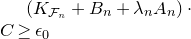 $(K_{\mathcal{F}_n}+B_n+\lambda_nA_n)\cdot C\geq\epsilon_0$
or
$(K_{\mathcal{F}_n}+B_n+\lambda_nA_n)\cdot C\geq\epsilon_0$
or $(K_{\mathcal{F}_n}+B_n+\lambda_nA_n)\cdot C=0$
. Since
$(K_{\mathcal{F}_n}+B_n+\lambda_nA_n)\cdot C=0$
. Since
 $$\lambda_n:=\inf\{t\geq 0\mid K_{\mathcal{F}_n}+B_n+tA_n\text{ is nef}/U\},$$
there exists a positive real number $\delta\in(0,({\epsilon_0}/{2\dim X+\epsilon_0}))$
and a
$\delta\in(0,({\epsilon_0}/{2\dim X+\epsilon_0}))$
and a $(K_{\mathcal{F}_n}+B_n+(1-\delta)\lambda_nA_n)$
-negative extremal ray
$(K_{\mathcal{F}_n}+B_n+(1-\delta)\lambda_nA_n)$
-negative extremal ray $/U$
R. If
$/U$
R. If $(K_{\mathcal{F}_n}+B_n+\lambda_nA_n)\cdot R\not=0$
, then R is spanned by a curve C such that
$(K_{\mathcal{F}_n}+B_n+\lambda_nA_n)\cdot R\not=0$
, then R is spanned by a curve C such that
 $$0\gt (K_{\mathcal{F}_n}+B_n)\cdot C\ge -2\dim X$$
and
 $$(K_{\mathcal{F}_n}+B_n+\lambda_nA_n)\cdot C\geq\epsilon_0,$$
so
 \begin{align*} &\bigg(K_{\mathcal{F}_n}+B_n+\lambda_n\frac{2\dim X}{2\dim X+\epsilon_0}A_n\bigg)\cdot C\\&\quad =\frac{\epsilon_0}{2\dim X+\epsilon_0}(K_{\mathcal{F}_n}+B_n)\cdot C+\frac{2\dim X}{2\dim X+\epsilon_0}(K_{\mathcal{F}_n}+B_n+\lambda_nA_n)\cdot C\\&\quad \geq \bigg(\frac{\epsilon_0}{2\dim X+\epsilon_0}\bigg)(-2\dim X)+\bigg(\frac{2\dim X}{2\dim X+\epsilon_0}\bigg)\epsilon_0=0,\end{align*}
which is not possible. Therefore, $(K_{\mathcal{F}_n}+B_n+\lambda_nA_n)\cdot R=0$
and we are done.
$(K_{\mathcal{F}_n}+B_n+\lambda_nA_n)\cdot R=0$
and we are done.
Proposition 8.2 Let $(X,\mathcal{F},B)/U$
be an lc algebraically integrable foliated triple. Let
$(X,\mathcal{F},B)/U$
be an lc algebraically integrable foliated triple. Let $\mathcal{P}:$
 $$(X_0,\mathcal{F}_0,B_0):=(X,\mathcal{F},B)\dashrightarrow (X_1,\mathcal{F}_1,B_1)\dashrightarrow\dots\dashrightarrow (X_n,\mathcal{F}_n,B_n)\dashrightarrow\dots$$
be a (possibly infinite) sequence of $(K_{\mathcal{F}}+B)$
-MMP
$(K_{\mathcal{F}}+B)$
-MMP $/U$
. For each
$/U$
. For each $i\geq 0$
, we let
$i\geq 0$
, we let $\psi_i: X_i\rightarrow T_i$
and
$\psi_i: X_i\rightarrow T_i$
and $\psi_i^+:X_{i+1}\rightarrow T_{i}$
be the
$\psi_i^+:X_{i+1}\rightarrow T_{i}$
be the $(i+1)$
th step of this MMP and let
$(i+1)$
th step of this MMP and let $\phi_i:=(\psi_{i}^+)^{-1}\circ\psi_i: X_i\dashrightarrow X_{i+1}$
be the induced birational map. Let
$\phi_i:=(\psi_{i}^+)^{-1}\circ\psi_i: X_i\dashrightarrow X_{i+1}$
be the induced birational map. Let $h: (Y,\mathcal{F}_Y,B_Y;G)/Z\rightarrow (X,\mathcal{F},B)$
be an ACSS modification of
$h: (Y,\mathcal{F}_Y,B_Y;G)/Z\rightarrow (X,\mathcal{F},B)$
be an ACSS modification of $(X,\mathcal{F},B)$
that is
$(X,\mathcal{F},B)$
that is $\mathbb{Q}$
-factorial, strict, and super. Let A be an ample
$\mathbb{Q}$
-factorial, strict, and super. Let A be an ample $/U$
$/U$ $\mathbb{R}$
-divisor on X and let
$\mathbb{R}$
-divisor on X and let $A_i$
be the image of A on
$A_i$
be the image of A on $X_i$
for each i.
$X_i$
for each i.
Then there exist a (possibly infinite) sequence $\mathcal{P}_Y$
of birational maps
$\mathcal{P}_Y$
of birational maps
 $$(Y_0,\mathcal{F}_{Y_0},B_{Y_0}):=(Y,\mathcal{F}_Y,B_Y)\dashrightarrow (Y_1,\mathcal{F}_{Y_1},B_{Y_1})\dashrightarrow\dots\dashrightarrow (Y_n,\mathcal{F}_{Y_n},B_{Y_n})\dashrightarrow\dots$$
satisfying the following. Let $\phi_{i,Y}: Y_i\dashrightarrow Y_{i+1}$
be the birational map in the
$\phi_{i,Y}: Y_i\dashrightarrow Y_{i+1}$
be the birational map in the $\mathcal{P}_Y$
above. Then we have the following.
$\mathcal{P}_Y$
above. Then we have the following.
-
(1) For any
$i\geq 0$
, there exists an ACSS modification
$h_i: (Y_i,\mathcal{F}_{Y_i},B_{Y_i};G_i)/Z\rightarrow (X_i,\mathcal{F}_i,B_i)$
that is
$\mathbb{Q}$
-factorial, strict, and super, such that
$h_0=h$
and
$G_i$
is the image of G on
$Y_i$
. -
(2) For any
$i\geq 0$
,
$h_{i+1}\circ\phi_{i,Y}=\phi_i\circ h_i$
. -
(3) For any
$i\geq 0$
,
$\phi_{i,Y}$
is a sequence of steps of
$(K_{\mathcal{F}_i}+B_{Y_i})$
-MMP
$/T_i$
and
$(Y_{i+1},\mathcal{F}_{Y_{i+1}},B_{Y_{i+1}})/T_i$
is the output of this MMP, such that
$\phi_{i,Y}$
is not the identity map. -
(4) The sequence
$\mathcal{P}_Y$
is a sequence of steps of a
$(K_{\mathcal{F}_Y}+B_Y)$
-MMP
$/U$
. -
(5) Assume that
$\mathcal{P}$
is a sequence of steps of MMP
$/U$
with scaling of A. Let
$A_{Y}:=h^*A$
and let
$A_{Y_i}$
the image of
$A_Y$
on
$Y_i$
for each i. Let be the
$$\lambda_i:=\inf\{t\geq 0\mid K_{\mathcal{F}_i}+B_i+tA_i\text{ is nef}/U\}$$
$(i+1)$
th scaling number. Then:-
(a)
$\phi_{i,Y}$
is a sequence of steps of a
$(K_{\mathcal{F}_{Y_i}}+B_{Y_i})$
-MMP
$/U$
with scaling of
$A_{Y_i}$
, and the scaling number of each step of
$\phi_{i,Y}$
is
$\lambda_i$
; -
(b)
$\mathcal{P}_Y$
is sequence of steps of a
$(K_{\mathcal{F}_Y}+B_Y)$
-MMP
$/U$
with scaling of
$A_Y$
.
-


Proof. Since condition (4) follows from condition (3) and condition (5)(b) follows from condition (5)(a), we only need to prove conditions (1)–(3) and (5)(a).
Let n be a non-negative integer. We prove the proposition by induction on n under the induction hypothesis that we have already constructed $(Y_i,\mathcal{F}_i,B_i;G_i)/U$
and
$(Y_i,\mathcal{F}_i,B_i;G_i)/U$
and $h_i$
for any
$h_i$
for any $i\leq n$
and
$i\leq n$
and $\phi_{i,Y}$
for any
$\phi_{i,Y}$
for any $i\leq n-1$
which satisfy conditions (1)–(3) and (5). When
$i\leq n-1$
which satisfy conditions (1)–(3) and (5). When $n=0$
, this follows from our assumption, so we may assume that
$n=0$
, this follows from our assumption, so we may assume that $n\gt 0$
. We need to construct
$n\gt 0$
. We need to construct $\phi_{n,Y},h_{n+1}$
, and
$\phi_{n,Y},h_{n+1}$
, and $(Y_{n+1},\mathcal{F}_{n+1},B_{n+1};G_{n+1})/U$
.
$(Y_{n+1},\mathcal{F}_{n+1},B_{n+1};G_{n+1})/U$
.
We let $H_n$
be a supporting function of the extremal ray
$H_n$
be a supporting function of the extremal ray $/U$
contracted by
$/U$
contracted by $\psi_n$
and let
$\psi_n$
and let
 $$L_n:=H_n-(K_{\mathcal{F}_n}+B_n),$$
such that $L_n=\lambda_nA_n$
if
$L_n=\lambda_nA_n$
if $\mathcal{P}$
is an MMP
$\mathcal{P}$
is an MMP $/U$
with scaling of A. Then
$/U$
with scaling of A. Then $L_n$
is ample
$L_n$
is ample $/T_n$
. Now we run a
$/T_n$
. Now we run a $(K_{\mathcal{F}_{Y_n}}+B_{Y_n})$
-MMP
$(K_{\mathcal{F}_{Y_n}}+B_{Y_n})$
-MMP $/T_n$
with scaling of
$/T_n$
with scaling of $h_n^*L_n$
, then this MMP is also a
$h_n^*L_n$
, then this MMP is also a $(K_{\mathcal{F}_{Y_n}}+B_{Y_n}+\frac{1}{2}h_n^*L_n)$
-MMP
$(K_{\mathcal{F}_{Y_n}}+B_{Y_n}+\frac{1}{2}h_n^*L_n)$
-MMP $/T_i$
with scaling of
$/T_i$
with scaling of $h_n^*L_n$
. By Theorem 5.6, we may choose such an MMP which terminates with a good minimal model
$h_n^*L_n$
. By Theorem 5.6, we may choose such an MMP which terminates with a good minimal model $(Y_{n+1},\mathcal{F}_{Y_{n+1}},B_{Y_{n+1}})/T_n$
of
$(Y_{n+1},\mathcal{F}_{Y_{n+1}},B_{Y_{n+1}})/T_n$
of $(Y_{n},\mathcal{F}_{Y_{n}},B_{Y_{n}})/T_n$
. Since
$(Y_{n},\mathcal{F}_{Y_{n}},B_{Y_{n}})/T_n$
. Since $X_{n+1}$
is the ample model
$X_{n+1}$
is the ample model $/T_n$
of
$/T_n$
of $K_{\mathcal{F}_n}+B_n$
,
$K_{\mathcal{F}_n}+B_n$
, $X_{n+1}$
is also the ample model
$X_{n+1}$
is also the ample model $/T_n$
of
$/T_n$
of $K_{\mathcal{F}_{Y_{n+1}}}+B_{Y_{n+1}}$
, so there exists an induced birational morphism
$K_{\mathcal{F}_{Y_{n+1}}}+B_{Y_{n+1}}$
, so there exists an induced birational morphism $h_{n+1}: Y_{n+1}\rightarrow X_{n+1}$
. Since
$h_{n+1}: Y_{n+1}\rightarrow X_{n+1}$
. Since $K_{Y_n}+B_{Y_n}$
is not nef
$K_{Y_n}+B_{Y_n}$
is not nef $/T_n$
and
$/T_n$
and $K_{Y_{n+1}}+B_{Y_{n+1}}$
is nef
$K_{Y_{n+1}}+B_{Y_{n+1}}$
is nef $/T_n$
,
$/T_n$
, $\phi_{i,Y}$
is not the identity map.
$\phi_{i,Y}$
is not the identity map.
Let $\phi_{n,Y}: Y_n\dashrightarrow Y_{n+1}$
be the induced birational map. Condition (1) for
$\phi_{n,Y}: Y_n\dashrightarrow Y_{n+1}$
be the induced birational map. Condition (1) for $n+1$
immediately follows by our construction and [Reference Chen, Han, Liu and XieCHLX23, Lemma 9.1.4]. Conditions (2) and (3) for
$n+1$
immediately follows by our construction and [Reference Chen, Han, Liu and XieCHLX23, Lemma 9.1.4]. Conditions (2) and (3) for $n+1$
follow immediately from our construction. Since
$n+1$
follow immediately from our construction. Since $H_n\sim_{\mathbb R,T_n}0$
,
$H_n\sim_{\mathbb R,T_n}0$
, $\phi_{n,Y}$
is
$\phi_{n,Y}$
is $(h_n^*H_n)$
-trivial, so condition (5)(a) for
$(h_n^*H_n)$
-trivial, so condition (5)(a) for $n+1$
immediately follows. Thus, conditions (1)–(3) and (5)(a) follow from induction on n and the proposition follows.
$n+1$
immediately follows. Thus, conditions (1)–(3) and (5)(a) follow from induction on n and the proposition follows.
9. Proof of the main theorems
Proof of Theorem 1.2. This follows from Proposition 7.1 and Theorem 7.2.
Proof of Theorem 1.3. By Proposition 7.1 and Theorem 7.2, we can run a step of a $(K_{\mathcal{F}}+B)$
-MMP
$(K_{\mathcal{F}}+B)$
-MMP $/U$
. By Theorem 7.2(2)(a), after a step of the MMP
$/U$
. By Theorem 7.2(2)(a), after a step of the MMP $\phi: X\dashrightarrow X'$
that is not a Mori fiber space,
$\phi: X\dashrightarrow X'$
that is not a Mori fiber space, $(X',\Delta':=\phi_*\Delta)$
is klt. Thus, we may continue this process.
$(X',\Delta':=\phi_*\Delta)$
is klt. Thus, we may continue this process.
Proof of Theorem 1.1. It is a special case of Theorems 1.2 and 1.3.
Theorem 9.1. Let $(X,\mathcal{F},B)/U$
be an lc algebraically integrable foliated triple such that
$(X,\mathcal{F},B)/U$
be an lc algebraically integrable foliated triple such that $(X,\Delta)$
is klt for some
$(X,\Delta)$
is klt for some $B\geq\Delta\geq 0$
. Let A be an ample
$B\geq\Delta\geq 0$
. Let A be an ample $/U$
$/U$ $\mathbb{R}$
-divisor on X. Then we may run a
$\mathbb{R}$
-divisor on X. Then we may run a $(K_{\mathcal{F}}+B)$
-MMP
$(K_{\mathcal{F}}+B)$
-MMP $/U$
with scaling of A.
$/U$
with scaling of A.
Proof of Theorem 1.4. By Theorem 9.1, we can run a $(K_{\mathcal{F}}+B)$
-MMP
$(K_{\mathcal{F}}+B)$
-MMP $/U$
with scaling of any ample
$/U$
with scaling of any ample $/U$
$/U$ $\mathbb{R}$
-divisor A. Let
$\mathbb{R}$
-divisor A. Let $\epsilon$
be a positive real number such that
$\epsilon$
be a positive real number such that $(K_{\mathcal{F}}+B+\epsilon A)$
is not pseudo-effective
$(K_{\mathcal{F}}+B+\epsilon A)$
is not pseudo-effective $/U$
.
$/U$
.
Let $h: (X',\mathcal{F}',B';G)/Z\rightarrow (X,\mathcal{F},B)$
be an ACSS modification of
$h: (X',\mathcal{F}',B';G)/Z\rightarrow (X,\mathcal{F},B)$
be an ACSS modification of $(X,\mathcal{F},B)$
that is
$(X,\mathcal{F},B)$
that is $\mathbb{Q}$
-factorial, strict, and super. By Proposition 8.2, any infinite sequence of steps of a
$\mathbb{Q}$
-factorial, strict, and super. By Proposition 8.2, any infinite sequence of steps of a $(K_{\mathcal{F}}+B+\epsilon A)$
-MMP
$(K_{\mathcal{F}}+B+\epsilon A)$
-MMP $/U$
with scaling of A induces an infinite sequence of steps of a
$/U$
with scaling of A induces an infinite sequence of steps of a $(K_{\mathcal{F}'}+B'+\epsilon h^*A)$
-MMP
$(K_{\mathcal{F}'}+B'+\epsilon h^*A)$
-MMP $/U$
with scaling of
$/U$
with scaling of $h^*A$
. By Theorem 5.6, any
$h^*A$
. By Theorem 5.6, any $(K_{\mathcal{F}'}+B'+\epsilon h^*A)$
-MMP
$(K_{\mathcal{F}'}+B'+\epsilon h^*A)$
-MMP $/U$
with scaling of
$/U$
with scaling of $h^*A$
terminates with a Mori fiber space
$h^*A$
terminates with a Mori fiber space $/U$
. Thus any
$/U$
. Thus any $(K_{\mathcal{F}}+B+\epsilon A)$
-MMP
$(K_{\mathcal{F}}+B+\epsilon A)$
-MMP $/U$
with scaling of A terminates with a Mori fiber space
$/U$
with scaling of A terminates with a Mori fiber space $/U$
, and the theorem follows.
$/U$
, and the theorem follows.
Proof of Theorem 1.5(1). By the generalized pair version of Theorem 9.1,Footnote
12
we can run a $(K_{\mathcal{F}}+B+A)$
-MMP
$(K_{\mathcal{F}}+B+A)$
-MMP $/U$
with scaling of any ample
$/U$
with scaling of any ample $/U$
$/U$ $\mathbb{R}$
-divisor H. Let
$\mathbb{R}$
-divisor H. Let $h: (X',\mathcal{F}',B';G)/Z\rightarrow (X,\mathcal{F},B)$
be an ACSS modification of
$h: (X',\mathcal{F}',B';G)/Z\rightarrow (X,\mathcal{F},B)$
be an ACSS modification of $(X,\mathcal{F},B)$
that is
$(X,\mathcal{F},B)$
that is $\mathbb{Q}$
-factorial, strict, and super. By Proposition 8.2, any infinite sequence of steps of a
$\mathbb{Q}$
-factorial, strict, and super. By Proposition 8.2, any infinite sequence of steps of a $(K_{\mathcal{F}}+B+A)$
-MMP
$(K_{\mathcal{F}}+B+A)$
-MMP $/U$
with scaling of H induces an infinite sequence of steps of a
$/U$
with scaling of H induces an infinite sequence of steps of a $(K_{\mathcal{F}'}+B'+h^*A)$
-MMP
$(K_{\mathcal{F}'}+B'+h^*A)$
-MMP $/U$
with scaling of
$/U$
with scaling of $h^*H$
. By Theorem 5.6, any
$h^*H$
. By Theorem 5.6, any $(K_{\mathcal{F}'}+B'+h^*A)$
-MMP
$(K_{\mathcal{F}'}+B'+h^*A)$
-MMP $/U$
with scaling of
$/U$
with scaling of $h^*H$
terminates with a minimal model
$h^*H$
terminates with a minimal model $/U$
. Thus any
$/U$
. Thus any $(K_{\mathcal{F}}+B+A)$
-MMP
$(K_{\mathcal{F}}+B+A)$
-MMP $/U$
with scaling of H terminates with a minimal model of
$/U$
with scaling of H terminates with a minimal model of $(X,\mathcal{F},B+A)/U$
, and the theorem follows.
$(X,\mathcal{F},B+A)/U$
, and the theorem follows.
Proof of Theorem 1.6. Let $H:=K_{\mathcal{F}}+B+A$
. By Lemma 2.29, H is NQC
$H:=K_{\mathcal{F}}+B+A$
. By Lemma 2.29, H is NQC $/U$
. Thus, we have
$/U$
. Thus, we have $H=\sum a_iH_i$
for some nef
$H=\sum a_iH_i$
for some nef $/U$
Cartier divisors
$/U$
Cartier divisors $H_i$
on X and
$H_i$
on X and $a_i\gt 0$
for each i. Let
$a_i\gt 0$
for each i. Let $\epsilon_0:=\min\{a_i\}$
and let
$\epsilon_0:=\min\{a_i\}$
and let $l\gt ({2\dim X})/{\epsilon_0}$
be an integer.
$l\gt ({2\dim X})/{\epsilon_0}$
be an integer.
Let $0\lt e\ll 1$
be a real number such that
$0\lt e\ll 1$
be a real number such that
 $$\widehat{A}:=A+e(K_{\mathcal{F}}+B)-e(K_X+\Delta)$$
is ample $/U$
. Let
$/U$
. Let $K:=(1-e)(K_{\mathcal{F}}+B)+e(K_X+\Delta)$
, then
$K:=(1-e)(K_{\mathcal{F}}+B)+e(K_X+\Delta)$
, then $H=K+\widehat{A}$
.
$H=K+\widehat{A}$
.
Claim 9.2 We claim $K_{\mathcal{F}}+B+\widehat{A}$
is pseudo-effective
$K_{\mathcal{F}}+B+\widehat{A}$
is pseudo-effective $/U$
.
$/U$
.
Assume Claim 9.2, then $K_{\mathcal{F}}+B+\widehat{A}+lH$
is also pseudo-effective
$K_{\mathcal{F}}+B+\widehat{A}+lH$
is also pseudo-effective $/U$
. By Theorem A.7 and Lemma B.6, there exists a positive integer
$/U$
. By Theorem A.7 and Lemma B.6, there exists a positive integer $l\gg 0$
which does not depend on e, such that we may run a
$l\gg 0$
which does not depend on e, such that we may run a $(K_{\mathcal{F}}+B+\widehat{A}+lH)$
-MMP
$(K_{\mathcal{F}}+B+\widehat{A}+lH)$
-MMP $/U$
, each step of this MMP is H-trivial, and the MMP terminates with a minimal model
$/U$
, each step of this MMP is H-trivial, and the MMP terminates with a minimal model $/U$
. Let Y be the output of this MMP and let
$/U$
. Let Y be the output of this MMP and let $B_Y,\Delta_Y,H_Y,A_Y$
be the images of
$B_Y,\Delta_Y,H_Y,A_Y$
be the images of $B,\Delta,H,A$
on Y, respectively. Let
$B,\Delta,H,A$
on Y, respectively. Let ${\textbf{A}}:=\overline{\widehat{A}}$
. By Theorem A.4,
${\textbf{A}}:=\overline{\widehat{A}}$
. By Theorem A.4, $(Y,\Delta_Y,{\textbf{A}})$
is klt. Since
$(Y,\Delta_Y,{\textbf{A}})$
is klt. Since
 $$(l+1-el)H=K+\widehat{A}+(l-el)H=(1-e)(K_{\mathcal{F}}+B+\widehat{A}+lH)+e(K_X+\Delta+\widehat{A}),$$
we have
 $$K_Y+\Delta_Y+{\textbf{A}}_Y+\frac{1-e}{e}(K_{\mathcal{F}_Y}+B_Y+{\textbf{A}}_Y+lH_Y)=\frac{l+1-el}{e}H_Y$$
is nef $/U$
. Let
$/U$
. Let
 $${\textbf{P}}:={\textbf{A}}+\overline{\frac{1-e}{e}(K_{\mathcal{F}_Y}+B_Y+{\textbf{A}}_Y+lH_Y)},$$
then $(Y,\Delta_Y,{\textbf{P}})/U$
is klt. Since
$(Y,\Delta_Y,{\textbf{P}})/U$
is klt. Since $\widehat{A}$
is ample
$\widehat{A}$
is ample $/U$
,
$/U$
, ${\textbf{A}}_Y$
is big
${\textbf{A}}_Y$
is big $/U$
. By [Reference Birkar and ZhangBZ16, Lemma 4.4(2)],
$/U$
. By [Reference Birkar and ZhangBZ16, Lemma 4.4(2)], $(Y,\Delta_Y,{\textbf{P}})/U$
is a good minimal model of itself, so
$(Y,\Delta_Y,{\textbf{P}})/U$
is a good minimal model of itself, so $K_Y+\Delta_Y+{\textbf{P}}_Y$
is semi-ample
$K_Y+\Delta_Y+{\textbf{P}}_Y$
is semi-ample $/U$
. Thus,
$/U$
. Thus, $H_Y$
is semi-ample
$H_Y$
is semi-ample $/U$
. Since
$/U$
. Since $X\dashrightarrow Y$
is H-trivial, H is semi-ample
$X\dashrightarrow Y$
is H-trivial, H is semi-ample $/U$
. Moreover, if H is Cartier, then
$/U$
. Moreover, if H is Cartier, then $H_Y$
is Cartier. By Lemma A.43,
$H_Y$
is Cartier. By Lemma A.43, $\mathcal{O}_Y(nH_Y)$
is globally generated
$\mathcal{O}_Y(nH_Y)$
is globally generated $/U$
for any integer
$/U$
for any integer $n\gg 0$
, and so
$n\gg 0$
, and so $\mathcal{O}_X(nH)$
is globally generated
$\mathcal{O}_X(nH)$
is globally generated $/U$
for any integer
$/U$
for any integer $n\gg 0$
.
$n\gg 0$
.
Finally we give the proof of Claim 9.2.
Proof of Claim 9.2. Let $h: (X',\mathcal{F}',B';G)/Z\rightarrow (X,\mathcal{F},B)$
be an ACSS modification that is
$h: (X',\mathcal{F}',B';G)/Z\rightarrow (X,\mathcal{F},B)$
be an ACSS modification that is $\mathbb{Q}$
-factorial, strict, and super. Suppose
$\mathbb{Q}$
-factorial, strict, and super. Suppose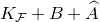 $K_{\mathcal{F}}+B+\widehat A$
is not pseudo-effective
$K_{\mathcal{F}}+B+\widehat A$
is not pseudo-effective $/U$
, then
$/U$
, then $K_{\mathcal{F}'}+B'+{\textbf{A}}_{X'}$
is also not pseudo-effective
$K_{\mathcal{F}'}+B'+{\textbf{A}}_{X'}$
is also not pseudo-effective $/U$
. By [Reference Chen, Han, Liu and XieCHLX23, Proposition 9.3.2], we may run a
$/U$
. By [Reference Chen, Han, Liu and XieCHLX23, Proposition 9.3.2], we may run a $(K_{\mathcal{F}'}+B'+{\textbf{A}}_{X'})$
-MMP
$(K_{\mathcal{F}'}+B'+{\textbf{A}}_{X'})$
-MMP $/U$
which terminates with a Mori fiber space
$/U$
which terminates with a Mori fiber space $/U$
, and this MMP is also an MMP
$/U$
, and this MMP is also an MMP $/Z$
. Since
$/Z$
. Since
 $$K_{X'}+B'+G+{\textbf{A}}_{X'}\sim_{\mathbb R,Z}K_{\mathcal{F}'}+B'+{\textbf{A}}_{X'},$$
we have
 $$(1-e)K_{\mathcal{F}'}+eK_{X'}+B'+eG+{\textbf{A}}_{X'}\sim_{\mathbb R,Z}K_{\mathcal{F}'}+B'+{\textbf{A}}_{X'},$$
so this MMP is also a $((1-e)K_{\mathcal{F}'}+eK_{X'}+B'+eG+{\textbf{A}}_{X'})$
-MMP
$((1-e)K_{\mathcal{F}'}+eK_{X'}+B'+eG+{\textbf{A}}_{X'})$
-MMP $/U$
. In particular,
$/U$
. In particular, $(1-e)(K_{\mathcal{F}'}+B'+{\textbf{A}}_{X'})+e(K_{X'}+B'+G+{\textbf{A}}_{X'})$
is not pseudo-effective
$(1-e)(K_{\mathcal{F}'}+B'+{\textbf{A}}_{X'})+e(K_{X'}+B'+G+{\textbf{A}}_{X'})$
is not pseudo-effective $/U$
.
$/U$
.
Since $(X,\Delta)$
is klt and
$(X,\Delta)$
is klt and $B\ge\Delta$
, from the definition of ACSS modification we see that
$B\ge\Delta$
, from the definition of ACSS modification we see that
 $$K_{X'}+B'+G\ge K_{X'}+\Delta'=h^*(K_X+\Delta),$$
hence $(1-e)(K_{\mathcal{F}'}+B'+{\textbf{A}}_{X'})+e(K_{X'}+\Delta'+{\textbf{A}}_{X'})$
is not pseudo-effective
$(1-e)(K_{\mathcal{F}'}+B'+{\textbf{A}}_{X'})+e(K_{X'}+\Delta'+{\textbf{A}}_{X'})$
is not pseudo-effective $/U$
either. However, this is not possible as
$/U$
either. However, this is not possible as
 \begin{align*}(1-e)(K_{\mathcal{F}'}+B'+{\textbf{A}}_{X'})+e(K_{X'}+\Delta'+{\textbf{A}}_{X'})=h^*(K_{\mathcal{F}}+B+A)=h^*H.\\[-33pt] \end{align*}
This concludes the proof of Theorem 1.6.
Proof of Theorem 1.5(2). By Theorem 1.5(1) we can run a $(K_\mathcal{F}+B+A)$
-MMP
$(K_\mathcal{F}+B+A)$
-MMP $/U$
and it terminate with a minimal model
$/U$
and it terminate with a minimal model $\phi:X\dashrightarrow X'$
. In particular the corresponding birational transform
$\phi:X\dashrightarrow X'$
. In particular the corresponding birational transform $K_{\mathcal{F}'}+B'+A'$
is nef
$K_{\mathcal{F}'}+B'+A'$
is nef $/U$
. Note that
$/U$
. Note that $(X',\Delta':=\phi_*\Delta)$
is klt by Theorem A.4. By [Reference Chen, Han, Liu and XieCHLX23, Lemma 16.1.1], there exists a nef
$(X',\Delta':=\phi_*\Delta)$
is klt by Theorem A.4. By [Reference Chen, Han, Liu and XieCHLX23, Lemma 16.1.1], there exists a nef $/U$
b-divisor
$/U$
b-divisor ${\textbf{N}}$
and an ample
${\textbf{N}}$
and an ample $/U$
$/U$ $\mathbb{R}$
-divisor
$\mathbb{R}$
-divisor $\tilde A'$
such that:
$\tilde A'$
such that:
-
(1)
$(X',\mathcal{F}',B',{\textbf{N}})$
is lc; and -
(2)
$A'\sim_{\mathbb{R},U}\tilde A'+{\textbf{N}}_{X'}.$


Then it suffices to show $K_{\mathcal{F}'}+B'+{\textbf{N}}_{X'}+\tilde A'$
is semi-ample
$K_{\mathcal{F}'}+B'+{\textbf{N}}_{X'}+\tilde A'$
is semi-ample $/U$
, which follows from Theorem A.8.
$/U$
, which follows from Theorem A.8.
Proof of Theorem 1.7. This is an immediate consequence of Theorem 1.5(2).
Proof of Theorem 1.8. By Theorem 9.1, we can run a $(K_{\mathcal{F}}+B)$
-MMP with scaling of any ample
$(K_{\mathcal{F}}+B)$
-MMP with scaling of any ample $\mathbb{R}$
-divisor A. Let
$\mathbb{R}$
-divisor A. Let $h: (X',\mathcal{F}',B';G)/Z\rightarrow (X,\mathcal{F},B)$
be an ACSS modification of
$h: (X',\mathcal{F}',B';G)/Z\rightarrow (X,\mathcal{F},B)$
be an ACSS modification of $(X,\mathcal{F},B)$
that is
$(X,\mathcal{F},B)$
that is $\mathbb{Q}$
-factorial, strict, and super. By Proposition 8.2, any infinite sequence of steps of a
$\mathbb{Q}$
-factorial, strict, and super. By Proposition 8.2, any infinite sequence of steps of a $(K_{\mathcal{F}}+B)$
-MMP with scaling of A induces an infinite sequence of steps of a
$(K_{\mathcal{F}}+B)$
-MMP with scaling of A induces an infinite sequence of steps of a $(K_{\mathcal{F}'}+B')$
-MMP with scaling of
$(K_{\mathcal{F}'}+B')$
-MMP with scaling of $h^*A$
.
$h^*A$
.
Suppose that this MMP does not terminate. Let $\lambda_i$
be the scaling numbers of this MMP and let
$\lambda_i$
be the scaling numbers of this MMP and let $\lambda:=\lim_{i\rightarrow+\infty}\lambda_i$
. If
$\lambda:=\lim_{i\rightarrow+\infty}\lambda_i$
. If $\lambda\gt 0$
, then we have an infinite sequence of steps of a
$\lambda\gt 0$
, then we have an infinite sequence of steps of a $(K_{\mathcal{F}'}+B'+\lambda A')$
-MMP with scaling of
$(K_{\mathcal{F}'}+B'+\lambda A')$
-MMP with scaling of $h^*A$
, which contradicts Theorem 5.6. Therefore,
$h^*A$
, which contradicts Theorem 5.6. Therefore, $\lambda=0$
. Let
$\lambda=0$
. Let
 $$(X_0,\mathcal{F}_0,B_0):=(X',\mathcal{F}',B')\dashrightarrow (X_1,\mathcal{F}_1,B_1)\dashrightarrow\dots\dashrightarrow (X_n,\mathcal{F}_n,B_n)\dashrightarrow\dots$$
be this MMP and let $A_i$
be the image of
$A_i$
be the image of $h^*A$
on
$h^*A$
on $X_i$
for each i. Then there exists
$X_i$
for each i. Then there exists $n\gt 0$
such that the induced birational map
$n\gt 0$
such that the induced birational map $\phi_i: X_n\dashrightarrow X_i$
is small for any
$\phi_i: X_n\dashrightarrow X_i$
is small for any $i\geq n$
. Therefore,
$i\geq n$
. Therefore,
 $$K_{\mathcal{F}_n}+B_n=\lim_{i\rightarrow+\infty}(\phi_i^{-1})_*(K_{\mathcal{F}_i}+B_i+\lambda_i A_i)$$
is movable. Since $\kappa_{\sigma}(K_{\mathcal{F}}+B)=0$
,
$\kappa_{\sigma}(K_{\mathcal{F}}+B)=0$
, $\kappa_{\sigma}(K_{\mathcal{F}_n}+B_n)=0$
. By [Reference Chen, Han, Liu and XieCHLX23, Lemma 4.2.4],
$\kappa_{\sigma}(K_{\mathcal{F}_n}+B_n)=0$
. By [Reference Chen, Han, Liu and XieCHLX23, Lemma 4.2.4], $K_{\mathcal{F}_n}+B_n\equiv 0$
, a contradiction. Therefore, any
$K_{\mathcal{F}_n}+B_n\equiv 0$
, a contradiction. Therefore, any $(K_{\mathcal{F}}+B)$
-MMP with scaling of A terminates with a minimal model
$(K_{\mathcal{F}}+B)$
-MMP with scaling of A terminates with a minimal model $(X_{\rm min},\mathcal{F}_{\rm min},B_{\rm min})$
of
$(X_{\rm min},\mathcal{F}_{\rm min},B_{\rm min})$
of $(X,\mathcal{F},B)$
such that
$(X,\mathcal{F},B)$
such that $K_{\mathcal{F}_{\rm min}}+B_{\rm min}\equiv 0$
. By [Reference Das, Liu and MascharakDLM23, Theorem 1.4],
$K_{\mathcal{F}_{\rm min}}+B_{\rm min}\equiv 0$
. By [Reference Das, Liu and MascharakDLM23, Theorem 1.4], $K_{\mathcal{F}_{\rm min}}+B_{\rm min}\sim_{\mathbb R}0$
.
$K_{\mathcal{F}_{\rm min}}+B_{\rm min}\sim_{\mathbb R}0$
.
Proof of Theorem 1.9(1). Let $\epsilon$
be a positive real number such that
$\epsilon$
be a positive real number such that $H:=-K_{\mathcal{F}}+\epsilon D$
is ample. Then any D-MMP is a
$H:=-K_{\mathcal{F}}+\epsilon D$
is ample. Then any D-MMP is a $(K_{\mathcal{F}}+H)$
-MMP. Since
$(K_{\mathcal{F}}+H)$
-MMP. Since $(X,\mathcal{F},0,\bar H)$
is an lc generalized foliated quadruple and X is klt, by the generalized pair version of Theorems 1.4 and 1.5 (see Theorems A.6 and A.7), we may run a
$(X,\mathcal{F},0,\bar H)$
is an lc generalized foliated quadruple and X is klt, by the generalized pair version of Theorems 1.4 and 1.5 (see Theorems A.6 and A.7), we may run a $(K_{\mathcal{F}}+H)$
-MMP with scaling of an ample divisor which terminates with either a good minimal model or a Mori fiber space.
$(K_{\mathcal{F}}+H)$
-MMP with scaling of an ample divisor which terminates with either a good minimal model or a Mori fiber space.
Lemma 9.3 Let $(X,\mathcal{F},B)/U$
be an lc algebraically integrable foliated triple such that
$(X,\mathcal{F},B)/U$
be an lc algebraically integrable foliated triple such that $(X,\Delta)$
is klt for some
$(X,\Delta)$
is klt for some $B\geq\Delta\geq 0$
. Assume that
$B\geq\Delta\geq 0$
. Assume that $-(K_{\mathcal{F}}+B)$
is ample
$-(K_{\mathcal{F}}+B)$
is ample $/U$
and
$/U$
and $L_1,\ldots,L_m$
be Cartier divisors on X. Let
$L_1,\ldots,L_m$
be Cartier divisors on X. Let $\mathcal{E}:=\bigoplus_{i=1}^m\mathcal{O}_X(L_i)$
and
$\mathcal{E}:=\bigoplus_{i=1}^m\mathcal{O}_X(L_i)$
and $\pi: Y=\mathbb{P}_X(\mathcal{E})\to X$
be the corresponding projective bundle. Then
$\pi: Y=\mathbb{P}_X(\mathcal{E})\to X$
be the corresponding projective bundle. Then $(Y,\pi^*\Delta)$
is klt and there exists
$(Y,\pi^*\Delta)$
is klt and there exists $B_Y\ge \pi^*\Delta$
such that:
$B_Y\ge \pi^*\Delta$
such that:
-
(1)
$(Y,\pi^{-1}\mathcal{F},B_Y)$
is lc; -
(2)
$-(K_{\pi^{-1}\mathcal{F}}+B_Y)$
is ample
$/U$
.



Proof. We have that $(Y,\pi^*\Delta)$
is klt by the smoothness of
$(Y,\pi^*\Delta)$
is klt by the smoothness of $\pi$
. Let T be the union of the sections of
$\pi$
. Let T be the union of the sections of $\pi$
corresponding to
$\pi$
corresponding to $\mathcal{E}\twoheadrightarrow L_i, 1\le i\le m$
. We will show
$\mathcal{E}\twoheadrightarrow L_i, 1\le i\le m$
. We will show $B_Y:=(1-\epsilon)T+\pi^{*}B$
satisfies our requirements for any
$B_Y:=(1-\epsilon)T+\pi^{*}B$
satisfies our requirements for any $0\lt \epsilon\ll1$
.
$0\lt \epsilon\ll1$
.
By taking a foliated log resolution of $(X,\mathcal{F},B)$
and considering the base change of
$(X,\mathcal{F},B)$
and considering the base change of $\pi$
, we can easily see by definition that
$\pi$
, we can easily see by definition that $(Y,\pi^{-1}\mathcal{F},T+\pi^{*}B)$
is lc if and only if
$(Y,\pi^{-1}\mathcal{F},T+\pi^{*}B)$
is lc if and only if $(X,\mathcal{F},B)$
is lc. Hence,
$(X,\mathcal{F},B)$
is lc. Hence, $(Y,\pi^{-1}\mathcal{F},B_Y)$
is lc as well.
$(Y,\pi^{-1}\mathcal{F},B_Y)$
is lc as well.
Since $K_{\pi^{-1}\mathcal{F}}+T=\pi^*K_\mathcal{F}$
and T is
$K_{\pi^{-1}\mathcal{F}}+T=\pi^*K_\mathcal{F}$
and T is $\pi$
-ample, we have
$\pi$
-ample, we have
 \begin{align*} -(K_{\pi^{-1}\mathcal{F}}+B_Y)\sim_{\mathbb{R},U}-\pi^*(K_\mathcal{F}+B)+\epsilon T \end{align*}
is ample $/U$
for any
$/U$
for any $0\lt \epsilon\ll1$
.
$0\lt \epsilon\ll1$
.
Proof of Theorem 1.9(2). By Theorem 1.6 we have $\mathrm{Pic}(X)_\mathbb{Q}\simeq N^1(X)_\mathbb{Q}$
. Choose a basis
$\mathrm{Pic}(X)_\mathbb{Q}\simeq N^1(X)_\mathbb{Q}$
. Choose a basis $L_1,\ldots,L_m$
of
$L_1,\ldots,L_m$
of $\mathrm{Pic}(X)_\mathbb{Q}$
such that each
$\mathrm{Pic}(X)_\mathbb{Q}$
such that each $L_i$
is a Cartier divisor on X and the convex hull of
$L_i$
is a Cartier divisor on X and the convex hull of $L_1,\ldots,L_m$
in
$L_1,\ldots,L_m$
in $N^1(X)_\mathbb{R}$
contains the effective cone Eff(X). Let
$N^1(X)_\mathbb{R}$
contains the effective cone Eff(X). Let $Y:=\mathbb{P}_X(\bigoplus_{i=1}^m\mathcal{O}_X(L_i))$
and H be the Cartier divisor which corresponds to the tautological line bundle
$Y:=\mathbb{P}_X(\bigoplus_{i=1}^m\mathcal{O}_X(L_i))$
and H be the Cartier divisor which corresponds to the tautological line bundle $\mathcal{O}_Y(1)$
. Note that H is a big Cartier divisor on Y. It is easy to check that the Cox ring of X is finitely generated if and only if the section ring R(Y, H) is finitely generated. By Lemma 9.3, there is a boundary divisor
$\mathcal{O}_Y(1)$
. Note that H is a big Cartier divisor on Y. It is easy to check that the Cox ring of X is finitely generated if and only if the section ring R(Y, H) is finitely generated. By Lemma 9.3, there is a boundary divisor $B_Y$
on Y such that
$B_Y$
on Y such that $(Y,\pi^{-1}\mathcal{F},B_Y)$
is lc and
$(Y,\pi^{-1}\mathcal{F},B_Y)$
is lc and $-(K_{\pi^{-1}\mathcal{F}}+B_Y)$
is ample. We can choose an ample divisor A on Y such that
$-(K_{\pi^{-1}\mathcal{F}}+B_Y)$
is ample. We can choose an ample divisor A on Y such that $K_{\pi^{-1}\mathcal{F}}+B_Y+A\sim_\mathbb{Q}\delta H$
for a sufficiently small rational number
$K_{\pi^{-1}\mathcal{F}}+B_Y+A\sim_\mathbb{Q}\delta H$
for a sufficiently small rational number $\delta\gt 0$
. By Theorem 1.7,
$\delta\gt 0$
. By Theorem 1.7, $R(Y,\delta H)$
is finitely generated, and so is R(Y,H). Therefore, the Cox ring of X is also finitely generated and, hence, X is a Mori dream space.
$R(Y,\delta H)$
is finitely generated, and so is R(Y,H). Therefore, the Cox ring of X is also finitely generated and, hence, X is a Mori dream space.
Proof of Theorem 1.10. Let $h: (X',\mathcal{F}',B';G)/Z\rightarrow (X,\mathcal{F},B)$
be an ACSS model of
$h: (X',\mathcal{F}',B';G)/Z\rightarrow (X,\mathcal{F},B)$
be an ACSS model of $(X,\mathcal{F},B)$
that is
$(X,\mathcal{F},B)$
that is $\mathbb{Q}$
-factorial, strict, and super. Let
$\mathbb{Q}$
-factorial, strict, and super. Let $A':=h^*A$
. Let H be an ample
$A':=h^*A$
. Let H be an ample $\mathbb{R}$
-divisor on X and let
$\mathbb{R}$
-divisor on X and let $H':=h^*H$
. By Theorem 5.6, we may run a
$H':=h^*H$
. By Theorem 5.6, we may run a $(K_{\mathcal{F}'}+B'+A')$
-MMP
$(K_{\mathcal{F}'}+B'+A')$
-MMP $/U$
$/U$ $\phi': X'\dashrightarrow X''$
which terminates with either a minimal model
$\phi': X'\dashrightarrow X''$
which terminates with either a minimal model $(X'',\mathcal{F}'',B''+A'')/U$
or a Mori fiber space
$(X'',\mathcal{F}'',B''+A'')/U$
or a Mori fiber space $(X'',\mathcal{F}'',B''+A'')\rightarrow T$
of
$(X'',\mathcal{F}'',B''+A'')\rightarrow T$
of $(X',\mathcal{F}',B'+A')/U$
, where B” and A” are the images of B’ and A’ on X” respectively. Let
$(X',\mathcal{F}',B'+A')/U$
, where B” and A” are the images of B’ and A’ on X” respectively. Let $\phi: X\dashrightarrow X''$
be the induced birational map.
$\phi: X\dashrightarrow X''$
be the induced birational map.
For any prime divisor D that is extracted by $\phi^{-1}$
, D is also extracted by h, so
$\phi^{-1}$
, D is also extracted by h, so
 $$-\operatorname{mult}_D(B''+A'')=a(D,\mathcal{F},B+A)\leq a(D,\mathcal{F},B)=-\epsilon_{\mathcal{F}}(D).$$
Therefore, $(X'',\mathcal{F}'',B''+A'')$
is a log birational model of
$(X'',\mathcal{F}'',B''+A'')$
is a log birational model of $(X,\mathcal{F},B)$
. For any prime divisor D on X that is exceptional
$(X,\mathcal{F},B)$
. For any prime divisor D on X that is exceptional $/X''$
, D is also a prime divisor on X’ that is exceptional
$/X''$
, D is also a prime divisor on X’ that is exceptional $/X''$
, so
$/X''$
, so
 $$a(D,\mathcal{F},B+A)=a(D,\mathcal{F}',B'+A')<a(D,\mathcal{F}'',B''+A'').$$
Thus, either $(X'',\mathcal{F}'',B''+A'')/U$
is a bs-minimal model of
$(X'',\mathcal{F}'',B''+A'')/U$
is a bs-minimal model of $(X,\mathcal{F},B+A)/U$
, or
$(X,\mathcal{F},B+A)/U$
, or $(X'',\mathcal{F}'',B''+A'')\rightarrow T$
is a bs-Mori fiber space of
$(X'',\mathcal{F}'',B''+A'')\rightarrow T$
is a bs-Mori fiber space of $(X,\mathcal{F},B+A)/U$
. In particular,
$(X,\mathcal{F},B+A)/U$
. In particular, $(X,\mathcal{F},B+A)/U$
has a bs-minimal model or a bs-Mori fiber space.
$(X,\mathcal{F},B+A)/U$
has a bs-minimal model or a bs-Mori fiber space.
Proof of Theorem 1.11. There exists an ACSS modification $h: (X',\mathcal{F}',B';G)/Z\rightarrow (X,\mathcal{F},B)$
that is
$h: (X',\mathcal{F}',B';G)/Z\rightarrow (X,\mathcal{F},B)$
that is $\mathbb{Q}$
-factorial, strict, and super, and
$\mathbb{Q}$
-factorial, strict, and super, and $(X',B'+G)/U$
has a log minimal model if
$(X',B'+G)/U$
has a log minimal model if $(X,\mathcal{F},B)/U$
has a bs-minimal model by Proposition 4.21. Let
$(X,\mathcal{F},B)/U$
has a bs-minimal model by Proposition 4.21. Let $f: X'\rightarrow Z$
be the associated contraction and let
$f: X'\rightarrow Z$
be the associated contraction and let $A':=h^*A$
. By Proposition 8.2, any infinite sequence of
$A':=h^*A$
. By Proposition 8.2, any infinite sequence of $(K_{\mathcal{F}}+B)$
-MMP
$(K_{\mathcal{F}}+B)$
-MMP $/U$
with scaling of A induces an infinite sequence of
$/U$
with scaling of A induces an infinite sequence of $(K_{\mathcal{F}'}+B')$
-MMP
$(K_{\mathcal{F}'}+B')$
-MMP $/U$
with scaling of A’.
$/U$
with scaling of A’.
First we prove condition (1). Suppose that the MMP does not terminate. We let $\lambda_i$
be the scaling numbers of the
$\lambda_i$
be the scaling numbers of the $(K_{\mathcal{F}}+B)$
-MMP
$(K_{\mathcal{F}}+B)$
-MMP $/U$
with scaling of A and let
$/U$
with scaling of A and let $\lambda:=\lim_{i\rightarrow+\infty}\lambda_i$
. By Lemma 4.17, any
$\lambda:=\lim_{i\rightarrow+\infty}\lambda_i$
. By Lemma 4.17, any $(K_{\mathcal{F}'}+B')$
-MMP
$(K_{\mathcal{F}'}+B')$
-MMP $/U$
with scaling of A’ is also a
$/U$
with scaling of A’ is also a $(K_{X'}+B'+G)$
-MMP
$(K_{X'}+B'+G)$
-MMP $/U$
with A’, and
$/U$
with A’, and $\lambda$
is also the limit of the scaling numbers of the
$\lambda$
is also the limit of the scaling numbers of the $(K_{X'}+B'+G)$
-MMP
$(K_{X'}+B'+G)$
-MMP $/U$
with A’. By Theorem 5.6, we have
$/U$
with A’. By Theorem 5.6, we have $\lambda=0$
. In particular,
$\lambda=0$
. In particular, $\lambda\not=\lambda_i$
for any i and
$\lambda\not=\lambda_i$
for any i and $K_{\mathcal{F}}+B$
is pseudo-effective
$K_{\mathcal{F}}+B$
is pseudo-effective $/U$
. Thus
$/U$
. Thus $(X,\mathcal{F},B)/U$
has a bs-minimal model, so
$(X,\mathcal{F},B)/U$
has a bs-minimal model, so $(X',B'+G)/U$
has a log minimal model. This contradicts Theorem 5.2.
$(X',B'+G)/U$
has a log minimal model. This contradicts Theorem 5.2.
Condition (2) follows from condition (1) and Theorem 9.1.
10. Further discussion
10.1 New definition of foliated klt singularities
Remark 10.1. We remark that our definitions of lc and klt singularities in Definition 2.9 have some differences from the classical definitions [Reference McQuillanMcQ08, Definition I.1.5], where the $-1$
is replaced with
$-1$
is replaced with $-\epsilon_{\mathcal{F}}(E)$
. The other definition is used in most of the literature (e.g. [Reference Cascini and SpicerCS20, Reference Ambro, Cascini, Shokurov and SpicerACSS21, Reference Cascini and SpicerCS21, Reference Chen, Han, Liu and XieCHLX23]). Lemma 2.10 shows that our definition of ‘lc’ coincides with the classical definition of ‘lc’. We briefly explain why we change the definition of ‘klt’. This is for several reasons.
$-\epsilon_{\mathcal{F}}(E)$
. The other definition is used in most of the literature (e.g. [Reference Cascini and SpicerCS20, Reference Ambro, Cascini, Shokurov and SpicerACSS21, Reference Cascini and SpicerCS21, Reference Chen, Han, Liu and XieCHLX23]). Lemma 2.10 shows that our definition of ‘lc’ coincides with the classical definition of ‘lc’. We briefly explain why we change the definition of ‘klt’. This is for several reasons.
-
(1) The classical ‘klt’ is an empty condition in many scenarios. For any non-trivial algebraically integrable foliation
$\mathcal{F}$
(
$\mathcal{F}\not=T_X$
), there are a lot of
$\mathcal{F}$
-invariant divisors, and each of them is an lc place. Therefore, the condition as in [Reference McQuillanMcQ08, Definition I.1.5(3)] is a condition that cannot be satisfied by any non-trivial algebraically integrable foliation. Similar issues may appear for foliations with non-trivial algebraic parts.
$$a(E,\mathcal{F},0) \gt -\epsilon_{\mathcal{F}}(E)\ \text{for any prime divisor \textit{E} over \textit{X}}$$
-
(2) ‘Purely log terminal (plt)’ is missing. For example, [Reference Cascini and SpicerCS25b, Theorem 1.1] established the correspondence via adjunction to non-invariant divisors for lc singularities. But the ‘plt-klt’ correspondence is missing. This prevents us from proving a lot of things, e.g. the existence of ‘pl-flips’ for foliations in dimension 4.
-
(3) ‘Terminal’ is also missing. [Reference Cascini and SpicerCS25b, Theorems 1.1, 3.16] can only show that ‘adjunction of canonical (respectively, terminal) singularities to non-invariant divisors is canonical (respectively, terminal)’. However, for usual pairs, we know that ‘adjunction of canonical singularities to divisors is terminal’. One reason for this is that the definition of ‘terminal’ for foliations requires that the discrepancies of
$\mathcal{F}$
-invariant divisors are
$\gt 0$
. Thus, it is also natural to ask whether we can establish the ‘canonical-terminal’ correspondence if we ignore the invariant lc places. -
(4) There are substantial differences between non-invariant divisors and invariant divisors and it is very important to use non-invariant divisors to lift sections. This is because we usually have exact sequences of the form
which allow us to lift sections. Here L usually has an lc structure
$$\mathcal{O}_X(L-S)\rightarrow\mathcal{O}_X(L)\rightarrow\mathcal{O}_S(L|_S),$$
$K+B$
and S is a component of
$\lfloor B\rfloor$
. However, if
$K=K_{\mathcal{F}}$
and S is an
$\mathcal{F}$
-invariant divisor, then
$(X,\mathcal{F},B)$
will not be lc by [Reference Cascini and SpicerCS21, Remark 2.3]. Therefore, non-invariant lc places behave better than lc places in this scenario.


With the above discussion, we also propose the definition of ‘plt’.
Definition 10.2. Let $(X,\mathcal{F},B)$
be a foliated triple. We say that
$(X,\mathcal{F},B)$
be a foliated triple. We say that $(X,\mathcal{F},B)$
is plt if
$(X,\mathcal{F},B)$
is plt if $a(E,\mathcal{F},B)\gt-\epsilon_{\mathcal{F}}(E)$
for any prime divisor E that is exceptional over X.
$a(E,\mathcal{F},B)\gt-\epsilon_{\mathcal{F}}(E)$
for any prime divisor E that is exceptional over X.
We propose the following questions on foliations with klt singularities.
Question 10.3 (Cf. [Reference Cascini and SpicerCS25b, Theorem 1.1]). Let $(X,\mathcal{F},B)$
be a (
$(X,\mathcal{F},B)$
be a ( $\mathbb Q$
-factorial) plt foliated triple and S a component of
$\mathbb Q$
-factorial) plt foliated triple and S a component of $\lfloor B\rfloor$
with normalization
$\lfloor B\rfloor$
with normalization $S^\nu$
. Let
$S^\nu$
. Let $\mathcal{F}_{S^\nu}$
be the restricted foliation of
$\mathcal{F}_{S^\nu}$
be the restricted foliation of $\mathcal{F}$
on
$\mathcal{F}$
on $S^\nu$
and let
$S^\nu$
and let
 $$K_{\mathcal{F}_{S^\nu}}+\operatorname{Diff}_{S^\nu}(\mathcal{F},B):=(K_{\mathcal{F}}+B)|_{S^\nu}.$$
Is $(S^\nu,\mathcal{F}_{S^\nu},\operatorname{Diff}_{S^\nu}(\mathcal{F},B))$
klt?
$(S^\nu,\mathcal{F}_{S^\nu},\operatorname{Diff}_{S^\nu}(\mathcal{F},B))$
klt?
Question 10.4 (Cf. [Reference Cascini and SpicerCS25a, Conjecture 4.2(2)]). Let $(X,\mathcal{F},B)$
be a
$(X,\mathcal{F},B)$
be a $\mathbb{Q}$
-factorial klt algebraically integrable foliated triple such that (X,B) is klt. Is
$\mathbb{Q}$
-factorial klt algebraically integrable foliated triple such that (X,B) is klt. Is $\mathcal{F}$
induced by a contraction?
$\mathcal{F}$
induced by a contraction?
Question 10.5 (Cf. [Reference Cascini and SpicerCS21, Theorem 11.3]). Let $(X,\mathcal{F},B)$
be a klt foliated triple such that
$(X,\mathcal{F},B)$
be a klt foliated triple such that $\dim X=3$
and
$\dim X=3$
and $\operatorname{rank}\mathcal{F}=2$
. Is
$\operatorname{rank}\mathcal{F}=2$
. Is $\mathcal{F}$
non-dicritical?
$\mathcal{F}$
non-dicritical?
Finally, we remark that the existence of pl-flips is one crucial step towards the existence of flips for usual varieties. With this in mind, we ask the following.
Question 10.6 (Pl-flip). Let $(X,\mathcal{F},B)$
be a
$(X,\mathcal{F},B)$
be a $\mathbb{Q}$
-factorial plt projective foliated triple and
$\mathbb{Q}$
-factorial plt projective foliated triple and $f: X\rightarrow Z$
a small contraction such that
$f: X\rightarrow Z$
a small contraction such that $\rho(X/Z)=1$
,
$\rho(X/Z)=1$
, $-(K_\mathcal{F}+B)$
is ample
$-(K_\mathcal{F}+B)$
is ample $/Z$
,
$/Z$
, $S:=\lfloor B\rfloor$
is irreducible, and
$S:=\lfloor B\rfloor$
is irreducible, and $-S$
is ample
$-S$
is ample $/Z$
. Assume that
$/Z$
. Assume that $\dim X=4$
. Does the flip
$\dim X=4$
. Does the flip $X^+\rightarrow Z$
of f exist?
$X^+\rightarrow Z$
of f exist?
10.2 MMP when the ambient variety is not klt
We still expect that the MMP holds for lc algebraically integrable foliations even if the ambient variety is not necessarily klt. We propose the following conjecture.
Conjecture 10.7 (MMP for algebraically integrable foliations) Let $(X,\mathcal{F},B)/U$
be an lc algebraically integrable foliated triple and R a
$(X,\mathcal{F},B)/U$
be an lc algebraically integrable foliated triple and R a $(K_{\mathcal{F}}+B)$
-negative extremal ray. Then we have the following.
$(K_{\mathcal{F}}+B)$
-negative extremal ray. Then we have the following.
-
(1) (Contraction theorem) There exists a contraction
$/U$
$\operatorname{cont}_R: X\rightarrow T$
of R. -
(2) (Existence of flips) If
$\operatorname{cont}_R$
is a flipping contraction, then the flip
$/U$
$X^+\rightarrow T$
associated to R exists. -
(3) (MMP) We can run a
$(K_{\mathcal{F}}+B)$
-MMP
$/U$
.


Theorem 1.10 provides some positive evidence towards Conjecture 10.7. In fact, if the ‘minimal model in the sense of Birkar and Shokurov’ in Theorem 1.10 is replaced with ‘good minimal model in the sense of Birkar and Shokurov’, then Conjecture 10.7 will immediately follow.
Another positive evidence for Conjecture 10.7 is the case when $\mathcal{F}$
is induced by a locally stable family
$\mathcal{F}$
is induced by a locally stable family $f: (X,B)\rightarrow Z$
. In this case, Conjecture 10.7 is essentially settled in [Reference Meng and ZhuangMZ23, Theorem 1.5] although it is not written in the language of foliations. We reinterpret [Reference Meng and ZhuangMZ23, Theorem 1.5] in the following way.
$f: (X,B)\rightarrow Z$
. In this case, Conjecture 10.7 is essentially settled in [Reference Meng and ZhuangMZ23, Theorem 1.5] although it is not written in the language of foliations. We reinterpret [Reference Meng and ZhuangMZ23, Theorem 1.5] in the following way.
Theorem 10.8 [Reference Meng and ZhuangMZ23, Theorem 1.5]. Let $f: (X,B)\rightarrow Z$
be a locally stable family over a normal variety with normal generic fiber and
$f: (X,B)\rightarrow Z$
be a locally stable family over a normal variety with normal generic fiber and $\mathcal{F}$
the foliation induced by f. Then
$\mathcal{F}$
the foliation induced by f. Then $K_{\mathcal{F}}=K_{X/Z}$
and
$K_{\mathcal{F}}=K_{X/Z}$
and $(X,\mathcal{F},B)$
is lc. Moreover, we may run a
$(X,\mathcal{F},B)$
is lc. Moreover, we may run a $(K_{\mathcal{F}}+B)$
-MMP
$(K_{\mathcal{F}}+B)$
-MMP $/Z$
.
$/Z$
.
Proof. It follows from the definition of locally stable families [Reference KollárKol23, Theorem-Definition 4.7] and [Reference Meng and ZhuangMZ23, Theorem 1.5].
We also have the following result for lc algebraically integrable foliations of co-rank 1.
Theorem 10.9 Let $(X,\mathcal{F},B)/U$
be an lc algebraically integrable foliated triple such that
$(X,\mathcal{F},B)/U$
be an lc algebraically integrable foliated triple such that $\operatorname{rank}\mathcal{F}=\dim X-1$
and let A,H be two ample
$\operatorname{rank}\mathcal{F}=\dim X-1$
and let A,H be two ample $/U$
$/U$ $\mathbb{R}$
-divisors on X. Then we have the following.
$\mathbb{R}$
-divisors on X. Then we have the following.
-
(1) If
$(X,\mathcal{F},B)$
is klt, then
$\mathcal{F}$
is induced by a contraction
$f: X\rightarrow Z$
. -
(2) Suppose that
$\mathcal{F}$
is induced by a contraction
$f: X\rightarrow Z$
. Then:-
(a) we may run a
$(K_{\mathcal{F}}+B)$
-MMP
$/U$
; -
(b) we may run a
$(K_{\mathcal{F}}+B+A)$
-MMP
$/U$
with scaling of H which terminates with either a good minimal model or a Mori fiber space of
$(X,\mathcal{F},B+A)/U$
.
-


Proof.
-
(1) By [Reference Chen, Han, Liu and XieCHLX23, Theorem 2.1.10],
$\mathcal{F}$
is induced by an almost holomorphic map
$f: X\dashrightarrow Z$
where Z is a curve. By the rigidity lemma, f is a contraction. -
(2) Let
$h: (X',\mathcal{F}',B';G')/Z'\rightarrow (X,\mathcal{F},B)$
be a super ACSS modification of
$(X,\mathcal{F},B)$
whose existence is guaranteed by Theorem 3.4. Since Z’ is a curve,
$Z'\cong Z$
. Therefore,
$X'\rightarrow Z'$
factors through X, so X is the core model of
$(h, X'\rightarrow Z)$
. Thus,
$(X,B+G)$
is lc, where
$G:=h_*G'$
, and
$K_X+B+G\sim_{\mathbb R,Z}K_\mathcal{F}+B$
by Lemma 3.5. Condition (2)(a) follows from [Reference Chen, Han, Liu and XieCHLX23, Lemma 9.1.4] and condition (2)(b) follows from [Reference Chen, Han, Liu and XieCHLX23, Theorem 16.1.4].


Finally, we conjecture the following.
Conjecture 10.10
(Base-point-freeness) Let $(X,\mathcal{F},B)/U$
be an lc algebraically integrable foliated triple. Let A be an ample
$(X,\mathcal{F},B)/U$
be an lc algebraically integrable foliated triple. Let A be an ample $/U$
$/U$ $\mathbb{R}$
-divisor on X such that
$\mathbb{R}$
-divisor on X such that $K_{\mathcal{F}}+B+A$
is nef
$K_{\mathcal{F}}+B+A$
is nef $/U$
. Then:
$/U$
. Then:
(1)
$K_{\mathcal{F}}+B+A$
is semi-ample
$/U$
;(2) if
$K_{\mathcal{F}}+B+A$
is Cartier, then
$\mathcal{O}_X(m(K_{\mathcal{F}}+B+A))$
is globally generated
$/U$
for any integer
$m\gg 0$
.


Acknowledgements
The authors would like to thank Caucher Birkar, Paolo Cascini, Guodu Chen, Christopher D. Hacon, Jingjun Han, Junpeng Jiao, Yuchen Liu, Vyacheslav V. Shokurov, Calum Spicer, Roberto Svaldi, Chenyang Xu, Qingyuan Xue, Ziwen Zhu, and Ziquan Zhuang for useful discussions. We would also like to thank the referees for their work and helpful comments.
Conflicts of interest
None.
Financial support
The work is supported by the National Key R&D Program of China (grant number 2024YFA1014400). The second author is partially supported by an AMS-Simons Travel Grant. The third author was partially supported by NSF (research grant numbers DMS-1801851 and DMS-1952522), as well as a grant from the Simons Foundation (award number 256202). The third author is supported by another grant from the Simons Foundation.
Journal information
Compositio Mathematica is owned by the Foundation Compositio Mathematica and published by the London Mathematical Society in partnership with Cambridge University Press. All surplus income from the publication of Compositio Mathematica is returned to mathematics and higher education through the charitable activities of the Foundation, the London Mathematical Society and Cambridge University Press.
Appendix A. Generalized foliated quadruples
In this appendix, we discuss the generalized foliated quadruple version of our main theorems. Due to technicality, we shall omit or only sketch the proofs of these theorems in this appendix. This appendix is organized in the following way. First we define generalized foliated quadruples and its related concepts. Then we shall state the generalized foliated quadruple version of the main theorems of the paper and provide sketch of their proofs which relies on results in the rest part of this appendix. Finally, we shall provide the generalized foliated quadruple version of all other results in this paper.
A.1 Definitions
Definition A.1. A generalized foliated quadruple $(X,\mathcal{F},B,{\textbf{M}})/U$
consists of a normal quasi-projective variety X, a foliation
$(X,\mathcal{F},B,{\textbf{M}})/U$
consists of a normal quasi-projective variety X, a foliation $\mathcal{F}$
on X, an
$\mathcal{F}$
on X, an $\mathbb{R}$
-divisor
$\mathbb{R}$
-divisor $B\geq 0$
on X, a projective morphism
$B\geq 0$
on X, a projective morphism $X\rightarrow U$
, and a nef
$X\rightarrow U$
, and a nef $/U$
$/U$ $\boldsymbol{b}$
-divisor
$\boldsymbol{b}$
-divisor ${\textbf{M}}$
, such that
${\textbf{M}}$
, such that $K_{\mathcal{F}}+B+{\textbf{M}}_X$
is
$K_{\mathcal{F}}+B+{\textbf{M}}_X$
is $\mathbb R$
-Cartier. We say that
$\mathbb R$
-Cartier. We say that $(X,\mathcal{F},B,{\textbf{M}})/U$
is NQC if
$(X,\mathcal{F},B,{\textbf{M}})/U$
is NQC if ${\textbf{M}}$
is NQC
${\textbf{M}}$
is NQC $/U$
. If
$/U$
. If $\mathcal{F}=T_X$
, then we say that
$\mathcal{F}=T_X$
, then we say that $(X,B,{\textbf{M}})/U$
is a generalized pair.
$(X,B,{\textbf{M}})/U$
is a generalized pair.
Remark A.2. We briefly remark the definitions of other concepts of generalized foliated quadruples and generalized pairs.
-
(1) Related descriptions of generalized foliated quadruples are defined in the same way as in Definition 2.8 (e.g. generalized foliated sub-quadruple).
-
(2) Singularities of generalized foliated quadruples are defined in the same way as in Definition 2.9. We do not define ‘potentially generalized klt’ as in Definition 2.11 because it is equivalent to ‘potentially klt’. See Lemma A.16.
-
(3) Foliated log resolution (Definition 2.13) and foliated log smooth model (Definition 4.10) can be defined for generalized foliated quadruples in the same way by requiring that
${\textbf{M}}$
descends X’. -
(4) Property
$(*)$
(Definition 2.14) and ACSS (Definition 2.17), can be defined for generalized foliated quadruples in a similar way. The ‘qdlt’ used for Definition 2.17(3) shall be replaced by ‘qdlt’ for generalized pairs defined in [Reference Chen, Han, Liu and XieCHLX23, Definition 7.1.1]. -
(5) Simple, core, ACSS modification/models defined in Definitions 3.2 and 3.3 can be defined for generalized foliated quadruples in the same way.
-
(6) Log birational model (Definition 4.2), all types of models in Definition 4.3, and different types of Mori fiber spaces in Definition 4.4, can be defined in the same way for generalized foliated quadruples by following the principle that when taking these models, the nef part
${\textbf{M}}$
does not change.


A.2 Generalized foliated quadruple version of the main theorems
Theorem A.3 (Theorem 1.2). Let $(X,\mathcal{F},B,{\textbf{M}})/U$
be an lc algebraically integrable generalized foliated quadruple such that
$(X,\mathcal{F},B,{\textbf{M}})/U$
be an lc algebraically integrable generalized foliated quadruple such that $(X,\Delta,{\textbf{N}})/U$
is klt, where
$(X,\Delta,{\textbf{N}})/U$
is klt, where $B\geq\Delta\geq 0$
and
$B\geq\Delta\geq 0$
and ${\textbf{M}}-{\textbf{N}}$
is nef
${\textbf{M}}-{\textbf{N}}$
is nef $/U$
. Let R be a
$/U$
. Let R be a $(K_{\mathcal{F}}+B+{\textbf{M}}_X)$
-negative extremal ray
$(K_{\mathcal{F}}+B+{\textbf{M}}_X)$
-negative extremal ray $/U$
. Then we have the following.
$/U$
. Then we have the following.
-
(1) (Contraction theorem) There exists a contraction
$/U$
$\operatorname{cont}_R: X\rightarrow Z$
of R. -
(2) (Existence of flips) If
$\operatorname{cont}_R$
is a flipping contraction, then the flip
$/U$
$X^+\rightarrow T$
associated to R exists.


Theorem A.4 (Theorem 1.3).Let $(X,\mathcal{F},B,{\textbf{M}})/U$
be an lc algebraically integrable generalized foliated quadruple such that
$(X,\mathcal{F},B,{\textbf{M}})/U$
be an lc algebraically integrable generalized foliated quadruple such that $(X,\Delta,{\textbf{N}})/U$
is klt, where
$(X,\Delta,{\textbf{N}})/U$
is klt, where $B\geq\Delta\geq 0$
and
$B\geq\Delta\geq 0$
and ${\textbf{M}}-{\textbf{N}}$
is nef
${\textbf{M}}-{\textbf{N}}$
is nef $/U$
. Then we may run a
$/U$
. Then we may run a $(K_{\mathcal{F}}+B+{\textbf{M}}_X)$
-MMP
$(K_{\mathcal{F}}+B+{\textbf{M}}_X)$
-MMP $/U$
. Moreover, for any birational map
$/U$
. Moreover, for any birational map $\phi: X\dashrightarrow X^+$
that is a sequence of steps of a
$\phi: X\dashrightarrow X^+$
that is a sequence of steps of a $(K_{\mathcal{F}}+B+{\textbf{M}}_X)$
-MMP
$(K_{\mathcal{F}}+B+{\textbf{M}}_X)$
-MMP $/U$
,
$/U$
, $(X,\Delta^+:=\phi_*\Delta,{\textbf{N}})$
is klt.
$(X,\Delta^+:=\phi_*\Delta,{\textbf{N}})$
is klt.
Proof of Theorem 1.3. By Proposition A.42 and Theorem 7.2, we can run a step of a $(K_{\mathcal{F}}+B)$
-MMP
$(K_{\mathcal{F}}+B)$
-MMP $/U$
. By Theorem 7.2(2)(a), after a step of the MMP
$/U$
. By Theorem 7.2(2)(a), after a step of the MMP $\phi: X\dashrightarrow X'$
that is not a Mori fiber space,
$\phi: X\dashrightarrow X'$
that is not a Mori fiber space, $(X',\Delta':=\phi_*\Delta)$
is klt. Thus, we may continue this process.
$(X',\Delta':=\phi_*\Delta)$
is klt. Thus, we may continue this process.
Theorem A.5 (Theorem 9.1). Let $(X,\mathcal{F},B,{\textbf{M}})/U$
be an lc algebraically integrable generalized foliated quadruple such that
$(X,\mathcal{F},B,{\textbf{M}})/U$
be an lc algebraically integrable generalized foliated quadruple such that $(X,\Delta,{\textbf{N}})/U$
is klt, where
$(X,\Delta,{\textbf{N}})/U$
is klt, where $B\geq\Delta\geq 0$
and
$B\geq\Delta\geq 0$
and ${\textbf{M}}-{\textbf{N}}$
is nef
${\textbf{M}}-{\textbf{N}}$
is nef $/U$
. Let A be an ample
$/U$
. Let A be an ample $/U$
$/U$ $\mathbb{R}$
-divisor on X. Then we may run a
$\mathbb{R}$
-divisor on X. Then we may run a $(K_{\mathcal{F}}+B+{\textbf{M}}_X)$
-MMP
$(K_{\mathcal{F}}+B+{\textbf{M}}_X)$
-MMP $/U$
with scaling of A.
$/U$
with scaling of A.
Theorem A.6 (Theorem 1.4). Let $(X,\mathcal{F},B,{\textbf{M}})/U$
be an lc algebraically integrable generalized foliated quadruple such that
$(X,\mathcal{F},B,{\textbf{M}})/U$
be an lc algebraically integrable generalized foliated quadruple such that $(X,\Delta,{\textbf{N}})/U$
is klt, where
$(X,\Delta,{\textbf{N}})/U$
is klt, where $B\geq\Delta\geq 0$
and
$B\geq\Delta\geq 0$
and ${\textbf{M}}-{\textbf{N}}$
is nef
${\textbf{M}}-{\textbf{N}}$
is nef $/U$
. Assume that
$/U$
. Assume that $K_{\mathcal{F}}+B+{\textbf{M}}_X$
is not pseudo-effective
$K_{\mathcal{F}}+B+{\textbf{M}}_X$
is not pseudo-effective $/U$
. Then we may run a
$/U$
. Then we may run a $(K_{\mathcal{F}}+B+{\textbf{M}}_X)$
-MMP
$(K_{\mathcal{F}}+B+{\textbf{M}}_X)$
-MMP $/U$
with scaling of an ample
$/U$
with scaling of an ample $/U$
$/U$ $\mathbb{R}$
-divisor and any such MMP terminates with a Mori fiber space
$\mathbb{R}$
-divisor and any such MMP terminates with a Mori fiber space $/U$
.
$/U$
.
Proof. The proof follows the same lines as the proof of Theorem 1.4 except that we replace Theorems 5.6, 9.1, and Proposition 8.2 with Theorems A.41, A.5, and Proposition A.45, respectively.
Theorem A.7 (Theorem 1.5). Let $(X,\mathcal{F},B,{\textbf{M}})/U$
be an lc algebraically integrable generalized foliated quadruple such that
$(X,\mathcal{F},B,{\textbf{M}})/U$
be an lc algebraically integrable generalized foliated quadruple such that $(X,\Delta,{\textbf{N}})/U$
is klt, where
$(X,\Delta,{\textbf{N}})/U$
is klt, where $B\geq\Delta\geq 0$
and
$B\geq\Delta\geq 0$
and ${\textbf{M}}-{\textbf{N}}$
is nef
${\textbf{M}}-{\textbf{N}}$
is nef $/U$
. Let A be an ample
$/U$
. Let A be an ample $/U$
$/U$ $\mathbb{R}$
-divisor on X. Then we have the following.
$\mathbb{R}$
-divisor on X. Then we have the following.
-
(1) We may run a
$(K_{\mathcal{F}}+B+A+{\textbf{M}}_X)$
-MMP
$/U$
with scaling of an ample
$/U$
$\mathbb{R}$
-divisor and any such MMP terminates with a minimal model of
$(X,\mathcal{F},B+A,{\textbf{M}})/U$
. -
(2) The minimal model in part (1) is a good minimal model.



Proof. The proof follows the same lines as the proof of Theorem 1.5 except that we replace Theorems 5.6, 9.1, and Proposition 8.2 with Theorems A.41, A.5, and Proposition A.45, respectively.
Theorem A.8 (Theorem 1.6). Let $(X,\mathcal{F},B,{\textbf{M}})/U$
be an lc algebraically integrable generalized foliated quadruple such that
$(X,\mathcal{F},B,{\textbf{M}})/U$
be an lc algebraically integrable generalized foliated quadruple such that $(X,\Delta,{\textbf{N}})/U$
is klt, where
$(X,\Delta,{\textbf{N}})/U$
is klt, where $B\geq\Delta\geq 0$
and
$B\geq\Delta\geq 0$
and ${\textbf{M}}-{\textbf{N}}$
is nef
${\textbf{M}}-{\textbf{N}}$
is nef $/U$
. Let A be an ample
$/U$
. Let A be an ample $/U$
$/U$ $\mathbb{R}$
-divisor on X such that
$\mathbb{R}$
-divisor on X such that $K_{\mathcal{F}}+B+A+{\textbf{M}}_X$
is nef
$K_{\mathcal{F}}+B+A+{\textbf{M}}_X$
is nef $/U$
. Then:
$/U$
. Then:
-
(1)
$K_{\mathcal{F}}+B+A+{\textbf{M}}_X$
is semi-ample
$/U$
; -
(2) if
$K_{\mathcal{F}}+B+A+{\textbf{M}}_X$
is Cartier, then
$\mathcal{O}_X(n(K_{\mathcal{F}}+B+A+{\textbf{M}}_X))$
is globally generated
$/U$
for any integer
$n\gg 0$
.





Theorem A.9 (Theorem 1.7). Let $(X,\mathcal{F},B,{\textbf{M}})/U$
be an lc algebraically integrable generalized foliated quadruple such that
$(X,\mathcal{F},B,{\textbf{M}})/U$
be an lc algebraically integrable generalized foliated quadruple such that $(X,\Delta,{\textbf{N}})$
is klt, where
$(X,\Delta,{\textbf{N}})$
is klt, where $B\geq\Delta\geq 0$
and
$B\geq\Delta\geq 0$
and ${\textbf{M}}-{\textbf{N}}$
is nef
${\textbf{M}}-{\textbf{N}}$
is nef $/U$
. Let A be an ample
$/U$
. Let A be an ample $/U$
$/U$ $\mathbb{R}$
-divisor on X such that
$\mathbb{R}$
-divisor on X such that $B+A+{\textbf{M}}_X$
is a
$B+A+{\textbf{M}}_X$
is a $\mathbb{Q}$
-divisor. Then the lc ring
$\mathbb{Q}$
-divisor. Then the lc ring
 $$R(X,K_{\mathcal{F}}+B+A+{\textbf{M}}_X):=\bigoplus_{m=0}^{+\infty}\pi_*\mathcal{O}_X(\lfloor m(K_{\mathcal{F}}+B+A+{\textbf{M}}_X)\rfloor)$$
is a finitely generated $\mathcal{O}_U$
-algebra.
$\mathcal{O}_U$
-algebra.
Proof. This is an immediate consequence of Theorem A.7(2).
Theorem A.10 (Theorem 1.8). Let $(X,\mathcal{F},B,{\textbf{M}})/U$
be an lc algebraically integrable generalized foliated quadruple such that
$(X,\mathcal{F},B,{\textbf{M}})/U$
be an lc algebraically integrable generalized foliated quadruple such that $(X,\Delta,{\textbf{N}})/U$
is klt, where
$(X,\Delta,{\textbf{N}})/U$
is klt, where $B\geq\Delta\geq 0$
and
$B\geq\Delta\geq 0$
and ${\textbf{M}}-{\textbf{N}}$
is nef
${\textbf{M}}-{\textbf{N}}$
is nef $/U$
. Assume that
$/U$
. Assume that $\kappa_{\sigma}(K_{\mathcal{F}}+B+{\textbf{M}}_X)=0$
.
$\kappa_{\sigma}(K_{\mathcal{F}}+B+{\textbf{M}}_X)=0$
.
Then we may run a $(K_{\mathcal{F}}+B+{\textbf{M}}_X)$
-MMP with scaling of an ample
$(K_{\mathcal{F}}+B+{\textbf{M}}_X)$
-MMP with scaling of an ample $\mathbb{R}$
-divisor and any such MMP terminates with a minimal model
$\mathbb{R}$
-divisor and any such MMP terminates with a minimal model $(X_{\rm min},\mathcal{F}_{\rm min},B_{\rm min},{\textbf{M}})$
of
$(X_{\rm min},\mathcal{F}_{\rm min},B_{\rm min},{\textbf{M}})$
of $(X,\mathcal{F},B,{\textbf{M}})$
such that
$(X,\mathcal{F},B,{\textbf{M}})$
such that $K_{\mathcal{F}_{\rm min}}+B_{\rm min}+{\textbf{M}}_{X_{\rm min}}\equiv 0$
. Moreover, if
$K_{\mathcal{F}_{\rm min}}+B_{\rm min}+{\textbf{M}}_{X_{\rm min}}\equiv 0$
. Moreover, if $\kappa_{\iota}(K_{\mathcal{F}}+B+{\textbf{M}}_X)=0$
, then
$\kappa_{\iota}(K_{\mathcal{F}}+B+{\textbf{M}}_X)=0$
, then $K_{\mathcal{F}_{\rm min}}+B_{\rm min}+{\textbf{M}}_{X_{\rm min}}\sim_{\mathbb R}0$
.
$K_{\mathcal{F}_{\rm min}}+B_{\rm min}+{\textbf{M}}_{X_{\rm min}}\sim_{\mathbb R}0$
.
Proof. Except in the last sentence of the proof where [Reference Das, Liu and MascharakDLM23, Theorem 1.4] is applied to show that $K_{\mathcal{F}_{\rm min}}+B_{\rm min}\sim_{\mathbb R}0$
, the proof of Theorem A.10 follows the same lines as the proof of Theorem 1.5 by replacing Theorems 5.6, 9.1, and Proposition 8.2 with Theorems A.41, A.5, and Proposition A.45 respectively. In this case, we get a minimal model
$K_{\mathcal{F}_{\rm min}}+B_{\rm min}\sim_{\mathbb R}0$
, the proof of Theorem A.10 follows the same lines as the proof of Theorem 1.5 by replacing Theorems 5.6, 9.1, and Proposition 8.2 with Theorems A.41, A.5, and Proposition A.45 respectively. In this case, we get a minimal model $(X_{\rm min},\mathcal{F}_{\rm min},B_{\rm min},{\textbf{M}})$
of
$(X_{\rm min},\mathcal{F}_{\rm min},B_{\rm min},{\textbf{M}})$
of $(X,\mathcal{F},B,{\textbf{M}})$
such that
$(X,\mathcal{F},B,{\textbf{M}})$
such that $K_{\mathcal{F}_{\rm min}}+B_{\rm min}+{\textbf{M}}_{X_{\rm min}}\equiv 0$
. The moreover part is obvious.
$K_{\mathcal{F}_{\rm min}}+B_{\rm min}+{\textbf{M}}_{X_{\rm min}}\equiv 0$
. The moreover part is obvious.
Theorem A.11 (Theorem 1.9(1)). Let $(X,\mathcal{F},B,{\textbf{M}})/U$
be an lc algebraically integrable generalized foliated quadruple such that
$(X,\mathcal{F},B,{\textbf{M}})/U$
be an lc algebraically integrable generalized foliated quadruple such that $(X,\Delta,{\textbf{N}})/U$
is klt, where
$(X,\Delta,{\textbf{N}})/U$
is klt, where $B\geq\Delta\geq 0$
and
$B\geq\Delta\geq 0$
and ${\textbf{M}}-{\textbf{N}}$
is nef
${\textbf{M}}-{\textbf{N}}$
is nef $/U$
. Assume that
$/U$
. Assume that $-(K_{\mathcal{F}}+B+{\textbf{M}}_X)$
is ample
$-(K_{\mathcal{F}}+B+{\textbf{M}}_X)$
is ample $/U$
. Let D be an
$/U$
. Let D be an $\mathbb{R}$
-Cartier
$\mathbb{R}$
-Cartier $\mathbb{R}$
-divisor on X. Then we may run a D-MMP which terminates with either a good minimal model
$\mathbb{R}$
-divisor on X. Then we may run a D-MMP which terminates with either a good minimal model $/U$
of D or a Mori fiber space
$/U$
of D or a Mori fiber space $/U$
of D.
$/U$
of D.
Proof. The proof follows the same lines as the proof of Theorem 1.9 except we replace Theorems 1.4 and 1.5 with Theorems A.6 and A.7, respectively.
Theorem A.12 (Theorem 1.10). Let $(X,\mathcal{F},B,{\textbf{M}})/U$
be an lc algebraically integrable generalized foliated quadruple and A an ample
$(X,\mathcal{F},B,{\textbf{M}})/U$
be an lc algebraically integrable generalized foliated quadruple and A an ample $/U$
$/U$ $\mathbb{R}$
-divisor on X. Assume that either X is potentially klt or
$\mathbb{R}$
-divisor on X. Assume that either X is potentially klt or ${\textbf{M}}$
is NQC
${\textbf{M}}$
is NQC $/U$
. Then
$/U$
. Then $(X,\mathcal{F},B,{\textbf{M}}+\bar A)/U$
has either a minimal model or a Mori fiber space in the sense of Birkar and Shokurov.
$(X,\mathcal{F},B,{\textbf{M}}+\bar A)/U$
has either a minimal model or a Mori fiber space in the sense of Birkar and Shokurov.
Proof. The proof is an immediate consequence of Theorem A.41. Note that the proof is even simpler compared with Theorem A.12 since A does not contribute to any singularity if it is in the nef part rather than the boundary part.
Theorem A.13 (Theorem 1.11). Let $(X,\mathcal{F},B,{\textbf{M}})/U$
be an NQC lc algebraically integrable generalized foliated quadruple. Assume that
$(X,\mathcal{F},B,{\textbf{M}})/U$
be an NQC lc algebraically integrable generalized foliated quadruple. Assume that $(X,\mathcal{F},B,{\textbf{M}})/U$
has a minimal model or a Mori fiber space in the sense of Birkar and Shokurov and X is potentially klt. Let A be an ample
$(X,\mathcal{F},B,{\textbf{M}})/U$
has a minimal model or a Mori fiber space in the sense of Birkar and Shokurov and X is potentially klt. Let A be an ample $/U$
$/U$ $\mathbb{R}$
-divisor on X. Then:
$\mathbb{R}$
-divisor on X. Then:
-
(1) any
$(K_{\mathcal{F}}+B+{\textbf{M}}_X)$
-MMP
$/U$
with scaling of A terminates; -
(2) if there exists a klt generalized pair
$(X,\Delta,{\textbf{N}})$
such that
$B\geq\Delta\geq 0$
and
${\textbf{M}}-{\textbf{N}}$
is nef
$/U$
, then
$(X,\mathcal{F},B,{\textbf{M}})/U$
has a minimal model or a Mori fiber space.


Proof. The proof follows the same lines as the proof of Theorem 1.11 except that we replace Lemma 4.17, Propositions 4.21 and 8.2, and Theorems 5.2, 5.6, and 9.1 with Lemma A.32, Propositions A.36 and A.45, and Theorems A.38, A.41, and A.5, respectively.
Theorem A.14 (Theorem 1.12). Let $(X,\mathcal{F},B:=\sum_{i=1}^mv^0_iB_i,{\textbf{M}}=\sum_{i=1}^n\mu^0_i{\textbf{M}}_i)/Z$
be an lc algebraically integrable generalized foliated quadruple such that
$(X,\mathcal{F},B:=\sum_{i=1}^mv^0_iB_i,{\textbf{M}}=\sum_{i=1}^n\mu^0_i{\textbf{M}}_i)/Z$
be an lc algebraically integrable generalized foliated quadruple such that $K_{\mathcal{F}}+B+{\textbf{M}}_X$
is nef
$K_{\mathcal{F}}+B+{\textbf{M}}_X$
is nef $/Z$
, each
$/Z$
, each $B_i\geq 0$
is a Weil divisor, and each
$B_i\geq 0$
is a Weil divisor, and each ${\textbf{M}}_i$
is a nef
${\textbf{M}}_i$
is a nef $/Z$
Cartier
$/Z$
Cartier $\boldsymbol{b}$
-divisor.
$\boldsymbol{b}$
-divisor.
Let $\boldsymbol{v}_0:=(v^0_1,\dots,v^0_m,\mu^0_1,\dots,\mu^0_n)$
. Then there exists an open subset U of the rational envelope of
$\boldsymbol{v}_0:=(v^0_1,\dots,v^0_m,\mu^0_1,\dots,\mu^0_n)$
. Then there exists an open subset U of the rational envelope of $\boldsymbol{v}_0$
in
$\boldsymbol{v}_0$
in $\mathbb R^{m+n}$
, such that
$\mathbb R^{m+n}$
, such that $(X,\mathcal{F},\sum_{i=1}^mv_iB_i,\sum_{i=1}^{n}\mu_i{\textbf{M}}_i)$
is lc and
$(X,\mathcal{F},\sum_{i=1}^mv_iB_i,\sum_{i=1}^{n}\mu_i{\textbf{M}}_i)$
is lc and $K_{\mathcal{F}}+\sum_{i=1}^mv_iB_i+\sum_{i=1}^{n}\mu_i{\textbf{M}}_{i,X}$
is nef
$K_{\mathcal{F}}+\sum_{i=1}^mv_iB_i+\sum_{i=1}^{n}\mu_i{\textbf{M}}_{i,X}$
is nef $/Z$
for any
$/Z$
for any $(v_1,\dots,v_m,\mu_1,\dots,\mu_n)\in U$
.
$(v_1,\dots,v_m,\mu_1,\dots,\mu_n)\in U$
.
Proof. The proof follows the same lines as the proof of Theorem 1.12 except we replace [Reference Das, Liu and MascharakDLM23, Theorem 1.5] with [Reference Chen, Han, Liu and XieCHLX23, Theorem 2.4.7].
A.3 Generalized foliated quadruple version of other results
Lemma A.15 (Lemma 2.10). Let $(X,\mathcal{F},B,{\textbf{M}})$
be a generalized foliated sub-quadruple. The following two conditions are equivalent:
$(X,\mathcal{F},B,{\textbf{M}})$
be a generalized foliated sub-quadruple. The following two conditions are equivalent:
-
(1)
$(X,\mathcal{F},B,{\textbf{M}})$
is sub-lc; -
(2)
$a(E,\mathcal{F},B,{\textbf{M}})\geq -\epsilon_{\mathcal{F}}(E)$
for any prime divisor E over X.


Proof. The proof follows the same lines as the proof of Lemma 2.10.
Lemma A.16 (Lemma 2.12). Let $(X,B,{\textbf{M}})/U$
be an lc g-pair such that
$(X,B,{\textbf{M}})/U$
be an lc g-pair such that $(X,\Delta_0,{\textbf{N}})/U$
is klt for some
$(X,\Delta_0,{\textbf{N}})/U$
is klt for some $\Delta_0,{\textbf{N}}$
, and let A be an ample
$\Delta_0,{\textbf{N}}$
, and let A be an ample $/U$
$/U$ $\mathbb{R}$
-divisor on X. Then X is potentially klt, and there exists a klt pair
$\mathbb{R}$
-divisor on X. Then X is potentially klt, and there exists a klt pair $(X,\Delta)$
such that
$(X,\Delta)$
such that $\Delta\sim_{\mathbb R,U}B+{\textbf{M}}_X+A$
.
$\Delta\sim_{\mathbb R,U}B+{\textbf{M}}_X+A$
.
Proof. This is [Reference Han and LiHL22, Lemma 3.4].
Proposition A.17 (Proposition 2.15). Let $(X,\mathcal{F},B,{\textbf{M}})$
be a generalized foliated quadruple. Let
$(X,\mathcal{F},B,{\textbf{M}})$
be a generalized foliated quadruple. Let $G\geq 0$
be a reduced divisor on X and
$G\geq 0$
be a reduced divisor on X and $f: X\rightarrow Z$
an equidimensional contraction, such that
$f: X\rightarrow Z$
an equidimensional contraction, such that $(X,\mathcal{F},B,{\textbf{M}};G)/Z$
satisfies Property
$(X,\mathcal{F},B,{\textbf{M}};G)/Z$
satisfies Property $(*)$
and B is horizontal
$(*)$
and B is horizontal $/Z$
. Then
$/Z$
. Then
 $$K_{\mathcal{F}}+B+{\textbf{M}}_X\sim_{Z}K_X+B+G+{\textbf{M}}_X.$$
Proof. This follows from [Reference Chen, Han, Liu and XieCHLX23, Proposition 7.3.6].
Lemma A.18 (Lemma 2.28).Let $(X,B,{\textbf{M}})/U$
be a
$(X,B,{\textbf{M}})/U$
be a $\mathbb{Q}$
-factorial lc g-pair and L an NQC
$\mathbb{Q}$
-factorial lc g-pair and L an NQC $/U$
$/U$ $\mathbb{R}$
-divisor on X such that X is klt. Then there exists a positive real number
$\mathbb{R}$
-divisor on X such that X is klt. Then there exists a positive real number $l_0$
such that any sequence of steps of a
$l_0$
such that any sequence of steps of a $(K_X+B+{\textbf{M}}_X+lL)$
-MMP
$(K_X+B+{\textbf{M}}_X+lL)$
-MMP $/U$
is L-trivial for any
$/U$
is L-trivial for any $l\gt l_0$
.
$l\gt l_0$
.
Proof. This is [Reference Han and LiHL22, Lemma 3.22].
Lemma A.19 (Lemma 2.29).Let $(X,\mathcal{F},B,{\textbf{M}})/U$
be an lc algebraically integrable generalized foliated quadruple and let D be an nef
$(X,\mathcal{F},B,{\textbf{M}})/U$
be an lc algebraically integrable generalized foliated quadruple and let D be an nef $/U$
$/U$ $\mathbb{R}$
-divisor on X such that
$\mathbb{R}$
-divisor on X such that $D-(K_{\mathcal{F}}+B+{\textbf{M}}_X)$
is ample
$D-(K_{\mathcal{F}}+B+{\textbf{M}}_X)$
is ample $/U$
. Then D is NQC
$/U$
. Then D is NQC $/U$
.
$/U$
.
Proof. The proof follows the same lines as the proof of Lemma 2.29. Note that [Reference Chen, Han, Liu and XieCHLX23, Theorem 2.3.1] is applicable to generalized foliated quadruples.
Lemma A.20 (Lemma 2.30). Let $(X,\mathcal{F},B,{\textbf{M}})/U$
be an lc algebraically integrable generalized foliated quadruple and D an
$(X,\mathcal{F},B,{\textbf{M}})/U$
be an lc algebraically integrable generalized foliated quadruple and D an $\mathbb{R}$
-divisor on X, such that
$\mathbb{R}$
-divisor on X, such that $K_{\mathcal{F}}+B+{\textbf{M}}_X+D$
is NQC
$K_{\mathcal{F}}+B+{\textbf{M}}_X+D$
is NQC $/U$
. Then there exists
$/U$
. Then there exists $\delta_0\in (0,1)$
, such that for any
$\delta_0\in (0,1)$
, such that for any $\delta\in (0,\delta_0)$
, any
$\delta\in (0,\delta_0)$
, any $(K_{\mathcal{F}}+B+{\textbf{M}}_X+(1-\delta)D)$
-non-positive extremal ray
$(K_{\mathcal{F}}+B+{\textbf{M}}_X+(1-\delta)D)$
-non-positive extremal ray $/U$
is a
$/U$
is a $(K_{\mathcal{F}}+B+{\textbf{M}}_X+D)$
-trivial extremal ray
$(K_{\mathcal{F}}+B+{\textbf{M}}_X+D)$
-trivial extremal ray $/U$
.
$/U$
.
Proof. The proof follows the same lines as the proof of Lemma 2.30. Note that [Reference Chen, Han, Liu and XieCHLX23, Theorem 2.3.1] is applicable to generalized foliated quadruples.
Theorem A.21 (Theorem 3.4).Let $(X,\mathcal{F},B,{\textbf{M}})$
be an lc algebraically integrable generalized foliated quadruple. Then
$(X,\mathcal{F},B,{\textbf{M}})$
be an lc algebraically integrable generalized foliated quadruple. Then $(X,\mathcal{F},B)$
has an ACSS model
$(X,\mathcal{F},B)$
has an ACSS model $h: (X',\mathcal{F}',B',{\textbf{M}};G)/Z\rightarrow (X,\mathcal{F},B,{\textbf{M}})$
that is
$h: (X',\mathcal{F}',B',{\textbf{M}};G)/Z\rightarrow (X,\mathcal{F},B,{\textbf{M}})$
that is $\mathbb{Q}$
-factorial, strict, and super.
$\mathbb{Q}$
-factorial, strict, and super.
Proof. This is [Reference Chen, Han, Liu and XieCHLX23, Theorem 2.5.1].
Lemma A.22 (Lemma 3.5).Let $(X,\mathcal{F},B,{\textbf{M}})$
be an lc algebraically integrable generalized foliated quadruple and let
$(X,\mathcal{F},B,{\textbf{M}})$
be an lc algebraically integrable generalized foliated quadruple and let $h: (X',\mathcal{F}',B',{\textbf{M}};G)/Z\rightarrow (X,\mathcal{F},B,{\textbf{M}})$
be a simple model. Let
$h: (X',\mathcal{F}',B',{\textbf{M}};G)/Z\rightarrow (X,\mathcal{F},B,{\textbf{M}})$
be a simple model. Let $f: X'\rightarrow Z$
the associated contraction, and let
$f: X'\rightarrow Z$
the associated contraction, and let $\bar X$
be the core model of (h,f) associated with
$\bar X$
be the core model of (h,f) associated with $(\bar h,\bar f)$
. Let
$(\bar h,\bar f)$
. Let $g: X'\rightarrow\bar X$
be the induced birational morphism,
$g: X'\rightarrow\bar X$
be the induced birational morphism, $\bar{\mathcal{F}}:=g_*\mathcal{F}',\bar B:=g_*B'$
, and
$\bar{\mathcal{F}}:=g_*\mathcal{F}',\bar B:=g_*B'$
, and $\bar G:=g_*G$
.
$\bar G:=g_*G$
.
Assume that f is equidimensional. Then:
-
(1)
$K_{\mathcal{F}'}+B'+{\textbf{M}}_{X'}=g^*(K_{\bar{\mathcal{F}}}+\bar B+{\textbf{M}}_{\bar X})$
; -
(2)
$K_{X'}+B'+G+{\textbf{M}}_X=g^*(K_{\bar X}+\bar B+\bar G+{\textbf{M}}_{\bar X})$
; -
(3)
$\bar h: (\bar X,\bar{\mathcal{F}},\bar B,{\textbf{M}};\bar G)/Z\rightarrow (X,\mathcal{F},B,{\textbf{M}})$
is a core model; -
(4) if
$h: (X',\mathcal{F}',B',{\textbf{M}};G)/Z\rightarrow (X,\mathcal{F},B,{\textbf{M}})$
is strict (respectively, super), then
$\bar h: (\bar X,\bar{\mathcal{F}},\bar B,{\textbf{M}};\bar G)/Z\rightarrow (X,\mathcal{F},B,{\textbf{M}})$
is strict (respectively, super).


Proof. The proof follows the same lines as the proof of Lemma 3.5 except that we use Proposition A.17 instead of Proposition 2.15.
Lemma A.23 (Lemma 3.6).Let $(X,\mathcal{F},B,{\textbf{M}})$
be an lc algebraically generalized foliated quadruple and let
$(X,\mathcal{F},B,{\textbf{M}})$
be an lc algebraically generalized foliated quadruple and let $h: (X',\mathcal{F}',B',{\textbf{M}};G)/Z\rightarrow (X,\mathcal{F},B,{\textbf{M}})$
be a strict simple model of
$h: (X',\mathcal{F}',B',{\textbf{M}};G)/Z\rightarrow (X,\mathcal{F},B,{\textbf{M}})$
be a strict simple model of $(X,\mathcal{F},B,{\textbf{M}})$
. If X is potentially klt, then X’ is potentially klt.
$(X,\mathcal{F},B,{\textbf{M}})$
. If X is potentially klt, then X’ is potentially klt.
Proof. By the same lines as the proof of Lemma 3.6, we can show that there exists a klt generalized pair $(X',\Delta',{\textbf{N}})$
. The lemma follows from Lemma A.18.
$(X',\Delta',{\textbf{N}})$
. The lemma follows from Lemma A.18.
Lemma A.24 (Lemma 4.6).Let $(X,\mathcal{F},B,{\textbf{M}})/U$
be a generalized foliated quadruple and let
$(X,\mathcal{F},B,{\textbf{M}})/U$
be a generalized foliated quadruple and let $(X',\mathcal{F}',B',{\textbf{M}})/U$
a bs-weak lc model of
$(X',\mathcal{F}',B',{\textbf{M}})/U$
a bs-weak lc model of $(X,\mathcal{F},B,{\textbf{M}})/U$
associated with the birational map
$(X,\mathcal{F},B,{\textbf{M}})/U$
associated with the birational map $\phi: X\dashrightarrow X'$
. Let
$\phi: X\dashrightarrow X'$
. Let $p: W\rightarrow X$
and
$p: W\rightarrow X$
and $q: W\rightarrow X'$
be birational morphisms such that
$q: W\rightarrow X'$
be birational morphisms such that $q=\phi\circ p$
. Assume that
$q=\phi\circ p$
. Assume that
 $$p^*(K_\mathcal{F}+B+{\textbf{M}}_X)=q^*(K_{\mathcal{F}'}+B'+{\textbf{M}}_{X'})+E,$$
then $E\geq 0$
and is exceptional
$E\geq 0$
and is exceptional $/X'$
.
$/X'$
.
Proof. The proof follows the same lines as the proof of Lemma 4.6.
Lemma A.25 (Lemma 4.7).Let $(X,\mathcal{F},B,{\textbf{M}})/U$
be a generalized foliated quadruple. Let
$(X,\mathcal{F},B,{\textbf{M}})/U$
be a generalized foliated quadruple. Let $(X_1,\mathcal{F}_1,B_1,{\textbf{M}})/U$
and
$(X_1,\mathcal{F}_1,B_1,{\textbf{M}})/U$
and $(X_2,\mathcal{F}_2,B_2,{\textbf{M}})/U$
be two bs-weak lc models of
$(X_2,\mathcal{F}_2,B_2,{\textbf{M}})/U$
be two bs-weak lc models of $(X,\mathcal{F},B,{\textbf{M}})/U$
with induced birational maps
$(X,\mathcal{F},B,{\textbf{M}})/U$
with induced birational maps $\phi: X_1\dashrightarrow X_2$
. Let
$\phi: X_1\dashrightarrow X_2$
. Let $h_1: W\rightarrow X_1$
and
$h_1: W\rightarrow X_1$
and $h_2: W\rightarrow X_2$
be two birational morphisms such that
$h_2: W\rightarrow X_2$
be two birational morphisms such that $\phi\circ h_1=h_2$
. Then:
$\phi\circ h_1=h_2$
. Then:
-
(1) we have
$$h_1^*(K_{\mathcal{F}_1}+B_1+{\textbf{M}}_{X_1})=h_2^*(K_{\mathcal{F}_2}+B_2+{\textbf{M}}_{X_2});$$
-
(2) if
$K_{\mathcal{F}_2}+B_2+{\textbf{M}}_{X_2}$
is semi-ample
$/U$
, then
$K_{\mathcal{F}_1}+B_1+{\textbf{M}}_{X_1}$
is semi-ample
$/U$
. -
(3) if
$K_{\mathcal{F}_2}+B_2+{\textbf{M}}_{X_2}$
is ample
$/U$
, then
$\phi$
is a morphism.


Proof. The proof follows the same lines as the proof of Lemma 4.7 except we replace Lemma 4.6 with Lemma A.24.
Lemma A.26 (Lemma 4.8). Let r be a positive real number. Let $(X,\mathcal{F}_1,B_1,{\textbf{M}}_1)/U$
and
$(X,\mathcal{F}_1,B_1,{\textbf{M}}_1)/U$
and $(X,\mathcal{F}_2,B_2,{\textbf{M}}_2)/U$
be two generalized foliated quadruples such that
$(X,\mathcal{F}_2,B_2,{\textbf{M}}_2)/U$
be two generalized foliated quadruples such that
 $$K_{\mathcal{F}_2}+B_2+{\textbf{M}}_{2,X}\equiv_U r(K_{\mathcal{F}_1}+B_1+{\textbf{M}}_{1,X}).$$
Let $(X',\mathcal{F}'_1,B_1',{\textbf{M}}_1)/U$
be a weak lc model (respectively, minimal model) of
$(X',\mathcal{F}'_1,B_1',{\textbf{M}}_1)/U$
be a weak lc model (respectively, minimal model) of $(X,\mathcal{F}_1,B_1,{\textbf{M}}_1)/U$
with induced birational map
$(X,\mathcal{F}_1,B_1,{\textbf{M}}_1)/U$
with induced birational map $\phi: X\dashrightarrow X'$
. Let
$\phi: X\dashrightarrow X'$
. Let $\mathcal{F}_2':=\phi_*\mathcal{F}$
and
$\mathcal{F}_2':=\phi_*\mathcal{F}$
and $B_2':=\phi_*B_2$
. Then
$B_2':=\phi_*B_2$
. Then $(X',\mathcal{F}_2',B_2',{\textbf{M}}_2)/U$
is a weak lc model (respectively, minimal model) of
$(X',\mathcal{F}_2',B_2',{\textbf{M}}_2)/U$
is a weak lc model (respectively, minimal model) of $(X,\mathcal{F}_2,B_2,{\textbf{M}}_2)/U$
.
$(X,\mathcal{F}_2,B_2,{\textbf{M}}_2)/U$
.
If $(X',\mathcal{F}'_1,B_1',{\textbf{M}}_1)/U$
is a semi-ample model (respectively, good minimal model) of
$(X',\mathcal{F}'_1,B_1',{\textbf{M}}_1)/U$
is a semi-ample model (respectively, good minimal model) of $(X,\mathcal{F}_1,B_1,{\textbf{M}}_1)/U$
and
$(X,\mathcal{F}_1,B_1,{\textbf{M}}_1)/U$
and
 $$K_{\mathcal{F}_2}+B_2+{\textbf{M}}_{2,X}\sim_{\mathbb R,U} r(K_{\mathcal{F}_1}+B_1+{\textbf{M}}_{1,X}),$$ $(X',\mathcal{F}'_2,B_2',{\textbf{M}}_2)/U$
is a semi-ample model (respectively, good minimal model) of
$(X',\mathcal{F}'_2,B_2',{\textbf{M}}_2)/U$
is a semi-ample model (respectively, good minimal model) of $(X,\mathcal{F}_2,B_2,{\textbf{M}}_2)/U$
.
$(X,\mathcal{F}_2,B_2,{\textbf{M}}_2)/U$
.
Proof. The proof follows the same lines as the proof of Lemma 4.8 except we replace Lemma 4.6 with Lemma A.24.
Theorem A.27 (Theorem 4.9). Let $(X,\mathcal{F},B,{\textbf{M}})/U$
be a
$(X,\mathcal{F},B,{\textbf{M}})/U$
be a $\mathbb{Q}$
-factorial ACSS algebraically integrable generalized foliated quadruple such that
$\mathbb{Q}$
-factorial ACSS algebraically integrable generalized foliated quadruple such that $K_{\mathcal{F}}+B+{\textbf{M}}_X\sim_{\mathbb R,U}E\geq 0$
and E is very exceptional
$K_{\mathcal{F}}+B+{\textbf{M}}_X\sim_{\mathbb R,U}E\geq 0$
and E is very exceptional $/U$
. Then we may run a
$/U$
. Then we may run a $(K_{\mathcal{F}}+B+{\textbf{M}}_X)$
-MMP
$(K_{\mathcal{F}}+B+{\textbf{M}}_X)$
-MMP $/U$
with scaling of an ample
$/U$
with scaling of an ample $/U$
$/U$ $\mathbb{R}$
-divisor A and any such MMP terminates with a good log minimal model
$\mathbb{R}$
-divisor A and any such MMP terminates with a good log minimal model $(X',\mathcal{F}',B',{\textbf{M}})/U$
such that
$(X',\mathcal{F}',B',{\textbf{M}})/U$
such that $K_{\mathcal{F}'}+B'+{\textbf{M}}_X\sim_{\mathbb R,U}0$
.
$K_{\mathcal{F}'}+B'+{\textbf{M}}_X\sim_{\mathbb R,U}0$
.
Proof. This follows from [Reference Chen, Han, Liu and XieCHLX23, Theorem 9.4.1].
Lemma A.28 (Lemma 4.11). Let $(X,\mathcal{F},B,{\textbf{M}})/U$
be an lc algebraically integrable generalized foliated quadruple. Let
$(X,\mathcal{F},B,{\textbf{M}})/U$
be an lc algebraically integrable generalized foliated quadruple. Let $(W,\mathcal{F}_W,B_W,{\textbf{M}})$
be a foliated log smooth model of
$(W,\mathcal{F}_W,B_W,{\textbf{M}})$
be a foliated log smooth model of $(X,\mathcal{F},B,{\textbf{M}})$
.
$(X,\mathcal{F},B,{\textbf{M}})$
.
Then any bs-weak lc model (respectively, bs-minimal model, bs-semi-ample model, bs-good minimal model, log minimal model, good log minimal model) of $(W,\mathcal{F}_W,B_W,{\textbf{M}})/U$
is a bs-weak lc model (respectively, bs-minimal model, bs-semi-ample model, bs-good minimal model, log minimal model, good log minimal model) of
$(W,\mathcal{F}_W,B_W,{\textbf{M}})/U$
is a bs-weak lc model (respectively, bs-minimal model, bs-semi-ample model, bs-good minimal model, log minimal model, good log minimal model) of $(X,\mathcal{F},B,{\textbf{M}})/U$
.
$(X,\mathcal{F},B,{\textbf{M}})/U$
.
Proof. The proof follows the same lines as the proof of Lemma 4.11 except we replace Lemma 4.6 with Lemma A.24.
Lemma A.29 (Lemma 4.13). Let $(X,\mathcal{F},B,{\textbf{M}})/U$
be an lc algebraically integrable generalized foliated quadruple and
$(X,\mathcal{F},B,{\textbf{M}})/U$
be an lc algebraically integrable generalized foliated quadruple and $(X',\mathcal{F}',B',{\textbf{M}})/U$
a bs-weak lc model of
$(X',\mathcal{F}',B',{\textbf{M}})/U$
a bs-weak lc model of $(X,\mathcal{F},B,{\textbf{M}})/U$
. Let
$(X,\mathcal{F},B,{\textbf{M}})/U$
. Let $(W,\mathcal{F}_W,B_W,{\textbf{M}})$
be a foliated log smooth model of
$(W,\mathcal{F}_W,B_W,{\textbf{M}})$
be a foliated log smooth model of $(X,\mathcal{F},B,{\textbf{M}})$
such that the induced birational map
$(X,\mathcal{F},B,{\textbf{M}})$
such that the induced birational map $\phi_W: W\dashrightarrow X'$
is a morphism.
$\phi_W: W\dashrightarrow X'$
is a morphism.
Then we may run a $(K_{\mathcal{F}_W}+B_W+{\textbf{M}}_W)$
-MMP
$(K_{\mathcal{F}_W}+B_W+{\textbf{M}}_W)$
-MMP $/X'$
with scaling of an ample
$/X'$
with scaling of an ample $/X'$
$/X'$ $\mathbb{R}$
-divisor which terminates with a good minimal model
$\mathbb{R}$
-divisor which terminates with a good minimal model $(Y,\mathcal{F}_Y,B_Y,{\textbf{M}})/X'$
of
$(Y,\mathcal{F}_Y,B_Y,{\textbf{M}})/X'$
of $(W,\mathcal{F}_W,B_W,{\textbf{M}})/X'$
such that
$(W,\mathcal{F}_W,B_W,{\textbf{M}})/X'$
such that
 $$K_{\mathcal{F}_Y}+B_Y+{\textbf{M}}_Y=q^*(K_{\mathcal{F}'}+B'+{\textbf{M}}_{X'}),$$
where $q: Y\rightarrow X'$
is the induced morphism. In particular,
$q: Y\rightarrow X'$
is the induced morphism. In particular, $(Y,\mathcal{F}_Y,B_Y,{\textbf{M}})/U$
is a log minimal model of
$(Y,\mathcal{F}_Y,B_Y,{\textbf{M}})/U$
is a log minimal model of $(W,\mathcal{F}_W,B_W,{\textbf{M}})/U$
.
$(W,\mathcal{F}_W,B_W,{\textbf{M}})/U$
.
Proof. The proof follows the same lines as the proof of Lemma 4.13 except we replace Lemma 4.6 with Lemma A.24 and replace Theorem 4.9 with Theorem A.27.
Lemma A.30 (Lemma 4.15).Let $(X,\mathcal{F},B,{\textbf{M}})/U$
be an lc algebraically integrable foliated quadruple. If
$(X,\mathcal{F},B,{\textbf{M}})/U$
be an lc algebraically integrable foliated quadruple. If $(X,\mathcal{F},B,{\textbf{M}})/U$
has a bs-weak lc model (respectively, bs-semi-ample model), then
$(X,\mathcal{F},B,{\textbf{M}})/U$
has a bs-weak lc model (respectively, bs-semi-ample model), then $(X,\mathcal{F},B,{\textbf{M}})/U$
has a log minimal model (respectively, good log minimal model).
$(X,\mathcal{F},B,{\textbf{M}})/U$
has a log minimal model (respectively, good log minimal model).
Proof. By Lemma A.25 we only need to prove the bs-weak lc model case. The lemma follows immediately from Lemmas A.28 and A.29.
Lemma A.31 (Lemma 4.16). Let $(X,\mathcal{F},B,{\textbf{M}})/U$
and
$(X,\mathcal{F},B,{\textbf{M}})/U$
and $(Y,\mathcal{F}_Y,B_Y,{\textbf{M}})/U$
be two lc algebraically integrable generalized foliated quadruples, and let
$(Y,\mathcal{F}_Y,B_Y,{\textbf{M}})/U$
be two lc algebraically integrable generalized foliated quadruples, and let $f: Y\rightarrow X$
be a birational morphism such that
$f: Y\rightarrow X$
be a birational morphism such that
 $$K_{\mathcal{F}_Y}+B_Y+{\textbf{M}}_Y=f^*(K_\mathcal{F}+B+{\textbf{M}}_X)+E$$
for some $E\geq 0$
that is exceptional
$E\geq 0$
that is exceptional $/X$
and
$/X$
and $f_*\mathcal{F}_Y=\mathcal{F}$
. Then:
$f_*\mathcal{F}_Y=\mathcal{F}$
. Then:
-
(1) any bs-weak lc model of
$(X,\mathcal{F},B,{\textbf{M}})/U$
is a bs-weak lc model of
$(Y,\mathcal{F}_Y,B_Y,{\textbf{M}})/U$
; -
(2) if
$(X,\mathcal{F},B,{\textbf{M}})/U$
has a bs-weak lc model (respectively, bs-semi-ample model), then
$(Y,\mathcal{F}_Y,B_Y,{\textbf{M}})/U$
has a log minimal model (respectively, good log minimal model).


Proof. The proof follows the same lines as the proof of Lemma 4.16 except that we replace Lemmas 4.6, 4.7, and 4.15 with Lemmas A.24, A.25, and A.30, respectively.
Lemma A.32 (Lemma 4.17). Let $(X,\mathcal{F},B,{\textbf{M}})/U$
be an lc algebraically integrable generalized foliated quadruple, G a reduced divisor on X, and
$(X,\mathcal{F},B,{\textbf{M}})/U$
be an lc algebraically integrable generalized foliated quadruple, G a reduced divisor on X, and $f: X\rightarrow Z$
a contraction, such that
$f: X\rightarrow Z$
a contraction, such that $(X,\mathcal{F},B,{\textbf{M}};G)/Z$
satisfies Property
$(X,\mathcal{F},B,{\textbf{M}};G)/Z$
satisfies Property $(*)$
and
$(*)$
and $K_{\mathcal{F}}+B+{\textbf{M}}_X\sim_{\mathbb R,U}K_X+B+G+{\textbf{M}}_X$
. Assume that G is super
$K_{\mathcal{F}}+B+{\textbf{M}}_X\sim_{\mathbb R,U}K_X+B+G+{\textbf{M}}_X$
. Assume that G is super $/Z$
. Let
$/Z$
. Let $D\geq 0$
be an
$D\geq 0$
be an $\mathbb{R}$
-divisor on X such that
$\mathbb{R}$
-divisor on X such that $K_{\mathcal{F}}+B+D+{\textbf{M}}_X$
is nef
$K_{\mathcal{F}}+B+D+{\textbf{M}}_X$
is nef $/U$
.
$/U$
.
Then any sequence of steps of a $(K_{\mathcal{F}}+B+{\textbf{M}}_X)$
-MMP
$(K_{\mathcal{F}}+B+{\textbf{M}}_X)$
-MMP $/U$
(with scaling of D) is a sequence of steps of a
$/U$
(with scaling of D) is a sequence of steps of a $(K_{X}+B+G+{\textbf{M}}_X)$
-MMP
$(K_{X}+B+G+{\textbf{M}}_X)$
-MMP $/U$
(with scaling of D), and any sequence of steps of a
$/U$
(with scaling of D), and any sequence of steps of a $(K_{X}+B+G+{\textbf{M}}_X)$
-MMP
$(K_{X}+B+G+{\textbf{M}}_X)$
-MMP $/U$
(with scaling of D) is a sequence of steps of a
$/U$
(with scaling of D) is a sequence of steps of a $(K_{\mathcal{F}}+B+{\textbf{M}}_X)$
-MMP
$(K_{\mathcal{F}}+B+{\textbf{M}}_X)$
-MMP $/U$
(with scaling of D). Moreover, any sequence of steps of a
$/U$
(with scaling of D). Moreover, any sequence of steps of a $(K_{\mathcal{F}}+B+{\textbf{M}}_X)$
-MMP
$(K_{\mathcal{F}}+B+{\textbf{M}}_X)$
-MMP $/U$
or a
$/U$
or a $(K_{X}+B+G+{\textbf{M}}_X)$
-MMP
$(K_{X}+B+G+{\textbf{M}}_X)$
-MMP $/U$
is a sequence of steps of an MMP
$/U$
is a sequence of steps of an MMP $/Z$
.
$/Z$
.
Proof. This follows from [Reference Chen, Han, Liu and XieCHLX23, Lemma 9.2.1].
We remark that the condition ‘NQC’ is needed for the next theorem.
Theorem A.33 (Theorem 4.18). Let $(X,B,{\textbf{M}})/U$
be an NQC lc generalized pair and A an ample
$(X,B,{\textbf{M}})/U$
be an NQC lc generalized pair and A an ample $/U$
$/U$ $\mathbb{R}$
-divisor on X such that
$\mathbb{R}$
-divisor on X such that $(X,B+A,{\textbf{M}})$
is lc and
$(X,B+A,{\textbf{M}})$
is lc and $K_X+B+A+{\textbf{M}}_X$
is nef
$K_X+B+A+{\textbf{M}}_X$
is nef $/U$
. Assume that
$/U$
. Assume that $(X,B,{\textbf{M}})/U$
has a
$(X,B,{\textbf{M}})/U$
has a $\mathbb{Q}$
-factorial bs-minimal model or
$\mathbb{Q}$
-factorial bs-minimal model or $K_X+B+{\textbf{M}}_X$
is not pseudo-effective
$K_X+B+{\textbf{M}}_X$
is not pseudo-effective $/U$
. Then there exists a sequence of
$/U$
. Then there exists a sequence of $(K_X+B+{\textbf{M}}_X)$
-MMP
$(K_X+B+{\textbf{M}}_X)$
-MMP $/U$
with scaling of A which terminates with either a minimal model or a Mori fiber space of
$/U$
with scaling of A which terminates with either a minimal model or a Mori fiber space of $(X,B)/U$
.
$(X,B)/U$
.
Proof. This follows from [Reference Tsakanikas and XieTX24, Theorem A].
Lemma A.34 (Lemma 4.19). Let $(X,\mathcal{F},B,{\textbf{M}})/U$
be an lc algebraically integrable generalized foliated quadruple. Assume that the associated morphism
$(X,\mathcal{F},B,{\textbf{M}})/U$
be an lc algebraically integrable generalized foliated quadruple. Assume that the associated morphism $\pi: X\rightarrow U$
is a contraction, and assume that
$\pi: X\rightarrow U$
is a contraction, and assume that $\mathcal{F}$
is induced by a contraction
$\mathcal{F}$
is induced by a contraction $f: X\rightarrow Z$
. Let
$f: X\rightarrow Z$
. Let $Z_U$
be the core model of
$Z_U$
be the core model of $(\pi,f)$
. Then:
$(\pi,f)$
. Then:
-
(1) any sequence of steps of a
$(K_{\mathcal{F}}+B+{\textbf{M}}_X)$
-MMP
$/U$
is a step of a
$(K_{\mathcal{F}}+B+{\textbf{M}}_X)$
-MMP
$/Z_U$
; -
(2) if
$(X,\mathcal{F},B,{\textbf{M}})$
is
$\mathbb{Q}$
-factorial ACSS and
$K_{\mathcal{F}}+B+{\textbf{M}}_X$
is nef
$/U$
, then
$K_{\mathcal{F}}+B+{\textbf{M}}_X$
is nef
$/Z_U$
; -
(3)
$(X,\mathcal{F},B,{\textbf{M}})/U$
has a bs-weak lc model if and only if
$(X,\mathcal{F},B,{\textbf{M}})/Z_U$
has a bs-weak lc model.










Proof. The proof follows the same lines as the proof of Lemma 4.19 except that we replace Lemmas 4.11, 4.13, and 4.15 with Lemmas A.28, A.29, and A.30, respectively.
Lemma A.35 (Lemma 4.20). Let $(X,B,{\textbf{M}})/U$
be a generalized pair associated with contraction
$(X,B,{\textbf{M}})/U$
be a generalized pair associated with contraction $\pi: X\rightarrow U$
. Let
$\pi: X\rightarrow U$
. Let $f: X\rightarrow Z$
be a contraction such that B is super
$f: X\rightarrow Z$
be a contraction such that B is super $/Z$
. Let
$/Z$
. Let $Z_U$
be the core model of
$Z_U$
be the core model of $(\pi,f)$
. Then:
$(\pi,f)$
. Then:
-
(1) if
$K_X+B+{\textbf{M}}_X$
is nef
$/Z_U$
then
$K_X+B+{\textbf{M}}_X$
is nef
$/U$
; -
(2) any sequence of steps of a
$(K_X+B+{\textbf{M}}_X)$
-MMP
$/U$
is a sequence of steps of a
$(K_X+B+{\textbf{M}}_X)$
-MMP
$/Z_U$
; -
(3) if
$(X,B,{\textbf{M}})/Z_U$
has a minimal model then
$(X,B,{\textbf{M}})/U$
has a minimal model; -
(4) if
$(X,B,{\textbf{M}})/U$
has a minimal model and
${\textbf{M}}$
is NQC
$/U$
, then
$(X,B,{\textbf{M}})/Z_U$
has a minimal model.


Proof. The proof follows the same lines as the proof of Lemma 4.20 except that the length of extremal ray control for pair is replaced by [Reference Chen, Han, Liu and XieCHLX23, Theorem 2.2.1(2)] for generalized pairs, and Lemma 4.15, Theorem 4.18 are replaced with A.30 and Theorem A.33, respectively.
Proposition A.36 (Proposition 4.21). Let $(X,\mathcal{F},B,{\textbf{M}})/U$
be an lc algebraically integrable generalized foliated quadruple. Assume that
$(X,\mathcal{F},B,{\textbf{M}})/U$
be an lc algebraically integrable generalized foliated quadruple. Assume that $(X,\mathcal{F},B,{\textbf{M}})/U$
has a bs-weak lc model. Then there exists an ACSS modification
$(X,\mathcal{F},B,{\textbf{M}})/U$
has a bs-weak lc model. Then there exists an ACSS modification $h: (X',\mathcal{F}',B',{\textbf{M}};G)/Z\rightarrow (X,\mathcal{F},B,{\textbf{M}})$
that is
$h: (X',\mathcal{F}',B',{\textbf{M}};G)/Z\rightarrow (X,\mathcal{F},B,{\textbf{M}})$
that is $\mathbb{Q}$
-factorial, strict, and super, and
$\mathbb{Q}$
-factorial, strict, and super, and $(X',B'+G,{\textbf{M}})/U$
has a log minimal model.
$(X',B'+G,{\textbf{M}})/U$
has a log minimal model.
Proof. The proof follows the same lines as the proof of Proposition A.36 with the following modifications: Lemmas 4.8, 4.11, 4.13, 4.15, 4.16, 4.17, and 4.19, and Theorem 4.9 are replaced by Lemmas A.26, A.28, A.29, A.30, A.31, A.32, and A.34, and Theorem A.27, respectively, and Lemma 4.20 is replaced with Lemma A.35(3).
Lemma A.37 (Lemma 5.1). Let $(X,B+A,{\textbf{M}})/U$
be an NQC lc generalized pair such that
$(X,B+A,{\textbf{M}})/U$
be an NQC lc generalized pair such that $(X,B,{\textbf{M}})$
is lc and
$(X,B,{\textbf{M}})$
is lc and $K_X+B+A+{\textbf{M}}_X$
is NQC
$K_X+B+A+{\textbf{M}}_X$
is NQC $/U$
. Then there exists a positive real number
$/U$
. Then there exists a positive real number $\epsilon\in (0,1)$
such that any
$\epsilon\in (0,1)$
such that any $(K_X+B+(1-\epsilon)A+{\textbf{M}}_X)$
-MMP
$(K_X+B+(1-\epsilon)A+{\textbf{M}}_X)$
-MMP $/U$
is
$/U$
is $(K_X+B+A+{\textbf{M}}_X)$
-trivial for any
$(K_X+B+A+{\textbf{M}}_X)$
-trivial for any $\epsilon\in (0,\epsilon_0)$
.
$\epsilon\in (0,\epsilon_0)$
.
Proof. This follows from [Reference Tsakanikas and XieTX24, Lemma 2.20].
Theorem A.38 (Theorem 5.2). Let $(X,B,{\textbf{M}})/U$
be a
$(X,B,{\textbf{M}})/U$
be a $\mathbb{Q}$
-factorial NQC lc generalized pair and
$\mathbb{Q}$
-factorial NQC lc generalized pair and $H\geq 0$
an
$H\geq 0$
an $\mathbb{R}$
-divisor on X such that
$\mathbb{R}$
-divisor on X such that $K_X+B+H+{\textbf{M}}_X$
is nef
$K_X+B+H+{\textbf{M}}_X$
is nef $/U$
and
$/U$
and $(X,B+H,{\textbf{M}})$
is lc. Assume that X is klt, and there exists an infinite sequence of
$(X,B+H,{\textbf{M}})$
is lc. Assume that X is klt, and there exists an infinite sequence of $(K_X+B+{\textbf{M}}_X)$
-MMP
$(K_X+B+{\textbf{M}}_X)$
-MMP $/U$
with scaling of H with scaling numbers
$/U$
with scaling of H with scaling numbers $\lambda_i$
such that
$\lambda_i$
such that $\lim_{i\rightarrow+\infty}\lambda_i=\lambda$
and
$\lim_{i\rightarrow+\infty}\lambda_i=\lambda$
and $\lambda\not=\lambda_i$
for any i.
$\lambda\not=\lambda_i$
for any i.
Then $(X,B+\lambda H,{\textbf{M}})/U$
does not have a bs-minimal model.
$(X,B+\lambda H,{\textbf{M}})/U$
does not have a bs-minimal model.
Proof. By [Reference Han and LiHL22, Theorem 4.1], $(X,B+\lambda H,{\textbf{M}})/U$
does not have a log minimal model that is
$(X,B+\lambda H,{\textbf{M}})/U$
does not have a log minimal model that is $\mathbb{Q}$
-factorial dlt. By [Reference Hacon and LiuHL23, Lemma 3.8],
$\mathbb{Q}$
-factorial dlt. By [Reference Hacon and LiuHL23, Lemma 3.8], $(X,B+\lambda H,{\textbf{M}})/U$
does not have a bs-minimal model.
$(X,B+\lambda H,{\textbf{M}})/U$
does not have a bs-minimal model.
Lemma A.39 (Lemma 5.4). Let $(X,B,{\textbf{M}})/U$
be a
$(X,B,{\textbf{M}})/U$
be a $\mathbb{Q}$
-factorial NQC lc generalized pair such that X is klt. Let
$\mathbb{Q}$
-factorial NQC lc generalized pair such that X is klt. Let $H\geq 0$
be an
$H\geq 0$
be an $\mathbb{R}$
-divisor on X such that
$\mathbb{R}$
-divisor on X such that $(X,B+H,{\textbf{M}})$
is lc and
$(X,B+H,{\textbf{M}})$
is lc and $K_X+B+H+{\textbf{M}}_X$
is nef
$K_X+B+H+{\textbf{M}}_X$
is nef $/U$
. Assume that for any
$/U$
. Assume that for any $\mu\in[0,1]$
, either:
$\mu\in[0,1]$
, either:
-
–
$(X,B+\mu H,{\textbf{M}})/U$
has a log minimal model; or -
–
$K_X+B+\mu H+{\textbf{M}}_X$
is not pseudo-effective
$/U$
.


Then there exists a $(K_X+B+{\textbf{M}}_X)$
-MMP
$(K_X+B+{\textbf{M}}_X)$
-MMP $/U$
with scaling of H which terminates after finitely many steps.
$/U$
with scaling of H which terminates after finitely many steps.
Proof. The proof follows the same lines as the proof of Lemma 5.4 except that we replace Lemma 5.1, Theorem 4.18, and Theorem 5.2 with Lemma A.37, Theorem A.33, and Theorem A.38, respectively.
Theorem A.40 (Theorem 5.5). Let $(X,B,{\textbf{M}})/U$
be an NQC lc generalized pair and A an ample
$(X,B,{\textbf{M}})/U$
be an NQC lc generalized pair and A an ample $/U$
$/U$ $\mathbb{R}$
-divisor on X such that
$\mathbb{R}$
-divisor on X such that $(X,B+A,{\textbf{M}})$
is lc. Then
$(X,B+A,{\textbf{M}})$
is lc. Then $(X,B+A,{\textbf{M}})/U$
has a bs-good minimal model or a bs-Mori fiber space.
$(X,B+A,{\textbf{M}})/U$
has a bs-good minimal model or a bs-Mori fiber space.
Proof. The proof follows from [Reference Tsakanikas and XieTX24, Theorems A, F].
Theorem A.41 (Theorem 5.6). Let $(X,\mathcal{F},B,{\textbf{M}})/U$
be an lc algebraically integrable generalized foliated quadruple and let A,H be two ample
$(X,\mathcal{F},B,{\textbf{M}})/U$
be an lc algebraically integrable generalized foliated quadruple and let A,H be two ample $/U$
$/U$ $\mathbb{R}$
-divisors on X. Let
$\mathbb{R}$
-divisors on X. Let $h: (X',\mathcal{F}',B,{\textbf{M}};G)/Z\rightarrow (X,\mathcal{F},B,{\textbf{M}})$
be a simple model of
$h: (X',\mathcal{F}',B,{\textbf{M}};G)/Z\rightarrow (X,\mathcal{F},B,{\textbf{M}})$
be a simple model of $(X,\mathcal{F},B,{\textbf{M}})$
that is strict and super,
$(X,\mathcal{F},B,{\textbf{M}})$
that is strict and super, $H':=h^*H$
, and
$H':=h^*H$
, and $A':=h^*A$
. Assume that either:
$A':=h^*A$
. Assume that either:
-
– X is potentially klt; or
-
– X’ is
$\mathbb{Q}$
-factorial klt and
${\textbf{M}}$
is NQC
$/U$
.


Then we have the following.
-
(1) We may run a
$(K_{\mathcal{F}'}+B'+H')$
-MMP
$/U$
with scaling of A’, say
$\mathcal{P}$
, such that
$\mathcal{P}$
terminates with either a minimal model or a Mori fiber space of
$(X',\mathcal{F}',B'+H')/U$
. -
(2) If X is potentially klt, then
$\mathcal{P}$
can be any
$(K_{\mathcal{F}'}+B'+H')$
-MMP
$/U$
with scaling of A’.





Proof. The proof follows the same lines as the proof of Theorem 5.6 except the following differences:we replace Lemmas 2.12, 3.5, 3.6, 4.8, 4.15, 4.16, 4.17, and 5.4 and Theorem 5.5 with Lemmas A.16, A.22, A.23, A.26, A.30, A.31, A.32, and A.39 and Theorem A.40, respectively.We remark that Lemma A.16 may need to be applied in Step 1 again in order to get the boundary $\Delta'$
.
$\Delta'$
.
Proposition A.42 (Proposition 7.1). Let $(X,\mathcal{F},B,{\textbf{M}})/U$
be an lc algebraically integrable generalized foliated quadruple such that
$(X,\mathcal{F},B,{\textbf{M}})/U$
be an lc algebraically integrable generalized foliated quadruple such that $(X,\Delta,{\textbf{N}})/U$
is klt, where
$(X,\Delta,{\textbf{N}})/U$
is klt, where $B\geq\Delta\geq 0$
and
$B\geq\Delta\geq 0$
and ${\textbf{M}}-{\textbf{N}}$
is nef
${\textbf{M}}-{\textbf{N}}$
is nef $/U$
. Let R be a
$/U$
. Let R be a $(K_{\mathcal{F}}+B+{\textbf{M}}_X)$
-negative extremal ray
$(K_{\mathcal{F}}+B+{\textbf{M}}_X)$
-negative extremal ray $/U$
and
$/U$
and $H_R$
a supporting function
$H_R$
a supporting function $/U$
of R. Suppose that
$/U$
of R. Suppose that $H_R$
is not big
$H_R$
is not big $/U$
. Then R is also a
$/U$
. Then R is also a $(K_X+\Delta+{\textbf{N}}_X)$
-negative extremal ray
$(K_X+\Delta+{\textbf{N}}_X)$
-negative extremal ray $/U$
. In particular, there exists a contraction
$/U$
. In particular, there exists a contraction $\operatorname{cont}_R$
of R.
$\operatorname{cont}_R$
of R.
Proof. It follows from the same lines of the proof of Proposition 7.1 except that we replace Proposition 2.15 and Theorem 3.4 with Proposition A.17 and Theorem A.21, respectively, and use [Reference Chen, Han, Liu and XieCHLX23, Theorem 2.2.1(4)] instead of the contraction theorem for lc pairs.
Lemma A.43 Let $(X,B,{\textbf{M}})/U$
be a klt generalized pair and L a nef
$(X,B,{\textbf{M}})/U$
be a klt generalized pair and L a nef $/U$
$/U$ $\mathbb{R}$
-divisor on X such that
$\mathbb{R}$
-divisor on X such that $aL-(K_X+B+{\textbf{M}}_X)$
is big
$aL-(K_X+B+{\textbf{M}}_X)$
is big $/U$
and nef
$/U$
and nef $/U$
for some
$/U$
for some $a\gt 0$
. Then L is semi-ample
$a\gt 0$
. Then L is semi-ample $/U$
. Moreover, if L is Cartier, then
$/U$
. Moreover, if L is Cartier, then $\mathcal{O}_X(mL)$
is globally generated
$\mathcal{O}_X(mL)$
is globally generated $/U$
for any
$/U$
for any $m\gg 0$
.
$m\gg 0$
.
Proof. We have $aL-(K_X+B+{\textbf{M}}_X)=L_n+({1}/{n})E$
for some ample
$aL-(K_X+B+{\textbf{M}}_X)=L_n+({1}/{n})E$
for some ample $/U$
$/U$ $\mathbb{R}$
-divisor
$\mathbb{R}$
-divisor $L_n$
and
$L_n$
and $E\geq 0$
. Let
$E\geq 0$
. Let $n\gg 0$
be an integer, then
$n\gg 0$
be an integer, then $(X,\Delta:=B+({1}/{n})E,{\textbf{M}})$
is klt and
$(X,\Delta:=B+({1}/{n})E,{\textbf{M}})$
is klt and $aL-(K_X+\Delta+{\textbf{M}}_X)$
is ample
$aL-(K_X+\Delta+{\textbf{M}}_X)$
is ample $/U$
. By [Reference Chen, Han, Liu and XieCHLX23, Theorem 2.2.7], L is semi-ample
$/U$
. By [Reference Chen, Han, Liu and XieCHLX23, Theorem 2.2.7], L is semi-ample $/U$
.
$/U$
.
Assume that L is Cartier. Let $p\gt a,q\gt a$
be two different prime numbers. Then
$p\gt a,q\gt a$
be two different prime numbers. Then $pL-(K_X+\Delta+{\textbf{M}}_X)$
and
$pL-(K_X+\Delta+{\textbf{M}}_X)$
and $qL-(K_X+\Delta+{\textbf{M}}_X)$
are ample
$qL-(K_X+\Delta+{\textbf{M}}_X)$
are ample $/U$
. By [Reference Chen, Han, Liu and XieCHLX23, Theorems 2.2.6],
$/U$
. By [Reference Chen, Han, Liu and XieCHLX23, Theorems 2.2.6], $\mathcal{O}_X(p^rL)$
and
$\mathcal{O}_X(p^rL)$
and $\mathcal{O}_X(q^sL)$
are globally generated
$\mathcal{O}_X(q^sL)$
are globally generated $/U$
for some positive integers r,s. For any integer
$/U$
for some positive integers r,s. For any integer $m\gg0$
,
$m\gg0$
, $m=bp^r+cq^s$
for some non-negative integers b,c. Thus,
$m=bp^r+cq^s$
for some non-negative integers b,c. Thus, $\mathcal{O}_X(mL)$
is globally generated
$\mathcal{O}_X(mL)$
is globally generated $/U$
for any
$/U$
for any $m\gg 0$
.
$m\gg 0$
.
Lemma A.44 (Lemma 8.1). Let $(X,\mathcal{F},B,{\textbf{M}})/U$
be an lc algebraically integrable generalized foliated quadruple and A an ample
$(X,\mathcal{F},B,{\textbf{M}})/U$
be an lc algebraically integrable generalized foliated quadruple and A an ample $/U$
$/U$ $\mathbb{R}$
-divisor on X. Let
$\mathbb{R}$
-divisor on X. Let $\mathcal{P}:$
 $$(X_0,\mathcal{F}_0,B_0,{\textbf{M}}):=(X,\mathcal{F},B,{\textbf{M}})\dashrightarrow (X_1,\mathcal{F}_1,B_1,{\textbf{M}})\dashrightarrow\dots\dashrightarrow (X_n,\mathcal{F}_n,B_n,{\textbf{M}})$$
be a sequence of steps of a $(K_{\mathcal{F}}+B+{\textbf{M}}_X)$
-MMP
$(K_{\mathcal{F}}+B+{\textbf{M}}_X)$
-MMP $/U$
with scaling of A and let
$/U$
with scaling of A and let $A_i$
be the image of A on
$A_i$
be the image of A on $X_i$
for each i. Let
$X_i$
for each i. Let
 $$\lambda_n:=\inf\{t\geq 0\mid K_{\mathcal{F}_n}+B_n+tA_n+{\textbf{M}}_X\text{ is nef}/U\}.$$
Suppose that $\lambda_n\gt 0$
. Then there exists a
$\lambda_n\gt 0$
. Then there exists a $(K_{\mathcal{F}_n}+B_n+{\textbf{M}}_{X_n})$
-negative extremal ray
$(K_{\mathcal{F}_n}+B_n+{\textbf{M}}_{X_n})$
-negative extremal ray $/U$
R such that
$/U$
R such that $(K_{\mathcal{F}_n}+B_n+\lambda_nA_n+{\textbf{M}}_{X_n})\cdot R=0$
.
$(K_{\mathcal{F}_n}+B_n+\lambda_nA_n+{\textbf{M}}_{X_n})\cdot R=0$
.
Proof. The proof follows the same lines as the proof of Lemma 8.1.
Proposition A.45 (Proposition 8.2).Let $(X,\mathcal{F},B,{\textbf{M}})/U$
be an lc algebraically integrable generalized foliated quadruple such that either
$(X,\mathcal{F},B,{\textbf{M}})/U$
be an lc algebraically integrable generalized foliated quadruple such that either ${\textbf{M}}$
is NQC
${\textbf{M}}$
is NQC $/U$
, or X is potentially klt. Let
$/U$
, or X is potentially klt. Let $\mathcal{P}:$
 $$(X_0,\mathcal{F}_0,B_0,{\textbf{M}}):=(X,\mathcal{F},B,{\textbf{M}})\dashrightarrow (X_1,\mathcal{F}_1,B_1,{\textbf{M}})\dashrightarrow\dots\dashrightarrow (X_n,\mathcal{F}_n,B_n,{\textbf{M}})\dashrightarrow\cdots$$
be a (possibly infinite) sequence of $(K_{\mathcal{F}}+B+{\textbf{M}}_X)$
-MMP
$(K_{\mathcal{F}}+B+{\textbf{M}}_X)$
-MMP $/U$
. For each
$/U$
. For each $i\geq 0$
, we let
$i\geq 0$
, we let $\psi_i: X_i\rightarrow T_i$
and
$\psi_i: X_i\rightarrow T_i$
and $\psi_i^+:X_{i+1}\rightarrow T_{i}$
be the
$\psi_i^+:X_{i+1}\rightarrow T_{i}$
be the $(i+1)$
th step of this MMP and let
$(i+1)$
th step of this MMP and let $\phi_i:=(\psi_{i}^+)^{-1}\circ\psi_i: X_i\dashrightarrow X_{i+1}$
be the induced birational map. Let
$\phi_i:=(\psi_{i}^+)^{-1}\circ\psi_i: X_i\dashrightarrow X_{i+1}$
be the induced birational map. Let $h: (Y,\mathcal{F}_Y,B_Y,{\textbf{M}};G)/Z\rightarrow (X,\mathcal{F},B,{\textbf{M}})$
be an ACSS modification of
$h: (Y,\mathcal{F}_Y,B_Y,{\textbf{M}};G)/Z\rightarrow (X,\mathcal{F},B,{\textbf{M}})$
be an ACSS modification of $(X,\mathcal{F},B,{\textbf{M}})$
that is
$(X,\mathcal{F},B,{\textbf{M}})$
that is $\mathbb{Q}$
-factorial, strict, and super. Let A be an ample
$\mathbb{Q}$
-factorial, strict, and super. Let A be an ample $/U$
$/U$ $\mathbb{R}$
-divisor on X and let
$\mathbb{R}$
-divisor on X and let $A_i$
be the image of A on
$A_i$
be the image of A on $X_i$
for each i.
$X_i$
for each i.
Then there exist a (possibly infinite) sequence $\mathcal{P}_Y$
of birational maps
$\mathcal{P}_Y$
of birational maps
 $$(Y_0,\mathcal{F}_{Y_0},B_{Y_0},{\textbf{M}}):=(Y,\mathcal{F}_Y,B_Y,{\textbf{M}})\dashrightarrow (Y_1,\mathcal{F}_{Y_1},B_{Y_1},{\textbf{M}})\dashrightarrow\dots\dashrightarrow (Y_n,\mathcal{F}_{Y_n},B_{Y_n},{\textbf{M}})\dashrightarrow\cdots$$
satisfying the following. Let $\phi_{i,Y}: Y_i\dashrightarrow Y_{i+1}$
be the induced birational map. Then we have the following.
$\phi_{i,Y}: Y_i\dashrightarrow Y_{i+1}$
be the induced birational map. Then we have the following.
-
(1) For any
$i\geq 0$
, there exist an ACSS modification
$h_i: (Y_i,\mathcal{F}_{Y_i},B_{Y_i},{\textbf{M}};G_i)/Z\rightarrow (X_i,\mathcal{F}_i,B_i)$
that is
$\mathbb{Q}$
-factorial, strict, and super, such that
$h_0=h$
and
$G_i$
is the image of G on
$Y_i$
. -
(2) For any
$i\geq 0$
,
$h_{i+1}\circ\phi_{i,Y}=\phi_i\circ h_i$
. -
(3) For any
$i\geq 0$
,
$\phi_{i,Y}$
is a
$(K_{\mathcal{F}_i}+B_{Y_i}+{\textbf{M}}_{Y_i})$
-MMP
$/T_i$
and
$(Y_{i+1},\mathcal{F}_{Y_{i+1}},B_{Y_{i+1}},{\textbf{M}})/T_i$
is the output of this MMP, such that
$\phi_{i,Y}$
is not the identity map. -
(4) The sequence
$\mathcal{P}_Y$
is a sequence of steps of a
$(K_{\mathcal{F}_Y}+B_Y+{\textbf{M}}_Y)$
-MMP
$/U$
. -
(5) Suppose that
$\mathcal{P}$
is an MMP
$/U$
with scaling of A. Let
$A_{Y}:=h^*A$
and let
$A_{Y_i}$
the image of
$A_Y$
on
$Y_i$
for each i. Let be the
$$\lambda_i:=\inf\{t\geq 0\mid K_{\mathcal{F}_i}+B_i+tA_i+{\textbf{M}}_{X_i}\text{ is nef}/U\}$$
$(i+1)$
th scaling number. Then:-
(a)
$\phi_{i,Y}$
is a sequence of steps of a
$(K_{\mathcal{F}_{Y_i}}+B_{Y_i}+{\textbf{M}}_{Y_i})$
-MMP
$/U$
with scaling of
$A_{Y_i}$
, and the scaling number of each step of
$\phi_{i,Y}$
is
$\lambda_i$
; -
(b)
$\mathcal{P}_Y$
is sequence of steps of a
$(K_{\mathcal{F}_Y}+B_Y+{\textbf{M}}_Y)$
-MMP
$/U$
with scaling of
$A_Y$
.
-















Appendix B. Nef divisors with real coefficients
In Step 3 of the proof of Theorem 7.2, we use Shokurov-type polytopes to construct an MMP $\varphi: X_n\dashrightarrow\bar X$
which is
$\varphi: X_n\dashrightarrow\bar X$
which is $(K_{\mathcal{F}_n}+B_n+{\textbf{M}}_{X_n}+A_n)$
-trivial, which is no longer valid if
$(K_{\mathcal{F}_n}+B_n+{\textbf{M}}_{X_n}+A_n)$
-trivial, which is no longer valid if ${\textbf{M}}$
is not NQC
${\textbf{M}}$
is not NQC $/U$
. This prevents us from proving the (possibly non-NQC) generalized foliated quadruple variations of our main theorems. We still want to prove these variations, not only for completeness but also for potential applications to the MMP on Kähler varieties (cf. [Reference Das and HaconDH23, Reference Das, Hacon and YáñezDHY23]). In this appendix, we prove a result, Proposition B.9, as a substitution of Shokurov-type polytopes for non-NQC generalized foliated quadruples, which is applied to the proof of Theorem 7.2 in Step 3. The key idea for our proof is to introduce the notation of
$/U$
. This prevents us from proving the (possibly non-NQC) generalized foliated quadruple variations of our main theorems. We still want to prove these variations, not only for completeness but also for potential applications to the MMP on Kähler varieties (cf. [Reference Das and HaconDH23, Reference Das, Hacon and YáñezDHY23]). In this appendix, we prove a result, Proposition B.9, as a substitution of Shokurov-type polytopes for non-NQC generalized foliated quadruples, which is applied to the proof of Theorem 7.2 in Step 3. The key idea for our proof is to introduce the notation of $\epsilon$
-nef
$\epsilon$
-nef $\mathbb{R}$
-divisors and study its behavior.
$\mathbb{R}$
-divisors and study its behavior.
Definition B.1 Let $\epsilon$
be a positive real number and
$\epsilon$
be a positive real number and $\Gamma$
a set of positive real numbers. Let
$\Gamma$
a set of positive real numbers. Let $\pi: X\rightarrow U$
be a projective morphism from a normal quasi-projective variety to a variety and let D be a nef
$\pi: X\rightarrow U$
be a projective morphism from a normal quasi-projective variety to a variety and let D be a nef $/U$
$/U$ $\mathbb{R}$
-divisor on X.
$\mathbb{R}$
-divisor on X.
-
(1) (
$\epsilon$
-nef) We say that D is
$\epsilon$
-nef
$/U$
if for any curve C on X such that:
$$D\cdot C\geq\epsilon$$
-
-
$D\cdot C\gt 0$
; and -
- C spans an extremal ray in
$\overline{NE}(X/U)$
.
-
-
(2) (
$\Gamma$
-NQC) We say that D is
$\Gamma$
-NQC
$/U$
if we can write
$D=\sum a_iD_i$
, such that each
$a_i\in\Gamma$
and each
$D_i$
is nef
$/U$
Cartier. In addition, if each
$a_i\geq\epsilon$
, then we say that D is
$\epsilon$
-NQC
$/U$
.


For any nef $/U$
$/U$ $\boldsymbol{b}$
-divisor
$\boldsymbol{b}$
-divisor ${\textbf{M}}$
on X, we say that
${\textbf{M}}$
on X, we say that ${\textbf{M}}$
is
${\textbf{M}}$
is $\epsilon$
-nef
$\epsilon$
-nef $/U$
(respectively,
$/U$
(respectively, $\Gamma$
-NQC
$\Gamma$
-NQC $/U$
,
$/U$
, $\epsilon$
-NQC
$\epsilon$
-NQC $/U$
) if there exists a birational morphism
$/U$
) if there exists a birational morphism $Y\rightarrow X$
, such that
$Y\rightarrow X$
, such that ${\textbf{M}}$
descends to Y and
${\textbf{M}}$
descends to Y and ${\textbf{M}}_Y$
is
${\textbf{M}}_Y$
is $\epsilon$
-nef
$\epsilon$
-nef $/U$
(respectively,
$/U$
(respectively, $\Gamma$
-NQC
$\Gamma$
-NQC $/U$
,
$/U$
, $\epsilon$
-NQC
$\epsilon$
-NQC $/U$
).
$/U$
).
The following results are clear and we are free to use them in the rest of this appendix.
-
– Any
$\epsilon$
-NQC
$/U$
$\mathbb{R}$
-divisor and
$\boldsymbol{b}$
-divisor is
$\epsilon$
-nef
$/U$
. -
– If
$\min\{\gamma\in\Gamma\}\geq\epsilon$
, then any
$\Gamma$
-NQC
$/U$
$\mathbb{R}$
-divisor and
$\boldsymbol{b}$
-divisor is
$\epsilon$
-NQC
$/U$
and
$\epsilon$
-nef
$/U$
. -
– Any NQC
$/U$
$\mathbb{R}$
-divisor and
$\boldsymbol{b}$
-divisor is
$\epsilon$
-NQC
$/U$
for some positive real number
$\epsilon$
.


Lemma B. 2. Let $X\rightarrow U$
be a projective morphism from a normal quasi-projective variety to a variety and let
$X\rightarrow U$
be a projective morphism from a normal quasi-projective variety to a variety and let ${\textbf{M}}$
be an NQC
${\textbf{M}}$
be an NQC $/U$
$/U$ $\boldsymbol{b}$
-divisor on X. Then there exist positive real numbers
$\boldsymbol{b}$
-divisor on X. Then there exist positive real numbers $a_1,\dots,a_k$
that are linearly independent over
$a_1,\dots,a_k$
that are linearly independent over $\mathbb Q$
such that
$\mathbb Q$
such that ${\textbf{M}}$
is
${\textbf{M}}$
is $\{a_1,\dots,a_k\}$
-NQC
$\{a_1,\dots,a_k\}$
-NQC $/U$
.
$/U$
.
Proof. We may write ${\textbf{M}}=\sum_{i=1}^mv_i{\textbf{N}}_i$
where each
${\textbf{M}}=\sum_{i=1}^mv_i{\textbf{N}}_i$
where each ${\textbf{N}}_i$
is a nef
${\textbf{N}}_i$
is a nef $/U$
$/U$ $\boldsymbol{b}$
-Cartier
$\boldsymbol{b}$
-Cartier $\boldsymbol{b}$
-divisor and each
$\boldsymbol{b}$
-divisor and each $v_i\gt 0$
. Let
$v_i\gt 0$
. Let $\boldsymbol{v}_0:=(v_{0,1},\dots,v_{0,m})$
and let V be the rational polytope of
$\boldsymbol{v}_0:=(v_{0,1},\dots,v_{0,m})$
and let V be the rational polytope of $\boldsymbol{v}_0$
in
$\boldsymbol{v}_0$
in $\mathbb R^m$
. Let
$\mathbb R^m$
. Let ${\textbf{M}}(\boldsymbol{v}):=\sum_{i=1}^mv_i{\textbf{N}}_i$
for any
${\textbf{M}}(\boldsymbol{v}):=\sum_{i=1}^mv_i{\textbf{N}}_i$
for any $\boldsymbol{v}=(v_1,\dots,v_m)$
in
$\boldsymbol{v}=(v_1,\dots,v_m)$
in $\mathbb R^m$
.
$\mathbb R^m$
.
Suppose that $\dim V=n$
, then we may take rational points
$\dim V=n$
, then we may take rational points $\boldsymbol{v}_1,\dots,\boldsymbol{v}_{n+1}$
in V such that
$\boldsymbol{v}_1,\dots,\boldsymbol{v}_{n+1}$
in V such that $\boldsymbol{v}$
is contained in the interior of the convex hull of
$\boldsymbol{v}$
is contained in the interior of the convex hull of $\boldsymbol{v}_1,\dots,\boldsymbol{v}_{n+1}$
. Then there exist unique positive real numbers
$\boldsymbol{v}_1,\dots,\boldsymbol{v}_{n+1}$
. Then there exist unique positive real numbers $b_1,\dots b_{n+1}$
such that
$b_1,\dots b_{n+1}$
such that $\sum_{i=1}^{n+1}b_i=1$
and
$\sum_{i=1}^{n+1}b_i=1$
and $\sum_{i=1}^{n+1}b_i\boldsymbol{v}_i=\boldsymbol{v}_0$
. Moreover,
$\sum_{i=1}^{n+1}b_i\boldsymbol{v}_i=\boldsymbol{v}_0$
. Moreover, $b_1,\dots,b_{n+1}$
are linearly independent over
$b_1,\dots,b_{n+1}$
are linearly independent over $\mathbb Q$
. Let N be a positive integer such that
$\mathbb Q$
. Let N be a positive integer such that $N{\textbf{M}}(\boldsymbol{v}_i)$
is Cartier for each i. Then we have
$N{\textbf{M}}(\boldsymbol{v}_i)$
is Cartier for each i. Then we have
 $${\textbf{M}}=\sum_{i=1}^{n+1}\frac{b_i}{N}(N{\textbf{M}}(\boldsymbol{v}_i)).$$
We may take $k:=n+1$
and
$k:=n+1$
and $a_i:={b_i}/{N}$
for each i.
$a_i:={b_i}/{N}$
for each i.
Lemma B.3 Let $\pi: X\rightarrow U$
be a projective morphism from a normal quasi-projective variety to a variety. Let C be a curve on X such that
$\pi: X\rightarrow U$
be a projective morphism from a normal quasi-projective variety to a variety. Let C be a curve on X such that $\pi(C)$
is a point. Let
$\pi(C)$
is a point. Let
 $$\lambda_0:=\inf\{\lambda\gt 0\mid \text{there exists a curve }C'\equiv_U\lambda C, \pi(C')=\{pt\}\}.$$
Then
 $$\lambda_0:=\min\{\lambda\gt 0\mid \text{there exists a curve }C'\equiv_U\lambda C, \pi(C')=\{pt\}\}.$$
Proof. Suppose not, then there exists a sequence of curves $C_i$
on X and a strictly decreasing sequence of real numbers
$C_i$
on X and a strictly decreasing sequence of real numbers $\{\lambda_i\}_{i=1}^{+\infty}$
, such that
$\{\lambda_i\}_{i=1}^{+\infty}$
, such that $\lim_{i\rightarrow+\infty}\lambda_i=\lambda_0$
,
$\lim_{i\rightarrow+\infty}\lambda_i=\lambda_0$
, $\pi(C_i)=\{pt\}$
, and
$\pi(C_i)=\{pt\}$
, and $C_i\equiv\lambda_iC$
for each i. Let H be an ample Cartier divisor on X, then
$C_i\equiv\lambda_iC$
for each i. Let H be an ample Cartier divisor on X, then
 $$\lambda_i=\frac{H_i\cdot C}{H\cdot C},$$
so $(H\cdot C)\lambda_i$
is an integer for each i, which is not possible.
$(H\cdot C)\lambda_i$
is an integer for each i, which is not possible.
Lemma B.4 Let $\pi: X\rightarrow U$
be a projective morphism from a normal quasi-projective variety to a variety and let D be a nef
$\pi: X\rightarrow U$
be a projective morphism from a normal quasi-projective variety to a variety and let D be a nef $/U$
$/U$ $\mathbb{R}$
-divisor on X. Let
$\mathbb{R}$
-divisor on X. Let $\epsilon$
be a positive real number. Suppose that
$\epsilon$
be a positive real number. Suppose that
 $$D\cdot C\geq\epsilon$$
for any curve C on X such that:
-
–
$D\cdot C\gt 0$
; -
– C spans an extremal ray in
$\overline{NE}(X/U)$
; and -
– for any curve C’ on X so that
$C'\equiv_U\lambda C$
for some real number
$\lambda\gt 0$
, we have
$\lambda\geq 1$
.


Then D is $\epsilon$
-nef
$\epsilon$
-nef $/U$
.
$/U$
.
Proof. Suppose that D is not $\epsilon$
-nef
$\epsilon$
-nef $/U$
. Then there exists a curve C’ on X such that
$/U$
. Then there exists a curve C’ on X such that $D\cdot C'\gt 0$
, C’ spans an extremal ray R in
$D\cdot C'\gt 0$
, C’ spans an extremal ray R in $\overline{NE}(X/U)$
, and
$\overline{NE}(X/U)$
, and $D\cdot C'<\epsilon$
. We let
$D\cdot C'<\epsilon$
. We let
 $$\lambda_0:=\inf\{\lambda\gt 0\mid \text{there exists a curve }C''\equiv_U\lambda C', \pi(C')=\{pt\}\}.$$
Then $\lambda_0\leq 1$
. By Lemma B.3, there exists a curve
$\lambda_0\leq 1$
. By Lemma B.3, there exists a curve $C_0$
on X such that
$C_0$
on X such that $C_0\equiv_U\lambda_0C'$
and
$C_0\equiv_U\lambda_0C'$
and $\pi(C_0)=\{pt\}$
. Then
$\pi(C_0)=\{pt\}$
. Then $C_0$
spans R, and for any curve C” on X so that
$C_0$
spans R, and for any curve C” on X so that $C''\equiv_U\lambda C_0$
for some real number
$C''\equiv_U\lambda C_0$
for some real number $\lambda\gt 0$
, we have
$\lambda\gt 0$
, we have $\lambda\geq 1$
. By our assumption,
$\lambda\geq 1$
. By our assumption, $D\cdot C_0\geq\epsilon$
. Therefore,
$D\cdot C_0\geq\epsilon$
. Therefore,
 $$D\cdot C'=\frac{1}{\lambda_0}D\cdot C_0\geq\frac{\epsilon}{\lambda_0}\geq\epsilon,$$
a contradiction.
Lemma B.5 Let d be a positive integer and $\epsilon$
a positive real number. Let
$\epsilon$
a positive real number. Let $a_1,\dots,a_k$
be positive real numbers that are linearly independent over
$a_1,\dots,a_k$
be positive real numbers that are linearly independent over $\mathbb Q$
. Let
$\mathbb Q$
. Let $\delta_0:={\epsilon}/({2(2d+\epsilon)})$
. Then there exists function
$\delta_0:={\epsilon}/({2(2d+\epsilon)})$
. Then there exists function $\tau: (0,\delta_0]\rightarrow\mathbb R_{\gt 0}$
depending only on
$\tau: (0,\delta_0]\rightarrow\mathbb R_{\gt 0}$
depending only on $d,\epsilon$
, and
$d,\epsilon$
, and $a_1,\dots,a_k$
satisfying the following.
$a_1,\dots,a_k$
satisfying the following.
Let $(X,\mathcal{F},B,{\textbf{M}})/U$
be an lc algebraically integrable generalized foliated quadruple and
$(X,\mathcal{F},B,{\textbf{M}})/U$
be an lc algebraically integrable generalized foliated quadruple and ${\textbf{N}}$
an NQC
${\textbf{N}}$
an NQC $/U$
$/U$ $\boldsymbol{b}$
-divisor on X, such that:
$\boldsymbol{b}$
-divisor on X, such that:
-
(1)
$(X,\mathcal{F},B,{\textbf{M}}+{\textbf{N}})$
is lc; -
(2)
$K_{\mathcal{F}}+B+{\textbf{M}}_X$
is nef
$/U$
; -
(3)
$K_{\mathcal{F}}+B+{\textbf{M}}_X+{\textbf{N}}_X$
is
$\epsilon$
-NQC
$/U$
; and -
(4)
${\textbf{N}}=\sum a_i{\textbf{N}}_i$
, where each
${\textbf{N}}_i$
is a nef
$/U$
Cartier
$\boldsymbol{b}$
-divisor and each
${\textbf{N}}_{i,X}$
is Cartier.



Then
 $$K_{\mathcal{F}}+B+{\textbf{M}}_X+(1-\delta){\textbf{N}}_X$$
is $\tau(\delta)$
-nef
$\tau(\delta)$
-nef $/U$
for any
$/U$
for any $\delta\in (0,\delta_0)$
.
$\delta\in (0,\delta_0)$
.
Proof. Let $M:=\max\{{2d}/{a_i}\mid 1\leq i\leq k\}$
. Consider the set
$M:=\max\{{2d}/{a_i}\mid 1\leq i\leq k\}$
. Consider the set
 $$\Gamma_0:=\bigg\{-\sum_{i=1}^ka_i\gamma_i\;\bigg|\; \gamma_i\in\mathbb Z\cap (-\infty,M]\bigg\}.$$
It is easy to see that $\Gamma_0$
is a set whose only accumulation point is
$\Gamma_0$
is a set whose only accumulation point is $+\infty$
. In particular,
$+\infty$
. In particular,
 $$\gamma_0:=\inf\{\gamma\in\Gamma_0\mid \gamma\gt 0\}=\min\{\gamma\in\Gamma_0\mid\gamma\gt 0\}\gt 0.$$
In the following, we shall show that
 $$\tau: \delta\rightarrow\min\bigg\{\frac{\epsilon}{2},\delta\gamma_0\bigg\}$$
satisfies our requirements.
Fix $\delta\in (0,\delta_0)$
. By Lemma B.4, we only need to show that
$\delta\in (0,\delta_0)$
. By Lemma B.4, we only need to show that $(K_{\mathcal{F}}+B+{\textbf{M}}_X+(1-\delta){\textbf{N}}_X)\geq\tau(\delta)$
for any curve C on X satisfying the following:
$(K_{\mathcal{F}}+B+{\textbf{M}}_X+(1-\delta){\textbf{N}}_X)\geq\tau(\delta)$
for any curve C on X satisfying the following:
-
–
$(K_{\mathcal{F}}+B+{\textbf{M}}_X+(1-\delta){\textbf{N}}_X)\cdot C\gt 0$
; -
– C spans an extremal ray in
$\overline{NE}(X/U)$
; -
– for any curve C’ on X such that
$C'\equiv_U\lambda C$
for some real number
$\lambda\gt 0$
, we have
$\lambda\geq 1$
.


For any such curve C, there are two possibilities.
Case 1: $(K_{\mathcal{F}}+B+{\textbf{M}}_X+{\textbf{N}}_X)\cdot C\gt 0$
. Since
$(K_{\mathcal{F}}+B+{\textbf{M}}_X+{\textbf{N}}_X)\cdot C\gt 0$
. Since $K_{\mathcal{F}}+B+{\textbf{M}}_X+{\textbf{N}}_X$
is
$K_{\mathcal{F}}+B+{\textbf{M}}_X+{\textbf{N}}_X$
is $\epsilon$
-NQC
$\epsilon$
-NQC $/U$
,
$/U$
,
 $$(K_{\mathcal{F}}+B+{\textbf{M}}_X+{\textbf{N}}_X)\cdot C\geq\epsilon.$$
Suppose that $(K_{\mathcal{F}}+B+{\textbf{M}}_X+(1-\delta){\textbf{N}}_X)\cdot C<{\epsilon}/{2}$
. Then
$(K_{\mathcal{F}}+B+{\textbf{M}}_X+(1-\delta){\textbf{N}}_X)\cdot C<{\epsilon}/{2}$
. Then
 \begin{align*} &(K_{\mathcal{F}}+B+{\textbf{M}}_X)\cdot C\\ &\quad=\frac{1}{\delta}((K_{\mathcal{F}}+B+{\textbf{M}}_X+(1-\delta){\textbf{N}}_X)\cdot C-(1-\delta)(K_{\mathcal{F}}+B+{\textbf{M}}_X+{\textbf{N}}_X)\cdot C)\\ &\quad<\frac{1}{\delta}\bigg(\frac{\epsilon}{2}-(1-\delta)\epsilon\bigg)=\epsilon-\frac{\epsilon}{2\delta}<\epsilon-\frac{\epsilon}{2\delta_0}=-2d.\end{align*}
Let R be the extremal ray spanned by C. Then R is a $(K_{\mathcal{F}}+B+{\textbf{M}}_X)$
-negative extremal ray. By [Reference Chen, Han, Liu and XieCHLX23, Theorem 2.3.1], R is spanned by a curve C’ such that
$(K_{\mathcal{F}}+B+{\textbf{M}}_X)$
-negative extremal ray. By [Reference Chen, Han, Liu and XieCHLX23, Theorem 2.3.1], R is spanned by a curve C’ such that
 $$(K_{\mathcal{F}}+B+{\textbf{M}}_X)\cdot C'\geq-2d.$$
Therefore, $C'\equiv \lambda C$
for some
$C'\equiv \lambda C$
for some $\lambda\in (0,1)$
, which is not possible. Therefore,
$\lambda\in (0,1)$
, which is not possible. Therefore,
 $$(K_{\mathcal{F}}+B+{\textbf{M}}_X+(1-\delta){\textbf{N}}_X)\cdot C\geq\frac{\epsilon}{2}\geq\tau(\delta).$$
Case 2: $(K_{\mathcal{F}}+B+{\textbf{M}}_X+{\textbf{N}}_X)\cdot C=0$
. Suppose that
$(K_{\mathcal{F}}+B+{\textbf{M}}_X+{\textbf{N}}_X)\cdot C=0$
. Suppose that ${\textbf{N}}_{i,X}\cdot C \gt {2d}/{a_i}$
for some i. Then
${\textbf{N}}_{i,X}\cdot C \gt {2d}/{a_i}$
for some i. Then
 $$(K_X+B+{\textbf{M}}_X+{\textbf{N}}_X-a_i{\textbf{N}}_{i,X})\cdot C<-2d.$$
Let R be the extremal ray spanned by C. Then R is a $(K_{\mathcal{F}}+B+{\textbf{M}}_X+{\textbf{N}}_X-a_i{\textbf{N}}_{i,X})$
-negative extremal ray. By [Reference Chen, Han, Liu and XieCHLX23, Theorem 2.3.1], R is spanned by a curve C’ such that
$(K_{\mathcal{F}}+B+{\textbf{M}}_X+{\textbf{N}}_X-a_i{\textbf{N}}_{i,X})$
-negative extremal ray. By [Reference Chen, Han, Liu and XieCHLX23, Theorem 2.3.1], R is spanned by a curve C’ such that
 $$(K_{\mathcal{F}}+B+{\textbf{M}}_X+{\textbf{N}}_X-a_i{\textbf{N}}_{i,X})\cdot C'\geq-2d.$$
Therefore, $C'\equiv \lambda C$
for some
$C'\equiv \lambda C$
for some $\lambda\in (0,1)$
, a contradiction.
$\lambda\in (0,1)$
, a contradiction.
Therefore, ${\textbf{N}}_{i,X}\cdot C\leq{2d}/{a_i}\leq M$
for each i. We have
${\textbf{N}}_{i,X}\cdot C\leq{2d}/{a_i}\leq M$
for each i. We have
 $$0 \lt (K_{\mathcal{F}}+B+{\textbf{M}}_X+(1-\delta){\textbf{N}}_X)\cdot C=-\delta\sum a_i({\textbf{N}}_{i,X}\cdot C)\in \bigg\{\sum(-\delta a_i)\gamma_i\;\bigg|\; \gamma_i\in\mathbb Z,\gamma_i\leq M\bigg\}.$$
Therefore,
 $$(K_{\mathcal{F}}+B+{\textbf{M}}_X+(1-\delta){\textbf{N}}_X)\cdot C\geq\delta\gamma_0\geq\tau(\delta).$$
Lemma B.6. Let d be a positive integer and $\epsilon$
a positive real number. Let
$\epsilon$
a positive real number. Let $(X,\mathcal{F},B,{\textbf{M}})/U$
be an lc algebraically integrable generalized foliated quadruple of dimension d and D an
$(X,\mathcal{F},B,{\textbf{M}})/U$
be an lc algebraically integrable generalized foliated quadruple of dimension d and D an $\epsilon$
-nef
$\epsilon$
-nef $\mathbb{R}$
-divisor on X. Then for any real number
$\mathbb{R}$
-divisor on X. Then for any real number $l \gt {2d}/{\epsilon}$
, any single step of a
$l \gt {2d}/{\epsilon}$
, any single step of a
 $$(K_{\mathcal{F}}+B+{\textbf{M}}_X+lD)\text{-MMP}/U$$
is D-trivial.
Proof. Let R be a $(K_{\mathcal{F}}+B+{\textbf{M}}_X+lD)$
-negative extremal ray
$(K_{\mathcal{F}}+B+{\textbf{M}}_X+lD)$
-negative extremal ray $/U$
. Then D is a
$/U$
. Then D is a $(K_{\mathcal{F}}+B+{\textbf{M}}_X)$
-negative extremal ray
$(K_{\mathcal{F}}+B+{\textbf{M}}_X)$
-negative extremal ray $/U$
. By [Reference Chen, Han, Liu and XieCHLX23, Theorem 2.3.1], D is spanned by a curve C such that
$/U$
. By [Reference Chen, Han, Liu and XieCHLX23, Theorem 2.3.1], D is spanned by a curve C such that
 $$0\lt -(K_{\mathcal{F}}+B+{\textbf{M}}_X)\cdot C\leq 2d.$$
Therefore, $lD\cdot C\leq 2d$
, so
$lD\cdot C\leq 2d$
, so $D\cdot C<\epsilon$
. Therefore,
$D\cdot C<\epsilon$
. Therefore, $D\cdot C=0$
, and the lemma follows.
$D\cdot C=0$
, and the lemma follows.
Lemma B.7 Let d be a positive integer and $\epsilon$
a positive real number. Then
$\epsilon$
a positive real number. Then $\delta_0:={\epsilon}/({2d+\epsilon})$
satisfies the following. Let
$\delta_0:={\epsilon}/({2d+\epsilon})$
satisfies the following. Let $(X,\mathcal{F},B,{\textbf{M}})/U$
be an lc algebraically integrable generalized foliated quadruple and D an
$(X,\mathcal{F},B,{\textbf{M}})/U$
be an lc algebraically integrable generalized foliated quadruple and D an $\mathbb{R}$
-divisor on X, such that
$\mathbb{R}$
-divisor on X, such that $K_{\mathcal{F}}+B+{\textbf{M}}_X+D$
is
$K_{\mathcal{F}}+B+{\textbf{M}}_X+D$
is $\epsilon$
-NQC
$\epsilon$
-NQC $/U$
. Then for any
$/U$
. Then for any $\delta\in (0,\delta_0)$
, any
$\delta\in (0,\delta_0)$
, any $(K_{\mathcal{F}}+B+{\textbf{M}}_X+(1-\delta)D)$
-non-positive extremal ray
$(K_{\mathcal{F}}+B+{\textbf{M}}_X+(1-\delta)D)$
-non-positive extremal ray $/U$
is a
$/U$
is a $(K_{\mathcal{F}}+B+{\textbf{M}}_X+D)$
-trivial extremal ray
$(K_{\mathcal{F}}+B+{\textbf{M}}_X+D)$
-trivial extremal ray $/U$
.
$/U$
.
Proof. Fix $\delta\in (0,\delta_0)$
and let R be a
$\delta\in (0,\delta_0)$
and let R be a $(K_{\mathcal{F}}+B+{\textbf{M}}_X+(1-\delta)D)$
-non-positive extremal ray
$(K_{\mathcal{F}}+B+{\textbf{M}}_X+(1-\delta)D)$
-non-positive extremal ray $/U$
. If R is not
$/U$
. If R is not $(K_{\mathcal{F}}+B+{\textbf{M}}_X+D)$
-trivial, then R is
$(K_{\mathcal{F}}+B+{\textbf{M}}_X+D)$
-trivial, then R is $(K_{\mathcal{F}}+B+{\textbf{M}}_X+D)$
-positive, hence
$(K_{\mathcal{F}}+B+{\textbf{M}}_X+D)$
-positive, hence $(K_{\mathcal{F}}+B+{\textbf{M}}_X)$
-negative. By [Reference Chen, Han, Liu and XieCHLX23, Theorem 2.3.1], R is spanned by a curve C such that
$(K_{\mathcal{F}}+B+{\textbf{M}}_X)$
-negative. By [Reference Chen, Han, Liu and XieCHLX23, Theorem 2.3.1], R is spanned by a curve C such that $0\lt -(K_{\mathcal{F}}+B+{\textbf{M}}_X)\cdot C\leq 2d$
. Since
$0\lt -(K_{\mathcal{F}}+B+{\textbf{M}}_X)\cdot C\leq 2d$
. Since $K_{\mathcal{F}}+B+{\textbf{M}}_X+D$
is
$K_{\mathcal{F}}+B+{\textbf{M}}_X+D$
is $\epsilon$
-NQC
$\epsilon$
-NQC $/U$
,
$/U$
, $(K_{\mathcal{F}}+B+{\textbf{M}}_X+D)\cdot C\geq\epsilon$
. Thus,
$(K_{\mathcal{F}}+B+{\textbf{M}}_X+D)\cdot C\geq\epsilon$
. Thus,
 \begin{align*} 0&=(K_{\mathcal{F}}+B+{\textbf{M}}_X+(1-\delta)D)\cdot C\\ &=(1-\delta)(K_{\mathcal{F}}+B+{\textbf{M}}_X+D)\cdot C+\delta(K_{\mathcal{F}}+B+{\textbf{M}}_X)\cdot C\\ &\geq (1-\delta)\epsilon-2d\delta \gt\epsilon-(2d+\epsilon)\delta_0=0,\end{align*}
which is not possible. The lemma follows.
Lemma B.8 Let $(X,\mathcal{F},B,{\textbf{M}})/U$
be a
$(X,\mathcal{F},B,{\textbf{M}})/U$
be a $\mathbb{Q}$
-factorial ACSS algebraically integrable foliated quadruple and D a Cartier divisor on X. Let
$\mathbb{Q}$
-factorial ACSS algebraically integrable foliated quadruple and D a Cartier divisor on X. Let $\phi: X\dashrightarrow X'$
be a birational map that is a step of a
$\phi: X\dashrightarrow X'$
be a birational map that is a step of a $(K_{\mathcal{F}}+B+{\textbf{M}}_X)$
-MMP
$(K_{\mathcal{F}}+B+{\textbf{M}}_X)$
-MMP $/U$
such that
$/U$
such that $\phi$
is D-trivial. Then
$\phi$
is D-trivial. Then $\phi_*D$
is Cartier.
$\phi_*D$
is Cartier.
Proof. Let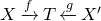 $X\xrightarrow{f} T\xleftarrow{g} X'$
be this step of the MMP. By [Reference Chen, Han, Liu and XieCHLX23, Theorem 16.1.3],
$X\xrightarrow{f} T\xleftarrow{g} X'$
be this step of the MMP. By [Reference Chen, Han, Liu and XieCHLX23, Theorem 16.1.3], $\mathcal{O}_X(mD)$
is globally generated over T for any
$\mathcal{O}_X(mD)$
is globally generated over T for any $m\gg 0$
. Therefore,
$m\gg 0$
. Therefore, $mD=f^*L_m$
and
$mD=f^*L_m$
and $(m+1)D=f^*L_{m+1}$
for some Cartier divisors
$(m+1)D=f^*L_{m+1}$
for some Cartier divisors $L_m,L_{m+1}$
for any
$L_m,L_{m+1}$
for any $m\gg 0$
, so
$m\gg 0$
, so $D=f^*(L_{m+1}-L_m)$
. Therefore,
$D=f^*(L_{m+1}-L_m)$
. Therefore, $\phi_*D=g^*(L_{m+1}-L_m)$
is Cartier.
$\phi_*D=g^*(L_{m+1}-L_m)$
is Cartier.
Proposition B.9 Let $(X,\mathcal{F},B,{\textbf{M}})/U$
be an lc algebraically integrable generalized foliated quadruple and let
$(X,\mathcal{F},B,{\textbf{M}})/U$
be an lc algebraically integrable generalized foliated quadruple and let ${\textbf{N}}$
be an NQC
${\textbf{N}}$
be an NQC $/U$
$/U$ $\boldsymbol{b}$
-divisor on X, such that:
$\boldsymbol{b}$
-divisor on X, such that:
• $(X,\mathcal{F},B,{\textbf{M}}+{\textbf{N}})$
is lc;
$(X,\mathcal{F},B,{\textbf{M}}+{\textbf{N}})$
is lc;
• $K_{\mathcal{F}}+B+{\textbf{M}}_X$
is nef
$K_{\mathcal{F}}+B+{\textbf{M}}_X$
is nef $/U$
; and
$/U$
; and
• $K_{\mathcal{F}}+B+{\textbf{M}}_X+{\textbf{N}}_X$
is NQC
$K_{\mathcal{F}}+B+{\textbf{M}}_X+{\textbf{N}}_X$
is NQC $/U$
.
$/U$
.
Then there exists a real number $\delta_0\in (0,1)$
and a function
$\delta_0\in (0,1)$
and a function $\mu: (0,\delta)\rightarrow (0,+\infty)$
satisfying the following. Assume that:
$\mu: (0,\delta)\rightarrow (0,+\infty)$
satisfying the following. Assume that:
-
(1)
$\delta\in (0,\delta_0)$
is a real number; -
(2)
$l\gt\mu(\delta)$
is a real number; and -
(3)
$(X,\mathcal{F}',B',{\textbf{M}}')/U$
is an lc algebraically integrable generalized foliated quadruple such that one of the following conditions hold,-
(a)
$(X',\mathcal{F}',B',{\textbf{M}}')$
is
$\mathbb{Q}$
-factorial ACSS, or -
(b)
$\mathcal{F}'=T_X$
and
${\textbf{M}}'$
is NQC
$/U$
, or -
(c)
$\mathcal{F}'=T_X$
and
$(X',B',{\textbf{M}}')$
is klt.
-






Then any sequence of steps of a
 $$((K_{\mathcal{F}'}+B'+{\textbf{M}}'_X)+l(K_{\mathcal{F}}+B+{\textbf{M}}_X+(1-\delta){\textbf{N}}_X))\text{-MMP}/U$$
is $(K_{\mathcal{F}}+B+{\textbf{M}}_X+(1-\delta){\textbf{N}}_X)$
-trivial,
$(K_{\mathcal{F}}+B+{\textbf{M}}_X+(1-\delta){\textbf{N}}_X)$
-trivial, $(K_{\mathcal{F}}+B+{\textbf{M}}_X+{\textbf{N}}_X)$
-trivial, and
$(K_{\mathcal{F}}+B+{\textbf{M}}_X+{\textbf{N}}_X)$
-trivial, and ${\textbf{N}}_X$
-trivial.
${\textbf{N}}_X$
-trivial.
Proof. Let $d:=\dim X$
.
$d:=\dim X$
.
Step 1. In this step we introduce real numbers $\epsilon$
,
$\epsilon$
, $a_1,\dots,a_k$
, and
$a_1,\dots,a_k$
, and $\boldsymbol{b}$
-divisors
$\boldsymbol{b}$
-divisors ${\textbf{N}}_1,\dots,{\textbf{N}}_k$
. We construct
${\textbf{N}}_1,\dots,{\textbf{N}}_k$
. We construct $\delta_0$
and
$\delta_0$
and $\mu$
so that they only depend on
$\mu$
so that they only depend on $d,\epsilon,a_1,\dots,a_k$
.
$d,\epsilon,a_1,\dots,a_k$
.
Since $K_{\mathcal{F}}+B+{\textbf{M}}_X+{\textbf{N}}_X$
is NQC
$K_{\mathcal{F}}+B+{\textbf{M}}_X+{\textbf{N}}_X$
is NQC $/U$
, there exists a positive real number
$/U$
, there exists a positive real number $\epsilon$
such that
$\epsilon$
such that $K_{\mathcal{F}}+B+{\textbf{M}}_X+{\textbf{N}}_X$
is
$K_{\mathcal{F}}+B+{\textbf{M}}_X+{\textbf{N}}_X$
is $\epsilon$
-NQC
$\epsilon$
-NQC $/U$
.
$/U$
.
Since ${\textbf{N}}$
is an NQC
${\textbf{N}}$
is an NQC $/U$
$/U$ $\boldsymbol{b}$
-divisor, by Lemma B.2, there exist positive real numbers
$\boldsymbol{b}$
-divisor, by Lemma B.2, there exist positive real numbers $a_1,\dots,a_k$
that are linearly independent over
$a_1,\dots,a_k$
that are linearly independent over $\mathbb Q$
, such that
$\mathbb Q$
, such that ${\textbf{N}}=\sum_{i=1}^ka_i{\textbf{N}}_i$
, where each
${\textbf{N}}=\sum_{i=1}^ka_i{\textbf{N}}_i$
, where each ${\textbf{N}}_i$
is nef
${\textbf{N}}_i$
is nef $/U$
Cartier. Since
$/U$
Cartier. Since $K_{\mathcal{F}}+B+{\textbf{M}}_X+{\textbf{N}}_X$
and
$K_{\mathcal{F}}+B+{\textbf{M}}_X+{\textbf{N}}_X$
and $K_{\mathcal{F}}+B+{\textbf{M}}_X$
are
$K_{\mathcal{F}}+B+{\textbf{M}}_X$
are $\mathbb{R}$
-Cartier,
$\mathbb{R}$
-Cartier, ${\textbf{N}}_X$
is
${\textbf{N}}_X$
is $\mathbb{R}$
-Cartier. Therefore,
$\mathbb{R}$
-Cartier. Therefore, ${\textbf{N}}_{i,X}$
is
${\textbf{N}}_{i,X}$
is $\mathbb{Q}$
-Cartier for each i. We let I be a positive integer such that
$\mathbb{Q}$
-Cartier for each i. We let I be a positive integer such that $I{\textbf{N}}_{i,X}$
is Cartier for each i. Possibly replacing each
$I{\textbf{N}}_{i,X}$
is Cartier for each i. Possibly replacing each $a_i$
with
$a_i$
with ${a_i}/{I}$
and
${a_i}/{I}$
and ${\textbf{N}}_i$
with
${\textbf{N}}_i$
with $I{\textbf{N}}_i$
, in the following, we shall assume that
$I{\textbf{N}}_i$
, in the following, we shall assume that ${\textbf{N}}_{i,X}$
is Cartier for each i.
${\textbf{N}}_{i,X}$
is Cartier for each i.
We let $\delta_0:={\epsilon}/({2(2d+\epsilon)})$
and let
$\delta_0:={\epsilon}/({2(2d+\epsilon)})$
and let $\tau: (0,\delta_0)\rightarrow (0,+\infty)$
be the function constructed in Lemma B.5 which depends only on
$\tau: (0,\delta_0)\rightarrow (0,+\infty)$
be the function constructed in Lemma B.5 which depends only on $d,\epsilon,a_1,\dots,a_k$
. We define
$d,\epsilon,a_1,\dots,a_k$
. We define $\mu(\delta):={2d}/{\tau(\delta)}$
.
$\mu(\delta):={2d}/{\tau(\delta)}$
.
Step 2. In this step we prove the proposition by induction on the number of steps of the MMP.
Claim B.10 Let $\delta\in (0,\delta_0)$
and
$\delta\in (0,\delta_0)$
and $l\gt \mu(\delta)$
be two real numbers. Let n be a non-negative integer and let
$l\gt \mu(\delta)$
be two real numbers. Let n be a non-negative integer and let
 $$X_0:=X\dashrightarrow X_1\dashrightarrow\dots\dashrightarrow X_n\dashrightarrow X_{n+1}$$
be a sequence of steps of a
 $$((K_{\mathcal{F}'}+B'+{\textbf{M}}'_X)+l(K_{\mathcal{F}}+B+{\textbf{M}}_X+(1-\delta){\textbf{N}}_X))\text{-MMP}/U.$$
For each j, we let $\mathcal{F}_j,\mathcal{F}_j'$
be the induced foliations of
$\mathcal{F}_j,\mathcal{F}_j'$
be the induced foliations of $\mathcal{F},\mathcal{F}'$
on
$\mathcal{F},\mathcal{F}'$
on $X_j$
, and let
$X_j$
, and let $B_j,B_j'$
be the images of B,B’ on
$B_j,B_j'$
be the images of B,B’ on $X_j$
respectively. Then for any
$X_j$
respectively. Then for any $0\leq j\leq n+1$
:
$0\leq j\leq n+1$
:
-
(1)
$(X_j,\mathcal{F}_j,B_j,{\textbf{M}}+{\textbf{N}})$
is lc; -
(2)
$K_{\mathcal{F}_j}+B_j+{\textbf{M}}_{X_j}$
is nef
$/U$
; -
(3)
${\textbf{N}}_{i,X_j}$
is Cartier for each i; -
(4)
$K_{\mathcal{F}_j}+B_j+{\textbf{M}}_{X_j}+{\textbf{N}}_{X_j}$
is
$\epsilon$
-NQC
$/U$
; -
(5)
$(X_j,\mathcal{F}'_j,B_j',{\textbf{M}}')$
is lc; and-
(a) if
$(X,\mathcal{F}',B',{\textbf{M}}')$
is
$\mathbb{Q}$
-factorial ACSS, then
$(X_j,\mathcal{F}'_j,B_j',{\textbf{M}}')$
is
$\mathbb{Q}$
-factorial ACSS, and -
(b) if
$\mathcal{F}'=T_X$
and
$(X',B',{\textbf{M}}')$
is klt, then
$(X_j,B_j',{\textbf{M}}')$
is klt;
-








and
-
(6) if
$j\leq n$
, then
$X_{j}\dashrightarrow X_{j+1}$
is
$(K_{\mathcal{F}_j}+B_j+{\textbf{M}}_{X_j}+(1-\delta){\textbf{N}}_{X_j})$
-trivial and
${\textbf{N}}_{i,X_j}$
-trivial for each i.




Proof. We prove Claim B.10 by induction on n. When $n=0$
, conditions (1)–(5) hold by our construction. By induction, we may assume that conditions (1)–(5) hold for
$n=0$
, conditions (1)–(5) hold by our construction. By induction, we may assume that conditions (1)–(5) hold for $j\leq n$
and condition (6) holds for
$j\leq n$
and condition (6) holds for $j\leq n-1$
. By Lemma B.5,
$j\leq n-1$
. By Lemma B.5, $K_{\mathcal{F}_n}+B_n+{\textbf{M}}_{X_n}+(1-\delta){\textbf{N}}_{X_n}$
is
$K_{\mathcal{F}_n}+B_n+{\textbf{M}}_{X_n}+(1-\delta){\textbf{N}}_{X_n}$
is $\tau(\delta)$
-nef
$\tau(\delta)$
-nef $/U$
for any
$/U$
for any $\delta\in (0,\delta_0)$
. By Lemma B.6,
$\delta\in (0,\delta_0)$
. By Lemma B.6, $X_n\dashrightarrow X_{n+1}$
is
$X_n\dashrightarrow X_{n+1}$
is $(K_{\mathcal{F}_n}+B_n+{\textbf{M}}_{X_n}+(1-\delta){\textbf{N}}_{X_n})$
-trivial. By Lemma B.7,
$(K_{\mathcal{F}_n}+B_n+{\textbf{M}}_{X_n}+(1-\delta){\textbf{N}}_{X_n})$
-trivial. By Lemma B.7, $X_n\dashrightarrow X_{n+1}$
is
$X_n\dashrightarrow X_{n+1}$
is $(K_{\mathcal{F}_n}+B_n+{\textbf{M}}_{X_n}+{\textbf{N}}_{X_n})$
-trivial, hence
$(K_{\mathcal{F}_n}+B_n+{\textbf{M}}_{X_n}+{\textbf{N}}_{X_n})$
-trivial, hence ${\textbf{N}}_{X_n}$
-trivial. Since
${\textbf{N}}_{X_n}$
-trivial. Since $a_1,\dots,a_k$
are linearly independent over
$a_1,\dots,a_k$
are linearly independent over $\mathbb Q$
,
$\mathbb Q$
, $X_n\dashrightarrow X_{n+1}$
is
$X_n\dashrightarrow X_{n+1}$
is ${\textbf{N}}_{i,X_n}$
-trivial for any i. This deduces condition (6) for
${\textbf{N}}_{i,X_n}$
-trivial for any i. This deduces condition (6) for $j=n$
.
$j=n$
.
We left to prove conditions (1)–(5) for $j=n+1$
. Since
$j=n+1$
. Since $X_n\dashrightarrow X_{n+1}$
is
$X_n\dashrightarrow X_{n+1}$
is $(K_{\mathcal{F}_n}+B_n+{\textbf{M}}_{X_n}+(1-\delta){\textbf{N}}_{X_n})$
-trivial, we get conditions (1) and (4) by induction hypothesis, and we have that
$(K_{\mathcal{F}_n}+B_n+{\textbf{M}}_{X_n}+(1-\delta){\textbf{N}}_{X_n})$
-trivial, we get conditions (1) and (4) by induction hypothesis, and we have that $X_n\dashrightarrow X_{n+1}$
is a step of a
$X_n\dashrightarrow X_{n+1}$
is a step of a $(K_{\mathcal{F}'}+B'+{\textbf{M}}_X')$
-MMP
$(K_{\mathcal{F}'}+B'+{\textbf{M}}_X')$
-MMP $/U$
. By condition (6) for
$/U$
. By condition (6) for $j=n$
,
$j=n$
, $X_n\dashrightarrow X_{n+1}$
is
$X_n\dashrightarrow X_{n+1}$
is $(K_{\mathcal{F}_n}+B_n+{\textbf{M}}_{X_n})$
-trivial, so condition (2) follows from the induction hypothesis. Condition (3) follows from the induction hypothesis and Lemma B.8. Condition (5) follows from induction hypothesis and [Reference Chen, Han, Liu and XieCHLX23, Lemma 9.1.4].
$(K_{\mathcal{F}_n}+B_n+{\textbf{M}}_{X_n})$
-trivial, so condition (2) follows from the induction hypothesis. Condition (3) follows from the induction hypothesis and Lemma B.8. Condition (5) follows from induction hypothesis and [Reference Chen, Han, Liu and XieCHLX23, Lemma 9.1.4].
Proof of Proposition B.9 continued. This immediately follows from Claim B.10(6).





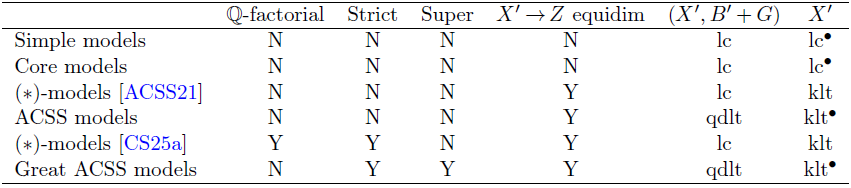

 Open access

