

Introduction
Twin or single-bearing ewes may produce insufficient colostrum for their lambs even when grazing lush green pastures (Murphy et al., Reference Murphy, McNeill, Fisher and Lindsay1996; McNeill et al., Reference McNeill, Murphy and Lindsay1998; Banchero et al., Reference Banchero, Quintans, Martin, Milton and Lindsay2003). This may be due to the ewes' having a low intake of pasture in the last weeks of pregnancy (Forbes, Reference Forbes1968) or the low nutrient density of a diet based solely on pastures. Consequently, a supplement of grain in late pregnancy provides the ewe with a more concentrated diet and can overcome the limitations imposed by roughages alone (Hall et al., Reference Hall, Holst and Shutt1992; Murphy et al., Reference Murphy, McNeill, Fisher and Lindsay1996; Banchero et al., Reference Banchero, Quintans, Martin, Lindsay and Milton2004a and Reference Banchero, Quintans, Martin, Milton and Lindsayb). Banchero et al. (Reference Banchero, Quintans, Martin, Lindsay and Milton2004a) showed that supplementation of single- and twin-bearing ewes with cracked maize during the last 7 days of pregnancy more than doubled the amount of colostrum accumulated at lambing compared with that produced by unsupplemented, but otherwise well-fed ewes consuming a roughage diet. In those studies, the maize increased the lactose concentration of the colostrum because it increased the glucose supply to the udder. We argued that it is probably the starch in the maize that provided the substrate for the lactose that improved production of colostrum and therefore barley, also high in starch, should be equally effective in stimulating early production of colostrum. Maize is not universally available in regions where sheep are bred, especially those with little summer rainfall so a more accessible grain like barley would be valuable if it were equally effective.
Material and methods
The experiment was conducted in accordance with the directives of the Experimental Unit ‘Palo a Pique’ of INIA Treinta y Tres in Uruguay with regard to the use of animals for experimentation.
Experimental treatments
The experiment was conducted at the Experimental Unit ‘Palo a Pique’ of INIA Treinta y Tres, Uruguay (35°S), in August 2003 using adult Corriedale ewes, 35 bearing single foetuses (44.3 ± 0.52 kg, body condition score 1.48 ± 0.03; scale 0 to 5 of Russell et al. (Reference Russell, Doney and Gunn1969) measured at 128 days after mating) and 25 bearing twin foetuses (50.8 ± 0.91 kg, body condition score 1.52 ± 0.02). The experimental ewes were selected from a flock of 260 that had been synchronised using a single injection of 160 μg Delprostenate (Glandinex™ Universal Lab., Uruguay). They were mixed with Corriedale rams (1 per 12.5 ewes) during the second heat after synchronisation and scanned for pregnancy with single or twin foetuses 90 days later. The ewes grazed ad libitum native pastures (71 g crude protein (CP) and 6.6 MJ metabolisable energy (ME) per kg dry matter (DM)) from mating until they were housed indoors in individual pens on day 128 after mating (day − 21 before lambing was expected to commence; day 0 = lambing). The ewes were fed 100% of their ME requirements according to Ministry of Agriculture, Fisheries and Food (MAFF, 1975) to maintain them in moderate body condition (about condition score 1.5). The twin-bearing ewes were each offered a basal diet of 1.4 kg DM of lucerne hay (153 g CP and 9.0 MJ ME per kg DM) per day. The single-bearing ewes were each offered a basal diet of 1.0 kg DM of lucerne hay per day. All ewes had access to a mineral mix (Cobalfosal Ovino Total® Barraca Deambrossi, Uruguay) and water ad libitum. Fourteen days before the expected time of lambing the ewes were allocated to three treatments and fed either the basal diet alone (control, 12 single- and 8 twin-bearers), the basal diet plus a supplement of whole barley (88.4% DM, 107 g CP and 13.5 MJ ME per kg DM; ‘whole barley’, 11 single- and 8 twin-bearers) or the basal diet plus a supplement of cracked maize (86.6% DM, 80 g CP and 13.3 MJ ME per kg DM; ‘cracked maize’, 12 single- and 9 twin-bearers). Both supplements were introduced to the ewes progressively at the rate of 0.2, 0.2, 0.3, 0.3, 0.4, 0.4, 0.5, 0.5 kg per head per day from day 134 to 141 of gestation (day −15 to day − 8 before birth) and thereafter the ewes were offered 0.6 kg per head per day until they lambed (day 0). The lucerne hay was offered each morning at 0800 h and the whole barley or cracked maize was offered to the supplemented ewes 30 min later. Any lucerne hay or grain that was not eaten was weighed and recorded before the ewes were fed the next day.
Live weight and body condition
The body weight and condition score of ewes were recorded on days 65 and 130 of gestation.
Udder measures, colostrum production, viscosity and composition
The volume of the udder for each ewe was calculated just before and immediately after lambing by measuring the lateral and longitudinal semi-circumference of the udder with a flexible tape measure. Udder volume was derived considering the udder as a hemisphere and using the formula of Mellor and Murray (Reference Mellor and Murray1985) modified by Bencini and Purvis (Reference Bencini and Purvis1990). The full volume of the udder at lambing was calculated from its linear dimensions and the empty volume was calculated by subtracting from the full volume, the amount of colostrum that could be expressed from the udder immediately after lambing.
The ewes were observed for 24 h/day and, immediately after lambing, each ewe received an intramuscular injection of 5 IU of oxytocin (Hipofamina™ Lab. Dispert, Uruguay). One teat was then completely milked-out by hand and covered with tape to prevent the lamb or lambs from sucking. The other teat was left uncovered for the lamb or lambs to suck. The colostrum expressed from the teat was weighed and classified on appearance and consistency according to the 0 to 7 scale of McCance and Alexander (Reference McCance and Alexander1959): where 0 is no expressible secretion; 1 is a clear, serous straw-coloured liquid grading to 7 which is an opaque, white liquid similar to normal milk. A 20-ml sample of the colostrum had a preservative added (50 μl 10% potassium dichromate) and was stored at 4°C until analysed for components. The same teat from each ewe was milked following an intramuscular injection of 5 IU of oxytocin at 1, 3, 6 and 10 h after lambing. The resulting colostrum was weighed each time and a 20-ml sample was treated and stored in the same way as the initial sample until analysed. The colostrum expressed from the teat at lambing represented that which had accumulated prior to lambing and the colostrum expressed at each subsequent milking represented the quantity secreted since the previous milking. The samples of colostrum were analysed for fat, lactose, protein and total solids using a Milkoscan (133 Foss Electric Denmark).
Birth weight and identification of lambs
The lambs were weighed and identified soon after birth and each lamb was allowed to suck from the uncovered teat. When colostrum production was judged to be insufficient for the lamb's requirement (Mellor and Murray, Reference Mellor and Murray1986) the lamb(s) were given a supplement of colostrum that had been warmed to about 38°C.
Statistical analysis
The effects of supplementation on the weight and characteristics of the colostrum secreted, udder volume and lamb birth weight were analysed by least-squares analysis of variance using the SAS ProcGLM procedure (Statistical Analysis Systems Institute (SAS), 2001).
The model used was: Y ij = μ + τij + ɛij where:
Y ij is the random variable (i = treatment 1…6; j = repetitions); μ is the general mean for each treatment; τij = Ai + Bj + (AB)ij, being Ai the effect of birth type (1,2) and Bj the effect of the supplement (1,2,3) and (AB)ij the interaction between birth type and supplement; ɛij is the experimental error.
The viscosity of the colostrum was analysed as discrete data using the SAS GenMod procedure. Regression analysis was used to establish correlations between colostrum production and viscosity. Effects were deemed significant when the level of probability was 5% or less. The interaction between treatments and birth type was presented only if it was significant.
Results
Production of colostrum
At lambing, ewes supplemented with whole barley or cracked maize had accumulated more than double the quantity of colostrum accumulated by unsupplemented ewes and the twin-bearing ewes produced more than the single-bearing ewes (P < 0.05, Table 1). The colostrum produced by twin-bearing ewes supplemented with barley or maize did not differ but, single-bearing ewes supplemented with maize produced 50% more than the ewes supplemented with barley (P < 0.05). Subsequent production of colostrum remained greater in supplemented than in unsupplemented ewes for up to 3 h after lambing although, the production of colostrum did not differ between supplemented groups. Colostrum secretion was also higher in twin- than in single-bearing ewes up to 1 h after lambing, but there was no difference by 3 h after lambing (P < 0.05). The total quantity of colostrum produced (that accumulated at lambing plus subsequent production up to 10 h after lambing) was higher in supplemented than in unsupplemented ewes and was also higher in twin- compared with single-bearing ewes (P < 0.05). In single-bearing ewes, supplementation with maize increased colostrum production more than supplementation with barley but in twin-bearing ewes, barley produced more colostrum than maize (P < 0.05)
Mean (± s.e.) colostrum (g) accumulated at birth and secreted 0 to 1, 1 to 3, 3 to 6 and 6 to 10 h after lambing and total production of colostrum in single- and twin-bearing Corriedale ewes supplemented with barley, maize or unsupplemented in the week before lambing

† Significant differences for values within rows: *P ≤ 0.05, **P ≤ 0.01, *** P ≤ 0.001. NS, values within rows are not different.
Udder development
At lambing, the udder volume of the supplemented ewes was only 16% greater (P = 0.10) than that of the unsupplemented ewes, but the full and empty udders of the twin-bearing ewes were much larger (P < 0.001) than those of the single-bearing ewes (Table 2).
Mean (± s.e.) udder volume (ml) at lambing in single- and twin-bearing Corriedale ewes supplemented with barley, maize or unsupplemented in the week before lambing

† Significant differences for values within rows: *P ≤ 0.05, ***P ≤ 0.001. NS, values within rows are not different.
Viscosity of the colostrum
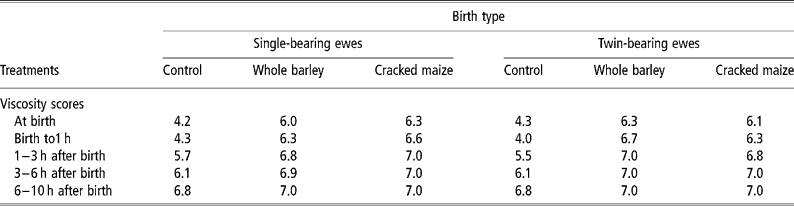
Unsupplemented ewes had colostrum that was more viscous than that of ewes supplemented with either barley or maize (Table 3 and Annex, P < 0.001) irrespective of whether they bore single or twin lambs. The viscosity of the colostrum decreased for all groups from parturition up to 10 h after birth. Immediately after parturition, unsupplemented ewes continued producing colostrum that was more viscous (P > 0.01) than that of supplemented ewes but by 10 h after birth there was no difference. The viscosity of the colostrum was negatively correlated with both the amount of colostrum accumulated at parturition (n = 60, r = 0.54, P < 0.05) and the yield of colostrum from lambing up to 1 h after birth (n = 58, r = 0.36, P < 0.05) or 3 h after birth (n = 57, r = 0.37, P < 0.05). The viscosity of the colostrum was not significantly correlated with the yield of colostrum 6 h after birth.
Mean viscosity scores (0 to 7) for colostrum accumulated at birth and secreted 0 to 1, 1 to 3, 3 to 6 and 6 to 10 h after lambing in single- and twin-bearing Corriedale ewes supplemented with barley, maize or unsupplemented in the week before lambing
Comparison between treatments
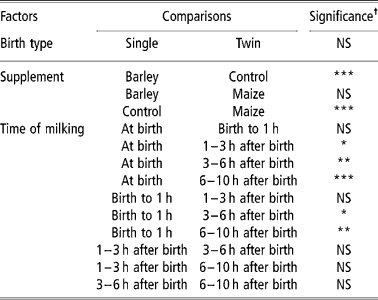
† Significant differences for values within rows: *P ≤ 0.05, **P ≤ 0.01, *** P ≤ 0.001. NS, values within rows are not different.
Components of colostrum
Supplementation also affected the main colostrum components at lambing (P>0.05, Table 4). The total weight of solids in the colostrum secreted up to 10 h after birth were similar for the supplemented ewes (300 ± 26.5 g for those fed barley and 336 ± 25.2 g for those fed maize) and higher than unsupplemented ewes (209 ± 26 g) (P < 0.01) even though the percentage of solids were significantly lower in the supplemented groups. Twin-bearing ewes produced more total solids than single-bearing ewes (326 ± 22.8 g v. 237 ± 19.3 g, P < 0.01). At birth, the percentage of fat did not differ between treatments but the percentage of protein was lower and the percentage of lactose was higher in supplemented than in unsupplemented ewes (P < 0.05). There was no difference in the protein content of the colostrum produced by ewes supplemented with either barley or maize but the lactose content of the colostrum produced by single-bearing ewes supplemented with barley was lower that that produced by single-bearing ewes supplemented with maize (P < 0.001). From 1 h after birth the percentage of fat was similar regardless of supplementation. On the other hand, protein percentage continued to be lower in supplemented ewes up to 6 h after lambing (P < 0.01). In contrast, the percentage of lactose remained higher (P < 0.01) in supplemented than in unsupplemented ewes up to 3 h after birth. There was no difference between supplemented treatments for any of the components of colostrum.
Mean values (± s.e.) for the components of colostrum at different milking times in single- and twin-bearing Corriedale ewes supplemented with barley, maize or unsupplemented in the week before lambing

† Significant differences for values within rows: *P ≤ 0.05, **P ≤ 0.01, ***P ≤ 0.001. NS, values within rows are not different.
At parturition the colostrum of single- and twin-bearing ewes did not differ in composition. The total weight of solids was similar for single and twin-bearing ewes for the first three milkings was higher for the twin-bearing ewes at 6 h (P < 0.05) becoming similar again at 10 h (Table 4). After lambing, the percentage of fat and protein remained similar in both groups but the single-bearing ewes had a higher percentage of lactose in their milk than twin-bearing ewes at 1 and 6 h after birth (P < 0.05).
Birth weight of lambs
Supplementation of the ewes prior to lambing did not affect the birth weight of their lambs but twin lambs were lighter than single lambs (P < 0.001; Table 5).
Mean (± s.e.) birth weight of lambs born to single- and twin-bearing Corriedale ewes supplemented with barley, maize or unsupplemented in the week before lambing

† Significant differences for values within the row: ***P ≤ 0.001. NS, values within the row are not different.
Consumption of roughages and supplements
Single-bearing ewes consumed all of the roughage diet offered, as did control twin-bearing ewes. On the other hand, twin-bearing ewes supplemented with maize or barley left 7% each. Single-bearing ewes supplemented with maize left 5% of the grain diet whereas the ewes supplemented with barley left 9%. Supplemented twin-bearing ewes ate their entire supplement.
Discussion
Supplementing ewes before lambing either with whole barley or cracked maize increased the quantity of colostrum accumulated at birth and its subsequent secretion during the following hours. Supplemented ewes produced between 1.9 to 2.8 times more colostrum at birth than unsupplemented ewes despite the unsupplemented ewes being fed to meet their estimated ME requirements (MAFF, 1975). The increase in production of colostrum was of the same order as that found by Banchero et al. (Reference Banchero, Quintans, Martin, Lindsay and Milton2004a and Reference Banchero, Quintans, Martin, Milton and Lindsayb) using maize alone. This strengthens our hypothesis that the starch supplied by both grains is the key to stimulating the production of colostrum. Large amounts of starch may pass into the small intestine and can account for a large proportion of the starch digested in the whole digestive tract (Nocek and Tamminga, Reference Nocek and Tamminga1991). This may increase the entry rate of glucose (Knowlton et al., Reference Knowlton, Dawson, Glenn, Huntington and Erdman1998; Landau et al., Reference Landau, Nitsan, Zoref and Madar1999) and, subsequently, the mammary uptake of glucose and the synthesis of lactose by the mammary gland (Linzell, Reference Linzell, Larson and Smith1974).
Barley is fermented to a greater extent than maize in the rumen (Nocek and Tamminga, Reference Nocek and Tamminga1991) and therefore would be expected to provide less starch for digestion to glucose in the small intestine. Indeed, in the single-bearing ewes, barley was less effective than maize to increase the amount of colostrum produced but it was just as effective in twin-bearing ewes. In twin-bearing ewes Weston (Reference Weston1988) showed that the rate of passage of digesta from the rumen is higher than in single-bearing ewes due to the compression by the twin foetuses. So it is likely that more unfermented barley passed from the rumen to the intestine in our twin-bearing ewes resulting in a similar glucose entry rate from both supplements.
The greater response in the yield of colostrum of twin-bearing ewes over single-bearing ewes after supplementation is consistent with previous work (Hall et al., Reference Hall, Holst and Shutt1992; Banchero et al., Reference Banchero, Quintans, Martin, Lindsay and Milton2004a). Twin-bearing ewes developed bigger udders than single-bearing ewes (Mellor, Reference Mellor1988) with the capacity to synthesise more colostrum.
Supplemented ewes not only produced more colostrum than unsupplemented ewes but also the colostrum they produced was more liquid and this, in turn, was associated with higher levels of lactose. Lactose is osmotically active (Leong et al., Reference Leong, Navaratnam, Stankiewicz, Wallace, Ward and Kuhn1990) so draws water from the blood and, in doing so, decreases the viscosity of the colostrum. The ewes with colostrum of highest viscosity and at the same time the lowest concentration of lactose were the unsupplemented ewes regardless of whether they bore twin or single lambs.
From a practical standpoint, short-term, strategic supplementation did not significantly increase the weight of the lambs and therefore it did not increase the chances of difficult births. On the contrary, it ensured that the volume of colostrum available at birth met, or exceeded the estimated requirements of 50 ml/kg of lamb birth weight (Robinson et al., Reference Robinson, Rooke, McEvoy, Freer and Dove2002). In addition, the fact that the colostrum was less viscous means that it should be more readily taken in by the lamb when it first attempts to suck and this, in turn, should aid in establishing a stronger maternal bond (Nowak and Poindron, Reference Nowak and Poindron2006). This suggests that supplementation is a worthwhile strategy for increasing the chances of survival of newborn lambs. The results presented here show that the form of supplementation, maize or barley, can be chosen on economic grounds as the lambs that are usually most at risk, the twins, receive equivalent benefit when their mothers receive either supplement.
Acknowledgements
We thank Gabriel and Fernando García, Damián Gonzalez and Jonny Nogueira for their technical help. We thank Dr Gabriel Ciappesoni for assistance with the statistical analysis.



