





Introduction
Learning vocabulary is an essential part of language acquisition. Vocabulary is especially important when sequential bilinguals learn a second language (L2), since knowing more words is the best way to improve communication. This is why there is so much focus on vocabulary in the L2 classroom. But what are the cognitive mechanisms that support word learning? While this ability rests on many sub-processes, a key one is that memories for new words need to be consolidated. In essence, a new word starts off as an episodic experience (e.g., a foreign-language teacher providing for the first time the L2 label for an existing concept) but a memory of this experience is not enough for the learner to be able to use the new word efficiently and appropriately. Through consolidation, however, the new word becomes integrated into the mental lexicon such that the learner can use it as they communicate in the L2. Little is known about memory consolidation in L2 learners (but see Qiao & Forster, Reference Qiao and Forster2017; Nakayama & Lupker, Reference Nakayama and Lupker2018). In this study, we examine if and how consolidation processes support lexical integration, at form and meaning levels, as sequential bilinguals learn new words.
It seems plausible, a priori, that word-learning mechanisms are likely to be the same in the L2 as in the first language (L1). It is the most parsimonious account; language learners have a set of cognitive mechanisms that they can use to learn words, and they use them irrespective of the language the words are spoken in. The lack of evidence for age of acquisition effects for vocabulary is consistent with this hypothesis. While there is convincing evidence that there are sensitive periods for the acquisition of phonology (Flege, Yeni-Komshian & Liu, Reference Flege, Yeni-Komshian and Liu1999; Granena & Long, Reference Granena and Long2012) and grammar (Granena & Long, Reference Granena and Long2012; Hartshorne, Tanenbaum & Pinker, Reference Hartshorne, Tanenbaum and Pinker2018), this does not appear to be the case for vocabulary (Hartshorne & Germine, Reference Hartshorne and Germine2015; Snow & Hoefnagel-Höhle, Reference Snow and Hoefnagel-Höhle1978). Furthermore, L1 users need to be able to continue learning new L1 words throughout their lives, and indeed do so without any apparent decrease in that ability (Hartshorne & Germine, Reference Hartshorne and Germine2015). It thus seems likely that the same mechanisms for word learning are available across the lifespan, and hence also that they can be applied when learning words in a late-acquired L2. Neuropsychological and neuroimaging evidence further supports this view. While brain damage can differentially affect L1 and L2 grammar, this appears not to be the case for L1 versus L2 vocabulary (Ullman, Reference Ullman2001; Ullman & Lovelett, Reference Ullman and Lovelett2018). Similarly, the brain networks active in L1 word processing tasks appear to overlap with those used in L2 word processing (Ullman, Reference Ullman2001).
There are, however, critical differences between L1 and L2 vocabulary acquisition. The late L2 learner may be confronted with problems with phonology (e.g., difficulties hearing non-native speech segments correctly may interfere with learning the new word's form; Pajak, Creel & Levy, Reference Pajak, Creel and Levy2016) and/or syntax (e.g., difficulties with non-native grammar may interfere with learning a new word's grammatical role). Furthermore, L2 vocabulary builds on L1 vocabulary, such that (at least in most cases in late L2 acquisition) new L2 words refer to concepts that are already known. Translation is thus an important means to support L2 vocabulary learning and processing (Kroll & Stewart, Reference Kroll and Stewart1994; Dijkstra et al., Reference Dijkstra, Wahl, Buytenhuijs, van Halem, Al-Jibouri, De Korte and Rekké2019) but is something that is obviously not available in L1 acquisition. It would therefore be a mistake to assume that L2 word learning is identical to L1 word learning. For exactly this reason it is essential to seek to specify which mechanisms are or are not shared across L1 and L2 learning contexts. We therefore asked in this study whether memory consolidation processes are shared between L1 and L2 vocabulary acquisition.
Consolidation is a central feature of language learning and of other domains of cognition. Across cognitive domains, after new experiences have been encoded in episodic memory, they are consolidated through transfer into semantic memory (McGaugh, Reference McGaugh2000; Alvarez & Squire, Reference Alvarez and Squire1994; Winocur & Moscovitch, Reference Winocur and Moscovitch2011). In the Complementary Learning Systems (CLS) account (McClelland, McNaughton & O'Reilly, Reference McClelland, McNaughton and O'Reilly1995), integration of new knowledge into semantic memory requires slow consolidation because the new knowledge must be interleaved with old knowledge without catastrophic interference (i.e., overwriting of old knowledge by new knowledge). Fast learning in the episodic memory system complements this slow consolidation process by providing initial storage of the new knowledge. Episodic memory is supported by activity in medial temporal structures centered on the hippocampus, whereas semantic memory is supported by activity in neocortical structures, and consolidation entails a shift in the relative engagement of these two sets of structures (Takashima, Petersson, Rutters, Tendolkar, Jensen, Zwarts, McNaughton & Fernández, Reference Takashima, Petersson, Rutters, Tendolkar, Jensen, Zwarts, McNaughton and Fernández2006; Frankland & Bontempi, Reference Frankland and Bontempi2005).
New words need to be consolidated and integrated into the semantic network to function as stable lexical representations: after initial episodic experience with them, they must be integrated into the lexicon such that they can be used in communication (e.g., speaking and listening to speech). But this again needs to be done so that the integration of new words does not disrupt existing lexical knowledge (i.e., without catastrophic interference; McClelland et al., Reference McClelland, McNaughton and O'Reilly1995). Beginning with the work of Gaskell and Dumay (Reference Gaskell and Dumay2003), there is now a substantial body of evidence, consistent with the CLS account, for consolidation in L1 word learning (for reviews, see Davis & Gaskell, Reference Davis and Gaskell2009; James, Gaskell, Weighall & Henderson, Reference James, Gaskell, Weighall and Henderson2017). Behavioral studies have shown that, after a period of consolidation, new words start to function like existing words and thus appear to be integrated into the lexicon at both the form and meaning levels. At the form level, new words start to engage in competition with other words, as shown by the emergence, after consolidation, of inhibition of responses to similar-sounding existing words (e.g., decisions to cathedral become slower after the new word cathedruke has been consolidated and hence starts to compete with cathedral; Gaskell & Dumay, Reference Gaskell and Dumay2003). This effect has been shown in multiple studies using the pause-detection task, where participants have to decide whether they heard an artificially inserted pause in the base words (e.g., in cathedr…al). The competition appears to involve abstract (i.e., non-episodic) representations of the new words (Bakker, Takashima, van Hell, Janzen & McQueen, Reference Bakker, Takashima, van Hell, Janzen and McQueen2014) and does not require the new words to be associated with meanings (Gaskell & Dumay, Reference Gaskell and Dumay2003). When novel-word meanings are taught to participants, the emergence of semantic priming effects after consolidation suggests lexical integration of the meanings of the new words (e.g., facilitation of responses in a primed lexical decision task to the new word pamat, which was taught to be a kind of cat, when primed by dog; Bakker, Takashima, van Hell, Janzen & McQueen, Reference Bakker, Takashima, van Hell, Janzen and McQueen2015a; Bakker, Takashima, van Hell, Janzen & McQueen, Reference Bakker, Takashima, van Hell, Janzen and McQueen2015b; see also van der Ven, Takashima, Segers & Verhoeven, Reference van der Ven, Takashima, Segers and Verhoeven2017, where the new words served as primes rather than targets).
Lexical consolidation is enhanced by sleep. Although some studies have shown consolidation effects without any sleep in the time interval between learning and testing (Kapnoula, Gupta, Packard & McMurray, Reference Kapnoula, Gupta, Packard and McMurray2015; Lindsay & Gaskell, Reference Lindsay and Gaskell2013; Szmalec, Page & Duyck, Reference Szmalec, Page and Duyck2012), others have shown that sleep in that interval enhances consolidation (Dumay & Gaskell, Reference Dumay and Gaskell2007; Gaskell & Dumay, Reference Gaskell and Dumay2003) and that electrophysiological activity during sleep is associated with behavioral indicators of consolidation (Tamminen, Payne, Stickgold, Wamsley & Gaskell, Reference Tamminen, Payne, Stickgold, Wamsley and Gaskell2010). Thus, while sleep appears not to be necessary for consolidation to occur, it supports what is a gradual and ongoing process.
Further evidence for consolidation in L1 word learning comes from neuroscientific studies. In such studies, comparisons are usually made between the neural activity measured in response to words learned either on the day of test (less-consolidated novel words) or on a previous day (i.e., after at least one night of sleep; more-consolidated novel words). Results from fMRI (Davis, Di Betta, Macdonald & Gaskell, Reference Davis, Di Betta, Macdonald and Gaskell2009; Takashima, Bakker, van Hell, Janzen & McQueen, Reference Takashima, Bakker, van Hell, Janzen and McQueen2014), EEG (Bakker et al., Reference Bakker, Takashima, van Hell, Janzen and McQueen2015a, Reference Bakker, Takashima, van Hell, Janzen and McQueen2015b) and MEG (Bakker-Marshall et al., Reference Bakker-Marshall, Takashima, Schoffelen, van Hell, Janzen and McQueen2018) suggest, in keeping with the CLS model, a shift from greater engagement of the hippocampus and medial temporal structures for less-consolidated words to greater engagement of neocortical structures for more-consolidated words. A key neocortical structure showing this greater engagement after consolidation is the left posterior Medial Temporal Gyrus (pMTG); the pMTG appears to be a lexical hub in the perisylvian language network, one that plays a key role in binding together semantic, phonological, and orthographic knowledge about words (Bakker-Marshall et al., Reference Bakker-Marshall, Takashima, Schoffelen, van Hell, Janzen and McQueen2018).
There is also evidence in children of lexical integration after sleep from behavioral studies (Henderson, Weighall, Brown & Gaskell, Reference Henderson, Weighall, Brown and Gaskell2012, Reference Henderson, Weighall, Brown and Gaskell2013; van der Ven et al., Reference van der Ven, Takashima, Segers and Verhoeven2017); evidence that electrophysiological activity as children sleep is associated with memory consolidation of words (Smith et al., Reference Smith, Gaskell, Weighall, Warmington, Reid and Henderson2018); and fMRI evidence from children of decreasing hippocampal activity for novel words as the interval increases between learning and testing (Takashima, Bakker-Marshall, van Hell, McQueen & Janzen, Reference Takashima, Bakker-Marshall, van Hell, McQueen and Janzen2019). Although there seem to be differences in the details of the consolidation process with respect to which types of new words are more strongly consolidated (James, Gaskell & Henderson, Reference James, Gaskell and Henderson2019), the general picture emerging from this developmental work is that consolidation processes in children appear to be equivalent to those in adults (James et al., Reference James, Gaskell, Weighall and Henderson2017). These developmental data thus support the idea that the same consolidation mechanisms support word learning throughout the lifespan and hence the hypothesis that these mechanisms will also be used by sequential bilinguals as they learn L2 words.
We test this hypothesis here. We thus test for evidence that would challenge the recent claim that there are differences in lexical consolidation between L1 word learning in English native speakers (Qiao & Forster, Reference Qiao and Forster2013) and L2 word learning in Chinese–English sequential bilinguals (Qiao & Forster, Reference Qiao and Forster2017). Those studies used a masked priming technique in visual lexical decision. A Prime Lexicality Effect (PLE) on the form level was observed in the native English participants’ data (i.e., after training, no significant priming from a novel word prime, e.g., baltery, on responses to target words differing in only one letter, e.g., battery). The novel word primes thus behaved like real words and not like nonwords (which do produce facilitatory priming). In the bilingual participants’ data, however, there was no PLE even after multiple days of training on the novel words, and instead there was significant facilitatory priming (e.g., baltery primed responses to battery). The PLE is usually interpreted as an indicator of lexical competition, so Qiao and Forster (Reference Qiao and Forster2017) took the absence of the PLE in L2 participants as evidence that the novel words had not been integrated into the lexicon in the same way as L1 words are integrated, and hence that the L2 lexicon may be different in kind from the L1 lexicon. Another study, with L1 Japanese participants tested on L2 English, showed a similar facilitation effect on known English words (Nakayama & Lupker, Reference Nakayama and Lupker2018). The difference between L1 and L2 participants found in Qiao and Forster (Reference Qiao and Forster2017) may thus be driven by the difference in orthography between L1 (logographic Chinese) and L2 (alphabetic English). However, because the Qiao and Forster (Reference Qiao and Forster2017) findings conflict with our earlier arguments that word learning (and more specifically lexical consolidation) is likely to be the same across ages and languages, it is important to test for lexical consolidation in L2 speakers using other methods, specifically in a situation where there are no differences in orthography between L1 and L2. We took that approach here.
Our design was modelled on the seminal L1 study on lexical consolidation (Gaskell & Dumay, Reference Gaskell and Dumay2003). We taught Italian–English sequential bilinguals novel English-like words (e.g., apricon, taught to mean “stapler”) and then tested them on these novel words in a free recall task. A variety of tasks were used during training to try to ensure that the new words (presented in both written and spoken form) were associated with the concepts which were represented as pictures of objects (e.g., for apricon, a picture of a stapler). Two days later, the bilinguals were taught a matched second set of words in the same way. They were again tested on those words in free recall, and then they underwent a final test phase with three tasks. We used multiple test tasks, which examined different aspects of consolidation, and fMRI, in order to obtain a more complete picture of lexical integration in L2 word learning.
The first task tested recognition-memory in the fMRI scanner. Participants decided which of four words was the correct referent of a picture shown in the middle of the display. This task was designed to test non-episodic memory of the words through the use of pictures that had not been presented during training (e.g., for apricon, a different picture of a stapler). This task, which requires retrieval of the association of the new word with the abstract concept it refers to, enabled us to focus on neural activity in the networks responsible for linking word forms to word meanings, and the pMTG in particular (Bakker-Marshall et al., Reference Bakker-Marshall, Takashima, Schoffelen, van Hell, Janzen and McQueen2018; Takashima et al., Reference Takashima, Bakker, van Hell, Janzen and McQueen2014). The second test task was pause detection, which was used to measure integration of the novel words into the lexicon at the form level. Participants were asked to decide whether silent pauses had been inserted into base words – that is, real English words from which the novel words had been derived (e.g., for apricon, whether there was a pause in apricot). Following, for example, Gaskell and Dumay (Reference Gaskell and Dumay2003), decisions to the base words should be slowed down (relative to matched base words for novel words that had not been learned) because of competition between the base word and the novel word. Such competition would indicate lexical integration of the novel words at the form level. The third test task was primed lexical decision. The novel words served as semantically related primes for existing target words (e.g., apricon-paper). Speeding of responses to targets (relative to a semantically unrelated condition) would again indicate lexical integration of the novel word, but now at the meaning level (Bakker et al., Reference Bakker, Takashima, van Hell, Janzen and McQueen2015a, Reference Bakker, Takashima, van Hell, Janzen and McQueen2015b; van der Ven et al., Reference van der Ven, Takashima, Segers and Verhoeven2017). The constraints imposed on the choice of materials that could be used in all these tasks (e.g., that the base words were known to the participants) made it impossible to use actual English words for training. In keeping with many prior studies (e.g., Gaskell & Dumay, Reference Gaskell and Dumay2003), we therefore used pseudowords for training – in this case, those with English phonological and orthographic features.
We also collected data on the participants’ English proficiency, including their scores on standardized tests, their length of stay outside Italy, and a measure of their English vocabulary size. These secondary, individual-differences measures made it possible to ask, through correlational analyses, whether there was any association between L2 proficiency and degree of consolidation as estimated by the primary measures.
For all three primary measures, the main comparison was between the words learned on the day of test (“Recent” words), which we expected to be less consolidated, and the words learned two days earlier (“Remote” words), which we expected to be more consolidated. In the fMRI data, we predicted greater activity in the hippocampus and related medial temporal structures for Recent than for Remote words, and greater activity in the pMTG for Remote than for Recent words. In the pause-detection task, we predicted stronger competition (i.e., more slowing of responses relative to those for base words of untrained words) for the base words of the Remote words than for those of the Recent words. In the primed lexical-decision task, we predicted more facilitation of responses to targets primed by Remote words than to those primed by Recent words. Across all three measures, we were thus able to ask whether memory consolidation is a mechanism that operates as sequential bilinguals learn new L2 words, and whether there are consolidation effects for word forms and/or meanings.
Method
Participants
Fifty-two right-handed native Italians (30 female; average age 25 years, range 18–41) living in Nijmegen, the Netherlands, were recruited. No participants had a history of neurological or language-related disorders and all reported having normal or corrected-to-normal vision and hearing. One participant was excluded from the analysis because she was not able to conduct the experiment in the MRI scanner due to an attack of claustrophobia. Three more participants were excluded because their Reaction Times (RTs) were very slow (greater than the threshold of 2.5 standard deviations (SDs) above the group mean) in one or more of the primary behavioral tasks. One other participant's data were discarded from the MRI analyses due to technical problems with the imaging data. The analysis was therefore based on 48 participants for the behavioral data and 47 participants for the imaging data. All participants gave informed consent; the study was conducted according to a protocol approved by the regional ethical review board (CMO Region Arnhem-Nijmegen, The Netherlands).
Design
The study is summarized in Figure 1. Prior to the experiment, participants completed a pre-test (explained in the procedure section). On the first day (session 1), participants were trained on one set of novel words (Remote words) and a free-recall memory test. Two days later, hence with two nights allowing for sleep-related memory consolidation of the words learned on the first day, participants took part in the second training session with another set of novel words (Recent words) and a second free-recall task. After the training session on the second day, they took part in the recognition-memory task in the MRI scanner, followed by the pause-detection task, and finally the primed lexical-decision task. The latter two tasks were done in a behavioral laboratory (i.e., not in the scanner).
Overall study design.

Materials
Words
One hundred and twenty English-like pseudowords were created and divided into three sets of 40 (hereafter called novel words). The novel words in each set were matched for orthographic length (range 4–11 letters), phonological length (number of phonemes, range 3–10, and number of syllables, range 2-5).
The novel words were derived from existing English words (hereafter called base words) using Wuggy (a multilingual pseudoword generator; Keuleers & Brysbaert, Reference Keuleers and Brysbaert2010). For every base word, one to three phonemes of the last syllable were changed, in order to create a novel word that did not exist in English or Italian (e.g., apricon derived from apricot). In some cases of monosyllabic existing words, two or three phonemes were added at the end of the word (e.g., cliffon from cliff). The base words were not English-Italian cognates (e.g., we avoided cathedral - cattedrale). The selected base words had a frequency of occurrence in the range of 1.15 to 4.35 log10 per million according to the data from SubtlexUS (Brysbaert & New, Reference Brysbaert and New2009) and CLEARPOND (Marian, Bartolotti, Chabal & Shook, Reference Marian, Bartolotti, Chabal and Shook2012). Mean frequency of occurrence of the base words was balanced across the three lists. In addition, the base words had small phonological neighborhoods (80% with less than three neighbors, min. 0, max. 6) and small orthographic neighborhoods (86% with less than three neighbors, min. 0, max. 7). In this way, we enhanced the competition effect in the pause-detection task, which was the only task where the participants heard the base words (with or without pauses inserted). Forty high-frequency English words were selected for use as fillers in the pause-detection task.
The novel words were used in the training sessions, the explicit memory tasks (the free-recall and the recognition-memory task) and as primes in the primed lexical-decision task. For each novel word, two high-frequency existing English words were selected for use as targets in the primed lexical-decision task. One word in each pair was semantically related to the concept expressed by the novel word (as taught during the training sessions); the other was not. A further 240 pseudowords derived from these 240 target words were created with Wuggy, also for use as targets in the primed lexical-decision task. The critical stimuli are listed in the Supplementary Material (Table S1, Supplementary Materials).
Pictures
One hundred and twenty objects whose English names were unfamiliar to Italians were selected and two photos depicting the objects were selected from the internet. All pictures represented meaningful objects and were selected from different semantic categories (tools, animals, furniture, etc.). The pictures were divided into three sets with the categories equally distributed and paired with the three sets of 40 novel words. Any letters or words present in the pictures were blurred. The selected images were checked by 12 people who did not take part in the main experiment. They were asked if the object looked meaningful (i.e., if the object was recognizable), and whether each pair of pictures could be considered to be the same object. Picture pairs were chosen only if they met these criteria. The two pictures could differ in the angle of the photo, the color of the object, or other features (see Figure 2). The more distinct member of each pair was placed in Picture List 1 (used during training); the other one was placed in Picture List 2 (used during the recognition-memory test).
Example of a pair of pictures (for the novel word tickup) used in the training session (left panel) and the recognition-memory test (right panel).

Speech recordings and speech editing
All 120 base words, the 120 novel words, and the 40 filler words for the pause-detection task were each recorded three times by a young female native speaker of American English. In each case, the best of the three recordings was selected. A silent pause of 200 ms was then inserted immediately before the point of divergence between the base word and the novel word (e.g., before the [t] in apricot) using the audio editor Audacity. Fade-in and fade-out manipulations were applied in order to prevent any clipping sounds generated by the insertion of the pause.
Procedure
Pre-test
Participants first underwent a preliminary screening in order to check their eligibility. They had to be right-handed Italian native speakers, without any neurological or language disorders, to have no metal parts in their body (for safety during the scanner session) and no signs of claustrophobia. If they were eligible, they were scheduled for the two days of training and testing.
Furthermore, participants filled out a questionnaire. In the first part, knowledge of all English base words used in the main experiment was tested (e.g., “Do you know the meaning of apricot?”). The total number of known words was used as a proxy measurement of the participant's vocabulary size and performance on this part of the questionnaire was also used to filter the pause-detection data (and, for consistency, the primed lexical-decision data), such that the data was limited, per participant, to only those base words that they knew.
The second part of the questionnaire included information regarding the participant's proficiency in English. We asked for their IELTS score when available, and if not, scores on other tests, such as TOEFL, TOEIC or Cambridge CELA. The latter scores were converted to the equivalent IELTS score. We choose the IELTS as measurement of proficiency since it is widely considered to provide a reliable estimation (Charge & Taylor, Reference Charge and Taylor1997). We also asked the length of stay of the participant in English-speaking countries. Given the generally high level of English proficiency in the sample, the international English-speaking environment they all lived in, and the fact that none of the participants spoke Dutch, the Netherlands was considered to be an English-speaking country with respect to this length-of-stay measure.
Training sessions
The participants were assigned to one of six groups. Each group was trained on one of the three sets of novel words on the first day (i.e., for the Remote training session tasks) and on another set two days later (i.e., for the Recent training session tasks). The remaining set was used as the New condition in the recognition-memory task (see below). Assignment of novel word sets to session and tasks was counterbalanced over groups.
At the beginning of the first training session, instructions about the purpose of the experiment and the procedure were given. All instructions (i.e., for all training and test sessions) were in English. After initial instruction, participants underwent ten different training tasks. They were trained on the spelling of the words, the sound of the words and their pronunciation (i.e., reading, listening and speaking). For each trial, they were always informed if the given answer was correct or not and told what the correct answer was if they were incorrect, and, at the end of each task, they were shown the total number of correct answers. All tasks were presented using Presentation (www.neurobs.com) and used a response button box and/or a computer keyboard. See the Supplementary Material for details on the ten tasks (Table S2 and accompanying text, Supplementary Materials).
Testing sessions
After the training session on each day, participants performed a free-recall memory test. They had five minutes to type all the trained novel words they could remember. After the free-recall test on the second day of testing, the three main tests were conducted.
First, the recognition-memory task was performed in the MRI scanner. Participants saw a picture on a computer screen together with four printed response options. Their task was to decide which printed word was depicted by the picture. As noted above, these pictures had not been presented during training. At the beginning of the trial, a black fixation cross appeared for a jittered inter-trial interval (ITI) of 1-7 seconds. Then, the fixation cross turned blue for one second, prompting the participant that the next picture would be presented. Subsequently a picture appeared in the middle of the screen with four different word options in lower-case in the four corners of the screen. The picture was an image of an object from one of the following three conditions: the object had been studied the same day (Recent condition) or two days before (Remote condition), or it was novel (New condition). One of the four response options was the correct novel word, one was another novel word from the same training set (e.g., a word from the Remote set if the correct word was a word from the Remote set), one was a novel word taken from the other training set (e.g., a word from the Recent set if the correct word was a word from the Remote set), and the fourth option was the phrase “new object”. Participants were instructed to choose the option “new object” if they judged that the object was not in either of the studied lists. The positions of the four options were randomized on every trial. Participants were instructed to respond as soon as they knew the answer. If the participant did not respond within 2500 ms after the picture onset, the picture disappeared and the word “Respond” appeared in the center of the screen, to further prompt participants for a response. After the response, a black bar appeared under the chosen option for 500 ms, but no corrective feedback was given. This procedure was repeated for all 120 pictures, one at a time in random order.
Second, the pause-detection task was administered. In this task, the participant had to identify as quickly as possible if a pause was present or not in the spoken words presented through a loudspeaker. Of the 160 trials, there were 40 trials with the base words from which the Remote novel words had been created, 40 with the base words from which the Recent novel words had been created, 40 with the base words from which the untrained set of novel words had been created, and 40 with filler words. Overall, half of the trials had a pause inserted in the base word and half did not. The order of the trials (Remote/Recent/Untrained/Filler, Pause+/Pause-) was randomized for every participant.
At the beginning of the trial, a fixation cross appeared in the middle of the screen for 1000 ms, then it disappeared and the spoken word was played at the same time as two response options appeared on the screen: “Pause” on the left, “No pause” on the right. The participants were instructed to press the corresponding button (i.e., the left one when there was a pause and the right one when there was not) as fast and as accurately as possible. All responses given before the onset of the pause (or in the equivalent location in stimuli without a pause) were treated as errors. When a button response was made, a black bar appeared under the chosen option for 500 ms, but no corrective feedback was given. If the participant did not reply within 3 seconds after the offset of the sound stimulus “Too late” appeared on the screen and the trial was coded as a missing response.
Finally, participants took part in the primed lexical-decision task. In this task, they heard a novel word from the trained sessions, and then saw a word on the computer screen. Their task was to decide whether the word on the screen was an existing English word or not. This task was composed of 320 trials, half of them with the Remote novel words as the prime and the other half with Recent novel words as primes. Each prime word was played four times, once with a related word target, once with an unrelated word target, and twice with two different pseudoword targets. Order of primes was pseudo-randomized such that every sequence of four trials contained one related-word, one unrelated-word and 2 pseudoword targets. After trials 80, 160 and 240 there was a short break. At the beginning of each trial, a fixation cross appeared at the center of the screen for 1 second, then it disappeared and the prime novel word was presented auditorily. Participants were instructed to think of the meaning of the prime word. At acoustic offset of the prime, the target word appeared at the center of the screen together with the response options, on the left of the screen “Real word” and on the right “No word”. The participants’ task was to press the left button when the word on the screen was an existing word, and the right one when the word was a pseudo-word, as fast and as accurately as possible. When the answer was given, a black bar appeared under the chosen option for 500 ms, but no corrective feedback was given. If the subject did not reply within 4 seconds of target word onset, the trial was categorized as a miss.
At the end of the experiment, the participants were informed about the purpose of the experiment and told that the novel words were pseudowords rather than actual English words.
fMRI scanning and analysis procedures
fMRI data were recorded in a 3 T Prisma scanner (Siemens Healthcare, Erlangen, Germany) using a 32-channel head coil. For functional images, we used a multiband sequence with the following parameters: acceleration factor of six, repetition time (TR): 1000 ms, echo time: TE 34 ms, 66 slices, ascending slice order, 2.0 mm slice thickness, inplane field of view (FOV): 210 x 210 mm, flip angle: 60°. Slices were angulated in an oblique axial manner to reach whole-brain coverage. In addition, an inverted EPI with the same parameters was collected. Also, for field-map images, we used a multiband sequence with the following parameters: TR: 620.0 ms, echo time: TE 1 of 4.70 ms and TE 2 of 7.16 ms, 66 slices, ascending slice order, 2.0 mm slice thickness, inplane FOV: 210 x 210 mm, flip angle: 60°. T1-weighted anatomical scans at 1 mm isotropic resolution were acquired with TR 2300 ms, TE 3.03 ms, flip angle 8°, 1.0 mm slice thickness, and inplane FOV 256 × 256 mm.
Image pre-processing and statistical analysis was performed using SPM12 (www.fil.ion.ucl.ac.uk). The first ten volumes of each participant's functional scan were discarded to allow for T1 equilibration. Field-map images, T1 structural images and functional images were then converted from DICOM files to nifti files to allow the use of standard fMRI preprocessing tools in SPM12. Successively, the field-map deformation was calculated and the functional images were realigned and un-warped. Then the subject-mean image of the functional run was co-registered to the corresponding structural MRI and applied to all functional scans. Consecutively, T1 structural images were segmented and the functional images were normalized using the normalization parameter estimated in this segmentation step. Lastly, the functional scans were smoothed at 4 mm full-width half maximum.
The fMRI data were analyzed statistically using a general linear model (GLM) and statistical parametric mapping (www.fil.ion.ucl.ac.uk). Four explanatory variables were included in the model: correct trials for remote condition, recent condition, new condition (untrained) and other trials. Trials in the “other” category included all trials that were responded to incorrectly and trials with overly long RTs (> 2 SD above the mean RT for each participant). We took this approach of discarding trials with long RTs from the correct response regressors, as these trials may not be well modelled when the onset time is set to the picture onset. For 4 participants whose RTs (due to a technical error) were not logged, no trials were labeled as overly long. These explanatory variables were temporally convolved with the canonical Hemodynamic Response Function (HRF) provided by SPM12. Each event was time-locked to the onset of the picture. The design matrix also included the six head-motion regressors (three translations, three rotations). A high pass filter was implemented using a cut-off period of 128 s to remove low-frequency effects from the time series.
Two different Regions-of-Interest (ROI) masks were created using MarsBaR (Brett, Anton, Valabregue & Poline, Reference Brett, Anton, Valabregue and Poline2002). One of the masks covered the anatomical area of the hippocampus defined by the HIP AAL template (Tzourio-Mazoyer, Landeau, Papathanassiou, Crivello, Etard, Delcroix, Mazoyer & Joliot, Reference Tzourio-Mazoyer, Landeau, Papathanassiou, Crivello, Etard, Delcroix, Mazoyer and Joliot2002), the other the pMTG area. The latter was created by combining two different masks, an anatomical mask of the whole left MTG defined by the T2 AAL template (Tzourio-Mazoyer et al., Reference Tzourio-Mazoyer, Landeau, Papathanassiou, Crivello, Etard, Delcroix, Mazoyer and Joliot2002) and a sphere of 2 cm diameter with the center at [-58 -60 0] (MNI coordinates). These coordinates were taken from the peak of activation in the left pMTG as observed in Takashima et al. (Reference Takashima, Bakker, van Hell, Janzen and McQueen2014).
Results
The data from the training sessions are given in the Supplementary Materials (Table S3, Supplementary Materials).
Explicit memory tests
Behavioural results from the free recall and fMRI recognition-memory tasks are presented in Table 1. Due to technical problems, RTs of 4 participants during the recognition-memory task were not logged. Thus the RT data are based on 43 participants.
Explicit memory tasks: free recall and recognition memory (mean ± SD)

Note. Due to failure in logging, RTs for the recognition test for 4 participants and free-recall data in the Recent condition for 2 participants are missing.
Recognition-memory task
A repeated measures ANOVA with the factor Time (Remote, Recent, New) on the number of correct responses revealed that there was no difference in performance across these three levels (p = .621). RTs for correct responses were, however, significantly different from each other (F(2,84) = 32.7, p < .001, ηp2 = .438). The New condition was responded to more slowly than the Remote or Recent conditions (both ps < .001). There was a trend for the Recent condition to be faster than the Remote condition (p = .089).
Free recall test
There was a trend for more words to be typed overall, and to be typed correctly in the (Recent) second session than in the (Remote) first session (number of words typed p = .095, number of correctly typed words p = .083, see Table 1). This may be because participants anticipated the free recall test during the training phase in the second session based on their experience with this test in the first session.
We also asked if performance on the free recall task on both days was correlated with our measurements of individual differences in English proficiency by testing for the partial correlation coefficients. The descriptive data for the three individual differences measures are given in Table 2. Contrary to our hypothesis, length of stay and proficiency did not correlate with the number of correctly remembered words. Interestingly, we found different results for the two days with the respect to vocabulary size. On the second day, no significant correlation was found, but on the first day we found a correlation of vocabulary size with the number of correctly remembered words (r = .372, p = .009). Participants who knew more base words in the experimental word list were also the ones who were able to recall more novel words from the training list in session 1. Overall, these data contradict our hypothesis of an influence of individual differences in the memorization process except for vocabulary size, which correlated with the number of remembered words but only on the first day. Probably the advantages of a bigger vocabulary can be easily overwhelmed by better familiarization with the task (i.e., what and how well the words should be learned).
Individual difference measures (IELTS, length of stay, word knowledge)

fMRI analyses
Whole brain analysis
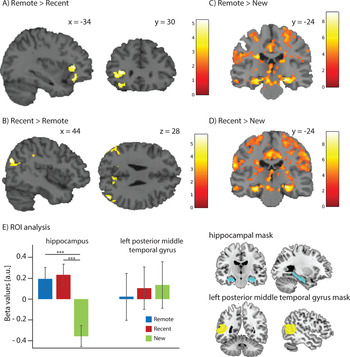
We predicted that words learnt 2 days before (Remote condition) would show a consolidation effect compared to words learnt just before the test (Recent condition), and thus show increased activity in the left pMTG and decreased activity in the hippocampus. To test this hypothesis, we contrasted the Remote and Recent conditions using a one-sample t-test. The Remote > Recent comparison showed two clusters in the left inferior frontal gyrus (pars triangularis peak [-34 30 6] cluster size 152; pars orbitalis peak [-34 30 -14], cluster size 80). No significant clusters were found in the predicted left pMTG. The reverse contrast Recent > Remote showed significant clusters in the bilateral occipito/parietal areas (right middle occipital gyrus peak [44 -74 28] cluster size 208, left angular gyrus peak [-52 -62 30] cluster size 124, right precuneus peak [8 -60 26] cluster size 85, left cuneus peak [-16 -56 26] cluster size 61, and right supramarginal gyrus peak [52 -38 38] cluster size 57). See Figure 3 (panels A and B) and Table 3.
fMRI results. A) Significant clusters found for the Recent > Remote contrast superimposed on a template brain. B) Significant clusters found for the Remote > Recent contrast. C) Significant clusters found for the Remote > New contrast. D) Significant clusters found for the Recent > New contrast. E) The left sub-panel shows the mean and SD of the extracted beta-values for the regions-of-interest (ROIs): the bilateral hippocampus and the left posterior middle temporal gyrus (pMTG). The right sub-panel shows the ROIs from which the beta-values were extracted.

fMRI: significant clusters

L: left, R: right
The Remote and Recent conditions both showed increased activity in the bilateral hippocampus compared to the New condition but the difference between Remote and Recent condition did not show a significant cluster in the hippocampus. See Figure 3 (panels C and D) and Table 3. Moreover, no increase in activity with consolidation was found within the left pMTG. Our hypothesis was only partially confirmed. Hippocampal activation was found for the Recent condition as expected, but the Remote condition also showed a heightened activation pattern in this region. Furthermore, we did not observe the expected pattern in the left pMTG.
ROI analysis
We also looked specifically at activity levels within the bilateral hippocampi and the left pMTG and, within these ROIs, tested for differences between the Recent and Remote conditions (see Figure 3E). The beta values extracted within these ROI were investigated with two repeated measures ANOVAs, with factor Time (Remote/Recent/New). One ANOVA was used to investigate the values for the left pMTG and the other the values for the bilateral hippocampus. For the comparison of mean beta values of the left pMTG (Remote (mean = 0.022, SD = 1.540), Recent (mean = 0.104, SD = 1.383), and New (mean = 0.137, SD = 1.526) no significant difference was found (p = .366). However, for the hippocampus we observed a significant difference (F(2,92) = 49.532, p < .001, ηp2 = .518): Remote (mean = 0.195, SD = 0.747), Recent (mean = 0.233, SD = 0.687), and New (mean = -0.354, SD = 0.697). This difference was driven by the values of the hippocampus in the New condition which were significantly different from the values in the other two conditions (both ps < .001; see Figure 3E). The difference between the Remote and Recent conditions, however, was not statistically significant (p = .890). The ROI analysis thus confirmed the findings that we observed in the whole-brain analysis.
Influence of different levels of English across participants
We assumed that there may be inter-participant variability in the brain responses to the consolidation trajectory, with longer experience or better knowledge of English speeding up the consolidation process. To test this hypothesis, we included extra regressors to the one-sample t-test comparing the Remote and Recent conditions. Although highly correlated with each other, IELTS, duration of stay, and vocabulary size differed slightly in different ways, and thus we tested each parameter separately. For IELTS, one cluster in the right posterior cingulate cortex (peak [2 -50 24] cluster size 47) was significant. More activity for the Recent condition relative to Remote condition was found if the IELTS score was higher. The reverse correlation did not show any significant clusters. For duration of stay in an English speaking environment, 2 clusters were found to be significant, one in the left inferior parietal cortex (peak [-48 -44 36] cluster size 52) and another in the right posterior middle temporal gyrus (peak [52 -42 -2] cluster size 56). More activity was found for the Recent condition if the duration of stay was longer. For vocabulary size, no significant clusters were observed for either direction. In sum, the correlation analyses with English proficiency measures did not show any effect in either the hippocampus or the pMTG.
Pause-detection task
Responses were excluded from this analysis for three reasons. First, all responses faster than 100 ms were removed from analysis and from calculation of mean RTs and SDs. Second, all remaining responses more than 2.5 SDs from the subject's mean were excluded. Third, we excluded all trials whose words were responded to as unknown during pre-test questionnaire on knowledge of English words. The results for the remaining data in this task are shown in Table 4 and Figure 4A.
Mean Reaction Times (mean ± S.E.) in the pause-detection task (left panel) and the primed lexical-decision task (right panel). * p < .05, *** p < .001.

Pause-detection task: Number of analysed trials and Reaction Times [mean (SD)]

With a repeated-measure design ANOVA, with two factors Time (Remote/Recent/Untrained), and Pause (With Pause/Without Pause), we investigated if the base words in the remote condition showed slower RTs compared to base words in the other conditions. As expected, a main effect of Time was observed (F(2,47) = 4.182, p = .018, ηp2 = .082). Planned t-tests comparing the Remote condition with the other conditions showed that RTs in the Remote condition were slower than those in either the Recent condition (t = 2.383, p = .021) or the Untrained condition (t = 2.503, p = .016, corrected α = .025). Thus, slower pause detection RTs were observed for the base words whose related novel words were trained 2 days before. There was a main effect of Pause, where participants responded faster when there was no pause inserted (p < .001) but the presence/absence of pause did not interact with Time (p = .107). In order to investigate if the three measures on English affinity (IELTS, duration stay, knowledge of English words) had any influence on the size of the effect (i.e., the difference of RTs between the Remote and Recent conditions), we correlated the size of the effect with the three covariates. None of the covariates significantly correlated with the consolidation effect (all ps > .184).
We observed the expected pattern for this task. That is, the interference effect was observed in the Remote condition, but not in the other two conditions. This suggests word-form based integration was observed after a period of consolidation.
Primed lexical-decision task
As with the pause-detection task, responses were excluded from this analysis for three reasons. First, all responses faster than 100 ms were removed from the analysis and hence from the calculation of mean RTs and SDs. Second, all remaining responses more than 2.5 SD from the subject's mean were excluded. Third, for consistency with the pause-detection analysis, we excluded all trials on a by-participant basis for all novel words whose base words were responded to as unknown by the participant during the English word pre-test. See Table 5 for a summary of the number of trials entered into the analysis and the RTs.
Primed lexical-decision task: Mean RTs and mean error rates.

We performed a repeated-measure design ANOVA, with two factors: Time (Remote/Recent) and Priming (Related/Unrelated) (see also Figure 4B). The analysis revealed a main effect of Priming, where related targets were responded faster than the unrelated targets (F(1,47) = 16.757, p < .001, ηp2 = .263), but we did not observe an effect of Time or an interaction of Time by Priming (p = .856, p = .253, respectively), although numerically the priming effect (the Unrelated–Related difference) was larger in the Remote condition (36.5 ± 64.8 ms) than in the Recent condition (17.9 ± 78.8 ms). Given this numerical trend, we performed an additional analysis in which we did not exclude trials on items with base words that the participants did not know in the English word pre-test (note that because the base words were not used in the primed lexical-decision task, data from their corresponding primes and targets, reflecting the meaning of the novel word rather than of the base word, is valid). This analysis once again revealed a main effect of Priming (F(1,47) = 11.397, p =.001, ηp2 = .195) and no effect of time (p = .626). The interaction of Time by Priming was again not significant (F(1,47) = 3.227, p = .079, ηp2 = .064). As with the pause-detection task, we also ran repeated measures ANOVAs with the English affinity covariates (IELTS, duration stay, knowledge of English). We did not find any significant effects with any of the covariates (p > .149).
Here, our hypothesis was partially confirmed. We found a main effect of priming: that is, the novel words primed semantically related target words, such that RTs were facilitated. Although this effect was numerically larger in the Remote condition than in the Recent condition, as we had expected, this difference was not significant.
Discussion
In this study, we asked whether memory consolidation supports the lexical integration (at the form and meaning levels) of novel L2 words in sequential bilinguals. Young adult native speakers of Italian with English as their L2 were taught two sets of English-like novel words, one set on the day of final testing (the Recent set) and one set two days earlier (the Remote set). We predicted that neural activity, as measured with fMRI, would shift from greater involvement of the hippocampus (and associated medial temporal structures) during the processing of Recent novel words (which should be less consolidated) to greater involvement of neocortical structures (the pMTG in particular) during the processing of Remote novel words (which should be more consolidated). This fMRI prediction was not confirmed. We also predicted two behavioral signatures of consolidation. The first was that there would be stronger form-based competition (as measured by slower pause-detection latencies) between novel words and existing phonologically related English words for the Remote words (more consolidated) than for the Recent words (less consolidated). The second was that there would be stronger semantic priming for the Remote words than for the Recent words (again because the former are more consolidated than the latter). The first of these behavioral predictions was confirmed while the second was not (there was a numerical trend in the predicted direction, but the interaction was not statistically significant). The behavioral findings thus suggest that consolidation does indeed appear to support word learning in the L2, but that integration at the level of lexical form may have a longer time-course than that at the level of lexical meaning.
The lack of neural evidence for consolidation does not undermine this conclusion, simply because it is a null result. The behavioral measures may be more sensitive than the fMRI measures. This may be for technical reasons, such as that the hypothesized differences in neural activity due to the effects of consolidation processes may not be adequately captured by the BOLD signal (i.e., it may have insufficient spatial or temporal resolution). It is unlikely, however, that this reason is the whole story, given the successful imaging of consolidation effects in prior fMRI word-learning studies (Davis et al., Reference Davis, Di Betta, Macdonald and Gaskell2009; Takashima et al., Reference Takashima, Bakker, van Hell, Janzen and McQueen2014). An additional or alternative reason for the present null result is that the recognition-memory task that we used in the scanner may have been sub-optimal. Remember that the displays involved the presentation of multiple printed words as response options. The act of reading these response options may have triggered episodic memories of the presentation of those words during training and thus increased the amount of hippocampal activity, making it harder to see the predicted difference between the Recent and Remote conditions. The difference observed between activity in the New condition and that in the two trained conditions (see Figure 3E) is consistent with the idea that, even though we used novel pictures in the scanner, both Remote and Recent words called up episodic memories from the training phase. An alternative task (e.g., a cued recall task in which the participants are asked to produce the learnt words when cued with the picture, rather than choose one from the options on the screen) could avoid this problem. Another possible interpretation is that the successful retrieval of remotely learned novel words still made use of the hippocampal episodic memory system. Both episodic and semantic memory representations can be activated upon retrieval if both memory representations are present (Takashima & Bakker, Reference Takashima and Bakker2017), and the episodic memory network was strongly engaged when retrieving the word meaning in both conditions. Future research is required to investigate further the neural signatures of memory consolidation in L2 word learning.
The current study failed to reveal effects of differences in English proficiency on either the degree of competition found in the pause-detection task or the amount of priming in the lexical-decision task. On the one hand, these null effects may again reflect lack of sensitivity (in this case, with respect to the individual differences measures): length of stay in an English-speaking country, standard test scores, and knowledge of the vocabulary that was tested in the study. These measures may not be precise enough indicators of proficiency and/or there may have been insufficient variance in the measures for associations with the consolidation effects to be detected. It may also be possible that the majority of participants were proficient enough for differences in amount of consolidation to go undetected. For example, differences in consolidation could arise if participants varied in their ability to hear non-native phonological categories accurately (e.g., the /ð/ in the novel word brothon) but perhaps there were few (or no) participants with such phonological difficulties. On the other hand, and with the usual provisos about null effects, one might argue that the lack of effects of proficiency is the expected outcome. If lexical integration is achieved through the same mechanisms as are used in L1 vocabulary acquisition (and, hence, are available to every L2 learner whatever their proficiency level), then lexical integration should not vary with language proficiency.
The results in the pause-detection and primed lexical-decision tasks are indeed consistent with the hypothesis that word learning in L2 is based on the same consolidation mechanisms as have been shown to affect L1 word learning in adults (Gaskell & Dumay, Reference Gaskell and Dumay2003; Dumay & Gaskell, Reference Dumay and Gaskell2007) and children (Henderson et al., Reference Henderson, Weighall, Brown and Gaskell2012, Reference Henderson, Weighall, Brown and Gaskell2013; van der Ven et al., Reference van der Ven, Takashima, Segers and Verhoeven2017). The lack of an effect of learning time (i.e., no interaction between Priming and Time) in the primed lexical-decision task may reflect insufficient power. If a study with greater statistical power were to detect this interaction, it would suggest that integration at the form and meaning levels has the same time course. Alternatively, however, if such a study were to confirm that the numerical trend observed here is not a real effect, it would suggest that meaning-level integration is indeed more rapid than form-level integration.
This difference in the time-course of lexical integration at the two levels would be consistent with evidence suggesting that meaning-level integration with new words can be very rapid (possibly due to “fast mapping”; Borovsky, Kutas & Elman, Reference Borovsky, Kutas and Elman2010; Borovsky, Elman & Kutas, Reference Borovsky, Elman and Kutas2012; Carey & Bartlett, Reference Carey and Bartlett1978). Furthermore, it is plausible that meaning-level integration may be quicker than form-level integration because there is more new knowledge to integrate in the latter case. Indeed, when a new L2 word refers to an existing concept (as in this study), no new concept needs to be acquired, and hence no reorganization of the semantic lexicon is required. All that is required is the integration of the knowledge that the concept has a new label. In contrast, the new form (unless it is a cognate, which we avoided here) is a novel package of phonological and orthographic knowledge that will overlap with (and thus need integration with) potentially many phonological and orthographic neighbors. While further research is required to examine possible differences between form- and meaning-level integration, we tentatively conclude, based on the present non-significant interaction and on these empirical and theoretical arguments, that consolidation processes may take more time for phonological than for semantic knowledge to be integrated in L2 learning. It is an interesting possibility that a novel L2 word might be lexically integrated at the meaning level while it still exists only as an episodic trace and thus not (fully) integrated at the form level.
One might consider that the order in which the tests were given might have had an effect. The participants were always tested for recognition memory in the scanner first, followed by the pause detection task, and finally the primed lexical decision task. It is thus possible that the recognition memory task (on Remote and Recent novel words) could have weakened potential differences between these two conditions in the other two tasks. Such an effect seems unlikely in the pause detection task because it was done on the base words of the novel words, which had not previously been presented. Furthermore, there was a difference between the Recent and Remote conditions in this task. This difference thus arose in spite of any effect of the preceding recognition memory task. In the lexical decision task, however, although the target words had also never appeared in any other task, it is possible that retrieval of the novel words’ meanings during the recognition memory task could have acted to remove differences in the efficacy of the Recent versus the Remote primes. The order of tests may thus be another reason (beyond insufficient power, as noted above) why the priming effect was not significantly modulated by the recent/remote training manipulation. This underscores the need for further research (looking e.g., at test order) to examine whether lexical integration has the same time course at the form and meaning levels.
The evidence of integration of novel words at both levels suggests that L2 vocabulary acquisition may be different from the acquisition of L2 grammar (Hartshorne et al., Reference Hartshorne, Tanenbaum and Pinker2018) or L2 phonology (Flege et al., Reference Flege, Yeni-Komshian and Liu1999). Vocabulary acquisition appears to rely on mechanisms that are basically the same across ages and languages (i.e., lexical integration is effectively the same throughout one's lifetime whichever language one is learning). Acquisition of grammar and phonology, in contrast, appears to depend on mechanisms which change with age, and thus (if the L2 is learned later in life than the L1) across languages.
Our claim that mechanisms of word learning are shared across L1 and L2 stands in sharp contrast to the recent suggestion that word learning is fundamentally different in L1 and L2 (Qiao & Forster, Reference Qiao and Forster2017). Qiao and Forster suggest that this qualitative difference reflects the closure of a critical period for language acquisition. As just discussed, there are grounds to question this suggestion: there is evidence that word-learning ability (unlike the abilities to learn other aspects of language) does not appear to depend on a critical period (Hartshorne & Germine, Reference Hartshorne and Germine2015; Snow & Hoefnagel-Höhle, Reference Snow and Hoefnagel-Höhle1978).
It remains the case, however, that our positive evidence of lexical consolidation in Italian–English sequential bilinguals is inconsistent with the negative evidence presented in Qiao and Forster's (Reference Qiao and Forster2017) masked priming experiment with Chinese–English sequential bilinguals. There are several possible explanations for this discrepancy. First, there may be global differences between learning words in both the spoken and printed modalities (as here) versus learning words only in the print modality (as in Qiao & Forster, Reference Qiao and Forster2017). This seems unlikely, given other evidence of lexical consolidation in the print modality (e.g., Bakker et al., Reference Bakker, Takashima, van Hell, Janzen and McQueen2014; Qiao & Forster, Reference Qiao and Forster2013). Second, there are other procedural differences between the studies, including whether the primes were masked (as in Qiao & Forster) or unmasked (as in the current priming task).
Third, as discussed in the study by Nakayama and Lupker (Reference Nakayama and Lupker2018), where they also found a facilitation effect for form-priming in an L2 English experiment with L1 Japanese participants, the unexpected findings in the L2 English materials with L2 Chinese participants in the Qiao and Forster study (2017) may be due to the differences between the L1 and L2 orthographies. It may be that an alphabetic orthographic lexicon (for L2 English) is different (and engages different processes) in someone who has an L1 logographic orthographic lexicon (as in the case of L1 Chinese participants) than in someone whose L1 uses an alphabetic orthography. The L1 visual masked priming study by Qiao and Forster (Reference Qiao and Forster2013) with English L1 participants indeed revealed interference effects which parallel those observed here in the remote condition of the pause detection task and those in previous studies investigating novel word learning in L1 (e.g., Bakker et al., Reference Bakker, Takashima, van Hell, Janzen and McQueen2014; Gaskell & Dumay, Reference Gaskell and Dumay2003). These interference effects, we have argued, reflect lexical integration effects after consolidation. It may be that lexical consolidation in L2 may be slower (or even fundamentally different) when it entails a different kind of writing system from that used in the participant's L1. One way to test this possibility would be to rerun Qiao and Forster's masked priming experiment in English with L2 participants who speak an L1 that uses the same orthographic writing system. Another way would be to test Chinese–English bilinguals but with a longer consolidation period than in Qiao and Forster's study (e.g., more days of training and/or a longer delay between training and final test). Without further evidence from such experiments for differences in lexicalization processes between L1 and L2, and given the present results and the data showing similarities in consolidation processes between children and adults, it appears unfounded to argue, as Qiao and Forster (Reference Qiao and Forster2017) do, that all L2 words (irrespective of language and orthography) are represented and processed in a qualitatively different way from L1 words.
Our data suggest instead that consolidation processes are similar across languages and are consistent with the idea that those processes are also similar across ages. This similarity, however, does not mean that there are no age-related changes in vocabulary acquisition whatsoever. In fact, there appear to be subtle differences between adults and children in the efficacy of consolidation processes. In particular, while degree of consolidation in children is modulated by the lexical neighborhood of the new word (i.e., new words are consolidated better if they have fewer neighbors), no such difference is observed in adults (James et al., Reference James, Gaskell and Henderson2019). Further research is required to investigate these age-related differences in greater detail. It is possible that effects of neural maturation may modulate the consolidation process (Takashima et al., Reference Takashima, Bakker-Marshall, van Hell, McQueen and Janzen2019), potentially through age-related changes in the engagement of schema-based memory formation processes (van Kesteren, Beul, Takashima, Henson, Ruiter & Fernández, Reference van Kesteren, Beul, Takashima, Henson, Ruiter and Fernández2013; van Kesteren, Ruiter, Fernández & Henson, Reference van Kesteren, Beul, Takashima, Henson, Ruiter and Fernández2012). In spite of these potential age-related effects, however, it appears that integration of new word forms has the same basic consolidation trajectory (i.e., the forms of recently learned words are less likely to be integrated than those of more remotely learned words) in monolinguals and bilinguals.
It is important to emphasize that there is much more to word learning than lexical consolidation. Many other cognitive mechanisms are also involved. As with consolidation, in many cases those mechanisms are likely to be the same in the L2 as in the L1. They include, for example, the ability to hold novel word-forms in phonological short-term memory (Baddeley, Gathercole & Papagno, Reference Baddeley, Gathercole and Papagno1998; McQueen, Eisner, Burgering & Vroomen, Reference McQueen, Eisner, Burgering and Vroomen2020) and the ability to form label-meaning associations (which as we have already noted can be very fast; Borovsky et al., Reference Borovsky, Kutas and Elman2010, Reference Borovsky, Elman and Kutas2012; Carey & Bartlett, Reference Carey and Bartlett1978). But other mechanisms are necessarily specific to the learning of L2 words. In particular, translation to the corresponding L1 word is an obvious way to learn an L2 word (and indeed traditional vocabulary learning in the language classroom involves rote learning of lists of L1-L2 word pairs). We should note that, in order to discourage a translation-based learning strategy, we tried to select referents of the new words that did not have readily available Italian translations (e.g., because they were low in frequency, which was of course also necessary to ensure that the participants did not already know the English words). Nevertheless, we cannot rule out that our participants used translation as a strategy. More generally, it is clear that there will always be differences between learning an L2 word (through translation to the L1 word or otherwise) when the referent is an existing concept than when (as is often the case, especially early in life, in the L1) the referent is a new concept.
Our claim is thus that lexical consolidation is an essential mechanism of word learning that can be found across ages and languages but neither that it is the only mechanism underlying word learning nor that those other mechanisms are always the same in L2 as in L1 learning. As we have also argued, our results across the two behavioral tasks suggest that consolidation may have a different time course at the meaning and form levels. It is possible that the consolidation process is more rapid for the integration of word meanings than for the integration of word forms, and this may especially be the case when the L2 word is a new, non-cognate label for an existing concept. Our findings suggest that, most clearly with respect to word forms, memory consolidation appears to support the gradual integration of new L2 words into the bilingual lexicon.
Supplementary Material
The supplementary materials comprise one file containing:
1. Materials: Critical stimuli (Table S1).
2. Procedure: Timeline of tasks (Table S2) and descriptions of each training-phase task.
3. Results: Error rates during the training phase (Table S3).
For supplementary material accompanying this paper, visit http://dx.doi.org/10.1017/S1366728921000286
Acknowledgments
This article is based on the MSc thesis of the first author, under the supervision of the other two authors, carried out as part of the Cognitive Neuroscience Research Master program at Radboud University, Nijmegen. We thank Tobia Spampatti for his invaluable assistance with preparing and running the experiment.




 Open access

