




1. Introduction
1.1 Motivation
Quantum computing is an approach to computation that utilizes quantum-mechanical principles such as superposition and entanglement to enhance certain calculations compared to classical computers. Because understanding all computational implications of these principles is challenging, designing quantum programming languages and their type systems forms a very active research field, in which new language paradigms and features are regularly proposed. Here, a place to begin is a type system – a formal system that acts as a blueprint for programming languages, similar to how the lambda calculus serves as a blueprint for functional programming languages. The formation and derivation rules of the type system provide an operational model that can be used to reason about the evolution of a quantum program, albeit at an abstract level.
Recursive methods are crucial for various aspects of quantum computing as seen in algorithms like Grover’s quantum search algorithm Grover (Reference Grover1996), where a unitary gate is applied multiple times. Also the construction of quantum circuits sometimes depends on recursive methods. For instance, the quantum Fourier transform in Shor’s algorithm for prime factorization Shor (Reference Shor1999) involves iteratively building on lower qubit counts. The design of quantum programming languages and their type systems is challenging, in particular when recursion is added.
In particular, an open problem is how to abstract away from the quantum circuit paradigm, just as classical computing advanced by shifting from assembly languages to high-level programming. A key component of this paradigm shift would be the implementation of a quantum control flow. Currently, in most existing quantum programming languages, the control flow is classical: conditions in if statements and for the termination of recursive loops are deterministically true or false. Even when a program branches based on the state of a qubit, that state must first be measured, collapsing it into a classical value before the control decision is made. In contrast, quantum control flow allows branching and looping decisions to depend on quantum states without prior measurement. This enables control structures that operate coherently on superpositions, allowing quantum operations to proceed along multiple computational paths in parallel, without collapsing the underlying quantum information. As an example, the quantum switch Chiribella et al. (Reference Chiribella, D’Ariano, Perinotti and Valiron2013) is a higher-order process that applies two operations $A$
and
$A$
and $B$
to a qubit, but the order of application depends on the state of a control qubit. For instance, if the state is
$B$
to a qubit, but the order of application depends on the state of a control qubit. For instance, if the state is $|0\rangle$
, we perform
$|0\rangle$
, we perform $A;B$
(i.e.,
$A;B$
(i.e., $A$
followed by
$A$
followed by $B$
), and if the state is
$B$
), and if the state is $|1\rangle$
, we perform
$|1\rangle$
, we perform $B;A$
. We explicitly do not require a measurement of the control qubit, and as a consequence, the state of the control qubit can be in a superposition of
$B;A$
. We explicitly do not require a measurement of the control qubit, and as a consequence, the state of the control qubit can be in a superposition of $|0\rangle$
and
$|0\rangle$
and $|1\rangle$
, whence so can be the order of application of
$|1\rangle$
, whence so can be the order of application of $A$
and
$A$
and $B$
. For this reason, we say that the quantum switch is an indefinite causal process.
$B$
. For this reason, we say that the quantum switch is an indefinite causal process.
Designing type systems that can express such inherently quantum control mechanisms remains a central challenge, particularly when it comes to achieving clean, higher-order and widely adopted solutions. A deep understanding of how higher-order functions behave under quantum interactions – such as superposition and entanglement – is crucial for designing type systems that can reliably express these control mechanisms.
One approach to gaining such an understanding is through denotational semantics, which provides a rigorous mathematical framework for interpreting programming languages and type systems. By constructing a denotational or categorical model of a type system, one can precisely describe the behavior of types and terms under complex computational phenomena – including quantum effects. Formally, a model consists of a category $\mathbf C$
, along with a interpretation function that assigns objects and morphisms of
$\mathbf C$
, along with a interpretation function that assigns objects and morphisms of $\mathbf C$
to types and terms of the system, respectively, and type constructors are interpreted by functors on
$\mathbf C$
to types and terms of the system, respectively, and type constructors are interpreted by functors on $\mathbf C$
. A crucial requirement is that the interpretation function is compositional, meaning that the interpretation of a compound term is determined solely by the interpretations of its immediate subterms. In this way, the semantics can be built “bottom up”: the meaning of complex terms can be expressed as the composition of the meanings of their constituent components.
$\mathbf C$
. A crucial requirement is that the interpretation function is compositional, meaning that the interpretation of a compound term is determined solely by the interpretations of its immediate subterms. In this way, the semantics can be built “bottom up”: the meaning of complex terms can be expressed as the composition of the meanings of their constituent components.
An example of how denotational semantics influences the design of programming languages is provided by Moggi’s seminal work modeling computational effects using monads Moggi (Reference Moggi1989, Reference Moggi1991), which inspired new computational paradigms such as Levy’s Call-by-push-value paradigm Levy (Reference Levy2004) that combines Call-by-value and Call-by-name. Another example of a new paradigm is provided by coherence spaces, from which Girard derived linear logic Girard (Reference Girard1987), eventually leading to substructural type systems. These type systems are actually used for quantum programming languages, because they reflect that quantum information is subject to principles such as the No-Cloning Theorem. Hence, we expect that new, more refined categorical models for higher-order quantum programming languages may provide insights into the possibilities for implementing recursion in quantum computing, and in particular may help clarify whether recursion with quantum control is feasible.
Currently, most models of quantum programming languages consist of a category $\mathbf M$
whose objects represent finite collections of qubits, and whose morphisms represent first-order quantum processes, such as quantum gates in the case of pure quantum computations, or quantum channels in the case of impure computations. To support higher-order functions, one often applies categorical constructions such as taking presheaves over
$\mathbf M$
whose objects represent finite collections of qubits, and whose morphisms represent first-order quantum processes, such as quantum gates in the case of pure quantum computations, or quantum channels in the case of impure computations. To support higher-order functions, one often applies categorical constructions such as taking presheaves over $\mathbf M$
. However, the free higher-order structure of such a model does not capture the quantum interactions between higher-order functions such as the quantum switch, which are essential for modeling quantum control.
$\mathbf M$
. However, the free higher-order structure of such a model does not capture the quantum interactions between higher-order functions such as the quantum switch, which are essential for modeling quantum control.
We propose constructing denotational models of quantum computing using the principles of noncommutative geometry Connes (Reference Connes1994), which is a mathematical framework in which quantum phenomena are described by noncommutative structures, typically in terms of bounded (= continuous linear) operators on a Hilbert space. Examples of these structures are operator algebras Blackadar (Reference Blackadar2006), that is, algebras of bounded operators on a Hilbert space, and operator spaces Effros and Ruan (Reference Effros and Ruan2000), which are subspaces of the space of all bounded operators on a Hilbert space. A core ingredient of noncommutative geometry is quantization, the process of extending classical mathematical structures into the noncommutative realm. A canonical example is provided by C*-algebras, which form a class of operator algebras that can be regarded as noncommutative generalizations of locally compact Hausdorff spaces. This connection is formalized by Gelfand duality, which states that any commutative $C^*$
-algebra
$C^*$
-algebra $A$
is isomorphic to the algebra
$A$
is isomorphic to the algebra $C_0(X)$
of continuous complex-valued functions vanishing at infinity on some locally compact Hausdorff space
$C_0(X)$
of continuous complex-valued functions vanishing at infinity on some locally compact Hausdorff space $X$
.
$X$
.
The guiding insight of noncommutative geometry is that many quantum phenomena have classical counterparts and can be understood as noncommutative generalizations of familiar structures. In classical physics, for instance, the observables of a system are continuous real-valued functions on its phase space $X$
, which is usually a locally compact Hausdorff spaces. In the language of operator algebras, these observables correspond to the self-adjoint elements of the C*-algebra
$X$
, which is usually a locally compact Hausdorff spaces. In the language of operator algebras, these observables correspond to the self-adjoint elements of the C*-algebra $C_0(X)$
. Quantum systems follow the same pattern: they are described by (typically noncommutative) C*-algebras, with observables identified as selfadjoint elements. In a similar way, we expect that quantizing the mathematical structures underlying the denotational semantics of ordinary higher-order programming languages will yield models of higher-order quantum programming languages that provide the clearest and most faithful representation of higher-order quantum functions and their interactions.
$C_0(X)$
. Quantum systems follow the same pattern: they are described by (typically noncommutative) C*-algebras, with observables identified as selfadjoint elements. In a similar way, we expect that quantizing the mathematical structures underlying the denotational semantics of ordinary higher-order programming languages will yield models of higher-order quantum programming languages that provide the clearest and most faithful representation of higher-order quantum functions and their interactions.
In the denotational semantics of programming languages and their type systems, the support of recursion requires the existence of canonical fixpoints of morphisms in a categorical model. As a consequence, categorical models for programming languages with recursion often consist of structures for which there exists a fixpoint theorem. For example, $\omega$
-complete partial ordered sets (cpos) are widely used in the denotational semantics of ordinary higher-order programming languages with recursion, because Kleene’s fixpoint theorem ensures the existence of fixpoints on pointed cpos, and because the category
$\omega$
-complete partial ordered sets (cpos) are widely used in the denotational semantics of ordinary higher-order programming languages with recursion, because Kleene’s fixpoint theorem ensures the existence of fixpoints on pointed cpos, and because the category $\mathbf{CPO}$
of cpos and Scott continuous maps is cartesian closed, hence supports higher-order functions. Domain theory is the branch of mathematics that studies cpos and their more refined variants, such as directed-complete partial orders (dcpos), and develops systematic methods for constructing denotational models that support higher-order functions and recursion on the basis of these structures.
$\mathbf{CPO}$
of cpos and Scott continuous maps is cartesian closed, hence supports higher-order functions. Domain theory is the branch of mathematics that studies cpos and their more refined variants, such as directed-complete partial orders (dcpos), and develops systematic methods for constructing denotational models that support higher-order functions and recursion on the basis of these structures.
We expect that the quantization of domain-theoretic structures will yield a quantum domain theory with the following properties:
-
1. Quantum domain theory should provide systematic methods for the construction of categorical models of higher-order quantum programming languages with recursion, just as ordinary domain theory does for ordinary programming languages.
-
2. Because of their noncommutative character, the resulting models describe higher-order quantum processes and their interactions more accurately.
-
3. Since its structures are noncommutative analogues of classical domain-theoretic ones, many of the techniques and intuitions of ordinary domain theory should carry over.
-
4. As a generalization of domain theory, its techniques should also apply to classical programming languages, thereby unifying classical and quantum computation in the same denotational framework.
-
5. Alternative semantic structures for ordinary languages – metric, topological, or coherence spaces – are deeply connected to domains and may be quantized in the same way. The resulting quantum structures would inherit similar connections to quantum domain theory, enabling a richer analysis of quantum programming models.
1.2 Contributions, methodology, and outline of the article
In this article, as a first step toward developing a quantum domain theory, we introduce quantum cpos, which are noncommutative generalizations of ordinary cpos, obtained via a quantization process that we call discrete quantization. This process, which is described in greater detail in Section 2, is based on noncommutative generalizations of sets and binary relations between sets, called quantum sets and binary relations between quantum sets,Footnote
1
respectively. The idea behind discrete quantization is that most mathematical structures can be defined in terms of sets and binary relations subject to constraints, hence one can quantize such a structure by replacing each instance of a set in its definition by a quantum set, and any instance of a binary relation between ordinary sets by a binary relation between quantum sets, while requiring that the same constraints hold. Categorically, discrete quantization amounts to the internalization of structures in the category $\mathbf{qRel}$
of quantum sets and binary relations. Using discrete quantization, one can easily obtain the notions of functions between quantum sets and partial orders on quantum sets as noncommutative generalizations of functions between ordinary sets and partial order relations on ordinary sets, respectively.
$\mathbf{qRel}$
of quantum sets and binary relations. Using discrete quantization, one can easily obtain the notions of functions between quantum sets and partial orders on quantum sets as noncommutative generalizations of functions between ordinary sets and partial order relations on ordinary sets, respectively.
Quantum sets and functions between quantum sets form a category $\mathbf{qSet}$
that can be regarded as a noncommutative generalization of the category
$\mathbf{qSet}$
that can be regarded as a noncommutative generalization of the category $\mathbf{Set}$
. This category
$\mathbf{Set}$
. This category $\mathbf{qSet}$
shares many categorical properties with
$\mathbf{qSet}$
shares many categorical properties with $\mathbf{Set}$
, for instance it is complete and cocomplete, but instead of cartesian closed, it is symmetric monoidal closed, reflecting the linear character of quantum data. This pattern seems to be typical, also the cartesian closed category
$\mathbf{Set}$
, for instance it is complete and cocomplete, but instead of cartesian closed, it is symmetric monoidal closed, reflecting the linear character of quantum data. This pattern seems to be typical, also the cartesian closed category $\mathbf{POS}$
of posets and monotone maps has a noncommutative counterpart
$\mathbf{POS}$
of posets and monotone maps has a noncommutative counterpart $\mathbf{qPOS}$
that is symmetric monoidal closed. The objects of
$\mathbf{qPOS}$
that is symmetric monoidal closed. The objects of $\mathbf{qPOS}$
are called quantum posets and consist of a quantum set equipped with a partial order relation.
$\mathbf{qPOS}$
are called quantum posets and consist of a quantum set equipped with a partial order relation.
In Section 2.5, we explore what computations can be modeled with $\mathbf{qSet}$
in the absence of recursion. Here, models based on quantum sets follow the same pattern as set-theoretic models of ordinary programming languages without recursion.
$\mathbf{qSet}$
in the absence of recursion. Here, models based on quantum sets follow the same pattern as set-theoretic models of ordinary programming languages without recursion. $\mathbf{qSet}$
models pure quantum computations just as
$\mathbf{qSet}$
models pure quantum computations just as $\mathbf{Set}$
models pure classical computations. As in the classical case, where impure computations (i.e., side effects) are described by monads on
$\mathbf{Set}$
models pure classical computations. As in the classical case, where impure computations (i.e., side effects) are described by monads on $\mathbf{Set}$
, impure quantum computations, typically represented by quantum channels, can be modeled by a monad
$\mathbf{Set}$
, impure quantum computations, typically represented by quantum channels, can be modeled by a monad $\mathcal D$
on
$\mathcal D$
on $\mathbf{qSet}$
that is the quantum analogue of the (countable) distributions monad. The CP-Löwner order
Footnote
2
emerges as a the counterpart of the pointwise order of subdistributions. Since the subdistributions monad is defined on thee category
$\mathbf{qSet}$
that is the quantum analogue of the (countable) distributions monad. The CP-Löwner order
Footnote
2
emerges as a the counterpart of the pointwise order of subdistributions. Since the subdistributions monad is defined on thee category $\mathbf{Set}$
, subdistributions do not suffice for the support of recursion. In the same spirit, the CP-Löwner order does not support full recursion in quantum computing. Another perspective on why support for recursion fails is that classically-controlled recursion typically takes place during the phase of circuit generation, whereas the CP-Löwner order describes the stage of completion of a computation during the phase of circuit execution.
$\mathbf{Set}$
, subdistributions do not suffice for the support of recursion. In the same spirit, the CP-Löwner order does not support full recursion in quantum computing. Another perspective on why support for recursion fails is that classically-controlled recursion typically takes place during the phase of circuit generation, whereas the CP-Löwner order describes the stage of completion of a computation during the phase of circuit execution.
In Section 3, we introduce quantum cpos, defined as quantum posets whose partial order relation generalizes $\omega$
-complete partial orders in the noncommutative setting. We also introduce noncommutative generalizations of basic domain-theoretic concepts, such as Scott continuity, and we show that the category
$\omega$
-complete partial orders in the noncommutative setting. We also introduce noncommutative generalizations of basic domain-theoretic concepts, such as Scott continuity, and we show that the category $\mathbf{qCPO}$
of quantum cpos and Scott continuous maps is enriched over
$\mathbf{qCPO}$
of quantum cpos and Scott continuous maps is enriched over $\mathbf{CPO}$
, complete, and has coproducts. The existence of arbitrary colimits is more complicated, and proven in Section 4.
$\mathbf{CPO}$
, complete, and has coproducts. The existence of arbitrary colimits is more complicated, and proven in Section 4.
In Section 5, we show that $\mathbf{qCPO}$
is symmetric monoidal closed, hence it supports higher-order functions. Similar to
$\mathbf{qCPO}$
is symmetric monoidal closed, hence it supports higher-order functions. Similar to $\mathbf{qSet}$
and
$\mathbf{qSet}$
and $\mathbf{qPOS}$
, the monoidal product of
$\mathbf{qPOS}$
, the monoidal product of $\mathbf{qCPO}$
is not the categorical product, even though it generalizes the cartesian product of ordinary cpos.
$\mathbf{qCPO}$
is not the categorical product, even though it generalizes the cartesian product of ordinary cpos.
In Section 6, we investigate the relation between cpos and quantum cpos: We show every cpo is a quantum cpo, and that there is a fully faithful strong monoidal functor $`(\!-\!):{\mathbf{CPO}}\to \mathbf{qCPO}$
, which has a right adjoint, hence forming a linear/nonlinear model (see also Definition 2.5.2).
$`(\!-\!):{\mathbf{CPO}}\to \mathbf{qCPO}$
, which has a right adjoint, hence forming a linear/nonlinear model (see also Definition 2.5.2).
The effect of nontermination, necessary for support of recursion, is supported by the construction of the lift monad on $\mathbf{qCPO}$
in Section 7, which we show to be commutative. We introduce pointed quantum cpos and strict Scott continuous maps, and show that they form a category
$\mathbf{qCPO}$
in Section 7, which we show to be commutative. We introduce pointed quantum cpos and strict Scott continuous maps, and show that they form a category $\mathbf{qCPO}_{\perp !}$
that is equivalent to the Kleisli category of the lift monad on
$\mathbf{qCPO}_{\perp !}$
that is equivalent to the Kleisli category of the lift monad on $\mathbf{qCPO}$
. Moreover, we show that
$\mathbf{qCPO}$
. Moreover, we show that $\mathbf{qCPO}_{\perp !}$
it is
$\mathbf{qCPO}_{\perp !}$
it is $\mathbf{CPO}$
-algebraically compact, a strong categorical property characteristic of models of type systems with recursive types, that is, type systems in which types can be defined recursively. This form of recursion is particularly powerful and typically implies recursion at the term level as well. Moreover, we show that there is a linear/nonlinear adjunction between
$\mathbf{CPO}$
-algebraically compact, a strong categorical property characteristic of models of type systems with recursive types, that is, type systems in which types can be defined recursively. This form of recursion is particularly powerful and typically implies recursion at the term level as well. Moreover, we show that there is a linear/nonlinear adjunction between $\mathbf{CPO}$
and
$\mathbf{CPO}$
and $\mathbf{qCPO}_{\perp !}$
and we conclude the article by proving that this adjunction forms model that is both sounds for ECLNL, a quantum circuit description language with recursive terms, and sound and computationally adequate for LNL-FPC, a type system that combines linear and recursive types, see also the Related work section. It follows that quantum cpos form an appropriate structure to model recursion at the stage of circuit generation.
$\mathbf{qCPO}_{\perp !}$
and we conclude the article by proving that this adjunction forms model that is both sounds for ECLNL, a quantum circuit description language with recursive terms, and sound and computationally adequate for LNL-FPC, a type system that combines linear and recursive types, see also the Related work section. It follows that quantum cpos form an appropriate structure to model recursion at the stage of circuit generation.
Finally, in the Conclusions section, we discuss the possible existence of a probabilistic power domain monad on $\mathbf{qCPO}$
, the challenges in finding such a monad, and its connection with support for quantum-controlled recursion.
$\mathbf{qCPO}$
, the challenges in finding such a monad, and its connection with support for quantum-controlled recursion.
1.3 Related work
Our work is based on two lines of research. The first concerns type systems with recursion for quantum programming languages and their denotational semantics. The starting point for this work is Proto-Quipper-M Rios and Selinger (Reference Rios and Selinger2017), a quantum circuit description language. In collaboration with Vladimir Zamdzhiev, the last two authors introduced ECLNL Lindenhovius et al. (Reference Lindenhovius, Mislove, Zamdzhiev, Palmigiano and Sadrzadeh2023), which is essentially an extension of Proto-Quipper-M with recursive terms, and LNL-FPC Lindenhovius et al. (Reference Lindenhovius, Mislove and Zamdzhiev2021), which can be viewed both as an extension of Plotkin’s Fixpoint Calculus (a blueprint for a recursive type system) with linear types, and as an extension of the circuit-free fragment of Proto-Quipper-M with recursive types. In this article, we construct a model in terms of quantum cpos that is sound for ECLNL and both sound and computationally adequate for LNL-FPC.
As mentioned above, models for quantum computing are often obtained by applying categorical constructions to a category $\mathbf M$
that models first-order quantum processes. For instance, in Lindenhovius et al. (Reference Lindenhovius, Mislove, Zamdzhiev, Palmigiano and Sadrzadeh2023), where ECLNL is defined, a presheaf model on
$\mathbf M$
that models first-order quantum processes. For instance, in Lindenhovius et al. (Reference Lindenhovius, Mislove, Zamdzhiev, Palmigiano and Sadrzadeh2023), where ECLNL is defined, a presheaf model on $\mathbf M$
was proposed, where
$\mathbf M$
was proposed, where $\mathbf M$
was taken to be the category of finite-dimensional matrix algebras and completely positive maps. Moreover, in Pagani et al. (Reference Pagani, Selinger and Valiron2014), a model for Selinger and Valiron’s quantum lambda calculus Selinger and Valiron (Reference Selinger and Valiron2006) was constructed, where
$\mathbf M$
was taken to be the category of finite-dimensional matrix algebras and completely positive maps. Moreover, in Pagani et al. (Reference Pagani, Selinger and Valiron2014), a model for Selinger and Valiron’s quantum lambda calculus Selinger and Valiron (Reference Selinger and Valiron2006) was constructed, where $\mathbf M$
was taken to be the category of finite-dimensional matrix algebras and completely positive maps. The eventual model is obtained by first taking a suitable full subcategory of the Karoubi envelope of
$\mathbf M$
was taken to be the category of finite-dimensional matrix algebras and completely positive maps. The eventual model is obtained by first taking a suitable full subcategory of the Karoubi envelope of $\mathbf M$
, then enriching it over the category
$\mathbf M$
, then enriching it over the category $\mathbf{DCPO}$
of dcpos via a change-of-basis operation, and finally taking the free finite biproduct completion. The resulting categorical model might be difficult to analyse because of this use of several categorical constructions on top of each other. The quantum lambda calculus and FPC were combined in the language Quantum FPC, which was also modelled by a presheaf category Tsukada and Asada (Reference Tsukada and Asada2024). We expect that the existence of a probabilistic power domain monad on
$\mathbf{DCPO}$
of dcpos via a change-of-basis operation, and finally taking the free finite biproduct completion. The resulting categorical model might be difficult to analyse because of this use of several categorical constructions on top of each other. The quantum lambda calculus and FPC were combined in the language Quantum FPC, which was also modelled by a presheaf category Tsukada and Asada (Reference Tsukada and Asada2024). We expect that the existence of a probabilistic power domain monad on $\mathbf{qCPO}$
will allow us to construct an alternative, more transparent models for the quantum lambda calculus and Quantum FPC in terms of quantum cpos.
$\mathbf{qCPO}$
will allow us to construct an alternative, more transparent models for the quantum lambda calculus and Quantum FPC in terms of quantum cpos.
The other line of research, mathematical quantization, is a rich subject with many applications in quantum information theory. Our preferred quantization method, discrete quantization, is based on the notion of a quantum relation between von Neumann algebras,Footnote
3
which was distilled by Weaver Weaver (Reference Weaver2012) from his work with Kuperberg on the quantization of metric spaces Kuperberg and Weaver (Reference Kuperberg and Weaver2012). Their quantum metric spaces can be regarded as an internal version of metric spaces in the category $\mathbf{WRel}$
of von Neumann algebras and quantum relations. For example, Kuperberg and Weaver showed that the quantum Hamming distance used in quantum error correction can be understood as a quantum metric Kuperberg and Weaver (Reference Kuperberg and Weaver2012).
$\mathbf{WRel}$
of von Neumann algebras and quantum relations. For example, Kuperberg and Weaver showed that the quantum Hamming distance used in quantum error correction can be understood as a quantum metric Kuperberg and Weaver (Reference Kuperberg and Weaver2012).
We will refer to the internalization of structures in $\mathbf{WRel}$
as W*-quantization. This process is closely related to discrete quantization, as follows from the work of the first author, who showed that the category
$\mathbf{WRel}$
as W*-quantization. This process is closely related to discrete quantization, as follows from the work of the first author, who showed that the category $\mathbf{qSet}$
is dually equivalent to the category
$\mathbf{qSet}$
is dually equivalent to the category $\mathbf{WStar}_{\mathrm{HA}}$
of hereditarily atomic von Neumann algebras
Footnote
4
and normal
$\mathbf{WStar}_{\mathrm{HA}}$
of hereditarily atomic von Neumann algebras
Footnote
4
and normal $*$
-homomorphisms Kornell (Reference Kornell2020), and that there is an inclusion of the category
$*$
-homomorphisms Kornell (Reference Kornell2020), and that there is an inclusion of the category $\mathbf{qRel}$
of quantum sets and binary relations into the category
$\mathbf{qRel}$
of quantum sets and binary relations into the category $\mathbf{WRel}$
of von Neumann algebras and quantum relations with hereditarily atomic von Neumann algebras as essential image [Kornell (Reference Kornell2024a), Section A.2]. In this work, we employ discrete quantization, because
$\mathbf{WRel}$
of von Neumann algebras and quantum relations with hereditarily atomic von Neumann algebras as essential image [Kornell (Reference Kornell2024a), Section A.2]. In this work, we employ discrete quantization, because $\mathbf{qRel}$
has better categorical properties than
$\mathbf{qRel}$
has better categorical properties than $\mathbf{WRel}$
,Footnote
5
and because most quantum computations only involve qubits, for which
$\mathbf{WRel}$
,Footnote
5
and because most quantum computations only involve qubits, for which $\mathbf{qRel}$
suffices.
$\mathbf{qRel}$
suffices.
Quantum posets and quantum graphs are other examples of quantum structures that can be obtained via both quantization processes Weaver (Reference Weaver2012). Quantum graphs were introduced as noncommutative confusability graphs for quantum error correction Duan et al. (Reference Duan, Severini and Winter2013), and Weaver generalized this notion to arbitrary von Neumann algebras Weaver (Reference Weaver2012, Reference Weaver2021). The first author showed that these structures, as well as discrete quantum groups can be characterized in terms of the internal logic of this category Kornell (Reference Kornell2024a,Reference Kornellb). The categorical properties of quantum posets were explored by the authors in Kornell et al. (Reference Kornell, Lindenhovius and Mislove2022). Building on this work and in collaboration with Gejza Jenča, the second author introduced a noncommutative generalization of complete lattices called quantum suplattices Jenča and Lindenhovius (Reference Jenča and Lindenhovius2023). This work heavily relies on the compact-closed structure of $\mathbf{qRel}$
.
$\mathbf{qRel}$
.
Von Neumann algebras provide prototypical noncommutative models for quantum computation. A first step in this direction was given by the first author, who established that the category of von Neumann algebras and normal $*$
-homomorphisms is monoidal closed, thereby showing that higher-order pure computations can already be captured in this operator-algebraic setting Kornell (Reference Kornell2017). In Cho (Reference Cho2016), it was shown that the category
$*$
-homomorphisms is monoidal closed, thereby showing that higher-order pure computations can already be captured in this operator-algebraic setting Kornell (Reference Kornell2017). In Cho (Reference Cho2016), it was shown that the category $\mathbf{WCPSU}$
of von Neumann algebras and completely positive subunital maps is
$\mathbf{WCPSU}$
of von Neumann algebras and completely positive subunital maps is $\mathbf{DCPO}$
-enriched with respect to the CP-Löwner order, can be used to model the language QPL. It was also shown that the category models an extension of QPL with inductive types Péchoux et al. (Reference Péchoux, Perdrix, Rennela and Zamdzhiev2020). In Cho and Westerbaan (Reference Westerbaan2016), it was shown that the inclusion of
$\mathbf{DCPO}$
-enriched with respect to the CP-Löwner order, can be used to model the language QPL. It was also shown that the category models an extension of QPL with inductive types Péchoux et al. (Reference Péchoux, Perdrix, Rennela and Zamdzhiev2020). In Cho and Westerbaan (Reference Westerbaan2016), it was shown that the inclusion of $\mathbf{WStar}$
into
$\mathbf{WStar}$
into $\mathbf{WCPSU}$
has an adjoint, and that the resulting adjunction can be used to model the recursion-free fragment of the quantum lambda calculus. In Section 2.5, we will see that when restricted to hereditarily atomic von Neumann algebras, this adjunction yields a monad on
$\mathbf{WCPSU}$
has an adjoint, and that the resulting adjunction can be used to model the recursion-free fragment of the quantum lambda calculus. In Section 2.5, we will see that when restricted to hereditarily atomic von Neumann algebras, this adjunction yields a monad on $\mathbf{qSet}$
that is the quantum version of the subdistributions monad.
$\mathbf{qSet}$
that is the quantum version of the subdistributions monad.
2. Preliminaries
2.1 Quantum sets and binary relations
In this section, we introduce quantum sets, binary relations and functions between quantum sets, and order relations on quantum sets. We recall the convention that we only use the modifier ‘quantum’ to noncommutative generalizations of structures such as quantum sets, quantum graphs or quantum posets. We do not use the modifier for noncommutative generalizations of notions on structures that coincide with the original notion when restricting to the classical case, such as binary relations and orders. We refer to Kornell (Reference Kornell2020) and Kornell et al. (Reference Kornell, Lindenhovius and Mislove2022) for a detailed discussion including proofs of the statements in these subsections.
The most transparent formulation of the definition of $\mathbf{qRel}$
, and of quantum sets in particular, is in terms of a known categorical construction. For this, we must first define the category
$\mathbf{qRel}$
, and of quantum sets in particular, is in terms of a known categorical construction. For this, we must first define the category $\mathbf{FdOS}$
.
$\mathbf{FdOS}$
.
Definition 2.1.1 ( $\mathbf{FdOS}$
). The category
$\mathbf{FdOS}$
). The category $\mathbf{FdOS}$
has objects that are nonzero finite-dimensional Hilbert spaces. A morphism
$\mathbf{FdOS}$
has objects that are nonzero finite-dimensional Hilbert spaces. A morphism $A:X\to Y$
in
$A:X\to Y$
in $\mathbf{FdOS}$
is a concrete operator space, that is, a subspace of the vector space
$\mathbf{FdOS}$
is a concrete operator space, that is, a subspace of the vector space $L(X,Y)$
of linear maps
$L(X,Y)$
of linear maps $X\to Y$
. The composition of
$X\to Y$
. The composition of $A$
with a morphism
$A$
with a morphism $B:Y\to Z$
is the operator space
$B:Y\to Z$
is the operator space $B\cdot A:=\mathrm{span}\{ba:a\in A,b\in B\}$
. The identity morphism on
$B\cdot A:=\mathrm{span}\{ba:a\in A,b\in B\}$
. The identity morphism on $X$
is the operator space
$X$
is the operator space ${\mathbb C} 1_X$
.
${\mathbb C} 1_X$
.
The space $L(X,Y)$
is actually a finite-dimensional Hilbert space via the inner product
$L(X,Y)$
is actually a finite-dimensional Hilbert space via the inner product $(a,b)\mapsto \mathrm{Tr}(a^\dagger b)$
, where
$(a,b)\mapsto \mathrm{Tr}(a^\dagger b)$
, where $a^\dagger :Y\to X$
denotes the hermitian adjoint of
$a^\dagger :Y\to X$
denotes the hermitian adjoint of $a\in L(X,Y)$
. Hence, the homset
$a\in L(X,Y)$
. Hence, the homset $\mathbf{FdOS}(X,Y)$
is a complete modular ortholattice, where the order on the homset is explicitly given by
$\mathbf{FdOS}(X,Y)$
is a complete modular ortholattice, where the order on the homset is explicitly given by $A\leq B$
if
$A\leq B$
if $A$
is a subspace of
$A$
is a subspace of $B$
. Since composition in
$B$
. Since composition in $\mathbf{FdOS}(X,Y)$
preserves suprema,
$\mathbf{FdOS}(X,Y)$
preserves suprema, $\mathbf{FdOS}$
is enriched over the category
$\mathbf{FdOS}$
is enriched over the category $\mathbf{Sup}$
of complete lattices and suprema-preserving functions;Footnote
6
any such category is also called a quantaloid. Products and coproducts in a quantaloid
$\mathbf{Sup}$
of complete lattices and suprema-preserving functions;Footnote
6
any such category is also called a quantaloid. Products and coproducts in a quantaloid $\mathbf Q$
coincide and are also called sums. The free sum-completion of
$\mathbf Q$
coincide and are also called sums. The free sum-completion of $\mathbf Q$
can be described by the quantaloid
$\mathbf Q$
can be described by the quantaloid $\mathrm{Matr}(\mathbf Q)$
, whose objects are
$\mathrm{Matr}(\mathbf Q)$
, whose objects are $\mathbf{Set}$
-indexed families of objects
$\mathbf{Set}$
-indexed families of objects $(X_i)_{i\in I}$
of
$(X_i)_{i\in I}$
of $\mathbf Q$
, and whose morphisms
$\mathbf Q$
, and whose morphisms $R:(X_i)_{i\in I}\to (Y_j)_{j\in J}$
are ‘matrices’ whose
$R:(X_i)_{i\in I}\to (Y_j)_{j\in J}$
are ‘matrices’ whose $(i,j)$
-component
$(i,j)$
-component $R(i,j)$
is a
$R(i,j)$
is a $\mathbf Q$
-morphism
$\mathbf Q$
-morphism $X_i\to Y_j$
.Footnote
7
Composition is defined by ‘matrix multiplication’: we define
$X_i\to Y_j$
.Footnote
7
Composition is defined by ‘matrix multiplication’: we define $S\circ R$
for
$S\circ R$
for $S:(Y_j)_{j\in J}\to (Z_k)_{k\in K}$
by
$S:(Y_j)_{j\in J}\to (Z_k)_{k\in K}$
by $(S\circ R)(i,k)=\bigvee _{j\in J}S(j,k)\cdot R(i,j)$
for each
$(S\circ R)(i,k)=\bigvee _{j\in J}S(j,k)\cdot R(i,j)$
for each $i\in I$
and
$i\in I$
and $k\in K$
, where
$k\in K$
, where $\cdot$
denotes the composition of morphisms in
$\cdot$
denotes the composition of morphisms in $\mathbf Q$
. The
$\mathbf Q$
. The $(i,i')$
-component of the identity morphism on an object
$(i,i')$
-component of the identity morphism on an object $(X_i)_{i\in I}$
is the identity morphism of
$(X_i)_{i\in I}$
is the identity morphism of $X_i$
if
$X_i$
if $i=i'$
and is
$i=i'$
and is $0$
otherwise. The order on the homsets of
$0$
otherwise. The order on the homsets of $\mathrm{Matr}(\mathbf Q)$
is defined componentwise.
$\mathrm{Matr}(\mathbf Q)$
is defined componentwise.
Definition 2.1.2 ( $\mathbf{qRel}$
). The category
$\mathbf{qRel}$
). The category $\mathbf{qRel}$
is the quantaloid
$\mathbf{qRel}$
is the quantaloid $\mathrm{Matr}(\mathbf{FdOS})$
. An object
$\mathrm{Matr}(\mathbf{FdOS})$
. An object ${\mathcal X}=(X_i)_{i\in I}$
of
${\mathcal X}=(X_i)_{i\in I}$
of $\mathbf{qRel}$
is called a quantum set. For convenience and without loss of generality, we will assume that
$\mathbf{qRel}$
is called a quantum set. For convenience and without loss of generality, we will assume that $X_i\neq X_j$
for each
$X_i\neq X_j$
for each $i\neq j$
(but we allow that possibly
$i\neq j$
(but we allow that possibly $X_i\cong X_j)$
, so there is a 1-1 correspondence between
$X_i\cong X_j)$
, so there is a 1-1 correspondence between $I$
and the set
$I$
and the set $\mathrm{At}({\mathcal X}):=\{X_i:i\in I\}$
, which allows us to write
$\mathrm{At}({\mathcal X}):=\{X_i:i\in I\}$
, which allows us to write ${\mathcal X}=(X)_{X\in \mathrm{At}({\mathcal X})}$
. We will refer to the elements of
${\mathcal X}=(X)_{X\in \mathrm{At}({\mathcal X})}$
. We will refer to the elements of $\mathrm{At}({\mathcal X})$
as atoms, and write
$\mathrm{At}({\mathcal X})$
as atoms, and write $X\,\, \propto {\mathcal X}$
if
$X\,\, \propto {\mathcal X}$
if $X\in \mathrm{At}({\mathcal X})$
. It is important to maintain a formal distinction between
$X\in \mathrm{At}({\mathcal X})$
. It is important to maintain a formal distinction between $\mathcal X$
and
$\mathcal X$
and $\mathrm{At}({\mathcal X})$
:
$\mathrm{At}({\mathcal X})$
: $\mathrm{At}({\mathcal X})$
is a set, while
$\mathrm{At}({\mathcal X})$
is a set, while $\mathcal X$
should be regarded as a quantum generalization of a set; we do not interpret a
$\mathcal X$
should be regarded as a quantum generalization of a set; we do not interpret a $d$
-dimensional atom of
$d$
-dimensional atom of $\mathcal X$
as an element, but as an indecomposable subset of
$\mathcal X$
as an element, but as an indecomposable subset of $\mathcal X$
consisting of
$\mathcal X$
consisting of $d^2$
elements that are inextricably clumped together. As a consequence, two quantum sets can have equinumerous sets of atoms, but they are isomorphic as quantum sets only if there is a bijection between their sets of atoms that respects the dimensions of the atoms. If a quantum set consists of a single atom, it is said to be atomic. We often denote atomic quantum sets by
$d^2$
elements that are inextricably clumped together. As a consequence, two quantum sets can have equinumerous sets of atoms, but they are isomorphic as quantum sets only if there is a bijection between their sets of atoms that respects the dimensions of the atoms. If a quantum set consists of a single atom, it is said to be atomic. We often denote atomic quantum sets by $\mathcal H$
. If the dimension
$\mathcal H$
. If the dimension $d$
of the atom of the atomic quantum set is relevant, we write
$d$
of the atom of the atomic quantum set is relevant, we write ${\mathcal H}_d$
instead of
${\mathcal H}_d$
instead of $\mathcal H$
.
$\mathcal H$
.
The atomic quantum set ${\mathcal H}_d$
can be used to represent a qudit, that is, a
${\mathcal H}_d$
can be used to represent a qudit, that is, a $d$
-level quantum system. In particular, a qubit can be represented by
$d$
-level quantum system. In particular, a qubit can be represented by ${\mathcal H}_2$
. Given an arbitrary quantum set
${\mathcal H}_2$
. Given an arbitrary quantum set $\mathcal X$
, its atoms intuitively represent the superselection sectorsFootnote
8
of the discrete quantum system represented by
$\mathcal X$
, its atoms intuitively represent the superselection sectorsFootnote
8
of the discrete quantum system represented by $\mathcal X$
. For any quantum set
$\mathcal X$
. For any quantum set $\mathcal X$
, we can consider the C*-algebra
$\mathcal X$
, we can consider the C*-algebra $A=\bigoplus _{X\in \mathrm{At}({\mathcal X})}L(X)$
, in which case these representations are precisely the representations
$A=\bigoplus _{X\in \mathrm{At}({\mathcal X})}L(X)$
, in which case these representations are precisely the representations $A\to L(X)$
for
$A\to L(X)$
for $X\in \mathrm{At}({\mathcal X})$
. Formally,
$X\in \mathrm{At}({\mathcal X})$
. Formally, $\mathrm{At}({\mathcal X})$
is an index set for the quantum set
$\mathrm{At}({\mathcal X})$
is an index set for the quantum set $\mathcal X$
, For this reason, we use the notation
$\mathcal X$
, For this reason, we use the notation $X\,\, \propto {\mathcal X}$
to express that
$X\,\, \propto {\mathcal X}$
to express that $X$
is an atom of
$X$
is an atom of $\mathcal X$
.
$\mathcal X$
.
To summarize, to any quantum set $\mathcal X$
, we associate an ordinary set
$\mathcal X$
, we associate an ordinary set $\mathrm{At}({\mathcal X})$
, whose elements are the atoms of
$\mathrm{At}({\mathcal X})$
, whose elements are the atoms of $\mathcal X$
, so
$\mathcal X$
, so $X\,\, \propto {\mathcal X}$
if and only if
$X\,\, \propto {\mathcal X}$
if and only if $X\in \mathrm{At}({\mathcal X})$
. Conversely, to any ordinary set
$X\in \mathrm{At}({\mathcal X})$
. Conversely, to any ordinary set $M$
consisting of finite-dimensional Hilbert spaces, we associate the unique quantum set
$M$
consisting of finite-dimensional Hilbert spaces, we associate the unique quantum set $\mathcal Q M$
whose set of atoms
$\mathcal Q M$
whose set of atoms $\mathrm{At}(\mathcal Q M) = \{H\in M\mid \dim (H) \gt 0\}$
.
$\mathrm{At}(\mathcal Q M) = \{H\in M\mid \dim (H) \gt 0\}$
.
Several set-theoretic concepts can also be generalized to the quantum setting. We call a quantum set $\mathcal X$
empty if
$\mathcal X$
empty if $\mathrm{At}({\mathcal X})=\emptyset$
; we call
$\mathrm{At}({\mathcal X})=\emptyset$
; we call $\mathcal X$
finite if
$\mathcal X$
finite if $\mathrm{At}({\mathcal X})$
is finite; we write
$\mathrm{At}({\mathcal X})$
is finite; we write ${\mathcal X}\subseteq \mathcal Y$
if
${\mathcal X}\subseteq \mathcal Y$
if $\mathrm{At}({\mathcal X})\subseteq \mathrm{At}(\mathcal Y)$
, in which case
$\mathrm{At}({\mathcal X})\subseteq \mathrm{At}(\mathcal Y)$
, in which case $\mathcal X$
is called a subset of
$\mathcal X$
is called a subset of $\mathcal Y$
. The union
$\mathcal Y$
. The union ${\mathcal X}\cup \mathcal Y$
is defined to be the quantum set
${\mathcal X}\cup \mathcal Y$
is defined to be the quantum set $\mathcal Q(\mathrm{At}({\mathcal X})\cup \mathrm{At}(\mathcal Y))$
, and the Cartesian product
$\mathcal Q(\mathrm{At}({\mathcal X})\cup \mathrm{At}(\mathcal Y))$
, and the Cartesian product ${\mathcal X}\times \mathcal Y$
of quantum sets is defined to be the quantum set
${\mathcal X}\times \mathcal Y$
of quantum sets is defined to be the quantum set $\mathcal Q\{X\otimes Y:X\,\, \propto {\mathcal X},Y\,\, \propto \mathcal Y\}$
, where
$\mathcal Q\{X\otimes Y:X\,\, \propto {\mathcal X},Y\,\, \propto \mathcal Y\}$
, where $\otimes$
denotes the Hilbert space tensor product.
$\otimes$
denotes the Hilbert space tensor product.
A morphism $R:{\mathcal X}\to \mathcal Y$
in
$R:{\mathcal X}\to \mathcal Y$
in $\mathbf{qRel}$
is called a binary relation or more simply a relation; as we have seen, it assigns to each
$\mathbf{qRel}$
is called a binary relation or more simply a relation; as we have seen, it assigns to each $X\,\, \propto {\mathcal X}$
and each
$X\,\, \propto {\mathcal X}$
and each $Y\,\, \propto \mathcal Y$
an operator space
$Y\,\, \propto \mathcal Y$
an operator space $R(X,Y):X\to Y$
. Sometimes we will write
$R(X,Y):X\to Y$
. Sometimes we will write $R_X^Y$
instead of
$R_X^Y$
instead of $R(X,Y)$
, a notation that improves the readability of large calculations. Given our conventions, composition with
$R(X,Y)$
, a notation that improves the readability of large calculations. Given our conventions, composition with $S:\mathcal Y\to \mathcal Z$
is then given by
$S:\mathcal Y\to \mathcal Z$
is then given by $(S\circ R)(X,Z)=\bigvee _{Y\,\, \propto \mathcal Y}S(Y,Z)\cdot R(X,Y)$
. We denote the identity morphism of
$(S\circ R)(X,Z)=\bigvee _{Y\,\, \propto \mathcal Y}S(Y,Z)\cdot R(X,Y)$
. We denote the identity morphism of $\mathcal X$
by
$\mathcal X$
by $I_{\mathcal X}$
, whose only nonvanishing components are
$I_{\mathcal X}$
, whose only nonvanishing components are $I_{\mathcal X}(X,X)={\mathbb C} 1_X$
for
$I_{\mathcal X}(X,X)={\mathbb C} 1_X$
for $X\,\, \propto {\mathcal X}$
. The order on the homset
$X\,\, \propto {\mathcal X}$
. The order on the homset $\mathbf{qRel}({\mathcal X},\mathcal Y)$
is given by
$\mathbf{qRel}({\mathcal X},\mathcal Y)$
is given by $R\leq S$
if and only if
$R\leq S$
if and only if $R(X,Y)\leq S(X,Y)$
for all
$R(X,Y)\leq S(X,Y)$
for all $X\,\, \propto {\mathcal X}$
and
$X\,\, \propto {\mathcal X}$
and $Y\,\, \propto \mathcal Y$
.
$Y\,\, \propto \mathcal Y$
.
The following theorem succinctly summarizes several relevant properties of this category:
Theorem (Kornell (Reference Kornell2020), Theorem 3.6). $\mathbf{qRel}$
is dagger compact.
$\mathbf{qRel}$
is dagger compact.
To make the dagger compact structure of $\mathbf{qRel}$
more explicit, we first extend the Cartesian product
$\mathbf{qRel}$
more explicit, we first extend the Cartesian product $\times$
of quantum sets to a monoidal product on
$\times$
of quantum sets to a monoidal product on $\mathbf{qRel}$
as follows. Given relations
$\mathbf{qRel}$
as follows. Given relations $R:{\mathcal X}_1\to \mathcal Y_1$
and
$R:{\mathcal X}_1\to \mathcal Y_1$
and $S:{\mathcal X}_2\to \mathcal Y_2$
, we define
$S:{\mathcal X}_2\to \mathcal Y_2$
, we define $R\times S$
by
$R\times S$
by $(R\times S)(X_1\otimes X_2,Y_1\otimes Y_2)=R(X_1,Y_1)\otimes S(Y_1,Y_2)$
. The monoidal unit is the quantum set
$(R\times S)(X_1\otimes X_2,Y_1\otimes Y_2)=R(X_1,Y_1)\otimes S(Y_1,Y_2)$
. The monoidal unit is the quantum set $\mathbf 1:=\mathcal Q\{{\mathbb C}\}$
. The dagger
$\mathbf 1:=\mathcal Q\{{\mathbb C}\}$
. The dagger $R^\dagger :\mathcal Y\to {\mathcal X}$
of a relation
$R^\dagger :\mathcal Y\to {\mathcal X}$
of a relation $R:{\mathcal X}\to \mathcal Y$
is given by
$R:{\mathcal X}\to \mathcal Y$
is given by $R^\dagger (Y,X)=\{r^\dagger :r\in R(X,Y)\}$
, where
$R^\dagger (Y,X)=\{r^\dagger :r\in R(X,Y)\}$
, where $r^\dagger$
denotes the hermitian adjoint of the linear map
$r^\dagger$
denotes the hermitian adjoint of the linear map $r:X\to Y$
. The dual
$r:X\to Y$
. The dual ${\mathcal X}^*$
of a quantum set
${\mathcal X}^*$
of a quantum set $\mathcal X$
is the quantum set
$\mathcal X$
is the quantum set $\mathcal Q\{X^*:X\,\, \propto {\mathcal X}\}$
, where
$\mathcal Q\{X^*:X\,\, \propto {\mathcal X}\}$
, where $X^*$
is the Banach space dual of the Hilbert space
$X^*$
is the Banach space dual of the Hilbert space $X$
.
$X$
.
We emphasize that a relation $R$
in
$R$
in $\mathbf{qRel}$
is not a binary relation in the traditional sense; it is not a set of ordered pairs of atoms. Binary relations between quantum sets can be regarded as a generalization of ordinary binary relations because we have a fully faithful functor
$\mathbf{qRel}$
is not a binary relation in the traditional sense; it is not a set of ordered pairs of atoms. Binary relations between quantum sets can be regarded as a generalization of ordinary binary relations because we have a fully faithful functor $`(\!-\!):\mathbf{Rel}\to \mathbf{qRel}$
(cf. Section 2.3). We also stress the difference in terminology between quantum relations and binary relations. The term ‘quantum relation’ was introduced by Weaver and Kuperberg, who do not follow our convention on the modifier ‘quantum’. The term refers to a morphism between von Neumann algebras, whereas the terms ‘relation’ and ‘binary relation’ refer to morphisms between sets or quantum sets. These classes of morphisms form categories that are equivalent but not equal: indeed, each quantum set
$`(\!-\!):\mathbf{Rel}\to \mathbf{qRel}$
(cf. Section 2.3). We also stress the difference in terminology between quantum relations and binary relations. The term ‘quantum relation’ was introduced by Weaver and Kuperberg, who do not follow our convention on the modifier ‘quantum’. The term refers to a morphism between von Neumann algebras, whereas the terms ‘relation’ and ‘binary relation’ refer to morphisms between sets or quantum sets. These classes of morphisms form categories that are equivalent but not equal: indeed, each quantum set $\mathcal X$
corresponds to the hereditarily atomic von Neumann algebra
$\mathcal X$
corresponds to the hereditarily atomic von Neumann algebra $\ell ^\infty ({\mathcal X}):=\bigoplus _{X\,\, \propto {\mathcal X}}L(X)$
, where
$\ell ^\infty ({\mathcal X}):=\bigoplus _{X\,\, \propto {\mathcal X}}L(X)$
, where $\bigoplus$
denotes the
$\bigoplus$
denotes the $\ell ^\infty$
-sum, and this object-level correspondence extends to an equivalence between
$\ell ^\infty$
-sum, and this object-level correspondence extends to an equivalence between $\mathbf{qRel}$
, whose morphisms are relations, and
$\mathbf{qRel}$
, whose morphisms are relations, and $\mathbf{WRel}_{\mathrm{HA}}$
, whose morphisms are normal unital
$\mathbf{WRel}_{\mathrm{HA}}$
, whose morphisms are normal unital $\ast$
-homomorphisms [Kornell (Reference Kornell2024a), Propositions A.2.1 & A.2.2]. Since dagger categories are self-dual, we also obtain an equivalence between
$\ast$
-homomorphisms [Kornell (Reference Kornell2024a), Propositions A.2.1 & A.2.2]. Since dagger categories are self-dual, we also obtain an equivalence between $\mathbf{qRel}$
and
$\mathbf{qRel}$
and $\mathbf{WRel}_{\textrm {HA}}^{\mathrm{op}}$
, whose morphisms are quantum relations.
$\mathbf{WRel}_{\textrm {HA}}^{\mathrm{op}}$
, whose morphisms are quantum relations.
2.2 Conventions
We will generally use calligraphic letters, for example, $\mathcal X$
, to name quantum sets and the corresponding capital letters, for example,
$\mathcal X$
, to name quantum sets and the corresponding capital letters, for example, $X$
, to name their atoms. In particular, if
$X$
, to name their atoms. In particular, if $\mathcal X$
is an atomic quantum set, then we will use
$\mathcal X$
is an atomic quantum set, then we will use $X$
to refer to its unique atom. We adopt the convention that
$X$
to refer to its unique atom. We adopt the convention that $\mathcal H$
always denotes an atomic quantum set. As usual, the Dirac delta symbol
$\mathcal H$
always denotes an atomic quantum set. As usual, the Dirac delta symbol $\delta _{a,b}$
names the complex number
$\delta _{a,b}$
names the complex number $1$
if
$1$
if $a = b$
and otherwise names
$a = b$
and otherwise names $0$
. Similarly, the symbol
$0$
. Similarly, the symbol $\Delta _{a,b}$
names the maximum binary relation on
$\Delta _{a,b}$
names the maximum binary relation on $\mathbf 1$
if
$\mathbf 1$
if $a=b$
and otherwise names the minimum binary relation on
$a=b$
and otherwise names the minimum binary relation on $\mathbf 1$
. Thus,
$\mathbf 1$
. Thus, $\delta _{a,b} \in \Delta _{a,b}({\mathbb C},{\mathbb C})$
. The binary relation
$\delta _{a,b} \in \Delta _{a,b}({\mathbb C},{\mathbb C})$
. The binary relation $\Delta _{a,b}$
is a scalar in the symmetric monoidal category
$\Delta _{a,b}$
is a scalar in the symmetric monoidal category $\mathbf{qRel}$
Abramsky and Coecke (Reference Abramsky and Coecke2008). Hence, for each binary relation
$\mathbf{qRel}$
Abramsky and Coecke (Reference Abramsky and Coecke2008). Hence, for each binary relation $R$
from a quantum set
$R$
from a quantum set $\mathcal X$
to a quantum set
$\mathcal X$
to a quantum set $\mathcal Y$
, we write
$\mathcal Y$
, we write $\Delta _{a,b}R$
for the binary relation from
$\Delta _{a,b}R$
for the binary relation from $\mathcal X$
to
$\mathcal X$
to $\mathcal Y$
obtained by composing
$\mathcal Y$
obtained by composing $\Delta _{a,b} \times R$
with unitors in the obvious way. Finally, we will reserve the notation
$\Delta _{a,b} \times R$
with unitors in the obvious way. Finally, we will reserve the notation $\leq$
for the partial order on the homsets of
$\leq$
for the partial order on the homsets of $\mathbf{qRel}$
. For any other partial order, we use the notation
$\mathbf{qRel}$
. For any other partial order, we use the notation $\sqsubseteq$
. We use the adjective ‘ordinary’ to emphasize that we are using a term in its standard sense. Thus, an ordinary poset is just a poset.
$\sqsubseteq$
. We use the adjective ‘ordinary’ to emphasize that we are using a term in its standard sense. Thus, an ordinary poset is just a poset.
2.3 Quantum sets as a generalization of ordinary sets
To each ordinary set $S$
, we associate a quantum set
$S$
, we associate a quantum set $`S$
as follows. For each
$`S$
as follows. For each $s\in S$
, we introduce a one-dimensional Hilbert space
$s\in S$
, we introduce a one-dimensional Hilbert space ${\mathbb C}_s$
such that
${\mathbb C}_s$
such that ${\mathbb C}_s\neq {\mathbb C}_t$
for
${\mathbb C}_s\neq {\mathbb C}_t$
for $s\neq t$
. For example, we might define
$s\neq t$
. For example, we might define ${\mathbb C}_s:=\ell ^2(\{s\})$
. This allows us to define
${\mathbb C}_s:=\ell ^2(\{s\})$
. This allows us to define $`S$
formally as the quantum set
$`S$
formally as the quantum set $\mathcal Q\{{\mathbb C}_s:s\in S\}$
.
$\mathcal Q\{{\mathbb C}_s:s\in S\}$
.
We can now extend the assignment $S\mapsto `S$
to a functor
$S\mapsto `S$
to a functor $`(\!-\!):\mathbf{Rel}\to \mathbf{qRel}$
as follows. Given a binary relation
$`(\!-\!):\mathbf{Rel}\to \mathbf{qRel}$
as follows. Given a binary relation $r:S\to T$
between ordinary sets
$r:S\to T$
between ordinary sets $S$
and
$S$
and $T$
, we define
$T$
, we define $`r:`S\to `T$
to be the relation given by
$`r:`S\to `T$
to be the relation given by
 \begin{align*} `r({\mathbb C}_s,{\mathbb C}_t)=\begin{cases} L({\mathbb C}_s,{\mathbb C}_t), & (s,t)\in r, \\ 0, & \text{otherwise}. \end{cases} \end{align*}
Since $L({\mathbb C}_s,{\mathbb C}_t)$
is one dimensional, it follows easily that
$L({\mathbb C}_s,{\mathbb C}_t)$
is one dimensional, it follows easily that $`(\!-\!):\mathbf{Rel}\to \mathbf{qRel}$
is a fully faithful functor, which justifies our view that binary relations between quantum sets generalize the ordinary binary relations. Furthermore,
$`(\!-\!):\mathbf{Rel}\to \mathbf{qRel}$
is a fully faithful functor, which justifies our view that binary relations between quantum sets generalize the ordinary binary relations. Furthermore, $`(\!-\!)$
preserves the other relevant structure: it is a strong monoidal functor that preserves the dagger, and the order structure of the homsets.
$`(\!-\!)$
preserves the other relevant structure: it is a strong monoidal functor that preserves the dagger, and the order structure of the homsets.
The quote notation may look a bit odd, but there is a reason for this choice of notation: we want to treat the objects and morphisms of $\mathbf{Rel}$
as special cases of objects and morphisms of
$\mathbf{Rel}$
as special cases of objects and morphisms of $\mathbf{qRel}$
, while still keeping a formal distinction. Hence, the notation for the embedding
$\mathbf{qRel}$
, while still keeping a formal distinction. Hence, the notation for the embedding $\mathbf{Rel}\to \mathbf{qRel}$
should not be too prominent visually, and this is exactly what the quote notation achieves.
$\mathbf{Rel}\to \mathbf{qRel}$
should not be too prominent visually, and this is exactly what the quote notation achieves.
2.4 Discrete quantization via quantum sets
The following summarizes results from Kornell (Reference Kornell2020), where proofs can be found. Since $\mathbf{qRel}$
is a dagger category that is equivalent to
$\mathbf{qRel}$
is a dagger category that is equivalent to $\mathbf{WRel}_{\mathrm{HA}}$
, we could equivalently define discrete quantization to be the process of internalizing structures in
$\mathbf{WRel}_{\mathrm{HA}}$
, we could equivalently define discrete quantization to be the process of internalizing structures in $\mathbf{qRel}$
. The basic principle is the following: given a category
$\mathbf{qRel}$
. The basic principle is the following: given a category $\mathbf C$
whose objects and morphisms can be described in terms of sets, binary relations, and constraints expressed in the language of dagger compact quantaloids, we define a category
$\mathbf C$
whose objects and morphisms can be described in terms of sets, binary relations, and constraints expressed in the language of dagger compact quantaloids, we define a category $\mathbf{qC}$
by replacing any set in the definition of
$\mathbf{qC}$
by replacing any set in the definition of $\mathbf C$
by a quantum set, and any binary relation between sets by a binary relation between quantum sets such that the original constraints still hold. In many cases, the functor
$\mathbf C$
by a quantum set, and any binary relation between sets by a binary relation between quantum sets such that the original constraints still hold. In many cases, the functor $`(\!-\!):\mathbf{Rel}\to \mathbf{qRel}$
induces a fully faithful functor
$`(\!-\!):\mathbf{Rel}\to \mathbf{qRel}$
induces a fully faithful functor $\mathbf C\to \mathbf{qC}$
, which we also notate
$\mathbf C\to \mathbf{qC}$
, which we also notate $`(\!-\!)$
. If this fully faithful functor exists, then the objects in
$`(\!-\!)$
. If this fully faithful functor exists, then the objects in $\mathbf{C}$
can also be regarded as objects in
$\mathbf{C}$
can also be regarded as objects in $\mathbf{qC}$
. Often,
$\mathbf{qC}$
. Often, $\mathbf{qC}$
has the same categorical properties as
$\mathbf{qC}$
has the same categorical properties as $\mathbf C$
, except that if
$\mathbf C$
, except that if $\mathbf C$
has a categorical product, this product translates to a symmetric monoidal product on
$\mathbf C$
has a categorical product, this product translates to a symmetric monoidal product on $\mathbf{qC}$
, due to the quantum character of the objects of the latter category.
$\mathbf{qC}$
, due to the quantum character of the objects of the latter category.
As an example, a function $f:S\to T$
between ordinary sets can be described in terms of the dagger compact quantaloid
$f:S\to T$
between ordinary sets can be described in terms of the dagger compact quantaloid $\mathbf{Rel}$
as a morphism such that
$\mathbf{Rel}$
as a morphism such that $f^\dagger \circ f\geq 1_S$
and
$f^\dagger \circ f\geq 1_S$
and $f\circ f^\dagger \leq 1_T$
, where the dagger of a binary relation in
$f\circ f^\dagger \leq 1_T$
, where the dagger of a binary relation in $\mathbf{Rel}$
is just the converse relation. In the same way, we can define a function
$\mathbf{Rel}$
is just the converse relation. In the same way, we can define a function $F:{\mathcal X}\to \mathcal Y$
between quantum sets as a binary relation that satisfies
$F:{\mathcal X}\to \mathcal Y$
between quantum sets as a binary relation that satisfies $F^\dagger \circ F\geq I_{\mathcal X}$
and
$F^\dagger \circ F\geq I_{\mathcal X}$
and $F\circ F^\dagger \leq I_{\mathcal Y}$
. We call the category of quantum sets and functions
$F\circ F^\dagger \leq I_{\mathcal Y}$
. We call the category of quantum sets and functions $\mathbf{qSet}$
. We call a function
$\mathbf{qSet}$
. We call a function $F:{\mathcal X}\to \mathcal Y$
injective if
$F:{\mathcal X}\to \mathcal Y$
injective if $F^\dagger \circ F=I_{\mathcal X}$
, surjective if
$F^\dagger \circ F=I_{\mathcal X}$
, surjective if $F\circ F^\dagger =I_{\mathcal Y}$
, and bijective if it is both injective and surjective, in which case
$F\circ F^\dagger =I_{\mathcal Y}$
, and bijective if it is both injective and surjective, in which case $F^\dagger$
is the inverse of
$F^\dagger$
is the inverse of $F$
. The injective functions coincide with the monos in
$F$
. The injective functions coincide with the monos in $\mathbf{qSet}$
; the surjective functions coincide with the epis in
$\mathbf{qSet}$
; the surjective functions coincide with the epis in $\mathbf{qSet}$
, and the bijections are precisely the isomorphisms of
$\mathbf{qSet}$
, and the bijections are precisely the isomorphisms of $\mathbf{qSet}$
.
$\mathbf{qSet}$
.
An important example of an injective function occurs in case that a quantum set $\mathcal X$
is a subset of a quantum set
$\mathcal X$
is a subset of a quantum set $\mathcal Y$
. Then we define the canonical injection
$\mathcal Y$
. Then we define the canonical injection $J_{\mathcal X}^{\mathcal Y}:{\mathcal X}\to \mathcal Y$
by
$J_{\mathcal X}^{\mathcal Y}:{\mathcal X}\to \mathcal Y$
by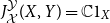 $J_{\mathcal X}^{\mathcal Y}(X,Y)={\mathbb C}1_X$
if
$J_{\mathcal X}^{\mathcal Y}(X,Y)={\mathbb C}1_X$
if $X=Y$
, and
$X=Y$
, and $J_{\mathcal X}^{\mathcal Y}(X,Y)=0$
otherwise, for
$J_{\mathcal X}^{\mathcal Y}(X,Y)=0$
otherwise, for $X\,\, \propto {\mathcal X}$
and
$X\,\, \propto {\mathcal X}$
and $Y\,\, \propto \mathcal Y$
. When the ambient quantum set
$Y\,\, \propto \mathcal Y$
. When the ambient quantum set $\mathcal Y$
is clear, we often write
$\mathcal Y$
is clear, we often write $J_{\mathcal X}$
instead of
$J_{\mathcal X}$
instead of $J_{\mathcal X}^{\mathcal Y}$
. Given a relation
$J_{\mathcal X}^{\mathcal Y}$
. Given a relation $R:{\mathcal X}\to \mathcal Y$
between quantum sets, we define the restriction
$R:{\mathcal X}\to \mathcal Y$
between quantum sets, we define the restriction $R|_{\mathcal W}:=\mathcal W\to {\mathcal X}$
of
$R|_{\mathcal W}:=\mathcal W\to {\mathcal X}$
of $R$
to a subset
$R$
to a subset $\mathcal W\subseteq {\mathcal X}$
as the quantum relation
$\mathcal W\subseteq {\mathcal X}$
as the quantum relation $R\circ J^{\mathcal X}_{\mathcal W}$
. Likewise, we define the corestriction
$R\circ J^{\mathcal X}_{\mathcal W}$
. Likewise, we define the corestriction $R|^{\mathcal Z}:{\mathcal X}\to \mathcal Z$
of
$R|^{\mathcal Z}:{\mathcal X}\to \mathcal Z$
of $R$
to a subset
$R$
to a subset $\mathcal Z\subseteq \mathcal Y$
to be the quantum relation
$\mathcal Z\subseteq \mathcal Y$
to be the quantum relation $(J_{\mathcal Z}^{\mathcal Y})^\dagger \circ R$
. We write
$(J_{\mathcal Z}^{\mathcal Y})^\dagger \circ R$
. We write $R|_{\mathcal W}^{\mathcal Z}$
for relation
$R|_{\mathcal W}^{\mathcal Z}$
for relation $(J_{\mathcal Z}^{\mathcal Y})^\dagger \circ R\circ J_{\mathcal W}^{\mathcal X}$
.
$(J_{\mathcal Z}^{\mathcal Y})^\dagger \circ R\circ J_{\mathcal W}^{\mathcal X}$
.
The symmetric monoidal product $\times$
on
$\times$
on $\mathbf{qRel}$
restricts to a symmetric monoidal product on
$\mathbf{qRel}$
restricts to a symmetric monoidal product on $\mathbf{qSet}$
, which we also notate
$\mathbf{qSet}$
, which we also notate $\times$
, even though this is not the categorical product on
$\times$
, even though this is not the categorical product on $\mathbf{qSet}$
either. We use this notation because this monoidal product on
$\mathbf{qSet}$
either. We use this notation because this monoidal product on $\mathbf{qSet}$
is the correct quantum generalization of the categorical product
$\mathbf{qSet}$
is the correct quantum generalization of the categorical product $\times$
on
$\times$
on $\mathbf{Set}$
. Moreover,
$\mathbf{Set}$
. Moreover, $\mathbf{qSet}$
is closed, and
$\mathbf{qSet}$
is closed, and $\mathcal Y^{\mathcal X}$
denotes the internal hom between quantum sets
$\mathcal Y^{\mathcal X}$
denotes the internal hom between quantum sets $\mathcal X$
and
$\mathcal X$
and $\mathcal Y$
.
$\mathcal Y$
.
The following theorem, whose content is taken from Kornell (Reference Kornell2020), summarizes the categorical properties of $\mathbf{qSet}$
:
$\mathbf{qSet}$
:
Theorem 2.4.1. Kornell (Reference Kornell2020). $\mathbf{qSet}$
is complete, cocomplete, and symmetric monoidal closed. Moreover,
$\mathbf{qSet}$
is complete, cocomplete, and symmetric monoidal closed. Moreover, $`(\!-\!):\mathbf{Rel}\to \mathbf{qRel}$
restricts and corestricts to a fully faithful functor
$`(\!-\!):\mathbf{Rel}\to \mathbf{qRel}$
restricts and corestricts to a fully faithful functor $`(\!-\!):\mathbf{Set}\to \mathbf{qSet}$
. Finally, the assignment
$`(\!-\!):\mathbf{Set}\to \mathbf{qSet}$
. Finally, the assignment ${\mathcal X}\mapsto \ell ^\infty ({\mathcal X})$
extends to an equivalence
${\mathcal X}\mapsto \ell ^\infty ({\mathcal X})$
extends to an equivalence $\ell ^\infty :\mathbf{qSet}\to \mathbf{WStar}_{\mathrm{HA}}^{\mathrm{op}}$
. Given a quantum function
$\ell ^\infty :\mathbf{qSet}\to \mathbf{WStar}_{\mathrm{HA}}^{\mathrm{op}}$
. Given a quantum function $F:{\mathcal X}\to \mathcal Y$
, we denote the corresponding normal unital
$F:{\mathcal X}\to \mathcal Y$
, we denote the corresponding normal unital $*$
-homomorphism
$*$
-homomorphism $\ell ^\infty (\mathcal Y)\to \ell ^\infty ({\mathcal X})$
by
$\ell ^\infty (\mathcal Y)\to \ell ^\infty ({\mathcal X})$
by $F^\star$
.
$F^\star$
.
We regard ordinary sets as a special case of quantum sets via the functor $`(\!-\!)$
.
$`(\!-\!)$
.
2.5 Modeling physical systems and quantum computations via quantum sets
Finitary physical types are naturally modeled by quantum sets. We can use the atomic quantum set ${\mathcal H}_d$
, whose only atom is a
${\mathcal H}_d$
, whose only atom is a $d$
-dimensional Hilbert space (cf. Definition 2.1.2) to model a qudit. In particular, the qubit can be modeled by the quantum set
$d$
-dimensional Hilbert space (cf. Definition 2.1.2) to model a qudit. In particular, the qubit can be modeled by the quantum set ${\mathcal H}_2$
. By contrast, the classical bit is modeled by the quantum set
${\mathcal H}_2$
. By contrast, the classical bit is modeled by the quantum set $`\{0,1\}$
, which has two one-dimensional atoms. The “memory” of an idealized quantum computer might consist of finitely many qubits, and finitely many bits, so we can model such a quantum computer as a composite physical system.
$`\{0,1\}$
, which has two one-dimensional atoms. The “memory” of an idealized quantum computer might consist of finitely many qubits, and finitely many bits, so we can model such a quantum computer as a composite physical system.
The symmetric monoidal product $\times$
on
$\times$
on $\mathbf{qRel}$
and
$\mathbf{qRel}$
and $\mathbf{qSet}$
generalizes the Cartesian product of ordinary sets. Composite systems consisting of two fully quantum systems, that is, of quantum systems modeled by single Hilbert spaces, are obtained by forming the tensor product of the two Hilbert spaces. Similarly, composite systems consisting of two fully classical systems, that is, of quantum systems modeled by ordinary sets, are obtained by forming the ordinary Cartesian product of the two sets. Thus, our generalized product models composite systems consisting entirely of fully quantum systems, or entirely of fully classical systems. In fact, it is appropriate for modeling mixed quantum/classical systems as well. In particular, an idealized quantum computer possessing
$\mathbf{qSet}$
generalizes the Cartesian product of ordinary sets. Composite systems consisting of two fully quantum systems, that is, of quantum systems modeled by single Hilbert spaces, are obtained by forming the tensor product of the two Hilbert spaces. Similarly, composite systems consisting of two fully classical systems, that is, of quantum systems modeled by ordinary sets, are obtained by forming the ordinary Cartesian product of the two sets. Thus, our generalized product models composite systems consisting entirely of fully quantum systems, or entirely of fully classical systems. In fact, it is appropriate for modeling mixed quantum/classical systems as well. In particular, an idealized quantum computer possessing $n$
qubits and
$n$
qubits and $m$
bits can be modeled by the quantum set
$m$
bits can be modeled by the quantum set
 \begin{equation*} \underbrace {{\mathcal H}_2 \times \cdots \times {\mathcal H}_2}_{n} \times \underbrace {`\{0,1\} \times \cdots \times `\{0,1\}}_{m}.\end{equation*}
This quantum set has $2^m$
atoms, each of dimension
$2^m$
atoms, each of dimension $2^n$
.
$2^n$
.
Other natural type constructors are also easily modeled in quantum sets. Sum types are modeled by disjoint unions of quantum sets, portraying a kind of classical disjunction of potentially quantum systems. The resulting physical system may be in a state of the first type or in a state of the second type, but no superpositions may occur. For example, an idealized quantum computer possessing a single qubit and a single bit is modeled by a quantum set with two atoms, because the computer can be in a configuration where the qubit has value $0$
, and it can be in a configuration where the qubit has value
$0$
, and it can be in a configuration where the qubit has value $1$
, but it cannot be in a superposition between two such states. The exponential modality
$1$
, but it cannot be in a superposition between two such states. The exponential modality $!$
that permits duplication, is modeled by an operation on quantum sets that extracts just their one-dimensional atoms, so
$!$
that permits duplication, is modeled by an operation on quantum sets that extracts just their one-dimensional atoms, so $!{\mathcal X}={\mathcal X}_1$
, where
$!{\mathcal X}={\mathcal X}_1$
, where
 \begin{equation*}{\mathcal X}_1:=\mathcal Q\{X\in \mathrm{At}({\mathcal X}):\dim (X)=1\}.\end{equation*}
This is essentially an ordinary set, and it is the largest subset that admits a duplication map. Indeed, classical sets all admit duplication maps, but the no-cloning theorem forbids the duplication of higher dimensional atoms. A useful result that characterizes the atoms of ${\mathcal X}_1$
is the following:
${\mathcal X}_1$
is the following:
Lemma 2.5.1.
Let $\mathcal X$
be a quantum set. Then we have the following canonical bijections:
$\mathcal X$
be a quantum set. Then we have the following canonical bijections:
-
• $b_{\mathcal X}\colon \mathrm{At}({\mathcal X}_1) \to \mathbf{qSet}(\mathbf 1, {\mathcal X})$
, which maps each one-dimensional atom
$X \,\, \propto {\mathcal X}$
to the function
$b_{\mathcal X}(X)\colon \mathbf 1 \to {\mathcal X}$
defined by
$b_{\mathcal X}(X)({\mathbb C}, X) = L({\mathbb C}, X)$
, with the other components vanishing;
$b_{\mathcal X}\colon \mathrm{At}({\mathcal X}_1) \to \mathbf{qSet}(\mathbf 1, {\mathcal X})$
, which maps each one-dimensional atom
$X \,\, \propto {\mathcal X}$
to the function
$b_{\mathcal X}(X)\colon \mathbf 1 \to {\mathcal X}$
defined by
$b_{\mathcal X}(X)({\mathbb C}, X) = L({\mathbb C}, X)$
, with the other components vanishing;
-
•
$B_{\mathcal X}:{\mathcal X}_1\to `\mathbf{qSet}(\mathbf 1,{\mathcal X})$
defined by
$B_{\mathcal X}(X,{\mathbb C}_{b_{\mathcal X}(X)}) = L(X,{\mathbb C}_{b_{\mathcal X}(X)})$
, for
$X \,\, \propto {\mathcal X}_1$
, with the other components vanishing.







Proof.
It is easy to see that $b_{\mathcal X}(X):\mathbf 1\to {\mathcal X}$
is a function for each atom
$b_{\mathcal X}(X):\mathbf 1\to {\mathcal X}$
is a function for each atom $X$
of
$X$
of $\mathcal X$
. Using the duality between
$\mathcal X$
. Using the duality between $\mathbf{qSet}$
and
$\mathbf{qSet}$
and $\mathbf{WStar}_{\mathrm{HA}}$
(cf. Theorem 2.4.1), it easily follows from [Kornell (Reference Kornell2020), Proposition 7.5] that all functions
$\mathbf{WStar}_{\mathrm{HA}}$
(cf. Theorem 2.4.1), it easily follows from [Kornell (Reference Kornell2020), Proposition 7.5] that all functions $\mathbf 1\to {\mathcal X}$
are of this form. The binary relation
$\mathbf 1\to {\mathcal X}$
are of this form. The binary relation $B_{\mathcal X}$
is a bijection by [Kornell (Reference Kornell2020), Proposition 4.4]
$B_{\mathcal X}$
is a bijection by [Kornell (Reference Kornell2020), Proposition 4.4]
We recall that the type systems of many quantum programming languages are based on intuitionistic linear logic. We further note that this logic can be modeled by linear/nonlinear models Benton (Reference Benton1995):
Definition 2.5.2 (Linear/nonlinear model). A linear/nonlinear model consists of a cartesian closed category $\mathbf V$
, a symmetric monoidal closed category
$\mathbf V$
, a symmetric monoidal closed category $\mathbf C$
and a strong monoidal functor
$\mathbf C$
and a strong monoidal functor $\mathbf V\to \mathbf C$
that has a right adjoint. The category
$\mathbf V\to \mathbf C$
that has a right adjoint. The category $\mathbf V$
is called the non-linear category, whereas
$\mathbf V$
is called the non-linear category, whereas $\mathbf C$
is called the linear category.
$\mathbf C$
is called the linear category.
Given such a model, the exponential modality $!\colon \mathbf C\to \mathbf C$
is the comonad induced by the linear/nonlinear adjunction. For instance, the functor
$!\colon \mathbf C\to \mathbf C$
is the comonad induced by the linear/nonlinear adjunction. For instance, the functor $`(\!-\!):\mathbf{Set}\to \mathbf{qSet}$
described in Theorem 2.4.1 has a right adjoint given by
$`(\!-\!):\mathbf{Set}\to \mathbf{qSet}$
described in Theorem 2.4.1 has a right adjoint given by ${\mathcal X}\mapsto \mathbf{qSet}(\mathbf 1,-)$
, hence
${\mathcal X}\mapsto \mathbf{qSet}(\mathbf 1,-)$
, hence $\mathbf{Set}$
and
$\mathbf{Set}$
and $\mathbf{qSet}$
form a linear/nonlinear model.Footnote
9
By Lemma 2.5.1, the comonad induced by the linear/nonlinear adjunction between
$\mathbf{qSet}$
form a linear/nonlinear model.Footnote
9
By Lemma 2.5.1, the comonad induced by the linear/nonlinear adjunction between $\mathbf{Set}$
and
$\mathbf{Set}$
and $\mathbf{qSet}$
is precisely the operation described above of extracting the one-dimensional atoms from a quantum set.
$\mathbf{qSet}$
is precisely the operation described above of extracting the one-dimensional atoms from a quantum set.
Higher types are modeled by quantum function sets, which are more challenging to describe, mainly due to the large automorphism group of the physical qubit. Indeed, the ordinary set $\mathbf{qSet}({\mathcal H}_2, {\mathcal H}_2)$
is in canonical bijection with the rotation group
$\mathbf{qSet}({\mathcal H}_2, {\mathcal H}_2)$
is in canonical bijection with the rotation group $\mathrm{SO}(3)$
. The quantum function set
$\mathrm{SO}(3)$
. The quantum function set ${\mathcal H}_2^{{\mathcal H}_2}$
also has atoms of dimension higher than
${\mathcal H}_2^{{\mathcal H}_2}$
also has atoms of dimension higher than $1$
. In general, the quantum function set from a quantum set
$1$
. In general, the quantum function set from a quantum set $\mathcal X$
to a quantum set
$\mathcal X$
to a quantum set $\mathcal Y$
has an atom of dimension
$\mathcal Y$
has an atom of dimension $d$
for each unital normal
$d$
for each unital normal $*$
-homomorphism
$*$
-homomorphism $\rho \colon \ell ^\infty (\mathcal Y) {\rightarrow } \ell ^\infty ({\mathcal X}) \overline \otimes L(H_d)$
that is irreducible in the sense that
$\rho \colon \ell ^\infty (\mathcal Y) {\rightarrow } \ell ^\infty ({\mathcal X}) \overline \otimes L(H_d)$
that is irreducible in the sense that $\rho (\ell ^\infty (\mathcal Y))' \cap ({\mathbb C} \overline \otimes L(H_d)) = {\mathbb C}$
, where
$\rho (\ell ^\infty (\mathcal Y))' \cap ({\mathbb C} \overline \otimes L(H_d)) = {\mathbb C}$
, where $\overline \otimes$
denotes the spatial tensor product of von Neumann algebras, and
$\overline \otimes$
denotes the spatial tensor product of von Neumann algebras, and $(\cdot)'$
denotes the commutant.
$(\cdot)'$
denotes the commutant.
Example 2.5.3. Proto-Quipper-M, introduced by Rios and Selinger Rios and Selinger (Reference Rios and Selinger2017), is a circuit description language that describes the generation of circuits, represented by a small symmetric monoidal category $\mathbf M$
. In case of quantum circuits, one can take
$\mathbf M$
. In case of quantum circuits, one can take $\mathbf M$
to be the opposite of the category whose objects are finite sums of matrix algebras, and whose morphisms are
$\mathbf M$
to be the opposite of the category whose objects are finite sums of matrix algebras, and whose morphisms are $*$
-homomorphisms. Here, a qudit is represented by
$*$
-homomorphisms. Here, a qudit is represented by $M_d(\mathbb C)$
. The tensor product of vector spaces is used to represent combined systems of several qudits.
$M_d(\mathbb C)$
. The tensor product of vector spaces is used to represent combined systems of several qudits.
An abstract axiomatization of models of Proto-Quipper-M was given in Lindenhovius et al. (Reference Lindenhovius, Mislove, Zamdzhiev, Palmigiano and Sadrzadeh2023): such a model consists of a symmetric monoidal closed category $\mathbf C$
with coproducts enriched over a cartesian closed category
$\mathbf C$
with coproducts enriched over a cartesian closed category $\mathbf V$
with coproducts such that
$\mathbf V$
with coproducts such that $\mathbf V$
and
$\mathbf V$
and $\mathbf C$
form a linear/nonlinear model, satisfying
$\mathbf C$
form a linear/nonlinear model, satisfying $\mathbf M$
embeds monoidally into
$\mathbf M$
embeds monoidally into $\mathbf C$
. Since
$\mathbf C$
. Since $\mathbf{Set}$
and
$\mathbf{Set}$
and $\mathbf{qSet}$
form a linear/nonlinear model with coproducts, and
$\mathbf{qSet}$
form a linear/nonlinear model with coproducts, and $\mathbf M$
can be a regarded as a subcategory of
$\mathbf M$
can be a regarded as a subcategory of $\mathbf{WStar}_{\mathrm{HA}}$
,
$\mathbf{WStar}_{\mathrm{HA}}$
, $\mathbf{qSet}$
clearly forms a model of Proto-Quipper-M.
$\mathbf{qSet}$
clearly forms a model of Proto-Quipper-M.
Example 2.5.4. Pure quantum computation refers to the model of quantum computation in which the evolution of a system is described entirely by quantum gates, typically formalized by unitary operators Huot and Staton (Reference Huot and Staton2019). In this pure setting, a quantum circuit is just the sequential composition of such unitaries. There is no measurement, randomness, or environmental interaction: computation proceeds coherently and reversibly, so quantum gates are automorphisms of fully quantum systems, which consist of qubits. In the category of quantum sets and functions, such an automorphism is formalized by a closely related function between quantum sets. Indeed, each function $F_1\colon {\mathcal H}_d {\rightarrow } {\mathcal H}_d$
, for any positive integer
$F_1\colon {\mathcal H}_d {\rightarrow } {\mathcal H}_d$
, for any positive integer $d$
, is defined by
$d$
, is defined by $F_1(H_d, H_d) = {\mathbb C}\cdot u$
, for some unitary operator
$F_1(H_d, H_d) = {\mathbb C}\cdot u$
, for some unitary operator $u$
. For example, the Hadamard gate is formalized by the function
$u$
. For example, the Hadamard gate is formalized by the function $F_1\colon {\mathcal H}_2 {\rightarrow } {\mathcal H}_2$
defined by
$F_1\colon {\mathcal H}_2 {\rightarrow } {\mathcal H}_2$
defined by
 \begin{align*} F_1(H_2, H_2) = {\mathbb C} \cdot \left [ \begin{matrix} 1\;\;\;\; & 1 \\ 1\;\;\;\; & -1 \end{matrix} \right ]. \end{align*}
This function $F_1$
is an automorphism of
$F_1$
is an automorphism of ${\mathcal H}_2$
in
${\mathcal H}_2$
in $\mathbf{qSet}$
. The unital normal
$\mathbf{qSet}$
. The unital normal $*$
-homomorphism
$*$
-homomorphism $M_2({\mathbb C}) \cong \ell ^\infty ({\mathcal H}_2) {\rightarrow } \ell ^\infty ({\mathcal H}_2) \cong M_2({\mathbb C})$
that corresponds to this function in the sense of Theorem 2.4.1 is simply conjugation by the Hadamard matrix above, appropriately normalized.
$M_2({\mathbb C}) \cong \ell ^\infty ({\mathcal H}_2) {\rightarrow } \ell ^\infty ({\mathcal H}_2) \cong M_2({\mathbb C})$
that corresponds to this function in the sense of Theorem 2.4.1 is simply conjugation by the Hadamard matrix above, appropriately normalized.
Example 2.5.5. Measurement is a channel from a fully quantum system to a fully classical system and cannot be described by a unitary operator. As a consequence, it is an impure quantum operation, which in $\mathbf{qSet}$
is formalized by a function from an atomic quantum set to a classical quantum set. It follows from the definition of a function between quantum sets that functions from an atomic quantum set
$\mathbf{qSet}$
is formalized by a function from an atomic quantum set to a classical quantum set. It follows from the definition of a function between quantum sets that functions from an atomic quantum set ${\mathcal H}_d$
to a classical quantum set
${\mathcal H}_d$
to a classical quantum set $`S$
are in bijective correspondence with projection-valued measurements on
$`S$
are in bijective correspondence with projection-valued measurements on ${\mathcal H}_d$
. Explicitly,
${\mathcal H}_d$
. Explicitly, $F_2(H_d, {\mathbb C}_s) = L(H_d, {\mathbb C}_s) \cdot p_s$
for each
$F_2(H_d, {\mathbb C}_s) = L(H_d, {\mathbb C}_s) \cdot p_s$
for each $s \in S$
, where
$s \in S$
, where $(p_s: s \in S)$
is a projective POVM.Footnote
10
In particular, the standard measurement of a qubit is formalized by a function from
$(p_s: s \in S)$
is a projective POVM.Footnote
10
In particular, the standard measurement of a qubit is formalized by a function from ${\mathcal H}_2$
to
${\mathcal H}_2$
to $`\{1, -1\}$
defined by
$`\{1, -1\}$
defined by
 \begin{align*} F_2(H_2, {\mathbb C}_s) = \begin{cases} {\mathbb C} \cdot [\begin{matrix} 1\;\;\;\; & 0 \end{matrix} ] & {s = 1}; \\ {\mathbb C} \cdot [\begin{matrix} 0\;\;\;\; & 1 \end{matrix}] & s = {-1}. \end{cases} \end{align*}
This function $F_2$
is an epimorphism in
$F_2$
is an epimorphism in $\mathbf{qSet}$
. Equivalently, it is surjective in the sense that
$\mathbf{qSet}$
. Equivalently, it is surjective in the sense that $F_2 \circ F_2^\dagger \geq I$
. The unital normal
$F_2 \circ F_2^\dagger \geq I$
. The unital normal $*$
-homomorphism
$*$
-homomorphism ${\mathbb C}^2 \cong \ell ^\infty (\{1, -1\}) {\rightarrow } \ell ^\infty ({\mathcal H}_2) \cong M_2({\mathbb C})$
corresponding to this function in the sense of Theorem 2.4.1 includes
${\mathbb C}^2 \cong \ell ^\infty (\{1, -1\}) {\rightarrow } \ell ^\infty ({\mathcal H}_2) \cong M_2({\mathbb C})$
corresponding to this function in the sense of Theorem 2.4.1 includes ${\mathbb C}^2$
into
${\mathbb C}^2$
into $M_2({\mathbb C})$
diagonally.
$M_2({\mathbb C})$
diagonally.
Example 2.5.6. Generally, quantum computations are described by quantum channels, that is, completely positive unital mapsFootnote
11
. Classically, impure computations correspond to side effects, which are modeled by monads. In a similar way, quantum channels can be described by Kleisli morphisms of a monad $\mathcal D$
on
$\mathcal D$
on $\mathbf{qSet}$
. This monad is induced by the adjunction between the category
$\mathbf{qSet}$
. This monad is induced by the adjunction between the category $\mathbf{WStar}_{\mathrm{HA}}^{\mathrm{op}}$
, which is equivalent to
$\mathbf{WStar}_{\mathrm{HA}}^{\mathrm{op}}$
, which is equivalent to $\mathbf{qSet}$
, and the category
$\mathbf{qSet}$
, and the category $\mathbf{WCPU}_{\mathrm{HA}}^{\mathrm{op}}$
, the opposite of the category of hereditarily atomic von Neumann algebras and normal completely positive unital maps. Here, the left adjoint is given by the canonical embedding of the former category into the latter. Thus, for any two quantum sets
$\mathbf{WCPU}_{\mathrm{HA}}^{\mathrm{op}}$
, the opposite of the category of hereditarily atomic von Neumann algebras and normal completely positive unital maps. Here, the left adjoint is given by the canonical embedding of the former category into the latter. Thus, for any two quantum sets $\mathcal X$
and
$\mathcal X$
and $\mathcal Y$
, we have a natural bijection
$\mathcal Y$
, we have a natural bijection $\mathbf{qSet}({\mathcal X},{\mathcal D}(\mathcal Y))\cong \mathbf{WCPU}_{\mathrm{HA}}(\ell ^\infty (\mathcal Y),\ell ^\infty ({\mathcal X}))$
, arbitrary quantum channels can be modeled in
$\mathbf{qSet}({\mathcal X},{\mathcal D}(\mathcal Y))\cong \mathbf{WCPU}_{\mathrm{HA}}(\ell ^\infty (\mathcal Y),\ell ^\infty ({\mathcal X}))$
, arbitrary quantum channels can be modeled in $\mathbf{qSet}$
.
$\mathbf{qSet}$
.
If we identify the states on $\mathcal X$
with normal completely positive unital functionals on
$\mathcal X$
with normal completely positive unital functionals on $\ell ^\infty ({\mathcal X})$
, then it follows from Lemma 2.5.1 that
$\ell ^\infty ({\mathcal X})$
, then it follows from Lemma 2.5.1 that
 \begin{equation*}\mathrm{States}({\mathcal X})=\mathbf{WCPU}_{\mathrm{HA}}(\ell ^\infty ({\mathcal X}),\mathbb C)=\mathbf{qSet}({\mathbf 1},{\mathcal D}({\mathcal X}))\cong \mathrm{At}({\mathcal D}({\mathcal X})_1),\end{equation*}
hence by the same lemma, we have an bijection
 \begin{equation} `\mathrm{States}({\mathcal X})\cong {\mathcal D}({\mathcal X})_1. \end{equation}
The monad $\mathcal D$
on
$\mathcal D$
on $\mathbf{qSet}$
is a noncommutative version of the (countable) distributions monad
$\mathbf{qSet}$
is a noncommutative version of the (countable) distributions monad $D$
on
$D$
on $\mathbf{Set}$
in the sense that if
$\mathbf{Set}$
in the sense that if $S$
is an ordinary set, then there is a bijection
$S$
is an ordinary set, then there is a bijection $`D(S)\cong {\mathcal D}(`S)_1$
, so essentially,
$`D(S)\cong {\mathcal D}(`S)_1$
, so essentially, $D(S)$
is the classical part of
$D(S)$
is the classical part of ${\mathcal D}(`S)$
. This follows by taking
${\mathcal D}(`S)$
. This follows by taking ${\mathcal X}=`S$
in Equation (1), and from a standard result in the theory of von Neumann algebras that the predual of the (hereditarily atomic) von Neumann algebra
${\mathcal X}=`S$
in Equation (1), and from a standard result in the theory of von Neumann algebras that the predual of the (hereditarily atomic) von Neumann algebra $\ell ^\infty (S)$
is isometrically isomorphic to
$\ell ^\infty (S)$
is isometrically isomorphic to $\ell ^1(S)$
, the space of functions
$\ell ^1(S)$
, the space of functions $f:S\to {\mathbb C}$
such that
$f:S\to {\mathbb C}$
such that $\sum _{x\in S}|f(x)|\lt \infty$
. This isomorphism restricts and corestricts to a bijection
$\sum _{x\in S}|f(x)|\lt \infty$
. This isomorphism restricts and corestricts to a bijection $\mathbf{WCPU}(\ell ^\infty (S),{\mathbb C})\cong D(S)$
, where we recognize the left-hand side as
$\mathbf{WCPU}(\ell ^\infty (S),{\mathbb C})\cong D(S)$
, where we recognize the left-hand side as $\mathrm{States}(`S)$
.
$\mathrm{States}(`S)$
.
Example 2.5.7. State preparation cannot be formalized directly as a function, in the manner of the Examples 2.5.4 and 2.5.5 Indeed, from the perspective of quantum mechanics, state preparation is a nondeterministic binary channel, but there are no functions at all from $`\{1, -1\}$
to
$`\{1, -1\}$
to ${\mathcal H}_2$
. However, it is possible to formalize state preparation in
${\mathcal H}_2$
. However, it is possible to formalize state preparation in $\mathbf{qSet}$
using the monad
$\mathbf{qSet}$
using the monad $\mathcal D$
of Example 2.5.6. In this example, we saw that
$\mathcal D$
of Example 2.5.6. In this example, we saw that $\mathcal D$
has the property that for each quantum set
$\mathcal D$
has the property that for each quantum set $\mathcal X$
, the one-dimensional atoms of
$\mathcal X$
, the one-dimensional atoms of ${\mathcal D}({\mathcal X})$
correspond bijectively to the states on
${\mathcal D}({\mathcal X})$
correspond bijectively to the states on $\mathcal X$
, which we may define to be the normal states on
$\mathcal X$
, which we may define to be the normal states on $\ell ^\infty ({\mathcal X})$
in the sense of operator algebras. We thus have a monomorphism
$\ell ^\infty ({\mathcal X})$
in the sense of operator algebras. We thus have a monomorphism $`\mathrm{States}({\mathcal X}) \rightarrowtail {\mathcal D}({\mathcal X})$
in
$`\mathrm{States}({\mathcal X}) \rightarrowtail {\mathcal D}({\mathcal X})$
in $\mathbf{qSet}$
.
$\mathbf{qSet}$
.
A simple experimental procedure, which consists of preparing a qubit, applying the Hadamard gate, and then measuring its value is modeled as the following composition of functions in $\mathbf{qSet}$
:
$\mathbf{qSet}$
:

where the injection is obtained from the bijection $`\mathrm{States}({\mathcal H}_2)\cong {\mathcal D}({\mathcal H}_2)_1$
in Example 2.5.6, and where
$`\mathrm{States}({\mathcal H}_2)\cong {\mathcal D}({\mathcal H}_2)_1$
in Example 2.5.6, and where $F_1$
and
$F_1$
and $F_2$
are the functions from Examples 2.5.4 and 2.5.5, respectively. This yields a function from
$F_2$
are the functions from Examples 2.5.4 and 2.5.5, respectively. This yields a function from $`\mathrm{States}({\mathcal H}_2)$
to
$`\mathrm{States}({\mathcal H}_2)$
to ${\mathcal D}(`\{1,-1\})$
, or equivalently a function.
${\mathcal D}(`\{1,-1\})$
, or equivalently a function. $\mathrm{States}({\mathcal H}_2) {\rightarrow } \mathrm{States}(`\{1,-1\})$
that maps each prepared state to the corresponding probability distribution on outcomes. This equivalence is due to the fact that a function between quantum sets necessarily maps one-dimensional atoms to one-dimensional atoms. Type theoretically, it is related to the fact that any term of type
$\mathrm{States}({\mathcal H}_2) {\rightarrow } \mathrm{States}(`\{1,-1\})$
that maps each prepared state to the corresponding probability distribution on outcomes. This equivalence is due to the fact that a function between quantum sets necessarily maps one-dimensional atoms to one-dimensional atoms. Type theoretically, it is related to the fact that any term of type $A$
that has only nonlinear parameters lifts to a term of type
$A$
that has only nonlinear parameters lifts to a term of type $!A$
.
$!A$
.
Example 2.5.8. Incomplete quantum computations are described by normal completely positive subunital maps, which generalize subdistributions, and which are in a 1-1 correspondence with the Kleisli maps of a monad $\mathcal S$
on
$\mathcal S$
on $\mathbf{qSet}$
that is the quantum version of the subdistributions monad
$\mathbf{qSet}$
that is the quantum version of the subdistributions monad $S$
on
$S$
on $\mathbf{Set}$
. This monad
$\mathbf{Set}$
. This monad $\mathcal S$
can be obtained in a similar way as the quantum distributions monad on
$\mathcal S$
can be obtained in a similar way as the quantum distributions monad on $\mathbf{qSet}$
in Example 2.5.6, namely via the adjunction between
$\mathbf{qSet}$
in Example 2.5.6, namely via the adjunction between $\mathbf{WStar}^{\mathrm{op}}_{\mathrm{HA}}$
and the category
$\mathbf{WStar}^{\mathrm{op}}_{\mathrm{HA}}$
and the category $\mathbf{WCPSU}^{\mathrm{op}}_{\mathrm{HA}}$
of hereditarily atomic von Neumann algebras and normal completely positive subunital maps. The existence of this adjunction is proven in Cho and Westerbaan (Reference Westerbaan2016); Westerbaan (Reference Westerbaan2019). As a consequence, the Kleisli morphisms
$\mathbf{WCPSU}^{\mathrm{op}}_{\mathrm{HA}}$
of hereditarily atomic von Neumann algebras and normal completely positive subunital maps. The existence of this adjunction is proven in Cho and Westerbaan (Reference Westerbaan2016); Westerbaan (Reference Westerbaan2019). As a consequence, the Kleisli morphisms ${\mathcal X}\to {\mathcal S}(\mathcal Y)$
correspond to normal completely positive subunital maps
${\mathcal X}\to {\mathcal S}(\mathcal Y)$
correspond to normal completely positive subunital maps $\ell ^\infty (\mathcal Y)\to \ell ^\infty ({\mathcal X})$
.
$\ell ^\infty (\mathcal Y)\to \ell ^\infty ({\mathcal X})$
.
The Kleisli morphisms of the ordinary subdistributions monad $S$
are the substochastic maps, which can be ordered pointwise. The analog of this order in the quantum setting is a variation of the Löwner order, the so-called CP-Löwner order on normal completely positive subunital mapsFootnote
12
It was shown in Cho (Reference Cho2016) that the category of von Neumann algebras with completely positive subunital maps is
$S$
are the substochastic maps, which can be ordered pointwise. The analog of this order in the quantum setting is a variation of the Löwner order, the so-called CP-Löwner order on normal completely positive subunital mapsFootnote
12
It was shown in Cho (Reference Cho2016) that the category of von Neumann algebras with completely positive subunital maps is $\mathbf{DCPO}$
-enriched with respect to the CP-Löwner order,Footnote
13
and in Jia et al. (Reference Jia, Kornell, Lindenhovius, Mislove and Zamdzhiev2022) that the Kleisli category
$\mathbf{DCPO}$
-enriched with respect to the CP-Löwner order,Footnote
13
and in Jia et al. (Reference Jia, Kornell, Lindenhovius, Mislove and Zamdzhiev2022) that the Kleisli category $\mathbf{qSet}_{\mathcal S}$
is likewise enriched over continuous domains with respect to this order. Nevertheless,
$\mathbf{qSet}_{\mathcal S}$
is likewise enriched over continuous domains with respect to this order. Nevertheless, $\mathbf{qSet}_{\mathcal S}$
does not support recursion, for the same reason that
$\mathbf{qSet}_{\mathcal S}$
does not support recursion, for the same reason that $\mathbf{Set}_S$
(which is also enriched over continuous domains) does not support for recursions: in both cases, the base category (
$\mathbf{Set}_S$
(which is also enriched over continuous domains) does not support for recursions: in both cases, the base category ( $\mathbf{Set}$
and
$\mathbf{Set}$
and $\mathbf{qSet})$
is not
$\mathbf{qSet})$
is not $\mathbf{CPO}$
-enriched. Another explanation is that in classically-controlled quantum computing, we have two runtimes: circuit generation time and circuit execution time. Typically, recursion in classically controlled quantum computing unfolds during the circuit generation time, whereas the CP-Löwner describes the stage of completion of a computation during the circuit execution time. The order of quantum cpos, on the other hand, describe the stage of completion of a computation during circuit generation time, and offer better support for recursion in quantum computing.
$\mathbf{CPO}$
-enriched. Another explanation is that in classically-controlled quantum computing, we have two runtimes: circuit generation time and circuit execution time. Typically, recursion in classically controlled quantum computing unfolds during the circuit generation time, whereas the CP-Löwner describes the stage of completion of a computation during the circuit execution time. The order of quantum cpos, on the other hand, describe the stage of completion of a computation during circuit generation time, and offer better support for recursion in quantum computing.
2.6 Quantum posets
Quantum cpo are in particular quantum posets, which are essentially due to Weaver [Weaver (Reference Weaver2012), Definition 2.4] and consist of a pair $({\mathcal X},R)$
consisting of quantum set
$({\mathcal X},R)$
consisting of quantum set $\mathcal X$
and a binary relation
$\mathcal X$
and a binary relation $R$
on
$R$
on $\mathcal X$
that generalizes orders to the noncommutative setting. We start by reviewing the exact notion of a quantum poset. We note that the notions of partial order, monotone function, etc. introduced here are all direct generalizations of the standard notions of set theory.
$\mathcal X$
that generalizes orders to the noncommutative setting. We start by reviewing the exact notion of a quantum poset. We note that the notions of partial order, monotone function, etc. introduced here are all direct generalizations of the standard notions of set theory.
Definition 2.6.1 (Quantum poset). We call a binary relation $R$
on a quantum set
$R$
on a quantum set $\mathcal X$
-
• reflexive if
$I_{\mathcal X}\leq R$
; -
• transitive if
$R\circ R\leq R$
; -
• antisymmetric if
$R\wedge R^\dagger \leq I_{\mathcal X}$
.


A relation satisfying these three conditions is an order. We define a quantum poset to be a pair $({\mathcal X},R)$
consisting of a quantum set
$({\mathcal X},R)$
consisting of a quantum set $\mathcal X$
equipped with an order
$\mathcal X$
equipped with an order $R$
.
$R$
.
Example 2.6.2. Let $\mathcal X$
be a quantum set. Then,
$\mathcal X$
be a quantum set. Then, $I_{\mathcal X}$
is easily seen to be an order on
$I_{\mathcal X}$
is easily seen to be an order on $\mathcal X$
, the trivial or flat order.
$\mathcal X$
, the trivial or flat order.
Example 2.6.3 (Kornell et al. (Reference Kornell, Lindenhovius and Mislove2022), Example 1.4). Let $\mathcal H$
be an atomic quantum set whose single atom is named
$\mathcal H$
be an atomic quantum set whose single atom is named $H$
. Then a binary relation
$H$
. Then a binary relation $V$
on
$V$
on $\mathcal H$
is an order if and only if its single component
$\mathcal H$
is an order if and only if its single component $V(H,H)$
is a unital algebra
$V(H,H)$
is a unital algebra $A$
of operators on
$A$
of operators on $H$
that is anti-symmetric in the sense that
$H$
that is anti-symmetric in the sense that $A\cap A^\dagger =\mathbb C1$
. We give a more specific example for
$A\cap A^\dagger =\mathbb C1$
. We give a more specific example for $H=\mathbb C^2$
. Let
$H=\mathbb C^2$
. Let $V(H,H)$
be the span of the nilpotent matrix
$V(H,H)$
be the span of the nilpotent matrix $a = \left [\begin{smallmatrix} 0 & 1 \\ 0 & 0 \end{smallmatrix}\right ]$
and the identity matrix
$a = \left [\begin{smallmatrix} 0 & 1 \\ 0 & 0 \end{smallmatrix}\right ]$
and the identity matrix $1 = \left [\begin{smallmatrix} 1 & 0 \\ 0 & 1 \end{smallmatrix}\right ]$
. This is an antisymmetric unital algebra of operators on
$1 = \left [\begin{smallmatrix} 1 & 0 \\ 0 & 1 \end{smallmatrix}\right ]$
. This is an antisymmetric unital algebra of operators on ${\mathbb C}^2$
, so
${\mathbb C}^2$
, so $({\mathcal H},V)$
is a quantum poset.
$({\mathcal H},V)$
is a quantum poset.
A function $F:({\mathcal X},R)\to (\mathcal Y,S)$
between quantum posets is said to be monotone if
$F:({\mathcal X},R)\to (\mathcal Y,S)$
between quantum posets is said to be monotone if $F\circ R\leq S\circ F$
. If
$F\circ R\leq S\circ F$
. If $R=F^\dagger \circ S\circ F$
, we say that
$R=F^\dagger \circ S\circ F$
, we say that $F$
an order embedding. A surjective order embedding is called an order isomorphism, and is precisely a bijective monotone function whose inverse is also monotone. The category of quantum posets and monotone maps is denoted by
$F$
an order embedding. A surjective order embedding is called an order isomorphism, and is precisely a bijective monotone function whose inverse is also monotone. The category of quantum posets and monotone maps is denoted by $\mathbf{qPOS}$
. The elementary properties of this category are established in Kornell et al. (Reference Kornell, Lindenhovius and Mislove2022):
$\mathbf{qPOS}$
. The elementary properties of this category are established in Kornell et al. (Reference Kornell, Lindenhovius and Mislove2022):
Theorem.
The category $\mathbf{qPOS}$
of quantum posets and monotone functions is complete, cocomplete, symmetric monoidal closed, and
$\mathbf{qPOS}$
of quantum posets and monotone functions is complete, cocomplete, symmetric monoidal closed, and $\mathbf{POS}$
-enriched, where
$\mathbf{POS}$
-enriched, where $\mathbf{POS}$
is the category of ordinary posets and monotone functions. Moreover, the functor
$\mathbf{POS}$
is the category of ordinary posets and monotone functions. Moreover, the functor $`(\!-\!):\mathbf{POS}\to \mathbf{qPOS}$
, given by
$`(\!-\!):\mathbf{POS}\to \mathbf{qPOS}$
, given by $(S,{\sqsubseteq })\mapsto (`S,`{\sqsubseteq })$
on posets and by
$(S,{\sqsubseteq })\mapsto (`S,`{\sqsubseteq })$
on posets and by $f\mapsto `f$
on monotone maps, is a fully faithful functor.
$f\mapsto `f$
on monotone maps, is a fully faithful functor.
Here, the monoidal product $({\mathcal X},R)\times (\mathcal Y,S)$
of two quantum posets
$({\mathcal X},R)\times (\mathcal Y,S)$
of two quantum posets $({\mathcal X},R)$
and
$({\mathcal X},R)$
and $(\mathcal Y,S)$
is the quantum poset
$(\mathcal Y,S)$
is the quantum poset $({\mathcal X}\times \mathcal Y,R\times S)$
. The monoidal product of two monotone functions is the monoidal product of the two functions when regarded as morphisms of
$({\mathcal X}\times \mathcal Y,R\times S)$
. The monoidal product of two monotone functions is the monoidal product of the two functions when regarded as morphisms of $\mathbf{qSet}$
.
$\mathbf{qSet}$
.
Example 2.6.4. Let $\overline {\mathbb N}$
be the set of natural numbers with infinity, ordered in the obvious way by
$\overline {\mathbb N}$
be the set of natural numbers with infinity, ordered in the obvious way by $\sqsubseteq$
. By the above theorem,
$\sqsubseteq$
. By the above theorem, $`{\sqsubseteq }$
is an order on
$`{\sqsubseteq }$
is an order on $`\overline {\mathbb N}=\mathcal Q\{{\mathbb C}_1,{\mathbb C}_2,\ldots ,{\mathbb C}_\infty \}$
whose nonvanishing components are given by
$`\overline {\mathbb N}=\mathcal Q\{{\mathbb C}_1,{\mathbb C}_2,\ldots ,{\mathbb C}_\infty \}$
whose nonvanishing components are given by $`{\sqsubseteq }({\mathbb C}_r,{\mathbb C}_s)=L({\mathbb C}_r,{\mathbb C}_s)$
if
$`{\sqsubseteq }({\mathbb C}_r,{\mathbb C}_s)=L({\mathbb C}_r,{\mathbb C}_s)$
if $r\sqsubseteq s$
in
$r\sqsubseteq s$
in $\overline {\mathbb N}$
. Since every atom of
$\overline {\mathbb N}$
. Since every atom of $`\overline {{\mathbb N}}$
is one-dimensional, and
$`\overline {{\mathbb N}}$
is one-dimensional, and $L({\mathbb C}_r,{\mathbb C}_s)$
is also one-dimensional, we can represent
$L({\mathbb C}_r,{\mathbb C}_s)$
is also one-dimensional, we can represent $`{\sqsubseteq }$
by the following matrix:
$`{\sqsubseteq }$
by the following matrix:
 \begin{align*} \left ( \begin{matrix} `{\sqsubseteq }({\mathbb C}_\infty , {\mathbb C}_\infty )\;\;\;\; & \cdots\;\;\;\; & `{\sqsubseteq }({\mathbb C}_2, {\mathbb C}_\infty )\;\;\;\; & `{\sqsubseteq }({\mathbb C}_1, {\mathbb C}_\infty ) \\ \vdots\;\;\;\; & \ddots\;\;\;\; & \vdots\;\;\;\; &\vdots \\ `{\sqsubseteq }({\mathbb C}_\infty , {\mathbb C}_2)\;\;\;\; & \cdots\;\;\;\; & `{\sqsubseteq }({\mathbb C}_2, {\mathbb C}_2)\;\;\;\; &`{\sqsubseteq }({\mathbb C}_1, {\mathbb C}_2) \\ `{\sqsubseteq }({\mathbb C}_\infty , {\mathbb C}_1)\;\;\;\; & \cdots\;\;\;\; & `{\sqsubseteq }({\mathbb C}_2, {\mathbb C}_1)\;\;\;\; & `{\sqsubseteq }({\mathbb C}_1, {\mathbb C}_1) \end{matrix} \right ) : = \left ( \begin{matrix} {\mathbb C}\;\;\;\; & \cdots\;\;\;\; & {\mathbb C}\;\;\;\; & {\mathbb C} \\ \vdots\;\;\;\; & \ddots\;\;\;\; & \vdots\;\;\;\; &\vdots \\ 0\;\;\;\; & \cdots\;\;\;\; & {\mathbb C}\;\;\;\; & {\mathbb C} \\ 0\;\;\;\; & \cdots\;\;\;\; & 0\;\;\;\; &{\mathbb C} \end{matrix} \right ). \end{align*}
The triangular shape of the matrix of $`{\sqsubseteq }$
reflects that
$`{\sqsubseteq }$
reflects that $\sqsubseteq$
is an ordinary order.
$\sqsubseteq$
is an ordinary order.
Example 2.6.5. Let $\mathcal H$
be the atomic quantum set with single atom
$\mathcal H$
be the atomic quantum set with single atom $H={\mathbb C}^2$
, and let
$H={\mathbb C}^2$
, and let $V$
be the quantum order from Example 2.6.3, that is,
$V$
be the quantum order from Example 2.6.3, that is, $V(H,H)={\mathbb C} a+{\mathbb C}1$
, where
$V(H,H)={\mathbb C} a+{\mathbb C}1$
, where $a = \left [\begin{smallmatrix} 0 & 1 \\ 0 & 0 \end{smallmatrix}\right ]$
and
$a = \left [\begin{smallmatrix} 0 & 1 \\ 0 & 0 \end{smallmatrix}\right ]$
and $1$
is the identity on
$1$
is the identity on ${\mathbb C}^2$
. Let
${\mathbb C}^2$
. Let ${\mathcal X}:=`\overline {\mathbb N}\times {\mathcal H}$
. Then, all atoms of
${\mathcal X}:=`\overline {\mathbb N}\times {\mathcal H}$
. Then, all atoms of $\mathcal X$
are of the form
$\mathcal X$
are of the form $X_i : = {\mathbb C}_i \otimes {\mathbb C}^2$
for some
$X_i : = {\mathbb C}_i \otimes {\mathbb C}^2$
for some $i\in \overline {\mathbb N}$
. If
$i\in \overline {\mathbb N}$
. If $\sqsubseteq$
denotes the usual order on
$\sqsubseteq$
denotes the usual order on $\overline {\mathbb N}$
as in the previous example, then the above theorem implies that
$\overline {\mathbb N}$
as in the previous example, then the above theorem implies that $S:=`{\sqsubseteq }\times V$
is an order on
$S:=`{\sqsubseteq }\times V$
is an order on $`\overline {\mathbb N}\times {\mathcal H}$
. Since each atom
$`\overline {\mathbb N}\times {\mathcal H}$
. Since each atom $X_i$
of
$X_i$
of $\mathcal X$
is canonically isomorphic to
$\mathcal X$
is canonically isomorphic to ${\mathbb C}^2$
, we may depict
${\mathbb C}^2$
, we may depict $S$
as a matrix of matrix subspaces as follows:
$S$
as a matrix of matrix subspaces as follows:
 \begin{align*} \left ( \begin{matrix} S(X_\infty , X_\infty )\;\;\;\; & \cdots\;\;\;\; & S(X_2, X_\infty )\;\;\;\; & S(X_1, X_\infty ) \\ \vdots\;\;\;\; & \ddots\;\;\;\; & \vdots\;\;\;\; &\vdots \\ S(X_\infty , X_2)\;\;\;\; & \cdots\;\;\;\; & S(X_2, X_2)\;\;\;\; &S(X_1, X_2) \\ S(X_\infty , X_1)\;\;\;\; & \cdots\;\;\;\; & S(X_2, X_1)\;\;\;\; & S(X_1, X_1) \end{matrix} \right ) : = \left ( \begin{matrix} {\mathbb C} a+{\mathbb C} 1\;\;\;\; & \cdots\;\;\;\; & {\mathbb C} a + {\mathbb C} 1\;\;\;\; & {\mathbb C} a + {\mathbb C} 1 \\ \vdots\;\;\;\; & \ddots\;\;\;\; & \vdots\;\;\;\; & \vdots \\ 0\;\;\;\; & \cdots\;\;\;\; & {\mathbb C}\;\;\;\; a + {\mathbb C} 1\;\;\;\; & {\mathbb C} a + {\mathbb C} 1 \\ 0\;\;\;\; & \cdots\;\;\;\; & 0\;\;\;\; & {\mathbb C} a\;\;\;\; + {\mathbb C} 1 \\ \end{matrix} \right ). \end{align*}
The following result, from Kornell et al. (Reference Kornell, Lindenhovius and Mislove2022) shows the category $\mathbf{qPOS}$
is enriched over
$\mathbf{qPOS}$
is enriched over $\mathbf{POS}$
, using a generalization of the pointwise order on functions from an ordinary set into an ordinary poset.
$\mathbf{POS}$
, using a generalization of the pointwise order on functions from an ordinary set into an ordinary poset.
Lemma 2.6.6 (Lemma 4.1. Kornell et al. (Reference Kornell, Lindenhovius and Mislove2022)). For two functions $F,G:{\mathcal X}\to \mathcal Y$
from a quantum set
$F,G:{\mathcal X}\to \mathcal Y$
from a quantum set $\mathcal X$
to a quantum poset
$\mathcal X$
to a quantum poset $(\mathcal Y,S)$
, the following conditions are equivalent:
$(\mathcal Y,S)$
, the following conditions are equivalent:
-
•
$G\leq S\circ F$
; -
•
$F\leq S^\dagger \circ G$
; -
•
$S\circ G\leq S\circ F$
; -
•
$S^\dagger \circ F\leq S^\dagger \circ G$
; -
•
$G\circ F^\dagger \leq S$
.




We define $F\sqsubseteq G$
if the above conditions hold. Then
$F\sqsubseteq G$
if the above conditions hold. Then $\mathbf{qSet}({\mathcal X},\mathcal Y)$
is an ordinary poset in the order
$\mathbf{qSet}({\mathcal X},\mathcal Y)$
is an ordinary poset in the order $\sqsubseteq$
.
$\sqsubseteq$
.
We regard ordinary posets as a special case of quantum posets via the functor $`(\!-\!):\mathbf{POS}\to \mathbf{qPOS}$
.
$`(\!-\!):\mathbf{POS}\to \mathbf{qPOS}$
.
3. Quantum Cpos
We next define quantum cpos, which generalize complete partial orders to the quantum setting. To begin, recall that a complete partial order (cpo) is a poset in which every monotone increasing sequence has a supremum. A poset $(X,\sqsubseteq )$
is a cpo if and only if the homset
$(X,\sqsubseteq )$
is a cpo if and only if the homset $\mathbf{Set}(1,X)$
equipped with the pointwise order is a cpo. This suggests that we could define a quantum cpo to be a quantum poset
$\mathbf{Set}(1,X)$
equipped with the pointwise order is a cpo. This suggests that we could define a quantum cpo to be a quantum poset $({\mathcal X},R)$
such that
$({\mathcal X},R)$
such that $\mathbf{qSet}({\mathbf 1},({\mathcal X},R))$
is a cpo when equipped with the pointwise order of Lemma 2.6.6. Unfortunately, this definition is too weak, for several reasons. Firstly,
$\mathbf{qSet}({\mathbf 1},({\mathcal X},R))$
is a cpo when equipped with the pointwise order of Lemma 2.6.6. Unfortunately, this definition is too weak, for several reasons. Firstly, $\mathbf{Set}$
has a single generator, namely
$\mathbf{Set}$
has a single generator, namely $1$
, but
$1$
, but $\mathbf{qSet}$
is generated by the atomic quantum sets of the form
$\mathbf{qSet}$
is generated by the atomic quantum sets of the form ${\mathcal H}_d$
for
${\mathcal H}_d$
for $d\in \mathbb N$
. The functions
$d\in \mathbb N$
. The functions ${\mathbf 1}\to {\mathcal X}$
correspond only to the one-dimensional atoms (see Lemma 2.5.1), so to the classical part of
${\mathbf 1}\to {\mathcal X}$
correspond only to the one-dimensional atoms (see Lemma 2.5.1), so to the classical part of $\mathcal X$
. This is related to the fact that higher-dimensional atoms of
$\mathcal X$
. This is related to the fact that higher-dimensional atoms of $\mathcal X$
can be interpreted as subsets of
$\mathcal X$
can be interpreted as subsets of $\mathcal X$
consisting of elements that cannot be accessed individually. However, also requiring that
$\mathcal X$
consisting of elements that cannot be accessed individually. However, also requiring that $\mathbf{qSet}({\mathcal H}_d,{\mathcal X})$
is a cpo for each
$\mathbf{qSet}({\mathcal H}_d,{\mathcal X})$
is a cpo for each $d\in \mathbb N$
yields a definition that is too weak, because this amounts to taking ‘external’ suprema of monotonically ascending sequences, that is, purely defined in terms of homsets, whereas a proper quantization of cpos requires an ‘internal’ notion of suprema of such sequences.
$d\in \mathbb N$
yields a definition that is too weak, because this amounts to taking ‘external’ suprema of monotonically ascending sequences, that is, purely defined in terms of homsets, whereas a proper quantization of cpos requires an ‘internal’ notion of suprema of such sequences.
To find the correct definition of a quantum cpos, we examine the classical case more closely. Let $(X,{\sqsubseteq })$
be an ordinary poset, let
$(X,{\sqsubseteq })$
be an ordinary poset, let $W$
be an ordinary set, and let
$W$
be an ordinary set, and let $k_1\sqsubseteq k_2\sqsubseteq \cdots$
be a monotonically increasing sequence of functions from
$k_1\sqsubseteq k_2\sqsubseteq \cdots$
be a monotonically increasing sequence of functions from $W$
to
$W$
to $X$
in the pointwise order. For each
$X$
in the pointwise order. For each $w \in W$
, the monotonically increasing sequence
$w \in W$
, the monotonically increasing sequence $k_1(w) \sqsubseteq k_2(w) \sqsubseteq \cdots$
has supremum
$k_1(w) \sqsubseteq k_2(w) \sqsubseteq \cdots$
has supremum $x_\infty \in X$
if and only if the intersection of the upward-closed sets
$x_\infty \in X$
if and only if the intersection of the upward-closed sets $\mathop {\uparrow } k_n(w):=\{x\in X:k_n(w)\sqsubseteq x\}$
is the upward-closed set
$\mathop {\uparrow } k_n(w):=\{x\in X:k_n(w)\sqsubseteq x\}$
is the upward-closed set $\mathop {\uparrow } x_\infty$
. Thus, if each sequence
$\mathop {\uparrow } x_\infty$
. Thus, if each sequence $k_1(w) \sqsubseteq k_2(w) \sqsubseteq \cdots$
has a supremum in
$k_1(w) \sqsubseteq k_2(w) \sqsubseteq \cdots$
has a supremum in $X$
, then we obtain a function
$X$
, then we obtain a function $k_\infty \colon W {\rightarrow } X$
with the property that
$k_\infty \colon W {\rightarrow } X$
with the property that $\mathop {\uparrow } k_\infty (w) = \bigwedge _{n \in {\mathbb N}} \mathop {\uparrow } k_n(w)$
for all
$\mathop {\uparrow } k_\infty (w) = \bigwedge _{n \in {\mathbb N}} \mathop {\uparrow } k_n(w)$
for all $w \in W$
. In fact, this is an equivalence of conditions, and if we view both the order
$w \in W$
. In fact, this is an equivalence of conditions, and if we view both the order $\sqsubseteq$
and the functions
$\sqsubseteq$
and the functions $k_n$
as morphisms in the category
$k_n$
as morphisms in the category $\mathbf{Rel}$
, then we can render the latter condition as
$\mathbf{Rel}$
, then we can render the latter condition as $(\!\sqsubseteq\!)\circ k_\infty =\bigwedge _{n\in {\mathbb N}}(\!\sqsubseteq\!)\circ k_n$
. In short, a poset
$(\!\sqsubseteq\!)\circ k_\infty =\bigwedge _{n\in {\mathbb N}}(\!\sqsubseteq\!)\circ k_n$
. In short, a poset $(X,{\sqsubseteq })$
is a cpo if and only if, for each set
$(X,{\sqsubseteq })$
is a cpo if and only if, for each set $W$
and each monotonically increasing sequence of functions
$W$
and each monotonically increasing sequence of functions $k_1 \sqsubseteq k_2 \sqsubseteq \cdots \colon W \to X$
, there exists a function
$k_1 \sqsubseteq k_2 \sqsubseteq \cdots \colon W \to X$
, there exists a function $k_\infty \colon W \to X$
such that
$k_\infty \colon W \to X$
such that $(\!\sqsubseteq\!)\circ k_\infty =\bigwedge _{n\in {\mathbb N}}(\!\sqsubseteq\!)\circ k_n$
. By analogy, a quantum poset
$(\!\sqsubseteq\!)\circ k_\infty =\bigwedge _{n\in {\mathbb N}}(\!\sqsubseteq\!)\circ k_n$
. By analogy, a quantum poset $({\mathcal X},R)$
should be a quantum cpo if and only if, for each quantum set
$({\mathcal X},R)$
should be a quantum cpo if and only if, for each quantum set $\mathcal W$
and each monotonically increasing sequence of functions
$\mathcal W$
and each monotonically increasing sequence of functions $K_1 \sqsubseteq K_2 \sqsubseteq \cdots \colon \mathcal W \to {\mathcal X}$
, there exists a function
$K_1 \sqsubseteq K_2 \sqsubseteq \cdots \colon \mathcal W \to {\mathcal X}$
, there exists a function $K_\infty \colon \mathcal W \to {\mathcal X}$
such that
$K_\infty \colon \mathcal W \to {\mathcal X}$
such that $R\circ K_\infty =\bigwedge _{n\in {\mathbb N}}R \circ K_n$
. Establishing this as the correct condition is our next goal.
$R\circ K_\infty =\bigwedge _{n\in {\mathbb N}}R \circ K_n$
. Establishing this as the correct condition is our next goal.
3.1 Convergence
For a monotonically increasing sequence of functions $K_1 \sqsubseteq K_2 \sqsubseteq \cdots \sqsubseteq K_\infty$
from a quantum set
$K_1 \sqsubseteq K_2 \sqsubseteq \cdots \sqsubseteq K_\infty$
from a quantum set $\mathcal W$
to a quantum poset
$\mathcal W$
to a quantum poset $\mathcal X$
, we next define the notation
$\mathcal X$
, we next define the notation $K_n \nearrow K_\infty$
, whose intuitive meaning is that
$K_n \nearrow K_\infty$
, whose intuitive meaning is that $K_\infty$
is the internal pointwise supremum of the sequence
$K_\infty$
is the internal pointwise supremum of the sequence $K_1, K_2, \ldots$
. Example 3.1.3 then shows
$K_1, K_2, \ldots$
. Example 3.1.3 then shows $K_n \nearrow K_\infty$
is a strictly stronger relation than
$K_n \nearrow K_\infty$
is a strictly stronger relation than $K_\infty$
being the external supremum of the sequence
$K_\infty$
being the external supremum of the sequence $K_1, K_2, \ldots$
among all the functions from
$K_1, K_2, \ldots$
among all the functions from $\mathcal W$
to
$\mathcal W$
to $\mathcal X$
.
$\mathcal X$
.
Definition 3.1.1 (Limit of increasing sequence of $\mathbf{qSet}$
-morphisms). Let
$\mathbf{qSet}$
-morphisms). Let $({\mathcal X},R)$
be a quantum poset, and let
$({\mathcal X},R)$
be a quantum poset, and let $\mathcal W$
be a quantum set. Equip
$\mathcal W$
be a quantum set. Equip $\mathbf{qSet}(\mathcal W,{\mathcal X})$
with the pointwise order
$\mathbf{qSet}(\mathcal W,{\mathcal X})$
with the pointwise order $\sqsubseteq$
defined in Lemma 2.6.6
.
$\sqsubseteq$
defined in Lemma 2.6.6
.
-
(1) If the supremum of a monotonically increasing sequence
$K_1\sqsubseteq K_2\sqsubseteq \cdots$
in
$\mathbf{qSet}(\mathcal W,{\mathcal X})$
equipped with the pointwise order exists, we denote it by
$\bigsqcup _{n\in {\mathbb N}}K_n$
. -
(2) If there exists some
$K_\infty :\mathcal W\to {\mathcal X}$
such that
$R\circ K_\infty =\bigwedge _{n\in {\mathbb N}}R\circ K_n,$
then we write
$K_n\nearrow K_\infty$
.




Thus, $K_n\nearrow K_\infty$
expresses that
$K_n\nearrow K_\infty$
expresses that $K_\infty$
is the internal supremum of the sequence. In this case, we will call
$K_\infty$
is the internal supremum of the sequence. In this case, we will call $K_\infty$
the limit of the sequence. On the other hand,
$K_\infty$
the limit of the sequence. On the other hand, $K_\infty =\bigsqcup _{n\in {\mathbb N}}K_n$
expresses that
$K_\infty =\bigsqcup _{n\in {\mathbb N}}K_n$
expresses that $K_\infty$
is the external supremum of the sequence. In this case, we omit the word ‘external’, and just call
$K_\infty$
is the external supremum of the sequence. In this case, we omit the word ‘external’, and just call $K_\infty$
the supremum of the sequence.
$K_\infty$
the supremum of the sequence.
In order to show that property (2), $K_n\nearrow K_\infty$
is the appropriate one for the quantum setting, we first prove that the limit of a monotonically ascending sequence is also its supremum, as one would expect from the classical case.
$K_n\nearrow K_\infty$
is the appropriate one for the quantum setting, we first prove that the limit of a monotonically ascending sequence is also its supremum, as one would expect from the classical case.
Lemma 3.1.2.
Let $({\mathcal X},R)$
be a quantum poset, and let
$({\mathcal X},R)$
be a quantum poset, and let $\mathcal W$
be a quantum set. If a monotonically ascending sequence of functions
$\mathcal W$
be a quantum set. If a monotonically ascending sequence of functions $K_1\sqsubseteq K_2\sqsubseteq \cdots \sqsubseteq K_\infty :\mathcal W\to {\mathcal X}$
satisfies
$K_1\sqsubseteq K_2\sqsubseteq \cdots \sqsubseteq K_\infty :\mathcal W\to {\mathcal X}$
satisfies $K_n\nearrow K_\infty$
, then
$K_n\nearrow K_\infty$
, then $K_\infty =\bigsqcup _{n\in {\mathbb N}}K_n$
. In particular,
$K_\infty =\bigsqcup _{n\in {\mathbb N}}K_n$
. In particular, $K_\infty$
is the unique limit of the
$K_\infty$
is the unique limit of the $K_n$
.
$K_n$
.
Proof.
Since $R\circ K_\infty =\bigwedge _{n\in {\mathbb N}}R\circ K_n$
, we have
$R\circ K_\infty =\bigwedge _{n\in {\mathbb N}}R\circ K_n$
, we have $R\circ K_\infty \leq R\circ K_n$
for each
$R\circ K_\infty \leq R\circ K_n$
for each $n\in {\mathbb N}$
, that is,
$n\in {\mathbb N}$
, that is, $K_n\sqsubseteq K_\infty$
for each
$K_n\sqsubseteq K_\infty$
for each $n\in {\mathbb N}$
; hence,
$n\in {\mathbb N}$
; hence, $K_\infty$
is an upper bound of the
$K_\infty$
is an upper bound of the $K_n$
in
$K_n$
in $\mathbf{qSet}(\mathcal W,{\mathcal X})$
. Let
$\mathbf{qSet}(\mathcal W,{\mathcal X})$
. Let $G$
be any upper bound of the
$G$
be any upper bound of the $K_n$
. For each
$K_n$
. For each $n \in {\mathbb N}$
,
$n \in {\mathbb N}$
, $K_n\sqsubseteq G$
, that is,
$K_n\sqsubseteq G$
, that is, $R\circ G\leq R\circ K_n$
, and so,
$R\circ G\leq R\circ K_n$
, and so, $R\circ G\leq \bigwedge _{n\in {\mathbb N}}R\circ K_n=R\circ K_\infty$
. Thus,
$R\circ G\leq \bigwedge _{n\in {\mathbb N}}R\circ K_n=R\circ K_\infty$
. Thus, $K_\infty \sqsubseteq G$
; we conclude that
$K_\infty \sqsubseteq G$
; we conclude that $K_\infty$
is indeed the supremum of the functions
$K_\infty$
is indeed the supremum of the functions $K_n$
in
$K_n$
in $\mathbf{qSet}(\mathcal W,{\mathcal X})$
. If
$\mathbf{qSet}(\mathcal W,{\mathcal X})$
. If $G:\mathcal W\to {\mathcal X}$
is any function satisfying
$G:\mathcal W\to {\mathcal X}$
is any function satisfying $K_n\nearrow G$
, then the same argument shows
$K_n\nearrow G$
, then the same argument shows $G=\sup _{n\in {\mathbb N}}K_n=K_\infty$
; hence, limits are unique.
$G=\sup _{n\in {\mathbb N}}K_n=K_\infty$
; hence, limits are unique.
The converse of Lemma 3.1.2 is not true, as the next example shows. That is, there exist a quantum set $\mathcal W$
, a quantum poset
$\mathcal W$
, a quantum poset $({\mathcal X},R)$
and functions
$({\mathcal X},R)$
and functions $K_1 \sqsubseteq K_2 \sqsubseteq \cdots \sqsubseteq K_\infty \colon W {\rightarrow } {\mathcal X}$
such that
$K_1 \sqsubseteq K_2 \sqsubseteq \cdots \sqsubseteq K_\infty \colon W {\rightarrow } {\mathcal X}$
such that $K_\infty =\bigsqcup _{n\in {\mathbb N}}K_n$
, but not
$K_\infty =\bigsqcup _{n\in {\mathbb N}}K_n$
, but not $K_n \nearrow K_\infty$
. Nevertheless, Lemma 3.1.2 implies that
$K_n \nearrow K_\infty$
. Nevertheless, Lemma 3.1.2 implies that $K_\infty =\bigsqcup _{n\in {\mathbb N}}K_n$
is equivalent to
$K_\infty =\bigsqcup _{n\in {\mathbb N}}K_n$
is equivalent to $K_n \nearrow K_\infty$
when
$K_n \nearrow K_\infty$
when $({\mathcal X},R)$
is a quantum cpo.
$({\mathcal X},R)$
is a quantum cpo.
Example 3.1.3. Let ${\mathcal X}=`\overline {\mathbb N}\times {\mathcal H}$
ordered by
${\mathcal X}=`\overline {\mathbb N}\times {\mathcal H}$
ordered by $S$
as in Example 2.6.5. Later we will see that
$S$
as in Example 2.6.5. Later we will see that $({\mathcal X},S)$
is a quantum cpo according to Proposition 3.2.7, Corollaries 6.1.14 and 5.1.5. Here, we modify
$({\mathcal X},S)$
is a quantum cpo according to Proposition 3.2.7, Corollaries 6.1.14 and 5.1.5. Here, we modify $S$
slightly in order to obtain a quantum poset for which not every monotonically ascending sequence has a limit. So let
$S$
slightly in order to obtain a quantum poset for which not every monotonically ascending sequence has a limit. So let $R$
be the quantum order that equals
$R$
be the quantum order that equals $S$
on all atoms, except we equip the atom
$S$
on all atoms, except we equip the atom $X_\infty ={\mathbb C}_\infty \otimes {\mathbb C}^2$
the flat order, that is,
$X_\infty ={\mathbb C}_\infty \otimes {\mathbb C}^2$
the flat order, that is, $R(X_\infty ,X_\infty )={\mathbb C} 1_{X_\infty }$
. Since each atom
$R(X_\infty ,X_\infty )={\mathbb C} 1_{X_\infty }$
. Since each atom $X_i={\mathbb C}_i\otimes {\mathbb C}^2$
is canonically isomorphic to
$X_i={\mathbb C}_i\otimes {\mathbb C}^2$
is canonically isomorphic to ${\mathbb C}^2$
, we can depict
${\mathbb C}^2$
, we can depict $R$
as a matrix of matrix subspaces as follows:
$R$
as a matrix of matrix subspaces as follows:
 \begin{align*} \left ( \begin{matrix} R(X_\infty , X_\infty )\;\;\;\; & \cdots\;\;\;\; & R(X_2, X_\infty )\;\;\;\; & R(X_1, X_\infty ) \\ \vdots\;\;\;\; & \ddots\;\;\;\; & \vdots\;\;\;\; &\vdots \\ R(X_\infty , X_2)\;\;\;\; & \cdots\;\;\;\; & R(X_2, X_2)\;\;\;\; &R(X_1, X_2) \\ R(X_\infty , X_1)\;\;\;\; & \cdots\;\;\;\; & R(X_2, X_1)\;\;\;\; & R(X_1, X_1) \end{matrix} \right ) : = \left ( \begin{matrix} {\mathbb C} 1\;\;\;\; & \cdots\;\;\;\; & {\mathbb C} a + {\mathbb C} 1\;\;\;\; & {\mathbb C} a + {\mathbb C} 1 \\ \vdots\;\;\;\; & \ddots\;\;\;\; & \vdots\;\;\;\; & \vdots \\ 0\;\;\;\; & \cdots\;\;\;\; & {\mathbb C} a + {\mathbb C} 1\;\;\;\; & {\mathbb C} a + {\mathbb C} 1 \\ 0\;\;\;\; & \cdots\;\;\;\; & 0\;\;\;\; & {\mathbb C} a + {\mathbb C} 1 \\ \end{matrix} \right ) \end{align*}
So, the only difference between $R$
and
$R$
and $S$
is the first row, first column entry.
$S$
is the first row, first column entry.
We show $R$
is an order and that there is a monotonically increasing sequence of functions
$R$
is an order and that there is a monotonically increasing sequence of functions $K_1 \sqsubseteq K_2 \sqsubseteq \cdots \colon {\mathcal H}\to ({\mathcal X},R)$
with a supremum,
$K_1 \sqsubseteq K_2 \sqsubseteq \cdots \colon {\mathcal H}\to ({\mathcal X},R)$
with a supremum, $K_\infty$
, that does not satisfy
$K_\infty$
, that does not satisfy $R \circ K_\infty = \bigwedge _{n \in {\mathbb N}} R \circ K_n$
. Appealing to the fact that the algebra
$R \circ K_\infty = \bigwedge _{n \in {\mathbb N}} R \circ K_n$
. Appealing to the fact that the algebra ${\mathbb C}1 + {\mathbb C} a$
is antisymmetric, it is easy to verify that
${\mathbb C}1 + {\mathbb C} a$
is antisymmetric, it is easy to verify that $R$
is an order on
$R$
is an order on $`{\mathbb N} \times {\mathcal H}$
. The “origin” of the matrices is in the lower right corner, to reflect the intuition that higher-indexed atoms
$`{\mathbb N} \times {\mathcal H}$
. The “origin” of the matrices is in the lower right corner, to reflect the intuition that higher-indexed atoms $X_i$
correspond to atomic subsets that are higher in the order on
$X_i$
correspond to atomic subsets that are higher in the order on $\mathcal X$
.
$\mathcal X$
.
For each $n \in {\mathbb N}$
we define the function
$n \in {\mathbb N}$
we define the function $K_n\colon {\mathcal H} \to {\mathcal X}$
and compute
$K_n\colon {\mathcal H} \to {\mathcal X}$
and compute $R \circ K_n$
as follows:
$R \circ K_n$
as follows:
 \begin{align*} \left ( \begin{matrix} K_n (H, X_\infty ) \\ \vdots \\ K_n (H, X_{n+1}) \\ K_n (H, X_n) \\ K_n (H, X_{n-1}) \\ \vdots \\ K_n(H, X_2) \\ K_n(H, X_1) \end{matrix} \right ) : = \left ( \begin{matrix} 0 \\ \vdots \\ 0 \\ {\mathbb C} 1 \\ 0\\ \vdots \\ 0 \\ 0 \end{matrix} \right ) \qquad \left ( \begin{matrix} (R \circ K_n) (H, X_\infty ) \\ \vdots \\ (R \circ K_n) (H, X_{n+1}) \\ (R \circ K_n) (H, X_n) \\ (R \circ K_n) (H, X_{n-1}) \\ \vdots \\ (R \circ K_n)(H, X_2) \\ (R \circ K_n)(H, X_1) \end{matrix} \right ) = \left ( \begin{matrix} {\mathbb C} a + {\mathbb C} 1 \\ \vdots \\ {\mathbb C} a + {\mathbb C} 1 \\ {\mathbb C} a + {\mathbb C} 1 \\ 0\\ \vdots \\ 0 \\ 0 \end{matrix} \right ) \end{align*}
We also define $K_\infty \colon {\mathcal H} {\rightarrow } {\mathcal X}$
below (it’s straightforward to show
$K_\infty \colon {\mathcal H} {\rightarrow } {\mathcal X}$
below (it’s straightforward to show $K_\infty = \sup _{n\in {\mathbb N}} K_n$
), and we compute
$K_\infty = \sup _{n\in {\mathbb N}} K_n$
), and we compute $R \circ K_\infty$
as follows:
$R \circ K_\infty$
as follows:
 \begin{align*} \left ( \begin{matrix} K_\infty (H, X_\infty ) \\ \vdots \\ K_\infty (H, X_2) \\ K_\infty (H, X_1) \end{matrix} \right ) : = \left ( \begin{matrix} {\mathbb C} 1 \\ \vdots \\ 0 \\ 0 \end{matrix} \right ) \qquad \left ( \begin{matrix} (R \circ K_\infty ) (H, X_\infty ) \\ \vdots \\ (R \circ K_\infty )(H, X_2) \\ (R \circ K_\infty )(H, X_1) \end{matrix} \right ) = \left ( \begin{matrix} {\mathbb C} 1 \\ \vdots \\ 0 \\ 0 \end{matrix} \right ) \end{align*}
Thus, we find that
 \begin{align*} \left ( \begin{matrix} (R \circ K_\infty ) (H, X_\infty ) \\ \vdots \\ (R \circ K_\infty )(H, X_2) \\ (R \circ K_\infty )(H, X_1) \end{matrix} \right ) = \left ( \begin{matrix} {\mathbb C} 1 \\ \vdots \\ 0 \\ 0 \end{matrix} \right ) \neq \left ( \begin{matrix} {\mathbb C} a + {\mathbb C} 1\\ \vdots \\ 0 \\ 0 \end{matrix} \right ) = \bigwedge _{n \in {\mathbb N}} \left ( \begin{matrix} (R \circ K_n) (H, X_\infty ) \\ \vdots \\ (R \circ K_n)(H, X_2) \\ (R \circ K_n)(H, X_1) \end{matrix} \right ). \end{align*}
In short, $R \circ K_\infty \neq \bigwedge _{n \in {\mathbb N}} R \circ K_n$
, so we do not have that
$R \circ K_\infty \neq \bigwedge _{n \in {\mathbb N}} R \circ K_n$
, so we do not have that $K_n \nearrow K_\infty$
in
$K_n \nearrow K_\infty$
in $\mathbf{qPOS}({\mathcal H},({\mathcal X},R))$
.
$\mathbf{qPOS}({\mathcal H},({\mathcal X},R))$
.
On the other hand, we claim that $K_\infty =\bigsqcup _{n\in {\mathbb N}}K_n$
, that is, that
$K_\infty =\bigsqcup _{n\in {\mathbb N}}K_n$
, that is, that $K_\infty$
is the supremum of the sequence
$K_\infty$
is the supremum of the sequence $K_1 \sqsubseteq K_2 \sqsubseteq \cdots$
in
$K_1 \sqsubseteq K_2 \sqsubseteq \cdots$
in $\mathbf{qPOS}({\mathcal H},({\mathcal X},S))$
in the order defined in Lemma 2.6.6. Indeed, let
$\mathbf{qPOS}({\mathcal H},({\mathcal X},S))$
in the order defined in Lemma 2.6.6. Indeed, let $F$
be a function such that
$F$
be a function such that $K_n \sqsubseteq F$
for each
$K_n \sqsubseteq F$
for each $n \in {\mathbb N}$
. It follows immediately that
$n \in {\mathbb N}$
. It follows immediately that $F \leq \bigwedge _{n \in {\mathbb N}} R \circ K_n$
:
$F \leq \bigwedge _{n \in {\mathbb N}} R \circ K_n$
:
 \begin{align*} \left ( \begin{matrix} F (H, X_\infty ) \\ \vdots \\ F(H, X_2) \\ F(H, X_1) \end{matrix} \right ) \leq \left ( \begin{matrix} {\mathbb C} a +{\mathbb C} 1 \\ \vdots \\ 0 \\ 0 \end{matrix} \right ). \end{align*}
By the definition of a function between quantum sets, $F \circ F^\dagger \leq I_{\mathcal X}$
. Thus,
$F \circ F^\dagger \leq I_{\mathcal X}$
. Thus, $F(H, X_\infty )$
is a subspace of
$F(H, X_\infty )$
is a subspace of $2\times 2$
complex matrices such that
$2\times 2$
complex matrices such that $F(H, X_\infty )\cdot F(H, X_\infty )^\dagger \leq {\mathbb C} 1$
. It is straightforward to show that this implies that either
$F(H, X_\infty )\cdot F(H, X_\infty )^\dagger \leq {\mathbb C} 1$
. It is straightforward to show that this implies that either $F(H, X_\infty )= 0$
or
$F(H, X_\infty )= 0$
or $F(H, X_\infty ) = {\mathbb C} u$
for some unitary matrix
$F(H, X_\infty ) = {\mathbb C} u$
for some unitary matrix $u$
. By the definition of a function between quantum sets,
$u$
. By the definition of a function between quantum sets, $F^\dagger \circ F \geq I_{\mathcal H}$
, so certainly
$F^\dagger \circ F \geq I_{\mathcal H}$
, so certainly $F(H, X_\infty ) \neq 0$
. Hence,
$F(H, X_\infty ) \neq 0$
. Hence, $F(H, X_\infty ) = {\mathbb C} u$
for some unitary matrix
$F(H, X_\infty ) = {\mathbb C} u$
for some unitary matrix $u$
. Applying [Weaver (Reference Weaver2019), Proposition 3.4], we find that
$u$
. Applying [Weaver (Reference Weaver2019), Proposition 3.4], we find that $u$
is a scalar and, therefore, that
$u$
is a scalar and, therefore, that $F = K_\infty$
. Thus,
$F = K_\infty$
. Thus, $K_\infty$
is not only the least upper bound of the sequence
$K_\infty$
is not only the least upper bound of the sequence $K_1 \sqsubseteq K_2 \sqsubseteq \cdots$
, it is the only upper bound of this sequence.
$K_1 \sqsubseteq K_2 \sqsubseteq \cdots$
, it is the only upper bound of this sequence.
3.2 Quantum cpos
We now define quantum cpos and the Scott continuous functions between them.
Definition 3.2.1 (Quantum cpo). A quantum poset $({\mathcal X},R)$
is called a quantum cpo if, for each atomic quantum set
$({\mathcal X},R)$
is called a quantum cpo if, for each atomic quantum set $\mathcal H$
, every monotonically ascending sequence
$\mathcal H$
, every monotonically ascending sequence $K_1\sqsubseteq K_2\sqsubseteq \cdots :{\mathcal H}\to {\mathcal X}$
has a limit
$K_1\sqsubseteq K_2\sqsubseteq \cdots :{\mathcal H}\to {\mathcal X}$
has a limit $K_\infty :{\mathcal H}\to {\mathcal X}$
, that is,
$K_\infty :{\mathcal H}\to {\mathcal X}$
, that is, $K_n\nearrow K_\infty$
.
$K_n\nearrow K_\infty$
.
Example 3.2.2. Let $\mathcal X$
be a quantum set equipped with the trivial order
$\mathcal X$
be a quantum set equipped with the trivial order $I_{\mathcal X}$
. Then,
$I_{\mathcal X}$
. Then, $({\mathcal X},I_{\mathcal X})$
is a quantum cpo. This can be seen as follows: Let
$({\mathcal X},I_{\mathcal X})$
is a quantum cpo. This can be seen as follows: Let $K_1\sqsubseteq K_2\sqsubseteq \cdots :{\mathcal H}\to {\mathcal X}$
be a monotonically ascending sequence of functions for some atomic quantum set
$K_1\sqsubseteq K_2\sqsubseteq \cdots :{\mathcal H}\to {\mathcal X}$
be a monotonically ascending sequence of functions for some atomic quantum set $\mathcal H$
. For
$\mathcal H$
. For $n\leq m$
, we have
$n\leq m$
, we have $K_n\sqsubseteq K_m$
, hence
$K_n\sqsubseteq K_m$
, hence $K_m=I_{\mathcal X}\circ K_m\leq I_{\mathcal X}\circ K_n=K_n.$
It now follows from [Kornell et al. (Reference Kornell, Lindenhovius and Mislove2022), Lemma A.7] that
$K_m=I_{\mathcal X}\circ K_m\leq I_{\mathcal X}\circ K_n=K_n.$
It now follows from [Kornell et al. (Reference Kornell, Lindenhovius and Mislove2022), Lemma A.7] that $K_n=K_m$
, so the sequence is constant. Taking
$K_n=K_m$
, so the sequence is constant. Taking $K_\infty =K_1$
gives
$K_\infty =K_1$
gives $\bigwedge _{n\in {\mathbb N}}I_{\mathcal X}\circ K_n=\bigwedge _{n\in {\mathbb N}}K_n=K_1=K_\infty =I_{\mathcal X}\circ K_\infty ,$
which shows that indeed
$\bigwedge _{n\in {\mathbb N}}I_{\mathcal X}\circ K_n=\bigwedge _{n\in {\mathbb N}}K_n=K_1=K_\infty =I_{\mathcal X}\circ K_\infty ,$
which shows that indeed $K_n\nearrow K_\infty$
.
$K_n\nearrow K_\infty$
.
The next result shows that we can replace $\mathcal H$
by any quantum set
$\mathcal H$
by any quantum set $\mathcal W$
in Definition 3.2.1, as one would expect, since the atomic quantum sets generate
$\mathcal W$
in Definition 3.2.1, as one would expect, since the atomic quantum sets generate $\mathbf{qSet}$
.
$\mathbf{qSet}$
.
Proposition 3.2.3.
Let $({\mathcal X},R)$
be a quantum cpo, and let
$({\mathcal X},R)$
be a quantum cpo, and let $\mathcal W$
be a quantum set. For every monotonically ascending sequence of functions
$\mathcal W$
be a quantum set. For every monotonically ascending sequence of functions $F_1\sqsubseteq F_2\sqsubseteq \cdots :\mathcal W\to {\mathcal X}$
, there is a function
$F_1\sqsubseteq F_2\sqsubseteq \cdots :\mathcal W\to {\mathcal X}$
, there is a function $F_\infty :\mathcal W\to {\mathcal X}$
such that
$F_\infty :\mathcal W\to {\mathcal X}$
such that $F_n\nearrow F_\infty$
.
$F_n\nearrow F_\infty$
.
Proof.
For each $W\,\, \propto \mathcal W$
, let
$W\,\, \propto \mathcal W$
, let $J_W:\mathcal Q\{W\}\to \mathcal W$
be the canonical inclusion. Let
$J_W:\mathcal Q\{W\}\to \mathcal W$
be the canonical inclusion. Let $n,m \in {\mathbb N}$
such that
$n,m \in {\mathbb N}$
such that $n \leq m$
. Then,
$n \leq m$
. Then, $F_n\sqsubseteq F_m$
, so
$F_n\sqsubseteq F_m$
, so $F_n\circ J_W\sqsubseteq F_n\circ J_W$
. Hence,
$F_n\circ J_W\sqsubseteq F_n\circ J_W$
. Hence, $F_1\circ J_W\sqsubseteq F_2\circ J_W\sqsubseteq \cdots :\mathcal Q\{W\}\to {\mathcal X}$
is a monotonically ascending sequence of functions, and since
$F_1\circ J_W\sqsubseteq F_2\circ J_W\sqsubseteq \cdots :\mathcal Q\{W\}\to {\mathcal X}$
is a monotonically ascending sequence of functions, and since $\mathcal Q\{W\}$
is atomic, it follows that there is a function
$\mathcal Q\{W\}$
is atomic, it follows that there is a function $F_W:\mathcal Q\{W\}\to {\mathcal X}$
such that
$F_W:\mathcal Q\{W\}\to {\mathcal X}$
such that $F_n\circ J_W\nearrow F_W$
, that is,
$F_n\circ J_W\nearrow F_W$
, that is, $R\circ F_W=\bigwedge _{n\in {\mathbb N}}R\circ F_n\circ J_W.$
We obtain a function $F_\infty =[F_W:W\,\, \propto \mathcal W]: \mathcal W = \biguplus _{W\,\, \propto \mathcal W}\mathcal Q\{W\}\to {\mathcal X}$
, which satisfies
$F_\infty =[F_W:W\,\, \propto \mathcal W]: \mathcal W = \biguplus _{W\,\, \propto \mathcal W}\mathcal Q\{W\}\to {\mathcal X}$
, which satisfies $F_\infty (W,X)=F_W(W,X)$
for each
$F_\infty (W,X)=F_W(W,X)$
for each $W\,\, \propto \mathcal W$
and each
$W\,\, \propto \mathcal W$
and each $X\,\, \propto {\mathcal X}$
. We then find that
$X\,\, \propto {\mathcal X}$
. We then find that
 \begin{align*} (R\circ F_\infty )(W,X) & = \bigvee _{X'\,\, \propto {\mathcal X}}R(X',X)\cdot F_\infty (W,X')=\bigvee _{X'\,\, \propto {\mathcal X}} R(X',X)\cdot F_W(W,X')\\ & =(R\circ F_W)(W,X)=\bigwedge _{n\in {\mathbb N}}(R\circ F_n\circ J_W)(W,X)=\bigwedge _{n\in {\mathbb N}} (R\circ F_n)(W,X). \end{align*}
Therefore, $R\circ F_\infty =\bigwedge _{n\in {\mathbb N}}R\circ F_n$
, that is,
$R\circ F_\infty =\bigwedge _{n\in {\mathbb N}}R\circ F_n$
, that is, $F_n\nearrow F_\infty$
.
$F_n\nearrow F_\infty$
.
Definition 3.2.4 (Scott-continuous function). Let $({\mathcal X},R)$
and
$({\mathcal X},R)$
and $(\mathcal Y,S)$
be quantum posets. A monotone function
$(\mathcal Y,S)$
be quantum posets. A monotone function $F:({\mathcal X},S)\to (\mathcal Y,S)$
is called Scott continuous if for each atomic quantum set
$F:({\mathcal X},S)\to (\mathcal Y,S)$
is called Scott continuous if for each atomic quantum set $\mathcal H$
and each monotone sequence of functions
$\mathcal H$
and each monotone sequence of functions $K_1\sqsubseteq K_2\sqsubseteq \cdots \sqsubseteq K_\infty :{\mathcal H}\to {\mathcal X}$
satisfying
$K_1\sqsubseteq K_2\sqsubseteq \cdots \sqsubseteq K_\infty :{\mathcal H}\to {\mathcal X}$
satisfying $K_n\nearrow K_\infty$
, we have
$K_n\nearrow K_\infty$
, we have $F\circ K_n\nearrow F\circ K_\infty$
.
$F\circ K_n\nearrow F\circ K_\infty$
.
Since left multiplication by the monotone function $F$
is monotone [Kornell et al. (Reference Kornell, Lindenhovius and Mislove2022), Lemma 4.4], it follows that the functions
$F$
is monotone [Kornell et al. (Reference Kornell, Lindenhovius and Mislove2022), Lemma 4.4], it follows that the functions $F\circ K_n$
form a monotonically increasing sequence.
$F\circ K_n$
form a monotonically increasing sequence.
Example 3.2.5. Let $\mathcal X$
be a quantum set, equipped with the trivial order
$\mathcal X$
be a quantum set, equipped with the trivial order $I_{\mathcal X}$
, and let
$I_{\mathcal X}$
, and let $(\mathcal Y,S)$
be a quantum poset. Then, any function
$(\mathcal Y,S)$
be a quantum poset. Then, any function $F:{\mathcal X}\to \mathcal Y$
is Scott continuous: Indeed, by Example 3.2.2,
$F:{\mathcal X}\to \mathcal Y$
is Scott continuous: Indeed, by Example 3.2.2, $({\mathcal X},R)$
is a quantum cpo, since any sequence
$({\mathcal X},R)$
is a quantum cpo, since any sequence $K_1\sqsubseteq K_2\sqsubseteq \cdots :{\mathcal H}\to {\mathcal X}$
is constant with limit is
$K_1\sqsubseteq K_2\sqsubseteq \cdots :{\mathcal H}\to {\mathcal X}$
is constant with limit is $K_1$
. Hence,
$K_1$
. Hence, $\bigwedge _{n\in {\mathbb N}}S\circ F\circ K_n=S\circ F\circ K_1,$
which expresses that
$\bigwedge _{n\in {\mathbb N}}S\circ F\circ K_n=S\circ F\circ K_1,$
which expresses that $F\circ K_n\nearrow F\circ K_1$
.
$F\circ K_n\nearrow F\circ K_1$
.
Lemma 3.2.6.
Let $({\mathcal X},R)$
and
$({\mathcal X},R)$
and $(\mathcal Y,S)$
be quantum posets, and let
$(\mathcal Y,S)$
be quantum posets, and let $F:{\mathcal X}\to \mathcal Y$
be an order isomorphism. Then,
$F:{\mathcal X}\to \mathcal Y$
be an order isomorphism. Then, $F$
is Scott continuous.
$F$
is Scott continuous.
Proof.
Let $\mathcal H$
be an atomic quantum set, and let
$\mathcal H$
be an atomic quantum set, and let $K_1\sqsubseteq K_2\sqsubseteq \cdots \subseteq K_\infty :{\mathcal H}\to {\mathcal X}$
satisfy
$K_1\sqsubseteq K_2\sqsubseteq \cdots \subseteq K_\infty :{\mathcal H}\to {\mathcal X}$
satisfy $K_n\nearrow K_\infty$
, that is,
$K_n\nearrow K_\infty$
, that is, $\bigwedge _{n\in {\mathbb N}}R\circ K_n=R\circ K_\infty .$
Since
$\bigwedge _{n\in {\mathbb N}}R\circ K_n=R\circ K_\infty .$
Since $F$
is a surjective order embedding by [Kornell et al. (Reference Kornell, Lindenhovius and Mislove2022), Proposition 2.7], we have
$F$
is a surjective order embedding by [Kornell et al. (Reference Kornell, Lindenhovius and Mislove2022), Proposition 2.7], we have $R=F^\dagger \circ S\circ F$
. Using the surjectivity of
$R=F^\dagger \circ S\circ F$
. Using the surjectivity of $F$
and [Kornell et al. (Reference Kornell, Lindenhovius and Mislove2022), Proposition A.6], we then find that
$F$
and [Kornell et al. (Reference Kornell, Lindenhovius and Mislove2022), Proposition A.6], we then find that
 \begin{align*} \bigwedge _{n\in {\mathbb N}}S\circ F\circ K_n & =F\circ F^\dagger \circ \bigwedge _{n\in {\mathbb N}}S\circ F\circ K_n=F\circ \bigwedge _{n\in {\mathbb N}}F^\dagger \circ S\circ F\circ K_n\\ & =F\circ \bigwedge _{n\in {\mathbb N}}R\circ K_n=F\circ R\circ K_\infty =F\circ F^\dagger \circ S\circ F\circ K_\infty =S\circ F\circ K_\infty . \end{align*}
Therefore, $F\circ K_n\nearrow F\circ K_\infty$
.
$F\circ K_n\nearrow F\circ K_\infty$
.
Proposition 3.2.7.
Let $\mathcal X$
be a finite quantum set, and let
$\mathcal X$
be a finite quantum set, and let $R$
be an order on
$R$
be an order on $\mathcal X$
. Then,
$\mathcal X$
. Then, $({\mathcal X},R)$
is a quantum cpo. Moreover, if
$({\mathcal X},R)$
is a quantum cpo. Moreover, if $(\mathcal Y,S)$
is a quantum poset and
$(\mathcal Y,S)$
is a quantum poset and $F:{\mathcal X}\to \mathcal Y$
is monotone, then
$F:{\mathcal X}\to \mathcal Y$
is monotone, then $F$
is Scott continuous.
$F$
is Scott continuous.
Proof.
Let $\mathcal H$
be an atomic quantum set and let
$\mathcal H$
be an atomic quantum set and let $K_1\sqsubseteq K_2\sqsubseteq K_3\sqsubseteq \cdots$
be a monotonically ascending sequence in
$K_1\sqsubseteq K_2\sqsubseteq K_3\sqsubseteq \cdots$
be a monotonically ascending sequence in $\mathbf{qSet}({\mathcal H},{\mathcal X})$
. By definition of the order on
$\mathbf{qSet}({\mathcal H},{\mathcal X})$
. By definition of the order on $\mathbf{qSet}({\mathcal H},{\mathcal X})$
,
$\mathbf{qSet}({\mathcal H},{\mathcal X})$
, $R\circ K_1\geq R\circ K_2\geq R\circ K_3\geq \cdots$
is a non-ascending sequence in
$R\circ K_1\geq R\circ K_2\geq R\circ K_3\geq \cdots$
is a non-ascending sequence in $\mathbf{qRel}({\mathcal H},{\mathcal X})$
. Fix
$\mathbf{qRel}({\mathcal H},{\mathcal X})$
. Fix $X\in {\mathcal X}$
, and let
$X\in {\mathcal X}$
, and let $H$
be the unique atom of
$H$
be the unique atom of $\mathcal H$
. Then,
$\mathcal H$
. Then, $ (R\circ K_1)(H,X)\geq (R\circ K_2)(H,X)\geq \cdots$
is a non-ascending sequence in
$ (R\circ K_1)(H,X)\geq (R\circ K_2)(H,X)\geq \cdots$
is a non-ascending sequence in $L(H,X)$
, which is finite-dimensional. Thus, there is some
$L(H,X)$
, which is finite-dimensional. Thus, there is some $n_X\in {\mathbb N}$
such that
$n_X\in {\mathbb N}$
such that $(R\circ K_n)(H,X)=(R\circ K_{n_X})(H,X)$
for all
$(R\circ K_n)(H,X)=(R\circ K_{n_X})(H,X)$
for all $n\geq n_X$
. Since
$n\geq n_X$
. Since $\mathcal X$
is finite, we know that
$\mathcal X$
is finite, we know that $\{n_X:X\,\, \propto {\mathcal X}\}$
has a maximum element, which we call
$\{n_X:X\,\, \propto {\mathcal X}\}$
has a maximum element, which we call $m$
. Let
$m$
. Let $K_\infty =K_m$
. Then, for each
$K_\infty =K_m$
. Then, for each $X\,\, \propto {\mathcal X}$
and each
$X\,\, \propto {\mathcal X}$
and each $n\geq m$
, we have
$n\geq m$
, we have $(R\circ K_n)(H,X)=(R\circ K_\infty )(H,X)$
, and therefore,
$(R\circ K_n)(H,X)=(R\circ K_\infty )(H,X)$
, and therefore, $R\circ K_n=R\circ K_\infty$
. We conclude that
$R\circ K_n=R\circ K_\infty$
. We conclude that $ \bigwedge _{n\in {\mathbb N}}R\circ K_n=R\circ K_\infty$
, that is, that
$ \bigwedge _{n\in {\mathbb N}}R\circ K_n=R\circ K_\infty$
, that is, that $K_n\nearrow K_\infty$
. Therefore,
$K_n\nearrow K_\infty$
. Therefore, $({\mathcal X},R)$
is a quantum cpo.
$({\mathcal X},R)$
is a quantum cpo.
Now let $(\mathcal Y,S)$
be a quantum poset, and let
$(\mathcal Y,S)$
be a quantum poset, and let $F:{\mathcal X}\to \mathcal Y$
be monotone. Let
$F:{\mathcal X}\to \mathcal Y$
be monotone. Let $K_1\sqsubseteq K_2\sqsubseteq \cdots \subseteq K_\infty :{\mathcal H}\to {\mathcal X}$
satisfy
$K_1\sqsubseteq K_2\sqsubseteq \cdots \subseteq K_\infty :{\mathcal H}\to {\mathcal X}$
satisfy $K_n\nearrow K_\infty$
. We have already shown that there is some
$K_n\nearrow K_\infty$
. We have already shown that there is some $m\in {\mathbb N}$
such that
$m\in {\mathbb N}$
such that $K_n=K_m$
for each
$K_n=K_m$
for each $n\geq m$
and that
$n\geq m$
and that $K_\infty =K_m$
. Since
$K_\infty =K_m$
. Since $F$
is monotone, left multiplication with
$F$
is monotone, left multiplication with $F$
is monotone [Kornell et al. (Reference Kornell, Lindenhovius and Mislove2022), Lemma 4.4], hence
$F$
is monotone [Kornell et al. (Reference Kornell, Lindenhovius and Mislove2022), Lemma 4.4], hence $F\circ K_1\sqsubseteq F\circ K_2\sqsubseteq \cdots \sqsubseteq F\circ K_m=F\circ K_{m+1}=\cdots = F\circ K_\infty :{\mathcal H}\to {\mathcal X}$
is a monotonically ascending sequence of functions that stabilizes at
$F\circ K_1\sqsubseteq F\circ K_2\sqsubseteq \cdots \sqsubseteq F\circ K_m=F\circ K_{m+1}=\cdots = F\circ K_\infty :{\mathcal H}\to {\mathcal X}$
is a monotonically ascending sequence of functions that stabilizes at $m$
, hence
$m$
, hence
 \begin{equation*}S\circ F\circ K_1\geq S\circ F\circ K_2\geq \cdots \geq S\circ F\circ K_m=S\circ F\circ K_{m+1}=\cdots =S\circ F\circ K_\infty .\end{equation*}
Thus $\bigwedge _{n\in {\mathbb N}} S\circ F\circ K_n=S\circ F\circ K_m=S\circ F\circ K_\infty ,$
so
$\bigwedge _{n\in {\mathbb N}} S\circ F\circ K_n=S\circ F\circ K_m=S\circ F\circ K_\infty ,$
so $F\circ K_n\nearrow F\circ K_\infty$
. Therefore,
$F\circ K_n\nearrow F\circ K_\infty$
. Therefore, $F$
is Scott continuous.
$F$
is Scott continuous.
Lemma 3.2.8.
Let $({\mathcal X},R)$
,
$({\mathcal X},R)$
, $(\mathcal Y,S)$
, and
$(\mathcal Y,S)$
, and $(\mathcal Z,T)$
be quantum posets, and let
$(\mathcal Z,T)$
be quantum posets, and let $F:{\mathcal X}\to \mathcal Y$
and
$F:{\mathcal X}\to \mathcal Y$
and $G:\mathcal Y\to \mathcal Z$
be Scott continuous. Then,
$G:\mathcal Y\to \mathcal Z$
be Scott continuous. Then, $G\circ F$
is Scott continuous.
$G\circ F$
is Scott continuous.
Proof.
As the composition of monotone functions, $G\circ F$
is monotone. Let
$G\circ F$
is monotone. Let $\mathcal H$
be an atomic quantum set and let
$\mathcal H$
be an atomic quantum set and let $K_1\sqsubseteq K_2\sqsubseteq \cdots \subseteq K_\infty :{\mathcal H}\to {\mathcal X}$
satisfy
$K_1\sqsubseteq K_2\sqsubseteq \cdots \subseteq K_\infty :{\mathcal H}\to {\mathcal X}$
satisfy $K_n\nearrow K_\infty$
. Because
$K_n\nearrow K_\infty$
. Because $F$
is Scott continuous,
$F$
is Scott continuous, $F \circ K_n \nearrow F \circ K_\infty$
, and because
$F \circ K_n \nearrow F \circ K_\infty$
, and because $G$
is Scott continuous,
$G$
is Scott continuous, $G \circ F \circ K_n \nearrow G \circ F \circ K_\infty$
. Therefore,
$G \circ F \circ K_n \nearrow G \circ F \circ K_\infty$
. Therefore, $G \circ F$
is Scott continuous.
$G \circ F$
is Scott continuous.
Let $\mathcal X$
be a quantum poset, let
$\mathcal X$
be a quantum poset, let $\mathcal H$
be an atomic quantum set, and let
$\mathcal H$
be an atomic quantum set, and let $K_1\sqsubseteq K_2\sqsubseteq \cdots :{\mathcal H}\to {\mathcal X}$
be a monotonically ascending sequence with limit
$K_1\sqsubseteq K_2\sqsubseteq \cdots :{\mathcal H}\to {\mathcal X}$
be a monotonically ascending sequence with limit $K_\infty$
. Then,
$K_\infty$
. Then,
 \begin{equation*} \bigwedge _{n\in {\mathbb N}}R\circ I_{\mathcal X}\circ K_n=\bigwedge _{n\in {\mathbb N}}R\circ K_n=R\circ K_\infty =R\circ I_{\mathcal X}\circ K_\infty ,\end{equation*}
and hence $I_{\mathcal X}:{\mathcal X}\to {\mathcal X}$
is Scott continuous. Together with the previous lemma, this shows that quantum posets and Scott continuous maps form a subcategory
$I_{\mathcal X}:{\mathcal X}\to {\mathcal X}$
is Scott continuous. Together with the previous lemma, this shows that quantum posets and Scott continuous maps form a subcategory $\mathbf{qPOS}_{\mathrm{SC}}$
of
$\mathbf{qPOS}_{\mathrm{SC}}$
of $\mathbf{qPOS}$
. By restricting the class of objects to quantum cpos, we obtain the category
$\mathbf{qPOS}$
. By restricting the class of objects to quantum cpos, we obtain the category $\mathbf{qCPO}$
.
$\mathbf{qCPO}$
.
Definition 3.2.9 ( $\mathbf{qCPO}$
). We define
$\mathbf{qCPO}$
). We define $\mathbf{qCPO}$
to be the category of quantum cpos and Scott continuous functions.
$\mathbf{qCPO}$
to be the category of quantum cpos and Scott continuous functions.
3.3 Enrichment over
$\mathbf{CPO}$

We show that for quantum cpos $({\mathcal X},R)$
and
$({\mathcal X},R)$
and $(\mathcal Y,S)$
, the subset
$(\mathcal Y,S)$
, the subset $\mathbf{qCPO}(({\mathcal X},R), (\mathcal Y,S)) \subseteq \mathbf{qPOS}(({\mathcal X},R), (\mathcal Y,S))$
is a cpo in the induced order. Thus,
$\mathbf{qCPO}(({\mathcal X},R), (\mathcal Y,S)) \subseteq \mathbf{qPOS}(({\mathcal X},R), (\mathcal Y,S))$
is a cpo in the induced order. Thus, $\mathbf{qCPO}$
is enriched over
$\mathbf{qCPO}$
is enriched over $\mathbf{CPO}$
.
$\mathbf{CPO}$
.
Proposition 3.3.1.
Let $({\mathcal X},R)$
be a quantum poset, and let
$({\mathcal X},R)$
be a quantum poset, and let $(\mathcal Y,S)$
be a quantum cpo. Let
$(\mathcal Y,S)$
be a quantum cpo. Let $F_1\sqsubseteq F_2$ $\sqsubseteq \cdots \sqsubseteq F_\infty :{\mathcal X}\to \mathcal Y$
satisfy
$\sqsubseteq \cdots \sqsubseteq F_\infty :{\mathcal X}\to \mathcal Y$
satisfy $F_n\nearrow F_\infty$
. If each
$F_n\nearrow F_\infty$
. If each $F_n$
is monotone, then so is
$F_n$
is monotone, then so is $F_\infty$
, and if each
$F_\infty$
, and if each $F_n$
is Scott continuous, so is
$F_n$
is Scott continuous, so is $F_\infty$
.
$F_\infty$
.
Proof. By the definition of limit (Definition 3.1.1),
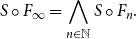 \begin{equation} S\circ F_\infty =\bigwedge _{n\in {\mathbb N}} S\circ F_n. \end{equation}
Assume that each $F_n$
is monotone, i.e., that
$F_n$
is monotone, i.e., that $S\circ F_n\geq F_n\circ R$
. Then,
$S\circ F_n\geq F_n\circ R$
. Then,
 \begin{align*} S\circ F_\infty & =\bigwedge _{n\in {\mathbb N}}S\circ S\circ F_n\geq \bigwedge _{n\in {\mathbb N}}S\circ F_n\circ R\geq \left (\bigwedge _{n\in {\mathbb N}}S\circ F_n\right )\circ R=S\circ F_\infty \circ R\geq F_\infty \circ R, \end{align*}
where the first equality follows by combining Equation (2) with the definition of an order; that definition is also used in the last inequality. We use [Kornell et al. (Reference Kornell, Lindenhovius and Mislove2022), Lemma A.1] in the second inequality.
Now, assume that each $F_n$
is Scott continuous. Let
$F_n$
is Scott continuous. Let $\mathcal H$
be an atomic quantum set, and let
$\mathcal H$
be an atomic quantum set, and let $K_1\sqsubseteq K_2\sqsubseteq \cdots :{\mathcal H}\to {\mathcal X}$
be a monotonically ascending sequence of functions with limit
$K_1\sqsubseteq K_2\sqsubseteq \cdots :{\mathcal H}\to {\mathcal X}$
be a monotonically ascending sequence of functions with limit $K_\infty$
. Then, for each
$K_\infty$
. Then, for each $n \in {\mathbb N}$
, we have that
$n \in {\mathbb N}$
, we have that $F_n\circ K_m\nearrow F_n\circ K_\infty$
, that is,
$F_n\circ K_m\nearrow F_n\circ K_\infty$
, that is,
 \begin{equation} \bigwedge _{m\in {\mathbb N}}S\circ F_n\circ K_m=S\circ F_n\circ K_\infty . \end{equation}
Using [Kornell et al. (Reference Kornell, Lindenhovius and Mislove2022), Proposition A.6] implicitly, we find that $S\circ F_\infty \circ K_\infty = \bigwedge _{n\in {\mathbb N}}S\circ F_n\circ K_\infty = \bigwedge _{n,m\in {\mathbb N}} S\circ F_n\circ K_m =\bigwedge _{m\in {\mathbb N}}S\circ F_\infty \circ K_m,$
where we use Equation (2) in the first and last equalities and Equation (3) in the middle equality.
$S\circ F_\infty \circ K_\infty = \bigwedge _{n\in {\mathbb N}}S\circ F_n\circ K_\infty = \bigwedge _{n,m\in {\mathbb N}} S\circ F_n\circ K_m =\bigwedge _{m\in {\mathbb N}}S\circ F_\infty \circ K_m,$
where we use Equation (2) in the first and last equalities and Equation (3) in the middle equality.
Corollary 3.3.2.
Let $({\mathcal X},R)$
and
$({\mathcal X},R)$
and $(\mathcal Y,S)$
be quantum cpos. Then,
$(\mathcal Y,S)$
be quantum cpos. Then, $\mathbf{qCPO}({\mathcal X},\mathcal Y)$
is a cpo.
$\mathbf{qCPO}({\mathcal X},\mathcal Y)$
is a cpo.
Proof.
Let $F_1\sqsubseteq F_2\sqsubseteq \cdots$
be a monotone sequence in
$F_1\sqsubseteq F_2\sqsubseteq \cdots$
be a monotone sequence in $\mathbf{qCPO}({\mathcal X},\mathcal Y)$
. Then
$\mathbf{qCPO}({\mathcal X},\mathcal Y)$
. Then $F_n\nearrow F_\infty$
for some
$F_n\nearrow F_\infty$
for some $F_\infty :{\mathcal X}\to \mathcal Y$
by Proposition 3.2.3. By Proposition 3.3.1, we find that
$F_\infty :{\mathcal X}\to \mathcal Y$
by Proposition 3.2.3. By Proposition 3.3.1, we find that $F_n\in \mathbf{qCPO}({\mathcal X},\mathcal Y)$
. By Lemma 3.1.2, it follows that
$F_n\in \mathbf{qCPO}({\mathcal X},\mathcal Y)$
. By Lemma 3.1.2, it follows that $F_\infty =\bigsqcup _{n\in {\mathbb N}}F_n$
in
$F_\infty =\bigsqcup _{n\in {\mathbb N}}F_n$
in $\mathbf{qCPO}({\mathcal X},\mathcal Y)$
.
$\mathbf{qCPO}({\mathcal X},\mathcal Y)$
.
Lemma 3.3.3.
Let $\mathcal X$
and
$\mathcal X$
and $\mathcal Y$
be quantum sets, and let
$\mathcal Y$
be quantum sets, and let $(\mathcal Z,T)$
be a quantum cpo. Let
$(\mathcal Z,T)$
be a quantum cpo. Let $F\colon {\mathcal X} {\rightarrow } \mathcal Y$
be a function. For any monotonically increasing sequence of functions
$F\colon {\mathcal X} {\rightarrow } \mathcal Y$
be a function. For any monotonically increasing sequence of functions $G_1 \sqsubseteq G_2 \sqsubseteq \cdots \sqsubseteq G_\infty \colon \mathcal Y \to \mathcal Z$
satisfying
$G_1 \sqsubseteq G_2 \sqsubseteq \cdots \sqsubseteq G_\infty \colon \mathcal Y \to \mathcal Z$
satisfying $G_n\nearrow G_\infty$
, we have
$G_n\nearrow G_\infty$
, we have $G_n \circ F \nearrow G_\infty \circ F$
.
$G_n \circ F \nearrow G_\infty \circ F$
.
Proof.
Since right multiplication is monotone [Kornell et al. (Reference Kornell, Lindenhovius and Mislove2022), Lemma 4.2], it follows that $G_1\circ F\sqsubseteq G_2\circ F\sqsubseteq \cdots :{\mathcal X}\to \mathcal Z$
is a monotonically ascending sequence of functions. Then,
$G_1\circ F\sqsubseteq G_2\circ F\sqsubseteq \cdots :{\mathcal X}\to \mathcal Z$
is a monotonically ascending sequence of functions. Then,
 \begin{equation*} \bigwedge _{n\in {\mathbb N}}T\circ G_n\circ F=\left (\bigwedge _{n\in {\mathbb N}}T\circ G_n\right )\circ F=T\circ G_\infty \circ F,\end{equation*}
where the first equality is by [Kornell et al. (Reference Kornell, Lindenhovius and Mislove2022), Proposition A.6], and the second equality since $G_n\nearrow G_\infty$
. We conclude that
$G_n\nearrow G_\infty$
. We conclude that $G_n\circ F\nearrow G_\infty \circ F$
.
$G_n\circ F\nearrow G_\infty \circ F$
.
Lemma 3.3.4.
Let $\mathcal X$
be a quantum set, and let
$\mathcal X$
be a quantum set, and let $(\mathcal Y,S)$
and
$(\mathcal Y,S)$
and $(\mathcal Z,T)$
be quantum cpos. Let
$(\mathcal Z,T)$
be quantum cpos. Let $G:\mathcal Y\to \mathcal Z$
be Scott continuous. If
$G:\mathcal Y\to \mathcal Z$
be Scott continuous. If $F_1\sqsubseteq F_2\sqsubseteq \cdots \sqsubseteq F_\infty :{\mathcal X}\to \mathcal Y$
satisfies
$F_1\sqsubseteq F_2\sqsubseteq \cdots \sqsubseteq F_\infty :{\mathcal X}\to \mathcal Y$
satisfies $F_n\nearrow F_\infty$
, then
$F_n\nearrow F_\infty$
, then $G\circ F_n\nearrow G\circ F_\infty$
.
$G\circ F_n\nearrow G\circ F_\infty$
.
Proof.
Fix $X \,\, \propto {\mathcal X}$
, and let
$X \,\, \propto {\mathcal X}$
, and let $J_X:\mathcal Q\{X\}\to {\mathcal X}$
be the inclusion function. By Lemma 3.3.3,
$J_X:\mathcal Q\{X\}\to {\mathcal X}$
be the inclusion function. By Lemma 3.3.3, $F_n \circ J_X \nearrow F_\infty \circ J_X$
. Since
$F_n \circ J_X \nearrow F_\infty \circ J_X$
. Since $\mathcal Q\{X\}$
is atomic, it follows from the Scott continuity of
$\mathcal Q\{X\}$
is atomic, it follows from the Scott continuity of $G$
that
$G$
that $G\circ F_n\circ J_X\nearrow G\circ F_\infty \circ J_X$
. We now reason that
$G\circ F_n\circ J_X\nearrow G\circ F_\infty \circ J_X$
. We now reason that
 \begin{align*} & \left (\bigwedge _{n\in {\mathbb N}}T\circ G\circ F_n\right ) \circ J_X = \bigwedge _{n\in {\mathbb N}}T\circ G\circ F_n \circ J_X = T \circ G \circ F_\infty \circ J_X, \end{align*}
where the second equality follows by [Kornell et al. (Reference Kornell, Lindenhovius and Mislove2022), Proposition A.6]. We vary $X \,\, \propto {\mathcal X}$
to conclude that
$X \,\, \propto {\mathcal X}$
to conclude that $\bigwedge _{n\in {\mathbb N}}T\circ G\circ F_n = T \circ G \circ F_\infty$
, i.e., that
$\bigwedge _{n\in {\mathbb N}}T\circ G\circ F_n = T \circ G \circ F_\infty$
, i.e., that $G \circ F_n \nearrow G \circ F_\infty$
, as desired.
$G \circ F_n \nearrow G \circ F_\infty$
, as desired.
Theorem 3.3.5.
The category $\mathbf{qCPO}$
is enriched over
$\mathbf{qCPO}$
is enriched over $\mathbf{CPO}$
.
$\mathbf{CPO}$
.
Proof.
Let $({\mathcal X},R)$
,
$({\mathcal X},R)$
, $(\mathcal Y,S)$
, and
$(\mathcal Y,S)$
, and $(\mathcal Z,T)$
be quantum cpos. The homsets
$(\mathcal Z,T)$
be quantum cpos. The homsets $\mathbf{qCPO}({\mathcal X},\mathcal Y)$
and
$\mathbf{qCPO}({\mathcal X},\mathcal Y)$
and $\mathbf{qCPO}(\mathcal Y,\mathcal Z)$
are cpos by Corollary 3.3.2. It follows that for functions
$\mathbf{qCPO}(\mathcal Y,\mathcal Z)$
are cpos by Corollary 3.3.2. It follows that for functions $F_1 \sqsubseteq F_2 \sqsubseteq \cdots \sqsubseteq F_\infty \in \mathbf{qCPO}({\mathcal X},\mathcal Y)$
, the condition
$F_1 \sqsubseteq F_2 \sqsubseteq \cdots \sqsubseteq F_\infty \in \mathbf{qCPO}({\mathcal X},\mathcal Y)$
, the condition $F_\infty = \bigsqcup _{n \in {\mathbb N}} F_n$
is equivalent to the condition
$F_\infty = \bigsqcup _{n \in {\mathbb N}} F_n$
is equivalent to the condition $F_n \nearrow F_\infty$
, and likewise for functions
$F_n \nearrow F_\infty$
, and likewise for functions $G_1 \sqsubseteq G_2 \sqsubseteq \cdots \sqsubseteq G_\infty \in \mathbf{qCPO}(\mathcal Y,\mathcal Z)$
. We apply Lemmas 3.3.3 and 3.3.4 to infer that composition
$G_1 \sqsubseteq G_2 \sqsubseteq \cdots \sqsubseteq G_\infty \in \mathbf{qCPO}(\mathcal Y,\mathcal Z)$
. We apply Lemmas 3.3.3 and 3.3.4 to infer that composition $\mathbf{qCPO}({\mathcal X},\mathcal Y) \times \mathbf{qCPO}(\mathcal Y,\mathcal Z) {\rightarrow } \mathbf{qCPO}({\mathcal X},\mathcal Z)$
is Scott continuous in each of its two variables separately. It follows that the iterated limits are equal and they equal the double limit, so we conclude composition is Scott continuous. Therefore
$\mathbf{qCPO}({\mathcal X},\mathcal Y) \times \mathbf{qCPO}(\mathcal Y,\mathcal Z) {\rightarrow } \mathbf{qCPO}({\mathcal X},\mathcal Z)$
is Scott continuous in each of its two variables separately. It follows that the iterated limits are equal and they equal the double limit, so we conclude composition is Scott continuous. Therefore $\mathbf{qCPO}$
is enriched over
$\mathbf{qCPO}$
is enriched over $\mathbf{CPO}$
.
$\mathbf{CPO}$
.
3.4 Completeness
We next show that the category $\mathbf{qCPO}$
is complete. For denotational semantics, completeness on its own has no special meaning. Later, we use completeness of
$\mathbf{qCPO}$
is complete. For denotational semantics, completeness on its own has no special meaning. Later, we use completeness of $\mathbf{qCPO}$
to show that
$\mathbf{qCPO}$
to show that $\mathbf{qCPO}$
is also cocomplete, which in turn will be used to construct a category of quantum cpos that is
$\mathbf{qCPO}$
is also cocomplete, which in turn will be used to construct a category of quantum cpos that is $\mathbf{CPO}$
-algebraically compact, a property that is fundamental for modeling recursive types. Eventually, we will show that
$\mathbf{CPO}$
-algebraically compact, a property that is fundamental for modeling recursive types. Eventually, we will show that $\mathbf{qCPO}$
is symmetric monoidal closed. In combination with completeness and cocompleteness, this implies that
$\mathbf{qCPO}$
is symmetric monoidal closed. In combination with completeness and cocompleteness, this implies that $\mathbf{qCPO}$
is a cosmos, which is a category that has suitable properties for enriched category theory.
$\mathbf{qCPO}$
is a cosmos, which is a category that has suitable properties for enriched category theory.
Theorem 3.4.1.
The category $\mathbf{qCPO}$
is complete. Any limit in
$\mathbf{qCPO}$
is complete. Any limit in $\mathbf{qCPO}$
can be calculated in the ambient category
$\mathbf{qCPO}$
can be calculated in the ambient category $\mathbf{qPOS}$
, and the embedding of
$\mathbf{qPOS}$
, and the embedding of $\mathbf{qCPO}$
in
$\mathbf{qCPO}$
in $\mathbf{qPOS}_{\mathrm{SC}}$
preserves all limits, where
$\mathbf{qPOS}_{\mathrm{SC}}$
preserves all limits, where $\mathbf{qPOS}_{\mathrm{SC}}$
denotes the category of quantum posets and Scott continuous functions.
$\mathbf{qPOS}_{\mathrm{SC}}$
denotes the category of quantum posets and Scott continuous functions.
Proof.
Consider a diagram of shape $A$
, consisting of objects
$A$
, consisting of objects $({\mathcal X}_\alpha ,R_\alpha )\in \mathbf{qCPO}$
and with Scott continuous maps
$({\mathcal X}_\alpha ,R_\alpha )\in \mathbf{qCPO}$
and with Scott continuous maps $F_f:{\mathcal X}_\alpha \to {\mathcal X}_\beta$
for each morphism
$F_f:{\mathcal X}_\alpha \to {\mathcal X}_\beta$
for each morphism $f:\alpha \to \beta$
in
$f:\alpha \to \beta$
in $A$
. We can regard this as a diagram in
$A$
. We can regard this as a diagram in $\mathbf{qPOS}$
. The latter category is complete by Theorem 5.5 Kornell et al. (Reference Kornell, Lindenhovius and Mislove2022), which also states that the limit of the diagram in
$\mathbf{qPOS}$
. The latter category is complete by Theorem 5.5 Kornell et al. (Reference Kornell, Lindenhovius and Mislove2022), which also states that the limit of the diagram in $\mathbf{qPOS}$
is given by
$\mathbf{qPOS}$
is given by $({\mathcal X},R)$
, where
$({\mathcal X},R)$
, where $\mathcal X$
is the limit of the diagram
$\mathcal X$
is the limit of the diagram $({\mathcal X}_\alpha )_{\alpha \in A}$
in
$({\mathcal X}_\alpha )_{\alpha \in A}$
in $\mathbf{qSet}$
, and where
$\mathbf{qSet}$
, and where $R=\bigwedge _{\alpha \in A}F_\alpha ^\dagger \circ R_\alpha \circ F_\alpha$
, where
$R=\bigwedge _{\alpha \in A}F_\alpha ^\dagger \circ R_\alpha \circ F_\alpha$
, where $F_\alpha :{\mathcal X}\to {\mathcal X}_\alpha$
are the limiting functions of the diagram in
$F_\alpha :{\mathcal X}\to {\mathcal X}_\alpha$
are the limiting functions of the diagram in $\mathbf{qSet}$
. Theorem 5.5 Kornell et al. (Reference Kornell, Lindenhovius and Mislove2022) also assures that these limiting functions
$\mathbf{qSet}$
. Theorem 5.5 Kornell et al. (Reference Kornell, Lindenhovius and Mislove2022) also assures that these limiting functions $F_\alpha$
are monotone, so they are also limiting functions in
$F_\alpha$
are monotone, so they are also limiting functions in $\mathbf{qPOS}$
.
$\mathbf{qPOS}$
.
We first show that $({\mathcal X},R)$
is a quantum cpo. For a fixed atomic quantum set
$({\mathcal X},R)$
is a quantum cpo. For a fixed atomic quantum set $\mathcal H$
let
$\mathcal H$
let $K_1\sqsubseteq K_2$ $\sqsubseteq \ldots :{\mathcal H}\to {\mathcal X}$
be a monotonically ascending sequence of functions. Since left multiplication is monotone [Kornell et al. (Reference Kornell, Lindenhovius and Mislove2022), Lemma 4.4], we find for each
$\sqsubseteq \ldots :{\mathcal H}\to {\mathcal X}$
be a monotonically ascending sequence of functions. Since left multiplication is monotone [Kornell et al. (Reference Kornell, Lindenhovius and Mislove2022), Lemma 4.4], we find for each $\alpha \in A$
that
$\alpha \in A$
that $F_\alpha \circ K_1\sqsubseteq F_\alpha \circ K_2\sqsubseteq \ldots :{\mathcal H}\to {\mathcal X}_\alpha$
is a monotonically ascending sequence of functions, too.
$F_\alpha \circ K_1\sqsubseteq F_\alpha \circ K_2\sqsubseteq \ldots :{\mathcal H}\to {\mathcal X}_\alpha$
is a monotonically ascending sequence of functions, too.
We first claim that if there exists a function $K_\infty :{\mathcal H}\to {\mathcal X}$
such that
$K_\infty :{\mathcal H}\to {\mathcal X}$
such that
 \begin{equation} F_\alpha \circ K_n\nearrow F_\alpha \circ K_\infty \end{equation}
for each $\alpha \in A$
, then
$\alpha \in A$
, then $K_n\nearrow K_\infty$
. Equation (4) means that
$K_n\nearrow K_\infty$
. Equation (4) means that $ R_\alpha \circ F_\alpha \circ K_\infty =\bigwedge _{n\in {\mathbb N}}R_\alpha \circ F_\alpha \circ K_n$
; hence, we find that
$ R_\alpha \circ F_\alpha \circ K_\infty =\bigwedge _{n\in {\mathbb N}}R_\alpha \circ F_\alpha \circ K_n$
; hence, we find that
 \begin{align*} R\circ K_\infty & = \left (\bigwedge _{\alpha \in A}F_\alpha ^\dagger \circ R_\alpha \circ F_\alpha \right )\circ K_\infty =\bigwedge _{\alpha \in A}F_\alpha ^\dagger \circ R_\alpha \circ F_\alpha \circ K_\infty \\ & = \bigwedge _{\alpha \in A}F_\alpha ^\dagger \circ \bigwedge _{n\in {\mathbb N}}R_\alpha \circ F_\alpha \circ K_n=\bigwedge _{\alpha \in A} \bigwedge _{n\in {\mathbb N}}F_\alpha ^\dagger \circ R_\alpha \circ F_\alpha \circ K_n\\ & = \bigwedge _{n\in {\mathbb N}}\bigwedge _{\alpha \in A} F_\alpha ^\dagger \circ R_\alpha \circ F_\alpha \circ K_n= \bigwedge _{n\in {\mathbb N}}\left (\bigwedge _{\alpha \in A} F_\alpha ^\dagger \circ R_\alpha \circ F_\alpha \right )\circ K_n = \bigwedge _{n\in {\mathbb N}}R\circ K_n, \end{align*}
where we use [Kornell et al. (Reference Kornell, Lindenhovius and Mislove2022), Proposition A.6] in the second, the third and the penultimate equalities. Therefore, $K_n\nearrow K_\infty$
, as claimed.
$K_n\nearrow K_\infty$
, as claimed.
Next we construct a function $K_\infty$
that satisfies (4). Since
$K_\infty$
that satisfies (4). Since $({\mathcal X}_\alpha ,R_\alpha )$
is by assumption a quantum cpo for each
$({\mathcal X}_\alpha ,R_\alpha )$
is by assumption a quantum cpo for each $\alpha \in A$
, there exists a function
$\alpha \in A$
, there exists a function $G_\alpha :{\mathcal H}\to {\mathcal X}_\alpha$
such that
$G_\alpha :{\mathcal H}\to {\mathcal X}_\alpha$
such that $F_\alpha \circ K_n\nearrow G_\alpha$
. Consider a morphism
$F_\alpha \circ K_n\nearrow G_\alpha$
. Consider a morphism $f:\alpha \to \beta$
in
$f:\alpha \to \beta$
in $A$
. By the definition of
$A$
. By the definition of $F_\alpha$
and
$F_\alpha$
and $F_\beta$
being limiting maps, we have
$F_\beta$
being limiting maps, we have $ F_f\circ F_\alpha =F_\beta .$
By the Scott continuity of
$ F_f\circ F_\alpha =F_\beta .$
By the Scott continuity of $F_f$
, we have
$F_f$
, we have $ F_\beta \circ K_n=F_f\circ F_\alpha \circ K_n\nearrow F_f\circ G_\alpha .$
It now follows from Lemma 3.1.2 that
$ F_\beta \circ K_n=F_f\circ F_\alpha \circ K_n\nearrow F_f\circ G_\alpha .$
It now follows from Lemma 3.1.2 that $G_\beta =F_{f}\circ G_\alpha$
. Thus, the functions
$G_\beta =F_{f}\circ G_\alpha$
. Thus, the functions $G_\alpha :{\mathcal H}\to {\mathcal X}_\alpha$
form a cone, and since the functions
$G_\alpha :{\mathcal H}\to {\mathcal X}_\alpha$
form a cone, and since the functions $F_\alpha :{\mathcal X}\to {\mathcal X}_\alpha$
form the limiting cone, there must be a monotone function
$F_\alpha :{\mathcal X}\to {\mathcal X}_\alpha$
form the limiting cone, there must be a monotone function $K_\infty :{\mathcal H}\to {\mathcal X}$
such that
$K_\infty :{\mathcal H}\to {\mathcal X}$
such that $G_\alpha =F_\alpha \circ K_\infty$
. Since
$G_\alpha =F_\alpha \circ K_\infty$
. Since $F_\alpha \circ K_n\nearrow G_\alpha$
, it follows that Equation (4) holds for each
$F_\alpha \circ K_n\nearrow G_\alpha$
, it follows that Equation (4) holds for each $\alpha \in A$
, hence we conclude that
$\alpha \in A$
, hence we conclude that $K_n\nearrow K_\infty$
. Therefore,
$K_n\nearrow K_\infty$
. Therefore, $({\mathcal X},R)$
is a quantum cpo.
$({\mathcal X},R)$
is a quantum cpo.
We have to show that the limiting functions $F_\alpha$
are Scott continuous. Let
$F_\alpha$
are Scott continuous. Let $\mathcal H$
be an atomic quantum set, and let
$\mathcal H$
be an atomic quantum set, and let $K_1\sqsubseteq K_2\sqsubseteq \cdots :{\mathcal H}\to {\mathcal X}$
be a monotonically ascending sequence. Then,
$K_1\sqsubseteq K_2\sqsubseteq \cdots :{\mathcal H}\to {\mathcal X}$
be a monotonically ascending sequence. Then, $K_n\nearrow K_\infty '$
for some
$K_n\nearrow K_\infty '$
for some $K'_\infty :{\mathcal H}\to {\mathcal X}$
since
$K'_\infty :{\mathcal H}\to {\mathcal X}$
since $\mathcal X$
is a quantum cpo. Now, as before, construct some
$\mathcal X$
is a quantum cpo. Now, as before, construct some $K_\infty$
such that (4) holds for each
$K_\infty$
such that (4) holds for each $\alpha \in A$
, and note that
$\alpha \in A$
, and note that $K_n\nearrow K_\infty$
. Then Lemma 3.1.2 implies
$K_n\nearrow K_\infty$
. Then Lemma 3.1.2 implies $K_\infty =K_\infty '$
. Thus, Equation (4) expresses that
$K_\infty =K_\infty '$
. Thus, Equation (4) expresses that $F_\alpha$
is Scott continuous. We have shown that the vertex
$F_\alpha$
is Scott continuous. We have shown that the vertex $({\mathcal X},R)$
of the limiting cone is a quantum cpo and that the limiting functions
$({\mathcal X},R)$
of the limiting cone is a quantum cpo and that the limiting functions $F_\alpha$
are all Scott continuous; hence, this cone is entirely in
$F_\alpha$
are all Scott continuous; hence, this cone is entirely in $\mathbf{qCPO}$
. It remains to show that it is also limiting in
$\mathbf{qCPO}$
. It remains to show that it is also limiting in $\mathbf{qCPO}$
.
$\mathbf{qCPO}$
.
Let $(\mathcal Y,S)$
be a quantum poset, and let
$(\mathcal Y,S)$
be a quantum poset, and let $C_\alpha :\mathcal Y\to {\mathcal X}_\alpha$
be Scott continuous maps that form a cone. Since
$C_\alpha :\mathcal Y\to {\mathcal X}_\alpha$
be Scott continuous maps that form a cone. Since $({\mathcal X},R)$
is the limit of the
$({\mathcal X},R)$
is the limit of the $({\mathcal X}_\alpha ,R_\alpha )$
in
$({\mathcal X}_\alpha ,R_\alpha )$
in $\mathbf{qPOS}$
, there exists a unique monotone map
$\mathbf{qPOS}$
, there exists a unique monotone map $M:\mathcal Y\to {\mathcal X}$
such that
$M:\mathcal Y\to {\mathcal X}$
such that $F_\alpha \circ M=C_\alpha$
for each
$F_\alpha \circ M=C_\alpha$
for each $\alpha \in A$
. We claim that
$\alpha \in A$
. We claim that $M$
is Scott continuous: Indeed, let
$M$
is Scott continuous: Indeed, let $\mathcal H$
be an atomic quantum set, let
$\mathcal H$
be an atomic quantum set, let $E_1\sqsubseteq E_2\sqsubseteq \cdots :{\mathcal H}\to \mathcal Y$
be a monotonically ascending sequence of functions, and assume that there exists a function
$E_1\sqsubseteq E_2\sqsubseteq \cdots :{\mathcal H}\to \mathcal Y$
be a monotonically ascending sequence of functions, and assume that there exists a function $E_\infty :{\mathcal H}\to \mathcal Y$
such that
$E_\infty :{\mathcal H}\to \mathcal Y$
such that $E_n\nearrow E_\infty$
. Note that
$E_n\nearrow E_\infty$
. Note that $E_\infty$
exists if we assume that
$E_\infty$
exists if we assume that $(\mathcal Y,S)$
is a quantum cpo. Let
$(\mathcal Y,S)$
is a quantum cpo. Let $K_n=M\circ E_n$
for each
$K_n=M\circ E_n$
for each $n\in \{1,2,\ldots ,\infty \}$
. Since
$n\in \{1,2,\ldots ,\infty \}$
. Since $M$
is monotone, left multiplication with
$M$
is monotone, left multiplication with $M$
is monotone [Kornell et al. (Reference Kornell, Lindenhovius and Mislove2022), Lemma 4.4], hence the sequence
$M$
is monotone [Kornell et al. (Reference Kornell, Lindenhovius and Mislove2022), Lemma 4.4], hence the sequence $K_1\sqsubseteq K_2\sqsubseteq \cdots$
is also monotonically ascending. Since the
$K_1\sqsubseteq K_2\sqsubseteq \cdots$
is also monotonically ascending. Since the $C_\alpha$
are Scott continuous, we have
$C_\alpha$
are Scott continuous, we have $C_\alpha \circ E_n\nearrow C_\alpha \circ E_\infty$
. So, for each
$C_\alpha \circ E_n\nearrow C_\alpha \circ E_\infty$
. So, for each $\alpha \in A$
we obtain
$\alpha \in A$
we obtain
 \begin{equation*} F_\alpha \circ K_n=F_\alpha \circ M\circ E_n=C_\alpha \circ E_n\nearrow C_\alpha \circ E_\infty =F_\alpha \circ M\circ E_\infty =F_\alpha \circ K_\infty ,\end{equation*}
which shows the $K_n$
satisfy condition (4) for each
$K_n$
satisfy condition (4) for each $\alpha \in A$
; i.e., we obtain
$\alpha \in A$
; i.e., we obtain $K_n\nearrow K_\infty$
. But this exactly expresses that
$K_n\nearrow K_\infty$
. But this exactly expresses that $M\circ E_n\nearrow M\circ E_\infty$
, so
$M\circ E_n\nearrow M\circ E_\infty$
, so $M$
is Scott continuous. If
$M$
is Scott continuous. If $\mathcal Y$
is a quantum cpo, it follows that the Scott continuous functions
$\mathcal Y$
is a quantum cpo, it follows that the Scott continuous functions $F_\alpha :{\mathcal X}\to {\mathcal X}_\alpha$
form a limiting cone in
$F_\alpha :{\mathcal X}\to {\mathcal X}_\alpha$
form a limiting cone in $\mathbf{qCPO}$
, so
$\mathbf{qCPO}$
, so $({\mathcal X},R)$
is the limit of the diagram.
$({\mathcal X},R)$
is the limit of the diagram.
Choosing $(\mathcal Y,S)$
to be a quantum cpo shows that
$(\mathcal Y,S)$
to be a quantum cpo shows that $\mathbf{qCPO}$
is complete. Since we allowed
$\mathbf{qCPO}$
is complete. Since we allowed $(\mathcal Y,S)$
to be an arbitrary quantum poset, it follows that the embedding of
$(\mathcal Y,S)$
to be an arbitrary quantum poset, it follows that the embedding of $\mathbf{qCPO}$
into
$\mathbf{qCPO}$
into $\mathbf{qPOS}_{\mathrm{SC}}$
preserves all limits.
$\mathbf{qPOS}_{\mathrm{SC}}$
preserves all limits.
4. Coproducts and Cocompleteness
In this section, we show that the category $\mathbf{qCPO}$
has coproducts and that it is cocomplete. Coproducts are used in semantics to support sum types and conditional branching, while cocompleteness is required to construct a
$\mathbf{qCPO}$
has coproducts and that it is cocomplete. Coproducts are used in semantics to support sum types and conditional branching, while cocompleteness is required to construct a $\mathbf{CPO}$
-algebraic compact category of quantum cpos, which is key for modeling recursive types. We begin with coproducts.
$\mathbf{CPO}$
-algebraic compact category of quantum cpos, which is key for modeling recursive types. We begin with coproducts.
4.1 Coproducts
The main technical challenge of showing the existence of coproducts in $\mathbf{qCPO}$
is the case that a monotone ascending sequence
$\mathbf{qCPO}$
is the case that a monotone ascending sequence $K_1 \sqsubseteq K_2 \sqsubseteq \cdots \colon {\mathcal H}\to {\mathcal X}_i\uplus {\mathcal X}_2$
of functions from an atomic quantum set to a coproduct of quantum posets - intuitively a family of monotone ascending sequences in
$K_1 \sqsubseteq K_2 \sqsubseteq \cdots \colon {\mathcal H}\to {\mathcal X}_i\uplus {\mathcal X}_2$
of functions from an atomic quantum set to a coproduct of quantum posets - intuitively a family of monotone ascending sequences in ${\mathcal X}_1 \uplus {\mathcal X}_2$
indexed by
${\mathcal X}_1 \uplus {\mathcal X}_2$
indexed by $\mathcal H$
- have non-zero range in both summands.
$\mathcal H$
- have non-zero range in both summands.
We briefly recall the construction of coproducts of quantum sets and of quantum posets. The coproduct $\biguplus _{\alpha \in A}{\mathcal X}_\alpha$
of a family
$\biguplus _{\alpha \in A}{\mathcal X}_\alpha$
of a family $({\mathcal X}_\alpha )_{\alpha \in A}$
of quantum sets coincides in
$({\mathcal X}_\alpha )_{\alpha \in A}$
of quantum sets coincides in $\mathbf{qSet}$
and
$\mathbf{qSet}$
and $\mathbf{qRel}$
and is defined as follows. If all quantum sets in the family are pairwise disjoint, their coproduct is simply the union
$\mathbf{qRel}$
and is defined as follows. If all quantum sets in the family are pairwise disjoint, their coproduct is simply the union $\bigcup _{\alpha \in A}{\mathcal X}_\alpha :=\mathcal Q\bigcup _{\alpha \in A}\mathrm{At}({\mathcal X}_\alpha )$
, otherwise the coproduct is given by the disjoint union
$\bigcup _{\alpha \in A}{\mathcal X}_\alpha :=\mathcal Q\bigcup _{\alpha \in A}\mathrm{At}({\mathcal X}_\alpha )$
, otherwise the coproduct is given by the disjoint union $\bigcup _{\alpha \in A}{\mathcal X}_\alpha \times `\{\alpha \}$
. So, just as for ordinary sets, for most results involving coproducts we can assume that the family over which the coproduct is formed consists of pairwise disjoint quantum sets. For each
$\bigcup _{\alpha \in A}{\mathcal X}_\alpha \times `\{\alpha \}$
. So, just as for ordinary sets, for most results involving coproducts we can assume that the family over which the coproduct is formed consists of pairwise disjoint quantum sets. For each $\beta \in A$
, we denote the canonical injection
$\beta \in A$
, we denote the canonical injection ${\mathcal X}_\beta \to \biguplus _{\alpha \in A}{\mathcal X}_\alpha$
by
${\mathcal X}_\beta \to \biguplus _{\alpha \in A}{\mathcal X}_\alpha$
by $J_\beta$
.
$J_\beta$
.
If each quantum set in the family $({\mathcal X}_\alpha )_{\alpha \in A}$
is equipped with an order
$({\mathcal X}_\alpha )_{\alpha \in A}$
is equipped with an order $R_\alpha$
, then the coproduct is
$R_\alpha$
, then the coproduct is $\biguplus _{\alpha \in A}({\mathcal X}_\alpha ,R_\alpha ):=({\mathcal X},R)$
, where
$\biguplus _{\alpha \in A}({\mathcal X}_\alpha ,R_\alpha ):=({\mathcal X},R)$
, where ${\mathcal X}=\biguplus _{\alpha \in A}{\mathcal X}_\alpha$
in
${\mathcal X}=\biguplus _{\alpha \in A}{\mathcal X}_\alpha$
in $\mathbf{qSet}$
, and
$\mathbf{qSet}$
, and $R=\biguplus _{\alpha \in A}R_\alpha$
in
$R=\biguplus _{\alpha \in A}R_\alpha$
in $\mathbf{qRel}$
, that is, the unique relation on
$\mathbf{qRel}$
, that is, the unique relation on $\mathcal X$
such that
$\mathcal X$
such that $R\circ J_\alpha =R_\alpha \circ J_\alpha$
for each
$R\circ J_\alpha =R_\alpha \circ J_\alpha$
for each $\alpha \in A$
[Kornell et al. (Reference Kornell, Lindenhovius and Mislove2022), Proposition 6.2].
$\alpha \in A$
[Kornell et al. (Reference Kornell, Lindenhovius and Mislove2022), Proposition 6.2].
Definition 4.1.1 (Decomposition of $\mathcal H$
). Let
$\mathcal H$
). Let $\mathcal H$
be an atomic quantum set, and let
$\mathcal H$
be an atomic quantum set, and let $\mathcal X$
be any quantum set. Let
$\mathcal X$
be any quantum set. Let $H$
be the unique atom of
$H$
be the unique atom of $\mathcal H$
. A function
$\mathcal H$
. A function $D\colon {\mathcal H} \to {\mathcal X}$
is a decomposition of
$D\colon {\mathcal H} \to {\mathcal X}$
is a decomposition of $\mathcal H$
if there exists a family
$\mathcal H$
if there exists a family $\{X_\alpha \}_{\alpha \in A}$
of pairwise orthogonal subspaces of
$\{X_\alpha \}_{\alpha \in A}$
of pairwise orthogonal subspaces of $H$
that sum to
$H$
that sum to $H$
such that
$H$
such that
-
(1)
${\mathcal X} =\mathcal Q\{X_\alpha :\alpha \in A\}$
, and
-
(2)
$D(H, X_\alpha ) = {\mathbb C} \cdot \mathrm{proj}_{X_\alpha }$
for each
$\alpha \in A$
,



where $\mathrm{proj}_{X_\alpha }\in L(H, X_\alpha )$
is the orthogonal projection onto
$\mathrm{proj}_{X_\alpha }\in L(H, X_\alpha )$
is the orthogonal projection onto $X_\alpha$
.
$X_\alpha$
.
We have a canonical one-to-one correspondence between the decompositions of $\mathcal H$
and orthogonal direct sum decompositions
$\mathcal H$
and orthogonal direct sum decompositions $H = \bigoplus _{\alpha \in A} X_\alpha$
. The nonzero subspaces
$H = \bigoplus _{\alpha \in A} X_\alpha$
. The nonzero subspaces $X_\alpha$
are pair-wise distinct, so
$X_\alpha$
are pair-wise distinct, so $\bigcup _{\alpha \in A} \mathcal Q\{X_\alpha \} = \biguplus _{\alpha \in A} \mathcal Q\{X_\alpha \}$
.
$\bigcup _{\alpha \in A} \mathcal Q\{X_\alpha \} = \biguplus _{\alpha \in A} \mathcal Q\{X_\alpha \}$
.
Lemma 4.1.2.
Let $\mathcal H$
be an atomic quantum set, and let
$\mathcal H$
be an atomic quantum set, and let $D\colon {\mathcal H} \to \biguplus _{\alpha \in A} \mathcal Q\{X_\alpha \}$
be any decomposition of
$D\colon {\mathcal H} \to \biguplus _{\alpha \in A} \mathcal Q\{X_\alpha \}$
be any decomposition of $\mathcal H$
. Then,
$\mathcal H$
. Then, $D$
is surjective.
$D$
is surjective.
Proof.
For each $\alpha \in A$
, let
$\alpha \in A$
, let $\mathrm{proj}_{X_\alpha }:H\to H$
be the projection operator whose range is the subspace
$\mathrm{proj}_{X_\alpha }:H\to H$
be the projection operator whose range is the subspace $X_\alpha$
of
$X_\alpha$
of $H$
. Clearly
$H$
. Clearly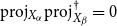 $\mathrm{proj}_{X_\alpha }\mathrm{proj}_{X_\beta }^\dagger = 0$
for distinct
$\mathrm{proj}_{X_\alpha }\mathrm{proj}_{X_\beta }^\dagger = 0$
for distinct $\alpha , \beta \in A$
. We now calculate that for all
$\alpha , \beta \in A$
. We now calculate that for all $\alpha , \beta \in A$
,
$\alpha , \beta \in A$
,
 \begin{align*} (D\circ D^\dagger )(X_\beta ,{X_\alpha }) & = \bigvee _{H\,\, \propto {\mathcal H}}D(H,X_\alpha )D^\dagger ({X_\beta },H)=D(H, X_\alpha )D^\dagger (X_\beta , H) =D(H, X_\alpha )D(H,X_\beta )^\dagger \\ & = {\mathbb C} \mathrm{proj}_{X_\alpha } \mathrm{proj}_{X_\beta }^\dagger =\delta _{\alpha ,\beta }{\mathbb C} \mathrm{proj}_{X_\alpha }\mathrm{proj}_{X_\alpha }^\dagger = \delta _{\alpha ,\beta }{\mathbb C} 1_{X_\alpha }=I_{{\mathcal X}}(X_\beta ,X_\alpha ). \end{align*}
In general, a decomposition $D:{\mathcal H}\to {\mathcal X}$
of
$D:{\mathcal H}\to {\mathcal X}$
of $\mathcal H$
is not injective. In fact,
$\mathcal H$
is not injective. In fact, $D$
is injective precisely when it is bijective, in which case
$D$
is injective precisely when it is bijective, in which case $\mathcal X$
also is atomic. In this case, it necessarily follows that the unique atoms of
$\mathcal X$
also is atomic. In this case, it necessarily follows that the unique atoms of $\mathcal X$
and
$\mathcal X$
and $\mathcal H$
have the same dimension.
$\mathcal H$
have the same dimension.
Lemma 4.1.3.
Let $F$
be a function from an atomic quantum set
$F$
be a function from an atomic quantum set ${\mathcal H}=\mathcal Q\{H\}$
, to the disjoint union of an indexed family of quantum sets
${\mathcal H}=\mathcal Q\{H\}$
, to the disjoint union of an indexed family of quantum sets $\{\mathcal Y_\alpha \}_{\alpha \in A}$
. Then, there exists a decomposition
$\{\mathcal Y_\alpha \}_{\alpha \in A}$
. Then, there exists a decomposition $D\colon {\mathcal H} {\rightarrow } \biguplus _{\alpha \in A} \mathcal Q\{X_\alpha \}$
and a family of functions
$D\colon {\mathcal H} {\rightarrow } \biguplus _{\alpha \in A} \mathcal Q\{X_\alpha \}$
and a family of functions $\{F_\alpha \colon \mathcal Q\{X_\alpha \} {\rightarrow } \mathcal Y_\alpha \}_ {\alpha \in A}$
such that
$\{F_\alpha \colon \mathcal Q\{X_\alpha \} {\rightarrow } \mathcal Y_\alpha \}_ {\alpha \in A}$
such that $(\biguplus _{\alpha \in A} F_\alpha ) \circ D = F$
.
$(\biguplus _{\alpha \in A} F_\alpha ) \circ D = F$
.
Proof.
Fix $\alpha \in A$
, and let
$\alpha \in A$
, and let $J_\alpha$
be the inclusion of
$J_\alpha$
be the inclusion of $\mathcal Y_\alpha$
into the disjoint union
$\mathcal Y_\alpha$
into the disjoint union $\biguplus _{\alpha '} \mathcal Y_{\alpha '}$
. We have that
$\biguplus _{\alpha '} \mathcal Y_{\alpha '}$
. We have that $J_\alpha ^\dagger \circ F \circ F^\dagger \circ J_\alpha \leq J_\alpha ^\dagger \circ J_\alpha = I_{\mathcal Y_\alpha }$
, and thus,
$J_\alpha ^\dagger \circ F \circ F^\dagger \circ J_\alpha \leq J_\alpha ^\dagger \circ J_\alpha = I_{\mathcal Y_\alpha }$
, and thus, $J_\alpha ^\dagger \circ F$
is a partial function. Applying [Kornell (Reference Kornell2020), Proposition C.6], we obtain a subspace
$J_\alpha ^\dagger \circ F$
is a partial function. Applying [Kornell (Reference Kornell2020), Proposition C.6], we obtain a subspace $X_\alpha \leq H$
and a function
$X_\alpha \leq H$
and a function $F_\alpha \colon \mathcal Q\{X_\alpha \} \to \mathcal Y_\alpha$
such that
$F_\alpha \colon \mathcal Q\{X_\alpha \} \to \mathcal Y_\alpha$
such that $F_\alpha \circ K_\alpha =J_\alpha ^\dagger \circ F$
, where
$F_\alpha \circ K_\alpha =J_\alpha ^\dagger \circ F$
, where $K_\alpha$
is the partial function from
$K_\alpha$
is the partial function from $\mathcal H$
to
$\mathcal H$
to ${\mathcal X}_\alpha = \mathcal Q\{X_\alpha \}$
defined by
${\mathcal X}_\alpha = \mathcal Q\{X_\alpha \}$
defined by $K_\alpha (H, X_\alpha ) = {\mathbb C} \cdot \mathrm{proj}_{X_\alpha }^\dagger$
.
$K_\alpha (H, X_\alpha ) = {\mathbb C} \cdot \mathrm{proj}_{X_\alpha }^\dagger$
.
If we vary $\alpha \in A$
, we obtain families
$\alpha \in A$
, we obtain families $\{X_\alpha \,\, \propto {\mathcal X}_\alpha \}_{\alpha \in A}$
,
$\{X_\alpha \,\, \propto {\mathcal X}_\alpha \}_{\alpha \in A}$
, $\{K_\alpha \}_{\alpha \in A}$
and
$\{K_\alpha \}_{\alpha \in A}$
and $\{F_\alpha \}_{\alpha \in A}$
. Now, let
$\{F_\alpha \}_{\alpha \in A}$
. Now, let $D = $ $[K_\alpha ^\dagger : \alpha \in A]^\dagger$
, where the square-bracket notation refers to the coproduct in
$[K_\alpha ^\dagger : \alpha \in A]^\dagger$
, where the square-bracket notation refers to the coproduct in $\mathbf{qRel}$
. We compute that
$\mathbf{qRel}$
. We compute that
 \begin{align*} \left (\biguplus _\alpha F_\alpha \right ) \circ D &= \left (\biguplus _\alpha F_\alpha \right ) \circ [K_\alpha ^\dagger : \alpha \in A]^\dagger = \left ( [K_\alpha ^\dagger : \alpha \in A] \circ \left (\biguplus _\alpha F_\alpha ^\dagger \right )\right )^\dagger \\ & = [K_\alpha ^\dagger \circ F_\alpha ^\dagger : \alpha \in A]^\dagger = [(F_\alpha \circ K_\alpha )^\dagger : \alpha \in A]^\dagger = [(J_\alpha ^\dagger \circ F)^\dagger : \alpha \in A]^\dagger \\ & = [F^\dagger \circ J_\alpha : \alpha \in A]^\dagger = (F^\dagger )^\dagger = F. \end{align*}
Thus, $(\biguplus _\alpha F_\alpha ) \circ D = F$
.
$(\biguplus _\alpha F_\alpha ) \circ D = F$
.
To show that $D$
is a decomposition, we show that it is a function. For distinct
$D$
is a decomposition, we show that it is a function. For distinct $\alpha , \beta \in A$
, we apply [Kornell et al. (Reference Kornell, Lindenhovius and Mislove2022), Lemma 6.1(a)] to find that
$\alpha , \beta \in A$
, we apply [Kornell et al. (Reference Kornell, Lindenhovius and Mislove2022), Lemma 6.1(a)] to find that
 \begin{align*} K_\alpha \circ K_\beta ^\dagger & \leq F_\alpha ^\dagger \circ F_\alpha \circ K_\alpha \circ K_\beta ^\dagger \circ F_\beta ^\dagger \circ F_\beta = F_\alpha ^\dagger \circ J_\alpha ^\dagger \circ F \circ F^\dagger \circ J_\beta \circ F_\beta \\ & \leq F_\alpha ^\dagger \circ J_\alpha ^\dagger \circ J_\beta \circ F_\beta = F_\alpha ^\dagger \circ \bot \circ F_\beta = \bot , \end{align*}
so $K_\alpha \circ K_\beta ^\dagger = \bot$
. It follows that
$K_\alpha \circ K_\beta ^\dagger = \bot$
. It follows that
 \begin{align*} D \circ D^\dagger & = \bigvee _{\alpha , \beta \in A} J_\alpha \circ J_\alpha ^\dagger \circ D \circ D^\dagger \circ J_\beta \circ J_\beta ^\dagger = \bigvee _{\alpha , \beta \in A} J_\alpha \circ (D^\dagger \circ J_\beta )^\dagger \circ ( D^\dagger \circ J_\beta ) \circ J_\beta ^\dagger \\ & = \bigvee _{\alpha , \beta \in A} J_\alpha \circ K_\alpha \circ K_\beta ^\dagger \circ J_\beta ^\dagger = \bigvee _{\alpha \in A} J_\alpha \circ K_\alpha \circ K_\alpha ^\dagger \circ J_\alpha ^\dagger \leq \bigvee _{\alpha \in A} J_\alpha \circ J_\alpha ^\dagger = I_{(\biguplus _\alpha \mathcal Y_\alpha )}. \end{align*}
Thus, $D$
is a partial function.
$D$
is a partial function.
The equation $(\biguplus _\alpha F_\alpha ) \circ D = F$
in the category
$(\biguplus _\alpha F_\alpha ) \circ D = F$
in the category $\mathbf{qPar}$
of quantum sets and partial functions is equivalent to the equation
$\mathbf{qPar}$
of quantum sets and partial functions is equivalent to the equation $D^\star \circ (\biguplus _\alpha F_\alpha )^\star = F^\star$
in the category
$D^\star \circ (\biguplus _\alpha F_\alpha )^\star = F^\star$
in the category $\mathbf{WStar}_{\mathrm{HA}}$
of hereditarily atomic von Neumann algebras and normal
$\mathbf{WStar}_{\mathrm{HA}}$
of hereditarily atomic von Neumann algebras and normal $*$
-homomorphisms (cf. Theorem 2.4.1). The normal
$*$
-homomorphisms (cf. Theorem 2.4.1). The normal $*$
-homomorphism
$*$
-homomorphism $F^\star$
is unital, because
$F^\star$
is unital, because $F$
is a function. Then,
$F$
is a function. Then, $D^\star \circ (\biguplus _\alpha F_\alpha )^\star = F^\star$
implies the normal
$D^\star \circ (\biguplus _\alpha F_\alpha )^\star = F^\star$
implies the normal $*$
-homomorphism
$*$
-homomorphism $D^\star$
is also unital, so
$D^\star$
is also unital, so $D$
is also a function.
$D$
is also a function.
It follows that $D$
is a decomposition: By a short direct computation, we have that
$D$
is a decomposition: By a short direct computation, we have that $D(H, X_\alpha ) = K_\alpha (H, X_\alpha ) = {\mathbb C} \cdot \mathrm{proj}_{X_\alpha }^\dagger$
for all
$D(H, X_\alpha ) = K_\alpha (H, X_\alpha ) = {\mathbb C} \cdot \mathrm{proj}_{X_\alpha }^\dagger$
for all $\alpha \in A$
. For all distinct
$\alpha \in A$
. For all distinct $\alpha , \beta \in A$
, if
$\alpha , \beta \in A$
, if $X_\alpha$
and
$X_\alpha$
and $X_\beta$
are both nonzero, then they must be orthogonal anyway, because
$X_\beta$
are both nonzero, then they must be orthogonal anyway, because
 \begin{equation*}{\mathbb C} \cdot \mathrm{proj}_{X_\alpha } \cdot \mathrm{proj}_{X_\beta }^\dagger = D(H,X_\alpha )^\dagger \cdot D(H, X_\beta ) \leq I_{(\biguplus _{\alpha \in A} {\mathcal X}_\alpha )}(X_\alpha , X_\beta ) = 0.\end{equation*}
Similarly, $1_H \in I_{\mathcal H}(H, H) = \bigvee _{\alpha \in A} D(H, X_\alpha ) \cdot D(H, X_\alpha ) = \bigvee _{\alpha \in A} {\mathbb C} \cdot \mathrm{proj}_{X_\alpha }^\dagger \cdot \mathrm{proj}_{X_\alpha }$
, so
$1_H \in I_{\mathcal H}(H, H) = \bigvee _{\alpha \in A} D(H, X_\alpha ) \cdot D(H, X_\alpha ) = \bigvee _{\alpha \in A} {\mathbb C} \cdot \mathrm{proj}_{X_\alpha }^\dagger \cdot \mathrm{proj}_{X_\alpha }$
, so $1_H = $ $\sum _{\alpha \in A}\mathrm{proj}_{X_\alpha }^\dagger \cdot \mathrm{proj}_{X_\alpha }$
, implying that
$\sum _{\alpha \in A}\mathrm{proj}_{X_\alpha }^\dagger \cdot \mathrm{proj}_{X_\alpha }$
, implying that $\bigvee _{\alpha \in A} X_\alpha = H$
.
$\bigvee _{\alpha \in A} X_\alpha = H$
.
Lemma 4.1.4.
Let $\{(\mathcal Y_\alpha ,S_\alpha )\}_{\alpha \in A}$
be an indexed family of quantum posets, and let
$\{(\mathcal Y_\alpha ,S_\alpha )\}_{\alpha \in A}$
be an indexed family of quantum posets, and let $\mathcal Y=\biguplus _{\alpha \in A}\mathcal Y_\alpha$
be the coproduct of
$\mathcal Y=\biguplus _{\alpha \in A}\mathcal Y_\alpha$
be the coproduct of $\{\mathcal Y_\alpha \}_{\alpha \in A}$
in
$\{\mathcal Y_\alpha \}_{\alpha \in A}$
in $\mathbf{qSet}$
. Let
$\mathbf{qSet}$
. Let $\mathcal H$
be an atomic quantum set, let
$\mathcal H$
be an atomic quantum set, let $S$
be an order on
$S$
be an order on $\mathcal Y$
, and let
$\mathcal Y$
, and let $F^1,F^2:{\mathcal H}\to \mathcal Y$
be functions such that
$F^1,F^2:{\mathcal H}\to \mathcal Y$
be functions such that $F^1\sqsubseteq F^2$
. For each
$F^1\sqsubseteq F^2$
. For each $i \in \{1,2\}$
, let
$i \in \{1,2\}$
, let $D_i:{\mathcal H}\to \biguplus _{\alpha \in A}\mathcal Q\{X^i_\alpha \}$
be a decomposition of
$D_i:{\mathcal H}\to \biguplus _{\alpha \in A}\mathcal Q\{X^i_\alpha \}$
be a decomposition of $\mathcal H$
and let
$\mathcal H$
and let $\{F^i_\alpha :\mathcal Q\{X^i_\alpha \}\to \mathcal Y_\alpha \}_{\alpha \in A}$
be an indexed family of functions such that
$\{F^i_\alpha :\mathcal Q\{X^i_\alpha \}\to \mathcal Y_\alpha \}_{\alpha \in A}$
be an indexed family of functions such that
 \begin{equation*} F^i=\left (\biguplus _{\alpha \in A}F^i_\alpha \right )\circ D_i,\end{equation*}
as in Lemma 4.1.3 .
Let $\beta \in A$
. If
$\beta \in A$
. If $J_\beta \circ S_\beta =S\circ J_\beta ,$
where
$J_\beta \circ S_\beta =S\circ J_\beta ,$
where $J_\beta \colon \mathcal Y_\beta \to \mathcal Y$
is the canonical injection, then
$J_\beta \colon \mathcal Y_\beta \to \mathcal Y$
is the canonical injection, then
-
(1)
$X_\beta ^1\perp X_\gamma ^2$
for each
$\gamma \in A$
distinct from
$\beta$
and
-
(2)
$X^1_\beta = X^2_\beta$
implies
$F_\beta ^1\sqsubseteq F_{\beta }^2$
.


Proof.
The condition $F^1\sqsubseteq F^2$
is equivalent to
$F^1\sqsubseteq F^2$
is equivalent to $F^2\circ (F^1)^\dagger \leq S$
. Hence, we obtain
$F^2\circ (F^1)^\dagger \leq S$
. Hence, we obtain
 \begin{equation*} \left (\biguplus _{\alpha \in A} F^2_\alpha \right )\circ D_2\circ D_1^\dagger \circ \left (\biguplus _{\alpha \in A}F^1_\alpha \right )^\dagger \leq S, \end{equation*}
and hence
 \begin{align*} D_2\circ D_1^\dagger & \leq \left (\biguplus _{\alpha \in A} F_\alpha ^2\right )^\dagger \circ \left (\biguplus _{\alpha \in A} F_\alpha ^2\right )\circ D_2\circ D_1^\dagger \circ \left (\biguplus _{\alpha \in A}F^1_\alpha \right )^\dagger \circ \left (\biguplus _{\alpha \in A}F^1_\alpha \right )\\ & \leq \left (\biguplus _{\alpha \in A} F_\alpha ^2\right )^\dagger \circ S \circ \left (\biguplus _{\alpha \in A}F^1_\alpha \right ). \end{align*}
For $i \in \{1,2\}$
and
$i \in \{1,2\}$
and $\beta \in A$
, let
$\beta \in A$
, let $J_\beta ^i:\mathcal Q\{X_\beta ^i\}\hookrightarrow \biguplus _{\alpha \in A}\mathcal Q\{X^i_\alpha \}$
be inclusion. Let
$J_\beta ^i:\mathcal Q\{X_\beta ^i\}\hookrightarrow \biguplus _{\alpha \in A}\mathcal Q\{X^i_\alpha \}$
be inclusion. Let $\beta ,\gamma \in A$
be distinct. Then,
$\beta ,\gamma \in A$
be distinct. Then,
 \begin{align*} (J_\gamma ^2)^\dagger \circ D_2\circ D_1^\dagger \circ J_\beta ^1 & \leq (J_\gamma ^2)^\dagger \circ \left (\biguplus _{\alpha \in A} F_\alpha ^2\right )^\dagger \circ S \circ \left (\biguplus _{\alpha \in A}F^1_\alpha \right )\circ J^1_\beta =(F_\gamma ^2)^\dagger \circ J_\gamma ^\dagger \circ S\circ J_\beta \circ F_\beta ^1\\ &= (F_\gamma ^2)^\dagger \circ J_\gamma ^\dagger \circ J_\beta \circ S_\beta \circ F_\beta ^1= \bot , \end{align*}
since $J_\gamma ^\dagger \circ J_\beta =\bot$
by [Kornell et al. (Reference Kornell, Lindenhovius and Mislove2022), Lemma 6.1(a)]. Applying [Kornell et al. (Reference Kornell, Lindenhovius and Mislove2022), Lemma A.5], we now infer that
$J_\gamma ^\dagger \circ J_\beta =\bot$
by [Kornell et al. (Reference Kornell, Lindenhovius and Mislove2022), Lemma 6.1(a)]. Applying [Kornell et al. (Reference Kornell, Lindenhovius and Mislove2022), Lemma A.5], we now infer that $((J^1_\beta )^\dagger \circ D_1)(H,X_\beta )=D_1(H,X_\beta )={\mathbb C} \cdot \mathrm{proj}_{X^1_{\beta }}$
and similarly that
$((J^1_\beta )^\dagger \circ D_1)(H,X_\beta )=D_1(H,X_\beta )={\mathbb C} \cdot \mathrm{proj}_{X^1_{\beta }}$
and similarly that $((J_\gamma ^2)^\dagger \circ D_2)(H,X^2_\gamma )={\mathbb C}\cdot \mathrm{proj}_{X^2_\gamma }.$
Thus, for distinct
$((J_\gamma ^2)^\dagger \circ D_2)(H,X^2_\gamma )={\mathbb C}\cdot \mathrm{proj}_{X^2_\gamma }.$
Thus, for distinct $\beta ,\gamma \in A$
, if
$\beta ,\gamma \in A$
, if $X_\beta ^1$
and
$X_\beta ^1$
and $X_\gamma ^2$
are nonzero, we find that
$X_\gamma ^2$
are nonzero, we find that
 \begin{align*} 0 & = \bot (X^1_\beta , X^2_\gamma ) = [(J_\gamma ^2)^\dagger \circ D_2\circ D_1^\dagger \circ J^1_\beta ](X_\beta ^1,X^2_\gamma )=[((J_\gamma ^2)^\dagger \circ D_2)\circ ( (J^1_\beta )^\dagger \circ D_1)^\dagger ](X^1_\beta ,X^2_\gamma )\\ & = \bigvee _{H\,\, \propto {\mathcal H}}((J_\gamma ^2)^\dagger \circ D_2)(H,X_\gamma ^2)\cdot ((J_\beta ^1)^\dagger \circ D_1)^\dagger (X^1_\beta ,H)=((J_\gamma ^2)^\dagger \circ D_2)(H,X_\gamma ^2)\cdot ((J^1_\beta )^\dagger \circ D_1)(H,X^1_\beta )^\dagger \\ & = ({\mathbb C} \cdot \mathrm{proj}_{X_\gamma ^2}) \cdot ({\mathbb C} \cdot \mathrm{proj}_{X_\beta ^1})^\dagger = {\mathbb C} \cdot \mathrm{proj}_{X_\gamma ^2} \cdot \mathrm{proj}_{X_\beta ^1}^\dagger , \end{align*}
which implies that $X_\gamma ^2$
and
$X_\gamma ^2$
and $X_\beta ^1$
are orthogonal subspaces of
$X_\beta ^1$
are orthogonal subspaces of $H$
.
$H$
.
For (2), assume $X_1^\beta =X_2^\beta$
. For each
$X_1^\beta =X_2^\beta$
. For each $i \in \{1,2\}$
, the decomposition
$i \in \{1,2\}$
, the decomposition $D_i$
is surjective by Lemma 4.1.2, and thus, we have that
$D_i$
is surjective by Lemma 4.1.2, and thus, we have that
 \begin{align*} S_\beta \circ F_\beta ^i & = J_\beta ^\dagger \circ J_\beta \circ S_\beta \circ F_\beta ^i=J_\beta ^\dagger \circ S\circ J_\beta \circ F^i_\beta = J_\beta ^\dagger \circ S\circ \left (\biguplus _{\alpha \in A}F_\alpha ^i\right )\circ J_\beta ^i\\ & =J_\beta ^\dagger \circ S\circ \left (\biguplus _{\alpha \in A}F_\alpha ^i\right )\circ D_i \circ D_i^\dagger \circ J_\beta ^i =J_\beta ^\dagger \circ S\circ F^i\circ D_i^\dagger \circ J_\beta ^i. \end{align*}
As above, the partial functions $(J^1_\beta )^\dagger \circ D_1$
and
$(J^1_\beta )^\dagger \circ D_1$
and $(J^2_\beta )^\dagger \circ D_1$
are completely determined by
$(J^2_\beta )^\dagger \circ D_1$
are completely determined by $X^1_\beta$
and
$X^1_\beta$
and $X^2_\beta$
, respectively, and hence we have that
$X^2_\beta$
, respectively, and hence we have that $(J^1_\beta )^\dagger \circ D_1 = (J^2_\beta )^\dagger \circ D_2$
. Recalling that
$(J^1_\beta )^\dagger \circ D_1 = (J^2_\beta )^\dagger \circ D_2$
. Recalling that $F^1\sqsubseteq F^2$
is equivalent to
$F^1\sqsubseteq F^2$
is equivalent to $S\circ F^2\leq S\circ F^1$
, we calculate
$S\circ F^2\leq S\circ F^1$
, we calculate
 \begin{align*} S_\beta \circ F^2_\beta & = J_\beta \circ S\circ F^2\circ D_2^\dagger \circ J^2_\beta = J_\beta \circ S\circ F^2\circ D_1^\dagger \circ J^1_\beta \\ & \leq J_\beta \circ S\circ F^1\circ D_1^\dagger \circ J^1_\beta =S_\beta \circ F_\beta ^1. \end{align*}
Therefore, $F^1_\beta \sqsubseteq F^2_\beta$
, as claimed.
$F^1_\beta \sqsubseteq F^2_\beta$
, as claimed.
Theorem 4.1.5.
The category $\mathbf{qCPO}$
has all coproducts. The coproduct of an indexed family of quantum cpos in
$\mathbf{qCPO}$
has all coproducts. The coproduct of an indexed family of quantum cpos in $\mathbf{qCPO}$
is also their coproduct in
$\mathbf{qCPO}$
is also their coproduct in $\mathbf{qPOS}$
.
$\mathbf{qPOS}$
.
Proof.
Let $\{(\mathcal Y_\alpha ,S_\alpha )\}_{\alpha \in A}$
be an indexed family of quantum cpos, and let
$\{(\mathcal Y_\alpha ,S_\alpha )\}_{\alpha \in A}$
be an indexed family of quantum cpos, and let $(\mathcal Y,S)$
be its coproduct
$(\mathcal Y,S)$
be its coproduct $(\mathcal Y,S)$
in
$(\mathcal Y,S)$
in $\mathbf{qPOS}$
(cf. [Kornell et al. (Reference Kornell, Lindenhovius and Mislove2022), Proposition 6.2]). Hence,
$\mathbf{qPOS}$
(cf. [Kornell et al. (Reference Kornell, Lindenhovius and Mislove2022), Proposition 6.2]). Hence,
 \begin{equation} J_\alpha \circ S_\alpha =S\circ J_\alpha \end{equation}
for each $\alpha \in A$
. Let
$\alpha \in A$
. Let ${\mathcal H} = \mathcal Q\{H\}$
be an atomic quantum set, and let
${\mathcal H} = \mathcal Q\{H\}$
be an atomic quantum set, and let $K^1\sqsubseteq K^2\sqsubseteq \cdots :{\mathcal H}\to \mathcal Y$
be a monotonically ascending sequence of functions. By Lemma 4.1.3, for each
$K^1\sqsubseteq K^2\sqsubseteq \cdots :{\mathcal H}\to \mathcal Y$
be a monotonically ascending sequence of functions. By Lemma 4.1.3, for each $n\in {\mathbb N}$
, there exist a decomposition
$n\in {\mathbb N}$
, there exist a decomposition $D_n:{\mathcal H}\to \biguplus _{\alpha \in A}\mathcal Q\{X^n_\alpha \}$
and an indexed family
$D_n:{\mathcal H}\to \biguplus _{\alpha \in A}\mathcal Q\{X^n_\alpha \}$
and an indexed family $\{K^n_\alpha : \mathcal Q\{X^n_\alpha \} \to \mathcal Y_\alpha \}_{\alpha \in A}$
of functions such that
$\{K^n_\alpha : \mathcal Q\{X^n_\alpha \} \to \mathcal Y_\alpha \}_{\alpha \in A}$
of functions such that $K^n=\left (\biguplus _{\alpha \in A}K_\alpha ^n\right )\circ D_n$
.
$K^n=\left (\biguplus _{\alpha \in A}K_\alpha ^n\right )\circ D_n$
.
We show that the decompositions $D_n$
are all the same, as follows: Since Equation (5) holds for each
$D_n$
are all the same, as follows: Since Equation (5) holds for each $\alpha \in A$
, we can apply Lemma 4.1.4(1) to conclude that for each
$\alpha \in A$
, we can apply Lemma 4.1.4(1) to conclude that for each $n\in {\mathbb N}$
, we have
$n\in {\mathbb N}$
, we have $X^1_\alpha \perp X^{n}_\beta$
for each
$X^1_\alpha \perp X^{n}_\beta$
for each $\alpha \neq \beta$
in
$\alpha \neq \beta$
in $A$
. Since
$A$
. Since $H=\bigoplus _{\alpha \in A}X_\alpha ^n$
by the definition of a decomposition, it follows that
$H=\bigoplus _{\alpha \in A}X_\alpha ^n$
by the definition of a decomposition, it follows that $X_\alpha ^1=X_{\alpha }^{n}$
for each
$X_\alpha ^1=X_{\alpha }^{n}$
for each $\alpha \in A$
. Hence
$\alpha \in A$
. Hence $D_1=D_{n}$
for each
$D_1=D_{n}$
for each $n\in {\mathbb N}$
. Let
$n\in {\mathbb N}$
. Let $D=D_1 = D_2 = \ldots$
, and for each
$D=D_1 = D_2 = \ldots$
, and for each $\alpha \in A$
, let
$\alpha \in A$
, let $X_\alpha = X_\alpha ^1 = X_\alpha ^2 = \cdots$
.
$X_\alpha = X_\alpha ^1 = X_\alpha ^2 = \cdots$
.
We now apply Lemma 4.1.4(2) to conclude that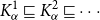 $K_\alpha ^1\sqsubseteq K_\alpha ^2\sqsubseteq \cdots$
for each
$K_\alpha ^1\sqsubseteq K_\alpha ^2\sqsubseteq \cdots$
for each $\alpha \in A$
. If
$\alpha \in A$
. If $X_\alpha$
is zero-dimensional, then
$X_\alpha$
is zero-dimensional, then $\mathcal Q\{X_\alpha \} = `\emptyset$
is initial in
$\mathcal Q\{X_\alpha \} = `\emptyset$
is initial in $\mathbf{qSet}$
; hence
$\mathbf{qSet}$
; hence $K^1_\alpha =K^n_\alpha$
for each
$K^1_\alpha =K^n_\alpha$
for each $n\in {\mathbb N}$
. Taking
$n\in {\mathbb N}$
. Taking $K^\infty _\alpha =K^1_\alpha$
, we automatically have
$K^\infty _\alpha =K^1_\alpha$
, we automatically have $K_\alpha ^n\nearrow K_\alpha ^\infty$
. If
$K_\alpha ^n\nearrow K_\alpha ^\infty$
. If $X_\alpha$
is not zero-dimensional, then the fact that
$X_\alpha$
is not zero-dimensional, then the fact that $\mathcal Y_\alpha$
is a quantum cpo ensures the existence of a function
$\mathcal Y_\alpha$
is a quantum cpo ensures the existence of a function $K^\infty _\alpha :{\mathcal X}_\alpha \to \mathcal Y_\alpha$
such that
$K^\infty _\alpha :{\mathcal X}_\alpha \to \mathcal Y_\alpha$
such that $K^n_\alpha \nearrow K^\infty _\alpha$
. In either case,
$K^n_\alpha \nearrow K^\infty _\alpha$
. In either case,
 \begin{equation} S_\alpha \circ K_\alpha ^\infty =\bigwedge _{n\in {\mathbb N}}S_\alpha \circ K_\alpha ^n. \end{equation}
Let $K^\infty =\left (\biguplus _{\alpha \in A}K_\alpha ^\infty \right )\circ D$
. We show that
$K^\infty =\left (\biguplus _{\alpha \in A}K_\alpha ^\infty \right )\circ D$
. We show that $K^n\nearrow K^\infty$
:
$K^n\nearrow K^\infty$
:
 \begin{align*} S\circ K^\infty & = \left (\biguplus _{\alpha \in A}S_\alpha ^\infty \right )\circ \left (\biguplus _{\alpha \in A}K_\alpha ^\infty \right )\circ D =\left (\biguplus _{\alpha \in A}(S_\alpha \circ K_\alpha ^\infty )\right )\circ D=\left (\biguplus _{\alpha \in A}\left (\bigwedge _{n\in {\mathbb N}}(S_\alpha \circ K_\alpha ^n)\right )\right )\circ D\\ & =\left (\bigwedge _{n\in {\mathbb N}}\left (\biguplus _{\alpha \in A}(S_\alpha \circ K_\alpha ^n)\right )\right )\circ D=\bigwedge _{n\in {\mathbb N}}\left (\biguplus _{\alpha \in A}(S_\alpha \circ K_\alpha ^n)\circ D\right )\\ & =\bigwedge _{n\in {\mathbb N}}\left (\left (\biguplus _{\alpha \in A}S_\alpha \right )\circ \left (\biguplus _{\alpha \in A}K_\alpha ^n\right )\circ D\right )=\bigwedge _{n\in {\mathbb N}}S\circ K^n, \end{align*}
where the fourth equality follows from [Kornell et al. (Reference Kornell, Lindenhovius and Mislove2022), Lemma 6.1], and the fifth equality follows from [Kornell et al. (Reference Kornell, Lindenhovius and Mislove2022), Proposition A.6]. Therefore, $\mathcal Y$
is a quantum cpo.
$\mathcal Y$
is a quantum cpo.
Next, we show that the canonical injections $J_\beta :\mathcal Y_\beta \to \mathcal Y$
are Scott continuous for each
$J_\beta :\mathcal Y_\beta \to \mathcal Y$
are Scott continuous for each $\beta \in A$
. So, let
$\beta \in A$
. So, let $\mathcal H$
be an atomic quantum set, and let
$\mathcal H$
be an atomic quantum set, and let $E_1\sqsubseteq E_2\sqsubseteq \cdots :{\mathcal H}\to \mathcal Y_\beta$
be a monotonically ascending sequence of functions with limit
$E_1\sqsubseteq E_2\sqsubseteq \cdots :{\mathcal H}\to \mathcal Y_\beta$
be a monotonically ascending sequence of functions with limit $E_\infty$
. Let
$E_\infty$
. Let $K^i=J_\beta \circ E_i$
for each
$K^i=J_\beta \circ E_i$
for each $i\in {\mathbb N}\cup \{\infty \}$
. Since the
$i\in {\mathbb N}\cup \{\infty \}$
. Since the $J_\alpha$
are monotone by [Kornell et al. (Reference Kornell, Lindenhovius and Mislove2022), Proposition 6.2], left multiplication with
$J_\alpha$
are monotone by [Kornell et al. (Reference Kornell, Lindenhovius and Mislove2022), Proposition 6.2], left multiplication with $J_\alpha$
is monotone [Kornell et al. (Reference Kornell, Lindenhovius and Mislove2022), Lemma 4.4], and it follows that
$J_\alpha$
is monotone [Kornell et al. (Reference Kornell, Lindenhovius and Mislove2022), Lemma 4.4], and it follows that $K^1\sqsubseteq K^2\sqsubseteq \cdots \sqsubseteq$
is a monotonically ascending sequence. We need to show that
$K^1\sqsubseteq K^2\sqsubseteq \cdots \sqsubseteq$
is a monotonically ascending sequence. We need to show that $K^n\nearrow K^\infty$
. For each
$K^n\nearrow K^\infty$
. For each $\alpha \in A$
, we calculate that
$\alpha \in A$
, we calculate that
 \begin{align*} J_\alpha ^\dagger \circ \bigwedge _{n\in {\mathbb N}} S\circ K^n & =\bigwedge _{n\in {\mathbb N}}J_\alpha ^\dagger \circ S\circ K^n=\bigwedge _{n\in {\mathbb N}}J_\alpha ^\dagger \circ S\circ J_\beta \circ E_n=\bigwedge _{n\in {\mathbb N}}J_\alpha ^\dagger \circ J_\beta \circ S_\beta \circ E_n\\ & =\Delta _{\alpha ,\beta } \cdot \bigwedge _{n\in {\mathbb N}}S_\beta \circ E_n=\Delta _{\alpha ,\beta }\cdot (S_\beta \circ E_\infty ) =J_\alpha ^\dagger \circ J_\beta \circ S_\beta \circ E_\infty \\ &= J_\alpha ^\dagger \circ S\circ J_\beta \circ E_\infty =J_\alpha ^\dagger \circ S\circ K_\infty , \end{align*}
where we have used [Kornell et al. (Reference Kornell, Lindenhovius and Mislove2022), Proposition A.6] for the first and the penultimate equality, [Kornell et al. (Reference Kornell, Lindenhovius and Mislove2022), Proposition 6.2] for the third equality, and [Kornell et al. (Reference Kornell, Lindenhovius and Mislove2022), Lemma 6.1] for the fourth and sixth equalities. We use $E_n\nearrow E_\infty$
for the fifth equality. It now follows by [Kornell et al. (Reference Kornell, Lindenhovius and Mislove2022), Lemma 6.1] that
$E_n\nearrow E_\infty$
for the fifth equality. It now follows by [Kornell et al. (Reference Kornell, Lindenhovius and Mislove2022), Lemma 6.1] that $\bigwedge _{n\in {\mathbb N}}S\circ K^n=S\circ K^\infty$
, i.e., that
$\bigwedge _{n\in {\mathbb N}}S\circ K^n=S\circ K^\infty$
, i.e., that $K^n\nearrow K^\infty$
. Therefore, each of the canonical injections
$K^n\nearrow K^\infty$
. Therefore, each of the canonical injections $J_\beta$
, for
$J_\beta$
, for $\beta \in A$
, is Scott continuous.
$\beta \in A$
, is Scott continuous.
Finally, let $(\mathcal Z,T)$
be a quantum cpo, and for each
$(\mathcal Z,T)$
be a quantum cpo, and for each $\alpha \in A$
, let
$\alpha \in A$
, let $F_\alpha :\mathcal Y_\alpha \to \mathcal Z$
be a Scott continuous function. We need to show that
$F_\alpha :\mathcal Y_\alpha \to \mathcal Z$
be a Scott continuous function. We need to show that $[F_\alpha :\alpha \in A]:\mathcal Y\to \mathcal Z$
is Scott continuous, where the notation refers to the universal property of the coproduct. Hence, let
$[F_\alpha :\alpha \in A]:\mathcal Y\to \mathcal Z$
is Scott continuous, where the notation refers to the universal property of the coproduct. Hence, let $\mathcal H$
be an atomic quantum set and let
$\mathcal H$
be an atomic quantum set and let $K^1\sqsubseteq K^2\sqsubseteq \cdots :{\mathcal H}\to \mathcal Y$
be a monotonically ascending sequence of functions with limit
$K^1\sqsubseteq K^2\sqsubseteq \cdots :{\mathcal H}\to \mathcal Y$
be a monotonically ascending sequence of functions with limit $K^\infty$
. As before, we have a decomposition
$K^\infty$
. As before, we have a decomposition $D:{\mathcal H}\to \biguplus _{\alpha \in A}\mathcal Q\{X_\alpha \}$
and an indexed family of functions
$D:{\mathcal H}\to \biguplus _{\alpha \in A}\mathcal Q\{X_\alpha \}$
and an indexed family of functions $\{K^i_\alpha :\{X_\alpha \}\to \mathcal Y_\alpha \}_{\alpha \in A}$
such that
$\{K^i_\alpha :\{X_\alpha \}\to \mathcal Y_\alpha \}_{\alpha \in A}$
such that $K^i=\left (\biguplus _{\alpha \in A}K^i_\alpha \right )\circ D$
, for each index
$K^i=\left (\biguplus _{\alpha \in A}K^i_\alpha \right )\circ D$
, for each index $i \in {\mathbb N} \cup \{\infty \}$
, and
$i \in {\mathbb N} \cup \{\infty \}$
, and $K^n_\alpha \nearrow K^\infty _\alpha$
. Since each function
$K^n_\alpha \nearrow K^\infty _\alpha$
. Since each function $F_\alpha$
is Scott continuous, we also have that
$F_\alpha$
is Scott continuous, we also have that $F_\alpha \circ K_\alpha ^n\nearrow F_\alpha \circ K_\alpha ^\infty$
. We show that
$F_\alpha \circ K_\alpha ^n\nearrow F_\alpha \circ K_\alpha ^\infty$
. We show that $\left [F_\alpha :\alpha \in A\right ]\circ K^n\nearrow \left [F_\alpha :\alpha \in A\right ]\circ K^\infty$
:
$\left [F_\alpha :\alpha \in A\right ]\circ K^n\nearrow \left [F_\alpha :\alpha \in A\right ]\circ K^\infty$
:
 \begin{align*} \bigwedge _{n\in {\mathbb N}}T\circ [F_\alpha :\ &\alpha \in A]\circ K^n = \bigwedge _{n\in {\mathbb N}}T\circ [F_\alpha :\alpha \in A]\circ \left (\biguplus _{\alpha \in A}K^n_\alpha \right )\circ D \\ & = \bigwedge _{n\in {\mathbb N}}[T\circ F_\alpha \circ K_\alpha ^n:\alpha \in A]\circ D = \left (\bigwedge _{n\in {\mathbb N}} [T\circ F_\alpha \circ K_\alpha ^n:\alpha \in A]\right )\circ D\\ & = \left [\bigwedge _{n\in {\mathbb N}}T\circ F_\alpha \circ K_\alpha ^n:\alpha \in A\right ]\circ D = \left [T\circ F_\alpha \circ K_\alpha ^\infty :\alpha \in A\right ]\circ D\\ & = T\circ \left [F_\alpha \in A\right ]\circ \left (\biguplus _{\alpha \in A}K_\alpha ^\infty \right )\circ D = T\circ [F_\alpha :\alpha \in A]\circ K^\infty , \end{align*}
where the third equality follows from [Kornell et al. (Reference Kornell, Lindenhovius and Mislove2022), Proposition A.6], the fourth from [Kornell et al. (Reference Kornell, Lindenhovius and Mislove2022), Lemma 6.1], and the fifth equality is $F_\alpha \circ K_\alpha ^n\nearrow F_\alpha \circ K_\alpha ^\infty$
. Therefore, the monotone function
$F_\alpha \circ K_\alpha ^n\nearrow F_\alpha \circ K_\alpha ^\infty$
. Therefore, the monotone function $[F_\alpha :\alpha \in A]:\mathcal Y\to \mathcal Z$
, whose existence and uniqueness is guaranteed by the universal property of the coproduct in
$[F_\alpha :\alpha \in A]:\mathcal Y\to \mathcal Z$
, whose existence and uniqueness is guaranteed by the universal property of the coproduct in $\mathbf{qPOS}$
, is Scott continuous. All together, we find that
$\mathbf{qPOS}$
, is Scott continuous. All together, we find that $(\mathcal Y,S)$
is also its coproduct of the family
$(\mathcal Y,S)$
is also its coproduct of the family $\{(\mathcal Y_\alpha , S_\alpha )\}_{\alpha \in A}$
in
$\{(\mathcal Y_\alpha , S_\alpha )\}_{\alpha \in A}$
in $\mathbf{qCPO}$
.
$\mathbf{qCPO}$
.
4.2 Factorizations in
$\mathbf{qSet}$

Let $F:{\mathcal X}\to \mathcal Y$
be a function. Then, the restriction of
$F:{\mathcal X}\to \mathcal Y$
be a function. Then, the restriction of $F|_{\mathcal Z}=F\circ J_{\mathcal Z}$
to any subset of
$F|_{\mathcal Z}=F\circ J_{\mathcal Z}$
to any subset of $\mathcal Z\subseteq {\mathcal X}$
is always a function, but the corestriction
$\mathcal Z\subseteq {\mathcal X}$
is always a function, but the corestriction $F|^{\mathcal W}=J_{\mathcal W}^\dagger \circ F$
of
$F|^{\mathcal W}=J_{\mathcal W}^\dagger \circ F$
of $F$
to a subset
$F$
to a subset $\mathcal W\subseteq \mathcal Y$
is not always a function. However, we prove below that
$\mathcal W\subseteq \mathcal Y$
is not always a function. However, we prove below that $F|^{\mathcal W}$
is a function if
$F|^{\mathcal W}$
is a function if $\mathcal W$
contains the range of
$\mathcal W$
contains the range of $F$
, that is, the subset
$F$
, that is, the subset
 \begin{equation*}\mathop {\mathrm{ran}} F:=\mathcal Q\{Y\,\, \propto \mathcal Y:F(X,Y)\neq 0\text{ for some }X\,\, \propto {\mathcal X}\}.\end{equation*}
We denote the embedding $J_{\mathop {\mathrm{ran}} F}^{\mathcal Y}:\mathop {\mathrm{ran}} F\to \mathcal Y$
by
$J_{\mathop {\mathrm{ran}} F}^{\mathcal Y}:\mathop {\mathrm{ran}} F\to \mathcal Y$
by $J_F$
.
$J_F$
.
Lemma 4.2.1.
Let $F:{\mathcal X}\to \mathcal Y$
and
$F:{\mathcal X}\to \mathcal Y$
and $G:\mathcal Y\to \mathcal Z$
be functions between quantum sets. Then:
$G:\mathcal Y\to \mathcal Z$
be functions between quantum sets. Then:
-
(a)
$F$
is surjective if and only if
$\mathop {\mathrm{ran}} F=\mathcal Y$
; -
(b)
$\mathop {\mathrm{ran}} (G\circ F)\subseteq \mathop {\mathrm{ran}} G$
; -
(c)
$\mathop {\mathrm{ran}} (G\circ F)=\mathop {\mathrm{ran}} G$
if
$F$
is surjective.





Proof.
Assume $F$
is surjective, that is,
$F$
is surjective, that is, $F\circ F^\dagger =I_{\mathcal Y}$
. Let
$F\circ F^\dagger =I_{\mathcal Y}$
. Let $Y\,\, \propto \mathcal Y$
. Then,
$Y\,\, \propto \mathcal Y$
. Then, ${\mathbb C} 1_Y=(I_{\mathcal Y})_Y^Y=(F\circ F^\dagger )_Y^Y=\bigvee _{X\,\, \propto {\mathcal X}}F_X^Y\cdot (F^\dagger )_Y^X,$
hence there must be some
${\mathbb C} 1_Y=(I_{\mathcal Y})_Y^Y=(F\circ F^\dagger )_Y^Y=\bigvee _{X\,\, \propto {\mathcal X}}F_X^Y\cdot (F^\dagger )_Y^X,$
hence there must be some $X\,\, \propto {\mathcal X}$
such that
$X\,\, \propto {\mathcal X}$
such that $F(X,Y)=F_X^Y\neq 0$
, that is,
$F(X,Y)=F_X^Y\neq 0$
, that is, $Y\,\, \propto \mathop {\mathrm{ran}} F$
. Conversely, assume that
$Y\,\, \propto \mathop {\mathrm{ran}} F$
. Conversely, assume that $\mathop {\mathrm{ran}} F=\mathcal Y$
. Let
$\mathop {\mathrm{ran}} F=\mathcal Y$
. Let $Y\,\, \propto \mathcal Y$
. Then there is some
$Y\,\, \propto \mathcal Y$
. Then there is some $X\,\, \propto {\mathcal X}$
such that
$X\,\, \propto {\mathcal X}$
such that $F(X,Y)\neq 0$
, hence there is some nonzero linear map
$F(X,Y)\neq 0$
, hence there is some nonzero linear map $a:X\to Y$
in
$a:X\to Y$
in $F(X,Y)$
, then also
$F(X,Y)$
, then also $0\neq aa^\dagger$
, which is an element in
$0\neq aa^\dagger$
, which is an element in $F(X,Y)\cdot F(X,Y)^\dagger =F(X,Y)\cdot F^\dagger (Y,X)$
, hence
$F(X,Y)\cdot F(X,Y)^\dagger =F(X,Y)\cdot F^\dagger (Y,X)$
, hence $0\lt F(X,Y)\cdot F^\dagger (Y,X)\leq (F\circ F)^\dagger (Y,Y)\leq I_{\mathcal Y}(Y,Y)={\mathbb C} 1_Y$
, and since
$0\lt F(X,Y)\cdot F^\dagger (Y,X)\leq (F\circ F)^\dagger (Y,Y)\leq I_{\mathcal Y}(Y,Y)={\mathbb C} 1_Y$
, and since ${\mathbb C} 1_Y$
is one-dimensional, we must have
${\mathbb C} 1_Y$
is one-dimensional, we must have $(F\circ F)^\dagger (Y,Y)=I_{\mathcal Y}(Y,Y)$
. If
$(F\circ F)^\dagger (Y,Y)=I_{\mathcal Y}(Y,Y)$
. If $Y,Y'\,\, \propto \mathcal Y$
are distinct, then
$Y,Y'\,\, \propto \mathcal Y$
are distinct, then $(F\circ F)^\dagger (Y,Y')\leq I_{\mathcal Y}(Y,Y')=0$
forces
$(F\circ F)^\dagger (Y,Y')\leq I_{\mathcal Y}(Y,Y')=0$
forces $(F\circ F)^\dagger =I_{\mathcal Y}(Y,Y')$
, whence
$(F\circ F)^\dagger =I_{\mathcal Y}(Y,Y')$
, whence $F\circ F^\dagger =I_{\mathcal Y}$
, that is,
$F\circ F^\dagger =I_{\mathcal Y}$
, that is, $F$
is surjective, which proves (a).
$F$
is surjective, which proves (a).
Let $Z\,\, \propto \mathop {\mathrm{ran}}(G\circ F)$
. Then,
$Z\,\, \propto \mathop {\mathrm{ran}}(G\circ F)$
. Then, $(G\circ F)(X,Z)\neq 0$
for some
$(G\circ F)(X,Z)\neq 0$
for some $X\,\, \propto {\mathcal X}$
, hence there must be some
$X\,\, \propto {\mathcal X}$
, hence there must be some $Y\,\, \propto \mathcal Y$
such that
$Y\,\, \propto \mathcal Y$
such that $0\lt G(Y,Z)\cdot F(X,Y)\leq (G\circ F)(X,Z)$
, which can only happen if
$0\lt G(Y,Z)\cdot F(X,Y)\leq (G\circ F)(X,Z)$
, which can only happen if $G(Y,Z)\neq 0$
, that is,
$G(Y,Z)\neq 0$
, that is, $Z\,\, \propto \mathop {\mathrm{ran}} G$
, which proves (b). For (c), assume that
$Z\,\, \propto \mathop {\mathrm{ran}} G$
, which proves (b). For (c), assume that $Z\,\, \propto \mathop {\mathrm{ran}} G$
, so
$Z\,\, \propto \mathop {\mathrm{ran}} G$
, so $G(Y,Z)\neq 0$
for some
$G(Y,Z)\neq 0$
for some $Y\,\, \propto \mathcal Y$
. Since
$Y\,\, \propto \mathcal Y$
. Since $F$
is surjective, we have
$F$
is surjective, we have $F\circ F^\dagger =I_{\mathcal Y}$
, whence
$F\circ F^\dagger =I_{\mathcal Y}$
, whence $(G\circ F\circ F^\dagger )(Y,Z)\neq 0$
. It follows that there must be some
$(G\circ F\circ F^\dagger )(Y,Z)\neq 0$
. It follows that there must be some $X\,\, \propto {\mathcal X}$
such that
$X\,\, \propto {\mathcal X}$
such that $0\lt (G\circ F)(X,Z)\cdot F^\dagger (Y,X)\leq (G\circ F\circ F^\dagger )(Y,Z)$
, forcing
$0\lt (G\circ F)(X,Z)\cdot F^\dagger (Y,X)\leq (G\circ F\circ F^\dagger )(Y,Z)$
, forcing $(G\circ F)(X,Z)\neq 0$
. Thus
$(G\circ F)(X,Z)\neq 0$
. Thus $Z\,\, \propto \mathop {\mathrm{ran}}(G\circ F)$
.
$Z\,\, \propto \mathop {\mathrm{ran}}(G\circ F)$
.
Lemma 4.2.2.
Let $F:{\mathcal X}\to \mathcal Y$
be a function. Then, the restriction
$F:{\mathcal X}\to \mathcal Y$
be a function. Then, the restriction $\overline F:=F|^{\mathop {\mathrm{ran}} F}$
to its range is a surjective function such that
$\overline F:=F|^{\mathop {\mathrm{ran}} F}$
to its range is a surjective function such that $F=J_F\circ \overline F$
.
$F=J_F\circ \overline F$
.
Proof. We have
 \begin{equation*}\overline F\circ \overline F^\dagger =J_F\circ F\circ F^\dagger \circ J_F^\dagger \leq J_F\circ J_F^\dagger =I_{\mathop {\mathrm{ran}} F},\end{equation*}
whereas for each $X\,\, \propto {\mathcal X}$
, we have
$X\,\, \propto {\mathcal X}$
, we have
 \begin{align*} (\overline F^\dagger \circ \overline F)_X^X & = \bigvee _{W\,\, \propto \mathop {\mathrm{ran}} F}(F^\dagger \circ J_F )_W^X\cdot (J_F\circ F)_X^W=\bigvee _{W\,\, \propto \mathcal W}F^X_W\cdot F_X^W\\ & =\bigvee _{Y\,\, \propto \mathcal Y}F^X_Y\cdot F_X^Y=(F^\dagger \circ F)_X^X=(I_{\mathcal X})_X^X. \end{align*}
For atoms $X\neq X'$
of
$X\neq X'$
of $\mathcal X$
, we have
$\mathcal X$
, we have $(\overline F^\dagger \circ \overline F)_X^{X'}\geq 0=(I_{\mathcal X})_X^X$
, so
$(\overline F^\dagger \circ \overline F)_X^{X'}\geq 0=(I_{\mathcal X})_X^X$
, so $\overline F^\dagger \circ \overline F\geq I_{\mathcal X}$
, which shows that
$\overline F^\dagger \circ \overline F\geq I_{\mathcal X}$
, which shows that $\overline F$
is indeed a function. Since
$\overline F$
is indeed a function. Since $\overline F$
is a function
$\overline F$
is a function ${\mathcal X}\to \mathop {\mathrm{ran}} F$
, we have
${\mathcal X}\to \mathop {\mathrm{ran}} F$
, we have $\mathop {\mathrm{ran}} \overline F\subseteq \mathop {\mathrm{ran}} F$
. Let
$\mathop {\mathrm{ran}} \overline F\subseteq \mathop {\mathrm{ran}} F$
. Let $Y\,\, \propto \mathop {\mathrm{ran}} F$
. Then,
$Y\,\, \propto \mathop {\mathrm{ran}} F$
. Then, $F(X,Y)\neq 0$
for some
$F(X,Y)\neq 0$
for some $X\,\, \propto \mathcal Y$
, hence
$X\,\, \propto \mathcal Y$
, hence $\overline F(X,Y)=(J_F^\dagger \circ F)(X,Y)=F(X,Y)\neq 0$
, so
$\overline F(X,Y)=(J_F^\dagger \circ F)(X,Y)=F(X,Y)\neq 0$
, so $Y\in \mathop {\mathrm{ran}} \overline F$
. We conclude that
$Y\in \mathop {\mathrm{ran}} \overline F$
. We conclude that $\mathop {\mathrm{ran}} \overline F=\mathop {\mathrm{ran}} F$
, hence it follows from Lemma 4.2.1 that
$\mathop {\mathrm{ran}} \overline F=\mathop {\mathrm{ran}} F$
, hence it follows from Lemma 4.2.1 that $\overline F$
is surjective. Finally, we have
$\overline F$
is surjective. Finally, we have $J_F\circ \overline F=J_F\circ J_F^\dagger \circ F\leq F$
for
$J_F\circ \overline F=J_F\circ J_F^\dagger \circ F\leq F$
for $J_F$
is a function. Since parallel functions are only comparable if they are equal [Kornell et al. (Reference Kornell, Lindenhovius and Mislove2022), Lemma A.7], it follows that
$J_F$
is a function. Since parallel functions are only comparable if they are equal [Kornell et al. (Reference Kornell, Lindenhovius and Mislove2022), Lemma A.7], it follows that $F=J_F\circ \overline F$
.
$F=J_F\circ \overline F$
.
The next lemma now characterizes precisely for which subsets $\mathcal W$
of
$\mathcal W$
of $\mathcal Y$
the corestriction
$\mathcal Y$
the corestriction $F|^{\mathcal W}$
is a function.
$F|^{\mathcal W}$
is a function.
Lemma 4.2.3.
Let $\mathcal X$
and
$\mathcal X$
and $\mathcal Y$
be quantum sets, and let
$\mathcal Y$
be quantum sets, and let $F \colon {\mathcal X} \to \mathcal Y$
be a function. Let
$F \colon {\mathcal X} \to \mathcal Y$
be a function. Let $\mathcal W$
be a subset of
$\mathcal W$
be a subset of $\mathcal Y$
. Then, the following are equivalent:
$\mathcal Y$
. Then, the following are equivalent:
-
(a)
$\mathop {\mathrm{ran}} F \subseteq \mathcal W$
; -
(b) there is a function
$G:{\mathcal X}\to \mathcal W$
such that
$F=J_{\mathcal W}\circ G$
; -
(c)
$F|^{\mathcal W}$
is a function.


In case these equivalent conditions hold, we have:
-
(1)
$F|^{\mathcal W}$
is the unique function
$G:{\mathcal X}\to \mathcal W$
such that
$F=J_{\mathcal W}\circ G$
; -
(2)
$\mathop {\mathrm{ran}} F=\mathop {\mathrm{ran}} F|^{\mathcal W}$
; -
(3)
$F|^{\mathcal W}$
is injective if and only if
$F$
is injective;
-
(4)
$F|^{\mathcal W}$
is surjective if and only if
$\mathcal W=\mathop {\mathrm{ran}} F$
.





Proof.
Assume that $\mathop {\mathrm{ran}} F \subseteq \mathcal W$
. By Lemma 4.2.2, we have
$\mathop {\mathrm{ran}} F \subseteq \mathcal W$
. By Lemma 4.2.2, we have $F = J_F \circ \overline F$
. Then,
$F = J_F \circ \overline F$
. Then,
 \begin{equation*}F = J_F \circ \overline F = J_{\mathcal W} \circ J_F^{\mathcal W} \circ \overline F.\end{equation*}
We conclude that $G = J_F^{\mathcal W} \circ \overline F$
is a function
$G = J_F^{\mathcal W} \circ \overline F$
is a function ${\mathcal X} \to \mathcal W$
such that
${\mathcal X} \to \mathcal W$
such that $F = J_{\mathcal W} \circ G$
, so (a) implies (b). Now, (c) follows from (b) because
$F = J_{\mathcal W} \circ G$
, so (a) implies (b). Now, (c) follows from (b) because
 \begin{equation*}F|^{\mathcal W}=J_{\mathcal W}^\dagger \circ F=J_{\mathcal W}^\dagger \circ J_{\mathcal W}\circ G=G,\end{equation*}
which also shows that $F|^{\mathcal W}$
is the unique function such that
$F|^{\mathcal W}$
is the unique function such that $F=J_{\mathcal W}\circ G$
. Conversely, assume that
$F=J_{\mathcal W}\circ G$
. Conversely, assume that $F|^{\mathcal W}$
is a function. Then,
$F|^{\mathcal W}$
is a function. Then, $J_{\mathcal W}\circ F|^{\mathcal W}$
is also a function, and
$J_{\mathcal W}\circ F|^{\mathcal W}$
is also a function, and $J_{\mathcal W}\circ F|^{\mathcal W}=J_{\mathcal W}\circ J_{\mathcal W}^\dagger \circ F\leq F$
, since
$J_{\mathcal W}\circ F|^{\mathcal W}=J_{\mathcal W}\circ J_{\mathcal W}^\dagger \circ F\leq F$
, since $J_{\mathcal W}$
is a function. Now, parallel functions are only comparable if they are equal [Kornell et al. (Reference Kornell, Lindenhovius and Mislove2022), Lemma A.7], so
$J_{\mathcal W}$
is a function. Now, parallel functions are only comparable if they are equal [Kornell et al. (Reference Kornell, Lindenhovius and Mislove2022), Lemma A.7], so $J_{\mathcal W}\circ F|^{\mathcal W}=F$
. It follows that
$J_{\mathcal W}\circ F|^{\mathcal W}=F$
. It follows that $\mathop {\mathrm{ran}} F=\mathop {\mathrm{ran}} (J_{\mathcal W}\circ F|^{\mathcal W}).$
Let
$\mathop {\mathrm{ran}} F=\mathop {\mathrm{ran}} (J_{\mathcal W}\circ F|^{\mathcal W}).$
Let $Y\,\, \propto \mathop {\mathrm{ran}} F$
. Then, there is some
$Y\,\, \propto \mathop {\mathrm{ran}} F$
. Then, there is some $X\,\, \propto {\mathcal X}$
such that
$X\,\, \propto {\mathcal X}$
such that $0\neq F(X,Y)=(J_{\mathcal W}\circ F|^{\mathcal W})(X,Y)$
, hence there must be some
$0\neq F(X,Y)=(J_{\mathcal W}\circ F|^{\mathcal W})(X,Y)$
, hence there must be some $W\,\, \propto {\mathcal W}$
such that
$W\,\, \propto {\mathcal W}$
such that $F|^{\mathcal W}(X,W)\neq 0$
and
$F|^{\mathcal W}(X,W)\neq 0$
and $J_{\mathcal W}(W,Y)\neq 0$
. The former expression implies that
$J_{\mathcal W}(W,Y)\neq 0$
. The former expression implies that $W \propto \mathop {\mathrm{ran}} F|^{\mathcal W}\subseteq {\mathcal W}$
. The latter expression only holds if
$W \propto \mathop {\mathrm{ran}} F|^{\mathcal W}\subseteq {\mathcal W}$
. The latter expression only holds if $W=Y$
, so
$W=Y$
, so $Y\in \mathop {\mathrm{ran}} F|^{\mathcal W}\subseteq {\mathcal W}$
, which shows that
$Y\in \mathop {\mathrm{ran}} F|^{\mathcal W}\subseteq {\mathcal W}$
, which shows that $\mathop {\mathrm{ran}} F\subseteq \mathop {\mathrm{ran}} F|^{\mathcal W}$
and that (c) implies (a).
$\mathop {\mathrm{ran}} F\subseteq \mathop {\mathrm{ran}} F|^{\mathcal W}$
and that (c) implies (a).
We already showed that $G$
in (b) must be equal to
$G$
in (b) must be equal to $F|^{\mathcal W}$
, and that
$F|^{\mathcal W}$
, and that $\mathop {\mathrm{ran}} F\subseteq \mathop {\mathrm{ran}} F|^{\mathcal W}$
. For the remainder of the proof, assume that conditions (a)-(c) holds. Let
$\mathop {\mathrm{ran}} F\subseteq \mathop {\mathrm{ran}} F|^{\mathcal W}$
. For the remainder of the proof, assume that conditions (a)-(c) holds. Let $W\,\, \propto \mathop {\mathrm{ran}} F|^{\mathcal W}$
. Then
$W\,\, \propto \mathop {\mathrm{ran}} F|^{\mathcal W}$
. Then $F|^{\mathcal W}(X,W)\neq 0$
for some
$F|^{\mathcal W}(X,W)\neq 0$
for some $X\,\, \propto {\mathcal X}$
, and
$X\,\, \propto {\mathcal X}$
, and $J_{\mathcal W}(W,W)=\mathbb C 1_W$
, hence
$J_{\mathcal W}(W,W)=\mathbb C 1_W$
, hence
 \begin{equation*}F(X,W)=(J_{\mathcal W}\circ F|^{\mathcal W})(X,W)\geq J_{\mathcal W}(W,W)\cdot F|^{\mathcal W}(X,W)\neq 0,\end{equation*}
implying that $W\,\, \propto \mathop {\mathrm{ran}} F$
. We conclude that
$W\,\, \propto \mathop {\mathrm{ran}} F$
. We conclude that $\mathop {\mathrm{ran}} F=\mathop {\mathrm{ran}} F|^{\mathcal W}$
. For (3), let
$\mathop {\mathrm{ran}} F=\mathop {\mathrm{ran}} F|^{\mathcal W}$
. For (3), let $F$
be injective, so
$F$
be injective, so $F^\dagger \circ F=I_{\mathcal X}$
. Then,
$F^\dagger \circ F=I_{\mathcal X}$
. Then,
 \begin{equation*} I_{\mathcal X}\leq (F|^{\mathcal W})^\dagger \circ F|^{\mathcal W}=F^\dagger \circ J_{\mathcal W}\circ J_{\mathcal W}^\dagger \circ F\leq F^\dagger \circ F=I_{\mathcal X},\end{equation*}
where the first inequality follows since $F|^{\mathcal W}$
is a function and the second because
$F|^{\mathcal W}$
is a function and the second because $J_{\mathcal W}$
is a function. Hence,
$J_{\mathcal W}$
is a function. Hence, $(F|^{\mathcal W})^\dagger \circ F|^{\mathcal W}=I_{\mathcal X}$
, i.e.,
$(F|^{\mathcal W})^\dagger \circ F|^{\mathcal W}=I_{\mathcal X}$
, i.e., $F|^{\mathcal W}$
is injective. Conversely, if
$F|^{\mathcal W}$
is injective. Conversely, if $F|^{\mathcal W}$
is injective, then
$F|^{\mathcal W}$
is injective, then $F=J_{\mathcal W}\circ F|^{\mathcal W}$
is injective as the composition of injective functions. Finally, by (2) and by Lemma 4.2.1,
$F=J_{\mathcal W}\circ F|^{\mathcal W}$
is injective as the composition of injective functions. Finally, by (2) and by Lemma 4.2.1, $F|^{\mathcal W}$
is surjective if and only if
$F|^{\mathcal W}$
is surjective if and only if $\mathop {\mathrm{ran}} F=\mathop {\mathrm{ran}} \overline F={\mathcal W}$
, which shows (4).
$\mathop {\mathrm{ran}} F=\mathop {\mathrm{ran}} \overline F={\mathcal W}$
, which shows (4).
In particular, $\overline F$
is the unique surjection
$\overline F$
is the unique surjection $G$
such that
$G$
such that $F=J_F\circ G$
. More generally, the injections and surjections of
$F=J_F\circ G$
. More generally, the injections and surjections of $\mathbf{qSet}$
form a factorization structure, and the factorization
$\mathbf{qSet}$
form a factorization structure, and the factorization $F = J_{F} \circ {\overline F}$
is the canonical factorization of
$F = J_{F} \circ {\overline F}$
is the canonical factorization of $F$
for this factorization system.
$F$
for this factorization system.
Proposition 4.2.4.
The surjections and injections of $\mathbf{qSet}$
form a factorization structure on
$\mathbf{qSet}$
form a factorization structure on $\mathbf{qSet}$
in the sense of [Adámek et al. (Reference Adámek, Herrlich and Strecker1990), Definition 14.1], that is, if
$\mathbf{qSet}$
in the sense of [Adámek et al. (Reference Adámek, Herrlich and Strecker1990), Definition 14.1], that is, if $\mathcal E$
denotes the class of surjections and
$\mathcal E$
denotes the class of surjections and $\mathcal M$
the class of injections in
$\mathcal M$
the class of injections in $\mathbf{qSet}$
, then
$\mathbf{qSet}$
, then $\mathcal E$
and
$\mathcal E$
and $\mathcal M$
are closed under composition with isomorphisms (which in
$\mathcal M$
are closed under composition with isomorphisms (which in $\mathbf{qSet}$
are bijections), any morphism
$\mathbf{qSet}$
are bijections), any morphism $F$
in
$F$
in $\mathbf{qSet}$
can be written as
$\mathbf{qSet}$
can be written as $F=M\circ E$
for
$F=M\circ E$
for $M\in {\mathcal M}$
and
$M\in {\mathcal M}$
and $E\in {\mathcal E}$
, and for each commutative square as below, with
$E\in {\mathcal E}$
, and for each commutative square as below, with $E'\in {\mathcal E}$
and
$E'\in {\mathcal E}$
and $M'\in {\mathcal M}$
, there is a unique diagonal map
$M'\in {\mathcal M}$
, there is a unique diagonal map $D:\mathcal W\to \mathcal Y$
such that the diagram commutes:
$D:\mathcal W\to \mathcal Y$
such that the diagram commutes:

Proof.
The surjections and injections in the category $\mathbf{WStar}$
of von Neumann algebras and unital normal
$\mathbf{WStar}$
of von Neumann algebras and unital normal $*$
-homomorphisms form a factorization structure. Indeed, it is well known that the range of a unital normal
$*$
-homomorphisms form a factorization structure. Indeed, it is well known that the range of a unital normal $*$
-homomorphism from one von Neumann algebra to another is itself a von Neumann algebra, and this readily implies that each unital normal
$*$
-homomorphism from one von Neumann algebra to another is itself a von Neumann algebra, and this readily implies that each unital normal $*$
-homomorphism factors into an surjective unital normal
$*$
-homomorphism factors into an surjective unital normal $*$
-homomorphism followed by a injective one. It is routine to verify the unique diagonalization property. The surjections and injections in the full subcategory
$*$
-homomorphism followed by a injective one. It is routine to verify the unique diagonalization property. The surjections and injections in the full subcategory $\mathbf{WStar}_{\mathrm{HA}}$
of hereditarily atomic von Neumann algebra therefore also form a factorization structure. Appealing to Theorem 2.4.1, and to [Kornell (Reference Kornell2020), Propositions 8.1 & 8.4], we conclude that the surjections and injections in
$\mathbf{WStar}_{\mathrm{HA}}$
of hereditarily atomic von Neumann algebra therefore also form a factorization structure. Appealing to Theorem 2.4.1, and to [Kornell (Reference Kornell2020), Propositions 8.1 & 8.4], we conclude that the surjections and injections in $\mathbf{qSet}$
form a factorization structure.
$\mathbf{qSet}$
form a factorization structure.
4.3 Sub-cpo’s
Recall that a sub-cpo of a cpo $(S, \sqsubseteq )$
is a subset of
$(S, \sqsubseteq )$
is a subset of $S$
that is closed under suprema of
$S$
that is closed under suprema of $\omega$
-chains. We generalize this notion to the quantum setting.
$\omega$
-chains. We generalize this notion to the quantum setting.
Definition 4.3.1 (Quantum sub-cpo). Let $(\mathcal Y,S)$
be a quantum cpo. We call
$(\mathcal Y,S)$
be a quantum cpo. We call ${\mathcal X}\subseteq \mathcal Y$
a sub-cpo of
${\mathcal X}\subseteq \mathcal Y$
a sub-cpo of $\mathcal Y$
if given any atomic quantum set
$\mathcal Y$
if given any atomic quantum set $\mathcal H$
and a monotonically increasing sequence
$\mathcal H$
and a monotonically increasing sequence $K_1\sqsubseteq K_2\sqsubseteq \cdots :$ ${\mathcal H}\to \mathcal Y$
with
${\mathcal H}\to \mathcal Y$
with $\mathop {\mathrm{ran}} K_i\subseteq {\mathcal X}$
, the limit
$\mathop {\mathrm{ran}} K_i\subseteq {\mathcal X}$
, the limit $K_i\nearrow K_{\infty }$
satisfies
$K_i\nearrow K_{\infty }$
satisfies $\mathop {\mathrm{ran}} K_\infty \subseteq {\mathcal X}$
.
$\mathop {\mathrm{ran}} K_\infty \subseteq {\mathcal X}$
.
Proposition 4.3.2.
Let $(\mathcal Y,R)$
be a quantum cpo and let
$(\mathcal Y,R)$
be a quantum cpo and let ${\mathcal X}\subseteq \mathcal Y$
be a subposet with the relative order
${\mathcal X}\subseteq \mathcal Y$
be a subposet with the relative order $R|_{\mathcal X}^{\mathcal X}=J_{\mathcal X}^\dagger \circ R\circ J_{\mathcal X}$
. Then,
$R|_{\mathcal X}^{\mathcal X}=J_{\mathcal X}^\dagger \circ R\circ J_{\mathcal X}$
. Then, $\mathcal X$
is a sub-cpo of
$\mathcal X$
is a sub-cpo of $\mathcal Y$
if and only if
$\mathcal Y$
if and only if $({\mathcal X},R|_{\mathcal X}^{\mathcal X})$
is a quantum cpo and
$({\mathcal X},R|_{\mathcal X}^{\mathcal X})$
is a quantum cpo and $J_{\mathcal X}$
is Scott continuous.
$J_{\mathcal X}$
is Scott continuous.
Proof.
First, assume that $\mathcal X$
is a sub-cpo of
$\mathcal X$
is a sub-cpo of $\mathcal Y$
and let
$\mathcal Y$
and let $K_1\sqsubseteq K_2\sqsubseteq \cdots :{\mathcal H}\to {\mathcal X}$
be a monotonically ascending sequence of functions. By definition of
$K_1\sqsubseteq K_2\sqsubseteq \cdots :{\mathcal H}\to {\mathcal X}$
be a monotonically ascending sequence of functions. By definition of $R$
, it follows that
$R$
, it follows that $J_{\mathcal X}$
is an order embedding, hence
$J_{\mathcal X}$
is an order embedding, hence $J_{\mathcal X}$
is injective and monotone by [Kornell et al. (Reference Kornell, Lindenhovius and Mislove2022), Lemma 2.4]. Let
$J_{\mathcal X}$
is injective and monotone by [Kornell et al. (Reference Kornell, Lindenhovius and Mislove2022), Lemma 2.4]. Let $G_n=J_{\mathcal X}\circ K_n$
. Since left multiplication with the monotone function
$G_n=J_{\mathcal X}\circ K_n$
. Since left multiplication with the monotone function $J_{\mathcal X}$
is monotone [Kornell et al. (Reference Kornell, Lindenhovius and Mislove2022), Lemma 4.4], it follows that
$J_{\mathcal X}$
is monotone [Kornell et al. (Reference Kornell, Lindenhovius and Mislove2022), Lemma 4.4], it follows that $G_1\sqsubseteq G_2\sqsubseteq \cdots :{\mathcal H}\to \mathcal Y$
is a monotonically ascending sequence of functions, which has a limit
$G_1\sqsubseteq G_2\sqsubseteq \cdots :{\mathcal H}\to \mathcal Y$
is a monotonically ascending sequence of functions, which has a limit $G_\infty$
, because
$G_\infty$
, because $\mathcal Y$
is a quantum cpo. Since
$\mathcal Y$
is a quantum cpo. Since $G_n$
factors via
$G_n$
factors via $J_{\mathcal X}$
, it follows that
$J_{\mathcal X}$
, it follows that $\mathop {\mathrm{ran}} G_n\subseteq {\mathcal X}$
. By definition of a sub-cpo, we have that
$\mathop {\mathrm{ran}} G_n\subseteq {\mathcal X}$
. By definition of a sub-cpo, we have that $\mathop {\mathrm{ran}} G_\infty \subseteq {\mathcal X}$
, and by Lemma 4.2.3, it follows that
$\mathop {\mathrm{ran}} G_\infty \subseteq {\mathcal X}$
, and by Lemma 4.2.3, it follows that $G_\infty = J_{\mathcal X}\circ K_\infty$
for some function
$G_\infty = J_{\mathcal X}\circ K_\infty$
for some function $K_\infty :{\mathcal H}\to {\mathcal X}$
. Then,
$K_\infty :{\mathcal H}\to {\mathcal X}$
. Then,
 \begin{align*} R|_{\mathcal X}^{\mathcal X}\circ K_\infty & = J_{\mathcal X}^\dagger \circ R\circ J_{\mathcal X}\circ K_\infty =J_{\mathcal X}^\dagger \circ R\circ G_\infty = J_{\mathcal X}^\dagger \circ \bigwedge _{n\in {\mathbb N}}R\circ G_n\\ & = \bigwedge _{n\in {\mathbb N}}J_{\mathcal X}^\dagger \circ R\circ G_n =\bigwedge _{n\in {\mathbb N}}J_{\mathcal X}^\dagger \circ R\circ J_{\mathcal X}\circ K_n = \bigwedge _{n\in {\mathbb N}}R|_{\mathcal X}^{\mathcal X}\circ K_n, \end{align*}
where the first and the last equalities are by definition of $R$
, the second and the penultimate equalities are by definition of the
$R$
, the second and the penultimate equalities are by definition of the $G_i$
, the third equality is by
$G_i$
, the third equality is by $G_n\nearrow G_\infty$
, and the fourth equality is by [Kornell et al. (Reference Kornell, Lindenhovius and Mislove2022), Proposition A.6]. We conclude that
$G_n\nearrow G_\infty$
, and the fourth equality is by [Kornell et al. (Reference Kornell, Lindenhovius and Mislove2022), Proposition A.6]. We conclude that $K_n\nearrow K_\infty$
, so
$K_n\nearrow K_\infty$
, so $({\mathcal X},R|_{\mathcal X}^{\mathcal X})$
is a quantum cpo.
$({\mathcal X},R|_{\mathcal X}^{\mathcal X})$
is a quantum cpo.
Next we show that $J_{\mathcal X}$
is Scott continuous. Let
$J_{\mathcal X}$
is Scott continuous. Let $K_1\sqsubseteq K_2\sqsubseteq \cdots \sqsubseteq K_\infty \colon {\mathcal H}\to {\mathcal X}$
with
$K_1\sqsubseteq K_2\sqsubseteq \cdots \sqsubseteq K_\infty \colon {\mathcal H}\to {\mathcal X}$
with $K_n\nearrow K_\infty$
. Then,
$K_n\nearrow K_\infty$
. Then, $\mathop {\mathrm{ran}} K_\infty \subseteq {\mathcal X}$
since
$\mathop {\mathrm{ran}} K_\infty \subseteq {\mathcal X}$
since $\mathcal X$
is a sub-cpo of
$\mathcal X$
is a sub-cpo of $\mathcal Y$
. By the first part of the proof, the sequence
$\mathcal Y$
. By the first part of the proof, the sequence $J_{\mathcal X}\circ K_n$
has a limit
$J_{\mathcal X}\circ K_n$
has a limit $G_\infty$
, and there is some
$G_\infty$
, and there is some $K'_\infty$
satisfying
$K'_\infty$
satisfying $\mathop {\mathrm{ran}} K'_\infty \subseteq {\mathcal X}$
,
$\mathop {\mathrm{ran}} K'_\infty \subseteq {\mathcal X}$
, $J_{\mathcal X}\circ K'_\infty = G_\infty$
, and
$J_{\mathcal X}\circ K'_\infty = G_\infty$
, and $K_n\nearrow K'_\infty$
. But, limits are unique by Lemma 3.1.2, so
$K_n\nearrow K'_\infty$
. But, limits are unique by Lemma 3.1.2, so $K_\infty = K'_\infty$
, and then
$K_\infty = K'_\infty$
, and then $J_{\mathcal X}\circ K_n\nearrow J_{\mathcal X} \circ K_\infty$
, so
$J_{\mathcal X}\circ K_n\nearrow J_{\mathcal X} \circ K_\infty$
, so $J_{\mathcal X}$
is Scott continuous.
$J_{\mathcal X}$
is Scott continuous.
Now assume that $({\mathcal X},R|_{\mathcal X}^{\mathcal X})$
is a quantum cpo and that
$({\mathcal X},R|_{\mathcal X}^{\mathcal X})$
is a quantum cpo and that $J_{\mathcal X}$
is Scott continuous. Let
$J_{\mathcal X}$
is Scott continuous. Let $G_1\sqsubseteq G_2\sqsubseteq \cdots \sqsubseteq G_\infty :{\mathcal H}\to \mathcal Y$
satisfy
$G_1\sqsubseteq G_2\sqsubseteq \cdots \sqsubseteq G_\infty :{\mathcal H}\to \mathcal Y$
satisfy $G_n\nearrow G_\infty$
. Assume that
$G_n\nearrow G_\infty$
. Assume that $\mathop {\mathrm{ran}} G_n\subseteq {\mathcal X}$
for each
$\mathop {\mathrm{ran}} G_n\subseteq {\mathcal X}$
for each $n\in {\mathbb N}$
. We need to show that
$n\in {\mathbb N}$
. We need to show that $\mathop {\mathrm{ran}} G_\infty \subseteq {\mathcal X}$
, too. For each
$\mathop {\mathrm{ran}} G_\infty \subseteq {\mathcal X}$
, too. For each $n\in {\mathbb N}$
, since
$n\in {\mathbb N}$
, since $\mathop {\mathrm{ran}} G_n\subseteq {\mathcal X}$
, it follows from Lemma 4.2.3 that
$\mathop {\mathrm{ran}} G_n\subseteq {\mathcal X}$
, it follows from Lemma 4.2.3 that $G_n=J_{\mathcal X}\circ K_n$
for some function
$G_n=J_{\mathcal X}\circ K_n$
for some function $K_n:{\mathcal H}\to {\mathcal X}$
. Then for each
$K_n:{\mathcal H}\to {\mathcal X}$
. Then for each $n,m\in {\mathbb N}$
such that
$n,m\in {\mathbb N}$
such that $n\leq m$
, we have
$n\leq m$
, we have $R|_{\mathcal X}^{\mathcal X}\circ K_m =J_{\mathcal X}^\dagger \circ R\circ J_{\mathcal X}\circ K_m=J_{\mathcal X}^\dagger \circ R\circ G_m\leq J_{\mathcal X}^\dagger \circ R\circ G_n=J_{\mathcal X}^\dagger \circ R\circ J_{\mathcal X}\circ K_n=R|_{\mathcal X}^{\mathcal X}\circ K_n,$
where the inequality follows from
$R|_{\mathcal X}^{\mathcal X}\circ K_m =J_{\mathcal X}^\dagger \circ R\circ J_{\mathcal X}\circ K_m=J_{\mathcal X}^\dagger \circ R\circ G_m\leq J_{\mathcal X}^\dagger \circ R\circ G_n=J_{\mathcal X}^\dagger \circ R\circ J_{\mathcal X}\circ K_n=R|_{\mathcal X}^{\mathcal X}\circ K_n,$
where the inequality follows from $G_n\sqsubseteq G_m$
, hence also
$G_n\sqsubseteq G_m$
, hence also $K_n\sqsubseteq K_m$
. We conclude that
$K_n\sqsubseteq K_m$
. We conclude that $K_1\sqsubseteq K_2\sqsubseteq \cdots :{\mathcal H}\to {\mathcal X}$
is a monotonically ascending sequence of functions, which has a limit
$K_1\sqsubseteq K_2\sqsubseteq \cdots :{\mathcal H}\to {\mathcal X}$
is a monotonically ascending sequence of functions, which has a limit $K_\infty$
, since
$K_\infty$
, since $\mathcal X$
is a quantum cpo. By Scott continuity of
$\mathcal X$
is a quantum cpo. By Scott continuity of $J_{\mathcal X}$
, we obtain
$J_{\mathcal X}$
, we obtain $G_n=J_{\mathcal X}\circ K_n\nearrow J_{\mathcal X}\circ K_\infty ,$
and since also
$G_n=J_{\mathcal X}\circ K_n\nearrow J_{\mathcal X}\circ K_\infty ,$
and since also $G_n\nearrow G_\infty$
, it follows from Lemma 3.1.2 that
$G_n\nearrow G_\infty$
, it follows from Lemma 3.1.2 that $G_\infty =J_{\mathcal X}\circ K_\infty$
. Lemma 4.2.3 now implies that
$G_\infty =J_{\mathcal X}\circ K_\infty$
. Lemma 4.2.3 now implies that $\mathop {\mathrm{ran}} G_\infty \subseteq {\mathcal X}$
, so
$\mathop {\mathrm{ran}} G_\infty \subseteq {\mathcal X}$
, so $\mathcal X$
is a sub-cpo of
$\mathcal X$
is a sub-cpo of $\mathcal Y$
.
$\mathcal Y$
.
Proposition 4.3.3.
Let $(\mathcal Y,S)$
be a quantum cpo and let
$(\mathcal Y,S)$
be a quantum cpo and let ${\mathcal X}\subseteq \mathcal Y$
be a finite subset. Then,
${\mathcal X}\subseteq \mathcal Y$
be a finite subset. Then, $\mathcal X$
is a sub-cpo of
$\mathcal X$
is a sub-cpo of $\mathcal Y$
.
$\mathcal Y$
.
Classically, if $Y$
is a cpo, then the sub-cpos of
$Y$
is a cpo, then the sub-cpos of $Y$
form the closed sets of the
$Y$
form the closed sets of the $d$
-topology on
$d$
-topology on $Y$
Zhao and Fan (Reference Zhao and Fan2010). This topology also has an intrinsic description: a subset
$Y$
Zhao and Fan (Reference Zhao and Fan2010). This topology also has an intrinsic description: a subset $X\subseteq Y$
is
$X\subseteq Y$
is $d$
-closed iff
$d$
-closed iff $X$
is closed under suprema of ascending sequences, and the
$X$
is closed under suprema of ascending sequences, and the $d$
-closure of a subset is the intersection of the sub-cpos containing the subset. The fact that quantum sets are not well-pointed makes it challenging to describe quantum topologies, but the next results allow use to define the “quantum”
$d$
-closure of a subset is the intersection of the sub-cpos containing the subset. The fact that quantum sets are not well-pointed makes it challenging to describe quantum topologies, but the next results allow use to define the “quantum” $D$
-closed sets of a quantum cpo, along with the
$D$
-closed sets of a quantum cpo, along with the $D$
-closure of a subset.
$D$
-closure of a subset.
Lemma 4.3.4.
Let $\mathcal Y$
be a quantum cpo, and let
$\mathcal Y$
be a quantum cpo, and let $\{{\mathcal X}_\alpha \}_{\alpha \in A}$
be a collection of sub-cpos of
$\{{\mathcal X}_\alpha \}_{\alpha \in A}$
be a collection of sub-cpos of $\mathcal Y$
. Then,
$\mathcal Y$
. Then, ${\mathcal X}=\bigcap _{\alpha \in A}{\mathcal X}_\alpha$
is a sub-cpo of
${\mathcal X}=\bigcap _{\alpha \in A}{\mathcal X}_\alpha$
is a sub-cpo of $\mathcal Y$
. In particular, if
$\mathcal Y$
. In particular, if $\mathcal Z\subset \mathcal Y$
is nonempty, and
$\mathcal Z\subset \mathcal Y$
is nonempty, and $\{{\mathcal X}_\alpha \mid \alpha \in A\}$
is the family of sub-cpos of
$\{{\mathcal X}_\alpha \mid \alpha \in A\}$
is the family of sub-cpos of $\mathcal Y$
containing
$\mathcal Y$
containing $\mathcal Z$
, then
$\mathcal Z$
, then ${\mathcal X} = \bigcap _\alpha {\mathcal X}_\alpha$
is a nonempty sub-cpo of
${\mathcal X} = \bigcap _\alpha {\mathcal X}_\alpha$
is a nonempty sub-cpo of $\mathcal Y$
that contains
$\mathcal Y$
that contains $\mathcal Z$
, so it is the smallest such sub-cpo.
$\mathcal Z$
, so it is the smallest such sub-cpo.
Proof.
Let $K_1\sqsubseteq K_2\sqsubseteq \cdots \sqsubseteq K_\infty :{\mathcal H}\to \mathcal Y$
satisfy
$K_1\sqsubseteq K_2\sqsubseteq \cdots \sqsubseteq K_\infty :{\mathcal H}\to \mathcal Y$
satisfy $K_n\nearrow K_\infty$
such that
$K_n\nearrow K_\infty$
such that $\mathop {\mathrm{ran}} K_n\subseteq {\mathcal X}$
for each
$\mathop {\mathrm{ran}} K_n\subseteq {\mathcal X}$
for each $n\in {\mathbb N}$
. Fix
$n\in {\mathbb N}$
. Fix $\alpha \in A$
. Then for each
$\alpha \in A$
. Then for each $n\in {\mathbb N}$
, we have
$n\in {\mathbb N}$
, we have $\mathop {\mathrm{ran}} K_n\subseteq {\mathcal X}\subseteq {\mathcal X}_\alpha$
, and since
$\mathop {\mathrm{ran}} K_n\subseteq {\mathcal X}\subseteq {\mathcal X}_\alpha$
, and since ${\mathcal X}_\alpha$
is a sub-cpo of
${\mathcal X}_\alpha$
is a sub-cpo of $\mathcal Y$
, it follows that
$\mathcal Y$
, it follows that $\mathop {\mathrm{ran}} K_\infty \subseteq {\mathcal X}_\alpha$
. Since
$\mathop {\mathrm{ran}} K_\infty \subseteq {\mathcal X}_\alpha$
. Since $\alpha \in A$
is arbitrary, we conclude that
$\alpha \in A$
is arbitrary, we conclude that $\mathop {\mathrm{ran}} K_\infty \subseteq \bigcap _{\alpha \in A}{\mathcal X}_\alpha ={\mathcal X}$
, whence
$\mathop {\mathrm{ran}} K_\infty \subseteq \bigcap _{\alpha \in A}{\mathcal X}_\alpha ={\mathcal X}$
, whence $\mathcal X$
is indeed a sub-cpo of
$\mathcal X$
is indeed a sub-cpo of $\mathcal Y$
.
$\mathcal Y$
.
The proof of the second assertion follows because $\mathcal Y$
is a sub-cpo containing
$\mathcal Y$
is a sub-cpo containing $\mathcal Z$
, so the family of such sub-cpos of
$\mathcal Z$
, so the family of such sub-cpos of $\mathcal Y$
is non-empty. Since the intersection of this family clearly contains
$\mathcal Y$
is non-empty. Since the intersection of this family clearly contains $\mathcal Z$
, it follows that the intersection is the smallest sub-cpo of
$\mathcal Z$
, it follows that the intersection is the smallest sub-cpo of $\mathcal Y$
containing
$\mathcal Y$
containing $\mathcal Z$
.
$\mathcal Z$
.
Thus the following concept is well defined:
Definition 4.3.5 (Sub-cpo $\overline {\mathcal X}$
generated by
$\overline {\mathcal X}$
generated by $\mathcal X$
). Let
$\mathcal X$
). Let $\mathcal Y$
be a quantum cpo and let
$\mathcal Y$
be a quantum cpo and let ${\mathcal X}\subseteq \mathcal Y$
. Then we define
${\mathcal X}\subseteq \mathcal Y$
. Then we define
 \begin{equation*}\overline {\mathcal X}=\bigcap \{\mathcal Z\subseteq \mathcal Y:\mathcal Z\text{ is a sub-cpo of }\mathcal Y\text{ containing }{\mathcal X}\},\end{equation*}
which we call the sub-cpo of $\mathcal Y$
generated by
$\mathcal Y$
generated by $\mathcal X$
or the
$\mathcal X$
or the $D$
-closure of
$D$
-closure of $\mathcal X$
in
$\mathcal X$
in $\mathcal Y$
.
$\mathcal Y$
.
4.4 The
$\mathcal D$
-completion of quantum posets and cocompleteness of
$\mathbf{qCPO}$


Let $\mathbf{POS}_{\mathrm{SC}}$
be the category of ordinary posets and Scott continuous maps. Then, the inclusion
$\mathbf{POS}_{\mathrm{SC}}$
be the category of ordinary posets and Scott continuous maps. Then, the inclusion ${\mathbf{CPO}}\to \mathbf{POS}_{\mathrm{SC}}$
has a left adjoint, which assigns to each poset
${\mathbf{CPO}}\to \mathbf{POS}_{\mathrm{SC}}$
has a left adjoint, which assigns to each poset $X$
its
$X$
its $D$
-completion Zhao and Fan (Reference Zhao and Fan2010). Instrumental for this completion is the
$D$
-completion Zhao and Fan (Reference Zhao and Fan2010). Instrumental for this completion is the $D$
-topology on a cpo
$D$
-topology on a cpo $Y$
; the closed subsets of this topology are precisely the sub-cpos of
$Y$
; the closed subsets of this topology are precisely the sub-cpos of $Y$
. As a consequence, the
$Y$
. As a consequence, the $D$
-closure of a subset
$D$
-closure of a subset $S$
of
$S$
of $Y$
is the intersection of all sub-cpos of
$Y$
is the intersection of all sub-cpos of $Y$
containing
$Y$
containing $S$
.
$S$
.
We will generalize this construction to the quantum realm, that is, if $\mathbf{qPOS}_{\mathrm{SC}}$
denotes the category of quantum posets and Scott continuous maps, we show that the inclusion
$\mathbf{qPOS}_{\mathrm{SC}}$
denotes the category of quantum posets and Scott continuous maps, we show that the inclusion ${\mathcal I}:\mathbf{qCPO}\to \mathbf{qPOS}_{\mathrm{SC}}$
has a left adjoint
${\mathcal I}:\mathbf{qCPO}\to \mathbf{qPOS}_{\mathrm{SC}}$
has a left adjoint $\mathcal D$
. It turns out that the results required to show that
$\mathcal D$
. It turns out that the results required to show that $\mathcal D$
exists are almost identical to the results required for the cocompleteness of
$\mathcal D$
exists are almost identical to the results required for the cocompleteness of $\mathbf{qCPO}$
.
$\mathbf{qCPO}$
.
We first need to show that $\mathbf{qCPO}$
is wellpowered. This means that for each quantum cpo
$\mathbf{qCPO}$
is wellpowered. This means that for each quantum cpo $\mathcal Y$
, the class of all equivalence classes of monomorphisms in
$\mathcal Y$
, the class of all equivalence classes of monomorphisms in $\mathbf{qCPO}$
with codomain
$\mathbf{qCPO}$
with codomain $\mathcal Y$
under a suitable equivalence relation
$\mathcal Y$
under a suitable equivalence relation $\sim$
forms a set. Specifically, for monomorphisms
$\sim$
forms a set. Specifically, for monomorphisms $F:{\mathcal X}\to \mathcal Y$
and
$F:{\mathcal X}\to \mathcal Y$
and $F':{\mathcal X}'\to \mathcal Y$
, we define
$F':{\mathcal X}'\to \mathcal Y$
, we define $F\sim F'$
if there exists an isomorphism
$F\sim F'$
if there exists an isomorphism $K:{\mathcal X}\to {\mathcal X}'$
in
$K:{\mathcal X}\to {\mathcal X}'$
in $\mathbf{qCPO}$
such that
$\mathbf{qCPO}$
such that $F'=F\circ K$
. In this case,
$F'=F\circ K$
. In this case, $F$
and
$F$
and $F'$
and are said to be isomorphic.
$F'$
and are said to be isomorphic.
Proposition 4.4.1.
Monomorphisms in $\mathbf{qPOS}_{\mathrm{SC}}$
and in
$\mathbf{qPOS}_{\mathrm{SC}}$
and in $\mathbf{qCPO}$
are precisely the injective Scott continuous maps.
$\mathbf{qCPO}$
are precisely the injective Scott continuous maps.
Proof.
The proof of this statement is almost identical to the proof of [Kornell et al. (Reference Kornell, Lindenhovius and Mislove2022), Lemma 3.1], which states that monomorphisms in $\mathbf{qPOS}$
are precisely the injective monotone maps. In particular, the proof that any injective monotone morphism is a monomorphism is identical. For the other direction, let
$\mathbf{qPOS}$
are precisely the injective monotone maps. In particular, the proof that any injective monotone morphism is a monomorphism is identical. For the other direction, let $({\mathcal X},R)$
be a quantum poset and let
$({\mathcal X},R)$
be a quantum poset and let $(\mathcal Y,S)$
be a quantum cpo. Let
$(\mathcal Y,S)$
be a quantum cpo. Let $M:({\mathcal X},R)\to (\mathcal Y,S)$
be a Scott continuous map that is not injective. Just as in [Kornell et al. (Reference Kornell, Lindenhovius and Mislove2022), Lemma 3.1], it follows that
$M:({\mathcal X},R)\to (\mathcal Y,S)$
be a Scott continuous map that is not injective. Just as in [Kornell et al. (Reference Kornell, Lindenhovius and Mislove2022), Lemma 3.1], it follows that $M:{\mathcal X}\to \mathcal Y$
is not a monomorphism in
$M:{\mathcal X}\to \mathcal Y$
is not a monomorphism in $\mathbf{qSet}$
, hence there is a quantum set
$\mathbf{qSet}$
, hence there is a quantum set $\mathcal W$
and distinct functions
$\mathcal W$
and distinct functions $F,G:\mathcal W\to {\mathcal X}$
such that
$F,G:\mathcal W\to {\mathcal X}$
such that $M\circ F=M\circ G$
. By Example 3.2.2,
$M\circ F=M\circ G$
. By Example 3.2.2, $(\mathcal W,I_{\mathcal W})$
is a quantum cpo, and it follows from Example 3.2.5 that the functions
$(\mathcal W,I_{\mathcal W})$
is a quantum cpo, and it follows from Example 3.2.5 that the functions $F,G:(\mathcal W,I_{\mathcal W})\to ({\mathcal X},R)$
are Scott continuous, which implies that
$F,G:(\mathcal W,I_{\mathcal W})\to ({\mathcal X},R)$
are Scott continuous, which implies that $M$
is not an monomorphism in
$M$
is not an monomorphism in $\mathbf{qPOS}_{\mathrm{SC}}$
. If
$\mathbf{qPOS}_{\mathrm{SC}}$
. If $({\mathcal X},R)$
is a quantum cpos, it follows from the same argumentation that
$({\mathcal X},R)$
is a quantum cpos, it follows from the same argumentation that $M$
is not a monomorphism in
$M$
is not a monomorphism in $\mathbf{qCPO}$
.
$\mathbf{qCPO}$
.
Proposition 4.4.2. $\mathbf{qCPO}$
is wellpowered.
$\mathbf{qCPO}$
is wellpowered.
Proof.
Let $(\mathcal Y,S)$
be a quantum cpo, and let
$(\mathcal Y,S)$
be a quantum cpo, and let $F:({\mathcal X},R)\to (\mathcal Y,S)$
be a monomorphism in
$F:({\mathcal X},R)\to (\mathcal Y,S)$
be a monomorphism in $\mathbf{qCPO}$
. By [Kornell et al. (Reference Kornell, Lindenhovius and Mislove2022), Lemma 3.1] and Proposition 4.4.1 it follows that any monomorphism in
$\mathbf{qCPO}$
. By [Kornell et al. (Reference Kornell, Lindenhovius and Mislove2022), Lemma 3.1] and Proposition 4.4.1 it follows that any monomorphism in $\mathbf{qCPO}$
is a monomorphism in the ambient category
$\mathbf{qCPO}$
is a monomorphism in the ambient category $\mathbf{qPOS}$
. Moreover, by Lemma 3.2.6, any isomorphism in
$\mathbf{qPOS}$
. Moreover, by Lemma 3.2.6, any isomorphism in $\mathbf{qCPO}$
is an isomorphism in
$\mathbf{qCPO}$
is an isomorphism in $\mathbf{qPOS}$
, and any isomorphism in
$\mathbf{qPOS}$
, and any isomorphism in $\mathbf{qPOS}$
between objects in
$\mathbf{qPOS}$
between objects in $\mathbf{qCPO}$
is an isomorphism in
$\mathbf{qCPO}$
is an isomorphism in $\mathbf{qCPO}$
. As a consequence, the class
$\mathbf{qCPO}$
. As a consequence, the class $\mathfrak A$
of monomorphisms in
$\mathfrak A$
of monomorphisms in $\mathbf{qCPO}$
with codomain
$\mathbf{qCPO}$
with codomain $\mathcal Y$
is a subclass of the class
$\mathcal Y$
is a subclass of the class $\mathfrak B$
of monomorphisms in
$\mathfrak B$
of monomorphisms in $\mathbf{qPOS}$
with codomain
$\mathbf{qPOS}$
with codomain $\mathcal Y$
. Since isomorphisms in
$\mathcal Y$
. Since isomorphisms in $\mathbf{qCPO}$
coincide with isomorphisms in
$\mathbf{qCPO}$
coincide with isomorphisms in $\mathbf{qPOS}$
, it follows that
$\mathbf{qPOS}$
, it follows that ${\mathfrak A}/\sim$
is a subclass of
${\mathfrak A}/\sim$
is a subclass of ${\mathfrak B}/\sim$
, which is a set by [Kornell et al. (Reference Kornell, Lindenhovius and Mislove2022), Theorem 6.4]. We conclude that
${\mathfrak B}/\sim$
, which is a set by [Kornell et al. (Reference Kornell, Lindenhovius and Mislove2022), Theorem 6.4]. We conclude that ${\mathfrak A}/\sim$
must also be a set, whence
${\mathfrak A}/\sim$
must also be a set, whence $\mathbf{qCPO}$
is wellpowered.
$\mathbf{qCPO}$
is wellpowered.
Proposition 4.4.3.
Let $\mathcal X$
and
$\mathcal X$
and $\mathcal Y$
be quantum sets, and let
$\mathcal Y$
be quantum sets, and let $F\colon {\mathcal X} \to \mathcal Y$
be a function. If
$F\colon {\mathcal X} \to \mathcal Y$
be a function. If $\mathrm{At}({\mathcal X})$
is finite, then
$\mathrm{At}({\mathcal X})$
is finite, then $\mathrm{At}(\mathop {\mathrm{ran}} F)$
is finite. If
$\mathrm{At}(\mathop {\mathrm{ran}} F)$
is finite. If $\mathrm{At}({\mathcal X})$
is infinite, then
$\mathrm{At}({\mathcal X})$
is infinite, then $\mathrm{card}(\mathrm{At}(\mathop {\mathrm{ran}} F))\leq \mathrm{card}(\mathrm{At}({\mathcal X}))$
.
$\mathrm{card}(\mathrm{At}(\mathop {\mathrm{ran}} F))\leq \mathrm{card}(\mathrm{At}({\mathcal X}))$
.
Proof.
We factor $F$
through its range
$F$
through its range $F = J_F \circ \overline F$
[Kornell et al. (Reference Kornell, Lindenhovius and Mislove2022), Definition 3.2]. The function
$F = J_F \circ \overline F$
[Kornell et al. (Reference Kornell, Lindenhovius and Mislove2022), Definition 3.2]. The function $\overline F\colon {\mathcal X} \to \mathop {\mathrm{ran}} F$
is surjective, so
$\overline F\colon {\mathcal X} \to \mathop {\mathrm{ran}} F$
is surjective, so $\overline F^\star \colon \ell ^\infty (\mathop {\mathrm{ran}} F) \to \ell ^\infty ({\mathcal X}) = \bigoplus _{X\,\, \propto {\mathcal X}}L(X)$
is an injective unital normal
$\overline F^\star \colon \ell ^\infty (\mathop {\mathrm{ran}} F) \to \ell ^\infty ({\mathcal X}) = \bigoplus _{X\,\, \propto {\mathcal X}}L(X)$
is an injective unital normal $*$
-homomorphism as follows from Theorem 2.4.1 and [Kornell (Reference Kornell2020), Proposition 8.1].
$*$
-homomorphism as follows from Theorem 2.4.1 and [Kornell (Reference Kornell2020), Proposition 8.1].
Now, $\mathrm{At}({\mathcal X})$
is finite if and only if
$\mathrm{At}({\mathcal X})$
is finite if and only if $\ell ^\infty ({\mathcal X})=\bigoplus _{X\in \mathrm{At}({\mathcal X})}L(X)$
is finite-dimensional, hence if
$\ell ^\infty ({\mathcal X})=\bigoplus _{X\in \mathrm{At}({\mathcal X})}L(X)$
is finite-dimensional, hence if $\mathrm{At}({\mathcal X})$
is finite, then the injectivity of
$\mathrm{At}({\mathcal X})$
is finite, then the injectivity of $\overline F^\star$
forces
$\overline F^\star$
forces $\ell ^\infty (\mathop {\mathrm{ran}} F)$
to be finite-dimensional, so
$\ell ^\infty (\mathop {\mathrm{ran}} F)$
to be finite-dimensional, so $\mathrm{At}(\mathop {\mathrm{ran}} F)$
must be finite, too. For the second statement, assume that
$\mathrm{At}(\mathop {\mathrm{ran}} F)$
must be finite, too. For the second statement, assume that $\mathrm{At}({\mathcal X})$
is infinite. We note that the dimension of each
$\mathrm{At}({\mathcal X})$
is infinite. We note that the dimension of each $X\in \mathrm{At}({\mathcal X})$
is equal to the maximum cardinality of any set of pairwise orthogonal projections in
$X\in \mathrm{At}({\mathcal X})$
is equal to the maximum cardinality of any set of pairwise orthogonal projections in $L(X)$
. Then the maximum cardinality of any set of pairwise orthogonal projections in
$L(X)$
. Then the maximum cardinality of any set of pairwise orthogonal projections in $\ell ^\infty ({\mathcal X})=\bigoplus _{X\in \mathrm{At}({\mathcal X})}L(X)$
is
$\ell ^\infty ({\mathcal X})=\bigoplus _{X\in \mathrm{At}({\mathcal X})}L(X)$
is $\sum _{X\in \mathrm{At}({\mathcal X})}\dim (X)$
, which equals the cardinality of
$\sum _{X\in \mathrm{At}({\mathcal X})}\dim (X)$
, which equals the cardinality of $\mathrm{At}({\mathcal X})$
because every atom is finite-dimensional. Now, since injective
$\mathrm{At}({\mathcal X})$
because every atom is finite-dimensional. Now, since injective $*$
-homomorphisms map sets of pairwise orthogonal projections to sets or pairwise orthogonal projections, the second statement follows from the injectivity of
$*$
-homomorphisms map sets of pairwise orthogonal projections to sets or pairwise orthogonal projections, the second statement follows from the injectivity of $\overline {F}^\star$
.
$\overline {F}^\star$
.
We next generalize the $D$
-closure of a subset to the quantum setting. Since we lack topological tools, we first show we can prove statements about the
$D$
-closure of a subset to the quantum setting. Since we lack topological tools, we first show we can prove statements about the $D$
-closure by transfinite induction. We say two functions
$D$
-closure by transfinite induction. We say two functions $F:\mathcal W\to \mathcal Y$
and
$F:\mathcal W\to \mathcal Y$
and $G:{\mathcal V}\to \mathcal Y$
with the same codomain are equivalent if
$G:{\mathcal V}\to \mathcal Y$
with the same codomain are equivalent if $F={\mathcal V}\circ K$
for some bijection
$F={\mathcal V}\circ K$
for some bijection $K:\mathcal W\to {\mathcal V}$
; it is easy to see that equivalent functions have the same range. The fact that up to isomorphism there are only countably many atomic quantum sets then assures that
$K:\mathcal W\to {\mathcal V}$
; it is easy to see that equivalent functions have the same range. The fact that up to isomorphism there are only countably many atomic quantum sets then assures that ${\mathcal X}_{\alpha +1}$
in the following lemma is well defined.
${\mathcal X}_{\alpha +1}$
in the following lemma is well defined.
Lemma 4.4.4.
Let $\mathcal Y$
be a quantum cpo, and let
$\mathcal Y$
be a quantum cpo, and let ${\mathcal X}\subseteq \mathcal Y$
. Define
${\mathcal X}\subseteq \mathcal Y$
. Define ${\mathcal X}_0={\mathcal X}$
, and for an ordinal
${\mathcal X}_0={\mathcal X}$
, and for an ordinal $\alpha$
, define
$\alpha$
, define ${\mathcal X}_{\alpha +1} = \bigcup _{K_\infty \in {\mathcal K}} \mathop {\mathrm{ran}} K_\infty$
where
${\mathcal X}_{\alpha +1} = \bigcup _{K_\infty \in {\mathcal K}} \mathop {\mathrm{ran}} K_\infty$
where $\mathcal K$
is the family of all
$\mathcal K$
is the family of all $K_\infty :{\mathcal H}\to \mathcal Y$
satisfying there is an atomic quantum set
$K_\infty :{\mathcal H}\to \mathcal Y$
satisfying there is an atomic quantum set $\mathcal H$
and a sequence
$\mathcal H$
and a sequence $K_n\nearrow K_\infty \colon {\mathcal H}\to \mathcal Y$
with
$K_n\nearrow K_\infty \colon {\mathcal H}\to \mathcal Y$
with $\mathop {\mathrm{ran}} K_n\subseteq {\mathcal X}_{\alpha }$
for each
$\mathop {\mathrm{ran}} K_n\subseteq {\mathcal X}_{\alpha }$
for each $n\in {\mathbb N}$
. For each limit ordinal
$n\in {\mathbb N}$
. For each limit ordinal $\lambda$
define
$\lambda$
define
 \begin{equation*}{\mathcal X}_\lambda =\bigcup _{\alpha \lt \lambda }{\mathcal X}_\alpha .\end{equation*}
Then
-
(a)
${\mathcal X}_\alpha \subseteq {\mathcal X}_\beta$
for ordinals
$\alpha$
and
$\beta$
such that
$\alpha \lt \beta$
; -
(b)
$\overline {\mathcal X}={\mathcal X}_{\omega _1}$
.


Proof.
Firstly, for any successor ordinal $\alpha +1$
, we have
$\alpha +1$
, we have ${\mathcal X}_\alpha \subseteq {\mathcal X}_{\alpha +1}$
: let
${\mathcal X}_\alpha \subseteq {\mathcal X}_{\alpha +1}$
: let $X\,\, \propto {\mathcal X}_\alpha$
. Then
$X\,\, \propto {\mathcal X}_\alpha$
. Then ${\mathcal H}=\mathcal Q\{X\}$
is atomic. Consider the constant sequence
${\mathcal H}=\mathcal Q\{X\}$
is atomic. Consider the constant sequence $K_n:{\mathcal H}\to \mathcal Y$
given by
$K_n:{\mathcal H}\to \mathcal Y$
given by $K_n=J_{\mathcal X}$
for
$K_n=J_{\mathcal X}$
for $n\in {\mathbb N}$
. Then,
$n\in {\mathbb N}$
. Then, $\mathop {\mathrm{ran}} K_n=\mathcal Q\{X\}\subseteq {\mathcal X}_\alpha$
, and
$\mathop {\mathrm{ran}} K_n=\mathcal Q\{X\}\subseteq {\mathcal X}_\alpha$
, and $K_n\nearrow J_X$
. Hence
$K_n\nearrow J_X$
. Hence $\mathcal Q\{X\}=\mathop {\mathrm{ran}} J_X\subseteq {\mathcal X}_{\alpha +1}$
. Given a limit ordinal
$\mathcal Q\{X\}=\mathop {\mathrm{ran}} J_X\subseteq {\mathcal X}_{\alpha +1}$
. Given a limit ordinal $\lambda$
, we clearly have
$\lambda$
, we clearly have ${\mathcal X}_\alpha \subseteq {\mathcal X}_\lambda$
for each
${\mathcal X}_\alpha \subseteq {\mathcal X}_\lambda$
for each $\alpha \lt \lambda$
, whence for any two ordinals
$\alpha \lt \lambda$
, whence for any two ordinals $\alpha$
and
$\alpha$
and $\beta$
, we have
$\beta$
, we have $\alpha \lt \beta$
implies
$\alpha \lt \beta$
implies ${\mathcal X}_\alpha \subseteq {\mathcal X}_\beta$
.
${\mathcal X}_\alpha \subseteq {\mathcal X}_\beta$
.
Since ${\mathcal X}_0={\mathcal X}$
, it follows that
${\mathcal X}_0={\mathcal X}$
, it follows that ${\mathcal X}\subseteq {\mathcal X}_{\omega _1}$
. We show that
${\mathcal X}\subseteq {\mathcal X}_{\omega _1}$
. We show that ${\mathcal X}_{\omega _1}$
is a sub-cpo of
${\mathcal X}_{\omega _1}$
is a sub-cpo of $\mathcal Y$
. So let
$\mathcal Y$
. So let $\mathcal H$
be an atomic quantum set and let
$\mathcal H$
be an atomic quantum set and let $K_1\sqsubseteq K_2\sqsubseteq \cdots :{\mathcal H}\to {\mathcal X}_{\omega _1}$
be a monotonically ascending sequence of functions, and note that
$K_1\sqsubseteq K_2\sqsubseteq \cdots :{\mathcal H}\to {\mathcal X}_{\omega _1}$
be a monotonically ascending sequence of functions, and note that $\mathop {\mathrm{ran}} K_n\subseteq {\mathcal X}_{\omega _1}=\bigcup _{\alpha \lt \omega _1}{\mathcal X}_\alpha$
. Since
$\mathop {\mathrm{ran}} K_n\subseteq {\mathcal X}_{\omega _1}=\bigcup _{\alpha \lt \omega _1}{\mathcal X}_\alpha$
. Since $\mathcal Y$
is a cpo, the sequence
$\mathcal Y$
is a cpo, the sequence $K_n$
has a limit
$K_n$
has a limit $K_\infty$
. We show
$K_\infty$
. We show $\mathop {\mathrm{ran}} K_\infty \subseteq {\mathcal X}_{\omega _1}$
.
$\mathop {\mathrm{ran}} K_\infty \subseteq {\mathcal X}_{\omega _1}$
.
Fix $n\in {\mathbb N}$
and let
$n\in {\mathbb N}$
and let $X\,\, \propto \mathop {\mathrm{ran}} K_n$
. Then
$X\,\, \propto \mathop {\mathrm{ran}} K_n$
. Then $X\,\, \propto {\mathcal X}_{\beta _X}$
for some
$X\,\, \propto {\mathcal X}_{\beta _X}$
for some $\beta _X\lt \omega _1$
. Because
$\beta _X\lt \omega _1$
. Because $\mathcal H$
consists of a single atom, the range of
$\mathcal H$
consists of a single atom, the range of $K_n$
consists of finitely many atoms (Proposition 4.4.3). It follows that
$K_n$
consists of finitely many atoms (Proposition 4.4.3). It follows that $\alpha _n=\max \{\beta _X:X\,\, \propto \mathop {\mathrm{ran}} K_n\}$
exists and is smaller than
$\alpha _n=\max \{\beta _X:X\,\, \propto \mathop {\mathrm{ran}} K_n\}$
exists and is smaller than $\omega _1$
. Thus
$\omega _1$
. Thus $\mathop {\mathrm{ran}} K_n\subseteq {\mathcal X}_{\alpha _n}$
. Since
$\mathop {\mathrm{ran}} K_n\subseteq {\mathcal X}_{\alpha _n}$
. Since $\alpha _n\lt \omega _1$
,
$\alpha _n\lt \omega _1$
, $\alpha _n$
is countable, and then
$\alpha _n$
is countable, and then $\alpha :=\sup _{n\in {\mathbb N}}\alpha _n=\bigcup _{n\in {\mathbb N}}\alpha _n$
is countable, so
$\alpha :=\sup _{n\in {\mathbb N}}\alpha _n=\bigcup _{n\in {\mathbb N}}\alpha _n$
is countable, so $\alpha \lt \omega _1$
. Hence,
$\alpha \lt \omega _1$
. Hence, $\mathop {\mathrm{ran}} K_n\subseteq {\mathcal X}_\alpha$
for each
$\mathop {\mathrm{ran}} K_n\subseteq {\mathcal X}_\alpha$
for each $n\in {\mathbb N}$
, so
$n\in {\mathbb N}$
, so $\mathop {\mathrm{ran}} K_\infty \subseteq {\mathcal X}_{\alpha +1}$
, and since also
$\mathop {\mathrm{ran}} K_\infty \subseteq {\mathcal X}_{\alpha +1}$
, and since also $\alpha +1\lt \omega _1$
, it follows that
$\alpha +1\lt \omega _1$
, it follows that $\mathop {\mathrm{ran}} K_\infty \subseteq {\mathcal X}_{\omega _1}$
. Hence
$\mathop {\mathrm{ran}} K_\infty \subseteq {\mathcal X}_{\omega _1}$
. Hence ${\mathcal X}_{\omega _1}$
is indeed a sub-cpo of
${\mathcal X}_{\omega _1}$
is indeed a sub-cpo of $\mathcal Y$
, and since it contains
$\mathcal Y$
, and since it contains $\mathcal X$
, it follows that
$\mathcal X$
, it follows that $\overline {\mathcal X}\subseteq {\mathcal X}_{\omega _1}$
.
$\overline {\mathcal X}\subseteq {\mathcal X}_{\omega _1}$
.
For the reverse inclusion, ${\mathcal X}_0 = {\mathcal X}\subseteq \overline {\mathcal X}$
by Lemma 4.3.4. We claim that for an ordinal
${\mathcal X}_0 = {\mathcal X}\subseteq \overline {\mathcal X}$
by Lemma 4.3.4. We claim that for an ordinal $\alpha$
, if
$\alpha$
, if ${\mathcal X}_\alpha \subseteq \overline {\mathcal X}$
then
${\mathcal X}_\alpha \subseteq \overline {\mathcal X}$
then ${\mathcal X}_{\alpha +1}\subseteq \overline {\mathcal X}$
. Indeed, assume
${\mathcal X}_{\alpha +1}\subseteq \overline {\mathcal X}$
. Indeed, assume ${\mathcal X}_\alpha \subseteq \overline {\mathcal X}$
. Let
${\mathcal X}_\alpha \subseteq \overline {\mathcal X}$
. Let $\mathcal H$
be an atomic quantum set, and let
$\mathcal H$
be an atomic quantum set, and let $K_1\sqsubseteq K_2\sqsubseteq \cdots :{\mathcal H}\to \mathcal Y$
be a sequence with limit
$K_1\sqsubseteq K_2\sqsubseteq \cdots :{\mathcal H}\to \mathcal Y$
be a sequence with limit $K_\infty$
and with
$K_\infty$
and with $\mathop {\mathrm{ran}} K_n\subseteq {\mathcal X}_\alpha$
for each
$\mathop {\mathrm{ran}} K_n\subseteq {\mathcal X}_\alpha$
for each $n\in {\mathbb N}$
. Then
$n\in {\mathbb N}$
. Then $\mathop {\mathrm{ran}} K_n\subseteq \overline {\mathcal X}$
for each
$\mathop {\mathrm{ran}} K_n\subseteq \overline {\mathcal X}$
for each $n\in {\mathbb N}$
, and since
$n\in {\mathbb N}$
, and since $\bar X$
is a sub-cpo of
$\bar X$
is a sub-cpo of $\mathcal Y$
, it follows that
$\mathcal Y$
, it follows that $\mathop {\mathrm{ran}} K_\infty \subseteq \overline {\mathcal X}$
, whence
$\mathop {\mathrm{ran}} K_\infty \subseteq \overline {\mathcal X}$
, whence ${\mathcal X}_{\alpha +1}\subseteq \overline {\mathcal X}$
.
${\mathcal X}_{\alpha +1}\subseteq \overline {\mathcal X}$
.
If $\lambda$
is a limit ordinal such that
$\lambda$
is a limit ordinal such that ${\mathcal X}_\alpha \subseteq \overline {\mathcal X}$
for each
${\mathcal X}_\alpha \subseteq \overline {\mathcal X}$
for each $\alpha \lt \lambda$
, it follows by definition of
$\alpha \lt \lambda$
, it follows by definition of ${\mathcal X}_\lambda$
that
${\mathcal X}_\lambda$
that ${\mathcal X}_\lambda \subseteq \overline {\mathcal X}$
. Thus
${\mathcal X}_\lambda \subseteq \overline {\mathcal X}$
. Thus ${\mathcal X}_{\omega _1}\subseteq \overline {\mathcal X}$
by ordinal induction.
${\mathcal X}_{\omega _1}\subseteq \overline {\mathcal X}$
by ordinal induction.
Our next goal is to show that any Scott continuous function $F$
between quantum cpos can be written as
$F$
between quantum cpos can be written as $F=M\circ E$
for some monomorphism
$F=M\circ E$
for some monomorphism $M$
and some epimorphism
$M$
and some epimorphism $E$
. We already characterized monomorphisms, hence we proceed with investigating epimorphisms.
$E$
. We already characterized monomorphisms, hence we proceed with investigating epimorphisms.
Lemma 4.4.5.
Let $\mathcal X$
be a quantum poset, let
$\mathcal X$
be a quantum poset, let $\mathcal Y$
be a quantum cpo, and let
$\mathcal Y$
be a quantum cpo, and let $E:{\mathcal X}\to \mathcal Y$
be Scott continuous. If
$E:{\mathcal X}\to \mathcal Y$
be Scott continuous. If $\overline {\mathop {\mathrm{ran}} E}=\mathcal Y$
, then
$\overline {\mathop {\mathrm{ran}} E}=\mathcal Y$
, then $E$
is an epimorphism in
$E$
is an epimorphism in $\mathbf{qPOS}_{\mathrm{SC}}$
. If
$\mathbf{qPOS}_{\mathrm{SC}}$
. If $\mathcal X$
is a quantum cpo, then
$\mathcal X$
is a quantum cpo, then $E$
is also an epimorphism in
$E$
is also an epimorphism in $\mathbf{qCPO}$
.
$\mathbf{qCPO}$
.
Proof.
First assume that $\overline {\mathrm{ran}(E)}=\mathcal Y$
. Let
$\overline {\mathrm{ran}(E)}=\mathcal Y$
. Let $(\mathcal Z,T)$
be a quantum poset and let
$(\mathcal Z,T)$
be a quantum poset and let $F,G:\mathcal Y\to \mathcal Z$
be Scott continuous functions such that
$F,G:\mathcal Y\to \mathcal Z$
be Scott continuous functions such that $F\circ E=G\circ E$
.
$F\circ E=G\circ E$
.
Write $\mathcal W=\mathrm{ran}(E)$
. We claim that
$\mathcal W=\mathrm{ran}(E)$
. We claim that $F$
and
$F$
and $G$
coincide on
$G$
coincide on $\mathcal W$
, that is,
$\mathcal W$
, that is, $F\circ J_{\mathcal W}=G\circ J_{\mathcal W}$
, where
$F\circ J_{\mathcal W}=G\circ J_{\mathcal W}$
, where $J_{\mathcal W}:\mathcal W\to \mathcal Y$
is the inclusion. Indeed, by Lemma 4.2.3, there is a surjective function
$J_{\mathcal W}:\mathcal W\to \mathcal Y$
is the inclusion. Indeed, by Lemma 4.2.3, there is a surjective function $K:{\mathcal X}\to \mathcal W$
such that
$K:{\mathcal X}\to \mathcal W$
such that $E=J_{\mathcal W}\circ K$
. Then
$E=J_{\mathcal W}\circ K$
. Then
 \begin{equation*}F\circ J_{\mathcal W}=F\circ J_{\mathcal W}\circ K\circ K^\dagger =F\circ E\circ K^\dagger =G\circ E\circ K^\dagger =G\circ J_{\mathcal W}\circ K\circ K^\dagger =G\circ J_{\mathcal W},\end{equation*}
where $K\circ K^\dagger =I_{\mathcal W}$
by surjectivity of
$K\circ K^\dagger =I_{\mathcal W}$
by surjectivity of $K$
.
$K$
.
We recall Lemma 4.4.4 and follow the same notation. Hence let ${\mathcal W}_0={\mathcal W}$
and define
${\mathcal W}_0={\mathcal W}$
and define ${\mathcal W}_\lambda =\bigcup _{\alpha \lt \lambda }{\mathcal W}_\alpha$
for each limit ordinal
${\mathcal W}_\lambda =\bigcup _{\alpha \lt \lambda }{\mathcal W}_\alpha$
for each limit ordinal $\lambda$
. Finally, for any ordinal
$\lambda$
. Finally, for any ordinal $\alpha$
, define
$\alpha$
, define ${\mathcal W}_{\alpha +1}= \bigcup _{K_\infty \in {\mathcal K}} \mathop {\mathrm{ran}} K_\infty$
where
${\mathcal W}_{\alpha +1}= \bigcup _{K_\infty \in {\mathcal K}} \mathop {\mathrm{ran}} K_\infty$
where $\mathcal K$
is the family of all
$\mathcal K$
is the family of all $K_\infty :{\mathcal H}\to \mathcal Y$
, with
$K_\infty :{\mathcal H}\to \mathcal Y$
, with $\mathcal H$
an atomic quantum set, for which there is a sequence
$\mathcal H$
an atomic quantum set, for which there is a sequence $K_1\sqsubseteq K_2\sqsubseteq \cdots :{\mathcal H}\to \mathcal Y$
with
$K_1\sqsubseteq K_2\sqsubseteq \cdots :{\mathcal H}\to \mathcal Y$
with $K_n\nearrow K_\infty$
, and
$K_n\nearrow K_\infty$
, and $\mathop {\mathrm{ran}} K_n\subseteq {\mathcal W}_{\alpha }$
for each
$\mathop {\mathrm{ran}} K_n\subseteq {\mathcal W}_{\alpha }$
for each $n\in {\mathbb N}$
.
$n\in {\mathbb N}$
.
Let $\beta$
be an ordinal, and assume that
$\beta$
be an ordinal, and assume that $F\circ J_{{\mathcal W}_\alpha }=G\circ J_{{\mathcal W}_\alpha }$
for each
$F\circ J_{{\mathcal W}_\alpha }=G\circ J_{{\mathcal W}_\alpha }$
for each $\alpha \lt \beta$
. We aim to show that also
$\alpha \lt \beta$
. We aim to show that also $F\circ J_{{\mathcal W}_\beta }=G\circ J_{{\mathcal W}_\beta }$
. First assume that
$F\circ J_{{\mathcal W}_\beta }=G\circ J_{{\mathcal W}_\beta }$
. First assume that $\beta$
is a successor ordinal, so
$\beta$
is a successor ordinal, so $\beta =\alpha +1$
. Let
$\beta =\alpha +1$
. Let $Y\,\, \propto {\mathcal W}_\beta$
and
$Y\,\, \propto {\mathcal W}_\beta$
and $Z\,\, \propto \mathcal Z$
. Then
$Z\,\, \propto \mathcal Z$
. Then $Y\,\, \propto \mathop {\mathrm{ran}} K_\infty$
for some atomic quantum set
$Y\,\, \propto \mathop {\mathrm{ran}} K_\infty$
for some atomic quantum set $\mathcal H$
and some function
$\mathcal H$
and some function $K_\infty :{\mathcal H}\to \mathcal Y$
for which there is a sequence
$K_\infty :{\mathcal H}\to \mathcal Y$
for which there is a sequence $K_1\sqsubseteq K_2\sqsubseteq \cdots :{\mathcal H}\to \mathcal Y$
with
$K_1\sqsubseteq K_2\sqsubseteq \cdots :{\mathcal H}\to \mathcal Y$
with $K_n\nearrow K_\infty$
and
$K_n\nearrow K_\infty$
and $\mathop {\mathrm{ran}} K_n\subseteq {\mathcal W}_\alpha$
. The last inclusion implies there is a function
$\mathop {\mathrm{ran}} K_n\subseteq {\mathcal W}_\alpha$
. The last inclusion implies there is a function $\tilde K_n:{\mathcal H}\to {\mathcal W}_\alpha$
such that
$\tilde K_n:{\mathcal H}\to {\mathcal W}_\alpha$
such that $K_n=J_{W_\alpha }\circ \tilde K_n$
(Lemma 4.2.3). Let
$K_n=J_{W_\alpha }\circ \tilde K_n$
(Lemma 4.2.3). Let ${\mathcal V}=\mathop {\mathrm{ran}} K_\infty$
. Then, there is a surjective function
${\mathcal V}=\mathop {\mathrm{ran}} K_\infty$
. Then, there is a surjective function $\overline K_\infty :{\mathcal H}\to {\mathcal V}$
such that
$\overline K_\infty :{\mathcal H}\to {\mathcal V}$
such that $K_\infty =J_{{\mathcal V}}\circ \overline K_\infty$
.
$K_\infty =J_{{\mathcal V}}\circ \overline K_\infty$
.
Since $K_n\nearrow K_\infty$
, and
$K_n\nearrow K_\infty$
, and $F$
and
$F$
and $G$
are Scott continuous continuous, we have
$G$
are Scott continuous continuous, we have
 \begin{align*} F\circ K_n\nearrow F\circ K_\infty & =F\circ J_{{\mathcal V}}\circ \overline K_\infty ,\quad \mathrm{and}\\ G\circ K_n\nearrow G\circ K_\infty & =G\circ J_{{\mathcal V}}\circ \overline K_\infty . \end{align*}
Since $F\circ J_{{\mathcal W}_\alpha }=G\circ J_{{\mathcal W}_\alpha }$
by assumption, we obtain
$F\circ J_{{\mathcal W}_\alpha }=G\circ J_{{\mathcal W}_\alpha }$
by assumption, we obtain $F\circ K_n=F\circ J_{{\mathcal W}_\alpha }\circ \tilde K_n=G\circ J_{{\mathcal W}_\alpha }\circ \tilde K_n=G\circ K_n,$
and since limits are unique, we obtain
$F\circ K_n=F\circ J_{{\mathcal W}_\alpha }\circ \tilde K_n=G\circ J_{{\mathcal W}_\alpha }\circ \tilde K_n=G\circ K_n,$
and since limits are unique, we obtain $F\circ J_{{\mathcal V}}\circ \overline K_\infty =G\circ J_{{\mathcal V}}\circ \overline K_\infty ,$
and the surjectivity of
$F\circ J_{{\mathcal V}}\circ \overline K_\infty =G\circ J_{{\mathcal V}}\circ \overline K_\infty ,$
and the surjectivity of $\overline K_\infty$
then implies
$\overline K_\infty$
then implies
 \begin{equation*}F\circ J_{\mathcal V}=F\circ J_{\mathcal V}\circ \overline K_\infty \circ \overline K_\infty ^\dagger =G\circ J_{\mathcal V}\circ \overline K_\infty \circ \overline K_\infty ^\dagger =G\circ J_{\mathcal V}.\end{equation*}
Since ${\mathcal V}=\mathop {\mathrm{ran}} K_\infty \subseteq {\mathcal W}_\beta$
, and
${\mathcal V}=\mathop {\mathrm{ran}} K_\infty \subseteq {\mathcal W}_\beta$
, and $Y\,\, \propto {\mathcal V}$
, we obtain
$Y\,\, \propto {\mathcal V}$
, we obtain
 \begin{equation*} (F\circ J_{{\mathcal W}_\beta })(Y,Z)=F(Y,Z)=(F\circ J_{\mathcal V})(Y,Z)=(G\circ J_{\mathcal V})(Y,Z)=G(Y,Z)=(G\circ J_{{\mathcal W}_\beta })(Y,Z),\end{equation*}
and since $Y\,\, \propto {\mathcal W}_\beta$
and
$Y\,\, \propto {\mathcal W}_\beta$
and $Z\,\, \propto \mathcal Z$
are arbitrary, it follows that
$Z\,\, \propto \mathcal Z$
are arbitrary, it follows that $F\circ J_{{\mathcal W}_\beta }=G\circ J_{{\mathcal W}_\beta }$
.
$F\circ J_{{\mathcal W}_\beta }=G\circ J_{{\mathcal W}_\beta }$
.
Now assume that $\beta$
is a limit ordinal. Let
$\beta$
is a limit ordinal. Let $Y\,\, \propto {\mathcal W}_\beta$
and
$Y\,\, \propto {\mathcal W}_\beta$
and $Z\,\, \propto \mathcal Z$
. Then
$Z\,\, \propto \mathcal Z$
. Then $Y\,\, \propto {\mathcal W}_\alpha$
for some
$Y\,\, \propto {\mathcal W}_\alpha$
for some $\alpha \lt \beta$
, whence
$\alpha \lt \beta$
, whence
 \begin{equation*}(F\circ J_{{\mathcal W}_\beta })(Y,Z)=F(Y,Z)=(F\circ J_{{\mathcal W}_\alpha })(Y,Z)=(G\circ J_{{\mathcal W}_\alpha })(Y,Z)=G(Y,Z)=(G\circ J_{{\mathcal W}_\beta })(Y,Z),\end{equation*}
and since $Y\,\, \propto {\mathcal W}_\beta$
and
$Y\,\, \propto {\mathcal W}_\beta$
and $Z\,\, \propto \mathcal Z$
are arbitrary, it follows that
$Z\,\, \propto \mathcal Z$
are arbitrary, it follows that $F\circ J_{{\mathcal W}_\beta }=G\circ J_{{\mathcal W}_\beta }$
.
$F\circ J_{{\mathcal W}_\beta }=G\circ J_{{\mathcal W}_\beta }$
.
Now by Lemma 4.4.4, we have $\bar {\mathcal W}={\mathcal W}_{\omega _1}$
, so we have
$\bar {\mathcal W}={\mathcal W}_{\omega _1}$
, so we have $F\circ J_{{\mathcal W}_{\omega _1}}=G\circ J_{{\mathcal W}_{\omega _1}}$
. By assumption
$F\circ J_{{\mathcal W}_{\omega _1}}=G\circ J_{{\mathcal W}_{\omega _1}}$
. By assumption $\mathcal Y=\bar {\mathcal W}$
, so
$\mathcal Y=\bar {\mathcal W}$
, so $F\circ J_{\mathcal Y}=G\circ J_{\mathcal Y}$
, but since
$F\circ J_{\mathcal Y}=G\circ J_{\mathcal Y}$
, but since $J_{\mathcal Y}:\mathcal Y\to \mathcal Y$
is the identity
$J_{\mathcal Y}:\mathcal Y\to \mathcal Y$
is the identity $I_{\mathcal Y}$
on
$I_{\mathcal Y}$
on $\mathcal Y$
, we obtain
$\mathcal Y$
, we obtain $F=G$
. So
$F=G$
. So $E$
is indeed an epimorphism.
$E$
is indeed an epimorphism.
Proposition 4.4.6.
Let $({\mathcal X},R)$
be a quantum poset, let
$({\mathcal X},R)$
be a quantum poset, let $(\mathcal Y,S)$
be a quantum cpo, and let
$(\mathcal Y,S)$
be a quantum cpo, and let $F:{\mathcal X}\to \mathcal Y$
be Scott continuous. Let
$F:{\mathcal X}\to \mathcal Y$
be Scott continuous. Let $\mathcal Z\subseteq \mathcal Y$
be a subset such that
$\mathcal Z\subseteq \mathcal Y$
be a subset such that $\mathop {\mathrm{ran}} F\subseteq \mathcal Z$
and equip
$\mathop {\mathrm{ran}} F\subseteq \mathcal Z$
and equip $\mathcal Z$
with the relative order
$\mathcal Z$
with the relative order $J_{\mathcal Z}^\dagger \circ S\circ J_{\mathcal Z}$
(cf. [Kornell et al. (Reference Kornell, Lindenhovius and Mislove2022), Definition 2.2]). Then:
$J_{\mathcal Z}^\dagger \circ S\circ J_{\mathcal Z}$
(cf. [Kornell et al. (Reference Kornell, Lindenhovius and Mislove2022), Definition 2.2]). Then:
-
(a) The corestriction
$F|^{\mathcal Z}:{\mathcal X}\to \mathcal Z$
of
$F$
is a Scott continuous function;
-
(b) If
$\mathcal Z=\overline {\mathop {\mathrm{ran}} F}$
, then
$\overline {\mathop {\mathrm{ran}} F|^{\mathcal Z}}=\mathcal Z$
.


Note that $\mathcal Z$
does not need to be a sub-cpo of
$\mathcal Z$
does not need to be a sub-cpo of $\mathcal Y$
, even if
$\mathcal Y$
, even if $\mathcal Z=\mathop {\mathrm{ran}} F$
.
$\mathcal Z=\mathop {\mathrm{ran}} F$
.
Proof.
Since $\mathop {\mathrm{ran}} F\subseteq \mathcal Z$
it follows from Lemma 4.2.3 that
$\mathop {\mathrm{ran}} F\subseteq \mathcal Z$
it follows from Lemma 4.2.3 that $F|^{\mathcal Z}$
is a function such that
$F|^{\mathcal Z}$
is a function such that $J_{\mathcal Z}\circ F|^{\mathcal W}=F$
, so we proceed with showing that it is Scott continuous. So for an atomic quantum set
$J_{\mathcal Z}\circ F|^{\mathcal W}=F$
, so we proceed with showing that it is Scott continuous. So for an atomic quantum set $\mathcal H$
, let
$\mathcal H$
, let $K_1\sqsubseteq K_2\sqsubseteq \cdots \sqsubseteq K_\infty \colon {\mathcal H}\to {\mathcal X}$
be functions satisfying
$K_1\sqsubseteq K_2\sqsubseteq \cdots \sqsubseteq K_\infty \colon {\mathcal H}\to {\mathcal X}$
be functions satisfying $K_n\nearrow K_\infty$
. Then,
$K_n\nearrow K_\infty$
. Then,
 \begin{align*} \bigwedge _{n\in {\mathbb N}}J_{\mathcal Z}^\dagger \circ S\circ J_{\mathcal Z}\circ F|^{\mathcal Z}\circ K_n & =\bigwedge _{n\in {\mathbb N}}J_{\mathcal Z}^\dagger \circ S\circ F\circ K_n=J_{\mathcal Z}^\dagger \circ \bigwedge _{n\in {\mathbb N}}S\circ F\circ K_n\\ & =J_{\mathcal Z}^\dagger \circ S\circ F\circ K_\infty =J_{\mathcal Z}^\dagger \circ S\circ J_{\mathcal Z}\circ F|^{\mathcal Z}\circ K_\infty , \end{align*}
where we used [Kornell et al. (Reference Kornell, Lindenhovius and Mislove2022), Proposition A.6] in the second equality, and Scott continuity of $F$
in the penultimate equality. We conclude that
$F$
in the penultimate equality. We conclude that $F|^{\mathcal Z}$
is indeed Scott continuous.
$F|^{\mathcal Z}$
is indeed Scott continuous.
For (b) assume that $\mathcal Z=\overline {\mathop {\mathrm{ran}} F}$
. Then
$\mathcal Z=\overline {\mathop {\mathrm{ran}} F}$
. Then $\mathop {\mathrm{ran}} F\subseteq \mathcal Z$
, so it follows from Lemma 4.2.3 that
$\mathop {\mathrm{ran}} F\subseteq \mathcal Z$
, so it follows from Lemma 4.2.3 that $\mathop {\mathrm{ran}} F=\mathop {\mathrm{ran}} F|^{\mathcal Z}$
. Hence,
$\mathop {\mathrm{ran}} F=\mathop {\mathrm{ran}} F|^{\mathcal Z}$
. Hence, $\overline {\mathop {\mathrm{ran}} F^{\mathcal Z}}=\overline {\mathop {\mathrm{ran}} F}=\mathcal Z$
.
$\overline {\mathop {\mathrm{ran}} F^{\mathcal Z}}=\overline {\mathop {\mathrm{ran}} F}=\mathcal Z$
.
Corollary 4.4.7 (Epi-Mono Factorization in $\mathbf{qCPO}$
). Let
$\mathbf{qCPO}$
). Let $F:{\mathcal X}\to \mathcal Y$
be a Scott continuous function from a quantum poset
$F:{\mathcal X}\to \mathcal Y$
be a Scott continuous function from a quantum poset $\mathcal X$
to a quantum cpo
$\mathcal X$
to a quantum cpo $\mathcal Y$
. Let
$\mathcal Y$
. Let $\mathcal Z=\overline {\mathop {\mathrm{ran}} F}$
. Then
$\mathcal Z=\overline {\mathop {\mathrm{ran}} F}$
. Then $\mathcal Z$
is a sub-cpo of
$\mathcal Z$
is a sub-cpo of $\mathcal Y$
,
$\mathcal Y$
, $J_{\mathcal Z}$
is a monomorphism in
$J_{\mathcal Z}$
is a monomorphism in $\mathbf{qPOS}_{\mathrm{SC}}$
, and the corestriction
$\mathbf{qPOS}_{\mathrm{SC}}$
, and the corestriction $E:=F|^{\mathcal Z}$
is an epimorphism in
$E:=F|^{\mathcal Z}$
is an epimorphism in $\mathbf{qPOS}_{\mathrm{SC}}$
such that
$\mathbf{qPOS}_{\mathrm{SC}}$
such that $\overline {\mathop {\mathrm{ran}} E}=\mathcal Z$
. If
$\overline {\mathop {\mathrm{ran}} E}=\mathcal Z$
. If $\mathcal X$
is a quantum cpo, then
$\mathcal X$
is a quantum cpo, then $J_{\mathcal Z}$
is a monomorphism in
$J_{\mathcal Z}$
is a monomorphism in $\mathbf{qCPO}$
and
$\mathbf{qCPO}$
and $E$
is an epimorphism in
$E$
is an epimorphism in $\mathbf{qCPO}$
.
$\mathbf{qCPO}$
.
Proof.
By construction $\mathcal Z$
is a sub-cpo of
$\mathcal Z$
is a sub-cpo of $\mathcal Y$
, whence
$\mathcal Y$
, whence $J_{\mathcal Z}$
is Scott continuous by Proposition 4.3.2. Since
$J_{\mathcal Z}$
is Scott continuous by Proposition 4.3.2. Since $J_{\mathcal Z}$
is injective, it is a monomorphism in
$J_{\mathcal Z}$
is injective, it is a monomorphism in $\mathbf{qPOS}_{\mathrm{SC}}$
by Proposition 4.4.1. Note that if
$\mathbf{qPOS}_{\mathrm{SC}}$
by Proposition 4.4.1. Note that if $\mathcal X$
is a quantum cpo, the same proposition assures that
$\mathcal X$
is a quantum cpo, the same proposition assures that $J_{\mathcal Z}$
is a monomorphism in
$J_{\mathcal Z}$
is a monomorphism in $\mathbf{qCPO}$
. Now, Proposition 4.4.6 implies that
$\mathbf{qCPO}$
. Now, Proposition 4.4.6 implies that $E$
is Scott continuous function. It now follows from Lemma 4.4.5 that
$E$
is Scott continuous function. It now follows from Lemma 4.4.5 that $E$
is an epimorphism in
$E$
is an epimorphism in $\mathbf{qPOS}_{\mathrm{SC}}$
. The same lemma assures that
$\mathbf{qPOS}_{\mathrm{SC}}$
. The same lemma assures that $E$
is an epimorphism in
$E$
is an epimorphism in $\mathbf{qCPO}$
if
$\mathbf{qCPO}$
if $\mathcal X$
is a quantum cpo.
$\mathcal X$
is a quantum cpo.
Lemma 4.4.8.
Let $\mathcal X$
and
$\mathcal X$
and $\mathcal Y$
be finite quantum sets. Then
$\mathcal Y$
be finite quantum sets. Then $\mathrm{card}(\mathbf{qSet}({\mathcal X},\mathcal Y))\leq 2^{\aleph _0}$
.
$\mathrm{card}(\mathbf{qSet}({\mathcal X},\mathcal Y))\leq 2^{\aleph _0}$
.
Proof.
We have a bijection between $\mathbf{qSet}({\mathcal X},\mathcal Y)$
and
$\mathbf{qSet}({\mathcal X},\mathcal Y)$
and $\mathbf{WStar}_{\mathrm{HA}}(\ell ^\infty (\mathcal Y),\ell ^\infty ({\mathcal X}))$
(cf. Theorem 2.4.1), where the latter is a subspace of
$\mathbf{WStar}_{\mathrm{HA}}(\ell ^\infty (\mathcal Y),\ell ^\infty ({\mathcal X}))$
(cf. Theorem 2.4.1), where the latter is a subspace of $L(\ell ^\infty (\mathcal Y),\ell ^\infty ({\mathcal X}))$
. Since both
$L(\ell ^\infty (\mathcal Y),\ell ^\infty ({\mathcal X}))$
. Since both $\mathcal X$
and
$\mathcal X$
and $\mathcal Y$
are finite, it follows that
$\mathcal Y$
are finite, it follows that $\ell ^\infty ({\mathcal X})$
and
$\ell ^\infty ({\mathcal X})$
and $\ell ^\infty (\mathcal Y)$
, and hence also
$\ell ^\infty (\mathcal Y)$
, and hence also $L(\ell ^\infty (\mathcal Y),\ell ^\infty ({\mathcal X}))$
are finite-dimensional. Any finite-dimensional space over
$L(\ell ^\infty (\mathcal Y),\ell ^\infty ({\mathcal X}))$
are finite-dimensional. Any finite-dimensional space over $\mathbb C$
is isomorphic as a vector space to the product of a finite number of copies of
$\mathbb C$
is isomorphic as a vector space to the product of a finite number of copies of $\mathbb C$
, whose cardinality is
$\mathbb C$
, whose cardinality is $2^{\aleph _0}$
. Hence, the cardinality
$2^{\aleph _0}$
. Hence, the cardinality $\mathbf{qSet}({\mathcal X},\mathcal Y)$
can be at most
$\mathbf{qSet}({\mathcal X},\mathcal Y)$
can be at most $2^{\aleph _0}$
, too.
$2^{\aleph _0}$
, too.
Lemma 4.4.9.
Let $\mathcal X$
be a finite quantum set, and let
$\mathcal X$
be a finite quantum set, and let $\mathcal Y$
be an arbitrary quantum set. Then
$\mathcal Y$
be an arbitrary quantum set. Then $\mathrm{card}(\mathbf{qSet}({\mathcal X},\mathcal Y))\leq 2^{\aleph _0}\cdot \mathrm{card}(\mathrm{At}(\mathcal Y)).$
Proof.
Because $\mathcal X$
is finite, every function
$\mathcal X$
is finite, every function $F:{\mathcal X}\to \mathcal Y$
has a finite range (Proposition 4.4.3). The number of finite subsets of
$F:{\mathcal X}\to \mathcal Y$
has a finite range (Proposition 4.4.3). The number of finite subsets of $\mathcal Y$
is
$\mathcal Y$
is $\aleph _0\cdot \mathrm{card}(\mathrm{At}(\mathcal Y))$
. Multiplying with
$\aleph _0\cdot \mathrm{card}(\mathrm{At}(\mathcal Y))$
. Multiplying with $2^{\aleph _0}$
obtained from Lemma 4.4.8 gives us the cardinality of
$2^{\aleph _0}$
obtained from Lemma 4.4.8 gives us the cardinality of $\mathbf{qSet}({\mathcal X},\mathcal Y)$
. Finally, we use that
$\mathbf{qSet}({\mathcal X},\mathcal Y)$
. Finally, we use that $\aleph _0\cdot 2^{\aleph _0}=2^{\aleph _0}$
.
$\aleph _0\cdot 2^{\aleph _0}=2^{\aleph _0}$
.
Lemma 4.4.10.
Let $\mathcal Y$
be a quantum cpo, and let
$\mathcal Y$
be a quantum cpo, and let ${\mathcal X}\subseteq \mathcal Y$
be a quantum subset. Then,
${\mathcal X}\subseteq \mathcal Y$
be a quantum subset. Then,
 \begin{equation*}\mathrm{card}(\mathrm{At}(\overline {\mathcal X}))\leq (\mathrm{card}(\mathrm{At}({\mathcal X})))^{\aleph _0}.\end{equation*}
Proof.
If $\mathcal X$
is finite, it is already a sub-cpo by Proposition 4.3.3, in which case
$\mathcal X$
is finite, it is already a sub-cpo by Proposition 4.3.3, in which case $\overline {\mathcal X}={\mathcal X}$
, for which the statement clearly holds.
$\overline {\mathcal X}={\mathcal X}$
, for which the statement clearly holds.
Assume that $\mathcal X$
is infinite. By Lemma 4.4.4 it is sufficient to show that
$\mathcal X$
is infinite. By Lemma 4.4.4 it is sufficient to show that
 \begin{equation} \mathrm{card}({\mathcal X}_\alpha )\leq (\mathrm{card}(\mathrm{At}({\mathcal X})))^{\aleph _0} \end{equation}
holds for each ordinal $\alpha \leq \omega _1$
. Note that the same lemma assures that each
$\alpha \leq \omega _1$
. Note that the same lemma assures that each ${\mathcal X}_\alpha$
is infinite. Clearly (7) holds for
${\mathcal X}_\alpha$
is infinite. Clearly (7) holds for $\alpha =0$
. Given an ordinal
$\alpha =0$
. Given an ordinal $\beta \leq \omega _1$
assume as an induction hypothesis that (7) holds for each ordinal
$\beta \leq \omega _1$
assume as an induction hypothesis that (7) holds for each ordinal $\alpha \lt \beta$
. Assume first that
$\alpha \lt \beta$
. Assume first that $\beta$
is a succesor ordinal, so
$\beta$
is a succesor ordinal, so $\beta =\alpha +1$
for some ordinal
$\beta =\alpha +1$
for some ordinal $\alpha$
. For each
$\alpha$
. For each $d\in {\mathbb N}$
fix an atomic quantum set
$d\in {\mathbb N}$
fix an atomic quantum set ${\mathcal H}_d$
with single atom
${\mathcal H}_d$
with single atom $H_d$
of dimension
$H_d$
of dimension $d$
and let
$d$
and let $S_d$
be the set of all sequences
$S_d$
be the set of all sequences $K_1\sqsubseteq K_2\sqsubseteq \cdots :{\mathcal H}_d\to \mathcal Y$
such that
$K_1\sqsubseteq K_2\sqsubseteq \cdots :{\mathcal H}_d\to \mathcal Y$
such that $\mathop {\mathrm{ran}} K_n\subseteq X_\alpha$
for each
$\mathop {\mathrm{ran}} K_n\subseteq X_\alpha$
for each $n\in {\mathbb N}$
. Given a function
$n\in {\mathbb N}$
. Given a function $K:{\mathcal H}_d\to \mathcal Y$
with
$K:{\mathcal H}_d\to \mathcal Y$
with $\mathop {\mathrm{ran}} K\subseteq X_\alpha$
, we know that
$\mathop {\mathrm{ran}} K\subseteq X_\alpha$
, we know that $K(H_d,Y)=0$
if
$K(H_d,Y)=0$
if $Y\,\, \propto \mathcal Y$
is not an atom of
$Y\,\, \propto \mathcal Y$
is not an atom of ${\mathcal X}_\alpha$
, whereas for each
${\mathcal X}_\alpha$
, whereas for each $X\,\, \propto {\mathcal X}_\alpha \subseteq \mathcal Y$
,
$X\,\, \propto {\mathcal X}_\alpha \subseteq \mathcal Y$
, $K(H_d,X)$
is a subspace of the finite-dimensional space
$K(H_d,X)$
is a subspace of the finite-dimensional space $L(H_d,X)$
, hence there are only finitely many possible choices for
$L(H_d,X)$
, hence there are only finitely many possible choices for $K(H_d,X)$
. Since
$K(H_d,X)$
. Since $K$
is completely determined by
$K$
is completely determined by $K(H_d,X)$
for each
$K(H_d,X)$
for each $X\,\, \propto {\mathcal X}_\alpha$
, there at most
$X\,\, \propto {\mathcal X}_\alpha$
, there at most $\mathrm{card}(\mathrm{At}({\mathcal X}_\alpha ))$
many functions
$\mathrm{card}(\mathrm{At}({\mathcal X}_\alpha ))$
many functions $K:{\mathcal H}_d\to {\mathcal X}_\alpha$
, so there are at most
$K:{\mathcal H}_d\to {\mathcal X}_\alpha$
, so there are at most $2^{\aleph _0}\cdot \mathrm{card}(\mathrm{At}({\mathcal X}_\alpha ))$
elements in
$2^{\aleph _0}\cdot \mathrm{card}(\mathrm{At}({\mathcal X}_\alpha ))$
elements in $S_d$
. This means that
$S_d$
. This means that
 \begin{equation*}\mathrm{card}\left (\bigcup _{d\in {\mathbb N}}S_d\right )\leq \aleph _0\cdot 2^{\aleph _0}\mathrm{card}(\mathrm{At}({\mathcal X}_\alpha ))\leq \aleph _0\cdot 2^{\aleph _0}\cdot \mathrm{card}(\mathrm{At}({\mathcal X})^{\aleph _0}=\mathrm{card}(\mathrm{At}({\mathcal X}))^{\aleph _0},\end{equation*}
where we used the induction hypothesis in the last inequality. Let $X$
be an atom of
$X$
be an atom of ${\mathcal X}_\beta$
. Then, there is some atomic quantum set
${\mathcal X}_\beta$
. Then, there is some atomic quantum set $\mathcal H$
and a monotonically ascending sequence of functions
$\mathcal H$
and a monotonically ascending sequence of functions $K_1\sqsubseteq K_2\sqsubseteq \cdots :{\mathcal H}\to \mathcal Y$
with with limit
$K_1\sqsubseteq K_2\sqsubseteq \cdots :{\mathcal H}\to \mathcal Y$
with with limit $K_\infty$
such that
$K_\infty$
such that $\mathop {\mathrm{ran}} K_n\subseteq {\mathcal X}_\alpha$
for each
$\mathop {\mathrm{ran}} K_n\subseteq {\mathcal X}_\alpha$
for each $n\in {\mathbb N}$
and
$n\in {\mathbb N}$
and $X\,\, \propto \mathop {\mathrm{ran}} K_\infty$
. Let
$X\,\, \propto \mathop {\mathrm{ran}} K_\infty$
. Let $d$
be the dimension of the atom
$d$
be the dimension of the atom $H$
of
$H$
of $\mathcal H$
. Then, there is a bijection
$\mathcal H$
. Then, there is a bijection $F:{\mathcal H}_d\to {\mathcal H}$
, and it follows from Lemma 3.3.3 that
$F:{\mathcal H}_d\to {\mathcal H}$
, and it follows from Lemma 3.3.3 that $(K_n\circ F)_{n\in {\mathbb N}}$
is a monotonically ascending sequence in
$(K_n\circ F)_{n\in {\mathbb N}}$
is a monotonically ascending sequence in $\mathbf{qSet}({\mathcal H}_d,{\mathcal X}_\alpha )$
with limit
$\mathbf{qSet}({\mathcal H}_d,{\mathcal X}_\alpha )$
with limit $K_\infty \circ F$
. Thus,
$K_\infty \circ F$
. Thus, $(K_n\circ F)_{n\in {\mathbb N}}$
is an element of
$(K_n\circ F)_{n\in {\mathbb N}}$
is an element of $S_d$
, and clearly
$S_d$
, and clearly $\mathop {\mathrm{ran}} K_\infty =\mathop {\mathrm{ran}} K_\infty \circ F$
, which is finite by Proposition 4.4.3. Hence,
$\mathop {\mathrm{ran}} K_\infty =\mathop {\mathrm{ran}} K_\infty \circ F$
, which is finite by Proposition 4.4.3. Hence, $\mathrm{card}({\mathcal X}_\beta )\leq \aleph _0\cdot \mathrm{card}\left (\bigcup _{d\in {\mathbb N}} S_d\right )$
, from which it follows that (7) also holds for
$\mathrm{card}({\mathcal X}_\beta )\leq \aleph _0\cdot \mathrm{card}\left (\bigcup _{d\in {\mathbb N}} S_d\right )$
, from which it follows that (7) also holds for $\beta$
.
$\beta$
.
Now assume $\beta$
is a limit ordinal. Then, (7) hold for each
$\beta$
is a limit ordinal. Then, (7) hold for each $\alpha \lt \beta$
, hence
$\alpha \lt \beta$
, hence
 \begin{equation*}\mathrm{card}(\mathrm{At}({\mathcal X}_\beta ))=\mathrm{card}\left (\bigcup _{\alpha \lt \beta }{\mathcal X}_\alpha \right )\leq 2^{\aleph _0}\cdot \mathrm{card}(\mathrm{At}({\mathcal X}_\alpha ))\leq 2^{ \aleph _0}\cdot \mathrm{card}(\mathrm{At}({\mathcal X}))^{\aleph _0}=\mathrm{card}(\mathrm{At}({\mathcal X}))^{\aleph _0},\end{equation*}
where we used that $\mathrm{card}(\omega _1)=\aleph _1\leq 2^{\aleph _0}$
in the first inequality (equality if the Continuum Hypothesis is true); the second inequality follows from the induction hypothesis. Hence, (7) holds for any ordinal
$\mathrm{card}(\omega _1)=\aleph _1\leq 2^{\aleph _0}$
in the first inequality (equality if the Continuum Hypothesis is true); the second inequality follows from the induction hypothesis. Hence, (7) holds for any ordinal $\alpha \leq \omega _1$
.
$\alpha \leq \omega _1$
.
Let $G:\mathbf D\to \mathbf C$
be a functor. Given an object
$G:\mathbf D\to \mathbf C$
be a functor. Given an object $X$
in
$X$
in $\mathbf C$
, a pair
$\mathbf C$
, a pair $(f,Y)$
consisting of an object
$(f,Y)$
consisting of an object $Y\in \mathbf D$
and a morphism
$Y\in \mathbf D$
and a morphism $f:X\to GY$
in
$f:X\to GY$
in $\mathbf C$
is called a G-structure with domain
$\mathbf C$
is called a G-structure with domain $X$
[Adámek et al. (Reference Adámek, Herrlich and Strecker1990), Definition 8.30]. A
$X$
[Adámek et al. (Reference Adámek, Herrlich and Strecker1990), Definition 8.30]. A $G$
structure
$G$
structure $(f,Y)$
is generating if for any parallel morphisms
$(f,Y)$
is generating if for any parallel morphisms $r,s:Y\to Y'$
in
$r,s:Y\to Y'$
in $\mathbf D$
, the equality
$\mathbf D$
, the equality $Gr\circ f=Gs\circ f$
implies
$Gr\circ f=Gs\circ f$
implies $r=s$
. A generating
$r=s$
. A generating $G$
-structure
$G$
-structure $(f,Y)$
with domain
$(f,Y)$
with domain $X$
is extremally generating if every monomorphism
$X$
is extremally generating if every monomorphism $m:Y'\to Y$
in
$m:Y'\to Y$
in $\mathbf D$
and
$\mathbf D$
and $G$
-structure
$G$
-structure $(g,Y')$
with
$(g,Y')$
with $f=Gm\circ g$
satisfy
$f=Gm\circ g$
satisfy $m$
is an isomorphism in
$m$
is an isomorphism in $\mathbf D$
. Two
$\mathbf D$
. Two $G$
-structures
$G$
-structures $(f,Y)$
and
$(f,Y)$
and $(f',Y')$
with the same domain
$(f',Y')$
with the same domain $X$
are called isomorphic if there is an isomorphism
$X$
are called isomorphic if there is an isomorphism $k:Y\to Y'$
in
$k:Y\to Y'$
in $\mathbf D$
such that
$\mathbf D$
such that $Gk\circ f=f'$
[Adámek et al. (Reference Adámek, Herrlich and Strecker1990), Definition 8.34]. In this case, we write
$Gk\circ f=f'$
[Adámek et al. (Reference Adámek, Herrlich and Strecker1990), Definition 8.34]. In this case, we write $(f,Y)\sim (f',Y')$
. The relation
$(f,Y)\sim (f',Y')$
. The relation $\sim$
on the class of
$\sim$
on the class of $G$
-structures with domain
$G$
-structures with domain $X$
is an equivalence relation. We call
$X$
is an equivalence relation. We call $G$
(extremally) co-wellpowered if for each object
$G$
(extremally) co-wellpowered if for each object $X$
of
$X$
of $\mathbf C$
, the class of all equivalence classes under
$\mathbf C$
, the class of all equivalence classes under $\sim$
of (extremally) generating
$\sim$
of (extremally) generating $G$
-structures with domain
$G$
-structures with domain $X$
is a set [Adámek et al. (Reference Adámek, Herrlich and Strecker1990), Definition 8.37].
$X$
is a set [Adámek et al. (Reference Adámek, Herrlich and Strecker1990), Definition 8.37].
Let $\mathbf D$
be a category. We recall that two epimorphisms
$\mathbf D$
be a category. We recall that two epimorphisms $e:X\to Y$
and
$e:X\to Y$
and $e':X\to Y'$
in
$e':X\to Y'$
in $\mathbf D$
are called isomophic if there is an isomorphism
$\mathbf D$
are called isomophic if there is an isomorphism $k:Y\to Y'$
such that
$k:Y\to Y'$
such that $e'=k\circ e$
, in which case we write
$e'=k\circ e$
, in which case we write $e\sim e'$
. The relation
$e\sim e'$
. The relation $\sim$
is an equivalence relation on the class of all epimorphisms with domain
$\sim$
is an equivalence relation on the class of all epimorphisms with domain $X$
. Moreover, we recall that an epimorphism
$X$
. Moreover, we recall that an epimorphism $e:X\to Y$
is called extremal if for each monomorphism
$e:X\to Y$
is called extremal if for each monomorphism $m:Y'\to Y$
such that
$m:Y'\to Y$
such that $e=m\circ g$
for some
$e=m\circ g$
for some $g:X\to Y'$
, it follows that
$g:X\to Y'$
, it follows that $m$
is an isomorphism. We call
$m$
is an isomorphism. We call $\mathbf D$
extremally co-wellpowered if for each object
$\mathbf D$
extremally co-wellpowered if for each object $X\in \mathbf D$
the class of all equivalence classes under
$X\in \mathbf D$
the class of all equivalence classes under $\sim$
of epimorphisms with domain
$\sim$
of epimorphisms with domain $X$
is a set.
$X$
is a set.
Let $G:\mathbf D\to \mathbf C$
be a faithful extremally co-wellpowered functor. Then,
$G:\mathbf D\to \mathbf C$
be a faithful extremally co-wellpowered functor. Then, $\mathbf D$
is not necessarily extremally co-wellpowered [Adámek et al. (Reference Adámek, Herrlich and Strecker1990), Remark 8.39]. However, if
$\mathbf D$
is not necessarily extremally co-wellpowered [Adámek et al. (Reference Adámek, Herrlich and Strecker1990), Remark 8.39]. However, if $\mathbf D$
is a subcategory of
$\mathbf D$
is a subcategory of $\mathbf C$
, and
$\mathbf C$
, and $G$
is the inclusion, then for each object
$G$
is the inclusion, then for each object $X$
of
$X$
of $\mathbf D$
, we clearly have that a morphism
$\mathbf D$
, we clearly have that a morphism $f:X\to Y$
is an extremal epimorphism if and only if
$f:X\to Y$
is an extremal epimorphism if and only if $(f,Y)$
is an extremally generating
$(f,Y)$
is an extremally generating $G$
-structure, and
$G$
-structure, and $f\sim f'$
if and only if
$f\sim f'$
if and only if $(f,Y)\sim (f',Y)$
for any other epimorphism
$(f,Y)\sim (f',Y)$
for any other epimorphism $f':X\to Y'$
. Hence, we obtain:
$f':X\to Y'$
. Hence, we obtain:
Lemma 4.4.11.
Let $\mathbf C$
be a category, and let
$\mathbf C$
be a category, and let $\mathbf D$
be a subcategory of
$\mathbf D$
be a subcategory of $\mathbf C$
. If the inclusion
$\mathbf C$
. If the inclusion $G:\mathbf D\to \mathbf C$
is extremally co-wellpowered, so is
$G:\mathbf D\to \mathbf C$
is extremally co-wellpowered, so is $\mathbf D$
.
$\mathbf D$
.
The importance of these concepts lie in the following two theorems that we will use:
Theorem 4.4.12 (Adámek et al. (Reference Adámek, Herrlich and Strecker1990), Proposition 12.5 & Theorem 18.14). Let $\mathbf D$
be a complete, wellpowered and extremally co-wellpowered category. Then, a functor
$\mathbf D$
be a complete, wellpowered and extremally co-wellpowered category. Then, a functor $G:\mathbf D\to \mathbf C$
has a left adjoint if and only if it is extremally co-wellpowered.
$G:\mathbf D\to \mathbf C$
has a left adjoint if and only if it is extremally co-wellpowered.
Theorem 4.4.13 (Nakagawa (Reference Nakagawa1989), Theorem 5.11). A complete, wellpowered and extremally co-wellpowered category has all coequalizers.
Proposition 4.4.14.
Let ${\mathcal I}:\mathbf{qCPO}\to \mathbf{qPOS}_{\mathrm{SC}}$
be the inclusion. Let
${\mathcal I}:\mathbf{qCPO}\to \mathbf{qPOS}_{\mathrm{SC}}$
be the inclusion. Let $E:({\mathcal X},R)\to {\mathcal I}(\mathcal Y,S)$
be an extremally generating
$E:({\mathcal X},R)\to {\mathcal I}(\mathcal Y,S)$
be an extremally generating $\mathcal I$
-structure. Then
$\mathcal I$
-structure. Then $\overline {\mathop {\mathrm{ran}} E}=\mathcal Y$
.
$\overline {\mathop {\mathrm{ran}} E}=\mathcal Y$
.
Proof.
By definition of an $\mathcal I$
-structure,
$\mathcal I$
-structure, $(\mathcal Y,S)$
is a quantum cpo, and
$(\mathcal Y,S)$
is a quantum cpo, and $E:({\mathcal X},R)\to (\mathcal Y,S)$
is Scott continuous. Let
$E:({\mathcal X},R)\to (\mathcal Y,S)$
is Scott continuous. Let $\mathcal Z:=\overline {\mathop {\mathrm{ran}} E}$
. By definition,
$\mathcal Z:=\overline {\mathop {\mathrm{ran}} E}$
. By definition, $\mathcal Z$
is a sub-cpo of
$\mathcal Z$
is a sub-cpo of $\mathcal Y$
, hence it follows from Proposition 4.3.2 that
$\mathcal Y$
, hence it follows from Proposition 4.3.2 that $J_{\mathcal Z}$
is Scott continuous. Since
$J_{\mathcal Z}$
is Scott continuous. Since $J_{\mathcal Z}$
is injective, it follows from Proposition 4.4.1 that it is a monomorphism in
$J_{\mathcal Z}$
is injective, it follows from Proposition 4.4.1 that it is a monomorphism in $\mathbf{qCPO}$
. Since
$\mathbf{qCPO}$
. Since $\mathop {\mathrm{ran}} E\subseteq \mathcal Z$
, Proposition 4.4.6 assures the existence of a Scott continuous function
$\mathop {\mathrm{ran}} E\subseteq \mathcal Z$
, Proposition 4.4.6 assures the existence of a Scott continuous function $G:{\mathcal X}\to \mathcal Z$
such that
$G:{\mathcal X}\to \mathcal Z$
such that $E=J_{\mathcal Z}\circ G$
. Since
$E=J_{\mathcal Z}\circ G$
. Since $\mathcal Z$
is a quantum cpo, we have that
$\mathcal Z$
is a quantum cpo, we have that $G$
is actually a morphism
$G$
is actually a morphism ${\mathcal X}\to {\mathcal I}\mathcal Z$
, so
${\mathcal X}\to {\mathcal I}\mathcal Z$
, so $G$
is an
$G$
is an $\mathcal I$
-structure. Thus,
$\mathcal I$
-structure. Thus, $E=J_{\mathcal Z}\circ G={\mathcal I}(J_{\mathcal Z})\circ G$
, and since
$E=J_{\mathcal Z}\circ G={\mathcal I}(J_{\mathcal Z})\circ G$
, and since $E$
is an extremally generating
$E$
is an extremally generating $\mathcal I$
-structure, it follows that
$\mathcal I$
-structure, it follows that $J_{\mathcal Z}$
is an isomorphism in
$J_{\mathcal Z}$
is an isomorphism in $\mathbf{qCPO}$
. In particular,
$\mathbf{qCPO}$
. In particular, $J_{\mathcal Z}$
must be a bijection, which forces
$J_{\mathcal Z}$
must be a bijection, which forces $\mathcal Z=\mathcal Y$
.
$\mathcal Z=\mathcal Y$
.
Proposition 4.4.15.
Let $({\mathcal X},R)$
be a quantum poset, and let
$({\mathcal X},R)$
be a quantum poset, and let $\mathfrak F$
be the class of all Scott continuous functions
$\mathfrak F$
be the class of all Scott continuous functions $F:{\mathcal X}\to \mathcal Y_F$
, where
$F:{\mathcal X}\to \mathcal Y_F$
, where $\mathcal Y_F$
is a quantum cpo such that
$\mathcal Y_F$
is a quantum cpo such that $\overline {\mathop {\mathrm{ran}} F}=\mathcal Y_F$
. Define an equivalence relation
$\overline {\mathop {\mathrm{ran}} F}=\mathcal Y_F$
. Define an equivalence relation $\sim$
on
$\sim$
on $\mathfrak F$
by
$\mathfrak F$
by $F\sim F'$
if and only if there is an isomorphism
$F\sim F'$
if and only if there is an isomorphism $G:\mathcal Y_F\to \mathcal Y_{F'}$
in
$G:\mathcal Y_F\to \mathcal Y_{F'}$
in $\mathbf{qCPO}$
such that
$\mathbf{qCPO}$
such that $F'=G\circ F$
. Then,
$F'=G\circ F$
. Then, ${\mathfrak F}/\sim$
is a set.
${\mathfrak F}/\sim$
is a set.
Proof.
Let $F\sim F'$
in
$F\sim F'$
in $\mathfrak F$
. Since order isomorphisms are the isomorphisms in
$\mathfrak F$
. Since order isomorphisms are the isomorphisms in $\mathbf{qCPO}$
(see also Lemma 3.2.6), there is an order isomorphism
$\mathbf{qCPO}$
(see also Lemma 3.2.6), there is an order isomorphism $G:\mathcal Y_F\to \mathcal Y_{F'}$
, which in particular implies the existence of a bijection
$G:\mathcal Y_F\to \mathcal Y_{F'}$
, which in particular implies the existence of a bijection $f:\mathrm{At}(\mathcal Y_F)\to \mathrm{At}(\mathcal Y_{F'})$
such that
$f:\mathrm{At}(\mathcal Y_F)\to \mathrm{At}(\mathcal Y_{F'})$
such that $\dim f(Y)=\dim Y$
for each
$\dim f(Y)=\dim Y$
for each $Y\,\, \propto \mathcal Y_F$
[Kornell (Reference Kornell2020), Proposition 4.4]. It follows that the equivalence class of
$Y\,\, \propto \mathcal Y_F$
[Kornell (Reference Kornell2020), Proposition 4.4]. It follows that the equivalence class of $F\in {\mathfrak F}$
is determined by the cardinality of
$F\in {\mathfrak F}$
is determined by the cardinality of $\mathrm{At}(\mathcal Y_F)$
, the dimensions of the atoms of
$\mathrm{At}(\mathcal Y_F)$
, the dimensions of the atoms of $\mathcal Y_F$
, and the possible orders on
$\mathcal Y_F$
, and the possible orders on $\mathcal Y_F$
relative to which it is a quantum cpo with
$\mathcal Y_F$
relative to which it is a quantum cpo with $\overline {\mathop {\mathrm{ran}} F}=\mathcal Y_F$
. The statement follows if we can show that the cardinality of
$\overline {\mathop {\mathrm{ran}} F}=\mathcal Y_F$
. The statement follows if we can show that the cardinality of $\mathrm{At}(\mathcal Y_F)$
is bounded, because we have only a countable choice of possible dimensions for each atom of
$\mathrm{At}(\mathcal Y_F)$
is bounded, because we have only a countable choice of possible dimensions for each atom of $\mathcal Y_F$
, and any suitable order on
$\mathcal Y_F$
, and any suitable order on $\mathcal Y_F$
is an element of
$\mathcal Y_F$
is an element of $\mathbf{qRel}(\mathcal Y_F,\mathcal Y_F)$
, which is a set since
$\mathbf{qRel}(\mathcal Y_F,\mathcal Y_F)$
, which is a set since $\mathbf{qRel}$
is locally small.
$\mathbf{qRel}$
is locally small.
By Lemma 4.4.10, we have
 \begin{equation*}\mathrm{card}(\mathrm{At}(\mathcal Y_F))=\mathrm{card}(\mathrm{At}(\overline {\mathop {\mathrm{ran}} F}))\leq \mathrm{card}(\mathrm{At}(\mathop {\mathrm{ran}} F))^{\aleph _0}.\end{equation*}
Given a surjective function $G:{\mathcal X}\to {\mathcal W}$
, we claim that
$G:{\mathcal X}\to {\mathcal W}$
, we claim that $\mathrm{card}(\mathrm{At}({\mathcal W}))\leq \aleph _0\cdot \mathrm{card}(\mathrm{At}({\mathcal X}))$
. Indeed, since
$\mathrm{card}(\mathrm{At}({\mathcal W}))\leq \aleph _0\cdot \mathrm{card}(\mathrm{At}({\mathcal X}))$
. Indeed, since ${\mathcal X}\cong \coprod _{X\,\, \propto {\mathcal X}}\mathcal Q\{X\},$
with canonical injections
${\mathcal X}\cong \coprod _{X\,\, \propto {\mathcal X}}\mathcal Q\{X\},$
with canonical injections $J_X:\mathcal Q\{X\}\to {\mathcal X}$
, we have functions
$J_X:\mathcal Q\{X\}\to {\mathcal X}$
, we have functions $G_X:\mathcal Q\{X\}\to {\mathcal W}$
such that
$G_X:\mathcal Q\{X\}\to {\mathcal W}$
such that $[G_X:X\,\, \propto {\mathcal X}]=G$
, i.e.,
$[G_X:X\,\, \propto {\mathcal X}]=G$
, i.e., $G\circ J_X=G_X$
for each
$G\circ J_X=G_X$
for each $X\,\, \propto {\mathcal X}$
. By Proposition 4.4.3, the range of each
$X\,\, \propto {\mathcal X}$
. By Proposition 4.4.3, the range of each $G_X$
is finite, hence
$G_X$
is finite, hence $\mathrm{card}(\mathop {\mathrm{ran}} G_X)\leq \aleph _0$
. Then,
$\mathrm{card}(\mathop {\mathrm{ran}} G_X)\leq \aleph _0$
. Then,
 \begin{align*} \mathop {\mathrm{ran}} G & =\mathop {\mathrm{ran}}[G_X:X\,\, \propto {\mathcal X}]=\{W\,\, \propto {\mathcal W}:[G_X](X',W)\neq 0\text{ for some }X'\,\, \propto {\mathcal X}\}\\ & = \{W\,\, \propto {\mathcal W}:G_X(X,W)\neq 0\text{ for some }X\,\, \propto {\mathcal X}\}=\bigcup _{X\,\, \propto {\mathcal X}}\mathop {\mathrm{ran}} G_{\mathcal X}, \end{align*}
hence $\mathrm{card}(\mathcal W)=\mathrm{card}(\mathop {\mathrm{ran}} G)=\aleph _0\cdot \mathrm{card}(\mathrm{At}({\mathcal X})).$
We factor
$\mathrm{card}(\mathcal W)=\mathrm{card}(\mathop {\mathrm{ran}} G)=\aleph _0\cdot \mathrm{card}(\mathrm{At}({\mathcal X})).$
We factor $F$
through its range,
$F$
through its range, $F = J_F \circ \overline F$
, and take
$F = J_F \circ \overline F$
, and take $\mathcal W = \mathop {\mathrm{ran}} F$
. Hence,
$\mathcal W = \mathop {\mathrm{ran}} F$
. Hence, $\mathrm{card}(\mathrm{At}(\mathop {\mathrm{ran}} F))\leq \aleph _0\cdot \mathrm{card}(\mathrm{At}({\mathcal X}))$
, whence
$\mathrm{card}(\mathrm{At}(\mathop {\mathrm{ran}} F))\leq \aleph _0\cdot \mathrm{card}(\mathrm{At}({\mathcal X}))$
, whence
 \begin{equation*}\mathrm{card}(\mathrm{At}(\mathcal Y_F))\leq \aleph _0\cdot \mathrm{card}(\mathrm{At}({\mathcal X}))^{\aleph _0}.\end{equation*}
We conclude that ${\mathfrak F}/\sim$
indeed is a set.
${\mathfrak F}/\sim$
indeed is a set.
Corollary 4.4.16.
Both $\mathbf{qCPO}$
and the inclusion
$\mathbf{qCPO}$
and the inclusion ${\mathcal I}:\mathbf{qCPO}\to \mathbf{qPOS}_{\mathrm{SC}}$
are extremally co-wellpowered.
${\mathcal I}:\mathbf{qCPO}\to \mathbf{qPOS}_{\mathrm{SC}}$
are extremally co-wellpowered.
Proof.
Let $\mathcal X$
be a quantum poset, and let
$\mathcal X$
be a quantum poset, and let $\mathfrak G$
be the class of all extremally generating
$\mathfrak G$
be the class of all extremally generating $\mathcal I$
-structures with domain
$\mathcal I$
-structures with domain $\mathcal X$
. If
$\mathcal X$
. If $(F,\mathcal Y)$
is an element of
$(F,\mathcal Y)$
is an element of $\mathfrak G$
, then
$\mathfrak G$
, then $\mathcal Y$
is a quantum cpo, and
$\mathcal Y$
is a quantum cpo, and $F:{\mathcal X}\to \mathcal Y$
is Scott continuous. By Proposition 4.4.14, we have
$F:{\mathcal X}\to \mathcal Y$
is Scott continuous. By Proposition 4.4.14, we have $\overline {\mathop {\mathrm{ran}} F}=\mathcal Y$
. It follows that
$\overline {\mathop {\mathrm{ran}} F}=\mathcal Y$
. It follows that $\mathfrak G$
is a subclass of the class
$\mathfrak G$
is a subclass of the class $\mathfrak F$
of Proposition 4.4.15. Since this proposition asserts that
$\mathfrak F$
of Proposition 4.4.15. Since this proposition asserts that ${\mathfrak F}/\sim$
is a set, so must be
${\mathfrak F}/\sim$
is a set, so must be ${\mathfrak G}/\sim$
from which it follows that
${\mathfrak G}/\sim$
from which it follows that $\mathcal I$
is extremally co-wellpowered. It now follows from Lemma 4.4.11 that
$\mathcal I$
is extremally co-wellpowered. It now follows from Lemma 4.4.11 that $\mathbf{qCPO}$
is extremally co-wellpowered, too.
$\mathbf{qCPO}$
is extremally co-wellpowered, too.
In [Zhao and Fan (Reference Zhao and Fan2010), Definition 1], the $D$
-completion of a poset
$D$
-completion of a poset $X$
is defined as a dcpo
$X$
is defined as a dcpo $D(X)$
together with a Scott continuous map
$D(X)$
together with a Scott continuous map $\eta :X\to D(X)$
such that for any other dcpo
$\eta :X\to D(X)$
such that for any other dcpo $Y$
and Scott continuous map
$Y$
and Scott continuous map $f:X\to Y$
there is a unique Scott continuous map
$f:X\to Y$
there is a unique Scott continuous map $k:D(X)\to Y$
such that
$k:D(X)\to Y$
such that $f=\hat f\circ \eta$
. The following theorem asserts that we have a similar completion for quantum posets.
$f=\hat f\circ \eta$
. The following theorem asserts that we have a similar completion for quantum posets.
Theorem 4.4.17.
The inclusion ${\mathcal I}:\mathbf{qCPO}\to \mathbf{qPOS}_{\mathrm{SC}}$
has a left adjoint
${\mathcal I}:\mathbf{qCPO}\to \mathbf{qPOS}_{\mathrm{SC}}$
has a left adjoint $\mathcal D$
. In particular, if
$\mathcal D$
. In particular, if $\mathcal X$
is a quantum poset, then there exists a quantum cpo
$\mathcal X$
is a quantum poset, then there exists a quantum cpo ${\mathcal D}({\mathcal X})$
and a Scott continuous function
${\mathcal D}({\mathcal X})$
and a Scott continuous function $E_{\mathcal X}:{\mathcal X}\to {\mathcal D}({\mathcal X})$
satistying the following universal property: for each quantum cpo
$E_{\mathcal X}:{\mathcal X}\to {\mathcal D}({\mathcal X})$
satistying the following universal property: for each quantum cpo $\mathcal Z$
and each Scott continuous map
$\mathcal Z$
and each Scott continuous map $G:{\mathcal X}\to \mathcal Z$
, there is a unique Scott continuous map
$G:{\mathcal X}\to \mathcal Z$
, there is a unique Scott continuous map $K:{\mathcal D}({\mathcal X})\to \mathcal Z$
such that the following diagram commutes:
$K:{\mathcal D}({\mathcal X})\to \mathcal Z$
such that the following diagram commutes:

Proof.
The category $\mathbf{qCPO}$
is complete by Theorem 3.4.1, wellpowered by Proposition 4.4.2, and extremally co-wellpowered by Corollary 4.4.16. Since the same corollary assures that the inclusion
$\mathbf{qCPO}$
is complete by Theorem 3.4.1, wellpowered by Proposition 4.4.2, and extremally co-wellpowered by Corollary 4.4.16. Since the same corollary assures that the inclusion ${\mathcal I}:\mathbf{qCPO}\to \mathbf{qPOS}_{\mathrm{SC}}$
is extremally co-wellpowered, it follows from Theorem 4.4.12 that
${\mathcal I}:\mathbf{qCPO}\to \mathbf{qPOS}_{\mathrm{SC}}$
is extremally co-wellpowered, it follows from Theorem 4.4.12 that $\mathcal I$
has a left adjoint
$\mathcal I$
has a left adjoint $\mathcal D$
. The universal property of the function
$\mathcal D$
. The universal property of the function $E_{\mathcal X}$
is expresses the universal property of the unit
$E_{\mathcal X}$
is expresses the universal property of the unit $E$
of the adjunction
$E$
of the adjunction ${\mathcal D}\dashv {\mathcal I}$
.
${\mathcal D}\dashv {\mathcal I}$
.
Let $J:\overline {\mathop {\mathrm{ran}} E_{\mathcal X}}\to {\mathcal D}({\mathcal X})$
be the embedding. Since
$J:\overline {\mathop {\mathrm{ran}} E_{\mathcal X}}\to {\mathcal D}({\mathcal X})$
be the embedding. Since ${\mathcal D}({\mathcal X})$
is a quantum cpo, Proposition 4.4.6 assures that the corestriction
${\mathcal D}({\mathcal X})$
is a quantum cpo, Proposition 4.4.6 assures that the corestriction $G:{\mathcal X}\to \overline {\mathop {\mathrm{ran}} E_{\mathcal X}}$
of
$G:{\mathcal X}\to \overline {\mathop {\mathrm{ran}} E_{\mathcal X}}$
of $E_{\mathcal X}:{\mathcal X}\to {\mathcal D}({\mathcal X})$
, that is, the unique function such that
$E_{\mathcal X}:{\mathcal X}\to {\mathcal D}({\mathcal X})$
, that is, the unique function such that $E_{\mathcal X}=J\circ G$
, exists and is Scott continuous. Then from the universal property of
$E_{\mathcal X}=J\circ G$
, exists and is Scott continuous. Then from the universal property of $E_{\mathcal X}$
, it follows that there exists a function
$E_{\mathcal X}$
, it follows that there exists a function $K:{\mathcal D}({\mathcal X})\to \overline {\mathop {\mathrm{ran}} E_{\mathcal X}}$
such that
$K:{\mathcal D}({\mathcal X})\to \overline {\mathop {\mathrm{ran}} E_{\mathcal X}}$
such that $K\circ E_{\mathcal X}=G$
. Then
$K\circ E_{\mathcal X}=G$
. Then $E_{\mathcal X}=J\circ G=J\circ K\circ E_{\mathcal X}$
, and again using the universal property of
$E_{\mathcal X}=J\circ G=J\circ K\circ E_{\mathcal X}$
, and again using the universal property of $E_{\mathcal X}$
yields
$E_{\mathcal X}$
yields $J\circ K=I_{{\mathcal D}({\mathcal X})}$
, that is,
$J\circ K=I_{{\mathcal D}({\mathcal X})}$
, that is, $J$
is a split epimorphism in
$J$
is a split epimorphism in $\mathbf{qSet}$
. By [Kornell (Reference Kornell2020), Proposition 8.1], epimorphisms in
$\mathbf{qSet}$
. By [Kornell (Reference Kornell2020), Proposition 8.1], epimorphisms in $\mathbf{qSet}$
are precisely the surjections, which forces
$\mathbf{qSet}$
are precisely the surjections, which forces $\overline {\mathrm{ran}\,E_{\mathcal X}}={\mathcal D}({\mathcal X})$
.
$\overline {\mathrm{ran}\,E_{\mathcal X}}={\mathcal D}({\mathcal X})$
.
Theorem 4.4.18. $\mathbf{qCPO}$
is cocomplete.
$\mathbf{qCPO}$
is cocomplete.
Proof.
By Theorem 3.4.1, Proposition 4.4.2 and Corollary 4.4.16, $\mathbf{qCPO}$
is complete, wellpowered, and extremally co-wellpowered, hence it has all coequalizers by Theorem 4.4.13. By Theorem 4.1.5,
$\mathbf{qCPO}$
is complete, wellpowered, and extremally co-wellpowered, hence it has all coequalizers by Theorem 4.4.13. By Theorem 4.1.5, $\mathbf{qCPO}$
has also all coproducts. It is a standard result that any category with all products and all equalizers is complete, see for instance [Borceux (Reference Borceux1994), Theorem 2.8.1], hence by duality it follows that
$\mathbf{qCPO}$
has also all coproducts. It is a standard result that any category with all products and all equalizers is complete, see for instance [Borceux (Reference Borceux1994), Theorem 2.8.1], hence by duality it follows that $\mathbf{qCPO}$
has all colimits.
$\mathbf{qCPO}$
has all colimits.
5. Monoidal Structure on
$\mathbf{qCPO}$

In this section, we prove that $\mathbf{qCPO}$
is symmetric monoidal closed. Monoidal products are relevant to denotational semantics as they offer support for pair types, whereas the internal hom arising from the monoidal closed structure can be used to model function types.
$\mathbf{qCPO}$
is symmetric monoidal closed. Monoidal products are relevant to denotational semantics as they offer support for pair types, whereas the internal hom arising from the monoidal closed structure can be used to model function types.
The monoidal product of two quantum cpos $({\mathcal X}_1, R_1)$
and
$({\mathcal X}_1, R_1)$
and $({\mathcal X}_2, R_2)$
is simply their monoidal product as posets:
$({\mathcal X}_2, R_2)$
is simply their monoidal product as posets: $({\mathcal X}_1 \times {\mathcal X}_2, R_1 \times R_2)$
. The monoidal structure on
$({\mathcal X}_1 \times {\mathcal X}_2, R_1 \times R_2)$
. The monoidal structure on $\mathbf{qSet}$
is closed, yielding quantum functions sets
$\mathbf{qSet}$
is closed, yielding quantum functions sets $\mathcal Y^{\mathcal X}$
for all quantum sets
$\mathcal Y^{\mathcal X}$
for all quantum sets $\mathcal X$
and
$\mathcal X$
and $\mathcal Y$
; see also Theorem 2.4.1. The monoidal structure on
$\mathcal Y$
; see also Theorem 2.4.1. The monoidal structure on $\mathbf{qCPO}$
is similarly closed, with each inner hom object
$\mathbf{qCPO}$
is similarly closed, with each inner hom object $[{\mathcal X},\mathcal Y]_\uparrow$
equal to a subset of
$[{\mathcal X},\mathcal Y]_\uparrow$
equal to a subset of $\mathcal Y^{\mathcal X}$
, appropriately ordered. Specifically,
$\mathcal Y^{\mathcal X}$
, appropriately ordered. Specifically, $[{\mathcal X},\mathcal Y]_\uparrow$
is the largest subset of
$[{\mathcal X},\mathcal Y]_\uparrow$
is the largest subset of $\mathcal Y^{\mathcal X}$
on which the evaluation function
$\mathcal Y^{\mathcal X}$
on which the evaluation function $\mathcal Y^{\mathcal X} \times {\mathcal X} \to \mathcal Y$
is Scott continuous in the second variable, in a sense that is still to be defined. This subset
$\mathcal Y^{\mathcal X} \times {\mathcal X} \to \mathcal Y$
is Scott continuous in the second variable, in a sense that is still to be defined. This subset $[{\mathcal X},\mathcal Y]_\uparrow$
is also a subset of the quantum poset
$[{\mathcal X},\mathcal Y]_\uparrow$
is also a subset of the quantum poset $[{\mathcal X},\mathcal Y]_\sqsubseteq$
, and it is ordered accordingly.
$[{\mathcal X},\mathcal Y]_\sqsubseteq$
, and it is ordered accordingly.
5.1 Monoidal product
We show that the monoidal product of any two quantum cpos $({\mathcal X},R)$
and
$({\mathcal X},R)$
and $(\mathcal Y,S)$
is itself a quantum cpo. Let
$(\mathcal Y,S)$
is itself a quantum cpo. Let $P\colon {\mathcal X} \times \mathcal Y \to {\mathcal X}$
and
$P\colon {\mathcal X} \times \mathcal Y \to {\mathcal X}$
and $Q\colon {\mathcal X} \times \mathcal Y \to \mathcal Y$
be the canonical projection functions [Kornell (Reference Kornell2020), Section 10]. Given a monotonically ascending sequence
$Q\colon {\mathcal X} \times \mathcal Y \to \mathcal Y$
be the canonical projection functions [Kornell (Reference Kornell2020), Section 10]. Given a monotonically ascending sequence $K_1 \sqsubseteq K_2 \sqsubseteq \cdots$
of functions from an atomic quantum set
$K_1 \sqsubseteq K_2 \sqsubseteq \cdots$
of functions from an atomic quantum set $\mathcal H$
to a monoidal product of quantum cpos
$\mathcal H$
to a monoidal product of quantum cpos ${\mathcal X} \times \mathcal Y$
, it is not so difficult to show that
${\mathcal X} \times \mathcal Y$
, it is not so difficult to show that $P \circ K_n \nearrow F_\infty$
, for some function
$P \circ K_n \nearrow F_\infty$
, for some function $F_\infty \colon {\mathcal H} \to {\mathcal X}$
, and symmetrically, that
$F_\infty \colon {\mathcal H} \to {\mathcal X}$
, and symmetrically, that $Q \circ K_n \nearrow G_\infty$
, for some function
$Q \circ K_n \nearrow G_\infty$
, for some function $G_\infty \colon {\mathcal H} \to \mathcal Y$
. The main technical challenge is to show that
$G_\infty \colon {\mathcal H} \to \mathcal Y$
. The main technical challenge is to show that $F_\infty$
and
$F_\infty$
and $G_\infty$
are compatible in the sense of [Kornell (Reference Kornell2020), Definition 10.3], that is, to show that
$G_\infty$
are compatible in the sense of [Kornell (Reference Kornell2020), Definition 10.3], that is, to show that $F_\infty$
and
$F_\infty$
and $G_\infty$
are the components of a function
$G_\infty$
are the components of a function $K_\infty \colon {\mathcal H} \to {\mathcal X} \times \mathcal Y$
.
$K_\infty \colon {\mathcal H} \to {\mathcal X} \times \mathcal Y$
.
Definition 5.1.1.
Two functions $F\colon {\mathcal H} \to {\mathcal X}$
and
$F\colon {\mathcal H} \to {\mathcal X}$
and $G\colon {\mathcal H} \to \mathcal Y$
are said to be compatible if there exists a function
$G\colon {\mathcal H} \to \mathcal Y$
are said to be compatible if there exists a function $(F,G)\colon {\mathcal H} \to {\mathcal X} \times \mathcal Y$
that makes the following diagram commute:
$(F,G)\colon {\mathcal H} \to {\mathcal X} \times \mathcal Y$
that makes the following diagram commute:

The duality between quantum sets and hereditarily atomic von Neumann algebras makes it clear that if such a function $(F, G)$
exists, then it is unique (cf. Theorem 2.4.1
). Furthermore, if
$(F, G)$
exists, then it is unique (cf. Theorem 2.4.1
). Furthermore, if $F'$
is a function from
$F'$
is a function from $\mathcal X$
to a quantum set
$\mathcal X$
to a quantum set ${\mathcal X}'$
and
${\mathcal X}'$
and $G$
is a function from
$G$
is a function from $\mathcal Y$
to a quantum set
$\mathcal Y$
to a quantum set $\mathcal Y'$
, then
$\mathcal Y'$
, then $(F' \times G') \circ (F, G) = (F' \circ F, G' \circ G)$
.
$(F' \times G') \circ (F, G) = (F' \circ F, G' \circ G)$
.
Lemma 5.1.2.
Let $\mathcal V$
and
$\mathcal V$
and $\mathcal W$
be quantum sets, and let
$\mathcal W$
be quantum sets, and let $({\mathcal X},R)$
and
$({\mathcal X},R)$
and $(\mathcal Y,S)$
be quantum posets. Let
$(\mathcal Y,S)$
be quantum posets. Let $F_1\sqsubseteq F_2\sqsubseteq F_3\sqsubseteq \cdots :{\mathcal V}\to {\mathcal X}$
and
$F_1\sqsubseteq F_2\sqsubseteq F_3\sqsubseteq \cdots :{\mathcal V}\to {\mathcal X}$
and $G_1\sqsubseteq G_2\sqsubseteq G_3\sqsubseteq \cdots :\mathcal W\to \mathcal Y$
be monotonically ascending sequences of functions with limits
$G_1\sqsubseteq G_2\sqsubseteq G_3\sqsubseteq \cdots :\mathcal W\to \mathcal Y$
be monotonically ascending sequences of functions with limits $F_\infty$
and
$F_\infty$
and $G_\infty$
, respectively. Then
$G_\infty$
, respectively. Then $F_n\times G_n\nearrow F_\infty \times G_\infty$
.
$F_n\times G_n\nearrow F_\infty \times G_\infty$
.
Proof.
By the definition of the order of functions, we have $R \circ F_1 \geq R \circ F_2 \geq \cdots$
and
$R \circ F_1 \geq R \circ F_2 \geq \cdots$
and $S \circ G_1 \geq S \circ G_2 \cdots$
. Thus, the binary relation
$S \circ G_1 \geq S \circ G_2 \cdots$
. Thus, the binary relation $(R \circ F_n) \times (S \circ G_m)$
is monotonically decreasing in both variables
$(R \circ F_n) \times (S \circ G_m)$
is monotonically decreasing in both variables $n$
and
$n$
and $m$
. Hence, we have
$m$
. Hence, we have $\bigwedge _{n\in {\mathbb N}}(R\circ F_n)\times ( S\circ G_n) = \bigwedge _{n,m\in {\mathbb N}}(R\circ F_n)\times ( S\circ G_m)$
. We calculate that
$\bigwedge _{n\in {\mathbb N}}(R\circ F_n)\times ( S\circ G_n) = \bigwedge _{n,m\in {\mathbb N}}(R\circ F_n)\times ( S\circ G_m)$
. We calculate that
 \begin{align*} \bigwedge _{n\in {\mathbb N}}(R\times S)\circ (F_n\times G_n) & = \bigwedge _{n\in {\mathbb N}}(R\circ F_n)\times ( S\circ G_n) = \bigwedge _{n,m\in {\mathbb N}}(R\circ F_n)\times ( S\circ G_m)\\ & = \bigwedge _{n\in {\mathbb N}}(R\circ F_n)\times \bigwedge _{m\in {\mathbb N}}( S\circ G_m) = (R\circ F_\infty )\times (S\circ G_\infty )\\ & = (R\times S)\circ (F_\infty \times G_\infty ), \end{align*}
where we use [Kornell et al. (Reference Kornell, Lindenhovius and Mislove2022), Lemma A.3] for the third equality.
Lemma 5.1.3.
Let $({\mathcal X},R)$
be a quantum poset, and let
$({\mathcal X},R)$
be a quantum poset, and let $\mathcal H$
be an atomic quantum set. Let
$\mathcal H$
be an atomic quantum set. Let ${\mathcal X}_1,{\mathcal X}_2\subseteq {\mathcal X}$
, and let
${\mathcal X}_1,{\mathcal X}_2\subseteq {\mathcal X}$
, and let $J_1=J_{{\mathcal X}_1}$
and
$J_1=J_{{\mathcal X}_1}$
and $J_2=J_{{\mathcal X}_2}$
. Let
$J_2=J_{{\mathcal X}_2}$
. Let $\bar F_1:{\mathcal H}\to {\mathcal X}_1$
and
$\bar F_1:{\mathcal H}\to {\mathcal X}_1$
and $\bar F_2:{\mathcal H}\to {\mathcal X}_2$
be surjective functions, and let
$\bar F_2:{\mathcal H}\to {\mathcal X}_2$
be surjective functions, and let $M$
be the binary relation from
$M$
be the binary relation from ${\mathcal X}_1$
to
${\mathcal X}_1$
to ${\mathcal X}_2$
defined by
${\mathcal X}_2$
defined by $M=\bar F_2\circ \bar F_1^\dagger .$
If both
$M=\bar F_2\circ \bar F_1^\dagger .$
If both
 \begin{align} J_1\circ \bar F_1 & \sqsubseteq J_2\circ \bar F_2\qquad \mathrm{and} \end{align}
 \begin{align} J_2^\dagger \circ R\circ J_2\circ \bar F_2& =J_2^\dagger \circ R\circ J_1\circ \bar F_1, \end{align}
hold, then
-
(a)
$M$
is a function
${\mathcal X}_1\to {\mathcal X}_2$
, -
(b)
$M$
is monotone for the induced orders on
${\mathcal X}_1$
and
${\mathcal X}_2$
, and
-
(c)
$J_2^\dagger \circ R\circ J_2\circ M=J_2^\dagger \circ R\circ J_1$
.



Proof. We first show (c) by a direct calculation:
 \begin{equation*} J_2^\dagger \circ R\circ J_2\circ M=J_2^\dagger \circ R\circ J_2\circ \bar F_2\circ \bar F_1^\dagger =J_2^\dagger \circ R\circ J_1\circ \bar F_1\circ \bar F_1^\dagger = J_2^\dagger \circ R\circ J_1,\end{equation*}
where the second equality follows from Equation (9) and the last equality holds because $\bar F_1$
is surjective. For (a), we calculate that
$\bar F_1$
is surjective. For (a), we calculate that
 \begin{equation*}M^\dagger \circ M=(\bar F_2\circ \bar F_1^\dagger )^\dagger \circ (\bar F_2\circ \bar F_1^\dagger )=\bar F_1\circ \bar F_2^\dagger \circ \bar F_2\circ \bar F_1^\dagger \geq \bar F_1\circ I\circ \bar F_1^\dagger =\bar F_1\circ \bar F_1^\dagger =I,\end{equation*}
where we use the surjectivity of $\bar F_1$
for the last equality. Similarly, we calculate that
$\bar F_1$
for the last equality. Similarly, we calculate that
 \begin{align*} M\circ M^\dagger & = I_{{\mathcal X}_2}\circ M\circ M^\dagger \leq J_2^\dagger \circ R\circ J_2\circ M\circ M^\dagger =J_2^\dagger \circ R\circ J_1\circ M^\dagger \\ & = J_2^\dagger \circ R\circ J_1\circ \bar F_1\circ \bar F_2^\dagger = J_2^\dagger \circ R\circ J_2\circ \bar F_2\circ \bar F_2^\dagger =J_2^\dagger \circ R\circ J_2, \end{align*}
where the inequality follows because $J_2^\dagger \circ R\circ J_2$
is an order on
$J_2^\dagger \circ R\circ J_2$
is an order on ${\mathcal X}_2$
[Kornell et al. (Reference Kornell, Lindenhovius and Mislove2022), Lemma 2.1], the next equality follows from (c), the penultimate equality follows from Equation (9), and the last equality follows from the surjectivity of
${\mathcal X}_2$
[Kornell et al. (Reference Kornell, Lindenhovius and Mislove2022), Lemma 2.1], the next equality follows from (c), the penultimate equality follows from Equation (9), and the last equality follows from the surjectivity of $\bar F_2$
. Since
$\bar F_2$
. Since $(M\circ M^\dagger )^\dagger =M\circ M^\dagger$
, we have
$(M\circ M^\dagger )^\dagger =M\circ M^\dagger$
, we have
 \begin{align*} M\circ M^\dagger & =(M\circ M^\dagger )\wedge (M\circ M^\dagger )^\dagger \leq (J_2^\dagger \circ R\circ J_2)\wedge (J_2^\dagger \circ R\circ J_2)^\dagger \\ & = (J_2^\dagger \circ R\circ J_2)\wedge (J_2^\dagger \circ R^\dagger \circ J_2)=J_2^\dagger \circ (R\wedge R^\dagger )\circ J_2=J_2^\dagger \circ J_2=I_{{\mathcal X}_2}, \end{align*}
where we use [Kornell et al. (Reference Kornell, Lindenhovius and Mislove2022), Proposition A.6] in the second equality of the second line and the antisymmetry axiom of an order in the penultimate equality. The last equality follows by the injectivity of $J_2$
. Finally, we show (b).
$J_2$
. Finally, we show (b).
 \begin{align*} M\circ J_1^\dagger \circ R\circ J_1 & = \bar F_2\circ \bar F_1^\dagger \circ J_1^\dagger \circ R\circ J_1 = \bar F_2\circ (R^\dagger \circ J_1\circ \bar F_1)^\dagger \circ J_1 \leq \bar F_2\circ (R^\dagger \circ J_2\circ \bar F_2)\circ J_1\\ & =\bar F_2\circ \bar F_2^\dagger \circ J_2^\dagger \circ R\circ J_1=J_2^\dagger \circ R\circ J_1 = J_2^\dagger \circ R\circ J_2\circ M \end{align*}
where the inequality follows from Equation (8) and [Kornell et al. (Reference Kornell, Lindenhovius and Mislove2022), Lemma 4.1], the penultimate equality follows from the surjectivity of $\bar F_2$
, and the last equality is (c).
$\bar F_2$
, and the last equality is (c).
Theorem 5.1.4.
Let $({\mathcal X},R)$
and
$({\mathcal X},R)$
and $(\mathcal Y,S)$
be quantum posets, let
$(\mathcal Y,S)$
be quantum posets, let ${\mathcal H} = \mathcal Q\{H\}$
be an atomic quantum set, and let
${\mathcal H} = \mathcal Q\{H\}$
be an atomic quantum set, and let $E_1\sqsubseteq E_2\sqsubseteq \cdots :{\mathcal H}\to {\mathcal X}\times \mathcal Y$
be a monotonically ascending sequence of functions. For each
$E_1\sqsubseteq E_2\sqsubseteq \cdots :{\mathcal H}\to {\mathcal X}\times \mathcal Y$
be a monotonically ascending sequence of functions. For each $n\in {\mathbb N}$
, let
$n\in {\mathbb N}$
, let $F_n=P\circ E_n:{\mathcal H}\to {\mathcal X}$
, and
$F_n=P\circ E_n:{\mathcal H}\to {\mathcal X}$
, and $G_n=Q\circ E_n:{\mathcal H}\to \mathcal Y$
. Assume that there are functions
$G_n=Q\circ E_n:{\mathcal H}\to \mathcal Y$
. Assume that there are functions $F_\infty :{\mathcal H}\to {\mathcal X}$
and
$F_\infty :{\mathcal H}\to {\mathcal X}$
and $G_\infty :{\mathcal H}\to \mathcal Y$
such that
$G_\infty :{\mathcal H}\to \mathcal Y$
such that $F_n\nearrow F_\infty$
and
$F_n\nearrow F_\infty$
and $G_n\nearrow G_\infty$
. Then, there exists a natural number
$G_n\nearrow G_\infty$
. Then, there exists a natural number $\ell$
such that the binary relation
$\ell$
such that the binary relation $E_\infty :{\mathcal H}\to {\mathcal X}\times \mathcal Y$
, defined by
$E_\infty :{\mathcal H}\to {\mathcal X}\times \mathcal Y$
, defined by $E_\infty = (F_\infty \times G_\infty )\circ$ $ (F_\ell ^\dagger \times G_\ell ^\dagger )\circ (F_\ell ,G_\ell ),$
is a function that satisfies
$ (F_\ell ^\dagger \times G_\ell ^\dagger )\circ (F_\ell ,G_\ell ),$
is a function that satisfies $E_n\nearrow E_\infty$
,
$E_n\nearrow E_\infty$
, $P\circ E_\infty =F_\infty$
, and
$P\circ E_\infty =F_\infty$
, and $Q\circ E_\infty =G_\infty .$
Thus, we find that $F_\infty$
and
$F_\infty$
and $G_\infty$
are compatible, with
$G_\infty$
are compatible, with $(F_n, G_n) \nearrow (F_\infty , G_\infty )$
.
$(F_n, G_n) \nearrow (F_\infty , G_\infty )$
.
Proof of Theorem
5.1.4. First, we show that $F_\infty$
and
$F_\infty$
and $G_\infty$
are compatible. We begin by factoring each function
$G_\infty$
are compatible. We begin by factoring each function $F_i$
through its range, and likewise each function
$F_i$
through its range, and likewise each function $G_i$
[Kornell et al. (Reference Kornell, Lindenhovius and Mislove2022), Definition 3.2]. Thus, writing
$G_i$
[Kornell et al. (Reference Kornell, Lindenhovius and Mislove2022), Definition 3.2]. Thus, writing $J_i$
for the inclusion of
$J_i$
for the inclusion of ${\mathcal X}_i:= \mathop {\mathrm{ran}} F_i$
into
${\mathcal X}_i:= \mathop {\mathrm{ran}} F_i$
into $\mathcal X$
and
$\mathcal X$
and $K_i$
for the inclusion of
$K_i$
for the inclusion of $\mathcal Y_i:= \mathop {\mathrm{ran}} G_i$
into
$\mathcal Y_i:= \mathop {\mathrm{ran}} G_i$
into $\mathcal Y$
, we have
$\mathcal Y$
, we have $F_i = J_i \circ \overline F_i$
and
$F_i = J_i \circ \overline F_i$
and $G_i = K_i \circ \overline G_i$
, for all
$G_i = K_i \circ \overline G_i$
, for all $i \in \{0,1, \ldots , \infty \}$
. Each function
$i \in \{0,1, \ldots , \infty \}$
. Each function $\overline F_i \colon {\mathcal H} \to {\mathcal X}_i$
is surjective, and this implies that its codomain
$\overline F_i \colon {\mathcal H} \to {\mathcal X}_i$
is surjective, and this implies that its codomain ${\mathcal X}_i$
is finite in the sense that it has only finitely many atoms. Indeed, by [Kornell (Reference Kornell2020), Proposition 8.1] the unital
${\mathcal X}_i$
is finite in the sense that it has only finitely many atoms. Indeed, by [Kornell (Reference Kornell2020), Proposition 8.1] the unital $*$
-homomorphism
$*$
-homomorphism $F_i^\star \colon \ell ^\infty ({\mathcal X}_i) {\rightarrow } \ell ^\infty ({\mathcal H}) = L(H)$
is injective. Hence, each
$F_i^\star \colon \ell ^\infty ({\mathcal X}_i) {\rightarrow } \ell ^\infty ({\mathcal H}) = L(H)$
is injective. Hence, each ${\mathcal X}_i$
is finite, for
${\mathcal X}_i$
is finite, for $i = \{1, 2, \ldots , \infty \}$
, and similarly, each
$i = \{1, 2, \ldots , \infty \}$
, and similarly, each $\mathcal Y_i$
is finite.
$\mathcal Y_i$
is finite.
For each atom $X\,\, \propto {\mathcal X}_\infty$
, the sequence of operator subspaces
$X\,\, \propto {\mathcal X}_\infty$
, the sequence of operator subspaces $(R\circ F_1)(H,X)\geq (R\circ F_2)(H,X)\geq \cdots$
is monotonically decreasing, simply because the sequence of functions
$(R\circ F_1)(H,X)\geq (R\circ F_2)(H,X)\geq \cdots$
is monotonically decreasing, simply because the sequence of functions $F_1 \sqsubseteq F_2 \sqsubseteq$
is monotonically ascending. These subspaces are all finite-dimension; hence, we conclude that this monotonically decreasing sequence of subspaces must stablize. Similarly, for each atom
$F_1 \sqsubseteq F_2 \sqsubseteq$
is monotonically ascending. These subspaces are all finite-dimension; hence, we conclude that this monotonically decreasing sequence of subspaces must stablize. Similarly, for each atom $Y\,\, \propto \mathcal Y_\infty$
, the monotonically decreasing sequence
$Y\,\, \propto \mathcal Y_\infty$
, the monotonically decreasing sequence $(S\circ G_1)(H,Y)\geq (S\circ G_2)(H,Y)\geq \cdots$
must also stabilize. Since both
$(S\circ G_1)(H,Y)\geq (S\circ G_2)(H,Y)\geq \cdots$
must also stabilize. Since both ${\mathcal X}_\infty$
and
${\mathcal X}_\infty$
and $\mathcal Y_\infty$
are finite, this means that we can find an index
$\mathcal Y_\infty$
are finite, this means that we can find an index $\ell \in {\mathbb N}$
such that for each index
$\ell \in {\mathbb N}$
such that for each index $i \in \{\ell , \ell +1, \ldots ,\}$
, each atom
$i \in \{\ell , \ell +1, \ldots ,\}$
, each atom $X\,\, \propto {\mathcal X}_\infty$
and each atom
$X\,\, \propto {\mathcal X}_\infty$
and each atom $Y\,\, \propto \mathcal Y_\infty$
, we have
$Y\,\, \propto \mathcal Y_\infty$
, we have
 \begin{align*} (R\circ F_i)(H,X) =(R\circ F_\infty )(H,X),\quad \text{and}\quad (S\circ G_i)(H,Y) =(S\circ G_\infty )(H,Y). \end{align*}
We apply [Kornell et al. (Reference Kornell, Lindenhovius and Mislove2022), Lemma A.5] to find that
 \begin{align*} J_\infty ^\dagger \circ R\circ F_i =J_\infty ^\dagger \circ R\circ F_\infty ,\quad \text{and}\quad K_\infty ^\dagger \circ S\circ G_i = K_\infty ^\dagger \circ S\circ G_\infty . \end{align*}
In other words, $ J_\infty ^\dagger \circ R\circ J_i\circ \bar F_i =J_\infty ^\dagger \circ R\circ J_\infty \circ \bar F_\infty$
, and
$ J_\infty ^\dagger \circ R\circ J_i\circ \bar F_i =J_\infty ^\dagger \circ R\circ J_\infty \circ \bar F_\infty$
, and $ K_\infty ^\dagger \circ S\circ K_i\circ \bar G_i = K_\infty ^\dagger \circ S\circ K_\infty \circ \bar G_\infty .$
We certainly also have that
$ K_\infty ^\dagger \circ S\circ K_i\circ \bar G_i = K_\infty ^\dagger \circ S\circ K_\infty \circ \bar G_\infty .$
We certainly also have that $ J_i\circ \bar F_i \sqsubseteq J_\infty \circ \bar F_\infty ,$
and
$ J_i\circ \bar F_i \sqsubseteq J_\infty \circ \bar F_\infty ,$
and $ K_i\circ \bar G_i \sqsubseteq K_\infty \circ \bar G_\infty ,$
so we can apply Lemma 5.1.3 at each index
$ K_i\circ \bar G_i \sqsubseteq K_\infty \circ \bar G_\infty ,$
so we can apply Lemma 5.1.3 at each index $i \in \{\ell , \ell +1, \ldots \}$
.
$i \in \{\ell , \ell +1, \ldots \}$
.
For each index $i \in \{\ell , \ell +1, \ldots \}$
, let
$i \in \{\ell , \ell +1, \ldots \}$
, let $M_i:=\bar F_\infty \circ \bar F_i^\dagger$
and
$M_i:=\bar F_\infty \circ \bar F_i^\dagger$
and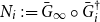 $N_i:= \bar G_\infty \circ \bar G_i^\dagger$
. We have that
$N_i:= \bar G_\infty \circ \bar G_i^\dagger$
. We have that
-
(a)
$M_i:{\mathcal X}_i\to {\mathcal X}_\infty$
and
$N_i:\mathcal Y_i\to \mathcal Y_\infty$
are functions, -
(b)
$M_i$
and
$N_i$
are monotone, -
(c)
$ J_\infty ^\dagger \circ R\circ J_\infty \circ M_i = J_\infty ^\dagger \circ R\circ J_i$
and
$K_\infty ^\dagger \circ S\circ K_\infty \circ N_i = K_\infty ^\dagger \circ S\circ K_i$
.




Note that $F_i = J_i\circ \bar F_i$
and
$F_i = J_i\circ \bar F_i$
and $G_i = K_i\circ \bar G_i$
are compatible by definition. Since
$G_i = K_i\circ \bar G_i$
are compatible by definition. Since $J_i$
and
$J_i$
and $K_i$
are injective, it follows by [Kornell et al. (Reference Kornell, Lindenhovius and Mislove2022), Corollary B.4] that
$K_i$
are injective, it follows by [Kornell et al. (Reference Kornell, Lindenhovius and Mislove2022), Corollary B.4] that $\overline F_i$
and
$\overline F_i$
and $\overline G_i$
are also compatible. Let
$\overline G_i$
are also compatible. Let $\bar E_i = (\bar F_i, \bar G_i)$
. We reason that
$\bar E_i = (\bar F_i, \bar G_i)$
. We reason that
 \begin{equation*} (J_i\times K_i)\circ \bar E_i=(J_i\times K_i)\circ (\bar F_i,\bar G_i)=(J_i\circ \bar F_i,K_i\circ \bar G_i)=(F_i,G_i)=E_i.\end{equation*}
Now, define $ \bar E_\infty =(M_\ell \times N_\ell )\circ \bar E_\ell$
and
$ \bar E_\infty =(M_\ell \times N_\ell )\circ \bar E_\ell$
and $E_\infty =(J_\infty \times K_\infty )\circ \bar E_\infty .$
We calculate that
$E_\infty =(J_\infty \times K_\infty )\circ \bar E_\infty .$
We calculate that
 \begin{align*} E_\infty & =(J_\infty \times K_\infty )\circ (M_\ell \times N_\ell )\circ \bar E_\ell \\ & = (J_\infty \times K_\infty )\circ ((\bar F_\infty \circ \bar F_\ell ^\dagger )\times (\bar G_\infty \circ \bar G_\ell ^\dagger ))\circ (\bar F_\ell ,\bar G_\ell )\\ & = (J_\infty \times K_\infty )\circ (\bar F_\infty \times \bar G_\infty )\circ (\bar F^\dagger _\ell \times \bar G_\ell ^\dagger )\circ (\bar F_\ell ,\bar G_\ell )\\ & = (J_\infty \times K_\infty )\circ (\bar F_\infty \times \bar G_\infty )\circ (\bar F^\dagger _\ell \times \bar G_\ell ^\dagger )\circ (J_\ell ^\dagger \times K_\ell ^\dagger )\circ (J_\ell \times K_\ell )\circ (\bar F_\ell ,\bar G_\ell )\\ & =((J_\infty \circ \bar F_\infty )\times (K_\infty \circ \bar G_\infty ))\circ ((\bar F^\dagger _\ell \circ J_\ell ^\dagger )\times (\bar G_\ell ^\dagger \circ K_\ell ^\dagger ))\circ (J_\ell \circ \bar F_\ell ,K_\ell \circ \bar G_\ell )\\ & = (F_\infty \times G_\infty )\circ (F_\ell ^\dagger \times G_\ell ^\dagger )\circ (F_\ell ,G_\ell ), \end{align*}
where we use [Kornell et al. (Reference Kornell, Lindenhovius and Mislove2022), Corollary B.4] in the penultimate equality. Hence, for each finite $i \geq \ell$
,
$i \geq \ell$
,
 \begin{align*} P\circ (J_\infty \times K_\infty )\circ (M_i\times N_i)\circ \bar E_i & = P\circ (J_\infty \times K_\infty )\circ (M_i\times N_i)\circ (\bar F_i,\bar G_i)\\ & = P\circ (J_\infty \circ M_i\circ \bar F_i,K_\infty \circ N_i\circ \bar G_i)\\ & = J_\infty \circ M_i\circ \bar F_i=J_\infty \circ \bar F_\infty \circ \bar F_i^\dagger \circ \bar F_i\\ & \geq J_\infty \circ \bar F_\infty \circ I=J_\infty \circ \bar F_\infty = F_\infty . \end{align*}
By [Kornell et al. (Reference Kornell, Lindenhovius and Mislove2022), Lemma A.7], we obtain $P\circ (J_\infty \times K_\infty )\circ (M_i\times N_i)\circ \bar E_i =F_\infty ,$
and in a similar way, we find
$P\circ (J_\infty \times K_\infty )\circ (M_i\times N_i)\circ \bar E_i =F_\infty ,$
and in a similar way, we find $ Q \circ (J_\infty \times K_\infty )\circ (M_i\times N_i)\circ \bar E_i=G_\infty .$
Therefore,
$ Q \circ (J_\infty \times K_\infty )\circ (M_i\times N_i)\circ \bar E_i=G_\infty .$
Therefore, $F_\infty$
and
$F_\infty$
and $G_\infty$
are compatible and
$G_\infty$
are compatible and $(F_\infty ,G_\infty )= (J_\infty \times K_\infty )\circ (M_i\times N_i)\circ \bar E_i$
for each
$(F_\infty ,G_\infty )= (J_\infty \times K_\infty )\circ (M_i\times N_i)\circ \bar E_i$
for each $i \in \{\ell ,\ell +1, \cdots \}$
. In particular, we conclude that
$i \in \{\ell ,\ell +1, \cdots \}$
. In particular, we conclude that $ (F_\infty ,G_\infty )= (J_\infty \times K_\infty )\circ (M_\ell \times N_\ell )\circ \bar E_\ell =(J_\infty \times K_\infty )\circ \bar E_\infty =E_\infty .$
Next we show that $E_n\nearrow E_\infty$
. Since
$E_n\nearrow E_\infty$
. Since $F_n\sqsubseteq F_\infty$
and
$F_n\sqsubseteq F_\infty$
and $G_n\sqsubseteq G_\infty$
for each
$G_n\sqsubseteq G_\infty$
for each $n\in {\mathbb N}$
, it follows from [Kornell et al. (Reference Kornell, Lindenhovius and Mislove2022), Proposition 7.6] that
$n\in {\mathbb N}$
, it follows from [Kornell et al. (Reference Kornell, Lindenhovius and Mislove2022), Proposition 7.6] that $E_n\sqsubseteq E_\infty$
for each
$E_n\sqsubseteq E_\infty$
for each $n\in {\mathbb N}$
. Thus,
$n\in {\mathbb N}$
. Thus, $(R\times S)\circ E_\infty \leq$ $(R\times S)\circ E_n$
for each
$(R\times S)\circ E_n$
for each $n\in {\mathbb N}$
, and therefore,
$n\in {\mathbb N}$
, and therefore,
 \begin{equation} (R\times S)\circ E_\infty \leq \bigwedge _{n\in {\mathbb N}}(R\times S)\circ E_n. \end{equation}
Fix an atom $X\otimes Y\,\, \propto {\mathcal X}\times \mathcal Y$
. Let
$X\otimes Y\,\, \propto {\mathcal X}\times \mathcal Y$
. Let $J_X$
be the inclusion function
$J_X$
be the inclusion function $J_{\mathcal Q\{X\}}:\mathcal Q\{X\}\to {\mathcal X}$
. Then, we have
$J_{\mathcal Q\{X\}}:\mathcal Q\{X\}\to {\mathcal X}$
. Then, we have $J_{X\otimes Y}=J_{\mathcal Q\{X\otimes Y\}}=J_{\mathcal Q\{X\}\times \mathcal Q\{Y\}}=J_{\mathcal Q\{X\}}\times J_{\mathcal Q\{Y\}}=J_{X}\times J_Y$
where we used [Kornell et al. (Reference Kornell, Lindenhovius and Mislove2022), Proposition B.3] in the penultimate equality. Since
$J_{X\otimes Y}=J_{\mathcal Q\{X\otimes Y\}}=J_{\mathcal Q\{X\}\times \mathcal Q\{Y\}}=J_{\mathcal Q\{X\}}\times J_{\mathcal Q\{Y\}}=J_{X}\times J_Y$
where we used [Kornell et al. (Reference Kornell, Lindenhovius and Mislove2022), Proposition B.3] in the penultimate equality. Since $L(H,X)$
and
$L(H,X)$
and $L(H,Y)$
are finite-dimensional, the monotonically decreasing sequences
$L(H,Y)$
are finite-dimensional, the monotonically decreasing sequences
 \begin{align*} (R\circ F_1)(H,X)\geq (R\circ F_2)(H,X)\geq \cdots ,\quad \text{and} \quad (S\circ G_1)(H,Y)\geq (S\circ G_2)(H,Y)\geq \cdots \end{align*}
stabilize, and since $\bigwedge _{n\in {\mathbb N}}R\circ F_n=R\circ F_\infty$
and
$\bigwedge _{n\in {\mathbb N}}R\circ F_n=R\circ F_\infty$
and $\bigwedge _{n\in {\mathbb N}}S\circ G_n=S\circ G_\infty$
, this means that we can find a natural number
$\bigwedge _{n\in {\mathbb N}}S\circ G_n=S\circ G_\infty$
, this means that we can find a natural number $m\geq \ell$
such that
$m\geq \ell$
such that
 \begin{align*} (R\circ F_n)(H,X) = (R\circ F_\infty )(H,X),\quad \text{and} \quad (S\circ G_n)(H,Y) = (S\circ G_\infty )(H,Y) \end{align*}
for all $n\geq m$
. Applying [Kornell et al. (Reference Kornell, Lindenhovius and Mislove2022), Lemma A.5], we infer that
$n\geq m$
. Applying [Kornell et al. (Reference Kornell, Lindenhovius and Mislove2022), Lemma A.5], we infer that
 \begin{align*} (J_X^\dagger \circ R\circ F_n)(H,X) & = (J_X^\dagger \circ R\circ F_\infty )(H,X), \; \text{and} \\ (J_Y^\dagger \circ S\circ G_n)(H,Y) & = (J_Y^\dagger \circ S\circ G_\infty )(H,Y). \end{align*}
Hence,
 \begin{align} J_X^\dagger \circ R\circ F_n & = J_X^\dagger \circ R\circ F_\infty \qquad \mathrm{and} \end{align}
 \begin{align} J_Y^\dagger \circ S\circ G_n & = J_Y^\dagger \circ S\circ G_\infty \end{align}
for each $n\geq m$
. Now, we calculate that
$n\geq m$
. Now, we calculate that
 \begin{align*} J_{X\otimes Y}^\dagger \circ &\bigwedge _{n\in {\mathbb N}}(R\times S)\circ E_n = \bigwedge _{n\in {\mathbb N}}J_{X\otimes Y}^\dagger \circ (R\times S)\circ E_n\\ & = \bigwedge _{n\in {\mathbb N}}(J_{X }^\dagger \times J_{Y}^\dagger )\circ (R\times S)\circ (F_n,G_n)\\ & = \bigwedge _{n\in {\mathbb N}}(J_{X }^\dagger \times J_{Y}^\dagger )\circ (R\times S)\circ (J_n\times K_n)\circ (\bar F_n,\bar G_n)\\ & \leq \bigwedge _{n\geq m}(J_{X }^\dagger \times J_{Y}^\dagger )\circ (R\times S)\circ (J_n\times K_n)\circ \big ((\bar F_n\circ \bar F_\ell ^\dagger )\times (\bar G_n\circ \bar G_\ell ^\dagger )\big )\circ (\bar F_\ell ,\bar G_\ell )\\ & = \bigwedge _{n\geq m}\big ((J_{X }^\dagger \circ R\circ F_n)\times (J_{Y}^\dagger \circ S\circ G_n)\big ) \circ (\bar F_\ell ^\dagger \times \bar G_\ell ^\dagger )\circ (\bar F_\ell ,\bar G_\ell )\\ & = \big ((J_{X }^\dagger \circ R\circ F_\infty )\times (J_{Y}^\dagger \circ S\circ G_\infty )\big ) \circ (\bar F_\ell ^\dagger \times \bar G_\ell ^\dagger )\circ (\bar F_\ell ,\bar G_\ell )\\ & = \big ((J_{X }^\dagger \circ R\circ J_\infty )\times (J_{Y}^\dagger \circ S\circ K_\infty )\big ) \circ (M_\ell \times N_\ell )\circ (\bar F_\ell ,\bar G_\ell )\\ & =J_{X\otimes Y }^\dagger \circ (R\times S)\circ E_\infty , \end{align*}
where the first equality follows by [Kornell et al. (Reference Kornell, Lindenhovius and Mislove2022), Proposition A.6] and the inequality follows by [Kornell et al. (Reference Kornell, Lindenhovius and Mislove2022), Proposition B.7]. The third-to-last equality follows from Equations (11) and (12). We now apply [Kornell et al. (Reference Kornell, Lindenhovius and Mislove2022), Lemma A.5] to calculate that
 \begin{align*} & \left (\bigwedge _{n\in {\mathbb N}}(R\times S)\circ E_n\right )(H,X\otimes Y) =\left (J_{X\otimes Y}^{\dagger }\circ \bigwedge _{n\in {\mathbb N}}(R\times S)\circ E_n\right )(H,X\otimes Y)\\ &\quad \leq \left (J_{X\otimes Y}^{\dagger }\circ (R\times S)\circ E_\infty \right )(H,X\otimes Y) = ((R\times S)\circ E_\infty )(H,X\otimes Y). \end{align*}
We now vary the atom $X\otimes Y\,\, \propto {\mathcal X}\times \mathcal Y$
to conclude that
$X\otimes Y\,\, \propto {\mathcal X}\times \mathcal Y$
to conclude that $\bigwedge _{n\in {\mathbb N}}(R\times S)\circ E_n\leq (R\times S)\circ E_\infty .$
With Equation (10), this implies that
$\bigwedge _{n\in {\mathbb N}}(R\times S)\circ E_n\leq (R\times S)\circ E_\infty .$
With Equation (10), this implies that $E_n\nearrow E_\infty$
, as claimed.
$E_n\nearrow E_\infty$
, as claimed.
Corollary 5.1.5.
Let $({\mathcal X},R)$
and
$({\mathcal X},R)$
and $(\mathcal Y,S)$
be quantum cpos. Then,
$(\mathcal Y,S)$
be quantum cpos. Then, $({\mathcal X}\times \mathcal Y,R\times S)$
is a quantum cpo, and the projection maps
$({\mathcal X}\times \mathcal Y,R\times S)$
is a quantum cpo, and the projection maps $P:{\mathcal X}\times \mathcal Y\to {\mathcal X}$
and
$P:{\mathcal X}\times \mathcal Y\to {\mathcal X}$
and $Q:{\mathcal X}\times \mathcal Y\to \mathcal Y$
are Scott continuous.
$Q:{\mathcal X}\times \mathcal Y\to \mathcal Y$
are Scott continuous.
Proof.
Let $\mathcal H$
be an atomic quantum set, and let
$\mathcal H$
be an atomic quantum set, and let $E_1\sqsubseteq E_2\sqsubseteq \ldots$
be a monotonically ascending sequence of functions
$E_1\sqsubseteq E_2\sqsubseteq \ldots$
be a monotonically ascending sequence of functions ${\mathcal H}\to {\mathcal X}\times \mathcal Y$
. Let
${\mathcal H}\to {\mathcal X}\times \mathcal Y$
. Let $F_n=P\circ E_n$
, and let
$F_n=P\circ E_n$
, and let $G_n=Q\circ E_n$
. By [Kornell et al. (Reference Kornell, Lindenhovius and Mislove2022), Lemma 7.3], the projection functions
$G_n=Q\circ E_n$
. By [Kornell et al. (Reference Kornell, Lindenhovius and Mislove2022), Lemma 7.3], the projection functions $P$
and
$P$
and $Q$
are monotone; hence,
$Q$
are monotone; hence, $F_1\sqsubseteq F_2\sqsubseteq \cdots$
and
$F_1\sqsubseteq F_2\sqsubseteq \cdots$
and $G_1\sqsubseteq G_2\sqsubseteq \cdots$
are monotonically ascending sequences. Since both
$G_1\sqsubseteq G_2\sqsubseteq \cdots$
are monotonically ascending sequences. Since both $\mathcal X$
and
$\mathcal X$
and $\mathcal Y$
are quantum cpos, there exist functions
$\mathcal Y$
are quantum cpos, there exist functions $F_\infty :{\mathcal H}\to {\mathcal X}$
and
$F_\infty :{\mathcal H}\to {\mathcal X}$
and $G_\infty :{\mathcal H}\to \mathcal Y$
such that
$G_\infty :{\mathcal H}\to \mathcal Y$
such that $F_n\nearrow F_\infty$
and
$F_n\nearrow F_\infty$
and $G_n\nearrow G_\infty$
. Now, we apply Theorem 5.1.4 to infer that there exists a function
$G_n\nearrow G_\infty$
. Now, we apply Theorem 5.1.4 to infer that there exists a function $E_\infty \colon {\mathcal H} \to {\mathcal X} \times \mathcal Y$
such that
$E_\infty \colon {\mathcal H} \to {\mathcal X} \times \mathcal Y$
such that $E_n\nearrow E_\infty$
,
$E_n\nearrow E_\infty$
, $P\circ E_\infty =F_\infty$
, and
$P\circ E_\infty =F_\infty$
, and $Q\circ E_\infty =G_\infty .$
Since
$Q\circ E_\infty =G_\infty .$
Since $P\circ E_n =F_n\nearrow F_\infty =P\circ E_\infty$
and
$P\circ E_n =F_n\nearrow F_\infty =P\circ E_\infty$
and $Q\circ E_n = G_n\nearrow G_\infty = Q\circ E_\infty$
, we also infer that
$Q\circ E_n = G_n\nearrow G_\infty = Q\circ E_\infty$
, we also infer that $P$
and
$P$
and $Q$
are Scott continuous.
$Q$
are Scott continuous.
Corollary 5.1.6.
Let $({\mathcal X},R)$
and
$({\mathcal X},R)$
and $(\mathcal Y,S)$
be quantum cpos, and let
$(\mathcal Y,S)$
be quantum cpos, and let $(\mathcal Z,T)$
be a quantum poset. Let
$(\mathcal Z,T)$
be a quantum poset. Let $M:\mathcal Z\to {\mathcal X}\times \mathcal Y$
be a function. Then
$M:\mathcal Z\to {\mathcal X}\times \mathcal Y$
be a function. Then $M$
is Scott continuous if and only if
$M$
is Scott continuous if and only if $P\circ M:\mathcal Z\to {\mathcal X}$
and
$P\circ M:\mathcal Z\to {\mathcal X}$
and $Q\circ M:\mathcal Z\to \mathcal Y$
are Scott continuous.
$Q\circ M:\mathcal Z\to \mathcal Y$
are Scott continuous.
Proof.
Assume that $M$
is Scott continuous. Since
$M$
is Scott continuous. Since $P$
and
$P$
and $Q$
are Scott continuous by Corollary 5.1.5 and the composition of Scott continuous maps is Scott continuous (cf. Lemma 3.2.8), it follows that
$Q$
are Scott continuous by Corollary 5.1.5 and the composition of Scott continuous maps is Scott continuous (cf. Lemma 3.2.8), it follows that $P\circ M$
and
$P\circ M$
and $Q\circ M$
are Scott continuous. For the converse, assume that
$Q\circ M$
are Scott continuous. For the converse, assume that $P\circ M$
and
$P\circ M$
and $Q\circ M$
are Scott continuous. Then,
$Q\circ M$
are Scott continuous. Then, $P\circ M$
and
$P\circ M$
and $Q\circ M$
are monotone, so
$Q\circ M$
are monotone, so $M$
is also monotone by [Kornell et al. (Reference Kornell, Lindenhovius and Mislove2022), Proposition 7.4].
$M$
is also monotone by [Kornell et al. (Reference Kornell, Lindenhovius and Mislove2022), Proposition 7.4].
Let $K_1\sqsubseteq K_2\sqsubseteq \cdots$
be a monotonically ascending sequence of functions
$K_1\sqsubseteq K_2\sqsubseteq \cdots$
be a monotonically ascending sequence of functions ${\mathcal H}\to \mathcal Z$
with limit
${\mathcal H}\to \mathcal Z$
with limit $K_\infty$
. For each
$K_\infty$
. For each $i\in \{1,2,\ldots ,\infty \}$
, let
$i\in \{1,2,\ldots ,\infty \}$
, let $E_i=M\circ K_i$
, let
$E_i=M\circ K_i$
, let $F_i=P\circ E_i$
and
$F_i=P\circ E_i$
and $G_i=Q\circ E_i$
. By the Scott continuity of
$G_i=Q\circ E_i$
. By the Scott continuity of $P\circ M$
and
$P\circ M$
and $Q\circ M$
, we have
$Q\circ M$
, we have
 \begin{align*} F_n=P\circ M\circ K_n \nearrow P\circ M\circ K_\infty =F_\infty ,\quad \text{and} \quad G_n=Q\circ M\circ K_n \nearrow Q\circ M\circ K_\infty =G_\infty . \end{align*}
By the monotonicity of $M$
,
$M$
, $E_1\sqsubseteq E_2\sqsubseteq \cdots$
is a monotonically ascending sequence of functions
$E_1\sqsubseteq E_2\sqsubseteq \cdots$
is a monotonically ascending sequence of functions ${\mathcal H}\to {\mathcal X}\times \mathcal Y$
. We now apply Theorem 5.1.4 to we conclude that
${\mathcal H}\to {\mathcal X}\times \mathcal Y$
. We now apply Theorem 5.1.4 to we conclude that $E_n \nearrow E_\infty$
, because the function
$E_n \nearrow E_\infty$
, because the function $E_\infty$
is uniquely determined by the equations
$E_\infty$
is uniquely determined by the equations $P \circ E_\infty = F_\infty$
and
$P \circ E_\infty = F_\infty$
and $Q \circ E_\infty = G_\infty$
. In other words,
$Q \circ E_\infty = G_\infty$
. In other words, $M \circ K_n \nearrow M \circ K_\infty$
. Therefore,
$M \circ K_n \nearrow M \circ K_\infty$
. Therefore, $M$
is Scott continuous.
$M$
is Scott continuous.
Lemma 5.1.7.
Let $({\mathcal X}_1,R_1)$
,
$({\mathcal X}_1,R_1)$
, $({\mathcal X}_2,R_2)$
,
$({\mathcal X}_2,R_2)$
, $(\mathcal Y_1,S_1)$
and
$(\mathcal Y_1,S_1)$
and $(\mathcal Y_2,S_2)$
be quantum cpos, and let
$(\mathcal Y_2,S_2)$
be quantum cpos, and let $F:({\mathcal X}_1,R_1)\to ({\mathcal X}_2,R_2)$
and
$F:({\mathcal X}_1,R_1)\to ({\mathcal X}_2,R_2)$
and $G:(\mathcal Y_1,S_1)\to (\mathcal Y_2,S_2)$
be Scott continuous. Then,
$G:(\mathcal Y_1,S_1)\to (\mathcal Y_2,S_2)$
be Scott continuous. Then,
 \begin{equation*}F\times G:({\mathcal X}_1\times \mathcal Y_1,R_1\times S_1)\to ({\mathcal X}_2\times \mathcal Y_2,R_2\times S_2)\end{equation*}
is Scott continuous.
Proof.
Let $K_1\sqsubseteq K_2\sqsubseteq \cdots :{\mathcal H}\to {\mathcal X}_1\times \mathcal Y_1$
be a monotonically ascending sequence with limit
$K_1\sqsubseteq K_2\sqsubseteq \cdots :{\mathcal H}\to {\mathcal X}_1\times \mathcal Y_1$
be a monotonically ascending sequence with limit $K_\infty$
, and for each
$K_\infty$
, and for each $i\in \{1,2,\ldots ,\infty \}$
, let
$i\in \{1,2,\ldots ,\infty \}$
, let $E_i=(F\times G)\circ K_i$
. By [Kornell et al. (Reference Kornell, Lindenhovius and Mislove2022), Lemma 7.2],
$E_i=(F\times G)\circ K_i$
. By [Kornell et al. (Reference Kornell, Lindenhovius and Mislove2022), Lemma 7.2], $F\times G$
is monotone; hence,
$F\times G$
is monotone; hence, $E_1\sqsubseteq E_2\sqsubseteq \cdots :{\mathcal H}\to {\mathcal X}_2\times \mathcal Y_2$
is a monotonically ascending sequence of functions, too. It follows from Theorem 5.1.4 that
$E_1\sqsubseteq E_2\sqsubseteq \cdots :{\mathcal H}\to {\mathcal X}_2\times \mathcal Y_2$
is a monotonically ascending sequence of functions, too. It follows from Theorem 5.1.4 that $E_n\nearrow E$
for some
$E_n\nearrow E$
for some $E:{\mathcal H}\to {\mathcal X}_2\times \mathcal Y_2$
such that
$E:{\mathcal H}\to {\mathcal X}_2\times \mathcal Y_2$
such that $P_2\circ E_n\nearrow P_2\circ E$
and
$P_2\circ E_n\nearrow P_2\circ E$
and $Q_2\circ E_n\nearrow Q_2\circ E$
. Here,
$Q_2\circ E_n\nearrow Q_2\circ E$
. Here, $P_i\colon {\mathcal X}_i \times \mathcal Y_i {\rightarrow } {\mathcal X}_i$
and
$P_i\colon {\mathcal X}_i \times \mathcal Y_i {\rightarrow } {\mathcal X}_i$
and $Q_i\colon {\mathcal X}_i \times \mathcal Y_i {\rightarrow } \mathcal Y_i$
are the canonical projections, for both
$Q_i\colon {\mathcal X}_i \times \mathcal Y_i {\rightarrow } \mathcal Y_i$
are the canonical projections, for both $i \in \{1,2\}$
.
$i \in \{1,2\}$
.
It also follows from Corollary 5.1.5 that $P_1\circ K_n\nearrow P_1\circ K_\infty$
and
$P_1\circ K_n\nearrow P_1\circ K_\infty$
and $Q_1\circ K_n\nearrow Q_1\circ K_\infty$
. Since
$Q_1\circ K_n\nearrow Q_1\circ K_\infty$
. Since $F$
and
$F$
and $G$
are Scott continuous, it follows that
$G$
are Scott continuous, it follows that $F\circ P_1\circ K_n\nearrow F\circ P_1\circ K_\infty$
and
$F\circ P_1\circ K_n\nearrow F\circ P_1\circ K_\infty$
and $G\circ Q_1\circ K_n\nearrow G\circ Q_1\circ K_\infty$
. Using [Kornell et al. (Reference Kornell, Lindenhovius and Mislove2022), Proposition B.2], we obtain
$G\circ Q_1\circ K_n\nearrow G\circ Q_1\circ K_\infty$
. Using [Kornell et al. (Reference Kornell, Lindenhovius and Mislove2022), Proposition B.2], we obtain
 \begin{align*} P_2\circ E_n & = P_2\circ (F\times G)\circ K_n=F\circ P_1\circ K_n\nearrow F\circ P_1\circ K_\infty = P_2\circ (F\times G)\circ K_\infty = P_2\circ E_\infty ,\\ Q_2\circ E_n & = Q_2\circ (F\times G)\circ K_n=G\circ Q_1\circ K_n\nearrow G\circ Q_1\circ K_\infty = Q_2\circ (F\times G)\circ K_\infty = Q_2\circ E_\infty . \end{align*}
By the uniqueness of limits (Lemma 3.1.2), we have that $P\circ E=P\circ E_\infty$
and
$P\circ E=P\circ E_\infty$
and $Q\circ E=Q\circ E_\infty$
. It then follows that
$Q\circ E=Q\circ E_\infty$
. It then follows that $E=E_\infty$
[Kornell et al. (Reference Kornell, Lindenhovius and Mislove2022), Appendix B]; hence,
$E=E_\infty$
[Kornell et al. (Reference Kornell, Lindenhovius and Mislove2022), Appendix B]; hence, $ (F\times G)\circ K_n=E_n\nearrow E=E_\infty = (F\times G)\circ K_\infty$
. Therefore,
$ (F\times G)\circ K_n=E_n\nearrow E=E_\infty = (F\times G)\circ K_\infty$
. Therefore, $F\times G$
is indeed Scott continuous.
$F\times G$
is indeed Scott continuous.
Theorem 5.1.8.
The symmetric monoidal structure on $\mathbf{qPOS}$
restricts to
$\mathbf{qPOS}$
restricts to $\mathbf{qCPO}$
.
$\mathbf{qCPO}$
.
Proof.
By Theorem 5.1.4 and Lemma 5.1.7, the monoidal product on $\mathbf{qPOS}$
restricts to a bifunctor on
$\mathbf{qPOS}$
restricts to a bifunctor on $\mathbf{qCPO}$
. The tensor unit
$\mathbf{qCPO}$
. The tensor unit $({\mathbf 1},I_{{\mathbf 1}}$
) of
$({\mathbf 1},I_{{\mathbf 1}}$
) of $\mathbf{qPOS}$
is a quantum cpo by Proposition 3.2.7. Finally, the components of the associator, the left and right unitors and the symmetry in
$\mathbf{qPOS}$
is a quantum cpo by Proposition 3.2.7. Finally, the components of the associator, the left and right unitors and the symmetry in $\mathbf{qPOS}$
are order isomorphisms (cf. [Kornell et al. (Reference Kornell, Lindenhovius and Mislove2022), Theorem 7.5]); hence, they are Scott continuous by Lemma 3.2.6, that is, they are morphisms of
$\mathbf{qPOS}$
are order isomorphisms (cf. [Kornell et al. (Reference Kornell, Lindenhovius and Mislove2022), Theorem 7.5]); hence, they are Scott continuous by Lemma 3.2.6, that is, they are morphisms of $\mathbf{qCPO}$
.
$\mathbf{qCPO}$
.
5.2 Scott continuity in one of two variables
Let $({\mathcal X},R)$
,
$({\mathcal X},R)$
, $(\mathcal Y,S)$
, and
$(\mathcal Y,S)$
, and $(\mathcal Z,T)$
be quantum cpos, and let
$(\mathcal Z,T)$
be quantum cpos, and let $D\colon {\mathcal X} \times \mathcal Y \to \mathcal Z$
be a function. We define the Scott continuity of
$D\colon {\mathcal X} \times \mathcal Y \to \mathcal Z$
be a function. We define the Scott continuity of $D$
in the first variable and, symmetrically, the Scott continuity of
$D$
in the first variable and, symmetrically, the Scott continuity of $D$
in the second variable. We then show that
$D$
in the second variable. We then show that $D$
is Scott continuous if and only if it is Scott continuous in both variables.
$D$
is Scott continuous if and only if it is Scott continuous in both variables.
Definition 5.2.1.
Let $\mathcal X$
and
$\mathcal X$
and $\mathcal Y$
be quantum sets, and let
$\mathcal Y$
be quantum sets, and let $(\mathcal Z,T)$
be a quantum poset. Let
$(\mathcal Z,T)$
be a quantum poset. Let $D:{\mathcal X}\times \mathcal Y\to \mathcal Z$
be a function. If
$D:{\mathcal X}\times \mathcal Y\to \mathcal Z$
be a function. If $R$
is an order on
$R$
is an order on $\mathcal X$
, we say that
$\mathcal X$
, we say that $D$
is monotone in the first variable if
$D$
is monotone in the first variable if $D\circ (R\times I_{\mathcal Y})\leq T\circ D$
, or equivalently, if
$D\circ (R\times I_{\mathcal Y})\leq T\circ D$
, or equivalently, if $D$
is a monotone function from
$D$
is a monotone function from $({\mathcal X} \times \mathcal Y, R \times I_{\mathcal Y})$
to
$({\mathcal X} \times \mathcal Y, R \times I_{\mathcal Y})$
to $(\mathcal Z, T)$
. Similarly, if
$(\mathcal Z, T)$
. Similarly, if $S$
is an order on
$S$
is an order on $\mathcal Y$
, we say that
$\mathcal Y$
, we say that $D$
is monotone in the second variable if
$D$
is monotone in the second variable if $ D\circ (I_{\mathcal X}\times S)\leq T\circ D$
, or equivalently, if
$ D\circ (I_{\mathcal X}\times S)\leq T\circ D$
, or equivalently, if $D$
is a monotone function from
$D$
is a monotone function from $({\mathcal X} \times \mathcal Y, I_{\mathcal X} \times S)$
to
$({\mathcal X} \times \mathcal Y, I_{\mathcal X} \times S)$
to $(\mathcal Z, T)$
.
$(\mathcal Z, T)$
.
Lemma 5.2.2.
Let $({\mathcal X},R)$
,
$({\mathcal X},R)$
, $(\mathcal Y,S)$
, and
$(\mathcal Y,S)$
, and $(\mathcal Z,T)$
be quantum posets, and let
$(\mathcal Z,T)$
be quantum posets, and let $D:{\mathcal X}\times \mathcal Y\to \mathcal Z$
be a function. Then,
$D:{\mathcal X}\times \mathcal Y\to \mathcal Z$
be a function. Then, $D$
is monotone if and only if it is monotone in both variables.
$D$
is monotone if and only if it is monotone in both variables.
Proof.
Assume that $D$
is monotone, that is,
$D$
is monotone, that is, $ D\circ (R\times S)\leq T\circ D.$
Since
$ D\circ (R\times S)\leq T\circ D.$
Since $I_{\mathcal X}\leq R$
and
$I_{\mathcal X}\leq R$
and $I_{\mathcal Y}\leq S$
, we have that
$I_{\mathcal Y}\leq S$
, we have that $D\circ (I_{\mathcal X}\times S)\leq D\circ (R\times S)\leq T\circ D$
and
$D\circ (I_{\mathcal X}\times S)\leq D\circ (R\times S)\leq T\circ D$
and $D\circ (R\times I_{\mathcal Y})\leq D \circ (R \times S) \leq T\circ D$
[Kornell et al. (Reference Kornell, Lindenhovius and Mislove2022), Lemma A.3(b)]. Hence,
$D\circ (R\times I_{\mathcal Y})\leq D \circ (R \times S) \leq T\circ D$
[Kornell et al. (Reference Kornell, Lindenhovius and Mislove2022), Lemma A.3(b)]. Hence, $D$
is monotone in both variables.
$D$
is monotone in both variables.
For the converse, assume that $D$
is monotone in both variables. Then,
$D$
is monotone in both variables. Then,
 \begin{equation*} D\circ (S\times R)=D\circ (R\times I_{\mathcal Y})\circ (I_{\mathcal X}\times S)\leq T\circ D\circ (I_{\mathcal X}\times R)\leq T\circ T\circ D\leq T\circ D,\end{equation*}
where the first inequality holds because $D$
is monotone in the second variable and the second inequality holds because
$D$
is monotone in the second variable and the second inequality holds because $D$
is monotone in the first variable.
$D$
is monotone in the first variable.
Definition 5.2.3.
Let $\mathcal X$
and
$\mathcal X$
and $\mathcal Y$
be quantum sets, and let
$\mathcal Y$
be quantum sets, and let $(\mathcal Z,T)$
be a quantum poset. If
$(\mathcal Z,T)$
be a quantum poset. If $R$
is an order on
$R$
is an order on $\mathcal X$
, we say that a function
$\mathcal X$
, we say that a function $D:{\mathcal X}\times {\mathcal Y}\to \mathcal Z$
is Scott continuous in the first variable if it is monotone in the first variable and, for each atomic quantum set
$D:{\mathcal X}\times {\mathcal Y}\to \mathcal Z$
is Scott continuous in the first variable if it is monotone in the first variable and, for each atomic quantum set $\mathcal H$
and each monotonically ascending sequence
$\mathcal H$
and each monotonically ascending sequence $F_1\sqsubseteq F_2\sqsubseteq \cdots$
of functions
$F_1\sqsubseteq F_2\sqsubseteq \cdots$
of functions ${\mathcal H} \to {\mathcal X}$
, if
${\mathcal H} \to {\mathcal X}$
, if $F_n\nearrow F_\infty$
for some function
$F_n\nearrow F_\infty$
for some function $F_\infty :{\mathcal H}\to {\mathcal X}$
, then
$F_\infty :{\mathcal H}\to {\mathcal X}$
, then $D\circ (F_n\times I_{\mathcal Y})\nearrow D\circ (F_\infty \times I_{\mathcal Y})$
.
$D\circ (F_n\times I_{\mathcal Y})\nearrow D\circ (F_\infty \times I_{\mathcal Y})$
.
Similarly, if $S$
is an order on
$S$
is an order on $\mathcal Y$
, we say that a function
$\mathcal Y$
, we say that a function $D\colon {\mathcal X} \times \mathcal Y \to \mathcal Z$
is Scott continuous in the second variable if it is monotone in the second variable and, for each atomic quantum set
$D\colon {\mathcal X} \times \mathcal Y \to \mathcal Z$
is Scott continuous in the second variable if it is monotone in the second variable and, for each atomic quantum set $\mathcal H$
and each monotonically ascending sequence
$\mathcal H$
and each monotonically ascending sequence $G_1\sqsubseteq G_2\sqsubseteq \cdot$
of functions
$G_1\sqsubseteq G_2\sqsubseteq \cdot$
of functions ${\mathcal H} \to \mathcal Y$
, if
${\mathcal H} \to \mathcal Y$
, if $G_n\nearrow G_\infty$
for some function
$G_n\nearrow G_\infty$
for some function $G_\infty :{\mathcal H}\to \mathcal Y$
, then
$G_\infty :{\mathcal H}\to \mathcal Y$
, then $D\circ (I_{\mathcal X}\times G_n)\nearrow D\circ (I_{\mathcal X}\times G_\infty )$
.
$D\circ (I_{\mathcal X}\times G_n)\nearrow D\circ (I_{\mathcal X}\times G_\infty )$
.
Lemma 5.2.4.
Let $\mathcal V$
,
$\mathcal V$
, $\mathcal W$
,
$\mathcal W$
, $\mathcal X$
,
$\mathcal X$
, $\mathcal Y$
, and
$\mathcal Y$
, and $\mathcal Z$
be quantum sets and let
$\mathcal Z$
be quantum sets and let $Q$
,
$Q$
, $S$
, and
$S$
, and $T$
be orders on
$T$
be orders on $\mathcal W$
,
$\mathcal W$
, $\mathcal Y$
and
$\mathcal Y$
and $\mathcal Z$
, respectively. Let
$\mathcal Z$
, respectively. Let $F\colon {\mathcal V} \to {\mathcal X}$
,
$F\colon {\mathcal V} \to {\mathcal X}$
, $G\colon \mathcal W \to \mathcal Y$
and
$G\colon \mathcal W \to \mathcal Y$
and $D\colon {\mathcal X} \times \mathcal Y \to \mathcal Z$
be functions. If
$D\colon {\mathcal X} \times \mathcal Y \to \mathcal Z$
be functions. If $G$
is Scott continuous and
$G$
is Scott continuous and $D$
is Scott continuous in the second variable, then
$D$
is Scott continuous in the second variable, then $D \circ (F \times G)$
is also Scott continuous in the second variable.
$D \circ (F \times G)$
is also Scott continuous in the second variable.
Proof.
The function $D$
is Scott continuous in the second variable, and in particular, it is monotone in the second variable. Equivalently, it is monotone with respect to the order
$D$
is Scott continuous in the second variable, and in particular, it is monotone in the second variable. Equivalently, it is monotone with respect to the order $I_{\mathcal X} \times S$
on
$I_{\mathcal X} \times S$
on ${\mathcal X} \times \mathcal Y$
(Definition 5.2.1). The function
${\mathcal X} \times \mathcal Y$
(Definition 5.2.1). The function $G:{\mathcal V}\to \mathcal Y$
is trivially monotone if we order
$G:{\mathcal V}\to \mathcal Y$
is trivially monotone if we order $\mathcal Y$
and
$\mathcal Y$
and $\mathcal V$
trivially [Kornell et al. (Reference Kornell, Lindenhovius and Mislove2022), Example 1.11]. Hence,
$\mathcal V$
trivially [Kornell et al. (Reference Kornell, Lindenhovius and Mislove2022), Example 1.11]. Hence, $F\times G:\mathcal W\times {\mathcal V}\to {\mathcal X}\times \mathcal Y$
is also monotone, by [Kornell et al. (Reference Kornell, Lindenhovius and Mislove2022), Theorem 7.5]. Thus,
$F\times G:\mathcal W\times {\mathcal V}\to {\mathcal X}\times \mathcal Y$
is also monotone, by [Kornell et al. (Reference Kornell, Lindenhovius and Mislove2022), Theorem 7.5]. Thus, $D\circ (F\times G)$
is monotone with respect to the order
$D\circ (F\times G)$
is monotone with respect to the order $I_{\mathcal V}\times Q$
on
$I_{\mathcal V}\times Q$
on ${\mathcal V}\times \mathcal W$
, that is, it is monotone in the second variable.
${\mathcal V}\times \mathcal W$
, that is, it is monotone in the second variable.
Now, let $\mathcal H$
be an atomic quantum set, and let
$\mathcal H$
be an atomic quantum set, and let $K_1\sqsubseteq K_2\sqsubseteq \cdots$
be a monotonically ascending sequence of functions
$K_1\sqsubseteq K_2\sqsubseteq \cdots$
be a monotonically ascending sequence of functions ${\mathcal H}\to \mathcal W$
with limit
${\mathcal H}\to \mathcal W$
with limit $K_\infty$
. By the Scott continuity of
$K_\infty$
. By the Scott continuity of $G$
, it follows that
$G$
, it follows that $G\circ K_1\sqsubseteq G\circ K_2\sqsubseteq \cdots$
is a monotonically ascending sequence of functions
$G\circ K_1\sqsubseteq G\circ K_2\sqsubseteq \cdots$
is a monotonically ascending sequence of functions ${\mathcal H}\to \mathcal Y$
with limit
${\mathcal H}\to \mathcal Y$
with limit $G\circ K_\infty$
. Since
$G\circ K_\infty$
. Since $D$
is Scott continuous in the second variable, it follows that
$D$
is Scott continuous in the second variable, it follows that $D\circ ( I_{\mathcal X} \times (G\circ K_n))\nearrow D\circ ( I_{\mathcal X} \times (G\circ K_\infty ))$
. Furthermore, by Lemma 3.3.3,
$D\circ ( I_{\mathcal X} \times (G\circ K_n))\nearrow D\circ ( I_{\mathcal X} \times (G\circ K_\infty ))$
. Furthermore, by Lemma 3.3.3,
 \begin{equation*} D\circ (I_{\mathcal X} \times (G\circ K_n))\circ (F\times I_{\mathcal Y})\nearrow D\circ (I_{\mathcal X} \times (G\circ K_\infty ))\circ (F\times I_{\mathcal Y}), \end{equation*}
which is nothing more than
 \begin{equation*}D\circ (F\times G)\circ (I_{\mathcal V} \times K_n)\nearrow D\circ (F\times G)\circ (I_{\mathcal V} \times K_\infty ).\end{equation*}
Therefore, $D\circ (F\times G)$
is indeed Scott continuous in the second variable.
$D\circ (F\times G)$
is indeed Scott continuous in the second variable.
Proposition 5.2.5.
Let $({\mathcal X},R)$
,
$({\mathcal X},R)$
, $(\mathcal Y,S)$
, and
$(\mathcal Y,S)$
, and $(\mathcal Z,T)$
be quantum cpos. Then, a function
$(\mathcal Z,T)$
be quantum cpos. Then, a function $D:{\mathcal X}\times \mathcal Y\to \mathcal Z$
is Scott continuous if and only if it is Scott continuous in both variables.
$D:{\mathcal X}\times \mathcal Y\to \mathcal Z$
is Scott continuous if and only if it is Scott continuous in both variables.
Proof.
First, assume that $D$
is Scott continuous. It is monotone in both variables by Lemma 5.2.2. Hence, let
$D$
is Scott continuous. It is monotone in both variables by Lemma 5.2.2. Hence, let $\mathcal H$
be an atomic quantum set, and let
$\mathcal H$
be an atomic quantum set, and let $F_1 \sqsubseteq F_2 \sqsubseteq \cdots$
be a monotonically ascending sequence of functions
$F_1 \sqsubseteq F_2 \sqsubseteq \cdots$
be a monotonically ascending sequence of functions ${\mathcal H} \to {\mathcal X}$
with limit
${\mathcal H} \to {\mathcal X}$
with limit $F_\infty$
. By Lemma 5.1.2,
$F_\infty$
. By Lemma 5.1.2, $F_n \times I_{\mathcal Y} \nearrow F_\infty \times I_{\mathcal Y}$
. By Lemma 3.3.4,
$F_n \times I_{\mathcal Y} \nearrow F_\infty \times I_{\mathcal Y}$
. By Lemma 3.3.4, $D \circ (F_n \times I_{\mathcal Y}) \nearrow D \circ (F_\infty \times I_{\mathcal Y})$
. Therefore,
$D \circ (F_n \times I_{\mathcal Y}) \nearrow D \circ (F_\infty \times I_{\mathcal Y})$
. Therefore, $D$
is Scott continuous in the first variable, and symmetrically, it is Scott continuous in the second variable.
$D$
is Scott continuous in the first variable, and symmetrically, it is Scott continuous in the second variable.
Conversely, assume that $D$
is Scott continuous in both variables. In particular, it is monotone in both variables; hence it is monotone by Lemma 5.2.2. Let
$D$
is Scott continuous in both variables. In particular, it is monotone in both variables; hence it is monotone by Lemma 5.2.2. Let $E_1\sqsubseteq E_2\sqsubseteq \cdots$
be a monotonically ascending sequence of functions
$E_1\sqsubseteq E_2\sqsubseteq \cdots$
be a monotonically ascending sequence of functions ${\mathcal H}\to {\mathcal X}\times \mathcal Y$
with limit
${\mathcal H}\to {\mathcal X}\times \mathcal Y$
with limit $E_\infty$
. Let
$E_\infty$
. Let $F_i=P\circ E_i$
and
$F_i=P\circ E_i$
and $G_i=Q\circ E_i$
, for
$G_i=Q\circ E_i$
, for $i\in \{1,2,\ldots ,\infty \}$
. Since
$i\in \{1,2,\ldots ,\infty \}$
. Since $P$
and
$P$
and $Q$
are monotone [Kornell et al. (Reference Kornell, Lindenhovius and Mislove2022), Lemma 7.3], it follows that
$Q$
are monotone [Kornell et al. (Reference Kornell, Lindenhovius and Mislove2022), Lemma 7.3], it follows that $F_1\sqsubseteq F_2\sqsubseteq \cdots \sqsubseteq F_\infty$
and
$F_1\sqsubseteq F_2\sqsubseteq \cdots \sqsubseteq F_\infty$
and $G_1\sqsubseteq G_2\sqsubseteq \cdots \sqsubseteq G_\infty .$
By Corollary 5.1.5, we have
$G_1\sqsubseteq G_2\sqsubseteq \cdots \sqsubseteq G_\infty .$
By Corollary 5.1.5, we have $F_n\nearrow F_\infty$
and
$F_n\nearrow F_\infty$
and $G_n\nearrow G_\infty$
. We apply Theorem 5.1.4 to obtain a natural number
$G_n\nearrow G_\infty$
. We apply Theorem 5.1.4 to obtain a natural number $\ell$
such that
$\ell$
such that $E_\infty =(F_\infty \times G_\infty )\circ (F_\ell ^\dagger \times G_\ell ^\dagger )\circ (F_\ell ,G_\ell ).$
Fix $Z \,\, \propto \mathcal Z$
, and let
$Z \,\, \propto \mathcal Z$
, and let $J_Z\colon \mathcal Q\{Z\} \hookrightarrow \mathcal Z$
be inclusion. For each index
$J_Z\colon \mathcal Q\{Z\} \hookrightarrow \mathcal Z$
be inclusion. For each index $i \in \{0, 1 ,\ldots , \infty \}$
, we factor the function
$i \in \{0, 1 ,\ldots , \infty \}$
, we factor the function $F_i$
through its range:
$F_i$
through its range: $F_i = J_{{\mathcal X}_i} \circ \bar F_i$
, as in [Kornell et al. (Reference Kornell, Lindenhovius and Mislove2022), Definition 3.2]. Similarly, for each index
$F_i = J_{{\mathcal X}_i} \circ \bar F_i$
, as in [Kornell et al. (Reference Kornell, Lindenhovius and Mislove2022), Definition 3.2]. Similarly, for each index $j \in \{0, 1, \ldots , \infty \}$
, we factor the function
$j \in \{0, 1, \ldots , \infty \}$
, we factor the function $G_j$
through its range:
$G_j$
through its range: $G_j = J_{\mathcal Y_j} \circ \bar G_j$
. For each
$G_j = J_{\mathcal Y_j} \circ \bar G_j$
. For each $n \in {\mathbb N}$
, the function
$n \in {\mathbb N}$
, the function $\bar F_n\colon {\mathcal H} \to {\mathcal X}_n$
is surjective, so the unital normal
$\bar F_n\colon {\mathcal H} \to {\mathcal X}_n$
is surjective, so the unital normal $*$
-homomorphism
$*$
-homomorphism $\bar F_n^\star \colon \ell ^\infty ({\mathcal X}_n) \to \ell ^\infty ({\mathcal H}) = L(H)$
is injective by [Kornell (Reference Kornell2020), Proposition 8.1]; thus,
$\bar F_n^\star \colon \ell ^\infty ({\mathcal X}_n) \to \ell ^\infty ({\mathcal H}) = L(H)$
is injective by [Kornell (Reference Kornell2020), Proposition 8.1]; thus, ${\mathcal X}_n$
has only finitely many atoms. We now reason that, because
${\mathcal X}_n$
has only finitely many atoms. We now reason that, because $D\colon {\mathcal X} \times \mathcal Y \to \mathcal Z$
is Scott continuous in the second variable, the sequence
$D\colon {\mathcal X} \times \mathcal Y \to \mathcal Z$
is Scott continuous in the second variable, the sequence
 \begin{equation*}T \circ D \circ (I_{\mathcal X} \times G_1) \geq T \circ D \circ (I_{\mathcal X} \times G_2) \geq \cdots \end{equation*}
is monotonically decreasing in $\mathbf{qRel}({\mathcal X} \times {\mathcal H}, \mathcal Z)$
, with infimum
$\mathbf{qRel}({\mathcal X} \times {\mathcal H}, \mathcal Z)$
, with infimum $T \circ D \circ (I_{\mathcal X} \times G_\infty )$
, and therefore, the sequence
$T \circ D \circ (I_{\mathcal X} \times G_\infty )$
, and therefore, the sequence
 \begin{equation*}J_{\mathcal Z}^\dagger \circ T \circ D \circ (I_{\mathcal X} \times G_1) \circ (J_{{\mathcal X}_n} \times I_{\mathcal H}) \geq J_{\mathcal Z}^\dagger \circ T \circ D \circ (I_{\mathcal X} \times G_2) \circ (J_{{\mathcal X}_n} \times I_{\mathcal H}) \geq \cdots \end{equation*}
is monotonically decreasing in $\mathbf{qRel}({\mathcal X}_n \times {\mathcal H}, \mathcal Q\{Z\})$
, with infimum
$\mathbf{qRel}({\mathcal X}_n \times {\mathcal H}, \mathcal Q\{Z\})$
, with infimum $J_{\mathcal Z}^\dagger \circ T \circ D \circ (I_{\mathcal X} \times G_\infty ) \circ (J_{{\mathcal X}_n} \times I_{\mathcal H})$
. The poset
$J_{\mathcal Z}^\dagger \circ T \circ D \circ (I_{\mathcal X} \times G_\infty ) \circ (J_{{\mathcal X}_n} \times I_{\mathcal H})$
. The poset $\mathbf{qRel}({\mathcal X}_n \times {\mathcal H}, \mathcal Q\{Z\})$
clearly has finite height because the quantum sets
$\mathbf{qRel}({\mathcal X}_n \times {\mathcal H}, \mathcal Q\{Z\})$
clearly has finite height because the quantum sets ${\mathcal X}_n$
,
${\mathcal X}_n$
, $\mathcal Z$
and
$\mathcal Z$
and $\mathcal Q\{Z\}$
all have only finitely many atoms. Therefore, for each
$\mathcal Q\{Z\}$
all have only finitely many atoms. Therefore, for each $n \in {\mathbb N}$
, there exists a number
$n \in {\mathbb N}$
, there exists a number $k_n \in {\mathbb N}$
such that
$k_n \in {\mathbb N}$
such that $J_{\mathcal Z}^\dagger \circ T \circ D \circ (I_{\mathcal X} \times G_m) \circ (J_{{\mathcal X}_n} \times I_{\mathcal H}) = J_{\mathcal Z}^\dagger \circ T \circ D \circ (I_{\mathcal X} \times G_\infty ) \circ (J_{{\mathcal X}_n} \times I_{\mathcal H})$
for all
$J_{\mathcal Z}^\dagger \circ T \circ D \circ (I_{\mathcal X} \times G_m) \circ (J_{{\mathcal X}_n} \times I_{\mathcal H}) = J_{\mathcal Z}^\dagger \circ T \circ D \circ (I_{\mathcal X} \times G_\infty ) \circ (J_{{\mathcal X}_n} \times I_{\mathcal H})$
for all $m \geq k_n$
. Similarly, there exists a number
$m \geq k_n$
. Similarly, there exists a number $k_\infty$
such that
$k_\infty$
such that $J_Z^\dagger \circ T \circ D \circ (F_n \times I_{\mathcal Y}) \circ (I_{\mathcal X} \times J_{\mathcal Y_\infty }) = J_Z^\dagger \circ T \circ D \circ (F_\infty \times I_{\mathcal Y}) \circ (I_{\mathcal X} \times J_{\mathcal Y_\infty })$
for all
$J_Z^\dagger \circ T \circ D \circ (F_n \times I_{\mathcal Y}) \circ (I_{\mathcal X} \times J_{\mathcal Y_\infty }) = J_Z^\dagger \circ T \circ D \circ (F_\infty \times I_{\mathcal Y}) \circ (I_{\mathcal X} \times J_{\mathcal Y_\infty })$
for all $n \geq k_\infty$
, because
$n \geq k_\infty$
, because $D$
is Scott continuous in the first variable.
$D$
is Scott continuous in the first variable.
We now calculate that
 \begin{align*} J_Z^\dagger &\circ \left ( \bigwedge _{n\in {\mathbb N}}T\circ D\circ E_n \right ) \mathop {=}^{(a)} \bigwedge _{n\in {\mathbb N}}J_Z^\dagger \circ T\circ D\circ E_n = \bigwedge _{n\in {\mathbb N}} J_Z^\dagger \circ T\circ D\circ (F_n,G_n) \\& \mathop {\leq }^{(b)} \bigwedge _{n\in {\mathbb N}} J_Z^\dagger \circ T\circ D\circ (F_n\times G_n)\circ (F_\ell ^\dagger \times G^\dagger _\ell )\circ (F_\ell ,G_\ell ) \\ & \mathop {=}^{(c)} \bigwedge _{n\in {\mathbb N}}\bigwedge _{m\in {\mathbb N}} J_Z^\dagger \circ T\circ D\circ (F_n\times G_m)\circ (F_\ell ^\dagger \times G^\dagger _\ell )\circ (F_\ell ,G_\ell ) \\ & \leq \bigwedge _{n\geq k_\infty }\bigwedge _{m\geq k_n} J_Z^\dagger \circ T\circ D\circ (F_n\times G_m)\circ (F_\ell ^\dagger \times G^\dagger _\ell )\circ (F_\ell ,G_\ell ) \\ & = \bigwedge _{n\geq k_\infty }\bigwedge _{m\geq k_n} J_Z^\dagger \circ T\circ D\circ (I_{\mathcal X}\times G_m)\circ (J_{{\mathcal X}_n}\times I_{{\mathcal H}})\circ (( \bar F_n\circ F_\ell ^\dagger )\times G^\dagger _\ell )\circ (F_\ell ,G_\ell ) \\ & = \bigwedge _{n\geq k_\infty }\bigwedge _{m\geq k_n} J_Z^\dagger \circ T\circ D\circ (I_{\mathcal X}\times G_\infty )\circ (J_{{\mathcal X}_n}\times I_{{\mathcal H}})\circ (( \bar F_n\circ F_\ell ^\dagger )\times G^\dagger _\ell )\circ (F_\ell ,G_\ell ) \\ & = \bigwedge _{n\geq k_\infty } J_Z^\dagger \circ T\circ D\circ (I_{\mathcal X}\times G_\infty )\circ (J_{{\mathcal X}_n}\times I_{{\mathcal H}})\circ (( \bar F_n\circ F_\ell ^\dagger )\times G^\dagger _\ell )\circ (F_\ell ,G_\ell ) \\ &= \bigwedge _{n\geq k_\infty } J_Z^\dagger \circ T\circ D\circ (F_n\times G_\infty )\circ (F_\ell ^\dagger \times G^\dagger _\ell )\circ (F_\ell ,G_\ell ) \\ & = \bigwedge _{n\geq k_\infty }J_Z^\dagger \circ T\circ D\circ (F_n\times I_{\mathcal Y})\circ (I_{{\mathcal H}}\times J_{\mathcal Y_\infty })\circ (F_\ell ^\dagger \times (\bar G_\infty \circ G^\dagger _\ell ))\circ (F_\ell ,G_\ell ) \\ & = \bigwedge _{n\geq k_\infty } J_Z^\dagger \circ T\circ D\circ (F_\infty \times I_{\mathcal Y})\circ (I_{{\mathcal H}}\times J_{\mathcal Y_\infty })\circ (F_\ell ^\dagger \times (\bar G_\infty \circ G^\dagger _\ell ))\circ (F_\ell ,G_\ell ) \\ & = J_Z^\dagger \circ T\circ D\circ (F_\infty \times I_{\mathcal Y})\circ (I_{{\mathcal H}}\times J_{\mathcal Y_\infty })\circ (F_\ell ^\dagger \times (\bar G_\infty \circ G^\dagger _\ell ))\circ (F_\ell ,G_\ell ) \\ & = J_Z^\dagger \circ T\circ D\circ (F_\infty \times G_\infty )\circ (F_\ell ^\dagger \times G^\dagger _\ell )\circ (F_\ell ,G_\ell ) = J_Z^\dagger \circ T \circ D \circ E_\infty . \end{align*}
The equality marked $(a)$
follows from [Kornell et al. (Reference Kornell, Lindenhovius and Mislove2022), Proposition A.6]. The inequality marked
$(a)$
follows from [Kornell et al. (Reference Kornell, Lindenhovius and Mislove2022), Proposition A.6]. The inequality marked $(b)$
follows from [Kornell et al. (Reference Kornell, Lindenhovius and Mislove2022), Proposition B.7]. The equality marked
$(b)$
follows from [Kornell et al. (Reference Kornell, Lindenhovius and Mislove2022), Proposition B.7]. The equality marked $(c)$
follows from the fact that the binary relation
$(c)$
follows from the fact that the binary relation $ T\circ D\circ (F_n\times G_m) \in \mathbf{qRel}({\mathcal H} \times {\mathcal H}, \mathcal Z)$
can be written as both
$ T\circ D\circ (F_n\times G_m) \in \mathbf{qRel}({\mathcal H} \times {\mathcal H}, \mathcal Z)$
can be written as both $T \circ D\circ (F_n\times I_{\mathcal Y}) \circ (I_{\mathcal H} \times G_m)$
and
$T \circ D\circ (F_n\times I_{\mathcal Y}) \circ (I_{\mathcal H} \times G_m)$
and $T \circ D\circ (I_{\mathcal X} \times G_m) \circ (F_n\times I_{{\mathcal H}})$
, and thus,
$T \circ D\circ (I_{\mathcal X} \times G_m) \circ (F_n\times I_{{\mathcal H}})$
, and thus, $ T\circ D\circ (F_n\times G_m)$
is monotonically decreasing in both
$ T\circ D\circ (F_n\times G_m)$
is monotonically decreasing in both $n \in {\mathbb N}$
and
$n \in {\mathbb N}$
and $m \in {\mathbb N}$
, because
$m \in {\mathbb N}$
, because $D$
is monotone in both variables.
$D$
is monotone in both variables.
We vary $Z \,\, \propto \mathcal Z$
to conclude that
$Z \,\, \propto \mathcal Z$
to conclude that $\bigwedge _{n\in {\mathbb N}}T\circ D\circ E_n \leq T \circ D \circ E_\infty$
. The converse inequality follows easily from the fact that
$\bigwedge _{n\in {\mathbb N}}T\circ D\circ E_n \leq T \circ D \circ E_\infty$
. The converse inequality follows easily from the fact that $E_n \sqsubseteq E_\infty$
for each
$E_n \sqsubseteq E_\infty$
for each $n \in {\mathbb N}$
. Therefore,
$n \in {\mathbb N}$
. Therefore, $\bigwedge _{n\in {\mathbb N}}T\circ D\circ E_n = T \circ D \circ E_\infty$
; in other words,
$\bigwedge _{n\in {\mathbb N}}T\circ D\circ E_n = T \circ D \circ E_\infty$
; in other words, $D \circ E_n \nearrow D \circ E_\infty$
. More generally, we conclude that
$D \circ E_n \nearrow D \circ E_\infty$
. More generally, we conclude that $D$
is Scott continuous.
$D$
is Scott continuous.
5.3 Quantum families of Scott continuous functions
We show that the monoidal structure on $\mathbf{qCPO}$
is closed, by distinguishing a subset of the quantum function set
$\mathbf{qCPO}$
is closed, by distinguishing a subset of the quantum function set $\mathcal Y^{\mathcal X}$
that intuitively consists of Scott continuous functions, for all quantum cpos
$\mathcal Y^{\mathcal X}$
that intuitively consists of Scott continuous functions, for all quantum cpos $({\mathcal X},R)$
and
$({\mathcal X},R)$
and $(\mathcal Y,S)$
. Together with the evaluation function
$(\mathcal Y,S)$
. Together with the evaluation function $\mathrm{Eval}\colon \mathcal Y^{\mathcal X} \times {\mathcal X} {\rightarrow } \mathcal Y$
, the quantum functions set
$\mathrm{Eval}\colon \mathcal Y^{\mathcal X} \times {\mathcal X} {\rightarrow } \mathcal Y$
, the quantum functions set $\mathcal Y^{\mathcal X}$
may be regarded as the universal quantum family of functions from
$\mathcal Y^{\mathcal X}$
may be regarded as the universal quantum family of functions from $\mathcal X$
to
$\mathcal X$
to $\mathcal Y$
, and it is essentially constructed as such [Kornell (Reference Kornell2020), Definition 9.2]. Similarly, to construct the
$\mathcal Y$
, and it is essentially constructed as such [Kornell (Reference Kornell2020), Definition 9.2]. Similarly, to construct the $\mathbf{qCPO}$
inner hom
$\mathbf{qCPO}$
inner hom $[({\mathcal X},R),(\mathcal Y,S)]_\uparrow$
, we begin by defining a quantum family of Scott continuous functions from
$[({\mathcal X},R),(\mathcal Y,S)]_\uparrow$
, we begin by defining a quantum family of Scott continuous functions from $({\mathcal X},R)$
to
$({\mathcal X},R)$
to $(\mathcal Y,S)$
indexed by a quantum set
$(\mathcal Y,S)$
indexed by a quantum set $\mathcal W$
to be a function
$\mathcal W$
to be a function $F\colon \mathcal W \times {\mathcal X} \to \mathcal Y$
that is Scott continuous in the second variable.
$F\colon \mathcal W \times {\mathcal X} \to \mathcal Y$
that is Scott continuous in the second variable.
Definition 5.3.1.
Let $\mathcal W$
,
$\mathcal W$
, $\mathcal X$
, and
$\mathcal X$
, and $\mathcal Y$
be quantum sets. A quantum family of functions
$\mathcal Y$
be quantum sets. A quantum family of functions ${\mathcal X} \to \mathcal Y$
indexed by
${\mathcal X} \to \mathcal Y$
indexed by $\mathcal W$
is just a function
$\mathcal W$
is just a function $\mathcal W \times {\mathcal X} {\rightarrow } \mathcal Y$
. Furthermore, if
$\mathcal W \times {\mathcal X} {\rightarrow } \mathcal Y$
. Furthermore, if $({\mathcal X},R)$
and
$({\mathcal X},R)$
and $(\mathcal Y,S)$
are quantum cpos, then a quantum family of Scott continuous functions from
$(\mathcal Y,S)$
are quantum cpos, then a quantum family of Scott continuous functions from $({\mathcal X},R)$
to
$({\mathcal X},R)$
to $(\mathcal Y,S)$
is a function
$(\mathcal Y,S)$
is a function $\mathcal W \times {\mathcal X} \to \mathcal Y$
that is Scott continuous in the second variable, or equivalently, a Scott continuous function
$\mathcal W \times {\mathcal X} \to \mathcal Y$
that is Scott continuous in the second variable, or equivalently, a Scott continuous function $(\mathcal W, I_{\mathcal W}) \times ({\mathcal X}, R) \to (\mathcal Y, S)$
.
$(\mathcal W, I_{\mathcal W}) \times ({\mathcal X}, R) \to (\mathcal Y, S)$
.
Lemma 5.3.2.
Let $({\mathcal X},R)$
and
$({\mathcal X},R)$
and $(\mathcal Y,S)$
be quantum cpos, and let
$(\mathcal Y,S)$
be quantum cpos, and let $\mathcal V$
and
$\mathcal V$
and $\mathcal W$
be quantum sets. Let
$\mathcal W$
be quantum sets. Let $F:\mathcal W\times {\mathcal X}\to \mathcal Y$
be a quantum family of functions, and let
$F:\mathcal W\times {\mathcal X}\to \mathcal Y$
be a quantum family of functions, and let $G:{\mathcal V}\to \mathcal W$
be a surjective function. If
$G:{\mathcal V}\to \mathcal W$
be a surjective function. If $F\circ (G\times I_{\mathcal X})$
is Scott continuous in the second variable, then so is
$F\circ (G\times I_{\mathcal X})$
is Scott continuous in the second variable, then so is $F$
.
$F$
.
Proof.
First, we verify that $F$
is monotone in the second variable. Since
$F$
is monotone in the second variable. Since $F\circ (G\times I_{\mathcal X})$
is monotone in the second variable, we have that
$F\circ (G\times I_{\mathcal X})$
is monotone in the second variable, we have that $ F\circ (G\times I_{\mathcal X})\circ (I_{\mathcal V}\times R)\leq S\circ F\circ (G\times I_{\mathcal X})$
. Hence,
$ F\circ (G\times I_{\mathcal X})\circ (I_{\mathcal V}\times R)\leq S\circ F\circ (G\times I_{\mathcal X})$
. Hence, $ F\circ (I_{\mathcal W}\times R)=F\circ (I_{\mathcal W}\times R)\circ (G\times I_{\mathcal X})\circ (G^\dagger \times I_{\mathcal X}) = F\circ (G\times I_{\mathcal X})\circ (I_{\mathcal V}\times R)\circ (G^\dagger \times I_{\mathcal X}) \leq S\circ F\circ (G\times I_{\mathcal X})\circ (G^\dagger \times I_{\mathcal X})=S\circ F.$
Therefore,
$ F\circ (I_{\mathcal W}\times R)=F\circ (I_{\mathcal W}\times R)\circ (G\times I_{\mathcal X})\circ (G^\dagger \times I_{\mathcal X}) = F\circ (G\times I_{\mathcal X})\circ (I_{\mathcal V}\times R)\circ (G^\dagger \times I_{\mathcal X}) \leq S\circ F\circ (G\times I_{\mathcal X})\circ (G^\dagger \times I_{\mathcal X})=S\circ F.$
Therefore, $F$
is monotone in the second variable.
$F$
is monotone in the second variable.
Now, let $\mathcal H$
be an atomic quantum set, and let
$\mathcal H$
be an atomic quantum set, and let $K_1\sqsubseteq K_2\sqsubseteq \cdots$
be a monotonically ascending sequence of functions
$K_1\sqsubseteq K_2\sqsubseteq \cdots$
be a monotonically ascending sequence of functions ${\mathcal H}\to {\mathcal X}$
with limit
${\mathcal H}\to {\mathcal X}$
with limit $K_\infty$
. We calculate that
$K_\infty$
. We calculate that
 \begin{align*} \bigwedge _{n \in {\mathbb N}} S \circ F \circ (I_{\mathcal W} \times K_n) & = \left (\bigwedge _{n \in {\mathbb N}} S \circ F \circ (I_{\mathcal W} \times K_n) \right ) \circ (G \times I_{\mathcal H}) \circ (G^\dagger \times I_{\mathcal H}) \\ & = \left (\bigwedge _{n \in {\mathbb N}} S \circ F \circ (I_{\mathcal W} \times K_n) \circ (G \times I_{\mathcal H}) \right ) \circ (G^\dagger \times I_{\mathcal H}) \\ & = \left (\bigwedge _{n \in {\mathbb N}} S \circ F \circ (G \times I_{\mathcal X})\circ (I_{\mathcal V} \times K_n) \right ) \circ (G^\dagger \times I_{\mathcal H}) \\ & = S \circ F \circ (G \times I_{\mathcal X})\circ (I_{\mathcal V} \times K_\infty ) \circ (G^\dagger \times I_{\mathcal H}) = S \circ F \circ (I_{\mathcal V} \times K_\infty ), \end{align*}
where we apply [Kornell et al. (Reference Kornell, Lindenhovius and Mislove2022), Proposition A.6] in the second equality and the Scott continuity in the second variable of $F\circ (G\times I_{\mathcal X})$
in the fourth equality. We conclude that
$F\circ (G\times I_{\mathcal X})$
in the fourth equality. We conclude that $F$
is Scott continuous in the second variable.
$F$
is Scott continuous in the second variable.
Proposition 5.3.3.
Let $({\mathcal X},R)$
and
$({\mathcal X},R)$
and $(\mathcal Y,S)$
be quantum cpos. Let
$(\mathcal Y,S)$
be quantum cpos. Let $\mathfrak A$
be the set of all subsets
$\mathfrak A$
be the set of all subsets ${\mathcal V}\subseteq [{\mathcal X},\mathcal Y]_\sqsubseteq$
[Kornell et al. (Reference Kornell, Lindenhovius and Mislove2022), Theorem 8.3] such that
${\mathcal V}\subseteq [{\mathcal X},\mathcal Y]_\sqsubseteq$
[Kornell et al. (Reference Kornell, Lindenhovius and Mislove2022), Theorem 8.3] such that $\mathrm{Eval}_{\sqsubseteq }\circ (J_{\mathcal V}\times I_{\mathcal X}):{\mathcal V}\times {\mathcal X}\to \mathcal Y$
is Scott continuous in the second variable. Then,
$\mathrm{Eval}_{\sqsubseteq }\circ (J_{\mathcal V}\times I_{\mathcal X}):{\mathcal V}\times {\mathcal X}\to \mathcal Y$
is Scott continuous in the second variable. Then, $\mathfrak A$
has a greatest element.
$\mathfrak A$
has a greatest element.
Proof.
Let $\mathcal W=\bigcup \mathfrak A$
. We will show that
$\mathcal W=\bigcup \mathfrak A$
. We will show that $\mathcal W\in \mathfrak A$
, that is, that
$\mathcal W\in \mathfrak A$
, that is, that $\mathrm{Eval}_\sqsubseteq \circ (J_{\mathcal W}\times I_{\mathcal X})$
is Scott continuous in the second variable. First, we show that
$\mathrm{Eval}_\sqsubseteq \circ (J_{\mathcal W}\times I_{\mathcal X})$
is Scott continuous in the second variable. First, we show that $\mathrm{Eval}_\sqsubseteq \circ (J_{\mathcal W}\times I_{\mathcal X})$
is monotone in the second variable. Fix
$\mathrm{Eval}_\sqsubseteq \circ (J_{\mathcal W}\times I_{\mathcal X})$
is monotone in the second variable. Fix $W \,\, \propto \mathcal W$
, and let
$W \,\, \propto \mathcal W$
, and let ${\mathcal V} \in \mathfrak A$
be such that
${\mathcal V} \in \mathfrak A$
be such that $W \,\, \propto {\mathcal V}$
. Let
$W \,\, \propto {\mathcal V}$
. Let $J_W^{\mathcal V}\colon \mathcal Q\{W\} \hookrightarrow {\mathcal V}$
and
$J_W^{\mathcal V}\colon \mathcal Q\{W\} \hookrightarrow {\mathcal V}$
and $J_W^{\mathcal W}\colon \mathcal Q\{W\} \hookrightarrow \mathcal W$
be the inclusion functions of
$J_W^{\mathcal W}\colon \mathcal Q\{W\} \hookrightarrow \mathcal W$
be the inclusion functions of $\mathcal Q\{\mathcal W\}$
into
$\mathcal Q\{\mathcal W\}$
into $\mathcal V$
and
$\mathcal V$
and $\mathcal W$
, respectively. Similarly, let
$\mathcal W$
, respectively. Similarly, let $J_{\mathcal V}\colon {\mathcal V} \hookrightarrow [{\mathcal X},\mathcal Y]_\sqsubseteq$
and
$J_{\mathcal V}\colon {\mathcal V} \hookrightarrow [{\mathcal X},\mathcal Y]_\sqsubseteq$
and $J_{\mathcal W}\colon \mathcal W \hookrightarrow [{\mathcal X},\mathcal Y]_\sqsubseteq$
be the inclusion functions of
$J_{\mathcal W}\colon \mathcal W \hookrightarrow [{\mathcal X},\mathcal Y]_\sqsubseteq$
be the inclusion functions of $\mathcal V$
and
$\mathcal V$
and $\mathcal W$
, respectively, into
$\mathcal W$
, respectively, into $[{\mathcal X},\mathcal Y]_\sqsubseteq$
. We certainly have that
$[{\mathcal X},\mathcal Y]_\sqsubseteq$
. We certainly have that $J_{\mathcal V} \circ J_W^{\mathcal V} = J_{\mathcal W} \circ J_W^{\mathcal W}$
, since both sides of the equality are just the inclusion function
$J_{\mathcal V} \circ J_W^{\mathcal V} = J_{\mathcal W} \circ J_W^{\mathcal W}$
, since both sides of the equality are just the inclusion function $\mathcal Q\{W\} \hookrightarrow [{\mathcal X}, \mathcal Y]_\sqsubseteq$
. We now compute that
$\mathcal Q\{W\} \hookrightarrow [{\mathcal X}, \mathcal Y]_\sqsubseteq$
. We now compute that
 \begin{align*} & \mathrm{Eval}_\sqsubseteq \circ (J_{\mathcal W} \times I_{\mathcal X}) \circ (I_{\mathcal W} \times R) \circ (J_W^{\mathcal W} \times I_{\mathcal X}) = \mathrm{Eval}_\sqsubseteq \circ (I \times R) \circ (J_{\mathcal W} \times I_{\mathcal X}) \circ (J_W^{\mathcal W} \times I_{\mathcal X}) \\ & \quad = \mathrm{Eval}_\sqsubseteq \circ (I \times R) \circ (J_{\mathcal V} \times I_{\mathcal X}) \circ (J_W^{\mathcal V} \times I_{\mathcal X}) = \mathrm{Eval}_\sqsubseteq \circ (J_{\mathcal V} \times I_{\mathcal X}) \circ (I_{\mathcal V} \times R) \circ (J_W^{\mathcal V} \times I_{\mathcal X}) \\ & \quad \leq S \circ \mathrm{Eval}_\sqsubseteq \circ (J_{\mathcal V} \times I_{\mathcal X}) \circ (J_W^{\mathcal V} \times I_{\mathcal X}) = S \circ \mathrm{Eval}_\sqsubseteq \circ (J_{\mathcal W} \times I_{\mathcal X}) \circ (J_W^{\mathcal W} \times I_{\mathcal X}). \end{align*}
Thus, $\mathrm{Eval}_\sqsubseteq \circ (J_{\mathcal W} \times I_{\mathcal X}) \circ (I_{\mathcal W} \times R) \circ (J_W^{\mathcal W} \times I_{\mathcal X}) \leq S \circ \mathrm{Eval}_\sqsubseteq \circ (J_{\mathcal W} \times I_{\mathcal X}) \circ (J_W^{\mathcal W} \times I_{\mathcal X})$
. We vary
$\mathrm{Eval}_\sqsubseteq \circ (J_{\mathcal W} \times I_{\mathcal X}) \circ (I_{\mathcal W} \times R) \circ (J_W^{\mathcal W} \times I_{\mathcal X}) \leq S \circ \mathrm{Eval}_\sqsubseteq \circ (J_{\mathcal W} \times I_{\mathcal X}) \circ (J_W^{\mathcal W} \times I_{\mathcal X})$
. We vary $W \,\, \propto {\mathcal W}$
to conclude that
$W \,\, \propto {\mathcal W}$
to conclude that $\mathrm{Eval}_\sqsubseteq \circ (J_{\mathcal W} \times I_{\mathcal X}) \circ (I_{\mathcal W} \times R) \leq S \circ \mathrm{Eval}_\sqsubseteq \circ (J_{\mathcal W} \times I_{\mathcal X})$
. Therefore,
$\mathrm{Eval}_\sqsubseteq \circ (J_{\mathcal W} \times I_{\mathcal X}) \circ (I_{\mathcal W} \times R) \leq S \circ \mathrm{Eval}_\sqsubseteq \circ (J_{\mathcal W} \times I_{\mathcal X})$
. Therefore, $\mathrm{Eval}_\sqsubseteq \circ (J_{\mathcal W} \times I_{\mathcal X})$
is monotone in the second variable.
$\mathrm{Eval}_\sqsubseteq \circ (J_{\mathcal W} \times I_{\mathcal X})$
is monotone in the second variable.
Let $\mathcal H$
be an atomic quantum set, and let
$\mathcal H$
be an atomic quantum set, and let $K_1 \sqsubseteq K_2 \sqsubseteq \cdots$
be a monotonically ascending sequence of functions
$K_1 \sqsubseteq K_2 \sqsubseteq \cdots$
be a monotonically ascending sequence of functions ${\mathcal H} \to {\mathcal X}$
, with limit
${\mathcal H} \to {\mathcal X}$
, with limit $K_\infty$
. Fix
$K_\infty$
. Fix $W \,\, \propto \mathcal W$
, and let
$W \,\, \propto \mathcal W$
, and let ${\mathcal V} \in \mathfrak A$
be such that
${\mathcal V} \in \mathfrak A$
be such that $W \,\, \propto {\mathcal V}$
. We now compute that
$W \,\, \propto {\mathcal V}$
. We now compute that
 \begin{align*} \bigg ( \bigwedge _{n \in {\mathbb N}} S \circ \mathrm{Eval}_\sqsubseteq \circ (J_{\mathcal W} \times I_{\mathcal X})& \circ (I_{\mathcal W} \times K_n) \bigg ) \circ (J_W^{\mathcal W} \times I_{\mathcal H}) \\ & = \bigwedge _{n \in {\mathbb N}} S \circ \mathrm{Eval}_\sqsubseteq \circ (J_{\mathcal W} \times I_{\mathcal X}) \circ (I_{\mathcal W} \times K_n) \circ (J_W^{\mathcal W} \times I_{\mathcal H}) \\ & = \bigwedge _{n \in {\mathbb N}} S \circ \mathrm{Eval}_\sqsubseteq \circ (J_{\mathcal V} \times I_{\mathcal X}) \circ (I_{\mathcal V} \times K_n) \circ (J_W^{\mathcal V} \times I_{\mathcal H}) \\ & = \bigg ( \bigwedge _{n \in {\mathbb N}} S \circ \mathrm{Eval}_\sqsubseteq \circ (J_{\mathcal V} \times I_{\mathcal X}) \circ (I_{\mathcal V} \times K_n) \bigg ) \circ (J_W^{\mathcal V} \times I_{\mathcal H}) \\ & = S \circ \mathrm{Eval}_\sqsubseteq \circ (J_{\mathcal V} \times I_{\mathcal X}) \circ (I_{\mathcal V} \times K_\infty ) \circ (J_W^{\mathcal V} \times I_{\mathcal H}) \\ & = S \circ \mathrm{Eval}_\sqsubseteq \circ (J_{\mathcal W} \times I_{\mathcal X}) \circ (I_{\mathcal W} \times K_\infty ) \circ (J_W^{\mathcal W} \times I_{\mathcal H}), \end{align*}
where we appeal to [Kornell et al. (Reference Kornell, Lindenhovius and Mislove2022), Proposition A.6] for the first and third equalities. We vary $W \,\, \propto \mathcal W$
to conclude that
$W \,\, \propto \mathcal W$
to conclude that $\bigwedge _{n \in {\mathbb N}} S \circ \mathrm{Eval}_\sqsubseteq \circ (J_{\mathcal W} \times I_{\mathcal X}) \circ (I_{\mathcal W} \times K_n) = S \circ \mathrm{Eval}_\sqsubseteq \circ (J_{\mathcal W} \times I_{\mathcal X}) \circ (I_{\mathcal W} \times K_\infty )$
. In other words,
$\bigwedge _{n \in {\mathbb N}} S \circ \mathrm{Eval}_\sqsubseteq \circ (J_{\mathcal W} \times I_{\mathcal X}) \circ (I_{\mathcal W} \times K_n) = S \circ \mathrm{Eval}_\sqsubseteq \circ (J_{\mathcal W} \times I_{\mathcal X}) \circ (I_{\mathcal W} \times K_\infty )$
. In other words, $\mathrm{Eval}_\sqsubseteq \circ (J_{\mathcal W} \times I_{\mathcal X}) \circ (I_{\mathcal W} \times K_n) \nearrow \mathrm{Eval}_\sqsubseteq \circ (J_{\mathcal W} \times I_{\mathcal X}) \circ (I_{\mathcal W} \times K_\infty )$
. Thus,
$\mathrm{Eval}_\sqsubseteq \circ (J_{\mathcal W} \times I_{\mathcal X}) \circ (I_{\mathcal W} \times K_n) \nearrow \mathrm{Eval}_\sqsubseteq \circ (J_{\mathcal W} \times I_{\mathcal X}) \circ (I_{\mathcal W} \times K_\infty )$
. Thus, $\mathrm{Eval}_\sqsubseteq \circ (J_{\mathcal W} \times I_{\mathcal X})$
is Scott continuous in the second variable, and therefore,
$\mathrm{Eval}_\sqsubseteq \circ (J_{\mathcal W} \times I_{\mathcal X})$
is Scott continuous in the second variable, and therefore, $\mathcal W \in \mathfrak A$
as claimed.
$\mathcal W \in \mathfrak A$
as claimed.
Proposition 5.3.3 ensures that the subset $[{\mathcal X}, \mathcal Y]_\uparrow \subseteq [{\mathcal X},\mathcal Y]_\sqsubseteq$
is well defined:
$[{\mathcal X}, \mathcal Y]_\uparrow \subseteq [{\mathcal X},\mathcal Y]_\sqsubseteq$
is well defined:
Definition 5.3.4.
Let $\mathcal X$
and
$\mathcal X$
and $\mathcal Y$
be quantum cpos. We define
$\mathcal Y$
be quantum cpos. We define $[{\mathcal X},\mathcal Y]_\uparrow$
to be the largest subset
$[{\mathcal X},\mathcal Y]_\uparrow$
to be the largest subset $\mathcal W$
of
$\mathcal W$
of $[{\mathcal X},\mathcal Y]_\sqsubseteq$
such that
$[{\mathcal X},\mathcal Y]_\sqsubseteq$
such that $\mathrm{Eval}_{\sqsubseteq }\circ (J_{\mathcal W}\times I_{\mathcal X})$
is Scott continuous in the second variable.
$\mathrm{Eval}_{\sqsubseteq }\circ (J_{\mathcal W}\times I_{\mathcal X})$
is Scott continuous in the second variable.
In this context, we let $J$
be the inclusion function
$J$
be the inclusion function $[{\mathcal X},\mathcal Y]_\uparrow \hookrightarrow [{\mathcal X},\mathcal Y]_\sqsubseteq$
, and we equip
$[{\mathcal X},\mathcal Y]_\uparrow \hookrightarrow [{\mathcal X},\mathcal Y]_\sqsubseteq$
, and we equip $[{\mathcal X},\mathcal Y]_\uparrow$
with the induced order
$[{\mathcal X},\mathcal Y]_\uparrow$
with the induced order $J^\dagger \circ Q \circ J$
[Kornell et al. (Reference Kornell, Lindenhovius and Mislove2022), Definition 2.2, Theorem 8.3]. Furthermore, we define
$J^\dagger \circ Q \circ J$
[Kornell et al. (Reference Kornell, Lindenhovius and Mislove2022), Definition 2.2, Theorem 8.3]. Furthermore, we define $\mathrm{Eval}_\uparrow :[{\mathcal X},\mathcal Y]_\uparrow \times {\mathcal X}\to \mathcal Y$
to be the composition
$\mathrm{Eval}_\uparrow :[{\mathcal X},\mathcal Y]_\uparrow \times {\mathcal X}\to \mathcal Y$
to be the composition $\mathrm{Eval}_{\sqsubseteq }\circ (J\times I_{\mathcal X})$
.
$\mathrm{Eval}_{\sqsubseteq }\circ (J\times I_{\mathcal X})$
.
Lemma 5.3.5.
Let $({\mathcal X},R)$
,
$({\mathcal X},R)$
, $(\mathcal Y,S)$
, and
$(\mathcal Y,S)$
, and $(\mathcal Z,T)$
be quantum cpos. Let
$(\mathcal Z,T)$
be quantum cpos. Let $F:\mathcal Z\times {\mathcal X}\to \mathcal Y$
be a Scott continuous function. Then, there is a unique monotone function
$F:\mathcal Z\times {\mathcal X}\to \mathcal Y$
be a Scott continuous function. Then, there is a unique monotone function $G:\mathcal Z\to [{\mathcal X},\mathcal Y]_\uparrow$
such that the following diagram commutes:
$G:\mathcal Z\to [{\mathcal X},\mathcal Y]_\uparrow$
such that the following diagram commutes:

Proof.
By [Kornell et al. (Reference Kornell, Lindenhovius and Mislove2022), Theorem 8.3], which expresses that $\mathbf{qPOS}$
is monoidal closed, there exists a unique monotone
$\mathbf{qPOS}$
is monoidal closed, there exists a unique monotone $\tilde G:\mathcal Z\to [{\mathcal X},\mathcal Y]_\sqsubseteq$
such that
$\tilde G:\mathcal Z\to [{\mathcal X},\mathcal Y]_\sqsubseteq$
such that $F=\mathrm{Eval}_\sqsubseteq \circ ( \tilde G\times I_{\mathcal X})$
. We factor
$F=\mathrm{Eval}_\sqsubseteq \circ ( \tilde G\times I_{\mathcal X})$
. We factor $\tilde G$
through its range
$\tilde G$
through its range ${\mathcal V}: = \mathop {\mathrm{ran}} \tilde G$
, writing
${\mathcal V}: = \mathop {\mathrm{ran}} \tilde G$
, writing $\tilde G = J_{\mathcal V} \circ \bar G$
[Kornell et al. (Reference Kornell, Lindenhovius and Mislove2022), Definition 3.2]. The function
$\tilde G = J_{\mathcal V} \circ \bar G$
[Kornell et al. (Reference Kornell, Lindenhovius and Mislove2022), Definition 3.2]. The function $F = \mathrm{Eval}_\sqsubseteq \circ (\tilde G\times I_{\mathcal X})=\mathrm{Eval}_\sqsubseteq \circ ( J_{\mathcal V}\times I_{\mathcal X})\circ (\bar G\times I_{\mathcal X})$
is given to be Scott continuous, and in particular, it is Scott continuous in the second variable. Since
$F = \mathrm{Eval}_\sqsubseteq \circ (\tilde G\times I_{\mathcal X})=\mathrm{Eval}_\sqsubseteq \circ ( J_{\mathcal V}\times I_{\mathcal X})\circ (\bar G\times I_{\mathcal X})$
is given to be Scott continuous, and in particular, it is Scott continuous in the second variable. Since $\bar G$
is surjective, we apply Lemma 5.3.2 to conclude that
$\bar G$
is surjective, we apply Lemma 5.3.2 to conclude that $\mathrm{Eval}_\sqsubseteq \circ ( J_{\mathcal V}\times I_{\mathcal X})$
is Scott continuous in the second variable. Therefore, by the definition
$\mathrm{Eval}_\sqsubseteq \circ ( J_{\mathcal V}\times I_{\mathcal X})$
is Scott continuous in the second variable. Therefore, by the definition $[{\mathcal X},\mathcal Y]_\uparrow$
, we have that
$[{\mathcal X},\mathcal Y]_\uparrow$
, we have that ${\mathcal V} \subseteq [{\mathcal X},\mathcal Y]_\uparrow$
.
${\mathcal V} \subseteq [{\mathcal X},\mathcal Y]_\uparrow$
.
Writing $J$
for the inclusion
$J$
for the inclusion $[{\mathcal X}, \mathcal Y]_\uparrow \hookrightarrow [{\mathcal X}, \mathcal Y]_\sqsubseteq$
, as before, we clearly have that
$[{\mathcal X}, \mathcal Y]_\uparrow \hookrightarrow [{\mathcal X}, \mathcal Y]_\sqsubseteq$
, as before, we clearly have that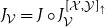 $J_{\mathcal V} = J \circ J_{\mathcal V}^{[{\mathcal X}, \mathcal Y]_\uparrow }$
. Hence, defining
$J_{\mathcal V} = J \circ J_{\mathcal V}^{[{\mathcal X}, \mathcal Y]_\uparrow }$
. Hence, defining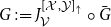 $G:= J_{\mathcal V}^{[{\mathcal X}, \mathcal Y]_\uparrow } \circ \bar G$
, we have that
$G:= J_{\mathcal V}^{[{\mathcal X}, \mathcal Y]_\uparrow } \circ \bar G$
, we have that $J \circ G = J \circ J_{\mathcal V}^{[{\mathcal X}, \mathcal Y]_\uparrow } \circ \bar G = J_{\mathcal V} \circ \bar G = \tilde G$
. We argue that
$J \circ G = J \circ J_{\mathcal V}^{[{\mathcal X}, \mathcal Y]_\uparrow } \circ \bar G = J_{\mathcal V} \circ \bar G = \tilde G$
. We argue that $G$
is monotone. The function
$G$
is monotone. The function $\tilde G$
is certainly monotone, so
$\tilde G$
is certainly monotone, so $J\circ G\circ T=\tilde G\circ T\leq Q\circ \tilde G=Q\circ J\circ G$
, where
$J\circ G\circ T=\tilde G\circ T\leq Q\circ \tilde G=Q\circ J\circ G$
, where $Q$
is the canonical order on
$Q$
is the canonical order on $[{\mathcal X}, \mathcal Y]_\sqsubseteq$
. The injectivity of
$[{\mathcal X}, \mathcal Y]_\sqsubseteq$
. The injectivity of $J$
now implies that
$J$
now implies that $G\circ T\leq J^\dagger \circ Q\circ J\circ G,$
which expresses that
$G\circ T\leq J^\dagger \circ Q\circ J\circ G,$
which expresses that $G$
is monotone, too.
$G$
is monotone, too.
By construction, $\mathrm{Eval}_\uparrow \circ (G\times I_{\mathcal X} ) = \mathrm{Eval}_\sqsubseteq \circ (J\times I_{\mathcal X} )\circ (G\times I_{\mathcal X} ) = \mathrm{Eval}_\sqsubseteq \circ (\tilde G\times I_{\mathcal X}) = F$
. The function
$\mathrm{Eval}_\uparrow \circ (G\times I_{\mathcal X} ) = \mathrm{Eval}_\sqsubseteq \circ (J\times I_{\mathcal X} )\circ (G\times I_{\mathcal X} ) = \mathrm{Eval}_\sqsubseteq \circ (\tilde G\times I_{\mathcal X}) = F$
. The function $G$
is also the unique function with this property, simply because
$G$
is also the unique function with this property, simply because $J$
is injective. Indeed, if
$J$
is injective. Indeed, if $G_1$
and
$G_1$
and $G_2$
are two functions
$G_2$
are two functions $\mathcal Z \to [{\mathcal X},\mathcal Y]_\uparrow$
making the diagram commute, then we have that
$\mathcal Z \to [{\mathcal X},\mathcal Y]_\uparrow$
making the diagram commute, then we have that $F = \mathrm{Eval}_\uparrow \circ (G_i \times I_{\mathcal X}) = \mathrm{Eval}_\sqsubseteq \circ ((J \circ G_i) \times I_{\mathcal X})$
for each
$F = \mathrm{Eval}_\uparrow \circ (G_i \times I_{\mathcal X}) = \mathrm{Eval}_\sqsubseteq \circ ((J \circ G_i) \times I_{\mathcal X})$
for each $i \in \{1,2\}$
. The universal property of
$i \in \{1,2\}$
. The universal property of $\mathrm{Eval}_\sqsubseteq$
implies that
$\mathrm{Eval}_\sqsubseteq$
implies that $J \circ G_1 = J \circ G_2$
, and the injectivity of
$J \circ G_1 = J \circ G_2$
, and the injectivity of $J$
is then implies that
$J$
is then implies that $G_1 = G_2$
. Therefore,
$G_1 = G_2$
. Therefore, $G$
is the unique monotone function making the diagram commute, as claimed.
$G$
is the unique monotone function making the diagram commute, as claimed.
Proposition 5.3.6.
Let $({\mathcal X},R)$
and
$({\mathcal X},R)$
and $(\mathcal Y,S)$
be quantum posets. Let
$(\mathcal Y,S)$
be quantum posets. Let $Q$
be the order on
$Q$
be the order on $[{\mathcal X},\mathcal Y]_\sqsubseteq$
as in [Kornell et al. (Reference Kornell, Lindenhovius and Mislove2022), Theorem 8.3]. Let
$[{\mathcal X},\mathcal Y]_\sqsubseteq$
as in [Kornell et al. (Reference Kornell, Lindenhovius and Mislove2022), Theorem 8.3]. Let $W$
be a relation on
$W$
be a relation on $[{\mathcal X},\mathcal Y]_\sqsubseteq$
such that one of the following (equivalent) conditions hold:
$[{\mathcal X},\mathcal Y]_\sqsubseteq$
such that one of the following (equivalent) conditions hold:
-
(a)
$W\times I_{\mathcal X}\leq \mathrm{Eval}_\sqsubseteq ^\dagger \circ S\circ \mathrm{Eval}_\sqsubseteq$
; -
(b)
$\mathrm{Eval}_\sqsubseteq \circ (W\times I_{\mathcal X})\leq S\circ \mathrm{Eval}_\sqsubseteq$
.


Then $W\leq Q$
.
$W\leq Q$
.
Proof.
Since $I_{[{\mathcal X},\mathcal Y]_\sqsubseteq }\leq \mathrm{Eval}_\sqsubseteq ^\dagger \circ \mathrm{Eval}_\sqsubseteq$
, the conditions (a) and (b) are equivalent.
$I_{[{\mathcal X},\mathcal Y]_\sqsubseteq }\leq \mathrm{Eval}_\sqsubseteq ^\dagger \circ \mathrm{Eval}_\sqsubseteq$
, the conditions (a) and (b) are equivalent.
In order to prove that any of these conditions imply $Q'\leq Q$
, we first note that by [Kornell et al. (Reference Kornell, Lindenhovius and Mislove2022), Theorem 8.3],
$Q'\leq Q$
, we first note that by [Kornell et al. (Reference Kornell, Lindenhovius and Mislove2022), Theorem 8.3], $Q$
is the largest pre-order on
$Q$
is the largest pre-order on $[{\mathcal X},\mathcal Y]_\sqsubseteq$
such that
$[{\mathcal X},\mathcal Y]_\sqsubseteq$
such that
 \begin{equation} \mathrm{Eval}_{\sqsubseteq }\circ (Q\times R)\leq S\circ \mathrm{Eval}_{\sqsubseteq }, \end{equation}
holds. Assume that condition (b) holds. Then,
 \begin{align*} \mathrm{Eval}_\sqsubseteq \circ (W\times R) & = \mathrm{Eval}_\sqsubseteq \circ (W\times I_{\mathcal X})\circ (I_{[{\mathcal X},\mathcal Y]_\sqsubseteq }\times R)\leq S\circ \mathrm{Eval}_\sqsubseteq \circ (I_{[{\mathcal X},\mathcal Y]_\sqsubseteq }\times R)\\ & \leq S\circ \mathrm{Eval}_\sqsubseteq \circ (Q\times R)\leq S\circ S\circ \mathrm{Eval}_\sqsubseteq \leq S\circ \mathrm{Eval}_\sqsubseteq , \end{align*}
where the first inequality is (b), the second inequality follows from [Kornell et al. (Reference Kornell, Lindenhovius and Mislove2022), Lemma A.3], and the penultimate inequality follows since $\mathrm{Eval}_\sqsubseteq$
is monotone (see also the identity (13)). Since
$\mathrm{Eval}_\sqsubseteq$
is monotone (see also the identity (13)). Since $Q$
is the largest pre-order on
$Q$
is the largest pre-order on $[{\mathcal X},\mathcal Y]_\sqsubseteq$
such that (13) holds, it follows that
$[{\mathcal X},\mathcal Y]_\sqsubseteq$
such that (13) holds, it follows that $W\leq Q$
.
$W\leq Q$
.
Proposition 5.3.7.
Let $({\mathcal X},R)$
and
$({\mathcal X},R)$
and $(\mathcal Y,S)$
be quantum cpos. Then,
$(\mathcal Y,S)$
be quantum cpos. Then, $([{\mathcal X},\mathcal Y]_{\uparrow },J^\dagger \circ Q\circ J)$
is a quantum cpo, and
$([{\mathcal X},\mathcal Y]_{\uparrow },J^\dagger \circ Q\circ J)$
is a quantum cpo, and $\mathrm{Eval}_{\uparrow }\colon [{\mathcal X},\mathcal Y]_\uparrow \times {\mathcal X}\to \mathcal Y$
is Scott continuous.
$\mathrm{Eval}_{\uparrow }\colon [{\mathcal X},\mathcal Y]_\uparrow \times {\mathcal X}\to \mathcal Y$
is Scott continuous.
Proof.
The identity $I_{\mathcal X}$
is trivially monotone, and the inclusion
$I_{\mathcal X}$
is trivially monotone, and the inclusion $J$
is monotone by [Kornell et al. (Reference Kornell, Lindenhovius and Mislove2022), Lemma 2.4]. Since
$J$
is monotone by [Kornell et al. (Reference Kornell, Lindenhovius and Mislove2022), Lemma 2.4]. Since $\mathbf{qPOS}$
is a monoidal category [Kornell et al. (Reference Kornell, Lindenhovius and Mislove2022), Theorem 7.5], it follows that
$\mathbf{qPOS}$
is a monoidal category [Kornell et al. (Reference Kornell, Lindenhovius and Mislove2022), Theorem 7.5], it follows that $J\times I_{\mathcal X}$
is also monotone. Furthermore, since
$J\times I_{\mathcal X}$
is also monotone. Furthermore, since $\mathrm{Eval}_\sqsubseteq$
is monotone [Kornell et al. (Reference Kornell, Lindenhovius and Mislove2022), Theorem 8.3], and monotone functions compose, we conclude that
$\mathrm{Eval}_\sqsubseteq$
is monotone [Kornell et al. (Reference Kornell, Lindenhovius and Mislove2022), Theorem 8.3], and monotone functions compose, we conclude that $\mathrm{Eval}_{\uparrow }$
is monotone.
$\mathrm{Eval}_{\uparrow }$
is monotone.
Let $\mathcal H$
be an atomic quantum set and
$\mathcal H$
be an atomic quantum set and $K_1\sqsubseteq K_2\sqsubseteq \cdots$
be a monotonically ascending sequence of functions
$K_1\sqsubseteq K_2\sqsubseteq \cdots$
be a monotonically ascending sequence of functions ${\mathcal H}\to [{\mathcal X},\mathcal Y]_\uparrow$
. We will show that this sequence has a limit
${\mathcal H}\to [{\mathcal X},\mathcal Y]_\uparrow$
. We will show that this sequence has a limit $K_\infty$
, to establish that
$K_\infty$
, to establish that $[{\mathcal X},\mathcal Y]_\uparrow$
is a quantum cpo. We will also show that
$[{\mathcal X},\mathcal Y]_\uparrow$
is a quantum cpo. We will also show that $\mathrm{Eval}_\uparrow \circ (K_n\times I_{\mathcal X})\nearrow \mathrm{Eval}_\uparrow \circ (K_\infty \times I_{\mathcal X})$
, to establish that
$\mathrm{Eval}_\uparrow \circ (K_n\times I_{\mathcal X})\nearrow \mathrm{Eval}_\uparrow \circ (K_\infty \times I_{\mathcal X})$
, to establish that $\mathrm{Eval}_\uparrow$
is Scott continuous in the first variable. By definition of
$\mathrm{Eval}_\uparrow$
is Scott continuous in the first variable. By definition of $[{\mathcal X},\mathcal Y]_\uparrow$
, we already know that
$[{\mathcal X},\mathcal Y]_\uparrow$
, we already know that $\mathrm{Eval}_\uparrow$
is Scott continuous in the second variable. Thus, we will conclude by Proposition 5.2.5 that
$\mathrm{Eval}_\uparrow$
is Scott continuous in the second variable. Thus, we will conclude by Proposition 5.2.5 that $\mathrm{Eval}_\uparrow$
is Scott continuous.
$\mathrm{Eval}_\uparrow$
is Scott continuous.
First, we define $K_\infty$
and show that
$K_\infty$
and show that $\mathrm{Eval}_\sqsubseteq \circ (J\times I_{\mathcal X})\circ (K_n\times I_{\mathcal X})\nearrow \mathrm{Eval}_\sqsubseteq \circ (J\times I_{\mathcal X})\circ (K_\infty \times I_{\mathcal X})$
. For brevity, we write
$\mathrm{Eval}_\sqsubseteq \circ (J\times I_{\mathcal X})\circ (K_n\times I_{\mathcal X})\nearrow \mathrm{Eval}_\sqsubseteq \circ (J\times I_{\mathcal X})\circ (K_\infty \times I_{\mathcal X})$
. For brevity, we write $F_n=\mathrm{Eval}_\uparrow \circ (K_n\times I_{\mathcal X})$
for each
$F_n=\mathrm{Eval}_\uparrow \circ (K_n\times I_{\mathcal X})$
for each $n\in {\mathbb N}$
. By [Kornell et al. (Reference Kornell, Lindenhovius and Mislove2022), Corollary 7.7], we have that
$n\in {\mathbb N}$
. By [Kornell et al. (Reference Kornell, Lindenhovius and Mislove2022), Corollary 7.7], we have that $ K_1\times I_{\mathcal X}\sqsubseteq K_2\times I_{\mathcal X}\sqsubseteq \cdots .$
By the monotonicity of
$ K_1\times I_{\mathcal X}\sqsubseteq K_2\times I_{\mathcal X}\sqsubseteq \cdots .$
By the monotonicity of $\mathrm{Eval}_\uparrow$
, we have that
$\mathrm{Eval}_\uparrow$
, we have that $F_1\sqsubseteq F_2\sqsubseteq \cdots ,$
and since the codomain of the functions
$F_1\sqsubseteq F_2\sqsubseteq \cdots ,$
and since the codomain of the functions $F_n$
is the quantum cpo
$F_n$
is the quantum cpo $\mathcal Y$
, it follows from Proposition 3.2.3 that
$\mathcal Y$
, it follows from Proposition 3.2.3 that $F_n\nearrow F_\infty$
for some function
$F_n\nearrow F_\infty$
for some function $F_\infty :{\mathcal X}\times {\mathcal H}\to \mathcal Y$
.
$F_\infty :{\mathcal X}\times {\mathcal H}\to \mathcal Y$
.
We equip $\mathcal H$
with the trivial order
$\mathcal H$
with the trivial order $I_{\mathcal H}$
. Then given another atomic quantum set
$I_{\mathcal H}$
. Then given another atomic quantum set ${\mathcal H}'$
, any monotonically ascending sequence
${\mathcal H}'$
, any monotonically ascending sequence $G_1\sqsubseteq G_2\sqsubseteq \cdots$
of functions
$G_1\sqsubseteq G_2\sqsubseteq \cdots$
of functions ${\mathcal H}' \to {\mathcal H}$
is constant, as in Example 3.2.2. If
${\mathcal H}' \to {\mathcal H}$
is constant, as in Example 3.2.2. If $T$
denotes the order on
$T$
denotes the order on $[{\mathcal X},\mathcal Y]_\uparrow$
, then for each
$[{\mathcal X},\mathcal Y]_\uparrow$
, then for each $n\in {\mathbb N}$
we have
$n\in {\mathbb N}$
we have $\bigwedge _{k\in {\mathbb N}}T\circ F_n \circ (G_k\times I_{\mathcal X})=T \circ F_n \circ (G_1\times I_{\mathcal X})$
. Hence,
$\bigwedge _{k\in {\mathbb N}}T\circ F_n \circ (G_k\times I_{\mathcal X})=T \circ F_n \circ (G_1\times I_{\mathcal X})$
. Hence, $F_n$
is automatically Scott continuous in the first variable. Moreover, it is straightforward to see that the functions
$F_n$
is automatically Scott continuous in the first variable. Moreover, it is straightforward to see that the functions $K_n$
are Scott continuous. It follows from Lemma 5.2.4 that each function
$K_n$
are Scott continuous. It follows from Lemma 5.2.4 that each function $F_n=\mathrm{Eval}_\uparrow \circ (K_n\times I_{\mathcal X})$
is also Scott continuous in the second variable. Thus, each function
$F_n=\mathrm{Eval}_\uparrow \circ (K_n\times I_{\mathcal X})$
is also Scott continuous in the second variable. Thus, each function $F_n$
is Scott continuous (Proposition 5.2.5). We conclude that, by Proposition 3.3.1, its limit
$F_n$
is Scott continuous (Proposition 5.2.5). We conclude that, by Proposition 3.3.1, its limit $F_\infty :{\mathcal H}\times {\mathcal X}\to \mathcal Y$
is Scott continuous, too. We now apply Lemma 5.3.5 to conclude that there is a function
$F_\infty :{\mathcal H}\times {\mathcal X}\to \mathcal Y$
is Scott continuous, too. We now apply Lemma 5.3.5 to conclude that there is a function $K_\infty :{\mathcal H}\to [{\mathcal X},\mathcal Y]_\uparrow$
such that
$K_\infty :{\mathcal H}\to [{\mathcal X},\mathcal Y]_\uparrow$
such that $F_\infty =\mathrm{Eval}_\uparrow \circ (K_\infty \times I_{\mathcal X})$
.
$F_\infty =\mathrm{Eval}_\uparrow \circ (K_\infty \times I_{\mathcal X})$
.
We show that $K_n \nearrow K_\infty$
. Fix
$K_n \nearrow K_\infty$
. Fix $n\in {\mathbb N}$
. Since
$n\in {\mathbb N}$
. Since $F_n\sqsubseteq F_\infty$
, we have that
$F_n\sqsubseteq F_\infty$
, we have that $F_\infty \leq S\circ F_n$
, whence we obtain that
$F_\infty \leq S\circ F_n$
, whence we obtain that
 \begin{align*} K_\infty \times I_{\mathcal X} & \leq \mathrm{Eval}_\uparrow ^\dagger \circ \mathrm{Eval}_\uparrow \circ (K_\infty \times I_{\mathcal X} )= \mathrm{Eval}_\uparrow ^\dagger \circ F_\infty \\ & \leq \mathrm{Eval}_\uparrow ^\dagger \circ S\circ F_n =\mathrm{Eval}_\uparrow ^\dagger \circ S\circ \mathrm{Eval}_{\uparrow }\circ (K_n\times I_{\mathcal X} )\\ & =(\mathrm{Eval}_\sqsubseteq \circ (J\times I_{\mathcal X} ))^\dagger \circ S\circ \mathrm{Eval}_\sqsubseteq \circ (J\times I_{\mathcal X} )\circ (K_n\times I_{\mathcal X} )\\ & = (J^\dagger \times I_{\mathcal X} )\circ \mathrm{Eval}_\sqsubseteq ^\dagger \circ S\circ \mathrm{Eval}_\sqsubseteq \circ ((J\circ K_n)\times I_{\mathcal X} ). \end{align*}
Appealing to the definition of a function between quantum sets, we conclude that
 \begin{align*} (J\circ K_\infty \circ K_n^\dagger \circ J^\dagger )\times I_{\mathcal X} \leq \mathrm{Eval}_\sqsubseteq ^\dagger \circ S\circ \mathrm{Eval}_\sqsubseteq . \end{align*}
It now follows from Proposition 5.3.6 that $J\circ K_\infty \circ K_n^\dagger \circ J^\dagger \leq Q$
for each
$J\circ K_\infty \circ K_n^\dagger \circ J^\dagger \leq Q$
for each $n\in {\mathbb N}$
. Again appealing to the definition of a function between quantum sets, we infer that
$n\in {\mathbb N}$
. Again appealing to the definition of a function between quantum sets, we infer that $J\circ K_\infty \leq Q\circ J\circ K_n$
; hence,
$J\circ K_\infty \leq Q\circ J\circ K_n$
; hence,
 \begin{equation} J^\dagger \circ Q\circ J\circ K_\infty \leq J^\dagger \circ Q\circ Q\circ J\circ K_n\leq J^\dagger \circ Q\circ J\circ K_n. \end{equation}
The binary relation $J^\dagger \circ Q\circ J$
is of course the canonical order on
$J^\dagger \circ Q\circ J$
is of course the canonical order on $[{\mathcal X},\mathcal Y]_\uparrow$
, so
$[{\mathcal X},\mathcal Y]_\uparrow$
, so $K_n\sqsubseteq K_\infty$
. We vary
$K_n\sqsubseteq K_\infty$
. We vary $n \in {\mathbb N}$
to conclude that
$n \in {\mathbb N}$
to conclude that $J^\dagger \circ Q\circ J\circ K_\infty \leq \bigwedge _{n\in {\mathbb N}}J^\dagger \circ Q\circ J\circ K_n$
, either from this inequality or directly from Inequality (14).
$J^\dagger \circ Q\circ J\circ K_\infty \leq \bigwedge _{n\in {\mathbb N}}J^\dagger \circ Q\circ J\circ K_n$
, either from this inequality or directly from Inequality (14).
To establish that $K_n \nearrow K_\infty$
, it remains to show that
$K_n \nearrow K_\infty$
, it remains to show that $J^\dagger \circ Q\circ J\circ K_\infty \geq \bigwedge _{n\in {\mathbb N}}J^\dagger \circ Q\circ J\circ K_n$
. The function
$J^\dagger \circ Q\circ J\circ K_\infty \geq \bigwedge _{n\in {\mathbb N}}J^\dagger \circ Q\circ J\circ K_n$
. The function $\mathrm{Eval}_\sqsubseteq$
is monotone, and in particular, it is monotone in the first variable (Lemma 5.2.2); hence,
$\mathrm{Eval}_\sqsubseteq$
is monotone, and in particular, it is monotone in the first variable (Lemma 5.2.2); hence, $ Q\times I_{\mathcal X}\leq \mathrm{Eval}_{\sqsubseteq }^\dagger \circ S\circ \mathrm{Eval}_\sqsubseteq$
. We now calculate that
$ Q\times I_{\mathcal X}\leq \mathrm{Eval}_{\sqsubseteq }^\dagger \circ S\circ \mathrm{Eval}_\sqsubseteq$
. We now calculate that
 \begin{align*} \left (\bigwedge _{n\in {\mathbb N}} J^\dagger \circ Q\circ J\circ K_n\right )\times I_{\mathcal X} & = \bigwedge _{n\in {\mathbb N}}(J^\dagger \times I_{\mathcal X})\circ (Q\times I_{\mathcal X})\circ (J\times I_{\mathcal X})\circ (K_n\times I_{\mathcal X})\\ & \leq \bigwedge _{n\in {\mathbb N}}(J^\dagger \times I_{\mathcal X})\circ \mathrm{Eval}_\sqsubseteq ^\dagger \circ S\circ \mathrm{Eval}_\sqsubseteq \circ (J\times I_{\mathcal X})\circ (K_n\times I_{\mathcal X})\\ & = \bigwedge _{n\in {\mathbb N}}(J\times I_{\mathcal X})^\dagger \circ \mathrm{Eval}_\sqsubseteq ^\dagger \circ S\circ F_n\\ & = (J\times I_{\mathcal X})^\dagger \circ \mathrm{Eval}_\sqsubseteq ^\dagger \circ \bigwedge _{n\in {\mathbb N}} S\circ F_n\\ & = (J\times I_{\mathcal X})^\dagger \circ \mathrm{Eval}_\sqsubseteq ^\dagger \circ S\circ F_\infty \\ & = (J^\dagger \times I_{\mathcal X})\circ \mathrm{Eval}_\sqsubseteq ^\dagger \circ S\circ \mathrm{Eval}_\sqsubseteq \circ (J\times I_{\mathcal X})\circ (K_\infty \times I_{\mathcal X}), \end{align*}
where we use [Kornell et al. (Reference Kornell, Lindenhovius and Mislove2022), Lemma A.3] in the first equality and [Kornell et al. (Reference Kornell, Lindenhovius and Mislove2022), Proposition A.6] in the third equality. Appealing to the definition of a function between quantum sets, we infer that
 \begin{equation*} \left (J\circ \left ( \bigwedge _{n\in {\mathbb N}} J^\dagger \circ Q\circ J\circ K_n \right ) \circ K_\infty ^\dagger \circ J^\dagger \right )\times I_{\mathcal X}\leq \mathrm{Eval}_\sqsubseteq ^\dagger \circ S\circ \mathrm{Eval}_\sqsubseteq .\end{equation*}
Applying Proposition 5.3.6, we obtain $J\circ \left ( \bigwedge _{n\in {\mathbb N}} J^\dagger \circ Q\circ J\circ K_n \right ) \circ K_\infty ^\dagger \circ J^\dagger \leq Q.$
Appealing to the injectivity of
$J\circ \left ( \bigwedge _{n\in {\mathbb N}} J^\dagger \circ Q\circ J\circ K_n \right ) \circ K_\infty ^\dagger \circ J^\dagger \leq Q.$
Appealing to the injectivity of $J$
, we reason that
$J$
, we reason that
 \begin{equation*} \left ( \bigwedge _{n\in {\mathbb N}} J^\dagger \circ Q\circ J\circ K_n \right ) \circ K_\infty ^\dagger = J^\dagger \circ J\circ \left ( \bigwedge _{n\in {\mathbb N}} J^\dagger \circ Q\circ J\circ K_n \right ) \circ K_\infty ^\dagger \circ J^\dagger \circ J\leq J^\dagger \circ Q\circ J.\end{equation*}
Therefore, $\bigwedge _{n\in {\mathbb N}} J^\dagger \circ Q\circ J\circ K_n \leq J^\dagger \circ Q\circ J\circ K_\infty$
, and more precisely,
$\bigwedge _{n\in {\mathbb N}} J^\dagger \circ Q\circ J\circ K_n \leq J^\dagger \circ Q\circ J\circ K_\infty$
, and more precisely, $\bigwedge _{n\in {\mathbb N}} J^\dagger \circ Q\circ J\circ K_n = J^\dagger \circ Q\circ J\circ K_\infty$
.
$\bigwedge _{n\in {\mathbb N}} J^\dagger \circ Q\circ J\circ K_n = J^\dagger \circ Q\circ J\circ K_\infty$
.
We conclude that $K_n \nearrow K_\infty$
and, more generally, that
$K_n \nearrow K_\infty$
and, more generally, that $[{\mathcal X},\mathcal Y]_\uparrow$
is a quantum cpo. Furthermore,
$[{\mathcal X},\mathcal Y]_\uparrow$
is a quantum cpo. Furthermore, $\mathrm{Eval}_\uparrow \circ (K_n\times I_{\mathcal X})=F_n\nearrow F_\infty =\mathrm{Eval}_\uparrow \circ (K_\infty \times I_{\mathcal X})$
, and thus,
$\mathrm{Eval}_\uparrow \circ (K_n\times I_{\mathcal X})=F_n\nearrow F_\infty =\mathrm{Eval}_\uparrow \circ (K_\infty \times I_{\mathcal X})$
, and thus, $\mathrm{Eval}_\sqsubseteq$
is Scott continuous in the first variable. Therefore, it is Scott continuous.
$\mathrm{Eval}_\sqsubseteq$
is Scott continuous in the first variable. Therefore, it is Scott continuous.
Theorem 5.3.8.
The category $\mathbf{qCPO}$
is monoidal closed with respect to the monoidal product
$\mathbf{qCPO}$
is monoidal closed with respect to the monoidal product $\times$
, that is, for each triple of quantum cpos
$\times$
, that is, for each triple of quantum cpos $({\mathcal X},R)$
,
$({\mathcal X},R)$
, $(\mathcal Y,S)$
, and
$(\mathcal Y,S)$
, and $(\mathcal Z,T)$
and for each Scott continuous function
$(\mathcal Z,T)$
and for each Scott continuous function $F:\mathcal Z\times {\mathcal X}\to \mathcal Y$
, there is a Scott continuous function
$F:\mathcal Z\times {\mathcal X}\to \mathcal Y$
, there is a Scott continuous function $G \colon \mathcal Z {\rightarrow } [{\mathcal X},\mathcal Y]_{\uparrow }$
such that the following diagram commutes.
$G \colon \mathcal Z {\rightarrow } [{\mathcal X},\mathcal Y]_{\uparrow }$
such that the following diagram commutes.

Proof.
Let $F:\mathcal Z\times {\mathcal X}\to \mathcal Y$
be Scott continuous. By Lemma 5.3.5, there is a unique monotone function
$F:\mathcal Z\times {\mathcal X}\to \mathcal Y$
be Scott continuous. By Lemma 5.3.5, there is a unique monotone function $G:\mathcal Z\to [{\mathcal X},\mathcal Y]_\uparrow$
such that the diagram in the statement of the theorem commutes. It remains only to show that
$G:\mathcal Z\to [{\mathcal X},\mathcal Y]_\uparrow$
such that the diagram in the statement of the theorem commutes. It remains only to show that $G$
is Scott continuous.
$G$
is Scott continuous.
Let $H$
be an atomic quantum set, and let
$H$
be an atomic quantum set, and let $K_1\sqsubseteq K_2\sqsubseteq \cdots$
be a monotonically ascending sequence of functions
$K_1\sqsubseteq K_2\sqsubseteq \cdots$
be a monotonically ascending sequence of functions ${\mathcal H}\to \mathcal Z$
, with limit
${\mathcal H}\to \mathcal Z$
, with limit $K_\infty$
. For each
$K_\infty$
. For each $n\in {\mathbb N}$
, let
$n\in {\mathbb N}$
, let $\tilde K_n=G\circ K_n$
. Since
$\tilde K_n=G\circ K_n$
. Since $G$
is monotone,
$G$
is monotone, $\tilde K_1\sqsubseteq \tilde K_2\sqsubseteq \cdots$
is a monotonically ascending sequence of functions
$\tilde K_1\sqsubseteq \tilde K_2\sqsubseteq \cdots$
is a monotonically ascending sequence of functions ${\mathcal H}\to [{\mathcal X},\mathcal Y]_\uparrow$
, which must have some limit
${\mathcal H}\to [{\mathcal X},\mathcal Y]_\uparrow$
, which must have some limit $\tilde K_\infty$
. By [Kornell et al. (Reference Kornell, Lindenhovius and Mislove2022), Corollary 7.7],
$\tilde K_\infty$
. By [Kornell et al. (Reference Kornell, Lindenhovius and Mislove2022), Corollary 7.7], $K_1\times I_{\mathcal X}\sqsubseteq K_2\times I_{\mathcal X}\sqsubseteq \cdots$
is a monotonically ascending sequence of functions
$K_1\times I_{\mathcal X}\sqsubseteq K_2\times I_{\mathcal X}\sqsubseteq \cdots$
is a monotonically ascending sequence of functions ${\mathcal H}\times {\mathcal X}\to \mathcal Z\times {\mathcal X}$
whose limit is
${\mathcal H}\times {\mathcal X}\to \mathcal Z\times {\mathcal X}$
whose limit is $K_\infty \times I_{\mathcal X}$
by Lemma 5.1.2, and similarly,
$K_\infty \times I_{\mathcal X}$
by Lemma 5.1.2, and similarly, $ \tilde K_1\times I_{\mathcal X}\sqsubseteq \tilde K_2\times I_{\mathcal X}\sqsubseteq \cdots$
is a monotonically increasing sequence of functions
$ \tilde K_1\times I_{\mathcal X}\sqsubseteq \tilde K_2\times I_{\mathcal X}\sqsubseteq \cdots$
is a monotonically increasing sequence of functions $:{\mathcal H}\times {\mathcal X}\to [{\mathcal X},\mathcal Y]_\uparrow \times {\mathcal X}$
whose limit
$:{\mathcal H}\times {\mathcal X}\to [{\mathcal X},\mathcal Y]_\uparrow \times {\mathcal X}$
whose limit $\tilde K_\infty \times I_{\mathcal X}$
.
$\tilde K_\infty \times I_{\mathcal X}$
.
The function $F$
is Scott continuous by assumption, and
$F$
is Scott continuous by assumption, and $\mathrm{Eval}_\uparrow$
is Scott continuous by Proposition 5.3.7. Hence, it follows from Lemma 3.3.4 that
$\mathrm{Eval}_\uparrow$
is Scott continuous by Proposition 5.3.7. Hence, it follows from Lemma 3.3.4 that
 \begin{equation*}F\circ (K_n\times I_{\mathcal X})\nearrow F\circ (K_\infty \times I_{\mathcal X}), \quad \text{and} \quad \mathrm{Eval}_\uparrow \circ (\tilde K_n\times I_{\mathcal X})\nearrow \mathrm{Eval}_\uparrow \circ (\tilde K_\infty \times I_{\mathcal X}).\end{equation*}
Since $F\circ (K_n\times I_{\mathcal X})=\mathrm{Eval}_\uparrow \circ (G\times I_{\mathcal X})\circ (K_n\times I_{\mathcal X})=\mathrm{Eval}_\uparrow \circ (\tilde K_n\times I_{\mathcal X})$
for each
$F\circ (K_n\times I_{\mathcal X})=\mathrm{Eval}_\uparrow \circ (G\times I_{\mathcal X})\circ (K_n\times I_{\mathcal X})=\mathrm{Eval}_\uparrow \circ (\tilde K_n\times I_{\mathcal X})$
for each $n \in {\mathbb N}$
, it follows that
$n \in {\mathbb N}$
, it follows that $F\circ (K_\infty \times I_{\mathcal X})=\mathrm{Eval}_\uparrow \circ (\tilde K_\infty \times I_{\mathcal X})$
and, therefore, that
$F\circ (K_\infty \times I_{\mathcal X})=\mathrm{Eval}_\uparrow \circ (\tilde K_\infty \times I_{\mathcal X})$
and, therefore, that $ \mathrm{Eval}_\uparrow \circ ((G\circ K_\infty )\times I_{\mathcal X})=\mathrm{Eval}_\uparrow (G\times I_{\mathcal X})\circ (K_\infty \times I_{\mathcal X})=F\circ (K_\infty \times I_{\mathcal X})=\mathrm{Eval}_\uparrow \circ (\tilde K_\infty \times I_{\mathcal X}).$
We thus conclude that
$ \mathrm{Eval}_\uparrow \circ ((G\circ K_\infty )\times I_{\mathcal X})=\mathrm{Eval}_\uparrow (G\times I_{\mathcal X})\circ (K_\infty \times I_{\mathcal X})=F\circ (K_\infty \times I_{\mathcal X})=\mathrm{Eval}_\uparrow \circ (\tilde K_\infty \times I_{\mathcal X}).$
We thus conclude that $\mathrm{Eval}_\uparrow \circ ((G\circ K_\infty )\times I_{\mathcal X}) = \mathrm{Eval}_\uparrow \circ (\tilde K_\infty \times I_{\mathcal X})$
.
$\mathrm{Eval}_\uparrow \circ ((G\circ K_\infty )\times I_{\mathcal X}) = \mathrm{Eval}_\uparrow \circ (\tilde K_\infty \times I_{\mathcal X})$
.
Equip $\mathcal H$
with the trivial order
$\mathcal H$
with the trivial order $I_{\mathcal X}$
. Writing
$I_{\mathcal X}$
. Writing $J$
for the inclusion function
$J$
for the inclusion function $[{\mathcal X},\mathcal Y]_\uparrow \hookrightarrow [{\mathcal X},\mathcal Y]_\sqsubseteq$
, we have that
$[{\mathcal X},\mathcal Y]_\uparrow \hookrightarrow [{\mathcal X},\mathcal Y]_\sqsubseteq$
, we have that $\mathrm{Eval}_\sqsubseteq \circ ((J \circ G\circ K_\infty )\times I_{\mathcal X}) = \mathrm{Eval}_\sqsubseteq \circ ((J \circ \tilde K_\infty )\times I_{\mathcal X})$
. The functions
$\mathrm{Eval}_\sqsubseteq \circ ((J \circ G\circ K_\infty )\times I_{\mathcal X}) = \mathrm{Eval}_\sqsubseteq \circ ((J \circ \tilde K_\infty )\times I_{\mathcal X})$
. The functions $J \circ G\circ K_\infty$
and
$J \circ G\circ K_\infty$
and $J \circ \tilde K_\infty$
are both trivially monotone, so they are equal by the universal property of
$J \circ \tilde K_\infty$
are both trivially monotone, so they are equal by the universal property of $\mathrm{Eval}_\sqsubseteq \colon [{\mathcal X},\mathcal Y]_\sqsubseteq \times {\mathcal X} \to \mathcal Y$
. Because
$\mathrm{Eval}_\sqsubseteq \colon [{\mathcal X},\mathcal Y]_\sqsubseteq \times {\mathcal X} \to \mathcal Y$
. Because $J$
is an injection we conclude
$J$
is an injection we conclude $G\circ K_\infty = \tilde K_\infty$
. Thus,
$G\circ K_\infty = \tilde K_\infty$
. Thus, $G \circ K_n = \tilde K_n \nearrow \tilde K_\infty = G \circ K_\infty$
. Therefore,
$G \circ K_n = \tilde K_n \nearrow \tilde K_\infty = G \circ K_\infty$
. Therefore, $G$
is Scott continuous.
$G$
is Scott continuous.
6. Inclusion of
$\mathbf{CPO}$
into
$\mathbf{qCPO}$


As we observed in [Kornell et al. (Reference Kornell, Lindenhovius and Mislove2022), Example 1.3], the pair $(`S, `\sqsubseteq )$
is a quantum poset for every ordinary poset
$(`S, `\sqsubseteq )$
is a quantum poset for every ordinary poset $(S, \sqsubseteq )$
. We proceed to show that if
$(S, \sqsubseteq )$
. We proceed to show that if $(S, \sqsubseteq )$
is a cpo, then
$(S, \sqsubseteq )$
is a cpo, then $(`S, `\sqsubseteq )$
is a quantum cpo. The converse implication holds essentially by construction (Section 3), so we will have shown that the notion of a quantum cpo is indeed a quantum generalization of the ordinary notion.
$(`S, `\sqsubseteq )$
is a quantum cpo. The converse implication holds essentially by construction (Section 3), so we will have shown that the notion of a quantum cpo is indeed a quantum generalization of the ordinary notion.
We will also show that the “inclusion” functor $(S, \sqsubseteq ) \mapsto (`S, `\sqsubseteq )$
from
$(S, \sqsubseteq ) \mapsto (`S, `\sqsubseteq )$
from $\mathbf{CPO}$
to
$\mathbf{CPO}$
to $\mathbf{qCPO}$
has a right adjoint, which takes each quantum cpo
$\mathbf{qCPO}$
has a right adjoint, which takes each quantum cpo $({\mathcal X},R)$
to the ordinary cpo whose points are the one-dimensional atoms of
$({\mathcal X},R)$
to the ordinary cpo whose points are the one-dimensional atoms of $\mathcal X$
, ordered according to
$\mathcal X$
, ordered according to $R$
. For denotational semantics, the existence of this right adjoint assures that
$R$
. For denotational semantics, the existence of this right adjoint assures that $\mathbf{qCPO}$
forms a linear/nonlinear model; the comonad induced by the adjunction can be used to model the exponential modality
$\mathbf{qCPO}$
forms a linear/nonlinear model; the comonad induced by the adjunction can be used to model the exponential modality $!$
of linear logic. See also Definition 2.5.2.
$!$
of linear logic. See also Definition 2.5.2.
6.1 Ordinary cpos as quantum cpos
Let ${\mathcal H} = \mathcal Q\{H\}$
be an atomic quantum set, and let
${\mathcal H} = \mathcal Q\{H\}$
be an atomic quantum set, and let $S$
be an ordinary set. A function
$S$
be an ordinary set. A function $F\colon {\mathcal H} \to `S$
is essentially an
$F\colon {\mathcal H} \to `S$
is essentially an $S$
-valued observable on
$S$
-valued observable on $H$
: it is uniquely determined by an indexed family
$H$
: it is uniquely determined by an indexed family $\{H_s\}_{s \in S}$
of pair-wise orthogonal subspaces of
$\{H_s\}_{s \in S}$
of pair-wise orthogonal subspaces of $H$
that together sum to
$H$
that together sum to $H$
. This one-to-one correspondence may be defined by
$H$
. This one-to-one correspondence may be defined by $H_s = H\cdot F^\star (\delta _s)$
for all
$H_s = H\cdot F^\star (\delta _s)$
for all $s \in S$
, where
$s \in S$
, where $\delta _s \in \ell ^\infty (`S)$
is the minimal projection corresponding to
$\delta _s \in \ell ^\infty (`S)$
is the minimal projection corresponding to $s$
, which is the indicator function on the subset
$s$
, which is the indicator function on the subset $\{s\}\subseteq S$
if we identify
$\{s\}\subseteq S$
if we identify $\ell ^\infty (`S)$
with
$\ell ^\infty (`S)$
with $\ell ^\infty (S)$
, and where
$\ell ^\infty (S)$
, and where $F^\star$
is defined as in Theorem 2.4.1. Intuitively, the unit vectors in
$F^\star$
is defined as in Theorem 2.4.1. Intuitively, the unit vectors in $H_s$
represent those states of the quantum system represented by
$H_s$
represent those states of the quantum system represented by $H$
that yield the outcome
$H$
that yield the outcome $s \in S$
with probability one, see also Example 2.5.5.
$s \in S$
with probability one, see also Example 2.5.5.
Let $(S, \sqsubseteq )$
be a poset, and let
$(S, \sqsubseteq )$
be a poset, and let $F$
and
$F$
and $F'$
be functions
$F'$
be functions ${\mathcal H} \to `S$
, intuitively, two
${\mathcal H} \to `S$
, intuitively, two $S$
-valued observables. As we essentially show in Proposition 6.1.6, the inequality
$S$
-valued observables. As we essentially show in Proposition 6.1.6, the inequality $F \sqsubseteq F'$
is equivalent to the condition
$F \sqsubseteq F'$
is equivalent to the condition $H_{s} \perp H_{s'}'$
for all
$H_{s} \perp H_{s'}'$
for all $s, s'\in S$
such that
$s, s'\in S$
such that $s \not \sqsubseteq s'$
. Thus, intuitively,
$s \not \sqsubseteq s'$
. Thus, intuitively, $F \sqsubseteq F'$
if and only if the two observables are such that if we first measure
$F \sqsubseteq F'$
if and only if the two observables are such that if we first measure $F$
and then we measure
$F$
and then we measure $F'$
, then the outcome
$F'$
, then the outcome $s$
of the first measurement must be below the outcome
$s$
of the first measurement must be below the outcome $s'$
of the second measurement.
$s'$
of the second measurement.
For illustration, we briefly examine the special case $S = {\mathbb R}$
, with
$S = {\mathbb R}$
, with $\sqsubseteq$
being the standard order. Functions
$\sqsubseteq$
being the standard order. Functions ${\mathcal H} \to `{\mathbb R}$
of course correspond to self-adjoint operators on
${\mathcal H} \to `{\mathbb R}$
of course correspond to self-adjoint operators on $H$
, and the order that we have defined is then just the spectral order on
$H$
, and the order that we have defined is then just the spectral order on $H$
[Olson (Reference Olson1971), Definition 1]. Thus, our order on functions
$H$
[Olson (Reference Olson1971), Definition 1]. Thus, our order on functions ${\mathcal H} \to `S$
, for general
${\mathcal H} \to `S$
, for general $S$
, is a generalization of Olson’s spectral order.
$S$
, is a generalization of Olson’s spectral order.
Definition 6.1.1.
Let $H$
be a Hilbert space. A partition on
$H$
be a Hilbert space. A partition on $H$
is a set of nonzero projection operators on
$H$
is a set of nonzero projection operators on $H$
whose sum is the identity operator
$H$
whose sum is the identity operator $1_H$
. A projection is said to be a cell of a partition
$1_H$
. A projection is said to be a cell of a partition $P$
if it is an element of
$P$
if it is an element of $P$
. Similarly, a projection is said to be a multicell of a partition
$P$
. Similarly, a projection is said to be a multicell of a partition $P$
if it is a sum of elements of
$P$
if it is a sum of elements of $P$
, possibly an empty sum or an infinite sum.
$P$
, possibly an empty sum or an infinite sum.
The partitions on a Hilbert space $H$
are obviously analogous to the partitions of an ordinary set
$H$
are obviously analogous to the partitions of an ordinary set $S$
. Such a partition might be more naturally defined to be a decomposition of
$S$
. Such a partition might be more naturally defined to be a decomposition of $H$
into a set of pairwise-orthogonal closed subspaces, but our equivalent definition in terms of projections is more convenient here. We remark that the projections in a partition are necessarily mutually orthogonal, otherwise their sum cannot equal
$H$
into a set of pairwise-orthogonal closed subspaces, but our equivalent definition in terms of projections is more convenient here. We remark that the projections in a partition are necessarily mutually orthogonal, otherwise their sum cannot equal $1_H$
.
$1_H$
.
Definition 6.1.2.
Let $H$
be a Hilbert space, and let
$H$
be a Hilbert space, and let $P_1$
and
$P_1$
and $P_2$
be partitions on
$P_2$
be partitions on $H$
. We define
$H$
. We define $P_1 \leq P_2$
if each projection
$P_1 \leq P_2$
if each projection $p_1 \in P_1$
is contained in some projection
$p_1 \in P_1$
is contained in some projection $p_2 \in P_2$
. The partitions on
$p_2 \in P_2$
. The partitions on $H$
are thus partially ordered.
$H$
are thus partially ordered.
Hence, the inequality $P_1 \leq P_2$
expresses that
$P_1 \leq P_2$
expresses that $P_1$
is finer than
$P_1$
is finer than $P_2$
. This partial order has a greatest element, the singleton partition, but it has no least element. In the pursuit of clarity, we specialize our terminology to the various partial orders that appear in this section. If
$P_2$
. This partial order has a greatest element, the singleton partition, but it has no least element. In the pursuit of clarity, we specialize our terminology to the various partial orders that appear in this section. If $s_1$
and
$s_1$
and $s_2$
are the elements of a poset
$s_2$
are the elements of a poset $(S, \sqsubseteq )$
, then we say that
$(S, \sqsubseteq )$
, then we say that $s_1$
is below
$s_1$
is below $s_2$
to mean that
$s_2$
to mean that $s_1 \sqsubseteq s_2$
. If
$s_1 \sqsubseteq s_2$
. If $p_1$
and
$p_1$
and $p_2$
are projection operators on a Hilbert space
$p_2$
are projection operators on a Hilbert space $H$
, then we say that
$H$
, then we say that $p_1$
is contained in
$p_1$
is contained in $p_2$
to mean that
$p_2$
to mean that $p_1 \leq p_2$
; by definition, this holds if and only if
$p_1 \leq p_2$
; by definition, this holds if and only if $p_1p_2=p_1$
. If
$p_1p_2=p_1$
. If $P_1$
and
$P_1$
and $P_2$
are partitions on a Hilbert space
$P_2$
are partitions on a Hilbert space $H$
, then we say that
$H$
, then we say that $P_1$
refines
$P_1$
refines $P_2$
to mean that
$P_2$
to mean that $P_1 \leq P_2$
. Next, we give a different characterization of the refinement relation. First, we say that projection operators
$P_1 \leq P_2$
. Next, we give a different characterization of the refinement relation. First, we say that projection operators $p$
and
$p$
and $q$
on a Hilbert space
$q$
on a Hilbert space $H$
are orthogonal if
$H$
are orthogonal if $pq=0$
, or equivalently, if
$pq=0$
, or equivalently, if $p\leq (1_H-q)$
, in which case we write
$p\leq (1_H-q)$
, in which case we write $p\perp q$
.
$p\perp q$
.
Lemma 6.1.3.
Let $H$
be a finite-dimensional Hilbert space, and let
$H$
be a finite-dimensional Hilbert space, and let $P_1$
and
$P_1$
and $P_2$
be partitions on
$P_2$
be partitions on $H$
. Then,
$H$
. Then, $P_1$
refines
$P_1$
refines $P_2$
if and only if every cell of
$P_2$
if and only if every cell of $P_2$
is a multicell of
$P_2$
is a multicell of $P_1$
.
$P_1$
.
Proof.
We first make the following observation. If $P$
is a partition on
$P$
is a partition on $H$
, and
$H$
, and $q$
an arbitrary projection operator on
$q$
an arbitrary projection operator on $H$
, then
$H$
, then $\sum P=1_H$
forces that
$\sum P=1_H$
forces that $q\not \perp p$
for some
$q\not \perp p$
for some $p\in P$
. It follows that
$p\in P$
. It follows that $q\leq \sum \{p\in P:p\not \perp q\}=1_H-\sum \{p\in P:p\perp q\}$
.
$q\leq \sum \{p\in P:p\not \perp q\}=1_H-\sum \{p\in P:p\perp q\}$
.
Now assume that $P_1\leq P_2$
. For any
$P_1\leq P_2$
. For any $p\in P_1$
, we have
$p\in P_1$
, we have $p\leq q$
for some
$p\leq q$
for some $q\in P_2$
. If
$q\in P_2$
. If $r\in P_2\setminus \{q\}$
, then
$r\in P_2\setminus \{q\}$
, then $q\perp r$
, hence
$q\perp r$
, hence $p\leq q\leq 1_H-r$
, so also
$p\leq q\leq 1_H-r$
, so also $p\perp r$
. So for each
$p\perp r$
. So for each $p\in P_1$
and each
$p\in P_1$
and each $q\in P_2$
, we either have
$q\in P_2$
, we either have $p\leq q$
or
$p\leq q$
or $p\perp q$
. Now, let
$p\perp q$
. Now, let $q\in P_2$
. Then
$q\in P_2$
. Then $q\leq \sum \{p\in P_1:p\not \perp q\}=\sum \{p\in P_1:p\leq q\}\leq q$
, whence
$q\leq \sum \{p\in P_1:p\not \perp q\}=\sum \{p\in P_1:p\leq q\}\leq q$
, whence $q$
is a multicell of
$q$
is a multicell of $P_1$
.
$P_1$
.
For the converse, assume that every cell of $P_2$
is a multicell of
$P_2$
is a multicell of $P_1$
, and let
$P_1$
, and let $p\in P_1$
. We have
$p\in P_1$
. We have $p\not \perp q$
for some
$p\not \perp q$
for some $q\in P_2$
, and by assumption,
$q\in P_2$
, and by assumption, $q=p_1+\cdots +p_n$
for some cells
$q=p_1+\cdots +p_n$
for some cells $p_1,\ldots ,p_n\in P_1$
. Then,
$p_1,\ldots ,p_n\in P_1$
. Then, $p\not \perp p_i$
for some
$p\not \perp p_i$
for some $i\in \{1,\ldots ,n\}$
, and since all elements of
$i\in \{1,\ldots ,n\}$
, and since all elements of $P_1$
are mutually orthogonal, it follows that
$P_1$
are mutually orthogonal, it follows that $p=p_i\leq p_1+\cdots +p_n=q$
.
$p=p_i\leq p_1+\cdots +p_n=q$
.
Definition 6.1.4.
Let ${\mathcal H} = \mathcal Q\{H\}$
be an atomic quantum set, and let
${\mathcal H} = \mathcal Q\{H\}$
be an atomic quantum set, and let $P$
be a partition on
$P$
be a partition on $H$
. We define the binary relation
$H$
. We define the binary relation $M_P\colon {\mathcal H} {\rightarrow } `P$
by
$M_P\colon {\mathcal H} {\rightarrow } `P$
by $M_P(H, {\mathbb C}_p) = L(H,{\mathbb C}_p)\cdot p$
.
$M_P(H, {\mathbb C}_p) = L(H,{\mathbb C}_p)\cdot p$
.
It is immediate from the definition that $M_P$
is a surjective function. Indeed, for cells
$M_P$
is a surjective function. Indeed, for cells $p_1, p_2 \in P$
, we have
$p_1, p_2 \in P$
, we have $(M_P \circ M_P^\dagger ) ({\mathbb C}_{p_1}, {\mathbb C}_{p_2}) = L(H,{\mathbb C}_{p_1}) \cdot p_1 \cdot p_2 \cdot L({\mathbb C}_{p_2},H) = \delta _{p_1,p_2} \cdot L ({\mathbb C}_{p_1}, {\mathbb C}_{p_2}) = I_{`P}({\mathbb C}_{p_1}, {\mathbb C}_{p_2})$
, where
$(M_P \circ M_P^\dagger ) ({\mathbb C}_{p_1}, {\mathbb C}_{p_2}) = L(H,{\mathbb C}_{p_1}) \cdot p_1 \cdot p_2 \cdot L({\mathbb C}_{p_2},H) = \delta _{p_1,p_2} \cdot L ({\mathbb C}_{p_1}, {\mathbb C}_{p_2}) = I_{`P}({\mathbb C}_{p_1}, {\mathbb C}_{p_2})$
, where $\delta$
denotes the characteristic function of the equality relation on
$\delta$
denotes the characteristic function of the equality relation on $P$
. Thus,
$P$
. Thus, $M_P \circ M_P^\dagger = I_{`P}$
. Similarly,
$M_P \circ M_P^\dagger = I_{`P}$
. Similarly, $(M_P^\dagger \circ M_P)(H, H) = \sum _{p \in P} p \cdot L({\mathbb C}_{p},H)\cdot L(H,{\mathbb C}_{p}) \cdot p = \sum _{p \in P} p \cdot L(H, H) \cdot p \geq \sum _{p \in P} p \cdot ({\mathbb C} \cdot 1_{H})\cdot p = {\mathbb C} \cdot \sum _{p \in P} p = {\mathbb C} \cdot 1_{H} = I_{{\mathcal H}}(H, H)$
, and thus,
$(M_P^\dagger \circ M_P)(H, H) = \sum _{p \in P} p \cdot L({\mathbb C}_{p},H)\cdot L(H,{\mathbb C}_{p}) \cdot p = \sum _{p \in P} p \cdot L(H, H) \cdot p \geq \sum _{p \in P} p \cdot ({\mathbb C} \cdot 1_{H})\cdot p = {\mathbb C} \cdot \sum _{p \in P} p = {\mathbb C} \cdot 1_{H} = I_{{\mathcal H}}(H, H)$
, and thus,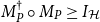 $M_P^\dagger \circ M_P \geq I_{{\mathcal H}}$
.
$M_P^\dagger \circ M_P \geq I_{{\mathcal H}}$
.
Proposition 6.1.5.
Let ${\mathcal H} = \mathcal Q\{H\}$
be an atomic quantum set, let
${\mathcal H} = \mathcal Q\{H\}$
be an atomic quantum set, let $S$
be an ordinary set, and let
$S$
be an ordinary set, and let $F$
be a function from
$F$
be a function from $\mathcal H$
to
$\mathcal H$
to $`S$
. Let
$`S$
. Let $P$
be the partition on
$P$
be the partition on $H$
defined by
$H$
defined by
 \begin{equation*}P = \{F^\star (\delta _s) \,|\, s \in S,\,F^\star (\delta _s) \neq 0 \}.\end{equation*}
Then, there is a unique function $f$
from
$f$
from $P$
to
$P$
to $S$
such that
$S$
such that $F = `f \circ M_P$
.
$F = `f \circ M_P$
.
Proof.
Since $L(H, {\mathbb C}_s)$
is isomorphic to the dual of
$L(H, {\mathbb C}_s)$
is isomorphic to the dual of $H$
, each subspace
$H$
, each subspace $F(H, {\mathbb C}_s) \leq L(H, {\mathbb C}_s)$
is of the form
$F(H, {\mathbb C}_s) \leq L(H, {\mathbb C}_s)$
is of the form $F(H, {\mathbb C}_s) = L(H, {\mathbb C}_s) \cdot p_s$
for some projection
$F(H, {\mathbb C}_s) = L(H, {\mathbb C}_s) \cdot p_s$
for some projection $p_s$
on
$p_s$
on $H$
. Proposition 7.5 of Kornell (Reference Kornell2020) implies that
$H$
. Proposition 7.5 of Kornell (Reference Kornell2020) implies that $p_s = F^\star (\delta _s)$
. Define
$p_s = F^\star (\delta _s)$
. Define $f \colon P {\rightarrow } S$
by
$f \colon P {\rightarrow } S$
by $f(p_s) = s$
, for all projections
$f(p_s) = s$
, for all projections $p_s \in P$
. Then, for each
$p_s \in P$
. Then, for each $s \in S$
,
$s \in S$
,
 \begin{align*} (`f \circ M_P)(H, {\mathbb C}_s) = \sum _{p\in P} `f({\mathbb C}_p, {\mathbb C}_s) \cdot M_P(H, {\mathbb C}_p) = L({\mathbb C}_{p_s}, {\mathbb C}_s) \cdot L(H, {\mathbb C}_{p_s}) \cdot p_s = F(H, {\mathbb C}_s). \end{align*}
The second equality holds even if $p_s \not \in P$
, because in this case,
$p_s \not \in P$
, because in this case, $p_s = 0$
. Thus,
$p_s = 0$
. Thus, $`f \circ M_P = F$
. The uniqueness of
$`f \circ M_P = F$
. The uniqueness of $f$
follows from the surjectivity of
$f$
follows from the surjectivity of $M_P$
.
$M_P$
.
For us, the significance of this proposition is the existence of a factorization $F = `f \circ M_P$
for some partition
$F = `f \circ M_P$
for some partition $P$
on
$P$
on $H$
. Many such factorizations in the sequel may be different from the canonical factorization given by Proposition 6.1.5.
$H$
. Many such factorizations in the sequel may be different from the canonical factorization given by Proposition 6.1.5.
Proposition 6.1.6.
Let $(S, \sqsubseteq )$
be a partially ordered set, and let
$(S, \sqsubseteq )$
be a partially ordered set, and let ${\mathcal H} = \mathcal Q\{H\}$
be an atomic quantum set. Let
${\mathcal H} = \mathcal Q\{H\}$
be an atomic quantum set. Let $P_1$
and
$P_1$
and $P_2$
be partitions on
$P_2$
be partitions on $H$
, and let
$H$
, and let $f_1\colon P_1 {\rightarrow } S$
and
$f_1\colon P_1 {\rightarrow } S$
and $f_2\colon P_2 {\rightarrow } S$
be ordinary functions. Then,
$f_2\colon P_2 {\rightarrow } S$
be ordinary functions. Then, $`f_1 \circ M_{P_1} \sqsubseteq `f_2 \circ M_{P_2}$
if and only if for all
$`f_1 \circ M_{P_1} \sqsubseteq `f_2 \circ M_{P_2}$
if and only if for all $p_1 \in P_1$
and
$p_1 \in P_1$
and $p_2 \in P_2$
, the condition
$p_2 \in P_2$
, the condition $p_1 \not \perp p_2$
implies
$p_1 \not \perp p_2$
implies $f_1(p_1) \sqsubseteq f_2(p_2)$
.
$f_1(p_1) \sqsubseteq f_2(p_2)$
.
Proof.
The inequality $`f_1 \circ M_{P_1} \sqsubseteq `f_2 \circ M_{P_2}$
is equivalent to the inequality
$`f_1 \circ M_{P_1} \sqsubseteq `f_2 \circ M_{P_2}$
is equivalent to the inequality $`f_2 \circ M_{P_2} \leq (`{\sqsubseteq }) \circ `f_1 \circ M_{P_1}$
, by our definition of the order on functions, and this inequality is in turn equivalent to
$`f_2 \circ M_{P_2} \leq (`{\sqsubseteq }) \circ `f_1 \circ M_{P_1}$
, by our definition of the order on functions, and this inequality is in turn equivalent to $`f_2 \circ M_{P_2} \circ M_{P_1}^\dagger \leq (`{\sqsubseteq }) \circ `f_1$
, by our definition of a function as a binary relation between quantum sets. The binary relation
$`f_2 \circ M_{P_2} \circ M_{P_1}^\dagger \leq (`{\sqsubseteq }) \circ `f_1$
, by our definition of a function as a binary relation between quantum sets. The binary relation $M_{P_2} \circ M_{P_1}^\dagger$
is from
$M_{P_2} \circ M_{P_1}^\dagger$
is from $`P_1$
to
$`P_1$
to $`P_2$
, and it is evidently equal to
$`P_2$
, and it is evidently equal to $`r$
, where
$`r$
, where $r$
is the ordinary binary relation that relates
$r$
is the ordinary binary relation that relates $p_1 \in P_1$
to
$p_1 \in P_1$
to $p_2 \in P_2$
if and only if
$p_2 \in P_2$
if and only if $p_1 \not \perp p_2$
. Hence, the inequality
$p_1 \not \perp p_2$
. Hence, the inequality $`f_1 \circ M_{P_1} \sqsubseteq `f_2 \circ M_{P_2}$
is equivalent to
$`f_1 \circ M_{P_1} \sqsubseteq `f_2 \circ M_{P_2}$
is equivalent to $`f_2 \circ `r \leq (`{\sqsubseteq }) \circ `f_1$
, and thus, also to
$`f_2 \circ `r \leq (`{\sqsubseteq }) \circ `f_1$
, and thus, also to $f_2 \circ r \leq ({\sqsubseteq }) \circ f_1$
. This last inequality is obviously equivalent to the claimed implication.
$f_2 \circ r \leq ({\sqsubseteq }) \circ f_1$
. This last inequality is obviously equivalent to the claimed implication.
Lemma 6.1.7.
Let $(S, \sqsubseteq )$
be a partially ordered set, let
$(S, \sqsubseteq )$
be a partially ordered set, let ${\mathcal H} = \mathcal Q\{H\}$
be an atomic quantum set, let
${\mathcal H} = \mathcal Q\{H\}$
be an atomic quantum set, let $P$
be a partition on
$P$
be a partition on $H$
, and let
$H$
, and let $f\colon P {\rightarrow } S$
be a function. Then, for each
$f\colon P {\rightarrow } S$
be a function. Then, for each $s_0 \in S$
, we have
$s_0 \in S$
, we have $(`({\sqsubseteq }) \circ `f \circ M_P)(H, {\mathbb C}_{s_0}) = L(H, {\mathbb C}_{s_0}) \cdot \sum \{ p \in P \,|\, f(p) \sqsubseteq s_0 \}$
.
$(`({\sqsubseteq }) \circ `f \circ M_P)(H, {\mathbb C}_{s_0}) = L(H, {\mathbb C}_{s_0}) \cdot \sum \{ p \in P \,|\, f(p) \sqsubseteq s_0 \}$
.
Proof.
 \begin{align*} (`({\sqsubseteq }) \circ `f \circ M_P)(H, {\mathbb C}_{s_0}) & = \sum _{s \in S} \sum _{p \in P} `({\sqsubseteq })({\mathbb C}_s, {\mathbb C}_{s_0}) \cdot `f({\mathbb C}_p, {\mathbb C}_s) \cdot M_P(H, {\mathbb C}_p) \\ & = \sum _{s \sqsubseteq s_0} \sum _{f(p) = s} L({\mathbb C}_s, {\mathbb C}_{s_0}) \cdot L({\mathbb C}_p, {\mathbb C}_s) \cdot L(H, {\mathbb C}_p) \cdot p \\ & = \sum _{s \sqsubseteq s_0} \sum _{f(p) = s} L(H, {\mathbb C}_{s_0}) \cdot p = L(H, {\mathbb C}_{s_0}) \cdot \sum _{s \sqsubseteq s_0} \sum _{f(p) = s} p \\ &= L(H, {\mathbb C}_{s_0}) \cdot \sum \{ p \in P \,|\, f(p) \sqsubseteq s_0 \} \end{align*}
Proposition 6.1.8.
Let $H$
be a Hilbert space. Each nonempty collection
$H$
be a Hilbert space. Each nonempty collection $\mathcal P$
of partitions on
$\mathcal P$
of partitions on $H$
has a least upper bound.
$H$
has a least upper bound.
Proof.
The union $\bigcup \mathcal P$
is a set of projections on
$\bigcup \mathcal P$
is a set of projections on $\mathcal H$
. We define a graph structure on
$\mathcal H$
. We define a graph structure on $\bigcup \mathcal P$
by defining two projections to be adjacent iff their product is nonzero. We define two projections in
$\bigcup \mathcal P$
by defining two projections to be adjacent iff their product is nonzero. We define two projections in $\bigcup \mathcal P$
to be equivalent iff they are in the same component of the graph. Finally, we define
$\bigcup \mathcal P$
to be equivalent iff they are in the same component of the graph. Finally, we define $Q_0$
to be the set
$Q_0$
to be the set $\{ \bigvee [p] \,|\, [p] \in \bigcup \mathcal P / \sim \}$
.
$\{ \bigvee [p] \,|\, [p] \in \bigcup \mathcal P / \sim \}$
.
We claim that $Q_0$
is a partition on
$Q_0$
is a partition on $H$
. To show pairwise orthogonality, let
$H$
. To show pairwise orthogonality, let $[p]$
and
$[p]$
and $[p']$
be distinct equivalence classes. By definition of the equivalence relation, every projection in
$[p']$
be distinct equivalence classes. By definition of the equivalence relation, every projection in $[p]$
is orthogonal to every projecion in
$[p]$
is orthogonal to every projecion in $[p']$
. Thus,
$[p']$
. Thus, $\bigvee [p]$
is orthogonal to
$\bigvee [p]$
is orthogonal to $\bigvee [p']$
. The join
$\bigvee [p']$
. The join $\bigvee Q_0$
is equal to the join
$\bigvee Q_0$
is equal to the join $\bigvee \bigcup \mathcal P$
, which is clearly the identity operator
$\bigvee \bigcup \mathcal P$
, which is clearly the identity operator $1_H$
, simply because
$1_H$
, simply because $\mathcal P$
is a nonempty collection of partitions.
$\mathcal P$
is a nonempty collection of partitions.
By Definition 6.1.2 of the order on partitions, a partition $Q$
is an upper bound for
$Q$
is an upper bound for $\mathcal P$
if and only if every projection
$\mathcal P$
if and only if every projection $p$
in
$p$
in $\bigcup P$
is contained in a projection
$\bigcup P$
is contained in a projection $q$
in
$q$
in $Q$
. This immediately implies that
$Q$
. This immediately implies that $Q_0$
is an upper bound for
$Q_0$
is an upper bound for $\mathcal P$
, because
$\mathcal P$
, because $p \leq \bigvee [p]$
. To show that
$p \leq \bigvee [p]$
. To show that $Q_0$
is the least upper bound, let
$Q_0$
is the least upper bound, let $Q$
be an arbitrary upper bound for
$Q$
be an arbitrary upper bound for $\mathcal P$
, and let
$\mathcal P$
, and let $p$
be an arbitrary projection in
$p$
be an arbitrary projection in $\bigcup P$
. The projection
$\bigcup P$
. The projection $p$
is a cell of some partition
$p$
is a cell of some partition $P \in \mathcal P$
, which refines
$P \in \mathcal P$
, which refines $Q$
by assumption, so there is a projection
$Q$
by assumption, so there is a projection $q$
in
$q$
in $Q$
that contains
$Q$
that contains $p$
. Similarly, every projection
$p$
. Similarly, every projection $p' \in \bigcup \mathcal P$
that is adjacent to
$p' \in \bigcup \mathcal P$
that is adjacent to $p$
must be contained in some projection
$p$
must be contained in some projection $q'$
in
$q'$
in $Q$
. If
$Q$
. If $q$
and
$q$
and $q'$
are distinct, then they are orthogonal, implying that
$q'$
are distinct, then they are orthogonal, implying that $p$
and
$p$
and $p'$
are also orthogonal, and thus contradicting that
$p'$
are also orthogonal, and thus contradicting that $p$
and
$p$
and $p'$
are adjacent. Therefore,
$p'$
are adjacent. Therefore, $p'$
also must be contained in
$p'$
also must be contained in $q$
. By induction on path length, every projection in
$q$
. By induction on path length, every projection in $\bigcup \mathcal P$
that is equivalent to
$\bigcup \mathcal P$
that is equivalent to $p$
must be contained in
$p$
must be contained in $q$
, so
$q$
, so $\bigvee [p] \leq q$
. We conclude that
$\bigvee [p] \leq q$
. We conclude that $Q_0 \leq Q$
, and more generally, that
$Q_0 \leq Q$
, and more generally, that $Q_0$
is the least upper bound of
$Q_0$
is the least upper bound of $\mathcal P$
.
$\mathcal P$
.
Lemma 6.1.9.
Let $H$
be a nonzero finite-dimensional Hilbert space. Let
$H$
be a nonzero finite-dimensional Hilbert space. Let $q$
be any nonzero projection on
$q$
be any nonzero projection on $H$
, and let
$H$
, and let $P_1, P_2, \ldots$
be any sequence of partitions on
$P_1, P_2, \ldots$
be any sequence of partitions on $H$
. There exists a sequence of projections
$H$
. There exists a sequence of projections $p_1 \not \perp p_2 \not \perp \cdots$
such that
$p_1 \not \perp p_2 \not \perp \cdots$
such that $p_i \in P_i$
and
$p_i \in P_i$
and $p_i \not \perp q$
for all
$p_i \not \perp q$
for all $i \in {\mathbb N}$
. Moreover, such a sequence exists for any prescribed projection
$i \in {\mathbb N}$
. Moreover, such a sequence exists for any prescribed projection $p_n \in P_n$
that is not orthogonal to
$p_n \in P_n$
that is not orthogonal to $q$
, where
$q$
, where $n$
is any positive integer.
$n$
is any positive integer.
Proof.
The cells of the partition $P_1$
sum to the identity, so they cannot all be orthogonal to
$P_1$
sum to the identity, so they cannot all be orthogonal to $q$
. Let
$q$
. Let $p_1 \in P_1$
be any projection that is not orthogonal to
$p_1 \in P_1$
be any projection that is not orthogonal to $q$
. Suppose by contradiction that every projection in
$q$
. Suppose by contradiction that every projection in $P_2$
is either orthogonal to
$P_2$
is either orthogonal to $p_1$
or orthogonal to
$p_1$
or orthogonal to $q$
. Then, we can divide
$q$
. Then, we can divide $P_2$
into the set of projections orthogonal to
$P_2$
into the set of projections orthogonal to $p_1$
, and the set of projections orthogonal to
$p_1$
, and the set of projections orthogonal to $q$
. Since
$q$
. Since $P_2$
is a partition, this implies that
$P_2$
is a partition, this implies that $p_1 \perp q$
, contradicting our choice of
$p_1 \perp q$
, contradicting our choice of $p_1$
. Thus, there exists a projection
$p_1$
. Thus, there exists a projection $p_2 \in P_2$
that is neither orthogonal to
$p_2 \in P_2$
that is neither orthogonal to $p_1$
nor orthogonal to
$p_1$
nor orthogonal to $q$
. Repeating this process recursively, we obtain a sequence of projections
$q$
. Repeating this process recursively, we obtain a sequence of projections $p_1, p_2, \ldots$
with the desired properties.
$p_1, p_2, \ldots$
with the desired properties.
We chose $p_1$
arbitrarily, but we can also construct such a sequence from any given projection
$p_1$
arbitrarily, but we can also construct such a sequence from any given projection $p_1 \in P_1$
that is not orthogonal to
$p_1 \in P_1$
that is not orthogonal to $q$
. Furthermore, we can begin constructing such a sequence from any given projection
$q$
. Furthermore, we can begin constructing such a sequence from any given projection $p_n \in P_n$
, for any given positive integer
$p_n \in P_n$
, for any given positive integer $n$
. If we do so, we may choose the projections
$n$
. If we do so, we may choose the projections $p_{n-1}, \ldots , p_1$
via the same process.
$p_{n-1}, \ldots , p_1$
via the same process.
Lemma 6.1.10.
Let $H$
be a nonzero finite-dimensional Hilbert space, and let
$H$
be a nonzero finite-dimensional Hilbert space, and let $P_1, P_2, \ldots$
be a sequence of partitions on
$P_1, P_2, \ldots$
be a sequence of partitions on $H$
with the property that the partition
$H$
with the property that the partition $Q=\sup _{i \geq n} P_i$
is independent of
$Q=\sup _{i \geq n} P_i$
is independent of $n$
. Let
$n$
. Let $r_1$
be a multicell of
$r_1$
be a multicell of $P_1$
, and for each
$P_1$
, and for each $i\gt 1$
, recursively define
$i\gt 1$
, recursively define $r_{i+1}$
to be the smallest multicell of
$r_{i+1}$
to be the smallest multicell of $P_{i+1}$
that is at least as large as
$P_{i+1}$
that is at least as large as $r_i$
. Then, the monotone increasing sequence
$r_i$
. Then, the monotone increasing sequence $r_1 \leq r_2 \leq \cdots$
stabilizes at the smallest multicell
$r_1 \leq r_2 \leq \cdots$
stabilizes at the smallest multicell $s$
of
$s$
of $Q$
that is at least as large as
$Q$
that is at least as large as $r_1$
.
$r_1$
.
Proof.
The sequence $r_1 \leq r_2 \leq \cdots$
stablizes at some positive integer
$r_1 \leq r_2 \leq \cdots$
stablizes at some positive integer $n$
, because it is a monotone increasing sequence of projections on a finite-dimensional Hilbert space. By induction, each multicell
$n$
, because it is a monotone increasing sequence of projections on a finite-dimensional Hilbert space. By induction, each multicell $r_i$
is contained in
$r_i$
is contained in $s$
, because each partition
$s$
, because each partition $P_i$
refines
$P_i$
refines $Q$
, and therefore every multicell of
$Q$
, and therefore every multicell of $Q$
is also a multicell of
$Q$
is also a multicell of $P_i$
. In particular,
$P_i$
. In particular, $r_n$
is contained in
$r_n$
is contained in $s$
.
$s$
.
By choice of $n$
, the sequence
$n$
, the sequence $r_n$
,
$r_n$
, $r_{n+1}, \cdots$
is constant. Thus,
$r_{n+1}, \cdots$
is constant. Thus, $r_n$
is a multicell of
$r_n$
is a multicell of $P_i$
for each index
$P_i$
for each index $i \geq n$
. This implies that the partition
$i \geq n$
. This implies that the partition $\{r_n, 1-r_n\}$
is refined by each such partition
$\{r_n, 1-r_n\}$
is refined by each such partition $P_i$
, so by definition of
$P_i$
, so by definition of $Q$
, the partition
$Q$
, the partition $\{r_n, 1-r_n\}$
is also refined by
$\{r_n, 1-r_n\}$
is also refined by $Q$
. It follows that
$Q$
. It follows that $r_n$
is a multicell of
$r_n$
is a multicell of $Q$
. Thus,
$Q$
. Thus, $r_n$
is a multicell of
$r_n$
is a multicell of $Q$
that contains
$Q$
that contains $r_1$
and is also contained in
$r_1$
and is also contained in $s$
, the smallest multicell of
$s$
, the smallest multicell of $Q$
that contains
$Q$
that contains $r_1$
. Therefore,
$r_1$
. Therefore, $r_n = s$
.
$r_n = s$
.
Lemma 6.1.11.
Let $(S, \sqsubseteq )$
be a cpo, let
$(S, \sqsubseteq )$
be a cpo, let ${\mathcal H} = \mathcal Q\{H\}$
be an atomic quantum set, and let
${\mathcal H} = \mathcal Q\{H\}$
be an atomic quantum set, and let $F_1 \sqsubseteq F_2 \sqsubseteq \cdots$
be a sequence of functions
$F_1 \sqsubseteq F_2 \sqsubseteq \cdots$
be a sequence of functions ${\mathcal H} {\rightarrow } `S$
. For each index
${\mathcal H} {\rightarrow } `S$
. For each index $i \in {\mathbb N}$
, let
$i \in {\mathbb N}$
, let $P_i$
be a partition on the Hilbert space
$P_i$
be a partition on the Hilbert space $H$
, and let
$H$
, and let $f_i\colon P_i {\rightarrow } S$
be an ordinary function such that
$f_i\colon P_i {\rightarrow } S$
be an ordinary function such that $F_i = `f_i \circ M_{P_i}$
. Let
$F_i = `f_i \circ M_{P_i}$
. Let $P_\infty = \limsup _{i \in {\mathbb N}} P_i$
. Let
$P_\infty = \limsup _{i \in {\mathbb N}} P_i$
. Let $p_\infty \in P_\infty$
, and let
$p_\infty \in P_\infty$
, and let $p_1 \not \perp p_2 \not \perp \cdots$
be a sequence of projections such that
$p_1 \not \perp p_2 \not \perp \cdots$
be a sequence of projections such that $p_i \in P_i$
and
$p_i \in P_i$
and $p_i \not \perp p_\infty$
for all
$p_i \not \perp p_\infty$
for all $i \in {\mathbb N}$
. For every positive integer
$i \in {\mathbb N}$
. For every positive integer $n$
, there exists a positive integer
$n$
, there exists a positive integer $m \geq n$
such that
$m \geq n$
such that $f_m(p) \sqsupseteq f_n(p_n)$
for every projection
$f_m(p) \sqsupseteq f_n(p_n)$
for every projection $p \in P_m$
satisfying
$p \in P_m$
satisfying $p \not \perp p_\infty$
.
$p \not \perp p_\infty$
.
Proof.
For each $n \in {\mathbb N}$
, define
$n \in {\mathbb N}$
, define $\tilde P_n = \sup _{i \geq n} P_i$
. The sequence of partitions
$\tilde P_n = \sup _{i \geq n} P_i$
. The sequence of partitions $\tilde P_1, \tilde P_2, \ldots$
is decreasing, and it therefore stablizes. Thus,
$\tilde P_1, \tilde P_2, \ldots$
is decreasing, and it therefore stablizes. Thus, $P_\infty$
is well defined, and furthermore, for all
$P_\infty$
is well defined, and furthermore, for all $n$
greater than or equal to some positive integer
$n$
greater than or equal to some positive integer $n_0$
, we have
$n_0$
, we have $P_\infty = \sup _{i \geq n} P_i$
. Fix
$P_\infty = \sup _{i \geq n} P_i$
. Fix $p_\infty \in P_\infty$
. Let
$p_\infty \in P_\infty$
. Let $p_1 \not \perp p_2 \not \perp \cdots$
be any sequence of projections with
$p_1 \not \perp p_2 \not \perp \cdots$
be any sequence of projections with $p_i \in P_i$
and
$p_i \in P_i$
and $p_i \not \perp p_\infty$
for all
$p_i \not \perp p_\infty$
for all $i \in {\mathbb N}$
. By Proposition 6.1.6, we have
$i \in {\mathbb N}$
. By Proposition 6.1.6, we have $f_1(p_1) \sqsubseteq f_2(p_2) \sqsubseteq \cdots$
.
$f_1(p_1) \sqsubseteq f_2(p_2) \sqsubseteq \cdots$
.
Let $n$
be any integer greater than or equal to
$n$
be any integer greater than or equal to $n_0$
. The projection
$n_0$
. The projection $p_n$
is a multicell of
$p_n$
is a multicell of $P_n$
, so by Lemma 6.1.10, there is an increasing sequence of projections
$P_n$
, so by Lemma 6.1.10, there is an increasing sequence of projections
 \begin{equation*}r_n \leq r_{n+1} \leq \cdots \leq r_{m} = r_{m+1} = \cdots \end{equation*}
with $r_n$
equal to
$r_n$
equal to $p_n$
, with each subsequent
$p_n$
, with each subsequent $r_i$
equal to the smallest multicell of
$r_i$
equal to the smallest multicell of $P_i$
at least as large as
$P_i$
at least as large as $r_{i-1}$
, and with
$r_{i-1}$
, and with $r_m$
also equal to the smallest multicell of
$r_m$
also equal to the smallest multicell of $P_\infty$
at least as large as
$P_\infty$
at least as large as $r_n$
. Since the partition
$r_n$
. Since the partition $P_n$
refines
$P_n$
refines $P_\infty$
, the cell
$P_\infty$
, the cell $p_n\in P_n$
must be contained in
$p_n\in P_n$
must be contained in $p_\infty$
. We conclude that
$p_\infty$
. We conclude that $r_m = p_\infty$
.
$r_m = p_\infty$
.
Each multicell $r_i$
for
$r_i$
for $i \gt n$
is clearly the sum of all projections in
$i \gt n$
is clearly the sum of all projections in $P_i$
that are not orthogonal to
$P_i$
that are not orthogonal to $r_{i-1}$
. Thus, for any projection
$r_{i-1}$
. Thus, for any projection $q_m \in P_m$
contained in
$q_m \in P_m$
contained in $r_m$
, by backward induction on
$r_m$
, by backward induction on $i$
, we can find a sequence of projections
$i$
, we can find a sequence of projections $q_n \not \perp \cdots \not \perp q_m$
, with
$q_n \not \perp \cdots \not \perp q_m$
, with $q_n$
equal to
$q_n$
equal to $p_n$
, and with each
$p_n$
, and with each $q_i$
in
$q_i$
in $P_i$
. Now, applying Proposition 6.1.6, we conclude that
$P_i$
. Now, applying Proposition 6.1.6, we conclude that $f_n(p_n) = f_n(q_n) \leq \cdots \leq f_m (q_m)$
. Therefore,
$f_n(p_n) = f_n(q_n) \leq \cdots \leq f_m (q_m)$
. Therefore, $f_m(q_m) \sqsupseteq f_n(p_n)$
for every projection
$f_m(q_m) \sqsupseteq f_n(p_n)$
for every projection $q_m \in P_m$
such that
$q_m \in P_m$
such that $q_m \leq r_m$
.
$q_m \leq r_m$
.
Let $p$
be any projection in
$p$
be any projection in $P_m$
that satisfies
$P_m$
that satisfies $p \not \perp p_\infty$
. The partition
$p \not \perp p_\infty$
. The partition $P_m$
refines
$P_m$
refines $P_\infty$
, so
$P_\infty$
, so $p \leq p_\infty$
. In other words,
$p \leq p_\infty$
. In other words, $p \in P_m$
and
$p \in P_m$
and $p \leq r_m$
. Applying the conclusion of the previous paragraph with
$p \leq r_m$
. Applying the conclusion of the previous paragraph with $q_m = p$
, we infer that
$q_m = p$
, we infer that $f_m(p) \sqsupseteq f_n(p_n)$
. Therefore, for all
$f_m(p) \sqsupseteq f_n(p_n)$
. Therefore, for all $n \geq n_0$
, there exists
$n \geq n_0$
, there exists $m \geq n$
such that for all
$m \geq n$
such that for all $p \in P_m$
, if
$p \in P_m$
, if $p \not \perp p_\infty$
, then
$p \not \perp p_\infty$
, then $f_m(p) \sqsupseteq f_n(p_n)$
.
$f_m(p) \sqsupseteq f_n(p_n)$
.
Now, let $n$
be any positive integer less than
$n$
be any positive integer less than $n_0$
, if such a positive integer exists. We have already established that there is a positive integer
$n_0$
, if such a positive integer exists. We have already established that there is a positive integer $m \geq n_0 \gt n$
such that for all
$m \geq n_0 \gt n$
such that for all $p \in P_m$
, if
$p \in P_m$
, if $p \not \perp p_\infty$
, then
$p \not \perp p_\infty$
, then $f_m(p) \sqsupseteq f_{n_0}(p_{n_0}) \sqsupseteq f_n(p_n)$
. Thus, the lemma is proved.
$f_m(p) \sqsupseteq f_{n_0}(p_{n_0}) \sqsupseteq f_n(p_n)$
. Thus, the lemma is proved.
Lemma 6.1.12.
Let $(S, \sqsubseteq )$
be a cpo, let
$(S, \sqsubseteq )$
be a cpo, let ${\mathcal H} = \mathcal Q\{H\}$
be an atomic quantum set, and let
${\mathcal H} = \mathcal Q\{H\}$
be an atomic quantum set, and let $F_1 \sqsubseteq F_2 \sqsubseteq \cdots$
be a sequence of functions
$F_1 \sqsubseteq F_2 \sqsubseteq \cdots$
be a sequence of functions ${\mathcal H} {\rightarrow } `S$
. For each index
${\mathcal H} {\rightarrow } `S$
. For each index $i \in {\mathbb N}$
, let
$i \in {\mathbb N}$
, let $P_i$
be a partition on the Hilbert space
$P_i$
be a partition on the Hilbert space $H$
, and let
$H$
, and let $f_i\colon P_i {\rightarrow } S$
be an ordinary function such that
$f_i\colon P_i {\rightarrow } S$
be an ordinary function such that $F_i = `f_i \circ M_{P_i}$
. Let
$F_i = `f_i \circ M_{P_i}$
. Let $P_\infty = \limsup _{i \in {\mathbb N}} P_i$
, and let
$P_\infty = \limsup _{i \in {\mathbb N}} P_i$
, and let $p_\infty \in P_\infty$
. Then, for each sequence of projections
$p_\infty \in P_\infty$
. Then, for each sequence of projections $p_1 \not \perp p_2 \not \perp \cdots$
such that
$p_1 \not \perp p_2 \not \perp \cdots$
such that $p_i \in P_i$
and
$p_i \in P_i$
and $p_i \not \perp p_\infty$
for all
$p_i \not \perp p_\infty$
for all $i \in {\mathbb N}$
, the supremum
$i \in {\mathbb N}$
, the supremum $\sup _{i\in {\mathbb N}} f_i(p_i)$
is well defined. Furthermore, it does not depend on the choice of sequence.
$\sup _{i\in {\mathbb N}} f_i(p_i)$
is well defined. Furthermore, it does not depend on the choice of sequence.
Proof.
Let $p_1 \not \perp p_2 \not \perp \cdots$
and
$p_1 \not \perp p_2 \not \perp \cdots$
and $p_1' \not \perp p_2' \not \perp \cdots$
be two such sequences of projections. By Proposition 6.1.6 the sequences
$p_1' \not \perp p_2' \not \perp \cdots$
be two such sequences of projections. By Proposition 6.1.6 the sequences $f_1(p_1), f_2(p_2), \ldots$
and
$f_1(p_1), f_2(p_2), \ldots$
and $f_1(p_1'), f_2(p_2'), \ldots$
are monotone increasing, and by our assumption that
$f_1(p_1'), f_2(p_2'), \ldots$
are monotone increasing, and by our assumption that $(S, \sqsubseteq )$
is a cpo,
$(S, \sqsubseteq )$
is a cpo, $\sup _{i\in {\mathbb N}} f_i(p_i)$
and
$\sup _{i\in {\mathbb N}} f_i(p_i)$
and $ \sup _{i \in {\mathbb N}} f_i(p_i')$
are both well defined elements of
$ \sup _{i \in {\mathbb N}} f_i(p_i')$
are both well defined elements of $S$
.
$S$
.
Applying Lemma 6.1.11, we find that for each positive integer $n$
, there is a positive integer
$n$
, there is a positive integer $m$
such that
$m$
such that $f_n(p_n) \sqsubseteq f_m(p_m') \sqsubseteq \sup _{i \in {\mathbb N}} f_i(p_i')$
. Thus,
$f_n(p_n) \sqsubseteq f_m(p_m') \sqsubseteq \sup _{i \in {\mathbb N}} f_i(p_i')$
. Thus, $\sup _{i\in {\mathbb N}} f_i(p_i) \sqsubseteq \sup _{i\in {\mathbb N}} f_i(p_i')$
. Similarly,
$\sup _{i\in {\mathbb N}} f_i(p_i) \sqsubseteq \sup _{i\in {\mathbb N}} f_i(p_i')$
. Similarly, $\sup _{i\in {\mathbb N}} f_i(p_i') \sqsubseteq \sup _{i\in {\mathbb N}} f_i(p_i)$
. Thus, we conclude that the two suprema are equal, and more generally, that the supremum does not depend on our choice of sequence.
$\sup _{i\in {\mathbb N}} f_i(p_i') \sqsubseteq \sup _{i\in {\mathbb N}} f_i(p_i)$
. Thus, we conclude that the two suprema are equal, and more generally, that the supremum does not depend on our choice of sequence.
Theorem 6.1.13.
Let $(S, \sqsubseteq )$
be a cpo, let
$(S, \sqsubseteq )$
be a cpo, let ${\mathcal H} = \mathcal Q\{H\}$
be an atomic quantum set, and let
${\mathcal H} = \mathcal Q\{H\}$
be an atomic quantum set, and let $F_1 \sqsubseteq F_2 \sqsubseteq \cdots$
be a sequence of functions
$F_1 \sqsubseteq F_2 \sqsubseteq \cdots$
be a sequence of functions ${\mathcal H} {\rightarrow } `S$
. For each index
${\mathcal H} {\rightarrow } `S$
. For each index $i \in {\mathbb N}$
, let
$i \in {\mathbb N}$
, let $P_i$
be a partition on the Hilbert space
$P_i$
be a partition on the Hilbert space $H$
, and let
$H$
, and let $f_i\colon P_i {\rightarrow } S$
be an ordinary function such that
$f_i\colon P_i {\rightarrow } S$
be an ordinary function such that $F_i = `f_i \circ M_{P_i}$
. Let
$F_i = `f_i \circ M_{P_i}$
. Let $P_\infty = \limsup _{i \in {\mathbb N}} P_i$
, and let
$P_\infty = \limsup _{i \in {\mathbb N}} P_i$
, and let $f_\infty \colon P_\infty {\rightarrow } S$
be defined by
$f_\infty \colon P_\infty {\rightarrow } S$
be defined by $f_\infty (p_\infty ) = \sup _{i \in {\mathbb N}} f_i(p_i)$
for all
$f_\infty (p_\infty ) = \sup _{i \in {\mathbb N}} f_i(p_i)$
for all $p_\infty \in P_\infty$
, where
$p_\infty \in P_\infty$
, where $p_1 \not \perp p_2 \not \perp \cdots$
is any sequence of projections such that
$p_1 \not \perp p_2 \not \perp \cdots$
is any sequence of projections such that $p_i \in P_i$
and
$p_i \in P_i$
and $p_i \not \perp p_\infty$
for all
$p_i \not \perp p_\infty$
for all $i \in {\mathbb N}$
. Let
$i \in {\mathbb N}$
. Let $F_\infty = `f_\infty \circ M_{P\infty }$
. Then,
$F_\infty = `f_\infty \circ M_{P\infty }$
. Then, $F_i \nearrow F_\infty$
.
$F_i \nearrow F_\infty$
.
Proof.
By the definition of the order on functions, we have that $`({\sqsubseteq }) \circ F_1 \geq `({\sqsubseteq }) \circ F_2 \geq \cdots$
, and we are only to show that the infimum of this sequence is the binary relation
$`({\sqsubseteq }) \circ F_1 \geq `({\sqsubseteq }) \circ F_2 \geq \cdots$
, and we are only to show that the infimum of this sequence is the binary relation $`({\sqsubseteq }) \circ F_\infty$
.
$`({\sqsubseteq }) \circ F_\infty$
.
First, we show that $`({\sqsubseteq }) \circ F_\infty$
is a lower bound, by proving that
$`({\sqsubseteq }) \circ F_\infty$
is a lower bound, by proving that $F_n \sqsubseteq F_\infty$
for each
$F_n \sqsubseteq F_\infty$
for each $n \in {\mathbb N}$
. Fix
$n \in {\mathbb N}$
. Fix $n \in {\mathbb N}$
, and let
$n \in {\mathbb N}$
, and let $p_n \in P_n$
and
$p_n \in P_n$
and $p_\infty \in P_\infty$
be projections such that
$p_\infty \in P_\infty$
be projections such that $p_n \not \perp p_\infty$
. Applying Lemma 6.1.9, we find a sequence
$p_n \not \perp p_\infty$
. Applying Lemma 6.1.9, we find a sequence $p_1 \not \perp p_2 \not \perp \cdots$
such that
$p_1 \not \perp p_2 \not \perp \cdots$
such that $p_i \in P_i$
and
$p_i \in P_i$
and $p_i \not \perp p_\infty$
for all
$p_i \not \perp p_\infty$
for all $i \in {\mathbb N}$
. By definition of
$i \in {\mathbb N}$
. By definition of $f_\infty$
, we conclude that
$f_\infty$
, we conclude that $f_n(p_n) \leq f_\infty (p_\infty )$
. We now conclude by Proposition 6.1.6 that
$f_n(p_n) \leq f_\infty (p_\infty )$
. We now conclude by Proposition 6.1.6 that $F_n \sqsubseteq F_\infty$
, which means that
$F_n \sqsubseteq F_\infty$
, which means that $`({\sqsubseteq }) \circ F_n \geq `({\sqsubseteq }) \circ F_\infty$
. Therefore,
$`({\sqsubseteq }) \circ F_n \geq `({\sqsubseteq }) \circ F_\infty$
. Therefore, $`({\sqsubseteq }) \circ F_\infty$
is indeed a lower bound for our sequence of binary relations.
$`({\sqsubseteq }) \circ F_\infty$
is indeed a lower bound for our sequence of binary relations.
To show that $`({\sqsubseteq }) \circ F_\infty$
is the greatest lower bound, we reason atomwise. Fix
$`({\sqsubseteq }) \circ F_\infty$
is the greatest lower bound, we reason atomwise. Fix $s_0 \in S$
. The decreasing sequence of subspaces
$s_0 \in S$
. The decreasing sequence of subspaces $(`({\sqsubseteq }) \circ F_1)(H, {\mathbb C}_{s_0}) \geq (`({\sqsubseteq }) \circ F_2)(H, {\mathbb C}_{s_0}) \geq \cdots$
must stabilize, as must the decreasing sequence of partitions
$(`({\sqsubseteq }) \circ F_1)(H, {\mathbb C}_{s_0}) \geq (`({\sqsubseteq }) \circ F_2)(H, {\mathbb C}_{s_0}) \geq \cdots$
must stabilize, as must the decreasing sequence of partitions $\sup _{i \geq 1} P_i, \sup _{i \geq 2} P_i, \ldots$
. Without loss of generality, we may assume that both sequences are constant.
$\sup _{i \geq 1} P_i, \sup _{i \geq 2} P_i, \ldots$
. Without loss of generality, we may assume that both sequences are constant.
For each index $i \in {\mathbb N} \cup \{\infty \}$
, define
$i \in {\mathbb N} \cup \{\infty \}$
, define $r_i = \sum \{p \in P_i \,|\, f_i(p) \sqsubseteq s_0\}$
. By Lemma 6.1.7,
$r_i = \sum \{p \in P_i \,|\, f_i(p) \sqsubseteq s_0\}$
. By Lemma 6.1.7, $(`({\sqsubseteq }) \circ F_i)(H, {\mathbb C}_{s_0}) = L(H, {\mathbb C}_{s_0}) \cdot r_i$
, so the sequence
$(`({\sqsubseteq }) \circ F_i)(H, {\mathbb C}_{s_0}) = L(H, {\mathbb C}_{s_0}) \cdot r_i$
, so the sequence $r_1, r_2, \ldots$
is also constant. Since we have already established that
$r_1, r_2, \ldots$
is also constant. Since we have already established that $`({\sqsubseteq }) \circ F_\infty$
is a lower bound, we already have
$`({\sqsubseteq }) \circ F_\infty$
is a lower bound, we already have $r_1 \geq r_\infty$
, and it remains only to show that
$r_1 \geq r_\infty$
, and it remains only to show that $r_1 \leq r_\infty$
. If
$r_1 \leq r_\infty$
. If $r_1 = 0$
, then there is nothing to prove.
$r_1 = 0$
, then there is nothing to prove.
Assume that $r_1 \neq 0$
, and let
$r_1 \neq 0$
, and let $p_1 \in P_1$
be any projection contained in
$p_1 \in P_1$
be any projection contained in $r_1$
. Since
$r_1$
. Since $r_1$
is also a multicell of
$r_1$
is also a multicell of $P_2$
, we may choose a projection
$P_2$
, we may choose a projection $p_2 \in P_2$
that is not orthogonal to
$p_2 \in P_2$
that is not orthogonal to $p_1$
and that is also contained in
$p_1$
and that is also contained in $r_1$
. Continuing in this way, we obtain a sequence of projections
$r_1$
. Continuing in this way, we obtain a sequence of projections $p_1 \not \perp p_2 \not \perp \cdots$
such that
$p_1 \not \perp p_2 \not \perp \cdots$
such that $p_i \in P_i$
and
$p_i \in P_i$
and $p_i \leq r_1$
for each
$p_i \leq r_1$
for each $i \in {\mathbb N}$
. By definition of
$i \in {\mathbb N}$
. By definition of $r_i$
, we are assured that
$r_i$
, we are assured that $f_i(p_i) \sqsubseteq s_0$
for each
$f_i(p_i) \sqsubseteq s_0$
for each $i \in {\mathbb N}$
.
$i \in {\mathbb N}$
.
Each partition $P_i$
refines
$P_i$
refines $P_\infty$
, so each projection
$P_\infty$
, so each projection $p_i$
is contained in some projection in
$p_i$
is contained in some projection in $P_\infty$
. Thus,
$P_\infty$
. Thus, $p_1$
is contained in some projection
$p_1$
is contained in some projection $p_\infty \in P_\infty$
. Furthermore, because
$p_\infty \in P_\infty$
. Furthermore, because $p_1 \not \perp p_2 \not \perp \ldots$
, it follows by induction that
$p_1 \not \perp p_2 \not \perp \ldots$
, it follows by induction that $p_i \leq p_\infty$
for all
$p_i \leq p_\infty$
for all $i \in {\mathbb N}$
. In particular,
$i \in {\mathbb N}$
. In particular, $p_i \not \perp p_\infty$
for all
$p_i \not \perp p_\infty$
for all $i \in {\mathbb N}$
. We now apply the definition of
$i \in {\mathbb N}$
. We now apply the definition of $f_\infty$
to find that
$f_\infty$
to find that $f_\infty (p_\infty ) = \sup _{i \in {\mathbb N}} f_i(p_i) \sqsubseteq s_0$
. Therefore,
$f_\infty (p_\infty ) = \sup _{i \in {\mathbb N}} f_i(p_i) \sqsubseteq s_0$
. Therefore, $p_1 \leq p_\infty \leq r_\infty$
. Since
$p_1 \leq p_\infty \leq r_\infty$
. Since $p_1$
was chosen arbitrarily, we conclude that
$p_1$
was chosen arbitrarily, we conclude that $r_1 \leq r_\infty$
.
$r_1 \leq r_\infty$
.
Therefore, $(`({\sqsubseteq }) \circ F_1)(H, {\mathbb C}_{s_0}) = L(H, {\mathbb C}_{s_0}) \cdot r_1 = L(H, {\mathbb C}_{s_0}) \cdot r_\infty = (`({\sqsubseteq }) \circ F_\infty )(H, {\mathbb C}_{s_0})$
. We vary
$(`({\sqsubseteq }) \circ F_1)(H, {\mathbb C}_{s_0}) = L(H, {\mathbb C}_{s_0}) \cdot r_1 = L(H, {\mathbb C}_{s_0}) \cdot r_\infty = (`({\sqsubseteq }) \circ F_\infty )(H, {\mathbb C}_{s_0})$
. We vary $s_0 \in S$
to conclude that
$s_0 \in S$
to conclude that $`({\sqsubseteq }) \circ F_1 = `({\sqsubseteq }) \circ F_\infty$
, and thus,
$`({\sqsubseteq }) \circ F_1 = `({\sqsubseteq }) \circ F_\infty$
, and thus, $`({\sqsubseteq }) \circ F_\infty$
is the infimum of
$`({\sqsubseteq }) \circ F_\infty$
is the infimum of $`({\sqsubseteq }) \circ F_1 \geq `({\sqsubseteq }) \circ F_2 \geq \cdots$
.
$`({\sqsubseteq }) \circ F_1 \geq `({\sqsubseteq }) \circ F_2 \geq \cdots$
.
Corollary 6.1.14.
Let $(S,\sqsubseteq )$
be a cpo. Then,
$(S,\sqsubseteq )$
be a cpo. Then, $(`S, `{\sqsubseteq })$
is a quantum cpo.
$(`S, `{\sqsubseteq })$
is a quantum cpo.
Proof.
Let $\mathcal H$
be an atomic quantum set, and let
$\mathcal H$
be an atomic quantum set, and let $F_1 \sqsubseteq F_2 \sqsubseteq \cdots$
be an ascending sequence of functions
$F_1 \sqsubseteq F_2 \sqsubseteq \cdots$
be an ascending sequence of functions ${\mathcal H} {\rightarrow } `S$
. By Proposition 6.1.5, each function
${\mathcal H} {\rightarrow } `S$
. By Proposition 6.1.5, each function $F_i$
may be factored as
$F_i$
may be factored as $F_i = `f_i \circ M_{P_i}$
, for some partition
$F_i = `f_i \circ M_{P_i}$
, for some partition $P_i$
on
$P_i$
on $H$
, and some ordinary function
$H$
, and some ordinary function $f_i\colon P_i {\rightarrow } S$
. By Theorem 6.1.13, there exists a function
$f_i\colon P_i {\rightarrow } S$
. By Theorem 6.1.13, there exists a function $F_\infty \colon {\mathcal H} {\rightarrow } `S$
such that
$F_\infty \colon {\mathcal H} {\rightarrow } `S$
such that $F_i \nearrow F_\infty$
.
$F_i \nearrow F_\infty$
.
Corollary 6.1.15.
Let $(S_1,\sqsubseteq _1)$
and
$(S_1,\sqsubseteq _1)$
and $(S_2, \sqsubseteq _2)$
be cpos, and let
$(S_2, \sqsubseteq _2)$
be cpos, and let $g\colon S_1 \to S_2$
be a Scott continuous function. Then
$g\colon S_1 \to S_2$
be a Scott continuous function. Then $`g\colon `S_1 {\rightarrow } `S_2$
is also Scott continuous.
$`g\colon `S_1 {\rightarrow } `S_2$
is also Scott continuous.
Proof.
Let $\mathcal H$
be an atomic quantum set, and let
$\mathcal H$
be an atomic quantum set, and let $F_1, F_2, \ldots , F_\infty$
be functions
$F_1, F_2, \ldots , F_\infty$
be functions ${\mathcal H} {\rightarrow } `S$
such that
${\mathcal H} {\rightarrow } `S$
such that $F_i \nearrow F_\infty$
. By Proposition 6.1.5, each function
$F_i \nearrow F_\infty$
. By Proposition 6.1.5, each function $F_i$
may be factored as
$F_i$
may be factored as $F_i = `f_i \circ M_{P_i}$
, for some partition
$F_i = `f_i \circ M_{P_i}$
, for some partition $P_i$
on
$P_i$
on $H$
, and some ordinary function
$H$
, and some ordinary function $f_i\colon P_i {\rightarrow } S$
. By Theorem 6.1.13,
$f_i\colon P_i {\rightarrow } S$
. By Theorem 6.1.13, $F_\infty$
may be factored as
$F_\infty$
may be factored as $F_\infty = `f_\infty \circ M_{P_\infty }$
, where
$F_\infty = `f_\infty \circ M_{P_\infty }$
, where $P_\infty = \limsup _{i {\rightarrow } \infty } P_i$
and
$P_\infty = \limsup _{i {\rightarrow } \infty } P_i$
and $f_\infty \colon P_\infty {\rightarrow } S$
is defined by
$f_\infty \colon P_\infty {\rightarrow } S$
is defined by $f_\infty (p_\infty ) = \sup _{i \in {\mathbb N}} f_i(p_i)$
for all
$f_\infty (p_\infty ) = \sup _{i \in {\mathbb N}} f_i(p_i)$
for all $p_\infty \in P_\infty$
, where
$p_\infty \in P_\infty$
, where $p_1 \not \perp p_2 \not \perp \cdots$
is any sequence of projections such that
$p_1 \not \perp p_2 \not \perp \cdots$
is any sequence of projections such that $p_i \in P_i$
and
$p_i \in P_i$
and $p_i \not \perp p_\infty$
for all
$p_i \not \perp p_\infty$
for all $i \in {\mathbb N}$
.
$i \in {\mathbb N}$
.
We now apply Theorem 6.1.13 again, to show that $`g \circ F_i \nearrow `g \circ F_\infty$
. Indeed, each function
$`g \circ F_i \nearrow `g \circ F_\infty$
. Indeed, each function $`g\circ F_i$
may be factored as
$`g\circ F_i$
may be factored as $`g \circ F_i = `(g \circ f_i) \circ M_{P_i}$
, and
$`g \circ F_i = `(g \circ f_i) \circ M_{P_i}$
, and $`g \circ F_\infty$
may be similarly factored as
$`g \circ F_\infty$
may be similarly factored as $`g \circ F_\infty = `(g \circ f_\infty ) \circ M_{P_\infty }$
. Furthermore, for each projection
$`g \circ F_\infty = `(g \circ f_\infty ) \circ M_{P_\infty }$
. Furthermore, for each projection $p_\infty \in P_\infty$
, and each sequence
$p_\infty \in P_\infty$
, and each sequence $p_1 \not \perp p_2 \not \perp \cdots$
such that
$p_1 \not \perp p_2 \not \perp \cdots$
such that $p_i \in P_i$
and
$p_i \in P_i$
and $p_i \not \perp p_\infty$
for all
$p_i \not \perp p_\infty$
for all $i\in {\mathbb N}$
, we have
$i\in {\mathbb N}$
, we have $(g \circ f_\infty )(p_\infty ) = g (f_\infty (p_\infty )) = g(\sup _{i \in {\mathbb N}} f_i(n_i)) = \sup _{i \in {\mathbb N}} g(f_i(n_i)) = \sup _{i \in {\mathbb N}} (g \circ f_i)(n_i)$
. The third equality in the calculation appeals to the given assumption that
$(g \circ f_\infty )(p_\infty ) = g (f_\infty (p_\infty )) = g(\sup _{i \in {\mathbb N}} f_i(n_i)) = \sup _{i \in {\mathbb N}} g(f_i(n_i)) = \sup _{i \in {\mathbb N}} (g \circ f_i)(n_i)$
. The third equality in the calculation appeals to the given assumption that $g$
is Scott continuous, and to Proposition 6.1.6. We conclude by Theorem 6.1.13 that
$g$
is Scott continuous, and to Proposition 6.1.6. We conclude by Theorem 6.1.13 that $`g \circ F_i \nearrow `g \circ F_\infty$
. Therefore,
$`g \circ F_i \nearrow `g \circ F_\infty$
. Therefore, $`g$
is Scott continuous.
$`g$
is Scott continuous.
Proposition 6.1.16.
Let $(S,\sqsubseteq _S)$
and
$(S,\sqsubseteq _S)$
and $(T,\sqsubseteq _T)$
be cpos. Denote by
$(T,\sqsubseteq _T)$
be cpos. Denote by $\sqsubseteq _{S\times T}$
the product order on
$\sqsubseteq _{S\times T}$
the product order on $S\times T$
, that is,
$S\times T$
, that is, $(s_1,t_1)\sqsubseteq _{S\times T}(s_2,t_2)$
if and only if
$(s_1,t_1)\sqsubseteq _{S\times T}(s_2,t_2)$
if and only if $s_1\sqsubseteq _S s_2$
and
$s_1\sqsubseteq _S s_2$
and $t_1\sqsubseteq _T t_2$
. Then, there is an order isomorphism
$t_1\sqsubseteq _T t_2$
. Then, there is an order isomorphism $G:`(S,\sqsubseteq _S)\times `(T,\sqsubseteq _T)\to `(S\times T,\sqsubseteq _{S\times T})$
whose only nonzero components are given by
$G:`(S,\sqsubseteq _S)\times `(T,\sqsubseteq _T)\to `(S\times T,\sqsubseteq _{S\times T})$
whose only nonzero components are given by $G({\mathbb C}_s\otimes {\mathbb C}_t,{\mathbb C}_{(s,t)})=L({\mathbb C}_s\otimes {\mathbb C}_t,{\mathbb C}_{(s,t)})$
for each
$G({\mathbb C}_s\otimes {\mathbb C}_t,{\mathbb C}_{(s,t)})=L({\mathbb C}_s\otimes {\mathbb C}_t,{\mathbb C}_{(s,t)})$
for each $s\in S$
and each
$s\in S$
and each $t\in T$
.
$t\in T$
.
Proof.
It was already stated in [Kornell (Reference Kornell2020), Section II] that $`S\times `T\cong `(S\times T)$
. Clearly,
$`S\times `T\cong `(S\times T)$
. Clearly, $G:`S\times `T\to `(S\times T)$
is a bijection. A short calculation yields
$G:`S\times `T\to `(S\times T)$
is a bijection. A short calculation yields
 \begin{align*} \big (G\circ (`{\sqsubseteq _S}\times `{\sqsubseteq _T})\big )({\mathbb C}_{s_1}\otimes {\mathbb C}_{t_1},{\mathbb C}_{(s_2,t_2)})=\begin{cases} L({\mathbb C}_{s_1}\otimes {\mathbb C}_{t_1},{\mathbb C}_{(s_2,t_2)}), & s_1\sqsubseteq _S s_2\text{ and }t_1\sqsubseteq _Tt_2, \\ 0, & \text{else}, \end{cases} \end{align*}
and
 \begin{align*} \big (`{\sqsubseteq _{S\times T}}\circ G\big )({\mathbb C}_{s_1}\otimes {\mathbb C}_{t_1},{\mathbb C}_{(s_2,t_2)}) =\begin{cases} L({\mathbb C}_{s_1}\otimes {\mathbb C}_{t_1},{\mathbb C}_{(s_2,t_2)}), & s_1\sqsubseteq _S s_2\text{ and }t_1\sqsubseteq _Tt_2, \\ 0, & \text{else}. \end{cases} \end{align*}
It follows that $G\circ (`{\sqsubseteq _S}\times `{\sqsubseteq _T})=`{\sqsubseteq _{S\times T}}\circ G$
, so
$G\circ (`{\sqsubseteq _S}\times `{\sqsubseteq _T})=`{\sqsubseteq _{S\times T}}\circ G$
, so $G$
is an order isomorphism by [Kornell et al. (Reference Kornell, Lindenhovius and Mislove2022), Proposition 2.7].
$G$
is an order isomorphism by [Kornell et al. (Reference Kornell, Lindenhovius and Mislove2022), Proposition 2.7].
6.2 The right adjoint of inclusion
It follows from Corollaries 6.1.14 and 6.1.15 that the functor $`(\!-\!):\mathbf{POS}\to \mathbf{qPOS}$
restricts and corestricts to a functor
$`(\!-\!):\mathbf{POS}\to \mathbf{qPOS}$
restricts and corestricts to a functor $`(\!-\!):{\mathbf{CPO}}\to \mathbf{qCPO}$
. Now, we will show that the functor
$`(\!-\!):{\mathbf{CPO}}\to \mathbf{qCPO}$
. Now, we will show that the functor ${\mathcal X}\mapsto \mathbf{qCPO}({\mathbf 1},{\mathcal X})$
is its right adjoint. Of course,
${\mathcal X}\mapsto \mathbf{qCPO}({\mathbf 1},{\mathcal X})$
is its right adjoint. Of course, $\mathbf{qCPO}({\mathbf 1},{\mathcal X})$
is canonically a cpo, because
$\mathbf{qCPO}({\mathbf 1},{\mathcal X})$
is canonically a cpo, because $\mathbf{qCPO}$
is enriched over
$\mathbf{qCPO}$
is enriched over $\mathbf{CPO}$
(Theorem 3.3.5). Any function from
$\mathbf{CPO}$
(Theorem 3.3.5). Any function from $\mathbf 1$
to a quantum cpo
$\mathbf 1$
to a quantum cpo $\mathcal X$
is automatically Scott continuous, and hence, the points of
$\mathcal X$
is automatically Scott continuous, and hence, the points of $\mathbf{qCPO}({\mathbf 1},{\mathcal X})$
are in canonical one-to-one correspondence with the one-dimensional atoms of
$\mathbf{qCPO}({\mathbf 1},{\mathcal X})$
are in canonical one-to-one correspondence with the one-dimensional atoms of $\mathcal X$
.
$\mathcal X$
.
We begin by showing that the the one-dimensional atoms of a quantum cpo $({\mathcal X},R)$
form a sub-cpo. So, let
$({\mathcal X},R)$
form a sub-cpo. So, let ${\mathcal X}_1$
be the subset of
${\mathcal X}_1$
be the subset of $\mathcal X$
that consists of the one-dimensional atoms of
$\mathcal X$
that consists of the one-dimensional atoms of $\mathcal X$
, let
$\mathcal X$
, let $J_1\colon {\mathcal X}_1 \hookrightarrow {\mathcal X}$
be its inclusion function, and let
$J_1\colon {\mathcal X}_1 \hookrightarrow {\mathcal X}$
be its inclusion function, and let $R_1$
be the induced order on
$R_1$
be the induced order on ${\mathcal X}_1$
, that is, let
${\mathcal X}_1$
, that is, let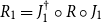 $R_1=J_1^\dagger \circ R\circ J_1$
[Kornell et al. (Reference Kornell, Lindenhovius and Mislove2022), Definition 2.2].
$R_1=J_1^\dagger \circ R\circ J_1$
[Kornell et al. (Reference Kornell, Lindenhovius and Mislove2022), Definition 2.2].
Lemma 6.2.1.
Make the assumptions of Theorem 6.1.13. Furthermore, let $({\mathcal X},R)$
be a quantum cpo, and assume that
$({\mathcal X},R)$
be a quantum cpo, and assume that $S = \mathrm{At}({\mathcal X}_1)$
, with
$S = \mathrm{At}({\mathcal X}_1)$
, with $X_1 \sqsubseteq X_1'$
iff
$X_1 \sqsubseteq X_1'$
iff $R(X_1, X_1') \neq 0$
, for
$R(X_1, X_1') \neq 0$
, for $X_1, X_1' \in S$
. Let
$X_1, X_1' \in S$
. Let $E$
be the canonical isomorphism
$E$
be the canonical isomorphism $`S \leftrightarrow {\mathcal X}_1$
, and let
$`S \leftrightarrow {\mathcal X}_1$
, and let $J_1$
be the inclusion function
$J_1$
be the inclusion function ${\mathcal X}_1 \hookrightarrow {\mathcal X}$
. If
${\mathcal X}_1 \hookrightarrow {\mathcal X}$
. If $P_\infty =\{1\}$
, then
$P_\infty =\{1\}$
, then $J_1 \circ E \circ$ $F_i \nearrow J_1 \circ E \circ F_\infty$
.
$F_i \nearrow J_1 \circ E \circ F_\infty$
.
Proof.
Let $p_\infty = 1$
, and let
$p_\infty = 1$
, and let $p_1 \not \perp p_2 \not \perp p_3 \not \perp \cdots$
be a sequence of projections such that
$p_1 \not \perp p_2 \not \perp p_3 \not \perp \cdots$
be a sequence of projections such that $p_i \in P_i$
for all
$p_i \in P_i$
for all $i \in {\mathbb N}$
, as in the statement of Theorem 6.1.13. Assume that
$i \in {\mathbb N}$
, as in the statement of Theorem 6.1.13. Assume that $P_\infty := \limsup _{i \in {\mathbb N}} P_i$
equals
$P_\infty := \limsup _{i \in {\mathbb N}} P_i$
equals $\{1\}$
. For each
$\{1\}$
. For each $i \in {\mathbb N} \cup \{\infty \}$
, let
$i \in {\mathbb N} \cup \{\infty \}$
, let $h_i\colon \{1\} {\rightarrow } S$
be the function defined by
$h_i\colon \{1\} {\rightarrow } S$
be the function defined by $h_i(1) = f_i(p_i)$
. Thus,
$h_i(1) = f_i(p_i)$
. Thus, $`h_\infty \circ M_{\{1\}} = F_\infty$
, but in general,
$`h_\infty \circ M_{\{1\}} = F_\infty$
, but in general, $`h_i \circ M_{\{1\}}$
is distinct from
$`h_i \circ M_{\{1\}}$
is distinct from $F_i$
. However, we will eventually show that for each sufficiently large integer
$F_i$
. However, we will eventually show that for each sufficiently large integer $n$
, there is an integer
$n$
, there is an integer $m \geq n$
such that
$m \geq n$
such that $`h_n \circ M_{\{1\}} \sqsubseteq F_m$
.
$`h_n \circ M_{\{1\}} \sqsubseteq F_m$
.
By definition of the functions $h_i$
, for
$h_i$
, for $i \in {\mathbb N} \cup \{\infty \}$
, we certainly have that
$i \in {\mathbb N} \cup \{\infty \}$
, we certainly have that $h_i \nearrow h_\infty$
. The functions
$h_i \nearrow h_\infty$
. The functions $J_1$
and
$J_1$
and $E$
are both monotone, so we also know that
$E$
are both monotone, so we also know that $J_1 \circ E \circ `h_1 \sqsubseteq J_1 \circ E \circ `h_2 \sqsubseteq \cdots$
is a monotone increasing sequence. Because
$J_1 \circ E \circ `h_1 \sqsubseteq J_1 \circ E \circ `h_2 \sqsubseteq \cdots$
is a monotone increasing sequence. Because $({\mathcal X},R)$
is a quantum cpo, this monotone increasing sequence has a limit, also a function
$({\mathcal X},R)$
is a quantum cpo, this monotone increasing sequence has a limit, also a function $\{1\} {\rightarrow } {\mathcal X}$
. This limiting function must factor through
$\{1\} {\rightarrow } {\mathcal X}$
. This limiting function must factor through $J_1$
, and it must be the least upper bound of the sequence, so it must be equal to
$J_1$
, and it must be the least upper bound of the sequence, so it must be equal to $J_1 \circ E \circ `h_\infty$
. We conclude that
$J_1 \circ E \circ `h_\infty$
. We conclude that $J_1 \circ E \circ `h_i \nearrow J_1 \circ E \circ `h_\infty$
. As a consequence, we also have that
$J_1 \circ E \circ `h_i \nearrow J_1 \circ E \circ `h_\infty$
. As a consequence, we also have that $J_1 \circ E \circ `h_i \circ M_{\{1\}} \nearrow J_1 \circ E \circ `h_\infty \circ M_{\{1\}}$
.
$J_1 \circ E \circ `h_i \circ M_{\{1\}} \nearrow J_1 \circ E \circ `h_\infty \circ M_{\{1\}}$
.
By Lemma 6.1.11, for each positive integer $n$
, there exists an integer
$n$
, there exists an integer $m \geq n$
such that
$m \geq n$
such that $f_m(p) \sqsupseteq f_n(p_n)$
for every projection
$f_m(p) \sqsupseteq f_n(p_n)$
for every projection $p \in P_m$
. It follows by Proposition 6.1.6 that for each positive integer
$p \in P_m$
. It follows by Proposition 6.1.6 that for each positive integer $n$
, there exists an integer
$n$
, there exists an integer $m(n) \geq n$
such that
$m(n) \geq n$
such that $F_{m(n)} \sqsupseteq `h_n \circ M_{\{1\}}$
. Hence,
$F_{m(n)} \sqsupseteq `h_n \circ M_{\{1\}}$
. Hence, $J_1 \circ E \circ `h_n \circ M_{\{1\}} \sqsubseteq J_1 \circ E \circ F_{m(n)}$
for all sufficiently large integers
$J_1 \circ E \circ `h_n \circ M_{\{1\}} \sqsubseteq J_1 \circ E \circ F_{m(n)}$
for all sufficiently large integers $n$
.
$n$
.
We now calculate that
 \begin{align*} R \circ J_1 \circ E \circ F_\infty & = R \circ J_1 \circ E \circ `h_\infty \circ M_{\{1\}} = \bigwedge _{n \in {\mathbb N}} R \circ J_1 \circ E \circ `h_n \circ M_{\{1\}} \\ &\geq \bigwedge _{n \in {\mathbb N}} R \circ J_1 \circ E \circ F_{m(n)} \geq \bigwedge _{m \in {\mathbb N}} R \circ J_1 \circ E \circ F_m. \end{align*}
It follows from the monotonicity of $J_1$
and
$J_1$
and $E$
that
$E$
that $J_1 \circ E \circ F_1 \sqsubseteq J_1 \circ E \circ F_2 \sqsubseteq \cdots$
is an increasing sequence, so the converse inequality is already established. Thus, the lemma is proved.
$J_1 \circ E \circ F_1 \sqsubseteq J_1 \circ E \circ F_2 \sqsubseteq \cdots$
is an increasing sequence, so the converse inequality is already established. Thus, the lemma is proved.
Theorem 6.2.2.
Let ${\mathcal H} = \mathcal Q\{H\}$
be an atomic quantum set, let
${\mathcal H} = \mathcal Q\{H\}$
be an atomic quantum set, let $({\mathcal X}, R)$
be a quantum cpo, and let
$({\mathcal X}, R)$
be a quantum cpo, and let $J_1\colon {\mathcal X}_1 \hookrightarrow {\mathcal X}$
be the inclusion function. For each
$J_1\colon {\mathcal X}_1 \hookrightarrow {\mathcal X}$
be the inclusion function. For each $i \in {\mathbb N} \cup \{\infty \}$
, let
$i \in {\mathbb N} \cup \{\infty \}$
, let $G_i$
be a function from
$G_i$
be a function from $\mathcal H$
to
$\mathcal H$
to $\mathcal X$
. Assume that
$\mathcal X$
. Assume that $G_i \nearrow G_\infty$
, and that
$G_i \nearrow G_\infty$
, and that $G_i$
factors through
$G_i$
factors through $J_1$
for each
$J_1$
for each $i \in {\mathbb N}$
. Then,
$i \in {\mathbb N}$
. Then, $G_\infty$
also factors through
$G_\infty$
also factors through $J_1$
.
$J_1$
.
Proof.
Let $S = \mathrm{At}({\mathcal X}_1)$
, and let
$S = \mathrm{At}({\mathcal X}_1)$
, and let $\sqsubseteq$
be the partial order on
$\sqsubseteq$
be the partial order on $S$
defined by
$S$
defined by $X_1 \sqsubseteq X_1'$
iff
$X_1 \sqsubseteq X_1'$
iff $R(X_1, X_1') \neq 0$
for
$R(X_1, X_1') \neq 0$
for $X_1, X_1' \in S$
, so that
$X_1, X_1' \in S$
, so that $(`S, `{\sqsubseteq })$
is canonically isomorphic to
$(`S, `{\sqsubseteq })$
is canonically isomorphic to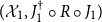 $({\mathcal X}_1, J_1^\dagger \circ R \circ J_1)$
. Let
$({\mathcal X}_1, J_1^\dagger \circ R \circ J_1)$
. Let $E$
be this isomorphism. By assumption, for each integer
$E$
be this isomorphism. By assumption, for each integer $i \in {\mathbb N}$
, the function
$i \in {\mathbb N}$
, the function $G_i$
factors through
$G_i$
factors through $J_1$
. Since,
$J_1$
. Since, $E$
is an isomorphism, it also factors through
$E$
is an isomorphism, it also factors through $J_1 \circ E$
. Therefore, for each integer
$J_1 \circ E$
. Therefore, for each integer $i \in {\mathbb N}$
, let
$i \in {\mathbb N}$
, let $F_i\colon {\mathcal H} {\rightarrow } `S$
be such that
$F_i\colon {\mathcal H} {\rightarrow } `S$
be such that $J_1 \circ E \circ F_i = G_i$
. By Proposition 6.1.5, each such function
$J_1 \circ E \circ F_i = G_i$
. By Proposition 6.1.5, each such function $F_i$
may be further factored as
$F_i$
may be further factored as $F_i = `f_i \circ M_{P_i}$
for some partition
$F_i = `f_i \circ M_{P_i}$
for some partition $P_i$
on
$P_i$
on $H$
. Let
$H$
. Let $P_\infty = \limsup _{i {\rightarrow } \infty } P_i$
. Without loss of generality, we may assume that
$P_\infty = \limsup _{i {\rightarrow } \infty } P_i$
. Without loss of generality, we may assume that $\sup _{i \in {\mathbb N}} P_{i} = P_\infty$
. Thus,
$\sup _{i \in {\mathbb N}} P_{i} = P_\infty$
. Thus, $P_i \leq P_\infty$
for each index
$P_i \leq P_\infty$
for each index $i \in {\mathbb N}$
. We index the elements of
$i \in {\mathbb N}$
. We index the elements of $P_\infty$
by some set
$P_\infty$
by some set $A$
, writing
$A$
, writing $P_\infty = \{ p_\infty ^\alpha \,|\, \alpha \in A\}$
.
$P_\infty = \{ p_\infty ^\alpha \,|\, \alpha \in A\}$
.
Fix an index $\alpha \in A$
. For each
$\alpha \in A$
. For each $i \in {\mathbb N}\cup \{\infty \}$
, we define
$i \in {\mathbb N}\cup \{\infty \}$
, we define $P_i^\alpha := \{p_i \in P_i \,|\, p_i \leq p_\infty ^\alpha \}$
. Identifying each projection contained in
$P_i^\alpha := \{p_i \in P_i \,|\, p_i \leq p_\infty ^\alpha \}$
. Identifying each projection contained in $p^\alpha _\infty$
with a projection operator on
$p^\alpha _\infty$
with a projection operator on $H^\alpha := p_\infty ^\alpha H$
in the obvious way, we conclude that
$H^\alpha := p_\infty ^\alpha H$
in the obvious way, we conclude that $P_i^\alpha$
is a partition on
$P_i^\alpha$
is a partition on $H^\alpha$
. The partition
$H^\alpha$
. The partition $P_\infty ^\alpha = \{p_\infty ^\alpha \}$
is indeed the supremum of the partitions
$P_\infty ^\alpha = \{p_\infty ^\alpha \}$
is indeed the supremum of the partitions $P^\alpha _i$
, for
$P^\alpha _i$
, for $i \in {\mathbb N}$
, essentially by our definition of
$i \in {\mathbb N}$
, essentially by our definition of $P_\infty$
. Thus, we plan to apply Lemma 6.2.1. For each integer
$P_\infty$
. Thus, we plan to apply Lemma 6.2.1. For each integer $i \in {\mathbb N}$
, we define
$i \in {\mathbb N}$
, we define $f_i^\alpha$
to be the restriction of
$f_i^\alpha$
to be the restriction of $f_i$
to
$f_i$
to $P_i^\alpha$
; in other words,
$P_i^\alpha$
; in other words, $f_i^\alpha = f_i \circ j_i^\alpha$
, where
$f_i^\alpha = f_i \circ j_i^\alpha$
, where $j_i^\alpha \colon P_i^\alpha \hookrightarrow P_i$
is the ordinary inclusion function. We now define
$j_i^\alpha \colon P_i^\alpha \hookrightarrow P_i$
is the ordinary inclusion function. We now define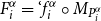 $F_i^\alpha = `f_i^\alpha \circ M_{P_i^\alpha }$
.
$F_i^\alpha = `f_i^\alpha \circ M_{P_i^\alpha }$
.
We claim that $F_1^\alpha \sqsubseteq F_2^\alpha \sqsubseteq \cdots$
. Fix integers
$F_1^\alpha \sqsubseteq F_2^\alpha \sqsubseteq \cdots$
. Fix integers $i_1 \lt i_2 \in {\mathbb N}$
. We are given that
$i_1 \lt i_2 \in {\mathbb N}$
. We are given that $J_1 \circ E \circ F_{i_1} \sqsubseteq J_1 \circ E \circ F_{i_2}$
, which means that
$J_1 \circ E \circ F_{i_1} \sqsubseteq J_1 \circ E \circ F_{i_2}$
, which means that $J_1 \circ E \circ F_{i_2} \leq R \circ J_1 \circ E \circ F_{i_1}$
. Appealing to the fact that
$J_1 \circ E \circ F_{i_2} \leq R \circ J_1 \circ E \circ F_{i_1}$
. Appealing to the fact that $J_1$
and
$J_1$
and $E$
are injective, that is,
$E$
are injective, that is, $J_1^\dagger \circ J_1 = I$
and
$J_1^\dagger \circ J_1 = I$
and $E^\dagger \circ E =I$
, we infer that
$E^\dagger \circ E =I$
, we infer that $F_{i_2} \leq E^\dagger \circ J_1^\dagger \circ R \circ J_1 \circ E \circ F_{i_1}$
. The binary relation
$F_{i_2} \leq E^\dagger \circ J_1^\dagger \circ R \circ J_1 \circ E \circ F_{i_1}$
. The binary relation $ E^\dagger \circ J_1^\dagger \circ R \circ J_1 \circ E$
on
$ E^\dagger \circ J_1^\dagger \circ R \circ J_1 \circ E$
on $`S$
is equal to
$`S$
is equal to $`{\sqsubseteq }$
, essentially by definition. Therefore,
$`{\sqsubseteq }$
, essentially by definition. Therefore, $F_{i_1} \sqsubseteq F_{i_2}$
. Appealing to Proposition 6.1.6 twice, we conclude that
$F_{i_1} \sqsubseteq F_{i_2}$
. Appealing to Proposition 6.1.6 twice, we conclude that $F_{i_1}^\alpha \sqsubseteq F_{i_2}^\alpha$
. We vary
$F_{i_1}^\alpha \sqsubseteq F_{i_2}^\alpha$
. We vary $i_1$
and
$i_1$
and $i_2$
to conclude that
$i_2$
to conclude that $F_1^\alpha \sqsubseteq F_2^\alpha \sqsubseteq \cdots$
.
$F_1^\alpha \sqsubseteq F_2^\alpha \sqsubseteq \cdots$
.
By Lemma 6.2.1, $J_1 \circ E \circ F_i^\alpha \nearrow J_1 \circ E \circ F_\infty ^\alpha$
for some function
$J_1 \circ E \circ F_i^\alpha \nearrow J_1 \circ E \circ F_\infty ^\alpha$
for some function $F_\infty ^\alpha \colon {\mathcal H}^\alpha {\rightarrow } `S$
. We vary
$F_\infty ^\alpha \colon {\mathcal H}^\alpha {\rightarrow } `S$
. We vary $\alpha \in A$
to define
$\alpha \in A$
to define $F_\infty = [F_\infty ^\alpha \,|\, \alpha \in A] \circ D_{P_\infty }$
, where the bracket notation refers to the universal property of the coproduct
$F_\infty = [F_\infty ^\alpha \,|\, \alpha \in A] \circ D_{P_\infty }$
, where the bracket notation refers to the universal property of the coproduct $\biguplus _{\alpha \in A} {\mathcal H}^\alpha$
, and
$\biguplus _{\alpha \in A} {\mathcal H}^\alpha$
, and $D_{P_\infty }\colon {\mathcal H} \to \biguplus _{\alpha \in A} {\mathcal H}^\alpha$
is the decomposition function corresponding to
$D_{P_\infty }\colon {\mathcal H} \to \biguplus _{\alpha \in A} {\mathcal H}^\alpha$
is the decomposition function corresponding to $P_\infty$
(Definition 4.1.1). We now compute as follows:
$P_\infty$
(Definition 4.1.1). We now compute as follows:
 \begin{align*} R \circ J_1& \circ E \circ F_\infty = R \circ J_1 \circ E \circ \left [ F_\infty ^\alpha \, \middle | \, \alpha \in A \right ] \circ D_{P_\infty } = \left [R \circ J_1 \circ E \circ F_\infty ^\alpha \, \middle | \, \alpha \in A\right ] \circ D_{P_\infty } \\ &= \left [\bigwedge _{i \in {\mathbb N}} R \circ J_1 \circ E \circ F_i^\alpha \, \middle | \, \alpha \in A\right ] \circ D_{P_\infty } = \left (\bigwedge _{i \in {\mathbb N}}\left [ R \circ J_1 \circ E \circ F_i^\alpha \, \middle | \, \alpha \in A\right ]\right ) \circ D_{P_\infty } \\ &= \bigwedge _{i \in {\mathbb N}}R \circ J_1 \circ E \circ \left [ F_i^\alpha \, \middle | \, \alpha \in A\right ] \circ D_{P_\infty } = \bigwedge _{i \in {\mathbb N}}R \circ J_1 \circ E \circ \left [ `f_i^\alpha \circ M_{P_i^\alpha }\, \middle | \, \alpha \in A\right ] \circ D_{P_\infty } \\ &= \bigwedge _{i \in {\mathbb N}}R \circ J_1 \circ E \circ \left [ `f_i \circ `j_i^\alpha \circ M_{P_i^\alpha }\, \middle | \, \alpha \in A\right ] \circ D_{P_\infty } \\ &= \bigwedge _{i \in {\mathbb N}}R \circ J_1 \circ E \circ `f_i \circ \left [ `j_i^\alpha \circ M_{P_i^\alpha }\, \middle | \, \alpha \in A\right ] \circ D_{P_\infty } \\ &= \bigwedge _{i \in {\mathbb N}}R \circ J_1 \circ E \circ `f_i \circ M_{P_i} = \bigwedge _{i \in {\mathbb N}}R \circ J_1 \circ E \circ F_i \end{align*}
Thus, $J_1 \circ E \circ F_i \nearrow J_1 \circ E \circ F_\infty$
. We conclude that
$J_1 \circ E \circ F_i \nearrow J_1 \circ E \circ F_\infty$
. We conclude that $G_\infty = J_1 \circ E \circ F_\infty$
, so
$G_\infty = J_1 \circ E \circ F_\infty$
, so $G_\infty$
does factor through
$G_\infty$
does factor through $J_1$
.
$J_1$
.
Corollary 6.2.3.
Let $({\mathcal X}, R)$
be a quantum cpo. Then, the inclusion function
$({\mathcal X}, R)$
be a quantum cpo. Then, the inclusion function $J_1\colon {\mathcal X}_1 \hookrightarrow {\mathcal X}$
is Scott continuous.
$J_1\colon {\mathcal X}_1 \hookrightarrow {\mathcal X}$
is Scott continuous.
Proof.
Let $\mathcal H$
be an atomic quantum set, and let
$\mathcal H$
be an atomic quantum set, and let $F_1 \sqsubseteq F_2 \sqsubseteq \cdots \sqsubseteq F_\infty$
be a monotonically ascending sequence of functions
$F_1 \sqsubseteq F_2 \sqsubseteq \cdots \sqsubseteq F_\infty$
be a monotonically ascending sequence of functions ${\mathcal H} {\rightarrow } {\mathcal X}_1$
with
${\mathcal H} {\rightarrow } {\mathcal X}_1$
with $F_i \nearrow F_\infty$
. Since
$F_i \nearrow F_\infty$
. Since $J_1$
is monotone,
$J_1$
is monotone, $J_1 \circ F_1 \sqsubseteq J_1 \circ F_2 \sqsubseteq \cdots \sqsubseteq J_1 \circ F_\infty$
is a monotonically ascending sequence of functions
$J_1 \circ F_1 \sqsubseteq J_1 \circ F_2 \sqsubseteq \cdots \sqsubseteq J_1 \circ F_\infty$
is a monotonically ascending sequence of functions ${\mathcal H} {\rightarrow } {\mathcal X}$
. By the definition of a quantum cpo, there is a function
${\mathcal H} {\rightarrow } {\mathcal X}$
. By the definition of a quantum cpo, there is a function $G_\infty \colon {\mathcal H} {\rightarrow } {\mathcal X}$
such that
$G_\infty \colon {\mathcal H} {\rightarrow } {\mathcal X}$
such that $J_1 \circ F_i \nearrow G_\infty$
. In particular,
$J_1 \circ F_i \nearrow G_\infty$
. In particular, $G_\infty \sqsubseteq J_1 \circ F_\infty$
. By Theorem 6.2.2, there is a function
$G_\infty \sqsubseteq J_1 \circ F_\infty$
. By Theorem 6.2.2, there is a function $F_\infty '\colon {\mathcal H} {\rightarrow } {\mathcal X}_1$
such that
$F_\infty '\colon {\mathcal H} {\rightarrow } {\mathcal X}_1$
such that $G_\infty = J_1 \circ F_\infty '$
. Thus,
$G_\infty = J_1 \circ F_\infty '$
. Thus, $J_1 \circ F_1 \sqsubseteq J_1 \circ F_2$ $\sqsubseteq \ldots \sqsubseteq J_1 \circ F_\infty ' \sqsubseteq J_1 \circ F_\infty$
. Since
$\sqsubseteq \ldots \sqsubseteq J_1 \circ F_\infty ' \sqsubseteq J_1 \circ F_\infty$
. Since $J_1$
is an order embedding, we infer that
$J_1$
is an order embedding, we infer that $F_1 \sqsubseteq F_2 \sqsubseteq \ldots \sqsubseteq F_\infty ' \sqsubseteq F_\infty$
. In other words,
$F_1 \sqsubseteq F_2 \sqsubseteq \ldots \sqsubseteq F_\infty ' \sqsubseteq F_\infty$
. In other words, $F_\infty '$
is an upper bound of the sequence
$F_\infty '$
is an upper bound of the sequence $F_1 \sqsubseteq F_2 \sqsubseteq \ldots$
that is nevertheless below
$F_1 \sqsubseteq F_2 \sqsubseteq \ldots$
that is nevertheless below $F_\infty$
. Since
$F_\infty$
. Since $F_\infty$
is the least upper bound, we conclude that
$F_\infty$
is the least upper bound, we conclude that $F_\infty ' = F_\infty$
. Therefore,
$F_\infty ' = F_\infty$
. Therefore, $J_1 \circ F_i \nearrow J_1 \circ F_\infty$
, as desired.
$J_1 \circ F_i \nearrow J_1 \circ F_\infty$
, as desired.
Equip $\mathbf 1$
with its unique (trivial) order
$\mathbf 1$
with its unique (trivial) order $I_{\mathbf 1}$
. Let
$I_{\mathbf 1}$
. Let $\mathcal X$
be a quantum set and
$\mathcal X$
be a quantum set and $R$
an order relation on
$R$
an order relation on $\mathcal X$
. Then each function
$\mathcal X$
. Then each function $F:{\mathbf 1}\to {\mathcal X}$
is automatically monotone, simply because
$F:{\mathbf 1}\to {\mathcal X}$
is automatically monotone, simply because $\mathbf 1$
is trivially ordered. In fact, if
$\mathbf 1$
is trivially ordered. In fact, if $({\mathcal X},R)$
is a quantum cpo, then
$({\mathcal X},R)$
is a quantum cpo, then $F$
is automatically Scott continuous, simply because
$F$
is automatically Scott continuous, simply because $\mathbf 1$
is a finite quantum poset and monotone maps whose codomain is finite are Scott continuous (Proposition 3.2.7). Hence, if
$\mathbf 1$
is a finite quantum poset and monotone maps whose codomain is finite are Scott continuous (Proposition 3.2.7). Hence, if $({\mathcal X},R)$
is a quantum cpo, then
$({\mathcal X},R)$
is a quantum cpo, then $\mathbf{qSet}({\mathbf 1},{\mathcal X})=\mathbf{qPOS}({\mathbf 1},{\mathcal X})=\mathbf{qCPO}({\mathbf 1},{\mathcal X})$
.
$\mathbf{qSet}({\mathbf 1},{\mathcal X})=\mathbf{qPOS}({\mathbf 1},{\mathcal X})=\mathbf{qCPO}({\mathbf 1},{\mathcal X})$
.
Lemma 6.2.4.
Let $({\mathcal X},R)$
be a quantum poset, and equip
$({\mathcal X},R)$
be a quantum poset, and equip $\mathrm{At}({\mathcal X}_1)$
with the order defined by
$\mathrm{At}({\mathcal X}_1)$
with the order defined by $X \sqsubseteq X'$
if and only if
$X \sqsubseteq X'$
if and only if $R(X,X') \neq 0$
, for
$R(X,X') \neq 0$
, for $X, X' \in \mathrm{At}({\mathcal X}_1)$
. Then, the canonical bijection
$X, X' \in \mathrm{At}({\mathcal X}_1)$
. Then, the canonical bijection $b_{\mathcal X}:\mathrm{At}({\mathcal X}_1)\to \mathbf{qSet}({\mathbf 1},{\mathcal X})$
of Lemma 2.5.1 is an order isomorphism.
$b_{\mathcal X}:\mathrm{At}({\mathcal X}_1)\to \mathbf{qSet}({\mathbf 1},{\mathcal X})$
of Lemma 2.5.1 is an order isomorphism.
Proof.
For visual brevity, write $b = b_{\mathcal X}$
. Let
$b = b_{\mathcal X}$
. Let $X, X' \in \mathrm{At}({\mathcal X}_1)$
. We reason that
$X, X' \in \mathrm{At}({\mathcal X}_1)$
. We reason that
 \begin{align*} b(X) \sqsubseteq b(X') & \; \Longleftrightarrow \; b(X') \circ b(X)^\dagger \leq R \; \Longleftrightarrow \; b(X')({\mathbb C}, X') \cdot b(X) ({\mathbb C},X)^\dagger \leq R(X, X') \\ & \; \Longleftrightarrow \; L(X,X') = R(X,X') \; \Longleftrightarrow \; R(X,X') \neq 0 \end{align*}
The first equivalence follows by [Kornell et al. (Reference Kornell, Lindenhovius and Mislove2022), Lemma 4.1(4)].
Lemma 6.2.5.
Let $({\mathcal X},R)$
be a quantum poset. Let
$({\mathcal X},R)$
be a quantum poset. Let $B_{\mathcal X}:{\mathcal X}_1\to `\mathbf{qSet}({\mathbf 1},{\mathcal X})$
be the bijection from Lemma 2.5.1
, so
$B_{\mathcal X}:{\mathcal X}_1\to `\mathbf{qSet}({\mathbf 1},{\mathcal X})$
be the bijection from Lemma 2.5.1
, so $B_{\mathcal X}(X,{\mathbb C}_{b_{\mathcal X}(X)}) = L(X,{\mathbb C}_{b_{\mathcal X}(X)})$
, for
$B_{\mathcal X}(X,{\mathbb C}_{b_{\mathcal X}(X)}) = L(X,{\mathbb C}_{b_{\mathcal X}(X)})$
, for $X \,\, \propto {\mathcal X}_1$
, with the other components vanishing. Then,
$X \,\, \propto {\mathcal X}_1$
, with the other components vanishing. Then, $B_{\mathcal X}$
is an order isomorphism from
$B_{\mathcal X}$
is an order isomorphism from $({\mathcal X}_1, R_1)$
to
$({\mathcal X}_1, R_1)$
to $(`\mathbf{qSet}({\mathbf 1},{\mathcal X}), `{\sqsubseteq })$
, where
$(`\mathbf{qSet}({\mathbf 1},{\mathcal X}), `{\sqsubseteq })$
, where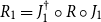 $R_1 = J_1^\dagger \circ R \circ J_1$
and
$R_1 = J_1^\dagger \circ R \circ J_1$
and $\sqsubseteq$
is the usual order on functions [Kornell et al. (Reference Kornell, Lindenhovius and Mislove2022), Lemma 4.1].
$\sqsubseteq$
is the usual order on functions [Kornell et al. (Reference Kornell, Lindenhovius and Mislove2022), Lemma 4.1].
Proof.
For visual brevity, write $b = b_{\mathcal X}$
and
$b = b_{\mathcal X}$
and $B = B_{\mathcal X}$
. Reasoning by cases, we find that the conclusion of Lemma 6.2.4 is that
$B = B_{\mathcal X}$
. Reasoning by cases, we find that the conclusion of Lemma 6.2.4 is that $b$
is a bijection and
$b$
is a bijection and $`(\!\sqsubseteq\!)({\mathbb C}_{b(X_1)}, {\mathbb C}_{b(X_2)}) \cdot L(X_1, {\mathbb C}_{b(X_1)}) = L(X_2, {\mathbb C}_{b(X_2)}) \cdot R_1(X_1, X_2)$
for all
$`(\!\sqsubseteq\!)({\mathbb C}_{b(X_1)}, {\mathbb C}_{b(X_2)}) \cdot L(X_1, {\mathbb C}_{b(X_1)}) = L(X_2, {\mathbb C}_{b(X_2)}) \cdot R_1(X_1, X_2)$
for all $X_1, X_2 \,\, \propto {\mathcal X}_1$
. We also calculate that for all
$X_1, X_2 \,\, \propto {\mathcal X}_1$
. We also calculate that for all $X_1, X_2 \,\, \propto {\mathcal X}_1$
,
$X_1, X_2 \,\, \propto {\mathcal X}_1$
,
 \begin{align*} (`(\!\sqsubseteq\!) \circ B)( X_1, {\mathbb C}_{b(X_2)}) &= \bigvee _{P \in \mathbf{qSet}({\mathbf 1}, {\mathcal X})} `(\!\sqsubseteq\!)({\mathbb C}_{P}, {\mathbb C}_{b(X_2)}) \cdot B(X_1, {\mathbb C}_{P}) \\ & = `(\!\sqsubseteq\!)({\mathbb C}_{b(X_1)}, {\mathbb C}_{b(X_2)}) \cdot L(X_1, {\mathbb C}_{b(X_1)}) = L(X_2, {\mathbb C}_{b(X_2)}) \cdot R_1(X_1, X_2) \\ &= \bigvee _{X \,\, \propto {\mathcal X}_1} B(X,{\mathbb C}_{b(X_2)}) \cdot R_1(X_1, X) = (B \circ R_1)(X_1, {\mathbb C}_{b(X_2)}). \end{align*}
Thus, $`(\!\sqsubseteq\!) \circ B = B \circ R_1$
. It follows immediately that
$`(\!\sqsubseteq\!) \circ B = B \circ R_1$
. It follows immediately that $B$
is an isomorphism of quantum posets in the sense of [Kornell et al. (Reference Kornell, Lindenhovius and Mislove2022), Definition 2.6].
$B$
is an isomorphism of quantum posets in the sense of [Kornell et al. (Reference Kornell, Lindenhovius and Mislove2022), Definition 2.6].
For the next lemma, we introduce a minor notation that will allow us to distinguish functions $1 \to {\mathcal X}$
from the corresponding functions
$1 \to {\mathcal X}$
from the corresponding functions $1 \to \mathbf{qSet}(1, {\mathcal X})$
. Specifically, whenever
$1 \to \mathbf{qSet}(1, {\mathcal X})$
. Specifically, whenever $s$
is an element of some ordinary set
$s$
is an element of some ordinary set $S$
, we write
$S$
, we write $\ulcorner s \urcorner$
for the corresponding function
$\ulcorner s \urcorner$
for the corresponding function $1 \to S$
.
$1 \to S$
.
Lemma 6.2.6.
Let $\mathcal X$
be a quantum set, let
$\mathcal X$
be a quantum set, let $b_{\mathcal X}: \mathrm{At}({\mathcal X}_1) \to \mathbf{qSet}({\mathbf 1}, {\mathcal X})$
be as in Lemma 6.2.4
, and let
$b_{\mathcal X}: \mathrm{At}({\mathcal X}_1) \to \mathbf{qSet}({\mathbf 1}, {\mathcal X})$
be as in Lemma 6.2.4
, and let $B_{\mathcal X}: {\mathcal X}_1 \to `\mathbf{qSet}({\mathbf 1}, {\mathcal X})$
be as in Lemma 6.2.5
. Then, for all functions
$B_{\mathcal X}: {\mathcal X}_1 \to `\mathbf{qSet}({\mathbf 1}, {\mathcal X})$
be as in Lemma 6.2.5
. Then, for all functions $P_0\colon {\mathbf 1} \to {\mathcal X}$
, we have that
$P_0\colon {\mathbf 1} \to {\mathcal X}$
, we have that $J_1 \circ B_{\mathcal X}^{^{-1}} \circ `\ulcorner P_0 \urcorner = P_0$
.
$J_1 \circ B_{\mathcal X}^{^{-1}} \circ `\ulcorner P_0 \urcorner = P_0$
.
Proof.
For visual brevity, write $b = b_{\mathcal X}$
and
$b = b_{\mathcal X}$
and $B = B_{\mathcal X}$
. Note that
$B = B_{\mathcal X}$
. Note that $B^{-1} = B^\dagger$
[Kornell (Reference Kornell2020), Proposition 4.2]. Let
$B^{-1} = B^\dagger$
[Kornell (Reference Kornell2020), Proposition 4.2]. Let $X_0 \,\, \propto {\mathcal X}_1$
be such that
$X_0 \,\, \propto {\mathcal X}_1$
be such that $b_{\mathcal X}(X_0) = P_0$
(Lemma 6.2.4). We calculate that for all one-dimensional atoms
$b_{\mathcal X}(X_0) = P_0$
(Lemma 6.2.4). We calculate that for all one-dimensional atoms $X \,\, \propto {\mathcal X}$
,
$X \,\, \propto {\mathcal X}$
,
 \begin{align*} (J_1 \circ B^{-1} \circ `\ulcorner P_0 \urcorner ) ({\mathbb C}, X) &= (B^{-1} \circ `\ulcorner P_0 \urcorner )({\mathbb C}, X) = (B^\dagger \circ `\ulcorner P_0 \urcorner )({\mathbb C}, X) \\ & = \bigvee _{P \in \mathbf{qSet}({\mathbf 1}, {\mathcal X})} B^\dagger ({\mathbb C}_P, X) \cdot `\ulcorner P_0 \urcorner ({\mathbb C}, {\mathbb C}_P) = B^\dagger ({\mathbb C}_{P_0}, X) \cdot L({\mathbb C}, {\mathbb C}_{P_0}) \\ & = B^\dagger ({\mathbb C}_{b(X_0)}, X) \cdot L({\mathbb C}, {\mathbb C}_{b(X_0)}) = \delta _{X_0, X} \cdot L({\mathbb C}_{b(X_0)}, X) \cdot L({\mathbb C}, {\mathbb C}_{b(X_0)}) \\ & = \delta _{X_0, X} \cdot L({\mathbb C}, X) = b(X_0)({\mathbb C}, X) = P_0({\mathbb C}, X). \end{align*}
Of course, $(J_1 \circ B^{-1} \circ `\ulcorner P_0 \urcorner )({\mathbb C}, X) = 0 = P({\mathbb C}, X)$
for all atoms
$(J_1 \circ B^{-1} \circ `\ulcorner P_0 \urcorner )({\mathbb C}, X) = 0 = P({\mathbb C}, X)$
for all atoms $X \,\, \propto {\mathcal X}$
of dimension larger than one. Therefore,
$X \,\, \propto {\mathcal X}$
of dimension larger than one. Therefore, $J_1 \circ B^{-1} \circ `\ulcorner P_0 \urcorner = P_0$
, as claimed.
$J_1 \circ B^{-1} \circ `\ulcorner P_0 \urcorner = P_0$
, as claimed.
Theorem 6.2.7.
The functor $`(\!-\!):{\mathbf{CPO}}\to \mathbf{qCPO}$
is fully faithful, strong monoidal and left adjoint to
$`(\!-\!):{\mathbf{CPO}}\to \mathbf{qCPO}$
is fully faithful, strong monoidal and left adjoint to $\mathbf{qCPO}({\mathbf 1},-):\mathbf{qCPO}\to {\mathbf{CPO}}$
.
$\mathbf{qCPO}({\mathbf 1},-):\mathbf{qCPO}\to {\mathbf{CPO}}$
.
Proof.
It easily follows from the order isomorphism in Proposition 6.1.16 that $`(\!-\!)$
is strong monoidal. We show that the functors in the statement are adjoint to each other. Moreover, we show that every component of the unit is an isomorphism in
$`(\!-\!)$
is strong monoidal. We show that the functors in the statement are adjoint to each other. Moreover, we show that every component of the unit is an isomorphism in $\mathbf{CPO}$
, which implies that
$\mathbf{CPO}$
, which implies that $`(\!-\!)$
is fully faithful by [MacLane (Reference MacLane1998), Theorem IV.3.1].
$`(\!-\!)$
is fully faithful by [MacLane (Reference MacLane1998), Theorem IV.3.1].
Fix a cpo $(S, \sqsubseteq )$
. If we order the atoms of
$(S, \sqsubseteq )$
. If we order the atoms of $`S$
by
$`S$
by ${\mathbb C}_{s_1} \sqsubseteq {\mathbb C}_{s_2}$
if and only if
${\mathbb C}_{s_1} \sqsubseteq {\mathbb C}_{s_2}$
if and only if $`(\!\sqsubseteq\!)({\mathbb C}_{s_1}, {\mathbb C}_{s_2})\neq 0$
, then
$`(\!\sqsubseteq\!)({\mathbb C}_{s_1}, {\mathbb C}_{s_2})\neq 0$
, then $i_S: s \mapsto {\mathbb C}_s$
becomes an order isomorphism
$i_S: s \mapsto {\mathbb C}_s$
becomes an order isomorphism $S \to \mathrm{At}(`S)$
, simply by definition of
$S \to \mathrm{At}(`S)$
, simply by definition of $`(\!\sqsubseteq\!)$
. The bijection
$`(\!\sqsubseteq\!)$
. The bijection $b_{`S}: \mathrm{At}(`S) \to \mathbf{qSet}(1,`S)$
is also an order isomorphism by Lemma 6.2.4, and it is easy to see that
$b_{`S}: \mathrm{At}(`S) \to \mathbf{qSet}(1,`S)$
is also an order isomorphism by Lemma 6.2.4, and it is easy to see that $b_{`S}({\mathbb C}_s) = ` \ulcorner s \urcorner$
for all
$b_{`S}({\mathbb C}_s) = ` \ulcorner s \urcorner$
for all $s \in S$
. Indeed,
$s \in S$
. Indeed, $b_{`S}({\mathbb C}_s)({\mathbb C},{\mathbb C}_{s'}) = \delta _{s,s'} \cdot L({\mathbb C}, {\mathbb C}_{s'}) = ` \ulcorner s \urcorner ({\mathbb C}, {\mathbb C}_{s'})$
for all
$b_{`S}({\mathbb C}_s)({\mathbb C},{\mathbb C}_{s'}) = \delta _{s,s'} \cdot L({\mathbb C}, {\mathbb C}_{s'}) = ` \ulcorner s \urcorner ({\mathbb C}, {\mathbb C}_{s'})$
for all $s, s' \in S$
. Thus,
$s, s' \in S$
. Thus, $\eta _{S} : = b_{S'} \circ i_S$
is an order isomorphism
$\eta _{S} : = b_{S'} \circ i_S$
is an order isomorphism $S \to \mathbf{qSet}({\mathbf 1}, `S) = \mathbf{qCPO}({\mathbf 1}, `S)$
such that
$S \to \mathbf{qSet}({\mathbf 1}, `S) = \mathbf{qCPO}({\mathbf 1}, `S)$
such that $\eta _S(s) = `\ulcorner s \urcorner$
for all
$\eta _S(s) = `\ulcorner s \urcorner$
for all $s \in S$
.
$s \in S$
.
We show that $\eta _S$
satisfies the universal property of the
$\eta _S$
satisfies the universal property of the $S$
-component of the unit the claimed adjunction. Let
$S$
-component of the unit the claimed adjunction. Let $({\mathcal X}, R)$
be a quantum cpo, and let
$({\mathcal X}, R)$
be a quantum cpo, and let $f: S \to \mathbf{qCPO}({\mathbf 1}, {\mathcal X})$
be a Scott continuous function. We show that there exists a unique Scott continuous function
$f: S \to \mathbf{qCPO}({\mathbf 1}, {\mathcal X})$
be a Scott continuous function. We show that there exists a unique Scott continuous function $F\colon `S \to X$
making the following diagram commute:
$F\colon `S \to X$
making the following diagram commute:

Let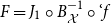 $F = J_1 \circ B_{\mathcal X}^{-1} \circ `f$
. For each
$F = J_1 \circ B_{\mathcal X}^{-1} \circ `f$
. For each $s \in S$
, we calculate that
$s \in S$
, we calculate that
 \begin{equation*}J_1 \circ B_{\mathcal X}^{-1} \circ `f \circ \eta _S(s) = J_1 \circ B_{\mathcal X}^{-1} \circ `f \circ `\ulcorner s \urcorner = J_1 \circ B_{\mathcal X}^{-1} \circ `\ulcorner f(s) \urcorner = f(s),\end{equation*}
applying Lemma 6.2.6 in the last step. Thus, $F\circ (\!-\!)$
makes the diagram commute. If
$F\circ (\!-\!)$
makes the diagram commute. If $F'$
also makes the diagram commute, then we quickly find that
$F'$
also makes the diagram commute, then we quickly find that $(F \circ (\!-\!)) = (F' \circ (\!-\!))\colon \mathbf{qCPO}({\mathbf 1}, `S) \to \mathbf{qCPO}({\mathbf 1}, {\mathcal X})$
, because
$(F \circ (\!-\!)) = (F' \circ (\!-\!))\colon \mathbf{qCPO}({\mathbf 1}, `S) \to \mathbf{qCPO}({\mathbf 1}, {\mathcal X})$
, because $\eta _S$
is an isomorphism. This implies that
$\eta _S$
is an isomorphism. This implies that $F = F'$
because for all
$F = F'$
because for all $s \in S$
and all
$s \in S$
and all $X \,\, \propto {\mathcal X}$
, we have that
$X \,\, \propto {\mathcal X}$
, we have that
 \begin{align*} F'({\mathbb C}_s, X) \cdot L({\mathbb C}, {\mathbb C}_s) & = \bigvee _{s' \in S} F'({\mathbb C}_{s'}, X) \cdot `\ulcorner s \urcorner ({\mathbb C}, {\mathbb C}_{s'}) = (F' \circ ` \ulcorner s \urcorner ) \\ & = (F \circ ` \ulcorner s \urcorner ) = \bigvee _{s' \in S} F({\mathbb C}_{s'}, X) \cdot `\ulcorner s \urcorner ({\mathbb C}, {\mathbb C}_{s'}) = F({\mathbb C}_s, X) \cdot L({\mathbb C}, {\mathbb C}_s). \end{align*}
Therefore, the order isomorphisms $\eta _S$
, for all cpos
$\eta _S$
, for all cpos $S$
, together form the unit of an adjuction between the functor
$S$
, together form the unit of an adjuction between the functor $\mathbf{qCPO}({\mathbf 1},-):\mathbf{qCPO}\to {\mathbf{CPO}}$
and a functor
$\mathbf{qCPO}({\mathbf 1},-):\mathbf{qCPO}\to {\mathbf{CPO}}$
and a functor ${\mathbf{CPO}} \to \mathbf{qCPO}$
that takes each cpo
${\mathbf{CPO}} \to \mathbf{qCPO}$
that takes each cpo $S$
to the quantum cpo
$S$
to the quantum cpo $`S$
. To show that this left adjoint is
$`S$
. To show that this left adjoint is $`(\!-\!):{\mathbf{CPO}}\to \mathbf{qCPO}$
, as claimed, it is enough to show that the unit is a natural transformation from the identity functor on
$`(\!-\!):{\mathbf{CPO}}\to \mathbf{qCPO}$
, as claimed, it is enough to show that the unit is a natural transformation from the identity functor on $\mathbf{CPO}$
to
$\mathbf{CPO}$
to $\mathbf{qCPO}({\mathbf 1}, `(\!-\!))$
. Let
$\mathbf{qCPO}({\mathbf 1}, `(\!-\!))$
. Let $S_1$
and
$S_1$
and $S_2$
be cpos, and let
$S_2$
be cpos, and let $f$
be a Scott continuous function
$f$
be a Scott continuous function $S_1 \to S_2$
. For all
$S_1 \to S_2$
. For all $s_1 \in S_1$
, we calculate that
$s_1 \in S_1$
, we calculate that $\mathbf{qCPO}({\mathbf 1}, `f)(\eta _{S_1})(s_1) = \mathbf{qCPO}({\mathbf 1}, `f)(`\ulcorner s_1 \urcorner ) = `f \circ (`\ulcorner s_1 \urcorner ) = ` \ulcorner f(s_1) \urcorner = \eta _{S_2} (f(s_1))$
. We conclude that the unit is indeed a natural transformation from the identity functor on
$\mathbf{qCPO}({\mathbf 1}, `f)(\eta _{S_1})(s_1) = \mathbf{qCPO}({\mathbf 1}, `f)(`\ulcorner s_1 \urcorner ) = `f \circ (`\ulcorner s_1 \urcorner ) = ` \ulcorner f(s_1) \urcorner = \eta _{S_2} (f(s_1))$
. We conclude that the unit is indeed a natural transformation from the identity functor on $\mathbf{CPO}$
to
$\mathbf{CPO}$
to $\mathbf{qCPO}({\mathbf 1}, `(\!-\!))$
, completing the proof.
$\mathbf{qCPO}({\mathbf 1}, `(\!-\!))$
, completing the proof.
7. The Lift Monad
Programs in simply-typed languages without a recursion operator always terminate. If a language has a recursion operator, there is the possibility of nonterminating programs, hence it is desirable that nontermination can be expressed within a denotational model for such a language. In the denotational semantics of ordinary programming languages, the effect of nontermination is often modeled by the “lift monad” $(\!-\!)_\perp$
on
$(\!-\!)_\perp$
on $\mathbf{CPO}$
, which adds a least element to each cpo. In this section, we prove that there is a lift monad on
$\mathbf{CPO}$
, which adds a least element to each cpo. In this section, we prove that there is a lift monad on $\mathbf{qCPO}$
, also denoted by
$\mathbf{qCPO}$
, also denoted by $(\!-\!)_\perp$
, which generalizes the lift monad on
$(\!-\!)_\perp$
, which generalizes the lift monad on $\mathbf{CPO}$
. Moreover, we show that
$\mathbf{CPO}$
. Moreover, we show that $(\!-\!)_\perp$
is a symmetric monoidal monad, which is a necessary and sufficient condition to conclude that the Kleisli category of the monad is symmetric monoidal. Showing that a monad
$(\!-\!)_\perp$
is a symmetric monoidal monad, which is a necessary and sufficient condition to conclude that the Kleisli category of the monad is symmetric monoidal. Showing that a monad $T$
is symmetric monoidal amounts to showing the existence of a double strength map
$T$
is symmetric monoidal amounts to showing the existence of a double strength map $TX \otimes TY \to T(X\otimes Y)$
and proving its related diagrams commute. Verifying the commutativity of these diagrams is tedious, but the verification of some of them can be circumvented by applying known results.
$TX \otimes TY \to T(X\otimes Y)$
and proving its related diagrams commute. Verifying the commutativity of these diagrams is tedious, but the verification of some of them can be circumvented by applying known results.
We begin by sketching our approach in terms of the classical versions of our categories. If $X$
is an ordinary cpo, then the underlying set of
$X$
is an ordinary cpo, then the underlying set of $X_\perp$
is the coproduct
$X_\perp$
is the coproduct $X\uplus 1$
of
$X\uplus 1$
of $X$
with the terminal object
$X$
with the terminal object $1$
in
$1$
in $\mathbf{Set}$
. In a category
$\mathbf{Set}$
. In a category $\mathbf C$
with coproducts and a terminal object
$\mathbf C$
with coproducts and a terminal object $1$
, if the endofunctor
$1$
, if the endofunctor $X\mapsto X\uplus 1$
forms a monad, it is called the maybe monad. For example, it is well-known that this endofunctor is a monad on
$X\mapsto X\uplus 1$
forms a monad, it is called the maybe monad. For example, it is well-known that this endofunctor is a monad on $\mathbf{Set}$
whose Kleisli category is equivalent to the category of sets and partial functions, which in turn is well-known to be symmetric monoidal. Hence we can conclude that the maybe monad on
$\mathbf{Set}$
whose Kleisli category is equivalent to the category of sets and partial functions, which in turn is well-known to be symmetric monoidal. Hence we can conclude that the maybe monad on $\mathbf{Set}$
is symmetric monoidal without checking any diagram. Although the lift monad on
$\mathbf{Set}$
is symmetric monoidal without checking any diagram. Although the lift monad on $\mathbf{CPO}$
and the maybe monad on
$\mathbf{CPO}$
and the maybe monad on $\mathbf{CPO}$
differ, the action of both monads on the underlying set of a cpo coincides with the maybe monad on
$\mathbf{CPO}$
differ, the action of both monads on the underlying set of a cpo coincides with the maybe monad on $\mathbf{Set}$
, so the diagrams for a symmetric monoidal monad must commute in both cases. Therefore, the lift monad on
$\mathbf{Set}$
, so the diagrams for a symmetric monoidal monad must commute in both cases. Therefore, the lift monad on $\mathbf{CPO}$
must be symmetric monoidal. Following this approach, we will first show that the maybe monad on
$\mathbf{CPO}$
must be symmetric monoidal. Following this approach, we will first show that the maybe monad on $\mathbf{qSet}$
is well defined and symmetric monoidal, and then use the above reasoning to conclude the lift monad on
$\mathbf{qSet}$
is well defined and symmetric monoidal, and then use the above reasoning to conclude the lift monad on $\mathbf{qCPO}$
is symmetric monoidal, too.
$\mathbf{qCPO}$
is symmetric monoidal, too.
7.1 The maybe monad on
$\mathbf{qSet}$

We fix some terminology. If $T$
is a monad on a category
$T$
is a monad on a category $\mathbf C$
with unit
$\mathbf C$
with unit $\eta$
and multiplication
$\eta$
and multiplication $\mu$
, then we denote its Kleisli category by
$\mu$
, then we denote its Kleisli category by ${\mathbf C}_T$
. The objects of
${\mathbf C}_T$
. The objects of ${\mathbf C}_T$
coincide with the objects of
${\mathbf C}_T$
coincide with the objects of $\mathbf C$
, and for objects
$\mathbf C$
, and for objects $X,Y\in {\mathbf C}_T$
, we have
$X,Y\in {\mathbf C}_T$
, we have ${\mathbf C}_T(X,Y)={\mathbf C}(X,TY)$
. For a morphism
${\mathbf C}_T(X,Y)={\mathbf C}(X,TY)$
. For a morphism $f$
in this homset we write
$f$
in this homset we write $f:X\;\;\;\;\;\circ \!\!\!\!\!\!\!\longrightarrow Y$
if we regard it as a morphism in
$f:X\;\;\;\;\;\circ \!\!\!\!\!\!\!\longrightarrow Y$
if we regard it as a morphism in ${\mathbf C}_T$
and
${\mathbf C}_T$
and $f:X\to TY$
if we regard it as a morphism in
$f:X\to TY$
if we regard it as a morphism in $\mathbf C$
. Composition in
$\mathbf C$
. Composition in ${\mathbf C}_T$
is denoted by
${\mathbf C}_T$
is denoted by $\bullet$
, so
$\bullet$
, so $g\bullet f=\mu _Z\circ Tg\circ f$
for
$g\bullet f=\mu _Z\circ Tg\circ f$
for $f:X\;\;\;\;\;\circ \!\!\!\!\!\!\!\longrightarrow Y$
and
$f:X\;\;\;\;\;\circ \!\!\!\!\!\!\!\longrightarrow Y$
and $g:Y\;\;\;\;\;\circ \!\!\!\!\!\!\!\longrightarrow Z$
in
$g:Y\;\;\;\;\;\circ \!\!\!\!\!\!\!\longrightarrow Z$
in ${\mathbf C}_T$
, that is, for
${\mathbf C}_T$
, that is, for $f:X\to TY$
and
$f:X\to TY$
and $g:Y\to TZ$
in
$g:Y\to TZ$
in $\mathbf C$
.
$\mathbf C$
.
If $\mathbf C$
is equipped with symmetric monoidal product
$\mathbf C$
is equipped with symmetric monoidal product $\otimes$
, we say that
$\otimes$
, we say that $T$
is a symmetric monoidal monad if for each
$T$
is a symmetric monoidal monad if for each $X,Y\in {\mathbf C}$
there exists a double strength
$X,Y\in {\mathbf C}$
there exists a double strength $k_{X,Y}:TX\otimes TY\to T(X,Y)$
natural in
$k_{X,Y}:TX\otimes TY\to T(X,Y)$
natural in $X$
and
$X$
and $Y$
, satisfying conditions (1)-(5) in [Seal (Reference Seal2013), 1.2]. Equivalently,
$Y$
, satisfying conditions (1)-(5) in [Seal (Reference Seal2013), 1.2]. Equivalently, $T$
is symmetric monoidal if and only if
$T$
is symmetric monoidal if and only if ${\mathbf C}_T$
can be equipped with a symmetric monoidal product such that the canonical functor
${\mathbf C}_T$
can be equipped with a symmetric monoidal product such that the canonical functor ${\mathbf C}\to {\mathbf C}_T$
is strictly monoidal [Seal (Reference Seal2013), Proposition 1.2.2].
${\mathbf C}\to {\mathbf C}_T$
is strictly monoidal [Seal (Reference Seal2013), Proposition 1.2.2].
Theorem 7.1.1.
The endofunctor $\mathcal M$
on
$\mathcal M$
on $\mathbf{qSet}$
given by
$\mathbf{qSet}$
given by ${\mathcal X}\mapsto {\mathcal X}\uplus {\mathbf 1}$
is a symmetric monoidal monad. More specifically:
${\mathcal X}\mapsto {\mathcal X}\uplus {\mathbf 1}$
is a symmetric monoidal monad. More specifically:
-
• The
$\mathcal X$
-component of the unit
$H$
of
$\mathcal M$
is
$J_{\mathcal X}:{\mathcal X}\to {\mathcal X}\uplus {\mathbf 1}$
. -
• Given
${\mathcal X}\in \mathbf{qSet}$
, if we write
${\mathcal M}{\mathcal X}={\mathcal X}\uplus {\mathbf 1}_1$
and
${\mathcal M}^2{\mathcal X}={\mathcal X}\uplus {\mathbf 1}_1\uplus {\mathbf 1}_2$
, where
${\mathbf 1}_i=\mathcal Q\{{\mathbb C}_i\}$
, then the
$\mathcal X$
-component
$M_{\mathcal X}:{\mathcal M}^2{\mathcal X}\to {\mathcal M}{\mathcal X}$
of the multiplication of
$\mathcal M$
is given by
for each
\begin{align*} M_{\mathcal X}(X,X')=\begin{cases} L({\mathbb C}_2,{\mathbb C}_1), & X={\mathbb C}_2, X'={\mathbb C}_1,\\ {\mathbb C} 1_X, & X=X',\\ 0, & \textit{otherwise} \end{cases} \end{align*}
$X\,\, \propto {\mathcal M}^2{\mathcal X}$
and each
$X'\,\, \propto {\mathcal M}{\mathcal X}$
.
-
• For each
${\mathcal X},\mathcal Y\in \mathbf{qSet}$
the double strength (also called the structural constraint)
$K_{{\mathcal X},\mathcal Y}:{\mathcal M}{\mathcal X}\times {\mathcal M}\mathcal Y\to {\mathcal M}({\mathcal X}\times \mathcal Y)$
is given for each
$X\,\, \propto {\mathcal M}{\mathcal X}$
,
$Y\,\, \propto {\mathcal M}\mathcal Y$
and each
$Z\,\, \propto {\mathcal M}({\mathcal X}\times \mathcal Y)$
by
(15)
\begin{equation} K_{{\mathcal X},\mathcal Y}(X\otimes Y,Z) = \begin{cases} {\mathbb C} 1_{X\otimes Y}, & X\neq {\mathbb C}_1\neq Y\textit{ and }Z=X\otimes Y,\\ L(X\otimes Y,Z), & Z={\mathbb C}_1 \textit{ and }(X={\mathbb C}_1\textit{ or }Y={\mathbb C}_1),\\ 0, & \textit{otherwise.} \end{cases} \end{equation}
















Proof.
It follows from [Riehl (Reference Riehl2016), Example 5.1.4] that $\mathcal M$
is a monad on
$\mathcal M$
is a monad on $\mathbf{qSet}$
. This monad is obtained from an adjunction as follows. First, let
$\mathbf{qSet}$
. This monad is obtained from an adjunction as follows. First, let $\mathbf{qSet}_*$
be the coslice category under
$\mathbf{qSet}_*$
be the coslice category under $\mathbb 1$
, whose objects are pairs
$\mathbb 1$
, whose objects are pairs $({\mathcal X},A)$
consisting of a quantum set
$({\mathcal X},A)$
consisting of a quantum set $\mathcal X$
and a function
$\mathcal X$
and a function $A:{\mathbf 1}\to {\mathcal X}$
. Morphisms
$A:{\mathbf 1}\to {\mathcal X}$
. Morphisms $F:({\mathcal X},A)\to (\mathcal Y,B)$
are functions
$F:({\mathcal X},A)\to (\mathcal Y,B)$
are functions $F:{\mathcal X}\to \mathcal Y$
such that
$F:{\mathcal X}\to \mathcal Y$
such that $F\circ A=B$
. Let
$F\circ A=B$
. Let ${\mathcal G}:\mathbf{qSet}_*\to \mathbf{qSet}$
be the forgetful functor
${\mathcal G}:\mathbf{qSet}_*\to \mathbf{qSet}$
be the forgetful functor $({\mathcal X},A)\mapsto {\mathcal X}$
. Then,
$({\mathcal X},A)\mapsto {\mathcal X}$
. Then, $\mathcal G$
is right adjoint to the functor
$\mathcal G$
is right adjoint to the functor ${\mathcal F}:\mathbf{qSet}\to \mathbf{qSet}_*$
that acts on objects by
${\mathcal F}:\mathbf{qSet}\to \mathbf{qSet}_*$
that acts on objects by ${\mathcal X}\mapsto ({\mathcal X}\uplus {\mathbf 1},J_{\mathbf 1})$
and on morphisms by
${\mathcal X}\mapsto ({\mathcal X}\uplus {\mathbf 1},J_{\mathbf 1})$
and on morphisms by $F\mapsto F\uplus I_{\mathbf 1}$
. The
$F\mapsto F\uplus I_{\mathbf 1}$
. The $\mathcal X$
-component of the unit
$\mathcal X$
-component of the unit $H$
of the adjunction
$H$
of the adjunction ${\mathcal F}\dashv {\mathcal G}$
is
${\mathcal F}\dashv {\mathcal G}$
is $J_{\mathcal X}:{\mathcal X}\to {\mathcal X}\uplus {\mathbf 1}$
, and the
$J_{\mathcal X}:{\mathcal X}\to {\mathcal X}\uplus {\mathbf 1}$
, and the $({\mathcal X},A)$
-component of the counit
$({\mathcal X},A)$
-component of the counit $E$
is the morphism
$E$
is the morphism $[I_{\mathcal X},A]:({\mathcal X}\uplus {\mathbf 1},J_{\mathbf 1}^{{\mathcal X}\uplus {\mathbf 1}})\to ({\mathcal X},A)$
. It follows that the
$[I_{\mathcal X},A]:({\mathcal X}\uplus {\mathbf 1},J_{\mathbf 1}^{{\mathcal X}\uplus {\mathbf 1}})\to ({\mathcal X},A)$
. It follows that the $\mathcal X$
-component
$\mathcal X$
-component $M_{\mathcal X}={\mathcal G} E_{{\mathcal F}{\mathcal X}}$
of the multiplication of the induced monad
$M_{\mathcal X}={\mathcal G} E_{{\mathcal F}{\mathcal X}}$
of the multiplication of the induced monad $\mathcal M$
is the function
$\mathcal M$
is the function $[I_{{\mathcal X}\uplus {\mathbf 1}_1},J_{{\mathbf 1}_2}]:{\mathcal X}\uplus {\mathbf 1}_1\uplus {\mathbf 1}_2\to {\mathcal X}\uplus {\mathbf 1}_1$
, which is precisely the expression for
$[I_{{\mathcal X}\uplus {\mathbf 1}_1},J_{{\mathbf 1}_2}]:{\mathcal X}\uplus {\mathbf 1}_1\uplus {\mathbf 1}_2\to {\mathcal X}\uplus {\mathbf 1}_1$
, which is precisely the expression for $M_{\mathcal X}$
in the statement.
$M_{\mathcal X}$
in the statement.
We thank the anonymous reviewer for the observation that the maybe monad on a semicartesian closed category with coproducts is automatically a symmetric monoidal monad, so that we can omit the direct verification of the axioms for a double strength in [Seal (Reference Seal2013), 1.2], which is straightforward but tedious. We sketch how the semicartesian closed structure yields the double strength $K$
. Since
$K$
. Since $\mathbf{qSet}$
is symmetric monoidal closed, the monoidal product
$\mathbf{qSet}$
is symmetric monoidal closed, the monoidal product $\times$
preserves coproducts, whence for quantum sets
$\times$
preserves coproducts, whence for quantum sets $\mathcal X$
and
$\mathcal X$
and $\mathcal Y$
there exists a bijection
$\mathcal Y$
there exists a bijection
 \begin{equation*}D_{{\mathcal X},\mathcal Y}:({\mathcal X}\uplus {\mathbf 1})\times (\mathcal Y\uplus {\mathbf 1})\to ({\mathcal X}\times \mathcal Y)\uplus ({\mathcal X}\times {\mathbf 1})\uplus ({\mathbf 1}\times \mathcal Y)\uplus ({\mathbf 1}\times {\mathbf 1}).\end{equation*}
Clearly, the domain and codomain of $D_{{\mathcal X},\mathcal Y}$
have the same atoms, namely
$D_{{\mathcal X},\mathcal Y}$
have the same atoms, namely $X\otimes Y$
,
$X\otimes Y$
, $X\otimes \mathbb C$
,
$X\otimes \mathbb C$
, $\mathbb C\otimes Y$
, and
$\mathbb C\otimes Y$
, and $\mathbb C\otimes \mathbb C$
for
$\mathbb C\otimes \mathbb C$
for $X\,\, \propto {\mathcal X}$
and
$X\,\, \propto {\mathcal X}$
and $Y\,\, \propto \mathcal Y$
. Hence, clearly
$Y\,\, \propto \mathcal Y$
. Hence, clearly $D_{{\mathcal X},\mathcal Y}$
is the “identity”. Now, we obtain
$D_{{\mathcal X},\mathcal Y}$
is the “identity”. Now, we obtain $K_{{\mathcal X},\mathcal Y}$
as the composition
$K_{{\mathcal X},\mathcal Y}$
as the composition $\big (I_{{\mathcal X}\times \mathcal Y}\uplus (L_{\mathbf 1}\circ [ !_{\mathcal X}\times I_{\mathbf 1},I_{\mathbf 1}\times !_{\mathcal Y},I_{{\mathbf 1}\times {\mathbf 1}}])\big )\circ D_{{\mathcal X},\mathcal Y}.$
7.2 The lift monad on
$\mathbf{qCPO}$

Next we describe how to lift a given quantum poset $({\mathcal X},R)$
to pointed posets, which will be achieved by equipping
$({\mathcal X},R)$
to pointed posets, which will be achieved by equipping ${\mathcal M}{\mathcal X}$
with an appropriate order. We will denote the added one-dimensional atom in
${\mathcal M}{\mathcal X}$
with an appropriate order. We will denote the added one-dimensional atom in ${\mathcal M}{\mathcal X}$
by
${\mathcal M}{\mathcal X}$
by ${\mathbb C}_\perp$
instead of
${\mathbb C}_\perp$
instead of $\mathbb C$
in order to emphasize that it will function as a least element (it corresponds to an element since it is one-dimensional), hence we will write
$\mathbb C$
in order to emphasize that it will function as a least element (it corresponds to an element since it is one-dimensional), hence we will write ${\mathcal M}{\mathcal X}={\mathcal X}\uplus \mathcal Q\{{\mathbb C}_\perp \}$
. We note that if
${\mathcal M}{\mathcal X}={\mathcal X}\uplus \mathcal Q\{{\mathbb C}_\perp \}$
. We note that if $\mathcal X$
already has an atom
$\mathcal X$
already has an atom ${\mathbb C}_\perp$
(for instance because it is the result of a previous lifting operation), we relabel that atom, and call the newly added atom
${\mathbb C}_\perp$
(for instance because it is the result of a previous lifting operation), we relabel that atom, and call the newly added atom ${\mathbb C}_\perp$
. This is also the common practice with ordinary posets, where the added bottom element is usually denoted by
${\mathbb C}_\perp$
. This is also the common practice with ordinary posets, where the added bottom element is usually denoted by $\perp$
, even when the given poset already had a bottom element, which then typically is renamed.
$\perp$
, even when the given poset already had a bottom element, which then typically is renamed.
Proposition 7.2.1.
Let $({\mathcal X},R)$
be a quantum poset. Define
$({\mathcal X},R)$
be a quantum poset. Define $({\mathcal X},R)_\perp =({\mathcal M}{\mathcal X},R_\perp )$
, where
$({\mathcal X},R)_\perp =({\mathcal M}{\mathcal X},R_\perp )$
, where
 \begin{align*} R_\perp (X,Y)=\begin{cases} R(X,Y), & X,Y\,\, \propto {\mathcal X};\\ L(X,Y), & X={\mathbb C}_\perp ;\\ 0, & X\,\, \propto {\mathcal X},Y={\mathbb C}_\perp . \end{cases} \end{align*}
Then $({\mathcal X},R)_\perp$
is a quantum poset, and
$({\mathcal X},R)_\perp$
is a quantum poset, and $J_{\mathcal X}:({\mathcal X},R)\to ({\mathcal X},R)_\perp$
is an order embedding such that
$J_{\mathcal X}:({\mathcal X},R)\to ({\mathcal X},R)_\perp$
is an order embedding such that
 \begin{equation} R_\perp \circ J_{\mathcal X}=J_{\mathcal X}\circ R. \end{equation}
Proof.
We first show that $R_\perp$
is an order on
$R_\perp$
is an order on ${\mathcal M}{\mathcal X}$
. Let
${\mathcal M}{\mathcal X}$
. Let $X,Y\,\,\propto {\mathcal M}{\mathcal X}$
. In order to check that
$X,Y\,\,\propto {\mathcal M}{\mathcal X}$
. In order to check that $I_{{\mathcal M}{\mathcal X}}(X,Y)\leq R_\perp (X,Y)$
, we only have to check the case that
$I_{{\mathcal M}{\mathcal X}}(X,Y)\leq R_\perp (X,Y)$
, we only have to check the case that $X=Y$
, since
$X=Y$
, since $I_{\mathcal X}(X,Y)=0$
if
$I_{\mathcal X}(X,Y)=0$
if $X\neq Y$
. First assume
$X\neq Y$
. First assume $X\neq {\mathbb C}_\perp$
. Then,
$X\neq {\mathbb C}_\perp$
. Then, $I_{{\mathcal M}{\mathcal X}}(X,X)={\mathbb C} 1_X=I_{\mathcal X}(X,X)\leq R(X,X)=R_\perp (X,X).$
If
$I_{{\mathcal M}{\mathcal X}}(X,X)={\mathbb C} 1_X=I_{\mathcal X}(X,X)\leq R(X,X)=R_\perp (X,X).$
If $X={\mathbb C}_\perp$
, then
$X={\mathbb C}_\perp$
, then $I_{{\mathcal M}{\mathcal X}}(X,X)= {\mathbb C} 1_X\leq L({\mathbb C}_\perp ,{\mathbb C}_\perp )=R_\perp (X,X).$
We conclude that
$I_{{\mathcal M}{\mathcal X}}(X,X)= {\mathbb C} 1_X\leq L({\mathbb C}_\perp ,{\mathbb C}_\perp )=R_\perp (X,X).$
We conclude that $I_{{\mathcal M}{\mathcal X}}\leq R_\perp$
. Next, we check that
$I_{{\mathcal M}{\mathcal X}}\leq R_\perp$
. Next, we check that $R_\perp \circ R_\perp \leq R_\perp$
. For
$R_\perp \circ R_\perp \leq R_\perp$
. For $X,Y\,\,\propto {\mathcal X}$
, we have
$X,Y\,\,\propto {\mathcal X}$
, we have $R_\perp (X,{\mathbb C}_\perp )=0$
, hence
$R_\perp (X,{\mathbb C}_\perp )=0$
, hence
 \begin{align*} (R_\perp \circ R_\perp )(X,Y) & =R_\perp ({\mathbb C}_\perp ,Y)\cdot R_\perp (X,{\mathbb C}_\perp )\vee \bigvee _{Z\,\, \propto {\mathcal X}}R(Z,Y)\cdot R(X,Z)\\ & =\bigvee _{Z\,\, \propto {\mathcal X}}R(Z,Y)\cdot R(X,Z)=(R\circ R)(X,Y)\leq R(X,Y). \end{align*}
For $X={\mathbb C}_\perp$
, we have
$X={\mathbb C}_\perp$
, we have $(R_\perp \circ R_\perp )(X,Y) \leq L(X,Y)=R_\perp (X,Y).$
For
$(R_\perp \circ R_\perp )(X,Y) \leq L(X,Y)=R_\perp (X,Y).$
For $Y={\mathbb C}_\perp$
, and
$Y={\mathbb C}_\perp$
, and $X\,\, \propto {\mathcal X}$
, we recall that
$X\,\, \propto {\mathcal X}$
, we recall that $R_\perp (Z,Y)=0$
for each
$R_\perp (Z,Y)=0$
for each $Z\in {\mathcal X}$
, hence
$Z\in {\mathcal X}$
, hence
 \begin{align*} (R_\perp \circ R_\perp )(X,Y) & =R_\perp (X,{\mathbb C}_\perp )=\bigvee _{Z\,\, \propto {\mathcal X}_\perp }R_\perp (Z,{\mathbb C}_\perp )\cdot R_\perp (X,Z)=R_\perp ({\mathbb C}_\perp ,{\mathbb C}_\perp )\cdot R_\perp (X,{\mathbb C}_\perp )\\ & = L({\mathbb C}_\perp ,{\mathbb C}_\perp )\cdot L(X,{\mathbb C}_\perp )=L(X,{\mathbb C}_\perp )=R_\perp (X,Y). \end{align*}
We conclude that $R_\perp \circ R_\perp \leq R_\perp$
. Next, we check that
$R_\perp \circ R_\perp \leq R_\perp$
. Next, we check that $R_\perp \wedge R_\perp ^\dagger =I_{{\mathcal M}{\mathcal X}}$
. We note that for each
$R_\perp \wedge R_\perp ^\dagger =I_{{\mathcal M}{\mathcal X}}$
. We note that for each $X,Y\,\, \propto {\mathcal M}{\mathcal X}$
, we have
$X,Y\,\, \propto {\mathcal M}{\mathcal X}$
, we have $(R_\perp \wedge R_\perp ^\dagger )(X,Y) = R_\perp (X,Y)\wedge R_\perp ^\dagger (X,Y) = R_\perp (X,Y)\wedge R_\perp (Y,X)^\dagger ,$
hence for
$(R_\perp \wedge R_\perp ^\dagger )(X,Y) = R_\perp (X,Y)\wedge R_\perp ^\dagger (X,Y) = R_\perp (X,Y)\wedge R_\perp (Y,X)^\dagger ,$
hence for $X,Y\,\, \propto {\mathcal X}$
, we obtain
$X,Y\,\, \propto {\mathcal X}$
, we obtain $(R_\perp \wedge R_\perp ^\dagger )(X,Y) = R(X,Y)\wedge R(Y,X)^\dagger = R(X,Y)\wedge R^\dagger (X,Y) = (R\wedge R^\dagger )(X,Y) =I_{\mathcal X}(X,Y)=\delta _{X,Y}{\mathbb C} 1_X=I_{{\mathcal M}{\mathcal X}}(X,Y).$
For
$(R_\perp \wedge R_\perp ^\dagger )(X,Y) = R(X,Y)\wedge R(Y,X)^\dagger = R(X,Y)\wedge R^\dagger (X,Y) = (R\wedge R^\dagger )(X,Y) =I_{\mathcal X}(X,Y)=\delta _{X,Y}{\mathbb C} 1_X=I_{{\mathcal M}{\mathcal X}}(X,Y).$
For $X={\mathbb C}_\perp$
, we have
$X={\mathbb C}_\perp$
, we have $R_\perp (Y,X)=L(Y,X)$
if
$R_\perp (Y,X)=L(Y,X)$
if $Y={\mathbb C}_\perp$
, so if
$Y={\mathbb C}_\perp$
, so if $Y=X$
, and
$Y=X$
, and $R_\perp (Y,X)=0$
otherwise, hence
$R_\perp (Y,X)=0$
otherwise, hence $(R_\perp \wedge R_\perp ^\dagger )(X,Y)= L(X,Y)\wedge R_\perp (Y,X)^\dagger =R_\perp (Y,X)^\dagger = \delta _{X,Y}L(Y,X)^\dagger =\delta _{X,Y}L(X,Y)=\delta _{X,Y}{\mathbb C} 1_X=I_{{\mathcal M}{\mathcal X}}(X,Y).$
If
$(R_\perp \wedge R_\perp ^\dagger )(X,Y)= L(X,Y)\wedge R_\perp (Y,X)^\dagger =R_\perp (Y,X)^\dagger = \delta _{X,Y}L(Y,X)^\dagger =\delta _{X,Y}L(X,Y)=\delta _{X,Y}{\mathbb C} 1_X=I_{{\mathcal M}{\mathcal X}}(X,Y).$
If $Y={\mathbb C}_\perp$
, and
$Y={\mathbb C}_\perp$
, and $X\,\, \propto {\mathcal X}$
, then
$X\,\, \propto {\mathcal X}$
, then $(R_\perp \wedge R_\perp ^\dagger )(X,Y) = 0\wedge L(Y,X)^\dagger =0=I_{{\mathcal M}{\mathcal X}}(X,Y).$
Thus
$(R_\perp \wedge R_\perp ^\dagger )(X,Y) = 0\wedge L(Y,X)^\dagger =0=I_{{\mathcal M}{\mathcal X}}(X,Y).$
Thus $R_\perp \wedge R_\perp ^\dagger =I_{{\mathcal M}{\mathcal X}}$
, and we conclude that
$R_\perp \wedge R_\perp ^\dagger =I_{{\mathcal M}{\mathcal X}}$
, and we conclude that $R_\perp$
is an order on
$R_\perp$
is an order on ${\mathcal M}{\mathcal X}$
. Finally, for each
${\mathcal M}{\mathcal X}$
. Finally, for each $X\,\, \propto {\mathcal X}$
and
$X\,\, \propto {\mathcal X}$
and $Y\,\, \propto {\mathcal M}{\mathcal X}$
, we have
$Y\,\, \propto {\mathcal M}{\mathcal X}$
, we have
 \begin{align*} (R_\perp \circ J_{\mathcal X})(X,Y) & =R_\perp (X,Y)=\begin{cases} R(X,Y), & Y\,\, \propto {\mathcal M}{\mathcal X},\\ 0, & Y={\mathbb C}_\perp \end{cases}\\ & = J_{\mathcal X}(X,Y)\cdot R(X,Y)=\bigvee _{Z\,\, \propto {\mathcal X}}J_{\mathcal X}(Z,Y)\cdot R(X,Z)=(J_{\mathcal X}\circ R)(X,Y), \end{align*}
so (16) holds, which yields $J_{\mathcal X}^\dagger \circ R_\perp \circ J_{\mathcal X}=J^\dagger _{\mathcal X}\circ J_{\mathcal X}\circ R=R$
, using that
$J_{\mathcal X}^\dagger \circ R_\perp \circ J_{\mathcal X}=J^\dagger _{\mathcal X}\circ J_{\mathcal X}\circ R=R$
, using that $J_{\mathcal X}$
is injective. Thus,
$J_{\mathcal X}$
is injective. Thus, $J_{\mathcal X}$
is an order embedding.
$J_{\mathcal X}$
is an order embedding.
If $({\mathcal X},R)$
is a quantum poset, we will sometimes write
$({\mathcal X},R)$
is a quantum poset, we will sometimes write ${\mathcal X}_\perp$
instead of
${\mathcal X}_\perp$
instead of ${\mathcal M}{\mathcal X}$
.
${\mathcal M}{\mathcal X}$
.
Proposition 7.2.2.
We obtain an endofunctor $(\!-\!)_\perp :\mathbf{qPOS}\to \mathbf{qPOS}$
if for each monotone map
$(\!-\!)_\perp :\mathbf{qPOS}\to \mathbf{qPOS}$
if for each monotone map $F:({\mathcal X},R)\to (\mathcal Y,S)$
between quantum posets
$F:({\mathcal X},R)\to (\mathcal Y,S)$
between quantum posets $({\mathcal X},R)$
and
$({\mathcal X},R)$
and $(\mathcal Y,S)$
we define
$(\mathcal Y,S)$
we define $F_\perp :({\mathcal X},R)_\perp \to (\mathcal Y,S)_\perp$
by
$F_\perp :({\mathcal X},R)_\perp \to (\mathcal Y,S)_\perp$
by $F_\perp ={\mathcal M} F$
, which satisfies
$F_\perp ={\mathcal M} F$
, which satisfies
 \begin{equation} F_\perp \circ J_{\mathcal X}=J_{\mathcal Y}\circ F. \end{equation}
Proof.
We check that $F_\perp$
is monotone, for which we use the monotonicity of
$F_\perp$
is monotone, for which we use the monotonicity of $F$
, that is,
$F$
, that is, $R\circ F\leq F\circ S$
. Then, for
$R\circ F\leq F\circ S$
. Then, for $X\,\, \propto {\mathcal X}_\perp$
and
$X\,\, \propto {\mathcal X}_\perp$
and $Y\,\, \propto \mathcal Y_\perp$
, we have:
$Y\,\, \propto \mathcal Y_\perp$
, we have:
 \begin{align*} (F_\perp \circ R_\perp )(X,Y) & = \bigvee _{Z\,\, \propto {\mathcal X}_\perp }F_\perp (Z,Y)\cdot R_{\perp }(X,Z)\\ & = \begin{cases} \bigvee _{Z\,\, \propto {\mathcal X}}F(Z,Y)\cdot R(X,Z), & X\,\, \propto {\mathcal X},Y\,\, \propto \mathcal Y,\\ \bigvee _{Z\,\, \propto {\mathcal X}}F(Z,Y)\cdot L({\mathbb C}_\perp ,Z), & X={\mathbb C}_\perp ,Y\,\, \propto \mathcal Y\\ L({\mathbb C}_\perp ,{\mathbb C}_\perp )\cdot 0, & X\,\, \propto {\mathcal X},Y={\mathbb C}_\perp \\ L({\mathbb C}_\perp ,{\mathbb C}_\perp )\cdot L({\mathbb C}_\perp ,{\mathbb C}_\perp ), & X={\mathbb C}_\perp , Y={\mathbb C}_\perp \end{cases}\\ & = \begin{cases} (F\circ R)(X,Y), & X\,\, \propto {\mathcal X},Y\,\, \propto \mathcal Y,\\ \bigvee _{Z\,\, \propto {\mathcal X}}F(Z,Y)\cdot L({\mathbb C}_\perp ,Z), & X={\mathbb C}_\perp ,Y\,\, \propto \mathcal Y\\ 0, & X\,\, \propto {\mathcal X},Y={\mathbb C}_\perp \\ L({\mathbb C}_\perp ,{\mathbb C}_\perp ), & X={\mathbb C}_\perp , Y={\mathbb C}_\perp \end{cases}\\ & \leq \begin{cases} (S\circ F)(X,Y), & X\,\, \propto {\mathcal X},Y\,\, \propto \mathcal Y,\\ L({\mathbb C}_\perp ,Y) , & X={\mathbb C}_\perp ,Y\,\, \propto \mathcal Y\\ 0, & X\,\, \propto {\mathcal X},Y={\mathbb C}_\perp \\ L({\mathbb C}_\perp ,{\mathbb C}_\perp ), & X={\mathbb C}_\perp ,Y={\mathbb C}_\perp \end{cases}\\ & = \begin{cases} \bigvee _{Z\,\, \propto \mathcal Y}S(Z,Y)\cdot F(X,Z), & X\,\, \propto {\mathcal X},Y\,\, \propto \mathcal Y,\\ L({\mathbb C}_\perp ,Y)\cdot L({\mathbb C}_\perp ,{\mathbb C}_\perp ) , & X={\mathbb C}_\perp ,Y\,\, \propto \mathcal Y\\ L({\mathbb C}_\perp ,{\mathbb C}_\perp )\cdot 0, & X\,\, \propto {\mathcal X},Y={\mathbb C}_\perp \\ L({\mathbb C}_\perp ,{\mathbb C}_\perp )\cdot L({\mathbb C}_\perp ,{\mathbb C}_\perp ), & X={\mathbb C}_\perp ,Y={\mathbb C}_\perp \end{cases}\\ & = \bigvee _{Z\,\, \propto {\mathcal M}\mathcal Y} S_\perp (Z,Y)\cdot F_\perp (X,Z)\\ & = (S_\perp \circ F_\perp )(X,Y) \end{align*}
Let $X\,\, \propto {\mathcal X}$
and
$X\,\, \propto {\mathcal X}$
and $Y\,\, \propto \mathcal Y_\perp$
. By [Kornell et al. (Reference Kornell, Lindenhovius and Mislove2022), Lemma A.5], we have
$Y\,\, \propto \mathcal Y_\perp$
. By [Kornell et al. (Reference Kornell, Lindenhovius and Mislove2022), Lemma A.5], we have
 \begin{align*} (F_\perp \circ J_{\mathcal X})(X,Y)=F_\perp (X,Y)=\begin{cases} F(X,Y), & Y\,\, \propto \mathcal Y,\\ 0, & Y={\mathbb C}_\perp , \end{cases} \end{align*}
whereas
 \begin{align*} (J_{\mathcal Y}\circ F)(X,Y) = \bigvee _{Z\,\, \propto \mathcal Y}J_{\mathcal Y}(Z,Y)\cdot F(X,Z)=\begin{cases} F(X,Y), & Y\,\, \propto \mathcal Y,\\ 0, & Y={\mathbb C}_\perp ,\end{cases}, \end{align*}
thus (17) holds.
Next, we show that $(\!-\!)_\perp$
is a functor. Consider the identity
$(\!-\!)_\perp$
is a functor. Consider the identity $I_{\mathcal X}:({\mathcal X},R)\to ({\mathcal X},R)$
. Then,
$I_{\mathcal X}:({\mathcal X},R)\to ({\mathcal X},R)$
. Then,
 \begin{align*} (I_{\mathcal X})_\perp (X,Y) & =\begin{cases} I_{\mathcal X}(X,Y), & X,Y\,\, \propto {\mathcal X},\\ L(X,Y), & X=Y={\mathbb C}_\perp ,\\ 0, & \textrm {otherwise}, \end{cases}\\ & = \begin{cases} \delta _{X,Y}{\mathbb C} 1_X, & X,Y\,\, \propto {\mathcal X},\\ {\mathbb C} 1_X, & X=Y={\mathbb C}_\perp ,\\ 0, & \mathrm{otherwise} \end{cases}\\ & = \delta _{X,Y}{\mathbb C} 1_X = I_{{\mathcal X}_\perp }(X,Y). \end{align*}
If $(\mathcal Z,T)$
is another quantum poset, and
$(\mathcal Z,T)$
is another quantum poset, and $G:\mathcal Y\to \mathcal Z$
is monotone, then
$G:\mathcal Y\to \mathcal Z$
is monotone, then
 \begin{align*} (G_\perp \circ F_\perp )(X,Z)& =\bigvee _{Y\,\, \propto {\mathcal M}\mathcal Y}G_\perp (Y,Z)\cdot F_\perp (X,Y)\\[5pt] & = \begin{cases} \bigvee _{Y\,\, \propto \mathcal Y}G(Y,Z)\cdot F(X,Y), & X\,\, \propto {\mathcal X},Z\,\, \propto \mathcal Z\\[5pt] L(X,Y)\cdot L(Y,Z), & X={\mathbb C}_\perp ,Z={\mathbb C}_{\mathcal Z},\\[5pt] 0, & \textrm {otherwise}. \end{cases}\\[5pt] & = \begin{cases} (G\circ F)(X,Z), & X\,\, \propto {\mathcal X},Z\,\, \propto \mathcal Z\\[5pt] L(X,Z), & X={\mathbb C}_\perp ,Z={\mathbb C}_\perp ,\\[5pt] 0, & \textrm {otherwise}. \end{cases}\\[5pt] & = (G\circ F)_\perp (X,Z). \end{align*}
We conclude that $(\!-\!)_\perp$
is indeed a functor.
$(\!-\!)_\perp$
is indeed a functor.
Lemma 7.2.3.
Let $({\mathcal X},R)$
be a quantum poset, and for an atomic quantum set
$({\mathcal X},R)$
be a quantum poset, and for an atomic quantum set $\mathcal H$
, let
$\mathcal H$
, let
 \begin{equation} E_1\sqsubseteq E_{2}\sqsubseteq E_{3}\sqsubseteq \cdots :{\mathcal H}\to {\mathcal X}_\perp \end{equation}
be a monotone sequence. Then there exists a $k\in {\mathbb N}$
and a decomposition
$k\in {\mathbb N}$
and a decomposition $D:{\mathcal H}\to \mathcal Y\uplus \mathcal Z$
(cf. Definition 4.1.1) such that there are functions
$D:{\mathcal H}\to \mathcal Y\uplus \mathcal Z$
(cf. Definition 4.1.1) such that there are functions
 \begin{equation} F_k\sqsubseteq F_{k+1}\sqsubseteq F_{k+2}\sqsubseteq \cdots :\mathcal Y\to {\mathcal X}, \end{equation}
and a function $G:\mathcal Z\to \mathcal Q({\mathbb C}_\perp )$
such that
$G:\mathcal Z\to \mathcal Q({\mathbb C}_\perp )$
such that $E_n=(F_n\uplus G)\circ D$
for each
$E_n=(F_n\uplus G)\circ D$
for each $n\geq k$
.
$n\geq k$
.
If $({\mathcal X},R)$
is a quantum cpo, then so is
$({\mathcal X},R)$
is a quantum cpo, then so is $({\mathcal X}_\perp ,R_\perp )$
, the embedding
$({\mathcal X}_\perp ,R_\perp )$
, the embedding $J_{\mathcal X}:{\mathcal X}\to {\mathcal X}_\perp$
is Scott continuous, and the limits
$J_{\mathcal X}:{\mathcal X}\to {\mathcal X}_\perp$
is Scott continuous, and the limits $E_\infty$
and
$E_\infty$
and $F_\infty$
of the sequences in (
18
) and (
19
), respectively, are related via
$F_\infty$
of the sequences in (
18
) and (
19
), respectively, are related via $E_\infty =(F_\infty \uplus G)\circ D$
.
$E_\infty =(F_\infty \uplus G)\circ D$
.
Proof.
Let $\mathcal H$
be an atomic quantum set, and let
$\mathcal H$
be an atomic quantum set, and let $E_1\sqsubseteq E_2\sqsubseteq \cdots :{\mathcal H}\to {\mathcal X}_\perp$
be a monotone sequence. If
$E_1\sqsubseteq E_2\sqsubseteq \cdots :{\mathcal H}\to {\mathcal X}_\perp$
be a monotone sequence. If $\mathcal X$
is already a pointed quantum cpo, we can relabel its bottom element, hence independent of
$\mathcal X$
is already a pointed quantum cpo, we can relabel its bottom element, hence independent of $\mathcal X$
being pointed, we can assume that
$\mathcal X$
being pointed, we can assume that ${\mathbb C}_\perp$
is not an atom of
${\mathbb C}_\perp$
is not an atom of $\mathcal X$
. As a consequence, we have
$\mathcal X$
. As a consequence, we have ${\mathcal X}_\perp ={\mathcal X}\uplus \mathcal Q\{{\mathbb C}_\perp \}$
as a quantum set. Lemma 4.1.3 gives us decompositions
${\mathcal X}_\perp ={\mathcal X}\uplus \mathcal Q\{{\mathbb C}_\perp \}$
as a quantum set. Lemma 4.1.3 gives us decompositions $D_n:{\mathcal H}\to \mathcal Y_n\uplus \mathcal Z_n$
and functions
$D_n:{\mathcal H}\to \mathcal Y_n\uplus \mathcal Z_n$
and functions $F_n:\mathcal Y_n\to {\mathcal X}$
,
$F_n:\mathcal Y_n\to {\mathcal X}$
, $G_n:\mathcal Z_n\to \mathcal Q\{{\mathbb C}_\perp \}$
such that
$G_n:\mathcal Z_n\to \mathcal Q\{{\mathbb C}_\perp \}$
such that $E_n=(F_n\uplus G_n)\circ D_n$
. Since (18) holds, we can now apply Lemma 4.1.4 to conclude that for each
$E_n=(F_n\uplus G_n)\circ D_n$
. Since (18) holds, we can now apply Lemma 4.1.4 to conclude that for each $n\in {\mathbb N}$
, we have
$n\in {\mathbb N}$
, we have $Y_n\perp Z_{n+1}$
. By definition of a decomposition, we have
$Y_n\perp Z_{n+1}$
. By definition of a decomposition, we have
 \begin{equation} H=Y_{i}\oplus Z_{i} \end{equation}
for each $i\in {\mathbb N}$
, so
$i\in {\mathbb N}$
, so $H=Y_{n+1}\oplus Z_{n+1}$
, whence
$H=Y_{n+1}\oplus Z_{n+1}$
, whence $Y_n\leq Y_{n+1}$
. Thus, we obtain a monotone sequence
$Y_n\leq Y_{n+1}$
. Thus, we obtain a monotone sequence $Y_1\leq Y_2\leq \ldots$
, and since
$Y_1\leq Y_2\leq \ldots$
, and since $Y_i\leq H$
for each
$Y_i\leq H$
for each $i\in {\mathbb N}$
and
$i\in {\mathbb N}$
and $H$
is finite-dimensional, it follows that there is some
$H$
is finite-dimensional, it follows that there is some $k\in {\mathbb N}$
such that
$k\in {\mathbb N}$
such that $Y_n=Y_{k}$
, so
$Y_n=Y_{k}$
, so $\mathcal Y_n=\mathcal Y_k$
for each
$\mathcal Y_n=\mathcal Y_k$
for each $n\geq k$
. It follows from (20) that also
$n\geq k$
. It follows from (20) that also $Z_n=Z_k$
, so
$Z_n=Z_k$
, so $\mathcal Z_n=\mathcal Z_k$
for each
$\mathcal Z_n=\mathcal Z_k$
for each $n\geq k$
. Let
$n\geq k$
. Let $D=D_k$
and
$D=D_k$
and $G=G_k$
, then
$G=G_k$
, then $D_n=D$
for each
$D_n=D$
for each $n\geq k$
by (3) of Definition 4.1.1. Again applying Lemma 4.1.4 yields
$n\geq k$
by (3) of Definition 4.1.1. Again applying Lemma 4.1.4 yields $F_k\sqsubseteq F_{k+1}\sqsubseteq F_{k+2}\sqsubseteq \ldots :\mathcal Y_k\to {\mathcal X}.$
Since
$F_k\sqsubseteq F_{k+1}\sqsubseteq F_{k+2}\sqsubseteq \ldots :\mathcal Y_k\to {\mathcal X}.$
Since $\mathcal Q\{{\mathbb C}_\perp \}$
is terminal in
$\mathcal Q\{{\mathbb C}_\perp \}$
is terminal in $\mathbf{qSet}$
, it follows from
$\mathbf{qSet}$
, it follows from $\mathcal Z_n=\mathcal Z_k$
for each
$\mathcal Z_n=\mathcal Z_k$
for each $n\geq k$
that we also have that
$n\geq k$
that we also have that $G_n=G$
for each
$G_n=G$
for each $n\geq k$
.
$n\geq k$
.
Since $\mathcal X$
is a quantum cpo, and
$\mathcal X$
is a quantum cpo, and $\mathcal Y$
is subatomic, there is some
$\mathcal Y$
is subatomic, there is some $F_\infty$
such that
$F_\infty$
such that $F_n\nearrow F_\infty$
for
$F_n\nearrow F_\infty$
for $n\geq k$
, that is,
$n\geq k$
, that is, $\bigwedge _{n\geq k}R\circ F_n=R\circ F_\infty .$
Let
$\bigwedge _{n\geq k}R\circ F_n=R\circ F_\infty .$
Let $E_\infty =(F_\infty \uplus G)\circ D_k$
. Since
$E_\infty =(F_\infty \uplus G)\circ D_k$
. Since $E_1\sqsubseteq E_2\sqsubseteq \ldots$
, we have
$E_1\sqsubseteq E_2\sqsubseteq \ldots$
, we have $R_\perp \circ E_1\geq R_\perp \circ E_2\ldots ,$
hence
$R_\perp \circ E_1\geq R_\perp \circ E_2\ldots ,$
hence $\bigwedge _{n\in {\mathbb N}}R_\perp \circ E_n=\bigwedge _{n\geq k}R_{\perp }\circ E_n.$
For any $E:{\mathcal H}\to {\mathcal X}_\perp$
, we have
$E:{\mathcal H}\to {\mathcal X}_\perp$
, we have $(R_\perp \circ E)_{H}^{{\mathbb C}_\perp }=\bigvee _{X\,\, \propto {\mathcal X}_\perp }(R_\perp )^X_{{\mathbb C}_\perp }E_{H}^X=L({\mathbb C}_\perp ,{\mathbb C}_\perp )E_{H}^{{\mathbb C}_\perp }=E_{H}^{{\mathbb C}_\perp },$
hence
$(R_\perp \circ E)_{H}^{{\mathbb C}_\perp }=\bigvee _{X\,\, \propto {\mathcal X}_\perp }(R_\perp )^X_{{\mathbb C}_\perp }E_{H}^X=L({\mathbb C}_\perp ,{\mathbb C}_\perp )E_{H}^{{\mathbb C}_\perp }=E_{H}^{{\mathbb C}_\perp },$
hence
 \begin{align*} \left (\bigwedge _{n\geq k}R_\perp \circ E_n\right )_{H}^{{\mathbb C}_\perp } & =\bigwedge _{n\geq k} (R_\perp \circ E_n)_{H}^{{\mathbb C}_\perp }=\bigwedge _{n\geq k }(E_n)_{H}^{{\mathbb C}_\perp } =\bigwedge _{n\geq k}\big ((F_n\uplus G)\circ D\big )_{H}^{ {\mathbb C}_\perp }\\ & =\bigwedge _{n\geq k}\bigvee _{W\,\, \propto \mathcal Y\uplus \mathcal Z}(F_n\uplus G)_{W}^{{\mathbb C}_\perp } D_{H}^W=\bigwedge _{n\geq k}\bigvee _{W\,\, \propto \mathcal Z}G_{W}^{{\mathbb C}_\perp } D_{H}^W \\ & =\bigvee _{W\,\, \propto \mathcal Y\uplus \mathcal Z}(F_\infty \uplus G)_{W}^{{\mathbb C}_\perp } D_{H}^W = \big ((F_\infty \uplus G)\circ D\big )_{H}^{ {\mathbb C}_\perp }=(E_\infty )_{H}^{ {\mathbb C}_\perp }=(R_\perp \circ E_\infty )_{H}^{ {\mathbb C}_\perp }. \end{align*}
Now let $X\,\, \propto {\mathcal X}$
. Then for any
$X\,\, \propto {\mathcal X}$
. Then for any $E:{\mathcal H}\to {\mathcal X}_\perp$
, we have
$E:{\mathcal H}\to {\mathcal X}_\perp$
, we have $(R_\perp \circ E)_{H}^{X}=\bigvee _{Y\,\, \propto {\mathcal X}_\perp }(R_\perp )^X_{Y}E_{H}^Y=\bigvee _{Y\,\, \propto {\mathcal X}}R^X_{Y}E_{H}^Y=(R\circ E)_{H}^X,$
hence
$(R_\perp \circ E)_{H}^{X}=\bigvee _{Y\,\, \propto {\mathcal X}_\perp }(R_\perp )^X_{Y}E_{H}^Y=\bigvee _{Y\,\, \propto {\mathcal X}}R^X_{Y}E_{H}^Y=(R\circ E)_{H}^X,$
hence
 \begin{align*} \left (\bigwedge _{n\geq k}R_\perp \circ E_n\right )_{H}^{X} & =\bigwedge _{n\geq k} (R_\perp \circ E_n)_{H}^{X}=\bigwedge _{n\geq k }(R\circ E_n)_{H}^{X} =\bigwedge _{n\geq k}\big (R\circ (F_n\uplus G)\circ D\big )_{H}^{X} \\ & =\bigwedge _{n\geq k}\bigvee _{V\,\, \propto {\mathcal X},W\,\, \propto \mathcal Y\uplus \mathcal Z}R^X_V(F_n\uplus G)_{W}^{V} D_{H}^W=\bigwedge _{n\geq k}\bigvee _{V\,\, \propto {\mathcal X},W\,\, \propto \mathcal Y}R_V^X(F_n)_{W}^{V} D_{H}^W \\ &= \bigwedge _{n\geq k}\bigvee _{V\,\, \propto {\mathcal X}}R_V^X (F_n)_{Y}^VD_{H}^{Y}=\bigwedge _{n\geq k}(R\circ F_n)^X_{Y}D_{H}^{Y}=\bigwedge _{n\geq k}(R\circ F_n)^X_Y\mathrm{proj}_{Y} \\ & =(R\circ F_\infty )^X_{Y}\mathrm{proj}_{Y}=\bigvee _{V\,\, \propto {\mathcal X}}R_V^X(F_\infty )^V_{Y}D_{H}^{Y} = \bigvee _{V\,\, \propto {\mathcal X},W\,\, \propto \mathcal Y_k}R_V^X(F_\infty )^V_{W}D_{H}^{W}\\ & =\bigvee _{V\,\, \propto {\mathcal X},W\,\, \propto \mathcal Y\uplus \mathcal Z}R_V^X(F_\infty \uplus G)_{W}^{V} D_{H}^W = \big (R\circ (F_\infty \uplus G)\circ D\big )_{H}^{X}\\ & =(R\circ E_\infty )_{H}^{ X}=(R_\perp \circ E_\infty )_{H}^{X}. \end{align*}
We conclude that $E_n\nearrow E_\infty$
.
$E_n\nearrow E_\infty$
.
By Proposition 7.2.1, $J_{\mathcal X}$
is monotone. It remains to show that
$J_{\mathcal X}$
is monotone. It remains to show that $J_{\mathcal X}$
is Scott continuous. So let
$J_{\mathcal X}$
is Scott continuous. So let $E_1\sqsubseteq E_2\sqsubseteq \ldots :{\mathcal H}\to {\mathcal X}$
be a monotone sequence with limit
$E_1\sqsubseteq E_2\sqsubseteq \ldots :{\mathcal H}\to {\mathcal X}$
be a monotone sequence with limit $E_\infty$
. We need to show that
$E_\infty$
. We need to show that $J_{\mathcal X}\circ E_n\nearrow J_{\mathcal X}\circ E_\infty$
. For any
$J_{\mathcal X}\circ E_n\nearrow J_{\mathcal X}\circ E_\infty$
. For any $E:{\mathcal H}\to {\mathcal X}$
, and
$E:{\mathcal H}\to {\mathcal X}$
, and $X\,\, \propto {\mathcal X}_\perp$
, using (16) from Proposition 7.2.1, we find
$X\,\, \propto {\mathcal X}_\perp$
, using (16) from Proposition 7.2.1, we find
 \begin{align*} (R_\perp \circ J_X\circ E)_{H}^X=(J_{\mathcal X}\circ R\circ E)_{H}^X=\bigvee _{Y\,\, \propto {\mathcal X}_\perp }(J_{\mathcal X})_Y^X(R\circ E)_{H}^Y=\begin{cases}(R\circ E)_{H}^X, & X\,\, \propto {\mathcal X}\\ 0, & X={\mathbb C}_\perp . \end{cases}, \end{align*}
hence we obtain $\left (\bigwedge _{n\in {\mathbb N}}R_\perp \circ J_{\mathcal X}\circ E_n\right )_{H}^{{\mathbb C}_\perp }=\bigwedge _{n\in {\mathbb N}}(R_\perp \circ J_{\mathcal X}\circ E_n)_{H}^{{\mathbb C}_\perp }=0=(R_\perp \circ J_X\circ E_\infty )_{H}^{{\mathbb C}_\perp },$
whereas for
$\left (\bigwedge _{n\in {\mathbb N}}R_\perp \circ J_{\mathcal X}\circ E_n\right )_{H}^{{\mathbb C}_\perp }=\bigwedge _{n\in {\mathbb N}}(R_\perp \circ J_{\mathcal X}\circ E_n)_{H}^{{\mathbb C}_\perp }=0=(R_\perp \circ J_X\circ E_\infty )_{H}^{{\mathbb C}_\perp },$
whereas for $X\,\, \propto {\mathcal X}$
, we find
$X\,\, \propto {\mathcal X}$
, we find
 \begin{align*} \left (\bigwedge _{n\in {\mathbb N}}R_\perp \circ J_{\mathcal X}\circ E_n\right )_{H}^X & =\bigwedge _{n\in {\mathbb N}}(R_\perp \circ J_{\mathcal X}\circ E_n)_{H}^X=\bigwedge _{n\in {\mathbb N}}(R\circ E_n)_{H}^X=\left (\bigwedge _{n\in {\mathbb N}}R\circ E_n\right )_{H}^X\\ & =(R\circ E_\infty )_{H}^X=(R_\perp \circ J_{\mathcal X}\circ E_\infty )_{H}^X, \end{align*}
where we used $E_n\nearrow E_\infty$
in the penultimate equality. We conclude that
$E_n\nearrow E_\infty$
in the penultimate equality. We conclude that $\bigwedge _{n\in {\mathbb N}}R_\perp \circ J_{\mathcal X}\circ E_n=R_\perp \circ J_{\mathcal X}\circ E_\infty$
, hence indeed
$\bigwedge _{n\in {\mathbb N}}R_\perp \circ J_{\mathcal X}\circ E_n=R_\perp \circ J_{\mathcal X}\circ E_\infty$
, hence indeed $J_{\mathcal X}\circ E_n\nearrow J_{\mathcal X}\circ E_\infty$
.
$J_{\mathcal X}\circ E_n\nearrow J_{\mathcal X}\circ E_\infty$
.
Lemma 7.2.4.
Let $({\mathcal X},R)$
and
$({\mathcal X},R)$
and $({\mathcal V},S)$
be quantum cpos, and let
$({\mathcal V},S)$
be quantum cpos, and let $K:{\mathcal X}_\perp \to {\mathcal V}$
be a monotone map. If
$K:{\mathcal X}_\perp \to {\mathcal V}$
be a monotone map. If $K\circ J_{\mathcal X}$
is Scott continuous, so is
$K\circ J_{\mathcal X}$
is Scott continuous, so is $K$
.
$K$
.
Proof.
Assume that $K\circ J_{\mathcal X}$
is Scott continuous. Let
$K\circ J_{\mathcal X}$
is Scott continuous. Let $\mathcal H$
be an atomic quantum set, and let
$\mathcal H$
be an atomic quantum set, and let $E_1\sqsubseteq E_2\sqsubseteq \cdots :{\mathcal H}\to {\mathcal X}_\perp$
be a monotone sequence with limit
$E_1\sqsubseteq E_2\sqsubseteq \cdots :{\mathcal H}\to {\mathcal X}_\perp$
be a monotone sequence with limit $E_\infty$
. By Lemma 7.2.3, there is some
$E_\infty$
. By Lemma 7.2.3, there is some $k\in {\mathbb N}$
such that there is a decomposition
$k\in {\mathbb N}$
such that there is a decomposition $D:{\mathcal H}\to \mathcal Y\uplus \mathcal Z$
, there are functions
$D:{\mathcal H}\to \mathcal Y\uplus \mathcal Z$
, there are functions $F_k\sqsubseteq F_{k+1}\sqsubseteq \cdots \sqsubseteq F_\infty :\mathcal Y\to {\mathcal X}$
with
$F_k\sqsubseteq F_{k+1}\sqsubseteq \cdots \sqsubseteq F_\infty :\mathcal Y\to {\mathcal X}$
with $F_n\nearrow F_\infty$
for
$F_n\nearrow F_\infty$
for $n\geq k$
, and there is a function
$n\geq k$
, and there is a function $G:\mathcal Z\to \mathcal Q\{{\mathbb C}_\perp \}$
such that
$G:\mathcal Z\to \mathcal Q\{{\mathbb C}_\perp \}$
such that $E_n=(F_n\uplus G)\circ D$
for
$E_n=(F_n\uplus G)\circ D$
for $k\leq n\leq \infty$
. Since
$k\leq n\leq \infty$
. Since $F_n\nearrow F_\infty$
for
$F_n\nearrow F_\infty$
for $n\geq k$
, it follows from the Scott continuity of
$n\geq k$
, it follows from the Scott continuity of $K\circ J_{\mathcal X}$
that
$K\circ J_{\mathcal X}$
that $K\circ J_{\mathcal X}\circ F_n\nearrow K\circ J_{\mathcal X}\circ F_\infty$
for
$K\circ J_{\mathcal X}\circ F_n\nearrow K\circ J_{\mathcal X}\circ F_\infty$
for $n\geq k$
, that is,
$n\geq k$
, that is,
 \begin{equation} \bigwedge _{n\geq k}S\circ K\circ J_{\mathcal X}\circ F_n=S\circ K\circ J_{\mathcal X}\circ F_\infty . \end{equation}
Fix $n\in \{k,k+1,\ldots ,\infty \}$
. Then for each
$n\in \{k,k+1,\ldots ,\infty \}$
. Then for each $X\,\, \propto {\mathcal X}_\perp$
, we have
$X\,\, \propto {\mathcal X}_\perp$
, we have
 \begin{align*} (E_n)_{H}^X & = ((F_n\uplus G)\circ D)_{H}^X = \bigvee _{W\,\, \propto \mathcal Y\uplus \mathcal Z}(F_n\uplus G)_W^X D_{H}^W = \begin{cases} \bigvee _{W\,\, \propto \mathcal Y}(F_n)_W^XD_{H}^W, & X\,\, \propto {\mathcal X},\\ \bigvee _{W\,\, \propto \mathcal Z}G_W^XD_{H}^W, & X={\mathbb C}_\perp \end{cases}\\ & = \begin{cases} (F_n)_Y^X\mathrm{proj}_Y, & X\,\, \propto {\mathcal X},\\ G_Z^{{\mathbb C}_\perp }\mathrm{proj}_Z, & X={\mathbb C}_\perp , \end{cases} \end{align*}
since $\mathcal Y$
and
$\mathcal Y$
and $\mathcal Z$
are subatomic, hence of the form
$\mathcal Z$
are subatomic, hence of the form $\mathcal Q\{Y\}$
and
$\mathcal Q\{Y\}$
and $\mathcal Q\{Z\}$
, respectively, for (possibly zero-dimensional) Hilbert spaces
$\mathcal Q\{Z\}$
, respectively, for (possibly zero-dimensional) Hilbert spaces $Y$
and
$Y$
and $Z$
.
$Z$
.
Using [Kornell et al. (Reference Kornell, Lindenhovius and Mislove2022), Lemma A.5] in the third equality of the next calculation, we find for each $W\,\, \propto {\mathcal V}$
:
$W\,\, \propto {\mathcal V}$
:
 \begin{align*} (K\circ E_n)_H^W & = \bigvee _{X\,\, \propto {\mathcal X}_\perp } K_X^W\cdot (E_n)_H^X =\bigvee _{X\,\, \propto {\mathcal X}}K_X^W\cdot (E_n)_H^X\vee K_{{\mathbb C}_\perp }^W\cdot (E_n)_H^{{\mathbb C}_\perp }\\ & =\bigvee _{X\,\, \propto {\mathcal X}}(K\circ J_{\mathcal X})_X^W\cdot (E_n)_H^X\vee (K\circ J_{{\mathbb C}_\perp })_{{\mathbb C}_\perp }^W\cdot (E_n)_H^{{\mathbb C}_\perp }\\ & = \bigvee _{X\,\, \propto {\mathcal X}}(K\circ J_{\mathcal X})_X^W\cdot (F_{n})_Y^X\mathrm{proj}_Y\vee (K\circ J_{{\mathbb C}_\perp })_{{\mathbb C}_\perp }^W\cdot G_Z^{{\mathbb C}_\perp }\mathrm{proj}_Z\\ & = (K\circ J_{\mathcal X}\circ F_n)_Y^W\mathrm{proj}_Y\vee (K\circ J_{{\mathbb C}_\perp }\circ G)_Z^{W}\mathrm{proj}_Z. \end{align*}
Then for each $V\,\, \propto {\mathcal V}$
, we find
$V\,\, \propto {\mathcal V}$
, we find
 \begin{align*} (S\circ K\circ E_n)_H^V &= \bigvee _{W\,\, \propto {\mathcal V}} S_W^V\cdot (K\circ E_n)_H^W\\ & = \bigvee _{W\in {\mathcal V}}S_W^V\cdot \big ((K\circ J_{\mathcal X}\circ F_n)_Y^W\mathrm{proj}_Y\vee (K\circ J_{{\mathbb C}_\perp }\circ G)_Z^{W}\mathrm{proj}_Z\big )\\ & = \bigvee _{W\in {\mathcal V}}S_W^V\cdot (K\circ J_{\mathcal X}\circ F_n)_Y^W\mathrm{proj}_Y\vee \bigvee _{W\in {\mathcal V}}S_W^V\cdot (K\circ J_{{\mathbb C}_\perp }\circ G)_Z^{W}\mathrm{proj}_Z\\ & = (S\circ K\circ J_{\mathcal X}\circ F_n)_Y^V\mathrm{proj}_Y\vee (S\circ K\circ J_{{\mathbb C}_\perp }\circ G)_Z^{V}\mathrm{proj}_Z \end{align*}
We note that two subspaces $N_1,N_2$
of the Hilbert space
$N_1,N_2$
of the Hilbert space $L(H,V)$
are orthogonal if every operator in
$L(H,V)$
are orthogonal if every operator in $x\in N_1$
is orthogonal to every operator
$x\in N_1$
is orthogonal to every operator $y\in N_2$
, which is the case precisely when
$y\in N_2$
, which is the case precisely when ${\mathrm{Tr}}(x^\dagger y)=0$
. We note that any operator
${\mathrm{Tr}}(x^\dagger y)=0$
. We note that any operator $x$
in the subspace
$x$
in the subspace $(S\circ K\circ J_{\mathcal X}\circ F_n)_{Y}^V\mathrm{proj}_Y$
is of the form
$(S\circ K\circ J_{\mathcal X}\circ F_n)_{Y}^V\mathrm{proj}_Y$
is of the form $a\circ \mathrm{proj}_Y$
for some
$a\circ \mathrm{proj}_Y$
for some $a\in (S\circ K\circ J_{\mathcal X}\circ F_n)_{Y}^V$
, and every operator
$a\in (S\circ K\circ J_{\mathcal X}\circ F_n)_{Y}^V$
, and every operator $y$
in
$y$
in $ (S\circ K\circ J_{\mathcal X}\circ G)_{Z}^V\mathrm{proj}_Z$
is of the form
$ (S\circ K\circ J_{\mathcal X}\circ G)_{Z}^V\mathrm{proj}_Z$
is of the form $b\circ \mathrm{proj}_Z$
for some
$b\circ \mathrm{proj}_Z$
for some $b\in (S\circ K\circ J_{\mathcal X}\circ G)_{Z}^V$
. Then,
$b\in (S\circ K\circ J_{\mathcal X}\circ G)_{Z}^V$
. Then,
 \begin{equation*}{\mathrm{Tr}}(x^\dagger y)={\mathrm{Tr}}(\mathrm{proj}_Y^\dagger \circ a^\dagger \circ b\circ \mathrm{proj}_Z)={\mathrm{Tr}}(a^\dagger \circ b\circ \mathrm{proj}_Z\circ \mathrm{proj}_Y^\dagger )=0,\end{equation*}
since by definition of a decomposition $Y$
and
$Y$
and $Z$
are orthogonal subspaces of
$Z$
are orthogonal subspaces of $H$
. We conclude that
$H$
. We conclude that $(S\circ K\circ J_{\mathcal X}\circ F_n)_{Y}^V\mathrm{proj}_Y$
and
$(S\circ K\circ J_{\mathcal X}\circ F_n)_{Y}^V\mathrm{proj}_Y$
and $ (S\circ K\circ J_{V}\circ G)_Z^{{\mathbb C}_\perp }\mathrm{proj}_Z$
are orthogonal to each other. As a consequence, the subspaces are said to be compatible with each other in the orthomodular sense (cf. [Pták and Pulmannová (Reference Pták and Pulmannová1991), Definition 1.2.1]). Using (21) in the second equality of the next calculation, we obtain:
$ (S\circ K\circ J_{V}\circ G)_Z^{{\mathbb C}_\perp }\mathrm{proj}_Z$
are orthogonal to each other. As a consequence, the subspaces are said to be compatible with each other in the orthomodular sense (cf. [Pták and Pulmannová (Reference Pták and Pulmannová1991), Definition 1.2.1]). Using (21) in the second equality of the next calculation, we obtain:
 \begin{align*} \bigwedge _{n\in {\mathbb N}} (S\circ K\circ J_{\mathcal X}\circ F_n)_{Y}^V\mathrm{proj}_Y & = \left (\bigwedge _{n\in {\mathbb N}} S\circ K\circ J_{\mathcal X}\circ F_n\right )_{Y}^V\mathrm{proj}_Y = (S\circ K\circ J_{\mathcal X}\circ F_\infty )_{Y}^V\mathrm{proj}_Y, \end{align*}
which is also orthogonal to $(S\circ K\circ J_{{\mathbb C}_\perp }\circ G)_Z^{V}\mathrm{proj}_Z$
(since the previous analysis was for all
$(S\circ K\circ J_{{\mathbb C}_\perp }\circ G)_Z^{V}\mathrm{proj}_Z$
(since the previous analysis was for all $n\in \{k,k+1,\ldots ,\infty \}$
), we are allowed to apply the Foulis–Holland Theorem (see for instance [Pták and Pulmannová (Reference Pták and Pulmannová1991), Proposition 1.3.8]) to obtain the second equality in the next calculation:
$n\in \{k,k+1,\ldots ,\infty \}$
), we are allowed to apply the Foulis–Holland Theorem (see for instance [Pták and Pulmannová (Reference Pták and Pulmannová1991), Proposition 1.3.8]) to obtain the second equality in the next calculation:
 \begin{align*} \bigwedge _{n\in {\mathbb N}}(S\circ K\circ E_n)_H^V & = \bigwedge _{n\in {\mathbb N}}\big ( (S\circ K \circ J_{\mathcal X}\circ F_n)_{Y}^V\mathrm{proj}_Y \vee (S\circ K\circ J_{{\mathbb C}_\perp }\circ G)_Z^{V}\mathrm{proj}_Z\big )\\ & = \left (\bigwedge _{n\in {\mathbb N}} (S\circ K\circ J_{\mathcal X}\circ F_n)_{Y}^V\mathrm{proj}_Y\right ) \vee (S\circ K\circ J_{{\mathbb C}_\perp }\circ G)_Z^{V}\mathrm{proj}_Z\\ & = (S\circ K\circ J_{\mathcal X}\circ F_\infty )_{Y}^V\mathrm{proj}_Y\vee (S\circ K\circ J_{{\mathbb C}_\perp }\circ G)_Z^{V}\mathrm{proj}_Z\\ & = (S\circ K\circ E_\infty )_H^V, \end{align*}
where we used (21) in the penultimate equality. We conclude that $S_\perp \circ K\circ E_n\nearrow S_\perp \circ K\circ E_\infty$
, so
$S_\perp \circ K\circ E_n\nearrow S_\perp \circ K\circ E_\infty$
, so $K$
is Scott continuous.
$K$
is Scott continuous.
Lemma 7.2.5.
Let $({\mathcal X},R)$
be a quantum cpo. Then
$({\mathcal X},R)$
be a quantum cpo. Then $J_{\mathcal X}:({\mathcal X},R)\to ({\mathcal X},R)_\perp$
is a Scott continuous order embedding such that
$J_{\mathcal X}:({\mathcal X},R)\to ({\mathcal X},R)_\perp$
is a Scott continuous order embedding such that
 \begin{equation} J_{\mathcal X}\circ R=R_\perp \circ J_{\mathcal X}. \end{equation}
Proof.
Let $J_{\mathcal X}:{\mathcal X}\to {\mathcal X}_\perp$
be the inclusion. Then for
$J_{\mathcal X}:{\mathcal X}\to {\mathcal X}_\perp$
be the inclusion. Then for $X\,\, \propto {\mathcal X}$
and
$X\,\, \propto {\mathcal X}$
and $Y\,\, \propto {\mathcal X}_\perp$
, we have
$Y\,\, \propto {\mathcal X}_\perp$
, we have
 \begin{align*} (J_{\mathcal X}\circ R)(X,Y)=\bigvee _{Z\,\, \propto {\mathcal X}}J_{\mathcal X}(Z,Y)R(X,Z)=\begin{cases} 0, & Y={\mathbb C}_\perp ,\\ R(X,Y), & Y\,\, \propto {\mathcal X}, \end{cases} \end{align*}
whereas [Kornell et al. (Reference Kornell, Lindenhovius and Mislove2022), Lemma A.5] gives $(R_\perp \circ J_X)(X,Y)=R_\perp (X,Y),$
which yields (22). Since
$(R_\perp \circ J_X)(X,Y)=R_\perp (X,Y),$
which yields (22). Since $J_{\mathcal X}$
is injective, it follows from (22) that
$J_{\mathcal X}$
is injective, it follows from (22) that $ R=J_{\mathcal X}^\dagger \circ J_{\mathcal X}\circ R=J_{\mathcal X}^\dagger \circ R_\perp \circ J_{\mathcal X},$
so
$ R=J_{\mathcal X}^\dagger \circ J_{\mathcal X}\circ R=J_{\mathcal X}^\dagger \circ R_\perp \circ J_{\mathcal X},$
so $J_{\mathcal X}$
is an order embedding. Scott continuity follows from Lemma 7.2.3.
$J_{\mathcal X}$
is an order embedding. Scott continuity follows from Lemma 7.2.3.
Lemma 7.2.6.
Let $({\mathcal X},R)$
be a quantum cpo. Then,
$({\mathcal X},R)$
be a quantum cpo. Then, $M_{\mathcal X} :({\mathcal X},R)_{\perp \perp }\to ({\mathcal X},R)_\perp$
is Scott continuous.
$M_{\mathcal X} :({\mathcal X},R)_{\perp \perp }\to ({\mathcal X},R)_\perp$
is Scott continuous.
Proof.
Since we have to apply $(\!-\!)_\perp$
, hence
$(\!-\!)_\perp$
, hence $\mathcal M$
twice, we will write
$\mathcal M$
twice, we will write ${\mathcal X}_\perp ={\mathcal M}{\mathcal X}={\mathcal X}\uplus \mathcal Q\{{\mathbb C}_1\}$
and
${\mathcal X}_\perp ={\mathcal M}{\mathcal X}={\mathcal X}\uplus \mathcal Q\{{\mathbb C}_1\}$
and ${\mathcal X}_{\perp \perp }={\mathcal M}^2{\mathcal X}={\mathcal X}\uplus \mathcal Q\{{\mathbb C}_1\}\uplus \mathcal Q\{{\mathbb C}_2\}$
. Let
${\mathcal X}_{\perp \perp }={\mathcal M}^2{\mathcal X}={\mathcal X}\uplus \mathcal Q\{{\mathbb C}_1\}\uplus \mathcal Q\{{\mathbb C}_2\}$
. Let $X\,\, \propto {\mathcal M}^2{\mathcal X}$
and
$X\,\, \propto {\mathcal M}^2{\mathcal X}$
and $Y\,\, \propto {\mathcal M}{\mathcal X}$
. Then,
$Y\,\, \propto {\mathcal M}{\mathcal X}$
. Then,
 \begin{align*} (M_{\mathcal X}\circ R_{\perp \perp })_X^Y & =\bigvee _{Z\,\, \propto {\mathcal M}^2{\mathcal X}} (M_{\mathcal X})_Z^Y\cdot (R_{\perp \perp })_X^Z=\delta _{Y,{\mathbb C}_1}L({\mathbb C}_2,{\mathbb C}_1)\cdot (R_{\perp \perp })_X^{{\mathbb C}_2}\vee \bigvee _{Z\,\, \propto {\mathcal M}{\mathcal X}}\delta _{Z,Y}(R_{\perp \perp })_{X}^Z\\ & =\delta _{Y,{\mathbb C}_1}\delta _{X,{\mathbb C}_2}L({\mathbb C}_2,{\mathbb C}_1)\cdot L(X,{\mathbb C}_2)\vee (R_{\perp \perp })_X^Y=\delta _{Y,{\mathbb C}_1}\delta _{X,{\mathbb C}_2}L({\mathbb C}_2,{\mathbb C}_1)\vee (R_{\perp \perp })_X^Y\\ & =\begin{cases} L({\mathbb C}_2,{\mathbb C}_1), & X={\mathbb C}_2,Y={\mathbb C}_1,\\ R_{\perp }(X,Y), & X\,\, \propto {\mathcal M}{\mathcal X},\\ 0, & \text{otherwise} \end{cases}\\ & \leq \begin{cases} L({\mathbb C}_1,Y)\cdot L({\mathbb C}_2,{\mathbb C}_1), & X={\mathbb C}_2,\\ R_{\perp }(X,Y), & X\,\, \propto {\mathcal M}{\mathcal X} \end{cases}\\ & = \begin{cases} (R_\perp )_{{\mathbb C}_1}^Y\cdot L({\mathbb C}_2,{\mathbb C}_1), & X={\mathbb C}_2\\ (R_\perp )_X^Y, & X\,\, \propto {\mathcal M}{\mathcal X} \end{cases} \end{align*}
 \begin{align*} & = \bigvee _{Z\,\, \propto {\mathcal M}{\mathcal X}}(R_\perp )_Z^Y\cdot (M_{\mathcal X})_X^Z\\ & = (R_\perp \circ M_{\mathcal X})_X^Y, \end{align*}
which shows that $M_{\mathcal X}$
is monotone.
$M_{\mathcal X}$
is monotone.
We note that since the $\mathcal X$
-components of the multiplication and the unit of the monad
$\mathcal X$
-components of the multiplication and the unit of the monad $\mathcal M$
are
$\mathcal M$
are $M_{\mathcal X}$
and
$M_{\mathcal X}$
and $J_{\mathcal X}$
, respectively, we have
$J_{\mathcal X}$
, respectively, we have $M_{\mathcal X}\circ J_{{\mathcal X}_\perp }=I_{{\mathcal X}_\perp }$
, which obviously is Scott continuous. Hence, we can apply Lemma 7.2.4 to conclude that
$M_{\mathcal X}\circ J_{{\mathcal X}_\perp }=I_{{\mathcal X}_\perp }$
, which obviously is Scott continuous. Hence, we can apply Lemma 7.2.4 to conclude that $M_{\mathcal X}$
is Scott continuous.
$M_{\mathcal X}$
is Scott continuous.
Lemma 7.2.7.
Let $({\mathcal X},R)$
and
$({\mathcal X},R)$
and $(\mathcal Y,S)$
be quantum posets. Then,
$(\mathcal Y,S)$
be quantum posets. Then, $K_{{\mathcal X},\mathcal Y}:({\mathcal X},R)_\perp \times (\mathcal Y,S)_\perp \to ({\mathcal X}\times \mathcal Y,R\times S)_\perp$
is Scott continuous.
$K_{{\mathcal X},\mathcal Y}:({\mathcal X},R)_\perp \times (\mathcal Y,S)_\perp \to ({\mathcal X}\times \mathcal Y,R\times S)_\perp$
is Scott continuous.
Proof.
Since $K$
is a double strength for the monad
$K$
is a double strength for the monad $\mathcal M$
on
$\mathcal M$
on $\mathbf{qSet}$
, it follows from [Seal (Reference Seal2013), 1.2] that
$\mathbf{qSet}$
, it follows from [Seal (Reference Seal2013), 1.2] that $K\circ (J_{\mathcal X}\times J_{\mathcal Y})=K\circ (H_{\mathcal X}\times H_{\mathcal Y})=H_{{\mathcal X}\times \mathcal Y}=J_{{\mathcal X}\times \mathcal Y}$
, which is Scott continuous by Lemma 7.2.5. Similar to the proof of Lemma 7.2.4, one can show that the Scott continuity of
$K\circ (J_{\mathcal X}\times J_{\mathcal Y})=K\circ (H_{\mathcal X}\times H_{\mathcal Y})=H_{{\mathcal X}\times \mathcal Y}=J_{{\mathcal X}\times \mathcal Y}$
, which is Scott continuous by Lemma 7.2.5. Similar to the proof of Lemma 7.2.4, one can show that the Scott continuity of $K\circ (J_{\mathcal X}\times J_{\mathcal Y})$
implies that
$K\circ (J_{\mathcal X}\times J_{\mathcal Y})$
implies that $K$
is both Scott continuous in the first and in the second variable, hence Scott continuous by Proposition 5.2.5.
$K$
is both Scott continuous in the first and in the second variable, hence Scott continuous by Proposition 5.2.5.
Theorem 7.2.8.
The triple $( (\!-\!)_\perp ,M,H)$
is a symmetric monoidal monad on
$( (\!-\!)_\perp ,M,H)$
is a symmetric monoidal monad on $\mathbf{qCPO}$
with double strength
$\mathbf{qCPO}$
with double strength $K$
.
$K$
.
Proof.
By Theorem 7.1.1, $({\mathcal M},M,H)$
is a symmetric monoidal monad on
$({\mathcal M},M,H)$
is a symmetric monoidal monad on $\mathbf{qSet}$
. Let
$\mathbf{qSet}$
. Let $({\mathcal X},R)$
be a quantum cpo. Then,
$({\mathcal X},R)$
be a quantum cpo. Then, ${\mathcal M}{\mathcal X}$
is the underlying quantum set of
${\mathcal M}{\mathcal X}$
is the underlying quantum set of $({\mathcal X},R)_\perp$
, and the
$({\mathcal X},R)_\perp$
, and the $\mathcal X$
-components
$\mathcal X$
-components $J_{\mathcal X}$
and
$J_{\mathcal X}$
and $M_{\mathcal X}$
of
$M_{\mathcal X}$
of $H$
and
$H$
and $M$
are Scott continuous by Lemmas 7.2.5 and 7.2.6, whence
$M$
are Scott continuous by Lemmas 7.2.5 and 7.2.6, whence $((\!-\!)_\perp ,M,H)$
is a monad on
$((\!-\!)_\perp ,M,H)$
is a monad on $\mathbf{qCPO}$
. Moreover, if
$\mathbf{qCPO}$
. Moreover, if $(\mathcal Y,S)$
is another quantum cpo, then the
$(\mathcal Y,S)$
is another quantum cpo, then the $({\mathcal X},\mathcal Y)$
-component of the double strength
$({\mathcal X},\mathcal Y)$
-component of the double strength $K$
of
$K$
of $({\mathcal M},M,H)$
is Scott continuous by Lemma 7.2.7, hence
$({\mathcal M},M,H)$
is Scott continuous by Lemma 7.2.7, hence $((\!-\!)_\perp ,M,H)$
is a symmetric monoidal monad on
$((\!-\!)_\perp ,M,H)$
is a symmetric monoidal monad on $\mathbf{qCPO}$
with double strength
$\mathbf{qCPO}$
with double strength $K$
.
$K$
.
We denote the Kleisli category of $(\!-\!)_\perp$
by
$(\!-\!)_\perp$
by $\mathbf{Kl}$
. So its objects are the objects of
$\mathbf{Kl}$
. So its objects are the objects of $\mathbf{qCPO}$
, and morphisms
$\mathbf{qCPO}$
, and morphisms $F\in \mathbf{Kl}({\mathcal X},\mathcal Y)$
if and only if
$F\in \mathbf{Kl}({\mathcal X},\mathcal Y)$
if and only if $F\in \mathbf{qCPO}({\mathcal X},\mathcal Y_\perp )$
. Composition
$F\in \mathbf{qCPO}({\mathcal X},\mathcal Y_\perp )$
. Composition $G\circ F$
of
$G\circ F$
of $F$
with
$F$
with $G\in \mathbf{Kl}(\mathcal Y,\mathcal Z)$
is given by
$G\in \mathbf{Kl}(\mathcal Y,\mathcal Z)$
is given by $M_{\mathcal Z}\circ G_\perp \circ F$
. Furthermore, we define
$M_{\mathcal Z}\circ G_\perp \circ F$
. Furthermore, we define ${\mathcal V}:\mathbf{qCPO}\to \mathbf{Kl}$
to be the functor whose action on objects is given by
${\mathcal V}:\mathbf{qCPO}\to \mathbf{Kl}$
to be the functor whose action on objects is given by ${\mathcal V}(({\mathcal X},R))=({\mathcal X},R)_\perp$
, and that acts on morphisms from
${\mathcal V}(({\mathcal X},R))=({\mathcal X},R)_\perp$
, and that acts on morphisms from $({\mathcal X},R)$
to
$({\mathcal X},R)$
to $(\mathcal Y,S)$
in
$(\mathcal Y,S)$
in $\mathbf{qCPO}$
by
$\mathbf{qCPO}$
by $F\mapsto H_{(\mathcal Y,S)}\circ F$
.
$F\mapsto H_{(\mathcal Y,S)}\circ F$
.
Corollary 7.2.9.
There exists a symmetric monoidal product $\odot$
on
$\odot$
on $\mathbf{Kl}$
such that the functor
$\mathbf{Kl}$
such that the functor $\mathcal V:\mathbf{qCPO}\to \mathbf{Kl}$
is strict monoidal. In particular, we have
$\mathcal V:\mathbf{qCPO}\to \mathbf{Kl}$
is strict monoidal. In particular, we have ${\mathcal X}\odot \mathcal Y={\mathcal X}\times \mathcal Y$
on objects, and for morphisms
${\mathcal X}\odot \mathcal Y={\mathcal X}\times \mathcal Y$
on objects, and for morphisms $F:{\mathcal X}\;\;\;\;\;\circ \!\!\!\!\!\!\!\longrightarrow {\mathcal X}'$
and
$F:{\mathcal X}\;\;\;\;\;\circ \!\!\!\!\!\!\!\longrightarrow {\mathcal X}'$
and $G:\mathcal Y\;\;\;\;\;\circ \!\!\!\!\!\!\!\longrightarrow \mathcal Y'$
, we have that
$G:\mathcal Y\;\;\;\;\;\circ \!\!\!\!\!\!\!\longrightarrow \mathcal Y'$
, we have that $F\odot G:{\mathcal X}\odot \mathcal Y\;\;\;\;\;\circ \!\!\!\!\!\!\!\longrightarrow {\mathcal X}'\odot \mathcal Y'$
is given by the following composition
$F\odot G:{\mathcal X}\odot \mathcal Y\;\;\;\;\;\circ \!\!\!\!\!\!\!\longrightarrow {\mathcal X}'\odot \mathcal Y'$
is given by the following composition
 \begin{equation*} {\mathcal X}\times \mathcal Y\xrightarrow {F\times G}{\mathcal X}_\perp '\times \mathcal Y_\perp '\xrightarrow {K_{{\mathcal X}',\mathcal Y'}}({\mathcal X}'\times \mathcal Y')_\perp ,\end{equation*}
so $F\odot G=K_{{\mathcal X}',\mathcal Y'}\circ (F\times G)$
.
$F\odot G=K_{{\mathcal X}',\mathcal Y'}\circ (F\times G)$
.
Proof.
Since $(\!-\!)_\perp$
is a symmetric monoidal monad on
$(\!-\!)_\perp$
is a symmetric monoidal monad on $\mathbf{qCPO}$
by Theorem 7.2.8, this follows directly from [Seal (Reference Seal2013), Proposition 1.2.2] and its proof.
$\mathbf{qCPO}$
by Theorem 7.2.8, this follows directly from [Seal (Reference Seal2013), Proposition 1.2.2] and its proof.
7.3 Pointed quantum cpos
Lemma 7.3.1.
Let $({\mathcal X},R)$
be a quantum poset such for which there is a one-dimensional atom
$({\mathcal X},R)$
be a quantum poset such for which there is a one-dimensional atom $X_\perp \,\, \propto {\mathcal X}$
such that
$X_\perp \,\, \propto {\mathcal X}$
such that $R(X_\perp ,X)=L(X_\perp ,X)$
for each
$R(X_\perp ,X)=L(X_\perp ,X)$
for each $X\,\, \propto {\mathcal X}$
. Then
$X\,\, \propto {\mathcal X}$
. Then $R(X,X_\perp )=0$
for each
$R(X,X_\perp )=0$
for each $X\,\, \propto {\mathcal X}$
such that
$X\,\, \propto {\mathcal X}$
such that $X\neq X_\perp$
.
$X\neq X_\perp$
.
Proof. By a direct calculation we have
 \begin{align*} 0 & = I_{\mathcal X}(X,X_\perp )=(R\wedge R^\dagger )(X,X_\perp )=R(X,X_\perp )\wedge R^\dagger (X,X_\perp )=R(X,X_\perp )\wedge R(X_\perp ,X)^\dagger \\ & = R(X,X_\perp )\wedge L(X_\perp ,X)^\dagger =R(X,X_\perp )\wedge L(X,X_\perp )=R(X,X_\perp ) \end{align*}
for each $X\,\, \propto {\mathcal X}$
such that
$X\,\, \propto {\mathcal X}$
such that $X\neq X_\perp$
.
$X\neq X_\perp$
.
Lemma 7.3.2.
Let $({\mathcal X},R)$
be a quantum cpo. Then the following conditions are equivalent:
$({\mathcal X},R)$
be a quantum cpo. Then the following conditions are equivalent:
-
(a) There is a (necessarily unique) quantum cpo
$(\mathcal Y,S)$
such that
$({\mathcal X},R)=(\mathcal Y,S)_\perp$
; -
(b) there exists a Scott continuous function
$B_{\mathcal X}:{\mathbf 1}\to {\mathcal X}$
such that for each atomic quantum set
$\mathcal H$
the composition
$B_{\mathcal X}\circ !_{\mathcal H}$
is the least element of
$\mathbf{qSet}({\mathcal H},{\mathcal X})$
; -
(c) There exists a (necessarily unique) atom
${\mathbb C}_\perp \,\, \propto {\mathcal X}$
such that
$R({\mathbb C}_\perp ,X)=L({\mathbb C}_\perp ,X)$
for each
$X\,\, \propto {\mathcal X}$
.






The function $B_{\mathcal X}$
in (b) and the atom
$B_{\mathcal X}$
in (b) and the atom ${\mathbb C}_\perp$
in (c) are related to each other via
${\mathbb C}_\perp$
in (c) are related to each other via $B_{\mathcal X}({\mathbb C},X)=\delta _{X,{\mathbb C}_\perp }L({\mathbb C},X)$
.
$B_{\mathcal X}({\mathbb C},X)=\delta _{X,{\mathbb C}_\perp }L({\mathbb C},X)$
.
Proof.
Assume that $({\mathcal X},R)=(\mathcal Y,S)_\perp$
for some quantum cpo
$({\mathcal X},R)=(\mathcal Y,S)_\perp$
for some quantum cpo $(\mathcal Y,S)$
. We define
$(\mathcal Y,S)$
. We define $B_{\mathcal X}$
as the function
$B_{\mathcal X}$
as the function $B_{\mathcal X}({\mathbb C},X)=\delta _{X,{\mathbb C}_\perp }L({\mathbb C},X)$
. Let
$B_{\mathcal X}({\mathbb C},X)=\delta _{X,{\mathbb C}_\perp }L({\mathbb C},X)$
. Let $\mathcal H$
be atomic. We have
$\mathcal H$
be atomic. We have $B_{\mathcal X}\circ !_{\mathcal H}(H,X)=B_{\mathcal X}({\mathbb C},X)\cdot L(H,{\mathbb C})=\delta _{X,{\mathbb C}_\perp }L(H,X)$
, hence
$B_{\mathcal X}\circ !_{\mathcal H}(H,X)=B_{\mathcal X}({\mathbb C},X)\cdot L(H,{\mathbb C})=\delta _{X,{\mathbb C}_\perp }L(H,X)$
, hence $(R\circ B_{\mathcal X}\circ !_{\mathcal H})(H,Y)=(S_\perp \circ B_{\mathcal X}\circ !_{\mathcal H})(H,Y)=\bigvee _{X\,\, \propto {\mathcal X}}S_\perp (X,Y)\cdot \delta _{X,{\mathbb C}_\perp }L(H,X)=L({\mathbb C}_\perp ,Y)\cdot L(H,{\mathbb C}_\perp )=L(H,Y)$
. So, for each
$(R\circ B_{\mathcal X}\circ !_{\mathcal H})(H,Y)=(S_\perp \circ B_{\mathcal X}\circ !_{\mathcal H})(H,Y)=\bigvee _{X\,\, \propto {\mathcal X}}S_\perp (X,Y)\cdot \delta _{X,{\mathbb C}_\perp }L(H,X)=L({\mathbb C}_\perp ,Y)\cdot L(H,{\mathbb C}_\perp )=L(H,Y)$
. So, for each $F\in \mathbf{qSet}({\mathcal H},{\mathcal X})$
, we have
$F\in \mathbf{qSet}({\mathcal H},{\mathcal X})$
, we have $R\circ F\leq R\circ B_{\mathcal X}\circ !_{{\mathcal H}}$
, expressing that
$R\circ F\leq R\circ B_{\mathcal X}\circ !_{{\mathcal H}}$
, expressing that $B_{\mathcal X}\circ !_{\mathcal H}$
is the least element of
$B_{\mathcal X}\circ !_{\mathcal H}$
is the least element of $\mathbf{qSet}({\mathcal H},{\mathcal X})$
.
$\mathbf{qSet}({\mathcal H},{\mathcal X})$
.
Now assume that there exists a function $B_{\mathcal X}:{\mathbf 1}\to {\mathcal X}$
satisfying the conditions in (b). By Lemma 6.2.4 and the paragraph preceding it, there is a one-dimensional atom
$B_{\mathcal X}:{\mathbf 1}\to {\mathcal X}$
satisfying the conditions in (b). By Lemma 6.2.4 and the paragraph preceding it, there is a one-dimensional atom ${\mathbb C}_\perp \,\, \propto {\mathcal X}$
such that
${\mathbb C}_\perp \,\, \propto {\mathcal X}$
such that $B_{\mathcal X}({\mathbb C},X)=\delta _{X,{\mathbb C}_\perp }L({\mathbb C},X)$
for each
$B_{\mathcal X}({\mathbb C},X)=\delta _{X,{\mathbb C}_\perp }L({\mathbb C},X)$
for each $X\,\, \propto {\mathcal X}$
, which is Scott continuous by Example 3.2.5.
$X\,\, \propto {\mathcal X}$
, which is Scott continuous by Example 3.2.5.
Then for any other atom $X\,\, \propto {\mathcal X}$
, we have that
$X\,\, \propto {\mathcal X}$
, we have that $B_{\mathcal X}\circ !_{\mathcal Q\{X\}}$
is smaller than or equal to the embedding
$B_{\mathcal X}\circ !_{\mathcal Q\{X\}}$
is smaller than or equal to the embedding $J_X:\mathcal Q\{X\}\to {\mathcal X}$
in
$J_X:\mathcal Q\{X\}\to {\mathcal X}$
in $\mathbf{qSet}(\mathcal Q\{X\},{\mathcal X})$
. Hence
$\mathbf{qSet}(\mathcal Q\{X\},{\mathcal X})$
. Hence $J_X\leq R\circ B_{\mathcal X}\circ !_{\mathcal Q\{X\}}$
, so
$J_X\leq R\circ B_{\mathcal X}\circ !_{\mathcal Q\{X\}}$
, so
 \begin{align*} {\mathbb C} 1_X & =J_X(X,X)\leq (R\circ B_{\mathcal X}\circ !_{\mathcal Q\{X\}})(X,X)=\bigvee _{Y\,\, \propto {\mathcal X}}R(Y,X)\cdot B_{\mathcal X}({\mathbb C},Y)\cdot !_{\mathcal X}(X,{\mathbb C})\\ & =R({\mathbb C}_\perp ,X)\cdot L({\mathbb C},{\mathbb C}_\perp )\cdot L(X,{\mathbb C})=R({\mathbb C}_\perp ,X)\cdot L(X,{\mathbb C}_\perp ). \end{align*}
Multiplying both sides on the right with $L({\mathbb C}_\perp ,X)$
yields
$L({\mathbb C}_\perp ,X)$
yields
 \begin{equation*}L({\mathbb C}_\perp ,X)\leq R({\mathbb C}_\perp ,X)\cdot L(X,{\mathbb C}_\perp )\cdot L({\mathbb C}_\perp ,X)=R({\mathbb C}_\perp ,X)\cdot L({\mathbb C}_\perp ,{\mathbb C}_\perp )=R({\mathbb C}_\perp ,X),\end{equation*}
forcing $R({\mathbb C}_\perp ,X)=L({\mathbb C}_\perp ,X).$
Finally, to show that (c) implies (a), we first note that $R(X,{\mathbb C}_\perp )=0$
by Lemma 7.3.1 for each atom
$R(X,{\mathbb C}_\perp )=0$
by Lemma 7.3.1 for each atom $X\neq {\mathbb C}_\perp$
. Let
$X\neq {\mathbb C}_\perp$
. Let $\mathcal Y$
be the quantum set obtained from
$\mathcal Y$
be the quantum set obtained from $\mathcal X$
by removing
$\mathcal X$
by removing ${\mathbb C}_\perp$
. We define the order
${\mathbb C}_\perp$
. We define the order $S$
on
$S$
on $\mathcal Y$
as the relative order, that is,
$\mathcal Y$
as the relative order, that is,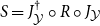 $S=J_{\mathcal Y}^\dagger \circ R\circ J_{\mathcal Y}$
. We show that
$S=J_{\mathcal Y}^\dagger \circ R\circ J_{\mathcal Y}$
. We show that $(\mathcal Y,S)$
is a quantum cpo: Let
$(\mathcal Y,S)$
is a quantum cpo: Let $\mathcal H$
be an atomic quantum set and let
$\mathcal H$
be an atomic quantum set and let $K_1\sqsubseteq K_2\sqsubseteq \cdots :{\mathcal H}\to \mathcal Y$
be a monotonically ascending sequence of functions. Let
$K_1\sqsubseteq K_2\sqsubseteq \cdots :{\mathcal H}\to \mathcal Y$
be a monotonically ascending sequence of functions. Let $G_n=J_{\mathcal Y}\circ K_n$
for each
$G_n=J_{\mathcal Y}\circ K_n$
for each $n\in {\mathbb N}$
. Since
$n\in {\mathbb N}$
. Since $J_{\mathcal Y}$
by definition of the order on
$J_{\mathcal Y}$
by definition of the order on $\mathcal Y$
is an order embedding, hence monotone, it follows from Lemma 3.3.4 that
$\mathcal Y$
is an order embedding, hence monotone, it follows from Lemma 3.3.4 that $G_1\sqsubseteq G_2\sqsubseteq \cdots :{\mathcal H}\to {\mathcal X}$
is a monotonically ascending sequence, which therefore has a limit
$G_1\sqsubseteq G_2\sqsubseteq \cdots :{\mathcal H}\to {\mathcal X}$
is a monotonically ascending sequence, which therefore has a limit $G_\infty$
. For any
$G_\infty$
. For any $G:{\mathcal H}\to {\mathcal X}$
, we have
$G:{\mathcal H}\to {\mathcal X}$
, we have
 \begin{equation*}\mathop {\mathrm{ran}} G=\{X\,\, \propto {\mathcal X}:G(H',X)\neq 0 \text{ for some }H'\,\, \propto {\mathcal H}\}=\{X\,\, \propto {\mathcal X}:G(H,X)\neq 0\}.\end{equation*}
Moreover, by Lemma 4.2.3 we have $\mathop {\mathrm{ran}} G\subseteq \mathcal Y$
if and only if
$\mathop {\mathrm{ran}} G\subseteq \mathcal Y$
if and only if $G$
factors via
$G$
factors via $J_{\mathcal Y}$
. Thus,
$J_{\mathcal Y}$
. Thus, $G(H,X_\perp )=0$
if and only if
$G(H,X_\perp )=0$
if and only if $G=J_{\mathcal Y}\circ K$
for some
$G=J_{\mathcal Y}\circ K$
for some $K:{\mathcal H}\to \mathcal Y$
Furthermore, we have
$K:{\mathcal H}\to \mathcal Y$
Furthermore, we have
 \begin{equation*}(R\circ G)(H,X_\perp )=\bigvee _{X\,\, \propto {\mathcal X}}R(X,X_\perp )\cdot G(H,X_\perp ) = R(X_\perp ,X_\perp )\cdot G(H,X_\perp ),\end{equation*}
where we used that $R(X,{\mathbb C}_\perp )=0$
for each atom
$R(X,{\mathbb C}_\perp )=0$
for each atom $X\neq {\mathbb C}_\perp$
in the last equality. Since
$X\neq {\mathbb C}_\perp$
in the last equality. Since $R(X_\perp ,X_\perp )\geq I_{{\mathcal X}}(X,X)\geq {\mathbb C} 1_X$
, it follows that
$R(X_\perp ,X_\perp )\geq I_{{\mathcal X}}(X,X)\geq {\mathbb C} 1_X$
, it follows that $(R\circ G)(H,X_\perp )=0$
if and only if
$(R\circ G)(H,X_\perp )=0$
if and only if $G(H,X_\perp )=0$
if and only if
$G(H,X_\perp )=0$
if and only if $G=J_{\mathcal Y}\circ K$
for some
$G=J_{\mathcal Y}\circ K$
for some $K:{\mathcal H}\to \mathcal Y$
. Since
$K:{\mathcal H}\to \mathcal Y$
. Since $G_n\nearrow G_\infty$
, we have
$G_n\nearrow G_\infty$
, we have $(R\circ G_\infty )(H,X_\infty )=\bigwedge _{n\in {\mathbb N}}(R\circ G_n)(H,X_\perp )=0,$
hence
$(R\circ G_\infty )(H,X_\infty )=\bigwedge _{n\in {\mathbb N}}(R\circ G_n)(H,X_\perp )=0,$
hence $G_\infty =J_{\mathcal Y}\circ K_\infty$
for some
$G_\infty =J_{\mathcal Y}\circ K_\infty$
for some $K_\infty :{\mathcal H}\to \mathcal Y$
. Then,
$K_\infty :{\mathcal H}\to \mathcal Y$
. Then, $G_n\nearrow G_\infty$
translates to
$G_n\nearrow G_\infty$
translates to $\bigwedge _{n\in {\mathbb N}} R\circ J_{\mathcal Y}\circ K_n=\bigwedge _{n\in {\mathbb N}}R\circ G_n=R\circ G_\infty =R\circ J_{\mathcal Y}\circ K_\infty .$
It then follows from [Kornell et al. (Reference Kornell, Lindenhovius and Mislove2022), Proposition A.6] that
$\bigwedge _{n\in {\mathbb N}} R\circ J_{\mathcal Y}\circ K_n=\bigwedge _{n\in {\mathbb N}}R\circ G_n=R\circ G_\infty =R\circ J_{\mathcal Y}\circ K_\infty .$
It then follows from [Kornell et al. (Reference Kornell, Lindenhovius and Mislove2022), Proposition A.6] that
 \begin{align*} \bigwedge _{n\in {\mathbb N}}S\circ K_n& =\bigwedge _{n\in {\mathbb N}}J_{\mathcal Y }^\dagger \circ R\circ J_{\mathcal Y}\circ K_n=J_{\mathcal Y}^\dagger \circ \bigwedge _{n\in {\mathbb N}} R\circ J_{\mathcal Y}\circ K_n\\ & =J_{\mathcal Y}^\dagger \circ R\circ J_{\mathcal Y}\circ K_\infty =S\circ K_\infty , \end{align*}
which shows that $K_n\nearrow K_\infty$
, so
$K_n\nearrow K_\infty$
, so $\mathcal Y$
is indeed a quantum cpo. Clearly
$\mathcal Y$
is indeed a quantum cpo. Clearly $(\!-\!)_\perp$
is injective on objects, hence
$(\!-\!)_\perp$
is injective on objects, hence $(\mathcal Y,S)$
is unique.
$(\mathcal Y,S)$
is unique.
Definition 7.3.3.
We call a quantum cpo $({\mathcal X},R)$
pointed if it satisfies one (and hence all) of the conditions in Lemma 7.3.2
. We say that a Scott continuous map
$({\mathcal X},R)$
pointed if it satisfies one (and hence all) of the conditions in Lemma 7.3.2
. We say that a Scott continuous map $F:({\mathcal X},R)\to (\mathcal Y,S)$
between pointed quantum cpos is strict if
$F:({\mathcal X},R)\to (\mathcal Y,S)$
between pointed quantum cpos is strict if $F\circ B_{\mathcal X}=B_{\mathcal Y}$
. The subcategory of
$F\circ B_{\mathcal X}=B_{\mathcal Y}$
. The subcategory of $\mathbf{qCPO}$
consisting of pointed quantum cpos and strict Scott continuous maps is denoted by
$\mathbf{qCPO}$
consisting of pointed quantum cpos and strict Scott continuous maps is denoted by $\mathbf{qCPO}_{\perp !}$
.
$\mathbf{qCPO}_{\perp !}$
.
Lemma 7.3.4.
Let $({\mathcal X},R)$
be a pointed quantum cpo. Then for each quantum set
$({\mathcal X},R)$
be a pointed quantum cpo. Then for each quantum set $\mathcal Y$
, the function
$\mathcal Y$
, the function $B_{\mathcal Y,{\mathcal X}}:=B_{\mathcal X}\circ !_{\mathcal Y}$
is Scott continuous, and it is the least element of
$B_{\mathcal Y,{\mathcal X}}:=B_{\mathcal X}\circ !_{\mathcal Y}$
is Scott continuous, and it is the least element of $\mathbf{qSet}(\mathcal Y,{\mathcal X})$
. Moreover, if
$\mathbf{qSet}(\mathcal Y,{\mathcal X})$
. Moreover, if $\mathcal Z$
is another quantum set, and
$\mathcal Z$
is another quantum set, and $F:\mathcal Z\to \mathcal Y$
is a function, then
$F:\mathcal Z\to \mathcal Y$
is a function, then $B_{\mathcal Y,{\mathcal X}}\circ F=B_{\mathcal Z,{\mathcal X}}$
.
$B_{\mathcal Y,{\mathcal X}}\circ F=B_{\mathcal Z,{\mathcal X}}$
.
Proof.
Let $K:\mathcal Y\to {\mathcal X}$
be a function. Let
$K:\mathcal Y\to {\mathcal X}$
be a function. Let $X\,\, \propto {\mathcal X}$
and
$X\,\, \propto {\mathcal X}$
and $Y\,\, \propto {\mathcal X}$
, and let
$Y\,\, \propto {\mathcal X}$
, and let $J_Y:\mathcal Q\{Y\}\to \mathcal Y$
be the embedding. Lemma 7.3.2 assures that
$J_Y:\mathcal Q\{Y\}\to \mathcal Y$
be the embedding. Lemma 7.3.2 assures that $B_{\mathcal X}\circ !_{\mathcal Q\{Y\}}$
is the least element of
$B_{\mathcal X}\circ !_{\mathcal Q\{Y\}}$
is the least element of $\mathbf{qSet}(\mathcal Q\{Y\},{\mathcal X})$
, hence
$\mathbf{qSet}(\mathcal Q\{Y\},{\mathcal X})$
, hence $B_{\mathcal Y,{\mathcal X}}\circ J_Y=B_{\mathcal X}\circ !_{\mathcal Y}\circ J_Y=B_{\mathcal X}\circ 1_{\mathcal Q\{Y\}}\leq K\circ J_Y$
, so
$B_{\mathcal Y,{\mathcal X}}\circ J_Y=B_{\mathcal X}\circ !_{\mathcal Y}\circ J_Y=B_{\mathcal X}\circ 1_{\mathcal Q\{Y\}}\leq K\circ J_Y$
, so $K(Y,X)=(K\circ J_Y)(X,Y)\leq (R\circ B_{\mathcal X}\circ !_{\mathcal Y})$ $(Y,X)$
, showing that
$(Y,X)$
, showing that $B_{\mathcal X}\circ !_{\mathcal Y}\sqsubseteq K$
, so
$B_{\mathcal X}\circ !_{\mathcal Y}\sqsubseteq K$
, so $B_{\mathcal Y,{\mathcal X}}$
is indeed the least element of
$B_{\mathcal Y,{\mathcal X}}$
is indeed the least element of $\mathbf{qSet}(\mathcal Y,{\mathcal X})$
. Since it is the composition of Scott continuous functions, it is Scott continuous. Finally, we have
$\mathbf{qSet}(\mathcal Y,{\mathcal X})$
. Since it is the composition of Scott continuous functions, it is Scott continuous. Finally, we have $B_{\mathcal Y,{\mathcal X}}\circ F=B_{{\mathcal X}}\circ !_{\mathcal Y}\circ F=B_{\mathcal X}\circ !_{\mathcal Z}=B_{\mathcal Z,{\mathcal X}}$
.
$B_{\mathcal Y,{\mathcal X}}\circ F=B_{{\mathcal X}}\circ !_{\mathcal Y}\circ F=B_{\mathcal X}\circ !_{\mathcal Z}=B_{\mathcal Z,{\mathcal X}}$
.
Lemma 7.3.5.
Let $({\mathcal X},R)$
and
$({\mathcal X},R)$
and $(\mathcal Y,S)$
be pointed quantum cpos and let
$(\mathcal Y,S)$
be pointed quantum cpos and let $F:{\mathcal X}\to \mathcal Y$
be a Scott continuous function. Then
$F:{\mathcal X}\to \mathcal Y$
be a Scott continuous function. Then $F$
is strict if and only if
$F$
is strict if and only if $F({\mathbb C}_\perp ,Y)=\delta _{Y,{\mathbb C}_\perp }L({\mathbb C}_\perp ,Y)$
for each
$F({\mathbb C}_\perp ,Y)=\delta _{Y,{\mathbb C}_\perp }L({\mathbb C}_\perp ,Y)$
for each $Y\,\, \propto \mathcal Y$
.
$Y\,\, \propto \mathcal Y$
.
Proof.
Let $F$
be strict. Then, for each
$F$
be strict. Then, for each $Y\,\, \propto \mathcal Y$
, we have
$Y\,\, \propto \mathcal Y$
, we have
 \begin{equation*} \delta _{Y,{\mathbb C}_\perp }L({\mathbb C},Y)=B_{\mathcal Y}({\mathbb C},Y)=(F\circ B_{\mathcal X})({\mathbb C},Y)=\bigvee _{X\,\, \propto {\mathcal X}}F(X,Y)\cdot B_{\mathcal X}({\mathbb C},X)=F({\mathbb C}_\perp ,Y)\cdot L({\mathbb C},{\mathbb C}_\perp ),\end{equation*}
hence
 \begin{equation*} F({\mathbb C}_\perp ,Y)=F({\mathbb C}_\perp ,Y)\cdot L({\mathbb C},{\mathbb C}_\perp )\cdot L({\mathbb C}_\perp ,C)=\delta _{Y,{\mathbb C}_\perp }L({\mathbb C},Y)\cdot L({\mathbb C}_\perp ,{\mathbb C})=\delta _{Y,{\mathbb C}_\perp }L({\mathbb C}_\perp ,Y).\end{equation*}
Conversely, if $F({\mathbb C}_\perp ,Y)=\delta _{Y,{\mathbb C}_\perp }L({\mathbb C}_\perp ,Y)$
for each
$F({\mathbb C}_\perp ,Y)=\delta _{Y,{\mathbb C}_\perp }L({\mathbb C}_\perp ,Y)$
for each $Y\,\, \propto \mathcal Y$
, we have by definition of
$Y\,\, \propto \mathcal Y$
, we have by definition of $B_{\mathcal X}$
:
$B_{\mathcal X}$
:
 \begin{align*} (F\circ B_{\mathcal X})({\mathbb C},Y) & =\bigvee _{X\,\, \propto {\mathcal X}}F(X,Y)\cdot B_{\mathcal X}({\mathbb C},X)=F({\mathbb C}_\perp ,Y)\cdot L({\mathbb C},{\mathbb C}_\perp )\\ & =\delta _{Y,{\mathbb C}_\perp }L({\mathbb C}_\perp ,Y)\cdot L({\mathbb C},{\mathbb C}_\perp )=\delta _{Y,{\mathbb C}_\perp }L({\mathbb C},Y)=B_{\mathcal Y}({\mathbb C},Y). \end{align*}
We conclude that $F$
is strict.
$F$
is strict.
Theorem 7.3.6.
The category $\mathbf{qCPO}_{\perp !}$
is equivalent to
$\mathbf{qCPO}_{\perp !}$
is equivalent to $\mathbf{Kl}$
.
$\mathbf{Kl}$
.
Proof.
We can identify $\mathbf{Kl}$
with the category of free
$\mathbf{Kl}$
with the category of free $(\!-\!)_\perp$
-algebras.
$(\!-\!)_\perp$
-algebras.
By Definition 7.3.3 and Lemma 7.3.2, any object of $\mathbf{qCPO}_{\perp !}$
is of the form
$\mathbf{qCPO}_{\perp !}$
is of the form $({\mathcal X},R)_\perp$
for some unique quantum cpo
$({\mathcal X},R)_\perp$
for some unique quantum cpo $({\mathcal X},R)$
. So, let
$({\mathcal X},R)$
. So, let $({\mathcal X},R)_\perp$
and
$({\mathcal X},R)_\perp$
and $({\mathcal X},S)_\perp$
be two pointed quantum cpos and let
$({\mathcal X},S)_\perp$
be two pointed quantum cpos and let $F:({\mathcal X},R)_\perp \to (\mathcal Y,S)_\perp$
be a strict Scott continuous map. We show that
$F:({\mathcal X},R)_\perp \to (\mathcal Y,S)_\perp$
be a strict Scott continuous map. We show that $F:({\mathcal X}_\perp ,M_{\mathcal X})\to (\mathcal Y_\perp ,M_{\mathcal Y})$
is a morphism of
$F:({\mathcal X}_\perp ,M_{\mathcal X})\to (\mathcal Y_\perp ,M_{\mathcal Y})$
is a morphism of $(\!-\!)_\perp$
-algebras, where
$(\!-\!)_\perp$
-algebras, where $M_{\mathcal X}:{\mathcal X}_{\perp \perp }\to {\mathcal X}_\perp$
is given in Theorem 7.1.1. So, we need to show that
$M_{\mathcal X}:{\mathcal X}_{\perp \perp }\to {\mathcal X}_\perp$
is given in Theorem 7.1.1. So, we need to show that $F\circ M_{\mathcal X}=M_{\mathcal Y}\circ F_\perp$
. For any quantum cpo
$F\circ M_{\mathcal X}=M_{\mathcal Y}\circ F_\perp$
. For any quantum cpo $\mathcal Z$
, we write
$\mathcal Z$
, we write $\mathrm{At}(\mathcal Z_\perp )=\mathrm{At}(\mathcal Z)\cup \{{\mathbb C}_{\perp }\}$
and
$\mathrm{At}(\mathcal Z_\perp )=\mathrm{At}(\mathcal Z)\cup \{{\mathbb C}_{\perp }\}$
and $\mathrm{At}(\mathcal Z_{\perp \perp })=\mathrm{At}(\mathcal Z_\perp )\cup \{{\mathbb C}_{\perp _2}\}$
. Then, the only nonzero components of
$\mathrm{At}(\mathcal Z_{\perp \perp })=\mathrm{At}(\mathcal Z_\perp )\cup \{{\mathbb C}_{\perp _2}\}$
. Then, the only nonzero components of $M_{\mathcal Z}$
are
$M_{\mathcal Z}$
are $M_{\mathcal Z}(Z,Z)={\mathbb C} 1_Z$
for
$M_{\mathcal Z}(Z,Z)={\mathbb C} 1_Z$
for $Z\neq {\mathbb C}_{\perp _2}$
and
$Z\neq {\mathbb C}_{\perp _2}$
and $M_{\mathcal Z}({\mathbb C}_{\perp _2},{\mathbb C}_{\perp })=L({\mathbb C}_{\perp _2},{\mathbb C}_{\perp })$
. Let
$M_{\mathcal Z}({\mathbb C}_{\perp _2},{\mathbb C}_{\perp })=L({\mathbb C}_{\perp _2},{\mathbb C}_{\perp })$
. Let $X\,\, \propto {\mathcal X}_{\perp \perp }$
and
$X\,\, \propto {\mathcal X}_{\perp \perp }$
and $Y\,\, \propto \mathcal Y_\perp$
. If
$Y\,\, \propto \mathcal Y_\perp$
. If $X\neq {\mathbb C}_{\perp _2}$
, we have
$X\neq {\mathbb C}_{\perp _2}$
, we have
 \begin{align*} ( F\circ M_{\mathcal X})(X,Y) & = \bigvee _{Z\,\, \propto {\mathcal X}_\perp }F(Z,Y)\cdot M_{\mathcal X}(X,Z)=F(X,Y)= \bigvee _{Z\,\, \propto \mathcal Y_\perp }M_{\mathcal Y}(Z,Y)\cdot F(X,Z)\\ & = \bigvee _{Z\,\, \propto \mathcal Y_{\perp \perp }}M_{\mathcal Y}(Z,Y)\cdot F_\perp (X,Z) = M_{\mathcal Y}\circ F_\perp (X,Y) . \end{align*}
If $X={\mathbb C}_{\perp _2}$
, then using Lemma 7.3.5, we find:
$X={\mathbb C}_{\perp _2}$
, then using Lemma 7.3.5, we find:
 \begin{align*} ( F\circ M_{\mathcal X})(X,Y) & = \bigvee _{Z\,\, \propto {\mathcal X}_\perp }F(Z,Y)\cdot M_{\mathcal X}({\mathbb C}_{\perp _2},Z)=F({\mathbb C}_{\perp },Y)\cdot L({\mathbb C}_{\perp _2},{\mathbb C}_{\perp })\\ & = \delta _{Y,{\mathbb C}_\perp }L({\mathbb C}_{\perp },Y)\cdot L({\mathbb C}_{\perp _2},{\mathbb C}_{\perp })=\delta _{Y,{\mathbb C}_\perp }L({\mathbb C}_{\perp _2},Y)\\ & = \delta _{Y,{\mathbb C}_\perp }L({\mathbb C}_{\perp _2},Y)\cdot L({\mathbb C}_{\perp _2},{\mathbb C}_{\perp _2}) = M_{\mathcal Y}({\mathbb C}_{\perp _2},Y)\cdot L({\mathbb C}_{\perp _2},{\mathbb C}_{\perp _2})\\ & = \bigvee _{Z\,\, \propto \mathcal Y_{\perp \perp }}M_{\mathcal Y}(Z,Y)\cdot F_\perp ({\mathbb C}_{\perp _2},Z)= M_{\mathcal Y}\circ F_\perp (X,Y). \end{align*}
We conclude that $M_{\mathcal Y}\circ F_\perp =F\circ M_{\mathcal X}$
, so
$M_{\mathcal Y}\circ F_\perp =F\circ M_{\mathcal X}$
, so $F$
is a morphism of
$F$
is a morphism of $(\!-\!)_\perp$
-algebras.
$(\!-\!)_\perp$
-algebras.
Conversely, assume that $F$
is a morphism of
$F$
is a morphism of $(\!-\!)_\perp$
-algebras. For any quantum cpo
$(\!-\!)_\perp$
-algebras. For any quantum cpo $(\mathcal Z,T)$
, and any
$(\mathcal Z,T)$
, and any $Z\,\, \propto \mathcal Z_\perp$
, we calculate:
$Z\,\, \propto \mathcal Z_\perp$
, we calculate:
 \begin{align*} ( M_{\mathcal Z}\circ B_{\mathcal Z_\perp })({\mathbb C},Z) & = \bigvee _{Z'\,\, \propto \mathcal Z_{\perp \perp }}M_{\mathcal Z}(Z',Z )\cdot \delta _{Z',{\mathbb C}_\perp }L({\mathbb C},Z)\\ & = M_{\mathcal Z}({\mathbb C}_\perp ,Z)\cdot L({\mathbb C}_,{\mathbb C}_\perp ) = \delta _{Z,{\mathbb C}_\perp }L({\mathbb C}_\perp ,Z)\cdot L({\mathbb C},{\mathbb C}_\perp )=\delta _{Z,{\mathbb C}_\perp }L({\mathbb C},Z). \end{align*}
Hence, we find for each $Y\,\, \propto \mathcal Y_\perp$
:
$Y\,\, \propto \mathcal Y_\perp$
:
 \begin{align*} \delta _{Y,{\mathbb C}_\perp }L({\mathbb C},Y) & = (M_{\mathcal Y}\circ B_{\mathcal Y_\perp })({\mathbb C},Y) = M_{\mathcal Y}\circ (F_\perp \circ B_{{\mathcal X}_\perp })({\mathbb C},Y) =(F\circ M_{\mathcal X}\circ B_{{\mathcal X}_\perp })({\mathbb C},Y)\\ & = \bigvee _{X\,\, \propto {\mathcal X}_\perp }F(X,Y)\cdot ( M_{\mathcal X}\circ B_{{\mathcal X}_\perp })({\mathbb C},X) = F({\mathbb C}_\perp ,Y)\cdot L({\mathbb C},{\mathbb C}_\perp ), \end{align*}
where we used the definition of a strict map in the second equality, and the fact that $F$
is a
$F$
is a $(\!-\!)_\perp$
-algebra morphism in the third equality. Hence,
$(\!-\!)_\perp$
-algebra morphism in the third equality. Hence,
 \begin{equation*} F({\mathbb C}_\perp ,Y)=F({\mathbb C}_\perp ,Y)\cdot L({\mathbb C},{\mathbb C}_\perp )\cdot L({\mathbb C}_\perp ,{\mathbb C})=\delta _{Y,{\mathbb C}_\perp }L({\mathbb C},{\mathbb C}_Y)\cdot L({\mathbb C}_\perp ,{\mathbb C})=\delta _{Y,{\mathbb C}_\perp }L({\mathbb C}_\perp ,Y).\end{equation*}
It now follows from Lemma 7.3.5 that $F$
is strict. We conclude that every object of
$F$
is strict. We conclude that every object of $\mathbf{qCPO}_{\perp !}$
is of the form
$\mathbf{qCPO}_{\perp !}$
is of the form $({\mathcal X},R)_\perp$
for some unique quantum cpo
$({\mathcal X},R)_\perp$
for some unique quantum cpo $({\mathcal X},R)$
, and similarly, the underlying quantum cpo of any free
$({\mathcal X},R)$
, and similarly, the underlying quantum cpo of any free $(\!-\!)_\perp$
-algebra
$(\!-\!)_\perp$
-algebra $({\mathcal X}_\perp ,M_{\mathcal X})$
is
$({\mathcal X}_\perp ,M_{\mathcal X})$
is $({\mathcal X},R)_\perp$
for some unique quantum cpo
$({\mathcal X},R)_\perp$
for some unique quantum cpo $({\mathcal X},R)$
. Moreover, any Scott continuous map
$({\mathcal X},R)$
. Moreover, any Scott continuous map $F:({\mathcal X},R)_\perp \to (\mathcal Y,S)_\perp$
between pointed quantum cpos is strict if and only if it is an
$F:({\mathcal X},R)_\perp \to (\mathcal Y,S)_\perp$
between pointed quantum cpos is strict if and only if it is an $(\!-\!)_\perp$
-algebra morphism
$(\!-\!)_\perp$
-algebra morphism $({\mathcal X}_\perp ,M_{\mathcal X})\to (\mathcal Y_\perp ,M_{\mathcal Y})$
. It now easily follows that
$({\mathcal X}_\perp ,M_{\mathcal X})\to (\mathcal Y_\perp ,M_{\mathcal Y})$
. It now easily follows that $\mathbf{qCPO}_{\perp !}$
and
$\mathbf{qCPO}_{\perp !}$
and $\mathbf{Kl}$
are equivalent.
$\mathbf{Kl}$
are equivalent.
7.4 Monoidal closure
Recall that $\mathbf{qCPO}$
is monoidal closed with inner hom
$\mathbf{qCPO}$
is monoidal closed with inner hom $[-,-]_\uparrow$
and with evaluation function
$[-,-]_\uparrow$
and with evaluation function $\mathrm{Eval}_\uparrow$
(cf. Theorem 5.3.8). In this section, we show that
$\mathrm{Eval}_\uparrow$
(cf. Theorem 5.3.8). In this section, we show that $\mathbf{Kl}$
is monoidal closed, too.
$\mathbf{Kl}$
is monoidal closed, too.
Proposition 7.4.1.
Let $({\mathcal X},R)$
be a quantum cpo, and let
$({\mathcal X},R)$
be a quantum cpo, and let $(\mathcal Y,S)$
be a pointed quantum cpo. Then,
$(\mathcal Y,S)$
be a pointed quantum cpo. Then, $[{\mathcal X},\mathcal Y]_\uparrow$
is pointed, too.
$[{\mathcal X},\mathcal Y]_\uparrow$
is pointed, too.
Proof.
By Lemma 7.3.4, there is a Scott continuous function $B_{{\mathcal X},\mathcal Y}:\boldsymbol{\mathcal{X}}\to \mathcal Y$
that is the least element of
$B_{{\mathcal X},\mathcal Y}:\boldsymbol{\mathcal{X}}\to \mathcal Y$
that is the least element of $\mathbf{qSet}({\mathcal X},\mathcal Y)$
. The same lemma assures that
$\mathbf{qSet}({\mathcal X},\mathcal Y)$
. The same lemma assures that $B_{{\mathbf 1}\times {\mathcal X},\mathcal Y}=B_{{\mathcal X},\mathcal Y}\circ L_{\mathcal X}:{\mathbf 1}\times {\mathcal X}\to \mathcal Y$
is Scott continuous, and the least element of
$B_{{\mathbf 1}\times {\mathcal X},\mathcal Y}=B_{{\mathcal X},\mathcal Y}\circ L_{\mathcal X}:{\mathbf 1}\times {\mathcal X}\to \mathcal Y$
is Scott continuous, and the least element of $\mathbf{qSet}({\mathbf 1}\times {\mathcal X},\mathcal Y)$
, where
$\mathbf{qSet}({\mathbf 1}\times {\mathcal X},\mathcal Y)$
, where $L_{\mathcal X}$
denotes the left unitor of
$L_{\mathcal X}$
denotes the left unitor of $\mathbf{qCPO}$
. By the monoidal closure of
$\mathbf{qCPO}$
. By the monoidal closure of $\mathbf{qCPO}$
, there is a Scott continuous function
$\mathbf{qCPO}$
, there is a Scott continuous function $B:{\mathbf 1}\to [{\mathcal X},\mathcal Y]_\uparrow$
such that the following diagram commutes:
$B:{\mathbf 1}\to [{\mathcal X},\mathcal Y]_\uparrow$
such that the following diagram commutes:

We next show that for each atomic quantum set $\mathcal H$
, the map
$\mathcal H$
, the map $B\circ !_{{\mathcal H}}$
is the least element of
$B\circ !_{{\mathcal H}}$
is the least element of $\mathbf{qSet}({\mathcal H},[{\mathcal X},\mathcal Y]_\uparrow )$
as by Lemma 7.3.2 this would assure that
$\mathbf{qSet}({\mathcal H},[{\mathcal X},\mathcal Y]_\uparrow )$
as by Lemma 7.3.2 this would assure that $[{\mathcal X},\mathcal Y]_\uparrow$
is pointed. By Lemma 7.3.4, we have
$[{\mathcal X},\mathcal Y]_\uparrow$
is pointed. By Lemma 7.3.4, we have $B_{{\mathcal H}\times {\mathcal X},\mathcal Y}=B_{{\mathbf 1}\times {\mathcal X},\mathcal Y}\circ (!_{{\mathcal H}}\times I_{\mathcal X})$
. Thus consider the following diagram:
$B_{{\mathcal H}\times {\mathcal X},\mathcal Y}=B_{{\mathbf 1}\times {\mathcal X},\mathcal Y}\circ (!_{{\mathcal H}}\times I_{\mathcal X})$
. Thus consider the following diagram:

It follows from Lemma 7.3.4 that $B_{{\mathcal H}\times {\mathcal X},\mathcal Y}$
is the least element of
$B_{{\mathcal H}\times {\mathcal X},\mathcal Y}$
is the least element of $\mathbf{qCPO}({\mathcal H}\times {\mathcal X},\mathcal Y)\subseteq \mathbf{qSet}({\mathcal H}\times {\mathcal X},\mathcal Y)$
. Since
$\mathbf{qCPO}({\mathcal H}\times {\mathcal X},\mathcal Y)\subseteq \mathbf{qSet}({\mathcal H}\times {\mathcal X},\mathcal Y)$
. Since $\mathbf{qCPO}$
is order enriched, currying is an order isomorphism, hence
$\mathbf{qCPO}$
is order enriched, currying is an order isomorphism, hence $B\circ !_{{\mathcal H}}$
is the least element of
$B\circ !_{{\mathcal H}}$
is the least element of $\mathbf{qCPO}({\mathcal H},[{\mathcal X},\mathcal Y]_\uparrow )$
. By Example 3.2.5, it follows that any function
$\mathbf{qCPO}({\mathcal H},[{\mathcal X},\mathcal Y]_\uparrow )$
. By Example 3.2.5, it follows that any function $K:{\mathcal H}\to [{\mathcal X},\mathcal Y]_\uparrow$
is Scott continuous, hence
$K:{\mathcal H}\to [{\mathcal X},\mathcal Y]_\uparrow$
is Scott continuous, hence $\mathbf{qCPO}({\mathcal H},[{\mathcal X},\mathcal Y]_\uparrow )=\mathbf{qSet}({\mathcal H},[{\mathcal X},\mathcal Y]_\uparrow )$
. We conclude that
$\mathbf{qCPO}({\mathcal H},[{\mathcal X},\mathcal Y]_\uparrow )=\mathbf{qSet}({\mathcal H},[{\mathcal X},\mathcal Y]_\uparrow )$
. We conclude that $B\circ !_{{\mathcal H}}$
is indeed the least element of
$B\circ !_{{\mathcal H}}$
is indeed the least element of $\mathbf{qSet}({\mathcal H},[{\mathcal X},\mathcal Y]_\uparrow )$
, that is,
$\mathbf{qSet}({\mathcal H},[{\mathcal X},\mathcal Y]_\uparrow )$
, that is, $B=B_{[{\mathcal X},\mathcal Y]_\uparrow }$
.
$B=B_{[{\mathcal X},\mathcal Y]_\uparrow }$
.
By Proposition 7.4.1, we know that $[{\mathcal X},\mathcal Y_\perp ]_\uparrow$
is a pointed quantum cpo for any two quantum cpos
$[{\mathcal X},\mathcal Y_\perp ]_\uparrow$
is a pointed quantum cpo for any two quantum cpos $\mathcal X$
and
$\mathcal X$
and $\mathcal Y$
, and by Lemma 7.3.2, there is a unique quantum cpo
$\mathcal Y$
, and by Lemma 7.3.2, there is a unique quantum cpo $\{{\mathcal X},\mathcal Y\}$
such that
$\{{\mathcal X},\mathcal Y\}$
such that $\{{\mathcal X},\mathcal Y\}_\perp =[{\mathcal X},\mathcal Y_\perp ]_\uparrow$
. Recall the conventions about Kleisli categories at the beginning of this section. We thus have a morphism
$\{{\mathcal X},\mathcal Y\}_\perp =[{\mathcal X},\mathcal Y_\perp ]_\uparrow$
. Recall the conventions about Kleisli categories at the beginning of this section. We thus have a morphism $E:\{{\mathcal X},\mathcal Y\}\odot {\mathcal X}\;\;\;\;\;\circ \!\!\!\!\!\!\!\longrightarrow \mathcal Y$
given by the composition
$E:\{{\mathcal X},\mathcal Y\}\odot {\mathcal X}\;\;\;\;\;\circ \!\!\!\!\!\!\!\longrightarrow \mathcal Y$
given by the composition
 \begin{equation*}\{{\mathcal X},\mathcal Y\}\times {\mathcal X}\xrightarrow { H_{\{{\mathcal X},\mathcal Y\}}\times I_{\mathcal X}}[{\mathcal X},\mathcal Y_\perp ]_\uparrow \times {\mathcal X}\xrightarrow {\mathrm{Eval}_\uparrow }\mathcal Y_\perp \end{equation*}
in $\mathbf{qCPO}$
.
$\mathbf{qCPO}$
.
Lemma 7.4.2.
Let $\mathcal X$
,
$\mathcal X$
, $\mathcal Y$
and
$\mathcal Y$
and $\mathcal Z$
be quantum cpos and let
$\mathcal Z$
be quantum cpos and let $G:\mathcal Z\;\;\;\;\;\circ \!\!\!\!\!\!\!\longrightarrow \{{\mathcal X},\mathcal Y\}$
be a morphism in
$G:\mathcal Z\;\;\;\;\;\circ \!\!\!\!\!\!\!\longrightarrow \{{\mathcal X},\mathcal Y\}$
be a morphism in $\mathbf{Kl}$
, which is a morphism
$\mathbf{Kl}$
, which is a morphism $G:\mathcal Z\to [{\mathcal X},\mathcal Y_\perp ]_\uparrow$
in
$G:\mathcal Z\to [{\mathcal X},\mathcal Y_\perp ]_\uparrow$
in $\mathbf{qCPO}$
. Then
$\mathbf{qCPO}$
. Then $E\bullet (G\odot H_{\mathcal X})=\mathrm{Eval}_\uparrow \circ (G\times I_X)$
.
$E\bullet (G\odot H_{\mathcal X})=\mathrm{Eval}_\uparrow \circ (G\times I_X)$
.
Proof. Consider the following commuting diagram:

Here, the square commutes by naturality of $K$
. Since the lift is a monoidal monad, we have
$K$
. Since the lift is a monoidal monad, we have $K_{\{{\mathcal X},\mathcal Y\}_\perp ,{\mathcal X}}\circ (H_{\{{\mathcal X},\mathcal Y\}_\perp }\times H_{\mathcal X})=H_{\{{\mathcal X},\mathcal Y\}_\perp \times {\mathcal X}}$
, whence
$K_{\{{\mathcal X},\mathcal Y\}_\perp ,{\mathcal X}}\circ (H_{\{{\mathcal X},\mathcal Y\}_\perp }\times H_{\mathcal X})=H_{\{{\mathcal X},\mathcal Y\}_\perp \times {\mathcal X}}$
, whence
 \begin{equation*} (H_{\{{\mathcal X},\mathcal Y\}}\times I_{\mathcal X})_\perp \circ K_{\{{\mathcal X},\mathcal Y\},{\mathcal X}}\circ (I_{\{{\mathcal X},\mathcal Y\}_\perp }\times H_{\mathcal X})=H_{\{{\mathcal X},\mathcal Y\}_\perp \times {\mathcal X}}\end{equation*}
As a consequence, we obtain
 \begin{align*}M_{\mathcal Y}\circ (\mathrm{Eval}_\uparrow )_\perp \circ (H_{\{X,\mathcal Y\}}\times I_{\mathcal X})_\perp \circ K_{\{{\mathcal X},\mathcal Y\},{\mathcal X}}\circ (I_{\{{\mathcal X},\mathcal Y\}_\perp }\times H_{\mathcal X})&=M_{\mathcal Y}\circ (\mathrm{Eval}_\uparrow )_\perp \circ H_{\{{\mathcal X},\mathcal Y\}_\perp \times {\mathcal X}}\\&=\mathrm{Eval}_\uparrow ,\end{align*}
where the last equality follows since $\mathcal Y_\perp$
, the codomain of
$\mathcal Y_\perp$
, the codomain of $\mathrm{Eval}_\uparrow$
is lifted, and for arbitrary morphisms
$\mathrm{Eval}_\uparrow$
is lifted, and for arbitrary morphisms $F:{\mathcal V}\to {\mathcal W}_\perp$
with a lifted codomain we have
$F:{\mathcal V}\to {\mathcal W}_\perp$
with a lifted codomain we have $M_{\mathcal W}\circ F_\perp \circ H_{\mathcal V}=F$
, which follows the following commuting diagram:
$M_{\mathcal W}\circ F_\perp \circ H_{\mathcal V}=F$
, which follows the following commuting diagram:

where the square commutes by naturality of $H$
. By definition of a monad, we have
$H$
. By definition of a monad, we have $M_{\mathcal W}\circ H_{{\mathcal W}_\perp }=I_{{\mathcal W}_\perp }$
, from which indeed
$M_{\mathcal W}\circ H_{{\mathcal W}_\perp }=I_{{\mathcal W}_\perp }$
, from which indeed $M_{\mathcal W}\circ F_\perp \circ H_{\mathcal V}=F$
follows. Thus, we conclude
$M_{\mathcal W}\circ F_\perp \circ H_{\mathcal V}=F$
follows. Thus, we conclude
 \begin{equation*} \mathrm{Eval}_\uparrow =M_{\mathcal Y}\circ (\mathrm{Eval}_\uparrow )_\perp \circ (H_{\{X,\mathcal Y\}}\times I_{\mathcal X})_\perp \circ K_{\{{\mathcal X},\mathcal Y\},{\mathcal X}}\circ (I_{\{{\mathcal X},\mathcal Y\}_\perp }\times H_{\mathcal X}), \end{equation*}
whence
 \begin{align*} \mathrm{Eval}_\uparrow \circ (G\times I_{\mathcal X}) & = M_{\mathcal Y}\circ (\mathrm{Eval}_\uparrow )_\perp \circ (H_{\{X,\mathcal Y\}}\times I_{\mathcal X})_\perp \circ K_{\{{\mathcal X},\mathcal Y\},{\mathcal X}}\circ (I_{\{{\mathcal X},\mathcal Y\}_\perp }\times H_{\mathcal X})\circ (G\times I_{\mathcal X})\\ & = M_{\mathcal Y}\circ (\mathrm{Eval}_\uparrow )_\perp \circ (H_{\{X,\mathcal Y\}}\times I_{\mathcal X})_\perp \circ K_{\{{\mathcal X},\mathcal Y\},{\mathcal X}}\circ (G\times H_{\mathcal X})\\ & = M_{\mathcal Y}\circ (\mathrm{Eval}_\uparrow \circ H_{\{X,\mathcal Y\}}\times I_{\mathcal X})_\perp \circ (G\odot H_{\mathcal X})\\ & = M_{\mathcal Y}\circ E_\perp \circ (G\odot H_{\mathcal X})\\ & = E\bullet (G\odot H_{\mathcal X}). \end{align*}
Theorem 7.4.3.
The Kleisli category $\mathbf{Kl}$
of the lift monad is symmmetric monoidal closed.
$\mathbf{Kl}$
of the lift monad is symmmetric monoidal closed.
Proof.
By Corollary 7.2.9 $\mathbf{Kl}$
is a symmetric monoidal category, so we only have to show that
$\mathbf{Kl}$
is a symmetric monoidal category, so we only have to show that $\mathbf{Kl}$
is monoidal closed. Let
$\mathbf{Kl}$
is monoidal closed. Let $F:\mathcal Z\odot {\mathcal X}\;\;\;\;\;\circ \!\!\!\!\!\!\!\longrightarrow \mathcal Y$
be a morphism in
$F:\mathcal Z\odot {\mathcal X}\;\;\;\;\;\circ \!\!\!\!\!\!\!\longrightarrow \mathcal Y$
be a morphism in $\mathbf{Kl}$
. Then,
$\mathbf{Kl}$
. Then, $F$
is a morphism
$F$
is a morphism $\mathcal Z\times {\mathcal X}\to \mathcal Y_\perp$
in
$\mathcal Z\times {\mathcal X}\to \mathcal Y_\perp$
in $\mathbf{qCPO}$
. By the universal property of
$\mathbf{qCPO}$
. By the universal property of $\mathrm{Eval}_\perp$
, there is a unique morphism
$\mathrm{Eval}_\perp$
, there is a unique morphism $G:\mathcal Z\to [{\mathcal X},\mathcal Y_\perp ]_\uparrow$
such that
$G:\mathcal Z\to [{\mathcal X},\mathcal Y_\perp ]_\uparrow$
such that $\mathrm{Eval}_\uparrow \circ (G\circ I_{\mathcal X})=F$
. Now,
$\mathrm{Eval}_\uparrow \circ (G\circ I_{\mathcal X})=F$
. Now, $G$
is a morphism
$G$
is a morphism $\mathcal Z\;\;\;\;\;\circ \!\!\!\!\!\!\!\longrightarrow \{{\mathcal X},\mathcal Y\}$
in
$\mathcal Z\;\;\;\;\;\circ \!\!\!\!\!\!\!\longrightarrow \{{\mathcal X},\mathcal Y\}$
in $\mathbf{Kl}$
, and by Lemma 7.4.2, it follows that
$\mathbf{Kl}$
, and by Lemma 7.4.2, it follows that $G$
is the unique morphism in
$G$
is the unique morphism in $\mathbf{Kl}$
such that
$\mathbf{Kl}$
such that $E\bullet (G\odot H_{\mathcal X})=F$
. Since
$E\bullet (G\odot H_{\mathcal X})=F$
. Since $H_{\mathcal X}$
is the identity morphism on
$H_{\mathcal X}$
is the identity morphism on $\mathcal X$
, this shows the assignment
$\mathcal X$
, this shows the assignment $\mathcal Y\mapsto \{{\mathcal X},\mathcal Y\}$
is the right adjoint of
$\mathcal Y\mapsto \{{\mathcal X},\mathcal Y\}$
is the right adjoint of $\mathcal Z\mapsto \mathcal Z\odot {\mathcal X}$
, that is,
$\mathcal Z\mapsto \mathcal Z\odot {\mathcal X}$
, that is, $\mathbf{Kl}$
is monoidal closed.
$\mathbf{Kl}$
is monoidal closed.
7.5 Completeness and coproducts
Lemma 7.5.1.
Let $({\mathcal X},R)$
and
$({\mathcal X},R)$
and $(\mathcal Y,S)$
be quantum posets and let
$(\mathcal Y,S)$
be quantum posets and let $F:{\mathcal X}\to \mathcal Y$
be an order embedding, that is,
$F:{\mathcal X}\to \mathcal Y$
be an order embedding, that is, $R=F^\dagger \circ S\circ F$
. If
$R=F^\dagger \circ S\circ F$
. If $\mathcal Z$
is a quantum set, then the map
$\mathcal Z$
is a quantum set, then the map $\mathbf{qSet}({\mathcal X},F):\mathbf{qSet}(\mathcal Z,{\mathcal X})\to \mathbf{qSet}(\mathcal Z,\mathcal Y)$
,
$\mathbf{qSet}({\mathcal X},F):\mathbf{qSet}(\mathcal Z,{\mathcal X})\to \mathbf{qSet}(\mathcal Z,\mathcal Y)$
, $G\mapsto F\circ G$
is an order embedding.
$G\mapsto F\circ G$
is an order embedding.
Proof.
Let $G_1,G_2:\mathcal Z\to {\mathcal X}$
be functions. Since
$G_1,G_2:\mathcal Z\to {\mathcal X}$
be functions. Since $F$
is monotone, its left action is monotone [Kornell et al. (Reference Kornell, Lindenhovius and Mislove2022), Lemma 4.4], whence
$F$
is monotone, its left action is monotone [Kornell et al. (Reference Kornell, Lindenhovius and Mislove2022), Lemma 4.4], whence $G_1\sqsubseteq G_2$
implies
$G_1\sqsubseteq G_2$
implies $F\circ G_1\sqsubseteq F\circ G_2$
. For the converse, assume that
$F\circ G_1\sqsubseteq F\circ G_2$
. For the converse, assume that $F\circ G_1\sqsubseteq F\circ G_2$
. Then,
$F\circ G_1\sqsubseteq F\circ G_2$
. Then, $S\circ F\circ G_2\leq S\circ F\circ G_1$
, so
$S\circ F\circ G_2\leq S\circ F\circ G_1$
, so $R\circ G_2=F^\dagger \circ S\circ F\circ G_2\leq F^\dagger \circ S\circ F\circ G_1=R\circ G_1$
, that is,
$R\circ G_2=F^\dagger \circ S\circ F\circ G_2\leq F^\dagger \circ S\circ F\circ G_1=R\circ G_1$
, that is, $G_1\sqsubseteq G_2$
.
$G_1\sqsubseteq G_2$
.
Proposition 7.5.2.
The canonical embedding $\mathbf{Kl}\to \mathbf{EM}$
,
$\mathbf{Kl}\to \mathbf{EM}$
, ${\mathcal X}\mapsto ({\mathcal X}_\perp ,M_{\mathcal X})$
of the Kleisli category of the monad
${\mathcal X}\mapsto ({\mathcal X}_\perp ,M_{\mathcal X})$
of the Kleisli category of the monad $(\!-\!)_\perp$
on
$(\!-\!)_\perp$
on $\mathbf{qCPO}$
into the Eilenberg–Moore category
$\mathbf{qCPO}$
into the Eilenberg–Moore category $\mathbf{EM}$
of
$\mathbf{EM}$
of $(\!-\!)_\perp$
is a weak equivalence of categories.
$(\!-\!)_\perp$
is a weak equivalence of categories.
Proof.
It is sufficient to show that each $(\!-\!)_\perp$
-algebra
$(\!-\!)_\perp$
-algebra $({\mathcal X},F)$
is free, that is, equal to
$({\mathcal X},F)$
is free, that is, equal to $(\mathcal Y_\perp ,M_{\mathcal Y})$
for some quantum cpo
$(\mathcal Y_\perp ,M_{\mathcal Y})$
for some quantum cpo $\mathcal Y$
. By definition of an
$\mathcal Y$
. By definition of an $(\!-\!)_\perp$
-algebra
$(\!-\!)_\perp$
-algebra $F:{\mathcal X}_\perp \to {\mathcal X}$
is a Scott continuous map satisying
$F:{\mathcal X}_\perp \to {\mathcal X}$
is a Scott continuous map satisying $F\circ H_{\mathcal X}=I_{\mathcal X}$
, where we recall that
$F\circ H_{\mathcal X}=I_{\mathcal X}$
, where we recall that $H_{\mathcal X}:{\mathcal X}\to {\mathcal X}_\perp$
is the unit of the monad
$H_{\mathcal X}:{\mathcal X}\to {\mathcal X}_\perp$
is the unit of the monad $(\!-\!)_\perp$
, and is equal to the embedding
$(\!-\!)_\perp$
, and is equal to the embedding $J_{\mathcal X}:{\mathcal X}\to {\mathcal X}_\perp$
.
$J_{\mathcal X}:{\mathcal X}\to {\mathcal X}_\perp$
.
We first show that $\mathcal X$
is pointed, for which we consider the map
$\mathcal X$
is pointed, for which we consider the map $K:{\mathcal X}_\perp \to {\mathcal X}_\perp$
given by
$K:{\mathcal X}_\perp \to {\mathcal X}_\perp$
given by $K=H_{\mathcal X}\circ F$
, which is Scott continuous since it is the composition of Scott continuous maps. Let
$K=H_{\mathcal X}\circ F$
, which is Scott continuous since it is the composition of Scott continuous maps. Let $\mathcal H$
be an atomic quantum set. By Theorem 3.3.5,
$\mathcal H$
be an atomic quantum set. By Theorem 3.3.5, $\mathbf{qCPO}({\mathcal H},{\mathcal X}_\perp )$
is a cpo, which is equal to
$\mathbf{qCPO}({\mathcal H},{\mathcal X}_\perp )$
is a cpo, which is equal to $\mathbf{qSet}({\mathcal H},{\mathcal X}_\perp )$
by Example 3.2.5. It follows from Lemma 7.3.4 that
$\mathbf{qSet}({\mathcal H},{\mathcal X}_\perp )$
by Example 3.2.5. It follows from Lemma 7.3.4 that $\mathbf{qCPO}({\mathcal H},{\mathcal X}_\perp )$
is a pointed cpo with a least element
$\mathbf{qCPO}({\mathcal H},{\mathcal X}_\perp )$
is a pointed cpo with a least element $B_{{\mathcal H},{\mathcal X}_\perp }$
that equals
$B_{{\mathcal H},{\mathcal X}_\perp }$
that equals $B_{\mathcal X}\circ !_{\mathcal H}$
. Note that
$B_{\mathcal X}\circ !_{\mathcal H}$
. Note that $\mathbf 1$
is atomic, and
$\mathbf 1$
is atomic, and $B_{{\mathbf 1},{\mathcal X}_\perp }=B_{{\mathcal X}_\perp }$
.
$B_{{\mathbf 1},{\mathcal X}_\perp }=B_{{\mathcal X}_\perp }$
.
Since $K$
is Scott continuous, it follows from Lemma 3.3.4 that the map
$K$
is Scott continuous, it follows from Lemma 3.3.4 that the map $\mathbf{qCPO}({\mathcal H},{\mathcal X}_\perp )\to \mathbf{qCPO}({\mathcal H},{\mathcal X}_\perp )$
,
$\mathbf{qCPO}({\mathcal H},{\mathcal X}_\perp )\to \mathbf{qCPO}({\mathcal H},{\mathcal X}_\perp )$
, $G\mapsto K\circ G$
is Scott continuous, hence Kleene’s Fixpoint Theorem (see for instance [Abramsky and Jung (Reference Abramsky, Jung, Abramsky, Gabbay and Maibaum1994), Theorem 2.1.19]) assures that this map has a least fixpoint
$G\mapsto K\circ G$
is Scott continuous, hence Kleene’s Fixpoint Theorem (see for instance [Abramsky and Jung (Reference Abramsky, Jung, Abramsky, Gabbay and Maibaum1994), Theorem 2.1.19]) assures that this map has a least fixpoint $G_{\mathcal H}$
given by
$G_{\mathcal H}$
given by $\bigvee _{n\in {\mathbb N}}K^n\circ B_{{\mathcal H},{\mathcal X}_\perp }$
, where the supremum is taken with respect to the order
$\bigvee _{n\in {\mathbb N}}K^n\circ B_{{\mathcal H},{\mathcal X}_\perp }$
, where the supremum is taken with respect to the order $\sqsubseteq$
on
$\sqsubseteq$
on $\mathbf{qCPO}({\mathcal H},{\mathcal X}_\perp )$
. By Lemma 3.3.3, we have
$\mathbf{qCPO}({\mathcal H},{\mathcal X}_\perp )$
. By Lemma 3.3.3, we have $G_{\mathcal H}=\bigvee _{n\in {\mathbb N}}K^n\circ B_{{\mathcal H},{\mathcal X}_\perp }=\bigvee _{n\in {\mathbb N}}K^n\circ B_{{\mathcal X}_\perp }\circ !_{{\mathcal H}}=\bigvee _{n\in {\mathbb N}}K^n\circ B_{{\mathbf 1},{\mathcal X}_\perp }\circ !_{{\mathcal H}}=G_{{\mathbf 1}}\circ !_{{\mathcal H}}$
.
$G_{\mathcal H}=\bigvee _{n\in {\mathbb N}}K^n\circ B_{{\mathcal H},{\mathcal X}_\perp }=\bigvee _{n\in {\mathbb N}}K^n\circ B_{{\mathcal X}_\perp }\circ !_{{\mathcal H}}=\bigvee _{n\in {\mathbb N}}K^n\circ B_{{\mathbf 1},{\mathcal X}_\perp }\circ !_{{\mathcal H}}=G_{{\mathbf 1}}\circ !_{{\mathcal H}}$
.
We claim that $F\circ G_{\mathcal H}$
is the least element of
$F\circ G_{\mathcal H}$
is the least element of $\mathbf{qSet}({\mathcal H},{\mathcal X})$
. Let
$\mathbf{qSet}({\mathcal H},{\mathcal X})$
. Let $N:{\mathcal H}\to {\mathcal X}$
be a function. Then,
$N:{\mathcal H}\to {\mathcal X}$
be a function. Then, $H_{\mathcal X}\circ N$
is a function
$H_{\mathcal X}\circ N$
is a function ${\mathcal H}\to {\mathcal X}_\perp$
, and we have
${\mathcal H}\to {\mathcal X}_\perp$
, and we have $K^0\circ B_{{\mathcal H},{\mathcal X}_\perp }=B_{{\mathcal H},{\mathcal X}_\perp }\sqsubseteq H_{\mathcal X}\circ N$
. Assume that
$K^0\circ B_{{\mathcal H},{\mathcal X}_\perp }=B_{{\mathcal H},{\mathcal X}_\perp }\sqsubseteq H_{\mathcal X}\circ N$
. Assume that $K^n\circ B_{{\mathcal H},{\mathcal X}_\perp }\sqsubseteq H_{\mathcal X}\circ N$
. Then,
$K^n\circ B_{{\mathcal H},{\mathcal X}_\perp }\sqsubseteq H_{\mathcal X}\circ N$
. Then, $K^{n+1}\circ B_{{\mathcal H},{\mathcal X}_\perp }\sqsubseteq K\circ H_{\mathcal X}\circ N=H_{\mathcal X}\circ F\circ H_{\mathcal X}\circ N=H_{\mathcal X}\circ N$
, since
$K^{n+1}\circ B_{{\mathcal H},{\mathcal X}_\perp }\sqsubseteq K\circ H_{\mathcal X}\circ N=H_{\mathcal X}\circ F\circ H_{\mathcal X}\circ N=H_{\mathcal X}\circ N$
, since $F\circ H_{\mathcal X}=I_{\mathcal X}$
. We conclude that
$F\circ H_{\mathcal X}=I_{\mathcal X}$
. We conclude that $K^n\circ B_{{\mathcal H},{\mathcal X}_\perp }\sqsubseteq H_{\mathcal X}\circ N$
for each
$K^n\circ B_{{\mathcal H},{\mathcal X}_\perp }\sqsubseteq H_{\mathcal X}\circ N$
for each $n=0,1,2,\ldots$
, hence also
$n=0,1,2,\ldots$
, hence also $G_{\mathcal H}=\bigvee _{n\in {\mathbb N}}K^n\circ B_{{\mathcal H},{\mathcal X}_\perp }\sqsubseteq H_{\mathcal X}\circ N$
. Note that by definition of
$G_{\mathcal H}=\bigvee _{n\in {\mathbb N}}K^n\circ B_{{\mathcal H},{\mathcal X}_\perp }\sqsubseteq H_{\mathcal X}\circ N$
. Note that by definition of $R_\perp$
, we have
$R_\perp$
, we have $R_\perp (X,Y)=R(X,Y)$
for each
$R_\perp (X,Y)=R(X,Y)$
for each $X,Y\,\, \propto {\mathcal X}$
, which translates to
$X,Y\,\, \propto {\mathcal X}$
, which translates to $J_{\mathcal X}^\dagger \circ R_\perp \circ J_{\mathcal X}=R$
, so
$J_{\mathcal X}^\dagger \circ R_\perp \circ J_{\mathcal X}=R$
, so $J_{\mathcal X}$
is an order embedding. We have
$J_{\mathcal X}$
is an order embedding. We have $H_{\mathcal X}\circ F\circ G_{\mathcal H}=K\circ G_{\mathcal H}=G_{\mathcal H}\sqsubseteq H_{\mathcal X}\circ N$
. Since
$H_{\mathcal X}\circ F\circ G_{\mathcal H}=K\circ G_{\mathcal H}=G_{\mathcal H}\sqsubseteq H_{\mathcal X}\circ N$
. Since $H_{\mathcal X}=J_{\mathcal X}$
, we have
$H_{\mathcal X}=J_{\mathcal X}$
, we have $J_{\mathcal X}\circ F\circ G_{\mathcal H}\sqsubseteq J_{\mathcal X}\circ N$
, which implies
$J_{\mathcal X}\circ F\circ G_{\mathcal H}\sqsubseteq J_{\mathcal X}\circ N$
, which implies $F\circ G_{\mathcal H}\sqsubseteq N$
by Lemma 7.5.1. We conclude that since
$F\circ G_{\mathcal H}\sqsubseteq N$
by Lemma 7.5.1. We conclude that since $G_{\mathcal H}=G_{{\mathbf 1}}\circ !_{{\mathcal H}}$
, we have a function
$G_{\mathcal H}=G_{{\mathbf 1}}\circ !_{{\mathcal H}}$
, we have a function $F\circ G_{\mathbf 1}:{\mathbf 1}\to {\mathcal X}$
, such that
$F\circ G_{\mathbf 1}:{\mathbf 1}\to {\mathcal X}$
, such that $F\circ G_1\circ !_{\mathcal H}$
is the least element of
$F\circ G_1\circ !_{\mathcal H}$
is the least element of $\mathbf{qSet}({\mathcal H},{\mathcal X})$
for each atomic quantum set
$\mathbf{qSet}({\mathcal H},{\mathcal X})$
for each atomic quantum set $\mathcal H$
. It follows from Lemma 7.3.2 that
$\mathcal H$
. It follows from Lemma 7.3.2 that $({\mathcal X},R)$
is a pointed quantum cpo, so
$({\mathcal X},R)$
is a pointed quantum cpo, so $({\mathcal X},R)=(\mathcal Y,S)_\perp$
for some quantum cpo
$({\mathcal X},R)=(\mathcal Y,S)_\perp$
for some quantum cpo $(\mathcal Y,S)$
. The same lemma assures the existence of a one-dimensional atom
$(\mathcal Y,S)$
. The same lemma assures the existence of a one-dimensional atom $X_\perp \,\, \propto {\mathcal X}$
such that
$X_\perp \,\, \propto {\mathcal X}$
such that $R(X_\perp ,X)=L(X_\perp ,X)$
and
$R(X_\perp ,X)=L(X_\perp ,X)$
and $(F\circ G_{{\mathbf 1}})({\mathbb C},X)=\delta _{X_\perp ,X}L({\mathbb C},X)$
for each
$(F\circ G_{{\mathbf 1}})({\mathbb C},X)=\delta _{X_\perp ,X}L({\mathbb C},X)$
for each $X\,\, \propto {\mathcal X}$
.
$X\,\, \propto {\mathcal X}$
.
Next we show that $F=M_{\mathcal Y}$
. Since
$F=M_{\mathcal Y}$
. Since $F\circ H_{\mathcal X}=I_{\mathcal X}$
, and
$F\circ H_{\mathcal X}=I_{\mathcal X}$
, and $H_{\mathcal X}=J_{\mathcal X}$
, it follows that
$H_{\mathcal X}=J_{\mathcal X}$
, it follows that $F(X,Y)=\delta _{X,Y}{\mathbb C} 1_X$
for each
$F(X,Y)=\delta _{X,Y}{\mathbb C} 1_X$
for each $X,Y\,\, \propto {\mathcal X}$
. It remains to show that
$X,Y\,\, \propto {\mathcal X}$
. It remains to show that $F({\mathbb C}_\perp ,X_\perp )=L({\mathbb C}_\perp ,X_\perp )$
. Since
$F({\mathbb C}_\perp ,X_\perp )=L({\mathbb C}_\perp ,X_\perp )$
. Since $R(X_\perp ,X)=L(X_\perp ,X)$
for each
$R(X_\perp ,X)=L(X_\perp ,X)$
for each $X\,\, \propto {\mathcal X}_\perp$
, it follows from Lemma 7.3.1 that
$X\,\, \propto {\mathcal X}_\perp$
, it follows from Lemma 7.3.1 that $R(X,X_\perp )=0$
for each atom
$R(X,X_\perp )=0$
for each atom $X\neq {\mathbb C}_\perp$
. Hence,
$X\neq {\mathbb C}_\perp$
. Hence, $(R\circ F)({\mathbb C}_\perp ,X_\perp )=\bigvee _{X\,\, \propto {\mathcal X}}R(X,X_\perp )\cdot F({\mathbb C}_\perp ,X)=R(X_\perp ,X_\perp )\cdot F({\mathbb C}_\perp ,X_\perp )=L(X_\perp ,X_\perp )\cdot F({\mathbb C}_\perp ,X_\perp )=F({\mathbb C}_\perp ,X_\perp )$
. Since
$(R\circ F)({\mathbb C}_\perp ,X_\perp )=\bigvee _{X\,\, \propto {\mathcal X}}R(X,X_\perp )\cdot F({\mathbb C}_\perp ,X)=R(X_\perp ,X_\perp )\cdot F({\mathbb C}_\perp ,X_\perp )=L(X_\perp ,X_\perp )\cdot F({\mathbb C}_\perp ,X_\perp )=F({\mathbb C}_\perp ,X_\perp )$
. Since $F$
is monotone, we have
$F$
is monotone, we have $F\circ R_\perp \leq R\circ F$
, hence
$F\circ R_\perp \leq R\circ F$
, hence $L({\mathbb C}_\perp ,X_\perp )=L(X_\perp ,X_\perp )\cdot L({\mathbb C}_\perp ,X_\perp )=F(X_\perp ,X_\perp )\cdot R_\perp ({\mathbb C}_\perp ,X_\perp )\leq \bigvee _{X\,\, \propto {\mathcal X}_\perp }F(X,X_\perp )\cdot R({\mathbb C}_\perp ,X)=(F\circ R_\perp )({\mathbb C}_\perp ,X_\perp )\leq (R\circ F)({\mathbb C}_\perp ,X_\perp )=F({\mathbb C}_\perp ,X_\perp )$
, which forces
$L({\mathbb C}_\perp ,X_\perp )=L(X_\perp ,X_\perp )\cdot L({\mathbb C}_\perp ,X_\perp )=F(X_\perp ,X_\perp )\cdot R_\perp ({\mathbb C}_\perp ,X_\perp )\leq \bigvee _{X\,\, \propto {\mathcal X}_\perp }F(X,X_\perp )\cdot R({\mathbb C}_\perp ,X)=(F\circ R_\perp )({\mathbb C}_\perp ,X_\perp )\leq (R\circ F)({\mathbb C}_\perp ,X_\perp )=F({\mathbb C}_\perp ,X_\perp )$
, which forces $F({\mathbb C}_\perp ,X_\perp )=L({\mathbb C}_\perp ,X_\perp )$
.
$F({\mathbb C}_\perp ,X_\perp )=L({\mathbb C}_\perp ,X_\perp )$
.
We conclude that $({\mathcal X},F)=(\mathcal Y_\perp ,M_{\mathcal Y})$
, so the embedding of
$({\mathcal X},F)=(\mathcal Y_\perp ,M_{\mathcal Y})$
, so the embedding of $\mathbf{Kl}$
into
$\mathbf{Kl}$
into $\mathbf{EM}$
is surjective on all objects, hence
$\mathbf{EM}$
is surjective on all objects, hence $\mathbf{Kl}$
is isomorphic to
$\mathbf{Kl}$
is isomorphic to $\mathbf{EM}$
.
$\mathbf{EM}$
.
Theorem 7.5.3.
The Kleisli category $\mathbf{Kl}$
of the monad
$\mathbf{Kl}$
of the monad $(\!-\!)_\perp$
on
$(\!-\!)_\perp$
on $\mathbf{qCPO}$
is complete and has all coproducts.
$\mathbf{qCPO}$
is complete and has all coproducts.
Proof.
Since $\mathbf{qCPO}$
has all coproducts (cf. Theorem 4.1.5), it follows from [Szigeti (Reference Szigeti1983), Proposition 2.2] that
$\mathbf{qCPO}$
has all coproducts (cf. Theorem 4.1.5), it follows from [Szigeti (Reference Szigeti1983), Proposition 2.2] that $\mathbf{Kl}$
also has all coproducts. By Proposition 7.5.2, there is an isomorphism of categories
$\mathbf{Kl}$
also has all coproducts. By Proposition 7.5.2, there is an isomorphism of categories $\mathbf{Kl}\to \mathbf{EM}$
, which trivially has a right adjoint: its inverse. Since
$\mathbf{Kl}\to \mathbf{EM}$
, which trivially has a right adjoint: its inverse. Since $\mathbf{qCPO}$
is complete (cf. Theorem 3.4.1), it follows now from [Szigeti (Reference Szigeti1983), Theorem 3.1] that
$\mathbf{qCPO}$
is complete (cf. Theorem 3.4.1), it follows now from [Szigeti (Reference Szigeti1983), Theorem 3.1] that $\mathbf{Kl}$
is also complete.
$\mathbf{Kl}$
is also complete.
7.6
$\mathbf{CPO}$
-algebraically compact categories of quantum cpos

In this section, we show that the equivalent categories $\mathbf{qCPO}_{\perp !}$
and
$\mathbf{qCPO}_{\perp !}$
and $\mathbf{Kl}$
are
$\mathbf{Kl}$
are $\mathbf{CPO}$
-algebraically compact. This notion, which we will define below, is nearly sufficient to model recursion; only a few additional mild conditions are needed to obtain computational adequacy.
$\mathbf{CPO}$
-algebraically compact. This notion, which we will define below, is nearly sufficient to model recursion; only a few additional mild conditions are needed to obtain computational adequacy.
Definition 7.6.1.
A category $\mathbf C$
enriched over a symmetric monoidal category
$\mathbf C$
enriched over a symmetric monoidal category $\mathbf V$
is called
$\mathbf V$
is called $\mathbf V$
-algebraically compact if each
$\mathbf V$
-algebraically compact if each $\mathbf V$
-endofunctor
$\mathbf V$
-endofunctor $T$
on
$T$
on $\mathbf C$
has an initial
$\mathbf C$
has an initial $T$
-algebra
$T$
-algebra $\omega :T\Omega \to \Omega$
such that
$\omega :T\Omega \to \Omega$
such that $\omega ^{-1}:\Omega \to T\Omega$
is a final
$\omega ^{-1}:\Omega \to T\Omega$
is a final $T$
-coalgebra.
$T$
-coalgebra.
We next need the following definition:
Definition 7.6.2.
Let $\mathbf C$
be a
$\mathbf C$
be a $\mathbf{CPO}$
-enriched category.
$\mathbf{CPO}$
-enriched category.
-
• Given two objects
$A$
and
$B$
of
$\mathbf C$
, two morphisms
$e:A\to B$
and
$p:B\to A$
are said to form an embedding-projection pair or an e-p pair if
$p\circ e=1_A$
and
$e\circ p\leq 1_B$
. The morphism
$e$
and
$p$
are called an embedding and a projection, respectively.
-
•
$\mathbf C$
has an e-initial object if it has an initial object
$0$
such that any morphism with source
$0$
is an embedding.
-
•
$\mathbf C$
has a p-terminal object if it has a terminal object
$1$
such that any morphism with target
$1$
is a projection.
-
•
$\mathbf C$
is said to have an ep-zero object if it has an e-initial object that is p-terminal.
-
•
$\mathbf C$
has
$\omega$
-colimits over embeddings if every
$\omega$
-diagram in
$\mathbf C$
whose connecting morphisms are embeddings has a colimit.
-
•
$\mathbf C$
has
$\omega$
-limits over projections if every
$\omega$
-diagram in
$\mathbf C$
whose connecting morphisms are projections has a limit.


Lemma 7.6.3. $\mathbf{Kl}$
is enriched over
$\mathbf{Kl}$
is enriched over ${\mathbf{CPO}}_{\perp !}$
.
${\mathbf{CPO}}_{\perp !}$
.
Proof.
Let $\mathcal X$
and
$\mathcal X$
and ${\mathcal X}'$
be quantum cpos. Then, it follows from Theorem 3.3.5 and Lemma 7.3.4 that
${\mathcal X}'$
be quantum cpos. Then, it follows from Theorem 3.3.5 and Lemma 7.3.4 that $\mathbf{Kl}({\mathcal X},{\mathcal X}')=\mathbf{qCPO}({\mathcal X},{\mathcal X}'_\perp )$
is a pointed cpo with least element
$\mathbf{Kl}({\mathcal X},{\mathcal X}')=\mathbf{qCPO}({\mathcal X},{\mathcal X}'_\perp )$
is a pointed cpo with least element $B_{{\mathcal X},{\mathcal X}'_\perp }$
. Let
$B_{{\mathcal X},{\mathcal X}'_\perp }$
. Let $\mathcal Y$
and
$\mathcal Y$
and $\mathcal Y'$
be two other quantum cpos. By Corollary 7.2.9 the monoidal product
$\mathcal Y'$
be two other quantum cpos. By Corollary 7.2.9 the monoidal product $F\odot G$
of two morphisms
$F\odot G$
of two morphisms $F:{\mathcal X}\;\;\;\;\;\circ \!\!\!\!\!\!\!\longrightarrow {\mathcal X}'$
and
$F:{\mathcal X}\;\;\;\;\;\circ \!\!\!\!\!\!\!\longrightarrow {\mathcal X}'$
and $G:\mathcal Y\;\;\;\;\;\circ \!\!\!\!\!\!\!\longrightarrow \mathcal Y'$
in
$G:\mathcal Y\;\;\;\;\;\circ \!\!\!\!\!\!\!\longrightarrow \mathcal Y'$
in $\mathbf{Kl}$
is given by
$\mathbf{Kl}$
is given by $K_{{\mathcal X}'\times \mathcal Y'}\circ ( F\times G)$
. Since
$K_{{\mathcal X}'\times \mathcal Y'}\circ ( F\times G)$
. Since $K_{{\mathcal X}',\mathcal Y'}$
is Scott continuous by Lemma 7.2.7 and
$K_{{\mathcal X}',\mathcal Y'}$
is Scott continuous by Lemma 7.2.7 and $(-\times -)$
is Scott continuous by Lemma 5.1.2, it follows that
$(-\times -)$
is Scott continuous by Lemma 5.1.2, it follows that $(-\odot -)$
is Scott continuous. A short calculation shows that for any two quantum cpos
$(-\odot -)$
is Scott continuous. A short calculation shows that for any two quantum cpos $\mathcal Z$
and
$\mathcal Z$
and $\mathcal Z'$
, we have
$\mathcal Z'$
, we have $B_{\mathcal Z,\mathcal Z'_\perp }(Z,Z')=\delta _{Z',{\mathbb C}_\perp }L(Z,Z')$
for each
$B_{\mathcal Z,\mathcal Z'_\perp }(Z,Z')=\delta _{Z',{\mathbb C}_\perp }L(Z,Z')$
for each $Z\,\, \propto \mathcal Z$
and
$Z\,\, \propto \mathcal Z$
and $Z'\,\, \propto \mathcal Z'_\perp$
. Hence, for each
$Z'\,\, \propto \mathcal Z'_\perp$
. Hence, for each $X\otimes Y\,\, \propto {\mathcal X}\times \mathcal Y$
and
$X\otimes Y\,\, \propto {\mathcal X}\times \mathcal Y$
and $Z\,\, \propto ({\mathcal X}'\times \mathcal Y')_\perp$
, we have
$Z\,\, \propto ({\mathcal X}'\times \mathcal Y')_\perp$
, we have
 \begin{align*} (B_{{\mathcal X},{\mathcal X}'_\perp }\odot B_{\mathcal Y,\mathcal Y'_\perp })(X\otimes Y,Z) & = \bigvee _{X'\otimes Y'\,\, \propto {\mathcal X}'_\perp \times \mathcal Y'_\perp }K_{{\mathcal X}',\mathcal Y'}(X'\otimes Y',Z)\cdot (B_{{\mathcal X},{\mathcal X}'_\perp }\times B_{\mathcal Y,\mathcal Y'_\perp })(X\otimes Y,X'\otimes Y')\\ & = K_{{\mathcal X}',\mathcal Y'}({\mathbb C}_\perp \otimes {\mathbb C}_\perp ,Z)\cdot (L(X,{\mathbb C}_\perp )\otimes L(Y,{\mathbb C}_\perp ))\\ & = \delta _{Z,{\mathbb C}_\perp }L({\mathbb C}_\perp \otimes {\mathbb C}_\perp ,Z)\cdot L(X\otimes Y,{\mathbb C}_\perp \otimes {\mathbb C}_\perp )\\ & = \delta _{Z,{\mathbb C}_\perp }L(X\otimes Y,Z)= B_{{\mathcal X}\times \mathcal Y,({\mathcal X}'\times \mathcal Y')_\perp }(X\otimes Y,Z) \end{align*}
Hence, $(-\odot -)$
is strict. Let
$(-\odot -)$
is strict. Let $\mathcal X$
,
$\mathcal X$
, $\mathcal Y$
and
$\mathcal Y$
and $\mathcal Z$
be quantum cpos. Then, the map
$\mathcal Z$
be quantum cpos. Then, the map $\mathbf{Kl}(\mathcal Y,\mathcal Z)\times \mathbf{Kl}({\mathcal X},\mathcal Y)\to \mathbf{Kl}({\mathcal X},\mathcal Z)$
,
$\mathbf{Kl}(\mathcal Y,\mathcal Z)\times \mathbf{Kl}({\mathcal X},\mathcal Y)\to \mathbf{Kl}({\mathcal X},\mathcal Z)$
, $(G,F)\mapsto G\bullet F$
is the map
$(G,F)\mapsto G\bullet F$
is the map $\mathbf{qCPO}(\mathcal Y,{\mathcal Z}_\perp )\times \mathbf{qCPO}({\mathcal X},{\mathcal Y}_\perp )\to \mathbf{qCPO}({\mathcal X},{\mathcal Z}_\perp )$
,
$\mathbf{qCPO}(\mathcal Y,{\mathcal Z}_\perp )\times \mathbf{qCPO}({\mathcal X},{\mathcal Y}_\perp )\to \mathbf{qCPO}({\mathcal X},{\mathcal Z}_\perp )$
, $(G,F)\mapsto M_{\mathcal Z}\circ {\mathcal M} G\circ F$
. This map is Scott continuous because the map
$(G,F)\mapsto M_{\mathcal Z}\circ {\mathcal M} G\circ F$
. This map is Scott continuous because the map $G\mapsto {\mathcal M} G$
is Scott continuous by Theorem 7.2.8, hence the map
$G\mapsto {\mathcal M} G$
is Scott continuous by Theorem 7.2.8, hence the map $(G,F)\mapsto {\mathcal M} G\circ F$
is Scott continuous by Lemma 3.3.3, and since
$(G,F)\mapsto {\mathcal M} G\circ F$
is Scott continuous by Lemma 3.3.3, and since $M_{\mathcal Z}$
is Scott continuous by Lemma 7.2.6, it also follows from Lemma 3.3.4 that
$M_{\mathcal Z}$
is Scott continuous by Lemma 7.2.6, it also follows from Lemma 3.3.4 that $(G,F)\mapsto M_{\mathcal Z}\circ {\mathcal M} G\circ F$
is Scott continuous. We verify that
$(G,F)\mapsto M_{\mathcal Z}\circ {\mathcal M} G\circ F$
is Scott continuous. We verify that $G\bullet B_{{\mathcal X},{\mathcal Y}_\perp }=B_{\mathcal Y,{\mathcal Z}_\perp }\bullet F=B_{{\mathcal X},{\mathcal Z}_\perp }$
. We write
$G\bullet B_{{\mathcal X},{\mathcal Y}_\perp }=B_{\mathcal Y,{\mathcal Z}_\perp }\bullet F=B_{{\mathcal X},{\mathcal Z}_\perp }$
. We write ${\mathbb C}_1$
for the augmented bottom in
${\mathbb C}_1$
for the augmented bottom in ${\mathcal Z}_\perp$
and
${\mathcal Z}_\perp$
and ${\mathbb C}_\perp$
for the augmented bottom in
${\mathbb C}_\perp$
for the augmented bottom in $\mathcal Z_{\perp \perp }$
. Then, for
$\mathcal Z_{\perp \perp }$
. Then, for $X\,\, \propto {\mathcal X}$
and
$X\,\, \propto {\mathcal X}$
and $Z\,\, \propto {\mathcal Z}_{\perp \perp }$
, we have
$Z\,\, \propto {\mathcal Z}_{\perp \perp }$
, we have
 \begin{align*} ({\mathcal M} G\circ B_{{\mathcal X},{\mathcal Y}_\perp })(X,Z)=(G\uplus I_{\mathbf 1})({\mathbb C}_\perp ,Z)\cdot L(X,{\mathbb C}_\perp )=\begin{cases}L(X,{\mathbb C}_2), & Z={\mathbb C}_\perp ,\\ 0, & Z\neq {\mathbb C}_\perp , \end{cases} \end{align*}
hence for each $X\,\, \propto {\mathcal X}$
and
$X\,\, \propto {\mathcal X}$
and $Z\,\, \propto {\mathcal Z}_\perp$
, we have
$Z\,\, \propto {\mathcal Z}_\perp$
, we have
 \begin{align*} (G\bullet B_{{\mathcal X},{\mathcal Y}_\perp })(X,Z) & = (M_{\mathcal Z}\circ {\mathcal M} G\circ B_{{\mathcal X},{\mathcal Y}_\perp })(X,Z) =M_{\mathcal Z}({\mathbb C}_\perp ,Z)\cdot L(X,{\mathbb C}_\perp )\\[5pt] & =\delta _{Z,{\mathbb C}_1}L({\mathbb C}_\perp ,Z)\cdot L(X,{\mathbb C}_\perp ) =\delta _{Z,{\mathbb C}_1}L(X,Z)=B_{{\mathcal X},\mathcal Z_\perp }(X,Z). \end{align*}
Moreover, for $Z\,\, \propto {\mathcal Z}_\perp$
and
$Z\,\, \propto {\mathcal Z}_\perp$
and $Y\,\, \propto {\mathcal Y}_\perp$
, we have
$Y\,\, \propto {\mathcal Y}_\perp$
, we have
 \begin{align*} (M_{\mathcal Z}\circ {\mathcal M} B_{\mathcal Y,\mathcal Z_\perp })(Y,Z) & = (M_{\mathcal Z}\circ (B_{\mathcal Y,\mathcal Z_\perp }\uplus I_{\mathbf 1}))(Y,Z) =\bigvee _{W\,\, \propto \mathcal Z_{\perp \perp }}M_{\mathcal Z}(W,Z)\cdot (B_{\mathcal Y,\mathcal Z_\perp }\uplus I_{\mathbf 1})(Y,W)\\[5pt] & = \begin{cases} \bigvee _{W\,\, \propto \mathcal Z_\perp }M_{\mathcal Z}(W,Z)\cdot B_{\mathcal Y,Z_\perp }(Y,W), & Y\neq {\mathbb C}_\perp ,\\[5pt] M_{\mathcal Z}({\mathbb C}_\perp ,Z)\cdot I_{\mathbf 1}({\mathbb C}_\perp ,{\mathbb C}_\perp ), & Y={\mathbb C}_\perp , \end{cases}\\[5pt] & = \begin{cases} M_{\mathcal Z}({\mathbb C}_1,Z)\cdot L(Y,{\mathbb C}_1), & Y\neq {\mathbb C}_\perp ,\\[5pt] M_{\mathcal Z}({\mathbb C}_\perp ,Z), & Y={\mathbb C}_\perp , \end{cases}\\[5pt] & =\delta _{Z,{\mathbb C}_1}L(Y,Z)=B_{{\mathcal Y}_\perp ,{\mathcal Z}_\perp }(Y,Z). \end{align*}
So, $M_{\mathcal Z}\circ {\mathcal M} B_{\mathcal Y,\mathcal Z_\perp }=B_{\mathcal Y_\perp ,\mathcal Z_\perp }$
. It now follows from Lemma 7.3.4 that
$M_{\mathcal Z}\circ {\mathcal M} B_{\mathcal Y,\mathcal Z_\perp }=B_{\mathcal Y_\perp ,\mathcal Z_\perp }$
. It now follows from Lemma 7.3.4 that
 \begin{equation*} B_{\mathcal Y,{\mathcal Z}_\perp }\bullet F=M_{\mathcal Z}\circ {\mathcal M} B_{\mathcal Y,\mathcal Z_\perp }\circ F=B_{\mathcal Y_\perp ,{\mathcal Z}_\perp }\circ F=B_{{\mathcal X},\mathcal Z_\perp }. \end{equation*}
It follows that $\mathbf{Kl}$
is enriched over
$\mathbf{Kl}$
is enriched over ${\mathbf{CPO}}_{\perp !}$
.
${\mathbf{CPO}}_{\perp !}$
.
Lemma 7.6.4. $\mathbf{Kl}$
has an ep-zero object.
$\mathbf{Kl}$
has an ep-zero object.
Proof.
Note that $H_{\mathcal X}=J_{\mathcal X}$
is the identity on
$H_{\mathcal X}=J_{\mathcal X}$
is the identity on $\mathcal X$
in
$\mathcal X$
in $\mathbf{Kl}$
. The empty quantum set
$\mathbf{Kl}$
. The empty quantum set $\emptyset$
is the initial object of
$\emptyset$
is the initial object of $\mathbf{qCPO}$
, hence also of
$\mathbf{qCPO}$
, hence also of $\mathbf{Kl}$
. Given any
$\mathbf{Kl}$
. Given any ${\mathcal X}\in \mathbf{Kl}$
, we denote the initial map
${\mathcal X}\in \mathbf{Kl}$
, we denote the initial map $\emptyset \;\;\;\;\;\circ \!\!\!\!\!\!\!\longrightarrow {\mathcal X}$
by
$\emptyset \;\;\;\;\;\circ \!\!\!\!\!\!\!\longrightarrow {\mathcal X}$
by $E_{\mathcal X}$
, which is a morphism
$E_{\mathcal X}$
, which is a morphism $\emptyset \to {\mathcal X}_\perp$
in
$\emptyset \to {\mathcal X}_\perp$
in $\mathbf{qCPO}$
.
$\mathbf{qCPO}$
. $\emptyset$
is also the terminal object of
$\emptyset$
is also the terminal object of $\mathbf{Kl}$
, since
$\mathbf{Kl}$
, since $\mathbf{Kl}({\mathcal X},\emptyset )=\mathbf{qCPO}({\mathcal X},\emptyset _\perp )=\mathbf{qCPO}({\mathcal X},{\mathbf 1})=1$
. Hence, we are done if we can show that
$\mathbf{Kl}({\mathcal X},\emptyset )=\mathbf{qCPO}({\mathcal X},\emptyset _\perp )=\mathbf{qCPO}({\mathcal X},{\mathbf 1})=1$
. Hence, we are done if we can show that $E_{\mathcal X}$
and the terminal map
$E_{\mathcal X}$
and the terminal map $!_{\mathcal X}:{\mathcal X}\to {\mathbf 1}$
in
$!_{\mathcal X}:{\mathcal X}\to {\mathbf 1}$
in $\mathbf{qCPO}$
form an e-p pair. Since
$\mathbf{qCPO}$
form an e-p pair. Since $!_{\mathcal X}\bullet E_{\mathcal X}$
is a morphism
$!_{\mathcal X}\bullet E_{\mathcal X}$
is a morphism $\emptyset \;\;\;\;\;\circ \!\!\!\!\!\!\!\longrightarrow \emptyset$
, and since
$\emptyset \;\;\;\;\;\circ \!\!\!\!\!\!\!\longrightarrow \emptyset$
, and since $\emptyset$
is initial in
$\emptyset$
is initial in $\mathbf{Kl}$
, the only element in
$\mathbf{Kl}$
, the only element in $\mathbf{Kl}(\emptyset ,\emptyset )$
is
$\mathbf{Kl}(\emptyset ,\emptyset )$
is $J_\emptyset$
, so
$J_\emptyset$
, so $!_{\mathcal X}\bullet E_{\mathcal X}=J_\emptyset$
. We have
$!_{\mathcal X}\bullet E_{\mathcal X}=J_\emptyset$
. We have $E_{\mathcal X}\bullet !_{\mathcal X}=M_{\mathcal X}\circ (E_{\mathcal X})_\perp \circ !_{\mathcal X}$
. It easily follows from the action of the lift monad on morphisms that
$E_{\mathcal X}\bullet !_{\mathcal X}=M_{\mathcal X}\circ (E_{\mathcal X})_\perp \circ !_{\mathcal X}$
. It easily follows from the action of the lift monad on morphisms that $(E_{\mathcal X})_\perp =B_{{\mathcal X}_{\perp \perp }}$
. Furthermore, if we denote
$(E_{\mathcal X})_\perp =B_{{\mathcal X}_{\perp \perp }}$
. Furthermore, if we denote ${\mathcal X}_\perp ={\mathcal X}\uplus Q\{{\mathbb C}_1\}$
and
${\mathcal X}_\perp ={\mathcal X}\uplus Q\{{\mathbb C}_1\}$
and ${\mathcal X}_{\perp \perp }={\mathcal X}\uplus \mathcal Q\{{\mathbb C}_2\}$
, we have
${\mathcal X}_{\perp \perp }={\mathcal X}\uplus \mathcal Q\{{\mathbb C}_2\}$
, we have $M_{\mathcal X}\circ B_{{\mathcal X}_{\perp \perp }}({\mathbb C},X)=M_{\mathcal X}({\mathbb C}_2,X)\cdot B_{{\mathcal X}_{\perp \perp }}({\mathbb C},{\mathbb C}_2)=\delta _{X,{\mathbb C}_1}L({\mathbb C}_2,X)\cdot L({\mathbb C},{\mathbb C}_2)=\delta _{X,{\mathbb C}_1} L({\mathbb C},X)=B_{{\mathcal X}_\perp }({\mathbb C},X)$
for each
$M_{\mathcal X}\circ B_{{\mathcal X}_{\perp \perp }}({\mathbb C},X)=M_{\mathcal X}({\mathbb C}_2,X)\cdot B_{{\mathcal X}_{\perp \perp }}({\mathbb C},{\mathbb C}_2)=\delta _{X,{\mathbb C}_1}L({\mathbb C}_2,X)\cdot L({\mathbb C},{\mathbb C}_2)=\delta _{X,{\mathbb C}_1} L({\mathbb C},X)=B_{{\mathcal X}_\perp }({\mathbb C},X)$
for each $X\,\, \propto {\mathcal X}_\perp$
. Using Lemma 7.3.4, we now obtain
$X\,\, \propto {\mathcal X}_\perp$
. Using Lemma 7.3.4, we now obtain $E_{\mathcal X}\bullet !_{\mathcal X}=M_{\mathcal X}\circ B_{{\mathcal X}_{\perp \perp }}\circ !_{\mathcal X}=B_{{\mathcal X}_\perp }\circ !_{\mathcal X}=B_{{\mathcal X},{\mathcal X}_\perp }$
, which is the least element of
$E_{\mathcal X}\bullet !_{\mathcal X}=M_{\mathcal X}\circ B_{{\mathcal X}_{\perp \perp }}\circ !_{\mathcal X}=B_{{\mathcal X}_\perp }\circ !_{\mathcal X}=B_{{\mathcal X},{\mathcal X}_\perp }$
, which is the least element of $\mathbf{qCPO}({\mathcal X},{\mathcal X}_\perp )=\mathbf{Kl}({\mathcal X},{\mathcal X})$
. Hence,
$\mathbf{qCPO}({\mathcal X},{\mathcal X}_\perp )=\mathbf{Kl}({\mathcal X},{\mathcal X})$
. Hence, $E_{\mathcal X}\bullet !_{\mathcal X}=B_{{\mathcal X}_\perp }\sqsubseteq J_{\mathcal X}$
. We conclude that
$E_{\mathcal X}\bullet !_{\mathcal X}=B_{{\mathcal X}_\perp }\sqsubseteq J_{\mathcal X}$
. We conclude that $E_{\mathcal X}$
and
$E_{\mathcal X}$
and $!_{\mathcal X}$
indeed form an e-p pair.
$!_{\mathcal X}$
indeed form an e-p pair.
Lemma 7.6.5. $\mathbf{Kl}$
has all
$\mathbf{Kl}$
has all $\omega$
-colimits over embeddings.
$\omega$
-colimits over embeddings.
Proof.
By Theorem 7.5.3, $\mathbf{Kl}$
is complete, hence it has all
$\mathbf{Kl}$
is complete, hence it has all $\omega$
-limits over projections. By the limit-colimit coincidence theorem for
$\omega$
-limits over projections. By the limit-colimit coincidence theorem for $\mathbf{CPO}$
-enriched categories (see for instance [Smyth and Plotkin (Reference Smyth and Plotkin1982), Theorem 2]), it follows that
$\mathbf{CPO}$
-enriched categories (see for instance [Smyth and Plotkin (Reference Smyth and Plotkin1982), Theorem 2]), it follows that $\mathbf{Kl}$
also has all
$\mathbf{Kl}$
also has all $\omega$
-colimits over embeddings.
$\omega$
-colimits over embeddings.
Theorem 7.6.6.
The equivalent categories $\mathbf{qCPO}_{\perp !}$
and
$\mathbf{qCPO}_{\perp !}$
and $\mathbf{Kl}$
are
$\mathbf{Kl}$
are $\mathbf{CPO}$
-algebraically compact.
$\mathbf{CPO}$
-algebraically compact.
Proof.
By Lemmas 7.6.4 and 7.6.5, it follows that $\mathbf{Kl}$
has an ep-zero object and all
$\mathbf{Kl}$
has an ep-zero object and all $\omega$
-colimits over embeddings. [Fiore (Reference Fiore1994), Corollary 7.2.4] states that these two properties are sufficient to guarantee that a
$\omega$
-colimits over embeddings. [Fiore (Reference Fiore1994), Corollary 7.2.4] states that these two properties are sufficient to guarantee that a $\mathbf{CPO}$
-category is
$\mathbf{CPO}$
-category is $\mathbf{CPO}$
-algebraically compact.
$\mathbf{CPO}$
-algebraically compact.
7.7 A categorical model of ECLNL and LNL-FPC
In this section, we describe how our results can be used to form a denotational model for two quantum programming languages, ECLNL Lindenhovius et al. (Reference Lindenhovius, Mislove, Zamdzhiev, Palmigiano and Sadrzadeh2023) and LNL-FPC Lindenhovius et al. (Reference Lindenhovius, Mislove and Zamdzhiev2021), both of which support (classically controlled) recursion. We focus on these languages because they were introduced together, and because there is a characterization of the properties that a category must possess in order to be a model for these languages. Hence, we only have to verify that the model we present using quantum cpos has these properties.
Both ECLNL and LNL-FPC are based on Rios and Selinger’s Proto-Quipper-M, introduced in Rios and Selinger (Reference Rios and Selinger2017), which is a circuit description language, that is, it can be used to generate quantum circuits in a structured way. Moreover, completed circuits can be used as data, which for instance can be stored in variables, and on which meta-operations can be performed. The original version of Proto-Quipper-M did not include constructs for recursion, state preparation or measurement, but the addition of the last two features is relatively straightforward. In that case the language has two runtimes: circuit generation time and circuit execution time. The language ECLNL is an extension of Proto-Quipper-M with recursive terms (but still without state preparation and measurement). LNL-FPC can be regarded both as the circuit-free fragment of Proto-Quipper-M extended with recursive types, and as an extension of Plotkin’s FPC with linear types. FPC itself is regarded as a blueprint of a higher-order programming language with recursive types. Just as in FPC, type-level recursion in LNL-FPC induces term-level recursion.
It is generally accepted that models of quantum programming languages should utilize a call-by-value methodology. Languages utilizing call-by-value specify a family of values (typically of ground type) that do have any syntactic reductions. We recall that a model is sound if whenever a term $m$
reduces to a value
$m$
reduces to a value $v$
, then
$v$
, then $m$
and
$m$
and $v$
have the same denotation. In this case,
$v$
have the same denotation. In this case, $m$
is said to halt. A term whose denotation is
$m$
is said to halt. A term whose denotation is $\bot$
is said to diverge, and computational adequacy specifies that if a term
$\bot$
is said to diverge, and computational adequacy specifies that if a term $m$
does not diverge, then
$m$
does not diverge, then $m$
halts. Utilizing the fact that
$m$
halts. Utilizing the fact that $\mathbf{Kl}$
is
$\mathbf{Kl}$
is $\mathbf{CPO}$
-algebraically compact, we show that
$\mathbf{CPO}$
-algebraically compact, we show that $\mathbf{KL}$
is sound for both ECLNL and LNL-FPC. We also show
$\mathbf{KL}$
is sound for both ECLNL and LNL-FPC. We also show $\mathbf{Kl}$
is computationally adequate for the circuit-free fragment of LNL-FPC. Since ECLNL is a quantum circuit description language, showing that it can be modeled by
$\mathbf{Kl}$
is computationally adequate for the circuit-free fragment of LNL-FPC. Since ECLNL is a quantum circuit description language, showing that it can be modeled by $\mathbf{Kl}$
demonstrates that quantum cpos support recursion during the circuit generation stage of a quantum computation.
$\mathbf{Kl}$
demonstrates that quantum cpos support recursion during the circuit generation stage of a quantum computation.
Proposition 7.7.1.
The functor ${\mathcal V}\circ `(\!-\!):{\mathbf{CPO}}\to \mathbf{Kl}$
forms the left adjoint of a linear/non-inear model (cf. Definition 2.5.2) in which both the linear and the non-linear category have all coproducts.
${\mathcal V}\circ `(\!-\!):{\mathbf{CPO}}\to \mathbf{Kl}$
forms the left adjoint of a linear/non-inear model (cf. Definition 2.5.2) in which both the linear and the non-linear category have all coproducts.
Proof.
We establish an adjunction with $\mathbf{CPO}$
as follows: we first note that Theorem 6.2.7 assures that the functor
$\mathbf{CPO}$
as follows: we first note that Theorem 6.2.7 assures that the functor $`(\!-\!):{\mathbf{CPO}}\to \mathbf{qCPO}$
has a right adjoint. Moreover, it is easy to verify that
$`(\!-\!):{\mathbf{CPO}}\to \mathbf{qCPO}$
has a right adjoint. Moreover, it is easy to verify that $`(\!-\!)$
is strong monoidal. Furthermore, by Corollary 7.2.9, the functor
$`(\!-\!)$
is strong monoidal. Furthermore, by Corollary 7.2.9, the functor ${\mathcal V}:\mathbf{qCPO}\to \mathbf{Kl}$
is strict monoidal, and it has a right adjoint by construction of Kleisli categories. As a consequence, the functor
${\mathcal V}:\mathbf{qCPO}\to \mathbf{Kl}$
is strict monoidal, and it has a right adjoint by construction of Kleisli categories. As a consequence, the functor ${\mathcal V}\circ `(\!-\!):{\mathbf{CPO}}\to \mathbf{Kl}$
is strong monoidal and has a right adjoint, with which it forms a linear/non-linear adjunction. Since
${\mathcal V}\circ `(\!-\!):{\mathbf{CPO}}\to \mathbf{Kl}$
is strong monoidal and has a right adjoint, with which it forms a linear/non-linear adjunction. Since $\mathbf{CPO}$
is cocomplete, it has all coproducts. The existence of coproducts in
$\mathbf{CPO}$
is cocomplete, it has all coproducts. The existence of coproducts in $\mathbf{Kl}$
follows from Theorem 7.5.3.
$\mathbf{Kl}$
follows from Theorem 7.5.3.
Theorem 7.7.2. The linear/non-linear model in Proposition 7.7.1 is a sound categorical model for ECLNL.
Proof.
The proposition expresses that the model is a so-called CLNL-model as defined in [Lindenhovius et al. (Reference Lindenhovius, Mislove, Zamdzhiev, Palmigiano and Sadrzadeh2023), Definition 2]. By [Lindenhovius et al. (Reference Lindenhovius, Mislove, Zamdzhiev, Palmigiano and Sadrzadeh2023), Theorem 2], all categorical data in this model are enriched over $\mathbf{CPO}$
. By Theorem 7.6.6, the comonad induced by the adjunction in the model is algebraically compact. Hence, the linear/non-linear model is a sound categorical model for Proto-Quipper-M extended with recursive terms by [Lindenhovius et al. (Reference Lindenhovius, Mislove, Zamdzhiev, Palmigiano and Sadrzadeh2023), Theorem 7].
$\mathbf{CPO}$
. By Theorem 7.6.6, the comonad induced by the adjunction in the model is algebraically compact. Hence, the linear/non-linear model is a sound categorical model for Proto-Quipper-M extended with recursive terms by [Lindenhovius et al. (Reference Lindenhovius, Mislove, Zamdzhiev, Palmigiano and Sadrzadeh2023), Theorem 7].
In order to show that the model in Proposition 7.7.1 is computationally adequate for LNL-FPC, we need one more concept:
Definition 7.7.3.
Let $(\mathbf C,\otimes , I)$
be a symmetric monoidal
$(\mathbf C,\otimes , I)$
be a symmetric monoidal ${\mathbf{CPO}}_{\perp !}$
-category. Then we say that the monoidal product
${\mathbf{CPO}}_{\perp !}$
-category. Then we say that the monoidal product $\otimes$
on
$\otimes$
on $\mathbf C$
reflects the order if for any two pairs of parallel morphisms
$\mathbf C$
reflects the order if for any two pairs of parallel morphisms $f_1, g_1: I \to A$
and
$f_1, g_1: I \to A$
and $f_2, g_2 : I \to B$
such that
$f_2, g_2 : I \to B$
such that $f_1 \neq \perp \neq g_1$
and
$f_1 \neq \perp \neq g_1$
and $f_2 \neq \perp \neq g_2$
, we have that
$f_2 \neq \perp \neq g_2$
, we have that $f_1\otimes f_2\leq g_1 \otimes g_2$
implies
$f_1\otimes f_2\leq g_1 \otimes g_2$
implies $f_1\leq g_1$
and
$f_1\leq g_1$
and $f_2\leq g_2$
.
$f_2\leq g_2$
.
Lemma 7.7.4.
The monoidal product $\odot$
on
$\odot$
on $\mathbf{Kl}$
reflects the order.
$\mathbf{Kl}$
reflects the order.
Proof.
Let $({\mathcal X},R)$
and
$({\mathcal X},R)$
and $(\mathcal Y,S)$
be quantum cpos, and let
$(\mathcal Y,S)$
be quantum cpos, and let $F_1,F_2\in \mathbf{Kl}({\mathbf 1},{\mathcal X})$
and
$F_1,F_2\in \mathbf{Kl}({\mathbf 1},{\mathcal X})$
and $G_1,G_2\in \mathbf{Kl}({\mathbf 1},\mathcal Y)$
such that
$G_1,G_2\in \mathbf{Kl}({\mathbf 1},\mathcal Y)$
such that $F_1\neq B_{{\mathcal X}_\perp }$
and
$F_1\neq B_{{\mathcal X}_\perp }$
and $G_1\neq B_{\mathcal Y_\perp }$
. We need to show that
$G_1\neq B_{\mathcal Y_\perp }$
. We need to show that $F_1\odot G_1\sqsubseteq F_2\odot G_2$
implies
$F_1\odot G_1\sqsubseteq F_2\odot G_2$
implies $F_1\sqsubseteq F_2$
and
$F_1\sqsubseteq F_2$
and $G_1\sqsubseteq G_2$
. Note that
$G_1\sqsubseteq G_2$
. Note that $F_i\odot G_i= K_{{\mathcal X},\mathcal Y}\circ (F_i\times G_i)$
for
$F_i\odot G_i= K_{{\mathcal X},\mathcal Y}\circ (F_i\times G_i)$
for $i=1,2$
. For simplicity, we write
$i=1,2$
. For simplicity, we write $K$
instead of
$K$
instead of $K_{{\mathcal X},\mathcal Y}$
. For any quantum set
$K_{{\mathcal X},\mathcal Y}$
. For any quantum set $\mathcal Z$
, we write
$\mathcal Z$
, we write $\mathcal Z_1$
to denote its subset of one-dimensional atoms. By definition of the range (cf. [Kornell et al. (Reference Kornell, Lindenhovius and Mislove2022), Definition 3.2]) and by Lemma 6.2.4 and its preceding paragraph, we have
$\mathcal Z_1$
to denote its subset of one-dimensional atoms. By definition of the range (cf. [Kornell et al. (Reference Kornell, Lindenhovius and Mislove2022), Definition 3.2]) and by Lemma 6.2.4 and its preceding paragraph, we have $\mathop {\mathrm{ran}} F_i\subseteq ({\mathcal X}_\perp )_1$
, and
$\mathop {\mathrm{ran}} F_i\subseteq ({\mathcal X}_\perp )_1$
, and $\mathop {\mathrm{ran}} G_i\subseteq (\mathcal Y_\perp )_1$
. It follows from Lemma 4.2.3 that there are functions
$\mathop {\mathrm{ran}} G_i\subseteq (\mathcal Y_\perp )_1$
. It follows from Lemma 4.2.3 that there are functions $F_i':{\mathbf 1}\to ({\mathcal X}_\perp )_1$
and
$F_i':{\mathbf 1}\to ({\mathcal X}_\perp )_1$
and $G_i':{\mathbf 1}\to (\mathcal Y_\perp )_1$
such that
$G_i':{\mathbf 1}\to (\mathcal Y_\perp )_1$
such that $F_i=J_{({\mathcal X}_\perp )_1}\circ F_i'$
and
$F_i=J_{({\mathcal X}_\perp )_1}\circ F_i'$
and $G_i=J_{(\mathcal Y_\perp )_1}\circ G_i'$
. Note that all atoms of
$G_i=J_{(\mathcal Y_\perp )_1}\circ G_i'$
. Note that all atoms of $({\mathcal X}_\perp )_1\times (\mathcal Y_\perp )_1$
are of the form
$({\mathcal X}_\perp )_1\times (\mathcal Y_\perp )_1$
are of the form $X\otimes Y$
for
$X\otimes Y$
for $X\,\, \propto ({\mathcal X}_\perp )_1$
and
$X\,\, \propto ({\mathcal X}_\perp )_1$
and $Y\,\, \propto (\mathcal Y_\perp )_1$
, hence one-dimensional. By definition of
$Y\,\, \propto (\mathcal Y_\perp )_1$
, hence one-dimensional. By definition of $K$
and by definition of the range of a function, it follows that the restriction
$K$
and by definition of the range of a function, it follows that the restriction $K\circ (J_{({\mathcal X}_\perp )_1}\times J_{(\mathcal Y_\perp )_1})$
of
$K\circ (J_{({\mathcal X}_\perp )_1}\times J_{(\mathcal Y_\perp )_1})$
of $K$
to
$K$
to $({\mathcal X}_\perp )_1\times (\mathcal Y_\perp )_1$
is contained in
$({\mathcal X}_\perp )_1\times (\mathcal Y_\perp )_1$
is contained in $(({\mathcal X}\times \mathcal Y)_\perp )_1$
, hence again by Lemma 4.2.3 it follows that
$(({\mathcal X}\times \mathcal Y)_\perp )_1$
, hence again by Lemma 4.2.3 it follows that $K\circ J_{({\mathcal X}_\perp )_1\times (\mathcal Y_\perp )_1}=J_{(({\mathcal X}\times \mathcal Y)_\perp )_1}\circ K'$
for some function
$K\circ J_{({\mathcal X}_\perp )_1\times (\mathcal Y_\perp )_1}=J_{(({\mathcal X}\times \mathcal Y)_\perp )_1}\circ K'$
for some function $K':({\mathcal X}_\perp )_1\times (\mathcal Y_\perp )_1\to (({\mathcal X}\times \mathcal Y)_\perp )_1$
. Hence, we obtain the following commuting diagram:
$K':({\mathcal X}_\perp )_1\times (\mathcal Y_\perp )_1\to (({\mathcal X}\times \mathcal Y)_\perp )_1$
. Hence, we obtain the following commuting diagram:

Since $J_{(({\mathcal X}\times \mathcal Y)_\perp )_1}$
is an order embedding, it follows from Lemma 7.5.1 and
$J_{(({\mathcal X}\times \mathcal Y)_\perp )_1}$
is an order embedding, it follows from Lemma 7.5.1 and $K\circ (F_1\times G_1)=F_1\odot G_1\sqsubseteq F_2\odot G_2=K\circ (F_2\times G_2)$
that
$K\circ (F_1\times G_1)=F_1\odot G_1\sqsubseteq F_2\odot G_2=K\circ (F_2\times G_2)$
that $K'\circ (F_1'\times G_1')\sqsubseteq K'\circ (F_2'\times G_2')$
. Since each quantum cpo
$K'\circ (F_1'\times G_1')\sqsubseteq K'\circ (F_2'\times G_2')$
. Since each quantum cpo $\mathcal Z$
consisting of one-dimensional atoms can be identified with
$\mathcal Z$
consisting of one-dimensional atoms can be identified with $`Z$
, where it is clear that
$`Z$
, where it is clear that $\mathcal Z$
is pointed if and only if
$\mathcal Z$
is pointed if and only if $Z$
is pointed, and the functor
$Z$
is pointed, and the functor $`(\!-\!):{\mathbf{CPO}}\to \mathbf{qCPO}$
is fully faithful by Theorem 6.2.7, it follows that we can identify
$`(\!-\!):{\mathbf{CPO}}\to \mathbf{qCPO}$
is fully faithful by Theorem 6.2.7, it follows that we can identify $\mathbf 1$
with
$\mathbf 1$
with $`1$
,
$`1$
, $({\mathcal X}_\perp )_1$
and
$({\mathcal X}_\perp )_1$
and $(\mathcal Y_\perp )_1$
with
$(\mathcal Y_\perp )_1$
with $`(X_\perp )$
and
$`(X_\perp )$
and $`(Y_\perp )$
for some posets
$`(Y_\perp )$
for some posets $X$
and
$X$
and $Y$
, and
$Y$
, and $F_i'$
and
$F_i'$
and $G_i'$
with
$G_i'$
with $`f_i$
for some functions
$`f_i$
for some functions $f_i:1\to X_\perp$
and
$f_i:1\to X_\perp$
and $g_i:1\to Y_\perp$
. Furthermore,
$g_i:1\to Y_\perp$
. Furthermore, $(({\mathcal X}\times \mathcal Y)_\perp )_1$
corresponds to
$(({\mathcal X}\times \mathcal Y)_\perp )_1$
corresponds to $`((X\times Y)_\perp )$
and
$`((X\times Y)_\perp )$
and $K'$
corresponds to
$K'$
corresponds to $`k$
, where
$`k$
, where $k:X_\perp \times Y_\perp \to (X\times Y)_\perp$
is the usual double strength on
$k:X_\perp \times Y_\perp \to (X\times Y)_\perp$
is the usual double strength on $\mathbf{CPO}$
, i.e.,
$\mathbf{CPO}$
, i.e., $k(x,y)=(x,y)$
if
$k(x,y)=(x,y)$
if $x\neq \perp \neq y$
, and
$x\neq \perp \neq y$
, and $\perp$
otherwise.
$\perp$
otherwise. $F_1\neq B_{{\mathcal X}_\perp }$
corresponds to
$F_1\neq B_{{\mathcal X}_\perp }$
corresponds to $f_1\neq \perp$
and similarly
$f_1\neq \perp$
and similarly $G_1\neq B_{\mathcal Y_\perp }$
corresponds to
$G_1\neq B_{\mathcal Y_\perp }$
corresponds to $g_1\neq \perp$
. Moreover, it is easy to verify that
$g_1\neq \perp$
. Moreover, it is easy to verify that $`(\!-\!):{\mathbf{CPO}}\to \mathbf{qCPO}$
preserves products, hence
$`(\!-\!):{\mathbf{CPO}}\to \mathbf{qCPO}$
preserves products, hence $K'\circ (F_1'\times G_1')\sqsubseteq K'\circ (F_2'\times G_2')$
implies
$K'\circ (F_1'\times G_1')\sqsubseteq K'\circ (F_2'\times G_2')$
implies $k\circ (f_1\times g_1)\sqsubseteq k\circ (f_2\times g_2)$
. Since
$k\circ (f_1\times g_1)\sqsubseteq k\circ (f_2\times g_2)$
. Since $f_1\neq \perp g_1$
, it is easy to verify that this implies
$f_1\neq \perp g_1$
, it is easy to verify that this implies $f_1\sqsubseteq f_2$
and
$f_1\sqsubseteq f_2$
and $g_1\sqsubseteq g_2$
, whence
$g_1\sqsubseteq g_2$
, whence $F_1\sqsubseteq F_2$
and
$F_1\sqsubseteq F_2$
and $G_1\sqsubseteq G_2$
.
$G_1\sqsubseteq G_2$
.
We can now formulate the main theorem of this section:
Theorem 7.7.5.
The linear/nonlinear model in Proposition 7.7.1 is a computationally adequate $\mathbf{CPO}$
-LNL model, that is, a computationally adequate model for LNL-FPC.
$\mathbf{CPO}$
-LNL model, that is, a computationally adequate model for LNL-FPC.
Proof.
Any model satisfying the conditions of [Lindenhovius et al. (Reference Lindenhovius, Mislove and Zamdzhiev2021), Definitions 5.13 & 7.1] is called a computationally adequate $\mathbf{CPO}$
-LNL model, which is computationally adequate for LNL-FPC by [Lindenhovius et al. (Reference Lindenhovius, Mislove and Zamdzhiev2021), Theorem 7.10]. By Proposition 7.7.1, the first three properties of [Lindenhovius et al. (Reference Lindenhovius, Mislove and Zamdzhiev2021), Definition 5.13] are fulfilled, where [Lindenhovius et al. (Reference Lindenhovius, Mislove, Zamdzhiev, Palmigiano and Sadrzadeh2023), Theorem 2] is used to guarantee that all categorical structure is enriched over
$\mathbf{CPO}$
-LNL model, which is computationally adequate for LNL-FPC by [Lindenhovius et al. (Reference Lindenhovius, Mislove and Zamdzhiev2021), Theorem 7.10]. By Proposition 7.7.1, the first three properties of [Lindenhovius et al. (Reference Lindenhovius, Mislove and Zamdzhiev2021), Definition 5.13] are fulfilled, where [Lindenhovius et al. (Reference Lindenhovius, Mislove, Zamdzhiev, Palmigiano and Sadrzadeh2023), Theorem 2] is used to guarantee that all categorical structure is enriched over $\mathbf{CPO}$
. The last condition in [Lindenhovius et al. (Reference Lindenhovius, Mislove and Zamdzhiev2021), Definition 5.13] follows from Lemmas 7.6.4 and 7.6.5. The parts about the category
$\mathbf{CPO}$
. The last condition in [Lindenhovius et al. (Reference Lindenhovius, Mislove and Zamdzhiev2021), Definition 5.13] follows from Lemmas 7.6.4 and 7.6.5. The parts about the category $\mathbf C$
in the last condition are automatically fulfilled, since we take
$\mathbf C$
in the last condition are automatically fulfilled, since we take $\mathbf C={\mathbf{CPO}}$
, which is cocomplete, so it in particular has all
$\mathbf C={\mathbf{CPO}}$
, which is cocomplete, so it in particular has all $\omega$
-colimits over pre-embeddings with respect to
$\omega$
-colimits over pre-embeddings with respect to ${\mathcal V}\circ `(\!-\!).$
Preservation of these colimits by
${\mathcal V}\circ `(\!-\!).$
Preservation of these colimits by $(-\times -)$
follows from the fact
$(-\times -)$
follows from the fact $\mathbf{CPO}$
is cartesian closed, so both
$\mathbf{CPO}$
is cartesian closed, so both $X\times (\!-\!)$
and
$X\times (\!-\!)$
and $(\!-\!)\times X$
preserve all colimits for any cpo
$(\!-\!)\times X$
preserve all colimits for any cpo $X$
.
$X$
.
The first condition of [Lindenhovius et al. (Reference Lindenhovius, Mislove and Zamdzhiev2021), Definition 7.1] states that the monoidal unit of $\mathbf{Kl}$
should not be equal to its initial object, which clearly is the case, since
$\mathbf{Kl}$
should not be equal to its initial object, which clearly is the case, since $\mathbf 1$
is the monoidal unit of
$\mathbf 1$
is the monoidal unit of $\mathbf{Kl}$
, whereas the zero object is the empty quantum poset. The second and last condition of [Lindenhovius et al. (Reference Lindenhovius, Mislove and Zamdzhiev2021), Definition 7.1] is that the monoidal product on
$\mathbf{Kl}$
, whereas the zero object is the empty quantum poset. The second and last condition of [Lindenhovius et al. (Reference Lindenhovius, Mislove and Zamdzhiev2021), Definition 7.1] is that the monoidal product on $\mathbf{Kl}$
reflects the order, which is the case by Lemma 7.7.4.
$\mathbf{Kl}$
reflects the order, which is the case by Lemma 7.7.4.
8. Conclusion
By internalizing cpos in the category $\mathbf{qRel}$
of quantum sets and binary relations, we obtained a noncommutative generalization of cpos, called quantum cpos. We investigated the properties of the category
$\mathbf{qRel}$
of quantum sets and binary relations, we obtained a noncommutative generalization of cpos, called quantum cpos. We investigated the properties of the category $\mathbf{qCPO}$
of quantum cpos and Scott continuous maps and showed there is a lift monad whose Kleisli category
$\mathbf{qCPO}$
of quantum cpos and Scott continuous maps and showed there is a lift monad whose Kleisli category $\mathbf{Kl}$
is equivalent to the category
$\mathbf{Kl}$
is equivalent to the category $\mathbf{qCPO}_{\perp !}$
of pointed quantum cpos with strict Scott continuous maps. We also established that
$\mathbf{qCPO}_{\perp !}$
of pointed quantum cpos with strict Scott continuous maps. We also established that $\mathbf{Kl}$
is
$\mathbf{Kl}$
is $\mathbf{CPO}$
-algebraically compact, a feature commonly shared by models that support recursive types.
$\mathbf{CPO}$
-algebraically compact, a feature commonly shared by models that support recursive types.
Many works on denotational semantics employ directed complete partial orders (dcpos) instead of cpos. A definition of a quantum dcpo $({\mathcal X},R)$
can be obtained by replacing the sequences
$({\mathcal X},R)$
can be obtained by replacing the sequences $K_1\sqsubseteq K_2\sqsubseteq \cdots$
of functions
$K_1\sqsubseteq K_2\sqsubseteq \cdots$
of functions ${\mathcal H}\to {\mathcal X}$
in Definition 3.2.1 by a directed set in
${\mathcal H}\to {\mathcal X}$
in Definition 3.2.1 by a directed set in $\mathbf{qSet}({\mathcal H},{\mathcal X})$
. We believe the proofs in the present article can be modified in a straightforward manner to obtain analogous results for quantum dcpos, but we are unsure whether a category of quantum dcpos would have any advantage over
$\mathbf{qSet}({\mathcal H},{\mathcal X})$
. We believe the proofs in the present article can be modified in a straightforward manner to obtain analogous results for quantum dcpos, but we are unsure whether a category of quantum dcpos would have any advantage over $\mathbf{qCPO}$
.
$\mathbf{qCPO}$
.
We illustrated the utility of our results by showing the Kleisli category $\mathbf{Kl}$
provides a denotational model for two programming languages, ECLNL and LNL-FPC. Utilizing the fact that
$\mathbf{Kl}$
provides a denotational model for two programming languages, ECLNL and LNL-FPC. Utilizing the fact that $\mathbf{Kl}$
is
$\mathbf{Kl}$
is $\mathbf{CPO}$
-algebraically compact, we showed that
$\mathbf{CPO}$
-algebraically compact, we showed that $\mathbf{KL}$
is sound for both ECLNL and LNL-FPC, and that
$\mathbf{KL}$
is sound for both ECLNL and LNL-FPC, and that $\mathbf{Kl}$
is computationally adequate for the circuit-free fragment of LNL-FPC.
$\mathbf{Kl}$
is computationally adequate for the circuit-free fragment of LNL-FPC.
Other models for ECLNL and LNL-FPC preceded ours (cf. Lindenhovius, Mislove and Zamdzhiev (2023, 2021)), but to our knowledge, $\mathbf{Kl}$
is the only model that is simultaneously sound for both languages, and also computationally adequate for LNL-FPC. We believe
$\mathbf{Kl}$
is the only model that is simultaneously sound for both languages, and also computationally adequate for LNL-FPC. We believe $\mathbf{Kl}$
could be computationally adequate for ECLNL, by adapting the proof using logical relations that was used for LNL-FPC to the setting of ECLNL. All proofs we know of for establishing computational adequacy rely on formal relations in which the monoidal product reflects the order, and
$\mathbf{Kl}$
could be computationally adequate for ECLNL, by adapting the proof using logical relations that was used for LNL-FPC to the setting of ECLNL. All proofs we know of for establishing computational adequacy rely on formal relations in which the monoidal product reflects the order, and $\mathbf{Kl}$
satisfies this property. The fact that
$\mathbf{Kl}$
satisfies this property. The fact that $\mathbf{Kl}$
satisfies this property at linear types also leads us to believe
$\mathbf{Kl}$
satisfies this property at linear types also leads us to believe $\mathbf{Kl}$
could be computationally adequate for an extension of LNL-FPC with circuits, or equivalently, an extension of Proto-Quipper-M with recursive types.
$\mathbf{Kl}$
could be computationally adequate for an extension of LNL-FPC with circuits, or equivalently, an extension of Proto-Quipper-M with recursive types.
As mentioned in Section 2.5, quantum circuit description languages with measurement and state preparation typically have two runtimes: circuit generation time, during which a quantum circuit is constructed, and circuit execution time, during which the qubit states are prepared, the circuit is applied, and the qubits are measured. In the current paradigm of quantum computing, recursion is controlled classically. This is related to the fact that recursion in quantum circuit description languages takes place during circuit generation time. As a consequence, measurement and state preparation, which are operations that typically take place during circuit execution time, are less relevant for understanding recursion in quantum computing according to the current paradigm. The fact that $\mathbf{Kl}$
is a model of ECLNL, a circuit description language with recursive terms, demonstrates that quantum cpos support recursion at circuit generation time.
$\mathbf{Kl}$
is a model of ECLNL, a circuit description language with recursive terms, demonstrates that quantum cpos support recursion at circuit generation time.
Neither state preparation nor measurement were included in the original formulation of Proto-Quipper-M, or in its related languages ECLNL and LNL-FPC. However, both operations can be described in terms of quantum sets, where state preparation requires the use of one of the probabilistic monads $\mathcal D$
or
$\mathcal D$
or $\mathcal S$
on
$\mathcal S$
on $\mathbf{qSet}$
, as mentioned in Section 2.5. In collaboration with Xiaodong Jia and Vladimir Zamdzhiev, the authors used the monad
$\mathbf{qSet}$
, as mentioned in Section 2.5. In collaboration with Xiaodong Jia and Vladimir Zamdzhiev, the authors used the monad $\mathcal S$
to model a hybrid quantum programming language whose classical subsystem is recursively typed and whose quantum subsystem is a first-order type system with recursive terms Jia et al. (Reference Jia, Kornell, Lindenhovius, Mislove and Zamdzhiev2022). The resulting language handles quantum data and classical data separately, allowing recursion to be defined only for classical data types.
$\mathcal S$
to model a hybrid quantum programming language whose classical subsystem is recursively typed and whose quantum subsystem is a first-order type system with recursive terms Jia et al. (Reference Jia, Kornell, Lindenhovius, Mislove and Zamdzhiev2022). The resulting language handles quantum data and classical data separately, allowing recursion to be defined only for classical data types.
Dynamic lifting allows for the interweaving of circuit generation time and circuit execution time. We expect that $\mathbf{qSet}$
is a model for Proto-Quipper-Dyn Fu et al. (Reference Fu, Kishida, Ross and Selinger2022, Reference Fu, Kishida, Ross and Selinger2023), the extension of Proto-Quipper-M with dynamic lifting, where the latter operation is modeled by the monad
$\mathbf{qSet}$
is a model for Proto-Quipper-Dyn Fu et al. (Reference Fu, Kishida, Ross and Selinger2022, Reference Fu, Kishida, Ross and Selinger2023), the extension of Proto-Quipper-M with dynamic lifting, where the latter operation is modeled by the monad $\mathcal S$
of Example 2.5.8.
$\mathcal S$
of Example 2.5.8.
What a quantum domain theory based on quantum cpos presently lacks is, above all, a quantum probabilistic power domain monad, that is, probabilistic monad on $\mathbf{qCPO}$
, just like
$\mathbf{qCPO}$
, just like $\mathcal S$
is a probabilistic monad on
$\mathcal S$
is a probabilistic monad on $\mathbf{qSet}$
. We expect that such a monad on
$\mathbf{qSet}$
. We expect that such a monad on $\mathbf{qCPO}$
will suffice to provide models in terms of quantum cpos for various quantum programming languages with classically-controlled recursion, such as the quantum lambda calculus, its extension with recursive types Quantum FPC, and a possible extension of Proto-Quipper-Dyn with recursive types.
$\mathbf{qCPO}$
will suffice to provide models in terms of quantum cpos for various quantum programming languages with classically-controlled recursion, such as the quantum lambda calculus, its extension with recursive types Quantum FPC, and a possible extension of Proto-Quipper-Dyn with recursive types.
Perhaps more importantly, we expect that such a monad will provide the right setting to study the possibility of implementing recursion with quantum control, for the following reasons. First, such a monad allows us to describe higher-order impure functions in the quantum cpo framework, analogue to the description of such functions in the quantum sets framework via the monad $\mathcal S$
on
$\mathcal S$
on $\mathbf{qSet}$
. Since the quantum cpo framework is noncommutative by construction, we expect that it can describe the quantum interactions between the higher-order functions. Secondly, such a monad combines in a compatible way the order of quantum cpos with the CP-Löwner order of the von Neumann algebras associated with the quantum sets underlying quantum cpos. We recall that the order of quantum cpos is used to describe recursion at circuit generation time, whereas the Löwner order describes the state of completion of a computation at circuit execution time. Thus, combining both orders likely supports recursion at both runtimes. Moreover, such a combination might support a single runtime in which circuit generation and circuit execution are no longer sequential, but exhibit an indefinite causal order, as in case of the quantum switch, and more generally, in quantum control flow.
$\mathbf{qSet}$
. Since the quantum cpo framework is noncommutative by construction, we expect that it can describe the quantum interactions between the higher-order functions. Secondly, such a monad combines in a compatible way the order of quantum cpos with the CP-Löwner order of the von Neumann algebras associated with the quantum sets underlying quantum cpos. We recall that the order of quantum cpos is used to describe recursion at circuit generation time, whereas the Löwner order describes the state of completion of a computation at circuit execution time. Thus, combining both orders likely supports recursion at both runtimes. Moreover, such a combination might support a single runtime in which circuit generation and circuit execution are no longer sequential, but exhibit an indefinite causal order, as in case of the quantum switch, and more generally, in quantum control flow.
Constructing such a quantum probabilistic power domain is ongoing research. Classically, probabilistic effects in the context of recursion are described by Jones’s probabilistic power domain, a monad based on valuations over domains Jones (1990). According to the principles of noncommutative geometry, quantizing Jones’s monad - or an appropriate variant - might yield a suitable probabilistic monad on $\mathbf{qCPO}$
. However, quantizing valuations is difficult due to the modularity property of valuations, which would require an understanding how to quantize addition and equality. This is highly nontrivial, which makes finding a quantum probabilistic power domain challenging.
$\mathbf{qCPO}$
. However, quantizing valuations is difficult due to the modularity property of valuations, which would require an understanding how to quantize addition and equality. This is highly nontrivial, which makes finding a quantum probabilistic power domain challenging.
Finally, valuations on classical domains are defined on the lattice of Scott-open sets. But, the standard notion of quantum topological spaces is a noncommutative generalization of locally compact Hausdorff spaces, that is, $C^*$
-algebras, which generalize locally compact Hausdorff spaces. This is problematic for domains where only the Lawson topology is Hausdorff, while the Scott topology (which is typically
$C^*$
-algebras, which generalize locally compact Hausdorff spaces. This is problematic for domains where only the Lawson topology is Hausdorff, while the Scott topology (which is typically $T_0$
) underpins most applications to computation. We plan to investigate the quantization of topological spaces beyond locally compact Hausdorff spaces, via discrete quantization. One step in this direction is the introduction of quantum suplattices, which are quantized versions of complete lattices Jenča and Lindenhovius (Reference Jenča and Lindenhovius2023). Since topological methods also play a role in finding alternative constructions of probabilistic power domains (Jia et al., Reference Jia, Lindenhovius, Mislove and Zamdzhiev2021; Jia and Mislove, Reference Jia and Mislove2022), we hope that such a notion of quantum topological spaces may yield a different path towards a suitable quantum probabilistic power domain.
$T_0$
) underpins most applications to computation. We plan to investigate the quantization of topological spaces beyond locally compact Hausdorff spaces, via discrete quantization. One step in this direction is the introduction of quantum suplattices, which are quantized versions of complete lattices Jenča and Lindenhovius (Reference Jenča and Lindenhovius2023). Since topological methods also play a role in finding alternative constructions of probabilistic power domains (Jia et al., Reference Jia, Lindenhovius, Mislove and Zamdzhiev2021; Jia and Mislove, Reference Jia and Mislove2022), we hope that such a notion of quantum topological spaces may yield a different path towards a suitable quantum probabilistic power domain.
Acknowledgments
We thank Xiaodong Jia and Sander Uijlen for valuable conversations about this work. We are especially grateful to Vladimir Zamdzhiev for his insights, which significantly enhanced our understanding of abstract models of quantum computation. Finally, we thank the anonymous reviewers for their helpful comments, which improved the text. This work was partially funded by the AFOSR under the MURI grant number FA9550-16-1-0082 entitled “Semantics, Formal Reasoning, and Tool Support for Quantum Programming”. The second author is currently supported by the Austrian Science Fund (FWF) [Project Number: PAT6443523, DOI: 10.55776/PAT6443523].


 Open access

