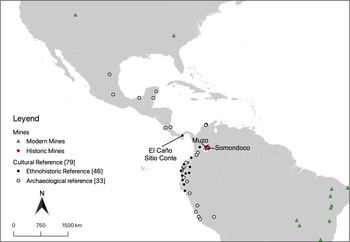


Archaeological data and ethnohistoric references provide evidence of the utilization and trade of emeralds by Native Americans across a broad expanse of the American continent, spanning as early as 300 BC through the period of European colonization (Figure 1; Bray Reference Bray2022; Lothrop Reference Lothrop1937:189). In the specific context of Coclé, Panama, emerald-like stones have been documented among the grave goods in funerary deposits at Sitio Conte and, more recently, in El Caño, dating back from the eighth to tenth centuries AD (Lothrop Reference Lothrop1937:186–191; Mayo and Mayo Reference Mayo and Mayo2013). The geological origins of these artifacts have been hypothesized, suggesting that they originated from regions such as Costa Rica, Colombia (particularly the Muzo region), and Ecuador, indicative of long-distance exchange across the area. These attributions are primarily based on geographic proximity, ethnohistoric documents, and technological stylistic similarities (Lothrop Reference Lothrop1937:186–191; Mason Reference Mason1949:88). A hypothetical local origin for these stones has yet to be proposed, as there are only scattered rumors regarding the existence of emeralds in the isthmus, centered in the Darién region and the north coast near Colón (Verrill Reference Verrill1921:205). However, no gemological or chemical analyses have been conducted to identify these archaeological stones as emeralds. Without such analyses, their authenticity remains unverified, impeding provenance evaluation.
Distribution of archaeological and ethnohistorical references to emeralds, highlighting the origin of samples from El Caño and Sitio Conte, and the potential provenance of geological sources. (Color online)

Emeralds, a variety of beryl characterized by the chemical formula Be3Al2(SiO3)6, have a green hue due to the presence of chromium, vanadium, and iron, which are the chromophore elements. These gems are relatively rare globally, with only a few significant geological deposits identified in Colombia and Brazil on the American continent. Also, infrequent geological discoveries have been made in the United States and Canada (Giuliani et al. Reference Giuliani, Groat, Marshall, Fallick and Branquet2019). Of the American emerald deposits, only the Colombian deposits have a long mining record (Brazeal Reference Brazeal2014). In contrast, knowledge of Brazilian geological deposits and those found in the United States and Canada is relatively recent, dating back to the late nineteenth and twentieth centuries. In most cases, the chemical fingerprints of emeralds are well documented, aiding in comparison with archaeological samples in provenance studies.
Numerous studies have investigated historical emeralds from Old World collections. They have employed spectroscopic techniques and microscopic observations, yielding consistent and accurate results (Karampelas et al. Reference Karampelas, Gaillou, Herreweghe, Maouche, Hennebois, Leblan and Sainte Beuve2022; Nikopoulou et al. Reference Nikopoulou, Karampelas, Gaillou, Hennebois, Maouche, Herreweghe and Papadopoulou2023; Schmetzer and Gilg Reference Schmetzer and Gilg2022). In contrast, research on the provenance of hypothetical archaeological emeralds remains limited on the American continent, despite important archaeological discoveries in Colombia (ancient Muisca territories, El Cauca Valley, and Nariño), Panama, and Ecuador (primarily linked to the La Tolita-Tumaco culture) (Banco Central del Ecuador 1998; Bray Reference Bray2022; Lleras-Pérez Reference Lleras-Perez1997). The scarcity of studies within the context of ancient America could lead to incorrect interpretations of archaeological data, and key aspects such as identification, provenance, consumption, circulation, and chronology might be misinterpreted. Consequently, applying scientific methods in new research can improve our understanding of the cultural importance these gemstones held for societies across the American continent. Therefore, the main aim of this study is to determine whether the stones found at Sitio Conte and El Caño are emeralds. Once confirmed, their geological origin and manufacturing location will be examined. By identifying these materials and tracing their provenance and manufacturing origins, this study could contribute to understanding the cultural and economic significance of these artifacts for the societies associated with El Caño and Sitio Conte. Moreover, the findings can provide insight into broader patterns of regional interaction in ancient Central and South America.
The working hypothesis proposes that the analyzed samples are emeralds, likely originating from Colombian geological sources. This hypothesis is supported by the relative proximity of Colombia’s emerald geological formations to the archaeological sites where the samples were found. These formations represent the closest known sources of emeralds. Furthermore, archaeological evidence suggests that these geological deposits were exploited during periods corresponding to the occupations of El Caño and Sitio Conte. The methodological framework employed in this study, including microscopic and spectroscopic analyses, in principle, can support an accurate evaluation of this hypothesis.
Archaeological Context, Materials, and Methods
Geographical, Cultural, and Archaeological Context
The study materials were discovered during excavations at El Caño (Mayo Torné Reference Mayo Torné2020a, Reference Mayo Torné2020b) and the neighboring Sitio Conte (Lothrop Reference Lothrop1937; Mason Reference Mason1949). Both funerary sites are located on Panama’s Pacific coast, within an alluvial plain near the mouth of the Rio Grande in Parita Bay (Figure 1). The region is part of the Panamanian Dry Arc, characterized by a savanna landscape with two distinct seasons: a dry season and a rainy season. These two sites are the focal point of a culturally rich region traditionally known as Gran Coclé. This area represents one of the three distinct cultural zones identified by archaeologists within the isthmus of Panama over the past 2,000 years of the precolumbian era (Cooke Reference Cooke, Cooke, Hoopes, Quilter and Saunders2011). These territories are integral to the Isthmo-Colombian Area, a vast cultural macroregion from Honduras to southern Colombia. Within this territory, diverse native populations share a common genetic and linguistic heritage, alongside an indigenous cultural evolution that has been relatively uninfluenced by external forces since the conclusion of the Pleistocene era (Hoopes Reference Hoopes2005; Hoopes and Fonseca Reference Hoopes, Fonseca, Quilter and Hoopes2003).
The Sitio Conte and El Caño tombs are notable for containing multiple burials of individuals of varying social statuses, with one in each tomb accompanied by a greater quantity and variety of grave goods. These high-status individuals were given special treatment, being shrouded and placed atop the bodies of others, typically in the center of the tomb. Some researchers think that some tombs belong to high-status individuals with their attendants (Herrerín et al. Reference Herrerín, Mayo Torné, Mayo Torné, Guinea, Hervás and Fernández-Valmayor2018:201; Lothrop Reference Lothrop1937; Mayo and Mayo Reference Mayo and Mayo2013; Mayo Torné et al. Reference Mayo Torné, Torné, Bueno, Herrera and Herrerín López2016), and in the specific case of tombs with two individuals buried with high-status symbols, they were “chiefs and warriors slain in a single battle (Mason Reference Mason, Orhser and Simonpietri1942:105).” Other researchers, meanwhile, believe that the burials are chiefs with their prisoners of war (Linares Reference Linares1977:72). After two decades of research at El Caño, we conclude that the reverence and commemoration of ancestors were central to the religious practices of ancient Coclé between approximately AD 750 and 1000. The funerary rituals documented at El Caño can be situated within a broader tradition of ancestor veneration in the Mesoamerican and Andean regions, as discussed by Matsumoto (Reference Matsumoto and Shimada2013) and McAnany (Reference McAnany2014, Reference McAnany, Hill and Hageman2016).
The archaeological materials accompanying these burials are considered works of art. This is due to the technical quality, originality, and rich iconography of bone, stone, ceramic, and gold (Lothrop Reference Lothrop1937, Reference Lothrop1942; Mayo Torné Reference Mayo Torné2020b, Reference Mayo Torné2021). In the case of the most prominent high-status tombs, there could be thousands of archaeological artifacts, some of which are naturally seen as products of trade with neighboring regions, such as manatee ribs, shells, or megalodon tooth fossils (Cooke and Sanchez Reference Cooke and Sanchez2001; Lothrop Reference Lothrop1937). Other artifacts, such as pyrite mirrors or translucent green stones (the focus of this analysis), are likely to have originated from more distant areas (Mayo Torné et al. Reference Mayo Torné, Torné, Hernández, Zamora, Gutiérrez, Ceballos, Jaén, Denvers and Tísoc2025).
The discovery of these large numbers of archaeological materials in the tombs of El Caño and Sitio Conte reveals a marked dynamism in craft production, carried out mainly by experienced specialists (Mayo Torné Reference Mayo Torné2021, Reference Mayo Torné2022), and a particular interest in exchanging exotic products. This local craft production, along with the exchange of exotic goods, was encouraged and promoted by the ruling elite, which provoked unique economic dynamism during ancient times in the region. It can be seen in the significant accumulation of goods to cover the demand for funeral celebrations and the exclusivity of some objects, such as mirrors, particular gold items, and translucent green stones.
The Translucent Green Stones Found in Cocle in Its Archaeological Context
The following is a description of the translucent green stones found in Coclé. Radiometric analysis of the charcoal samples provided calibrated dates for these samples (Table 1).
Emeralds from El Caño and Associated AMS Radiometric Dates.

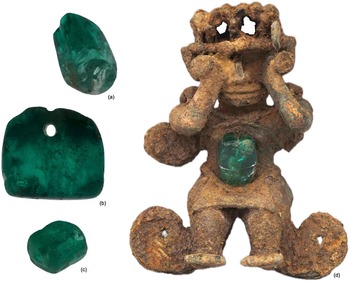
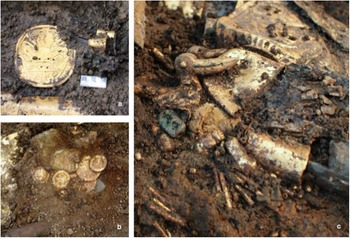
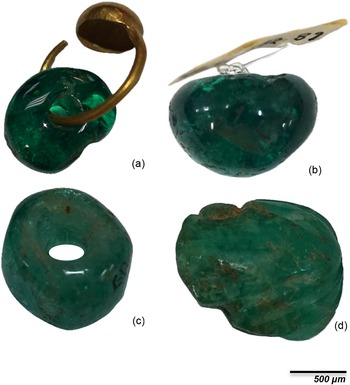
Artifact 7644. Quadrangular prism stone weighing 12.4 grams (Figure 2b; http://oda-fec.org/nata/view/cm_view_virtual_object.php?idov=961&seleccion=1). It was originally mounted in a copper pendant in the form of a spider, representing the insect’s abdomen. The stone features two intersecting cylindrical perforations, each with a diameter of 3 mm. One perforation runs parallel to the crystallographic c-axis, while the other is perpendicular to it, intersecting at the center of the piece. On the side where the stone was set into the pendant, three vertical, parallel cuts are visible. Their symmetry suggests that these are deliberate incisions, not remnants of earlier perforation attempts. The surface of the stone is both glossy and rough, with visible cracking in certain areas. Artifact 7644 was recovered from Tomb T6 (Figure 3b), a burial context that was later disturbed by the excavations of Tombs T1 and T2.
Archaeological emeralds found in El Caño: (a) Emerald 9288 (22 × 13 × 10 mm); (b) Emerald 7644 (22 × 24 × 11 mm); (c) Emerald 1116 (13 × 11 ×x 13 mm); (d) Emerald 11149 (15 × 11 × 9 mm). (Color online)

Fieldwork photographs of emeralds: (a) 11149 found in Tomb 4 (emerald 11161 was found below); (b) emerald 7644 from Tomb 6; (c) emerald 9286 from Tomb 2. (Color online)

Artifact 9286. Triangular prism-shaped stone weighing 4.3 grams (Figure 2a; http://oda-fec.org/nata/view/cm_view_virtual_object.php?idov=942&seleccion=1). It exhibits a cross-shaped perforation consisting of a biconical hole (3 mm in diameter) that transverses the upper portion laterally, and a second, larger biconical perforation (5 mm in diameter) aligned parallel to the longitudinal axis. This second perforation intersects and passes through the center of the upper hole. Additionally, a longitudinal groove with semicircular or channel-like characteristics is present, likely the result of a failed drilling attempt that caused the stone to fracture—an error in execution. Similar manufacturing traces have been observed on green stones 7644 and 11149, suggesting a recurrent technical challenge in the production of such artifacts. The surface of artifact 9286 appears smooth and lustrous to the naked eye. It was recovered as part of the funerary assemblage associated with Individual 7, a high-status adult male interred in Tomb T2 (Figure 3c).
Artifact 11149. Ellipsoidal stone set at the abdominal level of a copper pendant shaped in the form of a woman (Figure 2d; http://oda-fec.org/nata/view/cm_view_virtual_object.php?idov=1012&seleccion=1). It features two slightly misaligned cylindrical perforations that extend from opposite sides toward the center, parallel to the crystallographic c-axis. Each perforation reaches approximately halfway through the piece. The perforation mouths are ellipsoidal rather than circular, measuring 4.93 × 4.5 mm on one side and 6 × 4.5 mm on the other. Moreover, a longitudinal groove with semicircular morphology is present. This feature runs parallel to the internal perforations and aligns with the abdomen of the copper pendant. It is only visible when the stone is removed from its mount and appears to result from a failed drilling attempt. A further diagnostic feature is a perimeter incision that encircles the belly of the stone, following a tangential path relative to the longitudinal axis and the main perforation. The surface of artifact 11149 appears smooth and lustrous to the naked eye, consistent with other worked greenstones in the assemblage.
Artifact 11161. Pentagon-shaped and weighs 2.4 grams (Figure 2c; http://oda-fec.org/nata/view/cm_view_virtual_object.php?idov=1461&seleccion=1). It has a cylindrical perforation that crosses through the center parallel to its c-axis, with a diameter of 3 mm on one side and 2.5 mm on the other. Its surface was opaque and rough to the naked eye. Regarding their context, artifacts 11149 and 11161 are part of the mortuary ensemble of the highest-status individual (Individual 1) in tomb T4 (Figure 3a). Artifact 11149 was found between his chest and head, next to two tusk-shaped pendants, on top of a double copper pendant, and 11161 was found beneath it.
Artifact 40-13-2. Quadrangular prism-shaped. It was set in a gold pendant representing a feline (https://www.penn.museum/collections/object/16330). It has no perforations, and the surface is opaque and rough to the naked eye. Emerald 40-13-27 is associated with the primary occupant of Burial 11, excavated by Mason (Reference Mason1949) at Sitio Conte, buried with a large quantity and variety of high-status objects (plaques, pectorals, bracelets, a belt of spherical gold beads, necklaces, gold and stone ear ornaments, and earrings, among others). The pendant was found on one of the pectorals, very close to the belt, at the level of the lord’s abdomen (Hearne and Sharer Reference Hearne and Sharer1992:12).
Other Translucent Green Stones Were Found in Coclé. Besides the five stones analyzed in this work, three others were found in Tomb 26 at Sitio Conte. The sample 33-42-20/1605 is quadrangular prism-shaped and weighs 37.8 grams (https://collections.peabody.harvard.edu/objects/details/287724?ctx=6a266bd5b0f22afffa086cc5db93d620724ddf68&idx=0). It was set on a gold pendant in the shape of a squid. It features seven conical perforations arranged at different heights, a cross-shaped perforation consisting of three perforations at the same height, and one slightly misaligned compared to the others, which do not coincide in the center due to the natural cavity in the stone at this point. Additionally, there were three more conical perforations at varying heights. All perforations (the cross-shaped perforation was composed of four perforations, and the perforations that did not penetrate through the piece) had a 3 mm diameter at the mouth. The surface was opaque and rough to the naked eye. Artifact 33-42-20/1605 was found in Deposit XVI of Tomb 26 at Sitio Conte (Lothrop Reference Lothrop1937:Figure 247).
Artifact 33-42-20/1685 is hexagonal and weighs 22.3 grams. It was shaped like a crocodile in a gold pendant. It features a cross-shaped perforation comprising two conical perforations with a diameter of 3 mm, no alignment, and a longer tubular perforation that traverses the center, following a path parallel to its longitudinal axis, which is aligned with the fourth conical perforation. The four perforations connect at the tip and have a diameter of 3 mm at the mouth. The surface is opaque and rough. Artifact 33-42-20/1685 was found in Deposit XI of Tomb 26 at Sitio Conte (Lothrop Reference Lothrop1937:Figure 246).
Artifact 33-42-20/1709A is an object lacking a geometrically defined form (https://collections.peabody.harvard.edu/objects/details/304032?ctx=bcad15306f2aaed53a079c655d2a311757e16d16&idx=0). It has a biconical perforation, with two aligned conical perforations. The surface is opaque and rough. Artifact 33-42-20/1709A was found in Deposit XIV of Tomb 26 along with a gold bead, a pair of artifacts set in gold, a perforated dog tooth, two bone beads, two perforated shark teeth, and an arrow point (Lothrop Reference Lothrop1937:273).
The eight pieces described are the only known stone-like emeralds found in Coclé. Another sample, not included in this study, observed by Lothrop in an antique store in Panama City (Lothrop Reference Lothrop1937:186), is presumed to come from a tomb excavated in Los Santos province. However, the authenticity of the gem’s origin remains unverifiable.
There is no known record of the use of emeralds among Native Americans in Panama. Therefore, it can be concluded that their presence on the isthmus is rare and ascribed to a specific geographical context and historical period, coinciding with the use of the necropolises of El Caño and Sitio Conte.
Methods
The samples recovered from El Caño (Figure 2) were subjected to an analytical protocol, including microscopy, portable X-ray fluorescence (pXRF), and other spectroscopic techniques (FTIR, UV–Vis–NIR, and photoluminescence). These analyses aim to evaluate the geological and chemical composition of the stones. Due to logistical limitations, the sample from Sitio Conte was analyzed exclusively using pXRF. All analyses were conducted using nondestructive methods.
Microscopic Observations. Microscopic observations can offer insights into the origin of samples by examining their inclusions. The examinations were conducted using a Zeiss STEMI 508 stereo microscope equipped with an attached Axion Cam camera. The ZEN 3.5 software was used in this process, allowing for precise inclusion measurements. However, it is noteworthy that the investigation faced challenges, resulting from numerous cracks in the samples, the fact that some emeralds are mounted on metal objects, and the low transparency of many specimens.
Portable X-Ray Fluorescence. The pXRF is a technique used for characterizing the elements on the surface of samples with some limited penetration depth (typically a few tens of microns). The analyses were conducted using a Bruker Titan S1 pXRF instrument equipped with an X-ray excitation source and a secondary electron detector, featuring a 5 mm collimator. The chemical elements that can be evaluated range from manganese to uranium. Therefore, the identification and quantification of beryllium is outside the detection range of the equipment, as it is a very light element. The analyses focused on evaluating the presence and values of the chromophore elements in the emeralds: iron, chromium, and vanadium. The studies were performed using the Geomining Library configuration in three phases, each lasting 199 seconds. The excitation sources used were voltages (kV) and currents (μA) in each of the phases: 30 kV and 27.9 (μA) in phase 1, 50 kV and 27.2 (μA) in phase 2, and 15 kV and 22.2 (μA) in phase 3. The orientation was always perpendicular to the c-axis, aiming to identify the most regular zones of the samples as far as possible. At least three measurements were taken for each sample, and the results were averaged. Quantification was calculated in parts per million (ppm).
Other Spectroscopic Analyses. In addition to the pXRF analyses, a variety of analytical techniques were employed, enabling a more robust evaluation of the samples’ geological origin. FTIR analyses were performed using a SHIMADZU IRAffinity-1S in specular reflectance and transmittance modes. The procedure included baseline correction, which eliminated the influence of environmental variations on the analyses. The results were computed by averaging 50 spectra with a resolution of 4 cm-1. The spectral band averaged between 350 and 7,800 cm-1. The orientation of the samples was perpendicular to the c-axis. Photoluminescence is used in gemology to distinguish between natural and synthetic emeralds. It has recently been evaluated as a tool to determine the origin of gems, serving as a supplementary technique to infrared spectroscopy, Raman spectroscopy, and ultraviolet spectroscopy (Thompson et al. Reference Thompson, Kidd, Astrom, Scarani and Smith2014:334). Analysis was performed using an ASEQ Instruments LR1-B with a 405 nm laser, with an aperture of 50 ms and an average of 50 measurements. Finally, UV-Vis-NIR analysis was performed using a UV-1,800 Shimadzu instrument with a nominal bandwidth of 1 nm. The spectral region acquired was 190–1,100 nm. The spectra were processed using Origin Lab software.
Results of the Analyses
Microscopic Observations
Emeralds are translucent stones with inclusions, colloquially known as emerald gardens. These inclusions have been utilized in traditional gemology to distinguish between synthetic and geological samples, as well as to evaluate geological origin. Microscopic observation of the emeralds found in El Caño enabled us to identify a type of inclusion known as multiphase (Figure 4a), characterized by a combination of solid matter, gas, and fluids. These inclusions have traditionally been associated with Colombian emeralds in classical gemology. However, similar features have been observed recently in samples from other localities (Saeseaw et al. Reference Saeseaw, Pardieu and Sangsawong2014). Finally, the typical Colombian dark inclusion from the black shale host rock (Saeseaw et al. Reference Saeseaw, Renfro, Palke, Sun and McClure2019:619–620) was absent in the samples from El Caño, unlike in other archaeological samples from Ecuador or Colombia (Figures 4b and 4c).
Microscope emeralds images: (a) emerald from El Caño with two-phase (liquid and gas) and three-phase inclusion (liquid, gas, and solid); (b) emerald from Quimbaya Culture with dark inclusion (from black shale host rock) and possible pyrite inclusion; (c) emerald from La Tolita-Tumaco Culture with black shale inclusion. (Color online)

Spectroscopic Analyses
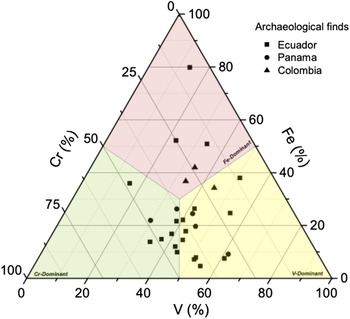
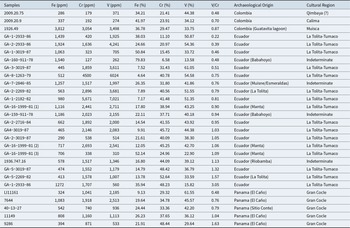
Portable X-ray Fluorescence. As previously mentioned, emeralds are a variety of beryllium aluminosilicates, and their characteristic green color is produced by vanadium, chromium, and iron. Fluorescence analysis revealed the presence of these chromophore elements, and their concentrations were similar to those in samples of Colombian origin. The results show that low iron values (approximately 1,000 ppm or lower), a low V/Cr ratio (Table 2), and a ternary plot of the relative concentrations of the chromophore elements are similar to those of Colombian emeralds (Figure 5; García-Toloza et al. Reference García-Toloza, Angarita, Alvarado, González-Durán and Cedeño2021; González-Durán et al. Reference González-Durán, García-Toloza, Cedeño-Ochoa and Angarita2019:221), with three likely originating from the Eastern Emerald Belt (EEB; V-dominant) and two from the Western Emerald Belt (WEB; Cr-dominant). Data on the concentrations of chromophore elements in emeralds from Panama and other archaeological sites in Colombia and Ecuador suggest that the samples probably came from the two Colombian emerald belts. It is essential to note that the data may present some degree of measurement uncertainty; therefore, it is recommended that a previous calibration with reference materials be performed for precise quantification in the future.
Ternary graph showing the relative concentrations of the chromophore elements of the materials analyzed from El Caño and Sitio Conte. The results of the analysis of archaeological samples from Colombia and Ecuador used in the technological analysis are also presented. (Color online)

Geochemical Composition and Relative Elemental Ratios of Emerald Samples Analyzed by pXRF.

UV-Vis-NIR Analyses. Results were of sufficient quality for samples 7644 and 9286 in the transmittance mode (Figure 6). In both cases, the spectra, recorded in transmittance mode, exhibit reduced transmittance (i.e., absorption bands) around 420–430 nm and 610 nm, corresponding to Cr3+ and V3+ electronic transitions. No significant absorption features were detected near 370 nm or 830 nm, which are associated with Fe3+ and Fe2+, respectively. A pronounced minimum in transmittance is observed at ∼970 nm (particularly in sample 7644), attributed to water molecules. These data relate to bibliographic references of Colombian emeralds with low iron content compared to those in other regions (Jimenez Guevara Reference Jimenez Guevara2017:84; Van Meerbeeck Reference Van Meerbeeck2010:74).
UV-Vis-NIR transmittance spectra of two samples from El Caño. (Color online)

FTIR Analyses. Specular reflectance FTIR analyses were relatively clean in the region between 2,000 and 3,000 cm-1 and very noisy in the other areas, where spectra could not be interpreted reliably. In this region (2,000–3,000 cm-1), peaks are observed around 2,360 cm-1, corresponding to CO2 bands, which are visible in Colombian gems (Ruiz et al. Reference Ruiz, Toloza, Bastidas and Serna2021:26).
The transmittance spectra were satisfactory, especially for sample 7644 (Figure 7), where readings were taken across the entire spectral region of interest. Well-defined peaks were observed at 2,351 cm-1 (CO2), 2,474 cm-1, 2,640 cm-1, 2,671 cm-1, and 2,684 cm-1 for deuterated water (2H2O), and approximately 2,814 cm-1, which is possibly associated with hydrochloric acid (HCl), present in Colombian emeralds (Cedeño et al. Reference Cedeño, Herreño, Fotaleche and Jiménez2015:96; Karampelas et al. Reference Karampelas, Al-Shaybani, Mohamed, Sangsawong and Al-Alawi2019:19). The region between 5,000 and 7,000 cm-1 of the transmittance spectrum for Emerald 7644 is also very informative. A peak at 5,272 cm-1, linked to type II water, and another around 5,433 cm-1, linked to type I water, were noted. Finally, the strong excitation at wavenumber 6,815 cm-1 can be attributed to type I water. This excitation is related to the low alkalinity in the gem-forming environment typical of Colombian emeralds (Ruiz et al. Reference Ruiz, Toloza, Bastidas and Serna2021:27).
The transmittance FTIR spectra of emerald 7644 (top) are expanded to show two interesting regions (bottom): the region from 2,000 to 4,000 cm-1 (left) and from 4,000 to 7,000 cm-1 (right).

Photoluminescence Analysis. The excitation bands observed in the spectra of all analyzed samples correspond to the presence of chromium (Cr+3). These appear faint around 680 nm, pronounced and sharp in the R1 region, and broader at the 720 and 740 nm regions (Figure 8). The position of the R1 line in all samples, below 383.9 nm, is consistent with a non-schist geological origin, in agreement with data from Colombian emerald deposits (Thompson et al. Reference Thompson, Kidd, Astrom, Scarani and Smith2014:336). Additionally, in all samples from El Caño, except for sample 7644, the R1 line was located at 383.8 nm, values reported for emeralds from the EEB (García-Toloza et al. Reference García-Toloza, Herreño-Daza, González-Durán, Cedeño-Ochoa and Angarita-Sarmiento2019:933).
Laser-excited PL spectra of four samples from El Caño. (Color online)

Typological Classification of Archaeological Emeralds in the Isthmo–Colombian Area and Ecuador
The Coclé area is one of the known areas of emerald consumption in the Isthmo-Colombian region. Other important places include the Muisca territory, the Cauca River Valley, the coast, and the Ecuadorian Andes. There are typological differences in the way these emeralds have been worked, and they are often linked to their archaeological origins. Therefore, the typological classification of gems based on technological criteria can provide information about the manufacturing location. With this in mind, a typological classification of emeralds, including the Coclé gems, is presented. These 22 emeralds were concluded to be emeralds based on microscopic observation and the result of the pXRF analysisFootnote 1: 18 emeralds from Manta and La Tolita-Tumaco Cultures housed in the Museum of Art and Anthropology of Guayaquil (MAAC), two emeralds from Cambridge University found in the Guatavia Lagoon (Muisca Region) and Riobamba (Ecuadorian Andes), and two emeralds presumably from the Cauca Valley under the custody of the Walters Museum.Footnote 2 The relation between the emeralds’ shape and the perforation type was observed. The similarity of the sample sets was determined using Jaccard’s coefficient, and the data were processed using RStudio software. Emeralds were grouped into nine clusters (Figure 9), as follows.
Technological cluster classification of archaeological emeralds from Ecuador, Colombia, and Panama based on Jaccard distance.

Cluster 1: This group includes spherical emeralds with V-shaped perforations, characterized by smooth and shiny surfaces. The emeralds in this group are GA1-2182-82 (Figure 10b), GA-160-911-78, GA-1-3019-87, GA-2-2269-82, and GA-5-3019-87, attributed to the La Tolita-Tumaco culture from MAAC. This group also includes the emerald from GA-159-911-78 from Hacienda La Compañía, Babahoyo (Los Ríos).
Archaeological emeralds at the Anthropological and Contemporary Art Museum of Guayaquil: (a) emerald from Cluster 2; (b) emerald from Cluster 1; (c) emerald from Cluster 5; (d) emerald from Cluster 4. (Color online)

Cluster 2: This group comprises discoidal, spherical, and elliptical emerald beads characterized by linear perforations and smooth, lustrous surfaces. Two of the beads exhibit marks from earlier, possibly failed, perforation attempts, and four are part of a gold ring setting. The emeralds in this group include GA-5-2269-82, GA-16-1999-81B (Figure 10a), GA-16-1999-81C, GA-8-1263-79, GA-7-2846-85, and GA-16-1999-81A, all attributed to the La Tolita-Tumaco culture and housed in the MAAC collection. Also included in this cluster are emerald 1936.747.6, reportedly from Riobamba in the Ecuadorian Andes, and currently curated at the Archaeological and Anthropological Museum of the University of Cambridge (https://collections.maa.cam.ac.uk/objects/594911/?query=EMERALD&page=2), and emerald 11149, recovered from El Caño.
Cluster 3: This group includes emeralds that exhibit slight modification, with their original morphology still discernible. They feature intersecting perforations indicative of intentional working. The cluster involves two specimens from El Caño (Artifacts 9286 and 7644) and two from Sitio Conte (33-42-20/1605 and 33-42-20/1685). The El Caño emeralds also display traces of aborted or incomplete perforation attempts, while specimen 33-42-20/1605 from Sitio Conte exhibits additional blind perforations, suggesting complex or unfinished manufacturing processes.
Cluster 4: This group consists of figuratively shaped emeralds featuring perforations and smooth, glossy surfaces. This is represented in the sample by a single specimen: a frog-shaped emerald (Figure 10d; MAAC: GA-2-2933-86), attributed to the La Tolita-Tumaco culture and housed in the MAAC collection.
Cluster 5: This group includes slightly worked emeralds with a linear perforation. This group includes the emerald GA-2-2716-84 attributed to the La Tolita-Tumaco culture at the MAAC (Figure 10c); the Calima emerald 2009.20.9 in the Walters Museum (https://art.thes.org/detail/80164/emerald-bead/), the emerald from El Caño 11161, and emerald 33-42-201709 from Sitio Conte.
Cluster 6: Unmodified emeralds with two V-shaped perforations. This group includes emerald 2009.20.75 (Walters Museum) from the El Cauca Valley, Colombia (https://art.thewalters.org/detail/80230/tubular-bead-necklace-and-emerald-pendant/).
Cluster 7: Unmodified Emerald. This cluster comprises a Muisca emerald from the Cambridge collection, reportedly recovered from the Laguna de Guatavita. The specimen is currently housed in the Archaeological and Anthropological Museum of the University of Cambridge (https://collections.maa.cam.ac.uk/objects/545624/?query=EMERALD&page=2).
Cluster 8: This is an emerald from Sitio Conte 40-13-27 with rough and opaque surfaces, intuited original shape, without perforations, and inserted in a gold pendant.
Cluster 9: This group comprises unperforated emeralds shaped as figurative forms, characterized by smooth and lustrous surfaces. It includes three frog-shaped figures (GA-1-2933-86, GA-2-3019-87, GA-3-3019-87) and one bird-shaped figure (GA-4-3019-87), all attributed to the La Tolita-Tumaco culture.
This classification has helped characterize the emeralds categorized here, and the results provide insight into their places of manufacture. For example, some pieces analyzed in this article have unique relations between their technological features and archaeological origins. In the case of the analyzed pieces from Ecuador, ranging from the coastal to the Andean region, there are tiny geometric beads corresponding to Cluster 1, as well as animal-shaped emeralds associated with Clusters 4 and 9, which have no known parallels elsewhere. The beads are gleaming, indicating that they were highly polished and, in some cases, have V-shaped perforations (Cluster 1). This particularity attracted the attention of the Spanish chroniclers during the colonial period (Juan and de Ulloa Reference Juan and de Ulloa1748). This type of perforation is also present in the region, as seen in shell and stone artifacts.
Other examples linking archaeological emeralds and technological features include the unmodified emeralds found in the Guatavita lagoon (Cluster 7) and those in Cluster 3, located in Cocle. The emerald from Guatavita is typical of the Muisca Region, where archaeologists usually find unaltered emeralds in tombs and other sacred places (Bray Reference Bray2022; Lleras-Perez Reference Lleras-Perez1997). Cluster 3 consists of emeralds found exclusively in Panama, characterized by crossed perforations. It serves as evidence, at least in the case of Cluster 3, of local emerald manufacturing in Cocle. Other groups, such as Clusters 2 and 5, include emeralds originating from diverse locations and may have been imported either in their original form or with subsequent modifications.
Discussion
Research into the chemical and gemological aspects of emeralds recovered from precontact archaeological sites has been notably limited, with only a few sporadic studies providing brief insights into samples lacking contextual information or with poor technical reference (Laurs and Quinn Reference Laurs and Quinn2002; Shimada and Griffin Reference Shimada and Griffin1994; Whittington and Vose Reference Whittington and Vose1998). The results presented in this study represent, therefore, a pioneering effort to characterize precontact archaeological emeralds in the American Continent and make a significant contribution to understanding their importance for native populations. Despite the existing limitations, such as the lack of a laboratory in Panama with specialized equipment for the study of gemstones and the difficulty of sending the study samples to laboratories abroad due to the legal protection of this type of samples in the country, the results of analyses of samples from El Caño and Sitio Conte are significant. This study provides archaeologists with a valuable framework to assess the emerald exchange networks in the Isthmo-Colombian Area with a certain degree of confidence.
The analyses reveal that all samples are indeed emeralds from Colombia. The geological characteristics of the Colombian gems are unique. Unlike many deposits worldwide, they are found in a sedimentary rock environment with no connection to metamorphic rocks in their formation (Giuliani et al. Reference Giuliani, Groat, Marshall, Fallick and Branquet2019:30). Compared to other primary worldwide sources, such as Brazilian emeralds, they have a low concentration of iron and alkali minerals. Therefore, the iron concentration is a reliable marker for distinguishing Colombian emeralds from those originating elsewhere (Cedeño et al. Reference Cedeño, Herreño, Fotaleche and Jiménez2015:93). Additionally, the type of water and the ratio of vanadium to chromium have significant meaning.
Within Colombia, emerald deposits are concentrated in two belts located relatively close to each other in the Eastern Cordillera of the Andes. These are the WEB, which includes the renowned Muzo mines, and the EEB, corresponding to the Chivor (Somondoco) mines. These two zones exhibit differences in the composition of the host rocks, the geological age of formation, and the tectonic setting of mineralization, which is reflected in the characteristics of the gems and their geochemistry (García-Toloza et al. Reference García-Toloza, Herreño-Daza, González-Durán, Cedeño-Ochoa and Angarita-Sarmiento2019:931). For example, iron concentration levels generally differ between the emerald deposits; notably, the Muzo-Quipama district within the WEB exhibits higher iron values. Additionally, vanadium-to-chromium ratios can assist in provenance determination, with high chromium concentrations characteristic of EEB samples and elevated vanadium levels typical of WEB samples (Cedeño et al. Reference Cedeño, Herreño, Fotaleche and Jiménez2015:95).
The determination of Colombian provenance, as evident in the analysis results, is well supported in this study by a combination of chemical analytical methods, including FTIR analysis to evaluate water type and alkalinity, UV-Vis-NIR analysis of iron spectral behavior, and chromium luminescence emission analysis. Additionally, the consistency of the pXRF data and the photoluminescence R1 peaks with those documented in both the WEB and EEB of Colombia supports the association with the historically significant Muzo and Somondoco mining regions.
The Colombian origin is also substantiated by the proximity of documented emerald deposits in Colombia and archaeological evidence indicating mining activities in the eastern Andean region during pre-Columbian times in both emerald belts. The temporal alignment of the archaeological occupation of the El Caño and Sitio Conte sites and the emerald mining activities reinforces the linkage between the emeralds found in the Coclé and Colombian sources.
The Colombian emerald deposits (located more than 700 km in a direct line from El Caño and Sitio Conte) raise important questions concerning the mechanisms of transport, the nature of exchange (whether direct or mediated), and the sociopolitical factors that may have facilitated such interactions during the precontact period. Addressing these issues requires a multifaceted approach, including the analysis of ethnohistoric sources, technological studies of manufacturing techniques, GIS-based modeling of cost-efficient exchange routes, chronological assessments of relevant contexts, and the characterization of materials involved in long-distance exchange. While each line of evidence presents methodological and interpretive challenges, together they could offer a framework for more comprehensive future investigations. Meanwhile, this study provides archaeological data that informs this discussion.
For example, it is unlikely that the emeralds found in Panama arrived through direct long-distance trade involving specialist merchants. There is no archaeological evidence of such practices among the Chibcha populations of the Eastern Andes or the inhabitants of the Coclé region. A more plausible scenario is trickle-down trade, documented in sixteenth-century sources (Bray Reference Bray2022:78), which involved coastal populations of northern Colombia and the Magdalena River basin. This suggests a situation in which emeralds reached Panama through regional networks of interaction and exchange among diverse groups. However, technological parallels observed in this study, particularly in emeralds from clusters 2 and 5, indicate that some specimens may have been worked in Ecuadorian contexts (Lothrop Reference Lothrop1937:189–190) before being transported to Coclé. In such a case, long-distance merchants like Mindalaes—an elite trading group from southern Colombia and northern Ecuador—could have played a key role in the circulation of these goods (Bray Reference Bray2022:78).
The exchange networks, such as those mentioned in the chronicles, were probably activated by the use and demand for emeralds by the inhabitants of the Ecuadorian coast, where the earliest archaeological samples have been identified.Footnote 3 At the beginning of the eighth century, the Chibcha peoples of the highlands, whose territories of influence included numerous emerald deposits, began consuming these gems extensively (Langebaek Reference Langebaek1987:108–109). The Muiscas used them as part of their offerings, in their funerary rituals, and in jewelry, which probably originated and promoted the mining boom and the consequent specialization of mining techniques. Therefore, the demand for emeralds in funerary and religious rituals stimulated the search and exploitation of these resources, increasing the volume of finds. At the same time, the surplus resulting from mining specialization promoted commercialization and exchange with neighboring populations. The development of emerald trade expanded rapidly, with emeralds reaching Panama around AD 800, coinciding with the use of El Caño and Sitio Conte as funerary sites. The archaeological evidence of emerald routes covers a vast territory extending from central Panama southward to regions beyond the cultural periphery of the Isthmo-Colombian Area in Ecuador and the northern coast of Peru, with existing archaeological evidence of emeralds exchange in tombs of the Sicán culture (Shimada and Griffin Reference Shimada and Griffin1994:85). During the sixteenth century, the transfer was so voluminous that there were even markets dedicated to its commercialization, such as Turmequé, mainly devoted to the exchange of this gem (Pérez de Barradas Reference Pérez de Barradas1951:122).
Indeed, the exchange of emeralds was favored by their intrinsic beauty, which included color, brightness, transparency, and uniqueness. The scarcity of known emerald deposits and their beauty made these stones highly valued prestige goods, especially for inhabitants of El Caño or Sitio Conte, where emeralds were exotic products alien to the local geology. However, the attractiveness and uniqueness of emeralds alone are insufficient to explain their widespread distribution in distant territories. The exchange networks and movement of emeralds to regions far from their origins demand consideration within a broader political and economic context. In this sense, alliances with shared interests among neighboring populations, redistributive systems facilitating the exchange of goods, and, in certain instances, the application of social and political domination could become crucial factors allowing the fluid transfer of these gems to remote zones. In this sociopolitical landscape, emeralds function not only as items with probable exchange value but also their role extends beyond mere transactions, likely functioning as symbolic tools in the formation and consolidation of alliances or tributary payments related to subjugation. Their use in diplomatic and economic contexts highlights the multifaceted roles that valuable commodities, such as emeralds, can play in shaping relationships, power dynamics, and regional interactions during the studied historical period. In this context, elites in the Isthmo-Colombian Area promoted regional trade of these gems.
In the specific case of Panama, emeralds have a well-contextualized, localized presence within a relatively short period, spanning from the eighth to the tenth centuries. Additionally, these examples represent the northernmost archaeological evidence of their use by Native Americans in the precontact period. However, they are not the only material associated with long-distance exchange networks in the region. Among the earliest examples of technological transmission are instances of goldsmithing, evidenced by the production of metal objects attributed to the Initial Group, active in the early centuries of the first millennium (Bray et al. Reference Bray, Cooke, Redwood, McEwan and Hoopes2021), and later artifacts stylistically linked to Quimbaya goldwork (Lothrop Reference Lothrop1937). The geographical position of Panama’s central chiefdoms, represented in the late periods by the sites of El Caño and Sitio Conte, played a prominent role in these exchange networks, facilitating the transfer of technology and goods in the region. These networks appear to have extended northward, as indicated by the presence of Maya objects at El Caño and goldsmithing artifacts from the isthmus found in the Mesoamerican region (Mayo Torné et al. Reference Mayo Torné, Torné, Hernández, Zamora, Gutiérrez, Ceballos, Jaén, Denvers and Tísoc2025). The impact of Sitio Conte and El Caño decreased after AD 1000, marking the beginning of a period of contraction in the contributions and influence of the central Panamanian chiefdoms within the exchange system. This regression is evidenced by the absence of some foreign products, such as emeralds or mirrors, which are no longer found in archaeological contexts in the region. Nevertheless, some of these exchange networks were active during the sixteenth century, when written records document the maritime trade of goods in the Pacific, including valuable Spondylus sp. shells (Caillavet Reference Caillavet, Cárdenas-Arroyo and Bray1998), and describe trade relations on the Caribbean coast (Castillero Calvo Reference Castillero Calvo1995; Ortíz et al. Reference Ortíz Díaz, Luís Ruvalcaba, Cockrell, McEwan and John2021).
Conclusion
The recent analysis of translucent green stones found at the El Caño site and in Sitio Conte, Panama, has provided insight into complex networks of interaction and exchange between the chiefdoms of the Isthmo-Colombian Area. By using pXRF, optical microscopy, and other spectroscopy techniques, the stones were identified as emeralds, with their geochemical fingerprints suggesting a likely origin in Colombia, possibly from both emerald belts where the historic mines of Muzo and Somondoco are located. The analyses confirm emerald exploitation dates and exchanges between the eighth and tenth centuries AD, corresponding with the burial dates at Sitio Conte and El Caño. Technological evidence suggests that at least the emeralds from Group 3 were modified locally. In contrast, the emeralds in Groups 2 and 5 may have been modified elsewhere.
The discovery of emeralds in El Caño and Sitio Conte has significant implications for understanding the social and economic dynamics in the area during that period. The presence of these gemstones, along with the accumulation of other prestigious goods, indicates the existence of chiefdoms in central Panama that held influential positions, amassed valuable items, exerted authority, and stimulated exchange networks in the region. The consumption of emeralds, therefore, offers useful insights into the socioeconomic evolution of the Isthmo-Colombian Area, highlighting the significant role of prestigious goods and their accumulation in shaping interregional interactions between societies during this period.
Future research in the region should emphasize provenance analyses based on archaeologically contextual materials. In parallel, investigations into craft production should be expanded to include detailed assessments of technological practices, degrees of technical skill, and evidence of specialization. This integrated approach will provide insights into the social and cultural significance of craft production in the Isthmo-Colombian Area, contributing to broader reconstructions of exchange networks and the nature of intergroup relationships in precontact times.
Acknowledgments
We wish to thank the Ministry of Culture of Panama and the Technological University of Panama for their institutional and technical support. We also thank the Penn Museum of the University of Pennsylvania (especially William Wierzbowski), the Department of Archaeological Collections of the Museo Antropológico y de Arte Contemporáneo de Guayaquil (EOD-MAAC), the Walters Art Museum (especially Ellen Hoobler), and the Museum of Archaeology and Anthropology, University of Cambridge (especially Eleanor Wilkinson) for granting permission to work with their collections. We want to thank Amalie Hipp for assisting with the grammatical revision of the original manuscript. The authors are members of the National Research System (SNI, Panama). All figures are courtesy of the authors.
Funding Statement
This work was supported by the National Secretary of Science and Technology of Panama (SENACYT), under grant PFID-FID-2021-166.
Data Availability Statement
Raw numeric data obtained during analysis are publicly available in the El Caño Archaeological Project repository: http://oda-fec.org/nata/view/cm_view_virtual_object.php?idov=3562&seleccion=1&idpadre=33&pes=rec.
Competing Interests
The authors declare none.